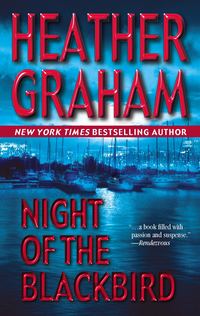
Kitabı oku: «Night Of The Blackbird»
Praise for New York Times Bestselling Author
Heather Graham
“Graham shines in this frightening tale. Paranormal elements add zing to her trademark chilling suspense and steamy romance, keeping the pages flying.”
—Romantic Times on Haunted
“Graham’s tight plotting, her keen sense of when to reveal and when to tease…will keep fans turning the pages.”
—Publishers Weekly on Picture Me Dead
“An incredible storyteller!”
—Los Angeles Daily News
“Demonstrating the skills that have made her one of today’s best storytellers, Ms. Graham delivers one of this year’s best books thus far.”
—Romantic Times on Hurricane Bay
“A suspenseful, sexy thriller…Graham builds jagged suspense that will keep readers guessing up to the final pages.”
—Publishers Weekly on Hurricane Bay
“A roller-coaster ride…fast-paced, thrilling…Heather Graham will keep you in suspense until the very end. Captivating.”
—Literary Times on Hurricane Bay
“The talented Ms. Graham once again thrills us. She delivers excitement [and] romance…that keep the pages flipping quickly from beginning to end.”
—Romantic Times on Night of the Blackbird
“With the name Heather Graham on the cover, you are guaranteed a good read!”
—Literary Times
HEATHER GRAHAM
NIGHT OF THE BLACKBIRD

First and foremost, with love for my mother
Violet J. Graham Sherman of County Dublin
for being Irish, for being a great mom.
In memory of Granny Browne and Aunt Amy
who taught me all about banshees and leprechauns—
at least, their versions of the tales.
For my cousin, Katie Browne DeVuono,
for being everything wonderful about the Irish.
For Victoria Graham Davant, my sister, my best friend,
for all that we share from the past and the present.
Contents
Prologue
Chapter 1
Chapter 2
Chapter 3
Chapter 4
Chapter 5
Chapter 6
Chapter 7
Chapter 8
Chapter 9
Chapter 10
Chapter 11
Chapter 12
Chapter 13
Chapter 14
Chapter 15
Chapter 16
Chapter 17
Chapter 18
Chapter 19
Chapter 20
Epilogue
Prologue
Belfast, Northern Ireland,
Summer, 1977
“All right, my son, my fine lad!” his mum said, bursting into his square little room without even knocking. “Your da has made it home, and we are going to the movies!”
The mother was flushed and eager. Her work-worn face was transformed into beauty, for her smile was a young girl’s smile, and brightness touched her eyes. He held his breath, barely able to believe. He wanted to go to the movies so badly. It was the new American film, making its debut downtown. At nine, he spent much of his time in the streets; few promises his parents made came to pass. Not their faults, just the way of the world, and there were many things that were the way of the world, or the way of his particular world, and that was just that, and he understood it. His father had his work, his mother had hers, and they had their time at the pub, as well, with their meetings and such. He was a tough kid, strong for his nine years, street smart and, sadly—as even he was aware—already wary and weary. But this…
It was a science fiction movie. Full of futuristic knights, space vehicles, great battles. The fight for right and, in the end—or so he figured—the victory of right over evil.
He threw down the comic book he was reading and stared at her with disbelief, then jumped up, throwing his arms around her. “The movies! Really? Wow!”
“Comb your hair now, boy. Get ready. I’ll get your baby sister.”
And soon they were walking down the street.
The street was something of a slum. Old brick walls were covered with graffiti. The houses were old, as well, small, drafty, and still required peat fires in winter. But it was a good neighborhood in which to live. There were plenty of dark, secret places in the crevices in the walls; there were gates to be jumped, places to hide.
Here and there, they passed a neighbor. Men tipped their hats. Women greeted them with cordial voices. The boy was so pleased, walking along with his folks. He held his sister’s hand. She was just five, younger than he, with eyes still so bright and alive. She didn’t know yet that the smiles that greeted them were usually grim smiles, that the people were as gray and strained as the sky that ever seemed dark, as the old buildings that always seemed somber and shadowed. She looked up at him, and her smile was real, beautiful, and though they fought at times, though he was a tough kid, a nine-year-old boy, and she just a little girl, he loved her fiercely. Her pleasure and awe in their outing touched him deeply.
“We’re really going to see the movie?”
“We’re really going to see the movie!” he assured her.
Their father turned around, grinning. “Aye, girl, and we’re buying popcorn, as well!”
She laughed, and the sound of her laughter made them all smile; it even seemed to touch the ancient grimed walls and make them lighter.
They reached the movie theater. Some there were their friends, some were their enemies. They all wanted to see the movies, so some of the smiles were a bit grimmer, and now and then his parents exchanged stiff nods with others.
As he’d promised, their father bought popcorn. And sodas. Even candy.
He’d seldom felt closer to his parents. More like a boy. For a few hours he left his own dark reality for a far-off time and place. He laughed, he cheered, he gave his sister the last little kernel of popcorn. He explained what she didn’t understand. He lifted her onto his lap. He watched his mother hesitate, then let her head fall on his father’s shoulder. His father let his hand fall upon her knee.
They were halfway home when the gunmen suddenly appeared.
They had come from one of those dark and secretive places in the wall that the boy had learned so well himself.
The masked man in the front suddenly called his father by name.
“I am he, and proud of it, I am!” his father replied with strength and defiance, pushing his wife behind him. “But me family is with me—”
“Aye, ye’d hide behind skirts!” the second man said contemptuously.
The popping of gunfire, so suddenly and so close, was deafening.
The boy reached for his sister even as he watched his father fall. It had happened so fast, yet it was almost like slow motion in the movies. He could see the terrible end; he couldn’t stop it.
The gunmen had come for his father. But a stray bullet hit his sister, as well. Somewhere in his mind, he knew that the gunmen hadn’t intended it, nor could they afford to regret it. She was simply a casualty of this strange war.
He heard his mother shout his father’s name. She didn’t know as yet that her baby was gone, as well.
The lad held his sister, seeing the blood stain her dress. Her eyes were open. She didn’t even feel pain; she didn’t realize what was happening. She smiled, her bright eyes touching his as she whispered his name.
“I want to go home now,” she said. Then she closed her eyes, and he knew she was dead.
He just held her, in the darkness of the street and the darkness of his life, and he listened to his mother’s screams and, soon, the wailing of the police cars and the ambulances in the shadows of the night.
They had the services for his father and sister on a Saturday afternoon. They had waked them in the house in the old way, and family and friends had come and sat vigil by the coffins. They had drunk whiskey and ale, and his father had been hailed and put upon a pedestal, the loss of his baby sister made into a cause. There was so much press from around the world that many whispered that the sacrifice of the poor wee dear might well have been God’s way in their great cause.
They hadn’t seen her smile. They didn’t know that she’d been just a child with hopes and dreams and a wealth of life within her smile and the brightness of her eyes.
At last it was time for the final service, the time when they would be buried—though nothing here, he knew, was ever really buried.
Father Gillian read the prayers, and a number of men gave impassioned speeches. His mother wailed, tore at her hair, beat her breast. Women helped her, held her, grieved with her. They cried and mourned and wailed, as well, sounding like a pack of banshees, howling to the heavens.
He stood alone. His tears had been shed.
The prayers and the services over, the pipers came forward, and the old Irish pipes wheezed and wailed.
They played “Danny Boy.”
Soon after, he stepped forward with some of the other men, and they lifted the coffins. Thankfully, he was a tall lad, and he carried his sister’s coffin with cousins much older than he. She had been such a little thing, it was amazing that the coffin could be so heavy. Almost as if they carried a girl who had lived a life.
They were laid into the ground. Earth and flowers were cast upon them. It was over.
The other mourners began to move away, Father Gillian with an arm around his mother. A great aunt came up to him. “Come, lad, your mother needs you.”
He looked up for a moment, his eyes misting with tears. “She does not need me now,” he said, and it was true—he had tried to be a comfort to her, but she had her hatred, and her passion, and she had a newfound cause.
He didn’t mean to hurt anyone, so he added, “I need to be here now, please. Me mom has help now. Later, when she’s alone, she’ll need me.”
“You’re a good lad, keen and sharp, that you are,” his aunt said, and she left him.
Alone, he stood by the graves. Silent tears streamed down his cheeks.
And he made a vow. A passionate vow, to his dead father, his poor wee sister. To his God—and to himself.
He would die, he swore, before he ever failed in that vow.
Darkness fell around his city.
And around his heart.
1
New York City, New York
The Present
“What do you mean, you’re not coming home for Saint Patrick’s Day?”
Moira Kelly flinched.
Her mother’s voice, usually soft, pleasant and well-modulated, was so shrill that Moira was certain her assistant had heard Katy Kelly in the next room—despite the fact that they were talking by phone, and that her mother was in Boston, several hundred miles away.
“Mum, it’s not like I’m missing Christmas—”
“No, it’s worse.”
“Mum, I’m a working woman, not a little kid.”
“Right. You’re a first-generation American, forgetting all about tradition.”
Moira inhaled deeply. “Mother, that’s the point. We are living in America. Yes, I was born here. As disheartening and horrible as it may be, Saint Patrick’s Day is not a national holiday.”
“There you go. Mocking me.”
Moira inhaled deeply again, counted, sighed. “I’m not mocking you.”
“You work for yourself. You can work around any holiday you want.”
“I don’t actually just work for myself. I have a partner. We have a whole production company. A schedule. Deadlines. And my partner has a wife—”
“That Jewish girl he married.”
Moira hesitated again.
“No, Mum. Andy Garson, the New York reporter, the one who sometimes cohosts that mid-morning show, just married a Jewish girl. Josh’s wife is Italian.” She smiled slightly, staring at the receiver. “And very Catholic. You’d like her. And their little eight-month-old twins. A few of the reasons we both really want to keep this company going!”
Her mother only heard what she wanted to hear. “If his wife is Catholic, she should understand.”
“I don’t think the Italians consider Saint Patrick’s day a national holiday, either,” Moira said.
“He’s a Catholic saint!” her mother said.
“Mother—”
“Moira, please. I’m not asking for myself.” This time, her mother hesitated. “Your father just had to have another procedure….”
Her heart skipped a beat. “What do you mean?” she asked sharply.
“They may have to do another surgery.”
“You didn’t call me!”
“I’m calling you now.”
“But not about Dad!”
“He wouldn’t let me call and tell you—he hasn’t been feeling all that well and he didn’t want to disturb you before the holiday. You’ve always come home before. We figured we’d tell you when you got here. He has to have a test on Monday—outpatient, and not life-threatening—and then…well, then they’ll decide just what to do. But, darling, you know…he really would like you home, though he won’t admit it. And Granny Jon is…well, she seems to be failing a bit.”
Granny Jon was ninety-something years in age and, at best, maybe a good eighty-five pounds in weight. She was still the fiercest little creature Moira had ever met.
She would live forever, Moira was convinced.
But Moira was concerned about her father. He’d had open-heart surgery a few years earlier, a valve replacement, and since then, she’d worried about him. He never complained, always had a smile and was therefore, in her mind, dangerous—simply because he was too prone to being half-dead before he would agree to see a doctor. She knew that her mother worked very hard to keep him on a proper heart-healthy regime, but that couldn’t solve everything.
And as to Saint Patrick’s day…
“Patrick is coming,” her mother informed her.
Naturally, she thought.
Her brother, who had property in western Massachusetts, wouldn’t dare miss his own saint’s day. Few men would have such courage.
Still, it was easy for Patrick. He was in Boston often anyway.
In fact, she realized with a small touch of guilt, she had counted on her brother and her sister, Colleen, to make it all right that she wasn’t there for the great family holiday that much of the country saw as an excuse to drink green beer or send out cute little leprechaun cards, though it meant far more to them.
“You want to see Patrick, don’t you?”
“Of course, but I’m mostly worried about Dad.”
“If your father and I were both to drop dead tomorrow—”
“My brother, sister and I would still see each other, Mum. Honestly, you’re not going to drop dead tomorrow, but don’t worry, we love each other, we’d see each other.”
It was an old argument. Her mother said the same thing to her, she said the same thing back. Her mother said the same thing to her brother—who said the same thing back.
Her sister just sighed and rolled her eyes each time.
But Moira did love her family.
“Mum, I’ll be home.” She wasn’t that far away, and it wasn’t that she didn’t get home frequently. This time, this Saint Patrick’s Day, she hadn’t thought much about it—just because she did get home so often. She had just been home for the Christmas holidays. Going home now hadn’t seemed crucial, in part because of the filming schedule.
But it was crucial now.
“Did you hear me, Mum? I will be home for Saint Patrick’s Day.”
“Bless you, baby. I do need you.”
“I’ll call you back as soon as I get things straightened out. You make Dad behave, okay?”
“I will.”
She started to set the receiver down, but then she heard her mother’s voice. “Oh, sweetheart, I forgot to tell you—”
“Yes?” She brought the receiver back to her ear.
“You’ll never guess who’s coming.”
“The great leprechaun?” She couldn’t quite help herself.
“No!”
“Auntie Lizbeth?” She wasn’t really an aunt, just an old neighbor from back home. She came to the States every few years. Moira liked her, though she seldom understood her—she simply smiled at the old woman a lot. She was even older than Granny Jon, had the thickest brogue known to man—and her wolfhound had chewed up her false teeth, since she hated them and was always leaving them on the table. To Moira, she had been almost totally incomprehensible even when she’d had her teeth, and now, well, it was almost impossible for Moira to make sense of her words. Still, Granny Jon and her folks seemed to do just fine understanding the old woman.
“No, silly. Not Auntie Lizbeth.”
“I give up, Mum. Who?”
“Dan. Daniel O’Hara. Isn’t that wonderful? You two were always such good friends. I know you wouldn’t have wanted to miss him.”
“Uh…no,” she said, and her voice cracked only slightly.
“Goodbye, darling.”
“Bye, Mum.”
Danny was coming.
She didn’t realize that she was still holding the receiver with a death grip until her hand began to hurt and the low buzzing sound from the phone began to sink in. Then a recorded operator’s voice. If you’d like to make a call…
She hung up, stared at the phone, then shook her head in disgust. How long since she had seen Danny? Two years, maybe three? He’d been the love of her life—the love of her young life, she corrected herself. But he’d come and gone like the wind. She’d refused to see him the last time he had called to say he was in the States. He was about as dependable as good weather in a Boston winter. And still…
Her heart quivered with a little pang. It would be good to see Danny.
Now that she was really over him.
And she was seeing someone, so she really would be immune to his, “Ah, Moira, just a quick beer.” Or, “Moira Kelly, you’d not take a stroll with me?” Or even, “You’d not like to make time stand still, hop in bed with me, girl, because you know, you do, that we were magic?”
No more, Daniel.
She had a hectic life; she would be busy, especially since she was about to ask everyone to reschedule everything for her.
She loved her business. She was still in awe of the fact that she and Josh had made a go of it, that they were a production company and that their show was a modest success. Ireland, the old country, remained a passion for her parents. America was hers. She’d been born here and she’d grown up here, and the diversity of her country was what she loved best. Since she’d first gone to college, she’d kept very busy. Forgetting what could never be. Or trying to.
Maybe, though, in the corner of her mind, she had always dreamed that Danny would come back. To stay.
With annoyance, she realized that the very thought made her wistful.
Okay, she cared for Danny, she always would. In a far, far corner of her mind! As far as a distant galaxy. She was a realist. She’d seen people through the years—not too seriously, because of her work. And she was seeing someone now, someone bright, compelling and with shared interests, someone who’d entered her life at the right time, in the right way….
So Danny was coming to Boston. Good for him. He would like…
For a moment, her mind went blank.
Michael! She was dating a man named Michael McLean. Of Irish descent, as well, but of normal Irish descent. They had a really great relationship. Michael loved a good movie and didn’t whine about a bad one. He was an avid sports fan but liked a day at a museum just as well and was up for a Broadway show—or Off Broadway, for that matter.
He was nearly perfect. He worked hard for her company, too. He was always on the go, seeing people, checking on logistics and permits. In fact, he was off somewhere right now. She wasn’t even sure where. Well, of course, she knew…she just couldn’t think of it right now. Talking to her mother had that effect on her.
It didn’t matter where he was. Michael always had his cell phone on him, and he always returned messages, whether they were personal or business related. It was part of his being so wonderful.
And still, just thinking about Danny…
Impatiently, she picked up a pencil and tapped it on her desk. She had other things to think about. Like business. She reached for the phone again and buzzed her partner, Josh.
It would be good to see Danny again.
She was startled by the wave of heat that seemed to wash through her with the thought. Like a longing to hop into bed this very second. She could close her eyes and see him. See him naked.
Stop it! she chastised herself.
“What’s up?”
“What?”
“You called me,” Josh said. “What’s up?”
“Can we go somewhere for lunch?”
Mentally, she put clothes on Danny.
Then she sternly forced him to the far corner of her mind.
She realized that Josh had hesitated, and as if she were in front of him, she could see his shaggy brows tightening into a frown. Danny retreated to memory. Her partner was very real, always a part of her life, steady, and just a downright, decent good guy. Josh Whalen was tall and lean, almost skinny. Good-looking. They had met in film school at NYU, almost had an affair, realized instead that they could remain friends for a lifetime but never lovers, and became partners instead.
Danny had been in her life then, coming and going. Josh would have been only an attempt to convince herself that she wouldn’t have to wait forever for a man to love, but she’d realized that before she’d done anything they would both regret.
Once again, she firmly pushed Danny back where he belonged.
Josh was better than any man she had ever dated. They shared a vision—and a work ethic. They’d both slaved in numerous restaurants to raise the capital they had needed to get their small production company going; he had also worked in construction and dug ditches. They had both been willing to give a hundred percent.
“You don’t want me just to come to your office?” Josh asked.
“No. I want to take you to a nice restaurant, buy you a few glasses of good wine….”
His groan interrupted her. “You want to change the schedule.”
“I—”
“Make it a sports bar, and buy me a beer.”
“Where?”
He named his favorite little hole-in-the-wall, just a few blocks from their offices in the Village. He had an interview with a potential new cameraman, she was supposed to have coffee with a potential guest, but they decided to meet right after their appointments.
As it happened, their potential guest missed her connection and called in to find out if Moira would be available in the afternoon. Relieved, Moira cheerfully agreed.
She went out walking. And walked and walked until it was nearly time to meet Josh.
Moira reached Sam’s Sports Spectacular—a true hole-in-the-wall but a great neighborhood place—before her partner. She seldom drank anything at all during the day and was cautious even at night, but this afternoon, she ordered a draft. She was nursing it at the farthest table from the bar when Josh came in. He was a handsome, appealing guy in a tall, lanky, artistic way. He looked like a director or, she mused with a flash of humor, a refugee from some grunge band. His eyes were dark and beautiful, his hair reddish brown and very curly, and despite his wife’s objection, he wore a full beard and mustache.
“Where’s my beer?” he asked, sliding into a chair by the table.
“I wasn’t sure what you wanted.”
He stared at her as if she had lost her mind. “How many years have you known me?”
“Almost ten. Since we were eighteen. But—”
“What do I always drink?”
“Miller Lite. But—”
“There you have it.”
“I’m a bit off today.”
“You are a bit off.” He raised his hand, and their waiter saw him. He gave his order, and the young man nodded in acknowledgment and started for the bar.
“Why are you off today?” Josh asked, leaning forward.
“My mother called.”
He grimaced. “My mother calls almost every day. That’s no excuse.”
“You don’t know my mother.”
“I do.” He grinned and feigned a slight accent. “She’s a lovely lady, she is.”
“Um. My dad’s ill.”
“Oh.” Josh was quickly serious. “I’m sorry.”
“I—” She hesitated. That wasn’t really it. “I think he’s going to be okay, although it appears he may need another surgery.”
“So you want to go home for Saint Patrick’s day.”
“I know we were supposed to be shooting at the theme parks in central Florida, and I know how hard you worked to straighten out all the paperwork and rights and—”
“Things have been postponed before.”
“I truly appreciate your attitude,” she told him softly, swallowing her draft, her eyes lowered.
“I never believed we’d be going to Florida in March.”
She looked at him and flushed. “You think I have no spine?”
“I think your mother could take on the Terminator.”
She flashed him a grateful smile. “I do have another idea. We can do a real ethnic Irish show and arrange with the Leisure Channel to do a live feed. It really might be a great idea. I think the viewers would love it.”
Josh mused over the idea. He lifted his hands. “You could be right. ‘Fun, food, and fantasy—live from the home of the hostess herself.”’
“How do you feel about Boston in March?”
“Wretched, but then, it’s not much worse than New York.” He smiled at her suddenly. “Actually, I thought something like this might come up. I’ve had Michael checking into the permit situation in Boston as well as Orlando.”
“You’re kidding! He didn’t say a word.”
“He knows how to keep a confidence. I didn’t want you to suspect I was second-guessing you.”
“Great.”
“Hey, kid, it’s a show we should have done before this.”
She grinned, suddenly feeling a tremendous sense of relief. “But you and Gina were looking forward to doing the whole Disney thing.”
“We’ll still do it. We’ll just reschedule. And the kids won’t mind—they didn’t really understand what was going on anyway.”
She smiled. He had a point. At eight months, the twins undoubtedly didn’t care one way or the other whether they got to see Mickey Mouse or not.
“Do you want something to eat?” he asked her. “Or are you just going to drink your lunch?” He indicated her beer glass. It was empty, and she didn’t even remember drinking the whole thing.
“I am Irish,” she muttered.
He laughed, leaning forward again. “Hey! No ill will intended. I just wondered if you wanted food or not.”
“Yes, yes, I guess I should eat.”
“They make a nice salad here.”
“Great. I think I’ll have a hamburger.”
“Ah, we’re being a wild renegade today, eh?” He teased, motioning to their waiter.
“What? Are you trying to be just a wee bit condescending, so I don’t have to be eternally grateful for making you change the entire schedule for the season?”
He laughed. “Maybe. Maybe it’s just amusing to see you so afraid of going home.”
“I am not afraid of going home! I go home all the time. Here comes the waiter. Just order me a hamburger—and another beer.”
Josh did so diligently, but there was still a sparkle in his eyes.
“So what are you so afraid of?” he asked softly, once the waiter had taken their order and departed.
“I’m not afraid. I go home all the time.”
“But this time you seem uneasy. Is it the fact that you think we should film at your home as an excuse to go there? The whole thing does fit nicely. There are a lot of Irish in the United States. And on Saint Patrick’s Day—”
“Everyone is Irish. Yes, I know,” she murmured. Her second beer arrived. She flashed the waiter a smile. He grinned and left. She took a sip of the brew immediately, then sat back, running her fingertip along the edge of the glass.
“So? It’s perfect.” Josh said.
“Perfect—and what a cast of characters we have.”
“Your mother is charming. So is your father.”
“Mmm. They are. Just…”
“Just what?”
“Well, they are…eccentric.”
“Your parents? No.”
“Stop teasing. You know Granny Jon. She had me convinced for years that I had to be really good or the banshees would get me on the way to the outhouse. I think that Colleen, Patrick and I were all out of high school before we suddenly realized the great flaw in her terror tactics—we didn’t have an outhouse.”
“Your grandmother is adorable.”
“Like a hedgehog,” Moira agreed. “Then there’s my father, who has yet to accept the fact that in the U.S., the Fighting Irish are a football team.”
“Not true! I’ve watched college football games with him. Though he does root for Notre Dame, I’ll give you that.”
“My mother will give speeches on how the traditional dish is bacon and cabbage, not corned beef, and somewhere along the line, if you’re not careful, Dad will get going on English imperialism against the rights of the Gaelic-speaking people of the world, and then he’ll get going on the wonders of America. He’ll forget that as a country we massacred hundreds of thousands of Indians and he’ll start to list famous Americans of Irish descent, from the founding fathers to the Civil War—both sides, of course.”
“Maybe he’ll avoid talking about Irishmen who rode with Custer.”
“Josh, I’m serious. You know my dad. Please, God, make sure no one brings up the question of Irish nationalism or the IRA.”
“Okay, we’ll keep him off politics.”
She barely heard him as she rested an elbow on the table, leaning over, preoccupied. “Patrick will bring my little nieces and nephew, so Mum, Dad and Granny Jon will all be running around pretending there are stray leprechauns in the house. They’ll have beer kegs everywhere, and everything will be green.”
“It sounds great.”
“We’ll have all kinds of company—”
“The more the merrier.”
She straightened and looked him in the eye. “Danny is coming,” she told him.
“Oh, I see,” he said softly.
He awoke very late and very slowly, and in luxurious comfort. The mattress he lay on was soft, the sheets cool and clean. The woman beside him still smelled sweetly of perfume, and of the scent of their lovemaking. She was young, but not too young. Her skin was tanned and sleek. Her hair was dark, and a wealth of it graced the hotel pillow. She’d had her price, but what the hell, so did he. They’d had fun together.
Coffee had brewed in a pot he’d set to go on a timer last night. Brewed and probably burned. He’d never imagined he would sleep so late.
He leaned against his pillow and the headboard.
America was good.
He had always enjoyed it.
There was so much here. Such an abundance. And such foolish people, who didn’t begin to understand what they had. Aye, they had their problems; he wasn’t at all blind to the world, nor did he lack compassion. But problems were different here. Spoiled rich kids, racial tensions, Republicans, Democrats…and, he had to say, though with all compassion, if they didn’t have enough problems, they just made more for themselves. But it didn’t change the fact that life was good.
The phone rang. He reached to the bedside table; picked it up.
“Hello?”
“Have you the order ready, sir?”
“I do. Shall I deliver, or do you want to come here?”
“It’s probably better if you come here. We may have more business to discuss.”
“That will be fine. When?”
He was given a time; then the phone clicked. He hung up.
The woman at his side stirred and moaned. She turned toward him; her eyes flickering open. She smiled. “Morning.”
“Morning.” He leaned over and kissed her. She was still a cute little thing. Dark-haired, dark-eyed, tanned.
She reached for him beneath the sheets, her hand curling around his sex.
He arched a brow at her.
She laughed. “Freebie. I don’t usually stay until morning—”
“I don’t usually keep a who—a woman—till morning,” he amended kindly.
Her fingers were talented, and he found himself quickly aroused. He noted, though, the light that was beginning to show around the edges of the curtains.
“What’s the matter?” she asked him.
He smiled, crushed out his cigarette. “Nothing,” he told her, drawing her head toward his, kissing her lips, then drawing her downward to continue a more liquid approach to her sensual assault on his body. He glanced at his watch. Plenty of time.
She was very good, and it had been a long time since he’d had such an opportunity to dally. He let her have her way, then returned the favor, and when he made love to her—if one could, even politely, call the act “making love” when it with a woman who was a stranger and a whore at that—he did so with energy and pleasure, a courteous partner despite the fact that he swiftly climaxed. Even as he rolled to her side, he checked his watch again.
“Late,” he muttered, then kissed her lips and headed for the shower. “Coffee’s on. Cigarettes are by the bed.”
He showered quickly, with an economy of motion learned over the years. He emerged well scrubbed, hair washed. He grabbed a towel from the rack and studiously worked at drying his hair while he opened the bathroom door and exited, head covered, body naked.
“Did you get your cof—” He began politely, but then paused, muscles tightening “What are you doing?” he asked sharply.
She was on her knees, his pants in her hands.
“I—” she began, dropping his pants, looking at him. She stumbled to her feet. Had she been about to rob him?
He wondered what she had seen. He noted quickly that she had been through more than his pants. Drawers weren’t quite closed; the dust ruffle around the bed was still up at the foot of it. What had she discovered that had caused the look of fear she wore?
Or was it merely what she was seeing in his eyes?
She stood, clad in her bra slip and stockings. He watched the workings of her mind. She was wishing she’d got dressed and got the hell out while he had showered.
But she hadn’t.
Her eyes, glued to his, registered her fear. He didn’t look away; he saw the room with his peripheral vision. She’d done a good job in the time she’d had. Thorough. She was just a working girl—and, it appeared, a thief.
Or was she?
“I was just looking around, just curious,” she said, moistening her lips.
Whatever else she was, she was a damn poor liar.
“Ah, love,” he said softly. “Hadn’t you ever heard? Curiosity killed the cat.”
“Ah, your good friend Daniel O’Hara,” Josh teased. “Think of it. If it hadn’t been for old Danny boy, you and I might be married now.”
“And divorced—we’d have killed each other in a week,” Moira reminded him.
“Maybe, maybe not. Let’s see, you were intellectually in love with me, but you lusted after your old flame. I was the good, decent man who meant to do all the honorable things, but he was an unobtainable, intriguing and dashing young lover, and though never present, he took your heart as well as your—well, you know.”
“Josh, we would never have gotten married.”
“Probably not,” he agreed, a bit too cheerfully.
“Well, I don’t appreciate the dramatics. He’s an old family friend—”
“And the fact that he’s built like a linebacker and looks like an Adonis has nothing to do with it?”
“You’re being incredibly…shallow. As if I don’t judge men by other standards. Besides, you’re a very good-looking man yourself.”
“Thanks. I’ll take that. But I’m not sure I compare with your exotic foreign lover. And no, it’s not just his looks that affect you. It’s the accent, the voice, the tradition, the fact that he’s an old family friend.” He put on a Hollywood Irish accent. “Aye, me lass, your lover has a definite presence.”
“He’s not my lover!”
“How quickly you protest.”
“I haven’t even seen him in years.”
“I can tell you when you saw him last. Summer, almost three years ago. And you wound up lying to your family, saying you were coming back to New York, but you stayed at the Copley with him in Boston. You thought he’d stay here, because you wanted him to. He wasn’t ready, you got mad. And when he called again the following Christmas, you refused to see him.”
“I never told you all that!”
“Well, I may not have made it as husband material, but I am your best friend. And there’s something about him you can’t quite shake.”
“You’re wrong.”
“Am I?”
“Trust me, I have shaken him.” She looked at her watch. “How time flies when you’re being tortured by your supposed best friend. I have to meet Mrs. Grisholm. She missed her connection this morning. She’s the lady from that little mystery theater group in Maine where the audience joins in and they do the show together. They even cook and eat dinner together. You know. I told you all about her, and it sounds like a—”
“What’s Michael going to say about the return of your old flame? Did you ever tell him about Daniel O’Hara?” Josh interrupted, amused.
“Dan is my past, Michael is none of your business.”
Josh started laughing. Her cheeks flamed.
“Saint Patrick’s Day could be lots of fun. Your sleeping arrangements may be none of my business, but we hired Michael as location manager before you two became involved, so I assume he’ll be joining us in Boston.”
“Yes, of course he’ll be joining us in Boston.”
Josh was still grinning.
“Oh, will you wipe that smirk off your face?”
“I’m sorry. As your one-time would-be lover, I find it amusing that you’ve spent half your adult life in celibacy and now you’re going to have both of the great loves of your life home for the holiday.”
“Josh…” she said warningly.
“Maybe that’s not so bad. Mum and Dad can protect you.”
She stood up. “I would thank you for being such a great business partner—”
“If I wasn’t being such a prick.” He was still laughing.
“I could tell your wife you’re being a horse’s ass.”
“She knows all about my ancient crush on you. I think she’ll find the situation just as much fun as I do.”
“You’re impossible, and I’m leaving.”
“You’re leaving because you’re late, and you love me anyway,” he called after her, since she was already heading for the door.
“I don’t love you,” she called, turning around. “Make sure you get the check, and leave a decent tip.”
“You adore me!” he called after her.
At the door, she looked back. He was still wearing the same shit-eating grin. He arched a brow to her and started humming “Danny Boy.”
2
It had been a damned long day. Michael McLean took his work to heart, and he accomplished what he set out to do, whether it took diplomacy and tact or a dead-set determination and a few strong-arm techniques.
When the phone rang, Michael jumped. He’d been lying there, half asleep, and though his work meant that he got calls at all hours, he hadn’t been expecting the abrasive ring. He’d been traveling large expanses of the country—they had to be prepared for every contingency—and he was tired. For a moment the ringing was simply jarring, and he let it go on. Then he forced himself up, dragging his legs over the side of the bed, running his fingers through his hair. He started for his bedside phone, then realized that it was his cellular ringing. He rose, running his fingers through his hair, found his pants and dug out the phone.
He glanced at the caller ID. Moira.
“Hey, babe, what’s up? You’re all right, aren’t you? It’s late.”
“I know, I’m sorry. I should have called earlier.”
“You can call me any time, day or night. You know that.”
“Thanks,” she said, her voice soft.
There were lots of women in the world. He’d known his share. But the tenor of her voice slipped into him. There were others, yes. But none quite like her. He pictured her. Moira was a beauty, with her true deep red hair and blue-green eyes. Tall, elegant, with a natural sophistication and the ability to dirty her hands and nails, laugh at any obstacle and get involved with the most absurd situations. When he’d answered the ad for an associate producer and locations manager for KW Productions, he’d known her from seeing her on the air, having studied what tapes he could find before applying for the job. She was good on tape. She was even better in person. He hadn’t been ready for the excitement she could create or the emotion she could invoke. He wished she were there right now. Amazing what the sound of her voice could do to a man.
“I should have called you—could have called you—hours ago,” she went on, then halted suddenly. “You haven’t heard from Josh already, have you?”
“No.”
He heard her sigh. “Yeah, he would make me do this one myself. And it’s so late because I’ve been trying to get up the nerve to call you.”
He was about to assure her that she never needed nerve to call him when she rushed on.
“I know how much work you’ve already done—”
“You are the boss, you know.”
“Not really. Josh and I have always made decisions together, and since you’ve been with us, well, you’ve just been the perfect addition to the show…. Oh, Lord, Michael, I’m so sorry to be doing this, but…we’re making a sudden switch in plans.”
He’d been expecting this; still, he felt every muscle in his body tense. He knew what she was about to say.
“I know that you and Josh have made an incredible effort on the Orlando angle, that acquiring permits to tape has been a bitch…but we’re switching locations for Saint Patrick’s Day. I’m so sorry. I know—”
“Family pressure, eh?” he asked quietly.
“My father has to go in for tests next week. Nothing serious, Mum assures me, but I’m willing to bet he’s still working the pub himself until all hours of the night. Anyway, she made it sound as if I were punching the Easter Bunny or something, and I…I caved in.”
“Don’t worry,” he told her. “I’ve already looked into the Boston situation.”
“What?”
“Josh and I both kind of expected this,” he said.
She was silent.
“Moira, it’s all right. Hey, I’m going to love meeting your family. I’ll get to feel important, right? The man in your life, someone who means everything in the world to you, right?”
“You’re incredible, you know that?”
“Well, of course, you’d have nothing less, right?” he said.
“You know what?”
“What?”
“You sound so good.”
Her voice was almost like silk.
“I was just thinking the same about you.”
“They’re crazy, you know.”
“Who?”
“My folks.”
“Moira, you’ve hit the right guy here. My family is Irish, too. Okay, we don’t own a pub and no one runs around whistling ‘Danny Boy’ all day, but I can deal with the leprechaun and banshee stories. Don’t be so worried.”
She was still silent. Then she said, “Mine do.”
“What?”
“They run around whistling ‘Danny Boy’ all the time.”
He laughed. “I’ve got nothing against the song. Hey, Josh and I had a wager going, you know.”
“Who bet that I wouldn’t cave in to family pressure?”
“Neither of us. The wager was on the date you’d finally do it.”
“I can’t wait to see you,” she said. Once again, he pictured her. Not the woman on television. The one who should be here with him now. Softly scented, sleek and smooth, hair down and wild, naked as the day she was born. Maybe that was part of her allure. She could be so elegant and almost aloof in public, and so incredibly sensual and volatile in private.
“I don’t think there are any planes at this time of night,” he said regretfully. “Can’t even hop a train. I could rent a car…if you’re really needy.”
“You’re good. Very good.”
“No, what I am is—”
“Never mind,” she said, laughing again. “You know you can’t rent a car in Florida and be here that quickly. And I have to—have to—tie up a few things here tomorrow and then head up right after. That will give us a week before the actual big day. Time so I can see my folks and so we can give the Leisure Channel a really good show.”
“I can be there, if you want.” He wondered if he should tell her that he wasn’t in Florida. Maybe he’d better leave that one for Josh.
He was silent for a moment. Yes, there were other women in the world, he knew that well. The fingers of his free hand tensed and eased, tensed and eased. But none like her.
“Aye, me love, at ye olde pub!” he said, giving her his best Irish accent. “If you insist that we wait that long.”
“You’d really drive all night…?”
“I would.”
“I’d rather have you alive in the future than dead in such an effort,” Moira said firmly. “Boston, night after next, Kelly’s Pub, you’ll meet the folks. I’ll see you there?”
“All right,” he told her. Then, though he had expected it, he found himself dreading the fact that they would all be in Boston together. He, Moira, her family, her past—and the future. “I love you,” he added, and he was surprised by the almost desperate ardor in his voice.
“I love you, too,” she said, and he believed her.
A few moments later, they rang off.
Though it was late and he was still exhausted, Michael found himself rising and getting dressed. He glanced at the clock. Not that late; just after midnight.
He dressed and left the hotel room.
His destination was within easy walking distance. Boston was a good city in that respect. Narrow, winding streets in the old section and even in the newer areas. There was little distance here between the colonial and the modern. He liked Boston. Great seafood. A sense of history.
He walked quickly and came to the street he had checked out earlier that day. There, in the middle of the block, beneath a soft yellow streetlight, was the sign.
Kelly’s Pub.
He stood there, staring at it.
And damning the days to come.
The doors were still open, though it looked quiet within. Weeknight. He thought about sauntering in, quietly ordering a draft, sitting in a corner, taking a look.
No.
At twelve-thirty, he turned and walked away.
Twelve forty-five.
From the shadows cast by the long buildings, another man watched Michael McLean leave the premises. He hadn’t really seen his face, had never known the man previously, but even so, he was fully aware of who he was.
Dan O’Hara watched the man thoughtfully until he had disappeared. He had avoided the streetlight on the opposite side of the block and therefore had hardly been even a dark silhouette in the night.
He leaned against the old building. With the street clear, he lit a cigarette, slowly allowing the smoke to filter out of his lungs. Bad habit. He needed to quit, he thought idly. So that was Michael. He didn’t have enough basis for any rational judgments, but by virtue of instinct, he disliked the guy. But then, Moira could be seeing a Nobel Peace Prizewinning certified saint and he would still dislike the guy.
He had to force himself to hold back any conclusions on Michael McLean. He couldn’t even blame the guy for wanting a good look at the pub.
Kelly’s. Dan loved the place himself.
How long had he been gone this time? Too long. Of course, last time he had come back, things had been different. No Moira.
How many times had he pushed her away? Doing the right thing, of course. At first she’d been too young. Then, even when they’d become lovers, he’d just known that he was wrong for her. Yet he hadn’t realized that he still lived with the belief that she was his, that she would still be there. He truly wanted her to be happy, but he wasn’t a man without an ego. Somewhere inside, he had believed that happiness for her would mean waiting for him.
Okay, so he was an ass.
An ass…yet he had done the right thing. She was a strong character, with a sense of the world, of right and wrong and everything that being an American meant. He hadn’t been able to help it; he was Irish. An Irishman who loved America, but who felt…
Obligated.
Was he always going to feel obligated?
Hell, was he going to survive?
He thought angrily of how much he didn’t like what was going on, and there seemed to be no help in the knowledge that it wasn’t his fault. He’d never put any of this into motion, but there wasn’t a damn thing he could do.
Moira was coming home. He’d talked to Katy Kelly on the phone today, and she’d been in heaven, knowing that she would have her whole family home and in one place for the special holiday. She was also a little nervous. “She’s been seeing a man, one her da and I have yet to meet,” Katy had informed him, trying to keep her disapproval out of her voice.
“He’s probably a great guy,” Dan had told her. “She’s grown up a smart woman, Katy, you know that. You should be proud.”
“He’s in television, too. Working for her and Josh.” Katy had sighed. “Now Josh…there’s a good man.”
“A fine man.” Danny could say so easily. He liked Moira’s partner. And the fellow was married, was truly a friend and had never had an intimate relationship with Moira.
“Well, this new fellow is Irish.”
“Oh? And what’s his name.”
“Michael. Michael McLean.”
“Well, there you go. What more can you ask for?”
Katy sighed again. “Well, I suppose…for you two to have married, Danny.”
“Ah, Katy. We were going different ways. Besides, I wasn’t meant for marriage.”
“I think you were.”
She had gone on to insist that it wouldn’t matter that Moira and her crew would be there—the back room of the pub was his, as it always was when he came to Boston. And yes, Moira knew that he was coming.
A strange sense of nostalgia stole over him. This place really was home to him, certainly as much as any other. His early years seemed a very long time ago. Living with his uncle, he had traveled a great deal. Brendan O’Toole, his mother’s brother, who had married a cousin of Katy Kelly, had been a scholar and broker for antique manuscripts. He had given Dan his first love of literature. Of the written word and the power within it. He’d been a storyteller, another talent he had passed on to Dan. His house in Dublin had been home, but they’d been on the go constantly. Dan had seen many foreign countries, and he had spent a great deal of time in America. He did love the States.
And after any length of time away, he missed this old place.
It was time for him to be there. He could go on in. But he had said he was arriving in the morning. He would wait. No reason to tell the folks that he had been in Boston a bit before checking in with them.
Aye, he would wait.
As he stood there against the building, he saw another man striding down the street. He wore a huge overcoat and a low-brimmed hat. Nothing odd in that. Boston could be frigid this time of year.
But this man approached the pub oddly; then, as Dan had done himself, he paused, staring at the windows.
He stood there for a long time. Dan dropped his cigarette to the ground and remained still, watching the watcher.
The man was peering through the windows, trying to see who was in the pub.
Apparently he didn’t see the person—or people—he was seeking, because after a long moment, he turned away and started down the street again, back in the direction from which he had come.
Nothing odd in that. A guy out to find friends at a pub, taking a look for them, realizing they weren’t there, deciding to leave.
Nothing odd in that.
Except that the man in the huge coat and low-brimmed hat was Patrick Kelly, son of the owners of Kelly’s Pub.
Dan lit another cigarette, feeling a new tension, as if rocks were forming in his gut.
He waited awhile longer, then hiked up the collar of his coat and started off down the street, as well.
Moira seldom paused to window-shop; she was usually running somewhere, and besides, she had been in New York a long time. She still loved the beautiful displays that were put out for holidays, and she appreciated the fact that she could buy almost anything in the world in the city where she lived and worked. She loved clothes, but she also loved a day when she could take the time to try on outfits, go through a zillion pair of shoes, driving salesmen crazy.
But that morning, walking toward the new French restaurant in the Village where she was to meet the lady from Maine to discuss their taping schedule, she found herself stopping to stare at an incredible Saint Patrick’s showcase. The stores usually had out all their Easter wares along with their Saint Patrick’s Day items. This particular window had been done with real love. There were shamrocks everywhere, arranged artfully. A field of lovely porcelain fairies had been hung to fly above a rainbow with the traditional pot of gold at the end. Finely carved leprechauns with charming faces were set around the rainbow, as if they were busy at daily tasks. The leprechaun in the middle sat on a pedestal, facing a fairy on another pedestal. The fairy was exquisite, poised on one toe, with wings painted the colors of the rainbow. Pausing without realizing it, she stared at the fairy, charmed. She realized that it was a music box.
She glanced quickly at her watch and decided she had time to take a closer look. She went into the store, not surprised to discover that the shop owner was the cashier, that she still carried a bit of an Irish accent and that she was delighted with Moira’s interest in the item.
“My mother would absolutely love that piece,” Moira told her, and asked the price.
It was high, but the woman quickly explained. “The piece is one of a kind. The fairies and leprechauns, you see. The porcelain fairies are limited, but the carved pieces are handcrafted by two brothers in Dublin. Each is individual, and signed. I believe they’ll be very popular in the future, but it’s not the fact that they may be highly collectible one day that makes them so dear. It’s the time taken for the work that goes into each one.”
“I hate to ask you to take it out of the window.”
“Oh, no, dear, I love the darling little things. Please, it’s my pleasure, even if you don’t buy. You seem to truly appreciate the art of it.”
Moira assured her that she did, indeed. And when the woman took the piece from the window and put it before her, she found that it was even more beautiful than she had thought. The carving of the face was exquisite. The fairy created a feeling that was totally ethereal. She was simply magical. All that is good and enchanting about the Irish people, Moira thought.
“I’ll take her,” Moira said.
“Don’t you wish to hear her play?” the woman asked, twisting the key at the bottom of the small pedestal.
“Sure, thank you. What song does she play?”
The woman laughed softly. She allowed her accent to deepen as she jokingly said, “Why, besure and begorrah, dear. She plays ‘Danny Boy.’ You know, ‘Londonderry Air.”’
The little fairy began to spin, to fly on her pedestal. The music tinkled out, charming, beautiful, sweet, the haunting melody familiar and yet light, different.
“Danny Boy.” Of course. What else? There were so many beautiful old Irish tunes, but naturally this box would play “Danny Boy.”
“Is something wrong?” the woman asked.
“No, she’s lovely, thank you so much. I’ll definitely buy her for my mum.”
“I’ll wrap her very carefully for you.”
“Thanks so much.”
As Moira waited, she realized that she would be spending the next week listening to “Danny Boy.” Might as well get used to it now.
“Are you sure there’s nothing wrong, dear?”
“Not at all. In fact, I’d like both of those little stuffed leprechauns, please. They’ll make cute little gifts for my nieces. Then I need something for a boy.”
“I have a small, hand-held video game just in. Banshees against fairies, with the leprechauns being the chance factor, some of them good, some of them bad.”
“Sounds perfect,” Moira said. “Thank you so much.”
Tomorrow she was going home. And suddenly, here in this shop, anticipation mingled with her dread.
Kelly’s Pub was already in full nightly swing when Dan O’Hara emerged from the back room of the tavern, the guest quarters, where he had been staying. The pub band, Blackbird, was already playing a mixture of old and new Irish music with a bit of American pop thrown in here and there. He knew all the members from way back.
It was the first time he had come into the pub during opening hours, and he was ready for the greeting he knew he would receive.
“And there he is!” Eamon Kelly called from behind the bar. “The best and brightest of you lot of reprobates, Mr. Daniel O’Hara.”
“Hey, Danny, how are you?” asked old Seamus.
“Danny boy, you’re back in town!” Liam McConnahy said.
The lineup at the bar was made up of Eamon’s longtime friends, some old country, some born and bred in the USA. He recognized Sal Costanza, an old school chum who had grown up in the Italian sector along the North Shore. Eamon Kelly had created his own little Gaelic empire here, but he was a good-hearted, friendly fellow, with a keen interest in everyone around him and—usually—a nose for a decent character in any man. But now Dan didn’t like what was happening here. He would have done anything in his power to keep Kelly’s Pub and the Kellys themselves out of what was happening. But things had been set in motion; he had no choice. Whatever was going down had been given the code name Blackbird, and that could only refer to Kelly’s Pub.
Hell, a Kelly could be involved.
“Back in town,” Dan said easily, embracing both old Seamus and Liam, then shaking hands with the others as each man spoke a quick greeting.
“So,” Seamus said, his thick, snow-white brows rising over cloudy blue eyes, “have you been hanging around back in the old country or gallivantin’ around the States?”
“A bit of both,” Dan said.
“You’ve been in Ireland recently?” Liam asked. He had the same cap of white hair as Seamus, except that his was thinning now.
“That I have,” Dan said.
“The Republic—or the North?” Seamus asked, a slight frown denoting his worry.
“A bit of both,” Dan said. “Eamon, how about a round for my old friends at the bar? It’s good to see them again. Sal, how’s it going in the pasta business in Little Italy? I’ve been hankering for a taste of your mom’s lasagna. No one makes it as good as she does.”
Sal answered, and Dan kept smiling, nodding in reply to the thanks he received for the round of drinks. But as he engaged in the banter at the bar, he looked around the room. Though the band was in action at one end, the scene remained fairly quiet. An attractive young couple, with either his or her parents, were having dinner at a center table. A group just off from work—probably from the IBM offices or the bank around the corner—huddled around a couple of tables near the band, winding down from their nine-to-five workday. Patrick Kelly was in. Eamon’s son, tall, with a head full of dark hair touched by a reddish sheen. He was a good-looking fellow, on stage now with the band, playing along with the violinist. He saw Daniel and gave him a wave and a grin, beckoning to him. Daniel nodded and smiled in return, motioning that he would join them all soon. Patrick nudged Jeff Dolan, lead guitarist and group leader, and Jeff, too, nodded Dan’s way.
Still scanning the room, Dan saw a lone man in a business suit seated at a far corner table, a darkened table. A stranger. Dan had the feeling the man was surveying the occupants of the pub, just as he was doing himself.
“What are you drinking yourself?” Eamon asked him.
“What’s he drinking?” Seamus said indignantly. “Give him a whiskey and a Guinness!”
“Now, Seamus, I’m in the grand old USA,” Dan protested. “A Bud Lite on draft, if you will, Eamon. It may prove to be a long night—back with a party of Boston’s black sheep!”
“How’s the place look, Danny?” Liam asked. “You miss it when you’re away?”
“Why, the pub looks just fine, and old friends look even better,” Dan replied. He lifted the stein Eamon had brought him. “Slainte! To old times, old friends.”
“And to the old country!” Eamon declared.
“Aye, to the old country,” Dan said softly.
The sky was overcast when Moira’s shuttle from New York to Boston made its initial descent for landing. Even so, she stared out the window for a bird’s-eye view of the city where she had grown up, and which she still loved so much. Coming home. She was excited; she loved her family dearly. They were all entirely crazy, of course. She was convinced of that. But she loved them and was happy at the prospect of seeing them.
But then…then there was this whole Danny thing.
The plane landed. She was slow to take off her seat belt and slow to deplane. No one was picking her up; she had made the last-minute decision to take an earlier shuttle than the rest of the cast and crew, who would be taking the last flight. When the people in the seats behind her had filed out, she grabbed her overnight bag and walked out, thanking the flight attendant and the pilots, who were waiting for her exit to leave themselves.
Outside Logan, she hailed a taxi. Once seated, she realized that the driver, a young man of twenty-something with a lean face and amber eyes, was staring at her by way of the rearview mirror.
Ücretsiz ön izlemeyi tamamladınız.