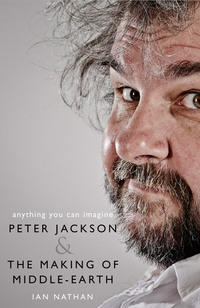
Kitabı oku: «Anything You Can Imagine»


Copyright
HarperCollinsPublishers Ltd
1 London Bridge Street
London SE1 9GF
www.harpercollins.co.uk
First published by HarperCollinsPublishers 2018
Copyright © Ian Nathan 2018
Cover design by Claire Ward © HarperCollinsPublishers Ltd 2018
Cover photograph © Paul Stuart/Camera Press London
Ian Nathan asserts the moral right to be identified as the author of this work.
A catalogue copy of this book is available from the British Library.
All rights reserved under International and Pan-American Copyright Conventions. By payment of the required fees, you have been granted the non-exclusive, non-transferable right to access and read the text of this e-book on screen. No part of this text may be reproduced, transmitted, down-loaded, decompiled, reverse engineered, or stored in or introduced into any information storage and retrieval system, in any form or by any means, whether electronic or mechanical, now known or hereinafter invented, without the express written permission of HarperCollins.
Source ISBN: 9780008192471
Ebook Edition © May 2018 ISBN: 9780008192488
Version: 2019-03-27
Dedication
For Kat, who can’t abide hobbits.
Epigraph
‘The artist-initiated epic is an obsessive testing of possibilities … It comes, too, from a conviction, or a hope, that if you give popular audiences the greatest you have in you they will respond.’
Pauline Kael
‘It would be easier to film The Odyssey. Much less happens in it.’
J.R.R. Tolkien
Contents
Cover
Title Page
Copyright
Dedication
Epigraph
Foreword by Andy Serkis
Prologue: Journey's End
1: Sillification
2: An Unexpected Director
3: Many Meetings
4: Words and Pictures
5: Concerning Hobbits
6: Heavenly Creatures
7: Jamboree
8: Miramar’s Mecca of Merry Souls
9: Proof of Concept
10: The Monsters and the Critics
11: To the Edge of the World
12: Junkie
13: MASSIVE
14: Return to the Edge of the World
15: The Music of Middle-earth
16: King of a Golden Hall
17: Legacy of the Ring
18: There and Back Again
19: Augmented Reality
Afterword
Picture Section
Footnotes
Bibliography
Index
Acknowledgements
Picture Credits
About the Author
Also by Ian Nathan
About the Publisher
Foreword
It feels like there was life before and life after.
I can remember the first time I saw Gollum. A finished Gollum. It was the sequence by the Forbidden Pool where he turns around to see Frodo, and he knows that something’s going on. It’s almost like an animal instinct; he can sense it. It was absolutely extraordinary.
You don’t know, you could never know. Here, finally, was the first proof that a level of psychological and emotional detail could be conveyed through ones and noughts. That thought could be conveyed through the combination of my performance and what they were doing at Weta Digital. I could sense that thought. I could feel that was exactly as I played it. That was incredibly gratifying.
Then I remember seeing The Two Towers for the first time. It was in New York, I was with Miranda Otto, Bernard Hill and Karl Urban. It was mind blowing. I knew every single frame.
I sensed that my life was never going to be the same again.
I supposed that was true for everyone who shared in The Lord of the Rings. The actors, the crew, everyone. None of us really knew what we were letting ourselves in for. And we went through so much together. Filmmaking is life. Every day you’re making a film is as important as the end result, because it feeds into the fabric of that film. That counts tenfold for The Lord of the Rings. That’s what attracted me to go back and do so many projects with Peter, Fran and Philippa, and all those guys down there, because it is a way of life. You don’t go to work; you’re living and breathing it.
Nevertheless, it certainly wasn’t the journey I was expecting for a second. Not for a second. Adding together both The Lord of the Rings and The Hobbit, I have celebrated seven different birthdays in New Zealand. The first one was literally only days after I arrived. We were up at Ruapehu, shooting Mount Doom. That was pretty cool. We were staying at the Powderhorn, which looked like an alpine chalet. It was lovely. They made me a cake. The most memorable one was when Pete gave me the Ring for my birthday and on the same day asked me to be in King Kong. That was on an Easter Sunday. Other ones came and went, in so many beautiful places.
I still feel deeply connected to New Zealand. The beauty there is almost overwhelming. I was very into the outdoor life, walking, hiking and kayaking whenever I could. The whole experience was very spiritual. That country, root and branch, mountain and valley, is the soul of the films.
Moreover, I also can’t express how honest and open the people are. How much they made us part of their community and gave us such a good time. I made so many great friends.
So many people migrated there to take up jobs on The Lord of the Rings, it created a film industry there.
In the end, though, all roads lead back to Pete. And Fran and Philippa, of course. Pete is the most fearless director I’ve ever met. He has shared so much with me, taught me so much. I have said it often, but there is something truly maverick about him, an indie filmmaker working on the biggest scale possible. That’s what it always felt like. We were shooting these personal little indie films. These extraordinary films are an expression of who a person is. Pete is also such a visionary, just breaking barriers all the time with this marriage of technology and artistry.
I remember the glint in his eye when I first met him, so many years ago, in London. I could sense, even then, his vision for Gollum; neither of us really knew what we were letting ourselves in for but it was definitely going to be an unexpected journey. After principal photography on The Lord of the Rings ended, Pete signed a poster for me, which said “Many thanks for all the fun … and the fun to come.” It was then, and for the next decade, and hopefully always will be just that …
Andy Serkis
PROLOGUE
Journey’s End
Monday, 1 December, 2003 was a typical summer’s day in Wellington. The sun was doing its level best, but the eternal, maddening winds were already scuffling over the bay and muscling their way inshore to ruffle pennants and hairdos but never spirits. Not on this day.
The red carpet was less familiar but not unexpected. Over 500 feet of imitation velvet swerved up Courtenay Place to the doors of the Embassy Cinema, recently refurbished at a cost of $5 million to a fetching cream and caramel Art Deco scheme. One of the myriad cinematic gifts Peter Jackson had bestowed upon his hometown. Fittingly, fifteen years earlier, his debut film, Bad Taste, had premiered at the Embassy, albeit with less salubrious décor and a smaller turnout.
Less in keeping with the old movie-palace aesthetic was the cowled Nazgûl astride a fell beast that had landed on top of the cinema virtually overnight to take up silent watch over the day’s festivities.
That full-size model, or maquette, with its great-scooped neck and outspread wings, sculpted by the imperious talents of Weta Workshop, still exists. Like so many Middle-earthian relics, it has been squirrelled away for posterity in one of Jackson’s dusty warehouses, the Mines of Moria of the Upper Hutt Valley.
Jackson might have to still undertake the mandatory global press tour on behalf of his new film, with its procession of glad-handing and crowd waving, but he had been adamant that the official world premiere for The Return of the King was to be in Wellington, the city at the heart of the production. This was the victory lap for a filmmaking triumph that, even in his innermost fantasies, he could never have imagined, and he wanted to share the moment with the people who had contributed so much.
Naturally, it was to be a party of special magnificence.
The good folk of Wellington were beginning to line the streets, bringing picnics and an unusual air of excitement for such an imperturbable race. Some had even camped out overnight. It felt like a public holiday, or a homecoming parade. And in some senses that is exactly what it was. By the afternoon, over 125,000 locals were crammed ten rows deep on either side of the streets — quite something for a city with a population of 164,000 — their ranks swelled by out-of-towners (decreed honorary Wellingtonians for such an occasion), many wearing homespun wizard hats and Elf-ears, who had crammed themselves onto long-haul flights from every corner of the world just to be here on this day. You could hear the noise halfway to Wanganui.
Soon enough the stars and filmmakers would glide through the city, setting off from Parliament House on Lambton Quay in a fleet of Ford Mustang convertibles, soaking up the adoration of the crowd with a royal wave, flanked by Gondorian cavalry, enshrouded Nazgûl on stoic horses, pug-ugly Orcs hefting Weta-made swords, beefcake Uruk-hai, supermodel Elves, and dancing hobbits trying not to trip over their outsized feet. At their head, in deference to the country that had become Middle-earth, was an outlier of Māori warriors with florid tā moko tattoos and waggling tongues. They might as well have been another extraordinary tribe dreamed up in leafy Oxford, a million miles away, in the mind of a pipe-smoking don.
When Orlando Bloom wafted past accompanied by Liv Tyler, there was screaming of a kind that was once the preserve of Beatlemania. There exists a framed photo of the four young actors who played the heroic hobbits — Elijah Wood, Sean Astin, Billy Boyd and Dominic Monaghan — that they had made for Jackson’s birthday. They are in their hobbit wigs, Shire garments and prosthetic feet, but playing instruments and posed exactly like John, Paul, George and Ringo. ‘The Hobbits’ is emblazoned on the bass drum. The Beatles are Jackson’s favourite band, and had themselves once pondered making their own version of Tolkien’s epic as a musical extravaganza.
New Line had reputedly spent millions on the last official world premiere of the film trilogy they had staked their future on. What an inspired decision that seemed now. Had any film in history received a welcome like this? Bob Shaye, the tall, graceful, slightly bohemian CEO of New Line, would sit alongside Jackson in the lead car, the man who had taken the chance on this young director. It hadn’t been the easiest relationship. Hollywood’s risk-averse mentality was not an ideal mix with the natural Kiwi courage to take on the odds. There would be further tensions to come. For now, Shaye and his partner Michael Lynne’s gamble on the impossible book, which had seemed so foolhardy if not outright suicidal to their peers, had that shimmer of Hollywood history about it. That sense of divine obsession on which the movie industry was built, where for every Gone with the Wind there was a Heaven’s Gate.
Figurative tickertape was raining down on Wellington; it was the stuff of dreams with the city’s favourite son capturing it all on his video camera. He knew he would never remember it all, it would pass in a blur.
They had made it to the Moon and back again in filmmaking terms. The Return of the King, a fantasy epic, that laughably unsophisticated genre, would soon pick up eleven Oscar nominations. This was the culminating chapter in a staggering, and staggeringly successful, adaptation of J.R.R. Tolkien’s The Lord of the Rings, considered for so long as impossible to capture on film.
Helen Clark, New Zealand’s prime minister, the day’s host, would give her thanks for all the films had brought to this country. Not only Hollywood dollars and employment — when the accounting was done the films would have utilised the talents of 23,000 Kiwis — but the tourism boom his trilogy of marvels had launched. With the help of a different world Jackson had put New Zealand onto the map.
How proud his country was of him, she said. How much she hoped his success would continue on into the future.
Jackson too would address the crowd, giving his thanks and saying how humble he felt that so many of them would turn out. He wasn’t even an All Black.
Everyone would give speeches. Each roared on by the crowd. It was like a wedding or a coronation, with 2,500 specially invited guests. Only this time Viggo Mortensen wasn’t expected to sing.
*
Earlier that day, amid the bustle of party business, with various planners and executives clamouring into walky-talkies and lumpen Nokias, Jackson had dutifully arrived on time at his allotted meeting point. Then, he hadn’t had to travel far. His home in Seatoun was barely ten minutes away, twenty if you caught Wellington at rush hour when the tailbacks can stretch to as many as ten cars long.
Seatoun lies on the seaward side of the quiet Wellington suburb of the Miramar Peninsula that plays home to Jackson’s filmmaking empire — studio, offices, post-production facilities, Weta Workshop, Weta Digital. Hollywood visitors still had trouble seeing past the corrugated iron roofs, brick warehouses, and general disrepair of the former paint factory on Stone Street. Outwardly, barring the immediate beauty of the landscape, everything here seemed so … Well, so unlikely.
How unlikely too that, in all their planning, no one had thought what to do with their director, the man who had made all this happen, while the final arrangements for the premiere were being made. So it was that Jackson had been guided to a perfectly nice hotel suite to wait in a celebrity holding pattern while the more rigorous demands of readying film stars for a public appearance took place elsewhere.
The memory still strikes Jackson as strange. ‘I thought, well, that sounds nice. I thought there would be the actors, but it was just me, and they shut the door. And I was sitting in this hotel room for at least an hour and a half. I was lying there thinking, this is pretty weird. Why aren’t we having a drink down in the bar?’
He was as nervous as anyone would be about to speak in front of hundreds of thousands of people. A drink, a laugh, simply passing the time with someone would have helped.
What might have struck him as strangest of all, however, was that he had been left to his own devices. As long as he stayed put. New Line’s army of wedding planners weren’t going to let their prize catch wriggle free. They virtually put him under lock and key. Gandalf imprisoned on the roof of Orthanc.
Only hours before, with the eleventh hour disappearing in the rear-view mirror, had he completed his adaptation of The Lord of the Rings trilogy. With a running time of three hours twenty-one minutes, long even by his own extended standards — and even then he knew that fans would bemoan the loss of lovely sequences that wouldn’t be retrieved until the Extended Edition a year from now — The Return of the King was ready for its heroic debut. For the first time in five years, maybe longer, Jackson didn’t need to worry about his films.
There was no need to approve any fresh artwork from the peerless and tireless pencils of John Howe or Alan Lee; or clear an effects shot, a music cue, a sound edit, a costume alteration, a set that had sprung up overnight, a mooted location or schedule, a poster design, or indeed head to the edit suite, because when all else was done he always needed to head to the edit. No actors would need to call upon his wisdom; no lighting set-up or shot trajectory was open for discussion. No stunt team needed marshalling. No new script pages needed to be wrestled into submission; as he no longer needed to fine-tune the sometimes-cumbersome complexities of Tolkien’s world toward the dynamic world of cinema — to choose this path or that, often depending on which one smelled the better. Even those public relations folk, who had called upon him to speak to the press when he could least afford the time, were now busy elsewhere.
The constant background noise inherent in this awesome undertaking had finally been silenced — all he could hear was the crowd a few blocks away, cheering even the carpet sweepers.
Jackson was left alone with his thoughts.
He turned on the television and found a telemovie, whatever was playing. He can’t remember what it was about let alone what it was called; he doubts it was any good.
Lying there on the bed, some cheesy, low-budget melodrama in the background, his mind must surely have wandered back through the forest of days, the miraculous events and unaccountable toil that had brought him here to this moment of triumph and farewell.
CHAPTER 1
Sillification
In June 1958, John Ronald Reuel Tolkien put pen to paper. Without letting his scrupulous English manners slip, he still made his feelings quite clear. The story, he claimed, swelling in his indignation as the letter wound on, had been ‘murdered’.
The year before, three American producers sounding not unlike a law firm from a film noir movie — Forrest J. Ackerman, Morton Grady Zimmerman and Al Brodax — had approached Tolkien’s publishers, Allen & Unwin, proposing a feature film of The Lord of the Rings. Having decried the ‘sillification achieved’ by the BBC in a 1955, twelve-part radio serial based upon his epic, written and produced by the poet Terrence Tiller (a close friend of Tolkien admirer W.H. Auden) — since lost to the mists of BBC deletion — he couldn’t see that dealing with a film version would be any less painful.
However, if not won over, he had begun to be persuaded that these filmmakers were at least responsive to the needs of the book. In the box of notes sent to the author’s house in the Oxford suburb of Headington, the trio outlined an ambitious mix of live action and animation running to three hours, including two intermissions, with the aim of shooting among the untamed expanses of the American landscape. Tolkien had been especially impressed at the quality of the concept art. How unlike Walt Disney it was, he noted appreciatively.
A few weeks later, as he had begun to read the story treatment, his heart had sunk. He simply couldn’t detect ‘any appreciation for what it was about’. Gandalf does not ‘splutter’, he contended, the Balrog does not speak and Lothlórien does not have shiny minarets. All moral import had been lost. The entire tone was childish, more of a fairy tale. And his book was most certainly not a fairy tale. The treatment did, incidentally, include Tom Bombadil.
His response goes on for several pages. Each documenting a significant narrative failing in the laissez-faire approach Zimmerman, the nominal screenwriter, had taken with the original text.
Wizards can be quick to anger.
Such a maladroit effort, if not rank trivialisation of Tolkien’s great adventure, is disappointing for fans of the genre. Not that the book wouldn’t suffer an arduous journey through a litany of scrambled attempts before it would be done justice. It was more that one of the prospective producers was meant to have had a keen respect for fantasy fiction.
Ackerman is known as the godfather of geek. He had helped fashion the concept of the fan convention; arriving at the First World Science Fiction Convention in New York in 1939 clad in a ‘futuristicostume’, he effectively invented cosplay to boot. On a business footing, he served as agent for many of the great Fifties horror and science fiction writers whose imaginations were running rife beneath the shadow of the nuclear age (and the influence of Tolkien). Writers like Ray Bradbury, Marion Zimmer Bradley and Isaac Asimov, the latter of who would create the star-spanning Foundation trilogy.
In 1958, Ackerman began his lifelong tenure as editor of Famous Monsters of Filmland, a lavish, bustling monthly devoted to genre movies. Within its awe-struck pages were features celebrating King Kong, the 1933 classic, including the discovery of a fabled shot of a spider lurking on the cavern roof that fans had thought to be the stuff of myth. It also curated the kind of pun-heavy vernacular that saw the letters page christened ‘Fang Mail’.
For Tolkien, used to the unhurried discussion of philological esoterica among collegiate friends and the woody scent of pipe smoke at The Eagle and Child, he may as well have been from Mars.
For Peter Jackson and those filmmaking peers who shared a taste for the fantastic and the macabre, kindred visionaries like Guillermo del Toro, Fantastic Monsters of Filmland would become a friend in the dark. Here was proof that there were likeminded, monster-mad souls everywhere. Without it they may never have discovered their calling. In his old office, the secret one behind the bookcase that contained his most prized memorabilia, Jackson had his collection of back issues proudly on display.
With a rakish, pencil-thin moustache, high forehead and large horn-rimmed glasses, Ackerman suggested Vincent Price playing an insurance salesman, and he would appear in many of his beloved B-movies. He also dabbled a little in film production. And, together with his partners, was the first recorded prospector to engage with Tolkien about a film version of his great work.
We should respect the fact that Ackerman was ahead of the curve. In 1958, The Lord of the Rings was only four years old. While selling respectably, it was a long way from the cult prominence that made it a fixture of late-1960s campuses across America. An unauthorised ACE paperback edition had wriggled through America’s insubstantial copyright rules in 1965 and sold in phenomenal quantities. Indeed, by 1966 it was out-selling The Catcher in the Rye at Harvard. Students formed Tolkien societies, dressing up as their favourite characters and feasting on mushrooms. A scholarly lapel was naked without badges exclaiming ‘Frodo Lives’ or ‘Gandalf for President’.
Once official editions were issued (through the paperback imprint Ballantine Books) Tolkien would taste remarkable success. This in turn led to conspicuous quarters of the literary establishment scoffing at something they saw as childish. Among academics, to express affection for Tolkien was deemed as ‘professional suicide’.
In 1956, in his sarcastic essay, ‘Oo, Those Awful Orcs!’ Marxist critic Edmund Wilson called it ‘balderdash’.
Decades on, Germaine Greer claimed that the book’s popularity was like a ‘bad dream’.
Tolkien had never expected to start, as he put it, a ‘tide’. He only wrote the book for those who might like it.
Nevertheless, Frodo’s quest to rid the world of a magical ring by tossing it back into the volcanic fires from which it was forged had touched readers around the world. By 1968, three million copies of The Lord of the Rings had been sold worldwide. A 1999 poll conducted by Amazon judged it to be the Book of the Millennium. By 2003, once again much to the chagrin of the literary establishment, and perhaps catching a tailwind from Jackson’s films, a poll on behalf of the BBC’s Big Read named it Britain’s Favourite Read. According to recent calculations the book has sold upwards of 100 million copies.
Let us not tarry too long on the history of Tolkien and his literary genius. Reams have been written on the provenance of hobbits and the entirety of Middle-earth. Reams more will come. Born in Bloemfontein, South Africa in 1892, where his father died when he was three, he was raised by his mother in the bucolic Worcestershire village of Sarehole (since consumed by greater Birmingham). She would die when he was only twelve, leaving him and his brother, Hilary, orphans. An early fascination with ancient languages and their mythological roots would lead to his creating his own, and eventually to an Oxford professorship in English Language and Literature, a journey interrupted by enlistment and the First World War.
In the dreadful lulls between fighting on the Somme (where Jackson’s grandfather also fought), and while recuperating from trench fever in Staffordshire, Tolkien began to conceive of the vastness of his fictional world, a world that would have its origins in the languages he had devised. He never felt he was writing fantasy but a form of history, a record that would reveal who might have spoken such words and where they might have lived. He saw his book as an attempt to recover a mythology for Britain, which lacked the equivalent lore to that of the Germanic, Nordic and Icelandic sagas he loved. Through a process he called ‘sub-creation’ grew a backdrop for his later books, a world of intricate construction: races, languages, myriad tales of wars and upheaval and a vast, vital geography against which it all played out.
‘I always had the sense of recording what was already “there”, somewhere, not of “inventing”,’ recalled Tolkien.
Philippa Boyens, who would work so closely with Jackson and Fran Walsh on the writing of the adaptation to come, always valued the ‘wholeness’ of Middle-earth. ‘That you can escape into something that feels utterly real,’ she says. ‘I like that obsession. I like all the detail.’
Laughing, she recalls that whenever any questions from the cast or crew became too entangled in the brambles of Tolkien’s mythos they were always fielded to Boyens as the trio’s Tolkien nerd. She always impressed upon her fellow filmmakers how much underpinned the books.
‘It’s such an immersive thing, because as much as he delved into and loved those languages, he loved them because of their connection with who the British are as a people. And that profoundly affected him, and that probably has a lot to do with his childhood.’
Watching the encroachment of industry and the concomitant loss of a tradition; the stark impressions of the battlefront that stripped bare notions of class; the devotion to nature (especially trees); learning; fine company; a dignified, if antiquated properness in his relationship with women: all were ingredients in the wholeness of the book. But deeper still, in Tolkien’s early loss of his parents, Boyens sees the loneliness of Frodo expelled from the childlike idyll of the Shire to venture into the adulthood of Middle-earth.
Composed first for his children, Tolkien would publish The Hobbit in 1937, a lighter, charming prelude to The Lord of the Rings, which would eventually follow in 1954. He never intended his second novel to be divided into three books, or considered a trilogy. This was a necessity brought on by soaring paper costs following the Second World War (another global conflict that overshadowed his writing). It was a single, epic story, over 1,000 pages in length, made up of more than half a million words.
His response to Ackerman and co. provides an insight into how the author generally perceived the idea of transforming his work into film entertainment.
Tolkien had visual sense. In among the treatment’s atrocities, he could appreciate, ‘A scene of gloom lit by a small red fire with the wraiths approaching as darker shadows.’
He revealed actorly qualities too. In the 1950s, disappointed by that 1955 BBC version, he recorded his own radio play The Homecoming of Beorhtnoth, Beorhthelm’s Son, in the poem’s full alliterative Anglo-Saxon metre. There is a little existing footage of him from a BBC documentary from 1968. He plays well to the camera: warm, curious and knowingly dotty, throwing in an occasional faraway look in his eye as he gazes off into the distance, perhaps to Middle-earth.
Even so, Tolkien didn’t regard movies, or drama in general, as legitimate art. We are left to wonder if Sir Ian McKellen’s wry Gandalf or Viggo Mortensen’s robust Aragorn might have swayed him, but he considered the idea of acting to be a ‘bogus magic’. It was pretending.
Nevertheless, as early as 1957 he had written to his publisher Stanley Unwin that he wasn’t opposed to the idea of an animated version of the book — evidently having no faith that live action would stand up to the exotic creatures and fantastical locations therein. In another oft-quoted letter to his publisher, in his qualified way he even welcomed the idea.
‘And that quite apart from the glint of money,’ he added, ‘though on the brink of retirement that is not an unpleasant possibility.’
He was no fool about the business.
Tolkien reasoned, with a foresight that would have made him more adept at dealing with Hollywood than his quiet, donnish persona would suggest, that he could either strike a deal through which he would lose control but be correspondingly compensated financially, or retain a degree of control but not the fiscal win.
‘Cash or kudos,’ he explained to his biographer Humphrey Carpenter.
With few signs of either cash or kudos emerging out of granting a six-month option to Ackerman and his associates, as the biography succinctly puts it, ‘negotiations were not continued’.
He was there for the first showing of the remake of King Kong, a production he’d been following for months in the pages of Famous Monsters of Filmland. But the cinema was still locked up and Courtney Place was as deserted as it would one day throng with delighted thousands as Jackson made his lap of honour in an unforeseeable future.
‘I kind of bought into the hype,’ he laughs — that boy was such a dreamer. ‘I convinced myself there would be crowds and crowds of people. There weren’t. And, like most people, I was disappointed by it.’
The film is a wreck. Big-talking mini-mogul Dino De Laurentiis, cut from similar cloth to Saul Zaentz, had boasted of using a forty-foot robotic gorilla that could scale buildings, but the technology had failed him and its motion was never captured. In the finished film it is Rick Baker in a suit. The modern setting, the absence of dinosaurs, the flat, un-wonderful ambience generated by journeyman director John Guillermin (The Towering Inferno) bespoke of all that could fail in a film.
The disappointment of the King Kong remake would teach Jackson a valuable lesson, and he saw it six times. You must never forget that fifteen-year-old, too early, waiting in the cold.
The presence of Kong would cast a huge shadow over Jackson’s career, but even having finally made his own spectacular remake in 2005 (another long, wending, troubled journey to the screen), it is to The Lord of the Rings the fifteen-year-olds of all ages and sexes came back again and again, breathless in anticipation.
It was actually the year before he first saw King Kong that an eight-year-old Jackson began shooting films. With a growing interest in special effects already stirred by a steady diet of Thunderbirds, television’s Batman and the epochal moment his neighbour Jean Watson, who worked at Kodak, gave him a Super-8 camera, he also looked upon King Kong as much as a technical triumph as an emotional journey.
‘A year after we met, he showed me a Bond parody called Coldfinger that he’d made when he was fifteen or sixteen,’ remembers Botes. ‘He’d copied the editing of On Her Majesty’s Secret Service. And he played James Bond himself. I thought, “This is uncanny — he actually looks like Sean Connery.”’
Jackson built a filmmaking career with his own hands. A fleet of homemade shorts, inspired by his love of King Kong, Ray Harryhausen and James Bond, would grow (or perhaps the word is mutate) into his first feature film — Bad Taste.
Made in fits and starts over four years, and because of day jobs, only on Sundays, Bad Taste began life as the short, Roast of the Day (the powerful tale of an aid worker encountering cannibal psychos in deepest Pukerua), and slowly sprouted into a feature film. Doffing a windblown forelock toward Sam Raimi’s The Evil Dead, Jackson’s unhinged tale of a group of aliens plotting to turn humanity into fast food, would be a test of his native ingenuity and fortitude to rival that of The Lord of the Rings.
Roping in friends and colleagues from The Evening Post, cast and crew came and went over the ensuing years, written out then written back in again, Jackson more or less making it up as he went along. His parents provided the $2,500 to buy a 16mm Bolex camera. Everything else — prosthetics, special effects, Steadicam rig, props, alien vomit, stunts, acting — was homemade.
At one stage, Jackson, in the prominent role of the nitwit alien investigator Derek, would dangle himself upside down over a local cliff, a rope tied around his ankle the other end attached to a wooden post. Health and safety were for those who could afford them. He only hoped his friends would pull him back up again. If that post hadn’t held, The Lord of the Rings may linger to this day unmade.
‘It crushed all the nerves in my foot,’ he laughs; ‘it took about six months for the sensitivity to come back.’ Which might account for his nonchalance toward going barefoot on the roughest terrain.
Halfway through, they all went to see Robert Zemeckis’ thriller Romancing the Stone, then almost killed themselves replicating the sequence where Michael Douglas plunges downslope through the bushes.
Eight years later Jackson would be working with Zemeckis.
There were also times it tested Jackson’s emotional reserves. One Sunday, dropped off on location by his parents with all the props and costumes, no one else showed up. He just sat there all day. When his parents came to collect him at 5 p.m., he was close to tears. It was a lonely lesson in always working with people you could depend on.
Bad Taste would be his film school. And a film would emerge, half-crazed but hilarious, gurgling with its own outrageous pleasure at the raw act of creation. Following another arduous test of his patience, it would find distribution and stir up a cult following that exists to this day, hanging on to the hope that Jackson will eventually make good on his promise to make a sequel or two.
Significant to this tale were two key friendships that Jackson formed because of his Bad Taste. Richard Taylor, who along with his wife Tania was making puppets for a satirical Spitting Image-style New Zealand television show called Public Eye, had heard about this guy out in Pukerua Bay who was making a sci-fi splatter movie in his basement. ‘We really wanted to meet him. It turned out that his sci-fi movie was called Bad Taste. He was baking foam latex in his mum’s oven.’
Taylor would join forces with Jackson on his very next film, and begin his own journey toward The Lord of the Rings.
And this was when Jackson first met Fran Walsh. To be exact, he first saw Walsh on the set of the series Worzel Gummidge Down Under, the television offshoot about a talking scarecrow, for which he had been hired to do a few little special effects. She was one of the writers, but they hadn’t spoken. Then out of the blue Botes asked if he could show the unfinished Bad Taste to a couple of his screenwriter friends, he thought would appreciate it. They happened to be Walsh and her then boyfriend Stephen Sinclair. Walsh remembered being bowled over by how uninhibited the film was, and on zero budget.
She would volunteer her services to help complete the film, and would become not only the most important creative partner in Jackson’s life but the story of this book.
Completing Bad Taste, says Taylor, ‘Peter was bitten by the bug.’ Up until then he had thought he might get by in special effects. In New Zealand the thought that you could follow a career as a director was preposterous. But the response to Bad Taste was so powerful that it convinced Jackson this was his calling.
Jackson also committed himself to gore, and ruffling the strait-laced New Zealand film community. In 1989 came depraved puppet musical Meet The Feebles (shot in a rat-infested warehouse) followed in 1992, after a salutary false start, by Braindead, his blood-bolstered, period zomcom. The film that would take him to America — if only for a visit.
A career had been born in a deluge of sheep brains, farting hippos and a zombie baby named Selwyn. Middle-earth was another world.
‘When he finally made enough money to move into town,’ remembers Taylor, ‘it was into the tiniest house in Wellington. He bought the biggest television I have ever seen and we’d sit in his front room, dwarfed by this gigantic thing. When you stood up to make a cup of tea, there’d be half a dozen people out on the pavement, standing there watching the movie!’
*
There is one other adaption of The Lord of the Rings we have yet to mention. Indeed, it was the most comprehensive and meaningful adaption to date, one that is still held in the highest esteem by fans. It was also the only version of the book to provide any objective lessons — apart from what not to do — in how to successfully dramatize Tolkien, even though there was not a single frame to be seen.
This was, of course, the 1981 BBC radio serialization. Adapted by Brian Sibley and Michael Bakewell with a fine-edged scalpel, trimming great swathes of the book without any discernible loss of the central story (it still runs to a considerable eighteen hours). They also retained a good deal of Tolkien’s dialogue, while carefully negotiating the demands of radio dramatization. Events that are reported in the book are transformed into first-hand scenes (a trick Jackson and his writers would apply). Even the battle scenes, inevitably reduced by the medium, have a dense, breathy, clanging atmosphere. All of it eased onward through the addition of a narrator (Gerard Murphy).
Above all, the vocal performances set an enviable standard: Michael Horden swings appreciably between avuncular and steely as Gandalf; Robert Stephens’ smoky basso makes Aragorn seem older, wiser and immediately kingly. Jackson would seek a deliberate resonance between the serial and his own films in the casting of Ian Holm as his Bilbo; Holm having made an impassioned Frodo back in 1981.
Having made his mark in Bakshi’s adaptation, Peter Woodthorpe would again provide the disturbingly funny duality of his Gollum. Disembodied, that needling, pathetic, hissing voice carries a note of pure heartbreak.
The seminal serial was responsible for bringing another generation to the book. But Hollywood had lost interest or grown weary of its numerous challenges. And for fifteen years the Ring lay forgotten, until it was finally picked up by the most unlikely director imaginable.
CHAPTER 2
An Unexpected Director
The English Patient was dying. Saul Zaentz had pleaded with the studio that they were in the process of forging art. He had protested at their shortsightedness. And he had resorted to good old-fashioned brinkmanship. They were only weeks from shooting, but 20th Century Fox were not backing down. Fox had bought the English language rights to this expensive adaptation of Michael Ondaatje’s Booker prize-winning novel for a not inconsiderable $20 million (the full budget was $31 million, including $5 million of Zaentz’s own money) and were insisting it have a marquee female lead.
Accepting Ralph Fiennes as the hero — if such a straightforward term could be applied to the emotionally fraught and morally elusive weft of Ondaatje’s novel — already spoke of a due deference to artistic over commercial merit. This was, they knew, a prestige project. Fiennes was so very English — although his character turns out to be Hungarian.
The Second World War romantic epic came endowed with a tricky structure. It told a story within a story, gradually regaled to Juliet Binoche’s free-spirited nurse, and us, by a burn-ravaged Fiennes languishing within the gorgeous grounds of a Franciscan monastery somewhere in the Tuscany countryside. His tale will sweep us all back to a Sahara on the brink of war where spies and cartographers muster and a great love affair ensues, all simmering in a grand manner not seen since the imperial heyday of David Lean. The kind of film, everyone kept saying, no one made anymore.
When it came to Fiennes’ romantic opposite – the fragile, conflicted, swan-like Katharine Clifton – Fox were thinking of Demi Moore, in the spring of 1995 box office gold following Indecent Proposal and Disclosure. Zaentz and his so very English director, Anthony Minghella, whose determination to steer his own artistic choices mirrored that of Peter Jackson’s, had set their heart upon Kristin Scott Thomas — more traditionally beautiful, more icy and layered.
Bill Mechanic, who was then president of Fox, later promised on his life that the Moore rumours were untrue. Minghella maintained that ‘Demi’s name was always mentioned’.
Whatever the case, the fractious production had reached an impasse. Actually, that was no longer true.
Fox had pulled the plug.
Rallying round the desperate project, already encamped in the desert, two of Minghella’s closest allies, director Sydney Pollack and producer Scott Rudin, put in a call to Harvey Weinstein, the influential co-founder and co-chairman, with his brother Bob, of the independent film powerhouse Miramax.
‘Harvey just stepped in and financed it one hundred per cent,’ confirms Jackson, who has been recounting the story as a matter of significant background.
Cynical Hollywood commentators, of which there are many, suspected that Miramax was already well aware the project was faltering, with Harvey ready and waiting for it to collapse so he could swoop in and save the day.
Akin to Zaentz, this was exactly the kind of project that fitted Harvey’s view of himself as both Hollywood player and indie king, as well as the philosophy of Miramax as a film company: sophisticated, literary, but with mainstream potential, and Oscar-worthy, always Oscar-worthy. Spinning gold on behalf of the inevitable awards campaign for The English Patient, Miramax’s gifted publicists spread a tale of the White Knight who saved great art from studio defilement.
Nominated for twelve Oscars (including one for Kristin Scott Thomas), winner of nine, and making $231 million around the world, The English Patient cemented Harvey’s reputation. By the mid-1990s, he was the new Selznick, but operating from New York headquarters beyond the borders of Hollywood. He wasn’t the kind of studio boss who would demand Demi Moore. He understood the needs of filmmakers. He could manage big, important films outside of the studio system. He also understood the marketplace and how to reach an audience. He could finesse, and he could bully. His methods, often cutting and re-cutting problem films — landing him the nickname ‘Harvey Scissorhands’ — he insisted were always at the service of the film. This was how, alongside Bob, he maintained Miramax’s great duality: cash and kudos.
Not that it was all about literary adaptations. If Minghella was his longing, romantic Sméagol side, then Quentin Tarantino, who wanted to storm the barricades of such strait-laced tradition as The English Patient, let alone The Lord of the Rings, was his expletive-spitting Gollum.
Between Miramax’s multiple personalities, you can also trace Harvey’s attraction to Jackson: the young Kiwi embodied that very schism. He was the director of Bad Taste, Meet The Feebles and Braindead, giddy gore hound and natural wit, predisposed never to abide by the Hollywood playbook. But then he would produce something as finely tuned as Heavenly Creatures.
It is often claimed that the two poles of Jackson’s filmmaking pedigree are what made him so ideal for adapting Tolkien.
The English Patient had finally wrapped production in 1996 when Jackson called his long-standing manager Ken Kamins and casually asked him to find out who might own the rights to The Lord of the Rings. For a certain fee, databases can be consulted. In the litigious universe of Hollywood, it is essential to cover your back. Jackson had assumed they must be with Disney or Spielberg or Lucas. ‘They would all be locked up, as they say,’ he admits. ‘And we wouldn’t have a chance. So we really went into this with no expectations at all.’
Kamins didn’t take long to discover that thirty years after buying them from UA, the rights to both The Hobbit and The Lord of the Rings still resided with Zaentz. He might not be a Spielberg or a Lucas, but this wasn’t necessarily good news. Having had his fingers burned so badly with the Ralph Bakshi debacle, Zaentz had closely guarded the rights ever since.
It wasn’t as if since Bakshi no one had returned to the idea of adapting one of the most popular books of the twentieth century in the intervening years; they had simply come up against the Black Gates of Zaentz’s resistance.
If by some miraculous chance he was to agree, says Jackson, word came back that he would want to be attached to it. ‘That is just the way he was. He was a producer himself. But he tended to say no. He had done his Tolkien thing, it was a huge disaster for him, and he had lost a lot of money by the sound of it. He just didn’t want to know about it.’
They needed a backstairs route to the rights — a secret way into Zaentz, a chance to try and persuade him. And although he didn’t know it yet, Jackson already had the perfect guide. In fact, that guide was impatiently waiting for the director to call.
Within the parameters of a first-look deal he had recently struck with Miramax, Jackson was contractually bound to first test the waters on any new idea with Harvey Weinstein. And this was a staggeringly ambitious plan.
‘The idea was to do The Hobbit as one movie, then two movies of The Lord of the Rings,’ says Jackson. ‘Still as a package: you make The Hobbit by itself, if it is successful you then get to do The Lord of the Rings films back-to-back. A three-film thing.’
So the initial desire had been to adapt Tolkien’s books in chronological order, beginning with his first, younger-orientated Middle-earth novel: Bilbo, the Dwarves, and dislodging a fire-breathing squatter.
‘I could tell on the phone he was really excited right away,’ recalls Jackson, not yet knowing that this conversation would change his life.
The English Patient may not have yet been released but Minghella had wrought classical wonders with the strange book. Another attention-grabbing, epic production based on a tricky literary source, as directed by another of his self-styled discoveries, played right into Harvey’s view of himself as a promethean, David O. Selznick type for a modern Hollywood.
‘Who’s got the rights?’ he asked.
‘Well, it’s not going to be easy, Harvey,’ Jackson warned him, ‘because it is this guy called Saul Zaentz.’
Jackson laughs. ‘Harvey was the man who had saved The English Patient. We were talking to the right guy.’
If you put it in a script it would sound corny and contrived. No one would believe a word of it, but then so much of Jackson’s career has been decreed by what you would call fate.
Says Kamins, ‘It’s the big theme for him. He has always believed that fate was going to point him in the right direction.’
Jackson’s manager cannot think of a single conversation in all the time he has represented him where they have sat down and discussed what he should or shouldn’t do with his career. ‘Peter sort of functions by his own compass — that fate will deal him the right set of cards. And in this particular instance maybe more than any other, he was proven completely right.’
There are things that can be seen with the naked eye when you’re trying to achieve something in the motion picture marketplace and there are the things that lie hidden. You can’t ever see what’s going on behind the boardroom doors. The business decisions, the politics and agendas, the history, or the simple expediency that can come with good timing: all those invisible but significant factors that allow you to be able to do the unexpected. Otherwise known as fate.
‘Saul?!’ Weinstein boomed, his thick New York vowels reverberating down the transpacific line, more excited still by the chance to demonstrate the extent of his magical largesse: the beneficent Harvey, fulfiller of wishes. ‘I’ll call him straightaway. He owes me a huge favour.’
*
Print the legend, and the inception of Jackson’s great adventure occurred on an unspecified morning while The Frighteners was in post-production. He and Fran Walsh had got chatting about how to follow up their spectral comedy-horror. In spring 1996 things were moving for Jackson: he was now working on a Hollywood stage, with Hollywood budgets at his disposal, and to a large extent still on his own terms and staying put in New Zealand. More than ever, they needed to maintain their momentum.
‘So how about a fantasy film?’ proposed Jackson. Something like Ray Harryhausen once made, the spectaculars he had been whelped on: no irony, but a cornucopia of fantastic beasts. Only they would use the growing digital capabilities of their own visual effects company, Weta, to conjure them up rather than the chronically slow minutiae of stop-motion. Perhaps, Jackson suggested, something more classically swords and sorcery than the Arabian Nights or Greek myth that had been Harryhausen’s metier. He searched the air for an equivalent …
‘Something like The Lord of the Rings.’
At that point, he had still only read it the once, when he was eighteen. It was simply what sprang to mind.
‘Well,’ Walsh replied, ‘in that case why not do The Lord of the Rings?’
Except it didn’t go like that. Not exactly. The reality behind the decision to attempt Tolkien was a lot more complicated and painful. The river of fate had many twists and turns to negotiate.
*
In the 1950s, Kamins, eldest of four New Yorker brothers, always played the dutiful son and did whatever he was told. This was the reason Jackson’s manager so loved the Marx Brothers of Duck Soup and Horse Feathers. He longed for their utter sense of anarchy, their disrespect for authority.
‘They managed to play by their own set of rules, which I never could,’ he says wistfully.
Short-haired and snappily attired (the opposite of his client), with a calm, observant, thorough manner, Kamins is a Hollywood man without the pretension. He sees the world keenly through his rimless spectacles. From his hardwood-floored, glass-walled, art-adorned eyrie that gazes down upon Sunset Boulevard, he has been Jackson’s eyes and ears in the movie-town since 1992. It is also easy to see why the Kiwi director has remained loyal to his Hollywood minder. Kamins is no mere facilitator or dealmaker; he is a great storyteller, who parses the madness of the film industry with wisdom and wry humour, and stood in the eye of the hurricane of the trilogy’s storm-tossed beginnings. There were times when the future of the project depended on Kamins’ gift for talking down dragons.
He openly admits the books had meant very little to him. ‘They were not, like, seared on my soul. I mean, I knew of them. But I was in no manner, shape or form an aficionado, or a hardcore fantasy fan for that matter.’
Rather than King Kong, Kamins is a ‘Godfather-fanatic’. Film class at college had introduced him to films like The Grand Illusion, Klute and Rio Bravo. That is where his tastes lay. He believed in his client’s project without it having to be a religious experience.
Out of college, Kamins had climbed onto the lower rungs of the film industry, reaching the nascent home entertainment business at RCA Columbia at exactly the time his mentor Larry Estes began backing low-budget film productions, laying off theatrical and television rights while retaining the video rights.
Under that paradigm they backed Steven Soderbergh’s sex, lies and videotape, which had caused a stir at the Sundance Film Festival. Every independent theatrical distributor had come running in. They ended up making a deal with Harvey Weinstein.
Using this business model, home video specialist LIVE Entertainment would back Reservoir Dogs and begin Tarantino’s journey toward the sun. Another promising indie named New Line Cinema also began to see significant profits care of its home entertainment investments.
It was while at the now defunct talent agency InterTalent, a few rungs higher in his career, that Kamins’ boss, Bill Block, couldn’t get a ticket to the Batman Returns premiere. Tim Burton’s shadowy superhero sequel was the seen-to-be-seen-at golden ticket of the week. In his frustration Block had glanced over the many invites, requests and pleas for representation yet to be cleared from his desk and a letter caught his eye. It came from an attorney. ‘Hey, I have this client. He’s going to be in LA. He’s holding a screening of his new movie.’
Block walked down the corridor and into Kamins’ office. ‘I’m going to this screening and you’re coming with me.’
It was called Braindead.
Jackson was stopping in Los Angeles on his way back from Cannes, where he had been endeavouring to sell the distribution rights to his great ode to the flinging of viscera. The film that a mesmerized Guillermo del Toro once claimed made ‘Sam Raimi look like Yasujiro Ozu’. While in town, Jackson was hosting a screening at the Fine Arts Theatre on Wilshire Boulevard. Despite clashing with the big-budget antics of The Penguin and Catwoman, every agency in town was sending someone.
Kamins was impressed at the inventive use of effects in what was clearly a ‘modestly budgeted’ horror film. He certainly had never seen a hero lawnmower his way through a zombie horde. Indeed, it was the film’s sense of humour that spoke to him. The director was winking at the audience, egging them on. ‘Can you believe this level of madness?’
Kamins was reminded of the Marx Brothers.
‘I think that Peter unwittingly tapped into that same sense of anarchy,’ he says. ‘“I’m going to do things my own way. I’m going to challenge norms.” And I don’t know that I even understood it that clearly at the time. But it resonated for me.’
There was a spate of lunches for Jackson that week. Held at jazzy, star-spotted joints like Spagos or Chasens where the would-be agents reeled off a blur of inane advice. Oh, you should do a Friday the 13th. Oh, you should do a Tales from the Crypt. Oh, you should do a Freddy movie. All they could see was Braindead the horror movie, Jackson the New Zealand Sam Raimi.
Theirs was the last lunch of the week. And Kamins took a revolutionary approach. ‘I remember asking him, “Well, what do you want to do?” And he said, “Well, Fran and I are working on this project about matricide. About these two girls growing up in New Zealand, a true story …”’
It was called Heavenly Creatures.
The next week, Kamins’ phone rang. Jackson’s chirpy voice came on the line: ‘Fran and I have had a chat. We would like you to represent us.’
Kamins wasn’t the first agent-manager of Jackson’s career. Shortly after finishing Meet the Feebles, he had ventured to Los Angeles and found representation with a good-sized agency and a very good lawyer in Peter Nelson, who has stayed the course to this day (and would be another important figure in the many, many negotiations to come). Nelson had sent out the invitations to the Braindead screening with the objective of landing Jackson fresh representation. As he put it, the previous agency had ‘fallen asleep’.
Speaking to Jackson over lunch, Kamins was impressed by how purposeful and business-like was this young director. ‘For somebody who did not grow up here, but who clearly was a fan of movies and had aspirations to be a filmmaker, I was struck by how not-awed he was by the town. He had a fearlessness or a blindness to the reality of what he was walking into. All of which seemed to serve him really well.’
*
Heavenly Creatures changed everything. Heavenly Creatures got Jackson out of the horror ghetto where Hollywood would be happy to confine him. ‘Oh, he makes those low budget splatter movies that have some humour in them.’ Typecasting, Kamins could see, that didn’t project ‘a vision that he could do bigger films’.
Disney had offered him a supernatural rom-com called Johnny Zombie, which he wisely turned down. It was made by Bob Balaban as My Boyfriend’s Back in 1993, and swiftly forgotten thereafter.
He had so much more to him than Bad Taste.
Jackson followed Braindead by winning the Silver Lion for Best Direction at the Venice Film Festival. Head of the jury David Lynch had quickened to a queasy portrait of small-town murder where schoolgirls turned out to be the perpetrators not the victims. There were further festival awards to follow at Toronto and Chicago, and nine New Zealand Film and Television Awards.
‘There was a sophistication to Heavenly Creatures,’ says Kamins proudly. ‘This was not a horror film in the traditional sense.’
Tellingly, in terms of the influence Walsh has had on the trajectory of both their careers, it had begun as her passion project. Jackson hadn’t even heard of the real-life murder case, and worried at first that the story was too grim to make a satisfying film.
In 1952, two New Zealand schoolgirls, more than a little emotionally maladjusted, fell into an intense friendship that spilled into a mania for one another. Their relationship was like an addiction. Threatened with separation, they conspired to literally dash the brains out of one of their mothers with a brick. For all the bloody mayhem of his career, this remains the most disturbing sequence Jackson has ever filmed. The shift in mood and moral accountability from Braindead is astonishing. They had shot in the footsteps of the actual scene of the crime in Christchurch’s Victoria Park. In truth, a few hundred feet further along the wooded path after Jackson had become unnerved by a lack of birdsong at the exact murder scene.
The Pauline Parker-Juliet Hulme case shook the stiff veil of propriety that 1950s New Zealand had inherited from Britain. In fact, it tore it down. This was the scandal of its day, portrayed in lurid, tabloid details by the excited papers and true crime accounts; there was even a novel. Author Angela Carter had written a screenplay inspired by the events called The Christchurch Murder, which Walsh had read. When she and Jackson were developing the idea, two rival film projects were already underway: one produced by Dustin Hoffman, the other to be directed by fellow New Zealander Niki Caro (Whale Rider).
What makes the Jackson-Walsh script so evocative is the decision to concentrate on the friendship rather than the sensationalist furore of the court case. They were two schoolgirls, barely sixteen, with hints of lesbianism to their unnatural bond — until 1973 homosexuality was still considered a mental malady in New Zealand. However, Hulme (who as an adult was later revealed to be crime author Anne Perry) flatly denied this was so.
Ücretsiz ön izlemeyi tamamladınız.