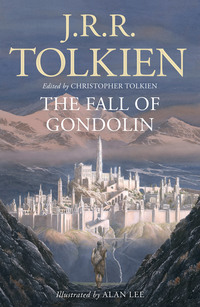
Kitabı oku: «The Fall of Gondolin»


Copyright
HarperCollinsPublishers Ltd
1 London Bridge Street,
London SE1 9GF
www.tolkien.co.uk
www.tolkienestate.com
First published in Great Britain by HarperCollinsPublishers Ltd 2018
All texts and materials by J.R.R. Tolkien © The Tolkien Estate Limited 2018
Preface, Notes and all other materials © C.R. Tolkien 2018
Illustrations © Alan Lee 2018
Cover design © HarperCollinsPublishers Ltd 2020
Illustration © Alan Lee
 ®, TOLKIEN® and FALL OF GONDOLIN® are registered trade marks of The Tolkien Estate Limited
The Proprietor on behalf of the Author and the Editor hereby assert their respective moral rights to be identified as the author of the Work.
A CIP catalogue record for this book is available from the British Library
All rights reserved under International and Pan-American Copyright Conventions. By payment of the required fees, you have been granted the non-exclusive, non-transferable right to access and read the text of this e-book on screen. No part of this text may be reproduced, transmitted, down-loaded, decompiled, reverse engineered, or stored in or introduced into any information storage and retrieval system, in any form or by any means, whether electronic or mechanical, now known or hereinafter invented, without the express written permission of HarperCollins.
Source ISBN: 9780008302757
Ebook Edition © August 2018 ISBN: 9780008302788
Version: 2020-03-30
Dedication
To my family
Contents
Cover
Title Page
Copyright
Dedication
List of Plates
Preface
List of Illustrations
Prologue
THE FALL OF GONDOLIN
The Original Tale
The Earliest Text
Turlin and the Exiles of Gondolin
The Story Told in the Sketch of the Mythology
The Story Told in the Quenta Noldorinwa
The Last Version
The Evolution of the Story
Conclusion
The Conclusion of the Sketch of the Mythology
The Conclusion of the Quenta Noldorinwa
Footnotes
List of Names
Additional Notes
Glossary
Map of Beleriand
The House of Bëor
The Princes of the Noldor
Works by J.R.R. Tolkien
About the Publisher
PLATES
Swanhaven
‘They attempt to seize the swan-ships in Swanhaven, and a fight ensues’ (p.32)
Turgon Strengthens the Watch
‘he caused the watch and ward to be thrice strengthened at all points’ (p.64)
The King’s Tower Falls
‘the tower leapt into a flame and in a stab of fire it fell’ (p.96)
Glorfindel and the Balrog
‘that Balrog that was with the rearward foe leapt with great might on certain lofty rocks’ (p.107)
The Rainbow Cleft
‘he should be led to a river-course that flowed underground through which a turbulent water ran at last into the western sea’ (p.135)
Mount Taras
‘he saw a line of great hills that barred his way, marching westward until they ended in a tall mountain’ (p.160)
Ulmo Appears Before Tuor
‘Then there was a noise of thunder, and lightning flared over the sea’ (p.167)
Orfalch Echor
‘Tuor saw that the way was barred by a great wall built across the ravine’ (p.195)
PREFACE
In my preface to Beren and Lúthien I remarked that ‘in my ninety-third year this is (presumptively) the last book in the long series of editions of my father’s writings’. I used the word ‘presumptively’ because at that time I thought hazily of treating in the same way as Beren and Lúthien the third of my father’s ‘Great Tales’, The Fall of Gondolin. But I thought this very improbable, and I ‘presumed’ therefore that Beren and Lúthien would be my last. The presumption proved wrong, however, and I must now say that ‘in my ninety-fourth year The Fall of Gondolin is (indubitably) the last’.
In this book one sees, from the complex narrative of many strands in various texts, how Middle-earth moved towards the end of the First Age, and how my father’s perception of this history that he had conceived unfolded through long years until at last, in what was to be its finest form, it foundered.
The story of Middle-earth in the Elder Days was always a shifting structure. My History of that age, so long and complex as it is, owes its length and complexity to this endless welling up: a new portrayal, a new motive, a new name, above all new associations. My father, as the Maker, ponders the large history, and as he writes he becomes aware of a new element that has entered the story. I will illustrate this by a very brief but notable example, which may stand for many. An essential feature of the story of the Fall of Gondolin was the journey that the Man, Tuor, undertook with his companion Voronwë to find the Hidden Elvish City of Gondolin. My father told of this very briefly in the original Tale, without any noteworthy event, indeed no event at all; but in the final version, in which the journey was much elaborated, one morning out in the wilderness they heard a cry in the woods. We might almost say, ‘he’ heard a cry in the woods, sudden and unexpected.1 A tall man clothed in black and holding a long black sword then appeared and came towards them, calling out a name as if he were searching for one who was lost. But without any speech he passed them by.
Tuor and Voronwë knew nothing to explain this extraordinary sight; but the Maker of the history knows very well who he was. He was none other than the far-famed Túrin Turambar, who was the first cousin of Tuor, and he was fleeing from the ruin – unknown to Tuor and Voronwë – of the city of Nargothrond. Here is a breath of one of the great stories of Middle-earth. Túrin’s flight from Nargothrond is told in The Children of Húrin (my edition, pp.180–1), but with no mention of this meeting, unknown to either of those kinsmen, and never repeated.
To illustrate the transformations that took place as time passed nothing is more striking than the portrayal of the god Ulmo as originally seen, sitting among the reeds and making music at twilight by the river Sirion, but many years later the lord of all the waters of the world rises out of the great storm of the sea at Vinyamar. Ulmo does indeed stand at the centre of the great myth. With Valinor largely opposed to him, the great God nonetheless mysteriously achieves his end.
Looking back over my work, now concluded after some forty years, I believe that my underlying purpose was at least in part to try to give more prominence to the nature of ‘The Silmarillion’ and its vital existence in relation to The Lord of the Rings – thinking of it rather as the First Age of my father’s world of Middle-earth and Valinor.
There was indeed The Silmarillion that I published in 1977, but this was composed, one might even say ‘contrived’ to produce narrative coherence, many years after The Lord of the Rings. It could seem ‘isolated’, as it were, this large work in a lofty style, supposedly descending from a very remote past, with little of the power and immediacy of The Lord of the Rings. This was no doubt inescapable, in the form in which I undertook it, for the narrative of the First Age was of a radically different literary and imaginative nature. Nevertheless, I knew that long before, when The Lord of the Rings was finished but well before its publication, my father had expressed a deep wish and conviction that the First Age and the Third Age (the world of The Lord of the Rings) should be treated, and published, as elements, or parts, of the same work.
In the chapter of this book, The Evolution of the Story, I have printed parts of a long and very revealing letter that he wrote to his publisher, Sir Stanley Unwin, in February 1950, very soon after the actual writing of The Lord of the Rings had reached its end, in which he unburdened his mind on this matter. At that time he portrayed himself self-mockingly as horrified when he contemplated ‘this impracticable monster of some six hundred thousand words’ – the more especially when the publishers were expecting what they had demanded, a sequel to The Hobbit, while this new book (he said) was ‘really a sequel to The Silmarillion’.
He never modified his opinion. He even wrote of The Silmarillion and The Lord of the Rings as ‘one long Saga of the Jewels and the Rings’. He held out against the separate publication of either work on those grounds. But in the end he was defeated, as will be seen in The Evolution of the Story, recognizing that there was no hope that his wish would be granted: and he consented to the publication of The Lord of the Rings alone.
After the publication of The Silmarillion I turned to an investigation, lasting many years, of the entire collection of manuscripts that he had left to me. In The History of Middle-earth I restricted myself as a general principle to ‘drive the horses abreast’, so to speak: not story by story through the years in their own paths, but rather the whole narrative movement as it evolved through the years. As I observed in the foreword to the first volume of the History,
the author’s vision of his own vision underwent a continual slow shifting, shedding and enlarging: only in The Hobbit and The Lord of the Rings did parts of it emerge to become fixed in print, in his own lifetime. The study of Middle-earth and Valinor is thus complex; for the object of the study was not stable, but existed, as it were, ‘longitudinally’ in time (the author’s lifetime), and not only ‘transversely’ in time, as a printed book that undergoes no essential further change.
Thus it comes about that from the nature of the work the History is often difficult to follow. When the time had come, as I supposed, to end at last this long series of editions it occurred to me to try out, as best as I could, a different mode: to follow, using previously published texts, one single particular narrative from its earliest existing form and throughout its later development: hence Beren and Lúthien. In my edition of The Children of Húrin (2007) I did indeed describe in an appendix the chief alterations to the narrative in successive versions; but in Beren and Lúthien I actually cited earlier texts in full, beginning with the earliest form in the Lost Tales. Now that it is certain that the present book is the last, I have adopted the same curious form in The Fall of Gondolin.
In this mode there come to light passages, or even full-fledged conceptions, that were later abandoned; thus in Beren and Lúthien the commanding if brief entrance of Tevildo, Prince of Cats. The Fall of Gondolin is unique in this respect. In the original version of the Tale the overwhelming attack on Gondolin with its unimagined new weapons is seen with such clarity and in such detail that the very names are given of the places in the city where the buildings were burnt down or where celebrated warriors died. In the later versions the destruction and fighting is reduced to a paragraph.
That the Ages of Middle-earth are conjoint can be brought home most immediately by the reappearance – in their persons, and not merely as memories – of the figures of the Elder Days in The Lord of the Rings. Very old indeed was the Ent, Treebeard; the Ents were the most ancient people surviving in the Third Age. As he carried Meriadoc and Peregrin through the forest of Fangorn he chanted to them:
In the willow-meads of Tasarinan I walked in the Spring.
Ah! the sight and the smell of the Spring in Nan-tasarion!
It was very long indeed before Treebeard sang to the hobbits in Fangorn that Ulmo Lord of Waters came to Middle-earth to speak to Tuor in Tasarinan, the Land of Willows. Or again, at the end of the story we read of Elrond and Elros, sons of Eärendel, in a later age the master of Rivendell and the first king of Númenor: here they are very young, taken into protection by a son of Fëanor.
*
But here I will introduce, as an emblem of the Ages, the figure of Círdan, the Shipwright. He was the bearer of Narya, the Ring of Fire, one of the Three Rings of the Elves, until he surrendered it to Gandalf; of him it was said that ‘he saw further and deeper than any other in Middle-earth’. In the First Age he was the lord of the havens of Brithombar and Eglarest on the coasts of Beleriand, and when they were destroyed by Morgoth after the Battle of Unnumbered Tears he escaped with a remnant of his people to the Isle of Balar. There and at the mouths of Sirion he turned again to the building of ships, and at the request of King Turgon of Gondolin he built seven. These ships sailed into the West, but no message from any one of them ever came back until the last. In that ship was Voronwë, sent out from Gondolin, who survived shipwreck and became the guide and companion of Tuor on their great journey to the Hidden City.
To Gandalf Círdan declared long after, when he gave him the Ring of Fire: ‘But as for me, my heart is with the Sea, and I will dwell by the grey shores, guarding the Havens until the last ship sails.’ So Círdan appears for the last time on the last day of the Third Age. When Elrond and Galadriel, with Bilbo and Frodo, rode up to the gates of the Grey Havens, where Gandalf was awaiting them,
Círdan the Shipwright came forth to greet them. Very tall he was, and his beard was long, and he was grey and old, save that his eyes were keen as stars; and he looked at them and bowed, and said: ‘All is now ready.’ Then Círdan led them to the Havens, and there was a white ship lying …
After farewells were spoken those who were departing went aboard:
and the sails were drawn up, and the wind blew, and slowly the ship slipped away down the long grey firth; and the light of the glass of Galadriel that Frodo bore glimmered and was lost. And the ship went out into the High Sea and passed on into the West …
thus following the path of Tuor and Idril as the end of the First Age approached, who ‘set sail into the sunset and the West, and came no more into any tale or song.’
*
The tale of The Fall of Gondolin gathers as it proceeds many glancing references to other stories, other places, and other times: to events in the past that govern actions and presumptions in the present time of the tale. The impulse, in such cases, to offer explanation, or at least some enlightenment, is strong; but keeping in mind the purpose of the book I have not peppered the texts with small superimposed numbers leading to notes. What I have aimed at is to provide some assistance of this nature in forms that can be readily neglected if desired.
In the first place, I have in the ‘Prologue’ introduced a citation from my father’s Sketch of the Mythology of 1926, in order to provide a picture, in his words, of the World from its beginning to the events leading finally to the foundation of Gondolin. Further, I have used the List of Names in many cases for statements a good deal fuller than the name implies; and I have also introduced, after the List of Names, a number of separate notes on very varied topics, ranging from the creation of the World to the significance of the name Eärendel and the Prophecy of Mandos.
Very intractable of course is the treatment of the changing of names, or of the forms of names. This is the more complex since a particular form is by no means necessarily an indication of the relative date of the composition in which it occurs. My father would make the same change in a text at quite different times, when he noticed the need for it. I have not aimed at consistency throughout the book: that is to say, neither settling for one form throughout, nor in every case following that in the manuscript, but allowing such variation as seems best. Thus I retain Ylmir when it occurs for Ulmo, since it is a regular occurrence of a linguistic nature, but give always Thorondor for Thorndor, ‘King of Eagles’, since my father was clearly intending to change it throughout.
Lastly, I have arranged the content of the book in a manner distinct from that in Beren and Lúthien. The texts of the Tale appear first, in succession and with little or no commentary. An account of the evolution of the story then follows, with a discussion of my father’s profoundly saddening abandonment of the last version of the Tale at the moment when Tuor passed through the Last Gate of Gondolin.
I will end by repeating what I wrote nearly forty years ago.
It is the remarkable fact that the only full account that my father ever wrote of the story of Tuor’s sojourn in Gondolin, his union with Idril Celebrindal, the birth of Eärendel, the treachery of Maeglin, the sack of the city, and the escape of the fugitives – a story that was a central element in his imagination of the First Age – was the narrative composed in his youth.
Gondolin and Nargothrond were each made once, and not remade. They remained powerful sources and images – the more powerful, perhaps, because never remade, and never remade, perhaps, because so powerful.
Though he set out to remake Gondolin he never reached the city again: after climbing the endless slope of the Orfalch Echor and passing through the long line of heraldic gates he paused with Tuor at the vision of Gondolin amid the plain, and never recrossed Tumladen.
The publication ‘in its own history’ of the third and last of the Great Tales is the occasion for me to write a few words in honour of the work of Alan Lee, who has illustrated each Tale in turn. He has brought to this task a deep perception of the inner nature of scene and event that he has chosen from the great range of the Elder Days.
Thus, he has seen, and shown, in The Children of Húrin, the captive Húrin, chained to a stone chair on Thangorodrim, listening to Morgoth’s terrible curse. He has seen, and shown, in Beren and Lúthien, the last of Fëanor’s sons seated motionless on their horses and gazing at the new star in the western sky, which is the Silmaril, for which so many lives had been taken. And in The Fall of Gondolin he has stood beside Tuor and with him marvelled at the sight of the Hidden City, for which he has journeyed so far.
Finally, I am very grateful to Chris Smith of HarperCollins for the exceptional help that he has given to me in the preparation of the detail of the book, especially in his assiduous accuracy, drawing on his knowledge both of the demands of publication and the nature of the book. To my wife Baillie also: without her unwavering support during the long time the book has been in the making it would never have been made. I would also thank all those who generously wrote to me when it appeared that Beren and Lúthien was to be my last book.
ILLUSTRATIONS
Tuor strikes a note on his harp
Tuor descends into the hidden river
Isfin and Eöl
Lake Mithrim
The mountains and the sea
Eagles fly above the encircling mountains
The delta of the River Sirion
Carved figurehead of Glorfindel in front of Elven-ships
Rían searches the Hill of Slain
The entrance to the King’s house
Tuor follows the swans to Vinyamar
Gondolin amid the snow
The Palace of Ecthelion
Elwing receives the survivors of Gondolin
Eärendel’s heraldic symbol above the sea
At the end of the book there will be found a map, and genealogies of the House of Bëor and the princes of the Noldor. These are taken from The Children of Húrin, with some minor alterations.
The black and white illustrations in this ebook are a true representation of how they appear in the print edition.

PROLOGUE
I will begin this book by returning to the quotation that I used to open Beren and Lúthien: a letter written by my father in 1964, in which he said that ‘out of my head’ he wrote The Fall of Gondolin ‘during sick-leave from the army in 1917’, and the original version of Beren and Lúthien in the same year.
There is some doubt about the year, arising from other references made by my father. In a letter of June 1955 he wrote ‘The Fall of Gondolin (and the birth of Eärendil) was written in hospital and on leave after surviving the Battle of the Somme in 1916’; and in a letter to W.H. Auden of the same year he dated it to ‘sick-leave at the end of 1916’. The earliest reference of his that I know of was in a letter to me of 30 April 1944, commiserating with me on my experiences of that time. ‘I first began’ (he said) ‘to write The History of the Gnomes1 in army huts, crowded, filled with the noise of gramophones’. This does not sound like sick-leave: but it may be that he began the writing before he went on leave.
Very important, however, in the context of this book, was what he said of The Fall of Gondolin in his letter to W.H. Auden of 1955: it was ‘the first real story of this imaginary world.’
My father’s treatment of the original text of The Fall of Gondolin was unlike that of The Tale of Tinúviel, where he erased the first, pencilled manuscript and wrote a new version in its place. In this case he did indeed extensively revise the first draft of the Tale, but rather than erase it he wrote a revised text in ink on the pencilled original, increasing the multiplicity of change as he progressed. It can be seen from passages where the underlying text is legible that he was following the first version fairly closely.
On this basis my mother made a fair copy, notably exact in view of the difficulties now presented by the text. Subsequently my father made many changes to this copy, by no means all at the same time. Since it is not my purpose in this book to enter into the textual complexities that all but invariably accompany the study of his works, the text that I give here is my mother’s, including the changes made to it.
It must however be mentioned in this connection that many of the changes to the original text had been made before my father, in the spring of 1920, read the Tale to the Essay Club of Exeter College at Oxford. In his introductory and apologetic words, explaining his choice of this work in place of an ‘Essay’, he said of it: ‘It has of course never seen the light before. A complete cycle of events in an Elfinesse of my own imagining has for some time past grown up (rather, has been constructed) in my mind. Some of the episodes have been scribbled down. This tale is not the best of them, but it is the only one that has so far been revised at all and that, insufficient as that revision has been, I dare read aloud.’
The original title of the tale was Tuor and the Exiles of Gondolin, but my father always later called it The Fall of Gondolin, and I have done the same. In the manuscript the title is followed by the words ‘which bringeth in the Great Tale of Eärendel’. The teller of the tale in the Lonely Isle, on which see Beren and Lúthien here–here, was Littleheart (Ilfiniol), son of that Bronweg (Voronwë) who plays an important part in the Tale.
It is in the nature of this, the third of the ‘Great Tales’ of the Elder Days, that the massive change in the world of Gods and Elves that had taken place should bear upon the immediate narrative of the Fall of Gondolin – and is indeed a part of it. A brief account of those events is needed; and rather than write one myself I think it far better to use my father’s own condensed, and characteristic, work. This is found in the ‘Original Silmarillion’ (also ‘A Sketch of the Mythology’), as he himself called it, which can be dated to 1926, and subsequently revised. I used this work in Beren and Lúthien, and again in this book as an element in the evolution of the tale of The Fall of Gondolin; but I use it here for the purpose of providing a concise account of the history before Gondolin came into being: it also has the advantage of itself deriving from a very early period.
In view of the purpose of its inclusion I have omitted passages that are not here relevant, and here and there made other minor modifications and additions for the sake of clarity. My text opens at the point where the original ‘Sketch’ begins.
After the despatch of the Nine Valar for the governance of the world Morgoth (Demon of Dark) rebels against the overlordship of Manwë, overthrows the lamps set up to illumine the world, and floods the isle of Almaren where the Valar (or Gods) dwelt. He fortifies a palace of dungeons in the North. The Valar remove to the uttermost West, bordered by the Outer Seas and the final Wall, and eastward by the towering Mountains of Valinor which the Gods built. In Valinor they gather all light and beautiful things, and build their mansions, gardens, and city, but Manwë and his wife Varda have halls upon the highest mountain (Taniquetil) whence they can see across the world to the dark East. Yavanna Palúrien plants the Two Trees in the middle of the plain of Valinor outside the gates of the city of Valmar. They grow under her songs, and one has dark green leaves with shining silver beneath, and white blossoms like the cherry from which a dew of silver light falls; the other has golden-edged leaves of young green like the beech and yellow blossom like the hanging blossoms of laburnum which give out heat and blazing light. Each tree waxes for seven hours to full glory and then wanes for seven; twice a day therefore comes a time of softer light when each tree is faint and their light is mingled.
The Outer Lands [Middle-earth] are in darkness. The growth of things was checked when Morgoth quenched the lamps. There are forests of darkness, of yew and fir and ivy. There Oromë sometimes hunts, but in the North Morgoth and his demonic broods (Balrogs) and the Orcs (Goblins, also called Glamhoth or people of hate) hold sway. Varda looks on the darkness and is moved, and taking all the hoarded light of Silpion, the White Tree, she makes and strews the stars.
At the making of the stars the children of Earth awake – the Eldar (or Elves). They are found by Oromë dwelling by the star-lit pool, Cuiviénen, Water of Awakening, in the East. He rides home to Valinor filled with their beauty and tells the Valar, who are reminded of their duty to the Earth, since they came thither knowing that their office was to govern it for the two races of Earth who should after come each in appointed time. There follows an expedition to the fortress of the North (Angband, Iron-hell), but this is now too strong for them to destroy. Morgoth is nonetheless taken captive, and consigned to the halls of Mandos who dwelt in the North of Valinor.
The Eldalië (people of the Elves) are invited to Valinor for fear of the evil things of Morgoth that still wandered in the dark. A great march is made by the Eldar from the East led by Oromë on his white horse. The Eldar are divided into three hosts, one under Ingwë after called the Quendi (Light-elves), one after called the Noldoli (Gnomes or Deep-elves), one after called the Teleri (Sea-elves). Many of them are lost upon the march and wander in the woods of the world; becoming the various hosts of the Ilkorindi (Elves who never dwelt in Kôr in Valinor). The chief of these was Thingol, who heard Melian and her nightingales singing and was enchanted and fell asleep for an age. Melian was one of the divine maidens of the Vala Lórien who sometimes wandered into the outer world. Melian and Thingol became Queen and King of woodland Elves in Doriath, living in a hall called the Thousand Caves.
The other Elves came to the ultimate shores of the West. In the North these in those days sloped westward in the North until only a narrow sea divided them from the land of the Gods, and this narrow sea was filled with grinding ice. But at the point to which the Elf-hosts came a wide dark sea stretched west.
There were two Valar of the Sea. Ulmo (Ylmir), the mightiest of all Valar next to Manwë, was lord of all waters, but dwelt often in Valinor, or in the Outer Seas. Ossë and the lady Uinen, whose tresses lay through all the sea, loved rather the seas of the world that washed the shores beneath the Mountains of Valinor. Ulmo uprooted the half-sunk island of Almaren where the Valar had first dwelt, and embarking on it the Noldoli and Quendi, who arrived first, bore them to Valinor. The Teleri dwelt some time by the shores of the sea awaiting him, and hence their love of it. While they were being also transported by Ulmo, Ossë in jealousy and out of love for their singing chained the island to the sea-bottom far out in the bay of Faërie whence the Mountains of Valinor could dimly be seen. No other land was near it, and it was called the Lonely Isle. There the Teleri dwelt a long age becoming different in tongue, and learning strange music from Ossë, who made the sea-birds for their delight.
The Gods gave a home in Valinor to the other Eldar. Because they longed even among the Tree-lit gardens of Valinor for a glimpse of the stars, a gap was made in the encircling mountains, and there in a deep valley a green hill, Kôr, was built. This was lit from the West by the Trees, to the East it looked out onto the Bay of Faërie and the Lonely Isle, and beyond to the Shadowy Seas. Thus some of the blessed light of Valinor filtered into the Outer Lands [Middle-earth], and falling on the Lonely Isle caused its western shores to grow green and fair.
On the top of Kôr the city of the Elves was built and was called Tûn. The Quendi became most beloved by Manwë and Varda, the Noldoli by Aulë (the Smith) and Mandos the Wise. The Noldoli invented gems and made them in countless numbers, filling all Tûn with them, and all the halls of the Gods.
The greatest in skill and magic of the Noldoli was Finwë’s elder son Fëanor.2 He contrived three jewels (Silmarils) wherein a living fire combined of the light of the Two Trees was set, they shone of their own light, impure hands were burned by them.
The Teleri seeing afar the light of Valinor were torn between desire to rejoin their kindred and to dwell by the sea. Ulmo taught them craft of boat-building. Ossë yielding gave them swans, and harnessing many swans to their boats they sailed to Valinor, and dwelt there on the shores where they could see the light of the Trees, and go to Valmar if they wished, but could sail and dance in the waters touched to light by the radiance that came out past Kôr. The other Eldar gave them many gems, especially opals and diamonds and other pale crystals which were strewn upon the beaches of the Bay of Faërie. They themselves invented pearls. Their chief town was Swanhaven upon the shores northward of the pass of Kôr.
The Gods were now beguiled by Morgoth, who having passed seven ages in the prisons of Mandos in gradually lightened pain came before the conclave of the Gods in due course. He looks with greed and malice upon the Eldar, who also sit there about the knees of the Gods, and lusts especially after the jewels. He dissembles his hatred and desire for revenge. He is allowed a humble dwelling in Valinor, and after a while goes freely about, only Ulmo foreboding ill, while Tulkas the strong, who first captured him, watches him. Morgoth helps the Eldar in many deeds, but slowly poisons their peace with lies.
He suggests that the Gods brought them to Valinor out of jealousy, for fear their marvellous skill, and magic, and beauty, should grow too strong for them outside in the world. The Quendi and Teleri are little moved, but the Noldoli, the wisest of the Elves, become affected. They begin at whiles to murmur against the Gods and their kindred; they are filled with vanity of their skill.
Most of all does Morgoth fan the flames of the heart of Fëanor, but all the while he lusts for the immortal Silmarils, although Fëanor has cursed for ever anyone, God or Elf or mortal that shall come hereafter, who touches them. Morgoth lying tells Fëanor that Fingolfin and his son Fingon are plotting to usurp the leadership of the Gnomes from Fëanor and his sons, and to gain the Silmarils. A quarrel breaks out between the sons of Finwë. Fëanor is summoned before the Gods, and the lies of Morgoth laid bare. Fëanor is banished from Tûn, and with him goes Finwë who loves Fëanor best of his sons, and many of the Gnomes. They build a Treasury northward in Valinor in the hills near Mandos’ halls. Fingolfin rules the Gnomes that are left in Tûn. Thus Morgoth’s words seem justified and the bitterness he sowed goes on after his words are disproved.
Tulkas is sent to put Morgoth in chains once more, but he escapes through the pass of Kôr into the dark region beneath the feet of Taniquetil called Arvalin, where the shadow is thickest in all the world. There he finds Ungoliant, Gloomweaver, who dwells in a cleft in the mountains, and sucks up light or shining things to spin them out again in webs of black and choking darkness, fog, and gloom. With Ungoliant he plots revenge. Only a terrible reward will bring her to dare the dangers of Valinor or the sight of the Gods. She weaves a dense gloom about her to protect her and swings on cords from pinnacle to pinnacle till she has scaled the highest peak of the mountains in the south of Valinor (little guarded because of their height and their distance from the old fortress of Morgoth). She makes a ladder that Morgoth can scale. They creep into Valinor. Morgoth stabs the Trees and Ungoliant sucks up their juices, belching forth clouds of blackness. The Trees succumb slowly to the poisoned sword, and to the venomous lips of Ungoliant.
The Gods are dismayed by a twilight at midday, and vapours of black float in about the ways of the city. They are too late. The Trees die while they wail about them. But Tulkas and Oromë and many others hunt on horseback in the gathering gloom for Morgoth. Wherever Morgoth goes there the confusing darkness is greatest owing to the webs of Ungoliant. Gnomes from the Treasury of Finwë come in and report that Morgoth is assisted by a spider of darkness. They had seen them making for the North. Morgoth had stayed his flight at the Treasury, slain Finwë and many of his men, and carried off the Silmarils and a vast hoard of the most splendid jewels of the Elves.
In the meanwhile Morgoth escapes by Ungoliant’s aid northward and crosses the Grinding Ice. When he has regained the northern regions of the world Ungoliant summons him to pay the other half of her reward. The first half was the sap of the Trees of Light. Now she claims one half of the jewels. Morgoth yields them up and she devours them. She is now become monstrous, but he will not give her any share in the Silmarils. She enmeshes him in a black web, but he is rescued by the Balrogs with whips of flame, and the hosts of the Orcs; and Ungoliant goes away into the uttermost South.
Morgoth returns to Angband, and his power and the numbers of his demons and Orcs becomes countless. He forges an iron crown and sets therein the Silmarils, though his hands are burned black by them, and he is never again free from the pain of the burning. The crown he never leaves off for a moment, and he never leaves the deep dungeons of his fortress, governing his vast armies from his deep throne.
When it became clear that Morgoth had escaped the Gods assemble about the dead Trees and sit in the darkness stricken and dumb for a long while, caring about nothing. The day which Morgoth chose for his attack was a day of festival throughout Valinor. Upon this day it was the custom of the chief Valar and many of the Elves, especially the Quendi, to climb the long winding paths in endless procession to Manwë’s halls upon Taniquetil. All the Quendi and some of the Noldoli (who under Fingolfin dwelt still in Tûn) had gone to Taniquetil, and were singing upon its topmost height when the watchers from afar descried the fading of the Trees. Most of the Noldoli were in the plain, and the Teleri upon the shore. The fogs and darkness drift in now off the seas through the pass of Kôr as the Trees die. Fëanor summons the Gnomes to Tûn (rebelling against his banishment).
There is a vast concourse on the square on the summit of Kôr about the tower of Ing, lit by torches. Fëanor makes a violent speech, and though his wrath is for Morgoth his words are in part the fruit of Morgoth’s lies. He bids the Gnomes fly in the darkness while the Gods are wrapped in mourning, to seek freedom in the world and to seek out Morgoth, now Valinor is no more blissful than the world outside. Fingolfin and Fingon speak against him. The assembled Gnomes vote for flight, and Fingolfin and Fingon yield; they will not desert their people, but they retain command over a half of the Noldoli of Tûn.
The flight begins. The Teleri will not join. The Gnomes cannot escape without boats, and do not dare to cross the Grinding Ice. They attempt to seize the swan-ships in Swanhaven, and a fight ensues (the first between the races of the Earth) in which many Teleri are slain, and their ships carried off. A curse is pronounced upon the Gnomes, that they shall after suffer often from treachery and the fear of treachery among their own kindred in punishment for the blood spilled at Swanhaven. They sail North along the coast of Valinor. Mandos sends an emissary, who speaking from a high cliff hails them as they sail by, and warns them to return, and when they will not, speaks the ‘Prophecy of Mandos’ concerning the fate of after days.

The Gnomes come to the narrowing of the seas, and prepare to sail. While they are encamped upon the shore Fëanor and his sons and people sail off taking with them all the boats, and leave Fingolfin on the far shore treacherously, thus beginning the curse of Swanhaven. They burn the boats as soon as they land in the East of the world, and Fingolfin’s people see the light in the sky. The same light also tells the Orcs of the landing.
Fingolfin’s people wander miserably. Some under Fingolfin return to Valinor to seek the Gods’ pardon. Fingon leads the main host North, and over the Grinding Ice. Many are lost.
Among the poems that my father embarked on during his years at the University of Leeds (most notably the Lay of the Children of Húrin in alliterative verse) was The Flight of the Noldoli from Valinor. This poem, also in alliterative verse, was abandoned after 150 lines. It is certain that it was written at Leeds, in (I think it extremely probable) 1925, the year in which he took up his appointment to the professorship of Anglo-Saxon at Oxford. From this poetic fragment I will cite a part, beginning at the ‘vast concourse on the square on the summit of Kôr’ where Fëanor ‘made a violent speech’, described in a passage of the Sketch of the Mythology p.32. The name Finn at lines 4 and 16 is the Gnomish form of Finwë, the father of Fëanor; Bredhil at line 49 the Gnomish name of Varda.
But the Gnomes were numbered by name and kin,
marshalled and ordered in the mighty square
upon the crown of Kôr. There cried aloud
the fierce son of Finn. Flaming torches
5
he held and whirled in his hands aloft,
those hands whose craft the hidden secret
knew, that none Gnome or mortal
hath matched or mastered in magic or in skill.
‘Lo! slain is my sire by the sword of fiends,
10
his death he has drunk at the doors of his hall
and deep fastness, where darkly hidden
the Three were guarded, the things unmatched
that Gnome and Elf and the Nine Valar
can never remake or renew on earth,
15
recarve or rekindle by craft or magic,
not Fëanor Finn’s son who fashioned them of yore –
the light is lost whence he lit them first,
the fate of Faërie hath found its hour.
Thus the witless wisdom its reward hath earned
20
of the Gods’ jealousy, who guard us here
to serve them, sing to them in our sweet cages,
to contrive them gems and jewelled trinkets,
their leisure to please with our loveliness,
while they waste and squander work of ages,
25
nor can Morgoth master in their mansions sitting
at countless councils. Now come ye all,
who have courage and hope! My call harken
to flight, to freedom in far places!
The woods of the world whose wide mansions
30
yet in darkness dream drowned in slumber,
the pathless plains and perilous shores
no moon yet shines on nor mounting dawn
in dew and daylight hath drenched for ever,
far better were these for bold footsteps
35
than gardens of the Gods gloom-encircled
with idleness filled and empty days.
Yea! though the light lit them and the loveliness
beyond heart’s desire that hath held us slaves
here long and long. But that light is dead.
40
Our gems are gone, our jewels ravished;
and the Three, my Three, thrice-enchanted
globes of crystal by gleam undying
illumined, lit by living splendour
and all hues’ essence, their eager flame –
45
Morgoth has them in his monstrous hold,
my Silmarils. I swear here oaths
unbreakable bonds to bind me ever,
by Timbrenting and the timeless halls
of Bredhil the Blessed that abides thereon –
50
may she hear and heed – to hunt endlessly
unwearying unwavering through world and sea,
through leaguered lands, lonely mountains,
over fens and forest and the fearful snows,
till I find those fair ones, where the fate is hid
55
of the folk of Elfland and their fortune locked,
where alone now lies the light divine.’
Then his sons beside him, the seven kinsmen,
crafty Curufin, Celegorm the fair,
Damrod and Díriel and dark Cranthir,
60
Maglor the mighty, and Maidros tall
(the eldest, whose ardour yet more eager burnt
than his father’s flame, than Fëanor’s wrath;
him fate awaited with fell purpose),
these leapt with laughter their lord beside,
65
with linkéd hands there lightly took
the oath unbreakable; blood thereafter
it spilled like a sea and spent the swords
of endless armies, nor hath ended yet.
*

The Tale of THE FALL OF GONDOLIN
Then said Littleheart son of Bronweg: ‘Know then that Tuor was a man who dwelt in very ancient days in that land of the North called Dor-lómin or the Land of Shadows, and of the Eldar the Noldoli know it best.
Now the folk whence Tuor came wandered the forests and fells and knew not and sang not of the sea; but Tuor dwelt not with them, and lived alone about that lake called Mithrim, now hunting in its woods, now making music beside its shores on his rugged harp of wood and the sinews of bears. Now many hearing of the power of his rough songs came from near and far to hearken to his harping, but Tuor left his singing and departed to lonely places. Here he learnt many strange things and got knowledge of the wandering Noldoli, who taught him much of their speech and lore; but he was not fated to dwell for ever in those woods.
Thereafter it is said that magic and destiny led him on a day to a cavernous opening down which a hidden river flowed from Mithrim. And Tuor entered that cavern seeking to learn its secret, but the waters of Mithrim drove him forward into the heart of the rock and he might not win back into the light. And this, it is said, was the will of Ulmo Lord of Waters at whose prompting the Noldoli had made that hidden way.
Then came the Noldoli to Tuor and guided him along dark passages amid the mountains until he came out in the light once more, and saw that the river flowed swiftly in a ravine of great depth with sides unscalable. Now Tuor desired no more to return but went ever forward, and the river led him always toward the west.
The sun rose behind his back and set before his face, and where the water foamed among many boulders or fell over falls there were at times rainbows woven across the ravine, but at evening its smooth sides would glow in the setting sun, and for these reasons Tuor called it Golden Cleft or the Gully of the Rainbow Roof, which is in the speech of the Gnomes Glorfalc or Cris Ilbranteloth.
Now Tuor journeyed here for three days, drinking the waters of the secret river and feeding on its fish; and these were of gold and blue and silver and of many wondrous shapes. At length the ravine widened, and ever as it opened its sides became lower and more rough, and the bed of the river more impeded with boulders against which the waters foamed and spouted. Long times would Tuor sit and gaze at the splashing water and listen to its voice, and then he would rise and leap onward from stone to stone singing as he went; or as the stars came out in the narrow strip of heaven above the gully he would raise echoes to answer the fierce twanging of his harp.
One day after a great journey of weary going Tuor at deep evening heard a cry, and he might not decide of what creature it came. Now he said: ‘It is a fay-creature’, now, ‘Nay, ’tis but some small beast that waileth among the rocks’; or again it seemed to him that an unknown bird piped with a voice new to his ears and strangely sad – and because he had not heard the voice of any bird in all his wandering down Golden Cleft he was glad of the sound although it was mournful. On the next day at an hour of the morning he heard the same cry above his head, and looking up beheld three great white birds beating back up the gully on strong wing, and uttering cries like to the ones he had heard amid the dusk. Now these were the gulls, the birds of Ossë.
In this part of that riverway there were islets of rock amid the currents, and fallen rocks fringed with white sand at the gullyside, so that it was ill-going, and seeking a while Tuor found a spot where he might with labour scale the cliffs at last. Then came a fresh wind against his face, and he said: ‘This is very good and like the drinking of wine,’ but he knew not that he was near the confines of the Great Sea.
As he went along above the waters that ravine again drew together and the walls towered up, so that he fared on a high cliff-top, and there came a narrow neck, and this was full of noise. Then Tuor looking downward saw the greatest of marvels, for it seemed that a flood of angry water would come up the narrows and flow back against the river to its source, but that water which had come down from distant Mithrim would still press on, and a wall of water rose nigh to the cliff-top, and it was crowned with foam and twisted by the winds. Then the waters of Mithrim were overthrown and the incoming flood swept roaring up the channel and whelmed the rocky islets and churned the white sand – so that Tuor fled and was afraid, who did not know the ways of the Sea; but the Ainur put it into his heart to climb from the gully when he did, or had he been whelmed in the incoming tide, and that was a fierce one by reason of a wind from the west. Then Tuor found himself in a rugged country bare of trees, and swept by a wind coming from the set of the sun, and all the shrubs and bushes leaned to the dawn because of the prevalence of that wind. And here for a while he wandered till he came to the black cliffs by the sea and saw the ocean and its waves for the first time, and at that hour the sun sank beyond the rim of Earth far out to sea, and he stood on the cliff-top with outspread arms, and his heart was filled with a longing very great indeed. Now some say that he was the first of Men to reach the Sea and look upon it and know the desire it brings; but I know not if they say well.
In those regions he set up his abode, dwelling in a cove sheltered by great sable rocks, whose floor was of white sand, save when the high flood partly overspread it with blue water; nor did foam or froth come there save at times of the direst tempest. There long he sojourned alone and roamed about the shore or fared over the rocks at the ebb, marvelling at the pools and the great weeds, the dripping caverns and the strange sea-fowl that he saw and came to know; but the rise and fall of the water and the voice of the waves was ever to him the greatest wonder and ever did it seem a new and unimaginable thing.
Now on the quiet waters of Mithrim over which the voice of the duck or moorhen would carry far he had fared much in a small boat with a prow fashioned like to the neck of a swan, and this he had lost on the day of his finding the hidden river. On the sea he adventured not as yet, though his heart was ever egging him with a strange longing thereto, and on quiet evenings when the sun went down beyond the edge of the sea it grew to a fierce desire.
Timber he had that came down the hidden river; a goodly wood it was, for the Noldoli hewed it in the forests of Dor-lómin and floated it to him of a purpose. But he built not as yet aught save a dwelling in a sheltered place of his cove, which tales among the Eldar since name Falasquil. This by slow labour he adorned with fair carvings of the beasts and trees and flowers and birds that he knew about the waters of Mithrim, and ever among them was the Swan the chief, for Tuor loved this emblem and it became the sign of himself, his kindred and folk thereafter. There he passed a very great while until the loneliness of the empty sea got into his heart, and even Tuor the solitary longed for the voice of men. Herewith the Ainur had something to do: for Ulmo loved Tuor.
One morning while casting his eye along the shore – and it was then the latest days of summer – Tuor saw three swans flying high and strong from the northward. Now these birds he had not before seen in these regions, and he took them for a sign, and said; ‘Long has my heart been set on a journey far from here; lo! now at length I will follow these swans.’ Behold, the swans dropped into the water of his cove and there swimming thrice about rose again and winged slowly south along the coast, and Tuor bearing his harp and spear followed them.
It was a great day’s journey that Tuor put behind him that day; and he came ere evening to a region where trees again appeared, and the manner of the land through which he now fared differed greatly from those shores about Falasquil. There had Tuor known mighty cliffs beset with caverns and great spoutholes, and deep-walled coves, but from the cliff-tops a rugged land and flat ran bleakly back to where a blue rim far to the east spoke of distant hills. Now however did he see a long and sloping shore and stretches of sand, while the distant hills marched ever nearer to the margin of the sea, and their dark slopes were clad with pine or fir and about their feet sprang birches and ancient oaks. From the feet of the hills fresh torrents rushed down narrow chasms and so found the shores and the salt waves. Now some of these clefts Tuor might not overleap, and often was it ill-going in these places, but still he laboured on, for the swans fared ever before him, now circling suddenly, now speeding forward, but never coming to earth, and the rush of their strong-beating wings encouraged him.
It is told that in this manner Tuor fared onward for a great number of days, and that winter marched from the North somewhat speedier than he for all his tirelessness. Nevertheless came he without scathe of beast or weather at a time of first spring to a river mouth. Now here was the land less northerly and more kindly than about the issuing of Golden Cleft, and moreover by a trend of the coast was the sea now rather to the south of him than to the west, as he could mark by the sun and stars; but he had kept his right hand always to the sea.
The river flowed down a goodly channel and on its banks were rich lands: grasses and moist meadow to the one side and tree-grown slopes of the other; its waters met the sea sluggishly and fought not as the waters of Mithrim in the north. Long tongues of land lay islanded in its course covered with reeds and bushy thicket, until further to seaward sandy spits ran out; and these were places beloved by such a multitude of birds as Tuor had nowhere yet encountered. Their piping and wailing and whistling filled the air; and here amid their white wings Tuor lost sight of the three swans, nor saw he them again.
Then did Tuor grow for a season weary of the sea, for the buffeting of his travel had been sore. Nor was this without Ulmo’s devising, and that night the Noldoli came to him and he arose from sleep. Guided by their blue lanterns he found a way beside the river border, and strode so mightily inland that when dawn filled the sky to his right hand lo! the sea and its voice were far behind him, and the wind came from before him so that its odour was not even in the air. Thus came he soon to that region that has been called Arlisgion ‘the place of reeds’, and this is in those lands that are to the south of Dor-lómin and separated therefrom by the Shadowy Mountains whose spurs run even to the sea. From these mountains came this river, and of a great clearness and marvellous chill were its waters even at this place. Now this is a river most famous in the histories of Eldar and Noldoli and in all tongues is it named Sirion. Here Tuor rested a while until driven by desire he arose once more to journey further and further by many days’ marches along the river borders. Full spring had not yet brought summer when he came to a region yet more lovely. Here the song of small birds shrilled about him with a music of loveliness, for there are no birds that sing like the songbirds of the Land of Willows; and to this region of wonder he had now come. Here the river wound in wide curves with low banks through a great plain of the sweetest grass and very long and green; willows of untold age were about its borders, and its wide bosom was strewn with water-lily leaves, whose flowers were not yet in the earliness of the year, but beneath the willows the green swords of the flaglilies were drawn, and sedges stood, and reeds in embattled array. Now there dwelt in these dark places a spirit of whispers, and it whispered to Tuor at dusk and he was loath to depart; and at morn for the glory of the unnumbered buttercups he was yet more loath, and he tarried.
Here saw he the first butterflies and was glad at the sight; and it is said that all butterflies and their kindred were born in the valley of the Land of Willows. Then came the summer and the time of moths and the warm evenings, and Tuor wondered at the multitude of flies, at their buzzing and the droning of the beetles and the hum of bees; and to all these things he gave names of his own, and wove the names into new songs on his old harp; and these songs were softer than his singing of old.
Then Ulmo grew in dread lest Tuor dwell for ever here and the great things of his design come not to fulfilment. Therefore he feared longer to trust Tuor’s guidance to the Noldoli alone, who did service to him in secret, and out of fear of Melko wavered much. Nor were they strong against the magic of that place of willows, for very great was its enchantment.
Behold now Ulmo leapt upon his car before the doorway of his palace below the still waters of the Outer Sea; and his car was drawn by narwhal and sealion and was in fashion like a whale; and amidst the sounding of great conches he sped from Ulmonan. So great was the speed of his going that in days, and not in years without count as might be thought, he reached the mouth of the river. Up this his car might not fare without hurt to its water and its banks; therefore Ulmo, loving all rivers and this one more than most, went thence on foot, robed to the middle in mail like the scales of blue and silver fishes; but his hair was a bluish silver and his beard to his feet was of the same hue, and he bore neither helm nor crown. Beneath his mail fell the skirts of his kirtle of shimmering greens, and of what substance these were woven is not known, but whoso looked into the depths of their subtle colours seemed to behold the faint movements of deep waters shot with the stealthy lights of phosphorescent fish that live in the abyss. Girt was he with a rope of mighty pearls, and he was shod with mighty shoes of stone.
Thither he bore too his great instrument of music; and this was of strange design, for it was made of many long twisted shells pierced with holes. Blowing therein and playing with his long fingers he made deep melodies of a magic greater than any other among musicians hath ever compassed on harp or lute, on lyre or pipe, or instruments of the bow. Then coming along the river he sat among the reeds at twilight and played upon his thing of shells; and it was nigh to those places where Tuor tarried. And Tuor hearkened and was stricken dumb. There he stood knee-deep in the grass and heard no more the hum of insects, nor the murmur of the river borders, and the odour of flowers entered not into his nostrils; but he heard the sound of waves and the wail of sea-birds, and his soul leapt for rocky places and the ledges that reek of fish, for the splash of the diving cormorant and those places where the sea bores into the black cliffs and yells aloud.
Then Ulmo arose and spoke to him and for dread he came near to death, for the depth of the voice of Ulmo is of the uttermost depth: even as deep as his eyes which are the deepest of all things. And Ulmo said: ‘O Tuor of the lonely heart, I will not that thou dwell for ever in fair places of birds and flowers; nor would I lead thee through this pleasant land, but that so it must be. But fare now on thy destined journey and tarry not, for far from hence is thy weird set. Now must thou seek through the lands for the city of the folk called Gondothlim or the dwellers in stone, and the Noldoli shall escort thee thither in secret for fear of the spies of Melko. Words I will set to your mouth there, and there you shall abide awhile. Yet maybe thy life shall turn again to the mighty waters; and of a surety a child shall come of thee than whom no man shall know more of the uttermost deeps, be it of the sea or of the firmament of heaven.’
Then spoke Ulmo also to Tuor some of his design and desire, but thereof Tuor understood little at that time and feared greatly. Then Ulmo was wrapped in a mist as it were of sea-air in those inland places, and Tuor, with that music in his ears, would fain return to the regions of the Great Sea; yet remembering his bidding turned and went inland along the river, and so fared till day. Yet he that has heard the conches of Ulmo hears them call him till death, and so did Tuor find.
When day came he was weary and slept till it was nigh dusk again, and the Noldoli came to him and guided him. So fared he many days by dusk and dark and slept by day, and because of this it came afterwards that he remembered not over well the paths that he traversed in those times. Now Tuor and his guides held on untiring, and the land became one of rolling hills and the river wound about their feet, and there were many dales of exceeding pleasantness; but here the Noldoli became ill at ease. ‘These,’ said they, ‘are the confines of those regions which Melko infesteth with his Goblins, the people of hate. Far to the north – yet alas not far enough, would they were ten thousand leagues – lie the Mountains of Iron where sits the power and terror of Melko, whose thralls we are. Indeed in this guiding of thee we do in secret from him, and did he know all our purposes the torment of the Balrogs would be ours.’
Falling then into such fear the Noldoli soon after left him and he fared alone amid the hills, and their going proved ill afterwards, for ‘Melko has many eyes’, it is said, and while Tuor fared with the Gnomes they took him twilight ways and by many secret tunnels through the hills. But now he became lost, and climbed often to the tops of knolls and hills scanning the lands about. Yet he might not see signs of any dwelling of folk, and indeed the city of the Gondothlim was not found with ease, seeing that Melko and his spies had not even yet discovered it. It is said nonetheless that at this time those spies got wind thus that the strange foot of Man had been set in those lands, and that for that Melko doubled his craft and watchfulness.
Now when the Gnomes out of fear deserted Tuor, one Voronwë or Bronweg followed afar off despite his fear, when chiding availed not to enhearten the others. Now Tuor had fallen into a great weariness and was sitting beside the rushing stream, and the sea-longing was about his heart, and he was minded once more to follow this river back to the wide waters and the roaring waves. But this Voronwë the faithful came up with him again, and standing by his ear said: ‘O Tuor, think not that but thou shalt again one day see thy desire; arise now, and behold, I will not leave thee. I am not of the road-learned of the Noldoli, being a craftsman and maker of things made by hand of wood and of metal, and I joined not the band of escort till late. Yet of old have I heard whispers and sayings said in secret amid the weariness of thraldom, concerning a city where Noldoli might be free could they find the hidden way thereto; and we twain may without a doubt find a road to the City of Stone, where is that freedom of the Gondothlim.’
Know then that the Gondothlim were that kin of the Noldoli who alone escaped Melko’s power when at the Battle of Unnumbered Tears he slew and enslaved their folk and wove spells about them and caused them to dwell in the Hells of Iron, faring thence at his will and bidding only.
Long time did Tuor and Voronwë seek for the city of that folk, until after many days they came upon a deep dale amid the hills. Here went the river over a very stony bed with much rush and noise, and it was curtained with a heavy growth of alders; but the walls of the dale were sheer, for they were nigh to some mountains which Voronwë knew not. There in the green wall that Gnome found an opening like a great door with sloping sides, and this was cloaked with thick bushes and long-tangled undergrowth; yet Voronwë’s piercing sight might not be deceived. Nonetheless it is said that such a magic had its builders set about it (by aid of Ulmo whose power ran in that river even if the dread of Melko fared upon its banks) that none save of the blood of the Noldoli might light on it thus by chance; nor would Tuor have found it ever but for the steadfastness of that Gnome Voronwë. Now the Gondothlim made their abode thus secret out of dread of Melko; yet even so no few of the braver Noldoli would slip down the river Sirion from those mountains, and if many perished so by Melko’s evil, many finding this magic passage came at last to the City of Stone and swelled its people.
Greatly did Tuor and Voronwë rejoice to find this gate, yet entering they found there a way dark, rough-going, and circuitous; and long time they travelled faltering within its tunnels. It was full of fearsome echoes, and there a countless stepping of feet would come behind them, so that Voronwë became adread, and said: ‘It is Melko’s goblins, the Orcs of the hills.’ Then would they run, falling over stones in the blackness, till they perceived it was but the deceit of the place. Thus did they come, after it seemed a measureless time of fearful groping, to a place where a far light glimmered, and making for this gleam they came to a gate like that by which they had entered, but in no way overgrown. Then they passed into the sunlight and could for a while see nought, but instantly a great gong sounded and there was a clash of armour, and behold, they were surrounded by warriors in steel. Then they looked up and could see, and lo! they were at the foot of steep hills, and these hills made a great circle wherein lay a wide plain, and set therein, not rightly at the midmost but rather nearer to that place where they stood, was a great hill with a level top, and upon that summit rose a city in the new light of the morning.
Then Voronwë spoke to the guard of the Gondothlim, and his speech they comprehended, for it was the sweet tongue of the Gnomes. Then spoke Tuor also and questioned where they might be, and who might be the folk in arms who stood about, for he was in amaze and wondered much at the goodly fashion of their weapons. Then it was said to him by one of that company: ‘We are the guardians of the issue of the Way of Escape. Rejoice that ye have found it, for behold before you the City of Seven Names where all who war with Melko may find hope.’
Then said Tuor: ‘What be those names?’ And the chief of the guard made answer: ‘It is said and it is sung: “Gondobar am I called and Gondothlimbar, City of Stone and City of the Dwellers in Stone; Gondolin the Stone of Song and Gwarestrin am I named, the Tower of Guard, Gar Thurion or the Secret Place, for I am hidden from the eyes of Melko; but they who love me most greatly call me Loth, for like a flower am I, even Lothengriol the flower that blooms on the plain.” Yet,’ said he, ‘in our daily speech we speak and we name it mostly Gondolin.’ Then said Voronwë: ‘Bring us thither, for we fain would enter,’ and Tuor said that his heart desired much to tread the ways of that fair city.
Then said the chief of the guard that they themselves must abide here, for there were yet many days of their moon of watch to pass, but that Voronwë and Tuor might pass on to Gondolin; and moreover that they would need thereto no guide, for ‘Lo, it stands fair to see and very clear, and its towers prick the heavens above the Hill of Watch in the midmost plain.’ Then Tuor and his companion fared over the plain that was of a marvellous level, broken but here and there by boulders round and smooth which lay amid a sward, and by pools in rocky beds. Many fair pathways lay across that plain, and they came after a day’s light march to the foot of the Hill of Watch (which is in the tongue of the Noldoli Amon Gwareth). Then did they begin to ascend the winding stairways which climbed up to the city gate; nor might any one reach that city save on foot and espied from the walls. As the westward gate was golden in the last sunlight did they come to the long stair’s head, and many eyes gazed upon them from the battlements and towers.
But Tuor looked upon the walls of stone, and the uplifted towers, upon the glistering pinnacles of the town, and he looked upon the stairs of stone and marble, bordered by slender balustrades and cooled by the leap of threadlike waterfalls seeking the plain from the fountains of Amon Gwareth, and he fared as one in some dream of the Gods, for he deemed not such things were seen by men in the visions of their sleep, so great was his amaze at the glory of Gondolin.
Even so came they to the gates, Tuor in wonder and Voronwë in great joy that daring much he had both brought Tuor hither in the will of Ulmo and had himself thrown off the yoke of Melko for ever. Though he hated him no wise less, no longer did he dread that Evil One with a binding terror (and of a sooth that spell which Melko held over the Noldoli was one of bottomless dread, so that he seemed ever nigh them even were they far from the Hells of Iron, and their hearts quaked and they fled not even when they could; and to this Melko trusted often).
Now is there a sally from the gates of Gondolin and a throng comes about these twain in wonder, rejoicing that yet another of the Noldoli has fled hither from Melko, and marvelling at the stature and the great limbs of Tuor, his heavy spear barbed with fish bone and his great harp. Rugged was his aspect, and his locks were unkempt, and he was clad in the skins of bears. It is written that in those days the fathers of the fathers of men were of less stature than men now are, and the children of Elfinesse of greater growth, yet was Tuor taller than any that stood there. Indeed the Gondothlim were not bent of back as some of their unhappy kin became, labouring without rest at delving and hammering for Melko, but small were they and slender and very lithe. They were swift of foot and surpassing fair; sweet and sad were their mouths, and their eyes had ever a joy within quivering to tears; for in those times the Gnomes were exiles at heart, haunted with a desire for their ancient homes that faded not. But fate and unconquerable eagerness after knowledge had driven them into far places, and now were they hemmed by Melko and must make their abiding as fair as they might by labour and by love.
How it came ever that among men the Noldoli have been confused with the Orcs who are Melko’s goblins, I know not, unless it be that certain of the Noldoli were twisted to the evil of Melko and mingled among these Orcs, for all that race were bred by Melko of the subterranean heats and slime. Their hearts were of granite and their bodies deformed; foul their faces which smiled not, but their laugh that of the clash of metal, and to nothing were they more fain than to aid in the basest of the purposes of Melko. The greatest hatred was between them and the Noldoli, who named them Glamhoth, or folk of dreadful hate.
Behold, the armed guardians of the gate pressed back the thronging folk that gathered about the wanderers, and one among them spoke saying: ‘This is a city of watch and ward, Gondolin on Amon Gwareth, where all may be free who are of true heart, but none may be free to enter unknown. Tell me then your names.’ But Voronwë named himself Bronweg of the Gnomes, come hither by the will of Ulmo as guide to this son of Men; and Tuor said: ‘I am Tuor son of Peleg son of Indor of the house of the Swan of the sons of the Men of the North who live far hence, and I fare hither by the will of Ulmo of the Outer Oceans.’
Then all who listened grew silent, and his deep and rolling voice held them in amaze, for their own voices were fair as the plash of fountains. Then a saying arose among them: ‘Lead him before the king.’
Then did the throng return within the gates and the wanderers with them, and Tuor saw they were of iron and of great height and strength. Now the streets of Gondolin were paved with stone and wide, kerbed with marble, and fair houses and courts amid gardens of bright flowers were set about the ways, and many towers of great slenderness and beauty builded of white marble and carved most marvellously rose to the heaven. Squares there were lit with fountains and the home of birds that sang amid the branches of their aged trees, but of all these the greatest was that place where stood the king’s palace, and the tower thereof was the loftiest in the city, and the fountains that played before the doors shot twenty fathoms and seven in the air and fell in a singing rain of crystal: therein did the sun glitter splendidly by day, and the moon most magically shimmered by night. The birds that dwelt there were of the whiteness of snow and their voices sweeter than a lullaby of music.
On either side of the doors of the palace were two trees, one that bore blossom of gold and the other of silver, nor did they ever fade, for they were shoots of old from the glorious trees of Valinor that lit those places before Melko and Gloomweaver withered them: and those trees the Gondothlim named Glingol and Bansil.
Then Turgon king of Gondolin robed in white with a belt of gold, and a coronet of garnets was upon his head, stood before his doors and spoke from the head of the white stairs that led thereto. ‘Welcome, O Man of the Land of Shadows. Lo! thy coming was set in our books of wisdom, and it has been written that there would come to pass many great things in the homes of the Gondothlim whenso thou faredst hither.’
Then spoke Tuor, and Ulmo set power in his heart and majesty in his voice. ‘Behold, O father of the City of Stone, I am bidden by him who maketh deep music in the Abyss, and who knoweth the mind of Elves and Men, to say unto thee that the days of Release draw nigh. There have come to the ears of Ulmo whispers of your dwelling and your hill of vigilance against the evil of Melko, and he is glad: but his heart is wroth and the hearts of the Valar are angered who sit in the mountains of Valinor and look upon the world from the peak of Taniquetil, seeing the sorrow of the thraldom of the Noldoli and the wanderings of Men; for Melko ringeth them in the Land of Shadows beyond the hills of iron. Therefore have I been brought by a secret way to bid you number your hosts and prepare for battle, for the time is ripe.’
Ücretsiz ön izlemeyi tamamladınız.