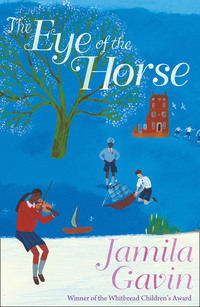
Kitabı oku: «The Eye of the Horse»

With gratitude to my parents for their memories; much love to Arthur, and to Geoff and Miriam for their endless support.

The Collected Poems and Plays of Rabindranath Tagore published by Macmillan
First published in Great Britain 1994 by Methuen Children’s Books
This edition published 2018 by Egmont UK Limited
The Yellow Building, 1 Nicholas Road, London W11 4AN
Text copyright © 1994 Jamila Gavin
The moral rights of the author have been asserted
ISBN 978 1 4052 9279 5
Ebook ISBN 978 0 7497 4743 5
A CIP catalogue record for this title is available from the British Library
All rights reserved. No part of this publication may be reproduced, stored in a retrieval system, or transmitted, in any form or by any means, electronic, mechanical, photocopying, recording or otherwise, without the prior permission of the publisher and the copyright owner.
Stay safe online. Any website addresses listed in this book are correct at the time of going to print. However, Egmont is not responsible for content hosted by third parties. Please be aware that online content can be subject to change and websites can contain content that is unsuitable for children. We advise that all children are supervised when using the internet.
Contents
Cover
Title Page
Acknowledgements and Copyright
Dedication
Epigraph
1. The Omen
2. The Sacrifice
3. The Gardens of Treachery
4. Train Tracks
5. The Prisoner
6. Who Will You Marry?
7. To the Borders of Death
8. The Wild Child
9. The Catch
10. The Paper Round
11. Voices
12. Savage Soul
13. Love or Duty?
14. Sea Change
15. Hanuman
16. A Woman in the Jungle
17. A Twist of Flowers
18. A Boat on a Pond
19. ‘La Paloma’
20. Monsoon
21. Promises to Keep
About the Author
To Miriam – The hub of the wheel holds all its parts together.
Then they let loose a white horse. And it was decreed that, wheresoever this horse should wander, King Rama would follow, even to the ends of the earth, until he might be led to the only person who could forgive him.
Ramayana
ONE
The Omen
‘Hey, Bublu! I heard something!’
The youngest boy, Sparrow, leaned over and shook the oldest boy.
‘Shut up, will you,’ groaned Bublu. It was hard enough to sleep at the best of times without being woken deliberately, what with the bitter winter cold and the fretful whimperings and nightmares, which racked them all on most nights.
Bublu enshrouded himself more tightly in the thin cotton sheet. He tried to ease the agony of the hard stone floor beneath his body, by rolling himself half over the limbs of the other boys. There was a murmuring of grunts and muttered protests, as everyone readjusted themselves in the knotted huddle they had formed around the ashes of last night’s fire.
But Bublu was awake now, and a few moments later, he too heard a noise. His body tensed automatically.
‘See! Didn’t I tell you?’ hissed Sparrow, his cold face pressed to Bublu’s ear. ‘You heard it, didn’t you! Is it them again? Are they coming to kill us?’ His voice almost broke out loud with panic.
Bublu clamped his hand over the youngest boy’s mouth. ‘Shut up, won’t you!’ He whispered. ‘All that’s over now.’ Even so, he was fully alert and sat up swiftly in the darkness, his mind already assessing the escape routes. He and the boys had gone over them many times, working out all the possible strategies. They had explored every part of the deserted palace; all the rooms, chambers, passageways, stairways; the different levels of terraces and even the wild saplings and creepers, down which they could shin in an emergency.
He listened, not breathing. In the past, the speed of his decision had been the difference between life and death.
They heard it again. It sounded like air being puffed out through nostrils; it was like the soft snort of a beast.
He hadn’t realised that Sparrow had clasped him round the waist, terrified that, should there be an order to flee, he would be left behind. Bublu struggled to his feet with Sparrow still clinging to him and shifted the child to his hip. ‘Hush, kid! Take it easy, it’s just an animal. Let’s go and look.’
‘What if it’s Muslims?’ stammered Sparrow.
‘Arreh!’ breathed Bublu, his sound smiling in the darkness. He was a Muslim.
Although it was pitch black, Bublu’s senses were so finely tuned that he knew in which direction was the doorway out onto the great verandah. Very rapidly, his eyes adjusted and he was able to differentiate between the inner darkness of the room in which they were sleeping, and the paler black of the starry night outside.
Sparrow was shaking uncontrollably with cold and fear as Bublu tiptoed to the entrance. A low half-moon came into view, casting a soft glow over the marble terrace. He stepped over the threshold and at first saw nothing but the great vast canopy of trees and undergrowth, which had grown out of control and turned the palace garden into a wilderness. Then there was a slight scrape of hoof on stone. The animal stood motionless, right there at the top of the verandah steps. At first he thought it was one of the palace statues, gleaming as white as the mist which hung over the lake beyond. But then the creature snorted again, and pawed the ground.
‘It’s a horse!’ exclaimed Bublu incredulously. ‘What the heck is a horse doing round here!’ Before he could utter another word, the animal leapt off the verandah and galloped away into the night.
The horse was seen again just before dawn of the next day.
It was Tuesday, 13 January 1948.
It materialised out of the frosty darkness, its hooves echoing strangely on the long white road. It was a pale horse; white as jasmine; white as the fresh snows on the mountain peaks to the north; white as the road beneath its feet.
Although the bridle had been fitted to a bit in its mouth, it had no saddle, and the reins hung loose. It looked to all intents and purposes like a bridegroom’s horse, for garlands of freshly threaded flowers hung round its neck, and a fringe of miniature pearls swung across its brow.
Sleepy farmers, startled out of their huddled blankets, saw it as they drove their bullock carts one behind the other, on their long trek to market. They called out to each other in the chilly darkness, standing up on the wooden yoke which held their beasts in harness.
‘Did you see that?’ they called.
‘Was it a horse?’
‘Whose is it? Where does it come from?’
One of them leapt from his cart and tried to grab it, but the horse reared in the air, shook him off, and galloped away.
The teacher glimpsed it as he cycled to school. It was mirrored in the dark, stagnant water of a ditch by the side of the road, its head stooped low to drink.
Old Ram Singh who, after his house had been razed to the ground, had made his home in the abandoned shell of All Souls’ Church, saw it grazing among the scarred and desecrated tombstones in the graveyard.
All that day the horse was seen, here and there, trotting along the dykes, meandering among the fields and nuzzling at fruit, which hung from the lower boughs in the guava groves. Sometimes it drifted tantalisingly close to the old men smoking their hookahs outside their homes, or the women filling pitchers with water from the well.
Later, after sundown, in the yellow paraffin light of the tea houses in the town, the gossip was all about the horse. They argued about where it had come from, to whom it belonged and what they should do about it. Some confessed they had tried already to catch it, but without success.
Bublu, who came into town every day to hang about, kept his ears open. This must be the same horse he and Sparrow had seen in the night. If the horse were a runaway and if he caught it, he would have as much right to it as anyone else. He wandered up to Dilip Singh, the tea-shop owner. ‘Here, let me hand out the tea while you fill the kettle again,’ he offered ingratiatingly.
‘Arreh! Everyone comes to me for a soft touch,’ Dilip Singh grumbled, but let Bublu hand out the cups anyway. The old-timers, those who had survived the troubles, knew the boy as Nazakhat Khan, son of the Muslim tailor, but they pretended not to, for his own safety.
‘The horse must have come down out of the mountains,’ said a farmer, as Bublu put a cup of tea before him. They all glanced to the northern horizon, where even in the darkness, the distant peaks of the Himalayas gleamed, everlastingly white.
‘Maybe it belongs to a Kashmiri trader,’ suggested a voice.
‘I say it’s a bridal horse that’s run off,’ declared another. ‘Didn’t you see how decorated it was?’
‘I haven’t heard of any weddings taking place today, have you?’ said the proprietor.
‘No! They say this month will not be auspicious,’ old Sharma, the sadhu, warned with a shake of his head. ‘There won’t be many marriages in the next few weeks.’
Old Sharma, the holy man, was another who spent his days hanging round the tea houses, waiting for the farmers to come with their tales and chatter. One of them was always sure to give him a free cup of tea, and a samosa too, if he was lucky. He shook his head like a grizzled prophet. ‘It’s an omen,’ he warned. ‘You mark my words. There has been too much killing. The gods must come now and take their retribution.’
‘Hey, Sharma, don’t bring talk like that into my tea house. You’ve had your cup, you old scrounger, now get out!’ yelled Dilip Singh. He grabbed the sadhu by the scruff of the neck and pushed him out on to the road.
The farmers looked at each other and shrugged. ‘Dilip Singh’s conscience is getting him ruffled!’ they smirked, though they all knew that no one’s hands were clean.
‘Hey, Babuji,’ cried Bublu, running over to help the old sadhu to his feet. ‘Do you mean it? Is the horse a bad omen?’
‘Ugh! Good, bad! How should I know? An omen is an omen.’
The dusty wireless, connected by a long twisted flex into the light socket and draped in wilting marigolds like a neglected goddess, crackled out news from New Delhi.
‘Shush!’ yelled a voice. ‘Listen! Listen, you chattering oafs!’
The voices quietened. They turned their ears to the smooth, anglicised tones of All India Radio which emanated from the temple of sound, propped on the shelf between the bags of spices.
Bublu didn’t understand English. ‘What is he saying?’ he pleaded.
‘Just be quiet, boy,’ muttered one of them. ‘How can we tell with you chattering on.’
‘This morning at eleven o’clock our respected Gandhiji began a fast. He told us of his profound sorrow that there is still so much communal strife in the country. It is his aim to achieve a reunion of hearts of all communities, with God as his supreme and sole counsellor.’
‘Did you hear that?’ the farmers whispered. ‘Gandhiji is fasting again.’ They gazed at each other, their faces etched with anxiety. The troubles were still all around them, they knew that. Every day there were reports of slayings and revenge. They glanced uneasily at old Sharma who was rubbing his elbows and brushing off the dust from his thin, spindly body.
‘What’s happening?’ begged Bublu, seeing the startled concern on everyone’s faces.
‘It’s the Mahatma, he’s going to fast again.’
‘What will be left of his body,’ exclaimed a voice.
The Mahatma was so small, so frail already. It was inconceivable that his skeletal frame could cope with any more deprivation.
‘How can we see a future for India and Pakistan once the British have left, if everyone is at each other’s throats?’ Gandhi had asked. ‘If this is the only way to make the politicians see sense then so be it.’
And so, once more, the Mahatma offered himself as a sacrifice.
That evening, Bublu got the boys to make a bigger fire than usual. The sadhu’s talk of omens and retribution had made him feel uneasy. Even though he was on home ground; even though he had been born in the village, as had previous generations of his family, ever since the troubles had broken out, Bublu had become a stranger – an alien in his own land. No one looked him in the eye, not even those who had known him all his life. His family had all been killed right here among them, and now, it was as if they had never been.
Somehow surviving, he slunk round the district with a raggle-taggle of other boys, who had also been orphaned or displaced. They stuck together in a band and set up camp in the ruined palace. No one else went there because of the ghosts and evil spirits that were reputed to haunt it.
The boys all had nicknames too, so that they could not be easily identified by race or creed. Bublu was the eldest and a natural leader, after having fought it out with Sandeep, whom they called One Eye – though he still had to watch his old rival.
They usually all straggled back to the ruined palace before sunset, bringing with them whatever gains they had collected through the day. It became the code of the group to pool everything – scraps of clothes, materials, objects – anything that might come in useful as a tool or a receptacle; and of course, each knew he must bring something back to contribute to a meal. The boys had agreed on a law: stealing vegetables and sugar cane from the fields was one thing – or scrumping mangoes, guavas and bananas, strictly for their own consumption – but there was to be no stealing from houses or persons. Any boy breaking the code would be punished by the group and if necessary, thrown out.
They were never sure each evening what, if anything, they would eat. Someone usually managed to break off some sugar cane, scrounge discarded radish tops or old chapattis, and if they were lucky, one or two women in the village left out some rice or lentils which the boys cooked up in an old petrol can.
Gradually, they became as tolerated in the district as the crows and stray dogs, which scavenged round the neighbourhood. But Bublu never dropped his guard – not with anyone.
Tonight, Bublu was ever more alert. Kept awake, not by strange noises or the fretful moanings of his companions, but the feeling that, somewhere out in the darkness, the white horse still roamed like an unquiet spirit.
However, his mind was made up. If he got the chance, he was going to catch it.
TWO
The Sacrifice
The clerk’s wife sighed. Her three fat sons clustered round her with pouting faces. Her husband had insisted that they too must fast. ‘It is our duty to support the Mahatma,’ explained the clerk.
‘Why, Pa?’ protested the eldest fat son. ‘How does it help the cause?’
‘After all, he won’t know,’ said the second fat son. ‘No one will know.’
‘Except us and our empty stomachs,’ moaned the third fat son.
But the clerk mercilessly reduced his family’s diet to a handful of nuts and one piece of fruit per day, saying, ‘At least you won’t starve like Gandhiji. He’s taking nothing, only water.’
It was too bad the way he carried his adoration of the Mahatma to such extreme limits and it wasn’t fair on the boys. The clerk’s wife gazed with anguished adoration at her three beautiful sons, as chubby as the god Ganesh and triumph of her womb.
They were a good Hindu family belonging to the Shatryia caste, who had managed to survive the troubles. They had only left the district temporarily when first Muslim, then Sikh gangs rampaged through. But as things quietened down, they returned to rebuild their home, and re-establish their place in the community.
Surely, they were entitled to some dignity? After all, they had to think of their reputation, and the future wives they would need to find for the boys. Yet since the clerk’s conversion to Gandhism he had stripped their modest home of everything that he called luxuries; their bedsteads, chairs, tables, ornaments, rugs – all had been given away or disposed of. He forbade his wife to wear jewellery and made her give away her best silk saris. From now on, they slept on thin mattresses on rickety charpoys, and all of them wore garments made from khadi, the raw rough cotton which had been spun by hand in the villages. She was sure the tailor had smirked when instructed to make their outfits.
Their food too had to be the most humble; just dhal, yogurt, fruit and nuts. No spices, no flavourings and no sweets were allowed.
His children were outraged. Three shiny plump boys, with cheeks like golden butter, who had been nourished and pampered from birth, with lashings of rich milk, cream, butter and cheese; who were used to curries cooked in the highest quality ghee, and ate only the freshest vegetables and fruit, and the finest white rice: whose mother adored making sweets and pastries and savoury samosas – they were to be denied all this – anything that smacked of pleasure or frivolity was banned. Food was for survival, because that was the lot of the poor, and it was with the poor that the clerk forced the whole family to identify.
Whenever they travelled by train, he insisted they cram themselves into the overflowing third class, along with malodorous peasants with their bundles and baskets.
But quite the worst indignity of all, was that the clerk made his wife clean out the latrines – the job of an Untouchable. She had begged and pleaded and screamed, and even threatened to leave home, but to no avail. The clerk told her that Gandhi had declared caste to be evil and must be done away with; that there was no longer any such thing as an ‘Untouchable’. People, who until now had been the lowest of the low – so low that they were outside caste itself, fit only to do the most menial of jobs, they were now to be called ‘Harijans’ – ‘children of God’. Everyone is equal in the eyes of God, Gandhi said, and he made his own wife clean out the latrines.
‘If Gandhi’s wife can clean out the latrines, then so can you,’ intoned the clerk without sympathy. ‘It is God’s work the same as everything else.’
‘Then why don’t you do it,’ hissed his wife under her breath.
‘What did you say?’ asked the clerk looking up from The Times of India he was reading.
‘I didn’t speak,’ murmured his wife, hurrying away with furious tears streaming down her face. What did he care that none of her women friends would come to take tea with her any more? And she was sure that her own children flinched from her when she kissed them.
Luckily for the three fat boys, the fast only lasted five days, but they made up for it by secretly buying sweets and gelabees from the sweet-seller, whom they passed each day on their way to school. Their mother always made sure they had enough annas in their pockets for whatever extra food they wanted to buy in the bazaar.
During that time, the horse was still to be seen in the district, though only fleetingly.
Gandhi ended his fast on Sunday, 18 January 1948.
THREE
The Gardens of Treachery
At early evening, just before the chill of night, the schoolteacher had taken to walking in the neglected, overgrown gardens of the abandoned palace. He sometimes took a small volume of poetry to read, relishing the loneliness which enabled him to declame it out loud.
‘There is a looker-on who sits behind my eyes.
It seems he has seen things in ages and worlds beyond memory’s shore,
And those forgotten sights glisten on the grass and shiver on the leaves.’
At the end of an avenue, just where it ran down to the lake shore, was a stone plaque, now quite hidden by tangled creepers. He found it by accident, when a loose page from his book blew into the undergrowth, and he was forced to leave the grassy track to retrieve it. Earth had already crept halfway up the hard, grey granite, almost obliterating the letters carved deeply into its surface. But he had scraped away the soil to reveal words. They were in English. First were two names: ‘Ralph and Grace’. These were the English children, the Chadwicks’ children, who had drowned in the lake some years ago. Many would go nowhere near the place now, for there had been talk of their ghosts walking on the water and the sound of childish laughter on the island in the middle of the lake. Beneath the names, chiselled deep and in a fine hand, were the words of a poem, also in English but dedicated to Lord Shiva:
I searched for your light
Everywhere:
And saw a dawn made from ten million million suns,
A cosmic brightness for my wonder.
O Destroyer of Darkness
If you are light
I need look no more.
That evening he walked in the cool, fragrant gardens. Just as he passed the plaque, and repeated the now well-remembered words, the schoolteacher had a sudden feeling that he was not alone.
Turning slowly, with a sharp chill running up his spine, he saw by the lake shore, some hundred metres away, the white horse. It was still bridled, and the garlands of flowers which hung round its neck looked as fresh as ever.
But there was something else now. Crouched nearby, as though it were its keeper, squatted a child all naked and wild, with hair that fell around it in a matted, tangled mass. Whether it was a girl or a boy, he could not tell, or perhaps, after all, it wasn’t human. Perhaps it was some animal, a monkey or even a young hyena, for when it suddenly looked up at him, it seemed to catch his eye with a glittering stare, and even from that distance, the look was so savage that he shuddered.
After a while, the horse moved on around the shore. The creature followed, sometimes on all fours, sometimes bounding about on two. The teacher watched them till they disappeared round a promontory. They did not reappear, although he waited until the sun had almost set.
It was Thursday, 29 January 1948.
‘Well, my daughter Marvi, and what are you doing today?’
Jhoti asked the same question almost every morning, just at the point of waking, before Marvinder had even opened her eyes.
‘I like Wednesdays, Ma,’ whispered Marvi into the cold, winter darkness. She could just see her breath puff upwards like a coil of ectoplasm, towards the still invisible ceiling. ‘We have our singing lessons with Mr Pentelow. He’s nice. He lets us choose our favourites.’
‘What is your favourite, Marvi, my dearest?’ sighed her mother. ‘Is it the song of spring which the farmers sing on their way to the fields? Is it the song about Krishna, stealing milk from the milkmaids? They were my favourites too.’
‘No, Ma. We don’t sing those songs here in England. We sing “The Ash Grove” and “Men of Harlech” and songs about Scotland. My favourite song is “Speed Bonnie Boat like a Bird on the Wing.” ’
Marvinder began to sing it quietly, sliding down under the bedclothes, so that she wouldn’t waken Kathleen and Beryl.
‘You’re going to be a musician, aren’t you, Marvi?’ Her mother sounded proud. ‘A violinist like Mr Chadwick, aren’t you, my daughter, aren’t you, my precious?’
‘Dr Silbermann teaches me well, Ma. I wish you could hear me.’
‘Do you remember, how we sat on the verandah in Deri, and listened, while Jaspal suckled at my breast? Do you remember, Marvinder, my child? Every evening, before dinner, the Chadwicks made music?’
‘Yes, Ma,’ cried Marvinder, and the tears slid down her cheeks. How could she forget? The music rose through the scented air of a Punjab evening, lifting out of the boughs of the mission garden like spirit birds, soaring and dipping and disappearing on and on into space. Even though they now lived in England, how could she forget? Especially not now that her mother, Jhoti, had taken up residence in her brain.
Marvinder had been dreaming about a horse. Sitting astride a white horse, she had been galloping . . . galloping . . . along twisting mountain trails; jumping gulleys and ditches and bubbling streams; ducking her head beneath the low branches of pine and spruce; then breaking out onto an open plain, where a silver horizon ran unimpeded from end to end; where the wind caught the horse’s tail and made it fan out behind it like a silver cataract; and her heart beat with the drumming of its hooves, as they sped along so fast, that any minute now, she felt they would leap up into the skies and gallop away among the stars.
But the sounds which awoke her were slow and heavy. Marvinder heard the early morning clip clop of the milkman’s cart coming down to Whitworth Road, and the faint tinkle of bottles as he unloaded the quota destined for No. 30.
She eased herself silently out of bed and sped, barefoot, down the freezing lino-covered stairs, to the front door. She opened it in time to see the milkman climbing the front steps with cheery face beaming out at her from beneath his peaked cap.
‘Hello, my little early bird,’ he whispered, as with practised silence, he set down the various groups of milk bottles in their proper places. ‘Looking for worms?’
She grinned back, remembered how it was he who taught her the saying, ‘it’s the early bird that catches the worm’.
Then, suddenly, his face became grave, and he bent forward confidentially. ‘There was news on the wireless this morning that’ll interest you,’ he murmured.
‘Oh?’ Marvinder was puzzled.
‘Mahatma Gandhi.’ The milkman said the name with reverence. ‘He’s been shot.’
It was Friday, 30th January 1948.
So, Marvinder in England heard the news before the clerk in India. The clerk didn’t hear till almost evening. He had been accounting all day, sitting in front of large dusty ledger books, with his specs balanced on his nose, pencil in hand, roaming up and down columns of figures, calculating, adding and subtracting and dividing, his brain revolving and clicking like the beads on an abacus.
‘What do you want?’ he demanded of the gangly youth who lingered somewhat insolently in the doorway.
The clerk knew he was something of a laughingstock with his colleagues, who liked to tease him for being such a faithful disciple of the Mahatma – especially as he came to work wearing a coarse khadi dhoti, instead of refined white cotton trousers and shirts or even western-style suits. What’s more, he had insisted on removing the top of his desk from its frame, placing it on the floor and working cross-legged. ‘We Indians should do things the Indian way, not ape the Britishers,’ he had declared with an air of moral superiority. However, it irked him no end, to think that he was being smirked at behind his back, by the cocky young messengers who hung about the office.
‘You haven’t heard the news, then?’ asked the youth with mock concern.
‘What news?’ The clerk frowned. He straightened his back from his cross-legged position, and adjusted his spectacles which had slipped down his nose. As he did so, he was aware of the sound of women wailing in the background and agitated voices, rising and falling in repeating sequences of distress. Anxiously, he gathered up his dhoti and got to his feet.
‘It’s your beloved leader; the Father of the People . . . Bapu . . .’ The youth drawled out the words slowly and sarcastically, relishing the puzzled anxiety he could see beginning to furrow the clerk’s face.
‘Gandhiji? Gandhiji?’
‘He’s been shot!’
‘Is he dead?’
‘Oh yes.’ The youth tittered, then fled.
Slipping . . . slipping . . . the ground was slipping away from beneath his feet. The clerk clutched his heart and then his head. The whole world became dark and began to spin around him as if out of control . . . it was a past betrayed . . . a future lost . . . what would happen . . . what would become of them? All that slaughter . . . destruction . . . and a terrible sickness of the soul . . . who could heal the wounds? Who could save them now? What revenge would God take for the death of a saint? Slipping . . . slipping . . . there was nothing solid for his feet to stand on.
The clerk crumpled to the ground, his arms clutched around his head as if waiting to be sucked away into oblivion.
In his distraught mind, he wandered through beautiful gardens of ornamental lakes and perfumed fountains; down shaded avenues of cypresses; into fruit groves and walled gardens, where flowering bushes were bursting with colour and profusion. They were gardens of order and peace created out of a jungle of danger and chaos. Yet a voice whispered in his brain. Beware! Beware the beast that lurks; the enemy disguised as a friend; the serpent coiled among the boughs of the tree in the garden of Eden, waiting for Eve; beware the Judas seeking out Jesus in the Garden of Gethsemane to embrace him with the kiss of betrayal; Ravana, king of the demons disguised as a holy man; the devil who has gained access into the inner sanctuary.
But it was too late for warnings. In a garden in Delhi, an assassin lurked among the shrubberies of Birla House. A man, pretending to be a disciple, waited for Gandhi.
The Mahatma was still frail and impossibly thin after his long fast. Flanked by his faithful women followers, on whose shoulders he rested a hand for support, he walked trustingly to a prayer meeting. The assassin stepped forward. So close. As close as friends. He faced him, looked him in the eye, then shot him three times.
‘Hiya Ram, Ram, Ram!’ were the last words on the Mahatma’s dying breath.
‘The light has gone out of our world,’ wept the Prime Minister.
Later that day the horse was seen again, galloping in a frenzy down the long white road. Some said a strange rider crouched on its back; some demented creature with wild hair flying – small as a child or a hunchback.
But that night, the horse came again to the palace. Bublu heard its footfall on the terrace. Bublu moved with the silence of a hunter. This time, he would catch it. He heard its breath and saw its white shape gleaming in the darkness. It looked up. The horse saw him with glittering eye. It didn’t run away. Bublu held out a hand of friendship. ‘Come to me, my beauty! Don’t run away. Come to me, O wondrous one!’
As he spoke, he moved closer and closer. Now he could feel its warm breath as he held his hand up to its nostrils. He stroked its nose and murmured lovingly to it. ‘Let’s be friends. Stay with me. I’ll feed you and groom you and ride you well. Stay, my beauty.’
The horse stood stock-still. Then Bublu realised that, sheltering beneath the horse’s belly, protected between its four legs, crouched a creature with long wild hair. In the darkness, he couldn’t make out the face, but its eyes, like the eyes of a snake, stared at him, glittering and hypnotic.
Bublu cried out loud with shock, but still the horse didn’t move.
What had come to them? What was this creature? Was it a demon? Was the horse a bringer of bad luck? Bublu remembered the words of the old sadhu.
He dared not move either towards the horse or back to his place by the fire. Instead, wrapping his sheet around him, Bublu sank down on his haunches, and stayed like that for the rest of the night, with his head sunk on to his arms.
FOUR
Train Tracks
Jaspal leaned over the old metal bridge and looked down onto the railway tracks below. The shining metal slithered away like parallel serpents, till they reached a point in the distance where they merged as if one – but he knew that this was only an optical illusion.
The sight of the tracks always gave him an intense feeling of excitement. Sometimes, when the sun was shining in a particular way, he could block from his view the grubby backs of those London houses and flats, with their grimy windows and straggles of grey washing hung out to dry. He could fix his eye on the patch of blue sky between the tenements, and imagine he was back in India. For a while, he could try and forget the pain which sat in his stomach like a hard lump.
Trains reminded him of his village back home in Deri. Beyond the mango and guava groves and between the fields of wheat, mustard seed and sugar cane, the railway track ran the length of the Punjab skyline.
He and his best friend, Nazakhat, had loved trains. On many an afternoon after school, they would take the long way home so that they might get over to the track and walk on the rails. There was no chance of being run down by a train, as you could see as far as the horizon in each direction. Anyway, long before the train was in sight, you could feel the hum of its power beneath your feet. It was often the smoke they saw first, streaming a long trail in the sky, and then they would hear the piercing shriek of its whistle, which carried all the way to the village.
Although there was no need for danger, they often created it.
‘Let’s see who’ll jump off first,’ Jaspal had shrieked to his friend, as the train came nearer. They had waited and waited, giggling and wobbling about with arms outstretched for balance, each on his rail. Jaspal was to leap off on one side, Nazakhat to the other. As the train bore down on them, the engine driver would often be leaning out of his cab swearing and cursing at them, shaking his fist and telling them to get out of the way. But they would just shake their fists back, mouthing unmentionable insults and then, at the last minute, fling themselves aside.
Jaspal smiled at the memory. If only it was only the good times he remembered. But trains pounded through his dreams at night. Indian trains, filled with refugees, escaping from the mayhem which was caused when India was split into two to create Pakistan; when Muslims, Hindus and Sikhs set upon each other with vicious fury, and people were driven hither and thither. The shriek of the train whistle had been a scream of death; a scream of hatred and murder and massacre. He had seen it. The images would never go away, though he tried to forget. He tried to forget the day they fled from their village. He, his sister, his grandmother and mother set off for Bombay. His mother, Jhoti, had been saving small amounts of money each time Govind sent anything from England. She had this dream, this conviction, that they would be able to buy themselves tickets on a ship bound for England. ‘If your father won’t come to us, then we will go to him,’ Jhoti had declared. Such were the desperate times, everyone was rushing around trying to work out strategies for survival. There was no one to tell her whether or not she had enough money, what papers she would need or how she would get there. With thousands of others, she had simply set off for the nearest railway station.
In the pandemonium of overcrowded platforms and trains packed with refugees, Jhoti and her children were separated from each other. The force of the crush swept Jaspal and Marvinder onto a train, which then moved off, carrying them helplessly away. Now he and his sister Marvinder were here in England while their mother and grandmother had been left behind to an unknown fate. The pain of those memories was too much to bear. Mostly, he kept them locked away in the dark recesses of his mind. Better, instead, to remember his games and his friends – especially, Nazakhat.
There was a clicking sound of a signal being raised. A train must be coming. It would be the express bound for Bournemouth and the south coast. Jaspal felt the same old excitement. If only Nazakhat could see this. He pulled a notebook and pencil out of his pocket and heaved himself up onto the parapet, so that he could get a good view of the name and number of the engine. He could hear it now as it pounded nearer. A thrill of anticipation ran through him.
Suddenly a voice yelled over the increasing roar. ‘Oi!’ Jaspal dropped down and turned. ‘Hey! Blackface! Bandage-head!’ Johnnie Cudlip stood on the other side of the road, leering at him. Although he was only a little older than Jaspal, he was a big boy for his age. Taller by a head and shoulders than any of his peers, his body was clumsy and unwieldy, as if he wasn’t sure what to do with it. His hands looked extra large, sticking out from the sleeves of the blazer he had outgrown six months ago.
Johnnie hated school because it made him feel stupid. Because teachers, who were hardly taller than he, crushed him with sarcasm and seemed to forget that, though he was as tall as a man, he was only a child. Out in the playground and the streets, it was a different story. There, he was king. There, he ruled. He was the leader of a terror gang. All the children feared him for his strength and the way he enjoyed a really good fight. What the teachers did with their tongues, he could do with his fists and feet and brute force. Anyone who wasn’t with him was against him – and your life was hardly worth living if you weren’t on his side – that is, until Jaspal came into the neighbourhood and soon formed a gang of his own.
Ever since Jaspal had moved into Whitworth Road, Johnnie had been out to get him; but though Jaspal was shorter than he, and thinner, somehow, Johnnie could never get to grips with him. He would no sooner jump on his back and get his head into a stranglehold, than Jaspal would wriggle like a fish, slither like a snake – somehow just make himself smaller and slip out of his grip. Other times, when the two boys would come face to face with each other, Jaspal’s body seemed to solidify. He would stand upright, calm and still, except that the muscles in his neck were as taut as rope and his limbs all ready to strike like a whiplash. Many a time, Johnnie had set the gang on him, but Jaspal was fast, elusive and cunning. No one could outrun him. It was as if he could make himself invisible.
‘Hanuman, Hanuman,’ whispered their mother when Marvinder told her from inside her head. ‘Hanuman, the son of Vayu, the god of the wind. He has magic powers – and not even the king of the demons can kill him. Hanuman found Sita. One day, he will find me.’
‘You’re like Hanuman,’ Marvinder whispered to her brother, when she watched a gang fight one day on the common. It had been a brutal, bloody fight, but Jaspal couldn’t be beaten. If he got knocked down, he was up on his feet again in a trice. He seemed to have eyes at the back of his head, and when his enemies came up behind him, he would start whirling his arms about and yelling like a mad creature.
Jaspal took up the name. He liked the sound it made. Hanuman . . . Hanuman . . . general of the king of the monkeys’ army, fighter of demons; son of the wind god with powers to make himself invisible, or turn himself into any shape both big and small. He taught the word to his gang. Now, when they went into a fight, they would chant, Hanuman . . . Hanuman . . . Hanuman . . . and before they had even struck a blow, the sound of the chanting brought fear into the hearts of Johnnie Cudlip and his gang.
‘Watching for the chuff-chuff, are we?’ Johnnie sneered. Jaspal was alone. Alone, he looked small, thin and easy to bully. Taking advantage of a break in the traffic, Johnnie dashed over the road and stood menacingly close to Jaspal.
The train was hurtling closer in a great cloud of black steam and smoke. Jaspal would have to lean well over to see the number. It meant turning his back on Johnnie. He hesitated then, gripping the rail of the bridge, he heaved himself up to his armpits and, with his toes, found some rivets with which to steady himself. He leaned over as far as he dared. The engine smoke whirled about him. Suddenly he felt hands grip his legs. Johnnie tipped him so that he was almost see-sawing over the side.
‘Need some help, do you?’ taunted Johnnie, laughing fiercely.
Jaspal felt himself losing control as the train sped beneath him, under the bridge. Instinctively, he clutched the sides with his hands and, in doing so, let slip his precious notebook, which contained pages and pages of numbers and the names of engines, taken down over hours of train-spotting. With a cry of anguish, he watched it fluttering down onto the track, just as the last carriage was sucked from view.
With miserable fury, Jaspal kicked out with all his might and sent Johnnie stumbling backwards, almost into the road. A bus blared out a warning on its horn, and someone shouted, ‘Bloomin’ rascals! Why aren’t they in school?’
Free of Johnnie’s grip, Jaspal ran to the far end of the bridge. All he could think about was retrieving his notebook. He discovered a small space between the edge of the bridge and a wall. He slid through and found himself on top of the steep embankment. There below him on the track he saw it, the wind idly riffling through its pages.
He began to slide down, partly on his bottom, struggling to keep control.
‘You coolie. I’ll get you for that!’ Smarting from the indignity of being kicked into the gutter, Johnnie came slithering down the embankment after him.
Jaspal reached the track. Just then, they heard another whistle. A second train was coming. If he didn’t get his notebook, it would be completely mangled beneath the wheels.
A goods train trundled into sight. It wasn’t as fast as the express, but it was going at a fairly swift speed. Jaspal didn’t hesitate. He dashed onto the line and grabbed the notebook. Johnnie too had now reached the edge of the track. Jaspal laughed and stood there, balancing on the rails brandishing his notebook. ‘Did you want something, beanpole?’ bellowed Jaspal. ‘Well, come and get it!’
The train driver was blasting a warning on his whistle. He was only fifteen metres away. Jaspal didn’t move. Johnnie made as if to run across. The driver blew his whistle again. Johnnie hesitated.
‘Cowardy custard, can’t eat mustard!’ yelled Jaspal triumphantly. Johnnie flinched with horror as Jaspal threw himself off the track, a couple of metres from impact with the train.
The two boys stared at each other between the passing trucks. Their gaze burned with enmity; then, before the long trail of goods had gone by, Jaspal had vanished.
That evening, Jaspal and his gang gathered in the cellar of the bombed house at the end of the road. They were initiating a new member into their brotherhood. Jaspal, as leader, stood on a table to give him height and authority. He wore a black turban and Indian shirt and pyjamas. His ceremonial sword was visible where it was tucked into his belt. He stood with his arms folded and feet apart, like a Sikh warrior waiting for action. Two candles flickered, casting gigantic shadows against the stone walls and the boys below him were quiet and attentive, their shadowed features turned upwards expectantly. They didn’t have turbans quite like Jaspal’s, but they wore bandanas round their heads whenever they gathered together.
He looked down on his followers – about eight of them – their faces solemn and dedicated. Two of the gang stepped forward, flanking a thin, pale-faced boy who was blindfolded. One of the gang removed the blindfold, while another gave him his spectacles. The boy hastily crammed the spectacles onto his face, which gave him a startled expression and made him look scared. He was new to the area and had been tormented at school. He knew that the only way to survive was to get into one of the gangs, then at least he would have the protection of his own gang brothers. He glanced around him nervously, then looked down.
‘What’s your name?’ demanded Jaspal.
‘Gordon Collins.’
‘To join this gang, you have to go through a test to prove you are brave and loyal. Do you understand?’ Jaspal stared at him coldly.
‘Yes.’ Gordon tried to control his quavering voice and he kept his eyes firmly to the ground. What would they ask him to do? He had heard stories of terrible tasks to get into gangs – things that were dangerous or terrifying. He waited with dread.
‘We have decided that you must spend the night in St Peter’s Church alone, and whatever happens – whatever you see or hear – don’t try and sneak out, because we’ll know, and not only will you be banned from our gang, but we’ll punish you for failing.’
Gordon heaved a sigh of relief, and looked round – his glance seeming to say, ‘Is that all?’ He thought they might ask him to run across the railway track in front of an oncoming train, or to walk across the wall of the canal bridge in the dark. But there was a general intake of breath and a low murmuring from the gang members, as if they thought this was bad enough.
‘When must I do it?’ he asked.
‘Tomorrow night,’ answered Jaspal. ‘Be outside the Palladium Cinema at ten o’clock sharp, and we will see you into the church. We’ll be waiting for you when you come out in the morning – so don’t think you can get away with anything. Understood?’
Gordon nodded. As he was escorted out of the cellar, he heard them chanting softly . . . Hanuman . . . Hanuman . . . Hanuman . . . They told him to scram. Until he was a gang member, he was not allowed to stay on for the meeting.
‘Cor! Wouldn’t like to be in your shoes,’ hissed his escort, at the top of the steps. ‘That church is haunted. I’ve heard of people who go grey with fright after spending a night in there.’
‘I don’t believe in ghosts,’ declared Gordon stoutly, hoping that his shaking voice didn’t give him away.
‘Huh! Tell us that the day after tomorrow!’ jeered the boys, pushing Gordon on his way.
‘Right,’ said Jaspal, jumping down from the table and sitting on it. ‘Business. The Johnnie Cudlip gang attacked Ronnie, Teddy and Frank in Warley Grove last night.’
Everyone turned and sympathetically examined the cuts and bruises of three younger boys who sniffed and wiped their noses across their sleeves and grinned sheepishly.
‘They’re cowards, that lot, picking on the little ones. Got no guts to face us. I think we need to show ’em. We must draw the whole Cudlip gang out; plan an attack – an ambush – and fight them into surrender. It’s about time Johnnie realised he can’t keep messing us about. I say we fight them after school . . . down at the tracks. Put out the word.’
FIVE
The Prisoner
It was Saturday. Maeve Singh came downstairs and stood in the doorway of her parents’ flat. Her body was still girlishly thin and undeveloped, as if she had grown up reluctantly. She held herself awkwardly stiff, like a tightly-coiled spring; her lips pressed together, her pretty face taut and defensive.
Her paper-white skin looked almost translucent as the sunlight fell across her face.
She was dressed to go out, though without much effort. She would have looked drab, except that the sun seemed to ignite the coils of red hair, which fell to her shoulders from beneath a panama-shaped green hat, and enriched the otherwise dull brown of her shapeless coat.
Her little daughter, Beryl, stood half-behind her, knee-high, clutching her mother’s coat in one hand, while sucking her thumb through a tight fist, with the other. She wasn’t dressed to go out, and knew that she was about to be left. Her light brown eyes shifted uneasily round the room, settling first on Jaspal, her half-brother. She was frightened of him. He always scowled and looked angry. He didn’t like her, she knew that. He hardly ever looked at her.
Marvinder was different. Beryl loved her. Marvinder seemed pleased to have a sister, even if she was only a half-sister. But Beryl would get used to being only half; half a sister, half-Indian, half-Irish . . . not as wholly Indian as their father, Govind, and not as wholly Irish as her mother, Maeve. Her skin was neither white nor brown; her hair neither black nor red. Only her eyes, her pale, flecked-brown eyes like the skins of almonds, were exactly the same as her father’s eyes and exactly the same as Marvinder’s. But she would not know this yet. She didn’t look in mirrors – at least not to assess herself. Her mirror was other people, and she saw herself the way they saw her.
‘Are you ready?’ Maeve asked. There was no enthusiasm in her voice.
Jaspal, Marvinder and Maeve’s young sister, Kathleen, had been lolling in front of the fire, engrossed in comics. Marvinder got up immediately, and pulled down her coat from the door, and Kathleen went over to her little niece, to coax her into staying. Jaspal rudely ignored Maeve and went on reading.
‘Well, come on then,’ Maeve was impatient. ‘Get your coat on, Jaspal. We’ll miss the bus. Good grief, we only go once a fortnight and, after all, it is to see your own father.’ She almost spat out the word ‘father’ like a bitter pill.
‘Can I go see Dadda!’ wailed Beryl.
‘Yeah, take Beryl. I don’t want to go,’ Jaspal muttered.
‘Come on, bhai,’ urged Marvinder, and she chucked his coat at him.
He reacted angrily. ‘Look what you’ve done, you stupid idiot!’ he yelled, dragging his comic out from under the coat. ‘That’s my comic. You’ve gone and wrecked my comic!’
Marvinder looked pained. Jaspal never used to talk rudely to her. ‘It doesn’t looked wrecked to me,’ she retorted. ‘Here!’ She reached out to straighten it, but he whipped it away.
‘Leave off. It’s mine.’
‘I know it’s yours, silly! I was just going to smooth it out.’
Maeve ran over impatiently and snatched at the comic. ‘For God’s sake, Jaspal, will you stop messing around and come. We’re going to miss the bus, I tell you.’
There was a ripping sound.
Jaspal gave a bellow of fury. ‘Look what you’ve done! You’ve torn it . . . you . . .’ He looked as if he would fly at her, but Marvinder grabbed his arm.
‘Jaspal, no!’ She begged, ‘Just put on your coat and come.’ She picked up his grey worsted coat and firmly held it out for him.
Jaspal snorted angrily and broke into a stream of Punjabi, which he knew infuriated Maeve. ‘Why should I do what that woman wants? She’s not my mother. She’s nothing but a thief and a harlot, stealing away our father. Now she thinks she can lord it over us. Well, she can’t. I don’t have to do anything she says.’
‘Oi, oi! You being rude again, you little devil?’ It was Mrs O’Grady appearing at the door. Her plump face was red with effort. She was panting heavily with having hauled two vast bundles of other people’s laundry up the long flight of stairs. ‘You needn’t think I don’t know what you’re saying, just because you speak in your gibberish.’ She dropped the washing and strode over to Jaspal with her hand raised. ‘You get your coat on immediately or you’ll get a clip round the ear.’ She hovered over him, threateningly. ‘And if I hear you’ve given Maeve any of your lip while out, Mr O’Grady will get his belt to you.’
That was no mean threat. One leg or no, Mr O’Grady was a powerful distributor of punishments, and even his strapping sons, Michael and Patrick, had to watch themselves when their father got mad.
Jaspal sullenly thrust his arms into the sleeves of the coat which Marvinder still held out for him, though when she tried to do up his buttons he pushed her away.
‘I’ll do it,’ he growled. ‘I’m not a baby.’
‘Huh, I’m not so sure about that,’ snapped Mrs O’Grady, lowering her hand. ‘Now get off with you,’ and she herded them to the landing, checking their hats and scarves and gloves and warning them about the chill out there.
If those who make up a family are like the spokes of a wheel, then Mrs O’Grady was both the hub and the outer rim. She held them all together; she fed them, nurtured them, washed and cooked for them and bullied them. She put up with her husband, with his drinking and temper and his fury at losing a leg in the war; she hustled her two boys, Patrick and Michael, making sure they got off to work every day – then taking half their wages at the end of the week, to store in the teapot which stood on the mantelpiece; and when Maeve had got pregnant by Govind – even though the man was a heathen and as brown as the River Thames, she insisted that the couple move into the household, taking the top-floor flat, which meant that the younger sister, Kathy, had to move down and sleep in the hall under the stairs.
In due course, when Beryl was born, it was Mrs O’Grady who coped, for Maeve was a reluctant mother, distraught at finding her freedom curtailed; and only a woman as mighty an Amazon as Mrs O’Grady could have endured the shock of finding out that Govind already had a wife and family back in India; only a woman with shoulders as broad as a continent could then take on his two refugee children, Jaspal and Marvinder, when they turned up out of the blue to find their father – a father who had got mixed up in black-marketeering and who was then sent to prison. She may have raged and grumbled and lashed out with her tongue, but she never complained. But kneeling in the darkness of the confessional, she had whispered to Father Macnally that she had prayed to the sweet Virgin not to send her any more children to look after – and especially, please – no more heathens.
‘Mum!’ Beryl wailed pathetically. She broke away from Kathleen’s arms and reached out for Maeve. ‘I want to see Dadda. Take me too!’
Mrs O’Grady snatched up her grandchild and held her firmly, ‘You stay with your Gran and your Aunty Kathleen, there’s a duck. You can go next time.’
‘We’ll see you later, Beryl,’ Maeve cooed at her child, trying to soften her voice and her face, before following Jaspal and Marvinder downstairs and out of the front door.
A sharp spring wind blew up Wandsworth High Road. It blew the scattered bus tickets into red, blue and yellow spirals and whirled them along the pavements. It made you hold on to your hat and clutch at your coat. It was the sort of wind which found its way into every crevice between neck and scarf, or wrist and glove. Even through the buttonholes. They bent their heads before it as they walked to the bus stop; and turned their backs on it, as they waited and waited for the red double-decker to come.
They were grateful to the wind. At least it gave them an excuse not to talk. Instead, they buried their reddened chins into their scarves and collars and gazed wistfully down the road, as if their very concentration could will the bus to come quicker.
And when it came, roaring to a stop in response to their outstretched hands, they always went clattering up the metal spiral steps onto the top deck. Maeve liked to smoke.
Jaspal and Marvinder would rush for the seats up at the very front above the driver’s head. They enjoyed the clear open view, and the feeling of being on top of the world. They could lean right forward and press their brows up against the glass.
But for all that, it was a gloomy journey which none of them relished. If only they could have got off at the river and spent the day in Battersea Park, or if, instead of changing buses at Hammersmith, they could have walked down to Shepherd’s Bush market and milled around the hustle and bustle of the stalls. Instead, they had to watch it all slide by and listen to the monotonous warnings of the conductor. ‘Hold very tight, please,’ as he tugged on the lower-deck bell string. ‘Ting, ting!’ It was one ting to stop and two tings to go.
At last they reached Ducane Road. The vast open playing fields of Latymer School seemed to gather up the winds and hurl them into their faces.
That final walk always seemed the longest. Maeve walked a little head, as if embarrassed by them, looking fixedly in front, never addressing any remarks to them, as if afraid people might think they were her children.
Two groups of people walked the same pavement, but managed to create a meaningful distance between each other.
There were those whose destination was Hammersmith Hospital, and with whom Maeve tried to merge for most of the walk. They were a generally cheerful lot, clutching bunches of newly-bought flowers from strategically-placed flower-sellers, or brown paper bags full of whatever fruit they could obtain with their ration coupons.
This group pretended not to see the other group, with whom, for a while, they shared the same pavement and the same direction. Their eyes looked through them as though they were ghosts, and there was a certain smugness, when this first group branched off and poured through the gates of the hospital in time for visiting hours.
The second group pretended not to notice or care. Their faces were grimmer, their pace more reluctant. Hardly anyone spoke, but concentrated on coaxing their children along, or simply fixing their focus on the next main gateway, to which they finally came. And when they walked through, they kept their eyes lowered to the ground. They never looked up at the grim fortress towers of His Majesty’s Prison, Wormwood Scrubs.
Here, Maeve, Jaspal and Marvinder joined a sizeable straggle of mostly women and children, gathering outside the large oval gate, waiting for the exact moment when they would be admitted. No matter how awful the weather, the gate was never opened even thirty seconds earlier than ordained.
Unlike hospital visitors, they weren’t allowed to take in flowers or fruit or packages of food. Each was frisked at the gate; handbags were opened and searched. They were made to feel that by visiting a prisoner, the visitor too was somehow guilty.
After further hanging about, they were all finally ushered into a large room, supervised by blank-faced warders, where, waiting for them at a series of tables, were the prisoners, their eyes eagerly scanning the faces as they came in.
Marvinder saw her father.
He was thinner these days. Perhaps it was the way they cropped his hair very close to the head; it seemed to emphasise his gaunt face; it made his cheeks look more hollow. His skin was blanched as if deprived of sunlight.
Lately, he had become withdrawn. Marvinder wondered whether it was to do with the killing of Mahatma Gandhi. When they broke the news to him a couple of months back, he looked as if he were going to faint.
‘Was he a very important man, Pa?’ she had asked, when he had collapsed into his chair and thrust his head down on the table between his arms.
‘Who can forgive me?’ was all her father had been able to choke, as if he had been the assassin.
‘When he was a student your father admired Mahatma Gandhi; worshipped him like a saint,’ Jhoti had explained inside her daughter’s head. ‘He travelled miles to attend his gatherings, and then came back to the village with such stories. He would tell us that the British were going to leave, and that India would become independent; how this little, half-starved man, with only a piece of cloth round his middle, was standing up to the might of the British Empire. The whole village would gather round to listen. Your father was such an important person in those days. But now . . . who would have thought . . .’
Marvinder waved a timid greeting. Her father raised a hand in acknowledgement. He stood up, but looked past her. He looked past Maeve too. It was Jaspal on whom he feasted his eyes. His gaze seemed to plead for understanding and forgiveness. ‘Can’t we be friends?’
But Jaspal lowered his eyes with embarrassment. It had been easy to love his father when he thought he was a hero. When they had lived in India, in their little Punjabi village, Jaspal, who had never known his father, grew up looking at the proud, flower-draped photograph, which had been taken when Govind graduated from Amritsar University. His turbaned head, with sleek moustache and confident eyes, stared out with a faint look of surprise, as though marvelling that he, the son of a simple farmer, could rise to such heights.
Govind had come to England to study, encouraged by Harold Chadwick, his English teacher back in India. He enrolled at London University to do a degree in law. He was urged to be someone; do something for his newly-independent country. But all these plans had been interrupted by the war. He had joined up along with all his fellow students and fought in Europe and North Africa.
So where was that hero now? Where was the soldier-scholar, whose garlanded image Jaspal had grown up with and admired every day? Where was the Sikh warrior, who had gone into the British army to help fight against the Nazis? When the war ended, and Govind didn’t come home, they never for a moment disbelieved his letters, which told them first, that he had been wounded and was undergoing treatment, and then, that he was trying to earn enough money in Britain, so that he could return to India and set up a business.
Jaspal remembered how his mother, Jhoti, had fretted. ‘Why doesn’t he come home? We need him here. We need him as a father to protect his family. Doesn’t he know what is happening here?’
Surely Govind must have heard. The whole world knew that Britain had finally granted India the right to independence. But even before the British left, the troubles began. When part of India split away to become Pakistan, in the vast interchange of populations from one country to another, thousands were slaughtered. And in the Punjab, the Sikhs, who were neither Hindu nor Muslim, fought for their own identity – and some, for their own homeland too. How could Govind not know? Why did he not return to protect his family?
But what did Govind, their father, know of all this? It was ten years since he had left India, and it was as though he had never belonged there, never had a family there, no parents, brothers or sisters, no wife and two young children.
By the time he married Maeve O’Grady, he was another person altogether. He never talked about India to her; never told her about his other wife and children; and the more time went by, the less reason he saw to confess – especially after Beryl was born.
Then Jaspal and Marvinder turned up on his doorstep in England and, like a thrust of the wheel, his whole world revolved and his past life confronted him.
At first, Jaspal couldn’t believe this was his father. He had no beard, no turban. He wasn’t a scholar or a warrior, or anyone he could be proud of. Worst of all, Govind had betrayed them all; Jaspal, Marvinder and their mother, Jhoti.
Then they found out he was part of a criminal gang.
Bitterly, all Jaspal could hear was Mr O’Grady’s words ringing in his ears, ‘He’s nothing but a spiv; a black-marketeer; a petty crook.’
‘But he did save a man from the fire,’ Jaspal had pleaded. ‘The newspapers said he was a hero.’
‘Just as well,’ Mr O’Grady had snorted. ‘Otherwise he would have gone to the gallows for murder.’
For that heroic act, they hoped his other crimes would be overlooked, but it was not to be. The wheels of justice turned, and Govind was convicted for black-marketeering.
‘It’s good that Ma never knew what Pa did in England,’ Marvinder had whispered when their father was taken off to prison.
Govind held out his hands greedily, eager to clasp each one. Jaspal avoided his father’s gaze and pulled away from Govind’s grip as soon as he could. He flopped down in a chair, and turned it sideways on, looking deliberately bored.
Marvinder pulled her chair closer, but sat with lowered eyes. No matter what Govind had done, she couldn’t hate him, and she wished she had magic powers, so that she could free him from his prison. She often imagined how she would help him to escape and they would all run away back to India. Then they would find her mother, Jhoti, and everything would be all right.
‘How are you doing for money?’ Govind asked Maeve. They sat facing each other across the table. They didn’t touch; each kept their hands clasped together in front of them.
‘We’re managing,’ she replied sullenly. ‘I’ve got a job at Franklands Engineering. Gives me about fifteen bob a week; a pound, with overtime. Between Mum, Dad and the boys, we get by. We get Family Allowance too. They’ve agreed to give it for Jaspal and Marvinder, as well as for Beryl, and I’ve got ration books for them now. That friend of yours, Mr Chadwick, he found out about it all for us.’
‘That’s good.’ Govind sighed with relief. ‘How’s Beryl?’
‘She’s fine.’ Maeve fingered her wedding ring so that she didn’t have to look at her husband. ‘The children bring home these American food parcels from school. That helps,’ she murmured.
Govind waited for more news of their child, but Maeve fell silent and went on twisting her ring round and round.
‘I’ve got something for her.’ Govind reached down to a brown paper bag at his feet and pulled out a stuffed elephant.
‘That’s nice!’ Marvinder exclaimed with enthusiasm. It was patchworked together from different bits of material and stuffed. ‘Isn’t it nice, Maeve?’
‘I made it in the workshops,’ Govind said with weary pride. ‘I’m halfway through a camel. It’ll be ready next time you come. But I hope Beryl will like the elephant.’ He stood it on the table for them to admire.
‘It’s lovely, isn’t it, Maeve!’ Marvinder persisted. ‘Course Beryl will like it, won’t she?’
Maeve nodded, giving it a cursory glance, but made no move to examine it. Marvinder picked it up. ‘Look, bhai! ’ She showed the elephant to Jaspal. ‘Isn’t Pa clever to make this?’
‘Why did you make an elephant?’ queried Jaspal in a cold voice. ‘They don’t have elephants here or camels, except in zoos. You should have made a dog or a cat.’
‘Shall I make you a dog or a cat?’ asked Govind, trying to please.
Jaspal almost snorted with derision. ‘Stuffed toys are for babies! Billy’s father makes boats. He sails them in the park. He might let me make one,’ added Jaspal cruelly.
‘Who’s Billy?’ asked Govind quietly.
‘My best friend,’ said Jaspal. ‘His dad might give me a job later in his workshop. He said I had all the makings of a carpenter. I can still remember everything old uncle taught me back in India.’
‘Who was your best friend in India? You used to write to me about him. The son of that Muslim tailor, Khan, wasn’t he?’
‘Nazakhat,’ said Marvinder, when she saw Jaspal purse his lips tightly. ‘Nazakhat and the Khans saved our lives. Without their help we would have been killed . . .’ Her voice trembled as she remembered.
‘Perhaps you should never have left Deri,’ murmured Govind. ‘Perhaps you should have stayed and taken your chances. Your friends, the Khans may have continued to protect you.’
‘They’re all dead,’ stated Jaspal, flatly.
‘Oh, Jaspal, how can you say that?’ protested Marvinder. ‘We don’t know anything for sure.’
‘I’ve read all about it in the papers. Millions have died, especially in the Punjab. Nazakhat must be dead. Ma, too. We would be dead if we’d stayed.’ His voice was cold and emotionless. There was an uncomfortable pause. Then Govind changed the subject. ‘Maeve says you’re going to be sitting the eleven-plus. You could go to grammar school and maybe to university.’ Govind leaned forward earnestly. ‘You could do what I was meant to do, if you study hard.’
‘Huh!’ Jaspal snorted again and turned away, no longer interested in communicating with his father.
‘What do you want to go putting ideas into his head like that for?’ Maeve reproached him in a shrill voice. ‘We’re short enough of money as it is, what with you in here. The sooner he’s out earning, the better – and her!’ She indicated Marvinder. ‘That Dr Silbermann’s giving her ideas too, what with all this violin playing. I don’t think it’s healthy, all the time she spends down there.’
Govind looked at his daughter and sighed. In India, he would have been negotiating her dowry and arranging a marriage for her. She was exactly the same as Jhoti, her mother, when he married her.
‘Perhaps when I get out, I’ll take Marvi back to India and get her marriage arranged. That would be the best.’ He spoke with the sudden enthusiasm of a good idea.
‘No, Pa, no!’ Marvinder stared at her father in horror.
‘I thought you wanted to go back.’ He frowned.
‘I do, I do. But I want to go back with you and Jaspal. I want to go home. I want to find out about Ma. I don’t want to get married. No one here gets married so young.’ Tears welled up in her eyes at the thought.
Maeve shrugged. ‘Come off it, Govind, she’s only thirteen, and she hasn’t even started her monthlies. I was thinking maybe she could do a paper round.’
‘I’d like a horse,’ said Jhoti inside Marvinder’s head. ‘A bridegroom’s horse, all decorated and ribboned.’
‘Could you make a horse?’ Marvinder asked her father, wiping her eyes on her sleeve. ‘I’d like a horse.’
‘Of course,’ replied Govind. ‘I’ll make one for you by the next time you come. It doesn’t take long.’
SIX
Who Will You Marry?
Marriage. The word; the thought of it, threw Marvinder into a state of dark imaginings. On the way home from prison, she left Jaspal alone at the front of the bus and joined Maeve at the back. She wanted to talk to her about it. But Maeve wasn’t in the mood; she puffed on her cigarette, enveloping them both in a haze of blue smoke, and stared out of the dirt-streaked window. She looked shut away into her own thoughts and unwilling to be drawn out.
For a while, they just sat there in silence, occasionally lurching up against each other as the bus bumped or turned a corner.
Marvinder glanced up at her. She wanted to run a finger over that smooth, white skin, to know whether white skin felt the same as brown skin. Or was it cooler? More delicate? Would her brown finger bruise it in some way? Leave a mark or a smudge? She tried to slip her hand in Maeve’s, which rested, ungloved on her lap. Maeve looked down at her, surprised, her green eyes looking as lost as pebbles falling through water.
‘Maeve! Do you think my pa will make me marry?’ Marvinder asked timidly.
Maeve drew her hand away and replaced her glove. ‘How should I know,’ she murmured vaguely. ‘I suppose you lot have your own customs. But I wouldn’t let no daughter of mine get married off while she’s still a child. It’s not right.’
‘What did you mean about not having started my monthlies?’ asked Marvinder.
‘Oh . . .’ Maeve looked embarrassed. ‘You’ll find out in due course. I expect me mum’ll tell you,’ and she turned her face away to look out of the window once more.
That night, Marvinder tried to speak to Jhoti about it. But like dreams, Jhoti had her own timing, and could not be summoned up at will.
‘Is it as bad as all that?’ asked Dr Silbermann, her friend in the basement below.
Marvinder went down with her violin almost every day after school. Down to a dim, dusty netherworld, smelling of glue and varnish. It was a planet made entirely of paper. Sheets of music, newspapers, clippings, and magazines covered every possible surface. They spread out, layer upon layer across the floor, or were piled into strange organic-like structures which always seemed about to topple over. There were books rising precariously in tall higgledy-piggledy towers, balanced along the mantelpiece like the distant skyline of some foreign city. The few bits of furniture that he owned – a bed, table, a chest of drawers, a couple of buried armchairs and his old grand piano, seemed only to be there to provide a surface for more books and music.
If anyone came to call, he would sweep a pile of papers to the floor revealing a battered armchair with its stuffing hanging out. Here, in a flurry of dust, his visitor would sit down.
Marvinder never saw him eat. His small gas cooker was always covered in tins of varnish and glue, and his sink never seemed free from jam jars stuffed with brushes, soaking in methylated spirits.
Above the sink hung a row of glistening violins in all shades of yellows and reds and golden browns, drying, after they had been freshly varnished and restored by him. He called them his children, and Marvinder knew that they were all he had left to love, since his own children had perished in the Nazi concentration camps.
But each day when she called, he would study her face, and know her mood and, today, he saw it was solemn and thoughtful. He looked kindly into her eyes and tweaked her chin. ‘So? Has Chicken Licken heard that the sky’s falling down?’ he chuckled.
Marvinder laughed then nearly cried. She hastily took out her violin and began tuning it. When she had recovered herself a bit, she said, ‘Do you think I’ll be ready for my exam next summer?’
But what she was really saying inside herself was, ‘My pa is thinking of taking me back to India to get me married. I don’t want to get married. Mrs O’Grady says he won’t make me. She said they’d all be against it. But if Pa says I must . . . I’ll have to . . .’
‘Of course you’ll be ready. Why, you’d be ready next month if it were necessary,’ Dr Silbermann replied reassuringly. ‘You’re not worrying about it, are you?’
‘No, not really!’
‘You’re getting on like a house on fire,’ smiled Dr Silbermann. ‘By the time you’ve played in the festival and given the Chadwicks a recital, you’ll be truly good and ready.’
‘I was married at your age,’ murmured Jhoti, from inside her daughter’s head. ‘We all have to in the end.’
‘Why?’ asked Marvinder silently.
‘Because you do. That’s what life is about.’ Her mother sighed. ‘It’s our duty.’
‘Were you happy?’
‘Happy? Ah . . .’ Her mother faded.
Dr Silbermann sat down at the piano and began to play the introduction of ‘La Paloma’. The sun streamed through the low bay window, creating a cosmos of molecules, where millions of specks of dust floated like planets, and the old Doctor of Music himself seemed to disintegrate in the shafts of light.
The notes from the piano rocked like a boat. Marvinder made her entry, her bow lightly bobbing across the strings, short and long, breathing out the phrases like a human voice singing.
‘I always think of the blue waters of the Mediterranean, when I hear this piece. I had never seen the sea before I went to Barcelona,’ Dr Silbermann said dreamily, as they came to the end.
‘Where’s Barcelona?’ asked Marvinder.
‘It’s in Spain, where the sun always shines. I went there once as a young man before the war. I gave a recital in a concert hall just off the main square. It was wonderful. We were so young and so hopeful. We thought music was the universal language. That all we had to do was play, and everyone would understand. We believed that music was the answer to all the ills of the world and that Barcelona was the most beautiful city in the universe. We were foolish. We thought that Beauty was Truth and Truth was Beauty.’ He sighed at the memory. ‘Perhaps one day, you’ll go to Spain.’
‘And give a recital?’ asked Marvinder.
‘Why not?’ Dr Silbermann smiled brightly. Then, as he turned back to the keyboard, he played a soft chord and murmured again, ‘Why not?’
When, later on upstairs over tea, Marvinder talked about going to Spain to give a concert, Michael and Patrick roared with laughter, and Mr O’Grady frowned disapprovingly.
‘What’s so funny?’ Marvinder protested, blushing uncomfortably. ‘Dr Silbermann says I might. He should know.’
‘Dr Silbermann’s soft in the head. It’s the war what done it, and him losing all his family like that. Poor sod. I’m not blaming him, but you shouldn’t go getting any fancy ideas, my girl,’ said Mrs O’Grady.
‘I think you should stop her going down there,’ declared Mr O’Grady. ‘It’s bad for her.’
‘Yeah, Dad’s right,’ agreed Michael. ‘All this caterwauling she does. Where’s it going to get her?’
Marvinder was outraged. The blood rushed angrily to her cheeks. Caterwauling? No one had ever referred to her violin-playing like that before.
‘Hey!’ Patrick teased her raucously. ‘No need to go to Spain and upset the bulls, Marvinder. You’d get an appreciative audience down in the churchyard with all them cats.’
‘Or how about the pub on a Saturday night? But none of that classical stuff, mind. You’d have to learn some Irish airs,’ yelled Michael gleefully. ‘I’ll teach you “When Irish Eyes Are Smiling”,’ and he broke into the song with great panache.
‘Fancy playing in the pub, Marvi?’ yelled Patrick, slapping his brother on the back with the enjoyment of ganging up on Marvinder. ‘Play us some jigs we can dance to!’
Marvinder got to her feet, with outraged tears streaming down her cheeks. ‘I hate you, Patrick O’Grady, and you too, Michael,’ she shouted.
‘Hey, hey! Settle down, all of you,’ bellowed Mrs O’Grady above the hubbub. ‘Stop that silly nonsense, boys. Come on, Marvinder. They were only teasing. You know what boys are. You play like an angel. We all know that. Sit down, there’s a good girl.’
Marvinder subsided back into her place, rubbing her nose along her sleeve and hiccuping with emotion. Kathleen leaned into her and patted her gently.
‘Take no notice, Marvi. You know they’re just stupid. All boys are stupid.’
‘Who are you going to marry when you grow up?’ Marvinder whispered in the darkness as, that night, she and Kathleen lay side by side in the bed they had to share.
Kathleen giggled softly. ‘How should I know?’
‘Don’t your mum and dad have a boy in mind for you?’
‘Course not! Anyway, I don’t think I want to marry.’
‘Why not?’ cried Marvinder.
‘It’s too much work. All those babies and things. Look at Mum. Look how hard she has to work; all that scrubbing and cleaning and washing and cooking. I don’t want to do that.’
‘Maeve’s only got one child. She doesn’t work so hard,’ remarked Marvinder.
‘Yeah, I know. Father Macnally’s always telling her off. He thinks she should have more by now. “It’s your Catholic duty to have babies for Jesus,” ’ mimicked Kathleen. ‘It would be just my luck to marry a man who gave me thirteen children like Mrs Hannagan. Can you imagine looking after thirteen children?’
‘I thought you might marry Tommy Henderson. He likes you lots,’ grinned Marvinder. ‘You like him too, don’t you?’
Kathleen blushed bright red. ‘Don’t be bloody daft. Anyhow, he’s a Protestant. How about you? Who will you marry?’
‘No one,’ stated Marvinder categorically. ‘No one. I’d hate to be married.’
Yet inside her, she knew the opposite was true. Only a few days ago, they had gone to the cinema to see the new Walt Disney film, Snow White. She thought it was the most beautiful, frightening and wonderful thing she had ever seen. When she had come out, blinking into the daylight, she felt she was Snow White. She understood Snow White’s sadness at having lost her mother and how cruel it was to be hated and rejected by her stepmother; and how her father didn’t seem to notice or care or try to defend her. Snow White longed to be loved and to have a home and happiness. Marvinder learned all the songs and sang them at school, while they waited in the dinner line. ‘Some day my prince will come . . .’
‘No one? Never?’ asked Kathleen, pressing her.
‘Well, maybe . . . someday,’ said Marvinder.
SEVEN
To the Borders of Death
It is sometimes hard to believe that the sun which rises up and up like a blazing chariot into a vast, blue Indian sky, is the same pale sun, which seeps weakly through the hard, grey canopy of a sky in England; where its very scarcity gives the sun a value, and its fragility induces a sense of wonder.
It is even more difficult to realise that the Thames, which flows so broad and busy past Battersea, flanked by warehouses and walls and embankments, is the same river which starts life in a Gloucestershire field. The source bubbles fretfully up through the mole-humped grass, somewhere behind a pub called the Thames Head, and homes ambitiously across water meadows to become a stream. Then, after meandering amiably between marshy banks, trailing with willow, its reeds haunted by water rats and coots and piping moorhens, it gains in strength and power, until, by the time it leaves Lechlade, it is swiftly flowing like an unbridled horse, wandering wherever it wills: eastwards, and northwards, then doing a complete loop and dropping down southwards to Oxford, no sooner going this way, than it turns and goes that way; past Abingdon, Maidenhead, Windsor and Richmond, finally heading for London, and beyond London, to the sea.
‘I think that the River Thames joins up with the Ganges in India.’
Edith Chadwick was standing in the bay window of the living room, staring out at the river which they could see from their house in Richmond.
‘Good heavens, Edith! How do you reach that conclusion?’ exclaimed her mother with uneasy amusement.
‘Well, the Thames flows out into the English Channel at Gravesend, and its waters become part of the sea. The Thames water could get swept round in the currents into the Atlantic and on into the Bay of Biscay and the Mediterranean. From there it joins the Suez canal and flows out into the Indian Ocean; and then . . .’ she moved her finger in the air as if along a map, ‘it meets up with the rivers of India which have been pouring down into the sea from the Himalayas, and they all become one. Aren’t I right?’ she challenged.
Dora laughed; it was a nervous high-pitched peal of laughter which sounded as though it could fragment into tears. ‘Oh, Edith! You are a funny girl.’ She tried to hug her daughter, but as usual, Edith’s body went rigid as her mother’s arms encircled her, and she pulled away.
‘You see, Harold!’ Dora cried desperately. ‘She doesn’t love me. My own daughter doesn’t love me. Indeed, she hates me. I know she does.’
‘No, Dora, stop!’ cried Harold, desperately trying to deflect his wife from another outburst of this sort. But hysteria overcame her with such suddenness these days, that he and Edith were left helpless.
‘And why? Why?’ Dora’s voice rose with emotion. ‘What have I ever done to you, Edith?’ She turned to her pleadingly. ‘Why do you treat me like your enemy? We used to be so close, you and I, until the twins were born. I know you hated Ralph and Grace, didn’t you? Did you think we stopped loving you then? But they’re dead now, and there’s only you, and I don’t blame you for their death. It’s my fault and only mine, so why do you hate me now? Why can’t you tell me, so that I can put it right?’ She was sobbing pitifully. Great, heaving sounds wrenched through her body.
Edith backed away, her face expressionless. She turned to look out of the window where the sun glinted on the slow-moving body of the Thames. She wondered if she could carry on with the link she had made, so that the waters of the Thames somehow joined with the waters of that lake in the Punjab, where the twins had drowned. Perhaps even as she looked, their souls were floating by, and their voices calling out to her, ‘Edie! Edie, wait for us!’
Harold came swiftly, and putting his arms round his wife, led her away to their bedroom. He gave her a sedative and sat with her till she calmed down and finally slept.
‘Oh, God!’ he whispered fiercely, as he caught a glimpse of his grey, anguished face in the dressing-table mirror. ‘What has happened to us?’
Would they ever be a family again?
When he returned to the living room, Edith had barely moved from her position in the window. He stood next to her. He didn’t touch her but, like her, looked out at the hard leaden surface of the river as it curved away. The variety of its moods and character never failed to fascinate; sometimes slowly moving, blue and benign, sometimes choppy and turbulent, sometimes just powerful and swiftly flowing. Today it looked indifferent.
‘Perhaps you’re right,’ he murmured. ‘I’d never thought of the Thames linking up with the Ganges, but it’s a lovely idea. It makes me feel hopeful. I always did believe that we all belonged to each other in this world; that what happens in one part of the globe matters to the other parts.’ He glanced sideways down at his daughter’s face. Her dark, corn-coloured hair fell like a curtain, barely revealing the profile of her pale, high forehead and strong, straight nose. Her lips, though full and generous, were pursed tight, puckering her cheeks as she gazed impassively out of the window. She could have been made of stone. It was as though she had absented her body. Gone away. They had lost their twins, and it was as if they had lost Edith too. What could he do to bring her back? What would make her laugh again?
Unexpectedly, Edith asked, ‘When are we going to see Jaspal and Marvinder again?’ Harold reacted as joyfully as if she had hugged him. Of course, Jaspal and Marvinder! It was time they saw them again. Edith had always laughed a lot when she was with Marvinder.
‘Whenever you like. Shall we ask Marvinder over for the day?’ Harold cried eagerly. ‘How about next Saturday?’
‘Yes, but Jaspal must come too,’ said Edith firmly.
‘We’ll play hide and seek,’ announced Edith.
Jaspal and Marvinder stood silently side by side in the gloom of the second floor, where Edith’s bedroom and playroom were.
They felt awkward and shabby and wished they weren’t there. Mr Chadwick had called in at Whitworth Road after work one evening to invite them over to Richmond. Mrs O’Grady had been out pushing Beryl’s old black pram round the streets, delivering laundry to her customers. If only she had been home when Mr Chadwick called, she might not have let this happen. She was suspicious of the Chadwicks. They belonged to a different class and a different world. They knew about Govind’s past life in India, and it made her feel uneasy. She didn’t want them interfering in their lives.
But only Maeve was home and, since she didn’t care one way or the other, Maeve immediately agreed to Jaspal and Marvinder visiting the Chadwicks the following Saturday. Jaspal was furious. It meant missing Flash Gordon at the Saturday morning pictures. It was the highlight of his week, and then, afterwards, roaming round the streets with the gang, or train-spotting with Billy. When Harold Chadwick left, he raged at Maeve and declared that nothing would make him go. It would be boring being with girls – and especially that toffee-nosed Edith.
But when Mrs O’Grady came home, she said, ‘Well, what’s done’s done. You’ll have to go now, so you might as well stop fussing and make the best of it.’
Harold Chadwick and Edith were waiting at Richmond station to meet them. Harold welcomed them with jovial words, but Edith looked pale and restrained. It was raining hard, so Mr Chadwick had brought the car. They would have driven in silence, had not Mr Chadwick asked lots of questions such as, ‘How is school?’ ‘Are the O’Gradys in good health?’ and ‘I’m so sorry it’s raining, and we can’t go boating. Oh well, there’ll be plenty more opportunities . . .’
When they arrived at the house, Mr Chadwick called out to his wife as he opened the front door. ‘Hello, darling! Dora! They’re here!’ There was no answer. ‘I wonder where your mother is . . .’ murmured Mr Chadwick. Edith shrugged. Everyone seemed awkward. Mr Chadwick took their coats and hung them up on a coatstand near the door.
Jaspal and Marvinder looked around, closely observing everything.
‘It’s more like a church than a house,’ whispered Jaspal, looking at the black and white tiled floor in the hall passage, and the stained glass of deep reds, greens and yellows of the front door and the landing windows.
They went into the living-room. It was a living-room and nothing but a living-room, with sofas and armchairs and cushions and rugs, and pretty little coffee tables and a vase of flowers in the window near the wireless. A fire was blazing in the polished grate, reflecting and twinkling in the shiny brass fender.
Mr Chadwick again called out for his wife. Still she didn’t answer. He tried to jolly up the atmosphere, cracking jokes and making suggestions about how they could pass the time with indoor play.
Edith said, ‘I’ll take them up to the top of the house. We’ll play dressing up and maybe hide and seek.’
Jaspal threw his sister a look of disgust and, powerlessly, they followed Edith back out into the hall and upstairs.
How strangely quiet it was. Their feet made no sound on the rich, red stair carpet, and no voices emanated from any of the rooms. Everything smelt clean and aired and polished. They reached the first floor and padded past a walnut table with curved legs, above which hung a painting of English countryside with horses and golden fields.
They continued up another set of stairs and stopped on the landing of the second floor. Edith went to a far door and said, in a commanding voice, ‘I am going up into the attic. Wait here until I call you.’ Then she opened the door, and they caught a glimpse of a flight of steep wooden stairs rising up into the darkness above.
Jaspal stuck out his tongue furiously. ‘Who does she think she is, that big fat snob, bossing us around like some princess. I want to go home right now. I hate it here. I hate Edith. I hate the Chadwicks. They’re nothing but poshy, toshy, snotty-nosed idiots. I’m going!’
‘Jaspal, no!’ Marvinder grabbed his arm. But Jaspal shook her free. ‘You can’t stop me!’ he cried and leapt down the short flight of stairs to the landing below. But it was only to come face to face with Dora Chadwick.
He stared at her, shocked to a standstill. ‘Memsahib . . . Mrs Chadwick?’
She had seemed to float out of a room as if she were a stranger, lost in her own house. She carried a vase of flowers in her hand and vaguely held them up before her. ‘Oh, Jaspal! It is Jaspal, isn’t it?’
Ücretsiz ön izlemeyi tamamladınız.