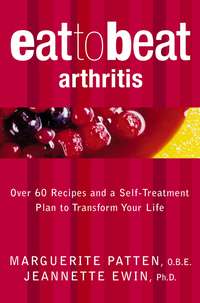
Kitabı oku: «Arthritis: Over 60 Recipes and a Self-Treatment Plan to Transform Your Life»

Eat to Beat Arthritis
Over 60 recipes and a self-treatment plan to transform your life
Marguerite Patten, O.B.E. and Jeannette Ewin, Ph.D.

Table of Contents
Cover Page
Title Page
Preface
Part One You Can Beat Arthritis!
Chapter 1 – You can beat arthritis!
Chapter 2 – Know your enemy (understanding arthritis and its causes)
Chapter 3 – Know how to combat your enemy (seven weeks that will change your life)
Chapter 4 – Changing your lifestyle
Part Two The Facts About Arthritis and Diet
Chapter 1 – About arthritis
Chapter 2 – Food, supplements and medication
Part Three The Eat to Beat Arthritis Diet
Chapter 1 – The basics
Chapter 2 – The seven-week diet plan
Part Four The Recipes
Introducing the diet
Creamy Liver Pâté
Cucumber and Seafood Dip
Golden Roquefort Dip
Making Stock
Beetroot Soup
Chicken and Almond Soup
Lentil Soup
Indonesian Chicken Soup
Liver and Mushroom Soup
Cod with Pineapple and Cucumber
Fish Véronique
Grilled Fish
Herbed Baked Fish
Kedgeree
Seafood Stir-fry
Mussels in Cream Sauce
Thai Fish Cakes
Grilled Spiced Sardines
Poached Herring Roes
Sautéed Cod’s Roe
Enjoying Liver
Grilled Liver
Sautéed Liver
Chicken Liver Risotto
Liver Soufflé
Country Lambs’ Kidneys
Creamed Sweetbreads
Sweet and Sour Lambs’ Hearts
Curried Tripe
Steak with Roquefort
Caribbean Lamb
Roast Chicken
Turkey in Almond Sauce
Quail with Blueberry Sauce
Salmis of Pheasant
Cucumber Sauce
Pesto Sauce
Vinaigrette Dressing
Mayonnaise
Almond Relish
Herbed Polenta
Savoury Omelettes
Sweet Potato Rösti
Minted Beans and Cabbage
Garlic Mushrooms
Avocado and Pineapple Salad
Buckwheat Salad
Fruit and Vegetable Salads
Grilled Goat’s Cheese Salad
Liver and Herb Salad
Mushroom and Liver Salad
Sweet Potato Salad
Main Dish Salads
Apricot Rice Pudding
Mango Foule
Ginger and Lemon Pears
Peaches in Honey and Almonds
Summer Soufflé Omelette
Strawberry and Grape Sorbet
Vanilla Ice Cream
Classic Blinis
Speedy Blinis
Macaroons
Millet Porridge
Hush Puppies
Corn Bread
Part Five Taking It Further
Chapter 1 – Foods that heal
Chapter 2 – Questions and answers about arthritis
Glossary
Helpful resources
Index
Copyright
About the Publisher
Preface
Marguerite Patten, O.B.E., a well-known and highly respected food writer, and Jeannette Ewin, Ph.D., a health journalist with an international following, have joined forces to create an eating plan that can help you beat the pain and distress of arthritis. The Eat to Beat Arthritis Diet, and everything you need to know about how it can change your life, is contained in this book.
Arthritis has been compared to being locked in a prison: its symptoms bar you from living the way you wish. In this book you will learn how to break lifestyle habits that have shackled you to pain. The pages that follow contain the latest information about food supplements that fight the causes and symptoms of arthritis. You will also learn how to listen to your own body, and understand what it is telling you about the food you eat.
The Eat to Beat Arthritis Diet is based on a selection of foods and supplements that help your body fight the pain of crippling disease. Unlike other diets you may have tried in the past, it allows you to enjoy appetizing and satisfying meals while you chart the dietary course towards wellbeing. Using foods recommended in the Eat to Beat Arthritis Diet, Marguerite Patten has developed over 60 delicious recipes that can be enjoyed by everyone – not just those suffering from arthritis. Unlike the recipes you may have tried in some healthrelated cookery books, the dishes described here are full of appealing flavour and texture.
Working on this book was a labour of love for Marguerite, as she personally knows how arthritis can affect one’s life. Her search for a means of controlling this painful illness had been long and hard, and included both acupuncture and chiropractic treatments. When these failed, her doctor said surgery on a severely arthritic hip was the only answer. Faced with family and professional responsibilities, Marguerite’s response was, ‘Sorry. I haven’t the time right now.’ With hope of finding an answer to her advancing illness in some other form of therapy, she turned for help to the subject she knows best: food. By changing her diet she changed her life, and in this book she not only provides clear instructions about how to cook the appropriate foods, but also shares the secrets of her own story.
Reading every health and diet book she could find that focused on the perplexing problem of arthritis, Marguerite came across an international bestseller: A Doctor’s Proven New Home Cure for Arthritis, by Dr Giraud W. Campbell. Here was a healing diet that incorporated foods she enjoyed eating. The prescribed therapy was strict, but manageable. She gave it a try and within weeks experienced a dramatic and clinically recognizable improvement in her condition.
Over the years since her introduction to Dr Campbell’s book, much has been learned about how diets work and why certain nutrient supplements help control this debilitating illness. To share her personal experience, and to expand what she had learned about diet and arthritis, Marguerite Patten teamed up with a friend and nutritionist, Dr Jeannette Ewin. Taking their lead from Dr Campbell’s book, they developed the Eat to Beat Arthritis Diet. This sensible and healthy way to enjoy good food combines Marguerite’s decades of experience developing tasty and sure-fire recipes, with Jeannette’s insight into the interactions between food, nutrition and health. As a side benefit, those who follow their advice will soon find they not only gain control over pain, but also enjoy a greater feeling of wellbeing.
Part One You Can Beat Arthritis!
Chapter 1 You can beat arthritis!
During an awards ceremony, American comedian Jack Benny reportedly said: Thank you for this honour, but I don’t know what I did to deserve it. Then again, I have arthritis, and I don’t know what I did to deserve that either.’
If – like Jack Benny – you suffer from arthritis, you know it is no laughing matter. Pain can dominate your life, and its effects are insidious. You don’t sleep well at night because your joints hurt. Backache plagues you while you are in bed. Knees and hips ache when you get out of bed. Slowly, you begin to feel depressed by the lack of sleep. During the day you begin avoiding exercise. Taking a walk, swinging a golf club, or doing everyday household chores cause discomfort and pain and, as a result, you find yourself moving less. Muscles that were once firm and strong begin to weaken from lack of use. Not burning off calories as quickly as you once did, you find yourself gaining a bit of weight. The problem of wakeful nights becomes compounded because the exercise you now avoid is an important part of getting the body ready for sleep. Overtime, arthritis begins to dominate your life, and you find yourself in a slow physical and emotional cycle of decline.
The above scenario is not inevitable, however. You can prevent it happening to you. By changing your diet and lifestyle, it is possible to regain a sense of physical and mental wellbeing. Arthritis leads to negative changes in your life: The Eat to Beat Arthritis Diet is your guide to the positive changes needed to overcome them.
Unfortunately, many arthritis sufferers never find a way of overcoming the debilitating symptoms of the disease. They may seek help from their doctor, and find that the medication they are prescribed causes unpleasant side effects such as stomach pain. Others try various forms of alternative therapy only to find them ineffective. In the end, they all too often submit. After all, they may reason, everyone who reaches a certain age must suffer from some form of aches or pains. As time goes by, their condition gets worse. All too soon the activities they once enjoyed – like playing with the grandchildren, gardening, or keeping up with a favourite hobby – cause too much pain to bear.
Don’t give in to arthritis. By learning to select and enjoy the foods that uniquely suit you, and by following the lifestyle advice in this book, you can continue enjoying life. Think positive. Be positive. Make the changes that release you from the negative cycle of arthritis.
The Eat to Beat Arthritis Diet is based on a simple, three-part strategy to healing and health:
 Know your enemy (in this case – arthritis);
Know how to defeat your enemy (gain control over arthritis in seven weeks); and
Enjoy life.
The details of this strategy are outlined in the chapters that follow, but here is a brief summary of what is involved.
Know your enemy
Strip away the mystery of arthritis by understanding what it is and why it occurs. When an illness is diagnosed and given a name by a doctor, it has power. It is the unknown, and we are its victims. By learning something about an illness, or disease, and why it makes us suffer, we gain control. Knowledge replaces doubt, and hope replaces fear.
The basic facts outlined in Chapter 2 demystify arthritis. More detailed information is presented in the section of the book called ‘Questions and answers about arthritis’. Additional help is also provided by a glossary, a selection of good food tips and a list of helpful resources (this includes a number of websites for those of you with access to the internet).
Know how to defeat your enemy (gain control over arthritis in seven weeks)
This book is your guide to seven weeks that can change your life. Once you understand an illness, you can build a strategy to defeat it. If its total defeat is not possible, you can still find ways to minimize its symptoms and learn to live a brighter, fuller life.
In the early parts of this book you will learn how to alter your diet and lifestyle to break the negative cycle of arthritis. You will discover why good nutrition can rebuild failing tissues, block pain and revitalize aching joints. It will also become clear why certain foods should be avoided, and how everyday favourites – like tomatoes and aubergines (eggplants) – can cause joint pain and swelling.
You are unique, and your requirement for food is unique. Not only do you need to know which foods you should eat, but how they can be balanced to help you live a full and active life – despite having arthritis. This is explained in Chapter 3, where you will find an outline of the basic rules of nutrition, and information about how the substances in food affect your health. The basic rules of nutrition hold for everyone, but the amounts of individual nutrients you require for optimum health are not the same as those needed by others.
During the seven weeks of this diet, you will learn how to listen to your body and recognize when specific foods are doing harm. Simply by avoiding all foods containing wheat and all drinks containing caffeine, many arthritis suffers find their lives changed forever.
If all this is beginning to sound a bit too restrictive – take heart! In Part Two you will find a long list of foods you can eat. And to help you enjoy a delicious (and very modern) approach to cooking with these ingredients, Marguerite Patten has devised over 60 easy-to-prepare recipes.
Marguerite’s recipes are a vital part of this book. In them she not only explains what to cook and how, but also shares her own experience with the diet. Day by day, step by step, she takes you through the diet and discusses why she chose one ingredient over another. These personal insights give invaluable information and encouragement as you begin to experiment with a style of cooking that is fresh and tasty as well as healing and healthy.
Enjoy life
This is the third proclamation of the Eat to Beat Arthritis Diet. Unfortunately there are no simple recipes to help you with this part of the programme. Some suggestions are offered later on, but no one can prescribe what is best for you. Just remember:
The glass of life is half full – not half empty.
Smiling has been scientifically shown to have a positive effect on mood and the sensation of pain.
Exercise relaxes you, loosens joints and muscles, and helps lay the groundwork for a good night’s sleep.
Chapter 2 Know your enemy (understanding arthritis and its causes)
The costly epidemic of arthritis
‘People ignore arthritis both as public and personal health problems because it doesn’t kill you.’ So said Chad Helmick, a medical epidemiologist at the Center for Disease Control and Prevention in the United States. He continued: ‘But what they don’t realize is that as Americans work and live longer, arthritis can affect their quality of life and eventually lead to disability.’ According to the FDA Consumer (May–June 2000), who quoted Dr Helmick, the current annual cost of arthritis to the U.S. economy is nearly $65 billion – a sum large enough to have about the same impact as a moderate recession.
Arthritis can strike at any age, and the number of arthritis sufferers increases each year. During a person’s lifetime, arthritis is more likely to restrict activity than cancer, diabetes or heart disease. World-wide, arthritis inflicts a terrible cost. In the United States alone, currently about 42 million people are afflicted by chronic forms of arthritis: according to the Center for Disease Control, that number will rise to 60 million by 2020. More than 11 million of those people will be crippled badly enough to be classified as disabled. And the U.S. is not an exceptional case – the social and economic impact of arthritis in the United States is mirrored throughout the Western world.
Why should more people suffer from arthritis today than in the past? And why do various forms of arthritis appear to be increasing at a greater rate in Westernized countries than in the rest of the world? Many experts believe the answer must be related to our lifestyle and diet.
When you consider the vast amount of money spent on medication to treat the symptoms of arthritis, and on surgical repair of crippled hips and knees, you get some idea just how much could be saved if people would eat and live according to the simple rules suggested here.
Arthritis comes in many forms
The word ‘arthritis’ refers to any process that causes inflammation of joints and surrounding tissues. Depending on which expert you believe, there are between one and two hundred different conditions that can be classified as ‘arthritis’. Some of these are common (osteoarthritis, rheumatoid arthritis and gout), while others are relatively rare (ankylosing spondylitis and systemic lupus erythematosis are examples). In Eat to Beat Arthritis we focus on those types of arthritis that affect the most people, although the anti-inflammation diet described here will help almost everyone.
Two key words need explanation: ‘inflammation’ and ‘joint’.
Inflammation is a natural process in which the body’s immune system reacts to infection, injury or any abnormal form of irritation. The area of inflammation becomes red, swollen and abnormally warm. When inflammation takes place around a site of infection or injury its role is to kill any invading organisms and speed up the removal of debris from dead bacteria (or viruses) and tissue. In other words, inflammation is a healthy part of the normal healing process. Unfortunately, there are times when the immune system mistakes the body’s own normal tissues for the ‘enemy’, and attacks them. This is known as an auto-immune reaction. The immune system may also attack parts of the body where concentrations of abnormal substances occur – such as joints in which bony nodules form after injury; or in places where abnormal deposits of uric acid form, as is the case in gout.
Inflammation is the real culprit in arthritis, so the diet described in this book is designed to help control inflammation. Even if you are on medication for your condition, changing the way you eat will help break the painful bonds of inflamed joints and tissues.
A joint is a place, or ‘join’, in the body where bones meet. Some joints are stationary, or fused, and have no motion; the joints between bone in the skull are examples. Other joints may allow a limited degree of motion, such as those in the fingers and toes, while others allow extensive motion. Hip joints are a good example of a place where there can be considerable movement at the place where bones meet.
As a general rule joints are formed from fibrous tissue, a pad of cartilage at the end of each bone within the joint, a thin lining of synovial membrane (which secretes a thin lubricating fluid into the joint to aid its motion) and, sometimes, a ligament, or strong band of fibrous tissue binding the bones together. Ligaments are also found supporting other parts of the body, including some internal organs.

OSTEOARTHRITIS
Almost everyone suffers from some degree of osteoarthritis. The older you get the more likely it is that injury or constant use has damaged one or more of your joints, and osteoarthritis has set in. Many athletes suffer this form of arthritis at a fairly early age owing to injury to cartilage and the bones within much-used joints, such as the knee. In less athletic people the pain experienced in knees, hands and hips by the time they reach retirement age is as a result of simple wear and tear on the internal structure of joints. In both cases, cartilage can wear so thin the ends of bones become exposed within joints. This causes pain and inflammation. To make matters worse, bony nodules may collect in osteoarthritic joints, adding to the pain and inflammation. And as anyone who suffers from pain knows, it can be mentally exhausting as well as physically debilitating.
Medical treatment for osteoarthritis usually involves analgesics (painkillers) and – in some cases – drugs that support the body’s attempts to rebuild damaged cartilage. Most of these drugs not only effectively reduce pain, they also reduce inflammation. The problem is that many analgesics (including aspirin and ibuprofen) cause stomach irritation that can lead to bleeding, and they do nothing to help rebuild worn tissue. During the past decade research has shown that there are natural compounds that support the rebuilding of damaged cartilage: glucosamine holds the greatest promise at present. You can learn more about this healing compound here.
RHEUMATOID ARTHRITIS
The stiffness, pain, swelling and loss of function associated with rheumatoid arthritis results from inflammation of the lining that secretes lubricating fluid into joints. The disease can affect other parts of the body, but treatment is most often sought for the condition when it involves joints. In most cases this form of arthritis affects the same joint on both sides of the body: both knees, or both hips, or the knuckles of both forefingers. In severe cases deformity and loss of function result.
The medications used to treat rheumatoid and osteoarthritis are similar, and are selected to block pain and reduce inflammation. However, there is strong evidence that certain foods, such as oily fish, and food supplements, such as fish oil, help reduce the causes of the inflammation without endangering the delicate lining of the stomach.
More information about rheumatoid arthritis can be found here.
GOUT
Gout is frequently lampooned as a rich man’s illness, associated with too much fine wine and fatty food. In fact it strikes people from all walks of life: beggar and king. It can be very painful, and it is common to hear sufferers describe how they cannot bear to have even the weight of a bed-sheet rest on an affected toe. (Big toes are frequent victims of this illness.) Mercifully, gout is far less common than either osteoarthritis or rheumatoid arthritis.
Gout is caused when too much uric acid collects in the blood. Uric acid is a by-product of normal metabolism, and it is usually collected and discarded from the body by the kidneys in urine. However, when the kidneys are not functioning normally, or when the diet contains an excess of certain foods, blood levels can rise to the point where the excess uric acid crystallizes in joints, the kidneys, or even the soft tissue of the ear. These stone-like residues cause pain, damage surrounding tissues, and trigger the biological processes that lead to inflammation.
There are medications to help gout suffers, but diet is a vital part of controlling the build-up of uric acid in the blood, and reducing or eliminating inflammation.
For more about gout, see here.
Chapter 3 Know how to combat your enemy (seven weeks that will change your life)
The power to heal is within you. Given the right nutritional building blocks, adequate rest, exercise and a pollution-free environment, the human body has remarkable powers of restoration and self-healing. The Eat to Beat Arthritis Diet is all about harnessing these elements to your advantage.
Food is the answer
No diet should promise overnight success. Healing takes time. If you suffer from arthritis you need to eat foods, and take food supplements, that calm the inflammatory processes that cause pain. You also need to consume those nutrients that the body needs to build new and healthy tissues, such as cartilage in joints.
Think of it this way. Your body is made entirely of the foods you eat. In an ideal world, what you eat would exactly match what your body needs to function at its best. But this is not an ideal world. Stress, illness, lifestyle changes and the natural processes of bearing children all place demands on your body that require a specific blend of nutrients. For example, smoking increases the body’s need for vitamin C, and you can cope with stress better if your diet is rich in foods containing B vitamins.
Using the advice in this book you will learn how to select those foods that provide the unique blend of nutrients your body needs for healing. You will also learn how the right foods can help you combat damaging and painful inflammation. Also highlighted is the importance of identifying foods to which you may be sensitive. Once you know what are the right foods for you, you can then go on to prepare delicious dishes using these ingredients. Best of all, you can read Marguerite Patten’s excellent advice on using and living with this diet. When you know what suits your body best, and you have experienced the rewards from changing your eating habits to improve your arthritis, you will find that you can relax from time to time and allow yourself some flexibility in what you eat. Marguerite explains how she balances her lifestyle with the diet and allows herself the occasional treat. The trick is just to enjoy yourself, then reinstate the Eat to Beat Arthritis Diet as soon as you can afterwards and you’ll soon be back to your best.
A schedule for success
Once you begin this diet you will probably experience an improvement in your condition during the first week: but there is more to come! Give yourself at least six weeks before you judge its total benefits to you. Eating plans that promise much faster results are not really being fair. It takes time for your body to heal. The full programme is explained in the next section, but here is a brief week-by-week summary of the diet, followed by an explanation of how it works:
Week zero – Listening to your body
Learn about yourself by keeping records of what you eat and when your symptoms appear.
As the first step towards controlling pain, eliminate coffee, cola drinks, tea and other sources of caffeine from your diet.
If you smoke cigarettes, this is the time to stop.
Week one – Cleansing and detoxifying your body
After a one-day fast, begin a diet of foods that help heal and rebuild the body.
Eliminate all foods containing wheat, rye, oats, and all sources of gluten from your diet.
Eliminate alcohol from your diet.
Supplements containing fish oil and vitamin E are added to your healing routine, as is a Health Drink that you make at home.
Week two – Stabilizing your body
The routine of foods and supplements started during Week One continues. (By this time, many people experience significant relief from the pain and inflammation of arthritis.)
Weeks three through six – The elimination diet
During these four weeks, you will introduce various foods and food groups into your diet to test their effect on your arthritis.
Up to now you have enjoyed a diet based on a limited number of ingredients. To live in the real world of work and family, that list of foods needs to be expanded.
The benefits of the diet by now include a greater sense of wellbeing, and improved skin and hair texture.
Week seven and forever – Enjoy life
WEEK ZERO – GETTING TO KNOW YOURSELF
This period is a preparation for the life-changes to come. By keeping a daily chart of when and where you experience pain, what you eat, how well you sleep, and when and how you exercise, you will have a snapshot of how well you are taking care of your body. Make no changes during this week (with the exception of giving up caffeine). Just listen to your body. You will continue to keep these charts throughout the first six weeks of the diet, because they will provide information about how your body is reacting to change.
It may be tempting to skip this week’s activities. Forget any such ideas. This may be the most valuable week of the diet, because it provides the information you need to monitor your progress towards a life of less pain and greater mobility. Keeping notes for anything shorter than a week will give you a false picture, because your life activities have a pattern – and they run from Sunday through to Saturday.
If you smoke, use this time to consider how you plan to remove this pollutant from your body. As you will learn in the next chapter, smoking adds to the problems that increase the pain of arthritis.
WEEK ONE – CLEANSING AND DETOXIFYING YOUR BODY
Work begins here. During these seven days you will lower the level of harmful substances in the body through fasting, avoiding specific foods, and drinking adequate amounts of fluids. The charts you keep will begin to show early benefits of the diet.
WEEK TWO – STABILIZING YOUR BODY
By the end of Week One you will be eating a very healthy, although somewhat restricted diet. This is the Basic Arthritis Diet. By following the same eating plan during the second week of the diet, you will stabilize your metabolism and remove any traces of reaction from foods you have eaten in the past. You are allowing your body to rest. (Do not worry about having to eat bland and uninteresting food – the recipes Marguerite Patten provides further on in the book are full of flavour.)
WEEKS THREE TO SIX – EXPANDING YOUR FOOD VOCABULARY
Now is the time to expand the variety of foods you eat. In this section, guidance is provided on how to test specific foods for their effect on your level of joint pain and discomfort. You may be surprised by the results. Foods you have enjoyed for years – and that you have been told are good for you – may be just the ones that stimulate an inflammatory reaction in your joints.
WEEK SEVEN AND FOREVER – HOW TO LIVE A LITTLE AND STILL MAINTAIN CONTROL OVER PAIN
Once you know which foods present problems, and how to detoxify your body on the Basic Arthritis Diet, you can try breaking the rules. But remember: once you break the rules you must return to them as quickly as possible.
Chapter 4 Changing your lifestyle
As you change your diet, and learn about yourself by using a self-assessment chart, you should consider other ways to improve your health. In addition to changing your diet and giving up smoking (see here), there are other ways you can change your lifestyle and help control the painful and crippling effects of arthritis:
1 Control your weight
2 Enjoy gentle exercise
3 Get adequate sleep
4 Learn to relax
5 Have a good laugh
Control your weight
Extra pounds place excess wear and tear on joints and ligaments. Hundreds of diet plans exist to help you lose weight: ignore them all. The healthiest and most important step towards eliminating unnecessary fat from your body is to eat a balanced diet in moderation, and become more active. Using the Eat to Beat Arthritis Diet as your guide, choose foods that suit you best and enjoy them in small portions until your weight has reached an ideal level.
Serve yourself whenever possible (other people always give you more than you need), and only put on your plate what you intend to eat. Do not have second helpings. If you would usually take two tablespoons of peas, take only one. If you usually enjoy a full bowl of soup, ladle out half a bowl as your diet portion. For the good health of your heart and vascular system, cut the amount of butter and animal fat in your diet to the smallest possible amounts, and use only half the oil you would usually use on salads and in cooking. Eat smaller portions and eat more slowly to enjoy the full flavour of your food. There are two exceptions to the rule on eating less. Among the foods you will enjoy on the Eat to Beat Arthritis Diet are liver and a nutritious Health Drink. Do not reduce your intake of either of these foods. (Gout sufferers must eliminate the liver, however. See here.)
If you are trying to lose weight, it is essential to add some extra exercise to your daily routine to burn off unwanted calories. Housework and walking to the shops are not enough.
If you smoke, try to stop. The health evidence against smoking tobacco is overwhelming. Smokers dislike hearing people drone on about this, but the effects of smoke on your body are worth keeping in mind when you are committed to improving your health. As all those massively expensive anti-smoking campaigns tell us, the link between smoking and certain forms of cancer is obvious, but smoking causes other damage as well. There is evidence that the damaging levels of free radicals released in the body by cigarette smoke increases inflammation, and thus increases the level of pain associated with arthritis.
Enjoy gentle exercise
Many of the causes of joint and muscle pain and discomfort should be eliminated or reduced by following the Eat to Beat Arthritis Diet. However, you also need to keep active to keep your body at its best, especially if you need to lose weight.
The choice of exercise activities is rich and varied. All you need to do is choose one and give it a try. If your first choice does not suit you, try another, and another, until you find one that you enjoy. Add at least three exercise sessions to your weekly routine. Include gentle stretching at both the start and conclusion of each session. No matter how old or unfit you are, visit the local gym and see if they offer anything that would interest you. Alternatively, contact local community and church groups to see if they offer activities that would get your blood pumping. You’ll be surprised by the variety of activities available. For example, line dancing seems to be all the rage for every age these days, and some of the less strenuous martial arts both strengthen the body and calm the mind.
Remember, talk with your doctor before beginning any new exercise or sporting activity. He or she will probably applaud your decision to get out and get moving.
Good forms of exercise include walking, swimming and stretching. Gardening is also valuable exercise as it promotes joint health by stretching and placing gentle pressure on muscles surrounding joints in the arms, legs, hips and back.
Pain may be increased when you first start exercising, but you will soon ‘work through’ that as your stiff joints regain their flexibility. Exercise unlocks stiff joints and tissues. How many times have you heard someone say, ‘I was so stiff this morning I thought I wouldn’t be able to get out of bed; but once I got moving everything was fine.’ You have probably had this same experience, and know that movement is a large part of keeping stiff limbs and muscles active.
To conquer the pain of arthritis, you should gently and repeatedly move the joints and tissues that hurt. By doing so, you strengthen the muscles that support the tissues, stimulate normal bone growth, and stimulate the circulation to the inflamed area. Remember, if you reduce your level of daily activity because you are afraid of the pain and discomfort that accompanies movement, you are going to lose more muscle strength and fail to stimulate normal bone growth.
Yoga and Pilates are two excellent exercise disciplines. Both stretch and strengthen muscles, but in their elementary forms neither one pushes or pulls muscles into extreme positions or activity. As relaxation is a principal goal in the practice of yoga, it has special value for arthritis sufferers. Yoga originated in India about three thousand years ago, and is based on physical control and relaxation. The practice has become increasingly popular over the past several decades, and many forms of movement and self-training have evolved. To learn more about yoga, visit your local library for books on the subject. Also, shop around to see what programmes are available in your area. Yoga is often offered in community and adult education centres.
Pilates is a form of exercise and body control developed by Joseph Pilates in the early 1900s. Born in Germany in 1880, Pilates was sickly and frail as a child, and as a result became obsessed by physical fitness. By the time the Great War broke out in Europe, Pilates was in England, teaching detectives self-defence. As a German, he was interned for the duration of the conflict. While in the camp he devised a regime of exercises for his fellow internees that maintained their health and fitness level while they were held in confinement. Not one of these people died during the influenza outbreak of 1918, and Pilates often claimed this was due to the exercise programme he developed. (There may be some truth in this, as we now know that exercise strengthens the immune system.)
After the war Joseph Pilates returned to Germany and began working with dancers and others who sought perfection in body form, flexibility and balance. When asked to begin work with the German army, Pilates refused and fled to America. On the boat he met a nursery teacher whom he later married. Together they established a fitness studio in New York, where dancers, athletes and members of top society soon became his clients. His devoted followers have included Martha Graham, Gregory Peck, Katharine Hepburn, Jodie Foster, Michael Crawford, Joan Collins and Sigourney Weaver. Tennis professional Pat Cash and world champion ice skating star Kristi Yamaguchi are among the athletes who have profited from Joseph Pilates’ teaching. His methods are now taught around the world.
The Pilates method differs from other fitness programmes in the way the exercises are approached. Like yoga, it binds the activities of the mind with those of the body, making the mental perception of the body as important as physical movement. As in yoga, the three main elements of each exercise are relaxation, control and co-ordination. Pilates differs from yoga in one important way, however: the Girdle of Strength, that is the internal cage of muscles that supports and holds the body’s internal organs in place, is tightened and used in every exercise practised. So too are the multifidous muscles, which stabilize the lumbar spine. By building power and flexibility into these often overlooked muscle groups, Pilates uniquely contributes to the physical fitness of sufferers of innumerable physical ailments and injuries.
For more about Pilates and how it can help you, browse in your local library and bookshop for more information. Also contact community and fitness centres to see what they have to offer in the way of basic courses.
Get adequate sleep
Insomnia affects the ability to concentrate and increases the awareness of pain and discomfort. If you have trouble sleeping, you are not alone. According to the Mayo Clinic in Rochester, Minnesota, more than 100 million people in the United States do not get a good night’s sleep on a regular basis. Tired people have slower reaction times, are less productive and are less likely to interact with others in a positive manner. Like everyone else, arthritis sufferers should do all they can to maximize their chances of sleeping for eight hours a night. Here are some tips on what you can do to help you deal with this insidious problem.
First, however, what is insomnia? According to the Mayo Clinic, in the United States, these are some signs to watch out for:
It takes longer than 30 minutes to fall asleep
You wake several times during the night
You wake up feeling muddled and tired
You fall asleep during meetings and daytime events
You are forgetful.
Dr Peter Hauri, Director of the Mayo Clinic Insomnia Program, suggests that answers to the following questions may help determine why you have sleep problems:
Do you feel anxious when you are getting ready for bed?
Do you argue with your spouse or partner in bed?
Do you worry about the next day’s tasks when you are trying to fall asleep?
Do you keep checking the time on a bedside clock?
Do you sleep better on holiday, or at a friend’s house, than when you are in your own bed at home?
Do you try to force yourself to go to sleep?
If you answered ‘yes’ to any of these questions you should take action.
Dr John W. Shepard Jr, M.D., Medical Director of the Mayo Clinic Sleep Disorders Center, has offered the following tips on how to get the full eight hours of sleep we all need each night. Remember, however, that what works for one person may not work for another. Try one or two of the following suggestions at a time until you find the combination that is right for you.
Avoid caffeine and nicotine. Both are addictive stimulants that can interfere with sleep. (Remember that on the Eat to Beat Arthritis Diet, neither caffeine nor cigarettes are permitted.)
Exercise, preferably in the afternoon.
Watch what you eat and drink. Fatty and spicy foods may cause heartburn that disturbs sleep.
Avoid drinking alcohol before going to bed; it may cause you to snore or get up during the night. (You should be avoiding it anyway while on the Eat to Beat Arthritis Diet.)
If you must have a midnight snack, eat foods rich in the amino acid L-tryptophan, which triggers the release of serotonin in the brain. Good snacks include a glass of milk (warm or cold, as you prefer) or a tuna or turkey sandwich.
Make sure the room is cool before going to bed, but have enough bedding to keep your body warm. Warm hands and feet encourage sleep.
Avoid naps. Save your sleep for night-time.
Enjoy stillness. Leave the radio and television off. If external noises disturb you use earplugs.
Use your bed only for sleeping and sex. Watch television somewhere else.
Set a sleep schedule. Try to go to bed and get up at the same time each day. Remember that a lazy Sunday morning in bed after a night out can mean a restless night ahead.
Do not fret if you cannot go to sleep immediately. After a time, get up and do something else, like reading a good book. Then try again.
Ücretsiz ön izlemeyi tamamladınız.