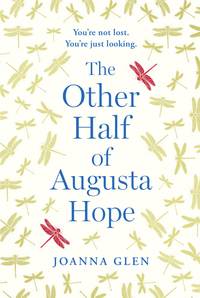
Kitabı oku: «The Other Half of Augusta Hope»


Copyright
The Borough Press
An imprint of HarperCollinsPublishers Ltd
1 London Bridge Street
London SE1 9GF
www.harpercollins.co.uk
Published by HarperCollinsPublishers 2019
Copyright © Joanna Glen 2019
Jacket design by Holly Macdonald © HarperCollinsPublishers Ltd 2019
Joanna Glen asserts the moral right to be identified as the author of this work.
Excerpt from The Collected Poems and Drawings of Stevie Smith, ed. by Will May reprinted by permission of Faber and Faber Ltd.
Excerpt from The Complete Poems of Philip Larkin, ed. by Archie Burnett reprinted by permission of Faber and Faber Ltd.
Excerpt from Los Puentes Colgados, 1921, Fundación Federico García Lorca. Translation and transcription to music, 2007, reprinted by permission of Keith James.
Every effort has been made to trace and contact copyright holders. If there are any inadvertent omissions we apologise to those concerned and will undertake to include suitable acknowledgements in all future editions.
A catalogue copy of this book is available from the British Library.
This novel is entirely a work of fiction. The names, characters and incidents portrayed in it are the work of the author’s imagination. Any resemblance to actual persons, living or dead, events or localities is entirely coincidental.
All rights reserved under International and Pan-American Copyright Conventions. By payment of the required fees, you have been granted the non-exclusive, non-transferable right to access and read the text of this e-book on screen. No part of this text may be reproduced, transmitted, down-loaded, decompiled, reverse engineered, or stored in or introduced into any information storage and retrieval system, in any form or by any means, whether electronic or mechanical, now known or hereinafter invented, without the express written permission of HarperCollins.
Source ISBN: 9780008314156
Ebook Edition © June 2019 ISBN: 9780008314170
Version: 2019-05-02
Dedication
For Mark, Charlie and Nina.
Epigraph
A time to weep and a time to laugh,
A time to mourn and a time to dance,
A time to scatter stones and a time to gather them …
Ecclesiastes 3:4–5
Contents
Cover
Title page
Copyright
Dedication
Epigraph
Augusta
Parfait
Augusta
Parfait
Augusta
Parfait
Augusta
Parfait
Augusta
Parfait
Augusta
Parfait
Augusta
Parfait
Augusta
Parfait
Augusta
Parfait
Augusta
Parfait
Augusta
Parfait
Augusta
Parfait
Augusta
Parfait
Augusta
Parfait
Augusta
Parfait
Augusta
Parfait
Augusta
Parfait
Augusta
Parfait
Augusta
Parfait
Augusta
Parfait
Augusta
Parfait
Augusta
Parfait
Augusta
Parfait
Augusta
Parfait
Augusta
Parfait
Augusta
Parfait
Augusta
Parfait
Augusta
Parfait
Augusta
Parfait
Augusta
Parfait
Augusta
Parfait
Augusta
Parfait
Augusta
Parfait
Augusta
Parfait
Augusta
Parfait
Augusta
Parfait
Augusta
Parfait
Augusta
Parfait
Augusta
Parfait
Augusta
Parfait
Augusta
Parfait
Augusta
Epilogue
Acknowledgements
About the Author
About the Publisher
Augusta
My parents didn’t seem the sort of people who would end up killing someone. Everyone would say that – except the boy who died, who isn’t saying anything. He carried his story with him off the edges of the earth, like the others who died along the way.
This story, my story, belongs to them too.
My story starts, like all stories do, with a mother and a father, and here they are – Stanley and Jilly Hope.
Stanley, tall, and stooping to apologise for this, liked to wear a dark wool suit, which, when he sat down, would rise to reveal two white and entirely hairless shins. Jilly was well below his eyeline, squashy as marshmallow and keen on aprons. She had pale curly hair, cut to just above the shoulder, which she patted, to little effect.
My parents put down a deposit on the house in Willow Crescent, in Hedley Green, before there was a house there at all. The riskiest thing they ever did. Empty out their bank account for a pile of mud.
From then on, no more risks to be taken. Life best lived within the crescent, which was circular, and round and round they went with their lives, contented, with no desire for exit.
I, as soon as I was out of my mother’s womb, looked to be out of anywhere I was put in, striving, with some success, to exit the cot, the playpen or the pram.
My first exit (out of my mother) was fraught. I’d turned the wrong way up and wrapped the umbilical cord around my neck, whilst Julia slid serenely into the world shortly before midnight on 31 July. I didn’t appear until some minutes later, by which time it was August, and we were twins with different birthdays.
My sister, born in July, was named Julia; I, born in August, would be Augusta. A thematic and paired approach, as advised by the library of books on naming babies which my mother had stacked on her bedside table throughout the long months of our gestation. Our double exit was complete. Exit was a word I liked, ex meaning out in Latin, and x meaning anything at all in maths, and exit signs in green and white everywhere at school, but with limited opportunities to do so.
Stanley and Jilly Hope were much more inclined towards the in than the out, the staying than the going. They were the first to move into the crescent, and they wore this like a badge amongst the neighbours. We live at number 1. As if this made them winners.
But the thought crept into my mind quite early on that they were losers.
‘Go away!’ I said to the thought, but it didn’t.
I never told anyone about it, even Julia, though I know it showed in the expression on my face, and this made her sad – and I am truly sorry about that now, sorrier than you know.
She and I were Snow White and Rose Red: Julia, fair, quiet and contained, happy inside herself, inside the house, humming; and me, quite the opposite, straining to leave, dark, outspoken, walking in the wind, railing. Railing, from the Latin, to bray like a donkey (ragulare) and railing meaning barrier or fence from straight stick (regula), which is how I looked, skinny as a ruler.
Our fifth birthday, one year of school done, and my legs and arms narrowing as I rose an inch above Julia’s head. We were given tricycles, mine, yellow, and Julia’s, pink. Julia drew chalk lines on the drive and spent the day reversing into parking spaces. I rode out of the drive, turned left, curved around to number 13, at the top of the crescent, twelve o’clock, crossed the road precariously to the roundabout and drove my trike into the fishpond singing ‘We All Live in a Yellow Submarine’.
At school, in Year 4, 1998, when I was seven years old, and we were doing an underwater project (remaining, ourselves, disappointingly, on land), Miss April told us that marinus meant of the sea in Latin, and sub meant under, hence submarine. But when I put up my hand and told her, excuse me, Miss April, but your pen has rolled sub your desk, she told me not to be a show-off, Augusta.
I’ve always loved words like other people love sweets or ice cream or puddings, words made of letters so that sounds turn into things, actual things. And miraculously we remember which sounds match which things, hundreds and thousands of sound-combinations – because that’s language. It mesmerised me as a child, and I would hang about, spellbound, whenever I heard people speaking Spanish or French or Gujarati.
I realised with some pride that I must sound as clever to foreigners when I spoke English, rattling off the words like a total pro, as we all do – well most of us, not Graham Cook, who lived next door, whose mouth didn’t manage to make any words at all.
‘You pity the Cooks,’ said my father, lightly, with no sign of pity on his face. ‘It could happen to anyone.’
I liked to pop next door and talk to Jim Cook when he was out washing his car in the drive, because he always had new dreams up his sleeve. But the truth was that none of them ever seemed to slip out of his sleeve into real life.
Barbara Cook used to take Julia and me swimming when she had respite care days for Graham because, my mother told me, the poor woman liked the chance to do normal things and do them normally, without a palaver. I tried to make swimming the best possible time for Barbara Cook, although she wasn’t a person who said much about how she was feeling.
One day, after swimming, I couldn’t find my skirt or my pants, and I had to walk into Barbara’s changing cubicle wearing a red T-shirt and nothing else – but all she said was, ‘Augusta, you look the living image of Winnie the Pooh!’
She laughed until her eyes were streaming tears, she wrapped my wet towel around my waist, and I had to waddle into the car park like that, my face on fire with the shame of it.
I wanted to like Barbara Cook, and I did like Barbara Cook, I might even have loved her, so I tried not to mind that she laughed at me when I already felt ashamed. I also learnt a valuable lesson: that the people we like, and might even love, will still disappoint us – in the same way, I suppose, as we disappoint them.
‘Why do you think Barbara laughed at me?’ I said to Julia later.
Julia shrugged and went on making some kind of woollen knitted rope which came out of the head of a painted wooden doll. I hated that thing. I had one too. Of course. Still sealed. Suffocating in her box. Like the rest of us.
My mother, inexplicably, tied Julia’s woollen rope onto the pull-on pull-off light string in the bathroom, to join the gallery of miscellany hung around the house. There were crêpe butterflies, paper mobiles on coat-hangers, doilies taped to windows and paintings magnetised to the fridge – a kind of shrine to us, the twins, their girls.
No more children followed.
‘When you have two perfect children,’ said my father, ‘why ask for trouble?’
‘Perfect, are we?’ said Julia, smiling, and stretching on the sofa like a cat, with that lovely aura of contentment she had, a kind of giant body-shaped halo.
‘No complications, I mean,’ said my father, nodding towards number 2, and reaching out his small pale hand to Julia’s shoulder. ‘All there. Not – you know.’
My father drew spirals out of his right temple.
My mother patted the front of her apron as if she’d baked us, and we’d risen just right.
‘Graham Cook is all there,’ I said, and I was off. ‘Why do you think it’s OK to make mental spiral signs with your fingers? And how do you think that would that make the Cooks feel? And what on earth does perfect mean anyway, because sometimes the people you think are so perfect in fact end up doing the worst—’
‘Can you slow down, Augusta? I can’t think straight,’ said my father.
‘—things in the world?’
I kept going because I loved the sound of my own voice even though I was scarcely seven years old, and I could only imagine how clever I would sound if someone foreign was listening. Someone from one of the many countries in the world that was not our boring country, afloat on a grey ocean, when other countries got turquoise and aquamarine and azure blue as the colour of their sea.
As you see, I never had that gold halo of contentment around me. I don’t know why that was. I guess it’s the way we were made, Julia and I.
The way I was made was wanting to write a book. From as far back as I can remember.
But first I wanted to memorise as many words as I could, so that I could write it with precision and a bit of pzazz – which is the only word in the dictionary starting with pz, acronyms excepted.
I liked to open the dictionary at the first and tiniest word, a (which has thirty-seven entries), and to work my way through all the letters of the alphabet, exclaiming and memorising, until I ended up at zyzzogeton (a genus of large South American leafhopper), and then I’d try out the words I’d found in new and unlikely combinations. Then I’d go back to the beginning and start at a again.
People typically use 5,000 words in their speech, and twice as many in their writing, but an educated person might use 80,000, and the twenty-volume Oxford English Dictionary has full entries for 171,476 words in current use, 47,156 obsolete words, with 9,500 derivatives as sub-entries.
When I was at Hedley Green library for the morning, I decided to try to find my favourite name for a country, going on sounds, without knowing anything about the place.
I was supposed to be doing a puppet workshop, but I crept away and let Julia make two stripy sock snakes with plastic eyes and felt tongues, which weren’t completely my cup of tea.
I crept past Jean, the librarian, who had a habit of ripping her own hair out, and I sat quietly in the shadows of the bookshelves. I went through all the countries, starting at A and ending at Z, in the index of the atlas, and I came to the conclusion that the best country name in the world was Burundi.
Burundi Burundi Burundi. I said it so many times it stopped meaning anything. It was like the sea lapping against my mind.
I went to the left-hand corner of the library where they had a huge globe on wheels, and I found Burundi, land-locked in Africa between Tanzania and Rwanda and the Democratic Republic of Congo. I turned the globe slowly, staring at all the countries and trying to memorise every name and every location and where they joined, and the shapes they made up against the sea, up against each other, and then I spun the globe round and round really fast, letting it turn into a greeny-blue blur, and I imagined myself at Hedley Green library, a tiny pin-prick in the South of England, rotating, and I tried to work out why we didn’t all fall off the earth – me, Julia, the puppet lady and all the stripy socks.
When I looked up Burundi in the encyclopaedias and information books at Hedley Green library, I found out that the Tutsis looked down their noses at the Hutus, who arrived there first – even though they all spoke the same Bantu language called Kirundi, and had the same colour skin and the same Christian religion. European men called by in ships, and they said that the Hutus should look after the Tutsis’ cows. To cut a very long story short, this in the end made them want to kill each other. I was struck by how sad and unnecessary this was – and then by how many other sad and unnecessary things human beings make happen on this earth. I decided to turn my attention to the sky.
When I started my research into the sky, a cloud seemed a simple thing to me – a puff of floating water-vapour, and that was that. But the more I researched, the more cloud meant. The five letters were elastic, and they stretched through the years, as I realised that someone somewhere was probably doing their PhD on clouds, or on one tiny aspect of clouds, and maybe that would take up half their brain for their whole life.
It made me feel dizzy when I realised everything the simple word cloud carried around inside it. It made me feel dizzy when I realised that this was true of every word there is. It made me feel both dizzy and small – and, in my dizziness and smallness, I watched the clouds go by, and they looked like speech bubbles. As I grew older and started to spend more time inside the row of dictionaries lined up on the reference shelves of the library, I put words inside them, words I loved, in alphabetical order A–Z. Acanthus, admiral, aeronaut, beanstalk, bergamot, chrysanthemum, calabash, cicada. I thought about the size of different words – or should I say the depth, or the space they take up? I wasn’t referring to the number of letters they had but to what manner of thing or things were held within those letters.
I thought of hundreds and thousands of words all meaning hundreds and thousands of things, and it made me realise that, in the course of my own life, I would end up knowing almost nothing. But the almost nothing I ended up knowing would, I supposed, be different from the almost nothing other people would end up knowing, and between us all, I thought we would know a bit more than almost nothing. And, of course, death would come along, and everything we’d found out would be buried with us. Which seemed a terrible waste. Shouldn’t we first be tipped upside down to let all our knowledge out – like when you empty a piggy bank of its coins?
For days, I went around chewing Burundi like you might chew gum. Burundi, I discovered, was a big, capacious word, and it stretched, stretched, stretched. Because Burundi meant a million things.
It was made up of 27,816 square kilometres, much of it hilly and mountainous, and 10 per cent of it water, mainly the huge Lake Tanganyika which contained 250 species of cichlid fish, rainbow-striped and dazzling.
There were about ten and a half million people living in Burundi – Hutu (85 per cent), Tutsi (14 per cent) and Twa (1 per cent) – and most of them were sad. Their land was running out of soil, their forests were running out of trees and the ones who hadn’t been killed by each other were dying of AIDs.
Only the other day, when they did one of those world happiness surveys, Burundi turned out to be the world’s least happy nation in 2016.
Burundi was my first unlikely choice before I realised how much I like unlikely choices – and, once I’d picked it, I couldn’t let it go. I tried to imagine how different my life would have been if I’d been born there and not here. And I did my best to keep up with what was going on there through the years, including writing letters to each one of its American ambassadors.
The American ambassadors never so much as replied to me, so I turned my attention back to words, which seemed more readily available.
The word Asda was created in 1965, when the Asquith brothers approached Associated Dairies to run the butchery departments in their chain of shops.
If you made a similar combination out of Julia and Augusta, I worked out that you could call us Justa – and we would be one. Like we were, we really were – back in 1999 when we were both nine years old and wearing matching pleated skirts, modelled on Jane in the interminable Peter and Jane series, from my mother’s second-hand Ladybird book collection.
Justa, I would later discover, is the feminine of justus, a Latin adjective meaning just and fair and proper and reasonable and a load of other things besides.
Asda is a word which sums up the life I was born into, a life in which Asda was news. And the news was that there was going to be a massive new Asda as part of the massive new shopping centre in Hedley Green, out on the main road. This was massive news in our house, in Willow Crescent, in the school playground, in Hedley Green high street – in 1999.
This new Asda would be the biggest Asda in Hertfordshire, or the South of England, or the whole world, depending who you were listening to. It was going to be huge and white and made of curved glass – like a great big UFO. Everyone was excited. Except me. They saw Asda as a big word, but I saw it as small. Size had nothing to do with it.
‘I can’t think of anything less exciting than the new Asda,’ I said to my mother and Julia. Because I liked to be dramatic and difficult, my mother would say. And oppositional, I would say, because I like finding new words.
‘Don’t be such an old grump, Augusta,’ said my mother, icing cupcakes in pastel colours, at breakfast, to eat at tea, like fashion houses show their autumn collections in the spring. She liked to be at least one meal ahead, sometimes more, which makes you feel breathless, if you think about it too hard. She rarely sat down.
Despite what I said, I quickly thought of about twenty-five things that were less exciting than the new Asda. Lard and washing up liquid and fingernail clippings and trowels and the hymn that begins ‘Forty Days and Forty Nights’ which we had to sing at school.
Although everyone called the new development Asda, there was going to be (eventually if all went to plan) a Homebase, a Next, a Mothercare and, rumour had it – because rumour has a lot of things – a cinema complex, possibly, and even a bowling alley. The cinema and bowling alley never came, as I might have predicted. (Think what a huge word rumour is, positively bulging with stuff, like a massive delusional warehouse.)
When I was a child and I told people my name, they said back at me, ‘Augusta?’ They said it with as big a question mark in their voice as you can imagine. Like they thought I’d got my own name wrong.
I replied, ‘Yes, Augusta.’
They said, ‘Oh, I see.’
Some people said, ‘And what are you actually called?’
I said, again, ‘Augusta.’
They said, ‘I haven’t heard that name before.’
But I soon grew to like my name.
It fits with my unusual choices.
Augusta, feminine version of Augustus – majestic, grand, venerable – a name originally given to the female relatives of Roman emperors.
Just saying.
Antsy Augusta, my mother used to call me.
‘Ants in your pants, can you please sit still and stop talking all the time?’
My mother kept saying over and over again how much she wished the Mothercare had come when we were little. I couldn’t see the point of saying this even once.
Julia reminded me that having twins was my mother’s idea of heaven: pastel-coloured Babygros, pin-tucked girls’ dresses and gingham bloomers.
I wondered what my heaven would be full of. But then I thought that I probably wouldn’t get a choice, bearing in mind the communal aspect of the project.
I prefer the word paradise to heaven, a word which joins us all the way from the Greek paradeisos, giving us one of my favourite ever adjectives – paradisiacal – a word which nobody actually uses.
My grandmother Nellie (who gave me her middle name, and her straight dark hair and skinny limbs) said that in heaven we’d be in white, wearing crowns and waiting around, like in the carol. I knew I didn’t want to wear a crown and I hated waiting around. So I hoped she was wrong. I still have no idea how it works, and I’d like to find out. Like we all would, I guess.
Julia said that heaven would be full of roses and waterfalls and flocks of white doves, which were three of her favourite things.
‘Oh, that I had wings like a dove! I would fly away and be at rest,’ said my grandmother, who liked to talk in bible verses, set off by a word or a thought or a curse on somebody she didn’t like. She particularly liked to divide people into sheep and goats, popping my goat grandfather into the jaws of hell at every possible opportunity because he had gone off with his secretary soon after my mother was born.
My grandmother would sit in the corner of the lounge on Friday evenings and Saturday afternoons, commenting on our lives like a one-woman Greek chorus, whilst also playing with the silver crucifix which she wore around her neck. It had a little Jesus Christ on it, permanently dying. It bothered me.
To make room for the magical Asda Development, the terraced houses on the main road were being taken down, with the residents compensated, very generously, everybody said. The way they did it looked like slicing a rectangular block of Wall’s ice cream, one oblong at a time, and I thought that this was one of my best similes (bearing in mind the name of the brand of ice cream), though nobody else in the family appreciated my brilliance.
Mrs Venditti, who was married to the ice cream-van man, cried as number 3 was sliced, and my mother explained that this was because her baby had died inside that house of cot death. I’d heard this was to do with lying babies on their front, and I asked my mother if Mrs Venditti had done this, by mistake, but my mother said, ‘Can we change the subject?’
‘Why?’ I said.
‘Because I don’t like thinking about dead babies,’ she said.
My father added, ‘Mrs Venditti is also Italian.’
I said, ‘What do you mean?’
He said, ‘Stop asking questions all the time.’
A driver in an old Renault 5 crashed into a minibus of school children because he was watching number 8 fall down, but nobody was badly hurt. A sign went up saying, ‘Keep your eyes on the road,’ except you had to take your eyes off the road to look at the sign. Sometimes, I thought, adults just don’t think things through.
My mother let me wait on the main road in the evenings to meet our father on his way home from work. It made her feel that everything about our life was utterly perfect. Like the families in her second-hand Ladybird books, which continued to proliferate along the shelves of the somewhat over-varnished pine dresser.
The Greens’ house was the last to come down, and all six Greens stood on the opposite pavement watching, as I waited for my father, who soon came walking past, whistling, on his way back from Stanley Hope Uniforms.
‘This must be a very sad day for you,’ he said to Mr Green cheerfully, as if the thought of Mr Green’s sadness made him feel safer inside his own happiness.
‘It’s only bricks and mortar,’ said Mr Green, with his hands in his pockets.
‘It’s a home,’ said my father.
‘That’s sentimental, Stanley,’ said Mr Green.
My father didn’t seem to be able to find an answer for that.
‘Aren’t you worried?’ said Mr Green to my father as his old house crashed to the ground.
‘Why would I be worried?’ said my father.
‘Too much worry, Jilly,’ my father would say when my mother suggested owning a dog, or going on an aeroplane, or having another baby, which was her favourite suggestion through the years.
‘School uniform!’ shouted Mr Green over the noise of the crashing bricks, jerking his head at the place behind the hoarding where the biggest Asda in the whole universe would be.
‘School uniform?’ shouted my father back.
Then the crashing stopped for a moment.
‘Asda sells school uniform,’ said Mr Green very slowly and very loudly as if my father had special needs. ‘Lots of it. And cheap. The whole shaboodle.’
I watched my father’s face, and I saw, for a tiny fragment of a second, a crack run across it, a hairline fracture, like on a china pot. I looked down at the pavement. I didn’t like to see my father’s face break like that. When I looked up, the hairline crack was gone. But my father’s face was covered in a layer of sweat like see-through Uhu glue, which I hoped might mend the crack, although I knew the truth, that cracks grow and split rather than shrink or mend. I had a premonition of my father’s face splitting in two.
‘Better be on our way then,’ said my father to Mr Green, and he shot his arm up in a wave to Mrs Green and the four bored children.
‘What’s a shaboodle?’ I said, thinking I had a new word to add to my S page.
My father didn’t answer Mr Green, and he didn’t answer me. He practically ran home, whereas normally we walked along together, talking about how my day had been at school. His fingers were trembling, and I could tell he wanted to see my mother really badly.
‘Peas in a pod,’ says my mother – still, despite, or maybe because of, everything. ‘That’s what marriage is. For better. For worse. In sickness. And in health.’
‘I need to talk to you, Jilly,’ said my father, with his key still in the door, and I noticed he was panting with worry. I took up my position underneath the serving hatch (an arched hole in the wall) on the lounge side, which enabled me to listen to all their kitchen conversations.
‘Oh, darling,’ said my mother, laughing. ‘Asda can’t compete with Stanley Hope Uniforms!’
‘Really?’ said my father. ‘Really?’
‘It’s the personal service,’ said my mother. ‘Who’s going to measure the kids up at Asda? Who’s going to sew initials onto their shoe bags at Asda?’
‘Really?’ said my father again. ‘So nothing to worry about?’
And he walked into the hall saying under his breath, ‘Nothing to worry about. Nothing to worry about.’
‘Were the Greens sad to see their home come crashing down?’ said my mother when we were eating supper.
‘Mr Green said it was only bricks and mortar,’ I said.
‘How heartless,’ said my mother. ‘It’s where they brought up their children.’
‘Mr Green told Dad he was being sentimental,’ I said.
My father blushed.
‘I like you sentimental,’ said my mother.
Julia and I looked at each other, waiting for my mother to kiss my father on his head, on his sweaty hair – which she did. I always found that my father’s hair smelled a bit funny.
‘We have something to tell you, Daddy,’ said my mother.
‘Oh yes,’ said my father, spearing his fifth sausage with his fork.
‘Julia has come home with the Poet of the Week certificate,’ said my mother. ‘It’s a very special award from school.’
‘Well done,’ said my father, before adding, ‘I’m sure Augusta’s poem was good too.’
‘Julia is going to read it to you,’ said my mother to my father.
‘The title,’ said Julia, glancing at me, slightly flushed, as, strictly speaking, poetry was my thing, ‘is “My Mother’s Name”.’
‘Everyone’s title was the same,’ I said, by way of information, though my mother took it as a slight against Julia, and left her eyes on me that fraction too long.
‘Fire away,’ said my father.
Julia stood up, and she started to read, though she wasn’t excellent at reading out and tended to stumble a bit, which made me clench my jaw.
‘My mother’s name is Jilly
And she likes things that are frilly
In summer she can be silly
And in winter she’s rather chilly.’
‘Bravo,’ said my father, laughing, ignoring the stumbles.
‘She’s just got me, hasn’t she?’ said my mother. ‘Down to a tee. I do like things that are frilly, don’t I, Stan?’
I was so happy that Julia got the Poet of the Week certificate, and I loved the way her little nose wrinkled like a rabbit when she read it, but I knew that this was not a good poem. Either the teacher had no idea about poetry or she had some other motive like balancing out the awards.
My mother and father laughed for some time together after Julia read the poem, which made me think they must be losing their minds. Even if you liked the rhymes, the poem was really not that funny.
‘I do get chilly in winter,’ laughed my mother, wiping her eyes, ‘and I am a bit silly in summer.’
Summer was coming, and my father would close the shop on 30 or 31 July (Julia’s birthday) for two weeks because so many people went away, and because my mother required that we too took a fortnight’s holiday.
My mother spent fifty weeks of the year planning our two-week holiday, which would be the only one my father was prepared to take because he never liked anyone else to run the shop, the way some mothers won’t pass their babies around. He had a sign in the window showing the whole calendar year. OPEN, it said in luminous ruled capital letters, with a single spindly pencil line through his holiday fortnight.
‘Six months until we go away,’ my mother would say.
‘Five’
‘Four’
‘Three’
‘Two’
‘One’
When we left for our holiday, my father would leave lights on timer switches around the house, mimicking our family routines, and he would go around checking them about five times before we left, and then one for luck. I told him that I’d never seen any burglars lurking about in Willow Crescent, and he said that they didn’t carry swag bags and wear striped T-shirts – burglars could be anyone, even people we knew and liked, even neighbours in Willow Crescent.
‘Even Barbara Cook?’ I said.
‘Obviously not Barbara Cook,’ he said.
‘You’re the Neighbourhood Watch man,’ I said. ‘Shouldn’t you have found out if any of our neighbours are burglars?’
‘Don’t worry your father when he’s so busy,’ said my mother, with her holiday glow, hoping my insolence wouldn’t make my father’s fingers start shaking, as it sometimes did, particularly on the day we left for our holiday, when he was taut with tension.
My mother started her trips to the travel agent in the autumn. She kept an eye on the newsagent board. She scoured the Sunday papers. She also used the school magazine where people advertised holiday homes and caravans.
Julia’s poem ended up being published in the school magazine. My mother cut it out and framed it, and my father nailed it to the hall wall. Julia put a chewy Werther’s toffee under my pillow with a note saying, ‘You are the real poet in the family.’
I chewed it with great humility as Julia said (not incorrectly), ‘My poem is actually quite bad.’
I wanted my mouth to make the words, ‘No it isn’t.’ But my mouth didn’t seem able to make those words, and, if it had, Julia would have known it was a total fib.
That’s the thing with being a twin, and maybe it’s the same with all brothers and sisters. You know the outside of each other, the body you bath with every night of your life, until you become too big to fit in together. Then one of you sits on the toilet lid and chats to the other in the bath until you run some more hot water and swap around.
You know the little splodge of birthmark on Julia’s right upper arm and the dark freckle on her left ring finger that helps her tell her right from her left, and you know her inside too just the same. You feel her tears before they fall – and you want to stop them, you so want to stop them, though you can’t, that’s the truth of it. You hear her laugh before it comes, and hearing her laugh makes you laugh too. Her lovely bright laugh.
In this way, your twin is your home.
Or mine was, anyway.
Far more than my home was ever my home.
What a word it is – home – a million meanings packed up in a giant handkerchief and hanging from a pole which we carry across our shoulder.
‘Didn’t you write a poem, Augusta?’ said my mother.
I nodded.
‘You must show me it,’ she said.
‘Don’t worry,’ I said.
‘I will worry,’ said my mother, which meant I had to go and get my English exercise book although I really didn’t want to.
‘Here it is,’ I said. ‘Miss Rae didn’t especially like it.’
‘I’m sure she did,’ said my mother, who obviously couldn’t be sure she did, especially as I could be absolutely sure she didn’t.
I opened the exercise book at the right page.
This is what my mother read:
‘My Mother’s Name’ by Augusta Hope
‘My mother’s name is Jilly
Which (apparently) is an affectionate
Shortened version of Jill
Although it is longer by y
Which makes me ask y
You don’t call a pill you love
Such as aspirin
(which removes head-aches)
A pilly
Or a hill you love
Such as Old John Brown’s
A hilly
Or a window sill you love
A window silly
But that would just be silly.’
Underneath, the teacher had written:
‘This is quite a strange poem, Augusta, and your rhyme pattern is not regular. Well done!’
My mother stared at the teacher’s comment.
Then she stared at the ruled grey line underneath. She was trying to read the indentations, and she was also trying to think what on earth she could say to me about my weird poem.
Underneath the teacher’s comment I had written:
‘I didn’t actually want a regular rhyme pattern FYI’ (which I’d discovered meant for your information). Then I’d rubbed it out because I knew that, though it was true, it was also a bit rude – and precocious.
My mother went on straining her eyes to read underneath the rubbing out.
‘What did it say here?’ she said.
‘I can’t remember,’ I said.
‘It’s …’ said my mother, and she couldn’t think what to say.
‘It’s OK,’ I said. ‘You don’t have to like it. I know it’s a bit strange.’
‘Sometimes I wonder what is going on in that little head of yours,’ said my mother.
She did not frame my poem.
Parfait
My mother was called Aurore, which means dawn.
And my motherland, still waiting for its dawn, is called Burundi.
Burundi carries its poetry in the hummingbirds drinking from the purple throats of flowers, the leaves glistening green after a night of rain; in the cichlid fish which flash like jewels deep beneath the surface of Lake Tanganyika, where crocodiles slumber like logs, still and deceptive, and hippos paddle downriver, in a line.
It carries its spirit in the dignified faces of all who are willing to forgive in the belief that Burundi will one day be beautiful again.
Dignified faces like my father’s.
I was his first son, and he prayed that by the time I was grown, we’d be living in peace.
‘You were born smiling,’ he told me. ‘And you were so perfect. Everything we’d ever dreamt of.’
‘So we called you Parfait,’ said my mother.
‘Parfait Nduwimana,’ said my father (which means I’m in God’s hands).
‘You were the most beautiful baby,’ said my mother ‘with those little dimples in your cheeks.’
‘Why would dimples be beautiful?’ I said.
‘Just because!’ she answered, hopping over to me on her wiry legs, and stroking my left-hand dimple with her right hand.
She reminded me of a bird, my mother.
I loved to spot birds when I was out and about: the hoopoe, or the Malachite kingfisher, or my favourite, the Fischer’s lovebird – a little rainbow-feathered parrot which used to bathe in the stream up above our homestead.
‘That bird is so …’ I said.
And my father said, ‘Unnecessary.’
Which I suppose is what beauty is.
Yet later I found I couldn’t live without it.
Then my father said, ‘Unnecessarily extravagant.’
I said, ‘What’s extravagant?’
He said, ‘This is,’ turning in a circle and pointing all around him, at the sky and the trees and the water running, clear, over the pebbles.
My family went on washing in the stream, like the birds.
There were nine of us in the beginning.
The girl twins: Gloria and Douce, who liked to dress up in the shiny bridesmaid dresses brought down the hill by the Baptists in plastic sacks.
The boy twins: Wilfred, named after an English missionary who lived (and died) on our colline, and Claude, named after a French one.
Pierre was strong and stubborn, and you couldn’t tell what he was thinking.
Zion was the baby, and you could. Even from when he was tiny, he wore his heart on his sleeve, as they say in English.
My father’s face always had a glow about it as if he had a candle inside him, shining light through his eyes. I see his smile, so wide it seemed to reach from one earlobe to the other, and I hear his laughter, bubbling up from some mysterious source inside him. I see his fingers sculpting a whistle from a stick, or fashioning a football for us out of coconut and twine.
I feel my mother’s arms around me, the slight damp of her armpits on my shoulders, the warmth of my cheek against her soft chest and the deep shiver of belonging running down my spine to the soles of my feet.
All of us would sit around the fire, the twin girls singing; the twin boys tied together at the ankle and refusing to separate; Pierre quiet and brooding; the baby in my mother’s arms, with something still of heaven about him.
‘We’ll call him Zion,’ said my father, as my mother pushed him out between her legs to the sound of gunfire in the homestead on the left.
The women tied the umbilical cord into his navel.
‘Yes, Zion!’ said my father. ‘And we’ll all keep dreaming of the city that is to come!’
Augusta
On the last day of 1999, the last day of the twentieth century, the last day of the old millennium, a day full of potential drama, there was a New Year’s Eve party at the Pattons’ house, number 13, the only detached house on the crescent, which was empty except for several towers of identical beige cardboard boxes in every room, each labelled in black marker pen with strange vowel-less codes on them like R1/shf or R3/cpd, which made you think that Mr Patton was a member of MI5.
The point of the party, whilst allegedly to celebrate the new millennium, was in fact to have lots of musical performances by the Patton children, practically every five minutes. Cello, violin, clarinet and a recorder ensemble, and then the whole lot all over again, until the rest of us nearly died of boredom.
Then it was 1 January 2000 – Julia and I were nine and a half years old, and the sci-fi millennium was here.
It made me hopeful. As if something monumental was about to happen. As if a battalion of silver robots was about to walk around the crescent. But actually, the next day, 2 January, in the rain, a grand piano rolled down the pavement. Because the Pattons (who were, as you’ve seen, very musical) were moving out of Willow Crescent. We saw Tabitha Patton through the window in an entirely empty house practising her violin amongst the boxes. She was ten years old and doing Grade 8. She went to private school, where apparently everyone is a genius.
Grade 8!
‘It’s cruel,’ said my mother.
‘Or brilliant,’ I said (to be oppositional because, to be honest, I couldn’t stand Tabitha Patton).
‘Do you always have to disagree with me?’ said my mother.
Next thing we knew, a huge removal lorry arrived, with foreign words down its side, and the removal men started bringing out carved benches and jewelled cushions, antique bird cages and hat stands, and cardboard boxes in bright canary colours.
But better than any of these things was the appearance of a dark-haired boy, who could carry four boxes at once, easy as anything.
Julia and I went and hung around in our raincoats, pretending to have lost something on the roundabout, and we spied on him from behind the ragged branches of the willow tree, which were actually pathetic for spying because they were too thin and straggly, and only covered us down to our waists.
We walked over and started looking for our lost thing on the wet pavement outside number 13, and we found out that the boy’s name was Diego, and then we completely forgot about our lost thing, and when Diego asked us the next day if we’d found it, we had no idea what he was talking about.
Looking back, Diego was a chubby twelve-year-old, but he was three years older than us, and we thought he was the bee’s knees with his dark Spanish skin and his black eyes. His sister was called Paloma which means Dove, though she wasn’t at all bird-like, and this possibly wasn’t the right name for her.
‘Which animal does she remind you of?’ I said to Julia.
‘I’m not saying,’ she replied.
But we burst out laughing anyway.
Then we felt bad, and Julia said, ‘She has a lovely face,’ which is what people say about fat girls.
My mother made a large dish of lasagne for the new arrivals, as was her custom. My father was the Neighbourhood Watch man, and she considered this the least she could do. She handed it over at the front door, looking up the hall, hoping for an invitation.
‘It was quite bare inside,’ she said on her return, ‘from what I could see.’
‘They have only been there an hour,’ said my father. ‘Anyhow, they’ll have different customs.’
‘Yes, but I imagine they’ll have furniture,’ I said.
A few days later, Diego’s foreign mother committed the error of not returning my mother’s lasagne dish, one she’d bought on holiday in Brittany in 1998, which said along the bottom, Quimper, Bretagne.
‘You don’t expect that of a new neighbour,’ said my mother, who didn’t have the necessary imagination to understand people.
Julia went to number 13 for the missing lasagne dish, with her smile. On the way back, she put a little sprig of yellow wintersweet flowers from our garden in the dish for my mother, so that when she came through the door, the kitchen smelled of petals. She just had that way with her. I could have thought for a hundred years and I would never have thought of putting yellow flowers in my mother’s lasagne dish.
As I write my story here in La Higuera in the south of Spain, though Hedley Green is over two thousand kilometres away, I can smell the wintersweet flowers in the front garden of number 1, to the left of the front door, and I can smell Julia’s soft fair hair, washed with Timotei shampoo, still wet, over her pale pink dressing gown, waiting to be dried. We’d sit, legs apart, us two, and sometimes Angela Dunnett from the crescent, and Julia’s slightly dizzy school-friend, Amy Atkins, drying and plaiting and crimping, and taking turns to be the person at the back of the line who had nobody to play with her hair.
‘If Angela Dunnett wanted to frizz her hair, she would need quimpers,’ I said, looking at the lasagne dish from Quimper.
‘She can’t help having a speech impediment,’ said my mother. ‘So don’t be a clever clogs.’
I felt ashamed – but I also found it a bit funny that Angela Dunnett, who was so full of herself, couldn’t say her rs. She was only two years older than us, but she acted like she knew everything there was to know about the world.
Julia said that Diego’s mother was called Lola Alvárez, trying to make the Spanish sounds come out just right. The name made the most gorgeous sounds I’d ever heard. Also, Julia added, she thought Lola Alvárez would end up being a very good neighbour; she had a lovely smile.
But three months later, Julia’s prediction had not come true on account of the fact that there were weeds growing all over the front garden of number 13, which quite ruined the appearance of the crescent, and my mother felt that, if the Neighbourhood Watch man couldn’t say this to Lola Alvárez, who could?
My father was dispatched, but when he came back, he said it hadn’t quite come out how he meant it to.
‘Did you say anything at all?’ said my mother.
‘I said that an English man’s home is his castle,’ he said.
‘Well, I suppose that’s a start,’ my mother said.
‘I wondered if perhaps they don’t know the difference between weeds and flowers,’ said my father. ‘It’s probably different over there.’
He pointed towards the level crossing, as if Spain was behind the railway line.
‘Then I shall tell them the difference, Stanley,’ said my mother.
I was there, cringing, at her side, when she did so, patting her curly hair and going pink on her cheeks even though she had paley-cream make-up on.
‘Your weeds are my flowers,’ Diego’s mother said to my mother, winking, with her hands in the pockets of her baggy dungarees, smiling in the way she had that made her eyes wrinkle up at the edges.
My mother never learnt to wink. Nor did she wish to. Neither did she have any understanding of dungarees for adults.
The weeds went on growing – white, blue, yellow and red – in the garden of number 13, and I loved the look of them.
Your weeds are my flowers – I am still thinking it years after.
I knew I was going to love Diego’s mother from the word go. Diego’s father, Fermín, was large and dark, a top scientist, who had come over to run the huge science laboratory out in the Tattershall Industrial Park. His mother had found a job teaching Spanish in the Sixth Form College in Hinton, and she wore her hair in plaits, with a rose fixed to each elastic. Fermín would pull her face towards him by holding her two plaits, and give her mouth-to-mouth kisses in the kitchen. I found this completely transfixing.
Parfait
My mother used to lean back against the big wall of my father’s dark chest, and he’d put his arms around her, clasped together like a belt at the front. I knew that nothing bad could ever happen to us because he was here, and he would save us, whatever happened.
‘We all need a Saviour,’ he used to say, smiling at us.
‘No we don’t,’ Pierre would answer, and this pained my father, the way he loved to say no to everything.
But now a saviour was coming.
Not down to earth from heaven.
But over the border from Rwanda.
With the name, Melchior, like my father, like one of the three wise kings.
He was a Hutu, like us.
And this Hutu was going to be president of Burundi.
Although Hutu people weren’t presidents, not ordinarily, not ever so far.
I’ll never forget the day that Melchior Ndadaye took power. The hope we felt in our new Hutu president, a hope that blew in the smoke of a thousand fires cooking a thousand celebration chickens, rising above the conical roofs of our huts on the collines above Bujumbura.
‘We have a choice to love the Tutsi even if they’ve killed half the people we loved,’ my father told us. ‘We have a choice to love our neighbour.’
We nodded because we hated to disappoint our father.
‘And who is your neighbour?’ said our father.
‘Anyone God made,’ we said, all together, as we’d been taught. ‘Hutu, Tutsi or Twa.’
‘Hurray for the new president!’ said my father.
‘Hurray for the new president!’ we all echoed.
Little did we know that one hundred and two days later, men from the army – the president’s army – would come to kill their president. Little did we know that his thirty-eight palace guards would make no attempt to defend him.
In revenge, the Hutu massacred the Tutsi. Which, my father said, the president would not have wanted. The conflict cost three hundred thousand lives in the end, and one of those three hundred thousand was my father, who chose to turn the other cheek because, as he’d often told us, someone has to break the chain.
I was eight years old at the time.
I watched the fruit bats flying north in a big black cloud, and I knew I couldn’t bear to be here on the colline without him. Perhaps the bats would fly all the way up the continent of Africa to Europe – and perhaps I could go there too one day.
The countries of Europe were joining together to make one big happy continent. That’s what the Baptists said – and they should have known, being from England and France, themselves. Through the years that followed, in addition to clothes, they brought us second-hand paperback books and atlases and foreign-language dictionaries and old magazines, and I stayed up at night reading about this other world, extending my French vocabulary, learning English and the capitals of European countries.
I read about a pop band called the Spice Girls and a nun called Mother Teresa and a beautiful princess who died in a tunnel in Paris and a woman who spent eighty-one days rowing alone across the Atlantic Ocean.
So it obviously was possible, getting away to somewhere else, if you were brave enough.
I could take my whole family somewhere better. We could leave the colline, catch a boat up the lake, walk through Rwanda to the Democratic Republic of Congo, up through the Central African Republic into Chad, through Niger to Algeria, and then we’d reach Morocco, and I’d seen on the map that there was a tiny strip of sea, thin as a river. We could cross it by boat and go and live in the south of Spain.
Perhaps we would find a new life.
But the years passed, and we didn’t find a new life. Everything went on just the same.
Except something was about to change.
The one thousands were coming to an end.
We sat, all of us, on 31 December 1999, crouched on our haunches, our bare brown feet caked in red mud, looking expectantly over Lake Tanganyika, whose waters flowed over our borders and out beyond, imagining that something extraordinary might happen as we crossed over at midnight to the new millennium.
‘It’s the longest lake in the world,’ I said to my brothers and sisters, trying to copy my father’s jolly tone of voice, though the exact timbre of it was fading away from me, six years from his death. I found it hard to conjure it at night inside my head but I could still see his big wide smile and his twinkling eyes.
‘It’s the second deepest and the second largest, after Lake Baikal in Siberia,’ I said. ‘It holds 18 per cent of the world’s fresh water – and the fish in the lake are so special and so colourful that they are sold all around the world to rich men who like to keep them in glass boxes in their dining rooms.’
‘Do soldiers break in and smash the glass boxes?’ said Zion.
‘They don’t need soldiers in those countries,’ I said, authoritatively – I was fourteen years old now, my voice had broken and I was growing body hair. ‘No, these rich men live in peace.’
‘Peace?’ said Zion, creasing his brow.
And he and I walked across the hillside, looking up at the sky.
‘Let’s imagine that the clouds are boats,’ I said, crouching down and putting my arm around Zion’s shoulder, just as my father did with me when I was a little boy. ‘And let’s imagine that they’ll dip down to earth, Little Bro, and we’ll climb in, you and I. And, you know what? We’ll float right across the border of Burundi and way over the whole continent of Africa to the sea.’
‘Will we really?’ said Zion.
‘Really really,’ I said, and I wished it was true. I wished I could make things not as they were. I wished I could save Zion from the place where he’d been born.
Ücretsiz ön izlemeyi tamamladınız.