Kitabı oku: «Midnight’s Descendants: South Asia from Partition to the Present Day»


Copyright
William Collins
An imprint of HarperCollinsPublishers
1 London Bridge Street
London SE1 9GF
WilliamCollinsBooks.com
First published in Great Britain by William Collins in 2014
Copyright © John Keay 2014
John Keay asserts the moral right to be identified as the author of this work.
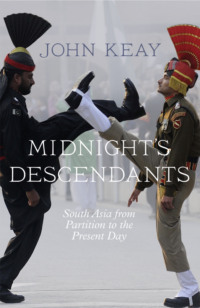
Cover photograph © Naringer NANU/AFP/Getty Images
A catalogue record for this book is available from the British Library.
All rights reserved under International and Pan-American Copyright Conventions. By payment of the required fees, you have been granted the non-exclusive, non-transferable right to access and read the text of this e-book on-screen. No part of this text may be reproduced, transmitted, down-loaded, decompiled, reverse engineered, or stored in or introduced into any information storage and retrieval system, in any form or by any means, whether electronic or mechanical, now known or hereinafter invented, without the express written permission of HarperCollins.
Source ISBN: 9780007326570 (HB), 9780007480036 (TPB)
Ebook Edition © January 2014 ISBN: 9780007468775
Version: 2015-07-20
In Memory of Julia Keay
Contents
Cover
Title Page
Copyright
Dedication
List of Illustrations
List of Maps and Charts
Author’s Note
Introduction
1. Casting the Die
2. Counting the Cost
3. Who Has Not Heard of the Vale of Cashmere?
4. Past Conditional
5. Reality Check
6. Power to the People
7. An Ill-Starred Conjunction
8. Two-Way Tickets, Double Standards
9. Things Fall Apart
10. Outside the Gates
11. India Astir
Epilogue
Postscript
Picture Section
Notes
Bibliography
Index
By the same author
About the Publisher
Illustrations
1. Wavell greets Jinnah prior to the 1946 Cabinet Mission talks. (Press Information Bureau/British Library)
2. Gandhi with Pethick-Lawrence during the talks. (akg-images/Archiv Peter Rühe)
3. Police use teargas to disperse a crowd in Calcutta. (© Hulton-Deutsch Collection/CORBIS)
4. The aftermath of the Calcutta killings of August 1946. (© Bettmann/CORBIS)
5. Lord and Lady Mountbatten’s carriage swamped by the crowd during India’s Independence Day celebrations. (Topham Picturepoint)
6. Nehru addresses a crowd of over a million on Independence Day. (Topham Picturepoint)
7. Trains packed with fleeing refugees at Amritsar. (© Illustrated London News Ltd/Mary Evans)
8. The refugee caravans were easy prey. Hundreds of thousands were massacred. (© Illustrated London News Ltd/Mary Evans)
9. Female students protest against the adoption of Urdu as Pakistan’s official language in Dhaka in 1953. (Rafiqul Islam)
10. Demonstrators in Bombay burn an effigy of Nehru in January 1956. (AP/Press Association Images)
11. Tenzing Norgay at the summit of Everest. (Getty Images)
12. Indian patrol in eastern Ladakh in 1960. (Topfoto)
13. Indian women preparing to defend the nation during the 1962 Sino–Indian war. (Topfoto)
14. A village in Jammu and Kashmir during the 1965 Indo–Pakistan war. (©Hulton-Deutsch Collection/CORBIS)
15. A Pakistani liaison officer shakes the hand of an Indian army officer after the announcement of a ceasefire in the Indo–Pakistan war. (Topfoto)
16. Indian troops advancing into East Pakistan in December 1971. (Getty Images)
17. Pakistan’s General Niazi signs the document of surrender at the end of the Bangladesh Independence War. (©Bettmann/CORBIS)
18. The Indian Herald’s supplement on Mrs Gandhi’s declaration of the Emergency. (Courtesy of the Indian Herald)
19. Indira Gandhi campaigning in Calcutta for the 1977 elections. (EE/AP/Press Association Images)
20. Sri Lankan Tamils training in southern India in 1986. (Topfoto/AP)
21. Young recruits undergoing training by the Tamil Tigers. (Topfoto/AP)
22. Sant Jarnail Singh Bhindranwale. (AP/Sondeep Shankar/AP/Press Association Images)
23. The Golden Temple of Amritsar during ‘Operation Bluestar’. (Topfoto/AP)
24. Kashmiris burn the Indian flag in March 1990. (Ajit Kumar/AP/Press Association Images)
25. Protesters against the Indian army’s presence in Srinagar. (Barbara Walton/AP/Press Association Images)
26. Militant VHP kar sevaks attack the Babri mosque in Ayodhya. (AFP/Getty Images)
27. Hindu youths clamber onto the domes of the Babri mosque. (AFP/Getty Images)
28. Mumbai under attack by jihadist gunmen in November 2008. (Punit Paranjpe/Reuters/Corbis)
29. The Golden Quadrilateral highway under construction near Kanpur. (Ed Kashi/VII/Corbis)
30. Sheikh Mujibur Rahman. (Mary Evans/SZ Photo/Scherl)
31. Zulfikar Ali Bhutto. (AP/Topfoto)
32. General Ziaul Haq. (AP/Topham)
33. Benazir Bhutto. (PA/Topfoto)
34. Atul Behari Vajpayee. (Topham Picturepoint)
Maps and Charts
1. South Asia – physical
2. South Asia today
3. British India and the Princely States in 1947
4. North-East India and Bangladesh
5. Kashmir and Punjab
6. Political succession in South Asia, 1947–2014


Author’s Note
I was six years old in 1947 when what was then British India won its independence. I vaguely recall the pomp and ceremony of the Delhi celebrations as filmed for Pathé News but have no recollection of seeing any coverage of the horrors of the Great Partition that followed. Pakistan I came across only in the classroom; it was not till nineteen years after Independence that I first visited what is now called South Asia.
Midnight’s Descendants is nevertheless a contemporary history. It spans my lifetime and has revived as many memories as questions. Since that first visit in 1966 I have been returning almost annually – as a journalist, documentary-maker, lecturer, writer of many books and taker of many holidays. In the process I have learned enough to know just how presumptuous this book is.
Contemporary history is itself fraught with pitfalls. It is, of course, a contradiction in terms: by definition, what is contemporary can’t be history. No record of the current can aspire to the detachment expected when writing of the past. Memory proves dangerously unreliable; impressions muddy the facts. A ready-made consensus does not exist in respect of many crucial developments, and access to the documentation on which later histories may be based is still embargoed. This book will probably be challenged and will certainly be superseded.
So why write it? The answer is simply that – both despite Partition and because of it – South Asia remains as distinct and crisis-prone a global entity as the Middle East (or ‘West Asia’, to South Asians). With a population greater than China’s, it is already the world’s largest market, and it may well host the world’s next superpower. In the past sixty-five years it has also staged at least five nasty wars and has more than once taken the world to the brink of nuclear conflagration. Yet its problems remain poorly understood, and its influence easily underrated. Studies of the region as a whole are surprisingly few. Visa restrictions limit travel and inhibit mutual exchange, much as prejudice limits mutual understanding. The outsider has a slight advantage here, which is my excuse for undertaking the book.
Over the years literally hundreds of friends and contacts have contributed to what follows. It would be invidious to attempt to list them; but one and all, I thank them. Sam Miller in Delhi and Philip Bowring in Hong Kong kindly read an early draft of the book. For their comments and encouragement I am enormously grateful, and I have enjoyed returning the compliment in respect of their own books. More immediately I want to record my debt to editors Lara Heimert and Sue Warga at Basic Books and Robert Lacey and Martin Redfern at William Collins. This is not by way of an authorial convention. Creative editors are a rare breed; so are patient ones. I have been blessed with four of the finest and most forbearing, and I thank them all most sincerely. For her still greater patience and unstinting support, and for her love, I am indebted to Amanda. But in her case thanks would be inappropriate and hopelessly inadequate. So I say no more.
John Keay
Argyll, 2013
Introduction
Approaching Bengal from opposite directions, the Ganges and the Brahmaputra shy away from a head-on collision and veer south, their braided channels fraying and criss-crossing in a tangle of waterways that rob the parent rivers of their identities. Long before reaching the sea the Ganges has split into the Hooghly and the Pabna, among others, and the Brahmaputra into the Padma and the Meghna. Known as ‘distributaries’, these sub-rivers then fork some more, creating a maze of broad brown bayous whose combined seaward meanderings define the area known as the Sundarbans. Here, in the world’s largest estuarine wilderness, expanses of glossy mangrove and thick muddy water cover an area as big as Belgium. Islands are indistinguishable from mainland; promising channels expire in stagnant creeks. In the several designated wildlife sanctuaries, amphibious adaptation proves the key to survival. Crocodiles loll along the tideline close-packed like sunbathers. Mudhoppers gawp and glisten in the slime and the local tigers swim as readily as they prowl.
With roads a rarity, the best way to get around the Sundarbans is by boat, perhaps with a bike aboard for excursions on terra firma. A guide is essential, the trails being few and the landmarks fewer. The rivers tug one way, the incoming tide another. Neither is consistent: salt water comes down on the ebb, fresh water is backed up by the flow. The logic of the currents is as hard to fathom as that of the international border which here separates India and Bangladesh. Maps show the border as a confident line bisecting islands and slicing through peninsulas as it ricochets from side to side down the broad Raimangal waterway. Its trajectory provides the region with its one feature of human geography. But on the ground – where there is ground – the border is scarcely to be seen. Shifting mudbanks and encroaching mangroves are no more conducive to frontier formalities than they are to cartographic precision. Apportioning the Sundarbans between India and what was then part of Pakistan must have been like trying to carve the gravy.
A game warden announces a sighting: ‘Changeable hawk-eagle.’ He points to a large raptor lodged in a dead tree.
‘It’s a darker version of the one in peninsular India.’
The bird is rooted to its perch and motionless. It could be stuffed, its taloned feet nailed to the branch, except that every now and then it moves its head ever so slightly, as if troubled by indecision. Choosing the behaviour appropriate to its species is problematic for a changeable hawk-eagle. Should it quarter low over India’s chunk of the Sundarbans or soar high above Bangladesh’s? Is this a hawk day or an eagle day? Or just another changeable day? The options make for great uncertainty.
‘So is that bit over there India or Bangladesh?’ I’m asking. Nothing seems one thing or another in this gooey wilderness.
‘Oh, that’s India. Bangladesh is over there. See? But it should be India. Khulna, that whole district, should have come to India at Partition. It had a Hindu majority.’
Khulna was not awarded to India because Murshidabad, a Muslim district to the north of Calcutta that straddles the Hooghly river, was preferred by Delhi on the grounds of strategic contiguity and economic convenience. Eastern Pakistan, as Bangladesh then was, got Khulna by way of exchange. Hence mainly Muslim Murshidabad went to mainly Hindu India, and mainly Hindu Khulna went to mainly Muslim Pakistan. So much for the fundamental principle on which British India was divided by 1947’s Great Partition – that contiguous areas where Indian Muslims were in a majority were to constitute Pakistan, and that areas where they were not in a majority were to constitute the new India.
Dividing the subcontinent had itself been a compromise, and proved a heavy price to pay for independence. Flying in the face of fifty years’ struggle for a single India and of a shared cultural and historical awareness that stretched back centuries, it had been dictated by three recent developments: most Indian Muslims had come round to the idea of a Muslim homeland of their own; most Indian nationalists were insisting on a successor state that was strong enough to resist such demands; and the British were desperate for a fast-track exit. Adopted only as a last-minute expedient, Partition was widely regretted at the time. And by all who hold life, livelihood and peace to be dear, it has been rued ever since.
‘These people here must be Indian then,’ I venture. Fishing boats and a gaggle of schoolchildren hint at a nearby village, but there is no mains electricity, no road and no phone line – and all this despite being within 150 kilometres of downtown Calcutta.
‘Well yes, now they’re mostly Indian. But many of them are actually from Bangladesh, some Hindu, some Muslim.’
In the Sundarbans the rivers and raptors are not the only changeable things. Decades after British-ruled India was partitioned into the republics of India, Pakistan and later Bangladesh, national identities in this part of the subcontinent remain as fluid as the wind-ruffled soup that passes for water. So, too, do patterns of migration and the terminology applied to them. Immediately after the Great Partition of 1947, people who crossed the border were known as ‘refugees’. In the 1960s they became ‘evacuees’, in the 1970s either ‘optees’ or ‘oustees’, in the 1980s ‘illegal immigrants’, and now ‘potential terrorists’. Like the reception afforded them in their chosen destination, their status has been declining. Not, though, their numbers. The exodus into India from that part of Pakistan which in 1971 became Bangladesh has always been difficult to quantify. Some say hundreds of thousands have crossed the border, some say millions. Urban India’s twenty-first-century construction boom draws heavily on Bangladeshi labour, much of it illegal. Locally there are migrants who traipse back and forth for seasonal work or even a daily wage. No one is sure who is a migrant worker and who a cross-border commuter. Throughout the delta, people still come and go largely undetected, like the tides and the tigers.
A thousand kilometres to the north, where the Bangladesh border squeezes the Indian state of West Bengal up against the Himalayas, the situation is further complicated by what must be the most eccentric frontier conformation on earth. Here territorial logic veers to the opposite extreme, that of over-definition. Communities lie trapped in time-warped pockets, their national identity determined by arcane landholding patterns and the inflexible notions of sovereignty so jealously entertained by modern nation states. With little regard to the religious affinities of the inhabitants, Partition here simply appropriated the piecemeal patterns of cultivation and proprietorship found in the extant land registers and then upgraded them into international borders.
Outside his house a man poses for the camera. His back is to the wall in the photo and his legs apart. He looks rather pleased with himself. The caption explains that he is standing with one foot in Bangladesh and the other in India, and that the wall behind him is part of an extension tacked onto his house so that it too straddles the international border. With a spare room in India he qualifies as an Indian resident and can avail himself of a connection to the Indian electricity grid. No one else in this bit of Bangladesh has electricity. Providing any social amenities here is problematic because the village is in fact a sovereign ‘enclave’.
An enclave is any atoll of territory wholly surrounded by the territory of another sovereign state, in this case India. Elsewhere there are bits of India stranded in Bangladesh. The border picks its way between these enclaves, and such is their complexity that most maps despair of showing them at all. But on the ground the formalities of international transfer are faithfully observed. Checkpoints bar the tiniest roads; flags are raised and lowered; papers are stamped, currency changed, sim cards traded and bribes disbursed. Cultivators setting off for their fields clutch passports; cross-border shopping trips may be construed as smuggling operations.
Willem van Schendel, Professor of Modern Asian History in the Netherlands (a country which has enclaves of its own in Belgian territory), estimates that there are 197 such sovereign pockets along this short section of the Indo–Bangladesh border west of the Tista river. Perhaps 100,000 people live in the enclaves, which cover a total area of about 120 square kilometres. It’s hard to be more precise, because enclaves may themselves have enclaves. The latter are known as ‘counter-enclaves’ and are, in effect, bits of India that lie within bits of Bangladesh that are themselves within India – or vice versa. In the Bhalapura Khagrabari complex of enclaves, the largest archipelago of Indian territory in Bangladesh, one such Bangladeshi counter-enclave contains a smaller counter-enclave of Indian territory. This is Dahala Khagrabari, which van Schendel calls ‘the world’s only counter-counter-enclave’. From here an Indian citizen wishing to reach India proper, a distance of around ten kilometres, has to cross the frontier four times – from India to Bangladesh, Bangladesh to India, India to Bangladesh and finally Bangladesh to the Indian ‘mainland’. Luckily Dahala Khagrabari comprises just 6.9 hectares and is currently uninhabited, being mostly jute fields. But envy not its farmer.
With their promise of sanctuary, enclaves have attracted unsavoury elements. Criminal gangs have tended to take up residence, and smuggling has become a way of life. Under cover of darkness or along paths tunnelled through the three-metre-high jute crop, everything from armaments to cattle, pharmaceuticals and people is channelled through the enclaves. In recent years criminal activity has reportedly been on the decline; life, though, remains ‘insecure’ and social amenities non-existent. The only obvious advantage of being an enclave-dweller is said to be ‘the absence of tax’.1
Something similar could be said of another anomaly of the Indo–Bangladesh border, namely the chars. These are mid-river mudbanks deposited principally by the flood-prone waters of the wide Brahmaputra. A quarter of a million people live on chars; the riverine soil can be very fertile and the river itself is rich in fish. But they do so at the risk not only of inundation but of involuntary migration; for such is the landscaping power of the monsoon-swollen flood that chars may shift. If the centre of the current happens to be the recognised border – as it is for several hundred kilometres – a char that was in Bangladesh one year may well end up in India the next (or vice versa).
‘[M]ost of the islands vehemently either move forward or backward across the international riverine border,’ complains an observer concerned with the problems of policing these errant landmasses.2 Though still at the same address, several thousand people may suddenly find themselves unaccredited immigrants in a different country. Border markers get washed away, rivers change course. In some areas the painful business of border negotiation and demarcation, a process that was supposedly concluded soon after Partition in the late 1940s, is still being repeated every year.
In 2006 the Indian authorities, spurred on by the prospect of cross-border infiltrators bent on terrorism, began ring-fencing Bangladesh (not forgetting its enclaves). The new fence has steel stanchions and razor wire and is actually two fences, so creating a caged corridor along which laundry can be hung out to dry. The fence stands three metres high, and when completed will be around 2,500 kilometres long. But its march is halted by every river and, as per a previous agreement not to construct contentious facilities on the border itself, it runs a hundred to a thousand metres behind the actual line of demarcation. Thus ‘a huge quantum of precious Indian land is becoming a no-man’s land’, complains one politician. Within this strip lie villages, farmland and uncounted residents. One quite short stretch of the fence is reported as having alienated, or ‘practically disowned’, 149 villages and 90,000 people. Indian citizens are being rendered stateless and their property worthless. The issue has been raised in the Indian Parliament and aired in the press, but without eliciting any promise of compensation or resettlement.3
All this is in striking contrast to the nearby border between India and Nepal. Here there are no fences, no patrols and minimal formalities. It is an ‘open border’. Although Nepal never came under direct British rule – and was therefore unaffected by Partition – an agreement had been reached whereby people and goods might cross at will. This still stands, albeit often amended. Immigrants from India already make up a substantial percentage of Nepal’s population, while Nepalis settled in India constitute an overall majority in parts of the Indian state of West Bengal. A Gorkha National Liberation Front (GNLF) represents the latter’s interests. Demanding the recognition of Gorkhali, Nepal’s main language, as one of India’s official languages – and so qualifying its speakers for the educational and job opportunities that go with recognition – the GNLF strives, not without occasional violence, for an autonomous enclave within West Bengal or even a separate Nepali state within the Republic of India. Migration, in other words, is here an accepted phenomenon. National identity (‘Nepali-ness’) is being officially downgraded to a linguistic identity (‘Gorkhali-ness’), which is something that can be accommodated within the accepted limits of protest and concession afforded to India’s other language groups.
Language remains a contentious issue throughout polyglot South Asia, but in modern India its explosive potential has been steadily tamed by concessions and circumstance. It plays no part in the plight of the enclave-dwellers and the migrants along the Indo–Bangladesh border; all of them speak Bengali, whether Indians, Bangladeshis or not exactly either. The same goes for Tamil-speakers flitting between Sri Lanka and south India. In both cases a shared language in fact serves as a camouflage, making the detection of illegal or undesirable incomers that much more difficult.
Other markers of identity prove less amenable. Beyond the Nepali concentrations in northern West Bengal, and beyond the enclaves and chars along the Indo–Bangladesh border, a tendon of Indian territory tugs at a knotted fist of mainly ethnic discontent in the remote hills along the Burmese border. By one reckoning India’s cluster of states in the far ‘north-east’ is plagued by over a hundred insurgency groups, most of them pressing their grievances on the grounds of disadvantaged ethnicity: ‘Manipur tops the list [for the number] of militias with 35, Assam is second with 34 and Tripura has 30; Nagaland has four and Meghalaya checks in with three militias.’4 At any given moment these groups vary greatly in terms of support, objectives and militancy. But with India, Bangladesh, Burma (now Myanmar) and China all interested parties in the political jigsaw of South Asia’s north-eastern extremity, ethnic grievances invariably involve territorial disputes, and these readily translate into war-worthy issues involving international sovereignty.
National identities cannot here be taken for granted. Even where the borders are not themselves in dispute, the loyalties of those living on either side of them may be. Like the fickle ‘distributaries’ of the Ganges and the Brahmaputra, the very idea of the nation state is dissipated and frayed into complex strands of competing allegiances. A Naga, for instance, may subscribe to half a dozen identities.
I am from Khonoma village of the Angami tribe … Now within the village I belong to the Iralu clan. The Iralu clan belongs in turn to the Meyasetsu clan. The Meyasetsu clan in turn belongs to the still wider and larger clan called the Merhuma Khel. The Merhuma Khel is in turn one of three major Khels that make up Khonoma village. The Khonoma village in turn belongs to the Angami tribe and the Angami tribe belongs in turn to the Naga nation … [T]hese ethnic and national identities are precious to me. They in fact define my political existence as a man with a country to call his own. As such, I can never surrender this birthright to India or any other nation on earth.5
Statements like this from a Naga nationalist are dismissed by the Indian authorities as secessionist and totally unacceptable. The Bangladeshi authorities take exactly the same line with their own disaffected Chakma peoples. Both governments classify such communities as ‘tribal’ and attribute their recalcitrance to poor education, misguided leadership, discriminatory policies and foreign interference. Yet Mahatma Gandhi himself once assured the Nagas that if they did not wish to be part of India they would not be compelled to integrate with it; India would recognise their independence. To the apostle of non-violence, forcibly incorporating any disaffected group contradicted the whole idea of free association on which the modern Indian nation was founded.
This all raises a more fundamental question about whether the correlation between a nation and a state is not itself the problem. In South Asia as a whole, and particularly in the chaotic circumstances of the north-east, other cherished affiliations – of kinship, creed, locality, language, tribe, clan, profession and caste – may need to be factored into considerations of identity. The twinning of sovereignty with territory may need to be ‘unbundled’, and the very notions of political authority and territorial integrity may need re-examination.6
By dividing British-ruled South Asia into a mainly Muslim Pakistan and a mainly Hindu India, the Great Partition of 1947 severed – and sometimes pocked – not just the landmass of South Asia but its society, economy and infrastructure, and above all its two main religious communities. Religion was indeed the mentor of Partition. It provided the motivation for division, dictated the criteria for realising it and underwrote the zealotry that accompanied it. Yet it would be wrong to suppose that Partition was principally about separating two competing belief systems. Doctrinal differences rarely entered into the debate at the time: religious parties, like the Jamaat-e-Islami of many orthodox Muslims or the Mahasabha of many nationalistic Hindus, in fact opposed territorial division. Even the prophets of Pakistan, like the pragmatists of a truncated India, anticipated the presence of religious minorities within the partitioned states. Indeed they competed in offering guarantees of citizenship and fair treatment to all such ‘confessional enclaves’.
When a community is under stress, its sense of itself frequently transcends its attachment to specific tenets. Diversity in matters of faith is trumped by an insistence on communal solidarity that may ignore lesser doctrinal and devotional distinctions. Thus the different traditions of Islam represented by Sunni, Shi’ite and Sufi practice were no more evident in the rhetoric of Partition than was the rivalry among those cults, disciplines and doctrines that go to make up ‘Hinduism’.
Rather was it – and is it – conduct, culture and kinship that comprise the markers of confessional identity and constitute the bonds that bind a community together. These may include things like where and to whom one was born; how one washes and dresses; what one eats and when one fasts; what work one does; when, where and how (not to mention whom) one worships; who one consorts with and marries; to what or to whom one looks for justice and redress; whom one idolises and whom one demonises; and what songs, verses and aphorisms one carries around in one’s head. Like that tribal layering of Naga identity, all these things define one’s existence as a member of a community – though not necessarily of a community with a country to call its own.
In the 1940s the desire to protect these markers from the perceived threat of Hindu rule on the part of Muslims, and of a privileged Muslim separatism on the part of Hindus, buoyed demands for communal autonomy. The hope was that autonomy would reassure all parties by ‘ring-fencing’ their interests and preserving their integrity. But in line with the contemporary partition in Palestine, and with almost no debate on the matter, the objective soon underwent a sea-change. Areas, not individuals, became the currency of partition, districts rather than households the unit of exchange. As per the last British Viceroy’s June 1947 partition plan, ‘the parties appear to have accepted that communal autonomy was to be realized by the creation of separate territorial sovereignties’, writes Joya Chatterji.
1
Casting the Die
In the early afternoon of 24 March 1946 three members of the British Cabinet, plus their staff, were driven from Delhi’s makeshift airport to the monumental residence built for the Viceroy of what was still British India. The traffic was light – it was a Sunday – and along the capital’s leafy avenues the cars were outnumbered by carts, some of them high-sided haywains drawn by enormous white oxen, others rubber-tyred flatbeds hauled by wispy-haired water-buffalo whose languid pace allowed for a snatched bite at the herbaceous bounty provided by the municipal groundsmen.
New Delhi, the garden city laid out as the capital of British India only twenty years earlier, dozed in the afternoon heat, unroused by the visiting Cabinet Ministers, untrodden by policemen or postmen – both were on strike – and unbothered by the post-war turmoil beyond India’s distant frontiers. It was just eight months since the British Labour Party had taken office in London, and seven since Japan’s surrender had brought an end to the Second World War. Half the world was still in uniform. A blitzed and rationed Britain faced the biggest reconstruction crisis in its history. Yet in London Prime Minister Clement Attlee had reconciled himself to dispensing with three of his most senior colleagues for what would turn out to be a hundred-day absence. Their mission was that important.
Of the three Cabinet Ministers, Lord Pethick-Lawrence was there as of right: as Secretary of State for India he headed a branch of the London government whose personnel and budget exceeded those of both the Foreign Office and the Colonial Office. Another of the delegates, Albert Victor Alexander, later Earl Alexander, had responsibility for safeguarding the British Empire’s maritime links as First Lord of the Admiralty; and the third, Sir Stafford Cripps, had led an earlier mission to India, was the prime mover in the present one, and was currently President of the Board of Trade. All were men of high principle. Pethick-Lawrence had once received a custodial sentence for encouraging suffragette defiance; Cripps, a vegetarian and a teetotaller, had once been expelled from the Labour Party as too left-wing; and Alexander, a blacksmith’s son, had been known to double as a lay preacher. All sympathised with India’s national aspirations and shared its leadership’s socialist values. Their integrity, their seniority and their extended leave from Cabinet duties bespoke their government’s intent. Britain’s Labour Party had already committed itself to ‘freedom and self-determination’ for the peoples of India; now it must deliver. As per its instructions, the delegation’s task was ‘to work out in cooperation [with India’s political leaders] the means by which Indians can themselves decide the form of their new institutions with the minimum of disturbance and the maximum of speed’. Thus would be consummated what the mission’s statement called ‘the transfer of responsibility’ and what the delegates themselves called ‘the transfer of power’.1
The Cabinet delegates, all of them aged around sixty, reeking of tobacco and unaccustomed to the ease of light linen suiting, were immediately dubbed ‘the Magi’ by Lord Wavell, the current Viceroy. The Indian press preferred to call them ‘the Three Wise Men’. They might have come from the West and arrived by plane, but the treasure they bore was indeed priceless. India was at last being proffered the means of securing full and unconditional independence. After decades of sacrifice and disappointment, of repression and obfuscation, protest and imprisonment, azadi (‘freedom’, ‘independence’) was within the grasp of the subcontinent’s four hundred millions.
In the history books this first post-war initiative in the endgame of British rule is known simply as ‘the 1946 Cabinet Mission’, an impersonal phrasing that has deterred scrutiny and obscured its importance. Within a year the new Viceroy, Lord Mountbatten, would steamroller through a very different handover of power that would relegate the Cabinet Mission and all its doings to the India Office’s bulging archive of begrudged concessions and aborted proposals. Yet, for all this, the Mission deserves recognition as one of the twentieth century’s milestones. It marked the beginning of the end for the British Empire in India; it was the first such overture to offer independence on a plate – to India or anywhere else. And it was the last to provide any real hope of staving off a division of the South Asian subcontinent.
Only in retrospect was it a failure. Both of the main contenders for power in India – the Indian National Congress guided by Jawaharlal Nehru and the Muslim League headed by Mohamed Ali Jinnah – would in fact accept a Mission proposal that emphatically rejected any division of the country; the demand for a sovereign state of Pakistan was so hopelessly impractical, declared the proposal, as ‘not to be an acceptable solution’. Even Jinnah, the man who epitomised the demand for a separate Muslim homeland called Pakistan, would not demur over what he called merely these ‘injudicious words’. Fitfully and faintly, a hint of consensus arced across India’s dark horizon of sectarian rivalry. The rainbow would soon fade, but throughout 1946 the country lay within a whisker of attaining full independence as a single sovereign state. Partition, in other words, was no more a foregone conclusion in the run-up to Independence than was the genocidal mayhem of its aftermath.
Rolling up their shirtsleeves of sea-island cotton, the Cabinet Ministers got down to work in the hermetically air-conditioned offices of a wing of the viceregal palace (‘one of the biggest residential buildings in the world’, it is now Rashtrapati Bhawan, the official home of the Republic of India’s President).2 For two weeks they listened – to the views of the Viceroy and his Executive Council, to the Governors of British India’s fourteen constituent provinces, the representatives of its several hundred quasi-sovereign princely states and the spokesmen of its main political parties and communal groupings; in all they would interview ‘472 people on 181 separate occasions’.3 Then for four weeks they drafted – first an outline of the likely constitutional options (a large two-tier federal India versus two or more smaller one-tier Indias) – followed, when the Muslim League rejected both, by a statement of their own that proposed a large three-tier federal India. This too was unacceptable; but hoping that common ground would emerge through direct Congress–League contact, the Cabinet Mission invited the interested parties to send representatives to a conference.
By now it was early May. The thermometer on the terrace outside the viceregal palace hovered in the upper thirties centigrade. Tarmac bubbled like porridge, and it was the turn of the railways to be paralysed by strike action. A suggestion that the delegates repair to Simla, 350 kilometres to the north and 2,000 metres higher, promised some welcome relief plus a tantalising glimpse of the Himalayan snowline. It was approved in a rare show of unanimity; elevation was just what the discussions needed. With the railways at a standstill, the Mission flew to Simla’s nearest airstrip at Ambala before addressing the hairpin bends of the near-perpendicular ascent to the town by car.
But ‘the Queen of Hill Stations’, as so often, disappointed. The change of scene brought no change of heart. Simla’s pine-scented zephyrs neither cooled heads nor cleared the air. The conference lasted over a week and served only to highlight League–Congress differences. Consultation degenerated into altercation. By 13 May the delegates were trailing back empty-handed to the inferno that was Delhi. Pethick-Lawrence was getting tetchy, Cripps, the Mission’s intellectual heavyweight, was wilting with diarrhoea which might have been dysentery, and Alexander had discovered an urgent need to visit a British naval base in Sri Lanka (then Ceylon).
Nevertheless, three days later, the Mission came up with its own solution. All its ‘proposals’ having been shot down by either Congress, the League or both, the Mission had decided to stop inviting comment and instead to table a ‘recommendation’. This favoured another three-tier, one-state constitution. Of the three tiers, the first would be comprised of British India’s fourteen directly administered provinces. Their recently elected legislatures would then take their provinces into three predetermined regional ‘groupings’ roughly corresponding to the north-west, the north-east and the remainder of the country, this being the second tier. And the groups would then arrogate to the central government – the topmost tier – certain all-India responsibilities like foreign affairs, defence, communications and some revenue-raising powers. The groups might award to the centre other responsibilities. They might also determine their own constitutions. Although a cumbersome device, the importance of the groups lay in the fact that two of them, those in the north-west and north-east, corresponded to the Muslim-majority regions earmarked by the Muslim League for its putative ‘Pakistan’. The League could thus reassure itself that the substance of a Muslim homeland had not been entirely precluded, while the Congress could reassure itself that the principle of an undivided India remained intact.
Overall the structure was essentially a graduated federal pyramid, with the fourteen provinces tapering to the three groups and then the one centre. Residual sovereignty would lie with the provinces and the groups, while the central government was comparatively weak. But provision was also made for an all-India constitution-making body, or Constituent Assembly, to give effect to the whole plan. The Constituent Assembly’s members would be selected by the provincial legislatures on a religious basis: Muslims would choose Muslim members, Sikhs Sikh members, and the great majority would choose ‘general members’, a term designed to avoid identifying the supporters of the determinedly secular Congress as overwhelmingly Hindus.
All the recommendations contained in this 16 May statement had been pre-agreed with London and anticipated by some of the earlier proposals. It was a longish document, and a particularly taxing one, with more than the odd devil in its considerable detail. In fact the detail was so complicated that it required weeks of clarification by the Mission, then exhaustive debate within the two main parties. Yet, not without grave misgivings and reservations, on 6 June Jinnah and the Muslim League accepted it; and so too, though anxious over the interpretation of some clauses and in the face of disapproval of the confessionally based groups from Mahatma Gandhi himself, did Congress on 25 June.
For the moment Partition was ruled out, as was a sovereign Pakistan; from Afghanistan to Burma an independent India would have the same dimensions as British India. On this happy note the members of the Cabinet Mission began packing their bags. Exhausted, they flew back to London on 29 June.
We ask the Indian people to give this statement calm and careful consideration [Cripps had pleaded at a press conference]. I believe that the happiness of their future depends on what they do now … But if the plan is not accepted, no one can say how great will be the disturbance, or how acute and long the suffering that will be self-inflicted by the Indian people.4
*
The disturbance and suffering began within a matter of weeks. For the Cabinet Mission, despite its apparent success on the constitutional front, had inadvertently made things worse. A constitutional framework had been agreed, but an actual constitution would have to wait on the deliberations of the Constituent Assembly. These could take months – as indeed they would (or, as in the eventual case of Pakistan, decades). In the meantime, Congress insisted that an interim government composed of Indian nationals should take over the reins of power. In Nehru’s view and in that of Gandhi, a constitution must be the product of an independent nation; freedom, if it meant anything, must include the freedom to formulate one’s own institutions; de facto independence must therefore precede the constitution-making process. The League took the opposite view: as Jinnah saw it, an interim government that inherited the paramount powers and patronage of the British Raj would be at liberty to influence the Constituent Assembly’s interpretation of the 16 May statement, even overrule it. If there had to be an interim government, therefore, Jinnah demanded a safeguard: half the interim government’s members must be Muslims nominated by his Muslim League, so negating any hostile intervention by the other half consisting mainly of Congress ‘general members’.
‘Now happened one of those unfortunate events which change the course of history,’ noted Maulana Azad, a scholarly and emollient Muslim who, unlike Jinnah, rejected the idea of Pakistan and was at the time President of the Congress Party. At a press conference Nehru was asked whether Congress accepted the 16 May plan in toto. Off the cuff Nehru replied that Congress would indeed enter the Constituent Assembly, but then added that it would do so ‘completely unfettered by agreements and free to meet all situations as they arise’. In effect, concluded Maulana Azad, Nehru was claiming for Congress the right to ‘change or modify the Cabinet Mission Plan as it thought best’. This ‘astonishing statement’ called into question the good faith of one of the main signatories and so undermined the whole agreement. Maulana Azad, as a Congress Muslim from a Muslim minority province that was never likely to be part of any Pakistan, had a vested interest in an undivided India; he was horrified. Jinnah was perhaps less so; in Nehru’s casual admission that he did not consider the agreement binding, Jinnah saw his often-aired fears confirmed. If the other signatory reserved the right to change or modify the agreement ‘as it thought best’, the League wanted nothing to do with it. It therefore withdrew its earlier acceptance.5
Meanwhile Congress had decided to withhold support for the proposed interim government. This time it was not Nehru who was responsible but Gandhi; for if Nehru had put his foot in it over the Constituent Assembly, Gandhi put his foot down over the interim government. No longer a Congress office-holder but still very much the party’s conscience, the seventy-six-year-old Mahatma baulked at that parity between Muslims (comprising roughly 30 per cent of India’s population) and non-Muslims (comprising 70 per cent) implied by the proposed make-up of the interim government, and he took particular exception to Jinnah’s insistence that only the Muslim League was entitled to nominate Muslim members.
Thus, within days of the Cabinet Mission emplaning for London, the Constituent Assembly was being boycotted by the League while the interim government was being boycotted by the Congress. Of the two representative institutions set up under the Mission’s plan to expedite the handover of power, neither was left with more than a single rickety leg to stand on.
Landed with this tottering structure, Wavell, the Viceroy, would do his best. Nehru would revise his position and Jinnah would be credited, wrongly, with second thoughts; a Constituent Assembly would indeed assemble and an interim government would be formed. Though the transactions of neither would induce a spirit of collaboration, well into 1947 all the interested parties remained engaged in a constitution-making process based on the Cabinet Mission’s recommendations – including its insistence that the territories comprising British India should continue as a single sovereign state.
It was events rather than debates that poisoned this uncertain process, then rendered it redundant. Back in 1942 Congress had severely embarrassed the British with a mass movement designed to sabotage their war effort and persuade them to ‘Quit India’ immediately. The movement had been suppressed, but only with great violence and thanks to some draconian wartime regulations. Now, according to the League, in the dog days of 1946, the British were fearful of a new wave of Congress non-cooperation that would be impossible to contain without the troop levels that had pertained in war and must therefore lead to the ignominy of forced eviction. It was this consideration that had led the Cabinet Mission to overlook Nehru’s ambivalence about constitution-making and to indulge Gandhi’s intransigence over Muslim representation in the interim government. In other words, the Muslim community was being ‘betrayed’, as Jinnah put it, by a British government reluctant to risk Congress retaliation. A record of mass menace was evidently more persuasive than one of reasoned argument; and taking this lesson to heart, on 29 July Jinnah announced that ‘this day we bid goodbye to constitutional methods’.6 In the first all-India protest it had ever organised, the Muslim League called on its supporters to stage their own brand of ‘direct action’. It also named the day – Friday (the Muslim day of prayer), 16 August.
The League’s protest was to be framed as a demand for ‘Pakistan’, a term that was already understood to mean an independent homeland for the League’s Muslim constituency – or what Jinnah called the ‘Muslim nation’. But what this ‘Pakistan’ would actually mean in respect of territory, population transfers and relations with the rest of India was far from clear. Jinnah preferred it that way: the vaguer the term, the more elastic its scope and the more electric its appeal. Yet despite the ‘Pakistan’ banners and posters (there was as yet no Pakistan flag or anthem), and despite the vast crowds of demonstrators and the usual scuffles, ‘Direct Action Day’ on 16 August occasioned no major confrontations in the great north-western centres of Muslim India – Delhi, Lahore, the Punjab – that would witness the worst atrocities of an eventual Partition. Instead it was Calcutta, then India’s largest conurbation and business capital, that exploded.
As in Dhaka, where lesser disturbances had been ongoing for weeks, the explosion was triggered by a minor local issue which, magnified in a prism of economic grievances, industrial disputes and confrontational party politics, assumed the black-and-white, them-or-us terms of the city’s already endemic Hindu–Muslim animosity. In the gory press reports of ‘the Great Calcutta Killing’ that ensued, the word ‘Pakistan’ received scarcely a mention; nor was it prominent among the declared demands and anxieties of the combatants. Partition, and its implications for Calcutta, a city with a Hindu majority but which was the capital of a province (Bengal) with a Muslim majority, was little understood; likewise the niceties of constitution-making and government-formation in far-off Delhi were irrelevant. Rather, the spark that ignited the explosion of violence was an innocuous and apparently commendable resolution of Bengal’s provincial assembly. Passed on a show of hands by its incumbent Muslim League ministry, it simply ordained that, to minimise the inevitable friction if non-Muslims worked while Muslims marched, ‘Direct Action Day’ should be observed by all as a public holiday.
‘CALCUTTA IN GRIP OF INSANE LUST FOR FRATRICIDAL BLOOD’ ran the 17 August 1946 headline in the People’s Age, the nation’s Communist (and so confessionally neutral) mouthpiece. The riots amounted to ‘a communal orgy the like of which had never been seen before’. Indeed, the Muslim League’s ‘Direct Action Day’ on the 16th had ‘turned into an open civil war between Hindus and Muslims’.7 Thousands were being killed, the streets were strewn with corpses, the hospitals were overflowing with the wounded, fires raged unchecked, and whole districts were being looted. One witness told of corpses being roped together like sporting trophies, another of babies being hurled from balconies, children clubbed to death, and mothers and daughters abused and butchered. Only the British, usually the butt of Bengali protests, had been left unmolested; and only the police had been minded to observe the declared holiday.
The politicians of both sides had to bear much of the responsibility. Congress members, after walking out of the Bengal Assembly in protest over the holiday resolution, had publicly denounced the League in the most intemperate terms. The League had responded with equally inflammatory sentiments. Both had welcomed the support of known criminal elements whose actions they had subsequently declined to condemn. The League government had at first delayed recalling the police and had then deployed them less than even-handedly; and when the situation was clearly beyond its control, it had failed to call on Bengal’s British Governor to send in the army. The Governor, in turn, should have acted sooner, whether asked to or not. As it was, the killing went on unopposed for two days and unquelled for four. Four thousand died, 11,000 survived serious injuries.
In retrospect, ‘the Great Calcutta Killing’ would come to be seen as the turning point, ‘the watershed’, in South Asian relations. For decades nationalists of every hue had concentrated their fire on British imperialism; a common enemy cemented a common sense of purpose. Now, with independence as good as won, nationalists turned on nationalists in a ‘civil war’ between the country’s two main communities. It was Gandhi’s worst nightmare, Nehru’s idea of madness; and it seemed unstoppable. Rightly or wrongly, the outbreak in Calcutta would be construed as the first eruption in a chain reaction of communal atrocities that, spreading erratically, gained in intensity until a year later they climaxed in the mass genocide of Partition.
Calcutta certainly set the pattern of savagery. No one knew who started the killing. Rumour raced ahead of verifiable report. The gangs responsible, whether Hindu or Muslim, invariably claimed to be avenging prior atrocities or acting in self-defence. Street talk of ‘massacres’ no more captured the full horror than the official designation of the disturbances as ‘riots’. Even ‘civil war’ was something of a misnomer. Some parts of the city were unaffected, with the Communist People’s Age smugly noting that ‘reports from the working-class belt indicate that the hysterical frenzy has not contaminated the workers’. The combatants were divided along purely communal lines, their object being not to expel or detain their opponents but to terrorise, desecrate and exterminate them. Age went unrespected and innocence unacknowledged; just to be of the wrong community was provocation enough. Votive objects – a domestic deity here, a treasured Quran there – were trashed and fouled. Mosques were defaced, shrines burned. Women, the embodiment of every community’s exclusivity, were a particular target. Of those ‘lucky’ to be still alive, some had been raped or abducted, while the dead had been physically incised with the religious hallmarks of their murderers. Either way, the objective was the appropriation of all that the other community held sacred.
As with the later massacres, the scale and the intensity of the Calcutta killings took both British and Indians by surprise. ‘No Indian political leader … neither the [Bengal] government, the opposition nor the press anticipated the magnitude of the tragedy.’ As later too, the national politicians in Delhi seemed more obsessed with the squabble for power than with its consequences for the febrile communities they represented. Like the frailest of firefighters, Gandhi alone would track the flames of violence, touring the stricken areas – Dhaka, then Noakhali (both in eastern Bengal) and then Bihar, all before the end of 1946 – as he fasted, marched and painfully practised the communal harmony that he so tirelessly preached. His colleagues preferred to accuse their political opponents either of starting the troubles or failing to suppress them, both of which only stoked the fires of hatred for the next round of atrocities. No one seemed capable of comprehending the scale and obscenity of the killing. In the midst of forming the interim government, Nehru breezily declared that his arrangements must ‘not be upset because a few persons misbehave in Calcutta’; Jinnah similarly refused to believe that any member of the Muslim League ‘would have taken part in using any violence’. A joint inquiry might have cleared the air. Neither party would agree to it. Instead both conducted their own inquiries. Each duly found against the other.8
Ironically, the effect on the British was wholly counter-productive. ‘Direct Action Day’, though conceived by Jinnah as a way of demonstrating that the League could bite as well as bark and must therefore be taken seriously, merely impressed the British with the urgency of disengaging. The Viceroy and his advisers were convinced that the situation was getting out of control. An all-India civil war seemed imminent, with the British ill-equipped to prevent it and in danger of being caught in the crossfire. Not for the first time, Wavell wavered over the prospects for a peaceful transfer of power and began drawing up a plan B. The ‘B’ stood for ‘Breakdown’ – a breakdown in the constitutional process and a breakdown in law and order. To a military man who had presided over the Allies’ wartime retreats in both North Africa and South-East Asia, a carefully phased withdrawal was the obvious answer, first from the comparatively peaceful south of India to the Gangetic plain, then to the strategic redoubt of the Punjab and the north-west. In this scenario, Jinnah’s Pakistan, if it ever materialised, would come piecemeal, later rather than sooner, and by agreement with Westminster regardless of Congress. The Calcutta Killings had neither advanced the League’s cause nor made Pakistan inevitable. What they did make inevitable was an early British departure and the near certainty of constitution-making being sacrificed to the exigencies of the moment, while the apprehensions of undivided India’s four hundred million citizens were left to fester.
*
‘Pakistan? What good is that to us? We want oil, cloth, sugar, wheat. And we want justice – that is all.’
Such were the sentiments expressed by a couple of Qureshi Muslims when, in March 1947, they were asked how they felt about a Pakistan that was looming larger with every communal massacre and constitutional impasse. Qureshis claim descent from the Arab invaders who first brought Islam to India in the eighth century; these ones had bicycles and were heading for a building site near the Narmada river in what is now Madhya Pradesh. Famed for speaking their mind, Qureshis might have been expected to welcome the idea of Pakistan. But in this case their response was wholly negative, and it was not untypical. It echoed that of sundry Pathans, Punjabis, Jats, Mewatis and Rajputs – Muslims and Sikhs as well as Hindus – whose opinions had been quietly canvassed over the previous four months by the inquisitive Malcolm Lyall Darling.
An ageing Quixote on a small grey horse, Darling had ridden out of Peshawar one raw November morning in 1946. From a start within sight of the Khyber Pass, he had been ambling east and south ever since. By March 1947 he was nearing the end of his epic ride in what was roughly the centre of India. Dressed in creaky leather boots, tweeds of many pockets and an outsize sola topi to protect his hairless pate, he looked exactly what he was: ex-Eton, ex-Cambridge and ex-ICS (Britain’s elite Indian Civil Service). But not for him the face-saving constitutional conundrums of Delhi or the peacekeeping anxieties of Calcutta. Darling was controversial. A gentle critic of many aspects of British policy, he had turned to Nehru when planning his itinerary, and would report to Gandhi on the findings of his trip. During thirty-six years’ service his speciality had been setting up agricultural cooperatives and encouraging ‘the Punjab Peasant in Prosperity and Debt’ (as per the title of one of his books). Rural life remained his passion. An hour or two spent chatting with agriculturalists under the village pipal tree he accounted well spent and entirely pleasurable. The diary of his 3,000-kilometre ride from the Indus to the Narmada during what would be north India’s last winter as an undivided land affords the most comprehensive investigation on record of rural opinion at this critical moment. Ministers in limousines might be deciding the subcontinent’s future, but it was the threadbare figures aboard the oxcarts, whether in the boulevards of New Delhi or in the back of beyond, who would have to live with the consequences – or die because of them.
Oddly, Partition and Pakistan, though hotly debated and now only a matter of months away, were not yet, according to Darling, at the top of the villager’s agenda. Mention of azadi did occasion excitement – and more especially so after February 1947, when the British finally announced a deadline for their departure. At the time Darling was trotting through a yellow sea of oil-seed rape between Gwalior and Jhansi. He approved the deadline. He had in fact been urging commitment to a cut-off date for years, if only to concentrate the minds of the constitution-makers. Now, though, the announcement hinted as much at necessity as tactics. Despairing of the Congress–League negotiations – or the lack of them – desperate to depart ahead of any communal bloodbath and highly doubtful of Wavell’s step-by-step ‘Breakdown Plan’, the London government had decreed that, agreement or not, it would pull out of India by June 1948.
Yet however imminent, even azadi was seen by the toiling masses less as a national triumph than as an economic panacea; for with self-government there would surely come the ‘oil, cloth, sugar, wheat and justice’ that were everywhere in such desperately short supply. Oil for lamps and cooking, cotton cloth for clothing (a single outfit of turban, trousers, shirt and shawl took twenty yards, ‘and women require considerably more’), sugar for sweets and treacly tea, and wheat (or rice) as the staple of subsistence – without these things life was barely supportable. Yet rationing, a wartime necessity in India as in Britain, had slashed their availability, while the combination of inflation and distributive corruption had pushed the prices of the little that was available way beyond the set rates. Incomes had roughly doubled in the previous five years, but ‘even the controlled price [of wheat] – Rs 10 a maund – is four times what it was before the war, and “in the black” [i.e. on the black market] it is Rs 14 to 16’, reported Darling.
Ücretsiz ön izlemeyi tamamladınız.