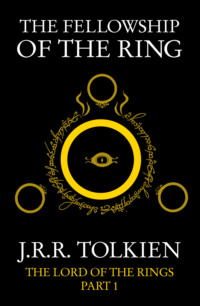
Kitabı oku: «The Fellowship of the Ring»


THE FELLOWSHIP OF THE RING
BEING THE FIRST PART OF
THE LORD OF THE RINGS
BY
J.R.R. TOLKIEN


COPYRIGHT
HarperCollins Publishers
1 London Bridge Street
London SE1 9GF
www.tolkien.co.uk
www.tolkienestate.com
 and ‘Tolkien’® are registered trademarks of The J.R.R. Tolkien Estate Limited
Published by HarperCollins Publishers 2008
This edition is based on the reset edition first published 2004
First published in Great Britain by George Allen & Unwin 1954
Second Edition 1966
Copyright © The Trustees of the J.R.R.Tolkien 1967 Settlement 1954, 1966
All rights reserved under International and Pan-American Copyright Conventions. By payment of the required fees, you have been granted the non-exclusive, non-transferable right to access and read the text of this e-book on-screen. No part of this text may be reproduced, transmitted, down-loaded, decompiled, reverse engineered, or stored in or introduced into any information storage and retrieval system, in any form or by any means, whether electronic or mechanical, now known or hereinafter invented, without the express written permission of HarperCollins e-books.
HarperCollinsPublishers has made every reasonable effort to ensure that any picture content and written content in this ebook has been included or removed in accordance with the contractual and technological constraints in operation at the time of publication.
Source ISBN: 9780261102927
Ebook Edition MARCH 2009 ISBN: 9780007322497
Version: 2018-03-02
Three Rings for the Elven-kings under the sky,
Seven for the Dwarf-lords in their halls of stone,
Nine for Mortal Men doomed to die,
One for the Dark Lord on his dark throne
In the Land of Mordor where the Shadows lie.
One Ring to rule them all, One Ring to find them,
One Ring to bring them all and in the darkness bind them
In the Land of Mordor where the Shadows lie.
CONTENTS
COVER PAGE
TITLE PAGE
COPYRIGHT
NOTE ON THE TEXT
NOTE ON THE 50TH ANNIVERSARY EDITION
FOREWORD TO THE SECOND EDITION
PROLOGUE
BOOK ONE
CHAPTER 1: A LONG-EXPECTED PARTY
CHAPTER 2: THE SHADOW OF THE PAST
CHAPTER 3: THREE IS COMPANY
CHAPTER 4: A SHORT CUT TO MUSHROOMS
CHAPTER 5: A CONSPIRACY UNMASKED
CHAPTER 6: THE OLD FOREST
CHAPTER 7: IN THE HOUSE OF TOM BOMBADIL
CHAPTER 8: FOG ON THE BARROW-DOWNS
CHAPTER 9: AT THE SIGN OF THE PRANCING PONY
CHAPTER 10: STRIDER
CHAPTER 11: A KNIFE IN THE DARK
CHAPTER 12: FLIGHT TO THE FORD
BOOK TWO
CHAPTER 1: MANY MEETINGS
CHAPTER 2: THE COUNCIL OF ELROND
CHAPTER 3: THE RING GOES SOUTH
CHAPTER 4: A JOURNEY IN THE DARK
CHAPTER 5: THE BRIDGE OF KHAZAD-DÛM
CHAPTER 6: LOTHLÓRIEN
CHAPTER 7: THE MIRROR OF GALADRIEL
CHAPTER 8: FAREWELL TO LÓRIEN
CHAPTER 9: THE GREAT RIVER
CHAPTER 10: THE BREAKING OF THE FELLOWSHIP
MAPS
KEEP READING
WORKS BY J.R.R. TOLKIEN
ABOUT THE PUBLISHER
NOTE ON THE TEXT
J.R.R. Tolkien’s The Lord of the Rings is often erroneously called a trilogy, when it is in fact a single novel, consisting of six books plus appendices, sometimes published in three volumes.
The first volume, The Fellowship of the Ring, was published in Great Britain by the London firm George Allen & Unwin on 29 July 1954; an American edition followed on 21 October of the same year, published by Houghton Mifflin Company of Boston. In the production of this first volume, Tolkien experienced what became for him a continual problem: printer’s errors and compositor’s mistakes, including well-intentioned ‘corrections’ of his sometimes idiosyncratic usage. These ‘corrections’ include the altering of dwarves to dwarfs, elvish to elfish, further to farther, nasturtians to nasturtiums, try and say to try to say and (‘worst of all’ to Tolkien) elven to elfin. In a work such as The Lord of the Rings, containing invented languages and delicately constructed nomenclatures, errors and inconsistencies impede both the understanding and the appreciation of serious readers – and Tolkien had many such readers from very early on. Even before the publication of the third volume, which contained much hitherto unrevealed information on the invented languages and writing systems, Tolkien received many letters from readers written in these systems, in addition to numerous enquiries on the finer points of their usage.
The second volume, The Two Towers, was published in England on 11 November 1954 and in the United States on 21 April 1955. Meanwhile Tolkien worked to keep a promise he had made in the foreword to volume one: that ‘an index of names and strange words’ would appear in the third volume. As originally planned, this index would contain much etymological information on the languages, particularly on the elven tongues, with a large vocabulary. It proved the chief cause of the delay in publishing volume three, which in the end contained no index at all, only an apology from the publisher for its absence. For Tolkien had abandoned work on it after indexing volumes one and two, believing its size and therefore its cost to be ruinous.
Volume three, The Return of the King, finally appeared in England on 20 October 1955 and in the United States on 5 January 1956. With the appearance of the third volume, The Lord of the Rings was published in its entirety, and its first edition text remained virtually unchanged for a decade. Tolkien had made a few small corrections, but further errors entered The Fellowship of the Ring in its December 1954 second impression when the printer, having distributed the type after the first printing, reset the book without informing the author or publisher. These include misrepresentations of the original printed text – that is, words and phrases that read acceptably in context, but which depart from Tolkien’s wording as originally written and published.
In 1965, stemming from what then appeared to be copyright problems in the United States, an American paperback firm published an unauthorized and non-royalty-paying edition of The Lord of the Rings. For this new edition by Ace Books the text of the narrative was reset, thus introducing new typographical errors; the appendices, however, were reproduced photographically from the hardcover edition, and remain consistent with it.
Tolkien set to work on his first revision of the text so that a newly revised and authorized edition could successfully compete on the American market. This first revision of the text was published in America in paperback by Ballantine Books, under licence from Houghton Mifflin, in October 1965. In addition to revisions within the text itself, Tolkien replaced his original foreword with a new one. He was pleased to remove the original foreword; in his check copy, he wrote of it: ‘confusing (as it does) real personal matters with the “machinery” of the Tale, is a serious mistake’. Tolkien also added an extension to the prologue and an index – not the detailed index of names promised in the first edition, but, rather, a bald index with only names and page references. Additionally, at this time the appendices were greatly revised.
Tolkien received his copies of the Ballantine edition in late January 1966, and in early February he recorded in his diary that he had ‘worked for some hours on the Appendices in Ballantine version & found more errors than I at first expected’. Soon after this he sent a small number of further revisions to Ballantine for the appendices, including the now well-known addition of ‘Estella Bolger’ as wife of Meriadoc in the family trees in Appendix C. Most of these revisions, which entered variously in the third and fourth impressions ( June and August 1966) of volume three, and which were not always inserted correctly (thereby causing further confusion in the text), somehow never made it into the main sequence of revision in the three-volume British hardcover edition, and for long remained anomalies. Tolkien once wrote, concerning the revising of The Lord of the Rings, that perhaps he had failed to keep his notes in order; this errant branch of revision seems likely to be an example of that disorder – either in his notes or in the ability of his publishers to follow them with utmost accuracy.
The revised text first appeared in Great Britain in a three-volume hardcover ‘Second Edition’ from Allen & Unwin on 27 October 1966. But again there were problems. Although the revisions Tolkien sent to America of the text itself were available to be utilized in the new British edition, his extensive revisions to the appendices were lost after being entered into the Ballantine edition. Allen & Unwin were forced to reset the appendices using the copy as published in the first Ballantine edition. This did not include Tolkien’s second, small set of revisions sent to Ballantine; but, more significantly, it did include a great number of errors and omissions, many of which were not discovered until long afterwards. Thus, in the appendices, a close scrutiny of the first edition text and of the much later corrected impressions of the second edition is necessary to discern whether any particular change in this edition is authorial or erroneous.
In America, the revised text appeared in hardcover in the three-volume edition published by Houghton Mifflin on 27 February 1967. This text was evidently photo-offset from the 1966 Allen & Unwin three-volume hardcover, and is thus consistent with it. Aside from the first printing of this second Houghton Mifflin edition, which has a 1967 date on the title page, none of the many reprintings is dated. After the initial printings of this edition, which bore a 1966 copyright notice, the date of copyright was changed in 1965 to match the statement in the Ballantine edition. This change has caused a great deal of confusion for librarians and other researchers who have tried to sort out the sequence of publication of these editions.
Meanwhile, Tolkien spent much of the summer of 1966 further revising the text. In June he learned that any more revisions were too late for inclusion in the 1966 Allen & Unwin second edition, and he recorded in his diary: ‘But I am attempting to complete my work [on the revisions] – I cannot leave it while it is all in my mind. So much time has been wasted in all my work by this constant breaking of threads.’ This was the last major set of revisions Tolkien himself made to the text during his lifetime. They were added to the second impression (1967) of the three-volume hard-cover Allen & Unwin second edition. The revisions themselves mostly include corrections of nomenclature and attempts at consistency of usage throughout the three volumes. Some small alterations were made by Tolkien in the 1969 one-volume India paper edition.
J.R.R. Tolkien died in 1973. His third son and literary executor, Christopher Tolkien, sent a large number of further corrections of misprints, mainly in the appendices and index, to Allen & Unwin for use in their editions in 1974. Most of these corrections were typographical, and in line with his father’s expressed intent in his own check copies.
Since 1974, Christopher Tolkien has sent additional corrections, as errors have been discovered, to the British publishers of The Lord of the Rings (Allen & Unwin, later Unwin Hyman, and now HarperCollins), who have tried to be conscientious in the impossible task of maintaining a textual integrity in whichever editions of The Lord of the Rings they have published. However, every time the text has been reset for publication in a new format (e.g. the various paperback editions published in England in the 1970s and 1980s), huge numbers of new misprints have crept in, though at times some of these errors have been observed and corrected in later printings. Still, throughout these years the three-volume British hardcover edition has retained the highest textual integrity.
In the United States, the text of the Ballantine paperback has remained unchanged for more than three decades after Tolkien added his few revisions in 1966. The text in all of the Houghton Mifflin editions remained unchanged from 1967 until 1987, when Houghton Mifflin photo-offset the then current three-volume British hardcover edition in order to update the text used in their editions. In those new reprintings a number of further corrections (overseen by Christopher Tolkien) were added, and the errant Ballantine branch of revision (including the ‘Estella Bolger’ addition) was integrated into the main branch of textual descent. This method of correction involved a cut-and-paste process with printed versions of the text. Beginning with the 1987 Houghton Mifflin edition, an earlier version of this ‘Note on the Text’ (dated October 1986) was added to The Lord of the Rings. This ‘Note’ has been reworked three times since then – the version dated April 1993 first appeared in 1994, and the version dated April 2002 came out later that year. The present ‘Note’ replaces and supersedes all previous versions.
For the 1994 British edition published by HarperCollins, the text of The Lord of the Rings was entered into word-processing files. This next stage of textual evolution came about to allow for a greater uniformity of the text in all future editions, but with it, inevitably, came new wrinkles. Some new misreadings entered into the text, while at the same time others were fixed. In the worst instance, one line of the ring inscription in the chapter ‘The Shadow of the Past’ of The Fellowship of the Ring was simply dropped. Unforeseeable glitches arose in other editions when the base computerized text was transferred into page-making or typesetting programs – e.g., in one edition of The Fellowship of the Ring, the closing two sentences of ‘The Council of Elrond’ simply and inexplicably disappeared. Such glitches have been very much the exception, not the rule, and the text has otherwise maintained a consistency and integrity throughout its computerized evolution.
The 1994 edition also contained a number of new corrections (again supervised by Christopher Tolkien), as well as a reconfigured index of names and page references. The 1994 text was first used in American editions published by Houghton Mifflin in 1999. A small number of further corrections were added into the 2002 three-volume edition illustrated by Alan Lee, published by HarperCollins in Great Britain and Houghton Mifflin in the United States.
The textual history of The Lord of the Rings, merely in its published form, is a vast and complex web. In this brief note I have given only a glimpse of the overall sequence and structure. Further details on the revisions and corrections made over the years to the published text of The Lord of the Rings, and a fuller account of its publishing history, may be found in J.R.R. Tolkien: A Descriptive Bibliography, by Wayne G. Hammond, with the assistance of Douglas A. Anderson (1993).
For those interested in observing the gradual evolving of The Lord of the Rings from its earliest drafts to its published form, I highly recommend Christopher Tolkien’s account, which appears within five volumes of his twelve-volume series The History of Middle-earth. Volumes six through nine contain the major part of his study pertaining to The Lord of the Rings: The Return of the Shadow (1988); The Treason ofIsengard (1989); The War of the Ring (1990); and Sauron Defeated (1992). Also, the final book of the series, The Peoples of Middle-earth (1996), covers the evolution of the prologue and appendices to The Lord of the Rings. These volumes contain an engrossing over-the-shoulder account of the growth and writing of Tolkien’s masterpiece.
The process of studying Tolkien’s manuscripts of The Lord of the Rings involved the deciphering of versions where Tolkien wrote first in pencil and then in ink atop the pencilled draft. Christopher Tolkien has described his father’s method of composition in The Return of the Shadow: ‘In the handwriting that he used for rapid drafts and sketches, not intended to endure long before he turned to them again and gave them a more workable form, letters are so loosely formed that a word which cannot be deduced or guessed at from the context or from later versions can prove perfectly opaque after long examination; and if, as he often did, he used a soft pencil much has now become blurred and faint.’ The true difficulty of reading such double-drafts can be observed in the frontispiece to The War of the Ring, which reproduces in colour Tolkien’s illustration of ‘Shelob’s Lair’ from a page of Tolkien’s manuscript. Looking very closely at the hasty ink draft alongside the illustration, one can see underneath it the earlier, hastier, pencilled draft. Also in The War of the Ring, Christopher Tolkien reproduces a page from the first manuscript of the chapter ‘The Taming of Sméagol’, and the printed text corresponding to this text is on the facing page (see pp. 90–91). One is astonished at anyone’s ability to decipher such texts.
That difficulty aside, just what do these books signify to ordinary readers and to Tolkien scholars? And what is ‘the history of the writing’ of a book? Simply, these volumes show in great detail the development of the story of The Lord of the Rings from its very earliest drafts and hasty projections through its completion. We see in the earliest materials what is very much a children’s book, a sequel to The Hobbit, and as the story grows through various ‘phases’, there is an increase in seriousness and depth. We see alternate branches of development, the gradual blending and merging of certain characters, and the slow emergence of the nature of the rings and of the motivations of other characters. Some of these various ideas are abandoned altogether, while others are reworked into some variant form that may or may not survive into the final version.
One could make a whole catalogue of interesting tidbits from Christopher Tolkien’s study – such as the fact that Strider was called Trotter until a very late stage in the writing of the book; that Trotter was at one time a hobbit, so named because he wore wooden shoes; that Tolkien at one point considered a romance between Aragorn and Éowyn; that Tolkien wrote an epilogue to the book, tying up loose ends, but it was dropped before publication (and now appears in Sauron Defeated); and so on. But these developments are best appreciated when read within the context of Christopher Tolkien’s commentary rather than discussed separately.
The most significant achievement of these volumes is that they show us how Tolkien wrote and thought. Nowhere else do we see the authorial process itself at work in such detail. Tolkien’s hastiest comments about where the story might proceed, or why it can or can’t go such and such a way – these queries to himself were written out: Tolkien is literally thinking on paper. This gives an added dimension of understanding to Tolkien’s comment to Stanley Unwin in a 1963 letter that, when suffering from trouble with his shoulder and right arm, ‘I found not being able to use a pen or pencil as defeating as the loss of her beak would be to a hen.’ And we, as readers of these volumes, can share with Tolkien himself the wonder and bewilderment of new characters appearing as if from nowhere, or of some other sudden change or development, at the very moment of their emergence into the story.
I know of no other instance in literature where we have such a ‘history of the writing’ of a book, told mostly by the author himself, with all the hesitations and false paths laid out before us, sorted out, commented upon, and served up to a reader like a feast. We are shown innumerable instances in the minutest detail of the thought-process itself at work. We see the author fully absorbed in creation for its own sake. And this is all the more exceptional because this is a history not only of the unfolding of a story and its text, but of the evolution of a world. There is an additional wealth of material beyond simple narrative text. There are maps and illustrations. There are languages and writing systems, and the histories of the peoples who spoke and wrote in these systems. All of these additional materials add multiple dimensions of complexity to our appreciation of the invented world itself.
Fifty years into the published life of The Lord of the Rings, it seems extraordinary to me that we have not only such a masterful work of literature but also as a companion to it an unparalleled account of its writing. Our gratitude as readers goes to both of the Tolkiens, father and son.
Douglas A. Anderson
May 2004
PROLOGUE
1 Concerning Hobbits
This book is largely concerned with Hobbits, and from its pages a reader may discover much of their character and a little of their history. Further information will also be found in the selection from the Red Book of Westmarch that has already been published, under the title of The Hobbit. That story was derived from the earlier chapters of the Red Book, composed by Bilbo himself, the first Hobbit to become famous in the world at large, and called by him There and Back Again, since they told of his journey into the East and his return: an adventure which later involved all the Hobbits in the great events of that Age that are here related.
Many, however, may wish to know more about this remarkable people from the outset, while some may not possess the earlier book. For such readers a few notes on the more important points are here collected from Hobbit-lore, and the first adventure is briefly recalled.
Hobbits are an unobtrusive but very ancient people, more numerous formerly than they are today; for they love peace and quiet and good tilled earth: a well-ordered and well-farmed countryside was their favourite haunt. They do not and did not understand or like machines more complicated than a forge-bellows, a water-mill, or a hand-loom, though they were skilful with tools. Even in ancient days they were, as a rule, shy of ‘the Big Folk’, as they call us, and now they avoid us with dismay and are becoming hard to find. They are quick of hearing and sharp-eyed, and though they are inclined to be fat and do not hurry unnecessarily, they are nonetheless nimble and deft in their movements. They possessed from the first the art of disappearing swiftly and silently, when large folk whom they do not wish to meet come blundering by; and this art they have developed until to Men it may seem magical. But Hobbits have never, in fact, studied magic of any kind, and their elusiveness is due solely to a professional skill that heredity and practice, and a close friendship with the earth, have rendered inimitable by bigger and clumsier races.
For they are a little people, smaller than Dwarves: less stout and stocky, that is, even when they are not actually much shorter. Their height is variable, ranging between two and four feet of our measure. They seldom now reach three feet; but they have dwindled, they say, and in ancient days they were taller. According to the Red Book, Bandobras Took (Bullroarer), son of Isumbras the Third, was four foot five and able to ride a horse. He was surpassed in all Hobbit records only by two famous characters of old; but that curious matter is dealt with in this book.
As for the Hobbits of the Shire, with whom these tales are concerned, in the days of their peace and prosperity they were a merry folk. They dressed in bright colours, being notably fond of yellow and green; but they seldom wore shoes, since their feet had tough leathery soles and were clad in a thick curling hair, much like the hair of their heads, which was commonly brown. Thus, the only craft little practised among them was shoe-making; but they had long and skilful fingers and could make many other useful and comely things. Their faces were as a rule good-natured rather than beautiful, broad, bright-eyed, red-cheeked, with mouths apt to laughter, and to eating and drinking. And laugh they did, and eat, and drink, often and heartily, being fond of simple jests at all times, and of six meals a day (when they could get them). They were hospitable and delighted in parties, and in presents, which they gave away freely and eagerly accepted.
It is plain indeed that in spite of later estrangement Hobbits are relatives of ours: far nearer to us than Elves, or even than Dwarves. Of old they spoke the languages of Men, after their own fashion, and liked and disliked much the same things as Men did. But what exactly our relationship is can no longer be discovered. The beginning of Hobbits lies far back in the Elder Days that are now lost and forgotten. Only the Elves still preserve any records of that vanished time, and their traditions are concerned almost entirely with their own history, in which Men appear seldom and Hobbits are not mentioned at all. Yet it is clear that Hobbits had, in fact, lived quietly in Middle-earth for many long years before other folk became even aware of them. And the world being after all full of strange creatures beyond count, these little people seemed of very little importance. But in the days of Bilbo, and of Frodo his heir, they suddenly became, by no wish of their own, both important and renowned, and troubled the counsels of the Wise and the Great.
Those days, the Third Age of Middle-earth, are now long past, and the shape of all lands has been changed; but the regions in which Hobbits then lived were doubtless the same as those in which they still linger: the North-West of the Old World, east of the Sea. Of their original home the Hobbits in Bilbo’s time preserved no knowledge. A love of learning (other than genealogical lore) was far from general among them, but there remained still a few in the older families who studied their own books, and even gathered reports of old times and distant lands from Elves, Dwarves, and Men. Their own records began only after the settlement of the Shire, and their most ancient legends hardly looked further back than their Wandering Days. It is clear, nonetheless, from these legends, and from the evidence of their peculiar words and customs, that like many other folk Hobbits had in the distant past moved westward. Their earliest tales seem to glimpse a time when they dwelt in the upper vales of Anduin, between the eaves of Greenwood the Great and the Misty Mountains. Why they later undertook the hard and perilous crossing of the mountains into Eriador is no longer certain. Their own accounts speak of the multiplying of Men in the land, and of a shadow that fell on the forest, so that it became darkened and its new name was Mirkwood.
Before the crossing of the mountains the Hobbits had already become divided into three somewhat different breeds: Harfoots, Stoors, and Fallohides. The Harfoots were browner of skin, smaller, and shorter, and they were beardless and bootless; their hands and feet were neat and nimble; and they preferred highlands and hillsides. The Stoors were broader, heavier in build; their feet and hands were larger; and they preferred flat lands and riversides. The Fallohides were fairer of skin and also of hair, and they were taller and slimmer than the others; they were lovers of trees and of woodlands.
The Harfoots had much to do with Dwarves in ancient times, and long lived in the foothills of the mountains. They moved westward early, and roamed over Eriador as far as Weathertop while the others were still in Wilderland. They were the most normal and representative variety of Hobbit, and far the most numerous. They were the most inclined to settle in one place, and longest preserved their ancestral habit of living in tunnels and holes.
The Stoors lingered long by the banks of the Great River Anduin, and were less shy of Men. They came west after the Harfoots and followed the course of the Loudwater southwards; and there many of them long dwelt between Tharbad and the borders of Dunland before they moved north again.
The Fallohides, the least numerous, were a northerly branch. They were more friendly with Elves than the other Hobbits were, and had more skill in language and song than in handicrafts; and of old they preferred hunting to tilling. They crossed the mountains north of Rivendell and came down the River Hoarwell. In Eriador they soon mingled with the other kinds that had preceded them, but being somewhat bolder and more adventurous, they were often found as leaders or chieftains among clans of Harfoots or Stoors. Even in Bilbo’s time the strong Fallohidish strain could still be noted among the greater families, such as the Tooks and the Masters of Buckland.
In the westlands of Eriador, between the Misty Mountains and the Mountains of Lune, the Hobbits found both Men and Elves. Indeed, a remnant still dwelt there of the Dúnedain, the kings of Men that came over the Sea out of Westernesse; but they were dwindling fast and the lands of their North Kingdom were falling far and wide into waste. There was room and to spare for incomers, and ere long the Hobbits began to settle in ordered communities. Most of their earlier settlements had long disappeared and been forgotten in Bilbo’s time; but one of the first to become important still endured, though reduced in size; this was at Bree and in the Chetwood that lay round about, some forty miles east of the Shire.
It was in these early days, doubtless, that the Hobbits learned their letters and began to write after the manner of the Dúnedain, who had in their turn long before learned the art from the Elves. And in those days also they forgot whatever languages they had used before, and spoke ever after the Common Speech, the Westron as it was named, that was current through all the lands of the kings from Arnor to Gondor, and about all the coasts of the Sea from Belfalas to Lune. Yet they kept a few words of their own, as well as their own names of months and days, and a great store of personal names out of the past.
About this time legend among the Hobbits first becomes history with a reckoning of years. For it was in the one thousand six hundred and first year of the Third Age that the Fallohide brothers, Marcho and Blanco, set out from Bree; and having obtained permission from the high king at Fornost, * they crossed the brown river Baranduin with a great following of Hobbits. They passed over the Bridge of Stonebows, that had been built in the days of the power of the North Kingdom, and they took all the land beyond to dwell in, between the river and the Far Downs. All that was demanded of them was that they should keep the Great Bridge in repair, and all other bridges and roads, speed the king’s messengers, and acknowledge his lordship.
Thus began the Shire-reckoning, for the year of the crossing of the Brandywine (as the Hobbits turned the name) became Year One of the Shire, and all later dates were reckoned from it. * At once the western Hobbits fell in love with their new land, and they remained there, and soon passed once more out of the history of Men and of Elves. While there was still a king they were in name his subjects, but they were, in fact, ruled by their own chieftains and meddled not at all with events in the world outside. To the last battle at Fornost with the Witch-lord of Angmar they sent some bowmen to the aid of the king, or so they maintained, though no tales of Men record it. But in that war the North Kingdom ended; and then the Hobbits took the land for their own, and they chose from their own chiefs a Thain to hold the authority of the king that was gone. There for a thousand years they were little troubled by wars, and they prospered and multiplied after the Dark Plague (S.R. 37) until the disaster of the Long Winter and the famine that followed it. Many thousands then perished, but the Days of Dearth (1158–60) were at the time of this tale long past and the Hobbits had again become accustomed to plenty. The land was rich and kindly, and though it had long been deserted when they entered it, it had before been well tilled, and there the king had once had many farms, cornlands, vineyards, and woods.
Forty leagues it stretched from the Far Downs to the Brandywine Bridge, and fifty from the northern moors to the marshes in the south. The Hobbits named it the Shire, as the region of the authority of their Thain, and a district of well-ordered business; and there in that pleasant corner of the world they plied their well-ordered business of living, and they heeded less and less the world outside where dark things moved, until they came to think that peace and plenty were the rule in Middle-earth and the right of all sensible folk. They forgot or ignored what little they had ever known of the Guardians, and of the labours of those that made possible the long peace of the Shire. They were, in fact, sheltered, but they had ceased to remember it.
At no time had Hobbits of any kind been warlike, and they had never fought among themselves. In olden days they had, of course, been often obliged to fight to maintain themselves in a hard world; but in Bilbo’s time that was very ancient history. The last battle, before this story opens, and indeed the only one that had ever been fought within the borders of the Shire, was beyond living memory: the Battle of Greenfields, S.R. 1147, in which Bandobras Took routed an invasion of Orcs. Even the weathers had grown milder, and the wolves that had once come ravening out of the North in bitter white winters were now only a grandfather’s tale. So, though there was still some store of weapons in the Shire, these were used mostly as trophies, hanging above hearths or on walls, or gathered into the museum at Michel Delving. The Mathom-house it was called; for anything that Hobbits had no immediate use for, but were unwilling to throw away, they called a mathom. Their dwellings were apt to become rather crowded with mathoms, and many of the presents that passed from hand to hand were of that sort.
Nonetheless, ease and peace had left this people still curiously tough. They were, if it came to it, difficult to daunt or to kill; and they were, perhaps, so unwearyingly fond of good things not least because they could, when put to it, do without them, and could survive rough handling by grief, foe, or weather in a way that astonished those who did not know them well and looked no further than their bellies and their well-fed faces. Though slow to quarrel, and for sport killing nothing that lived, they were doughty at bay, and at need could still handle arms. They shot well with the bow, for they were keen-eyed and sure at the mark. Not only with bows and arrows. If any Hobbit stooped for a stone, it was well to get quickly under cover, as all trespassing beasts knew very well.
All Hobbits had originally lived in holes in the ground, or so they believed, and in such dwellings they still felt most at home; but in the course of time they had been obliged to adopt other forms of abode. Actually in the Shire in Bilbo’s days it was, as a rule, only the richest and the poorest Hobbits that maintained the old custom. The poorest went on living in burrows of the most primitive kind, mere holes indeed, with only one window or none; while the well-to-do still constructed more luxurious versions of the simple diggings of old. But suitable sites for these large and ramifying tunnels (or smials as they called them) were not everywhere to be found; and in the flats and the low-lying districts the Hobbits, as they multiplied, began to build above ground. Indeed, even in the hilly regions and the older villages, such as Hobbiton or Tuckborough, or in the chief township of the Shire, Michel Delving on the White Downs, there were now many houses of wood, brick, or stone. These were specially favoured by millers, smiths, ropers, and cartwrights, and others of that sort; for even when they had holes to live in, Hobbits had long been accustomed to build sheds and workshops.
The habit of building farmhouses and barns was said to have begun among the inhabitants of the Marish down by the Brandywine. The Hobbits of that quarter, the Eastfarthing, were rather large and heavy-legged, and they wore dwarf-boots in muddy weather. But they were well known to be Stoors in a large part of their blood, as indeed was shown by the down that many grew on their chins. No Harfoot or Fallohide had any trace of a beard. Indeed, the folk of the Marish, and of Buckland, east of the River, which they afterwards occupied, came for the most part later into the Shire up from south-away; and they still had many peculiar names and strange words not found elsewhere in the Shire.
It is probable that the craft of building, as many other crafts beside, was derived from the Dúnedain. But the Hobbits may have learned it direct from the Elves, the teachers of Men in their youth. For the Elves of the High Kindred had not yet forsaken Middle-earth, and they dwelt still at that time at the Grey Havens away to the west, and in other places within reach of the Shire. Three Elf-towers of immemorial age were still to be seen on the Tower Hills beyond the western marches. They shone far off in the moonlight. The tallest was furthest away, standing alone upon a green mound. The Hobbits of the Westfarthing said that one could see the Sea from the top of that tower; but no Hobbit had ever been known to climb it. Indeed, few Hobbits had ever seen or sailed upon the Sea, and fewer still had ever returned to report it. Most Hobbits regarded even rivers and small boats with deep misgivings, and not many of them could swim. And as the days of the Shire lengthened they spoke less and less with the Elves, and grew afraid of them, and distrustful of those that had dealings with them; and the Sea became a word of fear among them, and a token of death, and they turned their faces away from the hills in the west.
The craft of building may have come from Elves or Men, but the Hobbits used it in their own fashion. They did not go in for towers. Their houses were usually long, low, and comfortable. The oldest kind were, indeed, no more than built imitations of smials, thatched with dry grass or straw, or roofed with turves, and having walls somewhat bulged. That stage, however, belonged to the early days of the Shire, and hobbit-building had long since been altered, improved by devices, learned from Dwarves, or discovered by themselves. A preference for round windows, and even round doors, was the chief remaining peculiarity of hobbit-architecture.
The houses and the holes of Shire-hobbits were often large, and inhabited by large families. (Bilbo and Frodo Baggins were as bachelors very exceptional, as they were also in many other ways, such as their friendship with the Elves.) Sometimes, as in the case of the Tooks of Great Smials, or the Brandybucks of Brandy Hall, many generations of relatives lived in (comparative) peace together in one ancestral and many-tunnelled mansion. All Hobbits were, in any case, clannish and reckoned up their relationships with great care. They drew long and elaborate family-trees with innumerable branches. In dealing with Hobbits it is important to remember who is related to whom, and in what degree. It would be impossible in this book to set out a family-tree that included even the more important members of the more important families at the time which these tales tell of. The genealogical trees at the end of the Red Book of Westmarch are a small book in themselves, and all but Hobbits would find them exceedingly dull. Hobbits delighted in such things, if they were accurate: they liked to have books filled with things that they already knew, set out fair and square with no contradictions.
2 Concerning Pipe-weed
There is another astonishing thing about Hobbits of old that must be mentioned, an astonishing habit: they imbibed or inhaled, through pipes of clay or wood, the smoke of the burning leaves of a herb, which they called pipe-weed or leaf, a variety probably of Nicotiana. A great deal of mystery surrounds the origin of this peculiar custom, or ‘art’ as the Hobbits preferred to call it. All that could be discovered about it in antiquity was put together by Meriadoc Brandybuck (later Master of Buckland), and since he and the tobacco of the Southfarthing play a part in the history that follows, his remarks in the introduction to his Herblore of the Shire may be quoted.
‘This,’ he says, ‘is the one art that we can certainly claim to be our own invention. When Hobbits first began to smoke is not known, all the legends and family histories take it for granted; for ages folk in the Shire smoked various herbs, some fouler, some sweeter. But all accounts agree that Tobold Hornblower of Longbottom in the Southfarthing first grew the true pipe-weed in his gardens in the days of Isengrim the Second, about the year 1070 of Shire-reckoning. The best home-grown still comes from that district, especially the varieties now known as Longbottom Leaf, Old Toby, and Southern Star.
‘How Old Toby came by the plant is not recorded, for to his dying day he would not tell. He knew much about herbs, but he was no traveller. It is said that in his youth he went often to Bree, though he certainly never went further from the Shire than that. It is thus quite possible that he learned of this plant in Bree, where now, at any rate, it grows well on the south slopes of the hill. The Bree-hobbits claim to have been the first actual smokers of the pipe-weed. They claim, of course, to have done everything before the people of the Shire, whom they refer to as “colonists”; but in this case their claim is, I think, likely to be true. And certainly it was from Bree that the art of smoking the genuine weed spread in the recent centuries among Dwarves and such other folk, Rangers, Wizards, or wanderers, as still passed to and fro through that ancient road-meeting. The home and centre of the art is thus to be found in the old inn of Bree, The Prancing Pony, that has been kept by the family of Butterbur from time beyond record.
‘All the same, observations that I have made on my own many journeys south have convinced me that the weed itself is not native to our parts of the world, but came northward from the lower Anduin, whither it was, I suspect, originally brought over Sea by the Men of Westernesse. It grows abundantly in Gondor, and there is richer and larger than in the North, where it is never found wild, and flourishes only in warm sheltered places like Longbottom. The Men of Gondor call it sweet galenas, and esteem it only for the fragrance of its flowers. From that land it must have been carried up the Greenway during the long centuries between the coming of Elendil and our own days. But even the Dúnedain of Gondor allow us this credit: Hobbits first put it into pipes. Not even the Wizards first thought of that before we did. Though one Wizard that I knew took up the art long ago, and became as skilful in it as in all other things that he put his mind to.’
3 Of the Ordering of the Shire
The Shire was divided into four quarters, the Farthings already referred to, North, South, East, and West; and these again each into a number of folklands, which still bore the names of some of the old leading families, although by the time of this history these names were no longer found only in their proper folklands. Nearly all Tooks still lived in the Tookland, but that was not true of many other families, such as the Bagginses or the Boffins. Outside the Farthings were the East and West Marches: the Buckland (p. 129); and the Westmarch added to the Shire in S.R. 1452.
The Shire at this time had hardly any ‘government’. Families for the most part managed their own affairs. Growing food and eating it occupied most of their time. In other matters they were, as a rule, generous and not greedy, but contented and moderate, so that estates, farms, workshops, and small trades tended to remain unchanged for generations.
There remained, of course, the ancient tradition concerning the high king at Fornost, or Norbury as they called it, away north of the Shire. But there had been no king for nearly a thousand years, and even the ruins of Kings’ Norbury were covered with grass. Yet the Hobbits still said of wild folk and wicked things (such as trolls) that they had not heard of the king. For they attributed to the king of old all their essential laws; and usually they kept the laws of free will, because they were The Rules (as they said), both ancient and just.
It is true that the Took family had long been pre-eminent; for the office of Thain had passed to them (from the Old-bucks) some centuries before, and the chief Took had borne that title ever since. The Thain was the master of the Shire-moot, and captain of the Shire-muster and the Hobbitry-in-arms; but as muster and moot were only held in times of emergency, which no longer occurred, the Thainship had ceased to be more than a nominal dignity. The Took family was still, indeed, accorded a special respect, for it remained both numerous and exceedingly wealthy, and was liable to produce in every generation strong characters of peculiar habits and even adventurous temperament. The latter qualities, however, were now rather tolerated (in the rich) than generally approved. The custom endured, nonetheless, of referring to the head of the family as The Took, and of adding to his name, if required, a number: such as Isengrim the Second, for instance.
The only real official in the Shire at this date was the Mayor of Michel Delving (or of the Shire), who was elected every seven years at the Free Fair on the White Downs at the Lithe, that is at Midsummer. As mayor almost his only duty was to preside at banquets, given on the Shire-holidays, which occurred at frequent intervals. But the offices of Postmaster and First Shirriff were attached to the mayoralty, so that he managed both the Messenger Service and the Watch. These were the only Shire-services, and the Messengers were the most numerous, and much the busier of the two. By no means all Hobbits were lettered, but those who were wrote constantly to all their friends (and a selection of their relations) who lived further off than an afternoon’s walk.
The Shirriffs was the name that the Hobbits gave to their police, or the nearest equivalent that they possessed. They had, of course, no uniforms (such things being quite unknown), only a feather in their caps; and they were in practice rather haywards than policemen, more concerned with the strayings of beasts than of people. There were in all the Shire only twelve of them, three in each Farthing, for Inside Work. A rather larger body, varying at need, was employed to ‘beat the bounds’, and to see that Outsiders of any kind, great or small, did not make themselves a nuisance.
At the time when this story begins the Bounders, as they were called, had been greatly increased. There were many reports and complaints of strange persons and creatures prowling about the borders, or over them: the first sign that all was not quite as it should be, and always had been except in tales and legends of long ago. Few heeded the sign, and not even Bilbo yet had any notion of what it portended. Sixty years had passed since he set out on his memorable journey, and he was old even for Hobbits, who reached a hundred as often as not; but much evidently still remained of the considerable wealth that he had brought back. How much or how little he revealed to no one, not even to Frodo his favourite ‘nephew’. And he still kept secret the ring that he had found.
4 Of the Finding of the Ring
As is told in The Hobbit, there came one day to Bilbo’s door the great Wizard, Gandalf the Grey, and thirteen dwarves with him: none other, indeed, than Thorin Oakenshield, descendant of kings, and his twelve companions in exile. With them he set out, to his own lasting astonishment, on a morning of April, it being then the year 1341 Shire-reckoning, on a quest of great treasure, the dwarf-hoards of the Kings under the Mountain, beneath Erebor in Dale, far off in the East. The quest was successful, and the Dragon that guarded the hoard was destroyed. Yet, though before all was won the Battle of Five Armies was fought, and Thorin was slain, and many deeds of renown were done, the matter would scarcely have concerned later history, or earned more than a note in the long annals of the Third Age, but for an ‘accident’ by the way. The party was assailed by Orcs in a high pass of the Misty Mountains as they went towards Wilderland; and so it happened that Bilbo was lost for a while in the black orc-mines deep under the mountains, and there, as he groped in vain in the dark, he put his hand on a ring, lying on the floor of a tunnel. He put it in his pocket. It seemed then like mere luck.
Trying to find his way out, Bilbo went on down to the roots of the mountains, until he could go no further. At the bottom of the tunnel lay a cold lake far from the light, and on an island of rock in the water lived Gollum. He was a loathsome little creature: he paddled a small boat with his large flat feet, peering with pale luminous eyes and catching blind fish with his long fingers, and eating them raw. He ate any living thing, even orc, if he could catch it and strangle it without a struggle. He possessed a secret treasure that had come to him long ages ago, when he still lived in the light: a ring of gold that made its wearer invisible. It was the one thing he loved, his ‘Precious’, and he talked to it, even when it was not with him. For he kept it hidden safe in a hole on his island, except when he was hunting or spying on the orcs of the mines.
Maybe he would have attacked Bilbo at once, if the ring had been on him when they met; but it was not, and the hobbit held in his hand an Elvish knife, which served him as a sword. So to gain time Gollum challenged Bilbo to the Riddle-game, saying that if he asked a riddle which Bilbo could not guess, then he would kill him and eat him; but if Bilbo defeated him, then he would do as Bilbo wished: he would lead him to a way out of the tunnels.
Since he was lost in the dark without hope, and could neither go on nor back, Bilbo accepted the challenge; and they asked one another many riddles. In the end Bilbo won the game, more by luck (as it seemed) than by wits; for he was stumped at last for a riddle to ask, and cried out, as his hand came upon the ring he had picked up and forgotten: What have I got in my pocket? This Gollum failed to answer, though he demanded three guesses.
The Authorities, it is true, differ whether this last question was a mere ‘question’ and not a ‘riddle’ according to the strict rules of the Game; but all agree that, after accepting it and trying to guess the answer, Gollum was bound by his promise. And Bilbo pressed him to keep his word; for the thought came to him that this slimy creature might prove false, even though such promises were held sacred, and of old all but the wickedest things feared to break them. But after ages alone in the dark Gollum’s heart was black, and treachery was in it. He slipped away, and returned to his island, of which Bilbo knew nothing, not far off in the dark water. There, he thought, lay his ring. He was hungry now, and angry, and once his ‘Precious’ was with him he would not fear any weapon at all.
But the ring was not on the island; he had lost it, it was gone. His screech sent a shiver down Bilbo’s back, though he did not yet understand what had happened. But Gollum had at last leaped to a guess, too late. What has it got in its pocketses? he cried. The light in his eyes was like a green flame as he sped back to murder the hobbit and recover his ‘Precious’. Just in time Bilbo saw his peril, and he fled blindly up the passage away from the water; and once more he was saved by his luck. For as he ran he put his hand in his pocket, and the ring slipped quietly on to his finger. So it was that Gollum passed him without seeing him, and went to guard the way out, lest the ‘thief ’ should escape. Warily Bilbo followed him, as he went along, cursing, and talking to himself about his ‘Precious’; from which talk at last even Bilbo guessed the truth, and hope came to him in the darkness: he himself had found the marvellous ring and a chance of escape from the orcs and from Gollum.
At length they came to a halt before an unseen opening that led to the lower gates of the mines, on the eastward side of the mountains. There Gollum crouched at bay, smelling and listening; and Bilbo was tempted to slay him with his sword. But pity stayed him, and though he kept the ring, in which his only hope lay, he would not use it to help him kill the wretched creature at a disadvantage. In the end, gathering his courage, he leaped over Gollum in the dark, and fled away down the passage, pursued by his enemy’s cries of hate and despair: Thief, thief! Baggins! We hates it for ever!
Now it is a curious fact that this is not the story as Bilbo first told it to his companions. To them his account was that Gollum had promised to give him a present, if he won the game; but when Gollum went to fetch it from his island he found the treasure was gone: a magic ring, which had been given to him long ago on his birthday. Bilbo guessed that this was the very ring that he had found, and as he had won the game, it was already his by right. But being in a tight place, he said nothing about it, and made Gollum show him the way out, as a reward instead of a present. This account Bilbo set down in his memoirs, and he seems never to have altered it himself, not even after the Council of Elrond. Evidently it still appeared in the original Red Book, as it did in several of the copies and abstracts. But many copies contain the true account (as an alternative), derived no doubt from notes by Frodo or Samwise, both of whom learned the truth, though they seem to have been unwilling to delete anything actually written by the old hobbit himself.
Gandalf, however, disbelieved Bilbo’s first story, as soon as he heard it, and he continued to be very curious about the ring. Eventually he got the true tale out of Bilbo after much questioning, which for a while strained their friendship; but the wizard seemed to think the truth important. Though he did not say so to Bilbo, he also thought it important, and disturbing, to find that the good hobbit had not told the truth from the first: quite contrary to his habit. The idea of a ‘present’ was not mere hobbitlike invention, all the same. It was suggested to Bilbo, as he confessed, by Gollum’s talk that he overheard; for Gollum did, in fact, call the ring his ‘birthday-present’, many times. That also Gandalf thought strange and suspicious; but he did not discover the truth in this point for many more years, as will be seen in this book.
Of Bilbo’s later adventures little more need be said here. With the help of the ring he escaped from the orc-guards at the gate and rejoined his companions. He used the ring many times on his quest, chiefly for the help of his friends; but he kept it secret from them as long as he could. After his return to his home he never spoke of it again to anyone, save Gandalf and Frodo; and no one else in the Shire knew of its existence, or so he believed. Only to Frodo did he show the account of his Journey that he was writing.
His sword, Sting, Bilbo hung over his fireplace, and his coat of marvellous mail, the gift of the Dwarves from the Dragon-hoard, he lent to a museum, to the Michel Delving Mathom-house in fact. But he kept in a drawer at Bag End the old cloak and hood that he had worn on his travels; and the ring, secured by a fine chain, remained in his pocket.
He returned to his home at Bag End on June the 22nd in his fifty-second year (S.R. 1342), and nothing very notable occurred in the Shire until Mr. Baggins began the preparations for the celebration of his hundred-and-eleventh birthday (S.R. 1401). At this point this History begins.
NOTE ON THE SHIRE RECORDS
At the end of the Third Age the part played by the Hobbits in the great events that led to the inclusion of the Shire in the Reunited Kingdom awakened among them a more widespread interest in their own history; and many of their traditions, up to that time still mainly oral, were collected and written down. The greater families were also concerned with events in the Kingdom at large, and many of their members studied its ancient histories and legends. By the end of the first century of the Fourth Age there were already to be found in the Shire several libraries that contained many historical books and records.
The largest of these collections were probably at Under-towers, at Great Smials, and at Brandy Hall. This account of the end of the Third Age is drawn mainly from the Red Book of Westmarch. That most important source for the history of the War of the Ring was so called because it was long preserved at Undertowers, the home of the Fairbairns, Wardens of the Westmarch. * It was in origin Bilbo’s private diary, which he took with him to Rivendell. Frodo brought it back to the Shire, together with many loose leaves of notes, and during S.R. 1420–1 he nearly filled its pages with his account of the War. But annexed to it and preserved with it, probably in a single red case, were the three large volumes, bound in red leather, that Bilbo gave to him as a parting gift. To these four volumes there was added in Westmarch a fifth containing commentaries, genealogies, and various other matter concerning the hobbit members of the Fellowship.
The original Red Book has not been preserved, but many copies were made, especially of the first volume, for the use of the descendants of the children of Master Samwise. The most important copy, however, has a different history. It was kept at Great Smials, but it was written in Gondor, probably at the request of the great-grandson of Peregrin, and completed in S.R. 1592 (F.A. 172). Its southern scribe appended this note: Findegil, King’s Writer, finished this work in IV 172. It is an exact copy in all details of the Thain’s Book in Minas Tirith. That book was a copy, made at the request of King Elessar, of the Red Book of the Periannath, and was brought to him by the Thain Peregrin when he retired to Gondor in IV 64.
The Thain’s Book was thus the first copy made of the Red Book and contained much that was later omitted or lost. In Minas Tirith it received much annotation, and many corrections, especially of names, words, and quotations in the Elvish languages; and there was added to it an abbreviated version of those parts of The Tale of Aragorn and Arwen which lie outside the account of the War. The full tale is stated to have been written by Barahir, grandson of the Steward Faramir, some time after the passing of the King. But the chief importance of Findegil’s copy is that it alone contains the whole of Bilbo’s ‘Translations from the Elvish’. These three volumes were found to be a work of great skill and learning in which, between 1403 and 1418, he had used all the sources available to him in Rivendell, both living and written. But since they were little used by Frodo, being almost entirely concerned with the Elder Days, no more is said of them here.
Since Meriadoc and Peregrin became the heads of their great families, and at the same time kept up their connexions with Rohan and Gondor, the libraries at Bucklebury and Tuckborough contained much that did not appear in the Red Book. In Brandy Hall there were many works dealing with Eriador and the history of Rohan. Some of these were composed or begun by Meriadoc himself, though in the Shire he was chiefly remembered for his Herblore of the Shire, and for his Reckoning of Years in which he discussed the relation of the calendars of the Shire and Bree to those of Rivendell, Gondor, and Rohan. He also wrote a short treatise on Old Words and Names in the Shire, showing special interest in discovering the kinship with the language of the Rohirrim of such ‘shire-words’ as mathom and old elements in place names.
At Great Smials the books were of less interest to Shire-folk, though more important for larger history. None of them was written by Peregrin, but he and his successors collected many manuscripts written by scribes of Gondor: mainly copies or summaries of histories or legends relating to Elendil and his heirs. Only here in the Shire were to be found extensive materials for the history of Númenor and the arising of Sauron. It was probably at Great Smials that The Tale of Years * was put together, with the assistance of material collected by Meriadoc. Though the dates given are often conjectural, especially for the Second Age, they deserve attention. It is probable that Meriadoc obtained assistance and information from Rivendell, which he visited more than once. There, though Elrond had departed, his sons long remained, together with some of the High-elven folk. It is said that Celeborn went to dwell there after the departure of Galadriel; but there is no record of the day when at last he sought the Grey Havens, and with him went the last living memory of the Elder Days in Middle-earth.

BOOK ONE
Chapter 1
A LONG-EXPECTED PARTY
When Mr. Bilbo Baggins of Bag End announced that he would shortly be celebrating his eleventy-first birthday with a party of special magnificence, there was much talk and excitement in Hobbiton.
Bilbo was very rich and very peculiar, and had been the wonder of the Shire for sixty years, ever since his remarkable disappearance and unexpected return. The riches he had brought back from his travels had now become a local legend, and it was popularly believed, whatever the old folk might say, that the Hill at Bag End was full of tunnels stuffed with treasure. And if that was not enough for fame, there was also his prolonged vigour to marvel at. Time wore on, but it seemed to have little effect on Mr. Baggins. At ninety he was much the same as at fifty. At ninety-nine they began to call him well-preserved; but unchanged would have been nearer the mark. There were some that shook their heads and thought this was too much of a good thing; it seemed unfair that anyone should possess (apparently) perpetual youth as well as (reputedly) inexhaustible wealth.
‘It will have to be paid for,’ they said. ‘It isn’t natural, and trouble will come of it!’
But so far trouble had not come; and as Mr. Baggins was generous with his money, most people were willing to forgive him his oddities and his good fortune. He remained on visiting terms with his relatives (except, of course, the Sackville-Bagginses), and he had many devoted admirers among the hobbits of poor and unimportant families. But he had no close friends, until some of his younger cousins began to grow up.
The eldest of these, and Bilbo’s favourite, was young Frodo Baggins. When Bilbo was ninety-nine he adopted Frodo as his heir, and brought him to live at Bag End; and the hopes of the Sackville-Bagginses were finally dashed. Bilbo and Frodo happened to have the same birthday, September 22nd. ‘You had better come and live here, Frodo my lad,’ said Bilbo one day; ‘and then we can celebrate our birthday-parties comfortably together.’ At that time Frodo was still in his tweens, as the hobbits called the irresponsible twenties between childhood and coming of age at thirty-three.
Twelve more years passed. Each year the Bagginses had given very lively combined birthday-parties at Bag End; but now it was understood that something quite exceptional was being planned for that autumn. Bilbo was going to be eleventy-one, 111, a rather curious number, and a very respectable age for a hobbit (the Old Took himself had only reached 130); and Frodo was going to be thirty-three, 33, an important number: the date of his ‘coming of age’.
Tongues began to wag in Hobbiton and Bywater; and rumour of the coming event travelled all over the Shire. The history and character of Mr. Bilbo Baggins became once again the chief topic of conversation; and the older folk suddenly found their reminiscences in welcome demand.
No one had a more attentive audience than old Ham Gamgee, commonly known as the Gaffer. He held forth at The Ivy Bush, a small inn on the Bywater road; and he spoke with some authority, for he had tended the garden at Bag End for forty years, and had helped old Holman in the same job before that. Now that he was himself growing old and stiff in the joints, the job was mainly carried on by his youngest son, Sam Gamgee. Both father and son were on very friendly terms with Bilbo and Frodo. They lived on the Hill itself, in Number 3 Bagshot Row just below Bag End.
‘A very nice well-spoken gentlehobbit is Mr. Bilbo, as I’ve always said,’ the Gaffer declared. With perfect truth: for Bilbo was very polite to him, calling him ‘Master Hamfast’, and consulting him constantly upon the growing of vegetables – in the matter of ‘roots’, especially potatoes, the Gaffer was recognized as the leading authority by all in the neighbourhood (including himself ).
‘But what about this Frodo that lives with him?’ asked Old Noakes of Bywater. ‘Baggins is his name, but he’s more than half a Brandybuck, they say. It beats me why any Baggins of Hobbiton should go looking for a wife away there in Buckland, where folks are so queer.’
‘And no wonder they’re queer,’ put in Daddy Twofoot (the Gaffer’s next-door neighbour), ‘if they live on the wrong side of the Brandywine River, and right agin the Old Forest. That’s a dark bad place, if half the tales be true.’
‘You’re right, Dad!’ said the Gaffer. ‘Not that the Brandybucks of Buckland live in the Old Forest; but they’re a queer breed, seemingly. They fool about with boats on that big river – and that isn’t natural. Small wonder that trouble came of it, I say. But be that as it may, Mr. Frodo is as nice a young hobbit as you could wish to meet. Very much like Mr. Bilbo, and in more than looks. After all his father was a Baggins. A decent respectable hobbit was Mr. Drogo Baggins; there was never much to tell of him, till he was drownded.’
‘Drownded?’ said several voices. They had heard this and other darker rumours before, of course; but hobbits have a passion for family history, and they were ready to hear it again.
‘Well, so they say,’ said the Gaffer. ‘You see: Mr. Drogo, he married poor Miss Primula Brandybuck. She was our Mr. Bilbo’s first cousin on the mother’s side (her mother being the youngest of the Old Took’s daughters); and Mr. Drogo was his second cousin. So Mr. Frodo is his first and second cousin, once removed either way, as the saying is, if you follow me. And Mr. Drogo was staying at Brandy Hall with his father-in-law, old Master Gorbadoc, as he often did after his marriage (him being partial to his vittles, and old Gorbadoc keeping a mighty generous table); and he went out boating on the Brandywine River; and he and his wife were drownded, and poor Mr. Frodo only a child and all.’
‘I’ve heard they went on the water after dinner in the moonlight,’ said Old Noakes; ‘and it was Drogo’s weight as sunk the boat.’
‘And I heard she pushed him in, and he pulled her in after him,’ said Sandyman, the Hobbiton miller.
‘You shouldn’t listen to all you hear, Sandyman,’ said the Gaffer, who did not much like the miller. ‘There isn’t no call to go talking of pushing and pulling. Boats are quite tricky enough for those that sit still without looking further for the cause of trouble. Anyway: there was this Mr. Frodo left an orphan and stranded, as you might say, among those queer Bucklanders, being brought up anyhow in Brandy Hall. A regular warren, by all accounts. Old Master Gorbadoc never had fewer than a couple of hundred relations in the place. Mr. Bilbo never did a kinder deed than when he brought the lad back to live among decent folk.
‘But I reckon it was a nasty knock for those Sackville-Bagginses. They thought they were going to get Bag End, that time when he went off and was thought to be dead. And then he comes back and orders them off; and he goes on living and living, and never looking a day older, bless him! And suddenly he produces an heir, and has all the papers made out proper. The Sackville-Bagginses won’t never see the inside of Bag End now, or it is to be hoped not.’
‘There’s a tidy bit of money tucked away up there, I hear tell,’ said a stranger, a visitor on business from Michel Delving in the Westfarthing. ‘All the top of your hill is full of tunnels packed with chests of gold and silver, and jools, by what I’ve heard.’
‘Then you’ve heard more than I can speak to,’ answered the Gaffer. ‘I know nothing about jools. Mr. Bilbo is free with his money, and there seems no lack of it; but I know of no tunnel-making. I saw Mr. Bilbo when he came back, a matter of sixty years ago, when I was a lad. I’d not long come prentice to old Holman (him being my dad’s cousin), but he had me up at Bag End helping him to keep folks from trampling and trapessing all over the garden while the sale was on. And in the middle of it all Mr. Bilbo comes up the Hill with a pony and some mighty big bags and a couple of chests. I don’t doubt they were mostly full of treasure he had picked up in foreign parts, where there be mountains of gold, they say; but there wasn’t enough to fill tunnels. But my lad Sam will know more about that. He’s in and out of Bag End. Crazy about stories of the old days, he is, and he listens to all Mr. Bilbo’s tales. Mr. Bilbo has learned him his letters – meaning no harm, mark you, and I hope no harm will come of it.
‘Elves and Dragons! I says to him. Cabbages and potatoes are better for me and you. Don’t go getting mixed up in the business of your betters, or you’ll land in trouble too big for you, I says to him. And I might say it to others,’ he added with a look at the stranger and the miller.
But the Gaffer did not convince his audience. The legend of Bilbo’s wealth was now too firmly fixed in the minds of the younger generation of hobbits.
‘Ah, but he has likely enough been adding to what he brought at first,’ argued the miller, voicing common opinion. ‘He’s often away from home. And look at the outlandish folk that visit him: dwarves coming at night, and that old wandering conjuror, Gandalf, and all. You can say what you like, Gaffer, but Bag End’s a queer place, and its folk are queerer.’
‘And you can say what you like, about what you know no more of than you do of boating, Mr. Sandyman,’ retorted the Gaffer, disliking the miller even more than usual. ‘If that’s being queer, then we could do with a bit more queerness in these parts. There’s some not far away that wouldn’t offer a pint of beer to a friend, if they lived in a hole with golden walls. But they do things proper at Bag End. Our Sam says that everyone’s going to be invited to the party, and there’s going to be presents, mark you, presents for all – this very month as is.’
That very month was September, and as fine as you could ask. A day or two later a rumour (probably started by the knowledgeable Sam) was spread about that there were going to be fireworks – fireworks, what is more, such as had not been seen in the Shire for nigh on a century, not indeed since the Old Took died.
Days passed and The Day drew nearer. An odd-looking waggon laden with odd-looking packages rolled into Hobbiton one evening and toiled up the Hill to Bag End. The startled hobbits peered out of lamplit doors to gape at it. It was driven by outlandish folk, singing strange songs: dwarves with long beards and deep hoods. A few of them remained at Bag End. At the end of the second week in September a cart came in through Bywater from the direction of Brandywine Bridge in broad daylight. An old man was driving it all alone. He wore a tall pointed blue hat, a long grey cloak, and a silver scarf. He had a long white beard and bushy eyebrows that stuck out beyond the brim of his hat. Small hobbit-children ran after the cart all through Hobbiton and right up the hill. It had a cargo of fireworks, as they rightly guessed. At Bilbo’s front door the old man began to unload: there were great bundles of fireworks of all sorts and shapes, each labelled with a large red G  and the elf-rune,
 .
That was Gandalf ’s mark, of course, and the old man was Gandalf the Wizard, whose fame in the Shire was due mainly to his skill with fires, smokes, and lights. His real business was far more difficult and dangerous, but the Shire-folk knew nothing about it. To them he was just one of the ‘attractions’ at the Party. Hence the excitement of the hobbit-children. ‘G for Grand!’ they shouted, and the old man smiled. They knew him by sight, though he only appeared in Hobbiton occasionally and never stopped long; but neither they nor any but the oldest of their elders had seen one of his firework displays – they now belonged to a legendary past.
Ücretsiz ön izlemeyi tamamladınız.