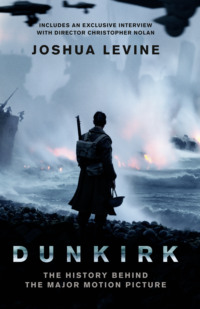
Kitabı oku: «Dunkirk: The History Behind the Major Motion Picture»

Copyright
William Collins
An imprint of HarperCollinsPublishers
1 London Bridge Street
London SE1 9GF
WilliamCollinsBooks.com
This eBook first published in Great Britain by William Collins in 2017
Copyright © Joshua Levine 2017

Cover image copyright © 2017 Warner Bros. Entertainment Inc.Copyright © 2017 Warner Bros. Entertainment Inc. DUNKIRK and all related characters and elements are trademarks and © Warner Bros. Entertainment Inc. WB SHIELD: ™ and © Warner Bros. Entertainment Inc. (S17)
Joshua Levine asserts the moral right to be identified as the author of this work
Map by John Gilkes
A catalogue record for this book is available from the British Library
Excerpt from The Road to Wigan Pier by George Orwell (Copyright © George Orwell, 1937), reprinted by permission of Bill Hamilton as the Literary Executor of the Estate of the Late Sonia Brownell Orwell; (Victor Gollancz 1937, Martin Secker & Warburg 1959, Penguin Books 1962, 1989, Penguin Classics 2001). Copyright © 1937 by Eric Blair. This edition copyright © the Estate of the late Sonia Brownell Orwell, 1986; and Copyright © 1958 and renewed 1986 by the Estate of Sonia B. Orwell, reprinted by permission of Houghton Mifflin Harcourt Publishing Company. All rights reserved.
All rights reserved under International and Pan-American Copyright Conventions. By payment of the required fees, you have been granted the non-exclusive, non-transferable right to access and read the text of this e-book on-screen. No part of this text may be reproduced, transmitted, down-loaded, decompiled, reverse engineered, or stored in or introduced into any information storage and retrieval system, in any form or by any means, whether electronic or mechanical, now known or hereinafter invented, without the express written permission of HarperCollins.
Source ISBN: 9780008227876
Ebook Edition © June 2017 ISBN: 9780008227883
Version: 2017-05-22
Dedication
To Lionel who inspired me.
To Peggy whom I hope to inspire.
To Philip Brown, Eric Roderick, Harold ‘Vic’ Viner and Charlie Searle with thanks.
Contents
Cover
Title Page
Copyright
Dedication
Map
Preface
‘I Don’t See It as a War Film. I See It as a Survival Story’: An Interview between Joshua Levine and Director Christopher Nolan
1 Survival
2 Quite Like Us
3 The Long and the Short and the Tall
4 High Hopes
5 Fighting Back
6 Halting the Panzers
7 Escape to Dunkirk
8 No Sign of a Miracle
9 A Miracle
10 Where’s the Bloody RAF?
11 A New Dunkirk
Illustration Credits
Picture Section
Acknowledgements
Select Bibliography
Also by Joshua Levine
About the Author
About the Publisher

Preface
One afternoon, sitting in the National Archives in Kew, I opened a file containing a report by Commander Michael Ellwood. Commander Ellwood was in charge of communications during the Dunkirk evacuation, and he wrote, in passing, of a Marconi transmitter/receiver that was used for a very short time before it broke down – due to ‘sand in the generator’.
This seemed surprising. How had sand got inside this precious piece of equipment? The Marconi TV5 was a sizeable box, and the memory of Laurel and Hardy delivering a piano in The Music Box flashed through my mind. Had two particularly clumsy ratings dropped it on the beach? Had Captain William Tennant, the Senior Naval Officer Dunkirk, yelled at them in frustration when they told him what they had just done to his only piece of transmitting equipment? Or did they stay quiet and hope that somebody else got the blame?
A short while later, in May 2016, I was standing at the shore end of the Dunkirk mole, very close to where Captain Tennant had placed his headquarters. Looking around, I could see parts of the Dunkirk beach cluttered with soldiers – or men who looked like soldiers. There were warships out to sea, and a white hospital ship, clearly marked with red crosses, was berthed at the end of the mole. Black smoke billowed in the distance, and the sea frontage had been camouflaged to remove any traces of the late twentieth century. Dunkirk was looking remarkably as it had in late May 1940.
Something else was striking, though. The wind had picked up and sand was whipping everywhere. It was clogging hair and stinging eyes. Most people were wearing goggles and shielding their faces – and I suddenly realised that nobody had dropped the transmitter. There had been no clumsy ratings. Sand had been blown into the generator in May 1940 just as it was now blowing into everybody’s eyes and ears. By spending time at Dunkirk, I was learning things about the original event that I could simply never have learned otherwise.
This is why I would urge anybody interested in the story of the evacuation to visit Dunkirk. Walking along the beaches and up the mole, exploring the perimeter where French and British troops kept the Germans at bay, visiting the excellent War Museum, the deeply moving cemetery and Église Saint-Éloi with its bullet- and shrapnel-pitted walls – these are all activities that will bring the events of May and June 1940 to life. The landscape retains the story, and fills in the gaps between words.
With this book, I have tried to tell a different story, or at least a wider story. Just as a visit to Dunkirk will make you think differently about the evacuation, so this book tries to explain events by placing them within a richer context – not merely military, but also political and social. It will try to give a sense of what it was to be a young soldier in 1940, and of the importance of youth culture, in its different forms, in the build-up to war. It will focus on the fighting (and sometimes lack of fighting) that led to the evacuation. And it will explore the effect of the evacuation, up to its very latest manifestation – the 2017 Chris Nolan film.
I have been lucky enough to work as historical adviser on this film. It was a pleasure to do so – partly because I enjoyed meeting so many interesting and enthusiastic people. But mainly because it has brought an under-appreciated piece of history to life in a remarkable way. In the last chapter, you will read of the efforts taken by director, producer and heads of department to be as true as possible to the historical event. By making those efforts, they have allowed the spirit of the evacuation to be recreated as vividly and as truly as I think it ever could be. The result allows us to experience the story for what it actually was – a hard and desperate fight for survival that kept the world free.
Nothing could be more important than that. I urge you to remember, as you watch, that without the real Tommys, Georges and Alexes, we would be living in a far darker world today. And many of us would not be living at all.
Joshua Levine
April 2017
‘I Don’t See It as a War Film. I See It as a Survival Story’
An Interview between Joshua Levine and Director Christopher Nolan
Joshua Levine: You’re a British person who works in America. When you said you wanted to make this very British subject into a movie, what did people say?
Christopher Nolan: I had the script finished before I told anyone. Emma [Thomas – producer of Dunkirk] knew. She had originally given me your book [Forgotten Voices of Dunkirk] to read. We had made a Channel crossing many years ago with a friend of ours (who’s actually in the film in one of the boats) in the spirit of re-enacting that historic journey. It was one of the most difficult and frankly dangerous-feeling experiences I have ever had. I was very grateful to get back in one piece, and that was without people dropping bombs on us. It was literally just the Channel, the elements and the three of us on a small boat.
JL: And you made that crossing as an homage?
CN: Yes. We did it a little bit too early in the year. It was Easter, I think it was April rather than May. It was a little too cold and we went over to Dunkirk specifically, but not as massive history buffs. We knew the story – we had grown up with it and our friend had a sail boat, and he said let’s just do it. It turned out to be very, very difficult (at least for me and Emma) venturing out into the Channel in a small boat. It’s a considerable thing to do. The idea of doing it and knowing that you’re heading into a war zone is unthinkable really. And that’s where the analysis of what Dunkirk means as mythology, or as modern mythology, or whatever you want to call it, can’t be overstated. By actually getting on a boat and making that trip you can glimpse the bravery of the people who did it. It’s just such a courageous thing for them to have done.
Emma and I talked about it years later and started reading first-hand accounts. We were curious about why no one had made a film about it – in modern times. It’s one of the greatest human stories. It’s universal, I think. So I did a lot of reading, danced around how to go about it and why people hadn’t in the past. Ultimately we came to the conclusion that the reason people hadn’t was because it was a defeat. And it’s an expensive film. It’s big. It’s an epic any way you slice it up. We tried to approach it in a very intimate way, but it’s an epic and so you need the resources of the industrial Hollywood machine behind it, and getting those resources channelled into a tale, however great, of defeat was a little tricky. But actually what drew us to the story is that it’s not a victory, it’s not a battle. It’s an evacuation. It’s a survival story.
So I don’t see it as a war film. I see it as a survival story. That’s why we don’t see the Germans in the film and why it’s approached from the point of view of the pure mechanics of survival rather than the politics of the event.
JL: It doesn’t feel like a war film. I remember reading about George Orwell’s Room 101, which contains the worst things in the world from your own personal perspective, this faceless enemy which is the nightmare of your imagination, it’s whatever terrifies you. And the film is almost a horror film, or a psychological horror film, or something like that?
CN: It’s a suspense film, but we try and push the visceral suspense as far as we can. So you get into the language of horror films, definitely.
JL: There’s almost an implied contract that if you’re going to make a film about the Nazis in any way you have to show them for what they were. And you haven’t done that.
CN: No. Well, when I was first writing it – it was a crawl at the beginning, but it tells you what’s going on – I used the word Nazi constantly and had people referring in the dialogue to Nazis. I wanted to continually remind the modern audience how evil and awful the enemy was and get them alongside. And then at some point – I think it was in my discussions with Mark Rylance, who first came aboard the project – I realised that because I had made the decision to never actually show Germans, even referring to them was pointless. You don’t want to be in a middle ground. That is to say that you either have to try and address the entire concept of Nazi evil and ideology, or you have to completely circumvent it by not showing them, by having them be subliminal creatures in a way, having them as an off-screen menace. It’s like the shark in Jaws, maybe you see the fin but you don’t see the shark. And that way your mind, and even your ethical sense of who you are identifying with in the film, automatically makes them the worst thing possible out there.
JL: The audience can run with their imagination and take it wherever it goes. But because this film will be seen by a lot of young people who know nothing about the Second World War at all, is there an obligation to underline who the Nazis were?
CN: I think the responsibility is to not present a misleading portrait of the Nazis, but Nazism is notable by its absence and being notable I think is the proper thing. You want the feeling of crisis and jeopardy in Europe. You want the feeling of these British and French soldiers on the ground at a crucial moment in history. You want to feel like this is the absolute crisis point. I did that, from a cinematic point of view, by not personalising, not humanising the enemy, which most war films, one way or another, tend to want to do at some point. Even as far back as All Quiet on the Western Front there’s a thread in war films of wanting to be sophisticated, wanting to humanise the enemy. But of course when you put yourself in the position of a soldier on that beach, for the vast majority their contact with the enemy is extremely limited and intermittent. Most of what you are seeing is bombs dropping. Most of what you are hearing is gunfire from a couple of miles away, which must have been more terrifying than we can really imagine as it gets closer and closer and closer. What we are trying to do with the sound mix right now is to figure out how to create that audio space, so that the battle appears to be ten miles away, then seven miles away, then four miles away, and how absolutely terrifying it would have been for the guys there on the beach.
It’s what you don’t know that is important in the film. So, in the expositional scene we give hopefully just enough historical information. The idea is that [the characters] Tommy and Gibson wouldn’t know anything about what was going on and then they’d be given disquieting scraps of information like ‘we’re trying to get forty-five thousand people off the beach’, ‘there are four hundred thousand people on the beach’ and then you get that ‘OK, every man for himself’ feeling. I was interested in the idea of what people wouldn’t know rather than explaining everything we know now. If you’re inside an event, particularly back then, when you didn’t have smartphones and everything, it’s pretty difficult to get any perspective on what’s going on. One of the most moving things about the Dunkirk story to me – in fact, definitely the single most moving thing – is that when these guys finally were rescued, when they finally made their way home, they went home with a sense of shame. That they went home, the vast majority of them, thinking they were going to be a huge disappointment to the British people back home and then found that they were welcomed as heroes was to me one of the most extraordinary turnarounds, emotionally, in history, and it was because they didn’t know what was going on. So we have them reading Churchill’s speech in the newspaper. They wouldn’t have been in Parliament, they wouldn’t have been able to do what films do traditionally, which is to cut to Winston Churchill speaking to the Cabinet or preparing his speech. They were just going to get it from the newspapers, so they find out after the fact what it is that they’ve been through.
JL: Are there any modern parallels? Are people going to see it as something that happened x years ago or are they going to see it as something that could happen again?
CN: One of the great misfortunes of our time, one of the horrible, unfortunate things with the migrant crisis in Europe, is that we are dealing once more with the mechanics and the physics of extraordinary numbers of people trying to leave one country on boats and get to another country. It’s a horrible resonance but it’s very easy in our technologically advanced times to forget how much basic physics come into play. Reality is insurmountable. If you have a vast number of people in one place and they need to get someplace else and they can’t fly and they have to get on boats – to overcrowd the boats, with that human desire for survival … it’s unthinkably horrible to see it on our front pages in this modern day and age. But it’s there. With that going on in the world today, I don’t think you can in any way dismiss the events of Dunkirk as being from another world or another era.
JL: So what war films do you like?
CN: One of my favourite films – one of the films I most admire – is Terence Malick’s Thin Red Line. It has almost no relevance to this film whatsoever, but it has had relevance to a lot of my other films. I think Memento is heavily indebted to Thin Red Line. We did actually screen it before this film, but it wasn’t relevant except in one key textural, stylistic sense, which is that it is timeless. It feels very accessible and contemporary even though it’s about World War II, and that was certainly something that we wanted to try and achieve in the texture of this film, but as far as the artistic underpinnings and the way in which it tells the story it felt very unrelated. I didn’t look at too many war films. We looked at Spielberg’s Saving Private Ryan, which was also instructive because it has a horror movie aesthetic. It has an approach to intensity and gore that’s so absolute and successful that you realise that you have to go elsewhere. You can’t try and compete with that film. It would be like trying to compete with Citizen Kane. I mean it’s an absolute. That’s the horror of war right there. So we went more in a suspense direction. I didn’t watch too many war films because I read – I think it’s reprinted in the liner notes of the Blu-Ray on the Criterion Edition of Thin Red Line – a piece of writing about war films by James Jones, who wrote the novel of the Thin Red Line, and it’s humbling. This is somebody who had been at war and had written about war and he exposes the devices, the bullshit of war movies in a merciless way that to a filmmaker sitting down to write a film set during a real moment in history was extremely daunting. One of the things he says is ‘What more can be said about war after All Quiet on the Western Front?’ So I went back to look at All Quiet on the Western Front, which I had not seen in many, many years. It’s incredible how all-encompassing it is as a statement about war, how horrible war is. Even though the craft of filmmaking was more in its infancy than now – it’s black and white, it barely has sound – it’s extraordinarily well made. And by virtue of the fact that it’s about Germans but made in the Hollywood system, the anti-nationalist point of view is so powerful, so strong. And that’s what elevates it above any other anti-war film made since. It’s so relentless in its depiction of how awful war is, it’s so unsparing in its depiction of how nationalist myths, jingoistic myths, propagate the idea of war as glorification. I don’t think they’d ever have been allowed to do that if it was made about the Americans and the British.
JL: So is your film a sort of successor to that?
CN: No, not at all. Because I did that reading, that research, it pushed me further in the direction that I had already been heading, not making a war film but making a survival story because that was what I felt confident of doing. I have not fought in a war. It’s my worst nightmare. I can’t imagine doing that. So to me Dunkirk becomes a survival story. The terms of the success or failure for me are survival, and that’s why when one of the soldiers at the end says ‘all we did was survive’, the blind man replies ‘That’s enough.’ Because in the terms of Dunkirk, that was the definition of success. Which is where Churchill’s ‘Inside this defeat there’s victory’ comes from. That’s the particular situation I felt confident trying to tell.
JL: Do you have anyone in your family who fought?
CN: My grandfather died in World War II. He was a navigator on a Lancaster.
JL: Good Lord. Do you know how many missions he survived?
CN: He survived forty-five. He was meant to retire, but I think he died on the forty-sixth. After forty-five, they would then go and instruct new pilots and he was right there. He’s buried in France, and we went to visit his grave while we were making the film, which was very moving. He was in his thirties when he died and he was the old man of the crew, they looked up to him as a father figure. I mean they were kids. They were eighteen, nineteen.
JL: Do you watch your films again?
CN: I do, yes.
JL: And when you watch them do you judge them? How do you watch a film you made several years ago?
CN: You wind up watching them for various reasons fairly soon after you finish, for the video release, for this and that, all kinds of technical reasons. And these days my kids are interested to see The Dark Knight or whatever and I’ll sit and watch it with them. But the reasons go away over time and you stop seeing the films. It’s a very long time since I have seen Memento. There are filmmakers who never watch their films. But I’m interested to because they change over time as you get further away from them. You start appreciating them in a more objective way – what’s good, what’s bad – and they become a little bit more of their time, I suppose.
JL: Yes.
CN: Which isn’t a cheerful thought, because you don’t want to think of yourself as ageing and being very much of your time, but you are …
JL: But how could you be anything else?
CN: Yes, it’s what we all are. But your highest aspiration is to make a film that feels timeless.
JL: Are you worried that the story of Dunkirk is going to be – certainly for a while, for a generation – your story of Dunkirk?
CN: That brings with it a responsibility, yes, and I am certainly mindful of it. But it’s probably one of the reasons why the film doesn’t attempt to be comprehensive. We don’t deal with the politics of the situation. We don’t deal with the larger worldview around it because I think it would be too daunting a responsibility to try and own a complex piece of history that you can’t actually distil into a two-hour dramatic narrative.
I’m comfortable presenting the visceral experience of Dunkirk and having that define for a period of time, for the next few years, people’s ideas of what the experience might have been. I feel qualified to do that, because we researched and we were able to film it comprehensively. But regarding the wider implications of the story, of the history itself, I don’t want to take that on. And I don’t think the film pretends to. The film has a quality of simplicity that allows you to imagine more stories. And that’s very, very deliberate. That’s part of the reason for the structure. We want to allow people the space to understand that there are many, many more experiences of these events.
JL: This is something that I have written in the book:
For every individual who stood on the beach or on the mole, or retreated clinging to a cow, there was a different reality. Set side by side, these realities often contradict each other. To take one element of the story; the beaches covered a large area, they were populated by many thousands of people in varying mental and physical states over nearly ten intense days of rapidly changing conditions. How could these stories not contradict each other? The whole world was present on those beaches.
To me that feels like the essence. Do you agree with that?
CN: Yes. I think the film is very much based on that same assessment of the illusive nature of individual subjective experience defining objective reality. Which is a connecting thread with all the films I’ve ever made. They are all about individual experiences, potential contradictions with objective reality, and the film tries very strongly to leave space for the seemingly infinite number of experiences and stories that would contradict each other or comment on each other in different ways. We tell three stories that intersect at a point. We show the point when they come together and they are very, very different experiences. Watching a Spitfire pilot ditch from the other Spitfire, it looks calm and controlled, but to actually go through that as you do later in the film is completely different. A massive contrast. That is something that’s always fascinated me about human experience.
JL: We went on a trip round parts of Britain meeting Dunkirk veterans. What did you learn from that?
CN: Absolutely vital things. But what was interesting was that although when we were talking to those people I was honoured and humbled, I wasn’t necessarily inspired or aware in the moment exactly what I was going to get out of these conversations. I knew it was a smart thing to do. We needed to talk to people who had actually been there if we were going to presume to portray their experience. It’s really only when I look back at the film now … when I look at the scene where they watch the guy walk into the water, I don’t know what that guy’s doing, whether he’s killing himself or whether he thinks he can actually swim out. But the reason I don’t know is because I think I even asked him [the veteran] ‘Was he killing himself?’ and he didn’t have an answer. This was a direct thing he had seen.
JL: Did the man himself even know what he was doing?
CN: I don’t know. Exactly.
JL: We like to pin a certainty on everything – ‘This is what he’s doing’ – and actually we don’t even know why we do what we do half the time. And in a situation like that, where the pressures are unimaginable …
CN: A lot of what I got from the conversations with those amazing people was confidence that things that we were intending to do were supported by people’s experience. Different people talking about being on the mole, people getting off the boat, the chap bringing water to Dunkirk, which meant getting off the boat and then not being able to get back on the same boat. It’s just this nightmarish feeling of chaos. Ordered chaos, I suppose you’d call it, or the almost bureaucratic chaos that was apparent on the mole. It’s very interesting listening to people talk about that. And also with that chap who, although he wasn’t a civilian, he’d come over from England to supply water – one of the things that fascinates me is the mechanics. This is why Tommy is trying to go to the loo at the beginning, because those things are interesting; the logistical things. Where are you going to get food from? Water? It’s something that was never planned and is being done ad hoc and so hearing the accounts of somebody who came over with water and saw all the fires from a distance and knew he was going there. That’s an omnipresent image in the film: heading towards these burning fires. It’s on the horizon. It’s the last place you want to go. There were all kinds of things I got from those conversations. They seeped in over time. I think it was very informative asking as you did what their interpretation of the Dunkirk spirit was, because there were such different interpretations. Three very distinct interpretations, as I remember. One was the little ships representing the idea of the Dunkirk spirit. Another was, I can’t remember the words he used, but he basically said it was complete bullshit. And then the last chap we were talking to, he related it to the people holding the perimeter who were left behind. And they were all three absolutely definitive in their own interpretation: that’s what it is, that’s what it means.
JL: Absolutely. I remember one said, ‘You were only worried about yourself.’
CN: Yes. I think he was one of the most interesting people to talk to. What he implied to us was that he’d gone through a set of experiences of which he was not proud, but which he firmly felt were in the norm of that situation for the people that were there. I felt that he wasn’t in any way saying he had done anything wrong or different, but that there were things which shouldn’t be talked about, which were best left there. And for me the whole relationship between Alex and Tommy and Gibson was that moment. It’s not meant to be judgemental of people. I felt that there was a window which opened up on to the privacy of that subjective experience.
JL: I find it interesting that when you get to a certain age the order of things often disappears. Stories no longer move from beginning to end. Time becomes increasingly irrelevant. For me, as a barrister and now a writer, I instinctively want to reorder people’s stories, make logical sense of them. But you’re coming from a totally different perspective, which I find very interesting. You’ve dealt so much in your films with the nature of time that – to you – there was something very honest about this.
CN: Very much. My job is to tell a story in a very disciplined and ordered manner, whether it’s chronological or not, and I wouldn’t have a job if it were natural to people conversationally. The reality is that people’s nature is not to be able to relate their experiences in an absolutely coherent manner, for whatever reason. So storytelling, in whatever form, always has value in society because it’s a particular skill. It’s putting something into a different form, and that’s why the guy not telling us about that specific experience creates an interesting hole in our knowledge which I think is much more expressive than the words would be. Whatever happened, I think he was aware on some level that it would either sound trivial to us, because perhaps he had just sworn at an officer, for example, or it would seem truly shameful, and we wouldn’t be able to understand. Whatever it is, his subjective experience, by becoming a story, would be greatly reduced. I find it very powerful and thought-provoking to think of it as a little gap in our knowledge. It confirms everything that the research suggested, which is that there was an enormous range of experience.
One
Survival
In the early summer of 1940, Anthony Irwin was a young officer in the Essex Regiment. As his battalion carried out a fighting retreat towards the French coast, held up by civilian refugees, targeted by guns and aircraft, pressured by approaching German infantry, Irwin, like most of his fellow officers and men, was experiencing war for the first time.
One afternoon, under attack from German bombers, he saw his first dead bodies. The first pair upset Irwin – but the second pair made him vomit, and appeared in his dreams for years afterwards. The difference was not in the manner of their deaths or even the severity of their wounds. It was in the second pair’s ‘indecent attitude’. Naked, demeaned, bloated and distorted, they embodied something worse than death.
That evening, his battalion was under attack again. Overwhelmed, a young private began crying. Irwin took the boy aside, intending to lead him away. But the private, rigid with misery, refused to move. The only thing to do, decided Irwin, was to knock him out. He ordered a sergeant to take a swing at the private’s chin – but the sergeant missed, cracking his knuckles on a wall. The private suddenly came to life and ran, but was chased down by Irwin who tackled him, and punched him in the face. The boy was now unconscious.
Irwin slung the private over his shoulder and carried him down to a nearby cellar. It was dark inside, and Irwin shouted for somebody to bring him a light. In the relative quiet, Irwin heard surprised voices, a man’s and a woman’s, and his eyes slowly focused on a soldier in the corner of the cellar having sex with a Belgian barmaid. Who could blame them, wondered Irwin. With death so close, they were grabbing hold of life.
Irwin was among hundreds of thousands of officers and men of the British Expeditionary Force retreating through Belgium towards the coast. They had sailed to France following the declaration of war on Germany on 3 September 1939. After months of ‘phoney war’, the German Blitzkrieg in the west had been launched on the morning of 10 May, and the bulk of the British forces was hurried into Belgium to assume prearranged positions along the River Dyle. There they formed the Allies’ left flank, alongside the French and Belgian armies, facing Hitler’s Army Group B. Further to the south, the Allies’ right flank was protected by the mighty Maginot line, a series of heavily defended fortresses, blockhouses and bunkers along the French border with Germany.
For a few short days in May 1940, the Allies and the Germans, broadly equal in military terms, seemed destined to act out another war of trenches and attrition. If experience could be trusted, the Germans would soon be hurling themselves at heavily defended Allied lines.
But the Allied commanders were instead offered a sharp lesson in modern warfare. Between the strongly held Allied flanks was the Ardennes forest, theoretically impregnable, and weakly defended by the French; only four light cavalry divisions and ten reserve divisions protected a hundred-mile front. And the Germans had a plan to exploit this front.
First formulated by Lieutenant General Erich Manstein, the plan had been through seven drafts by May 1940. It involved an initial attack on Holland and northern Belgium, drawing the Allies into a trap. For at the same time, the main German attack would come further south at the very weakest point of the Ardennes front. Led by Panzer tank divisions, it would begin by crossing the River Meuse, pushing through the area around Sedan and surging north-west for the coast, splitting the French armies in two and joining up with the northern attack to encircle the British Expeditionary Force.
The Manstein Plan was extremely risky; breaking through a wooded area was a huge logistical challenge, and the Panzer tank was a largely untested weapon. The plan’s success depended on unprecedented speed and intensive air support, but, above all, it depended on surprise. If the French learned of it in advance, it would surely fail. In January 1940, however, the Belgians had captured a copy of the previous German plan – to launch the main assault in Holland and Belgium. This was a straightforward repeat of Germany’s First World War strategy – and the Allies had no reason to believe that the Germans were now considering an alternative.
The level of risk involved in the Manstein Plan was so great, the break from traditional practice so complete, that most German generals refused to countenance it. It gained, however, an influential supporter in General Franz Halder, Chief of Staff of Army High Command. And, crucially, it had the support of the man whose opinion ultimately mattered in Nazi Germany – Adolf Hitler. The attack was ordered to go ahead.
In the event, the French were taken by complete surprise. Armoured forces, spearheaded by Lieutenant General Heinz Guderian’s Panzer Corps and devastatingly supported by the Luftwaffe, plunged through enemy lines, tearing a massive hole in French defences. German tanks began to race through France unchallenged. This is why, just days after taking up their positions in Belgium, British soldiers – clearly able to hold their own against the Germans – were being ordered backwards. There must, they thought, be a localised reason. Had the Germans broken through in a nearby sector? Or was their particular battalion being sent to the rear for some misdemeanour?
At first, British units retreated in stages, from one defendable line to another. Sometimes an entire division was pulled out, free to plug a distant gap. As the retreat gathered pace, confusion increased, and rumours began to circulate. One of these rumours proved true – an almighty breakthrough to the south was threatening to outflank the British army. But for most of the retreat there was no suggestion of evacuation, nor mention of the now legendary name Dunkirk.
All sorts of soldiers found themselves on the move, from elite guardsmen to untrained labour troops. Some went on foot, marching in battalion strength or stumbling alone. Others travelled in trucks, on horses, tractors and bicycles. One intrepid group was observed riding dairy cattle. Under fire and lacking supplies, the men of the British army were in every kind of physical and mental state.
One man, Walter Osborn of the Royal Sussex Regiment, was in a particularly difficult situation. Having sent the Prime Minister, Winston Churchill, an anonymous letter asking for ‘some leave for the lads’, he had been sentenced to forty-two days’ detention for using ‘language prejudicial to good order and conduct’. He was now engaged in a fighting retreat with his comrades – but he was at a disadvantage. Whenever the fighting stopped, he was locked up in a nearby barn or cellar to continue serving his sentence. This did not seem fair. As he complained to a regimental policeman: ‘A man’s got a right to know where he stands!’
Even more unusual was the small soldier sitting in a truck on the road to Tourcoing. In steel helmet and khaki greatcoat, carrying a rifle, the soldier looked like any other. The uniform may have hung a little, but that was hardly unusual. Private soldiers weren’t expected to dress like Errol Flynn in The Charge of the Light Brigade. The odd thing about this soldier was her marriage to a private in the East Surrey Regiment.
The soldier was Augusta Hersey, a twenty-one-year-old French girl. She had recently married Bill Hersey, a storeman in the 1st East Surreys. They had met in Augusta’s parents’ café when Hersey was stationed nearby, and despite neither speaking a word of the other’s language, they had fallen in love. Hersey had asked Augusta’s father for her hand by pointing at the word mariage in a French–English dictionary and repeating the phrase ‘Your daughter …’
Hersey was fortunate to have a sentimental company commander who agreed – against any number of regulations – that Augusta could dress in army uniform and retreat with his battalion. This was how the couple found themselves, almost together, fleeing the German advance. But their retreat had no definite objective until Lord Gort, the British commander, reached the brave conclusion that the only way to save a percentage of his army was to send Anthony Irwin, Walter Osborn, and the rest of the British Expeditionary Force, towards Dunkirk, the one port still in Allied hands, from where some of them could be hurriedly transported home by ship.
As they arrived at Dunkirk, soldiers were confronted by an unforgettable scene. Captain William Tennant, appointed Senior Naval Officer Dunkirk by the Admiralty, sailed from Dover to Dunkirk on the morning of 27 May to coordinate Operation Dynamo. He entered a town on fire, its streets littered with wreckage, every window smashed. Smoke from a burning oil refinery filled the town and its docks. There were dead and wounded men lying in the streets. As he walked on, he was confronted by an angry, snarling mob of British soldiers, rifles at the ready. He managed to defuse a difficult situation by offering the mob’s ringleader a swig from his flask.
Another naval officer arrived in Dunkirk two days later. Approaching from the sea, he was struck by one of the most pathetic sights he had ever seen. To the east of the port were ten miles of beach, the entire length blackened by tens of thousands of men. As he drew closer, he could see that many had waded into the water, queuing for a turn to tumble into pitiable little boats. The scene seemed hopeless. How, he wondered, could more than a fraction of these men hope to get away?
Yet the closer one came to the beaches, and the more time one spent on them, the clearer it became that there was no single picture and no single story. An officer of the Royal Sussex Regiment recalls arriving on the beach, and being smartly saluted by a military policeman who asked for his unit before politely directing him into a perfectly ordered queue. A young signalman, on the other hand, was greeted with the words, ‘Get out of here before we shoot you!’ in another queue. And a Royal Engineers sergeant watched a swarm of desperate soldiers fighting to get onto a boat as soon as it reached the shallows. In a desperate attempt to restore order before the boat capsized, the sailor in charge drew his revolver and shot one of the soldiers in the head. There was barely a reaction from the others. ‘There was such chaos on the beach,’ remembers the sergeant, ‘that this didn’t seem to be out of keeping.’
For every individual who stood on the beach or on the mole (the long breakwater from which most troops were evacuated), or retreated clinging to a cow, there was a different reality. Set side by side, these realities often contradict each other. To take one element of the story – the beaches covered a large area, they were populated by many thousands of people in varying mental and physical states over nearly ten intense days of rapidly changing conditions. How could these stories not contradict each other? The whole world was present on those beaches.
And the reality was no tidier once the soldiers were on boats and ships sailing for Britain. Bombed and shot at by the Luftwaffe, shelled by coastal batteries, fearful of mines and torpedoes, the men might be on their way to safety – but it had not yet arrived. An officer in the Cheshire Regiment was one of thirty aboard a whaler being rowed from the beach to a destroyer moored offshore which would then ferry them home. As the whaler drew close, the destroyer suddenly upped anchor and headed towards England. Overcome by emotion, an army chaplain leapt up in the whaler and yelled, ‘Lord! Lord! Why hast thou forsaken us?’ As he jumped, water began to pour into the boat, and everyone simultaneously screamed at him. Seconds later, in answer to his prayer – or possibly in answer to the exceptionally loud noise just made by thirty men – the destroyer turned round and came to pick them all up.
In the event, the vast majority of the British Expeditionary Force was brought safely home from Dunkirk. Most of those were carried by naval ships or large merchant vessels; the famous little ships (some crewed by ordinary people, most by sailors) were mainly used to ferry the soldiers from the shallow beaches to the larger ships moored offshore. But had these soldiers been killed or captured, Britain would surely have been forced to seek a peace settlement with Hitler, history would have taken a far darker course, and we would all be living in a very different world today.
This helps to explain why Dunkirk – a disastrous defeat followed by a desperate evacuation – has come to be seen as a glorious event, the snatching of victory from the jaws of a worldwide calamity. Whereas Armistice Day and most other war commemorations are sombre occasions focusing on loss, Dunkirk anniversaries feel more like celebrations, as small ships recreate their journeys across the Channel. Dunkirk represents hope and survival – and this is what it represented from the very start.
When the evacuation began, so dire was Britain’s military situation that, as in Pandora’s Box, only hope remained. On Sunday 26 May, a national day of prayer was observed. Services in Westminster Abbey and St Paul’s Cathedral were mirrored in churches and synagogues across Britain, and in the London Mosque in Southfields.
In his sermon, the Archbishop of Canterbury asserted that Britain both needed and deserved God’s help. ‘We are called to take our place in a mighty conflict between right and wrong,’ he said, suggesting that Britain’s moral principles were invested with sanctity because ‘they stand for the will of God.’ God was with Britain, and He alone knew how the evil enemy would be beaten. It is little wonder that the evacuation, quickly dubbed miraculous by Winston Churchill, assumed a quasi-religious quality. The Archbishop had been right, it seemed, Britain was favoured by the Lord. This confirmed the views of such writers as Rupert Brooke and Rudyard Kipling, and it helped give rise to a concept that has survived the last seven and a half decades: Dunkirk Spirit.
Defined as the refusal to surrender or despair in a time of crisis, Dunkirk Spirit seems to have asserted itself spontaneously. As they arrived back in Britain, most soldiers saw themselves as the wretched remnants of a trampled army. Many felt ashamed. But they were confounded by the unexpected public mood. ‘We were put on a train and wherever we stopped,’ says a lieutenant of the Durham Light Infantry, ‘people came up with coffee and cigarettes. We had evidence from this tremendous euphoria that we were heroes and had won some sort of victory. Even though it was obvious that we had been thoroughly beaten.’
Nella Last was a housewife from Lancashire. In early June she wrote in her diary:
This morning I lingered over my breakfast, reading and rereading the accounts of the Dunkirk evacuation. I felt as if deep inside me was a harp that vibrated and sang … I forgot I was a middle-aged woman who often got tired and who had backache. The story made me feel part of something that was undying.
The emotional outpouring did not please everybody, however. Major General Bernard Montgomery, commander of 3rd Division during the retreat, was disgusted to see soldiers walking around London with an embroidered ‘Dunkirk’ flash on their uniforms. ‘They thought they were heroes,’ he later wrote, ‘and the civilian public thought so too. It was not understood that the British Army had suffered a crashing defeat.’ A German invasion was expected, and exhibitions of pride and self-congratulation did not sit well with Montgomery. But for the majority, while Britain still had a fighting chance of survival, the returning soldiers were glorious heroes.
Some civilians baulked at the euphoria too. An old woman watched the shattered troops disembarking at Dover on 3 June. ‘When I was a girl,’ she said, ‘soldiers used to look so smart and would never have gone out without gloves.’ The Mass Observation reporter to whom she spoke noted a flat, unemotional atmosphere in the town. ‘I can only describe it,’ he wrote, ‘as no flags, no flowers and unlike the press reports.’
However widely felt, the authorities were keen to encourage the sense of emotion and relief – and this was something that Winston Churchill understood instinctively. Oliver Lyttelton, later to be a member of Churchill’s War Cabinet, describes great leadership as the ability to dull the rational faculty and substitute enthusiasm for it. In 1940, on a careful evaluation of the odds few would have acted decisively. But despite not being the cleverest of men, Churchill had the ability to inspire the country. He made you feel, says Lyttelton, as though you were a great actor in great events.
On the evening of 4 June, radio listeners heard a report of the Prime Minister’s speech, given earlier in the day to the House of Commons. The speech did not attempt to ignore reality; Churchill spoke of the German armoured divisions sweeping like a scythe around the British, French and Belgian armies in the north, closely followed by ‘the dull brute mass’ of the German army. He spoke of the losses of men and the overwhelming losses of guns and equipment. He acknowledged that thankfulness at the escape of the army should not blind the country ‘to the fact that what happened in France and Belgium is a colossal military disaster’.
But Churchill also described ‘a miracle of deliverance, achieved by valour, by perseverance, by perfect discipline, by faultless service, by resource, by skill, by unconquerable fidelity’. If this is what we can manage in defeat, he was suggesting, imagine what we can achieve in victory! He then spoke of his confidence that Britain would be able to defend itself against a German invasion:
We shall fight on the seas and oceans, we shall fight with growing confidence and growing strength in the air, we shall defend our Island, whatever the cost may be, we shall fight on the beaches, we shall fight on the landing grounds, we shall fight in the fields and in the streets, we shall fight in the hills; we shall never surrender …
Inspiring though these words must have sounded (the front page of the next morning’s Daily Mirror barked ‘WE NEVER SURRENDER’), they hint at a difficult future. Fighting in streets and hills implies guerrilla warfare: the sort of fighting to be engaged in once the Germans had already gained a foothold in Britain. Beyond this, though, Churchill was implying that Britain had strength in reserve. And while this might serve as a reassurance to her own people it was also meant as a message to the United States. We will hold the fort, Churchill was saying, until you come and join us. But please don’t wait too long …
Joan Seaman, a teenager in London, remembers being scared in the aftermath of Dunkirk. But when she heard these words, the effect was transforming. ‘When people have decried Churchill, I’ve always said, “Yes, but he stopped me being afraid!”’ George Purton, a private in the Royal Army Service Corps, had just struggled back from Dunkirk. He could not share Churchill’s opinion of the evacuation, but he knew ‘a splendid bit of propaganda’ when he heard it.
The next evening, 5 June, another BBC broadcast boosted the nation. Novelist and playwright J. B. Priestley gave a talk after the news. It was much chummier than Churchill’s, delivered as though knocking back a drink in the saloon bar with friends. In his Yorkshire accent, Priestley mocked the typical Englishness of the Dunkirk evacuation, the miserable blunder having to be retrieved before it was too late. He sneered at the Germans: they might not make many mistakes, but they didn’t achieve epics either. ‘There is nothing about them,’ he said, ‘that ever catches the world’s imagination.’ Warming to his theme that the British are lovable, absurd and quixotic, he spoke of the most ‘English’ aspect of the whole affair: the little pleasure steamers called away from their seaside world of sandcastles and peppermint rock to a horrid world of magnetic mines and machine guns. Some of the steamers had been sunk. But now they were immortal: ‘And our great grandchildren, when they learn how we began this War by snatching glory out of defeat, and then swept on to victory, may also learn how the little holiday steamers made an excursion to hell and came back victorious.’
In Priestley’s talk – and in other reactions to the evacuation – pride can be sensed in perceived British traits: modesty, comradeship, eccentricity, a belief in fairness, a willingness to stand up to bullies, and an effortless superiority. One does not, after all, want to be seen trying too hard. As Kipling once wrote:
Greater the deed, greater the need
Lightly to laugh it away,
Shall be the mark of the English breed
Until the Judgment Day!
The emerging story of Dunkirk was being shaped to fit the sense of national self. When, after all, had a plucky little army last hurried towards the French coast, desperate to escape an arrogant and vastly more powerful enemy, only to succeed against the odds and fight its way to freedom? During the Hundred Years War, of course, when the English won the glorious Battle of Agincourt, fought, according to Shakespeare, by the ‘happy few’, the ‘band of brothers’. If a sense of English self had been born at Agincourt, the Dunkirk story needed very little shaping.
Prevailing public attitudes can be gauged by the reaction to a play that premiered two weeks after the evacuation. Thunder Rock, starring Michael Redgrave, opened at the Neighbourhood Theatre in Kensington. Its author, Robert Ardrey, described it as a play for desperate people – and it was an instant hit. Theatre critic Harold Hobson recalls that it had the same effect on its audience that Churchill’s speech had on his. It proved so popular that it was secretly bankrolled by the Treasury and transferred to the West End – emphasising the blurred line between spontaneous spirit and its imposition by the authorities.
The plot revolves around a journalist, disillusioned by the modern world, who has retreated to a solitary life on a lighthouse on the American lakes. There he is visited by the ghosts of men and women who drowned on the lake a century earlier as they headed west to escape the problems of their own times. As the journalist and the ghosts speak, the parallels become clear; just as they should have engaged with the problems of their age, so should he now do the same. He resolves to leave the lighthouse and rejoin the wartime struggle. In a closing monologue, he rehearses the issues so relevant to the modern audience:
We’ve reason to believe that wars will cease one day, but only if we stop them ourselves. Get into it to get out … We’ve got to create a new order out of the chaos of the old … A new order that will eradicate oppression, unemployment, starvation and wars as the old order eradicated plague and pestilences. And that is what we’ve to fight and work for … not fighting for fighting’s sake, but to make a new world of the old.
Such lofty social ambitions reveal how Dunkirk Spirit was mutating. The initial sense of relief (that defeat was not inevitable) and pride (in an epic last-ditch effort) was combining with political realities to become something more complex and interesting. If Adolf Hitler was a symptom rather than a cause of the problem, then with victory must come a better and fairer world.
But for all the words spoken and written, perhaps Dunkirk Spirit’s most impressive manifestation was in the realm of British industry. In the immediate aftermath of the evacuation, the need for greater industrial effort was fully acknowledged by workers. This rare convergence of management and workforce, reflecting a shared interest in survival, was perhaps the apex of Dunkirk Spirit. At the SU factory in Birmingham, responsible for building carburettors for Spitfire and Hurricane fighters, output was doubled in the fortnight after Dunkirk. Official working hours stretched from eight in the morning to seven in the evening, seven days a week – but many workers stayed at their benches until midnight and slept on the factory premises. Such a state of affairs would have been unimaginable at almost any other time in the last century.
When the Blitz – the Luftwaffe’s bombing campaign against Britain – seized the country for eight and a half months between September 1940 and May 1941, ‘Dunkirk Spirit’ and ‘Blitz Spirit’ merged into a single idealised mood, the indiscriminate bombs emphasising the need to pull together. But the essence of both was the instinctive realisation that life truly mattered.
In the immediate post-war years, the concept of Dunkirk Spirit was sometimes called upon to decry the supposed British trait of trying hard only when something becomes necessary, but more recently, it has been used in its earliest, simplest sense. In December 2015, for example, retired picture framer Peter Clarkson pulled on a pair of swimming trunks and went for a swim in his kitchen after heavy rains flooded his Cumbria home. ‘This is how we treat these floods!’ he shouted as he breast-stroked past the cooker, explaining that he was trying to ‘gee up the neighbours with a bit of Dunkirk Spirit’. And when Hull City made a winning start to the 2016–17 Premier League season despite injuries to leading players and the lack of a permanent manager, midfielder Shaun Maloney ascribed results to ‘Dunkirk Spirit’ at the club.
But Dunkirk Spirit reached its high water mark during the 2016 Brexit referendum campaign, when the country was almost overwhelmed by references to the period. As Peter Hargreaves, a leading donor to the ‘Leave’ campaign, urged the public to vote for Brexit, he harked back to the last time Britain left Europe. ‘It will be like Dunkirk again,’ he said. ‘We will get out there and we will become incredibly successful because we will be insecure again. And insecurity is fantastic.’ Nigel Farage, meanwhile, not satisfied with invoking Dunkirk, tried to restage it by sailing a flotilla of small ships up the Thames, bearing slogans like ‘Vote Out and be Great Britain again’.
But these are the words and actions of people in current situations, with modern agendas. How do veterans of the evacuation describe Dunkirk Spirit? What did – and does – it mean to them?
For the most part, they relate it to their individual experiences. Robert Halliday of the Royal Engineers arrived in France at the start of the war and was evacuated from Bray Dunes on 1 June. As far as he is concerned, the essence of Dunkirk Spirit was the units of British and French soldiers fighting fiercely on the Dunkirk perimeter. ‘The guys who were keeping them [the Germans] at bay and letting us through were as good as gold!’ he says. He recalls soldiers calling out as he passed – ‘Good luck, off you go!’ His eyes sparkle as he remembers these events. Dunkirk Spirit remains very real to him. It was, he says, ‘wonderful’. George Wagner, who was evacuated from La Panne on 1 June, relates Dunkirk Spirit to survival. ‘We wanted to survive as a country. It was about comradeship and everyone together helping.’
Not everybody agrees. Ted Oates of the Royal Army Service Corps was rescued from the Dunkirk mole. Asked if Dunkirk Spirit means anything to him, he simply shakes his head. And far from experiencing Dunkirk Spirit, George Purton feels that the British army was effectively betrayed. ‘We were sent into something,’ he says, ‘that we couldn’t cope with.’ He remembers Dunkirk as a time of isolation. ‘There was so much happening and you were concerned about yourself only. How the hell am I going to get out of this?’
Dunkirk holds a semi-sacred place in Britain’s collective conscience. It has spawned conflicting experiences and attitudes. It inspires strong emotions, not only among veterans but in those born years afterwards, with only a folk memory of the event and a politically convenient interpretation. How then does a modern filmmaker approach it?
Chris Nolan, one of the most respected directors currently working, has written and directed a feature film set during the evacuation. It was a story with which he was already familiar. ‘I think every English schoolboy knows it,’ he says. ‘It’s in your bones, but I thought it was time to go back to the original source.’
Reappraising the Dunkirk story, Chris built up questions about what had really happened. ‘I was assuming, as modern, cynical people do, that when I looked into it, what I would find would be disappointing. That the mythology of Dunkirk Spirit would fall away and there would be a more banal centre.’ But as he unpeeled the layers, he found something unexpected: ‘I realised that the simplifications actually expose a truth, because the bigger truth, the wood for the trees, is that an absolutely extraordinary thing happened at Dunkirk. I realised how utterly heroic the event was.’
Heroic – but not straightforward. ‘When you dive into the real life of the story, what it would really have been like to be there, you find that it’s an incredibly complicated event. The sheer numbers of people involved – it was like a city on the beach. And in any city, there is cowardice, there is selfishness, there is greed, and there are instances of heroism.’ And the fact that heroism occurred alongside negative behaviours, that it flourished in spite of base human nature, makes it all the more affecting and powerful. ‘That,’ says Chris, ‘is what true heroism is.’ Yet for all the individual acts, he sees the Dunkirk evacuation as a communal effort by ordinary people acting for the greater good. This, he says, makes the heroism greater than the sum of its parts. And it is ultimately his reason for making the film.
Ücretsiz ön izlemeyi tamamladınız.