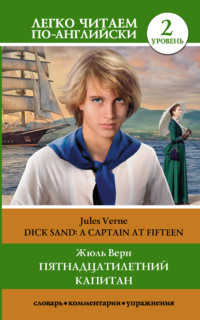
Kitabı oku: «Пятнадцатилетний капитан / Dick Sand. A Captain at Fifteen. Уровень 2»
Jules Verne
Dick Sand: A Captain at Fifteen
© ООО «Издательство АСТ», 2021
© Матвеев С.А., подготовка текста, комментарии, упражнения, словарь
Part I
Chapter I
The “Pilgrim”
On the 2nd of February, 1873, the “Pilgrim”, a schooner, the property ofJames Weldon1, a wealthy Californian ship-owner, was ready for the whale-fisheries2 in the southern seas.
Every season James Weldon sent his whalers both to the Arctic regions beyondBehring Straits3, and to the Antarctic Ocean below Tasmania and Cape Horn4. The “Pilgrim” was onae of the best vessels of its class.
Captain Hull5, an experienced seaman, was one of the most dexterous harpooners. The crew consisted of five sailors and an apprentice. In New Zealand, from the seamen of every nationality, and of needy emigrants, the captain could engage as many whalemen as he wanted for the season. The “Pilgrim” was on its way back. The time, indeed, for a good haul was past; the repeated and vigorous attacks upon the cetaceans made them very scarce.
The season was exceptionally unfortunate for the “Pilgrim.” At the beginning of January, Captain Hull abandoned hisfishing-quarters6. His men had doubtful character and showed the signs of insubordination. The “Pilgrim” was directed to the north-west, towards New Zealand. On the east coast of North Island, the whole of the gang was discharged.
The ship’s crew were very dissatisfied. They were angry. Their haul was meagre. They wanted two hundred barrels more. The rascals marred the success of the expedition.
Captain Hull made every effort to engage a fresh gang; but it was too late. He was leaving Auckland, alone with his crew, when he met a request.
James Weldon brought with him his wife, his son Jack, a child of five years of age, and a relative – Cousin Benedict. They wanted to accompany Weldon on his return home to San Francisco; but little Jack was seriously ill. His father’s affairs demanded his immediate return, so he left Jack at Auckland with Mrs. Weldon and Cousin Benedict.
In three months, Mrs. Weldon was anxious to get home as soon as possible. When she heard that her husband’s vessel, the “Pilgrim”, was at Auckland, she begged Captain Hull to take her with her little boy, Cousin Benedict, and Nan, an old negress, on board the “Pilgrim”. Captain Hull gave his consent. Moreover, the captain gave Mrs. Weldon his own cabin. Everything promised well for a prosperous voyage.
Mrs. Weldon herself accompanied her husband in many voyages, and she was not afraid of a seafaring life. She was a brave, high-spirited woman of about thirty years of age, of excellent health, and for her the sea had no terrors. She knew that Captain Hull was an experienced man, in whom her husband had the utmost confidence.
Cousin Benedict accompanied her. He was about fifty. Spare, lanky, with a bony frame, with an enormous cranium, and a profusion of hair, he was one of the amiable and inoffensive savants.
He did not think of his meals until they were before him. He was utterly insensible to heat or cold. They compared him to a tree which produces scant foliage and no fruit.
But Cousin Benedict was not idle. On the contrary, he was an amateur entomologist. Every available hour he spent in the pursuit of his favourite science. This passion of his urged him to accompany Mr. and Mrs. Weldon to New Zealand.
To leave him was sheer cruelty. So when Mrs. Weldon went on board the “Pilgrim,” Cousin Benedict joined her too.
The amateur was very careful about his special box. Amongst his collection of insects were some very remarkable examples of new staphylins, a species ofcarnivorous coleoptera7 with eyes above their heads. Of course Cousin Benedict insured his box at a fabulous sum. For him, it was worth far more than all the cargo of oil and whalebone.
Captain Hull met Mrs. Weldon and her party as they stepped on deck.
“Mrs. Weldon,” he said, “you take this passage entirely on your own responsibility.”
“Certainly, Captain Hull,” she answered; “but why do you say it?”
“Simply because I have no orders from Mr. Weldon,” replied the captain. “Madam, the ‘Pilgrim’ cannot afford you the comfort to which you are accustomed.”
Mrs. Weldon smiled. And the “Pilgrim” turned its head towards America.
Three days later strong easterly breezes compelled the schooner to change its course.
Chapter II
Dick Sand
Mrs. Weldon occupied the captain’s modest cabin. All the crew were civil and attentive to the wife of their employer, a master to whom they were faithfully attached. They were all natives of the coast of California, brave and experienced seamen. The only one on board who was not an American was Negoro, a cook. He was a Portuguese by birth, but spoke English with perfect fluency. The previous cook deserted the ship at Auckland. When Negoro applied for the place, Captain Hull engaged him at once.
Negoro looked about forty years of age. He was muscular; he was of middle height, and had a robust constitution. Hair was dark, his complexion somewhat swarthy. His manner was taciturn, and it was evident that he had some education. No one knew where he came from. But he made no secret of his intention to land atValparaiso8. He kept himself aloof as much as possible from the rest of the crew.
So the crew of the “Pilgrim” consisted of five seamen and an apprentice. This apprentice was Dick Sand. Dick was fifteen years old; his unknown parents abandoned him at his birth.
Dick looked stoutly and strongly. His complexion was dark, but his beaming blue eyes attested his Anglo-Saxon origin.
And Dick Sand was truly courageous. At fifteen years old, he acquired the stability of a man. At an early period of his life he realized all the difficulties of life. Lithe and agile in his movements, he liked to exercise.
Whilst he was acting as cabin-boy on one of trading-vessels, Dick attracted the notice of Captain Hull, who introduced him to his employer. Mr. Weldon liked the boy and gave him education. Throughout his studies Dick Sand studied geography of the world, mathematics and the science of navigation. Finallyhe found himself9 on board the “Pilgrim,” a vessel not only belonging to his benefactor, but under the command of his friend Captain Hull.
It was a pleasure to Dick Sand when he heard to his surprise that Mrs. Weldon became a passenger on board the “Pilgrim.” His devotion to the family of his benefactor was large and genuine.
Mrs. Weldon entrusted her little son to his especial charge. During the frequent periods of leisure, when the sea was fair, the apprentice was making little Jack familiar with the practice of a sailor’s craft. Mrs. Weldon’s assurance of Dick Sand’ ability and watchfulness to protect her boy was complete.
Time passed on without incident. But the wind made Captain Hull somewhat concerned; it absolutely prevented him from getting his ship into its proper course. The delay might be serious.
The Captain began to feel uneasiness. They were in a latitude far too much to the south to see a steamer going to Panama. The 2nd of February is the date at which our narrative commences.
It was about nine o’clock in the morning. Dick Sand was explaining to Jack how well the ship was ballasted, when suddenly the little fellow cried out,
“I can see something in the water!”
“Where? what?” exclaimed Dick.
“There!” said the child.
Dick fixed his gaze intently for a moment, and then shouted out lustily,
“Look out in front! There is something afloat!”
Chapter III
A Rescue
At the sound of Dick’s voice all the crew, in a moment, rushed to the deck, and Captain Hull hurried from his cabin to the bows. Mrs. Weldon, Nan, and even Cousin Benedict leaned over the starboard taffrails. Negoro did not leave his cabin, and was the only person on board who did not share the general excitement.
They saw a floating object about three miles ahead. One of the sailors declared that it looked to him like a raft. Cousin Benedict asserted that it was a huge sea-monster; but the captain soon said that it was the hull of a vessel.
In spite, however, of the convictions of the captain, Cousin Benedict was talking about some huge cetacean.
“It is certainly dead, then,” remarked Mrs. Weldon; “it is perfectly motionless.”
“Oh, that’s because it is asleep,” said Benedict.
But it was indeed the hull of a capsized ship. A quarter of an hour later and the “Pilgrim” was within half a mile of the deserted vessel. It was impossible to stand upon her deck. A few ends of cordage were all that remained of its shrouds. On the starboard flank was an enormous hole.
“The only wonder,” said the captain; “is that the vessel did not sink immediately.”
“Oh, the poor crew!” exclaimed Mrs Weldon.
“Most probably,” replied the captain, “they used the boats.”
“Is it not possible,” asked Mrs Weldon, “that anybody may still survive on board?”
“Hardly likely, madam.”
Dick Sand suddenly exclaimed,
“Hark! I hear a dog!”
Every one listened attentively. The dog was barking indeed. Was some unfortunate dog imprisoned beneath the hatchways? It was impossible at present to determine the precise truth.
Mrs Weldon pleaded,
“If it is only a dog, captain, let us save it.”
“Oh, yes, yes, mamma, we must save the dog!” cried little Jack; “I will go and get a bit of sugar for it.”
“A bit of sugar, my child, will not be much for a starved dog.”
“Then it will have my soup,” said the boy.
The vessels were now scarcely three hundred feet apart; the barking was more and more distinct, and presently a great dog barked more desperately than ever.
“Howick,” said Captain Hull, calling to the boatswain, “lower the small boat.”
The boat was lowered, and the captain and Dick, with a couple of sailors, went on board. The dog was yelping. All at once the animal become to bark with violence and furious with rage.
“What ails the brute?” exclaimed Captain Hull.
The boat was on the farther side of the wrecked ship, and the captain did not see that Negoro the cook came on to the schooner’s deck. The dog was against him. Negoro approached, and nobody saw him. Without a word or look of surprise, Negoro gazed a moment at the dog, knitted his brow, and retired.
As the boat rounded the stern of the drifting hull, the men observed that the one word “Waldeck” was painted on the aft-board, but that there was no intimation of the port to which the ship belonged. To Captain Hull’s experienced eye, however, certain details of construction gave a confirmation that it was an American ship.
The large hole near the bows indicated the place of the disastrous shock, but this aperture was five or six feet above the water.
Meantime the dog got to the centre. Here it continued to bark.
“Look at that dog!” said Dick; “I begin to think there must be somebody on board.”
“If so,” answered the captain, “he died of hunger.”
“No,” said Dick; “that dog is barking, so somebody there is alive.”
The captain and Dick called and whistled repeatedly to the dog, which jumped into the sea, and began to swim slowly towards the boat. Then the animal was lifted in.
“The poor wretch is dying of thirst!” said Dick.
Captain Hull and Dick clambered the “Waldeck”. The dog was accompanying them.
“There is nothing here; nobody here,” said the captain.
They ascended the ladder, but the dog, barking irrepressibly, began to drag them towards the stern.
They followed the dog to the poop, and there Captain Hull saw five bodies, motionless and apparently lifeless, stretched upon the floor.
Dick hastily examined them all, and emphatically declared, that they could breathe. The five unconscious men, who were all negroes, were brought safely to the boat. The dog followed, apparently satisfied.
The boat made its way back again to the “Pilgrim”. The unfortunate men were raised to the deck.
“Poor things!10” said Mrs. Weldon, as she looked compassionately on the motionless bodies.
“But they are not dead,” cried Dick eagerly; “they are not dead; we will save them!”
“What’s the matter with them?” asked Cousin Benedict, with utter bewilderment.
“We’ll hear all about them soon,” said the captain, smiling; “but first we will give them a few drops of rum.”
Cousin Benedict smiled in return.
“Negoro!” shouted the captain.
At the sound of the name, the dog growled fiercely, and showed its teeth. The cook did not answer.
“Negoro!” again the captain shouted, and the dog became yet more angry.
Negoro slowly left his kitchen. He showed his face upon the deck. The animal made a rush at him, and wanted to seize him by the throat. The man knocked the animal back with a poker which he had in his hand.
“Do you know this dog?” asked the captain.
“Know him? No!”
“Strange!” muttered Dick to himself; “there is some mystery here.”
Chapter IV
The Survivors of the “Waldeck”
The slave-trade11 is still extensively carried on in all parts of equatorial Africa. Year after year vessels loaded with slaves leave the coasts of Angola and Mozambique to transport their freight to many countries.
Captain Hull knew that very well. He thought that the negroes were the part of a slave-cargo which was on its way to some colony of the Pacific. And he wanted to announce that they regained their freedom on board the “Pilgrim.”
Mrs. Weldon, assisted by Nan and Dick Sand, was doing everything in her power to restore consciousness to the poor sufferers. Fresh water and some food soon helped them. The eldest of them was a man of about sixty years of age. When he regained his powers of speech, he was able to reply in good English to all the questions. In answer to Captain Hull’s inquiry whether they were not slaves, the old negro proudly stated that he and his companions were all free American Citizens from the state of Pennsylvania.
This old man communicated all the information that Captain Hull required to hear, and he related all the details of his adventures.
He said that his name was Tom. When was only six years of age he was brought from his home in Africa to the United States; but he recovered his freedom. His companions, who were all much younger than himself, were all free-born. One of them was his own son; his name was Bat (an abbreviation of Bartholomew); and there were three others, named Austin, Acteon, and Hercules.
Three years ago the five men were engaged by an Englishman who had large property in South Australia. Upon the completion of their engagement they determined to return to America. On the 5th of January, they embarked at Melbourne on board the “Waldeck.” Everything went on well for seventeen days, until, on the night of the 22nd, which was very dark,they were run into by12 a great steamer. The scene was terrible; both masts were gone, and the brig completely heeled over on its side. Captain and crew disappeared. They were left alone upon a half-capsized and disabled hull, twelve hundred miles from the nearest land.
The boats were crushed in the collision, so that they had to await the appearance of a passing vessel.
For the next ten days the negroes were eating the food that they found in the stern cabin; but they were quite unable to obtain a drop of anything to drink. Tortured with thirst, the poor men suffered agonies. On the previous night they entirely lost consciousness.
All the outlines of Tom’s narrative were fully confirmed by the other negroes.
One other survivor of the wreck was the dog who had an unaccountable dislike to Negoro.
Dingo, as the dog was named, belonged to the fine breed of mastiffs. The animal came from the coast of West Africa, near the mouth of the Congo. The captain of the “Waldeck” get the dog two years ago. The initials S. V. were engraved upon the dog’s collar.
Dingo was very large. It was a magnificent example of his kind. Standing on hind legs, it was as tall as a man. This dog was like a panther. Its fine shaggy coat was a dark tawny colour, its long bushy tail was as strong as a lion’s. If he was angry, no doubt he became a most formidable foe.
Dingo was unsociable, but it was not savage. Old Tom said that, on board the “Waldeck,” Dingo had particular dislike to negroes; it uniformly avoided them.
The five men were profoundly grateful to their kind-hearted benefactors; poor negroes utterly resigned the hope to repay the debt which they owed their deliverers.
Chapter V
Dingo’s Sagacity
Meantime the “Pilgrim” pursued its course, it was keeping as much as possible to the east, and soon the hull of the “Waldeck” was out of sight.
Captain Hull still continued to feel uneasy. Not that for himself he cared much about the delay of a week or two in a voyage from New Zealand to Valparaiso, but he was disappointed at the inconvenience it caused to his lady passenger. Mrs. Weldon, however, did not utter a word of complaint.
The captain’s next care was to think about the accommodation for Tom and his four associates. There was no room for them in the crew’s quarters, so that their berths were under the forecastle.
After this incident of the discovery of the wreck, life on board the “Pilgrim” relapsed into its ordinary routine. The good-natured negroes were always ready to help; the strongest of them was Hercules, a great fellow, six feet high.
Hercules became at once little Jack’s friend; and when the giant lifted him like a doll in his stalwart arms, the child fairly shrieked with delight.
“Higher! higher! very high!” Jack was saying.
“There you are, then, Master Jack,” Hercules was replying.
“Am I heavy?” asked the child,
“As heavy as a feather.”
“Then lift me higher still,” cried Jack.
Besides Dick Sand and Hercules, Jack admitted a third friend to his companionship. This was Dingo. The dog was one of those animals that are fond of children. It allowed Jack to do with him almost anything he pleased. Jack found a live dog infinitely more entertaining than his old toy upon its four wheels, and his great delight was to mount upon Dingo’s back. Dingo was the delight of all the crew excepting Negoro, who cautiously avoided the animal who showed unmistakable symptoms of hostility.
But Jack did not forget his old friend Dick Sand, who devoted all his leisure time to him. Mrs. Weldon regarded their intimacy with the greatest satisfaction, and one day made a remark in the presence of Captain Hull.
“You are right, madam,” said the captain cordially; “Dick will be a first-rate sailor. He has an instinct which is a little short of genius.”
“Certainly for his age,” assented Mrs. Weldon, “he is singularly advanced. He may be able to become a captain.”
The eyes of the two speakers turned in the direction where Dick Sand was standing. He was at the helm.
“Look at him now!” said the captain; “nothing distracts him from his duty; he acts as the most experienced helmsman.”
Just at this instant Cousin Benedict emerged from the stern-cabin, and began to wander up and down the deck, peering into the interstices of the network, drawing his long fingers along the cracks in the floor.
“Well, Benedict, how are you getting on?” asked Mrs Weldon.
“I? Oh, well enough, thank you,” he replied dreamily.
“What were you looking for under that bench?” said Captain Hull.
“Insects, of course,” answered Benedict; “I am always looking for insects.”
“But don’t you know, Benedict,” said Mrs. Weldon, “that Captain Hull does not allow any vermin on the deck of his vessel?”
Captain Hull smiled and said, -
“Mrs Weldon is very complimentary.”
Cousin Benedict shrugged his shoulders.
“However,” continued the captain, “I dare say down in the hold you can find some cockroaches.”
“I can see, sir,” replied Benedict, “that you are not an entomologist!”
“Not at all,” said the captain good-humouredly.
“Are you not satisfied,” Mrs. Weldon interposed; “with the result of your explorations in New Zealand?”
“Yes, yes,” answered Benedict, with reluctance; “I must not say I was dissatisfied. But, you know, an entomologist is always craving for fresh additions to his collection.”
While he was speaking, Dingo came and jumped on Benedict, and began to fawn on him.
“Get away, you brute!” he exclaimed, thrusting the dog aside.
“Poor Dingo! good dog!” cried Jack, running up and taking the animal’s huge head between his tiny hands.
“Your interest in cockroaches, Mr. Benedict,” observed the captain, “does not seem to extend to dogs.”
“This creature,” answered Benedict; “ disappointed me.”
“What do you mean? You cannot catalogue it?” asked Mrs Weldon laughingly.
“I understand that this dog was found on the West Coast of Africa,” replied Benedict, “and I hoped that it had some African insects in its coat. I searched its coat well, over and over again, but I could not find a single specimen.”
Captain Hull and Mrs. Weldon laughed.
Such were the conversations throughout the monotonous hours of smooth sailing, while the “Pilgrim” was making its headway to the east.
Cousin Benedict began to teach Hercules entomology. He was studying the extensive collection of stag-beetles, tiger-beetles and lady-birds.
Mrs. Weldon was giving her attention to the education of Master Jack. She was teaching her son to read and write, Dick Sand taught him arithmetic. The child made a rapid progress. Mrs. Weldon used a set of cubes, on the sides of which the various letters were painted in red. There were more than fifty cubes, which, besides the alphabet, included all the digits. It was astonishing how quickly the child advanced, and how many hours he spent in the cabin and on deck. Mrs. Weldon was very satisfied.
On the morning of the 9th an incident occurred. Jack was half lying, half sitting on the deck, amusing himself with his letters. He made a word with which he intended to puzzle old Tom. All at once, Dingo, who was gambolling round the child, made a sudden pause, lifted his right paw, and wagged his tail convulsively. Then the animal seized a capital S in his mouth, and carried it some paces away.
“Oh, Dingo, Dingo! you mustn’t eat my letters!” shouted the child.
But the dog came back again, and picked up another letter. This time it was a capital V. Jack uttered an exclamation of astonishment which brought to his side not only his mother, but the captain and Dick. Jack cried out in the greatest excitement that Dingo knew how to read.
Dick Sand smiled and stooped to take back the letters. Dingo snarled and showed his teeth, but the apprentice was not frightened. He replaced the two blocks among the rest. Dingo in an instant pounced upon them again, and laid a paw upon each of them.
“It is very strange,” said Mrs. Weldon; “he has picked out S V again.”
“S V!” repeated the captain thoughtfully; “are not those the letters that form the initials on his collar?”
He turned to the old negro, and continued,
“Tom didn’t you say that this dog did not always belong to the captain of the ‘Waldeck’?”
“I often heard from the captain,” replied Tom, “that he found the dogat the mouth of the Congo13.”
Mrs. Weldon asked, -
“Do you recall these letters, captain?”
“Mrs. Weldon,” the captain replied; “I can associate them with the fate of a brave explorer.”
“Whom do you mean?” said the lady.
“In 1871, just two years ago,” the captain continued, “a French traveller set out to cross Africa from west to east. His starting-point was the mouth of the Congo, and his exit was Cape Deldago, at the mouth of theRiver Rovouma14. The name of this man was Samuel Vernon. These letters – Vernon’s initials – are engraved on Dingo’s collar.”
“What do we know about this traveller?” asked Mrs. Weldon.
“Nothing. I think that he failed to reach the east coast. He died upon his way, orhe was made prisoner15 by the natives. Did this dog belong to him?”
“But you have no reason to suppose, Captain Hull, that Vernon ever owned a dog?”
“I never heard of it,” said the captain; “but the dog knows these letters. Look at the animal, madam! It does not only read the letters for himself, but invites us to come and read them with him.”
Whilst Mrs. Weldon was watching the dog with much amusement, Dick Sand asked the captain whether the traveller Vernon started on his expedition quite alone.
“That is really more than I can tell you, my boy,” answered Captain Hull.
Meanwhile Negoro quietly appeared on deck. The dog caught sight of the cook and began to bristle with rage. Negoro withdrew immediately to his room.
The incident did not escape the captain’s observation.
“No doubt,” he said, “there is some mystery here.”
“Don’t you think, sir, it’s strange that this dog knows the alphabet?”
“My mamma told me about a dog whose name was Munito, who could read as well as a schoolmaster, and could play dominoes,” said Jack.
Mrs. Weldon smiled.
“I am afraid, my child, the dog’s master, who was a clever American, taught Munito some curious tricks.”
“The more I think of it, the more strange it is,” said Captain Hull; “Dingo evidently has no acquaintance with any other letters except the two S V. Some circumstance which we cannot guess made the animal familiar with them.”
“What a pity Dingo cannot talk!” exclaimed the apprentice.
Chapter VI
A Whale
The dog’s manners repeatedly formed a subject of conversation between Mrs. Weldon, the captain, and Dick. The young apprentice does not trust Negoro, although the man’s conduct in general gave no grounds for suspicion.
Dingo soon gained the reputation of the cleverest dog in the world.
“Perhaps Dingo can,” suggested Bolton, the helmsman, “some fine day predict which way the wind lies.”
“Ah! why not?” assented another sailor; “parrots talk, and magpies talk; why can’t a dog? I think it is easier to speak with a mouth than with a beak.”
“Of course it is,” said Howick, the boatswain; “but who knows a talking dog?”
Thus Dingo became a hero. On several occasions Captain Hull repeated the experiment with the blocks, invariably with the same result; the dog never failed.
But Cousin Benedict took no interest in that.
“You cannot suppose,” he said to Captain Hull, after various repetitions of the trick, “that dogs are the only animals endowed with intelligence. Rats, you know, always leave a sinking ship, and beavers invariably raise their dams before the approach of a flood. And insects! Are not the structures of ants the very models for the architects of a city? And cannot fleas go through a drill and fire a gun as well as the artillerymen? This Dingo is not very interesting. Perhaps one day or other it may be identified as the ‘canis alphabeticus16’ of New Zealand.”
Anyway, Dingo was regarded as a phenomenon. This feeling was not shared by Negoro. He studiously avoided the animal, and Dick Sand was quite convinced that the cook’s hatred of the dog became still more intense.
This portion of the Pacific is almost always deserted. It is out of the line of the American and Australian steamers.
Sometimes white petrels congregated near the schooner; and sometimes petrels with brown borders on their wings came in sight.
On the day the wind shifted, Mrs. Weldon was walking up and down on the “Pilgrim’s” stern, when her attention was attracted by a strange phenomenon. Both Dick and Jack were standing close behind her, and she cried, -
“Look, Dick, look! The sea is all red. Is a seaweed making the water so strange?”
“No,” answered Dick, “it is not a weed; it is what the sailors call whales’ food. These are innumerable myriads of minute crustacea.”
“Crustacea,” replied Mrs. Weldon, “but they must be so small that they are mere insects. Cousin Benedict no doubt will like to see them.”
She called aloud, -
“Benedict! Benedict! Come here! We have here something interesting for you.”
The amateur naturalist slowly emerged from his cabin followed by Captain Hull.
“Ah! Yes, I see!” said the captain; “whales’ food; just the opportunity for you, Mr. Benedict, to study one of the most curious of the crustacea.”
“Nonsense!” ejaculated Benedict contemptuously; “utter nonsense!”
“Why? What do you mean, Mr. Benedict?” retorted the captain.
“Are you not aware, sir, that I am an entomologist?”
Captain Hull was unable to repress a smile, and turning to Mrs. Weldon, he continued, -
“When a whale gets into the middle of them it just opens its jaws, and, in a minute, hundreds of thousands of these minute creatures are inside the fringe or whalebone around its palate.”
Then they heard a shout from one of the sailors,”A whale!”
“There’s the whale!” repeated the captain. He hurried to the bow, followed by all the passengers. Even Cousin Benedict took a share in the general interest.
There was no doubt about the matter. An unusual commotion in the water showed the presence of a whale. Captain Hull and his crew gazed at the animal.
The captain’s eye soon enabled him to observe a column of water and vapour from the nostrils. “It isn’t a real whale,” he said; “the whale’s spout is small and rises high in the air. Dick, tell me, what do you think about it?”
With a critical eye Dick Sand looked long and steadily at the spout.
“I think it is a finback, sir,” said the apprentice, “But it is a very large finback.”
“Seventy feet, at least!” rejoined the captain.
“What a big fellow!” said Jack.
“Yes,” said the boatswain; “this one, if only we can get him, will fill our empty barrels.”
“Rather rough work, you know,” said Dick, “to attack a finback!”
“You are right, Dick,” answered the captain.
“But the profit is worth the risk, captain, isn’t it?”
“You are right again, Dick,” replied Captain Hull, and as he spoke, he clambered on to the bowsprit in order to get a better view of the whale.
The crew were as eager as their captain. They scanned the movements of their prey in the distance.
“Mamma!” cried little Jack, “I want to see a whale close, quite close, you know.”
“And so you will, my boy,” replied the captain, who was standing by. He turned to his crew,
“My men! What do you think? Remember, we are all alone; we have no whalemen to help us; we must rely upon ourselves. I can throw a harpoon; what do you say?”
The crew responded with a ringing cheer,
“Ay, ay, sir! Ay, ay!”
Chapter VII
Preparations for an Attack
Great was the excitement, and the question of an attempt to capture the sea-monster became the theme of conversation. The captain lost no time. He knew that the pursuit of a finback was always a matter of some peril.
The weather was excellent for the enterprise. The sea was calm, and the wind was moderate. The captain said,”Now, Dick, I am going to leave you for a few hours: while I am away, I hope that it will not be necessary for you to make any movement whatever. However, you must be on the watch. It is not very likely, but it is possible that this finback may carry us out to some distance. If so, you will follow us; and in that case, I am sure you may rely upon Tom and his friends for assistance.”
The negroes assured the captain of their willingness to obey Dick’s instructions, they were ready for immediate action.
The captain went on, “The weather is beautifully fine, Dick; but you must not leave the ship. If I want you to follow us, I will hoist a flag on the boat-hook.”
“You may trust me, sir,” answered Dick.
“All right, my lad; keep a cool head and a good heart. You are second captain now, you know!”
Dick blushed, and the bright flush spoke more than words.
“I can trust the lad,” murmured the captain to himself; “he is as modest as he is courageous.”
The captain was aware of the danger to which he was exposing himself, but his fisherman’s instinct was very keen. And so he finally prepared to start.
“I wish you all success!” said Mrs. Weldon.
“Many thanks!” he replied.
“Sometimes,” said Cousin Benedict, “sometimes there are strange insects on the backs of these great mammifers.”
“You will soon see them yourself,” was the captain’s reply.
As Captain Hull descended therope-ladder17 and took his place in the front of the boat, Mrs. Weldon and all on board renewed their good wishes.
The captain’s voice came from the retreating boat,
“Dick, one eye on us, one on the ship!”
“Ay, ay, sir,” replied the apprentice.
Dingo broke out into a piteous howl. The dog was standing erect. To the superstitious sailors, the howling was not reassuring. Even Mrs. Weldon was startled.
The animal walked slowly up to Mrs. Weldon, and began to lick her hand.
“Ah!” muttered old Tom, shaking his head solemnly, “a bad omen.”
And the dog gave a savage growl.
Negoro appeared and saw the ferocious attitude of the dog. The lady was quite unable to pacify the animal, which wanted to fly upon the throat of the cook, but Dick Sand called out loudly,
“Down, Dingo, down!”
The dog obeyed. Negoro turned very pale, and made his way cautiously back to his own quarters.
“Hercules,” said Dick, “keep your eye18 upon that man.”
“Yes, I will,” he answered.
The whale-boat became a speck upon the water.
Chapter VIII
A Catastrophe
Captain Hull knew the difficulty of the task. He wanted to approach to the whale from the leeward. He had perfect confidence in his boatswain.
“We mustn’t show ourselves too soon,” he said. “Now, my lads, as quietly as you can.”
The sailors were avoiding the least unnecessary noise.
The boat now glided stealthily on to the greasy surface of the reddened waters. The whale seemed utterly unconscious of the attack that was threatening it, and allowed the boat to come nearer.
Another half-hour elapsed, and the huge body of the whale was between the boat and the “Pilgrim.”
“Slowly, my men,” said the captain, in a low voice; “slowly and softly!”
The captain took the harpoon. He stood prepared to plunge his weapon into the mass that rose above the surface of the sea.
“Are you ready, my lads?” whispered he.
“Ay, ay, sir,” replied Howick, speaking as gently as his master.
“Then, alongside at once,” was the captain’s order.
In a few minutes the boat was only about ten feet from the body of the whale. The animal did not move. Was it asleep? In that case there was hope that the first stroke might be fatal. But it was no time for speculation; the moment for action arrived.
Captain Hull seized his weapon, and hurled it against the side of the finback.
“Backwater!19” he shouted.
The sailors pushed back with all their might, and the boat in an instant was beyond the range of the creature’s tail.
“See; there’s a youngster!” exclaimed Howick.
Captain Hull knew that the whale would defend “her little one.”
The whale was diving downwards almost perpendicularly. Its calf followed it; very soon, it began to swim along under water with great rapidity.
Captain Hull and Howick had sufficient opportunity to see the whale. It was at least eighty feet from head to tail, its colour was yellowish-brown, with numerous spots of a darker shade.
The pursuit commenced. The whale-boat darted like an arrow along the surface of the waves.
But the boat could not keep pace with the whale. The whale did not moderate its speed.
“Confound it!20” exclaimed the captain; “the animal is dragging us away from the ‘Pilgrim’. But sooner or later, however, it must come to the surface; the whale is not a fish, you know.”
He and his companions began to look serious. Then they observed a slight slackening in the tension.
“Thank Heaven!” cried the captain; “the beast is tired at last.”
He cast his eye towards the “Pilgrim”. It was a long distance, but when he hoisted the flag on the boat-hook, he saw that Dick Sand and the negroes at once began to get as near as possible to the wind.
Meantime, the whale rose to the surface of the water. It remained motionless, waiting for its calf. Captain Hull ordered his men to pull towards the whale as rapidly as they could.
“Now, my lads!” shouted the captain. “Look out! No false shots! Are you ready, Howick?”
“Quite ready, captain,” answered the boatswain.
“It looks suspicious,” said the captain; “but go on! straight ahead!”
Captain Hull was becoming more excited every moment.
The whale only turned round a little in the water. It was evidently still looking for its calf. All of a sudden it gave a jerk with its tail which carried it some few yards away.
The men were all excited. Was the beast going to escape again?
But no: the whale merely turned, and now was rapidly beating the water with its enormous fins.
“Look out, Howick, it’s coming!” shouted Captain Hull.
The boat swerved to avoid the blow. There was a sudden pause. The whale spouted up two gigantic columns of blood and water, lashed its tail, and renewed its angry attack upon the boat.
“Bale away, men!” cried the captain.
The sailors set to work, they were baling with all their might. Captain Hull cut the harpoon-line, because the whale made no further attempt to escape. It was going to fight desperately to the very end.
There was no alternative but to face the encounter. The whale caught the boat with a violent blow from its dorsal fin.
“Where’s Howick?” screamed the captain in alarm.
“Here I am, captain; all right!” replied the boatswain.
“The rudder’s smashed,” he said.
“Take another, Howick; quick!” cried the captain.
The young whale made its appearance on the surface of the sea. The mother made a fresh dash in its direction.
Captain Hull looked towards the “Pilgrim,” and waved his signal frantically above his head. But no human efforts could effectually hasten the arrival of the ship. The wind was filling the sails, but the progress was slow.
The whale demanded attention.
“Sheer off, Howick!” bellowed the captain.
But the order was useless. The sailors saw the failure, and uttered one long, despairing cry. From beneath there came a tremendous blow from the monster’s tail. It sent the boat into the air. In fragments it fell back again into a sea.
There was no hope. The whale returns once again to the attack; the waters around the struggling sailors seethe and foam.
In a quarter of an hour afterwards, Dick Sand, with the negroes, reaches the scene of the catastrophe. All is still and desolate. Nothing is visible except a few fragments of the whale-boat floating on the water.
Chapter IX
Captain Dick Sand
The first feeling after the terrible disaster was one of grief and horror at the fearful death of the victims. Captain Hull and his men were swept away, and they were powerless to help. Not one was saved; the schooner reached the spot too late to offer the least resistance to the attacks of the formidable sea-monster.
When Dick and the negroes returned to the ship after their hopeless search, Mrs. Weldon sank upon her knees; little Jack knelt beside her; and Dick, old Nan, and all the negroes stood reverently around her.
The situation was indeed very grave. Here was the “Pilgrim” in the middle of the Pacific, hundreds of miles away from the nearest land, without captain, without crew, at the mercy of the wind and waves. It was a strange fatality that brought the whale across their path. Dick Sand, the apprentice-boy of fifteen years of age, was the sole individual who had the slightest knowledge of the management of a ship. The negroes were ignorant of seamen’s duties; and here was a lady with her child on board.
Such were the facts which presented themselves to the mind of Dick. He was gazing gloomily at the spot where Captain Hull, his benefactor, died. The lad raised his eyes sadly; he scanned the horizon with the vain hope to descry some vessel for Mrs. Weldon and her son.
The ocean was deserted. The whale disappeared. The apprentice knew enough to be brave. He did not have false expectations.
Negoro came back upon deck. Every muscle of his face remained unmoved; not a gesture, not a word betrayed the least emotion.
He came to Dick Sand. Dick roused himself in an instant, and said,
“You want to speak to me?”
“I must speak either to the captain or the boatswain,” answered the man.
“Negoro,” said Dick sharply, “you know as well as I do, that they are drowned.”
“Then where am I to get my orders from?” asked the fellow insolently.
“From me,” promptly rejoined the apprentice.
“From you! From a boy of fifteen?”
“Yes, from me,” repeated Dick, in a firm and resolute voice. “From me.”
“It’s necessary to understand,” Mrs. Weldon said, “that Dick Sand is captain now. He will order, and the others must obey.”
Negoro frowned, bit his lip, sneered, and came back to his cabin.
Dick cast his eye first at the sails, then along the deck. He was conscious that the hopes of the passengers centred in himself.
Although he was satisfied of his capability, with the help of the negroes, to manipulate the sails, he could not control the ship’s course. He needed a few more years’ experience. How to use the sextant, to take the altitude of the stars, to read the time from his chronometer; sun, moon, and planets?
Mrs. Weldon recognized the thoughts which were passing in the mind of the lad.
“The command of the ship is in your hands, Dick,” she said. “You will do your duty; and Tom, and the rest of them, no doubt, will help you.”
“Yes, Mrs. Weldon,” rejoined Dick brightly; “and I hope I’ll make them good seamen. If only the weather lasts fair, everything will go on well enough. Will get safe ashore.”
Mrs. Weldon wanted to know about the “Pilgrim’s” present position.
“Never fear, madam,” he answered; “as we get nearer land we will see a cruiser which will put us into the right track.”
Dick went to the captain’s cabin and took the chart. According to it they were inlat. 43° 35’, S., and long. 164° 13’, W21. The “Pilgrim” was like a microscopic infusoria on the vast surface of that sea, and hundreds and hundreds of weary miles separated the ship from the coast.
No time to lose. Dick appealed to the negroes, and explained them the difficulty of the task. Tom answered that they were anxious to do all they could to assist him. If their knowledge is small, yet their arms are strong. They will certainly be obedient to his orders.
“My friends,” said Dick; “I will take the helm. But you know I must have my rest sometimes. No one can live without sleep. Now, Tom, you will stand by me for the remainder of the day. I will explain you how to steer by the aid of the compass. It is not difficult. You will soon learn.”
“All right, Captain Sands; we are at your service,” said old Tom gravely.
Chapter X
The New Crew
Dick’s prime object was to land his passengers safely at Valparaiso or some other American port. But maybe it’s better to take the “Pilgrim” back again to New Zealand? The distance is considerably less than it is to America. But the wind now veered to the north-west, and he decided to take advantage of it.
The new crew remained on watch. They were ready to make any alteration which the sails required. But the wind was so steady that no need arose for their services.
And Cousin Benedict? Where was he? And what was he doing?
He was sitting in his cabin; he had a magnifying-glass in his hand and was studying an insect. He was on deck at the time of the calamity; the captain with the crew drowned before his very eyes; but he said nothing. He hurried off towards his cabin.
Passing the kitchen, however, he caught sight of Negoro who wanted to crush an American species of cockroach. In a moment he forgot Captain Hull and his sailors.
Negoro made no further overt attempt to question the young captain’s authority. Dick was calm. If he exhibits any sign of insubordination, Hercules is ready to carry him off, and old Nan is ready to take his place in the cooking department. Probably Negoro was aware of all this.
The “Pilgrim” had two compasses and two chronometers, one to correct the other. Dick’s order was to take especial care of the compasses, which were of supreme importance.
A misfortune, however, was waiting for them. On the night of the 12th, the compass in the cabin became detached from its fastening and fell on the floor. The accident was not discovered until the following morning. Dick was extremely grieved at the loss.
Little Jack was merrily running over the deck or romping with Dingo. Sometimes he missed the companionship of Dick; but his mother told him that Dick was the captain. And the child understood that his old friend had new duties.
As a general rule Dick Sand remained at the wheel all night. He was sleeping in the daytime, and during the time when he was lying down he entrusted the wheel to Tom or Bat. Under his instructions they became very fair helmsmen.
Although in these waters they saw no vessel, Dick lighted the signals: a green light to starboard and a red light to port.
On the night of the 13th, Dick was so tired that he asked Tom to relieve him at the helm whilst he went down for a few hours’ rest. Acteon and Hercules remained on watch.
The night was very dark; the sky was covered with heavy clouds, and the sails on the top-masts were lost in the obscurity. Towards three o’clock in the morning Tom’s eye lost its power of vision, and he fell into a doze. Meantime a light shadow glided stealthily along the deck. Creeping gradually up to the binnacle, Negoro put down something heavy that he had in his hand. Then he made his way back, unseen and unheard.
Almost immediately afterwards, Tom awakened from his slumber. His eye fell instinctively on the compass, and he saw that the ship was out of its proper course. By a turn of the helm he brought the ship’s head to the east. But he was mistaken. During his brief interval of unconsciousness a piece of iron was deposited beneath the magnetic needle. The “Pilgrim” speeding along towards the south-east now!
Chapter XI
The Storm
During the next week nothing particular occurred on board. The “Pilgrim” made on the average 160 miles every twenty-four hours.
Dick was sure that the schooner was crossing the track of the vessels plying between the eastern and western hemispheres. But day after day passed, and yet there was no ship at all.
Very different, however, was the true position of the “Pilgrim” from what Dick supposed. Our young captain was convinced that they were proceeding steadily eastwards. He hoped to see the American coast very soon.
Although the youth of the apprentice did not allow him to have any advanced scientific knowledge, he was a real sailor. Captain Hull was a clever meteorologist and taught Dick to draw correct conclusions from the indications of the barometer.
On the 20th of February, the storm began. For three days the gale continued, yet without any variation in its direction. And the barometer was falling. The sky was overcast; clouds, thick and lowering, obscured the sun, and it was difficult to sail. There was cause for uneasiness. Dick maintained a calm exterior, but he was really tortured with anxiety.
About four o’clock one afternoon, Negoro emerged from his kitchen, and skulked to the fore. Dingo was fast asleep, and did not growl. For half an hour Negoro stood motionless, he was surveying the horizon. Negoro looked long at the water; he then raised his eyes and scanned the sky. Then he smiled and soon stealthily retreated to his own quarters.
Time passed on, and the 9th of March arrived without material change in the condition of the atmosphere. The sky remained heavily burdened.
The “Pilgrim” pitched and rolled frightfully. Fortunately Mrs. Weldon could bear the motion without much inconvenience, but her little boy was a miserable sufferer. Cousin Benedict was investigating cockroaches; he hardly noticed the weather or wind. Moreover, it was fortunate that the negroes did not suffer from sea-sickness, and consequently were able to assist their captain in his arduous task.
Dick was sure that the land was not far away. Surely, the shore must be almost in sight. But there was no land at all.
Next day as Dick was standing at the bow, Mrs. Weldon approached him. She asked him whether he could see anything. He lowered the telescope and answered,
“No, Mrs. Weldon, I cannot see anything. I cannot understand why we don’t see any land. It is nearly a month since we lost our poor dear captain. There is no delay in our progress, no stoppage. I cannot understand.”
“How far were we from land when we lost the captain?”
“We were scarcely more than 4500 miles from the shores of America.”
“And the rate?”
“Not much less than nine score knots a day.”
“How long, then, do you reckon, Dick, we will arrive at the coast?”
“In six-and-twenty days,” replied Dick.
He paused before he spoke again, then added,
“But what mystifies me even more is this: we don’t see a single vessel. And vessels are always traversing these seas.”
“But do you not think,” inquired Mrs. Weldon, “that you made some error in your reckoning?”
“Impossible, madam,” replied Dick, “I made no errors.”
But Dick did not know that the compass was misleading him entirely!
The “Pilgrim” was running with a terrific speed. Early on the morning of the 12th, Dick noted that the barometer now registered only 27.9°. Dick Sand became more uneasy than ever. The next moment Negoro appeared on deck; he pointed mysteriously to the horizon. The he looked round with a malevolent smile, and immediately left the deck, and went back to his cabin.
Ücretsiz ön izlemeyi tamamladınız.