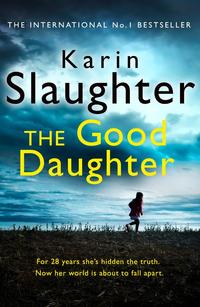
Kitabı oku: «The Good Daughter: The gripping new bestselling thriller from a No. 1 author»


Copyright
Published by HarperCollinsPublishers Ltd
1 London Bridge Street
London SE1 9GF
www.harpercollins.co.uk
First published in Great Britain by HarperCollinsPublishers Ltd 2017
Copyright © Karin Slaughter 2017
Cover design by Claire Ward © HarperCollinsPublishers Ltd. 2018. Cover photographs © Stephen Carroll/Arcangel Images
Excerpt from letter “To A” – Flannery O’Connor
Copyright © 1979 by Regina O’Connor
Reprinted by permission of the Mary Flannery O’Connor Charitable Trust via Harold Matson Co., Inc. All rights reserved.
Dr Seuss quotation from an interview in the L.A. Times reproduced by kind permission of the Dr Seuss estate
Karin Slaughter asserts the moral right to be identified as the author of this work.
A catalogue copy of this book is available from the British Library.
This novel is entirely a work of fiction. The names, characters and incidents portrayed in it are the work of the author’s imagination. Any resemblance to actual persons, living or dead, events or localities is entirely coincidental.
All rights reserved under International and Pan-American Copyright Conventions. By payment of the required fees, you have been granted the non-exclusive, non-transferable right to access and read the text of this e-book on screen. No part of this text may be reproduced, transmitted, down-loaded, decompiled, reverse engineered, or stored in or introduced into any information storage and retrieval system, in any form or by any means, whether electronic or mechanical, now known or hereinafter invented, without the express written permission of HarperCollins.
Source ISBN: 9780008150761
Ebook Edition © July 2017 ISBN: 9780008150785
Version: 2018-09-24
Epigraph
“… what you call my struggle to submit … is not struggle to submit but a struggle to accept and with passion. I mean, possibly, with joy. Picture me with my ground teeth stalking joy—fully armed too as it’s a highly dangerous quest.”
–Flannery O’Connor
Contents
Cover
Title Page
Copyright
Epigraph
Thursday, March 16, 1989
What Happened to Samantha
28 Years Later
Chapter 1
Chapter 2
Chapter 3
Chapter 4
Chapter 5
Chapter 6
What Happened to Charlotte
Chapter 7
Chapter 8
Chapter 9
Chapter 10
Chapter 11
Chapter 12
Chapter 13
Chapter 14
Chapter 15
What Really Happened to Charlie
Chapter 16
Chapter 17
Chapter 18
Chapter 19
What Happened to Sam
Acknowledgments
Cant’t wait for the next book from internationally-bestselling author Karin Slaughter?
About the Author
Also by Karin Slaughter
About the Publisher
Thursday, March 16, 1989
WHAT HAPPENED TO SAMANTHA
Samantha Quinn felt the stinging of a thousand hornets inside her legs as she ran down the long, forlorn driveway toward the farmhouse. The sound of her sneakers slapping bare earth bongoed along with the rapid thumps of her heart. Sweat had turned her ponytail into a thick rope that whipped at her shoulders. The twigs of delicate bones inside her ankles felt ready to snap.
She ran harder, choking down the dry air, sprinting into the pain.
Up ahead, Charlotte stood in their mother’s shadow. They all stood in their mother’s shadow. Gamma Quinn was a towering figure: quick blue eyes, short dark hair, skin as pale as an envelope, and with a sharp tongue just as prone to inflicting tiny, painful cuts in inconvenient places. Even from a distance, Samantha could see the thin line of Gamma’s disapproving lips as she studied the stopwatch in her hand.
The ticking seconds echoed inside Samantha’s head. She pushed herself to run faster. The tendons cording through her legs sent out a high-pitched wail. The hornets moved into her lungs. The plastic baton felt slippery in her hand.
Twenty yards. Fifteen. Ten.
Charlotte locked into position, turning her body away from Samantha, looking straight ahead, then started to run. She blindly stretched her right arm back behind her, waiting for the snap of the baton into the palm of her hand so that she could run the next relay.
This was the blind pass. The handoff took trust and coordination, and just like every single time for the last hour, neither one of them was up to the challenge. Charlotte hesitated, glancing back. Samantha lurched forward. The plastic baton skidded up Charlotte’s wrist, following the red track of broken skin the same as it had twenty times before.
Charlotte screamed. Samantha stumbled. The baton dropped. Gamma let out a loud curse.
“That’s it for me.” Gamma tucked the stopwatch into the bib pocket of her overalls. She stomped toward the house, the soles of her bare feet red from the barren yard.
Charlotte rubbed her wrist. “Asshole.”
“Idiot.” Samantha tried to force air into her shaking lungs. “You’re not supposed to look back.”
“You’re not supposed to rip open my arm.”
“It’s called a blind pass, not a freak-out pass.”
The kitchen door slammed shut. They both looked up at the hundred-year-old farmhouse, which was a sprawling, higgledy-piggledy monument to the days before licensed architects and building permits. The setting sun did nothing to soften the awkward angles. Not much more than an obligatory slap of white paint had been applied over the years. Tired lace curtains hung in the streaked windows. The front door was bleached a driftwoody gray from over a century of North Georgia sunrises. There was a sag in the roofline, a physical manifestation of the weight that the house had to carry now that the Quinns had moved in.
Two years and a lifetime of discord separated Samantha from her thirteen-year-old little sister, but she knew in this moment at least that they were thinking the same thing: I want to go home.
Home was a red-brick ranch closer to town. Home was their childhood bedrooms that they had decorated with posters and stickers and, in Charlotte’s case, green Magic Marker. Home had a tidy square of grass for a front yard, not a barren, chickenscratched patch of dirt with a driveway that was seventy-five yards long so that you could see who was coming.
None of them had seen who was coming at the red-brick house.
Only eight days had passed since their lives had been destroyed, but it felt like forever ago. That night, Gamma, Samantha and Charlotte had walked up to the school for a track meet. Their father was at work because Rusty was always at work.
Later, a neighbor recalled an unfamiliar black car driving slowly up the street, but no one had seen the Molotov cocktail fly through the bay window of the red-brick house. No one had seen the smoke billowing out of the eaves or the flames licking at the roof. By the time an alarm was raised, the red-brick house was a smoldering black pit.
Clothes. Posters. Diaries. Stuffed animals. Homework. Books. Two goldfish. Lost baby teeth. Birthday money. Purloined lipsticks. Secreted cigarettes. Wedding photos. Baby photos. A boy’s leather jacket. A love letter from that same boy. Mix tapes. CDs and a computer and a television and home.
“Charlie!” Gamma stood on the stoop outside the kitchen doorway. Her hands were on her hips. “Come set the table.”
Charlotte turned to Samantha and said, “Last word!” before she jogged toward the house.
“Dipshit,” Samantha muttered. You didn’t get the last word on something just by saying the words “last word.”
She moved more slowly toward the house on rubbery legs, because she wasn’t the moron who couldn’t reach back and wait for a baton to be slapped into her hand. She did not understand why Charlotte could not learn the simple handoff.
Samantha left her shoes and socks beside Charlotte’s on the kitchen stoop. The air inside the house was dank and still. Unloved, was the first adjective that popped into Samantha’s head when she walked through the door. The previous occupant, a ninety-six-year-old bachelor, had died in the downstairs bedroom last year. A friend of their father was letting them live in the farmhouse until things were worked out with the insurance company. If things could be worked out. Apparently, there was a disagreement as to whether or not their father’s actions had invited arson.
A verdict had already been rendered in the court of public opinion, which is likely why the owner of the motel they’d been staying at for the last week had asked them to find other accommodations.
Samantha slammed the kitchen door because that was the only way to make sure it closed. A pot of water sat idle on the olive-green stove. A box of spaghetti lay unopened on the brown laminate counter. The kitchen felt stuffy and humid, the most unloved space in the house. Not one item in the room lived in harmony with the others. The old-timey refrigerator farted every time you opened the door. A bucket under the sink shivered of its own accord. There was an embarrassment of mismatched chairs around the trembly chipboard table. The bowed plaster walls were spotted white where old photos had once hung.
Charlotte stuck out her tongue as she tossed paper plates onto the table. Samantha picked up one of the plastic forks and flipped it into her sister’s face.
Charlotte gasped, but not from indignation. “Holy crap, that was amazing!” The fork had gracefully somersaulted through the air and wedged itself between the crease of her lips. She grabbed the fork and offered it to Samantha. “I’ll wash the dishes if you can do that twice in a row.”
Samantha countered, “You toss it into my mouth once, and I’ll wash dishes for a week.”
Charlotte squinted one eye and took aim. Samantha was trying not to dwell on how stupid it was to invite her little sister to throw a fork in her face when Gamma walked in carrying a large cardboard box.
“Charlie, don’t throw utensils at your sister. Sam, help me look for that frying pan I bought the other day.” Gamma dropped the box onto the table. The outside was marked EVERYTHING $1 EA. There were dozens of partially unpacked boxes scattered through the house. They created a labyrinth through the rooms and hallways, all filled with thrift store donations that Gamma had bought for pennies on the dollar.
“Think of the money we’re saving,” Gamma had proclaimed, holding up a faded purple Church Lady T-shirt that read “Well, Isn’t That SPE-CIAL?”
At least that’s what Samantha thought the shirt said. She was too busy hiding in the corner with Charlotte, mortified that their mother expected them to wear other people’s clothes. Other people’s socks. Even other people’s underwear until thank God their father had put his foot down.
“For Chrissakes,” Rusty had yelled at Gamma. “Why not just sew us all up in sackcloth and be done with it?”
To which Gamma had seethed, “Now you want me to learn how to sew?”
Her parents argued about new things now because there were no longer any old things to argue about. Rusty’s pipe collection. His hats. His dusty law books splayed all over the house. Gamma’s journals and research papers with red lines and circles and notations. Her Keds kicked off by the front door. Charlotte’s kites. Samantha’s hair clips. Rusty’s mother’s frying pan was gone. The green crockpot Gamma and Rusty had gotten for a wedding present was gone. The burnt-smelling toaster oven was gone. The owl kitchen clock with the eyes that went back and forth. The hooks where they left their jackets. The wall that the hooks were mounted to. Gamma’s station wagon, which stood like a dinosaur fossil in the blackened cavern that had once been the garage.
The farmhouse contained five rickety chairs that had not been sold in the bachelor farmer’s estate sale, an old kitchen table that was too cheap to be called an antique and a large chiffarobe wedged into a small closet that their mother said they’d have to pay Tom Robinson a nickel to bust up.
Nothing hung in the chiffarobe. Nothing was folded into the keeping room drawers or placed on high shelves in the pantry.
They had moved into the farmhouse two days ago, but hardly any boxes had been unpacked. The hallway off the kitchen was a maze of mislabeled containers and stained brown paper bags that could not be emptied until the cabinets were cleaned, and the cabinets would not be cleaned until Gamma forced them to do it. The mattresses upstairs rested on bare floors. Overturned crates held cracked lamps to read by and the books that they read were not treasured possessions but on loan from the Pikeville public library.
Every night, Samantha and Charlotte hand-washed their running shorts and sports bras and ankle socks and Lady Rebels Track & Field T-shirts because these were among their few, precious possessions that had escaped the flames.
“Sam.” Gamma pointed to the air conditioner in the window. “Turn that thing on so we can get some air moving in here.”
Samantha studied the large, metal box before finding the ON button. Motors churned. Cold air with a tinge of wet fried chicken hissed through the vent. Samantha stared out the window at the side yard. A rusted tractor was near the dilapidated barn. Some unknown farming implement was half-buried in the ground beside it. Her father’s Chevette was caked in dirt, but at least it wasn’t melted to the garage floor like her mother’s station wagon.
She asked Gamma, “What time are we supposed to pick up Daddy from work?”
“He’ll get a ride from somebody at the courthouse.” Gamma glanced at Charlotte, who was happily whistling to herself as she tried to fold a paper plate into an airplane. “He has that case.”
That case.
The words bounced around inside Samantha’s head. Her father always had a case, and there were always people who hated him for it. There was not one low-life alleged criminal in Pikeville, Georgia, that Rusty Quinn would not represent. Drug dealers. Rapists. Murderers. Burglars. Car jackers. Pedophiles. Kidnappers. Bank robbers. Their case files read like pulp novels that always ended the same, bad way. Folks in town called Rusty the Attorney for the Damned, which was also what people had called Clarence Darrow, though to Samantha’s knowledge, no one had ever firebombed Clarence Darrow’s house for freeing a murderer from death row.
That was what the fire had been about.
Ezekiel Whitaker, a black man wrongly convicted of murdering a white woman, had walked out of prison the same day that a burning bottle of kerosene had been thrown through the Quinns’ bay window. In case the message wasn’t clear enough, the arsonist had also spray-painted the words NIGGER LOVER on the mouth of the driveway.
And now, Rusty was defending a man who’d been accused of kidnapping and raping a nineteen-year-old girl. White man, white girl, but still, tempers were running high because he was a white man from a trashy family and she was a white girl from a good one. Rusty and Gamma never openly discussed the case, but the details of the crime were so lurid that whispers around town had seeped in under the front door, mingled through the air vents, buzzed into their ears at night when they were trying to sleep.
Penetration with a foreign object.
Unlawful confinement.
Crimes against nature.
There were photographs in Rusty’s files that even nosy Charlotte knew better than to seek out, because some of the photos were of the girl hanging in the barn outside her family’s house because what the man had done to her was too horrible to live with, so she had taken her own life.
Samantha went to school with the dead girl’s brother. He was two years older than Samantha, but like everyone else, he knew who her father was and walking down the locker-lined hallway was like walking through the red-brick house while the flames stripped away her skin.
The fire hadn’t only taken her bedroom and her clothes and her purloined lipsticks. Samantha had lost the boy to whom the leather jacket had belonged, the friends who used to invite her to parties and movies and sleepovers. Even her beloved track coach who’d trained Samantha since sixth grade had started making excuses about not having enough time to work with her anymore.
Gamma had told the principal that she was keeping the girls out of school and track practice so that they could help unpack, but Samantha knew that it was because Charlotte had come home crying every day since the fire.
“Well, shit.” Gamma closed the cardboard box, giving up on the frying pan. “I hope you girls don’t mind being vegetarian tonight.”
Neither of them minded because it didn’t really matter. Gamma was an aggressively terrible cook. She resented recipes. She was openly hostile toward spices. Like a feral cat, she instinctively bristled against any domestication.
Harriet Quinn wasn’t called Gamma out of a precocious child’s inability to pronounce the word “Mama,” but because she held two doctorates, one in physics and one in something equally brainy that Samantha could never remember but, if she had to guess, had to do with gamma rays. Her mother had worked for NASA, then moved to Chicago to work at Fermilab before returning to Pikeville to take care of her dying parents. If there was a romantic story about how Gamma had given up her promising scientific career to marry a small-town lawyer, Samantha had never heard it.
“Mom.” Charlotte plopped down at the table, head in her hands. “My stomach hurts.”
Gamma asked, “Don’t you have homework?”
“Chemistry.” Charlotte looked up. “Can you help me?”
“It’s not rocket science.” Gamma dumped the spaghetti noodles into the pot of cold water on the stove. She twisted the knob to turn on the gas.
Charlotte crossed her arms low on her waist. “Do you mean, it’s not rocket science, so I should be able to figure it out on my own, or do you mean, it’s not rocket science, and that is the only science that you know how to perform, and so therefore you cannot help me?”
“There were too many conjunctions in that sentence.” Gamma used a match to light the gas. A sudden woosh singed the air. “Go wash your hands.”
“I believe I had a valid question.”
“Now.”
Charlotte groaned dramatically as she stood from the table and loped down the long hallway. Samantha heard a door open, then close, then another open, then close.
“Fudge!” Charlotte bellowed.
There were five doors off the long hallway, none of them laid out in any way that made sense. One door led to the creepy basement. One led to the chiffarobe. One of the middle doors inexplicably led to the tiny downstairs bedroom where the bachelor had died. Another led to the pantry. The remaining door led to the bathroom, and even after two days, none of them could quite retain the location in their long-term memory.
“Found it!” Charlotte called, as if they had all been breathlessly waiting.
Gamma said, “Grammar aside, she’s going to be a fine lawyer one day. I hope. If that girl doesn’t get paid to argue, she’s not going to get paid at all.”
Samantha smiled at the thought of her sloppy, disorganized sister wearing a blazer and carrying a briefcase. “What am I going to be?”
“Anything you want, my girl, just don’t do it here.”
This theme was coming up more often lately: Gamma’s desire for Samantha to move out, to get away, to do anything but whatever it was that women did here.
Gamma had never fit in with the Pikeville mothers, even before Rusty’s work had turned them into pariahs. Neighbors, teachers, people in the street, all had an opinion about Gamma Quinn, and it was seldom a positive one. She was too smart for her own good. She was a difficult woman. She didn’t know when to keep her mouth shut. She refused to fit in.
When Samantha was little, Gamma had taken up running. As with everything else, she had been athletic before it was popular, running marathons on the weekends, doing her Jane Fonda tapes in front of the television. It wasn’t just her athletic prowess that people found off-putting. You could not beat her at chess or Trivial Pursuit or even Monopoly. She knew all the questions on Jeopardy. She knew when to use who or whom. She could not abide misinformation. She disdained organized religion. In social situations, she had the strange habit of spouting obscure facts.
Did you know that pandas have enlarged wrist bones?
Did you know that scallops have rows of eyes along their mantles?
Did you know that the granite inside New York’s Grand Central Terminal gives off more radiation than what’s deemed acceptable at a nuclear power plant?
If Gamma was happy, if she enjoyed her life, if she was pleased with her children, if she loved her husband, were stray, unmatched pieces of information in the thousand-piece puzzle that was their mother.
“What’s taking your sister so long?”
Samantha leaned back in the chair and looked down the hall. All five doors were still closed. “Maybe she flushed herself down the toilet.”
“There’s a plunger in one of those boxes.”
The phone rang, a distinct jangling of a bell inside the old-fashioned rotary telephone on the wall. They’d had a cordless phone in the red-brick house, and an answering machine to screen all the calls that came in. The first time Samantha had ever heard the word “fuck” was on the answering machine. She was with her friend Gail from across the street. The phone was ringing as they walked through the front door, but Samantha had been too late to answer, so the machine had done the honors.
“Rusty Quinn, I will fuck you up, son. Do you hear me? I will fucking kill you, and rape your wife, and skin your daughters like I’m dressing a fucking deer, you fucking bleeding heart piece of shit.”
The phone rang a fourth time. Then a fifth.
“Sam.” Gamma’s tone was stern. “Don’t let Charlie answer that.”
Samantha stood from the table, leaving unsaid the “what about me?” She picked up the receiver and pressed it to her ear. Automatically, her chin tucked in, her jaw set, waiting for a punch. “Hello?”
“Hey there, Sammy-Sam. Lemme speak to your mama.”
“Daddy.” Samantha sighed out his name. And then she saw Gamma give a tight shake of her head. “She just went upstairs to take a bath.” Samantha realized too late that this was the same excuse she had given hours ago. “Do you want me to have her call you?”
Rusty said, “I feel our Gamma has been overly attentive to hygiene lately.”
“You mean since the house burned down?” The words slipped out before Samantha could catch them. The insurance agent at Pikeville Fire and Casualty wasn’t the only person who blamed Rusty Quinn for the fire.
Rusty chuckled. “Well, I appreciate you holding that back as long as you did.” His lighter clicked into the phone. Apparently, her father had forgotten about swearing on a stack of Bibles that he would quit smoking. “Now, listen, hon, tell Gamma when she gets out of the tub that I’m gonna have the sheriff send a car over.”
“The sheriff?” Samantha tried to convey her panic to Gamma, but her mother kept her back turned. “What’s wrong?”
“Nothing’s wrong, sugar. It’s just that they never caught that bad old fella who burned down the house, and today, another innocent man has gone free, and some people don’t like that, either.”
“You mean the man who raped that girl who killed herself?”
“The only people who know what happened to that girl are her, whoever committed the crime, and the Lord God in heaven. I don’t presume to be any of these people and I don’t opine that you should, either.”
Samantha hated when her father put on his country-lawyer-making-a-closing-argument voice. “Daddy, she hanged herself in a barn. That’s a proven fact.”
“Why is my life is riddled with contrary females?” Rusty put his hand over the phone and spoke to someone else. Samantha could hear a woman’s husky laugh. Lenore, her father’s secretary. Gamma had never liked her.
“All right now.” Rusty was back on the line. “You still there, honey?”
“Where else would I be?”
Gamma said, “Hang up the phone.”
“Baby.” Rusty blew out some smoke. “Tell me what you need me to do to make this better and I will do it immediately.”
An old lawyer’s trick; make the other person solve the problem. “Daddy, I—”
Gamma slammed her fingers down on the hook, ending the call.
“Mama, we were talking.”
Gamma’s fingers stayed hooked on the phone. Instead of explaining herself, she said, “Consider the etymology of the phrase ‘hang up the phone.’” She pulled the receiver from Samantha’s hand and hung it on the hook. “So, ‘pick up the phone’ even ‘off the hook,’ start to make sense. And of course you know the hook is a lever that, when depressed, opens up the circuit, indicating a call can be received.”
“The sheriff’s sending a car,” Samantha said. “Or, I mean, Daddy’s going to ask him to.”
Gamma looked skeptical. The sheriff was no fan of the Quinns. “You need to wash your hands for dinner.”
Samantha knew that there was no sense in trying to force further conversation. Not unless she wanted her mother to find a screwdriver and open the phone to explain the circuitry, which had happened with countless small appliances in the past. Gamma was the only mother on the block who changed the oil in her own car.
Not that they lived on a block anymore.
Samantha tripped on a box in the hallway. She grabbed her toes, holding onto them like she could squeeze out the pain. She had to limp the rest of the way to the bathroom. She passed her sister in the hallway. Charlotte punched her in the arm because that was the kind of thing Charlotte did.
The brat had closed the door, so Samantha had a false start before she found the bathroom. The toilet was low to the ground, installed back when people were shorter than they were now. The shower was a plastic corner unit with black mold growing inside the seams. A ball-peen hammer rested inside the sink. Black cast iron showed where the hammer had been repeatedly dropped into the bowl. Gamma had been the one to figure out why. The faucet was so old and rusted that you had to whack the tap handle to keep it from dripping.
“I’ll fix that this weekend,” Gamma had said, setting a reward for herself at the end of what would clearly be a difficult week.
As usual, Charlotte had left a mess in the tiny bathroom. Water pooled on the floor and flecked the mirror. Even the toilet seat was wet. Samantha reached for the roll of paper towels hanging on the wall, then changed her mind. From the beginning, the house had felt temporary, but now that her father had pretty much said he was sending the sheriff because it might get firebombed like the last one, cleaning seemed like a waste of time.
“Dinner!” Gamma called from the kitchen.
Samantha splashed water on her face. Her hair felt gritty. Streaks of red coated her calves and arms where clay had mixed in with her sweat. She wanted to soak in a hot bath, but there was only one bathtub in the house, claw-footed with a dark rust-colored ring around the lip from where the previous occupant had for decades sloughed the earth from his skin. Even Charlotte wouldn’t get in the tub, and Charlotte was a pig.
“It feels too sad in here,” her sister had said, slowly backing out of the upstairs bathroom.
The tub was not the only thing that Charlotte found unsettling. The spooky, damp basement. The creepy, bat-filled attic. The creaky closet doors. The bedroom where the bachelor farmer had died.
There was a photo of the bachelor farmer in the bottom drawer of the chiffarobe. They had found it this morning on the pretense of cleaning. Neither dared to touch it. They had stared down at the lonesome, round face of the bachelor farmer and felt overwhelmed by something sinister, though the photo was just a typical depression-era farm scene with a tractor and a mule. Samantha felt haunted by the sight of the farmer’s yellow teeth, though how something could look yellow in a black-and-white photo was a mystery.
“Sam?” Gamma stood in the bathroom doorway, looking at their reflections in the mirror.
No one had ever mistaken them for sisters, but they were clearly mother and child. They shared the same strong jawline and high cheekbones, the same arch to their eyebrows that most people took for aloofness. Gamma wasn’t beautiful, but she was striking, with dark, almost black hair and light blue eyes that sparkled with delight when she found something particularly funny or ridiculous. Samantha was old enough to remember a time when her mother took life a lot less seriously.
Gamma said, “You’re wasting water.”
Samantha tapped the faucet closed with the small hammer and dropped it back into the sink. She heard a car pulling up the driveway. The sheriff’s man, which was surprising because Rusty rarely followed through on his promises.
Gamma stood behind her. “Are you still sad about Peter?”
The boy whose leather jacket had burned in the fire. The boy who had written Samantha a love letter, but would no longer look her in the eye when they passed each other in the school hallway.
Gamma said, “You’re pretty. Do you know that?”
Sam pushed against Charlie, letting her know it was time to move. Charlie didn’t move. She held tight.
“The hell you will.” Zach thumped Hightop in the chest. “You think I’m gonna go down on a murder charge ’cause you grew a fucking conscience?”
Sam let go of her sister’s hand. She whispered, “Charlie, run.”
“I won’t tell,” Hightop said. “I’ll say it was me.”
“In my got-damn truck?”
Charlie tried to take Sam’s hand again. Sam pulled away, whispering, “Go.”
“Motherfucker.” Zach raised the shotgun, pointing it at Hightop’s chest. “This is what’s gonna happen, son. You’re gonna take my knife and you’re gonna slice open that bitch’s throat, or I will blow a hole in your chest the size of Texas.” He stamped his foot. “Right now.”
Hightop slung up the revolver, pointing it at Zach’s head. “We’re gonna turn ourselves in.”
“Get that fucking gun outta my face, you pansy-ass piece of shit.”
Sam nudged Charlie. She had to move. She had to get out of here. There would only be one chance. She practically begged her sister, “Go.”
Hightop said, “I’ll kill you before I kill them.”
“You ain’t got the balls to pull that trigger.”
“I’ll do it.”
Charlie still wouldn’t budge. Her teeth were chattering again.
“Run,” Sam pleaded. “You have to run.”
“Rich boy piece of shit.” Zach spat on the ground. He went to wipe his mouth, but only as a distraction. He reached out for the revolver. Hightop had anticipated the move. He backhanded the shotgun. Zach was thrown off balance. He couldn’t keep his footing. He fell back, arms flailing.
“Run!” Sam shoved her sister away. “Charlie, go!”
Charlie turned into a blur of motion. Sam started to follow, leg raised, arm bent—
Another explosion.
A flash of light from the revolver.
A sudden vibration in the air.
Sam’s head jerked so violently that her neck cracked. Her body followed in a wild twist. She spun like a top, falling into darkness the same way Alice fell into the rabbit hole.
Do you know how pretty you are?
Sam’s feet hit the ground. She felt her knees absorb the shock.
She looked down.
Her toes were spread flat against a water-soaked hardwood floor.
She looked up to find her reflection staring back from a mirror.
Inexplicably, Sam was at the farmhouse standing at the bathroom sink.
Gamma stood behind her, strong arms wrapped around Sam’s waist. Her mother looked younger, softer, in the mirror. Her eyebrow was arched up as if she’d heard something dubious. This was the woman who’d explained the difference between fission and fusion to a stranger at the grocery store. Who’d devised complicated scavenger hunts that took up all of their Easters.
What were the clues now?
“Tell me,” Sam asked her mother’s reflection. “Tell me what you want me to do.”
Gamma’s mouth opened, but she did not speak. Her face began to age. Sam felt a longing for the mother she would never see grow old. Fine lines spread out from Gamma’s mouth. Crow’s feet around her eyes. The wrinkles deepened. Streaks of gray salted her dark hair. Her jawline grew fuller.
Her skin began to peel away.
White teeth showed through an open hole in her cheek. Her hair turned into greasy white twine. Her eyes grew desiccated. She wasn’t aging.
She was decomposing.
Sam struggled to get away. The smell of death enveloped her: wet earth, fresh maggots burrowing underneath her skin. Gamma’s hands clamped around her face. She made Sam turn around. Fingers reduced to dry bone. Black teeth honed into razor blades as Gamma opened her mouth and screamed, “I told you to get out!”
Sam gasped awake.
Her eyes slit open onto an impenetrable blackness.
Dirt filled her mouth. Wet soil. Pine needles. Her hands were in front of her face. Hot breath bounced against her palms. There was a sound—
Shsh. Shsh. Shsh.
A broom sweeping.
An ax swinging.
A shovel dropping dirt into a grave.
Sam’s grave.
She was being buried alive. The weight of the soil on top of her was like a metal plate.
“I’m sorry.” Hightop’s voice caught around the words. “Please, God, please forgive me.”
The dirt kept coming, the weight turning into a vise that threatened to press the breath right out of her.
Did you know that Giles Corey was the only defendant in the Salem witch trials who was pressed to death?
Tears filled Sam’s eyes, slid down her face. A scream got trapped inside her throat. She couldn’t panic. She couldn’t start yelling or flailing because they would not help her. They would shoot her again. Begging for her life would only speed up the taking of her life.
“Don’t be silly,” Gamma said. “I thought you were past that teenager stage.”
Sam inhaled a shaky breath.
She startled as she realized that air was entering her lungs.
She could breathe!
Her hands were cupped to her face, creating an air pocket inside the dirt. Sam tightened the seal between her palms. She forced her breaths to slow in order to preserve what precious air she had left.
Charlie had told her to do this. Years ago. Sam could picture her sister in her Brownie uniform. Arms and legs like tiny sticks. Her creased yellow shirt and brown vest with all the patches she had earned. She had read aloud from her Adventure handbook at the breakfast table.
“‘If you find yourself caught in an avalanche, do not cry out or open your mouth,’” Charlie had read. “‘Put your hands in front of your face and try to create an airspace as you are coming to a stop.’”
Sam stuck out her tongue, trying to see how far away her hands were. She guessed a quarter of an inch. She flexed her fingers, trying to elongate the pocket of air. There was nothing to move into. The dirt was packed tightly around her hands, almost like cement.
She tried to glean the position of her body. She wasn’t flat on her back. Her left shoulder was pressed to the ground, but she wasn’t fully lying on her side, either. Her hips were turned at an angle to her shoulders. Cold seeped into the back of her running shorts. Her right knee was bent, her left leg was straight.
Torso twist.
A runner’s stretch. Her body had fallen into a familiar position.
Sam tried to shift her weight. She couldn’t move her legs. She tried her toes. Her calf muscles. Her hamstrings.
Nothing.
Sam closed her eyes. She was paralyzed. She would never walk again, run again, move again without assistance. Panic rushed into her chest like a swarm of mosquitos. Running was all that she had. It was who she was. What was the point of trying to survive if she could never use her legs again?
She pressed her face into her hands so that she wouldn’t cry out.
Charlie could still run. Sam had watched her sister bolt toward the forest. It was the last thing she’d seen before the revolver went off. Sam conjured into her mind the image of Charlie sprinting, her spindly legs moving impossibly fast as she flew forward, away, never hesitating, never stopping to look back.
Don’t think about me, Sam begged, the same thing she had told her sister a million times before. Just concentrate on yourself and keep running.
Had Charlie made it? Had she found help? Or had she looked over her shoulder to see if Sam was following and instead found Zachariah Culpepper’s shotgun jammed into her face?
Or worse.
Sam forced the thought from her mind. She saw Charlie running free, getting help, bringing the police back to the grave because she had their mother’s sense of direction and she never got lost and she would remember where her sister was buried.
Sam counted out the beats of her heart until she felt them slow to a less frantic pace.
And then she felt a tickle in her throat.
Everything was filled with dirt—her ears, nose, mouth, lungs. She couldn’t stop the cough that wanted to come out of her mouth. Her lips opened. The reflexive intake of air pulled more dirt into her nose. She coughed again, then again. The third time was so hard that she felt her stomach cramp as her body strained to pull itself into a ball.
Sam felt a jolt in her heart.
Her legs had twitched.
Panic and fear had cut off the vital connections between her brain and her musculature. She had not been paralyzed; she had been terrified, some ancient fight or flight mechanism pushing her out of her own body until she could understand what was happening. Sam felt elation as sensation slowly returned to her lower body. It was as if she was walking into a pool of water. At first, she could feel her toes spreading through the thick earth. Then her ankles were able to bend. Then she felt the tiniest amount of movement in her ankles.
If she could move her feet, what else could she move?
Sam flexed her calves, warming them up. Her quads started to fire. Her knees tensed. She concentrated on her legs, telling herself that they could move until her body sent back the message that yes, her legs could move.
She was not paralyzed. She had a chance.
Gamma always said that Sam had learned how to run before she’d learned how to walk. Her legs were the strongest part of her body.
She could kick her way out.
Sam worked her legs, making infinitesimal motions back and forth, trying to burrow through the heavy layer of dirt. Her breath grew hot in her hands. A dense fog clouded out the panic in her brain. Was she using up too much air? Did it matter? She kept losing track of what she was doing. Her lower body was moving back and forth and sometimes she found herself thinking she was lying on the deck of a tiny boat rocking on the ocean and then she would come to, would realize that she was trapped underground and struggle to move faster, harder, only to be lulled back onto the boat again.
She tried to count: One Mississippi, two Mississippi, three Mississippi …
Her legs cramped. Her stomach cramped. Everything cramped. Sam made herself stop, if only for a few seconds. The rest was almost as painful as the effort. Lactic acid boiled off her spent muscles, causing her stomach to churn. Her vertebrae had twisted into overtightened bolts that pinched the nerves and shot an electric pain into her neck and legs. Every breath was caught in her hands like a trapped bird.
“‘There is a fifty percent chance of survival,’” Charlie had read from her Adventure book. “‘But only if the victim is found within one hour.’”
Sam didn’t know how long she’d been in the grave. Like losing the red-brick house, like watching her mother die, that had been a lifetime ago.
She tightened her stomach muscles and tried a sideways push-up. Her arm tensed. Her neck strained. The earth pressed back, grinding her shoulder into the wet soil.
She needed more room.
Sam tried to rock her hips. There was an inch of space at first, then two inches, then she could move her waist, her shoulder, her neck, her head.
Was there suddenly more space between her mouth and her hands?
Sam stuck out her tongue again. She felt the tip brush against the gap between her two palms. That was half an inch, at least.
Progress.
She worked on her arms next, shifting them up and down, up and down. There were no inches this time. Centimeters, then millimeters of dirt shifted. She had to keep her hands in front of her face so she could breathe. But then she realized that she had to dig with her hands.
One hour. That was all Charlie had given her. Sam’s time had to be running out. Her palms were hot, bathed in condensation. Her brain was awash in dizziness.
Sam took a last, deep breath.
She pushed her hands away from her face. Her wrists felt like they were going to break as she twisted her hands around. She pressed together her lips, gritted her teeth, and clawed at the ground, furiously trying to dislodge the dirt.
And still the earth pushed back.
Her shoulders ignited in pain. Trapezoids. Rhomboids. Scapulae. Hot irons pierced her biceps. Her fingers felt like they were going to snap. Her nails chipped off. The skin on her knuckles peeled away. Her lungs were going to collapse. She couldn’t keep holding her breath. She couldn’t keep fighting. She was tired. She was alone. Her mother was dead. Her sister was gone. Sam started to yell, first in her head, then through her mouth. She was so angry—furious at her mother for grabbing the shotgun, livid with her father for bringing this hell to their doorstep, pissed at Charlie for not being stronger, and fucking apoplectic that she was going to die in this God damn grave.
Shallow grave.
Cool air wrapped around her fingers.
She had broken through the soil. Less than two feet separated Sam from life and death.
There was no time to rejoice. She had no air in her lungs, no hope unless she could keep digging.
She flicked away debris with her fingers. Leaves. Pine cones. Her murderer had tried to hide the freshly dug earth but he hadn’t counted on the girl inside climbing her way out. She grabbed a handful of dirt, then another, then kept going until she was able to clench her abdominal muscles one last time and leverage herself up.
Sam gagged on the sudden rush of fresh air. She spat out dirt and blood. Her hair was matted. She touched her fingers to the side of her scalp. Her pinky slipped into a tiny hole. The bone was smooth inside the circle. This was where the bullet had gone in. She had been shot in the head.
She had been shot in the head.
Sam took away her hand. She dared not wipe her eyes. She squinted into the distance. The forest was a blur. She saw two fat dots of light floating like lazy bumblebees in front of her face.
She heard the trickling of water, echoing, like through an access tunnel that snaked underneath a weather tower and led to a paved road.
Another pair of lights floated by.
Not bumblebees.
Headlights.
28 Years Later
1
Charlie Quinn walked through the darkened halls of Pikeville middle school with a gnawing sense of trepidation. This wasn’t an early morning walk of shame. This was a walk of deeply held regret. Fitting, since the first time she’d had sex with a boy she shouldn’t have had sex with was inside this very building. The gymnasium, to be exact, which just went to show that her father had been right about the perils of a late curfew.
She gripped the cell phone in her hand as she turned a corner. The wrong boy. The wrong man. The wrong phone. The wrong way because she didn’t know where the hell she was going. Charlie turned around and retraced her steps. Everything in this stupid building looked familiar, but nothing was where she remembered it was supposed to be.
She took a left and found herself standing outside the front office. Empty chairs were waiting for the bad students who would be sent to the principal. The plastic seats looked similar to the ones in which Charlie had whiled away her early years. Talking back. Mouthing off. Arguing with teachers, fellow students, inanimate objects. Her adult self would’ve slapped her teenage self for being such a pain in the ass.
She cupped her hand to the window and peered inside the dark office. Finally, something that looked how it was supposed to look. The high counter where Mrs. Jenkins, the school secretary, had held court. Pennants drooping from the water-stained ceiling. Student artwork taped to the walls. A lone light was on in the back. Charlie wasn’t about to ask Principal Pinkman for directions to her booty call. Not that this was a booty call. It was more of a “Hey, girl, you picked up the wrong iPhone after I nailed you in my truck at Shady Ray’s last night” call.
There was no point in Charlie asking herself what she had been thinking, because you didn’t go to a bar named Shady Ray’s to think.
The phone in her hand rang. Charlie saw the unfamiliar screen saver of a German Shepherd with a Kong toy in its mouth. The caller ID read SCHOOL.
She answered, “Yes?”
“Where are you?” He sounded tense, and she thought of all the hidden dangers that came from screwing a stranger she’d met in a bar: incurable venereal diseases, a jealous wife, a murderous baby mama, an obnoxious Alabama affiliation.
She said, “I’m in front of Pink’s office.”
“Turn around and take your second right.”
“Yep.” Charlie ended the call. She felt herself wanting to puzzle out his tone of voice, but then she told herself that it didn’t matter because she was never going to see him again.
She walked back the way she’d come, her sneakers squeaking on the waxed floor as she made her way down the dark hallway. She heard a snap behind her. The lights had come on in the front office. A hunched old woman who looked suspiciously like the ghost of Mrs. Jenkins shuffled her way behind the counter. Somewhere in the distance, heavy metal doors opened and closed. The beep-whir of the metal detectors swirled into her ears. Someone jangled a set of keys.
The air seemed to contract with each new sound, as if the school was bracing itself for the morning onslaught. Charlie looked at the large clock on the wall. If the schedule was still the same, the first homeroom bell would ring soon, and the kids who had been dropped off early and warehoused in the cafeteria would flood the building.
Charlie had been one of those kids. For a long time, whenever she thought of her father, her mind conjured up the scene of his arm leaning out of the Chevette’s window, freshly lit cigarette between his fingers, as he pulled out of the school parking lot.
She stopped walking.
The room numbers finally caught her attention, and she knew immediately where she was. Charlie touched her fingers to a closed wooden door. Room three, her safe haven. Ms. Beavers had retired eons ago, but the old woman’s voice echoed in Charlie’s ears: “They’ll only get your goat if you show them where you keep your hay.”
Charlie still didn’t know what that meant, exactly. You could extrapolate that it had something to do with the extended Culpepper clan, who had bullied Charlie relentlessly when she’d finally returned to school.
Or, you could take it that, as a girls’ basketball coach named Etta Beavers, the teacher knew what it felt like to be taunted.
There was no one who could give Charlie advice on how to handle the present situation. For the first time since college, she’d had a one-night stand. Or a one-night sit, if it boiled down to the exact position. Charlie wasn’t the type of person who did that sort of thing. She didn’t go to bars. She didn’t drink to excess. She didn’t really make hugely regrettable mistakes. At least not until recently.
Her life had started to unspool back in August of last year. Charlie had spent almost every waking hour since then raveling out mistake after mistake. Apparently, the new month of May was not going to see any improvement. The blunders were now starting before she even got out of bed. This morning, she’d been wide awake on her back, staring up at the ceiling, trying to convince herself that what had happened last night had not happened at all when an unfamiliar ringtone had come from her purse.
She had answered because wrapping the phone in aluminum foil, throwing it into the dumpster behind her office and buying a new phone that would restore from her old phone backup did not occur to her until after she had said hello.
The short conversation that followed was of the kind you would expect between two total strangers: Hello, person whose name I must have asked for but now can’t recall. I believe I have your phone.
Charlie had offered to meet the man at his work because she didn’t want him to know where she lived. Or worked. Or what kind of car she drove. Between his pickup truck and his admittedly exquisite body, she’d thought he’d tell her he was a mechanic or a farmer. Then he’d said that he was a teacher and she’d instantly flashed up a Dead Poets Society kind of thing. Then he’d said he taught middle school and she’d jumped to the unfounded conclusion that he was a pedophile.
“Here.” He stood outside an open door at the far end of the hall.
As if on cue, the overhead fluorescents popped on, bathing Charlie in the most unflattering light possible. She instantly regretted her choice of ratty jeans and a faded, long-sleeved Duke Blue Devils basketball T-shirt.
“Good Lord God,” Charlie muttered. No such problems at the end of the hall.
Mr. I-Can’t-Remember-Your-Name was even more attractive than she remembered. The standard button-down-with-khakis uniform of a middle-school teacher couldn’t hide the fact that he had muscles in places that men in their forties had generally replaced with beer and fried meat. His scraggly beard was more of a five o’clock shadow. The gray at his temples gave him a wizened air of mystery. He had one of those dimples in his chin that you could use to open a bottle.
This was not the type of man Charlie dated. This was the exact type of man that she studiously avoided. He felt too coiled, too strong, too unknowable. It was like playing with a loaded gun.
“This is me.” He pointed to the bulletin board outside his room. Small handprints were traced onto white butcher paper. Purple cut-out letters read MR. HUCKLEBERRY.
“Huckleberry?” Charlie asked.
“It’s Huckabee, actually.” He held out his hand. “Huck.”
Charlie shook his hand, too late realizing that he was asking for his iPhone. “Sorry.” She handed him the phone.
He gave her a crooked smile that had probably sent many a young girl into puberty. “Yours is in here.”
Charlie followed him into the classroom. The walls were adorned with maps, which made sense because he was apparently a history teacher. At least if you believed the sign that said MR. HUCKLEBERRY LOVES WORLD HISTORY.
She said, “I may be a little sketchy on last night, but I thought you said you were a Marine?”
“Not anymore, but it sounds sexier than middle-school teacher.” He gave a self-deprecating laugh. “Joined up when I was seventeen, took my retirement six years ago.” He leaned against his desk. “I was looking for a way to keep serving, so I got my master’s on a GI bill and here we are.”
“I bet you get a lot of tear-stained cards on Valentine’s Day.” Charlie would’ve failed history every single day of her life if her teacher had looked like Mr. Huckleberry.
He asked, “Do you have kids?”
“Not that I know of.” Charlie didn’t return the question. She assumed that someone with kids wouldn’t use a photo of his dog as his screen saver. “You married?”
He shook his head. “Didn’t suit me.”
“It suited me.” She explained, “We’ve been officially separated for nine months.”
“Did you cheat on him?”
“You’d think so, but no.” Charlie ran her finger along the books on the shelf by his desk. Homer. Euripides. Voltaire. Brontë. “You don’t strike me as the Wuthering Heights type.”
He grinned. “Not much talking in the truck.”
Charlie started to return the grin, but regret pulled down the corners of her mouth. In some ways, this easy, flirty banter felt like more of a transgression than the physical act of sex. She bantered with her husband. She asked inane questions of her husband.
And last night, for the first time in her married life, she had cheated on her husband.
Huck seemed to sense her mood shift. “It’s obviously none of my business, but he’s nuts for letting you go.”
“I’m a lot of work.” Charlie studied one of the maps. There were blue pins in most of Europe and some of the Middle East. “You go to all of these places?”
He nodded, but didn’t elaborate.
“Marines,” she said. “Were you a Navy SEAL?”
“Marines can be SEALs but not all SEALs are Marines.”
Charlie was about to tell him that he hadn’t answered the question, but Huck spoke first.
“Your phone started ringing at o’dark thirty.”
Her heart flipped in her chest. “You didn’t answer?”
“Nah, it’s much more fun trying to figure you out from your caller ID.” He pushed himself up on the desk. “B2 called around five this morning. I’m assuming that’s your hook-up at the vitamin shop.”
Charlie’s heart flipped again. “That’s Riboflavin, my spin-class instructor.”
He narrowed his eyes, but he didn’t push her. “The next call came at approximately five fifteen, someone who showed up as Daddy, who I deduce by the lack of the word ‘sugar’ in front of the name is your father.”
She nodded, even as her mother’s voice silently stressed that it was whom. “Any other clues?”
He pretended to stroke a long beard. “Beginning around five thirty, you got a series of calls from the county jail. At least six, spaced out about five minutes apart.”
“You got me, Nancy Drew.” Charlie held up her hands in surrender. “I’m a drug trafficker. Some of my mules got picked up over the weekend.”
He laughed. “I’m halfway believing you.”
“I’m a defense lawyer,” she admitted. “Usually people are more receptive to drug trafficker.”
Huck stopped laughing. His eyes narrowed again, but the playfulness had evaporated. “What’s your name?”
“Charlie Quinn.”
She could’ve sworn he flinched.
She asked, “Is there a problem?”
His jaw was clenched so hard the bone jutted out. “That’s not the name on your credit card.”
Charlie paused, because there was a lot wrong with that statement. “That’s my married name. Why were you looking at my credit card?”
“I wasn’t looking. I glanced at it when you put it down on the bar.” He stood up from the desk. “I should get ready for school.”
“Was it something I said?” She was trying to make a joke out of it, because of course it was something she’d said. “Look everybody hates lawyers until they need one.”
“I grew up in Pikeville.”
“You’re saying that like it’s an explanation.”
He opened and closed the desk drawers. “Homeroom’s about to start. I need to do my first-period prep.”
Charlie crossed her arms. This wasn’t the first time she’d had this conversation with long-time Pikeville residents. “There’s two reasons for you to be acting like you’re acting.”
He ignored her, opening and closing another drawer.
She counted out the possibilities on her fingers. “Either you hate my father, which is okay, because a lot of people hate him, or—” She held up her finger for the more likely excuse, the one that had put a target on Charlie’s back twenty-eight years ago when she’d returned to school, the one that still got her nasty looks in town from the people who supported the extended, inbred Culpepper clan. “You think I’m a spoiled little bitch who helped frame Zachariah Culpepper and his innocent baby brother so my dad could get his hands on some pissant life insurance policy and their shitty little trailer. Which he never did, by the way. He could’ve sued them for the twenty grand they owed in legal bills, but he didn’t. Not to mention I could pick those fuckers out of a line-up with my eyes closed.”
He was shaking his head before she even finished. “None of those things.”
“Really?” She had pegged him for a Culpepper truther when he’d told her that he’d grown up in Pikeville.
On the other hand, Charlie could see a career-Marine hating Rusty’s kind of lawyering right up until that Marine got caught with a little too much Oxy or a lot too much hooker. As her father always said, a Democrat is a Republican who’s been through the criminal justice system.
She told Huck, “Look, I love my dad, but I don’t practice the same kind of law that he does. Half my caseload is in juvenile court, the other half is in drug court. I work with stupid people who do stupid things, who need a lawyer to keep the prosecutor from overcharging them.” She held out her hands in a shrug. “I just level the playing field.”
Huck glared at her. His initial anger had escalated to furious in the blink of an eye. “I want you to leave my room. Right now.”
His hard tone made Charlie take a step back. For the first time, it occurred to her that no one knew she was at the school and that Mr. Huckleberry could probably break her neck with one hand.
“Fine.” She snatched her phone off his desk and started toward the door. Even as Charlie was telling herself she should shut up and go, she swung back around. “What did my father ever do to you?”
Huck didn’t answer. He was sitting at his desk, head bent over a stack of papers, red ink pen in hand.
Charlie waited.
He tapped the pen on his desk, a drumbeat of a dismissal.
She was about to tell him where to stick the pen when she heard a loud crack echo down the hallway.
Three more cracks followed in quick succession.
Not a car backfiring.
Not fireworks.
A person who has been up close when a gun is fired into another human being never mistakes the sound of a gunshot for something else.
Charlie was yanked down to the floor. Huck threw her behind a filing cabinet, shielding her body with his own.
He said something—she saw his mouth move—but the only sound she could hear was the gunshots echoing inside her head. Four shots, each a distinctive, terrifying echo to the past. Just like before, her mouth went dry. Just like before, her heart stopped beating. Her throat closed. Her vision tunneled. Everything looked small, narrowed to a single, tiny point.
Huck’s voice rushed back in. “Active shooter at the middle school,” he whispered calmly into his phone. “Sounds like he’s near the principal’s—”
Another crack.
Another bullet fired.
Then another.
Then the homeroom bell rang.
“Jesus,” Huck said. “There’s at least fifty kids in the cafeteria. I have to—”
A blood-curdling scream broke off the rest of his words.
“Help!” a woman yelled. “Please, help us!”
Charlie blinked.
Gamma’s chest exploding.
She blinked again.
Blood misting from Sam’s head.
Charlie, run!
She was out the door before Huck could stop her. Her legs pistoned. Her heart pounded. Her sneakers gripped the waxy floor but in her mind, she could feel the earth moving against her bare feet, tree limbs slicing into her face, fear cinching a length of barbed wire around her chest.
“Help us!” the woman cried. “Please!”
Huck caught up with Charlie as she rounded the corner. He was nothing more than a blur as her vision tunneled again, this time to the three people at the end of the hallway.
A man’s feet pointed up at the ceiling.
Behind him, to his right, a smaller set of feet splayed out.
Pink shoes. White stars on the soles. Lights that would flash when she walked.
An older woman knelt beside the little girl rocking back and forth, wailing.
Charlie wanted to wail, too.
Blood had sprayed the plastic chairs outside the office, splattered onto the walls and ceiling, jetted onto the floors.
There was a familiarity to the carnage that spread a numbness through Charlie’s body. She slowed to a jog, then a brisk walk. She had seen this before. She knew that you could put it all in a little box and close it up later, that you could go on with your life if you didn’t sleep too much, didn’t breathe too much, didn’t live too much so that death came back and snatched you away for the taking.
Somewhere, a set of doors banged open. Loud footsteps clumped through the hallways. Voices were raised. Screaming. Crying. Words were being shouted, but they were unintelligible to Charlie. She was underwater. Her body moved slowly, arms and legs floating against an exaggerated gravity. Her brain silently cataloged all of the things that she did not want to see.
Mr. Pinkman was on his back. His blue tie was tossed over his shoulder. Blood mushroomed from the center of his white dress shirt. The left side of his head was open, skin hanging like tattered paper around the white of his skull. There was a deep, black hole where his right eye should have been.
Mrs. Pinkman was not beside her husband. She was the screaming woman who had suddenly stopped screaming. She was cradling the child’s head in her lap, holding a pastel blue sweater to the girl’s neck. The bullet had ripped open something vital. Mrs. Pinkman’s hands were bright red. Blood had turned the diamond on her wedding ring the color of a cherry pit.
Charlie’s knees gave out.
She was on the floor beside the girl.
She was seeing herself lying on the ground in the forest.
Twelve? Thirteen?
Spindly little legs. Short black hair like Gamma. Long eyelashes like Sam.
“Help,” Mrs. Pinkman whispered, her voice hoarse. “Please.”
Charlie reached out her hands, not knowing where to put them. The little girl’s eyes rolled up, then just as suddenly, she focused on Charlie.
“It’s okay,” Charlie told her. “You’ll be okay.”
“Go before this lamb, oh Lord,” Mrs. Pinkman prayed. “Be not far from her. Make haste to help her.”
You won’t die, Charlie’s brain begged. You won’t surrender. You will graduate high school. You will go to college. You will get married. You will not leave a gaping hole in your family where your love used to be.
“Make haste to guide me, oh Lord my salvation.”
“Look at me,” Charlie told the girl. “You’re going to be fine.”
The girl was not going to be fine.
Her eyelids began to flutter. Her blue-tinged lips parted. Tiny teeth. White gums. The light pink tip of her tongue.
Slowly, the color began to drain from her face. Charlie was reminded of the way winter came down the mountain, the festive red and orange and yellow leaves turning umber, then brown, then starting to fall, so that by the time the cold reached its icy fingers into the foothills outside of town, everything was dead.
“Oh God,” Mrs. Pinkman sobbed. “Little angel. Poor little angel.”
Charlie couldn’t remember taking the child’s hand, but there were her little fingers caught between Charlie’s bigger ones. So small and cold, like a lost glove on the playground. Charlie watched the fingers slowly release until the girl’s hand fell slack to the floor.
Gone.
“Code Black!”
Charlie jerked at the sound.
“Code Black!” A cop was running up the hallway. He had his radio in one hand, a shotgun in the other. Panic cracked his voice. “Get to the school! Get to the school!”
For a brief second, the man made eye contact with Charlie. There was a spark of recognition, and then he saw the body of the dead child. Horror, then grief collapsed his features. The toe of his shoe caught a streak of blood. His feet slipped out from underneath him. He fell hard to the ground. His breath oofed out of his open mouth. The shotgun flew from his hand and skittered across the floor.
Charlie looked down at her own hand, the one that had held the child’s. She rubbed together her fingers. The blood was sticky, not like Gamma’s, which had felt slick like oil.
Bright white bone. Pieces of heart and lung. Cords of tendon and arteries and veins and life spilling out of her gaping wounds.
She remembered going back to the farmhouse after it was all over. Rusty had hired someone to clean, but they hadn’t done a thorough job. Months later, Charlie was looking for a bowl at the back of one of the cabinets and she’d found a piece of Gamma’s tooth.
“Don’t!” Huck yelled.
Charlie looked up, shocked by what she saw. What she had missed. What at first she couldn’t comprehend even though it was taking place less than fifty feet in front of her.
A teenage girl was sitting on the floor, her back to the lockers. Charlie’s brain flashed up an image from before, the girl sneaking into the edge of her tunnel vision as Charlie ran up the hallway toward the carnage. Charlie had instantly recognized the girl’s type: black clothes, black eyeliner. A Goth. No blood. Round face showing shock, not pain. She’s okay, Charlie had thought, running past her to reach Mrs. Pinkman, to reach the child. But the Goth girl wasn’t okay.
She was the shooter.
She had a revolver in her hand. Instead of picking off more victims, she was pointing the gun at her own chest.
“Put it down!” The cop was standing a few yards away, his shotgun jammed into his shoulder. Terror informed his every movement, from the way he was bouncing on the balls of his feet to the death grip he had on the weapon. “I said put it the fuck down!”
“She will.” Huck knelt with his back to the girl, shielding her. His hands were up. His voice was steady. “It’s okay, Officer. Let’s stay calm here.”
“Get out of my way!” The cop wasn’t calm. He was amped up, ready to pull the trigger the moment he got a clean shot. “Get the fuck out of my way!”
“Her name is Kelly,” Huck said. “Kelly Wilson.”
“Fucking move, asshole!”
Charlie didn’t watch the men. She watched the weapons.
Revolver and shotgun.
Shotgun and revolver.
She felt a wave pass through her body, the same kind of anesthesia that had numbed her so many times before.
“Move!” the cop screamed. He jerked the shotgun one way, then the other, trying to angle around Huck. “Get the fuck out of my way!”
“No.” Huck stayed on his knees, his back to Kelly. His hands stayed in the air. “Don’t do this, man. She’s only sixteen years old. You don’t want to kill a—”
“Move out of my way!” The cop’s fear was like an electric current crackling the air. “Get on the floor!”
“Stop it, man.” Huck moved with the shotgun, blocking him at every point. “She’s not trying to shoot anybody but herself.”
The girl’s mouth opened. Charlie couldn’t hear the words, but the cop obviously did.
“Did you hear that fucking bitch!” the cop screamed. “Let her do it or get the fuck out of my way!”
“Please,” Mrs. Pinkman whispered. Charlie had almost forgotten about the woman. The principal’s wife had her head in her hands, her eyes covered so she didn’t have to see. “Please stop.”
“Kelly.” Huck’s voice was calm. He reached his hand over his shoulder, palm up. “Kelly, give me the gun, sweetheart. You don’t have to do this.” He waited a few seconds, then said, “Kelly. Look at me.”
Slowly, the girl looked up. Her mouth was slack. Her eyes were glassy.
“Front hallway! Front hallway!” Another cop rushed past Charlie. He went down on one knee, sliding across the floor, two-handing his Glock and screaming, “Put it down!”
“Please, God,” Mrs. Pinkman sobbed into her hands. “Forgive this sin.”
“Kelly,” Huck said. “Hand me the gun. Nobody else has to get hurt.”
“Down!” the second cop boomed. Hysteria pitched his voice up too high. Charlie could see his finger tense on the trigger. “Get down on the ground!”
“Kelly.” Huck made his voice firm, like an angry parent. “I’m not asking anymore. Give me the gun right now.” He shook his open hand in the air for emphasis. “I mean it.”
Kelly Wilson began to nod. Charlie watched the teenager’s eyes gradually come back into focus as Huck’s words started to penetrate. Someone was telling her what to do, showing her a way out of this. Her shoulders relaxed. Her mouth closed. She blinked several times. Charlie intrinsically understood what the girl was going through. Time had stopped, and then someone, somehow, had found a key to wind it back up again.
Slowly, Kelly moved to put the revolver in Huck’s hand.
The cop pulled the trigger anyway.
2
Charlie watched Huck’s left shoulder jerk as the bullet ripped through his arm. His nostrils flared. His lips parted for breath. Blood wicked into the fibers of his shirt like a red iris. Still, he held onto the revolver that Kelly had placed in his hand.
Someone whispered, “Jesus Christ.”
“I’m all right,” Huck told the cop who had shot him. “You can holster your weapon, okay?”
The cop’s hands shook so hard that he could barely hold onto his gun.
Huck said, “Officer Rodgers, holster your weapon and take this revolver.”
Charlie felt rather than saw a swarm of police officers run past her. The air billowed around them like the cartoon swirls that came out of clouds, nothing more than thin, curved lines that indicated movement.
Then a paramedic was holding tightly to Charlie’s arm. Then someone was shining a flashlight into her eyes, asking if she was hurt, if she was in shock, if she wanted to go to the hospital.
“No,” Mrs. Pinkman said. Another paramedic was checking her for injuries. Her red shirt was soaked with blood. “Please. I’m fine.”
No one was checking on Mr. Pinkman.
No one was checking on the little girl.
Charlie looked down at her hands. The bones inside the tips of her fingers were vibrating. The sensation slowly spread until she felt like she was standing an inch outside of her body, that every breath was a reverberation of another breath that she had previously taken.
Mrs. Pinkman cupped her hand to Charlie’s cheek. She used her thumb to wipe away tears. Pain was etched into the deep wrinkles lining the woman’s face. With anyone else, Charlie would’ve pulled away, but she leaned into Mrs. Pinkman’s warmth.
They had been here before.
Twenty-eight years ago, Mrs. Pinkman was Miss Heller, living with her parents two miles away from the farmhouse. She was the one who’d answered the tentative knock at her door and found thirteen-year-old Charlie standing on the front porch, covered in sweat, streaked with blood, asking if they had any ice cream.
That was what people focused on when they told the story—not that Gamma had been murdered or that Sam had been buried alive, but that Charlie had eaten two bowls of ice cream before she’d told Miss Heller that something bad had happened.
“Charlotte.” Huck grabbed her shoulder. She watched his mouth move as he repeated the name that wasn’t her name anymore. His tie was undone. She saw the red splotches dotting the white bandage around his arm.
“Charlotte.” He shook her again. “You need to call your dad. Now.”
Charlie looked up, looked around. Time had moved on without her. Mrs. Pinkman was gone. The paramedics had disappeared. The only thing that remained the same was the bodies. They were still there, just a few feet away. Mr. Pinkman with his tie over his shoulder. The little girl with her pink jacket that was stained with blood.
“Call him,” Huck said.
Charlie fumbled for the phone in her back pocket. He was right. Rusty would be worried. She needed to let him know that she was okay.
Huck said, “Tell him to bring the newspapers, the chief of police, whoever he can get down here.” He looked away. “I can’t stop them on my own.”
Charlie felt a tightness in her chest, her body telling her that she was trapped inside something dangerous. She followed Huck’s gaze down the hallway.
He wasn’t worried about Charlie.
He was worried about Kelly Wilson.
The teenager was face down on the floor, both arms handcuffed tightly behind her back. She was petite, no more than Charlie’s size, but she was pinned down the same as if she were a violent con. One cop had his knee pressed into her back, another kneeled on her legs and yet another was grinding the sole of his boot into the side of the girl’s face.
These actions alone could be seen through the wide lens of admissible restraint, but that’s not why Huck had told her to call Rusty. Five more cops stood in a circle around the girl. She hadn’t heard them before but she could hear them clearly now. They were screaming, cursing, waving their arms around. Charlie knew some of these men, recognized them from high school or the courtroom or both. The expressions on their faces were all painted in the same shade of rage. They were furious about the deaths, livid about their own feelings of helplessness. This was their town. Their school. They had children who were students here, teachers, friends.
One of the cops punched a locker so hard that the hinge broke on the metal door. Others kept clenching and unclenching their hands. A few walked back and forth across the short length of the hall like animals in a cage. Maybe they were animals. One wrong word could spark a kick, then a punch, then batons would be pulled, guns would be drawn, and they would set upon Kelly Wilson like jackals.
“My girl’s that age,” someone hissed between gritted teeth. “They were in the same class.”
Another fist slammed into another locker.
“Pink coached me up,” someone said.
“He ain’t never gonna coach nobody up never again.”
Yet another locker door was kicked off its hinges.
“You—” Charlie’s voice cracked before she could finish. This was dangerous. Too dangerous. “Stop,” she said, then begged, “Please stop.”
They either didn’t hear her or didn’t care.
“Charlotte,” Huck said. “Don’t get into this. Just—”
“Fucking bitch.” The cop with his knee jammed into Kelly’s back yanked a fistful of the girl’s hair. “Why’d you do it? Why’d you kill ’em?”
“Stop,” Charlie said. Huck’s hand went to her arm, but she stood up anyway. “Stop,” she repeated.
No one was listening. Her voice was too timid because every muscle in her body was telling her not to insert herself into this buzz saw of masculine fury. It was like trying to stop dogs from fighting, except the dogs had loaded guns.
“Hey,” Charlie said, fear making her choke on the word. “Take her to the station. Put her in lock-up.”
Jonah Vickery, an asshole jock she knew from high school, snapped out his metal baton.
“Jonah.” Charlie’s knees were so weak that she had to lean against the wall to keep from sliding to the floor. “You need to Mirandize her and—”
“Charlotte.” Huck motioned for her to sit back down on the floor. “Don’t get into this. Call your dad. He can stop this.”
He was right. Cops were afraid of her father. They knew about his lawsuits, his public platform. Charlie tried to press the home button on the phone. Her fingers were too thick. Sweat had turned the dried blood into a thick paste.
“Hurry,” Huck said. “They’re going to end up killing her.”
Charlie watched a foot swing into Kelly’s side hard enough to make the girl’s hips leave the ground.
Another metal baton snapped out.
Charlie finally managed to press the home button. A photo of Huck’s dog filled the screen. She didn’t ask Huck for the code. It was too late to call Rusty. He wouldn’t make it to the school in time. She tapped the camera icon, knowing it bypassed the lock screen. Two swipes later, the video was recording. She zoomed in on the girl’s face. “Kelly Wilson. Look at me. Can you breathe?”
Kelly blinked. Her head looked like it was the size of a doll’s compared to the black police-issue boot that was pressing into the side of her face.
Charlie said, “Kelly, look into the camera.”
“God dammit,” Huck cursed. “I said to—”
“You guys need to stop this.” Charlie dragged her shoulder against the lockers as she walked closer to the lion’s den. “Take her to the station. Photograph her. Fingerprint her. Don’t let this blow back on—”
“She’s filming us,” one of the cops said. Greg Brenner. Another asshole jock. “Put it down, Quinn.”
“She’s a sixteen-year-old girl.” Charlie kept recording. “I’ll ride with her in the back of the car. You can arrest her and—”
“Make her stop,” Jonah said. He was the one with his foot pressed against the face of a teenage girl. “She’s worse than her fucking father.”
“Give her a bowl of ice cream,” Al Larrisy suggested.
Charlie said, “Jonah, get your boot off her head.” She trained the camera onto each man’s face. “There’s a right way to do this. You all know that. Don’t be the reason this case gets tossed.”
Jonah pressed his foot down so hard that Kelly’s jaw was forced open. Blood dribbled out where her braces had cut into her cheek. He said, “You see that dead baby over there?” He pointed up the hallway. “You see where her neck got blowed off?”
“What do you think?” Charlie asked, because she had the little girl’s blood all over her hands.
“I think you care more about a fucking murderer than you do about two innocent victims.”
“That’s enough.” Greg tried to grab the phone. “Turn it off.”
Charlie turned away so she could keep filming. “Put us both in the car,” she said. “Take us to the station and—”
“Give me that.” Greg reached for the phone again.
Charlie tried to feint away, but Greg was too fast. He snatched the phone out of her hand and threw it to the ground.
Charlie leaned down to retrieve it.
“Leave it,” he ordered.
Charlie kept reaching for the phone.
Without warning, the point of Greg’s elbow cracked against the bridge of her nose. Her head snapped back, banging into the locker. The pain was like a bomb had gone off inside of her face. Charlie’s mouth opened. She coughed out blood.
No one moved.
No one spoke.
Charlie cupped her hands to her face. Blood poured from her nose like a faucet. She felt stunned. Greg looked stunned. He held up his hands as if to say he didn’t mean it. But the damage had already been done. Charlie staggered sideways. She tripped over her own feet. Greg reached out to catch her. He was too late.
The last thing she saw was the ceiling spinning over her head as she hit the ground.
3
Charlie sat on the floor of the interview room with her back wedged into the corner. She had no idea how much time had passed since she’d been hauled off to the police station. An hour at least. Her wrists were still handcuffed. Toilet paper was still shoved up her broken nose. Stitches prickled the back of her scalp. Her head was pounding. Her vision was blurry. Her stomach was churning. She had been photographed. She had been fingerprinted. She was still wearing the same clothes. Her jeans were dotted with dark red splotches. The same pattern riddled her Duke Blue Devils T-shirt. Her hands were still caked with dried blood, because the cell where they had let her use the toilet only had a trickle of cold, brown water coming out of the filthy sink faucet.
Twenty-eight years ago, she had begged the nurses at the hospital to let her take a bath. Gamma’s blood was seared to her skin. Everything was sticky. Charlie had not completely submerged herself in water since the red-brick house had burned down. She’d wanted to feel the warmth envelop her, to watch the blood and bone float away like a bad dream fading from her memory.
Nothing ever truly faded. Time only dulled the edges.
Charlie let out a slow breath. She rested the side of her head against the wall. She closed her eyes. She saw the dead little girl in the school hallway, the way her color had drained like winter, the way her hand had fallen from Charlie’s hand the same way that Gamma’s hand had fallen away.
The little girl would still be in the cold hallway at school—her body, at least, along with Mr. Pinkman’s. Both still dead. Both still exposed to one more final injustice. They would be left out in the open, uncovered, unprotected, while people traipsed back and forth around them. That was how homicides worked. No one moved anything, not even a child, not even a beloved coach, until every inch of the crime scene was photographed, cataloged, measured, diagrammed, investigated.
Charlie opened her eyes.
This was all such sad, familiar territory: the images she couldn’t get out of her head, the dark places that her brain kept going to over and over again like car wheels wearing down a gravel road.
She breathed through her mouth. Her nose had a painful pulse. The paramedic had said it wasn’t broken, but Charlie didn’t trust any of them. Even while her head was being sutured, the cops were scrambling to cover for each other, articulating their reports, all of them agreeing that Charlie had been hostile, that she had knocked herself against Greg’s elbow, that the phone had been broken when she accidentally stepped on it.
Huck’s phone.
Mr. Huckleberry had repeatedly made that point that the phone and its contents belonged to him. He’d even shown them the screen so that they could watch the video being deleted.
While it was happening, it had hurt too much to shake her head, but Charlie did so now. They had shot Huck, unprovoked, and he was taking up for them. She had seen this kind of behavior in almost every police force she had ever dealt with.
No matter what, these guys always, always covered for each other.
The door opened. Jonah came in. He carried two folding chairs, one in each hand. He winked at Charlie, because he liked her better now that she was in his custody. He’d been the same kind of sadist in high school. The uniform had only codified it.
“I want my father,” she said, the same thing she said every time someone entered the room.
Jonah winked again as he unfolded the chairs on either side of the table.
“I have a legal right to counsel.”
“I just talked to him on the phone.” This came not from Jonah, but from Ben Bernard, an assistant district attorney for the county. He barely glanced at Charlie as he tossed a folder onto the table and sat down. “Take the cuffs off her.”
Jonah asked, “You want me to hook her leash to the table?”
Ben smoothed down his tie. He looked up at the man. “I said to take those fucking handcuffs off my wife right now.”
Ben had raised his voice to say this, but he hadn’t yelled. He never yelled, at least not in the eighteen years that Charlie had known him.
Jonah swung his keys around his fingers, making it clear that he was going to do this in his own time, of his own volition. He roughly unlocked the cuffs and stripped them from Charlie’s wrists, but the joke was on him because she was so numb that she didn’t feel any of it.
Jonah slammed the door when he left the room.
Charlie listened to the slam echo off the concrete walls. She stayed seated on the floor. She waited for Ben to say something jokey, like nobody puts baby in a corner, but Ben had two homicide victims at the middle school, a suicidal teenage murderer in custody and his wife was sitting in a corner covered in blood, so instead she took consolation in the way he lifted his chin to indicate that she should sit in the chair across from him.
She asked, “Is Kelly all right?”
“She’s on suicide watch. Two female officers, around the clock.”
“She’s sixteen,” Charlie said, though they both knew that Kelly Wilson would be direct filed as an adult. The teenager’s only saving grace—literally—was that minors were no longer eligible for the death penalty. “If she asked for a parent, that can be construed as the equivalent of asking for a lawyer.”
“Depends on the judge.”
“You know Dad will get a change of venue.” Charlie knew her father was the only lawyer in town who would take the case.
The overhead light flashed off Ben’s glasses as he nodded toward the chair again.
Charlie pushed herself up against the wall. A wave of dizziness made her close her eyes.
Ben asked, “Do you need medical treatment?”
“Somebody already asked me that.” Charlie didn’t want to go to a hospital. She probably had a concussion. But she could still walk as long as she kept some part of her body in contact with something solid. “I’m fine.”
He said nothing, but the silent, “of course you’re fine, you’re always fine,” reverberated around the room.
“See?” She touched the wall with the tips of her fingers, an acrobat on a wire.
Ben didn’t look up. He adjusted his glasses. He opened the file folder in front of him. There was a single form inside. Charlie’s eyes wouldn’t focus to read the words, even when he began writing in his big, blocky letters.
She asked, “With what offense have I been charged?”
“Obstruction of justice.”
“That’s a handy catch-all.”
He kept writing. He kept not looking at her.
She asked, “You already saw what they did to me, didn’t you?”
The only sound Ben made was his pen scratching across the paper.
“That’s why you won’t look at me now, because you already looked at me through that.” She nodded toward the two-way mirror. “Who else is there? Coin?” District Attorney Ken Coin was Ben’s boss, an insufferable dickslap of a man who saw everything in black and white and, more recently, brown, because of the housing boom that had brought an influx of Mexican immigrants up from Atlanta.
Charlie watched the reflection of her raised hand in the mirror, her middle finger extending in a salute to DA Coin.
Ben said, “I’ve taken nine witness statements that said you were inconsolable at the scene, and in the course of being comforted by Officer Brenner, your nose met with his elbow.”
If he was going to talk to her like a lawyer, then she was going to be a lawyer. “Is that what the video on the phone showed, or do I need to get a subpoena for a forensic examination of any deleted files?”
Ben’s shoulder went up in a shrug. “Do what you have to do.”
“All right.” Charlie braced her palms on the table so that she could sit. “Is this the part where you offer to drop the bogus obstruction charge if I don’t file an excessive force complaint?”
“I already dropped the bogus obstruction charge.” His pen moved down to the next line. “You can file as many complaints as you want.”
“All I want is an apology.”
She heard a sound behind the mirror, something close to a gasp. In the past twelve years, Charlie had filed two very successful lawsuits against the Pikeville Police force on behalf of her clients. Ken Coin had probably assumed she was sitting in here counting all of the money she was going to make off the city instead of grieving for the child who had died in her arms, or mourning the loss of the principal who had given her detention instead of kicking her out of school when they both knew that Charlie deserved it.
Ben kept his head bent down. He tapped his pen against the table. She tried not to think about Huck doing the same thing at his school desk.
He asked, “Are you sure?”
Charlie waved toward the mirror, hoping Coin was there. “If you guys could just admit when you did something wrong, then when you said that you did something right, people would believe you.”
Ben finally looked at her. His eyes tracked across her face, taking in the damage. She saw the fine lines around his mouth when he frowned, the deep furrow in his brow, and wondered if he had ever noticed the same signs of age in her face.
They had met in law school. He had moved to Pikeville in order to be with her. They had planned on spending the rest of their lives together.
She said, “Kelly Wilson has a right to—”
Ben held up his hand to stop her. “You know that I agree with everything you’re going to say.”
Charlie sat back in the chair. She had to remind herself that neither she nor Ben had ever bought into Rusty and Ken Coin’s “us against them” mentality.
She said, “I want a written apology from Greg Brenner. A real apology, not some bullshit, ‘I’m sorry you feel that way’ excuse like I’m a hysterical woman and he wasn’t acting like a God damn Brownshirt.”
Ben nodded. “Done.”
Charlie reached for the form. She grabbed the pen. The words were a blur, but she had read enough witness statements to know where you were supposed to sign your name. She scrawled her signature near the bottom, then slid the form back toward Ben. “I’ll trust you to keep your side of the bargain. Fill in the statement however you want.”
Ben stared down at the form. His fingers hovered at the edge. He wasn’t looking at her signature, but at the bloody brown fingerprints she’d left on the white paper.
Charlie blinked to clear her eyes. This was the closest they had come to touching each other in nine months.
“Okay.” He closed the folder. He made to stand.
“It was just the two of them?” Charlie asked. “Mr. Pink and the little—”
“I’d like to go now.” Charlie didn’t know that she was going to say the words until she heard them come out of her mouth. “I’m leaving.”
“You should finish your statement.” Delia smiled. “I’ll only need a few more minutes.”
“I’d like to finish it at a later date.” Charlie gripped the table so she could stand. “You said that I’m free to go.”
“Absolutely.” Delia Wofford again proved unflappable. She handed Charlie one of her business cards. “I look forward to speaking with you again soon.”
Charlie took the card. Her vision was still out of focus. Her stomach sloshed acid up into her throat.
Ben said, “I’ll take you out the back way. Are you okay to walk to your office?”
Charlie wasn’t sure about anything except that she had to get out of here. The walls were closing in. She couldn’t breathe through her nose. She was going to suffocate if she didn’t get out of this room.
Ben tucked her water bottle into his jacket pocket. He opened the door. Charlie practically fell into the hallway. She braced her hands against the wall opposite the door. Forty years of paint had turned the cinder blocks smooth. She pressed her cheek against the cold surface. She took a few deep breaths and waited for the nausea to pass.
“Charlie?” Ben said.
She turned back around. There was suddenly a river of people between them. The building was teeming with law enforcement. Muscle-bound men and women with big rifles strapped to their wide chests rushed back and forth. State troopers. Sheriff’s deputies. Highway patrol. Ben was right; they had all shown up. She saw letters on the backs of their shirts. GBI. FBI. ATF. SWAT. ICE. BOMB SQUAD.
When the hall finally cleared, Ben had his phone in his hands. He was silent as his thumbs moved across the screen.
She leaned against the wall and waited for him to finish texting whoever he was texting. Maybe the twenty-six-year-old from his office. Kaylee Collins. The girl was Ben’s type. Charlie knew this because, at that age, she had been her husband’s type, too.
“Shit.” Ben’s thumbs swiped across the screen. “Gimme another second.”
Charlie could’ve walked herself out of the police station. She could’ve walked the six blocks to her office.
But she didn’t.
She studied the top of Ben’s head, the way his hair grew from the crown like a spiral ham. She wanted to fold herself into his body. To lose herself in him.
Instead, Charlie silently repeated the phrases she had practiced in her car, in the kitchen, sometimes in front of the bathroom mirror:
I can’t live without you.
The last nine months have been the loneliest of my life.
Please come home because I can’t take it anymore.
I’m sorry.
I’m sorry.
I’m sorry.
“Plea deal on another case went south.” Ben dropped the phone into his jacket pocket. It clinked against Charlie’s half-empty water bottle. “Ready?”
She had no choice but to walk. She kept her fingertips to the wall, turning sideways as more cops in black tactical gear passed by. Their expressions were cold, unreadable. They were either going somewhere or coming back from something, their collective jaws set against the world.
This was a school shooting.
Charlie had been so focused on the what that she had forgotten the where.
She wasn’t an expert, but she knew enough about these investigations to understand that every school shooting informed the next one. Columbine, Virginia Tech, Sandy Hook. Law enforcement agencies studied these tragedies in an effort to prevent, or at the very least understand, the next one.
The ATF would comb the middle school for bombs because others had used bombs before. The GBI would look for accomplices because sometimes, rarely, there were accomplices. Canine officers would hunt for suspicious backpacks in the halls. They would check every locker, every teacher’s desk, every closet for explosives. Investigators would look for Kelly’s diary or a hit list, diagrams of the school, stashes of weaponry, a plan of assault. Tech people would look at computers, phones, Facebook pages, Snapchat accounts. Everyone would search for a motive, but what motive could they find? What answer could an eighteen-year-old offer to explain why she had decided to commit cold-blooded murder?
That was Rusty’s problem now. Exactly the kind of thorny, moral and legal issue that got him out of bed in the morning.
Exactly the kind of law that Charlie had never wanted to practice.
“Come on.” Ben walked ahead of her. He had a long, loping stride because he always put too much weight on the balls of his feet.
Was Kelly Wilson being abused? That would be Rusty’s first line of inquiry. Was there some sort of mitigating circumstance that would keep her off death row? She had been held back at least one year in school. Did that indicate a low IQ? Diminished capacity? Was Kelly Wilson capable of telling right from wrong? Could she participate in her own defense, as required by law?
Ben pushed open the exit door.
Was Kelly Wilson a bad seed? Was the explanation here the only explanation that would never make sense? Would Delia Wofford tell Lucy Alexander’s parents and Mrs. Pinkman that the reason they lost their loved ones was because Kelly Wilson was bad?
“Charlie,” Ben said. He was holding open the door. His iPhone was back in his hand.
Charlie shielded her eyes as she walked outside. The sunlight was as sharp as a blade. Tears rolled down her cheeks.
“Here.” Ben handed her a pair of sunglasses. They belonged to her. He must have gotten them out of her car.
Charlie took the glasses but couldn’t put them on her tender nose. She opened her mouth for air. The sudden heat was too much. She leaned down, hand braced on her knee.
“Are you going to be sick?”
“No,” she said, then “maybe,” then she threw up just enough to make a splatter.
Ben didn’t step back. He managed to gather her hair away from her face without touching her skin. Charlie retched two more times before he asked, “All right?”
“Maybe.” Charlie opened her mouth. She waited for more. A line of spit came out, but nothing else. “Okay.”
He let her hair drop back around her shoulders. “The paramedic told me that you have a concussion.”
Charlie couldn’t lift her head, but she told him, “There’s nothing they can do about it.”
“They can monitor you for symptoms like nausea and blurred vision and headaches and forgetting names and not tracking when you’re asked a simple question.”
“They wouldn’t know the names I was forgetting,” she said. “I don’t want to spend the night in a hospital.”
“Stay at the HP.” The higgledy-piggledy. Sam’s name for the meandering farmhouse had stuck. Ben said, “Rusty can watch you.”
“So I die from second-hand smoke instead of a brain aneurysm?”
“That’s not funny.”
Head still down, Charlie reached back for the wall. The feel of the solid concrete block gave her enough steadiness to risk standing up straight. She cupped her hand to her eyes. She remembered cupping her hand to the window of the front office this morning.
Ben handed her the water bottle. He had already taken the top off for her. She took a few slow sips and tried not to read too much into his thoughtfulness. Her husband was thoughtful with everybody.
She asked, “Where was Mrs. Jenkins when the shooting started?”
“In the file room.”
“Did she see anything?”
“Rusty will find out everything during discovery.”
“Everything,” Charlie repeated. In the coming months, Ken Coin would be required by law to turn over any material in the investigation that could be reasonably interpreted as evidence. Coin’s idea of “reasonable” was as fixed as a spider’s web.
She asked Ben, “Is Mrs. Pinkman okay?”
He didn’t bring up her “Heller” slip because that wasn’t his way. “She’s at the hospital. They had to sedate her.”
Charlie should visit her, but she knew that she would find an excuse not to. “You let me think Kelly Wilson was sixteen years old.”
“I thought you could figure it out by holding a sphere in your hand and pulling apart time.”
Charlie laughed. “That was some next-level bullshit I laid down in there.”
“There’s some out here, too.”
Charlie wiped her mouth with the back of her sleeve. She smelled dried blood again. Like everything else, she remembered the smell from before. She remembered the dark flecks falling like ash from her hair. She remembered that even after she’d bathed, even after she’d scrubbed herself raw, the odor of death had lingered.
She said, “You called me this morning.”
Ben shrugged like it didn’t matter.
Charlie poured the rest of the water onto her hands to clean them. “Have you talked to your mom and your sisters? They’ll be worried.”
“We talked.” He did that shrug again. “I should go back in.”
Charlie waited, but he didn’t go back in. She grappled for a reason to make him stay. “How’s Barkzilla?”
“Barky.” Ben took the empty bottle. He screwed on the cap. He dropped it back into his jacket pocket. “How’s Eleanor Roosevelt?”
“Quiet.”
He tucked his chin into his chest, returning to silence. This was nothing new. Her normally articulate husband had not articulated much to her in the past nine months.
But he wasn’t leaving. He wasn’t nodding her along, urging her to go. He wasn’t telling her that the only reason he wasn’t asking her if she was okay was because she would say that she was okay even if she wasn’t. Especially if she wasn’t.
She asked, “Why did you call me this morning?”
Ben groaned. He leaned his head back against the wall.
Charlie leaned her head back against the wall, too.
She studied the sharp line of his jaw. This was her type—a lanky, laid-back nerd who could quote Monty Python as easily as the United States constitution. He read graphic novels. He drank a glass of milk every night before he went to bed. He loved potato salad, and Lord of the Rings, and model trains. He preferred fantasy football to the real kind. He could not put on weight if you force-fed him butter. He was six feet tall when he stood up straight, which didn’t happen often.
She loved him so much that her heart literally hurt at the thought of never holding him again.
Ben said, “Peggy had this friend when she was fourteen. Her name was Violet.”
Peggy was the bossiest of his three older sisters.
“She was killed in a car crash. She was on her bicycle. We went to the funeral. I don’t know what my mom was thinking, taking me. I was too young to see that kind of thing. It was open casket. Carla held me up so I could see her.” His throat worked. “I, like, lost my shit. Mom had to take me out into the parking lot. It gave me nightmares. I thought that was the worst thing that I would ever see. A dead kid. A dead little girl. But she was cleaned up. You couldn’t see what had happened, that the car had hit her in the back. That she had bled to death, but inside. Not like the girl today. Not like what I saw at the school.”
There were tears in his eyes. Each word out of his mouth broke another piece of Charlie’s heart. She had to clench her fists to keep from reaching out to him.
Ben said, “Murder is murder. I can deal with that. Dealers. Gangbangers. Even domestic violence. But a kid? A little girl?” He kept shaking his head. “She didn’t look like she was sleeping, did she?”
“No.”
“She looked like she had been murdered. Like someone had fired a gun at her throat and the bullet ripped it open and she died a horrible, violent death.”
Charlie looked up into the sun because she didn’t want to see Lucy Alexander dying all over again.
Ben said, “The guy’s a war hero. Did you know that?”
He was talking about Huck.
“He saved a platoon or something, but he won’t talk about it because he’s like fucking Batman or something.” Ben pushed himself away from the wall, away from Charlie. “And this morning, he took a bullet in his arm. To save a murderer, whom he kept from getting murdered. And then he stood up for the guy who almost killed him. He lied in a sworn statement to keep another guy out of trouble. He’s so fucking handsome, right?” Ben was angry now, but his voice was low, shrunken by the humiliation that came courtesy of his bitch wife. “A guy like that, you see him walking down the street, you don’t know whether you want to fuck him or have a beer with him.”
Charlie looked down at the ground. They knew she had done both.
“Lenore’s here.”
Rusty’s secretary had pulled up to the gate in her red Mazda.
Charlie said, “Ben, I’m sorry. It was a mistake. An awful, awful mistake.”
“Did you let him on top?”
“Of course not. Don’t be ridiculous.”
Lenore tapped the horn. She rolled down her window and waved. Charlie waved back, her hand splayed, trying to let Lenore know that she needed a minute.
“Ben—”
It was too late. Ben was already pulling the door closed behind him.
4
Charlie sniffed her sunglasses as she walked toward Lenore’s car. She knew she was acting like a foolish girl in a teen romance, but she wanted to smell Ben. What she got instead was a whiff of her own sweat tinged with vomit.
Lenore leaned across the car to push open the door. “You put those on your nose, sweetheart, not in front of it.”
Charlie couldn’t put anything on her nose. She tossed the cheap glasses onto the dashboard as she got in. “Did Daddy send you?”
“Ben texted me, but, listen, your dad wants us to fetch the Wilsons and bring them back to the office. Coin’s trying to execute a search warrant. I brought your court clothes to change into.”
Charlie had started shaking her head as soon as she heard the words “your dad wants.” She asked, “Where’s Rusty?”
“At the hospital with the Wilson girl.”
Charlie huffed a laugh. Ben had really honed his deception skills. “How long before Dad figured out she wasn’t being held at the station?”
“Over an hour.”
Charlie put on her seat belt. “I was thinking how much Coin loves to play his games.” She had no doubt the district attorney had put Kelly Wilson in the back of an ambulance for the trip to the hospital. By maintaining the illusion that she wasn’t in police custody, he could argue that any statement she made absent counsel was voluntary. “She’s eighteen years old.”
“Rusty told me. The girl was practically catatonic at the hospital. He barely got her mama’s phone number out of her.”
“That’s how she was when I saw her. Almost in a fugue state.” Charlie hoped Kelly Wilson snapped out of it soon. At the moment, she was Rusty’s most vital source of information. Until he received the discovery materials from Ken Coin—witness lists, police statements, investigators’ notes, forensics—her father would be flying blind.
Lenore put her hand on the gear. “Where am I taking you?”
Charlie pictured herself at home, standing under a hot shower, surrounding herself with pillows in bed. And then she remembered that Ben wouldn’t be there and said, “I guess to the Wilsons.”
“They live on the backside of the Holler.” Lenore put the car in gear. She made a wide U-turn and drove up the street. “There’s no street address. Your dad sent me country directions—take a left at the old white dog, take a right at the crooked oak tree.”
“That’s good news for Kelly, I guess.” Rusty could break a search warrant that didn’t have the right address or at least a proper description of the house. The odds were against Ken Coin to come up with either. There were hundreds of rental houses and trailers up and down the Holler. No one knew exactly how many people lived there, what their names were or whether or not their children were attending school. The slumlords didn’t bother with leases or background checks so long as the right amount of cash showed up every week.
Charlie asked, “How long do you think we have before Ken locates the house?”
“No idea. They brought in a helicopter from Atlanta an hour ago, but from what I can tell, it’s on the other side of the mountain.”
Charlie knew that she could find the Wilson house. She was in the Holler at least twice a month chasing down past-due legal bills. Ben had been horrified when she’d casually mentioned her night-time excursions. Sixty percent of the crime in Pikeville was committed in or near Sadie’s Holler.
Lenore said, “I packed a sandwich for you.”
“I’m not hungry.” Charlie looked at the clock on the dash: 11:52 AM. Less than five hours ago, she’d been looking inside the darkened front office at the middle school. Less than ten minutes after that, two people were dead, another was shot, and Charlie was about to get her nose broken.
Lenore said, “You should eat.”
“I will.” Charlie stared out the window. Sunlight strobed through the tall trees behind the buildings. The flickering light flashed images into her mind like an old-timey slideshow. Charlie allowed herself the rare indulgence of lingering on the ones of Gamma and Sam—running down the long driveway to the farmhouse, giggling over a thrown plastic fork. She knew what came later, so she fast-forwarded until Sam and Gamma were firmly back in the past and all that remained was the aftermath of this morning.
Lucy Alexander. Mr. Pinkman.
A little girl. A middle-school principal.
The victims didn’t seem to have much in common except that they had been in the wrong place at the wrong time. If Charlie had to guess, she would assume that Kelly Wilson’s plan was to stand in the middle of the hall, revolver out in front of her, and wait for the bell to ring.
Then little Lucy Alexander rounded the corner.
Pop.
Then Mr. Pinkman rushed out of his office.
Pop-pop-pop.
Then the bell had rung and, but for some quick-thinking staff, a sea of fresh victims would have rushed down that same hallway.
Goth. Loner. Held back a grade.
Kelly Wilson was the exact type of girl who got bullied. Alone at the lunch table, last to get picked during gym, attending the school dance with a boy who only wanted one thing.
Why had Kelly picked up a gun when Charlie hadn’t?
Lenore said, “At least drink that Coke in the cooler. It’ll help with the shock.”
“I’m not in shock.”
“I bet you think your nose isn’t broken, either.”
“Actually, I do think it’s broken.” Lenore’s persistent mentions of Charlie’s health finally made Charlie aware that her health wasn’t that great. Her head was in a vise. Her nose had its own heartbeat. Her eyelids felt like they were weighed down with honey. She gave in for a few seconds, letting them close, welcoming the blankness.
Over the hum of the engine, she could hear Lenore’s feet working the pedals as she shifted gears. She always drove barefooted with her high heels on the floor beside her. She tended toward short skirts and colored stockings. The look was too young for a seventy-year-old woman, but considering that Charlie currently had more hair on her legs than Lenore, she couldn’t sit in judgment.
“You need to drink some of that Coke,” Lenore said.
Charlie opened her eyes. The world was still there.
“Now.”
Charlie was too exhausted to argue. She found the cooler wedged against the seat. She took out the Coke but left the sandwich. Instead of opening the bottle, she held it to the back of her neck. “Can I have some aspirin?”
“Nope. Raises the risk of bleeding.”
Charlie would’ve welcomed a coma over the pain. There was something about the bright sun that had turned her head into a giant, ringing bell. “What’s that thing you get in your ears?”
“Tinnitus,” Lenore said. “I’ll stop the car if you don’t start drinking that Coke right now.”
“And let the police get to the Wilson house before we do?”
“They’d have to leave out on this road, for one, and for two, even if they find the location of the house, and even if they have a judge standing by, it’ll take at least half an hour to put the warrant together and three, shut the hell up and do what I tell you before I pop you on the leg.”
Charlie used her T-shirt to twist off the cap. She sipped the Coke and watched downtown slip into the side mirror.
Lenore asked, “Did you throw up?”
“Pass.” Charlie felt her stomach clench again. The world outside was too disorienting. She had to close her eyes to regain her equilibrium.
The slideshow popped into her head again: Lucy Alexander. Mr. Pinkman. Gamma. Sam. Charlie clicked through the images quickly like she was searching for a file on her computer.
What had she said to special agent Delia Wofford that might hurt Kelly Wilson’s defense? Rusty would want to know. He would also want to know about the number and sequence of gunshots, the capacity of the revolver, what Kelly had whispered when Huck was begging her to give him the gun.
That last part would be crucial to Kelly Wilson’s defense. If she had made an admission, if she had offered a glib comment or stated a grim motive for her crimes, then no amount of oratory flourish on Rusty’s part would save her from the needle. Ken Coin would never turn such a high-profile prosecution over to the state. He had argued two capital cases before. No jury in Pikeville would refuse his request for death by lethal injection. Coin spoke with a particular authority. Back when he was a police officer, he’d executed a man with his own hands.
Twenty-eight years ago, Daniel Culpepper, Zachariah Culpepper’s brother, had been sitting in his trailer watching television when Officer Ken Coin had rolled up in his squad car. It was eight thirty in the evening. Gamma’s body had already been found at the farmhouse. Sam was bleeding her life away in the shallow stream that ran under the weather tower. Thirteen-year-old Charlie was sitting in the back of an ambulance begging the paramedics to let her go home. Officer Coin had kicked down the front door to Daniel Culpepper’s trailer. The suspect had grabbed his gun. Coin had shot the nineteen-year-old seven times in the chest.
To this day, the majority of the Culpepper clan insisted on Daniel’s innocence, but the evidence against the kid was incontrovertible. The revolver found in Daniel’s hand was later identified as the same weapon that had been used to shoot Sam in the head. Daniel’s blood-covered jeans and distinctive blue hightops were found smoldering in a burn barrel behind the trailer. Even his own brother said they both went to the HP to kill Rusty. They were worried they would lose their home over some stupid legal bill they assumed would come due after the Quinns lost everything in the fire. Charlie was left to survive the ordeal with the knowledge that her family’s life had been reduced to the price of a used trailer.
Lenore said, “We’re going past the school.”
Charlie opened her eyes. Pikeville Middle School had been Pikeville Junior High when Charlie was a student. The building had sprawled over the years, hastily overbuilt to accommodate the twelve hundred students pulled in from the neighboring communities. The high school beside it was even larger, meant to house almost two thousand kids.
She saw the empty space where her car had been parked. Police tape cordoned off the lot. There were other cars that belonged to teachers scattered among the police cruisers, government sedans, ambulances, fire trucks, crime scene buses, the coroner’s van. A news helicopter was flying low over the gymnasium. The scene felt surreal, like a director would yell “cut” and everyone would take lunch.
Charlie said, “Mrs. Pinkman had to be sedated.”
“She’s a good woman. She doesn’t deserve this. Nobody does.”
Charlie nodded because she couldn’t talk past the glass in her throat. Judith Heller Pinkman had been a weird touchstone to Charlie over the years. They would see each other in the hall when Charlie finally went back to school. Miss Heller always smiled, but she didn’t push Charlie, didn’t force her to talk about the tragedy behind their connection. She kept her distance, which in retrospect, took a kind of discipline that most people didn’t possess.
Lenore asked, “I wonder how long the media attention will last?” She was looking up at the helicopter. “Two victims. That’s quaint compared to most mass shootings.”
“Girls don’t kill. At least, not like this.”
“‘I Don’t Like Mondays.’”
“In general, or do you mean the Boomtown Rats’ song?”
“The song.” Lenore said, “It’s based on a shooting. 1979. A sixteen-year-old girl took a sniper rifle to a playground. I forget how many she killed. When the cops asked her why she did it, she said, ‘I don’t like Mondays.’”
“Jesus,” Charlie whispered, hoping like hell that Kelly Wilson hadn’t been that callous when she had whispered whatever she’d said in the hallway.
And then Charlie wondered why she cared about Kelly Wilson, because the girl was a murderer.
Charlie was jarred by the sudden clarity of thought.
Take away all that had happened this morning—the fear, the deaths, the memories, the heartache—and Charlie was left with one simple truth: Kelly Wilson had murdered two people in cold blood.
Unbidden, Rusty’s voice intruded: So what?
Kelly still had a right to a trial. She still had a right to the best defense she could find. Charlie had said as much to the angry group of cops who had wanted to beat the girl to death, but now, sitting in the car with Lenore, Charlie wondered if she had come to the girl’s defense simply because no one else would.
Another personality flaw that had become a sore point in her marriage.
She reached into the back seat, this time for her court clothes. She found what Ben called her Amish shirt and what Charlie considered one step up from a burka. The Pikeville judges, all of them cranky old men, were an aggressively conservative lot. Female lawyers had to choose between wearing long skirts and chaste blouses or having every objection, every motion, every word out of their mouth overruled.
Lenore asked, “Are you okay?”
“No, not really.” Letting out the truth took some of the pressure off of her chest. Charlie had always told Lenore things that she would never admit to anyone else. Lenore had known Rusty for over fifty years. She was a black hole into which all of the Quinn family secrets disappeared. “My head is killing me. My nose is broken. I feel like I threw up a lung. I can’t even see to read, and none of that matters because I cheated on Ben last night.”
Lenore silently shifted gears as she pulled onto the two-lane highway.
Charlie said, “It was okay while it lasted. I mean, he got the job done.” She carefully peeled off her Duke T-shirt, trying not to bump her nose. “I woke up crying this morning. I couldn’t stop. I just lay in bed for half an hour staring up at the ceiling and wanting to kill myself. And then the phone rang.”
Lenore shifted again. They were leaving the Pikeville city limits. The wind off the mountains buffeted the compact sedan.
“I shouldn’t have picked up the stupid phone. I couldn’t even remember his name. He couldn’t remember mine. At least he pretended not to. It was embarrassing and sordid and now Ben knows. The GBI knows. Everyone in his office knows.”
Charlie said, “That’s why I was at the school this morning, to meet the guy because he took my phone by mistake and he called and …” She put on her court shirt, a starched button-up with ruffles down the front to assure the judges that she was taking this woman thing seriously. “I don’t know what I was thinking.”
Lenore shifted into sixth. “That you were lonely.”
Charlie laughed, though there was nothing funny about the truth. She watched her fingers as she buttoned the shirt. The buttons were suddenly too small. Or maybe it was that her hands were sweating. Or maybe it was that the tremble was back in her fingers, the vibration of bone that felt like a tuning fork had been struck against her chest.
“Baby,” Lenore said. “Let it out.”
Charlie shook her head. She didn’t want to let it out. She wanted to hold it back, to put all the horrible images in their box, shove it onto a shelf, and never open it ever again.
But then a teardrop fell.
Then another.
Then Charlie was crying, then she was sobbing so hard that she doubled over, her head in her hands, because the grief was too much to carry.
Lucy Alexander. Mr. Pinkman. Miss Heller. Gamma. Sam. Ben.
The car slowed. The tires bumped against gravel as Lenore pulled to the side of the road. She rubbed Charlie’s back. “It’s okay, baby.”
It wasn’t okay. She wanted her husband. She wanted her useless asshole of a father. Where was Rusty? Why was he never there when she needed him?
“It’s okay.” Lenore kept rubbing Charlie’s back and Charlie kept crying because it was never going to be all right.
From the moment Charlie had heard those first gunshots in Huck’s room, the entirety of the most violent hour of her life had snapped back into her waking memory. She kept hearing the same words over and over again. Keep running. Don’t look back. Into the woods. To Miss Heller’s house. Up the school hallway. Toward the gunshots. But she was too late. Charlie was always too fucking late.
Lenore stroked back Charlie’s hair. “Deep breaths, sweetheart.”
Charlie realized she was starting to hyperventilate. Her vision blurred. Sweat broke out on her forehead. She made herself breathe until her lungs could take in more than a teaspoonful of air at a time.
“Take your time,” Lenore said.
Charlie took a few more deep breaths. Her vision cleared, at least as much as it was going to. She took another series of breaths, holding them for a second, maybe two, to prove to herself that she could.
“Better?”
Charlie whispered, “Was that a panic attack?”
“Might still be one.”
“Help me up.” Charlie reached for Lenore’s hand. The blood rushed from her head. Instinctively, she touched her aching nose, and the pain intensified.
Ücretsiz ön izlemeyi tamamladınız.