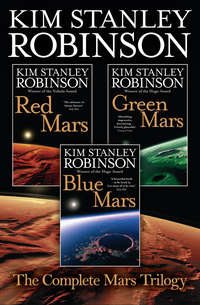
Kitabı oku: «The Complete Mars Trilogy: Red Mars, Green Mars, Blue Mars»
THE COMPLETE MARS TRILOGY
Red Mars
Green Mars
Blue Mars
Kim Stanley Robinson

 Copyright
This novel is entirely a work of fiction. The names, characters and incidents portrayed in it are the work of the author’s imagination. Any resemblance to actual persons, living or dead, events or localities is entirely coincidental.
HarperVoyager
An imprint of HarperCollinsPublishers Ltd.
1 London Bridge Street
London SE1 9GF
www.harpercollins.co.uk
Red Mars
Previously published in paperback by HarperCollins Science Fiction & Fantasy 1993
Published in paperback by HarperVoyager 1996
First published in Great Britain by HarperCollinsPublishers 1992
Cover layout design © HarperCollinsPublishers Ltd 2009
Copyright © Kim Stanley Robinson 1992
Green Mars
Previously published in paperback by HarperCollins Science Fiction & Fantasy 1994
Published in paperback by HarperVoyager 1996
First published in Great Britain by HarperCollinsPublishers 1992
Cover layout design © HarperCollinsPublishers Ltd 2009
Copyright © Kim Stanley Robinson 1994
Blue Mars
Previously published in paperback by Voyager 1996
First published in Great Britain by HarperVoyager 1996
Cover layout design © HarperCollinsPublishers Ltd 2009
Copyright © Kim Stanley Robinson 1996
Cover Photographs © Kees Veenenbos/Science Photo Library
Kim Stanley Robinson asserts the moral right to be identified as the author of this work
A catalogue copy of this book is available from the British Library
All rights reserved under International and Pan-American Copyright Conventions. By payment of the required fees, you have been granted the non-exclusive, non-transferable right to access and read the text of this ebook on screen. No part of this text may be reproduced, transmitted, down-loaded, decompiled, reverse engineered, or stored in or introduced into any information storage and retrieval system, in any form or by any means, whether electronic or mechanical, now known or hereinafter invented, without the express written permission of HarperCollins ebooks
HarperCollinsPublishers has made every reasonable effort to ensure that any picture content and written content in this ebook has been included or removed in accordance with the contractual and technological constraints in operation at the time of publication
Source ISBNs: 9780007401703, 9780007402090, 9780007402175
Ebook Edition © JULY 2015 ISBN: 9780008121778
Version: 2017-11-20
Contents
Cover
Title Page
Copyright
Red Mars
Title Page
Dedication
Part One: Festival Night
Part Two: The Voyage Out
Part Three: The Crucible
Part Four: Homesick
Part Five: Falling Into History
Part Six: Guns Under the Table
Part Seven: Senzeni Na
Part Eight: Shikata Ga Nai
Green Mars
Title Page
Dedication
Part One: Areoformation
Part Two: The Ambassador
Part Three: Long Runout
Part Four: The Scientist As Hero
Part Five: Homeless
Part Six: Tariqat
Part Seven: What Is To Be Done?
Part Eight: Social Engineering
Part Nine: The Spur of the Moment
Part Ten: Phase Change
Blue Mars
Title Page
Dedication
Part One: Peacock Mountain
Part Two: Areophany
Part Three: A New Constitution
Part Four: Green Earth
Part Five: Home at Last
Part Six: Ann in the Outback
Part Seven: Making Things Work
Part Eight: The Green and the White
Part Nine: Natural History
Part Ten: Werteswandel
Part Eleven: Viriditas
Part Twelve: It Goes So Fast
Part Thirteen: Experimental Procedures
Part Fourteen: Phoenix Lake
Keep Reading
About the Author
Also By Kim Stanley Robinson
About the Publisher

RED MARS
Kim Stanley Robinson
Dedication
For Lisa

PART ONE Festival Night
Mars was empty before we came. That’s not to say that nothing had ever happened. The planet had accreted, melted, roiled and cooled, leaving a surface scarred by enormous geological features: craters, canyons, volcanoes. But all of that happened in mineral unconsciousness, and unobserved. There were no witnesses – except for us, looking from the planet next door, and that only in the last moment of its long history. We are all the consciousness that Mars has ever had.
Now everybody knows the history of Mars in the human mind: how for all the generations of prehistory it was one of the chief lights in the sky, because of its redness and fluctuating intensity, and the way it stalled in its wandering course through the stars, and sometimes even reversed direction. It seemed to be saying something with all that. So perhaps it is not surprising that all the oldest names for Mars have a peculiar weight on the tongue – Nirgal, Mangala, Auqàkuh, Harmakhis – they sound as if they were even older than the ancient languages we find them in, as if they were fossil words from the Ice Age or before. Yes, for thousands of years Mars was a sacred power in human affairs; and its color made it a dangerous power, representing blood, anger, war and the heart.
Then the first telescopes gave us a closer look, and we saw the little orange disk, with its white poles and dark patches spreading and shrinking as the long seasons passed. No improvement in the technology of the telescope ever gave us much more than that; but the best Earthbound images gave Lowell enough blurs to inspire a story, the story we all know, of a dying world and a heroic people, desperately building canals to hold off the final deadly encroachment of the desert.
It was a great story. But then Mariner and Viking sent back their photos, and everything changed. Our knowledge of Mars expanded by magnitudes, we literally knew millions of times more about this planet than we had before. And there before us flew a new world, a world unsuspected.
It seemed, however, to be a world without life. People searched for signs of past or present Martian life, anything from microbes to the doomed canal-builders, or even alien visitors. As you know, no evidence for any of these has ever been found. And so stories have naturally blossomed to fill the gap, just as in Lowell’s time, or in Homer’s, or in the caves or on the savannah – stories of microfossils wrecked by our bio-organisms, of ruins found in dust storms and then lost forever, of Big Man and all his adventures, of the elusive little red people, always glimpsed out of the corner of the eye. And all of these tales are told in an attempt to give Mars life, or to bring it to life. Because we are still those animals who survived the Ice Age, and looked up at the night sky in wonder, and told stories. And Mars has never ceased to be what it was to us from our very beginning – a great sign, a great symbol, a great power.
And so we came here. It had been a power; now it became a place.
“…And so we came here. But what they didn’t realize was that by the time we got to Mars, we would be so changed by the voyage out that nothing we had been told to do mattered anymore. It wasn’t like submarining or settling the Wild West – it was an entirely new experience, and as the flight of the Ares went on, the Earth finally became so distant that it was nothing but a blue star among all the others, its voices so delayed that they seemed to come from a previous century. We were on our own; and so we became fundamentally different beings.”
All lies, Frank Chalmers thought irritably. He was sitting in a row of dignitaries, watching his old friend John Boone give the usual Boone Inspirational Address. It made Chalmers weary. The truth was, the trip to Mars had been the functional equivalent of a long train ride. Not only had they not become fundamentally different beings, they had actually become more like themselves than ever, stripped of habits until they were left with nothing but the naked raw material of their selves. But John stood up there waving a forefinger at the crowd, saying “We came here to make something new, and when we arrived our earthly differences fell away, irrelevant in this new world!” Yes, he meant it all literally. His vision of Mars was a lens that distorted everything he saw, a kind of religion.
Chalmers stopped listening and let his gaze wander over the new city. They were going to call it Nicosia. It was the first town of any size to be built free-standing on the Martian surface; all the buildings were set inside what was in effect an immense clear tent, supported by a nearly invisible frame, and placed on the rise of Tharsis, west of Noctis Labyrinthus. This location gave it a tremendous view, with a distant western horizon punctuated by the broad peak of Pavonis Mons. For the Mars veterans in the crowd it was giddy stuff: they were on the surface, they were out of the trenches and mesas and craters, they could see forever! Hurrah!
A laugh from the audience drew Frank’s attention back to his old friend. John Boone had a slightly hoarse voice and a friendly Midwestern accent, and he was by turns (and somehow even all at once) relaxed, intense, sincere, self-mocking, modest, confident, serious, and funny. In short, the perfect public speaker. And the audience was rapt; this was the First Man On Mars speaking to them, and judging by the looks on their faces they might as well have been watching Jesus produce their evening meal out of the loaves and fishes. And in fact John almost deserved their adoration, for performing a similar miracle on another plane, transforming their tin can existence into an astounding spiritual voyage. “On Mars we will come to care for each other more than ever before,” John said, which really meant, Chalmers thought, an alarming incidence of the kind of behavior seen in rat overpopulation experiments; “Mars is a sublime, exotic and dangerous place,” said John – meaning a frozen ball of oxidized rock on which they were exposed to about fifteen rem a year; “And with our work,” John continued, “we are carving out a new social order and the next step in the human story” – i.e. the latest variant in primate dominance dynamics.
John finished with this flourish, and there was, of course, a huge roar of applause. Maya Toitovna then went to the podium to introduce Chalmers. Frank gave her a private look which meant he was in no mood for any of her jokes; she saw it and said, “Our next speaker has been the fuel in our little rocket ship,” which somehow got a laugh. “His vision and energy are what got us to Mars in the first place, so save any complaints you may have for our next speaker, my old friend Frank Chalmers.”
At the podium he found himself surprised by how big the town appeared. It covered a long triangle, and they were gathered at its highest point, a park occupying the western apex. Seven paths rayed down through the park to become wide, tree-lined, grassy boulevards. Between the boulevards stood low trapezoidal buildings, each faced with polished stone of a different color. The size and architecture of the buildings gave things a faintly Parisian look, Paris as seen by a drunk Fauvist in spring, sidewalk cafes and all. Four or five kilometers downslope the end of the city was marked by three slender skyscrapers, beyond which lay the low greenery of the farm. The skyscrapers were part of the tent framework, which overhead was an arched network of sky-colored lines. The tent fabric itself was invisible, and so taken all in all, it appeared that they stood in the open air. That was gold. Nicosia was going to be a popular city.
Chalmers said as much to the audience, and enthusiastically they agreed. Apparently he had the crowd, fickle souls that they were, about as securely as John. Chalmers was bulky and dark, and he knew he presented quite a contrast to John’s blond good looks; but he knew as well that he had his own rough charisma, and as he warmed up he drew on it, falling into a selection of his own stock phrases.
Then a shaft of sunlight lanced down between the clouds, striking the upturned faces of the crowd, and he felt an odd tightening in his stomach. So many people there, so many strangers! People in the mass were a frightening thing – all those wet ceramic eyes encased in pink blobs, looking at him … it was nearly too much. Five thousand people in a single Martian town. After all the years in Underhill it was hard to grasp.
Foolishly he tried to tell the audience something of this. “Looking,” he said. “Looking around – the strangeness of our presence here is – accentuated.”
He was losing the crowd. How to say it? How to say that they alone in all that rocky world were alive, their faces glowing like paper lanterns in the light? How to say that even if living creatures were no more than carriers for ruthless genes, this was still, somehow, better than the blank mineral nothingness of everything else?
Of course he could never say it. Not at any time, perhaps, and certainly not in a speech. So he collected himself. “In the Martian desolation,” he said, “the human presence is, well, a remarkable thing” (they would care for each other more than ever before, a voice in his mind repeated sardonically). “The planet, taken in itself, is a dead frozen nightmare” (therefore exotic and sublime), “and so thrown on our own, we of necessity are in the process of – reorganizing a bit” (or forming a new social order) – so that yes, yes, yes, he found himself proclaiming exactly the same lies they had just heard from John!
Thus at the end of his speech he too got a big roar of applause. Irritated, he announced it was time to eat, depriving Maya of her chance for a final remark. Although probably she had known he would do that and so hadn’t bothered to think of any. Frank Chalmers liked to have the last word.
People crowded onto the temporary platform to mingle with the celebrities. It was rare to get this many of the first hundred in one spot anymore, and people crowded around John and Maya, Samantha Hoyle, Sax Russell and Chalmers.
Frank looked over the crowd at John and Maya. He didn’t recognize the group of Terrans surrounding them, which made him curious. He made his way across the platform, and as he approached he saw Maya and John give each other a look. “There’s no reason this place shouldn’t function under normal law,” one of the Terrans was saying.
Maya said to him, “Did Olympus Mons really remind you of Mauna Loa?”
“Sure,” the man said. “Shield volcanoes all look alike.”
Frank stared over this idiot’s head at Maya. She didn’t acknowledge the look. John was pretending not to have noticed Frank’s arrival. Samantha Hoyle was speaking to another man in an undertone, explaining something; he nodded, then glanced involuntarily at Frank. Samantha kept her back turned to him. But it was John who mattered, John and Maya. And both were pretending that nothing was out of the ordinary; but the topic of conversation, whatever it had been, had gone away.
Chalmers left the platform. People were still trooping down through the park, toward tables that had been set in the upper ends of the seven boulevards. Chalmers followed them, walking under young transplanted sycamores; their khaki leaves colored the afternoon light, making the park look like the bottom of an aquarium.
At the banquet tables construction workers were knocking back vodka, getting rowdy, obscurely aware that with the construction finished, the heroic age of Nicosia was ended. Perhaps that was true for all of Mars.
The air filled with overlapping conversations. Frank sank beneath the turbulence, wandered out to the northern perimeter. He stopped at a waist-high concrete coping: the city wall. Out of the metal stripping on its top rose four layers of clear plastic. A Swiss man was explaining things to a group of visitors, pointing happily.
“An outer membrane of piezoelectric plastic generates electricity from wind. Then two sheets hold a layer of airgel insulation. Then the inner layer is a radiation-capturing membrane, which turns purple and must be replaced. More clear than a window, isn’t it?”
The visitors agreed. Frank reached out and pushed at the inner membrane. It stretched until his fingers were buried to the knuckles. Slightly cool. There was faint white lettering printed on the plastic: Isidis Planitia Polymers. Through the sycamores over his shoulder he could still see the platform at the apex. John and Maya and their cluster of Terran admirers were still there, talking animatedly. Conducting the business of the planet. Deciding the fate of Mars.
He stopped breathing. He felt the pressure of his molars squeezing together. He poked the tent wall so hard that he pushed out the outermost membrane, which meant that some of his anger would be captured and stored as electricity in the town’s grid. It was a special polymer in that respect; carbon atoms were linked to hydrogen and fluorine atoms in such a way that the resulting substance was even more piezoelectric than quartz. Change one element of the three, however, and everything shifted; substitute chlorine for fluorine, for instance, and you had saran wrap.
Frank stared at his wrapped hand, then up again at the other two elements, still bonded to each other. But without him they were nothing!
Angrily he walked into the narrow streets of the city.
Clustered in a plaza like mussels on a rock were a group of Arabs, drinking coffee. Arabs had arrived on Mars only ten years before, but already they were a force to be reckoned with. They had a lot of money, and they had teamed up with the Swiss to build a number of towns, including this one. And they liked it on Mars. “It’s like a cold day in the Empty Quarter,” as the Saudis said. The similarity was such that Arabic words were slipping quickly into English, because Arabic had a larger vocabulary for this landscape: akaba for the steep final slopes around volcanoes, badia for the great world dunes, nefuds for deep sand, seyl for the billion year-old dry river beds … people were saying they might as well switch over to Arabic and have done with it.
Frank had spent a fair bit of time with Arabs, and the men in the plaza were pleased to see him. “Salaam aleykl” they said to him, and he replied, “Marhabba!” White teeth flashed under black moustaches. Only men present, as usual. Some youths led him to a central table where the older men sat, including his friend Zeyk. Zeyk said, “We are going to call this square Hajr el-kra Meshab, ‘the red granite open place in town.’” He gestured at the rust-colored flagstones. Frank nodded and asked what kind of stone it was. He spoke Arabic for as long as he could, pushing the edges of his ability and getting some good laughs in response. Then he sat at the central table and relaxed, feeling like he could have been on a street in Damascus or Cairo, comfortable in the wash of Arabic and expensive cologne.
He studied the men’s faces as they talked. An alien culture, no doubt about it. They weren’t going to change just because they were on Mars, they put the lie to John’s vision. Their thinking clashed radically with Western thought; for instance the separation of church and state was wrong to them, making it impossible for them to agree with Westerners on the very basis of government. And they were so patriarchal that some of their women were said to be illiterate – illiterates, on Mars! That was a sign. And indeed these men had the dangerous look that Frank associated with machismo, the look of men who oppressed their women so cruelly that naturally the women struck back where they could, terrorizing sons who then terrorized wives who terrorized sons and so on and so on, in an endless death spiral of twisted love and sex hatred. So that in that sense they were all madmen.
Which was one reason Frank liked them. And certainly they would come in useful to him, acting as a new locus of power. Defend a weak new neighbor to weaken the old powerful ones, as Machiavelli had said. So he drank coffee, and gradually, politely, they shifted to English.
“How did you like the speeches?” he asked, looking into the black mud at the bottom of his demitasse.
“John Boone is the same as ever,” old Zeyk replied. The others laughed angrily. “When he says we will make an indigenous Martian culture, he only means some of the Terran cultures here will be promoted, and others attacked. Those perceived as regressive will be singled out for destruction. It is a form of Ataturkism.”
“He thinks everyone on Mars should become American,” said a man named Nejm.
“Why not?” Zeyk said, smiling. “It’s already happened on Earth.”
“No,” Frank said. “You shouldn’t misunderstand Boone. People say he’s self-absorbed, but—”
“He is self-absorbed!” Nejm cried. “He lives in a hall of mirrors! He thinks that we have come to Mars to establish a good old American superculture, and that everyone will agree to it because it is the John Boone plan.”
Zeyk said, “He doesn’t understand that other people have other opinions.”
“It’s not that,” Frank said. “It’s just that he knows they don’t make as much sense as his.”
They laughed at that, but the younger men’s hoots had a bitter edge. They all believed that before their arrival Boone had argued in secret against UN approval for Arab settlements. Frank encouraged this belief, which was almost true – John disliked any ideology that might get in his way. He wanted the slate as blank as possible in everybody who came up.
The Arabs, however, believed that John disliked them in particular. Young Selim el-Hayil opened his mouth to speak, and Frank gave him a swift warning glance. Selim froze, then pursed his mouth angrily. Frank said, “Well, he’s not as bad as all that. Although to tell the truth I’ve heard him say it would have been better if the Americans and Russians had been able to claim the planet when they arrived, like explorers in the old days.”
Their laughter was brief and grim. Selim’s shoulders hunched as if struck. Frank shrugged and smiled, spread his hands wide. “But it’s pointless! I mean, what can he do?”
Old Zeyk lifted his eyebrows. “Opinions vary.”
Chalmers got up to move on, meeting for one instant Selim’s insistent gaze. Then he strode down a side street, one of the narrow lanes that connected the city’s seven main boulevards. Most were paved with cobblestones or streetgrass, but this one was rough blond concrete. He slowed by a recessed doorway, looked in the window of a closed boot manufactory. His faint reflection appeared in a pair of bulky walker boots.
Opinions vary. Yes, a lot of people had underestimated John Boone – Chalmers had done it himself many times. An image came to him of John in the White House, pink with conviction, his disobedient blond hair flying wildly, the sun streaming in the Oval Office windows and illuminating him as he waved his hands and paced the room, talking away while the President nodded and his aides watched, pondering how best to co-opt that electrifying charisma. Oh, they had been hot in those days, Chalmers and Boone; Frank with the ideas and John the front man, with a momentum that was practically unstoppable. It would be more a matter of derailment, really.
Selim el-Hayil’s reflection appeared among the boots.
“Is it true?” he demanded.
“Is what true?” said Frank crossly.
“Is Boone anti-Arab?”
“What do you think?”
“Was he the one who blocked permission to build the mosque on Phobos?”
“He’s a powerful man.”
The young Saudi’s face twisted. “The most powerful man on Mars, and he only wants more! He wants to be king!” Selim made a fist and struck his other hand. He was slimmer than the other Arabs, weak-chinned, his moustache covering a small mouth.
“The treaty comes up for renewal soon,” Frank said. “And Boone’s coalition is bypassing me.” He ground his teeth. “I don’t know what their plans are, but I’m going to find out tonight. You can imagine what they’ll be, anyway. Western biases, certainly. He may withhold his approval of a new treaty unless it contains guarantees that all settlements will be made only by the original treaty signatories.” Selim shivered, and Frank pressed; “It’s what he wants, and it’s very possible he could get it, because his new coalition makes him more powerful than ever. It could mean an end to settlement by non-signatories. You’ll become guest scientists. Or get sent back.”
In the window the reflection of Selim’s face appeared a kind of mask, signifying rage. “Battal, battal,” he was muttering. Very bad, very bad. His hands twisted as if out of his control, and he muttered about the Koran or Camus, Persepolis or the Peacock Throne, references scattered nervously among non-sequiturs. Babbling.
“Talk means nothing,” Chalmers said harshly. “When it comes down to it, nothing matters but action.”
That gave the young Arab pause. “I can’t be sure,” he said at last.
Frank poked him in the arm, watched a shock run through the man. “It’s your people we’re talking about. It’s this planet we’re talking about.”
Selim’s mouth disappeared under his moustache. After a time he said, “It’s true.”
Frank said nothing. They looked in the window together, as if judging boots.
Finally Frank raised a hand. “I’ll talk to Boone again,” he said quietly. “Tonight. He leaves tomorrow. I’ll try to talk to him, to reason with him. I doubt it will matter. It never has before. But I’ll try. Afterwards – we should meet.”
“Yes.”
“In the park, then, the southernmost path. Around eleven.”
Selim nodded.
Chalmers transfixed him with a stare. “Talk means nothing,” he said brusquely, and walked away.
The next boulevard Chalmers came to was crowded with people clumped outside open-front bars, or kiosks selling couscous and bratwurst. Arab and Swiss. It seemed an odd combination, but they meshed well.
Tonight some of the Swiss were distributing face masks from the door of an apartment. Apparently they were celebrating this stadtfest as a kind of Mardi Gras, Fassnacht as they called it, with masks and music and every manner of social inversion, just as it was back home on those wild February nights in Basel and Zurich and Luzern … On an impulse Frank joined the line. “Around every profound spirit a mask is always growing,” he said to two young women in front of him. They nodded politely and then resumed conversation in guttural Schwyzerdüütsch, a dialect never written down, a private code, incomprehensible even to Germans. It was another impenetrable culture, the Swiss, in some ways even more so than the Arabs. That was it, Frank thought; they worked well together because they were both so insular that they never made any real contact. He laughed out loud as he took a mask, a black face studded with red paste gems. He put it on.
A line of masked celebrants snaked down the boulevard, drunk, loose, at the edge of control. At an intersection the boulevard opened up into a small plaza, where a fountain shot sun-colored water into the air. Around the fountain a steel drum band hammered out a calypso tune. People gathered around, dancing or hopping in time to the low bong of the bass drum. A hundred meters overhead a vent in the tent frame poured frigid air down onto the plaza, air so cold that little flakes of snow floated in it, glinting in the light like chips of mica. Then fireworks banged just under the tenting, and colored sparks fell down through the snowflakes.
Sunset, more than any other time of day, made it clear that they stood on an alien planet; something in the slant and redness of the light was fundamentally wrong, upsetting expectations wired into the savannah brain over millions of years. This evening was providing a particularly garish and unsettling example of the phenomenon. Frank wandered in its light, making his way back to the city wall. The plain south of the city was littered with rocks, each one dogged by a long black shadow. Under the concrete arch of the city’s south gate he stopped. No one there. The gates were locked during festivals like these, to keep drunks from going out and getting hurt. But Frank had gotten the day’s emergency code out of the fire department AI that morning, and when he was sure no one was watching he tapped out the code and hurried into the lock. He put on a walker, boots, and helmet, and went through the middle and outer doors.
Outside it was intensely cold as always, and the diamond pattern of the walker’s heating element burned through his clothes. He crunched over concrete and then duricrust. Loose sand flowed east, pushed by the wind.
Grimly he looked around. Rocks everywhere. A planet sledgehammered billions of times. And meteors still falling. Someday one of the towns would take a hit. He turned and looked back. It looked like an aquarium glowing in the dusk. There would be no warning, but everything would suddenly fly apart, walls, vehicles, trees, bodies. The Aztecs had believed the world would end in one of four ways: earthquake, fire, flood, or jaguars falling from the sky. Here there would be no fire. Nor earthquake nor flood, now that he thought of it. Leaving only the jaguars.
The twilight sky was a dark pink over Pavonis Mons. To the east stretched Nicosia’s farm, a long low greenhouse running downslope from the city. From this angle one could see that the farm was larger than the town proper, and jammed with green crops. Frank clumped to one of its outer locks, and entered.
Inside the farm it was hot, a full 60° warmer than outside, and 15° warmer than in the city. He had to keep his helmet on, as the farm air was tailored to the plants, heavy on CO2 and short on oxygen. He stopped at a work station and fingered through drawers of small tools and pesticide patches, gloves and bags. He selected three tiny patches and put them in a plastic bag, then slipped the bag gently into the walker’s pocket. The patches were clever pesticides, biosaboteurs designed to provide plants with systemic defenses; he had been reading about them, and knew of a combination that in animals would be deadly to the organism …
He put a pair of shears in the walker’s other pocket. Narrow gravel paths led him up between long beds of barley and wheat, back toward the city proper. He went in the lock leading into town, unclipped his helmet, stripped off the walker and boots, transferred the contents of the walker pockets to his coat. Then he went back into the lower end of town.
Here the Arabs had built a medina, insisting that such a neighborhood was crucial to a city’s health; the boulevards narrowed, and between them lay warrens of twisted alleyways taken from the maps of Tunis or Algiers, or generated randomly. Nowhere could you see from one boulevard to the next, and the sky overhead was visible only in plum strips, between buildings that leaned together.
Most of the alleys were empty now, as the party was uptown. A pair of cats skulked between buildings, investigating their new home. Frank took the shears from his pocket and scratched into a few plastic windows, in Arabic lettering, Jew, Jew, Jew, Jew, Jew. He walked on, whistling through his teeth. Corner cafes were little caves of light. Bottles clinked like prospectors’ hammers. An Arab sat on a squat black speaker, playing an electric guitar.
He found the central boulevard, walked up it. Boys in the branches of the lindens and sycamores shouted songs to each other in Schwyzerdüütsch. One ditty was in English: “John Boone, Went to the moon, No fast cars, He went to Mars!” Small disorganized music bands barged through the thickening crowd. Some moustached men dressed as American cheerleaders flounced expertly through a complicated can-can routine. Kids banged little plastic drums. It was loud; the tenting absorbed sound, so there weren’t the echoes one heard under crater domes, but it was loud nevertheless.
Up there, where the boulevard opened into the sycamore park – that was John himself, surrounded by a small crowd. He saw Chalmers approaching and waved, recognizing him despite the mask. That was how the first hundred knew each other—
“Hey, Frank,” he said. “You look like you’re having a good time.”
“I am,” Frank said through his mask. “I love cities like this, don’t you? A mixed-species flock. It shows you what a diverse collection of cultures Mars is.”
John’s smile was easy. His eyes shifted as he surveyed the boulevard below.
Sharply Frank said, “A place like this is a crimp in your plan, isn’t it?”
Boone’s gaze returned to him. The surrounding crowd slipped away, sensing the antagonistic nature of the exchange. Boone said to Frank, “I don’t have a plan.”
“Oh come on! What about your speech?”
Boone shrugged. “Maya wrote it.”
A double lie: that Maya wrote it, that John didn’t believe it. Even after all these years it was almost like talking to a stranger. To a politician at work. “Come on, John,” Frank snapped. “You believe all that and you know it. But what are you going to do with all these different nationalities? All the ethnic hatreds, the religious manias? Your coalition can’t possibly keep a thumb on all this. You can’t keep Mars for yourselves, John, it’s not a scientific station anymore, and you’re not going to get a treaty that makes it one.”
“We’re not trying to.”
“Then why are you trying to cut me out of the talks!”
“I’m not!” John looked injured. “Relax, Frank. We’ll hammer it out together just like we always have. Relax.”
Frank stared at his old friend, nonplussed. What to believe? He had never known how to think of John – the way he had used Frank as a springboard, the way he was so friendly … hadn’t they begun as allies, as friends?
It occurred to him that John was looking for Maya. “So where is she?”
“Around somewhere,” Boone said shortly.
It had been years since they had been able to talk about Maya. Now Boone gave him a sharp look, as if to say it was none of his business. As if everything of importance to Boone had become, over the years, none of Frank’s business.
Frank left him without a word.
The sky was now a deep violet, streaked by yellow cirrus clouds. Frank passed two figures wearing white ceramic dominoes, the old Comedy and Tragedy personas, handcuffed together. The city’s streets had gone dark and windows blazed, silhouettes partying in them. Big eyes darted in every blurry mask, looking to find the source of the tension in the air. Under the tidal sloshing of the crowd there was a low tearing sound.
He shouldn’t have been surprised, he shouldn’t. He knew John as well as one could know another person; but it had never been any of his business. Into the trees of the park, under the hand-sized leaves of the sycamores. When had it been any different! All that time together, those years of friendship; and none of it had mattered. Diplomacy by other means.
He looked at his watch. Nearly eleven. He had an appointment with Selim. Another appointment. A lifetime of days divided into quarter hours had made him used to running from one appointment to the next, changing masks, dealing with crisis after crisis, managing, manipulating, doing business in a hectic rush that never ended; and here it was a celebration, Mardi Gras, Fassnacht! and he was still doing it. He couldn’t remember any other way.
He came on a construction site, skeletal magnesium framing surrounded by piles of bricks and sand and paving stones. Careless of them to leave such things around. He stuffed his coat pockets with fragments of brick just big enough to hold. Straightening up, he noticed someone watching him from the other side of the site – a little man with a thin face under spiky black dreadlocks, watching him intently. Something in the look was disconcerting, it was as if the stranger saw through all his masks and was observing him so closely because he was aware of his thoughts, his plans.
Spooked, Chalmers beat a quick retreat into the bottom fringe of the park. When he was sure he had lost the man, and that no one else was watching, he began throwing stones and bricks down into the lower town, hurling them as hard as he could. And one for that stranger too, right in the face! Overhead the tent framework was visible only as a faint pattern of occluded stars; it seemed they stood free, in a chill night wind. Air circulation was high tonight, of course. Broken glass, shouts. A scream. It really was loud, people were going crazy. One last paving stone, heaved at a big lit picture window across the grass. It missed. He slipped further into the trees.
Near the southern wall he saw someone under a sycamore – Selim, circling nervously. “Selim,” Frank called quietly, sweating. He reached into his jumper pocket, carefully felt in the bag and palmed the trio of stem patches. Synergy could be so powerful, for good or ill. He walked forward and roughly embraced the young Arab. The patches hit and penetrated Selim’s light cotton shirt. Frank pulled back.
Now Selim had about six hours. “Did you speak with Boone?” he asked.
“I tried,” Chalmers said. “He didn’t listen. He lied to me.” It was so easy to feign distress: “Twenty-five years of friendship, and he lied to me!” He struck a tree trunk with his palm, and the patches flew away in the dark. He controlled himself. “His coalition is going to recommend that all Martian settlements originate in the countries that signed the first treaty.” It was possible; and it was certainly plausible.
“He hates us!” Selim cried.
“He hates everything that gets in his way. And he can see that Islam is still a real force in people’s lives. It shapes the way people think, and he can’t stand that.”
Selim shuddered. In the gloom the whites of his eyes were bright. “He has to be stopped.”
Frank turned aside, leaned against a tree. “I – don’t know.”
“You said it yourself. Talk means nothing.”
Frank circled the tree, feeling dizzy. You fool, he thought, talk means everything. We are nothing but information exchange, talk is all we have!
He came on Selim again and said, “How?”
“The planet. It is our way.”
“The city gates are locked tonight.”
That stopped him. His hands started to twist.
Frank said, “But the gate to the farm is still open.”
“But the farm’s outer gates will be locked.”
Frank shrugged, let him figure it out.
And quickly enough Selim blinked, and said “Ah.” Then he was gone.
Frank sat between trees, on the ground. It was a sandy damp brown dirt, product of a great deal of engineering. Nothing in the city was natural, nothing.
After a time he got to his feet. He walked through the park, looking at people. If I find one good city I will spare the man. But in an open area masked figures darted together to grapple and fight, surrounded by watchers who smelled blood. Frank went back to the construction site to get more bricks. He threw them and some people saw him, and he had to run. Into the trees again, into the little tented wilderness, escaping predators while high on adrenalin, the greatest drug of all. He laughed wildly.
Suddenly he caught sight of Maya, standing alone by the temporary platform up at the apex. She wore a white domino, but it was certainly her: the proportions of the figure, the hair, the stance itself, all unmistakably Maya Toitovna. The first hundred, the little band; they were the only ones truly alive to him any more, the rest were ghosts. Frank hurried toward her, tripping over uneven ground. He squeezed a rock buried deep in one coat pocket, thinking Come on, you bitch. Say something to save him. Say something that will make me run the length of the city to save him!
She heard his approach and turned. She wore a phosphorescent white domino, with metallic blue sequins. It was hard to see her eyes.
“Hello, Frank,” she said, as if he wore no mask. He almost turned and ran. Mere recognition was almost enough to do it …
But he stayed. He said, “Hello, Maya. Nice sunset, wasn’t it?”
“Spectacular. Nature has no taste. It’s just a city inauguration, but it looked like Judgement Day.”
They were under a streetlight, standing on their shadows. She said, “Have you enjoyed yourself?”
“Very much. And you?”
“It’s getting a little wild.”
“It’s understandable, don’t you think? We’re out of our holes, Maya, we’re on the surface at last! And what a surface! You only get these kind of long views on Tharsis.”
“It’s a good location,” she agreed.
“It will be a great city,” Frank predicted. “But where do you live these days, Maya?”
“In Underhill, Frank, just as always. You know that.”
“But you’re never there, are you? I haven’t seen you in a year or more.”
“Has it been that long? Well, I’ve been in Hellas. Surely you heard?”
“Who would tell me?”
She shook her head and blue sequins glittered. “Frank.” She turned aside, as if to walk away from the question’s implications.
Angrily Frank circled her, stood in her path. “That time on the Ares,” he said. His voice was tight, and he twisted his neck to loosen his throat, to make speech easier. “What happened, Maya? What happened?”
She shrugged and did not meet his gaze. For a long time she did not speak. Then she looked at him. “The spur of the moment,” she said.
And then it was ringing midnight, and they were in the Martian time slip, the thirty-nine and a half minute gap between 12:00:00 and 12:00:01, when all the clocks went blank or stopped moving. This was how the first hundred had decided to reconcile Mars’s slightly longer day with the twenty-four hour clock, and the solution had proved oddly satisfactory. Every night to step for a while out of the flicking numbers, out of the remorseless sweep of the second hand—
And tonight as the bells rang midnight, the whole city went mad. Forty minutes outside of time; it was bound to be the peak of the celebration, everyone knew that instinctively. Fireworks were going off, people were cheering; sirens tore through the sound, and the cheering redoubled. Frank and Maya watched the fireworks, listened to the noise.
Then there was a noise that was somehow different: desperate cries, serious screams. “What’s that?” Maya said.
“A fight,” Frank replied, cocking an ear. “Something done on the spur of the moment, perhaps.” She stared at him, and quickly he added, “Maybe we should go have a look.”
The cries intensified. Trouble somewhere. They started down through the park, their steps getting longer, until they were in the Martian lope. The park seemed bigger to Frank, and for a moment he was scared.
The central boulevard was covered with trash. People darted through the dark in predatory schools. A nerve-grating siren went off, the alarm that signaled a break in the tent. Windows were shattering up and down the boulevard. There on the streetgrass was a man flat on his back, the surrounding grass smeared with black streaks. Chalmers seized the arm of a woman crouched over him. “What happened?” he shouted.
She was weeping. “They fought! They are fighting!”
“Who? Swiss, Arab?”
“Strangers,” she said. “Ausländer.” She looked blindly at Frank. “Get help!”
Frank rejoined Maya, who was talking to a group next to another fallen figure. “What the hell’s going on?” he said to her as they took off toward the city’s hospital.
“It’s a riot,” she said. “I don’t know why.” Her mouth was a straight slash, in skin as white as the domino still covering her eyes.
Frank pulled off his mask and threw it away. There was broken glass all over the street. A man rushed at them. “Frank! Maya!”
It was Sax Russell; Frank had never seen the little man so agitated. “It’s John – he’s been attacked!”
“What?” they exclaimed together.
“He tried to stop a fight, and three or four men jumped him. They knocked him down and dragged him away!”
“You didn’t stop them?” Maya cried.
“We tried – a whole bunch of us chased them. But they lost us in the medina.”
Maya looked at Frank.
“What’s going on!” he cried. “Where would anyone take him?”
“The gates,” she said.
“But they’re locked tonight, aren’t they?”
“Maybe not to everyone.”
They followed her to the medina. Streetlights were broken, there was glass underfoot. They found a fire marshall and went to the Turkish Gate; he unlocked it and several of them hurried through, throwing on walkers at emergency speed. Then out into the night to look around, illuminated by the bathysphere glow of the city. Frank’s ankles hurt with the night cold, and he could feel the precise configuration of his lungs, as if two globes of ice had been inserted in his chest, to cool the rapid beat of his heart.
Nothing out there. Back inside. Over to the northern wall and the Syrian Gate, and out again under the stars. Nothing.
It took them a long time to think of the farm. By then there were about thirty of them in walkers, and they ran down and through the lock and flooded down the farm’s aisles, spreading out, running between crops.
They found him among the radishes. His jacket was pulled over his face, in the standard emergency air pocket; he must have done it unconsciously, because when they rolled him carefully onto one side, they saw a lump behind one ear.
“Get him inside,” Maya said, her voice a bitter croak – “Hurry, get him inside.”
Four of them lifted him. Chalmers cradled John’s head, and his fingers were intertwined with Maya’s. They trotted back up the shallow steps. Through the farm gate they stumbled, back into the the city. One of the Swiss led them to the nearest medical center, already crowded with desperate people. They got John onto an empty bench. His unconscious expression was pinched, determined. Frank tore off his helmet and went to work pulling rank, bulling into the emergency rooms and shouting at the doctors and nurses. They ignored him until one doctor said, “Shut up. I’m coming.” She went into the hallway and with a nurse’s help clipped John into a monitor, then checked him out with the abstracted, absent look doctors have while working: hands at neck and face and head and chest, stethoscope …
Maya explained what they knew. The doctor took down an oxygen unit from the wall, looking at the monitor. Her mouth was bunched into a displeased little knot. Maya sat at the end of the bench, face suddenly distraught. Her domino had long since disappeared.
Frank crouched beside her.
“We can keep working on him,” the doctor said, “but I’m afraid he’s gone. Too long without oxygen, you know.”
“Keep working on him,” Maya said.
They did, of course. Eventually other medical people arrived, and they carted him off to an emergency room. Frank, Maya, Sax, Samantha, and a number of locals sat outside in the hall. Doctors came and went; their faces had the blank look they took on in the presence of death. Protective masks. One came out and shook his head. “He’s dead. Too long out there.”
Frank leaned his head back against the wall.
When Reinhold Messner returned from the first solo climb of Everest, he was severely dehydrated, and utterly exhausted; he fell down most of the last part of the descent, and collapsed on the Rongbuk glacier, and he was crawling over it on hands and knees when the woman who was his entire support team reached him; and he looked up at her out of a delirium, and said “Where are all my friends?”
It was quiet. No sound but the low hum and whoosh that one never escaped on Mars.
Maya put a hand on Frank’s shoulder, and he almost flinched; his throat clamped down to nothing, it really hurt. “I’m sorry,” he managed to say.
She shrugged the remark aside, frowned. She had somewhat the air of the medical people. “Well,” she said, “you never liked him much anyway.”
“True,” he said, thinking it would be politic to seem honest with her at that moment. But then he shuddered and said bitterly, “What do you know about what I like or don’t like.”
He shrugged her hand aside, struggled to his feet. She didn’t know; none of them knew. He started to go into the emergency room, changed his mind. Time enough for that at the funeral. He felt hollow; and suddenly it seemed to him that everything good had gone away.
He left the medical center. Impossible not to feel sentimental at such moments. He walked through the strangely hushed darkness of the city, into the land of Nod. The streets glinted as if stars had fallen to the pavement. People stood in clumps, silent, stunned by the news. Frank Chalmers made his way through them, feeling their stares, moving without thought toward the platform at the top of town; and as he walked he said to himself, Now we’ll see what I can do with this planet.
PART TWO The Voyage Out
“Since they’re going to go crazy anyway, why not just send insane people in the first place, and save them the trouble?” said Michel Duval.
He was only half joking; his position throughout had been that the criteria for selection constituted a mind-boggling collection of double binds.
His fellow psychologists stared at him. “Can you suggest any specific changes?” asked the chairman, Charles York.
“Perhaps we should all go to Antarctica with them, and observe them in this first period of time together. It would teach us a lot.”
“But our presence would be inhibitory. I think just one of us will be enough.”
So they sent Michel Duval. He joined a hundred and fifty-odd finalists at McMurdo Station. The initial meeting resembled any other international scientific conference, familiar to them all from their various disciplines. But there was a difference: this was the continuation of a selection process that had lasted for years, and would last another. And those selected would go to Mars.
So they lived in Antarctica for over a year together, familiarizing themselves with the shelters and equipment that were already landing on Mars in robot vehicles; familiarizing themselves with a landscape that was almost as cold and harsh as Mars itself; familiarizing themselves with each other. They lived in a cluster of habitats located in Wright Valley, the largest of Antarctica’s Dry Valleys. They ran a biosphere farm, and then they settled into the habitats through a dark austral winter, and studied secondary or tertiary professions, or ran through simulations of the various tasks they would be performing on the spaceship Ares, or later on the red planet itself; and always, always aware that they were being watched, evaluated, judged.
They were by no means all astronauts or cosmonauts, although there were a dozen or so of each, with many more up north clamoring to be included. But the majority of the colonists would have to have their expertise in areas that would come into play after landfall: medical skills, computer skills, robotics, systems design, architecture, geology, biosphere design, genetic engineering, biology; also every sort of engineering, and construction expertise of several kinds. Those who had made it to Antarctica were an impressive group of experts in the relevant sciences and professions, and they spent a good bit of their time cross-training to become impressive in secondary and tertiary fields as well.
And all their activity took place under the constant pressure of observation, evaluation, judgement. It was necessarily a stressful procedure; that was part of the test. Michel Duval felt that this was a mistake, as it tended to ingrain reticence and distrust in the colonists, preventing the very compatability that the selection committee was supposedly seeking. One of the many double binds, in fact. The candidates themselves were quiet about that aspect of things, and he didn’t blame them; there wasn’t any better strategy to take, that was a double bind for you: it insured silence. They could not afford to offend anyone, or complain too much; they could not risk withdrawing too far; they could not make enemies.
So they went on being brilliant and accomplished enough to stand out, but normal enough to get along. They were old enough to have learned a great deal, but young enough to endure the physical rigors of the work. They were driven enough to excel, but relaxed enough to socialize. And they were crazy enough to want to leave Earth forever, but sane enough to disguise this fundamental madness, in fact to defend it as pure rationality, scientific curiosity or something of the sort – that seemed to be the only acceptable reason for wanting to go, and so naturally they claimed to be the most scientifically curious people in history! But of course there had to be more to it than that. They had to be alienated somehow, alienated and solitary enough not to care about leaving everyone they had known behind forever – and yet still connected and social enough to get along with all their new acquaintances in Wright Valley, with every member of the tiny village that the colony would become. Oh, the double binds were endless! They were to be both extraordinary and extra ordinary, at one and the same time. An impossible task, and yet a task that was an obstacle to their heart’s greatest desire; making it the very stuff of anxiety, fear, resentment, rage. Conquering all those stresses …
But that too was part of the test. Michel could not help but observe with great interest. Some failed, cracked in one way or another. An American thermal engineer became increasingly withdrawn, then destroyed several of their rovers and had to be forcibly restrained and removed. A Russian pair became lovers, and then had a falling out so violent that they couldn’t stand the sight of each other, and both had to be dropped. This melodrama illustrated the dangers of romance going awry, and made the rest of them very cautious in this regard. Relationships still developed, and by the time they left Antarctica they had had three marriages, and these lucky six could consider themselves in some sense “safe”; but most of them were so focused on getting to Mars that they put these parts of their lives on hold, and if anything conducted discreet friendships, in some cases hidden from almost everyone, in other cases merely kept out of the view of the selection committees.
And Michel knew he was seeing only the tip of the iceberg. He knew that critical things were happening in Antarctica, out of his sight. Relationships were having their beginnings; and sometimes the beginning of a relationship determines how the rest of it will go. In the brief hours of daylight, one of them might leave the camp and hike out to Lookout Point; and another follow; and what happened out there might leave its mark forever. But Michel would never know.
And then they left Antarctica, and the team was chosen. There were fifty men and fifty women: thirty-five Americans, thirty-five Russians, and thirty miscellaneous international affiliates, fifteen invited by each of the two big partners. Keeping such perfect symmetries had been difficult, but the selection committee had persevered.
The lucky ones flew to Cape Canaveral or Baikonur, to ascend to orbit. At this point they both knew each other very well and did not know each other at all. They were a team, Michel thought, with established friendships, and a number of group ceremonies, rituals, habits, and tendencies; and among those tendencies was an instinct to hide, to play a role and disguise their real selves. Perhaps this was simply the definition of village life, of social life. But it seemed to Michel that it was worse than that; no one had ever before had to compete so strenuously to join a village; and the resulting radical division between public life and private life was new, and strange. Ingrained in them now was a certain competitive undercurrent, a constant subtle feeling that they were each alone, and that in case of trouble they were liable to be abandoned by the rest, and yanked out of the group.
The selection committee had thus created some of the very problems it had hoped to prevent. Some of them were aware of this; and naturally they took care to include among the colonists the most qualified psychiatrist they could think of.
So they sent Michel Duval.
At first it felt like a shove in the chest. Then they were pushed back in their chairs, and for a second the pressure was deeply familiar: one g, the gravity they would never live in again. The Ares had been orbiting Earth at 28,000 kilometers per hour. For several minutes they accelerated, the rocket’s push so powerful that their vision blurred as corneas flattened, and it took an effort to inhale. At 40,000 kilometers per hour the burn ended. They were free of the Earth’s pull, in orbit to nothing but the sun.
The colonists sat in the delta V chairs blinking, their skin flushed, their hearts pounding. Maya Katarina Toitovna, the official leader of Russian contingent, glanced around. People appeared stunned. When obsessives are given their object of desire, what do they feel? It was hard to say, really. In a sense their lives were ending; and yet something else, some other life, had finally, finally begun … Filled with so many emotions at once, it was impossible not to be confused; it was an interference pattern, some feelings cancelled, others reinforced. Unbuckling from her chair Maya felt a grin contorting her face, and she saw on the faces around her the same helpless grin; all but Sax Russell, who was as impassive as an owl, blinking as he looked over the readouts on the room’s computer screens.
They floated weightlessly around the room. December 21st, 2026: they were moving faster than anyone in history. They were on their way. It was the beginning of a nine-month voyage – or of a voyage that would last the rest of their lives. They were on their own.
Those responsible for piloting the Ares pulled themselves to the control consoles, and gave the orders to fire lateral control rockets. The Ares began to spin, stabilizing at four rpm. The colonists sank to the floors, and stood in a pseudogravity of .38 g, very close to what they would feel on Mars. Many man-years of tests had indicated that it would be a fairly healthy g to live in, and so much healthier than weightlessness that rotating the ship had been deemed worth the trouble. And, Maya thought, it felt great. There was enough pull to make balance relatively easy, but hardly any feeling of pressure, of drag. It was the perfect equivalent of their mood; they staggered down the halls to the big dining hall in Torus D, giddy and exhilarated, walking on air.
In Torus D’s dining hall they mingled in a kind of cocktail party, celebrating the departure. Maya wandered about, sipping freely from a mug of champagne, feeling slightly unreal and extremely happy, a mix that reminded her of her wedding reception many years before. Hopefully this marriage would go better than that one had, she thought, because this one was going to last forever. The hall was loud with talk. “It’s a symmetry not so much sociological as mathematic. A kind of aesthetic balance.” “We’re hoping to get it into the parts per billion range, but it’s not going to be easy.” Maya turned down an offered refill, feeling giddy enough. Besides, this was work. She was co-mayor of this village, so to speak, responsible for group dynamics, which were bound to get complex. Antarctic habits kicked in even at this moment of triumph, and she listened and watched like an anthropologist, or a spy.
“It’s a start,” Arkady said. “But there are aspects of that treaty you haven’t mentioned. Bases built on Mars will belong to the countries that build them, for instance. We will be building American and Russian bases, according to this provision of the law. And that puts us right back into the nightmare of Terran law and Terran history. American and Russian businesses will have the right to exploit Mars, as long as the profits are somehow shared by all the nations signing the treaty. This may only involve some sort of percentage paid to UN, in effect no more than bribe. I don’t believe we should acknowledge these provisions for even a moment!” ‘
Silence followed this remark.
Ann Clayborne said, “This treaty also says we have to take measures to prevent the disruption of planetary environments, I think is how they put it. It’s in Article Seven. That seems to me to expressly forbid the terraforming that so many of you are talking about.”
“I would say that we should ignore that provision as well,” Arkady said quickly. “Our own well-being depends on ignoring it.”
This view was more popular than his others, and several people said so.
“But if you’re willing to disregard one article,” Arkady pointed out, “you should be willing to disregard the rest. Right?”
There was an uncomfortable pause.
“All these changes will happen inevitably,” Sax Russell said with a shrug. “Being on Mars will change us in an evolutionary way.”
Arkady shook his head vehemently, causing him to spin a little in the air over the table. “No, no, no, no! History is not evolution! It is a false analogy! Evolution is a matter of environment and chance, acting over millions of years. But history is a matter of environment and choice, acting within lifetimes, and sometimes within years, or months, or days! History is Lamarckian! So that if we choose to establish certain institutions on Mars, there they will be! And if we choose others, there they will be!” A wave of his hand encompassed them all, the people seated at the tables, the people floating among the vines: “I say we should make those choices ourselves, rather than having them made for us by people back on Earth. By people long dead, really.”
Phyllis said sharply, “You want some kind of communal Utopia, and it’s not possible. I should think Russian history would have taught you something about that.”
“It has,” Arkady said. “Now I put to use what it has taught me.”
“Advocating an ill-defined revolution? Fomenting a crisis situation? Getting everyone upset and at odds with each other?”
A lot of people nodded at this, but Arkady waved them away. “I decline to accept blame for everyone’s problems at this point in the trip. I have only said what I think, which is my right. If I make some of you uncomfortable, that is your problem. It is because you don’t like the implications of what I say, but can’t find grounds to deny them.”
“Some of us can’t understand what you say,” Mary exclaimed.
“I say only this!” Arkady said, staring at her bug-eyed: “We have come to Mars for good. We are going to make not only our homes and our food, but also our water and the very air we breathe – all on a planet that has none of these things. We can do this because we have technology to manipulate matter right down to the molecular level. This is an extraordinary ability, think of it! And yet some of us here can accept transforming the entire physical reality of this planet, without doing a single thing to change ourselves, or the way we live. To be twenty-first century scientists on Mars, in fact, but at the same time living within nineteenth century social systems, based on seventeenth century ideologies. It’s absurd, it’s crazy, it’s – it’s —” he seized his head in his hands, tugged at his hair, roared “It’s unscientific! And so I say that among all the many things we transform on Mars, ourselves and our social reality should be among them. We must terraform not only Mars, but ourselves.”
No one ventured a rebuttal to that; Arkady at full throttle was pretty much unopposable, and a lot of them were genuinely provoked by what he had said and needed time to think. Others were simply disgruntled, but unwilling to cause too much of a fuss at this particular dinner, which was supposed to be a celebration. It was easier to roll one’s eyes, and drink to the toast. “To Mars! To Mars!” But as they floated around after finishing dessert, Phyllis was disdainful. “First we have to survive,” she said. “With dissension like this, how good will our chances be?”
Michel Duval tried to reassure her. “A lot of these disagreements are symptoms of the flight. Once on Mars, we’ll pull together. And we have more than just what we brought on the Ares to help us – we’ll have what the unmanned landers have brought already, shipments of equipment and food all over the surface and the moons. All that’s there for us. The only limit will be our own stamina. And this voyage is part of that – it’s a kind of preparation, a test. If we fail this part, we won’t even get to try on Mars.”
“Exactly my point!” Phyllis said. “We are failing in this.”
Sax stood, looking bored, and pushed off toward the kitchen. The hall was filled with the seashell roar of many small discussions, some of them acrimonious in tone. A lot of people were angry at Arkady, clearly; and others were angry at them for getting upset.
Maya followed Sax into the kitchen. As he cleaned his tray he sighed. “People are so emotional. Sometimes it seems like I’m stuck in an endless performance of the play No Exit.”
“That’s the one where they can’t get out of a little room?”
He nodded. “Where hell is other people. I hope we don’t prove the hypothesis.”
A few days later the landers were ready. They would descend over a period of five days; only the Phobos team would stay in what was left of the Ares, guiding it to its near-docking with the little moon. Arkady, Alex, Dmitri, Roger, Samantha, Edvard, Janet, Raul, Marina, Tatiana, and Elena said their farewells, absorbed already in the task at hand, promising to descend as soon as the Phobos station was built.
The night before the descent Maya couldn’t sleep. Eventually she gave up trying, and pulled herself through the rooms and corridors, up to the hub. Every object was sharp-edged with sleeplessness and adrenalin, and every familiarity of the ship was countered or overwhelmed by some alteration, a lashed-down stack of boxes or a dead-end in a tube. It was as if they had already left the Ares. She looked around at it one last time, drained of emotion. Then she pulled herself through the tight locks, into the landing vehicle she had been assigned to. Might as well wait there. She climbed into her spacesuit, feeling, as she so often did when the real moment came, that she was only going through another simulation. She wondered if she would ever escape that feeling, if being on Mars would be enough to end it. It would be worth it just for that: to make her feel real for once! She settled into her chair.
A few sleepless hours later she was joined by Sax, Vlad, Nadia, and Ann. Her companions belted in, and they ran through the check-out together. Toggles were flipped, there was a countdown; and their rockets fired. The lander drifted away from the Ares. Its rockets fired again. They fell toward the planet. They hit the top of the atmosphere, and their single trapezoidal window became a blaze of Mars-colored air. Maya, vibrating with the craft, stared up at it. She felt tense and unhappy, focused backward rather than forward, thinking of everyone still on the Ares; and it seemed to her that they had failed, that the five of them in the lander were leaving behind a group in disarray. Their best chance for creating some kind of concord had passed, and they had not succeeded; the momentary flash of happiness she had felt while brushing her teeth had been just that, a flash. She had failed, then. They were going their separate ways, splintered by their beliefs, and even after two separate years of enforced togetherness they were, like any other human group, no more than a collection of strangers. The die was cast.
PART THREE The Crucible
It formed with the rest of the solar system, around five billion years ago. That’s fifteen million human generations. Rocks banging together in space and then coming back and holding together, all because of the mysterious force we call gravity. That same mysterious warp in the weft of things caused the pile of rocks, when it was big enough, to crush in on its center until the heat of the pressure melted the rock. Mars is small but heavy, with a nickel-iron core. It is small enough that the interior has cooled faster than Earth’s: the core no longer spins inside the crust at a different speed and so Mars has practically no magnetic field. No dynamo left. But one of the last internal flows of the molten core and mantle was in the form of a huge anomalous lumping outward on one side, a shove against the crust wall that formed a continent-sized bulge, eleven kilometers high: three times as high as the Tibetan plateau is above its surroundings. This bulge caused many other features to appear: a system of radial fractures covering an entire hemisphere, including the largest cracks of all, the Valles Marineris, a lace of canyons that would cover the United States coast to coast. The bulge also caused a number of volcanoes, including three straddling its spine, Ascraeus Mons, Pavonis Mons and Arsia Mons; and off on its northwest edge, Olympus Mons, the tallest mountain in the solar system, three times the height of Everest, one hundred times the mass of Mauna Loa, the Earth’s largest volcano.
So the Tharsis Bulge was the most important factor in shaping the surface of Mars. The other major factor was meteor fall. In the Noachian Age, three to four billion years ago, millions of meteors were falling on Mars at a tremendous rate, and thousands of them were planetesimals, rocks as big as Vega or Phobos. One of the impacts left behind Hellas Basin, 2000 kilometers in diameter, the largest obvious crater in the solar system; although Daedalia Planum appears to be the remains of an impact basin 4500 kilometers across. Those are big; but then there are areologists who believe that the entire northern hemisphere of Mars is an ancient impact basin.
These big impacts created explosions so cataclysmic that it is hard to imagine them; ejecta from them ended up on the Earth and the Moon, and as asteroids in Trojan orbits; some areologists think that the Tharsis Bulge started because of the Hellas impact; others believe that Phobos and Deimos are ejecta. And these were only the largest impacts. Smaller stones fell every day, so that the oldest surfaces on Mars are saturated with cratering, the landscape a palimpsest of newer rings obscuring older ones, with no patch of land untouched. And each of these impacts released explosions of heat that melted rock: elements were broken out of their matrix and fired away in the form of hot gases, liquids, new minerals. This and the outgassing from the core produced an atmosphere, and lots of water; there were clouds, storms, rain and snow, glaciers, streams, rivers, lakes, all scouring the land, all leaving unmistakable marks of their passage – flood channels, stream beds, shorelines, every kind of hydrologic hieroglyphic.
But all that went away. The planet was too small, too far from the sun. The atmosphere froze and fell to the ground. Carbon dioxide sublimed to form a thin new atmosphere, while oxygen bonded to rock and turned it red. The water froze, and over the ages seeped down through the kilometers of meteor-broken rock. Eventually this layer of regolith became permeated with ice, and the deepest parts were hot enough to melt the ice; so there were underground seas on Mars. And water always flows downhill; so these aquifers migrated down, slowly seeping, until they pooled behind some stoppage or another, a rib of high bedrock or a frozen soil barrier. Sometimes intense artesian pressures built against these dams; and sometimes a meteor would hit, or a volcano appear, and the dam would burst apart and a whole underground sea would spew over the landscape in enormous floods, floods ten thousand times the flow of the Mississippi. Eventually, however, the water on the surface would freeze and sublime away in the ceaseless dry winds, and fall on the poles in every winter’s fog hood. The polar caps therefore thickened, and their weight drove the ice underground until the visible ice was only the tip of two world-topping lenses of underground permafrost, lenses ten and then a hundred times the visible caps’ volume. While back down toward the equator, new aquifers were being filled from below, by outgassing from the core; and some of the old aquifers were refilling.
And so this slowest of cycles approached its second round. But as the planet was cooling, all of it happened more and more slowly, in a long ritard like a clock winding down. The planet settled into the shape we see. But change never stops; the ceaseless winds carved the land, with dust that grew finer and finer; and the eccentricities of Mars’s orbit meant that the southern and northern hemispheres traded the cold and warm winters in a 51,000 year cycle, so that the dry ice cap and the water ice cap reversed poles. Each swing of this pendulum laid down a new stratum of sand, and the troughs of new dunes cut through older layers at an angle, until the sand around the poles lay in a stippled cross-hatching, in geometrical patterns like Navajo sand paintings, banding the whole top of the world.
The colored sands in their patterns, the fluted and scalloped canyon walls, the volcanoes rising right through the sky, the rubbled rock of the chaotic terrain, the infinity of craters, ringed emblems of the planet’s beginning … Beautiful, or harsher than that: spare, austere, stripped down, silent, stoic, rocky, changeless. Sublime. The visible language of nature’s mineral existence.
Mineral; not animal, nor vegetable, nor viral. It could have happened but it didn’t. There was never any spontaneous generation out of the clays or the sulphuric hot springs; no spore falling out of space, no touch of a god; whatever starts life (for we do not know), it did not happen on Mars. Mars rolled, proof of the otherness of the world, of its stony vitality.
And then, one day …
She hit the ground with both feet solid, nothing tricky about it, the g familiar from nine months in the Ares; and with the suit’s weight, not that much different from walking on Earth, as far as she could remember. The sky was a pink shaded with sandy tans, a color richer and more subtle than any in the photos. “Look at the sky,” Ann was saying, “look at the sky.” Maya was chattering away, Sax and Vlad spun like rotating statues. Nadezhda Francine Cherneshevsky took a few more steps, felt her boots crunch the surface. It was salt-hardened sand a couple of centimeters thick, which cracked when you walked on it; the geologists called it duricrust or caliche. Her boot tracks were surrounded by small systems of radial fractures.
She was out away from the lander. The ground was a dark rusty orange, covered with an even litter of rocks the same color, although some of the rocks showed tints of red or black or yellow. To the east stood a number of rocket landing vehicles, each one a different shape and size, with the tops of more sticking over the eastern horizon. All of them were crusted the same red-orange as the ground: it was an odd, thrilling sight, as if they had stumbled upon a long-abandoned alien spaceport. Parts of Baikonur would look like this, in a million years.
She walked to one of the nearest landing vehicles, a freight container the size of a small house, set on a skeletal four-legged rocket assembly. It looked like it had been there for decades. The sun was overhead, too bright to look at even through her faceplate; it was hard to judge through the polarization and other filters, but it seemed to her that the daylight was much like that on Earth, as far as she could remember. A bright winter’s day.
She looked around again, trying to take it in. They stood on a gently bumpy plain, covered with small sharp-edged rocks, all half-buried in dust. Back to the west the horizon was marked by a small flat-topped hill. It might be a crater rim, it was hard to say. Ann was already halfway there, still quite a large figure; the horizon was closer than seemed right, and Nadia paused to take note of that, suspecting that she would soon become accustomed to it, and never notice. But it was not Earthlike, that strangely close horizon, she saw that clearly now. They stood on a smaller planet.
She made a concerted effort to recall Earth’s gravity, wondering that it should be so hard. Walking in the woods, over tundra, on the river ice in winter … and now: step, step. The ground was flat, but one had to thread a course between the ubiquitous rocks; there was no place on Earth that she knew of where they were distributed so copiously and evenly. Take a jump! She did, and laughed; even with her suit on she could tell she was lighter. She was just as strong as ever, but weighed only thirty kilos! And the forty kilos of the suit … well, it threw her off balance, that was true. It made her feel that she had gone hollow. That was it: her center of gravity was gone, her weight had been shifted out to her skin, to the outside of her muscles rather than the inside. That was the effect of the suit, of course. Inside the habitats it would be as it had been in the Ares. But out here in a suit, she was the hollow woman. With the aid of that image she could suddenly move more easily, hop over a boulder, come down and take a turn, dance! Simply pop in the air, dance, land on top of a flat rock – watch out—
She tumbled, landed on a knee and both hands. Her gloves broke through the duricrust. It felt like a layer of caked sand at the beach, only harder and more brittle. Like hardened mud. And cold! Their gloves weren’t heated the way their boot soles were, and there wasn’t enough insulation when actually touching the ground. It was like touching ice with the bare fingers, wow! Around 215° Kelvin, she recalled, or –90° Centigrade; colder than Antarctica, colder than Siberia at its worst. Her fingertips were numb. They would need better gloves to be able to work, gloves fitted with heating elements, like their boot soles. That would make the gloves thicker and less flexible. She’d have to get her finger muscles back into shape.
She had been laughing. She stood and walked to another freight drop, humming “Royal Garden Blues.” She climbed the leg of the next drop and rubbed the crust of red dirt off an engraved manifest on the side of the big metal crate. One John Deere/Volvo Martian bulldozer, hydrazine-powered, thermally protected, semi-autonomous, fully programmable. Prostheses and spare parts included.
She felt her face stretched in a big grin. Backhoes, front loaders, bulldozers, tractors, graders, dump trucks; construction supplies and materials of every kind; air miners to filter and collect chemicals from the atmosphere; little factories to render these chemicals into other chemicals; other factories to combine those chemicals; a whole commissary, everything they were going to need, all at hand in scores of crates scattered over the plain. She began to hop from one lander to the next, taking stock. Some of them had obviously hit hard, some had their spider legs collapsed, others their bodies cracked, one was even flattened into a pile of smashed boxes, half-buried in dust; but these were just another kind of opportunity, the salvage and repair game, one of her favorites! She laughed aloud, she was a bit giddy, she noticed the comm light on her wrist console blinking; she switched to the common band and was startled by Maya and Vlad and Sax all talking at once, “Where’s Ann, you women get back here, hey Nadia, come help us get this damned habitat online, we can’t even get the door open!”
She laughed.
The habitats were scattered like everything else, but they had landed near one that they knew was functional; it had been turned on from orbit some days before, and run through a complete check. Unfortunately the outer lock door could not be included in the check, and it was stuck. Nadia went to work on it, grinning; it was odd to see what looked like a derelict trailer home sporting a space station lock door. It only took a minute for her to get it open, by tapping out the emergency open code while pulling out on the door. Stuck with cold, differential shrinking perhaps. They were going to have a lot of little problems like that.
Then she and Vlad were into the lock, and then inside the habitat. It still looked like a trailer home, but with the latest in kitchen fixtures. All the lights were on. The air was warm, and circulating well. The control panel looked like a nuclear power plant’s.
While the others came inside, Nadia walked down a row of small rooms, through door after door, and the oddest feeling suddenly came over her: things seemed out of place. The lights were on, some of them blinking; and down at the far end of the hall, a door was swinging slightly back and forth on its hinges.
Obviously the ventilation. And the shock of the habitat’s landing probably had disarranged things slightly. She shook off the feeling and went back to greet the others.
By the time everyone had landed and walked across the stony plain (stopping, stumbling, running, staring off at the horizon, spinning slowly, walking again), and had entered into the three functioning habitats, and gotten out of their EVA suits, and put them away, and checked out the habitats, and eaten a bit, talking it all over the whole while, night had fallen. They continued working on the habitats and talking through most of that night, too excited to fall asleep; then most of them slept in snatches until dawn, when they woke and suited up and went out again, looking around and checking manifests and running machines through checks. Eventually they noticed they were famished, and went back in to jam down a quick meal; and then it was night again!
And that was what it was like, for several days; a wild swirl of time passing. Nadia would wake to the bip of her wrist console and eat a quick breakfast looking out of the habitat’s little east window: dawn stained the sky rich berry colors for a few minutes, before shifting rapidly through a series of rosy tones to the thick pink-orange of daytime. All over the floor of the habitat her companions slept, on mattresses that would fold up against the wall during the day. The walls were beige, tinted orange by the dawn. The kitchen and living room were tiny, the four toilet rooms no more than closets. Ann would stir as the room lightened and go to one of the four toilets. John was already in the kitchen, moving around quietly. Conditions were so much more crowded and public than they had been on the Ares that some of them were having trouble adjusting; every night Maya complained she couldn’t sleep in such a crowd, but there she was, mouth open girlishly. She would be the last to rise, snoozing through the noise and bustle of the others’ morning routines.
Then the sun would crack the horizon, and Nadia would be done with her cereal and milk, the milk made of powder mixed with water mined from the atmosphere (it tasted just the same); and it was time to get into her walker, and out to work.
The walkers were designed for the Martian surface, and were not pressurized like spacesuits, but were rather made of an elastic mesh, which held in the body at about the same pressure that the Terran atmosphere would have. This prevented the severe expansion bruising that would result if skin were exposed to Mars’s minimal atmosphere, but it gave the wearer a lot more freedom of movement than a pressurized spacesuit would have. Walkers also had the very significant advantage of being fail-operational; only the hard helmet was airtight, so if you ripped a hole at knee or elbow you would have a badly bruised and frozen patch of skin, but would not suffocate and die within minutes.
Getting into a walker, however, was a workout in itself. Nadia wriggled the pants over her long underwear, then the jacket, and zipped the two sections of the suit together. After that she jammed into big thermal boots, and locked their toprings to the suit’s ankle rings; pulled on gloves, and locked the wrist rings; put on a fairly standard hard helmet, and locked it to the suit’s neck ring; then shouldered into an airtank backpack, and linked its air tubes to her helmet. She breathed hard a few times, tasting the cool oxygen-nitrogen in her face. The walker’s wristpad indicated that all the seals were good; and she followed John and Samantha into the lock. They closed the inner door; the air was sucked back into containers; John unlocked the outer door. The three of them stepped outside.
It was a thrill every morning to step out onto that rocky plain, with the early morning sun casting long black shadows to the west, and the various small knolls and hollows revealed clearly. There was usually a wind from the south, and loose fines moved in a sinuous flow over the ground, so that the rocks sometimes seemed to creep. Even the strongest of these winds could scarcely be felt against an outstretched hand, but they hadn’t yet experienced one of the storm winds; at five hundred kilometers per hour they were pretty sure to feel something. At twenty, nearly nothing.
Nadia and Samantha walked over to one of the little rovers they had uncrated and climbed in. Nadia drove the rover across the plain to a tractor they had found the day before about a kilometer to the west. The morning cold cut through her walker in a diamond pattern, as the result of the X weave of the heating filaments in the suit material. A strange sensation, but she had been colder in Siberia many a time and she had no complaints.
They came to the big lander and got out. Nadia picked up a drill with a Phillips screwdriver bit, and started dismantling the crate on top of the vehicle. The tractor inside the lander’s crate was a Mercedes-Benz. She poked the drill into the head of a screw, pulled the trigger and watched the screw spin out. She moved to the next, grinning. Innumerable times in her youth she had gone out in cold like this, with numb white chopped-up hands, and fought titanic battles to unscrew frozen or stripped screws … but here it was ziiip, another one out. And really with the walker it was warmer than it had been in Siberia, and freer than in space, the walker no more restrictive than a thin stiff wetsuit. Red rocks were scattered all around in their uncanny regularity; voices chattered on the common band: “Hey, I found those solar panels!” “You think that’s something, I just found the goddamn nuclear reactor.” Yes, it was a great morning on Mars.
The stacked crate walls made a ramp to drive the tractor off the lander; they didn’t look strong enough, but that was the gravity again. Nadia had turned on the tractor’s heating system as soon as she could reach it, and now she climbed into the cab and tapped a command into its autopilot, feeling that it would be best to let the thing descend the ramp on its own, with her and Samantha watching from the side, just in case the ramp was more brittle in the cold than expected, or otherwise unreliable. She still found it almost impossible to think in terms of Martian g, to trust the designs that took it into account. The ramp just looked too flimsy!
But the tractor rolled down without incident, and stopped on the ground: eight meters long, royal blue, with wire mesh wheels taller than they were. They had to climb a short ladder into the cab. The crane prosthesis was already attached to the mount on the front end, and that made it easy to load the tractor with the winch, the sandbagger, the boxes of spare parts, and finally the crate walls. When they were done, the tractor looked as overloaded and topheavy as a steam calliope; but the g made it only a matter of balance. The tractor itself was a real pig, with six hundred horsepower, a wide wheelbase, and wheels big as tracks. The hydrazine motor had pick-up even worse than diesel, but it was like the ultimate first gear, completely inexorable. They took off and rolled slowly toward the trailer park – and there she was, Nadezhda Cherneshevsky, driving a Mercedes-Benz across Mars! She followed Samantha to the sorting lot, feeling like a queen.
And that was the morning. Back into the habitat, helmet and tank off, a quick bite in walker and boots. With all that running around they were famished.
After lunch they went back out in the Mercedes-Benz, and used it to haul a Boeing air miner to an area east of the habitats, where they were going to gather all the factories. The air miners were big metal cylinders, somewhat resembling 737 fuselages except that they had eight massive sets of landing gear, and rocket engines attached vertically to their sides, and two jet engines mounted above the fuselage fore and aft. Five of these miners had been dropped in the area some two years before. In the time since, their jet engines had been sucking in the thin air and ramming it through a sequence of separating mechanisms, to divide it into its component gases. The gases had been compressed and stored in big tanks, and were now available for use. So the Boeings each now held 5,000 liters of water ice, 3,000 liters of liquid oxygen, 3,000 liters of liquid nitrogen, 500 liters of argon, and 400 liters of carbon dioxide.
Ücretsiz ön izlemeyi tamamladınız.