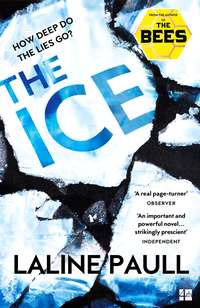
Kitabı oku: «The Ice: A gripping thriller for our times from the Bailey’s shortlisted author of The Bees»

COPYRIGHT
4th Estate
An imprint of HarperCollinsPublishers
1 London Bridge Street
London SE1 9GF
www.4thestate.co.uk
This eBook first published in Great Britain by 4th Estate in 2017
Copyright © Laline Paull 2017
Cover design by Heike Schuessler
Cover images © plainpicture/Mira/Conny Ekstrom
Interior engravings © Chris Wormelll
Map © Joy Gosney
With grateful thanks to the following for their permission to reproduce copyright material: Extracts from Arctic Adventure by Peter Freuchen by permission of Echo Point Books. Extracts from Farthest North by Fridtjof Nansen by permission of Skyhorse Publishing, Inc. Extracts from Lost in the Arctic by Ejnar Mikkelsen, published by William Heinemann. Reprinted by permission of The Random House Group Ltd. © Ejnar Mikkelsen 1913. Extract from Polar Bears by Nikita Ovsyanikov by permission of Quarto Publishing Group. Quote from Judge Rüdiger Wolfrum courtesy of the International Tribunal for the Law of the Sea. Extract from ‘Century of the Wind’ from The Wayfinders: Why Ancient Wisdom Matters in the Modern World, copyright © 2009 by Wade Davis and the Canadian Broadcasting Corporation. Reprinted by permission of House of Anansi Press, Toronto, www.houseofanansi.com, and the University of Western Australia Press. Extract from Northern Lights; The Official Account Of The British Arctic Air-Route Expedition by F. Spencer Chapman, published by Chatto & Windus. Reprinted by permission of The Random House Group Limited.
While every effort has been made to trace the owners of copyright material reproduced herein, the publishers would like to apologise for any omissions and would be pleased to incorporate missing acknowledgements in future editions.
Laline Paull asserts the moral right to be identified as the author of this work
A catalogue record for this book is available from the British Library
All rights reserved under International and Pan-American Copyright Conventions. By payment of the required fees, you have been granted the non-exclusive, non-transferable right to access and read the text of this e-book on screen. No part of this text may be reproduced, transmitted, down-loaded, decompiled, reverse engineered, or stored in or introduced into any information storage and retrieval system, in any form or by any means, whether electronic or mechanical, now known or hereinafter invented, without the express written permission of HarperCollins.
Source ISBN: 9780007557776
Ebook Edition © May 2017 ISBN: 9780007557769
Version: 2017-12-21
DEDICATION
For my brothers
Geoff and Gordon
with love
CONTENTS
Cover
Title Page
Copyright
Dedication
Map
1
2
3
4
5
6
7
8
9
10
11
12
13
14
15
16
17
18
19
20
21
22
23
24
25
26
27
28
29
30
31
32
33
34
35
Author’s Note
A Very Partial Bibliography
Acknowledgements
Also by Laline Paull
About the Author
About the Publisher

Among dogs are found characters almost as various as among men. Some dogs do not give a damn what they eat; some will eat their own mothers, as I have often witnessed, and others will starve to death before touching the bodies of their team-mates. Again, some refuse to eat the meat while it is still warm, but perhaps after it is cold they forget what it is and devour it greedily.
Arctic Adventure: My Life in the Frozen North (1936)
Peter Freuchen

1
They were rich, they were ready, they were ravenous for bear. Nine days into their fourteen-day voyage on the Vanir, the most expensive cruise ship in the Arctic, the passengers’ initial excitement had turned to patience, then frustration, and now, a creeping sense of defeat. As sophisticated travellers they knew money didn’t guarantee polar bear sightings – but they still believed in the natural law that wealth meant entitlement. Ursus maritimus sightings very much included.
‘Realm of the Ice King’ stated the brochure, featuring competition-winning photographs of sparkling ice and polar bears with cubs and kills, taken by recent passengers on this very route. But now instead of high blue heavens, the skies were overcast. Instead of a crisp and exhilarating minus three or even ten degrees (they were eager to test their new clothing), they suffered a vile gusty swelter that turned the Arctic dank as an English summer, and for which no combination of clothing was right. Plus the endless daylight was oppressive – medication schedules went awry and watches became meaningless.
There were several lawyers among the passengers. They invited the tour leader to the bar to look at the brochure and hear their formal complaint. The voyage was misrepresented. They had been mis-sold. Enough with the beach landings to stare at derelict huts and piles of whaling junk. Enough birds too, that didn’t fob them off. What they’d all paid for were sightings of live ice-obligate mammals. That was the primary focus of the text and image of the brochure, a sales document with a legal duty to accuracy. No icebergs either, just some dirty glaciers. They were considering a class action for compensation.
The passengers repaired to the salon and put on the compilation film that had become their envious obsession. With the blinds down to keep out the bullying daylight, they stared avidly at the on-screen polar bears; the one standing on a crimson mat of ice ripping flesh from a red rack of seal carcass, then the mother and her yearling swimming between the floes. Best of all was the large male standing on his hind legs, staring into the camera, his muzzle bright red. That was what they wanted.
The tour leader ran to the bridge to confer with the captain and the ice-pilot, who by law they were still required to employ, even though the summer sea ice was two years gone. They stared out at the grey chop of the Barents Sea. All knew, though they would not say for fear of their jobs, that the animals had all but vanished and the footage in the salon was several years old. There was one solution, prohibited, but every tour company knew it as a last resort. Send up a drone and find a bear.
Two miles away around the coast, down a deep M-shaped fjord, a large silvery wood cabin blended with the dark cobble of its beach. Modern extensions at its rear and sides were made of the very rock of the mountain that rose up behind it, and a close look would reveal several windows that reflected sea, sky and rock. But no one did look, in that intrusive unwelcome way, because this was Midgard Lodge in Midgardfjorden, and by direct intervention of Oslo, to the Sysselmann’s office in Svalbard, special rules applied.
Most outraging to those who knew of it, was the one which flouted a major conservation regulation and allowed Midgard Lodge helicopter flights between Longyearbyen airport and the tiny beach in front of the Lodge, which was just large enough to land a twelve-person Dauphin.
The second was that no cruise ship penetrate the Wijdefjorden system past a certain point, thereby closing the spectacular rock stratification of Midgardfjord and its peculiar forked glacier Midgardbreen, one side blue, one white, off to tourism.
The third, which caused the autocratic Sysselmann the most disquiet, was that these diktats were verified at the highest level but relayed verbally, via a female assistant defence minister. She refused to confirm them in writing and though the Sysselmann had not heard of her, she was rather too well informed about him. He duly made sure Mrs Larssen’s requests were observed, and in consequence, Midgard Lodge was not.
Except for today, when general manager Danny Long, on duty in the cabin office looking down the fjord, felt his instinct tweak him to take another look at the AIS radar screen. He had just checked it at mid-scale, taking in the little coloured arrowheads that showed, variously, pink and purple for fishing and sailing vessels, green for cargo, and god forbid, red for tankers coming in too close. He looked at the screen more closely. Something was off.
He clicked on the green arrows and saw what he expected – Asian cargo ships on the new TransPolar route. He clicked a couple at random: the Hao Puren: Rotterdam to Shanghai. The Zheng He, going the other way, Dalian to Algiers. A couple of others – everything moving smoothly.
Then he studied the dotted blue arrows of the cruise ships. Now the ice-free and liquid North Pole was just another bit of sea and offered no photo opportunities, Svalbard’s stunning coastline was clogged in the summer. All captains tried to stagger their route to minimise bottlenecks, but because of the rarity of animal sightings, the tour operators had an agreement to share the information with each other on Channel 16 – despite this leading to what amounted to a cruise ship race to be second at the kill. The coastguard policed what it could, and was glad of Midgard Lodge’s ability to offer search and rescue – but both knew that would be a last resort.
There: he saw it. The tiny blue cursor which had crossed into Midgard’s unofficially restricted area. He clicked. Passenger cruise ship Vanir, he knew it. High staff-to-passenger ratio, regular circuit – except today. Probably after a bear. There was a huge male passing through, he’d seen it standing in silhouette on the fjord’s bone.
He would report the ship’s transgression later, but for now the protocol was to ensure front-of-house was neat and clean, everything quiet. Keeping an eye on the Vanir’s position, he hit a speed-dial on the iridium phone never far from his hand. A moment later, the phone flashed back at him. Message received, they would stay out until further notice. Then Long called down to reception and was pleased to hear everything was in hand. He returned to the screen, watching the little blue cursor slowly blinking around the headland, coming closer.
When the bear was young and the snow fell clean and white, his fur showed creamy, even pale yellow at times. Now the snow had a greyish tinge, causing him to shine even brighter against it. He had grown long yellow guard hairs on his massive forelegs, increasing his appearance of power, and when the sun shone through them it gave him a gold aura. He was following the scented track of a female in oestrus who had passed by, but paused to watch the ship heaving into the narrow mouth of the fjord, its engine thundering the water, its fuel stinking the air.
The deck was crowded with people, bare-skinned faces with shiny black insect eyes turned towards him. Their human body smells mingled with the smell of food from the ship, and metal, and fuel. The engine sound died down and the vibrations slowed then stopped. The voices faded.
The black walls of the fjord held the Arctic silence, until the bear lifted his white anvil of a head, black nostrils flaring for more information. His every move drew clicks and whirrs from the ship, becoming a frenzy as a curl of wind tickled him with a clue, and he lay down and rolled in the female’s trail.
On the bridge with the captain, the tour leader looked down at the entranced passengers, and relaxed. The bear was massive by any standards and on the most photogenic blue side of the Midgardbreen glacier, where the ice terminus formed a cliff above the water. On the other side of the black bone of rock, the glacier was younger white ice and debouched in a relatively gentle slope down to the cobbled beach. With a start, the tour operator noticed the silver-grey wood cabin, extending back into the mountain.
‘Is this the British guy’s place? I heard it’d been sold – what goes on here?’ Neither the Norwegian captain nor ice-pilot replied. They had crossed a line to find her passengers their bear. Svalbard had many enigmatic structures. No comment.
Crowded at the rail, excited as schoolchildren and all thoughts of class actions gone from their minds, the passengers of the Vanir were busy changing lenses and exclaiming in wonder. The bear was as huge and charismatic a celebrity as they could dream of, they guessed him at eleven or twelve feet, nearly a ton, maybe more. Through powerful telephoto lenses they saw his duelling scars, and the way he stood up on his hind legs, the edge of his pelt shining gold around him. He stared straight back with knowing black eyes, and they felt a euphoric jolt of fear. He could kill them.
Without warning the white god dropped to all fours and changed into a frightened animal, running for the edge of the glacier. In consternation the passengers watched him stagger and clamber into the shadows, where he vanished. They groaned in disappointment, they scanned around for what had scared their bear, but though their hi-mag lenses probed the darkness of the lower crags and pored across the bright rock striations, nothing moved. They stared at the layers of colour and tried to appreciate the earth’s history laid bare. But they felt angry and tiny.
Someone shouted out: there! that puff of snow higher up the glacier – surely too far and they had not seen him run – but they focused in hope. They gasped in wonder as a hundred hidden chimneys below the surface puffed out more sparkling ice-smoke. The air clenched and the sea sighed. The Vanir lifted as a great pressure wave passed through the water.
And then it started. First a distant boom, a detonation deep inside the glacier. Nothing, for a few long seconds, then a huge tearing, cracking sound that shook the air, before time stretched and the blue snout of the glacier, sliding belly down from the ice cap, moaned and pushed out over the water – and then with thunderous bangs like car-crashes it exploded all along its front, hurling shards of ice into the air and seismic bursts into the water so that the reinforced steel hull of the Vanir vibrated with the charge.
Wraiths of glittering ice-dust drifted over the sea. The passengers gripped each other as the Vanir lifted and fell again, and the shards of ice so small as they splashed, rolled out into the fjord as icebergs tall as the ship.
And then, as they watched, something happened that made no sense at all.
In front of the still-shuddering glacier, an invisible hand pinched a fold of sea like cloth then pulled it high into the air in a fistful of waterfalls. Out of the dazzling torrent emerged a great sapphire castle with turrets and minarets, throwing sparkling foam and mist as it cleared the water for one long stupendous second.
The passengers on the Vanir screamed and shouted as their eyes brimmed with wonders – some saw the streak of gold glowing deep within the frozen blue, some the detail of the minarets, some saw gargoyles’ faces in the ice – but their voices were lost in the roaring sound as the vision leaned and fell, making a great bowl of the sea in which it twisted and rolled over, completely inverting itself.
All they saw now was a dark blue ice floe the size of an ice-rink, its pinnacles and spires forever hidden. Like a sentient thing, it glided towards the Vanir, a peculiar ridge of water pushing the ship aside as if to clear its way. Unearthly and real, the great floe followed the other icebergs out towards the mouth of Midgardfjorden, and the open sea beyond.
The passengers of the Vanir had no more words, but one, a woman, was making a convulsive, almost sexual sound. Oh, she kept whispering, still filming everything, the calving ongoing within her. Her lens followed the newborn icebergs, the whirling eddies in the water, and back to the glacier face. She filmed the water slapping and rocking at its base, and the cave of deepening blue ice where the water surged and circled. Something swirled at its centre, making the current waver. Something that had not been there a moment ago.
Without taking her eye from the viewfinder, she reached out a hand for her husband. She pulled him towards her and gave him the camera, still recording. She pointed to the red shape rocking just below the surface.
‘My god,’ she said softly, ‘is that a body?’
There is one place on the coast of which they stood in some dread – the great glacier of Puisortok. Travelling in early summer in their umiaks, they necessarily hug the coast, and utilize the narrow leads that exist between the pack-ice and the glacier. The literal meaning of the name is “the thing that comes up”, as this peculiar glacier often calves by huge pieces breaking off underwater, which come to the top and shoot like breaching whales into the air. Instant destruction is the penalty for misjudgement or mere bad luck.
I remember an old hunter saying: “Do not speak, do not eat, until Puisortok is passed.”
Northern Lights: The Official Account of the British Arctic Air-Route Expedition 1930–31 (1932)
Frederick Spencer Chapman

2
The calving of the Midgard glacier was a tiny stitch in a larger pattern. While the male corpse it disgorged was already in Tromsø and under autopsy, all around the Arctic Circle scientists were recording calving events of unprecedented magnitude. This apparently synchronised new behaviour of the ice was strongly active for about seventy hours in Greenland, Nunavut Arctic Canada, Alaska and Russia, before stopping as abruptly as it started.
Twenty-seven degrees south in London, the Saharan dust storm that had blown over Europe for the last three days also ceased, leaving a fine red film over the whole city and adding respiratory patients to overcrowded A&E departments and private surgeries alike. Entrepreneurial Londoners sold white paper masks by tube stations and only the reckless still went running.
Age fifty (but looking younger) and mindful of his mental state without hard exercise, Sean Cawson was one of them. Although his knees now protested and his thoughts clawed at him for the first two or three miles, afterwards he felt good, and that was rare. He left Martine sleeping, or pretending to, and slipped out of the apartment. Last night’s conversation was only on pause. He would have to deal with it before long.
He jogged past the neighbour’s door, smelling coffee and hearing their new baby crying. His daughter Rosie was almost grown up, and hated him. At the beginning, Martine had said she wasn’t interested in family life, and he’d been relieved: one conspicuous failure was enough. Now she’d changed her mind, and he felt betrayed.
He pulled the heavy black door shut and stood for a moment on the empty street while he chose his running music. It was early but muggy, the sky was grey and no birds flew. The white porch pillars of the houses were shaded with the ochre Saharan dust, which also gave an autumnal cast to the plane trees of the communal garden. As he chose a random mix and set off to the park, London looked and felt wrong.
The music matched it – harsh declamatory rap in African-inflected French that fitted the dislocated feel of the city. His feet caught the hard pounding rhythm and as he entered the park by the Kensington Palace gate he felt the spasms in his knees but ignored the pain. He was good at that. As if in reward, there ahead of him was one of his favourite sights, one of the privileges of early risers in certain parts of London: a troupe of army horses being exercised. Sometimes he’d pause to watch them cantering on the sand track that ran alongside Park Lane, a powerful river of satiny chestnut and bay muscle. The heavy rhythmic vibration of their hooves into the earth had risen through his feet into his body and connected him to some elusive feeling he could not name.
It was a crazy thought and the horses would easily outstrip him, but he wanted to run alongside them. He pushed himself harder. He could smell the fragrance of the animals as he cut across the grass, a wolf heading them off as they turned on the sand track for their canter – he would sprint and burn himself out until they left him behind—
His phone buzzed from his arm holster. There were only two people he set to bypass his Do Not Disturb – Rosie, who never called, and the other whose name now flashed on the screen, his mentor Joe Kingsmith.
‘Joe!’ he panted. ‘I’ll call you back.’ The riders were gathering up their horses, the animals were stamping, knowing what was coming.
‘Don’t, Sean, stay: it’s an emergency.’
Sean stopped short.
‘I’m here.’
‘Are you home?’
‘I’m in the park – what’s happened?’
‘Sean boy, I’d have called you at home but no one has a landline any more. I want someone there with you.’
Sean stood still. ‘Tell me.’
There was a silence, and by its quality, Sean guessed Kingsmith was airborne. He tried to slow his breathing. The kind tone frightened him.
‘Sean, I am so, so sorry. I’ve just spoken with Danny at Midgard. Tom’s body washed out of the Midgard glacier two days ago—’
‘Tom’s body?’ Sean heard the words clearly, but his mind rejected them.
‘They had the positive ID this morning. It’s definitely him. I’m so sorry, Sean. I wanted to be the one to tell you.’
The park vanished. Sean’s world contracted to Kingsmith’s voice. ‘Out of the glacier?’ He felt stupid and slow.
‘Shit. I knew I shouldn’t have told you on the phone, but how else? I don’t know that much. There was this huge calving almost in front of Midgard Lodge – that’s when his body came out. Some cruise ship was down there and saw it all. Danny got sent away by the coastguard when he went to look, they were holding it as a crime scene—’
‘A crime scene?’ Sean came back into his body. ‘There was no crime, everyone knows that!’ He was shouting but he couldn’t do anything about it.
‘Sean boy, I’m trying to tell you, will you please listen? They call it that for protocol when they want to record everything. Of course there was no crime. Now I know you haven’t been up there for a while, but Midgard is still a business and this could have a PR effect, so we need to handle it right.’
‘They’re sure it’s Tom?’
‘One hundred per cent. They had a good idea it could be and they matched DNA with a family member, apparently.’
‘No one told me. No one’s rung. They’ve known for two days?’
‘I guess you haven’t been in touch so much lately. We knew he was dead but … this is still a big shock.’
Sean walked away from the people coming towards him, out onto the great grassy plain of the park, the horses forgotten. He sank to his knees on the dry ground.
He felt the fingers in his right hand start to burn, as if they still had frostbite. He stuffed them into his left armpit and felt his chest trembling.
‘Danny should have called me.’
‘I wanted to be the one. I only know because I had to call him about something.’
‘What thing?’
‘Look: I completely get why you haven’t been up there. But you’ve got a lot of catching up to do, and now isn’t the right time. I’m glad you’re interested again, but you’ve got an awesome team taking care of things so don’t even worry.’
‘I should be helping bring him back, I should be there.’
‘You can’t do anything: it’s all in progress. You weren’t next of kin, but I guess they’ll be in touch with you, they’ll be able to have a funeral at last. And an inquest, but that’s separate.’
‘An inquest?’ The word was so ugly. ‘But we know what happened, I’ve said it all, we’ve been through it.’
‘I know, but it’s what happens when someone’s brought home. Same in the States as in the UK – just a formality. I’ll be there to support you, I promise … Sean, can you hear me?’
‘Yes.’ The grey sky pulsed above him.
‘You get yourself home, get back to Martine. She’s got a good head on her shoulders, she’ll know what to do. Sean, say something.’
‘What were you talking to Danny about?’
He heard Kingsmith’s bark of a laugh.
‘Boy, are you persistent! But I’ve always liked that. OK, mea culpa, I put in a retreat, very small and last minute, a favour for a pal. I saw a void in the schedule and he’s paying top dollar. But this is hardly the time—’
‘I’m still the CEO. Everything goes through me.’
‘And if you are thinking like that at a time like this, you are the right man for the job. Point taken. Sean? You’re breaking up but I hope you can still hear me: you need to speak to your friend in Oslo, about keeping traffic away from Midgard – it’s important—’
The phone connection dropped out – Kingsmith’s signature goodbye. Sean stood alone on the dusty red plain of Hyde Park, barely able to breathe.
He started to run.
Martine was in the wet-room shower when he came in, sweat-soaked like it was raining. Still in his clothes, he walked into the torrent and held her. She smiled, her eyes closed – and then she looked and saw his stricken face.
‘Oh my god, what’s happened?’
Sean hit his forehead against the streaming wall. ‘They’ve found Tom.’
‘Stop! Come here.’ She held him to her, keeping them under the streaming hot water, undressing him until he was naked. She kicked the clothes away from the drain and held him until he stopped shaking, then she turned off the water and helped him out and into a robe. As she put on her own, he went into the kitchen. She followed, watching while he took a bottle of vodka from the freezer and poured a big slug into a tumbler.
‘Don’t,’ she said. ‘Handle it without that. You don’t need it.’
He knocked it back. Then he told her, in the barest detail, about Kingsmith’s call, and the facts he knew, including the fact of the inquest. Martine nodded slowly.
‘I’m so sorry, my darling. But Joe’s absolutely right: this is closure at last, and if there’s an inquest we’ll get through it. I need to plan how we handle it. First thing is I’ll work on a statement on your behalf, and then we’ve got a bit of time.’
Sean listened to her as she walked around their dressing room preparing for work, thinking aloud. Joe was right, she had a good head on her well-set shoulders, working out which journalists could be trusted, how she would cancel certain invitations so they were not seen out enjoying themselves for a while …
He wished she had burst into tears. He wished she cared more about Tom, and less about damage control. Her voice went on as he stared at the rails of his clothes. Abruptly she was beside him.
‘I’m staying with you.’
‘No,’ he said, getting up. ‘Go to work. I’ll be OK.’ He pulled open a deep drawer and took out his Arctic travelling clothes, alien with lack of use. ‘I’m going to Midgard.’
Martine held his arm. ‘That’s crazy. You’re in shock. Look at yourself.’
He did. The mirror showed him a beautiful young woman standing there half-dressed, her dark hair wet, beside an older man who stared back at him, eyes haunted and dangerous. Sean turned away.
‘Joe put in a retreat. Without telling me.’
Martine frowned. ‘Really? He shouldn’t do that.’
‘It’s because I haven’t been there. I’ve dumped everything on the team.’
‘No. You’ve delegated. You can’t personally run every single one of your clubs, you pick right then you trust people.’
Sean threw some clothes into the bag and zipped it. ‘I’m letting everyone down.’
Martine tried again, embracing him and pressing herself into him from behind.
‘You’re not! Forget about last night, forget all that. Just come back to bed and let me look after you.’ She ran her hand down his chest and closed it over him. ‘Be sad in my arms. I won’t go in today.’
‘No, go. I’ll be OK.’ He kissed her, to deflect the rejection. She stared at him in the mirror as he went out into the bedroom and found his car key. She followed.
‘You can’t drive, you’ve just had a huge vodka. And if you’re on the afternoon flight you’ve got plenty of time – where are you going?’
Sean looked out into the square garden.
‘It’s bad to hear it on the phone.’
‘Oh.’ She moved away. ‘I see.’
‘Martine, please, you know how fragile she is.’
‘Actually no, I don’t think she is, not at all.’
‘She loved Tom as well.’
‘Fine. But I think she was prepared to pull any stunt to try to stop you leaving. I think she’s manipulative and angry and she’s turned your own daughter against you, and me, and it’s totally a mistake to keep being sentimental about a marriage that was over long before I came along.’ She sighed. ‘I’m sorry. That sounded harsh. I just want to protect you from more pain at a time like this. You shouldn’t go.’
‘You’re right.’
‘Yes, I am. But if you don’t want me to stay with you today, or to come with you to Midgard, if you want to just be alone with the bad feelings—’
‘Yes! I’m a fucking mess, I told you I was a bad deal—’
‘I never make bad deals.’ Martine pulled back and looked in his eyes. ‘But if you want healthy boundaries you’ll have them, and if you want to put yourself through the wringer, you’ll do that too.’ She kissed him on the lips. ‘So I really care that you’re so sad, but as you won’t let me help you, I am going to work. Let me know when you’re back. I’ll be here.’
He listened to her light step down the outer hall, then the click of the front door. He went back to the freezer, but stopped. Martine was right, of course. He was in no condition to drive.
The easiest way to learn, of course, was to inquire of an angakoq (wizard), and in the course of my long conversations with Igjugarjuk I learned many interesting things. His theories, however, were so simple and straightforward that they sound strikingly modern; his whole view of life may be summed up in his own words as follows:
‘All true wisdom is only to be learned far from the dwellings of men, out in the great solitudes; and is only to be attained through suffering. Privation and suffering are the only things that can open the mind of man to those things which are hidden from others.’
Across Arctic America: Narrative of the Fifth Thule Expedition (1927)
Knud Rasmussen

3
Sean once knew the sequence of lights so well that he never got caught on red. Now the route had become as alien as his old home and he misjudged every stretch. To keep his mind away from thoughts of Tom, he focused on driving impeccably and not as if he had gulped three fingers of vodka in the last hour – but the morning rush-hour traffic was infuriatingly slow and he suddenly felt self-conscious in his car.
It was a beautiful Aston Martin Vanquish in a custom missile-bronze colour, and part of its appeal three years ago – the longest he had ever kept a car – were the looks he caught as he flashed past other drivers. But today, passing slowly made him uncomfortable. Perhaps he should change it for a Tesla to show what a good, upright, ecologically concerned citizen he was, as well as a flash bastard.
Perhaps the lights were stuck. The white van alongside him made little feints forward, and he glanced over. Two schoolboys in green uniforms clambered over each other like puppies, waving at him and pointing in admiration of his car. They tugged at their driver dad, a tough-looking young man with a shaven head, who stared straight ahead.
Red-and-amber – the white van surged ahead the very instant the lights changed to green, and Sean saw the boys cheering and goading their father faster.
He drew alongside then fell back a couple of times, pulling faces as if he were striving and failing to overtake, so that the boys screeched with joy and bounced up and down on the bench seat. As he saw the filter lane for his exit, Sean pretended he was giving up, and the boys pumped their fists in triumph as he let the white van surge past him. The tough young dad flashed him a grin and he felt a wave of good feeling. Then he indicated, tipped the wheel and the feeling frayed like a thread as he wound back on the roads of his old life.
He drove slowly for the last few miles, surprised to see it had rained heavily. There was no sign of the red dust of London and the fields were green. The track to the house was badly potholed and he felt irritated – it wasn’t as if Gail couldn’t afford to get it graded. The thought of the settlement still pricked him. He would have been generous had she let him, instead of taking out her anger against Martine in financial terms. He had not thought her capable of being so petty. But put that aside: he was here to deliver a terrible blow.
Gail, I’ve got some bad news. Gail—
Something on the track ground against the undercarriage and he cursed and slowed down. He would go out the other way. The grading of the lane was not his business and this would be the last time he would come here, so it didn’t matter. But still, his eye ran over the orchards in some dismay. The fruit was retarded and the leaves too heavy. All the rain without the sun.
Instead of the old blue Saab in the garage, there was a new silver BMW four-wheel drive. Only now did he consider the possibility that Gail might not have been home, or not been alone. He pulled up, blocking the garage, the way that always made them look out. And there she was, coming to the kitchen window. To his surprise, she waved. He walked down the path, hoping she had not got the wrong idea. No flowers, no bottle, a bad time of day to visit. He brought bad tidings of great pain. Gail, I’ve got some bad news …
She opened the door before he knocked. One year younger than Sean, the glaze of youth had cracked into a filigree of lines around her eyes. Her face was softening and dropping and she wore her clothes sexlessly loose. But she was still wearing perfume.
‘Sean, I’m so sorry,’ she said. ‘Are you OK?’
‘You know?’ He stared at his ex-wife. ‘How? I only just found out.’
‘Ruth called me.’ She stood back to let him in. ‘Crack of dawn.’
‘They told her first?’ Sean was assaulted by the smell of home. The old oak floors and stairs, the extortionate beeswax polish. He noticed a bowl of orange roses on the table. ‘You cut the Whisky Macs.’ They always left them blooming on the path, for visitors to enjoy their scent.
‘Saves them from the rain. Someone called her from Svalbard: Tom named her next of kin, apparently. But you already knew that.’
Sean touched a rose and its petals dropped. ‘I don’t remember every single detail of that time.’
‘I do … But they saw each other, didn’t they? That one last time.’
‘Yes, but I didn’t realise she was officially … next of kin.’
Sean winced at the idea of Ruth Mott relating her version of that last night. But that was the only way Gail could know, because at the time they were in the final throes of nisi to absolute, and only their lawyers were speaking. He looked up the stairs. Someone else was in the house, he could feel it.
‘Whose silver car is that out there?’
‘The colour’s called mineral white. And it’s mine.’
‘You said you wanted to keep the Saab forever.’
‘Out with the old. Apparently this new one’s attached to a satellite, so I’m tracked from space if I want and even if I don’t, unless I sit down online for hours and work out how to switch it off. It’s got this inbuilt—’
‘I’m glad you’ve got yourself a good car.’
She’d moved the pictures around. There was a new light on a table. Tom was dead, that was why he’d come. So that Gail could express his grief. She wasn’t doing that properly.
‘You and Ruth have made up then.’
‘I was unfair to her.’
‘She shouldn’t have meddled.’
‘I should have listened.’
Alarmed by the tremble in her voice, he went into the kitchen. A muscle memory prompted him: dump the coat, dump the bag – he looked down at the settle. The newspapers and the big tabby cat that slept there were gone.
‘Where’s Harold?’ He looked around, making the sound that called him.
‘He died too. Last year. Tea? Coffee?’ Gail filled the kettle, her back to him.
‘You didn’t tell me.’ He couldn’t help himself, he looked around. Each thing he recognised was like an accusation. ‘Isn’t this place too big for you now?’
Gail turned. ‘Sean, why did you come? You could have phoned.’
‘That’s what Martine said.’
‘Ah. She’s so thoughtful.’
‘You don’t even seem upset about Tom. Aren’t you upset? You could have called—’ He stopped. It was obvious she was upset.
‘Yes. I’m upset. But I don’t call you any more, about anything, unless it’s Rosie. I assumed you knew.’ She did not cry. ‘So, there’ll be a funeral, what else? Your knighthood’s finally arrived?’
‘Not yet, but it will.’ He felt bewildered. Gail wasn’t like this. She was soft.
‘Your services to British business. One in the eye for my father.’
‘Here’s hoping.’ He felt the trembling ghosts of parties and dinners, the familiar plates he’d eaten off, the cupboards that held them. The bunches of herbs hanging up. ‘The lane,’ he said abruptly. ‘It’s in a shocking state, do you want me to make a call? You’ll never get round to it and it’ll just get worse. I don’t mind.’ He had not meant to say that.
‘I know you’re a master of the universe and all that—’
‘Those are bankers, I’ve never been a banker—’
‘—but in case you hadn’t noticed, it’s been raining solidly for a month.’
‘It hasn’t rained a drop in London.’
‘I don’t care what happens in London! You can’t grade a flooded lane, you have to wait for it to drain. It’s all organised. But thank you for pointing it out.’
‘So you’re OK then. Not – clinically depressed.’
‘Sorry to tell you, I’m absolutely fine.’ She wiped her eyes, her back to him.
‘Is that Sean?’ His daughter Rosie swerved round the kitchen door in a long T-shirt that said OCCUPY, and her honey brown hair ruined into dreadlocks. Her ears were multiply pierced, and to his dismay, he noticed another tribal tattoo on her upper arm.
‘Rosie,’ he groaned. ‘What have you done to yourself?’
‘Grown up without you? Why is Mum crying? Sean, why are you even here?’ Rosie put her arm around her mother and glared at him.
‘I’m fine,’ said Gail, ‘really. We’re just talking.’
‘And I don’t like you calling me that,’ he said. ‘I’m still your father.’ The way she looked at him broke his heart.
‘Uh-uh, you sacked yourself. A father is someone you’re supposed to be able to trust, who gives his word and keeps it, who doesn’t cheat and lie again and again, when they’ve promised not to. Mum cries every day you know.’
‘Oh for goodness sake, I do not—’
‘My god! Why does everybody lie the whole time?’
‘Some day, Rosie,’ he said, ‘you might understand that things are not always black and—’
‘White,’ she finished for him, ‘I know. They’re in the grey, and in the grey, Rosie, is where people like me make their money and tell their lies and generally screw up other people’s lives. In the grey. I’ve got it. Sean.’
‘She doesn’t know,’ Gail said quietly.
‘Know what? Ugh: you’re expecting a little bébé with her. Well it’s never going to have anything to do with me.’
‘No, that’s not why I’ve come, and I didn’t know you were here, I thought it was term time. I came to tell your mother that Tom’s body has been found. And in person, Rosie, not to be insulted by you but to break it gently to her. Except she already knew.’
Rosie stared at her mother in shock.
‘Ruth called me this morning.’ Gail put her arm round her daughter. ‘I’ll tell you all about it.’ She looked at Sean over Rosie’s shoulder. ‘Thank you for coming. I appreciate it.’
He stared at his crying daughter, and his stranger of an ex-wife. He was being dismissed from his own home. Ex-home. But still his child.
‘Rosie,’ he said gently, ‘if you ever wanted to see me—’
‘Why would I want to do that?’ She didn’t look at him.
‘Because you’re my daughter and I love you.’
‘Don’t hold your breath.’ She ducked out from under her mother’s arm and ran upstairs, her face crumpling.
The Vanquish blinked an electronic greeting. Sean drove carefully down the rutted, waterlogged private lane, then into the long single-lane road. The numbness was definitely gone, the encounter had left him raw with failure.
A short sharp blast of a horn ahead returned his attention to the narrow road, where a battered red Land Rover pulling a trailer was upon him. A man and a woman in matching jackets – James and Emma Goring. OK, he could do this. He’d only just gone by a passing place so he waved then reversed, shaking himself out of his funk, ready to greet them. The shattered bones of the past, knitting back together. He would tell them what had happened.
James and Emma – he couldn’t remember their children’s names – but over nearly a decade they had eaten at each other’s houses, bought rounds at the Acorn, gone to firework parties, shared New Year – the stuff of life that slowly accretes into friendship. But they did not appear to recognise him. In fact, James raised a casual finger of thanks and was about to drive on, until Sean called out.
James did a double-take, and stopped. ‘Sean!’ he said. Emma lowered the phone she had been checking, and just that second also officially recognised him too, with a bright smile.
Engines running, they exchanged enthusiastic concerns about the weather and the state of the lanes, and Sean told them about the dust storm, which they’d seen on TV but only got a little of here, weren’t they lucky with their microclimate? And then the awkward pause.
Sean knew they wanted to go. He felt angry, he kept them talking, anything, about all the new vineyards, the farm, while he absorbed the fact they hadn’t wanted to stop. Pretending they hadn’t recognised him. People got divorced, people moved on – he looked pointedly at their trailer, where big sound speakers were covered with a tarp.
‘Of course!’ he said. ‘Your solstice party – here’s hoping for sunshine!’
‘Oh,’ James said quickly, ‘very small this year.’
‘Big speakers, for a small party.’
‘Not really.’
They looked at each other, their smiles fading. They were not going to invite him.
‘I came down to tell Gail a dear friend of ours died.’ Sean had to look up at them from his lower vehicle. ‘We’re still friends.’
‘Best way,’ said James. ‘And sorry for your loss.’
‘Absolutely,’ Emma said. ‘So sorry. Take care, Sean.’
James put the Land Rover in gear and the loaded trailer rattled dangerously close to the Aston as they passed, attention fixed on the lane ahead. Then they were gone.
Sean stared after them in the rear-view mirror, his heart pounding like he’d been in a fight. He’d thought of them as friends – he’d brought out his best wine and put up with their tedious company in the hope that they would surely reveal themselves at some point – he presumed it was just that English reserve—
No. They had never been friends; they had always been cold to him. It was Gail they’d liked, he knew they thought she’d married down. The loss of Tom burned through him again: Tom who had been a true friend and a gentleman, always showing the same kindness and self-respect whether he was talking to a tramp or a billionaire. Sean heard Kingsmith’s voice in his head, from the old days, when he’d taken a business loss. Learn, and don’t look back. He checked the time, and told the satnav Heathrow.
There is a power that we call Sila, which is not to be explained in simple words. A great spirit, supporting the world and the weather and all life on earth, a spirit so mighty that his utterance to mankind is not through common words, but by storm and snow and rain and the fury of the sea; all the forces of nature that men fear.
When all is well, Sila sends no message to mankind, but withdraws into his own endless nothingness, apart. So he remains as long as men do not abuse life, but act with reverence towards their daily food.
No one has seen Sila; his place of being is a mystery, in that he is at once among us and unspeakably far away.
Across Arctic America: Narrative of the Fifth Thule Expedition (1927)
Knud Rasmussen

4
Sitting in 1F, crammed against the plastic wall, the smell of his neighbour’s duty-free aftershave in his nose, Sean remembered Tom’s grim prediction that Svalbard would become the Ibiza of the north. The midnight sun, exotic locale, and public awareness of the fragility of the region had created the strongest driver for tourism the Arctic had ever seen. Now Longyearbyen even had its own club scene, a Mecca for outward-bound hen and stag parties and rich kids bored of skiing.
Sean watched the stewardess and her cart coming closer. The clink of ice made him swallow in anticipation. He must reframe the shock as closure. A stone – a literal heavy headstone, could be laid on Tom’s recovered body in its grave, and on the hope he would return.
‘Sir, any drinks or snacks?’ the stewardess repeated, with an economy-class smile. She passed him his two miniature vodkas, tin of tonic and a plastic cup with a single ice cube and moved on quickly before he could ask for more. He didn’t bother with the tonic, just poured in both vodkas and knocked it back. No matter what Kingsmith and Martine said, in his heart he knew this was anything but closure. He’d learned to live with the idea of Tom lost in pristine obscurity – that was how many Arctic heroes ended their story. His reappearance was unscripted, as if the glacier itself had moved against him.
Another shadow fell on his thoughts, provoked by Gail’s reference to his still-imminent knighthood. The New Year and Birthday honours had come and gone three times, but there was always a good reason he had to wait – bit of a backlog, wheels within wheels, don’t worry—
He guessed why it hadn’t yet materialised: there were questions about the accident. All right then, let the inquest lance that boil of suspicion. He’d tell them whatever they wanted to know and as he publicly cleared his name, he would also remind the world that risk and danger were at the very heart of exploration and even to this day the fittest and best-prepared polar adventurers still sometimes died. Surviving was not a crime, nor was making a fine living from Midgard Lodge, where the beloved Tom Harding had died. An aggrieved journalist, turned down for membership at Sean’s other clubs, had written about Midgard and called it ‘Dirty Davos’. This was not entirely untrue. Sean Cawson’s group of membership clubs around the world catered to a global elite, but Midgard Lodge was different. The northernmost hostelry in the world and converted from an old whaling station, it was inaccessible to all but its guests, and provided for those who valued discretion, whose reputations were not the holiest, but who wanted to improve their standing in the world as well as their profits. These were the people about whom the World Economic Forum felt squeamish, who would never be invited to actual Davos, but whose decisions were of great economic and political import. If they were excluded from the best business society – publicly, at least – they were welcome to meet, and talk, and explore different business models in the stunning environment of Midgard Lodge. Sean believed and Tom had agreed that it was pointless preaching to the converted; also that honey caught more flies than vinegar. A luxury retreat in a uniquely inspiring location, security assured, was part of the realpolitik of environmental progress.
The stewardess was at the rear of the plane. Sean felt anxiety coursing through him but he didn’t want to arrive blunted by alcohol. A delicate thing, for a CEO to re-establish the chain of command after so long an absence – but Danny Long was slipping up as general manager if he was reporting to Kingsmith first. Kingsmith might have recommended him, but he was only Sean’s sleeping partner in Midgard, not an official shareholder like Martine and her clean-tech investors, nor Radiance Young and her friends in Hong Kong. Sean always smiled at the thought of Radiance and her bare-faced insistence she was investing all her own renminbis, not those of the People’s Republic behind her. Fine, if that was what she needed to say. But she certainly brought the Party with her.
It would probably be a few days before details were released to the press and then the news cycle and the eulogising would start up again. ‘Glacier gives up the ghost’, or more soberly, ‘Body of missing British environmentalist discovered’. As if Tom Harding were Franklin’s lost expedition, the subject of national mourning for decades. And then, of course, there would be the pictures. Tom shaking hands with indigenous protestors at the line of jungle they had saved. Tom swimming with that bloody whale shark, as if he were the only person in the world ever to do that. Tom with actors draped on his shoulders, celebrity trading for rugged moral virtue.
The prospect of reliving the cult of Tom was as irritating now as it had been while he was alive, but the worst of it was, Tom had disliked it too. Sean couldn’t even call him on his ego – or his looks, which were not his fault. Women adored him, men admired him, and this idolisation was a large part of why Sean had so doggedly courted him for Midgard, refusing to take no for an answer. But it wasn’t the whole of it. Despite their years of distance, Sean knew that if Tom believed in Midgard, then he had truly created something of real value to this world. His old friend’s approval had really mattered – and Kingsmith was right, he must get out in front of all this and use the drama positively.
Ücretsiz ön izlemeyi tamamladınız.