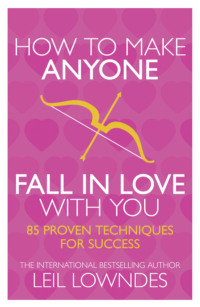
Kitabı oku: «How to Make Anyone Fall in Love With You: 85 Proven Techniques for Success»

To fulfil the promise of the title,
How to Make Anyone Fall in Love with You offers 85 techniques based on scientific studies into the nature of romantic love.
Contents
Cover
Title Page
1. Anyone? Yes, Practically Anyone
Science ‘Discovers’ Sex
How More Research Was Compiled
How the Techniques Were Developed
How I Tested the Techniques
2. What Makes People Fall in Love?
1. First Impressions
2. Similar Character, Complementary Needs
3. Equity
4. Ego
5. Early-Date Gender-Menders
6. ℞ for Sex
3. The Physical Side of Falling in Love
‘Why Do My Insides Go All Funny?’
‘Does Somebody Have to be Pea-Brained to Fall in Love with Me?’
‘Why Do We Fall in Love with One Person and Not Another?’
‘How Can These Little Things Start Love?’
4. Where Are All the Good Men and Women?
Looking for Love in All the Wrong Places
5. Does Love at First Sight Exist?
Part One: First Impressions
6. How to Make a Dynamite First Impression
First Impressions Last Forever
Be Ready for Love – Always!
Stay Psychologically ‘Fit to Kill’
7. How to Ignite Love at First Sight
How Much Eye Contact Does it Take to Imitate Love?
How to Get Sexy ‘Bedroom Eyes’
How to Awaken Primal, Unsettling, Sexy Feelings in Your Quarry
Naughty Eyes Are So Nice
8. Your First Approach
The Gentle Art of Pickup (Not for Men Only)
Hunters, Make the First Move … Fast
Huntresses, Make the Fast Move … First
First Moves That Work for Women
9. Your First Body Language
Let Your Body Do the Talking
The Dance of Intimacy
When You Are Quarry
The Word That Can Save Your Relationship
‘But This Is So Basic!’
10. Your First Conversation
Conversation Is Making Beautiful Music Together
Conversation Is Like Making Love
Conversation Is Like Selling
How to Know What Topic Turns Your Quarry On
How to Fool Your Quarry into Thinking You Two Are Already in Love
Get Even Closer by Giving the Gift of Intimacy
Make Your Lifestyle ‘Fit’ Your Quarry’s Lovemap
11. Your First Date
The Game Begins in Earnest
‘How Soon Should I Make My Move?’
‘Playing Hard to Get – Should I, or Shouldn’t I?’
The Scientifically Proven Best First Date
Give Your Quarry First-Date Butterflies
Plant the Seeds of Similarity
First-Date Restaurant Smarts
Hunters, Some Spit and Polish for Your P’s and Q’s
Huntresses, Forgive His Foibles
First-Date Duds
‘I Haven’t Got a Thing to Wear’
Part Two: Similar Character, Complementary Needs
12. ‘It’s You and Me, Baby, Alone Against This Mad, Mad World’
Similarity … and a Touch of Difference (Just a Touch)
13. How to Establish Subconscious Similarity
How to Instantly Make Your Quarry Feel, ‘Why, We’re Just Alike!’
Words to Give Your Quarry ‘That Family Feeling’
‘We Even Speak the Same (Body) Language’
14. How to Establish Conscious Similarity
The Three Crucial Conscious Similarities
Let’s Talk About Our Relationship – Not!
15. How to Establish Complementary Needs
‘I Got Just What You Need, Sweetheart’
Part Three: Ego
16. The World Revolves Around You, My Quarry
Ego Massage Is a Highly Skilled Craft
17. Step One: Silent Praise
Let Your Body Do the Praising
18. Step Two: Empathy
‘I Can Identify with That!’
Lovers Share Intimate Details
Lovers Have Private Jokes
19. Step Three: Admiration
‘Oh, Darling, You Did an Absolutely Superb Job Slicing These Mushrooms’
20. Step Four: The Implied Compliment
‘You’re Much Too Young to Remember This, But …’
The Bull’s-Eye Booster: ‘I Just Love What You Like About Yourself’
21. Step Five: The Big Guns
‘YOU Are the Most Fascinating Person I’ve Ever Met’
‘What Does Giving a Killer Compliment Do for Me?’
22. Fine-Tuning the Ego-Machine
‘Wait a Minute. Does Everybody Like Compliments?’
Knee-Jerk Praise: ‘What You Just Did Was Fabulous’
Have the First Laugh
Lovers Give Each Other Pet Names
When Your Quarry Praises You
23. Keeping the Love Coals Warm
‘I Love the Way You Wrinkle Your Nose When You Laugh’
Part Four: Equity
24. Everybody’s Got a Market Value, Baby
Why is Finding Love Like Horse Trading?
What Currency ‘Buys’ a Good Partner?
25. How Can I Use the Equity Principle to Find Love?
‘You Really Don’t Want to Marry the Handsome Prince or the Beautiful Princess’
‘Why Don’t I Want to Get Married?’
‘What Happens if Inequity Strikes After We’re Married?’
26. How Important Are Looks?
What Types of Looks Do Women Like?
What Types of Looks Do Men Like?
‘How Can I Make My Quarry Think I’m Better Looking?’
How to Beef Up Your Odds on Making the Kill
27. Pursuing Rich and Famous Prey
The Look of Money
The Sound of Class
What Does the U Crowd Talk About?
Use Status Words with Status Prey
28. Upping Your Ante in Other Assets
Knowledge, Social Graces and Inner Beauty Are Tangible Assets
29. Help Them Convince Themselves That They Love You
Let Your Quarry Do Favours for You
Hey! What About ‘O Lyric Love, Half Angel and Half Bird’?
Part Five: Early-Date Gender-Menders
30. ‘I Hope He or She’s Not an Idiot Like All the Others’
‘I Want a Man I Can Talk to, a Woman Who Thinks Like a Man’
31. What Is ‘Man Talk’ and What Is ‘Woman Talk’? (Do They Exist?)
32. ‘How Do You Feel About That?’
33. ‘Excuse Me, Could You Tell Me Where …?’
34. ‘Please, Spare Me the Details’
35. ‘Tell Me (Don’t Tell Me) About It’
36. ‘What’s the Best Way to Get from A to B?’
‘A Straight Line!’ He Declares; ‘A Gentle Curve?’ She Asks
37. ‘Could You Give Me a Hand with This?’
38. Little Words to Win Your Quarry’s Heart
39. Are There Dangerous Waters Ahead in the Gender Gap?
Part Six: ℞ for Sex
40. Your Quarry’s Hottest Erogenous Zone
41. No Two Sexualities Are Alike, as No Two Snowflakes Are Alike
How Do Men’s and Women’s Sexual Desires Differ?
Why Are Men’s and Women’s Fantasies So Different?
Yet More Differences
How to Use Differences to Make Your Quarry Fall in Love with You
42. Forget the Golden Rule between the Sheets
Men in Lust, Women in Love
43. Hunters, Make Love to a Woman as a Woman Wants It
The One-Hour Lesson That Will Change Your Life
Another Crash Course in Steamy Sensuality for Men
44. Huntresses, Have Sex with a Man as a Man Wants It
Let’s Go to the Videotape
Additional ‘Coarse’ Materials for Your Raw Sex Curriculum
45. A Quiz: Who Loves More, Men or Women?
Who Falls in Love Faster? Men!
Who Is More Idealistic About Love? Men!
Who Usually Initiates the Break-up? Women!
Who Suffers More from a Break-up? Men!
Who Loves Their Lovers More? Men!
46. Your Quarry’s Sexual Desires Are as Individual as a Thumbprint
Sex Is Like a Steak
The Number One Sexual Wish
‘Why Did He or She Lose Interest?’
‘Is This Woman Enough for Me Sexually for the Rest of My Life?’
47. Huntresses, Become a Sexual Sleuth
Let Your Quarry Know You Are a Sexual Adventurer
Uncover His Core Fantasies
Make Your Quarry Feel Safe Sharing His Deepest Desires
The Hot Purr Follow-Up
Do All Men Have a Sexual Secret?
Ask Knock-His-Socks-Off Details Questions
Huntresses, Discover His Trigger Words
Give Your Quarry Good Bed Rap
48. Hunters, Do These Techniques Work with Women?
Peel Back Her Layers and Lay Bare Her Deeper Fantasies
Love Her as She Needs to Be Loved
Magic Words to Make Her Love You
Huntresses, Relationship Trigger Words Work for You, Too
49. Finally, Snaring the Confirmed Bachelor
Why Do Jerrys Want Such Far-Out Sex?
A Walk on the Weird Side
50. On Looking at Other Women
51. The Final Stone Unturned
Afterword
Also by Leil Lowndes
Notes
About the Author
Copyright page
About the Publisher
Chapter One
Anyone? Yes,
Practically Anyone
‘I don’t understand. I’m attractive, intelligent, sensitive, accomplished. Why doesn’t he or she fall for me? Why can’t I find love?’ How many times have you beaten your fists on the pillow asking yourself this question?
You open this book sceptically, yet harbouring hope, for the solution. You read the title: How to Make Anyone Fall in Love with You.
‘That’s a big promise,’ you say. Indeed, it is. But the promise of this book is yours if you are willing to follow a scientifically sound plan to capture the heart of a Potential Love Partner.
Why, when history is strewn with broken hearts, do we now claim the means to make someone fall in love with us? Because, after centuries of resistance, science is finally unravelling what romantic love actually is, what triggers it, what kills it, and what makes it last.
Just as ancient tribesmen saw an eclipse and thought it was black magic, we looked at love and thought it was enchantment. Sometimes, especially during those first blissful moments when we want to stop strangers on the street and cry out, ‘I’m in love!’ it may feel like enchantment, but, as we enter the 21st century, we are discovering that love is a definable and calculated blend of chemistry, biology and psychology. (And, well, maybe a little black magic thrown in.)
As science sets sail in previously unknown seas, we are at last beginning to understand the rudiments of that ‘most insane, most delusive, and most transient of passions’, as George Bernard Shaw described love. And what makes people want to stay in that ‘excited, abnormal and exhausting condition continuously until death do them part’? The question, and the quandary, of ‘Precisely what is love?’ is not new. It is one that has been given serious consideration throughout the ages by cerebral heavyweights like Plato, Sigmund Freud and Charlie Brown.
In the darkened Broadway theatre in 1950, the audiences of South Pacific were in total harmony with Ezio Pinza when he pondered, ‘Who can explain it? Who can tell you why? Fools give you reasons. Wise men never try.’ Well, recently, many wise men and women have tried, and succeeded. Don’t blame Rodgers and Hammerstein. When they were composing romantic musicals, the scientific community was as perplexed about love as Nellie and Emile de Bacque singing their bewilderment about some enchanted evening.
Science ‘Discovers’ Sex
Long before Sigmund Freud tackled the subject, analytical scientific minds agreed that love was basic to the human experience. But their rational brains also deemed that evaluating, classifying and defining romantic love was impossible and therefore a waste of time and money. Freud went to his deathbed declaring, ‘We really know very little about love.’
His dying words remained the scientific doctrine. At least until the early 1970s when a pioneer-spirited band of social psychologists took up the scientists’ constant cries of ‘why?’ and ‘how?’ They began asking themselves – and everybody they could lure into their laboratories – questions about romantic love.
Two women psychologists made a breakthrough by inadvertently focusing the attention of the modern press on the ancient question of ‘What is love?’ Ellen Berscheid, PhD, with a colleague, Elaine Hatfield, managed to wangle an $84,000 federal grant to study romantic love. Berscheid convinced the National Science Foundation to open its coffers by declaring, ‘We already understand the mating habits of the stickleback fish. It is time to turn to a new species.’
Berscheid’s study, like others before, might have gone unnoticed and unpublished, except for a dozen or so pages in an obscure professional journal. Fortunately for love-seekers everywhere, one morning on Capitol Hill former United States Senator William Proxmire of Wisconsin was going through his papers. Buried deep in the pile was the NSF’S frivolous grant to two women to study relationships.
Proxmire hit the dome! Eighty-four thousand dollars to study what? He dashed off an explosive press release announcement that romantic love was not a science and, furthermore, he roared, ‘National Science Foundation, get out of the love racket. Leave that to Elizabeth Barrett Browning and Irving Berlin.’ Proxmire then added a personal note: ‘I’m also against it because I don’t want the answer.’ He assumed everyone felt the same. How wrong he was!
Proxmire’s reaction set off an international firestorm that raged around Berscheid for the next two years. ‘Extra! Extra! Read all about it. National Science Foundation Tackles Love!’ Newspapers had a field day. Cameras and microphones zeroed in on Berscheid with gusto. The quiet researcher’s office was swamped with mail.
Proxmire’s potshot at love had backfired. Instead of putting an end to the ‘frivolous pursuit’, his brouhaha generated tempestuous interest in the study of love. James Reston of the New York Times declared that if Berscheid et al could find ‘the answer to our pattern of romantic love, marriage, disillusion, divorce – and the children left behind – it would be the best investment of federal money since Jefferson made the Louisiana Purchase’.
It was as though Ellen Berscheid had pulled her finger out of the dyke. Ever since, there has been a torrent of studies scrutinizing every aspect of love. Respected social scientists with names like Foa, Murstein, Dion, Aron, Rubin and many others relatively unknown outside the scientific world have given us an as-yet-unopened gift – a gift we will unwrap now: the results of their labours, their studies, teach us (although that was not their purpose) how to make somebody fall in love.
Granted, some of the studies do not guide us directly to that goal. To find the relevant studies, I had to comb through hundreds of scientific probings with cumbersome titles such as ‘The Implications of Exchange Orientation on the Dyadic Functioning of Heterosexual Cohabitors’. (What?) Some studies had mice listening to classical music, then jazz and blues, to see which made them hornier.1 Other studies which were worthless to our goal explored sexual attraction to corpses,2 and then there were studies on tantric motionless intercourse,3 which, I assumed, works only when a couple’s honeymoon cruise ship hits rocky seas.
Happily, many studies bore tastier and more practical fruit. Especially helpful were studies by an intrepid researcher named Timothy Perper, a PhD student who spent many hours observing subjects in his favourite laboratory, called a ‘singles’ bar’. We also benefit from brilliant examinations by Robert Sternberg and his colleagues who explored theories of love. We learn from insightful early explorations into the elements of infatuation by Dorothy Tennov and others. There were courageous, if relatively unknown, researchers like Carol Ronai. She actually took a job as a table dancer in a topless bar to record what facial expressions turn men on.4
How More Research Was Compiled
My own first-hand research, although less daring, was no less vigorous. For more than ten years, before becoming a communications consultant and trainer, I was director of a research group I founded called The Project.
The Project was a New York City-based not-for-profit corporation established to explore sexuality and relationships. During my tenure with The Project, I interviewed and catalogued thousands of subjects on what they sought in a partner. I gathered information from the students at the dozens of universities where I was invited to speak on my research.
Like the work of researcher Ellen Berscheid, The Project experienced an unsought avalanche of attention which brought it to national attention. A Time magazine reporter covered one of our sessions and wrote a full-page article declaring ‘Sex Fantasy Goes to Broadway’, which, indeed, it did.
One arm of The Project had volunteers presenting psychodramatizations of their actual love fantasies on stage. Because there was no nudity and no explicit language, the squeaky-clean dramatizations were unique and caught the attention of the three major television networks, which presented excerpts of the vignettes on national programmes. This, in turn, spawned dozens of articles in respected mainstream publications in America and Europe.
As a result, people from all over the world sent us their stories, their fantasies, their longings for love. They called or wrote to The Project detailing precisely what they sought in a romantic partner. Most of the letters and calls we received were prefaced with comments like, ‘I’ve never told anyone but …’ The callers and writers then proceeded to divulge their deepest desires to the anonymous Project. We listened, gratefully, as we gathered data on what made, or would make, people fall in love.
How the Techniques Were Developed
Let us leave the world of sexuality for a moment. Come with me to my second discipline, the field of communications. It is here I take the findings and turn them into workable techniques to make someone fall in love with you.
It has been proved beyond any doubt that there are ways to induce desired behaviour from people. If there were not, all psychologists and thousands of corporate trainers, myself included, would be out of business. There are established methods for invoking various emotions and for changing people’s behaviour. For example, we can learn how to deal with difficult people or how to make troublesome employees respond in the desired way.
Feedback from seminars I have presented for government organizations, universities, professional associations and corporations convinces me that we can indeed effect changes in behaviour patterns. We accomplish this complex task by first understanding people’s basic needs and motivations, then by employing the right verbal and non-verbal skills to modify their behaviour.
That is what I do in this book. Drawing from the scientific studies, I reveal the basic needs and motivations that make someone fall in love. Then I give you the right verbal and non-verbal skills to induce the behaviour you want – in this case, to make that person fall in love with you.
This book is the result of many years of research and exploration into several disciplines: interpersonal relationships, human sexuality, communication skills and gender differences. We not only draw from scientific studies into the nature of love and from my personal research, but we also benefit from the work of modern therapists and communications analysts. I am especially grateful for the work of sociolinguist Deborah Tannen5 and the clever Mars/Venus analogies of therapist John Gray,6 who made it common knowledge that men and women have vastly different styles of thinking and communicating.
What is the recipe for making someone fall in love with you? Can it be reduced to a formula? The following sounds simple, but it is actually quite complicated.
You start with a solid scientific base of what makes up interpersonal attraction. Then you gather profound information about your Quarry (the person you want to make fall in love with you). Next, you employ sophisticated, often subliminal, communication techniques to meet his or her conscious and subconscious needs. Finally, you secure your Quarry with your spicy perception of precisely what he or she wants sexually. There you have it: the formula for making a Potential Love Partner fall in love with you.
How I Tested the Techniques
I was not content with simply relying on research. I needed to see if these techniques would work in the field. Several years ago, to test my theories, I created a seminar with the same title as this book, ‘How to Make Anyone Fall in Love with You’.
Invitations flowed in from all over the country from colleges, singles’ groups, clubs and continuing education organizations. It is on this playing field that the material has been tested. And the feedback from my students is, ‘Yes!’ You can make someone fall in love with you.
Is it a simple task? No.
Does it require sacrifice? Yes.
You may decide, after reading this book, that capturing his or her heart is simply not worth having to give that much of yourself. But if you do want to proceed, follow me. We will explore the skills needed to accomplish the task, to make the Potential Love Partner of your choice fall in love with you. (You notice that I have used the words Potential Love Partner several times. I will do so throughout the book because, although it is bulkier, the phrase is more accurate than anyone, which my publisher wisely decided is more readable.)
Who are your Potential Love Partners? Firstly, a Potential Love Partner (or PLP) is anyone who is ready for love. Timing, if not everything, at least counts a lot. For example, if someone has just lost a beloved spouse he or she may not be ready for love. That knocks him or her – temporarily – out of the PLP category.
Secondly, a Potential Love Partner is anyone free of esoteric psychological (or Lovemap) needs. These are needs that, through no fault of your own, you cannot fulfil. We will talk a lot about your Quarry’s Lovemap later.
That leaves many Potential Love Partners, a myriad of hearts to choose from. Let us embark now upon the path that leads you to the heart of the man or woman you desire.
Chapter Two
What Makes People Fall in Love?
The Six Elements
What are the long-awaited results of Berscheid’s early studies and the deluge of those that followed? Well, maybe Freud was right. Romantic love is enigmatic. It is difficult to capture and convert into computerized, controlled bits and bytes of information. Instead, treating it as if it were a virus, scholars are tackling specific questions about love, nailing down a few facets at a time. They have made tremendous progress.
Out of the cascade of studies, six verities emerge about what makes people fall in love. To be a successful Hunter or Huntress of hearts, you must, like Cupid, be a skilful archer, and aim your arrow dead centre at the following six targets.
1. First Impressions
You Never Get a Second Chance at Love at First Sight
The first moments you spot your Quarry – and he or she gets a glimpse of you – can be decisive. Herein lies a ‘go/no go’ decision. Scientists tell us that love’s seeds are often sown during the first few minutes of a relationship.
When two cats meet for the first time, they stop and look at each other. If one hisses, the other bristles his coat and hisses back. However, if the first cat gives a little nudge with its cold nose, the other cat responds in kind, and they wind up purring together and licking each other’s coats.
A man and a woman getting to know each other are like two little animals sniffing each other out. We do not have tails that wag or hair that bristles, but we do have eyes that narrow or widen. We have hands that flash knuckles or subconsciously soften in the palms-up ‘I submit’ position. There are dozens of other ‘involuntary’ reactions that take place in the first few moments of interaction. The good news is that we can learn to control these presumed involuntary reactions.
The moment you set eyes on each other, your Potential Love Partner subconsciously reads the subtleties of your body language. In these first crucial moments he or she can unconsciously resolve to try for romantic take-off or abort thoughts of love. His or her mind then becomes computer-like, and your PLP continues to make rapid decisions about you during your first conversation, your first date.
In Part One we will cover techniques to lure Potential Love Partners into approaching you, into liking you, and then into making a first date. I will share scientifically sound methods of keeping the conversation exciting and making the first date stimulating for your Quarry.
2. Similar Character, Complementary Needs
I Want a Lover Just Like Dear Old Me (Well, Almost)!
If you pass the first impressions test, you enter the second phase. Here your Quarry starts making judgements about you as a Potential Love Partner. His or her subconscious mind is saying, ‘I want someone like me. Well, almost like me.’
If there is to be compatibility for a lifetime, or even for a date, some similarity is necessary. Our hearts are finely tuned instruments that seek someone who has values similar to ours, who holds beliefs similar to ours, and who looks at the world in more or less the same way we do. Similarity makes us feel good because it confirms the choices we have spent our whole lives making. We also look for people who enjoy the same activities so we can have fun together. Similarity is indeed a launch pad for a good relationship takeoff.
But we get bored with too much similarity. Besides, we need somebody to make up for our lacks. If we have no head for mathematics, who is going to balance the cheque book? If we are sloppy, who is going to pick up our socks?
So we also look for complementary qualities in a long-term love partner. But not any complementary qualities – only the ones we find interesting or that enhance our lives. Hence, we seek someone who is both similar and complementary.
In Part Two we will explore methods of planting subliminal seeds of similarity in your Quarry’s heart and ways to make him or her know that, even though you two are basically alike, you are different in so many utilitarian, fun and interesting ways.
3. Equity
The ‘WIIFM’ Principle of Love
‘Hey, sweetheart, everybody’s got a market value! Everybody wears a price tag.’ How pretty is she? How much prestige does he have? How blue is her blood? How much power does he wield? Are they rich, intelligent, nice? What can they do for me?
Does this sound ugly? Researchers tell us love is not really blind. Everybody – even the nicest people – has a touch of crass when it comes to choosing a long-term partner. It’s no different to in the business world where everybody asks, ‘WIIFM?’ What’s in it for me?
I can hear some of you protesting, ‘No, love is pure and compassionate. It involves caring, altruism, communion and selflessness. That’s what love is all about.’ Yes, that’s what love is all about when good people are truly in love. You have probably even met couples who are deeply devoted and would sacrifice everything for each other. Yes, this kind of selfless love that we all dream of having exists. But it comes later – much later. It comes only after you have made your partner fall in love with you.
If you want to make someone fall in love with you, researchers say, you must initially convince them they are getting a good deal. We may not be conscious of it but, science tells us, tried and true market principles apply to love relationships. Lovers unconsciously calculate the other person’s comparable worth, the cost-benefit ratio of the relationship, the hidden costs, the maintenance fee and the assumed depreciation. Then they ask themselves, ‘Is this the best offer I can get?’ Everybody has a big scorecard locked away in their heart. And, in order to make people fall in love with you, you have to make them feel they are getting a very good deal.
Is all lost if you weren’t born drop-dead gorgeous, or if you don’t have a famous family name? No. In Part Three we will explore silver-tongued verbal skills to replace the silver spoon that was never in our mouths when we were born. In that way we can satisfy some very choosy Quarry.
4. Ego
How Do You Love Me? Let Me Count the Ways
At the blazing core of first romantic rumblings is ego. Perhaps Cupid misses the mark when he aims his little arrow at Quarries’ hearts. Science shows us where to really level our ammunition and take fire – right at their egos. People fall in love with people in whose eyes they behold the most ideal reflections of themselves.
Would-be lovers should be thrilled that ego makes the world go round, because Quarries’ egos are very vulnerable targets. There are multifarious ways to make your Quarry feel beautiful, strong, handsome, charming, dynamic, or however he or she wants to feel. There are big-stroke compliments, little-stroke caresses, and a myriad of deliciously devious means to make your Quarry feel special. Subtle procedures can convince Quarries what they have suspected all along: ‘I am different. I am wonderful. And to thank you for recognizing this amazing fact, I’ll fall in love with you.’
Everyone also hungers for security and validation. We seek protection in our primary relationship from the cruel, cruel world. Part Four, How to Make Anyone Fall in Love with You, explores ways to make your Quarry feel that you are the salvation – you are his or her safe harbour from the storm of life.
5. Early-Date Gender-Menders
Is There Love After Eden?
Everyone smiled knowingly in 1956 when Rex Harrison moaned from the Broadway stage, ‘Oh, why can’t a woman be more like a man?’ He knew his Fair Lady was a very different animal indeed. But in the era following My Fair Lady feminists cast serious doubt on his convictions.
Now, after many decades of pondering, presuming and postulating on whether men and women really differ in anything but their genitals, the envelope has been opened. The answer is – drumroll please – yes! Men and women think and communicate in dramatically different ways.
Neurosurgeons can point to clumps of neurons in female brains that cause men like Henry Higgins in My Fair Lady to call women ‘exasperating, calculating, agitating, maddening and infuriating’. Scientists aim their needles at the molecules in the male brain that make women accuse men of being ‘insensitive clods’.
Despite the torrent of data flowing in about the genetic, cerebral and sexual differences between men and women, both Hunters and Huntresses continue to assume we think alike and persist in courting each other in the way they would like to be courted themselves. Perhaps recent scientific findings will give men and women more insight into each other’s style, but nothing short of a frontal lobotomy could make a permanent change in which brand of neurons our brains give off. Women will continue to be ‘exasperating’, and men will still be ‘insensitive’. And both will keep on communicating in styles that turn each other off, especially on the first dates.
To avoid scaring off their prey before they bag it, serious big-game hunters know all the characteristics and habits of deer, moose, caribou, bison and wild hogs. Likewise, serious love Hunters and Huntresses must be well versed in gender differences if they intend to make the kill.
Part Five briefs you on how to avoid the most common early-date turnoffs to make even the most wary Quarry comfortable letting down his or her guard. Love-shy Quarry who usually take flight when a man or woman gets too close will happily come within firing range of your arrow.
6. ℞ for Sex
How to Turn on the Sexual Electricity
Many books on how to turn on your partner make sex sound like flipping the switch on the night-light next to your bed. ‘Press here to speed up orgasm. Stroke there for an extra charge.’ Yes, sexuality is electricity, but your Quarry’s bodily buttons only speed up or slow down the physical functions. Mind power is what drives the mighty machine and keeps it generating heat for many years. The most erotic organ in your Quarry’s body is his or her brain.
For details and how-tos, there is no lack of reference books. They have names like How to Drive Your Man Wild in Bed, How to Drive Your Woman Wild in Bed, How to Drive Your Man Even Wilder in Bed and How to Satisfy a Woman Every Time and Have Her Beg for More. The list goes on. Such manuals are replete with detailed data for women on how to tickle that spot just below the ‘cute little helmet’ to drive him out of his gourd. Men can examine idiotproof charts on where to let their fingers do the walking so as to not miss the U-turn that leads to her G-spot.
All of this is important stuff – very important stuff. But when it comes to actually making somebody fall in love with you, it pales in comparison to what I will call brain fellatio – sucking the dreams, the longings and the fantasies out of your Quarry, and then creating a lifelong erotic aura that he or she luxuriates in.
Gentlemen, far more important for a woman than how many times you can ‘do it’ in a week (or even in a night) is the sensuality and passion you create in every aspect of your relationship. And the sensations you give her every time you look at her. Ladies, far more important to a man than your bra-cup size or the curve of your hips is the size and curve of your sexual attitude and how you deal with his individual sexuality.
No two sexualities are alike, just as no two snowflakes are alike. I will give you techniques to uncover your Quarry’s unique sexuality and then make love to him or her just the way he or she likes it. In Part Six we will explore the right kind of sex to make your particular Quarry fall in love with you.
Let us now embark upon our six-part journey, starting with what happens physically when we fall in love.
Chapter Three
The Physical Side of Falling in Love
‘Why Do My Insides Go All Funny?’
Falling in love is both a mental and a physical process. Some of the first techniques you will learn ignite your Quarry’s physical response to you before his or her brain catches up. We will put love through the brain-scanner and under the X-ray machine to examine what physically happens to your Quarry when he or she starts to feel that incredible sensation called love.
‘Does Somebody Have to be Pea-Brained to Fall in Love with Me?’
As a matter of fact, yes. Scientists tell us only PEA-brained people fall in love. At the core of infatuation, they speculate, is a chemical called phenylethylamine, or PEA. It is a chemical cousin of amphetamines and gives a similar ‘kick’.
PEA comes from secretions through the nervous system and bloodstream that create an emotional response equivalent to a high on drugs. This is the chemical which makes your heart palpitate, your hands sweat and your insides go all funny. (It is rumoured that PEA can also make you want to rip your Quarry’s clothes off at the first available opportunity.)
Phenylethylamine, scientists say, along with dopamine and norepinephrine, is manufactured in the body when we first feel the physical sensation of romantic love. It is as close to a natural high as the body can get. (Cole Porter obviously knew what he was singing about when he wrote ‘I Get a Kick Out of You’.)
The bad news is that the kick does not last forever, or even for very long. This adds to the quickly mounting scientific evidence that romantic love is relatively short-lived. That is why some people become ‘love junkies’. The good news is that it does last long enough to kick-start great love affairs. Its average one-and-a-half to three-year duration is plenty of time to have a fantastic fling, to get him or her to say ‘I do’, and/or propagate the species.
Now, since you can’t go around armed with a syringe filled with phenylethylamine, spot your Quarry and inject the PEA-filled tube into his or her bloodstream, you do the next best thing. You develop techniques to trigger PEA-brained responses in people and give them the sensation that they are falling in love.
‘Why Do We Fall in Love with One Person and Not Another?’
People don’t just mysteriously wake up one morning with an overdose of PEA in their brains and then develop a crush on the next person they set eyes on. No, PEA and its sister chemicals are precipitated by emotional and visceral reactions to specific stimuli.
Like what? It can be a whiff of her perfume, the boyish way he says hello or the adorable way she wrinkles her nose when she laughs. It could even be an innocuous article of clothing you are wearing that drives your Quarry bonkers. For example, in 1924, Conrad Hilton, the founder of the Hilton hotel chain, flipped over a red hat that he spotted sitting five pews in front of him in church. After the service he followed the red hat down the street and eventually married the lady walking under it.
‘How Can These Little Things Start Love?’
Why do these seemingly meaningless stimuli kick-start love? Where do they come from? Are they in our genes?
No, genes have nothing to do with falling in love. The origin lies deeply buried in our psyche. The ammunition that gets fired off when we see (hear, smell, feel) something we like is lying dormant in our subconscious. It springs from that apparently bottomless well from which most of our personality rises – our childhood experiences or, most significantly, what happens to us between the tender ages of five and eight. When we are very young, a type of subconscious imprinting takes place, similar to the phenomenon that occurs in certain species of the animal kingdom.
During the 1930s an eminent Austrian ethologist, Dr Konrad Lorenz, induced a flock of baby ducks to become hopelessly attached to him. Observing how baby ducklings, shortly after hatching, begin to waddle along in single file behind their mother – and continue to do so into maturity – Dr Lorenz decided to imprint the ducklings with himself.
Lorenz hatched a clutch of duck eggs in an incubator. At first sight of their little beaks breaking through eggshells, he squatted low as if he were a mother duck and waddled past the eggs. They promptly broke free and followed him across the laboratory. Thereafter, despite the presence of real female ducks, these imprinted little ducklings continued to waddle after Dr Lorenz on every possible occasion.
Researchers have shown that the phenomenon of imprinting is not limited to birds. Various forms of it exist among fish, guinea pigs, sheep, deer, buffalo and other mammalian species. Are humans immune to imprinting? Well, unlike the duped ducklings queued up behind Dr Lorenz, we do not continue to crawl after the doctor who delivered us until we reach adulthood. But there is strong evidence that we fall prey to another kind of imprinting – and early sexual imprinting.
Universally respected sexologist Dr John Money coined the term Lovemap to describe this imprinting. Our Lovemaps are carvings of pain or pleasure axed in our brains in early responses to our family members, our childhood friends and our chance encounters. The cuts are so deep that they fester forever in some nook or cranny of the human psyche, just waiting to bleed again when the proper stimulus strikes.
Dr Money said, ‘Lovemaps. They’re as common as faces, bodies, and brains. Each of us has one. Without it there would be no falling in love, no mating, and no breeding of the species.’7 Your Quarry has a Lovemap. You have a Lovemap. We all have Lovemaps. They are indelibly etched into our egos, our ids, our psyches, our subconscious. They can be positive imprintings. For example, perhaps your mother wore a certain perfume, your beloved father had a boyish grin or your favourite teacher scrunched up her nose when she laughed. Perhaps a beautiful lady in a red hat was kind to little Connie Hilton when he was growing up in San Antonio, New Mexico.
Lovemaps can be negative, too. Women, maybe you were molested as a child, so now you can never love a man with a leering smile. Men, maybe your cruel wicked aunt wore Joy perfume, so now any woman who gives you a whiff of Joy makes you want to flee like a bug blasted with insect repellent.
Lovemaps sometimes contain very convoluted paths. Early negative experiences can give them a strange twist. Women, maybe your father ran off with another woman, leaving you and your mother alone, so now, if your date so much as glances at a passing lady, you freak out. Gentlemen, perhaps your beautiful baby-sitter spanked you when you were five, but it stimulated your little genitals and felt good. So now, as an adult, you cannot fall in love with a woman unless she will give you love spankings.
Forgotten experiences, both positive and negative, are remembered by your sexual subconscious. If the timing is right and someone triggers one, BLAM! A shot of PEA shoots through your veins. It blasts your brain, blinding you to reason, and you begin to fall in love. It’s the necessary spark to kick-start love.
That is just for starters. The starter gets your car going, and then the battery takes over. Similarly, after your brain recuperates from its first shot of PEA, a little reason (hopefully) starts to make its way through the grey matter. As you and your PLP get to know each other better, you begin exploring your similarities and your differences (we cover this in Part Two), and you both start asking yourselves, ‘What can I get from this relationship?’ (Part Three). We listen to our ego and see how much reinforcement it is getting (Part Four). Early love is very delicate, and often we inadvertently turn our Quarry off in the first few dates (Part Five). If we get beyond that, what goes on – or doesn’t go on – between the sheets plays a gigantic role (Part Six). Throughout How to Make Anyone Fall in Love with You, we will explore all these factors from a scientific point of view.
Let us now go back to the beginning. Where do you find a Potential Love Partner? How do you get that first shot of PEA shooting through his/her veins over you?
Ücretsiz ön izlemeyi tamamladınız.