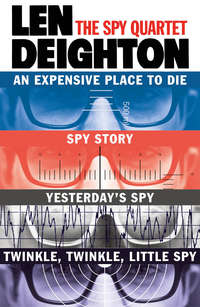
Kitabı oku: «The Spy Quartet: An Expensive Place to Die, Spy Story, Yesterday’s Spy, Twinkle Twinkle Little Spy»
LEN DEIGHTON
The Spy Quartet

Copyright
Published by HarperCollinsPublishers Ltd 1 London Bridge Street London SE1 9GF
www.harpercollins.co.uk
An Expensive Place to Die first published in Great Britain by Jonathan Cape Ltd 1967
Spy Story first published in Great Britain by Jonathan Cape Ltd 1974
Yesterday’s Spy first published in Great Britain by Jonathan Cape Ltd 1975
Twinkle, Twinkle, Little Spy first published in Great Britain by Jonathan Cape Ltd 1976
An Expensive Place to Die copyright © Len Deighton 1967
Spy Story copyright © Len Deighton 1974
Yesterday’s Spy copyright © Len Deighton 1975
Twinkle, Twinkle, Little Spy copyright © Len Deighton 1976
Introductions copyright © Pluriform Publishing Company BV 2012
Cover designer’s notes © Arnold Schwartzman 2012
Cover design and photography © Arnold Schwartzman 2012
E-bundle cover design © HarperCollinsPublishers Ltd 2015
Len Deighton asserts the moral right to be identified as the author of these works.
A catalogue copy of this book is available from the British Library.
These novels are entirely works of fiction. The names, characters and incidents portrayed in them are the work of the author’s imagination. Any resemblance to actual persons, living or dead, events or localities is entirely coincidental.
All rights reserved under International and Pan-American Copyright Conventions. By payment of the required fees, you have been granted the non-exclusive, non-transferable right to access and read the text of this e-book on screen. No part of this text may be reproduced, transmitted, down-loaded, decompiled, reverse engineered, or stored in or introduced into any information storage and retrieval system, in any form or by any means, whether electronic or mechanical, now known or hereinafter invented, without the express written permission of HarperCollins.
Source ISBN: 9780007458349, 9780007458363, 9780007458370, 9780007458356
Ebook Edition © January 2015 ISBN: 9780008116224
Version: 2017-08-18
Contents
Cover
Title Page
Copyright
An Expensive Place to Die
Spy Story
Yesterday’s Spy
Twinkle, Twinkle, Little Spy
About the Author
By Len Deighton
About the Publisher

Cover designer’s note
On a visit to Paris to produce a book on that charming city’s Art Deco architecture, my first stop was to locate the Folies Bergère, the legendary music hall where music would become just one of the many entertainments on offer to patrons. It was the author’s suggestion that I introduce an image that evoked ‘Gay Paree’. I believed that this image would fit the bill perfectly, and indeed it does. The dancing figure of the woman very much symbolizes one of the femmes fatales plying their trade so artfully for Monsieur Datt, and the multitude of swirling patterns behind her lead the eye on many a confusing journey – just like those endured by our intrepid hero.
I was also inspired by the book’s inclusion of a quotation from the poem ‘May’:
‘… If she is not a rose, a rose all white,
Then she must be redder than the red of blood.’
A rose has come to symbolize many things in the arts, and here the contrast between the virginal and the sinful taint of blood is particularly apposite. The juxtaposition of the blood-stained rose over the Folies facade provided me with the key design element.
On each front cover of this latest quartet, I have placed a photograph of the eyes of the bespectacled unnamed spy, in this instance overlaid with calibration marks from a hypodermic syringe. Why a syringe? Well, that will become all too apparent as you delve deeper into the seedy world of An Expensive Place to Die.
A final touch to the front cover was the choice of a typeface that would present an elegant facade beneath which the elements of corruption would appear. The reason for my use of red for the final word is three-fold: it helps to draw attention to the blood on the rose; it creates the tricolour of the French flag; and it offers a cheeky sense of melodrama – humour is always important, especially in the works of this author.
Readers who have been faithfully building their collection of these reissues will by now have become familiar with my use of a linking motif on the spines of the books. Being the final foursome in the entire series of reissues, and books in which violence is never too far away, I thought it a good idea to ‘go out with a bang’, as it were. This quartet’s spines accordingly display a different handgun, as mentioned in each of the books’ texts. The example here is a 6.35mm Mauser automatic, which was an antique even during the period of this story.
Another recurring feature in this quartet, to be found within each back cover’s photographic montage, is a pair of ‘our hero’s’ glasses, which look suspiciously like those worn by ‘Harry Palmer’ in The Ipcress File and other outings...
For this book’s montage, in order to evoke communist China’s involvement in the plot, I included a bust of Mao that I purchased some time ago in Shanghai. Like many of my objets from another time, it has found a new life helping to tell a story that the Chairman no doubt would have frowned upon.
A souvenir ashtray featuring the Eiffel Tower becomes the receptacle for a lipstick-traced remnant of one of our hero’s Gauloise cigarettes, plus a Parisian Gendarme’s badge. Further pieces of ephemera are a vintage Folies Bergère programme plus a pair of Paris postcards. The top hat from a Monopoly set is a nod to the elite of Parisian society who are caught in Monsieur Datt’s web, and the dice and ace of spades card tell us that to enter his world is a gamble, which can lead to death. Lastly, the quarter-inch magnetic tape underneath the top hat is of a recording that I produced of Mick Jagger promoting one of The Rolling Stones albums for Radio Luxembourg!
Arnold Schwartzman OBE RDI
Hollywood 2012
LEN DEIGHTON
An Expensive Place to Die
Do not disturb the President of the Republic
except in the case of world war.
Instructions for night duty officers
at the Élysée Palace
You should never beat a woman,
not even with a flower.
The Prophet Mohammed
Dying in Paris is a terribly expensive
business for a foreigner.
Oscar Wilde
The poem ‘May’ quoted here is from Twentieth Century Chinese Poetry, translated by Kai-yu Hsu (copyright © Kai-yu Hsu 1963) and reprinted by permission of Doubleday & Co. Inc., New York
Contents
Cover
Cover designer’s note
Title Page
Epigraph
Introduction
Chapter 1
Chapter 2
Chapter 3
Chapter 4
Chapter 5
Chapter 6
Chapter 7
Chapter 8
Chapter 9
Chapter 10
Chapter 11
Chapter 12
Chapter 13
Chapter 14
Chapter 15
Chapter 16
Chapter 17
Chapter 18
Chapter 19
Chapter 20
Chapter 21
Chapter 22
Chapter 23
Chapter 24
Chapter 25
Chapter 26
Chapter 27
Chapter 28
Chapter 29
Chapter 30
Chapter 31
Chapter 32
Chapter 33
Chapter 34
Chapter 35
Chapter 36
Chapter 37
Chapter 38
Chapter 39
Chapter 40
Footnotes
Introduction
France beckons to every lonely misfit, and most novelists answer to that description at some time or another. Many authors have responded to France’s call with enthusiasm; notably during those years between the two world wars when the exchange rates favoured those with US dollars, and Prohibition at home made the noble vintages of France irresistible. But most of those writers were prudent. Writing primarily for English-speaking readers they wrote stories about English-speaking people. Most of those stories were vaguely autobiographical ones about the wealthy English and American visitors with whom the writers fraternized. France provided the mountains and the Mediterranean but the French people in the stories were mostly waiters.
Many of the resulting books were dazzling; some became classics but many of the stories could have taken place in Gloucestershire or Long Island. This was a practical restraint, but writing about France without depicting French people (however inaccurate or untypical the characterizations might be) is like eating a chocolate bar without first removing the wrapper. I am not prudent. I wanted to tell my story with French men and women playing major roles.
It was this need to bring French people into An Expensive Place to Die that led to my including some chapters in the third person. This gave me a chance to show their thoughts and motivation and an opportunity to have action beyond that of the first person. This was not a planned device, it came naturally to the telling of the story and no one criticized it.
No doubt every writer has their own method of writing and this is something that writers enjoy talking about. Most important is whether to write after making a careful plan or to simply invent each new chapter as it comes. Many writers have told me that they don’t know what the end of their books will be when they are writing the first page. The argument against this is the uncertainty that comes of consigning the plot to the vagaries of the writer’s day-to-day temperament. My experience is that there comes a stage in the planning when it is best to start writing and leave some room to develop your characters. Whatever method is chosen, some element of your story is likely to assume an importance beyond your plan. In XPD a character named Charles Stein became that sort of element. He wrestled to take control of my story and nearly did so. Looking back on it, the book was much enhanced by him. For An Expensive Place to Die it was Paris that took on an unplanned importance, and this gives the book an atmosphere rather different to all the other books I have written.
I was a teenager when I first went to Paris. It was not ‘warm and gay’ as the Hammerstein lyric recalled; rather it was ‘old and grey’ as in the lyric that Sinatra was crooning at that time. The war was scarcely ended and I stepped from the train into a dense aroma of Gauloises and garlic. I found myself alone and without contacts standing on the noisy concourse of the Gare du Nord. Packed tight, there were beggars, whores and black-market traders all plying their trades with appropriate subtlety. Heavily burdened infantrymen displayed the silence of the weary while polished and blancoed military police patrols sifted continually through the multitude. My parents had only agreed to this expedition because someone was to meet me and take care of me. That friend was posted away at short notice and I was left to my own devices. Someone put a card into my hand and I plodded along, suitcase in hand, to Place Blanche, a seedy district adjacent to Montmartre. Using the advertisement card, I found a tiny attic room in an old, cheap, threadbare hotel near the Moulin Rouge.
It was all exactly like the little room in which Jean Gabin fought off the flics in that wonderful old film Le Jour se Lêve. All that night I waited for the ‘daybreak’ as I had waited for Santa Claus to arrive on so many Christmas mornings. When light came through the shabby curtains I looked out of the window at the roofs of Paris. This remains one of the most memorable moments of my long, eventful and happy life. I was a teenager, and entirely unsupervised, with this great foreign city laid at my feet. I could scarcely believe my good fortune. I tramped around the city; stood alone at the tomb of Napoleon and inspected the burned-out German tanks that the French were in no hurry to clear away. The fighting had ended but the smell of war lingered. I walked all the way to the Etoile and then back across town to the Place Bastille, only to be sadly disappointed that the grim old prison was no longer there. The Folies Bergère is just for tourists, the concierge at the hotel told me; the Concert Mayol is far more risqué and the girls far, far more naked. I went to the Concert Mayol. I went to the Louvre, where they also had naked girls, to Notre Dame and to that most spectacular of Paris sights – the Sainte Chapelle. I climbed the steep, slippery, and seemingly unending iron steps to get to the top of the Eiffel Tower, and was spattered with red lead primer paint as I passed workers restoring it to good condition.
Although I was in civilian clothes, my youth and London accent caused me to be mistaken for a soldier and I capitalized on this by eating in the military facilities such as the Montgomery Club near the Place de la Concorde. In some places I was eyed with suspicion and twice I was detained on suspicion of being an army deserter. I soon made sure I carried my passport everywhere I went. I must have walked many miles during that time in Paris and by saving my money I was able to afford a lunch at the renowned Tour d’Argent, which had resumed its production of the famous roast duck, prepared at the tableside in a massive silver press.
After that first visit, I returned to Paris many times. For short periods I lived there in varying degrees of comfort. My wife’s parents enjoyed a lovely home there and we relished their hospitality. The idea of writing about this Paris I discovered never went away. I knew several fashion photographers and in the early 1960s I started notes for a book using as a background the Paris collections. I continued my lengthy stay there but I didn’t continue with this project. I also abandoned a story about a symphony orchestra because I didn’t know enough about music and musicians. Finally I met a Paris policeman who wanted to practise his English and I knew I was going to write An Expensive Place to Die.
Together with my family I have lived in many countries, but I never became one of the dedicated exiles who cluster in the sunshine and snow. Perhaps the France I depict in An Expensive Place to Die is not a land you recognize. Yet this is what France, or more particularly Paris, seemed like back in the sixties when I lived there and wrote this book.
It was the chance introduction to a detective serving with the police judiciaire that gave me the chance to write about the underside of Paris. This friend served in the brigade mondaine, which is the quaint title the French give to what in London was called the vice squad. My policeman knew everything and everyone. People high and low, people in bars and those in exclusive clubs knew him and so did those who went to sleep on the pavement, hugging smelly ventilation grills for the sake of the warmth. In late evening, hundreds of big trucks brought fresh produce into the old market area, and not all the drivers curled up in their cab with a blanket and a bottle of beer. Around the market whole streets of bars and brothels came to life at midnight and plain-clothes policemen, such as my friend, were an inevitable addition to the cast. Muscular doormen and girls with too much make-up greeted him like an old friend. He showed me the flea markets where stolen goods sometimes came to light. He showed me establishments in the swanky arrondissements that do not feature in any tourist guidebooks. It is ‘down these mean streets’ that a fiction writer can venture protected by the armour of disguise that all storytellers wear. I kept close to his side and kept my mouth shut as we walked his beat. Without his unstinting help and good-natured guidance (and did I say protection?) An Expensive Place to Die would have been a different, and rather more conventional, book.
It happens like that sometimes. You encounter a promising source and suddenly a torrent of information comes pouring down all over you. Now the problem becomes knowing where to stop. Research is always more fun than writing and there is always a temptation to go on with it for ever. I enjoy using foreign locations in my stories but feel I should carefully absorb the places I write about; live in them long enough to meet my neighbours, buy from the local shops, sit around in the local cafes and suffer the bus services and the Metro. For some books I went beyond that. My children attended local schools and we almost became natives. Only probing beyond the tourist trails will give a writer the environment in which convincing characters can roam. In An Expensive Place to Die I probed, but the Paris into which I dug was somewhat bleak. Looking back now, perhaps a more generous portion of the glamour of that much-maligned city would have given my story more optimism.
But there was a mysterious epilogue to An Expensive Place to Die. On 24th April 1967 the New York Times carried a story concerning two Russian nationals; both identified by the US Government as officers of the KGB. At Kennedy International Airport they boarded Air France Flight 702 scheduled to depart for Paris at 7.00pm. Ten minutes before the flight was due to leave a man who identified himself as an FBI agent went to Gate 29, handed an Air France official a package and asked him to give it to one of the Russians. Curious about the last-minute arrival of the package, the chief stewardess, Marguerite Switon, gave it to the pilot, Michel Vachey. By this time he was moving his plane from the gate to the runway for take-off.
Still at the controls, the pilot opened the package and found inside a copy of An Expensive Place to Die. It also contained a small dossier of replica documents and maps that were tucked inside the book. Here were official-looking papers signed by high officials and marked ‘Top Secret’. (This dossier had in fact been designed by Ray Hawkey as a supplement to the story; Ray designed the covers of many of my books, and also some similarly fine publicity material for books such as SS-GB.) Vachey was alarmed. He asked the tower for permission to taxi back to Gate 29, to which Air France’s station manager was summoned.
According to the New York Times article the plane was delayed while FBI officials examined the papers and took guidance via several phone calls to FBI headquarters in Washington. At 9.30pm the Air France flight took off for Paris. This strange story was taken up by other papers including The New York Daily News.
It sounds like a successful publicity stunt but Walter Minton, a good friend as well as being president of Putnam’s, my New York publishing house, denied all knowledge of these minor dramas. In London my publishers knew nothing about ‘stunts’ and neither did my good friend Ray Hawkey. So what is the real story behind it? I am still hoping that someone will tell me.
It was not the only time these documents would interest the Russians. I learnt that a Soviet official in Canada paid money for the dossier believing it to be secret material. A year or two later I was told that it all happened at a time when the Russians were particularly touchy about Chinese espionage. They wondered whether someone with inside knowledge about planted information had provided to me the plot of An Expensive Place to Die.
Len Deighton, 2012
1
The birds flew around for nothing but the hell of it. It was that sort of day: a trailer for the coming summer. Some birds flew in neat disciplined formations, some in ragged mobs, and higher, much higher, flew the loner who didn’t like corporate decisions.
I turned away from the window. My visitor from the Embassy was still complaining.
‘Paris lives in the past,’ said the courier scornfully. ‘Manet is at the opera and Degas at the ballet. Escoffier cooks while Eiffel builds, lyrics by Dumas, music by Offenbach. Oo-là-là our Paree is gay, monsieur, and our private rooms discreet, our coaches call at three, monsieur, and Schlieffen has no plans.’
‘They’re not all like that,’ I said. Some birds hovered near the window deciding whether to eat the seed I’d scattered on the window-sill.
‘All the ones I meet are,’ said the courier. He too stopped looking across the humpty-backed rooftops, and as he turned away from the window he noticed a patch of white plaster on his sleeve. He brushed it petulantly as though Paris was trying to get at him. He pulled at his waistcoat – a natty affair with wide lapels – and then picked at the seat of the chair before sitting down. Now that he’d moved away from the window the birds returned, and began fighting over the seed that I had put there.
I pushed the coffee pot to him. ‘Real coffee,’ he said. ‘The French seem to drink only instant coffee nowadays.’ Thus reassured of my decorum he unlocked the briefcase that rested upon his knees. It was a large black case and contained reams of reports. One of them he passed across to me.
‘Read it while I’m here. I can’t leave it.’
‘It’s secret?’
‘No, our document copier has gone wrong and it’s the only one I have.’
I read it. It was a ‘stage report’ of no importance. I passed it back. ‘It’s a lot of rubbish,’ I said. ‘I’m sorry you have to come all the way over here with this sort of junk.’
He shrugged. ‘It gets me out of the office. Anyway it wouldn’t do to have people like you in and out of the Embassy all the time.’ He was new, this courier. They all started like him. Tough, beady-eyed young men anxious to prove how efficient they can be. Anxious too to demonstrate that Paris could have no attraction for them. A near-by clock chimed two P.M. and that disturbed the birds.
‘Romantic,’ he said. ‘I don’t know what’s romantic about Paris except couples kissing on the street because the city’s so overcrowded that they have nowhere else to go.’ He finished his coffee. ‘It’s terribly good coffee,’ he said. ‘Dining out tonight?’
‘Yes,’ I said.
‘With your artist friend Byrd?’
I gave him the sort of glance that Englishmen reserve for other Englishmen. He twitched with embarrassment. ‘Look here,’ he said, ‘don’t think for a moment … I mean … we don’t have you … that is …’
‘Don’t start handing out indemnities,’ I said. ‘Of course I am under surveillance.’
‘I remembered your saying that you always had dinner with Byrd the artist on Mondays. I noticed the Skira art book set aside on the table. I guessed you were returning it to him.’
‘All good stuff,’ I said. ‘You should be doing my job.’
He smiled and shook his head. ‘How I’d hate that,’ he said. ‘Dealing with the French all day; it’s bad enough having to mix with them in the evening.’
‘The French are all right,’ I said.
‘Did you keep the envelopes? I’ve brought the iodine in pot iodide.’ I gave him all the envelopes that had come through the post during the previous week and he took his little bottle and painted the flaps carefully.
‘Resealed with starch paste. Every damn letter. Someone here, must be. The landlady. Every damned letter. That’s too thorough to be just nosiness. Prenez garde.’ He put the envelopes, which had brown stains from the chemical reaction, into his case. ‘Don’t want to leave them around.’
‘No,’ I said. I yawned.
‘I don’t know what you do all day,’ he said. ‘Whatever do you find to do?’
‘I do nothing all day except make coffee for people who wonder what I do all day.’
‘Yes, well thanks for lunch. The old bitch does a good lunch even if she does steam your mail open.’ He poured both of us more coffee. ‘There’s a new job for you.’ He added the right amount of sugar, handed it to me and looked up. ‘A man named Datt who comes here to Le Petit Légionnaire. The one that was sitting opposite us at lunch today.’ There was a silence. I said:
‘What do you want to know about him?’
‘Nothing,’ said the courier. ‘We don’t want to know anything about him, we want to give him a caseful of data.’
‘Write his address on it and take it to the post office.’
He gave a pained little grimace. ‘It’s got to sound right when he gets it.’
‘What is it?’
‘It’s a history of nuclear fall-out, starting from New Mexico right up to the last test. There are reports from the Hiroshima hospital for bomb victims and various stuff about its effect upon cells and plant-life. It’s too complex for me but you can read it through if your mind works that way.’
‘What’s the catch?’
‘No catch.’
‘What I need to know is how difficult it is to detect the phoney parts. One minute in the hands of an expert? Three months in the hands of a committee? I need to know how long the fuse is, if I’m the one that’s planting the bomb.’
‘There is no cause to believe it’s anything other than genuine.’ He pressed the lock on the case as though to test his claim.
‘Well that’s nice,’ I said. ‘Who does Datt send it to?’
‘Not my part of the script, old boy. I’m just the errand boy, you know. I give the case to you, you give it to Datt, making sure he doesn’t know where it came from. Pretend you are working for CIA if you like. You are a clean new boy, it should be straightforward.’
He drummed his fingers to indicate that he must leave.
‘What am I expected to do with your bundle of papers – leave it on his plate one lunchtime?’
‘Don’t fret, that’s being taken care of. Datt will know that you have the documents, he’ll contact you and ask for them. Your job is just to let him have them … reluctantly.’
‘Was I planted in this place six months ago just to do this job?’
He shrugged, and put the leather case on the table.
‘Is it that important?’ I asked. He walked to the door without replying. He opened the door suddenly and seemed disappointed that there was no one crouching outside.
‘Terribly good coffee,’ he said. ‘But then it always is.’ From downstairs I could hear the pop music on the radio. It stopped. There was a fanfare and a jingle advertising shampoo.
‘This is your floating favourite, Radio Janine,’ said the announcer. It was a wonderful day to be working on one of the pirate radio ships: the sun warm, and three miles of calm blue sea that entitled you to duty-free cigarettes and whisky. I added it to the long list of jobs that were better than mine. I heard the lower door slam as the courier left. Then I washed up the coffee cups, gave Joe some fresh water and cuttlefish bone for his beak, picked up the documents and went downstairs for a drink.
2
Le Petit Légionnaire (‘cuisine faite par le patron’) was a plastic-trimmed barn glittering with mirrors, bottles and pin-tables. The regular lunchtime customers were local businessmen, clerks from a near-by hotel, two German girls who worked for a translation agency, a couple of musicians who slept late every day, two artists and the man named Datt to whom I was to offer the nuclear fall-out findings. The food was good. It was cooked by my landlord who was known throughout the neighbourhood as la voix – a disembodied voice that bellowed up the lift shaft without the aid of a loudspeaker system. La voix – so the stories went – once had his own restaurant in Boul. Mich. which during the war was a meeting place for members of the Front National.1 He almost got a certificate signed by General Eisenhower but when his political past became clearer to the Americans he got his restaurant declared out of bounds and searched by the MPs every week for a year instead.
La voix did not like orders for steck bien cuit, charcuterie as a main dish or half-portions of anything at all. Regular customers got larger meals. Regular customers also got linen napkins but were expected to make them last all the week. But now lunch was over. From the back of the café I could hear the shrill voice of my landlady and the soft voice of Monsieur Datt who was saying, ‘You might be making a mistake, you’ll pay one hundred and ten thousand francs in Avenue Henri Martin and never see it come back.’
‘I’ll take a chance on that,’ said my landlord. ‘Have a little more cognac.’
M. Datt spoke again. It was a low careful voice that measured each word carefully, ‘Be content, my friend. Don’t search for the sudden flashy gain that will cripple your neighbour. Enjoy the smaller rewards that build imperceptibly towards success.’
I stopped eavesdropping and moved on past the bar to my usual table outside. The light haze that so often prefaces a very hot Paris day had disappeared. Now it was a scorcher. The sky was the colour of well-washed bleu de travail. Across it were tiny wisps of cirrus. The heat bit deep into the concrete of the city and outside the grocers’ fruit and vegetables were piled beautifully in their wooden racks, adding their aroma to the scent of a summer day. The waiter with the withered hand sank a secret cold lager, and old men sat outside on the terrasse warming their cold bones. Dogs cocked their legs jauntily and young girls wore loose cotton dresses and very little make-up and fastened their hair with elastic bands.
A young man propped his moto carefully against the wall of the public baths across the road. He reached an aerosol can of red paint from the pannier, shook it and wrote ‘lisez l’Humanite nouvelle’ across the wall with a gentle hiss of compressed air. He glanced over his shoulder, then added a large hammer and sickle. He went back to his moto and sat astride it surveying the sign. A thick red dribble ran down from the capital H. He went back to the wall and dabbed at the excess paint with a piece of rag. He looked around, but no one shouted to him, so he carefully added the accent to the e before wrapping the can into the rag and stowing it away. He kicked the starter, there was a puff of light-blue smoke and the sudden burp of the two-stroke motor as he roared away towards the Boulevard.
I sat down and waved to old Jean for my usual Suze. The pin-table glittered with pop-art-style illuminations and click-clicked and buzzed as the perfect metal spheres touched the contacts and made the numbers spin. The mirrored interior lied about the dimensions of the café and portrayed the sunlit street deep in its dark interior. I opened the case of documents, smoked, read, drank and watched the life of the quartier. I read ninety-three pages and almost understood by the time the rush-hour traffic began to thicken. I hid the documents in my room. It was time to visit Byrd.
I lived in the seventeenth arrondissement. The modernization project that had swept up the Avenue Neuilly and was extending the smart side of Paris to the west had bypassed the dingy Quartier des Ternes. I walked as far as the Avenue de la Grande Armée. The Arc was astraddle the Étoile and the traffic was desperate to get there. Thousands of red lights twinkled like bloodshot stars in the warm mist of the exhaust fumes. It was a fine Paris evening, Gauloises and garlic sat lightly on the air, and the cars and people were moving with the subdued hysteria that the French call élan.
I remembered my conversation with the man from the British Embassy. He seemed upset today, I thought complacently. I didn’t mind upsetting him. Didn’t mind upsetting all of them, come to that. No cause to believe it’s anything other than genuine. I snorted loudly enough to attract attention. What a fool London must think I am. And that stuff about Byrd. How did they know I’d be dining with him tonight? Byrd, I thought, art books from Skira, what a lot of cock. I hardly knew Byrd, even though he was English and did lunch in Le Petit Légionnaire. Last Monday I dined with him but I’d told no one that I was dining with him again tonight. I’m a professional. I wouldn’t tell my mother where I keep the fuse wire.
3
The light was just beginning to go as I walked through the street market to Byrd’s place. The building was grey and peeling, but so were all the others in the street. So, in fact, were almost all the others in Paris. I pressed the latch. Inside the dark entrance a twenty-five-watt bulb threw a glimmer of light across several dozen tiny hutches with mail slots. Some of the hutches were marked with grimy business cards, others had names scrawled across them in ball-point writing. Down the hall there were thick ropes of wiring connected to twenty or more wooden boxes. Tracing a wiring fault would have proved a remarkable problem. Through a door at the far end there was a courtyard. It was cobbled, grey and shiny with water that dripped from somewhere overhead. It was a desolate yard of a type that I had always associated with the British prison system. The concierge was standing in the courtyard as though daring me to complain about it. If mutiny came, then that courtyard would be its starting place. At the top of a narrow creaking staircase was Byrd’s studio. It was chaos. Not the sort of chaos that results from an explosion, but the kind that takes years to achieve. Spend five years hiding things, losing things and propping broken things up, then give it two years for the dust to settle thickly and you’ve got Byrd’s studio. The only really clean thing was the gigantic window through which a sunset warmed the whole place with rosy light. There were books everywhere, and bowls of hardened plaster, buckets of dirty water, easels carrying large half-completed canvases. On the battered sofa were the two posh English Sunday papers still pristine and unread. A huge enamel-topped table that Byrd used as a palette was sticky with patches of colour, and across one wall was a fifteen-foot-high hardboard construction upon which Byrd was painting a mural. I walked straight in – the door was always open.
‘You’re dead,’ called Byrd loudly. He was high on a ladder working on a figure near the top of the fifteen-foot-high painting.
‘I keep forgetting I’m dead,’ said the model. She was nude and stretched awkwardly across a box.
‘Just keep your right foot still,’ Byrd called to her. ‘You can move your arms.’
The nude girl stretched her arms with a grateful moan of pleasure.
‘Is that okay?’ she asked.
‘You’ve moved the knee a little, it’s tricky … Oh well, perhaps we’ll call that a day.’ He stopped painting. ‘Get dressed, Annie.’ She was a tall girl of about twenty-five. Dark, good-looking, but not beautiful. ‘Can I have a shower?’ she asked.
‘The water’s not too warm, I’m afraid,’ said Byrd, ‘but try it, it may have improved.’
The girl pulled a threadbare man’s dressing-gown around her shoulders and slid her feet into a pair of silk slippers. Byrd climbed very slowly down from the ladder on which he was perched. There was a smell of linseed oil and turpentine. He rubbed at the handful of brushes with a rag. The large painting was nearly completed. It was difficult to put a name to the style; perhaps Kokoschka or Soutine came nearest to it but this was more polished, though less alive, than either. Byrd tapped the scaffolding against which the ladder was propped.
‘I built that. Not bad, eh? Couldn’t get one like it anywhere in Paris, not anywhere. Are you a do-it-yourself man?’
‘I’m a let-someone-else-do-it man.’
‘Really,’ said Byrd and nodded gravely. ‘Eight o’clock already, is it?’
‘Nearly half past,’ I said.
‘I need a pipe of tobacco.’ He threw the brushes into a floral-patterned chamber-pot in which stood another hundred. ‘Sherry?’ He untied the strings that prevented his trouser bottoms smudging the huge painting, and looked back towards the mural, hardly able to drag himself away from it. ‘The light started to go an hour back. I’ll have to repaint that section tomorrow.’ He took the glass from an oil lamp, lit the wick carefully and adjusted the flame. ‘A fine light these oil lamps give. A fine silky light.’ He poured two glasses of dry sherry, removed a huge Shetland sweater and eased himself into a battered chair. In the neck of his check-patterned shirt he arranged a silk scarf, then began to sift through his tobacco pouch as though he’d lost something in there.
It was hard to guess Byrd’s age except that he was in the middle fifties. He had plenty of hair and it was showing no sign of grey. His skin was fair and so tight across his face that you could see the muscles that ran from cheekbone to jaw. His ears were tiny and set high, his eyes were bright, active and black, and he stared at you when he spoke to prove how earnest he was. Had I not known that he was a regular naval officer until taking up painting eight years ago I might have guessed him to be a mechanic who had bought his own garage. When he had carefully primed his pipe he lit it with slow care. It wasn’t until then that he spoke again.
‘Go to England at all?’
‘Not often,’ I said.
‘Nor me. I need more baccy; next time you go you might bear that in mind.’
‘Yes,’ I said.
‘This brand,’ he held a packet for me to see. ‘Don’t seem to have it here in France. Only stuff I like.’
He had a stiff, quarter-deck manner that kept his elbows at his waist and his chin in his neck. He used words like ‘roadster’ that revealed how long it was since he had lived in England.
‘I’m going to ask you to leave early tonight,’ he said. ‘Heavy day tomorrow.’ He called to the model, ‘Early start tomorrow, Annie.’
‘Very well,’ she called back.
‘We’ll call dinner off if you like.’ I offered.
‘No need to do that. Looking forward to it to tell the truth.’ Byrd scratched the side of his nose.
‘Do you know Monsieur Datt?’ I asked. ‘He lunches at the Petit Légionnaire. Big-built man with white hair.’
‘No,’ he said. He sniffed. He knew every nuance of the sniff. This one was light in weight and almost inaudible. I dropped the subject of the man from the Avenue Foch.
Byrd had asked another painter to join us for dinner. He arrived about nine thirty. Jean-Paul Pascal was a handsome muscular young man with a narrow pelvis who easily adapted himself to the cowboy look that the French admire. His tall rangy figure contrasted sharply with the stocky blunt rigidity of Byrd. His skin was tanned, his teeth perfect. He was expensively dressed in a light-blue suit and a tie with designs embroidered on it. He removed his dark glasses and put them in his pocket.
‘An English friend of Monsieur Byrd,’ Jean-Paul repeated as he took my hand and shook it. ‘Enchanted.’ His handshake was gentle and diffident as though he was ashamed to look so much like a film star.
‘Jean-Paul speaks no English,’ said Byrd.
‘It is too complicated,’ said Jean-Paul. ‘I speak a little but I do not understand what you say in reply.’
‘Precisely,’ said Byrd. ‘That’s the whole idea of English. Foreigners can communicate information to us but Englishmen can still talk together without an outsider being able to comprehend.’ His face was stern, then he smiled primly. ‘Jean-Paul’s a good fellow just the same: a painter.’ He turned to him. ‘Busy day, Jean?’
‘Busy, but I didn’t get much done.’
‘Must keep at at, my boy. You’ll never be a great painter unless you learn to apply yourself.’
‘Oh but one must find oneself. Proceed at one’s own speed,’ said Jean-Paul.
‘Your speed is too slow,’ Byrd pronounced, and handed Jean-Paul a glass of sherry without having asked him what he wanted. Jean turned to me, anxious to explain his apparent laziness. ‘It is difficult to begin a painting – it’s a statement – once the mark is made one has to relate all later brush-strokes to it.’
‘Nonsense,’ said Byrd. ‘Simplest thing in the world to begin, tricky though pleasurable to proceed with, but difficult – dammed difficult – to end.’
‘Like a love affair,’ I said. Jean laughed. Byrd flushed and scratched the side of his nose.
‘Ah. Work and women don’t mix. Womanizing and loose living is attractive at the time, but middle age finds women left sans beauty, and men sans skills; result misery. Ask your friend Monsieur Datt about that.’
‘Are you a friend of Datt?’ Jean-Paul asked.
‘I hardly know him,’ I said. ‘I was asking Byrd about him.’
‘Don’t ask too many questions,’ said Jean. ‘He is a man of great influence; Count of Périgord it is said, an ancient family, a powerful man. A dangerous man. He is a doctor and a psychiatrist. They say he uses LSD a great deal. His clinic is as expensive as any in Paris, but be gives the most scandalous parties there too.’
‘What’s that?’ said Byrd. ‘Explain.’
‘One hears stories,’ said Jean. He smiled in embarrassment and wanted to say no more, but Byrd made an impatient movement with his hand, so he continued. ‘Stories of gambling parties, of highly placed men who have got into financial trouble and found themselves …’ he paused ‘… in the bath.’
‘Does that mean dead?’
‘It means “in trouble”, idiom,’ explained Byrd to me in English.
‘One or two important men took their own lives,’ said Jean. ‘Some said they were in debt.’
‘Damned fools,’ said Byrd. ‘That’s the sort of fellows in charge of things today, no stamina, no fibre; and that fellow Datt is a party to it, eh? Just as I thought. Oh well, chaps won’t be told today. Experience better bought than taught they say. One more sherry and we’ll go to dinner. What say to La Coupole? It’s one of the few places still open where we don’t have to reserve.’
Annie the model reappeared in a simple green shirtwaist dress. She kissed Jean-Paul in a familiar way and said good evening to each of us.
‘Early in the morning,’ Byrd said as he paid her. She nodded and smiled.
‘An attractive girl,’ Jean-Paul said after she had gone.
‘Yes,’ I said.
‘Poor child,’ said Byrd. ‘It’s a hard town for a young girl without money.’
I’d noticed her expensive crocodile handbag and Charles Jourdan shoes, but I didn’t comment.
‘Want to go to an art show opening Friday? Free champagne.’ Jean-Paul produced half a dozen gold-printed invitations, gave one to me and put one on Byrd’s easel.
‘Yes, we’ll go to that,’ said Byrd; he was pleased to be organizing us. ‘Are you in your fine motor, Jean?’ Byrd asked.
Jean nodded.
Jean’s car was a white Mercedes convertible. We drove down the Champs with the roof down. We wined and dined well and Jean-Paul plagued us with questions like do the Americans drink Coca-Cola because it’s good for their livers.
It was nearly one A.M. when Jean dropped Byrd at the studio. He insisted upon driving me back to my room over Le Petit Légionnaire. ‘I am especially glad you came tonight,’ he said. ‘Byrd thinks that he is the only serious painter in Paris, but there are many of us who work equally hard in our own way.’
‘Being in the navy,’ I said, ‘is probably not the best of training for a painter.’
‘There is no training for a painter. No more than there is training for life. A man makes as profound a statement as he is able. Byrd is a sincere man with a thirst for knowledge of painting and an aptitude for its skills. Already his work is attracting serious interest here in Paris and a reputation in Paris will carry you anywhere in the world.’
I sat there for a moment nodding, then I opened the door of the Mercedes and got out. ‘Thanks for the ride.’
Jean-Paul leaned across the seat, offered me his card and shook my hand. ‘Phone me,’ he said, and – without letting go of my hand – added, ‘If you want to go to the house in the Avenue Foch I can arrange that too. I’m not sure I can recommend it, but if you have money to lose I’ll introduce you. I am a close friend of the Count; last week I took the Prince of Besacoron there – he is another very good friend of mine.’
‘Thanks,’ I said, taking the card. He stabbed the accelerator and the motor growled. He winked and said, ‘But no recriminations afterward.’
‘No,’ I agreed. The Mercedes slid forward.
I watched the white car turn on to the Avenue with enough momentum to make the tyres howl. The Petit Légionnaire was closed. I let myself in by the side entrance. Datt and my landlord were still sitting at the same table as they had been that afternoon. They were still playing Monopoly. Datt was reading from his Community Chest card, ‘Allez en prison. Avancez tout droit en prison. Ne passez pas par la case “Départ”. Ne recevez pas Frs 20.000.’ My landlord laughed, so did M. Datt.
‘What will your patients say?’ said my landlord.
‘They are very understanding,’ said Datt; he seemed to take the whole game seriously. Perhaps he got more out of it that way.
I tiptoed upstairs. I could see right across Paris. Through the dark city the red neon arteries of the tourist industry flowed from Pigalle through Montmartre to Boul. Mich., Paris’s great self-inflicted wound.
Joe chirped. I read Jean’s card. ‘“Jean-Paul Pascal, artist painter”. And good friend to princes,’ I said. Joe nodded.
4
Two nights later I was invited to join the Monopoly game. I bought hotels in rue Lecourbe and paid rent at the Gare du Nord. Old Datt pedantically handled the toy money and told us why we went broke.
When only Datt remained solvent he pushed back his chair and nodded sagely as he replaced the pieces of wood and paper in the box. If you were buying old men, then Datt would have come in a box marked White, Large and Bald. Behind his tinted spectacles his eyes were moist and his lips soft and dark like a girl’s, or perhaps they only seemed dark against the clear white skin of his face. His head was a shiny dome and his white hair soft and wispy like mist around a mountain top. He didn’t smile much, but he was a genial man, although a little fussy in his mannerisms as people of either sex become when they live alone.
Madame Tastevin had, upon her insolvency, departed to the kitchen to prepare supper.
I offered my cigarettes to Datt and to my landlord. Tastevin took one, but Datt declined with a theatrical gesture. ‘There seems no sense in it,’ he proclaimed, and again did that movement of the hand that looked like he was blessing a multitude at Benares. His voice was an upper-class voice, not because of his vocabulary or because he got his conjugations right but because he sang his words in the style of the Comédie Française, stressing a word musically and then dropping the rest of the sentence like a half-smoked Gauloise. ‘No sense in it,’ he repeated.
‘Pleasure,’ said Tastevin, puffing away. ‘Not sense.’ His voice was like a rusty lawn-mower.
‘The pursuit of pleasure,’ said Datt, ‘is a pitfall-studded route.’ He removed the rimless spectacles and looked up at me blinking.
‘You speak from experience?’ I asked.
‘I’ve done everything,’ said Datt. ‘Some things twice. I’ve lived in eight different countries in four continents. I’ve been a beggar and I’ve been a thief. I’ve been happy and sad, rich and poor, master and manservant.’
‘And the secret of happiness,’ mocked Tastevin, ‘is to refrain from smoking?’
‘The secret of happiness,’ Datt corrected, ‘is to refrain from wishing to.’
‘If that’s the way you feel,’ said Tastevin, ‘why do you come to my restaurant almost every day?’
At that moment Madame Tastevin came in with a tray holding a coffee jug and plates of cold chicken and terrine of hare.
‘There’s your reason for not smoking,’ said Datt. ‘I would never let tobacco mar the taste of the food here.’ Madame Tastevin purred with delight. ‘I sometimes think my life is too perfect. I enjoy my work and never wish to do less of it, and I eat your wonderful food. What a perfect life.’
‘That’s self-indulgent,’ said Tastevin.
‘Perhaps it is – so what? Isn’t your life self-indulgent? You could make far more money working in one of the three-star restaurants but you spend your life running this small one – one might almost say for your friends.’
‘I suppose that’s true,’ said Tastevin. ‘I enjoy cooking, and my customers appreciate my work I think.’
‘Quite so. You are a sensible man. It’s madness to go every day to work at something you do not enjoy.’
‘But suppose,’ asked Madame Tastevin, ‘that such a job brought us a lot of money that would enable him to retire and then do as he wishes?’
‘Madame,’ said Datt. His voice took on that portentous, melodious quality that narrators on arty French films employ. ‘Madame Tastevin,’ he said again, ‘there is a cave in Kashmir – Amarnath cave – the most sacred spot on earth to a worshipper of the Hindu god Siva. The pilgrims who journey there are old; sometimes sick too. Many of them die on the high passes, their tiny tents swept away by the sudden rainstorms. Their relatives do not weep. To them this does not matter; even the arrival – which must always be on a night of full moon – is not more vital than the journey. Many know they will never arrive. It is the journey that is holy, and so it is to Existentialists: life is more important than death. Whatever they do, men are too anxious to get to the end. The sex act, eating a fine meal, playing golf, there is a temptation to rush, gobble or run. That is foolish, for one should move at a relaxed pace through life doing the work one enjoys instead of chasing ambition helter-skelter, pursuing one’s ultimate death.’
Tastevin nodded sagely and I stopped gobbling the cold chicken. Datt tucked a napkin in his collar and savoured a little terrine, pursing his lips and remarking on the salt content. When he had finished he turned to me. ‘You have a telephone, I believe,’ he said, and without waiting for my reply was already on his feet and moving towards the door.
‘By all means use it,’ I told him and by a burst of speed was able to get upstairs before him. Joe blinked in the sudden electric light. Datt dialled a number and said ‘Hello, I am at the Petit Légionnaire and I am ready for the car in about five minutes.’ He hung up. Datt came over to where I was standing with Joe. ‘It’s my belief,’ said Datt, ‘that you are making inquiries about me.’
I didn’t answer.
‘It would be a fruitless task.’
‘Why?’
‘Because no matter what you discover it will not harm me.’
‘The art of Zen in clandestine behaviour?’
Datt smiled. ‘The art of Zen in having influential friends,’ he said.
I didn’t answer him. I pushed open the shutters and there was Paris. Warm streets, a policeman, two lovers, four cats, fifty dented deux-chevaux cars and a pavement full of garbage bins. The life of Paris centres on its streets; its inhabitants sit at the windows gazing down upon people as they buy, sell, thieve, drive, fight, eat, chat, posture, cheat or merely stand looking, upon the streets of Paris. Its violence too centres upon the streets and outside the public baths the previous night M. Picard, who owned the laundry, was robbed and knifed. He died twitching his own blood into ugly splashes that could still be seen upon the torn election posters flapping from the ancient shutters.
A black Daimler came down the road and stopped with a tiny squeak.
‘Thank you for the use of your telephone,’ said Datt. At the door he turned. ‘Next week I should like to talk with you again,’ he said. ‘You must tell me what you are curious about.’
‘Any time,’ I agreed. ‘Tomorrow if you wish.’
Datt shook his head. ‘Next week will be soon enough.’
‘As you wish.’
‘Yes,’ said Datt. He walked out without saying good night.
After Datt left Joe took a brief swing. I checked that the documents were still in their hiding-place. Perhaps I should have given them to Datt a few minutes before, but I looked forward to seeing him again next week. ‘It seems to me, Joe,’ I said, ‘that we are the only people in town who don’t have powerful friends.’ I put the cover on him before he could answer.
5
Faubourg St Honoré, seven thirty P.M. Friday. The tiny art gallery was bursting at the seams. Champagne, free champagne, was spilling over high suede boots and broken sandals. I had spent twenty-five minutes prising triangular pieces of smoked salmon away from circular pieces of toast, which is not a rewarding experience for a fully grown human male. Byrd was talking to Jean-Paul and rapping at one of the abstract panels. I edged towards them, but a young woman with green eye-shadow grabbed my arm. ‘Where’s the artist?’ she asked. ‘Someone’s interested in “Creature who fears the machine” and I don’t know if it’s one hundred thousand francs or fifty.’ I turned to her but she had grabbed someone else already. Most of my champagne was lost by the time I got to Byrd and Jean-Paul.
‘There’s some terrible people here,’ said Jean-Paul.
‘As long as they don’t start playing that dashed rock-and-roll music again,’ said Byrd.
‘Were they doing that?’ I asked.
Byrd nodded. ‘Can’t stand it. Sorry and all that, but can’t stand it.’
The woman with green eye-shadow waved across a sea of shoulders, then cupped her mouth and yelled to me. ‘They have broken one of the gold chairs,’ she said. ‘Does it matter?’
I couldn’t stand her being so worried. ‘Don’t worry,’ I called. She nodded and smiled in relief.
‘What’s going on?’ said Jean-Paul. ‘Do you own this gallery?’
‘Give me time,’ I said, ‘and maybe I’ll give you a one-man show.’
Jean-Paul smiled to show that he knew it was a joke, but Byrd looked up suddenly. ‘Look here, Jean-Paul,’ he said severely, ‘a one-man show would be fatal for you right now. You are in no way prepared. You need time, my boy, time. Walk before you run.’ Byrd turned to me. ‘Walk before you run, that’s right, isn’t it?’
‘No,’ I said. ‘Any mother will tell you that most kids can run before they can walk; it’s walking that’s difficult.’
Jean-Paul winked at me and said, ‘I must decline, but thank you anyway.’
Byrd said, ‘He’s not ready. You gallery chappies will just have to wait. Don’t rush these young artists. It’s not fair. Not fair to them.’
I was just going to straighten things out when a short thickset Frenchman with a Légion d’Honneur in his buttonhole came up and began to talk to Byrd.
‘Let me introduce you,’ said Byrd. He wouldn’t tolerate informality. ‘This is Chief Inspector Loiseau. Policeman. I went through a lot of the war with his brother.’
We shook hands, and then Loiseau shook hands with Jean-Paul, although neither of them showed a great deal of enthusiasm for the ritual.
The French, more particularly the men, have developed a characteristic mouth that enables them to deal with their language. The English use their pointed and dexterous tongues, and their mouths become pinched and close. The French use their lips and a Frenchman’s mouth becomes loose and his lips jut forward. The cheeks sink a little to help this and a French face takes on a lean look, back-sloping like an old-fashioned coal-scuttle. Loiseau had just such a face.
‘What’s a policeman doing at an art show?’ asked Byrd.
‘We policemen are not uncultured oafs,’ said Loiseau with a smile. ‘In our off-duty hours we have even been known to drink alcohol.’
‘You are never off duty,’ said Byrd. ‘What is it? Expecting someone to make off with the champagne buckets?’ Loiseau smiled slyly. A waiter nearly passed us with a tray of champagne.
‘One might ask what you are doing here?’ said Loiseau to Byrd. ‘I wouldn’t think this was your sort of art.’ He tapped one of the large panels. It was a highly finished nude, contorted in pose, the skin shiny as though made from polished plastic. In the background there were strange pieces of surrealism, most of them with obvious Freudian connotations.
‘The snake and the egg are well drawn,’ said Byrd. ‘The girl’s a damn poor show though.’
‘The foot is out of drawing,’ said Jean-Paul. ‘It’s not well observed.’
‘A girl that could do that would have to be a cripple,’ said Byrd.
Still more people crowded into the room and we were being pushed closer and closer to the wall.
Loiseau smiled. ‘But a poule that could get into that position would earn a fortune on the rue Godot de Mauroy,’ said the Chief Inspector.
Loiseau spoke just like any police officer. You can easily recognize them by their speech, to which a lifetime of giving evidence imparts a special clarity. The facts are arranged before the conclusions just like a written report, and certain important words – bus route numbers and road names – are given emphasis so that even young constables can remember them.
Byrd turned back to Jean-Paul: he was anxious to discuss the painting. ‘You’ve got to hand it to him though, the trompe l’œil technique is superb, the tiny brushwork. Look at the way the Coca-Cola bottle is done.’
‘He’s copied that from a photo,’ said Jean-Paul. Byrd bent down for a close look.
‘Damn me! The rotten little swine!’ said Byrd. ‘It is a bloody photo. It’s stuck on. Look at that!’ He picked at the corner of the bottle and then appealed to the people around him. ‘Look at that, it’s been cut from a coloured advert.’ He applied himself to other parts of the painting. ‘The typewriter too, and the girl …’
‘Stop picking at that nipple,’ said the woman with green eye-shadow. ‘If you touch the paintings once more you’ll be asked to leave.’ She turned to me. ‘How can you stand there and let them do it? If the artist saw them he’d go mad.’
‘Gone mad already,’ said Byrd curtly. ‘Thinking chaps are going to pay money for bits cut out of picture books.’
‘It’s quite legitimate,’ said Jean-Paul. ‘It’s an objet trouvé …’
‘Rot,’ said Byrd. ‘An objet trouvé is a piece of driftwood or a fine stone – it’s something in which an artist has found and seen otherwise unnoticed beauty. How can an advert be found? How can you find an advert – the damned things are pushed under your noses every way you look, more’s the pity.’
‘But the artist must have freedom to …’
‘Artist?’ snorted Byrd. ‘Damned fraud. Damned rotten little swine.’
A man in evening dress with three ballpoint pens in his breast pocket turned round. ‘I haven’t noticed you decline any champagne,’ he said to Byrd. He used the intimate tu. Although it was a common form of address among the young arty set, his use of it to Byrd was offensive.
‘What I had,’ interrupted Jean-Paul – he paused before delivering the insult – ‘was Sauternes with Alka Seltzer.’
The man in the dinner suit leaned across to grab at him, but Chief Inspector Loiseau interposed himself and got a slight blow on the arm.
‘A thousand apologies, Chief Inspector,’ said the man in the dinner suit.
‘Nothing,’ said Loiseau. ‘I should have looked where I was going.’
Jean-Paul was pushing Byrd towards the door, but they were moving very slowly. The man in the dinner suit leaned across to the woman with the green eye-shadow and said loudly, ‘They mean no harm, they are drunk, but make sure they leave immediately.’ He looked back towards Loiseau to see if his profound understanding of human nature was registering. ‘He’s with them,’ the woman said, nodding at me. ‘I thought he was from the insurance company when he first came.’ I heard Byrd say, ‘I will not take it back; he’s a rotten little swine.’
‘Perhaps,’ said dinner-jacket tactfully, ‘you would be kind enough to make sure that your friends come to no harm in the street.’
I said, ‘If they get out of here in one piece they can take their own chances in the street.’
‘Since you can’t take a hint,’ said dinner-jacket, ‘let me make it clear …’
‘He’s with me,’ said Loiseau.
The man shied. ‘Chief Inspector,’ said dinner-jacket, ‘I am desolated.’
‘We are leaving anyway,’ said Loiseau, nodding to me. Dinner-jacket smiled and turned back to the woman with green eye-shadow.
‘You go where you like,’ I said. ‘I’m staying right here.’
Dinner-jacket swivelled back like a glove puppet.
Loiseau put a hand on my arm. ‘I thought you wanted to talk about getting your carte de séjour from the Prefecture.’
‘I’m having no trouble getting my carte de séjour,’ I said.
‘Exactly,’ said Loiseau and moved through the crowd towards the door. I followed.
Near the entrance there was a table containing a book of newspaper clippings and catalogues. The woman with green eye-shadow called to us. She offered Loiseau her hand and then reached out to me. She held the wrist limp as women do when they half expect a man to kiss the back of their hand. ‘Please sign the visitors’ book,’ she said.
Loiseau bent over the book and wrote in neat neurotic writing ‘Claude Loiseau’; under comments he wrote ‘stimulating’. The woman swivelled the book to me. I wrote my name and under comments I wrote what I always write when I don’t know what to say – ‘uncompromising’.
The woman nodded. ‘And your address,’ she said.
I was about to point out that no one else had written their address in the book, but when a shapely young woman asks for my address I’m not the man to be secretive. I wrote it: ‘c/o Petit Légionnaire, rue St Ferdinand, 17ième.’
The woman smiled to Loiseau in a familiar way. She said, ‘I know the Chief Inspector’s address: Criminal Investigation Department, Sûreté Nationale, rue des Saussaies.’2
Loiseau’s office had that cramped, melancholy atmosphere that policemen relish. There were two small silver pots for the shooting team that Loiseau had led to victory in 1959 and several group photos – one showed Loiseau in army uniform standing in front of a tank. Loiseau brought a large M 1950 automatic from his waist and put it into a drawer. ‘I’m going to get something smaller,’ he said. ‘This is ruining my suits.’ He locked the drawer carefully and then went through the other drawers of his desk, riffling through the contents and slamming them closed until he laid a dossier on his blotter.
‘This is your dossier,’ said Loiseau. He held up a print of the photo that appears on my carte de séjour. ‘“Occupation,”’ he read, ‘“travel agency director”.’ He looked up at me and I nodded. ‘That’s a good job?’
‘It suits me,’ I said.
‘It would suit me’, said Loiseau. ‘Eight hundred new francs each week and you spend most of your time amusing yourself.’
‘There’s a revived interest in leisure,’ I said.
‘I hadn’t noticed any decline among the people who work for me.’ He pushed his Gauloises towards me. We lit up and looked at each other. Loiseau was about fifty years old. Short muscular body with big shoulders. His face was pitted with tiny scars and part of his left ear was missing. His hair was pure white and very short. He had plenty of energy but not so much that he was prepared to waste any. He hung his jacket on his chair back and rolled up his shirtsleeves very neatly. He didn’t look like a policeman now, more like a paratroop colonel planning a coup.
‘You are making inquiries about Monsieur Datt’s clinic on the Avenue Foch.’
‘Everyone keeps telling me that.’
‘Who for?’
I said, ‘I don’t know about that place, and I don’t want to know about it.’
‘I’m treating you like an adult,’ said Loiseau. ‘If you prefer to be treated like a spotty-faced j.v. then we can do that too.’
‘What’s the question again?’
‘I’d like to know who you are working for. However, it would take a couple of hours in the hen cage to get that out of you. So for the time being I’ll tell you this: I am interested in that house and I don’t want you to even come downwind of it. Stay well away. Tell whoever you are working for that the house in Avenue Foch is going to remain a little secret of Chief Inspector Loiseau.’ He paused, wondering how much more to tell me. ‘There are powerful interests involved. Violent groups are engaged in a struggle for criminal power.’
‘Why do you tell me that?’
‘I thought that you should know.’ He gave a Gallic shrug.
‘Why?’
‘Don’t you understand? These men are dangerous.’
‘Then why aren’t you dragging them into your office instead of me?’
‘Oh, they are too clever for us. Also they have well-placed friends who protect them. It’s only when the friends fail that they resort to … coercion, blackmail, killing even. But always skilfully.’
‘They say it’s better to know the judge than to know the law.’
‘Who says that?’
‘I heard it somewhere.’
‘You’re an eavesdropper,’ said Loiseau.
‘I am,’ I said. ‘And a damned good one.’
‘It sounds as though you like it,’ said Loiseau grimly.
‘It’s my favourite indoor sport. Dynamic and yet sedentary; a game of skill with an element of chance. No season, no special equipment …’
‘Don’t be so clever,’ he said sadly. ‘This is a political matter. Do you know what that means?’
‘No. I don’t know what that means.’
‘It means that you might well spend one morning next week being lifted out of some quiet backwater of the St Martin canal and travelling down to the Medico-Legal Institute3 where the boys in butchers’ aprons and rubber boots live. They’ll take an inventory of what they find in your pockets, send your clothes to the Poor Law Administration Office, put a numbered armband on you, freeze you to eight degrees centigrade and put you in a rack with two other foolish lads. The superintendent will phone me and I’ll have to go along and identify you. I’ll hate doing that because at this time of year there are clouds of flies as large as bats and a smell that reaches to Austerlitz Station.’ He paused. ‘And we won’t even investigate the affair. Be sure you understand.’
I said, ‘I understand all right. I’ve become an expert at recognizing threats no matter how veiled they are. But before you give a couple of cops tape measures and labels and maps of the St Martin canal, make sure you choose men that your department doesn’t find indispensable.’
‘Alas, you have misunderstood,’ said Loiseau’s mouth, but his eyes didn’t say that. He stared. ‘We’ll leave it like that, but …’
‘Just leave it like that,’ I interrupted. ‘You tell your cops to carry the capes with the lead-shot hems and I’ll wear my water-wings.’
Loiseau allowed his face to become as friendly as it could become.
‘I don’t know where you fit into Monsieur Datt’s clinic, but until I do know I’ll be watching you very closely. If it’s a political affair, then let the political departments request information. There’s no point in us being at each other’s throat. Agreed?’
‘Agreed.’
‘In the next few few days you might be in contact with people who claim to be acting for me. Don’t believe them. Anything you want to know, come back to me directly. I’m 22.22.4 If you can’t reach me here then this office will know where I am. Tell the operator that “Un sourire est différent d’un rire”.’
‘Agreed,’ I said. The French still use those silly code words that are impossible to use if you are being overheard.
‘One last thing,’ said Loiseau. ‘I can see that no advice, however well meant, can register with you, so let me add that, should you tackle these men and come off best …’ he looked up to be sure that I was listening, ‘… then I will personally guarantee that you’ll manger les haricots for five years.’
‘Charged with …?’
‘Giving Chief Inspector Loiseau trouble beyond his normal duties.’
‘You might be going further than your authority permits,’ I said, trying to give the impression that I too might have important friends.
Loiseau smiled. ‘Of course I am. I have gained my present powerful position by always taking ten per cent more authority than I am given.’ He lifted the phone and jangled the receiver rest so that its bell tinkled in the outer office. It must have been a prearranged signal because his assistant came quickly. Loiseau nodded to indicate the meeting was over.
‘Goodbye,’ he said. ‘It was good to see you again.’
‘Again?’
‘NATO conference on falsification of cargo manífests, held in Bonn, April 1956. You represented BAOR, if I remember rightly.’
‘You talk in endless riddles,’ I said. ‘I’ve never been in Bonn.’
‘You are a glib fellow,’ said Loiseau. ‘Another ten minutes and you’d convince me I’d never been there.’ He turned to the assistant who was waiting to conduct me downstairs. ‘Count the fire extinguishers after he’s left,’ said Loiseau. ‘And on no account shake hands with him; you might find yourself being thrown into the Faubourg St Honoré.’
Loiseau’s assistant took me down to the door. He was a spotty-faced boy with circular metal-framed spectacles that bit deep into his features like pennies that had grown into the trunk of a tree. ‘Goodbye,’ I said as I left him, and gave him a brief smile. He looked through me, nodding to the policeman on sentry who eased the machine gun on his shoulder. Abandoning the entente cordiale I walked towards the Faubourg St Honoré looking for a taxi. From the gratings in the road there came the sound of a Métro train, its clatter muffled by four huddled clochards anxious for the warmth of the sour subterranean air. One of them came half-awake, troubled by a bad dream. He yelled and then mumbled.
On the corner an E-type was parked. As I turned the corner the headlights flashed and it moved towards me. I stood well back as the door swung open. A woman’s voice said, ‘Jump in.’
‘Not right now,’ I said.
6
Maria Chauvet was thirty-two years old. She had kept her looks, her gentleness, her figure, her sexual optimism, her respect for men’s cleverness, her domestication. She had lost her girlhood friends, her shyness, her literary aspirations, her obsession with clothes and her husband. It was a fair swop, she decided. Time had given her a greater measure of independence. She looked around the art gallery without seeing even one person that she really desired to see again. And yet they were her people: the ones she had known since her early twenties, the people who shared her tastes in cinema, travel, sport and books. Now she no longer wished to hear their opinions about the things she enjoyed and she only slightly wished to hear their opinions about the things she hated. The paintings here were awful, they didn’t even show a childish exuberance; they were old, jaded and sad. She hated things that were too real. Ageing was real; as things grew older they became more real, and although age wasn’t something she dreaded she didn’t want to hurry in that direction.
Maria hoped that Loiseau wasn’t going to be violent with the Englishman that he had taken away. Ten years ago she would have said something to Loiseau, but now she had learned discretion, and discretion had become more and more vital in Paris. So had violence, come to that. Maria concentrated on what the artist was saying to her. ‘… the relationships between the spirit of man and the material things with which he surrounds himself …’
Maria had a slight feeling of claustrophobia; she also had a headache. She should take an aspirin, and yet she didn’t, even though she knew it would relieve the pain. As a child she had complained of pain and her mother had said that a woman’s life is accompanied by constant pain. That’s what it’s like to be a woman, her mother had said, to know an ache or a pain all day, every day. Her mother had found some sort of stoic satisfaction in that statement, but the prospect had terrified Maria. It still terrified her and she was determined to disbelieve it. She tried to disregard all pains, as though by acknowledging them she might confess her feminine frailty. She wouldn’t take an aspirin.
She thought of her ten-year-old son. He was living with her mother in Flanders. It was not good for the child to spend a lot of time with elderly people. It was just a temporary measure and yet all the time he was there she felt vaguely guilty about going out to dinner or the cinema, or even evenings like this.
‘Take that painting near the door,’ said the artist. ‘“Holocaust quo vadis?” There you have the vulture that represents the ethereal and …’
Maria had had enough of him. He was a ridiculous fool; she decided to leave. The crowd had become more static now and that always increased her claustrophobia, as did people in the Métro standing motionless. She looked at his flabby face and his eyes, greedy and scavenging for admiration among this crowd who admired only themselves. ‘I’m going now,’ she said. ‘I’m sure the show will be a big success.’
‘Wait a moment,’ he called, but she had timed her escape to coincide with a gap in the crush and she was through the emergency exit, across the cour and away. He didn’t follow her. He probably already had his eye on some other woman who could become interested in art for a couple of weeks.
Maria loved her car, not sinfully, but proudly. She looked after it and drove it well. It wasn’t far to the rue des Saussaies. She positioned the car by the side of the Ministry of the Interior. That was the exit they used at night. She hoped Loiseau wouldn’t keep him there too long. This area near the Élysée Palace was alive with patrols and huge Berliot buses, full of armed cops, the motors running all night in spite of the price of petrol. They wouldn’t do anything to her, of course, but their presence made her uncomfortable. She looked at her wristwatch. Fifteen minutes the Englishman had been there. Now, the sentry was looking back into the courtyard. This must be him. She flashed the headlights of the E-type. Exactly on time; just as Loiseau had told her.
7
The woman laughed. It was a pleasant musical laugh. She said, ‘Not in an E-type. Surely no whore solicits from an E-type. Is it a girl’s car?’ It was the woman from the art gallery.
‘Where I come from,’ I said, ‘they call them hairdressers’ cars.’
She laughed. I had a feeling that she had enjoyed my mistaking her for one of the motorized prostitutes that prowled this district. I got in alongside her and she drove past the Ministry of the Interior and out on to the Malesherbes. She said,
‘I hope Loiseau didn’t give you a bad time.’
‘My resident’s card was out of date.’
‘Poof!’ she scoffed. ‘Do you think I’m a fool? You’d be at the Prefecture if that was the case, not the Ministry of the Interior.’
‘So what do you think he wanted?’
She wrinkled her nose. ‘Who can tell? Jean-Paul said you’d been asking questions about the clinic on the Avenue Foch.’
‘Suppose I told you I wish I’d never heard of the Avenue Foch?’
She put her foot down and I watched the speedometer spin. There was a screech of tyres as she turned on to the Boulevard Haussmann. ‘I’d believe you,’ she said. ‘I wish I’d never heard of it.’
I studied her. She was no longer a girl – perhaps about thirty – dark hair and dark eyes; carefully applied make-up; her clothes were like the car, not brand-new but of good quality. Something in her relaxed manner told me that she had been married and something in her overt friendliness told me she no longer was. She came into the Étoile without losing speed and entered the whirl of traffic effortlessly. She flashed the lights at a taxi that was on a collision course and he sheered away. In the Avenue Foch she turned into a driveway. The gates opened.
‘Here we are,’ she said. ‘Let’s take a look.’
The house was large and stood back in its own piece of ground. At dusk the French shutter themselves tightly against the night. This gaunt house was no exception.
Near to, the cracks in the plaster showed like wrinkles in a face carelessly made-up. The traffic was pounding down the Avenue Foch but that was over the garden wall and far away.
‘So this is the house on the Avenue Foch,’ I said.
‘Yes,’ said the girl.
The big gates closed behind us. A man with a flashlight came out of the shadows. He had a small mongrel dog on a chain.
‘Go ahead,’ said the man. He waved an arm without exerting himself. I guessed that the man was a one-time cop. They are the only people who can stand motionless without loitering. The dog was a German Shepherd in disguise.
We drove down a concrete ramp into a large underground garage. There were about twenty cars there of various expensive foreign makes: Ford GTs, Ferraris, a Bentley convertible. A man standing near the lift called, ‘Leave the keys in.’
Maria slipped off her soft driving shoes and put on a pair of evening shoes. ‘Stay close,’ she said quietly.
I patted her gently. ‘That’s close enough,’ she said.
When we got out of the lift on the ground floor, everything seemed red plush and cut glass – un décor maison-fin-de-siècle – and all of it was tinkling: the laughter, the medals, the ice cubes, the coins, the chandeliers. The main lighting came from ornate gas lamps with pink glass shades; there were huge mirrors and Chinese vases on plinths. Girls in long evening dresses were seated decorously on the wide sweep of the staircase, and in an alcove a barman was pouring drinks as fast as he could work. It was a very fancy affair; it didn’t have the Republican Guard in polished helmets lining the staircase with drawn sabres, but you had the feeling that they’d wanted to come.
Maria leaned across and took two glasses of champagne and some biscuits heaped with caviare. One of the men said, ‘Haven’t seen you for ages.’ Maria nodded without much regret. The man said, ‘You should have been in there tonight. One of them was nearly killed. He’s hurt; badly hurt.’
Maria nodded. Behind me I heard a woman say, ‘He must have been in agony. He wouldn’t have screamed like that unless he had been in agony.’
‘They always do that, it doesn’t mean a thing.’
‘I can tell a real scream from a fake one,’ said the woman.
‘How?’
‘A real scream has no music, it slurs, it … screeches. It’s ugly.’
‘The cuisine,’ said a voice behind me, ‘can be superb; the very finely sliced smoked pork served hot, cold citrus fruits divided in half, bowls of strange hot grains with cream upon it. And those large eggs that they have here in Europe, skilfully fried crisp on the outside and yet the yolk remains almost raw. Sometimes smoked fish of various kinds.’ I turned to face them. The speaker was a middle-aged Chinese in evening dress. He had been speaking to a fellow countryman and as he caught my eye he said, ‘I am explaining to my colleague the fine Anglo-Saxon breakfast that I always enjoy so much.’
‘This is Monsieur Kuang-t’ien,’ said Maria, introducing us.
‘And you, Maria, are exquisite this evening,’ said M. Kuang-t’ien. He spoke a few lines of soft Mandarin.
‘What’s that?’ asked Maria.
‘It is a poem by Shao Hs˘un-mei, a poet and essayist who admired very much the poets of the West. Your dress reminded me of it.’
‘Say it in French,’ said Maria.
‘It is indelicate, in parts.’ He smiled apologetically and began to recite softly.
‘Ah, lusty May is again burning,
A sin is born of a virgin’s kiss;
Sweet tears tempt me, always tempt me
To feel between her breasts with my lips.
Here life is as eternal as death,
As the trembling happiness on a wedding night;
If she is not a rose, a rose all white,
Then she must be redder than the red of blood.’
Maria laughed. ‘I thought you were going to say “she must be redder than the Chinese People’s Republic”.’
‘Ah. Is not possible,’ said M. Kuang-t’ien, and laughed gently.
Maria steered me away from the two Chinese. ‘We’ll see you later,’ she called over her shoulder. ‘He gives me the creeps,’ she whispered.
‘Why?’
‘“Sweet tears”, “if she isn’t white she’ll be red with blood”, death “between breasts”.’ She shook away the thought of it. ‘He has a sick sadistic streak in him that frightens me.’
A man came pushing through the crowd. ‘Who’s your friend?’ he asked Maria.
‘An Englishman,’ said Maria. ‘An old friend,’ she added untruthfully.
‘He looks all right,’ said the man approvingly. ‘But I wished to see you in those high patent shoes.’ He made a clicking sound and laughed, but Maria didn’t. All around us the guests were talking excitedly and drinking. ‘Excellent,’ said a voice I recognized. It was M. Datt. He smiled at Maria. Datt was dressed in a dark jacket, striped trousers and black tie. He looked remarkably calm; unlike so many of his guests, his brow was not flushed nor his collar wrinkled. ‘Are you going in?’ he asked Maria. He looked at his pocket watch. ‘They will begin in two minutes.’
‘I don’t think so,’ said Maria.
‘Of course you are,’ said Datt. ‘You know you will enjoy it.’
‘Not tonight,’ said Maria.
‘Nonsense,’ said Datt gently. ‘Three more bouts. One of them is a gigantic Negro. A splendid figure of a man with gigantic hands.’
Datt lifted one of his own hands to demonstrate, but his eyes watched Maria very closely. She became agitated under his gaze and I felt her grip my hand tightly as though in fear. A buzzer sounded and people finished their drinks and moved towards the rear door.
Datt put his hands on our shoulders and moved us the way the crowd went. As we reached the large double doors I saw into the salon. A wrestling ring was set up in the centre and around it were folding chairs formed up in rows. The salon itself was a magnificent room with golden caryatids, a decorated ceiling, enormous mirrors, fine tapestry and a rich red carpet. As the spectators settled the chandeliers began to dim. The atmosphere was expectant.
‘Take a seat, Maria,’ said Datt. ‘It will be a fine fight; lots of blood.’ Maria’s palm was moist in mine.
‘Don’t be awful,’ said Maria, but she let go of my hand and moved towards the seats.
‘Sit with Jean-Paul,’ said Datt. ‘I want to speak with your friend.’
Maria’s hand trembled. I looked around and saw Jean-Paul for the first time. He was seated alone. ‘Go with Jean-Paul,’ said Datt gently.
Jean-Paul saw us, he smiled. ‘I’ll sit with Jean-Paul,’ said Maria to me.
‘Agreed,’ I said. By the time she was seated, the first two wrestlers were circling each other. One was an Algerian I would guess, the other had bright dyed yellow hair. The man with straw hair lunged forward. The Algerian slid to one side, caught him on the hip and butted him heavily with the top of his head. The crack of head meeting chin was followed by the sharp intake of breath by the audience. On the far side of the room there was a nervous titter of laughter. The mirrored walls showed the wrestlers repeated all around the room. The central light threw heavy shadows under their chins and buttocks, and their legs, painted dark with shadow, emerged into the light as they circled again looking for an opening. Hanging in each corner of the room there was a TV camera linked by landline to monitor screens some distance away. The screens were showing the recorded image.
It was evident that the monitor screens were playing recordings, for the pictures were not clear and the action on the screen took place a few seconds later than the actual fighting. Because of this time-lag between recording and playing back the audience were able to swing their eyes to the monitors each time there was an attack and see it take place again on the screen.
‘Come upstairs,’ said Datt.
‘Very well.’ There was a crash; they were on the mat and the fair man was in a leg lock. His face was contorted. Datt spoke without turning to look. ‘This fighting is rehearsed. The fair-haired man will win after being nearly throttled in the final round.’
I followed him up the magnificent staircase to the first floor. There was a locked door. Clinic. Private. He unlocked the door and ushered me through. An old woman was standing in the corner. I wondered if I was interrupting one of Datt’s interminable games of Monopoly.
‘You were to come next week,’ said Datt.
‘Yes he was,’ said the old woman. She smoothed her apron over her hips like a self-conscious maidservant.
‘Next week would have been better,’ said Datt.
‘That’s true. Next week – without the party – would have been better,’ she agreed.
I said, ‘Why is everyone speaking in the past tense?’
The door opened and two young men came in. They were wearing blue jeans and matching shirts. One of them was unshaven.
‘What’s going on now?’ I asked.
‘The footmen,’ said Datt. ‘Jules on the left. Albert on the right. They are here to see fair play. Right?’ They nodded without smiling. Datt turned to me. ‘Just lie down on the couch.’
‘No.’
‘What?’
‘I said no I won’t lie down on the couch.’
Datt tutted. He was a little put out. There wasn’t any mockery or sadism in the tutting. ‘There are four of us here,’ he explained. ‘We are not asking you to do anything unreasonable, are we? Please lie down on the couch.’
I backed towards the side table. Jules came at me and Albert was edging around to my left side. I came back until the edge of the table was biting my right hip so I knew exactly how my body was placed in relation to it. I watched their feet. You can tell a lot about a man from the way he places his feet. You can tell the training he has had, whether he will lunge or punch from a stationary position, whether he will pull you or try to provoke you into a forward movement. Jules was still coming on. His hands were flat and extended. About twenty hours of gymnasium karate. Albert had the old course d’échalotte look about him. He was used to handling heavyweight, over-confident drunks. Well, he’d find out what I was; yes, I thought: a heavyweight, over-confident drunk. Heavyweight Albert was coming on like a train. A boxer; look at his feet. A crafty boxer who would give you all the fouls; the butts, kidney jabs and back of the head stuff, but he fancied himself as a jab-and-move-around artist. I’d be surprised to see him aim a kick in the groin with any skill. I brought my hands suddenly into sparring position. Yes, his chin tucked in and he danced his weight around on the balls of his feet. ‘Fancy your chances, Albert?’ I jeered. His eyes narrowed. I wanted him angry. ‘Come on soft boy,’ I said. ‘Bite on a piece of bare knuckle.’
I saw the cunning little Jules out of the corner of my eye. He was smiling. He was coming too, smooth and cool inch by inch, hands flat and trembling for the killer cut.
I made a slight movement to keep them going. If they once relaxed, stood up straight and began to think, they could eat me up.
Heavyweight Albert’s hands were moving, foot forward for balance, right hand low and ready for a body punch while Jules chopped at my neck. That was the theory. Surprise for Albert: my metal heelpiece going into his instep. You were expecting a punch in the buffet or a kick in the groin, Albert, so you were surprised when a terrifying pain hit your instep. Difficult for the balancing too. Albert leaned forward to console his poor hurt foot. Second surprise for Albert: under-swung flat hand on the nose; nasty. Jules is coming, cursing Albert for forcing his hand. Jules is forced to meet me head down. I felt the edge of the table against my hip. Jules thinks I’m going to lean into him. Surprise for Jules: I lean back just as he’s getting ready to give me a hand edge on the corner of the neck. Second surprise for Jules: I do lean in after all and give him a fine glass paperweight on the earhole at a range of about eighteen inches. The paperweight seems none the worse for it. Now’s the chance to make a big mistake. Don’t pick up the paperweight. Don’t pick up the paperweight. Don’t pick up the paperweight. I didn’t pick it up. Go for Datt, he’s standing he’s mobile and he’s the one who is mentally the driving force in the room.
Down Datt. He’s an old man but don’t underrate him. He’s large and weighty and he’s been around. What’s more he’ll use anything available; the old maidservant is careful, discriminating, basically not aggressive. Go for Datt. Albert is rolling over and may come up to one side of my range of vision. Jules is motionless. Datt is moving around the desk; so it will have to be a missile. An inkstand, too heavy. A pen-set will fly apart. A vase: unwieldy. An ashtray. I picked it up, Datt was still moving, very slowly now, watching me carefully, his mouth open and white hair disarrayed as though he had been in the scuffle. The ashtray is heavy and perfect. Careful, you don’t want to kill him. ‘Wait,’ Datt says hoarsely. I waited. I waited about ten seconds, just long enough for the woman to come behind me with a candlestick. She was basically not aggressive, the maidservant. I was only unconscious thirty minutes, they told me.
8
I was saying ‘You are not basically aggressive’ as I regained consciousness.
‘No,’ said the woman as though it was a grave shortcoming. ‘It is true.’ I couldn’t see either of them from where I was full length on my back. She switched the tape recorder on. There was the sudden intimate sound of a girl sobbing. ‘I want it recording,’ she said, but the sound of the girl became hysterical and she began to scream as though someone was torturing her. ‘Switch that damn thing off,’ Datt called. It was strange to see him disturbed, he was usually so calm. She turned the volume control the wrong way and the sound of the screams went right through my head and made the floor vibrate.
‘The other way,’ screamed Datt. The sound abated, but the tape was still revolving and the sound could just be heard; the girl was sobbing again. The desperate sound was made even more helpless by its diminished volume, like someone abandoned or locked out.
‘What is it?’ asked the maidservant. She shuddered but seemed reluctant to switch off; finally she did so and the reels clicked to a standstill.
‘What’s it sound like?’ said Datt. ‘It’s a girl sobbing and screaming.’
‘My God,’ said the maidservant.
‘Calm down,’ said Datt. ‘It’s for amateur theatricals. It’s just for amateur theatricals,’ he said to me.
‘I didn’t ask you,’ I said.
‘Well, I’m telling you.’ The servant woman turned the reel over and rethreaded it. I felt fully conscious now and I sat up so that I could see across the room. The girl Maria was standing by the door, she had her shoes in her hand and a man’s raincoat over her shoulders. She was staring blankly at the wall and looking miserable. There was a boy sitting near the gas fire. He was smoking a small cheroot, biting at the end which had become frayed like a rope end, so that each time he pulled it out of his mouth he twisted his face up to find the segments of leaf and discharge them on the tongue-tip. Datt and the old maidservant had dressed up in those old-fashioned-looking French medical gowns with high buttoned collars. Datt was very close to me and did a patent-medicine commercial while sorting through a trayful of instruments.
‘Has he had the LSD?’ asked Datt.
‘Yes,’ said the maid. ‘It should start working soon.’
‘You will answer any questions we ask,’ said Datt to me.
I knew he was right: a well-used barbiturate could nullify all my years of training and experience and make me as co-operatively garrulous as a tiny child. What the LSD would do was anyone’s guess.
What a way to be defeated and laid bare. I shuddered, Datt patted my arm.
The old woman was assisting him. ‘The Amytal,’ said Datt, ‘the ampoule, and the syringe.’
She broke the ampoule and filled the syringe. ‘We must work fast,’ said Datt. ‘It will be useless in thirty minutes; it has a short life. Bring him forward, Jules, so that she can block the vein. Dab of alcohol, Jules, no need to be inhuman.’
I felt hot breath on the back of my neck as Jules laughed dutifully at Datt’s little joke.
‘Block the vein now,’ said Datt. She used the arm muscle to compress the vein of the forearm and waited a moment while the veins rose. I watched the process with interest, the colours of the skin and the metal were shiny and unnaturally bright. Datt took the syringe and the old woman said, ‘The small vein on the back of the hand. If it clots we’ve still got plenty of patent ones left.’
‘A good thought,’ said Datt. He did a triple jab under the skin and searched for the vein, dragging at the plunger until the blood spurted back a rich gusher of red into the glass hypodermic. ‘Off,’ said Datt. ‘Off or he’ll bruise. It’s important to avoid that.’
She released the arm vein and Datt stared at his watch, putting the drug into the vein at a steady one cc per minute.
‘He’ll feel a great release in a moment, an orgastic response. Have the Megimide ready. I want him responding for at least fifteen minutes.’
M. Datt looked up at me. ‘Who are you?’ he asked in French. ‘Where are you, what day is it?’
I laughed. His damned needle was going into someone else’s arm, that was the only funny thing about it. I laughed again. I wanted to be absolutely sure about the arm. I watched the thing carefully. There was the needle in that patch of white skin but the arm didn’t fit on to my shoulder. Fancy him jabbing someone else. I was laughing more now so that Jules steadied me. I must have been jostling whoever was getting the injection because Datt had trouble holding the needle in.
‘Have the Megimide and the cylinder ready,’ said M. Datt, who had hairs – white hairs – in his nostrils. ‘Can’t be too careful. Maria, quickly, come closer, we’ll need you now, bring the boy closer; he’ll be the witness if we need one.’ M. Datt dropped something into the white enamel tray with a tremendous noise. I couldn’t see Maria now, but I smelled the perfume – I’d bet it was Ma Griffe, heavy and exotic, oh boy! It’s orange-coloured that smell. Orange-coloured with a sort of silky touch to it. ‘That’s good,’ said M. Datt, and I heard Maria say orange-coloured too. Everyone knows, I thought, everyone knows the colour of Ma Griffe perfume.
The huge glass orange fractured into a million prisms, each one a brilliant, like the Sainte Chapelle at high noon, and I slid through the coruscating light as a punt slides along a sleepy bywater, the white cloud low and the colours gleaming and rippling musically under me.
I looked at M. Datt’s face and I was frightened. His nose had grown enormous, not just large but enormous, larger than any nose could possibly be. I was frightened by what I saw because I knew that M. Datt’s face was the same as it had always been, and that it was my awareness that had distorted. Yet even knowing that the terrible disfigurement had happened inside my mind, not on M. Datt’s face, did not change the image; M. Datt’s nose had grown to a gigantic size.
‘What day is it?’ Maria was asking. I told her. ‘It’s just a gabble,’ she said. ‘Too fast to really understand.’ I listened but I could hear no one gabbling. Her eyes were soft and unblinking. She asked me my age, my date of birth and a lot of personal questions. I told her as much, and more, than she asked. The scar on my knee and the day my uncle planted the pennies in the tall tree. I wanted her to know everything about me. ‘When we die,’ my grandmother told me, ‘we shall all go to Heaven,’ she surveyed her world, ‘for surely this is Hell?’ ‘Old Mr Gardner had athlete’s foot, whose was the other foot?’ Recitation: ‘Let me like a soldier fall …’
‘A desire,’ said M. Datt’s voice, ‘to externalize, to confide.’
‘Yes,’ I agreed.
‘I’ll bring him up with the Megimide if he goes too far,’ said M. Datt. ‘He’s fine like that. Fine response. Fine response.’
Maria repeated everything I said, as though Datt could not hear it himself. She said each thing not once but twice. I said it, then she said it, then she said it again differently; sometimes very differently so that I corrected her, but she was indifferent to my corrections and spoke in that fine voice she had; a round reed-clear voice full of song and sorrow like an oboe at night.
Now and again there was the voice of Datt deep and distant, perhaps from the next room. They seemed to think and speak so slowly. I answered Maria leisurely but it was ages before the next question came. I tired of the long pauses eventually. I filled the gaps telling them anecdotes and interesting stuff I’d read. I felt I’d known Maria for years and I remember saying ‘transference’, and Maria said it too, and Datt seemed very pleased. I found it was quite easy to compose my answers in poetry – not all of it rhymed, mind you – but I phrased it carefully. I could squeeze those damned words like putty and hand them to Maria, but sometimes she dropped them on to the marble floor. They fell noiselessly, but the shadows of them reverberated around the distant walls and furniture. I laughed again, and wondered whose bare arm I was staring at. Mind you, that wrist was mine, I recognized the watch. Who’d torn that shirt? Maria kept saying something over and over, a question perhaps. Damned shirt cost me £3.10s and now they’d torn it. The torn fabric was exquisite, detailed and jewel-like. Datt’s voice said, ‘He’s going now: it’s very short duration, that’s the trouble with it.’
Maria said, ‘Something about a shirt, I can’t understand, it’s so fast.’
‘No matter,’ said Datt. ‘You’ve done a good job. Thank God you were here.’
I wondered why they were speaking in a foreign language. I had told them everything. I had betrayed my employers, my country, my department. They had opened me like a cheap watch, prodded the main spring and laughed at its simple construction. I had failed and failure closed over me like a darkroom blind coming down.
Dark. Maria’s voice said, ‘He’s gone,’ and I went, a white seagull gliding through black sky, while beneath me the even darker sea was welcoming and still. And deep, and deep and deep.
9
Maria looked down at the Englishman. He was contorted and twitching, a pathetic sight. She felt inclined to cuddle him close. So it was as easy as that to discover a man’s most secret thoughts – a chemical reaction – extraordinary. He’d laid his soul bare to her under the influence of the Amytal and LSD, and now, in some odd way, she felt responsible – guilty almost – about his well-being. He shivered and she pulled the coat over him and tucked it around his neck. Looking around the damp walls of the dungeon she was in, she shivered too. She produced a compact and made basic changes to her make-up: the dramatic eye-shadow that suited last night would look terrible in the cold light of dawn. Like a cat, licking and washing in moments of anguish or distress. She removed all the make-up with a ball of cotton-wool, erasing the green eyes and deep red lips. She looked at herself and pulled that pursed face that she did only when she looked in a mirror. She looked awful without make-up, like a Dutch peasant; her jaw was beginning to go. She followed the jawbone with her finger, seeking out that tiny niche halfway along the line of it. That’s where the face goes, that niche becomes a gap and suddenly the chin and the jawbone separate and you have the face of an old woman.
She applied the moisture cream, the lightest of powder and the most natural of lipstick colours. The Englishman stirred and shivered; this time the shiver moved his whole body. He would become conscious soon. She hurried with her make-up, he mustn’t see her like this. She felt a strange physical thing about the Englishman. Had she spent over thirty years not understanding what physical attraction was? She had always thought that beauty and physical attraction were the same thing, but now she was unsure. This man was heavy and not young – late thirties, she’d guess – and his body was thick and uncared for. Jean-Paul was the epitome of masculine beauty: young, slim, careful about his weight and his hips, artfully tanned – all over, she remembered – particular about his hairdresser, ostentatious with his gold wristwatch and fine rings, his linen, precise and starched and white, like his smile.
Look at the Englishman: ill-fitting clothes rumpled and torn, plump face, hair moth-eaten, skin pale; look at that leather wristwatch strap and his terrible old-fashioned shoes – so English. Lace-up shoes. She remembered the lace-up shoes she had as a child. She hated them, it was the first manifestation of her claustrophobia, her hatred of those shoes. Although she hadn’t recognized it as such. Her mother tied the laces in knots, tight and restrictive. Maria had been extra careful with her son, he never wore laced shoes. Oh God, the Englishman was shaking like an epileptic now. She held his arms and smelled the ether and the sweat as she came close to him.
He would come awake quickly and completely. Men always did, they could snap awake and be speaking on the phone as though they had been up for hours. Man the hunter, she supposed, alert for danger; but they made no allowances. So many terrible rows with men began because she came awake slowly. The weight of his body excited her, she let it fall against her so that she took the weight of it. He’s a big ugly man, she thought. She said ‘ugly’ again and that word attracted her, so did ‘big’ and so did ‘man’. She said ‘big ugly man’ aloud.
I awoke but the nightmare continued. I was in the sort of dungeon that Walt Disney dreams up, and the woman was there saying ‘Big ugly man’ over and over. Thanks a lot, I thought, flattery will get you nowhere. I was shivering, and I came awake carefully; the woman was hugging me close, I must have been cold because I could feel the warmth of her. I’ll settle for this, I thought, but if the girl starts to fade I’ll close my eyes again, I need a dream.
It was a dungeon, that was the crazy thing. ‘It really is a dungeon,’ I said.
‘Yes,’ said Maria, ‘it is.’
‘What are you doing here then?’ I said. I could accept the idea of me being in a dungeon.
‘I’m taking you back,’ she said. ‘I tried to lift you out to the car but you were too heavy. How heavy are you?’
‘Never mind how heavy I am,’ I said. ‘What’s been going on?’
‘Datt was questioning you,’ she said. ‘We can leave now.’
‘I’ll show you who’s leaving,’ I said, deciding to seek out Datt and finish off the ashtray exercise. I jumped off the hard bench to push open the heavy door of the dungeon. It was as though I was descending a non-existent staircase and by the time I reached the door I was on the wet ground, my legs twitching uselessly and unable to bear my weight.
‘I didn’t think you’d get even this far,’ said Maria, coming across to me. I took her arm gratefully and helped myself upright by clawing at the door fixtures. Step by difficult step we inched through the cellar, past the rack, pincers and thumbscrews and the cold fireplace with the branding irons scattered around it. ‘Who lives here?’ I asked. ‘Frankenstein?’
‘Hush,’ said Maria. ‘Keep your strength for walking.’
‘I had a terrible dream,’ I said. It had been a dream of terrible betrayal and impending doom.
‘I know,’ said Maria. ‘Don’t think about it.’
The dawn sky was pale as though the leeches of my night had grown fat upon its blood. ‘Dawns should be red,’ I said to Maria.
‘You don’t look so good yourself,’ she said, and helped me into the car.
She drove a couple of blocks from the house and parked under the trees amid the dead motor cars that litter the city. She switched the heater on and the warm air suffused my limbs.
‘Do you live alone?’ she asked.
‘What’s that, a proposal?’
‘You aren’t fit enough to be left alone.’
‘Agreed,’ I said. I couldn’t shake off the coma of fear and Maria’s voice came to me as I had heard it in the nightmare.
‘I’ll take you to my place, it’s not far away,’ she said.
‘That’s okay,’ I said. ‘I’m sure its worth a detour.’
‘It’s worth a journey. Three-star food and drink,’ she said. ‘How about a croque monsieur and a baby?’5
‘The croque monsieur would be welcome,’ I agreed.
‘But having the baby together might well be the best part,’ she said.
She didn’t smile, she kicked the accelerator and the power surged through the car like the blood through my reviving limbs. She watched the road, flashing the lights at each intersection and flipping the needle around the clock at the clear stretches. She loved the car, caressing the wheel and agog with admiration for it; and like a clever lover she coaxed it into effortless perfomance. She came down the Champs for speed and along the north side of the Seine before cutting up through Les Halles. The last of the smart set had abandoned their onion soup and now the lorries were being unloaded. The fortes were working like looters, stacking the crates of vegetables and boxes of fish. The lorry-drivers had left their cabs to patronize the brothels that crowd the streets around the Square des Innocents. Tiny yellow doorways were full of painted whores and arguing men in bleu de travail. Maria drove carefully through the narrow streets.
‘You’ve seen this district before?’ she asked.
‘No,’ I said, because I had a feeling that she wanted me to say that. I had a feeling that she got some strange titillation from bringing me this way to her home. ‘Ten new francs,’ she said, nodding towards two girls standing outside a dingy café. ‘Perhaps seven if you argued.’
‘The two?’
‘Maybe twelve if you wanted the two. More for an exhibition.’
She turned to me. ‘You are shocked.’
‘I’m only shocked that you want me to be shocked,’ I said.
She bit her lip and turned on to the Sebastopol and speeded out of the district. It was three minutes before she spoke again. ‘You are good for me,’ she said.
I wasn’t sure she was right but I didn’t argue.
That early in the morning the street in which Maria lived was little different from any other street in Paris; the shutters were slammed tight and not a glint of glass or ruffle of curtain was visible anywhere. The walls were colourless and expressionless as though every house in the street was mourning a family death. The ancient crumbling streets of Paris were distinguished socially only by the motor cars parked along the gutters. Here the R4s, corrugated deux chevaux and dented Dauphines were outnumbered by shiny new Jags, Buicks and Mercs.
Inside, the carpets were deep, the hangings lush, the fittings shiny and the chairs soft. And there was that symbol of status and influence: a phone. I bathed in hot perfumed water and sipped aromatic broth, I was tucked into crisp sheets, my memories faded and I slept a long dreamless sleep.
When I awoke the radio was playing Françoise Hardy in the next room and Maria was sitting on the bed. She looked at me as I stirred. She had changed into a pink cotton dress and was wearing little or no make-up. Her hair was loose and combed to a simple parting in that messy way that takes a couple of hours of hairdressing expertise. Her face was kind but had the sort of wrinkles that come when you have smiled cynically about ten million times. Her mouth was small and slightly open like a doll, or like a woman expecting a kiss.
‘What time is it?’ I asked.
‘It’s past midnight,’ she said. ‘You’ve slept the clock round.’
‘Get this bed on the road. What’s wrong, have we run out of feathers?’
‘We ran out of bedclothes; they are all around you.’
‘Fill her up with bedclothes mister and if we forget to check the electric blanket you get a bolster free.’
‘I’m busy making coffee. I’ve no time to play your games.’
She made coffee and brought it. She waited for me to ask questions and then she answered deftly, telling me as much as she wished without seeming evasive.
‘I had a nightmare and awoke in a medieval dungeon.’
‘You did,’ said Maria.
‘You’d better tell me all about it,’ I said.
‘Datt was terrified that you were spying on him. He said you have documents he wants. He said you had been making inquiries so he had to know.’
‘What did he do to me?’
‘He injected you with Amytal and LSD (it’s the LSD that takes time to wear off). I questioned you. Then you went into a deep sleep and awoke in the cellars of the house. I brought you here.’
‘What did I say?’
‘Don’t worry. None of those people speak English. I’m the only one that does. Your secrets are safe with me. Datt usually thinks of everything, but he was disconcerted when you babbled away in English. I translated.’
So that was why I’d heard her say everything twice. ‘What did I say?’
‘Relax. It didn’t interest me but I satisfied Datt.’
I said, ‘And don’t think I don’t appreciate it, but why should you do that for me?’
‘Datt is a hateful man. I would never help him, and anyway, I took you to that house, I felt responsible for you.’
‘And …?’
‘If I had told him what you really said he would have undoubtedly used amphetamine on you, to discover more and more. Amphetamine is dangerous stuff, horrible. I wouldn’t have enjoyed watching that.’
‘Thanks,’ I said. I reached towards her, took her hand, and she lay down on the bed at my side. She did it without suspicion or arch looks, it was a friendly, rather than a sexual gesture. She lit a cigarette and gave me the packet and matches. ‘Light it yourself,’ she said. ‘It will give you something to do with your hands.’
‘What did I say?’ I asked casually. ‘What did I say that you didn’t translate into French for Datt?’
‘Nothing,’ Maria said immediately. ‘Not because you said nothing, but because I didn’t hear it. Understand? I’m not interested in what you are or how you earn your living. If you are doing something that’s illegal or dangerous, that’s your worry. Just for the moment I feel a little responsible for you, but I’ve nearly worked off that feeling. Tomorrow you can start telling your own lies and I’m sure you will do it remarkably well.’
‘Is that a brush-off?’
She turned to me. ‘No,’ she said. She leaned over and kissed me.
‘You smell delicious,’ I said. ‘What is it you’re wearing?’
‘Agony,’ she said. ‘It’s an expensive perfume, but there are few humans not attracted to it.’
I tried to decide whether she was geeing me up, but I couldn’t tell. She wasn’t the sort of girl who’d help you by smiling, either.
She got off the bed and smoothed her dress over her hips.
‘Do you like this dress?’ she asked.
‘It’s great,’ I said.
‘What sort of clothes do you like to see women in?’
‘Aprons,’ I said. ‘Fingers a-shine with those marks you get from handling hot dishes.’
‘Yes, I can imagine,’ she said. She stubbed out her cigarette.
‘I’ll help you if you want help but don’t ask too much, and remember that I am involved with these people and I have only one passport and it’s French.’
I wondered if that was a hint about what I’d revealed under the drugs, but I said nothing.
She looked at her wristwatch. ‘It’s very late,’ she said. She looked at me quizzically. ‘There’s only one bed and I need my sleep.’ I had been thinking of having a cigarette but I replaced them on the side table. I moved aside. ‘Share the bed,’ I invited, ‘but I can’t guarantee sleep.’
‘Don’t pull the Jean-Paul lover-boy stuff,’ she said, ‘it’s not your style.’ She grabbed at the cotton dress and pulled it over her head.
‘What is my style?’ I asked irritably.
‘Check with me in the morning,’ she said, and put the light out. She left only the radio on.
10
I stayed in Maria’s flat but the next afternoon Maria went back to my rooms to feed Joe. She got back before the storm. She came in blowing on her hands and complaining of the cold.
‘Did you change the water and put the cuttlefish bone in?’ I asked.
‘Yes,’ she said.
‘It’s good for his beak,’ I said.
‘I know,’ she said. She stood by the window looking out over the fast-darkening boulevard. ‘It’s primitive,’ she said without turning away from the window. ‘The sky gets dark and the wind begins to lift hats and boxes and finally dustbin lids, and you start to think this is the way the world will end.’
‘I think politicians have other plans for ending the world,’ I said.
‘The rain is beginning. Huge spots, like rain for giants. Imagine being an ant hit by a …’
The phone rang. ‘ … raindrop like that.’ Maria finished the sentence hurriedly and picked up the phone.
She picked it up as though it was a gun that might explode by accident. ‘Yes,’ she said suspiciously. ‘He’s here.’ She listened, nodding, and saying ‘yes’. ‘The walk will do him good,’ she said. ‘We’ll be there in about an hour.’ She pulled an agonized face at me. ‘Yes,’ she said to the phone again. ‘Well you must just whisper to him and then I won’t hear your little secrets, will I?’ There was a little gabble of electronic indignation, then Maria said, ‘We’ll get ready now or we’ll be late,’ and firmly replaced the receiver. ‘Byrd,’ she said. ‘Your countryman Mr Martin Langley Byrd craves a word with you at the Café Blanc.’ The noise of rain was like a vast crowd applauding frantically.
‘Byrd,’ I explained, ‘is the man who was with me at the art gallery. The art people think a lot of him.’
‘So he was telling me,’ said Maria.
‘Oh, he’s all right,’ I said. ‘An ex-naval officer who becomes a bohemian is bound to be a little odd.’
‘Jean-Paul likes him,’ said Maria, as though it was the epitome of accolades. I climbed into my newly washed underwear and wrinkled suit. Maria discovered a tiny mauve razor and I shaved millimetre by millimetre and swamped the cuts with cologne. We left Maria’s just as the rain shower ended. The concierge was picking up the potted plants that had been standing on the pavement.
‘You are not taking a raincoat?’ she asked Maria.
‘No,’ said Maria.
‘Perhaps you’ll only be out for a few minutes,’ said the concierge. She pushed her glasses against the bridge of her nose and peered at me.
‘Perhaps,’ said Maria, and took my arm to walk away.
‘It will rain again,’ called the concierge.
‘Yes,’ said Maria.
‘Heavily,’ called the concierge. She picked up another pot and prodded the earth in it.
Summer rain is cleaner than winter rain. Winter rain strikes hard upon the granite, but summer rain is sibilant soft upon the leaves. This rainstorm pounced hastily like an inexperienced lover, and then as suddenly was gone. The leaves drooped wistfully and the air gleamed with green reflections. It’s easy to forgive the summer rain; like first love, white lies or blarney, there’s no malignity in it.
Byrd and Jean-Paul were already seated at the café. Jean-Paul was as immaculate as a shop-window dummy but Byrd was excited and dishevelled. His hair was awry and his eyebrows almost non-existent, as though he’d been too near a water-heater blow-back. They had chosen a seat near the side screens and Byrd was wagging a finger and talking excitedly. Jean-Paul waved to us and folded his ear with his fingers. Maria laughed. Byrd was wondering if Jean-Paul was making a joke against him, but deciding he wasn’t, continued to speak.
‘Simplicity annoys them,’ Byrd said. ‘It’s just a rectangle, one of them complained, as though that was a criterion of art. Success annoys them. Even though I make almost no money out of my painting, that doesn’t prevent the critics who feel my work is bad from treating it like an indecent assault, as though I have deliberately chosen to do bad work in order to be obnoxious. They have no kindness, no compassion, you see, that’s why they call them critics – originally the word meant a captious fool; if they had compassion they would show it.’
‘How?’ asked Maria.
‘By painting. That’s what a painting is, a statement of love. Art is love, stricture is hate. It’s obvious, surely. You see, a critic is a man who admires painters (he wants to be one) but cares little for paintings (which is why he isn’t one). A painter, on the other hand, admires paintings, but doesn’t like painters.’ Byrd, having settled that problem, waved to a waiter. ‘Four grands crèmes and some matches,’ he ordered.
‘I want black coffee,’ said Maria.
‘I prefer black too,’ said Jean-Paul.
Byrd looked at me and made a little noise with his lips. ‘You want black coffee?’
‘White will suit me,’ I said. He nodded an appreciation of a fellow countryman’s loyalty. ‘Two crèmes – grands crèmes – and two small blacks,’ he ordered. The waiter arranged the beer mats, picked up some ancient checks and tore them in half. When he had gone Byrd leaned towards me. ‘I’m glad,’ he said – he looked around to see that the other two did not hear. They were talking to each other – ‘I’m glad you drink white coffee. It’s not good for the nerves, too much of this very strong stuff.’ He lowered his voice still more. ‘That’s why they are all so argumentative,’ he said in a whisper. When the coffees came Byrd arranged them on the table, apportioned the sugar, then took the check.
‘Let me pay,’ said Jean-Paul. ‘It was my invitation.’
‘Not on your life,’ said Byrd. ‘Leave this to me, Jean-Paul. I know how to handle this sort of thing, it’s my part of the ship.’
Maria and I looked at each other without expression. Jean-Paul was watching closely to discover our relationship.
Byrd relished the snobbery of certain French phrases. Whenever he changed from speaking French into English I knew it was solely because he intended to introduce a long slab of French into his speech and give a knowing nod and slant his face significantly, as if we two were the only people in the world who understood the French language.
‘Your inquiries about this house,’ said Byrd. He raised his forefinger. ‘Jean-Paul has remarkable news.’
‘What’s that?’ I asked.
‘Seems, my dear fellow, that there’s something of a mystery about your friend Datt and that house.’
‘He’s not a friend of mine,’ I said.
‘Quite quite,’ said Byrd testily. ‘The damned place is a brothel, what’s more …’
‘It’s not a brothel,’ said Jean-Paul as though he had explained this before. ‘It’s a maison de passe. It’s a house that people go to when they already have a girl with them.’
‘Orgies,’ said Byrd. ‘They have orgies there. Frightful goings on Jean-Paul tells me, drugs called LSD, pornographic films, sexual displays …’
Jean-Paul took over the narrative. ‘There are facilities for every manner of perversion. They have hidden cameras there and even a great mock torture-chamber where they put on shows …’
‘For masochists,’ said Byrd. ‘Chaps who are abnormal, you see.’
‘Of course he sees,’ said Jean-Paul. ‘Anyone who lives in Paris knows how widespread are such parties and exhibitions.’
‘I didn’t know,’ said Byrd. Jean-Paul said nothing. Maria offered her cigarettes around and said to Jean-Paul, ‘Where did Pierre’s horse come in yesterday?’
‘A friend of theirs with a horse,’ Byrd said to me.
‘Yes,’ I said.
‘Nowhere,’ said Jean-Paul.
‘Then I lost my hundred nouveaux,’ said Maria.
‘Foolish,’ said Byrd to me. He nodded.
‘My fault,’ said Jean-Paul.
‘That’s right,’ said Maria. ‘I didn’t give it a second look until you said it was a certainty.’
Byrd gave another of his conspiratorial glances over the shoulder.
‘You,’ he pointed to me as though he had just met me on a footpath in the jungle, ‘work for the German magazine Stern.’
‘I work for several German magazines,’ I admitted. ‘But not so loud, I don’t declare all of it for tax.’
‘You can rely upon me,’ said Byrd. ‘Mum’s the word.’
‘Mum’s the word,’ I said. I relished Byrd’s archaic vocabulary.
‘You see,’ said Byrd, ‘when Jean-Paul told me this fascinating stuff about the house on Avenue Foch I said that you would probably be able to advance him a little of the ready if you got a story out of it.’
‘I might,’ I agreed.
‘My word,’ said Byrd, ‘what with your salary from the travel agency and writing pieces for magazines you must be minting it. Absolutely minting it, eh?’
‘I do all right,’ I admitted.
‘All right, I should think you do. I don’t know where you stack it all if you are not declaring it for tax. What do you do, hide it under your bed?’
‘To tell you the truth,’ I said, ‘I’ve sewn it into the seat of my armchair.’
Byrd laughed. ‘Old Tastevin will be after you, tearing his furniture.’
‘It was his idea,’ I joked, and Byrd laughed again, for Tastevin had a reputation for being a skinflint.
‘Get you in there with a camera,’ mused Byrd. ‘Be a wonderful story. What’s more it would be a public service. Paris is rotten to the core you see. It’s time it was given a shaking up.’
‘It’s an idea,’ I agreed.
‘Would a thousand quid be too much?’ he asked.
‘Much too much,’ I said.
Byrd nodded. ‘I thought it might be. A hundred more like it eh?’
‘If it’s a good story with pictures I could get five hundred pounds out of it. I’d pay fifty for an introduction and guided tour with co-operation, but the last time I was there I was persona non grata.’
‘Precisely, old chap,’ said Byrd. ‘You were manhandled, I gather, by that fellow Datt. All a mistake, wasn’t it?’
‘It was from my point of view,’ I said. ‘I don’t know how Monsieur Datt feels about it.’
‘He probably feels désolé,’ said Byrd. I smiled at the idea.
‘But really,’ said Byrd, ‘Jean-Paul knows all about it. He could arrange for you to do your story, but meanwhile mum’s the word, eh? Say nothing to anyone about any aspect. Are we of one mind?’
‘Are you kidding me?’ I said. ‘Why would Datt agree to expose his own activities?’
‘You don’t understand the French, my boy.’
‘So everyone keeps telling me.’
‘But really. This house is owned and controlled by the Ministry of the Interior. They use it as a check and control on foreigners – especially diplomats – blackmail you might almost say. Bad business, shocking people, eh? Well they are. Some other French johnnies in government service – Loiseau is one – would like to see it closed down. Now do you see, my dear chap, now do you see?’
‘Yes,’ I said. ‘But what’s in it for you?’
‘Don’t be offensive, old boy,’ said Byrd. ‘You asked me about the house. Jean-Paul is in urgent need of the ready; ergo, I arrange for you to make a mutually beneficial pact.’ He nodded. ‘Suppose we say fifty on account, and another thirty if it gets into print?’
A huge tourist bus crawled along the boulevard, the neon light flashing and dribbling down its glasswork. Inside, the tourists sat still and anxious, crouching close to their loudspeakers and staring at the wicked city.
‘Okay,’ I said. I was amazed that he was such an efficient bargain-maker.
‘In any magazine anywhere,’ Byrd continued. ‘With ten per cent of any subsequent syndication.’
I smiled. Byrd said, ‘Ah, you didn’t expect me to be adept at bargaining, did you?’
‘No,’ I said.
‘You’ve a lot to learn about me. Waiter,’ he called. ‘Four kirs.’ He turned to Jean-Paul and Maria. ‘We have concluded an agreement. A small celebration is now indicated.’
The white wine and cassis came. ‘You will pay,’ Byrd said to me, ‘and take it out of our down payment.’
‘Will we have a contract?’ asked Jean-Paul.
‘Certainly not,’ said Byrd. ‘An Englishman’s word is his bond. Surely you know that, Jean-Paul. The whole essence of a contract is that it’s mutually beneficial. If it isn’t, no paper in the world will save you. Besides,’ he whispered to me in English, ‘give him a piece of paper like that and he’ll be showing everyone; he’s like that. And that’s the last thing you want, eh?’
‘That’s right,’ I said. That’s right, I thought. My employment on a German magazine was a piece of fiction that the office in London had invented for the rare times when they had to instruct me by mail. No one could have known about it unless they had been reading my mail. If Loiseau had said it, I wouldn’t have been surprised, but Byrd …!
Byrd began to explain the theory of pigment to Jean-Paul in the shrill voice that he adopted whenever he talked art. I bought them another kir before Maria and I left to walk back to her place.
We picked our way through the dense traffic on the boulevard.
‘I don’t know how you can be so patient with them,’ Maria said. ‘That pompous Englishman Byrd and Jean-Paul holding his handkerchief to protect his suit from wine stains.’
‘I don’t know them well enough to dislike them,’ I explained.
‘Then don’t believe a word they say,’ said Maria.
‘Men were deceivers ever.’
‘You are a fool,’ said Maria. ‘I’m not talking about amours, I’m talking about the house on Avenue Foch; Byrd and Jean-Paul are two of Datt’s closest friends. Thick as thieves.’
‘Are they?’ I said. From the far side of the boulevard I looked back. The wiry little Byrd – as volatile as when we’d joined him – was still explaining the theory of pigment to Jean-Paul.
‘Comédiens,’ Maria pronounced. The word for ‘actor’ also means a phoney or impostor. I stood there a few minutes, looking. The big Café Blanc was the only brightly lit place on the whole tree-lined boulevard. The white coats of the waiters gleamed as they danced among the tables laden with coffee pots, citron pressé and soda siphons. The customers were also active, they waved their hands, nodded heads, called to waiters and to each other. They waved ten-franc notes and jangled coins. At least four of them kissed. It was as though the wide dark boulevard was a hushed auditorium, respecting and attentive, watching the drama unfold on the stage-like terrasse of the Café Blanc. Byrd leaned close to Jean-Paul. Jean-Paul laughed.
11
We walked and talked and forgot the time. ‘Your place,’ I said finally to Maria. ‘You have central heating, the sink is firmly fixed to the wall, you don’t share the w.c. with eight other people and there are gramophone records I haven’t even read the labels on yet. Let’s go to your place.’
‘Very well,’ she said, ‘since you are so flattering about its advantages.’ I kissed her ear gently. She said, ‘But suppose the landlord throws you out?’
‘Are you having an affair with your landlord?’
She smiled and gave me a forceful blow that many French women conveniently believe is a sign of affection.
‘I’m not washing any more shirts,’ she said. ‘We’ll take a cab to your place and pick up some linen.’
We bargained with three taxi-drivers, exchanging their directional preferences with ours; finally one of them weakened and agreed to take us to the Petit Légionnaire.
I let myself into my room with Maria just behind me. Joey chirped politely when I switched on the light.
‘My God,’ said Maria, ‘someone’s turned you over.’
I picked up a heap of shirts that had landed in the fireplace.
‘Yes,’ I said. Everything from the drawers and cupboards had been tipped on to the floor. Letters and cheque stubs were scattered across the sofa and quite a few things were broken. I let the armful of shirts fall to the floor again, I didn’t know where to begin on it. Maria was more methodical, she began to sort through the clothes, folding them and putting trousers and jackets on the hangers. I picked up the phone and dialled the number Loiseau had given me.
‘Un sourire est différent d’un rire,’ I said. France is one place where the romance of espionage will never be lost, I thought. Loiseau said ‘Hello.’
‘Have you turned my place over, Loiseau?’ I said.
‘Are you finding the natives hostile?’ Loiseau asked.
‘Just answer the question,’ I said.
‘Why don’t you answer mine?’ said Loiseau.
‘It’s my jeton,’ I said. ‘If you want answers you buy your own call.’
‘If my boys had done it you wouldn’t have noticed.’
‘Don’t get blasé. Loiseau. The last time your boys did it – five weeks back – I did notice. Tell ’em if they must smoke, to open the windows; that cheap pipe tobacco makes the canary’s eyes water.’
‘But they are very tidy,’ said Loiseau. ‘They wouldn’t make a mess. If it’s a mess you are complaining of.’
‘I’m not complaining about anything,’ I said. ‘I’m just trying to get a straight answer to a simple question.’
‘It’s too much to ask of a policeman,’ said Loiseau. ‘But if there is anything damaged I’d send the bill to Datt.’
‘If anything gets damaged it’s likely to be Datt,’ I said.
‘You shouldn’t have said that to me,’ said Loiseau. ‘It was indiscreet, but bonne chance anyway.’
‘Thanks,’ I said and hung up.
‘So it wasn’t Loiseau?’ said Maria, who had been listening.
‘What makes you think that?’ I asked.
She shrugged. ‘The mess here. The police would have been careful. Besides, if Loiseau admitted that the police have searched your home other times why should he deny that they did it this time?’
‘Your guess is as good as mine,’ I said. ‘Perhaps Loiseau did it to set me at Datt’s throat.’
‘So you were deliberately indiscreet to let him think he’d succeeded?’
‘Perhaps.’ I looked into the torn seat of the armchair. The horse-hair stuffing had been ripped out and the case of documents that the courier had given me had disappeared. ‘Gone,’ said Maria.
‘Yes,’ I said. ‘Perhaps you did translate my confession correctly after all.’
‘It was an obvious place to look. In any case I was not the only person to know your “secret”: this evening you told Byrd that you kept your money there.’
‘That’s true, but was there time for anyone to act on that?’
‘It was two hours ago,’ said Maria. ‘He could have phoned. There was plenty of time.’
We began to sort out the mess. Fifteen minutes passed, then the phone rang. It was Jean-Paul.
‘I’m glad to catch you at home,’ he said. ‘Are you alone?’
I held a finger up to my lips to caution Maria. ‘Yes,’ I said. ‘I’m alone. What is it?’
‘There’s something I wanted to tell you without Byrd hearing.’
‘Go ahead.’
‘Firstly. I have good connections in the underworld and the police. I am certain that you can expect a burglary within a day or so. Anything you treasure should be put into a bank vault for the time being.’
‘You’re too late,’ I said. ‘They were here.’
‘What a fool I am. I should have told you earlier this evening. It might have been in time.’
‘No matter,’ I said. ‘There was nothing here of value except the typewriter.’ I decided to solidify the freelance-writer image a little. ‘That’s the only essential thing. What else did you want to tell me?’
‘Well that policeman, Loiseau, is a friend of Byrd.’
‘I know,’ I said. ‘Byrd was in the war with Loiseau’s brother.’
‘Right,’ said Jean-Paul. ‘Now Inspector Loiseau was asking Byrd about you earlier today. Byrd told Inspector Loiseau that …’
‘Well, come on.’
‘He told him you are a spy. A spy for the West Germans.’
‘Well that’s good family entertainment. Can I get invisible ink and cameras at a trade discount?’
‘You don’t know how serious such a remark can be in France today. Loiseau is forced to take notice of such a remark no matter how ridiculous it may seem. And it’s impossible for you to prove that it’s not true.’
‘Well thanks for telling me,’ I said. ‘What do you suggest I do about it?’
‘There is nothing you can do for the moment,’ said Jean-Paul. ‘But I shall try to find out anything else Byrd says of you, and remember that I have very influential friends among the police. Don’t trust Maria whatever you do.’
Maria’s ear went even closer to the receiver. ‘Why’s that?’ I asked. Jean-Paul chuckled maliciously. ‘She’s Loiseau’s ex-wife, that’s why. She too is on the payroll of the Sûreté.’
‘Thanks,’ I said. ‘See you in court.’
Jean-Paul laughed at that remark – or perhaps he was still laughing at the one before.
12
Maria applied her make-up with unhurried precision. She was by no means a cosmetics addict but this morning she was having lunch with Chief Inspector Loiseau. When you had lunch with an ex-husband you made quite sure that he realized what he had lost. The pale-gold English wool suit that she had bought in London. He’d always thought her a muddle-headed fool so she’d be as slick and businesslike as possible. And the new plain-front shoes; no jewellery. She finished the eyeliner and the mascara and began to apply the eye-shadow. Not too much; she had been wearing much too much the other evening at the art gallery. You have a perfect genius, she told herself severely, for getting yourself involved in situations where you are a minor factor instead of a major factor. She smudged the eye-shadow, cursed softly, removed it and began again. Will the Englishman appreciate the risk you are taking? Why not tell M. Datt the truth of what the Englishman said? The Englishman is interested only in his work, as Loiseau was interested only in his work. Loiseau’s love-making was efficient, just as his working day was. How can a woman compete with a man’s work? Work is abstract and intangible, hypnotic and lustful; a woman is no match for it. She remembered the nights she had tried to fight Loiseau’s work, to win him away from the police and its interminable paperwork and its relentless demands upon their time together. She remembered the last bitter argument about it. Loiseau had kissed her passionately in a way he had never done before and they had made love and she had clung to him, crying silently in the sudden release of tension, for at that moment she knew that they would separate and divorce, and she had been right.
Loiseau still owned a part of her, that’s why she had to keep seeing him. At first they had been arranging details of the legal separation, custody of the boy, then agreements about the house. Then Loiseau had asked her to do small tasks for the police department. She knew that he could not face the idea of losing her completely. They had become dispassionate and sincere, for she no longer feared losing him; they were like brother and sister now, and yet … she sighed. Perhaps it all could have been different; Loiseau still had an insolent confidence that made her pleased, almost proud, to be with him. He was a man, and that said everything there was to say about him. Men were unreasonable. Her work for the Sûreté had become quite important. She was pleased with the chance to show Loiseau how efficient and businesslike she could be, but Loiseau would never acknowledge it. Men were unreasonable. All men. She remembered a certain sexual mannerism of his, and smiled. All men set tasks and situations in which anything a woman thinks, says, or does will be wrong. Men demand that women should be inventive, shameless whores, and then reject them for not being motherly enough. They want them to attract their men friends and then they get jealous about it.
She powdered her lipstick to darken it and then pursed her lips and gave her face one final intent glare. Her eyes were good, the pupils were soft and the whites gleaming. She went to meet her ex-husband.
13
Loiseau had been smoking too much and not getting enough sleep. He kept putting a finger around his metal wristwatch band; Maria remembered how she had dreaded those nervous mannerisms that always preceded a row. He gave her coffee and remembered the amount of sugar she liked. He remarked on her suit and her hair and liked the plain-fronted shoes. She knew that sooner or later he would mention the Englishman.
‘Those same people have always fascinated you,’ he said. ‘You are a gold-digger for brains, Maria. You are drawn irresistibly to men who think only of their work.’
‘Men like you,’ said Maria. Loiseau nodded.
He said, ‘He’ll just bring you trouble, that Englishman.’
‘I’m not interested in him,’ said Maria.
‘Don’t lie to me,’ said Loiseau cheerfully. ‘Reports from seven hundred policemen go across this desk each week. I also get reports from informers and your concierge is one of them.’
‘The bitch.’
‘It’s the system,’ said Loiseau. ‘We have to fight the criminal with his own weapons.’
‘Datt gave him an injection of something to question him.’
‘I know,’ said Loiseau.
‘It was awful,’ said Maria.
‘Yes, I’ve seen it done.’
‘It’s like a torture. A filthy business.’
‘Don’t lecture me,’ said Loiseau. ‘I don’t like Amytal injections and I don’t like Monsieur Datt or that clinic, but there’s nothing I can do about it.’ He sighed. ‘You know that, Maria.’ But Maria didn’t answer. ‘That house is safe from even my wide powers.’ He smiled as if the idea of him endangering anything was absurd. ‘You deliberately translated the Englishman’s confession incorrectly, Maria,’ Loiseau accused her.
Maria said nothing. Loiseau said, ‘You told Monsieur Datt that the Englishman is working under my orders. Be careful what you say or do with these people. They are dangerous – all of them are dangerous; your flashy boyfriend is the most dangerous of all.’
‘Jean-Paul you mean?’
‘The playboy of the Buttes Chaumont,’ said Loiseau sarcastically.
‘Don’t keep calling him my boyfriend,’ said Maria.
‘Come come, I know all about you,’ said Loiseau, using a phrase and a manner that he employed in interrogations. ‘You can’t resist these flashy little boys and the older you get the more vulnerable you become to them.’ Maria was determined not to show anger. She knew that Loiseau was watching her closely and she felt her cheeks flushing in embarrassment and anger.
‘He wants to work for me,’ said Loiseau.
‘He likes to feel important,’ explained Maria, ‘as a child does.’
‘You amaze me,’ said Loiseau, taking care to be unamazed. He stared at her in a way that a Frenchman stares at a pretty girl on the street. She knew that he fancied her sexually and it comforted her, not to frustrate him, but because to be able to interest him was an important part of their new relationship. She felt that in some ways this new feeling she had for him was more important than their marriage had been, for now they were friends, and friendship is less infirm and less fragile than love.
‘You mustn’t harm Jean-Paul because of me,’ said Maria.
‘I’m not interested in Drugstore cowboys,’ said Loiseau. ‘At least not until they are caught doing something illegal.’
Maria took out her cigarettes and lit one as slowly as she knew how. She felt all the old angers welling up inside her. This was the Loiseau she had divorced; this stern, unyielding man who thought that Jean-Paul was an effeminate gigolo merely because he took himself less seriously than Loiseau ever could. Loiseau had crushed her, had reduced her to a piece of furniture, to a dossier – the dossier on Maria; and now the dossier was passed over to someone else and Loiseau thought the man concerned would not handle it as competently as he himself had done. Long ago Loiseau had produced a cold feeling in her and now she felt it again. This same icy scorn was poured upon anyone who smiled or relaxed; self-indulgent, complacent, idle – these were Loiseau’s words for anyone without his self-flagellant attitude to work. Even the natural functions of her body seemed something against the law when she was near Loiseau. She remembered the lengths she went to to conceal the time of her periods in case he should call her to account for them, as though they were the mark of some ancient sin.
She looked up at him. He was still talking about Jean-Paul. How much had she missed – a word, a sentence, a lifetime? She didn’t care. Suddenly the room seemed cramped and the old claustrophobic feeling that made her unable to lock the bathroom door – in spite of Loiseau’s rages about it – made this room unbearably small. She wanted to leave.
‘I’ll open the door,’ she said. ‘I don’t want the smoke to bother you.’
‘Sit down,’ he said. ‘Sit down and relax.’
She felt she must open the door.
‘Your boyfriend Jean-Paul is a nasty little casserole,’6 said Loiseau, ‘and you might just as well face up to it. You accuse me of prying into other people’s lives: well perhaps that’s true, but do you know what I see in those lives? I see things that shock and appal me. That Jean-Paul. What is he but a toe-rag for Datt, running around like a filthy little pimp. He is the sort of man that makes me ashamed of being a Frenchman. He sits all day in the Drugstore and the other places that attract the foreigners. He holds a foreign newspaper pretending that he is reading it – although he speaks hardly a word of any foreign language – hoping to get into conversation with some pretty little girl secretary or better still a foreign girl who can speak French. Isn’t that a pathetic thing to see in the heart of the most civilized city in the world? This lout sitting there chewing Hollywood chewing-gum and looking at the pictures in Playboy. Speak to him about religion and he will tell you how he despises the Catholic Church. Yet every Sunday when he’s sitting there with his hamburger looking so transatlantique, he’s just come from Mass. He prefers foreign girls because he’s ashamed of the fact that his father is a metal-worker in a junk yard and foreign girls are less likely to notice his coarse manners and phoney voice.’
Maria had spent years hoping to make Loiseau jealous and now, years after their divorce had been finalized, she had succeeded. For some reason the success brought her no pleasure. It was not in keeping with Loiseau’s calm, cold, logical manner. Jealousy was weakness, and Loiseau had very few weaknesses.
Maria knew that she must open the door or faint. Although she knew this slight dizziness was claustrophobia she put out the half-smoked cigarette in the hope that it would make her feel better. She stubbed it out viciously. It made her feel better for about two minutes. Loiseau’s voice droned on. How she hated this office. The pictures of Loiseau’s life, photos of him in the army: slimmer and handsome, smiling at the photographer as if to say ‘This is the best time of our lives, no wives, no responsibility.’ The office actually smelled of Loiseau’s work; she remembered that brown card that wrapped the dossiers and the smell of the old files that had come up from the cellars after goodness knows how many years. They smelled of stale vinegar. It must have been something in the paper, or perhaps the fingerprint ink.
‘He’s a nasty piece of work, Maria,’ said Loiseau. ‘I’d even go so far as to say evil. He took three young German girls out to that damned cottage he has near Barbizon. He was with a couple of his so-called artist friends. They raped those girls, Maria, but I couldn’t get them to give evidence. He’s an evil fellow; we have too many like him in Paris.’
Maria shrugged, ‘The girls should not have gone there, they should have known what to expect. Girl tourists – they only come here to be raped; they think it’s romantic to be raped in Paris.’
‘Two of these girls were sixteen years old, Maria, they were children; the other only eighteen. They’d asked your boyfriend the way to their hotel and he offered them a lift there. Is this what has happened to our great and beautiful city, that a stranger can’t ask the way without risking assault?’
Outside the weather was cold. It was summer and yet the wind had an icy edge. Winter arrives earlier each year, thought Maria. Thirty-two years old, it’s August again but already the leaves die, fall and are discarded by the wind. Once August was hot midsummer, now August was the beginning of autumn. Soon all the seasons would merge, spring would not arrive and she would know the menopausal womb-winter that is half-life.
‘Yes,’ said Maria. ‘That’s what has happened.’ She shivered.
14
It was two days later when I saw M. Datt again. The courier was due to arrive any moment. He would probably be grumbling and asking for my report about the house on the Avenue Foch. It was a hard grey morning, a slight haze promising a scorching hot afternoon. In the Petit Légionnaire there was a pause in the business of the day, the last petit déjeuner had been served but it was still too early for lunch. Half a dozen customers were reading their newspapers or staring across the street watching the drivers argue about parking space. M. Datt and both the Tastevins were at their usual table, which was dotted with coffee pots, cups and tiny glasses of Calvados. Two taxi-drivers played ‘ping-foot’, swivelling the tiny wooden footballers to smack the ball across the green felt cabinet. M. Datt called to me as I came down for breakfast.
‘This is terribly late for a young man to wake,’ he called jovially. ‘Come and sit with us.’ I sat down, wondering why M. Datt had suddenly become so friendly. Behind me the ‘ping-foot’ players made a sudden volley. There was a clatter as the ball dropped through the goal-mouth and a mock cheer of triumph.
‘I owe you an apology,’ said M. Datt. ‘I wanted to wait a few days before delivering it so that you would find it in yourself to forgive me.’
‘That humble hat doesn’t fit,’ I said. ‘Go a size larger.’
M. Datt opened his mouth and rocked gently. ‘You have a fine sense of humour,’ he proclaimed once he had got himself under control.
‘Thanks,’ I said. ‘You are quite a joker yourself.’
M. Datt’s mouth puckered into a smile like a carelessly ironed shirt-collar. ‘Oh I see what you mean,’ he said suddenly and laughed. ‘Ha-ha-ha,’ he laughed. Madame Tastevin had spread the Monopoly board by now and dealt us the property cards to speed up the game. The courier was due to arrive, but getting closer to M. Datt was the way the book would do it.
‘Hotels on Lecourbe and Belleville,’ said Madame Tastevin.
‘That’s what you always do,’ said M. Datt. ‘Why don’t you buy railway stations instead?’
We threw the dice and the little wooden discs went trotting around the board, paying their rents and going to prison and taking their chances just like humans. ‘A voyage of destruction,’ Madame Tastevin said it was.
‘That’s what all life is,’ said M. Datt. ‘We start to die on the day we are born.’
My chance card said ‘Faites des réparations dans toutes vos maisons’ and I had to pay 2,500 francs on each of my houses. It almost knocked me out of the game but I scraped by. As I finished settling up I saw the courier cross the terrasse. It was the same man who had come last time. He took it very slow and stayed close to the wall. A coffee crème and a slow appraisal of the customers before contacting me. Professional. Sift the tails off and duck from trouble. He saw me but gave no sign of doing so.
‘More coffee for all of us,’ said Madame Tastevin. She watched the two waiters laying the tables for lunch, and now she called out to them, ‘That glass is smeary’, ‘Use the pink napkins, save the white ones for evening’, ‘Be sure there is enough terrine today. I’ll be angry if we run short.’ The waiters were keen that Madame shouldn’t get angry, they moved anxiously, patting the cloths and making microscopic adjustments to the placing of the cutlery. The taxi-drivers decided upon another game and there was a rattle of wooden balls as the coin went into the slot.
The courier had brought out a copy of L’Express and was reading it and sipping abstractedly at his coffee. Perhaps he’ll go away, I thought, perhaps I won’t have to listen to his endless official instructions. Madame Tastevin was in dire straits, she mortgaged three of her properties. On the cover of L’Express there was a picture of the American Ambassador to France shaking hands with a film star at a festival.
M. Datt said, ‘Can I smell a terrine cooking? What a good smell.’
Madame nodded and smiled. ‘When I was a girl all Paris was alive with smells; oil paint and horse sweat, dung and leaky gas lamps and everywhere the smell of superb French cooking. Ah!’ She threw the dice and moved. ‘Now,’ she said, ‘it smells of diesel, synthetic garlic, hamburgers and money.’
M. Datt said, ‘Your dice.’
‘Okay,’ I told him. ‘But I must go upstairs in a moment. I have so much work to do.’ I said it loud enough to encourage the courier to order a second coffee.
Landing on the Boul des Capucines destroyed Madame Tastevin.
‘I’m a scientist,’ said M. Datt, picking up the pieces of Madame Tastevin’s bankruptcy. ‘The scientific method is inevitable and true.’
‘True to what?’ I asked. ‘True to scientists, true to history, true to fate, true to what?’
‘True to itself,’ said Datt.
‘The most evasive truth of all,’ I said.
M. Datt turned to me, studied my face and wet his lips before beginning to talk. ‘We have begun in a bad … a silly way.’ Jean-Paul came into the café – he had been having lunch there every day lately. He waved airily to us and bought cigarettes at the counter.
‘But there are certain things that I don’t understand,’ Datt continued. ‘What are you doing carrying a case-load of atomic secrets?’
‘And what are you doing stealing it?’
Jean-Paul came across to the table, looked at both of us and sat down.
‘Retrieving,’ said Datt. ‘I retrieved it for you.’
‘Then let’s ask Jean-Paul to remove his gloves,’ I said.
Jean-Paul watched M. Datt anxiously. ‘He knows,’ said M. Datt. ‘Admit it, Jean-Paul.’
‘On account,’ I explained to Jean-Paul, ‘of how we began in a bad and silly way.’
‘I said that,’ said M. Datt to Jean-Paul. ‘I said we had started in a bad and silly way and now we want to handle things differently.’
I leaned across and peeled back the wrist of Jean-Paul’s cotton gloves. The flesh was stained violet with ‘nin’.7
‘Such an embarrassment for the boy,’ said M. Datt, smiling. Jean-Paul glowered at him.
‘Do you want to buy the documents?’ I asked.
M. Datt shrugged. ‘Perhaps. I will give you ten thousand new francs, but if you want more than that I would not be interested.’
‘I’ll need double that,’ I said.
‘And if I decline?’
‘You won’t get every second sheet, which I removed and deposited elsewhere.’
‘You are no fool,’ said M. Datt. ‘To tell you the truth the documents were so easy to get from you that I suspected their authenticity. I’m glad to find you are no fool.’
‘There are more documents,’ I said. ‘A higher percentage will be Xerox copies but you probably won’t mind that. The first batch had a high proportion of originals to persuade you of their
authenticity, but it’s too risky to do that regularly.’
‘Whom do you work for?’
‘Never mind who I work for. Do you want them or not?’
M. Datt nodded, smiled grimly and said, ‘Agreed, my friend. Agreed.’ He waved an arm and called for coffee. ‘It’s just curiosity. Not that your documents are anything like my scientific interests. I shall use them merely to stimulate my mind. Then they will be destroyed. You can have them back …’ The courier finished his coffee and then went upstairs, trying to look as though he was going no farther than the toilets on the first floor.
I blew my nose noisily and then lit a cigarette. ‘I don’t care what you do with them, monsieur. My fingerprints are not on the documents and there is no way to connect them with me; do as you wish with them. I don’t know if these documents connect with your work. I don’t even know what your work is.’
‘My present work is scientific,’ explained Datt. ‘I run my clinic to investigate the patterns of human behaviour. I could make much more money elsewhere, my qualifications are good. I am an analyst. I am still a good doctor. I could lecture on several different subjects: upon oriental art, Buddhism or even Marxist theory. I am considered an authority on Existentialism and especially upon Existentialist psychology; but the work I am doing now is the work by which I will be known. The idea of being remembered after death becomes important as one gets old.’ He threw the dice and moved past Départ. ‘Give me my twenty thousand francs,’ he said.
‘What do you do at this clinic?’ I peeled off the toy money and passed it to him. He counted it and stacked it up.
‘People are blinded by the sexual nature of my work. They fail to see it in its true light. They think only of the sex activity.’ He sighed. ‘It’s natural, I suppose. My work is important merely because people cannot consider the subject objectively. I can; so I am one of the few men who can control such a project.’
‘You analyse the sexual activity?’
‘Yes,’ said Datt. ‘No one does anything they do not wish to do. We do employ girls but most of the people who go to the house go there as couples, and they leave in couples. I’ll buy two more houses.’
‘The same couples?’
‘Not always,’ said Datt. ‘But that is not necessarily a thing to be deplored. People are mentally in bondage, and their sexual activity is the cipher which can help to explain their problems. You’re not collecting your rent.’ He pushed it over to me.
‘You are sure that you are not rationalizing the ownership of a whorehouse?’
‘Come along there now and see,’ said Datt. ‘It is only a matter of time before you land upon my hotels in the Avenue de la République.’ He shuffled his property cards together. ‘And then you are no more.’
‘You mean the clinic is operating at noon?’
‘The human animal,’ said Datt, ‘is unique in that its sexual cycle continues unabated from puberty to death.’ He folded up the Monopoly board.
It was getting hotter now, the sort of day that gives rheumatism a jolt and expands the Eiffel Tower six inches. ‘Wait a moment,’ I said to Datt. ‘I’ll go up and shave. Five minutes?’
‘Very well,’ said Datt. ‘But there’s no real need to shave, you won’t be asked to participate.’ He smiled.
I hurried upstairs, the courier was waiting inside my room. ‘They bought it?’
‘Yes,’ I said. I repeated my conversation with M. Datt.
‘You’ve done well,’ he said.
‘Are you running me?’ I lathered my face carefully and began shaving.
‘No. Is that where they took it from, where the stuffing is leaking out?’
‘Yes. Then who is?’
‘You know I can’t answer that. You shouldn’t even ask me. Clever of them to think of looking there.’
‘I told them where it was. I’ve never asked before,’ I said, ‘but whoever is running me seems to know what these people do even before I know. It’s someone close, someone I know. Don’t keep poking at it. It’s only roughly stitched back.’
‘That at least is wrong,’ said the courier. ‘It’s no one you know or have ever met. How did you know who took the case?’
‘You’re lying. I told you not to keep poking at it. Nin; it colours your flesh. Jean-Paul’s hands were bright with it.’
‘What colour?’
‘You’ll be finding out,’ I said. ‘There’s plenty of nin still in there.’
‘Very funny.’
‘Well who told you to poke your stubby peasant fingers into my stuffing?’ I said. ‘Stop messing about and listen carefully. Datt is taking me to the clinic, follow me there.’
‘Very well,’ said the courier without enthusiasm. He wiped his hands on a large handkerchief.
‘Make sure I’m out again within the hour.’
‘What am I supposed to do if you are not out within the hour?’ he asked.
‘I’m damned if I know,’ I said. They never ask questions like that in films. ‘Surely you have some sort of emergency procedure arranged?’
‘No,’ said the courier. He spoke very quietly. ‘I’m afraid I haven’t. I just do the reports and pop them into the London dip mail secret tray. Sometimes it takes three days.’
‘Well this could be an emergency,’ I said. ‘Something should have been arranged beforehand.’ I rinsed off the last of the soap and parted my hair and straightened my tie.
‘I’ll follow you anyway,’ said the courier encouragingly. ‘It’s a fine morning for a walk.’
Ücretsiz ön izlemeyi tamamladınız.