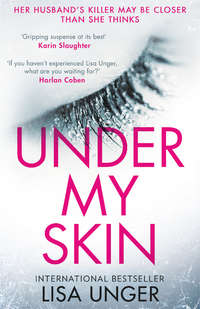
Kitabı oku: «Under My Skin»
From New York Times bestselling author and master of suspense Lisa Unger comes an addictive psychological thriller about a woman on the hunt for her husband’s killer
What if the nightmares are actually memories?
It’s been a year since Poppy’s husband, Jack, was brutally murdered during his morning run through Manhattan’s Riverside Park. In the immediate aftermath, Poppy spiraled into an oblivion of grief, disappearing for several days only to turn up ragged and confused wearing a tight red dress she didn’t recognize. What happened to Poppy during those lost days? And more importantly, what happened to Jack?
The case was never solved, and Poppy has finally begun to move on. But those lost days have never stopped haunting her. Poppy starts having nightmares and blackouts—there are periods of time she can’t remember, and she’s unable to tell the difference between what is real and what she’s imagining. When she begins to sense that someone is following her, Poppy is plunged into a game of cat and mouse, determined to unravel the mystery around her husband’s death. But can she handle the truth about what really happened?
LISA UNGER is the New York Times and internationally bestselling, award-winning author of 16 novels. Her books are published in 26 languages and have sold millions of copies worldwide. Lisa Unger lives in the Tampa Bay area of Florida with her husband, daughter and labradoodle.
Also by Lisa Unger
THE RED HUNTER
INK AND BONE
THE WHISPERING HOLLOWS (novella)
CRAZY LOVE YOU
IN THE BLOOD
HEARTBROKEN
DARKNESS MY OLD FRIEND
FRAGILE
DIE FOR YOU
BLACK OUT
SLIVER OF TRUTH
BEAUTIFUL LIES
SMOKE
TWICE
THE DARKNESS GATHERS
ANGEL FIRE

Copyright

An imprint of HarperCollins Publishers Ltd
1 London Bridge Street
London SE1 9GF
First published in Great Britain by HQ in 2018
Copyright © Lisa Unger 2018
Lisa Unger asserts the moral right to be identified as the author of this work.
A catalogue record for this book is available from the British Library.
This novel is entirely a work of fiction. The names, characters and incidents portrayed in it are the work of the author’s imagination. Any resemblance to actual persons, living or dead, events or localities is entirely coincidental.
All rights reserved under International and Pan-American Copyright Conventions. By payment of the required fees, you have been granted the non-exclusive, non-transferable right to access and read the text of this e-book on-screen. No part of this text may be reproduced, transmitted, downloaded, decompiled, reverse engineered, or stored in or introduced into any information storage and retrieval system, in any form or by any means, whether electronic or mechanical, now known or hereinafter invented, without the express written permission of HarperCollins.
Ebook Edition © October 2018 ISBN: 9781474066754
Praise for Lisa Unger
‘Lisa Unger’s deliciously intense and addictive thriller got under my skin. I picked it up, was drawn into this dark, tangled tale, and couldn’t pull away until it was done. Gripping suspense at its best.’
Karin Slaughter
‘Under My Skin is a twisting labyrinth of a book where nothing is as it seems, dreams bleed into reality, and the past is the future. Lisa Unger is one of my favorite writers. And in this tilt-a-whirl of a psychological thriller, she’s at the top of her game.’
Lisa Gardner
‘This is a haunting, compulsive tale that will have you under its spell long after you’ve closed the book.’
Tess Gerritsen
‘Under My Skin is a perfectly dark and unsettling, spellbinding thriller. Told with both eloquence and urgency, Unger knows just how to hook her readers and reel them in. This book is not to be missed.’
Mary Kubica
‘Deeply plotted and complex and carries an undeniable momentum. Lisa Unger’s enthralling cast of characters pulled me right in and locked me down tight. This is one book that will have you racing to the last page, only to have you wishing the ride wasn’t over.’
Michael Connelly
‘Riveting psychological suspense of the first order. If you haven’t yet experienced Lisa Unger, what are you waiting for?’
Harlan Coben
‘Suspenseful, sensitive, sexy, subtle. The best nail-biter I have read for ages. Highly recommended.’
Lee Child
To Connie, Donna and Pat,
Faithful readers who have become friends.
Your support means more than you know.
Contents
Cover
Back Cover Text
About the Author
Booklist
Title Page
Copyright
Praise
Dedication
PROLOGUE
PART ONE
Chapter 1
Chapter 2
Chapter 3
Chapter 4
Chapter 5
Chapter 6
Chapter 7
Chapter 8
Chapter 9
Chapter 10
Chapter 11
Chapter 12
Chapter 13
Chapter 14
Chapter 15
Chapter 16
Chapter 17
Chapter 18
Chapter 19
Chapter 20
Chapter 21
Chapter 22
Chapter 23
PART TWO
Chapter 24
Chapter 25
Chapter 26
Chapter 27
Chapter 28
Chapter 29
Chapter 30
Chapter 31
Chapter 32
Chapter 33
SIX MONTHS LATER
Chapter 34
ACKNOWLEDGMENTS
About the Publisher
PROLOGUE
I like him. I do.
But.
There’s always a but, isn’t there?
He’s talking and I should be listening. I’m not. Does he see it, that I’m scattered, distracted? Doubtful. He doesn’t seem especially observant, has that way about him that people do now. As if they are putting on a show of themselves, as if the moment is being watched rather than lived. He glances about as he talks. Up at the television screens over the bar, all on mute, all tuned in to different sporting events. Down at the phone that sits dark beside him. Back to me, off again to the rowdy table across from us—a postwork gathering I’m guessing from the rumpled suits and tired eyes.
I soak in the details of him: his shock of ink black hair, thick—any girl would kill for it; dark stubble on his jaw, just enough—sexy, not unkempt, style, not neglect; his gym-toned body. Beneath the folds of his lavender oxford, the dip of cut abs, the round of a well-worked shoulder.
If I had a camera in my hand—not a smartphone but a real camera—say a mirrorless Hasselblad X1D, ergonomic, light—old-school style with high-tech innards—I’d watch him through the lens and try to find the moment when he revealed himself, when the muscles in his face relaxed and the mask dropped, even for just a millisecond. Then I’d see him. The man he really is when he steps off the stage he imagines himself on.
I already knew he was handsome, stylish, in shape, before we agreed to meet. His profile told me as much. He works in finance. (Of course he does.) His favorite book is the Steve Jobs autobiography. (What else?) But what’s under his skin, that carefully manicured outer layer? Beneath the mask he puts on in the morning—what’s there? The camera always sees it.
He runs his fingertips along the varnished edge of the table between us, then steeples them. I read somewhere that this is the gesture of someone very sure of himself and his opinions. It tracks. He seems very sure of himself, as people who know very little often are.
He laughs, faux self-deprecating, at something he’s just said about himself. His words still hang in the air, something about his being a workaholic. What a relief that it’s just drinks, not dinner. No point in wasting time, if it’s not there, he wrote. Who could disagree? So adult. So reasonable.
I never thought it would be. It can’t be. Because it has nothing to do with the way he looks. It isn’t about his eyes, black, heavily lashed and half-lidded. Or the bow of his mouth, full, kissable. (Though I might kiss him anyway. Maybe more. Depends.) Attraction, desire is nothing to do with the physical; it’s chemical, a head trip. And my head—well, let’s just say it’s not on straight.
A woman laughs too loud—a cackle really, harsh and jarring. It startles me, sends a pulse of adrenaline through me. I scan the crowd. I really shouldn’t be here.
“Time for another?” he asks. His teeth. They’re so white. Perfectly aligned. Nothing in nature is so flawless. Braces. Whitening.
The rim of the glass is ice-cold beneath my fingertip. The drink went down fast, too fast. I promised myself I wouldn’t drink, not with everything that’s been going on. It’s been a long day, a long week. A long year. The weight of it all is tugging at me, pulling me under.
I take too long to answer and he frowns, just slightly, looks at his phone. I should just leave. This is crazy.
“Sure,” I say instead. “One more.”
He smiles again, thinks it’s a good sign.
Really, I just want to go home, pull up my hair, put on my sweats, get into bed. Even that’s not an option. Once we walk out of here, it’s back to the jigsaw puzzle of my life.
“Grey Goose and soda,” he tells the waitress when he’s flagged her down. He remembers what I’m drinking. A small thing, but so few people pay attention to the details these days. “And Blanton’s on the rocks.”
Straight bourbon, very manly.
“Am I talking too much?” he says. He looks sweetly sheepish. Is it put on? “I’ve heard that before. My last girlfriend, Kim—she said I ramble when I get nervous.”
It’s the second time he’s mentioned her, his “last girlfriend, Kim.” Why, I wonder? Carrying a torch? Or just trying to market himself as someone who’s been in a relationship? Also, “last girlfriend.” It begs the question: How many others? Maybe I’m reading too much into it. I do that.
“Not at all.”
I am a seeker. I want to explore the world. Don’t you? I love to learn, to cook, to travel. I get lost in a good book.
That’s what his profile said. In his picture, he smiled, nearly laughing, hair wind-tossed. It was a good photo, could have come from a magazine—which is always suspicious. Photographers know all the tricks to capturing beauty, the right angles, the proper lighting, the magic of filters. The truth is that most people aren’t that hot in person. Even beautiful people, real ones, are flawed in some way—not airbrushed, or prettily windblown, eyes glittering. Lines around the eyes and mouth, an almost imperceptibly crooked nose, a faint scar—chicken pox or a childhood fall from a bike. People, real people, have a little stain from lunch on their tie, maybe something hanging from their nose or in their teeth, patches of dry skin, shoes that need replacing. These imperfections make us who we are, tell the truth of our lives.
But to his credit, he is close to as good-looking as his profile picture. But something’s off. What is it?
There’s nothing special about my profile picture, nothing misleading, just a photo snapped by my friend Layla, who set the whole thing up. Of course, she’s a talented photographer, my oldest friend and knows how to shoot me. No filter, though, no Photoshop tricks. What you see is what you get. Sort of.
“What about you?” he says.
The waitress delivers the drinks to our high-top. Her ears are lined with silver hoops; another in her lip. She is fleshy but pretty with startling green eyes that give her an otherworldly look. I bet she reads a lot of teen fantasy novels. Twilight. Harry Potter. Hunger Games.
“Thank you, darlin’,” he says to her. He drops the g and inflects the word with a twang, though I know he was born and raised in New Jersey. She beams at him, flushes a little. He’s a charmer in a sea of snakes.
I notice that he has a way of looking at women, a warm gaze, a wide smile. It seems like a choice. A technique. He knows that women like to be gazed upon, attended to with male eyes. It makes them feel pretty, special in a world where we too rarely feel like either of those things. She smiles at him, does this quick bat of her eyelashes. She likes him. I can tell; she glances at him from time to time as she shuttles back and forth along the bar, between the other high-tops she’s also serving. Even if I walk out of here, I’m sure someone will go home with him. Good-looking, charming guys emanating the scent of money rarely go lonely.
“What do you want to know?” I ask when he turns back to me.
He takes a sip of his bourbon, gazes over his glass, mischievous. “In your profile, you said you were a runner.”
Did Layla put that in my profile? Layla—this dating thing? All her idea. Time to get back out there, girlfriend. I honestly don’t remember what we put in the profile.
“I run,” I say. The truth is that I used to run. “I don’t know if I’d call myself a runner.”
“What’s the difference?”
“I run—for exercise, because I like it, because it calms me. But it doesn’t define me. I don’t have a group, or register for races, travel to do marathons or whatever.”
Am I rambling?
Finally, “I run. I am not a runner. Anyway, I’m more indoors lately, at the gym.”
He nods slowly, a pantomime of the careful listener, looks down at his glass.
I almost tell him about Jack then; it’s always right on the tip of my tongue.
My husband was killed last year, I want to say. He was attacked while he was running in Riverside Park at 5:00 a.m. Whoever it was—they beat him to death. His murder is still unsolved. I should have been with him. Maybe if I had been... Anyway. I don’t find running as enjoyable as I used to.
But then he’s talking about how he started running in high school, ran in college, still runs, travels for marathons, is thinking about a triathlon in New Mexico next year, but his work in finance—the hours are so crazy.
Kim’s right, I think. He talks too much. And not just when he’s nervous. Because he’s not nervous, not at all.
It’s his nails. They’re perfect. They are, in fact, professionally manicured. Expertly shaped and buffed squares at the ends of thick fingers. He steeples them again on the table between us. That’s the but. Vanity. He’s vain, spends a lot of time on himself. The gym, his clothes, his skin, hair, nails. Which is fine for tonight. But in the long game, when it’s time to stop worrying about yourself and start thinking about someone else, he’s not going to be able to do it. The lens would have seen it right away.
Should I mention my nervous breakdown, the one I had after Jack died, how days of my life just—disappeared? Probably not, right?
The space grows more crowded, louder. It’s one of those Upper East Side sports bars with big screens mounted at every angle, games from all over the country, all over the world playing. It’s filling up with the after-work crowd, men who are really still babies with their first jobs, fresh out of school, girls—tight-bodied, hair dyed, waxed and threaded, tits high—who have no idea what the next ten years will hold, how many disappointments small and large.
It’s Thursday, tomorrow the end of the workweek, so the energy is high, exuberant voices booming. Our waitress drifts back and forth, deftly balancing trays of clinking highballs, frothy pilsners of beer, shot glasses of amber liquid. Shots? Really? Do people still do that?
There’s a buzz of anxiety in the back of my head as I scan the crowd, turn to look through the big windows to the street. Someone’s been following me, I almost say, but don’t. I’ve been suffering from some sleep disturbances, some unsettling dreams that might be memories, and to be truthful my life is a bit of a mess. But I don’t say those things. He’s still talking, this time about work, a boss he doesn’t like.
It’s closing in, all the laughter, cheering, bodies starting to press, ties loosening, hair coming down. I let him pick the meeting place. I’d have chosen a quiet spot downtown—in the West Village or Tribeca, someplace soothing and serene, dark, where you speak in low tones, lean in, get to know someone.
Note to self: don’t let them choose—even though the choice speaks volumes. In fact, this dating thing, maybe it’s not for me at all.
“I’ve got an early day tomorrow,” I say, in the next lull between things he’s saying about himself. He’s been practically yelling, to be heard above the din. I should get out of here. Huge mistake.
I see it then. A flinty look of angry disappointment. It’s gone in a millisecond, replaced by a practiced smile.
“Oh,” he says. He looks at his watch—a Fitbit, wouldn’t you know it. “Yeah, me, too.”
“This has been great,” I say. He picks up the check, which the bartender must have laid in front of him at some point.
I take my wallet out.
“Let’s split it,” I say. I prefer to pay or split in these circumstances; I like the feel of equal ground beneath my feet.
“No,” he says. His tone has gone a little flat. “I’ve got it.”
It’s not just the nails. There’s a sniff of arrogance, something cold beneath the flirting. I can see the glint of it, now that he knows he’s not going to get what he came for. Or maybe it’s not any of those things. Maybe there’s nothing wrong with him at all. Very likely it’s that something is wrong with me.
Or most likely of all, it’s just that he’s not Jack.
Until you let your husband go, no one else will measure up. That’s what my shrink said.
I’m trying. I’m dating.
Setting them up to knock them down isn’t dating.
Is that what I’m doing? Just killing time with men who can’t help but to ultimately reveal themselves as not-Jack. They won’t be as funny as he was, or know just where to rub my shoulders. They won’t run out at any hour for anything I need, without being asked. I’ll go grab it for you. They won’t have his laugh, or that serious set to his face when he’s concentrating. They won’t bite on the inside of their cheeks when annoyed. They won’t feel like him, or smell like him. Not-Jack.
Until one day, says Dr. Nash, there’s someone else who you love for all new reasons. You’ll build a new life. I don’t bother telling her that it’s not going to happen. In fact, there are a lot of things I don’t bother telling Dr. Nash.
On the street, though I reach out for his hand, he tries for a kiss. I let his lips touch mine, but then I pull back a little, something repelling me. He jerks back, too. It’s awkward. No heat. Nothing. I shouldn’t be disappointed, should have long ago lost the capacity for disappointment. I suspected (knew) that it wouldn’t be there. But I thought maybe if there was heat, some physical spark, I wouldn’t need the sleeping pills tonight. Maybe we’d go back to his place and I’d have a reprieve from putting back the pieces of my fractured life.
Now I must decide where I will go tonight—back to an apartment I was supposed to share with my husband but where I now live alone and no longer feel safe, back to Layla’s penthouse, maybe to a hotel.
A police car whips up Lexington. Whoop. Whoop.
“Maybe we could run this weekend?” He’s still working it, though I can’t imagine why. “Ever try the trails up in Van Cortlandt Park? Short but pretty—you feel miles away from the city.”
“Nice,” I say.
Unless there’s someone lurking in the shadows, and no one can hear you call for help.
“Should I text you?”
He’ll never text me, of course.
“That sounds great.”
Even if he does text me, I won’t answer him. Or I’ll put him off until he gets the hint. It’s easy like that, this dating thing in the age of technology. You can dangle someone off the edge of your life until they just float away, confused. Ghosting, I think the millennials call it.
“Can I see you home?” he asks.
“No,” I say. “I’m fine. Thanks.”
I feel wobbly, suddenly. It’s after nine, and those two vodka sodas are sloshing around in an empty stomach, not to mention the other chemicals floating in my bloodstream. I haven’t eaten anything since—when?
“You okay?” he asks. His concern seems exaggerated, his tone almost mocking. There are other people on the street, a couple laughing, intimate, close, a kid with his headphones on, a homeless guy sitting on the stoop.
“I’m fine,” I say again, feeling defensive. I didn’t have that much to drink.
But then he has his arm looped through mine, too tight, and I find myself tipping into him. I try to pull away from him. But he doesn’t allow it. He’s strong and I can’t free my arm.
“Hey,” I say.
“Hey,” he says, a nasty little mimic. “You’re okay.”
Of course I’m okay, I want to snap. But the words won’t come. There’s just this bone-crushing fatigue, this wobbly, foggy, vague feeling. Something’s not right. The world starts to brown around the edges. Oh, no. Not now.
“She’s okay,” he says, laughing. His voice sounds distant and strange. “Just one too many I guess.”
Who’s he talking to?
“Let go of me,” I manage, my voice an angry hiss.
He laughs; it’s echoing and strange. “Take it easy, sweetie.”
He’s moving me too fast up the street, his grip too tight. I stumble and he roughly keeps me from falling.
“What the hell are you doing?” I ask.
Fear claws at the back of my throat. I can’t wait to get away from this guy. He pulls me onto a side street; there’s no one around.
“Hey.” A voice behind us. He spins, taking me with him. There’s someone standing there. He looks distantly familiar as the world tips. Somewhere inside me there’s a jangle of alarm. He has a dark hood on, his face not visible.
It’s him.
He’s big, bigger than—what’s his name? Reg, or something. Rex? The big man blocks our path up the sidewalk.
“Hey, seriously, dude,” says Rick. Yes, Rick, that was it. “Step aside. I’ve got this.”
But the world is fading fast, going soft and blurry, tilting. There’s a flash, quick-fire movement. Then a girlish scream, a river of blood. Black red on lavender.
Then arms on me.
Falling.
Nothing.
PART ONE
Hypnagogia
Between the dreams of night and day there is not so great a difference.
—Carl Jung, Psychology of the Unconscious
1
“I think someone’s following me.”
I almost kept this to myself, but toward the end of our session it just tumbles out.
Dr. Nash wrinkles her brow with concern. “Oh?”
Her office is a cozy living room, all big furniture and fluffy throw pillows. There are shelves and shelves of books and pictures, and trinkets, small art objects from her travels. It’s exactly the kind of office you’d want your shrink to have. Warm, enveloping. I sink deeper into my usual corner on her plush couch, leaning heavily on the overstuffed armrest. I resist the urge to curl up in a ball and cover myself with the cashmere blanket that’s tossed artfully over the back. A grouping of those faux candles flicker on the coffee table; she made me some tea when I arrived. It sits in front of me, untouched.
“The other night when I left the gym, there was someone standing across the street. I think I saw him again this morning on a park bench near my office.”
Even thinking about it, there’s a flutter of unease.
The doctor shifts in her leather Eames chair; it’s too well made to creak beneath her weight. She’s a wisp of a woman. The leather just whispers against the fabric of her pants. Afternoon light washes in, touching her hair and the side of her face. There are these longish pauses in our conversation where she chooses her words, letting mine ring back to me. She takes one now, considering me.
“Are you certain it was the same man?” she asks finally.
A cool October breeze wafts in the open window, street noise carrying up from nine floors below. A horn, the rumble of a manhole cover wobbling beneath the weight of passing vehicles, the yipping of some small dog. I imagine a Yorkie in a little sweater, straining against a slender leash.
“No,” I admit.
“But certain enough that you’re uneasy about it.”
I’m already sorry I brought it up. I did see someone, a man in a black hoodie, sneakers, faded jeans. He stood in a dark doorway across the street when I left the gym last Tuesday. Then on Thursday as I headed to my office clutching my daily quadruple espresso, I saw him again. I felt his eyes on me, the details of his face hidden in the dark shadow of that hood.
I dismissed it. There are lots of staring men clad in jeans and hoodies in this city. Any girl will tell you, there are always eyes on you, unsolicited comments, unwanted noises, unwelcome approaches. But then maybe I saw him once more over the weekend, when I was coming home from the farmers’ market. Still, it’s hard to be certain.
“Well,” I backpedal. “Maybe it wasn’t the same man.”
I shouldn’t have said anything. I don’t want her to think I’m backsliding. Stumbling toward another breakdown. When something like that happens to you, there’s this energy to the people who care about you, like they’re always waiting for signs that it’s going to happen again. I get it; they don’t want to miss the tells a second time and run the risk of losing you again, maybe for good. Even I’m wary. I feel a little sick about that black spot in my memory where I took a vacation from reality, how fuzzy are the days surrounding Jack’s murder.
So. I try not to think about it. It’s one of the things from which I am trying to move on. That’s what you’re supposed to do, you know, when the worst thing happens and you’re still standing. Everyone’s very clear about it: you’re supposed to move on.
“It’s probably nothing,” I say, stealing a surreptitious glance at my watch. My smartphone, my tether as Jack liked to call it, is off and tucked into my bag, as per Dr. Nash’s office rules. Here we free ourselves of distractions and try to be present in a world that conspires against it, she has said more than once.
Dr. Nash watches me, prettily brushing away an errant strand of her lovely gray-blond bob. Behind her there’s a picture of her family—her chiseled-jaw, graying husband, her grown children both with her same delicate features, intelligent eyes. They all stand together on a terrace overlooking a beach sunset, smiling, faces pressed together. We’re perfect, it seems to say. Wealthy and gorgeous, without a single stain of darkness on our lives. I look away.
“I noticed you’re not wearing your rings,” she says.
I look down at my left hand. The finger is slightly indented from my wedding and engagement rings, but bare.
“When did you make that decision?”
My hands swelled the other night, and I took the rings off and put them in the dish beside my bed. I haven’t put them back on. I tell her as much. Jack has been dead almost a year. I’m not married anymore. Time to stop wearing the jewelry, right? Even though the sight of my bare hand puts a painful squeeze on my heart, it’s time.
“Was it before or after that you started seeing the hooded figure?”
Dr. Nash is the master of the pointed question.
“I see where you’re going with this.”
“I’m just asking.”
I smile a little. “You’re never just asking, Dr. Nash.”
We like each other. Sometimes, lately, our sessions devolve into chats—which she says is a sign I need her less. A good thing, according to her. Progress on the road to healing, the new normal as she likes to call it.
“How are you sleeping?” she asks, letting her other question rest.
I have the nearly empty pill bottle in my purse. Last time I asked for more, she wrote me a scrip but lowered the dosage. I’d like you to try to get off these. Honestly, it hasn’t been going well. My dreams are too vivid. I’m less rested, so edgier, jumpier during the day.
“I was going to ask for my refill.”
“How’s that lower dosage?”
I shrug, trying for nonchalance. I don’t want to appear fragile, not to her, not to anyone. Even though I am, terribly. “I’m dreaming more. Maybe I feel a little less rested.”
“You’re not taking more of them, though, are you?”
I am. I’m also doing other things I shouldn’t be doing. Like taking them with alcohol, for one.
“No,” I lie.
She nods carefully, watching me in her shrink way. “You’ve been taking them for eleven months. I’d like to go down to the minimum dosage with an eye toward your being off them altogether. Want to give it a try?”
I hesitate. That chemical slumber is the best place in my life right now. I don’t say that, though. It sounds too grim. Instead I find myself agreeing.
“Great,” she says. “If it’s an issue, we’ll go back up to the dosage you’re on now. And those dreams? Go back to the dream journal you were keeping when Jack first died. It’s an important part of our lives, our dream world. As we’ve discussed, we can learn a lot about ourselves there. Do you still keep it by your bed?”
“Yes.”
She hands me the white slip of paper.
“Well,” she says. I stare at the crisp sheet, her doctor’s scrawl. “I think our time is up for today.”
I’m always a little startled by the end of a session, the abrupt reminder that no matter how intimate, how I strip myself bare in these sessions, ours is a professional relationship. If I stopped paying, these chats with Dr. Nash would come to an unceremonious end.
“And, Poppy? If you see him again, call me.”
A siren from the street below drifts up, a distant and ghostly wail. This sound, so frequent in the cacophony of city noise, always makes me think of Jack. About an hour after he left that morning, emergency vehicles howled up the avenue beneath our window. There should have been some premonition, some dark dawning, but there wasn’t.
A lingering head cold had kept me in bed instead of going with him as I normally would have.
You could have died that morning, too, Layla says when we go over and over it.
Or maybe it wouldn’t have happened at all. Maybe we would have run in a different direction. Or maybe we could have fought off the attacker together.
Or maybe, or maybe, or maybe—on and on. Infinite possibilities, myriad ways Jack might still be with me. He overslept; a light caused him to cross another street; I was there and twisted my ankle, causing us to return home. I turn to those scenarios in blank moments, in dreams, when I should be paying attention in meetings. So many other paths he could have taken and didn’t.
“I’m not imagining him.” It seems to come out of nowhere.
Dr. Nash cocks her head at me. “I didn’t say you were.”
I bend down and grab my bag, come to standing as she does.
“And lock your doors. Be mindful,” she adds.
“You sound like my mother.”
She chuckles. “We can talk about that next session.”
“Very funny.”
* * *
I walk toward the subway, needing to get back downtown for a two o’clock meeting. I’m probably going to be late—again. The city is such a mess, a constant crush of traffic and delayed trains. I think about a cab or an Uber, but sometimes that’s even worse, snaking through jammed streets, trapped in a box, trying to decide if it would be faster to just get out and walk. The whole city seems to conspire against promptness.
I text my assistant, Ben. Running late, I tap in quickly and descend beneath the street. It’s Monday midday, so it’s not as crowded as it could be. Though the day is mild, the platform is hot as an oven and smells like piss. My stress level starts to tick up.
Jack wanted us to leave Manhattan; he’d grown to hate it. Everything that was cool about it is gone. It’s just an island for the rich. He dreamed of a historic property upstate, something with a lot of land, trees, trails to wander. Something we could renovate and make ours. He longed to disconnect from the rush of wanting, grasping, striving, at least on the weekends. He wanted time back behind the camera. He didn’t get any of those things.
We were packing when he died, boxing up the one-bedroom Upper West Side apartment we’d shared for five years. But instead of moving out of the city, we were moving to The Tate, a luxury high-rise in Chelsea—a gleaming tower of apartments with floor-to-ceiling windows, offering stunning vistas, high ceilings, wood floors, chic open-plan kitchens, pool and gym, a 24/7 building staff. It was me. I was the one who wanted it; he acquiesced.
He loved our dark, cozy place on Ninety-Seventh—with views of the other building across the street, with radiators that clanked, and mice in our ridiculously dated kitchen, and the old doorman Richie, who’d worked there forever and was sometimes asleep when we walked in. He loved our crazy, colorful cast of neighbors—Merlinda, the psychic who read clients in her apartment; Chuck—or Chica—accountant by day, drag queen by night, who had the most beautiful singing voice I’d ever heard; Bruce, Linda and Chloe, public school teachers and their adorable, gifted daughter, our next-door neighbors who never failed to invite us for Sunday dinner.
Now I live in a starkly beautiful space that looks out onto lower Manhattan—alone. I don’t even know who lives in the apartment next to me. The hallways are gray tunnels, lined with doors that seem to rarely open. In my apartment, the furniture is placed appropriately—bed in the bedroom, couch in the living area—but most of the boxes are still unpacked. To say I miss my husband, our wacky neighbors, that dark old apartment, our life—well, why? There are no words to adequately describe that slick-walled gully of despair. Suffice it to say that I can’t seem to fully move into my new life without Jack.
I’m sorry, I tell him. I wish I had listened to you.
Dr. Nash says it’s okay to talk to him, if I understand he’s not talking back.
Time drags and I’m ever more fidgety, annoyed. More people file down the stairs. The platform grows dense with bodies, the air thickening with impatience. Still the train doesn’t come. I lean over the edge of the platform to see if I can spot the glow of an oncoming headlamp. No.
I glance at the clock. There is officially no way to be on time now. A bead of perspiration trails down my spine. A glance at my phone reveals that there’s no signal.
When the train finally screeches into the station, it’s already packed. I wait by the door, letting the flow of people exit. There’s no guarantee that the next train will be any less crowded, and that waiting meeting looms. I shoulder myself on, shimmying toward the door that connects one car to the other; find a space with a little breathing room. The cars fill.
Stand clear of the closing doors.
The doors close, open again, then finally shut for good. The train lurches forward, stops, jostling everyone, then onward again. I close my eyes, try to breathe. The crowded space is closing in already. I am not great in tight spaces, which is an uncomfortable condition for a city dweller. It’s worse since Jack died; the fingers of panic tugging at me more than they used to. I lean my head against the scratched, foggy glass. Breathe. Just breathe. Imagine you’re on a trail in the woods, plenty of space, the tall green trees giving oxygen and shade. There’s a bird singing, the sound of the wind in the leaves. It’s the meditation Dr. Nash gave me for dealing with anxiety in crowds or anywhere. Occasionally, it works.
But when I open my eyes again, he’s there. That hooded man, pressed in among the crowd in the other car, a statue amidst the clutter of shuffling, jostling passengers. His eyes are hidden by the shadow of the hood, but I can feel them. Is it the same man? My heart stutters, a suck of fear at the base of my throat.
Reality cracks, a fissure splits in my awareness. For a moment, quick and sharp, I’m back in my own bedroom. The space beside me on the king mattress is cold when it should be warm. The covers are tossed. Jack left for his run without me, letting me sleep.
“Jack?”
Then I’m back, the train still rattling, rumbling. I’m stunned, a little breathless; what was that? A kind of vivid remembering, a daydream? Okay. It’s not the first time it has happened; but it is the most vivid. The woman next to me gives me a sideways glance, shifts away.
Pull it together, Poppy. The stranger—he’s still there. Is he watching me?
Or is he just another blank commuter, lost in thought about home or work or whatever it is we ponder when we’re zoning out, traveling between the places in our lives. Maybe he’s not seeing me at all. For a moment, I just stare.
Then, unthinking, I push through the doors, stepping out onto the shaking metal platforms between the cars. This is a major subway no-no, I think as I balance and grope my way through the squeal of metal racing past concrete, metal on metal singing, sparking, then through the other door into the relative quiet of the next car.
He moves away, shoving his way through the throng. I follow.
“What the fuck?”
“Watch it.”
“Come on.”
Annoyed passengers shoot dirty looks, shift reluctantly out of my way as I push after him, the black of his hood cutting like a fin through the sea of others.
As we pull into the next station, he disappears through the door at the far end of the car. Trying to follow him, I find myself caught in the flow of people exiting, and get pushed out of the train onto the platform. I finally break free from the crowd, jog up the platform searching for the hooded figure among tall and short, young and old, backpacks, briefcases, suits, light jackets, baseball caps. Where is he?
I want to see his face, need to see it, even though I can’t say why. Distantly, I’m aware that this is not wise behavior. Not street-smart.
Don’t chase trouble, my mother always says. It will find you soon enough.
Then the doors close and I’m too late to get back on. Shit. My phone chimes, finding a rare spot of service underground.
A text from Ben: ETA? They’re going to wait a bit, then reschedule. Assume you’re stuck on the train.
It isn’t until the train pulls away that I see the stranger again, on board, standing in the door window. He’s still watching, or so it seems, his face obscured in the darkness of the hood. I walk, keeping pace with the slow-moving train for a minute, lift my phone and quickly take a couple of pictures. I can almost see his face. Then he’s gone.
2
I arrive at the office frazzled, sweaty, full of nerves, late for the meeting. In the bathroom, running my wrists under cold water, pulling shaking fingers through my dark hair, I stare at my reflection in the mirror.
Pull. Yourself. Together.
My face is sickly gray under the ugly fluorescents, as I dab some makeup on the eternal dark circles under my eyes, refresh lipstick and blush. A little better, but the girl in the mirror is still a tired, wrung-out version of the person she used to be.
Rustling through my bag, I find the bottle of pills Layla gave me. It’s blank, the little amber vial, no label. For nerves, she said. I hesitate only a second before popping one in my mouth and swallowing it with water from the faucet, then try to take some centering breaths. Dr. Nash is not aware of my unauthorized pill-taking, one of multiple things I keep from her. I know. What’s the point of keeping things from the person who is supposed to be helping you?
As I walk past Ben’s desk, he rises and hands me a stack of messages.
“They’re waiting,” he says, dropping into step beside me. “You’re fine.”
“Great.” My smile feels as stiff and fake as it is. “The subway is a mess.”
“Everything okay?”
He inspects me through thick, dark-rimmed glasses, tugs at his hipster beard. He’s a stellar assistant; I keep trying to promote him but he doesn’t want to go. My clients love him—he’s on top of all their contracts, tracks down their payments, helps with grant and residency applications. Over the past year, he’s been more agent to them than I have. He could probably just take over and I could slip away. It’s tempting, that idea of slipping away, disappearing—another life, another self.
“Yeah,” I say unconvincingly. Ben watches after me with a frown as I push into the conference room.
“His work,” Maura is saying. “It’s stunning.”
“Whose work?” I ask, taking my seat at the head of the conference table. “Sorry I’m late.”
All eyes turn to me. When Jack was alive, I could come and go unnoticed. He ran the meetings and I was the number two—critical to the running of the office, but not the magnetic, energetic head of the meeting table. He brought a light and enthusiasm for the craft, for the business into every gathering. I am not the captain he was, I know, but I’m doing my best. They watch me now—respectful, kind, hopeful.
Jack picked out everything in this room, from the long sleek conference table to the white leather swivel chairs, the enormous flat screen on the wall. His photo from an Inca Trail trek, featured in Travel + Leisure, is blown up onto an enormous canvas. He took it from his campsite above the cloud line—orange tents blossom in white mist, as clouds fall away into a landscape of jade and royal blue, the dip of the valley dark and the sky bright.
“Alvaro’s,” Maura says. “He took that Nat Geo job to photograph the okapi living in the Ituri Rainforest, just got back yesterday.”
The photos come up on the screen—lush, jewel greens and deep black, a red mud road twists and disappears into a thick of forest; a girl, her eyes dark and staring, stands on a riverbank in a grass skirt, her expression innocently teasing. A blue-and-white truck travels precariously over a swaying wooden slat bridge.
Maura runs a manicured hand over her black hair, pulled tight into a ponytail at the base of her neck. She’s young, but her almond-shaped eyes reveal an old soul. Olive-skinned, almost birdlike in her delicacy, she’s a firebrand agent, fiercely protective of her clients. She worries over them like a mother hen.
“The colors, the movement, the energy,” I say. “They’re wonderful.”
The trunk of a tree, hollowed out and haunted, twisting, branches reaching up into deep green black. The shots of the okapi, an animal that is partially striped like a zebra, but related more closely to a giraffe, are stunning—a mother nursing her young, a young male hiding in tall grass, a small herd underneath a wide full moon.
“They are,” Maura agrees. Her smile is wide and proud. “He’s—amazing.”
I wonder, not for the first time, if something is going on between Maura and Alvaro. It’s not a good idea for an agent to fall in love with a photographer she represents. In fact, it’s not a good idea for anyone to fall in love with a photographer. The unfiltered world never quite measures up to whatever he sees through that lens. Alvaro Solare, Jack’s best friend and the firm’s first client, is the typical roving photographer, always in pursuit of the next perfect shot. Which means the rest of the world can go to hell. There are a string of heartbroken women in his wake. I’d prefer Maura not become one of them. But it’s not really my business.
The rest of my agents run down the status of their clients’ assignments. Our firm, Lang and Lang, mine and Jack’s, represents photographers. We are a boutique agency, small but successful, with some of the top names in fashion, feature and news photography on our roster.
What started as a small enterprise in our apartment, has grown into an agency with a suite of offices in the Flatiron Building. Jack, affable and mellow, was a natural mediator. When Alvaro was in a dispute with the New York Times travel section, Jack stepped in and resolved it over drinks with the photo editor, an old friend of his. Alvaro paid Jack 15 percent out of appreciation. One thing led to another, and after a year Jack was turning down photo assignments, and representing more of his friends, including me.
So, after years of hustling as travel photographers, scraping together a living, we traded in our life of adventure for a firm dedicated to protecting the rights of people who make a living with a camera in their hands. Alvaro thought it was a mistake, that we were wasting our talent and our lives. And he never lost an opportunity to tell us so. But we thought it was time to settle down, start a family. Except it didn’t work out that way.
I half listen as the other agents run down problems and successes. I comment, make suggestions, offer to make a call to a contact of mine at Departures. But mostly, I am still on that train, chasing after the man in the hood.
I wonder if anyone notices that I am a ghost in my life.
* * *
It’s another half hour before I am back in my office, scrolling through the blurry, useless photos I took on my smartphone. The light was poor, too much motion. That dark form is just a smudge, a black space between the grainy commuters all around him. I use my thumb and forefinger to enlarge the image on the screen, but it looks ever more amorphous as a low-quality image will.
I start to doubt myself, my grip on reality. What did I see really, after all? Just a man with a hood, who might or might not have been looking in my direction.
I don’t even notice Ben until he’s sitting across the desk from me. There’s a look I don’t like on his face, worry, something else.
“What?”
He leans back and crosses his legs. “When were you going to tell me?”
“Tell you?”
“That you’re dating again.”
I shake my head, not wanting to get into it. “I’m not.”
“So, who’s Rick, then?” He slides a message across my desk. There’s another one from him in the stack I’ve just barely started to sort through. I’m old-school; I still like paper messages to toss when calls are returned, write notes on, keep as reminders.
“He’s no one,” I say.
I wouldn’t say I’m exactly dating. There’s a snow globe on my desk, a little farmhouse surrounded by trees. Jack gave it to me one Christmas. This is what our house will look like, out in the country. Quiet. Away from all the chatter. I tip it and watch the snow swirl around the black branches.
“I saw your profile online,” says Ben. He peers over his glasses, a gesture he thinks makes him look wise, worldly. It really doesn’t. He’s far too young to be either of those things.
Putting the snow globe down, I lean back in my chair and frown at him.
“What are you doing on an online dating site, a young hottie like you? They must drop like flies.”
He shoots me a faux-smarmy eyebrow raise. “That’s what we do. The millennials? It’s how we roll. Tinder, OKCupid, Match.com. Love is just a swipe away.” He makes a wave motion with his hand.
“So, it’s not just for old people, then?” I sift through the tiny white sheets of paper. “The divorced, the forever single—the widowed.”
Widowed. I hate that word; it evokes black veils and wails of grief. It defines me by the loss of my husband, as though I’m less now that he’s gone. Of course—I am. I regret saying it as soon as it’s out of my mouth. The word hangs in the air between us. When I look up from my messages, Ben has me pinned in a thoughtful gaze. Another youngster with an old soul; it seems we have a type in our small firm.
“If you must know, it wasn’t my idea.”
“Let me guess.” He shifts forward, puts his elbows on his knees.
“Layla came over. Wine was consumed. The next thing I know, I’m back in the dating scene.”
I don’t think you can clinically call what I’m doing dating. In the olden days, we used to refer to it as sleeping around. A relationship? A boyfriend? No. I don’t want those things. Not yet. Maybe not ever. But, wow, does it ever feel good to be touched again. I don’t share this with Ben, who is studiously massaging that hipster beard he’s so proud of. I wish he’d cut it off. It’s borderline offensive, though I can’t say why precisely.
“It’s a good thing,” he says finally, rising. “And Rick sounds like kind of a nice guy. He’s hot, too. Looks like he could have money.”
“You checked him out?” I say, mock mortified.
“Uh,” he says, widening his eyes. “Yeah.”
I smile at my young friend, my assistant who has outgrown his position but still likes it. If he has a girlfriend, or a boyfriend—or whatever—he never says so. I open my email; an impossible number of messages await.
“Two calls in a day,” says Ben, moving toward the door. “I like his confidence. A man who knows what he wants.”
“Confidence or arrogance?” I ask. “Desperation?”
“Let’s call it—” Beard rubbing, word searching. “Assertiveness.”
“Send him an email, will you? Tell him drinks on Thursday?” I ask.
“From you or from me?”
“Would it be weird if it was from you?”
“Seriously weird,” he says, then rethinks. “Well—more like pretentious. Have your people call my people? Do you want to be that person?”
“Fine—from me.”
Ben frequently sends emails at my direction from my account. Never anything big, just setting meeting times, quick one-line answers to various questions.
“Where?”
I shrug. “I don’t care. He can choose.”
Ben hesitates in the door a minute, his lanky form in my peripheral vision. Then he leaves me and I am alone with that image staring back at me from my smartphone. I close the photo app and put the device down, shut my eyes and draw in a few deep breaths. That’s the other thing you’re supposed to do when you’re trying to move on, to smooth out the edges of the panic, sadness, anger or whatever overtakes you—focus on the breath. Breathe, they tell you.
Whatever that pill was, it has smoothed out the edges some, for sure. I’m lighter, less shaky.
But—honestly—I’m scared; fear tickles at the back of my throat. There’s a white noise of anxiety in the back of my head. It’s not just the man in the shadows, on the train. He is scary, sure. If there really is someone following me, then yes, it’s weird and frightening. What’s scarier, though, given my history, is if there isn’t.
* * *
I finish out the day, and work late, pushing everything else away. There are contracts to review, emails to answer, a dispute between a fashion photographer and a model she supposedly came on to, then ejected from a shoot when he refused her, another dispute between a feature photographer who’d submitted photos to a travel magazine, filed for payment via their Kafkaesque system, and ninety days later still hadn’t been paid. Work is easy, a cocoon that keeps the chaos of life away.
When I look up from my desk again it’s after seven and all the other offices are dark. The refrigerator in our break room hums, a familiar and weirdly comforting sound. Half of the hallway lights are off, leaving the space dim and shadowy. I know Ben was the last to leave and he locked me in on the way out, reminding me to set the alarm when I finally took off for the night.
As I’m packing my bag, a phone starts ringing in one of the offices. It bounces to the main line, and I reach over to pick it up. There’s no number on the caller ID, but I see that it came from Maura’s extension. Maybe it’s Alvaro; he used to call late for Jack. We’ve drifted since Jack’s death, not that he and I were ever really friends. In fact, despite his extraordinary talent, and his close friendship to Jack, I’ve always considered him a giant asshole. I really hope, for Maura’s sake, that she hasn’t fallen for him.
“Lang and Lang.”
There’s just a crackling on the line.
“Hello?” A strange sense of urgency pulls me forward in my seat.
There’s a voice but so much interference that I can barely make it out. I hang on awhile longer, listening. A strain of music. The blast of a horn. That voice, it’s throaty and deep, talking quickly, unintelligible through the static. Is it familiar?
Poppy. I think he says my name. Something about it sets my nerve endings tingling.
“Yes, this is Poppy. Sorry—I can’t hear you.”
Ücretsiz ön izlemeyi tamamladınız.