Kitabı oku: «Last Seen»


Copyright

Published by HarperCollinsPublishers Ltd
1 London Bridge Street
London SE1 9GF
www.harpercollins.co.uk
First published in Great Britain by HarperCollinsPublishers 2017
Copyright © Lucy Clarke 2017
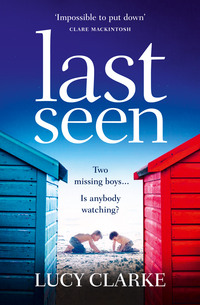
Cover design by Heike Schüssler © HarperCollinsPublishers Ltd 2017
Cover photographs © Mary Schannen/Trevillion Images (children, beach); Hayden
Verry/Arcangel Images (beach huts); Naomi Roe/EyeEm/Getty Images (sky).
Lucy Clarke asserts the moral right to be identified as the author of this work.
A catalogue copy of this book is available from the British Library.
This novel is entirely a work of fiction. The names, characters and incidents portrayed in it are the work of the author’s imagination. Any resemblance to actual persons, living or dead, events or localities is entirely coincidental.
All rights reserved under International and Pan-American Copyright Conventions. By payment of the required fees, you have been granted the non-exclusive, non-transferable right to access and read the text of this e-book on screen. No part of this text may be reproduced, transmitted, down-loaded, decompiled, reverse engineered, or stored in or introduced into any information storage and retrieval system, in any form or by any means, whether electronic or mechanical, now known or hereinafter invented, without the express written permission of HarperCollins.
Source ISBN: 9780007563388
Ebook Edition © June 2017 ISBN: 9780007563395
Version: 2020-11-10
Dedication
To Darcy Wren, the newest addition to the family.
Contents
Cover
Title Page
Copyright
Dedication
Prologue
1. Sarah
2. Isla
3. Sarah
4. Isla
5. Sarah
6. Isla
7. Sarah
8. Sarah
9. Isla
10. Sarah
11. Isla
12. Sarah
13. Isla
14. Sarah
15. Sarah
16. Isla
17. Sarah
18. Isla
19. Sarah
20. Isla
21. Sarah
22. Isla
23. Sarah
24. Isla
25. Sarah
26. Sarah
27. Isla
28. Sarah
29. Sarah
30. Isla
31. Sarah
32. Isla
33. Sarah
34. Sarah
35. Sarah
36. Isla
37. Isla
38. Sarah
39. Isla
40. Sarah
41. Sarah
42. Isla
43. Sarah
44. Isla
45. Sarah
46. Isla
47. Sarah
48. Isla
49. Sarah
50. Isla
51. Sarah
52. Isla
53. Sarah
54. Sarah
Epilogue
Read on to enjoy an exclusive extract of The Castaways
Acknowledgements
Author’s Note
A Q&A with Lucy Clarke
Keep Reading …
About the Author
Also by Lucy Clarke
About the Publisher
Prologue
Salt water burns the back of my throat as I surface, coughing. My legs kick frantically, trying to propel me nearer the boat. The hull is close, whale-sized, solid. I lash out, white fingertips clawing at the side, but there’s nothing to grip and I go under again, mouth open, briny water shooting up my nose.
Suddenly there’s an iron hand around my arm, pulling, dragging me upwards. My kneecap smashes against the side of the boat as I’m hauled on board, a pool of water spilling from me. I blink salt water and tears from my eyes, staring into a face half hidden by a beard. A dark gaze meets mine; the man speaks quickly, asking questions, draping a blanket over my shoulders.
I say nothing. My whole body shakes beneath the stiff fabric.
I look down at my feet. They are pressed together, white, bloodless, impossibly pale. Beyond them, stacked in the centre of the boat, is a tower of briny, dark cages, where lobsters writhe, tails and claws snapping and clacking.
‘What happened?’ the man asks over and over, his voice sounding distant as if it’s an echo in my head.
I don’t answer – won’t take my eyes off the lobsters. They are not red as you see them in pictures, but black and shining, huge claws flecked with white. Can they breathe out of the sea, I wonder? Aren’t they drowning, right now, here in front of me? I want to throw them back into the water, watch them swim down to the sea bed. Their antennae quiver and flit as we motor towards the shallows.
There’s a sudden roar of a boat engine close by. My head snaps up in time to see a blur of orange flashing past: the lifeboat. For the first time I notice the small crowd gathered on the shoreline. My fingers dig into the blanket as I realize: they are looking for us.
Both of us.
I am shaking so hard my teeth clatter in my head. I look down at my hands, then slide them beneath my thighs. I know everything is different now. Everything has changed.
1. SARAH
DAY ONE, 6.15 A.M.
In the distance I can hear the light wash of waves folding on to shore. I lie still, eyes closed, but I can sense the dawn light filtering into the beach hut, slipping beneath the blinds ready to pull me into the new day. But I’m not ready. An uneasy feeling slides through my stomach.
I reach out to find Nick’s side of the bed empty, the sheet cool. He’s in Bristol, I remember. He has his pitch this morning. He left last night with a slice of birthday cake pressed into his hand. At that point Jacob was still smiling about the presents he’d been given for his seventeenth birthday. Nick has no idea what happened later.
A low flutter of panic beats in my chest: Will Jacob tell him?
I push myself upright in bed, my thoughts snapping and firing now. I can still feel the vibrations of Jacob’s footsteps storming across the beach hut, then the gust of air as the door slammed behind him, his birthday cards gliding to the ground like falling birds. I’d picked them up, carefully replacing each of them, until I reached the last – a homemade card with a photo glued to the front. I’d gripped its edges, imagining the satisfying tear of paper beneath my fingertips. I had made myself return it to the shelf, rearranging the cards so it was placed at the back.
I listen for the sound of Jacob’s breathing, waiting to catch the light hum of a snore – but all I can hear are the waves at the door. I straighten, fully alert now. Did I hear him come in last night? It’s impossible to sneak into the beach hut quietly. The door has to be yanked open where the wooden frame has swollen with rain; the sofa bed has to be skirted around in the dark; the wooden ladder to the mezzanine, where Jacob sleeps, creaks as it is climbed; and then there’s the slide and shuffle of his knees when he crawls to the mattress in the eaves.
Pulling back the covers, I clamber from the bed. In the dim haze I scan the tidy square of the beach hut for clues of my son: there are no trainers kicked off by the door; no jumper tossed on the sofa; no empty glasses or plates left on the kitchen counter, nor dusting of crumbs. The hut is immaculate, neat, just as I left it.
I ignore the faint pulse of pain in my head as I cross the beach hut in three steps, climbing the base of the ladder. It’s dark in the mezzanine – I’d pulled the blind over the porthole window and made Jacob’s bed before going to sleep myself. Usually the distinctive fug of a teenage boy lingers up here, but this morning the heaped body of my son is absent, the duvet smooth.
I squeeze my eyes shut and swear under my breath. What did I expect?
I don’t know why I let it happen, not on his birthday. I shouldn’t have risen to his challenge. I went too far. We both did. Diffuse, not antagonise, Nick is fond of telling me. (Thank you, Nick. I’d never have thought of that myself.)
When Jacob was little, Nick would always ask my opinion on what Jacob needed, how best to dress a cut on his knee, or whether he could do with a nap, or what he might prefer to eat. But, in the last few years, my confidence in knowing what my son needs has slipped away. In his company, I often find myself at an utter loss as to what to say – asking too many questions, or not the right ones. On the odd occasion that Jacob does confide in me, I feel like a desert-walker who has come across a freshwater lake, thirsting for closeness.
Last night, as Jacob swung round to face me, I couldn’t think what to say, what to do. Maybe it was because seventeen is like a line in the sand; he’d just stepped over it into adulthood – but I wasn’t ready. Maybe that’s why I said the things I did, trying to pull him back to me.
I descend the ladder now, feeling the full weight of my headache kicking in. I’m sure Jacob will have stayed out with his friends – he’ll probably roll in at mid-morning, a hangover worsening his mood. Yet still, I feel the tentacles of panic reaching, feeling their way through my chest.
Coffee. That’s what I need. I pump water into the kettle, then light the hob, listening to the rush of gas. As I wait for the water to boil, I have a strange, uncomfortable sensation that this is going to be my life one day: just me, alone, making coffee for one. It makes sweat prickle underarm, dread loosening my insides.
I reach out and snap on the battery-powered radio. A song blares into the hut – Jacob and I are always having radio wars, he switching it from Radio 4 to a station he likes, knowing I’ve still not learnt how to use the Memory button, so I must manually retune it to find my station again. But this morning, I like the noise and the thrash of guitars. I’ll leave it on. That way, when he comes back it’ll be playing.
Once I’ve made myself a coffee, I use the rest of the hot water to wash my face. There’s a toilet block nearby, but the sinks are usually mapped with sand or the white trails of spat-toothpaste. Diane and Neil next door have installed a water tank beneath their hut, and rigged up a heater from their solar panels so they can have hot running water at the flick of the tap. Isla thinks it’s an extravagance – another sign of the beach huts becoming too gentrified – but I’d laughed and said I’d be adding that to Nick’s To Do list.
I pat my face dry, then move to the windows, pulling up the blinds. Sea, sky and morning light spill into the hut and my breathing immediately softens. The early sun lies low to the horizon, the glassy sea tamed beneath it.
Stepping out on to the deck, the air is fresh and salted. I love this time of day before the breeze picks up and stirs white caps, when the light is soft against the water and the sand is empty of footprints. If Nick were here, he’d take his daily swim before leaving for the office, but right now he’ll be waking in a hotel room. I picture him shaving off the weekend’s stubble in a windowless en suite, then making an instant coffee with one of those silly miniature kettles. I don’t feel sorry that he’s there; he thrives on that kick of adrenalin that will be firing through him as he runs through the pitch for a final time, making sure he’s got just the right blend of humour, professionalism and hard facts. He’ll be brilliant, I know he will. His agency is pitching for the print advertising for a confectionery company that he’s been wooing for months. I’m keeping everything crossed for him. I know how much Nick needs it.
How much we need it.
Standing at the edge of the deck, I glance across to Isla’s hut. It stands shoulder to shoulder with ours – exactly five feet between them. In the summer that our boys turned seven, Jacob and Marley had fastened sheets above the shaded pathway running between the huts, calling it their Secret Sand Tunnel. Their games usually involved wanting to be in the water, or making dens in the wooded headland at the far end of the sandbank, so Isla and I were delighted to have them playing close by where we could hear the soft murmur of their chatter through the wooden walls of our huts, like mice in the eaves of a home.
In the clear morning light, I notice how tired Isla’s hut looks. The plywood shutters, which were hurriedly fixed across the windows last night, give the air of eviction, and the deck is empty of her faded floral sun-chair and barbecue. Several planks of decking are beginning to rot, mould lining the grooves. The yellow paintwork of the hut is peeling and flaking, and the sight saddens me, remembering how bright and vivid her hut was the first year she owned it – sherbet lemon yellow, she called the colour.
I feel my throat closing. Everything felt so fresh at the beginning. That first summer we met, I remember my father asking hopefully, ‘Is there a boy?’
I’d laughed. In a way, meeting Isla was like falling in love. We wanted to spend every free moment together. We would call each other after school, and have long, laughter-filled conversations that made my cheeks ache from smiling so hard, and my ear pink from being pressed close to the phone. My exercise books were filled with doodles of her name, and I’d find ways to bring her into conversation, just so she would feel present and real to me. Our friendship burst to life like a butterfly shedding its chrysalis: together we were bright and beautiful and soaring.
What happened to those two girls?
You didn’t want me here, Isla hissed last night before leaving to catch her flight.
I wondered if I’d feel guilty this morning. Regret the things I’d said to her.
I pull my shoulders back. I don’t.
I’m relieved she’s gone.
2. ISLA
It was so close to being perfect.
We were best friends.
We spent our summers living on a sandbank in beach huts next door to one another.
We fell pregnant in the same year – and gave birth to sons three weeks apart.
Our boys grew up together with the beach as their playground.
It seemed impossible, back then, to imagine that anything could come between us.
Yet perfect is a high spire to dance on – and below there’s nothing but a very long drop …
Summer 1991
A strong briny scent rose from the stacks of blackened lobster pots, where a flock of starlings hopped and chattered, iridescent feathers catching in the sunlight. At the harbour edge, the water gurgled and slopped. Sarah crouched down and dipped her forefinger into the water, then brought it to her lips and sucked it. She thought for a moment, then said, ‘Notes of engine oil, fish guts and swan shit.’
I grinned. I’d known Sarah for precisely one hour and forty-five minutes, but already we were friends. She had a good laugh – mischievous and surprisingly loud – yet there was something almost apologetic about the way she lifted a hand to her mouth as if to contain it.
Right now we were meant to be crammed into a sweltering studio taking part in a week-long drama workshop. I had my mum’s Reiki clients to blame for losing a whole week of the summer holidays; Sarah said she’d signed herself up as it was better than being at home. During the first break, we’d sat on the sun-warmed steps outside, drinking cans of Cherry Coke, and decided we wouldn’t be going back indoors.
Sarah placed her hands on the railings. Her bitten fingernails were painted pink, the polish faded at the edges. She looked across the water to the golden stretch of sand ahead of us. ‘Where’s that?’
‘Longstone Sandbank.’ It was flanked by a meandering natural harbour on one side, and on the other by the open sea. ‘You’ve never been?’
She shook her head. ‘We only moved here a month ago. Is it an island?’
‘Almost.’ The sandbank was no more than half a mile long, and was separated from the quay by a fast-moving channel of water. Dotted along its spine were a rabble of brightly coloured wooden beach huts. I always thought it looked as though the sandbank had tried its hardest to escape the mainland – and it had succeeded, except for the slimmest touch of land still tethering it to a wooded headland at its far end.
‘How do you get there?’
‘By boat,’ I said, nodding towards the ferry that was bobbing across the harbour, orange fenders strapped to its sides. The engine growled against the running tide as it motored towards the quayside. We watched as the round-faced captain leant out to loop a rope around a thick wooden post.
‘Wanna go there?’ I asked.
Sarah’s green eyes glittered as they met mine. ‘Yes.’
We climbed on to the wooden boat, handing the captain our fifty-pence pieces, and moved to the bench at the back. Kneeling up on the seat, we rested our chins on top of folded arms so we could watch the wake the ferry created as it pulled away.
I glanced across at Sarah. The sun illuminated her clear, smooth face, and the delicate curve of her small mouth. She grinned at me. ‘Who knew drama club would be so much fun?’
The ferry crossing only took a few minutes and we hopped from the boat and moved down the rickety jetty, our sandals clanking against the wooden planks. Reaching the beach, Sarah’s gaze flitted over the huts as she exclaimed, ‘They’re like little houses. Look! They have proper kitchens – and beds!’
‘You can sleep in them during the summer,’ I told her, pointing out a hut with a wooden ladder leading up to a mezzanine. ‘Imagine waking up here!’
A low, rhythmic boom hinted at the sea that lay on the other shore of the sandbank, so we left the harbour behind and squeezed between two huts, stepping over a set of oars and skirting a deflated dinghy. Immediately the breeze was stronger, blown onshore in salty gusts. Whitecaps ducked and dived, driving small waves to break on the shore. Rocky groynes punctuated the beach, creating a series of small bays.
We kicked off our shoes and walked with our arms linked, tramping through the thick, warm sand. Sarah was a head shorter than me, but she walked with long strides and our steps fell into an easy rhythm. There were pockets of activity everywhere: two young girls buckled into life jackets were dragging a kayak to the shore; an older woman standing in the shallows threw a stick for a muscular, bounding dog; a man in a panama hat struggled to put up a windbreak in the fine sand, using a pebble for a hammer. We passed a family eating brunch at a picnic table, their bare feet dug into the sand, a pile of napkins secured from the breeze by a large pebble. At the hut next door a group of teenage boys lounged bare-chested and tanned, two guitars leant against sun-chairs. I nudged Sarah in the ribs and she smiled into her chin.
Surprisingly, many of the huts were closed, their blinds drawn. I wondered where their owners were – what they could possibly be doing that was better than being here. They looked odd, those shuttered huts, secretive shadows in the brilliant midday sun.
After some time, a craggy headland ended the row of huts and the beach thinned as it wrapped around crumbling sandstone cliffs. We scrambled over a rocky groyne that separated one deserted bay from the next, and walked on the shoreline, avoiding the dark piles of seaweed flagging on the sand.
Sarah paused, turning to face me. ‘Shall we swim?’
I glanced around us; the bay was empty, the water a tantalizing blue. I grinned as I wriggled out of my T-shirt and cut-offs, leaving me in mismatched underwear.
Sarah shrugged off her dress, grabbed my hand, and together we ran towards the water.
My breath caught at the first grip of cold around my ankles. Sarah squealed as a rush of white water engulfed our middles. When a wave came, I dived through it, cold squeezing a scream from my lungs. Beneath the water I glided, the rest of the world closing out. My skin came alive with the bite of the sea, the sting of the salt.
When there was no more air left in my lungs, I broke through the surface, hair slick to my head. The sea fizzed and breathed around me.
Sarah was laughing with her head tipped back.
We let the sea toy with us – lifting us up, then sucking us back with each shelf of water.
‘Let’s catch this wave,’ I said, paddling for a small peak and trying to bodysurf into shore, but I wasn’t quick enough and it passed beneath me. I trod water waiting for the next and, when it came, we both kicked feverishly whilst striking out with our arms. We were rewarded as the wave propelled us forwards, Sarah whooping as we travelled. The wave broke early in a charge of foam and we were sent flailing, legs tangled about arms like rag dolls. I felt myself rolled along the sea bed, my underwear flimsy protection against the ride, and we both surfaced gasping and laughing. We waded out, staggering up the beach.
An older boy with thick dark hair, who I hadn’t noticed earlier, was fishing on the rocks at the edge of the bay. He watched us closely, his gaze both serious and curious. I glanced sideways at Sarah and found she was staring right back at him.
I shivered. We didn’t have towels, so we stood with our arms outstretched to salute the sun, like my mother did in her yoga practice.
Looking towards the beach huts, they seemed like tiny colourful homes whispering of sun-swept holidays. High on adrenalin and the bloom of a new friendship, I announced, ‘One day I’m going to buy a beach hut. I’ll fill it with books and candles and board games and music – and I won’t leave all summer.’
‘Except when you walk over to my beach hut,’ Sarah added. ‘Because I’m going to buy the one next door.’
It was a girl’s wish, that’s all. Beach huts next door, long summers spent on a sandbank.
But neither of us could know that our lightly cast dream would come true – or what it would cost us both.
3. SARAH
DAY ONE, MIDDAY
I wait until midday before I call Jacob; it gives him long enough to sleep off the worst of his hangover, and enough time to feel he’s proved a point by not returning to the beach hut. When I pick up my mobile, I see that I missed a call from Isla last night. There’s no message and I wonder vaguely if she was ringing to apologize.
I scroll to Jacob’s number, press call, and then hold the mobile to my ear, my fingers drumming the kitchen counter.
Oddly, there’s no ring tone – just a recorded voice informing me that they’re unable to connect me, and I should try again later.
Jacob would never switch off his phone. His mobile is like a fifth limb, which he uses with an instinctiveness that eludes me completely. He can point his phone to the sky and name star constellations, or take over the car stereo with a swipe of the screen. It’s unlikely he’s got no signal either, as everywhere on the sandbank is in range. I suppose it’s possible that he’s run out of battery, although we all charge our phones from an attachment that Nick rigged up from the solar panels.
I wonder what to do now. I don’t like the idea of stewing in the beach hut, waiting for him to return. I keep replaying our argument, pausing on the narrowness of Jacob’s dark gaze, and the way he’d yanked his rucksack from the floor, then slammed the beach hut door so hard that the panes of glass rattled in their frames. I’d gone to the window, pressing my fingertips against the cool glass. The beach was in darkness, except for the lantern of a night-fisherman setting up for the evening and the glow of Neil’s boat going out, and I’d watched Jacob slide away into the night, a stranger to me.
What happened to the little boy I used to hold in my arms as a baby, with his inquisitive brown gaze that fixed on mine, the button nose that wrinkled when I made him laugh? It had been so much easier then. There were fewer mistakes to make.
I pick up my mobile again, passing it from hand to hand. Part of me is desperate to call Nick and tell him what’s going on, but he’ll still be in the pitch and, anyway, if I tell him that Jacob’s stayed out overnight, he’ll want to know why.
No, I need to handle this myself.
I slip the phone into my pocket, then leave the hut.
Luke’s beach hut is on the harbour side of the sandbank, near the wooden jetty where the ferry docks. I’ve known his parents for years: they are a lovely couple, both GPs, who take on gruelling schedules. Luke is the youngest of four brothers and I think, by now, his parents’ rules have relaxed so greatly that Luke spends the majority of the summer in the beach hut on his own.
A shining cloud of starlings rises from a hut roof as I pass, wings beating a bewitching pattern in the sunlight.
As I near Luke’s hut I pull my sunglasses down and go to smooth my hair back – forgetting I’ve recently had it cut so it now rests just above my shoulders. The space where it has always hung down my back feels strangely exposed, naked. Nick assures me he likes the change, but I worry I look too severe, the blonde bob sharpening my features.
Luke is sitting on the deck in his board shorts, opposite a girl who wears a black bikini, her skin tanned and tight. I glance beyond them, inside the dim hut, and can make out a cluster of young people sprawled across the sofas. I have no intention of embarrassing Jacob with a lecture about why he didn’t come home last night – I simply want to see him, know he’s okay.
‘Luke!’ I smile, lifting a hand.
He sits up a little straighter, squinting. ‘All right?’
He’s turning into a handsome young man, with his thick sandy blond hair and an open smile. ‘Good party?’
‘Yeah,’ he says, getting slowly to his feet. He climbs down from the deck and stands on the beach, leaning a hand on a weathered picnic bench as he squints against the sun. I don’t flatter myself that he’s come to greet me – he just doesn’t want me to enter the hut. It’s a space for teenagers, not mothers.
Up a little closer, it’s clear he’s hung-over. He’s got that glazed look, and a slumped, low energy, as if everything is a little too bright, a touch too vivid. His hair sticks up at one side of his head, and his eyes are bloodshot. I can smell the alcohol fumes rising from his pores. ‘Jacob still here?’
‘Jacob?’ he repeats, surprised.
‘He didn’t stay here last night?’
‘No.’ Luke glances back inside the hut, my gaze following his. Through the gaggle of teenagers I spot empty cans of beer, bottles of spirits, cigarette butts. I notice a plastic drinks bottle with the nose cut off and tin foil wrapped around one end of it, and can guess what they’ve been using it for.
I keep my tone light. ‘He did come to the party?’
‘Yeah, course. It was for him.’
Jacob has always dismissed any suggestion of a birthday party, which is why I was thrilled this year when he said he was going to Luke’s hut for drinks. I offered to buy some beers for them, and a few packs of burgers in case they were hungry later, but he said, ‘It’s sorted.’ Which meant, Don’t interfere.
Despite myself, I ask, ‘What time did he leave?’
Luke rubs the heel of his hand across the side of his head. ‘I dunno. Maybe around eleven, I guess.’
Early – especially as it was a party for him.
‘He said he was gonna come back here.’
Then I realize. I smile lightly as I say, ‘I should probably be looking for him in Caz’s hut, shouldn’t I?’
One of the young men in the hut adds with a smirk, ‘Maybe they were making up!’
Luke narrows his eyes at the boy.
I want to ask more, but instead I say, ‘Cheers, Luke.’
Cheers? I never say cheers.
I leave the hut feeling like an idiot. Of course Jacob will be at Caz’s hut! Robert, her father, must be away.
As far as I can intuit, Jacob and Caz have been a couple since the start of summer. I’ve known Caz since she was a little girl. She’s always been pretty – petite and blonde with sharp green eyes – and I’ve watched her bloom into a confident, beautiful young woman, but there’s a knowingness in her eyes that doesn’t escape me. Earlier in the summer I’d come across the pair of them lying on a rug by the shore, listening to music. A song they both knew was playing loudly and Caz began to sing. I was surprised to see Jacob joining in at the chorus. Their singing grew louder and more raucous as they half shouted the lyrics, nodding their heads, laughing together, the sun on their faces. Caz had jumped to her feet, the rug becoming her stage as she danced and sang. Jacob pulled out his phone and snapped pictures, Caz posing with a hand on her hip, laughing, pouting. As I watched, a spike of doubt stabbed the scene: Do not hurt my son.
As I’m walking away from Luke’s hut, I catch one of the girls saying, ‘Caz was a total mess.’
I slow my pace enough to catch someone else adding, ‘He didn’t need to march her out. She was just having fun.’
I strain to hear the rest, but the conversation swims away from me. Did Jacob have to help Caz back to her hut? Was she so drunk that he didn’t want to leave her? I like the idea of my son being the responsible one.
Caz’s hut is at the furthest end of the sandbank, near the headland. The walk from one tip of the sandbank to the other should only take fifteen minutes, but in summer it feels like you can’t go more than ten paces without a hut owner calling out a greeting, or inviting you in for a drink. I have to pass our beach hut on the way, so I pop my head in briefly just to check Jacob hasn’t returned in the meantime. I’m not surprised to find it empty still.
As I’m moving on, I notice Diane, our next-door beach hut neighbour, standing on her deck. Despite the warmth of the day, a navy fleece is zipped to her chin. She stands with her hands planted on her hips, staring out into the bay where her husband, Neil, is boarding his boat.
‘Neil going fishing?’ I ask.
She looks at me for a long moment. ‘The boat’s been dinged. He’s checking the damage.’
‘Oh, what happened?’
‘No idea.’
Neil will be on the warpath, then. The boat is his pride and joy. He spends more time tinkering with it than fishing from it.
Although Diane and Neil have owned the hut next door for over ten years, I’ve always found it disappointing that we’ve never grown close. Nick and Neil sink the odd beer around the barbecue – but I just can’t imagine sitting out late on the deck sharing a bottle of wine with Diane. I honestly don’t know what we’d talk about.
I ask, ‘You haven’t seen Jacob this morning, have you?’
Diane looks at me through the corners of her eyes. ‘Jacob? Why? Is something wrong?’
‘He didn’t come home last night,’ I say with a loose wave of my fingers, as if it is no big deal.
There’s something odd about the way her gaze travels searchingly over my face. ‘No. I’ve not seen him.’
‘He’s probably at his girlfriend’s.’
Her gaze still doesn’t leave me. ‘I do hope so.’
It’s an odd remark – although perhaps not in the context of Diane. As I move on, I think that, if Diane were one of my other friends with teenagers, I’d already be turning this into an anecdote: Jacob stayed out all night on his birthday. He didn’t bother to text, didn’t answer his mobile the next morning – nothing! I was in a total panic. I found him eventually – with his girlfriend, of course! I can picture the other mums doing that reassuring little roll of their eyes, which means: teenagers.
I’m a good sharer among friends; I trade just the right balance of lamentable parenting tales, with the occasional golden highlight thrown in for good measure: Jacob cooked for us all yesterday. Spaghetti bolognese. Without being asked. I had to stop myself demanding to know what he’d done.
But I am careful not to share everything. For example, it’s only Nick and I who know that Jacob’s head of sixth form called us in halfway through the term to talk about Jacob’s poor attendance. My hands trembled as I left the office. ‘Truancy? Where’s he been going? Do you think something is wrong?’
Nick had slung his arm around my shoulder, just like he used to do when we were younger, and said with a grin, ‘I seem to remember you and Isla bunking off your drama classes.’
‘That was different. It wasn’t school.’
Nick only grinned more.
I also didn’t tell my friends how Jacob broke two toes in the spring. He didn’t injure them in a skateboarding accident, but because he’d kicked the skirting board in our hallway when I’d told him he was too young to go to Glastonbury with his friends.
Just before I reach Caz’s hut, I become aware of Isaac at the periphery of my vision. He’s crossing the beach, his gaze fixed on me. I keep my eyes lowered, pretending not to notice him.
‘Sarah!’ he calls.
I flinch at the sound of my name from his mouth – but I don’t turn.
I can hear his footsteps hurrying through the sand. Heat suffuses my skin as I march on.
‘Sarah! Wait!’ he calls when he is almost at my shoulder.
I have no choice but to turn. ‘Oh, Isaac! I was miles away.’ I keep pace as I say, ‘Sorry, I can’t stop. Meeting Jacob. Already late!’
It’s a lie, of course, but at least Isaac doesn’t say anything further. From the corner of my eye, I see him hesitate. He looks anxious, his hands fluttering at his sides. Then thankfully he nods his head and lets me go.
Caz and Robert’s hut, painted a fresh sky blue, is raised slightly above the neighbouring ones. I scan the harbour to see if I can spot Robert’s boat – a large grey RIB with an oversized engine (which, to me, screams Penis extension!). I can’t see it moored up today, which most likely means he isn’t on the sandbank.
I call out as I climb the wooden steps leading on to the deck, not wishing to surprise Caz and Jacob if they’re together. I find Caz curled into the sofa with her headphones on, eyes closed. Her clear skin is deeply tanned, and her hair, bleached to a white-blonde, looks wild and mussed. I glance beyond her, looking for traces that my son is here. I suppose he could have left by now, deciding to see one of his friends, or to take a walk up on the headland. I am turning to leave when Caz’s eyes suddenly flick open. She sits up, startled, yanking off her headphones. There’s a red mark across her cheek from where she’s been lying, and I notice a slight glassiness to her eyes.
‘Sorry, I just came to see if—’
‘I was just … going out.’
‘Out?’
‘To catch up with a friend.’ Caz puts a hand to her head and ruffles her hair around her face.
I hover in the doorway, giving no indication of leaving.
‘I’ve got a minute though.’
I move into the hut, lowering myself on to the sofa opposite her. I take in the cream tongue-and-groove panelling, the expensive striped navy blinds, the antique barometer fixed above the sink. Caz’s mother decorated the hut before she left Robert to live in Spain with the manager of the timeshare she owned. I’ve not been in the hut since she left and I’m reminded how serene the view of the harbour is on a still day; only sailing boats and sea birds dot the water, the fishing quay visible in the distance. I do enjoy crossing to the harbour side of the sandbank to watch the sun go down in the evenings, yet it’s the sea view that I love; it’s wilder, more exposed.
‘Want a drink?’ Caz offers half-heartedly.
‘Thank you, but no. I was just passing and wanted to catch Jacob. But obviously he’s not here.’
‘No.’
‘He stayed last night, didn’t he?’
She shakes her head. ‘No.’
The word is clear and firm. It drops like a pebble into my chest, causing a ripple of panic. Then, where did he stay?
I look closely at Caz, wondering whether she is telling me the truth. She is perched on the edge of the sofa, as if she’s about to spring up – disappear. Perhaps she thinks I’d be cross if she admitted that Jacob spent the night. She reaches a hand to her left ear lobe, toying with a silver earring she wears in the shape of a seahorse. I watch as she turns it lightly through her fingers, over and over, like a rosary bead, and then removes it. She does the same with the second earring, placing them both on top of a pile of Coast magazines that are stacked neatly on the rustic coffee table between us.
I have the strongest desire to reach out for the earrings, feel the warm weight of the silver in my palm. I keep my focus on Caz though, asking, ‘Do you know where he is?’
‘No. No, I don’t.’
‘But you saw him at the party last night?’
‘Yeah, for a bit.’
‘I heard you left together.’
Colour spreads up Caz’s neck. ‘Oh, yeah. That’s right. We walked back together.’
‘But Jacob didn’t stay here?’
‘No,’ she says tightly.
‘Where did he stay?’
She sighs, exasperated now. ‘Look, we walked back along the beach. Stopped by the rocks near his hut to talk for a bit. Then I came back here. That’s it.’
‘Was he planning to return to the party?’
‘Maybe. I don’t know.’
I think of the conversation I overheard in Luke’s hut – Caz was a ‘mess’ and Jacob practically had to ‘march her out’. ‘Did the two of you argue?’ I picture Caz standing close with one of the other boys at the party, looking up through her long lashes, while Jacob waited at the edge of the hut, watching.
It’s clear I’ve overstepped the mark by the way Caz lifts her chin and glares at me. ‘Jacob wasn’t in a brilliant mood last night.’ She pauses. ‘I’m sure you know.’
The comment, delivered so innocuously, holds a clear accusation. Heat builds in my cheeks as I wonder what exactly Jacob told her.
Caz’s barbed remark seems to have returned her composure, set her on some ledge above me that I didn’t know we were vying for. She uncrosses her bare legs and stands. There is an empty glass on the coffee table, and she collects it, carrying it towards the sink. ‘If I see Jacob, I’ll be sure to let him know you’re looking for him.’
I’m about to rise to my feet, but my gaze catches again on the silver seahorse earrings, lying right there in front of me.
As Caz fills her water glass, I stand, and as I do so I find my fingertips brushing the earrings. I tell myself I am only looking. I just want to see the detail of them. Touch them once. But, before I can stop myself, I feel my fingers closing tightly around them.
I feel the burst of energy filling my chest, the heat roaring through me.
Caz turns to look at me.
I meet her eye, smile. Then I leave her beach hut, heart thudding.
4. ISLA
My thoughts wander back through the events of this summer, turning each one through my mind, like a collection of pebbles I’m trying to arrange. I need to understand how I’m here. How any of this happened. Where everything went wrong between Sarah and me.
There was an evening jog in the mosquito-clouded air; a bottle of wine shared in the wrong beach hut; a stinging remark made on the deck of Sarah’s hut; a photo removed from a wall. Were those some of the events that led to this?
It wasn’t just this summer when things began to unravel – the first thread came loose years before. I meander further back through deep sands and beneath cloudy, salt-bitten skies, pausing on a boat returning to shore with only one boy on deck – not two.
There. That is the moment.
Maybe there’s a sense of inevitability, because how do you recover, pick up your friendship, after something like that?
Yet there was a time when Sarah was everything to me. When she was my family. Back then, I thought nothing could break us.
Summer 1997
My knees were pressed against the metal frame of my mother’s hospital bed, my hands squeezing hers. I was scared: scared by the smell of decay in the thick, still air; scared by the lightness of my mother’s fragile, bony fingers that had once danced with silver rings; scared by her tissue-thin eyelids that hadn’t opened in two days; scared by the watery rasp of her breath that dragged through her body like the tide drawing over rocks. I wanted to pull my hands away, clamp them over my ears. I wanted to run. I wanted to be anywhere but in the curtained space of a Macmillan ward watching my mother dying.
This could not be it. I wasn’t ready.
Our life together was walking at night through the woodland that backed on to our bungalow. It was reading books in front of the fire, me lying on the faded rug, my mother sitting in the oak rocking chair. It was picking elderflower heads and making thick sweet cordial that we stored in glass bottles in the pantry. It was strangers coming in and out of the house for Reiki appointments and reflexology. It was the smell of lavender and rosehip and orange blossom. It was the sound of laughter.
Cancer is a wicked thief. In four short months it had stolen almost everything my mother had: her energy, the songs she used to sing, the quickness in her steps. I’d watched her fade away until all that was left was her shadow. I knew the thief wouldn’t rest until it had that too, but I sat there, clinging on, not ready to let my mother go.
I squeezed her hand tightly, silently begging, I am nineteen years old. Don’t leave me, Mum. Please …
But she did.
She slipped away from me even while I was holding on.
A night-shift nurse with cropped black hair pulled the curtain back a little. Maybe that nurse had learnt to tell death from the expression on the living’s faces, or from the silencing of the hospital machines, or from that certain stillness that pervaded afterwards. She padded softly across the lino floor and gently placed her hand on my shoulder. ‘It’s all right, sweetie. You’re going to be all right.’
I didn’t move. Didn’t speak. Didn’t let go of my mother.
I screwed my eyes shut and gripped tighter, already beginning to feel her fingers cooling within mine.
On the afternoon of my mother’s funeral, I stood in the hallway, watching people trampling across our rugs, smearing our glasses with their fingerprints, leaving their scents of perfume and aftershave lingering in our home – wiping away the final traces of my mother.
I squeezed into the kitchen, skirting a group of my mother’s yoga friends, searching for Sarah. She’d slept at the bungalow with me every night since my mother died; we’d grab a stack of blankets from the lounge and sit on the mildew-ridden swing-chair in the garden, smoking and talking. I had no siblings to grieve with, and my father – a Scottish chef who’d met my mother during a retreat – had never been a fixture in my life. Sarah was everything, now. It was easy being together because she’d loved my mother, too. She’d tried on wigs with us, striking silly poses in front of the shop mirror; she’d artfully wrapped bright scarves around my mother’s neck to hide the tumours that had spread there; she’d smoothed blusher across her cheekbones before hospital appointments. My mother called her ‘Sarah Sunshine’.
I saw her across the room carrying a tray of drinks, smiling, thanking people for coming – doing the things I hadn’t the heart to. Seeing me, she tapped the pocket of her trousers where I could make out the rectangular shape of a cigarette packet, then signalled towards the garden with a grin. A smoke outside. That’s exactly what I needed. We’d pull down the hood of the swing-chair and light up with our heads bent together, shutting out the rest of the world.
As I started to make my way across the lounge, a heavyset man with tufts of white hair sprouting from the crown of his head lowered himself into my mother’s rocking chair. The oak spindles protested beneath his weight as he rocked it back and forth, the back of the chair clipping the wall with each motion. He lifted a hand to his mouth, inserting a forefinger to work something loose from his teeth, flashing his thick pink tongue at the room. He sucked his finger clean, then drummed it against the polished arm of the rocker, leaving a glistening smear of his saliva on the wood.
My throat burned with red-hot outrage as I bellowed, ‘No!’
The room fell instantly silent. Every head swivelled in my direction.
‘Get out of my mother’s chair!’
The white-haired man looked horrified. His brow dipped uncertainly, shock making his mouth hang slack. He pushed himself unsteadily to his feet, apologizing. His eyes darted around the room, as if looking for someone to help him.
A hand wrapped around my arm. Heart thudding, I turned to find Sarah looking at me, worry etched in her high, pale forehead. ‘Isla?’
An enormous pressure was building within my chest. ‘I … I just … need to go.’
‘Okay,’ she told me. ‘Okay.’
I spun round, crossed the living room and raced along the hallway, bursting out of the back door. A blast of cool air hit me, and I ran with my head down, my red pumps flashing along the damp pavement in quick bursts of colour, like a heartbeat.
Some time later, I found myself at the quay, my dress stuck to the small of my back, my breath coming hard. I gripped the metal railing, sucking in the salt-tinged air.
The beach huts sat quietly on the distant sandbank, a comforting presence with their pastel-light colours cutting through the grey, rolling sky. When the harbour ferry arrived, I didn’t pause to think about the guests abandoned in my home, or worry that Sarah would be left to lock up; I simply climbed aboard.
Within minutes, I was standing on the shoreline of the sandbank before a grey, restless sea. Tears ran down my face, dripping from my chin into the neckline of my dress. I had no coat, not even a cardigan, and I could feel the cold beginning to seep into my bones as I hugged my arms around myself, shivering into my sobs. When the first drops of rain began to fall, I stood firm thinking I could outlast them – that I would dance in the face of the cold, of the rain, my grief burning like heat inside me – but after a few minutes, the dark romance of the idea waned, and I hurried for cover beneath the pitched wooden roof of a beach hut.
Sheltering from the rain, I noticed a handwritten advert was tacked to the window, the blue ink faded: Beach hut for sale.
I stepped back, considering the hut. It had once been painted a brilliant blue, but the paint had peeled and flaked over the years. In places the wood had rotted, and the deck I was standing on had moulded in the corners, long fingers of dune grass reaching up beneath the planks.
There was a small gap at the base of the blinds, and I pressed my face against the damp glass, peering in. Through the dimness, I could see the deckchairs, a barbecue and a windbreak cluttering the small space. A sun-bleached sofa bed was piled with a rabble of patterned cushions. Above it was a driftwood shelf that had been emptied of the previous owner’s belongings, hardened candlewax pooled in two spots. At the back of the hut there was a small kitchen area with an ancient gas oven and a two-ringed hob. An old wooden spice rack was tacked to the wall, and an array of mugs hung from hooks below it. The mismatch of colours and patterns reminded me of my mother’s bungalow – and I wanted it.
I wanted that beach hut more than I’d ever wanted anything.
I could picture it: the hut would be a place to retreat to; somewhere I could rebuild myself; a place where I could watch the weather moving across the horizon and begin to make fresh memories.
As I stood on the deck of that old hut with the roar of the sea at my ear and the fresh breath of salt air on my skin, the sandbank seemed to stretch around me, holding me tightly, anchoring me.
Back then, I had been certain that buying the beach hut was the right decision. I used the money from the sale of my mother’s bungalow, though everyone had told me I was mad. Keep the inheritance in brick-built property – not a beach hut! But I was nineteen. I didn’t want mortgage repayments, council tax bills, or responsibility. I wanted the sea. I wanted space. I wanted to do something for myself.
Summers I’d live in the beach hut. Winters I’d rent one of the cheap holiday lets that always stood empty in the winter months.
It was a plan. It was the best I could do.
‘Go for it!’ Sarah had said to me as we ate Chinese takeaway sitting on the floor of my mother’s bungalow, surrounded by boxes marked for charity shops. ‘That’s what your mother would have told you to do, isn’t it?’
I nodded because she was right.
I remember how Sarah had put down her plate and slung her arm around my shoulder, pulling me in close. ‘The beach hut will be a fresh start, Isla. It’s going to change everything.’
Sarah was right about that, too.
5. SARAH
DAY ONE, 6 P.M.
I pour a large glass of wine and drink it watching the clock on the hut wall. Alone in the beach hut, the ticks seem to sharpen the silence. Still no Jacob. The panic is growing louder and louder, like an insistent guest who won’t be silenced.
My phone beeps with a message. I snatch it from the kitchen side, stabbing at the screen – but it’s just a text from a friend about her upcoming fortieth. I don’t bother reading the full message. Instead I check the call log on my mobile and see I’ve rung Jacob a dozen times today – and each time I’ve been greeted by the same recorded message telling me I can’t be connected.
I gulp back my wine, then pour a second glass, reminding myself to drink it more slowly.
All day I’ve been hoping that Jacob will roll in at any moment – but it’s six o’clock now. I try to breathe slowly, but a rising tide of fear is building in my chest as I look at the facts: I haven’t seen or heard from Jacob in almost twenty-four hours. He didn’t stay at Luke’s hut after the party, and he didn’t stay with Caz, either. There’s no possibility that he could have gone back to our family home since it’s rented out for the summer. So where the hell is he?
A movement on the shoreline captures my attention. I narrow my gaze, focusing on the figure. I recognize the long, loping strides, the slight roundness of the shoulders: Isaac. He must sense my gaze on him because his stride abruptly falters and he turns to face this direction. He’s too far away to make out his expression, but I know he is watching me. Watching this hut.
I swallow, turning away.
I give myself a moment, then I pick up my mobile and call Nick.
He answers to a rush of noise and I guess he’s in the car with the windows down.
‘You driving?’
‘Yes. Only just left Bristol.’
I hear the electric whine of the windows being closed. ‘It went on that long?’
‘Yeah,’ he says, and I can’t tell whether his tone suggests it was a good pitch or not.
I picture him in his shirt and tie, his jacket thrown across the back seat. He’ll have undone his top button and pushed up his sleeves. He’ll park near the quay, then catch the ferry to the sandbank. He loves the unusual commute, tells me it’s his wind-down time in the evenings – allows him to shake off the day. When I see him striding across the beach in his shirt and tie – everyone else in flip-flops and cotton shorts – I feel a swell of pride that he’s mine.
For three months of the summer, we rent out our house and move into the beach hut. We used to go back and forth between the house and hut, but for the past couple of summers we’ve stayed solely on the sandbank. It’s a huge amount of work having to clear out the wardrobes and cupboards of our home, and lock away our possessions in the garage. Jacob thinks we do it so we can spend more time at the beach, but the truth is, we need the money.
I know Nick will be expecting me to ask how his pitch went, but I need to tell him about Jacob first. ‘Listen, it’s probably nothing, but I haven’t seen Jacob since last night.’ My words sound more clipped than I’d intended.
Nick is always telling me to give Jacob a bit more space. He never uses the word ‘smothering’, although I sense it is there on the tip of his tongue. ‘Last night?’ His reply is sharp with surprise. ‘Well, where is he?’
‘He went to Luke’s hut for drinks – but didn’t stay over. And I checked with Caz, and she says he didn’t stay with her either. I’ve no idea where he is.’
‘Not like him.’
‘I know.’
I don’t mention the fight between Jacob and myself, yet. Instead I say, ‘I think he and Caz may have been arguing.’
‘Ah,’ Nick says, as if this explains everything. ‘He’ll be letting off steam. Licking his wounds. He’ll be back when he’s hungry.’
I want, so much, to believe that’s true. Yet I think about Jacob’s mouth twisting with anger as he faced me, and the way the hut shook as he slammed the door on his way out.
From my pocket, I pull out Caz’s seahorse earrings. Up close they look a little tacky; the curves are blackening, and one of the butterfly clasps is gold and must have been mixed with another piece of jewellery. I wonder whether Caz will even look for them.
If I had my ears pierced, I would try them on. As I hold them up to the light, I picture Jacob walking in – seeing me with them. I can’t begin to imagine how I’d explain it. The buzz that hummed through me is already quietening. In its place, I feel the steady rise of shame. I cross the hut and stuff the earrings into a cotton bag at the back of one of our drawers, trying not to think about the other items in there.
I move to the food cupboard and take out three baking potatoes, choosing the smaller one for myself. I scrub them, pierce the skins, then dust them with salt, before placing them in the small gas oven. I’ve made chilli for dinner, as I know it’s a favourite with Nick and Jacob, and I can only hope that the three of us will be sitting together to eat.
I pick up my wine glass and move to the doorway. It’s a warm evening with little wind. All along the sandbank, children have been put to bed and parents take chairs and drinks on to the beach, sitting together in groups as the yawning shadows of huts stretch down to the water. Our dear friends, Joe and Binks, who have owned the tired green hut on the other side of Isla’s for over thirty years, huddle around a barbecue, the food long cooked, driftwood keeping the fire stoked for warmth. They look subdued this evening, perhaps missing their much-adored grandchildren who returned home yesterday after spending the week with them. Lorrain, who is new to the sandbank, sits between Joe and Binks, leaning close to the flames to light the cigarette pressed between her lips. She calls them her ‘summer treats’, buying just one pack and making them last the season.
The sight of the red ember glowing in the dusk makes me yearn for a cigarette, too. I haven’t smoked properly in years – not since I fell pregnant with Jacob. Occasionally I share the odd cigarette with Isla, pressing it to my lips like a delicious secret. If Nick’s with us, he’ll make a show of protesting, but in truth, I think he likes the nod to our youth. That’s one of the special things about old friends – you never quite let go of the memory of who you used to be.
What was I like at Jacob’s age? It’s so easy to forget who I was at seventeen as the years keep stacking, one on top of the other; the girl who wore silver platforms and drew flicks of liquid eyeliner at the edges of her eyes getting compressed beneath the weight of the past. I know that at Jacob’s age I wasn’t close to my mother, that’s for certain. It was Isla who I spent every free moment with.
A memory swims back to me … an evening when we were seventeen and cycled into town with fake IDs stuffed into our handbags. We’d fluttered our way into a club and danced for hours in a bar built into a disused church. Discs span. Our bodies curved to a beat that thundered from two speakers, our dresses stuck to the small of our backs.
Isla had slipped her hand into the tiny single pocket on the front of her dress, then uncurled her fingers in front of me, eyes glinting. I peered at her palm, then looked up at her smiling.
We put gold tablets on the end of our tongues and swallowed.
The rhythm sped up. My pulse flickered in my throat.
A boy danced with his knee through mine – and I tipped back my head and laughed. Isla jumped into the air with the music, long hair catching in a flash of light. A strobe played over us, distilling our movements into a hundred frames.
Later, much later, we tumbled out on to the street, hearts thumping, minds buzzing. We squeezed through the doorway of a kebab shop together, watching meat spin in a blizzard of overhead lights. We ate on the pavement, glittering heels kicked off, grease and mayonnaise dampening our lips. We stuffed wrappers in a bin and walked with our arms linked, hips knocking, to where our bikes were chained together.
Heels were thrown in baskets and we carved through the night on our bikes, the wind behind us, tanned legs pedalling fast circles. I raced to the top of a hill, standing up on the pedals, feeling my dress billowing around the tops of my thighs. At the brow, breathing hard, Isla and I were shoulder to shoulder.
I turned.
She looked at me. Grinned.
Before us the dark road unfurled. We leant forward, gave a dozen hard pedals, and then the momentum caught us. We felt the pull of the wheels as they began to roll. We went hurtling down, wind whipping our hair back from our faces. No bike lights, no helmets, bare skin inches away from the rough scrape of tarmac. Isla lay across the handlebars, legs outstretched behind her, screaming a single high note. I kicked out my legs so they sailed like wings away from the pedals.
The stars rained down as we glided.
Together we felt free. Invincible. Brave.
I was young once, I want to tell Jacob. I haven’t always been this person you see now.
I love you. I’m sorry. It was the wrong decision. Those are some of the other things I need to say.
Forgive me.
‘No Jacob yet?’ Nick asks the moment he walks in.
I shake my head.
Nick moves towards me and I know he’ll press a quick kiss on my cheek. I can’t remember when we stopped kissing each other on the mouth – but I realize that I miss it. As he bends towards me, I turn my face into him so his kiss lands on my lips. We bump chins, like uncertain teenagers, and Nick raises his eyebrows slightly.
I catch the smell of his fading aftershave, and a hint of air freshener from his car. He is forty-three in autumn and I think he looks good on it; he still has a thick head of lightbrown hair, and the lines on his face trace a pattern of smiles rather than frowns. He goes to the fridge and pulls out a beer, then sinks down on to the sofa.
I pour another glass of wine for myself, but remain standing. ‘How did the pitch go?’ I ask, although all I really want to talk about is Jacob.
‘Okay. I think. God, I don’t know. It’s so hard to say. We were there all day. But they’re seeing three more agencies. It’ll come down to figures in the end, I suppose.’
‘Three more?’ Nick had thought it was just his agency, and a London firm.
He shrugs, surprisingly relaxed about it. Since he heard about the pitch, he’s been working flat out. He’s grinding his teeth again in his sleep. I haven’t mentioned it; I know he sees it as a weakness – a sign that he can’t handle the stress.
‘When will you hear?’
‘Friday.’
I take another sip of wine, then direct the conversation to Jacob. ‘I’m surprised there’s still been no word from our boy.’
‘What did Luke say?’
‘Just that Jacob was at the party until about eleven, and then he and Caz walked along the beach – had an argument, I’m gauging – and then she left him and went to her hut alone.’ I tell Nick about the remarks I overheard at Luke’s hut about Caz’s drinking.
‘Sounds like the two of them had a bust-up. He was happy enough earlier on in the day, wasn’t he?’
I hesitate, thinking of our argument.
Nick knows me too well. ‘Did the two of you have a fight?’
‘It was ridiculous, really. Something and nothing.’
‘What started it this time?’
I make a show of trying to remember what we argued about, although I know exactly how it began. I remember the way Jacob turned to face me, the accusation in his eyes as Isla’s name came hissing out of my mouth. But I don’t tell Nick that. I say, ‘I asked Jacob whether he had enjoyed the barbecue – I was fishing for a thank you, I suppose. But he missed the hint entirely, just got out his phone and ignored me. I don’t mind doing all the work – I really don’t – but I’d just like him to notice sometimes. I nagged him about not being glued to the screen all day. He flared up. I fired back. That was it. I should have left it – it was his birthday.’
‘Doesn’t give him the right to be rude to you.’
I shrug lightly.
‘And then what, he left?’
‘Stormed out.’
Nick’s brows draw together, annoyed. He doesn’t ask a lot from Jacob – but good manners are high on his list.
‘I’m worried,’ I tell Nick, truthfully. ‘It’s been almost twenty-four hours since we’ve seen him. We don’t even know where he stayed last night. He wasn’t with Luke, or Caz, so where was he?’
‘He could’ve crashed in another friend’s hut – or even slept on the beach. It’s warm enough.’
‘Yes, but surely he’d have come back today? And he’s not answering his phone – it keeps on telling me that I can’t be connected.’
‘He’s switched it off, then.’
Why? Why would Jacob keep his phone switched off all day? Even if he was angry enough to not want to speak to me, surely he wouldn’t want to be cut off from everyone else? He could have just ignored my calls – but left his phone on.
Nick asks, ‘Do you think it’s serious between him and Caz?’
‘I think Jacob is serious. He’s in love with her, I can see it. He’s just been so … changeable. One moment he’s on top of the world – practically skipping around the hut. He was even singing yesterday morning. Jacob. Singing.’ I shake my head. ‘Then the next minute, he’s a moody bugger. Probably because they’ve had a fight or he’s seen her talking to another boy.’
‘And you don’t think she feels the same?’
I sigh. ‘To be honest, I’ve no idea. She just seems more … together than he does.’
‘So maybe they had a fight, like you suggested, and he’s just taking some time to cool down. Let’s give him another hour or two. You know what us Symonds men are like: when we get upset we like to just disappear, take ourselves off into the woods. Maybe this is Jacob’s way of letting off steam. He’s dealing with a lot of emotions, right now. He’s in love. His first love. That’s life-changing.’
Before Nick realizes what he’s said, the words are out there.
Colour spreads across his cheeks. He meets my gaze and I can see the apology in the widening of his pupils.
I wasn’t Nick’s first love.
Isla was.
6. ISLA
Nick was mine before he was Sarah’s. It’s one of those oddly uncomfortable, yet incontrovertible pieces of history that Sarah, Nick and I pretend to ignore. We flit around the subject, never quite brushing the edges of it, like moths scared of getting too close to a flame.
I met Nick the summer I bought my beach hut. His parents, David and Stella, owned the newly built hut next door, which had modern windows and a brand-new cooker that was fancier than the one in my mother’s old bungalow. They talked to me mostly of their three sons. Two were doctors, both on secondment in America, and their youngest son, Nick, was completing an MA in Business Studies – and was due to return to the sandbank for summer.
I was expecting someone pale-skinned and bookish from a spring spent studying, but when Nick arrived, he was tanned and athletic-looking. I liked his easy manner, and the smile that lit up his whole face when he shook my hand for the first time.
We were friends for two days – lovers by the third.
Summer 1998
‘Sherbet lemon yellow,’ I said to Nick as I balanced on the stepladder, dipping the paintbrush into the tin, the sun-warmed rungs of the ladder hard against my bare feet.
Nick, a glue-gun in hand, glanced up.
‘That’s how my mum would’ve described this colour. She painted my bedroom door in the same shade.’ I worked the brush across the hut in smooth strokes. I liked the steady rhythm of painting, the soothing repetition, the heat on my back.
‘You had a yellow bedroom door?’
‘All our doors were different colours. Mum’s room was new-leaf green,’ I said, thinking of the smear of my child-sized fingerprints from where I’d pushed the door open before the paint had dried. ‘The bathroom door was iceberg blue, and the kitchen was plum-pie purple. The estate agent who valued the bungalow said, “You might want to think about more neutral tones before putting it on the market.”’
Nick laughed. I could see he was going to ask something further about my mother, but I pointed to the radio and said, ‘Oh, I love this song! Turn it up.’
Sometimes I liked to talk to Nick about her, but more often than not I kept her for myself. It felt like an impossible task to try and pin her into words. He wouldn’t have been able to picture the violet flecks of her irises, or the way she sometimes slipped a pencil through the loose twisted knot of her hair. He didn’t know that when she played the flute, her eyes fluttered closed and her head would dance with the notes. He would struggle to understand that, in our house, we didn’t have a dining table – we brought mugs of tea and biscuits into bed in the mornings; we took jam sandwiches in our pockets when we were walking; we’d make thick soups over a fire in the garden. He wouldn’t know that sometimes my mother disappeared inside herself for long periods of time, and I would bring her food and books, and she’d run her fingers through my hair and call me, ‘My darling, Isla-la.’ She was a mother of colour and inconsistencies – and I wasn’t ready to share her.
In Nick’s family there were older brothers, a host of cousins, and two sets of grandparents; there were family meals and trophies on shelves; there was laughter and ribbing and family jokes. I loved being a part of it. His father treated me as though I was an exotic, intriguing patient he was still trying to diagnose. His mother looked at me through the corners of her eyes and spoke carefully. ‘She adores you,’ Nick would assure me with his easy smile, believing it. ‘How couldn’t she?’
I looked across at Nick, his top lip beaded with sweat as he concentrated on filling the cracks in the wood. I loved the confidence he had in the world – and his place in it. He belonged in a way I never would. If my mother had met him, she’d have held his face in her hands and said, ‘Well, aren’t you something special?’
He glanced up. ‘What?’
I smiled. ‘I wish Mum could have met you.’
He moved towards the stepladder where I still balanced, placing his lips against my bare ankle.
That evening, Sarah arrived at the hut with a sleeping bag stuffed underarm. ‘Can I stay?’
‘Course.’ I pushed myself up from Nick’s lap and crossed the hut, wrapping my arms around her. ‘Maggie’s birthday, isn’t it?’
She nodded. Maggie was her older sister, who was killed in a road accident the year before I met Sarah.
I took Sarah’s hand and pulled her across the deck, into the hut. ‘Watch the paint. It’s wet.’
‘Sherbet lemon yellow,’ she said with a smile. ‘I love it.’
Nick gave Sarah a warm hug, then told us he was going to The Rope and Anchor on the quay. I loved him in that moment for his tact, his sense of knowing when Sarah and I needed to be alone.
That night the air was warm and windless, and we built a fire near the shoreline and sat around it drinking cheap French beers and smoking.
As I shuffled closer to the flames, holding my palms up to the heat, Sarah said, ‘I threw the ball.’
There was no introduction, no explanation. In the darkness I couldn’t see her expression, but I knew exactly what she was talking about. Maggie was chasing after a ball when she was hit by the car that killed her. Sarah had told me before how she remembered Maggie lying on the roadside, an arm behind her back, her school skirt twisted around her waist. ‘Her knickers were on show – pink cotton ones with a mouse on the front that were too babyish for her. I thought, How embarrassing! Everyone can see your knickers! Honestly, that was my very first thought.’
Sarah poked at the fire with a stick, sending orange sparks crackling into the night. ‘I threw it,’ she said again. ‘It was this bouncing ball, as big as my fist, and when it bounced, silver glitter swirled like falling snow. I loved it – it was my favourite thing.’ She shook her head lightly. ‘I didn’t even mean to throw it. I was just holding it one moment … and the next I must have let it go without thinking. The ball started bouncing away from me, glittering in the sunlight. Maggie chased after it for me. She didn’t trip, didn’t stumble. She literally stepped right off the pavement without looking, her hand reaching out for my ball. I saw the car coming. It was bright red with a flat shiny bonnet and those pop-up lights. Do you remember? Some of the older sports cars had them. They were so square and sharp. I screamed at her to look out, but …’
I laced my fingers through Sarah’s, squeezing tight.
‘I threw the ball,’ she whispered, leaning against my shoulder. Her hair smelt of wood-smoke and dewberry shampoo. ‘I wish more than anything I hadn’t. She’d be twenty-one today.’
‘It wasn’t your fault,’ I whispered back. ‘It was an accident.’
A trail of tears glistened on Sarah’s cheeks. ‘You know what my mum said on the morning of the funeral? We were sitting at the kitchen table waiting for the hearse, listening to my father pacing on the landing above. He must have paused outside my sister’s room as we both heard the creak of the door handle being turned, then a gulp as if a sob was being swallowed. Mum pressed the heels of her hands into her eye sockets. She shook her head, hands twisting into her face. I could smell her lipstick, and the heat of tea on her breath as she said, “You should never, ever, throw a ball near a road! Remember that, Sarah! Remember!” She couldn’t even look at me.’
That night, as on many others, Sarah and I fell asleep on the beach, the stars watching over us. We crawled into my hut at dawn, dewy and shivering, and fell asleep on the sofa bed, a pile of blankets pulled over us.
Nick found us the next morning, curled together like a clasped shell around our secret pearls of grief.
Seven months later, I found myself at Heathrow Airport. I was standing at the departures gate, with Sarah facing me, arms folded. ‘You know Nick’s heartbroken?’
I tipped my head back, closed my eyes. ‘Don’t.’ I felt the weight of my backpack on my shoulders and against my pelvis. It was comforting, like a solid hug. I liked knowing that, for the next year, everything I needed was right here on my back.
‘He would’ve gone with you.’
I straightened. ‘I couldn’t let him give up his job. He loves it.’ He’d just started working as a marketing executive for a large agency that was young and forward-thinking and worked with some great clients. Nick practically bounced out of bed in the mornings, excited to get to the office.
‘It wasn’t only that, was it?’ Sarah said, her gaze still pinned on me.
‘I need to do this alone.’ I reached out and took her fingers in mine. ‘I’m sorry,’ I said softly, understanding that Sarah was hurt that I was leaving her, too. It was difficult to explain why I had to go on my own. For the last few months, the idea of travelling had become intoxicating. Every time I pictured it, there was no one else in the frame. It was me I saw riding a bus, my head leant against the sun-warmed window. It was me who would be getting lost in the dusty heat of a city. It was me who would be swimming in a lagoon on my own.
I needed time for myself. If Nick came with me, he’d keep me safe, plan routes, book accommodation, look after me – when I didn’t want any of that. I wanted to put myself in the hands of the universe and see what happened.
‘I’ll wait for you,’ he’d told me last night as I’d locked up the beach hut.
‘You mustn’t. Please,’ I’d begged him, burying my face in his neck.
When we’d stepped apart, he’d placed a final kiss on my forehead, almost reverently. He’d cleared his throat and told me, ‘Even though we’re not together now, Isla, if you have any problems – anything at all – you call me, okay? Whatever it is, wherever you are, whatever time of day or night – please don’t be too proud to call. If you need anything, I’m here. Okay?’
I’d felt tears prick at the base of my eyelids. I’d wrapped my arms around him one last time and wondered why the hell I was letting him go.
A flight delay was announced over the airport Tannoy, and I listened to check it wasn’t mine. Then I reached into the side pocket of my backpack, and slipped out a silver key that was attached to a small stone by a browning piece of string. ‘Here,’ I said, handing it to Sarah. ‘This is for you.’
‘Your beach hut key?’
‘I want you to look after it while I’m gone. Use it. Stay there.’
‘Really?’
I couldn’t bear the thought of the hut standing empty. I wanted it to be used, enjoyed, loved. I looked Sarah squarely in the eye and asked, ‘Take care of Nick for me, too?’ I paused. ‘I want him to be happy.’
Sarah stared at me for a long moment, her gaze moving searchingly across my face. ‘Okay.’
I sometimes think about that request and wonder exactly what I meant by it.
What Sarah thought I meant by it.
It’s easy to start pondering the possibilities of how life could have turned out differently. What if I’d kept my beach hut key safely tucked in my pocket? What if I’d asked Nick to wait for me? What if I’d never left at all?
They are questions without answers. Beginnings without ends. I don’t waste time in that place, not any more. I once thought it was answers I was looking for – but now that I’ve found them, I realize they’re not enough.
I want something far more.
7. SARAH
DAY ONE, 8.15 P.M.
Nick and I eat dinner in silence. Each mouthful of chilli feels like an effort, but I force myself to chew, washing down the food with sips of wine. When we’re finished, I clear our plates, grateful for the activity. Jacob’s meal is still left on the side, the jacket potato already slumping, the chilli congealing with a dark red film of oil. I stretch clingfilm over the plate and, even though the gas fridge in the beach hut is tiny and already crammed with food, I spend a minute or two crouched down rearranging everything so that I can make room for Jacob’s meal. I need everything to be normal.
Yet nothing is normal. Jacob has never disappeared like this. There’ve been arguments in the past where he’s taken himself off for a whole day. Once he didn’t come home at all – but he’d at least messaged Nick to say he was staying at a friend’s. I let myself hope he’s done something similar this time.
I turn to find Nick looking at the clock, his expression serious.
‘What are you thinking?’
‘We should probably let the police know.’
The knot in my stomach pulls tight. Police. Nick – who is always the calm to my storms – is taking this very seriously. He’s right, though: the police do need to be informed. I don’t know why I’m hesitating. I think it’s because it suddenly switches Jacob’s disappearance from being a protest by an angry teenager to being potentially worse. Far worse.
‘It’s quarter past eight,’ Nick says. ‘Let’s give it until nine o’clock.’
Waiting forty-five minutes will make no difference, but we make these small rules and deadlines to give ourselves control in a situation where we have none. ‘Okay,’ I tell Nick. ‘Nine o’clock.’
Nick tells me he’s going to get some fresh air. I’m about to say I’ll join him, when I catch the tightness of his expression and realize this isn’t an invitation. He wants to be alone.
As the door closes behind him, I have a sudden sensation of being trapped here, sealed within the four walls of the hut. Night seems to push right up to the windows. On the sandbank there are no streetlamps or car headlights to diffuse the thick blackness and, on a moonless night like this, the dark is so heavy that it feels like I can’t breathe.
Out on the water I catch the flicker of a light, the faint shadow of a boat sliding past. I find myself wondering if it’s Isaac’s boat – whether he’s out there, looking back at me. I shake my head, pull the blinds down, then set about lighting extra candles, placing them on shelves, the kitchen counter and the windowsills. I can’t bear to sit down, be static, so I decide to check through Jacob’s belongings. I know he took his rucksack with him to Luke’s – I remember him slinging it over his shoulder before he stormed out – and I wonder whether he’d packed anything that would indicate he was planning to stay away.
I kneel down and pull out Jacob’s drawer. A musty, boyish smell immediately hits me. His iPad is still here, and beside it are a heap of crumpled clothes: unwashed T-shirts mixed in with clean ones, balled-up socks, a pair of jeans with the belt wagging from the loops. Tangled among them is a damp beach towel that sprinkles sand across my lap as I shake it. Out of habit I begin folding things. I set the neatened pile of clothes aside, then pull out an old shoebox that is stuffed with odds and ends: a fin for his paddleboard, a piece of downhaul rope for his windsurfer, a pair of ancient goggles that washed up on the shore a couple of summers ago, a pack of cards that have softened with salt, a collection of bottle tops.
Behind the shoebox are a pair of binoculars housed in a tired black leather case that used to belong to Marley. I remember the times I’d see Marley sitting at the end of the rocks, the binoculars pressed to the bridge of his nose, watching the shorebirds, rapt. He’d run up the beach and I’d hear him on the deck excitedly recounting to Isla what he’d seen. ‘A herring gull caught a spider crab in its beak! I saw it, Mummy! Plucked right out of the sea. The crab was almost as heavy as the gull – but he got it. I saw him!’
Isla had gifted the binoculars to Jacob, wanting him to have the thing that Marley treasured the most. I was apprehensive that Jacob wouldn’t use them or treasure them in the way she’d hoped – but I was wrong. Jacob loved looking through the lenses, watching the horizon for yachts or passing ships, or seeing a weather front blowing in.
I open the case now and find a slim book tucked inside. Shorebirds of the Northern Hemisphere. On the inside cover, I see Marley’s handwriting: Marley Berry, age 8½. He would be turning seventeen soon. I picture that flyaway blond hair, the dreamy look in his eyes, the way he’d politely touch my hand and say, ‘Auntie Sarah, please may I have a drink?’ He was a beautiful little boy. My godson. Jacob’s best friend. Even as a toddler – when Jacob was bombing around, yanking everything he could reach from cupboards and drawers – I remember how Marley would sit quietly, sucking his fingers, watching with a thoughtful, observant expression. He was a quiet boy – My little thinker, Isla used to say – but he was wonderfully happy, too. He could spend hours turning the pages of his storybooks, or playing make-believe with the set of plastic dinosaurs I gave him for his third birthday.
I glance back down at the binoculars in my hands. A lump forms in my throat as I remember Isla using them to search the sea for Marley for days and days after he disappeared. She sat inside her beach hut with the doors closed, her gaze tracked to the rolling water.
I slip the book of shorebirds inside the leather case and return the binoculars to the drawer. Next I pull out Jacob’s wash bag. I unzip it and find a toothbrush with worn bristles and a bar of soap stuffed in a plastic bag. Although he hasn’t taken it with him, it doesn’t mean Jacob didn’t plan to stay out overnight, as the small detail of not having a toothbrush or soap with him wouldn’t have mattered. There are other things too – a can of deodorant, a razor, a bottle of shampoo. At the bottom there is an open pack of condoms.
I try not to be surprised. I tell myself he is seventeen. He has a girlfriend. It’s perfectly fine. I’d be naïve to think they weren’t sleeping together.
But, still.
He’s my baby.
I zip up the wash bag and pretend I haven’t seen.
I’m good at pretending.
In fact, Jacob was the one who pointed that out.
I’ve almost finished going through Jacob’s drawer, when I find something hard nestled in the bottom of a sock. I slip my hand inside and pull out a small metal tin. I used to have a similar tin myself when I was his age, so I know exactly what I’m going to find when I open it.
Inside are a pack of large Rizlas, a pouch of tobacco, and a small polythene bag of what I’m guessing is weed.
I lean back against the foot of the sofa and open the bag, pinching a small amount between my thumb and forefinger. I’ve never caught him with a joint – but it doesn’t come as a surprise to me that he smokes the stuff. Only a fortnight ago he’d returned to the hut one evening with the smell of smoke on his breath. His eyes had that slightly hazy, bloodshot look to them and he’d raided the biscuit tin, and then the crisp drawer.
‘Have you been smoking?’ I’d asked from the sofa, where I’d stayed up reading.
‘Mum, you might wanna hold your application for detective school. The thing about beach fires is that sometimes there is … smoke.’ He gave me a wide, easy smile.
Even though I knew he was lying, I didn’t call him on it. Those smiles were rare. He flopped on to the sofa beside me. Up close, I could see his widened pupils, the light slackness to his face. ‘Living in a beach hut – we’re lucky, aren’t we? The sea is just right there. Literally there.’
I let my questions drift away. Stoned or not, I’d liked that pleasant version of my son who sat next to me and actually held a conversation. We talked for a few minutes, reminiscing about past summers. But then I ruined it. ‘Was Caz at the party tonight?
‘Yeah.’
‘She’s nice. I like her.’ I told myself I should edit my next thought, but it slipped out so quickly, I didn’t have the chance. ‘Take things slowly, won’t you?’
I was worried Jacob might scare Caz off. I’d overheard his last girlfriend telling him, ‘You’re too possessive, Jacob. You need to back off. I’m your girlfriend, not your wife!’
As Jacob looked at me, his expression changed. He leant towards me, his face pressed up close to mine. I could smell the smoke and alcohol on his breath. He stared at me, eye to eye. His voice was low as he said, ‘Intense. Me?’
I opened my mouth to say something, but Jacob burst out laughing. Then he patted me on the shoulder as he stood, saying, ‘Great chat, Mum. Really great.’
Now I bring the weed towards my face and inhale.
The nutty, pungent smell takes me back to long evenings lying on the beach with Isla. We’d put a rug down by the shore and lie with our hair fanning around us, blowing smoke rings to the stars. On rainy nights, we’d bundle into her beach hut – Nick, too – and we’d smoke in there, the fumes so strong that we’d be stoned for hours.
It’s been years since I skinned up, and my fingers itch to make those practised movements. I almost laugh at the thought of Jacob walking in now to find me smoking a joint. At least it’d be an icebreaker.
I put the weed back in its bag, and return the tin to Jacob’s drawer. I’m surprised he didn’t take it with him to the party. I commend myself for being relaxed: there are condoms and drugs in his drawer. It’s not a parenting dream, but it could be worse.
I have a final rummage to see if I’ve missed anything, and my hand meets a white envelope. I pull it out, turning it over in my hands. There is no writing anywhere on it. The envelope is not sealed, so I simply lift the flap.
Inside is a wad of cash.
I count out the money. There’s exactly five hundred pounds in a mixture of denominations, the notes dirty and used.
Over summer Jacob’s been working part-time on the harbour ferry. He does three afternoon shifts a week and makes £70 at the end of it, but I know he’s recently spent much of that on a new skateboard. I wonder why he’d need this amount of cash at the beach, when there’s nothing to spend it on.
I look again at this envelope of money, wondering what he’s doing with it – and why it’s in a blank envelope.
I put everything back into his drawer and get to my feet, standing in the centre of the hut. My heart is beating harder now as the facts hit me, one after another: Jacob has not been seen in almost twenty-four hours; his phone isn’t connecting; he doesn’t appear to have taken any belongings with him. He has condoms, weed, and an envelope filled with money.
I don’t commend myself about being relaxed any more.
The moment Nick returns, I show him what I’ve found.
It’s the money that concerns him most. ‘Is there anything he’d talked about buying? I don’t know, like a new music system? A bike, maybe? Or something he knew we wouldn’t want him to get – like a moped?’
‘No, nothing.’ I’ve already been through this in my mind, and I can’t think of anything Jacob particularly wanted. I’ve even wondered whether the money was for Caz – to buy her a piece of jewellery, perhaps. She’s a girl of expensive tastes, used to being indulged by her father.
‘Maybe my parents gave him the money?’ Nick suggests.
‘No, they gave him twenty pounds,’ I say, showing him the birthday card propped on the shelf, a cheque fastened inside. I feel impatient with Nick as he tries to catch up. I hurry him through my thoughts: ‘It doesn’t make sense that Jacob would have that amount of money here. There’s nothing to buy at the beach. Anyway, most people make big purchases by card. Plus the money was in an envelope. Doesn’t that strike you as odd? It’s as if … I don’t know … as if he was going to give it to someone.’
‘Or,’ Nick says, ‘someone gave it to him.’
I press my lips together. I’ve told Nick about the weed, but neither of us have verbalized the possibility that the money could be linked to Jacob selling drugs – although the thought hovers in the back of my mind.
It’s past nine o’clock when we finally ring the police. Nick makes the call on speakerphone at my request.
I stand with my back pressed against the kitchen side, my hands clasped as I listen to Nick answering their questions. As soon as he utters the words, ‘male, seventeen’, I can practically hear the sense of urgency slipping from the officer’s tone.
If Jacob were a girl, I can’t help but think the officer would be sitting up straighter, listening harder.
Then I have to ask myself, if Jacob had been a girl, maybe I would have called the police sooner, too. Maybe I’d have called first thing in the morning when Jacob didn’t come home – rather than waiting all day.
Why the hell have we waited? I wouldn’t forgive myself if Jacob has had an accident and Nick and I delayed until now before doing anything about it. My mind fires with images of Jacob trapped between the rocks, with his ankle bent at an unnatural angle, or crumpled at the base of the headland, tonnes of earth and sand heaped on top of him.
The officer tells Nick that they’ll send someone out tonight, so Nick has to explain for a second time that he’s phoning from a beach hut on Longstone Sandbank. ‘The earliest you can reach us is first thing in the morning when the ferry starts running at eight o’clock.’ It always seems strange to me that many local people don’t visit the sandbank – often don’t even know where it is.
When the call is over, Nick places his mobile on the kitchen counter. We look at each other – but neither of us speaks.
So now a missing person’s file will be opened. There will be a case number. Officers at the beach. It feels as if I’ve been swimming away from the shore, being pulled unknowingly by a current, and now that I’ve turned to look back, I can see how very far away I am.
8. SARAH
DAY TWO, 7.15 A.M.
I sleep fitfully, listening for the sound of the beach hut doors opening, Jacob’s feet moving across the floor – but the footsteps never arrive. I wake unrested, my heart heavy.
Nick is already out of bed, looping a beach towel around his neck and slipping outside, disappearing into a shaft of light. He’ll swim out to the yellow buoy and back, then rinse the salt from his skin at the shower block. Usually he’d catch the first ferry to the quay at eight, and be in the office before the rest of his employees. Today, though, he won’t be going into the office. He’ll return to the hut and wait for the police to arrive.
I climb out of bed and set the kettle on the hob, in need of a hit of coffee. When I pull up the blinds, dust motes dance in the spill of sunlight. Outside, I can see the wind is up, the sea choppy. The patch of blue sky hovering above us will soon be swallowed by the thickening clouds.
I fold the sofa bed away, going through the motions of plumping the cushions and positioning them the way I like them. When Nick puts the bed away, the cushions are slung on to the sofa in any order – his silent protest that there are too many. Cushions. Did I really care about the positioning of cushions?
I hook back the beach hut doors so that the breeze can wash in and out. The sandbank is slowly yawning awake; two young girls from a few huts away are already playing by the rocks in their pyjamas, hair tangled over their shoulders. I try not to envy their parents: Your children are there. Right there!
Once I’ve made myself a coffee, I set the steaming mug beside the notebook I’ve dug out. The police will be here soon and I want to use the time I have productively. I fetch a pen and begin writing a list of all the people who could have seen Jacob on the day he disappeared.
Disappeared. Is that even the right word?
I start by listing the people who were at the family barbecue. There were only six of us: Me, Nick, Jacob, Isla, and Nick’s parents, David and Stella.
Next, I think about his friends at the party at Luke’s hut. I sip at the scalding coffee, realizing I only know the names of four or five of them, so I add a note to speak to both Luke and Caz again today. There are now eleven names on my sheet of paper, and I like looking at the neat structure of it – it gives me something practical I can work through. I want to speak to each of these people and find out if they noticed anything unusual about Jacob’s behaviour that evening, whether he gave any clue as to where he was going.
I will need to spread the net wider than the sandbank, as he could have hidden out for the night, then taken the first ferry off the sandbank in the morning. I must ask the ferryman, Ross Wayman, if he remembers seeing Jacob, I think as an aside, adding his name to the list.
It’s also possible that Jacob left the sandbank in the middle of the night without using the ferry; if you know the route through the wooded path, you can walk across the headland, which takes just over an hour on foot.
If Jacob has left – who would he choose to visit, and why? His closest friends are here on the beach. There’s family, I suppose. Jacob gets on well with his aunties and uncles – but both Nick’s brothers live in America with their families; east coast for Ted and Linda, west coast for Brian, Sally and their twins. The only family member who lives nearby is my mother and, although she’s very fond of Jacob, I don’t think she’d have been his first choice of refuge. Apart from our visits on her birthday and at Christmas, we see very little of her.
I glance down guiltily, picturing my mother sitting at the large mahogany dining table, with a crystal water jug on the table and the best silver cutlery laid out ready for a breakfast for one. The house is far too big for her now. I imagine the clink of her spoon against her china bowl, the sound ringing out in all that deafening silence. I don’t know how she can bear it.
I suddenly want to call her – to tell her about Jacob.
I take out my mobile, not caring that it’s early.
When she answers, the sound of her voice causes a lump of emotion to rise in my throat. ‘Oh Mum,’ I begin …
The police said they’d arrive on the first ferry, but they don’t. It’s ten o’clock when they finally trudge across the beach, their dark uniforms looking incongruous against the backdrop of the sea.
‘Sarah Symonds?’ the male officer asks, approaching our hut.
‘Yes, that’s me.’
Next door, Diane pauses from sweeping the deck to watch, eyes narrowing with interest.
I glare at her, irritated.
‘I’m Police Constable Steven Evans.’ A thin man with delicate, almost effeminate features, and a round nub of a chin, steps on to the deck, stretching out a pale hand, which I shake. ‘And this is PC Jacqui Roam,’ he says, introducing the woman at his side. She is about ten years younger than me, with thin brown hair in a plain bob, and pencilled-in eyebrows. There are dark circles beneath her eyes and the purple traces of acne scars around her chin and mouth. Her cheeks are flushed from the walk and, when she smiles, her eyes show warmth.
‘Come in.’ I usher them inside and point to the sofa. I imagine Diane will be lingering on her deck still. I want to pull our beach hut doors shut so that there’s nothing to overhear, but it’s already too warm inside.
PC Jacqui Roam whistles through her teeth. ‘Beautiful beach hut. I didn’t realize they were so spacious inside. And there’s an upstairs, too?’ She glances up at the wooden stepladder leading to the mezzanine.
It’s what always surprises people the first time they step inside the huts. From the outside, the beach huts look little more than colourful sheds, but inside they are like miniature homes. Usually I would chat easily about the layout of the beach hut, or show them the view from the porthole window upstairs – but the only thing I want to talk about right now is Jacob.
Sensing this, PC Evans takes out his notebook and a black biro. ‘Let’s start with the details.’
‘My husband will be in shortly. He’s just finishing up a call,’ I say glancing towards the shoreline, where Nick is pacing. He’s on the phone to his office and looks tense, preoccupied. He stares at the ground as he moves, his right hand gesturing blindly at his side. Occasionally his hand travels to his hairline, which he half-heartedly rubs. He should be in this beach hut with me, his hand holding mine. I try to catch his eye to let him know the police are here, but he doesn’t glance up.
PC Evans begins by running through a long list of questions about Jacob – most of which Nick covered when he rang the station last night. He makes notes about Jacob’s eye colour, whether he’s right or left handed, the details of his social media accounts, his mobile telephone number, his access to funds. The list goes on and on.
PC Roam then takes over, asking, ‘Sarah, why don’t you tell us everything you can about the day of your son’s disappearance?’
I sit up straight and clasp my hands together. I speak in a clear, precise voice, wanting to give them all the facts as succinctly and exactly as possible. I tell them it was Jacob’s seventeenth birthday and that we opened presents and had a family barbecue with Nick’s parents and Jacob’s godmother. Then I describe Jacob’s plans to go to Luke’s party that evening for some birthday drinks. I explain that I’ve talked to Luke, who told me that Jacob left the party at around eleven with his girlfriend, Caz, although Luke believed Jacob planned on returning to the party. I then repeat what I overheard – that Caz was very drunk – and that she and Jacob walked along the beach, then stopped at the rocks at the edge of bay, which I point to through the beach hut doors. I add that there may have been a disagreement, and that Caz then went back to her beach hut, leaving Jacob there. ‘That was the last time he’s been seen.’
I pass PC Evans the list of names I have written down, along with contact details, and – where relevant – the number of their beach huts. I have done my homework. I want to make things as easy as possible for the police.
PC Roam leans forward. ‘How has Jacob seemed to you, lately? What sort of mood has he been in?’ When she talks, her pencilled brows lift and dip above her eyes.
‘He’s been a little distracted,’ I admit. ‘I think it’s his girlfriend. My husband and I think it might be love.’
‘Things were … going well between them?’ PC Roam asks.
Earlier in the week I’d been washing up breakfast dishes, while Jacob sat slumped in the deckchair, his feet resting on the balcony railing, binoculars pressed to his face. ‘What are you looking at?’
Jacob whipped the binoculars away and turned to glare at me, as if shocked by my audacious attempt at communicating with him. ‘Nothing. A cormorant.’ He pushed himself up, his height still taking me by surprise. ‘I’m gonna see Luke,’ he’d grunted, then climbed from the deck and loped away across the beach.
Exhausted by the constant sensation that I needed to walk on eggshells, I’d settled into the deckchair he’d vacated and sighed.
Jacob had left his binoculars perched on the deck railing, so I picked them up and held them to my face, pointing them in the direction he’d been looking.
I squinted along the shoreline, looking for a cormorant. Joe and Binks were talking to Lorrain and Isla, who’d just come in from a swim and, beyond them, I saw what had caught Jacob’s attention: Caz was sitting on the shoreline in her bikini, between two boys. She had her head tipped back, laughing. Then she playfully slapped one of the boys. I remember thinking then: jealousy can be a toxic emotion.
I knew that very well.
Now I answer PC Roam. ‘Jacob doesn’t talk to me about his love life. Obviously,’ I say, imitating his gruff tone. I’ve no idea why I’m trying so hard to make the officers like me. Maybe I think they’ll put more effort into finding Jacob. ‘I imagine that there were the normal jealousies and arguments and make-ups.’
PC Roam nods, then asks, ‘What about your relationship with Jacob? How were things between the two of you?’
‘Fine. Everything was fine,’ I say, and I wonder if I’ve answered too brightly.
PC Roam’s mobile rings and she glances at the screen. When she flicks it to silent, apologizing for the interruption, I catch a glimpse of her screen saver – a picture of a round-faced baby smiling with a bib on. So she’s a mother, too. I wonder who her child is with while she’s at work, and how hard she must find it to leave.
When she looks up, I catch her eye and she seems to read my thoughts. She smiles.
‘And where were you and your husband the night you last saw Jacob?’ PC Evans asks.
‘I was here in the beach hut. Went to bed early.’
‘So the last time you saw Jacob was when he left for the drinks party at Luke’s hut around –’ he looks at his pad – ‘eight o’clock.’
‘That’s correct. My husband left an hour before that. He had to drive to Bristol ready for a pitch on Monday morning and he wanted to miss the traffic.’ As I’m talking about Nick, I hear the tread of his footsteps across the deck, and the three of us turn.
‘Nick Symonds,’ he says, offering his hand to both officers in turn.
‘We were just hearing about your whereabouts on the night Jacob was last seen. Your wife tells us you were in Bristol.’
‘Yes, that’s right.’ I pour Nick a glass of water while he gives the officers the details of his hotel and meeting.
I must have tuned out for a moment, because all of a sudden PC Evans is saying to me, ‘You and your son had words, did you?’
I turn, blinking into the spotlight of his question.
I’m aware of Nick’s brows drawing together as he looks at me, no doubt surprised that I have not shared this detail with the police. ‘Oh, well, we did, I suppose,’ I say to PC Evans, trying to smile. ‘Nothing important – just curfew time. You know what teenagers can be like.’
Through the corner of my eyes, I can see Nick staring at me, bewildered.
I panic. I can’t remember what I’d said the argument was about to Nick. It wasn’t curfew time. Why did I tell the police that? I should have stuck to the same story. I can feel heat creeping up my throat, clawing into my cheeks.
Then it comes back to me: ‘He also got a bit of a lecture about using his phone when I’m talking to him. Nothing serious. He left in a bit of a huff – but that’s nothing unusual! He’s seventeen!’
PC Roam saves me by smiling.
I daren’t look at Nick, but I hope he’s bought it, too.
PC Evans asks, ‘Have there been any signs that Jacob may be depressed?’
‘No, not at all,’ Nick answers. ‘Not to my mind, at least. Sarah?’
I shake my head. Jacob can be moody and challenging, but I wouldn’t say he’s depressed.
‘And has he ever suffered from any mental health problems?’
‘No,’ we both answer.
‘Have you been through Jacob’s belongings?’ PC Evans asks. ‘Noticed anything missing? A laptop, passport, wallet, clothes – anything that stands out?’
‘Jacob left the beach hut with his rucksack,’ I tell them, ‘but then he always takes it if he’s going to a friend’s hut for the evening.’
‘What do you think was in it?’
‘Not much – probably just his wallet and phone, and I think a blue hoodie. I couldn’t find it in his drawer. I’ve checked through his things here, and no other clothes look like they’ve been taken, or his wash stuff. He doesn’t have a laptop any more, just uses an iPad. That’s still here, too.’ I explain that our house is rented out during the summer holidays and all our other belongings are stored in the garage. The police suggest we visit this afternoon to be sure nothing is missing.
‘If it’s okay, we’d like to take Jacob’s iPad with us. Just procedure,’ PC Evans adds.
‘Course,’ I say.
Nick turns to me. ‘Have you told them about the weed in Jacob’s drawer, yet?
‘Not yet,’ I say tightly. What is he thinking? ‘It was just a tiny amount,’ I tell the police. ‘We’ve never seen Jacob with any before. He’s not into drugs – we’d know. I imagine he’s just experimenting. He’s at the age, isn’t he?’
‘Could we see?’ PC Evans asks.
I move to the drawer, fuming with Nick. This gives completely the wrong impression of Jacob. I take out Jacob’s tin and pass it to PC Evans. He opens it and looks inside, his expression giving nothing away.
‘What I did want to show you was this,’ I say, pulling out the envelope with the cash inside. ‘There’s five hundred pounds here. To be honest, I’ve no idea where it came from, or what Jacob is doing with it.’
I hand it to PC Evans, swapping it for the tin. He looks through the money, asking whether Jacob had a job, or savings, or whether there’s anyone who may have given him this sum of money. Nick and I share what we’d discussed, and the officer notes it down.
There are a few further formalities to go through, including the police conducting a brief search of the hut. They snap on blue plastic gloves, and move through the small space looking in the drawers and cupboards that I have already turned out.
‘If you don’t mind,’ PC Evans says a few minutes later, as he climbs down the ladder from the mezzanine, his knees creaking, ‘we’d like to take Jacob’s toothbrush with us.’ I must look surprised by the request, as he elaborates, ‘It’s just procedure. For his DNA.’
A flash of horror passes across Nick’s face as he, like me, realizes why the police require this. I fetch the toothbrush, looking away as PC Evans takes out a clear plastic bag to seal it within.
PC Roam requests a photo of Jacob. Nick takes out his phone and shows them a selection of shots. The police choose one, and Nick emails the image straight over to them. It’s a recent picture of Jacob wading in from the sea. His dark hair is pushed back from his face, and his skin glows in the way that it does after a day in the sunshine. He looks handsome in the photo, and I like it too, because he looks young. Not seventeen. Fresh-faced and innocent.
As they are closing up their notebooks, getting to their feet, PC Roam asks, ‘Can you think of anyone who may have a grudge against him? Anyone who has ever threatened him, or would have a particular interest in him?’
The questions catch me off guard, and I open my mouth, but can’t think of what I intended to say.
It is Nick who steps forward. ‘No. Absolutely not. No one would want to hurt him.’
PC Roam looks at me for a moment and I wonder what she sees.
Then she nods.
Both officers thank us for our time and tell us they’ll be in touch.
I stand in the doorway of the beach hut, watching as the police walk away.
Nick folds his arms across his chest. ‘That seemed to go okay.’
‘Yes,’ I agree. In the hour the police have been here, I’ve only had to lie to them twice.
9. ISLA
Sarah never used to lie. Not to me, anyway. There was a time when we told each other everything. There were no secrets between us – it was what made us work. Maybe that’s what it means to have a best friend – someone you can be wholeheartedly and unashamedly honest with. You can lay yourself bare to them – and they will love you, no matter what. That’s how it felt for us.
I wonder when we stopped sharing everything. There wasn’t a specific event, not that I remember, anyway. I suppose it’s natural that over time allegiances shift. When we were younger, there was a large, clear space in our lives reserved solely for each other. But then other people moved into our worlds – a lover for me, a husband for Sarah, our children – and the space we’d carved for each other began to reshape, shrink, like a withering balloon that loses air so slowly that you don’t notice until it is hanging limp, lifeless, a deflated reminder that the celebration is over.
Summer 2000
Sarah’s fingers were gripped around the rope barrier, her head tilted forward, peering past the stream of people flooding through the arrivals gate.
I hesitated: it’d been eighteen months since she’d dropped me at the airport – and so much had changed. She looked different from the Sarah I’d left behind; this new Sarah was more sophisticated, with a sleek haircut that feathered around her face, sunglasses pushed on top of her head. Her skin was tanned and smooth and she was wearing an empire-line blue dress that flowed over her pregnant stomach.
I felt my fingers lightly brush the swell of my own stomach.
Yes, so much had changed.
When Sarah spotted me, she beamed, ducking under the barrier, hurrying towards me, squealing.
We held tight to each other, our pregnant stomachs adding a strange awkwardness to the embrace, as if we couldn’t quite get close enough. ‘You’re here! You’re here!’ she kept on saying. Her hands moved to my bump, clutching it. ‘I can’t believe it,’ she said, her voice choked with emotion. ‘We’re both having babies!’
Standing back on home soil, it suddenly felt very real. ‘We’re going to be mothers!’ We hugged again.
‘God, I missed you,’ Sarah said. When I stepped back, she took my hand, turning me in a circle. ‘Look at you, beautiful girl!’
My long skirt flowed around my ankles, and my hair had grown almost to my waist. My skin had tanned to a deep mahogany, the pregnancy bringing out a cluster of freckles across the bridge of my nose.
‘I thought I’d never get you back. Nick and I were planning how we’d hunt you down.’
Nick and I. It felt painfully fresh, like the sting of soap on newly shaved skin.
I caught sight of Sarah’s engagement ring glittering on her slim hand. I screwed my eyes up in mock bedazzlement. ‘Check out that diamond!’
‘I know!’ she beamed, waggling her fingers.
On the drive home, we talked non-stop. I was relieved that there was no lull in conversation, no awkward pauses – we snapped back into our old rhythm as if I’d never been away.
‘Tell me about Cubbie,’ she said, one hand on the steering wheel, the other squeezing my knee.
‘We met in Nepal. He’s from Norway. God, Sarah, he was beautiful. Truly the most beautiful man I’ve ever seen. He had thick blond hair that he wore long, and this lovely regal nose – straight and long and perfect.’
‘Good genes, then.’
‘Here’s hoping! Three days, though – that was all we spent together. We were staying in the same homestead. After that he travelled north, and I headed south.’
‘You let him go?’
‘I didn’t know then. It was only a couple of months later that I began to suspect I was pregnant. We’d not swapped numbers, or addresses – nothing. I don’t even know his second name. Is that awful? I travelled back to the homestead to track him down, and left messages on the pin-boards of hostels asking if anyone knew of him, but I couldn’t find him.’ I’d agonized over Cubbie, unsettled by the idea that he’d never know he was to become a father. Eventually I had to accept there was nothing I could do, no way of locating him. I pressed my palms against the tiny swell of my stomach and promised my baby that I would make it up to him or her. That I would be everything.
When we pulled up at the house Sarah now shared with Nick, she cut the engine, then reached across and squeezed my fingers hard. ‘Nick and I. Are you sure?’
‘I’ve told you a thousand—’
‘I know. But I want you to look me in the eye and tell me. Not over the phone. Not by letter. Face to face. Are you certain?’
I pulled up her sunglasses, and pressed the tip of my nose against hers, staring her right in the eyes. ‘I’m certain.’
She exhaled with relief.
‘Anyway, bit late for me to change my mind, don’t you think?’ I said, pointing to her bump.
Sarah had talked to me about Nick from the start. When I’d called from a hostel in Goa, she’d told me about their first drunken kiss at The Rope and Anchor. Later, I think I was travelling north into the mountains, when she told me, ‘There’ve been more kisses, Isla. If I told you I thought I was falling for him, how would you feel?’ I was thousands of miles away, hiking through rice terraces, sleeping on overnight buses with my head on the shoulders of travellers I’d only known for hours. My relationship with Nick was a fond, warm memory. I cared about him deeply – but I didn’t ache for him. ‘I’d be happy for you both,’ I’d told her, and meant it.
By the time I phoned Sarah again, three or four months later, she told me that Nick had proposed. ‘He laid a picnic rug on the beach, and when he opened the hamper, there was a ring box inside! We’re engaged.’
Engaged. The word caught me off-guard, like a fist in the stomach. I managed to catch my breath and smile as I said, ‘Congratulations.’
At seven months pregnant, I knelt on the beach, scooping my hands into the damp sand. The sun was warm on my back, and I could feel the weight of the baby shifting within me.
I made two large holes, sculpting them smooth with my palms. ‘Done!’ I called to Sarah, who was walking towards the shore carrying a jug of cordial and a bowl of strawberries. In her bikini, her bump protruded so neatly it looked as if she’d swallowed a beach ball. I carried wide, and everyone told me I was having a girl because of the extra width at my hips, and the new thickness to my thighs.
I lay our beach towels side by side, covering the holes I’d dug. ‘You go first.’
Sarah, who was eight months pregnant to my seven, put the tray down, then knelt forward, gradually lowering herself on to the beach towel, her rounded stomach disappearing into the bump-sized hole. She made a low sound of pleasure at the back of her throat. ‘I will love you forever for this.’
I positioned myself next to her, my bump fitting snugly into the groove beneath my beach towel. It’d been months since I’d been able to lie on my front. At night, the only way I could get comfy was by lying on my right-hand side with a pillow gripped between my knees, and another wedged beneath my bump.
For a while, the two of us lay in silence, enjoying the bliss of stretching out flat. I lazily flicked the crescents of sand from beneath each of my fingernails, and every so often I’d feel the baby kick, a powerful little jab just below my ribs.
Sarah and I were spending most of our time at the sandbank. Nick’s parents had bought a holiday home in Spain, so had gifted their beach hut to Nick and Sarah. I’d picked up a part-time job waitressing but, whenever I wasn’t working, I’d be at the beach hut.
Sarah turned her head towards me, her cheek pressed into the beach towel. I could see the gold flecks in the green of her irises and smell strawberries on her breath. ‘You, Isla Berry, are a genius. Thank God you’re home.’
I grinned and squeezed her fingers. Sarah and I both looked up at the sound of Nick’s voice. ‘I’m looking for two pregnant women. I know they headed this way. Have you seen them?’
‘Nope. Not seen them,’ I said.
‘Now stop blocking our sun,’ Sarah told him.
He stepped aside, then stripped off his T-shirt and looked out over the water as if contemplating a swim. Then, as if he thought better of it, he patted his stomach and said, ‘Reckon you can make me one of those sand holes?’
It would be easy, I’d thought back then. The three of us would be best friends. We could make it work.
And maybe we would have done if Samuel had stayed in my life. If Marley had, too. Maybe, when they left, the space I carved for Sarah and Nick became too big – held too much weight – and it set the balance all wrong.
Or maybe it wasn’t my fault at all.
Maybe it was Sarah’s.
10. SARAH
DAY TWO, 11.45 A.M.
After the police leave, I step out on to the deck, my legs trembling. A sharp caw sounds above, and I glance up to see a solitary gull gliding, beady eyes watchful.
‘Shall we walk?’ Nick says from behind me.
I nod quickly. I can’t bear to sit and wait in that hut for one more moment.
As we move off, we pass Joe and Binks’s hut. Binks is dozing in her deckchair, her mouth slightly ajar. Next to her, Joe is squinting at a crossword that he holds at arm’s length. The normalcy of the scene is disorientating – like stumbling out of a darkened cinema into the blaze of the foyer.
‘Hello, both!’ Joe chirps.
Binks wakes at the sound of our voices, lightly touching the corners of her mouth. ‘Sarah. Nick.’ Binks would hate anyone to catch her dozing; at seventy-seven years young she still takes her grandchildren kayaking, and swims several lengths of our bay each morning.
Nick pauses in front of their deck, and I can sense he is about to tell them about Jacob. I push my hands deep into my pockets, somehow unready for this to become public.
‘Don’t know if you saw the police at our hut earlier,’ Nick says, ‘but Jacob’s missing.’
‘What?’ Joe sits forward in his chair. ‘Since when?’
‘He didn’t come back to the hut after a beach party on Sunday night.’
I can see them calculating that it’s now Tuesday morning. Joe gets to his feet, knees clicking. He stands with a hand on the deck railing. ‘What do the police say?’
I lift my shoulders. ‘That most missing people come back of their own accord.’
‘They’re going to make some enquiries,’ Nick follows. ‘You haven’t seen Jacob since Sunday night, have you?’
Joe and Binks look at each other. ‘Sunday night?’ Binks repeats. ‘It was Jacob’s birthday, wasn’t it? We saw you all out on the beach having that lovely barbecue in the afternoon. We commented on it, didn’t we? Thought how nice it was that Isla joined you – what with it being the anniversary.’
There it is. Anniversary. The word that Nick and I haven’t been mentioning. The word we didn’t bring up in front of the police, because surely it is just a coincidence that Jacob disappeared on that day.
Everyone who’s been on the sandbank for long enough knows about what happened seven years ago. Joe and Binks were there on the shoreline – they saw the lifeboat out in the water, felt the sand lifting around them as it was caught in the updraught of the coastguard helicopter.
Everyone remembers because what happened rocked the whole beach hut community.
‘No, we haven’t seen Jacob since that evening,’ Joe confirms. ‘But he’ll turn up. Course he will.’
Binks asks, ‘Is there anything we can do to help?’
‘The police are taking care of things for now,’ I tell them. ‘Like you say, I’m sure he’ll be back before we know it.’ I say it with such ease that no one would guess my hands are shaking within my pockets.
The sandbank ends at the base of a wooded headland. We follow the weaving path of steps that are shaded by a canopy of rangy trees, ferns and brambles. I count the steps. I’ve always worked well with numbers. If I feel my thoughts starting to unravel, I count things – the number of tiles on one side of a shower, the bricks in a section of wall, the number of flowers on a patterned skirt.
Ninety-eight steps.
By the time we reach the top, the muscles in the backs of my thighs feel warm. The view sweeps open around us, the harbour lying silent beneath a heavy grey sky – just a whisper of brightness remaining on the horizon. The air, dense with moisture, hangs above the landscape, compressing it. I can feel the weight of it, as if it’s squeezing the breath from my lungs, muffling the songs of the birds, quietening the sea. The purple tips of heather are still in the windless air, and the scent of gorse and ferns is thick. From here, the huts look no more than monopoly pieces. I can’t help but wonder if Jacob is down there, stowed away in someone’s beach hut, or camped out in the woodland.
I’d had such high hopes about this summer, imagining our family playing cards by candlelight late into the evening, or laughing around a barbecue cooking fresh fish. I pictured Nick with a tan, finally losing that pinched expression that has settled around his eyes. The beach hut, I’d thought, would be the answer. When mothers from Jacob’s college asked about our summer plans, it was hard to explain why we chose to spend it in a beach hut, where the fickle British weather is master of our days. There are things I love – that sense of freedom when my shoes are kicked off, my feet pushed deep into the sand – and there are things I loathe, like the grit of sand in the bed, and cooking on a temperamental two-ringed hob. But what brings us back here, summer after summer, is that the beach hut unites our family. The three of us are enclosed in one space; there are no doors to hide behind; Jacob can’t disappear to his room, or have his attention absorbed by the television. For a few weeks of the year, we step out of the rush of our normal lives and live outside-in, letting the rhythms of the weather and tides rule our days.
Our first weekend in the hut this summer had been beautifully warm. Jacob was in a bright mood – probably because college would be a distant memory for the next eight weeks. I’d been swimming and was pleased that I wasn’t quite as unfit as I’d imagined. As I was about to wade out, I saw Jacob jogging down the beach in his swim-shorts. ‘Mum! You’re actually in the sea!’ he laughed. With the sun on his face, he looked happy, handsome. ‘Stay in?’
I hadn’t planned to; I was already chilled to the bone, but it was such a rarity that Jacob wanted my company that I said, ‘Okay.’
As he bounded into the water, I dived down to the sea bed and kicked my legs up in the air, performing a wobbly handstand.
When I surfaced, Jacob was laughing at my poor attempt. I smiled with my teeth together, then squirted water in his face, a trick I used to love playing on him when he was a boy. Jacob slapped his hand across the surface, sending a spray of water towards me.
Laughing, I splashed back at him.
Jacob rushed forward, gripping my shoulders, and ducked me under.
I hadn’t expected his strength or the sudden weight of him. Salt water shot up my nose and burst into my mouth. I writhed beneath his grip.
I could only have been under for a matter of seconds, but when Jacob released me, I surfaced gasping, hair pasted to my face.
He reared back, the laughter gone. He lifted his hands in the air. ‘Sorry, Mum. Are you okay? Sorry …’
I wanted to tell him, It’s okay, I’m fine, but I couldn’t catch my breath to speak.
We stood in the shallows facing each other. Then, without a word, Jacob turned and waded out.
‘Jacob!’ I called after him. ‘Stay! I’m fine …’
He didn’t turn back. He jogged up the beach and disappeared inside the hut.
By the time I was out of the sea and had made my way into the beach hut, Jacob was gone, leaving puddles of salt water on the floor and a damp towel thrown over the deck railings.
‘Should we have told the police about the anniversary?’ Nick asks.
I don’t turn, but I know my husband is looking at me. ‘I didn’t think it was important,’ I say. The words sound like a lie – and I wonder if they are.
‘Jacob might not show it,’ Nick says, ‘but he still takes it hard.’
A sudden image pops into my head of Jacob and Marley with their crab nets and buckets, sitting on the jetty, mud-streaked legs hanging towards the water, scoring the size of the crabs they caught. That was a nine and a half. Look at its claws. It could tear boats out of the sea.
‘He blames himself,’ Nick says.
My blood freezes. I’m not sure I’ve heard right.
‘He doesn’t talk about Marley, does he? But I’m certain he still thinks about him. Marley shaped his life. What other seventeen year old would happily use a pair of binoculars to study birds? He does it because it’s his link to Marley.’
‘He was ten,’ I say. My voice is a whisper.
‘I know. I know that. But Jacob probably feels guilty: he made it – Marley didn’t. Isn’t there some disorder that people who live through a tragedy can suffer?’
‘Survivor guilt,’ I say, having looked into it some time ago. Signs of it can include anxiety, depression and guilt, linked to an experience where an individual survived a traumatic event when others didn’t. ‘I don’t think Jacob suffers from it. He’s never struck me as depressed or particularly anxious.’
‘Maybe not, but then would we even know? Jacob’s not exactly a sharer, is he?’
‘We’d know,’ I say.
‘Has he talked to you about Marley recently?’
My mouth turns dry. I shake my head.
‘He hasn’t mentioned his name in front of me – not for a while. But then,’ Nick shakes his head, ‘I never bring up Marley. Maybe I should. Maybe we should both be talking about him more. We don’t want what happened to seem like something that should have to crouch in the shadows. It was a desperate, desperate tragedy, but really it’s up to us to keep celebrating Marley’s memory, isn’t it?’
I manage to nod.
‘We should ring Isla.’
I start. ‘Why?’
‘Jacob’s close to her.’
The comment stings in a way it shouldn’t.
‘Jacob’s confided in her in the past,’ Nick continues. ‘They often talk together about Marley, don’t they?’
It was true. Sometimes I wondered if it wasn’t good for Jacob. He would share a memory of Marley, and I’d watch the way Isla’s face would light up with gratitude as if he’d given her the greatest gift.
Nick continues, ‘I heard him this summer reminiscing with Isla about that time he and Marley found that old windsurfing board washed up in our bay.’
‘When they cited scavengers’ rights,’ I add.
Nick smiles to himself. ‘The boys were so close.’
My heart clenches. Could Marley’s anniversary really have triggered Jacob’s disappearance?
‘Maybe Isla can think of something that’ll help us,’ Nick says. ‘Jacob might have mentioned something to her.’
‘I’m not sure if her mobile works over there.’
‘Course it will.’
Isla has been living and working in Chile for the past four years. She originally went there on a hiking holiday to Patagonia – but fell in love with the country and ended up working as a teacher at an international school. When she’s away, we rarely ring each other. We tell ourselves that ours is the sort of friendship that’s unchanged by long distance: when she’s back, she’s back. But I can’t help wondering whether, like me, Isla feels a sense of relief when we part. Summers on the sandbank have always had an intensity to them, our friendship blooming in the heat, living in each other’s pockets for the summer stretch. When autumn arrives and the huts are swept out, boarded up ready for the winter, we each disappear back to our own lives, and I like that – the flow of the seasons mirroring our friendship.
I was definitely ready to see her go this time.
‘Are you going to call her?’ Nick asks.
I think of the things we said to each other before she left. But with Nick at my shoulder, I can’t hesitate. I take out my mobile and turn so my back is to the wind. ‘What’s the time difference in Chile?’ I ask. ‘It could be the middle of the night.’
‘I’ve no idea. Isla won’t mind. This is important.’
I nod. Press Call.
There is long pause, and then the phone begins to ring.
I glance at Nick. He’s watching, expectant.
I wait, a hand pressed to my other ear to block out the wind.
In my head I am silently pleading: Don’t pick up.
Ücretsiz ön izlemeyi tamamladınız.