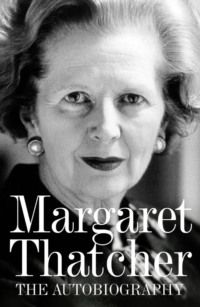
Kitabı oku: «Margaret Thatcher: The Autobiography»

M A R G A R E T
T H A T C H E R

THE AUTOBIOGRAPHY

CONTENTS
LIST OF ILLUSTRATIONS
EDITOR’S NOTE
CHAPTER 1 A Provincial Childhood
CHAPTER 2 Gowns-woman
CHAPTER 3 House Bound
CHAPTER 4 The Outer Circle
CHAPTER 5 A World of Shadows
CHAPTER 6 Teacher’s Pest
CHAPTER 7 No End of a Lesson
CHAPTER 8 Seizing the Moment
CHAPTER 9 A Bumpy Ride
CHAPTER 10 Détente or Defeat?
CHAPTER 11 Apprenticeship for Power
CHAPTER 12 Just One Chance …
CHAPTER 13 Over the Shop
CHAPTER 14 Changing Signals
CHAPTER 15 Into the Whirlwind
CHAPTER 16 Not At All Right, Jack
CHAPTER 17 Not for Turning
CHAPTER 18 The West and the Rest
CHAPTER 19 The Falklands War: Follow the Fleet
CHAPTER 20 The Falklands: Victory
CHAPTER 21 Generals, Commissars and Mandarins
CHAPTER 22 Disarming the Left
CHAPTER 23 Home and Dry
CHAPTER 24 Back to Normalcy
CHAPTER 25 Mr Scargill’s Insurrection
CHAPTER 26 Shadows of Gunmen
CHAPTER 27 Keeps Raining All the Time
CHAPTER 28 Men to Do Business With
CHAPTER 29 Putting the World to Rights
CHAPTER 30 Jeux Sans Frontières
CHAPTER 31 Hat Trick
CHAPTER 32 An Improving Disposition
CHAPTER 33 Not So Much a Programme, More a Way of Life
CHAPTER 34 A Little Local Difficulty
CHAPTER 35 To Cut and to Please
CHAPTER 36 Floaters and Fixers
CHAPTER 37 The Babel Express
CHAPTER 38 The World Turned Right Side Up
CHAPTER 39 No Time to Go Wobbly
CHAPTER 40 Men in Lifeboats
Photo Inserts
CHRONOLOGY 1955–1990
LIST OF ABBREVIATIONS
INDEX
COPYRIGHT
About the Publisher
LIST OF ILLUSTRATIONS
My father
My mother
My father’s shop in Grantham (Express Newspapers)
With my father
With my sister Muriel (F/T, Camera Press, London)
In the garden at the house of some friends Muriel, father, mother and me
At Somerville College, Oxford (By courtesy of the Principal and Fellows of Somerville College)
At work as a research chemist (Heute Magazine)
With Denis on our wedding day (Press Association Images)
My 1951 election address
As MP for Finchley (NI Syndication)
With Ted Heath at the Conservative Party Conference (Popperfoto/Getty Images)
Visiting a primary school as Secretary of State for Education
With Denis, Carol and Mark (NI Syndication/Arthur Steel)
Meeting the press at Conservative Central Office (Fox Photos)
The State Opening of Parliament (Getty Images)
Delivering the ‘Iron Lady’ speech in Kensington (Press Association Images)
On a walkabout in Huddersfield (Srdja Djukanovic)
On the stairs at Central Office following the 1979 general election victory (Lionel Chaerruault/Camera Press, London)
With Denis outside No. 10 (NI Syndication/Tony Eyles)
At the funeral of Airey Neave (Popperfoto/Getty Images)
Presenting deeds in Milton Keynes (Getty Images)
Addressing the Conservative Party Conference in Brighton (Press Association Images)
Visiting my old school in Grantham (NI Syndication/Arthur Edwards)
HMS Invincible returning to Portsmouth at the end of the Falklands War (Telegraph Syndication)
Presenting medals on board HMS Hermes (Martin Cleaver/Press Association Images)
On the steps of St Paul’s Cathedral (Press Association Images)
With Cecil Parkinson at Central Office (Herbie Knott/Rex Features)
At my desk at No. 10 (NI Syndication/John Manning)
The Grand Hotel in Brighton, after the bombing (Mike Abrahams/Alamy)
Leaving the Grand Hotel with Denis (Press Association Images)
Photocall at Chequers with the Gorbachevs (Getty Images)
Meeting Den Xiaoping (Xinhua, Camera Press, London)
With President Reagan at Camp David (Official White House Photograph)
Signing the Anglo-Irish Agreement (Press Association Images)
Greeting the Queen outside No. 10 (NI Syndication/Arthur Edwards)
With President Mitterand in 1986 (NI Syndication/Harry Kerr)
Some of the Commonwealth leaders who attended the Special Commonwealth Conference in London (Roger Hutchings/OBS, Camera Press, London)
In the kitchen at No. 10 (NI Syndication/Sally Soames)
With Denis in Cornwall (NI Syndication/Graham Wood)
Launching the 1987 general election manifesto Talking to the media from the Conservative Party ‘battle bus’ (NI Syndication/Graham Wood)
Outside No. 10 with Denis (NI Syndication/R Bamber)
With Neil Kinnock at the State Opening of Parliament (NI Syndication)
Walking across a desolate urban landscape near Stockton-on-Tees (NI Syndication/Chris Harries)
With President Reagan outside No. 10 (NI Syndication/John Rogers)
At the dinner at No. 10 held in honour of President Reagan White House Photograph)
Test driving the new Challenger tank (Joel Fink/AP/Press Association Images)
Arriving at Camp David by helicopter (Official White House Photograph)
With Helmut Kohl (NI Syndication)
With Boris Yeltsin (Camera Press, London)
With Nelson Mandela (Camera Press, London)
Addressing the United Nations General Assembly (Courtesy of the United Nations)
Receiving a standing ovation at the Party Conference (NI Syndication/Simon Townsley)
With members of the Cabinet and Denis at the Carlton Club Answering questions in the House of Commons (Press Association Images)
Driving away from Buckingham Palace (Geraint Lewis)
Leaving No. 10 for the last time (Richard Open/Camera Press, London)
EDITOR’S NOTE
The present edition is an abridged version of the original two volumes of Margaret Thatcher’s memoirs. The Downing Street Years, describing the author’s time as Prime Minister, was the first to appear, in 1993. The Path to Power, an account of her youth and early political career, was published two years later. The reverse chronological order was a response to the demands of the market and the relative interest of readers. But it had drawbacks.
This single, abridged volume sets them right. It begins at the beginning and ends at the – very dramatic – end. It excludes altogether the last section of The Path to Power, which was a series of essays on issues of the day. Also excluded, for brevity’s sake, are the dedications, acknowledgements, many footnotes and most of the appendices, along with some discursive sections and travelogues that have lost immediate interest. That said, all the key moments, events, issues, exchanges and arguments are here. Arguably, the compression results in a stronger, sharper self-portrait of one of the twentieth century’s towering figures.
ROBIN HARRIS
CHAPTER ONE
A Provincial Childhood
Grantham 1925–1943
MY FIRST DISTINCT MEMORY IS OF TRAFFIC. I was being pushed in a pram through the town to the park on a sunny day, and I must have encountered the bustle of Grantham on the way. The occasion stays in my mind as an exciting mixture of colour, vehicles, people and thunderous noise – yet, perhaps paradoxically, the memory is a pleasant one. I must have liked this first conscious plunge into the outside world.
As for indistinct memories, most of us probably recall our earliest years as a sort of blur. Mine was an idyllic blur in which the sun was always shining through the leaves of the lime tree into our living room and someone – my mother, my sister, one of the people working in the shop – was always nearby to cuddle me or pacify me with a sweet. Family tradition has it that I was a very quiet baby, which my political opponents might have some difficulty in believing. But I had not been born into a quiet family.
Four generations of the Roberts family had been shoemakers in Northamptonshire, at that time a great centre of the shoe industry. My father, who had wanted to be a teacher, had to leave school at thirteen because the family could not afford for him to stay on. He went instead to work at Oundle, one of the better public (i.e. private) schools. Years later, when I was answering questions in the House of Commons, Eric Heffer, a left-wing Labour MP and regular sparring partner of mine, tried to pull working-class rank by mentioning that his father had been a carpenter at Oundle. He was floored when I was able to retort that mine had worked in the tuck shop there.
My father had a number of jobs, most of them in the grocery trade, until in 1913 he was offered the post of manager of a grocery store in Grantham. In later years he would say that of the fourteen shillings a week he received, twelve shillings paid for his board and lodging, one shilling he saved, and only then did he spend the remaining shilling. The First World War broke out a year later. My father, a deeply patriotic man, tried to enlist no fewer than six times, but was rejected on each occasion on medical grounds. His younger brother, Edward, did enlist, and died on active service in Salonika in 1917. Few British families escaped such a bereavement, and Remembrance Day after the war was observed throughout the country both strictly and intensely.
Four years after arriving in Grantham my father met my mother, Beatrice Ethel Stephenson, through the local Methodist church. She had her own business as a dressmaker. They were married in that church in May 1917 and my sister, Muriel, was born in 1921.
My mother was quite a saver too, and by 1919 they were able to take out a mortgage to buy their own shop in North Parade. Our home was over this shop. In 1923 my father opened a second shop in Huntingtower Road – opposite the primary school which I would later attend. On 13 October 1925 I was born over the shop at North Parade.
That same year, my father expanded his business further, taking in two adjoining buildings in North Parade. Our shop and house were situated at a busy crossroads and the main railway line – Grantham was an important junction – was just a hundred yards away. We could set our clocks by the ‘Flying Scotsman’ as it thundered through. What I most regretted was that we did not have a garden. Not until the end of the Second World War did my father buy a house with a long garden further along North Parade, on which the family had set our hearts some years previously.
Life ‘over the shop’ is much more than a phrase. It is something which those who have lived it know to be quite distinctive. For one thing, you are always on duty. People would knock on the door at almost any hour of the night or weekend if they ran out of bacon, sugar, butter or eggs. Everyone knew that we lived by serving the customer; it was pointless to complain – and so nobody did. These orders were, of course, on top of the regular ones. My father or his staff – we had three at North Parade and someone else at Huntingtower – would generally go out and collect these. But sometimes my mother would do so, and then she might take Muriel and me along too. My sister and I knew a lot of people in the town as a result.
There was, of course, no question of closing down the shop for long family holidays. We used to go to the local seaside resort, Skegness. But my father and mother had to take their holidays at different times, with my father taking a week off every year to play his favourite game, competing in the bowls tournament at Skegness. Living over the shop, children see far more of their parents than in most other walks of life. I saw my father at breakfast, lunch, high tea and supper. We had much more time to talk than some other families, for which I have always been grateful.
My father was a specialist grocer. He always aimed to supply the best-quality produce, and the shop itself suggested this. Behind the counter there were three rows of splendid mahogany spice drawers with sparkling brass handles, and on top of these stood large, black, lacquered tea canisters. One of the tasks I sometimes shared was the weighing out of tea, sugar and biscuits from the sacks and boxes in which they arrived into 1lb and 2lb bags. In a cool back room we called ‘the old bake house’ hung sides of bacon which had to be boned and cut up for slicing. Wonderful aromas of spices, coffee and smoked hams would waft through the house.
I was born into a home which was practical, serious and intensely religious. My father and mother were both staunch Methodists; indeed, my father was much in demand as a lay preacher in and around Grantham. He was a powerful preacher whose sermons contained a good deal of intellectual substance. But he was taken aback when I asked him why he put on a ‘sermon voice’ on these occasions. I don’t think he realized that he did this. It was an unconscious homage to the biblical message, and quite different from the more prosaic tones in which he dispatched council business and current affairs.
Our lives revolved around Methodism. The family went to Sunday Morning Service at 11 o’clock, but before that I would have gone to morning Sunday School. There was Sunday School again in the afternoon; later, from about the age of twelve, I played the piano for the smaller children to sing the hymns. Then my parents would usually go out again to Sunday Evening Service.
On a few occasions I remember trying to get out of going. But when I said to my father that my friends were able to go out for a walk instead and I would like to join them, he would reply: ‘Never do things just because other people do them.’ This was one of his favourite expressions – used when I wanted to learn dancing, or sometimes when I wanted to go to the cinema. Whatever I felt at the time, the sentiment stood me in good stead, as it did my father.
My father’s sense of duty, however, always had its gentler side. This was not true of everyone. Life for poor people in the years before the Second World War was very difficult; and it was not much easier for those who had worked hard, accumulated a nest egg, and achieved a precarious respectability. They lived on a knife-edge and feared that if some accident hit them, or if they relaxed their standards of thrift and diligence, they might be plunged into debt and poverty. This precariousness often made otherwise good people hard and unforgiving. I remember a discussion between my father and a church-goer about the ‘prodigal son’ of a friend who, after running through his parents’ savings, had turned up penniless and with a young family on their doorstep. The church-goer was clear: the boy was no good, would never be any good, and should be shown the door. My father’s reply is vivid in my mind. No, he said. A son remained a son, and he must be greeted with all the love and warmth of his family when he turned to them. Whatever happens, you must always be able to come home.
As this suggests, my father was a man of firm principles – ‘Your father always sticks to his principles,’ my mother would say – but he did not believe in applying these principles in a way which made life wretched for everyone else. He showed this in his dealings as a local councillor and later alderman with the vexed question of what could be done on the Sabbath. In those days in Grantham and in most places cinemas were closed on Sundays, but during the war – adopting a utilitarian rather than a dogmatic approach – he supported Sunday opening because it gave the servicemen stationed near the town somewhere to go, without disturbing others who wanted a quieter, more contemplative Sabbath. At the same time he strongly (though in the end unsuccessfully) opposed the opening of the parks for the playing of games, which he felt would ruin other people’s peace and quiet. He wanted to keep Sunday a special day, but he was flexible about how it should be done. For my own part, I was unpersuaded, even as a girl, of the need for these restrictions: but I can now appreciate how much this highly principled man was prepared to bend on the matter when circumstances made it sensible.
These upright qualities, which entailed a refusal to alter your convictions just because others disagreed or because you became unpopular, were instilled into me from the earliest days. In 1936, when I was eleven, I was given a special edition of Bibby’s Annual. Joseph Bibby was a Liverpool food manufacturer who used part of his considerable self-made fortune to edit a religious magazine which was an odd combination of character building, homespun philosophy and religion; it also contained beautiful reproductions of great pictures. I was too young to know that the underlying approach was Theosophist* but the Annual was one of my most treasured possessions. Above all, it taught me some verses which I still use in off-the-cuff speeches because they came to embody for me so much of what I was brought up to feel.
One ship drives East, and another drives West,
By the self-same gale that blows;
’Tis the set of the sail, and not the gale,
That determines the way she goes.
ELLA WHEELER WILCOX
Or again:
The heights by great men reached and kept
Were not attained by sudden flight,
But they, while their companions slept,
Were toiling upward in the night.
HENRY WADSWORTH LONGFELLOW
Whether it was that early exposure to Bibby’s Annual or just a natural bent, I was soon fascinated by poetry. Aged ten, I was the proud winner of a prize at the Grantham Eisteddfod for reciting poetry. (I read John Drinkwater’s ‘Moonlit Apples’ and Walter de la Mare’s ‘The Travellers’.) One day soon afterwards, when I called at a door to collect an order for groceries, I was given an edition of Milton by someone who knew how much poetry meant to me: I have treasured the book ever since. In the first years of the war I would go out as part of a concert party to the surrounding villages and recite from my Oxford Book of English Verse – another book which even now is never far from reach. Methodism itself, of course, has, in the form of the Wesley hymns, some really fine religious poetry.
Religious life in Grantham was very active and, in the days before Christian ecumenism, competitive. There were three Methodist chapels, St Wulfram’s Anglican church – the sixth-highest steeple in England, according to local legend – and a Roman Catholic church just opposite our house. From a child’s standpoint, the Catholics seemed to have the most light-hearted time of all. I used to envy the young Catholic girls making their first communion, dressed in white, ribboned party dresses, and carrying baskets of flowers. The Methodist style was much plainer, and if you wore a ribboned dress an older chapel-goer would shake his head and warn against ‘the first step to Rome’.
Even without ribbons, however, Methodism was far from dour. It placed great emphasis on the social side of religion and on music, both of which gave me plenty of opportunities to enjoy life, even if it was in what might seem a rather solemn way. Our friends from church would often come in to cold supper on Sunday evenings, or we would go to them. I always enjoyed the adults’ conversation, which ranged far wider than religion or happenings in Grantham to include national and international politics. And one of the unintended consequences of the temperance side of Methodism was that Methodists tended to devote more time and attention to eating. ‘Keeping a good table’ was a common phrase, and many of the social occasions were built around tea parties and suppers. There was also a constant round of church events.
It was, I confess, the musical side of Methodism which I liked best. We sang special hymns on the occasion of Sunday School anniversaries. The Kesteven and Grantham Girls’ School (KGGS) carol service – and the weeks of practice which preceded it – was something I always looked forward to. Our church had an exceptionally good choir. Every other year we would perform an oratorio: Handel’s Messiah, Haydn’s Creation or Mendelssohn’s Elijah. We would have professionals from London to sing the more difficult solo parts. But what made an impression on me was the latent richness of musical talent which serious training and practice could develop. My family also belonged to a music society and three or four times a year there would be a chamber music concert.
We were a musical family. From the age of five my parents had me learn the piano: my mother played too. In fact, I turned out to be quite good, and I was fortunate enough to have excellent teachers and won several prizes at local music festivals. The piano on which I was taught was made by my great uncle, John Roberts, in Northampton. He also made church organs. When I was ten I visited him and was thrilled to be allowed to play one of the two he had built in a cavernous barn-like building in his garden. Sadly, at sixteen I found it necessary to stop music lessons when I was cramming for my university entrance, and I still regret that I never took the piano up again. At this time, however, it was I who played the piano at home, while my father (who had a good bass voice) and mother (a contralto) and sometimes friends sang the old favourites of an evening – ‘The Holy City’, ‘The Lost Chord’, Gilbert and Sullivan, etc.
Perhaps the biggest excitement of my early years was a visit to London when I was twelve years old. I came down by train in the charge of a friend of my mother’s, arriving at King’s Cross, where I was met by the Rev. Skinner and his wife, family friends who were going to look after me. The first impact of London was overwhelming: King’s Cross itself was a giant bustling cavern; the rest of the city had all the dazzle of a commercial and imperial capital. For the first time in my life I saw people from foreign countries, some in the traditional native dress of India and Africa. The sheer volume of traffic and of pedestrians was exhilarating; they seemed to generate a sort of electricity. London’s buildings were impressive for another reason; begrimed with soot, they had a dark imposing magnificence which constantly reminded me that I was at the centre of the world.
I was taken by the Skinners to all the usual sites. I fed the pigeons in Trafalgar Square; I rode the Underground – a slightly forbidding experience for a child; I visited the Zoo, where I rode on an elephant and recoiled from the reptiles – an early portent of my relations with Fleet Street; I was disappointed by Oxford Street, which was much narrower than the boulevard of my imagination; made a pilgrimage to St Paul’s, where John Wesley had prayed on the morning of his conversion; and of course, to the Houses of Parliament and Big Ben, which did not disappoint at all; and I went to look at Downing Street, but unlike the young Harold Wilson did not have the prescience to have my photograph taken outside No. 10.
All this was enjoyable beyond measure. But the high point was my first visit to the Catford Theatre in Lewisham where we saw Sigmund Romberg’s famous musical The Desert Song. For three hours I lived in another world, swept away as was the heroine by the daring Red Shadow – so much so that I bought the score and played it at home, perhaps too often.
I could hardly drag myself away from London or from the Skinners, who had been such indulgent hosts. Their kindness had given me a glimpse of, in Talleyrand’s words, ‘la douceur de la vie’ – how sweet life could be.
Our religion was not only musical and sociable – it was also intellectually stimulating. The ministers were powerful characters with strong views. The general political tendency among Methodists and other Nonconformists in our town was somewhat to the left wing and even pacifist. Methodists in Grantham were prominent in organizing the ‘Peace Ballot’ of 1935, circulating a loaded questionnaire to the electorate, which was then declared overwhelmingly to have ‘voted for peace’. It is not recorded how far Hitler and Mussolini were moved by this result; we had our own views about that in the Roberts household. The Peace Ballot was a foolish idea which must take some of the blame nationally for delaying the rearmament necessary to deter and ultimately defeat the dictators. On this question and others, being staunchly Conservative, we were the odd family out. Our friend the Rev. Skinner was an enthusiast for the Peace Ballot. He was the kindest and holiest man, and he married Denis and me at Wesley’s Chapel in London many years later. But personal virtue is no substitute for political hard-headedness.
The sermons we heard every Sunday made a great impact on me. It was an invited Congregationalist minister, the Rev. Childe, who brought home to me the somewhat advanced notion for those days that whatever the sins of the fathers (and mothers) they must never be visited on the children. I still recall his denunciation of the Pharisaical tendency to brand children born outside marriage as ‘illegitimate’. All the town knew of some children without fathers; listening to the Rev. Childe, we felt very guilty about thinking of them as different. Times have changed. We have since removed the stigma of illegitimacy not only from the child but also from the parent – and perhaps increased the number of disadvantaged children thereby. We still have to find some way of combining Christian charity with sensible social policy.
When war broke out and death seemed closer to everybody, the sermons became more telling. In one, just after the Battle of Britain, the preacher told us that it is ‘always the few who save the many’: so it was with Christ and the apostles. I was also inspired by the theme of another sermon: history showed how it was those who were born at the depths of one great crisis who would be able to cope with the next. This was proof of God’s benevolent providence and a foundation for optimism about the future, however dark things now looked. The values instilled in church were faithfully reflected in my home.
So was the emphasis on hard work. In my family we were never idle – partly because idleness was a sin, partly because there was so much work to be done, and partly, no doubt, because we were just that sort of people. As I have mentioned, I would help whenever necessary in the shop. But I also learned from my mother just what it meant to cope with a household so that everything worked like clockwork, even though she had to spend so many hours serving behind the counter. Although we had a maid before the war – and later a cleaning lady a couple of days a week – my mother did much of the work herself, and there was a great deal more than in a modern home. She showed me how to iron a man’s shirt in the correct way and to press embroidery without damaging it. Large flatirons were heated over the fire and I was let in on the secret of how to give a special finish to linen by putting just enough candle wax to cover a sixpenny piece on the iron. Most unusually for those times, at my secondary school we had to study domestic science – everything from how to do laundry properly to the management of the household budget. So I was doubly equipped to lend a hand with the domestic chores. The whole house at North Parade was not just cleaned daily and weekly: a great annual spring clean was intended to get to all those parts which other cleaning could not reach. Carpets were taken up and beaten. The mahogany furniture – always good quality, which my mother had bought in auction sales – was washed down with a mixture of warm water and vinegar before being repolished. Since this was also the time of the annual stocktaking in the shop, there was hardly time to draw breath.
Nothing in our house was wasted, and we always lived within our means. The worst you could say about another family was that they ‘lived up to the hilt’. Because we had always been used to a careful regime, we could cope with wartime rationing, though we used to note down the hints on the radio about the preparation of such stodgy treats as ‘Lord Woolton’s potato pie’, an economy dish named after the wartime Minister for Food. My mother was an excellent cook and a highly organized one. Twice a week she had her big bake – bread, pastry, cakes and pies. Her home-made bread was famous, as were her Grantham gingerbreads. Before the war there were roasts on Sunday, which became cold cuts on Monday and disappeared into rissoles on Tuesday. With wartime, however, the Sunday roast became almost meatless stew or macaroni cheese.
Small provincial towns in those days had their own networks of private charity. In the run-up to Christmas as many as 150 parcels were made up in our shop, containing tinned meat, Christmas cake and pudding, jam and tea – all purchased for poorer families by one of the strongest social and charitable institutions in Grantham, the Rotary Club. There was always something from those Thursday or Sunday bakes which was sent out to elderly folk living alone or who were sick. As grocers, we knew something about the circumstances of our customers.
I knew just what I thought of Hitler. Near our house was a fish and chip shop where I was sent to buy our Friday evening meal. Fish and chip queues were always a good forum for debate. On one occasion the topic was Hitler. Someone suggested that at least he had given Germany some self-respect and made the trains run on time. I vigorously argued the opposite, to the astonishment and doubtless irritation of my elders. The woman who ran the shop laughed and said: ‘Oh, she’s always debating.’
My family understood clearly Hitler’s brutal treatment of the Jews. At school we were encouraged to have foreign penfriends. Mine was a French girl called Colette: alas, I did not keep up contact with her. But my sister, Muriel, had an Austrian Jewish penfriend called Edith. After the Anschluss in March 1938, when Hitler annexed Austria, Edith’s father, a banker, wrote to mine asking whether we could take his daughter, since he very clearly foresaw the way events were leading. We had neither the time nor the money to accept such a responsibility alone; but my father won the support of the Grantham Rotarians, and Edith came to stay with each of our families in turn until she went to live with relatives in South America. She was seventeen, tall, beautiful, well-dressed, and spoke good English. She told us what it was like to live as a Jew under an anti-semitic regime. One thing Edith reported particularly stuck in my mind: the Jews, she said, were being made to scrub the streets.
We wanted to see Hitler’s wickedness ended, even by war if that proved necessary. From that point of view Munich was nothing to be proud of. We knew too that by the Munich Agreement Britain had complicity in the great wrong that had been done to Czechoslovakia. When fifty years later as Prime Minister I visited Czechoslovakia I addressed the Federal Assembly in Prague and told them: ‘We failed you in 1938 when a disastrous policy of appeasement allowed Hitler to extinguish your independence. Churchill was quick to repudiate the Munich Agreement, but we still remember it with shame.’ British foreign policy is at its worst when it is engaged in giving away other people’s territory.
But equally we all understood the lamentable state of unpreparedness in Britain and France to fight a major war. Also, unfortunately, some were taken in by the German propaganda and actually believed that Hitler was acting to defend the Sudeten Germans from Czech oppression. If we had gone to war at that point, moreover, we would not have been supported by all of the Dominions. It was the Germans’ subsequent dismemberment of what remained of Czechoslovakia in March 1939 that finally convinced almost everyone that war would soon be necessary to defeat Hitler’s ambitions. Even then, as I have pointed out, Labour voted against conscription the following month. There was strong anti-war feeling in Grantham too: many Methodists opposed the official recruiting campaign of May 1939, and right up to the outbreak of war and beyond pacifists were addressing meetings in the town.
In any case, the conflict was soon upon us. Germany invaded Poland on 1 September 1939. When Hitler refused to withdraw by 11 a.m. on Sunday 3 September in accordance with Britain’s ultimatum we were waiting by the radio, desperate for the news. It was the only Sunday in my youth when I can remember not attending church. Neville Chamberlain’s fateful words, relayed live from the Cabinet Room at No. 10, told us that we were at war.
It was natural at such times to ask oneself how we had come to such a pass. Each week my father would take two books out of the library, a ‘serious’ book for himself (and me) and a novel for my mother. As a result, I found myself reading books which girls of my age would not generally read. I soon knew what I liked – anything about politics and international affairs. I read, for instance, John Strachey’s The Coming Struggle for Power, which had first appeared in 1932. The contents of this fashionable communist analysis, which predicted that capitalism was shortly to be superseded by socialism, seemed to many of my generation exciting and new.
But both by instinct and upbringing I was always a ‘true blue’ Conservative. No matter how many left-wing books I read or left-wing commentaries I heard, I never doubted where my political loyalties lay. Such an admission is probably unfashionable. But though I had great friends in politics who suffered from attacks of doubt about where they stood and why, and though of course it would take many years before I came to understand the philosophical background to what I believed, I always knew my mind. I can see now that I was probably unusual. For the Left were setting the political agenda throughout the thirties and forties, even though the leadership of Churchill concealed it during the years of the war itself. This was evident from many of the books which were published at about this time. The Left had been highly successful in tarring the Right with appeasement, most notably in Victor Gollancz’s Left Book Club, the so-called ‘yellow books’. One in particular had enormous impact: Guilty Men, co-authored by Michael Foot, which appeared under the pseudonym ‘Cato’ after Dunkirk in 1940.
Robert Bruce Lockhart’s best-selling Guns or Butter? appeared in the autumn of 1938, after Munich. Lockhart’s travels through Europe led him to Austria (now Nazi-controlled) and then to Germany itself at the height of Hitler’s triumph. There the editor of a German national newspaper is reported as telling him that ‘Germany wanted peace, but she wanted it on her own terms.’ The book ends with Lockhart, woken by ‘the tramp of two thousand feet in unison’, looking out of his window onto a misty dawn, where ‘Nazi Germany was already at work’.
A more original variation on the same theme was Douglas Reed’s Insanity Fair. This made a deep impression on me. Reed witnessed the persecution of the Jews which accompanied the advance of Nazi influence. He described the character and mentality – alternately perverted, unbalanced and calculating – of the Nazi leaders. He analysed and blisteringly denounced that policy of appeasement by Britain and France which paved the way for Hitler’s successes. Written on the eve of the Anschluss, it was powerfully prophetic.
Out of the Night by Jan Valtin – pen name for the German communist Richard Krebs – was lent to my father by our future MP Denis Kendall. It was such strong meat that my father forbade me to read it – but when he went out to meetings I would take it down and read its spine-chilling account of totalitarianism in action. It is full of scenes of sadistic violence whose authenticity makes them still more horrifying. The appalling treatment by the Nazis of their victims is undoubtedly the most powerful theme. But underlying it is another, just as significant. For it describes how the communists set out in cynical alliance with the Nazis to subvert the fragile democracy of Germany by violence in the late twenties and early thirties. That same alliance against democracy would, of course, be replicated in the Nazi-Soviet pact of 1939 to 1941 which destroyed Poland, the Baltic States and Finland and plunged the world into war. The book undoubtedly contributed to my growing belief that Nazism (national socialism) and communism (international socialism) were but two sides of the same coin.
A book which had a particular influence on me was the American Herbert Agar’s A Time for Greatness, which appeared in 1944. This was a powerful analysis of how the West’s moral failure allowed the rise of Hitler and the war which had followed. It urged a return to western liberal democratic values and – though I liked this less – a fair amount of left-wing social engineering. For me the important message of Agar’s book was that the fight against Hitler had a significance for human destiny which exceeded the clash of national interests or spheres of influence or access to resources or any of the other – doubtless important – stuff of power politics.
Agar also wrote of the need, as part of the moral regeneration which must flow from fighting the war, to solve what he called ‘the Negro problem’. I had never heard of this ‘problem’ at all. Although I had seen some coloured people on my visit to London, there were almost none living in Grantham. Friends of ours once invited two American servicemen – one black, one white – stationed in Grantham back to tea and had been astonished to detect tension and even hostility between them. We were equally taken aback when our friends told us about it afterwards. This sort of prejudice was simply outside our experience or imagination.
Like many other young girls in wartime, I read Barbara Cartland’s Ronald Cartland, the life of her brother, a young, idealistic Conservative MP, who had fought appeasement all the way and who was killed at Dunkirk in 1940. It was a striking testament to someone who had no doubt that the war was not only necessary but right, and whose thinking throughout his short life was ‘all of a piece’, something which I always admired. But the sense that the war had a moral significance which underlay the fear and suffering – or in our family’s case in Grantham the material dreariness and mild deprivation – which accompanied it, was perhaps most memorably conveyed by Richard Hillary’s The Last Enemy. The author – a young pilot – portrays the struggle which had claimed the lives of so many of his friends, and which would claim his own less than a year later, as one which was also being fought out in the human heart. It was a struggle for a better life in the sense of simple decency.
A generation which, unlike Richard Hillary, survived the war felt this kind of desire to put things right with themselves, their country and the world. As I would come to learn when dealing with my older political colleagues, no one who fought came out of it quite the same person as went in. Less frequently understood, perhaps, is that war affected deeply people like me who, while old enough to understand what was happening in the conflict, were not themselves in the services. But we all see these great calamities with different eyes, and so their impact upon us is different. It never seemed to me, for example, as it apparently did to many others, that the ‘lesson’ of wartime was that the state must take the foremost position in our national life and summon up a spirit of collective endeavour in peace as in war.
The ‘lessons’ I drew were quite different. The first was that the kind of life that the people of Grantham had lived before the war was a decent and wholesome one, and its values were shaped by the community rather than by the government. Second, since even a cultured, developed, Christian country like Germany had fallen under Hitler’s sway, civilization had constantly to be nurtured, which meant that good people had to stand up for the things they believed in. Third, I drew the obvious political conclusion that it was appeasement of dictators which had led to the war, and that had grown out of wrong-headed but decent impulses, like the pacifism of Methodists in Grantham, as well as out of corrupt ones. And, finally, I had the patriotic conviction that, given great leadership of the sort I heard from Winston Churchill in the radio broadcasts to which we listened, there was almost nothing that the British people could not do.
Our life in wartime Grantham – until I went up to Oxford in 1943 – must have been very similar to that of countless other families. There was always voluntary work to do of one kind or another in the Service canteens and elsewhere. Our thoughts were at the front; we devoured voraciously every item of available news; and we ourselves, though grateful for being more or less safe, knew that we were effectively sidelined. But there were twenty-one German air raids on the town, and seventy-eight people were killed. The town munitions factory – the British Manufacturing and Research Company (BMAR Co., or ‘British Marcs’ as we called it) – was an obvious target, as was the junction of the Great North Road and the Northern Railway Line – the latter within a few hundred yards of our house. My father was frequently out in the evenings on air raid duty. During air raids we would crawl under the table for shelter – we had no outside shelter for we had no garden – until the ‘all clear’ sounded. After bombs fell on the town in January 1941 I asked my father if I could walk down to see the damage. He would not let me go. Twenty-two people died in that raid. We were also concerned for my sister Muriel, who was working in the Orthopaedic Hospital in Birmingham: Birmingham was, of course, very badly bombed.
In fact, Grantham itself was playing a more dramatic role than I knew at the time. Bomber Command’s 5 Group was based in Grantham, and it was from a large house off Harrowby Road that much of the planning was done of the bombing raids on Germany. The Dambusters flew from near Grantham – my father met their commander, Squadron Leader Guy Gibson. I always felt that Bomber Harris – himself based in Grantham in the early part of the war – had not been sufficiently honoured. I would remember what Winston Churchill wrote to him at the end of the war:
For over two years Bomber Command alone carried the war to the heart of Germany, bringing hope to the peoples of Occupied Europe and to the enemy a foretaste of the mighty power which was rising against him …
All your operations were planned with great care and skill. They were executed in the face of desperate opposition and appalling hazards. They made a decisive contribution to Germany’s final defeat. The conduct of these operations demonstrated the fiery gallant spirit which animated your air crews and the high sense of duty of all ranks under your command. I believe that the massive achievements of Bomber Command will long be remembered as an example of duty nobly done.
WINSTON S. CHURCHILL
In Grantham, at least, politics did not stand still in the war years. Hitler’s invasion of the Soviet Union in June 1941 sharply altered the attitudes of the Left to the war. Pacifist voices suddenly became silent. Anglo-Soviet friendship groups sprouted. We attended, not without some unease, Anglo-Soviet evenings held at the town hall. It was the accounts of the suffering and bravery of the Russians at Stalingrad in 1942–43 which had most impact on us.
Although it can now be seen that 1941 – with Hitler’s attack on Russia in June and the Japanese bombing of Pearl Harbor which brought America into the war in December – sowed the seeds of Germany’s ultimate defeat, the news was generally bad, especially so in early 1942. This almost certainly contributed to the outcome of the by-election held in Grantham on 27 February 1942, after Victor Warrender was elevated to the Lords as Lord Bruntisfield, to become an Admiralty spokesman. Denis Kendall stood as an Independent against our Conservative candidate, Sir Arthur Longmore. Kendall fought an effective populist campaign in which he skilfully used his role as General Manager of British Marcs to stress the theme of an all-out drive for production for the war effort and the need for ‘practical’ men to promote it. To our great surprise, he won by 367 votes. Then and later the Conservative Party was inclined to complacency. A closer analysis of the limited number of by-elections should have alerted us to the likelihood of the Socialist landslide which materialized in 1945.
Unusually, I took little part in the campaign because I was preparing for examinations which I hoped would get me into Somerville College, Oxford. In particular, my evenings were spent cramming the Latin which was required for the entrance exam. Our school did not teach Latin. Fortunately, our new headmistress, Miss Gillies, was able to arrange Latin lessons for me from a teacher at the boys’ grammar school, and to lend me her own books, including a textbook written by her father. The hard work helped keep my mind off the ever more dismal news about the war. In particular, there was a series of blows in the Far East – the loss of Malaya, the sinking of the Prince of Wales and Repulse, the fall of Hong Kong and then Singapore, the retreat through Burma and the Japanese threat to Australia. One evening in the spring of 1942 when I had gone for a walk with my father I turned and asked him when – and how – it would all end. He replied very calmly: ‘We don’t know how, we don’t know when; but we have no doubt that we shall win.’
In spite of my efforts to get into Somerville, I failed to win the scholarship I wanted. It was not too surprising, for I was only seventeen, but it was a blow. If I was not able to go up in 1943 I would not be allowed to do more than a two-year ‘wartime degree’ before I was called up for national service at the age of twenty. But there was nothing I could do about it, and so at the end of August 1943 I entered the third-year sixth and became Joint Head of School. Then a telegram arrived offering me a place at Somerville in October. Someone else had dropped out. And so it was that I suddenly found myself faced with the exciting but daunting prospect of leaving home, almost for the first time, for a totally different world.
* Theosophy was a mixture of mysticism, Christianity and the ‘wisdom of the East’, sense and nonsense.
* Aldermen were indirectly elected council members – elected to serve a fixed term by the directly elected element in the council; a highly honoured position which has since been abolished.
* From God Knows, by Minnie Louise Haskins.
CHAPTER TWO
Gowns-woman
Oxford 1943–1947
OXFORD DOES NOT SET OUT TO PLEASE. Freshmen arrive there for the Michaelmas term in the misty gloom of October. Monumental buildings impress initially by their size rather than their exquisite architecture. Everything is cold and strangely forbidding. Or so it seemed to me.
It had been at Somerville during bitterly cold mid-winter days that I had taken my Oxford entrance exams. But I had seen little of my future college before I arrived, rather homesick and apprehensive, to begin my first term. In fact, Somerville always takes people by surprise. Many incurious passers-by barely know it is there, for the kindest thing to say of its external structure is that it is unpretentious. But inside it opens up into a splendid green space onto which many rooms face. I was to live both my first and second years in college, and in due course, a picture or two, a vase and finally an old armchair brought back from Grantham allowed me to feel that the rooms were in some sense mine. In my third and fourth years I shared digs with two friends in Walton Street.
Both Oxford and Somerville were strongly if indirectly affected by the war. For whatever reason, Oxford was not bombed, but like everywhere else, both town and university were subject to the blackout (‘dim-out’ from 1944) and much affected by wartime stringencies. Stained-glass windows were boarded up. Large static water tanks stood ready for use in case of fire. Most of our rations were allocated direct to the college which provided our unexciting fare in hall, though on rare occasions I would be asked out to dinner. There were a few coupons left over for jam and other things. One of the minor benefits to my health and figure of such austerities was that I ceased having sugar in my tea – though only many years later would I deny my ever-sweet tooth the pleasure of sugared coffee (not that there was over-much coffee for some time either). There were tight controls over the use of hot water. For example, there must be no more than five inches of water in the bath and of course I rigidly observed this, though coming from a family where the relationship between cleanliness and Godliness was no laughing matter. Not that we ever felt like complaining. After all, we were the lucky ones.
I was the first Roberts to go to Oxbridge and I knew that, however undemonstrative they might be, my parents were extremely proud of the fact. Before I went up to Oxford, I had a less clear idea of what the place would be like than did many of my contemporaries. But I regarded it as being quite simply the best, and if I was serious about getting on in life that is what I should always strive for. So, excellent as it was, particularly in the sciences, I was never tempted to opt for Nottingham, our ‘local’ university. Another aspect of Oxford which appealed to me then – and still does – is the collegiate system. Oxford is divided into colleges, though it also has some central university institutions, such as the Bodleian Library. In my day, life centred on the college (where you ate and slept and received many of your tutorials) and around other institutions – church and societies – which had more or less a life of their own. My experience of college life contributed to my later conviction that if you wish to bring the best out of people they should be encouraged to be part of smaller, human-scale communities rather than be left to drift on a sea of impersonality.
Perhaps the most obvious way in which wartime conditions affected the ‘feel’ of university life was the fact that so many of us were very young – only seventeen or just eighteen. From 1944, the feel of Oxford changed again as older people, invalided out, started coming back from the services either to complete a shortened wartime degree or to begin a full degree course. They had been through so much more than we had. As Kipling wrote (in ‘The Scholars’) of young naval officers returning to Cambridge after the Great War to continue their studies:
Far have they steamed and much have they known, and most would they fain forget;
But now they are come to their joyous own with all the world in their debt.
By the time I left I found myself dealing with friends and colleagues who had seen much more of the world than I had. And I gained a great deal from the fact that Oxford at the end of the war was a place of such mixed views and experience.
I began by keeping myself to myself, for I felt shy and ill at ease in this quite new environment. I continued to take long walks on my own, around Christ Church Meadow, through the university parks and along the Cherwell or the Thames, enjoying my own company and thoughts. But I soon started to appreciate Oxford life. I was a member of a Methodist Study Group which gave and attended tea parties. My mother would send me cakes through the post and on a Saturday morning I would join the queue outside the ‘cake factory’ in north Oxford for an hour or so to buy the sustenance for tea that Sunday. I joined the Bach Choir, conducted by Sir Thomas Armstrong (by a nice coincidence Robert Armstrong’s father), whose repertoire was wider than its name suggested. I especially remember our performance of the St Matthew Passion in the Sheldonian Theatre, which Wren might have designed for the purpose. We also sang Prince Igor, Constant Lambert’s Rio Grande, and Holst’s Hymn of Jesus. Sometimes I went to listen rather than to sing: I heard Kathleen Ferrier in Elgar’s Dream of Gerontius.
With the end of the war and the return of the servicemen, the pace of entertainment quickened. Eights Week was revived and I went down to the river to watch the races. It was at this time that I first went out to dances and even on occasion drank a little wine (I had previously only tasted sherry and did not like it; nor do I now). I smoked my first cigarettes. I did not like them much either, though I knew I would get the taste if I persisted. I decided not to, to save the money and buy The Times every day instead. I now went to my first commem ball, and, like the girl in the song, danced all night. I saw Chekhov and Shakespeare at the Playhouse and the New Theatre. (Christopher Fry’s first plays were being performed at that time.) And I saw a wonderful OUDS (Oxford University Dramatic Society) production performed in a college garden and featuring Kenneth Tynan, Oxford’s latest dandy. I cannot remember the play, partly because it was always difficult to distinguish Ken Tynan on stage from Ken Tynan in everyday life.
I might have had a more glittering Oxford career, but I had little money to spare and would have been hard put to make ends meet if it had not been for a number of modest grants secured for me from the college at the instance of my ever-helpful tutor, the chemist Dorothy Hodgkin. I was also assisted by some educational trusts. I might have been able to supplement my income further from such sources if I had been prepared to give an undertaking to go into teaching. But I knew I had no such calling; and I did and do believe that good teachers need a vocation. In fact, I did teach science for one vacation at a school in Grantham in the summer of 1944: this earned the money for that luxury in Grantham but near-necessity in Oxford – a bicycle. It was while I was teaching there that Paris was liberated. The headmaster called the school together, announced that Paris was free again and told us how the brave Resistance fighters had helped the Allies by rising up against the German occupiers.
It was a thrilling moment. The war was evidently being won; I felt somehow less guilty for not being able to play a larger part; and I shared the joy of the British people that the French Resistance had restored French honour and pride. We may have had an exaggerated view in those days of the universality of resistance – we told each other stories of how the customers of a café would tap out ‘V for Victory’ in morse code on their glasses when a German soldier entered the café – but we had no doubt that every true Frenchman wanted to be free.
I threw myself into intensely hard work. In Dorothy Hodgkin the college was fortunate to have a brilliant scientist and a gifted teacher, working in the comparatively new field of X-ray crystallography. Mrs Hodgkin was a Fellow of the Royal Society and later made a decisive contribution towards discovering the structure of penicillin, the first antibiotic, for which she won the Nobel Prize in 1964. In my fourth and final year (1946–47) I worked with a refugee German scientist, Gerhard Schmidt, under Dorothy Hodgkin’s direction, on the simple protein Gramicidin B as the research project required to complete Part II of my chemistry course. Through the Cosmos Club and the Scientific Club I also came across other budding young scientists and heard many well-known scientists speak, including J.D. Bernal. His politics were very left wing, as indeed were those of many other scientists at that time. But they would never have dreamt of carrying their politics over into their professional relationships with their students.
Religion also figured large in my Oxford life. There are many tales of young people entering university and, partly through coming into contact with scepticism and partly for less wholesome reasons, losing their faith. I never felt in any danger of that. Methodism provided me with an anchor of stability and, of course, contacts and friends who looked at the world as I did. I usually attended the Wesley Memorial Church on Sundays. There was, as in Grantham, a warmth and a sober but cheerful social life which I found all the more valuable in my initially somewhat strange surroundings. The church had a very vigorous Students’ Fellowship. After Sunday Evening Service there was usually a large gathering over coffee in the minister’s house, where there would be stimulating discussion of religious and other matters. Occasionally I would go to the University Church of St Mary the Virgin to listen to a particularly interesting university sermon and sometimes I would go to the college chapel, especially when I knew that Miss Helen Darbishire, who was Principal and a distinguished scholar of Milton and Wordsworth when I first went up to Somerville, was preaching.
Generally speaking, though, I did not go to Anglican churches. But oddly enough – or perhaps not so oddly when one considers the great impact he had on so many of my generation – it was the religious writing of that High Anglican C.S. Lewis which had most impact upon my intellectual religious formation. The power of his broadcasts, sermons and essays came from a combination of simple language with theological depth. Who has ever portrayed more wittily and convincingly the way in which Evil works on our human weaknesses than he did in The Screwtape Letters? Who has ever made more accessible the profound concepts of Natural Law than he did in The Abolition of Man and in the opening passages of Mere Christianity? I remember most clearly the impact on me of Christian Behaviour (republished in Mere Christianity, but originally appearing as radio talks). This went to the heart of the appalling disparity between the way in which we Christians behave and the ideals we profess. One of C.S. Lewis’s messages was that the standards of Christianity are not just binding on the saints. As he put it:
Perfect behaviour may be as unattainable as perfect gear-changing when we drive; but it is a necessary ideal prescribed for all men by the very nature of the human machine just as perfect gear-changing is an ideal prescribed for all drivers by the very nature of cars.
Similarly, I was helped by what he wrote of the application of that sublime principle of Christian charity which seems to most of us so impossible of fulfilment. Lewis did not for a moment contest or diminish the sublimeness; but he very helpfully set out what charity is not.
… what [does] loving your neighbour as yourself [mean?] I have to love him as I love myself. Well, how exactly do I love myself? Now that I come to think of it, I have not exactly got a feeling of fondness or affection for myself, and I do not even always enjoy my own society. So apparently ‘Love your neighbour’ does not mean ‘feel fond of him’ or ‘find him attractive’ … I can look at some of the things I have done with horror and loathing. So apparently I am allowed to loathe and hate some of the things my enemies do … Consequently, Christianity does not want us to reduce by one atom the hatred we feel for cruelty and treachery … Even while we kill and punish we must try to feel about the enemy as we feel about ourselves – to wish that he were not bad, to hope that he may, in this world or another be cured: in fact, to wish his good.
CHAPTER THREE
House Bound
Marriage, family, law and politics 1947–1959
IF GOING UP TO OXFORD is one sort of shock, coming down is quite another. I had made many like-minded friends at Oxford, I had enjoyed my adventures in chemistry and I was passionately interested in university politics. It was a wrench to leave all that behind.
The newly created Oxford University Appointments Committee, which helped new graduates to find suitable jobs, arranged several interviews for me, including one at a Northern ICI plant. We hopefuls were interviewed by several managers whose written comments were passed on to the general manager, who gave us our final interview. The remarks on me were lying on the table at the interview, and I could not resist using my faculty for reading upside down. They were both encouraging and discouraging; one manager had written: ‘This young woman has much too strong a personality to work here.’ In fact, I had three or four interviews with other companies and eventually I was taken on by BX Plastics at Manningtree just outside Colchester to work in their research and development section. BX produced a full range of plastics both for industrial use and consumer use, including for films.
It had been understood when we originally discussed the position that it would involve my being in effect Personal Assistant to the Research and Development Director. I had been looking forward to this because I thought it would allow me to get to know more of how the company as a whole operated and also to use the talents I had, over and above my knowledge of chemistry. But on my arrival it was decided that there was not enough to do in that capacity and so I found myself donning my white coat again and immersing myself in the wonderful world of plastics. By the time Christmas 1947 was approaching I had made one or two friends and the Section moved into a separate and rather pleasant house in nearby Lawford. Like many others at the company, I lived in Colchester – a town which I increasingly came to like and where I had found comfortable lodgings. A bus took us all out to Lawford every day.
And, as always with me, there was politics. I immediately joined the Conservative Association and threw myself into the usual round of Party activities. In particular, I thoroughly enjoyed what was called the ‘39–45’ discussion group, where Conservatives of the war generation met to exchange views and argue about the political topics of the day. I also kept in touch with friends like Edward Boyle, who was later adopted for a Birmingham seat in the 1950 election. It was as a representative of the Oxford University Graduate Conservative Association (OUGCA) that I went to the Llandudno Conservative Party Conference in October 1948.
It had originally been intended that I should speak at the Conference, seconding an OUGCA motion deploring the abolition of university seats. At that time universities had separate representation in Parliament, and graduates had the right to vote in their universities as well as in the constituency where they lived. (I supported separate university representation, but not the principle that graduates should have more than one vote; my view was that graduates should be able to choose to vote in one or the other constituency.) It would have been my first Conference speech, but in the end the seconder chosen was a City man, because the City seats were also to be abolished.
My disappointment at this was very quickly overcome in a most unexpected way. After one of the debates, I found myself engaged in one of those speculative conversations which young people have about their future prospects. An Oxford friend, John Grant, said he supposed that one day I would like to be a Member of Parliament. ‘Well, yes,’ I replied, ‘but there’s not much hope of that. The chances of my being selected are just nil at the moment.’ I might have added that with no private income of my own there was no way I could have afforded to be an MP on the salary then available. I had not even tried to get on the Party’s list of approved candidates.
Later in the day, John Grant happened to be sitting next to the Chairman of the Dartford Conservative Association, John Miller. The Association was in search of a candidate. I learned afterwards that the conversation went something like this: ‘I understand that you’re still looking for a candidate at Dartford?’ (In fact, Conservative Central Office was becoming exasperated at Dartford’s failure to pick someone to fight the seat in an election that had to take place in 1950 and might be called before then.)
‘That’s right. Any suggestions?’
‘Well, there’s a young woman, Margaret Roberts, that you might look at. She’s very good.’
‘Oh, but Dartford is a real industrial stronghold. I don’t think a woman would do at all.’
‘Well, why not just look at her?’
And they did. I was invited to have lunch with John Miller and his wife, Phee, and the Dartford Women’s Chairman, Mrs Fletcher, on the Saturday on Llandudno Pier. Presumably, and in spite of any reservations about the suitability of a woman candidate for their seat, they liked what they saw. I certainly got on well with them. The Millers were to become close friends and I quickly developed a healthy respect for the dignified Mrs Fletcher. After lunch we walked back to the Conference Hall in good time for a place to hear Winston Churchill give the Party Leader’s speech. It was the first we had seen of him that week, because in those days the Leader did not attend the Conference itself, appearing only at a final rally on the Saturday. Foreign affairs naturally dominated his speech – it was the time of the Berlin blockade and the western airlift – and his message was sombre, telling us that only American nuclear weapons stood between Europe and communist tyranny and warning of ‘what seems a remorselessly approaching third world war’.
I did not hear from Dartford until December, when I was asked to attend an interview at Palace Chambers, Bridge Street – then housing Conservative Central Office – not far from Parliament itself. With a large number of other hopefuls I turned up on the evening of Thursday 30 December for my first Selection Committee. Very few outside the political arena know just how nerve-racking such occasions are. The interviewee who is not nervous and tense is very likely to perform badly: for, as any chemist will tell you, the adrenaline needs to flow if one is to perform at one’s best. I was lucky in that at Dartford there were some friendly faces around the table.
I found myself short-listed, and was asked to go to Dartford itself for a further interview. Finally, I was invited to the Bull Hotel in Dartford on Monday 31 January 1949 to address the Association’s Executive Committee of about fifty people. As one of five would-be candidates, I had to give a fifteen-minute speech and answer questions for a further ten minutes.
It was the questions which were more likely to cause me trouble. There was a good deal of suspicion of women candidates, particularly in what was regarded as a tough industrial seat like Dartford. This was quite definitely a man’s world into which not just angels feared to tread. There was, of course, little hope of winning it for the Conservatives, though this is never a point that the prospective candidate even in a Labour seat as safe as Ebbw Vale would be advised to make. The Labour majority was an all but unscalable 20,000. But perhaps this turned to my favour. Why not take the risk of adopting the young Margaret Roberts? There was not much to lose, and some good publicity for the Party to gain.
The most reliable sign that a political occasion has gone well is that you have enjoyed it. I enjoyed that evening at Dartford, and the outcome justified my confidence. I was selected. Afterwards I stayed behind for drinks and something to eat with the officers of the Association. The candidate is not the only one to be overwhelmed by relief on these occasions. The selectors too can stop acting as critics and start to become friends. The happy, if still slightly bewildered young candidate, is deluged with advice, information and offers of help. Such friendly occasions provide at least part of the answer to that question put to all professional politicians: ‘Why on earth do you do it?’
My next step was to be approved by the national Party. Usually Party approval precedes selection, but when I went to Central Office the day after to meet the Women’s Chairman, Miss Marjorie Maxse, I had no difficulties. A few weeks afterwards I was invited to dinner to meet the Party Chairman Lord Woolton, his deputy J.P.L. Thomas, Miss Maxse and the Area Agent, Miss Beryl Cook. Over the next few years Marjorie Maxse and Beryl Cook proved to be strong supporters and they gave me much useful advice.
After selection comes adoption. The formal adoption meeting is the first opportunity a candidate has to impress him or herself on the rank and file of the Association. It is therefore a psychologically important occasion. It is also a chance to gain some good local publicity, for the press are invited too. Perhaps what meant most to me, however, was the presence of my father. For the first time he and I stood on the same platform to address a meeting. He recalled how his family had always been Liberal, but that now it was the Conservatives who stood for the old Liberalism. In my own speech I too took up a theme which was Gladstonian in content if not quite style (or length), urging that ‘the Government should do what any good housewife would do if money was short – look at their accounts and see what’s wrong’.
After the adoption meeting at the end of February I was invited back by two leading lights of the Association, Mr and Mrs Soward, to a supper party they had arranged in my honour. Their house was at the Erith end of the constituency, not far from the factory of the Atlas Preservative Company, which made paint and chemicals, where Stanley Soward was a director. His boss, the Managing Director, had been at my adoption meeting and was one of the dinner guests: and so it was that I met Denis.
It was clear to me at once that Denis was an exceptional man. He knew at least as much about politics as I did and a good deal more about economics. His professional interest in paint and mine in plastics may seem an unromantic foundation for friendship, but it also enabled us right away to establish a joint interest in science. And as the evening wore on I discovered that his views were no-nonsense Conservatism.
After the evening was over he drove me back to London so that I could catch the midnight train to Colchester. It was not a long drive at that time of night, but long enough to find that we had still more in common. Denis is an avid reader, especially of history, biography and detective novels. He seemed to have read every article in the Economist and the Banker, and we found that we both enjoyed music – Denis with his love of opera, and me with mine of choral music.
From then on we met from time to time at constituency functions, and began to see more of each other outside the constituency. He had a certain style and dash. He had a penchant for fast cars and drove a Jaguar and, being ten years older, he simply knew more of the world than I did. At first our meetings revolved around political discussion. But as we saw more of each other, we started going to the occasional play and had dinner together. Like any couple, we had our favourite restaurants, small pasta places in Soho for normal dates, the wonderful White Tower in Fitzrovia, the Ecu de France in Jermyn Street and The Ivy for special occasions. I was very flattered by Denis’s attentions, but I first began to suspect he might be serious when the Christmas after my first election campaign at Dartford I received from him a charming present of a crystal powder bowl with a silver top, which I still treasure.
We might perhaps have got married sooner, but my passion for politics and his for rugby football – Saturdays were never available for a date – both got in the way. He more than made up for this by being an immense help in the constituency – problems were solved in a trice and all the logistics taken care of. Indeed, the fact that he had proposed to me and that we had become engaged was one final inadvertent political service, because unbeknown to me Beryl Cook leaked the news just before election day to give my campaign a final boost.
When Denis asked me to be his wife, I thought long and hard about it. I had so much set my heart on politics that I really hadn’t figured marriage in my plans. I suppose I pushed it to the back of my mind and simply assumed that it would occur of its own accord at some time in the future. I know that Denis too, because a wartime marriage had ended in divorce, only asked me to be his wife after much reflection. But the more I considered, the surer I was. More than forty years later I know that my decision to say ‘yes’ was one of the best I ever made.
I had in any case been thinking of leaving BX Plastics and Colchester for some time. It was my selection for Dartford that persuaded me I had to look for a new job in London. I had told the Selection Committee that I would fight Dartford with all the energy at my disposal, and I meant it. Nor was I temperamentally inclined to do otherwise. So I began to look for a London-based job which would give me about £500 a year – not a princely sum even in those days, but one which would allow me to live comfortably if modestly. I went for several interviews, but found that they were not keen to take on someone who was hoping to leave to take up a political career. I was certainly not going to disguise my political ambitions, so I just kept on looking. Finally, I was taken on by J. Lyons in Hammersmith as a food research chemist and moved into lodgings in the constituency.
Dartford became my home in every sense. The families I lived with fussed over me and could not have been kinder, their natural good nature undoubtedly supplemented by the fact that they were ardent Tories. The Millers also took me under their wing. After evening meetings I would regularly go back to their house to unwind over a cup of coffee. It was a cheerful household in which everyone seemed to be determined to enjoy themselves after the worst of the wartime stringencies were over. We regularly went out to political and non-political functions, and the ladies made an extra effort to wear something smart. John Miller’s father – a widower – lived with the family and was a great friend to me: whenever there was a party he would send me a pink carnation as a buttonhole.
I also used to drive out to the neighbouring North Kent constituencies: the four Associations – Dartford, Bexley Heath (where Ted Heath was the candidate), Chislehurst (Pat Hornsby-Smith) and Gravesend (John Lowe) – worked closely together and had a joint President in Morris Wheeler. From time to time he would bring us all together at his large house, ‘Franks’, at Horton Kirby.
Of the four constituencies, Dartford was by far the least winnable, and therefore doubtless in the eyes of its neighbours – though not Dartford’s – the least important. But there is always good political sense in linking safe constituencies with hopeless cases. If an active organization can be built up in the latter there is a good chance of drawing away your opponents’ party workers from the political territory you need to hold. This was one of the services which Central Office expected of us to help Ted Heath in the winnable seat of Bexley.
It was thus that I met Ted. He was already the candidate for Bexley, and Central Office asked me to speak in the constituency. Ted was an established figure. He had fought in the war, ending up as a Lieutenant-Colonel; his political experience went back to the late 1930s when he had supported an anti-Munich candidate in the Oxford by-election; and he had won the respect of Central Office and the four Associations. When we met I was struck by his crisp and logical approach – he always seemed to have a list of four aims, or five methods of attack. Though friendly with his constituency workers, he was always very much the man in charge, ‘the candidate’, or ‘the Member’, and this made him seem, even when at his most affable, somewhat aloof and alone.
Pat Hornsby-Smith, his next-door neighbour at Chislehurst, could not have been a greater contrast. She was a fiery, vivacious redhead and perhaps the star woman politician of the time. She had brought the Tory Conference to its feet with a rousing right-wing speech in 1946, and was always ready to lend a hand to other young colleagues. She and I became great friends, and had long political talks at her informal supper parties.
Well before the 1950 election we were all conscious of a Conservative revival. This was less the result of fundamental rethinking within the Conservative Party than of a strong reaction both among Conservatives and in the country at large against the socialism of the Attlee Government.
The 1950 election campaign was the most exhausting few weeks I had ever spent. Unlike today’s election campaigns, we had well-attended public meetings almost every night, and so I would have to prepare my speech some time during the day. I also wrote my letters to prospective constituents. Then, most afternoons, it was a matter of doorstep canvassing and, as a little light relief, blaring out the message by megaphone. I was well supported by my family: my father came to speak and my sister to help.
Before the election Lady Williams (wife of Sir Herbert Williams, veteran tariff reformer and a Croydon MP for many years) told candidates that we should make a special effort to identify ourselves by the particular way we dressed when we were campaigning. I took this very seriously and spent my days in a tailored black suit and a hat which I bought in Bourne and Hollingsworth in Oxford Street specially for the occasion. And, just to make sure, I put a black and white ribbon around it with some blue inside the bow. Quite whether these precautions were necessary is another matter. How many other twenty-four-year-old girls could be found standing on a soapbox in Erith Shopping Centre? In those days it was not often done for women candidates to canvass in factories. But I did – inside and outside. There was always a lively if sometimes noisy reception. The socialists in Dartford became quite irked until it turned out that their candidate – the sitting MP Norman Dodds – would have had the same facilities extended to him if they had thought of asking. It was only the pubs that I did not like going into, and indeed would not do so alone. Some inhibitions die hard.
I was lucky to have an opponent like Norman Dodds, a genuine and extremely chivalrous socialist of the old school. He knew that he was going to win, and he was a big enough man to give an ambitious young woman with totally different opinions a chance. Soon after I was adopted he challenged me to a debate in the hall of the local grammar school and, of course, I eagerly accepted. He and I made opening speeches, there were questions and then we each wound up our case. Each side had its own supporters, and the noise was terrific. Later in the campaign there was an equally vigorous and inconclusive re-run. What made it all such fun was that the argument was about issues and facts, not personalities. On one occasion, a national newspaper reported that Norman Dodds thought a great deal of my beauty but not a lot of my election chances – or of my brains. This perfect socialist gentleman promptly wrote to me disclaiming the statement – or at least the last part.
My own public meetings were also well attended. It was not unusual for the doors of our hall to be closed twenty minutes before the meeting was due to start because so many people were crowding in. Certainly, in those days one advantage of being a woman was that there was a basic courtesy towards us on which we could draw – something which today’s feminists have largely dissipated. So, for example, on one occasion I arrived at a public meeting to find the visiting speaker, the former Air Minister Lord Balfour of Inchrye, facing a minor revolution from hecklers in the audience – to such an extent indeed that the police had been sent for. I told the organizers to cancel the request, and sure enough once I took my place on the platform and started to speak the tumult subsided and order – if not exactly harmony – was restored.
I was also fortunate in the national and indeed international publicity which my candidature received. At twenty-four, I was the youngest woman candidate fighting the 1950 campaign, and as such was an obvious subject for comment. I was asked to write on the role of women in politics. My photograph made its way into Life magazine, the Illustrated London News where it rubbed shoulders with those of the great men of politics, and even the West German press where I was described as a ‘junge Dame mit Charme’ (perhaps for the last time).
The slogans, coined by me, gained in directness whatever they lacked in subtlety – ‘Vote Right to Keep What’s Left’ and, still more to the point, ‘Stop the Rot, Sack the Lot’.
I felt that our hard work had been worthwhile when I heard the result at the count in the local grammar school. I had cut the Labour majority by 6,000. It was in the early hours at Lord Camrose’s Daily Telegraph party at the Savoy Hotel – to which candidates, MPs, ministers, Opposition figures and social dignitaries were in those days all invited – that I experienced the same bittersweet feeling about the national result, where the Conservatives had cut Labour’s overall majority from 146 to 5 seats. But victory it was not.
I should recall, however, one peculiar experience I had as candidate for Dartford. I was asked to open a Conservative fête in Orpington and was reluctantly persuaded to have my fortune told while I was there. Some fortune tellers have a preference for crystal balls. This one apparently preferred jewellery. I was told to take off my string of pearls so that they could be felt and rubbed as a source of supernatural inspiration. The message received was certainly optimistic: ‘You will be great – great as Churchill.’ Most politicians have a superstitious streak; even so, this struck me as quite ridiculous. Still, so much turns on luck that anything that seems to bring a little with it is more than welcome. From then on I regarded my pearls as lucky. And, all in all, they seem to have proved so.
As I have said, the 1950 result was inconclusive. After the initial exhilaration dies away such results leave all concerned with a sense of anti-climax. There seemed little doubt that Labour had been fatally wounded and that the coup de grâce would be administered in a second general election fairly shortly. But in the meantime there was a good deal of uncertainty nationally and if I were to pursue my political career further I needed to set about finding a winnable seat. But I felt morally bound to fight the Dartford constituency again. It would be wrong to leave them to find another candidate at such short notice. Moreover, it was difficult to imagine that I would be able to make the kind of impact in a second campaign that I had in the one just concluded. I was also extremely tired and, though no one with political blood in their veins shies away from the excitement of electioneering, another campaign within a short while was not an attractive prospect.
I had also decided to move to London. I had found a very small flat in St George’s Square Mews, in Pimlico. Mr Soward (Senior) came down from Dartford to help me decorate it. I was able to see a good deal more of Denis and in more relaxing conditions than in the hubbub of Conservative activism in Dartford.
I also learned to drive and acquired my first car. My sister, Muriel, had a pre-war Ford Prefect which my father had bought her for £129, and I now inherited it. My Ford Prefect became well known around Dartford, where I was re-adopted, and did me excellent service until I sold it for about the same sum when I got married.
The general election came in October 1951. This time I shaved another 1,000 votes off Norman Dodds’s majority and was hugely delighted to discover when all the results were in that the Conservatives now had an overall majority of seventeen.
During my time at Dartford I had continued to widen my acquaintanceship with senior figures in the Party. I had spoken as proposer of a vote of thanks to Anthony Eden (whom I had first met in Oxford) when he addressed a large and enthusiastic rally at Dartford football ground in 1949. The following year I spoke as seconder of a motion applauding the leadership of Churchill and Eden at a rally of Conservative Women at the Albert Hall, to which Churchill himself replied in vintage form. This was a great occasion for me – to meet in the flesh and talk to the leader whose words had so inspired me as I sat with my family around our wireless in Grantham. In 1950 I was appointed as representative of the Conservative Graduates to the Conservative Party’s National Union Executive, which gave me my first insight into Party organization at the national level.
The greatest social events in my diary were the Eve of (parliamentary) Session parties held by Sir Alfred Bossom, the Member for Maidstone, at his magnificent house, No. 5 Carlton Gardens.
Several marquees were put up, brilliantly lit and comfortably heated, in which the greatest and the not so great – like one Margaret Roberts – would mingle convivially. Sir Alfred Bossom would cheerily describe himself as the day’s successor to Lady Londonderry, the great Conservative hostess of the inter-war years. You would hardly have guessed that behind his amiable and easygoing exterior was a genius who had devised the revolutionary designs of some of the first skyscrapers in New York. He was specially kind and generous to me. It was his house from which I was married, and there that our reception was held; and it was he who proposed the toast to our happiness.
I was married on a cold and foggy December day at Wesley’s Chapel, City Road. It was more convenient for all concerned that the ceremony take place in London, but it was the Methodist minister from Grantham, our old friend the Rev. Skinner, who assisted the Rev. Spivey, the minister at City Road. Then all our friends – from Grantham, Dartford, Erith and London – came back to Sir Alfred Bossom’s. Finally, Denis swept me off to our honeymoon in Madeira, where I quickly recovered from the bone-shaking experience of my first and last aquatic landing in a seaplane to begin my married life against the background of that lovely island.
On our return from Madeira I moved into Denis’s flat in Swan Court, Flood Street in Chelsea. It was a light, sixth-floor flat with a fine view of London. It was also the first time I learned the convenience of living all on one level. As I would find again in the flat at 10 Downing Street, this makes life far easier to run. There was plenty of space – a large room which served as a sitting room and dining room, two good-sized bedrooms, another room which Denis used as a study and so on. Denis drove off to Erith every morning and would come back quite late in the evening. We quickly made friends with our neighbours; one advantage of living in a block of flats with a lift is that you meet everyone.
People felt that after all the sacrifices of the previous twenty years, they wanted to enjoy themselves, to get a little fun out of life. Although I may have been perhaps rather more serious than my contemporaries, Denis and I enjoyed ourselves quite as much as most, and more than some. We went to the theatre, we took holidays in Rome and Paris (albeit in very modest hotels), we gave parties and went to them, we had a wonderful time.
But the high point of our lives at that time was the coronation of Queen Elizabeth in June 1953. Those who had televisions – we did not – held house parties to which all their friends came to watch the great occasion. Denis and I, passionate devotees of the monarchy that we were, decided the occasion merited the extravagance of a seat in the covered stand erected in Parliament Square just opposite the entrance to Westminster Abbey. The tickets were an even wiser investment than Denis knew when he bought them, for it poured all day and most people in the audience were drenched – not to speak of those in the open carriages of the great procession. The Queen of Tonga never wore that dress again. Mine lived to see another day.
Pleasant though married life was in London, I still had time enough after housework to pursue a long-standing intellectual interest in the law. As with my fascination with politics, it was my father who had been responsible for stimulating this interest. Although he was not a magistrate, as Mayor of Grantham in 1945–46 my father would automatically sit on the Bench. During my university vacations I would go along with him to the Quarter Sessions (where many minor criminal offences were tried), at which an experienced lawyer would be in the chair as Recorder. On one such occasion my father and I lunched with him, a King’s Counsel called Norman Winning. I was captivated by what I saw in court, but I was enthralled by Norman Winning’s conversation about the theory and practice of law. At one point I blurted out: ‘I wish I could be a lawyer; but all I know about is chemistry and I can’t change what I’m reading at Oxford now.’ But Norman Winning said that he himself had read physics for his first degree at Cambridge before changing to law as a second degree. I objected that there was no way I could afford to stay on all those extra years at university. He replied that there was another way, perfectly possible but very hard work, which was to get a job in or near London, join one of the Inns of Court and study for my law exams in the evenings. And this in 1950 is precisely what I had done. Now with Denis’s support I could afford to concentrate on legal studies without taking up new employment. There was a great deal to read, and I also attended courses at the Council of Legal Education.
My first general election polling day in Finchley in October 1959 was very much to set the pattern for the nine such polling days which would succeed it. Soon after the opening of the poll I would vote in my own home constituency – Orpington in 1959, Chelsea and Westminster in later elections – and then drive up to Finchley with Denis. I visited each of the polling stations and our committee rooms, breaking for lunch with Bertie Blatch and others in a hotel. There I rigorously paid just for my own food and drink, to avoid the accusation of ‘treating’ electors, terror of which is instilled by Conservative Central Office into all our candidates. From 5 o’clock I carefully avoided visiting committee rooms, which should all be sending out workers to summon our supporters to the polls, just dropping into a polling station or two to show the flag. Then at close of poll Denis and I went to the Blatches’ for something to eat, visited the constituency offices to catch the latest largely anecdotal news, and finally attended the count – on this occasion at Christ’s College, though later all nine constituency counts would be held at Barnet Town Hall.
At the school, I found that each of the candidates had been allocated a room where he or she with a select band of supporters could get something to eat and drink and where we had access to that miracle of modern political life – a television. The 1959 campaign had, in fact, been the first in which television played a serious part. I divided my time between watching the growing piles of ballot papers, candidate by candidate, on the long tables in the body of the hall, and slipping back to my room to catch the equally satisfactory results coming in across the country as a whole.
At about 12.30 a.m. I was told that the Finchley results were shortly to be announced, and was asked to join the Electoral Returning Officer with the other candidates on the platform. Perhaps some people in a safe seat when the Tories were on course for a national victory would have been confident or even complacent. Not me. Throughout my time in politics, whether from some sixth sense or perhaps – who knows? – from mere superstition, I have associated such attitudes with imminent disaster. So I stood by the side of Denis with a fixed smile and tried not to look as I felt.
The Returning Officer began: ‘Deakins, Eric Petro: thirteen thousand, four hundred and thirty-seven.’ (Labour cheers.) ‘Spence, Henry Ivan: twelve thousand, seven hundred and one.’ (Liberal cheers.) And finally we reached: ‘Thatcher, Margaret Hilda: twenty-nine thousand, six hundred and ninety-seven.’ I was home and dry – and with a majority of 16,260, almost 3,500 more than my predecessor. The cheers rose. I made my short speech of acceptance, thanked all my splendid helpers, received a warm hug from Denis and walked down from the platform – the elected Member for Finchley.
In an unguarded moment, shortly after I had been selected for Finchley, I had told the twins that once I became an MP they could have tea on the terrace of the House of Commons. From then on the plaintive request had been: ‘Aren’t you there yet, Mummy? It’s taking a long time.’ I had known the feeling. It had seemed so very long for me too. But I now knew that within weeks I would take my seat on the green leather benches of the House of Commons.
It was the first step.
* A.V. Dicey, jurist (1835–1922).
CHAPTER FOUR
The Outer Circle
Backbencher and junior minister 1959–1964
BY NOW MY FAMILY AND I were comfortably installed in a large-ish detached house at Farnborough in Kent. We had decided to buy ‘Dormers’, which we saw advertised in Country Life, after rent decontrol threatened to make it a good deal more expensive to continue renting our flat in Swan Court. In any event, we felt the children needed a garden to play in.
The one and a half acres of garden were heavily overgrown but I enjoyed setting to work to improve things. When my parents finally moved to a house with a garden – very long but narrow – I was no longer living at home. So the garden at ‘Dormers’ was my first real opportunity to don thick gardening gloves and rip out brambles, trundle barrows of leaf-mould from the nearby wood to improve the soil, and plant out flowerbeds. Luckily, in Bertie Blatch I had a constituency chairman who doubled as horticulturist: but for all his tips my roses never quite resembled his.
For the twins, ‘Dormers’ was a seventh heaven. There was the new experience of their own garden, neighbours with children and all the excitement of a wood to walk in – though not alone. The house was part of an estate, so there was no through-traffic and it was safe for the children. I eliminated right at the beginning the dreadful possibility of their falling in the pond by having it filled with earth and turned into a rose bed.
Mark and Carol were six when I became an MP, old enough to get into plenty of trouble if not firmly handled. Nor was Denis at home as much as he would have liked, since his job took him abroad a good deal. Because my parliamentary duties meant that I was not always back before the twins went to bed, I insisted on full family attendance at breakfast. We also had the advantage of the long parliamentary recess and indeed the long parliamentary weekends. But I owe a debt of gratitude to Barbara, the children’s nanny until she married a local horticulturist who advised me on the garden – and to Abby who replaced her and who in due course became a close family friend. They kept the children in order and I always telephoned from the House shortly before six each evening to see that all was well and to give the children a chance to tell me that it wasn’t.
Although there were often constituency duties, the weekends provided the opportunity to sort out the house and usually to do a large bake, just as we had done at home in Grantham. In the summer months Denis and I and the children would work – or in their case play at working – in the garden. But on Saturdays in the rugby season Denis would probably be refereeing or watching a match – an arrangement which from the earliest days of our marriage had been solemnly set down in tablets of stone. Sometimes if he was refereeing an important game I would go along as well, though my concentration on the game was frequently disturbed by the less than complimentary remarks which English crowds are inclined to exchange about the conduct of referees. On Sundays we took the twins to the Family Service at the Farnborough parish church. Denis was an Anglican, and we both felt that it would be confusing for the children if we did not attend the same church. The fact that our local church was Low Church made it easier for the Methodist in me to make the transition. Anyway, John Wesley regarded himself as a member of the Church of England to his dying day. I did not feel that any great theological divide had been crossed.
Weekends, therefore, provided me with an invaluable and invigorating tonic. So did family holidays. I remembered what I had enjoyed – and not enjoyed – about my own holidays at Skegness. My conclusion was that for young children nothing beats buckets and spades and plenty of activity. So we used to take a house on the Sussex coast for a month right by the side of the beach, and there always seemed to be other families with small children nearby. Later we went regularly to a family hotel at Seaview on the Isle of Wight or rented a flat in the village. Crossing the Solent by ferry seemed a great adventure to the children who, like all twins, had a degree of (usually) playful rivalry. On the way down to the coast in the car we always passed through a place called ‘Four Marks’. I was never able to answer Mark’s question about who these four were. Nor could I think up a satisfactory response to Carol who thought that it was all unfair and that there should also be a ‘Four Carols’. Not to be outdone, Mark pointed out that it was no less unfair that Christmas carols had no male equivalent.
It is hard to know whether one worries more about one’s children when they are within reach or far away. I wanted the twins to be at home when they were young, but unfortunately, the nearby day school to which Mark went had to close in 1961, and Denis persuaded me that it was best that he should go to Belmont Preparatory School. At least Belmont was just on the edge of Finchley, so I could take him out to lunch. Also I knew he was not too far away in case of emergencies. But not to be left out, Carol decided that she wanted to go to boarding school as well. The house seemed empty without them.
By now there was another emptiness in my life which could never be filled, and that was the loss of my mother, who died in 1960. She had been a great rock of family stability. She managed the household, stepped in to run the shop when necessary, entertained, supported my father in his public life and as Mayoress, did a great deal of voluntary social work for the church, displayed a series of practical domestic talents such as dressmaking and was never heard to complain. Like many people who live for others, she made possible all that her husband and daughters did. Her life had not been an easy one. Although in later years I would speak more readily of my father’s political influence on me, it was from my mother that I inherited the ability to organize and combine so many different duties of an active life. Her death was a great shock, even though it had not been entirely unexpected. Even young children have a keen sense of family grief. After my mother’s funeral, my father came back to stay with us for a while at ‘Dormers’. That evening when I turned back the coverlet of his bed, I found a little note from Mark on the pillow: ‘Dear Grandad I’m so sorry Granny died.’ It was heartbreaking.
I was very glad, however, that both my parents had seen their daughter enter the Palace of Westminster as a Member of Parliament – quite literally ‘seen’, because the press contained flattering photographs of me in my new hat on the way to the House. My first real contact with the Conservative Parliamentary Party was when on the day before Parliament opened I went along as a member of the 1922 Committee – the Party committee to which all Conservative backbench MPs belong – to discuss the question of the Speakership of the House. I knew only a relatively small number of the several hundred faces packed into that rumbustious, smoky committee room, but I immediately felt at home.
Everyone in those early days was immensely kind. The Chief Whip would give new Members a talk about the rules of the House and the whipping system. Old-stagers gave me useful hints about dealing with correspondence. They also told me that I should not just concentrate on the big issues like foreign affairs and finance, but also find one or two less popular topics on which I could make a mark. Another piece of good practical advice was to find myself a ‘pair’, which I promptly did in the form of Charlie Pannell, the Labour MP for Leeds West.* I had met him years earlier when he lived in Erith, in my old Dartford constituency. He was exactly the sort of good-humoured, decent Labour man I liked.
The Palace of Westminster seems a bewildering labyrinth of corridors to the uninitiated. It was some time before I could find my way with ease around it. There were modestly appointed rooms set apart for the twenty-five women Members – the ‘Lady Members’ Rooms’ – where I would find a desk to work at. Neither taste nor convention suggested my entering the Smoking Room. My formidably efficient secretary, Paddi Victor Smith, had a desk in a large office with a number of other secretaries where we worked on constituency correspondence. But the heart of the House of Commons was, even more than now, the Chamber itself. Early on, I was advised that there was no substitute for hours spent there. Finance and Foreign Affairs Committee meetings might be more informative. The weekly 1922 Committee meetings might be more lively, but it was only by absorbing the atmosphere of the House until its procedures became second nature and its style of debate instinctive that one could become that most respected kind of English politician, a ‘House of Commons man’ (or woman).
So I took my pre-arranged place in the fourth row back below the gangway – where thirty-one years later I chose to sit again after I resigned as Prime Minister. The House itself was – and still is – a very masculine place. This manifested itself above all, I found, in the sheer volume of noise. I was used to university debates and questions at the general election hustings, yet my brief previous visits to the Visitors’ Gallery of the House had never prepared me for this. But when I remarked on it to a colleague he just laughed and said, ‘You should have heard it during Suez!’ Masculinity, I soon found, however, did not degenerate into male prejudice. In different ways I had on occasion been made to feel small because I was a woman in industry, at the Bar and indeed in Tory constituency politics. But in the House of Commons we were all equals; and woe betide ministers who suggest by their demeanour or behaviour that they consider themselves more equal than the rest. I soon saw with appreciation that sincerity, logic and technical mastery of a subject could earn respect from both sides of the House. Shallowness and bluff were quickly exposed. Perhaps every generation of young men and women considers that those it once regarded as great figures had a stature lacked by their equivalents in later years. But I would certainly be hard put now to find on the backbenches the extraordinary range of experience and talents which characterized the House of Commons then. Almost whatever the subject, there would be some figure on either side of the House who would bring massive, specialized knowledge and obvious intuition to bear on it – and be listened to with respect by front and backbenches alike.
As it happens, I had very little opportunity during my first few months as an MP for the relaxed acquisition of experience of the House. With 310 other Members I had entered the Commons ballot for the introduction of Private Members’ Bills. Never previously having so much as won a raffle, I was greatly astonished to find myself drawn second. Only the first few Private Members’ Bills have any chance of becoming legislation, and even then the Government’s attitude towards them is crucial.
I had only given the most general consideration to the topic I would choose, but I now had just a week to make up my mind, for the Bill had to be tabled by 11 November.
As a result of an industrial dispute in the printing industry, which began in July 1958, a number of Labour-controlled councils in big cities had denied normal reporting facilities to journalists working on provincial newspapers involved in the dispute. This had highlighted a loophole in the law which many councils used to conceal information from the general public about their activities. The press had a statutory right of admission only to meetings of the full council, not to its committees. By the device of resolving to go into committee, councils could therefore exclude the press from their deliberations. And besides these ‘committees of the whole council’ there were many other committees which were closed. Large sums of ratepayers’ money could be spent – or mis-spent – without outside scrutiny. Nor did members of the public themselves have the right to attend any council or council committee meetings.
My own interest in the question stemmed partly from the fact that it had come to a head because of socialist connivance with trade union power, partly because I knew from Nottingham, not far from Grantham, what was going on, and partly because the present situation offended against my belief in accountability by government for the spending of people’s money. The 1959 Conservative manifesto had contained a promise ‘to make quite sure that the press have proper facilities for reporting the proceedings of local authorities’. Having read this, I imagined that a Bill to do just that would be welcome to the Government. I was swiftly disillusioned by the whips. Apparently, nothing more than a code of practice on the subject had been envisaged. This seemed to me extremely feeble, and so I decided to go ahead.
It quickly became clear that the objection to a measure with teeth came not from ministers at the Ministry of Housing and Local Government but rather from officials, who in turn were doubtless echoing the fierce opposition of the local authorities to any democratic check on their powers. Henry Brooke, the Cabinet minister in charge, was consistently sympathetic. Each Private Member’s Bill is placed under the supervision of a junior minister who either helps or hinders its progress. My Bill was given to Sir Keith Joseph, and it was in examination of the tedious technical intricacies of the measure that I first got to know Keith.
I learned a great deal in a very short time from the experience of devising, refashioning and negotiating for my Bill. Partly because the issue had been a live one for a number of years, but partly also because of senior Members’ kindness towards a new Member, I was able to rely on invaluable assistance from backbench colleagues. Sir Lionel Heald, a former Attorney-General, gave me the benefit of his great legal experience. I learned from him and others the techniques of legal draftsmanship, which were generally the preserve of the parliamentary draftsmen.
I also witnessed the power of pressure groups. The influence of the local authority lobby made itself felt in a hundred ways, and not only through the Labour Party. I therefore learned to play pressure group against pressure group and made the most of the help offered to me by the Newspaper Editors’ Guild and other press bodies.
In the end, however, there is no substitute for one’s own efforts. I wanted to get as many MPs as possible to the House on a Friday (when most MPs have returned to their constituency) for the Bill’s Second Reading – this was the great hurdle. I have always believed in the impact of a personal handwritten letter – even from someone you barely know. So just before Second Reading I wrote 250 letters to Government backbenchers asking them to attend and vote for my measure.
By the time I rose to deliver my speech on Friday 5 February 1960, I knew the arguments by heart. As a result, I could speak for almost half an hour without notes to hand – though not without nerves. The three women members of the Government – Pat Hornsby-Smith, Mervyn Pike and Edith Pitt – showed moral support from the front bench, and the House was very full for a Friday. I was delighted that nearly 200 Members voted, and we won handsomely. I was also genuinely moved by the comments that different MPs made to me personally – particularly Rab Butler, the Leader of the House and a master of ambiguous compliments, whose congratulations on this occasion, however, were straightforward, generous and very welcome to a new Member.
It was clear from the press next day that the speech had been a success and that I was – for the present at least – a celebrity. ‘A new star was born in Parliament’, thrilled the Daily Express. ‘Fame and Margaret Thatcher made friends yesterday’, shrieked the Sunday Dispatch. ‘A triumph’, observed the Daily Telegraph evenly. Feature articles appeared about me and my family. I was interviewed on television. The cameras came down to ‘Dormers’, and in an unguarded moment in answer to one of the more preposterous questions I told a journalist that ‘I couldn’t even consider a Cabinet post until my twins are older.’ But apart from this gaffe it was roses, roses all the way.
Excessive praise? I had no doubt myself that it was. And I was slightly nervous that it might excite the jealousy of colleagues. My speech had been a competent performance, but it was not an epic.
But was it, however, a portent? Some time before the general election I had read John Buchan’s The Gap in the Curtain. I had not thought more about it until I considered these somewhat overstated headlines. John Buchan’s tale concerns a group of men, including several politicians, who spend Whitsun at a friend’s house where they are enabled by another guest, a mysterious and fatally ill physicist of world renown, to glimpse the contents of a page of The Times one year later. Each sees something affecting his own future. One, a new Conservative MP, reads a brief obituary of himself which notes that he had delivered a brilliant maiden speech that had made him a national figure overnight. And so it turns out. The speech is outstanding, praised and admired on all sides; but after that, deprived of the self-confidence which knowledge of the future gave him, he fails totally and sinks into oblivion, waiting for the end. I shuddered slightly and reached for my lucky pearls.
But my Bill – with the significant addition that members of the general public should have the same rights as the press to attend council meetings, and with committees (apart from committees of the whole council) excluded from its provisions – duly passed into law; and, though my seven-day stardom faded somewhat, I had learned a lot and gained a good deal of confidence.
Life on the backbenches was always exciting – but so hectic that on one occasion, to the consternation of my male colleagues, I fainted in the Members’ Dining Room. I spent as much time as I could in the House and at backbench committees. I also regularly attended the dining club of new Tory Members to which the great figures of the Party – Harold Macmillan, Rab Butler, Iain Macleod and Enoch Powell – and brilliant young Tory journalists like Peter Utley would come to speak.
The natural path to promotion and success at this time lay in the centre of politics and on the left of the Conservative Party. Above all, the up-and-coming Tory politician had to avoid being ‘reactionary’. Nothing was likely to be so socially and professionally damaging as to bear that label. Conservatism at this time lacked fire. Even though what are now widely seen as the damaging moral, social and economic developments of the sixties mainly belong to the period of Labour government after 1964, the first years of the decade also were ones of drift and cynicism, for which Conservatives must be held in large part responsible.
The odd thing is, looking back, that Conservatives in the sixties, though increasingly and obsessively worried about being out of touch with contemporary trends and fashions, were beginning to lose touch with the instincts and aspirations of ordinary conservative-minded people. This was true on issues as different as trade unions and immigration, law and order and aid to the Third World. But it was also and most directly important as regards management of the economy.
It was not so much inflation, which was zero throughout the winter of 1959–60 and did not reach 5 per cent until the summer of 1961, but rather the balance of payments that was seen as the main economic constraint on growth. And the means adopted to deal with the problems at this time – credit controls, interest rate rises, the search for international credit to sustain the pound, tax rises and, increasingly, prototype incomes policies – became all too familiar over the next fifteen years.
The rethinking that produced first ‘Selsdon Man’ and later Thatcherism was barely in evidence.
The more I learned about it, the less impressed I was by our management of the economy. I listened with great care to the speeches of the Tory backbencher Nigel Birch, which were highly critical of the Government’s failure to control public spending. The Government’s argument was that increases could be afforded as long as the economy continued to grow. But this in turn edged us towards policies of injecting too much demand and then pulling back sharply when this produced pressures on the balance of payments or sterling. This is precisely what happened in the summer of 1961 when the Chancellor of the Exchequer Selwyn Lloyd introduced a deflationary budget and our first incomes policy, the ‘pay pause’. Another effect, of course, was to keep taxation higher than would otherwise be necessary. Chancellors of the Exchequer, wary of increases in basic income tax, laid particular importance on checking tax avoidance and evasion, repeatedly extending Inland Revenue powers to do so. Both as a tax lawyer and from my own instinctive dislike of handing more power to bureaucracies, I felt strongly on the matter and helped to write a critical report by the Inns of Court Conservative Society.
I felt even more strongly that the fashionable liberal tendencies in penal policy should be sharply reversed. So I spoke – and voted – in support of a new clause which a group of us wanted to add on to that year’s Criminal Justice Bill which would have introduced birching or caning for young violent offenders. In the prevailing climate of opinion, this was a line which I knew would expose me to ridicule from the selfconsciously high-minded commentators. But my constituents did not see it that way, and nor did a substantial number of us on the right. Although the new clause was defeated, sixty-nine Tory backbenchers voted against the Government and in support of it. It was the biggest Party revolt since we came to power in 1951, and the Whips’ Office were none too pleased. It was also the only occasion in my entire time in the House of Commons when I voted against the Party line.
The summer of 1961 was a more than usually interesting time in politics. I retained my close interest in foreign affairs, which were dominated by the uneasy developing relationship between Kennedy and Khrushchev, the building by the Soviets of the Berlin Wall and, closer to home, by the beginning of negotiations for Britain to join the Common Market. There was also speculation about a reshuffle. In spite of my slightly blotted copybook, I had some reason to think that I might be a beneficiary of it. I had remained to a modest degree in the public eye, and not just with my speech on corporal punishment. I gave a press conference with Eirene White, the Labour MP for East Flint, on the lack of provision being made for the needs of pre-school children in high-rise flats, a topic of growing concern at this time when so many of these badly designed monstrosities were being erected. But the main reason why I had hopes of benefiting from the reshuffle was very simple. Pat Hornsby-Smith had decided to resign to pursue her business interests, and it was thought politically desirable to keep up the number of women in the Government.
That said, I did not try to conceal my delight when the telephone rang and I was summoned to see the Prime Minister. Harold Macmillan was camping out in some style at Admiralty House while 10 Downing Street was undergoing extensive refurbishment. I had already developed my own strong impressions of him, not just from speeches in the House and to the 1922 Committee, but also when he came to speak to our New Members’ Dining Club – on which occasion he had strongly recommended Disraeli’s Sybil and Coningsby as political reading. But Disraeli’s style was too ornate for my taste, though I can see why it may have appealed to Harold Macmillan. It is now clear to me that Macmillan was a more complex and sensitive figure than he appeared; but appearance did seem to count for a great deal. Certainly, whether it was striking a bargain and cementing a friendship with President Kennedy, or delivering a deliciously humorous put-down to a ranting Khrushchev, Harold Macmillan was a superb representative of Britain abroad.
I sorted out my best outfit, this time sapphire blue, to go and see the Prime Minister. The interview was short. Harold Macmillan charmingly greeted me and offered the expected appointment. I enthusiastically accepted. I wanted to begin as soon as possible and asked him how I should arrange things with the department. Characteristically, he said: ‘Oh well, ring the Permanent Secretary and turn up at about 11 o’clock tomorrow morning, look around and come away. I shouldn’t stay too long.’
So it was the following morning – rather before eleven – that I arrived at the pleasant Georgian house in John Adam Street, just off the Strand, which was at that time the headquarters of the Ministry of Pensions and National Insurance. In a gesture which I much appreciated – and which I myself as a Cabinet minister always emulated – John Boyd-Carpenter, my minister, was there at the front door to meet me and take me up to my new office. John was someone it was easy to like and admire for his personal kindness, grasp of detail and capacity for lucid exposition of a complex case. And he was an excellent speaker and debater. All in all, a good model for a novice Parliamentary Secretary to follow.
The first step was to re-read the original Beveridge Report in which the philosophy of the post-war system of pensions and benefits was clearly set out. I was already quite well acquainted with its main aspects and I strongly approved of them. At the centre was the concept of a comprehensive ‘social insurance scheme’, which was intended to cover loss of earning power caused by unemployment, sickness or retirement. This would be done by a single system of benefits at subsistence level financed by flat-rate individual contributions. By the side of this there would be a system of National Assistance, financed out of general taxation, to help those who were unable to sustain themselves on National Insurance benefits, either because they had been unable to contribute, or had run out of cover. National Assistance was means tested and had been envisaged as in large part a transitional system, whose scope would diminish as pensions or personal savings rose.
It is easy in retrospect to poke fun at many of Beveridge’s assumptions and predictions. But Beveridge had sought to guard against the very problems which later governments more or less ignored and which have now returned to plague us, in particular the debilitating effects of welfare dependency and the loss of private and voluntary effort. Whatever the effects in practice, the Beveridge Report’s rhetoric has what would later be considered a Thatcherite ring to it:
… The State should offer security for service and contribution. The State in organizing security should not stifle incentive, opportunity, responsibility; in establishing a national minimum, it should leave room and encouragement for voluntary action by each individual to provide more than that minimum for himself and his family. [Paragraph 9]
… The insured persons should not feel that income for idleness, however caused, can come from a bottomless purse. [Paragraph 22]
Much of our time at the Ministry was taken up both with coping with the effects of and finding remedies to the difficulties which flowed from the gap between Beveridge’s original conception and the way in which the system – and with it public expectations – had developed. So, for example, in those days before inflation took hold and benefits were annually up-rated to cope with it, there were cries of disapproval when National Insurance pensions were increased and National Assistance, which made up your income to a certain level, was not. People also increasingly came to expect something better than a subsistence-level pension to retire upon, but the contribution levels or financing from general taxation which this would require seemed prohibitive. This lay behind John Boyd-Carpenter’s idea of the ‘graduated pensions’ scheme, whereby the payment of higher contributions could secure a somewhat higher pension, and provision was made for the encouragement of private occupational pension schemes. Another constant source of difficulty for which we found no ultimate (affordable) answer was the ‘earnings rule’ whereby pensioners who worked would at a certain level of income lose part or all of their pension payments. It was the impact of this on pensioner widows which caused me most difficulty and not a little heart-searching.
Apart from the Beveridge Report and other general briefing from the department, it was the case work – that is the investigation of particular people’s problems raised in letters – which taught me most about the Social Security system. I was not prepared to sign a reply if I did not feel that I properly understood the background. Consequently, a stream of officials came in and out of my office to give me the benefit of their matchless knowledge of each topic. I adopted a similar approach to parliamentary questions, which would be shared out between the ministers. I was not content to know the answer or the line to take. I wanted to know why.
Having served as a junior minister to three different ministers in the same department I was interested to see that the advice tendered to the ministers by civil servants differed, even though it was on the same topic. So I complained when both Niall Macpherson and Richard Wood received policy submissions proposing approaches that I knew had not been put to their predecessor, John Boyd-Carpenter. I remember saying afterwards: ‘That’s not what you advised the previous minister.’ They replied that they had known that he would never accept it. I decided then and there that when I was in charge of a department I would insist on an absolutely frank assessment of all the options from any civil servants who would report to me. Arguments should be from first principles.
I also learned another lesson. There was a good deal of pressure to remove the earnings rule as regards widowed mothers. I sympathized with it strongly. Indeed, this was one of the issues upon which, as a new MP, I had publicly stated my position. I thought that if a woman who had lost her husband but still had children to support decided to try to earn a little more through going out to work she should not lose pension for doing so. Perhaps as a woman I had a clearer idea of what problems widows faced. Perhaps it was my recollection of the heartbreaking sight of a recently widowed mother eking out her tiny income buying bruised fruit at my father’s shop. But I found it almost impossible to defend the Government line against Opposition attack. I raised the matter with officials and with my minister. On one occasion, I even raised it with Alec Douglas-Home as Prime Minister when he came to speak to a group of junior ministers. But although he seemed sympathetic, I never got anywhere.
The argument from officials in the department was always that ending the earnings rule for even this most deserving group would have ‘repercussions’ elsewhere. And, of course, they were logically correct. But how I came to hate that word ‘repercussions’.
Ministers were wrong to take such arguments at face value and not to apply political judgement to them. It was no surprise to me that one of the first acts of the incoming Labour Government in 1964 was to make the change for which I had been arguing, and to get the credit too. The moral was clear to me: bureaucratic logic is no substitute for ministerial judgement. Forget that as a politician, and the political ‘repercussions’ will be on you.
I retained my taste for the Chamber of the Commons, developed during my two years on the backbenches. We faced no mean opponents on the Labour benches. Dick Crossman had one of the finest minds in politics, if also one of the most wayward, and Douglas Houghton a formidable mastery of his brief. I liked both of them, but I was still determined to win any argument. I enjoyed the battle of facts and figures when our policies were under fire at Question Time and when I was speaking in debates – though sometimes I should have trod more warily. One day at the Dispatch Box I was handed a civil service note giving new statistics about a point raised in the debate. ‘Now,’ I said triumphantly, ‘I have the latest red hot figure.’ The House dissolved into laughter, and it took a moment for me to realize my double entendre.
As luck would have it, at Pensions we were due to answer questions on the Monday immediately after the notorious Cabinet reshuffle in July 1962 which became known as ‘The Night of the Long Knives’. John Boyd-Carpenter departed to become Chief Secretary to the Treasury and Niall Macpherson had not yet replaced him at Pensions. Since most of the questions on the Order Paper related to my side of the department’s activities, rather than War Pensions, I would have to answer in the place of the senior minister for nearly an hour. That meant another nerve-racking weekend for me and for the officials I had to pester. The Labour Party was in rumbustious mood, but I got through, saying when asked about future policy that I would refer the matter to my minister – ‘when I had one’.
But would the Government get through? As I was to experience myself many years later, every Cabinet reshuffle contains its own unforeseen dangers. But no difficulties I ever faced – even in 1989 – matched the appalling damage to the Government done by ‘The Night of the Long Knives’, in which one third of the Cabinet, including the Lord Chancellor and the Chancellor of the Exchequer, were dispatched and a new generation including Reggie Maudling, Keith Joseph and Edward Boyle found themselves in the front line of politics. One of the lessons I learned from the affair was that one should try to bring in some younger people to the Government at each reshuffle so as to avoid a log-jam. The handling of the changes was badly botched by Macmillan, whose standing never really recovered.
Above all, out in the country there had grown up a detectable feeling that the Conservatives had been in power too long and had lost their way. That most dangerous time for a government had arrived when most people feel, perhaps only in some vague way, that it is ‘time for a change’. Later in the autumn of 1962 the Government ran into squalls of a different kind. The Vassall spy case, the flight of Philby to the Soviet Union, confirming suspicions that he had been a KGB double-agent since the 1930s, and in the summer of 1963 the Profumo scandal – all served to enmesh the Government in rumours of sleaze and incompetence. These might have been shrugged off by a government in robust health. But the significance attached to these embarrassments was the greater because of the general malaise.
Europe was one of the main reasons for that malaise. In October 1961 Ted Heath had been entrusted by Harold Macmillan with the difficult negotiations for British membership of the European Economic Community. Not least because of Ted’s tenacity and dedication, most of the problems, such as what to do about Britain’s agriculture and about trade links with the Commonwealth, seemed eminently soluble. Then in January 1963 General de Gaulle vetoed our entry. No great popular passions about Europe were aroused at this time in Britain. There was a general sense, which I shared, that in the past we had underrated the potential advantage to Britain of access to the Common Market, that neither the European Free Trade Association (EFTA) nor our links with the Commonwealth and the United States offered us the trading future we needed, and that the time was right for us to join the EEC. I was an active member of the European Union of Women – an organization founded in Austria in 1953 to promote European integration – and sat on its ‘Judicial Panel’ which debated issues relating to law and the family. But I saw the EEC as essentially a trading framework – a Common Market – and neither shared nor took very seriously the idealistic rhetoric with which ‘Europe’ was already being dressed in some quarters. In fact, it is now clear to me that General de Gaulle was much more perceptive than we were at this time when, to our great chagrin, he noted:
England in effect is insular, she is maritime, she is linked through her exchanges, her markets, her supply lines to the most diverse and often the most distant countries; she pursues essentially industrial and commercial activities, and only slight agricultural ones … In short, the nature, the structure, the very situation that are England’s differ profoundly from those of the Continentals …
But he also said:
If the Brussels negotiations were shortly not to succeed, nothing would prevent the conclusion between the Common Market and Great Britain of an accord of association designed to safeguard exchanges, and nothing would prevent close relations between England and France from being maintained, nor the pursuit and development of their direct cooperation in all kinds of fields …
If this is what de Gaulle was indeed offering, it would have been a better reflection of British interests than the terms of British membership that were eventually agreed a decade later. We may have missed the best European bus that ever came along. At the time, however, so much political capital had been invested by Harold Macmillan in the European venture that its undignified collapse contributed to the impression that the Government had lost its sense of direction.
The Labour Party had suffered a tragedy when Hugh Gaitskell died young in January 1963. Harold Wilson was elected as Leader. Though lacking the respect which Gaitskell had won, Wilson was a new and deadly threat to the Government. He was a formidable parliamentary debater with a rapier wit. He knew how to flatter the press to excellent effect. He could coin the kind of ambiguous phrase to keep Labour united (e.g. ‘planned growth of incomes’ rather than ‘incomes policy’), and he could get under Harold Macmillan’s skin in a way Hugh Gaitskell never could. While Gaitskell was more of a statesman than Wilson, Wilson was an infinitely more accomplished politician.
As a result of all these factors, the Conservatives’ standing in the polls fell alarmingly. In July 1963, Labour were some 20 per cent ahead. In early October at the Labour Party Conference Harold Wilson’s brilliant but shallow speech about the ‘white heat’ of scientific revolution caught the imagination of the commentators. And then just a few days later – a bombshell – a resignation statement from Harold Macmillan’s hospital bed was read out by Alec Douglas-Home to the Party Conference at Blackpool, which was immediately transformed into a kind of gladiatorial combat by the leadership candidates.
But the real battle for the Conservative leadership was taking place elsewhere. The subtlest process of all was the way in which Harold Macmillan let it be known that he favoured Quintin Hogg over Rab Butler, thus stopping any bandwagon for the latter and preparing the ground for the ‘emergence’ of Alec Douglas-Home.
The Monday following the Conference I received a phone call from the Whips’ Office to gauge my views on the leadership. I first told them that I would support Rab over Quintin, because he was simply the more qualified of the two. I was then asked my view of Alec. This opened up a possibility I had not envisaged. ‘Is it constitutionally possible?’ I asked. Assured that it was, I did not hesitate. I replied: ‘Then I am strongly in favour of Alec.’
When Alec Douglas-Home became Foreign Secretary in June 1960 I had expressed doubts to Betty Harvie Anderson (MP for Renfrewshire East). I thought that there surely ought to be a suitable candidate for the post among the ministers in the Commons. Anthony Eden had, I recalled, ostensibly refused to give the Foreign Secretaryship to Lord Salisbury on these grounds. But Betty told me that Alec was quite outstanding and deserved the job. So I decided to read the new Foreign Secretary’s first speech in Hansard. It was a masterly survey of East-West relations, which emphasized the need for deterrence as well as negotiation with the Soviets and stressed the importance of our relationship with the United States. Alec now and later managed, most unusually, to combine skill in diplomacy with clarity of vision and he had the charm, polish and eye for detail of the perfect negotiator.
Moreover, Alec Douglas-Home was a manifestly good man – and goodness is not to be underrated as a qualification for those considered for powerful positions. He was also, in the best possible way, ‘classless’. You always felt that he treated you not as a category but as a person. And he actually listened – as I found when I took up with him the vexed question of the widowed mothers’ allowance.
But the press were cruelly and almost unanimously against him. He was easy to caricature as an out-of-touch aristocrat, a throwback to the worst sort of reactionary Toryism. Inverted snobbery was always to my mind even more distasteful than the straightforward self-important kind. By 1964 British society had entered a sick phase of liberal conformism passing as individual self-expression. Only progressive ideas and people were worthy of respect by an increasingly self-conscious and self-confident media class. And how they laughed when Alec said self-deprecatingly that he used matchsticks to work out economic concepts. What a contrast with the economic models with which the technically brilliant mind of Harold Wilson was familiar. No one stopped to question whether the weaknesses of the British economy were fundamentally simple and only superficially complex. In fact, if politicians had been compelled to use more honest language and simple illustrations to ensure that people understood their policies, we might well have avoided Britain’s slither into relative decline.
For all that – in spite of the media criticism, in spite of the chaotic end of the Macmillan Government, in spite of the correct but appallingly timed abolition of Retail Price Maintenance which so offended small-business support for the Conservatives – we very nearly won the 1964 general election. This recovery was not because of any economic improvement, for inflation worsened and the balance of payments deficit yawned. In part it was because the closer one looked at the Labour Party’s programme and its Leader, the less substantial they seemed. But mainly the credit for our political recovery should go to Alec.
There had been some press speculation that I might not hold Finchley. The Liberals began predicting another Orpington. They had secured a tight grip on the old Finchley council, though in May 1964 they had done rather less well in the elections for the new Barnet borough council. The Liberals’ new, energetic candidate, John Pardoe, campaigned principally on local issues while I mainly stuck to national ones – above all, how to secure prosperity without inflation.
I am always anxious on election day; but in 1964 my anxieties were, in spite of the predictions of my defeat at the start of the campaign, much greater for the Party nationally than for me in Finchley.
The results bore this out. I found myself with a majority over John Pardoe of almost 9,000. But I had seen the last of the Ministry at John Adam Street, for Labour had secured an overall majority of four seats. Thirteen years of Conservative government were over and a period of fundamental rethinking of Conservative philosophy was about to begin – alas, not for the last time.
* ‘Pairing’ is an informal arrangement by which pairs of MPs from opposing parties agree to abstain in parliamentary votes when one or other of them wishes to be absent from the House of Commons. The arrangement does not usually apply to crucial votes.
CHAPTER FIVE
A World of Shadows
Opposition 1964–1970
THE CONSERVATIVE PARTY has never been slow to shoot the pianist as a substitute for changing its tune. So it proved in the wake of our narrow 1964 election defeat. Anyone seriously thinking about the way forward for Conservatism would have started by examining whether the established tendency to fight on socialist ground with corporatist weapons had not something to do with the Party’s predicament. Then and only then – after a more or less inevitable second election defeat, for there was a general sense in the country that Labour needed a larger working majority if it were to carry out its programme – would have been the time to consider a leadership change. I had hoped and indeed naively expected that the Party would soldier on under Alec Douglas-Home. I later heard that the supporters of Ted Heath and others anxious to oust Alec had been busy behind the scenes; but I was unaware of these mysterious cabals until it was too late. I was stunned and upset when Alec told the 1922 Committee that he intended to stand down; I was all the more distressed by his evident unhappiness. I kept on saying to people, ‘Why didn’t he let his supporters know? We might have been able to help.’
Reggie Maudling and Ted Heath were generally accepted as the only two figures in serious contention for the leadership, which for the first time would be decided by a ballot of MPs. Reggie was thought to have the better chance. Although his performance as Chancellor of the Exchequer had incurred serious and in some ways justified criticism, there was no doubting his experience, brilliant intellect and command of the House. His main weakness was a certain laziness – something which is a frequent temptation to those who know that they are naturally and effortlessly cleverer than those around them.
Ted had a very different character. He was methodical, forceful and, at least on the one question which mattered to him above all others – Europe – a man of unyielding determination. As Shadow Chancellor he had the opportunity to demonstrate his capabilities in attacking the 1965 Finance Bill, which in those days was taken on the floor of the House. Ted was regarded as being somewhat to the right of Reggie, but they were both essentially centrists in Party terms. Something could be made of the different approaches they took to Europe, with Reggie regarding EFTA more favourably and Ted convinced that membership of the EEC was essential. But their attitudes to specific policies hardly affected the question of which to support.
I knew Reggie as a neighbouring MP for Barnet and I liked his combination of laid-back charm and acute intellect. Ted’s character seemed to me in many ways admirable. But he was not charming – nor, to be fair, did he set out to be. He was probably more at ease talking to men than women. But it was not just women who found him difficult to get on with. I felt that though I had known him for years, there was a sense in which I did not know him at all. I was not conscious at this time of any hostility, simply of a lack of human warmth. I did not either then or later regard amiability as an indispensable or even particularly important attribute of leadership. Yet, all things considered, I thought that I would vote for Reggie Maudling.
It was Keith Joseph who persuaded me to change my mind. By now Keith was a friend. We worked together, though with him very much as the senior partner, on pensions policy in 1964–65. Like everyone else who came to know him, I was deeply impressed by the quality of his mind and the depth of his compassion. Keith had gone into politics for the same reason that many on the left had done so – he wanted to improve the lot of ordinary people, particularly those he saw living deprived, unfulfilled lives. Many jokes would be made – and the best of them by Keith himself – about the way in which he changed his mind and reversed his policies on matters ranging from housing to health to social benefits. But the common thread was his relentless search for the right answer to the practical problems of human suffering. So I took him very seriously when he telephoned to say that while he knew I was currently intending to vote for Reggie, I should think again. Keith understood Reggie’s weaknesses. But it was Ted’s strengths that he wanted to speak about. He summed them up: ‘Ted has a passion to get Britain right.’ And, of course, so did Keith, and so did I.
This was decisive for me. To the disappointment of Reggie Maudling and his PPS, Neil Marten, I told them that Ted Heath would be getting my vote. Sufficient numbers thought similarly. Ted emerged with a clear majority on the first ballot, Reggie withdrawing to make a second ballot unnecessary.
I was not displeased to be given a different portfolio by the new Leader, exchanging my role as Shadow spokesman on Pensions for that of Housing and Land under my old boss, John Boyd-Carpenter. I would always regard my knowledge of the Social Security system as one of the most important aspects of what turned out to be my training to become Prime Minister. Now that we were in Opposition, however, it was not easy to oppose the large pension and benefit increases which the Labour Government was making: only later would the full financial implications of this spending spree become evident. So it was a relief to me to be moved to Housing and Land.
As was widely expected, Harold Wilson called an early snap election at the end of March 1966. The result – a Conservative rout and an overall Labour majority of ninety-seven – was equally expected. We fought an uninspiring campaign on the basis of a flimsy manifesto entitled Action not Words, which accurately summed up Ted’s impact on politics. This was widely seen as a completion of Wilson’s 1964 victory, and Ted was not blamed. I was not displeased to keep a healthy majority of 9,464, this time over the Labour Party which had beaten the Liberals into third place. But it was a depressing time. Denis knew my mood and went out to buy me an eternity ring to cheer me up.
I received a further fillip when Ted Heath made me Treasury spokesman on Tax under the Shadow Chancellor, Iain Macleod. There had been some speculation in the press that I would be promoted to the Shadow Cabinet myself. But I was not expecting it. I now know, having read Jim Prior’s memoirs,* that I was indeed considered but that Ted, rather presciently, decided against it because if they got me in ‘they would never get [me] out again’. As a tax lawyer I already knew my way around my new brief. Although I had no formal training in economic theory, I felt naturally at ease with the concepts and I had always had strong convictions about the way in which public money should be handled. As I had found when junior minister responsible for pensions, I was lucky enough to have the sort of mind to grasp technical detail and understand quite complex figuring fairly easily. None of which meant, however, that I could afford to relax.
I not only felt well-suited to my new job: it was also an exciting time to begin it. The incoherence and irresponsibility of socialist economic management had become apparent. The optimistic projections of George Brown’s National Plan, published in September 1965, were an albatross to hang around Labour’s neck, as forecasts of economic growth were not met. Labour’s pre-election promises of ‘no severe increases in taxation’ were broken with the announcement in the budget of May 1966 that a new Selective Employment Tax (SET) would be introduced, in effect a payroll tax falling particularly heavily on service industries: it was a major part of my brief to oppose it. The Labour Government’s reliance on its alleged special relationship with the trade unions to secure voluntary incomes restraint as a means of controlling inflation had already lost credibility with the failure of the Government-TUC joint Declaration of Intent, which had first been proclaimed amid fanfares in December 1964. In July 1966 the ‘voluntary’ approach was jettisoned. It was announced that there would be a six months’ wage freeze followed by six months of ‘severe restraint’. Prices would be frozen for a year, and a plea was made for limits to be applied to dividends over the same period. The National Board of Prices and Incomes, which Labour had established, was given powers to require one month’s advance notification of any price and wage increases and powers to delay increases by Order in Council for up to three months. The Government might take power to direct that specified price and wage increases should not be made. Fighting this policy in general and, under Iain Macleod’s leadership, opposing the ‘Standstill orders’ which came before the House of Commons, were the other important aspects of my brief.
In preparing myself for my first major Commons speech in my new role, I got out from the House of Commons Library every budget speech and Finance Bill since the war and read them. I was thus able to demonstrate to a somewhat bemused Jim Callaghan, then Chancellor of the Exchequer, and Jack Diamond, his Chief Secretary, that this was the only budget which had failed to make even a minor concession in the social services area. Then I sank my teeth into the SET. It was riddled with absurdities which I took great pleasure in exposing. The attempt to distinguish between manufacturing and service industries, shifting the tax burden onto the second and handing the money back as subsidies to the first, was a demonstrably inefficient, anomaly-ridden procedure. As I put it in the House: ‘Whatever the payroll tax is, it is thoroughly bad administration … I only wish that Gilbert and Sullivan were alive today so that we could have an opera about it.’
Our side of the House liked it. I got a good press, the Daily Telegraph observing that ‘it has taken a woman … to slam the faces of the Government’s Treasury ministers in the mud and then stamp on them’. Iain Macleod himself wrote some generous lines about the performance in another paper.
He did the same after my speech that autumn to the Party Conference in Blackpool. I put a special effort into it – though the nine hours of work I did would have seemed culpable idleness compared with the time I took for Conference speechwriting as Party Leader. That autumn, however, I spoke from notes, which gives extra spontaneity and the flexibility to insert a joke or jibe on the spur of the moment. Although the debate I was answering was on taxation, the cheers came in response to what I said about the way in which the Government was undermining the rule of law by the arbitrary powers it had taken through incomes policy and tax policy. With more than a touch of hyperbole, it must be admitted, I said: ‘All this is fundamentally wrong for Britain. It is a step not merely towards socialism but towards communism.’ The new and still left-of-centre Sun noted: ‘A Fiery Blonde Warns of the Road to Ruin’.
In October 1967 Ted made me front-bench spokesman on Fuel and Power and a member of the Shadow Cabinet. It may be that my House of Commons performances and perhaps Iain Macleod’s recommendation overcame any temperamental reluctance on Ted’s part. My first task was to read through all the evidence given to the inquiry about the causes of the terrible Aberfan disaster the previous year, when 116 children and 28 adults were killed by a slag tip which slipped onto a Welsh mining village. Many of the parents of the victims were in the gallery for the debate, and I felt for them. Very serious criticisms had been made of the National Coal Board and as a result someone, I thought, should have resigned, though I held back from stating this conclusion with complete clarity in my first speech to the House as Shadow spokesman. What was revealed by the report made me realize how very easy it is in any large organization to assume that someone else has taken the requisite action and will assume responsibility. This is a problem which, as later tragedies have demonstrated, industrial civilization has yet to solve.
It is hard to know just what turned the tide. Paradoxically perhaps, the Conservative figures who made the greatest contribution were those two fierce enemies, Ted Heath and Enoch Powell. No one could describe Ted as a great communicator, but as the days went by he came across as a decent man, someone with integrity and a vision – albeit a somewhat technocratic one – of what he wanted for Britain. It seemed, to use Keith’s words to me five years earlier, that he had ‘a passion to get Britain right’. This was emphasized in Ted’s powerful introduction to the manifesto in which he attacked Labour’s ‘cheap and trivial style of government’ and ‘government by gimmick’ and promised ‘a new style of government’. Ted’s final Party Election Broadcast also showed him as an honest patriot who cared deeply about his country and wanted to serve it. He had fought a good campaign. For his part, Enoch Powell made three powerful speeches on the failures of the Labour Government, urging people to vote Conservative. There is some statistical evidence that Enoch’s intervention helped tip the balance in the West Midlands.
My own result was announced to a tremendous cheer at Hendon College of Technology – I had increased my majority to over 11,000 over Labour. Then I went down to the Daily Telegraph party at the Savoy, where it quite soon became clear that the opinion polls had been proved wrong and that we were on course for an overall majority.
Friday was spent in my constituency clearing up and writing the usual thank-you letters. I thought that probably Ted would have at least one woman in his Cabinet, and that since he had got used to me in the Shadow Cabinet I would be the lucky girl. On the same logic, I would probably get the Education brief.
On Saturday morning the call from the No. 10 Private Secretary came through. Ted wanted to see me. When I went in to the Cabinet Room I began by congratulating him on his victory. But not much time was spent on pleasantries. He was as ever brusque and businesslike, and he offered me the job of Education Secretary, which I accepted.
I went back to the flat at Westminster Gardens with Denis and we drove to Lamberhurst.*
Sadly my father was not alive to share the moment. Shortly before his death in February, I had gone up to Grantham to see him. My stepmother, Cissy, whom he had married several years earlier and with whom he had been very happy, was constantly at his bedside. While I was there, friends from the church, business, local politics, the Rotary and bowling club, kept dropping in ‘just to see how Alf was’. I hoped that at the end of my life I too would have so many good friends.
I understand that my father had been listening to me as a member of a panel on a radio programme just before he died. He never knew that I would become a Cabinet minister, and I am sure that he never imagined I would eventually become Prime Minister. He would have wanted these things for me because politics was so much a part of his life and because I was so much his daughter. But nor would he have considered that political power was the most important or even the most effective thing in life. In searching through my papers to assemble the material for this volume I came across some of my father’s loose sermon notes slipped into the back of my sixth-form chemistry exercise book.
Men, nations, races or any particular generation cannot be saved by ordinances, power, legislation. We worry about all this, and our faith becomes weak and faltering. But all these things are as old as the human race – all these things confronted Jesus 2,000 years ago … This is why Jesus had to come.
My father lived these convictions to the end.
* A Balance of Power (1986), p.42.
* In Place of Strife was the – in retrospect ironically chosen – title of a Labour White Paper of 1969 which proposed a range of union reforms. The proposals had to be abandoned due to internal opposition within the Cabinet and the Labour Party, led by Jim Callaghan.
* We had bought ‘The Mount’, a mock-Tudor house with a large garden in Lamberhurst, near Tunbridge Wells, in 1965. In 1972 we sold it, and bought the house in Flood Street (Chelsea) which would be my home until in 1979 I moved into 10 Downing Street.
CHAPTER SIX
Teacher’s Pest
The Department of Education 1970–1974
ON MONDAY 22 JUNE 1970 I arrived at the Department of Education and Science (DES) in its splendid old quarters in Curzon Street. I was met by the Permanent Secretary, Bill (later Sir William) Pile and the outgoing Permanent Secretary, Sir Herbert Andrew. They gave me a warm greeting and showed me up to my impressive office. It was all too easy to slip into the warm water of civil service respect for ‘the minister’, but I was very conscious that hard work lay ahead. I was generally satisfied with the ministerial team I had been allotted: one friendly, one hostile and one neutral. My old friend Lord Eccles, as Paymaster-General, was responsible for the Arts. Bill Van Straubenzee, a close friend of Ted’s, dealt with Higher Education. Lord Belstead answered for the department in the Lords. I was particularly pleased that David Eccles, a former Minister of Education, was available, though installed in a separate building, to give me private advice based on his knowledge of the department.
My difficulties with the department, however, were not essentially about personalities. Nor did they stem from the opposition between my own executive style of decision-making and the more consultative style to which they were accustomed. Indeed, by the time I left I was aware that I had won a somewhat grudging respect because I knew my own mind and expected my decisions to be carried out promptly and efficiently. The real problem was – in the widest sense – one of politics.
The ethos of the DES was self-righteously socialist. For the most part, these were people who retained an almost reflex belief in the ability of central planners and social theorists to create a better world. There was nothing cynical about this. Years after many people in the Labour Party had begun to have their doubts, the educationalists retained a sense of mission. Equality in education was not only the overriding good, irrespective of the practical effects of egalitarian policies on particular schools; it was a stepping stone to achieving equality in society, which was itself an unquestioned good. It was soon clear to me that on the whole I was not among friends.
My difficulties with the civil service were compounded by the fact that we had been elected in 1970 with a set of education policies which were perhaps less clear than they appeared. During the campaign I had hammered away at seven points:
a shift of emphasis onto primary schools
the expansion of nursery education (which fitted in with Keith Joseph’s theme of arresting the ‘cycle of deprivation’)
in secondary education, the right of local education authorities to decide what was best for their areas, while warning against making ‘irrevocable changes to any good school unless … the alternative is better’
raising the school leaving age to sixteen
encouraging direct grant schools and retaining private schools*
expanding higher and further education
holding an inquiry into teacher training
But those pledges did not reflect a clear philosophy. Different people and different groups within the Conservative Party favoured very different approaches to education, in particular to secondary education and the grammar schools. On the one hand, there were some Tories who had a commitment to comprehensive education which barely distinguished them from moderate socialists. On the other, the authors of the so-called Black Papers on education had started to spell out a radically different approach, based on discipline, choice and standards (including the retention of existing grammar schools with high standards).
On that first day at the department I brought with me a list of about fifteen points for action which I had written down over the weekend in an old exercise book. After enlarging upon them, I tore out the pages and gave them to Bill Pile. The most immediate action point was the withdrawal of Tony Crosland’s Circular 10/65, under which local authorities were required to submit plans for reorganizing secondary education on completely comprehensive lines, and Circular 10/66, issued the following year, which withheld capital funding from local education authorities that refused to go comprehensive.
The department must have known that this was in our manifesto – but apparently they thought that the policy could be watered down, or its implementation postponed. I, for my part, knew that the pledge to stop pressuring local authorities to go comprehensive was of great importance to our supporters, and that it was important to act speedily in order to end uncertainty. Consequently, even before I had given Bill Pile my fifteen points, I had told the press that I would immediately withdraw Labour’s Circulars. I even indicated that this would have happened by the time of the Queen’s Speech. The alarm this provoked seems to have made its way to No. 10, for I was reminded that I should have Cabinet’s agreement to the policy, though of course this was only a formality.
More seriously, I had not understood that the withdrawal of one Circular requires the issue of another. My civil servants made no secret of the fact that they considered that a Circular should contain a good deal of material setting out the department’s views on its preferred shape for secondary education in the country as a whole. This might take for ever, and in any event I did not see things that way. The essence of our policy was to encourage variety and choice rather than ‘plan’ the system. Moreover, to the extent that it was necessary to lay down from the centre the criteria by which local authorities’ reorganization proposals would be judged, this could be done now in general terms, with any further elaboration taking place later. It was immensely difficult to persuade them that I was serious. I eventually succeeded by doing an initial draft myself: they quickly decided that co-operation was the better part of valour. And in the end a very short Circular – Circular 10/70 – was issued on Tuesday 30 June: in good time for the Education Debate on the Queen’s Speech on Wednesday 8 July.
I now came under fierce attack from the educational establishment because I had failed to engage in the ‘normal consultation’ which took place before a Circular was issued. I felt no need to apologize. As I put it in my speech in the House, we had after all ‘just completed the biggest consultation of all’, that is, a general election. But this carried little weight with those who had spent the last twenty-five years convinced that they knew best. Ted Short, Labour’s Education spokesman, a former schoolmaster, even went so far as to suggest that, in protest, teachers should refuse to mark 11-Plus exam papers. A delegation from the NUT came to see me to complain about what I had done. Significantly, the brunt of their criticism was that I had ‘resigned responsibility for giving shape to education’. If indeed that had been my responsibility, I do not think the NUT would have liked the shape I would have given it.
In fact, the policy which I now pursued was more nuanced than the caricatures it attracted – though a good deal could have been said for the positions caricatured. Circular 10/70 withdrew the relevant Labour Government Circulars and then went on: ‘The Secretary of State will expect educational considerations in general, local needs and wishes in particular and the wise use of resources to be the main principles determining the local pattern.’ It also made it clear that the presumption was basically against upheaval: ‘where a particular pattern of organization is working well and commands general support the Secretary of State does not wish to cause further change without good reason’.
Strange though it may seem, although local education authorities had been used to sending in general plans for reorganization of all the schools under their control, neither these nor the Secretary of State’s comments on them had any legal standing. The law only entered the picture when the notices were issued under Section 13 of the 1944 Education Act. This required local education authorities to give public notice – and notice to the department – of their intention to close or open a school, significantly alter its character, or change the age range of its pupils. Locally, this gave concerned parents, school governors and residents two months in which to object. Nationally, it gave me, as Secretary of State, the opportunity to intervene. It read: ‘Any proposals submitted to the Secretary of State under this section may be approved by him after making such modifications therein, if any, as appear to him desirable.’
The use of these powers to protect particular good schools against sweeping reorganization was not only a departure from Labour policy; it was also a conscious departure from the line taken by Edward Boyle, who had described Section 13 as ‘reserve powers’. But as a lawyer myself and as someone who believed that decisions about changing and closing schools should be sensitive to local opinion, I thought it best to base my policy on the Section 13 powers rather than on exhortation through Circulars. I was very conscious that my actions were subject to the scrutiny of the courts and that the grounds on which I could intervene were limited. And by the time I made my speech in the debate I was in a position to spell out more clearly how this general approach would be implemented.
My policy had a further advantage. At a time when even Conservative education authorities were bitten with the bug of comprehensivization, it offered the best chance of saving good local grammar schools. The administrative disadvantage was that close scrutiny of large numbers of individual proposals meant delays in giving the department’s response. Inevitably, I was attacked on the grounds that I was holding back in order to defer the closure of more grammar schools. But in this the critics were unjust. I took a close interest in speeding up the responses. It was just that we were deluged.
For all the political noise which arose from this change of policy, its practical effects were limited. During the whole of my time as Education Secretary we considered some 3,600 proposals for reorganization – the great majority of them proposals for comprehensivization – of which I rejected only 325, or about 9 per cent. In the summer of 1970 it had seemed possible that many more authorities might decide to reverse or halt their plans. For example, Conservative-controlled Birmingham was one of the first education authorities to welcome Circular 10/70. A bitter fight had been carried on to save the city’s thirty-six grammar schools. But in 1972 Labour took control and put forward its own plans for comprehensivization. I rejected sixty of the council’s 112 proposals in June 1973, saving eighteen of the city’s grammar schools.
Similarly, Richmond Council in Surrey had refused to come forward with a scheme under the Labour Government’s Circular 10/65, but in September 1970 voted by a large majority to end selection. I had no choice but to give my approval to the change the following year.
Perhaps the most awkward decisions I had to make related to Barnet. The Conservative-controlled Barnet Council decided to go comprehensive in October 1970, having conducted a survey of parents in which 79 per cent apparently favoured ending selection. There was fierce opposition to Barnet’s scheme, and in January 1971 I received 5,400 letters of protest. The following month I approved a scheme which ended two grammar schools, but I saved a third on the grounds that the proposed merger would lead to an inconvenient divided-site school. In April I saved another grammar school and in June blocked two more schemes, thus saving a good secondary modern and another grammar school. The Conservative Party locally was split and I was censured by the local council. Most of the borough’s secondary schools in fact went comprehensive that September. The local authority kept reformulating its plans. Christ’s College and Woodhouse Grammar Schools were the main bones of contention. They were still grammar schools when I became Leader of the Opposition in 1975; they only became part of a comprehensive system (in Woodhouse’s case, a sixth-form college) in 1978 after Labour’s 1976 Education Act scrapped Section 13 and attempted to impose a comprehensive system from the centre on England and Wales.
In retrospect, it is clear that a near obsessive concern with educational structures characterized the 1960s and ′70s. It is not that structures are unimportant. But educational theorists manifest a self-confidence which events have done nothing to justify when they claim that there is one system which in all circumstances and for all individuals is better than another.
In one respect at least, the Department of Education was an excellent preparation for the premiership. I came under savage and unremitting attack that was only distantly related to my crimes.
I have described the arguments about grammar schools and comprehensives. Yet these caused me only limited trouble, partly because many people – and not just Conservatives – agreed with me and partly because I was the bringer of good tidings in other matters. For example, I was hailed in a modest way as the saviour of the Open University. In Opposition both Iain Macleod and Edward Boyle had committed themselves in public against it. And although its abolition was not in the manifesto, many people expected it to perish. But I was genuinely attracted to the concept of a ‘University of the Airwaves’, because I thought that it was an inexpensive way of giving wider access to higher education, because I thought that trainee teachers in particular would benefit from it, because I was alert to the opportunities offered by technology to bring the best teaching to schoolchildren and students, and above all because it gave people a second chance in life. On condition that I agreed to reduce the immediate intake of students and find other savings, my Cabinet colleagues allowed the Open University to go ahead.
There were more discussions of public expenditure that autumn of 1970. The Treasury had its little list of savings for the education budget – including charges for libraries, museums, school meals and school milk. I persuaded the Cabinet to drop the proposed library charges, while reluctantly accepting entry charges for museums and galleries. (We kept one free day.) But pressure for more cuts was maintained, and I had to come up with a list of priority targets.
Savings on school meals and school milk were, I had to admit, an obvious candidate. There seemed no reason why families who could afford to do so should not make a larger contribution to the cost of school meals. I thought that I could defend such cuts if I could demonstrate that some of the money saved would go towards meeting the priority which we had set, namely the primary school building programme. And within the Department of Education budget it seemed logical that spending on education should come before ‘welfare’ spending, which should in principle fall to Keith Joseph’s department, Social Services.
As for milk, there were already mixed views on health grounds about the advantage of providing it. By 1970 very few children were so deprived that school milk was essential for their nourishment. Tony Barber, who became Chancellor in July 1970, after the death of Iain Macleod, wanted me to abolish free school milk altogether. But I managed to hold the line at an increased price for school meals and the withdrawal of free milk from primary school children over the age of seven. These modest changes came with safeguards: children in need of milk for medical reasons continued to receive it until they went to secondary school. All in all, I had defended the education budget effectively.
Nor was this lost on the press. The Daily Mail said that I had emerged as a ‘new heroine’. The Daily Telegraph drew attention to my plans to improve 460 of the oldest primary schools. The Guardian noted: ‘School meals and milk were the main casualties in a remarkably light raid on the education budget. Mrs Thatcher has won her battle to preserve a high school-building programme and turn it to the replacement of old primary schools.’
It was pleasant while it lasted.
The trouble was, it didn’t last long. Six months later we had to introduce a Bill to remove the legal duty for local education authorities to provide free milk and allow them discretion to make it available for a small charge. This gave Labour the parliamentary opportunity to cause havoc.
Even before that, however, the newspapers had unearthed the potential in stories about school meals. One report claimed that some local education authorities were going to charge children who brought sandwiches to school for their lunch. ‘Sandwich Kids In “Fines” Storm’ was how the Sun put it. I introduced a circular to prevent the practice. But that story in turn restored attention to the increase in school meal charges. Overnight the number of children eating such meals became a politically sensitive indicator. The old arguments about the ‘stigma’ of means-tested benefits, which I had come to know so well as a Parliamentary Secretary in the 1960s, surfaced again. It was said that children from families poor enough to be entitled to free school meals would be humiliated when better-off classmates paid for their own. Probably unwisely, I came up with a suggestion in a television programme that this could be avoided if mothers sent dinner money to schools in envelopes. The teachers could put the change back in the envelope. A poor child entitled to free meals would bring an envelope with coins that would just be put back again by the teacher. This just added a new twist to the story.
In any case, it was not long before the great ‘milk row’ dwarfed debate about meals. Newspapers which had congratulated me on my success in protecting the education budget at the expense of cuts in milk and meals suddenly changed their tune. The Guardian described the Education (Milk) Bill as ‘a vindictive measure which should never have been laid before Parliament’. The Daily Mail told me to ‘think again’. The Sun demanded to know: ‘Is Mrs Thatcher Human?’ But it was a speaker at the Labour Party Conference who seems to have suggested to the press the catchy title ‘Mrs Thatcher, milk snatcher’.
When the press discover a rich vein they naturally exhaust it. So it seemed as if every day some variant of the theme would emerge. For example, a Labour council was discovered to be considering buying its own herd of cows to provide milk for its children. Local education authorities sought to evade the legislation by serving up milky drinks but not milk. Councils which were not education authorities took steps to provide free milk for children aged seven to eleven under powers contained in the Local Government Act 1963. Only in Scotland and Wales did the action of councils involve a breach of the law, and it was for my Cabinet colleagues in the Scottish and Welsh departments to deal with the consequences of that rather than for me. But there was no doubt where the blame for it all was felt to lie. The campaign against me reached something of a climax in November 1971 when the Sun voted me ‘The Most Unpopular Woman in Britain’.
I learned a valuable lesson. I had incurred the maximum of political odium for the minimum of political benefit. I and my colleagues were caught up in battles with local authorities for months, during which we suffered constant sniping in the media, all for a saving of £9 million which could have been cut from the capital budget with scarcely a ripple. In future if I were to be hanged, it would be for a sheep, not a lamb, still less a cow.
The image which my opponents and the press had painted of me as callously attacking the welfare of young children was one which, as someone who was never happier than in children’s company, I found deeply wounding. But any politician who wants to hold high office must be prepared to go through something like this. Some are broken by it, others strengthened. Denis, always the essence of common sense, came through magnificently. If I survived, it was due to his love and support. I later developed the habit of not poring over articles and profiles in the newspapers about myself. I came to rely instead on briefings and summaries. If what the press wrote was false, I could ignore it; and if it was true, I already knew it.
Throughout 1971 as the assault on me was being mounted over the issue of school milk, I was locked in battle within the Cabinet on public spending. It was politically vital to my argument about school meals and milk that the primary school building programme should go ahead as envisaged. So within the department I rejected early suggestions of compromise with the Treasury budget cutters. In a note to Bill Pile in April 1971 I laid down our last-ditch position: ‘We cannot settle for less than last year in real terms.’
I could not reach agreement with Maurice Macmillan, then Chief Secretary, and so appealed, as any Cabinet minister has a right to do, to Cabinet. But I was then irritated to learn that No. 10 had decided that I would not be allowed to put in a paper. I wrote a sharply worded letter to Ted pointing out the pressures I was under to announce the 1973/74 school building programme.
I won his agreement to put in my paper in June 1971 – and I got my way. At Cabinet later that month I succeeded in obtaining almost everything that I wanted for the school building programme. It was just in time to announce to the annual conference of the Association of Education Committees in Eastbourne and prompted such headlines as ‘Record Programme to Improve Old Primary Schools’.
On my arrival at the DES, that really had been the priority for me. Because of it, I had to make (or at least accept) spending decisions which made life extraordinarily difficult. I felt that in the 1970s it was wrong for schools still to have leaky roofs, primitive equipment and outside lavatories. Moreover, now that the demographic ‘bulge’ of primary-school-age children had more or less been accommodated – the peak was in 1973 – there was some financial leeway to improve the quality of the often very old and gloomy schools which had been kept in use.
Whether or not the acclaim for my defence of the primary school building programme was justified, it soon faded away as a new agitation over the financing of student unions got under way. Unlike the controversy over school milk, this was largely a campaign organized by the hard Left. It was, therefore, less politically dangerous. But it was very vicious. Nor was it just directed against me. My daughter Carol, reading Law at University College, London, also had a hard time.
In both Europe and the United States this was the height of the period of ‘student revolution’. Looking back, it is extraordinary that so much notice should have been taken of the kindergarten Marxism and egocentric demands which characterized it. In part, it was a development of that youth cult of the 1960s whereby the young were regarded as a source of pure insight into the human condition. In response, many students accordingly expected their opinions to be treated with reverence.
The Left had managed to gain control of many student unions, and therefore of the public money which financed them, using this position to mount campaigns of disruption which infuriated ordinary taxpayers and even many students who simply wanted to study. There were two aspects: first, the financing of student bodies, and second what those bodies did. On the first, the main source of money for student unions was subscriptions out of mandatory grants received from their local education authorities. Union membership was normally obligatory and the union subscription was then paid direct to the student union. Some student unions took advantage of this to spend the revenue on partisan purposes, often in defiance of both their constitution and the wishes of their members.
In July 1971 I put proposals to the Home and Social Affairs Committee of the Cabinet (HS) for reform. I proposed that in future the union subscription should not be included in the fees payable to colleges and universities. The student maintenance grant would be increased slightly to enable students to join particular clubs or societies on a voluntary basis. Responsibility for providing student union facilities would then be placed on each academic institution. The facilities of each union would be open to all students, whether or not they were members of the union. Besides dealing with the question of accountability for public money, these changes would also abolish the closed-shop element in student unions which I found deeply objectionable on grounds of principle. HS was not prepared to go along with my proposals immediately, but I came back to the argument, fully recognizing how controversial they would be, and gained the Committee’s approval.
Bill Van Straubenzee was the minister directly responsible for dealing with consultations on the proposals. But I was the one immediately marked down as the hate-figure to be targeted for them. In early November in Leeds, where I was laying a stone to mark the construction of new buildings, about 500 students tried to shout me down. Later that month 2,000 screaming students tried to prevent my presenting the designation document of the South Bank Polytechnic at the Queen Elizabeth Hall. A dozen mounted police had to protect my car. In December the student protesters found time from their studies to organize a nationwide day of protest. My effigy was burnt at various universities.
By now many of the Vice-Chancellors and college authorities were giving tacit approval to the protests. Edward Boyle even addressed a mass meeting of students at Leeds to declare his opposition to my proposals. Since these had only been put out for consultation it was perfectly possible to allow tempers to cool and to delay action, which I did. The main problem was that until university authorities themselves were prepared to uphold the values of a university and exert some authority, no proposal for reform was likely to succeed. This was also the time when freedom of speech began to be denied by groups of students, who were then indulged by nervous university authorities. University intolerance was at its most violent in the early seventies. But, less visible and more institutionalized, the same censorship continues today.
Nineteen seventy-one had been a crucial year for the Government and for me personally. The pressures which mounted were all the more intolerable because they were cumulative. As I shall describe, the Government’s self-confidence broke in early 1972. Somehow, although under greater strain than at any time before or since, my own held.
But a number of commentators, with varying mixtures of relish and regret, thought that I was done for. On my return after the Christmas holiday at Lamberhurst, I was able to read my fate openly discussed in the newspapers. One described me as ‘The Lady Nobody Loves’. Another published a thoughtful article entitled ‘Why Mrs Thatcher is so Unpopular’. But I pushed the stuff aside and concentrated on my red boxes.
In fact, it was not long before the tide – for me personally, though not for the Government – began to turn. The far more serious issues of 1972 were now upon us – the miners’ strike and the various elements of the U-turn – and these dwarfed the personal campaign against me. And, of course, I was evidently not going to buckle or depart – at least voluntarily. But I owe a debt of gratitude to Ted Heath as well.
Ted asked me and my officials down to Chequers on Wednesday 12 January to have a general discussion about education. I took with me an aide-mémoire summing up the situation and looking ahead. In spite of all the difficulties, there was only one pre-election commitment which still remained to be implemented: the expansion of nursery education. More money was needed if something substantial was to be achieved. The other area was secondary school organization. There the problem was, as I put it, ‘many of our own local councils are running with the comprehensive tide. The question is what sort of balance should be struck between defending existing grammar schools and leaving local education authorities free to make their own decisions?’ We discussed both these points at Chequers. Ted was keen on nursery education; he had been pressing for action on student unions; and he very reasonably asked whether we could not use educational arguments in justifying our policy on selection, rather than just resting on the arguments about local authority autonomy.
From my point of view, however, at least as important as the discussion was the fact that by inviting me down with my officials Ted implied that there was no intention to move me from Education in the foreseeable future. This was a vital reinforcement for my authority. Ted went on a few days later in the House to list my achievements. Why did he give me such strong support? Some felt that he needed a woman in the Cabinet and it was difficult to find a credible alternative candidate. But I like to think that it also showed Ted’s character at its admirable best. He knew that the policies for which I had been so roundly attacked were essentially policies which I had reluctantly accepted under pressure from the Treasury and the requirements of public finance. He also knew that I had not tried to shift the blame onto others. However unreliable his adherence to particular policies, he always stood by people who did their best for him and his Government. This was one of the better reasons why his Cabinet reciprocated by remaining united behind him.
From the spring of 1972 the chilly political climate in which I had been living began noticeably to thaw.
It was, however, the Education White Paper, published in December 1972, which restored the fortunes of our education policy. The decision to publish it stemmed from discussions of the three Programme Analysis and Review (PAR) Reports which we had prepared in the department.*Education: A Framework for Advance was the original suggested title but, in a change which appears in retrospect to be all too typical of these over-ambitious, high-spending years, this became Education: A Framework for Expansion. The White Paper set out a ten-year plan for higher spending and better provision.
The White Paper received a disconcertingly rapturous reception. The Daily Telegraph, although making some criticisms about the lack of proposals for student loans or vouchers, said that the White Paper established me ‘as one of our most distinguished reforming – and spending – Ministers of Education’. The Daily Mail described it as a ‘Quiet Revolution’ and commented, ‘there has been nothing like it since the war’. More unsettling was the Guardian’s praise for a ‘progressive programme’ and the comment – I hoped tongue in cheek – that ‘apart from not mandatorily ending 11-Plus segregation, Mrs Thatcher is more than halfway towards a respectably socialist education policy’.
With the exception of some vigorous exchanges with Labour’s new and highly articulate Education spokesman, Roy Hattersley, about the rate of increase of education expenditure, the early months of 1973 were as near as any at the DES to being quiet. But the consequences of the Government’s fiscal and monetary policies were shortly to catch up with us. The first instalment was in May – a round of public expenditure cuts designed to cool the overheated economy. Capital spending in education, particularly the less politically sensitive area of higher education, was an obvious target. The reduction in the DES budget for 1974/75 was £182 million – out of £1,200 million total cuts in public spending. But I did manage for the time being to salvage the nursery school programme and also building programmes for special schools.
By now, however, my mind was fast focusing on the cataclysmic events overtaking the Government. It was not long before I would have to mount my soapbox and defend the policies I had pursued in my years at Education. I found no difficulty in doing so, for on almost every front the record was one of advance. And if the measures by which ‘advance’ at this time was assessed – resources committed rather than results achieved – are accepted, it was also a record of genuine improvement. Nearly 2,000 out-of-date primary schools in England and Wales were replaced or improved. There was a substantial expansion of nursery education. I pushed through the raising of the school leaving age, which the Labour Party had had to postpone. Fewer pupils were now taught in very large classes. There were more qualified teachers and more students in higher education. But too much of my time at Education had been spent arguing about structures and resources, too little in addressing the crucial issue of the contents of education.
Equally, it was clear by the time of the general election that both the figures and, more fundamentally, the approach of A Framework for Expansion had been bypassed by events. There was no way that a programme of universal nursery education was affordable. Schools would have to make do with leaky roofs for many more years, until declining pupil numbers and school closures allowed resources to be better used. The Robbins Report principle – that ‘courses of higher education should be available for all those qualified by ability and attainment to pursue them’ (paragraph 31) – would have to take second place to the demands of financial stringency.
However frustrating it was to watch the shrinkage of my cherished plans and programmes, I can now see that it was unavoidable. And it may have had the side effect of forcing us to think creatively about how to get the best value from our suddenly limited resources. In the economic sphere, the crises of 1973 to 1976 led to a deep scepticism about the value of Keynesian demand management and to a new appreciation of the classical liberal economic approach of balanced budgets, low taxes and free markets. Similarly, in education and in other areas of social policy too, the realization that remedies must be found other than increased public expenditure opened up a whole new world. Fundamental questions began to be asked about whether the education system in its present form could deliver the results expected of it. Did it not in practice largely exist for the benefit of those who ran it, rather than those who received it? Was the state doing too much, rather than too little? What did the – often superior – results of other countries’ education systems and methods have to teach us? It was becoming necessary to rethink these policies; and we were shortly to be granted plenty of time to think.
* Direct grant schools, which included some of the most famous and successful secondary schools in Britain, entry to which was often highly competitive, were funded direct from the DES and were outside local control.
* The PAR system was a characteristic innovation of the Heath Government – an ambitious attempt to review existing departmental programmes with the professed intention of radically reducing the role of government, but with little or no effect.
CHAPTER SEVEN
No End of a Lesson
The Heath Government 1970–1974
SHORTLY BEFORE 11 O’CLOCK on Tuesday 23 June 1970 my new ministerial car dropped me in Downing Street, where with other colleagues I ran the gauntlet of press and television outside No. 10. The hubbub in the ante-room was of enthusiasm and laughter. There was a spring in our step as we filed into the Cabinet Room where Ted Heath, with the Cabinet Secretary Sir Burke Trend beside him, awaited us. I found my place at the Cabinet table, but my mind was at least as much on the department as on the large strategic issues before the Government. It remained there – perhaps excessively so. But I felt an exhilaration which was prompted by more than the fact that this was my first ever Cabinet meeting: I felt, as I suspect we all did, that this was a decisive moment in the life of the country.
It was an impression which Ted himself did everything to justify. Speaking with the same intensity which had suffused his introduction to the manifesto on which we had just fought the election, he announced his intention of establishing a new style of administration. The emphasis was to be upon deliberation and the avoidance of hasty or precipitate reactions. There was to be a clean break and a fresh start and new brooms galore.
The tone was just what we would all have expected from Ted. He had a great belief in the capacity of open-minded politicians to resolve fundamental problems if the processes and structures of government were right and advice of the right technical quality was available and properly used. This was the approach which would lie behind the decision that autumn to set up the Central Policy Review Staff under Victor Rothschild, to reconstruct the machinery of government on more ‘rational’ lines (including the setting up of the mammoth Department of the Environment) and the establishment of the PAR system. More generally, it inspired what turned out to be an excessive confidence in the Government’s ability to shape and control events.
Inevitably, this account contains a large measure of hindsight. I was not a member of the key Economic Policy Committee (EPC) of the Cabinet, though I would sometimes attend if teachers’ pay or spending on schools was an issue. More frequently, I attended Terence Higgins’s sub-committee on pay when the full rigours of a detailed statutory prices and incomes policy – the policy our manifesto pledged us to avoid – were applied, and made some contributions there. And, naturally, I was not a member of Ted’s inner circle where most of the big decisions originated. The role of the Cabinet itself was generally of reduced importance after the first year of the Heath Government until its very end.
This, however, is said in explanation not exculpation. As a member of the Cabinet I must take my full share of responsibility for what was done under the Government’s authority. Reviewing the events of this period with the benefit of two decades’ hindsight I can see more clearly how Ted Heath, whether right or wrong, took the course he did. And as time went on, he was wrong, not just once but repeatedly. His errors – our errors, for we went along with them – did huge harm to the Conservative Party and to the country. But it is easy to comprehend the pressures upon him.
It is also important to remember that the policies Ted pursued between the spring of 1972 and February 1974 were urged on him by most influential commentators and for much of the time enjoyed a wide measure of public support. There were brave and far-sighted critics who were proved right. But they were an embattled, isolated group. Although my reservations steadily grew, I was not at this stage among them.
But some of us (though never Ted, I fear) learned from these mistakes. I can well understand how after I became Leader of the Conservative Party Enoch Powell, who with a small number of other courageous Tory backbenchers had protested at successive U-turns, claimed that: ‘If you are looking for somebody to pick up principles trampled in the mud, the place to look is not among the tramplers.’
But Enoch was wrong. In Rudyard Kipling’s words, Keith Joseph and I had ‘had no end of a lesson’:
Let us admit it fairly, as a business people should;
We have had no end of a lesson; it will do us no end of good. *
In this sense, we owed our later successes to our inside knowledge and to our understanding of the earlier failures. The Heath Government showed, in particular, that socialist policies pursued by Tory politicians are if anything even more disastrous than socialist policies pursued by Labour politicians. Collectivism, without even the tincture of egalitarian idealism to redeem it, is a deeply unattractive creed.
How did it happen? In spite of the acclaim for the Selsdon Park manifesto, we had thought through our policies a good deal less thoroughly than appeared. In particular that was true of our economic policy. We had no clear theory of inflation or the role of wage settlements within it. And without such a theory we drifted into the superstition that inflation was the direct result of wage increases and the power of trade unions. So we were pushed inexorably along the path of regulating incomes and prices.
Ted was also impatient. I share this characteristic. I am often impatient with people. But I knew that, in a broader sense, patience is required if a policy for long-term change is to work. This is especially true if, like Ted’s Government in 1970 and mine in 1979, you are committed to a non-interventionist economic policy that relies on setting a framework rather than designing a plan. Sudden shifts of direction, taken because the results are too long in appearing, can have devastating effects in undermining the credibility of the strategy. And so a government which came to power proud of its principle and consistency left behind it, among other embarrassing legacies, a host of quips about ‘the U-turn’. Ted’s own words in his introduction to the 1970 manifesto came back to haunt him:
Once a decision is made, once a policy is established, the Prime Minister and his colleagues should have the courage to stick to it. Nothing has done Britain more harm in the world than the endless backing and filling which we have seen in recent years.
At another level, however – the level of day-to-day human experience in government – the explanation of what happened is to be found in the forces which buffeted us and in our reactions to them. We thought we were well enough prepared to face these. But we were not. Little by little we were blown off course until eventually, in a fit of desperation, we tore up the map, threw the compass overboard and, sailing under new colours but with the same helmsman, still supremely confident of his navigational sense, set off towards unknown and rock-strewn waters.
The squalls began early. Within weeks of taking office the Government had been forced to declare a State of Emergency* as a national docks strike began to bite. At the same time a Court of Inquiry was set up to find an expensive solution. Although the strike evaporated within a fortnight, it was an ambiguous triumph.
The following month the crisis was international. On Sunday 6 September terrorists from the Popular Front for the Liberation of Palestine (PFLP) hijacked four aircraft (none of them British) and demanded that they be flown to Jordan. Three of the hijacks were successful, but on the fourth – an Israeli plane en route to London – the hijackers were overpowered by security men. The surviving terrorist, Leila Khalid, was arrested at Heathrow.
The PFLP demanded her release, and just before Cabinet met on Wednesday 9 September they hijacked a British aircraft in order to bring more pressure to bear. The plane was flying to Beirut as we met. It was explained to Cabinet that we had already acquiesced in an American suggestion to offer the release of Leila Khalid in return for the freedom of the hostages. Over the next few weeks Cabinet discussed the question many times as negotiations ran on. Meanwhile, Jordan fell into a state of civil war as King Hussein fought the Palestinians for control of his country and the Syrians invaded and occupied much of the north. Ted resisted any British involvement on the King’s side and was certain that we were right to negotiate with the PFLP. Though it went against the grain to release Khalid, in the end the deal was made. In due course all the hostages were released, though the hijacked aircraft were blown up by the terrorists, and King Hussein survived the events of ‘Black September’ – barely but triumphantly.
But by then the Government had already suffered a blow from which, perhaps, we never fully recovered. In mid-July Iain Macleod had gone into hospital for a small abdominal operation. It had been a success and he had returned to No. 11 for a few days’ rest. At about midnight on Monday 20 July my telephone rang. It was Francis Pym, the Chief Whip. Iain had suffered a heart attack that evening and had just died. He was only fifty-six.
I felt the blow personally, for Iain had always been a generous and kind man for whom to work. But I also immediately recognized that we had lost our shrewdest political intellect and best communicator. How Iain would have performed as Chancellor I do not know. But if one accepts that the worst mistakes of economic policy derived from Ted’s overruling the Treasury, it is reasonable to suppose that matters might have turned out better if Iain had lived. He was succeeded by Tony Barber, a man of considerable intellectual ability, who by and large had an unhappy time at the Treasury. The economic problems of the next few years were founded in this transition.
The Cabinet which met after Iain Macleod’s death was a sombre one. Around the Cabinet table already sat nearly all of those who would be my colleagues over the next four and a half years. Their personal qualities would be severely tested. Tony Barber was an old if not particularly close friend from the Bar, an able tax lawyer, but not someone to stand up against Ted. Reggie Maudling, Home Secretary until his resignation over the Poulson affair in 1972,* was still interested in and had strong views about economic policy. By contrast, he was less than fascinated by his new brief. He was unlikely to oppose any shift back towards a more interventionist economic policy, which indeed he had always favoured.
Alec Douglas-Home had returned effortlessly to his old Foreign Office brief where, however, plenty of effort was soon required in giving effect to our promises made in Opposition to lift the arms embargo on South Africa and in trying to devise an affordable way of retaining a British military presence east of Suez. He was unlikely to take much part in domestic political affairs now. Quintin Hailsham had found his ideal role as Lord Chancellor, beginning a long spell in that office under Ted and then me, where he managed to combine his old sense of mischief and theatre with the sedate traditions of the Upper House. Peter Carrington was Defence Secretary, a post for which he was well suited and which he filled with aplomb. I knew that he was close to Ted. He doubtless became still closer when later as Party Chairman and Energy Secretary he had a crucial role in dealing with the final miners’ strike which precipitated the general election of February 1974. He was one of Ted’s ‘inner circle’.
Keith Joseph, by contrast, though a senior Cabinet figure and someone whose views had always to be taken seriously, was certainly not part of that circle and was never, so far as I know, invited to join it. Having been appointed to be Secretary of State for Social Services, Keith’s compassionate, social reforming side had become uppermost at the expense of his more conservative economic convictions, though he retained a profound distrust of corporatism in all its forms. His passion became the need to tackle the problem of the ‘cycle of deprivation’ which condemned successive generations to poverty. Like me, Keith had been given a high-spending ‘social’ department, and there was a natural opposition between what he (also like me) wanted for his own preferred programmes and the requirements of tight public expenditure control. Whether by chance or calculation, Ted had ensured that the two most economically conservative members of his Cabinet were kept well out of economic decision-making, which was left to those over whom he could wield maximum influence.
John Davies, the former Director-General of the Confederation of British Industry (CBI) (who knew nothing of politics when he was summoned after Iain Macleod’s death to become Minister of Technology), certainly fell into that category. John was someone I liked, but his warmest admirer would have been hard put to make a case for his handling of the turbulent industrial politics which would now become his responsibility. John also represented ‘business’, a concept which Ted, with his latent corporatism, considered had some kind of ‘role’ in government.
With Tony Barber and John Davies, Robert Carr was, as Employment Secretary, the third key figure responsible for economic strategy under Ted. He was a good deal senior to me and we had different views and temperaments. He was a decent, hard-working though not a colourful personality. But he had a difficult, arguably impossible, brief in trying to make the flawed Industrial Relations Act work. His reputation as a left winger in Conservative terms was less useful than some might have expected; trade unionists used to regard left-wing Conservatives not as more compassionate but merely as less candid. As Employment Secretary at the time of the first (1972) miners’ strike and Home Secretary at the time of the second (1974), few people faced greater difficulties during these years.
One who did was Willie Whitelaw as, successively, Leader of the House, Northern Ireland Secretary and finally Employment Secretary at the time of the three-day week. We seemed to have little in common and neither of us, I am sure, suspected how closely our political destinies would come to be linked. Since Education was not a department requiring at this time a heavy legislative programme, our paths rarely crossed. But I was already aware of Willie as a wise, reassuring figure whose manner, voice and stature made him an excellent Leader of the House. Willie’s bluff public persona, however, concealed a shrewd political intelligence and instinct for managing men.
After Iain Macleod’s untimely death, Geoffrey Rippon was given responsibility for negotiating the terms of our entry into the European Economic Community. Although we had superficially similar backgrounds, Geoffrey and I were never close. It always seemed to me that he tried to overwhelm opponents with the force of his personality rather than with the force of his argument. This may have been because Ted had given him the task of getting the best deal he could in negotiations with the EEC – and that deal was not always in our best long-term interests.
My impression was that the two members of Cabinet Ted trusted most were Jim Prior and Peter Walker. Both had proved their loyalty, Jim as Ted’s PPS in Opposition, and Peter as organizer of his 1965 leadership campaign. Jim was Agriculture minister, a post which his farming background and rubicund features helped him make his own, before becoming Deputy Chairman of the Party under Peter Carrington in April 1972. Peter Walker’s thirst for the ‘modernization’ of British institutions must have helped draw him closer to Ted. He soon became Secretary of State for the huge new Department of the Environment, where he embarked with vigour upon the most unpopular local government reforms until my own Community Charge – and at the cost of far greater bureaucracy. Later he would go to the other conglomerate, the Department of Trade and Industry (DTI). Jim and, still more so, Peter were younger than me, but both had far more influence over the general direction of government. Although their political views were very different from mine, I respected their loyalty to Ted and their political effectiveness.
The other members of Cabinet – Gordon Campbell at Scotland, George Jellicoe as Lord Privy Seal and Leader of the Lords, Peter Thomas, a close parliamentary neighbour and friend, as Secretary of State for Wales and Party Chairman, and Michael Noble briefly at Trade – did not figure large in discussions. I therefore found myself with just one political friend in Cabinet – Keith.
But for all the difficulties which were quickly upon us that summer and autumn of 1970, such melancholy reflections were still far from our thoughts. Indeed, Ted Heath, Tony Barber, Robert Carr and John Davies set out on the course of radical reform with impressive zeal; and the rest of us in the Cabinet were enthusiastic cheerleaders.
First, the Government embarked with a will on cutting public spending. Discussions began at the end of July. A target was agreed of £1,700 million net reduction in planned spending by 1974/75, and Ted circulated a paper on the economy to show his commitment to the strategy. The cuts were to fall most heavily on industrial spending, though as already noted I had my own departmental spending battles at Education. Investment grants were ended. The Industrial Re-organization Corporation (IRC) would be closed down. Aircraft and space projects would be subject to the closest scrutiny. Even with the reprieve of the hugely expensive Concorde project, largely on European policy grounds, it was an impressive freemarket economic programme. And it made possible a tax-cutting budget in October, which reduced the standard rate of income tax by 6d, down from 8s.3d in the pound (just over 41p), and made reductions in corporation tax to take effect at the beginning of the next financial year.
Nor was there any delay in bringing forward the other key feature of our economic programme – the Industrial Relations Bill. The framework of the Bill was already familiar: this was one of the areas of policy most thoroughly worked out in Opposition and we had published our proposals in 1968. The main principles were that collective bargaining agreements should be legally enforceable unless the parties to them agreed otherwise, and that the unions’ historic immunities from civil action should be significantly narrowed and confined to those whose rule books met certain minimum standards (‘registered unions’).
Cases brought under this legislation would be dealt with by a new system of industrial courts and tribunals, headed by a branch of the High Court – the National Industrial Relations Court (NIRC). The Bill also gave new powers to the Secretary of State for Employment, when negotiation had failed, to apply to the NIRC either for an order deferring industrial action for up to sixty days – a ‘cooling off’ period – or for one requiring a secret ballot of the workers involved before a strike.
There was a good deal in the Bill that actively favoured trade unionism, for all the hostility it encountered on the Left. For the first time in English law there would be a legally enforceable right to belong (or not to belong) to a trade union. There would be statutory protection against unfair dismissal. Finally, the Bill would repeal provisions that made it a criminal offence for gas, water and electricity workers to strike during the lifetime of their contracts.
At the time I was a strong supporter of the Bill, although I had doubts about particular parts, such as the measure on essential services. We were all conscious that the previous Labour Government had backed off from its In Place of Strife proposals for trade union reform under a mixture of union and Party pressure. We were, therefore, doubly determined to make the changes required.
In retrospect, the philosophy of the Bill was muddled. It assumed that if the unions were in general confirmed in their powers they would discipline their members industrially, reducing wildcat strikes for instance, and use their industrial strength in a regulated and orderly fashion. But it also contained provisions to strengthen the powers of individuals against the unions. So the Bill was in part corporatist and in part libertarian.
CHAPTER EIGHT
Seizing the Moment
The October 1974 general election and the campaign for the Tory Leadership
IT IS NEVER EASY to go from government to opposition. But for several reasons it was particularly problematical for the Conservatives led by Ted Heath. First, of course, we had up until almost the last moment expected to win. Whatever the shortcomings of our Government’s economic strategy, every department had its own policy programme stretching well into the future. This now had to be abandoned for the rigours of Opposition. Secondly, Ted himself desperately wanted to continue as Prime Minister. He had been unceremoniously ejected from 10 Downing Street and for some months had to take refuge in the flat of his old friend and PPS Tim Kitson, having no home of his own – from which years later I drew the resolution that when my time came to depart I would at least have a house to go to. Ted’s passionate desire to return as Prime Minister lay behind much of the talk of coalitions and Governments of National Unity which came to disquiet the Party. The more that the Tory Party moved away from Ted’s own vision, the more he wanted to see it tamed by coalition. Thirdly, and worst of all perhaps, the poisoned legacy of our U-turns was that we had no firm principles, let alone much of a record, on which to base our arguments. And in Opposition argument is everything.
I was glad that Ted did not ask me to cover my old department at Education but gave me the Environment portfolio instead. I was convinced that both rates and housing – particularly the latter – were issues which had contributed to our defeat. The task of devising and presenting sound and popular policies in these areas appealed to me.
There were rumblings about Ted’s own position, though that is what they largely remained. This was partly because most of us expected an early general election to be called in order to give Labour a working majority, and it hardly seemed sensible to change leaders now. But there were other reasons. Ted still inspired nervousness, even fear among many of his colleagues. In a sense, even the U-turns contributed to the aura around him. For he had single-handedly reversed Conservative policies and had gone far, with his lieutenants, in reshaping the Conservative Party. Paradoxically too, both those committed to Ted’s approach and those – like Keith and me and many on the backbenches – who thought very differently agreed that the vote-buying policies which the Labour Party was now pursuing would inevitably lead to economic collapse. Just what the political consequences of that would be was uncertain. But there were many Tory wishful thinkers who thought that it might result in the Conservative Party somehow returning to power with a ‘doctor’s mandate’. And Ted had no doubt of his own medical credentials.
He did not, though, make the concessions to his critics in the Party which would have been required. He might have provided effectively against future threats to his position if he had changed his approach in a number of ways. He might have shown at least some willingness to admit and learn from the Government’s mistakes. He might have invited talented backbench critics to join him as Shadow spokesmen and contribute to the rethinking of policy. He might have changed the overall complexion of the Shadow Cabinet to make it more representative of parliamentary opinion.
But he did none of these things. He replaced Tony Barber – who announced that he intended to leave the Commons though he would stay on for the present in the Shadow Cabinet without portfolio – with Robert Carr, who was even more committed to the interventionist approach that had got us into so much trouble. He promoted to the Shadow Cabinet during the year those MPs like Michael Heseltine and Paul Channon who were seen as his acolytes, and were unrepresentative of backbench opinion of the time. Only John Davies and Joe Godber, neither of whom was ideologically distinct, were dropped. Above all, he set his face against any policy rethinking that would imply that his Government’s economic and industrial policy had been seriously flawed. When Keith Joseph was not made Shadow Chancellor, he said he wanted no portfolio but rather to concentrate on research for new policies – something which would prove as dangerous to Ted as it was fruitful for the Party. Otherwise, these were depressing signals of ‘more of the same’ when the electorate had clearly demonstrated a desire for something different. Added to this, the important Steering Committee of Shadow Ministers was formed even more in Ted’s image. I was not invited to join it, and of its members only Keith and perhaps Geoffrey Howe were likely to oppose Ted’s wishes.
Between the February and October 1974 elections most of my time was taken up with work on housing and the rates. I had an effective housing policy group of MPs working with me. Hugh Rossi, a friend and neighbouring MP, was a great housing expert, with experience of local government. Michael Latham and John Stanley were well versed in the building industry. The brilliant Nigel Lawson, newly elected, always had his own ideas. We also had the help of people from the building societies and construction industry. It was a lively group which I enjoyed chairing.
The political priority was clearly lower mortgage rates. The technical problem was how to achieve these without open-ended subsidy. In government we had introduced a mortgage subsidy, and there had been talk of taking powers to control the mortgage rate. The Labour Government quickly came up with its own scheme, devised by Harold Lever, to make large cheap short-term loans to the building societies. Our task was to devise something more attractive.
As well as having an eye for a politically attractive policy, I had always believed in a property-owning democracy and wider home ownership. It is cheaper to assist people to buy homes with a mortgage – whether by a subsidized mortgage rate, or by help with the deposit, or just by mortgage interest tax relief – than it is to build more council houses or to buy up private houses through municipalization. I used to quote the results of a Housing Research Foundation study which observed: ‘On average each new council house now costs roughly £900 a year in subsidy in taxes and rates (including the subsidy from very old council houses) … Tax relief on an ordinary mortgage, if this be regarded as a subsidy, averages about £280 a year.’ My housing policy group met regularly on Mondays. Housing experts and representatives from the building societies gave their advice. It was clear to me that Ted and others were determined to make our proposals on housing and possibly rates the centrepiece of the next election campaign, which we expected sooner rather than later. For example, at the Shadow Cabinet on Friday 3 May we had an all-day discussion of policies for the manifesto. I reported on housing and was authorized to set up a rates policy group. But this meeting was more significant for another reason. At it Keith Joseph argued at length but in vain for a broadly ‘monetarist’ approach to dealing with inflation.
The question of the rates was a far more difficult one than any aspect of housing policy, and I had a slightly different group to help me. Reform, let alone abolition, of the rates had profound implications for the relations between central and local government and for the different local authority services, particularly education. I drew on the advice of the experts – municipal treasurers proved the best source, and gave readily of their technical advice. But working as I was under tight pressure of time and close scrutiny by Ted and others who expected me to deliver something radical, popular and defensible, my task was not an easy one.
The housing policy group had already held its seventh meeting and our proposals were well developed by the time the rates group started work on 10 June. I knew Ted and his advisers wanted a firm promise that we would abolish the rates. But I was loath to make such a pledge until we were clear about what to put in their place. Anyway, if there was to be an autumn election, there was little chance of doing more than finding a sustainable line to take in the manifesto.
Meanwhile, throughout that summer of 1974 I received far more publicity than I had ever previously experienced. Some of this was inadvertent. The interim report of the housing policy group which I circulated to Shadow Cabinet appeared on the front page of The Times on Monday 24 June. On the previous Friday Shadow Cabinet had spent the morning discussing the fourth draft of the manifesto. By now the main lines of my proposed housing policy were agreed. The mortgage rate would be held down to some unspecified level by cutting the composite rate of tax paid by building societies on depositors’ accounts, in other words by subsidy disguised as tax relief. A grant would be given to firsttime buyers saving for a deposit, though again no figure was specified. There would be a high-powered inquiry into building societies; this was an idea I modelled on my earlier James Inquiry into teachers’ training. I hoped it might produce a long-term answer to the problem of high mortgage rates and yet save us from an open-ended subsidy.
The final point related to the right of tenants to buy their council houses. Of all our proposals this was to prove the most far-reaching and the most popular. The February 1974 manifesto had offered council tenants the chance to buy their houses, but retained a right of appeal for the council against sale, and had not offered a discount. We all wanted to go further than this; the question was how far. Peter Walker constantly pressed for the ‘Right to Buy’ to be extended to council tenants at the lowest possible prices. My instinct was on the side of caution. It was not that I underrated the benefits of wider property ownership. Rather, I was wary of alienating the already hard-pressed families who had scrimped to buy a house on one of the new private estates at the market price and who had seen the mortgage rate rise and the value of their house fall. These people were the bedrock Conservative voters for whom I felt a natural sympathy. They would, I feared, strongly object to council house tenants who had made none of their sacrifices suddenly receiving what was in effect a large capital sum from the Government. We might end up losing more support than we gained. In retrospect, this argument seems both narrow and unimaginative. And it was. But there was a lot to be said politically for it in 1974 at a time when the value of people’s houses had slumped so catastrophically.
In the event, the October 1974 manifesto offered council tenants who had been in their homes for three years or more the right to buy them at a price a third below market value. If the tenant sold again within five years he would surrender part of any capital gain. Also, by the time the manifesto reached its final draft, we had quantified the help to be given to first-time buyers of private houses and flats. We would contribute £1 for every £2 saved for the deposit up to a given ceiling. (We ducked the question of rent decontrol.)
It was, however, the question of how low a maximum mortgage interest rate we would promise in the manifesto that caused me most trouble. When I was in the car on the way from London to Tonbridge on Wednesday 28 August in order to record a Party Political Broadcast the bleeper signalled that I must telephone urgently. Ted wanted a word. Willie Whitelaw answered the phone and it was clear that the two of them, and doubtless others of the inner circle, were meeting. Ted came on the line. He asked me to announce on the PPB the precise figure to which we would hold down mortgages, and to take it down as low as I could. I said I could understand the psychological point about going below 10 per cent. That need could be satisfied by a figure of 9½ per cent, and in all conscience I could not take it down any further. To do so would have a touch of rashness about it. I was already worried about the cost. I did not like this tendency to pull figures out of the air for immediate political impact without proper consideration of where they would lead. So I stuck at 9½ per cent.
It was a similar story on the rates. When we had discussed the subject at our Shadow Cabinet meeting on Friday 21 June I had tried to avoid any firm pledge. I suggested that our line should be one of reform to be established on an all-party basis through a Select Committee. Even more than housing, this was not an area in which precipitate pledges were sensible. Ted would have none of this and said I should think again.
In July Charles Bellairs at the Conservative Research Department and I worked on a draft rates section for the manifesto. We were still thinking in terms of an inquiry and an interim rate relief scheme. I went along to discuss our proposals at the Shadow Cabinet Steering Committee. I argued for the transfer of teachers’ salaries – the largest item of local spending – from local government onto the Exchequer. Another possibility I raised was the replacement of rates with a system of block grants, with local authorities retaining discretion over spending but within a total set by central government. Neither of these possibilities was particularly attractive. But at least discussion revealed to those present that ‘doing something’ about the rates was a very different matter from knowing what to do.
On Saturday 10 August I used my speech to the Candidates’ Conference at the St Stephen’s Club to publicize our policies. I argued for total reform of the rating system to take into account individual ability to pay, and suggested the transfer of teachers’ salaries and better interim relief as ways to achieve this. It was a good time of the year – a slack period for news – to unveil new proposals, and we gained some favourable publicity.
It seemed to me that this proved that we could fight a successful campaign without being more specific; indeed, looking back, I can see that we were already a good deal too specific because, as I was to discover fifteen years later, such measures as transferring the cost of services from local to central government do not in themselves lead to lower local authority rates.
I had hoped to have a pleasant family holiday at Lamberhurst away from the demands of politics. It was not to be. The telephone kept ringing, with Ted and others urging me to give more thought to new schemes. Then I was called back for another meeting on Friday 16 August. Ted, Robert Carr, Jim Prior, Willie Whitelaw and Michael Wolff from Central Office were all there. It was soon clear what the purpose was – to bludgeon me into accepting a commitment in the manifesto to abolish the rates altogether within the lifetime of a Parliament. I argued against this for very much the same reason that I argued against the ‘9½ per cent’ pledge on the mortgage rate. But so shell-shocked by their unexpected defeat in February were Ted and his inner circle that in their desire for reelection they were clutching at straws, or what in the jargon were described as manifesto ‘nuggets’.
There were various ways to raise revenue for expenditure on local purposes. We were all uneasy about moving to a system whereby central government just provided block grants to local government. So I had told Shadow Cabinet that I thought a reformed property tax seemed to be the least painful option. But in the back of my mind I had the additional idea of supplementing the property tax with a locally collected tax on petrol. Of course, there were plenty of objections to both, but at least they were better than putting up income tax.
What mattered to my colleagues was clearly the pledge to abolish the rates, and at Wilton Street Ted insisted on it. I felt bruised and resentful to be bounced again into policies which had not been properly thought out. But I thought that if I combined caution on the details with as much presentational bravura as I could muster I could make our rates and housing policies into vote-winners for the Party. This I now concentrated my mind on doing.
It was at a press conference on the afternoon of Wednesday 28 August that I delivered the package of measures – built around 9½ per cent mortgages and the abolition of the rates – without a scintilla of doubt, which as veteran Evening Standard reporter Robert Carvel said, ‘went down with hardened reporters almost as well as the sherry’ served by Central Office. We dominated the news. It was by general consent the best fillip the Party had had since losing the February election. The Building Societies’ Association welcomed the proposals for 9½ per cent mortgages but questioned my figures about the cost. As I indignantly told them, it was their sums which were wrong and they subsequently retracted. Some on the economic right were understandably critical, but among the grassroots Conservatives that we had to win back the mortgage proposal was extremely popular. So too was the pledge on the rates. The Labour Party was rattled and unusually the party-giving Tony Crosland was provoked into describing the proposals as ‘Margaret’s midsummer madness’. All this publicity was good for me personally as well. Although I was not to know it at the time, this period up to and during the October 1974 election campaign allowed me to make a favourable impact on Conservatives in the country and in Parliament without which my future career would doubtless have been very different.

Although it was my responsibilities as Environment spokesman which took up most of my time and energy, from late June I had become part of another enterprise which would have profound consequences for the Conservative Party, for the country and for me. The setting up of the Centre for Policy Studies (CPS) is really part of Keith Joseph’s story rather than mine. Keith had emerged from the wreckage of the Heath Government determined on the need to rethink our policies from first principles. If this was to be done, Keith was the ideal man to do it. He had the intellect, the integrity and not least the humility required. He had a deep interest in both economic and social policy. He had long experience of government. He had an extraordinary ability to form relationships of friendship and respect with a wide range of characters with different viewpoints and backgrounds. Although he could, when he felt strongly, speak passionately and persuasively, it was as a listener that he excelled. Moreover, Keith never listened passively. He probed arguments and assertions and scribbled notes which you knew he would go home to ponder. He was so impressive because his intellectual self-confidence was the fruit of continual self-questioning. His bravery in adopting unpopular positions before a hostile audience evoked the admiration of his friends, because we all knew that he was naturally shy and even timid. He was almost too good a man for politics – except that without a few good men politics would be intolerable.
I could not have become Leader of the Opposition, or achieved what I did as Prime Minister, without Keith. But nor, it is fair to say, could Keith have achieved what he did without the Centre for Policy Studies and Alfred Sherman. Apart from the fact of their being Jewish, Alfred and Keith had little in common, and until one saw how effectively they worked together it was difficult to believe that they could co-operate at all.
Alfred had his own kind of brilliance. He brought his convert’s zeal (as an ex-communist), his breadth of reading and his skills as a ruthless polemicist to the task of plotting out a new kind of free market Conservatism. He was more interested, it seemed to me, in the philosophy behind policies than the policies themselves. He was better at pulling apart sloppily constructed arguments than at devising original proposals. But the force and clarity of his mind, and his complete disregard for other people’s feelings or opinion of him, made him a formidable complement and contrast to Keith. Alfred helped Keith to turn the Centre for Policy Studies into the powerhouse of alternative Conservative thinking on economic and social matters.
I was not involved at the beginning, though I gathered from Keith that he was thinking hard about how to turn his Shadow Cabinet responsibilities for research on policy into constructive channels. In March Keith had won Ted’s approval for the setting up of a research unit to make comparative studies with other European economies, particularly the so-called ‘social market economy’ as practised in West Germany. Ted had Adam Ridley put on the board of directors of the CPS (Adam acted as his economic adviser from within the Conservative Research Department), but otherwise Keith was left very much to his own devices. Nigel Vinson, a successful entrepreneur with strong free enterprise convictions, was made responsible for acquiring a home for the Centre, which was found in Wilfred Street, close to Victoria. It was at the end of May 1974 that I first became directly involved with the CPS. Whether Keith ever considered asking any other members of the Shadow Cabinet to join him at the Centre I do not know: if he had, they certainly did not accept. His was a risky, exposed position, and the fear of provoking the wrath of Ted and the derision of left-wing commentators was a powerful disincentive. But I jumped at the chance to become Keith’s Vice-Chairman.
The CPS was the least bureaucratic of institutions. Alfred Sherman has caught the feel of it by saying that it was an ‘animator, agent of change, and political enzyme’. The original proposed social market approach did not prove particularly fruitful and was eventually quietly forgotten, though a pamphlet called Why Britain Needs a Social Market Economy was published.
What the Centre then developed was the drive to expose the follies and self-defeating consequences of government intervention. It continued to engage the political argument in open debate at the highest intellectual level. The objective was to effect change – change in the climate of opinion and so in the limits of the ‘possible’. In order to do this, it had to employ another of Alfred’s phrases, to ‘think the unthinkable’. It was not long before more than a few feathers began to be ruffled by that approach.
Keith had decided that he would make a series of speeches over the summer and autumn of 1974 in which he would set out the alternative analysis of what had gone wrong and what should be done. The first of these, which was also intended to attract interest among potential fundraisers, was delivered at Upminster on Saturday 22 June. Alfred was the main draftsman. But as with all Keith’s speeches – except the fateful Edgbaston speech which I shall describe shortly – he circulated endless drafts for comment. All the observations received were carefully considered and the language pared down to remove every surplus word. Keith’s speeches always put rigour of analysis and exactitude of language above style, but taken as a whole they managed to be powerful rhetorical instruments as well.
The Upminster speech infuriated Ted and the Party establishment because Keith lumped in together the mistakes of Conservative and Labour Governments, talking about the ‘thirty years of socialistic fashions’. He said bluntly that the public sector had been ‘draining away the wealth created by the private sector’, and challenged the value of public ‘investment’ in tourism and the expansion of the universities. He condemned the socialist vendetta against profits and noted the damage done by rent controls and council housing to labour mobility. Finally – and, in the eyes of the advocates of consensus, unforgivably – he talked about the ‘inherent contradictions [of the] … mixed economy’. It was a short speech but it had a mighty impact, not least because people knew that there was more to come.
From Keith and Alfred I learned a great deal. I renewed my reading of the seminal works of liberal economics and conservative thought. I also regularly attended lunches at the Institute of Economic Affairs where Ralph Harris, Arthur Seldon, Alan Walters and others – in other words all those who had been right when we in government had gone so badly wrong – were busy marking out a new non-socialist economic and social path for Britain. I lunched from time to time with Professor Douglas Hague, the economist, who would later act as one of my unofficial economic advisers.
At about this time I also made the acquaintance of a polished and amusing former television producer called Gordon Reece, who was advising the Party on television appearances and who had, it seemed to me, an almost uncanny insight into that medium. In fact, by the eve of the October 1974 general election I had made a significant number of contacts with those on whom I would come to rely heavily during my years as Party Leader.
Keith delivered a further speech in Preston on Thursday 5 September. After some early inconclusive discussion in Shadow Cabinet of Keith’s various ideas, Ted had refused the general economic re-evaluation and discussion which Keith wanted. Keith decided that he was not prepared to be either stifled or ignored, and gave notice that he was intending to make a major speech on economic policy. Ted and most of our colleagues were desperate to prevent this. Geoffrey Howe and I were accordingly dispatched to try to persuade Keith not to go ahead, or at least to tone down what he intended to say. In any case, Keith showed me an early draft. It was one of the most powerful and persuasive analyses I have ever read. I made no suggestions for changes. Nor, as far as I know, did Geoffrey. The Preston speech must still be considered as one of the very few which have fundamentally affected a political generation’s way of thinking.
It began with the sombre statement: ‘Inflation is threatening to destroy our society.’ At most times this would have seemed hyperbole, but at this time, with inflation at 17 per cent and rising, people were obsessed with its impact on their lives. That only made more explosive Keith’s admission that successive governments bore the responsibility for allowing it to get such a grip. He rejected the idea embraced by the Shadow Cabinet that inflation had been ‘imported’ and was the result of rocketing world prices. In fact, it was the result of excessive growth of the money supply. Explaining as he did that there was a time lag of ‘many months, or even as much as a year or two’ between loose monetary policy and rising inflation, he also implicitly – and accurately – blamed the Heath Government for the inflation which was now beginning to take off and which would rise to even more ruinous levels the following year. He also rejected the use of incomes policy as a means of containing it. The analysis was subtle, detailed and devastating.
Keith then put his finger on the fundamental reason why we had embarked on our disastrous U-turns – fear of unemployment. It had been when registered unemployment rose to one million that the Heath Government’s nerve broke. But Keith explained that the unemployment statistics concealed as much as they revealed because they included ‘frictional unemployment’ – that is, people who were temporarily out of work moving between jobs – and a large number of people who were more or less unemployable for one reason or another. Similarly, there was a large amount of fraudulent unemployment, people who were drawing benefit while earning. In fact, noted Keith, the real problem had been labour shortages, not surpluses. He said that we should be prepared to admit that control of the money supply to beat inflation would temporarily risk some increase in unemployment. But if we wanted to bring down inflation (which itself destroyed jobs, though this was an argument to which Keith and I would subsequently have to return on many occasions), monetary growth had to be curbed. Keith did not argue that if we got the money supply right, everything else would be right. He specifically said that this was not his view. But if we did not achieve monetary control, we would never be able to achieve any of our other economic objectives.
The Preston speech was, of course, highly embarrassing for Ted and the Party establishment. Some still hoped that a combination of dire warnings about socialism, hints of a National Government and our new policies on mortgages and the rates would see us squeak back into office – an illusion fostered by the fact that on the very day of Keith’s speech an opinion poll showed us two points ahead of Labour. The Preston speech blew this strategy out of the water, for it was clear that the kind of reassessment Keith was advocating was highly unlikely to occur if the Conservatives returned to government with Ted Heath as Prime Minister. Keith himself discreetly decided to spend more time at the CPS in Wilfred Street than at Westminster, where some of his colleagues were furious. For my part, I did not think that there was any serious chance of our winning the election. In the short term I was determined to fight as hard as I could for the policies it was now my responsibility to defend. In the longer term I was convinced that we must turn the Party around towards Keith’s way of thinking, preferably under Keith’s leadership.
The Conservative Party manifesto was published early, on Tuesday 10 September – about a week before the election was announced – because of a leak to the press. I was taken by surprise by a question on it when I was opening the Chelsea Antiques Fair. The release of the manifesto in this way was not a good start to the campaign, particularly because we had so little new to say.
I could barely believe it. Although I was thirty-one votes short of the required margin to win outright on the first ballot – 50 per cent plus a lead of 15 per cent of those eligible to vote – and therefore there would have to be a second round, I was decisively ahead. I had no doubt that if I had failed against Ted that would have been the end of me in politics. As it was, I might be Leader. Who knows? I might even be Prime Minister.
My own surprise at the result was as nothing compared to the shattering blow it had delivered to the Conservative establishment. I felt no sympathy for them. They had fought me unscrupulously all the way. But I did feel sorry for Ted, who quickly announced his decision to resign as Leader and not to contest the second ballot. Willie Whitelaw now put his name forward and immediately became the favourite. I myself thought that Willie had a very good chance of winning; and though I could not seriously imagine him changing the direction of the Party as I wished, it did please me to think that between us there would be none of the bitterness which had soured my relations with Ted. Jim Prior, John Peyton and Geoffrey Howe also entered the contest. I was a little worried about Geoffrey’s candidature because he held similar views to mine and might split the right-wing vote, which in a close contest could be crucial. Hugh Fraser withdrew and urged his supporters to vote for Willie.
In fact, without knowing it, I had what the Americans call ‘momentum’. I had always reckoned that a substantial number of those voting for me in the first round would only do so as a tactical way of removing Ted and putting in someone more acceptable but still close to his way of thinking, such as Willie. But in fact my support actually hardened.
Certainly, many people in the Party at Westminster and outside it were now desperately anxious to bring the whole process to a swift end. The very circumstances which had counted against me in the first ballot now assisted me as the leading candidate in the second. The Daily Telegraph, an important barometer of Tory grassroots feeling, swung decisively onto my side.
Willie and I both attended the Young Conservative Conference at Eastbourne on Saturday 8 February. One woman on the platform was dressed in funereal black and glowering. I was rather concerned and asked her whether anything was wrong. ‘Yes,’ she said. ‘I’m in mourning for Mr Heath.’ There were few other mourners present. Willie and I were photographed as we kissed for the cameras. I remarked: ‘Willie and I have been friends for years. I’ve done that to Willie many times and he to me. It was not that difficult for him to do it, I think.’ Willie replied: ‘I’ve kissed her often. But we have not done it on a pavement outside a hotel in Eastbourne before.’ It was all good fun and the atmosphere lightened.
I used my own speech to the Conference to give a full-blooded rendering of my views. I said:
You can get your economic policies right, and still have the kind of society none of us would wish. I believe we should judge people on merit and not on background. I believe the person who is prepared to work hardest should get the greatest rewards and keep them after tax. That we should back the workers and not the shirkers: that it is not only permissible but praiseworthy to want to benefit your own family by your own efforts.
Conservatives had not heard this sort of message for many years, and it went down well.
On Tuesday the second ballot took place. Again I waited nervously in Airey’s room. And again it was Airey who came to give me the news. He smiled and said: ‘You are now Leader of the Opposition.’ I had obtained 146 votes to Willie’s seventy-nine. The other candidates were out of the picture.*
I now had to hurry down to the Grand Committee Room, off Westminster Hall, where the press were waiting. I told them: ‘To me it is like a dream that the next name in the lists after Harold Macmillan, Sir Alec Douglas-Home, Edward Heath, is Margaret Thatcher. Each has brought his own style of leadership and stamp of greatness to his task. I shall take on the work with humility and dedication.’
Then it was off for the Leader’s traditional first visit to Conservative Central Office. On entering, I could not help remembering how hard some of the people there had worked to stop my becoming Leader.
Then I was driven back to Bill Shelton’s house in Pimlico for a celebration with my friends. Denis was there. I had tried to telephone the news through to him myself, but somehow the Press Association beat me to it. Mark learned the news while he was at work as a trainee accountant. As for Carol, she could not be disturbed until she had finished the solicitors’ exam she was taking that afternoon.
Only much later that night, after I had returned from dinner with the Chief Whip, Humphrey Atkins, could all of the family celebrate the good news. It was wonderful to be together. I suspect that they knew, as I did, that from this moment on our lives would never be quite the same again.
Nor would the Conservative Party.
* Jim Prior and Geoffrey Howe had nineteen votes each and John Peyton eleven.
CHAPTER NINE
A Bumpy Ride
Leader of the Opposition February 1975–March 1977
MY FIRST TASK was to compose the Shadow Cabinet. I met Humphrey Atkins, the Chief Whip, in the Leader of the Opposition’s room in the House of Commons where we had an excellent dinner prepared by his wife Maggie. Humphrey Atkins had, of course, been Ted’s appointment, and occupying the position he did had not declared his support for one side or the other in the leadership contest. But he was amiable and amenable and, as Chief Whip, was possessed of the unique fund of knowledge and gossip so essential when making high political appointments. I told Humphrey that although there were some people, like Keith Joseph and Airey Neave, to whom I felt a special obligation, I did not want to make a clean sweep of the existing team. After the bitterness of the contest with Ted there had to be sufficient continuity to keep the Party together.
The more we talked, however, the clearer it became to both of us that all the other dispositions depended upon Ted. If he wished to serve under my leadership – and I had publicly committed myself to offering him the opportunity during the leadership campaign – he might decide that he wanted one of the three main Shadow posts, or possibly a post without portfolio. I privately hoped that he would not take up my offer at all. Although none of us knew how enduring his sense of injury would be, it was already hard to imagine Ted behaving like Alec Douglas-Home and fitting in as a loyal and distinguished member of his successor’s team. In any case, the newspapers were saying that Ted had no intention of serving. But I had to know for myself. Having sounded Ted out and received the impression that the speculation about his intentions was accurate, Humphrey reported back to me. But I had said I would make the offer, and the following morning I was driven to Ted’s house in Wilton Street to do it in person.
Tim Kitson, Ted’s PPS, showed me into the downstairs study. Ted was sitting at his desk. He did not get up; and I sat down without waiting to be asked. There was no point in pleasantries. I could guess what he thought about recent events and about me. Without offering a specific post, I asked him whether he would join the Shadow Cabinet. He said no, he would stay on the backbenches. The interview was effectively at an end. I knew that it must be painful and probably humiliating for him. But I also knew that if I walked out of Wilton Street past the assembled press after just a few minutes, the lunchtime news would be dominated by stories of snubs and splits. So I spun things out a little by asking his views about Labour’s promised referendum on Britain’s continuing membership of the European Economic Community and, in particular, whether he would lead the Conservative campaign. Again, he said no. I had done all I decently could to keep Ted within the fold and to ensure the meeting did not end too abruptly. But only five minutes or so had elapsed when I left Ted’s study. So Tim Kitson (who was equally aware of the risk of bad publicity) and I talked inconsequentially for another quarter of an hour to fill out the time before I left the house. Respecting, as I thought, Ted’s confidence, I did not even tell Airey Neave, who was setting up my office, the details of what had transpired. I made it public later only in order to set the record straight. I returned to the House of Commons and told Humphrey Atkins that Ted would indeed not be in the Shadow Cabinet.
Next, Robert Carr, who had been acting Leader of the Party during the leadership campaign, wanted to see me. He had, of course, been close to Ted and I could well understand if he did not relish the prospect of serving under me. In fact, when I saw him he made it quite clear that the only post he would accept was that of Shadow Foreign Secretary. I said that I could not promise him that. Not only was I unwilling to have my hands tied before I had properly considered the shape of the team as a whole: I was not convinced that Robert Carr would have a place in it.
By contrast, Willie Whitelaw definitely had. He had demonstrated his popularity in the leadership election. He was immensely experienced and his presence would be a reassuring guarantee to many on the backbenches that evolution rather than revolution was the order of the day. Perhaps both of us already sensed that we could form a strong political partnership, our strengths and weaknesses complementing one another’s. Although I could not as yet offer him a particular portfolio, I asked Willie to be Deputy Leader of the Party, and he accepted. But his loyalty was not contingent on that; he was loyal from the first.
That evening I chaired the Shadow Cabinet for the first time. The meeting had a slightly unreal atmosphere since none of those present had yet been formally reappointed, and some would not be. Quintin Hailsham congratulated me on the Shadow Cabinet’s behalf and pledged their loyalty and co-operation. I felt that he at least probably meant it. I said that Willie had agreed to be Deputy Leader and that Ted had turned down my offer of a place in the Shadow Cabinet. Willie then said that he had accepted the Deputy Leadership at once and looked forward to serving in this capacity. The formalities thus indicated a kind of armed truce between the competing views and personalities.
The following evening, I made my first appearance as Leader at the 1922 Committee meeting. My relations with the wider Parliamentary Party were much easier than with the Shadow Cabinet. As I entered, everyone rose to their feet. Edward du Cann presented me with an unsigned Valentine card (a day early) which would join the other Valentines and roses that accumulated at Flood Street.
In the next few days my time was taken up in meeting journalists, discussing arrangements for my office and fulfilling long-standing constituency engagements. There were few opportunities to sit down with Humphrey and Willie to discuss Shadow Cabinet membership. In any case, I wanted the weekend to make my final decisions. But the delay encouraged speculation. According to the press a battle was under way to prevent Keith Joseph becoming Shadow Chancellor. In fact, he did not ask for the position nor did I offer it.
Willie was the first to come in. I gave him a roving brief which included the issue of devolution – which already spelt political difficulties that he, as both a former Chief Whip and a Scot representing an English seat, might be able to tackle. Then I saw Keith Joseph, whom I asked to continue with his Shadow Cabinet responsibility for policy and research. In a sense, Willie and Keith were the two key figures, one providing the political brawn and the other the policy-making brains of the team. I also felt that Keith must continue his intellectual crusade from the Centre for Policy Studies for wider understanding and acceptance of free enterprise economics. I was under no illusion that my victory in the leadership election represented a wholesale conversion.
My next visitor was Reggie Maudling. I suspect that, although he had made it clear publicly that he was willing to serve, he was as surprised as the press when I made him Shadow Foreign Secretary. Though widely praised at the time, this was not a good appointment.
Still less of a soulmate was Ian Gilmour. He had been a strong partisan of Ted, and he lacked the support or standing which might have made him politically costly to dispense with. But I valued his intelligence. I felt that he could make a useful contribution as long as he was kept out of an economic post, to which neither his training nor his aptitudes suited him. I asked him to be Shadow Home Secretary.
Michael Heseltine, who now came in to see me, had a much more flamboyant personality than Ian’s, although they shared many of the same views. I asked him to stay on as Shadow Industry Secretary. It was a portfolio which gave full scope to his talent for Opposition, since it fell to him to fight the Labour Government’s main nationalization proposals. What I did not fully grasp at this time was how ideologically committed he was to an interventionist approach in industry which I could not accept.
I asked Peter Carrington to stay on as Leader of the House of Lords. Again, I had no illusions about Peter’s position in the Tory Party’s political spectrum: he was not of my way of thinking. He had, of course, been in Ted’s inner circle making the political decisions about the miners’ strike and the February 1974 election. But since we lost office he had proved an extremely effective Opposition Leader in the Upper House, and as a former Defence Minister and an international businessman he had wide experience of foreign affairs. Admittedly, he was likely in Shadow Cabinet to be on the opposite side to me on economic policy. But he never allowed economic disagreements to get in the way of his more general responsibilities. He brought style, experience, wit and – politically incorrect as the thought may be – a touch of class.
Geoffrey Howe had his own droll wit. But in most other ways he was a very different politician from my other appointments that day. I would in any case have felt obliged to give Geoffrey a Shadow Cabinet post, simply because he was a candidate against me and I wished to unify the Party as much as possible. But it was a calculated gamble to make him Shadow Chancellor. Geoffrey was to have a difficult time both trying to resolve our divisions on economic policy and in defending our case in the House. I would be put under a good deal of pressure to remove him and find someone better able to take on the Chancellor, Denis Healey. But I knew that Geoffrey’s difficulties, like mine, were more the result of circumstances than lack of native talent. By the time our period in Opposition was approaching its end he had become indispensable.
After careful thought I decided to keep Jim Prior as Shadow Employment Secretary. This was rightly taken as a signal that I had no immediate plans for a fundamental reform of trade union law. It was Jim’s strong conviction that our aim should be to establish both that we accepted the existing trade union law, with perhaps a few alterations, and that we saw the union leaders as people with whom we could deal. Such an approach made more sense at the beginning of the period in Opposition than at the end of it.
Airey Neave had already privately told me that the only portfolio he wanted was that of Shadow Northern Ireland Secretary. His intelligence contacts, proven physical courage and shrewdness amply qualified him for this testing and largely thankless task. The other appointments were less strategically crucial. Two offers of Shadow Cabinet posts were turned down – one to John Biffen, who would in fact join later, and the other to Edward du Cann, whose early campaign team had provided the nucleus of mine. Edward stayed on as Chairman of the 1922 Committee, which was probably far more useful to me.
The next day (Tuesday) I had some less pleasant business to transact. At 10.30 Peter Walker came in. There was no personal warmth between us. He had been one of the most effective members of Ted’s inner circle, and he opposed with vigour and eloquence the approach which Keith and I were committed to adopt. He clearly had to go.
I confirmed in a discussion with Geoffrey Rippon, who now came into my room, that he did not wish to serve: that suited us both. I then saw Nicholas Scott, who had shadowed Housing. He too was on the left of the Party. The conversation was made slightly easier by the fact that I had absorbed the Housing portfolio into the wider Environment one. His job had been shot from under him.
I left to last the interview with Robert Carr. I told him that I had given the Shadow Foreign Secretary post to Reggie Maudling, which he presumably knew already. Perhaps he had just bid too high, or perhaps he might have been persuaded to stay in another capacity. But I was not keen to have another strong opponent in any position on the team.
The published Shadow Cabinet list (to which Peter Thorneycroft as Party Chairman and Angus Maude as Chairman of the Conservative Research Department would later be added) was rightly seen as a compromise. As such, it annoyed the left of the Party who disliked my dropping of Robert Carr, Peter Walker and Nicholas Scott: it also disappointed the right who worried about Reggie Maudling’s return, the fact that Geoffrey and not Keith was Shadow Chancellor and the lack of any new right-wing faces from the backbenches. In fact, given the fragility as yet of my position and the need to express a balance of opinion in the Shadow Cabinet to bring the Party together, it was a relatively successful operation. It created a Treasury team that shared my and Keith’s views on the free market economy, shifted the balance of opinion within the Shadow Cabinet as a whole somewhat in my direction and yet gave grounds for loyalty to those I had retained from Ted’s regime. I felt I could expect support (within limits) from such a team, but I knew I could not assume agreement – even on basic principles.
Airey Neave and I decided that there would have to be changes at Conservative Central Office. Constitutionally, Central Office is the Leader of the Party’s office: events during the leadership campaign had convinced me that it would be very difficult for some of those there to act in that capacity under me.
At Central Office I wanted as Chairman an effective administrator, one preferably with business connections, who would be loyal to me. I had always admired Peter Thorneycroft and in retrospect I thought that his courageous resignation on the issue of public expenditure in 1958 had signalled a wrong turning for the post-war Conservative Party. As part of that older generation which had been leading the Party when I first entered Parliament, and as chairman of several large companies, Peter seemed to me to fit the bill. But how to persuade him? It turned out that Willie Whitelaw was related to him, and Willie persuaded him to take the job. It would have taxed the energy of a much younger man, for the Party Chairman has to keep up morale even in the lowest periods, of which there would be several. Peter had the added problem that at this stage most of the Party in the country accepted my leadership only on sufferance. This would gradually change after the 1975 Party Conference. But it took a good deal longer – and some painful and controversial personnel changes – before I felt that the leading figures at Central Office had any real commitment to me. Peter gradually replaced them with loyalists; I never enquired how.
Alistair McAlpine’s arrival as Party Treasurer certainly helped. Although a staunch Tory from a family of Tories, Alistair had to turn himself into something of a politician overnight. I told him that he would have to give up his German Mercedes for a British Jaguar and he immediately complied. But I had not prepared him for the host of minor but irritating examples of obstructive behaviour which confronted him at Central Office, nor for the great difficulties he would encounter in trying to persuade businessmen that in spite of the years of Heathite corporatism we were still a free enterprise Party worth supporting.
Some people expected me to make even more substantial changes at the Conservative Research Department. The CRD was in theory a department of Central Office, but largely because of its geographical separateness (in Old Queen Street) and its intellectually distinguished past, it had a specially important role, particularly in Opposition. In a sense, the Centre for Policy Studies had been set up as an alternative to the Research Department. Now that I was Leader, however, the CRD and the CPS would have to work together. The Director of the Research Department, Chris Patten, I knew to be on the left of the Party. Much bitterness and rivalry had built up between the CRD and the CPS. In the eyes of many on the right it was precisely the consensus-oriented, generalist approach epitomized by the CRD which had left us directionless and – in the words of Keith Joseph – ‘stranded on the middle ground’. I decided to replace Ian Gilmour with Angus Maude as Chairman of the Research Department, who would work with Keith on policy, but leave Chris Patten as Director and Adam Ridley, Ted’s former economic adviser, as his deputy. These were good decisions.
Meanwhile, Airey Neave and I had to assemble a small personal staff who would run my office. A flood of letters followed my becoming Leader, sometimes 800 a day. Girls would come across from Central Office to help sort out the post, but usually this was the task of my four secretaries, who sat on the floor in the main room opening envelopes and categorizing the letters. They did their best, but it was hopelessly unsystematic. Then Alistair McAlpine suggested that I ask David Wolfson to take charge of the correspondence section. Alistair thought that if David, as the man responsible for the mail-order section of Great Universal Stores, could not bring order out of this chaos no one could. In fact, both in Opposition and then at 10 Downing Street, David’s talents were put to a good deal wider use than sorting the mail: he gave insights into what business was thinking, provided important contacts and proved particularly adept at smoothing ruffled political feathers.
But I also needed a full-time head of my office, who had to be industrious, dependable and, with the number of speeches, articles and letters to draft, above all literate. It was my old friend and colleague, providentially translated to the editorship of the Daily Telegraph, Bill Deedes who suggested Richard Ryder, then working on Peterborough, the Telegraph’s respectable gossip column.
A month after Richard’s arrival Gordon Reece, on secondment from EMI for a year, joined my full-time staff to help in dealing with the press and much else. Gordon was a godsend. An ebullient former TV producer whose good humour never failed, he was able to jolly me along to accept things I would have rejected from other people. His view was that in getting my message across we must not concentrate simply on heavyweight newspapers, The Times and the Daily Telegraph, but be just as concerned about the mid-market populars, the Daily Mail and the Daily Express and – the real revolution – about the Sun and the News of the World. Moreover, he believed that even newspapers which supported the Labour Party in their editorial line would be prepared to give us fair treatment if we made a real attempt to provide them with interesting copy. He was right on both counts. The Sun and the News of the World were crucial in communicating Conservative values to traditionally non-Conservative voters. The left-wing Sunday Mirror also gave me fair and full coverage, however critical the comments. Gordon regularly talked to the editors. But he also persuaded me that the person they really wanted to see and hear from was me. So, whatever the other demands on my diary, when Gordon said that we must have lunch with such-and-such an editor, that was the priority.
Gordon also performed another invaluable service. Every politician has to decide how much he or she is prepared to change manner and appearance for the sake of the media. It may sound grittily honourable to refuse to make any concessions, but such an attitude in a public figure is most likely to betray a lack of seriousness about winning power or even, paradoxically, the pride that apes humility. When Gordon suggested some changes in my style of hair and clothes in order to make a better impression, he was calling upon his experience in television. ‘Avoid lots of jewellery near the face. Edges look good on television. Watch out for background colours which clash with your outfit.’ It was quite an education.
There was also the matter of my voice. In the House of Commons one has to speak over the din to get a hearing. This is more difficult the higher the pitch of one’s voice, because in increasing its volume one automatically goes up the register. This poses an obvious problem for most women. Somehow one has to learn to project the voice without shrieking.
Even outside the House, when addressing an audience my voice was naturally high-pitched, which can easily become grating and I had deliberately tried to lower its tone. The result, unfortunately, was to give me a sore throat – an even greater problem for a regular public speaker. Gordon found me an expert who knew that the first thing to do was to get your breathing right, and then to speak not from the back of the throat but from the front of the mouth. She was a genius. Her sympathetic understanding for my difficulties was only matched by that for her ailing cat. Unfortunately, the cat would sometimes fall sick just before my lesson and force its cancellation. Fortunately, I too like cats. And so we finished the course.
On one occasion Gordon took me to meet Sir Laurence Olivier to see whether he had any tips. He was quite complimentary, telling me that I had a good gaze out to the audience, which was important, and that my voice was perfectly all right, which – no thanks to the cat – it now probably was.
Getting all these things right took me several months. But all in all the general system never let me down. The real political tests of Opposition leadership, however, still lay ahead.
My first real experience of the public aspects of being Leader of the Opposition came when I visited Scotland on Friday 21 February. From the time that I stepped off the aircraft at Edinburgh Airport, where a waggish piper played ‘A man’s a man for a’ that’, I received an enthusiastic Scottish welcome.
I could always be sure of a friendly reception from grassroots Scottish Tories, whose embattled position seems to sharpen their zeal. More generally, however, the honeymoon did not last long and ordinary political life resumed with a vengeance. The opinion polls, which in February had given the Conservatives a 4 percentage point lead over Labour, showed a 2 per cent Labour lead just a month later – not statistically significant perhaps, but a check on any premature tendency to euphoria. It also soon became clear that powerful elements in the Party were out to make trouble for me. In early April Harold Macmillan and Ted Heath made speeches to a conference of Young Conservatives, warning against shifting the Conservative Party to the right. The European referendum campaign placed the focus on European issues, and this in turn gave a fillip to advocates of coalition government. All this created more difficulties for me.
My first major parliamentary performance, in which I crossed swords with Harold Wilson, in a debate on the economy on Thursday 22 May, was heavily and justly criticized for not spelling out convincingly the Conservative alternative. The difficulty was that at this point we had no credible alternative to offer. Imprisoned by the requirement of defending the indefensible record of the Heath Government, we were unable as yet to break through to a proper free market alternative.
Even so, on this and several other occasions I did not make a good speech. Leading for the Opposition in set-piece debates, one is not able to make a wide-ranging speech on the basis of a few notes, something which I was good at. The root of all our problems, however, lay in the unresolved contradictions of policy.
In March 1975 we discussed a paper from Keith and Angus on policy-making. They proposed involving both backbench committees and sympathetic outside experts; and this was accepted. The number of policy groups continued to multiply. They were generally chaired by the relevant front-bench spokesmen. Geoffrey Howe’s Economic Reconstruction Group was the main forum for hashing over economic policy. From time to time, there would be whole-day Shadow Cabinet policy discussions, which I myself would chair. The full Shadow Cabinet approved, rather than devised, policy on the basis of papers put to it by the chief Shadow spokesmen and their policy groups.
The Centre for Policy Studies and a range of outside advisers, particularly on economic matters, fed in ideas and suggestions to Keith and me (Keith also had a number of lunchtime meetings with other Shadow Cabinet colleagues on policy). And on top of all that I would sometimes advance a new policy in a speech or interview – not always to the applause of my colleagues.
Ücretsiz ön izlemeyi tamamladınız.