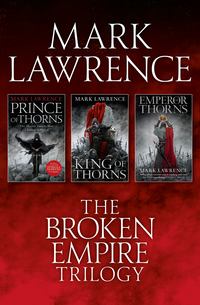
Kitabı oku: «The Complete Broken Empire Trilogy: Prince of Thorns, King of Thorns, Emperor of Thorns»
Mark Lawrence
The Broken Empire Trilogy
Book 1: Prince of Thorns Book 2: King of Thorns Book 3: Emperor of Thorns

Copyright
HarperVoyager
An imprint of HarperCollinsPublishers Ltd
77–85 Fulham Palace Road
Hammersmith, London W6 8JB
www.harpercollins.co.uk
Prince of Thorns
First Published in Great Britain by HarperVoyager 2011
Copyright © Mark Lawrence 2011
Cover Layout Design © HarperCollinsPublishers Ltd 2011
Cover illustration © Jason Chan
King of Thorns
First Published in Great Britain by HarperVoyager 2012
Copyright © Mark Lawrence 2012.
Map © Andrew Ashton
Cover Layout Design © HarperCollinsPublishers Ltd 2012
Cover illustration © Jason Chan
Emperor of Thorns
First Published in Great Britain by HarperVoyager 2013
Copyright © Mark Lawrence 2013
Map © Andrew Ashton
Cover Layout Design © HarperCollinsPublishers Ltd 2013
Cover illustration © Jason Chan
Mark Lawrence asserts the moral right to be identified as the author of this work.
A catalogue copy of this book is available from the British Library.
This novel is entirely a work of fiction. The names, characters and incidents portrayed in it are the work of the author’s imagination. Any resemblance to actual persons, living or dead, events or localities is entirely coincidental.
All rights reserved under International and Pan-American Copyright Conventions. By payment of the required fees, you have been granted the non-exclusive, non-transferable right to access and read the text of this e-book on screen. No part of this text may be reproduced, transmitted, down-loaded, decompiled, reverse engineered, or stored in or introduced into any information storage and retrieval system, in any form or by any means, whether electronic or mechanical, now known or hereinafter invented, without the express written permission of HarperCollins.
Source ISBNs:
Prince of Thorns: 9780007423293
King of Thorns: 9780007439034
Emperor of Thorns: 9780007439065
Bundle Edition (Containing Prince of Thorns, King of Thorns and Emperor of Thorns) © November 2014 ISBN: 9780008113704
Version: 2014-09-23
Contents
Cover
Title Page
Copyright
Prince of Thorns
King of Thorns
Emperor of Thorns
About the Author
Also by Mark Lawrence
About the Publisher

PRINCE OF THORNS
Book One of The Broken Empire
Mark Lawrence
To Celyn, the best parts were never broken.
Contents
Title Page
Dedication
Map
Chapter 1
Chapter 2
Chapter 3
Chapter 4
Chapter 5
Chapter 6
Chapter 7
Chapter 8
Chapter 9
Chapter 10
Chapter 11
Chapter 12
Chapter 13
Chapter 14
Chapter 15
Chapter 16
Chapter 17
Chapter 18
Chapter 19
Chapter 20
Chapter 21
Chapter 22
Chapter 23
Chapter 24
Chapter 25
Chapter 26
Chapter 27
Chapter 28
Chapter 29
Chapter 30
Chapter 31
Chapter 32
Chapter 33
Chapter 34
Chapter 35
Chapter 36
Chapter 37
Chapter 38
Chapter 39
Chapter 40
Chapter 41
Chapter 42
Chapter 43
Chapter 44
Chapter 45
Chapter 46
Chapter 47
Chapter 48
Chapter 49
Acknowledgments

1
Ravens! Always the ravens. They settled on the gables of the church even before the injured became the dead. Even before Rike had finished taking fingers from hands, and rings from fingers. I leaned back against the gallows-post and nodded to the birds, a dozen of them in a black line, wise-eyed and watching.
The town-square ran red. Blood in the gutters, blood on the flagstones, blood in the fountain. The corpses posed as corpses do. Some comical, reaching for the sky with missing fingers, some peaceful, coiled about their wounds. Flies rose above the wounded as they struggled. This way and that, some blind, some sly, all betrayed by their buzzing entourage.
‘Water! Water!’ It’s always water with the dying. Strange, it’s killing that gives me a thirst.
And that was Mabberton. Two hundred dead farmers lying with their scythes and axes. You know, I warned them that we do this for a living. I said it to their leader, Bovid Tor. I gave them that chance, I always do. But no. They wanted blood and slaughter. And they got it.
War, my friends, is a thing of beauty. Those as says otherwise are losing. If I’d bothered to go over to old Bovid, propped up against the fountain with his guts in his lap, he’d probably take a contrary view. But look where disagreeing got him.
‘Shit-poor farm maggots.’ Rike discarded a handful of fingers over Bovid’s open belly. He came to me, holding out his takings, as if it was my fault. ‘Look! One gold ring. One! A whole village and one fecking gold ring. I’d like to set the bastards up and knock ’em down again. Fecking bog-farmers.’
He would too: he was an evil bastard, and greedy with it. I held his eye. ‘Settle down, Brother Rike. There’s more than one kind of gold in Mabberton.’
I gave him my warning look. His cursing stole the magic from the scene; besides, I had to be stern with him. Rike was always on the edge after a battle, wanting more. I gave him a look that told him I had more. More than he could handle. He grumbled, stowed his bloody ring, and thrust his knife back in his belt.
Makin came up then and flung an arm about each of us, clapping gauntlet to shoulder-plate. If Makin had a skill, then smoothing things over was it.
‘Brother Jorg is right, Little Rikey. There’s treasure aplenty to be found.’ He was wont to call Rike ‘Little Rikey’, on account of him being a head taller than any of us and twice as wide. Makin always told jokes. He’d tell them to those as he killed, if they gave him time. Liked to see them go out with a smile.
‘What treasure?’ Rike wanted to know, still surly.
‘When you get farmers, what else do you always get, Little Rikey?’ Makin raised his eyebrows all suggestive.
Rike lifted his visor, treating us to his ugly face. Well brutal more than ugly. I think the scars improved him. ‘Cows?’
Makin pursed his lips. I never liked his lips, too thick and fleshy, but I forgave him that, for his joking and his deathly work with that flail of his. ‘Well, you can have the cows, Little Rikey. Me, I’m going to find a farmer’s daughter or three, before the others use them all up.’
They went off then, Rike doing that laugh of his – ‘hur, hur, hur’ – as if he was trying to cough a fishbone out.
I watched them force the door to Bovid’s place opposite the church, a fine house, high roofed with wooden slates and a little flower garden in front. Bovid followed them with his eyes, but he couldn’t turn his head.
I looked at the ravens, I watched Gemt and his halfwit brother, Maical, taking heads, Maical with the cart and Gemt with the axe. A thing of beauty, I tell you. At least to look at. I’ll agree war smells bad. But, we’d torch the place soon enough and the stink would all turn to wood-smoke. Gold rings? I needed no more payment.
‘Boy!’ Bovid called out, his voice all hollow like, and weak.
I went to stand before him, leaning on my sword, tired in my arms and legs all of a sudden. ‘Best speak your piece quickly, farmer. Brother Gemt’s a-coming with his axe. Chop-chop.’
He didn’t seem too worried. It’s hard to worry a man so close to the worm-feast. Still it irked me that he held me so lightly and called me ‘boy’. ‘Do you have daughters, farmer? Hiding in the cellar maybe? Old Rike will sniff them out.’
Bovid looked up sharp at that, pained and sharp. ‘H-how old are you, boy?’
Again the ‘boy’. ‘Old enough to slit you open like a fat purse,’ I said, getting angry now. I don’t like to get angry. It makes me angry. I don’t think he caught even that. I don’t think he even knew it was me that opened him up not half an hour before.
‘Fifteen summers, no more. Couldn’t be more …’ His words came slow, from blue lips in a white face.
Out by two, I would have told him, but he’d gone past hearing. The cart creaked up behind me, and Gemt came along with his axe dripping.
‘Take his head,’ I told them. ‘Leave his fat belly for the ravens.’
Fifteen! I’d hardly be fifteen and rousting villages.
By the time fifteen came around, I’d be King!
Some people are born to rub you the wrong way. Brother Gemt was born to rub the world the wrong way.
2
Mabberton burned well. All the villages burned well that summer. Makin called it a hot bastard of a summer, too mean to give out rain, and he wasn’t wrong. Dust rose behind us when we rode in; smoke when we rode out.
‘Who’d be a farmer?’ Makin liked to ask questions.
‘Who’d be a farmer’s daughter?’ I nodded toward Rike, rolling in his saddle, almost tired enough to fall out, wearing a stupid grin and a bolt of samite cloth over his half-plate. Where he found samite in Mabberton I never did get to know.
‘Brother Rike does enjoy his simple pleasures,’ Makin said.
He did. Rike had a hunger for it. Hungry like the fire.
The flames fair ate up Mabberton. I put the torch to the thatched inn, and the fire chased us out. Just one more bloody day in the years’ long death throes of our broken empire.
Makin wiped at his sweat, smearing himself all over with soot-stripes. He had a talent for getting dirty, did Makin. ‘You weren’t above those simple pleasures yourself, Brother Jorg.’
I couldn’t argue there. ‘How old are you?’ that fat farmer had wanted to know. Old enough to pay a call on his daughters. The fat girl had a lot to say, just like her father. Screeched like a barn owl: hurt my ears with it. I liked the older one better. She was quiet enough. So quiet you’d give a twist here or there just to check she hadn’t died of fright. Though I don’t suppose either of them was quiet when the fire reached them …
Gemt rode up and spoiled my imaginings.
‘The Baron’s men will see that smoke from ten miles. You shouldn’ta burned it.’ He shook his head, his stupid mane of ginger hair bobbing this way and that.
‘Shouldn’ta,’ his idiot brother joined in, calling from the old grey. We let him ride the old grey with the cart hitched up. The grey wouldn’t leave the road. That horse was cleverer than Maical.
Gemt always wanted to point stuff out. ‘You shouldn’ta put them bodies down the well, we’ll go thirsty now.’ ‘You shouldn’ta killed that priest, we’ll have bad luck now.’ ‘If we’d gone easy on her we’d have a ransom from Baron Kennick.’ I just ached to put my knife through his throat. Right then. Just to lean out and plant it in his neck. ‘What’s that? What say you, Brother Gemt? Bubble, bubble? Shouldn’ta stabbed your bulgy old Adam’s apple?’
‘Oh no!’ I cried, all shocked like. ‘Quick, Little Rikey, go piss on Mabberton. Got to put that fire out.’
‘Baron’s men will see it,’ said Gemt, stubborn and red-faced. He went red as a beet if you crossed him. That red face just made me want to kill him even more. I didn’t, though. You got responsibilities when you’re a leader. You got a responsibility not to kill too many of your men. Or who’re you going to lead?
The column bunched up around us, the way it always did when something was up. I pulled on Gerrod’s reins and he stopped with a snicker and a stamp. I watched Gemt and waited. Waited until all thirty-eight of my brothers gathered around, and Gemt got so red you’d think his ears would bleed.
‘Where we all going, my brothers?’ I asked, and I stood in my stirrups so I could look out over their ugly faces. I asked it in my quiet voice and they all hushed to hear.
‘Where?’ I asked again. ‘Surely it isn’t just me that knows? Do I keep secrets from you, my brothers?’
Rike looked a bit confused at this, furrowing his brow. Fat Burlow came up on my right, on my left the Nuban with his teeth so white in that soot-black face. Silence.
‘Brother Gemt can tell us. He knows what should be and what is.’ I smiled, though my hand still ached with wanting my dagger in his neck. ‘Where we going, Brother Gemt?’
‘Wennith, on the Horse Coast,’ he said, all reluctant, not wanting to agree to anything.
‘Well and good. How we going to get there? Near forty of us on our fine oh-so-stolen horses?’
Gemt set his jaw. He could see where I was going.
‘How we going to get there, if we want us a slice of the pie while it’s still nice and hot?’ I asked.
‘Lich Road!’ Rike called out, all pleased that he knew the answer.
‘Lich Road,’ I repeated, still quiet and smiling. ‘What other way could we go?’ I looked at the Nuban, holding his dark eyes. I couldn’t read him, but I let him read me.
‘Ain’t no other way.’
Rike’s on a roll, I thought, he don’t know what game’s being played, but he likes his part.
‘Do the Baron’s men know where we’re going?’ I asked Fat Burlow.
‘War dogs follow the front,’ he said. Fat Burlow ain’t stupid. His jowls quiver when he speaks, but he ain’t stupid.
‘So …’ I looked around them, real slow-like. ‘So, the Baron knows where bandits such as ourselves will be going, and he knows the way we’ve got to go.’ I let that sink in. ‘And I just lit a bloody big fire that tells him and his what a bad idea it’d be to follow.’
I stuck Gemt with my knife then. I didn’t need to, but I wanted it. He danced pretty enough too, bubble bubble on his blood, and fell off his horse. His red face went pale quick enough.
‘Maical,’ I said. ‘Take his head.’
And he did.
Gemt just chose a bad moment.
Whatever broke Brother Maical left the outside untouched. He looked as solid and as tough and as sour as the rest of them. Until you asked him a question.
3
‘Two dead, two wrigglers.’ Makin wore that big grin of his.
We’d have camped by the gibbet in any case, but Makin had ridden on ahead to check the ground. I thought the news that two of the four gibbet cages held live prisoners would cheer the brothers.
‘Two,’ Rike grumbled. He’d tired himself out, and a tired Little Rikey always sees a gibbet as half empty.
‘Two!’ the Nuban hollered down the line.
I could see some of the lads exchanging coin on their bets. The Lich Road is as boring as a Sunday sermon. It runs straight and level. So straight it gets so as you’d kill for a left turn or a right turn. So level you’d cheer a slope. And on every side, marsh, midges, midges and more marsh. On the Lich Road it didn’t get any better than two caged wrigglers on a gibbet.
Strange that I didn’t think to question what business a gibbet had standing out there in the middle of nowhere. I took it as a bounty. Somebody had left their prisoners to die, dangling in cages at the roadside. A strange spot to choose, but free entertainment for my little band nonetheless. The brothers were eager, so I nudged Gerrod into a trot. A good horse, Gerrod. He shook off his weariness and clattered along. There’s no road like the Lich Road for clattering along.
‘Wrigglers!’ Rike gave a shout and they were all racing to catch up.
I let Gerrod have his head. He wouldn’t let any horse get past him. Not on this road. Not with every yard of it paved, every flagstone fitting with the next so close a blade of grass couldn’t hope for the light. Not a stone turned, not a stone worn. Built on a bog, mind you!
I beat them to the wrigglers, of course. None of them could touch Gerrod. Certainly not with me on his back and them all half as heavy again. At the gibbet I turned to look back at them, strung out along the road. I yelled out, wild with the joy of it, loud enough to wake the head-cart. Gemt would be in there, bouncing around at the back.
Makin reached me first, even though he’d rode the distance twice before.
‘Let the Baron’s men come,’ I told him. ‘The Lich Road is as good as any bridge. Ten men could hold an army here. Them that wants to flank us can drown in the bog.’
Makin nodded, still hunting his breath.
‘The ones who built this road … if they’d make me a castle—’ Thunder in the east cut across my words.
‘If the Road-men built castles we’d never get in anywhere,’ Makin said. ‘Be happy they’re gone.’
We watched the brothers come in. The sunset turned the marsh pools to orange fire, and I thought of Mabberton.
‘A good day, Brother Makin,’ I said.
‘Indeed, Brother Jorg,’ he said.
So, the brothers came and set to arguing over the wrigglers. I went and sat against the loot-cart to read while the light stayed with us and the rain held off. The day left me in mind to read Plutarch. I had him all to myself, sandwiched between leather covers. Some worthy monk spent a lifetime on that book. A lifetime hunched over it, brush in hand. Here the gold, for halo, sun, and scrollwork. Here a blue like poison, bluer than a noon sky. Tiny vermilion dots to make a bed of flowers. Probably went blind over it, that monk. Probably poured his life in here, from young lad to grey-head, prettying up old Plutarch’s words.
The thunder rolled, the wrigglers wriggled and howled, and I sat reading words that were older than old before the Road-men built their roads.
‘You’re cowards! Women with your swords and axes!’ One of the crow-feasts on the gibbet had a mouth on him.
‘Not a man amongst you. All pederasts, trailing up here after that little boy.’ He curled his words up at the end like a Merssy-man.
‘There’s a fella over here got an opinion about you, Brother Jorg!’ Makin called out.
A drop of rain hit my nose. I closed the cover on Plutarch. He’d waited a while to tell me about Sparta and Lycurgus, he could wait some more and not get wet doing it. The wriggler had more to say and I let him tell it to my back. On the road you’ve got to wrap a book well to keep the rain out. Ten turns of oilcloth, ten more turns the other way, then stash it under a cloak in a saddlebag. A good saddlebag mind, none of that junk from the Thurtans, good double-stitched leather from the Horse Coast.
The lads parted to let me up close. The gibbet stank worse than the head-cart, a crude thing of fresh-cut timber. Four cages hung there. Two held dead men. Very dead men. Legs dangling through the bars, raven-pecked to the bone. Flies thick about them, like a second skin, black and buzzing. The lads had taken a few pokes at one of the wrigglers, and he didn’t look too cheerful for it. In fact he looked as if he’d pegged it. Which was a waste, as we had a whole night ahead of us, and I’d have said as much, but for the wriggler with the mouth.
‘So now the boy comes over! He’s finished looking for lewd pictures in his stolen book.’ He sat crouched up in his cage, his feet all bleeding and raw. An old man, maybe forty, all black hair and grey beard and dark eyes glittering. ‘Take the pages to wipe your dung, boy,’ he said fierce-like, grabbing the bars all of a sudden, making the cage swing. ‘It’s the only use you’ll get from it.’
‘We could set a slow fire?’ Rike said. Even Rike knew the old man just wanted us angry, so we’d finish him quick. ‘Like we did at the Turston gibbets.’
A few chuckles went up at that. Not from Makin though. He had a frown on under his dirt and soot, staring at the wriggler. I held up a hand to quiet them down.
‘It’d be a shameful waste of such a fine book, Father Gomst,’ I said.
Like Makin, I’d recognized Gomst through all that beard and hair. Without that accent though he’d have got roasted.
‘Especially an “On Lycurgus” written in high Latin, not that pidgin-Romano they teach in church.’
‘You know me?’ He asked it in a cracked voice, weepy all of a sudden.
‘Of course I do.’ I pushed both hands through my lovely locks, and set my hair back so he could see me proper in the gloom. I have the sharp dark looks of the Ancraths. ‘You’re Father Gomst, come to take me back to school.’
‘Pr-prin …’ He was blubbing now, unable to get his words out. Disgusting really. Made me feel as if I’d bitten something rotten.
‘Prince Honorous Jorg Ancrath, at your service.’ I did my court bow.
‘Wh-what became of Captain Bortha?’ Father Gomst swung gently in his cage, all confused.
‘Captain Bortha, sir!’ Makin snapped a salute and stepped up. He had blood on him from the first wriggler.
We had us a deathly silence then. Even the chirp and whir of the marsh hushed down to a whisper. The brothers looked from me, back to the old priest, and back to me, mouths hanging open. Little Rikey couldn’t have looked more surprised if you’d asked him nine times six.
The rain chose that moment to fall, all at once as if the Lord Almighty had emptied his chamber pot over us. The gloom that had been gathering set thick as treacle.
‘Prince Jorg!’ Father Gomst had to shout over the rain. ‘The night! You’ve got to run!’ He held the bars of his cage, white-knuckled, wide eyes unblinking in the downpour, staring into the darkness.
And through the night, through the rain, over the marsh where no man could walk, we saw them coming. We saw their lights. Pale lights such as the dead burn in deep pools where men aren’t meant to look. Lights that’d promise whatever a man could want, and would set you chasing them, hunting answers and finding only cold mud, deep and hungry.
I never liked Father Gomst. He’d been telling me what to do since I was six, most often with the back of his hand as the reason.
‘Run Prince Jorg! Run!’ old Gomsty howled, sickeningly self-sacrificing.
So I stood my ground.
Brother Gains wasn’t the cook because he was good at cooking. He was just bad at everything else.
4
The dead came on through the rain, the ghosts of the bog-dead, of the drowned, and of men whose corpses were given to the mire. I saw Red Kent run blind and flounder in the marsh. A few of the brothers had the sense to take the road when they ran, most ended in the mire.
Father Gomst started praying in his cage, shouting out the words like a shield: ‘Father who art in heaven protect thy son. Father who art in heaven.’ Faster and faster, as the fear got into him.
The first of them came up over the sucking pool, and onto the Lichway. He had a glow about him like moonlight, something that you knew would never warm you. You could see his body limned in the light, with the rain racing through him and bouncing on the road.
Nobody stood with me. The Nuban ran, eyes wide in a dark face. Fat Burlow looking as if the blood was let from him. Rike screaming like a child. Even Makin, with a horror on him.
I held my arms wide to the rain. I could feel it beat on me. I didn’t have so many years under my belt, but even to me the rain fell like memory. It woke wild nights in me when I stood on the Keep Tower, on the edge above a high fall, near drowned in the deluge and daring the lightning to touch me.
‘Our Father who art in heaven. Father who art …’ Gomst started to gabble when the lich came close. It burned with a cold fire and you could feel it licking at your bones.
I kept my arms wide and my face to the rain.
‘My father isn’t in heaven, Gomsty,’ I said. ‘He’s in his castle, counting out his men.’
The dead thing closed on me, and I looked in its eyes. Hollow they were.
‘What have you got?’ I said.
And it showed me.
And I showed it.
There’s a reason I’m going to win this war. Everyone alive has been fighting a battle that grew old before they were born. I cut my teeth on the wooden soldiers in my father’s war-room. There’s a reason I’m going to win where they failed. It’s because I understand the game.
‘Hell,’ the dead man said. ‘I’ve got hell.’
And he flowed into me, cold as dying, edged like a razor.
I felt my mouth curl in a smile. I heard my laughing over the rain.
A knife is a scary thing right enough, held to your throat, sharp and cool. The fire too, and the rack. And an old ghost on the Lichway. All of them might give you pause. Until you realize what they are. They’re just ways to lose the game. You lose the game, and what have you lost? You’ve lost the game.
That’s the secret, and it amazes me that it’s mine and mine alone. I saw the game for what it was the night when Count Renar’s men caught our carriage. There was a storm that night too, I remember the din of rain on the carriage roof and the thunder beneath it.
Big Jan had fair hauled the door off its hinges to get us out. He only had time for me though. He threw me clear; into a briar patch so thick that the Count’s men persuaded themselves I’d run into the night. They didn’t want to search it. But I hadn’t run. I’d hung there in the thorns, and I saw them kill Big Jan. I saw it in the frozen moments the lightning gave me.
I saw what they did to Mother, and how long it took. They broke little William’s head against a milestone. Golden curls and blood. And I’ll admit that William was the first of my brothers, and he did have his hooks in me, with his chubby hands and laughing. Since then I’ve taken on many a brother, and evil ones at that, so I’d not miss one or three. But at the time, it did hurt to see little William broken like that, like a toy. Like something worthless.
When they killed him, Mother wouldn’t hold her peace, so they slit her throat. I was stupid then, being only nine, and I fought to save them both. But the thorns held me tight. I’ve learned to appreciate thorns since.
The thorns taught me the game. They let me understand what all those grim and serious men who’ve fought the Hundred War, have yet to learn. You can only win the game when you understand that it is a game. Let a man play chess, and tell him that every pawn is his friend. Let him think both bishops holy. Let him remember happy days in the shadows of his castles. Let him love his queen. Watch him lose them all.
‘What have you got for me, dead thing?’ I asked.
It’s a game. I will play my pieces.
I felt him cold inside me. I saw his death. I saw his despair. And his hunger. And I gave it back. I’d expected more, but he was only dead.
I showed him the empty time where my memory won’t go. I let him look there.
He ran from me then. He ran, and I chased him. But only to the edge of the marsh. Because it’s a game. And I’m going to win.
5
Four years earlier
For the longest time I studied revenge to the exclusion of all else. I built my first torture chamber in the dark vaults of imagination. Lying on bloody sheets in the Healing Hall I discovered doors within my mind that I’d not found before, doors that even a child of nine knows should not be opened. Doors that never close again.
I threw them wide.
Sir Reilly found me, hanging within the hook-briar, not ten yards from the smoking ruin of the carriage. They almost missed me. I saw them reach the bodies on the road. I watched them through the briar, silver glimpses of Sir Reilly’s armour, and flashes of red from the tabards of Ancrath foot-soldiers.
Mother was easy to find, in her silks.
‘Sweet Jesu! It’s the Queen!’ Sir Reilly had them turn her over. ‘Gently! Show some respect—’ He broke off with a gasp. The Count’s men hadn’t left her pretty.
‘Sir! Big Jan’s over here, Grem and Jassar too.’ I saw them heave Jan over, then turn to the other guardsmen.
‘They’d better be dead!’ Sir Reilly spat. ‘Look for the princes!’
I didn’t see them find Will, but I knew they had by the silence that spread across the men. I let my chin fall back to my chest and watched the dark patterning of blood on the dry leaves around my feet.
‘Ah, hell …’ One of the men spoke at last.
‘Get him on a horse. Easy with him,’ Sir Reilly said. A crack ran through his voice. ‘And find the heir!’ With more vigour, but no hope.
I tried to call to them, but the strength had run from me, I couldn’t even lift my head.
‘He’s not here, Sir Reilly.’
‘They’ve taken him as a hostage,’ Sir Reilly said.
He had part of it right, something held me against my will.
‘Set him by the Queen.’
‘Gentle! Gentle with him …’
‘Secure them,’ Sir Reilly said. ‘We ride hard for the Tall Castle.’
Part of me wanted to let them go. I felt no pain any more, just a dull ache, and even that was fading. A peace folded me with the promise of forgetting.
‘Sir!’ A shout went up from one of the men.
I heard the clank of armour as Sir Reilly strode across to see.
‘Piece of a shield?’ he asked.
‘Found it in the mud, the carriage wheel must have pushed it under.’ The soldier paused. I heard scraping. ‘Looks like a black wing to me …’
‘A crow. A crow on a red field. It’s Count Renar’s colours,’ Reilly said.
Count Renar? I had a name. A black crow on a red field. The insignia flashed across my eyes, seared deep by the lightning of last night’s storm. A fire lit within me, and the pain from a hundred hooks burned in every limb. A groan escaped me. My lips parted, dry skin tearing.
And Reilly found me.
‘There’s something here!’ I heard him curse as the hook-briar found every chink in his armour. ‘Quickly now! Pull this stuff apart.’
‘Dead.’ I heard the whisper from behind Sir Reilly as he cut me free.
‘He’s so white.’
I guess the briar near bled me dry.
So they fetched a cart and took me back. I didn’t sleep. I watched the sky turn black, and I thought.
In the Healing Hall Friar Glen and his helper, Inch, dug the hooks from my flesh. My tutor, Lundist, arrived while they had me on the table with their knives out. He had a book with him, the size of a Teuton shield, and three times as heavy by the look of it. Lundist had more strength in that wizened old stick of a body than anyone guessed.
‘Those are fire-cleaned knives I hope, Friar?’ Lundist carried the accent of his homelands in the Utter East, and a tendency to leave half of a word unspoken, as if an intelligent listener should be able to fill in the blanks.
‘It is purity of spirit that will keep corruption from the flesh, Tutor,’ Friar Glen said. He spared Lundist a disapproving glance, and returned to his digging.
‘Even so, clean the knives, Friar. Holy office will prove scant protection from the King’s ire if the Prince dies in your halls.’ Lundist set his book down on the table beside me, rattling a tray of vials at the far end. He lifted the cover and turned to a marked page.
‘“The thorns of the hook-briar are like to find the bone.’” He traced a wrinkled yellow finger down the lines. ‘“The points can break off and sour the wound.”’
Friar Glen gave a sharp jab at that, which made me cry out. He set his knife down and turned to face Lundist. I could see only the friar’s back, the brown cloth straining over his shoulders, dark with sweat over his spine.
‘Tutor Lundist,’ he said. ‘A man in your profession is wont to think all things may be learned from the pages of a book, or the right scroll. Learning has its place, sirrah, but do not think to lecture me on healing on the basis of an evening spent with an old tome!’
Well, Friar Glen won that argument. The sergeant-at-arms had to ‘help’ Tutor Lundist from the hall.
I guess even at nine I had a serious lack of spiritual purity, for my wounds soured within two days, and for nine weeks I lay in fever, chasing dark dreams along death’s borderlands.
They tell me I raged and howled. That I raved as the pus oozed from slices where the briar had held me. I remember the stink of corruption. It had a kind of sweetness to it, a sweetness that’d make you want to hurl.
Inch, the friar’s aide, grew tired of holding me down, though he had the arms of a lumberjack. In the end they tied me to my bed.
I learned from Tutor Lundist that the friar would not attend me after the first week. Friar Glen said a devil was in me. How else could a child speak such horror?
In the fourth week I slipped the bonds that held me to my pallet, and set a fire in the hall. I have no memory of the escape, or my capture in the woods. When they cleared the ruin, they found the remains of Inch, with the poker from the hearth lodged in his chest.
Many times I stood at the Door. I had seen my mother and brother thrown through that doorway, torn and broken, and in dreams my feet would take me to stand there, time and again. I lacked the courage to follow them, held on the barbs and hooks of cowardice.
Sometimes I saw the dead-lands across a black river, sometimes across a chasm spanned by a narrow bridge of stone. Once I saw the Door in the guise of the portals to my father’s throne room, but edged with frost and weeping pus from every join. I had but to set my hand upon the handle …
The Count of Renar kept me alive. The promise of his pain crushed my own under its heel. Hate will keep you alive where love fails.
And then one day my fever left me. My wounds remained angry and red, but they closed. They fed me chicken in soup, and my strength crept back, a stranger to me.
The spring came to paint the leaves back upon the trees. I had my strength, but I felt something else had been taken. Taken so completely I could no longer name it.
The sun returned, and, much to Friar Glen’s distaste, Lundist returned to instruct me once more.
The first time he came, I sat abed. I watched him set out his books upon the table.
‘Your father will see you on his return from Gelleth,’ Lundist said. His voice held a note of reproach, but not for me. ‘The death of the Queen and Prince William weigh heavy on him. When the pain eases he will surely come to speak with you.’
I didn’t understand why Lundist should feel the need to lie. I knew my father would not waste time on me whilst it seemed I would die. I knew he would see me when seeing me served some end.
‘Tell me, tutor,’ I said. ‘Is revenge a science, or an art?’
6
The rain faltered when the spirits fled. I’d only broken the one, but the others ran too, back to whatever pools they haunted. Maybe my one had been their leader; maybe men become cowards in death. I don’t know.
As to my own cowards, they had nowhere to flee, and I found them easily enough. I found Makin first. He, at least, was headed back toward me.
‘So you found a pair then?’ I called to him.
He paused a moment and looked at me. The rain didn’t fall so heavy now, but he still looked like a drowned rat. The water ran in rivulets over his breastplate, in and out of the dents. He checked the marsh to either side, still nervy, and lowered his sword.
‘A man who’s got no fear is missing a friend, Jorg,’ he said, and a smile found its way onto those thick lips of his. ‘Running ain’t no bad thing. Leastways if you run in the right direction.’ He waved a hand toward where Rike wrestled with a clump of bulrushes, the mud up to his chest already. ‘Fear helps a man pick his fights. You’re fighting them all, my prince.’ And he bowed, there on the Lichway with the rain dripping off him.
I spared a glance for Rike. Maical had similar problems in a pool to the other side of the road. Only he’d got his problems up to the neck.
‘I’m going to fight them all in the end,’ I said to him.
‘Pick your fights,’ Makin said.
‘I’ll pick my ground,’ I said. ‘I’ll pick my ground, but I’m not running. Not ever. That’s been done, and we still have the war. I’m going to win it, Brother Makin, it’s going to end with me.’
He bowed again. Not so deep, but this time I felt he meant it. ‘That’s why I’ll follow you, Prince. Wherever it takes us.’
For the moment it took us to fishing brothers out of the mud. We got Maical first, even though Rike howled and cursed us. As the rain thinned, I could see the grey and the head-cart off in the distance. The grey had the sense to keep to the road, even when Maical didn’t. If Maical had led the grey into the mire I’d have left him to sink.
We pulled Rike out next. When we reached him the mud had almost found his mouth. Nothing but his white face showed above the pool, but that didn’t stop him shouting his foulnesses all the way. We found most of them on the road, but six got sucked down too quick, lost forever; probably getting ready to haunt the next band of travellers.
‘I’m going back for old Gomsty,’ I said.
We’d come a way down the road and the light had pretty much gone. Looking back you couldn’t see the gibbets, just grey veils of rain. Out in the marsh the dead waited. I felt their cold thoughts crawling on my skin.
I didn’t ask any of them to go with me. I knew none of them would, and it don’t do for a leader to ask and be told no.
‘What do you want with that old priest, Brother Jorg?’ Makin said. He was asking me not to go; only he couldn’t come out and say it.
‘You still want to burn him up?’ Even the mud couldn’t hide Rike’s sudden cheer.
‘I do,’ I said. ‘But that’s not why I’m getting him.’ And I set off back along the Lichway.
The rain and the darkness wrapped me. I lost the brothers, waiting on the road behind. Gomst and the gibbets lay ahead. I walked in a cocoon of silence, with nothing but the soft words of the rain, and the sound of my boots on the Lichway.
I’ll tell you now. That silence almost beat me. It’s the silence that scares me. It’s the blank page on which I can write my own fears. The spirits of the dead have nothing on it. The dead one tried to show me hell, but it was a pale imitation of the horror I can paint on the darkness in a quiet moment.
And there he hung, Father Gomst, priest to the House of Ancrath.
‘Father,’ I said, and I sketched him a bow. In truth though, I was in no mood for play. I had me a hollow ache behind my eyes. The kind that gets people killed.
He looked at me wide-eyed, as if I was a bog-spirit crawled out of the mire.
I went to the chain that held his cage up. ‘Brace yourself, Father.’
The sword I drew had slit old Bovid Tor not twenty-four hours before. Now I swung it to free a priest. The chain gave beneath its edge. They’d put some magic, or some devilry, in that blade. Father told me the Ancraths wielded it for four generations, and took it from the House of Or. So the steel was old before we Ancraths first lay hands upon it. Old before I stole it.
The birdcage fell to the path, hard and heavy. Father Gomst cried out, and his head hit the bars, leaving a livid cross-work across his forehead. They’d bound the cage-door with wire. It gave before the edge of our ancestral sword, twice stolen. I thought of Father for a moment, imaged his face twist in outrage at the use of so high a blade for such lowly work. I’ve a good imagination, but putting any emotion on the rock of Father’s face came hard.
Gomst crawled out, stiff and weak. As the old should be. I liked that he had the grace to feel the years on his shoulders. Some the years just toughened.
‘Father Gomst,’ I said. ‘Best hurry now, or the marsh dead may come out to scare us with their wailing and a-moaning.’
He looked at me then, drawing back as if he’d seen a ghost, then softening.
‘Jorg,’ he said, all full of compassion. Brimming with it, spilling it from his eyes as if it wasn’t just the rain. ‘What has happened to you?’
I won’t lie to you. Half of me wanted to stick the knife into him there and then, just as with red-faced Gemt. More than half. My hand itched with the need to pull that knife. My head ached with it, as if a vice were tightening against my temples.
I’ve been known to be contrary. When something pushes me, I shove back. Even if the one doing the pushing is me. It would have been easy to gut him then and there. Satisfying. But the need was too urgent. I felt pushed.
I smiled and said, ‘Forgive me, Father, for I have sinned.’
And old Gomsty, though he was stiff from the cage, and sore in every limb, bowed his head to hear my confession.
I spoke into the rain, low and quiet. Loud enough for Father Gomst though, and loud enough for the dead who haunted the marsh about us. I told of the things I’d done. I told of the things I would do. In a soft voice I told my plans to all with ears to hear. The dead left us then.
‘You’re the devil!’ Father Gomst took a step back, and clutched the cross at his neck.
‘If that’s what it takes.’ I didn’t dispute him. ‘But I’ve confessed, and you must forgive me.’
‘Abomination …’ The word escaped him in a slow breath.
‘And more besides,’ I agreed. ‘Now forgive me.’
Father Gomst found his wits at last, but still he held back. ‘What do you want with me, Lucifer?’
A fair question. ‘I want to win,’ I said.
He shook his head at that, so I explained.
‘Some men I can bind with who I am. Some I can bind with where I’m going. Others need to know who walks with me. I’ve given you my confession. I repent. Now God walks with me, and you’re the priest who will tell the faithful that I am His warrior, His instrument, the Sword of the Almighty.’
A silence stood between us, measured in heartbeats.
‘Ego te absolvo.’ Father Gomst got the words past trembling lips.
We walked back along the path then, and reached the others by and by. Makin had them lined up and ready. Waiting in the dark, with a single torch, and the hooded lantern hung up on the head-cart.
‘Captain Bortha,’ I said to Makin, ‘time we set off. We’ve got a ways before us till we reach the Horse Coast.’
‘And the priest?’ he asked.
‘Perhaps we’ll detour past the Tall Castle, and drop him off.’
My headache bit, hard.
Maybe it was something to do with having an old ghost haunt its way through to the very marrow of my bones, but today my headaches felt more like somebody prodding me with a stick, herding me along, and it was really beginning to fuck me off.
‘I think we will call in at the Tall Castle.’ I ground my teeth together against the daggers in my head. ‘Hand old Gomsty here over in person. I’m sure my father has been worried about me.’
Rike and Maical gave me stupid stares. Fat Burlow and Red Kent swapped glances. The Nuban rolled his eyes and made his wards.
I looked at Makin, tall, broad in the shoulder, black hair plastered down by the rain. He’s my knight, I thought. Gomst is my bishop, the Tall Castle my rook. Then I thought of Father. I needed a king. You can’t play the game without a king. I thought of Father, and it felt good. After the dead one, I’d begun to wonder. The dead one showed me his hell, and I had laughed at it. But now I thought of Father, and it felt good to know I could still feel fear.
7
We rode through the night and the Lichway brought us from the marsh. Dawn found us at Norwood, drear and grey. The town lay in ruin. Its ashes still held the acrid ghost of smoke that lingers when the fire is gone.
‘The Count of Renar,’ said Makin at my side. ‘He grows bold to attack Ancrath protectorates so openly.’ He shed the roadspeak like a cloak.
‘How can we know who wrought such wickedness?’ Father Gomst asked, his face as grey as his beard. ‘Perhaps Baron Kennick’s men raided down the Lichway. It was Kennick’s men who caged me on the gibbet.’
The brothers spread out among the ruins. Rike elbowed Fat Burlow aside, and vanished into the first building, which was nothing but a roofless shell of stone.
‘Shit-poor bog-farmers! Just like fecking Mabberton.’ The violence of his search drowned out any further complaint.
I remembered Norwood on fete day, hung with ribbons. Mother walked with the burgermeister. William and I had treacle-apples.
‘But these were my shit-poor bog-farmers,’ I said. I turned to look at old Gomsty. ‘There are no bodies. This is Count Renar’s work.’
Makin nodded. ‘We’ll find the pyre in the fields to the west. Renar burns them all together. The living and the dead.’
Gomst crossed himself and muttered a prayer.
War is a thing of beauty, as I’ve said before, and those who say otherwise are losing. I put a smile on, though it didn’t fit me. ‘Brother Makin, it seems the Count has made a move. It behoves us, as fellow soldiers, to appreciate his artistry. Have yourself a ride around. I want to know how he played his game.’
Renar. First Father Gomst, now Renar. As though the spirit in the mire had turned a key, and the ghosts of my past were marching through, one by one.
Makin gave a nod and cantered off. Not into town but out along the stream, following it up to the thickets beyond the market field.
‘Father Gomst,’ I said in my most polite court-voice. ‘Pray tell, where were you when Baron Kennick’s men found you?’ It made no sense that our family priest should be taken on a raid.
‘The hamlet of Jessop, my prince,’ Gomst replied, wary and looking anywhere but at me. ‘Should we not ride on? We’ll be safe in the homelands. The raids won’t reach past Hanton.’
True, I thought, so why would you come out into danger? ‘The hamlet of Jessop? Can’t say I’ve even heard of it, Father Gomst,’ I said, still nice as nice. ‘Which means it won’t be much more than three huts and a pig.’
Rike stormed out of the house, blacker than the Nuban with all the ash on him, and spitting mad. He made for the next doorway. ‘Burlow, you fat bastard! You set me up!’ If Little Rikey couldn’t find himself some loot then somebody else would pay. Always.
Gomst looked glad of the diversion, but I drew his attention back. ‘Father Gomst, you were telling me about Jessop.’ I took the reins from his hands.
‘A bog-town, my prince. A nothing. A place where they cut peat for the protectorate. Seventeen huts and perhaps a few more pigs.’ He tried a laugh, but it came out too sharp and nervy.
‘So you journeyed there to offer absolution to the poor?’ I held his eye.
‘Well …’
‘Out past Hanton, out to the edge of the marsh, out into danger,’ I said. ‘You’re a very holy man, Father.’
He bowed his head at that.
Jessop. The name rang a bell. A bell with a deep voice, slow and solemn. Send not to ask for whom the bell tolls …
‘Jessop is where the marsh-tide takes the dead,’ I said. I saw the words on the mouth of old Tutor Lundist as I spoke them. I saw the map behind him, pinned to the study wall, currents marked in black ink. ‘It’s a slow current but sure. The marsh keeps her secrets, but not forever, and Jessop is where she tells them.’
‘That big man, Rike, he’s strangling the fat one.’ Father Gomst nodded toward the town.
‘My father sent you to look at the dead.’ I didn’t let Gomst divert me with small talk. ‘Because you’d recognize me.’
Gomst’s mouth framed a ‘no’, but every other muscle in him said ‘yes’. You’d think priests would be better liars, what with their job and all.
‘He’s still looking for me? After four years!’ Four weeks would have surprised me.
Gomst edged back in his saddle. He spread his hands helplessly. ‘The Queen is heavy with child. Sageous tells the King it will be a boy. I had to confirm the succession.’
Ah! The ‘succession’. That sounded more like the father I knew. And the Queen? Now that put an edge on the day.
‘Sageous?’ I asked.
‘A heathen bone-picker, newly come to court.’ Gomst spat the words as if they tasted sour.
The pause grew into a silence.
‘Rike!’ I said. Not a shout, but loud enough to reach him. ‘Put Fat Burlow down, or I’ll have to kill you.’
Rike let go, and Burlow hit the ground like the three hundred pound lump of lard that he was. I guess that of the two, Burlow looked slightly more purple in the face, but only a little. Rike came toward us with his hands out before him, twisting as though he already had them around my neck. ‘You!’
No sign of Makin, and Father Gomst would be as useful as a fart in the wind against Little Rikey with a rage on him.
‘You! Where’s the fecking gold you promised us?’ A score of heads popped out of windows and doors at that. Even Fat Burlow looked up, sucking in a breath as if it came through a straw.
I let my hand slip from the pommel of my sword. It doesn’t do to sacrifice too many pawns. Rike had only a dozen yards to go. I swung off Gerrod’s saddle and patted his nose, my back to the town.
‘There’s more than one kind of gold in Norwood,’ I said. Loud enough but not too loud. Then I turned and walked past Rike. I didn’t look at him. Give a man like Rike a moment, and he’ll take it.
‘Don’t you be telling me about no farmers’ daughters this time, you little bastard!’ He followed me roaring, but I’d let the heat out of him. He just had wind and noise now. ‘That fecker of a count staked them all out to burn already.’
I made for Midway Street, leading up to the burgermeister’s house from the market field. As we passed him, Brother Gains looked up from the cook-fire he’d started. He clambered to his feet to follow and watch the fun.
The grain-store tower had never looked like much. It looked less impressive now, all scorched, the stones split in the heat. Before they burned them all away, the grain sacks would have hidden the trapdoor. I found it with a little prodding. Rike huffed and puffed behind me all the time.
‘Open it up.’ I pointed to the ring set in the stone slab.
Rike didn’t need telling twice. He got down and heaved the slab up as if it weighed nothing. And there they were, barrel after barrel, all huddled up in the dusty dark.
‘The old burgermeister kept the festival beer under the grain-tower. Every local knows that. A little stream runs down there to keep it all nice and cool-like. Looks like, what, twenty? Twenty barrels of golden festival beer.’ I smiled.
Rike didn’t smile back. He stayed on his hands and knees, and let his eye wander up the blade of my sword. I imagined how it must tickle against his throat.
‘See now, Jorg, Brother Jorg, I didn’t mean …’ he started. Even with my sword at his neck he had a mean look to him.
Makin clattered up and came to stand at my shoulder. I kept the blade at Rike’s throat.
‘I may be little, Little Rikey, but I ain’t a bastard,’ I said, soft, in my killing voice. ‘Isn’t that right, Father Gomst? If I was a bastard you wouldn’t have to risk life and limb to search the dead for me, now would you?’
‘Prince Jorg, let Captain Bortha kill this savage.’ Gomst must have found his composure somewhere. ‘We’ll ride on to the Tall Castle and your father—’
‘My father can damn well wait!’ I shouted. I bit back the rest, angry at being angry.
Rike forgot about the sword for a moment. ‘What the feck is all this “prince” shit? What the feck is all this “Captain Bortha” shit? And when do I get to drink the fecking beer?’
We had ourselves as full an audience then as we’d get, all the brothers about us in a circle.
‘Well,’ I said. ‘Since you ask so nice, Brother Rike, I’ll tell you.’
Makin raised his brows at me and he took a grip on his sword. I waved him down.
‘The Captain Bortha shit is Makin being Captain Makin Bortha of the Ancrath Imperial Guard. The prince shit is me being the beloved son and heir of King Olidan of the House of Ancrath. And we can drink the beer now, because today is my fourteenth birthday, and how else would you toast my health?’
Every brotherhood has a pecking order. With brothers like mine you don’t want to be at the bottom of that order. You’re liable to get pecked to death. Brother Jobe had just the right mix of whipped cur and rabies to stay alive there.
8
So we sat on the tumbled stones of the burgermeister’s house and drank beer. The brothers drank deep and called out my name. Some had it ‘Brother Jorg’, some had it ‘Prince Jorg’, but all of them saw me with new eyes. Rike watched me, beer-foam in his stubbled beard, the line of my sword across his neck. I could see him weighing the odds, a slow ballet of possibilities working their way across his low forehead. I didn’t wait for the word ‘ransom’ to bubble to the surface.
‘He wants me dead, Little Rikey,’ I said. ‘He sent Gomsty out to find proof I was dead, not to find me. He’s got a new queen now.’
Rike gave a grin that had more scowl than grin in it, then belched mightily. ‘You ran from a castle with gold and women, to ride with us? What idiot would do that?’
I sipped my beer. It tasted sour, but that seemed right somehow. ‘An idiot who knows he won’t win the war with the King’s guard at his side,’ I said.
‘What war, Jorg?’ The Nuban sat close by, not drinking. He always spoke slow and serious. ‘You want to beat the Count? Baron Kennick?’
‘The War,’ I said. ‘All of it.’
Red Kent came over from the barrels, his helm brimming with ale. ‘Never happen,’ he said. He lifted the helm and half-drained it in four swallows. ‘So you’re Prince of Ancrath? A copper-crown kingdom. Must be dozens with as good a claim on the high throne. Each of them with their own army.’
‘More like fifty,’ Rike growled.
‘Closer to a hundred,’ I said. ‘I’ve counted.’
A hundred fragments of empire grinding away at each other in a never-ending cycle of little wars, feuds, skirmishes, kingdoms waxing, waning, waxing again, lifetimes spent in conflict and nothing changing. Mine to change, to end, to win.
I finished my beer and got up to find Makin.
I didn’t have to look far. I found him with the horses, checking his stallion, Firejump.
‘What did you find?’ I asked him.
Makin pursed his lips. ‘I found the pyre. About two hundred, all dead. They didn’t light it though – probably scared off.’ He waved toward the west. ‘They came in on foot, up the marsh road, and over the ridge yonder. Had about twenty archers in the thicket by the stream, to pick off folks that tried to run.’
‘How many men altogether?’ I asked.
‘Probably a hundred. Foot soldiers most of them.’ He yawned and ran a hand from forehead to chin. ‘Two days gone now. We’re safe enough.’
I felt invisible thorns scratching at me, sharp hooks in my skin. ‘Come with me,’ I told him.
Makin followed me back to the steps and fallen pillars at the burgermeister’s doors. The brothers had Maical staving in a second barrel.
‘What ho, Captain!’ Burlow called out at Makin, his voice still hoarse from Rike’s strangling. A laugh went up at that, and I let it run its course. I felt the thorns again, sharp and deep. Sharpening me up for something. Two hundred bodies in a heap. All dead.
‘Cap’n Makin tells me we’re going to have company,’ I said.
Makin’s brows rose at that but I ignored him. ‘Twenty swords, rough men, bandits of the lowest order. Not the sort you’d like to meet,’ I told them. ‘Idling along in our direction, weighed down with loot.’
Rike got to his feet all sudden like, his flail rattling at his hip. ‘Loot?’
‘Slugs, I tell you. Growing rich off the destruction of others.’ I showed them my smile. ‘Well, my brothers, we’re going to have to show them the error of their ways. I want them dead. Every last one. And we’ll do it without a scratch. I want trip-pits in the main street. I want brothers hidden in the grain-tower and the Blue Boar tavern. I want Kent, Row, Liar and the Nuban here, behind these walls to shoot them down when they come between tower and tavern.’
The Nuban hefted his crossbow, a monstrous feat of engineering, worked in the old metal and embellished with the faces of strange gods. Kent tossed the dregs from his helm and set it on his head, ready with his longbow.
‘Now they might come over the ridge instead, so Rike’s going to take Maical and six others to hide in the tannery ruins. Anyone comes that way, let them past you, then gut them. Makin will be our scout to give us warning. The good father here and you five there, you’re going to stand with me to tempt them in.’
The brothers needed no telling. Well, Jobe did, but Rike hauled him out of the beer quick enough and he wasn’t gentle about it.
‘Loot!’ Rike shouted the words in his face. ‘Get digging trip-pits, shit-brains.’
They knew how to set up an ambush those lads. No mistake there. No one knew better how to fight in the ruins. Half the time they’d make the ruins themselves, half the time they’d fight in somebody else’s.
‘Burlow, Makin,’ I called them to me as the others set about their tasks. ‘I don’t need you to scout, Makin,’ I said, keeping my voice low. ‘I want you two to go to the thicket by the stream. I want you to hide yourselves. Hide so a bastard could sit on you and still not know you were there. You hide down there and wait. You’ll know what to do.’
‘Prince— Brother Jorg,’ Makin said. He had a big frown on, and his eyes kept straying down the street to old Gomsty praying before the burned-out church. ‘What’s this all about?’
‘You said you’d follow wherever I led, Makin,’ I answered. ‘This is where it starts. When they write the legend, this will be the first page. Some old monk will go blind illuminating this page, Makin. This is where it all starts.’ I didn’t say how short the book might be though.
Makin did that bow of his that’s half a nod, and off he went, Fat Burlow hurrying behind.
So, the brothers dug their traps, laid out their arrows, and hid themselves in what little of Norwood remained. I watched them, cursing their slowness, but holding my peace. And by and by only Father Gomst, my five picked men, and I remained on show. All the rest, a touch over two dozen, lay lost in the ruins.
Father Gomst came to my side, still praying. I wondered how hard he’d pray if he knew what was really coming.
I had an ache in my head now, like a hook inserted behind both eyes, tugging at me. The same ache that started up when the sight of old Gomsty made me think of going home. A familiar pain, one I’d felt at many a turn on the road. Oft times I’d let that pain lead me. But I felt tired of being a fish on a line. I bit back.
I saw the first scout on the marsh road an hour later. Others came soon enough, riding up to join him. I made sure they’d seen the seven of us standing on the burgermeister’s steps.
‘Company,’ I said, and pointed the riders out.
‘Shitdarn!’ Brother Elban spat on his boots. I’d chosen Elban because he didn’t look like much, a grizzled old streak in his rusty chainmail. He had no hair and no teeth, but he had a bite on him. ‘They’s no brigands, look at them ponies.’ He lisped the words a bit, having no teeth and all.
‘You know Elban, you might be right,’ I said, and I gave him a smile. ‘I’d say they looked more like house-troops.’
‘Lord have mercy,’ I heard old Gomsty murmur behind me.
The scouts pulled back. Elban picked up his gear and started for the market field where the horses stood grazing.
‘You don’t want to do that, old man,’ I said, softly.
He turned and I could see the fear in his eyes. ‘You ain’t gonna cut me down is you, Jorth?’ He couldn’t say Jorg without any teeth; I suppose it’s a name you’ve got to put an edge on.
‘I won’t cut you down,’ I said. I almost liked Elban; I wouldn’t kill him without a good reason. ‘Where you going to run to, Elban?’
He pointed over the ridge. ‘That’s the only clear way. Get snarled up elsewise, or worse, back in the marsh.’
‘You don’t want to go over that ridge, Elban,’ I said. ‘Trust me.’
And he did. Though maybe he trusted me because he didn’t trust me, if you get my meaning.
We stood and waited. We sighted the main column on the marsh road first, then moments later, the soldiers showed over the ridge. Two dozen of them, house-troops, carrying spears and shields, and above them the colours of Count Renar. The main column had maybe three score soldiers, and following on behind in a ragged line, well over a hundred prisoners, yoked neck to neck. Half a dozen carts brought up the rear. The covered ones would be loaded with provisions, the others held bodies, stacked like cord-wood.
‘House Renar doesn’t leave the dead unburned. They don’t take prisoners,’ I said.
‘I don’t understand,’ Father Gomst said. He’d gone past scared, into stupid.
I pointed to the trees. ‘Fuel. We’re on the edge of a swamp. There’s no trees for miles in this peat bog. They want a good blaze, so they’re bringing everyone back here to have a nice big bonfire.’
I had an explanation for Renar’s actions but as to my own, like Father Gomst, I wasn’t sure I understood either. Whatever strength I had on the road, it came to me through a willingness to sacrifice. It came on the day I set aside my vengeance on Count Renar as a thing without profit. And yet here I was, in the ruins of Norwood, with a thirst that couldn’t be quenched by any amount of festival beer. Waiting for that self-same count. Waiting with too few men, and with every instinct telling me to run. Every instinct, except for that one to hold or break, but never bend.
I could see individual figures at the head of the column quite clearly now. Six riders, chain-armoured, and a knight in heavy plate. The device on his shield came into view as he turned to signal his command. A black crow on a red field, a field of fire, Count Osson Renar wouldn’t lead a hundred men into an Ancrath protectorate, so this would be one of his boys. Marclos or Jarco.
‘The brothers won’t fight this lot,’ Elban said. He put a hand on my shoulder-plate. ‘We might fight a path out through the trees if we get to the horses, Jorth.’
Already twenty of the Renar men hastened toward the tree line, holding their longbows before them so they wouldn’t snag.
‘No.’ I let out a long sigh. ‘I’d best surrender.’
I held out my hand. ‘White flag if you please.’
The house-troops had deployed by the time I made my way down toward the main column. My ‘flag’ should properly be described as grey. An unwholesome grey at that, torn from Father Gomst’s hassock.
‘Noble born!’ I shouted. ‘Noble born under flag of truce!’
That surprised them. The house-troops, fanned out behind our horses, let me cross the market field unhindered. They looked to be a sorry lot, the metal scales falling from their leathers, rust on their swords. Homebodies they were, too long on the road and not hardened to it.
‘The lad wants to be first on the fire,’ one of them said. A skinny bastard with a boil on each cheek. He got a laugh with that.
‘Noble born!’ I called out. ‘Flag o’ truce.’ I didn’t expect to get this far with my sword.
I caught the stink of the column and could hear the weeping. The prisoners turned blank eyes upon me.
Two of Renar’s riders came forward to intercept me. ‘Where’d you steal the armour, boy?’
‘Go fuck yourself,’ I said. I kept it pleasant. ‘Who’ve you got leading this show then? Marclos?’
They exchanged a look at that. A wandering hedge-knight probably wouldn’t know one son of the House Renar from the next.
‘It doesn’t do to kill a noble prisoner without orders,’ I said. ‘Best let the Count-ling decide.’
Both riders dismounted. Tall men, veterans by the look of them. They took my sword. The older one, dark bearded with a white scar under both eyes, found my knife. The cut had taken the top of his nose too.
‘You’re a bit of an ugly mess aren’t you?’ I asked.
He found the knife in my boot as well.
I had no plan. The pain in my head hadn’t left any room for one. I’d ignored the wordless voice that had led me for so long. Ignored it for the joy of being stubborn. And here I was unarmed amongst too many foes, stupid and alone.
I wondered if my brother William was watching me. I hoped my mother wasn’t.
I wondered if I was going to die. If they’d burn me, or leave me as a maimed thing for Father Gomst to cart back to the Tall Castle.
‘Everyone has doubts,’ I said as Scar-face finished his search. ‘Even Jesu had his moment, and I ain’t him.’
The man looked at me as if I were mad. Maybe I was, but I’d found my peace. The pain left me and I saw things clear once again.
They led me to where Marclos sat on his horse, a monstrous stallion, twenty hands if it was one. He lifted his visor then and showed a pleasant face, a bit fat in the cheeks, quite jolly really. Looks, of course, can be deceiving.
‘Who the hell are you?’ he asked.
He had a nice bit of plate on, acid etched with a silver inlay and burnished so it shone even in the dreariest of light.
‘I said who the hell are you?’ He got some red in his cheeks then. Not so jolly. ‘You’ll sing on the fire, boy, so you may as well tell me now.’
I leaned forward as if to hear him. The bodyguards reached for me but I did the old shake and twist. Even with me in armour they were too slow. I used Marclos’s foot as a step, where it stuck out from the stirrup, and got up alongside him in no time at all. He had a nice stiletto in a sheath set handy in the saddle, so I had that out and stuck it in his eye. Then we were off. The pair of us galloping out across the market field. How to steal a horse is the first thing you learn on the road.
We bounced along, with him howling and shaking behind me. A couple of the house-troops tried to bar the way but I rode them down. They weren’t going to get up again either; that stallion was fearsome big. The archers might have taken a shot or three, but they couldn’t make sense of it from that distance, and we were headed into town.
I could hear the bodyguard thundering along behind. It sounded as if they knocked a few men down themselves. They came close, but we’d taken them by surprise, me and Marclos, and got a start on them. And as we reached the outskirts of Norwood they drew up short.
At the first building I wheeled sharply, and Marclos obliged by falling off. He hit the ground face first. Another one that wouldn’t be getting up again. It felt good, I won’t lie about that. I imagined the Count getting the news as he broke his fast. I wondered how he’d like the taste of it. Would he finish his eggs?
‘Men of Renar!’ I shouted it hard enough to hurt my lungs. ‘This town stands under the Prince of Ancrath’s protection. It will not be surrendered.’
I turned the horse again and rode on. A few arrows clattered behind me. At the steps I drew up and dismounted.
‘You came back …’ Father Gomst looked confused.
‘I did,’ I said. I turned to face Elban. ‘No fighting a retreat now eh, brother?’
‘You’re insane.’ The words escaped in a whisper. For some reason he didn’t lisp when he whispered.
The riders, Marclos’s personal guard, led the charge. Now that they had fifty foot soldiers around them, they had found their courage. Up on the ridge the two dozen house-troops took their cue and began to run with the slope. The archers started to emerge from the thicket for better aim.
‘These bastards will burn you alive if they take you that way,’ I said to the five brothers I had with me. Then I paused and I looked them in the eye, each one. ‘But they don’t want to die. They won’t want to go back to the Count either way. Would you take old bonfire-Renar his dead son back, and smooth it over with an “oh yes, but we killed scavengers … there was this boy … and an old man with no teeth …”?’
‘So mark me now. You fight these tame soldiers, and you show them hell. Show them enough of it and the bastards’ll break and run.’ I paused and caught Brother Roddat’s eye, for he was a weasel and like to run, sense or no sense. ‘You stick with me, Brother Roddat.’
I looked to the thicket, over the heads of the men surging up from the market field and saw an archer fall among the trees. Then another. An armoured figure emerged from the undergrowth. The archers in front of him still had their eyes on the advance. He took the head from the first one with a clean swing. Thank you, Makin, I thought. Fat Burlow came out at a run then, barrelling his armoured bulk into the bowmen.
The troops from the ridge passed by Rike’s position and his lads set to gutting them from behind. Not the sort of odds Little Rikey favoured, but the word ‘loot’ always did have an uncanny effect on him.
ChooOm! The Nuban’s crossbow shot its load. He couldn’t really miss with so many targets, but by rights he shouldn’t be able to pick his man with that thing. Even so, both bolts hit the lead rider in the chest and lifted him out of his saddle. Kent and the other two rose from behind the burgermeister’s walls. They did a double-take when they saw what was coming, but choices were in short supply and they had plenty of arrows.
The Renar troops hit our trip-pits at full tilt. I swear I heard the first ankle snap. After that it was all yelling as man went over man. Kent and Liar and Row took the opportunity to send a dozen more arrows into the main mass of the attack. The Nuban loaded his monster again and this time nearly took the head off a horse. The rider went over the top, and the beast fell onto him, brains spilling on the ground.
Some of those soldier boys didn’t like the road so much any more and took to finding a way through the ruins. Of course they found more than a way, they found the brothers who were waiting there.
The archers broke first. There isn’t much a man in a padded tunic, with a knife at his hip, can do against a decent swordsman in plate armour. And even Burlow was more than decent.
Three of the riders reached us. We didn’t stay on the street to meet them. We fell back into the skeleton of what used to be Decker’s Smithy. So they rode in, slowly, ash crunching under hoof. Elban leapt the first one from an alcove over the furnaces. Took that rider down sweet as sweet he did, his sharp little knife hitting home over and over. If you recall, I said Elban had a bite to him.
Two brothers pulled the second rider down, feinting in and out until they got an opening. He had no room to move his horse around. Should have got off.
That left me and Scar-face. He had a bit more to him, and had dismounted before he followed us. He came at me slow and easy, the tip of his sword waving before him. He wasn’t in a hurry: there’s no rush when the best part of fifty men are hard on your heels.
‘Flag o’ truce?’ I said, trying to goad him.
He didn’t speak. His lips pressed together in a tight line and he stepped forward, real slow. That’s when Brother Roddat stepped up behind him and stuck a sword through the back of his neck.
‘Should have taken your moment, Scar-face,’ I said.
I got back onto the street just in time to meet some huge red-faced bastard of a house-trooper who’d run his way up the hill. He pretty much exploded as the Nuban’s bolts hit him. Then they were on us. The Nuban picked up his mattock and Red Kent grabbed his axe. Roddat came past me with his spear and found a man to pin with it.
They came in two waves. There were the dozen or so who’d kept up with Marclos’s bodyguard and then behind them, another twenty coming at a slower pace. The rest lay strewn along the main street or dead in the ruins.
I ran past Roddat and the man he’d skewered. Past a couple of swordsmen who didn’t want me bad enough, and I was through the first wave. I could see that skinny bastard with the boils on his cheeks, there in the second wave, the one who’d joked about me on the fire.
Me charging the second wave, howling for Boil-cheeks’s blood. That’s what broke them. And the men from the ridge? They never reached us. Little Rikey thought they might be carrying loot.
I reckon more than half of the Count’s men ran. But they weren’t the Count’s men any more. They couldn’t go back.
Makin came up the hill, blood all over him. He looked like Red Kent the day we found him! Burlow came with him, but he stopped to loot the dead, and of course that involves turning the injured into the dead.
‘Why?’ Makin wanted to know. ‘I mean, superb victory, my prince … but why in the name of all the hells run such a risk?’
I held my sword up. The brothers around me took a step back, but to his credit, Makin didn’t flinch. ‘See this sword?’ I said. ‘Not a drop of blood on it.’ I showed it around then waved it at the ridge. ‘And out there there’s fifty men who’ll never fight for the Count of Renar again. They work for me now. They’re carrying a story about a prince who killed the Count’s son. A prince who would not retreat. A prince who never retreats. A prince who didn’t have to blood his sword to beat a hundred men with thirty.
‘Think about it, Makin. I made Roddat here fight like a madman because I told him if they think you’re not going to give up, they’ll break. Now I’ve got fifty enemies who’re out there telling everyone who’ll listen, “That Prince of Ancrath, he’s not going to break”. It’s a simple sum. If they think we won’t break, they give up.’
All true. It wasn’t the reason, but it was all true.
9
Four years earlier
The baton struck my wrist with a loud crack. My other hand caught hold as it rose. I tried to twist it free, but Lundist held tight. Even so, I could see his surprise.
‘I see you were paying attention after all, Prince Jorg.’
In truth I had been somewhere else, somewhere bloody, but my body has a habit of keeping watch for me at such times.
‘Perhaps you can summarize my points thus far?’ he said.
‘We are defined by our enemies. This holds true for men, and by extension, their countries,’ I said. I’d recognized the book Lundist brought to the lesson. That our enemies shape us was its central thesis.
‘Good.’ Lundist pulled his baton free and pointed to the table-map. ‘Gelleth, Renar, and the Ken Marshes. Ancrath is a product of her environs; these are the wolves at her door.’
‘The Renar highlands are all I care about,’ I said. ‘The rest can go hang.’ I rocked my chair onto the back two legs. ‘When Father orders the Gate against Count Renar, I’m going too. I’ll kill him myself if they let me.’
Lundist shot me a look, a sharp one, to see if I meant it. There’s something wrong about such blue eyes in an old man, but wrong or not he could see to the heart with them.
‘Boys of ten are better occupied with Euclid and Plato. When we visit war, Sun Tzu will be our guide. Strategy and tactics, these are of the mind, these are the tools of prince and king.’
I did mean it. I had a hunger in me, an aching for the Count’s death. The tight lines around Lundist’s mouth told me that he knew how deep the hunger ran.
I looked to the high window where sunlight fingered into the schoolroom and turned the dust to dancing motes of gold. ‘I will kill him,’ I said. Then, with a sudden need to shock, ‘Maybe with a poker, like I killed that ape Inch.’ It galled me to have killed a man and have no memory of it, not even a trace of whatever rage drove me to it.
I wanted some new truth from Lundist. Explain me, to me. Whatever the words, that was my question, youth to old age. But even tutors have their limits.
I rocked forward, set my hands upon the map, and looked to Lundist once more. I saw the pity in him. A part of me wanted to take it, wanted to tell him how I’d struggled against those hooks, how I’d watched William die. A part of me longed to lay it all down, that weight I carried, the acid pain of memory, the corrosion of hate.
Lundist leaned across the table. His hair fell around his face, long in the fashion of Orient, so white as to be almost silver. ‘We are defined by our enemies – but also we can choose them. Make an enemy of hatred, Jorg. Do that and you could be a great man, but more importantly, maybe a happy one.’
There’s something brittle in me that will break before it bends. Something sharp that puts an edge on all the soft words I once owned. I don’t think the Count of Renar put it there that day they killed my mother, he just drew the razor from its sheath. Part of me longed for a surrender, to take the gift Lundist held before me.
I cut away that portion of my soul. For good or ill, it died that day.
‘When will the Gate march?’ I left nothing in my voice to say I’d heard his words.
‘The Army of the Gate won’t march,’ Lundist said. His shoulders held a slump, tiredness or defeat.
That hit me in the gut, a surprise shot passing my guard. I jumped up toppling the chair. ‘They will!’ How could they not?
Lundist turned toward the door. His robes made a dry sound as he moved, like a sigh. Disbelief pinned me to the spot, my limbs strangers to me. I could feel the heat rising in my cheeks. ‘How could they not?’ I shouted at his back, angry for feeling like a child.
‘Ancrath is defined by her enemies,’ he said, walking still. ‘The Army of the Gate must guard the homeland, and no other army would reach the Count in his halls.’
‘A queen has died.’ Mother’s throat opened again and coloured my vision red. The hooks burned in my flesh once more. ‘A prince of the realm, slain.’ Broken like a toy.
‘And there is a price to pay.’ Lundist paused, one hand against the door, leaning as if for support.
‘The price of blood and iron!’
‘Rights to the Cathun River, three thousand ducats, and five Araby stallions.’ Lundist wouldn’t look at me.
‘What?’
‘River trade, gold, horses.’ Those blue eyes found me over his shoulder. An old hand took the door-ring.
The words made sense one at a time, not together.
‘The army …’ I started.
‘Will not move.’ Lundist opened the door. The day streamed in, bright, hot, laced with the distant laughter of squires at play.
‘I’ll go alone. That man will die screaming, by my hand.’ Cold fury crawled across my skin.
I needed a sword, a good knife at least. A horse, a map – I snatched the one before me, old hide, musty, the borders tattooed in Indus ink. I needed … an explanation.
‘How? How can their deaths be purchased?’
‘Your father forged his alliance with the Horse Coast kingdoms through marriage. The strength of that alliance threatened Count Renar. The Count struck early, before the links grew too strong, hoping to remove both the wife, and the heirs.’ Lundist stepped into the light, and his hair became golden, a halo in the breeze. ‘Your father hasn’t the strength to destroy Renar and keep the wolves from Ancrath’s doors. Your grandfather on the Horse Coast will not accept that, so the alliance is dead, Renar is safe. Now Renar seeks a truce so he may turn his strength to other borders. Your father has sold him such a truce.’
Inside I was falling, pitching, tumbling. Falling into an endless void.
‘Come, Prince.’ Lundist held out a hand. ‘Let’s walk in the sunshine. It’s not a day for desk-learning.’
I bunched the map in my fist, and somewhere in me I found a smile, sharp, bitter, but with a chill to it that held me to my purpose. ‘Of course, dear tutor. Let us walk in the sun. It’s not a day for wasting – oh no.’
And we went out into the day, and all the heat of it couldn’t touch the ice in me.
Knife-work is a dirty business, yet Brother Grumlow is always clean.
10
We had ourselves a prisoner. One of Marclos’s riders proved less dead than expected. Bad news for him all in all. Makin had Burlow and Rike bring the man to me on the burgermeister’s steps.
‘Says his name is Renton. “Sir” Renton, if you please,’ Makin said.
I looked the fellow up and down. A nice black bruise wrapped itself halfway round his forehead, and an overhasty embrace with Mother Earth had left his nose somewhat flatter than he might have liked. His moustache and beard could have been neatly trimmed, but caked in all that blood they looked a mess.
‘Fell off your horse did you, Renton?’ I asked.
‘You stabbed Count Renar’s son under a flag of truce,’ he said. He sounded a little comical on the ‘stabbed’ and ‘son’. A broken nose will do that for you.
‘I did,’ I said. ‘I can’t think of anything I wouldn’t have stabbed him under.’ I held Renton’s gaze; he had squinty little eyes. He wouldn’t have been much to look at in court finery. On the steps, covered in mud and blood, he looked like a rat’s leavings. ‘If I were you, I’d be more worried about my own fate than whether Marclos was stabbed in accordance with the right social niceties.’
That of course was a lie. If I were in his place, I’d have been looking for an opportunity to stick a knife in me. But I knew enough to know that most men didn’t share my priorities. As Makin said, something in me had got broken, but not so broken I didn’t remember what it was.
‘My family is rich, they’ll ransom me,’ Renton said. He spoke quickly, nervous now, as if he’d just realized his situation.
I yawned. ‘No they’re not. If they were rich you wouldn’t be riding in chain armour as one of Marclos’s guards.’ I yawned again, stretching my mouth until my jaw cracked. ‘Maical, get me a cup of that festival beer, will you?’
‘Maical’s dead,’ Rike said, from behind Sir Renton.
‘Never?’ I said. ‘Idiot Maical? I thought God had blessed him with the same luck that looks after drunkards and madmen.’
‘Well he’s near enough dead,’ Rike said. ‘Got him a gut-full of rusty iron from one of Renar’s boys. We laid him out in the shade.’
‘Touching,’ I said. ‘Now get my beer.’
Rike grumbled and slapped Jobe into taking the errand. I turned back to Sir Renton. He didn’t look happy, but he didn’t look as sad as you might expect a man in such a bad place to look. His eyes kept sliding over to Father Gomst. Here’s a man with faith in a higher source, I thought.
‘So, Sir Renton,’ I said. ‘What brings young Marclos to Ancrath’s protectorates? What does the Count think he’s up to?’
Some of the brothers had gathered around the steps for the show, but most were still looting the dead. A man’s coin is nice and portable, but the brothers wouldn’t stop there. I expected the head-cart to be heaped with arms and armour when we left. Boots too; there’s three coppers in a well-made pair of boots.
Renton coughed and wiped at his nose, spreading black gore across his face. ‘I don’t know the Count’s plans. I’m not privy to his private council.’ He looked up at Father Gomst. ‘As God is my witness.’
I leaned in close to him. He smelled sour, like cheese in the sun. ‘God is your witness, Renton, he’s going to watch you die.’
I let that sink in. I gave old Gomsty a smile. ‘You can look after this knight’s soul, Father. The sins of the flesh though – they’re all mine.’
Rike handed me my cup of beer, and I had a sip. ‘The day you’re tired of looting, Little Rikey, is the day you’re tired of life,’ I said. It got a chuckle from the brothers on the steps. ‘Why’re you still here when you could be cutting up the dead in search of a golden liver?’
‘Come to see you put the hurt on Rat-face,’ Rike said.
‘You’re going to be disappointed then,’ I said. ‘Sir Rat-face is going to tell me everything I want to know, and I’m not even going to have to raise my voice. When I’m done, I’m going to hand him over to the new burgermeister of Norwood. The peasants will probably burn him alive, and he’ll count it the easy way out.’ I kept it conversational. I find it’s the coldest threats that reach the deepest.
Out in the marshes I’d made a dead man run in terror, with nothing more than what I keep inside. It occurred to me that what scared the dead might worry the living a piece too.
Sir Renton didn’t sound too scared yet though. ‘You stabbed the better man today, boy, and there’s a better man before you. You’re nothing more than shit on my shoe.’ I’d hurt his pride. He was a knight after all, and here was a beardless lad making mock. Besides, the best I’d offered was an ‘easy’ burning. Nobody considers that the soft option.
‘When I was nine, the Count of Renar tried to have me killed,’ I said. I kept my voice calm. It wasn’t hard. I was calm. Anger carries less horror with it, men understand anger. It promises resolution; maybe bloody resolution, but swift. ‘The Count failed, but I watched my mother and my little brother killed.’
‘All men die,’ Renton said. He spat a dark and bloody mess onto the steps. ‘What makes you so special?’
He had a good point. What made my loss, my pain, any more important than everyone else’s?
‘That’s a good question,’ I said. ‘A damn good question.’
It was. There weren’t but a handful of the prisoners we’d taken from Marclos’s train who hadn’t seen a son, or a husband, a mother or a lover, killed. And killed in the past week. And this was my soft option, the mercies of these peasants compared to the attention of a young man whose hurt stood four years old.
‘Consider me a spokesman,’ I said. ‘When it comes to stage-acting, some men are more eloquent than others. It’s given to particular men to have a gift with the bow.’ I nodded to the Nuban. ‘Some men can knock the eye out of a bull at a thousand paces. They don’t aim any better for wanting it, they don’t shoot straighter because they’re justified. They just shoot straighter. Now me, I just … avenge myself better than most. Consider it a gift.’
Renton laughed at that and spat again. This time I saw part of a tooth in the mess. ‘You think you’re worse than the fire, boy?’ he asked. ‘I’ve seen men burn. A lot of men.’
He had a point. ‘You’ve a lot of good points, Sir Renton,’ I said.
I looked around at the ruins. Tumbled walls in the most, and blackened timber skeletons where roofs had kept a lid on folk’s lives for year after year. ‘It’s going to take a lot of rebuilding,’ I said. ‘A lot of hammers and a lot of nails.’ I sipped my beer. ‘A strange thing – nails will hold a building together, but there’s nothing better for taking a man apart.’ I held Sir Renton’s rat-like eyes, dark and beady. ‘I don’t enjoy torturing people, Sir Renton, but I’m good at it. Not world-class you understand. Cowards make the best torturers. Cowards understand fear and they can use it. Heroes on the other hand, they make terrible torturers. They don’t see what motivates a normal man. They misunderstand everything. They can’t think of anything worse than besmirching your honour. A coward on the other hand; he’ll tie you to a chair and light a slow fire under you. I’m not a hero or a coward, but I work with what I’ve got.’
Renton had the sense to pale at that. He reached out a muddy hand to Father Gomst. ‘Father, I’ve done nothing but serve my master.’
‘Father Gomst will pray for your soul,’ I said. ‘And forgive me the sins I incur in detaching it from your body.’
Makin pursed those thick lips of his. ‘Prince, you’ve spoken about how you’d break the cycle of revenge. You could start here. You could let Sir Renton go.’
Rike gave him a look as if he’d gone mad. Fat Burlow covered a chuckle.
‘I have spoken about that, Makin,’ I said. ‘I will break the cycle.’ I drew my sword and laid it across my knees. ‘You know how to break the cycle of hatred?’ I asked.
‘Love,’ said Gomst, all quiet-like.
‘The way to break the cycle is to kill every single one of the bastards that fucked you over,’ I said. ‘Every last one of them. Kill them all. Kill their mothers, kill their brothers, kill their children, kill their dog.’ I ran my thumb along the blade of my sword and watched the blood bead crimson on the wound. ‘People think I hate the Count, but in truth I’m a great advocate of his methods. He has only two failings. Firstly he goes far, but not far enough. Secondly he isn’t me. He taught me valuable lessons though. And when we meet, I will thank him for it, with a quick death.’
Old Gomsty started at that. ‘Count Renar did you wrong, Prince Jorg. Forgive him, but don’t thank him. He’ll burn in Hell for what he did. His immortal soul will suffer for eternity.’
I had to laugh out loud at that. ‘Churchmen, eh? Love one minute, forgiveness the next, and then it’s eternity on fire. Well rest at ease, Sir Renton, I’ve no designs on your immortal soul. Whatever happens between us, it will all be over in a day or two. Three at most. I’m not the most patient of men, so it will end when you tell me what I want to know, or I get bored.’
I got up from my step and went to crouch by Sir Renton. I patted his head. They’d tied his hands behind him, and I had my chainmail gauntlets on, so if he had a mind to bite, it’d do him no good.
‘I swore to Count Renar,’ he said. He tried to pull away, and he craned his neck to look at old Gomsty. ‘Tell him, Father, I swore before God. If I break my vow I’ll burn in Hell.’
Gomst came to lay his hand on Renton’s shoulder. ‘Prince Jorg, this knight has made a holy vow. There are few oaths more sacred than that of a knight to his liege lord. You should not ask him to break it. Nor should any threat against the flesh compel a man to betray a covenant and forever place his soul in the fires of the Devil.’
‘Here’s a test of faith for you, Sir Renton,’ I said. ‘I’ll tell you my tale and we’ll see whether you want to tell me the Count’s plans when I’m done.’ I settled down on the step beside him and swigged my beer. ‘When I first took to the road I was, oh, ten years of age. I’d a lot of anger in me then, and a need to know how the world worked. You see, I’d watched the Count’s men kill my brother, William, and slit Mother open. So I knew that the way I’d thought things were supposed to work was wrong. And of course, I fell in with bad sorts – didn’t I Rikey?’
Rike gave that laugh of his: ‘hur hur hur’. I think he just made the sound when he thought we expected a laugh. It didn’t have any joy in it.
‘I tried my hand at torture then. I wondered if I was supposed to be evil. I thought maybe I’d had a message from God to take up the Devil’s work.’
I heard Gomst muttering at that one, prayers or condemnation. It was true too. For the longest time I looked for a message in it all, to work out what I was supposed to be doing.
I laid my hand on Renton’s shoulder. He sat there with my hand on his left shoulder, and Gomst’s hand on his right. We could have been the Devil and the angel from those old scrolls, whispering in his ears.
‘We caught Bishop Murillo down by Jedmire Hill,’ I said. ‘I’m sure you heard about the loss of his mission? Anyhow, the brothers let me have the bishop. I was something of a mascot to them back then.’
The Nuban stood and walked off down the hill. I let him go. The Nuban didn’t have the stomach for this kind of thing. That made me feel – I don’t know – dirty? I liked the Nuban, though I didn’t let it show.
‘Now, Bishop Murillo was full of harsh words and judgement. He had plenty to tell me about hellfire and damnation. We sat a while and discussed the business of souls. Then I hammered a nail into his skull. Just here.’ I reached out and touched the spot on Renton’s greasy head. He flinched back like he’d been stung. ‘The bishop changed his tune a bit after that,’ I said. ‘In fact every time I knocked a new nail into him, he changed his tune. After a while he was a very different man. Did you know you can break a man into his parts like that? One nail will bring back memories of childhood. Another will make him rage, or sob, or laugh. In the end it seems we’re just toys, easy to break and hard to mend.
‘I hear that the nuns at Saint Alstis still have Bishop Murillo in their care. He’s a very different person now. He clutches at their habits and slurs awful things at them, so they say. Where the soul of that proud and pious man we took from the papal caravan is – well, I can’t tell you.’
With that, I ‘magicked’ a nail into my fingers. A rusty spike, three inches long. The man wet himself. There on the steps. Burlow gave an oath and kicked him, hard. When Renton got his breath back, he told me everything he knew. It took almost an hour. Then we gave him to the peasants and they burned him.
I watched the good folk of Norwood dance around their fire. I watched the flames lick above their heads. There’s a pattern in fire, as if something’s written there, and there’s folk who say they can read it too. Not me, though. It would have been nice to find some answers in the flames. I had questions: it was a thirst for the Count’s blood that had set me on the road. But somehow I’d given it up. Somehow I set it aside and told myself it was a sacrifice to strength.
I sipped my beer. Four years on the road. Always going somewhere, always doing something, but now, with my feet pointed towards home, it felt like I’d been lost all that time. Lost or led.
I tried to remember when I’d given up on the Count, and why. Nothing came to me, just the glimpse of my hand on a door, and the sensation of falling into space.
‘I’m going home,’ I said.
The dull ache between my eyes became a rusty nail, driven deep. I finished my beer, but it did nothing for me. I had an older kind of thirst.
11
Four years earlier
I followed Lundist out into the day.
‘Wait.’ He held his baton to my chest. ‘It never pays to walk blind. Especially not in your own castle where familiarity hides so much – even when we have the eyes to see.’
We stood for a moment on the steps, blinking away the sunlight, letting the heat soak in. Release from the gloom of the schoolroom held no great surprise. Four days in seven my studies kept me at Lundist’s side, sometimes in the schoolroom, the observatory, or library, but as often as not the hours would pass in a hunt for wonders. Whether it was the mechanics of the siege machinery held in the Arnheim Hall, or the mystery of the Builder-light that shone without flame in the salt cellar, every part of the Tall Castle held a lesson that Lundist could tease out.
‘Listen,’ he said.
I knew this game. Lundist held that a man who can observe is a man apart. Such a man can see opportunities where others see only the obstacles on the surface of each situation.
‘I hear wood on wood. Training swords. The squires at play,’ I said.
‘Some might not call it play. Deeper! What else?’
‘I hear birdsong. Skylarks.’ There it was, a silver chain of sound, dropped from on high, so sweet and light I’d missed it at first.
‘Deeper.’
I closed my eyes. What else? Green fought red on the back of my eyelids. The clack of swords, the grunts, panting, muted scuffle of shoe on stone, the song of skylarks. What else?
‘Fluttering.’ On the edge of hearing – I was probably imagining it.
‘Good,’ Lundist said. ‘What is it?’
‘Not wings. It’s deeper than that. Something in the wind,’ I said.
‘There’s no wind in the courtyard,’ Lundist said.
‘Up high then.’ I had it. ‘A flag!’
‘Which flag? Don’t look. Just tell me.’ Lundist pressed the baton harder.
‘Not the festival flag. Not the King’s flag, that’s flown from the north wall. Not the colours, we’re not at war.’ No, not the colours. Any curiosity in me died at that reminder of Count Renar’s purchase. I wondered, if they’d slain me also, would the price of a pardon have been higher? An extra horse?
‘Well?’ Lundist asked.
‘The execution flag, black on scarlet,’ I said.
It’s always been that way with me. Answers come when I stop trying to think it through and just speak. The best plan I’ll come up with is the one that happens when I act.
‘Good.’
I opened my eyes. The light no longer pained me. High above the courtyard the execution flag streamed in a westerly breeze.
‘Your father has ordered the dungeons cleared,’ Lundist said. ‘There will be quite a crowd come Saint Crispin’s Day.’
I knew that to be understatement. ‘Hangings, beheadings, impalement, oh my!’
I wondered if Lundist would seek to shield me from the proceedings. The corner of my mouth twitched, hooked on the notion that he might imagine I’d not seen worse already. For the mass executions of the previous year, Mother had taken us to visit Lord Nossar at his estates in Elm. William and I had the fort of Elm almost to ourselves. Later I learned that most of Ancrath had converged on the Tall Castle to watch the sport.
‘Terror and entertainment are weapons of statehood, Jorg.’ Lundist kept his tone neutral, his face inscrutable save for a tightness in the lips suggesting that the words carried a bad taste. ‘Execution combines both elements.’ He gazed at the flag. ‘Before I journeyed and fell slave to your mother’s people, I dwelt in Ling. In the Utter East pain is an artform. Rulers make their reputations, and that of their land, on extravagances of torture. They compete at it.’
We watched the squires spar. A tall knight gave instruction, sometimes with his fist.
For several minutes I said nothing. I imagined Count Renar at the mercy of a Ling torture-master.
No – I wanted his blood and his death. I wanted him to die knowing why he died, knowing who held the sword. But his pain? Let him do his burning in Hell.
‘Remind me not to go to Ling, Tutor,’ I said.
Lundist smiled, and led off across the courtyard. ‘It’s not on your father’s maps.’
We passed close by the duelling square, and I recognized the knight by his armour, a dazzling set of field plate with silver inlaid into acid-etched scrollwork across the breastplate.
‘Sir Makin of Trent,’ I said. I turned to face him. Lundist walked on for a few paces before realizing I’d left his side.
‘Prince Honorous.’ Sir Makin offered me a curt bow. ‘Keep that guard up, Cheeves!’ A barked instruction to one of the older boys.
‘Call me Jorg,’ I said. ‘I hear my father has made you Captain of the Guard.’
‘He found fault with my predecessor,’ Sir Makin said. ‘I hope to fulfil my duties more to the King’s pleasing.’
I’d not seen Sir Grehem since the attack on our coach. I suspected that the incident cost the former Captain of the Guard rather more than it cost Count Renar.
‘Let us hope so,’ I said.
Makin ran a hand through his hair, dark and beaded with sweat from the heat of the day. He had a slightly fleshy face, expressive, but you wouldn’t mistake him for someone without mettle.
‘Won’t you join us, Prince Jorg? A good right feint will serve you better in times of trouble than any amount of book learning.’ He grinned. ‘If your wounds are recovered sufficiently, of course.’
Lundist settled a hand on my shoulder. ‘The Prince is still troubled by his injuries.’ He fixed those too-blue eyes of his on Sir Makin. ‘You might consider reading Proximus’s thesis on the defence of royals. If you wish to avoid Sir Grehem’s fate, that is. It’s in the library.’ He moved to steer me away. I resisted on nothing more than principle.
‘I think the Prince knows his own mind, Tutor.’ Sir Makin flashed Lundist a broad smile. ‘Your Proximus can keep his advice. A knight trusts in his own judgement, and the weight of his sword.’
Sir Makin took a wooden sword from the cart on his left, and offered it to me, hilt first. ‘Come, my prince. Let’s see what you’ve got. Care to spar against young Stod here?’ He pointed out the smallest of the squires, a slight lad maybe a year my senior.
‘Him.’ I pointed to the biggest of them, a hulking lout of fifteen with a shock of ginger hair. I took the sword.
Sir Makin raised an eyebrow, and grinned all the wider. ‘Robart? You’ll fight Robart, will you now?’
He strode to the boy’s side and clapped a hand to the back of his neck. ‘This here is Robart Hool, third son of the House of Arn. Of all this sorry lot, he’s the one who might have a chance to earn his spurs one day. Got himself a way with the blade has our Master Hool.’ He shook his head. ‘Try Stod.’
‘Try none of them, Prince Jorg.’ Lundist kept the irritation from his voice, almost. ‘This is foolishness. You are not yet recovered.’ He shot a look at the grinning guard captain. ‘King Olidan will not take kindly to a relapse in his only heir.’
Sir Makin frowned at that, but I could see it had gone too far for his pride to let him take instruction. ‘Go easy on him, Robart. Really easy.’
‘If this ginger oaf doesn’t do his level best, I’ll make sure the closest he gets to being a knight is clearing the horse dung after the joust,’ I said.
I advanced on the squire, my head craned to look him in the face. Sir Makin stepped between us, a training sword in his left hand. ‘A quick test first, my prince. I’ve got to know you’ve enough of the basics not to get yourself hurt.’
The point of his blade clacked against mine, and slipped away, angled for my face. I slapped it aside, and made a half-lunge. The knight tamed my thrust easily enough; I tried to slide to his guard but he cut to my legs and I barely held him.
‘Not bad. Not bad.’ He inclined his head. ‘You’ve had decent instruction.’ He pursed his lips. ‘You’re what, twelve?’
‘Ten.’ I watched him return the trainer to the cart. He was right-handed.
‘All right.’ Sir Makin motioned the squires into a circle around us. ‘Let’s have us a duel. Robart, show the Prince no mercies. He’s good enough to lose without serious injury to anything but his pride.’
Robart squared up to me, all freckles and confidence. The moment seemed to come into focus. I felt the sun on my skin, the grit between the soles of my shoes and the flagstones.
Sir Makin held his hand up. ‘Wait for it.’
I heard the silver voices of the skylarks, invisible against the blue vaults above us. I heard the flapping of the execution flag.
‘Fight!’ The hand dropped.
Robart came in fast, swinging low. I let my sword fall to the ground. His blow caught me on the right side, just below the ribs. I’d have been cut in two … if it hadn’t been made of wood. But it was. I hit him in the throat, with the edge of my hand, an eastern move that Lundist had showed me. Robart went down as if a wall had dropped on him.
I watched him writhe, and for an instant I saw Inch in the Healing Hall on his hands and knees with the fire all around us and the blood pulsing from his back. I felt the poison in my veins, the hooks in my flesh, the simple need to kill – as pure an emotion as I have ever known.
‘No.’ I found Lundist’s hand on my wrist, stopping me as I reached for the boy. ‘It’s enough.’
It’s never enough. Words in my head, spoken by a voice not my own, a voice remembered from the briar and the fever-bed.
For several moments we watched the lad choke on the floor, and turn crimson.
The strangeness left me. I picked up my sword and returned it to Sir Makin.
‘Actually, Proximus is yours, Captain, not Lundist’s,’ I said. ‘Proximus was a Borthan scholar, seventh century. One of your ancestors. Perhaps you should read him after all. I’d hate to have nothing but Robart here, and his judgement, between me and my enemies.’
‘But …’ Sir Makin chewed his lip. He seemed to have run out of objections after ‘but’.
‘He cheated.’ Young Stod found the words for all of them.
Lundist had already started walking. I turned to follow him, then looked back.
‘It’s not a game, Sir Makin. You teach these boys to play by the rules, and they’re going to lose. It’s not a game.’
And when we make a mistake, we can’t buy our way out of it. Not with horses, not with gold.
We reached the Red Gate on the far side of the courtyard.
‘That boy could die,’ Lundist said.
‘I know,’ I said. ‘Take me to see these prisoners that Father’s to have killed.’
12
Four years earlier
More of the Tall Castle lies below the ground than above. It should be called the Deep Castle, really. It took us a while to reach the dungeons. We heard the shrieks from a level up, through walls of Builder-stone.
‘This visit is, perhaps, a bad idea,’ Lundist said, pausing before an iron door.
‘It’s my idea, Tutor,’ I said. ‘I thought you wanted me to learn by my mistakes?’
Another scream reached us, guttural with a hoarse edge to it, an animal sound.
‘Your father wouldn’t approve of this visit,’ Lundist said. He pressed his lips in a tight line, troubled.
‘That’s the first time you’ve called on Father’s wisdom to resolve an issue. Shame on you, Tutor Lundist.’ Nothing would turn me back now.
‘There are things that children—’
‘Too late, that horse already bolted. Stable burned.’ I brushed past him and rapped on the door with the hilt of my dagger. ‘Open up.’
A rattle of keys, and the door slid inward on oiled hinges. The wave of stench that hit me nearly took my breath. A warty old fellow in warder’s leathers leaned into view and opened his mouth to speak.
‘Don’t,’ I said, holding the business end of my dagger toward his tongue.
I walked on, Lundist at my heels.
‘You always told me to look and make my own judgement, Lundist,’ I said. I respected him for that. ‘No time to get squeamish.’
‘Jorg …’ He was torn, I could hear it in his voice, wracked between emotions I couldn’t understand, and logic that I could. ‘Prince—’
The cry rang out again, much louder now. I’d heard the sound before. It pushed at me, trying to force me away. The first time I heard that kind of pain, my mother’s pain, something held me back. I’ll tell you it was the hook-briar which held me fast. I’ll show you the scars. But in the night, before the dreams come, a voice whispers to me that it was fear that held me back, terror that rooted me in the briar, safe while I watched them die.
Another scream, more terrible and more desperate than any before. I felt the hooks in my flesh.
‘Jorg!’
I shook Lundist’s hands from me, and ran toward the sound.
I didn’t have far to run. I pulled up short at the entrance to a wide room, torch-lit, with cell doors lining three sides. At the centre, two men stood on opposite sides of a table, to which a third man had been secured with chains. The larger of the two warders held an iron poker, one end in a basket of glowing coals.
None of the three noted my arrival, nor did any of the faces pressed to the barred windows in the cell doors turn my way. I walked in. I heard Lundist arrive at the entrance and stop to take in the scene, as I had.
I drew close and the warder without the iron glanced my way. He jumped as if stung. ‘What in the—’ He shook his head to clear his vision. ‘Who? I mean …’
I’d imagined the torturers would be terrifying men with cruel faces, thin lips, hooked noses, the eyes of soulless demons. I think I found their ordinariness more of a shock. The shorter of the two looked a touch simple, but in a friendly way. Mild I’d call him.
‘Who’re you?’ This one had a more brutish cast to him, but I could picture him at ale, laughing, or teaching his son pitch-ball.
I hadn’t any of my court weeds on, just a simple tunic for the schoolroom. There was no reason for warders to recognize me. They would enter the vaults through the Villains’ Gate and had probably never walked in the castle above.
‘I’m Jorg,’ I said, in a servant’s accent. ‘My uncle paid old Wart-face at the door to let me see the prisoners.’ I pointed toward Lundist. ‘We’re going to the executions tomorrow. I wanted to see criminals close up first.’
I wasn’t looking at the warders now. The man on the table held my gaze. I’d seen only one black skin before, a slave to some noble visiting Father’s court from the south. But that man was brown. The fellow on the table had skin blacker than ink. He turned his head to face my way, slow as if it weighed like lead. The whites of his eyes seemed to shine in all that blackness.
‘Wart-face? Heh, I like that.’ The big warder relaxed and took up his iron again. ‘If there’s two ducats in it for me and Grebbin here, then I reckon you can stay and watch this fellow squeal.’
‘Berrec, it don’t seem right.’ Grebbin furrowed his broad forehead. ‘He’s a young-un an’ all.’
Berrec pulled the poker from the coals and held it toward Grebbin. ‘You don’t want to stand between me and a ducat, my friend.’
The black man’s naked chest glistened below the glowing point. Ugly burns marked his ribs, red flesh erupting like new-ploughed furrows. I could smell the sweet stench of roasted meat.
‘He’s very black,’ I said.
‘He’s a Nuban is what he is,’ Berrec said, scowling. He gave the poker a critical look and returned it to the fire.
‘Why are you burning him?’ I asked. I didn’t feel easy under the Nuban’s scrutiny.
The question puzzled them for a moment. Grebbin’s frown deepened.
‘He’s got the devil in him,’ Berrec said at last. ‘All them Nubans have. Heathens, the lot of them. I heard that Father Gomst, him as leads the King himself in prayer, says to burn the heathen.’ Berrec laid a hand on the Nuban’s stomach, a disturbingly tender touch. ‘So we’re just crisping this one up a bit, before the King comes to watch him killed on the morrow.’
‘Executed.’ Grebbin pronounced the word with the precision of one who has practised it many times.
‘Executed, killed, what’s the difference? They all end up for the worms.’ Berrec spat into the coals.
The Nuban kept his eyes on me, a quiet study. I felt something I couldn’t name. I felt somehow wrong for being there. I ground my teeth together and met his gaze.
‘What did he do?’ I asked.
‘Do?’ Grebbin snorted. ‘He’s a prisoner.’
‘His crime?’ I asked.
Berrec shrugged. ‘Getting caught.’
Lundist spoke from the doorway. ‘I believe … Jorg, that all of the prisoners for execution are bandits, captured by the Army of the March. The King ordered the action to prevent raids across the Lichway into Norwood and other protectorates.’
I broke my gaze from the Nuban’s, and let it slide across the marks of his torture. Where the skin remained unburned, patterns of raised scars picked out symbols, simple in design but arresting to the eye. A soiled loincloth hung across his hips. His wrists and ankles were bound with iron shackles secured with a basic pin-lock. Blood oozed along the short chains anchoring them to the table.
‘Is he dangerous?’ I asked. I moved close. I could taste the burned meat.
‘Yes.’ The Nuban smiled as he said it, his teeth bloody.
‘You shut your heathen hole, you.’ Berrec yanked the iron from the coals. A shower of sparks flew up as he lifted the white-hot poker to eye-level. The glow made something ugly of his face. It reminded me of a wild night when the lightning lit the faces of Count Renar’s men.
I turned to the Nuban. If he’d been watching the iron I’d have left him to it.
‘Are you dangerous?’ I asked him.
‘Yes.’
I pulled the pin from the manacle on his right wrist.
‘Show me.’
13
Four years earlier
The Nuban moved fast, but it wasn’t his speed that impressed, it was his lack of hesitation. He reached for Berrec’s wrist. A sudden heave brought the warder sprawling across him. The poker in Berrec’s outstretched hand skewered Grebbin through the ribs, deep enough so that Berrec lost his grip on it as Grebbin twisted away.
Without pause, the Nuban lifted himself halfway to sitting, as close to upright as his manacled wrist would let him. Berrec slid down the Nuban’s chest, sliding on sweat and blood, into his lap. He started to raise himself. The Nuban’s descending elbow put an end to the escape attempt. It caught Berrec on the back of the neck, and bones crunched.
Grebbin screamed of course, but screams were common enough in the dungeon. He tried to run, but somehow lost his sense of direction and slammed into a cell door, with enough force to drive the point of the poker out below his shoulder blade. The impact knocked him over and he didn’t get up again. He twisted for a moment, mouthing something, with only wisps of smoke or steam escaping his lips.
A cheer went up from those cells containing occupants too stupid to know when to stay silent.
Lundist could have run. He had plenty of time. I expected him to go for help, but he was halfway to me by the time Grebbin hit the ground. The Nuban pushed Berrec clear, and freed his other wrist.
‘Run!’ I shouted at Lundist in case it hadn’t occurred to him.
Actually, he was running, only in the wrong direction. I knew the years lay less heavy on him than an old man had a right to expect, but I didn’t think he could sprint.
I moved to put the table, and the Nuban, between Lundist and me.
The Nuban unpinned both ankles as Lundist reached him. ‘Take the boy, old man, and go.’ He had the deepest voice I’d ever heard.
Lundist fixed the Nuban with those disconcerting blue eyes of his. His robes settled, forgetting the rush from the doorway. He held hands to his chest, one atop the other. ‘If you go now, man of Nuba, I will not stop you.’
That brought a scatter of laughter from the cells.
The Nuban watched Lundist with the same intensity I’d seen earlier. He had a few inches on my tutor, but it was the difference in bulk that made it seem a contest between David and Goliath. Where Lundist stood slender as a spear, the Nuban had as much weight again, and more, corded into thick slabs of muscle over heavy bone.
The Nuban didn’t laugh at Lundist. Perhaps he saw more than the prisoners did. ‘I’ll take my brothers with me.’
Lundist chewed on that, then took a pace back. ‘Jorg, here.’ He kept his gaze on the Nuban.
‘Brothers?’ I asked. I couldn’t see any black faces at the bars.
The Nuban gave a broad smile. ‘Once I had hut-brothers. Now they are far away, maybe dead.’ He spread his arms, the smile becoming half grimace as he felt his burns. ‘But the gods have given me new brothers, road-brothers.’
‘Road-brothers.’ I rolled the words across my tongue. An image of Will flickered in my mind, blood and curls. There was power here. I felt it.
‘Kill them both, and let me out.’ A door to my left rattled as if a bull were worrying at it. If the speaker matched his voice, there was an ogre in there.
‘You owe me your life, Nuban,’ I said.
‘Yes.’ He jerked the keys from Berrec’s belt and stepped toward the cell on my left. I stepped with him, keeping him between Lundist and myself.
‘You’ll give me a life in return,’ I said.
He paused, glancing at Lundist. ‘Go with your uncle, boy.’
‘You’ll give me a life, brother, or I’ll take yours as forfeit,’ I said.
More laughter from the cells, and this time the Nuban joined in. ‘Who do you want killed, Little Brother?’ He set the key in the lock.
‘I’ll tell you when we see him,’ I said. To specify Count Renar now would raise too many questions. ‘I’m coming with you.’
Lundist rushed forward at that. He pivoted past the Nuban, delivering a kick to the back of his knee. I heard a loud click as the black man went down.
The Nuban twisted as he fell, and lunged for Lundist. Somehow the old man evaded him, and when the Nuban sprawled at his feet, Lundist kicked him in the neck, a blow that cut off his oath and left him limp on the stone floor.
I almost skipped free, but Lundist’s fingers knotted in my hair as it streamed behind me. ‘Jorg! This is not the way!’
I fought to escape, snarling. ‘It’s exactly the way.’ And I knew it to be true. The wildness in the Nuban, the bonds between these men, the focus on what will make the difference – no matter what the situation – all of it echoed in me.
From the corner of my eye I caught sight of the cell door opening. The click had been the key turning.
Lundist held my shoulders and made me face him. ‘You’ve no place with these men, Jorg. You can’t imagine the life they lead. They don’t have the answers you want.’ He had such intensity to him, I could almost believe he cared.
A figure emerged from the cell, stooping to come through the doorway. I’d never seen a man so big, not Sir Gerrant of the Table Guard, not Shem the stablehand, nor the wrestlers from The Slavs.
The man came up behind Lundist, quick, a rolling storm.
‘Jorg, you think I don’t understand—’ The sweep of a massive arm cut off Lundist’s words and sent him to the stone floor with such force I’d have winced even if he hadn’t taken a handful of my hair with him.
The man towered over me, an ugly giant in stinking rags, with his hair hanging down in matted curtains. The scale of him mesmerized me. He reached for me, and I moved too slow. The hand that caught me could almost close around my waist. He lifted me level with his face, and his filthy mane parted as he looked up.
‘Jesu, but you’re one hideous offence to the eye.’ I could tell he was going to kill me, so no point in being tactful. ‘I can see why the King wants to execute you.’
Even from the anonymity of the cells the laughter was hesitant. Not a man to mock, then. Nothing soft in his face, just brute lines, scar, and the jut of bone beneath coarse skin. He lifted me, as if to dash me on the stone, like throwing down an egg.
‘No!’
I could see under the giant’s arm, an old man and a red-haired youth had followed him out and were now helping the Nuban to his feet.
‘No,’ the Nuban said again. ‘I owe him a life, Brother Price. And besides, without him, you’d still be in that cell waiting on the pleasures of the morrow.’
Brother Price gave me a look of impersonal malice, and let me fall as though I’d ceased to exist. ‘Let them all out.’ He growled the words.
The Nuban gave the keys to the old man. ‘Brother Elban.’ Then he came across to where I’d landed. Lundist lay close by, face to the floor, blood pooling around his forehead.
‘The gods sent you, boy, to loose me from that table.’ The Nuban glanced at the torture rack, then at Lundist. ‘You come with the brothers now. If we find the man you want dead; I kill him, maybe.’
I narrowed my eyes. I didn’t like that ‘maybe’.
I looked to Lundist for a moment. I couldn’t tell if he were still breathing. I sensed a ghost of the guilt I should perhaps have felt, the itch from an amputated limb, still niggling though the flesh has long since gone.
I stood beside the Nuban, with Lundist at my feet, and watched as the outlaws released their comrades. I found myself staring into the orange heat of the coals, remem-bering.
I remembered a time when I lived in the lie. I lived in a world of soft things, mutable truths, gentle touches, laughter for its own sake. The hand that pulled me from the carriage that night, from the warmth of my mother’s side, into a night of rain and screaming, that hand pulled me out by a doorway that I can’t go back through. We all of us pass through that door, but we tend to exit of our own volition, and by degrees, sniffing the air, torn and tentative.
In the days following my escape and illness, I saw my old dreams grow small and wither. I saw my child’s life yellow on the tree and fall, as if a harsh winter had come to haunt the spring. It was a shock to see how little my life had meant. How mean the dens and forts in which William and I had played with such fierce belief, how foolish our toys without the intensity of an innocent imagination to animate their existence.
Every waking hour I felt an ache, a pain that grew each time I turned the memory over in my hand. And I returned to it, time and again, like a tongue to the socket of a missing tooth, drawn by the absence.
I knew it would kill me.
The pain became my enemy. More than the Count Renar, more than my father’s bartering with lives he should have held more precious than crown, or glory, or Jesu on the cross. And, because in some hard core of me, in some stubborn trench of selfish refusal, I could not, even at ten years of age, surrender to anything or anyone, I fought that pain. I analysed its offensive, and found its lines of attack. It festered, like the corruption in a wound turned sour, drawing strength from me. I knew enough to know the remedy. Hot iron for infection, cauterize, burn, make it pure. I cut from myself all the weakness of care. The love for my dead, I put aside, secure in a casket, an object of study, a dry exhibit, no longer bleeding, cut loose, set free. The capacity for new love, I burned out. I watered it with acid until the ground lay barren and nothing there would sprout, no flower take root.
‘Come.’
I looked up. The Nuban was speaking to me. ‘Come. We’re ready.’
The brothers were gathered around us in ragged and ill-smelling array. Price had one of the warders’ swords. The other gleamed in the hand of a second giant of a man, just a shade shorter, a shade lighter, a shade younger, and so similar in form that he could only have been squeezed from the same womb as Price.
‘We’re going to cut a way out of here.’ Price tested the edge of his sword against the short beard along his jawline. ‘Burlow, up front with Rike and me. Gemt and Elban, take the rear. If the boy slows us down, kill him.’
Price threw a look around the chamber, spat, and made for the corridor.
The Nuban put a hand on my shoulder. ‘You should stay.’ He nodded to Lundist. ‘But if you come, don’t fall behind.’
I looked down at Lundist. I could hear the voices telling me to stay, familiar voices, but distant. I knew the old man would walk through fire to save me, not because he feared my father’s wrath, but just … because. I could feel the chains that bound me to him. The hooks. I felt the weakness again. I felt the pain seeping through cracks I’d thought sealed.
I looked up at the Nuban. ‘I won’t fall behind,’ I said.
The Nuban pursed his lips, shrugged, and set off after the others. I stepped over Lundist, and followed.
Assassination is just murder with a touch more precision. Brother Sim is precise.
14
So we rode out from Norwood. The peasants watched us, all sullen and dazed, and Rike cursed them. As if it had been his idea to keep them from a Renar bonfire and now they owed him a cheer as he left. We left them the ruins of their town, decorated with the corpses of the men that ruined it. Poor compensation, especially after Rike and the brothers had stripped the dead of anything of worth. I reckoned we could make Crath City by nightfall, riding hard, and be banging on the gates of the Tall Castle before the moon rose.
I shouldn’t have been turning for home, picking up my old ways, and thinking once more about vengeance upon the Count of Renar. That’s what instinct told me. But today instinct spoke with an old and dry voice and I no longer trusted it. I wanted to go home, perhaps because it felt as though something else required that I did not. I wanted to go home and if Hell rose up to stop me, it would make me desire it the more. We took the Castle Road, up through the garden lands of Ancrath. Our path ran alongside gentle streams, between small woods and quiet farms. I’d forgotten how green it was. I’d grown used to a world of churned mud, burnt fields, smoke-grey skies, and the dead rotting on the ground. The sun found us, pushing its way through high cloud. In the warmth our column slowed until the clatter of hooves broke into lazy thuds. Gerrod paused where a three-bar gate led through the hedgerow. Beyond it, a field, golden with wheat, rolled out before us. He tore at the long grass around the gatepost. It felt as if God had poured honey over the land, sweet and slow, holding everything at peace. Norwood lay fifteen miles, and a thousand years, behind us.
‘Good to be back eh, Jorg?’ Makin pulled up beside me. He leaned forward in his stirrups and drank in the air. ‘Smells of home.’
And it did. The scent of warm earth took me back, back to times when my world was small, and safe.
‘I hate this place,’ I said. He looked shocked at that, and Makin was never an easy man to shock. ‘It’s a poison men take willingly, knowing it will make them weak.’
I gave Gerrod my heels and let him hurry up the road. Makin caught me up and cantered alongside. We passed Rike and Burlow at the crossroads, throwing rocks at a scarecrow.
‘Men fight for their homeland, Prince,’ Makin said. ‘It’s the land they defend. The King and the land.’
I turned to holler at the stragglers. ‘Close the line!’
Makin kept pace, waiting for an answer. ‘Let the soldiers die for their land,’ I said to him. ‘If the time comes to sacrifice these fields in the cause of victory, I’ll let them burn in a heartbeat. Anything that you cannot sacrifice pins you. Makes you predictable, makes you weak.’
We rode on at a trot, west, trying to catch the sun.
Soon enough we found the garrison at Chelny Ford. Or rather they found us. The watchtower must have seen us on the trail, and fifty men came out along the Castle Road to block our way.
I pulled up a few yards short of the pikemen, strung across the road in a bristling hedge, double-ranked. The rest of the squad waited behind the pike-wall, with drawn swords, save for a dozen archers arrayed amongst the corn in the field to our right. A score of heifers, in the field opposite, saw our approach and idled over to investigate.
‘Men of Chelny Ford,’ I called out. ‘Well met. Who leads here?’
Makin came up behind me, the rest of the brothers trailing in after him, easy in their saddles.
A tall man stepped forward between two pikemen, but not too far forward, no idiot this one. He wore the Ancrath colours over a long chain shirt, and an iron pot-helm low on his brow. To my right a dozen sets of white knuckles strained on bowstrings. To my left the heifers watched from behind the hedge, complacent and chewing on the cud.
‘I’m Captain Coddin.’ He had to raise his voice as one of the cows let out a low moo. ‘The King signs mercenaries at Relston Fayre. Armed bands are not permitted to roam into Ancrath. State your business.’ He kept his eyes on Makin, looking for his answer there.
I didn’t care for being dismissed as a child, but there’s a time and place for taking offence. Besides, old Coddin seemed to know his stuff. Putting Brother Gemt out of his misery was one thing, but wasting one of Father’s captains quite another.
I had my visor up already, so I used it to pull my helm off. ‘Father Gomst!’ I called for the priest, and the brothers shuffled their horses aside with a few mutters to let the old fellow past. He wasn’t much to look at. He’d hacked off that beard he grew in the gibbet-cage, but grey tufts still decorated his face in random clusters, and his priestly robes seemed more mud than cloth.
‘Captain Coddin,’ I said. ‘Do you know this priest, Father Gomst?’
Coddin raised an eyebrow at that. He had a pale face, and now it went paler. His mouth took on a hard edge, like a man who knows he’s the butt of a joke that he hasn’t worked out yet. ‘Aye,’ he said. ‘The King’s priest.’ He snapped his heels together and inclined his head, as if he were in court. It seemed funny out there in the road, with the birds tweeting overhead and the stink of the cows washing over us.
‘Father Gomst,’ I said. ‘Pray tell Captain Coddin who I am.’
The old fellow puffed himself up a bit. He’d been listless and grey since Norwood, but now he tried to find a crumb or two of authority.
‘Prince Honorous Jorg Ancrath sits before you, Captain. Lost and now returned, he is bound for his royal father’s court, and you would do well to see that he gets there with proper escort …’ He glanced at me, screwing up what courage he had behind the foolish remnants of his beard. ‘And a bath.’
A little snigger went up at that, on both sides of our standoff. It doesn’t pay to underestimate a cleric. They know the power of words and they’ll use them to their own ends. My palm ached for the hilt of my sword. I saw old Gomst’s head falling from his shoulders, bouncing once, twice, and rolling to a halt by the hooves of a black-and-white heifer. I pushed the vision away.
‘No bath. It’s about time for a little road-stink at court. Soft words and rose-water may please the gentry, but those that fight the war live dirty. I return to my father as a man who has shared the soldier’s lot. Let him know the truth of it.’ I let my words carry on the still air, and kept my eyes on Gomsty. He had the wit to look away.
My speech earned no rousing cheer, but Coddin bowed his head and we had no further mention of baths. A shame, truth be told, because I’d been looking forward to a hot tub ever since I decided to turn for home.
So Coddin left his second to command the garrison, and rode with us. His escort of two dozen riders swelled our numbers to nearly sixty. Makin carried a lance from the Ford armoury now, flying the Ancrath colours and royal crest. The garrison riders spread word through the villages as we passed. ‘Prince Jorg, Prince Jorg returned from the dead.’ The news stole ahead of us, until each town presented a larger and better prepared reception. Captain Coddin sent a rider to the King before we left Chelny Ford, but even without his message, they would know of us in the Tall Castle well before we got there.
At Bains Town the bunting stretched across Main Street, six minstrels, sporting lute and clavichord, played ‘The King’s Sword’ with more gusto than skill, jugglers exchanged twirling fire-brands and a bear danced before the mill pond. And the crowds! People packed in so tight we’d no hope of riding through. A fat woman in a tent of a dress which was striped like a tourney pavilion, saw me amid the van. She pointed and gave a shriek that drowned the minstrels out, ‘Prince Jorg! The Stolen Prince!’ The whole place went mad at that, cheering and crying. They surged forward like mad things. Coddin had his men in quick, though. I forgave him his earlier slight for that. If peasants had reached Rike we’d have had red slaughter.
On the Lich Road the brothers were more scared, but that’s the only time I’ve seen more fear in them than there at Bains Town. They none of them knew what to make of it. Grumlow’s left hand never left his dagger. Red Kent grinned like a maniac, terror in his eyes. Still, they’d learn fast enough. When they figured out the welcome that lay ahead. When they’d seen the taverns and the whores. Well, there’d be no dragging them out of Bains Town in a week.
One of the minstrels found a horn, and a harsh note cut through the tumult. Guards, red-robed with black chain beneath, cleared a path, and no less a man than Lord Nossar of Elm emerged before us. I recognized the man from court. He looked slightly fatter in his gilded show-plate and velvets, rather more grey in the beard spilling down over his breastplate, but pretty much the same jolly old Nossar who rode me on his shoulders once upon a time.
‘Prince Jorg!’ The old man’s voice broke for a moment. I could see tears shining in his eyes. It caught at me, that did. I felt it hook something in my chest. I didn’t like it.
‘Lord Nossar,’ I gave back, and let a smile curl my lip. The same smile I gave Gemt before I let him have my knife. I saw a flicker in Nossar’s eyes then. Just a moment of doubt.
He rallied himself. ‘Prince Jorg! Beyond all hope, you’ve returned to us. I cursed the messenger for a liar, but here you are.’ He had the deepest voice, rich and golden. Old Nossar spoke and you knew it was truth, you knew he liked you, it wrapped you up all warm and safe, that voice did. ‘Will you honour my house, Prince Jorg, and stay a night?’
I could see the brothers exchanging glances, eyeing women in the crowd. The mill pond burned crimson with the dying sun. North, above the dark line of Rennat Forest, the smoke of Crath City stained a darkening sky.
‘My Lord, it’s a gracious invitation, but I mean to sleep in the Tall Castle tonight. I’ve been away too long,’ I said.
I could see the worry on him. It hung on every crag of the man’s face. He wanted to say more, but not here. I wondered if Father set him to detain me.
‘Prince …’ He lifted a hand, his eyes seeking mine.
I felt that hook in my chest again. He would set me down in his high hall and talk of old times in that golden voice. He’d speak of William, and Mother. If there was a man who could disarm me, Nossar was that man.
‘I thank you for the welcome, Lord Nossar.’ I gave him court formality, curt and final.
I had to haul on the reins to turn Gerrod. I think even horses liked Nossar. I led the brothers around by the river trail, trampling over some farmer’s autumn turnips. The peasants cheered on, not sure what was happening, but cheering all the same.
We came to the Tall Castle by the cliff path, avoiding the sprawl of Crath City. The lights lay below us. Streets beaded with torch-light, the glow of fire and lamp rising from windows not yet shuttered against the cool of the night. The watchmen’s lanterns picked out the Old City wall, a skewed semi-circle, tapering down to the river where the houses spilled out beyond the walls, into the valley, reaching out along the river. We came to the West Gate, the one place we could reach the High City without trailing up through the narrow streets of the Old City. The guards raised the portcullises for us, first one, then the next, then the next. Ten minutes of creaking windlass and clanking chain. I wondered why the three gates were down. Did our foes truly press so close we must triple-gate the High Wall?
The gate captain came out whilst his men sweated to raise the last portcullis. Archers watched from the battlements high above. No bunting here. I recognized the man vaguely, as old as Gomst, salt-and-pepper hair. It was his sour expression I recalled best, pinched around the mouth as if he’d just that moment sucked a lemon.
‘Prince Jorg, we are told?’ He peered up at me, raising his torch almost to my face. Evidently I had enough of the King’s look about me to satisfy his curiosity. He lowered the torch fast enough and took a step back. I’m told I have my father’s eyes. Maybe I do, though mine are darker. We could both give a stare that made men think again. I’ve always thought I look too girlish. My mouth too much the rosebud, my cheekbones too high and fine. It’s of no great consequence. I’ve learned to wear my face as a mask, and generally I can write what I choose on it.
The captain nodded to Captain Coddin. He passed his gaze over Makin without a flicker, missed Father Gomst in the crowd, and lingered instead on the Nuban, before casting a dubious eye over Rike.
‘I can find accommodation for your men in the Low City, Prince Jorg,’ he said. By the Low City he meant the sprawl beyond the walls of Old City.
‘My companions can board with me at the castle,’ I said.
‘King Olidan requires only your presence, Prince Jorg,’ the gate captain said. ‘And that of Father Gomst, and Captain Bortha if he is with you?’
Makin raised a mailed hand. Both the gate captain’s eyebrows vanished up beneath his helm at that. ‘Makin Bortha? No …?’
‘One and the same,’ Makin said. He gave the man a broad grin, showing altogether too many teeth. ‘Been a while, Relkin, you old bastard.’
King Olidan requires … no room for manoeuvre there. A polite little ‘get your road-scum down to the slums’. At least Relkin made it clear enough from the start, rather than letting me lose face by arguing the odds before overruling me with King Olidan requires.
‘Elban, take the brothers down to the river and find some rooms. There’s a tavern, The Falling Angel, should be big enough for you all,’ I said.
Elban looked surprised at having been chosen, surprised but pleased. He smacked his lips over his toothless gums and glared back at the rest of them. ‘You heard Jorth! Prince Jorth I mean. Move it out!’
‘Killing peasants is a hanging offence,’ I said as they turned their horses. ‘Hear me, Little Rikey? Even one. So no killing, no pillage, and no raping. You want a woman, let the Count of Renar buy you one with his coin. Hell, let him buy you three.’
All three gates stood open. ‘Captain Coddin, a pleasure. Enjoy your ride back to the Ford,’ I said.
Coddin bowed in the saddle and led his troops off. That left just me, Gomst and Makin. ‘Lead on,’ I said. And Gate Captain Relkin led us through the West Gate into the High City.
We had no crowds to contend with. The hour was well past midnight and the moon rode high now. The wide streets of the High City lay deserted save for the occasional servant scurrying from one great house to the next. Maybe a merchant’s daughter or two watched us from behind the shutters, but in the main the noble houses slept sound and showed no interest in a returning prince.
Gerrod’s hooves sounded too loud on the flagstones leading up to Tall Castle. Four years ago I left in velvet slippers, quieter than any mouse. The clatter of iron shoes on stone hurt my ears. Inside, a small voice still whispered that I’d wake Father. Be quiet, be quiet, don’t breathe, don’t even let your heart beat.
Tall Castle is of course anything but tall. In four years on the road I had seen taller castles, even bigger castles, but never anything quite like Tall Castle. The place seemed at once familiar and strange. I remembered it as bigger. The castle may have shrunk from the unending vastness I’d carried with me in memory, but it still seemed huge. Tutor Lundist told me the whole place once served as foundations for a castle so tall it would scrape the sky. He said that when men first built this, all we see now lay under the ground. The Road-men didn’t build Tall Castle, but those who did had artifice almost to equal that of the Road-men. The walls weren’t quarry-hewn, but seemingly crushed rock that had once poured like water. Some magic set metal bars through the stone of the wall, twisted bars of a metal tougher even than the black iron from the East. So Tall Castle brooded squat and ancient, and the King sat within its metal-veined walls, watching over the High City, the Old City, the Low City. Watching over the city of Crath and all the dominions of his line. My line. My city. My castle.
15
Four years earlier
We left the Tall Castle by the Brown Gate, a small door on the lower slopes of the mount, out past the High Wall. I came last, with the ache of all those steps in my legs.
Faint red footprints marked the top stair. The owners of that blood were probably still bleeding, far behind us.
For a moment I saw Lundist, lying as I’d left him.
We’d climbed from the very bowels of the castle vaults, to the least ostentatious of all the castle’s exits. Dung men came this way a dozen times a day, carrying off the treasures of the privy. And I’ll tell you, royal shit stinks no less than any other.
The brother ahead of me turned at the archway, and showed me his teeth by way of a grin. ‘Fresh air! Take a breath o’ that, Castle Boy.’
I’d heard the Nuban call this one Row, a wire of a man, gristle and bone, old scars and a mean eye. ‘I’ll lick a leper’s neck before I take a lung-full o’ your stench, Brother Row.’ I pushed past him. It’d take more than talking like a road-brother to earn a place with these men, and giving an inch wasn’t the way to start.
Ancrath stretched out on our right. To the left, the smoke and spires of Crath City rose behind the Old Wall. A storm light covered it all. The kind that falls when thunderclouds gather in the day. A flat light that makes a stranger of even the most familiar landscape. It felt appropriate.
‘We travel fast and we travel hard,’ Price said.
Price and Rike, the only true brothers among us, stood shoulder to shoulder at the head of the column, Rike beetling his brow while Price told us how it would be. ‘We put as many miles between us and this shit-hole as it takes. The storm will hide our tracks. We’ll find horses as we go, roust a village or two if need be.’
‘You think the King’s hunters can’t track two dozen men through a bit of rain?’ I wished my voice didn’t ring so pure and high as I said it.
They all turned round at that. The Nuban flashed me a look, eyes wide, and patted down at the air as if to shut me up.
I pointed to the sprawl of roofs edging toward the river where Father’s loving citizens had built beyond the safety of the city walls in their passion to be near him.
‘By ones and twos a brother could find his way to a warm hearth, bit of roast beef, and an ale maybe,’ I said. ‘I hear there’s a tavern or three to be found down there. A brother could be toasting by a fire before the rain even got to washing his trail away.
‘The King’s men would be riding back and forth on those fine horses of theirs, getting wet, looking for the kind of rut that twenty men put in a road or across a field, looking for the kind of trouble a band of brothers stir up. And we’d be sitting comfortable in the shadow of the Tall Castle, waiting for the weather to clear.
‘You think there’s a man we left behind who could tell the Criers what we look like? You think the good folk of Crath City will notice a score added to their thousands?’
I could see I’d won them. I could see the light of that warm hearth reflecting in their eyes.
‘And how the feck are we to pay for roast beef and a roof to hide under?’ Price shoved through the brothers, setting the redhead, Gemt, on his rear. ‘Start robbing in the shadow of the Tall Castle?’
‘Yeah, how we a-gonna pay, Castle Boy?’ Gemt scrambled to his feet, finding me a better target than Price for his anger. ‘How we gonna?’
I brought up two ducats from my purse, and rubbed them together.
‘I’ll take that!’ A sharp-faced man to my left lunged for the purse, still fat with coin.
I flipped the dagger from my belt and stuck it through his outstretched hand.
‘Liar,’ I said. I shoved a little more, until the hilt slapped up against his palm, the blade glistening red behind.
‘Out the way, Liar.’ Price grabbed him by the neck and tossed him down the slope.
Price loomed over me. Any full-grown man loomed over me, but Price added a new dimension to it. He took a handful of my jerkin and hauled me up, eye to eye, careless of the bloody knife I still had hold of.
‘You’re not scared of me, are you, boy?’ The stink of him was something awful. Dead dog comes close.
I thought about stabbing him, but I knew there wasn’t a wound that would stop him breaking me in two before he died.
‘Are you scared of me?’ I asked him.
We had us a moment of understanding then. Price didn’t so much as twitch, but I saw it in him, and he saw it in me. He let me fall.
‘We’ll stay a day in the city,’ Price said. ‘The drinks are on Brother Jorg. Any of you whoresons start trouble before we leave, and I’ll hurt you, bad.’
He held a hand out to me where I lay. I half-reached for it, before understanding. I tossed the purse to him.
‘I’ll go with the Nuban,’ I said.
Price nodded. A black face lost from the dungeons would be remembered. A black face found in a Crath tavern would be remarked on.
The Nuban shrugged, and set off, east toward the open fields. I followed.
It wasn’t until we’d lost ourselves in the maze of tracks and hedgerows that the Nuban spoke again.
‘You should be afraid of Price, boy.’
The first breath of storm wind set the hawthorn rustling to either side. I could smell the electricity, mixed in with the richness of the earth.
‘Why?’ I wondered if he thought I lacked the imagination for fear. Some men are too dull to feel what might happen. Others torture themselves with maybes and populate their dreams with horrors more terrible than their worst enemy could inflict upon them.
‘Why would the gods care what happens to a child who doesn’t care about himself?’ the Nuban asked.
He paused before a turn in the road and moved close to the hedge. The wind shook again and white petals fell among the thorns. He looked back along the way we’d come.
‘Maybe I’m not afraid of the gods either,’ I said.
Fat drops of rain began to land around us.
The Nuban shook his head. Raindrops sparkled in the tight curls of his hair. ‘You’re a fool to make a fist at the gods, boy.’ He flashed me a grin, and edged to the corner. ‘Who knows what they might send you?’
Rain appeared to be the answer. It seemed to fall faster than normal, as if the sheer weight of water waiting to fall hurried the raindrops down. I moved in beside the Nuban. The hedge offered no shelter. The rain came through my tunic, cold enough to steal my breath. I thought then of the comforts I’d left behind, and wondered if perhaps I should have taken Lundist’s counsel after all.
‘Why are we waiting?’ I asked. I had to raise my voice above the roar of the rain.
The Nuban shrugged. ‘The road feels wrong.’
‘Feels more like a river – but why are we waiting?’
He shrugged again. ‘Maybe I need a rest.’ He touched a hand to his burns, and a wince showed me his teeth, very white where most of the brothers had a mouthful of grey rot.
Five minutes passed and I kept my peace. We couldn’t get wetter if we’d fallen down a well.
‘How did you all get taken?’ I asked. I thought of Price and Rike, and the notion of them surrendering to the King’s guard seemed somehow comical.
The Nuban shook his head.
‘How?’ I asked again, louder, above the rain.
The Nuban glanced back along the road, then bent in close. ‘A dream-witch.’
‘A witch?’ I made a face at him and spat water to the side.
‘A dream-witch.’ The Nuban nodded. ‘The witch came in our sleep and kept us tied in dreams while the King’s men took us.’
‘Why?’ I asked. If I took the witch seriously, and I didn’t, I knew for certain that my father didn’t employ any.
‘I think he was seeking to please the King,’ the Nuban said.
He stood without announcement and set off through the mud. I followed, but I held my tongue. I’d seen children tag after grown men throwing question after question, but I had put childhood aside. My questions could wait, at least until the rain stopped.
We sploshed along at a good pace for the best part of an hour before he stopped again. The rain had graduated from deluge to a steady soak that fell with the promise of lasting the night and through the next morning. This time our pause in the hedgerow proved well judged. Ten horsemen thundered by, kicking up mud left and right.
‘Your king wants us back in his dungeons, Jorg.’
‘He’s not my king any more,’ I said. I made to stand, but the Nuban caught my shoulder.
‘You left a rich life in the King’s own castle, and now you’re hiding in the rain.’ He kept a close watch on me. He read too much with his eyes and I didn’t like it. ‘Your uncle sacrificed himself to keep you safe. A good man I think. Old, strong, wise. But you came.’ He shook a clot of mud from his free hand. A silence stretched between us, the kind that invites you to fill it with confession.
‘There’s a man I want dead.’
The Nuban frowned. ‘Children shouldn’t be this way.’ The rain ran in trickles over the furrows on his brow. ‘Men shouldn’t be this way.’
I shook loose and set off. The Nuban fell in beside me and we covered another ten miles before the light failed entirely.
Our path took us by farmhouses and the occasional mill, but as night came we saw a cluster of lights below a wooded ridge a little south of us. From memory of Lundist’s maps I guessed it to be the village of Pineacre, until now nothing more to me than a small green dot on old parchment.
‘A bit of dry would be nice.’ I could smell the wood-smoke. All of a sudden I understood how easily I’d sold the brothers my plan on the strength of warmth and food.
‘We should spend the night up there.’ The Nuban pointed to the ridge.
The rain fell soft now. It wrapped us in a cold blanket that leeched my strength away. I cursed my weakness. A day on the road had left me dead on my feet.
‘We could sneak into one of those barns,’ I said. Two stood isolated, just below the treeline.
The Nuban started to shake his head. In the east thunder rumbled, low but sustained. The Nuban shrugged. ‘We could.’ The gods loved me!
We made our way through fields turned half to swamp, stumbling in the darkness, me tripping over my exhaustion.
The door to the barn groaned a protest then squealed open as the Nuban heaved on it. A dog barked somewhere in the distance, but I doubted any farmer would dare the rain on the strength of a hound’s opinion. We reeled in and fell into the hay. Each limb felt leaden, I would have sobbed with the tiredness if I’d let it have its way.
‘You’re not worried the dream-witch will come after you again?’ I asked. ‘She’s hardly going to be pleased if her present to the King has escaped.’ I stifled a yawn.
‘He,’ said the Nuban. ‘I think it’s a he.’
I pursed my lips. In my dreams the witches were always women. They’d hide in a dark room I’d never noticed before. A room whose open doorway stood off the corridor I had to follow. I’d pass the entrance and the skin on my back would crawl, invisible worms would tingle their way across the backs of my arms. I’d see her, sketched by shadows, her pale hands like spiders writhing from black sleeves. In that moment, when I tried to run, I’d become mired, as if I ran through molasses. I’d struggle, trying to shout, vomiting silence, a fly in the web, and she would advance, slow, inevitable, her face inching into the light. I’d see her eyes … and wake screaming.
‘So you’re not worried he’ll come after you again?’ I asked.
Thunder came in a sudden clap, shaking the barn.
‘He has to be close,’ the Nuban said. ‘He has to know where you are.’
I let go of a breath I hadn’t realized I’d been keeping.
‘He’ll send his hunter after us instead,’ the Nuban said. I heard the rustle as he pulled the hay down on himself.
‘That’s a pity,’ I said. It had been a long time since I’d dreamed of my own dream-witch. I rather liked the idea that she might be chasing us here, to this barn, in the jaws of the storm. I settled back into the prickle of the hay. ‘I’ll see if I can dream a witch tonight, yours or mine, I don’t care. And if I do, this time I’m not running anywhere. I’m going to turn around and gut the bitch.’
16
Four years earlier
Thunder again. It held me for a moment. I felt it in my chest. Then the lightning, spelling out the world in harsh new shapes. I saw visions in the afterimages. A baby shaken until the blood came from its eyes. Children dancing in a fire. Another rumble rattled the boards, and the darkness returned.
I sat in the confusion between sleep and the waking world, surrounded by the creak of wood, the shake and rattle of the wind. Lightning stabbed again and I saw the interior of the carriage, mother opposite, William beside her, curled upon the bench-seat, his knees to his chest.
‘The storm!’ I twisted and caught the window. The slats resisted me, spitting rain as the wind whistled outside.
‘Shush, Jorg,’ Mother said. ‘Go back to sleep.’
I couldn’t see her in the dark, but the carriage held her scent. Roses and lemon-grass.
‘The storm.’ I knew I’d forgotten something. That much I remembered.
‘Just rain and wind. Don’t let it frighten you, Jorg, love.’
Did it frighten me? I listened as the gusts ran their claws across the door.
‘We have to stay in the carriage,’ she said.
I let the roll and rock of the carriage take me, hunting for that memory, trying to jog it loose.
‘Sleep, Jorg.’ It was more of a command than a recommendation.
How does she know I’m not asleep?
Lightning struck so close I could hear the sizzle. The light crossed her face in three bars, making something feral of her eyes.
‘We have to stop the carriage. We have to get off. We have to—’
‘Go to sleep!’ Her voice carried an edge.
I tried to stand, and found myself weighed down, as if I were wading in the thickest mud … or molasses.
‘You’re not my mother.’
‘Stay in the carriage,’ she said, her voice a whisper.
The tang of cloves cut the darkness, a breath of myrrh beneath it, the perfume of the grave. The stink of it smothered all sound. Except the slow rasp of her breath.
I hunted the door handle with blind fingers. Instead of cold metal I found corruption, the softness of flesh turned sour in death. A scream broke from me, but it couldn’t pierce the silence. I saw her in the next flash of the storm, skin peeled from the bone, raw pits for eyes.
Fear took my strength. I felt it running down my leg in a hot flood.
‘Come to mother.’ Fingers like twigs closed around my arm and drew me forward in the blackness.
No thoughts would form in the terror that held me. Words trembled on my lips but I had no mind to know what they would be.
‘You’re … not her,’ I said.
One more flash, revealing her face an inch before mine. One more flash, and in it I saw my mother dying, bleeding in the rain of a wild night, and me hung on the briar, helpless in a grip made of more than thorns. Held by fear.
A cold rage rose in me. From the gut. I drove my forehead into the ruin of the monster’s face, and took the door handle with a surety that needed no sight.
‘No!’
And I leapt into the storm.
The thunder rolled loud enough to wake even the deepest buried. I jerked into a sitting position, confused by the stink of hay and the prickle of straw all around me. The barn! I remembered the barn.
A single point of illumination broke the night. A lantern’s glow. It hung from a beam close by the barn door. A figure, a man, a tall one, stood in the fringes of the light. The Nuban lay at his feet, caught in a troubled sleep.
I made to cry out, then bit my cheek hard enough to stop myself. The copper tang of the blood sharpened away the remnants of my dream.
The man held the biggest crossbow I’d ever seen. With one hand he began to wind back the cable. He took his time. When you’re hunting on behalf of a dream-witch I guess you’re never in a rush. Unless one of your victims escapes whatever dreams have been sent to keep them sleeping …
I reached for my knife, and found nothing. I guessed it lost along whatever path my nightmare had led me through the hay. The lantern struck a gleam from something metal by my feet. A bailing hook. Three more turns on that crank and he’d be done. I took the hook.
The storm howl covered my approach. I didn’t sneak. I walked across slow enough to be sure of my footing, fast enough to give ill fortune no time to act against me.
I’d thought to reach around and cut the bastard’s throat, but he was tall, too tall for a ten-year-old’s reach.
He lifted the crossbow to sight down at the Nuban.
Wait when waiting is called for. That’s what Lundist used to tell me. But never hesitate.
I hooked the hunter between the legs and yanked up as hard as I could.
Where the crash of thunder and the roar of the wind had failed, the hunter’s scream succeeded. The Nuban woke up. And to his credit there was no wondering where he was or what was happening. He surged to his feet and had a foot of steel through the man’s chest in two heartbeats.
We stood with the hunter lying between us, each with our weapon blooded.
The Nuban wiped his blade on the hunter’s cloak.
‘That’s a big old crossbow!’ I toed it across the floor and marvelled at the weight of it.
The Nuban lifted the bow. He ran his fingers over the metalwork inlaid on the wood. ‘My people made this.’ He traced the symbols and the faces of fierce gods. ‘And now I owe you another life.’ He hefted the crossbow and smiled, his teeth a white line in the lantern glow.
‘One will be enough.’ I paused. ‘It’s Count Renar that has to die.’
And the smile left him.
17
The old corridors enfolded me and four years became a dream. Familiar turns, the same vases, the same suits of armour, the same paintings, even the same guards. Four years and everything was the same, except me.
In the niches small silver lamps burned oil squeezed from whales in distant seas. I walked from one pool of light to the next, behind a guard whose armour beggared my own. Makin and Gomst had been led to separate destinations, and I went alone to whatever reception awaited. The place still made me feel small. Doors built for giants, ceilings soaring so high that a man with a lance could scarcely touch them. We came to the west wing, the royal quarters. Would Father meet me here? Man to man in the arboretum? Souls bared beneath the planetarium dome? I had imagined him seated in the black claw of his throne, brooding above the court, and me led toward him between the men of the Imperial Guard.
I followed the single guard, feeling vaguely cheated. Did I want to be surrounded by armed men? Had I grown so dangerous? To be heaped with chains? Did I want him to fear me? Fourteen years old, and the King of Ancrath quaking behind his bodyguard?
I felt foolish for a moment. I brushed a hand over the hilt of my sword. They’d cast the blade from the metal that ran through the castle walls. A true heirloom, with a heritage at the Tall Castle predating mine by a thousand years at least. I ached for a confrontation then. Voices rose at the back of my mind, clamouring, fighting one against the other. The skin on my back tingled, the muscle beneath twitched for action.
‘A bath, Prince Jorg?’
It was the guardsman. I nearly drew on him.
‘No,’ I said. I forced myself to calmness. ‘I’ll see the King now.’
‘King Olidan has retired, Prince,’ the guard said. Was he smirking at me? His eyes held an intelligence I didn’t associate with the palace guard.
‘Asleep?’ I would have given a year of my life to take the surprise from those words. I felt like Captain Coddin must have: the butt of a joke I had yet to comprehend.
‘Sageous awaits you in the library, my prince,’ the man said. He turned to go, but I had him by the throat.
Asleep? They were playing with me, Father and this pet magician of his.
‘This game,’ I said. ‘I expect it will provide amusement to somebody, but, if you … worry me … one more time, I will kill you. Think on it. You’re a piece in somebody else’s game, and all you’ll earn from it is a sword through the stomach, unless you redeem yourself in the next twenty seconds.’
It was a defeat, resorting to crude threats in a game of subtlety, but sometimes one must sacrifice a battle to win the war.
‘Prince, I … Sageous is waiting for you …’ I could see I’d turned his smug superiority into terror. I’d stepped outside the rules of play. I squeezed his throat a little. ‘Why would I want to speak to this … Sageous? What’s he to me?’
‘He-he holds the King’s favour. Pl-please, Prince Jorg.’
He got the words out past my fingers. It takes no great strength to throttle a man if you know where to grip.
I let him go and he fell, gasping. ‘In the library you say? What’s your name, man?’
‘Yes, my prince, in the library.’ He rubbed at his neck. ‘Robart. My name is Robart Hool.’
I strode out across the Hall of Spears, angling for the leathered door to the library. I paused before it, turning back to Robart. ‘There are turning points, Robart. Forks in the path we follow through our lives. Times that we look back to and say, “If only”. This is one of those times. It’s not often we get them pointed out to us. At this point you’ll either decide to hate me, or to serve me. Consider the choice carefully.’ I threw the library door open. It slammed back into the wall and I walked through.
In my mind the library walls stretched to the very heavens, thick with books, pregnant with the written word. I learned to read at three years of age. I was talking with Socrates at seven, learning form and thing from Aristotle. For the longest time I had lived in this library. Memory dwarfed reality: the place looked small now, small and dusty.
‘I’ve burned more books than this!’ I said.
Sageous stepped out from the aisle given over to ancient philosophy. He was younger than I expected, forty at the most, wearing just a white cloth, like the Roman togara. His skin held the dusky hue of the middle-lands, maybe Indus or Persia, but I could see it only in the rare spots the tattooist’s needle hadn’t found. He wore the text of a small book on his living hide, cut there in the flowing script of the mathmagicians. His eyes – well I know we’re supposed to cower beneath the gaze of potent men, but his eyes were mild. They reminded me of the cows on the Castle Road, brown and placid. His scrutiny was the thing that cut. Somehow those mild eyes dug in. Perhaps the script beneath them bore the power. All I can say is that, for a time uncounted, I could see nothing but the heathen’s eyes, hear nothing but his breath, stir no muscle but my heart.
He let me go, like a fish thrown back into the river, too small for the pot. We stood face to face, inches apart, and I’d no memory of closing the gap. But I’d come to him. We stood among the books. Among the wise words of ten thousand years. Plato to my left, copied, copied and copied again. The ‘moderns’ to my right, Russell, Popper, Xiang, and the rest. A small voice inside me, deep inside, called for blood. But the heathen had taken the fire from me.
‘Father must depend upon you, Sageous,’ I said. I twisted my fingers, wanting to want my sword. ‘To have a pagan at court must vex the priests. If the pope dared leave Roma these days, she’d be here to curse your soul to eternal hellfire!’ I had nothing but dogma with which to beat him.
Sageous smiled, a friendly smile, like I’d just run an errand for him. ‘Prince Jorg, welcome home.’ He had no real accent, but he ran his words out fluid and musical, like a Saracen or a Moor.
He stood no taller than me, in fact I probably had an inch on him. He was lean too, so I could have taken him to the floor there and then, and choked the life out of him. One murderous thought bubbled up after another, and leaked away.
‘There’s a lot of your father in you,’ he said.
‘Have you got him tamed too?’ I asked.
‘One doesn’t tame a man like Olidan Ancrath.’ His friendly smile took an edge of amusement. I wanted to know the joke. He could manage me but not my father? Or he could manipulate the King and chose to cover the fact with a smirk?
I imagined the heathen’s tattooed head shorn from his shoulders, his smile frozen and blood pumping from the stump of his neck. In that instant I reached for my sword and threw all my will behind the action. The pommel felt cold beneath my touch. I curled my fingers around the hilt, but before I could squeeze them tight, my hand fell away like a dead thing.
Sageous raised a brow at that. He’d had them shaved like his head, and drawn back in. He took a step backward.
‘You’re an interesting young man, Prince Jorg.’ His eyes hardened. Mild one moment, and in the next, dead as flint. ‘We shall have to find out what makes you tick, yes? I’ll have Robart escort you to your chamber, you must be tired.’ All the time he spoke, the fingers of his right hand traced words in the flowing script across his left arm, brushing over one symbol jumping higher to a black crescent moon, underlining a phrase, underlining it again. I did feel tired. I felt lead in every limb, pulling me down.
‘Robart!’ he called out loud enough for the corridor.
He looked back to me, mild again. ‘I expect you’ll have dreams, Prince, after so long away.’ His fingers moved over new lines, left hand, right arm. He traced words blacker than night across the veins in his wrist. ‘Dreams tell a man who he is.’
I struggled to keep my eyes open. On Sageous’s neck, just to the left of his Adam’s apple, amid all the tight-packed scrawl, was a letter, bigger than the rest, curled and recurled so it looked like a flower.
Touch the flower, I thought. Touch the pretty flower. And as if by magic, my treacherous hand moved. It took him by surprise, my fingers at his throat. I heard the door open behind me.
He’s skinny, I thought. So skinny. I wonder if I could close my hand around his neck. I admitted no hint of violence, just curiosity. And there it was, my hand around his neck. I heard Robart’s sudden intake of breath. Sageous stood frozen, his mouth half open, as if he couldn’t believe it.
I could barely stand, I could hardly keep the yawning from my voice, but I held his eye and let him think that the pressure I put on him was a threat, and not to keep me from falling.
‘My dreams are my own, heathen,’ I said. ‘Pray you’re not in them.’
I turned then, before I fell, and strode past Robart. He caught up in the Hall of Spears.
‘I’ve never seen anyone lay hand on Sageous, my prince.’
My prince. That was better. There was admiration in his voice, maybe genuine, maybe not, I was too tired to care.
‘He’s a dangerous man, his enemies die in their sleep. That or they’re broken. Lord Jale left the court two days after disagreeing with the pagan in front of your father. They say he can’t feed himself now, and spends his days singing an old nursery rhyme over and over.’
I reached the West Stair, Robart prattling beside me. He broke off all of a sudden. ‘Your chamber is off the Red Corridor, my prince.’ He stopped and studied his boots. ‘The Princess has your former chamber.’
Princess? I didn’t care. Tomorrow, tomorrow I would find out. I let him lead me to my room. One of the guest rooms off the Red Corridor. The chamber could have housed many a tavern I’d slept in, but it was a studied insult none the less. A room for a country baron or distant cousin visiting from the protectorates.
I stopped at the door, reeling with exhaustion. Sageous’s spell bit deeper and my strength left me like blood from sliced veins.
‘I told you it was time to choose, Robart,’ I said. I forced the words out one by one. ‘Get Makin Bortha here. Let him guard my door this night. Time to choose.’
I didn’t wait for a reply. If I had, he’d have had to carry me to bed. I pushed the door and half-staggered, half-fell, into the chamber. I collapsed back against the door, closing it, and slid to the floor. It felt like I kept on sliding, deeper and deeper, into an endless well.
18
I woke up with that sudden convulsion you get when every muscle you own suddenly realizes it’s dropped off on duty. Next came the shock of realizing how deeply I’d been asleep. You don’t sleep like that on the road, not if you want to wake up again. For a moment the darkness would yield nothing to my confusion. I reached for my sword and found only soft sheets. The Tall Castle! It came back to me. I remembered the pagan and his spell.
I rolled to the right. I always left my gear on my right side. Nothing but more mattress, soft and deep. I might have been blind for all the help my eyes gave. I guessed the shutters were shut tight, for not the slightest whisper of starlight reached me. It was quiet too. I reached out for the edge of the bed, and didn’t find it. A wide bed, I thought, trying to find some humour in the situation.
I let go the breath I’d been holding, the one I sucked in so fast when I woke. What was it that made me start? What dragged me out of the pagan’s spell in this oh so comfortable bed? I pulled my hand back, drew my knees to my chest. Somebody had put me to bed and taken my clothes. Not Makin, he’d not leave me naked against the night. That somebody and I would be having a discussion soon enough. But it could wait until morning. I just wanted to sleep, to let the day come.
Only sleep had kicked me out, and it wasn’t about to let me back in. So I lay there, naked in the strange bed, and wondered where my sword was.
The noise came so quiet at first I could believe I imagined it. I stared blind into the darkness and let my ears suck in the silence. It came again, soft as the whisper of flesh on stone. I could hear the ghost of a sound, a breath being drawn. Or maybe just a night breeze fingering its way through the shutters.
Ice ran up my spine, tingling on my shoulders. I sat up, biting back the urge to speak, to show bravado to the unseen terrors. I’m not six years old, I told myself. I’ve made the dead run. I threw the sheets back and stood up. If the pagan’s horror was waiting in the darkness then sheets would be no shield. With my hands held up before me, I walked forward, finding first the elusive edge of the bed, and then the wall. I turned and followed it, fingers trailing the stonework. Something went tumbling and broke with an expensive crash. I barked my shins on an unseen obstacle, nearly groined myself on a sideboard of some kind, then found the shutter slats.
I fumbled with the shutter catch. It defied me maddeningly, as though my fingers were frost-clumsy. The skin on my back crawled. I heard footsteps drawing closer. I hauled on the shutters with all my strength. Every move I made seemed slow and feeble, as though I moved through molasses, like in those dreams where the witch chases you and you can’t run.
The shutters gave without warning. They flew back and I found that I was standing high above the execution yard, drenched in moonlight. I spun around. Slow, too slow. And found nothing. Just a room of silver and shadows.
The window threw the moonlight on the wall to my right. My shadow reached forward in the arch of the window and fell at the feet of a tall portrait. A full length picture of a woman. I went numb: my face felt like a mask. I knew the picture. Mother. Mother in the great hall. Mother in a white dress, tall and icy in her perfection. She said she never liked that picture, that the artist had made her too distant, too much the queen. Only William softened it, she said. If she’d not had William hugging to her skirts she would have given the picture away, she said. But she couldn’t throw little William away.
I pulled my eyes from her face, pale in the silver light. She loomed above me, tall in life, taller in the portrait. Her dress fell in cascades of lace-froth: the artist had caught it well. He made it look real.
The open shutters let in a chill and I felt a cold beyond any autumn frost. My skin rose in tiny bumps. She couldn’t throw William away. Only William wasn’t there any more … I took a step back toward the open window.
‘Sweet Jesu …’ I blinked away tears.
Mother’s eyes followed me.
‘Jesu wasn’t there, Jorg,’ she said. ‘Nobody came to save us. You watched us, Jorg. You watched, but you didn’t come to help.’
‘No.’ I felt the window sill cold against the back of my knees. ‘The thorns … the thorns held me.’
She looked at me, eyes silver with the moon. She smiled and I thought for a moment she would forgive me. Then she screamed. She didn’t scream the screams she’d made when the Count’s men raped her. I could have stood that. Maybe. She screamed the screams she made when they killed William. Ugly, hoarse, animal screams, torn from her perfect painted face.
I howled back. The words burst from me. ‘The thorns! I tried, Mother. I tried.’
He rose up from behind the bed then. William, sweet William with the side of his head caved in. The blood clotted black on his golden hair. The eye that side was gone, but the other held me.
‘You let me die, Jorg,’ he said. He spoke it past a bubbling in his throat.
‘Will.’ I couldn’t say any more.
He lifted a hand to me, white with the trickles of blood darkest crimson.
The window yawned behind me and I made to throw myself back through it, but as I did something jolted me forward. I staggered and righted myself. Will stood there, silent now.
‘Jorg! Jorg!’ A shout reached me, distant but somehow familiar.
I looked back toward the window and the dizzying fall.
‘Jump,’ said William.
‘Jump!’ Mother said.
But Mother didn’t sound like Mother any more.
‘Jorg! Prince Jorg!’ The shout came louder now, and a more violent jolt threw me to the floor.
‘Get out of the fucking way, boy.’ I recognized Makin’s voice. He stood framed in the doorway, lamplight behind. And somehow I lay on the floor at his feet. Not by the window. Not naked, but in my armour still.
‘You were jammed up against the door, Jorg,’ Makin said. ‘This Robart fellow told me to come running, and here you are screaming behind the door.’ He glanced around, looking for the danger. ‘I ran from the South Wing for your blasted nightmare did I?’ He shoved the door open wider and added a belated, ‘Prince.’
I got to my feet, feeling as if I’d been rolled on by Fat Burlow. There was no painting on the wall, no Mother, no Will behind the bed.
I drew my sword. I needed to kill Sageous. I wanted it so badly I could taste it, like blood, hot and salt in my mouth.
‘Jorg?’ Makin asked. He looked worried, as if he was wondering if I’d gone mad.
I moved toward the open door. Makin stepped to block me. ‘You can’t go out there with a drawn sword, Jorg, the guard would have to stop you.’
He didn’t stand as tall or as wide as Rike, but Makin was a big man, broad in the shoulder and stronger than a man should be. I didn’t think I could take him down without killing him.
‘It’s all about sacrifice, Makin,’ I said. I let my sword drop.
‘Prince?’ He frowned.
‘I’m going to let that tattooed bastard live,’ I said. ‘I need him.’ I glimpsed my mother again, fading. ‘I need to understand what game is being played out here. Who exactly the pieces are and who the players are.’
Makin’s frown deepened. ‘You get some sleep, Jorg. In the bed this time.’ He glanced back into the corridor. ‘Do you want some light in there?’
I smiled at that. ‘No,’ I said. ‘I’m not afraid of the dark.’
Ücretsiz ön izlemeyi tamamladınız.