Kitabı oku: «Gathering Lies»
The woman sat tied to an upright chair, her arms bound from elbow to shoulder. She no longer squirmed to get free. By now she knew that wouldn’t help.
“Don’t you understand?” the man said again as he paced before her. His tone was distraught, worried. “You’re never getting out of here if you don’t tell me what I need to know.”
“I’ll die first, you son of a bitch,” she managed through dry, cracked lips.
“It’s beginning to look like you just might,” he said.
But his voice shook. She knew he was close to breaking, too.
The woman bowed her head and closed her eyes. Her neck ached from holding it stiff with fear, and her eyes burned from the too-bright light she’d been under for more than seven hours. She didn’t know how much more she could take.
The man knelt in front of her and whispered in her ear, all the while stroking her knee softly, then her thigh, where a bruise darkened by the minute.
“I don’t want to have to hurt you, Angel. You’re a beautiful woman. Just tell me. I promise I’ll let you go.”
“You’ll let me go?” she whispered. “Really?”
“Yes,” he whispered, rubbing her thigh more seductively now. “I promise. I’ll let you go. Just tell me.”
In a flash, the woman jerked back her right foot, then swung it forward with incredible force. Her pointed, high-heel shoe connected with his groin.
“Go to hell!” she yelled, her face contorting. “Go to goddam hell!”
Also available from MIRA Books and MEG O’BRIEN
CRASHING DOWN
SACRED TRUST
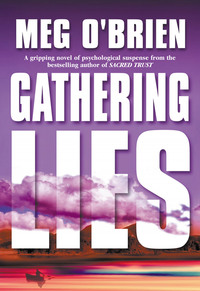
Gathering Lies
Meg O’Brien
 www.mirabooks.co.uk
I would like to thank the following people, without whose help this book could never have been written:
My son, Greg, whose editorial skills are truly excellent, and who saved my neck during the infamous “end of the book” when nothing was making any sense.
All my children—Robin, Greg, Amy, Kevin and Kate—who put up with me when the muse takes over and I’m miserable to be around.
Cathy Landrum, who is not only an excellent research assistant, but who, along with her husband and very patient designated driver, Randy, is an adventurous traveling companion, as well.
Heather Iker, for being my expert legal reader and keeping me straight on the ins and outs of the justice system. Thanks for all the hours, Heather, and for being a great lawyer and friend.
Al Wilding, retired Seattle police officer, resident of the San Juan Islands and new friend. By some twist of fate I found him on the Net, just when I needed another expert reader. Many thanks, Al, for your advice and support throughout the past months, and to your beautiful wife, Lotte, who puts up with our constant e-mailing. Thanks, too, Lotte, for spreading the rumor around Shaw Island that Al and I were having an online affair. I can only imagine what that’s done for my reputation at Our Lady of the Rock Priory!
Rick Boucher, owner of San Juan Web Talk, the Web site about the San Juan Islands—which was where I “met” Al Wilding in the first place. Thanks, Rick. Your Web site is an invaluable source of information about the islands.
Last and certainly not least, Amy Moore-Benson and Dianne Moggy, my editors at MIRA, who keep me wanting to write even when I’m ready to hie me off to a nunnery and hoe beans for the rest of my life.

CONTENTS
Prologue
PART I: THE SETUP
Chapter 1
Chapter 2
PART II: THE PURSUIT
Chapter 3
PART III: THE CRIME
Chapter 4
Chapter 5
Chapter 6
Chapter 7
Chapter 8
Chapter 9
Chapter 10
Chapter 11
Chapter 12
Chapter 13
Chapter 14
Chapter 15
Chapter 16
Chapter 17
Chapter 18
Chapter 19
Chapter 20
PART IV: THE ARREST
Chapter 21
Addendum
Prologue
ANGEL
April 7
The woman sat tied to an upright chair, her arms bound from elbow to shoulder. She no longer squirmed to get free. By now, she knew that wouldn’t help.
“Don’t you understand?” the man said again as he paced before her. His tone was distraught, worried. “You’re never getting out of here, if you don’t tell me what I need to know.”
“I’ll die first, you son of a bitch,” she managed through dry, cracked lips.
“It’s beginning to look like you just might,” he said.
But his voice shook. She knew he was close to breaking, too.
The woman bowed her head and closed her eyes. Her neck ached from holding it stiff with fear, and her eyes burned from the too-bright light she’d been under for more than seven hours. She didn’t know how much more she could take before the inevitable happened, before words poured forth despite her will, words she had vowed never to tell him, not in a million years.
“Get it over with,” she said dully, choking on a sob. “Please. Just do it now.” Her eyes were red and swollen with tears, her tone begging. “If we ever meant anything to each other…”
The man knelt in front of her and whispered in her ear, all the while stroking her knee softly, then her thigh, where a bruise darkened by the minute.
“I don’t want to have to hurt you, Angel. You’re a beautiful woman. Just tell me. I promise I’ll let you go.”
“You’ll let me go?” she whispered. “Really?”
“I told you I would,” he said softly. “You think I like this? God, I hate it! And it could all be over. You could be home, safe and sound. All you have to do is tell me.”
“You’ll let me go?” she said again, looking into his eyes, the eyes she once told him were more lovely than those of any man she’d ever known.
“Yes,” he whispered, rubbing her thigh more seductively now, letting his hand roam to the soft familiar flesh of the dark V, stroking her there as if she were a pet cat. A tingle ran through him as he realized she hadn’t worn panties. That’s how much she had trusted coming here this way.
“Yes,” he said huskily, “I promise. I’ll let you go. Just tell me.”
In a flash, the woman jerked back her right foot, then swung it forward with incredible force. Her pointed, high-heel shoe connected with his groin. The man screamed, falling back.
“Go to hell!” she yelled, her face contorting. “Go to goddamn hell!”
In an automatic response to the searing pain, the man leapt to his feet and swung at the woman with his fist. It connected with the side of her head, and the chair she was tied to wobbled. Teetering precariously, it fell back, striking the cast-iron, wood-burning stove. The woman’s head hit the sharp-edged corner of the stove with a resounding crack. Blood mushroomed from her scalp and her jaw went slack, her eyes staring. The man bent over her, still holding himself against the red-hot pain that seared through his groin.
“No!” he screamed. “Goddamn it, no!”
Kneeling again he quickly checked her pulse. It fluttered, then died. He put his ear to her mouth, but heard only the last sigh of a dying breath.
“Oh, God,” he moaned. “Oh, God, you can’t do this.”
He fancied the woman’s lips curved in a tired smile.
He sat for a long while on the floor beside her. “You were always so damn stubborn,” he said softly. “Why couldn’t you just have done things my way?”
He would miss her. But only a little. And now he would have to explain why he’d failed.
The man stood gingerly, still clutching himself. Light-headed, he stumbled to a telephone on the wall. Lifting the receiver, he punched in a number.
“She’s gone,” he said heavily, when a voice answered.
A small silence.
“No, I mean she’s gone. Dead.”
A tinny rumble of angry sound came through.
“No, she didn’t—Look, it wasn’t my—” He pressed his fist to his forehead. “Yes, I know. Yes. Right away.” He dropped the receiver back onto the hook.
“Damn you, Angel!” he cried, looking at the woman’s lifeless body. “All you had to do was tell me. I would have let you go.”
But he knew that wasn’t true. He would have had to kill her in the end.
And now he’d have to get to the other one. He’d have to make her give up the secret this woman had carried to her death.
If not, he’d be six feet under, along with this pile of useless flesh on his floor.
The pain in his groin ebbed, but not his anger. The man was less than gentle as he lifted the woman’s body and squeezed it into a steamer trunk he kept in the closet. She was too large for the trunk, and as he pushed and shoved he heard bones break.
The lock was flimsy and didn’t catch well. But that was all right. Where the trunk was going this time, it didn’t need a lock. He went to the kitchen and got a towel, which he drenched in cold water. This he used to wipe the blood from the braided rug, then from his hands.
Looking around the small cabin, he debated whether to take the trunk out and bury it now, or leave it here till his job was done. Hell, he might end up with a mass grave before this mess was over.
No, he’d better do it now. The place could be broken into while he was gone.
He dragged the trunk out onto the porch and glanced around for signs of anyone nearby. Even without looking, though, he knew he was alone. That’s one thing he liked about this place. It was a hideaway, for now. But in the future it could be a shelter where he could sit and think. He could picture himself a Thoreau—without, of course, the pond. It was here he might spend weekends and summer vacations, on this very porch, reading.
That is, if everything didn’t go all to hell.
He looked down at the trunk, a moment of sympathy for the woman filling him with guilt and remorse. His life wasn’t supposed to turn out like this. Neither was hers.
But it wasn’t his fault. If she’d told him everything right off, none of this would have happened.
Dragging the trunk down the steps, he noted that the sky was an odd yellow, the air still. Hot, for April. But that was the Northwest for you. One week snow, the next a heat wave. He wondered if there would be a thunderstorm, and knew he’d have to bury the trunk deep, so the upper layer of dirt wouldn’t wash away.
He got a shovel from the utility shed and went back to where he’d left the trunk, and began to dig. It was hot, tiring work, and he was still shaking from the unexpected way this had turned out. Still, he’d worked out for years, and was grateful for the hard, efficient muscles that made it possible for him to accomplish this.
When he was several feet down, he scrambled out and used his last ounce of strength to pull the trunk over to the hole, then dumped it in. Looking down into the makeshift grave, he began to sway. Wiping his forehead, he thought, God, I feel dizzy. Must be hunger. Or this crazy weather.
But then his feet began to move, and without volition they stumbled forward. Throwing his arms out, the man tried to keep his balance, like a chicken flapping its wings. But nothing stopped the forward fall, and the man screamed out. His boots slid on the crumbling edge of the grave, and horror overtook him as the ground shook and the trunk rocked back and forth. The flimsy lock snapped open, and the lid flew back revealing the woman’s bloody, broken body. The man fell on top of her, his face smacking the ooze from her skull. Dirt rained down upon them both, and like the wrath of God the ground continued to rumble and shake. Dirt choked his throat and stung his eyes. He tried to burrow an airhole, a space to keep him breathing till help arrived. But he knew, too, that help would not arrive. He was too far out, too isolated.
The next instant there appeared before him a tunnel of light. At first he thought he was dying, and he half expected to see his mother and all his dead relatives there, the way they said it happened on all those talk shows. Panic overwhelmed him. He’d read enough about near-death experiences to know they weren’t always sweetness and light. One could land in hell. Then, suddenly, the sides of the tunnel burst open with a whoosh. Light rushed in. It took the man a moment to realize it was real light, sky light, a hole in the grave. The ground in its shaking had opened a path—a path he could follow, if only he could get an arm out and dig.
“Dig, man!” he half screamed, his fingers scrabbling in the dirt like a crazed, panicky crab. “Dig!” He had to survive. He’d been given a second chance, and he had to grab it.
There was only one person left, now, who knew where that evidence was. Sarah Lansing. He would get to her, make her tell him where it was. Then he would kill her. It would be easier now, after this.
PART I
1
SARAH LANSING
Seattle, WA
May 5
Words.
Words have consumed me, of late. They’re just about all I have left, now, the only solace that remains. I sit here at my father’s desk, in the house I grew up in, telling my story to a computer screen. I write, now, for no eyes but my own. Every night I obliterate what I’ve written, in fear of having my work confiscated by the police. Days, my fingers hover over the keyboard, ever ready to hit the delete key in the event that what passes for the law should show up at my door.
Meanwhile I gather my thoughts, putting them into words.
Gather…Gathering…Gathered.
I have always loved that word. It has a multitude of meanings, as in storm clouds gathering, or supplicants gathered for prayer. It can mean a woman gathering material at the waist, as my mother did, to make a skirt. One can gather one’s thoughts, gather a man into oneself, gather children at one’s knee.
Or—as was the case at Thornberry—it can mean a gathering of lies.
We were all lying about something that spring. And thus, having come together, having gathered for reasons none of us fully understood, we harmed ourselves, and each other, in ways we had no notion of before we began.
I will tell you this: Each of us did what we had to do. Of that, I am clear, to this day. A path opened up and we took it, not even thinking where it might lead.
It led us straight into hell.
2
It was the spring of the Great Seattle Earthquake, and life had been bad enough without the ground opening up beneath our feet. But there it is. Life has a way of taking over, of running amok, and there’s not much point in fighting it—any more than there’s any point in fighting it when a man leaves, betrays, lets one down.
At first you ask yourself, was it my fault? Did I wear the wrong outfit, have the wrong shade of hair? Should I go shopping for something younger, perkier?
Buy a bottle of Clairol Midnight Brown?
I remember Ian saying once that he’d been in love, at twenty, with an Italian girl whose dark brown hair fell in waves to her waist. His pet name for her had been Sophia, he told me, as in Loren. His first love, he said, the one and only true love of his life.
He said this the day he broke it off with me, and I’ve always wondered if it wasn’t just what he told himself, to excuse the fact that he hadn’t had a lasting relationship in all the years since.
Or, again, maybe it was me. Am I too blond? Too amenable? Or conversely, too argumentative?
Life also has a way of burdening one with questions that have no answers, at least none one wants to hear. Therefore, regardless of the fact that I’d been to college and was thought to be a relatively bright woman, with a career I’d been excellent at, those are the kinds of crazy-making thoughts that went tripping through my brain on the day the Big One hit.
It happened while we were at Thornberry—I and the other women. I didn’t, at that point, know the real reason I’d been lured there—for that’s the way it turned out, I was lured there. Nor did I know, in my mind, why I’d accepted the invitation. I only knew I was on the run: from a broken heart, a lost job, and a life that was in shambles.
The invitation to Thornberry, a writer’s retreat on a tiny, private island in the San Juans, came by way of a friend at Seattle Mystery Bookshop, near the rather humble apartment I had lived in for years. When Bill Farley told me the invitation originated with Timothea Walsh, my response was immediate and positive.
“I know Timothea,” I said. “I spent summers on Esme Island as a teenager. My parents and I stayed at her bed-and-breakfast.”
“She’s turned it into a writer’s colony now,” Bill told me. “I hear she likes helping beginning writers, and most of the time they have to apply. This is something new she’s starting, where she invites women only, published or not, for one month out of the year. Everything’s paid for, room and board. All you have to do is show up.”
“But she can’t have asked for me, specifically,” I said, puzzled. “How did she know I was writing a book?”
“Maybe she read about it somewhere?” Bill said, a brow rising. “The papers, maybe?”
Good point, Bill. I’d been a high-profile public defender in Seattle until my arrest in January for drug possession. The local media made that hot news, splashing it all over the papers and television—which made sense, since my defense was that I’d been set up by a cabal of crooked Seattle cops. In the midst of all the media furor, someone had leaked the information that I was going for revenge by writing a book blasting the justice system, and the Seattle police in particular.
That “someone” was almost certainly my agent, Jeannie Wyatt, not that she’d admit it in a million years. Shortly after that, though, offers rolled in. From that point on, my fate as a writer—at least for a year or so if I turned out to be only a “one-book wonder”—was sealed. A bidding war began, ending forty-eight hours later in seven figures.
I’d become an overnight sensation—the Great White Hope of a New York publisher threatened with potential bankruptcy and unprepared for the advent of on-line publishing, e-books, print on demand. Rife with paranoia, they’d already dumped most of their mid-list writers, and were placing all their bets on a hot new blockbuster.
My book, someone high up had decided, would be blockbuster enough to hit the New York Times bestseller list.
And I hadn’t yet written a word.
As for Timothea, it did not surprise me that she’d turned her B&B into a writer’s colony. It was Timothea who first inspired me to write, sitting at her cherry-wood dining room table in the big white house, while everyone else was out on the beach or hiking around the island.
Tiny and remote, there was never much to do on Esme Island but swim and hike. I’d linger behind, my nose in a book, and one day Timmy—as she asked me to call her—sat me down with a pad and pencil and told me to write. She saw something in me back then, something I was too absorbed in being a teenager to see.
Later, when I took legal writing in law school, I began to recognize a few stirrings of potential in that direction. It wasn’t until after the arrest last January, however, that I seriously thought of becoming a scribbler for a living.
A ludicrous thought, an oxymoron for most struggling authors—writing for a living. But once convicted and sentenced for drug possession—if that was the way it turned out at trial—there was little chance I’d ever be a lawyer again.
Some days, at least when the sun shines, I sit here in the bay window of my parents’ house, at my father’s desk, and look out at ships going by on Puget Sound. Before me is the Space Needle, high-rise apartment buildings, sparkling blue water and islands with lush green forests. A halcyon scene. A scene I grew up loving, with great hopes to one day be part of it, to leave my mark on it, doing nothing but good.
How then, could things have gone so wrong?
Fresh out of law school fifteen years ago, at twenty-five, I still had some of those wildly heroic ideas law students get about saving the world. Growing up, I’d watched my father defend corporate raiders and tax cheaters at Sloan and Barber. It was always expected I’d follow in his footsteps. Then, as children will, I’d opted to do the opposite with my fine new degree and become a public defender.
This was not entirely to spite my father, who had hoped I’d one day be a partner at Sloan and Barber, a daughter he could show off at the country club, since he’d never had a son. I actually considered S&B for a while, but in law school I’d begun to hear about innocent people who’d been jailed for crimes they didn’t commit. Many lingered in prison ten, twenty years, while life outside the walls passed them by. Their children grew up, their wives or husbands moved on.
It was something that saddened and even frightened me. The idea that someone who had done nothing wrong could be yanked from his or her home, charged with a crime, and sent to prison for years—even life—sent chills down my spine. It smacked of Nazism, innocent people being dragged off into the night. I think this frightened me because I knew that if it could happen to one, it could happen to all.
My fear was theoretical in nature, back then. I couldn’t have known that one day it would happen to me. Unless, of course, it’s true that we come in “knowing” at some level what our life will be—thus explaining, for some, the kind of choices we make.
It was the advent of DNA as a means of identification in criminal cases that finally freed me of some of those fears. DNA had been discovered in 1870 by a chemistry student named Friederich Miescher, but no one realized its full potential back then. It wasn’t until the 1950s that deoxyribonucleic acid was discovered to carry genetic material from one generation to the next. Now, as everyone knows who watched the O.J. trial, it’s commonly used in criminal cases, much like fingerprints, to prove a person guilty or not. It can be obtained from something as simple as a swab of fluid from inside a cheek, or a hunk of hair.
Any prison inmate who’s been jailed wrongly can afford a lock of hair. What most can’t afford is a lawyer to fight the good fight. Someone needs to get a new trial going. Tests must be run, and DNA experts persuaded to testify pro bono—free of charge. Sometimes agencies such as the American Civil Liberties Union will help with the cost. However it’s done, it must be proved that the killer’s or rapist’s DNA, found on or near the victim, in no way matches the client’s—the wrongly accused perpetrator of the crime.
The plight of these wrongly accused became a moral crusade for me. During my last year of law school, I made the decision to shun the big fees my father assured me I could be making within a few years at Sloan and Barber. Instead—I announced with all the exuberance of naive youth—I would defend the poor and downtrodden.
Little did I know that within fifteen years, I’d be one of Seattle’s poor and downtrodden.
An exaggeration, of course. I tend to do that on days like today when everything seems so black. Still, when I was brought up on charges five months ago, I lost my job, and it looked for a while as if I’d be joining my clients on the streets. If my father hadn’t died of a heart attack, leaving me a modest inheritance, and if my mother hadn’t moved to Florida, leaving her house vacant, that’s precisely what might have occurred.
And there again we have one of life’s little tricks—it takes away the people you love, and replaces them with assets.
So what do you do? Do you say, “Go away, Life, I don’t want your filthy lucre”? I think not. Not, at least, when the meter reader is at one’s door.
So I moved into my parents’ house shortly after the arrest. Then last month, in April, out on bail, I went to Thornberry along with five other women who were invited there, just like me. We were all potential but as yet unpublished authors, and I suspected from the first that each of the others was running from something—also like me.
No one admitted to that, of course. Not at first. It took the quake to make us trust each other enough to share our stories. By then, it was far too late.
Because the time sequence of the two events that changed my life this past year can become confusing, I am writing them down here in much the way I write my notes for a legal brief. Much the way, in fact, that I’m writing the notes for my upcoming trial.
It is early May now. Last January I’d taken on the case of a woman arrested for prostitution. She was middle-aged, black, not particularly attractive—in other words, a piece of meat, nothing more, to the five Neanderthal cops on duty at the jail that night.
The woman was released when the morning shift came on. Five cops from the night shift followed her into an alley and gang-raped her for more than an hour. They used everything on her—nightsticks, guns, themselves. When it was over, Lonnie Mae Brown had just enough strength left to check herself into a hospital, before falling unconscious. When she came to, she refused to report the incident to the cops.
She also refused all tests. She was afraid of retaliation—and I couldn’t dismiss her fears. The rape of women in jail has been common in recent times, as has punishment for anyone who talks. Though Lonnie Mae’s rape had occurred outside in an alley, public outrage about renegade cops was high on the totem pole of police reform. The stakes, for the cops, were high. For that reason, if no other, they tried to make the victim look guilty.
A young, black doctor I knew sized up the situation and called me, thinking that, as a lawyer, I might be able to tell Lonnie Mae what her options were.
Not that she had many, so far as I could see. I was there in the hospital when she woke from a sedative, and the first thing she did was shoot up straight into the air, her eyes wide and on the hunt for tormentors, hands flailing at invisible ghosts.
The most I could do for her was to be honest, since she was refusing the rape tests. I told her as gently as possible that without them, there wouldn’t be enough evidence for the Prosecuting Attorney to press charges. I said if she needed to talk, though, to call me.
I fully expected never to hear from her again. But three days later, I did. She had decided to file a complaint, she said. Would I go to the station with her?
I was surprised, and I didn’t think it would do her any good. But I agreed. I picked Lonnie Mae up, and stood by her side while the cop taking her complaint had a chuckle or two over her story. He clearly didn’t believe it. Nor did he like the fact that I’d come in with her.
“Look, Counselor,” he said sarcastically, “if this really happened, how come your client didn’t get tested in the hospital?”
“She’s not my client,” I said sharply. “She’s my friend. You just make sure that complaint gets into the right hands.”
I was so angered by his attitude, I took Lonnie Mae home and sat with her, as she cried and wrung her hands.
“I just never thought it would do any good to have them tests,” she said, over and over.
Privately, I thought she’d been in too much shock to make that decision in the hospital. But it was too late for that now, and all I could do was try to comfort her. She seemed to need to lean on me, despite the fact that she hardly knew me. I felt bad for her, and distressed that I couldn’t do more for her. So I made myself available.
Lonnie Mae’s apartment was comprised of two rooms, a miserable little place in the worst part of town. The halls were filled with bums, crack addicts, pimps and rats. In the living room, on a packing crate that had become an end table, were crumpled, un-framed snapshots of a baby and two toddlers. She had lost touch with them over the years, she said wearily. “Social Services took ’em away long ago, and I ain’t seen ’em since then. I signed the papers, you know, for adoption. I figure that’s best. Ain’t no kind of life, livin’ with me.”
Silently, I agreed with her, but it wasn’t my job to judge her worth as a mother. Something in her defeated tone sparked my anger again, however, and with that, I thought of something I stupidly hadn’t considered before.
“Lonnie Mae,” I asked, “where are the clothes you wore during the rape that night?”
“Oh, they’s in the closet, over there,” she said tiredly. “The hospital put them in a bag.”
“May I see them?”
She nodded, and I crossed over to the closet. Opening it, a whiff of cheap, heavy perfume hit my nostrils, almost gagging me. Beneath it was a scent of sweat, a leftover, I assumed, of long nights on the streets, hustling johns in cars and in broken-down hotels.
There was gold in that closet, though. When Lonnie Mae had been picked up for prostitution and gang-raped, she was wearing a fake fur jacket, a red imitation leather skirt, and purple fishnet stockings. It had been three days since then, and she had already showered away any sperm that might have been used as evidence. The clothes she’d worn during the rape, however, were right here where she’d tossed them upon coming home from the hospital. She hadn’t taken them out of the bag, or washed them—and they were loaded with sperm. In particular, the cops hadn’t bothered to remove the fishnet stockings, that night in the alley. They’d torn through them, leaving them tattered around her legs, and in their macho celebration they had been sloppy, spewing DNA around like liquid confetti.
I asked Lonnie Mae if I could take the stockings. I wasn’t sure what I’d do with them, but I told her I was certain they could help. She said sure, and I stuck them in the trunk of my car when I left her that day.
Later that night, Lonnie Mae’s tenement burned to the ground. Dental records identified her body, which had been burned beyond recognition. The fire was thought to be “accidental,” caused by a space heater that tipped over in another apartment. Four other people died that night.
PART II
3
On that day in April when the Great Earthquake hit, none of us at Thornberry could possibly have guessed what lay ahead, or how it would affect every one of our lives.
I stepped out of my cottage that afternoon and lingered to drink in the view. Pausing for a moment on the small porch, I looked across fir and cedar trees to the sky above the Strait of Juan de Fuca. Here in the San Juan Islands, some eighty miles north of Seattle, the sky remained light somewhat longer than in the city. Even so, I hadn’t expected such an odd color of yellow at five in the afternoon. Nor had I expected the air to be so warm in April. It was the earliest spring in history, some said.
This was the first time I’d seen the sky like that, however. All week long clouds had hung over the islands, at least on those days when there wasn’t fog.
For long moments I gazed at the trees, my nose twitching at their sweet, woodsy scent. Primroses had popped up among the rocks that lined my path to the farmhouse road from my cottage—which was named, after Timothea’s deceased daughter, “Annie’s Rose.” Annie died from pneumonia when she was six, and Timmy had acquired a permit to have her buried on the property. A tiny cross marks the spot on a hill invisible from the farmhouse, but facing the sea.
There were only four homes on Esme Island, which was roughly oblong and three miles across from north to south. Ransford, the Ford house on the north side, was much grander than Thornberry, on the south shore. The other two homes were cabins, built in the 1950s and existing on Esme at the time Timothea and the Fords bought the island and built here. They lay to the west of Thornberry, along the shore, and were maintained by their original owners only as summer vacation homes.
This left Timothea quite isolated during the long winter months, which, I imagined, was why she’d set up a writer’s colony when the bed-and-breakfast closed. This way, she could still have year-round visitors.
She had apparently kept it manageable, however. There were only six residents’ cottages at Thornberry, each with different names and each beautifully crafted of cherry, pine, and cedar, with stained glass windows in the sleeping lofts. They dotted several acres of woodland surrounding the main house, which began as Timothea’s bed-and-breakfast all those years ago. Now called simply the “farmhouse,” it was a three-story white structure, similar in architecture to many of the lovely old homes in British Columbia. “What a romantic place,” my mother enthused the first summer we visited. “Perhaps we’ll meet our true loves here.”
She said it with that light laugh that surprised me every time it came out, as my mother was more often than not rather morose. I was ten at the time, and if I thought it odd that my mother—who had been married to my father for years—still spoke of finding her true love, I refrained from saying so.
The farmhouse now served as administrative office, kitchen, and nightly meeting place for resident writers. Timothea lived in the second-floor rooms, and two office assistants remained, weeknights, in private rooms on the third floor.
As for the cottages, none could be seen by the other. In fact, once settled in, the only sign of life nearby was a now and then wisp of smoke from the woodstoves of the other five residents. We were not permitted to speak to each other or disturb each other in any way, until four in the afternoon. This, Timmy explained, was to ensure that each of us had every opportunity to write.
Arriving at Thornberry in April, I was out on bail, my trial date set for August third. The prosecution had pushed for an earlier date, but my lawyer pushed back, pleading a full schedule. In truth, she was giving me time to finish the book. I knew there would also be the usual delays and continuances, and did not expect my trial to go forward till December, at the earliest.
Which thrilled my publisher. Though I wouldn’t turn the manuscript in until October, they planned to push Just Rewards through production virtually overnight, with a pub date of December 1. From the publisher’s point of view, it was worth the unusual effort, as the trial would help to make it a bestseller. From my lawyer’s point of view, I’d be getting it into the hands of the legal analysts—the talking heads on TV—right when it might do me the most good. They were known to come down hard, lately, on crooked cops. And since crooked cops were my best, and only, defense, I said sure, let’s pull out all the stops.
I was ready, by then, to play any angles to bend, and if necessary, beat the judicial system.
Seeing Timmy here again after so many years, I had mixed feelings. It had been two decades since I’d last been at Thornberry, and we both had changed. Timmy, though, seemed unusually strained. I mentioned this to Dana, one of the other residents, as we walked together toward the farmhouse for dinner. I’d run into her before, coming from her cottage, and we’d found it easy to talk to each other. For the most part, we talked about the other residents and how we felt about them. Gossip, I suppose—something I seldom indulged in. But at Thornberry, after the first few days of daily isolation, we were all still wondering about each other.
This night, I shifted the basket of books I’d brought with me to return to the farmhouse library, and brought up the subject of Timothea.
“I knew her a long time ago,” I said, “and she always seemed a happy person, one who knew precisely what she was doing in life. I thought she found contentment in it.”
“Well, it must be difficult dealing with five different writers a month,” Dana said. “Having to sit with us at dinner, listen to us jabber. Have you ever seen such a bunch of—” She hesitated.
I knew the word she was going for, and revised the first letter of it. “Witches?”
She laughed. “Except for Jane. She seems nice. I feel sorry for her, though. Grace just won’t let her be.”
Jane was a well-to-do young matron from Bellevue, and Grace Lopez a tough, mouthy New Yorker. Grace was thin and wiry, with short black hair, an olive complexion, and a temperament straight from the Bronx. So far, Jane hadn’t been doing very well at holding her own with her. Jane was writing a romance novel, and if there was anything Grace seemed as if she’d know nothing about, it was romance.
I myself had become bored with the kind of tensions that seemed to develop over dinner every night. Aside from Jane and Grace, there was Amelia, a seventy-two-year-old curmudgeon and prize-winning poet. She and Grace would get into something volatile, and Jane would leap in to smooth things over, then get caught in the runoff.
One member of our group that I hadn’t had time to form an opinion about was Kim Stratton, the Hollywood actress who’d suddenly found herself, with one hit movie, on a level with the best. Her succeeding films reportedly raked in more than the national debt, yet Kim had come to Thornberry to write her memoirs, she had told everyone on the one night she’d shown up for after-dinner coffee. The majority of the time she kept to herself in her cottage, and had acquired a reputation with the other women for being standoffish.
What kinds of memories this auburn-haired beauty felt impelled to be writing about at age thirty, I couldn’t imagine. Still, she was known as “America’s Sweetheart”—at least to those not old enough to remember that Mary Pickford once held that title. Presumably, enquiring minds wanted to read everything they could about Kim Stratton.
“So you think Timothea’s just bored with us all?” I asked Dana, as we continued toward the farmhouse.
She gave a shrug, and the silver-and-turquoise necklace she wore shimmered in the yellow light. Dana, from Santa Fe, was often mercifully teased by Grace for being psychic, or Santa “fey.” I knew little about her life in New Mexico, as she seldom talked about it. There was a husband, I’d learned. But the kind of person he was, and what he did for a living, seemed shrouded in mystery.
“You seem to know her better than any of us,” Dana answered. “What do you think?”
I wasn’t certain. I no longer felt I knew my old friend, and could only ascribe this to time passing, personalities changing. I’d grown up, while Timothea Walsh had grown older. I had no idea of the forces that had moved through her life, twisting and shaping it in ways perhaps different, but just as powerfully as forces that had shaped mine.
We turned a bend in the path, and I felt myself shiver.
“You feel it, too?” Dana asked. Her dark hair moved in fine wisps over her forehead as she turned her head from one side to the other, seeming to sniff the air.
“Too?”
“This spot,” she said, pulling her fringed shawl more tightly around her. “It’s very strange.”
She was right. The air was unseasonably warm, the sky still that strange, heavy amber. But there was something else along this one patch of trees. Every time I passed it, my legs would begin to feel weak, as if I could barely move. It was like slogging knee-deep through mud, and it lasted a few yards, then was gone.
“Old Indian ground,” Dana said. “I read about it in the library here. Energies like that, you know, have a way of lingering.”
My legal training had not prepared me for this kind of thinking, yet I couldn’t deny that something about this spot was unnatural.
“There may even have been mass murders here,” Dana continued in a low voice, “when northern tribes raided down here, killing the men and taking wives and slaves back with them.”
Her words echoed something from time past. What was it? Where had I heard this before?
It took a moment, but as we continued to walk, my thoughts flashed back to the year I turned eighteen. And Luke.
Luke Ford’s family owned Ransford, the larger home on Esme Island back then, and during the four summers I spent here, we had worn a path through the woods from visiting back and forth. Luke had commented more than once about the strange energies in the woods around here. How had I forgotten?
Luke had been my first love, and the exact opposite of Ian. Ian was all business, red hair cropped short, demeanor dead serious, while Luke joked, teased, flirted outrageously, and in general embraced life fully. He wore his thick, almost kinky dark hair in a ponytail that ended midway down his back. When he didn’t have it contained that way, it flowed around his face, framing and softening features that were sharp and angular—more striking than handsome.
I was seventeen the last summer I spent on Esme Island, and I could not get enough of Luke. Having flirted our way through the three previous summers, lightly touching each other, then pulling back as if burned by a hot poker, we were primed that year.
We started out the first day smiling awkwardly at each other, then glancing away; our eyes, when they met, spoke too much of our feelings. One day I was walking in the woods, looking for a quiet place to write. Luke hid in a tree and nearly startled me to death, dropping to the ground in front of me. Then he whisked me into his arms with a great holler and whoop.
“Sarah! My God, I missed you this year!”
We fell to the ground together, laughing, and from there on out, I was all his. His tongue parted my lips, while a hand came between my legs to create a passage there, as well.
When it was over, my back was scratched from dry pine needles on the forest floor. The discomfort I suffered was well worth it, however. It had been my first time, and for days I was consumed by memories of Luke stroking the entire length of my body till I was nothing but a quivering mass. I sought him out, sought that feeling over and over. The woods became our trysting place, while I became Guinevere and he Lancelot, having an illicit affair behind King Arthur’s back.
There was no king, of course, to cuckold. Only our parents, who thought we were still “just friends,” enjoying each other’s company on a lonely island every summer with few inhabitants, no television, no movies, and nothing, really, to do.
If they had known what we were up to, there would have been hell to pay. Both my parents and his were conventional, his mother almost saintly. This forbidden aspect only served to heighten our sense of danger, and therefore our lust. We experimented in ways neither of us ever had, and when we parted at the end of the summer, it was—at least for me—with a feeling of being wrenched from my soul.
It took me a long while, after that—years of law school, work and aimless dating—to fall in love again. That it was Ian I fell in love with is a mystery to me now. I never gave myself fully to him, and many’s the time I felt obligated to call up memories of that summer with Luke, to convince Ian that he’d satisfied me—that I’d felt all I was obligated to feel.
After that year, I didn’t see Luke again, though I heard about him a few times through my mother, who exchanged Christmas cards with his family for a time. Luke, Mrs. Ford wrote, had traveled in Europe after college, then worked in New York City. She never said exactly what he did for a living, and I remember thinking that with his lively personality he might be involved in anything from acting to simply hanging out, “following his bliss.” As far as I knew, he’d never married.
I wondered if he still came to the island, and if I’d see him here. Not likely, after all these years. Still, the thought brought with it a small jolt of excitement—something I dismissed immediately as a visceral carryover from adolescence, nothing more.
“Where did you go?” Dana asked, snapping me out of my reverie.
“Hmm? Oh, sorry. I was thinking.”
“Odd weather, isn’t it?” she said.
We were nearing the farmhouse, with its gardens leading down to the rocky beach. She scanned the horizon with a frown. “The water seems choppy, today. Odd, since it’s so warm.”
“I was just thinking that myself.”
Dana laughed, though the sound came out a bit hollow. “I lived in L.A. once, and we’d call this earthquake weather.”
“Well, they do keep warning us that the Big One’s coming,” I said.
A lush scent of roasting pork and freshly cooked vegetables drifted our way from the farmhouse. We stepped up our pace, and inside the kitchen we took seats on picnic-style benches at a long table, with the other writers and Timothea Walsh. Timmy and I had talked the first day I’d arrived, but not since, except to say hello in passing. She had asked about my mother, and I’d told her Mom was living with her sister in Florida, and doing well.
“I’m so sorry about your father,” Timmy had said. “But I must say…”
She had paused, then shaken her head and clamped her lips shut.
“You think she’s better off?” I pressed.
She fluttered a thin, white hand at her chest. “Well, Sarah, it’s not for me to say…but your mother’s life was never an easy one.”
I thought she’d meant because of my father’s tendency to work such long hours, so I just nodded, and we both changed the subject.
Now I looked across the table at Timmy and wondered. She kept glancing at me when she thought I wasn’t watching. I’d feel her eyes on me, and when I’d look up to meet them, she’d quickly turn away.
Lucy, the cook, was at the stove ladling out food. The daytime office staff had already left on the Friday night ferry for their homes on Whidbey. The ferry, which was privately owned and only stopped at Esme two days a week, would come again on Monday morning, bringing them back. Any other time, we couldn’t get off the island if our lives depended on it.
As, of course, they soon would.
The dinner conversation droned on and on. Another long evening, I thought, picking at the last morsel of roast pork on my plate. Dinner, then coffee in the living room. People reading their works-in-progress to each other, critiquing each other, sometimes being careful and delicate in their comments, other times hard as nails.
Though, come to think of it, only Amelia and Dana had read aloud in the five days we’d been here. And Amelia was usually the only hard-nosed critic. Even Grace was often silent when either woman read, as if she really didn’t know what to say.
The thought struck me suddenly that Grace might not be a writer. Almost immediately, I shook that off as silly. I’d been living in my mind too much of late, seeing shadows in every corner.
Still, I had thought I’d feel safer here on Esme Island than I did. There were moments, in fact, when I felt certain I was being watched.
“This warm weather is so wonderful!” Jane offered from across the table.
Jane was tiny, with short brown hair and a self-deprecating demeanor. I wondered if her size, which was not more than five foot one, caused her to feel incapable of making a mark on the world.
“I thought it would never stop raining this winter,” she went on. “In fact, at one point I thought if I had to put boots and raincoats on one more child, just one more day, I’d go crazy.”
“How many children do you have?” Timmy asked.
“Only two. It just seems like an army sometimes.” Jane smiled uncertainly. “That’s why it’s so good to be here. My husband gave me this two-week vacation as a birthday present. He’s working from home while I’m gone, so he can watch the kids.”
“You’re only here for two weeks?” I asked curiously. “I understood we’d all been invited for a month.”
Jane’s grimace was half smile, half frown. “We were, but I didn’t think I could be away from home that long. As it was, I spent a full week in the kitchen before I came here, making my husband’s favorite dishes and freezing them. He doesn’t know how to cook.”
“Some vacation,” Grace muttered. She frowned and shook back her cropped black hair, then folded her arms across her chest. Grace’s name did not at all fit her, as she was totally lacking in any of the graces. In fact, I had yet to hear her utter a good word about anyone.
Jane seemed to hunker more inside herself. She didn’t respond.
Amelia turned to Timmy and asked where Kim Stratton was.
“She’s having dinner in her cottage,” Timmy answered. “She did say she might join us later for coffee.”
Amelia harrumphed, then made small talk with Timmy about Thornberry, while Jane, Grace, Dana and I listened. Timmy sat every night at the head of the table, and as I’d noted to Dana, she didn’t seem particularly comfortable to be there. She seldom took part in our conversation unless asked a direct question, and I recalled that she had seemed a bit shy when I was younger. I wondered silently if she’d rather have dinner alone than with a group of edgy writers.
“I abandoned the bed-and-breakfast years ago,” she was saying now to Dana. Her hand went to smooth her short gray hair, a large diamond ring reflecting light from candles and sending sparkles around the table.
“It was far too much work,” she continued. “Not that this isn’t, but since you all do your own laundry and housekeeping, it’s quite a bit easier.”
A staff member—either Lucy or one of the two administrative assistants—brought lunches to the six cottages every day at noon, setting them on the porches without knocking or in any way disturbing the writers. Lunches were hearty soups or stews and homemade breads and muffins. At dinnertime, each writer brought her own basket back to the farmhouse and filled it with whatever she wanted for breakfast the next morning—eggs, bacon, muffins, fruit. Each cottage had its own small kitchen, and residents fixed their own breakfasts. There was no charge for any of this.
Thornberry, I’d been told by Bill Farley, was one of the most luxurious writer’s colonies in the country now. Timothea was a former patron of the arts from Seattle, a woman who had always wanted to help other women find their place in the writing world. When she had first sat me down at her dining room table with pad and pencil all those years ago, I hadn’t known this. I thought she was just being nice to the lonely kid with her nose in a book.
Now I understood the genuine kindness that lay behind Thornberry’s latest incarnation. There were no “page police,” no monitors of one’s work. The only thing Timothea asked was that the women who came here grow in some way that might further their talent. How they did that was their own business. They might take walks in the woods, keep a journal, help out with the organic farming, or even—if they wished—simply feed the two resident goats.
The conversation this night, dominated by Grace as usual, turned to politics. Since my life in Seattle had been saturated with troublesome politics, I had difficulty participating. But Grace was young and brash. She liked to mouth off for the sake of mouthing off, reminding me of certain teenagers I’d defended over the years—though Grace was clearly in her mid-to late-twenties.
“We’ve got to fucking bomb them,” Grace said firmly. “It’s the only way.”
This brought me out of my woolgathering long enough to wonder who she was talking about. Iran? The cornfields of Iowa? Anything could be turned into an enemy by this woman, I had learned.
Dana jumped in with an obvious attempt to change the subject. “Lucy, I love the way you use herbs in your cooking,” she called out to the cook, who was putting cookies for dessert into the oven.
“Thanks,” Lucy said. “You’re writing about herbs, aren’t you? We should talk one of these days.”
“I’d love to,” Dana said. “It’s not all about herbs, but they’re a large part of it. It’s about using what nature gave us, to heal—something even doctors are beginning to believe in.”
“Doctors!” Amelia, the poet, said scornfully. “I’ve never in my life gone to a doctor that I didn’t end up sicker than I was in the first place. And to add insult to injury, they put you in the poorhouse doing it.”
Dana smiled. “That’s how I got started on my book. I was sick, and as a writer, I couldn’t afford insurance. I began to study herbs and what they could do.”
“I don’t give much ground to herbs, either,” Amelia muttered. She tapped her forehead, and her short white curls bobbed. “It’s all in the mind. Doesn’t matter what you take, it’s in the mind.”
“Oh…” Jane began uncertainly, “you mean, you could take either prescription medicine or herbs, and depending on which one you believed in—”
“Turnips!” Amelia snapped. “You could take turnips, woman! It doesn’t matter what you take, it’s all in the mind.” Grace cast a contemptuous look at both of them and went back to stabbing her pork.
Dana, who didn’t eat meat, picked at her vegetables. An awkward silence filled the kitchen, and Jane stepped in again, changing the subject. Laying down her fork, she stretched and sighed.
“What a wonderful meal! You know, I can’t believe I’m here. After the PTA, the constant laundry, the carpooling—this is heaven.”
“Don’t tell me you don’t have a house full of servants,” Grace taunted.
“No. No, I don’t,” Jane answered slowly. “I have a once-a-week housekeeper, that’s all.”
“But a house that’s big enough for an army, I’ll bet,” Grace replied, zeroing in. “You people with your big houses, big cars, big everything—you’re ruining the world.”
“Grace!” Dana said softly. “You can’t just lump everyone—”
“Don’t give me that!” Grace interrupted. “It’s true. The rich are responsible for most of the ecological problems in the world. Everyone knows that.”
“Well, we don’t have to talk about it now,” Dana said mildly, casting a sympathetic glance at Jane. “Can’t we, for once, just have a nice dinner?”
“And just exactly when would you recommend we talk about the way the rich ruin the world?” Grace pushed. “What nice dinner would you prefer to ruin?”
Jane, turning a deep shade of red, stood and carried her plate to the sink. “I think I’ll turn in early,” she said.
I felt sorry for her. And just as sorry for myself. There were times when I thought I couldn’t stand another dinner with these women. Always fighting, arguing, picking on each other.
All but Jane, who tried, but didn’t have the ongoing fortitude to stand up for herself. And Dana, who did her best to keep the peace.
The rest, excluding Timmy, reminded me of children. Women in their twenties, thirties, forties, even seventies—going on five years old. Put a bunch of women together on an isolated island, and see what you get.
Later, I told myself that if I’d known how bad things could really get, I might have made a point of enjoying my “final meal.”
Jane would echo my thoughts. “If only I had known…” she would say numbly, over and over—though even she knew it was bad form to write that in a novel.
We were in the living room of the farmhouse when it happened—Grace, Amelia, Dana and myself. Jane had gone back to her cottage, and Kim Stratton hadn’t shown up at all. Timothea and Lucy were in the kitchen, cleaning up.
As was usual after dinner, we had gathered in comfortable chairs and sofas before the huge stone fireplace. A large bouquet of freshly cut flowers filled the hollow of the fireplace rather than wood, a nod to the overly warm weather that had fallen over the San Juans this day.
All four of us were at varying stages in our writing lives. Dana was working on her nonfiction book about natural healing, Amelia on a new poetry collection, and Grace…Grace never did say. The only thing I knew at this point was that she must have had a strong reason to come to this isolated island of few inhabitants and very little communication with the outside world. Esme was owned by Timmy and two of the other home owners on the island. Electricity came by way of generators, and water by wells. There was one battery-operated radio in the Thornberry office, and one cell phone serviced through a tower on Orcas. We had been asked to leave our own cell phones behind, and Timmy believed that she and the staff should live as simple a life as the residents here.
As for weather, it could get wild here even in the spring, with gale-force winds and unending storms. No one came to Esme without a good reason.
That night, however, had started out peacefully enough. Through French doors we could see a setting sun. A family of deer munched on grass on the lawn. Dana smiled and said, “Jane was right. This really is heaven.”
Amelia snorted. “Heaven, is it? Well, if you run across God, ask him how we’re supposed to keep those bloody little woodstoves going in the cottages. Someday I’d like to write an entire ten-line poem before the damn thing goes out.”
Dana sent a grin to me, and I turned to Amelia. “You sound like you don’t like it here.”
Amelia folded her arms across ample breasts. “I didn’t say that, did I?”
I smiled. “No, you didn’t say that.”
“Well, don’t go putting words in my mouth.”
Amelia stared into the fireplace as if flames flickered there.
Perhaps Dana was right, I thought. Old trauma—murders, even—must be hanging around Thornberry. Otherwise, why were so many people here in a bad temper?
Tonight was worse than ever. There was something in the air, and it was affecting everyone. Kim Stratton, I thought, knew what she was doing, hiding out at night. From now on, I vowed, I would do that, too.
“Well, I guess I’ll get started,” Amelia said, pulling a thin sheaf of white paper from a needlepoint briefcase.
I stifled a sigh. Here we go again. More cutoff breasts and blood gushing from women’s vaginas into male-dominated ground. God save me from the political ones.
Amelia’s latest was indeed another politically driven, and—to give it credit—probably award-winning piece. I closed my eyes and tried to pretend I was listening, while in truth I was working on my own book in my head.
I felt a jolt, and my eyes flew open.
“Did anybody else feel that?” Grace asked.
Amelia looked up from her paper and frowned. “Feel what?”
Grace rubbed the back of her neck. “I don’t know…I thought I felt something.”
“You did,” I confirmed. “I felt it, too.”
“Probably a gust of wind,” Dana added. “Coming from the kitchen. Lucy’s got the door open back there.”
Amelia returned to her reading.
“Damn, there it goes again!” Grace jumped to her feet.
Her words were barely out before the room shook violently.
“Earthquake!” Dana cried, her mouth forming a startled O. She grabbed the sides of her heavy armchair as it slid like dollhouse furniture along the hard-wood floor, striking the fireplace and throwing Dana into the hard stone facing. She screamed. Grace staggered and fell several feet across the room, hitting a coffee table with her knees and falling into a bookcase. Blood spurted from her nose. The bookcase pitched forward, burying her beneath it. I rose and stumbled for balance, grabbing Amelia, who looked so pale I thought she might faint. There was nowhere to go, however. Nowhere to hide.
All around us, windows shattered. Glass rained down. The tiny panes of the French doors were sharp slivers. I felt a stab on my cheek as figurines, now projectiles, flew from the fireplace mantel and shelves. Mini-blinds rattled and broke, falling to the floor with a clatter. The deep rolling motion went on and on, seemingly forever, and the piercing screech of Thornberry’s house alarm filled the night.
When the rolling and pitching was over, we were all in various positions on the floor. Dana lay against the hearth, blood dripping from her arm. Grace, still buried by the bookcase, groaned, but pushed at its weight and crawled out from under. Her nose was bleeding, and Amelia, next to me, looked dazed, her mouth drooping open.
I struggled to my feet, holding onto an end table. Heading across the room to Dana, I felt the warmth of blood trickling down my cheek. The living room was cluttered with debris; plaster had fallen from the ceiling, and glass crackled under my feet as I gingerly moved first one heavy beam, then another that had fallen from the ceiling. Sliding on a pile of books that had landed in the middle of the floor, I fell to a knee and yelped as a sliver of glass cut through my skin. Red flowed through my khaki pants.
Kneeling cautiously next to Dana, I checked her injured arm. The cut was four inches long and covered with plaster dust. That helped to staunch the bleeding, but the dirt and dust of years that had fallen with it weren’t good news.
“It doesn’t look too bad,” Dana said shakily, wincing at my light touch. “I think we lucked out. Sarah, your face is cut.”
Grace spoke from behind us, her tone sharp. “We can’t stay in here. There’ll be aftershocks.”
“Dana’s arm has to be cleaned,” I said, helping her up, then repeated, “It needs to be cleaned.”
I was on automatic, operating out of shock as my mind searched frantically to remember what I’d learned in all the earthquake preparedness meetings at the Justice building. I knew we had to get out of the house, but nothing made sense at the moment except to clean Dana’s wound. The fact that my own face was bleeding had no effect on me whatsoever.
“You, too, Grace,” I said. “Your nose is bleeding.”
Holding Dana’s good arm, I began to move cautiously with her over the shattered glass toward the downstairs bathroom. The ground started to pitch again.
“Damn it, we’ll be buried alive in here!” Grace yelled, grabbing Amelia and running for the front door.
Dana and I swung around toward the door, but none of us made it. The aftershock felt even more violent than the first tremor, and this time we were thrown to the floor right where we stood. A board with nails in it barely missed my chin. Dana cried out, her face twisting in pain.
Screams issued from the kitchen.
“Timmy!” Amelia cried. “She’s hurt!”
The center stairway from foyer to the upstairs level came crashing down, the spokes below the banister popping free and shooting in every direction like a bundle of Lincoln Logs hurled by an angry child.
Amelia’s voice rose to an hysterical pitch. “Timmy! I’m coming!” She began to crawl toward the rubble of stairs, now a huge pile that rose halfway to the second floor.
“No!” Grace yelled, pulling her back just in time to save her from a flying stair tread full of nails. “You can’t get through that way!”
She gave Amelia a hard shove through the front door, which was hanging by one hinge. The woman landed on her knees in the grass, crying out.
Dana and I made it to our feet and followed. Grace was the last one out, glancing toward the blocked-off kitchen before she stumbled through the doorway. She turned and looked up, on her face an expression of horror. I followed her gaze as the two upstairs levels of the farmhouse slid toward us like the top layers of a wedding cake.
We all turned and ran. From a safe distance we watched in disbelief as the entire mass shuddered, then thundered to a heap on the ground.
When the dust had settled, we staggered numbly to the debris and stared into its mass—boards, pipes, plaster, furniture, clothes and bathroom sinks. The huge chimney had fallen, and though parts of the farmhouse living room walls remained upright, there was no longer a ceiling or a roof. Nothing was left but a pile of rubble and bricks.
It was Dana who pointed out that the ground was no longer shaking. “Do you feel that? It’s stopped.”
We stared at each other, a mixture of relief and fear in each face.
“It’ll start again,” Grace said. “When it’s this big, there are hundreds of aftershocks.”
“She’s right,” I agreed.
I didn’t want to admit how frightened I was. Authorities in Seattle had been warning for years that the Big One was coming, and if this was it, there would be hundreds, perhaps thousands of aftershocks, and possibly even tidal waves, the dreaded tsunamis. I wondered how close the epicenter was.
My gaze swung to the kitchen wing, which was new and one-storied. It was still standing, though windows had popped out and parts of the roof had caved in.
“Listen,” I said.
Grace looked in that direction, her voice sharp. “To what?”
“It’s too quiet in there.”
Everyone turned that way.
“Oh, my God, Timmy!” Amelia cried. She swung around to Grace. “You should have let me go to her!”
“I saved your ass, old lady,” Grace shot back, hands on her hips. “You could be under that rubble with them.”
Amelia flushed, her face red and tear-streaked, hands shaking. “I don’t know who you think you are—”
I broke in. “Stop it, both of you! For God’s sake!”
“It doesn’t look all that bad,” Dana said softly. “They could be okay. But what about Jane and Kim?”
A wave of fear swept over me. Had they—had anyone else—survived?
“Timmy can’t be all right,” Amelia said querulously. “She would be here by now, checking on us. Something’s happened to her, or she’d be here by now!”
We no longer had access from the front. Heading at a run around the side of the house, we made for the back kitchen door. Slowing down as we reached it, Dana held her arm to staunch the renewed bleeding, and Grace rubbed a finger beneath her nose, which only smeared the blood that had been coagulating there. My legs shook, and I could see that Amelia was none too steady. I reached out and took her arm, urging her to lean on me.
The kitchen door stuck, but we were able to force it open despite the objects that had fallen against it. Once inside, the scene stopped us in our tracks. Though parts of the roof were indeed unscathed, there were huge, gaping holes. The entire inside ceiling had fallen, as had the skylight. Glass was everywhere, on cupboards, tables, in the sink, on the floor. Copper pots, which had hung gleaming on the walls only moments before, lay in a pile. Dishes had flown from cupboards and were strewn from one end of the room to the other. The huge stainless steel refrigerator had slid and lay on its side halfway across the room from where it had stood for years. Its door lay open, and jars of home-preserved jams had fallen out and broken. Reddish-purple streams of blackberry and raspberry jam flowed like blood onto the floor.
It was this that caught my attention first. I thought it was blood, and I ran to it, then realized my mistake. At the same time, I heard a moan.
“Quiet!” I yelled at Grace, who was issuing orders to Amelia and Dana to search through the rubble. “There’s somebody here.”
We lifted the heavy appliance together, all four of us at one end, and pushed it out of the way. The person under the fridge was Lucy, and as her condition became clear, Amelia began to cry. “Lucy…oh, poor Lucy.”
I checked her pulse, though it wasn’t necessary. Lucy’s neck was broken, her head twisted at an odd angle to her body. “She’s dead,” I said quietly.
“Poor, poor thing,” Amelia whispered, rocking back and forth on her knees and touching the other woman’s face as if to bring her back to life.
“For God’s sake, woman!” Grace said. “It’s not like she was your best friend!”
Amelia’s breath caught on a sob. She looked around frantically. “Timmy? Where is Timmy?”
“I heard a moan,” I said. “If it wasn’t Lucy—”
We began to toss debris aside, and in a corner we finally found Timothea, semiconscious, her eyes closed.
Amelia gently touched her face. “It’s all right, it’s all right, all right…” she murmured over and over.
I stroked the gray hair back from Timmy’s forehead, which was smeared with blood. Dana went to the sink for a wet rag. When she turned on the faucet, nothing came out.
“Damn!” She rummaged under the sink for bottled water, then in the open cupboards. Finally, she uncovered a bottle in the wreckage on the floor.
“Not too much,” I warned, as Dana wet the rag. She looked at me questioningly.
“We don’t know how long we’ll be without, or how much more we’ll find,” I said. “We’d better ration it.”
Dana nodded and screwed the cap back on the water bottle, handing me the dampened rag. I wiped the blood from Timmy’s forehead, and she opened her eyes. They registered shock, then comprehension, then worry.
“Is everyone all right?” Her voice was shaky, but her grip on my arm was strong.
“We don’t know about Jane and Kim, yet,” I answered. “The rest of us are fine. How do you feel?”
“Sore. Sore all over.” She tried to sit up. “Lucy? She was over—”
I pushed her gently back down. “Just rest, Timmy.”
“But Lucy—”
I shook my head. “I’m sorry. We can’t do anything for her.”
Understanding came over Timmy’s face. “Oh, no. Oh, no. Dear God.” Tears welled in her pale blue eyes.
“We don’t know about the cottages, yet,” I said, “but the entire upstairs and parts of the living room have collapsed. I’m sorry.”
Timmy squeezed her eyes shut briefly, then nodded. “I’m all right. I really am. Help me up, will you?”
“I’m not sure—”
“Just help me up!” she said angrily. Her mouth trembled, as did her entire body. “I have to take care of things!”
She put a hand on my shoulder to pull herself to a sitting position. Reluctantly, I helped her to stand, then turned to Dana and Amelia. “Will you take her outside? Stay with her?”
I turned to Grace. “Come with me and we’ll check out the cottages for Jane and Kim.”
Two hours later there were seven of us on the dark lawn, wrapped in blankets, with salvaged pillows and bottles of water beside us. Just that afternoon there had been ten women at Thornberry. We couldn’t know the fate of the two assistants who had left for Whidbey, but here on Esme Island, one of our number was now dead.
We had wrapped Lucy’s body in a blanket scrounged from the debris, and laid her to rest, temporarily, under what Timmy told us was her favorite tree. We didn’t know how long that “temporary” status might last. There was no law or rescue service on the island, and neighbors in the other three houses on Esme were not usually in residence until summer.
The small battery-operated radio we’d uncovered in the office debris had lasted only a few minutes, and there were no more batteries because Timmy had forgotten to buy extras. Those few minutes, however, were long enough for us to hear that the quake had indeed been the Big One, and that Seattle was in chaos, along with surrounding cities from Olympia in the south to Victoria, B.C., to the north. The quake had been felt, in varying degrees, as far south as San Francisco, and as far north as Alaska.
It was known that the San Juan Islands had been involved, the newscaster had said, based on reports from the U.S. Geological Survey. Helicopters that would ordinarily assess damage to those outlying areas, however, were in use transporting the many wounded and dead in the cities.
As for rescue teams, they had been decimated. Workers who were at home were unable to get to their places of duty, and at any rate were involved in taking care of their own families, many of whom were missing or dead. Buildings and freeways had crumpled, much like those in the 1995 quake in Kobe, Japan. Those who had thought Seattle was prepared for such a disaster were in shock. No one had prepared for this—a 9.1, if it didn’t go up from there when all the reports were in.
The last thing we heard before the radio’s batteries faded was that tsunami warnings had been issued for the entire west coast, from the San Juans south.
I huddled in my fleece jacket and looked around at the other women. We had found Kim and Jane standing in a daze outside their cottages, which had been totaled. The farmhouse, despite its near ruin, seemed to have survived better than any other structure at Thornberry. Even the goat pen had been demolished. The goats had run off.
When the aftershocks stopped, or at least slowed down, we would move inside and begin cleaning up. After that, we would all have to sleep and live in the kitchen until help arrived. We would have to pray it didn’t rain.
Jane was sobbing, terrified for her children and husband in Seattle. She had drawn her knees up in a fetal position and refused to look at anyone. Grace had distanced herself from all of us, and Dana sat quietly, her eyes closed. She didn’t talk about the husband she’d left behind in Santa Fe. Amelia was stone-faced, and in just as much shock as the rest of us, but unwilling to admit it.
I wondered why she had pretended all this time to be just like us—a guest who had been invited but didn’t know anyone here. Clearly, she was closer to Timmy, and even Lucy, than she’d let on. A strange old bird, tough on the outside but with surprisingly deep feelings inside.
Kim Stratton had proven to have more gumption and selflessness than anyone would have expected. Though everything she had brought to Thornberry with her had been buried beneath the ruins of her cottage, she had helped Jane to carry her few salvaged belongings down to the farmhouse lawn. She sat silently, now, her long auburn hair pulled back into a ponytail, her face smeared with dirt and sweat.
As for me, I worried that I might not have a home to go back to now, and I worried that my mom would be going crazy without news. But that was all. I had severed ties with most friends and co-workers after the arrest. Or they had severed ties with me.
There was Ian, of course. Had he survived the quake?
And if so, did he wonder about me?
Not likely. And not that I honestly cared. There had always been something about Ian I didn’t like—even when we were deep into sex, and had been together for months. In bed, I would look up into his eyes, eyes I had always thought were as lovely as a woman’s—long-lashed and ice-blue—and wonder what secrets lay behind them. When he betrayed me, I felt only a small jolt of surprise.
So it was done. Over. Even my impending trial paled in comparison. All that mattered was getting out of this alive.
As I thought that, the ground began to rumble again. Jane buried her face against her knees and sobbed. I and the others hunkered miserably into our blankets, and I thought I knew what they were thinking—the same thing I’d been thinking: Had the end of the world finally arrived?
PART III
4
The morning after the quake, a blood-red sun rose over the Sound, tinting the snowy tops of the Cascade Range. We had spent a miserable and frightening night on the lawn outside the Thornberry farmhouse. Aside from the cold and damp, there were the aftershocks, some of them almost as large as the original quake.
We stirred and began to sit up.
“I thought daylight would never come,” Dana said, rubbing her arms vigorously for warmth. “This has been the longest night of my life.”
I was forced to agree. I had nodded off a few times, only to have nightmares of rolling ground beneath me—nightmares that turned out to be all too real each time I woke.
I stood and shook the blanket from me, running fingers through my hair in a feeble attempt to straighten it. Since I’d cut it, it had grown out a few inches, and a natural curl made it tangle at night.
I’d give my right arm for a shower, I thought. Or to wash my face. But even though the Thornberry kitchen sink stood miraculously untouched, the water line from the well’s reservoir had broken, and the pump no longer worked. Nor could we use the one toilet in the farmhouse that remained standing. Like soldiers on bivouac, we had dug holes in the ground fifty yards into the woods. Grace was responsible for this idea, as well as a large percentage of the work it took.
“I’ll tell you one thing, I’m not going back inside,” Jane said, “not in the farmhouse or anywhere.” She gripped her blanket around her as another aftershock hit. We held our breaths till it was over, time suspended.
Afterward, Jane continued, her voice noticeably shakier. “Aren’t these things supposed to get less and less strong as time goes on?”
“Yeah, and people are supposed to prepare better,” Grace said pointedly to Timmy. “Why the hell didn’t you put away water and emergency food rations somewhere safe? Not to mention more portable radios, batteries, light sticks, camp stoves, propane lamps—” She broke off, cussing. “Where the fucking hell was your head, anyway? One cell phone in the whole damn place? And it’s under rubble now?”
Timmy blanched, but didn’t answer. I thought I saw her lips tremble, but the light wasn’t good so I wasn’t sure. I was about to break into Grace’s diatribe when Amelia did that for me.
“Timmy did her best,” she said defensively. “She couldn’t—”
“Couldn’t what?”
“Hush, Amelia,” Timmy said. “She’s right. Besides, she wouldn’t understand.”
Amelia shot a contemptuous look at Grace and turned away.
Grace shook her head. “You bet your sweet ass I wouldn’t understand. Sure, there are cans of food in the kitchen, but we can’t cook it, now that the line’s broken to the fuel tank. The stove is electric, and the generator’s useless without fuel. Besides that, whatever was in the fridge is spoiled by now. Or soon will be.”
“Well, at least there are plenty of cans of food,” Dana said in a surprisingly irate voice. “We can damn well eat things cold! Besides, there’s plenty of oysters around here. They aren’t bad raw.”
Grace gave a shudder. “And what do we do about water?” She held up a 12-ounce bottle of Perrier. “If these were all we could find last night, I doubt there are many more. Good God, Amelia, if Timmy had spent less on frills—”
“I suppose you have all those things in your own home,” Amelia said angrily. “You’re prepared for anything, no matter what.”
“You’re damned right, I am. It’s not like we haven’t had enough warnings in the past few years, even in New York. Not just about earthquakes, but blizzards, tornadoes, floods. And if you were any kind of friend to Timothea—which it seems you happen to be—or if you were a responsible person at all, you’d have made sure she stocked emergency supplies—”
“Will you two please stop!” Jane cried. She stood and flung her blanket to the ground, doubling her fists. Tears ran down her face. “My children may be dead right now! Do you realize that? While you two are harping at each other, my kids could be dead!”
“All right, that’s it!” I said, standing. “First of all, I’ve just about had it with you, Grace. Maybe you’re right, maybe Timmy could have prepared better. But it doesn’t help to stand around and rant at each other.”
I turned to Jane and put both hands on her shoulders. “Look, I know this is awful for you. But, Jane, we have to focus now on finding a way to communicate with the mainland. The sooner we do that, the sooner we may be able to reach your husband and children. At the very least, a portable radio might give us some up-to-date news. We could find out how things are going down there.”
Jane fell silent, and Dana asked, “What do you have in mind?”
“I’ve been thinking about it all night. There are three other houses on the island. Two, as I remember, are summer cabins. Right, Timmy?”
She nodded. “They’ve sold a couple of times over the years, but both have been vacant quite a while.”
“And the Ford house?”
“It’s still there, of course. The son owns it now, but he only comes out here in the summer.”
“Luke, you mean?”
She nodded again.
So he’s still around. “Any chance he’d be there now?” I asked. “It’s almost summer.”
“I’ve never known him to be here this early,” Timmy said. “And I’m pretty sure he would have let me know he was here, if he was.”
“So unless someone just happens to be visiting those two cabins, we’re the only people on the island, right? Then, what we need to do is check out those cabins, and Luke’s house, and see if they are indeed vacant, and if they survived the quake. If so, they might have some things we can use till help arrives.”
I turned to Timmy. “Two people should stay behind, just on the off chance a rescue party comes by. Do you mind? You and Amelia?”
“Leave the two old ladies behind, is that it?” Amelia said spiritedly. “Not on your life. Leave Jane. I’m as strong as she is.”
“I’m sure you are,” I said, though in truth I doubted it. It wasn’t Amelia’s age that was against her, as many women in their seventies were good hikers. But I’d seen her trembling when she thought no one was looking. It had been a difficult twelve hours, and Amelia needed rest, not the exertion of tramping through the woods. As for Timmy, she had suffered too much loss. To my eyes, she seemed close to breaking.
“I also thought maybe you and Timmy could check out the grounds here,” I said. “See what kinds of vegetables are left in the gardens, like maybe some carrots still in the ground from last fall? Do you mind?”
Amelia hesitated, but looked at Timmy, who seemed very frail, suddenly. “No,” she said, “of course not.”
“Okay, then, let’s get going,” Dana said. “I’m more than ready.”
We all looked at each other for signs of agreement. Kim, who hadn’t yet spoken, said, “Just one thing. Does anyone here have a gun?”
Jane laughed uncertainly. “My goodness, no. Who on earth would have thought we’d ever need one here?”
Dana shook her head, and Amelia raised her white brows and said, “That’s an odd thing to ask.”
“Not if you’ve ever been in an earthquake,” Kim said. “I have.”
“You mean in L.A.?”
She nodded. “The Northridge. People went nuts.”
“But that was entirely different,” I said. “L.A. is a big city. Here, there’s no one else on the island. Only us.”
Kim gave me a weighted look, then flicked her eyes to Grace.
We all followed her gaze.
Grace flushed, then said, “Oh, for God’s sake! I may not be the most patient person in the world, but it’s not like I’m going to kill anyone.”
No one said a word.
Kim Stratton and I made our way along the shoreline to the east, while Dana, Jane and Grace headed west to check out the two cabins. Our plan was to meet at the Ford house, which was in the approximate middle of the island, on the northern shore. The more direct, cross-island path Luke and I had created all those years ago had grown over, and I hadn’t been able to find it from Thornberry. Our trek would take us a bit longer than if the more direct three-mile route had been available, but we thought that if we kept a steady pace, we could be there in less than four hours.
The beach consisted of gray rock, not sand, and was lined with fir and cedar trees. At times we were forced to navigate huge logs that had washed up during storms, and in several places the shoreline came to a dead stop by boulders we had to climb to get where the beach began again.
I was grateful I’d worn my hiking boots, jeans, and a warm sweater and coat to dinner the night before. A quick check of my cottage this morning had revealed most of my belongings were buried beneath debris. There hadn’t been time to see what could be salvaged—nor had I wanted to. My nerves were shot, and I felt exhausted after so little sleep.
Nor could I eat. Timmy and Amelia had put together a breakfast of fruit and found muffins. I had wrapped a muffin in a napkin and had stuck it into my coat pocket for later. Kim and I each carried a bottle of water.
Each of our two groups had an air horn that we’d found in the kitchen pantry, nearly buried by flour sacks. They were one of the few things Timmy had set aside for emergencies—not that she’d expected anything like this, I thought. More likely illness, or an invasion by bear.
Are there bears up here? I suddenly wondered, nervously scanning a thick stand of fir trees. Grizzlies could kill a person with one swat and eat the evidence before anyone was the wiser.
Stop it. Better to worry about these damned aftershocks. Will they never stop?
Unable to steady myself as another one hit, I let it take me to my knees, then flattened myself on the ground. Kim fell prone beside me.
“That one felt stronger than the others,” she said, gripping the ground with her fists. “God help us if the first one was only a foreshock.”
“Don’t even think it.”
If I felt like I’d been through hell in Seattle before coming here, that whole business seemed more like purgatory now—the place Catholics believe you can pray yourself out of, like buying tickets to a fair. This—this not knowing what was going to happen next—was hell.
Or so I thought then, not knowing how much worse things were going to get.
I stood, brushing sharp, gravel-like sand from my knees and palms. As I did so, I felt like screaming—like running into the woods and beating on the ground. The only thing that kept me from doing that was feeling I had to keep up my spirits. If not for my sake, then for Kim’s. Though she probably didn’t need me for that.
On first meeting, Kim had seemed spoiled and standoffish. The two times she did show up for after-dinner coffee, she asked endless gossipy questions about our personal lives. I supposed this was what passed for conversation in Hollywood.
Still, I had to admit that Kim had been proving her mettle, ever since we’d found her outside her cottage yesterday, looking more angry than anything else.
I said to her now, as we began to walk again, “I’m amazed at how you’re taking all this.”
Her tone registered amusement. “Because I’m a star you mean?”
“Well, no…”
But that was exactly what I’d meant. “I guess you don’t seem the type—” I broke off. “Sorry.”
“Oh, hell, it’s okay. You couldn’t be expected to know that in less than two years in L.A., I went through fires, floods, riots, and the worst earthquake disaster to hit California in decades. I was in the Valley filming when the Northridge quake struck. We were all cut off from our homes for days, and the worst part was that when we got home, some of us couldn’t even find our front yards beneath the rubble. Then the rains began.” She gave a low laugh. “God, it was awful. I lost the first house I ever bought with my own money, when it slid down a hill onto Pacific Coast Highway.”
“I’m sorry.”
“Thanks. It was rough. So I guess I’d have to say that so far, this little rocker is a piece of cake.”
I smiled. “I’m glad someone feels that way. But I jumped to conclusions about you, and I don’t usually do that.”
Kim rubbed a smear of dirt from her face. “If it’s any consolation, you’re not the first. C’mon, let’s go.”
This time I followed, watching the dark red ponytail bob ahead of me. After the rosy sunset the night before, the day had turned chilly, the sky spitting rain. Kim wore only the jeans, long-sleeved sweatshirt and Saucony sports shoes she’d had on when the quake struck the day before. They were soaked clear through.
I caught up to her. “Kim, listen. I wasn’t thinking when I asked you to come with me. We should have taken more time to find you warm clothes.”
She smiled. “Guess you’ve never been on location, have you?”
“No. Pretty tough?”
“Try swimming in a creek in Yellowstone when it’s thirty degrees out and starting to snow.”
“Ugh. You must like your work, though, to be so successful at it. They say we thrive the most in the kind of work we love.”
“I suppose that’s true, at least for some. For me, it’s been a long, hard road, getting to where I am now. Some of it I don’t even want to remember.” Her face clouded over. “What about you?”
I started to answer just as we rounded another curve on the beach—only to see another stretch of uninhabited shoreline.
“Damn,” I said. “Where is that house, anyway? I remembered it being closer.”
“You want to rest?” she asked.
I shook my head. “I do need something to eat, though.” Pulling out the poppyseed muffin, I broke it in two and offered one half to Kim.
“Thanks. Listen, let’s sit down a minute so I can take my socks off. There’s so much sand lumped inside them, they’re making my toes sore.”
Holding the piece of muffin in her teeth, she untied her shoes and removed her socks, stuffing them into a pocket. We both sat for a moment, eating silently.
“You’re a lawyer, right?” Kim said, as the final bite of muffin disappeared. She brushed crumbs off her jeans. “A public defender?”
“I was.”
“You were? What happened? Or shouldn’t I ask?”
I gave a shrug. “It looks like we’re going to be on this blasted island together for a while, so sure, you can ask. I was a public defender in Seattle. I lost my job.”
“Cutbacks?”
“No. I was fired.”
She looked at me sharply. “I can’t imagine you doing something bad enough to get fired over.”
“Really? But we hardly know each other.”
“Well, it’s true I haven’t gotten to know you very well,” Kim admitted. “And that’s my fault. Believe it or not, even though I can hang loose in front of a camera, I don’t feel comfortable in groups of women. I don’t seem to have much in common with them, and I never know what to say. But the way you took over yesterday when the quake happened—not getting freaked out or anything—I guess I saw you as being in some sort of responsible job and never doing anything wrong.”
I almost laughed. “Well, you’ve got some of that right. I was in a responsible job, and I didn’t do anything wrong. Somebody set me up for drug possession with intent to sell, and now I’ve got a trial pending.”
“You’re kidding!”
“I wish.”
“But, Sarah, doesn’t being an attorney allow you more of a chance of clearing yourself? You can convince a jury you’re innocent, right? Then you can go back to work?”
“Aye, and there’s the rub…convincing a jury of my innocence.”
Kim nodded and sighed. “I was offered a role like that—an innocent woman, behind bars. I turned it down because my agent didn’t want me to play a prisoner.” She rolled her eyes. “Like people don’t know the difference between real life and acting these days. Laura West, who did take the part—Do you know her?”
“I know of her, of course,” I said. “Julia Roberts’s latest competition, right? Or so it’s said. Personally, I don’t think she can hold a candle to Roberts.”
“I agree. Even so, she won an Oscar for the part of that inmate. I was left to look at it as the road not taken.”
Ücretsiz ön izlemeyi tamamladınız.