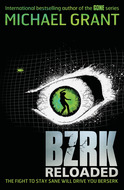
Kitabı oku: «BZRK: RELOADED»

For God’s sake, Plath who is really Sadie McLure, why didn’t you just do it?
Too precious to kill, are you, little rich girl?
Then what the hell are you doing in BZRK?
Don’t you know it’s a war, Plath? Don’t you know this is a battle for the human soul?
Why didn’t you kill, Plath?


First published in Great Britain 2013
by Electric Monkey – an imprint of Egmont UK Limited
The Yellow Building, 1 Nicholas Road, London, W11 4AN
Copyright © The Shadow Gang 2013
The moral rights of the author have been asserted
Endpage photograph © Dimarion/Shutterstock
ISBN 978 1 4052 6311 5
eISBN 978 1 7803 1255 2
www.egmont.co.uk
www.electricmonkeybooks.co.uk
A CIP catalogue record for this title is available from the British Library
All rights reserved. No part of this publication may be reproduced, distributed, or transmitted in any form or by any means, or stored in a database or retrieval system, without the prior written permission of the publisher.
Please note: Any website addresses listed in this book are correct at the time of going to print. However, Egmont cannot take responsibility for any third party content or advertising. Please be aware that online content can be subject to change and websites can contain content that is unsuitable for children. We advise that all children are supervised when using the internet.
EGMONT
Our story began over a century ago, when seventeen-year-old Egmont Harald Petersen found a coin in the street. He was on his way to buy a flyswatter, a small hand-operated printing machine that he then set up in his tiny apartment.
The coin brought him such good luck that today Egmont has offices in over 30 countries around the world. And that lucky coin is still kept at the company’s head offices in Denmark.
For Katherine, Jake and Julia
Being deeply loved by someone gives you strength.
Loving someone deeply gives you courage.
Lao Tzu
Kiss the crazy.
@Horse_ebooks
CONTENTS
Cover
Title page
Copyright
Dedication
Epigraph
ARTIFACT
AFTERMATH
ONE
TWO
THREE
FOUR
FIVE
ARTIFACT
SIX
SEVEN
EIGHT
NINE
ARTIFACT
TEN
ARTIFACT
ELEVEN
TWELVE
THIRTEEN
FOURTEEN
FIFTEEN
SIXTEEN
SEVENTEEN
EIGHTEEN
NINETEEN
TWENTY
TWENTY-ONE
TWENTY-TWO
TWENTY-THREE
TWENTY-FOUR
TWENTY-FIVE
ARTIFACT
TWENTY-SIX
TWENTY-SEVEN
After
Back series promotional page
Author’s Note
About the Author
About Publisher
ARTIFACT
To: Lear
From: Nijinsky
Wilkes is alive and back with us.
Ophelia is alive despite the loss of both legs below the knee.
Keats and Plath are both well and performed magnificently.
Vincent is suffering from a deep depression following the loss of one biot. The second biot was badly injured but is recovering. Vincent is being cared for, outcome very uncertain.
We failed in our main objective.
We await instructions.
ARTIFACT
To: Nijinsky
From: Lear
During Vincent’s incapacity you are in charge of NYC cell, Nijinsky. You’re the wrong person for the job. Become the right person.
ARTIFACT
Central Intelligence Agency–Office of Technology Threat Assessment
Transcript of interview with Professor Edwin H. Grossman, February 28, 2012
(Page 7 of 9)
Q: In your opinion then, this is a serious threat but not an urgent one?
Grossman: I don’t know your definition of urgent. Look, the gray goo scenario is not science fiction, not any longer. Nanotech is advancing by leaps and bounds. There is some very important research going on at MIT, and at UC Irvine, as well as in my own department at Texas.
Q: But anyone researching nanotech is aware of the danger.
Grossman: Fermi was aware of the danger of nuclear fission. Watson and Crick were aware of the danger of DNA. Alfred Nobel was aware of the danger of dynamite when he invented it. No doubt the first cave man to swing a club was aware–
Q: I take your point, Doctor, but you aren’t seriously comparing nanotechnology to nuclear weapons.
Grossman: Actually, yes, I am. You see, in either case, we are talking about enormous, catastrophic power in the hands of human beings.
Q: Only a madman–
Grossman: Only a madman? (Laughs.) Has there been a shortage of madmen in human history?
AFTERMATH
Vincent felt the laugh building inside him. It was like a build-up of steam in a covered pot. Like a volcano whose time to erupt has come at last.
He was being torn apart.
His arms were handcuffed to two parked diesel locomotives, and they were huffing and puffing, and smoke was coming up out of their undercarriages, and the locomotives were so hot that the steel side panels were melting.
He stood there between the tracks.
The chains were long. The engines would be able to build up speed.
“Hah-hah-hah-hah-hah!”
He laughed, because it would be funny when his arms were ripped from his body, when the flesh tore and the bones popped out of their sockets like pulling the wings off a barbecued chicken and . . .
“Come on, man, lie down, lie down, lie down.”
Choo choo. Choo chooooooo!
“You’re going to be okay, Vincent.”
Who was Vincent? His name was not Vincent. His name was . . . What was his name?
A dragon, one of those Chinese dragons, loomed over him, a giant face, and there was smoke coming out of its nostrils and it was the same as the smoke from the trains that were starting to move now, starting to pick up speed, now.
“Uh. Uh-uh-uh! Uh! Uhhhh! UUHHH!”
The chains clanked as the trains pulled away.
“Take this pill. Take the pill, Vincent.”
Vincent thrashed, had to free his arms, they would rip his arms off, his arms would be dragged off behind the trains!
“Uhhh-uhhh-UUUHHHH!”
“Goddamn it, take the pill!”
The dragon was ripping his mouth open; he was going to split Vincent’s head open so that brains came gushing out of his mouth, vomiting his own brains and . . .
The Chinese dragon was a nurse now, no, a dragon, no, no, no.
“Nooooo!”
A vice closed around his head. He smelled a masculine perfume. Vincent felt muscles like pythons around his head and something was in his mouth, and the dragon/nurse held his jaw shut even as he tried to scream and beg for help.
“Keats. Help me! Get water.”
From the sky came a bottle.
Fiji water. Oh, yes, that was the one with a square bottle, sure he would drink some water, yes, dragon, I’ll drink some water like a good boy.
“Get his mouth open.”
But the trains!
Vincent swallowed.
A voice he heard very, very clearly but through his head not his ears said, “They’ll kill you, they’ll have no choice, they’ll kill you, kill you, the mad king will send the mad emperor. Kill. You.”
But then his arms were ripped from their sockets—Snap! Pop!—by the trains and he laughed and laughed.
And he felt sick.
He wanted to throw up.
“Like my brother,” a voice said.
The dragon, who was really just a man who smelled like perfume, had an arm around Vincent’s head. The man was crying. So Vincent felt like crying, too.
The other one, Vincent thought maybe he was a devil, he wasn’t sure, he might have devil skin, and he had devil blue eyes.
“I don’t have arms anymore, Jin,” Vincent whispered.
“Jesus,” the possible devil with blue eyes said.
Jin—Nijinsky, the dragon, the nurse—didn’t say anything.
The drug came for Vincent. It called him to unconsciousness. As he tumbled, armless, down the long, long black well, Vincent had a moment of clarity.
So, he thought, this is madness.
She stood in the doorway, ready to help if Nijinksy and Keats had trouble getting Vincent into restraints.
Ready to help. Her heart was beating as if it was made out of lead. That beat, that unnatural beat squeezed the air out of her lungs; it clamped her throat.
Sadie McLure—Plath—had been just a little bit in love with Vincent. He had that effect on people. Not love love, not even attraction in the usual sense of the word—that feeling was reserved for Keats, who was working silently, quickly, to tie Vincent down. Keats looked as shell-shocked as Plath felt.
So, not love love and not attraction for Vincent, but some weird amalgam of protectiveness and trust. Strange to feel that way about someone as cold-blooded as Vincent, someone so utterly in control. Well, formerly in control.
Her fists clenched so tight that her neglected fingernails cut new and too-short lifelines into her palms. She had taken too many hits, too many losses: her mother, her father and brother. What was left to her now?
They said what didn’t kill you made you stronger. No, it left you with holes blown through your soul. It left you like Vincent.
Plath had been recruited by Vincent. She had trusted Vincent, trusted him even with her life. And at the same time there had always been the feeling that she should take care of him, not out of reciprocity, not because it was owed, but just because there was something in that impassive face, in those dark eyes that spoke to her and said, Yes, I need.
Plath knew she was not alone in this. The others, all of them, felt it.
But that Vincent, the cool, calm, relentless one whom you nevertheless wanted to shelter, that Vincent was not here any longer.
Madness.
Insanity.
It had been an abstraction, but now she saw it. Now she felt it, and brave Plath was no longer quite so brave.
She turned away, unable to watch any longer.
Ophelia would have laughed at the idea that what didn’t kill you made you stronger. Her legs were gone, one at the knee, one six inches higher. She was not stronger.
But worse, like Vincent she had lost her biots. Had Ophelia been capable of rational thought she might have contemplated the comparison between legs, actual, physical legs, and the biots, which were not, after all, exactly original equipment for any human.
Her legs had burned like candles, melted like wax, down to the bone. They’d amputated the barbecued stumps in the OR there at Bellevue Hospital. But her biots were dead long before that, incinerated in the terrible disaster at the United Nations. By the time doctors had taken what was left of her legs, what was left of her mind wasn’t much.
Ophelia was guarded by FBI agents who labeled her a terrorist suspect. There was one just outside the door to her hospital room, and one at each end of the hallway, and one at the nurse’s station. So, had Ophelia been sane, she probably would have been surprised to see a man standing at the foot of her bed who was obviously not a doctor, despite his white coat. Underneath the white coat was a faded, lilac velour blazer. His usual jaunty top hat had been set aside somewhere, but he still had Danny Trejo’s face.
Caligula—he had no other known name—came close to her, stood beside her. Ophelia gazed up at him and in a moment of clarity, a brief gap between the painkillers and the mental anguish, seemed almost to recognize him.
“You?”
“Yes, Ophelia.”
“Did? Are, uh . . . Did?” she asked. It was not a coherent question, but Caligula answered as though it was, as though she could understand, even though her eyes had rolled up into her head and a manic grin had distorted her lips.
“Wilkes got out. The others are alive.” And then he said, “You did good, Ophelia. You were brave.”
He put a palm on her forehead, a gesture that was tender but not, because he used the pressure to hold her head still as with a single swift motion he buried the dagger to the hilt in her temple.
From his pocket he withdrew a small cylinder ending in a pointed valve. He pulled the knife out and pushed the valve into the hole. He opened the valve and let his own special mixture of white phosphorus flow into her brain.
An autopsy might just conceivably produce evidence of nanotechnology, and it was part of Caligula’s brief to stop that from happening. That, and a mad Ophelia might eventually, in some disjointed rant, have given up a deadly secret or two.
The only survivor of the UN massacre in custody was now no longer available for questioning.
By the time Caligula left the room Ophelia’s eye sockets were dripping liquid fire.
ONE
“Oh, I needed that.”
The president of the United States, Helen Falkenhym Morales, was feeling gratified. She and her husband had just sat in bed and watched Jon Stewart take apart the Senate majority leader, a Morales foe. And for once the president had gone off-diet and actually eaten most of a butterscotch sundae.
An enemy ridiculed, and a gooey sundae: a good end to an otherwise lousy day.
Monte Morales leaned across the bed and wiped a bit of whipped cream from her chin, popped it in his mouth, and smiled.
She liked that smile; it was a very particular smile, and if it were not for the fact that her life was lived according to a rigid schedule, well . . . he was still sexy after all these years.
Her husband, Monte Morales, the first gentleman, or as most people referred to him, MoMo, was ten years younger than she and kept himself in good shape for a man of forty-five. It was one of the things the American people liked about him. They liked his good looks; they liked his obvious devotion to his wife; they liked the stories about his genial weekly poker games with some of the other spouses of important Washington players.
They didn’t approve of his smoking cigars in the White House, but the American people were willing to forgive so long as he kept on being the charming, easygoing counterbalance to his wife’s razor-edged personality.
MoMo was the living proof that the president couldn’t be all bad—even her enemies admitted that.
“What’s bothering you, babe?” MoMo asked.
She turned and frowned at him. It had sounded perilously close to criticism. “What do you mean? It’s time for bed, that’s all.”
He sat up, swung his legs off the side of the bed, and said, “Not now, I mean generally. You’ve been a little weird.”
“Weird?” The word was absurd applied to Helen Falkenhym Morales. Difficult, cold, critical: those were the words applied to her most frequently. No one thought she was weird.
MoMo shrugged his broad shoulders. “I mean . . . off. Just, sometimes. Little stuff. You were talking during the program.”
“So?”
“So you never do, that’s all.”
“Really? You think ten minutes before we go to sleep is time to start questioning me?” She pulled on a robe and glanced at her pad. Nothing there that needed immediate attention. There was a coup under way in Tajikistan. That could wait.
And there was a briefing book from Patrick Rios, the new director of the ETA—the Emerging Technologies Agency. Rios, late of the FBI and a real go-getter type, was pushing hard to go after McLure Industries. What Rios didn’t seem to understand was that Grey McLure and his son had been murdered in what had been—until the UN terrorist attack—the biggest headline event of the year. Go after McLure?
Well . . . why not, now that she thought of it. Rios was very smart, very capable. He reminded the president of herself, somehow. When she pictured Rios, she always seemed to see herself as a young, aggressive prosecutor.
She trusted him.
She needed to give him a free hand.
He was very like her, a good guy, reliable.
In fact, the two memories—of Rios and of herself at that age—were wired together. The president’s brain could not think of Rios without thinking of herself.
“Babe, that’s not what I’m saying,” MoMo said. He stood to wrap his arms around her, but she moved away, heading toward the bathroom and a hot shower, her end-of-day relaxation ritual. He followed. “It’s just I’m wondering if you’re okay.”
“Listen, MoMo, I’m tired. And until thirty seconds ago I was feeling like I had put a pleasant full stop on this lousy day. So if you have something to say, let’s get to it.”
She slid back the glass door on the shower and turned the water on. It would take thirty seconds for the water to heat up.
“Okay,” he said, suddenly very serious. “It’s a bunch of little things. You’ve developed a nervous tic in your eye.”
“It’s the pollen—it’s been terrible.”
“You call me MoMo. You never used to. I don’t mind it from other people, but that’s not what you call me.”
She hesitated. “Okay.”
“You ate raw tomatoes.”
“What?”
“You ate raw tomatoes. You hate them. You dropped the F-bomb in the Cabinet meeting. You never do that. The last couple days I see you staring in the mirror, and it’s like you just go blank. The other day you snapped at the photographer. When do you ever do that?”
“I don’t know if you’ve noticed, but I’ve been under some pressure lately,” she said, her voice dripping sarcasm.
“You’ve been under pressure since I’ve known you, Helen, you don’t snap at people who work for you, not people who can’t defend themselves. It’s just . . .” He shrugged helplessly. “I just wonder if maybe we should take a few days up at Camp David.”
“I can’t do that,” she said icily. “I’m not the first lady, I’m the goddamned president. I have actual work to do.”
The insult was like a knife in his ribs. He gulped, shocked by it. “See, that’s not the kind of thing you say,” he said finally.
She blinked.
“Sorry, Mo—, sorry, sweetheart. I’m . . .” She forced a helpless smile. “Yeah, maybe I need some time off.”
“Maybe more than that. That twitch, all this little stuff, more than I can remember right now . . . maybe you should call the White House physician. Just have him check. You know . . . could be . . . I don’t know.”
The president nodded solemnly. “Okay. Now I’m taking a shower. Want to join me?”
“You know I’m a bath man,” he said, his tone half reproach, half forgiveness.
She put her arms around him. “But I’m lonely in that big shower all alone.”
When they were under the spray she considered her options.
MoMo wouldn’t let it drop. He was nothing if not persistent. He loved her and he would keep pushing. And pushing.
Something was wrong with her—that was the hell of it. She had felt it. She knew it was true. Something wrong.
But she had a year until the election. This was no time to look weak. This was no time for doctors to be finding a tumor or a stroke or even just too much stress.
But what could she do? How could she stop MoMo from loving her right out of the White House?
Later she would recall that question.
Later she would ask herself how she had decided on the terrible answer.
But at this moment all she saw was that it would have to be a single swift blow. No second chances.
She pressed close to her husband. She kissed him. She ran her fingers through his wet hair, held both sides of his head tight, and with every muscle in her body smashed the back of his head against the tile wall.
MoMo sagged to the floor. Blood came with surprising force, more than she would have imagined.
She left the water running, stepped from the shower, crossed to the bathtub, and began filling it with hot water.
It took a couple of minutes before there was enough water in the tub.
MoMo groaned in the shower. Nonsense sounds, not words, but still she had to hurry.
She slid back the shower door, knelt down, put her hands under his arms, and dragged him the five feet to the tub. That much was easy: he was wet and soapy, and the floor was tile.
The harder part was pushing him up over the side of the tub. For the scenario to work it would have to seem as if he’d slipped and smashed his head against the side of the tub. It would be a long night of making sure that bloodstains were only in exactly the right places. The president would be scrubbing.
She manhandled MoMo into the rising water in the tub. Now he was moaning and moving feebly, like a sleepwalker, like a drunk, uncoordinated.
He splashed into the tub.
His eyes fluttered open as she ground the bloody wound against the back of the tub.
“Mwuh?” he managed to say.
Mustn’t leave handprints. Had to do this right. She pressed her palms against his chest and leaned her weight on him until his head was completely submerged.
His dark eyes blinked, seemed to gain awareness for just a moment, and his arms came up out of the water to push back . . .
Too late. His lungs filled.
He vomited into the water.
And then she no longer had to hold him down. MoMo wasn’t going anywhere.
It would be a tragedy. The nation would mourn. She would get a ten-point sympathy bounce in the polls.
Her secrets would be safe.
A sob heaved up from inside her. She loved him. She loved him with all her heart.
And she had just murdered him.
In an office in a building on the 1800 block of Pennsylvania Avenue, just streets from the White House, Bug Man tore the gloves from his hands.
He was shaking.
He felt sick. He climbed out of the chair, made it five steps on the way to the very nice executive bathroom before falling to his knees, gasping as if he’d been running a marathon.
He had been.
Down in the meat, down in the nano, he had been racing his exploding-head-logo nanobots, laying wire like some demented lineman from elements of the president’s ego, her self-image, to images of MoMo.
Bug Man had long since cauterized a number of areas storing what might be called ethics or morality. In fact, they weren’t that, they were memories of books, sermons, lectures, and—much more powerful—the images of victimization from her childhood in San Antonio that formed the basis of her core decency.
Like most politicians, and all presidents, she had a strong ego. She’d always had well-developed instincts for survival, what some would describe as ruthlessness. But it had been balanced by pity, kindness, fellow feeling, love.
Bug Man had needed a less moral, more ruthless person. He had needed her simplified—the better to manipulate, the better to convince her to give Rios and his brand new government agency free rein to quash any unhelpful investigations, to oppose any international action.
So Bug Man had made her that. He had needed her to be suggestible to paranoia; he had needed to be able to plug that heightened aggressiveness and ruthlessness into pictures of any and all whose actions might threaten the Armstrong Fancy Gifts Corporation.
Yes.
Well.
Brains are subtle things. Some miswiring had created the twitches and tells that had alerted MoMo to changes in his wife. The president’s heightened aggression combined with weakened restraint had led now to murder.
But for the last desperate minutes Bug Man had not been trying to get Helen Falkenhym Morales to kill her husband MoMo. He’d been trying to stop her.
Once he’d seen where she was going he’d tried—way too little, way too late—to make her see MoMo as an extension of herself.
The only result was that later, too damned late, she would feel remorse. Guilt. Which would only create its own problems.
Bug Man was on his knees, blood pounding in his face, stomach churning with fear, waiting for the call.
When his phone did ring it still startled him.
He wondered how long he could go without answering. He wondered if he could keep from vomiting again. Or crying.
“Yeah,” he whispered into his phone.
“Oh, Anthony.” The voice was not the ranting fury of the Armstrong Twins. It was Burnofsky. “Anthony, Anthony: what have you done?”
“Jesus Christ!” Bug Man wailed. “I didn’t know the crazy bitch would—”
Burnofsky laughed his parchment-dry laugh. “Watch what you say. Washington is full of big ears.”
“What am I . . . What do . . .” He couldn’t even frame the question. His breathing was short and harsh. “The Twins . . .”
“Past their bedtime, fortunately. The only one watching the video feed was me.”
It was a sign of how frightened Bug Man was that he welcomed this news. He despised Burnofsky, but he was terrified of Charles and especially Benjamin Armstrong.
“But there will be no hiding this, of course,” Burnofsky went on.
Bug Man cursed, but there was no anger left in him. All was cold knife-steel fear now. The Twins—Charles and Benjamin Armstrong, those freaks—were not patient with underlings who screwed up.
The things they could do to him . . . An earlier error had been punished with a beating delivered by AmericaStrong thugs against Bug Man’s legs and buttocks. He still couldn’t sit in a chair without a handful of Advil. Now he had endangered everything.
“I’m a twitcher; I’m a fighter, not a goddamned spinner,” Bug Man pleaded with the phone. “I took down Vincent himself. I took down Kerouac before him. I’m the best. I’m important. They can’t kill me! This is—”
“Mmmm,” Burnofsky said, amused, gloating, already seeing in his opium-addled brain the price the Twins might demand. “You’re screwed, Anthony my young friend. There’s only one person on this green Earth who can save you. Do you know who that is, Anthony?”
Bug Man was trembling. Even now, no anger. Anger would come later, along with self-justification, but right now, with his face inches from the floor and his whole body feeling sick, Bug Man could only moan.
“Who, Anthony? Who can save you now, you arrogant little Limey shit? Say the word.”
“You,” Bug Man whispered.
Silence stretched as Burnofsky absorbed his rival’s defeat. Then the older man said, “Go limp. Power down. Go to your hotel, screw your girlfriend, but do nothing else until I tell you.”
The phone went dead. Bug Man rolled onto his side and cried.
TWO
Keats, whose real name was Noah, had not intended to go to Plath’s room, but there he was. He knocked.
“Yes,” she said. Not “Come in,” just “Yes.” Knowing it was him.
He stood framed by the doorway.
“You look like hell,” she said.
“So do you.”
And then they simply went for each other. They clutched and tore at each other, bruised each other’s lips.
Noah’s fingers dug into a handful of Sadie’s dark hair, and Sadie’s hands fumbled to push his shirt over his head, and his tongue was in her mouth, and her breasts were pressed almost violently against his hard chest.
They were alive when they should be dead, and sane when they could be mad.
So afraid. So lonely.
Vincent’s lunatic howl was fresh in Keats’s mind, still echoed in his ears, and the sight of Nijinsky breaking down in tears, and the awful memory of his big brother, of Alex, shrieking like an animal, chained to a cot in a hellish mental ward screaming, “Berserk! Berserk! BERSERK!”
Keats had imagined that their first time making love would be a study in tenderness. But this was not tender. They could hardly keep from hurting each other. They needed something that was not horror. They needed something that was not drenched in despair.
They needed not to hear Vincent howling like a dog.
Noah gasped and pulled back suddenly. He pushed Plath’s greedy hands down against the pillow.
Her eyes were confused, wary. “Don’t stop,” she said and her voice was not pleading, it was a snapped order. She expected to be obeyed. She could do that voice when motivated.
“You’re leaking,” Keats said.
“What?”
“It’s not bad, not yet.”
She understood him, then sat up, put a hand to her head. As if she could feel it. “Damn it.”
“Yeah,” he agreed.
Keats looked at her. She closed her eyes, absorbing the frustration, then snapped her gaze up at him, blazing.
But as he looked at her face he also saw deep inside her. Not in some metaphorical way. He had eyes inside her, all the way down inside her brain.
Down in the meat.
Plath had an aneurysm, which had been serviced first by her father’s biots—before he had been murdered—and were now served by Keats’s own biots. Two tiny, nightmarish creatures, neither as large as a dust mite, neither visible to the unaided eye. Each had six legs, a tail that could deliver a venomous sting or drip acid. A spear for puncturing the metal shells of nanobots.
There was a rack of pins only a few molecules thick slung on the biot’s back. A spinneret at the rear oozed with webbing wire.
Biots were built of several different DNA strands: scorpion, spider, cobra, jellyfish, and human. The DNA of a specific human, in this case one Noah Cotton: Keats.
That DNA connection tied the biot to its creator, like a finger was tied to a brain, like a sort of detached limb, a body part controlled by his own mind. Move left. Move right. Jump. Strike. Run away.
Live.
Die.
The human DNA was most evident in the face of the biot. In addition to blank, soulless insect eyes, each biot also had structures that looked like human eyes, almost. Human until you looked closely and saw that these were as blank and soulless as the spider eyes.
The intimate connection had a very major downside. A biot wasn’t just a limb, it was an extension of the mind of its controller/creator. Lose a biot and you would lose your mind.
That was why Vincent howled. Bug Man had beaten him in battle and killed one of Vincent’s biots.
Noah kissed Plath, a kiss that was full of regret, and she accepted it passively.
Down deep inside her brain where a scalpel could never reach, Keats’s biots, K1 and K2, stood atop the Teflon fiber barrier that had been built so painstakingly around the aneurysm. It was a bulging artery, a thin spot, a swelling, like an overinflated balloon where the blood might break out at any moment and tear apart the drum-tight membrane to flood and destroy the brain tissue around it.
Pop.
A blown aneurysm could lead to anything from strokes to localized brain death to all-over, whole-body death.
The membrane was leaking. From Keats’s position it was a floor not a wall—gravity meant very little at the nano level. A floor that was gushing tiny red frisbees, like a jet of licked cough drops. These were the red blood cells, platelets. They shot up in a jet from a tiny tear in the artery wall and floated off into the cerebrospinal fluid, where blood was normally not allowed.
Within that garden hose of platelets were things of a paler color that looked like animated sponges, wads of mucousy goo—the white blood cells, the pale soldiers, the defenders of the body.
Keats saw this through two sets of biot eyes. The biots saw each other as well. And all the while, up in the macro, he was looking at Plath as she stood, and he gazed with intense regret on the curve of her breasts, and the narrowness of her waist, and saw—at least in his imagination—many other details as well.
It was painful, wanting her this badly.
Keats’s two biots scampered to the stash of titanium fibers. The fibers looked a little like strands of razor wire, each only about half the length of the biot itself. The jagged edges allowed them to be woven together. But care had to be exercised to avoid cutting into the artery wall and making things far worse.
“Can’t you do two things at once?” She leaned into him and he did not pull away. Her open mouth met his and her tongue found his and he was breathing her breath, and his heart was pounding, pounding crazy crazy crazy.
His body, his bruised, battered, painfully taut body, did not really give half a damn about doing the responsible thing but wanted very much, very excruciatingly much, to just do, and it was almost beyond his power to restrain himself and if she kept that up then things were going to move forward to the next step, a step he wanted to take more than he had ever wanted anything else in his sixteen years of life.
His words were a rasp and a groan. “Not those two things. No. Not at once.”
He held her back, his hands on her arms, and really why the hell were his arms taking sides with his brain when his body so clearly, clearly, clearly had other ideas in mind?
“I don’t want to be paying attention with half my mind,” he managed to say.
Plath liked that. She didn’t want that to be his answer, but she liked it anyway. Yes, he wanted it to be important. He wanted it to stay with him forever. Keats was always . . . She stopped herself in midthought. She didn’t know what he was always, did she? She barely knew him. They had met just weeks ago. Not a single second of that time had been anything like normal. It had been lunacy from the start.
We take the names of madmen, because madness is our fate.
Terribly melodramatic, that. Ophelia had denied that it was hopeless. Ophelia, who lay now, presumably in FBI custody, with her legs burned off.
And Vincent was the proof. Vincent, their pillar of strength. The best of BZRK, if there was a best.
How long until this beautiful, sweet boy with the sometimes difficult to understand English accent would be raving like his brother, Kerouac?
How long until he was howling like Vincent?
How long until she was alongside them?
He wasn’t the only one who wanted this, he wasn’t by any means the only one. She wanted him, all of him, not later, now. But that meant all of his attention, too, she supposed.
She was arguing with herself now, and either way she was losing. Plath was not good at losing.
Down deep inside her brain, Keats lifted the first of the fibers and slid one end into the weave. The platelets were pouring out, a fire hose of flat red discs. His biot bent the fiber against the current, pushing the flow aside, and shoved the loose end down, held it down while his second biot came running up with a second fiber. The platelets battered the biot’s head, a Nerf machine gun.
“How bad is it?” Plath asked.
“Not bad,” he reassured her. “Just an hour’s work.”
Plath smiled crookedly, and they both felt the moment slip away.
“You realize we may never get the opportunity again?” Plath asked him.
“Horribly aware, yes,” he said.
She laid a palm softly against his cheek. He closed his eyes. He couldn’t help it. He had to close his eyes because he could not look into her eyes or notice the tremor in her lips or the pulse in her throat or any of a hundred things that would destroy his ability to focus on saving her.
She kept her hand there. “I’m afraid,” she said.
“Me, too.”
“I told you before: I’m not the kind of girl who falls in love.”
He shrugged. “I’m the kind of boy who does.”
“It will make it so much worse,” she whispered. “Aren’t you afraid of that pain?”
“Yes,” he said.
“Then let’s not. We can make love without being in love, Keats. We can be . . . We can be fighters together. Side by side. We can be friends. We can do, whatever, we don’t have to be in love.”
He said nothing, half his focus already gone, trudging dutifully with his titanium fibers as platelets swirled around him.
“You don’t need me here,” she said, frustration turning her voice cold. Actually angry at him for focusing on saving her life, angry at him, she supposed, for being able to resist. Or just angry at life in general.
“I’m going to take a shower,” she said.
“Yeah,” he said flatly.
It took Keats closer to two hours to squeeze off the flow of blood. Then another twenty minutes to carefully check his work.
He fell asleep fully clothed, and though he would have loved to dream of her, exhaustion shut him down.
“Difficult news,” Burnofsky said.
Burnofsky brought that news to the Twins right away, middle of the night. There could be no concealing it. The best he could hope for was to save Bug Man’s life and leave his own plans intact. That above all: his own plans.
To that end he’d hoped to convince the Twins to take a victory lap, to take a tour of foreign facilities or even a vacation aboard their floating house of horrors, the Doll Ship.
Bug Man had forced his hand and disrupted Burnofsky’s timetable. In a few hours, by morning at latest, the news of the first gentleman’s death would be out. It would be seen as a tragic accident by the general public—but the Twins would know better.
If he was going to keep things running, he, Burnofsky, would have to get the Twins under control. Not easy. Never easy and harder now. Charles still saw reason. But Benjamin . . .
Burnofsky took the elevator up to the Tulip. The Tulip was the pinnacle, floors sixty-three through sixty-seven, of the Armstrong Building, headquarters of the Armstrong Fancy Gifts Corporation. It was the pink polymer, one-way transparent, nanocomposite-walled home and office of the Armstrong Twins.
AFGC still made fancy gifts at factories in China, Malaysia, and Turkey. They still owned and operated the ubiquitous gift stores seen in every American airport and in European and Japanese train stations. But gifts had long since ceased to be their main focus.
Weapons technology, surveillance, and communications technology, and above all, nanotechnology, now occupied the denizens of the Tulip and most of the sixty-two floors below. The gift stores were run out of an office park in Naperville, Illinois. In the Tulip they had bigger fish to fry.
Burnofsky had called ahead to Jindal so he could get the Twins up and alert. Jindal met him outside the private elevator, down on sixty-two.
“What is it?” Jindal asked, suppressing a yawn but intensely concerned despite his sleepiness.
“Why don’t I just tell the story once?” Burnofsky said and pushed past Jindal to the elevator. It was a short ride.
“What in hell?” Benjamin asked the moment Burnofsky appeared.
The Armstrong Twins wore a robe, dark red silk, specially tailored for them, of course: Nordstrom and Bloomingdale’s did not carry clothing in their size or shape.
Their legs, all three of them, were bare. Their feet—only the two useful ones—were in shearling-lined slippers, the third, deformed and three-quarter-size, was bare.
“Difficult news,” Burnofsky said.
“Well, spit it out, it’s the middle of the night!” Charles snapped.
Burnofsky tapped his pad for a few seconds, and the touch screen embedded in the Twins’ massive desk lit up.
It was the video from Bug Man’s feed. Like all nanobot video, it failed to achieve the high standards of Hollywood; it was grainy, jerky gray scale one moment and awash in unnatural computer-enhanced colors the next. This video was worse still because it was the result of tapping directly into the president’s optic nerve, pulling up the raw feed, so to speak, of rods and cones, uninterpreted by the visual cortex.
There was no sound, just a series of jerky images—a window, a wall, Monte Morales, a rumpled bed, the floor, Monte Morales again, a shower knob, a shoulder, an eye, a stream of water and then . . .
“Jesus!” It was Jindal. “Did she . . . Is that . . .”
It was fascinating to watch the reactions of the Twins. Charles’s eye stared hard—at the screen, at Burnofsky, at the screen. His mouth was a straight line, set, twitching in growing fury.
Benjamin seemed almost distracted. He looked to left and right. His mouth—well, it was hard, really, to judge his face fairly; it had been bashed and battered by the bottom of a glass bottle. There was a tooth missing altogether and another one chipped. Benjamin’s eye was a clenched purple fist with the pupil barely showing. He looked like someone who had been on the losing end of a bar fight.
Within the raw liver that was Benjamin’s eye socket, the cruel eye seemed far less interested than it should.
The third eye, the one between the usual two, seemed to agree with Charles that this was important. It focused its soulless stare on the video.
The file ended.
“It will be covered up,” Charles said. He tugged at the collar of his bathrobe and, as well as he could, tugged the belt tighter. “Bug Man must be replaced at once. And punished. Punished most severely. It’s that woman he has with him. She distracts him. Take her from him, get rid of her. Kill her in front of him! Bug Man will refocus. A beating for him, yes, a severe lesson, yes, that’s it, a beating! And kill his woman.”
“I disagree,” Burnofsky said as blandly as he could.
Oh, Bug Man would owe him. He wished he had video of Charles planning Bug Man’s humiliation and Jessica’s murder. Anthony Elder, that snotty little black British prodigy who called himself Bug Man, would kiss Burnofsky’s ass for this.
Burnofsky would own Bug Man.
“I don’t care about Bug Man,” Benjamin snarled. “It wasn’t Bug Man. It was her. Her!”
Burnofsky at first assumed he was talking about Bug Man’s girl, Jessica. But no . . . of course not.
“I want her hurt.” Benjamin touched his damaged mouth. Then he clenched his fist. “Damaged in some permanent way, something she can never overcome, something that will make her remaining life a horror. Not death, no, we still need her to get at her father’s secrets, but pain, such pain and despair, yes.”
Not poor, dumb, absurdly beautiful Jessica. Oh, no. Benjamin was thinking of Sadie McLure.
Burnofsky suppressed a sneer. Benjamin was losing his mind. The experience with Sadie McLure had unhinged him. He’d always been the more volatile of the Twins, but now? He was still “wired”—that was part of the problem. Burnofsky had volunteered to go in and pull those pins and wires, remove them before they became a settled feature of Benjamin’s brain, undo, insofar as anyone could, the damage done by Sadie McLure’s biots. But Benjamin couldn’t tolerate the idea of someone else inside his brain.
Irony, that.
And Charles? Well, just what the hell did you do if you were a conjoined twin and the other half of you went mad?
“She was inside my brain, sticking pins in my brain, making me an animal!” Benjamin bellowed.
“Brother . . .” But Charles’s voice wheezed out. Benjamin had taken control of their lungs.
“Something with acid,” Benjamin said, his voice suddenly silky. “Acid. Or something taken off. Cut something off her. Cut off her nose or her hands.” He chopped at the air with his hand. It was more than just a gesture of emphasis, he was using his hand as an imaginary meat cleaver.
Charles waited for an opening to speak. They each had a mouth of their own and a throat, but the lungs were shared property, and it could be difficult for one to make himself heard if the other was bellowing.
“Brother,” Charles began. “Let’s focus on this crisis. The next thing we need to consider is—”
“Next? Next? Next she suffers and I see it happen. I revel in it. I see it happen and I laugh at her. I stand over her and look down at her as she cries and begs and as the hope dies in her eyes. That’s next.”
He was shaking his fist now, a comic-book villain. But crying from his eye at the same time, a furious, frustrated, hurt child.
She was a sixteen-year-old girl, Sadie McLure, although now it seemed she used the nom de guerre Plath. So melodramatic, the BZRKers—such romantics.
Sixteen. The same age as Burnofsky’s own daughter, Carla.
Former daughter? No, death didn’t make you former, it just made you dead.
Charles and Benjamin had been much more calm when they’d ordered Carla’s death. They had been regretful. Charles had actually touched Burnofsky, put a ham-size hand on Burnofsky’s back as he ordered the death of his only child.
Solicitous.
Considerate.
She has betrayed us, Karl. She’s sold us out. You know how she would end up if we left her alone to leave us and join BZRK. Madness. Would you want that for your little girl?
Burnofsky drew a shaky breath. They might at least offer him a drink; of course, the Twins were a bit distracted. Benjamin was still ranting, and Charles was growing increasingly impatient with it.
“I was raped by her!” Benjamin bellowed. “Violated!”
Plath had managed to infiltrate Benjamin’s brain with her biots. Burnofsky knew she was new at the business of nano warfare, but she had improvised, the clever, clever girl. Given the time frame she could have had only minimal training in the sophisticated business of subtly rewiring a human brain. And she’d been in a hurry and under pressure, so she had simply stabbed pins and run wire almost randomly.
She had made scrambled eggs of Benjamin’s brain.
That was some of her father’s intelligence in evidence. She was smarter than the brother who had died. He wondered if they had killed the wrong McLure child. Stone was a stolid, dutiful type, his sister on the other hand . . .
The result of Sadie’s wiring had been severe mental disruption. Benjamin had screeched and babbled and generally made a fool of himself, straining the physical barrier that connected his own head to Charles’s—very painful—and caused the unfortunate incident of the glass bottle, the results of which were still so obvious on Benjamin’s face.
The membrane, the flesh, whatever the word was for the living intersection between Charles and Benjamin, had been strained and torn. The central eye, that eerie, third eyeball that sometimes joined with Charles and other times with Benjamin, and at still other times seemed to decide its own focus, was red-rimmed, the lower lid crusted with blood that still seeped from a deep bruise.
At the end Plath had let Benjamin live when she might well have killed him. Burnofsky wondered whether at this moment Charles thought that was a good thing or not. How many times must one or the other of the Twins have pondered the question of what happened if one of them died?
Their heads were melded. Some areas of their brains were directly connected. They shared a neck, albeit a neck with two sets of vocal cords. They had two hearts—one apiece—and had a sort of two-lobed stomach that fed out through a single alimentary tract.
Each had an arm. Each had a leg. And there was the third leg as well, a leg that dragged like so much dead weight. As a consequence they moved with extreme difficulty and usually chose to get around in a motorized cart or wheeled office chair customized to fit their double width.
Charles tried again. “We have important matters to discuss, Benjamin. We are on the cusp of completing Phase Three of our plan, brother, don’t you grasp that? Don’t you see how far we have come? But we must deal with this crisis. Bug Man’s incompetence may upset everything!”
“It wasn’t you,” Benjamin snapped. “It wasn’t you. It was me. It was me she humiliated.”
“Look, we’ll deal with the girl when we get an opportunity,” Charles soothed. “Of course you feel violated. Of course you’re angry. But—”
It was part of the strangeness of dealing with the Twins that when they spoke to each other they could not look at each other. They had never made direct eye contact in their lives.
“You think I’m being irrational,” Benjamin said, sounding rational for the first time in several minutes. “But you don’t understand. This cannot be tolerated. If we can be humiliated this way, then we will lose credibility with our own people. Do you think our twitchers aren’t talking about it?” He stabbed a finger in Burnofsky’s direction. “Do you think Karl isn’t smirking?”
In fact, Karl Burnofsky was smirking, but he hid it well. His sagging, whiskered face and rheumy blue eyes did not appear to reflect any pleasure.
It occurred to him that this was his opportunity to speak. He said, “Perhaps a vacation. Some time off. We have come a long way. You’re both tired. Deservedly so, the weariness of a long battle.”
Charles shot a sharp, suspicious look at Burnofsky. “Are you out of your mind? This thing with Bug Man and the president, for God’s sake, target number one, the purpose for which we lost so many good people. The woman has to give Rios the go-ahead.”
“She did,” Burnofsky said. “The initial go-ahead, anyway. I can show you the video. She finished cleaning up the blood and went to her pad, pulled up the ETA mission, and approved it. Rios has long since started planning counter-attacks on BZRK. The president has scheduled a meeting with him to discuss raiding McLure, blocking their accounts, arresting individuals on suspicion of terrorism. I am confident she will give him free rein; Bug Man has succeeded in that. And gentlemen, wasn’t that our goal?” Burnofsky puffed out his cheeks in a sort of world-weary gesture. “Bug Man screwed up, but—and it’s a very big but—he did accomplish the goal. We own the president, and we control ETA, the agency that will deal with any nanotechnology information.”
“Damn, Karl, you might have told us,” Charles chided, but he was too happy to be genuinely angry.
“This thing with Monte Morales, it’s a blip,” Burnofsky said. “It’s a bump in the road. And you’re . . . tired.” He tried to send a meaningful look to Charles without it being intercepted by Benjamin, but of course that was a physical impossibility.
What he wanted to say was, “Look, your twin is losing it. If he goes, you go. Get him out of here. Get him some rest.”
“I can handle Bug Man,” Burnofsky said. “Jindal will be here running the daily operation. I can go to Washington and supervise the wiring of the president personally. If I do have to take it over, I can do it without relying on signal repeaters. Meanwhile, Rios is moving immediately against BZRK in DC and New York. BZRK will be effectively taken out, in this country at least. We’ve been probed by Anonymous, but we’re confident they’ve been shut out. We have substantial control of the FBI, we have some assets in the Secret Service. Our overseas targets are being well managed. So . . . honestly? Now’s a good time for a break.”
Charles looked hard at Burnofsky, reading his thoughts. Charles knew his brother’s stability was tenuous at best.
“You’ll go to Washington yourself?” Charles asked, seeming oddly deflated. “You’ll take charge?”
“I will go. I will oversee the wiring. I’ll touch base with Rios. And I’ll deal with Bug Man.”
Benjamin frowned. Then his eye brightened, and the third eye seemed to join in sympathy. “The Doll Ship.”
“It’s in the Pacific. Somewhere near Japan, heading toward Hong Kong to pick up a very nice haul of Korean refugees, and one moderately good twitcher,” Jindal reported. He had deemed it a safe moment to speak up. Jindal was a true believer, a Nexus Humanus cultist, wired and, in the favorite Nexus Humanus phrase, “Sustainably happy.”
A sucker, in Burnofsky’s view. A fool. A middle manager with delusions of importance.
The mention of the Doll Ship soothed some of the anxiety from Benjamin’s face. Charles, too, softened a bit.
“The Doll Ship,” Benjamin said, and his bruised mouth smiled.
Sick bastards, both of you, Burnofsky thought. Sick, sad, screwed-up freaks. It would be good to get them out of the way for a few days.
He had work to do.
Ücretsiz ön izlemeyi tamamladınız.