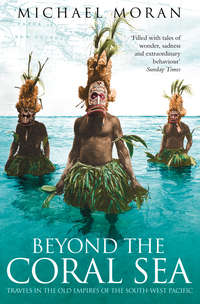
Kitabı oku: «Beyond the Coral Sea: Travels in the Old Empires of the South-West Pacific»

BEYOND THE CORAL SEA
Travels in the old Empires of the South-West Pacific
MICHAEL MORAN


Dedication
For my mother who saw this voyage begin but not end and the children of Papua New Guinea so full of energy and eternal delight
Epigraph
I have always thought the situation of a Traveller singularly hard. If he tells nothing that is uncommon he must be a stupid fellow to have gone so far, and brought home so little; and if he does, why – it is hum – aya – a tap of the Chin; – and – ‘He’s a Traveller.’
WILLIAM WALES
Astronomer and Meteorologist
Captain Cook’s Second Voyage in the Resolution
Journal 13 May, 1774
Contents
Cover
Title Page
Dedication
Epigraph
Maps
Prologue
1 Forsaking Pudding Island
2 The Eye of the Eagle
3 ‘No More ’Um Kaiser, God Save ’Um King’
4 Death is Lighter than a Feather
5 Too Hard a Country for Soft Drinks
6 ‘Mr Hallows Plays No Cricket. He’s Leaving on the Next Boat.’
7 Constitutional Crisis in Makamaka
8 ‘O Maklai, O Maklai!’ or The Archipelago of Contented People
9 Kolonialpolitik Defeats the Man from the Moon
10 Minotaurs on Gilded Couches
11 Feverish Nightmares
12 Grand Opening – Tsoi Island General Store
13 An Account of the Criminal Excesses of Charles Bonaventure du Breil
14 ‘In Loveing Memory’
15 ‘The Sick Man Goes Down with the Plane’
16 ‘Rabaul i blow up!’
17 Queen Emma
18 A Moveable Feast
19 ‘No Trespassing Except By Request’
20 Auf Wiedersehn, Kannibalen
21 Under the Mosquito Net in Malinowski’s Tent
22 Farewell to That Strange and Fatal Glamour
Epilogue
Afterword
Brief Chronology of Significant Historical Events in Papua New Guinea
Bibliography of Principal Sources
Index
Acknowledgements
Author’s Note
About the Author
Copyright
About the Publisher
Maps


Prologue
‘If you dress well, they won’t eat you!’ Wallace said.
He shuffled the cards with the stump of his right arm, beginning another interminable game of patience. The light was failing, the atmosphere oppressively hot and humid as the cards flapped on the bare table. Local boys glanced in darkly as they passed the flyblown screens covering the louvred windows. They were interested in the visitor and craned for a better view. A wretched poster of Bill Clinton greeting King Harald V of Norway hung at a crazy angle from the flaking wall.
‘We thought you were Gods.’
His rippling, grey hair caught the sun and he smiled, teeth showing the past ravages of chewing betel nut. Wallace Andrew was a distinguished personage with a heart of gold. This virtue had brought him many misfortunes in life. He began to hum the hymn ‘All Things Bright and Beautiful’.
‘Such a lovely tune, don’t you think? Young people today have abandoned proper hymns.’
The ceiling fan was motionless, the air thick and still. A pretty village woman with an ancient profile began to hurriedly set the table for dinner, laying out cutlery, bananas, pineapple and some lurid green cordial in a glass jug. She covered it with mesh. Malarial mosquitoes had already begun to ride the last shafts of sunlight in the dusk. ‘Napoleon will be here at seven. They will come directly from the chamber and then go out again,’ she said in excellent English, clearly for my benefit. They generally spoke the Suau language in the islands around Milne Bay in Eastern Papua New Guinea.
‘Fine men. Like my grandfather, a fine man,’ Wallace noted sadly, another fast game of patience in progress in the gloom. He adopted a consistently high moral tone in all his conversations and talked often of selfless Christians.
‘Charles Abel, one of the first English missionaries, always wore a bow tie, white shoes, starched shirt and trousers. He was never kai kai’d1 because they respected him. His wife came from England too. She delivered a village baby after they landed and her white dress was soon covered in blood. They didn’t eat her. She helped them.’
Wallace was, after all, the grandson of a cannibal and an expert on matters of cannibal etiquette.
Two men carrying folders dragged open the grill on the front door and entered the main room. They glanced quickly and expectantly at the deserted bar but it had been some time since any festivities of an alcoholic or social kind had taken place there. They greeted Wallace. He stood up full of respect and pleasure that government ministers had chosen to be guests at his establishment.
‘We go up, then come down to eat, then go out.’
The brevity of their speech was almost aggressive as they noticed the white stranger in their midst. The assertive masculinity of Melanesian culture. Their dark features could scarcely be seen as they climbed the central flight of a once-grand staircase that branched into two wings of remarkable austerity and dilapidation. Their bare feet made only the slightest sound like large cats padding about. Floorboards creaked overhead and doors slammed. Silence apart from the worn cards softly slapping one over the other. Wallace scarcely glanced at the deck as he deftly adjusted his amputated arm, leaning slightly to one side, gathering them in.
‘You can walk around the whole island in the moonlight. It’s beautiful. Even if you are drunk nothing will happen to you here – not like the hell of Alotau!’
Wallace was full of trust in his fellow man yet he had suffered many betrayals. Tropical foliage spun by the moon appealed to my sense of romance, but this particular night was pitch black.
Fluorescent lights cruelly illuminated the dining room. The Kinanale Guesthouse was in desperate need of refurbishment. During colonial days it had been the single accommodation for white employees of the Steamships Trading Company.1 Paintings of sailing ships and bush huts with strange watchtowers covered the larger cracks. A small lounge opened off the main room like a builder’s afterthought. Geckos darted in erratic motion across the stained walls. Dinah removed the mesh from the table. She laid out fish and taro on platters together with a jug of crystalclear iced water. A solitary bell sounded the hour over the football pitch, former cricket ground, former malarial swamp that lay before this once select building in the centre of the island. An air of abandonment and futility gave rise to a curious sense of threat and lethargy.
The government officials had changed into crisp shirts for the evening session and padded over to the table. Wallace, perhaps sensing their shyness, decided to introduce me.
‘This is Mr Michael from England. He is a famous man and wrote me a letter,’ searching the while in a battered briefcase. He produced the creased relic and began to read out loud, to my acute embarrassment. ‘Dear Mr Andrew, your name was given to me by Sir Kina Bona, the High Commissioner in London and I …’
Their fierce expressions changed at once to broad smiles of extreme friendliness. But the visitors must always make the first move.
‘Wallace has been telling me all about your important government work. What are you doing on the island?’ I was tactfully pouring a glass of the luminous cordial so as to avoid appearing overly inquisitive. Wallace beamed from his proprietor’s perch.
‘I’m Napoleon, Assembly Clerk for the Milne Bay Province and this is the Principal Adviser to the Provincial Government. He’s from Morobe Province. We are running a seminar for local councillors. Welcome to our difficult and beautiful country.’ The introductions seemed overly formal, even odd, in this place that had clearly seen better days.
I was on Samarai, a tiny island in China Strait that lies off the southeastern tip of Papua New Guinea, described before the Great War as ‘the jewel of the Pacific’. It was the original port of entry to British New Guinea and had been the provincial headquarters before Port Moresby. This gem lay on the sea route between China and Australia. The tropical enchantment cast by Samarai was loved by all who visited it. Destroyed by the Australian administration in anticipation of a Japanese invasion that never happened, it was now more like the discarded shell of the pink pearls still harvested nearby.
Having dinner with the descendant of a cannibal, a man who spoke reverentially and compulsively of the shedding of the blood of Christ whilst humming ‘All things bright and beautiful, all creatures great and small’, was just the beginning of a cultural adventure through the largely unknown islands of Eastern Papua New Guinea.
1Pidgin for ‘food’ is kai kai. Here it is used as a passive verb – to be kai kai’d is to be eaten.
1Steamships Group is one of the largest public companies in Papua New Guinea with many diverse business interests apart from shipping. The original Australian company was established in adverse circumstances in Port Moresby in 1924 by a retired sea captain, Algernon Sydney Fitch, the first branch opening on Samarai in 1926.
1. Forsaking Pudding Island
London
29 September 1999
It was raining heavily as I clambered out of the taxi in the Mall and ran up the grand flight of steps past the Duke of York column into Waterloo Place. The statues of the explorers Sir John Franklin and Captain Scott looked stern and Olympian. I was heading for the High Commission of Papua New Guinea through a forest of history and high culture, umbrella up, head down. The high classicism of Nash’s Via Triumphalis, former site of the Regent’s wanton and ruinous Carlton House, could not have contrasted more strongly with the musky odour in the corridor of pagan carvings that led to the High Commissioner’s office. Grimy windows overlooked Waterloo Place. The national flag wrapped around its pole badly needed cleaning. Papua New Guinea time and GMT were indicated by rough signs on mismatching clocks. This was clearly the lair of a culture unconcerned with cosmetic niceties. His Excellency Sir Kina Bona, the High Commissioner, was chewing gum and watching the Rugby World Cup as I wandered in. He had an instantly likeable face and seemed unaffected by his diplomatic status.
‘How do you do, sir?’ I held out my hand respectfully.
‘Much better if I could get out of here mate! Do you like rugby? What can I do you for?’
The gum thunked into the bin. Rugby was the furthest thing from my mind, but this was a promising beginning. He had a refined, educated air and wore fine-rimmed glasses. Underneath the banter I felt a moral outlook at odds with the modern political world.
We sat down and began to talk. An islander from Kwato in Milne Bay Province, he had attended the mission school as a child, secondary school in Sydney, studied Law at the University of Papua New Guinea and was Crown Prosecutor at the Public Prosecution Office until 1994 when he was subsequently appointed to the post of High Commissioner. Married to a ‘Lancashire lass’, he should have left London two years ago.
‘Britain has little interest in PNG but all the Commonwealth High Comms cooperate very well.’
Grotesque Sepik river masks grinned down like a nightmare from another world.
‘Where are you off to?’ he enquired vaguely, settling uncomfortably into a leather chair.
‘I’m planning a trip around the islands next year. I don’t intend to go to the Highlands at all. Far too violent. Just the islands.’
‘Yes – the violence. Moresby is pretty bad. The police are so under-funded that corruption is rife … the jungle hardly lends itself to strict policing. Not like Surrey!’
He laughed with a hint of derision at the ease of civilised life.
‘I used to live on Norfolk Island off the coast of Australia. Home to the descendants of the Bounty mutiny.’
I was fighting to establish a rapport with this fellow islander, some common ground. The masks seemed threatening in Waterloo Place. The contrast was suffocating.
‘Really? Islands are special places. I miss the sweet waves of Samarai and Kwato on moonlit nights. Cities, well …’
He drifted off into an unexpected romantic reverie. I explained myself.
‘I got bored with catching the seventy-three bus down Oxford Street to Victoria every morning. Threw it up in the end. The job I mean.’
‘What were you doing?’
‘Teaching languages.’
‘I had fine English teachers at the Mission. The very best.’ He paused. ‘Now we only bash the missionaries during election time!’ He grinned broadly.
After some desultory chat about the independence movement in East Timor and the excitement of family life in Hampstead Garden Suburb I rose to leave.
‘I’ll send you some family contacts and useful people to look up. They’ll look after you, or eat you!’ More good-natured laughter.
I signed the visitor’s book and left the office. I was heading for Berry Bros in St James’s to collect a good bottle of red Graves. A final farewell to civilisation. A feeling of exhilaration passed over me as I glanced back through rain-lashed Waterloo Place at the windows harbouring that alien world. For a moment I watched the beads of water running off the polished bonnet of his midnight-blue diplomatic Jaguar.
I was about to escape from Pudding Island.
The original idea of sailing a copra schooner called Barracuda around the islands of Eastern Papua New Guinea in the spirit of Robert Louis Stevenson had faded, as do so many boyhood dreams. I. had always wanted to sail the old vessels of the past on those remarkable voyages of discovery. My friends at the Royal Papua Yacht Club laughed at the idea and told me that all the old ketches and schooners had rotted in the mud. The price of copra had collapsed and the corpse of the industry was barely twitching. No one would dream of wasting money building or even repairing an old copra schooner. There were no more sailing ships plying the islands. Traditional sailing canoes like the majestic lakatoi of Port Moresby with their towering crab-claw sails and multiple hulls had by now almost completely disappeared. Chartering a vessel as an individual was prohibitively expensive. Even if I had sailed my own yacht I could easily become a victim of unfavourable trade winds or worse, piracy. Unless I was prepared to wait for unreliable boats from Thursday Island in the far north of Australia, it was impossible legally to enter Papua New Guinea except by air through Port Moresby or Mount Hagen in the Highlands. I was disappointed but determined to sail at least part of the Australian coastline in the old style, completely dependent on the vagaries of wind and weather.
A rare opportunity arose to ‘take passage’ on the replica of Captain Cook’s ship Endeavour as a supernumerary member of the crew. That it was sailing in precisely the opposite direction to my intended destination did not disturb me. I would experience sailing a tall ship along the New South Wales coast for a week from Southport (near Brisbane) to Sydney. A suitably nautical frame of mind would then enable me to jet off to Port Moresby with equanimity.
Endeavour is a handsome vessel and a magnificent replica of the original ship. It was constructed as Australia’s flagship from 1988–94 in Fremantle in Western Australia. She is built of jarrah and has upper sides of varnished pine, finished in the Royal Navy colours of blue, red and yellow. I took Sir Joseph Banks’s cabin on the after fall deck – a small space that I later discovered was occupied not by Sir Joseph himself but by his dogs – a bitch spaniel called Lady used as gun dog, and a greyhound taken on board to run down game.
Joseph Banks was only twenty-five when word reached him on 15 August 1768 that Endeavour was ready to take him aboard on a great adventure to the South Seas. He was at the opera in London with Miss Harriet Blosset, a French ward to whom he was engaged and in love, but with whom he lamentably lacked the French language to communicate. Confessing himself to be of ‘too volatile a temperament to marry’, and unable to explain the meaning of his imminent departure, he drank heavily in a romantic funk the night before he left London for Plymouth. Poor weather delayed the sailing until 25 August.
Banks’s father was an MP and the family were wealthy and well-connected, living at Revesby Abbey in Lincolnshire. He had been to Eton (which trained him no doubt for the rigours of the voyage but not for the travails of love), spent seven years at Oxford studying botany, and worked at the British Museum in London. In February 1768, the Royal Society decided that observing ‘the passage of the Planet Venus over the Disc of the Sun … is a Phaenomenon that must … be accurately observed in proper places’. The Admiralty decided on Tahiti as a place of observation, and James Cook was appointed chief observer of the transit. He selected a Whitby ‘cat’1 called the Earl of Pembroke as the most suitable vessel for such a voyage, refitted and renamed her the Endeavour.
As a Fellow of the Royal Society, Banks contributed ten thousand pounds to purchase a vast quantity of both practical and elegant equipment for the voyage, and transported a comprehensive library of some one hundred and fifty volumes. A party of nine made up his gentleman’s entourage, all trained in the techniques of collecting and preparing specimens. He became almost more famous than Cook himself, but remained dogged by the unfortunate repercussions of the ‘caddishly abandoned’ Miss Blosset (‘Miss Bl: swooned &c’, his journal coolly observes).
Cook had a complement of some ninety-four souls together with chickens, pigs, a cat and a milch goat that had already circumnavigated the globe. In a letter to Banks in February 1772, Dr Johnson included a Latin elegy for the celebrated animal, part of which runs:
In fame scarce second to the nurse of Jove,
This Goat, who twice the world had traversed round,
Deserving both her master’s care and love,
Ease and perpetual pasture now has found.
His adventurous friend James Boswell records that Johnson was sceptical of what a traveller might learn by taking long voyages, despite on one occasion when dining with the Reverend Alexander Grant at Inverness, divertingly ‘standing up to mimic the shape and motions of a kangaroo’ and making ‘two or three vigorous bounds across the room’.
By 16 August 1770, Cook had reached the Great Barrier Reef, courageously searching for the elusive passage between New Guinea and Australia. The passage had originally been discovered in 1606 by the great Spanish navigator Luis Vaes de Torres, but strategic secrecy was paramount for Spain and on many charts the two land masses appeared joined. Capricious winds drove Cook and his crew ineluctably towards disaster. ‘… a speedy death was all we had to hope for …,’ reiterated Banks. But by 21 August, the Endeavour had threaded its way around Cape York, the northern extremity of Australia, and passed through the Endeavour Straits or as it is now named, Torres Strait.
On 27 August they set sail for New Guinea. They voyaged past the south coast of the island, almost a year now after the visit to Tahiti where the officers had observed the transit of Venus and Mr Banks the slow and painful tattooing of a girl’s bottom. Two days later they came to a landfall fringed by dense vegetation and mangrove swamps. Banks wrote: ‘Distant as the land was a very Fragrant smell came off from it realy in the morn with the little breeze which blew right off shore …’ The water was warm, muddy and shallow, keeping them away from the coast until 3 September when they waded in to land. Banks collected a few specimens but remained curiously unimpressed. They found human footprints which caused them as much consternation as that felt by Robinson Crusoe. They proceeded with caution until they came to a hut in a grove of coconut palms. Three warriors suddenly rushed them from the jungle, throwing spears and incendiary devices, shouting hideously. A hundred naked Papuans appeared around a promontory. It was time to leave.
The following excerpts are taken from my voyage diary:
Endeavour, 7.30 p.m.
4 September 2000
Have come off Afternoon Watch and had dinner. A nerve-wracking and terrifying day. Rose early 6.00 a.m. Troubled sleep – excitement, nerves and information overload. Claustrophobia with the cabin door shut. Prolix talk of ‘bunts’, ‘clews’, ‘belaying lines’, ‘bracing the yards’ and generally hauling on any of the innumerable ropes in sight. Mind-snapping terms of the sea is assumed knowledge – understood absolutely nothing.
Time to ‘go aloft’. Terrified. My group designated Foremast Watch. Forced by bravado to climb the ‘ratlines’. Felt decidedly like a rat. The lines are angled up to a platform called the ‘tops’. Remainder of the thirty-three metre mast towers above. Palms sweating. Shuffling along the yard (to which sails are furled) on rope not much thicker than a garden hose. ‘Stepping on!’ is the brisk instruction. ‘Falling off!’ screamed as you crash to the deck. Managed that, then. Is this my future for the next seven days? Much preparation casting off.
Very calm day, brilliant sunshine with light NE wind.
‘Stand by for cannon!’ shouts the ship’s carpenter, a handsome, blond Cornishman, responsible for construction of the replica and loved by all the girls.
‘Fire in the hole!’ He lights the powder.
Boom! Replica four-pounder carriage gun recoils, acrid smoke rolls across the deck. A terrific report, too close to some nautical types sipping Pimms on the deck of their chromium cruiser. They fell backwards off their chairs as shredded paper and smoke engulfed them.
‘Haul on the halyards! Ease on the bunts and clews!’
Felt like easing myself but not permitted until further out. Hauled on lines until palms sore. Not seasick but a visit to the heads (mariners’ term for onboard toilet) could bring it on. Open grey valve, pump up water, do your business, keep your balance as you have a good look while you pump out, repeat three times, close grey valve under pain of castration. Voyage will be no picnic. Comforting smell of tar.
Came off Afternoon Watch at 4.00 p.m. and resume First Watch at 8.00 p.m. Ship glides slowly and is deeply restful. In perfect harmony with the sea. Progress about 3 knots – a stately speed which would have given Banks and his party ample time to draw, read, discuss and describe their collections. Sun setting through the stern sash windows of the Great Cabbin. Storm lanterns lit, secretive plashing of water at the stern and creaking of the ship. Absolutely magical and poetic.
Sailing at night on the Endeavour is like taking part in a Wagnerian opera, the Flying Dutchman, perhaps. On watch, time to gaze up at the moon through the swaying rigging, silhouetted against the myriad stars of southern latitudes. A shadowy helmsman guides us across the deep. Silence on deck. Ship groans quietly as it folds through the sea. Watching the phosphorescence at the bow I was suddenly transfixed by the appearance of silver tunnels and comet trails cut by porpoises as they dodged and played before the ship. Captain ordered us to ‘wear ship’ – rudely-broken reverie. Had to set the sails and belay lines (fasten the coils of rope around wooden pins) in the dark. After stress and furious activity, lying on my back in front of the helm watching the masts arch like giant pointers across the constellations. Dreamed of the discovery of New Guinea on a ship such as this.
Endeavour
6 September 2000
Morning Watch began at 4.00 a.m. Ungodly hour to be on deck. A still night with feathery winds and countless stars, the moon intensely bright. Silhouettes of the crew on watch float like wraiths. Dawn a glowing rind of orange before sun breaks the horizon. Red Ensign flies from the stern mast and stern lantern glints in the dawn.
Later in the morning a hump-backed whale breached – spectacular arch of patent-leather black and white. Barometer falling. ‘It’s coming all right,’ crackled Captain Blake ominously on the weather deck. During night watches he often comes on deck bare-chested in a maroon sarong. Seems to sense any unnatural movement of the ship through his sleep. Catapults from the companion to bark orders in eighteenth-century style.
Mainmast Watch took in sail at Trial Bay off coast of New South Wales. Landing from surf boats. Moving reconciliation ceremony with Aboriginal community. Exhausted from climbing and hauling – aching and stressed by vast quantity of strange sailing nomenclature.
Endeavour
7 September 2000
Oppressive lowering sky and ominous calm. Hardly slept for last three days. On watch and took the ‘brains’ side of the wheel.1 Wind strength increased towards evening, gusting to 40 knots. Bow ploughed into the 1.5m swell but the ship felt strong. Sea a magnificent expanse of breaking waves, wind tearing the lashing foam. Shrieks rent the rigging. Wheel duty in this weather madly exhilarating. Maintaining course fraught with problems, arms aching, slow response to helm. Bow rises to frightening heights before ploughing back down into the troughs.
Lines lashed. Many seasick. Going aloft 25 metres in these conditions to take in t’gallant sails not for the fainthearted. Respect for the old mariners boundless – their achievement unimaginable until you sail a tall ship. Vessel utterly at the mercy of wind. So tired cannot sleep. Eating little.
Great Cabbin, Endeavour
8 September 2000
Physically impossible to write. Force 8 gales. Taking in all sail. On verge of throwing up. Gorge rising. Ship lurched and shuddered through night. Roped myself into the fixed cot.
Endeavour
9 September 2000
Wind sufficiently abated to write a journal entry. Warm sun as we sail along the coast of New South Wales and begin to set sails again after the storm. Activity everywhere.
‘Hauling on the halyards! Easing on the bunts and clews! Bracing the yards!’
‘Two, six … heave!’ we hauled on the lines.
‘Two, six … heave!’
‘Belay all lines.’ Signs of relief.
Leaned against the capstan and idly looked at a jetliner high above, slicing across the sky leaving a glittering trail of ice crystals; the eighteenth century contemplating the twenty-first century. The original exploration of the Black Islands of New Guinea was on ships such as this. My own journey to that fabled land would be on an aircraft such as that.
1The English north-country vessel known as a ‘cat’ was a Whitby collier. This was the type of working vessel on which James Cook learnt his calling. In 1771 he wrote in admiration of her handling, ‘No sea can hurt her laying Too under a Main Sail or Mizon ballanc’d.’
1Two seamen are normally at the wheel – the ‘muscles’ on the port side who only helps turn it, and the ‘brains’ on the starboard side who turns and maintains the course, calling out the setting and watching the instruments.
2. The Eye of the Eagle
Final approach to Port Moresby in the dry season is over arid, brown hills bereft of vegetation and a polished turquoise sea. The colonial terminal at Jacksons airport has faded lettering on the fibro huts, the modern terminal a bland feel, new paint already peeling in the heat. An Air Force Dakota without engines lies abandoned on one side of the runway, a reminder of the first commercial flights. The blast of desiccated air as you disembark is like a physical punch, gusts of the south-east trades dry the mouth. Certainly you are no longer referred to as masta as your bags are unloaded. Only one officer is on duty at passport control to process the entire jetload of passengers. Welcome to modern Papua New Guinea, ‘land of the unexpected’.
Captain John Moresby may have been the first white man the native people had ever seen when he sailed into the harbour aboard the HMS Basilisk in 1873. He spent some time trading with the villagers of the local Motu tribe. He wrote that civilisation seemed to have little to offer this culture. The London Missionary Society were settling in a year later and by 1883 there were five resident Europeans in Port Moresby including the Reverend James Chalmers, a gregarious character who was eventually murdered and eaten by cannibals on Goaribari Island in Western New Guinea. Despite its isolation and absence of road connections, Moresby has remained the capital.
The taxi driver informed me that the bullet hole in the corner of the cracked windscreen was from raskols – a misleadingly benign Pidgin word meaning ‘violent criminal’. They had attempted to hold him up on the way to ‘Town’, the centre of the city. He was a Highlander with an ambiguous smile somewhere between a welcome and a nasty threat. I began to glance anxiously at passing cars.
‘Wanpela sutim mi nogut tru lon hia. Olgeta bakarap.’1
‘Were you hurt? Did they take your money?’
‘Took everything but I drive away quick. Back at work next day. Mosby em gutpela ples.’2
This made no logical sense at all to me so I fell silent until we reached the hotel. It was a dusty drive with colourful children and resentful adults crowding the roadsides. There had been a drought for the last seven months. The usual Western corporate signage had been bleached by the savage sun. A car had collided with a truck bearing the company name ‘Active Demolition’. I glimpsed the original Motuan stilt village of Hanuabada, fibro huts replacing the traditional bush materials. A few cargo ships lay becalmed in the port.
A midday stroll among the sterile office blocks, slavering guard dogs and confectioner’s nightmares thrown up by financial institutions did not appeal, so I headed south for Ela Beach, an inviting stretch of sand facing Walter Bay. Trucks cranked past with men crammed like sardines in the back and small PMV3 buses smoked happily by like toys. Seaweed, cans and other detritus marred the shore, but kiosks gaily painted in Jamaican style lifted the spirits. A rugby side were training on the sand, running forward through a line of plastic traffic cones and then suddenly reversing through them. Many who were overweight fell over during the difficult backward manoeuvre but there was no laughter, just embarrassment. Papua New Guinea is the only country in the world that has rugby as its national sport and every aspect of it is taken seriously. Training was interrupted by the capture of a turtle on the breakwater. A long time was spent inspecting and discussing the prize. Some of the boys scribbled graffiti on its shell in luminous paint and then released it back into the bay, fins flapping, neck craning. Training resumed.
Palm trees with slender trunks curved over the bay in front of international high-rise apartments. I walked past a group of suspicious-looking youths sitting under some trees outside a café and strolled out onto the disintegrating breakwater. A family were competing with each other, skimming pebbles across the surface of the water. The five children, father and mother were screaming with delight at this simple game that seemed to bond them so intimately.
Visitors are warned by expatriates not to approach, in fact to walk away from groups of youths but I decided to wander over to the cluster beneath the casuarina trees. They were chewing betel nut and spitting the blood-red juice in carefully-aimed jets. They were shocked when I greeted them, but smiled almost immediately. The smile on a Melanesian face is like the unexpected appearance of a new actor on the stage.
‘Monin tru, ol mangi. Yupela iorait?’1
‘Orait tasol, bikman.2 Where do you come from?’ They stood up, even respectfully I thought.
‘England. I live in London. My name’s Michael.’ I held out my hand which was shaken softly. They shuffled about looking at the ground, showing signs of amazement by spitting fast red gobbets in the dust.
‘And you’ve come here! Do you like our country?’
‘Everyone seems pretty friendly to me. What’s your name?’ I asked a boy with the most intense black skin I had ever seen – it was almost blue. He had dreadlocks, perfect white teeth and eyes like an eagle. He appeared highly intelligent, but melancholic shadows fleetingly crossed his features.
‘Gideon. I’m from Buka.’ His open face smiled engagingly.
‘Really! I hope to go there. I’m visiting the islands.’
‘It’s beautiful on Buka, but no work. The Bougainville war destroyed everything. I came to Moresby but can’t get a job. I’ve got my electrician’s certificate.’ The shadows were well established.
‘Mipela ino inap lon bikpela skul,’1 said a fierce lad with broken, heavily-stained teeth. It looked as though a bomb had gone off in his mouth. He was angry.
‘I come from the Sepik. I have no parents and no money.’ He looked savagely at the ground and started violently peeling a new nut.
‘Are you all unemployed?’ I asked, already knowing the answer.
They nodded dreamily.
‘Don’t you miss your family?’
Silence.
‘I’ve heard that some boys break into houses and steal. Is that true?’ I was living dangerously, considering it was my first afternoon.
‘Yes, but they’re not bad boys, sir. We’re not raskols! We need the money to eat. We want to work but we can’t get a job.’
‘That’s not really a good reason to steal. You could go to prison. Ruin your life.’
‘Corrupt politicians have ruined our country. You don’t see them going to prison.’ Gideon offered this as a challenge for me to refute.
‘No one gives us a chance. We’re on the outside looking in.’
‘Where are you from?’
‘Chimbu.’ The older man seemed to stand apart from the rest and was more deeply resentful.
‘Where do you live in Moresby?’
‘Are you a priest?’ It was an aggressive answer. ‘Ragamuga. Six-Mile Dump. You’ll visit?’ He smirked and spat into the dust. I had only read about this desperate migrant settlement situated behind a large rubbish dump. No, I did not intend to go there.
‘But what about your future?’ I was moving into a dead-end.
‘So? No one gives a shit about us. Politicians just want money.’ Isaiah was from East New Britain and had parallel tattoos on his cheeks.
‘We’re bored and no future. That’s the problem.’
I realised with alarm that my group had grown into a small crowd that surrounded me. They pushed forward not to attack but desperate to explain, to justify themselves, expecting me to provide an explanation, an instant solution.
‘Everyone hates us. No tourists come because the newspapers report so much violence.’
I said nothing but the headline in the newspaper in my hotel screamed of the rape of three nurses at Mt Hagen Hospital and the theft of an ambulance. The thieves were demanding compensation for the return of the vehicle or they would torch it.
‘Violence is terrible in the Highlands. That’s why I chose the islands.’ I was out of my depth.
‘You’re lucky. You have money to travel,’ said a boy from Oro Province wearing a bedraggled feather in his hair.
Beavis and Butthead cartoons flickered on the screen behind the heavily-barred windows of the ‘Jamaica Bar’. Papuan reggae music was playing somewhere. I was a distraction but not a solution. Some drifted away and sat under the trees again. Large spots of rain from an afternoon storm kicked up the reddened dust.
‘Well, I’d better be going. Nice to have met you. Gideon, Isaiah …’ I shook their hands.
‘Tenk yu tru long toktok wantaim yu, bikman.1 All the way from London! Enjoy our country.’
They remained standing and smiling as I headed back. This encounter with wasted potential, cynicism, and the crushed optimism of youth left me feeling depressed and impotent. The cultural diversity of the country meant that there was tension between youths from many regions thrown together by unemployment. In traditional villages in the past, fear of neighbouring peoples and respect for the authority of the elders would have limited the freedom of the young. The notion of respect had almost disappeared, but not only in Papua New Guinea. London and Sydney were similar, but this country was poor and the politicians corrupt.
Many observers blame the present law and order troubles on the premature commitment Australia made to the granting of independence in 1975. At the outset, an inappropriate West-minster-style two-party democracy was imposed on the country with legislative power vested in a national parliament. The national government devolved power through nineteen provincial governments. The country joined the Commonwealth with the Queen as Head of State, and a governor-general appointed as her representative. Papua New Guinea covers a vast area (it is the second largest island in the world) and possesses such extreme cultural diversity that the growth of a properly integrated strategy for development has remained a perennial challenge. The first Prime Minister, Sir Michael Somare, was an able and popular politician, but the many emergent parties have become increasingly unable to establish clear ideological principles. Political candidates pursue personal or regional goals at the expense of party policies.1
Most Papua New Guineans still live a subsistence lifestyle in villages quite separate from the influence of the cash economy. The villagers have become convinced that, at both the provincial and national levels, politicians are self-serving and uninterested in their welfare. Traditional social arrangements had already begun to disintegrate under colonial rule. The adoption of an inappropriate Western legal system has only exacerbated the agony of cultural fragmentation. Tribal fighting has resumed in the Highland provinces, but under more murderous rules than in the past. As the traditional society in the village disintegrates, many young people flee to the urban ghettoes of Port Moresby and Lae to face almost certain unemployment followed by a descent into crime. The challenge remains to evolve a system that combines the strengths of traditional leadership with the ideals of modern government, giving due legal weight to the fraught claims of land ownership by the numerous clans.
On my return to the ‘executive floor’ of my hotel, I passed psychedelic kiosks and wrecked cars in the oppressive heat and scalding rain. Luxury expatriate enclaves seemed to be going up everywhere on higher ground. Segregation has made this a city divided against itself. The cool, spacious lobby transported me to a different planet to that inhabited by my ‘new friends’ on Ela Beach, and the grim reality of their settlement homes. This was the arena where exploitation and ‘aid’ were strategically planned by company generals. The sunset from the elevation of the executive floor was sublime; copper and tarnished brass shot through with blue. This luxurious scene was decidedly different from the wild 1920s when Tom McCrann’s hostelry in Moresby displayed a notice in the saloon:
Men are requested not to sleep on the billiard table with their spurs on.
At dinner there was an astounding mixture of guests. A tattooed Scot was having dinner with an Asian engineer.
‘Glad you’re on the fuckin’ project, Wang. You’ve got a degree.’
A German trio who had run out of time were attempting to negotiate a price for the ethnic decorations on the hotel walls. A heavily-tattooed Pacific islander in a black sleeveless singlet, chiselled black beard and jeans patched with grandmother’s chintz was eating soup and tugging at his pearl earring. A Belgian photographer with a ponytail was talking to a glamorous Parisian collector of artefacts from the Maprik region who had a gallery in Aix-en-Provence.
‘Every week I ’ave ze fever on ze exact same day!’ she exclaimed in desperation.
A newly-rich Highlander was eating a roast chicken, juggling greasy drumsticks in both hands and attempting to talk on a mobile phone. Pallid Englishmen and tanned Australians were earnestly discussing football and drink. They had the weak eyes and the furtive mouths of social casualties, bolstering their own false optimism or drowning betrayals in liquor.
‘The free drinks are from five thirty to six thirty. Don’t come after or we’ll have to pay.’
‘Right, mate!’
‘They’re tough men the South African rugby team!’
‘Blood oath! Fuckin’ tough!’
‘Hides like a rhinoceros!’
‘More like a fuckin’ elephant, mate!’
‘Fuckin’ tough.’
‘Yeah. Fuckin’ tough, real men.’
‘Fuckin’ tough!’
‘Yeah, fuckin’ …’ and so on, endlessly, whilst downing bottle after bottle of South Pacific lager.
A huge butterfly enamelled in iridescent blue battened against the glass door leading out to the swimming pool. A Chopin nocturne floated across the lounge from the Papua New Guinean pianist playing a grand piano. I wandered over at this unexpected appearance of European culture and spoke to him.
‘You’re playing Chopin,’ I rather pointlessly observed.
‘Yes. I studied classical music for many years. Do you have a request?’
‘Not classical. Jazz. Can you play “Misty”?’
‘Sure. If you like jazz you might like my novel. It’s on the music stand.’
A small pile of paperbacks entitled The Blue Logic: Something from the Dark Side of Port Moresby by Wiri Yakaipoko was stacked on one side above his fluent fingers.
‘What’s your novel about?’
‘It’s a crime novel about Moresby. Plenty of it around here to write about.’ I could hardly disagree.
Chopin, jazz and crime are an odd mixture. Unexpected conjunctions and unpredictable outcomes were to become a feature of all my travels in Papua New Guinea. I went to bed suffering from a blinding headache which seemed to come from the combination of the anti-malarial drug Lariam1 and alcohol.
The next day the usual horrors were introduced quietly under the door of my room via the dailies.
A youth was chopped to death and two houses burnt down in the Kaugere suburb of Port Moresby over the weekend.
Under the banner headline ‘Patients Hungry’ we learn that patients’ food was stolen from Modilon Hospital in Madang.
A thirteen-year-old sex worker said, ‘My aunt kicked me out because she said I slept with her husband. Prostitution is fun and I get a lot of money.’ Tribal fighting now takes place with homemade guns, grenade launchers and Kalashnikovs rather than spears.
The city looks more attractive on my birthday. Red and mauve bougainvillea are flowering, Ela Beach looks inviting and the frangipani spiral down in pink and white. I decide to go for a walk. Outside the US Embassy I am almost arrested for writing down the sign NOKEN PARK LONG HIA meaning ‘No Parking’ in Tok Pisin (Pidgin).
The evolution of Melanesian Pidgin (or bêche-de-mer English, as it was popularly known in colonial days) was complex. There are many regional varieties of this colourful and witty language which originated on the Pacific plantations of Queensland, Samoa and New Caledonia in the early eighteenth century. It had emerged fully formed by about 1885 and is still evolving in rich referential complexity. Around eight hundred or one seventh of the world’s languages are spoken in Papua New Guinea. Some two hundred are Austronesian spoken in the coastal and island regions, and the remainder are Papuan spoken in the Highland areas. There are three lingua francas – English, Motu (spoken in Port Moresby) and Tok Pisin.
Outside the Westpac Bank a huge Alsatian and armed guard in a baseball cap stand in the centre of three signs warning ‘Beware of the Dog’. The brooding atmosphere of male unemployment hangs about like a miasma, and I have not seen a white face in three hours. Huge holes in the pavement and deep storm-water channels offer possibilities of serious injury. The light burst of a glowering Melanesian face suddenly smiling. At the Port Moresby Grammar School, children in pale uniforms are caged up in a security tunnel hung with plants waiting to go home. Fishing trawlers of unbelievable decrepitude are moored at the wharves. Thick, black smoke pours from their funnels, the idle crews lounging in the shade of tarpaulins or carrying huge tuna by the gills. One boy drops a plastic bag full of silver sprats that cascade over the wharf like pirate’s treasure. Six mothers breast-feeding babies inexplicably sit in the broiling sun on a concrete platform raised above a potholed road. I slip into the shade of the Port Moresby Public Library. An eerie silence reigns, but people greet my unexpected presence with smiles of surprise. Useful titles such as Australian Imperialism in the Pacific and Tuscan Cuisine grace the shelves.
A friend, John Kasaipwalova, had invited me for a birthday dinner. He is a prominent and controversial Papua New Guinean poet and writer and was a student rebel during the drive for Independence in the 1970s. He is also chief of the Kwenama clan on Kiriwina Island in the Trobriands, one of my destinations. I was collected in a Mitsubishi Pajero with gigantic bull-bars, a fantastically cracked windscreen and peeling sun filters. John has a round friendly face framed by a halo of tightly curled hair, his sensibility a rich repository of poetic image and symbolic knowledge. But entrepreneurial activities tend to preoccupy him these days, as he attempts to balance the claims of individual business and his responsibility to his own clan community. He was accompanied by Mary, his attractive Malaysian wife, and ‘Uncle Sam’, who drives the Pajero with fearsome spirit, thundering over unsealed roads past striped drums marking dark detours. While avoiding a cavernous pothole, he asked me to guess his nationality. His mother turned out to be from Sri Lanka and his father an unusual mixture of Dutch, Portuguese and Australian Aboriginal. ‘Dad’s family moved about quite a bit.’ Under an Australian bush hat he had the long grey beard of a swami and spoke with a slight Indian accent. It was a striking face, a colonial cocktail.
The shopping precinct that housed the Chinese restaurant was protected by a high security fence with bars two inches thick, armed guards, slavering dogs and a searchlight.
‘It’s a gourmet place!’ explained Sam as we parked among a crowd of children.
We were shown into a private room with intense fluorescent lighting. Geckos erupted into life on the walls like surrealistic wallpaper. Sam’s gold rings glinted on his slender fingers and the cutlery was reflected in his melancholic eyes.
Delicious coconut prawns, chilli crab and coral trout with tender asparagus appeared like magic. The conversation ranged lethargically over many topics, as if we were in an island village. They were shocked to learn of my walking alone in Moresby and even more surprised when I mentioned the young boys.
‘I’m hoping to go to the Trobriands quite soon, John.’ I briefly outlined my island itinerary.
‘You’ve made the best decision in choosing the islands. How come the Trobriands?’
‘Well, it’s a short story that’s taken a long time to complete. I bought a tabuya1 or wave-splitter from Kiriwina in an artefact shop many years ago. It’s been in my music room in London for ages, and I’ve always wanted to visit where it was made.’
‘I can tell you that the tabuya has been watching you. The design symbolises bulibwali or the eye of the sea eagle [osprey]. You had to come. His eye never sleeps, you know. In an instant he decided on you as his particular fish. That’s why you came. It’s very simple.’
‘Do you really believe this?’
‘Of course. You’re a person who possesses concentration. You plan and attend to detail. Am I right?’
‘Actually, yes. I drive people mad with it.’
‘There you are!’ John reached for more coconut prawns in an ebullient mood. He continued his arcane explanations with some seaweed poised between chopsticks in midair. I wanted to hear an account of the famous kula trading ring from the chief of a clan. I was anxious to know if the classical descriptions were still accurate.
‘Tell me something about kula, John.’
‘Well, first you must understand the mystery of Monikiniki or the Five Disciplines of Excellence.’
‘Sounds a bit complicated.’
‘Never! It’s simple! The disciplines are symbolised in the five compartments of a Trobriand mollusc shell. Each compartment represents one of the senses and is represented by a bird, plant or even a grasshopper. The eye is represented by the bulibwali or the sea eagle.’
We had moved into the realm of myth and magic for which these islands are famous, rather daunting for a European unused to the sharing of mystical experience.
‘But what is kula exactly?’ I was impatient as usual.
‘That’s not easy to answer, but basically it’s an activity of giving and receiving between people that results in them growing spiritually.’
‘But doesn’t it involve trading valuable soulava or necklaces in a clockwise direction around certain islands and mwali or arm shells in a counter-clockwise direction?’
‘Of course, but they’re only the outward manifestation of the activity, in fact the consummation of it. The objects accumulate power as they pass from hand to hand over time. Some might even kill you. But it’s the quality of this experience that’s important.’
I began to be drawn irresistibly into the rich mythological world of the Trobriand Islands, so unlike the sterility of my own empirical society where success seemed the sole criterion. I began to look forward to my trip with keen anticipation. A couple of lines of a poetic song concerning the kula came to mind.
Scented petals and coconut oil anoint our bodies We’re ready to sail with the south-east wind
John fell silent and took some more chilli crab. The mood had become serious yet our state of mind was happy and free.
‘I’ve never been to the yam festival in the Trobes. Never managed to get there. God knows why.’ Sam trailed off and adjusted his hat to a more comfortable position. He reached for some more coral trout.
‘God’s saving you, Sam, from a long period of self-abuse,’ John observed. Everyone laughed heartily. The yam festival is famous for its ecstatic expression of sexual freedom in celebration of the harvest and the end of ten months hard gardening.
Myth and magic give life meaning in the islands. We discussed the weighty word kastom. It is an essential Pidgin concept that derives from the English word ‘custom’ but with a more complex Melanesian meaning and multifarious connotations. It is normally used in reference to traditional culture that has come under threat from aggressive European development. But kastom cannot be simply translated. There are many contradictions within this multilayered concept. The idea has led to a strong cultural revival as regional identities become increasingly diluted. People are always talking about the loss of it. Closeness to nature and the traditional sense of belonging to a community are being replaced by the desire for individual consumption. European technology dominates modern life in the cities, yet a profound need remains for the unseen worlds of magic and religion. A further complication is the extreme cultural diversity of the country. Many distinct cultures have been wilfully cobbled together into the artificial political entity known as Papua New Guinea. Cultural differences are ignored, or worse, attempts are made to diffuse them.
‘More chilli crab?’ Sam spun the lazy susan.
‘Do you know there is a ruined temple on the top of Egum Atoll?’ John said, secretively.
‘Yes, and flat stones with magical properties on Woodlark Island,’ his wife whispered.
It was getting late. We emerged from the restaurant into the glare of security searchlights. The massive gates swung open and we drove out of the compound. Uncle Sam began to sing the praises of Port Moresby as we drove back into town. Mansions surrounded by high fences topped with glistening razor wire, signs painted with cartoon-like dogs and guards posturing with guns, spun through the headlights. Dark hills sprinkled with twinkling lights reared on either side of the highway.
‘Nothing is as beautiful as this in the world!’ Sam suddenly exclaimed with great feeling.
I spent a restless night poring over maps, anxious to leave the place. Papua New Guinea can be broadly divided into the mountainous interior, the coastal regions, great rivers and the island provinces. My decision to explore the islands had come from their extreme isolation, their reputation for beauty, tranquillity and the preservation of their ancient cultures. Near Moresby, the start of the Kokoda trail had been closed by tribal fighting. There were reports of a white, female bushwalker who had been raped even though she was with a local guide. This constant threat of violence in the capital had begun to depress me. I was tired of being holed up for safety in a luxury hotel with paranoid expatriate businessmen planning the disintegration of a culture for profit. My jumping-off point for the islands would be Alotau, the capital of Milne Bay Province at the eastern extremity of the mainland. From there I could leap aboard a banana boat1 to Samarai, the traditional gate to the old empires.
1‘Somebody shot at me. Everything around here’s pretty bad. It’s completely buggered up!’
2‘Port Moresby’s a good place.’
3Public Motor Vehicle – these minibuses are considered to be dangerous for visitors, but in my experience they were a source of all my best conversations and friendships with local people.
1‘Good morning, boys. How’re you?’
2‘Fine thanks, Sir.’
1‘We can’t afford university.’
1‘Thanks very much for talking to us, Sir.’
1Sir Michael Somare was born in 1936 in Rabaul, East New Britain. He led the Pangu Pati (Party), the largest and most influential political party in the move towards independence in 1975. He became the first Prime Minister of independent Papua New Guinea from 1975–80 and again from 1982–5. His membership of the Pangu Pati ended in 1997 and he formed the National Alliance Party which won a comfortable majority in the violent 2002 elections. After seventeen years, Sir Michael Somare, ‘the father of the nation’, was elected Prime Minister for a remarkable third term.
1Mefloquine or Lariam (the trade name) is the most powerful of the anti-malarial prophylactics. Unlike other drugs, it protects against the fatal strain of cerebral malaria. It can have disturbing psychological side-effects.
1A tabuya is the prowboard of a Trobriand canoe.
1The term ‘banana boat’ has nothing to do with bananas or their transport. It refers to the shape of the innumerable fibreglass dinghies fitted with forty-horsepower outboard motors that ply the islands and coast of PNG like noisy water insects. They have taken the place of the elegant sailing canoes of the past, which have almost completely disappeared. They sometimes carry suicidal numbers of passengers, often travel enormous distances across open ocean, and never take a single life jacket. Many simply disappear, the occupants lost to drowning or sharks.
Ücretsiz ön izlemeyi tamamladınız.