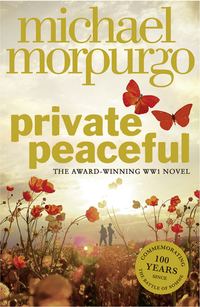
Kitabı oku: «Private Peaceful»
With my thanks to Piet Chielens of In Flanders Field Museum in Ypres


Copyright
First published in Great Britain by HarperCollins Children’s Books in 2003
This edition published by HarperCollins Children’s Books in 2016
HarperCollins Children’s Books is a division of HarperCollinsPublishers Ltd,
1 London Bridge Street
London SE1 9GF
The HarperCollins website address is: www.harpercollins.co.uk
Text copyright © Michael Morpurgo 2003
Photographs in end material © Shutterstock
Cover design © HarperCollinsPublishers Ltd 2016
Cover images © Pirmin Föllmi/EyeEm/Getty Images (poppy field); Shutterstock.com (all other images)
Michael Morpurgo asserts the moral right to be identified as the author of the work.
A catalogue copy of this book is available from the British Library.
Although the title was inspired by the name on a gravestone in Ypres, this novel is a work of fiction. Any reference to real people (living or dead), actual locales and historical events are used solely to lend the fiction an appropriate cultural and historical setting. All other names, characters, places and incidents portrayed in this book are the product of the author’s imagination, and any resemblance to actual persons, living or dead, is entirely coincidental.
All rights reserved under International and Pan-American Copyright Conventions. By payment of the required fees, you have been granted the non-exclusive, non-transferable right to access and read the text of this e-book on screen. No part of this text may be reproduced, transmitted, down-loaded, decompiled, reverse engineered, or stored in or introduced into any information storage and retrieval system, in any form or by any means, whether electronic or mechanical, now known or hereinafter invented, without the express written permission of HarperCollins.
HarperCollinsPublishers has made every reasonable effort to ensure that any picture content and written content in this ebook has been included or removed in accordance with the contractual and technological constraints in operation at the time of publication
Source ISBN: 9780007486441
Ebook Edition © 2016 ISBN: 9780007477838
Version: 2018-07-31
Dedication

Contents
Cover
Title Page
Copyright
Dedication
Foreword
Five Past Ten
Twenty to Eleven
Nearly Quarter Past Eleven
Ten to Midnight
Twenty-four minutes past twelve
Nearly five to one
Twenty-eight minutes past one
Fourteen minutes past two
A minute past three
Twenty-five past three
Nearly Four o’clock
Five to five
One minute to six
Discover more
Author’s note
About the Author
Discover more unforgettable books from the nation’s favourite storyteller
Other titles by Michael Morpurgo include
About the Publisher
FOREWORD
Of course both Private Peaceful and War Horse take place in the First World War.
War Horse came first, way back in 1982, a story inspired by a chance meeting in my local pub all those years ago with an old veteran who lived in our village. From my talks with him and with two other old men of that generation, I found out so much about that war, about life at home and in the trenches. One of these old soldiers had been to war, ‘with horses’, as he put it. Those meetings and the surprise discovery in the attic of four contemporary drawings of cavalry fighting in the First World War, provided the seed corn for War Horse.
Sadly, the book did not do that well when it came out, sold very few copies, failed to win a prize, received mixed reviews, but the few who did read it seemed to like it. Because of this I was invited to a conference of children’s writers and illustrators from all over the world who had tackled the difficult subject of war. It took place in Ypres in Belgium, the town that had been fought over fiercely in the First World War. There, battles had resulted in the deaths of hundreds of thousands of soldiers on both sides, and the town became synonymous with the endurance and suffering of that terrible war. They held this conference in one of the greatest of all war museums, In Flanders Fields, so called because of John Macrae’s iconic poem.
I went with my friend, Michael Foreman, who had already written and illustrated two remarkable books set in war, War Game and War Boy. We went off together one morning to spend some time in the museum, and arranged to meet outside in the square afterwards. No war museum is more deeply engaging or informative or heart-breaking. But I found myself unable to stay long. It was simply too upsetting, as indeed a war museum should be. As I was leaving, I saw up on the wall, in a frame, a typed letter with its envelope. Intrigued, I went closer. It was from a captain in the army to the mother of a soldier, informing her in just few short lines that her son had been shot at dawn for cowardice. I read the address and name on the envelope, saw the jagged tear she had made opening it, knew at once that this letter destroyed her life, and the lives of her family. I could see her in my mind’s eye, standing there on her doorstep, letter in hand. I could feel her grief and her pain.
I knew then that I had to know more about the soldiers who had been executed in that war. I was able to see documents of their court martial trials – some lasting less than an hour, for a man’s life. I found out how there were over 3,000 soldiers condemned to death for cowardice in the face of the enemy, for desertion. Two were shot for falling asleep on sentry duty. Of these about 300 had their sentences confirmed and were shot. Many had clearly been suffering from shell shock – post traumatic stress disorder we call it these days. Some had already been hospitalised for it. It was evident to me that there was little justice here, more retribution. Very often the men had no one to represent them. It was capital punishment imposed quite deliberately to encourage other soldiers to obey orders.
I read in my research at the museum how these executions were carried out. At dawn, in a farm yard, or prison yard, out in a field, up against a hedge, the prisoner was tied to a post, blindfolded and then shot by a firing squad, sometimes composed of his comrades from his own company. I visited some of the places this had happened, stood where they had stood. I visited their graves. And I knew I had to write the story of one of these unfortunate men, ‘worthless men’ as one had been called as he was sentenced at his trial.
On my return home I discovered that all these years later, despite all the campaigning of the families of the executed to persuade governments to pardon those men shot at dawn, still there was a refusal to acknowledge that terrible injustices had been done. So I determined then to tell the story of one of these men, the life story from childhood home to the trenches to the firing squad.
I set the story in my village, in the farms and fields around me, in my cottage at home, the place where the soldier was born and grew up, where he went to school, where he fished in the rivers, scrimped apples – actually the same village where the story of War Horse takes place, where Joey is born and grew up. Much that I had learnt when I visited Ypres, and from those old men in the village all those years before when I was writing War Horse, I incorporated into this new story. It was, after all, the same war, the same horror, the same suffering.
I decided to become my soldier, tell it in the first person, speak it down onto the page, my thoughts and memories during the last long night before the execution at dawn. I had to live as close to the story as possible. I would have no numbered chapters, but instead simply the time as I look at my watch, as the hours pass, as 6 o’clock comes ever closer. I trace my life, to make the night as long as my life, to postpone the fatal hour.
Unlike War Horse, this book was an instant success. It did receive great reviews, mostly, did win a prize or two, did sell well. Within a year it was on the stage, adapted into a powerful one-man show by Simon Reade. It travelled the country, received rave reviews wherever it went. It travelled the world. Then Tom Morris at the National Theatre approached me with the idea of making a play of War Horse, a book which had been ignored for twenty-five years or more, though never out of print, thanks to my publishers who kept the faith!
War Horse turned out to be the greatest hit the National Theatre has ever had. It has also travelled the world from Germany, to the US, to Japan and China. Next year it will tour the UK again. And there have been films and radio plays of both War Horse and Private Peaceful.
But both books, although set in amongst the suffering of war at home and on the battlefield, are essentially about our longing for peace.
Both are my anthems for peace.
Michael Morpurgo, 2016
FIVE PAST TEN
They’ve gone now, and I’m alone at last. I have the whole night ahead of me, and I won’t waste a single moment of it. I shan’t sleep it away. I won’t dream it away either. I mustn’t, because every moment of it will be far too precious.
I want to try to remember everything, just as it was, just as it happened. I’ve had nearly eighteen years of yesterdays and tomorrows, and tonight I must remember as many of them as I can. I want tonight to be long, as long as my life, not filled with fleeting dreams that rush me on towards dawn.
Tonight, more than any other night of my life, I want to feel alive.
Charlie is taking me by the hand, leading me because he knows I don’t want to go. I’ve never worn a collar before and it’s choking me. My boots are strange and heavy on my feet. My heart is heavy too, because I dread what I am going to. Charlie has told me often how terrible this school-place is: about Mr Munnings and his raging tempers and the long whipping cane he hangs on the wall above his desk.
Big Joe doesn’t have to go to school and I don’t think that’s fair at all. He’s much older than me. He’s even older than Charlie and he’s never been to school. He stays at home with Mother, and sits up in his tree singing Oranges and Lemons, and laughing. Big Joe is always happy, always laughing. I wish I could be happy like him. I wish I could be at home like him. I don’t want to go with Charlie. I don’t want to go to school.
I look back, over my shoulder, hoping for a reprieve, hoping that Mother will come running after me and take me home. But she doesn’t come and she doesn’t come, and school and Mr Munnings and his cane are getting closer with every step.
“Piggyback?” says Charlie. He sees my eyes full of tears and knows how it is. Charlie always knows how it is. He’s three years older than me, so he’s done everything and knows everything. He’s strong, too, and very good at piggybacks. So I hop up and cling on tight, crying behind my closed eyes, trying not to whimper out loud. But I cannot hold back my sobbing for long because I know that this morning is not the beginning of anything – not new and exciting as Mother says it is – but rather the end of my beginning. Clinging on round Charlie’s neck I know that I am living the last moments of my carefree time, that I will not be the same person when I come home this afternoon.
I open my eyes and see a dead crow hanging from the fence, his beak open. Was he shot, shot in mid-scream, as he began to sing, his raucous tune scarcely begun? He sways, his feathers still catching the wind even in death, his family and friends cawing in their grief and anger from the high elm trees above us. I am not sorry for him. It could be him that drove away my robin and emptied her nest of her eggs. My eggs. Five of them there had been, live and warm under my fingers. I remember I took them out one by one and laid them in the palm of my hand. I wanted them for my tin, to blow them like Charlie did and lay them in cotton wool with my blackbird’s eggs and my pigeon’s eggs. I would have taken them. But something made me draw back, made me hesitate. The robin was watching me from Father’s rose bush, her black and beady eyes unblinking, begging me.
Father was in that bird’s eyes. Under the rose bush, deep down, buried in the damp and wormy earth were all his precious things. Mother had put his pipe in first. Then Charlie laid his hobnail boots side by side, curled into each other, sleeping. Big Joe knelt down and covered the boots in Father’s old scarf.
“Your turn, Tommo,” Mother said. But I couldn’t bring myself to do it. I was holding the gloves he’d worn the morning he died. I remembered picking one of them up. I knew what they did not know, what I could never tell them.
Mother helped me to do it in the end, so that Father’s gloves lay there on top of his scarf, palms uppermost, thumbs touching. I felt those hands willing me not to do it, willing me to think again, not to take the eggs, not to take what was not mine. So I didn’t do it. Instead I watched them grow, saw the first scrawny skeletal stirrings, the nest of gaping, begging beaks, the frenzied screeching at feeding time; witnessed too late from my bedroom window the last of the early-morning massacre, the parent robins watching like me, distraught and helpless, while the marauding crows made off skywards cackling, their murderous deed done. I don’t like crows. I’ve never liked crows. That crow hanging there on the fence got what he deserved. That’s what I think.
Charlie is finding the hill up into the village hard going. I can see the church tower and below it the roof of the school. My mouth is dry with fear. I cling on tighter.
“First day’s the worst, Tommo,” Charlie’s saying, breathing hard. “It’s not so bad. Honest.” Whenever Charlie says “honest”, I know it’s not true. “Anyway I’ll look after you.”
That I do believe, because he always has. He does look after me too, setting me down, and walking me through all the boisterous banter of the school yard, his hand on my shoulder, comforting me, protecting me.
The school bell rings and we line up in two silent rows, about twenty children in each. I recognise some of them from Sunday school. I look around and realise that Charlie is no longer beside me. He’s in the other line, and he’s winking at me. I blink back and he laughs. I can’t wink with one eye, not yet. Charlie always thinks that’s very funny. Then I see Mr Munnings standing on the school steps cracking his knuckles in the suddenly silent school yard. He has tufty cheeks and a big belly under his waistcoat. He has a gold watch open in his hand. It’s his eyes that are frightening and I know they are searching me out.
“Aha!” he cries, pointing right at me. Everyone has turned to look. “A new boy, a new boy to add to my trials and tribulations. Was not one Peaceful enough? What have I done to deserve another one? First a Charlie Peaceful, and now a Thomas Peaceful. Is there no end to my woes? Understand this, Thomas Peaceful, that here I am your lord and master. You do what I say when I say it. You do not cheat, you do not lie, you do not blaspheme. You do not come to school in bare feet. And your hands will be clean. These are my commandments. Do I make myself absolutely clear?”
“Yes sir,” I whisper, surprised I can find my voice at all.
We file in past him, hands behind our backs. Charlie smiles across at me as the two lines part: “Tiddlers” into my classroom, “Bigguns” into his. I’m the littlest of the Tiddlers. Most of the Bigguns are even bigger than Charlie, fourteen years old some of them. I watch him until the door closes behind him and he’s gone. Until this moment I have never known what it is to feel truly alone.
My bootlaces are undone. I can’t tie laces. Charlie can, but he’s not here. I hear Mr Munnings’ thunderous voice next door calling the roll and I am so glad we have Miss McAllister. She may speak with a strange accent, but at least she smiles, and at least she’s not Mr Munnings.
“Thomas,” she tells me, “you will be sitting there, next to Molly. And your laces are undone.”
Everyone seems to be tittering at me as I take my place. All I want to do is to escape, to run, but I don’t dare do it. All I can do is cry. I hang my head so they can’t see my tears coming.
“Crying won’t do your laces up, you know,” Miss McAllister says.
“I can’t, Miss,” I tell her.
“Can’t is not a word we use in my class, Thomas Peaceful,” she says. “We shall just have to teach you to tie your bootlaces. That’s what we’re all here for, Thomas, to learn. That’s why we come to school, don’t we? You show him, Molly. Molly’s the oldest girl in my class, Thomas, and my best pupil. She’ll help you.”
So while she calls the roll Molly kneels down in front of me and does up my laces. She ties laces very differently from Charlie, delicately, more slowly, in a great loopy double knot. She doesn’t look up at me while she’s doing it, not once, and I wish she would. She has hair the same colour as Billyboy, Father’s old horse – chestnut brown and shining – and I want to reach out and touch it. Then she looks up at me at last and smiles. It’s all I need. Suddenly I no longer want to run home. I want to stay here with Molly. I know I have a friend.
In playtime, in the school yard, I want to go over and talk to her, but I can’t because she’s always surrounded by a gaggle of giggling girls. They keep looking at me over their shoulders and laughing. I look for Charlie, but Charlie’s splitting conkers open with his friends, all of them Bigguns. I go to sit on an old tree stump. I undo my bootlaces and try to do them up again remembering how Molly did it. I try again and again. After only a short while I find I can do it. It’s untidy, and it’s loose, but I can do it. Best of all, from across the school yard Molly sees I can do it, and smiles at me.
At home we don’t wear boots, except for church. Mother does of course, and Father always wore his great hobnail boots, the boots he died in. When the tree came down I was there in the wood with him, just the two of us. Before I ever went to school he’d often take me off to work with him, to keep me out of mischief, he said. I’d ride up behind him on Billyboy and hang on round his waist, my face pressed into his back. Whenever Billyboy broke into a gallop I’d love it. We galloped all the way that morning, up the hill, up through Ford’s Cleave Wood. I was still giggling when he lifted me down.
“Off you go, you scallywag, you,” he said. “Enjoy yourself.”
I hardly needed to be told. There were badger holes and fox holes to peer into, deer prints to follow perhaps, flowers to pick, or butterflies to chase. But that morning I found a mouse, a dead mouse. I buried it under a pile of leaves. I was making a wooden cross for it. Father was chopping away rhythmically nearby, grunting and groaning at every stroke as he always did. It sounded at first as if Father was just groaning a bit louder. That’s what I thought it was. But then, strangely, the sound seemed to be coming not from where he was, but from somewhere high up in the branches.
I looked up to see the great tree above me swaying when all the other trees were standing still. It was creaking while all the other trees were silent. Only slowly did I realise it was coming down, and that when it fell it would fall right on top of me, that I was going to die and there was nothing I could do about it. I stood and stared, mesmerised at the gradual fall of it, my legs frozen under me, quite incapable of movement.
I hear Father shouting: “Tommo! Tommo! Run, Tommo!” But I can’t. I see Father running towards me through the trees, his shirt flailing. I feel him catch me up and toss me aside in one movement, like a wheat sheaf. There is a roaring thunder in my ears and then no more.
When I wake I see Father at once, see the soles of his boots with their worn nails. I crawl over to where he is lying, pinned to the ground under the leafy crown of the great tree. He is on his back, his face turned away from me as if he doesn’t want me to see. One arm is outstretched towards me, his glove fallen off, his finger pointing at me. There is blood coming from his nose, dropping on the leaves. His eyes are open, but I know at once they are not seeing me. He is not breathing. When I shout at him, when I shake him, he does not wake up. I pick up his glove.
In the church we’re sitting side by side in the front row, Mother, Big Joe, Charlie and me. We’ve never in our lives sat in the front row before. It’s where the Colonel and his family always sit. The coffin rests on trestles, my father inside in his Sunday suit. A swallow swoops over our heads all through the prayers, all through the hymns, flitting from window to window, from the belfry to the altar, looking for some way out. And I know for certain it is Father trying to escape. I know it because he told us more than once that in his next life he’d like to be a bird, so he could fly free wherever he wanted.
Big Joe keeps pointing up at the swallow. Then without any warning he gets up and walks to the back of the church where he opens the door. When he gets back he explains to Mother what he’s done in his loud voice, and Grandma Wolf, sitting beside us in her black bonnet, scowls at him, at all of us. I know then what I never understood before, that she is ashamed to be one of us. I didn’t really understand why until later, until I was older.
The swallow sits perched on a rafter high above the coffin. It lifts off and swoops up and down the aisle until at last it finds the open door and is gone. And I know that Father is happy now in his next life. Big Joe laughs out loud and Mother takes his hand in hers. Charlie catches my eye. At that moment all four of us are thinking the very same thing.
The Colonel gets up into the pulpit to speak, his hand clutching the lapel of his jacket. He declares that James Peaceful was a good man, one of the best workers he has ever known, the salt of the earth, always cheerful as he went about his work, that the Peaceful family had been employed in one capacity or another, by his family, for five generations. In all his thirty years as a forester on the estate James Peaceful had never once been late for work and was a credit to his family and his village. All the while as the Colonel drones on I’m thinking of the rude things Father used to say about him – “silly old fart”, “mad old duffer” and much worse – and how Mother had always told us that he might well be a “silly old fart” or “mad old duffer”, but how it was the Colonel who paid Father’s wages and owned the roof over our heads, how we children should show respect when we met him, smile and touch our forelocks, and we should look as if we meant it too, if we knew what was good for us.
Afterwards we all gather round the grave and Father’s lowered down, and the vicar won’t stop talking. I want Father to hear the birds for the last time before the earth closes in on top of him and he has nothing left but silence. Father loves larks, loves watching them rising, rising so high you can only see their song. I look up hoping for a lark, and there is a blackbird singing from the yew tree. A blackbird will have to do … I hear Mother whispering to Big Joe that Father is not really in his coffin any more, but in heaven up there – she’s pointing up into the sky beyond the church tower – and that he’s happy, happy as the birds.
The earth thuds and thumps down on the coffin behind us as we drift away, leaving him. We walk home together along the deep lanes, Big Joe plucking at the foxgloves and the honeysuckle, filling Mother’s hands with flowers, and none of us has any tears to cry or words to say. Me least of all. For I have inside me a secret so horrible, a secret I can never tell anyone, not even Charlie. Father needn’t have died that morning in Ford’s Cleave Wood. He was trying to save me. If only I had tried to save myself, if I had run, he would not now be lying dead in his coffin. As Mother smooths my hair and Big Joe offers her yet another foxglove, all I can think is that I have caused this.
I have killed my own father.
TWENTY TO ELEVEN
I don’t want to eat. Stew, potatoes and biscuits. I usually like stew, but I’ve no appetite for it. I nibble at a biscuit, but I don’t want that either. Not now. It’s a good thing Grandma Wolf is not here. She always hated us leaving food on our plates. “Waste not, want not,” she’d say. I’m wasting this, Wolfwoman, whether you like it or not.
Big Joe ate more than all the rest of us put together. Everything was his favourite – bread and butter pudding with raisins, potato pie, cheese and pickle, stew and dumplings – whatever Mother cooked, he’d stuff it in and scoff it down. Anything Charlie and I didn’t like we’d shuffle on to his plate when Mother wasn’t looking. Big Joe always loved the conspiracy of that, and he loved the extra food too. There was nothing he wouldn’t eat. When we were little, before we knew better, Charlie once bet me an owl’s skull I’d found that Big Joe would even eat rabbit droppings. I couldn’t believe he would, because I thought Big Joe must know what they were. So I took the bet. Charlie put a handful of them in a paper bag and told him they were sweets. Big Joe took them out of the bag and popped them into his mouth, savouring every one of them. And when we laughed, he laughed too and offered us one each. But Charlie said they were especially for him, a present. I thought Big Joe might get ill after that, but he never did.
Mother told us when we were older that Big Joe had nearly died just a few days after he was born. Meningitis, they told her at the hospital. The doctor said Joe had brain damage, that he’d be no use to anyone, even if he lived. But Big Joe did live, and he did get better, though never completely. As we were growing up, all we knew was that he was different. It didn’t matter to us that he couldn’t speak very well, that he couldn’t read or write at all, that he didn’t think like we did, like other people did. To us he was just Big Joe. He did frighten us sometimes. He seemed to drift off to live in a dream world of his own, often a world of nightmares I thought because he could become very agitated and upset. But sooner or later he always came back to us and would be himself again, the Big Joe we all knew, the Big Joe who loved everything and everyone, especially animals and birds and flowers, totally trusting, always forgiving – even when he found out that his sweets were rabbit droppings.
Charlie and I got into real trouble over that. Big Joe would never have found out, not by himself. But, always generous, he went and offered one of the rabbit droppings to Mother. She was so angry with us I thought she’d burst. She put a finger in Big Joe’s mouth, scooped out what was still in there and made him wash it out. Then she made Charlie and me eat one rabbit dropping each so that we’d know what it was like.
“Horrible, isn’t it?” she said. “Horrible food for horrible children. Don’t you treat Big Joe like that ever again.”
We felt very ashamed of ourselves – for a while anyway. Ever since then someone has only had to mention rabbits, for Charlie and me to smile at one another and remember. It’s making me smile again now, even just thinking of it. It shouldn’t, but it does.
In a way our lives at home always revolved around Big Joe. How we thought about people depended largely on how they behaved with our big brother. It was quite simple really: if people didn’t like him or were offhand or treated him as if he was stupid, then we didn’t like them. Most people around us were used to him, but some would look the other way, or worse still, just pretend he wasn’t there. We hated that more than anything. Big Joe never seemed to mind, but we did on his behalf – like the day we blew raspberries at the Colonel.
No one at home ever spoke well of the Colonel, except Grandma Wolf of course. Whenever she came for her visits she wouldn’t hear a word against him. She and Father would have dreadful rows about him. We grew up thinking of him mostly as just a “silly old fart”. But the first time I saw for myself what the Colonel was really like, was because of Big Joe.
One evening Charlie and Big Joe and I were coming back home up the lane. We’d been fishing for brown trout in the brook. Big Joe had caught three, tickled them to sleep in the shallows and then scooped them out on to the bank before they knew what had happened. He was clever like that. It was almost as if he knew what the fish were thinking. He never liked killing them though, and nor did I. Charlie had to do that.
Big Joe always said hello, loudly, to everyone. It’s how he was. So when the Colonel rode by that evening, Big Joe called out hello, and proudly held up his trout to show him. The Colonel trotted by as if he hadn’t even seen us. When he’d passed Charlie blew a noisy raspberry after him, and Big Joe did the same because he liked rude noises. But the trouble was that Big Joe was enjoying himself so much blowing raspberries that he didn’t stop. The Colonel reined in his horse and gave us a very nasty look. For a moment I thought he was going to come after us. Luckily he didn’t, but he did crack his whip. “I’ll teach you, you young ruffians!” he roared. “I’ll teach you!”
I’ve always thought that was the moment the Colonel began to hate us, that from then on he was always determined one way or another to get his own back. We ran for it all the way home. Whenever anyone farts or blows raspberries I always think of that meeting in the lane, of how Big Joe always laughs at rude noises, laughs like he’ll never stop. I think too of the menacing look in the Colonel’s eye and the crack of his whip, and how Big Joe blowing raspberries at him that evening may well have changed our lives for ever.
It was Big Joe, too, who got me into my first fight. There was a lot of fighting at school, but I was never much good at it and always seemed to end up getting a swollen lip or a bleeding ear. I learned soon enough that if you don’t want to get hurt you keep your head down and you don’t answer back, particularly if the other fellow is bigger. But one day I discovered that sometimes you’ve got to stand up for yourself and fight for what’s right, even when you don’t want to.
It was at playtime. Big Joe came up to school to see Charlie and me. He just stood and watched us from outside the school gate. He did that often when Charlie and I first went off to school together – I think he was finding it lonely at home without us. I ran over to him. He was breathless, bright-eyed with excitement. He had something to show me. He opened his cupped hands just enough for me to be able to see. There was a slowworm curled up inside. I knew where he’d got it from – the churchyard, his favourite hunting ground. Whenever we went up to put flowers on Father’s grave, Big Joe would go off on his own, hunting for more creatures to add to his collection; that’s when he wasn’t just standing there gazing up at the tower and singing Oranges and Lemons at the top of his voice and watching the swifts screaming around the church tower. Nothing seemed to make him happier than that.
I knew Big Joe would put his slowworm in with all his other creatures. He kept them in boxes at the back of the woodshed at home – lizards, hedgehogs, all sorts. I stroked his slowworm with my finger, and said it was lovely, which it was. Then he wandered off, walking down the lane humming his Oranges and Lemons as he went, gazing down in wonder at his beloved slowworm.
I am watching him go when someone taps me hard on my shoulder, hard enough to hurt. It is big Jimmy Parsons. Charlie has often warned me about him, told me to keep out of his way. “Who’s got a loony for a brother?” says Jimmy Parsons, sneering at me.
I cannot believe what he’s said, not at first. “What did you say?”
“Your brother’s a loony, off his head, off his rocker, nuts, barmy.”
I go for him then, fists flailing, screaming at him, but I don’t manage to land a single punch. He hits me full in the face and sends me sprawling. I find myself suddenly sitting on the ground, wiping my bleeding nose and looking at the blood on the back of my hand. Then he puts the boot in, hard. I curl up in a ball like a hedgehog to protect myself, but it doesn’t seem to do me much good. He just goes on kicking me on my back, on my legs, anywhere he can. When he finally stops I wonder why.
I look up to see Charlie grabbing him round the neck and pulling him to the ground. They’re rolling over and over, punching each other and swearing. The whole school has gathered round to watch now, egging them on. That’s when Mr Munnings comes running out of the school, roaring like a raging bull. He pulls them apart, takes them by their collars and drags them off inside the school. Luckily for me Mr Munnings never even notices me sitting there, bleeding. Charlie gets the cane, and so does Jimmy Parsons – six strokes each. So Charlie saves me twice that day. The rest of us stand there in the school yard in silence, listening to the strokes and counting them. Big Jimmy Parsons gets it first, and he keeps crying out: “Ow, sir! Ow, sir! Ow, sir!” But when it’s Charlie’s turn, all we hear are the whacks, and then the silences in between. I am so proud of him for that. I have the bravest brother in the world.
Molly comes over and, taking me by the hand, leads me towards the pump. She soaks her handkerchief under it and dabs my nose and my hands and my knee – the blood seems to be everywhere. The water is wonderfully cold and soothing, and her hands are soft. She doesn’t say anything for a while. She’s dabbing me very gently, very carefully so as not to hurt me. Then all of a sudden she says: “I like Big Joe. He’s kind. I like people who are kind.”
Molly likes Big Joe. Now I know for sure that I will love her till the day I die.
After a while Charlie came out into the school yard hitching up his trousers and grinning in the sunshine. Everyone was crowding around him.
“Did it hurt, Charlie?”
“Was it on the back of the knees, Charlie, or on your bum?”
Charlie never said a word to them. He just walked right through everyone, and came straight over to me and Molly. “He won’t do it again, Tommo,” he said. “I hit him where it hurts, in the goolies.” He lifted my chin and peered at my nose. “Are you all right, Tommo?”
“Hurts a bit,” I told him.
“So does my bum,” said Charlie.
Molly laughed then, and so did I. So did Charlie, and so did the whole school.
From that moment on Molly became one of us. It was as if she had suddenly joined our family and become our sister. When Molly came home with us that afternoon Big Joe gave her some flowers he’d picked, and Mother treated her like the daughter she’d never had. After that, Molly came home with us almost every afternoon. She seemed to want to be with us all the time. We didn’t discover the reason for this until a lot later. I remember Mother used to brush Molly’s hair. She loved doing it and we loved watching.
Mother. I think of her so often. And when I think of her I think of high hedges and deep lanes and our walks down to the river together in the evenings. I think of meadowsweet and honeysuckle and vetch and foxgloves and red campion and dog roses. There wasn’t a wild flower or a butterfly she couldn’t name. I loved the sound of their names when she spoke them: red admiral, peacock, cabbage white, adonis blue. It’s her voice I’m hearing in my head now. I don’t know why, but I can hear her better than I can picture her. I suppose it was because of Big Joe that she was always talking, always explaining the world about us. She was his guide, his interpreter, his teacher.
They wouldn’t have Big Joe at school. Mr Munnings said he was backward. He wasn’t backward at all. He was different, “special” Mother used to call him, but he was not backward. He needed help, that’s all, and Mother was his help. It was as if Big Joe was blind in some way. He could see perfectly well, but very often he didn’t seem to understand what he was seeing. And he wanted to understand so badly. So Mother would be forever telling him how and why things were as they were. And she would sing to him often, too, because it always made him happy and soothed him whenever he had one of his turns and became anxious or troubled. She’d sing to Charlie and me as well, more out of habit, I think. But we loved it, loved the sound of her voice. Her voice was the music of our childhood.
After Father died the music stopped. There was a stillness and a quietness in Mother now, and a sadness about the house. I had my terrible secret, a secret I could scarcely ever put out of my mind. So in my guilt I kept more and more to myself. Even Big Joe hardly ever laughed. At meals the kitchen seemed especially empty without Father, without his bulk and his voice filling the room. His dirty work coat didn’t hang in the porch any more, and the smell of his pipe lingered only faintly now. He was gone and we were all quietly mourning him in our way.
Mother still talked to Big Joe, but not as much as before. She had to talk to him, because she was the only one who truly understood the meaning of all the grunts and squawks Big Joe used for language. Charlie and I understood some of it, some of the time, but she seemed to understand all he wanted to say, sometimes even before he said it. There was a shadow hanging over her, Charlie and I could see that, and not only the shadow of Father’s death. We were sure there was something else she wouldn’t talk about, something she was hiding from us. We found out what it was only too soon.
We were back home after school having our tea – Molly was there too – when there was a knock on the door. Mother seemed at once to know who it was. She took time to gather herself, smoothing down her apron and arranging her hair before she opened the door. It was the Colonel. “I wanted a word, Mrs Peaceful,” he said. “I think you know what I’ve come for.”
Mother told us to finish our tea, closed the door and went out into the garden with him. Charlie and I left Molly and Big Joe at the table and dashed out of the back door. We hurdled the vegetables, ran along the hedge, crouched down behind the woodshed and listened. We were close enough to hear every word that was said.
“It may seem a little indelicate to broach the subject so soon after your late husband’s sad and untimely death,” the Colonel was saying. He wasn’t looking at Mother as he spoke, but down at his top hat which he was smoothing with his sleeve. “But it’s a question of the cottage. Strictly speaking, of course, Mrs Peaceful, you have no right to live here any more. You know well enough I think that this is a tied cottage, tied to your late husband’s job on the estate. Now of course with him gone …”
“I know what you’re saying, Colonel,” Mother said. “You want us out.”
“Well, I wouldn’t put it quite like that. It’s not that I want you out, Mrs Peaceful, not if we can come to some other arrangement.”
“Arrangement? What arrangement?” Mother asked.
“Well,” the Colonel went on, “as it happens there’s a position up at the house that might suit you. My wife’s lady’s maid has just given notice. As you know my wife is not a well woman. These days she spends most of her life in a wheelchair. She needs constant care and attention seven days a week.”
“But I have my children,” Mother protested. “Who would look after my children?”
It was a while before the Colonel spoke. “The two boys are old enough now to fend for themselves, I should have thought. And as for the other one, there is the lunatic asylum in Exeter. I’m sure I could see to it that a place be found for—”
Mother interrupted, her fury only barely suppressed, her voice cold but still calm. “I could never do that, Colonel. Never. But if I want to keep a roof over our heads, then I have to find some way I can come to work for you as your wife’s maid. That is what you’re telling me, isn’t it.”
“I’d say you understand the position perfectly, Mrs Peaceful. I couldn’t have put it better myself. I shall need your agreement within the week. Good day Mrs Peaceful. And once again my condolences.”
We watched him go, leaving Mother standing there. I had never in my life seen her cry before, but she cried now. She fell on her knees in the long grass holding her face in her hands. That was when Big Joe and Molly came out of the cottage. When Big Joe saw Mother he ran and knelt down beside her, hugging and rocking her gently in his arms, singing Oranges and Lemons until she began to smile through her tears and join in. Then we were all singing together, and loudly in our defiance so that the Colonel could not help but hear us.
Later, after Molly had gone home, Charlie and I sat in silence in the orchard. I almost told him my secret then. I wanted to so badly. But I just couldn’t bring myself to do it. I thought he might never speak to me again if I did. The moment passed. “I hate that man,” said Charlie under his breath. “I’ll do him, Tommo. One day I’ll really do him.”
Of course Mother had no choice. She had to take the job, and we only had one relative to turn to for help, Grandma Wolf. She moved in the next week to look after us. She wasn’t our grandmother at all, not really – both our grandmothers were dead. She was Mother’s aunt, but always insisted we called her “Grandma” because she thought Great Aunt made her sound old and crotchety, which she always was. We hadn’t liked her before she moved in – as much on account of her moustache as anything else – and we liked her even less now that she had. We all knew her story; how she’d worked up at the Big House for the Colonel for years as housekeeper, and how, for some reason, the Colonel’s wife couldn’t stand her. They’d had a big falling out, and in the end she’d had to leave and go to live in the village. That was why she was free to come and look after us.
But between ourselves Charlie and I had never called her either Great Aunt or Grandma. We had our own name for her. When we were younger Mother had often read us Little Red Riding Hood. There was a picture in it Charlie and I knew well, of the wolf in bed pretending to be Little Red Riding Hood’s grandma. She had a black bonnet on her head, like our “Grandma” always used to wear, and she had big teeth with gaps in between, just like our “Grandma” too. So ever since I could remember we had called her “Grandma Wolf” – never to her face, of course. Mother said it wasn’t respectful, but secretly I think she always quite liked it.
Soon it wasn’t only because of the book that we thought of her as Grandma Wolf. She very quickly showed us who was in charge now that Mother was not there. Everything had to be just so: hands washed, hair done, no talking with your mouth full, no leaving anything on your plate. Waste not, want not, she’d say. That wasn’t so bad. We got used to it. But what we could not forgive was that she was nasty to Big Joe. She talked to him, and about him, as if he were stupid or mad. She’d treat him as if he were a baby. She was forever wiping his mouth for him, or telling him not to sing at the table. When Molly protested once, she smacked her and sent her home. She smacked Big Joe too, whenever he didn’t do what she said, which was often. He would start to rock then and talk to himself, which is what he always did whenever he was upset. But now Mother wasn’t there to sing to him, to calm him. Molly talked to him, and we tried too, but it was not the same.
From the day Grandma Wolf moved in, our whole world changed. Mother would go to work up at the Big House at dawn, before we went off to school, and she still wouldn’t be back when we got home for our tea. Instead Grandma Wolf would be there, at the door of what seemed to us now to be her lair. And Big Joe, who she wouldn’t allow to go off on his wanders as he’d always loved to do, would come rushing up to us as if he hadn’t seen us in weeks. He’d do the same to Mother when she came home, but she was often so exhausted she could hardly talk to him. She could see what was going on but was powerless to do anything about it. It seemed to all of us as if we were losing her, as if she was being replaced and pushed aside.
It was Grandma Wolf who did all the talking now, even telling Mother what to do in her own house. She was forever saying how Mother hadn’t brought us up properly, that our manners were terrible, that we didn’t know right from wrong – and that Mother had married beneath her. “I told her then and I’ve told her since,” she ranted on, “she could have done far better for herself. But did she listen? Oh no. She had to marry the first man to turn her head, and him nothing but a forester. She was meant for better things, a better class of person. We were shopkeepers – we ran a proper shop, I can tell you – made a tidy profit, too. In a big way of business, I’ll have you know. But oh no, she wouldn’t have it. Broke your grandfather’s heart, she did. And now look what she’s come to: a lady’s maid, at her age. Trouble. Your mother’s always been nothing but trouble from the day she was born.”
We longed for Mother to stand up to her, but each time she just gave in meekly, too worn out to do anything else. To Charlie and me she seemed almost to have become a different person. There was no laughter in her voice, no light in her eyes. And all along I knew full well whose fault it was that this had all happened, that Father was dead, that Mother had to go to work up at the Big House, and that Grandma Wolf had moved in and taken her place.
At night we could sometimes hear Grandma Wolf snoring in bed, and Charlie and I would make up this story about the Colonel and Grandma Wolf; how one day we’d go up to the Big House and push the Colonel’s wife into the lake and drown her, and then Mother could come home and be with us and Big Joe and Molly, and everything could be like it had been before. Then the Colonel and Grandma Wolf could marry one another and live unhappily ever after, and because they were so old they could have lots of little monster children born already old and wrinkly with gappy teeth: the girls with moustaches like Grandma Wolf, the boys with whiskers like the Colonel.
I remember I used to have nightmares filled with those monster children, but whatever my nightmare it would always end the same way. I would be out in the woods with Father and the tree would be falling, and I’d wake up screaming. Then Charlie would be there beside me, and everything would be all right again. Charlie always made things all right again.
Ücretsiz ön izlemeyi tamamladınız.