Sadece Litres'te okuyun

Kitap dosya olarak indirilemez ancak uygulamamız üzerinden veya online olarak web sitemizden okunabilir.

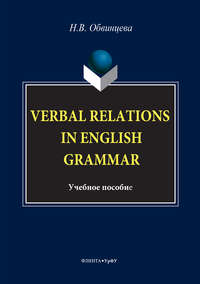
Kitabı oku: «Verbal Relations in English Grammar», sayfa 2

Yazı tipi:

English has two main kinds of verbs: normal verbs (called lexical verbs) and auxiliary verbs. The difference between them is mainly in where they can go in a sentence. Some verbs are in both groups, but there are very few auxiliary verbs in English. There are also two kinds of auxiliary verbs: modal verbs and non-modal verbs. In this textbook we consider lexical verbs in all their categories and observe the place of them in the sentence.

UNIT I
RELATIONS IN THE SENTENCE

WORD ORDER

Sentence is a linguistic unit consisting of one or more words that are grammatically linked. A sentence can include words grouped meaningfully to express a statement, question, exclamation, request, command or suggestion [2].

Sentence – conceived, explicitly or implicitly, as the largest unit of grammar, or the largest unit over which a rule of grammar can operate (P. H. Matthews).

Word order – used widely of the order of elements within the sentence, whether words or, more commonly, phrases. E. g. the ‘basic word order’ in English is ‘SVO’: i. e. a subject phrase (S), whether one word or many, precedes the verb (V), and an object phrase (O), again whether one word or many, follows it.

Due to the absence of case distinctions word order is practically the only means of distinguishing between the subject and the direct object. The word order in English is direct. The basic pattern of a simple sentence in English is one subject-predicate unit, that is, it has two main (principal) positions: those of the subject and of the predicate. It is the pattern of a two-member sentence. The verb in the predicate position may be intransitive, transitive, ditransitive or a link verb. The structure of the common sentence comprises the members in the following order [2]:

Yaş sınırı:
0+
Litres'teki yayın tarihi:
29 haziran 2017
Yazıldığı tarih:
2017
Hacim:
85 s. 42 illüstrasyon
ISBN:
978-5-9765-3193-2, 978-5-7996-1704-2
Telif hakkı:
ФЛИНТА