Kitabı oku: «Blood of Tyrants»

Copyright
HarperVoyager An imprint of HarperCollinsPublishers Ltd
1 London Bridge Street
London SE1 9GF
www.harpercollins.co.uk
First published in Great Britain by Ballantine Books 2013
Copyright © Naomi Novik 2013
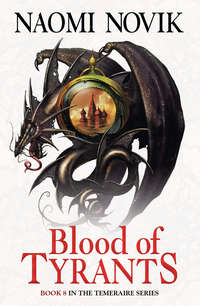
Cover layout design © HarperCollinsPublishers Ltd 2014
Cover illustration © Dominic Harman
Naomi Novik asserts the moral right to be identified as the author of this work.
A catalogue copy of this book is available from the British Library.
This novel is entirely a work of fiction. The names, characters and incidents portrayed in it are the work of the author’s imagination. Any resemblance to actual persons, living or dead, events or localities is entirely coincidental.
All rights reserved under International and Pan-American Copyright Conventions. By payment of the required fees, you have been granted the non-exclusive, non-transferable right to access and read the text of this e-book on screen. No part of this text may be reproduced, transmitted, down-loaded, decompiled, reverse engineered, or stored in or introduced into any information storage and retrieval system, in any form or by any means, whether electronic or mechanical, now known or hereinafter invented, without the express written permission of HarperCollins.
Source ISBN: 9780007569083
Ebook Edition © 2014 ISBN: 9780007569090
Version: 2016-08-31
Dedication
To Cynthia Manson, my amazing agent and friend, with much love and gratitude
Contents
Cover
Title Page
Copyright
Dedication
Map
Part 1
Chapter 1
Chapter 2
Chapter 3
Chapter 4
Chapter 5
Chapter 6
Chapter 7
Part 2
Chapter 8
Chapter 9
Chapter 10
Chapter 11
Chapter 12
Chapter 13
Chapter 14
Chapter 15
Part 3
Chapter 16
Chapter 17
Chapter 18
Chapter 19
Chapter 20
Acknowledgments
About the Author
The Temeraire series by Naomi Novik
About the Publisher


Chapter 1
Water lapping salt at his cheek roused him, a fresh cold trickle finding its way into the hollow of sand where his face rested. It spurred him: with an effort he pushed to hands and knees and then up, to stagger indecorously along the shore and fall again at the foot of several gnarled old pines clinging to the edge of the beach.
His mouth was dry and cracked, his tongue swollen. His hands were clotted with sand. The wind bit sharply through the sodden wool of his coat, stained black with water, and he was barefoot. Slowly, he unfastened the remnants of a leather harness from around his waist: buckles and clasps of good steel, still bright, but heavily waterlogged; he let it fall to the sand. The sword-belt he kept. The blade when he drew it was bright Damascus steel, the hilt wrapped in black ray-skin, the collar the golden head of a dragon. He stared down at it, without recognition.
He rested it across his knees and leaned back against the tree, half-drifting. The empty ocean stood before him: water cold dark blue, the sky a thin grey; dark clouds receded into the east. He might have emerged onto the sand new-born. He felt as empty as the shore: of strength, of history, of name.
Thirst at last drove him onwards, when little else would have served to rouse him. The stand of trees gave onto a road, well-maintained and showing the signs of heavy use, recent tracks and disturbed dust. He walked slowly and mechanically until he found a narrow stream that crossed the road, traveling towards the sea, and he stopped and cupped water into his mouth urgently until the taste of salt had gone.
He held himself braced on hands and knees, water dripping from his face into the stream. The bank had a little new grass, though the ground was still cold. There was a smell in the air of pine-needles, and the stream ran over the rocks in a steady gurgle, mingling with the more distant sound of the ocean, the scent of salt on the wind. He felt inwardly the sense of something urgent and forgotten like a weight on his back. But his trembling arms slowly gave way. He lay down on the grass of the riverbank where he had knelt to drink and fell again into a heavy torpor; his head ached dully.
The sun climbed, warmed his coat. Travelers went past on the nearby road. He was distantly aware of the jingle of harness and slap of walking feet, the occasional creak of cart wheels, but none of them stopped to bother him or even halted by the stream. A small party of men went by singing off-key, loudly and cheerfully, not in any tongue he knew. At last a larger company came, accompanied by the familiar creaking of an old-fashioned sedan-chair. Some confused corner of his mind offered the image of an older woman, borne by porters through London streets, but even as it came he knew it wrong.
The creaking stopped abruptly; a voice spoke from the chair: a clear tenor with the directness of authority. Prudence would have driven him to his feet, but he had no reserves of strength. In a moment, someone came to inspect him—a servant of some kind? He had some vague impression of a youth bending down over him, but not so low that the face came clear.
The servant paused, and then withdrew quickly to his master and spoke urgently in a clear young voice. There was another pause, and then the master spoke again in yet another tongue, one which he could not put a name to and nevertheless somehow understood: a rising and falling speech, musical. “I will not evade the will of Heaven. Tell me.”
“He is Dutch,” the servant answered in that same language, reluctance clear in every word.
He might have raised his head to speak—he was not Dutch, and knew that, if very little else; but he was cold, and his limbs heavier with every moment.
“Master, let us go on—”
“Enough,” the tenor voice said, quiet but final.
He heard orders given in the unfamiliar language while darkness stole over his vision; there were hands on him, their warmth welcome. He was lifted from the ground and slung into a sheet or a net for carrying; he could not even open his eyes to see. The company moved on; suspended in mid-air, swinging steadily back and forth as they went on, he felt almost as though he were in a hammock, aboard ship, swaying with the water. The movement lulled him; his pain dulled; he knew nothing more.
“William Laurence,” he said, and woke with his own name, at least, restored to him: out of a tangled dream full of burning sails and a strange weight of despair, a sinking ship. It faded as he struggled up to sit. He had been lying on a thin pad laid upon a floor of woven straw matting, in a room like none he had ever seen before: one solid wooden wall, the rest of translucent white paper set in frames of wood, and no sign of doors or windows. He had been bathed and dressed in a robe of light cotton; his own clothes were gone, and his sword. He missed the latter more.
He felt adrift, robbed of place and time. The chamber might have been a solitary hut or a room in the center of a great house; it might be set upon a mountaintop or the seashore; he might have slept an hour, a day, a week. A shadow abruptly loomed on the other side of the wall furthest from his bed, and the wall slid open along a track to furnish Laurence a glimpse of a corridor and another room across standing half-open, indistinguishable from his own, save for a window which looked out on a slim cherry-tree with bare dark branches.
A young man, not very tall but gangly with recent growth, perhaps sixteen, came through the opening and folded himself into the low-roofed chamber while Laurence stared at him blankly: he was Oriental. A long face with a sharp chin, clean-shaven and softened with the last remnants of puppy-fat; his dark hair was drawn back into a tail, and he wore an intricately arranged set of robes, creases as sharp as knife-edges.
He sat down on his heels and contemplated Laurence in turn, with an expression bleak enough to be aimed at a plague-carrier. After a moment he spoke, and Laurence thought he recognized the voice—the youth who had wished him left by the road.
“I have not the least notion what you are saying,” Laurence said, his voice sounding hoarse in his own ears. He cleared his throat: even that much struck his head with fresh pain. “Can you speak English? Or French? Where am I?” He tried those tongues both, and then hesitating repeated the last over in the other language which the men had spoken on the road.
“You are in Chikuzen Province,” the young man said, answering him in kind, “and far from Nagasaki, as you must well know.”
There was a sharp bitterness to his voice, but Laurence seized on the one familiar name. “Nagasaki?” he said, half in relief, but the momentary gratification faded: he was no less bewildered to know himself in Japan, the other side of the world from where he ought have been.
The young man—too old for a page, and he wore a sword; an equerry of some sort, or a squire, Laurence could only guess—made no answer, only with a curt gesture motioned him off the mat.
Laurence shifted himself onto the floor, with some awkwardness and pain: the ceiling was too low to have permitted him to stand unless he had hunched over like a toad, and he ached in every part. Two servants came in at the young man’s call; they tidied the mat away into a cabinet and offered Laurence fresh garments, baffling in their layers. He felt a clumsy child under their valeting, thrust one way and then another as he put his limbs continuously in the wrong places; then they brought him a tray of food: rice and dried fish and pungent broth, with an array of startling pickles. It was by no means the breakfast he would have chosen, his stomach unsettled, but they had no sooner put it before him than animal hunger became his master. He paused only after having devoured nearly half the meal, and stared at the eating-sticks, which he had picked up and used without thinking of it.
He forced himself to go on more slowly than he wished, still queasy and conscious of being under observation, the young man regarding him coldly and steadily the whole of his meal. “Thank you,” Laurence said at last, when he had finished, and the dishes were silently and deftly removed. “I would be grateful if you should give your master my thanks for his hospitality, and tell him I would be glad of an opportunity to repay it.”
The youth only compressed his lips together. “This way,” he said shortly. Laurence supposed he could have not looked anything but a vagabond, when they had found him.
The corridors of the house were not so stooped as the chambers. Laurence followed him to a back-chamber with a low writing-desk of some sort set upon the floor: another man sat behind it, working smoothly with brush and ink. His forehead and pate were clean-shaven, with a queue of his black hair clubbed tight and bound down doubled, over the bare skin; his garments were more ornate than the young man’s, although of the same style. The young man bowed to him from the waist, and spoke briefly in the Japanese tongue, gesturing towards him.
“Junichiro tells me you are recovered, Dutchman,” the man said, laying aside his brush. He looked across the desk at Laurence, wearing an expression of formal reserve, but with none of the dismay the young man—Junichiro?—had aimed at him.
“Sir,” Laurence said, “I must correct you: I am an Englishman, Captain William Laurence of—” He halted. Hanging from the wall behind the man’s head was a large and polished bronze mirror. The face which looked back at him from it was not merely haggard from his recent ordeal but unfamiliar: his hair grown long; a thin white scar running down his cheek, long-healed, which he did not remember; and lines and wear accumulated. He might have aged years since he had seen himself last.
“Perhaps you would be so kind as to explain to me the circumstances of your arrival in this part of the country,” the man said, prompting gently.
Laurence managed to say, reeling, “I am Captain William Laurence, of His Majesty’s Ship Reliant, of the Royal Navy. And I have not the least notion how I have come to be here, except if my ship has suffered some accident, which God forbid.”
Laurence did not much know what else he said afterwards. He supposed they saw his confusion and distress, for the questions stopped, and a servant was called to bring in a tray: a flask and small porcelain cups. His host filled one and gave it to him; Laurence took it and drank blindly, glad for the intensity: strong as brandy though light on the tongue. His cup was refilled promptly, and he drank again; the cup was small enough to be a single swallow. But he put it down afterwards. “I beg your pardon,” he said, feeling acutely that he had lost control of himself, and all the more awkward in the face of their carefully polite failure to notice it. “I beg your pardon,” he said, more strongly. “Sir, to answer your question, I cannot tell you how I came to be here: I must have been swept overboard, is the only possible answer. As for purpose, I have none; I have neither business nor friends in this part of the world.”
He hesitated, yet there was no help for it; he could not help but recognize himself utterly a beggar. Pride should have to be sacrificed. “I am sorry to be so bold as to make any further claims on your generosity,” he said, “when you have already been more than kind, but I would be glad—I would be very glad indeed for your assistance in making my way to Nagasaki, where I may be reunited with my ship, or find another to return me to England.”
But his host was silent. Finally he said, “You are yet too ill for the rigors of a long journey, I think. For now, permit me to invite you to enjoy the hospitality of my house. If there is anything you require for your comfort, Junichiro will see it is done.”
All that was courteous, all that was kind, and yet it was a dismissal. Junichiro silently moved to hover behind Laurence at his elbow, plainly waiting for him to leave. Laurence hesitated, but he could not much argue: there was a low hollow thumping in his head, like the sound of bare heels coming down on a deck overhead, and the liquor already had thrown a further haze over his sight.
He followed Junichiro out and down the hall, back to the small chamber where he had awoken. Junichiro drew open the door and stood waiting; his face remained hard and unfriendly, and he fixed his eyes past Laurence like a grande dame giving the cut direct, though he said with cold hauteur, once Laurence had ducked inside, “Send for me if you should require anything.”
Laurence looked about the chamber: the empty floor covered with straw mats, the bare and featureless walls, the silence of it; both the siren’s promise of immediate rest, and confinement. “My liberty,” he said, grimly, half under his breath.
“Be grateful for your life,” Junichiro said with sudden venom, “which you have only by my master’s benevolence. Perhaps he will think better of it.”
He all but hurled the door shut, the frame rattling on its track, and Laurence could only stare after his shadow disappearing on the other side of the translucent wall.
The green, glassy wave broke against the shoals but flung itself rushing on even as it crumpled. The cold foam washed ferociously up Temeraire’s hindquarters and left a fresh line of seaweed and splinters clinging to his hide as it finally fell back, exhausted. A low groaning came from the Potentate’s hull where she strained against the rocks, pinned and struggling; all around them the ocean stood wide and empty and grey, and the distant curve of land was only a smudge in the distance.
“You may say anything you like,” Temeraire said, flatly, “but I do not care in the least. I will go alone, if I must, whether or not anyone will come and help me.”
“Oh, Lord,” Granby muttered, half under his breath; Captain Berkley, who was clinging to a stanchion to keep his balance on the badly slanted deck, did not bother to keep his own voice low, but bellowed up, “Listen, you mad beast, you don’t suppose any of us like it better than you do?”
“I am quite sure I should like it less than anyone, if Laurence were dead,” Temeraire said, “but he is not: he is certainly not dead. Of course I am going to go and look for him: I think it outside of everything for you to try and persuade me to any other course.”
He did not bother to keep the reproach from his voice, and the anger. “And I do not see why you will all waste time arguing with me, when you had much better be helping me to organize a search: he cannot come to us, as long as we are still fixed out here in this useless position.”
He was himself in an equally unpleasant position: perched awkwardly upon the long line of jagged black rocks, with his hindquarters half in the ocean, and peering over onto the dragondeck at the aviators. The Potentate had grounded during the storm: a terrific crash which had nearly sent all the dragons sliding off the deck into the ocean and tipped the ship up and over her ends.
There had been no time to think of anything but the mad scrambling effort to untangle themselves from the storm-chains in time, Laurence throwing himself up to where little Nitidus was pinned beneath three knots, frantically sawing them open and letting him at last wriggle free, so the rest of them had room enough to burst loose while the chains and tarpaulins slid down over the prow, into the churning ocean.
“When you are loose, take hold the anchor-chains at stern and bow!” Laurence had roared to him, before climbing up. “You must hold her back and off her beam-ends, else this cross-ocean will pound her apart on the shoals,” and as soon as Temeraire had managed to break free he had done it: he and Maximus and Kulingile all working mightily together, straining against the anchor-chains and every rope that Nitidus and Dulcia could bring up to them, to keep the ship upright while the wind shrieked and tried to batter her and them against the rocks. And Temeraire had borne the brunt of it, for he could better maneuver than either of them: though it was quite impossible to hover properly in the storm, at least he could keep to his position more or less, without being flung down into the waves.
No-one had said a word to him, all that time—no-one had mentioned that Laurence was nowhere to be seen, and likely carried overboard with the chains—until he had finally been able to land exhausted on the deck, and look about, and Roland had slowly come and told him softly that Laurence was lost.
Temeraire did not mind admitting that it had been a very dreadful moment, and he had indulged himself in imagining consequences as dire as any of them. He had gone and swept frantically over all the neighboring ocean, every moment a torment as he found not the least sign of the tarpaulins or Laurence anywhere. But he had forced himself to stop searching empty waves—it had already been several hours, and Laurence would certainly not have stayed in the water, but would have struck right out for land, sensibly—and had gone back to the ship to consult maps to determine where best to find Laurence, and organize a better rescue.
It had not occurred to him that anyone would be so ridiculous as to throw some business of politics in his way: this nonsense of Japan being closed to foreign shipping, and unreasonably intolerant of visitors. Of course Hammond might be counted on to try offering him objections on such flimsy grounds, but Temeraire would have thought better of Granby and Captain Harcourt to lend themselves to it, or any of the other dragons’ captains.
Temeraire was trying to be just: he did not hold it against anyone, much, that they had not noticed Laurence missing in the great confusion—although he had been trying to save the entire ship, and others had not been in quite so crucial a position; someone else might have looked sooner—“But I do not think it unreasonably selfish of me,” he said, “that now the others should keep on without me, until I have found Laurence. And I will certainly go at once.”
The storm was gone and the winds had died down, and Maximus and Kulingile could take it in turn to keep the ship from being smashed upon the shoals: Kulingile was aloft even now, doing his turn alone, and the ship was perfectly well. It did not signify if a few waves came over the side; sailors had to be prepared to get a little wet, now and again.
“I do not even mean to be gone very long,” Temeraire said. “I am only asking to take perhaps twenty men, or thirty, and fly to the nearest shore and begin a search: certainly we will find him very soon. Particularly if we should make inquiries amongst the populace.”
“We must do nothing of the sort,” Hammond said, leaning over the rail and mopping his brow with his handkerchief: the weather was pleasantly hot now under the direct sun, which they had not seen for several days. “Nagasaki is the only harbor of Japan even open to any Western trade: the law utterly forbids the entry of any foreigners into the country, and if they should find Captain Laurence thrown up on their shore—” He stopped talking with a choking cough, as Granby stumbled with the swell on the shuddering deck, and knocked him in the side.
“If they do not want any foreigners about, they should be all the happier for us to find Laurence, and depart,” Temeraire said, feeling himself on eminently solid ground. “And after all, we can tell them we do not want to be here, either: we are only on our way to China, and if we had not run into that dreadful squall we should not have troubled them in the least.”
“Perhaps instead you might proceed at once to Nagasaki,” Gong Su said; he did not quail when Temeraire turned a cold glittering eye upon him, although he did add, “I beg your forgiveness for speaking of a course of action which is distasteful to you, but no good can come from failing to follow the proper forms of intercourse. I am sure that an inquiry laid with the harbormaster, with the proper respect, is most likely to yield the fruit which we all desire: the prince’s safe return.”
“Not much chance of that, certain sure,” O’Dea muttered, from where he was sitting not far away, wrapped in an oilskin and huddled up to Iskierka’s side for the warmth, pretending to be worming a rope usefully when really he was only listening. “Cruel, I call it, to keep up his hopes: the ocean keeps what she takes.”
“Thank you, O’Dea, that is enough,” Granby said sharply.
“It is enough,” Temeraire said. “You need not silence him, when he is only saying what you all think. Well, I do not care. I am not going to Nagasaki; I am not going to China; I am not going anywhere without Laurence, and I am certainly not going to only sit here and wait.”
“No, of course you aren’t,” Granby said under his breath.
“Oh, yes, you are!” said Iskierka cracking open an eye, now of all times. She had slept nearly the entire storm away fastened down in the most comfortable place, between Maximus and Kulingile, with Temeraire curled round and Lily, Messoria, and Immortalis all heaped on top; during the crisis, she had done absolutely nothing but huddle on an exposed rock and watch, grumblingly, while the rest of them had worked. And now the ship was more secure, she had slung herself, very inconveniently for everyone else, around the base of the mizzenmast to keep sleeping all the day.
“I am not, in the least!” Temeraire said to her, with strong indignation: if she were to tell him Laurence was dead, he would clout her across the nose. “Laurence is not dead.”
“I don’t see why he should be dead,” Iskierka said, “what has that to do with anything? But you are not going haring off into the countryside when we are stuck here on these rocks, and anything at all might happen to the ship.”
Temeraire thought this ridiculous. The storm was over, and the Potentate had not sunk yet; she would not sink now. “Whyever ought I stay here, when Laurence is lost somewhere in Japan?”
“Because I am going to have the egg tomorrow,” Iskierka said, then paused and tilted her head thoughtfully, “or perhaps to-day: I want something to eat, and then we shall see.”
“The egg?” Granby said, staring at her. “What egg? What—do you mean to tell me the two of you blighted fiends have been—”
“Well, of course,” Iskierka said. “How else could we have made an egg? Although,” she added to Temeraire, “it has been a great deal more trouble for me, so once it is out, I think it is only fair you should look after it: anyway you are not going anywhere, until it is quite safe.”
Chapter 2
Another full day passed in sleep and eating restored Laurence to nearly all the outward semblances of comfort, and robbed him more with every passing minute of the inward: he could not conceive of any course which should have deposited him so unceremoniously on the highways of Japan. He could not even be grateful to find himself equipped, apparently by the hand of deity, with the Chinese language to hand: he would have preferred to have been made mute, and known in the confines of his own mind whence he came, even if he could not have communicated that knowledge to his captors.
And captors they certainly were: his request for transport to Nagasaki remained notably unanswered. He had learnt a little more of his situation from Junichiro, who had despite his earlier flash of resentment continued to wait upon him punctiliously. His host’s name was Kaneko Hiromasa; his exact rank Laurence could not entirely work out, but he was at the least a reasonably wealthy man of some position, if judged by the size of his house and the number of servants, and engaged on important affairs by the quantity of papers in his study. A country-gentleman, managing his own estates, or perhaps even an official of some sort. Regardless of his rank, however, it was increasingly plain he did not view Laurence as a mere subject of charity, to be fed and washed and sent on his way.
Laurence had not been able to marshal his resources to pursue the matter on the previous day. Confusion and illness had overcome him, and he had spent nearly all the day asleep, stretched his full length upon the bare mats of the floor, rousing only for dinner. But in the morning he awakened feeling himself again, in body at least; and when the servants came with breakfast, he made plain he wished to speak with Kaneko once again. The ordinary maids did not speak Chinese, but when he had repeated their master’s name, they went away, and brought Junichiro back with them.
That young man came to the chamber door and stood outside, his face hard and remote. “My master is presently occupied,” he said. “Permit me to address your needs.” His voice was flat, and he did not look Laurence in the face. There was a strange mingling of formality and palpable resentment in his manner: all the outward shows of courtesy, and no evidence of any real feeling which might have motivated it.
Laurence could not make sense of it. If his presence had meant some great burden for the household, he might better have understood, but Kaneko need not have picked him up from the ground if so, and in any case the largesse which had been shown him, so far, scarcely seemed of a kind which would have troubled the finances of such a house.
But a full understanding was not his present concern: the meat of the matter was that they did not mean to aid him to get back to his ship. “I remain grateful for your master’s hospitality,” he said, “but my health is recovered, and I will trespass on it no further: I would ask you for the return of my clothing, and my sword, and to show me the way to the road.”
Junichiro looked at him with an expression briefly startled, as though Laurence had asked him for a pair of wings. “What would you do?” he said, with sincere confusion. “You cannot speak the language; you are a foreigner and a barbarian—”
“And,” Laurence said, cutting him off short; he could not have said how he knew the word had the flavor of an insult, but he did, “if I mean to go to the devil, that is my business, and surely no concern of yours.”
He would indeed have been glad of help, but not of the sort which would keep him penned in a room and plied with food and drink. So far, he seemed to figure at once as an unexpected but welcome guest, and a piece of highly inconvenient baggage: Junichiro plainly wished him gone—or never come at all—but even the servants eyed him with sidelong worried looks that required no translation.
At the very least, Laurence hoped his demand to leave might draw out some response which should illuminate matters, and let him know how better to proceed: and indeed Junichiro hesitated; he left and in a little while returned and said, “My master will see you.”
Laurence hoped to make a better show of himself, at this second meeting; he had asked for a razor, and conquered the disquiet of looking at his strangely unfamiliar face in the glass long enough to clear away the several days’ growth of beard. The servants had brought him to a bathing room, peculiarly divided with a wooden-slatted floor on which they insisted on scrubbing him in the open air, surely unhealthy in the extreme and inviting a chill, before permitting him to step into the large bath, itself excessively hot; at least, he had thought it so, but on emerging he could not deny it had done splendidly to ease his aches.
When ushered into the office this time, he was able to fold himself down in a better imitation of what was evidently the polite kneeling posture; his legs still complained of the position, but he was not so weak he was at every moment in danger of tipping over and having to reach out a hand to steady himself awkwardly against the floor with his fingertips.
Kaneko was frowning, however: Laurence’s sword lay on the desk before him, unsheathed, and in the sunlight coming through the open window looked even more splendid than Laurence had recalled: jewels gleamed from the dragon’s-head of the hilt, and the blade shone. His fingers itched to hold it again. “Where did you have this from?” Kaneko asked, touching the hilt.
Laurence could not bring himself to make the fantastic if honest answer that he did not recall: in any event, he did not feel himself compelled to answer such a question, personal and unjustified. “Are you proposing, sir,” he said, “that I have stolen it? The sword is mine, as are the coat, the shirt, and the trousers you found upon me; I am sorry to be equally unable to provide you with the bills of sale for any of them, if you should require the same to restore them to me.”
Kaneko hesitated. “This is a very fine blade,” he said, finally.
He seemed to want something more, but Laurence could not provide it. “Yes,” he said, unyielding, as he could not be otherwise. “I am a serving-officer of His Majesty’s Navy, sir; I rely upon my sword.”
He waited; he did not entirely understand what concerned Kaneko so about the blade. Finally, Kaneko said bluntly, “It is of Chinese make,” and Laurence inwardly flinched not with surprise, but with the absence of surprise: he realized he knew as much, and had not even thought it strange, before.
“I have another of Spanish,” Laurence said, swallowing his confusion, “and one of Prussian. Do you mean to keep it?”
Junichiro twitched as if with indignation, but Kaneko did not answer, only looking down still at the sword: Laurence had an impression he was dissatisfied with the answer, but why he should have cared where the sword had come from, Laurence could not say. “If not,” he added, “I would be glad for its return.”
“Ah,” Kaneko said, and tapped his fingers once upon the desk, before stilling his hand. “The bakufu has directed that only a samurai may bear a long sword.”
“If that is, as I suppose, a knight,” Laurence said, “I am the third son of the Earl of Allendale and, as I have already said, a ship’s captain: I must consider both my birth and my rank adequate to my arms by any reasonable standard. I will speak plainly, sir: if you mean to pillage me, I should be hard-put to prevent you under the circumstances, but I will thank you not to dress it up with justifications as ungentlemanly as they are unwarranted.”
“How dare you speak so to my master?” Junichiro flared up, half-rising on his knees. “You should have died, but for his intervention—”
“I did not request your aid,” Laurence said flatly, to Kaneko rather than to his squire, “and should rather have had none of it than a pretense at the same: I consider it no favor to be fed and clothed, and held against my will. If you are making yourself my jailor, sir, I should care to know on what grounds I am to meet with such treatment. So far as I know there is peace between our nations, and a shipwreck has in every civilized society all the claims to human sympathy which any man should care to receive, himself being the victim of such a disaster.”
“One who breaks the law may desire sympathy and yet not deserve it!” Junichiro said, and then subsided: Kaneko had raised his hand a very little.
“If a man may break the laws of your nation merely by being hurled unwillingly upon your shore,” Laurence said dryly, “then they seek to constrain not the will of man, but of God.”
“Enough, Junichiro,” Kaneko said quietly, when the young man would have answered hotly again. “The objection is just: I have not been of true service to you, as I vowed to be.”
He sat in silence a moment, looking down at his desk, while Laurence wondered at vowed: he had done nothing to earn any promise of service himself; was Kaneko under some sort of religious obligation?
“The obligations of honor are many,” Kaneko said at last, “and often contradictory.”
Junichiro made a violent motion of protest, a hand chopped across the air, outstretched as if he meant to catch the words even being spoken. Kaneko glanced at him, and with affection but sternly said, “Enough, Junichiro.”
“Master,” Junichiro said, “not for this. Not—”
Laurence watched them, disturbed: the young man’s voice was breaking, though Kaneko seemed as placid as a lake; he felt abruptly as awkward as though he had wandered into a stranger’s house, and found it full of family quarrels addressed only obliquely, through hints.
“I must write to Lady Arikawa,” Kaneko said, “and offer her my apologies. I see now that I have acted wrongly: I did not have the right to undertake an oath which might expose her to charges of disobedience to the bakufu. I regret that you must endure a delay in my answer,” he added to Laurence. “It must be her will, and not mine, whether I am permitted to fulfill my vow with honor by offering you assistance, and then make her my amends.”
“Pray Heaven she commands otherwise,” Junichiro said.
“You will desire no such thing,” Kaneko said, sharply, and after a moment, the young man looked away and muttered, “No.”
Kaneko nodded once, and then dismissed them both silently but pointedly by returning his attention to his writing-work as thoroughly as if he had been alone in the chamber.
Laurence hesitated, but the decision seemed made: he followed Junichiro’s shoulders, hunched forward a little as though he still felt his master’s reproof, back through the corridors to his own chamber. “I should like my own clothing again, at least,” he said abruptly, when they had reached the small room, and he had stepped inside, “if there is no objection to that.”
“If you wish to look like a ragged beggar, I suppose it can be accomplished,” Junichiro said, savagely, and closed the wall-panel behind him. But Laurence for the moment was as glad to be shut in with his own thoughts.
It seemed plain that the law here was inhospitable in the extreme to foreigners, and only some kind of vow—now-regretted—had impelled Kaneko to undertake the forms of charity towards him, evidently at real risk of his own disgrace. This Lady Arikawa, whoever she might be—perhaps his liege, certainly a person of authority—would be under no similar constraint. Kaneko might wish to leave his fate to the will of this lady, and so propitiate her, but Laurence felt not the slightest inclination to accommodate his plans. If return he owed, for hospitality so unwillingly given, then removing himself from the situation was all the return he was prepared to make.
The house was large, but hardly fortified, and he had seen only a few manservants. If the law generally barred the possession of blades, his own lack might not be an insurmountable obstacle if he could not get at the sword; although that, too, might be accomplished. The chief difficulty was not an escape, he thought, but its sequel. He could with an effort summon up the shape of the nation, on a chart, but he had never sailed this way in his life. If he had been asked to find Nagasaki by latitude and longitude, from memory, he might as well have made for Perdition straightaway.
But with any luck he could find his way back to the coast, whence perhaps some fisherman might be prevailed upon to carry him in secret to the port: and if he had not dreamt it in his delirium, the buttons of his coat had been gold. If not, in any case there might be a few coins in a pocket, or slipped through into the lining, if his things had not been pillaged.
They had not. Junichiro returned only a little while later with a servant trailing him, who set down on the floor just inside the room the bundle of clothing. And when the door had closed, and Laurence held the salt-stained and ruined clothes, he found the buttons, still firmly sewn on, were gold; and so, too, were the long narrow bars athwart each shoulder where the epaulettes had ought to be—
—and the coat itself was an aviator’s green.
The first order of business was plainly to get the ship afloat again: a ship sitting on rocks was of no use to anyone. “But shan’t the ocean get in, once those are underwater?” Lily said, her head tilted to examine the gaping holes where the rocks had pierced the hull and yet stood within, keeping the Potentate fixed upon the shoals.
“Oh! by no means,” Temeraire said. “They will patch it, with some timber and oakum, I believe; or perhaps with something else, it makes not a particle of difference. That is not our affair: that is for the sailors to worry about.”
He spoke with impatience, which he was aware Lily did not deserve, but he could not quite help himself. It was so very hard to stay here, especially when he was forced to overhear the officers, who insisted on speaking to one another in the certainty of Laurence’s death; even Granby, of whom Temeraire would have expected better, had only said to Hammond, “For Heaven’s sake, Hammond, let him think as he likes. It will take him dreadfully, when he does believe it.”
“Well, I am not going to believe it, so there,” Temeraire said, to himself; but it certainly did not improve his already-great anxiety to be away, searching for Laurence; and neither did Churki sitting there like a great unhelpful lump and wagging her head seriously and saying, “This is what comes of putting all your heart in just one person! Hammond, I should have mentioned before, I hope you are thinking of marriage, and do not fear that I am inclined to be unreasonable. As long as she is young enough to have a great many children, I will be very pleased, whatever your choice.”
Temeraire snorted: Churki might be considerably older, and very experienced from her service with the Incan army, but what did she know of it, anyway. He was quite done considering her opinion as particularly worthwhile; at least, on this subject.
But he very badly wished to go look for Laurence, anyway: and after all, there was no egg yet; there might not be an egg for days, and until there was an egg, it was none of his business but Iskierka’s, whatever she might say. And he would have gone, indeed—if only he could have persuaded himself that this explanation would hold the least weight with Laurence.
But Temeraire could just see himself trying to tell Laurence that he had left an egg on a ship swinging about on some rocks, with no-one to look after it but Iskierka. And not just any egg, but his very own egg and Iskierka’s: a Celestial and Kazilik cross, which Granby had said that very afternoon, to Captain Blaise, was likely worth more than the crown jewels of Britain—Temeraire had never seen these, but he was sure they must be impressive—and they must have a great deal of straw and a warm room set aside for it, if he pleased.
“But the ship is not in any real danger, at present,” Temeraire argued, to an imagined Laurence, “and after all if it did sink, we are close enough to fly to shore. And it is not only Iskierka to watch over it: there are Maximus and Lily, too, who would not let anything happen to the egg; and the rest of our formation, and Kulingile and Churki, besides. Really it would be extraordinary if anything should go wrong—”
But the vision of Laurence was unpersuaded, and only looked at him with gentle reproof: it was not their responsibility; it was his, and not to be pushed off onto someone else. Temeraire’s ruff drooped as he lost the argument with himself once again.
“Anyway,” he said to Lily now, out loud, with apology in his tone, “I am sure they will manage that part of the business perfectly well: so pray let us think how we are to get her off the rocks, instead.”
He had hoped, at first, that they might simply be able to lift the ship with all of them working together, but the ship’s master Mr. Ness had categorically made this impossible as a matter of weight. When he had worked the figures large enough to see clearly, Temeraire had been forced to admit as much: why on earth anyone had put five hundred tons of pig iron and another four hundred of shingle at the very bottom of the Potentate’s hold was quite a mystery to him, and he could not in the least work out how she stayed afloat ordinarily, but lifting her straight up by even an inch would certainly be beyond their power.
“If only we might rig a pulley!” he added again, but his best ingenuity had failed at contriving any way to establish a pulley in mid-air, above the ship, out in the middle of the ocean. “Or a lever—”
“Well, what about a lever?” Maximus said, gingerly sitting back on his haunches on the shoals, giving over his own attempts to inspect the holes: the ocean was too rough to see them from any distance. “That is only a stick, put underneath and pushed, ain’t it?” and Temeraire paused. He had been stopped, by the size of the ship, but perhaps—
“Where the devil are we to get a lever big enough to move her?” Mr. Ness called down at them, in exasperation. “Why, it should have to be taller than Babel.”
“We do not want one lever,” Temeraire said, with a sudden burst of inspiration. “We want three: one for me, and Maximus, and Kulingile, all to push on at once; and we will get trees from the shore to make them.”
Laurence would have given a great deal for a pair of boots. He contented himself, in the meantime, by working out a way of lacing the sandals more closely to his feet with the unraveled remnants of his woolen stockings, braided to make thin ropes. The coat he made into a bundle with his trousers: at least in the native clothing, he hoped he would not be utterly conspicuous at a glance, when he had tied a rag over his hair.
The bundle he left in the corner of the room when the servants came with the evening meal, and despite the reawakening of his sense of taste, he forced himself to eat even the fermented fish with its sour, vinegared rice; he could not anticipate another meal, any time soon. When it was cleared away, and the noises of the house began to die away along with the light filtering in through the rice-paper walls, Laurence debated with himself the merits of going after the sword. All practicality argued against it. He could not be sure the sword would yet be in Kaneko’s office, nor that the chamber would be unguarded; if he did retrieve it, the blade should then have to be concealed somehow, or draw unwanted attention. A sword wrapped in a bundle of clothing would be of little use if he were confronted unexpectedly by a few pursuers; and only if he were taken so might he hope to escape.
“Well,” Laurence said, standing, “I may as well have a look: if it does not come easy to hand, I may always withdraw.” He felt awkward, uneasy in the decision: irrational, when so many sensible arguments stood against it. He could not have said why; some inarticulate feeling only revolted. He did not want to leave the sword.
He mentally told himself to wake at four bells of the middle watch, and slept until the deep of the night, rousing from another strange and unpleasant dream: great chains tangled around his wrists, dragging him through deep water. He took his bundle, slung over a shoulder by his belt, and stepped cautiously out into the hallway: the soft matting did not betray him as he walked, barefoot to keep the slap of the sandals from making any noise.
The walls were a faint luminescent grey, paler than their frames. He kept the very tips of his fingers lightly against the surface of the paper, guiding his steps through the dark. There was a yellow glow of lantern-light somewhere on his right—outside the house, he thought; within, all the rooms were dark. He came to Kaneko’s office, and the door slid soundlessly open on its track. He thought at first he had mistaken the room: the desk was gone, and the room entirely bare at first glance. Then Laurence saw the furniture had all been tidied away against the walls, and the writing-desk stood atop a low chest.
He carefully lifted down the desk, and opening the lid found the blade wrapped in a soft silk cloth, which he left behind. He put the sword inside his bundle of clothing, pulling out folds to conceal it from hilt to tip, and restored the chest and desk to their places. He was comforted to have the sword again, and yet distressed for being so: too much as though he could not trust himself, his own feelings, to be as they ought.
Slipping back into the hallway, he looked for a way out, and followed a breath of air to the entryway: a very indifferent sentry drowsed in a corner, and Laurence was past him and had a foot in the gardens when a great roaring came from above, a sound at once familiar and bone-rattling, though he had not heard it since the battle of the Nile: a dragon, overhead, and the lights of all the house flared at his back.
“Buggering mad, the lot of you,” Mr. Ness had said, rudely, but Temeraire had with some exasperation demanded a better suggestion of him and, failing to receive any, had nodded firmly.
“Then we shall at least try,” he said, “and if it does not work, then I suppose you must begin to take out all that ballast and throw it into the ocean, along with the cannon, until we can lift the ship; and while you do that, Iskierka will go to the shore to be safe, and the other dragons will stay with her and the egg, and I will go and find Laurence. You will stay with the egg?” he appealed, turning his head.
“Of course we will,” Maximus said stoutly, and Lily added, “All of us: except Nitidus will go with you, to carry messages back and forth,” an excellent notion. Temeraire was quite sure no-one would give any trouble to Iskierka and Lily and Maximus.
“Anyway,” Lily said, “perhaps it needn’t come to that, and I am quite ready to be off these rocks: let us go by all means and fetch some trees.”
But they were unable to leave immediately: “I want to come, too!” Kulingile called down, in protest. Certainly Temeraire could not stay, but Maximus stood on seniority and refused to stay behind, either, which bode fair to make a quarrel; and meanwhile Hammond began bleating of the necessity to avoid being seen. Well, Temeraire did not mean to go in blowing on trumpets, but after all, they did need to take away several large trees, and he supposed someone might notice: that would not be his fault.
“We had better come along, then, Hammond; and all your crews, also,” Churki said.
Hammond, taken aback, said, “Certainly not—a martial presence, nothing more undesirable—”
But Churki shook her head censoriously at him. “If there are dragons here, they will certainly assume we are here to take their people away if they do not see we have any of our own. And if there are men, they will want men to talk to: that is only the natural order of things, and all the more so if they are like these peculiar sailors you have here on this vessel, who are afraid of dragons.”
Hammond paused, doubtful; Temeraire could see the sense in what Churki said, but he did not mean to countenance the delay involved in getting all the crews aboard. He only had a scant few officers himself, but Lily and her formation-dragons had their full crews, and even the aviators could not easily go clambering aboard from the precarious surface which the ship presently offered.
“The captains shall come with us,” Temeraire said, “and Ferris shall come with me, which will make a sensible number of men, and not any sort of threatening number; and,” to Kulingile, “this time Maximus shall go, and if we cannot get the boat off, then next time, you shall: that is surely only fair. And,” he added, very handsomely in his opinion, “I will take the lines when we come back to give you a rest before we lever her off, even though it will not be my turn yet.”
“I do not need a rest,” Kulingile said disconsolately. “This is not very difficult: it is only tiresome, and I want something better to eat, which you are sure to get when you are on land.”
“Oh!” Iskierka said, raising up her head from the dragondeck, where she had lain down again, ignoring Granby and Maximus’s surgeon Gaiters clambering about her hindquarters, consulting in low voices, “a cow! You shall bring me back a cow, Temeraire; do not forget it.”
“Wherever am I to find a cow, which is not someone’s property?” Temeraire said in exasperation, and Hammond at once began to speak again—likely the discussion should have been another hour, but Temeraire realized his mistake and said quickly, “but we will bring you both back something good to eat, if we should find anything without anyone seeing us, or objecting: we will save you the very best of what we find, you have my promise.”
“Well, that is fair,” Kulingile said, mollified, and Temeraire put out a foreleg on the dragondeck for Ferris, who hesitated only a moment before climbing into his grasp, and then launched them before anyone else could object further, or make any more unreasonable demands.
Ferris was very quiet, when he had got astride Temeraire’s neck and buckled himself on, while they hovered waiting for the other dragons to take up their captains and come aloft—Temeraire was careful to keep out of ear-shot of the deck. “Are you quite well, Ferris?” Temeraire said, craning about his head.
Ferris hesitated; he looked a great deal better lately, Temeraire had even before now noticed and approved: he could not help but congratulate himself for it, and see in it evidence that he was not a careless guardian of his crew, despite all their trials amongst the Inca and since.
Certainly Ferris was happier than when he had first come back to them in New South Wales; he was not so weary-looking, and the ruddy blotches which had marred his face then had cleared. He looked nearer his four-and-twenty than he had, and if he did not wear a green coat—Temeraire did not understand why Hammond had not straightened out that matter yet—at least the coat which he did wear, brown, was neat and trim and with silver buttons; and he took excellent care of his linen, which was properly white.
“You ought have taken Forthing,” Ferris said abruptly.
“Oh, Forthing,” Temeraire said, with a flick of his ruff. “Whyever for? I do not see why I ought to be giving Forthing any special notice: he is very well, I suppose, for ordinary work.”
“He is an officer of the Corps,” Ferris said, “and I—I am not; he is your first lieutenant.”
“You were, before him,” Temeraire said, “except for Granby; whom I cannot ask to come away from Iskierka under the circumstances. I do not take any notice of what some silly court-martial may have said, Ferris: I hope you do not think I do, and you ought not, either. Why, they declared Laurence should be put to death; you cannot imagine their judgment holds any water with me, or anyone of sense.”
Ferris was silent, and then he said, “You wouldn’t be taking Forthing up, no matter what, I suppose.”
“Taking him up?” Temeraire said. “I am perfectly happy for him to ride, when the rest of the crew do,” although this was not entirely true: with as much opportunity as Ferris had been given, during their brief stay in Brazil, Forthing had not bothered to repair any of his wardrobe but what had outright holes in it; his green coat was faded almost to grey, his neckcloth a disgrace, and his trousers frayed at hem and seams. It was an embarrassment, and all Temeraire’s hinting had gone unheeded entirely.
“No, I mean,” Ferris said, hesitated, and said, “if Captain Laurence—if we should not—”
Temeraire was still quite puzzled a moment; then he understood, and indignation swelled his breast. “I should not take that slovenly third-rate—piker for my captain if he were the last person to be had on the earth,” he said, heatedly. “Oh! Him, to succeed Laurence: I should like to see it! If the Admiralty should dare to propose it, I should go to Whitehall and bring the Navy Offices down about their ears.
“Anyway,” he added, in the teeth of his own anxiety, “I am sure Laurence will look after himself very well, until we can come get him: oh! Why are they taking so very long about getting aloft?”
The flight was not a long one, the coast rising ahead of them as they flew, the waters still depthless blue-black beneath. Dulcia and Nitidus sped on ahead in spite of Hammond’s cries of protest, but they circled back to meet the rest of them shortly before they all came over the coast: they had seen a few small fishing-boats, they reported, and a great many large half-drowned rice fields, with the beginnings of green shoots.
“But nothing very nice to eat,” Nitidus said sadly. “Why, I did not even see a sheep, or a goat.”
“Thank Heaven,” Temeraire could overhear Hammond say, foolishly: it would have been nice to know sheep might be had, even if they could not easily be got.
Captain Warren fetched Nitidus a buffet to the shoulder, and raised his speaking-trumpet to call over from his back, as they fell back into formation, “More to the point, there’s a bay straightaway three points to the north, with pine-trees as handsome as you could like.”
The bay was isolate, the glossy black water’s surface broken with a great many lumpy protruding rocks which likely made it inconvenient for fishing-boats, and showed no signs of use except a low stone wall which did not seem to have any purpose at all; it only ran along the shore in either direction. Hammond let himself down from Churki’s back clumsily but with haste the instant they had landed, and hurried to inspect: it was overgrown with a carpet of pale short green grass. “I see no sign of any other sort of traffic,” he said, with great relief, when he had straightened up, “so now pray let us get the trees and be away: at once, at once. I shall account all arrears of Fortune paid off, if only we should escape without notice.”
Lily cocked her head, considering, and said, “I suppose we should like them to fall inwards: stand back, all of you, if you please.”
“And to the north,” Captain Harcourt added, from her back, looking at the narrow wind-socks which stood up from Lily’s harness at various points. “Sing out when you are all safe away.”
Temeraire waited until Hammond with the rest of the company was moving, hastily, out of any chance of Lily’s acid spattering, and then announced, “I will go aloft, and see if I can make out anything more of the countryside: I should not like to disappoint Iskierka.”
In point of fact, he was quite willing to disappoint Iskierka if there were no cows to be had; but so long as they were here on land, Temeraire did not see any reason not to have a look around for Laurence. “Of course we are not likely to see him,” he added to Ferris, over his shoulder, as he flew quickly away before he might have to hear Hammond shouting protests after him, “but if only we should happen to, how convenient that would be: even Hammond could not complain, then. And even if we do not, we will have saved some time, later; we will not have to search here again. We will not go far, we will only go along the coast—”
Indeed, he did not go so far that he did not hear the thundering crash of the first pine, coming down; he did not wish to risk overlooking any sign. The coast was mostly rocky, save for a few other inlets and narrow streams coming down, but not very high. “I do not think it would be excessively difficult to get safely ashore, for a man swimming,” Temeraire said to Ferris.
Ferris said, “There aren’t cliffs, at least,” in a consoling way. “Shan’t we turn back, now? Those fishermen there are sure to see us if only they look up, and I think that must be a harbor over there—”
“But there are a few more beaches in this direction,” Temeraire said. “We shall go and have a look at those, from the air: I am sure they are too busy fishing to pay any attention to—”
He was interrupted in this optimistic speech by a sudden bellowing roar, loud and strangely gargled: he turned back hurriedly. “I do not see anyone in the air,” Temeraire said, uncertainly, peering in every direction: the day was clear, and he could not imagine where the roar had come from. “Perhaps it was only another pine coming down—”
“That noise was no tree-fall,” Ferris said, urgently, and Temeraire could not disagree however much he wished to do; he turned back towards the bay and crested the trees just in time to find, to his appalled surprise, Maximus and Lily and the others all mantling towards a monstrous sea-serpent rearing itself up out of the bay. The rocks were not rocks at all; they were a part of its body, and it was twice as big as Maximus even only in the parts which Temeraire could see.
And then Temeraire realized he was wrong: it was not a serpent; it was a dragon, with forelegs out upon the sand: only it was very long, and with stubby wings. It opened its mouth and made another roaring noise, a deep angry growling demand at the formation, which carried over the water clear enough, but in some language which Temeraire did not recognize.
They stood all amazed a moment, regarding one another, very much like figures upon a war-table from Temeraire’s distant view. When none of them answered, the serpent-dragon reached for the second tree, which had struck partway into the water. Lily sprang forward and put her talons upon it; the great dragon made a dismissive snort in her direction, which needed no translation.
Temeraire beat urgently towards them as Lily raised her wings and flared them out a little: the brilliant orange and purple would have warned any European beast, and their immense wingspan, but it was no surprise if the Japanese dragon did not recognize her as a Longwing, or did not know what that meant; and she was not a third his size. Temeraire saw Captain Harcourt, a tiny figure, lean forward on Lily’s neck and point to the sand; Lily turned her head and spat a thin demonstrative stream of acid, to make her point.
The serpentine dragon drew back from the hissing black stench and the thin trails of smoke, its own small wings flattening against its back, and then it plunged its head into the water and opened its jaw wide. The dragon, already so massive but slender, began now to rapidly swell up and out to the sides: Temeraire could not understand in the least how he was managing it, and then the dragon reared itself back out and up, and up, and up, and it blasted Lily and all the others with a torrent of water.
“Oh!” Temeraire cried, “Oh, it is a Sui-Riu!” that variety of dragon being known to him from Sir Edward Howe’s work on the Oriental breeds, but as he flew towards them as quickly as ever he could, he thought with some strong indignation that Sir Edward might have mentioned the immense—the truly immense—scale; and the book had not in the least conveyed the true impact of the water-spouting.
Even Maximus had been swept off his feet, and was now tangled and struggling up against the tree-line; Lily was coughing and sputtering, having taken the brunt of the torrent, jerking her head, and Nitidus and Dulcia had been carried into the bay itself and were floundering in the waves. Immortalis and Churki were a tumbled sand-clogged mess flung into the woods, trying to get their footing again; Sutton and Messoria, having stationed themselves back and apart, were a little better off and getting into the air.
But the Sui-Riu evidently had no intention of letting them get their bearings back: he had plunged his head back into the water and was inhaling again. He might blast them on the far side, and so sweep more of them into the water, where he would certainly have an advantage, since he could breathe through it: unsporting, except that to be fair he was one against eight.
However, Temeraire could not give him much credit for that: no-one had asked the Sui-Riu to be so unfriendly. Lily had given the most polite warning one could ask for—if she had liked to be similarly nasty, she might have taken the Sui-Riu directly in the eye with her shot. Temeraire worked his lungs as he flew, gathering breath, and even as the Sui-Riu drew himself up out of the water again, Temeraire dived towards him, roaring in full and terrible voice.
The waters of the bay shuddered from the divine wind, the surface going for a moment bowl-like and concave; the Sui-Riu was bowled over onto his side with an immense splash, and his torrent erupted involuntarily and spilled harmless over the water, merely adding more turbulence. But the distance was too great, or else perhaps the water somehow absorbed some of the impact; the Sui-Riu managed to right himself in the water, and did not look so dreadfully injured as did most dragons who had borne the direct brunt of the divine wind. Only a little blood trickled black from his right ear, over scales that were a deep greenish black the color of dry seaweed, and his eye on that side was bloodshot: otherwise he seemed quite all right, and great sharp fins were rising up angrily all over his back, like blades.
But Temeraire was hovering off the shore, now, closer; and Maximus and Lily were righting themselves. The others fell into line behind Lily, taking up their formation-positions. Temeraire did not much like formation-fighting, but one could not deny its tactical usefulness, and the Sui-Riu evidently did not have any difficulty recognizing his increasing disadvantage. Shaking away the last of the effects, he looked up at Temeraire, and his eyes—a great slitted pale grey that looked nearly white—drew thin and narrow.
The Sui-Riu rumbled some remarks in a most angry tone, sounding more like a distant thundercloud than anything else. “I do not have any notion what you are saying,” Temeraire informed him loudly, in Chinese, “but you needn’t complain of us, when you attack people out of nowhere—if you should—”
But as abruptly as he had emerged before, the Sui-Riu was gone: in one smooth motion he plunged beneath the dark murky waters of the bay, clouded even further now by silt and sand raised in their exchange. One long barnacled curve of tail breached the water, and was gone: though Temeraire held position a long time, he did not break the surface again.
Chapter 3
The lanterns were coming alight, one after another, all through the house. Laurence could trace the servants moving in waves as the glow spread behind the walls. The sentry at the door was waking with a snorting start and jerking to his feet, blinking around. Laurence for a moment considered: the man was paunchy and sleep-dazed, armed only with a short blade—a quick struggle might see him through—
But the dragon was descending from aloft—the dragons, rather, for there were two immense black shadows against the milky wash of the moonless night, coming into the lamp-light. One, the larger, had wide green eyes that glowed like a cat’s: it was not looking at him presently, but if it could see in the dark, like the Fleur-de-Nuit, nothing could be easier than for the beast to hunt him down while he fumbled over unfamiliar ground in the dark.
Quickly, Laurence turned instead and thrust his small bundle into the ornamental bushes planted against the side of the house, and then went and stood by the door of the house to wait, as though he had been brought there. The sentry looked at him in confusion, but Laurence looked back at him with unmoving face, brazening it out, and the man was in a moment overwhelmed by a sudden flow of servants hurrying out into the garden. Junichiro appeared by Laurence’s elbow.
“What are you doing out here?” the young man demanded, but preoccupied himself did not wait for an answer; instead he seized Laurence by the arm and drew him along with the flow of people. “They have certainly come on your account,” he said, “so you may as well stay here.”
Kaneko was coming out of the house himself, dressed in formal robes; he wore two blades at his belt and came past his servants, who had arrayed themselves in a square as neat as any infantry troop. Two last men were hurrying around the perimeter of a great flagstoned courtyard, lighting lamps all around it, and then they all knelt together as the dragons came descending into the square, Kaneko out ahead of the rest of the party.
The dragons settled themselves neatly upon the ground; the larger, grey in body and something the size of a middle-weight, wore curious pale green silken dressings the color of its eyes wound about its neck and wing-tips and forelegs, which coming loose made graceful arcs about its body like sails spilling their wind. It had not a single man aboard. The smaller dragon, a brilliant yellow beast larger than a Winchester though not up to combat-weight, carried four: of these, the lead gentleman was dressed in elaborate and formal robes bearing signs of some sort of office, and the others were evidently servants who carried boxes and one an armful of scrolls, and preceding him down unfolded a set of steps to enable him to make a more ponderous and imposing descent.
The grey dragon bent its head towards Kaneko while the men dismounted. It spoke to him in the Japanese tongue, and he bowed more deeply and said something back. Laurence caught the name Arikawa out of it, but he saw no women; perhaps these were Lady Arikawa’s emissaries, and he could see nothing to bode well for his future in their cold faces.
There was a little more formal exchange between them, which Laurence could not follow: he was all the more conscious of his utter isolation, of himself as a prisoner among strangers, unable even to pick out a word or to conceive their intentions. The servants were dismissed; the guests and Kaneko went inside the house; Junichiro took him by the arm and drew him along after them. They turned immediately from the entryway into a chamber on the side, whose entire outer wall was slid back and left wide open to face upon the courtyard where the dragons had settled themselves.
The servants brought great kettles of steaming sharp-nosed tea out to bowls laid before the beasts. The official and Kaneko were served afterwards; they drank, making what Laurence assumed from their tone was mere small conversation, until abruptly he was drawn in front of them, and without hesitation or change of demeanor the official addressed him in Chinese and said, “What is your purpose in coming to our nation?”
“Sir,” Laurence said, “I have no purpose but to be restored to my country-men, and my ship if at all possible.”
It was the opening salvo of an interrogation which proceeded despite the hour of the night, and was as frustrating to Laurence as it was to his interlocutor. He could not but be conscious of the impossibility of avowing himself unable to remember his purpose. Better to be thought a liar than a lunatic, he was sure, but unable to confess this truth, he felt every other word hung upon a knife-edge of honor. He did not know why he was here, and therefore could not say with honest confidence that he meant them no injury. What if the Japanese sheltered some French ship, which he pursued?
“I am a shipwreck: I did not choose to be thrown on your shore, and my presence here is the merest accident,” he said again, the best he could do. “And as you have received no declaration of war, from Britain, nor any envoy,” he added, hoping as much was true, “then, sir, I hope you will believe I am not here as your enemy. You surely cannot imagine me intended in any way to be a spy, and His Majesty’s Government does not behave in so underhanded a manner as to attack another nation with no warning or quarrel.”
The official, who had been addressed by the others as Matsudaira, was an older man, with a narrow beard that framed his face in dark lines salted a little with grey; his mouth was thin and hard. “Indeed,” he said, and put down his teacup. “With your gracious permission, Lady Arikawa, we will take the Englishman to Hakata Bay, and consult him upon the evidence there.”
Laurence looked in confusion for any new arrival; then the grey dragon answered, in Chinese, “Let it be done,” with some reluctance in her tone. Kaneko, frowning slightly, looked at her: the dragon shook her head at him, setting the arcs of green fabric trembling.
The sun was rising, little by little, as they went. Kaneko alone went with the grey dragon—who, Laurence somewhat doubtfully supposed, was Lady Arikawa. She bent her foreleg and invited Kaneko upon her back: evidently some sign of great condescension on her part, and one of which Matsudaira did not approve, judged from the tightening of his lips. Laurence himself and the rest of the company went aboard the second, smaller beast.
Junichiro, left behind to watch the house, had watched them go aboard with his eyes darting anxiously from his master to Matsudaira: he, too, saw the magistrate’s frowns. Yet he maintained his composure, or nearly so: when the dragons leapt aloft, his face turned up to follow them, betraying for a moment a boyish note of longing. Laurence recognized it as kin to the feeling which he had worn himself as a boy hanging on the prow of his uncle’s ship, although he had never thought of attaching such a feeling to dragons.
Laurence was grateful to find both his stomach and his courage easily equal to the journey; he had been able to make his way up the harness without hesitation or awkwardness, and the wind cool and fragrant and crisp in his face was a pleasure despite the great rushing speed. They were near the ocean: dawn broke over the water brilliantly, sunlight a streaming silver path towards them so that Laurence’s eyes teared with the glare. The green fabric on Lady Arikawa’s back, which she had drawn taut about herself for the flight, was bordered with innumerable small gems which blazed in the new light. She averted her eyes from the sun, however, and dropped back so the smaller dragon’s shadow could land upon her head and give her some relief from the light. Laurence noted it with some small gratitude: she would be no very effective searcher during the daylight, perhaps—if he could somehow still manage his escape.
The tenor of Matsudaira’s interrogation had left Laurence in no doubt of the increasing urgency of flight. He could curse the ill-fortune that had brought the dragons down at so unexpected an hour, but not berate himself for failure. He had planned his attempt at escape as well as he could, and at least he had avoided giving rise to suspicion—he was neither bound nor chained at present, and Kaneko had not even missed the sword yet.
As soon as another opportunity afforded, even perhaps during this excursion, Laurence meant to try again. He had kept the gold bars tucked into the sash of his garment, so he was not wholly without resources even without his lost bundle. The flight indeed might aid him, for they were aloft more than an hour: Laurence had not realized he had been brought so far from the shore, but Kaneko’s house evidently stood perhaps fifteen or even as much as twenty miles inland.
“Hakata Bay” was a promising sound, however: at least he should be on the coast again, and if there were any chance of slipping away, he could more easily hunt out some fishing-boat. So, at least, he told himself; he refused to listen to the grim internal voice which would fain have whispered in his ear at length of the impracticalities of any such plan, and the absurdity of escaping alone from a large and well-armed party accompanied by dragons, no less. Hopelessness was a worse defeat than any other; he did not mean to yield to it.
The countryside below was not unpromising for his purposes. At first the land below was settled; but towards the end of their flight, the dragons turned away from a bustling harbor full of shipping, following the line of an old low stone wall—some sort of coastal defense, perhaps? It resembled nothing so much as some of the defenses thrown up against Napoleon, on Britain’s own shores. It carried them along to a more isolate shore, hidden by the curving of the coastline, where there was only a mere fringe of sand leading up to a thick forest of tree-trunks, which Laurence thought might serve to hide him even from dragons.
But as they landed, the waters of the bay shuddered and broke open, and a monstrous creature came rising from the waves. It was something like the sea-serpents of half-legendary repute, but magnified to a size that put to shame the most outrageous and absurd sea-tales Laurence had ever heard passed off for truth by sailors; he had never even conceived its like.
The smaller dragons landed before it and bowed their heads low to the ground; the men slid to the sand and all knelt deeply before the creature. It climbed a little way out on the shore to meet them, its enormous talons digging great gouges in the sand, so deep that water pooled up in them as it lifted them to claw its way further up the shore. It made a rumbling speech to the party, permitting them to rise, and even inclined its head a very little to Lady Arikawa; but when at last it swung its heavy finned head towards Laurence, a glitter of angry malice shone in its pallid white eyes, one of them shot through with broken black vessels of blood.
“Pray be reasonable,” Hammond said, leaning greenish over the rail; he was chewing a great lump of coca leaves in his distended cheek, an effort to make up for the wad he had lost when the Sui-Riu had swamped them: he was still in his sodden clothing. “We must go on to Nagasaki, as soon as we may, and there make amends. Only consider: if the beast was not some mere feral creature, and it should report our quarrel, any efforts to find Captain Laurence will certainly be grievously hampered by the opposition of the authorities—”
“What you mean is,” Temeraire said, “you want us to run away from that big sea-dragon like cowards, only because you are afraid he will come after the ship.”
He did not bother to be polite about it. Captain Blaise had not been the least reluctant to express his own sentiments, when Temeraire and the others had returned, on the subject of the Sui-Riu as it was described to him—sentiments which did not in Temeraire’s opinion do him the least credit. “We must get out of these waters at once,” Blaise had said, and he had made all the men beat to quarters instantly, though there had not been any sign of the other beast all the long flight back.
“And,” Temeraire added, “this after we blacked his eye for him quite thoroughly, to boot; it seems to me you might have a little confidence in us.”
They were waiting now only for high tide to finish coming in: the great tree-trunks had been with enormous effort wedged slowly and painfully between the ship and the reef; the anchor-cables were woven in and around Messoria’s harness and Immortalis’s. Maximus would take one lever, Kulingile the other, and Temeraire the middle. Iskierka would lie about on the rocks doing nothing but criticizing—Temeraire snorted—and Lily would look on, and perhaps strike the shoals with acid, as they tried to get the ship off them, if that should seem useful.
“And if he does show himself, while you are working,” Iskierka put in, yawning, “I am perfectly able to breathe flame, even if I do not mean to be exerting myself a great deal presently. He will certainly think better of attacking us, then.”
“Dear God,” Captain Blaise said, and seized Granby by the arm to object violently to any such proceeding: the sailors were really unreasonable on the subject of fire, Temeraire felt; it was not as though Iskierka had proposed setting the sails alight.
He withdrew along the line of the shoals to wait alone until the tide should rise, and simmered quietly beneath the steady cold wash of the waves. He would not go on to Nagasaki. He did not know where precisely Nagasaki was, but it was not near-by; he did not mean to abandon the search for Laurence an instant longer than the ship’s rescue required. The egg would be quite safe, once they were afloat again.
The emptiness of the coast he had flown over with Ferris lingered in the back of his mind like an unpleasant aftertaste. It had been three days and nights since Laurence had been swept away—already any visible signs upon the shore might have been lost. Laurence would have gone inland for water, perhaps; or perhaps he had even been lying under some tree for shelter, or calling up to Temeraire from a distance, unheard. Temeraire still had not the least doubt of Laurence’s survival, but that alone would be of little use if he could not find Laurence.
“Temeraire!” Dulcia landed on his back and knocked him on the shoulder with her head. “We have been calling and calling: it is time to get the ship off the rocks.”
“Oh!” Temeraire said, rousing, and found himself very cold and stiff indeed coming out of the great dark circling of his thoughts; the water was almost halfway up his hindquarters, and the short harness about his shoulders was sodden and heavy and dragging as he went into the air, a reminder of his empty back.
Messoria and Immortalis launched themselves with the cables; Dulcia and Nitidus each took another cable, for what help they could give, and Captain Blaise gave the word to throw the sea-anchor over the side beyond them, to help if it might. The tree-tops had been wedged in carefully under the hull, and their long trunks were jutting up from the ocean, froth churning up around them.
“Are you quite ready?” Temeraire asked Maximus and Kulingile.
“I still say there is something strange about this,” Demane said, from the dragondeck, gripping the railing hard; he had been reluctant to see Kulingile lent to the attempt at all. “Kulingile, you are sure you will do this? I don’t see how it can work—”
“I’ve told you!” his brother Sipho hissed at him.
Temeraire flattened his ruff: he understood a little Demane’s anxiety—there was every reason to believe the Admiralty would be delighted to push him and his brother off if Kulingile were lost: he had still not been confirmed in his rank, and Laurence had been his only patron. But it seemed to Temeraire that this was all the more reason to help him find Laurence and bring him back.
“Oh, I don’t mind trying,” Kulingile said easily, however. “If it don’t work, we will only sit on those logs for a while, and nothing much will happen.”
Temeraire drew breath to explain, yet again, why it would work, after all; then he forced himself not to argue. “If you are quite ready,” he said, and together they flung themselves down upon the levers, and as one exhaled as deeply as they could, from all their air-sacs.
Temeraire had worked it all out on paper, or rather, Sipho had worked it out to his direction, with help from a still-doubtful Ness; but paper made nothing to the experience of plunging deep into the icy cold water, feeling his body pulling at him as though an anchor. He had to scrabble desperately to keep himself upon the lever; his own weight would have dragged him instantly deep beneath the surface of the water.
“Hold on, there, you damned lummox!” Berkley was bellowing, over the railing. “Breathe in again!” Maximus was struggling beside him, and Kulingile was sinking so deep the water was nearly to his fore shoulders.
“Oh, but it is working!” Lily cried, on the far side of the ship, and then with alarm, “Look out—” as the ship came up and off the rocks with almost startling ease, and began to slide down the levers towards them.
Laurence had made one of the party which had taken the Tonnant, at the Nile, after the Longwing formation above had made its pass. He remembered the great pitted smoking holes, which had gone through the decks, and the screams of the wretched seaman who had incautiously put his bare foot upon one small spatter, not the size of a shilling. One of his mess-mates had chopped his foot off at once, there upon the deck, and so saved the fellow’s life; although the wound had mortified and killed him three days later.
He recognized, therefore, the characteristic spattering of the Longwing acid upon the tree-stumps which they showed him, and the earth surrounding them, and although the stolen trees had provoked such hostility in his captors, Laurence could not help but rejoice that at last he could begin to understand; he could make sense of the intelligence these signs offered him. There was a Longwing near-by, and it had come and taken away three prime pieces of timber.
“Taken for masts, most likely,” Laurence said, drawing a picture of a sailing ship in the wet sand to translate the word for them. Three masts on such a scale: a dragon transport for sure, which in any event should have been required to carry a Longwing and its usual formation; and that, surely, explained Laurence’s own presence. The Reliant must have been traveling in company with the larger ship, to serve her as a more agile defender: no-one could call transports easy to handle, for all the massive weight of iron they could bring to bear.
The coat—the green coat—must have come off some aviator’s back. Perhaps it had been thrown up on the shore beside him by the same storm that had wrecked the ship’s masts, and in the first early moments of cold and delirium Laurence had put it on. He wondered now if the sword, too, had come from another man’s hand; but he put that doubt aside. If it had, he could more easily restore it himself than could the Japanese—if he were permitted to go home.
And home was now a real possibility. There was a British ship here, in these very waters. She was not sunk; she was injured, but afloat, and her crew hoped to repair her. The Allegiance? Laurence wondered. Or perhaps the Dominion; although that ship was ordinarily on the run to Halifax. He still did not know what they had been doing with a transport so near Japan, but those questions were as nothing to the sheer inexpressible relief of knowing himself not, as he had begun to feel, wholly adrift, unmoored from any connection to his own life.
Laurence looked up from the sand, and addressed Matsudaira again. “Sir, I will say on behalf of my country-men that I am sure they intended no offense. They came ashore meaning only to take some necessary material for their ship’s repair, from what they must have supposed to be a stand of unused timber.”
“And where is this ship, now?” Matsudaira said.
His expression betrayed nothing but the same mild interest he had displayed throughout all the conversation, but the question came very quick. Laurence paused. He had just been thinking he might ask for a map of the coastline, or for a local fisherman to question. A transport had a draught near fifty feet: she could not anchor in shallow waters, and would not risk coming very near the coast. Some haphazard anchorage sheltered from the worst of the ocean by shoals was the most likely; near in straight line flight from this bay. He thought he might be able to guess a likely place, and even direct a boat thence, given some sense of the nearby waters.
Ücretsiz ön izlemeyi tamamladınız.