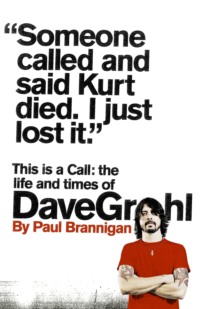
Kitabı oku: «This Is a Call: The Life and Times of Dave Grohl»
This is a Call: The Life and Times of Dave Grohl
By Paul Brannigan

Contents
Cover
Title Page
Foreword
Learn to fly
This is a call
Chaotic hardcore underage delinquents
Gods look down
Negative creep
Lounge act
Smells like teen spirit
I hate myself and I want to die
I’ll stick around
My poor brain
Disenchanted lullaby
Home
These days
Photographic Insert
Sources
Bibliography
Discography
Searchable Terms
Acknowledgements
Copyright
About the Publisher
Foreword
Dave Grohl has just slapped me across the face. It’s the early hours of 20 December 2005, and he and I are in a central London rock bar. Neither of us is meant to be here. Grohl is supposed to be in Ireland, resting up before his band Foo Fighters headline Dublin’s 8,000 capacity Point Depot; I had only dropped in to the Crobar for a swift pre-Christmas beer with colleagues. But sometimes, particularly for those of us with Irish blood, nights in bars take on a momentum all their own.
Surprised to see one another, Grohl and I caught up quickly: I had recently become a father and Dave’s wife Jordyn was five months pregnant, so babies and fatherhood dominated the early conversation. Then Grohl brought two trays laden with Jägermeister shots to our table and the evening began to get a little unhinged. Soon enough, all sensible conversation was abandoned. As the Crobar’s excellent jukebox spat the sounds of Metallica, Minor Threat, Venom, Black Flag, Slayer and the Sex Pistols into the night air Grohl and I started doing what men of a certain age do while listening to very loud rock music when very drunk – screaming out lyrics, thrusting clenched fists skywards and headbanging furiously. And it was in the midst of this unedifying frenzy that Dave Grohl asked me to give him a slap in the face, an ancient male bonding ritual that only those conversant in the hesher tradition will truly understand.
‘I can’t do that,’ I protested.
‘Why not?’ he asked.
‘Well, because … because … you’re Dave Grohl,’ I stammered.
‘Okay, I’ll go first then,’ said Grohl.
And with that, Foo Fighters’ grinning frontman unleashed a stinging right hander which almost lifted me off the sticky barroom floor. Out of politeness, then, it seemed only fair to hit him back …
I first met Dave Grohl in November 1997 in London. The afternoon was memorable for all the wrong reasons. I had been commissioned to interview Foo Fighters’ 28-year-old frontman for an end-of-year cover story for Kerrang! magazine, but, travelling back home following the interview, I discovered to my horror that our entire conversation had been wiped from the cassette in my dictaphone. Mortified, I begged Grohl’s long-standing PR man Anton Brookes to schedule another interview. Days later, I spoke with Grohl again backstage at London’s Brixton Academy: he had the manners and good grace not to laugh at my misfortune.
Over the next decade, I would run into the singer fairly regularly – at gigs, in TV studios, on the set of video shoots and in dingy rock clubs across the world; sometimes we would have business to conduct, at other times our contact was limited to the briefest of greetings. Relationships within the music industry are often conducted at such a level.
‘I would consider the two of us to be friends,’ Grohl told me as we had lunch at the Sunset Marquis hotel in West Hollywood in 2009 while conducting a lengthy interview for MOJO magazine. ‘This is the basis of our relationship, this working thing, but let’s go have a fucking beer, you know what I mean? But it would take a long time for you to really know me.’
In the eighteen months it has taken me to write this book, that sentence has entered my head one hundred times. In truth, everyone thinks they know Dave Grohl. In an age where social networking has made Marshall McLuhan’s 1960s vision of a global village a reality, where Twitter and Facebook and Tumblr and Flickr conspire to log and classify every waking moment, Grohl’s public profile has been distilled down to one simple epithet: he is, by common consent, ‘The Nicest Man in Rock’. But in effect this rather meaningless, reductive phrase has allowed the ‘real’ Dave Grohl to remain hidden in plain sight, unknown to all but his closest friends.
Based upon insights drawn from first-hand interviews with Grohl’s friends, peers and associates, and from my conversations with the man himself, this is my attempt to tell Dave Grohl’s story. It is an epic tale, documenting a journey which has taken Grohl from Washington DC’s scuzziest punk rock clubs to the White House and the world’s most imposing stadia. It’s a story which ties together strands from fifty years of rock ’n’ roll history, from Bob Dylan, The Beatles and Led Zeppelin through to Sonic Youth, Queens of the Stone Age and The Prodigy in a singular career, one which speaks volumes about both the evolution of the recording industry and the manner in which music soundtracks our lives. On a more basic level, it’s a story about family and a musical community which continues to inspire, empower and engage.
During the course of writing this book, I spoke to Dave Grohl both on and off-record, and he was kind enough to permit me to visit his family home in California during the making of Foo Fighters’ current album Wasting Light. The last time I talked with Dave was on 3 July 2011, minutes after his band performed in front of 65,000 people for a second consecutive evening at the National Bowl in Milton Keynes, England. That was a special night, a night for celebration, but also one which felt like the beginning of a whole new chapter for this most resolute of musicians. That future is unwritten; this is the story so far.
Paul Brannigan
London, July 2011
Learn to Fly
A big rock ’n’ roll moment for me was going to see AC/DC’s Let There Be Rock movie. That was the first time I heard music that made me want to break shit. That was maybe the first moment where I really felt like a fucking punk, like I just wanted to tear that movie theatre to shreds watching this rock ’n’ roll band …
Dave Grohl
In 1980, in a song named after their Los Angeles hometown, the punk band X sang of a female acquaintance who had lost her way, lost her innocence and lost her patience with the City of Angels, a friend desperate to flee the squalid, druggy Hollywood scene and unforgiving streets where ‘days change at night, change in an instant’. But even as Farrah Fawcett Minor was dying to get out, get out, one young punk on the East Coast was dreaming of heading in the opposite direction.
As a child, Dave Grohl had a recurring dream, one that stole into his head in the hours of darkness ‘a thousand fucking times’. In this dream, he was riding a tiny bike from his home in Springfield, Virginia to Los Angeles, cruising slowly along the side of the highway as cars whizzed past with horns blaring and tail pipes smoking. Generations of bored, restless suburban kids have harboured similar fantasies of escaping suffocating small-town life for the glister of Hollywood. Deep in the national psyche LA remains synonymous with freedom, opportunity and boundless glamour, and the city’s entertainment industries, both legal and less legal, have grown fat feasting upon the wide-eyed ingénues who spill daily from incoming Greyhound coaches and Amtrak trains, but young Grohl’s imagination was fired less by the shimmering promises of the Golden State than by the excitement of whatever swerves and undulations might have to be negotiated on his westward odyssey.
In September 2009 I had lunch with Foo Fighters’ frontman at West Hollywood’s chic Sunset Marquis hotel. As he picked at a Caesar salad, Grohl, modern rock’s most convincing renaissance man, described the early days of his life’s journey as being informed by a ‘sense of adventure’, of ‘not knowing what lay ahead’.
‘In that dream I had so far to go,’ he said, ‘and I was going so slow, but I was moving.’
Los Angeles is a city which holds memories both good and bad for Grohl. A decade ago he would tell anyone who’d listen that he hated this town, hated the Hollywood lifestyle, and hated pretty much everyone he met here:
‘It’s kinda funny for a while,’ he conceded, ‘then annoying, then depressing, finally it gets terrifying because you start wondering if these people are rubbing off on you. It’s like one giant frenzy of aspiration and lies.’
But now Los Angeles, or more specifically Encino, 15 miles northwest of Sunset Boulevard’s celebrity haunts, and a neighbourhood Grohl once defined as a place where ‘porn stars become grocery clerks and rock stars come to die’, is his home. Here, overlooking the San Fernando Valley, Dave Grohl literally has Los Angeles at his feet.
Grohl bought his house, a tasteful four-bedroom 1950s villa set on almost 4,000 square feet of prime Californian real estate, for $2.2 million in April 2003; four months later, surrounded by friends and family, he married MTV producer Jordyn Blum on the tennis court at the rear of the property. And it was here that Grohl elected to record Foo Fighters’ seventh studio album Wasting Light in autumn 2010, eschewing digital studio technology in favour of tracking to analogue tape, a process largely viewed as antiquated within the modern recording industry.
From the outset, it seemed like a curious move, verging on the perverse: Grohl has his very own state-of-the-art recording complex, Studio 606, in Northridge, California, not ten minutes’ drive from his home, and though his house in Encino also contains a compact home studio built around a 24-track mixing desk, the set-up is very much that of a family home, not some rock star bolthole. In contrast to houses in Los Angeles’ more fashionable zip codes, there are no high fences surrounding the Grohl residence, no signs warning of armed security guards patrolling the perimeters: a plaque on the left-hand side of the driveway simply reads The Grohls. When you step inside the front door there are no gold or platinum discs on the hallway walls, no framed magazine covers, no posed portraits with celebrity friends, nothing to signpost the road Dave Grohl has travelled to get here: instead there are family snapshots and brightly coloured crayon-drawn abstract artwork tacked to the walls, the work of artists-in-residence Violet Maye Grohl and Harper Willow Grohl, Dave and Jordyn’s young daughters.
In November 2010 I was invited to the Grohl family home to interview Foo Fighters about their work-in-progress. I arrived to find the man of the house in his garage, holding up scuffed album sleeves and fingerprint-smudged CD cases from his personal record collection to a webcam delivering images for a 24/7 live stream on Foo Fighters’ website. Among them were Bad Brains’ Rock for Light, Metallica’s Master of Puppets, AC/DC’s Back in Black, Thin Lizzy’s Live and Dangerous, Ted Nugent’s Cat Scratch Fever, Pixies’ Trompe Le Monde and Led Zeppelin’s Houses of the Holy, each album a strand of Grohl’s musical DNA, each one a part of the soundtrack of his life. Behind him, producer Butch Vig stood splicing two-inch analogue tape on a 24-track Studer A800 reel-to-reel tape machine. In the room next door, eighteen of Grohl’s guitars stood erect in flight cases, tuned and ready for use. In the adjoining garage, usually reserved for Grohl’s Harley Davidson motorcycles, Taylor Hawkins’s drum kit sat encircled by mic stands.
‘It gets fucking loud in there,’ said Grohl, closing the door with a smile.
Upstairs in the studio control room, band members Pat Smear, Chris Shiftlet, Nate Mendel and Hawkins sat sharing cartons of take-away food. Around them Grohl strode animated, enthusing about his belief that Wasting Light would be Foo Fighters’ definitive work. And as he spoke, his decision to record here began to make sense, indeed began to look inspired.
‘It only seemed like a good idea to do it here,’ Grohl insisted. ‘I wasn’t nervous about it at all. What we’re doing here is in some ways making sense of everything we’ve done for the last fifteen years.
‘It all came together as one big idea. Let’s work with Butch, but let’s not use computers, let’s only use tape. Let’s not do it at 606, let’s do it in my garage. And let’s make a movie that tells the history of the band as we’re making the new album, so that somehow it all makes sense together in the grand scheme of things. I feel like you can actually hear the whole process in the album.’
For Grohl, the notion of time, its passing, its deathless march and the value and importance of seizing precious moments, is central to Wasting Light. But later that night, as I played back the cassette recording of the day’s conversations, it struck me that the process unfolding in Encino was perhaps more personal than Dave Grohl would care to acknowledge explicitly: as he spoke of garage demos and life-changing albums, of collaborations with heroes and friends, of teenage desires and adult responsibilities, it seemed that in making Foo Fighters’ seventh album Dave Grohl was seeking not merely to define his band’s career, but also to make sense of his own life to date. And who could blame him? For his has been a journey more dramatic than that adolescent dreamer back in Virginia could ever have imagined.
Between 1880 and 1920 almost 24 million immigrants arrived in the United States, the majority of them from Southern and Eastern European nations. Pursuing his own dreams, Dave Grohl’s great-grandfather was among their number.
Born in Slovakia, then a part of the powerful Austro-Hungarian Empire, John Grohol was admitted to America in 1886, the same year in which the Statue of Liberty was erected on Bedloe’s Island in New York Harbor. Like the vast majority of Slovaks who boarded dangerously overcrowded, unsanitary steamer ships for the twelve-day voyage to America’s eastern seaboard, Grohol was an economic migrant: without a trade to his name when he arrived in the USA, he was drawn to the state of Pennsylvania by the promise of unskilled labour in the region’s coalfields and steel mills. The state was a popular destination for Slovak immigrants: when Grohol made his home in the small town of Houtzdale in Clearfield County, he was just one of approximately 250,000 Slovaks to put down roots within the borders of the Keystone State between 1880 and 1920. This influx of new labour engendered a certain amount of tension in the region.
Racist attitudes towards the settling Eastern European community were laid out in the bluntest terms by a report commissioned by the US Immigration Commission, published in 1911. Presented to Congress by the Republican Senator for Vermont, William P. Dillingham, Volume 16 of the Reports of the Immigration Commission: Immigrants in Industries dealt with studies into communities built around ‘Copper Mining and Smelting; Iron Ore Mining; Anthracite Coal Mining; [and] Oil Refining’ in Michigan, Minnesota and Pennsylvania, and concluded that white, American-born workers were being displaced by ‘the more recent settlers of the community’, referred to elsewhere in the report as ‘the ignorant foreigner’.
One excerpt of Dillingham’s report stated:
The social and moral deterioration of the community through the infusion of a large element of foreign blood may be described under the heads of the two principal sources of its evil effects: (a) The conditions due directly to the peculiarities of the foreign body itself; and (b) those which arise from the reactions upon each other of two non-homogeneous social elements – the native and the alien classes – when brought into close association. Among the effects under the first-named class may be enumerated the following:
A lowering of the average intelligence, restraint, sensitivity, orderliness, and efficiency of the community through the greater deficiency of the immigrants in all of these respects.
An increase of intemperance and the crime resulting from inebriety due to the drink habits of the immigrants.
An increase of sexual immorality due to the excess of males over females …
Baldly put, the ‘new immigrants’ were regarded as a dangerous breed of subhumans.
The Dillingham Commission concluded that immigration from Southern and Eastern Europe posed a significant threat to American society and should in the future be greatly reduced. These findings were used to justify a series of new laws in the 1920s which served to place restrictions on immigration, and which also served to place a veneer of legitimacy on increasingly hostile, often blatantly discriminatory employment practices towards foreign-born workers.
Faced with such widespread attitudes and beliefs, it’s understandable that when John Grohol and his wife Anna, herself a Slovakian immigrant, started their own family, their four sons – Joseph, John, Alois and Andrew – were encouraged to adopt the less obviously Slovakian, more Americanised surname Grohl in order to better assimilate into the prevailing culture.
Ethnic conflict was not, however, confined to the United States. Tensions were also running high in Europe, with questions of sovereignty, race and national self-determination causing division and toxic discord. The 1914 assassination of Archduke Franz Ferdinand, heir presumptive to the Austro-Hungarian throne, by Yugoslav nationalist Gavrilo Princip acted as the catalyst for a breakdown in international diplomacy in the Balkans, a situation which ultimately led to the outbreak of the First World War.
By the time America entered the Great War in April 1917, the Grohol family themselves had crossed state lines and moved to Canton, Ohio, setting up home at 116 Rowland Avenue, in the north-east of the city.
Canton was a hard, working-class town, built around its steel mills, which had embarked upon massive recruitment drives required to accommodate the increased productivity needed for the war effort. As his second eldest boy, John Stephen, enlisted in the United States army, John Grohol senior took up a position as a hammerman in one such factory. During this period Canton’s population swelled significantly – the 1920 census recorded the town as being home to 90,000 residents, a leap of almost 40,000 from figures collated just a decade previously – but among this new influx of citizens were less savoury elements, attracted by the town’s increased prosperity.
By the mid 1920s Canton had acquired the unwanted nickname ‘Little Chicago’ in recognition of the growth of underworld gangs busying themselves with organised prostitution, bootlegging and gambling operations in the town’s newly established red-light districts. Suspicious of the local police force’s apparent unwillingness to crack down on such illicit activities, newspaper editor Donald Ring Mellet conducted his own investigations, exposing the collusion between gangsters and police in a series of searing articles published in the Canton Daily News. Mellet paid a high price for his crusading efforts: on 16 July 1926 the journalist was shot dead at his home in a cold-blooded execution which sent shockwaves through the local community. This was not the American Dream as John Grohol had envisaged it. It was time for his family to move on once more. They headed north-east, this time for Ohio’s industrial heartland.
Residents of Warren, Ohio refer to their hometown as ‘The Festival City’ in recognition of the various celebrations of heritage, culture and art held throughout the year for the local community. In the summer of 2009, one such event – the inaugural Music Is Art festival – attracted thousands of music fans to the city’s downtown Courthouse Square. On display from 26 July to the first day of August were no less than 48 acts, a rich variety of musicians and artists. But on the afternoon of 1 August there was little debate as to the festival’s headline attraction.
‘Is this the most beautiful day of your life?’ Dave Grohl asked the crowd gathered on the lawn of the Trumbull County Courthouse as he was presented with the key to the city on the Music Is Art stage. ‘Because it is mine.’
‘I was born here, at the hospital just down the street, over at Trumbull Memorial,’ Grohl continued. ‘Most of my family is from the Niles and the Youngstown and the Warren area: my mother went to Boardman High School, my father went to the Academy …’
Standing alongside Grohl’s father James and mother Virginia, Warren Police Sergeant Joe O’Grady felt a surge of pride as he watched the city’s most famous son address his audience. Dave Grohl had perfected the art of speaking to a large group as if he were having an intimate one-to-one conversation with a close friend, and the crowd listened rapt as he spoke in his easy-going, everyman manner of his family’s history in Ohio: about his paternal grandfather Alois Grohl’s work at Republic Steel in Youngstown, his maternal grandfather John Hanlon’s employment as a civil engineer on the Mosquito Dam building project in the 1940s, and his own pride in hailing from the town.
The Music Is Art festival was Sgt Joe O’Grady’s brainchild, and it was his idea too to lobby the city council to rename a downtown street in Dave Grohl’s honour. This tribute, he argued, would bolster civic pride, and in saluting Grohl’s musical achievements the city elders would send an inspirational message to the youth of Warren about fulfilling their own potential. In September 2008 Warren City Council passed O’Grady’s resolution, and Market Street Alley was officially renamed David Grohl Alley.
On the morning of the dedication ceremony, Joe O’Grady walked Dave Grohl through downtown Warren to meet with one young man whose story had become entwined with the police officer’s own vision and passion for the project.
Throughout the summer of 2009, Jacob Robinson, an eighteen-year-old skater and aspiring rapper, had worked long days in David Grohl Alley, sweeping the asphalt street and removing weeds and leaves from every crack in the bordering walls, so that artists from the Trumbull Art Gallery could paint murals along its length. Initially these chores were undertaken as part of a community service programme, after a fracas with a local police officer who’d apprehended him for skateboarding on a public street (a misdemeanour under the city’s penal code).
But as O’Grady explained to Grohl, as Robinson’s involvement in the project deepened so too did the teenager’s sense of self-esteem. In Robinson’s story Grohl heard an echo of his own formative years: himself a self-confessed ‘little vandal’ during adolescence, he saw in Robinson another creative, frustrated, headstrong young man in need of direction. In a log cabin adjacent to Monument Park he spoke with the young skater as he signed his skate deck, telling him, ‘You and I are a lot alike.’
‘When I was your age, I was into skateboarding and I was into music,’ said Grohl. ‘I did my best to be myself and stay out of trouble …’
The sentence was left hanging, but its subtext was clear enough to both Robinson and the listening Joe O’Grady. This was precisely the kind of non-judgemental pep talk to which Robinson could connect, the kind of positive message the progressive policeman would himself repeat in the months and years ahead to other kids who felt both disillusioned and disenfranchised growing up in Warren.
‘A kid who’s fifteen years old doesn’t feel there’s hope,’ O’Grady told a local entertainment website. ‘But just because you’re born here doesn’t mean you’re a nobody.’
David Eric Grohl was born on 14 January 1969 at Trumbull Memorial Hospital in Warren, just one mile from the street that now bears his name. He was James and Virginia Grohl’s second child, and a brother for their daughter Lisa, then still a month shy of her third birthday. Speaking with Nirvana biographer Michael Azerrad in 1993, Grohl described his parents as being positioned ‘pretty much at other ends of the spectrum’: in his eyes, his father was ‘a real conservative, neat, Washington DC kind of man’, his mother ‘a liberal, free-thinking, creative’ type, but in the early years of the couple’s relationship their shared passions evidently eclipsed such ideological divisions.
Virginia Jean Hanlon met James Harper Grohl while working in community theatre in Trumbull County. She was a striking, smart and sassy trainee teacher, he a quick-witted, charming and confident young journalist. Grohl was a classically trained flautist – nothing less than a ‘child prodigy’, according to his son – and a keen jazz buff; Hanlon sang with high school friends in an a cappella vocal group named the Three Belles. The pair also shared a love of poetry and literature, particularly the provocative counter-culture writings of Beat Generation authors Jack Kerouac, William Burroughs and Allen Ginsberg. In later years, in the company of his son’s more artistic, liberal-minded friends, James Grohl was fond of wheeling out an anecdote about Ginsberg (unsuccessfully) hitting on him when the pair moved in the same bohemian circles, a pointed reminder to his son that he wasn’t always such a strait-laced square.
At the time of his son’s birth, James Grohl was a journalist for the Scripps Howard news agency, a division of the multi-platform communications empire built up by the tough-talking Illinois-born media mogul Edward Willis Scripps. With a culture encouraging independent thinking, instincts for social reform and a healthy disrespect for authority, it was a fecund environment for any ambitious young journalist. For James Grohl, this avowed policy of fearless, scrupulous news-gathering was never more important than when he was called upon to cover the student protests at Kent State University in nearby Kent, Ohio in May 1970.
Founded in 1910 as a teacher training college, Kent State was officially accorded university status in 1935; then, as now, the college prided itself upon a commitment to ‘excellence in action’. By 1970 the student body, which included future Pretenders singer Chrissie Hynde, then an eighteen-year-old art student, numbered 21,000 across all programmes. That student body had become enraged when US President Richard Nixon, a man elected two years earlier on a pledge to end the war in Vietnam, announced on 30 April 1970 that US combat forces had invaded neighbouring Cambodia, an act widely interpreted as an escalation of the conflict.
When sporadic rioting broke out in the city in the wake of an anti-war demonstration on the university campus on 1 May, Mayor Leroy Satrom declared a state of emergency, and Ohio Governor James Allen Rhodes sent the National Guard to Kent to quell the disturbances and restore order.
On 4 May, when 2,000 protestors gathered on the university commons for another scheduled protest, they were ordered to disperse. When it became clear that the protestors were not prepared to comply with this injunction, the Guardsmen fired first tear gas, then live ammunition, into their midst. Four students were killed, and nine more injured.
Dubbed ‘the Kent State Massacre’ by the media, the killings galvanised the American anti-war movement. In the wake of the shootings, angry demonstrations were held on college campuses nationwide, and on 9 May an estimated 100,000 people converged upon Washington DC to protest against the Vietnam War and the horrifying events in Ohio. In response, the Nixon administration called upon the military to defend government offices, as the President was secreted from the District of Columbia to Camp David in Maryland for his own safety. White House staffers viewed the tense stand-off with mounting panic: upon seeing armed soldiers in the basement of the executive offices, one Nixon aide later commented, ‘You’re thinking “This can’t be the United States of America. This is not the greatest free democracy in the world. This is a nation at war with itself.”’
James Grohl’s dispatches from Ohio marked him out as a rising star within the Scripps Howard news service. In 1972, while working in Columbus, Ohio, he was asked to consider a move to Washington DC, the nation’s capital and political nerve centre, to develop his career further. For Grohl, the timing was perfect. This was the age of the crusading journalist, with Washington Post reporters Carl Bernstein and Bob Woodward being hailed as American heroes for their incisive and explosive investigations into a seemingly trivial burglary at the Watergate Hotel on 17 June 1972, which exposed a botched attempt to bug the offices of the Democratic National Committee offices and uncovered a paper trail all the way to the White House, leading to the resignation of ‘Tricky Dickie’ Nixon on 8 August 1974. What upwardly mobile young reporter wouldn’t wish to join the pair on the frontline in their tenacious pursuit of the truth? It was an opportunity Grohl accepted without reservation.
Like so many other transplants to the DC metropolitan area, he chose to relocate his family not in the District of Columbia itself, but in the outlying suburbs. Springfield, Virginia lay six miles down the I-95, just inside the Capital Beltway, and like the neighbouring towns of Arlington, Annandale and Alexandria it was a popular destination for commuters working in the city or at the nearby Pentagon offices. As with other Northern Virginian towns, it had a transient population, with the shifting dynamics of working on Capitol Hill leading many families to relocate after four or five years in the area. Despite this, residents worked hard to foster and maintain a strong community spirit.
At the dawn of the 1970s the Grohls’ new hometown was a location suited to the patronising sobriquet ‘white-bread’. But, befitting a town ‘15 minutes from chicken farmers, and 15 minutes from the White House’, as Dave Grohl would later describe it, Springfield, VA also had a more schizophrenic character. Here, urbane, moneyed politicos – those ‘fortunate sons’ eviscerated in song by Creedence Clearwater Revival – shared street space with blue-collar Southerners with gun racks on their pickup trucks and Skynyrd and Zeppelin blasting from their Camaros and Ford Mustangs.
This is a call
The whole night was like a scene from Lord of the Rings where there’s twelve people that have to fight their way through an army of orcs, and there’s just no way they can possibly win – that’s how it felt to be a punk rocker in the middle of five million rednecks in Washington DC on the 4th of July. I had just discovered punk rock, and it was so unbelievably moving. It was like our own personal Altamont, our Woodstock. And that’s when I said, ‘Fuck the world, I’m doing this …’
Dave Grohl
It was 3 July 1983, Independence Day weekend, and America was in the mood to party. The sun was shining in Washington DC and Irene Cara’s hit single Flashdance … What a Feeling, sitting pretty at the summit of the Billboard Hot 100 for a fifth consecutive week, blasted from every shopfront, souvenir stall and boombox in the nation’s capital. The stately tree-lined avenues around the National Mall were a bustle of colour, movement and noise, as tens of thousands of tourists and DC metropolitan area residents jockeyed for the best vantage points for that evening’s celebratory fireworks display.
Chatting and laughing, Dave Grohl and Larry Hinkle weaved their way through the crowds, heading towards the Lincoln Memorial, in whose shadow a free concert was being held. Timed to coincide with DC’s annual pro-marijuana legalisation Smoke-In event, the Rock Against Reagan concert had been organised by the Youth International Party, a leftist counter-cultural collective, and boasted a line-up featuring some of the finest American hardcore bands of the day, among them Reagan Youth, Crucifucks, Toxic Reasons, M.D.C. (aka Millions of Dead Cops) and headliners Dead Kennedys.
As they neared the concert site, Grohl and Hinkle sensed a change in the atmosphere. There were DC police everywhere, some patting down concertgoers against squad cars, others patrolling the site on horseback, dozens more sitting in buses in full riot gear. In a field adjacent to the Lincoln Memorial 800 punk rockers watched Houston’s D.R.I. hammer through their hate songs in E minor, with vocalist Kurt Brecht railing against American consumerism, the military-industrial complex and the evil deathmonger in residence at 1600 Pennsylvania Avenue, over guitarist Spike Cassidy’s filthy, gnarled, slamdance-on-a-dime riffs. When the band finally stopped to draw breath, an impressed Dave Grohl immediately walked over to their tour van and bought a copy of their self-titled 22-song seven-inch EP from the sweating, panting Brecht.
As the sky darkened, so too did the mood on the Mall. The punks grew mouthier, the tourists more bellicose. There were catcalls, confrontations and scuffles, raised voices and raised fists. Drunken college students pushed beer kegs around in shopping trolleys and stoned, naked hippies frolicked in the Reflecting Pool. The police got edgier and the bands played on, harder, faster, louder. As the sun dipped below the skyline, the Dead Kennedys walked on stage to face pandemonium.
‘I get chills just thinking about it,’ says Grohl. ‘There were police helicopters going around with their lights on the audience and cops on horseback just fucking billy-clubbing punk rockers. Dead Kennedys are playing “Holiday in Cambodia” and Jello Biafra is pointing at the Washington Monument with its two blinking red lights and he’s saying, “With the great Klansman in the sky with his two blinking red eyes …”, it was unbelievable, it was like Apocalypse Now. The whole night was like a scene from Lord of the Rings where there’s twelve people that have to fight their way through an army of orcs, and there’s just no way they can possibly win – that’s how it felt to be a punk rocker in the middle of five million rednecks in Washington DC on the 4th of July. I had just discovered punk rock, and it was so unbelievably moving. It was like our own personal Altamont, our Woodstock. And that’s when I said, “Fuck the world, I’m doing this …”’
Music historians will argue forever about the origins of punk rock. Some lay the blame at the feet of Ann Arbor, Michigan’s The Stooges, blank-eyed degenerates who channelled desperation and isolation and boredom and violence and sex and confusion into brutish, nihilistic numbskull anthems. On ‘1969’, the opening track of their self-titled début album, released in the year of Dave Grohl’s birth, vocalist Iggy Pop looked outside his window to see ‘war across the USA’, before turning his disgust inwards, mocking his own sullen self-pity (‘last year I was 21 / I didn’t have a lot of fun’) with a deceptively throwaway, infantile bubblegum-pop lyric – ‘I say Oh-my and a boo-hoo’ – positively dripping with sarcasm and self-loathing. Every bit as combative and confrontational as the cold, hard stares of the four lank-haired thugs glaring out from the cover artwork, The Stooges was also music to beat yourself up to, a recurring theme in punk rock to the present day.
Other music critics see the form as pre-dating The Stooges, with its roots in the primitive, animalistic poundings of The Sonics, The Seeds, The Wailers and a thousand more unsung hooligan-blues heroes of the early 1960s who never meant jack-shit outside the bare brick walls of their own suburban garages. These bands took the thrust-and-drag dynamics of The Kingsmen’s 1963 version of Richard Berry’s deathless rock ’n’ roll standard ‘Louie Louie’ and The Kinks’ 1964 hit ‘You Really Got Me’ and amplified them with brute force and ignorance, getting high on volume and fuzz and speaker-hiss and adrenaline. Drawn together on Rolling Stone writer Lenny Kaye’s seminal 1972 compilation album Nuggets, bands such as The Barbarians and The Mojo Men and The Amboy Dukes made a forceful case for being the true defenders of the spirit of rock ’n’ roll.
In the early seventies, though, rock critics seemed keen to label just about anyone punk. To New York Times writer Grace Lichtenstein, Alice Cooper was a punk. To England’s New Musical Express Gene Vincent was a punk, as was Eddie Cochran. To Zigzag magazine Bruce Springsteen was ‘a rock ’n’ roll punk’. To Greg Shaw of Rolling Stone magazine, fifties teen idol Dion was ‘the original punk’. As English rock writer Mick Houghton cannily observed in 1975, ‘the term “punk” is bandied about an awful lot these days. It seems to describe almost any rock performer who camps it up to any degree, on or off-stage, or who displays an arrogance and contempt for his audience.’
By consensus, however, New York and London are generally acclaimed as the parent cities of the modern punk sound. The New York punk scene revolved around the CBGB club on Bowery on Manhattan’s Lower East Side, a scuzzy, graffiti-covered fleapit which, from 1974, played host to nonconformist, experimental artists such as Ramones, The New York Dolls, The Heartbreakers, Suicide, Blondie, Television, Talking Heads and Richard Hell and the Voidoids. London’s vibrant scene, centred around the Sex Pistols, The Clash, The Damned, X-Ray Spex, The Slits and The Adverts, kicked in two years later, in 1976. But it was the latter scene which first received mainstream press coverage in the US, when Rolling Stone writer Charles M. Young was dispatched to London in August 1977 to write a cover story on the Sex Pistols, then still unsigned in America.
The Sex Pistols were England’s most notorious rock band, even before their first single, the electrifying Anarchy in the UK, débuted in the UK charts. In their very first press interview guitarist Steve Jones commented, ‘We’re not into music. We’re into chaos,’ words that would prove astonishingly prescient. Following a fractious appearance on primetime television show Today on 1 December 1976 – where the Pistols responded to host Bill Grundy’s goading putdowns by calling him a ‘dirty fucker’ and a ‘fucking rotter’ – the band graduated from the covers of Britain’s four weekly music papers – New Musical Express, Melody Maker, Sounds and Record Mirror – to the nation’s sensationalist, scandal-thirsty tabloid newspapers, who gleefully set about portraying the young Londoners as dangerous revolutionaries hellbent on destroying the very fabric of British society. The band’s inflammatory decision to release their caustic second single, God Save the Queen, in the run-up to Queen Elizabeth II’s Silver Jubilee only heightened their infamy.
Charles Young was not met with open arms in London. Initially, in fact, he was not met at all, for Malcolm McClaren, the Sex Pistols’ mischievous, maverick manager, simply ignored the writer’s phone calls during his first two days in the city. Though Rolling Stone took pride in its roots as a counter-cultural magazine, by the mid-seventies it was firmly part of the establishment, in thrall to Laurel Canyon songwriters and MOR superstars: cover stars in 1976 included Neil Diamond, Jackson Browne, Paul Simon, Peter Frampton, teen pinup Donny Osmond and Christian crooner Pat Boone. When McClaren finally deigned to receive Young at his central London flat, he regarded the journalist as one might regard a ball of phlegm hacked up in a porcelain sink.
‘This band hates you,’ he loftily informed Young. ‘It hates your culture. Why can’t you lethargic, complacent hippies understand that? You need to be smashed.’
When he finally met McClaren’s charges, Young was horrified and fascinated in equal measure by the ‘four proletarian kids’ who’d provoked such outrage and revulsion in the UK. In a beautifully written article, titled ‘Rock Is Sick and Living in London’, the writer sketched out pen portraits of the men behind the myths: in his eyes, guitarist Steve Jones was a brash, lairy Jack The Lad who revelled in his band’s ‘bad boy’ status, drummer Paul Cook was thoughtful and unassuming, while cartoon-like bassist Sid Vicious was a somewhat pitiful, childlike, self-abusing simpleton.
Young found the band’s witheringly sarcastic frontman Johnny Rotten a more complex character to categorise. Despite Rotten doing his level best to be as obnoxious as possible to the visiting scribe, Young was impressed by the singer’s passion and obvious intelligence, and found the 21-year-old a not entirely dislikeable character.
On 19 August Young travelled to Wolverhampton to see the Pistols in concert. When the band took to the stage of Club Lafayette at the stroke of midnight, the writer was transfixed by the chaotic, violent spectacle in front of him and by Rotten in particular, whom he later hailed as ‘perhaps the most captivating performer I’ve ever seen’. He was convinced that the Pistols could be just the wake-up call that the moribund US music scene was crying out for.
‘Kids destroyed schools to the tune of $600 million in the U.S. last year,’ he noted towards the end of his article. ‘That’s a lot of anger that the Southern-California-Cocaine-and-Unrequited-Love Axis isn’t capable of tapping.’
By the time the Sex Pistols finally hit America’s West Coast in January 1978, however, they were a very different band. Vicious was by now a full-blown heroin addict, Rotten was at loggerheads with McClaren over his manipulative managerial style and Jones and Cook were tiring of the self-destructive circus that had long since enveloped their band. With perverse, puckish logic, McClaren had shied away from booking the Pistols into America’s most Anglophile, punk-cognisant cities – New York, Los Angeles, Boston, Detroit – opting instead to schedule dates in Pittsburgh, Atlanta, Memphis, San Antonio, Baton Rouge, Dallas, Tulsa and San Francisco, gambling that America’s media would lap up the opportunity to see how the more conservative Bible Belt states would react to these delinquent scumbags pitching up in their towns. Hysterical television reports sensationalising the violence at the band’s English gigs duly followed: Atlanta’s Channel 2 news team upped the ante by claiming that the band routinely vomited and committed ‘sex acts’ upon one another as part of their stage show.
Those hoping to witness Caligulan frenzy on the Pistols’ début US tour would have been horribly disappointed: the shows were remarkable only for the sense of anti-climax which accompanied them. The biggest problem the Pistols faced lay in the yawning chasm between their terrifying reputation and the rather more prosaic reality: audiences expecting to see the Four Horsemen of the Apocalypse were confronted instead with little more than a workmanlike rock ’n’ roll band.
By the time the Pistols pitched up at San Francisco’s Winterland Ballroom on 14 January it was all over bar the shouting. The Winterland show saw the quartet play to a crowd of over 5,000 people – more than they’d drawn in the previous six shows combined – but by now Rotten was sick to his cavities of the whole sorry pantomime. At the end of a perfunctory set the band returned for one encore, a ramshackle, seemingly interminable trawl through The Stooges’ ‘No Fun’. As the song limped to its climax, Rotten knelt at the lip of the stage, his arms folded across his chest, fixing his audience with a sullen glare.
‘Ah-ha-ha,’ he laughed joylessly. ‘Ever get the feeling you’ve been cheated? Good night.’ His microphone clunked to the floor, and the Pistols’ great rock ’n’ roll swindle was over.
Among the audience at Winterland that night were 19-year-old Eric Boucher, a freshman at the University of California, Santa Cruz, and two friends from Hermosa Beach, California, 22-year-old Keith Morris and 23-year-old Greg Ginn, who played together in a Stooges/MC5-influenced garage rock band called Panic. Far from feeling cheated, and unaware that the Pistols had just played their last show – Johnny Rotten would announce his exit from the group just four days later – all three young men walked out of Winterland feeling elated, energised and inspired by what they had seen. Six months later Boucher formed his own punk band, Dead Kennedys, and adopted the stage name Jello Biafra. Six months after that, Ginn and Morris changed the name of their band to the more militant, threatening-sounding Black Flag.
It would be a gross over-simplification to suggest that the American hardcore movement was born, like a phoenix from the ashes, out of the death of the Sex Pistols’ punk rock dream. By the summer of 1977, while the Pistols were finishing up the recording of their début album Never Mind the Bollocks at Wessex Sound Studios in London, there was already a fertile, diverse punk rock scene in Los Angeles, centred around the Masque, a dingy basement club just off Hollywood Boulevard. Here bands such as the Weirdos, The Zeros, X, The Bags and The Germs – the latter fronted by charismatic, nihilistic Iggy/Bowie acolyte Darby Crash and his guitar-playing best friend Pat Smear – played short, riotous sets for messed-up Hollywood club kids.
Keith Morris and Greg Ginn were occasional visitors to the Masque but found themselves out of step with the self-absorbed, narcissistic, peacocking club regulars, who took one withering look at the suburban beach kids with their long hair, faded jeans and T-shirts, and slammed doors in their faces.
‘We weren’t in it for the fashion,’ Morris told Black Flag biographer Stevie Chick, ‘we were in it for the music, its intensity, and the volume.’ The cliquish snobbery they encountered in Hollywood only enhanced the alienation felt by Morris and his friends, and strengthened their desire to create a new noise, without waiting for anyone’s permission or acceptance.
Black Flag’s début EP then was a startling declaration of independence, in both content and form. Released on guitarist Greg Ginn’s own newly created SST label in January 1979, the Nervous Breakdown EP featured four taut, wired tales of caucasian psychosis, delivered at breakneck speed, with extreme aggression. From Keith Morris’s agitated delivery of Ginn’s tension-filled lyrics – ‘I’m about to have a nervous breakdown / My head really hurts / If I don’t find a way outta here / I’m gonna go berserk …’ – through to the pen-drawn cover art (contributed by Ginn’s brother Raymond Pettibon) which depicted a terrified-looking man holding up a chair to fend off another visibly distressed, aggravated individual with clenched fists raised, it was a record every bit as viciously confrontational as The Stooges’ 1969 début.
By the time filmmaker Penelope Spheeris began documenting the LA punk scene for her 1981 movie The Decline of Western Civilization, Morris and Ginn were no longer playing together (the singer having bailed out to form his own band, the more frantic but less threatening Circle Jerks) but the Nervous Breakdown EP had become one of the cornerstones of a new punk rock community.
Born in South Bay towns such as Hermosa Beach, San Pedro, Santa Ana and Huntingdon Beach, American hardcore was, in its earliest incarnation, the sound of California screaming. Growing from childhood to adolescence while former Hollywood actor Ronald Reagan reigned as Governor of California, teenagers in these towns were raised to believe that theirs was the golden generation, that they were the heirs apparent to the fabled American Dream: for many, such promises were a joke without a punchline. Living in the suburbs, and still dependent on their parents, these kids felt like flies caught in a jam-jar jail: they understood that a bigger world lay somewhere out there, but they themselves stood trapped in their everyday world, frustrated and constrained by the invisible walls they believed surrounded them.
To those with such a mindset, punk rock offered both succour and a sense of escape. It did not matter that by 1979 the mainstream was already pronouncing punk ‘dead’ – indeed this was the year that trailblazing fanzine PUNK ceased publication – it didn’t matter that the Sex Pistols were defunct and that The Clash had broken their chains with the expansive London Calling: for the kids who had just discovered the genre, this was a new form of music from which they weren’t about to walk away. Instead they stripped away the elements they didn’t like – the posturing, the obsession with fashion, the elitism – and rebooted the genre, amplifying its volume, simplifying its structure, accelerating the velocity, ratcheting up the aggression. What emerged was hardcore: music made by, made for and made about America’s angry, alienated youth, a true riot of their own.
In the 2006 documentary American Hardcore, based upon writer Steve Blush’s 2001 book of the same name, Keith Morris gave an eloquent summation of hardcore’s appeal for suburban teens.
‘I’m working Monday through Friday, here comes Friday night and I’m just gonna go off,’ said Morris. ‘I hate my boss, I hate the people that I work with, I hate my parents, I hate all these authoritative figures, I hate politicians, I hate people in government, I hate the police: everybody is kinda pointing the finger at me, everybody is picking at me, everybody is poking at me and now I have a chance to be with a bunch of my own type of people, and I have a chance to go off. And that’s basically what it was … BOOM!’
Dave Grohl’s first punk rock epiphany came not in one of the community centres, church halls or housing co-op basements that provided the setting for the incubation of Washington DC’s nationally regarded hardcore scene, but in Evanston, Illinois, a prosperous suburb of Chicago. Located on the shores of Lake Michigan, Evanston was largely populated by wealthy old money families, aspirational middle-class professionals and a transient student population taking classes at the nearby Northwestern University. It was also home to Virginia Grohl’s best friend, her former Boardman High School classmate and Three Belles bandmate Sherry Pelz, by then the married Sherry Bradford, and her teenage daughter Tracey, a sassy, feisty punk rock girl who within the space of ten days in the summer of 1982 turned Dave Grohl’s world upside down.
Tracey Bradford became a punk after seeing Dead Kennedys and Chicago’s own Naked Raygun and Articles of Faith destroy her hometown’s Club COD one ‘fun, crazy’ night in September 1981. An instant convert to the cause, within weeks she had shorn her long brown hair and swapped pretty, preppy dresses for bondage pants and ripped T-shirts. None of this, however, had been relayed to Dave Grohl before he knocked on the Bradfords’ front door that summer.
‘So we showed up that year,’ he recalls, ‘and Tracey came down to the door in engineer boots, bondage pants and an Anti-Pasti T-shirt, with a crew cut and a fucking motorcycle chain around her neck and spikes. And I was like, “You are my hero!”
‘We ran up the stairs of their mansion to her bedroom and she had, honestly, a collection of punk rock singles that would be worth like $100,000 today, singles that are considered impossible to find, like first-pressing Dischord singles, legendary shit you just don’t see. And I went through every single one of those records. And that definitely set my life in the direction it’s been in for thirty fucking years.’
Now a care home nurse living in Florida, Tracey Bradford has fond memories of her ‘cousin’ Dave’s visit.
‘It’s funny, I don’t ever remember thinking, “Wow, Dave thinks I’m cool!”,’ she laughs. ‘I don’t really recall him being really impressed. I just remember that Dave was always a really nice guy. He was pretty young the first time he came to visit – I remember him visiting with his little Winnie the Pooh bear – and he was a good kid, always super, super nice.’
As Grohl rifled through her record collection, Bradford dropped another bombshell: she wasn’t just a punk rock fan, she was also the singer in her own punk rock band, Verboten.
‘Verboten were a pretty cool little band,’ remembers Steve Albini, now frontman of noise rock provocateurs Shellac and a world-renowned recording engineer, then a journalism and fine art student at Northwestern University, taking his first faltering steps towards punk rock godhead with his misanthropic dorm room solo project Big Black. ‘Chicago had such a small punk rock scene and everybody knew everybody. That was a really inspirational period: it seemed like everything was permissible, like all the misfits and losers and people who couldn’t function in regular society could get along quite comfortably with each other and that sort of created a punk rock scene. There was nothing fashionable or chic about it like it was in Los Angeles or New York where you’d have hip socialites dropping in on the punk scene, or where wealthy patrons took bands under their wings. That didn’t happen in Chicago, it was very much a street-level scene and by the mid-eighties it had extended to misfits of all ages. The kids in Verboten would probably have been the youngest kids involved.’
Verboten, in which 14-year-old Bradford was joined by 10-year-old guitarist Jason Narducy, 12-year-old bassist Chris Kean and 11-year-old drummer Zack Kantor, played their first show at Chicago’s Cubby Bear, a dank, dark rock club opposite Wrigley Field, home of the Chicago Cubs baseball team, in January 1982, opening up for Naked Raygun and Rights of the Accused. Video footage of the gig shows Verboten to be a tight little unit, with their young guitarist emerging as the star of the show, ripping out a blistering Angus Young-style solo during a chaotic cover of ‘Louie Louie’ as stage invaders swamp his singer and front row punks take the piss with good-humoured ‘We’re not worthy!’ bows.
‘It was all a big laugh,’ remembers Bradford, ‘all about having a good time.’
As Naked Raygun and Rights of the Accused were back at the Cubby Bear while the Grohls were staying in Evanston, Bradford asked Grohl and Hinkle if they would be interested in coming along to see a punk rock show with her.
‘I had to sit them down and give them the Punk Rock 101 speech before we left,’ laughs Bradford. ‘And they had to look the part so we wouldn’t stand out. I’d dated the drummer of Rights of the Accused and then the guitarist, they were both boys that I knew, so it was important that I wasn’t bringing two little geeks to the show.’
Yet to release a single, in 1982 Naked Raygun were still one of the Chicago punk scene’s best-kept secrets. Influenced by second-wave British punk acts Wire, Gang of Four and Stiff Little Fingers, the band dealt in abrasive, scratchy, teeth-on-edge post-punk, with Santiago Durango’s metallic, drilling guitar lines tempered by vocalist Jeff Pezzati’s keen melodic instincts: the notoriously hard-to-please Steve Albini considered them the finest band in his adopted hometown.
Grohl was also blown away by the band, but more than that, he loved the tumultuous atmosphere in the Cubby Bear and the sense of community within its walls. Tracey Bradford introduced him to Pezzati and her friends in Rights of the Accused, and the Chicago punks adopted him for the evening, filling his head with stories of legendary gigs and must-have records, and scooping him off the venue’s sticky floor when the propulsive ebb and flow of the pit threatened to pull him under. It was an eye-opening, life-changing night for the youngsters from Virginia: ‘When we walked out I remember Dave saying, “That was fucking crazy!”’ says Bradford.
‘I stood there and thought, “I could do this, I can play drums, and you don’t even have to sing – you can just scream your balls off,”’ Grohl recalled two decades later. ‘I talked to the singer and I jumped on someone’s head and I felt completely at ease with the band and the audience. It was just a bunch of people having a good time.
‘Most people who were kids back then, when they talk about their first concert it’s like, “Yeah, I saw Dio opening for Ozzy,” or “I saw Fastway opening for Van Halen,” but mine was Rights of the Accused opening for Naked Raygun. That was my point of reference, and still to this day it remains some sort of reference as to how music should be experienced live.’
Before he left Evanston, Grohl had one more revelatory experience, one which would shape the rest of his adolescence, and provide a moral framework that continues to inform his life. It came with the discovery that, back on the East Coast, one of punk rock’s most vibrant, vital communities was virtually on his doorstep.
‘I remember looking at Tracey’s singles,’ he told me in 2009, ‘and picking up an S.O.A. single or a Minor Threat single – a Dischord single anyway – and looking at the address and going, “Woah, this one is from Washington DC!” And then Tracey said, “Dude, listen to this!” and she played me a Bad Brains record. And it was like, “Holy shit! They’re from DC too?” And then we listened to Faith and Void and all the real cool shit from Dischord’s early days. And a lot of these bands were still going at that time, so now I had a mission for when I got back home, to check out that scene. It took me about a year before I finally found it. And then I couldn’t get out of it.’
If liberal, leafy Evanston, Illinois was an unlikely breeding ground for punk rock revolution, the same could be said of Washington DC’s affluent, elegant Georgetown district, home to politicians, foreign diplomats and some of the city’s most influential, wealthy and well-connected families. Before he was elected as the 35th President of the United States in 1961, Senator John F. Kennedy owned a house in the district; former US President Bill Clinton also lived in the area while studying at Georgetown University, America’s oldest and most prestigious Catholic university. The hub of Washington’s glamorous social scene, Georgetown is best known for its refined architecture, upscale boutiques and high-end restaurants, but it was in this genteel, gentrified district that the punk rock scene which changed Dave Grohl’s life was spawned.
Ian MacKaye is the godfather of that community. A most reluctant punk rock icon, MacKaye’s name has nonetheless become a by-word for uncompromised integrity, independent thought and unyielding, principled self-determination. The Clash’s Joe Strummer once commented: ‘Ian’s the only one who ever did the punk thing right from Day One and followed through on it all the way.’ Dischord, the record label MacKaye co-founded in 1980 to document his hometown’s nascent scene, stands as an inspirational example of the potential of the punk rock underground. Preferring handshake deals over legal contracts, selling its releases at affordable prices and splitting all profits evenly between artists and the label, Dischord is a collective that values community above commerce, and offers an alternative, ethical framework to standard record industry practices. The trailblazing bands Ian MacKaye fronted – among them Minor Threat, Embrace and Fugazi – operated defiantly out of step with the music business; his current group The Evens continue happily to do so.
Like Dave Grohl, MacKaye is the son of a journalist father and a schoolteacher mother: unlike Grohl, one can easily imagine him excelling in either profession. Often portrayed as an austere, intimidating character, in person MacKaye is thoughtful, eloquent and disarmingly direct, blessed with a dry wit and an encyclopaedic knowledge of, and boundless enthusiasm for, music.
MacKaye’s introduction to punk rock came on the night of 3 February 1979, when he attended an all-ages concert featuring New York’s trashy punkabilly ghouls The Cramps and Washington DC New Wave outfit Urban Verbs at Georgetown University’s Hall of Nations. He remembers that night as ‘one of the greatest nights of my life’.
‘At that show I entered into a whole new universe,’ he told me in 1992, as we conducted an interview in a Georgetown café three blocks from 36th and Prospect Street, the former location of the Hall of Nations. ‘I met a lot of really interesting people who challenged me artistically and emotionally and politically and sexually, people who threw up all these different ideas and alternative ways of living. And when the music you listen to challenges established notions of how music should sound, it gives you the message that rules can be broken. It was the most unbelievable, mind-blowing night.’
Ücretsiz ön izlemeyi tamamladınız.