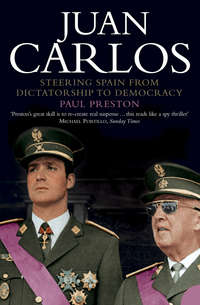
Kitabı oku: «Juan Carlos: Steering Spain from Dictatorship to Democracy»

JUAN CARLOS
A People’s King
PAUL PRESTON

In Memory of José María Coll Comín
CONTENTS
Cover
Title Page
CHAPTER ONE: In Search of a Lost Crown 1931–1948
CHAPTER TWO: A Pawn Sacrificed 1949–1955
CHAPTER THREE: The Tribulations of a Young Soldier 1955–1960
CHAPTER FOUR: A Life Under Surveillance 1960–1966
CHAPTER FIVE: The Winning Post in Sight 1967–1969
CHAPTER SIX: Under Suspicion 1969–1974
CHAPTER SEVEN: Taking Over 1974–1976
CHAPTER EIGHT: The Gamble 1976–1977
CHAPTER NINE: More Responsibility, Less Power: the Crown and Golpismo 1977–1980
CHAPTER TEN: Fighting for Democracy 1980–1981
CHAPTER ELEVEN: Living in the Long Shadow of Success 1981–2002
BIBLIOGRAPHY
NOTES
INDEX
ACKNOWLEDGEMENTS
About the Author
Praise
Also by the Author
Copyright
About the Publisher
CHAPTER ONE In Search of a Lost Crown 1931–1948
There are two central mysteries in the life of Juan Carlos, one personal, the other political. The key to both lies in his own definition of his role: ‘For a politician, because he likes power, the job of King seems to be a vocation. For the son of a King, like me, it’s something altogether different. It’s not a question of whether I like it or not. I was born to it. Ever since I was a child, my teachers have taught me to do things that I didn’t like. In the house of the Borbóns, being King is a profession.’1 In those words lies the explanation for what is essentially a life of considerable sacrifice. How else is it possible to explain the apparent equanimity with which Juan Carlos accepted the fact that his father, Don Juan, to all intents and purposes sold him into slavery? In 1948, in order to keep the possibility of a Borbón restoration in Spain on Franco’s agenda, Don Juan permitted his son to be taken to Spain to be educated at the will of the Caudillo. In a normal family, this act would be considered to be one of cruelty, or at best, of callous irresponsibility. But the Borbón family was not ‘normal’ and the decision to send Juan Carlos away responded to a ‘higher’ dynastic logic. Nevertheless, the tension between the needs of the human being and the needs of the dynasty lies at the heart of the story of the distance between the fun-loving boy, Juanito de Borbón, and the rather stiff prince Juan Carlos with his perpetually sad look. The other, rather more difficult puzzle, is how a prince emanating from a family with considerable authoritarian traditions, obliged to function within ‘rules’ invented by General Franco, and brought up to be the keystone of a complex plan for the continuity of the dictatorship should have committed himself to democracy.
The mission to which Juan Carlos was born, and which would take precedence over any personal life, was to make good the disaster that had struck his family in 1931. On 12 April 1931, nationwide municipal elections had seen sweeping victories for the anti-monarchical coalition of Republicans and Socialists. King Alfonso XIII, an affable and irresponsible rake, had earned considerable unpopularity for his part in the great military disaster at Annual in Spain’s Moroccan colony in 1921. Even more, his collusion in the establishment of a military dictatorship in 1923 had sealed his fate. When he learned that his generals were not inclined to risk civil war in order to overturn the election results, he gave a note to his Prime Minister, Admiral Aznar. ‘The elections celebrated on Sunday show me clearly that today I do not have the love of my people. My conscience tells me that this wrong turn will not last forever, because I always tried to serve Spain, my every concern being the public interest even in the most difficult moments.’ He went on to say, ‘I do not renounce any of my rights.’ In that statement can be distantly discerned the process whereby Spain lost a monarchy, suffered a dictatorship and regained a monarchy. The hidden message to his supporters was that they should create a situation in which the Spanish people would beg him to return. This would be the seed from which the military uprising of 1936 would grow. However, its leader, General Franco, despite being a self-proclaimed monarchist and one-time favourite of Alfonso XIII, would not call him back to be King. One reason perhaps was that Alfonso XIII also said, ‘I am King of all Spaniards, and also a Spaniard.’ Those words would often be used by Alfonso’s son and heir, Don Juan, and would occasion the sarcastic mirth of the dictator. They would be used again on the day of the coronation of King Juan Carlos.2
On 14 April 1931, on his painful journey from Madrid, via Cartagena, into exile in France, the King was accompanied by his cousin, Alfonso de Orleáns Borbón. The Queen, Victoria Eugenia of Battenburg, a granddaughter of Queen Victoria, was escorted into exile by her cousin, Princess Beatrice of Saxe-Coburg, the wife of Alfonso de Orleáns Borbón.3 The government of the Republic quickly published a decree depriving the exiled King of his Spanish citizenship and the royal family of its possessions in Spain. After a short sojourn in the Hôtel Meurice on the rue de Rivoli in Paris, the royal family moved to a house in Fontainebleau. There, Alfonso XIII received delegations of conspirators against the Second Republic and gave them his approval and encouragement.4
In addition to the blow of exile, Alfonso XIII suffered considerable personal sadness. Without the scenery of the palace and the supporting cast of courtiers, the emptiness of his relationship with Victoria Eugenia was increasingly exposed. Not long after their arrival at Fontainebleau, the King remonstrated with the Queen about her closeness to the Duke and Duchess de Lécera who had accompanied her into exile. The marriage of the Duke, Jaime de Silva Mitjans, and the lesbian Duchess, Rosario Agrelo de Silva, was a sham but they stayed together because both were in love with the Queen. Despite persistent rumours, which niggled at Alfonso XIII, the Queen always vehemently denied that she and the Duke had been lovers. Nevertheless, when the bored Alfonso XIII took a new lover in Paris and the Queen in turn remonstrated with him, he tried to divert the onslaught by throwing in her face the alleged relationship with Lécera. She denied it but, as tempers rose, he demanded that she choose between himself and Lécera. Fearful of losing their support, on which she had come to rely, she replied, by her own account, with the fateful words, ‘I choose them and never want to see your ugly face again.’5 There would be no going back.
Another reason for Alfonso’s long-deteriorating relationship with Victoria Eugenia was the fact that she had brought haemophilia into the family. The couple’s eldest son, Alfonso, was of dangerously delicate health. He was haemophilic and, according to his sister, the Infanta Doña Cristina, ‘the slightest knock caused him terrible pain and would paralyse part of his body.’ He often could not walk unaided and lived in constant fear of a fatal blow. When the recently appointed Director General of Security, Emilio Mola, made his courtesy visit to the palace in February 1930, he was shocked: ‘I also visited the Príncipe de Asturias [the Spanish equivalent of the Prince of Wales] and only then did I fully understand the intimate tragedy of the royal family and comprehend the pain in the Queen’s face. He received me standing up and had the kindness to ask me to sit. Then he tried to get up to see me out and it was impossible: a flash, of anguish and of resignation, passed across his face.’6 Alfonso formally renounced his right to the throne on n June 1933 in return for his father’s permission to contract a morganatic marriage with an attractive but frivolous girl he had met at the Lausanne clinic where he was receiving treatment. Edelmira Sampedro y Robato was the 26-year-old daughter of a rich Cuban landowner.
Immediately following his eldest son’s renunciation of his dynastic rights, Alfonso XIII arranged for a number of prominent monarchists to put pressure on his second son, Don Jaime, to follow his brother’s example. Don Jaime was deaf and dumb – the result of a botched operation when he was four. Cut off from the world, both by dint of his royal status and his deafness, he had grown into a singularly immature young man. The monarchist leader José Calvo Sotelo persuaded him that his inability to use the telephone would significantly diminish his capacity to take part in anti-Republican conspiracies.7 Alfonso married Edelmira in Lausanne, in the presence of his mother and two sisters. Neither his father nor three brothers deigned to attend. On the same day, in Fontainebleau, 21 June 1933, Don Jaime, who was single at the time, finally agreed to renounce his rights to the throne, as well as those of his future heirs. The renunciation was irrevocable and would be ratified on 23 July 1945. In spite of this, he would later contest its validity, thereby complicating Juan Carlos’s rise to power.8
In his 1933 letter to his father, Don Jaime wrote: ‘Sire. The decision of my brother to renounce, for himself and his descendants, his rights to the succession of the crown has led me to weigh the obligations that thus fall on me … I have decided on a formal and explicit renunciation, for me and for any descendants that I might have, of my rights to the throne of our fatherland.’9 Don Jaime would, in any case, have lost his rights when, in 1935, he also made a morganatic marriage, to an Italian, Emmanuela Dampierre Ruspoli, who although a minor aristocrat was not of royal blood. It was not a love match and would end unhappily.10
In the summer of 1933, during a royal skiing holiday in Istria, Alfonso’s fourth son, Don Gonzalo – who also suffered from haemophilia – was involved in a car crash and died as a result of an internal haemorrhage.11 His first son fared little better. After his allowance was slashed by the exiled King, Alfonso’s marriage to Edelmira did not survive. They divorced in May 1937. Two months later, he married another Cuban, Marta Rocafort y Altuzarra, a beautiful model. The marriage lasted barely six months and they were also divorced, in January 1938. Having fallen in love with Mildred Gaydon, a cigarette girl in a Miami nightclub, Alfonso was on the point of marrying for a third time when tragedy once more struck the Borbón family. On the night of 6 September 1938, after leaving the club where Mildred worked, he too was involved in a car crash and, like his brother Gonzalo, died of internal bleeding.12
As a result of the successive renunciations of Alfonso and Jaime, the title of Príncipe de Asturias fell upon Alfonso XIII’s third son, the 20-year-old Don Juan. When he received his father’s telegram informing him of this, Don Juan was a serving officer in the Royal Navy on HMS Enterprise, anchored in Bombay. Because he realized that his new role would eventually involve him leaving his beloved naval career, he accepted only after some delay. In May 1934, he was promoted to sub-lieutenant and in September, he joined the battleship HMS Iron Duke. In March 1935, he passed the examinations in naval gunnery and navigation which opened the way to his becoming a lieutenant and being eligible to command a vessel. However, that would mean renouncing his Spanish nationality, something he was not prepared to do. His uncle, King George V, granted him the rank of honorary Lieutenant RN.13
Don Juan did not emulate his elder brothers’ disastrous marriages. On 13 January 1935, at a party given by the King and Queen of Italy on the eve of the marriage of the Infanta Doña Beatriz to Prince Alessandro Torlonia, Prince di Civitella Cesi, Don Juan had met the 24-year-old María de las Mercedes Borbón Orléans. Having faced the problem of his eldest son’s unsuitable marriage, Alfonso XIII was delighted when Don Juan began to fall in love with a statuesque princess who was descended from the royal families of Spain, France, Italy and Austria. They were married on 12 October 1935 in Rome. Several thousand Spanish monarchists made the trip to the Italian capital and turned the ceremony into a demonstration against the Spanish Republic. By this time, Queen Victoria Eugenia had long since left Alfonso XIII and she refused to attend the wedding.14 The newly appointed Príncipe de Asturias and his new bride settled at the Villa Saint Blaise in Cannes in the south of France. There, he quickly made contact with the leading monarchist politicians who were involved in anti-Republican plots.
Unsurprisingly, when on the evening of 17 July 1936 units of the Spanish Army in Morocco rebelled against the Second Republic, the coup d’état was enthusiastically welcomed by both Don Juan and his father. They avidly followed the progress of the military rebels on the radio, particularly through the lurid broadcasts of General Queipo de Llano. A group of Don Juan’s followers, who had been avid conspirators against the Republic, including Eugenio Vegas Latapié, Jorge Vigón, the Conde de Ruiseñada and the Marqués de la Eliseda, felt that it would be politically prudent for him to be seen fighting on the Nationalist side. He had already discussed the matter with his aide-de-camp, Captain Juan Luis Roca de Togores, the Vizconde de Rocamora. Don Juan left his home for the front for the first time on 31 July 1936, despite the fact that only the previous day Doña María de las Mercedes had given birth to their first child, a daughter, Pilar. His mother, Queen Victoria Eugenia, was present, having come to Cannes for the birth. To the delight of Don Juan’s followers, she declared: ‘I think it is right that my son should go to war. In extreme situations, such as the present one, women must pray and men must fight.’ Pleasantly surprised by this, they were, nevertheless, worried about the possible reaction of Alfonso XIII who was holidaying in Czechoslovakia. However, when Don Juan telephoned him, he too agreed enthusiastically, saying, ‘I am delighted. Go, my son, and may God be with you!’
The following day, 1 August, the tall and good-natured Don Juan duly crossed the French border into Spain in a chauffeur-driven Bentley, ahead of a small convoy of cars carrying his followers. They arrived in Burgos determined to fight on the Nationalist side. However, the rebel commander in the north, the impulsive General Emilio Mola, was in fact an anti-monarchist. Without consulting his fellow generals, he abruptly ordered the Civil Guard to ensure that Don Juan left Spain immediately. This incident inclined many deeply monarchist officers to transfer their long-term political loyalty from Mola to Franco.15
After his return to Cannes, the presence of important supporters of the Spanish military rebellion attracted the attention of local leftists. Groups of militants of the Front Populaire took to gathering outside the Villa Saint Blaise each evening and shouting pro-Republican slogans. Fearful for the security of his family – his wife was pregnant once more – Don Juan decided to move to Rome. His father was already resident there and the Fascist authorities would ensure that there would be no unpleasantness of the kind that had marred their stay in France. At first they lived in the Hotel Eden until, at the beginning of 1937, they moved into a flat on the top floor of the Palazzo Torlonia in Via Bocca di Leone. The palazzo was the home of Don Juan’s sister Doña Beatriz and Alessandro Torlonia.16
At the beginning of January 1938, Doña María de las Mercedes was coming to the culmination of her second pregnancy. However, when Don Juan was invited to go hunting, her doctor assured him that it was safe to go as the baby would not appear for at least another three weeks. Doña María was at the cinema with her father-in-law, Alfonso XIII, when her labour pains began. Juan Carlos was born at 2.30 p.m. on 5 January 1938 at the Anglo-American hospital in Rome. He was one month premature. When Doña María was taken to hospital, her lady-in-waiting, Angelita Martínez Campos, the Vizcondesa de Rocamora, called Don Juan back to Rome by sending him a telegram which read ‘Bambolo natto’ (Baby born). On receiving the telegram, he set off, driving so furiously that he broke an axle spring on his Bentley. Arriving before his son, Alfonso XIII played a trick. As he welcomed Don Juan, he held in his arms a Chinese baby boy – who had been born in an adjoining room to the secretary at the Chinese Embassy. Don Juan knew at once that the child was not his, yet, on seeing his own son, he confessed later, for a moment, he would have almost preferred the Chinese baby. Doña María, unlike most mothers, did not think her baby was the most beautiful creature on earth. She later recalled that, ‘The poor thing was a month premature and had big bulging eyes. He was ugly, as ugly as sin! It was awful! Thank God he soon sorted himself out.’ The blond baby weighed three kilograms. The earliest photographs of Juan Carlos were taken, not at his birth, but when he was already five months old.17 Despite his mother’s initial alarm, Juan Carlos did not remain ‘ugly’ for long. His good looks would always be a major asset – they would, indeed, be a major factor in his eventually winning the approval of Queen Frederica of Greece, his future mother-in-law.18
On 26 January 1938, the child was baptized at the chapel of the Order of Malta in the Via Condotti in Rome. The choice of the chapel was made because of its proximity to the Palazzo Torlonia, where the reception took place. The baptism ceremony was conducted by Cardinal Eugenio Pacelli, then Secretary of State to the Vatican, and the future Pope Pius XII. At the christening, the baby Prince’s godmother was his paternal grandmother, Queen Victoria Eugenia. His godfather in absentia was the Infante Carlos de Borbón-Dos-Sicilias, his maternal grandfather. As a general in the Nationalist army, at the time engaged in the battle for Teruel, he was unable to travel to Rome. He was represented at the baptism by Don Juan’s elder brother, Don Jaime. Very few Spaniards were able to travel to Rome for the occasion and the birth of the Prince went virtually unnoticed even in the Nationalist zone of Spain.19
The boy was christened with the names Juan, for his father; Alfonso, for his paternal grandfather, the exiled King Alfonso XIII; and Carlos, for his maternal grandfather, Carlos de Borbón-Dos-Sicilias. Juan Carlos’s family and friends would, however, usually call him Juanito, at first because of his youth and later in order to distinguish him from his father. It was only after his emergence as a public figure that he began to use the name of Juan Carlos. There were, of course, political reasons behind the choice of the Prince’s public name. Don Juan told his lifelong adviser, the monarchisi intellectual, Pedro Sainz Rodríguez, that the choice was Franco’s. The idea may also have emanated from the conservative monarchist Marqués de Casa Oriol, José María Oriol, although the future King himself could not remember this with any certainty.20 ‘Juan Carlos’ would distinguish the Prince from his father, Don Juan, and perhaps ingratiate him with the ultra-conservative Car lists whose pretender always carried the name Carlos. The elimination of his middle name, Alfonso, would certainly have been to Franco’s liking since it was central to the Caudillo’s rhetoric that it was the misguided liberalism of Alfonso XIII that had rendered the Spanish Civil War inevitable.
Don Juan de Borbón continued to harbour a desire to take part in the Nationalist war effort. He had written to the Generalísimo on 7 December 1936 and respectfully requested permission to join the crew of the battlecruiser Baleares which was then nearing completion: ‘… after my studies at the Royal Naval College, I served for two years on the Royal Navy battlecruiser HMS Enterprise, I completed a special artillery course on the battleship HMS Iron Duke and, finally, before leaving the Royal Navy with the rank of Lieutenant, I spent three months on the destroyer HMS Winchester.’21 Although the young Prince promised to remain inconspicuous, not to go ashore at any Spanish port and to abstain from any political contact, Franco was quick to perceive the dangers both immediate and distant. If Don Juan were to fight on the Nationalist side, intentionally or otherwise he would soon become a figurehead for the large numbers of monarchists, especially in the Army, who, for the moment, were content to leave Franco in charge while waiting for victory and an eventual restoration of Alfonso XIII. There was the danger that the Alfonsists would become a distinct group alongside the Falangists and the Carlists, adding their voice to the political diversity that was beginning to come to the surface in the Nationalist zone. The execution of José Antonio Primo de Rivera, founder of the Falange, in a Republican prison had solved one problem, and Franco was now in the process of cutting down the Carlist leader, Manuel Fal Conde. He did not need Don Juan de Borbón emerging as a monarchist figurehead.
Franco’s response was a masterpiece of duplicity. He delayed some weeks before replying to Don Juan. ‘It would have given me great pleasure to accede to your request, so Spanish and so legitimate, to serve in our Navy for the cause of Spain. However, the need to keep you safe would not permit you to live as a simple officer since the enthusiasm of some and the officiousness of others would stand in the way of such noble intentions. Moreover, we have to take into account the fact that the place which you occupy in the dynastic order and the consequent obligations impose upon us all, and demand of you the sacrifice of desires which are as patriotic as they are noble and deeply felt, in the interests of the Patria … It is not possible for me to follow the dictates of my soldier’s heart and to accept your offer.’22 Thus, with apparent grace, he deflected a dangerous offer.
Franco also managed to squeeze considerable political capital out of so doing. He arranged for word to be circulated in Falangist circles that he had prevented the heir to the throne from entering Spain because of his own commitment to the future Falangist revolution. He also publicized what he had done and gave reasons aimed at consolidating his own position among the monarchists. ‘My responsibilities are great and among them is the duty not to put his life in danger, since one day it may be precious to us … If one day a King returns to rule over the State, he will have to come as a peace maker and should not be found among the victors.’23 The cynicism of such sentiments would be fully appreciated only after nearly four decades had elapsed, during which Franco dedicated his efforts to institutionalizing the division of Spain into victors and vanquished and failing to restore the monarchy. When the Baleares was sunk on 6 March 1938, Franco is said to have commented with an ironic smile, ‘And to think that Don Juan de Borbón wanted to serve on board.’24
In the meantime, in the autumn of 1936, believing that the military uprising would, if victorious, culminate in a restoration of the monarchy, Alfonso XIII had telegraphed Franco to congratulate him on his successes. In his suite in the Gran Hotel in Rome, the King kept a huge map of Spain marked with little flags with which he obsessively followed the progress of the rebel troops on various fronts.25 In his confidence that Franco would repay earlier favours by restoring the monarchy, he misjudged his man. Had he and his son been a little more suspicious, they might have been alarmed to note that the newly installed Head of State had already begun to comport himself as if he were the King rather than simply the praetorian guard responsible for bringing back the monarchy. With the support of the Catholic Church, which had blessed the Nationalist war effort as a religious crusade, Franco began to project himself as the saviour of Spain and the defender of the universal faith, both roles associated with the great kings of the past. Religious ritual was used to give legitimacy to his power as it had to those of the medieval kings of Spain. The liturgy and iconography of his regime presented him as a holy crusader; he had a personal chaplain and he usurped the royal prerogative of entering and leaving churches under a canopy.
The confidence in himself and his office generated by such ceremonial was revealed when Franco celebrated the first year of his Movimiento. His broadcast speech was, according to his cousin, entirely written by himself. He spoke in terms which suggested that he placed himself far higher than the Borbón family, as a providential figure, the very embodiment of the spirit of traditional Spain. He attributed to himself the honour of having saved ‘Imperial Spain which fathered nations and gave laws to the world’.26 On the same day, an interview with the Caudillo was published in the monarchist newspaper ABC. In it, he announced the imminent formation of his first government. Asked if his references to the historic greatness of Spain implied a monarchical restoration, he replied truthfully while managing to give the impression that this was his intention, ‘On this subject, my preferences are long since known, but now we can think only of winning the War, then it will be necessary to clean up after it, then construct the State on firm bases. While all this is happening, I cannot be an interim power.’
For Franco, and indeed many of his supporters within the Nationalist zone, the monarchy of Alfonso XIII was irrevocably stigmatized by its association with the constitutional parliamentary system. In his interview, he declared that, ‘If the monarchy were to be one day restored in Spain, it would have to be very different from the monarchy abolished in 1931 both in its content and, though it may grieve many of us, even in the person who incarnates it.’ This was profoundly humiliating for Alfonso XIII, all the more so coming from a man whose career he had promoted so assiduously.27
The Caudillo’s attitude to the exiled King, and by implication, to the Borbón family, was underlined in a harshly dismissive letter sent to Alfonso XIII on 4 December 1937. The King, having recently donated one million pesetas to the Nationalist cause, had written to Franco expressing his concern that the restoration of the monarchy seemed to be low on his list of priorities. The Generalísimo replied coldly, insinuating that the problems which caused the Civil War were of the King’s making and outlining both the achievements of the Nationalists and the tasks remaining to be carried out after the War. Expanding on his ABC interview, the Caudillo made it clear that Alfonso XIII could expect to play no part in that future: ‘the new Spain which we are forging has so little in common with the liberal and constitutional Spain over which you ruled that your training and old-fashioned political practices necessarily provoke the anxieties and resentments of Spaniards.’ The letter ended with a request that the King look to the preparation of his heir, ‘whose goal we can sense but which is so distant that we cannot make it out yet’.28 It was the clearest indication yet that Franco had no intention of ever relinquishing power, yet the epistolary relationship between Franco and the exiled King remained surprisingly smooth. (Indeed, in December 1938, Franco revoked the Republican edict that had deprived the King of his Spanish citizenship and the royal family of its properties.) Throughout the Civil War, after each victory, the Generalísimo had sent a telegram to Alfonso XIII and, in turn, received congratulatory messages from both the exiled King and his son. However, after the final victory, and the capture of Madrid, Franco had not done so. The outraged Alfonso XIII rightly took this to mean that Franco had no intention of restoring the monarchy.29
If the future of Alfonso XIII’s heir was unclear to Franco, even less certain was that of his grandson, Juan Carlos. For the first four and a half years of his life, the boy lived with his parents in Rome. Soon after his birth the family moved from the modest flat on the top floor of the Palazzo Torlonia in Via Bocca di Leoni to the four-storey Villa Gloria, at 112 Viale dei Parioli in the elegant Roman suburb of Parioli.30 This was a happy time for the Borbóns – a period during which it was possible to live as a relatively normal, as opposed to a royal, family. Juan Carlos’s younger sister Margarita was born blind on 6 March 1939. Even so, the degree of family warmth was limited. All three children were looked after by two Swiss nannies, Mademoiselles Modou and Any, under the supervision, not of their mother but of the Vizcondesa de Rocamora. The young Prince was often taken out for walks by his parents or by his nannies, sometimes to the Palazzo Torlonia, sometimes to the private park of the Pamphili family or to the park of Villa Borghese. Don Juan showed some affection for his eldest son, often carrying him in his arms when they visited Alfonso XIII at the Gran Hotel.
However, such signs of warmth were rare. The young Prince was soon being schooled in the harsh lesson that his central purpose in life was to contribute in some way to the mission of seeing the Borbón family back on the throne in Spain. Don Juan had already started to make demands that the child found difficult to meet. Miguel Sánchez del Castillo (a film actor working in Rome at the time) recalls that, on one occasion, Juan Carlos was given a cavalry uniform as a present from several Spanish aristocratic ladies. ‘An Italian photographer spent over an hour taking pictures of him. Don Juan Carlos, who was only four years old at the time, endured having to stand to attention on a table. When they finally took him to the kitchen and one of his nannies took his boots off, his feet had been rubbed raw, because the boots were too small for him. That is when he shyly started to cry. I later learnt that his father had taught him from a very young age that a Borbón cries only in his bed.31
CHAPTER TWO A Pawn Sacrificed 1949–1955
Juan Carlos’s new home was Las Jarillas, a grand Andalusian-style house, 17 kilometres outside Madrid on the road to Colmenar Viejo. One reason for its selection was its proximity both to El Pardo and the military garrison at El Goloso. A special direct telephone line to the base was installed in Danvila’s house in case of Falangist demonstrations against the Prince. Such daring would have been unlikely in Franco’s Spain and the nearest thing to public opposition was the singing of a ditty whose chorus went: ‘El que quiere una corona/que se haga de cartón/que la Corona de España/no es para ningún Borbón’ (He who wants a crown/better get a cardboard one/for the crown of Spain/will go to no Borbón). Shortly after his arrival, the boy suffered an acute bout of flu, perhaps another occasion on which the pain of separation from his parents was manifested physically.1 Used to absences from his family, Juan Carlos settled down relatively quickly at the school improvised for him at Las Jarillas. Although close to Madrid, it had not yet been overtaken by urban sprawl from the capital and still enjoyed an air of rural tranquillity. Its 100 hectares permitted hunting – mainly of rabbits. As it became obvious how much the Prince enjoyed shooting, he began to receive invitations to other hunts for larger prey such as wild deer and even wild boar.
Don Juan, with Franco’s approval, had hand-picked a group of tutors and eight aristocratic students. Four had been chosen from amongst Spain’s leading aristocratic families and others from the prosperous upper-middle classes: Alonso Álvarez de Toledo (son of the Marqués de Valdueza who, as an adult, would become an important figure in the Spanish financial world); Carlos de Borbón-Dos-Sicilias (Juan Carlos’s first cousin on his mother’s side, named for Juan Carlos’s maternal grandfather and godfather); Jaime Carvajal y Urquijo (son of the Conde de Fontanar); Fernando Falcó y Fernández de Córdoba (later Marqués de Cubas); Agustín Carvajal y Fernández de Córdoba (who would become an airline pilot); Alfredo Gómez Torres (a Valencian who would become an agronomist); Juan José Macaya (from Barcelona, who would become an economist and financial counsellor); and José Luis Leal Maldonado (the son of naval officer who was a friend of Don Juan, he would later be an important banker and Minister of the Economy from April 1979 to June 1980).
Juan Carlos was especially fond of his cousin, Carlos de Borbón-Dos-Sicilias, and the fact that they were allowed to share a room took the edge off his initial loneliness. During the Christmas holidays after his first term at Las Jarillas, the Prince had to write an essay on his school. It revealed more than just his disregard for punctuation: ‘On the day that I arrived, the boys were at the door waiting for me and I went in feeling really embarrassed with my Aunt Alicia and then we went upstairs it was a really nice room where we slept my cousin Carlos de Borbón is really nice because he is always saying daft things.’2
In his essay, Juan Carlos complained of how much he was obliged to study. Don Juan had given instructions that the work at Las Jarillas be hard and demanding. Years later, Juan Carlos would comment, ‘Don’t imagine that we were treated like kings. In fact, they made us study harder than in an ordinary school on the basis that “because we were who we were, we had to give a good example”.’ Certainly, Don Juan tried to ensure that his son’s academic abilities were assessed as impartially as possible. At the end of the academic year, the boys would indeed sit, at the Instituto San Isidro of Madrid, the public examinations taken by all Spanish children at ordinary schools. Juan Carlos would soon grow particularly attached to two of his tutors: José Garrido Casanova, the headmaster at Las Jarillas and founder of the hospice for homeless children of Nuestra Señora de la Paloma, and Heliodoro Ruiz Arias, the boys’ sports teacher. Garrido, a good and fair man of liberal views from Granada, was a brilliant teacher and warm and sympathetic human being. He made a profound impression on the Prince. Years later, Juan Carlos would say, ‘Sometimes, when I have to take certain decisions, I still ask myself what he would have advised me to do.’ Heliodoro had, in the 1930s, been the personal trainer of José Antonio Primo de Rivera. He saw in the young Prince great athletic potential and set himself the task of converting him into an all-round sportsman.3
Jaime Carvajal later came to the conclusion that their headmaster was ‘a key figure in the formation of Don Juan Carlos’s personality, after his father or even at the same level as Don Juan’. It was inevitable that, having been sent away by his own father, the boy would latch on to an appropriate father figure. Garrido had the sensitivity to realize that the Prince would be disorientated and confused after the brusque separation from his family. Accordingly, he treated Juan Carlos with real affection. Each night, he would check that he was comfortable, make a sign of the cross on his forehead and, after asking if he needed anything, turn out the light. He was quickly made aware of the sadness that the boy felt as a result of his situation. His father had given him a letter to hand over to Garrido. In it, he gave the teacher instructions about how he wanted his son to be educated. They read it together and, when they reached the part in which Don Juan spoke of his son’s responsibilities as representative of the family, tears appeared in the Prince’s eyes. It was a brutal reminder that his official position as Prince took precedent over the needs of a little boy trying to be brave. Garrido often noticed Juanito gazing sadly into the distance and then, as if realizing that he had no right to nostalgia, suddenly jumping up and riding his bike or taking out his frustrations on a football.
The Prince always endeavoured to hide his feelings but Garrido later recalled how much Juan Carlos enjoyed reading Platero y yo by Juan Ramón Jiménez, carrying the book with him everywhere he went during his first months at the school. One evening, the boy recited by heart a passage from the book as they watched the sunset. He startled Garrido by saying, ‘Mummy is on the other side.’ Garrido was moved and grew very fond of him, commenting years later, This child radiated affection despite the fact that they only ever spoke to him about duties and responsibilities.’ Garrido took particular interest in ensuring that the Prince’s relations with his classmates and with servants and gardeners were as natural as possible. In 1969, when Juan Carlos was named royal successor by Franco, he wrote to Garrido the following note: ‘I remember you with the greatest affection and every day allows me better to measure what I owe to you. You have helped me a lot with your example and your advice. And the counsels you gave to me were as good as they were numerous.’4
In contrast, Juan Carlos would later admit to an aversion for the dour Father Ignacio de Zulueta, an aristocratic Basque priest who visited Las Jarillas three times a week to supervise the children’s ethical and religious education. Tall and gaunt as if he had stepped down from an El Greco canvas, Zulueta was a forbidding figure. He had been recommended to Don Juan by the Duque de Sotomayor and Danvila because he represented the most conservative strand of Francoist thinking. Deeply reactionary, obsessed with royal protocol, Zulueta insisted on the entire class calling the young Prince by the title of ‘Your Highness’.5 Juan Carlos, desperate to be treated as an equal by his classmates, preferred that they call him ‘Juanito’ and used the informal ‘tú’ form of address. Accordingly, Zulueta’s instruction was usually ignored by the boys.6
Juan Carlos’s classmates at Las Jarillas remember him as a fun-loving child, who worked hard at his academic assignments, was an average student, excelled at sports, and was open and generous.7 As a result, Juan Carlos made solid friendships at his new school. This was underlined by the fact that none of the boys from Las Jarillas would later try to exploit their relationship with the King. It was also shown in the warmth with which they still spoke of Juan Carlos, 50 years later. In 1998, on Juan Carlos’s 60th birthday, a Spanish magazine interviewed the King’s old school friends. Alonso Álvarez de Toledo recalled how, although they were aware of Juan Carlos’s importance at the time (if only because he often received illustrious visitors), they soon accepted him as one of the gang. Jaime Carvajal y Urquijo agreed, describing the young Juan Carlos as ‘an ordinary kid, joyful, naughty, with a heart of gold, a wonderful companion’. Juan Carlos’s cousin, Carlos de Borbón-Dos-Sicilias, recalled being surprised at the time by Juan Carlos’s acute intuition and by his already highly developed sense of responsibility. He also recalled how little spare time they had at Las Jarillas, spending, as they did, most of their hours studying or playing sports. According to Carlos de Borbón, Juan Carlos and Jaime Carvajal were the best sportsmen, the latter being the most academically gifted of the group.8
The day at Las Jarillas began with daily mass at which Juan Carlos often served as an altar boy. This was followed by the ritual raising of the Spanish flag. Although classes followed the general Spanish curriculum, there was – as might have been expected of a school whose teachers were all fervent monarchists – a degree of laxity when it came to Francoist political indoctrination. Fernando Falcó y Fernández de Córdoba remembered that, when they sat the exam for what the regime called ‘Formación del Espíritu Nacional’ (Formation of the National Spirit), none of the class knew the Falangist hymn ‘Cara al sol’ by heart. To avoid the scandal that this might provoke in Franco’s Spain, the exam question was magically replaced by another. The children were also given the opportunity to experience some aspects of ordinary life at Las Jarillas. José Luis Leal Maldonado recalled that the Las Jarillas football team always lost to the visiting team of the Las Palomas school. Juan José Macaya recalled a day when the boys discovered a hen house in the grounds of the estate. In spite of – or perhaps in reaction to – the discipline enforced at the school, they proceeded to kill several hens.9
In spite of Juan Carlos’s apparent contentment, certain aspects of his new life in Spain must have been difficult. Outside monarchist circles, his arrival in Spain had been greeted by some with a wave of ill feeling. With the exception of the monarchist daily ABC, the controlled press had marked his arrival with a series of articles featuring malicious and laconic comments about the young Prince, as well as carefully selected, mostly blurry photographs which made him look devious and sly.10 Rumours were spread to the effect that the young Prince was a sadist who watered the plants at Las Jarillas with lime in order to kill them.11 Already at the age of ten, he was obliged to devote many hours to replying to the many cards and letters that arrived for him. He also served an apprenticeship in the boring business of official audiences for the endless streams of monarchists who, after securing the appropriate permission from the Duque de Sotomayor, visited him. Among them was the ineffable General José Millán Astray who arrived accompanied by his permanent escort of Legionnaires. He startled the Prince by shouting, ‘Highness! May the Virgin protect us.’ The tedium was mitigated by the obligatory gifts which ranged from boxes of chocolates to a magnificent electric car.12
A week before the end of his first term, Juan Carlos was visited by the monarchist General Antonio Aranda, a Nationalist hero of the Civil War. Aranda took notes of their conversation: ‘the boy is very likeable, lively and intelligent, I was utterly charmed by him since I thought he would be more sullen and he’s quite the opposite. He asked me about the Army and aeroplanes. This is what excites him and when I explained things to him in detail, he was really pleased. Just then, from the downstairs room where we were talking, we spotted a group of overdressed ladies and gentlemen arriving and the Prince, with total spontaneity and frankness, burst out, “What a drag! They’re coming to interrupt us! Weren’t you really having a good time telling me all this stuff? I know I was enjoying listening to you. Why don’t those people just go away?”’ The Duque de Sotomayor glided in to inform the Prince that he had to receive these new visitors. It was indicative of the ambiguous loyalties of the supposed supporters of Don Juan that Aranda’s notes soon found their way onto Franco’s desk.13
At the end of term, Juan Carlos returned home to Estoril for the Christmas holidays. Towards the end of December, José María Gil Robles took his own children and Juan Carlos to the zoo in Lisbon. With great sensibility, he reflected on the power struggle between Don Juan and Franco, in which the Prince played the role of shuttlecock. Gil Robles was struck by Juan Carlos’s subdued and sombre demeanour: ‘He is still just a child and entirely likeable, but I find him serious beyond his years and even rather sad, as though he were aware of the battle being fought over him. Watching him play in the park yesterday, and later at home, I could not avoid a feeling of sorrow. He is a loveable child. When I think about his future, I feel real compassion for him. What does the future hold for this little boy who, at the age of ten, is the object of such a bitter struggle?’14
In January 1949, Juan Carlos returned to Las Jarillas. However, his sojourn there was dependent on the continuing ceasefire between his father and the dictator. Hostilities were once more imminent. Gil Robles complained bitterly that Franco was failing to fulfil any of the promises made to Don Juan on the Azor. Instructions had been issued that any references to Don Juan had to be to ‘His Highness the Conde de Barcelona’ which appalled the monarchists who referred to him as ‘His Majesty King Juan III’. Juan Carlos was denied the right to use his proper title of Príncipe de Asturias, and was to be referred to only as ‘His Royal Highness Prince Juan Carlos’.15 Throughout 1949, the relationship between Franco and Don Juan deteriorated and Juan Carlos would be the victim. Although Gil Robles and Sainz Rodríguez continually urged Don Juan to recognize that Franco would never make way for the monarchy, he continued to hope, on the basis of the blandishments of Danvila.
The Caudillo made occasional token gestures to ingratiate himself with monarchists, by giving the impression that he was devoted to their cause. Although determined never to cede power to Don Juan, Franco wanted to maintain the credibility bestowed by the link with him. At the end of February, for instance, he attended a mass in El Escorial on the anniversary of the death of Alfonso XIII and was extremely anxious to secure the presence of Juan Carlos at the annual parade to commemorate the Nationalist victory in the Civil War. According to Gil Robles, ‘He is determined that the Prince should watch the parade from a special tribune, lower than his own. The troops in the march-past will be ordered to render him full honours.’ Under intense pressure from Gil Robles, Don Juan informed a disappointed Danvila that his son would not be attending the parade.16 On 18 May 1949, at the opening of the Cortes, as if in retaliation, Franco made a long, rambling, self-congratulatory speech including, en passant, disparaging remarks about Alfonso XIII and his mother Queen María Cristina.17 As a result, Don Juan’s more militant supporters urged Juan Carlos’s immediate return to Estoril.
Oblivious to the gathering storm clouds, Juan Carlos returned to Estoril at the end of May 1949 for summer holidays which would last for nearly 17 months. At the beginning of July, Don Juan wrote to Eugenio Vegas Latapié, inviting him to Portugal and commenting, ‘Juanito is back from Spain full of the joys of spring. He always remembers you with great affection.’ Juan Carlos himself wrote to Vegas Latapié on 17 July, repeating the invitation. After a cruise in the Mediterranean with the entire family, Don Juan left for a hunting party in Scotland on 23 August. Vegas arrived at about the same time and spent nearly a month with Juan Carlos, one day taking him to see a doctor because he had broken a finger. When asked how he broke it, the boy replied ‘thumping my sister Pilar’.18 In opposition to the views of Gil Robles and Sainz Rodríguez, Queen Victoria Eugenia believed that Juan Carlos should return to Las Jarillas after the summer holidays. She was concerned that the boy’s life should not be turned upside down yet again although, in her determination to see her family once more on the throne in Madrid, she also inclined to Danvila’s view that Franco should be placated at all costs. Juan Carlos remained in Estoril while Don Juan dithered.
However, many of his supporters, including the Duque de Alba, Franco’s wartime Ambassador in London, expressed outrage at Franco’s exploitation of his good will. Gil Robles and Sainz Rodríguez worked at persuading Don Juan to drop the duplicitous Danvila and to refuse to allow Juan Carlos to return to Spain. He finally made up his mind after a long conversation with Gil Robles on 26 September 1949. Attempting to put some backbone into his master, Gil Robles baldly pointed out that his collaboration with Franco had severely undermined his credibility. The same man who had been moved by Juan Carlos’s sadness some months earlier now said, ‘Your Majesty must consider that the Prince is the only weapon that he has left against Franco. If you agree in the same terms as last year, you will be disarmed for good.’ Yet again it was obvious that, in Estoril, the needs of a future monarchical restoration would always be of far greater importance than the needs of the child. Don Juan was finally shaken out of his indecision when the plain-speaking Gil Robles made a prophetic warning: ‘Do not think you are indispensable. Within a few years, many will be placing their hopes on the Prince: some in good faith; others out of sheer ambition.’19
At the end of September 1949, Don Juan sent a note, drafted by Gil Robles, informing Franco that, since the agreements made during the Azor meeting had not been fulfilled, the Prince could not remain in Spain.20 Franco responded threateningly in mid-October, with a lengthy note, ‘whose two principal characteristics,’ noted Gil Robles, ‘are overweening arrogance and bad grammar.’ Denying that he had made any promises on the Azor, Franco stated that the benefits of Juan Carlos’s presence in Spain were all on the side of the royal family but also made it clear that he had no plans to replace the dictatorship. His messenger, the servile Danvila, also passed on the Caudillo’s demand that, during his forthcoming State visit to Portugal, Don Juan should pay him a courtesy call at the Palacio de Queluz. Made aware by Gil Robles that this would simply lead to his public humiliation, Don Juan declined. Franco insisted, even going so far as instructing his brother Nicolás to threaten Don Juan that the Cortes would pass a law specifically excluding him from the throne. Don Juan’s snub was the only blot on a spectacular public relations success for Franco. He had arrived in Portugal on the battlecruiser Miguel de Cervantes at the head of a flotilla of 11 warships. The Caudillo’s chagrin may be imagined when he discovered that, as the Spanish fleet left the Tagus estuary, Admiral Moreno, realizing that Don Juan was wistfully watching from the shore, had ordered the ship’s company to form up and render him full honours.21
Don Juan felt troubled that his son would not be returning to Spain. After all, he believed that it was important that Juan Carlos should be educated as a Spaniard in the country over which, one day, he was destined to reign. At the back of his mind was the preoccupation, prompted by the insidious Danvila, that in keeping Juan Carlos in Portugal he might be ruining the family’s chance of a return to the throne. Gil Robles suspected that he was seeking any pretext to send his son back to Las Jarillas. Certainly, he had made no alternative preparations for the resumption of the child’s education in Estoril. In consequence, the 1949–1950 academic year must have been a depressing one for the nearly 12-year-old Juan Carlos. It was good to be back with his family, although Don Juan was often away travelling or hunting. Having coped with separation a year before by becoming closely attached to his classmates at Las Jarillas, he had been torn away from them and now missed them. Kept together as a cohort in the hope that he would eventually rejoin them, they had been moved, for the 1949–1950 academic year, to the ground floor of the palace belonging to the Duque and Duquesa de Montellano in Madrid’s Paseo de la Castellana.
In Portugal, Juan Carlos had to make do with work arranged by the stern Father Zulueta or sent by José Garrido and he rattled around Villa Giralda, missing the friends that he had made in Spain. He was too young to understand why he had been separated from them but not too young to resent it. The disruption to his education and his life again showed how little he mattered within the bigger diplomatic game. It is impossible to calculate how the callous exploitation of his person affected Juan Carlos’s attitude to his father. However, the frequency with which he later spoke of certain individuals being ‘like a second father’ is revealing. Such references would include, bizarrely, Franco, and, much more understandably, José Garrido, and later, the man who would run his household in Spain, Nicolás Cotoner, the Marqués de Mondéjar. Although he always spoke respectfully of Don Juan, perhaps subconsciously Juan Carlos felt that his father had not behaved towards him in the way that a ‘real father’ should.
The boy’s depressing situation at Villa Giralda was exacerbated by anxieties about his godfather and grandfather, Carlos de Borbón-Dos-Sicilias, who was gravely ill. Doña María de las Mercedes was desperate to go to Seville to be at the bedside of her dying father. However, in a gratuitously humiliating gesture, Franco denied her permission to enter Spain until the very last moment. When Don Carlos’s situation worsened, she set off anyway but arrived too late. Carlos de Borbón-Dos-Sicilias died on 11 November 1949, and Doña María would always hold a grudge against Franco. Years later, she said, ‘I can forgive anything, but Franco, whom I defended in other things to the point of falling out with my friends, I could never forgive for the way he treated my father and for what he did to prevent me arriving in time to see him before he died.’ While at Las Jarillas, Juan Carlos had often spent weekends in Seville with his grandfather. On 14 November, Juan Carlos wrote to one of his friends: ‘I’m sad because of granddad’s death and Mummy is in Seville.’ He was slightly distracted by the arrival of his electric car from Las Jarillas.22
Don Juan continued to waver over his son’s future. Gil Robles advised him not to send Juan Carlos back to Spain, since his presence would be exploited by Franco. Sainz Rodríguez suggested that arrangements for the 1950–1951 academic year could be proposed by the Diputación de la Grandeza (a kind of central committee of the Spanish aristocracy). To make matters worse for Juan Carlos and his father, in December 1949, Don Jaime de Borbón announced that he considered invalid his 1933 renunciation of his rights to the throne on the highly dubious grounds that his physical incapacity had been cured. He attributed this ‘miracle’ to the love of his new German ‘wife’, Carlotte Tiede-mann, a hard-drinking operetta singer. Gil Robles was convinced that Franco was behind this manoeuvre. It was believed that the Caudillo had paid Don Jaime to make his announcement, resolving his immediate debts and providing him with a substantial allowance. Certainly, Franco was looking into ways in which he could make use of Don Jaime’s ambitions.23 His claim to the throne put pressure on Don Juan now, as it would later on Juan Carlos. In the short term, it seemed to determine Don Juan – shortly before disappearing on another hunting jaunt – that his son, who was still without teachers, would continue his education at Estoril, under the alternating supervision of Father Zulueta and José Garrido.24
During a stay in Rome in March 1950, Don Juan was visited by Padre Josémaría Escrivá de Balaguer, the founder of the Opus Dei. Escrivá believed that holiness could be achieved through ordinary work and had created a corps of militant Christians who through austerity, celibacy and devotion to professional excellence lived in a kind of virtual monastery within the real world. At the time, Escrivá was residing in Italy while endeavouring to secure full recognition from the Vatican for the Opus Dei. He was also extremely keen to clinch the support of Franco, for whom he had begun to supervise spiritual retreats at El Pardo in 1944. Now, he reproached Don Juan for keeping his son in Portugal, saying that he was badly advised and ill-informed about the real situation in Spain. He urged him to return the Prince to Spain where he could get a proper patriotic education. Escrivá’s notes of the conversation were dutifully forwarded to Franco. It is probable that at this encounter were sown the seeds of the Opus Dei’s later participation in the education of Juan Carlos.25 Don Juan was looking for a Catholic framework for his son’s development. Initially, he had hoped for the involvement of the Jesuits. Through Danvila, contacts were made with the Spanish province of the Society of Jesus and it was agreed in principle that Jesuits would be chosen as teachers for the Prince. However, when permission was sought from the Vicar General of the Society, the Belgian Father Jean Baptiste Janssens, he issued categoric orders that the proposal was to be rejected. When the request was repeated, he explained that in the experience of the Society of Jesus, the education of royal personages had been ‘pernicious’.26
Finally, in the autumn of 1950, convinced that he had made his point with Franco, Don Juan allowed Juan Carlos to resume his education in Spain. This time, his eldest son was accompanied by his brother, Alfonsito. A new school was set up, not at Las Jarillas, but at the palace of Miramar, the old summer residence of the royal family on the bay of San Sebastián, in the Basque Country. Don Juan seemed to be hoping that distance might diminish the influence of Franco. Again, he made some effort to ensure that his two sons’ academic abilities would be evaluated impartially. The boys at Miramar were thus required to sit, at the end of each academic year, the official exams taken by other children at ordinary schools. Having said that, the ‘normality’ was relative. The examinations were oral and public. When Juan Carlos attended for examination at the Instituto San Isidro in Madrid, his answers had a large crowd breaking into enthusiastic applause. Afterwards, he was seen leaving the examination hall through a great throng of police and clapping well-wishers. The entire process was gushingly reported in the monarchist daily ABC.27
The 16 boys at the school were divided into two groups, one of Juan Carlos’s age and the other of Alfonso’s contemporaries. The older group contained several of Juan Carlos’s pals from Las Jarillas – Jaime de Carvajal y Urquijo, José Luis Leal Maldonado, Alfredo Gómez Torres, Alonso Álvarez de Toledo, and Juan José Macaya. Aurora Gómez Delgado (the French tutor, nurse and housekeeper at Miramar) would later recall that the section of the Miramar palace that housed the school was very beautiful, but also extremely cold. There was no central heating, just one stove on each of the three floors. The permanent teaching staff resided with the boys at Miramar. José Garrido Casanova acted again as headmaster. The stern Father Ignacio de Zulueta taught Latin and religious education, and also organized their weekend outings. Father Zulueta said daily mass at which he would deliver a reactionary sermon. The children would later recall occasions on which Zulueta made them pray for the conversion of the Soviet Union or for the victory of the British Conservative Party in the 1950 elections. In the midst of this particular sermon, Juan Carlos stuck a needle into the bottom of one of his classmates, Carlos Benjumea, whose cry of pain secured him a ferocious dressing-down from the furious priest.
Aurora Gómez Delgado was the only woman on the full-time teaching staff. In addition, a group of non-resident part-time teachers came in a few hours a week to teach specialist subjects such as music, physics and gymnastics. Amongst them was Mrs Mary Watt, who started teaching English to the children in their third year at Miramar.28 One of the reasons for Mrs Watt’s late arrival at Miramar may well have been Juan Carlos’s self-confessed reluctance to learn English – the consequence in part of the education he had received at the hands of Eugenio Vegas Latapié, Julio Danvila, Father Zulueta and other Spanish reactionaries. In a 1978 interview for Welt am Sonntag, he explained that: ‘For patriotic reasons I was predisposed against England and I refused to learn the language. My father used to reprimand me for this, as did my grandmother and my teachers. We had lunch with the Queen of England and my father said to Elizabeth II: “Sit next to him so that he feels ashamed at being unable to answer your questions.” That is precisely what happened. I felt deeply ashamed at only being able to speak in French with the Queen, and realized that patriotism had to manifest itself in other ways and that I had to learn English no matter how much it outraged me to do so.’ Juan Carlos would take a long time to master the English language. By his own admission, the early days of his engagement to Sofia were complicated by the fact that his English was still quite poor and she spoke no Spanish.29
Ücretsiz ön izlemeyi tamamladınız.