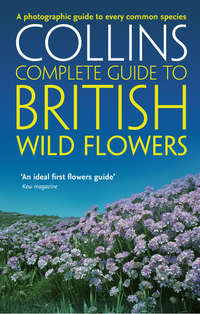
Kitabı oku: «British Wild Flowers: A photographic guide to every common species»


COPYRIGHT
Collins
An imprint of HarperCollins Publishers Ltd.
1 London Bridge Street
London SE1 9GF
www.harpercollins.co.uk
Collins is a registered trademark of HarperCollinsPublishers Ltd.
First published in 2006
Text © 2006 Paul Sterry
Photographs © Individual photographers indicated in the picture credits
Colour reproduction by Nature Photographers Ltd.
Paul Sterry asserts his moral right to be identified as the author of this work
A catalogue record for this book is available from the British Library
All rights reserved under International and Pan-American Copyright Conventions. By payment of the required fees, you have been granted the nonexclusive, nontransferable right to access and read the text of this ebook on-screen. No part of this text may be reproduced, transmitted, downloaded, decompiled, reverse-engineered, or stored in or introduced into any information storage and retrieval system, in any form or by any means, whether electronic or mechanical, now known or hereafter invented, without the express written permission of HarperCollins ebooks
HarperCollinsPublishers has made every reasonable effort to ensure that any picture content and written content in this ebook has been included or removed in accordance with the contractual and technological constraints in operation at the time of publication.
Source ISBN: 9780007236848
Ebook Edition © MARCH 2015 ISBN: 9780008144586
Version: 2016-12-05
CONTENTS
Cover
Title Page
Copyright
Introduction
How to Use this Book
Basic Botany
Glossary
Flowers
Wild Flower Identification
Fruits and Seeds
Leaves
Habitats
Conservation
Species Descriptions
Juniper to Nettle Families
Nettle, Birthwort and Knotweed Families
Knotweed Family Polygonaceae
Blinks to Goosefoot Families
Goosefoot Family Chenopodiaceae
Goosefoot and Pink Families
Pink Family Caryophyllaceae
Buttercup Family Ranunculaceae
Fumitory and Poppy Families
Poppy, Barberry and Cabbage Families
Cabbage Family Brassicaceae
Cabbage and Mignonette Families
Sundew, Pitcherplant and Stonecrop Families
Stonecrop and Saxifrage Families
Saxifrage Family Saxifrageaceae
Gooseberry and Rose Families
Rose Family Rosaceae
Pea Family Fabaceae
Pea and Wood-sorrel Families
Crane’s-bill Family Geraniaceae
Crane’s-bill and Flax Families
Spurge Family Euphorbiaceae
Spurge, Milkwort and Balsam Families
Holly, Spindle, Buckthorn, Box and Mallow Families
Mallow to St John’s-wort Families
St John’s-wort and Rock-rose Families
Violet Family Violaceae
Violet to Willowherb Families
Waterwort and Willowherb Families
Willowherb and Dogwood Families
Ivy and Carrot Families
Carrot Family Apiaceae
Primrose Family Primulaceae
Heather Family Ericaceae
Heather and Crowberry Families
Wintergreen, Bird’s-nest and Thrift Families
Ash and Gentian Families
Gentian, Bogbean, Periwinkle and Bedstraw Families
Bedstraw Family Rubiaceae
Bedstraw, Jacob’s-ladder and Dodder Families
Bindweed and Borage Families
Borage Family Boraginaceae
Vervain and Dead-nettle Families
Dead-nettle Family Lamiaceae
Dead-nettle and Butterfly-bush Families
Nightshade and Figwort Families
Figwort Family Scrophulariaceae
Figwort and Broomrape Families
Broomrape, Moschatel and Valerian Families
Valerian and Butterwort Families
Plantain and Arrowgrass Families
Honeysuckle and Teasel Families
Teasel and Bellflower Families
Bellflower Family Campanulaceae
Daisy Family Asteraceae
Iris, Black Bryony and Lords-and-ladies Families
Orchid Family Orchidaceae
Water Plants
Pondweeds Potamogetonaceae
Bur-reed, Bulrush and Rush Families
Rush and Sedge Families
Sedge Family Cyperaceae
Sedge and Grass Families
Grass Family Poaceae
The West Country
The Lizard
The Isles of Scilly
Channel Islands
The New Forest and Isle of Wight
South-East England’S Estuaries and Coasts
The South and North Downs
East Anglia
The Chilterns and Cotswolds
English and Welsh Uplands
Scottish Highlands and Western Isles
Shetland and Orkney Isles
Ireland
Further Reading and Useful Organisations
Index
About the Publisher
INTRODUCTION
PEOPLE LIVING IN BRITAIN and Ireland seldom have to travel far to find a wealth of wild flowers and, although the region’sv plantlife faces significant conservation issues, residents should feel privileged to live in such a flower-rich part of the world. Underpinning our floral diversity is a rich array of habitats, the product of our region’s topography, geology and history of land use. Good fortune, in the form of the Gulf Stream, dictates a mild and comparatively equable climate for much of the time, and this, too, contributes to botanical diversity. Complete British Wild Flowers has arisen from my personal love for the flora of Britain and Ireland, not to mention half a lifetime devoted to photographing our wild flowers.
THE REGION COVERED BY THIS BOOK
The region covered by this book comprises the whole of mainland England, Wales, Scotland and Ireland, as well as offshore islands including the Shetlands, Orkneys, Hebrides, Isle of Man and the Isles of Scilly. In addition, I have included the Channel Islands because their proximity to, and ecological affinities with, northern France allow them to make a valuable contribution to our flora.
THE CHOICE OF SPECIES
The coverage of the book is restricted mainly to what most people understand to be wild flowers – not a strict botanical term, but taken to mean flowering plants of relatively modest stature, species that in most cases do not exceed 2m in height. For the sake of completeness I have also included a number of woody flowering shrubs, but I have excluded obvious tree species. Terrestrial habitats harbour the lion’s share of our flowering plants and this is reflected in the coverage of this book. But I have also included species that are strictly aquatic, both those that occur in freshwater habitats and the limited range of flowering plants that grow in coastal marine environments.
Complete British Wild Flowers is aimed primarily at the botanical novice and those with a moderate degree of botanical experience. Consequently, for the main section of the book, I have selected species that the naturalist stands a reasonable chance of encountering, although a few scarce but spectacular and distinctive species have also been included here for good measure. Some botanical groups are minefields for the beginner: for example, hundreds of so-called ‘microspecies’ of brambles are recognised by experts and similar complexity is found among dandelions, hawkweeds and eyebrights to name three more. In a book of this size, accurate identification of these subdivisions is impossible to achieve. So rather than baffle the reader, I have chosen to ‘lump’ the subdivisions together within these complex groups and treat them as species aggregates.
In the hope and expectation that readers’ appetites for botanical discoveries are whetted by the book, the last section of Complete British Wild Flowers is devoted to botanical hotspots, areas that merit a visit in search of the localised floral treasures they harbour.

Floral delights such as this heathland have inspired generations of botanists.
HOW TO USE THIS BOOK
THE BOOK HAS BEEN designed so that the text and photographs for each species are on facing pages. A system of labelling clearly states the flower’s identity. The text has been written to complement the information conveyed by the photographs. By and large, the order in which the species appear in the main section of the book roughly follows standard botanical classification. However, because parts of the field are in a state of flux, the order may differ slightly from that found in other guides, past, present or future.
SPECIES DESCRIPTIONS
At the start of each species description the plant’s most commonly used and current English name is given. This is followed by the scientific name, comprising the genus name first and then by the specific name. In a few instances, where this is pertinent, reference is made, in either the species heading or the main body of the text, to a further subdivision: subspecies. In general, I have followed the nomenclature of Clive Stace’s New Flora of the British Isles (see p.). However, with orchids I have used the most up-to-date classification system, which differs from that in most currently available floras. The family group to which the plant in question belongs is then given. If a species is anything other than widespread and common, there then follows a measure of its scarcity, indicated by rosette symbols:
 | Scarce overall, but locally common |
 | Scarce, local and seldom common |
 | Local and rare |
These scarcity ratings are based on my own observations, so they are subjective and are not intended as an absolute guide to a species’ status. Lastly in the heading, some measure is given of the plant’s size. Size and stature vary according to a number of factors so these values should be treated with a degree of caution.
The text has been written in as concise a manner as possible. Each description begins with a summary of the plant and the habitat that it favours. To avoid potential ambiguities, the following headings break up the rest of each description: FLOWERS; FRUITS; LEAVES; STATUS. These sections describe the colour, shape and size of the various plant parts – features that tend to be more constant, and hence more useful for identification, than the overall size of the plant. Text in italics relates to key features of identification.
MAPS
The maps provide invaluable information about the distribution and occurrence of each species in the region: the intensity of the colour gives an indication of abundance. In compiling the maps, I have made reference to a number of sources, including An Atlas of the Wild Flowers of Britain and Northern Europe, the New Atlas of the British and Irish Flora (see p.), various county floras and, of course, my own notes. The maps represent the current ranges of plants in the region in general terms. Please bear in mind that, given the size of the maps, small and isolated populations will not necessarily be featured. Note also that the ranges of many species (particularly those influenced by agriculture) are likely to contract further as the years go by.
PHOTOGRAPHS
Great care has gone into the selection of photographs for this book and in many cases the images have been taken specifically for this project. Preference has been given to photographs that serve both to illustrate key identification features of a species when in flower, and to emphasise its beauty. In many instances, smaller inset photographs illustrate useful identification features that are not shown clearly by the main image.
BASIC BOTANY
IN COMMON WITH OTHER living organisms, plants have the abilities to grow, reproduce themselves, respond to stimuli and – to a limited extent compared to most animals – move. What sets them apart from animals in particular, and defines plants as a group, is their ability, in almost all species, to manufacture their own food from inorganic building blocks. Fundamental to this ability is the process called photosynthesis, in which plants use energy from sunlight to convert carbon dioxide from the air and water into glucose. Oxygen is a by-product of this reaction. A pigment called chlorophyll is the agent that extracts from sunlight the energy needed to fuel the reaction; its coloration is what makes plants green.
The plants covered in this book are the most advanced of their kind in evolutionary terms. All have the ability to reproduce sexually and flowers are the means by which this process is achieved. Flower structure is as varied as it is complex, and the fact that whole books, including this one, can be devoted to detailing its diversity is testament to this. Flower structure is dealt with in more detail on page 10.

Among terrestrial plants the process of photosynthesis is difficult to demonstrate outside the laboratory. However, certain submerged aquatic plants, such as this Water Starwort, produce bubbles of oxygen when they are exposed to bright sunlight, indicating that photosynthesis is indeed taking place.
THE ROLE OF PLANTS IN ECOLOGY
The importance of plants in the global ecosystem, and at the local level, cannot be overstated. Not only do plants generate (through photosynthesis) the atmospheric oxygen that all animals need to breathe but, as a source of food, they underpin food chains across the world. Without plants, life on earth as we know it would not have evolved and could not survive.


The survival of plants and animals is inextricably linked at the general level, but there are plenty of highly specific instances of dependence, the relationship often hinted at by their English names. Without their namesake-specific foodplants, neither the Figwort Weevil (left) nor the Mullein Moth (right), shown here as a caterpillar, could survive.
GLOSSARY
Achene – one-seeded dry fruit that does not split.
Acute – sharply pointed.
Alien – introduced by man from another part of the world.
Alternate – not opposite.
Annual – plant that completes its life cycle within 12 months.
Anther – pollen-bearing tip of the stamen.
Appressed (sometimes written as adpressed in other books) – pressed closely to the relevant part of the plant.
Auricle – pair of lobes at the base of a leaf.
Awn – stiff, bristle-like projection, seen mainly in grass flowers.
Axil – angle between the upper surface or stalk of a leaf and the stem on which it is carried.
Basal – appearing at the base of plant, at ground level.
Basic – soil that is rich in alkaline (mainly calcium) salts.
Beak – elongate projection at the tip of a fruit.
Berry – fleshy, soft-coated fruit containing several seeds.
Biennial – plant that takes two years to complete its life cycle.
Bog – wetland on acid soil.
Bract – modified, often scale-like, leaf found at the base of flower stalks in some species.
Bracteole – modified, often scale-like, leaf found at the base of individual flowers in some species.
Bulb – swollen underground structure containing the origins of the following year’s leaves and buds.
Bulbil – small, bulb-like structure, produced asexually by some plants and capable of growing into a new plant.
Calcareous – containing calcium, the source typically being chalk or limestone.
Calyx – outer part of a flower, comprising the sepals.
Capsule – dry fruit that splits to liberate its seeds.
Catkin – hanging spike of tiny flowers.
Chlorophyll – green pigment, present in plant leaves and other structures, and essential in the process of photosynthesis.
Cladode – green, leaf-like shoot.
Clasping – referring to leaf bases that have backward-pointing lobes that wrap around the stem.
Composite – member of the daisy family (Asteraceae).
Compound – leaf that is divided into a number of leaflets.
Cordate – heart-shaped at the base.
Corm – swollen underground stem.
Corolla – collective term for the petals.
Cultivar – plant variety created by cultivation.
Deciduous – plant whose leaves fall in autumn.
Decurrent – with the leaf base running down the stem.
Dentate – toothed.
Digitate – resembling the fingers of a splayed hand.
Dioecious – having male and female flowers on separate plants.
Disc floret – one of the inner florets of a composite flower.
Drupe – succulent fruit, the seed inside having a hard coat.
Emergent – a plant growing with its base and roots in water, the rest of the plant emerging above water level.
Entire – in the context of a leaf, a margin that is untoothed.
Epicalyx – calyx-like structure, usually surrounding, and appressed, to the calyx.
Epiphyte – plant that grows on another plant, on which it is not a parasite.
Fen – wetland habitat on alkaline peat.
Filament – stalk part of a stamen.
Flexuous – wavy.
Floret – small flower, part of larger floral arrangement as in composite flowers or umbellifers.
Fruits – seeds of a plant and their associated structures.
Genus (plural Genera) – group of closely related species, sharing the same genus name.
Glabrous – lacking hairs.
Gland – sticky structure at the end of a hair.
Glaucous – blue-grey in colour.
Globose – spherical or globular.
Glume – pair of chaff-like scales at the base of a grass spikelet.
Hybrid – plant derived from the crossfertilisation of two different species.
Inflorescence – the flowering structure in its entirety, including bracts.
Introduced – not native to the region.
Keel – seen in pea family members; the fused two lower petals that are shaped like a boat’s keel.
Lanceolate – narrow and lance-shaped.
Latex – milky fluid.
Lax – open, not dense.
Leaflet – leaf-like segment or lobe of a leaf.
Ligule – somewhat membranous flap at the base of a grass leaf, where it joins the stem.
Linear – slender and parallel-sided.
Lip – usually the lower part of an irregular flower such as an orchid.
Lobe – division of a leaf.
Microspecies – division within a species, members of which are only subtly different from members of other microspecies.
Midrib – central vein of a leaf.
Native – occurring naturally in the region and not known to have been introduced.
Node – point on the stem where a leaf arises.
Nut – a dry, one-seeded fruit with a hard outer case.
Nutlet – small nut.
Oblong – leaf whose sides are at least partly parallel-sided.
Obtuse – blunt-tipped (usually in the context of a leaf).
Opposite – (usually leaves) arising in opposite pairs on the stem.
Opposite
Oval – leaf shape. Ovate is oval in outline.
Ovary – structure containing the ovules, or immature seeds.
Ovoid – egg-shaped.
Palmate – leaf with finger-like lobes arising from the same point.
Panicle – branched inflorescence.
Pappus – tuft of hairs on a fruit.
Parasite – plant that derives its nutrition entirely from another living organism.
Pedicel – stalk of an individual flower.
Perennial – plant that lives for more than two years.
Perfoliate – surrounding the stem.
Perianth – collective name for a flower’s petals and sepals.
Petals – inner segments of a flower, often colourful.
Petiole – leaf stalk.
Pinnate – leaf division with opposite pairs of leaflets and a terminal one.
Pod – elongated fruit, often almost cylindrical, seen in pea family members.
Pollen – tiny grains that contain male sex cells, produced by a flower’s anthers.
Procumbent – lying on the ground.
Prostrate – growing in a manner pressed tightly to the ground.
Pubescent – with soft, downy hairs.
Ray – one of the stalks of an umbel.
Ray floret – one of the outer florets of a composite flower.
Receptacle – swollen upper part of a stem to which the flower is attached.
Recurved – curving backwards or downwards.
Reflexed – bent back at an angle of more than 90 degrees.
Rhizome – underground, or ground-level, stem.
Rosette – clustered, radiating arrangement of leaves at ground level.
Saprophyte – plant that lacks chlorophyll and which derives its nutrition from decaying matter.
Sepal – one of the outer, usually less colourful, segments of a flower.
Sessile – lacking a stalk.
Shrub – branched, woody plant.
Spadix – spike of florets as seen in members of the genus Arum.
Spathe – large, leafy bract surrounding the flower spike as seen in members of the genus Arum.
Species – division within classification that embraces organisms that closely resemble one another and that can interbreed to produce a viable subsequent generation.
Spreading – branching horizontally (in the case of a whole plant) or sticking out at right angles (in the case of hairs).
Stamen – male part of the flower, comprising the anther and filament.
Stigma – receptive surface of the female part of a flower, to which pollen adheres.
Stipule – usually a pair of leaf-like appendages at the base of a leaf.
Stolon – creeping stem.
Style – element of the female part of the flower, sitting on the ovary and supporting the stigma.
Subspecies – members of a species that possess significant morphological differences from other groups within the species as a whole; in natural situations, different subspecies are often separated geographically.
Succulent – swollen and fleshy.
Tendril – slender, twining growth used by some plants to aid climbing.
Tepals – both sepals and petals, when the two are indistinguishable.
Thallus – the body of a plant in species where separate structures cannot be distinguished readily.
Tomentose – covered in cottony hairs.
Trifoliate (or trefoil) – leaf with three separate lobes.
Truncate – ending abruptly and squared-off.
Tuber – swollen, usually underground, part of the stem or root.
Tubercle – small swelling.
Umbel – complex, umbrella-shaped inflorescence.
Whorl – several leaves or branches arising from the same point on a stem.
FLOWERS
ATTRACTIVE THOUGH MANY OF them may be, flowers are not produced to delight the human eye. Their role is strictly functional – they are the plant’s sex organs, there to produce sex cells and ensure the maximum chance of successful fertilisation taking place.
BASIC FLOWER STRUCTURE AND FUNCTION
In a few species, male and female sex cells are borne in separate flowers, or even on different plants, but in most cases they appear together within the same flower. Male sex cells are contained within pollen, tiny grains that are produced by structures called anthers and borne on slender stems referred to as filaments; collectively, anthers and filaments are referred to as stamens. The female part of most flowers comprises the ovary, containing the female sex cells, above which is borne the stigma (which receives the pollen) carried on a stem called the style.
Some plants, such as grasses and catkin-bearing shrubs, employ the wind to carry their pollen to others of the same species. Vast quantities of pollen are required to achieve a successful outcome with such a random process. Most other species adopt a more targeted approach and use the services of animals – insects in almost all cases – to transfer pollen. In exchange for a meal, in the form of nectar, insects inadvertently carry pollen on their bodies to the next flowers they visit; with any luck, a neighbouring plant of the same species will be visited while pollen still persists. In almost all species, flower structure has evolved to avoid self-pollination and to maximise the chances of cross-pollination – pollen being transferred to visiting insect pollinators and received from other plants by the same agents.

Bumblebees, and bees generally, are the classic insect pollinators. They visit flowers in search of nectar and unwittingly acquire a dusting of pollen, which is slightly sticky, on their hairy bodies; this is then carried to subsequent flowers they visit.

Cross-section through a typical flower, in this case a crane’s-bill.

Close-up of a stamen.

Close-up of the stigma, style and ovary.
WILD FLOWER IDENTIFICATION
SEASONED AND EXPERIENCED BOTANISTS are likely to approach the subject of identification by using definitive botanical works (floras) that rely on detailed keys, a thorough understanding of botanical terms, and a willingness to use descriptions rather than pictures to separate species. While this approach has scientific validity, in my experience it is not the way that the average floral enthusiast approaches the problem. Most tend to leaf through illustrated books to find suitable candidate species and then narrow down the field by scrutinising any closely related alternatives. This approach can succeed in most instances, especially if close care is paid to the detailed structure of the plant – leaves and fruits, as well as flowers – in addition to other factors such as flowering time, habitat preferences and distribution. I anticipate that this is how Complete British Wild Flowers will be used, initially at least, by most readers, although it will not take long for even the most inexperienced person to be able to detect similarities among plant family members, hence narrowing down the options at a stroke. Nevertheless, for absolute beginners, I felt it would be useful to provide a few pointers to lead in the right direction. I have concentrated on flower families where, in most species, there are sufficient similarities to justify generalisations. Strikingly unusual flowers, and species without large family ties, are not included in the following series of short cuts. I have used flower structure, such as the number of petals, as an initial guide. Note, however, that within several of the families identified, one or more rogue species may defy the family character and will not fall into the appropriate category. For example, although Tormentil is a member of the rose family (characterised by flowers with five petals), its flowers have just four petals.
SHORT CUTS TO FLOWER IDENTITY
3-PETALLED FLOWERS

WATER-PLANTAINS – equal-sized petals; white or pinkish petals; aquatic or marginal plants; see pp.


ORCHIDS – flowers comprising 3 petals plus 3 sepals, the latter often petal-like in colour and shape; the lower petal often takes the form of an enlarged or elaborate lip; see pp.
4-PETALLED FLOWERS

CABBAGE FAMILY MEMBERS – relatively small flowers; equal-sized petals; flowers often in groups; white, yellow or pinkish depending on species; see pp.


BEDSTRAWS – tiny flowers; equal-sized petals; flowers often in frothy heads; white or yellow depending on species; see pp.


SPEEDWELLS – relatively small flowers; unequal-sized petals; blue, purplish or white depending on species; see pp.

WILLOWHERBS – relatively small flowers in most species; equal-sized petals; flowers in open heads; pinkish, red or white depending on species; see pp.

POPPIES AND ALLIES – relatively large and crinkly, equal-sized petals; flowers usually solitary; red or yellow depending on species; see pp.
5-PETALLED FLOWERS

WATER-CROWFOOTS – equal-sized petals; flowers usually solitary; white petals; aquatic; see pp.

SUNDEWS – tiny flowers with equal petals; in spikes but usually only one flower opens at a time; bog plants with sticky, red leaves; white petals; see pp.

BUTTERCUPS – equal-sized, often shiny petals; flowers usually solitary; yellow; see pp.

ROCK-ROSES – equal-sized, crinkly petals; flowers usually solitary; yellow or white depending on species; see pp.

ST JOHN’S-WORTS – equal-sized petals; flowers in open heads in most species; yellow but marked with small black dots or streaks in some species; see pp.


ROSES AND ALLIES – equal-sized petals; flowers solitary or in open heads depending on species; white, pink or yellow depending on species; see pp.

SAXIFRAGES – equal-sized petals; flowers solitary or in open heads depending on species; white, pinkish or yellow depending on species; see pp.

MULLEINS – equal-sized or slightly unequal petals; flowers often in tall spikes; yellow or white depending on species; see pp.


LOOSESTRIFES AND PIMPERNELS – petals fused but 5 distinct and equal lobes present; yellow, red, purple or pink depending on species; see pp.


PRIMROSE – petals fused but 5 distinct and equal lobes present; yellow or pink depending on species; see pp.

MALLOWS – equal-sized petals; flowers solitary or in open heads; pink; see pp.

CENTAURIES – corolla fused but with 5 petal-like lobes; in clusters in most species; petals pink or yellow depending on species; see pp.

WOOD SORREL AND ALLIES – equalsized petals; yellow, pinkish or white depending on species; trifoliate leaves; see pp.


PINKS, CHICKWEEDS AND STITCHWORTS – equal-sized petals, often deeply divided; flowers usually solitary; white or pink depending on species; see pp.


PEA FAMILY MEMBERS – unequal petals arranged in a characteristic manner comprising a standard, a keel and wings; yellow, pinkish, purple or white depending on species; see pp.


CRANE’S-BILLS – equal-sized petals; flowers solitary or in open heads depending on species; pinkish, bluish or purple depending on species; see pp.

FLAXES – equal-sized petals; flowers usually solitary; bluish or white depending on species; see pp.

SEA-LAVENDERS – flowers funnelshaped; petals fused at the base; restricted to coastal habitats; bluish-lilac petals; see pp.

VIOLETS – unequal petals; spur present; blue, violet or white depending on species; see pp.

FORGET-ME-NOTS – petals fused but 5 petal-like lobes present; in open heads in most species; blue, pinkish or white depending on species; see pp.
TRUMPET-SHAPED FLOWERS

GENTIANS – trumpet relatively narrow; petals fused but with 4 or 5 pointed or rounded lobes; bluish, purple or pinkish depending on species; see pp.

BINDWEEDS – trumpet open and flared; white or pink depending on species; see pp.
BELL-SHAPED FLOWERS

BELLFLOWERS – flowers rather open with 5 lobes; blue or purplish depending on species; see pp.

HEATHERS – flowers typically small, rather tubular and usually pendent; pink or purple depending on species; see pp.
TUBULAR OR FUSED FLOWERS

EYEBRIGHTS – flowers 2-lipped; upper lip hooded, lower lip 3-lobed; white, marked with purple and yellow; see pp.

BORAGE AND ALLIES – 5 lobes present; flowers borne in spikes, curved in some species; yellow, pinkish, purple or white depending on species; see pp.

TOADFLAXES – flowers spurred and 2-lipped; upper lip 2-lobed, lower lip 3-lobed; yellow or purplish depending on species; see pp.


LOUSEWORTS AND COW-WHEATS – flowers 2-lipped; upper lip hooded, lower lip 3-lobed; borne in spike-like heads in most species; pinkish or purple depending on species; see pp.

FUMITORIES – flowers 2-lipped; pinkish or yellow depending on species; see pp.

FIGWORTS – flowers tiny, globular and 2-lipped; upper lip 2-lobed, lower lip 3-lobed; purplish or yellow depending on species; see pp.


LABIATES – flowers 2-lipped; lower lip often lobed, upper lip often hooded and toothed; borne in spikes in most species; whole plant often aromatic; wide range of colours seen in the different species; see pp.

BROOMRAPES – flowers 2-lipped; upper lip hooded, lower lip 3-lobed; flowers the same colour as rest of plant; borne in spikes; see pp.
MANY-FLOWERED HEADS OR FLOWERS IN CLUSTERED HEADS
UMBELLIFERS OR CARROT FAMILY MEMBERS – individual flowers comprising 5 tiny petals; flowers stalked and arranged in umbrella-shaped heads; white or yellow depending on species; see pp.


SCABIOUSES – individual flowers with 4 or 5 petals depending on species; borne in dense, domed heads; outer flowers often larger than inner ones; see pp.


DAISY FAMILY MEMBERS – numerous tiny flowers; arranged in dense heads in most species; inner disc florets appearing very different from outer ray florets in many species; wide range of colours seen in the different species; see pp.
FRUITS AND SEEDS
FRUITS FOLLOW IN THE wake of flowers and are the structures in which a plant’s seeds develop and are protected. In many cases, the shape and structure of these fruits, and often the seeds themselves, are designed to assist their dispersal, when ripe, away from the plant that produced them. A number of ingenious methods have evolved to facilitate this process: some seeds are carried by the wind; others attach themselves to the fur of animals; some even float away on water or have evolved to be eaten and digested by birds. The study of fruits and seeds is not only fascinating in its own right but in many instances the structure or appearance of a fruit can be a valuable aid to correct identification.

The burred fruits of Lesser Burdock readily become snagged in animal fur, travelling with the creature until the fruit finally disintegrates and liberates the seeds.

The hook-tipped spines on the fruit of Wood Avens catch in animal fur. Subsequently, they also help the fruit to disintegrate, as unattached barbs snag on objects and material that the animal rubs against.

The flowers of Common and Grey Field-speedwells are rather similar. Only by looking at the fruits (Common left, Grey right) can you be absolutely certain of any given plant’s identity.

Cabbage family members produce fruits known as pods, which vary considerably in terms of size and shape according to species. Those of Wild Candytuft, seen here, are particularly attractive.

Dandelion seeds are armed with a tuft of hairs – the pappus – that assists wind dispersal. While it remains intact, the collection of seeds and hairs is often referred to as a ‘clock’.

The fruits of Field Gromwell are hard-cased nutlets, designed to be resistant to abrasion and wear, allowing the species to grow as an arable weed, but of course only in the absence of herbicides.

Like other members of the pea family, the fruits of bird’s-foottrefoil are elongated pods.

The seeds of Elder are contained within luscious berries. These are eaten by birds and the seeds (protected by a coating resistant to being digested) are dispersed with the droppings.

The fruits of roses are fleshy and known as hips; inside these are seeds (dry achenes).

The fruit of the Common Poppy is a hollow vessel that contains thousands of minute seeds. When the fruit is ripe, holes below its rim allow seeds to escape when the plant is shaken by the wind.

In strict botanical terms, the fruits of the Raspberry are a collection of small drupes – each one a fleshy fruit that contains a hard-coated seed.
LEAVES
BEING THE MAIN STRUCTURES responsible for photosynthesis, a plant’s leaves are its powerhouse. They vary from species to species and come in a wide range of shapes and sizes. Their appearance is an evolutionary response to the plant’s needs, in particular factors such as the habitat in which it grows, the degree of shading or exposure dictated by its favoured growing location, and rainfall. In most instances, all the leaves on a given plant are likely to be broadly similar to one another, although size tends to decrease up the stem of a plant. However, to complicate matters, basal leaves can be entirely different in appearance from stem leaves. This applies to a number of species, notably some umbellifers.

In essence, leaves are thin and rather delicate structures. However, rigidity is maintained by a network of veins through which pass the ingredients required for photosynthesis, and the products of the process.

The intricate network of veins in a leaf is often best appreciated after autumn leaf-fall in deciduous species. Softer tissue decomposes before the veins themselves disintegrate, leaving striking leaf skeletons.
Leaf shape is not an infallible guide to plant identity, so its importance as an identifying feature is secondary to the appearance of flowers. There are many instances where entirely unrelated plants have superficially very similar leaves and great care must be taken when using leaf shape alone for identification. However, there are also plenty of instances where leaf shape is distinctive and diagnostic, or where it allows the separation of closely related plants that have superficially similar flowers. So it is worth paying attention to the variety of leaf shapes found among British wild flowers, some of which are shown right and overleaf along with the common descriptive name by which their shapes are known. Also shown are a variety of distinctive marginal features.


OVATE


LANCEOLATE


ROUNDED


POINTED-TIPPED


SPOON-SHAPED


LINEAR


ROUNDED-TIPPED


TOOTHED (DENTATE) MARGIN


HEART-SHAPED (CORDATE) BASE


PINNATE


PALMATE


LOBED MARGIN

CLASPING BASE


TRIFOLIATE (OR TREFOIL)


FINELY DIVIDED
HABITATS
WHEREVER CONDITIONS ARE SUITABLE for life then plants are likely to grow. Although some species are rather catholic with regard to where they grow, most are much more specific, influenced by factors such as underlying soil type, whether the soil is waterlogged or free-draining, summer and winter temperature extremes and so on. Consequently, where environmental conditions are broadly similar, the same plant species are likely to be found; where these communities are recognisably distinct they are referred to by specific habitat names. In Britain, many of our most distinct habitats owe their existence to past and present human activity, so they are classed as semi-natural in ecological terms.
DECIDUOUS WOODLAND
Woodlands of deciduous trees are found throughout most of the region. They are (or would be, if allowed to flourish) the dominant natural forest type of all regions except in parts of Scotland where evergreen conifers predominate. As their name suggests, deciduous trees have shed their leaves by winter and grow a new set the following spring. The seasonality seen in deciduous woodland is among the most marked and easily observed of any habitat in the region.
Almost all woodland in the region has been, and still is, influenced in some way by man. This might take the form of simple disturbance by walkers, at one end of the spectrum, or clear-felling at the other. Man’s influence is not always to the detriment of wildlife, however. Sympathetic coppicing of Hazel and Ash, for example, can encourage a profusion of wild flowers. In particularly rich locations, carpets of Bluebells, Wood Anemones and Wood Sorrel form the backdrop for more unusual species such as Early Purple Orchid and Greater Butterfly Orchid, Goldilocks Buttercup and Herb-Paris.

Centuries of woodland coppicing have inadvertently created the perfect environment for Bluebells to thrive. A carpet of these lovely plants is a quintessentially English scene.
Ücretsiz ön izlemeyi tamamladınız.