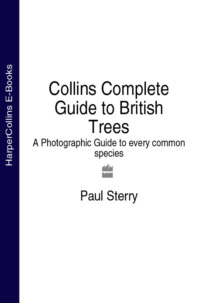
Kitabı oku: «Collins Complete Guide to British Trees: A Photographic Guide to every common species»


COPYRIGHT
HarperCollinsPublishers Ltd.
1 London Bridge Street
London SE1 9GF
The Collins website address is: http://www.harpercollins.co.uk.
Collins is a registered trademark of HarperCollinsPublishers Ltd.
First published in 2007
Text © 2007 Paul Sterry
Photographs © Individual photographers as indicated in the picture credits
Paul Sterry asserts his moral right to be identified as the author of this work.
All rights reserved under International and Pan-American Copyright Conventions. By payment of the required fees, you have been granted the nonexclusive, nontransferable right to access and read the text of this e-book on-screen. No part of this text may be reproduced, transmitted, downloaded, decompiled, reverse-engineered, or stored in or introduced into any information storage and retrieval system, in any form or by any means, whether electronic or mechanical, now known or hereafter invented, without the express written permission of HarperCollins e-books.
A catalogue record for this book is available from the British Library.
Source ISBN: 9780007211777
Ebook Edition © MARCH 2015 ISBN: 9780008144593
Version: 2015-04-22
Colour reproduction by Nature Photographers Ltd
HarperCollinsPublishers has made every reasonable effort to ensure that any picture content and written content in this ebook has been included or removed in accordance with the contractual and technological constraints in operation at the time of publication.
DEDICATION
The book is dedicated to the memory of Bramley Frith.
CONTENTS
Cover
Title Page
Copyright
Dedication
Introduction
How to Use this Book
Glossary
Basic Tree Biology
What is a Tree?
Tree and Shrub Families in Britain and Ireland
Identifying Trees
The Life Cycle of a Tree
Growth Rings and Ageing a Tree in the Field
The Ecology of Trees and Woodland
Fungi, Trees and Woodland
Galls
Mosses, Liverworts and Lichens
Hedgerows
Winter Twigs
Comparing Leaves of Common Trees and Shrubs
Comparing the Bark of Common Trees and Shrubs
Fruits and Seeds
History of Woodland Management
Traditional Timber Uses
How to Use an Oak Tree
Recognising Timber
Places to Visit
Conservation
Species Descriptions
Keep Reading
Further Reading
Index
About the Publisher
INTRODUCTION
Trees and shrubs are such a feature of the British scene that many people take them for granted. However, imagine what the landscape (not to mention the parks and gardens) of Great Britain and Ireland would be like without them and you can begin to appreciate their significance. Indeed, in many ways it is our trees and shrubs, more than other living things, that help define what we think of as the British countryside.
Native tree species have an ecological significance that goes beyond their individual presence. The role they play in the ecology of our native woodlands particularly fascinates me, perhaps more than their appearance. So I make no apologies for this book being biased in favour of native species. However, introduced trees and shrubs also have a role to play in today’s world. Some are widely naturalised, many soften our otherwise often brutal urban landscapes and still more are familiar and valued features of mature gardens. Consequently, I have included a wide range of familiar planted species, along with a selection of more unusual or exotic trees and shrubs mostly associated with collections and arboreta.

Whether planted or growing in the wild, the Common Beech produces autumn colours that cannot fail to lift the spirits.

Known best for its colourful berries, the Rowan is widely planted in urban settings and is a welcome sight in autumn.
My personal interest in trees and shrubs extends beyond enjoyment of trees for their own sake and their role in our ecology. I am also fascinated by the uses of timber and tree products in woodland crafts and traditional practices. Sections of the book reflect this interest.
THE REGION COVERED BY THIS BOOK
The region covered by the book comprises the whole of mainland England, Wales, Scotland and Ireland, as well as offshore islands including the Shetlands, the Orkneys, the Hebrides, the Isle of Man, the Isles of Scilly and the Channel Islands.
THE CHOICE OF SPECIES
The coverage of the book is restricted mainly to what most people understand to be trees and larger shrubs; the former are usually defined as single-boled plants with a trunk that exceeds 5m, while shrubs are typically multi-stemmed. However, for the sake of completeness, and as a minor self-indulgence, I have also included native members of tree groups such as willows and birches that should not qualify for inclusion, in the strict sense, on the grounds that they are too small.
Complete British Trees will enable amateur naturalists to identify all native and widely naturalised tree and shrub species found growing wild in the British countryside. With an eye to the exotic, it also allows naturalists and gardeners alike to identify ornamentally planted trees, and to anticipate what any given specimen tree will look like if bought and planted. I hope that the range of popular garden species included in the book helps in this regard.
HOW TO USE THIS BOOK
The book has been designed so that the text and photographs for each species are on facing pages. A system of labelling clearly identifies each tree or shrub. The text complements the information conveyed by the photographs. By and large, the order in which species appear in the main section of the book roughly follows standard botanical classification. However, because parts of the field are in a state of flux, the order may differ slightly from that found in other guides, past, present or future.
SPECIES DESCRIPTIONS
At the start of each species description the most commonly used and current English name is given. My primary source of reference for this, and for scientific names, has been Clive Stace’s New Flora of the British Isles. Essentially this covers native and widely naturalised British species. For non-native garden trees and shrubs I have followed the naming employed by Owen Johnson in Collins’ Tree Guide.
The English name of each plant is followed by its scientific name, which comprises the genus name followed by the specific name. In a few instances, where this is pertinent, reference is made (either in the species heading or in the main body of the text) to a further subdivision: subspecies. Some cultivated trees and shrubs are known best, or sometimes exclusively, by their cultivar name, so where this helps with recognition I have included it; some hybrid trees and shrubs are now known only by their horticultural names.
The text has been written in as concise a manner as possible. Each description begins with a summary of the tree or shrub. To avoid potential ambiguities, the following subheadings break up the rest of each species description: BARK; BRANCHES (occasionally SHOOTS); LEAVES; REPRODUCTIVE PARTS; STATUS AND DISTRIBUTION; COMMENTS. Not all these headings are used for every species. Within the sections dealing with plant parts, colour, shape and size are described; these tend to be more constant, and hence are more useful for identification, than the overall size of the tree or shrub.
MAPS
The maps provide invaluable information about the distribution and occurrence of species in the region, but obviously they are only relevant in the case of native species and widely naturalised ones. Magenta has been used to represent the range of native species while cyan denotes the occurrence of naturalised alien trees or shrubs; the intensity of the colour gives an indication of a species’ abundance in a given area. In compiling the maps, I have made reference to a number of sources, including An Atlas of the Wild Flowers of Britain and Northern Europe, various county floras, the New Atlas of the British and Irish Flora and my own notes. The maps represent the current ranges of trees and shrubs in the region in general terms. Please bear in mind that, given the size of the maps, small and isolated populations will not necessarily be featured. Furthermore, the ranges of many species (particularly invasive introduced species and declining native trees and shrubs) are likely to change as the years go by.

Map coloration helps distinguish between the native and introduced distributions of species such as the Scots Pine.
PHOTOGRAPHS
Great care has gone into the selection of photographs for this book and in many cases the images have been taken specifically for this project. Preference was given to photographs that serve both to illustrate key identification features of a species and to emphasise its beauty. In many instances, smaller inset photographs illustrate features useful for identification that are not shown clearly by the main image.
GLOSSARY
Achene – one-seeded dry fruit that does not split.
Acute – sharply pointed.
Alien – introduced by man from another part of the world.
Alternate – not opposite.
Anther – pollen-bearing tip of the stamen.
Auricle – one of a pair of lobes at the base of a leaf.
Axil – angle between the upper surface of a leaf, or its stalk, and the stem on which it is carried.
Berry – fleshy, soft-coated fruit containing several seeds.
Bract – modified, often scale-like leaf found at the base of flower stalks in some species.
Calcareous – containing calcium, the source typically being chalk or limestone.
Calyx – outer part of a flower, comprising the sepals.
Capsule – dry fruit that splits to liberate its seeds.
Catkin – hanging spike of tiny flowers.
Clasping – descriptive of leaf bases that have backward-pointing lobes which wrap around the stem.
Compound – (of leaves) divided into a number of leaflets.
Cordate – heart-shaped at the base.
Corolla – the collective term for the petals.
Cultivar – plant variety created by cultivation.
Deciduous – plant whose leaves fall in autumn.
Dentate – toothed.
Dioecious – having male and female flowers on separate plants.
Drupe – succulent or spongy fruit, usually with a hard-coated single seed.
Entire – (of leaves) with an untoothed margin.
Fruits – the seeds of a plant and their associated structures.
Glabrous – lacking hairs.
Globose – spherical or globular.
Hybrid – plant derived from the cross-fertilisation of two different species.
Inflorescence – the flowering structure in its entirety, including bracts.
Introduced – not native to the region.
Involucre – ring of bracts surrounding a flower or flowers.
Lanceolate – narrow and lance-shaped.
Leaflet – leaf-like segment or lobe of a leaf.
Lenticel – breathing pore on a fruit, shoot or trunk.
Linear – slender and parallel-sided.
Lobe – a division of a leaf.
Midrib – the central vein of a leaf.
Native – occurring naturally in the region and not known to have been introduced.
Oblong – (of leaves) with sides at least partly parallel.
Obtuse – (of leaves) blunt-tipped.
Opposite – (usually of leaves) arising in opposite pairs on the stem.
Oval – leaf shape.
Ovary – structure containing the ovules, or immature seeds.
Ovoid – egg-shaped.
Palmate – (of leaves) with finger-like lobes arising from the same point.
Pedicel – stalk of an individual flower.
Perianth – collective name for a flower’s petals and sepals.
Petals – inner segments of a flower, often colourful.
Petiole – leaf stalk.
Pinnate – (of leaves) with opposite pairs of leaflets and a terminal one.
Pod – elongated fruit, often almost cylindrical, seen in pea family members.
Pollen – tiny grains that contain male sex cells, produced by a flower’s anthers.
Pubescent – with soft, downy hairs.
Rachis – main stalk of a compound leaf or stem of an inflorescence or array of fruits.
Reflexed – bent back at an angle of more than 90 degrees.
Sepal – outer, usually less colourful, segments of a flower.
Stamen – male part of the flower, comprising anther and filament.
Stigma – receptive surface of the female part of a flower, to which pollen adheres.
Style – an element of the female part of the flower, sitting on the ovary and supporting the stigma.
Tepal – perianth segment when petals and sepals are not identifiably separable.
Tomentose – covered in cottony hairs.
Whorl – several leaves or branches arising from the same point on a stem.
BASIC TREE BIOLOGY
In many ways, trees and shrubs are no different from other flowering plants – they just happen to be bigger. They all grow, produce leaves, flowers and fruits in order to reproduce, and compete with other forms of life in the struggle to survive. The following is a basic review of the biology of trees and shrubs, which will help any reader unfamiliar with the subject to gain a better understanding of these fascinating organisms.
WOODY TISSUE
The principal way in which a tree or shrub differs from other, herbaceous, members of its family is its ability to produce woody tissue; this serves to conduct materials around the plant, and leads to the production of permanent shoots. In the case of perennial herbaceous plants, the shoots die back at the end of each growing season, or in the case of annuals, the whole plant dies and a new generation arises from seeds formed by the previous generation.
Trees and shrubs have an important layer of cells enclosing shoots, buds and roots, called the cambium layer. This is an active layer that is constantly producing new cells on its inner and outer surfaces. Cells that grow on the inside of the cambium develop into woody tissue or xylem; this conducts water from the roots to the shoots, buds and leaves. Eventually it forms the bulk of the trunk and branches of the tree as a new layer is laid down each year. Cells that grow on the outside of the cambium form the conductive tissue, known as phloem, that carries sugars from the leaves down to the roots. This vital layer must not be damaged. If a complete ring of this tissue is cut away from the trunk of a tree the roots will be deprived of nourishment from the leaves and the tree will eventually die.

A cross section through a Pedunculate Oak trunk reveals its many layers.
ANNUAL RINGS
When the tree begins to grow vigorously in the spring it forms large conductive cells that allow sap to flow freely through the trunk. As the season advances, cells produced by the cambium layer become smaller, with thicker walls for support, so they give a more dense appearance. In winter, cell production slows down and then ceases for a while; come the spring, however, there is a sudden burst of cell production and large cells are produced once more. The new growth of large cells immediately next to the thinner layer of dense cells gives the appearance of a ring. By examining a cut stump it is possible to count the rings and therefore discover the age of the tree, and also to find out which were the best growing seasons (see pp.).
BARK
The bark is an important part of a tree, protecting the vital growing layers of cells below from varying environmental conditions. It is produced by a layer of cambium cells and grows to accommodate the increasing girth of the tree. It may be thin and papery, smooth and shiny, or thick and deeply furrowed. Each type of bark is matched to the tree’s environment, so tree species that are subject to heat and strong sunlight in their native ranges have a thicker bark than those that come from cooler, humid climates (see also pp.).

Himalayan Birch bark is relatively thin and peels readily.

while Pyrenean Oak bark is thick and corky.
ROOTS
The first part of a tree to emerge from a seed is a tiny root whose first function is to draw up water and dissolved minerals from the soil. In the case of most of our tree species, successful germination is dependent upon this first root making contact with a species-specific symbiotic fungal partner, a relationship that continues for the rest of the tree’s life. This relationship is discussed in more detail on p. 34. From this simple start the tiny root will grow and divide, eventually forming a large network of powerful roots, side-branches and fine root hairs that spread out in all directions around the base of the trunk. The main roots will be woody and very strong, but their many branches terminate in fine root hairs that are only a few cells long; these have thin, permeable walls through which will pass all the water and minerals needed for the survival and growth of the tree. Although the sturdy roots strengthened with woody tissue help anchor the tree in the ground, it is the millions of fine root hairs that keep the tree alive by supplying it with water and nutrients. These fine root hairs are very short-lived, being constantly replaced as the main roots grow through the soil.
The root system of a large, mature tree does not penetrate far down into the soil. The most useful supply of dissolved nutrients for the tree lies in the shallow layer of topsoil and the adjacent sub-soil, so it is more beneficial if the roots spread outwards through this layer rather than penetrate to a great depth into a rather sterile and hostile layer. A 50mtall tree will probably have a spread of smaller branching roots all around the bole, the extent approximately equal to the spread of the branches or, sometimes, to the height of the tree. The proximity of other trees, the nature of the soil, and the presence of obstacles like rocks or river banks will all influence the final extent of the root system, however. This knowledge of the spread of the roots is useful when planning where to plant large trees that may damage drains or the foundations of buildings when they reach maturity, and it should also be borne in mind when digging ditches or ponds near large trees.

Spreading Beech roots.
In order to be able to function at all, roots require a supply of nutrients from the leaves, so within the root system there is a two-way traffic of water and minerals up from the soil to the leaves, and dissolved sugars and other nutrients down from the leaves.
The root hairs are living cells that require oxygen in order to be able to carry out respiration. They give off carbon dioxide as a waste gas, so they need access to air in the soil to allow these gases to circulate. Most trees, and most land plants, cannot grow in completely waterlogged soils and those that do have special adaptations for survival.
A number of trees, especially members of the Fabaceae, such as the Honey Locust, have many rounded nodules on the roots that contain colonies of nitrogen-fixing bacteria. These are able to use gaseous nitrogen and turn it into compounds vital to the growth of the plants.
LEAVES
Leaves are among the most conspicuous and distinctive features of any tree. They grow in a huge variety of shapes, sizes, colours and combinations and are usually the best feature for identifying the tree because of their unique structure. Leaves may vary from one species to another but they all perform the same vital function as the principal producers of food for the tree.
The first pair of leaves to emerge from the seed are simple, and bear no resemblance to the true leaves of the tree; they are derived from the seed’s food store. They are green, however, and supply the tiny seedling with its first food made from sunlight energy. Once the seedling has begun to produce leaves that are miniature versions of its true leaves, growth can begin very rapidly. Tiny seedlings are vulnerable to grazing, trampling, drought and competition, so very few survive.

Recently germinated oak seedling.

A plant’s leaves are its powerhouse, trapping energy from sunlight and converting it into basic food.
Leaves are basically thin layers of living tissue with the ability to trap light energy and use this to convert the raw materials of water and carbon dioxide into a simple sugar. This reaction, known as photosynthesis, is arguably the most important chemical reaction in the world, for it is the basis of all other food production. Animals do not have the ability to convert these simple materials into food; they have to rely on plants to do it for them. The simple sugar produced in the leaves is glucose, and this can be formed into a variety of other important materials, particularly starch, which many plants store, or pack into their seeds. A vital by-product of this reaction is oxygen, the gas essential for the respiration of all members of the animal kingdom. This explains the vital role of trees in the ecosystem: they are major consumers of carbon dioxide, one of the so-called ‘greenhouse gases’; and they are major producers of oxygen, the gas we need for our respiration. They are also major producers of food for much of the animal kingdom.
Contained within a leaf are numerous specialised cells. Some are concerned with the transport of materials in and out of the leaf, some are the vital energy-trapping cells that utilise sunlight, and others are concerned with the regulation of water movements. The cells that trap light-energy contain a light-absorbing pigment called chlorophyll, which gives leaves their green colour. Other pigments of different colours may be present in varying amounts, and it is this variety that gives leaves of different trees their own subtle shade of green. Without the green chlorophyll or other light-absorbing pigments, leaves would be unable to perform their important function, and also, if deprived of light, they would be unable to manufacture the tree’s food.
Leaves arrange themselves in such a way to absorb the maximum amount of sunlight, so spreading canopies or trees growing taller than their neighbours, are both ways in which trees maximise the light-gathering power of their leaves. Some leaves have paler patches that lack green chlorophyll; these are known as variegated leaves and certain trees, such as some cultivars of the Highclere hollies, regularly produce green-and-yellow leaves. If the leaves were completely lacking in chlorophyll they would be unable to manufacture food for the tree; the small areas of green tissue in the leaf produce all the food needed by the whole leaf.
All leaves have tiny pores in their surface (normally just the lower surface) called stomata. These allow water to evaporate into the atmosphere. To some extent the tree can regulate the opening and closing of these stomata, but during daylight hours, when the tree is trapping sunlight, they will be open, allowing water out and also allowing the circulation of the gases involved in photosynthesis. This can lead to problems for trees growing in hot, dry areas, or in well-drained soils where little ground water is available. In order to allow the essential gases to circulate, and at the same time minimising water loss, many leaves have become reduced in size, such as the needles of firs and pines, or have thick waxy upper surfaces such as the glossy green leaves of hollies and magnolias. This reduces water loss to a minimum without impeding photosynthesis.
The great variety of leaf shapes and sizes is an indication of the variety of ways in which trees can cope with environmental conditions. Some trees grow in areas where water is at a premium, so they have small leaves, to cut down on water loss through their thin skins. Some grow in shady conditions, so they may have larger leaves that can trap the maximum amount of light energy. Some trees are subject to grazing by animals, so their leaves are spiny or prickly, or protected on tough, thorny stems.
Beech

OVAL AND ENTIRE
Hornbeam

ELLIPTICAL AND TOOTHED
Small-leaved Lime

CORDATE
Red Oak

LOBED
Horse-chestnut

PALMATE
White Ash

COMPOUND
Yew

NEEDLE-LIKE
Scots Pine

WITH PAIRED NEEDLES
Leaf types.

Deciduous trees, such as Horse-chestnut, produce fresh leaves each spring, which burst forth from buds.

Autumn leaf colour is spectacular in many maple species: as chlorophyll and other pigments are withdrawn, remaining red pigments prevail.
Evergreen trees do not lose all their leaves at the end of every growing season; most leaves remain on the tree through the winter, although there is always some loss and some replacement. In many of the pines, for example, the needles will remain on the tree for about 3 years. As the shoot grows longer each year, a new set of needles grows on the tip of the lengthening shoot. The older needles, finding themselves further and further away from the tip, gradually fall off. Small leaf scars remain, and these are quite distinctive in some species and may be a useful aid to identification. Broadleaved trees such as Holly also replace their leaves gradually so there is always some leaf-fall, but plenty of green foliage remains on the tree.
Deciduous trees generally shed all their leaves at the end of the growing season, before the onset of winter. Many of them produce spectacular displays of colour before the leaves finally fall. These colour changes are the result of the gradual withdrawal back into the tree of all the useful materials in the leaf; as the various pigments are removed the leaf itself changes colour until finally a corky layer, called the abscission layer, grows at the base of the petiole or leaf stalk. This seals off the shoot and when the leaf finally falls, a scar is left through which mould spores and other harmful materials are unable to pass. The twigs of Horse-chestnut have very distinctive leaf scars that look like tiny horseshoes. If these are examined carefully through a hand-lens, the sealed-off ends of the vessels that conducted materials in and out of the leaves can clearly be seen.
There may be as many as 250,000 leaves on a mature oak tree, whilst a large spruce probably has 10 times as many, in the form of needles. The oak’s leaves will be shed at the end of the growing season, adding to the rich accumulation on the ground beneath it, whilst the spruce’s needles will be shed and replaced gradually, each individual needle remaining on the tree for about 4 years.
REPRODUCTION
Trees normally produce flowers when they are several years old. Beech, for example, produces its first flowers at around 30 years old, repeating the process each spring for the next 200 years if it remains healthy. Some trees, such as apples or oaks, have years in which they produce a large crop of fruits or seeds, followed by other years with hardly any, whilst other species, such as some maples, produce a good seed crop year after year.

Even a slight breeze will liberate pollen from the male catkins of Hazel

Carry it to female flowers.
Some trees and shrubs produce conspicuous flowers to attract pollinating insects, something that, in ornamental trees, we also find attractive. Honey Bees are particularly important pollinators, but numerous other insects visit the flowers for nectar and pollen. Many flowering trees have also long been prized by gardeners for their scent.
Many trees are pollinated by the wind. Their flowers are less conspicuous, often taking the form of catkins, which are pendulous and usually open before the leaves so that nothing impedes the free movement of the pollen grains. Wind-pollinated flowers normally have flowers of separate sexes, the males usually being larger and more abundant. Many wind-pollinated trees are such prolific producers of pollen that on warm breezy days in spring clouds of pollen can sometimes be seen blowing from the trees.
Conifer flowers are either male or female, and borne on the same or different trees. There are no petals, but some of the flowers are still quite colourful and decorative. Male flowers are short-lived, falling off after they have released clouds of pollen, but the female flowers, often covered with brightly coloured scales, remain on the tree after pollination and develop into cones containing the seeds. They rely on the wind for pollination and also for seed dispersal. A few close relatives of the conifers, such as the yews, produce fleshy fruits instead of cones.

Mature cones open and close in response to temperature and humidity, releasing seeds in hot, dry conditions.
The flowers of broadleaved trees and shrubs are usually hermaphrodite, containing both male and female parts, but there are a number of exceptions. Both sexes usually have petals in some form or other and they may also be scented. Small flowers are often grouped together in larger clusters to help attract pollinating insects. Some are wind-pollinated and open early in the year before the leaves, but insect-pollinated flowers usually open in spring and summer when more insects are active.
The fruits of trees and shrubs are much more varied than the cones of the conifers. They range from tiny papery seeds with wings, through nuts and berries, to large succulent fruits in a variety of shapes and colours. Edible fruits are designed to assist dispersal of the seeds by animals and many are delicious to the human palate.

Hawthorn flowers are an attractive sight in spring and are irresistible to pollinating insects.

HAZEL – NUTS

CRAB APPLE – FLESHY FRUIT

SYCAMORE – WINGED SEEDS

GUELDER-ROSE – BERRIES
The fruits of broadleaved trees and shrubs come in a range of shapes and size, including winged seeds, hard-cased nuts, luscious berries and juicy fruits.
WHAT IS A TREE?
Nobody could have any doubt that a mature Wellingtonia or an ancient, spreading Pedunculate Oak is a tree, but would a prostrate Juniper, or a Creeping Willow, also qualify, or are they merely shrubs? One feature common to both trees and shrubs is that their stems increase in thickness each year by the laying down of internal layers of woody tissue in the form of concentric rings. This secondary thickening builds up year by year to increase the diameter of the stem and gives a permanent record of the age of the tree or shrub.
Trees are generally considered to have a single main stem of 5m or more in height with a branching crown above this, whereas shrubs may have numerous stems arising at ground level and may not normally reach the height of a tree. Both trees and sizeable shrubs are covered in this book but the distinction is not always clear. Individuals of the same species may become trees or form shrubs, depending on the circumstances in which they are growing, or their management. Hazel, for example, forms a multi-stemmed shrub in response to coppicing, or cutting back to the rootstock; each time this is done, new shoots arise from the rootstock and the Hazel regenerates. If this cutting back does not take place, it can grow as a medium-sized tree on a single stem.
Trees do not belong to a single family of plants; many plant families are represented, and some, like the Fabaceae and Rosaceae, also include many herbaceous plants and shrubs as well as large trees.
The plant kingdom is divided into two main classes, the Gymnosperms and the Angiosperms. The most primitive of the two classes is the Gymnosperms, the name meaning ‘naked seeds’; the ovule is borne on a bract and not enclosed in a seedpod or case. This class includes the Maidenhair Tree, a very primitive tree, and all the conifers, or cone-bearing trees.
The name Angiosperm means ‘hidden seeds’ and refers to the way the seeds are contained inside an ovary, a structure that may later develop into a seedpod or fruit. This large class includes many well-known plant families, some of which are mostly made up of herbaceous plants, and some of which are mostly composed of trees. The Limes (Tiliaceae) and Elms (Ulmaceae), for example, are mostly trees, whilst trees feature in only one of many genera in the Foxglove family (Scrophulariaceae). All of our garden and wild flowers, bulbs, palms and the grasses and cereals are Angiosperms.

With their massive trunks, there is no mistaking that these Common Beeches are indeed trees.
TREE AND SHRUB FAMILIES IN BRITAIN AND IRELAND
 | GINKGOACEAE (GINKGO FAMILY)An ancient family, representing the precursors of our modern conifers and broadleaves, that thrived before present tree families had evolved. Only one species has survived; others are known only from fossils dating from at least 200 million years ago. |
 | ARAUCARIACEAE (MONKEY-PUZZLE FAMILY)A family of large evergreen trees, some important timber-producers, found mainly in South America and Australasia. Sexes are separate and trees seen in Britain have been raised from seed. |
 | AXACEAE (YEW FAMILY)A small family of primitive conifers, some being little more than shrubs, restricted to the northern hemisphere. They have poisonous seeds and foliage. Male and female flowers are produced on separate trees and the seeds are surrounded by a fleshy cup called an aril. They can be propagated by seeds and cuttings. |
 | CEPHALOTAXACEAE (PLUM YEW or COW-TAIL PINE FAMILY)Once a widely distributed family, according to fossil remains, but now restricted to the Far East. The leaves are large, flattened needles, the male and female flowers are borne on separate plants and the fruits are plum-like. |
 | PODOCARPACEAE (PODOCARP or YELLOW-WOOD FAMILY)A family of yew-like trees with fruits that are borne on fleshy stalks that are edible. Mainly confined to the tropics and the southern hemisphere, but some occur in Japan and India. |
 | CUPRESSACEAE (CYPRESS FAMILY)A large group of coniferous trees widely spread around the world. Most have very small, scale-like leaves and tiny buds. The cones are small and tough, often rounded and woody, or fleshy in the case of junipers. Most are slow-growing and long-lived, giving strong, scented timber, and were mistakenly called cedars by early explorers. |
 | TAXODIACEAE (REDWOOD FAMILY)An ancient family, once with many more representatives than the 15 species that exist today. Four species are deciduous, the others all evergreen and mostly with hard, spine-tipped leaves. The globular cones are relatively small. The bark in all species is fibrous and a rich red-brown. Some redwoods are the largest living organisms in the world. |
  | PINACEAE (PINE FAMILY)A large family of 200 species, all originating in the northern hemisphere. Their cones are woody and composed of a spiral arrangement of scales, each with two seeds. The leaves are needle-like. The arrangement of the needles, such as being grouped in pairs or threes, or growing on short pegs, is a great help in the identification of these trees. The family includes firs (genus Abies), cedars (genus Cedrus), larches (genus Larix), spruces (genus Picea), hemlock-spruces (genus Tsuga), Douglas firs (genus Pseudotsuga) and pines (genus Pinus). |
 | SALICACEAE (WILLOW AND POPLAR FAMILY)A very widespread group of trees and shrubs, numbering well over 300 species, with many more hybrids that are often difficult to place. Male and female flowers are found on separate trees and usually take the form of catkins. Leaves are alternate, and long and pointed in the case of willows. Most species, apart from Goat Willow and Grey Willow, propagate easily from cuttings. Many grow in wet habitats such as stream sides, and small shrubby species are often found in upland regions. Wind-dispersed seeds make them rapid colonisers of new habitats. Most members of this family are vigorous, fast-growing trees and tolerant of much bad treatment from both man and natural disasters like storms. Many are of great importance for wildlife, supporting large numbers of insect larvae. A number are grown for ornament, having a weeping habit, bright foliage or colourful winter twigs. |
 | JUGLANDACEAE (WALNUT FAMILY)A family of 7 genera and about 60 species spread across the Americas, SE Europe, SE Asia and Japan. Leaves are usually alternate and pinnate, flowers are without petals, small and grouped in catkins, with males and females on the same plant. The fruit is usually a nut, sometimes large and edible, or sometimes small and winged. The family includes hickories (genus Carya), wingnuts (genus Pterocarya) and walnuts (genus Juglans). |
 | MYRICACEAE (BOG MYRTLE FAMILY)A family of 2 genera and 35 species of trees and shrubs; only one in our region. The simple leaves have resinous glands and the flowers are borne in spike-like catkins. |
  | BETULACEAE (BIRCH FAMILY)A large family of 6 genera and about 150 species of medium-sized trees and shrubs. Flowers are in the form of catkins, with the separate sexes growing on the same tree; the male catkins are the more conspicuous. Seeds are borne in smaller cone-like catkins, or in the form of nuts with hard shells or sometimes wings. In the British Isles, the family is represented by birches (genus Betula), alders (genus Alnus), hornbeams (genus Carpinus), hop-hornbeams (genus Ostrya) and hazels (genus Corylus). Some authorities place the genera Carpinus and Ostrya in a separate family, Carpinaceae, while the genus Corylus is sometimes placed in the family Corylaceae. |
  | FAGACEAE (BEECH FAMILY)A large family containing many well-known trees. More than 1,000 species, in 8 genera, occur, mostly in the northern hemisphere, but many far to the south. The flowers are small, sexes are usually separate and on the same tree. Fruits are in the form of nuts, protected by a cupule. The family is represented in Britain and Ireland by beeches (genus Fagus), southern beeches (genus Nothofagus), Sweet Chestnut (genus Castanea) and oaks (genus Quercus). |
 | ULMACEAE (ELM FAMILY)Includes about 150 species of both deciduous and evergreen trees and shrubs occurring in tropical and northern areas. The leaves are normally alternate, the small flowers lack petals and the fruits may be winged, in the form of a nut, or fleshy with a single stone. |
 | MORACEAE (MULBERRY FAMILY)A large family from the tropics with around 1,000 species, 12 of which are known as mulberries. Two of these are hardy in Britain and Ireland; their male and female flowers are in the form of separate catkins, but growing on the same tree, and the fruits are edible berries. |
 | BERBERIDACEAE (BARBERRY FAMILY)A family of shrubs with alternate leaves and flowers with 6–9perianth segments in whorls. Fruits are berries or capsules. Only one species is native to the British Isles; it seldom achieves great stature. |
 | PROTEACEAE (PROTEA FAMILY)A large family of over 1,000 evergreen trees and shrubs, mostly native to the southern hemisphere, but introduced widely around the world. Leaves are alternate and sometimes pinnate. The flowers can be very showy, although petals are very small, the main display being provided by a large divided calyx. |
 | CERCIDIPHYLLACEAE (KATSURA FAMILY)A very small family with probably only a single species, once thought to be closer to the magnolias, but now considered to be more primitive and perhaps nearer to the planes. |
 | MAGNOLIACEAE (MAGNOLIA FAMILY)A family of 12 genera and up to 200 species, most occurring in Asia, particularly the Himalayas, China and Japan; a few also occur in the south of the USA and further south into South America. They can be either trees or shrubs, deciduous or evergreen, with alternate, untoothed and occasionally lobed leaves. The flowers are often showy and sometimes scented. |
 | LAURACEAE (LAUREL FAMILY)Mostly evergreen trees and shrubs. The family numbers about 1,000 species, mainly found in the tropics, but with a few hardy species occurring in more northern areas. Many are aromatic. |
 | HAMAMELIDACEAE (WITCH HAZEL FAMILY)Contains about 25 genera and 100 species that occur in temperate and subtropical regions. They range from trees to shrubs and may be evergreen or deciduous. Many are very popular ornamental garden plants. |
 | PLATANACEAE (PLANE FAMILY)A family of 8 species of large deciduous trees, mostly native to the USA and Mexico, apart from one that occurs in the Balkans and one in SE Asia. Leaves are large and normally palmate. Male and female flowers are in separate pendulous clusters on the same tree. |
  | ROSACEAE (ROSE FAMILY)A very large and important family of over 100 genera and about 3,000 species of trees, shrubs and herbaceous plants. The trees can be deciduous or evergreen, and have alternate, simple leaves or a range of leaf types including complex pinnate leaves. Flowers are usually 5-petalled, with the ovary beneath the petals, but the fruits are very varied and the family is divided mainly on the basis of the types of fruits produced. Tree and shrub representatives in Britain and Ireland are brideworts (Spiraea), Quince (Cydonia), Medlar (Mespilus), pears (Pyrus), apples (Malus), whitebeams and allies (Sorbus), Loquat (Eriobotrya), mespils (Amelanchier), cotoneasters (Cotoneaster), hawthorns (Crataegus) and cherries and their allies (Prunus). |
 | FABACEAE (PEA FAMILY)A very large family of trees, shrubs and herbaceous plants that bear their seeds in pods. Their roots have colonies of nitrogen-fixing bacteria living on them in tiny nodules. All of the tree species have tough, durable wood and many of them are thorny. Most have compound leaves and very attractive flowers. |
 | SIMAROUBACEAE (QUASSIA FAMILY)A mainly tropical and subtropical family of about 20 genera and 150 species of trees and shrubs. Leaves are alternate and usually pinnate, and the flowers are small and 5-petalled. The fruit is either winged or a capsule. |
 | ANACARDIACEAE (CASHEW FAMILY)A large family of more than 800 species of trees, shrubs and climbers found mainly in warm climates. They may be deciduous or evergreen, but most have alternate leaves that can be simple or pinnate, and many, such as Poison Ivy, have an irritant resin in the leaves that can damage human skin. The flowers are small and the sexes are often on different plants. |
 | ACERACEAE (MAPLE FAMILY)A family of about 100 species of trees and shrubs, some evergreen, some deciduous, mostly occurring in northern temperate regions. Leaves are opposite and nearly always lobed, and sometimes divided into leaflets. Flowers are small, and the seeds are winged, in 2 halves. Many have beautiful autumn colours and are popular garden trees, and some are important timber-producing trees. |
 | HIPPOCASTANACEAE (HORSE-CHESTNUT FAMILY)A family of 2 genera and 15 species of deciduous trees and shrubs occurring in North America, SE Europe and E Asia. The compound leaves are strongly palmate, and the showy flowers are 4-or 5-petalled, growing in large upright clusters at the ends of the shoots, usually in summer. The fruits are large shiny nuts in a variably prickly husk. The timber is not particularly strong for such a large tree, and is best used for carving and turnery. |
 | QUIFOLIACEAE (HOLLY FAMILY)A large family of evergreen and deciduous trees and shrubs from temperate and tropical regions, most of which are hollies. Leaves are usually alternate. The male and female flowers are normally small, white or tinged pink, and on separate plants. The fruit is usually a colourful berry. |
 | CELASTRACEAE (SPINDLE FAMILY)A family of almost 100 genera and more than 1,000 species of evergreen and deciduous trees, shrubs and climbers, found in many parts of the world and in many climatic types. The leaves may be opposite or alternate and the greenish flowers are usually small and insignificant. |
 | BUXACEAE (BOX FAMILY)A family of about 60 species of evergreen trees and shrubs, with a few herbaceous plants. The leaves are normally opposite and the flowers are tiny, usually growing in clusters. |
 | RHAMNACEAE (BUCKTHORN FAMILY)A family of about 60 genera and 900 species of trees, shrubs and climbers found in most regions of the world. They may be deciduous or evergreen, bear spines on the shoots and branches and have alternate or opposite leaves. The flowers are small and separate sexes may occur on different plants. A number of species yield useful dyes, and many are poisonous. |
 | TILIACEAE (LIME FAMILY)A family of more than 700 species of trees, shrubs and herbaceous plants. The majority are found in the tropics but the 30 true limes (Tilia), which originated in the cooler regions of the northern hemisphere, are the only trees. The leaves are alternate and may be lobed, and they often have star-like hairs. The flowers are small, frequently fragrant, with 5 petals and sepals and many stamens. The fruit is usually a dry capsule, but it may be hard and woody. The timber is pale and soft and can be used for wood-carving. |
 | PITTOSPORACEAE (PITTOSPORUM FAMILY)A large family of 9 genera and over 200 species, mostly originating in Australasia. The leaves are alternate and usually untoothed and the 5-lobed flowers develop into either dry or succulent fruits. Some are cultivated and numerous attractive varieties occur in gardens. |
 | TAMARICACEAE (TAMARISK FAMILY)A family of small trees and shrubs with tiny, scale-like, clasping alternate leaves and glands that excrete salt. The flowers are small but borne in dense heads. The seeds are wind-dispersed and are good colonisers of disturbed ground. Many grow near the sea. |
 | ELAEAGNACEAE (OLEASTER FAMILY)A family of about 50 species of evergreen or deciduous shrubs and small trees, found in temperate and cooler regions in the northern hemisphere. The twigs are frequently armed with spines. The leaves have entire margins, may be scaly on the underside and are either opposite or alternate. The flowers are small and lack petals, and the sexes may be separated on different plants. Some species produce edible fruits. |
 | MYRTACEAE (MYRTLE FAMILY)A large family mainly occurring in the southern hemisphere. Only a single representative occurs naturally in Europe (the evergreen shrub Myrtle Myrtus communis), and none is known in North America. The family does, however, include the genus Eucalyptus, trees from Australasia. Overall, the family includes about 4,000 species of mostly evergreen aromatic trees and shrubs. The leaves are generally opposite and the flowers have 4 or 5 petals but many stamens. |
 | EUCRYPHIACEAE (EUCRYPHIA FAMILY)A small family of 5 species in a single genus, but widespread, occurring in Chile and Australasia. The leaves are opposite and may be simple or pinnate, with entire or toothed margins. One is deciduous but the others are evergreen. The flowers, borne in summer, are showy and make these trees popular subjects for large gardens. |
 | NYSSACEAE (BLACK GUM FAMILY)A small family of 7 trees native to E Asia and North America. The male and female flowers are separate but borne on the same tree. The flowers are small and lack petals, but may be conspicuous because of large showy bracts below them. The leaves are alternate. |
 | CORNACEAE (DOGWOOD FAMILY)A family of about 100 species of evergreen or deciduous shrubs that grow in temperate regions of the northern hemisphere. Leaves are usually opposite and flowers are small but often surrounded by conspicuous colourful bracts. |
 | ERICACEAE (HEATHER FAMILY)A large family of 100 genera and about 3,000 species found all around the world. Most are trees or shrubs and may be evergreen or deciduous with alternate leaves. The flowers are variable, but most have 5 petals joined at the base. |
 | EBENACEAE (EBONY FAMILY)A large family of trees found mainly in the tropics and including the African tree that yields the black wood known as ebony. The date plums, Diospyros species, producing edible fruits, are mostly hardy in the N European climate. |
Ücretsiz ön izlemeyi tamamladınız.