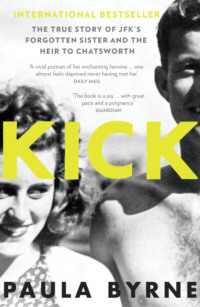
Kitabı oku: «Kick: The True Story of Kick Kennedy, JFK’s Forgotten Sister and the Heir to Chatsworth»

COPYRIGHT
William Collins
An imprint of HarperCollinsPublishers
1 London Bridge Street
London SE1 9GF
WilliamCollinsBooks.com
This eBook first published in Great Britain by William Collins in 2016
Copyright © 2016 Paula Byrne
Paula Byrne asserts the moral right to be identified as the author of this work
A catalogue record for this book is available from the British Library
Cover photograph © Corbis
The author has made every effort to trace copyright holders of images reproduced in this book, but will be glad to rectify any omissions in future editions.
All rights reserved under International and Pan-American Copyright Conventions. By payment of the required fees, you have been granted the non-exclusive, non-transferable right to access and read the text of this e-book on-screen. No part of this text may be reproduced, transmitted, down-loaded, decompiled, reverse engineered, or stored in or introduced into any information storage and retrieval system, in any form or by any means, whether electronic or mechanical, now known or hereinafter invented, without the express written permission of HarperCollins..
Source ISBN: 9780007548149
Ebook Edition © May 2016 ISBN: 9780007548132
Version: 2017-03-08
DEDICATION
For my boys, Tom and Harry
(Kennedys through and through …)
and in memory of my grandfather, Robert Kennedy
CONTENTS
Cover
Title Page
Copyright
Dedication
Prologue: Kicking the Surf
1. Rose and Joe
2. A Beautiful and Enchanting Child
3. Forbidden Fruit
4. Hyannis Port
5. Bronxville
6. Convent Girl
7. Muckers and Trouble
8. Mademoiselle Pourquoi
9. Gstaad and Italy
10. Travels with my Mother: Russia and England
11. Politics and Europe Revisited
12. The Ambassador
13. At the Court of St James’s
14. ‘I Get a Kick Out of You’
15. The Debutante
16. Lords a-Leaping
17. ‘A Merry Girl’
18. Billy
19. The Riviera
20. Peace for our Time
21. Chatsworth
22. St Moritz and Rome
23. The Gathering Storm
24. The Last Hurrah
25. ‘This Country is at War with Germany’
26. The Personality Kids
27. Operation Ariel
28. The Fourth Hostage
29. Billy and Sally
30. Kick the Reporter
31. Lobotomy
32. Scandal
33. ‘Did You Happen to See …’
34. Red Cross Worker of World War II
35. Coffee and Doughnuts
36. Sister Kick
37. Girl on a Bicycle
38. Parties and Prayers
39. Rosemary Tonks
40. Agnes and Hartie
41. Telegrams and Anger
42. ‘I Love You More Than Anything in the World’
43. The Marchioness of Hartington
44. Operation Aphrodite
45. Billy the Hero
46. ‘Life is So Cruel’
47. The Widow Hartington
48. Politics or Passion?
49. Joy She Gave Joy She Has Found
Epilogue
Acknowledgements
Picture Section
Sources
Notes
Index
Also Available …
Also by Paula Byrne
About the Publisher
PROLOGUE
Kicking the Surf

Hyannis Port, Cape Cod, 1937.
Joseph Patrick Kennedy stood on the veranda of his newly restored ocean-front beach-house, watching his seventeen-year-old daughter, Kathleen, water-skiing on Nantucket Sound at breakneck speed. Of all his girls, she was the one whom he loved the most. She was as plucky and fearless as her brothers, imbued with the same restless energy and drive. One of the reasons her father favoured her was because she wasn’t afraid of him. She wasn’t afraid of anyone. As she approached the sprawling white clapboard house with its green shutters, the speedboat and its tow-line abruptly began to jackknife, veering this way and that in spiky, jerking movements. Joe’s eyes narrowed as he watched the boat. Kathleen was dangerously close to the motor and he feared that she would be cut to pieces, crushed by the boat, carved up by the blades of the propeller. What on God’s earth was she doing?
His serious face suddenly broke into that radiant Kennedy smile and his shoulders relaxed. He saw exactly what she was doing. She was spelling out her name in the foamy surf.
K I C K
Kathleen Agnes Kennedy was born on 20 February 1920. Everyone, with the exception of her mother, who called her Kathleen, called her ‘Kick’. It began when her younger siblings found it hard to pronounce her name. She became Kick.1 Her moniker suited her perfectly. It was also said that K.K. was known as Kick because her ebullient personality reminded her father of a high-spirited pony.2 She was vivacious and quick-witted. As a little girl she loved to kick off her shoes, loved to run barefoot in the sand. When she became a debutante in London in the late 1930s, and a guest at England’s finest country houses, she would surprise polite society by her habit of kicking off her high-heeled shoes in company. Many a haughty aristocratic eyebrow would be raised, especially among the young debs put out by the unruly conduct of the Kennedy girl. But she soon charmed them all, winning them over with her jokes, her effervescence and her ease of manner.
She wasn’t a girl whom it was easy to constrain. Part of a large, clever family, she had to fight to be heard. She could be as headstrong as her boisterous brothers, but she was never belligerent or aggressive, as the male Kennedys could be. There was a sweetness and gentleness about her. Kick, blessed with an open, happy disposition, was cheerful and sunny, rarely moody or sulky. She was kind but tenacious. Children who are quietly determined, though seemingly malleable, are often the ones to be anxious about. They tend to get their own way.
That day when she traced out her name in the surf, Kick was showing off for her father, whom she idolized. But she was also doing it for herself. She had a very strong sense of self. She knew who she was. She was a Kennedy. She also had a stubborn streak. She would need those traits for what lay ahead. She would turn out to be the rebel of the family. She would kick against family, faith and country. And her name in the Kennedy family history would one day be erased, just as her ‘K I C K’ in the surf lasted only a moment before disappearing back into the ocean’s milky blue depths.
1
Rose and Joe
A very good polite Catholic.
Rose Kennedy
83 Beals Street, Brookline, January 1920.
Rose Fitzgerald Kennedy was eight months pregnant with her fourth child and she was about to walk out on her husband, Joe. Leaving her three little ones in the care of the Irish nanny, she packed a bag, slammed the door of her small townhouse in Brookline, Massachusetts, and returned home to Dorchester. She moved into her old bedroom, without saying a word to her parents. She was where she belonged, with her beloved father, and she said to herself that she was never going back. She had failed to heed his advice when he had warned her not to marry the upstart Joe Kennedy. After six years, her marriage was in crisis. Rose had made a big mistake.
But the child kicking so strongly inside her belly was a constant, nagging reminder that she was now a mother with responsibilities. Two of her small children were a cause for grave concern. Little Jack was sickly, in and out of hospital. Nobody could work out what was wrong; it was many years before he was correctly diagnosed. Rose’s firstborn daughter, Rosemary, was also a worry. She was too quiet, didn’t cry as much as her other two babies.1 Rose was trapped, and she knew it. But she was teaching her husband a lesson. She was a Fitzgerald, the cherished eldest daughter in one of the city’s most prominent Roman Catholic families. And now she was home.
Her diminutive father, John F. Fitzgerald, of Irish immigrant stock, was the first American-born Irish Catholic to be elected to the office of Mayor of Boston. What he lacked in height, he more than compensated for in energy. He was a gifted athlete and a good scholar and was accepted into Harvard Medical School. Just one year after his studies began, his father died. Fitzgerald left Harvard, took a job as a civil servant and raised his siblings. He washed their faces and dressed the babies.2 He never complained. He just got on with it.
He was a man of extraordinary charm and vitality. So charming, with the Irish gift of the gab, that his nickname was ‘Honey Fitz’. Other nicknames were ‘young Napoleon’ and ‘the little General’.3 In trying to describe her father’s particular brand of charisma, Rose would one day write of the attractive mix of his ‘abundant energy, vitality, physique, quick reflexes, and a psychological or endocrinological “x factor”’.4 She noted that her father had the ability to walk into a room full of dull, bored people and within minutes the place would be buzzing with life and energy. This charm, this energy, this ‘x factor’, would be inherited, above all, by her daughter Kathleen and her son Jack.
When she came to publish her memoirs in her eighties, Rose called herself Rose Fitzgerald Kennedy. In her mind, she was always a Fitzgerald, and proud to be so. ‘There was no one in the world like my father,’ she wrote. ‘Wherever he was, there was magic in the air.’5 She quoted him so much that she earned the nickname ‘Father says’.
Honey Fitz had an eclectic, wide-ranging mind and a habit of cutting out anything in print that interested him: news articles, quotations. He would pin them to his lapel. Rose inherited this trait and her children remembered her wandering around the house with notes pinned to her dress. Later, she put together scrapbooks full of photographs and clippings. She was an inveterate writer and always kept a notebook by her side to scribble down interesting ideas or quotations from books or plays. When her papers were released in 2007, there were 185,000 items stored in 253 boxes. Among those papers are Kick’s letters and her own scrapbooks of cuttings, articles and photographs.
Rose Fitzgerald had grown up in the world of politics. Honey Fitz became a US Congressman, spending his weeks in Washington and returning home to the country at weekends and for vacations. Despite the fact that he was so often away working, Rose was far closer to her father than to her mother, Josie. Honey Fitz loved people, so long as they were interesting, whereas Josie was shy and preferred to surround herself with family members. She was the disciplinarian. She spanked her children if they misbehaved. She was also deeply religious and instilled her piety into her children. As a fervent and devout Roman Catholic she drilled the children in the catechism. During the month of May (the month of the Blessed Virgin) she kept a shrine and her children filled it with flowers and prayed every night. During Lent, the children would kneel in the dark and recite the rosary.6
Devoted wife Josie didn’t know, or pretended not to know, that Honey Fitz had a string of affairs. ‘Me for the pretty girls, brains or no brains,’ he told a Boston Post reporter.7 He would pick up any young attractive girl, particularly blondes, and barely bothered to keep it a secret. Josie Fitzgerald did a great line in denial. She learnt to smile graciously, dress stylishly and keep her feelings in check. This set a pattern for her daughter, who would repeat history when she made her own choice of a powerful but chronically unfaithful husband. Rose spent her life turning a blind eye, just as her mother had done. Trained well in the school of face-saving, she followed her mother in taking comfort from fashionable clothes and expensive jewels.
As the daughter of devout Catholics, Rose was encouraged to date only Catholic boys. A ‘mixed’ marriage was, in her parents’ eyes, unthinkable. In her memoirs, she describes Boston as having two societies, one of them almost entirely Protestant (mainly of English descent) and the other Irish Catholic.8 She recalled that ‘between the two groups feelings were, at best, suspicious, and in general amounted to a state of chronic, mutual antagonism’.9
Protestant boys were a rarity at dances and social events. But even when a suitable Catholic boy caught her eye, her parents were unimpressed. His name was Joe Kennedy. Rose and Joe had met once as children when they were on vacation in Maine. Eight years later they met in Boston and what began as ‘affectionate’ friendship turned to romantic love.10 Despite the opposition of her parents, who disliked Joe and thought him unworthy of their daughter, Rose continued to see him secretly.
Joe Kennedy should have been ideal son-in-law material. He had attended the prestigious Boston Latin School, Fitzgerald’s alma mater. He was a brilliant baseball player, president of the senior class and a natural born leader. He was a fabulous dancer. He didn’t drink or smoke, and was ‘a very good polite Catholic’.11 He was tall and handsome, with sandy-coloured hair, freckles and blue eyes. His best feature was a captivating smile. Rose said that when he smiled, he made everyone want to smile, too.12 She recalled that he had a knack of getting along with people from all backgrounds: ‘He could talk to anybody.’13
Joe was the son of P. J. Kennedy, a successful businessman and politician. But Fitzgerald was possessive of Rose, and no one was good enough for his daughter. The irony was that Joe Kennedy was all too much like Honey Fitz: tough, energetic, ambitious. In an attempt to keep the lovers apart, Fitzgerald forbade Rose to attend the renowned Wellesley College, where she had been offered a place. Wellesley girls often dated boys from nearby Harvard, and Honey wasn’t having that. Rose later said that not going to Wellesley was the great regret of her life. She was entered instead into the Convent of the Sacred Heart, in downtown Boston.
The Order of the Sacred Heart had been founded in the early nineteenth century in France for the education of upper-class Catholic girls. It later spread to London, the Netherlands and America. Rose found herself entering a very different world: early-morning prayer, silence during class and serious study. She was still in touch with Joe, though he was due to start at Harvard. Despite her father’s opposition to the romance, Rose refused to stop seeing Joe, and in order to separate them once and for all the Fitzgeralds whisked Rose and her sister Agnes to Europe for a two-month tour, after which she was deposited in the Sacred Heart Convent in Blumenthal, Holland.
She decided that she would surrender herself to her faith. But she was also determined to ‘marry Joe, too, no matter what anyone thought or said’.14 For his part, Joe was equally determined to marry the Mayor’s beautiful daughter. Her newfound piety only added to her allure. He was furious that Fitzgerald didn’t think him good enough for his ‘Rosie’. He hated to be underestimated, and it drove him harder in his ambition to succeed. He was the first and only son in his family, with three sisters and a strong mother, who was also a devout Catholic. His father, P.J., a quiet and more benign figure, was rarely at home, busy with his bank and with the world of politics.
At Harvard, despite his sporting success and easy manner, Joe was not accepted into the more Brahmin clubs. His Irish roots and Catholicism saw to that. Rejection only fuelled his ambition. And to succeed he wanted to make money. And for that, it would help to have the right wife. With his good looks and his charm, he had developed a reputation as a ladies’ man with a taste for ‘actresses’. But they weren’t the kind of girls you married. If he wanted the Mayor’s daughter, he was going to have her. And Honey Fitzgerald was not going to stop him.
Joe graduated from Harvard and took a position in his father’s bank, before leaving to become an assistant bank examiner, an auditor responsible for ensuring proper financial practice. His plan was to become the youngest bank manager in Boston. The time was ready. But Fitzgerald was still set against him.
Then in December 1913, something happened that changed the dynamic between Rose and her father. Fitzgerald was in the middle of a re-election campaign. Out of the blue a letter was posted to the Mayor, edged in black, demanding that he should withdraw from the campaign or his affair with a cigarette girl called Toodles would be exposed. In fact, Fitzgerald had done little more than kiss her on a dance floor, but he knew that the damage was done. This was a battle he was not going to win. The Toodles scandal had brought shame to his door.
Josie and Rose were united in their fury. Toodles was the same age as Rose. Fitzgerald had constructed an idealized image of home and family. Josie had put up and shut up as long as her home and family were inviolate. But now that the press was on to her husband, the lines had been blurred. Fitzgerald withdrew from the campaign for ‘health reasons’. For Rose, this spelt freedom. Her beloved father, her idol, had feet of clay; he had been a coward and had run from a fight. She had lost respect for him, and he was never the same again in her eyes. A known philanderer was in no position to stop his daughter from making a good marriage to a man who was now cutting a figure: early in 1914, at the age of twenty-five, Joe Kennedy had become President of Colombia Trust Company, making him the youngest bank president in the United States.15 Rose married him later that year, on 7 October. Cardinal William O’Connell, a close friend of the Fitzgeralds, conducted the ceremony. ‘I’d always wanted to be married by a Cardinal and I was,’ said Joe.16
Rose almost immediately got pregnant, giving birth to a healthy 10-pound boy called Joseph on 25 July 1915. He was known as ‘young Joe’, or ‘Joe Junior’. Honey Fitz told a waiting reporter the happy news of his grandson: ‘Of course, he is going to be President of the United States, his mother and father have already decided that.’17 A year after Joe’s arrival, Rose was pregnant again, and she gave birth on 29 May 1917 to another boy, though he was an underweight and sickly child. She called him John Fitzgerald Kennedy, but he was to be called Jack.
Rose now longed for a daughter, and she got her wish when she gave birth to a girl whom she called Rosemary. But the child seems to have been starved of oxygen at birth. The deadly Spanish flu epidemic was as its height. The family physician was worked off his feet and he arrived late. The midwife could easily have delivered the baby herself, but she followed instructions to wait for the doctor and she held back the baby’s head until he arrived (he would receive his full fee only if he was present at the delivery). This decision was to have dire consequences for the baby. Though she was a lovely child, the most classically beautiful of the Kennedy daughters, it became increasingly clear that she was brain-damaged.
Soon Rose was pregnant again. But she was deeply unhappy. Joe was rarely home, and she was lonely. She missed her family, and her father, and the role she had cultivated as Mayor’s daughter. There was also the problem of sex. As a devout Catholic, Rose believed that sexual intercourse was for the sole purpose of procreation. Canon law decreed that contraception was tantamount to murder. Kick would inherit this belief. Rose refused to use birth control and she had been pregnant almost constantly since she was married. But sexual intercourse during menstruation and pregnancy was frowned upon. Joe had embarrassed Rose one evening at dinner with close friends when he began discussing their sex life: ‘Now, listen, Rosie, this idea of yours that there is no romance outside of procreation is simply wrong … It was not part of our contract at the altar, the priest never said that … and if you don’t open your mind on this, I’m going to tell the priest on you.’18 His sexual frustration is evident from this remark. And it no doubt gave him licence to have extramarital affairs and justify them to himself. Joe did not drink or smoke, but his vice was ‘fornication’. Invariably he was drawn towards actresses, waitresses, secretaries and models. Like many powerful men, he had a high libido, and an appetite for ‘fresh meat’, which his son Jack would inherit. He compartmentalized his life, without compunction, into two parts, family and home on the one hand, and his affairs on the other. Rose felt utterly cheated by how her life was turning out. That was why she walked out and returned to her family home.
Rose stayed in her old bedroom, thinking about her future and, for a fortnight, nobody said a word to her. While there, she did agree to accompany Joe to the Ace of Clubs ball, an important event for her as she was President of the organization. Before she married Joe, Rose had founded a club for women who had studied abroad and were interested in current events. Every year she led the grand march in the charity ball.19 She was determined that, despite her marital problems, this year should be no different. It was business as usual. Though heavily pregnant, Rose looked stunning in her ‘black web dress’; one of the reasons she attended was to avoid being the subject of gossip. But after the dance the couple went their separate ways.
Shortly afterwards, her father came to talk and urged her to return to Joe. Divorce was never going to be an option. Rosie had made her choice, and she was going to have to live with it. ‘What is past is past,’ her father told her. ‘The old days are gone. Your children need you and your husband needs you. You can make things work out. I know you can.’20
When she cradled her small daughter, Kathleen Agnes, in her arms in February 1920, Rose knew that she had made the right decision to return to Joe. Just as she had experienced an epiphany at Blumenthal to dedicate her life to God and to marry Joe, she now resolved to become the perfect mother and wife. Like Marmee in her favourite book, Little Women, she would learn to suppress her anger.
Rose Kennedy would apply to motherhood the exacting standards that she brought to bear in her thwarted intellectual life. She would pour her vast reserves of energy and ambition into raising her children, a job she took very seriously: ‘I looked upon child-rearing as a profession and decided it was just as interesting and just as challenging as any profession in the world and one that demanded the best that I could bring to it.’
Furthermore, she wanted those children to be the best: ‘I had made up my mind to raise my children as perfectly as possible.’21 Rose would pay a huge price for her overweening ambition for her children. But she was steadfast in her beliefs: ‘what greater aspiration and challenge are there for a mother than the hope of raising a great son or daughter?’22
2
A Beautiful and Enchanting Child
All my ducks are swans … but Kick was especially special.
Joseph Kennedy
Kick was born, like her brother Jack and sister Rosemary, in the twin bed nearest the window in the upstairs master bedroom at 83 Beals Street in Brookline. From the start, Kathleen was a special baby. One of nine children, she would take on the status of eldest daughter, as a result of Rosemary’s special needs which made her forever a child.
Rose doted on her baby, but on the day that she was born, Jack, just two and a half, developed a serious case of scarlet fever and was hospitalized. In those days, as Rose recalled, it was a ‘dreaded disease, fairly often fatal, quite crippling in aftereffects’.1 Joe proved himself to be an exemplary father, praying for his son and spending hours in the Boston City Hospital. He had ‘never experienced any serious sickness in the family previous to this case of Jack’s’ and he had ‘little realized what an effect such a happening could possibly have’ on him.2
Jack of course did recover, and became particularly close to Kick. He returned home just before his third birthday, and he was shown his new baby sister. On the medical index cards that Rose kept for all of the children, she wrote that Jack seemed ‘very happy’ to see his sister.3 Physically Kick resembled him the most, with thick golden-brown hair and blue-grey eyes. She would not grow up to be conventionally beautiful. She had her mother’s strong jawline and short neck along with a somewhat square face that was unlike Rosemary’s (which was heart-shaped), but she was a striking girl with lovely ivory skin. Kick’s beauty was all within, and she would grow up to have the greatest sexual charisma of all the girls. Men would be utterly captivated by her.
She was a fearless toddler, always wanting to keep up with her two elder brothers in sports and physical activities. Rose noted in her journal that at the age of two and a half she went out in the snow by herself in her little sleigh.4 She was already exhibiting signs of the independent spirit that would define her life. In a diary fragment, Rose wrote that her three-year-old daughter was ‘a beautiful and enchanting child’, with the soft, high colouring and beautiful skin of her Kennedy grandmother: ‘Although we delighted in her, I don’t think we could have spoiled her if we had tried.’5
Rose Kennedy has sometimes been presented as a somewhat cold and uncaring mother. Nothing could be further from the truth. She was a strict disciplinarian (one had to be with nine lively children), but her journals show a different picture to the one that is sometimes perceived. She had a keen sense of humour, and she clearly took great pride and delight in her brood. Like many a Catholic mother, she especially adored her boys. She noted down all the amusing things that Joe and Jack did: ‘Joe Jr. and Jack have a new song about the Bed Bugs and the Cooties. Also a club where they initiate new members by sticking pins into them.’6 Another entry recorded: ‘Boys went to store and saw “No dogs allowed in this Restaurant” and they put in front of it “Hot”.’7
Kick was also naturally funny. When she was a toddler, her mother tried to discourage her from sucking her thumb in the night by binding it with a plaster. Rose noticed the next morning that it had been removed and when she asked where it was Kick replied innocently, ‘A little mouse took it.’8 Her first surviving letter was written to Santa Claus when she was six: ‘Dear Santa Claus i want a doll and a doll carriage tea set and paper doll little book and little blck board your little friend Kathleen.’9 Throughout her life, she adored writing letters, always scribbling at high speed, with frequent slips of the pen, regular spelling mistakes and occasional bad grammar (as far as possible, I reproduce her exact words in all quotations, only correcting where there is ambiguity of sense).
With so many children in the house, Christmas was a special time. Rose recalled that it was always ‘the greatest event in our house’.10 The children all helped to select the Christmas tree, ‘as big as our living room would allow’. Rose remembered them choosing presents carefully for one another, ‘a story-book with large colorful pictures’ for Jack, or a ‘wind-up toy’ or ‘for the baby of the moment, a rattle, or teething ring, or jingle bells’. Then the children would excitedly wrap them and hide everything away in secret places until Christmas Day.
Rose would tell them the Christmas Nativity story and the children would sing ‘Away in a Manger’, then on Christmas morning they would look to see what Santa had brought. The house looked like a Fifth Avenue toy-shop.11 She would also tell them the story about how her father had started the idea of public Christmas trees for those people who couldn’t afford to buy their own. Honey put up a Christmas tree in the middle of Boston Common, ‘and the idea spread, until thousands and thousands of cities and towns and villages all over the country have public Christmas trees every year’.12
Rose claimed that she was particularly close to her first four children. ‘I spent more time with them. I knew their every thought and each personality fascinated me,’ she declared in her memoirs.13 In an entry in her journal for 1923, she seems less enamoured: ‘Took care of children. Miss Brooks, the governess, helped. Kathleen still has bronchitis and Joe sick in bed. Great Life.’14
Rose, having made her decision to stick by Joe, was more content than she had been before, and she had all the trappings of wealth to reconcile her to the realities of her marriage. She took solace in her money and status. She was back, but it was to be on her own terms.
Joe had almost made his first million by the time Kick arrived. A few weeks after she was born, the Kennedy family moved into a large, newly built Colonial-revival house, at 131 Naples Road, which had all mod cons, including a washing machine and ice-box. Rose brought her cherished grand piano and her Sir Thomas Lipton crockery embellished with the Irish shamrock.
She had servants and a chauffeur. All the children had their own bedrooms, and so did she and so did her husband. This was an important symbol of Rose and Joe’s increasingly separate lives. They also began vacationing apart, sometimes for months at a time. When they went to New York City, they always stayed at separate hotels.
The house had a wraparound porch, a key to Rose’s management of her ever-increasing brood: ‘the front porch is one of the greatest arrangements ever imagined for the benefit of mother and child’. She divided the porch into sections with folding gates, so that the children could play together but also be safe, and she could keep a close eye on them.15 The children were entertained by the ‘full panorama of neighborhood life … cars passing by, people walking along (many of them acquaintances who waved), the letter carrier, the milkman with his wire basket loaded full as he came to our house and empty as he left, the policeman passing by on his patrol, the grocery boy, tradesmen, visitors, and friends of all degrees and kinds – everybody with a smile and cheerful greeting for the children’.16
Kick’s first school was the Edward Devotion School, a five-minute walk from her family home. Joe, Jack, Rosemary and Kick all attended the school, though Rosemary was kept back from first grade and stayed in a class with younger children. She was rarely teased because she was so beautiful and innocent, and she had siblings to take care of her.
Rose Kennedy was a natural teacher. Indeed, she was probably a better teacher than a mother. Not coddling the children, or being overly affectionate, teaching them to be strong and independent, was part of her code. The children lived by a strict routine. Fresh air and exercise were high on the list. They were encouraged to take part in sports, especially swimming and tennis, to eat the right sorts of food, to read the right sorts of books, to contribute to the right sorts of discussions. Rose kept a close eye on their diets. She was obsessed with their weight, particularly the girls’. Every Saturday the children were weighed, and Rose scrupulously made a note of the latest figures on the index cards that contained all of their medical information. At the age of just seven, Kick wrote to her mother, ‘I gained a pound and a half. Eunice gained some too. Rose is as fat as ever.’17
Joe Kennedy wanted his family to be sleek and lean. He did not want his children to look like fat Irish peasants. The children were perfectly turned out, usually all of them dressed in the same clothes, as if their only identity was as a Kennedy – matching middy blouses and skirts for the girls and identical sailor suits for the boys.18
Rose hired an orthodontist to straighten out the children’s teeth, giving them the famous ‘flashing Kennedy smile’. For five years the children hopped into their father’s Rolls-Royce to be driven down to New York to a ‘superdentist’ to have their braces tightened. Rose closely monitored the intake of candy (only one piece allowed per day after dinner); tooth-brushing took place after every meal. With the thirteen-year age spread in the family, the dentist visits covered a span of two decades.
Rose admitted that she had all the domestic help she required, and that her role in the household was more like that of an ‘executive’. She recalled twenty years of ‘rows of diapers hanging up to dry on the back-yard clotheslines’.19 During the winter months, the diapers would freeze on the line, and would have to be thawed on the steam radiators.
Rose would think nothing of spanking the children with a ruler or a wooden coat hanger. She would never hit them in anger, but she believed in smacking, especially as she had such boisterous children. As she said, the mere mention of a spanking was enough to moderate a child’s bad behaviour. In later years, her grandchildren retrieved all the coat hangers from the closet and threw them down the garbage chute, just in case. Rose thought this was hilarious. Spanking was a very Roman Catholic punishment – immediate, direct, not inflicted in anger, and with the lesson learnt everyone could move on. Rose’s second method of discipline was to lock naughty children in the cupboard: ‘Well, I put them in the closet, but … they weren’t scared of the dark. It would just get one or two of them out of the way for a while.’20
Rose’s lack of emotional nourishment left its scars on her children. Jack, who was a sensitive boy, remembered: ‘My mother never really held me or hugged me. Never! Never!’21 The only time she touched them was to spank them. Kick, like Jack, was uncomfortable with physical demonstrativeness, which was another legacy of Rose’s emotional sterility. Later in life, Kick sought out several maternal substitutes, most notably Nancy Astor, with whom she developed deeply affectionate relationships. Older women were drawn to her, sensing that she lacked that special mother’s love.
Rose left the hugging and kissing to the children’s nanny, a working-class Irishwoman called Katherine Conboy, known to the family as ‘Kico’. Kick and her sisters adored her, and they would spend hours in the kitchen chatting to her. She in return adored the Kennedy children. Rose was perfectly happy with this arrangement. She simply did not see it as her role to kiss and hug for fear of ‘(s)mother love’. Respect was her by-word. The children always called her ‘Mother’, and they feared and loved her in equal measure.
Thus the Kennedy children were raised as upper-class British children were, by the nanny, and emotionally distant from their parents. It made them tough and independent, but it also left psychological wounds. Perhaps this was one of the reasons why Kick and Jack understood and sympathized with their English aristocratic friends. Rose’s strategy was to encourage the eldest son and daughter to take on the role of nurturing and shaping the other children. Joe Jr took to this role of little father with aplomb. Jack later said, ‘I think if the Kennedy children amount to anything now, or ever amount to anything, it will be due more to Joe’s behavior and his constant example than to any other factor.’22
The surrogate-mother role was more difficult for Kick because of Rosemary. Kick had to assume the role of eldest sister and was encouraged to take responsibility for all of her sisters, but, although she loved them, she was not naturally suited to the role. She was too wild, too free-spirited. Eunice, just one year younger, was much more temperamentally suited to that role, and she felt especially responsible for Rosemary. All of the girls mothered Teddy, the baby of the family, who was born in 1932. ‘It was like having an army of mothers around me,’ he recalled.23
Kick worshipped her father. He was a forceful presence in the lives of the children, despite the long absences caused by his work. He approached his duties as a father with great seriousness, and he loved children, but only his own. When he was away from home, every Sunday the children would line up in order of age and speak to him on the telephone.24
When he returned from business trips, it was a moment of high excitement for the children. ‘He would sweep them into his arms and hug them, and grin at them, and talk to them, and perhaps carry them around,’ Rose recalled. As each child became able to talk he would ‘want that child in bed with him for a little while each morning. And the two of them would be there propped up on the pillows, with perhaps the child’s head cuddling on his shoulder, and he would talk or read a story or they would have conversations.’25 Joe struggled with Rosemary’s mental incapacitation. He wanted his children to be perfect Americans, and that was one of the reasons he especially doted on Kick, who was so lively and smart. She later called him a ‘powerhouse, a force of nature’.26
He believed in treating the small children as young adults, refused to talk down to them and was plain-speaking and blunt, though loving. He was very tactile with the children, unlike Rose. They knew, however, not to overstep the mark, and if they did, one ‘Daddy’s Look’ was all it took: ‘ice-cold steel blue, piercing right into and through you and stripped you to the soul’.27 But if the children were ever in trouble, Joe insisted always on hearing the truth: ‘tell me the truth. Tell me everything about it, the whole truth. Then I’ll do everything I can to help. But if you don’t give me the truth, I’m licked.’28
Joe had his own inimitable way of speaking, which the children long remembered, with amusing phrases and aphorisms that became part of family lore: ‘applesauce’ (bullshit) was not tolerated, nor would he accept ‘monkey business’. ‘He doesn’t have the brains of a donkey’ or ‘He doesn’t have enough brains to find his way out of a telephone booth’ were Daddy expressions. ‘All my ducks are swans,’ he would say of the children, adding that Kick was ‘especially special’.29 ‘No crying in this house’ was another favourite, along with ‘You’d better believe it’, ‘Things don’t happen, they are made to happen’ and ‘I don’t want any sour pusses around here.’30 In later years, the children, now adults, would have cushions made with his aphorisms embroidered on them.31
Joe was not one for self-pity. Teddy revealed the key to his character when he described his father’s support and optimism, especially when things went wrong: this was when Joe was at his best. ‘The greater the disaster, the brighter he was.’ When things went really badly, Joe would declare, ‘That may be one of the best things that ever happened to you!’ But, most of all, Joe wanted his children to strive. Not necessarily to be the best, but to ‘strive’ for excellence. And then: ‘After you have done the best you can, the hell with it.’32
This interest and devotion exhibited by a father towards his children was highly unusual in those days, when fathers were often remote and women were left to run the house and family. As well as the telephone calls, the children were encouraged to write letters to their father, and he admonished them whenever they forgot to write. Kick’s earliest letters to him are full of affection and love, funny stories, and kisses, hearts and pictures. In preparation for writing her memoirs, Rose looked back over her papers and noted that Kick’s ‘early letters seemed so warm and affectionate, perhaps more so than the other children’.33
Kathleen also missed her father and worried about him when he was away: ‘Dear Daddy, I hope you have got rid of your cold … We are all fine and we miss you very much.’34 She told him jokes, reported that she had joined the Girl Scouts, that there had been ‘peachy skating’ at the Field Club, and asked ‘are you coming home soon?’35 Her letters to Rose were much less effusive.
In 1925, Joe set up a trust fund for each of his children that would increase to $10 million by the mid-1940s. All of the children were ‘trust fund’ babies. They had the cushion of money, which also bestowed confidence, but also carelessness.
In May 1927, when she was seven, Kick made her first Holy Communion. Her parents were in California, but she wrote to tell them that she had been preparing for it by going to church every day for the week leading up to the ceremony. It’s surprising to discover that Rose and Joe were absent. For Catholic children it’s a very special ceremony, a watershed moment in which the Holy Eucharist is taken for the first time. Little girls are dressed to look like mini brides in white dresses and veils, symbolizing purity. Shortly before Holy Communion, the child makes their First Confession, a daunting experience in which the heart is opened in a dark booth. The priest, who sits behind a screen or grille, gives absolution; the child says an act of contrition and is given penance in the form of prayers.
It was left to Joe Jr to take on the paternal role, writing to his parents to inform them that little Kathleen was preparing herself for the sacrament.36 By this time Rose had seven children and was pregnant again. Joe Sr was about to become even busier, and Hollywood was beckoning.
3
Forbidden Fruit
A real-life Jay Gatsby, ever-reinventing and legitimizing himself.
Amanda Smith, Joe’s granddaughter1
September 1927.
They tumbled out of the silver Rolls-Royce with blue fenders, like characters from F. Scott Fitzgerald’s The Great Gatsby. The glamorous woman and the tall, handsome, impeccably dressed man in his white flannels. Then came the children. There were seven of them, good-looking, beautifully turned out, barely able to conceal their excitement. Mother and children had taken a private train from Boston, where Joe met them, and they were now arriving at their newly rented home in Riverdale, an affluent suburb of New York. The Kennedys always knew how to make an entrance.
The move was crucial for Joe, who knew that however much money he made, he and his family would never belong in Brahmin Boston. They would never be welcomed at the right sort of country club. Joe later said that he had moved because he felt that his daughters would never be invited to the best coming-out parties in Boston. He knew that New York was a meritocracy in a way that Boston could never be.
Joe’s rise to the top was carefully orchestrated. He had the big house; he wore tailored suits and custom-made shirts and refused to ride the streetcar to the office, preferring to drive in his Cadillac. He gave up baseball for golf, through which he could make important connections. He was still an outsider. But there was one place where he could use his outsider status to his advantage, and where he would make his fortune. Hollywood.
In November 1919, Joe, seeing the opportunities in the new world of moving pictures, had set up his own film-distribution company, Columbia Films Inc. By 1926 he was a movie mogul, and owned his own motion picture company, FBO (Film Booking Offices of America). One of his strategies had been to convince the studios that he was the man who could clean up Hollywood. In the early twenties Hollywood had been rocked by sex scandals and charges of immorality, such as the notorious Fatty Arbuckle affair, when the actor was accused of the rape and murder of a young starlet.
Film titles such as Loving Lips, The Restless Sex and Short Skirts give an idea of the way that Hollywood was going. Joe would give Hollywood good clean family films. Furthermore, there was widespread anti-Semitic distrust of the studios, which were mainly run by Jews. Joe, by contrast, was ‘a Harvard graduate, a Boston businessman and banker, a family man, a practicing Christian, and decidedly not a New York City Jew’.2 As studio head, Joe instituted new accounting procedures and fired several of the overpaid executives. While the films were produced in Hollywood, the major decisions were made on the East Coast. Kennedy moved into the FBO offices at 1560 Broadway off 24th Street in New York City.
Joe was known in the studio world as the ‘blond Moses’, leading the way for film companies converting from silent movies to talkies. His charisma and charm were remarked upon time and time again. The actress Joan Fontaine said, ‘You felt not just that you were the only one in the room that mattered, but the only one in the world.’3 What he took from his time in Hollywood was the art of performing as a public personality, and the importance of image. In a stroke of PR genius, he invited in a group of newspaper reporters and explained his vision for the movie industry. ‘Wholesomeness, Mr Kennedy pointed out to his guests, is intended to form the keynote of the pictures … and there is to be a very general elimination of the sex problem movies and of those which depend upon sex appeal,’ announced the Boston Daily Globe.4
The Kennedy children were a key part of his image as a family man. From their perspective, to have a father in the movie world was thrilling. They had access to the latest Hollywood films, much to the envy of their friends. Kick’s early letters are full of references to the movies that she had seen. They provided the backdrop to her life. All the movies were checked in advance for their suitability: ‘if there was a slip-up and the plot became lurid, the projector was switched off and the audience was sent out’.5 The boys loved the cowboy films that Joe sent over. Kick and her sisters watched Douglas Fairbanks movies and films with titles such as Welcome Danger.
Kick attended the Riverdale County School, along with four of her siblings. As Catholics, the Kennedys were outsiders. They were a tribe and they stuck together, but Jack and Kick found it easy to make friends, and were keen to establish their own identity outside that of being a Kennedy. After school, the children played touch football in the field behind the Presbyterian church, Kick joining in with her brothers. A friend remembered that ‘Kathleen was one hell of a football player. She was on top of everything.’6
She was especially close to Jack, a thin, underweight child who continued to be plagued with illness. Like many clever, sickly children who miss a lot of school, he devoured books and had a precocious intellect. His passion was for history and reading literature and poetry. One of his defence mechanisms was a highly developed sense of humour. Kick was the butt of many a brotherly joke poking fun at her lack of intellect, but this was part of their teasing relationship. A schoolfriend from Riverdale days observed that ‘Kathleen was bonded to Jack with a profundity that mere blood seemed insufficient to describe.’7
Kick was given a very special birthday present for her eighth birthday: a new baby sister. She was to be called Jean. Kick wrote to ‘Dear Daddy’ and told him, ‘I like Jean very much.’8 Her father was taking his usual long vacation in Palm Beach. ‘I hope you are having a nice time in Florida. Do you go in swimming? Is the water cold?’ she asked in one of her earliest surviving letters.9 In her neat, bold hand, she described a funny moment when she was given a present of a little box of powder for her doll, which she managed to spill over herself. Neither of Kick’s parents was home that winter. Rose had returned to Boston to have the new baby, and Joe refused to sacrifice his annual vacation with his male buddies and business associates.
There was a team of nannies and nursery maids dedicated to looking after the children in the absence of the parents. Joe’s closest friend and adviser was an old friend of Honey Fitz, a man called Edward Moore. He and his wife Mary were childless and they became surrogate parents to the Kennedy children. When Rose and Joe were away, the Moores stepped in to help.
In the days after Jean’s birth, a huge bouquet of flowers was delivered to St Margaret’s Hospital from the actress Gloria Swanson, congratulating Rose on the birth of her child. Joe finally arrived from Palm Beach at his wife’s bedside, carrying three expensive diamond bracelets. This was not just a gift for having the baby, it was a guilt present. What did Rose really think when she looked at Gloria Swanson’s bouquet of flowers and the diamond bracelet glittering on her arm? It was an open secret that Joe and Gloria Swanson were in the throes of a passionate affair.
They had met for the first time in November 1927. Gloria was just twenty-eight, beautiful, charismatic and perhaps the most famous movie star in the world. She looked like a younger, more glamorous version of Rose. She had the same black, glossy hair, luminous skin and sapphire-blue eyes. Joe was utterly captivated. She could further his reputation as a serious studio head. He was tired of making B movies and cowboy films. He saw the way Hollywood was going – talkies. He wanted a business partnership with the screen goddess and he wanted her for himself. When they first met for dinner to discuss their partnership, Joe assured her, ‘Together we could make millions.’10 He offered to manage her, promising that he would reduce her debts and make her an even bigger star.11
The affair was to be a lasting one, and it posed a serious threat to his family. Gloria was utterly unlike the usual chorus girls that had previously attracted Joe. Before her, it was easy for him to compartmentalize his sexual affairs and his love for Rose. Rose was his wife, the mother of his children; the showgirls were there just for sex and for fun. Gloria was in an entirely different category.
Joe, more than ever, began to lead a bifurcated life, between his wife and large brood of handsome children and the glamorous movie star, the ultimate trophy mistress. In October 1928, he invited Gloria to a Halloween party in Riverdale along with her children. Gloria initially refused to meet the wife of the man she was sleeping with. But she did allow her children to go to the party. Her daughter, known as ‘little Gloria’, was the same age as Kick. She remembered the party with the decorations and all of the Kennedy children.
Kick was intrigued to meet the daughter of the world’s most famous movie star. She liked little Gloria, and took her to her Bronxville school to meet her schoolfriends. She introduced her guest as ‘Gloria Swanson’s daughter’. The other girls laughed and thought it was a joke: ‘After all, Gloria Swanson was, to them, practically a supernatural being, so she wouldn’t be in Bronxville.’12 Kick was indignant that nobody believed her story.
She liked her new friend, but she longed even more to meet the beautiful star herself. She wouldn’t have to wait long. The seriousness of the love affair was evident from Joe’s deliberate and highly risky merging of his two lives. He was adamant that his star, Gloria Swanson, should meet the family.
Ücretsiz ön izlemeyi tamamladınız.