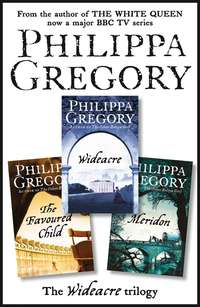
Kitabı oku: «The Complete Wideacre Trilogy: Wideacre, The Favoured Child, Meridon»
PHILIPPA GREGORY
THE COMPLETE WIDEACRE TRILOGY:
WideacreThe Favoured ChildMeridon

Contents
Cover
Title Page
Wideacre
The Favoured Child
Meridon
Keep Reading
About the Author
Also by the Author
Copyright
About the Publisher

PHILIPPA GREGORY
Wideacre
Contents
Cover
Title Page
Map
Chapter 1
Chapter 2
Chapter 3
Chapter 4
Chapter 5
Chapter 6
Chapter 7
Chapter 8
Chapter 9
Chapter 10
Chapter 11
Chapter 12
Chapter 13
Chapter 14
Chapter 15
Chapter 16
Chapter 17
Chapter 18
Chapter 19
Chapter 20
Epilogue
Map

 1

Wideacre Hall faces due south and the sun shines all day on the yellow stone until it is warm and powdery to the touch. The sun travels from gable end to gable end so the front of the house is never in shadow. When I was a small child, collecting petals in the rose garden, or loitering at the back of the house in the stable yard, it seemed that Wideacre was the very centre of the world with the sun defining our boundaries in the east at dawn, until it sank over our hills in the west in the red and pink evening. The great arch it traced in the sky over Wideacre seemed to me a suitable boundary for our vertical influence. Behind the sun was God and the angels; beneath it, and far more significantly, ruled the Squire, my father.
I cannot remember a time before I loved him, the blond, red-faced, loud Englishman. I suppose there must have been a time when I was confined to a white-frilled crib in the nursery; I suppose I must have taken my first steps clinging tight to my mother’s hand. But I have no childish memories of my mother at all. Wideacre filled my consciousness, and the Squire of Wideacre dominated me as he ruled the world.
My first, my earliest childhood memory is of someone lifting me up to my father as he towered above me in the saddle of his chestnut hunter. My little legs dangled helplessly in space as I rose up the yawning void to the great chestnut shoulder – a hot, red rockface to my surprised eyes – and up to the hard, greasy saddle. Then my father’s arm was tight round my body and his hand tucked me securely before him. He let me grip the reins in one hand and the pommel in the other, and my gaze locked on the coarse russet mane and the shiny leather. Then the monster beneath me moved and I clutched in fright. His pace was erratic and rolling to me, and the long gap between each great stride caught me unawares. But my father’s arm held tight and I gradually raised my eyes from the muscled, steamy shoulder of the mountainous horse, up his long neck to his pointy signalling ears … and then the sweep of Wideacre burst upon me.
The horse was walking down the great avenue of beech and oak that leads to the house. The dappled shadows of the trees lay across the springing grass and the rutted mud tracks. In the banks glowed the pale yellow of spring primroses and the brighter sunshine yellow of celandine. The smell, the dark, damp smell of rain-wet earth filled the arch of the trees like birdsong.
A drainage ditch runs alongside the drive, its yellow stones and white sand rinsed clean by the trickle of water. From my rolling vantage point I could at last see a clear view of its length, even where the black leafmould at the banks carried the tiny, forked hoofprints of nighttime deer.
‘All right, Beatrice?’ My father’s voice behind me was a rumble I could feel in my tense, skinny little body as well as hear. I nodded. To see the trees of Wideacre, to smell the earth of it, to be out among the breath of wind of Wideacre, bonnetless, carriageless and motherless, was beyond words.
‘Like to try a trot?’ he asked.
I nodded again, tightening my small hands on the saddle and reins. At once the giant strides altered and all around me the trees lurched and jigged as the horizon moved in great sickening leaps. I bobbed like a cork in a spring-flood river, sliding painfully to one side, and then, perilously, correcting. Then I heard my father click to the horse and the stride lengthened. Wonderfully, the horizon steadied, but the trees sped past. I regained my balance and, though the ground flashed by under the thudding hoofs, I could breathe and look around again. Your first canter is the fastest speed you will ever go. I clung like a louse to the saddle and felt the spring wind in my face, and saw the shadows of the trees flash light and shade across me as the chestnut mane streamed, and I could feel a great burble of delighted laughter and scream of fear gather in my throat.
On our left the woods were thinning and the steep bank dropped away, so I could see through the trees to the fields beyond, already brightening with the spring growth. In one a hare, large as a hound puppy, stood on its hind legs to watch us go by, its black-tipped ears pointed to hear the thud of the hoofs and the jingle of the bit. In the next field a line of women, drab against the deep black of the ploughed field, bent double over the furrows, picking, picking, picking, like sparrows on the broad back of a black cow, clearing the earth of flints before sowing.
Then the sliding scenery slowed and slowed as the hunter dropped into a teeth-chattering trot again, and then pulled up at the closed gates. A woman erupted from the open back door of the lodge house and scuttled through a scatter of hens to swing open a tall iron gate.
‘A fine young lady you have to ride with you today,’ she said smiling. ‘Are you enjoying your ride, Miss Beatrice?’
My father’s chuckle vibrated down my spine, but I was on my dignity, high on the hunter, and I merely bowed. A perfect copy, had I known it, of my mother’s chill snobbery.
‘Say good day to Mrs Hodgett,’ my father said abruptly.
‘Nay!’ said Mrs Hodgett, chuckling. ‘She’s too grand for me today. I’ll have a smile on baking day though, I know.’
The deep chuckle shook me again, and I relented and beamed down on Mrs Hodgett. Then my father clicked to the hunter and the smooth walk bore me away.
We did not turn left down the lane that leads to Acre village as I had expected, but went straight ahead, up a bridle track where I had never been before. My excursions until now had been in the carriage with Mama or in the pony-cart with Nurse, but never on horseback along the narrow green ways where no wheels could go. This path led us past the open fields where each man of the village could farm his own strip in a ragged, pretty patchwork. My father tutted under his breath at the ill-dug ditch and the thriving thistles in one patch and the horse, eager for a signal to canter, broke forward again. His easy strides took us higher and higher up the winding path, past deep banks dotted with wild flowers and with exciting-looking small holes, crowned with hedges of budding hawthorn and dogroses.
Then the banks fell away, and the fields and hedges with them, and we were riding, silent on thick leafmould, through the beech coppice that crowds the lower slopes of our downs. Tall, straight, grey trunks rose high as a cathedral nave. The nutty, woody smell of beech tickled my nose, and the sunlight at the end of the wood looked like the bright mouth of a cave, miles and miles away. The hunter, blowing now, rushed upon it, and in seconds we were out in the brilliant sunlight at the very tipmost-topmost point, the highest peak in the entire world, the pinnacle of the South Downs.
We turned to look back over the way we had come and the shape and the setting of Wideacre opened up to me, like a magical page in a picture book, seen for the first time.
Closest to us, and extending far below us, were the green, sweet slopes of the downs, steep at the top, but easy as soft shoulders lower down. The gentle wind that always blows steady and strong along the top of the downs brought the smell of new grass and of ploughing. It flattened the grass in patches like seaweed tossing under currents of water, first one way, then another.
Where the ground grew steep and broken, the beech coppices had taken hold and now I could look down on them, like a lark, and see the thick tops of the trees. The leaves were in their first emerald growth and chestnuts showed fat, mouth-watering buds. The silver birches shivered like streams of green light.
To our right lay the dozen cottages of Acre village, whitewashed and snug. The vicarage, the church, the village green and the broad, spreading chestnut tree that dominates the heart of the village. Beyond them, in miniature size like crumpled boxes, were the shanties of the cottagers who claimed squatters’ rights on the common land. Their little hovels, sometimes thatched with turf, sometimes only a roofed-in cart, were an eyesore even from here. But to the west of Acre, like a yellow pearl on green velvet, amid tall, proud trees and moist, soft parkland, was Wideacre Hall.
My father slipped the reins from my fingers and the great head of his horse dipped suddenly to crop the short turf.
‘It’s a fine place,’ he said to himself. ‘I shouldn’t think there’s a finer in the whole of Sussex.’
‘There isn’t finer in the whole world,’ I said with the certainty of a four-year-old.
‘Mmm,’ he said softly, smiling at me. ‘You may be right.’
On the way home, he let me ride alone in glorious solitude on top of the swaying mountain. He walked at my side, a restraining hand gripping the frills and flounces of my petticoats. Past the lodge gates and up into the cool quietness of the drive, he loosened his grip and walked before me, looking back to bawl instructions.
‘Sit up! Chin up! Hands down! Heels in! Elbows in! Gentle with his mouth! You want to trot? Well, sit down, tighten the rein, and dig your heels in! Yes! Good!’ And his beaming face dissolved in the heaving blur as I clung with all my small might to the leaping saddle and bit back shrieks of fear.
I rode alone up the last stretch of the drive and triumphantly brought the gentle great animal to a standstill before the terrace. But no applause greeted me. My mama watched me, unimpressed, from the window of her parlour, then came out slowly to the terrace.
‘Get down at once, Beatrice,’ she said, waving Nurse forward. ‘You have been far too long. Nurse, take Miss Beatrice upstairs and change and bath her at once. All her clothes will have to be washed. She smells like a groom.’
They pulled me off my pinnacle and my father’s eyes met mine in rueful regret. Then Nurse paused in her flight towards the house.
‘Madam!’ she said, her voice shocked.
She and my mother peeled back the layers of petticoats and found my lacy flounces stained with blood at the knees. Deftly Nurse stripped them off so she could see my legs. The stitching and the stirrup-leather flaps had rubbed my knees and calves raw and they had bled.
‘Harold!’ said my mother. It was the only sign of reproach she ever permitted herself. Papa came forward and took me into his arms.
‘Why didn’t you tell me you were hurt?’ he asked, his blue eyes narrow with concern. ‘I would have carried you home in my arms, little Beatrice. Why didn’t you tell me?’
My knees burned as if stung by nettles but I managed a smile.
‘I wanted to ride, Papa,’ I said. ‘And I want to go riding again.’
His eyes sparkled and his deep, happy laugh shouted out.
‘That’s my girl!’ he said in delight. ‘Want to go riding again, eh? Well, you shall. Tomorrow I shall go to Chichester and buy you a pony and you shall learn to ride at once. Riding till her knees bled at four years old, eh? That’s my girl!’
Still laughing, he led his horse around to the stable yard at the rear of the house where we could hear him shouting for a stable lad. I was left alone with Mama.
‘Miss Beatrice had better go straight to bed,’ she told Nurse, ignoring my wide-awake face. ‘She will be tired. She has done more than enough for one day. And she will not go riding again.’
Of course I went riding again. My mother was bound by all sorts of beliefs in vifely obedience and deference to the head of the household, and she never stood against my father for more than one self-forgetful second. A few days after my ride on the hunter and, alas, before the little scabs on the inside of my knees had healed, we heard a clatter of hoofs on the gravel and a ‘Holloa!’ from outside the front door.
On the gravel sweep outside the house stood my father’s hunter with Father astride. He was leaning down to lead the tiniest pony I had ever seen. One of the new Dartmoor breed, with a coat as dark and smooth as brown velvet and a sweep of black mane covering her small face. In a second my arms were round her neck and I was whispering into her ear.
Only one day later and Nurse had cobbled together a tiny version of a tailored riding habit for me to wear for my daily lesson with Papa in the paddock. Never having taught anyone to ride, he taught me as he had learned from his father. Round and round the water-meadows so my falls were cushioned by the soft earth. Tumble after tumble I took into the wet grass – and I did not always come up smiling. But Papa, my wonderful, godlike papa, was patient, and Minnie, dear little Minnie, was sweet natured and gentle. And I was a born fighter.
Only two weeks later, and I rode out daily with Papa. Minnie was on a leading rein and beside the hunter she looked like a plump minnow on the end of a very long line.
A few weeks after those first expeditions and Papa released me from the apprenticeship of the leading rein and let me ride alone. ‘I’d trust her anywhere,’ he said briefly to Mama’s murmured expostulations. ‘She can learn embroidery any time. She’d better learn to have a seat on a horse while she’s young.’
So Papa’s great hunter strode ahead and Minnie bobbed behind in a rapid trot to keep up. In the lanes and fields of Wideacre, the Squire and the little Mistress became a familiar sight as our rides lengthened from the original half an hour to the whole of the afternoon. Then it became part of the routine of the day that I should go out morning and afternoon with Papa. In the summer of 1760 – an especially dry hot summer – I was out every day with the Squire, and I was all of five.
These were the golden years of my childhood and even at that age I knew it. My brother Harry’s baby illnesses lingered on; they feared he had inherited Mama’s weak heart. But I was as fit as a flea and never missed a day out with Papa. Harry stayed indoors almost all winter with colds and rheums and fevers, while Mama and Nurse fussed over him. Then when spring was coming and the warm winds brought the evocative smells of warming land, he was convalescent. At haymaking, when I would be out with Papa to watch them scything down the tall rippling grass in great green sweeps, Harry would be indoors with his sneezing malady which started every year at haytime. His miserable ’atchoo, ’atchoo, would go on all through the hot days of summer, so he missed harvesting, too. At the turn of the year, when Papa promised I could go fox-cubbing, Harry would be back in the nursery or, at the best, sitting by the parlour fire with his winter ailments again.
A year older than me he was taller and plumper, but no match for me. If I succeeded in teasing him into a fight, I could easily trip him up and wrestle with him until he called for Mama or Nurse. But there was much good nature in Harry’s sweet placidity and he would never blame me for his bumps and bruises. He never earned me a beating.
But he would not romp with me, or wrestle with me, or even play a gentle game of hide-and-seek with me in the bedrooms and galleries of the Hall. He really enjoyed himself only when he was sitting with Mama in the parlour and reading with her. He liked to play little tunes on the pianoforte there, or read mournful poetry aloud to her. A few hours of Harry’s life made me unaccountably ill and tired all over. One day in the quiet company of Harry and Mama made me feel as weary as a long day in the saddle riding over the downs with Papa.
When the weather was too bad for me to be allowed out, I would beg Harry to play, but we had no games in common. As I moped round the dark library room, cheered only by finding the breeding record of Papa’s hunters, Harry would pile all the cushions he could find into the window seat and make himself a little nest like a plump wood pigeon. Book in one hand, box of comfits in the other, he was immovable. If the wind suddenly ripped a gap in the thunderclouds for the sun to pour through, he would look out at the dripping garden and say: ‘It is too wet to go out, Beatrice. You will get your stockings and shoes soaked and Mama will scold you.’
So Harry stayed indoors sucking sweets, and I ran out alone through the rose garden where every leaf, dark and shiny as holly, extended a drop of rain on its luscious point for me to lick. Every dense, clustered flower had a drop like a diamond nestling among the petals and when you sniffed the sweetness, rainwater got up your nose and made it tickle. If it rained while I was roaming, I could dive for shelter in the little white latticed summerhouse in the centre of the rose garden and watch the rain splashing on the gravel paths. But more often I would take no notice at all and walk on, on and out through the streaming paddock, past the wet ponies, along the footpath through the sheltered beech wood down to the River Fenny which lay like a silver snake in the coppice at the end of the paddock.
So although we were so near in age, we were strangers for all of our childhood. And though a house with two children in it – and one of them a romp – can never be completely still, I think we were a quiet, isolated household. Papa’s marriage to Mama had been arranged with a view to wealth rather than suitability and it was obvious to us, to the servants and even to the village, that they grated on each other. She found Papa loud and vulgar. And Papa would, too often, offend her sense of propriety by donning his Sussex drawl in her parlour, by his loud, easy laugh, and by his back-slapping chumminess with every man on our land from the poorest cottager to the plumpest tenant farmer.
Mama thought her town-bred airs and graces were an example to the county but they were despised in the village. Her disdainful, mincing walk down the aisle of the parish church every Sunday was parodied and mimicked in the taproom of the Bush by every lad who fancied himself a wit.
Our procession down the aisle, with Mama’s disdainful saunter and Harry’s wide-eyed waddle, made me blush with embarrassment for my family. Only inside our high-backed pew could I relax. While Mama and Harry stuck their heads in their hands and fervently prayed, I would sit up by Papa and slip one cold hand in his pocket.
Mama would recite prayers in a toneless murmur, but my little fingers would seek and find the private magic of my papa’s pocket. His clasp knife, his handkerchief, a head of wheat or a special pebble I had given him – more potent than the bread and wine, more real than the catechism.
And after the service, when Papa and I lingered in the churchyard to learn the village news, Mama and Harry would hurry on to the carriage, impatient of the slow, drawling jokes and fearful of infections.
She tried to belong to the village, but she had no knack of free and easy speech with our people. When she asked them how they did, or when a baby was due, she sounded as if she did not really care (which was true) or as if she found their whole lives sordid and tedious (which was also true). So they mumbled like idiots, and the women twisted their aprons in their hands as they spoke, and kept their mob caps dipped low.
‘I really fail to see what you see in them,’ Mama complained languidly after one of these abortive attempts at conversation. ‘They really are positively natural.’
They were natural. Oh, not in the sense she meant: that they were half-witted. They were natural in that they did as they felt and said what they thought. Of course they became tongue-tied and awkward in her chilly presence. What could you say to a lady who sat in a carriage high above you and asked you with every appearance of boredom what you were giving your husband for dinner that night? She might ask, but she did not care. And even more amazing to them, who believed the life of Wideacre was well known throughout the length and breadth of England, was that the Squire’s lady clearly did not know she was speaking to the wife of one of Acre’s most successful poachers, and so a true answer to the question would have been: ‘One of your pheasants, ma’am.’
Papa and I knew, of course. But there are some things that cannot be told, cannot be taught. Mama and Harry lived in a world that dealt in words. They read huge boxfuls of books delivered from London booksellers and libraries. Mama wrote long criss-crossed letters that went all over England: to her sisters and brothers in Cambridge and London, and to her aunt in Bristol. Always words, words, words. Chatter, gossip, books, plays, poetry and even songs with words that had to be memorized.
Papa and I lived in a world where words were very few. We felt our necks prickle when thunder threatened haymaking and it only needed a nod between us for me to ride to one corner of the field and Papa to ride away over to the other acres to tell the men to stack what they could and be ready for the rain. We smelled rain on the air at the start of harvesting and, without speaking, would wheel our horses round to stop the sickle gangs from cutting the standing corn with the storm coming. The important things I knew were never taught. The important things I was born knowing, because I was Wideacre born and Wideacre bred.
As for the wider world, it hardly existed. Mama would hold up a letter to Papa and say: ‘Fancy …’ And Papa would merely nod and repeat: ‘Fancy.’ Unless it affected the price of corn or wool, he had no interest.
We visited some county families, of course. Papa and Mama would attend evening parties in winter, and now and then Mama would take Harry and me to visit the children of neighbouring families: the Haverings at Havering Hall, ten miles to the west, and the de Courcey family in Chichester. But the roots of our lives were deep, deep into the Wideacre earth and our lives were lived in isolation behind the Wideacre park walls.
And after a day in the saddle, or a long afternoon watching the labourers ploughing, Papa liked nothing so much as a cigar in the rose garden while the stars came out in the pearly sky and the bats swooped and twittered overhead. Then Mama would turn from the windows of the parlour with a short sigh and write long letters to London. Even my childish eyes saw her unhappiness. But the power of the Squire, and the power of the land, kept her silent.
Her loneliness showed itself only in her continual letters, and in the way her disagreements with Papa were never won nor lost, but dragged on in indecisive pain.
The riding quarrel rumbled on throughout my childhood. My mama was bound to conventional obedience to the Master’s word, but utterly free of any moral standard. Behind her respectability and her worship of the conventions she had the morality of the gutter. Without power, she had spent all her life seeking minuscule advantages in perpetual quest for the satisfaction of getting her own way in something, anything, however small.
Poor woman! She had no control of the housekeeping monies, which were submitted by butler and cook directly to Papa and paid for out of the estate accounts. She had no control over her dress allowance, which was paid direct to the Chichester dressmaker and milliner. Once a quarter she received a few pounds and shillings for spending money: for her church collection, for her charities and for the dizzy indulgence of buying a posy of flowers or a box of sweetmeats. And even that little purse was discreetly regulated by her behaviour. After a moment’s lapse when she had spoken out to Papa shortly after my birth, the allowance had magically stopped – a seven-year-old secret that still rankled enough for Mama to whisper it to me in her enduring resentment.
I listened not at all and cared less. I was for the Squire. I was Papa’s little girl, and I understood well enough that disloyal, resentful whispers like that were part of the same attack on me and my papa as her opposition to my riding. Mama was always in search of family life as it was depicted in her quarterly journals. That was the secret reason for her hatred of my father’s uncompromising loudness, his bawdiness, his untamed joy. That was why she gloried in the quiet prettiness of her fair-haired boy. And that was why she would have done anything to get me off horseback and into the parlour where young girls, all young girls, whatever their talents and dispositions, belonged.
‘Why don’t you stay at home today, Beatrice?’ she asked in her sweet plaintive voice one morning at breakfast. Papa had already eaten and gone, and my mama turned her eyes from his plate with the great knuckle bone of ham chewed clean and the scatter of crumbs from a crusty Wideacre loaf.
‘I am riding with Papa,’ I said, my words muffled by my own hearty portion of bread and ham.
‘I know that is what you planned,’ she corrected me sharply. ‘But I am asking you to stay at home today. To stay at home with me. This morning I should like to pick some flowers and you could help me to arrange them in the blue vases. This afternoon we could go for a drive. We could even visit the Haverings. You would like that. You could chatter with Celia.’
‘I am sorry, Mama,’ I said with all the finality of an indulged seven-year-old, ‘but I promised Papa I would check the sheep on the downs and I will need all day. I shall go to the west side this morning and then ride home for dinner. This afternoon I shall go to the east side and not be back till tea-time.’
Mama compressed her lips and looked down at the table. I barely noticed her rising irritation and her tone of anger and pain was a surprise to me when she burst out: ‘Beatrice, I cannot think what is wrong with you! Time and time again I ask you to spend a day, or half a day with me, and every time you have something else you would rather do. It hurts me; it distresses me to be so rebuffed. You should not even be riding alone. It is outrageous, when I have specifically asked for your company indoors.’
I gazed blankly at her, a fork of ham halfway to my mouth.
‘You look surprised, Beatrice,’ she said crossly, ‘but in any ordinary household you would not even have learned how to ride. It is only because your father is horse-mad and you are Wideacre-mad that you have such licence. But I will not tolerate it in my daughter. I will not permit it!’
That made me afraid. Mama’s overt opposition to my daily rides could mean I was returned to the conventional pursuits of a young lady. A miserable enough fate for anyone, but if I was to be kept inside when the ploughing started, or when the reaping bands were out, or at harvest time, I should be in continual torment. Then I heard my papa’s clatter in the hall and the door banged open. Mama winced at the noise and my head jerked up like a gun dog at the sound of game, to see his bright eyes and merry smile.
‘Still feeding, little piglet?’ he bellowed. ‘Late to breakfast, late to leave and late in the fields. You have to be on the west slope and back in time for dinner, remember. You’ll have to hurry.’
I hesitated and glanced at Mama. She said nothing and her eyes were downcast. I saw the game she was playing in one swift, acute second. She had put me in a position where my defiance of her would be absolute if I went now with my papa. On the other hand, my obedience and devotion could be transferred wholesale to her if I insisted on staying indoors. I was not going to be managed by such paltry parlour games. I swallowed my mouthful and cast Mama’s secrets before my father.
‘Mama says I must stay at home today,’ I said innocently. ‘What am I to do?’
I glanced from one to the other, the picture of childish obedience. I looked as if I sought only guidance, but in my heart I had staked a large gamble on my papa.
‘Beatrice is needed out on the downs today,’ he said baldly. ‘She can stay at home tomorrow. I want her to look at the flocks today before we separate them for market and there is no one else free who can ride up there and whose judgement I can rely on.’
‘Young ladies do not generally spend all day in the saddle. I am afraid for Beatrice’s health,’ Mama said.
Papa grinned. ‘Oh stuff, ma’am,’ he said rousingly. ‘She’s as lean and as fit as a racehorse. She’s never had a day’s illness in her life. Why don’t you say what you mean?’
Mama bridled. Plain speaking is not the natural voice of ladies.
‘It’s not the proper upbringing for a girl,’ she said. ‘Spending all her time talking with such rough men. Knowing all the tenants and cottagers and galloping around the countryside without a chaperone.’
Papa’s blue eyes sparkled with temper. ‘Those rough men earn our bread and butter,’ he said. ‘Those tenants and cottagers pay for Beatrice’s horse, aye and even the dress on her back and the boots on her feet. A fine little city-miss you would have on your hands if she did not know where the wealth is made and where the work is done.’
Mama, a city-miss in her girlhood, looked up from the table and came perilously close to defying the convention that Ladies Never Raise Their Voices, Never Disagree with Their Husbands, and Keep Their Tempers Under the Tightest of Wraps.
‘Beatrice should be brought up in a manner befitting a young lady,’ she said tremulously. ‘She will not be a farm manager in later life; she will be a lady. She should be learning how a lady behaves.’
Papa was red to the ears – a sure sign of his temper. ‘She is a Lacey of Wideacre,’ he said, his voice firm and unnecessarily loud for the little breakfast parlour. The cups jumped and chinked as he bumped the table.
‘She is a Lacey of Wideacre, and whatever she does, however she behaves, will always be fitting. Whether she checks the sheep or even digs ditches, she will always be a Lacey of Wideacre. On this land her behaviour is the pattern of Quality. And no damned mincing, citified, pretty-pretty gentility could change that. And nothing could improve that.’
Mama was white with fright and temper.
‘Very well,’ she said through her narrowed lips. ‘It shall be as you order.’
She rose from the table and picked up her reticule, her shawl and the letters that lay by her plate. I could see her fingers tremble and her mouth working to hold back resentful, bitter tears. Papa detained her with a hand on her arm at the door and she looked up in his face with an expression of icy dislike.
‘She is a Lacey of Wideacre,’ he said again, trying to convey to this outsider what that meant on this, our land. ‘Bearing that name, on this land she can do no wrong. You need have no fears for her, ma’am.’
Mama tipped her head in cold acquiescence and stood like a statue till he released her. Then she glided, in the short dainty steps of the perfect lady, from the room. Papa turned his attention to me, silent at my breakfast plate.
‘You didn’t want to stay at home, did you, Beatrice?’ he asked, concerned. I beamed at him.
‘I am a Lacey of Wideacre, and my place is on the land!’ I said. He scooped me from my place in a great bear-hug and we went arm in arm to the stables, victors of a righteous battle. Mama watched me go from the parlour window, and when I was on my pony and safe from her detaining hand, I reined in by the terrace to see if she would come out. She opened the glass door and came out languidly, her perfumed skirts brushing the stones of the terrace, her eyes blinking in the bright sunshine. I stretched an apologetic hand out to her.
‘I am sorry to grieve you, Mama,’ I offered. ‘I shall stay at home tomorrow.’
She did not move close to take my hand. She was always afraid of horses and perhaps she disliked being too close to the pony who was pulling against the bit and pawing at the gravel, keen to be off. Mama’s pale eyes looked coldly up at me, sitting high, bright and straight-backed on a glossy pony.
‘I try and try with you, Beatrice,’ she said and her voice was sad, but also flawed with self-righteous complaint. ‘I sometimes think you do not know how to love properly. All you ever care for is the land. I think sometimes you only love your papa so much because he is the master of the land. Your heart is so full of Wideacre there scarcely seems room for anything else.’
The pony fidgeted and I smoothed her neck. There seemed little to say. What Mama said was probably true, and I felt a momentary sentimental sadness that I could not be the daughter she wanted.
‘I am sorry, Mama,’ I said awkwardly.
‘Sorry!’ she said and her voice was scornful. She turned and swept back through the door leaving me holding a restless pony on a tight rein and feeling somehow foolish. Then I loosened the rein and Minnie sprang forward and we clattered off down the gravel to the grassy track of the drive. Once in the shadow of the branches, which cast dappled bars of shade across my track while the early summer sunshine warmed my face, I forgot all about the disappointed woman I had left in her pale parlour and remembered only my freedom on the land and the work I had to do that day.
But Harry, her favourite, was a disappointment to her in another way. The high hills and the rolling chalk valleys and the sweet River Fenny flowing so cool and so green through our fields and woods were never enough for him. He seized at the chance of visits to our aunt in Bristol and said he preferred the rooftops and rows of tall town houses to our wide, empty horizon.
And when Papa broached the idea of a school, Mama turned white and reached a hand for her only son. But Harry’s blue eyes sparkled and he said he wanted to go. Against Papa’s certainty that Harry would need a better education than his own to deal with an encroaching and slippery world, and Harry’s quiet but effective determination to leave, Mama was helpless. All August, while Harry was ill again, Mama, Nurse, the housekeeper and every one of the four upstairs maids dashed around all day in a frenzy of preparation for the eleven-year-old hero’s departure for school.
Papa and I avoided the worst of the fuss. In any case, there were the long days we had to spend on the open downland pastures collecting the sheep to separate lambs from ewes for slaughter. Harry, too, remained secluded in library or parlour choosing books to take to school with him, and scanning his newly purchased Latin and Greek grammars.
‘You cannot want to go, Harry!’ I said incredulously.
‘Whyever not?’ he said, frowning at the breeze that had blown in with me as I flung open the library door.
‘To leave Wideacre!’ I said and then stopped. Once again Harry’s world of words defeated me. If he did not know that nothing outside Wideacre could match the smell of Wideacre’s summer wind, or that a handful of Wideacre earth was worth an acre of any other land, then I had no way to tell him. We did not see the same sights.
We did not speak the same language. We did not share even the similarity of family resemblance. Harry took after my father in colouring, with his bright blond curls and his wide blue, honest eyes. From Mama he had inherited her delicate bone structure and the sweetness of her smile. Her smiles were rare enough, but Harry was a merry-faced golden cherub. All the petting and indulgence he had from Mama had been unable to spoil his sunny nature – and his smiling good looks reflected his sweet and loving spirit.
Beside him I was a throwback to our Norman ancestors and the founders of the line. Foxy-coloured, like those greedy and dangerous men who came in the train of the Norman conqueror and took one look at the lovely land of Wideacre and fought and cheated and lied until they got it. From those ancestors I had my chestnut hair, but my hazel-green eyes were all my own. No portrait in the gallery showed a set of eyes slantingly placed above high cheekbones like mine.
‘She’s a changeling,’ Mama once said in despair.
‘She’s her own pattern,’ my blond papa said consolingly. ‘Maybe she’ll grow into good looks.’
But Harry’s golden curls could not last for ever. His head was cropped for his first wig as part of the preparation for school. Mama wept as the radiant springs fell all around him on the floor, but Harry’s eyes were bright with excitement and pride as Papa’s own wigmaker fitted a little bob-tailed wig on his head – as shorn as a lamb. Mama wept for his curls; she wept as she packed his linen; she wept as she packed a great box of sweetmeats to sustain her baby in the hard outside world. The week before his departure, she was in one continual flood of tears, which even Harry thought wearisome, and Papa and I found pressing business on the far side of the estate from breakfast to dinner.
When he finally departed – like a young lord in the family carriage with his bags strapped on the back, two outriders and Papa himself riding alongside for company for the first stage – Mama shut herself in her parlour for the afternoon. To my credit, I managed a few tears and I took good care to tell no one they were not for Harry’s departure. My father had bought me my first grown-up mount to console me for the loss of my brother. She was an exquisite mare, Bella, with a coat the colour of my own chestnut hair, a black mane and tail and a stripe like starlight down her nose. But I would not be allowed to try her paces till Papa came home, and he would be gone overnight. My tears flowed easily enough, but they were all for me and white-nosed Bella. Once Harry turned the corner of the drive and was out of sight, I scarcely thought of him again.
Not so Mama. She spent long solitary hours in her front parlour fiddling with little pieces of sewing, sorting embroidery silks or tapestry wool into the ranges of shades; arranging flowers picked for her by me or one of the gardeners, or tinkling little tunes on the piano – absorbed by the little time-wasting tedious skills of a lady’s life. But, unconsciously, the little tune would stop and her hands would fall into her lap, and she would gaze out of the window to the gentle shoulder of the green downs, seeing their rippled loveliness, yet all the time seeing the bright face of Harry, her only son. Then she would sigh, very softly, and drop her head to her work, or take up the tune again.
The sunlight, so joyous in the garden and in the woods, seemed to beat cruelly on the pretty pastel colours of the ladies’ parlour. It bleached the pink out of the carpets and the gold out of Mama’s hair, and the lines into her face. While she faded in pale silence indoors, my father and I rode over the length and breadth of Wideacre land, chatting to the tenant farmers, checking the progress of their crops against those we farmed ourselves, watching the flow of the River Fenny over our turning millwheel, until it seemed that the whole world was ours and I might take a proprietary interest in every living thing that – one way or another – belonged to us.
Not a baby was born in our village but I knew of it and generally the child took one of our names: Harold or Harry for my father and brother, Beatrice for my mama and me. When one of our tenants died, we concerned ourselves in the packing and the leaving of their family, if they were going, or the succession of the oldest son and the co-operation of his brothers if they were staying. My father and I knew every blade of grass on our lands, from the weeds on the lazy Dells’ farm (they would be looking for a new tenancy when their lease ran out) to the white-painted fence posts on the spick-and-span Home Farm we farmed ourselves.
Small wonder I was a little empress riding over our land on our horses, with Father – the greatest landlord for a hundred miles around – riding before me and nodding to our people who dropped a curtsy or pulled their forelocks as we passed.
Poor Harry missed all this. Not for him the pleasure of seeing our land under every daily light and in every season. The ploughed fields ringed with white hoarfrost and crunchy as fudge, or the swaying corn in the beating heat of summer. While I rode like a lord at a lord’s side, Harry moped at school and sent sorrowful letters home to his mother, who replied in pale blue ink blotted with tears of sympathy.
His first year was miserable with longing for his mama and her quiet sunny parlour. The boys all belonged to gangs with fierce tribal loyalties, and little Harry was bullied and tormented by every child an inch taller or a month older. Not until his second year brought a new batch of victims into the arena did Harry’s life improve. His third school year meant the dizzy heights of being nearly a big boy, and his cherub-like brightness and his undimmed sweetness brought him petting as well as occasional cruelty. More and more often, when he came home for the holidays, his great trunk was crammed with comfits and cakes given him by older boys.
‘Harry is so popular,’ Mama said proudly.
Each holiday, too, he would tell me tales of the courage and dash of his gang leader. How every term they would plan a campaign in the war against the apprentice lads of the town. How they marched from the school gates to spring upon the lads in glorious, epic battles. And how the hero of the day was always Staveley, Lord Staveley’s youngest son, who gathered around himself the strongest, the meanest and the prettiest of all the boys in the school.
Harry’s new-found zest for school could only widen the gulf between us. He had caught the schoolboy’s tone of arrogance like a galloping infection and, apart from boring me to tears about the demigod Staveley, scarcely deigned to speak to me at all. Towards Papa he was always polite, but his unconcealed enthusiasm for his studies made Papa at first proud, and then irritated that Harry should so obviously prefer to spend his days in the library when the windows were open and the cuckoos calling to everyone to take a line and rod and try for some salmon.
Only with Mama was he totally unchanged, and those two spent long, intimate days in easy companionship, reading and writing together in library and parlour while Papa and I, intent on wider, freer pursuits, watched the land under every light, under every season and under every sort of weather. Harry could come and go as he pleased; he was always a visitor in his own home. He never belonged to Wideacre as I belonged. Only Papa, the land and I were the constant elements in my life. Papa, the land and I had been inseparable since the first time I had seen Wideacre in its wonderful wholeness from between the hunter’s ears. Papa, the land and I would be here for ever.
2
‘I don’t know what I’ll do without you when you leave,’ Papa said casually to me one day as we rode down the lane to Acre village to see the blacksmith.
‘I’ll never go,’ I said, my confidence unshaken. I was only half attending for we were each of us leading one of the heavy plough horses to be shod. That was easy for Papa, high on his hunter, but my dainty mare only came up to the work-horse’s shoulder, so I had to keep her alert and wide awake to follow his great strides.
‘You’ll have to go some day,’ said Papa, looking over the hedges to see the plough using the second team of horses starting to turn over the sluggish winter earth. ‘You will marry and leave with your husband. Perhaps you’ll be a fine lady at Court, not that there’s much of a Court left and all filled with ugly German women, Hanover rats, they call ’em; but you’ll be away and care nothing for Wideacre.’
I laughed. The idea was so ludicrous and adulthood so far away that nothing could shake my belief in the trinity of Papa, and me, and the land.
‘I won’t marry,’ I said. ‘I shall stay here and work with you and look after Wideacre, like you and I do now.’
‘Aye,’ Papa said tenderly. ‘But Harry will be Master here when I’m gone, and I would rather see you in your own home than rubbing against him. Besides, Beatrice, the land is well enough for you now, but in a few years you will want pretty clothes and balls. Then who will watch the winter sowing?’
I laughed again with my childish confidence that good things never change.
‘Harry knows nothing about the land,’ I said dismissively. ‘If you asked him what a short-horn was, he would think it was a musical instrument. He’s not been here for months – why, he hasn’t even seen the new plantation. Those trees were my idea, and you planted them just where I thought they should be. The man said I was a proper little forester – and you said I should have a stool made from the wood of my trees when I was an old lady! Harry cannot be Master here – he is always away.’
I still had not understood. Silly fool that I was. Though I had seen enough older sons inheriting the farms and enough younger sons working as day labourers or going into service before they could marry their patient sweethearts, I had never thought of them as landowners as we were.
I never imagined that the rule that favoured older sons to the exclusion of all others could ever, possibly, apply to us – to me. I had seen village girls of my age working as hard as adult women to earn money for the family coffers. I had seen their sisters, a few years older, on the look-out for older sons – always the eldest – to marry. But I never thought that the rigid, crazy rule that the first boy takes all could apply to us. It was a feature of the lives of the poor, like early death, poor health and starvation in winter. These things were not the same for us.
Oddly, I had never thought of Harry as the son and heir, just as I had never thought of Mama as the Mistress of Wideacre. They were simply private individuals, seldom seen outside the walls of the park. They were the background to the glory of the Squire and me. So my father’s words had not disturbed me – they had passed me by.
I had much to learn, the little girl that I was then. I had never even heard of ‘entail’, the legal process of tying up a great estate so it is always handed to the next male heir – be he ever so distant, even if there are a hundred daughters loving the land before him. With childlike concentration I still had the ability to hear only what interested me – and speculation about the next Master of Wideacre was as remote as the music of the spheres.
While I dismissed the thoughts from my mind, my father had pulled up his hunter to chat with one of our tenants trimming his boundary hedge of blackthorn and dogroses.
‘Good morning, Giles,’ I said, my seat in the saddle, the tip of my head, a perfect copy of my father’s friendly condescension.
‘Mistress.’ Giles touched an arthritic hand to his head. He was years younger than my father but bent double with the burden of poverty. A lifetime of waterlogged ditches, muddy fields and frozen pathways had permeated his bones with agonizing arthritis which no amount of dirty flannel wrapped round his skinny legs seemed to cure. His brown hand permanently ingrained with dirt (our dirt) was as knotted and as gnarled as a holly trunk.
‘A grand little lady she’s becoming,’ he said to my father. ‘’Tis sad to think she’ll have to leave us some day soon.’ I stared at the old man. My father picked a sprig of clipped elder from the hedge with the butt of his whip.
‘Aye,’ he said slowly. ‘But a man must run the land and maids must marry.’ He paused. ‘The young Master will be home soon when he’s finished with his books. Time enough then to learn of country ways. The fields and the downs are good enough for a girl with the teaching her mother gives her, but these are bad times. The next Master of Wideacre will need to know his way in the world.’
I listened, silent. Even my mare seemed to freeze as my father spoke and the great shire-horses dropped their heads as if to listen while my father tore down the secure world of my childhood with his quiet, deadly words.
‘Yes, she’s a good girl and as sharp on the land as a bailiff for all she’s so young. But she’ll be off to marry some lord or other some day, and young Harry will take my place. He’ll be all the better for his learning.’
Giles nodded. There was a silence. A long, country silence punctuated with the springtime birdsong. There was no hurry on that timeless afternoon which marked the end of my childhood. My father had said all he had to say and said nothing. Giles said nothing, thought nothing, gazed into space. And I said not a word for I had no words to deal with this pain. In a series of clicks, like the moving parts of some strange and cruel clock, all my pictures of the adult world were falling into place. The precious elder son always took the land – and the redundant girls could go where they could find a man to take them. My residence at Wideacre was not an exclusive favour, and Harry’s departure an exile – but I was kept at home because I was not worth educating.
Harry’s school was not an interruption of his Wideacre life but an essential preparation for it. While I had been revelling in the land and the freedom of being the only child at home, Harry had been growing stronger and more skilled and would return to expel me from my home. Papa did not love me best. Papa did not love me best. Papa did not love me best.
I took a deep shuddering breath, softly, softly, so that no one could hear. And I looked at my father with a new, strange clarity. He might love me tenderly, but not enough to give me Wideacre. He might wish the best for me, but he could see no further than a good match and permanent exile from the one place in the world that was my home. He might plan ahead for Harry’s future but he had forgotten me. Forgotten me.
So that was the end of my childhood; that warm spring day on the lane to Acre with the two great shire-horses beside my papa and me, and Giles, blank as chalk scree, staring at nothing. The absolute security of owning the land I loved left me, then, in that moment, and I never had it fully back. I left my childhood with my heart aching and my mind full of anger and resentment. I started adulthood with a bitter taste in my mouth and a formless determination that I would not go. I would not leave Wideacre. I would not surrender my place to Harry. If it was the way of the world that girls left home, then the world would have to change. I would never change.
‘You’ll have to hurry and change,’ my mama said in her continual, unconscious contradiction of me. She held the hem of her green silk dress clear of the puddles in the stable yard as we clattered in. Always, she had this way of innocently opposing me, just as she continually opposed my father. From her I learned early that you do not have to argue or to state your beliefs to oppose someone. You can simply turn your head from them; from their ideas, from their loves and their enthusiasms. Without Papa, she might well have been a more direct, a sweeter-natured, woman. With him, her sense of her own purpose had soured into frustration. What should have been directness and honesty had become unspoken opposition.
‘You must hurry and change into your pink silk,’ she repeated with emphasis as I slid from the saddle and tossed the reins to a waiting stable lad. ‘We’ve a special guest for dinner – Harry’s headmaster.’
My father directed a long, silent look at her.
‘Yes,’ she said defensively. ‘I did ask him to visit. I am worried about the boy. I’m sorry, Harold, I should have told you earlier, only it is some time since I wrote and I thought he was not coming at all. I would have mentioned it before …’ She broke off and stopped. I understood my father’s rising irritation. But his reply was checked, as a man all in black except for the white band of a clerical collar appeared at the rose-garden gate.
‘Dr Yately!’ my father said in a tone of convincing delight. ‘How good to see you! And what a surprise! I should have been home to meet you had I known you were coming.’
The tall man nodded and smiled and I gained a quick impression of a cool, astute man of the world. I dipped my curtsy and shot another look at him as I rose. This was no social call. He had come for a purpose and he was anxious to complete his mission. I saw his wary eyes assessing Papa, and I wondered what he wanted of us.
He had come, it was clear, to do Mama’s work for her. She still longed to have Harry home to fill the gap his absence had left in her life. Dr Yately, for reasons I could not yet guess, was ready to take the part of the pale wife against the Squire himself. For some reason, he was as anxious to be rid of Harry as Mama was to have him home.
I attended dinner in the girlish dress of maidenly pink and correctly said not a word except in reply to a direct question – and I had few of them. I sat facing my mother. It was one of my father’s foibles that a male guest should take the foot of the table and he the head. So Mama and I – equally unimportant – sat in silence while the men talked over our heads.
Dr Yately had evidently come to persuade my father to remove Harry from his expensive, exclusive school. But if he succeeded, he stood to lose a pupil who had taken every costly extra, who was likely to need a tutor from the school to attend him to university, and who might well choose to take that tutor with him to Europe on the Grand Tour. With the disappearance of Harry, Dr Yately could say goodbye to thousands of pounds of fees. So why should he want to be rid of him? What could Harry have possibly done that was too gross a secret for a frank explanation to my father, and too shameful for Dr Yately simply to overlook and continue to pocket the fees?
The clever man knew his business. He kept off the subject of Harry but praised the roast beef and relished the wine (only our second-best claret I noticed). He clearly knew nothing about farming but he drew my father out to talk about some of the new techniques we might try. My father grew expansive, jovial. He even offered Dr Yately the chance of a few days’ hunting next season if he could take a holiday. Dr Yately was polite, but noncommittal.
Once Papa started melting towards the visitor and broached another bottle, Mama was in a hurry to leave the gentlemen together. With the sharp regret of a fourteen-year-old girl who had been on horseback all day, I watched some apple charlotte returning untouched to the kitchen. But Mama rose from the table and Dr Yately and Papa politely bowed us from the room and settled down to their port and talk.
My mother’s pale face was flushed with pleasure as she opened her workbox and handed me my embroidery.
‘Your brother Harry will come home as soon as term ends, and never go to that dreadful place again, if only your papa agrees,’ she said, elated.
‘So early?’ I asked, keenly defensive of my position. ‘Why? What has he done?’
‘Done?’ Her eyes met mine directly, no subterfuge in their pale shadows. ‘Nothing! Whatever could he do? It’s what those brutes of boys have done to him.’ She hesitated and chose a strand of silk.
‘When he was last home for the holidays he needed a chest plaster, do you remember?’ Of course I did not. But I nodded.
‘Both Nurse and I saw marks on his poor body. He had been beaten, Beatrice. He begged me to say and do nothing, but the more I thought of it the more certain I was he should be taken away from that school. I wrote to Dr Yately and he replied that he would see what was happening. Then he arrived here today!’ My mother’s voice was full of pride that she had taken action that had produced results, and dramatic results. ‘He tells me that Harry has been forced to join one of the boys’ gangs, and that in their games they have some shocking rules and punishments. The worst boy – the ringleader – is the son of …’ She paused. ‘Well, never mind who, precisely. But it is someone the Doctor simply must not offend. This boy has established some sort of hold over Harry. He made him sit next to him in class, have his bed next to him in the dormitory and has teased and bullied him all term. Dr Yately says he cannot separate them and he suggests – Oh! I hope your papa agrees – that Harry is of an age when he could pursue his studies at home and learn about the estate at the same time.’
Unseen by Mama, my head low over my embroidery, I raised ironic eyebrows. Harry learn about the estate, indeed! He had lived here all his life and did not even know the exact lie of our borders. He had driven through Wideacre wood every Sunday, and yet he did not know where in the wood there was a nightingale’s nest, or where in the stream you could always find trout. If Harry was going to learn about the estate it was to be hoped he could find it in a book, for he had never even glanced from the library windows when he was last home.
But my confidence was undermined by a shiver of unease. All Harry knew about Wideacre at the moment could be written in a chapbook. But once he was home at the request of Mama, and not because Papa needed him, he might become the son my papa had wanted; had sought in me. He might become, in truth, the heir.
The gentlemen did not come to the drawing room for tea and Mama sent me early to bed. After my maid had twisted my chestnut hair into one fat plait down my back, I sent her away and climbed out of my bed to sit on the window seat. My bedroom was on the second floor, facing east, overlooking the fat sickle of the rose garden, which curves around the front and east of the house and with a glimpse of the peach trees and fruit cages of the kitchen garden. Not for me the larger bedrooms in the front of the house, like Harry’s room, which faces south. Still, from where I sat I could see the garden in the moonlight and the wood pressing up to the garden gates. The cool night air carried countryside smells to me. The promising scent of growing meadows, damp with dew and the occasional warble of a restless blackbird. From the woods I heard the abrupt bark of a dog fox and from downstairs I could hear the rumble of my father’s voice as he talked about horses. I knew then that the quiet man in black had got his way with Papa and Harry would be coming home.
A dark shadow crossing the lawn interrupted my thoughts. I recognized the gamekeeper’s lad, a boy of my age, built like a young ox, with a lurcher dog – a poacher’s dog to catch poachers – at his heels. He saw the candle in my window and came from the garden (where he had no business to be) to stand beneath my window (where he had no business to be), one hand casually on the warm sandstone wall. The silk shawl I had over my nightdress seemed too flimsy when I saw his warm eyes on me, and his smile as he gazed upwards.
We were friends, and yet not friends, Ralph and I. One summer, when Harry had been especially unwell and I had been left to run wild, I had found this unkempt boy in the rose garden and, with the haughtiness of a six-year-old, ordered him out of the gate. He tipped me into a rose bush with one hard shove as his reply, but when he saw my shocked, scratched face, he kindly offered to pull me out again. I took his proffered hand and, as soon as I was on my feet, I bit it as hard as I could and took to my heels – not to the Hall for shelter, but through the lychgate to the wood. This refuge was impenetrable to Mama and Nurse who were ignorant of the little animal pathways among the thickets, and were forced to stand at the gate, calling and calling, until I chose to reappear. But this stocky child wormed along the tracks as fast as I went, and arrived at a little hollow among brambles, roses and bushes on my heels.
His dirty little face was split in a broad grin and I grinned back. It was the start of a friendship that, childlike, lasted the summer and then stopped as quickly and as thoughtlessly as it had begun. Every day during that hot, dry summer I would escape from the busy parlourmaid, who had suddenly found my care added to her duties, and skip down to the woods. Ralph would meet me by the Fenny and all morning we would fish and splash in the stream, go on great expeditions all the way to Acre lane, climb trees, rob birds’ nests, or catch butterflies.
I was free because Harry was watched night and day by Nurse and Mama. Ralph was free from the day he could walk because his mother, Meg, a slattern in a tumbledown cottage in the middle of the woods, had never troubled where he went or what he did. This made him a perfect playmate for me – and he taught me all the paths and trees of Wideacre woods in a great sweep around the Hall as far as my little legs could carry me in a morning.
We played like country children, speaking little and doing a lot. But the summer soon ended; Harry recovered, and Mama returned to her eagle-eyed scrutiny of the whiteness of my pinnies. Mornings were again given over to lessons, and if Ralph waited in the woods while the leaves turned yellow and red, he would not have waited for long. Very soon he had given up playing altogether and trailed around behind the gamekeeper, learning the skills of keeping game and killing vermin. Papa heard Ralph’s name as the handiest lad in the village for pheasant chicks, and by the time he was eight he was paid a penny a day in the season.
By the time he was twelve he was earning half a man’s pay but doing a man’s job in and out of season. His mother had come from nowhere; his father had disappeared, but that meant he was free of the family loyalty that kept poachers safe in Acre village. And his tumbledown house in the woods was an advantage too. They put the pheasant breeding pens all around the dirty little cottage by the Fenny and Ralph’s deepest sleep could always be broken by the crack of a twig near the game birds.
Eight years is a lifetime in childhood, and I had almost forgotten the summer when the dirty little urchin and I had been inseparable. But somehow, when I was mounted on my pretty mare, with my tailored habit and tricorn hat, I felt awkward riding past Ralph. When he pulled his forelock to Papa and nodded to me I did not feel easy and gracious as I said, ‘Good day.’ I did not enjoy stopping and talking with Ralph, especially if I was riding alone. And I did not like now the way he leaned, so self-possessed, against our wall and looked up at me, illuminated by my candle.
‘You’ll take cold,’ he said. His voice was already deep. He had filled out in the past two years and had the solid strength of a young man.
‘Yes,’ I said, shortly. I did not withdraw from the window for that would somehow have been a concession to his advice … and an acknowledgement that I was conscious of his eyes on me.
‘Are you out after poachers?’ I asked, unnecessarily.
‘Well, I’m not going courting with a dog and a gun,’ he said in the slow drawl of the downs. ‘A fine lass I’d get with a gun and a trap, don’t you think, Miss Beatrice?’
‘You’re too young to think of courting,’ I said dictatorially. ‘You’re no older than me.’
‘Oh, but I do think of courting,’ he said. ‘I like to think of a warm, friendly lass when I wait alone in the woods on a cold night. I’m not too young for courting, Miss Beatrice. But you’re right, we are the same age. Are girls of near fifteen too young to think of loving and kisses on warm summer nights?’
His dark eyes never left mine, and they seemed somehow to shine in the moonlight. I was very glad – and yet somehow sorry – that I was safe in the house, high above him.
‘Ladies are,’ I said firmly. ‘And the village girls would know better than to think of you.’
‘Ah.’ He sighed. The country silence filled the pause. His dog yawned and stretched out on the gravel at Ralph’s boots. Contradictorily, I wished with all my heart that he would look at me again in that shining, hot way, and that I had not called myself a lady and reminded him that he was nothing. His head dropped and his eyes no longer stared up at me, but were fixed on the ground. I could think of nothing to say; I felt awkward and foolish and also sorry, sorry, sorry, to have been arrogant to one of our people. Then he shifted his weight and hefted his gun over his shoulder. Despite the shadows I could see he was smiling, and that he needed my pity not at all.
‘A lady is the same as a village girl in the cold, or in a quiet hayloft, or in a little hollow of the downs, I reckon,’ he said. ‘And if fifteen is old enough for me, I reckon it’s old enough for you, too.’ He paused. ‘My lady,’ he added, and his voice made it into an endearment.
I choked with shock, and while I said nothing like a fool, Ralph whistled to his dog, a black dog, his shadow, and left me without even a by-your-leave. He walked like a lord across his own acres, a dark shape in the shadowy garden, over our lawn and through the little gate to our woods. I was stunned at his impertinence. Then, with a sudden spurt of rage, I bounced from my window seat to go down to the Squire, who should have him whipped. Dragging on my wrapper, I was halfway to the door before I paused. For some reason, I could not think why, I did not want Ralph whipped – or thrown off Wideacre. He should certainly be punished, but not by my father, nor the gamekeeper either. I, alone, should find some way to wipe that insulting, warm smile from his face. I went to bed planning revenge. But I could not sleep. My heart was thudding so loud. I was surprised it should beat so fast with rage.
In the morning, I had all but forgotten him. It meant nothing, nothing at all, that I chose to ride in the direction of his home. I knew he would have been watching for poachers in the woods all night, and so would be home till noon at least in the horrid, damp cottage near the disused mill on the River Fenny. The flow had never been reliable there, and my father’s father had built a new mill to grind our corn further upstream. The old mill had fallen into disrepair and the tiny worker’s cottage alongside seemed to be sinking into the boggy ground. The woods grew close to the back door of the low-roofed shack, and as Ralph grew taller I believe he must have stooped all the time indoors. It was a two-roomed place, more a hovel than a cottage.
His mother was a dark, large-boned woman with wild, dangerous looks like his. ‘A gypsy of a woman,’ my father called her with relish.
‘Really?’ said my fair-haired mother coldly.
We often rode this way, my father and I. He would stop outside the poor cottage and Meg would come out to him, stooping under the low eaves, her skirt held high above the mud, barefoot, her strong brown ankles splashed and dirty. But she met my father’s eyes with a proud, bright smile like an equal, and brought him home-brewed ale in a rough cup. When he tossed her a coin she caught it as if it were her due, and sometimes I saw the hint of a smile of understanding between them.
There could not be secrets between this wild and lonely woman and the Squire, my father. But once or twice when he had ridden fast from home, full of impatience with my mother and her small, fiddling ways, we had seemed naturally to drift towards the Fenny and the little cottage in the woods where Meg, the gypsy woman, swayed towards us with her barefoot dancing step and her eyes bright with knowledge.
She was supposed to be a widow. Ralph’s father, the black sheep of one of the oldest families in Acre, had been pressed into the Navy and disappeared: dead, or missing, or run away. The other men of the village followed her with their eyes like hungry dogs but she looked neither to right nor left. Only my father, the Squire, brought a smile to her eyes, and those dark eyes to his face. No other man was ever worth a second glance. So, although she had offers, oh, many, she and Ralph never moved from the dark little house by the river.
‘A hundred years ago she would have been burned for a witch,’ said my father.
‘Oh, really?’ said my unbewitching mother.
She did not seem surprised to see me at her garden gate alone, but then nothing surprised her. She nodded and brought me a cup of milk in the way of country hospitality. I drank, still sitting sidesaddle on my mare and, as I drained the cup, Ralph came like a midnight shadow from the woods. He had a pair of dead rabbits hanging from one hand and his dog, as ever, at his heels.
‘Miss Beatrice,’ he said in a slow greeting.
‘Hello, Ralph,’ I said graciously. In the bright daylight his night-time power had gone. His mother took my cup and we were alone in the sunlight.
‘I knew you would come,’ he said confidently. It was as if the sun had gone out. Like a mesmerized rabbit I gazed straight into his dark black eyes and could see nothing, nothing, but his eyes fixed on mine and the slow smile of his mouth, and the way a small pulse was beating quick under the tanned skin of his throat. The tall youth had all the power of last night. He carried it with him. He stood at my mare’s head and I was glad to be seated above him, at shoulder height in the saddle.
‘Oh, really?’ I said, in unconscious imitation of my mother’s frigid tones. Abruptly, he turned, and walked away from me, through the purple willowherb to the Fenny. Without thinking what I was doing, I slid from the saddle, hitched my horse’s reins to Meg’s ramshackle fence and followed him. He never glanced behind, he never waited for me. He walked as if he were quite alone, down to the riverbank, and then turned upstream to where the ruins of the mill stood, the deep millpond dark behind it.
The wide, arched door where they used to load the wagons stood open. Ralph never looked back and I followed him without a word inside. A half-floor for storing sacks stretched across the room, a rickety ladder leading up to it. In the warm gloom of the old building I could smell the fusty, safe odour of old straw and feel the thick softness of dusty chaff underfoot.
‘Want to see a swallow’s nest?’ Ralph offered nonchalantly.
I nodded. Swallows are lucky and their little mud and grass cup-shaped nests on beams or ledges under the eaves always pleased me. He led the way up the ladder and I followed unhesitatingly. When he reached the top he stretched out a hand to pull me up, and when I stood beside him, he did not let my hand go. His eyes met mine in a long, measuring stare.
‘There they are,’ he said. He pointed to the nest being built on a low beam under the roof. As we watched, a parent bird swooped into the barn with a tiny beakful of mud to add to the growing sides and swooped away. We watched in silence. Ralph let my hand go and slid his hand around my waist, drawing me closer. We stood side by side and his hand smoothed over the velvet of my gown up to the curve of my small breast. Without speaking a word, we turned together and he dipped his head to kiss me. The kiss was as gentle as the flight of the swallow.
His mouth brushed mine with soft, gentle touches. As he repeated them, I felt him tense, and the grip on my waist grew tighter. Swoony with pleasure, I found my knees giving way beneath me and I sank on to the dusty straw-strewn floor with my arms around him.
We were half children, half adult. I knew everything about mating animals, but nothing of kisses and lovemaking. But Ralph was a country lad and had been drawing a man’s wage and drinking with men for two years. My hat fell off as I tipped my head back to meet his kisses, and it was my hands that opened the neck of my gown to his exploring, clumsy fingers, and opened his shirt so I could press my forehead to his chest and rub my burning face against him.
Somewhere in the back of my mind a voice said: ‘Fever. I must have a fever.’ For my legs were too weak to rise and somehow I was trembling, trembling all over. In the core of my body, under my ribcage, was a fluttering, painful feeling. Down my spine was a long, long shiver. Ralph’s smallest move made me shudder. When his forefinger drew a line from under my ear to the base of my neck, he could feel me tremble all over. ‘I must be ill,’ said my drowning consciousness. ‘I must be very, very ill.’
Ralph eased back from me and leaned on an elbow looking down into my face. ‘You should go,’ he said. ‘It’s getting late.’
‘Not yet,’ I said. ‘It can’t be two o’clock yet.’
I fumbled in my pocket for my silver watch, a miniature copy of my father’s, and opened it.
‘Three!’ I exclaimed. ‘I shall be late!’ I jumped to my feet, reaching for my hat and shaking the straw from my skirt. Ralph made no effort to help me, but leaned back against an old stook of straw. I buttoned the front of my gown, watching him covertly under my eyelashes. He pulled a straw from the stook and chewed on it, watching me, impassive. His dark eyes showed nothing. He seemed as content to be left as to be visited, as still as a secret pagan god left neglected in old woods.
I was ready to go and should have been hurrying away, yet the flutter under my ribcage had become some sort of ache. I did not want to leave just yet. I sat down again beside him and laid my head prettily on his shoulder.
‘Say you love me before I go,’ I whispered.
‘Oh, no,’ he said without heat. ‘I’ll have none of that.’
In surprise I jerked my head back to stare at him.
‘You don’t love me?’ I asked, astounded.
‘No,’ said Ralph. ‘You don’t love me, do you?’
I paused, a cry of outrage on my lips. But I could not say I did love him. I liked the kissing very much, oh, so very much, and I would like to meet him again, here in the darkness of the old mill. Perhaps the next time I would slide my dress off and feel his hands and lips all over me. But he was, after all, Meg’s son. And he lived in such a dirty little cottage. And he was only the gamekeeper’s lad and one of our people. And we let him and Meg live in the cottage for practically nothing; it was almost charity.
‘No,’ I said slowly. ‘I don’t suppose I do.’
‘There are those who love and there are those who are loved,’ he said thoughtfully. ‘I’ve seen grown men weep like babies for my mother, and she never look at them. Gentlemen, too. I’ll never be like that for a woman. I’ll never love and pine and fall sick for someone. I shall be the one who is loved, and gets the presents and the loving and the pleasure … and then moves on.’
I thought swiftly of my father, bluff and heart-whole, and of my mother’s stifled sighs and pining for the love of her son. Then I thought of the girls I had seen in the village follow a lad with their eyes and blush scarlet and grow pale. Of the village girl who drowned herself in Fenny pool when her lover went into service in Kent. Of the constant pain there is for a woman in loving, and wedding, and childbirth and the loss of looks and then the loss of love.
‘I shan’t be the one who loves either,’ I said firmly.
He laughed aloud.
‘You!’ he said. ‘Oh, you are like all the Quality. All you care for is your own pleasure and owning the land.’
Our pleasure and owning the land. It is true. His kisses had been pleasure; wonderful swoony pleasure. Good food, a taste of wine, hunting on a frosty morning; these things are pleasure. But to own Wideacre is not pleasure; it is the only way to be alive. I smiled at the thought. He smiled kindly in return.
‘Oh,’ he said longingly, ‘you’ll be a proper little heartbreaker when you are ready. With those slanty green eyes of yours and your beechnut hair, you’ll get all the pleasure you want, and all the land, too.’
Something in his voice convinced me he was telling the truth. I would have all the pleasure, and all the land as well. My misfortune of being born a girl would not be my destiny. I could take pleasure, and I would take land, too, just like a man. And the pleasure I would have in courting would be far more than any man would have. Ralph had enjoyed our kissing, I knew, but his pleasure had been nothing to mine. I had been faint with delight at the feelings of my silky skin. My body was a perfect animal, so lithe and slim and sweet. I would get pleasure with any man I wanted. I would get the land, too. I wanted Wideacre with every waking thought, and breath, and dream. And I deserved Wideacre, too. No one cared for it as I did, or loved it as I did, or knew it as well as I.
But I looked at Ralph speculatively. I had heard something else in his voice, and his eyes were no longer impassive; they were warm and sensuous again.
‘You could love me!’ I said. ‘You nearly do already.’
He threw out a hand in the way the lads do when they wrestle and want to surrender.
‘Oh, yes,’ he said, as if it hardly mattered. ‘And perhaps I could make you love me. But there would be no place for us. You belong at the Hall and I belong in Meg’s cottage in the woods. We can meet in secret and take our pleasure in dark and dirty places, but you will marry a lord and I will marry some slut from the village. If you want love, you must find someone else. I will take you only for pleasure.’
‘For pleasure then,’ I agreed, as seriously as swearing to a covenant. I turned my face to him and he kissed me solemnly as a binding pledge. I scrambled to my feet, but then I paused to look at him. Leaning against the stook of straw, he looked like some dangerous harvest deity. I smiled at him, almost shyly, and went back to stand before him. Lazily, he reached up a hand to me and pulled me down to him. I was in his arms once more; we smiled into each other’s eyes like equals, as if there were no Hall and no cottage. Then his hard mouth came down on mine and my hat fell off again.
I did not get any dinner that day.
But I was not hungry.
3
For three unbearable days, Mama, in a flutter of excitement over Harry’s promised return, had the landau out every day to take us into Chichester to buy new wallpaper for his room. The journal she read was full of the craze for the Chinese style, and Mama and I leafed through prints of dragons until my head spun with weariness and boredom. Three long days, while the early summer sun grew hotter and, somewhere, by the river, Ralph waited. Yet I spent every one of them in the drapers of Chichester choosing a new bedspread for Harry, selecting new brocades for the curtains and hangings in his room.
It was all for Harry, all for Harry’s return. When I asked if I might also have new curtains and hangings for my room, I met with one of Mama’s most hurtful rebuffs.
‘It hardly seems worth it,’ she said vaguely. She said no more. She needed to say no more. It was not worth the expense for the second child, in second place. It was not worth the expense to please a girl. It was not worth the expense to decorate a room for one who was merely passing through on her way to a marriage and another home.
I said nothing; but I begrudged Harry every penny. I said nothing; but I begrudged him every fraction of his unearned status. I said nothing; but I ill-wished him every morning of those three long days.
If I knew my brother at all, he would enjoy them for the first week, then forget them. But I knew also his sweetness, and that Mama would be repaid for her trouble in full by one of his tender, gentle smiles. Nothing would repay me for my trouble because I loathed days in Chichester, sitting idly in a shop while Mama played princess and hesitated between one shade of colour and another. Worse than all of this, for some reason I was ill.
I did not tell Mama, for I dreaded her concern, and for some reason I did not want to be touched by anyone. When I stretched out my kid-gloved hands and spread the fingers, I could see they trembled. Worse, my belly gave great, unaccountable leaps in swoops like fear or dread. I was not hungry. Only Mama’s obsession with the redecorating distracted her from the fact that for the past three days I had eaten only at breakfast.
Stroking the pile of some printed velvet in one shop, I thought suddenly of the smoothness of the skin of Ralph’s shoulders and my knees buckled suddenly. I sank into a chair and found my heart racing and I could not catch my breath. ‘I must be ill,’ I thought.
On the evening of the third day we followed the sun home. It was setting over the downs in a gold and rosy glow. Mama was a fulfilled woman. In the bandboxes of the landau we had silks and satins for new cushion covers, quilting and new patterns. Following us tomorrow would be brocades, wallpapers and several pieces of extremely ugly furniture which were to convert Harry’s lovely old English bedroom into something as like a pagoda as the Chichester merchants and Mama could imagine.
Mama was at peace with her purchases all around us, and I was smiling like a madonna to be driving home through the mild evening air of a Wideacre spring. The smells of the roadside flowers blew towards us as the weary horses trotted home, ears pricked for their stable. In the banks I could see the greeny yellow of the last primroses and in the little coppices the bluebells shimmered in a watery haze. Blackbirds singing for their loves trickled out notes so sad and lovely, and as we turned through the tall lodge gates, I could hear the insistent call of the cuckoo.
In the shadow of a great yew tree by the lodge gate stood Ralph. The horses were walking and I was carried slowly past him. His eyes were fixed on mine as if neither of us could see anything else. All around me the wood grew dim as if I were suddenly blinded. My belly gave a great lurch as if in mortal terror and then the terror turned to joy and I smiled at Ralph as if he himself had brought the spring, the bluebells and the cuckoo. He tipped his head at the landau – but he did not tug his forelock in the usual way of our people – and his eyes never left mine. His face warmed and his eyes crinkled in a slow intimate smile. The carriage went past at walking pace, but oh! far too fast. I did not look back, but I felt his eyes, warm, desiring, on the back of my neck all the way up the drive until the sweep around the great copper beech hid me from him.
The next day, God bless them, the carters lost a wheel from the wagons and could not bring the goods. Mama was in a fidget to set me to work hemming curtains but she had to wait. Tomorrow, I might be indoors labouring over Harry’s damned dragons, but today I was free. The day stretched before me like a reprieve from a death sentence. I changed out of my morning dress into my new green riding habit – back from Papa’s tailor only that week – and twisted my hair under the matching green hat with especial care. Then I was off on pretty Bella, down the drive and across the stone bridge over the Fenny. I turned her to the right to let her canter down the track that runs alongside the river.
The Fenny was swollen with the spring rains and was brown and boiling like clear soup. Its swirlings and splashings over new-formed waterfalls matched my mood and I rode at an easy canter beside the river, smiling. The beech trees were in their early haze of green over my head and between the rustling leaves of last autumn new straight shoots were poking through, miraculously slender and strong. Every bird in the world was calling, calling for a mate. The universe of Wideacre was alive with the urgency of love and springtime, and I was dressed in green like life itself.
Ralph was sitting beside the river, a rod in his hands, his back against a fallen pine. He looked up at the sound of my horse’s hoofs and smiled without surprise. He seemed as much part of my beloved Wideacre as the trees themselves. We had not planned this meeting but it was as natural as the birdsong that we should meet whenever we wished. Ralph by the river drew me to him as surely as hidden water draws a forked willow stick to point downwards.
I tied Bella to an elder bush and she drooped her head in recognition that we were here for the afternoon. My steps rustled in the leaves as I walked towards him and stood, waiting, before him.
He smiled up at me, squinting against the brightness of the springtime sky behind me.
‘I’ve missed you,’ he said suddenly and my heart jumped as if I had taken a tumble from one of Papa’s hunters.
‘I could not get away,’ I said. I put my hands behind my back so he should not see them tremble but, absurdly, my eyes seemed to be filling with tears and I could not keep my lips from quivering. I could hide my hands and no one could tell under the smooth skirts of my green gown that my knees were weak, but my face seemed naked as if I had been caught in sleep or in a second of shameful fear. I risked a glance at his face and caught his eyes upon me. I saw in that second his easy confidence had gone. Ralph, too, was as tense as a snare. I could see his breath was as fast as if he had been sprinting. In wonder, I stepped forward and put out a hand to touch his thick, black hair. In a swift, unpredictable movement he snatched my hand and tugged me down beside him. Both his hands on my shoulders he glared into my face as if torn between a desire to murder, and a desire to love me. I had no thoughts. I just gazed back as if I was famished for the look of him.
Then the dangerous, fiery look melted from his eyes and he smiled at me as warm as a summer day.
‘Oh, Beatrice,’ he said, lingeringly. His hands slid from my shoulders down the neat-cut jacket to my waist and he pulled me close and kissed my lips, my eyelids and my throat. Then we sat side by side, with his arm around me and my head on his shoulder, watching the river and the bob of his pine-cone float for a long, long time.
We spoke little, for we were still country children. When the float bobbed and Ralph jumped to pull the line in, I had his cap ready to catch the fish as neatly and surely as in our childhood summer. Dead leaves, bracken and old twigs made a little fire under the trees by the river, and Ralph cleaned the trout and spitted it on a twig while I fed the little flames. I had eaten little for three days and the burned skin of the trout was salty and good. It was part raw, but whoever cares for such things when it is your own trout from your own river cooked on a fire of your own twigs? I washed my fingers and mouth in the rushing water and drank some of the sweet flood. Then I leaned back against the log and Ralph’s arms were around me.
Young ladies, girls of the Quality, are said to have painful childbirths, difficulty monthly seasons, fearful loss of virginity. Without one direct, honest word, Mama had ensured I knew that wifely duties included the making and bearing of an heir, and had convinced me that the task would be disagreeable and painful. Perhaps it is. Perhaps mating the man of your parents’ choice in the great wooden family bed, with the plans of two families on you, and your duty clear before you, is a painful insult to your body. All I know for certain is that to lie with the lad of your choice, like any free maid, under the Wideacre trees and sky is to become part of the old magic of the land, to hear the great heart of Wideacre thud in your ears, to feel the pulse of the earth.
We rolled together as inexpert, yet as graceful, as otter cubs; then the inexplicable, unexpected, unplanned sensations added and added and added up to a sudden crisis of delight that left me gasping and weeping into Ralph’s shoulder while he said, ‘Oh,’ as if he were extraordinarily surprised.
Then we lay in silence, clasped together as close as interlaced hands. And then, like the children we were, we fell asleep.
We woke, cold, cramped and uncomfortable. My back was patchy with the impress of twigs and leaves and Ralph had a red line across his forehead from pitching forward against the bark of the log. We huddled into our clothes and hugged for warmth as the quick springtime twilight lengthened the shadows of the bushes and the trees. Then Ralph cupped his hands for my foot and tossed me into the saddle. There was one wordless, warm look between us and then I turned my horse’s head and trotted for home. I felt badly in need of a hot bath and a huge meal. I felt like a goddess.
Those first wordless meetings set a pattern of pleasure that grew and grew all spring and early summer as the days warmed and the crops greened the dark fields. The lambs, the cows in calf and the sowing kept me out of Mama’s way with an excuse for absence almost every day. Once I had looked over the animals, or helped move the flocks up to the sweet grass of the spring downs, I could do as I pleased. Ralph knew some hidey-holes in the woods further afield than where we had played as six-year-olds, and on the few wet days we met at the old mill again. Above our shifting bodies, the little swallows hatched and were fed. I knew we had been lovers for weeks when the little hungry squeaks from the nest of mud grew louder and louder, and then one day they had flown. It was the only sign I noticed of passing time.
‘Ralph’s a first-rate man,’ Harry said firmly. He had lost most of his quiet diffidence but still had his gentle voice and manners. He was openly disagreeing with me, without a thought in the world that I might be irritated or angry. ‘It would be a shame to lose him and there are many landlords who would pay him more and house him better, too. I think he should have the Tyacke cottage when the old man dies. It’s a handy cottage and near to the coverts.’
I nearly exploded with anger at my brother’s stupidity. ‘Nonsense! Tyacke’s cottage is worth £150 a year and the entry fee to a new tenant is £100. We can’t throw money like that away on Ralph’s convenience. We could repair his old cottage or move him into a small cottage in the village, but the Tyacke cottage is out of the question. Why, it’s practically a house! What would Ralph or Meg want with a front parlour – they’d only use it to keep the pheasant chicks in.’
My mother, stone-deaf to the discussion, heard only the tone of my voice and it roused her from her habitual indifference.
‘Beatrice, decorum,’ she said automatically. ‘And don’t interfere with business, dear.’
I ignored the caution, but my father nodded at me to be silent.
‘I’ll consider it, Harry,’ he said. ‘Ralph is a good man, you’re right. I’ll look into it. He’s reliable with pheasants and foxes and we need to keep him on the estate. Beatrice is right that the Tyacke property is a handsome cottage, but Ralph does need something more than that shack by the stream. Full of ideas Ralph is. Why, he’s even got one of those mantraps for the woods. He knows his job and he works hard. I’ll consider it.’
My brother nodded and smiled at me. There was no malice or triumph in his smile. His friendship with Ralph had brought him a new confidence but no arrogance. His smile was still that of a cherubic schoolboy, his eyes still the clear blue of a happy child.
‘He will be pleased,’ he said serenely.
I realized then that this was Ralph’s idea, Ralph’s arguments, Ralph’s very words. He had given me pleasure and possessed me, but he held my brother in the palm of his hand. Through my brother he could influence my father and I knew, because I knew Ralph, that he was after more than the pretty little Tyacke cottage to rent. He was after land, and then more land. More to the point, he was after our land. Few people ever move more than five miles from the village where they are born. Ralph was born on Wideacre land; he would die here. If he wanted land, it was our land he was after. The cottage was just a first step for him and I could not imagine where his hunger would end. I understood it as clearly as I understood myself. I would have done anything, committed any crime, any sin, to own our fields and woods. With a growing fear I wondered if Ralph also had the same desire, and how my besotted brother would ever stand against him.
I excused myself from the table and slipped out to the stables, ignoring my mother’s murmured instructions. I needed to see Ralph, no longer as a lover needs to see the man she loves, but to see if I could feel in him the passion for the land that he had seen in me. If he wanted Wideacre as much as I wanted it – the serene and lovely house, the warm gardens, the folds of the hills and the rich, peaty earth with the silver traces of sand – then my family was lost. Harry’s enthusiasm would admit a cuckoo that would throw us mercilessly to one side and claim the golden kingdom for himself. My mare trotted swiftly down the track to the cottage that was suddenly not good enough for Ralph, and then shied, nearly unseating me, as a bush near the path swayed and rustled.
‘Ralph!’ I said. ‘You nearly had me off!’
He grinned. ‘You should ride on a tighter rein, Beatrice.’
I turned the head of my horse and urged her forward so I could see what Ralph was doing. He was pegging out the jaws of a huge mantrap, a vicious weapon, on to the ground. It yawned like a great clam, custom-made in a London workshop for the protection of the gentry’s sport. Nearly four feet wide, made of sharpened, spiky iron with a spring as quick as the crack of a whip.
‘What a horrid thing,’ I said. ‘Why aren’t you putting it on the path?’
‘I can see the path from the cottage,’ said Ralph. ‘They know that. Just here, before the path bends, they creep through the bushes to get to the pheasants roosting. I’ve seen the prints of their boots. I reckon this will give them a welcome they weren’t expecting.’
‘Does it kill a man?’ I asked, visualizing the jaws snapping shut.
‘Can do,’ said Ralph, unconcerned. ‘Depends on his luck. In the great estates in the north they stake them out round the walls and check them once a week. If a man is caught, he may bleed to death before the keeper comes round. Your father wouldn’t allow such a thing here. If the man is lucky, he has two broken legs; if he is unlucky and it has cut a vital path of blood, he bleeds to death.’
‘Won’t you be there quick enough to save him?’ I asked, repelled by the weapon spread like a deadly invitation in the leaves.
‘Nay,’ Ralph drawled, unconcerned. ‘You’ve seen me cut a deer’s throat. You know how quick an animal dies when the blood is gushing. It’s the same with a man. But chances are they’ll just walk a little slowly for the rest of their days.’
‘You’d better warn your mother,’ I cautioned.
Ralph laughed. ‘She was away as soon as she saw it,’ he said. ‘She’s fey, you know. Said it smelled of death. Begged me to have nothing to do with it.’ He glanced at me sideways. ‘I sleep alone here during the afternoons and I watch at night.’
I ignored the unspoken invitation, though a prickling on my skin reminded me of what a long afternoon in Ralph’s cottage would have meant in the time that had gone.
‘You’re very thick with Master Harry,’ I said.
He nodded. ‘He’s learning his way round the woods,’ he said. ‘He’s got no feeling for the land like you, but he’ll make a good enough Squire in time with the right bailiff.’
‘We’ve never had a bailiff,’ I said swiftly. ‘We don’t have bailiffs at Wideacre.’
Ralph, still kneeling, gave me a long, cool look. His eyes were as bright and sharp as the teeth of the trap.
‘Maybe the next Squire will have a bailiff,’ he said slowly. ‘Maybe that bailiff will know the land well, better than the Master even. Maybe that bailiff will love the land and be a good Master to it, better than the Squire himself. Isn’t that the Master the land should have? Isn’t that the sort of man you’d like to see here, at your side?’
I slid off my mare and hitched the reins to a low branch, carefully away from the trap.
‘Let’s walk to the river,’ I said. ‘Leave that.’
Ralph kicked a few more concealing leaves over the trap and turned to follow me. I swayed towards him as we walked and my cheek brushed his shoulder. We walked in silence. The River Fenny, our river, is a sweet clean trout stream you can drink in safety over every inch of our land. The salmon reach this far in summer, and you can always have a trout or a bowlful of eels for half an hour’s netting. The pebbles here are golden and the river is a streak of silver in the sunlight with mysterious amber pools under the shades of the trees. We watched the endless flow of water over the stones and said in unison, ‘Look! A trout!’ and smiled that we should speak together. Our eyes met in a shared love of the trout, the river and the sweet Sussex earth. The days of absence slid away from us, and we smiled.
‘I was born and bred here,’ Ralph said suddenly. ‘My father and his parents and their parents have been working this land for as long as we can trace back. That gives me some rights.’
The river babbled quietly.
A fallen tree trunk spanned the river. I stepped on to it and sat, my legs dangling over the water. Ralph balanced down the trunk and leaned against one of the branches looking at me.
‘I can see my way clear now,’ he said quietly. ‘I can see my way clear through to the land and the pleasure. D’you remember, Beatrice, when we spoke that first time? The land and the pleasure for both of us.’
A trout plopped in the river behind him, but he didn’t turn his head. He watched me as close as my owl watched me at night, as if to read my thoughts. I looked up, a slanting, sliding glance out of the corner of my tilted eyes.
‘The same land and the same pleasure. We share them both?’
He nodded. ‘You’d do anything to be Mistress of Wideacre, wouldn’t you, Beatrice? You’d give anything you owned, make any sacrifice there was, to be the Mistress in the Hall and be able to ride over the land every day of your life and say, “This is mine.”’
‘Yes,’ I said.
‘But you’ll be sent away,’ he said. ‘You’re not a child any more. You can tell what your future will be – sent to London and married to a stranger who will take you far away, perhaps to a different county. The land, the weather and the farming will be all different. The hay won’t smell the same; the earth won’t be the same colour. The milk and cheese will taste different. Harry will marry some high-bred girl who will come and queen it here and take your mother’s place. You’ll be lucky if you’re allowed a visit once a year at Christmas.’
I said nothing. The picture was too clear, all too likely. Ralph had been planning while I had been dreaming. Everything he said was right. I would be sent away. Harry would marry. Wideacre would not be my home for ever; I would be far away in some unknown part of the country. Perhaps, even worse, I would have to live with some fashionable husband in London and never smell new-mown hay again. I said nothing, but I hurt inside and I was afraid.
The bedroom my mama would not redecorate for me, the warning my papa had given me, the love they both showed for Harry all told me, as clear as a tolling bell, where I was going. I was on my way to exile, and all my will and all my passion could not save me.
Ralph turned his head from my shocked face and watched the stream. The slim, silver trout was finning gently, nose pointing upstream as the sweet water flowed all over him.
‘There is a way to stay here and be the Lady of Wideacre,’ he said slowly. ‘It is a long and crooked way, but we win the land and the pleasure.’
‘How?’ I said. The ache of loneliness in my belly made my voice as quiet and as low as his. He turned back to me and sat beside me, our heads together like conspirators.
‘When Harry inherits you stay beside him. He trusts you and he trusts me,’ Ralph said. ‘We cheat him, you and I. As his bailiff, I can cheat him on his rents, on his land, on his harvests. I tell him we have to pay more taxes and I bank the difference. I tell him we need special seed corn, special animals, and I bank the difference. You cheat him on his accounting. In his wages for the house servants, the house management, the home farm, the stables, the dairy, the brewery. You know how it could be done better than I.’ He waited and I nodded. I knew. I had been involved in the running of the estate since my earliest years when Harry was away at school or staying with relatives. I knew I could cheat him of a fortune in the household accounts alone. With Ralph acting with me I calculated that Harry would be bankrupt inside three years.
‘We ruin him.’ Ralph’s voice was a whisper, mingling with the clatter of the stream. ‘You’ll have a jointure protected, or probably a dower house protected, or funds. Your income is safe, but we make him bankrupt. With the money we’ve saved I buy the estate from him. And then I’m the Master here and you’re what you deserve to be, the Mistress of the finest estate and house in England, the Squire’s Lady, the Mistress of Wideacre.’
‘And Harry?’ I asked, my voice cold.
Ralph spat contemptuously to the riverbank. ‘He’s clay to anyone’s moulding,’ he said. ‘He’ll fall in love with a pretty girl, or maybe a pretty boy. He could hang himself or become a poet. He could live in London or go to Paris. He’ll have some money from the sale; he won’t starve.’ He smiled. ‘He can visit us if you like. I don’t think of Harry.’
I smiled in return, but my heart was beating faster with mingled hope and anger.
‘It could work,’ I said, neutrally.
‘It would,’ he said. ‘I have been many nights planning.’
I thought of him, hidden among the ferns in the woods, his dark eyes staring brightly into the darkness, watching for poachers and yet looking beyond the shadows to the future when there would be no cold, uncomfortable nights. When other men, paid men, would do his watching for him, and he could drink and dine and stand before a roaring fire and speak of the slackness of servants and the problems with rent rolls, and the state of the crops, and the incompetence of the government; and gentlemen would listen to him and agree.
‘It would work, except for one thing,’ I said.
Ralph waited.
‘My father’s healthy, strong as an ox. He could sire another son tomorrow and provide the child with trustees and guardians. Apart from that possibility, Harry may be fascinated with you now, but I doubt you’ll hold him for twenty years. My father’s forty-nine. He could live another forty years. By the time he’s dead, I’ll have been married thirty-five years to some fat old Scottish nobleman with a pack of barefoot children, maybe future dukes and duchesses, and probably grandchildren on the way too. Harry’s wife, whoever she may be, will have settled in nicely, growing fat and comfortable with two new heirs out of short clothes. The most you can hope for is Tyacke’s cottage. And the most I can hope for’, my voice quavered on a sob, ‘is exile.’
Ralph nodded. ‘Aye,’ he said. ‘That’s the difficulty. It would work, but it would only work now, this summer. If it’s to happen it’s got to be done while Harry’s at a loose end, trailing around after me, or mooning around after you. In love with both of us and afraid of both of us. It has to be now while we are land-hungry and love-hungry. I don’t want to wait, Beatrice.’
His eyes on my face were bright. He was in love with me and with my land, a heady mixture for a labourer, the son of a labouring man. But the bleak reality of my life away from Wideacre as it must be, as it was bound to be, was a stark contrast to this dream future that Ralph saw, that Ralph thought we could win: as Lady of Wideacre.
‘My father looks well,’ I said drily.
There was a long pause as our eyes met in clear mutual knowledge of how far we were prepared to go to achieve Ralph’s dream, my dream.
‘There are accidents.’ Ralph’s words fell into a silence as ominous and deep as the still millpond. Like a stone tossed in deep water the idea spread widening ripples in my mind. I measured the appalling loss of my beloved, my delightful, papa against the certainty of my loss of Wideacre.
The precious, essential presence of my vital, noisy papa against the certain loneliness and coldness of my exile, which would come as surely as my sixteenth birthday would come, and at much the same time. I looked at Ralph unsmiling.
‘Accidents,’ I said flatly.
‘It could happen tomorrow,’ he said, as cold as me.
I nodded. My mind searched like a skilled spinner over a tangled skein of wool to find the ideas and threads of ideas that would lead me through a maze of sin and crime, and out of the maze into the broad sunshine of my home. I measured in silence how much I needed my papa against how much I needed that security; considered Harry’s infatuation with Ralph and how far it would lead him. Thought of my mama and how the loss of my father would make me more vulnerable to her, but ever and again came back to that picture of me in a comfortless northern castle far away from the land where I belonged, pining my heart out for the sound of a Wideacre morning. Always seeing my papa’s profile as he turned his face from me to watch his son. He had betrayed me before I ever dreamed of betraying him. I sighed. There could only ever have been one answer.
‘It could work,’ I said again.
‘It would work now,’ Ralph corrected me. ‘Harry could change in a year, in a couple of months. If he is sent away to prepare for university we will both lose our hold on him. It would work only this summer. It would work tomorrow.’
‘Tomorrow?’ I said with a flash of irritation. ‘You say tomorrow. Do you really mean tomorrow?’
Ralph’s dark eyes were black with the knowledge of what we were saying.
‘Yes,’ he said. ‘I do.’
I gave a gasp. ‘Why so soon?’ I said in instinctive fear. Yet my heart had leapt at the thought of moving quickly, of securing my future in an instant; of making something happen at once.
‘Why wait?’ said Ralph with cruel logic. ‘Nothing will change for me. I trust your mettle, Beatrice. If you are for Wideacre, if you wish to live there, if you are as determined as I think you are – why wait?’ His eyes were narrowed, measuring me, and I knew that together we were an explosive combination of elements. Without me this plan would never have been in his mind. Without me it could not have worked. Without his urgent pressure I could not have gone ahead. We led each other on like a pair of falling angels spinning down into hell. I breathed a deep sigh to slow the pace of my heart. The river bubbled neutrally beneath us.
4
I woke with a jolt in the pearl-grey light of a summer dawn and knew that today I had to do something – that I had woken myself early because I had something to do. But for a few dozy, sleep-drenched moments I could not for the life of me recall what it was. Then I gave a little gasp as yesterday came back to me – bright as an enamelled picture – Ralph and me sitting with the Fenny flowing beneath us, talking madness, talking death, talking treason.
Ralph had caught me while I was off balance; he had touched me on the raw of my jealous, exclusive heart, which says – which always said – ‘Love me. Love me only.’ The sight of my papa loving someone else, choosing another to ride with him, to chat with him, to run the land with him, had thrown me into such churning rage that I simply wanted to lash out – to hurt everyone as much as I was hurt. If I could have dropped Harry dead to the ground with a wish, I would have done so, for usurping my place with Papa. But the deep core of my resentful grief was directed against the father who had turned against me, the fickle and worthless man, after I had loved him without fail and without faltering for all of my life. It was his lack of fidelity to me that laid me open to any alliance. It was his failure to honour the love and trust between us that sent me spinning, rootless, amoral, into the world where any chance thought or vengeful plan could catch and hold me. It was as if I had sworn him fealty and he had broken his oath as liege lord. Disappointment and grief were the least of it – I had been betrayed.
And Ralph had made my counter-attack sound so easy. Ralph had made it sound so gentle. Ralph had made it sound so sensible. A well-schemed, cool-headed plan anyone would be wise to undertake. So logical that I could not fault it. It would work. It would give me what I needed – Wideacre – and it would revenge me for the pain my papa had caused me.
I shook my head on the pillow in the grey light of my whitewashed bedroom. I had been mad for a few seconds there, back on the tree trunk with Ralph’s persuasive voice gentle in my ear. I had been mad to listen and doubly mad to appear to consent. The thought of my papa in pain and realizing at last that he needed me was a sweet picture. The thought of him magically gone, and Harry magically gone, leaving me alone, in sole control, was another fine picture. But I was not fool enough to think such things could happen because I willed them. They were the dreams of a hurt child. I had been dangerously close to believing them.
To set such a course in motion was madness, and yesterday I had been mad with my jealousy and fear of the future. But today, with the dew falling and the sun not yet hot and the birds not yet singing, was another day. As soon as the servants were up and had unbolted the kitchen doors I should slip down to Meg’s cottage in the woods and tap on Ralph’s window and tell him I did not mean it. I would not have long to wait for they work long hours in the kitchen and the youngest maid would be stoking the kitchen fire and bringing in the logs in less than an hour. Until she opened the back door I could not get out without leaving an unbolted door behind me, and that would lead to questions that might take some answering. I had only to wait a few minutes, slip on some clothes, tiptoe downstairs and slide out while her back was turned. If Ralph had been out for poachers last night I might even meet him on his way home.
I snuggled a little lower under the covers, relishing the warmth in the knowledge that in a few moments I would have to leave the cosy softness of my bed and get dressed in a cold room and washed in cold water. I would set things right with Ralph and we would think of some other way. Perhaps things would come right of their own accord. If Harry left early for university, or even went to stay with some of Mama’s family for a few weeks, I would have the time to win back Papa’s attention. He might turn from me now, but I knew in his heart he loved me. He would tire of Harry; he would tire of teaching him. He would want the wordless instinctive companionship he and I had developed over years of riding the land together. Then he would look for me, and I would be at his side, and Harry would be the one who was left out and unwanted. Comforted by the thought I dozed and woke to check the brightness of the window. I listened for the kitchen maid but there was no sound. It was too early. If I fell asleep I would wake the moment I heard the back door open or the girl bring the logs in. I dozed, then I slid into a deeper sleep.
I awoke with a jump to see my window bright with early morning sunshine and my bedroom door opening as my maid brought in hot water for me to wash and an early morning cup of chocolate.
‘You slept late, Miss Beatrice,’ she said cheerily and clattered the cup at my bedside table. I threw back the covers and ran to the window. It was full day.
‘What time is it, Lucy?’ I asked urgently, splashing water on my face and throwing off my shift.
‘Eight o’clock,’ she said, as if it did not matter. As if it did not matter at all.
I gasped. Pointless to reproach myself for oversleeping on this one vital morning. ‘Help me,’ I said peremptorily. ‘I’m in a dreadful hurry.’
She moved like a dolt but I was dressed in minutes and racing down the stairs to the hall. No need for the kitchen door; the front door stood wide open. I caught sight of my papa eating his breakfast as I dashed past. He called good morning to me and I called back but did not stop. There still might be time to catch Ralph.
There still might be time, I thought as I ran, through the rose garden, through the little gate, across the paddock, the burrs catching at my long skirt, which I held bunched up in one hand. Then I was in the wood and settled down to a steady pace along the riverbank. A hundred things could delay Ralph at home and make him late setting out today. If he had been out late last night he might oversleep as I had. If he had stayed out all night he might now be having breakfast before going out again. He might still be out and on his way home. Or – and I had some faith in this – he might know, as lovers and young people often do know, that I was desperate and anxious; he might be waiting for me because he could somehow sense my urgency to see him, to tell him I had changed my mind, that I had been mad for a few moments – for an afternoon and a night only! – and that I knew now, as I had always known really, that of course my papa was sacred. On his own land he was the Squire and could not be touched. As my papa he was my dearest love – dearer to me than my own life I thought. What I said against him was spoken out of grief and hurt. I had never meant it for more than one foolish afternoon and one night.
My breath was coming in gasps and my tight-fitted dress was soaked with sweat under my arms and down my back but I did not dare stop. I thought I was as fit as a hunter in training but I was hampered by my skirts and by the rough ground under my boots. And it is a long way. But I did not dare stop. At this very moment Ralph might be pulling a jacket on, reaching for his cap and going out into the woods where I could not find him.
I had not asked him for a plan so I did not know, had no idea where he would then go. How he planned to meet my father, how he planned to do the act to which I consented – but did not mean. So I gasped at the burning pain under my ribs and panted for breath but ran on. It was like one of those nightmares when you run faster and faster but can get no purchase on the earth. My beloved Wideacre earth seemed to be turning to clay underneath my boots and though my legs were running I could feel that I was slowing, slowing; that my strides were not so long, that they were not so quick: I was losing time because I could not run, because I could not fly, and every second that passed might make the difference between seeing Ralph at the edge of the wood at the back of his cottage – or not seeing him at all.
I burst into the sunlight by the little cottage, speechless with lack of breath, banged through the garden gate and staggered, half drunkenly, up to the front door. I thumped on it with both clenched fists, then doubled up on the threshold whooping for breath, near sick with the strain of running so hard and so far. I heard footsteps inside and I felt dizzy with relief that I was in time. It would be all right. I had caught him, and the madness of yesterday’s conversation would be something we would both laugh about in a few moments. When he would say, ‘You did not think I really would have?’ and I would be able to laugh and laugh and say, ‘No, of course not.’ The door opened, and there was Meg.
‘Meg!’ I said, my face aghast, peering past her into the gloom. ‘Where’s Ralph?’
‘Gone out,’ she said, her dark eyes blank to conceal her curiosity, her face impassive at the sight of the Squire’s daughter, wet with sweat, hair down her back, gasping on the doorstep.
I gaped at her as if she had signed my death warrant. Death indeed. Death I thought it was.
‘Where?’ I asked. I was still panting and could say only one or two words.
She shrugged, still carefully incurious. ‘Into the woods,’ she said. ‘Towards the common, I think.’
I put my face in my hands. I could not think. I had been so sure that if I had run without pausing, had punished myself with such a merciless pace, I would certainly catch him. Or that he would somehow know. That, in any case, the dream of a vengeful child does not become reality. That I could count on the world’s not being such that if I wished something it would happen.
Meg left me abruptly and came back with an earthenware beaker filled with water in her hand. I took it and drank it without seeing or tasting. I had overslept. I had run as fast as I could. But Ralph had gone.
The sun was hot on the side of my face; I could feel sweat on my scalp and my face was wet with it. I sat numb and unmoving and cold with horror.
‘Did he take his gun?’ I asked, my voice bleak.
‘No, nor the dogs,’ Meg replied, nodding towards the two of them tied up by a shack that was their kennel.
No gun. My mind seized on that like a hopeful omen. Perhaps it meant he had known when he woke this morning, as I had known, that it was all madness, all folly. That we had been talking, as children will talk, about what they would like to do. Or what they would do if they could. He had not taken his gun. Perhaps he had just gone out to check the traps. Perhaps my father was safe.
My father.
I suddenly realized that my father could be perfectly safe. Ralph was somewhere out there, but inside the house my papa was utterly secure. With me, he was absolutely safe. Indeed, if he was with anyone Ralph would not touch him, but leave the execution of the plan for another day. Ralph would certainly come home this afternoon or evening. I could see him then and tell him that I had changed my mind. All I had to do was to ensure that my papa did not ride alone today. And I could do it by merely asking if I might ride with him. He was safe. And I could save him.
‘Tell Ralph I want to see him urgently,’ I said peremptorily to Meg. I got to my feet and found I swayed a little with dizziness. I ignored it and went through the garden and back to the path along the riverbank where I had dashed in such terror only a few minutes before. My breathing was back to normal and I walked briskly, the sun shining in my face. I walked a little faster. Worry snapped at my heels like a black dog. I had left my papa at breakfast and he had the morning papers; the post had not yet come. I could be fairly sure he would not have finished his meal by the time I got back to the Hall. Or could I? I quickened my pace a little, my heart thudding faster again, not at the speed but at the dawning of fear.
He would almost certainly wait for his letters. He might even be waiting for me to return. With a little luck I should walk up the path through the rose garden and see him standing on the terrace, sniffing at the air and smoking a cigar with the morning paper under his arm. The thought of him there was so clear in my mind I could almost smell the blue cigar smoke drifting on the air. I dropped into a trot. He was there, I had a certainty he was there. Looking at the roses, wondering what took me out of the house in such a tearing hurry, and waiting for the boy to come back with the mail from the early coach from London. The trot speeded into a run. I knew he was there, but I had been so frightened today that I wanted to see him. I wanted to race up to him, even hot and dishevelled and sweaty as I was, and feel his strong heavy arm around me in a hard hug, so I could know for certain, know for sure, he was safe. That I could not possibly harm him. Even if I had wanted to. I had a sharp pain under one of my ribs that made every breath a little gasp as a red-hot needle pricked me with each step. And I could feel an ominous tightening in my calf muscle. Although I knew, I knew, he was safe, it seemed some sort of magic that I should run as fast as I could. I was not in terror for him, but I would not feel easy until I saw him, until I could take his arm and say, ‘Today, I shall ride with you all day.’ Or even say to stupid Harry, ‘If you are riding with Papa today you must be with him all the time, and you must promise that.’ Harry would promise, and Harry would keep his word. So my papa was safe. I just needed to see him.
5
That night my mind played a strange trick on me in my dreams. I dreamed of Ralph, not the Ralph of my nightmares but the old Ralph of our loving summer. I was drifting through the rose garden, my feet skimming over the gravel paths. The gate opened before me and I made the same ghostly progress down to the river. By the bank stood a figure. I knew it was my lover and we slid together. His body entered mine with piercing sweetness and I moaned with pleasure. The high note of pleasure and pain disturbed my sleep and I awoke, full of regret. The dream faded fast as I opened my eyes, but the face of my lover as he lifted his head from our deep kiss was Harry’s.
I suppose I should have been shocked, but instead I merely smiled and sat up in bed. To dream of Harry while the spring was stirring seemed natural and right. We were constantly in each other’s company and I gained more and more pleasure from our comradeship. It was pleasant to walk in the gardens with him. We were planning a shrubbery, and we would take a stake and map out the shape of the paths on the newly turned earth. Then, when the carter came loaded high with swaying trees and shrubs, we spent a glorious couple of days ordering their planting by the three gardeners, and even treading them in, tying and staking out the branches ourselves.
Sometimes we drove up to the downs together. Although I was still forbidden to ride outside the grounds, I had hunted out an old governess cart and broke my mare to driving so I could range all around the estate and drive as far as the foothills of the downs with Harry riding alongside. I thought sometimes how pleased Papa would have been to see us in such unity on the land he loved.
‘Are you not tired, Beatrice?’ Harry would ask solicitously.
And I would smile without replying and we would stroll together to the top of the downs to look down on the surrounding greening fields and woods; or turn our backs and look southwards to where the sea gleamed like a blue slab in the distance.
I started to lose my fear of Harry’s superior education, especially when I saw how little he still knew about the land. And I started to enjoy hearing about his books and the ideas that interested him. I could never see what actual difference it made whether one had an agreement called a Social Contract or not, but when Harry spoke of the struggle for the ownership of land, and whether land could be owned by an élite of a people, I found my interest suddenly sharpened.
He would laugh at me then and say, ‘Oh, Beatrice, you care for nothing at all unless it relates to Wideacre. What a little heathen you are! What a little peasant!’
And I would laugh back and accuse him of being so full of ideas that he could not recognize wild oats in a wheat crop – which was shockingly true.
If there had been more young people in the neighbourhood we would have spent far less time together. Or if Harry had known more about the land he would not have needed my company daily. If we had not been in heavy mourning, Harry would probably have spent the previous winter in London for the season, and even I might have been taken to town for a few days. But as things were, we were very much on our own. My returning spirits showed themselves in my better health and I became once more buoyantly fit, restrained only by Mama who tried to keep me eternally stitching embroidery by her side in the pale parlour. There was no Papa to come banging in from the stables and rescue me from the tyranny of conventional behaviour now, but I could generally rely on Harry to need my advice for some work on the land.
The land missed Papa. Harry was inexperienced and slow to learn how to control the tenants who poached and thieved outrageously. Nor could he organize the villagers’ sowing and weeding of our crops. But beside his ignorance my status grew, and it was very pleasant to be able to order this thing or that thing to be done without confirming an order with the Master. I kept thinking how good it would have been if I could have had the land wholly to myself, but it was only ever a passing thought. It was also good to drive down the lanes to the fields with Harry riding alongside, and to look up in the evening and find his eyes smiling upon me.
He was no longer the schoolboy home early. He was a man in the first broadening and strengthening of his youth. As for me, every day made me a shade more golden, my eyes brighter hazel, my hair a tinge redder from the sun. Every day as I bloomed in the warmth of that especially fine spring, I felt a greater longing for a lover. I pressed my lips together remembering Ralph’s rough biting kisses, and my body warmed and tingled under the black silk of my mourning dress when I remembered his intimate, shameless probing. Harry once caught my eye in one of these erotic daydreams as we sat alone beside the library fire one evening, supposedly doing accounts. I blushed at once to the roots of my hair.
Harry, oddly, said nothing, but he looked at me as if he were somehow bemused and blushed too.
We were so delightfully strange to each other. My pleasure with Ralph had been in confirming the person I was, the things that were important. With Ralph I hardly needed to speak. We both knew if the day would be fair or if it would rain. We both knew that the villagers would be planting the fields on the bottom slopes of the downs so we would have to hide in the woods that day. We both knew that passion and the land are the most important things in anyone’s life, and that any other interests are secondary and slight.
But Harry knew none of these things, and while I could not help despising his ignorance, I felt also a great curiosity about the things he did know, and the things he did care for. Harry was a great intriguing mystery to me, and as the warm spring days became reassuringly hot summer ones I found my interest in him growing and growing while the corn turned silver-green. The only distraction from this growing affection and intimacy was Mama, who would intermittently insist that I behave as a normal young lady and not as a farm manager. But even she could not ignore Harry’s real need for me on the land. One day when she insisted that I stay at home to receive a call from the ladies from Havering Hall, we lost something like fifty pounds on one day’s work! Harry could not control the reaping gang and their families following behind to glean robbed us of one stook in every three.
The ladies – Lady Havering and little mousey Celia – had chatted politely with Mama as I watched the sun stream through the window, and knew in impotent rage that Harry would not be watching the reapers. When he came in for afternoon tea my fears were confirmed. He reported with great pride that they had finished the Manor Farm fields already. Properly cut they should not have been finished until the following day. Harry sat beside Celia Havering and nibbled seed cake like a sun-kissed cupid without a care in the world, while I could hardly sit still for anxiety.
He chatted away like a caged songbird to Celia, who actually spoke back in a voice a fraction clearer than her habitual whisper. Half an hour he spent talking of the lovely weather and the latest novel, before a hard look from me reminded him that he had workers in the field who were, I knew, taking an equally lengthy break. He took himself off with much flowery bowing and kissing of hands and seemed almost sorry to leave. The mysterious tastes of my beautiful brother were not always a delight.
‘You seem very anxious about the harvest, Miss Lacey,’ said Celia softly. I looked sharply at her to see if she was being impertinent, but the soft brown eyes were guileless and her face pale and quite without a spark of malice.
‘It is the first harvest Harry has had to supervise,’ I replied absent-mindedly. ‘He had been away from home and does not know our country ways. I am afraid I am needed out in the fields.’
‘If you would like –’ she paused delicately. ‘If you would enjoy a drive –’ She broke off again. ‘We came in Mama’s carriage and you and I could … I am sure …’ Her flutter of words came to a total standstill but her meaning finally penetrated my ears. I had been watching some rain clouds on the horizon that would have ruined everything if they had come to anything, but they seemed to be breaking up.
‘A drive?’ I said. ‘I should love it!’
‘Mama’s carriage’ turned out to be a large old-fashioned open landau, and after much fussing with parasols to protect our delicate complexions, we drove towards the fields. Celia tilted her sunshade precisely at the sky to cast a shadow over her face. She was milk compared with honey sitting beside me. Her skin looked as if she had been reared in a cellar she was so beautifully pale, while I was a clear honey colour on face, hands and throat, and had even a disastrous dusting of freckles on my nose. Even in my dark mourning clothes I was bright beside Celia, with flushed cheeks from the warmth of my heavy dress in the sun. She was pale and cool, her shy brown eyes scarcely daring to look over the hedges as we drove. She had a little trembly face and a quivering rosebud mouth. She seemed so young beside me. Five years older but such a sweet baby.
She showed no signs of anxiety at the plight of being ill-loved and unmarried at twenty-one. Her pale prettiness had not taken in London during her one cut-price season. Lord Havering had opened Havering House for her coming-out ball and had stood her the price of a court gown. But all of Lady Havering’s fortune at marriage had been squandered on betting and gambling, and there was little to spare for her daughter. Celia’s own substantial fortune, secure from her step-papa by sensible settlements, had guaranteed her one or two proposals. But Celia had demurred, and Lady Havering had not insisted, and she had come home to her restricted and hard-working life at the Hall with little idea that life for a young girl could include pleasure, or liveliness or joy.
She had little enough joy in her life. When her mama accepted Lord Havering and moved into the Hall little Celia went too, more like an extra bandbox than a person whose wants might be consulted. Aged eleven, she had been put in charge of the jolly, noisy Havering children for day after long crowded day, while Lord Havering recouped his gambling debts by dismissing housekeeper, governess and nurse, leaving his new wife and stepdaughter to share the work of running house and nursery between them.
The nobly born, ill-bred Havering children cared not a rap for their quiet-voiced, subdued new sister, and Celia, in silent mourning for her papa and their quiet, invalid’s routine, lived a life of loneliness and solitude in the very heart of one of the biggest houses in the county.
Enough in that situation to make any girl nervous. Celia was fortunate only in that her dowry, which was a handsome parcel of land adjoining ours, a good half-dozen farms tied up by her mother’s lawyers, was safe from her spendthrift stepfather as part of the marriage settlement. I knew her from childhood when our mamas would call on each other and I would be taken to the nursery to romp with the small Haverings and attend Celia’s solemn dolls’ tea parties. But when I grew old enough to ride with my father, I saw little of her. We sometimes took our hounds over to Havering Hall, and I would wave to her as I rode beside my father in my smart dark green or navy riding habit, and see her watching, a fragile flower in white satin, from an upstairs window. She never rode, of course; she never even came to greet us from the front door. I think the major expeditions in her week were the two church services on a Sunday, and the occasional social visit like this one. What can have prompted the idea of a drive, the Lord only knew. I would have driven with the devil himself to see the fields; what Celia hoped to gain I neither knew nor cared.
As soon as we came in sight of the field I saw that I had been right. A dozen men were cutting in the line with their wives and children coming behind to collect the corn and set it in stooks. By rights, when the corn had been cut, the women and children and the men could then glean, picking up the broken straw for bedding or fodder for their animals, and picking up the dropped heads of corn for themselves. Harry had been letting them cut so carelessly that whole patches of the crop would be left standing for the convenience of the gleaners, and they were trying the old cheat of slicing the corn so short it would not bind into a stook and would be dropped for the families to collect.
Instead of supervising this shambles, Harry was stripped down to shirtsleeves himself and playing around with a sickle at the end of the line. Even in my temper I could not ignore his dazzling looks. Wig off, his own hair shone like pure gold in the bright sunshine and his loose white shirt billowed around him. He was taller than the men around him and slim. His dark breeches were cut close to his strong legs and back. I swear a saint would have felt desire on seeing him. Celia’s eyes, like mine, were glued to him, and he glanced up and saw her and waved and came to the gate.
‘It’s to be hoped you don’t cut your feet off,’ I said acidly. I was hot and irritable draped in my heavy black mourning clothes. Celia beside me was the picture of cool perfection in white silk under a cherry parasol.
Harry laughed in delight. ‘I dare say I will!’ he said happily. ‘It’s splendid fun! When I think of all the harvests I’ve missed! Do you know this is my first-ever harvest at Wideacre?’
Celia widened her brown eyes sympathetically. She could not drag her gaze from him. His open shirt revealed the glint of a few hairs at the top of his chest, and his skin was as pale as creamy milk with a pink tinge where he was catching the sun.
‘They should be closer together,’ I said. ‘They’re missing more than a yard every time they move forward.’
Harry smiled at Celia. ‘I’m such a beginner,’ he said helplessly.
‘I know nothing of such things,’ Celia said in her soft voice. ‘But I do love to see the men working.’
‘Working!’ I said impatiently. ‘That lot are on holiday! Help me down, Harry.’ I left the two of them admiring the beauty of the scene and stalked across the stubble (or rather through it, because it was a good foot high) to sort the men out.
‘Watch out,’ said one, loud enough for me to hear. ‘Here comes the Master.’ The slow chuckle of country humour spread among them and I grinned too.
‘Enough of this,’ I said, loud enough for the whole reaper gang to hear. ‘You close up, all of you. John Simon, I don’t plan to keep your family in corn for free all winter! Move closer to William there. You, Thomas, you cut nearer to the hedge. Don’t think I don’t know what game you’re all playing! Any more of this nonsense I’ll have you all out at Michaelmas!’
Grumbling and chuckling, they closed the ranks and started the process again, scything their way in a line up the field, this time leaving no part of the swathe uncut. I smiled in pleasure at the sight of our corn rippling and falling in great pale golden heaps in our fields, and turned and made my way back to the landau.
Celia’s laugh trilled out, as happy as a mistle-thrush, and I saw my brother smiling warmly at her. I paid no attention at all.
‘D’you see now, Harry, how they’re closer together and there’s less waste?’ I asked.
‘Yes, I do,’ said Harry. ‘I did tell them but they just seemed to straggle apart again.’
‘They’re hoodwinking you,’ I said severely. ‘You must show them that you’re the Master.’
Harry grinned at Celia and I saw her smile shyly in reply.
‘I’m a worthless fellow,’ he said to Celia, begging for a contradiction.
‘You are indeed,’ I said before she could disagree. ‘Now get back to the men and don’t let them stop for more than ten minutes for tea, and they’re not to go home till sunset.’
He stuck to his job and the labourers did not trudge home to their cottages until long after sunset. Harry rode home whistling under a round golden harvest moon. I heard him as I dressed for dinner, and for some silly reason I felt my heart lift as his horse clattered up the drive and around to the stables. I paused in twisting my hair into a knot on the top of my head, and looked more carefully at myself in the glass. I wondered how I looked beside Celia. I was beautiful, there was no doubt, thank God, about that, but I wondered how my clear, bright looks compared to Celia’s sweet loveliness. And when I remembered the scene at the field it struck me, for the first time, that Harry might not relish being reprimanded by his sister in front of the men. Perhaps his heart did not lift at the sight of me, and certainly I knew he did not watch my body and my movements as I had watched his when he bent and stretched in the cornfield.
I slipped down to Mama’s room where she had a long pier glass so I could see my full-length reflection. The sight reassured me. Black suited me – better than the pale pinks and blues I had been forced to wear before. The gown was tight-waisted with black stomacher and square neck, showing me as slim as a whip. The shorter hair around my face twisted into natural curls (with a little help from the tongs) and my eyes in the candle-light were as inscrutable as a cat’s.
Behind the image of my dark figure the room was reflected in shades of shadow. The deep green curtains of the old four-poster bed were dark as pine needles in the light from my single candle and, as I moved, my shadow leaped, huge as a giant’s, on the dim wall behind me. Some trick of light, some nervous fancy, made me suddenly certain I was not alone in the room. I did not turn to look quickly behind me as normally I would have done. I stayed facing the mirror with my unprotected back to the room, my eyes trying to pierce the shadowy corners of the dark room reflected in the darker glass to see who was there.
It was Ralph.
He lay, where he had longed to be, on the master bed. His face was warmed with that familiar, that beloved smile that always lighted him when he turned to me. A look part confident, part male pride, part tenderness, and the anticipation of rough as well as gentle pleasure.
I froze. I could not see his legs.
I neither moved nor breathed.
I could not see his legs.
If they were whole, then the last months had been a nightmare and this was sweet reality. If they were gone, then the nightmare was with me and I was in its grip, but a million times worse than I had dreamed in my bed. The curtains of the bed cast deep slabs of shadow across the counterpane. I could not see his legs.
I knew I must turn and face him.
My face in the glass was the only bright thing in the dark room and it glowed like a ghost. I bit the inside of my cheeks for courage, and like a doomed man turned slowly, slowly, around.
There was nothing there.
The bed was empty.
I croaked, ‘Ralph?’ out of my tightening throat and only the candle flame moved. I took three stiff steps and held the candle high to see every inch of the bed. There was no one there. The pillows and the embroidered silk counterpane were smooth and undented. I put a shaking hand out to touch the pillows and they were cool.
No one had been there.
I staggered to Mama’s dressing table, set the candlestick carefully down, and crumpled on to the stool, my head in my hands.
‘Oh, God,’ I said miserably. ‘Don’t let me go mad. Don’t send me mad now. Oh, don’t let it end in madness when I am so nearly at peace at last.’
Long minutes passed in utter silence except for the steady ticking of the grandfather clock in the corridor. I took a deep breath and took my hands from my face. My face was as serene and lovely as ever and I gazed at it in the glass as if it belonged to someone else, a stranger’s beauty. Even I could not penetrate its calm looks or imagine what terrors were hidden behind that green cat-like gaze.
Then a floorboard outside the door creaked and the door opened. I jumped with a scream in my throat, but only Mama stood there. For a second she did not move and I read her concern for me, and some hint of a darker thought in her expression.
‘It’s not like you to be preening in front of a mirror, Beatrice,’ she said gently. ‘Did I startle you? What were you thinking of, I wonder, that you should be so pale?’
I smiled a strained smile and turned away from the glass. She said nothing but crossed the room and opened her top drawer and took out a handkerchief. The silence lengthened and I felt a familiar drumming of blood in my head as I became anxious, wondering what would come next.
‘You must have missed your pretty dresses when you saw Miss Havering this afternoon,’ my mother said, wrong as usual. ‘How lovely she looked, didn’t she? I thought Harry was most struck.’
‘Harry?’ I said mechanically.
‘There could scarcely be a better match,’ my mother said, spraying eau-de-cologne on the lace handkerchief. ‘Her dowry lands lie so convenient for our own – your papa always had his eye on them – and she is such a dear, charming girl. I understand she is accustomed to very difficult circumstances at home, and the poor thing is well used to adapting herself. Lady Havering assured me that, should there be a match of it, you and I would stay here as long as we wished. Celia would expect no alteration. I do not think that one could plan better.’
I felt a growing chill inside me. Mama could not be talking about a match for Harry. Harry was my friend, my companion. We farmed Wideacre together. We belonged together, alone on Wideacre.
‘A match for Harry?’ I asked incredulously.
‘Of course,’ Mama said, not meeting my eyes. ‘Naturally. Did you think he would stay a bachelor all his life? Did you think Harry would forget his duty to his name and die childless?’
I gaped at her. I had never thought of the matter at all. I never thought beyond this easy summer of my growing intimacy with Harry. Of the happiness I felt when he was so sweet to me. Of the warmth of his smile. Of the tenderness in his voice when he spoke to me.
‘I never thought of the future at all,’ I said, speaking truly of my youthful, feckless half-planning.
‘I have,’ said Mama, and I realized that she was watching me intently and that my face was unguarded before her. I had thought of her for so long as an unimportant pawn on the great chessboard of our fields that it came as a shock to recall that she had been watching me for all my life, watching me closely even now. She knew me as no other person could. She had given birth to me and watched me walk away from her, watched my growing passion for the land and my growing pleasure in running it. If she knew …! But I could take that thought no further. It was impossible to consider what she might think if she had dared to go beyond the barriers I had placed on my own mind.
But she had been uneasy about me for years. Her little plaintive, nagging contradictions added up to a great suspicion that I was not a child of proper feelings. While my father had insisted that a Lacey of Wideacre could do no wrong, she had been forced to acquiesce and had assumed, as he had insisted, that her complaints about me stemmed merely from her town-bred conventionality. But now no rowdy, careless Papa was there to overbear her judgement and she could see me ever more clearly. She did not merely object that I did not behave in a conventional way – that would have been easily mended. She objected, she suspected, that I did not feel in my private heart as a young girl should do.
‘Mama …’ I said, and it was a half-conscious appeal to her to protect me, as a parent should, from my fear. Even though what I most feared were the thoughts behind her suddenly sharp eyes.
She ceased her fiddly tidying of her chest of drawers and turned towards me, leaning back against the chest, her blue eyes scanning my face with anxiety.
‘What is it, Beatrice?’ she said. ‘I cannot guess what is in your mind. You are my own child, and yet sometimes I cannot even approach a guess at what you are thinking.’
I stammered. I had no words to hand. My heart was still hammering from my foolish vision of Ralph. It was too much to have to deal with Mama, to have to face her only minutes later.
‘There is something wrong,’ she said with certainty. ‘I have been treated as a fool in this house, but I am not a fool. I know when there is something wrong, and there is something wrong now.’
I put my hands out, half to stretch towards her, half to ward off the words and the thoughts I feared she had in her mind. She did not take my hands. She made no move towards me. She was not grateful for a caress; she stayed cold and questioning, and her eyes drained me of courage.
‘You loved your papa not as an ordinary child loves its father,’ she said definitely. ‘I have watched you all your life. You loved him because he was the Squire and because he owned Wideacre. I know that. No one cared what I knew, nor what I thought. But I knew that your sort of love is, somehow … dangerous.’
My breath hissed in a gasp as she searched and then found that dreadful, illuminating word.
My hands were back in my lap loosely clasped to hide their trembling. My face upturned to my mama felt as white as a sheet. If I had been a murderer on trial in the dock I could not have seemed more aghast, more guilty.
‘Mama …’ I half whispered. It was a plea to her to stop this remorseless progress of ideas which could lead her all the way into the deep secret maze of the truth.
She moved from the chest of drawers and came towards me. I nearly shrank away, but something, some pride, some strength, kept me rock-still. I looked into her face with my brave, lying eyes, and matched her gaze.
‘Beatrice, I am preparing for Harry’s marriage to Celia,’ she said, and I saw her eyes glisten with a hint of tears. ‘No woman welcomes the arrival of another into her home. No woman looks forward to seeing her son turn away from her to his bride. But I am doing this for Harry.’ She paused. ‘I am doing this for you,’ she said deliberately. ‘You must, you shall be freed from your fascination with this land and with its master,’ she said urgently. ‘With another girl a little older than you in the house, you will go out more. You can visit the Haverings, perhaps go to London with them. And Harry will be absorbed in Celia and he will have less time for you.’
‘You wish to come between Harry and me?’ I said in impulsive resentment.
‘Yes,’ said my mother baldly. ‘There is something in this house. What it is I cannot say, but I can feel it. Some hint of danger. I feel as if I can smell it in every room where you and Harry are working together. You are both my children. I love you both. I should guard you both. I will save you both from whatever danger it is that threatens us all.’
I found, in the deepest reserves of my courage, a confident smile, and I held it on my face.
‘Mama, you are sad and still grieving for Papa. We are all of us still mourning. There is no danger, no threat. There is only a brother and sister trying to get the work done that only their papa knew and understood. It is just work, Mama. And Celia will help us and soon Wideacre will be straight again.’
She sighed at that and her shoulders trembled in a nervous shudder, and then straightened.
‘I wish I could be sure,’ she said. ‘I sometimes think I must be mad to think of danger, danger everywhere. I suppose you are right, Beatrice. It is only grief letting in foolish thoughts. Forgive me, my dear, if I alarmed you with my silliness. And yet, remember what I said. Now your papa has gone you are in my charge and you will have to lead a more normal life. While Harry needs your help you may indeed aid him, but when he has a wife you will be less important on Wideacre, Beatrice. And I expect you to accept that change with good grace.’
I bowed my head, my eyes smiling under the lowered eyelids. ‘Yes, indeed, Mama,’ I said submissively. And at the same time I thought, ‘You won’t keep me stitching in the drawing room when the sun is hot and the reapers need watching in the fields.’ And I knew she could not.
But the betrothal exposed once more my vulnerability. I had no plan. Ralph had been the planner and Ralph had paid for his upstart wickedness. I had only let the sunshiny days slip by me, resting like a child in the pleasure of the day. I was not even the principal person on the land that summer. I still knew more than Harry could ever learn. I still knew the needs of the lands, the needs of our people and the additional, slightly special Wideacre ways. But that summer Harry’s star was in the ascendant and while I might give orders, the sun came out when he came into a cornfield.
He could never control a reaper gang as I could. He was both too friendly – with his eccentric insistence on using a scythe very badly himself – and too distant – leaving them at dinner break to come back to the Hall. They preferred to have me overseeing, knowing that I would do my job well – watching the line, checking the yield and planning the work – and leave them to do theirs. Then when the girls came through the stubble with great flasks of cider and home-brewed beer and huge crusty loaves of yellow bread, they knew I would sit in the prickly field beside them and eat as hungrily as any of them.
But that year they were not my people. They were Harry’s.
I could not hate Harry for it. I hated with every fibre in my spiteful, resentful body the old men, the male lawyers, the male Parliament, the male judiciary and the male landowners who had constructed a system of laws expressly designed to ensure that their mothers, their wives and even their own little daughters should forever be excluded from everything that makes life worth living: the ownership of land. But I could not hate Harry. No one could. His ready smile, his sweetness of temper, his quick humour and his dazzling good looks earned him favour wherever he went. The men of the reaper gang might prefer working in the field where I was watching, but their women blushed as red as cherries if Harry so much as rode down the lane. He was the harvest deity that summer. All I could be was priestess at the shrine.
6
I came home from that drive my head full of anything but turnips. Celia’s inarticulate murmurs about Harry’s courting had made my head throb with jealousy and longing. She might be happy to hand over to me the control of her married life, but it was still her downcast eyes that Harry watched, even when I was near by. And when we stood side by side looking at the turnip field, he had bent his head low to see her pale prettiness under her parasol.
I left her in the parlour and went to my room to take off my bonnet. I looked at myself in the little mirror but my reflection gave me scant joy. If Harry preferred sugar and cream then my clear strong beauty would help me little. My green eyes looked blankly back at me, dark with desire. I could not believe, I could not make my mind believe, that any man would refuse me if I set my heart on him. I sighed and pressed my forehead against the cool glass and longed and longed for Harry.
My skirts hissed as I turned from my room and went downstairs. Celia might not want his love, but she had it. And while I flinched at the sight of his courtesy to her and his gentle words to her as she sat sipping tea, it was worse to be in my room alone, knowing that downstairs he was beside her on the sofa. I might spend more hours with him but never, never could I sit, my eyes downcast, and feel his gaze scanning my face. Never could I look up in the delicious certainty that my eyes would meet his. We were much together, but our magical moments were few. We were always interrupted; Mama was always coming in and out and her eyes were sharp on her beloved son.
At the turn of the stairs I paused. Some careless maid must have left the back-stair door open and one of the stable cats had sauntered in and was sitting, proud as punch, in the first-floor corridor. Mama was ill whenever she was in a room with a cat and it was a house rule that all the stable cats were locked firmly out. I should have to rush this one back to the yard and then air the corridor, or she would have one of her painful gasping attacks when she could not breathe and her face went from white to yellow. Her heart was delicate and last time she had suffered an attack the London specialist had warned her most strongly against risking another. So the rule against cats was rigidly enforced and I should save someone a dismissal if I got the animal away before Mama came up to change.
But as I went towards it something made me pause. And then I stopped stock still. I had no idea in my head, nor the shadow of a plan. But my passion for Harry moved me as if I had no will of my own. I was in the grip of such a longing to be alone with him that my aching sensuous body moved as if of its own volition. I feared Mama’s sharp eyes, her instinctive knowledge of me. The way she could almost smell my warm sighs. The cat’s eyes met mine, green to green, with a key to Mama’s absence as clear as a spoken word between us. Then my hand was on the latch of her bedroom door and the door yielded to my half-conscious touch. Like some obedient familiar the cat stretched and walked, tail proudly high, into the master bedroom and I shut the door behind it. I still could not be sure what I had done. I still could not have said whether I had let the cat in, or if the cat had let itself in with my hand only opening the door. Cat, Mama, Harry and I seemed caught in a web of someone else’s spinning. I was as unthinking as the cat itself. I went down to the parlour with my face as clear and calm as the Fenny on a summer’s day, and my eyes as opaque as the cat in my delicate mama’s bedroom.
I sat beside Celia and even accompanied her on the piano and sang a little duet with her, her thin warble keeping my richer voice more or less in key. Then Harry and she sang a folk song and I took the moment to excuse myself from the parlour and go back upstairs.
The blessed thing had made puddles all over the floor which I had to wipe up. But it had curled up on Mama’s bed and sunned itself on the pillow where her head would lie that night. I picked it up by the scruff of its neck and swept down the back stairs with it and set it on its feet outside the stable door. It gazed at me unwinkingly as if it knew we shared a secret – a discreet conspirator.
We retired early that night but I was disturbed around midnight by the sound of a door banging and running feet. Mama’s maid was probably carrying her a hot posset from the kitchen and a warming pan for her chilled feet. I half thought about getting up to see if I could help her, but my bed was too warm and I was too sleepy to move. Even as I thought I really should go to her, I fell asleep.
When I visited her in the morning the blinds were down and the room reeked of camphor and lavender water. She lay absolutely still on the great bed, her face white on the pillows where the cat had slept and licked its matted dirty fur.
‘I am so sorry, dear, but I cannot speak. I feel so ill, so very ill,’ said Mama in a thread of a voice. ‘Please tell Harry not to be concerned. I shall be better soon.’
I gave a small murmur of sympathy and bent over and kissed her. Her face was strained with pain and she was as white as her sheets. My own head ached in sympathy when I saw the skin drawn tight across her forehead, and my own heart thudded in fear when I heard how her breath rasped and saw her lips tremble. But my eyes gave away nothing, like the cat’s. I had planned nothing. I was guilty of no premeditated crime. The deceiving, unreliable old gods of the land had set magic at work on Wideacre and all I could do was to follow blindly wherever they were leading me. The insistent pull of my longing for Harry had brought the cat to wait for me outside my mother’s bedroom. Now she struggled for breath in a darkened room. Her pain made me ill. Ill with sympathy for her, and ill with anxiety on my own account.
‘Mama,’ I said weakly. I needed a smile from her to reassure me that this was only a passing illness. That although she looked as white as death she was still breathing, her fluttering heart was still working. She would be recovered in a few days, she would still have time to love me. She might still turn from her adoration of Harry and learn to value me. I might still become her beloved, her perfect child.
She opened her eyes wearily and saw my anxious face.
‘It is all right, Beatrice,’ she said with a hint of impatience. ‘Go to your breakfast and go out if you wish. I only need rest.’
I heard her tone of dismissal and it hurt me, as she was still able to hurt me. She turned her face away from me without the smile that I was waiting for. There was no need for me to stay. I closed her bedroom door behind me with the slightest of clicks and turned my thoughts from her all that day.
In her absence that afternoon, Harry led me into dinner and for the first time in our lives we faced each other at the head and foot of the candle-lit dinner table and dined alone. We spoke in hushed voices. Although Mama’s room was too far away to be disturbed by our talk, the murmur emphasized our privacy in the quiet house, the glow of the room a little island of peace and contentment in the darkened house on the dark land. I sat with Harry as he drank his port, and when he had finished we went to the parlour together. We played cards until Stride brought the tea table in. When I passed Harry his teacup our fingers touched, and I smiled at his touch but I did not tremble. Then we sat in companionable silence before the fire. When he glanced up from watching the burning logs in the grate, he smiled at me and I smiled back without a shadow of need.
It was an evening like an island of peace in a fast-flowing river of desire. We were tired and quiet like two children at the end of a happy, busy day. With no other person calling Harry’s attention from me, with no other person frightening me with the prospect of a loss of love, I was able to sit and smile and dream. And I was free at last from need. I went to bed with a chaste, fraternal kiss on my forehead and wanted nothing more. I slept soundly that night with no ache of desire and no confusing dreams of longing. I was secure at last in his affection and undivided attention and that seemed to me then so much. It even, for that one magic, easy night, seemed enough.
The next day was so lovely we decided to make a holiday of it and we rode out together up to the downs. My mourning was at last reduced and I had ordered a pale grey riding habit which suited me well. The underskirt was a soft grey worsted and the smart little jacket was grey velvet. With a matching grey velvet cap on my head, I felt I could stay in second mourning for years. Nothing in bright colours could set off my figure better.
On the top of the downs the wind was stronger and bowled my cap away so Harry and I rode a race for it. He won. In truth I reined in and let him win, and he leaned low in his saddle and scooped it up on his riding crop. He cantered back to me and presented it with a flourish. I smiled with all my heart in my eyes.
The horses walked shoulder to shoulder on a long rein along the old drovers’ way across the top of the downs and we looked south to glimpse the sea. Larks struggled up and up and up, singing out their achievement, then closed their tiny wings and plummeted to the earth. In the woods a pair of cuckoos called amorously, irresponsibly, to each other, and everywhere there was the lazy rasp-rasp of grasshoppers and the whirring drone of bees.
I was alone on my land with the man I needed, and he had eyes only for me. Today Harry was nobody’s son and nobody’s fiancé. He was alone with me and my jealous, hungry heart could be still, knowing that all day and all evening we should see no one else. No one would come into the rooms when I was longing to be alone with him. His head would lift and his eyes would smile for no one but me.
The horses rubbed shoulders as they walked, and we talked together of Harry’s latest book about farming and my comments on what might work and what would not. We spoke of the house and of the changes that would come in October. Then, without prompting, Harry spoke of Celia.
‘She is so pure, Beatrice, so innocent. I respect her so much,’ he began. ‘A man would be a brute indeed to try to force her in any way. She is like a beautiful piece of Dresden china. Don’t you think so?’
‘Oh, yes,’ I said with ready sympathy. ‘She’s as beautiful as an angel and so sweet. A little shy perhaps?’ I let my voice make a gentle question of the statement.
‘And nervous,’ Harry agreed. ‘With that brute of a stepfather she can have no idea of what a loving marriage can be.’
‘Such a shame,’ I said carefully. ‘Such a shame that such a lovely girl, that your future wife, should be so cool.’
Harry looked quickly at me, his blue eyes piercing.
‘It’s what I fear,’ he said frankly. The horses ambled into a sheltered little dell and stopped to crop the springy downs turf. At our backs the ground rose steeply and below us a hazel coppice shielded us from the north. Sitting there we were screened from everyone and yet could see half of England looking west. Harry jumped down from the saddle and tied his horse. I made no move, but sat idly in the saddle and let my horse graze on a loosened rein.
There was a singing in my ears as sweet and insistent as the lark, and I knew it was the magic of Wideacre and the hum of the spinning wheel spinning the thread of our lives together.
‘You are a man of strong passions,’ I said.
Harry’s profile, as he stood at my horse’s head and looked away from me over our land, was as clear and as strong as a Greek statue. My body ached for him, but I kept my voice steady and low.
‘I can’t help it,’ he said and his cheeks flushed red under the golden colour of his skin.
‘I understand,’ I said. ‘It is the same for me. It is in our blood, I think.’
Harry turned quickly to look at me. I was sweating with nervousness like a mare put to the stallion. I could feel the grey gown damp under my arms. But my face was calm and clear.
‘A lady can be a perfect lady,’ I said. ‘Her public behaviour can be meticulous, and yet she can feel desire when she loves and when she has chosen well.’
Harry was staring at me. I could find no words to go on. I merely looked back at him with my passion and longing written all over my face certain that he would see the truth of what was between us.
‘You have a fiancé?’ he asked in amazement.
‘No!’ I exploded. ‘And I never wish to have one!’
I sprang from the saddle and reached out my arms to him. He caught me as I slid down and I grasped the lapels of his coat and nearly wept in anger and frustration.
‘Oh, Harry!’ I said, and my voice broke on a sob and then I could not stop crying. The ache in my heart was too strong, the singing in my ears was deafening. ‘Oh, Harry! Oh, Harry, my love!’
He froze as if my words had turned him to stone. But I could not stop weeping. I was ruined and he would never love me, but I could not contain myself. I had watched and waited for his touch so long that now his arms were around me I could not play the pretty maiden like Celia. I could not stop myself from clinging to his jacket as if I were drowning. I banged my forehead against the muscled strength of his chest and moaned aloud. He still did not move, but his arms around my waist were as tight as a vice. My sobs quietened and I bit my cheeks to force myself to silence. Slowly, painfully, I pulled a little away from him and raised my eyes to see his face.
Harry’s eyes were dark with desire and his heart under my hands was thudding. His mouth was trembling, just slightly, and he gazed into my face as if he would eat me alive.
‘It is a sin,’ he said in a low voice.
The world was spinning around me. I could hardly hear him; I could hardly find words to reply to him.
‘It is not,’ I said immediately. ‘It is not, Harry. It is right. You can feel it is right. It is no sin. It is no sin. It is not.’
His head came down to me and my eyes half shut in expectation of his kiss. He was so close I could feel his breath on my face and I opened my mouth and breathed in the air from his mouth in a little shudder of longing. But still he would not kiss me.
‘It is a sin,’ he said softly.
‘Worse sin to be married for ever to a woman who is as cold as ice,’ I murmured. ‘Worse to live with a wife who cannot love you, who does not know how to love, while I wear out my days in yearning for you. Oh, pity me, Harry! If you cannot love me, then pity me.’
‘I can love you,’ he contradicted me, his voice a husky rumble. ‘Oh, Beatrice, if you knew! But it is a sin.’
He was holding on to those four words as a talisman to keep his lovely head from coming down that fraction lower to crush his mouth on mine. I could feel his body was taut with desire and yet he had himself under control. He loved me, he desired me, and yet he would not touch me. I could bear his closeness and the half-inch between our mouths no more. I lunged up to him and bit him, as hard as I could, on his teasing, tormenting mouth. My riding whip was still looped on my wrist and I slid my hand from his chest and caught it dagger-like and stabbed it into his thigh.
‘Harry, I will kill you,’ I said and I meant it.
His mouth was bleeding and he took one hand from my waist to put the back of his fingers to his lips. He brought his hand away and saw it was stained with blood. Then he gave a great groan and flung his full weight on top of me. He ripped at my riding habit and as the buttons at the neck parted he moaned and buried his face in my breasts, kissing hard, and biting without mercy. I dragged his breeches down to his knees and he pushed up my skirts and petticoats.
Still half dressed and too desperate to care we rolled together on the grass as Harry thrust with impatient, unskilled stabs at my body, thumping his hardness into my thighs, at my back, against my wet softness until there was that one second of terrifying pleasure as frightening as falling from a tree, as painful as a knife blow and he found the sweet hidden secret place and pushed in, like a fist through curtains. For a split second we both froze still, stunned by the sensation, then he shook my body like a terrier holding a rat, and in seconds I was screaming. My legs and arms grabbed him to me and we writhed like frantic adders. With a great bellow Harry collapsed and lay still and I, hungry, greedy, insatiable, arched my back on the soft downs turf and rubbed and rubbed against him till I gave a great sigh of release and lay still.
Slowly I opened my eyes and saw Harry’s head against our blue sky and our larks singing up and up and up. The Squire of Wideacre lay heavily on me. His seed was in my body, his land beneath our coupled bodies; our grass was in one of my clenched hands, and the little meadow flowers and herbs drenched with my wetness beneath me. At last, at last, I had Wideacre and the Master. Our land beneath me, the Squire inside me. I gave a shuddering sob. The ache of longing I had carried with me all my life was gone, and my jealous anxiety had finally released me.
Harry tensed at the sound of my sob and rolled off me, his face a picture of guilt and misery.
‘My God, Beatrice, what can I say?’ he said helplessly. He sat up and buried his face in his hands. His shoulders sagged, his head bowed. I sat beside him and pulled my gown together at the neck, but not too close. I put a gentle hand on his shoulder. My body was still trembling with the shock of Harry’s rough loving; my mind was too dazed with delight to be able to think what was wrong with him.
Harry lifted his sad face at the touch of my hand and looked at me in abject misery.
‘My God, Beatrice! I must have hurt you so badly! And I love you so! What can I say? I am so ashamed!’
For a moment I gazed at him blankly, and then his words penetrated my dazed mind and I realized he was full of guilt at what seemed to him some kind of rape.
‘It is my fault,’ he said. ‘I have longed for you ever since the day when I rescued you from that brute. But God forgive me, Beatrice, I have kept seeing you in my mind as I saw you then, naked on the floor. Oh, that I should have saved you from him to ruin you myself!’ He dropped his head into his hands again in despair. ‘Beatrice, before heaven I never meant to,’ he said muffled. ‘I am a villain, but God knows not such a villain as to plan this thing. I did not dream such a thing could happen between brother and sister. I am totally to blame and I do not shirk my guilt. But, Beatrice, I did not know such a thing was possible.’
I put my hand tenderly on his silly head.
‘You are not totally to blame,’ I said gently. ‘And there is no blame. You have been dreaming of me, and I have been dreaming of you. There is no need for guilt.’
Harry raised his tear-filled eyes to my face with a glimmer of hope.
‘It is a sin though,’ he said uncertainly.
I shrugged, and at the movement my dress parted and one silky shoulder and the curve of my breast caught Harry’s gaze.
‘I cannot feel it is a sin,’ I said. ‘I know when I am doing wrong and this does not seem to me wrong. It seems to me where I should be, where I have been going towards all my life. I cannot see this as something wrong.’
‘It is wrong though,’ said Harry. He could not take his eyes from the gap in my gown. ‘It is wrong,’ he repeated. ‘And one cannot say something is not a sin just because it feels right …’
His voice, the voice of the authoritative know-all male tailed off as I lay back and shut my eyes. Harry leaned beside me, supported on one elbow. ‘You are not thinking logically, Beatrice …’ he said, and he said no more. He leaned forward and kissed my eyelids as gently as a downland butterfly alighting on a flower.
I made not a move; I barely sighed. I lay as still as a leaf as he traced a line of gentle kisses down my cheek, down my throat, and down the smooth flatness between my breasts. He pushed at the gown with his forehead and rubbed his face, as gentle now as he had been rough before, along the swell of my breasts and then took the crowning nipple in his mouth.
‘It is a sin,’ he said muffled.
His eyes were shut so he could not see me smile.
I lay still with the sun on my eyelids and felt Harry’s weight shift over to come on me again, and felt his insistent hardness. He might have all the resources of education in rhetoric but I had the high singing magic of Wideacre, and the easy pull of two young bodies. We moved together and there was a spark of pleasure like lightning before a storm as we touched, but came no closer. We rubbed like courting otters; face to face, body to body, legs entwined, biding our time.
‘It is a sin and I will not do it,’ said Harry. His denial was exciting to both of us.
‘I will not,’ he said again as he did. We rocked together and he slid inside me like an otter entering deep water.
‘Beatrice, my darling,’ he said. I opened my eyes and smiled at him.
‘Harry, my love,’ I said. ‘My only love.’
He groaned and fell on my mouth, and his tongue and his body stirred me at once. This time we were slower, more sensuous. I slithered down on him and twisted to give him as much awareness of me as I could. Harry’s ignorant bumpings on me had me shuddering with delight. Then we moved faster and faster till a great explosion of feeling when Harry reared up and banged my head and shoulders on the soft turf of the downs in ecstasy and triumph.
Then we were still for a long, long time.
We rolled apart and dressed. I was quiet in my mind and sore in my body. From a saddlebag I unpacked ham, floury bread still warm from the baking, beer for Harry in a stone jug with a glass stopper, and a broad withy basket of Wideacre strawberries. We sat side by side looking out over our lands and wolfed the food. I was as hungry as if I had been fasting for a week. Harry fetched me a glass of water from the spring further down the hill at the start of the beech coppice and I drank in silence. It wells out of the chalk here as pure as filtered rain. It was icy cold and tasted green and sweet.
After the last strawberry we still had said nothing. I rolled on my back and gazed up at the sky and after a little hesitation Harry lay down beside me, then raised himself to look at my face. He rested his head on one hand and touched my face gently, nervously, with the other hand. As I smiled he took one tress of my loosened chestnut hair and wound it around his finger.
‘It pleased you,’ he said. It was not a question. He had seen and felt my delight, and it was with relief that I saw there was no need to lie.
‘Yes,’ I said, rolling to lie on my side as we faced each other mirror fashion.
‘Does it seem wrong to you?’ Harry’s moral certainties had been overthrown by his body, but always he would need words. Even now, sticky with pleasure and worn out from lovemaking, he needed to talk, to put into words the speechless magic that was in the air and the earth all around us.
‘We are the Laceys of Wideacre,’ I said simply. That statement of family pride still seemed to me the only explanation I would ever need for my behaviour, even though the man who had said it was dead and his son, my brother, had lain in my arms.
‘We are the Laceys of Wideacre,’ I said again. Harry was blank. He needed words and complicated explanations. Nothing simple would ever do for him. ‘Who else could there be for me?’ I asked. ‘Who else could there be for you? On our own land, where we rule. Who else could there ever be?’
Harry smiled. ‘You are as proud as a peacock, Beatrice,’ he said. ‘It’s only a little estate, you know. There are bigger places and older names.’
I stared as blankly at him as he sometimes did at me. I scrutinized his face to see if he was joking, but to my amazement he really meant it. He really could compare Wideacre to other estates as if anywhere else would ever do for a Lacey, as if anywhere else could exist for a Lacey.
‘Maybe,’ I said. ‘But they mean nothing. Here on this land there is only one master and mistress and they are always Laceys of Wideacre.’
Harry nodded. ‘Aye, it sounds well,’ he said. ‘And what takes place between you and me is a private matter which no one need ever know. As you say, on our land it is our affair. But we will need to be careful at home.’
My eyes widened. I had meant to explain to Harry that it was inevitable that we should be lovers, as surely as one season follows another. I was myself the heart of Wideacre and he had been the demigod of the harvest. The moment I had opened the barn doors to him I had opened my heart to him. The moment the earth grew for him, he was mine. I took him as easily and as naturally as the chalk soaks up rain. But Harry understood none of this. What he had heard, and what he was now thinking, was that on our own land we could meet and make love in secrecy. He was right. And to be able to love in secret and security would require some planning. But the picture in my mind of the chalk-blue butterfly coming to the flower was not the one Harry had, of hiding from the neighbours and deceiving the servants. I had thought no further than my insistent need for Harry, of the magic that had brought us to this little cup of land as naturally as one kingfisher finds another, though there be only two on the whole length of the river. But Harry had his man’s mind on loving me and he wanted to establish ways and means.
‘How could we meet in the house in private?’ he asked. ‘My bedroom is beside Mama’s and she is always listening for me. And yours is on the second floor where I could have no excuse to be. Yet I will need to see you, Beatrice.’
‘What about the west wing?’ I suggested, thinking aloud. ‘We hardly ever use the guest bedrooms, and the scullery and breakfast parlour downstairs are closed up. Why don’t we convert the parlour into an office for the estate work and I could move into the guest bedroom above?’
Harry frowned, trying to visualize the change.
‘The guest bedroom?’ he queried.
‘It adjoins your room,’ I said with half a smile. ‘Indeed there was a connecting door which was closed to make two shallow cupboards in each room. But we could easily have it opened up again. Then we could be together in perfect privacy at any time – day or night.’
Harry beamed, like a child promised a treat. ‘Oh, Beatrice,’ he said, ‘that would be so good.’
‘We’ll do it then,’ I said briskly, the dreamy sense of magic gone from me. ‘I’ll set the work in hand tomorrow, and I’ll tell Mama only that we are making an office for the estate work.’
Harry nodded but his face was shadowed again.
‘Mama,’ he said thoughtfully. ‘The faintest shadow of the idea would kill her. I could never forgive myself if we grieved her so. I could not live with myself if she knew. And then there’s Celia. And there’s your future to think about too, Beatrice.’
I could feel the wall of words building up inside Harry again and I sighed for my own easy, instinctive wordless loving. My eyelids flickered down so he could not see the rueful gleam that showed in them when I thought how I had made love one long hot summer with Ralph and never exchanged more than a dozen words at any meeting. But Harry was so clever.
I gave him a gentle push that laid him flat on his back in the sweet-smelling grass again. He smiled at my playfulness but then his eyes darkened with desire as I leaned over on top of him. The muscles in his body tensed in anticipation of a caress … but none came. I put my face close to his throat and pursed my lips but did not kiss him. Instead I blew gently and watched his muscles ripple at the feeling of the tiny cool breaths. In the sudden tense silence I slid down the length of his chest, touching him nowhere but letting him feel my cool blowing in a straight line from his tanned throat to the dimple of his navel and the coarse hairs that pointed like an arrow down to his untied breeches. When the cool promise of my breath stirred the hairs between his straddled legs I reared up and smiled at him. My curls were tumbled, my face flushed, my green eyes gleamed with pleasure – pleasure at the feeling in every inch of my smooth supple body, and in the excitement at this exercise of my natural good power.
‘Never mind worrying, Harry,’ I urged him with my easy sensuality. ‘Just think about what you would like to do now.’
It did not take him long to decide.
At home, Mama was still unwell but she had lost the blueness around her mouth and her breath was coming more easily. One of the under-parlourmaids had confessed to Stride the butler that she had left the stable door open and she was afraid that it had been her fault if a cat had come into the house. Stride had threatened her with dismissal and was waiting for me in the hall before dinner for me to confirm his decision. I was sleepy with pleasure and in a haze of satisfaction.
‘She must go,’ I said. I had almost forgotten that it had been my hand on the latch of Mama’s door. The girl was sent home to Acre village without wages or a character. My mind was too full of my own happiness to contrive better for her.
Stride nodded and summoned us in to dinner. Harry sat at one end of the long polished dining table and I at the other. We glowed like a pair of angels in the candle-light and the room was golden with our happiness.
We talked casually about the land. We spoke of Mama’s health and whether she would like to go to the sea for a few days’ rest or whether it would be good for her to see one of the best doctors in London. Then Stride left fruit and ratafia before me, and cheese and port before Harry and went out, closing the door behind him. We listened to the sound of his steps down the hall to the kitchen quarters, the swish of the door as he pushed through, and then silence. We were alone.
7
The following day I went to call on Celia. Mama chose to come too and she and Lady Havering closeted themselves in the parlour with wedding-dress patterns and tea and cakes while Celia and I were free to wander in the garden.
Havering Hall is a bigger house than Wideacre – built on a different scale as a great showpiece, while Wideacre has always been a manor house extended and improved, but firstly a beloved home. Havering is large, rebuilt in the last century in the baroque style, which was popular then, with plenty of stone garlands and statuary niches and swags of stone ribbons over the windows. If you like that sort of thing it is said to be a fine example. I think it fussy and overdone. I prefer the plain clean lines of my home with the windows set honest and straight in the sand-coloured walls and no fancy pillars blocking the sunlight from the front rooms.
The gardens were laid out at the same time and they show the neglect even worse than the house. The paths were planned with a ruler and compass to follow straight lines around square and rectangular flower beds leading one, like a bored pawn on a gravel and grass chessboard, to the square ornamental pond in the centre of the garden where the carp are supposed to fin among flowering water lilies, and the fountains play.
In practice, the pond is dried out because it sprang a leak and no one had the wit to find the hole and have it mended. The fountains never played well because of low water pressure, and when the pump broke they stopped for ever. The carp benefited the herons but no one else.
The ornamental flower beds may still preserve their soldier-straight rows of flowering plants and the centre crowns of roses, but it is hard to tell for the towering weeds. They are the friendly wild flowers of my Wideacre childhood – rosebay willowherb, gypsy’s lace, wild foxgloves. But they look like a sign of the end of the world in these formal gardens. The ladies of Havering – Celia’s mama, herself and her four stepsisters – can see no solution but to wander around the garden saying, ‘Dear, dear’ at the greenfly and the suckers and the crumbling flower-bed edges. A week’s hard work by two sensible men would reverse the decay, and anyone but a fool would set them to it. But the ladies of Havering prefer to endure, with sad acceptance, the rack and ruin of garden and, more seriously, of farmland.
‘It is a shame,’ Celia concurred. ‘But the house is worse. It is so gloomy with the furniture under dust sheets and bowls out to catch the drips of water when it rains. And in winter it is really very cold.’
I nodded. I could sympathize with Celia’s position as a stepdaughter from a previous marriage brought into a home both overpoweringly grand and unnecessarily uncomfortable. But for Celia our lands and our position were not just enviable for themselves – they were her refuge from the discomforts and humiliations of her home. With good management, a lot could have been done with the Havering estate; Harry and I expected a handsome profit from Celia’s dowry lands. After all, we shared the same good soil and easy weather. There was no God-given reason that Wideacre cattle should be twice the size of the Havering beasts, or that Wideacre fields should offer double the yield. Except, of course, for the crucial ingredient of the Master’s boot. Wideacre had never been neglected by an absentee landlord spending the profits faster than they grew.
Wideacre Hall might be plain and unfashionable. The rose garden might be modest and too like simple gardens of cottages and small farmhouses. But that was because when the land yielded a good golden profit, the money went back into the land, repairing buildings, fences and gates; buying time so fields could be rested between sowings; carting mulch from the stables to make the earth yield in greater and greater abundance. But Lord Havering cared nothing for the land except as a source of gambling money, and his wife and his daughters could live in a broken-down barn for all he cared as long as he had an income from his rack-rents to gamble away at White’s or Brooks’s in London.
‘You will be glad to get to Wideacre,’ I said sympathetically.
‘I will,’ she said. ‘Especially with you there, dearest Beatrice. And your mama too, of course.’
‘I am surprised, then, that you are going on a wedding tour,’ I said carefully. ‘Was it your idea?’
‘It was,’ she said dolefully. ‘It was. Oh, Beatrice!’ She glanced guiltily back at the house as if her mama’s stern face was looking out of the windows, or as if her four stepsisters might at any moment creep out and eavesdrop. Abruptly she guided us into an overgrown arbour and sat down. I sat down beside her and put a sisterly arm around her.
‘It was my idea when Harry was so sweet and gentle,’ she said. ‘I thought we would go to Paris and Rome and hear the lovely concerts, and make visits and things …’ Her voice tailed off. ‘But now when I think of marriage and the things one has to do, I wish I had never suggested it! Just think of being quite alone for weeks!’ My body melted at the very thought of being alone with Harry for weeks, but I kept a proper face of sisterly concern.
‘If only your mama could come with us,’ Celia said wildly. ‘Or Beatrice … or … or … or you!’
I was genuinely surprised.
‘Me?’ I said. I had thought only of stopping the tour but this was a new development.
‘Yes,’ she said quickly. ‘You can come and keep me company while Harry is visiting his farms and lectures, and then when I am sketching you can keep Harry company in Rome.’
The idea of keeping Harry company in Rome made my head spin with imagined pleasure.
‘Oh, Beatrice, say you will!’ she said quickly. ‘It is quite customary. Last year Lady Alverstoke took her sister on her wedding tour, and Sarah Vere did so too. Beatrice, do come with us as a favour to me. Your company would make all the difference in the world to me, and I’m sure Harry would like it too. We could all have such fun.’
‘We could,’ I said slowly. In my mind’s eye were hot, sunlit afternoons with Celia sketching with her maid, or making calls, while Harry and I lay luxuriously together in the sunlight. Or in the evening while Celia attended a concert, Harry and I in a little discreet house dining together, and then retiring to a private room with a bottle of champagne. Of the long, sensuous hours while Celia was fitted with Paris clothes, of the snatched moments while Celia wrote letters to her mama. Of daily rides together in foreign scenes, of little secret places we would find to hide and embrace.
‘Promise you will come!’ Celia said desperately. ‘It is yet another favour I ask of you, I know. But promise me you will!’
I took her fingers that trembled so pitifully in a comforting sisterly grasp.
‘I promise I will come,’ I said reassuringly. ‘As a special favour to you, dear Celia, I will come.’
She held my hand as a drowning man might clutch at a branch. And I let her cling to me. Celia’s hero worship of me might be tedious, but it gave me a strong hold on her and on Harry through her. We were sitting, hand-clasped, when her stepbrother George came running out to find us.
‘Good afternoon, Miss Lacey,’ he said, blushing the rosy red of a coltish fourteen-year-old boy. ‘Mama sent me to find you to tell you that your mama is ready to leave.’
Celia fluttered ahead of us up the weed-strewn path to the house while George offered me his arm with elaborate courtesy.
‘They have been talking about the bread riots,’ he said with an awkward attempt at conversation with the lovely Miss Beatrice, the toast of the county.
‘Oh, yes,’ I said with polite interest. ‘Bread riots where?’
‘In Portsmouth, Mama said, I think,’ he said vaguely. ‘Apparently a mob broke into two bakers’ claiming the bread was made with adulterated flour. They were led by a legless gypsy on horseback. Fancy that!’
‘Fancy,’ I repeated slowly, uneasy with a feeling of dread I could not properly understand.
‘Fancy a mob being led by a man on a horse,’ George said with youthful scorn. ‘Why, next they’ll be looting with a curricle and pair.’
‘When was this?’ I asked sharply, some premonition drawing a cold fingernail down my spine.
‘I don’t know,’ said George. ‘Some weeks ago, I think. They’ve probably all been caught by now. I say, Miss Lacey, will you dance at Celia’s wedding?’
I found a smile to meet his open admiration. ‘No, George,’ I said kindly. ‘I shan’t be fully out of mourning. But when I am, at the first party I shall dance with you.’
He coloured up to his ears and escorted me up the steps to the Hall in breathless silence. Mama and Lady Havering were not speaking of the Portsmouth bread riots when we entered the drawing room, and there was no opportunity to ask more about it. It remained a faint shadow on my mind, like the cold shiver that country people say is someone walking over your grave. I did not like to hear of angry men on horses, of legless men leading mobs. But I could hardly have said why.
In any case, the most pressing problem before me was to seize my God-given chance to join the wedding tour. Some wise instinct made me delay telling Harry that his bride had asked me along for company until we were at tea: Mama, Harry and myself. I wanted to make sure that Harry could not refuse me as a lover what he could be forced to grant me as a brother.
I stressed that it was Celia’s invitation to me, and said that I had told her I could give her no answer without mama’s consent. I watched Harry’s face carefully and saw the brief leap of anticipation and pleasure at the news, succeeded by the more permanent expression of doubt. Harry’s good conscience had the upper hand again and I realized, with a pang of jealousy and pain, that he was looking forward to being alone with Celia, far away from her overbearing mother, far away from his stultifying, smothering, loving mama. Far away, even, from his desirable, mysterious sister.
‘It would be a marvellous opportunity for you,’ Mama said, glancing towards Harry to guess what her darling boy would prefer. ‘And so like Celia to think of giving you pleasure. But perhaps Harry feels he needs you here while he is away? There is always a lot of work to do on the land in autumn, I know your papa used to say so.’
She turned to Harry, having prepared the ground so he could merely indicate his wishes and we would all rush to satisfy them. Everything in this house went to Harry. I curbed my impatience.
‘Celia was actually begging me to come,’ I said, a smile on my face. I looked directly at Harry down the walnut table. ‘She rather dreads, I think, being left in a strange town while Harry seeks out some experimental farmer.’ My eyes held his and I knew he would read my secret message. ‘She does not yet share your tastes, as I do.’
He knew what I meant. Mama glanced curiously from his face to mine.
‘Celia has many years ahead of her to learn to share Harry’s tastes,’ she said gently. ‘I am sure she will do her very best to please him and make him happy.’
‘Oh, yes,’ I said in ready agreement. ‘I am sure she will make us all happy. She is such a sweet good girl; she will be a marvellous wife.’
The thought of a lifetime with a ‘marvellous wife’ cast a shadow over Harry’s face. I took a gamble on Mama’s innocence and rose from my seat and walked to the head of the table. To Mama’s view from the foot I was prettily coaxing my dear brother, but he and I knew as I came near him the speed of his pulse was raised and, at my touch and at the smell of my warm perfumed skin, his breathing became faster. I kept my back to Mama and put my cheek against his face. I felt his skin grow hot under mine and I knew that my touch, the glimpse of my breasts at the top of my gown, were winning the battle for me against Harry’s weathercock feelings. There was never any need to argue with Harry. He was lost at the first reminder of pleasure.
‘Do take me with you, Harry,’ I pleaded, in a low coaxing tone. ‘I promise I will be good.’ Hidden from our mother, I breathed a kiss high on his cheek near his ear. He could stand no more and gently pushed me from him. I saw the muscles around his eyes were tense with self-control.
‘Of course, Beatrice,’ he said courteously. ‘If that is what Celia desires, I can think of no more agreeable arrangement. I shall write her a note and join you and Mama in the parlour for tea.’
He got himself quickly out of the room to cool off and left me alone with Mama. She was peeling a peach and did not look at me. I slipped back into my seat and cut a few grapes from the fat cluster with a pair of delicate silver scissors.
‘Are you sure you should go?’ Mama asked evenly. She kept her eyes on her neat hands.
‘Why not?’ I asked idly. But my nerves were alert.
She groped for a good reason and could not answer me at once.
‘Are you anxious at being left alone?’ I asked. ‘We shall not be gone very long.’
‘I do think it would be easier if you stayed,’ she concurred. ‘But I dare say I can manage for six or eight weeks. It is not Wideacre …’ She let the sentence hang, and I did not help her to complete it.
‘Perhaps they need time to be alone together …’ she started tentatively.
‘Whatever for?’ I said coolly, gambling on her belief in my virginal innocence. Gambling also on her own experience of marriage, which had not included courtship as a preliminary, nor a honeymoon as an introduction, but had been a business arrangement contracted for profit and concluded without emotion, except mutual dislike.
‘Perhaps you and Harry would do well to be apart …’ she said, even more hesitantly.
‘Mama,’ I said challengingly with my brave courage high. ‘Whatever are you saying?’
Her head jerked up at the strength in my voice and her pale eyes looked half frightened.
‘Nothing,’ she said, almost whispering. ‘Nothing, child. Nothing. It is just that sometimes I am so afraid for you – for your extreme passions. First you adored your father to such a height of feeling, and then you transferred that affection to Harry. All the time you will do nothing but roam around Wideacre as if you were a ghost haunting the place. It frightens me to see you so obsessed with Wideacre, so constantly with Harry. I just want you to have a normal, ordinary girlhood.’
I hesitated. ‘My girlhood is normal and ordinary, Mama,’ I said mildly. ‘It is not like yours because times are changing. But even more so because you were reared in town whereas I have had a country childhood. But I am no different from girls of my own age.’
She remained uneasy, but she would never have the courage to look into the pictures she had of Harry and me, to see clearly what was taking place before her frightened half-shut eyes.
‘I dare say you are not …’ she said. ‘I cannot judge. We see so few young people. Your papa had little time for county society and we live so withdrawn … I can hardly judge.’
‘Don’t be distressed, Mama,’ I said soothingly, my voice warm with assumed affection. ‘I am not obsessed with Wideacre, for, see, I am leaving in mid-autumn, one of the loveliest seasons. I am not possessive of Harry for I am happy at his marriage and I am making close friends with Celia. There is nothing to fear.’
Mama had neither wits sharp enough nor instincts true enough to filter truth from lies. In any case, if the truth of my relationship with Harry had stared her in the face she would have died rather than see it. So she swallowed her last slice of peach and gave me an apologetic smile.
‘I am foolish to worry so,’ she said. ‘But I do feel the responsibility of you and Harry heavily on me. Without your papa you two have only me to guide you and I am anxious that ours shall be a truly happy home.’
‘Indeed it is,’ I said firmly. ‘And when Celia lives here with us all it will be even happier.’
Mama rose to her feet and we walked together to the door. I opened it for her in a pretty gesture of courtesy and she paused to give me a gentle kiss on the cheek.
‘God bless you, my dear, and keep you safe,’ she said tenderly, and I knew she was reproaching herself for her lack of warmth towards me, and for the unease she felt when she saw me with my arms around my brother’s neck.
‘Thank you, Mama,’ I said, and the gratitude in my voice was not assumed. I was truly moved by her attempt to do her duty by me, and to love me into the bargain. She had hurt me, and her preference for Harry turned my heart to ice towards her. But I could recognize her honest, honourable attempt to care for Harry and me equally.
‘I’ll order tea,’ she said and left the room.
She left me beside the dining table, turning over a conflict of feelings. If only life was as my mama perceived it, how simple it would be. If Harry and I had an easy, sinless working partnership, if Harry’s marriage was a real one of love, if my future could be a happy one in a new home with a loving husband – how easy it would be to live without sin. Then the door opened and Harry came in, his letter to Celia half finished in his hand.
‘Beatrice,’ he murmured. We faced each other at the foot of the polished table, our faces reflected in the dark wood. He had the face of an angel, and the shadowy reflection only made his clear-cut features more luminous. As I glanced down at the table I saw my own face, pale as a ghost with my white powdered hair piled on my head, regal as a queen. But my eyes were large and serious, and my mouth was sad. We appeared what we were: a weak boy and a proud and passionate young woman. But for that moment we could have halted the process we had, half consciously, started. I was filled with a sense of peace at my mother’s gentle blessing, at her humility and at her own confused quest for proper behaviour in a world where sin was in every corner of her house, half sensed, half understood, but secretly threatening. Watching her struggle to find the courage to confront the truth, her struggle to love me, I saw the pattern of another sort of life, one where people might choose renunciation rather than grabbing for pleasure. Where one might count the cost in moral terms, and decide it was too high. Where one might search for goodness rather than gratification.
But the vision was a brief one.
‘I’ll come to your room tonight,’ said Harry urgently. Then he paused and glanced curiously at my face. ‘You do wish it?’
I hesitated. The refusal was on my lips and I believe that the first refusal would have been the hardest. Then perhaps we could have left those two evil days behind us. But then I caught sight of the letter to Celia. The page was open and I could see the first words written in Harry’s boyish hand. ‘My good angel,’ it said. He called her his good angel even when he was hot with desire for me. And she would come into our house – my house – and be the angel of Wideacre while I would be married off and banished.
Not only Harry but Celia, Mama and I were all trapped in the roles we had to play. A second’s hesitation from me and Celia would win Harry and Wideacre for ever, as surely as if she had plotted and schemed against me. She could take Wideacre from me without exertion, as a tribute to her sweetness and kindness. While I could hold it only by striving and planning and struggling. She was his good angel, and I, in the battle for ownership, was forced to be Lucifer.
I shrugged. My passion for Wideacre had brought me this far. It might take me further yet. In any case, it was not in my nature to say no to Harry when he stood there with a love letter to my rival in his hand, and his eyes dark with desire for me.
I walked through the doorway and let my body brush briefly against him as I passed. ‘At midnight,’ I said. ‘Come to my room.’
I heard a sigh, almost like a growl, as my hair touched his cheek and then he followed me like an obedient puppy to the brightly lit parlour, to the cheerful fire, and to Mama with her loving smile for both of us, her good children.
That night I lay in Harry’s arms and let him love me as if we could hold back the morning. My willingness and passion excited him and kept him from sleep for hour after heady hour. And after he had loved me we dozed and then woke, and loved again. He did not creep back to his own chill bedroom until the first notes of the chorus of summer birdsong were starting in the rose garden, and when I could hear, muffled by the servants’ door, the clatter of water jugs and milk pails and the kitchen fire being lit.
When I was alone in my narrow bed I did not sleep but propped myself up on the pillows to look out over the garden. I felt physically sated, even physically exhausted, for we had kissed and rolled and embraced and loved all night. But I did not feel the deep calmness that I used to feel after as little as ten minutes with Ralph. Harry might fill me with desire, he might give me hours of pleasure, but he never left me at peace. With Harry I always had a lingering sense that I had to stay alert. With Ralph, the gypsy’s son, I had been a sensual equal. But Harry owned the land, and I could never sleep easy beside him.
Now my plans seemed to have brought me to some secure harbour. The wedding would go ahead and both bride and groom counted on me as their main friend and ally. With them using me as confidante and messenger, I would be able to keep them estranged for ever. The only danger to my future I could foresee was the possibility of Harry having a son and heir. I could tolerate sharing the estate with Harry, but I could not have borne the sight of Celia’s brat growing up on my land. While Harry fecklessly passed over to me all the management and power on the estate I could feel myself a joint owner, but once he had a son he would start planning for the future on his account – and I could not have borne that.
But it seemed so unlikely. Celia, who already trembled and turned pale at the very thought of the nightmare of marital duties, seemed unlikely to be a lusty breeder. I could not imagine them making love more than a few token occasions. I could not imagine Celia conceiving easily, like healthy peasant stock.
And I was not now jealous of Celia. I should not mind when she preceded me into the drawing room and into dinner as, following the conventions, I stepped back for her and then for Mama. I should not mind because I would know, and everyone would know, who was the true power on Wideacre. Ours is a small county and everyone knows everyone else’s business. All our workers had long acknowledged me as the real force on the estate and all our tenants habitually consulted me first. While Harry had spent much time at Havering Hall this spring I had ordered fences to be repaired, entire cottages to be rebuilt, without his even noticing. The whole county knew that I ruled.
It would not take them long to realize that I would not release my control over the house to the new bride either. I controlled the purse strings at Wideacre and cook, butler and chief groom all brought their monthly accounts to me. There would be no extra expenditure made in the house or stables which was not first agreed by Miss Beatrice. If Celia tried to do so much as plan a dinner party without my knowledge she would find the cook apologetic, but reluctant. The wine could not be brought from the cellar, the lamb could not be butchered on the Home Farm without Miss Beatrice’s say-so. Celia would discover – if she did not guess already – that her role in the household would be a very limited one.
What she might do, with my blessing, was to take from me the tedious time-wasting business of ladies’ social calls and tea parties. No work on the land was so urgent that I could escape my duty as the daughter of the house to accompany Mama on one of these ‘treats’ at least once a week. We were ‘at home’ to callers every Wednesday afternoon, and my week seemed punctuated by those dreary afternoons when, dressed in silk or velvet, depending on the season, I sat behind the tea urn and poured tea and smiled and talked of the weather or the new play at Chichester, or the vicar’s sermon, or a pending marriage.
Every Wednesday was overshadowed by the prospect of an afternoon that made my idle legs ache with boredom, as if I had the ague.
‘Sit down, Beatrice, you are so restless,’ Mama would say to me when the last nodding bonnet had driven away down the drive.
‘I am stiff with sitting, I am aching with sitting,’ I would reply desperately. And she would sigh, and look at me with irritated incomprehension. And I would throw on a shawl and walk until I was under the cover of the wood, and then I would lift my skirts and pelt along the woodland paths until the blood was back in my cheeks and the clean air back in my lungs and my legs no longer felt like lead. Then I would saunter home, my bonnet swinging on its ribbons in my hand, my head tipped back to watch the interlaced branches over my head, and my ears rinsed clean of the chatter and full of birdsong.
Celia could have Wednesday afternoons with my blessing. She could have Sunday afternoons, too. After we had attended Matins and eaten a substantial Sunday dinner, it was Harry’s privilege to go to the library and supposedly read serious books – actually he used to put his feet up on the desk and doze in his chair, while in the parlour I sat ramrod-backed in a straight chair and read to Mama from a book of sermons. Celia could have the sermons, and much good might they do her.
All I cared for in county social life were impromptu occasions which happened when there were enough young people to roll back the rugs, and beg an aunt or an indulgent mother to let them dance. I liked the assemblies at Chichester we attended when lambing was done and the roads became easier. And I loved the easy male camaraderie out hunting, and the dances after dinner in winter. But outside those times, when my feet would tap and I would dance with anyone, anyone at all, for the sheer pleasure of swirling round the room, I could do without a social life. I followed my papa. My home was all I needed, and Wideacre could be represented by quiet, pretty little Celia at every county tea party from now till Doomsday with my blessing.
I should have been less easy at the promotion Celia would gain on marriage if I had not seen, without vanity but with clear eyes, that I was far the prettier. Celia was a lovely girl, brown eyes as soft as pansies, skin like cream. But set beside me she became invisible. That summer I glowed with beauty and sensuality. I never walked down a Chichester street but I felt people watching me – women as well as men – and watching me with pleasure in my easy swift stride, in the way my copper hair caught the light in its dancing, wavy ripple, and in my bright face and easy laugh.
If I had lived the life my mama wanted, I should have been as proud as any silly peacock in a dry aviary, for I should have had nothing to think about but how I looked and what colours best became me. But leading the life I had chosen, it mattered less to me whether my hair was right or my eyes bright or my skin clear than whether I could keep a gang of reapers in line. And I prized my eyes less for their clear lovely greenness, and more because one hard look from them could have a lazy ploughboy turned around and speeded up in one second.
But I should have been a saint in heaven if I had not watched Celia narrowly, for she was my rival. And I should have been an angel indeed if I had not looked forward to her wedding day when I was to stand beside her as bride’s attendant, at a time when we would be side by side and I would shine her down.
I would look well in the grey silk Celia had chosen. My hair would be piled high except for one negligent curl, which would trail over my bare shoulder. It would be powdered with white, white powder, which set off the bright green of my eyes and the warm living tints of my skin. The cross old dressmaker, brought from London to Havering Hall for the final fittings, actually gasped when I came out of Celia’s dressing room to stand before the glass in the dress.
‘Miss Lacey, you will be the loveliest lady there,’ she said.
I gazed at the pier glass in Celia’s bedroom. The gown was watered silk, catching the light as I moved, yet as dully smooth as pewter. You could not look at it and not want to touch me. It clung to me – and as I was mother-naked underneath every movement I made let the rich fabric shout, ‘Look! Look! Look!’ I really was very, very lovely. And I was glad to be so lovely.
The grey stomacher was embroidered with tiny seed pearls and tied so tight that I could scarcely breathe. Its pressure on my breasts made them flat so they overflowed in two warm curves at the low neck line. The silk overskirt parted to show the underskirt, which was not of the usual thick quilt. I had deliberately chosen a silk of fine light weaving and I could feel its smooth, satiny texture against my bare legs as I walked.
But my complacent smile was wiped off my face as the door to the closet at the side of Celia’s bedroom opened and she came out to stand beside me at the pier glass. In her wedding dress of white silk with a silver thread of pattern, she looked like a fairy-tale princess. No man could look at me and not feel hot desire. But no man or woman could look at Celia and not love her. Her waist, as slim as my own, was enhanced by the pointed triangle of the stomacher, and her slim back was hinted by the straight fall of silk at the back of the gown that swayed, tantalizingly, when she moved. Her soft brown hair was piled above her face. She had not powdered it today, but I could imagine that when she was powdered and curled she would set any man’s heart racing, not only with desire, but with tenderness, too.
Ücretsiz ön izlemeyi tamamladınız.