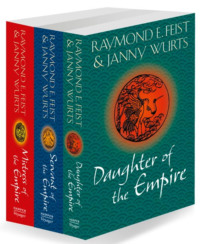
Kitabı oku: «The Complete Empire Trilogy: Daughter of the Empire, Mistress of the Empire, Servant of the Empire»
RAYMOND E. FEIST
and
JANNY WURTS
The Empire Trilogy
Daughter of the Empire
Servant of the Empire
Mistress of the Empire


Copyright
This novel is entirely a work of fiction. The names, characters and incidents portrayed in it are the work of the author’s imagination. Any resemblance to actual persons, living or dead, events or localities is entirely coincidental.
HarperVoyager An imprint of HarperCollinsPublishers Ltd. 1 London Bridge Street London SE1 9GF
www.harpercollins.co.uk
First published in Great Britain by
Grafton Books 1987
Daughter of the Empire First published in Great Britain by Grafton Books 1987
Copyright © Raymond E. Feist and Janny Wurts 1987
Servant of the Empire First published in Great Britain by Grafton Books 1990
Copyright © Raymond E. Feist and Janny Wurts 1990
Mistress of the Empire First published in Great Britain by Grafton Books 1992
Copyright © Raymond E. Feist and Janny Wurts 1992
The Authors assert the moral right to be identified as the authors of this work
A catalogue record for this book is available from the British Library
All rights reserved under International and Pan-American Copyright Conventions. By payment of the required fees, you have been granted the nonexclusive, nontransferable right to access and read the text of this ebook on screen. No part of this text may be reproduced, transmitted, downloaded, decompiled, reverse engineered, or stored in or introduced into any information storage and retrieval system, in any form or by any means, whether electronic or mechanical, now known or hereinafter invented, without the express written permission of HarperCollins ebooks
HarperCollinsPublishers has made every reasonable effort to ensure that any picture content and written content in this ebook has been included or removed in accordance with the contractual and technological constraints in operation at the time of publication
Ebook Edition © MARCH 2013 ISBN: 9780007518760
Version: 2018-5-14
Table of Contents
Cover
Title Page
Copyright
Daughter of the Empire
Servant of the Empire
Mistress of the Empire
About the Author
Also by the Author
About the Publisher

RAYMOND E. FEIST
and
JANNY WURTS
Daughter of the Empire
Book One of the Empire Trilogy
This book is dedicated to
Harold Matson
with deep appreciation, respect, and affection
Table of Contents
Cover
Title Page
Dedication
Map
Chapter One: Lady
Chapter Two: Evaluations
Chapter Three: Innovations
Chapter Four: Gambits
Chapter Five: Bargain
Chapter Six: Ceremony
Chapter Seven: Wedding
Chapter Eight: Heir
Chapter Nine: Snare
Chapter Ten: Warlord
Chapter Eleven: Renewal
Chapter Twelve: Risks
Chapter Thirteen: Seduction
Chapter Fourteen: Acceptance
Chapter Fifteen: Arrival
Chapter Sixteen: Funeral
Chapter Seventeen: Revenge
Acknowledgements
Map

• Chapter One • Lady
The priest struck the gong.
The sound reverberated off the temple’s vaulted domes, splendid with brightly coloured carvings. The solitary note echoed back and forth, diminishing to a remembered tone, a ghost of sound.
Mara knelt, the cold stones of the temple floor draining the warmth from her. She shivered, though not from chill, then glanced slightly to the left, where another initiate knelt in a pose identical to her own, duplicating Mara’s movements as she lifted the white head covering of a novice of the Order of Lashima, Goddess of the Inner Light. Awkwardly posed with the linen draped like a tent above her head, Mara impatiently awaited the moment when the headdress could be lowered and tied. She had barely lifted the cloth and already the thing dragged at her arms like stone weights! The gong sounded again. Reminded of the goddess’s eternal presence, Mara inwardly winced at her irreverent thoughts. Now, of all times, her attention must not stray. Silently she begged the goddess’s forgiveness, pleading nerves – fatigue and excitement combined with apprehension. Mara prayed to the Lady to guide her to the inner peace she so fervently desired.
The gong chimed again, the third ring of twenty-two, twenty for the gods, one for the Light of Heaven, and one for the imperfect children who now waited to join in the service of the Goddess of Wisdom of the Upper Heaven. At seventeen years of age, Mara prepared to renounce the temporal world, like the girl at her side who – in another nineteen chimings of the gong – would be counted her sister, though they had met only two weeks before.
Mara considered her sister-to-be: Ura was a foul-tempered girl from a clanless but wealthy family in Lash Province while Mara was from an ancient and powerful family, the Acoma. Ura’s admission to the temple was a public demonstration of family piety, ordered by her uncle, the self-styled family Lord, who sought admission into any clan that would take his family. Mara had come close to defying her father to join the order. When the girls had exchanged histories at their first meeting, Ura had been incredulous, then almost angry that the daughter of a powerful Lord should take eternal shelter behind the walls of the order. Mara’s heritage meant clan position, powerful allies, an array of well-positioned suitors, and an assured good marriage to a son of another powerful house. Her own sacrifice, as Ura called it, was made so that later generations of girls in her family would have those things Mara chose to renounce. Not for the first time Mara wondered if Ura would make a good sister of the order. Then, again not for the first time, Mara questioned her own worthiness for the Sisterhood.
The gong sounded, deep and rich. Mara closed her eyes a moment, begging for guidance and comfort. Why was she still plagued with doubts? After eighteen more chimes, family, friends, and the familiar would be forever lost. All her past life would be put behind, from earliest child’s play to a noble daughter’s concern over her family’s role within the Game of the Council, that never-ending struggle for dominance which ordered all Tsurani life. Ura would become her sister, no matter the differences in their heritage, for within the Order of Lashima none recognized personal honour or family name. There would remain only service to the goddess, through chastity and obedience.
The gong rang again, the fifth stroke. Mara peeked up at the altar atop the dais. Framed beneath carved arches, six priests and priestesses knelt before the statue of Lashima, her countenance unveiled for the initiation. Dawn shone through the lancet windows high in the domes, the palest glow reaching like fingers through the half-dark temple. The touch of sunrise seemed to caress the goddess, softening the jewel-like ceremonial candles that surrounded her. How friendly the lady looked in morning’s blush, Mara thought. The Lady of Wisdom gazed down with a half-smile on her chiselled lips, as if all under her care would be loved and protected, finding inner peace. Mara prayed this would be true. The only priest not upon his knees again rang the gong. Metal caught the sunlight, a splendid burst of gold against the dark curtain that shrouded the entrance to the inner temple. Then, as the dazzling brilliance faded, the gong rang again.
Fifteen more times it would be struck. Mara bit her lip, certain the kind goddess would forgive a momentary lapse. Her thoughts were like flashing lights from broken crystals, dancing about here and there, never staying long in one place. I’m not very good material for the Sisterhood, Mara confessed, staring up at the statue. Please have patience with me, Lady of the Inner Light. Again she glanced at her companion; Ura remained still and quiet, eyes closed. Mara determined to imitate her companion’s behaviour outwardly, even if she couldn’t find the appropriate calm within. The gong sounded once more.
Mara sought that hidden centre of her being, her wal, and strove to put her mind at rest. For a few minutes she found herself successful. Then the beat of the gong snatched her back to the present. Mara shifted her weight slightly, rejecting irritation as she tried to ease her aching arms. She fought an urge to sigh. The inner calm taught by the sisters who had schooled her through her novitiate again eluded her grasp, though she had laboured at the convent for six months before being judged worthy of testing here in the Holy City by the priests of the High Temple.
Again the gong was struck, as bold a call as the horn that had summoned the Acoma warriors into formation. How brave they all had looked in their green enamelled armour, especially the officers with their gallant plumes, on the day they left to fight with the Warlord’s forces. Mara worried over the progress of the war upon the barbarian world, where her father and brother fought. Too many of the family’s forces were committed there. The clan was split in its loyalty within the High Council, and since no single family clearly dominated, blood politics bore down heavily upon the Acoma. The families of the Hadama Clan were united in name only, and a betrayal of the Acoma by distant cousins who sought Minwanabi favour was not outside the realm of possibility. Had Mara a voice in her father’s counsel, she would have urged a separation from the War Party, even perhaps an alliance with the Blue Wheel Party, who feigned interest only in commerce while they quietly worked to balk the power of the Warlord …
Mara frowned. Again her mind had been beguiled by worldly concerns. She apologized to the goddess, then pushed away thoughts of the world she was leaving behind.
Mara peeked as the gong rang again. The stone features of the goddess now seemed set in gentle rebuke; virtue began with the individual, she reminded. Help would come only to those who truly searched for enlightenment. Mara lowered her eyes.
The gong reverberated and through the dying shiver of harmonics another sound intruded, a disturbance wholly out of place. Sandals scuffed upon stone in the antechamber, accompanied by the dull clank of weapons and armour. Outside the curtain an attending priest challenged in a harsh whisper, ‘Stop, warrior! You may not enter the inner temple now! It is forbidden!’
Mara stiffened. A chilling prescience passed through her. Beneath the shelter of the tented headcloth, she saw the priests upon the dais rise up in alarm. They turned to face the intruder, and the gong missed its beat and fell silent.
The High Father Superior moved purposefully towards the curtain, his brow knotted in alarm. Mara shut her eyes tightly. If only she could plunge the outside world into darkness as easily, then no one would be able to find her. But the sound of footfalls ceased, replaced by the High Father Superior’s voice. ‘What cause have you for this outrage, warrior! You violate a most holy rite.’
A voice rang out. ‘We seek the Lady of the Acoma!’
The Lady of the Acoma. Like a cold knife plunged into the pit of her stomach, the words cut through Mara’s soul. That one sentence forever changed her life. Her mind rebelled, screaming denial, but she willed herself to remain calm. Never would she shame her ancestors by a public display of grief. She controlled her voice as she slowly rose to her feet. ‘I am here, Keyoke.’
As one, the priests and priestesses watched the High Father Superior cross to stand before Mara. The embroidered symbols on his robes of office flashed fitfully as he beckoned to a priestess, who hastened to his side. Then he looked into Mara’s eyes and read the contained pain hidden there. ‘Daughter, it is clear Our Mistress of Wisdom has ordained another path for you. Go with her love and in her grace, Lady of the Acoma.’ He bowed slightly.
Mara returned his bow, then surrendered her head covering to the priestess. Oblivious to Ura’s sigh of envy, she turned at last to face the bearer of those tidings which had changed her life.
Just past the curtain, Keyoke, Force Commander of the Acoma, regarded his mistress with weary eyes. He was a battle-scarred old warrior, erect and proud despite forty years of loyal service. He stood poised to step to the girl’s side, provide a steadying arm, perhaps even shield her from public view should the strain prove too much.
Poor, ever-loyal Keyoke, Mara thought. This announcement had not come easily for him either. She would not disappoint him by shaming her family. Faced with tragedy, she maintained the manner and dignity required of the Lady of a great house.
Keyoke bowed as his mistress approached. Behind him stood the tall and taciturn Papewaio, his face as always an unreadable mask. The strongest warrior in the Acoma retinue, he served as both companion and body servant to Keyoke. He bowed and held aside the curtain for Mara as she swept past.
Mara heard both fall into step, one on each side, Papewaio one pace behind, correct in form to the last detail. Without words she led them from the inner temple, under the awning that covered the garden court separating the inner and outer temples. They entered the outer temple, passing between giant sandstone columns that rose to the ceiling. Down a long hall they marched, past magnificent frescos depicting tales of the goddess Lashima. Desperately attempting to divert the pain that threatened to overwhelm her, Mara remembered the story each picture represented: how the goddess outwitted Turakamu, the Red God, for the life of a child; how she stayed the wrath of Emperor Inchonlonganbula, saving the city of Migran from obliteration; how she taught the first scholar the secret of writing. Mara closed her eyes as they passed her favourite: how, disguised as a crone, Lashima decided the issue between the farmer and his wife. Mara turned her eyes from these images, for they belonged to a life now denied her.
All too soon she reached the outer doors. She paused a moment at the top of the worn marble stairs. The courtyard below held a half company of guards in the bright green armour of the Acoma. Several showed freshly bandaged wounds, but all came to attention and saluted, fist over heart, as their Lady came into view. Mara swallowed fear: if wounded soldiers stood escort duty, the fighting must have been brutal indeed. Many brave warriors had died. That the Acoma must show such a sign of weakness made Mara’s cheeks burn with anger. Grateful for the temple robe that hid the shaking in her knees, she descended the steps. A litter awaited her at the bottom. A dozen slaves stood silently by until the Lady of the Acoma settled inside. Then Papewaio and Keyoke assumed position, one on each side. On Keyoke’s command, the slaves grasped the poles and lifted the litter on to sweating shoulders. Veiled by the light, embroidered curtain on either side of the litter, Mara sat stiffly as the soldiers formed up before and after their mistress.
The litter swayed slightly as the slaves started towards the river, threading an efficient course through the throng who travelled the streets of the Holy City. They moved past carts pulled by sluggish, six-legged needra and were passed in turn by running messengers and trotting porters with bundles held aloft on shoulder or head, hurrying their loads for clients who paid a premium for swift delivery.
The noise and bustle of commerce beyond the gates jolted Mara afresh; within the shelter of the temple, the shock of Keyoke’s appearance had not fully registered. Now she battled to keep from spilling tears upon the cushions of the litter as understanding overwhelmed her. She wanted not to speak, as if silence could hide the truth. But she was Tsurani, and an Acoma. Cowardice would not change the past, nor forever stave off the future. She took a breath. Then, drawing aside the curtain so she could see Keyoke, she voiced what was never in doubt.
‘They are both dead.’
Keyoke nodded curtly, once. ‘Your father and brother were both ordered into a useless assault against a barbarian fortification. It was murder.’ His features remained impassive, but his voice betrayed bitterness as he walked at a brisk pace beside his mistress.
The litter jostled as the slaves avoided a wagon piled with jomach fruit. They turned down the street towards the landing by the river while Mara regarded her clenched hands. With focused concentration, she willed her fingers to open and relax. After a long silence she said, ‘Tell me what happened, Keyoke.’
‘When the snows on the barbarian world melted we were ordered out, to stand against a possible barbarian assault.’ Armour creaked as the elderly warrior squared his shoulders, fighting off remembered fatigue and loss, yet his voice stayed matter-of-fact. ‘Soldiers from the barbarian cities of Zun and LaMut were already in the field, earlier than expected. Our runners were dispatched to the Warlord, camped in the valley in the mountains the barbarians call the Grey Towers. In the Warlord’s absence, his Subcommander gave the order for your father to assault the barbarian position. We –’
Mara interrupted. ‘This Subcommander, he is of the Minwanabi, is he not?’
Keyoke’s weathered face showed a hint of approval as if silently saying, you’re keeping your wits despite grief. ‘Yes. The nephew of Lord Jingu of the Minwanabi, his dead brother’s only son, Tasaio.’ Mara’s eyes narrowed as he continued his narrative. ‘We were grossly outnumbered. Your father knew this – we all knew it – but your father kept honour. He followed orders without question. We attacked. The Subcommander promised to support the right flank, but his troops never materialized. Instead of a coordinated charge with ours, the Minwanabi warriors held their ground, as if preparing for counterattack. Tasaio ordered they should do so.
‘But just as we were overwhelmed by a counterattack, support arrived from the valley, elements of the forces under the banner of Omechkel and Chimiriko. They had no hint of the betrayal and fought bravely to get us out from under the hooves of the barbarians’ horses. The Minwanabi attacked at this time, as if to repulse the counterattack. They arrived just as the barbarians retreated. To any who had not been there from the start, it was simply a poor meeting with the barbarian enemy. But the Acoma know it was Minwanabi treachery.’
Mara’s eyes narrowed, and her lips tightened; for an instant Keyoke’s expression betrayed concern that the girl might shame her father’s memory by weeping before tradition permitted. But instead she spoke quietly, her voice controlled fury. ‘So my Lord of the Minwanabi seized the moment and arranged for my father’s death, despite our alliance within the War Party?’
Keyoke straightened his helm. ‘Indeed, my Lady. Jingu of the Minwanabi must have ordered Tasaio to change the Warlord’s instructions. Jingu moves boldly; he would have earned Tasaio the Warlord’s wrath and a dishonourable death had our army lost that position to the barbarians. But Almecho needs Minwanabi support in the conquest, and while he is angry with Jingu’s nephew, he keeps silent. Nothing was lost. To outward appearances, it was simply a standoff, no victor. But in the Game of the Council, the Minwanabi triumph over the Acoma.’ For the first time in her life, Mara heard a hint of emotion in Keyoke’s voice. Almost bitterly, he said, ‘Papewaio and I were spared by your father’s command. He ordered us to remain apart with this small company – and charged us to protect you should matters proceed as they have.’ Forcing his voice back to its usual brisk tone, he added, ‘My Lord Sezu knew he and your brother would likely not survive the day.’
Mara sank back against the cushions, her stomach in knots. Her head ached and she felt her chest tighten. She took a long, slow breath and glanced out the opposite side of the litter, to Papewaio, who marched with a studied lack of expression. ‘And what do you say, my brave Pape?’ she asked. ‘How shall we answer this murder visited upon our house?’
Papewaio absently scratched at the scar on his jaw with his left thumb, as he often did in times of stress. ‘Your will, my Lady.’
The manner of the First Strike Leader of the Acoma was outwardly easy, but Mara sensed he wished to be holding his spear and unsheathed sword. For a wild, angry instant Mara considered immediate vengeance. At her word, Papewaio would assault the Minwanabi lord in his own chamber, in the midst of his army. Although the warrior would count it as an honour to die in the effort, she shunted away the foolish impulse. Neither Papewaio nor any other wearing the Acoma green could get within half a day’s march of the Minwanabi lord. Besides, loyalty such as his was to be jealously guarded, never squandered.
Removed from the scrutiny of the priests, Keyoke studied Mara closely. She met his gaze and held it. She knew her expression was grim and her face drawn and chalky, but she also knew she had borne up well under the news. Keyoke’s gaze returned forward, as he awaited his mistress’s next question or command.
A man’s attention, even an old family retainer’s, caused Mara to take stock of herself, without illusions, being neither critical nor flattering. She was a fair-looking young woman, not pretty, especially when she wrinkled her brow in thought or frowned in worry. But her smile could make her striking – or so a boy had told her once – and she possessed a certain appealing quality, a spirited energy, that made her almost vivacious at times. She was slender and lithe in movement, and that trim body had caught the eye of more than one son of a neighbouring house. Now one of those sons would likely prove a necessary ally to stem the tide of political fortune that threatened to obliterate the Acoma. With her brown eyes half-closed, she considered the awesome responsibility thrust upon her. She realized, with a sinking feeling, that the commodities of womankind – beauty, wit, charm, allure – must all now be put to use in the cause of the Acoma, along with whatever native intelligence the gods had granted her. She fought down the fear that her gifts were insufficient for the task; then, before she knew it, she was recalling the faces of her father and brother. Grief rose up within her, but she forced it back deep. Sorrow must keep until later.
Softly Mara said, ‘We have much to talk of, Keyoke, but not here.’ In the press of city traffic, enemies might walk on every side, spies, assassins, or informants in disguise. Mara closed her eyes against the terrors of imagination and the real world both. ‘We shall speak when only ears loyal to the Acoma may overhear.’ Keyoke grunted acknowledgement. Mara silently thanked the gods that he had been spared. He was a rock, and she would need such as he at her side.
Exhausted, Mara settled back into the cushions. She must arise above grief to ponder. Her father’s most powerful enemy, Lord Jingu of the Minwanabi, had almost succeeded in gaining one of his life’s ambitions: the obliteration of the Acoma. The blood feud between the Acoma and Minwanabi had existed for generations, and while neither house had managed to gain the upper hand, from time to time one or the other had to struggle to protect itself. But now the Acoma had been gravely weakened, and the Minwanabi were at the height of their power, rivalling even the Warlord’s family in strength. Jingu was already served by vassals, first among them the Lord of the Kehotara, whose power equalled that of Mara’s father. And as the star of the Minwanabi rose higher, more would ally with him.
For a long while Mara lay behind the fluttering curtains, to all appearances asleep. Her situation was bitterly clear. All that remained between the Lord of the Minwanabi and his goal was herself, a young girl who had been but ten chimes from becoming a sister of Lashima. That realization left a taste in her mouth like ash. Now, if she were to survive long enough to regain family honour, she must consider her resources and plot and plan, and enter the Game of the Council; and somehow she must find a way to thwart the will of the Lord of one of the Five Great Families of the Empire of Tsuranuanni.
Mara blinked and forced herself awake. She had dozed fitfully while the litter travelled the busy streets of Kentosani, the Holy City, her mind seeking relief from the stress of the day. Now the litter rocked gently as it was lowered to the docks.
Mara peeked through the curtains, too numb to find pleasure in the bustle of the throngs upon the dockside. When she had first arrived in the Holy City, she had been enthralled by the multi-coloured diversity found in the crowd, with people from every corner of the Empire upon every hand. The simple sight of household barges from cities up and down the river Gagajin had delighted her. Bedecked with banners, they rocked at their moorings like proudly plumed birds amid the barnyard fowl as busy commercial barges and traders’ boats scurried about them. Everything, the sights, the sounds, the smells, had been so different from her father’s estates – her estates now, she corrected herself. Torn by that recognition, Mara hardly noticed the slaves who toiled in the glaring sun, their sweating, near-naked bodies dusted with grime as they loaded bundled goods aboard the river barges. This time she did not blush as she had when she had first passed this way in the company of the sisters of Lashima. Male nudity had been nothing new to her; as a child she had played near the soldiers’ commons while the men bathed and for years she had swum with her brother and friends in the lake above the needra meadow. But seeing naked men after she had renounced the world of flesh seemed somehow to have made a difference. Being commanded to look away by the attending sister of Lashima had made her want to peek all the more. That day she had to will herself not to stare at the lean, muscled bodies.
But today the bodies of the slaves failed to fascinate, as did the cries of the beggars who called down the blessings of the gods on any who chose to share a coin with the less fortunate. Mara ignored the rivermen, who sauntered by with the swaggering gait of those who spent their lives upon the water, secretly contemptuous of land dwellers, their voices loud and edged with rough humour. Everything seemed less colourful, less vivid, less captivating, as she looked through eyes suddenly older, less given to seeing with wonder and awe. Now every sunlit façade cast a dark shadow. And in those shadows enemies plotted.
Mara left her litter quickly. Despite the white robe of a novice of Lashima, she bore herself with the dignity expected of the Lady of the Acoma. She kept her eyes forward as she moved towards the barge that would take her downriver, to Sulan-Qu. Papewaio cleared a path for her, roughly shoving common workers aside. Other soldiers moved nearby, brightly coloured guardians who conducted their masters from the barges to the city. Keyoke kept a wary eye upon them as he hovered near Mara’s side while they crossed the dock.
As her officers ushered her up the gangplank, Mara wished for a dark, quiet place in which to confront her own sorrow. But the instant she set foot upon the deck, the barge master hustled to meet her. His short red and purple robe seemed jarringly bright after the sombre dress of the priests and sisters in the convent. Jade trinkets clinked on his wrists as he bowed obsequiously and offered his illustrious passenger the finest accommodation his humble barge permitted, a pile of cushions under a central canopy, hung round by gauzy curtains. Mara allowed the fawning to continue until she had been seated, courtesy requiring such lest the man unduly lose face. Once settled, she let silence inform the barge master his presence was no longer required. Finding an indifferent audience to his babble, the man let fall the thin curtain, leaving Mara a tiny bit of privacy at last. Keyoke and Papewaio sat opposite, while the household guards surrounded the canopy, their usual alertness underscored by a grim note of battle-ready tension.
Seeming to gaze at the swirling water, Mara said, ‘Keyoke, where is my father’s … my own barge? And my maids?’
The old warrior said, ‘The Acoma barge is at the dock in Sulan-Qu, my Lady. I judged a night encounter with soldiers of the Minwanabi or their allies less likely if we used a public barge. The chance of surviving witnesses might help discourage assault by enemies disguised as bandits. And should difficulty visit us, I feared your maids might prove a hindrance.’ Keyoke’s eyes scanned the docks while he spoke. ‘This craft will tie up at night with other barges, so we will never be upon the river alone.’
Mara nodded, letting her eyes close a long second. Softly she said, ‘Very well.’ She had wished for privacy, something impossible to find on this public barge, but Keyoke’s concerns were well founded.
Lord Jingu might sacrifice an entire company of soldiers to destroy the last of the Acoma, certain he could throw enough men at Mara’s guards to overwhelm them. But he would only do so if he could assure himself of success, then feign ignorance of the act before the other Lords of the High Council. Everyone who played the Game of the Council would deduce who had authored such slaughter, but the forms must always be observed. One escaped traveller, one Minwanabi guard recognized, one chance remark overheard by a poleman on a nearby barge, and Jingu would be undone. To have his part in such a venal ambush revealed publicly would lose him much prestige in the council, perhaps signalling to one of his ‘loyal’ allies that he was losing control. Then he could have as much to fear from his friends as from his enemies. Such was the nature of the Game of the Council. Keyoke’s choice of conveyance might prove as much a deterrent to treachery as a hundred more men-at-arms.
• Chapter Two • Evaluations
Mara felt wetness upon her face.
Through the confusion of returning senses, she realized Papewaio was gently cradling her head in the crook of his arm as he moistened her face with a damp rag. Mara opened her mouth to speak, but her throat constricted. She coughed, then swallowed hard against the ache of injured neck muscles. She blinked, and struggled to organize her thoughts; but she knew only that her neck and throat hurt terribly and the sky above looked splendid beyond belief, its blue-green depths appearing to fade into the infinite. Then she moved her right hand; pain shot across her palm, jolting her to full memory.
Almost inaudibly she said, ‘The assassin?’
Papewaio inclined his head toward something sprawled by the reflecting pool. ‘Dead.’
Mara turned to look, ignoring the discomfort of her injuries. The corpse of the killer lay on one side, the fingers of one hand trailing in water discoloured with blood. He was short, reed-thin, of almost delicate build, and clad simply in a black robe and calf-length trousers. His hood and veil had been pulled aside, revealing a smooth, boyish face marked by a blue tattoo upon his left cheek – a hamoi flower stylized to six concentric circles of wavy lines. Both hands were dyed red to the wrists. Mara shuddered, still stinging from the violence of those hands upon her flesh.
Papewaio helped her to her feet. He tossed away the rag, torn from her rent garment, and handed her the white robe intended for the end of the ceremony. Mara clothed herself, ignoring the stains her injured hands made upon the delicately embroidered material. At her nod, Papewaio escorted her from the glade.
Mara followed the path, its familiarity no longer a comfort. The cruel bite of the stranger’s cord had forced her to recognize that her enemies could reach even to the heart of the Acoma estates. The security of her childhood was forever gone. The dark hedges surrounding the glade now seemed a haven for assassins, and the shade beneath the wide limbs of the ulo tree carried a chill. Rubbing the bruised and bloody flesh of her right hand, Mara restrained an impulse to bolt in panic. Though terrified like a thyza bird at the shadow of a golden killwing as it circles above, she stepped through the ceremonial gate with some vestige of the decorum expected of the Ruling Lady of a great house.
Nacoya and Keyoke waited just outside, with the estate gardener and two of his assistants. None spoke but Keyoke, who said only, ‘What?’
Papewaio replied with grim brevity. ‘As you thought. An assassin waited. Hamoi tong.’
Nacoya extended her arms, gathering Mara into hands that had soothed her hurts since childhood, yet for the first time Mara found little reassurance. With a voice still croaking from her near strangulation, she said, ‘Hamoi tong, Keyoke?’
‘The Red Hands of the Flower Brotherhood, my Lady. Hired murderers of no clan, fanatics who believe to kill or be killed is to be sanctified by Turakamu, that death is the only prayer the god will hear. When they accept a commission they vow to kill their victims or die in the attempt.’ He paused, while the gardener made an instinctive sign of protection: the Red God was feared. With a cynical note, Keyoke observed, ‘Yet many in power understand that the Brotherhood will offer their unique prayer only when the tong has been paid a rich fee.’ His voice fell to almost a mutter as he added, ‘And the Hamoi are very accommodating as to whose soul shall offer that prayer to Turakamu.’
‘Why had I not been told of these before?’
‘They are not part of the normal worship of Turakamu, mistress. It is not the sort of thing fathers speak of to daughters who are not heirs.’ Nacoya’s voice implied reprimand.
Though it was now too late for recriminations, Mara said, ‘I begin to see what you meant about needing to discuss many things right away.’ Expecting to be led away, Mara began to turn toward her quarters. But the old woman held her; too shaken to question, Mara obeyed the cue to remain.
Papewaio stepped away from the others, then dropped to one knee in the grass. The shadow of the ceremonial gate darkened his face, utterly hiding his expression as he drew his sword and reversed it, offering the weapon hilt first to Mara. ‘Mistress, I beg leave to take my life with the blade.’
For a long moment Mara stared uncomprehendingly. ‘What are you asking?’
‘I have trespassed into the Acoma contemplation glade, my Lady.’
Overshadowed by the assassination attempt, the enormity of Papewaio’s act had not registered upon Mara until this instant. He had entered the glade to save her, despite the knowledge that such a transgression would earn him a death sentence without appeal.
As Mara seemed unable to respond, Keyoke tried delicately to elaborate on Pape’s appeal. ‘You ordered Jican, Nacoya, and myself not to accompany you to the glade, Lady. Papewaio was not mentioned. He hid himself near the ceremonial gate; at the sound of a struggle he sent the gardener to fetch us, then entered.’
The Acoma Force Commander granted his companion a rare display of affection; for an instant the corners of his mouth turned up, as if he acknowledged victory after a difficult battle. Then his hint of a smile vanished. ‘Each one of us knew such an attempt upon you was only a matter of time. It is unfortunate that the assassin chose this place; Pape knew the price of entering the glade.’
Keyoke’s message to Mara was clear: Papewaio had affronted Mara’s ancestors by entering the glade, earning himself a death sentence. But not to enter would have entailed a fate far worse. Had the last Acoma died, every man and woman Papewaio counted a friend would have become houseless persons, little better than slaves or outlaws. No warrior could do other than Papewaio had done; his life was pledged to Acoma honour. Keyoke was telling Mara that Pape had earned a warrior’s death, upon the blade, for choosing life for his mistress and all those he loved at the cost of his own life. But the thought of the staunch warrior dying as a result of her own naïveté was too much for Mara. Reflexively she said, ‘No.’
Assuming this to mean he was denied the right to die without shame, Papewaio bent his head. Black hair veiled his eyes as he flipped his sword, neatly, with no tremor in his hands, and drove the blade into the earth at his Lady’s feet. Openly regretful, the gardener signalled his two assistants. Carrying rope, they hurried forward to Papewaio’s side. One began to bind Papewaio’s hands behind him while the other tossed a long coil of rope over a stout tree branch.
For a moment Mara was without comprehension, then understanding struck her: Papewaio was being readied for the meanest death, hanging, a form of execution reserved for criminals and slaves. Mara shook her head and raised her voice. ‘Stop!’
Everyone ceased moving. The assistant gardeners paused with their hands half-raised, looking first to the head gardener, then to Nacoya and Keyoke, then to their mistress. They were clearly reluctant to carry out this duty, and confusion over their Lady’s wishes greatly increased their discomfort.
Nacoya said, ‘Child, it is the law.’
Gripped by an urge to scream at them all, Mara shut her eyes. The stress, her mourning, the assault, and now this rush to execute Papewaio for an act caused by her irresponsible behaviour came close to overwhelming her. Careful not to burst into tears, Mara answered firmly. ‘No … I haven’t decided.’ She looked from face to impassive face and added, ‘You will all wait until I do. Pape, take up your sword.’
Her command was a blatant flouting of tradition; Papewaio obeyed in silence. To the gardener, who stood fidgeting uneasily, she said, ‘Remove the assassin’s body from the glade.’ With a sudden vicious urge to strike at something, she added, ‘Strip it and hang it from a tree beside the road as a warning to any spies who may be near. Then cleanse the natami and drain the pool; both have been defiled. When all is returned to order, send word to the priests of Chochocan to come and reconsecrate the grove.’
Though all watched with unsettled eyes, Mara turned her back. Nacoya roused first. With a sharp click of her tongue, she escorted her young mistress into the cool quiet of the house. Papewaio and Keyoke looked on with troubled thoughts, while the gardener hurried off to obey his mistress’s commands.
The two assistant gardeners coiled the ropes, exchanging glances. The ill luck of the Acoma had not ended with the father and the son, so it seemed. Mara’s reign as Lady of the Acoma might indeed prove brief, for her enemies would not rest while she learned the complex subtleties of the Game of the Council. Still, the assistant gardeners seemed to silently agree, such matters were in the hands of the gods, and the humble in life were always carried along in the currents of the mighty as they rose and fell. None could say such a fate was cruel or unjust. It simply was.
The moment the Lady of the Acoma reached the solitude of her quarters, Nacoya took charge. She directed servants who bustled with subdued efficiency to make their mistress comfortable. They prepared a scented bath while Mara rested on cushions, absently fingering the finely embroidered shatra birds that symbolized her house. One who did not know her would have thought her stillness the result of trauma and grief; but Nacoya observed the focused intensity of the girl’s dark eyes and was not fooled. Tense, angry, and determined, Mara already strove to assess the far-reaching political implications of the attack upon her person. She endured the ministrations of her maids without her usual restlessness, silent while the servants bathed her and dressed her wounds. A compress of herbs was bound around her bruised and lacerated right hand. Nacoya hovered anxiously by while Mara received a vigorous rub by two elderly women who had ministered to Lord Sezu in the same manner. Their old fingers were surprisingly strong; knots of muscular tension were sought out and gradually kneaded away. Afterwards, clothed in clean robes, Mara still felt tired, but the attentions of the old women had eased away nervous exhaustion.
Nacoya brought chocha, steaming in a fine porcelain cup. Mara sat before a low stone table and sipped the bitter drink, wincing slightly as the liquid aggravated her bruised throat. In the grove she had been too shocked by the attack to feel much beyond a short burst of panic and fear. Now she was surprised to discover herself too wrung out to register any sort of reaction. The slanting light of afternoon brightened the paper screens over the windows, as it had throughout her girlhood. Far off, she could hear the whistles of the herdsmen in the needra meadows, and near at hand, Jican’s voice reprimanding a house slave for clumsiness. Mara closed her eyes, almost able to imagine the soft scratch of the quill pen her father had used to draft instructions to distant subordinates; but Minwanabi treachery had ended such memories forever. Reluctantly Mara acknowledged the staid presence of Nacoya.
The old nurse seated herself on the other side of the table. Her movements were slow, her features careworn. The delicate seashell ornaments that pinned her braided hair were fastened slightly crooked, as reaching upwards to fix the pin correctly became more difficult with age. Although only a servant, Nacoya was well versed in the arts and subtlety of the Game of the Council. She had served at the right hand of Lord Sezu’s lady for years, then raised his daughter after the wife’s death in childbirth. The old nurse had been like a mother to Mara. Sharply aware that the old nurse was waiting for some comment, the girl said, ‘I have made some grave errors, Nacoya.’
The nurse returned a curt nod. ‘Yes, child. Had you granted time for preparation, the gardener would have inspected the grove immediately before you entered. He might have discovered the assassin, or been killed, but his disappearance would have alerted Keyoke, who could have had warriors surround the glade. The assassin would have been forced to come out or starve to death. Had the Hamoi murderer fled the gardener’s approach and been lurking outside, your soldiers would have found his hiding place.’ The nurse’s hands tightened in her lap, and her tone turned harsh. ‘Indeed, your enemy expected you to make mistakes … as you did.’
Mara accepted the reproof, her eyes following the lazy curls of steam that rose from her cup of chocha. ‘But the one who sent the killer erred as much as I.’
‘True.’ Nacoya squinted, forcing farsighted vision to focus more clearly upon her mistress. ‘He chose to deal the Acoma a triple dishonour by killing you in your family’s sacred grove, and not honourably with the blade, but by strangulation, as if you were a criminal or slave to die in shame!’
Mara said, ‘But as a woman –’
‘You are Ruling Lady,’ snapped Nacoya. Lacquered bracelets clashed as she thumped fists on her knee in a timeworn gesture of disapproval. ‘From the moment you assumed supremacy in this house, child, you became as a man, with every right and privilege of rulership. You wield the powers your father did as Lord of the Acoma. And for this reason, your death by the strangler’s cord would have visited as much shame on your family as if your father or brother had died in such fashion.’
Mara bit her lip, nodded, and dared another sip of her chocha. ‘The third shame?’
‘The Hamoi dog certainly intended to steal the Acoma natami, forever ending your family’s name. Without clan or honour, your soldiers would have become grey warriors, outcasts living in the wilds. All of your servants would have finished their lives as slaves.’ Nacoya ended in bitterness. ‘Our Lord of the Minwanabi is arrogant.’
Mara placed her chocha cup neatly in the centre of the table. ‘So you think Jingu responsible?’
‘The man is drunk with his own power. He stands second only to the Warlord in the High Council now. Should fate remove Almecho from his throne of white and gold, a Minwanabi successor would assuredly follow. The only other enemy of your father’s who would wish your ruin is the Lord of the Anasati. But he is far too clever to attempt such a shameful assault – so badly done. Had he sent the Hamoi murderer, his instructions would have been simple: your death by any means. A poison dart would have struck from hiding, or a quick blade between the ribs, then quickly away to carry word of your certain death.’
Nacoya nodded with finality, as if discussion had confirmed her convictions. ‘No, our Lord of the Minwanabi may be the most powerful man in the High Council, but he is like an enraged harulth, smashing down trees to trample a gazen.’ She raised spread fingers, framing the size of the timid little animal she had named. ‘He inherited his position from a powerful father, and he has strong allies. The Lord of the Minwanabi is cunning, not intelligent.
‘The Lord of the Anasati is both cunning and intelligent, one to be feared.’ Nacoya made a weaving motion with her hand. ‘He slithers like the relli in the swamp, silent, stealthy, and he strikes without warning. This murder was marked as if the Minwanabi lord had handed the assassin a warrant for your death with his own family chop affixed to the bottom.’ Nacoya’s eyes narrowed in thought. ‘That he knows you’re back this quickly speaks well of his spies. We assumed he would not find out you were Ruling Lady for a few more days. For the Hamoi to have been sent so soon shows he knew you had not taken your vows from the instant Keyoke led you from the temple.’ She shook her head in self-reproach. ‘We should have assumed as much.’
Mara considered Nacoya’s counsel, while her cup of chocha cooled slowly on the table. Aware of her new responsibilities as never before, she accepted that unpleasant subjects could no longer be put off. Though dark hair curled girlishly around her cheeks, and the robe with its ornate collar seemed too big for her, she straightened with the resolve of a ruler. ‘I may seem like a gazen to the Lord of the Minwanabi, but now he has taught this eater of flowers to grow teeth for meat. Send for Keyoke and Papewaio.’
Her command roused the runner, a small, sandal-clad slave boy chosen for his fleetness; he sprang from his post by her doorway to carry word. The warriors arrived with little delay; both had anticipated her summons. Keyoke wore his ceremonial helm, the feather plumes denoting his office brushing the lintel of the doorway as he entered. Bare-headed, but nearly as tall, Papewaio followed his commander inside. He moved with the same grace and strength that had enabled him to strike down a killer only hours before; his manner betrayed not a single hint of concern over his unresolved fate. Struck by his proud carriage, and his more than usually impassive face, Mara felt the judgment she must complete was suddenly beyond her resources.
Her distress was in no way evident as the warriors knelt formally before her table. The green plumes of Keyoke’s helm trembled in the air, close enough for Mara to touch. She repressed a shiver and gestured for the men to sit. Her maidservant offered hot chocha from the pot, but only Keyoke accepted. Papewaio shook his head once, as though he trusted his bearing better than his voice.
Mara said, ‘I have erred. I will seek to avoid such error again –’ She paused sharply, frowned, and made a nervous gesture that the sisters of Lashima had striven to eliminate. ‘No,’ said Mara, ‘I must do better than that, for at the temple I learned that my impatience sometimes undoes my judgement. Keyoke, between us there must be a hand signal, to be used in times when my life, or the Acoma existence, may be threatened in ways I may not understand. Then perhaps the folly of this day’s events may never be repeated.’
Keyoke nodded, his scarred face impassive, but his manner suggesting approval. After a moment of thought, he ran the knuckle of his index finger along an old scar that creased his jaw. ‘Lady, would you recognize this gesture as such a warning, even in a crowded or public place?’
Mara nearly smiled. Keyoke had chosen a nervous habit of Papewaio’s, his only outward sign of tension. Keyoke never fidgeted; through danger or stress, and even in battle, she supposed, her Force Commander never lost control. If he scratched a scar in her presence, she would notice, and hopefully take heed. ‘Very good. So be it, Keyoke.’
A strained silence developed as Mara shifted her regard to the other warrior before her. ‘My brave Pape, had I not erred in one instance, I would now be dead and all our holdings and retainers left without a mistress.’ Wishing the moment of judgment could be delayed, the girl added, ‘Had I but said let none follow me to the grove …’ Her sentence trailed off, unfinished. All knew that her command would have been obeyed to the letter; duty would have compelled Papewaio to remain in the manor, leaving his mistress to fate’s choices.
Mara said, ‘Now one of my most valued retainers must forfeit his life for loyal and honourable service to his house.’
‘Such is the law,’ Keyoke observed, revealing no hint of sorrow or anger. Relieved that Mara had the strength to do her duty, his plumes of office stilled above his immobile features.
Mara sighed. ‘I expect there is no other way.’
‘None, child,’ said Nacoya. ‘You must specify the manner and time of Pape’s death. You may allow him to fall upon his own sword, though, granting him a warrior’s honour, to die by the blade. He deserves that, at least, mistress.’
Mara’s dark eyes flashed; angry at having to waste such a stalwart servant, she knitted her brows in thought. Nothing was said for a time, then, abruptly, she announced, ‘I think not.’
Keyoke seemed on the verge of speaking, then simply nodded, while Papewaio rubbed his jaw with one thumb, his familiar sign of distress. Shaken by the gesture, Mara continued quickly. ‘My sentence is this: loyal Pape, that you will die is certain. But I shall decide the place and the circumstance of that death in my own time. Until then you shall serve as you always have. Around your head wear the black rag of the condemned, that all may know I have pronounced death upon you.’
Papewaio nodded once. ‘Your will, mistress.’
Mara added, ‘And should fate cause my death before yours, you may fall upon your own blade … or seek to visit revenge upon my murderer, as you see fit.’ She was certain which course Pape would choose. Now, until she selected the time and manner of execution, Papewaio would remain in her service.
Mara regarded her three most loyal followers, half-fearful her unorthodox judgment might be challenged. But duty and custom demanded unquestioned obedience, and no one met her glance. Hoping she had acted with honour, Mara said, ‘Go now, and freely attend your duties.’
Keyoke and Papewaio rose at once. They bowed with stiff-backed formality, turned, and departed. Old and slow of movement, Nacoya performed her obeisance with less grace. She straightened, a hint of approval on her wizened face. ‘That was well done, daughter of Sezu,’ she whispered. ‘You save Pape’s honour and preserve a most loyal servant. He will wear the black rag of shame as if it were a badge of honour.’ Then, as if embarrassed by her boldness, the old nurse left hastily.
The house servant who hovered by the door had to speak twice before Mara noticed her. ‘As my mistress needs?’
Wrung out by the emotions and tensions of the afternoon, the Lady of the Acoma looked up. By the expectant look on the servant’s face, she realized the afternoon had passed. Blue shadows dappled the door screens, lending a moody, sombre air to the decorative paintings of huntsmen. Longing for the simplicity of her girlhood, Mara decided to forego the formality of the evening meal. Tomorrow was soon enough to face the fact that she must sit in her father’s place at the head of the table. She said to the maidservant, ‘Let the evening breezes in, then withdraw.’
The servant hastened to obey her wishes and slid open the large outer screens that faced the west. The orange sun hung low, kissing the purple edge of the horizon. Red-gold light burnished the marshes where the shatra birds flocked at eventide. Even as Mara watched, the ungainly creatures exploded into flight. Within minutes the sky was covered with silhouettes of grace and elegance, whirling across clouds fired with scarlet and pink, and indigo before the approach of night. No man understood the reason for this splendid group dance upon the wing, but the sight was majestic. Though Mara had watched the display a thousand times through girlhood, the birds still took her breath away. She did not notice the tiptoe departure of the maidservant but for the better part of an hour sat absorbed as flocks numbering in the thousands gathered to wheel and turn, bank and glide, while the light slowly faded. The birds landed as the sun vanished. In the silvery twilight they gathered in the marshes, clustered tightly to baffle predators while they slept.
House servants returned in the warm, sweet hour of nightfall, bringing oil for the lamps and hot herb tea. But exhaustion had overtaken Mara at last. They found her asleep amid her cushions, lulled by the familiar sounds of herders driving the needra into shelter. In the distance the sad song of a kitchen slave kneading thyza bread for the morning meal was a soft counterpoint to the faint calls of Keyoke’s sentries as they patrolled the grounds to ensure the safety of Acoma’s newest Lady.
Accustomed to temple discipline, Mara awoke early. She blinked, at first confused by her surroundings; then the rich coverlet thrown over her sleeping mat reminded her: she lay in her father’s chamber as Ruling Lady of the Acoma. Rested, but still aching from the bruises left by the Minwanabi assassin, she rolled on her side. Luxuriant strands of hair caught in her lashes; impatiently she pushed them away.
Dawn brightened the screens that faced east. The whistle of a herder driving needra to pasture cut through daybreak’s chorus of bird calls. Made restless by memories, Mara arose.
Her maids did not hear her stir. Barefoot, and appreciative of the solitude, the girl crossed the chamber and slipped the catch on the screen. She slid it aside with the barest of squeaks. Cool air caressed her skin between the loose folds of her robe. Mara drew in the scent of dew, and moist earth, and the delicate perfume of akasi flowers. Mist rose off the marshlands, rendering the trees and hedges in tones of charcoal, and there the lone silhouette of a herdsman driving the slow-moving needra.
The soldier at his post in the dooryard turned about on his beat, and realized the girl who stood in the white shift and sleep-tangled hair was his ruling mistress. He bowed gravely. Mara nodded absently as he returned to his duty. The girl regarded the wide expanse of her family estates, in a morning as yet unmarred by the noise and bustle of the day. Shortly all who worked upon the estate would be busy about their tasks, and for only a few minutes longer would Mara have this serene glimpse of what was now hers to protect. Her brows knitted in concern as she realized how much she had to learn to manage these holdings. At present she didn’t even know the extent of her inheritance. She knew vaguely that she had properties in other provinces, but she had no knowledge of their disposition and worth. Her father had disliked the details of farming and stock breeding, and while he had overseen his assets and his people’s well-being with wisdom, his conversations with Mara had always been turned to matters of his liking, and of a lighter nature.
When the maid called softly from the doorway of the chamber, Mara shut the screen. ‘I shall dress and breakfast at once,’ she instructed. ‘Then I will see this new hadonra, Jican, in the study.’
The maid bowed and hastened to the wardrobe, while Mara shook the tangles from her hair. Denied the comfort of servants in the temple, Mara reached automatically for her brush.
‘My Lady, don’t I please you?’ The young maid’s bearing revealed distress.
Mara frowned, annoyed by her thoughtless lapse. ‘You please me well enough.’ She surrendered the hairbrush and sat still as the serving girl began to tend her hair. As the maid worked, Mara conceded to herself that her decision to see Jican was as much to avoid Nacoya as to learn more of her estates. The old nurse had a natural tendency to be grumpy in the early morning. And beyond her normal ill temper, Nacoya would have volumes to say to the young girl on her responsibilites as Ruling Lady.
Mara sighed, and the maid paused, waiting for some indication from her Lady if there was a problem. When Mara said nothing, the girl continued, tentatively, as if fearing her Lady’s disapproval. Mara mulled over the questions for Jican, knowing that eventually she would have to contend with Nacoya’s scolding manner. Again she sighed, much as she had when facing one of Nacoya’s punishments for some girlish prank, and again, the maid halted to see if her mistress was displeased. After a momentary pause, the girl resumed arranging her mistress’s hair, and Mara became caught up in the questions of estate management.
Later, dressed and groomed, Mara sat with her elbow propped in a mound of cushions. Her lip was pinched between her teeth in concentration as she reviewed the latest of a sizeable heap of scrolls. Small, sun-bronzed, and nervous as a thyza bird, the hadonra, Jican, looked over her shoulder. Presently he extended a tentative finger.
‘The profits are listed there, my Lady. As you note, they are respectable.’
‘I see that, Jican.’ Mara laid the scroll on her knees as Nacoya ducked her head around the door. ‘I am busy, Nacoya. I will see you shortly, perhaps at noon.’
The old nurse shook her head, her hairpins as crooked as ever. ‘By my lady’s leave, it is now an hour past noon.’
Mara raised her brows in surprise. She sympathized with her father’s impatience with the management of his far-flung holdings. The task was more involved than she had suspected. Yet, unlike her father, she found the intricacies of finance fascinating. With a rueful smile at Nacoya’s impatience, the Lady of the Acoma said, ‘I lost track of time. But Jican is nearly finished. You may wait if you wish.’
Nacoya jerked her head in the negative. ‘Too much to do, Lady. Send your runner for me when you are ready. But do not delay much longer. Decisions must be made, and tomorrow is too late to consider them.’
The nurse departed. Mara heard her pause to mutter to Keyoke, standing guard in the hallway beyond. Then, drawn back to Jican and her lesson in commerce, Mara reached for another scroll. This time she commented on the balance, without the hadonra’s needing to prompt. ‘We may lack warriors, Jican, but we are strong in property, perhaps even prosperous.’
‘It is not difficult, mistress. Sotamu left clear records of the years he served your father. I but follow his example. Thyza crops have been bountiful for three years, while the hwaet blight in the plains provinces has driven high the prices of all grain – thyza, ryge, maza, even milat. With hwaet scarce, only a lazy manager carts his thyza to Sulan-Qu and sells it there. It takes only a little more effort to deal with a factor from a consortium of grain shippers in the City of the Plains.’ The small man sighed in discomfort. ‘My Lady, I mean no disrespect to any of your lofty class, but I have known many powerful lords to dislike the details of business. Yet at the same time they refuse their hadonras and factors the authority to act independently. Therefore we have traded with large houses and avoided the merchants of the city whenever we might. This has left us large profits more often than not.’
‘It must work!’ Mara straightened in the darkness. ‘Else our pride will be much diminished. Asking security in exchange for marriage gains no honour, but only rewards those who plotted treachery against us. Our house would no longer be a major player in the Game of the Council, and the spirits of my ancestors would be unsettled. No, on this I think my father would say, “Safe is not always best.”’
Keyoke buckled his helm with the care he might have used preparing for battle. ‘As my Lady wills. But I don’t envy the task of explaining what you propose to Nacoya.’ He bowed, rose, and strode to the outer screen.
He slipped the catch and stepped out. Moonlight drenched the flower beds in gilt. Silhouetted against their brightness, the Force Commander’s shoulders seemed straighter, his carriage the slightest bit less strained. With relief, Mara perceived that Keyoke welcomed a warrior’s solution to Acoma troubles. He had agreed to risk her plan rather than see her bind the family through marriage to the mercy of a stronger house. She unlinked sweating fingers, afraid and exhilarated at the same time.
‘I’ll marry on my terms, or not at all,’ she murmured to the night. Then she lay back on her cushions. Sleep came reluctantly. Memories of Lano tangled with thoughts of young, boastful sons of great houses, one of whom she must eventually choose as suitor.
Morning dawned hot. With a dry wind blowing from the south, moisture from the rainy season remained only in sheltered hollows, and the herders drove needra to pasture amid ochre clouds of dust. Mara broke her fast in the inner courtyard garden, beneath the generous shade of the trees. The trickle of water from an ornamental fountain soothed her where she sat, dressed in a high-collared robe of saffron. She seemed even younger than her seventeen years, her eyes too bright and her face shadowed with sleeplessness. Yet her voice, when she summoned Nacoya, was crisp with authority.
The old nurse arrived grouchy, as was usual for her in the morning. Mara’s summons had reached her while dressing, for her hair was hastily bound back, and her lips pressed thin with annoyance. She bowed briskly and said, ‘As my mistress wishes?’
The Lady of the Acoma gestured permission to sit. Nacoya declined; her knees pained her, and the hour was too early to argue with a headstrong girl whose stubbornness might lead the honour of her ancestors to ruin.
Mara smiled sweetly at her former nurse. ‘Nacoya, I have reconsidered your advice and seen wisdom in marriage to thwart our enemies’ plots. I ask that you prepare me a list of suitors whom you consider eligible, for I shall need guidance to choose a proper mate. Go now. I shall speak with you on the matter in due time.’
Nacoya blinked, obviously startled by this change of heart. Then her eyes narrowed. Surely such compliance masked some other intent, yet Tsurani ethics forbade a servant the right to question. Suspicious in the extreme, but unable to evade her dimissal, the old nurse bowed. ‘Your will, mistress, and may Lashima’s wisdom guide you.’
She shuffled out, muttering under her breath. Mara sipped chocha, the image of the titled Lady. Then, after an appropriate interval, she called softly to her runner. ‘Send for Keyoke, Papewaio, and Jican.’
The two warriors arrived before her cup was empty, Keyoke in his battle armour, resplendently polished; Papewaio also was armed for action, the black headband of the condemned tied as neatly as the sash from which hung his sword. As Nacoya had guessed, he carried himself like a man awarded an honour token for bravery. His expression was otherwise unchanged. In her entire life there were few things as constant as Papewaio, thought Mara.
She nodded to the servant with the chocha pot, and this time Pape accepted a mug of the steaming drink.
Keyoke sipped his chocha without removing his helm, sure sign he was pondering strategy. ‘All is ready, mistress. Pape oversaw dispensation of weapons and armour, and Strike Leader Tasido oversees the drill. So long as no fighting occurs, your warriors should give a convincing appearance.’
‘Well enough.’ Too nervous to finish her chocha, Mara laid sweating hands in her lap. ‘All we need now is Jican, that the bait may be prepared.’
The hadonra reached the garden at that moment. He bowed, breathless and sweating, as he had come in haste. His clothing was dusty, and he still carried the needra tally he had been marking as the herds were driven to pasture. ‘My apologies, mistress, for my soiled appearance. By your own command, the herders and slaves –’
‘I know, Jican,’ Mara cut in. ‘Your honour is no less, and your devotion to duty is admirable. Now, have we crops and goods in the store sheds to mount a trading caravan?’
Startled by the praise and a wholly unexpected shift of topic, the hadonra squared his shoulders. ‘We have six wagonloads of thyza of poor quality that were held back to fatten the needra, though the ones not bearing can do well enough without. The last calves were weaned two days ago. We have some hides suitable to be sold to the harness makers.’ Jican shifted his weight, careful to hide his puzzlement. ‘The caravan would be very small. Neither the grain nor the goods would realize significant profit.’ He bowed deferentially. ‘My mistress would do better to wait until the marketable produce comes in season.’
Mara ignored the suggestion. ‘I want a small caravan prepared.’
‘Yes, mistress.’ The hadonra’s fingers whitened on the edge of the tally slate. ‘I shall send word to our agent in Sulan-Qu –’
‘No, Jican.’ Turning brusquely, Mara rose and crossed to the rim of the fountain. She extended her hand, letting water spill like jewels through her fingers. ‘I wish this caravan to travel to Holan-Qu.’
Jican directed a startled glance at Keyoke, but saw no hint of disapproval on the Force Commander’s lined face. Nervous, nearly pleading, he urged, ‘Mistress, I obey your desire, but your goods should still be sent to Sulan-Qu, then downriver and on from Jamar by ship.’
‘No.’ Droplets dashed across marble tile as Mara closed her fist. ‘I wish the wagons to travel overland.’
Again Jican glanced at Keyoke; but the Force Commander and his bodyguard stood like sun-cured ulo wood, facing correctly forward. Struggling to master his agitation, the hadonra of the Acoma appealed to his mistress. ‘Lady, the mountain road is dangerous. Bandits lurk in the woods in good number, and we lack enough warriors to drive them out. To guard such a caravan would leave this estate unprotected. I must advise against it.’
With a girlish smile, Mara swung away from the fountain. ‘But the caravan shall not strip our defences. Papewaio will head a company of hand-picked men. A dozen of our better soldiers should be sufficient to keep the bandits away. They’ve raided our herds and will not need food, and wagons without large numbers of guards obviously carry goods of little value.’
Jican bowed, his narrow face immobile. ‘Then we would be wise to send no guards at all.’ His manner concealed sharp disbelief; he dared the dishonour of his mistress’s displeasure to dissuade her from folly.
‘No.’ Mara wrapped dripping fingers in the rich folds of her robe. ‘I require an honour guard.’
Jican’s face twisted with shock that vanished almost instantly. That his mistress intended to go along on this venture indicated that sorrow had stripped her of wits.
‘Go now, Jican,’ said Mara. ‘Attend to my commands.’
The hadonra peered sideways at Keyoke, as if certain the Lady’s demand would provoke protest. But the old Force Commander only shrugged slightly, as if to say, what is to be done?
Jican lingered, though honour forbade him to object. A stern look from Mara restored his humility. He bowed swiftly and departed, his shoulders drooping. Yesterday the Lady of the Acoma had deemed his judgement worthy of praise; now she seemed bereft of the instincts Lashima gave to a needra.
The servants in attendance kept proper silence, and Keyoke moved no muscle beneath the nodding plumes of his helm. Only Papewaio met his mistress’s eye. The creases at the corners of his mouth deepened slightly. For a moment he seemed about to smile, though all else about his manner remained formal and unchanged.
• Chapter Three • Innovations
Dust swirled.
The brisk breeze did nothing to cut the heat, and stinging grit made the needra snort. Wooden wheels squealed as the three wagons comprising Mara’s caravan grated over the gravel road. Slowly they climbed into the foothills, leaving behind the flatlands … and the borders of the Acoma estates. Brightly lacquered green spokes caught the sunlight, seeming to wink as they turned, then slowed as rocks impeded their progress. The drovers yipped encouragement to the needra, who rolled shaggy lashed eyes and tried to balk as pasture and shed fell behind. The slaves carrying Mara’s litter moved steadily, until rough terrain forced them to slow to avoid jostling their mistress. For reasons the slaves could not imagine, their usually considerate Lady was ordering a man-killing pace, determined to see the caravan through the high passes before nightfall.
Mara sat stiffly. The trees that shaded the edge of the trail offered ready concealment, thick boles and tangled brush casting shadows, deep enough to hide soldiers. And the wagons were a severe disadvantage. The keenest ear could hear no rustle of foliage over the needra’s bawl and the grinding creak of wheels, and the sharpest eye became hampered by the ever-present dust. Even the battle-hardened soldiers appeared on edge.
The sun climbed slowly towards noon. Heat shimmer danced over the valley left behind, and scaly, long-tailed ketso scurried into hiding as the caravan rumbled past the rocks where they basked. The lead wagons, then the litter, breasted the crest of a rise. Keyoke signalled a halt. The bearers lowered the litter in the shade of an outcrop, giving silent prayers of thanks, but the drovers and the warriors maintained position under Papewaio’s vigilant eyes.
Ahead, a steep-sided ravine cut the east-facing slopes of the Kyamaka Mountains. The road plunged steeply downward, folded into switchback curves, then straightened to slice across a hollow with a spring.
Keyoke bowed before Mara’s litter and indicated a dell to one side of the hollow, where no trees grew and the earth was beaten and hard. ‘Mistress, the scouts sent out after the raid found warm ashes and the remains of a butchered needra in that place. They report tracks, and evidence of habitation, but the thieves themselves have moved on. No doubt they keep moving their base.’
Mara regarded the ravine, shading her eyes against the afternoon glare with her hand. She wore robes of exceptional richness, with embroidered birds on the cuffs, and a waistband woven of iridescent plumes. A scarf of spun silk covered the welts on her neck, and her wrists clinked with bracelets of jade, polished by the non-human cho-ja to transparent thinness. While her dress was frivolous and girlish, her manner was intently serious. ‘Do you expect an attack?’
‘I don’t know.’ Keyoke’s gaze swept the ravine again, as if by force of concentration he could discern any bandits lying hidden. ‘But we must prepare ourselves for any turn of fate. And we must act as if enemies observe every movement.’
‘Continue on, then,’ said Mara. ‘Have the foot slave broach a water flask. The soldiers and litter bearers may refresh themselves as we march. Then, when we reach the spring, we can make a show of stopping for a drink and so seem more vulnerable than we are.’
Keyoke saluted. ‘Your will, mistress. I will wait here for those who follow. Papewaio will assume command of the caravan.’ Then with a surprising show of concern in his eyes, he added softly, ‘Be wary, my Lady. The risks to your person are great.’
Mara held steady under his gaze. ‘No more than my father would take. I am his daughter.’
The Force Commander returned one of his rare and brief smiles and turned from the litter. With a minimum of disruption, he saw Mara’s orders carried out. The water-bearer hustled through the ranks with his flasks clanking from the harness he wore, dispensing drinks to the soldiers with a speed gained only by years of campaigning. Then Keyoke signalled, and Papewaio gave the command to move out. Needra drivers shouted, wheels creaked, and dust rose in clouds. The wagons rolled forward to the crest, and then over to begin their ponderous descent to the ravine. Only a trained scout would have noted that one less soldier left the camp than had entered.
Mara appeared dignified and serene, but her small painted fan trembled between nervous fingers. She started almost imperceptibly each time the litter moved as one of her bearers shifted grip to sip from the flask carried by the water-bearer. Mara closed her eyes, inwardly pleading Lashima’s favour.
The road beyond the crest was rutted and treacherous with loose stone. Men and animals were forced to step with care, eyes upon the path. Time and again the gravel would turn underfoot and pebbles would bounce and rattle downslope, to slash with a clatter through the treetops. Jostled as her slaves fought the uncertain terrain, Mara caught herself holding her breath. She bit her lip and forced herself not to look back or show any sign that her caravan was not upon an ordinary journey. Keyoke had not mentioned that the Acoma soldiers who followed could not cross this ridge without being observed; they would have to circle round by way of the wood. Until they regained their position a short distance behind, Mara’s caravan was as vulnerable as a jigahen in the courtyard as the cook approaches with his chopping knife.
At the floor of the ravine the wood seemed denser: damp soil covered with blackferns spread between huge boles of pynon trees, their shaggy aromatic bark interlaced with vines. The slaves who carried the litter breathed deeply, grateful for the cooler forest. Yet to Mara the air seemed dead after the capricious breezes of the heights. Or perhaps it was simply tension that made the stillness oppressive? The click as she flicked open her fan caused several warriors to turn sharply.
Here even bare rock was mantled with leaf mould, and footfalls became deadened to silence. Creaking wagon sounds were smothered by walls of vines and tree trunks; this forest gave back nothing.
Papewaio faced forward, his eyes continually scanning the darkness on either side. His hand never strayed from the intricate hide lacings that bound the hilt of his sword. Watching him, Mara thought upon her father, who had died knowing allies had betrayed him. She wondered what had become of his sword, a work of art with its carved hilts and jewelled sheath. The shatra bird of the Acoma had been worked in enamel on the pommel, and the blade fashioned in the jessami method, three hundred needra hide strips, each scraped to paper thinness, then cleverly and painstakingly laminated – for even a needle-point bubble of air would render it useless – to a metal hardness with an edge unmatched save for the legendary steel swords of the ancients. Perhaps some barbarian warlord wore the sword as a trophy now … perhaps he would be an honourable man, if a barbarian was capable of being such. Mara forced away such morbid thoughts. Feeling smothered by the oppressive stillness and the dark foliage overhead, she clenched her hands until her delicate wood fan threatened to snap.
‘Lady, I ask leave to permit the men a chance to rest and replenish the flasks,’ said Papewaio.
Mara started, nodded, and raked back the damp hair that clung to her temples. The caravan had reached the spring without incident. Ponderous wheels ground to a halt; warriors arrayed themselves in defensive positions, while the foot slave and several of the drovers hastened to them with moist cloths and a meal of thyza biscuit and dried fruit. Other men attended to the needra, while the bearers lowered Mara’s litter with stifled grunts of relief. They then stood patiently awaiting their turn to rinse their faces at the spring.
Papewaio returned from the lines of warriors and knelt before his mistress. ‘Would my Lady care to leave the litter and walk about?’
Mara extended her hand, her full sleeve trailing nearly to the ground. The dagger concealed by the garment dragged at her wrist, an unfamiliar lump she carried awkwardly. She had wrestled with Lanokota as a child, to Nacoya’s continual dismay, but weapons had never attracted her. Keyoke has insisted she bring the knife, though the hastily shortened straps had been fashioned for a larger arm and the hilt felt clumsy in her hand. Overheated, and suddenly uncertain, she permitted Papewaio to help her to her feet.
The ground before the spring was pocked by the prints of men and animals that had baked hard in the sun after the rainy season. While Papewaio drew a dipper of water, his mistress jabbed the earth with her sandal and wondered how many of the marks had been made by stock stolen from Acoma pastures. Once she had overheard a trader describe how certain clans in the north notched the hooves of their livestock, to assist trackers in recovering stolen beasts. But until now the Acoma had commanded the loyalty of enough warriors to make such precautions unnecessary.
Papewaio raised a dripping container of water. ‘My Lady?’
Roused from reflection, Mara sipped, then wet her fingers and sprinkled water upon her cheeks and neck. Noon was well past, and slanting sunlight carved the soldiers into forms of glare and shadow. The wood beyond lay still, as if every living thing slept through the afternoon heat. Mara shivered, suddenly chilled as the water cooled her skin. If bandits had lain waiting in ambush, surely they should have attacked by now; an unpleasant alternative caused her to look at her Strike Leader in alarm.
‘Pape, what if the grey warriors have circled behind us and attacked the Acoma estates while we travelled upon the road?’
The warrior set the crockery dipper on a nearby stone. The fastenings of his armour squeaked as he shrugged, palms turned skywards to indicate that plans succeeded only at the whim of fate. ‘If bandits attack your estates, all honour is lost, Lady, for the best of your warriors have been committed here.’ He glanced at the woods, while his hand fell casually to the hilt of his sword. ‘But I think it unlikely. I have told the men to be ready. The day’s heat lessens, but no leafhoppers sing within the wood.’ Suddenly a bird hootedly loudly overhead. ‘And when the karkak cries, danger is near.’
A shout erupted from the trees at the clearing’s edge. Mara felt strong hands thrust her backwards into the litter. Her bracelets snagged the silken hangings as she flung out a hand to break her fall. Awkwardly tumbled against the cushions, she jerked the material aside and saw Papewaio whirl to defend her, his sword gliding from its scabbard. Overturned by his foot, the dipper spun and shattered against a stone. Fragments pelted Mara’s ankles as the swords of her warriors hissed from their sheathes to meet the attack of the outlaws who charged from cover.
Through the closing ranks of her defenders, Mara glimpsed a band of men with drawn weapons running towards the wagons. Despite being dirty, thin, and raggedly clad, the raiders advanced in well-organized ranks. The ravine echoed with shouts as they strove to break the line of defenders. Fine cloth crumpled between Mara’s hands. Her warriors were many times outnumbered. Aware that her father and brother had faced worse battles than this on the barbarian world, she strove not to flinch at the crack of sword upon sword. Papewaio’s voice prevailed over the confusion, his officer’s plume readily visible through the press; at his signal, the battle-hardened warriors of the Acoma gave way with almost mechanical discipline.
The attack faltered. With no honour to be gained from retreat, the usual Tsurani tactic was to charge, not assume a defensive posture; the sight of wagons being abandoned warned the ruffians to caution. Enclosed by the green-armoured backs of her escort, Mara heard a high-pitched shout. Feet slapped earth as the attackers checked. Except for the unarmed drivers, and the cringing presence of the water-bearer, the wagons had been abandoned without dispute; seemingly the warriors had withdrawn to defend the more valuable treasure.
Slowly, warily, the bandits approached. Between the bodies of her defenders, Mara saw lacquered wagons gleam as an enemy force numbering five times greater than her escort closed in a half circle around the spring.
The trickle of water was overlaid by the creak of armour and the fast, nervous breathing of tense men. Papewaio held position by Mara’s litter, a chiselled statue with drawn sword. For a long, tense minute, movement seemed suspended. Then a man behind enemy lines barked an order; two bandits advanced and slices the ties binding the cloth that covered the wagons. Mara felt sweat spring along her spine as eager hands bared Acoma goods to the sunlight. Now came the most difficult moment, since for a time her warriors must hold their line regardless of insult or provocation. Only if the outlaws threatened Mara would the Acoma soldiers answer.
The bandits quickly realized then that no counterattack would be forthcoming. With shouts of exultation, they hefted bags of thyza from the wagon; others edged closer to the Acoma guard, curious to see what treasure would merit such protection. As they neared, Mara caught glimpses of grimy knuckles, tattered cloth, and a crude and mismatched accumulation of weapons. Yet the manner in which the blades were held indicated training and skill, and ruthless need. These were men desperate enough to kill and die for a wagon-weight of poor-quality thyza.
A shout of unmistakable authority cut through the jubilation of the men beside the wagon. ‘Wait! Let that be!’ Falling silent, the bandits turned from their booty, some with sacks of grain still clutched to their breast.
‘Let us see what else fortune had brought us this day.’ A slender, bearded man who was obviously the commander of the band broke through the ranks of his underlings and strode boldly towards the warriors guarding Mara. He paused midway between the lines, sword at the ready and a cocky sureness to his manner that caused Papewaio to draw himself up.
‘Steady, Pape,’ Mara whispered, more to reassure herself than to restrain her Strike Leader. Stifled in the confines of her litter, she watched the bandit make a disparaging gesture with his sword.
‘What’s this? Why should men with swords and armour and the honour of a great house not fight?’ The bandit commander shifted his weight, betraying underlying uneasiness. No Tsurani warrior he had known had ever hesitated to attack, even die, since the highest accolade a fighter could earn was to perish in battle. Another step brought him near enough to catch sight of Mara’s litter. No longer puzzled, he craned his neck, then cried, ‘A woman!’
Mara’s hands tightened in her lap. Head high, her pale face expressionless, she watched the bandit leader break into a wide grin. As if a dozen warriors standing ready to dispute his conquest were no deterrent, he spun to face his companions. ‘A fine day, men. A caravan, and a captive, and not a man’s blood spilled to the Red God!’
Interested, the nearer outlaws dropped sacks of thyza and crowded together, weapons aggressively angled towards the Acoma lines. Their commander turned in Mara’s direction and shouted, ‘Lady, I trust your father or husband is loving and rich, or if not loving, then at least rich. For you are now our hostage.’
Mara jerked aside the curtain of the litter. She accepted Papewaio’s hand and rose, saying, ‘Your conclusion may be premature, bandit.’
Her poise caused the outlaw leader a stab of uncertainty; he stepped back, daunted by her confidence. But the armed company at his back lost none of their eagerness, and more men drifted from the woods to observe the exchange.
Looking past the shoulders of her guards at the slender man, Mara demanded, ‘What is your name?’
Regaining his bantering manner, the bandit leader leaned on his sword. ‘Lujan, Lady.’ He still showed deference to one obviously noble. ‘Since I am destined to be your host for a time, may I enquire whom I have the honour of addressing?’
Several outlaws laughed at their leader’s mock display of manners. Mara’s escort stiffened with affront, but the girl herself remained calm. ‘I am Mara, Lady of the Acoma.’
Conflicting expressions played across Lujan’s face: surprise, amusement, concern, then at last consideration; he lifted his sword and gestured delicately with the point. ‘Then you are without husband or father, Lady of the Acoma. You must negotiate your own ransom.’ Even as he spoke, his eyes played across the woodlands behind Papewaio and Mara, for her confident stance and the smallness of her retinue suggested something out of place. Ruling Ladies of great houses did not place themselves at risk without reason. Something in his posture caused alarm in his men, nearly a hundred and fifty of them, as well as Mara could estimate. Their nervousness grew as she watched; some cast about for signs of trouble, while others seemed on the point of charging Papewaio’s position without order.
As if the situation were not about to turn from dangerous to deadly, Mara smiled and fingered her bracelets. ‘My Force Commander said I might be annoyed by an unkempt lot like you.’ Her voice became peevish. ‘I despise him when he’s right. Now I’ll never hear the end of his nattering!’ At this some of the outlaws burst into laughter.
Papewaio showed no reaction to this unlikely description of Keyoke. He relaxed slightly, aware that his mistress sought to lessen tension and avoid an imminent conflict.
Mara looked at the bandit chieftain, outwardly defiant but secretly attempting to gauge his mood. He insolently levelled his weapon in her direction. ‘How convenient for us you failed to take your adviser’s suggestion seriously. In future you would be well advised to heed such counsel … if you have the opportunity.’
Several of the Acoma soldiers tensed at the implied threat. Surreptitiously Mara touched Papewaio’s back to reassure him, then said girlishly, ‘Why would I not have have the opportunity?’
With a display of mock regret, Lujan lowered his sword. ‘Because, Lady, if our negotiations prove unsatisfactory, you will be in no position to hear your Force Commander again.’ His eyes darted, seeking possible trouble; everything about this raid was askew.
‘What do you mean!’ Mara stamped her foot as she spoke, ignoring the dangerous attitude the bandit’s threat roused in her escort.
‘I mean that while I’m not certain how much value you place on your own freedom, I do know what price you’ll fetch on the slave blocks at Migran.’ Lujan jumped back half a step, sword poised, as Acoma guards barely restrained themselves from answering such insult with attack. Sure of retaliation, the bandits raised weapons and crouched.
Lujan scanned the clearing furiously as both sides stood on the brink of combat. Yet no charge came. A gleam of understanding entered the outlaw’s eyes. ‘You plot something, pretty mistress?’ The words were half question, half statement.
Unexpectedly amused by the man’s impudence, Mara saw that the outlaw’s brash and provocative comments were intended to test her mettle in turn. She realized how closely she had come to underestimating this Lujan. That such a clever man could go to waste! she thought. Striving to buy time, she shrugged like a spoiled child.
Lujan stepped boldly forward and, reaching through the line of her guards, fingered the scarf at her neck with a rough and dirty hand.
Reaction followed instantaneously. Lujan felt sudden pressure against his wrist. Looking down, he saw Papewaio’s sword a hairsbreadth away from severing his hand. The outlaw’s head jerked up so his eyes were level with the Strike Leader’s. In flat tones Papewaio said, ‘There is a limit.’
Lujan’s fingers unclenched slowly, freeing Mara’s scarf. He smiled nervously, adroitly withdrawing his hand, then stepped away from Mara’s guard. His manner now turned suspicious and hostile, for under normal circumstances to touch a Lady in such a way would have cost his life. ‘There is some deception here, Lady. What game is this?’ He gripped his sword tightly, and his men shuffled forward, awaiting only his order to attack.
Suddenly aware that Mara and her officer were closely observing the rocks above the clearing, the bandit chieftain swore. ‘No Ruling Lady would travel with so few warriors! Aie, I am a fool!’
He started forward, and his men tensed to charge, when Mara shouted, ‘Keyoke!’
An arrow sped through the air to strike the ground between the outlaw leader’s legs. He pulled up short, as if reaching the end of a tether. Teetering for an instant on his toes, he awkwardly stumbled back a pace. A voice rang out from above. ‘One step closer to my mistress, and you’re a dead man!’ Lujan spun towards the voice, and high above Keyoke pointed a drawn sword at the bandit chieftain. The Force Commander nodded grimly, and an archer fired a signal arrow over the ridge of the ravine. It rose with a whistling scream, cutting through his shout as he called to his subcommanders. ‘Ansami! Mesai!’
Other shouts answered from the woods. Flanked from the rear, outlaws whirled to catch glimpses of polished armour between the trees, the tall plumes of an officer’s helm at the fore. Uncertain how large a force had been pitched against him, the bandit chieftain reacted instantaneously. In desperation, he whirled and yelled his command to charge the guard around Mara’s litter.
She had won. She had tasted her first victory in the Game of the Council, and the experience whetted her wits, left her yearning for something more and greater. For the first time in life she understood why the great Lords strove, and even died, for the chance to gain in honour.
Smiling through the tracks of tears, she allowed the motion of the litter to relax her body. No one she faced across the invisible gaming table of Tsurani politics would know of this move, at least not directly and not for some time. But where Minwanabi treachery had reduced the Acoma home garrison to fifty soldiers, she now commanded the loyalty of better than two hundred. Since grey warriors were scattered in hideouts the breadth of the Empire, she could employ these men to recruit more. Should she gain but another week from her sending the box with the feather and cord to the Lord of the Minwanabi, then she might have five hundred or more soldiers to offset his next threat. Mara felt joyous. She knew victory! And two voices arose from memory. On one hand the teaching sister said, ‘Child, be wary of the lure of power and triumph, for all such things are transitory.’ But Lano’s impetuous voice urged her to appreciate her accomplishments. ‘Enjoy victory while you can, Mara-anni. Enjoy it while you can.’
Mara lay back, tired enough to set her mind at rest. As her slaves bore her homeward through the deepening shadows of sundown, she smiled slightly in the privacy of her litter. While she knew that her situation was still almost hopeless, she was going to take Lano’s advice. Life must be savoured while it lasted.
The wagon wheels creaked and turned and the needra snorted, while the dust of tramping men turned the air ochre and gold. Sunset faded slowly to twilight as Mara’s unlikely caravan with its ill-assorted company of men-at-arms made its way down the road to the Acoma estate.
The torches by the main door of the estate house lit a courtyard thrown into confusion. The earlier arrival of the formerly masterless workers and farmers has busied Jican and his staff to the exclusion of all else, as meals and quarters and jobs were meted out to all. When Mara’s caravan returned on the edge of nightfall with Lujan’s ragged, underfed warriors, the hadonra threw his hands in the air and begged the gods for an end to an impossible day’s work. Hungry himself, and by now resigned to a tongue-lashing from his wife for missing his children’s bedtime, Jican dispatched word to the cooks to prepare yet another cauldron of thyza, and to cut cold meat and fruit. Then, shorter than most of his charges and having to make up the difference by being tirelessly energetic, the hadonra began the task of taking names and tallying which men needed clothing, and which sandals. While Keyoke began the task of sorting the newcomers into companies, Jican and his assistants assembled a team of slaves to sweep out an empty barracks and fetch blankets for sleeping mats. Without formal instructions from anyone, Lujan took on the role of officer, reassuring or bullying where necessary to help get his company settled.
Into this chaos of milling men and needra wagons sailed Nacoya, her hairpins askew in her agitation. She gave Lujan’s raffish company a brisk glance and homed in at once on Mara’s litter. Weaving a determined path through the press, she arrived just as Papewaio assisted his Lady from the cushions to her feet. Stiff from sitting and dazzled by the torchlight, Mara observed that silent moment when her Strike Leader surrendered her care to Nacoya. The invisible line between the domains of bodyguard and nurse lay approximately where the stone walk from the main doors of the house touched the roadway.
Nacoya accompanied her mistress back to her quarters, one step behind her shoulder as was proper. Once through the door, the old nurse gestured for the maids to withdraw. Then, her expression obscured by the wavering shadows cast by the oil lamps, she slid the screen firmly closed.
As Mara paused to remove the layers of bracelets and jewellery she had worn to seem frivolous throughout her ruse, the nurse addressed her with flint in her voice. ‘What is this sudden return? And who are all those ragged men?’
Mara tossed a brooch and jade necklace into a coffer with a rattle. After tension, and danger, and the intoxicating euphoria of success, the nurse’s peremptory manner set her teeth on edge; keeping firm rein on herself, she twisted off her rings one by one and related in detail the plan she had executed to replenish the Acoma garrison.
As the last ornament fell with a click into the pile, Nacoya’s voice rose. ‘You dared stake the future of the Acoma on so ill-conceived a plan? Girl, do you know what you risked?’ Mara turned to face Nacoya and found the nurse’s face reddened and her hands clenched. ‘Had one of those bandits struck a blow, your men would have died defending you! And for what? So that a scant dozen warriors would remain to defend the empty shell of this house when the Minwanabi came? Who would have defended the natami? Not Keyoke or Papewaio. They would have died!’ Near-hysterical with anger, the old woman shook. ‘You could have been used by every one of them! You could have been killed!’
Nacoya’s voice rose in pitch as if she was unable to contain her anger. ‘Instead of this … reckless adventure … you … you should have been deciding upon an appropriate marriage.’ Reaching out, Nacoya grabbed Mara’s arms and began to shake her, as if she were still a child. ‘If you continue in your headstrong foolishness, you’ll find your prospects limited to the son of some wealthy fertilizer merchant looking to buy a name for his family, while cut-throats and needra thieves guard your estate!’
‘Enough!’ Startled by the hardness of her own voice, Mara pushed the old woman away; and the sharpness of her manner cut through Nacoya’s tirade as a scythe cuts through grass. The old woman bit off her protests. Then, as she seemed on the verge of speaking again, Mara said, ‘Enough, Nacoya.’ Her tone was low and deadly, barely masking her anger.
Mara faced her old nurse. She stepped forward until scant inches separated them and said, ‘I am the Lady of the Acoma.’ The statement reflected little of the ire of the moment before; softening faintly, Mara studied the face of the woman who had raised her from childhood. Earnestly she said, ‘Mother of my heart, of all who serve me, you are most loved.’ Then her eyes narrowed and fire returned to her words. ‘But never forget for an instant you serve me. Touch me like that, address me in such a manner again, Nacoya – ever – and I will have you beaten like a kitchen slave. Do you understand?’
Nacoya wavered an instant and slowly bowed her ancient head. Wisps of loosened hair fluttered at the nape of her neck as she stiffly knelt before Mara until both old knees rested upon the floor. ‘I beg my mistress’s forgiveness.’
After an instant, Mara bent forward and put her arms around Nacoya’s shoulders. ‘Oldest and dearest companion, fate has changed our roles. Only days ago I was novitiate in the temple and you were my teacher and mother. Now I must rule over you, even as my father did. You serve me best by sharing your great wisdom. But in the end I alone must choose which path to follow.’
Hugging the trembling old woman close, Mara added, ‘And should you doubt, remember that I was not captured by bandits. Pape and Keyoke didn’t die. I chose well. My plans succeeded, and now we gain back some of what was lost.’
Nacoya was silent, then whispered, ‘You were right.’
Mara released the old woman and clapped her hands twice. Maids hurried in to tend their mistress while the old nurse rose from the floor. Shaking still from her reprimand, Nacoya said, ‘Lady, have I permission to withdraw?’
Mara lifted her chin as a maidservant began unfastening the collar of her robe. ‘Yes, old one, but attend me after I bathe. We have much to discuss. I have given much thought to what you’ve advised. The time has come for me to make arrangements for marriage.’
Nacoya’s dark eyes opened wide. On the heels of Mara’s sudden wilfulness, this concession came as a total surprise. ‘Your will, my Lady,’ she said. She bowed and departed, leaving the maids to their work. In the dimness of the corridor the old woman straightened her spine with relief. At last Mara had come to accept her role as Ruling Lady. And while the vehemence of Mara’s rebuke had stung sharply, the release of responsibility for a child who must manage the honour of her ancestors brought a sense of profound satisfaction. The old nurse nodded to herself. If prudence was not among Mara’s virtues, the girl at least had inherited her father’s astonishing boldness and courage.
An hour later the Lady of the Acoma rose from her bathing tub. Two maids wrapped her glistening body in towels while another restored the screens that partitioned the wooden tub from the rest of the sleeping quarters. Like all Tsurani great houses, the number and size of rooms were strictly a function of where and how screens and doors were placed. By sliding another screen door, Mara’s sleeping chamber could be reached from the study without leaving the central apartments.
The air was still hot. Mara chose the lightest of her silk robes, barely covering mid-thigh and almost transparent, with no heavy embroidery. The day had tired her greatly, and she wished for simplicity and relaxation. Later, in the cooler hours of late evening, she would don a longer, heavier outer robe. But in the presence of her maids, and Nacoya, Mara could enjoy the immodest but comfortable lounging robe.
At her Lady’s command a maid pulled aside a screen that opened onto a small section of the inner court garden, always available to Mara for reflection and contemplation. While a dozen servants could hurry on errands through the central courtyard of the house, the clever placement of screening shrubs and dwarf trees provided a cranny of green where their passing would not intrude.
Nacoya appeared as Mara seated herself before the opening. Silent, and showing signs of nervous exhaustion, the girl motioned for the nurse to sit opposite her. Then she waited.
‘Mistress, I have brought a list of suitable alliances,’ Nacoya opened.
Mara continued to stare out the door, her only movement a slight turning of her head as the maidservant in attendance combed out her long, damp hair. Presuming permission to continue, Nacoya unrolled the parchment between her wrinkled hands. ‘Mistress, if we are to survive the plots of the Minwanabi and the Anasati, we must choose our alliance with care. We have three choices, I think. We can ally ourselves with an old and honoured name whose influence has gone into decline. Or we can choose a husband from a family newly powerful and wealthy, but seeking honour, tradition, and political alliance. Or we might seek a family that would ally because your family’s name would add to some ambition of their own in the Great Game.’
Nacoya paused to allow Mara the chance to reply. But the young woman continued to stare into the gloom of the garden, the faintest of frowns creasing her brow. The maid finished with the combing; she bundled Mara’s hair into a neat knot, bowed, and withdrew.
Nacoya waited. When Mara still made no move, she cleared her throat, then opened the scroll with well-concealed exasperation and said, ‘I have ruled out those families who are powerful but lack tradition. You would be better served by a marriage to a son of a house that in turn has powerful allies. As this means possible entanglements with the allies of the Minwanabi and, especially, the Anasati, there are few truly acceptable houses.’ She looked again at Mara, but the Lady of the Acoma seemed to be listening solely to the calls of the insects that wakened into song after sundown.
As servants made rounds to trim the lamps, Nacoya saw that the frown had deepened upon Mara’s face. The old nurse straightened the parchment with a purposeful motion. ‘Of all those likely to be interested, the best choices would be …’
Mara suddenly spoke. ‘Nacoya. If the Minwanabi are the single most powerful house in the Empire, which house is the most powerfully politically connected?’
Nacoya pushed her list into her lap. ‘The Anasati, without question. If the Lord of the Anasati did not exist, this list would be five times as long. That man has forged alliances with more than half the powerful Lords in the Empire.’
Mara nodded, her eyes fixed upon the air as if it held something only she could see. ‘I have decided.’
Nacoya leaned expectantly forward, suddenly afraid. Mara had not even taken the list, let alone looked at the names Nacoya had dictated to the scribe. Mara turned and focused her gaze keenly upon Nacoya’s face. ‘I shall marry a son of the Lord of the Anasati.’
• Chapter Four • Gambits
The gong was struck.
The harmonics of its sound reverberated through the breadth of the great hall of the Anasati. Hung with ancient war banners, the room was thick with the smell of old waxed wood and generations of intrigue. The vaulted tiled roof hid shadows so deep the place was sombre even with candles lit. The hall itself swallowed echoes, to the point where the assembled courtiers and retainers, seated and waiting, seemed barely moving statues who made no sound.
At the head of a long, carpeted centre aisle, upon an imposing dais, sat the Lord of the Anasati in his formal robes of office. Beneath the tiered weight of his ceremonial headdress, perspiration glossed his forehead; his bone-thin features showed no trace of discomfort, though his attire was stifling in the heat of midday. A dozen sashes of scarlet and yellow restricted his breathing, while the bows that flared out like starched wings behind him bound his shoulders; each time he moved, servants were obliged to rush to his side and adjust them. In one hand he held a large carved wand, its origins lost in time, sign of his supremacy as Ruling Lord. Across his knees rested the ancient steel sword of the Anasati – a relic second in importance only to the family natami – handed down from father to son since the days of golden bridge and the Escape, when the nations first come to Kelewan. Now its weight bore down cruelly on old knees, an inconvenience he must endure along with all the other trappings of office while waiting for the upstart Acoma girl to arrive. The room was a veritable oven, for tradition dictated that all the screens must remain closed until the formal entry of the suitor.
Tecuma, Lord of the Anasati, inclined his head slightly, and his First Adviser, Chumaka, hurried to his side. ‘How long?’ the Lord whispered impatiently.
‘Quite soon, master.’ The loyal counsellor bobbed like a nervous rodent and elaborated. ‘The gong has rung thrice, as Mara’s litter reached the outer gate, while it entered the main house, and now as it passes through the gate to the courtyard. The fourth chime will sound when she is admitted to your august presence, Lord.’
Irked by stillness when he longed for music, the Lord of the Anasati said, ‘Have you given thought to what I asked?’
‘Of course, my Lord. Your wish is my desire. I have conceived of several appropriate insults to answer the Acoma bitch’s presumption.’ The adviser licked his lips and added, ‘To ask for your son Jiro as consort … well, that would be brilliant’ – the Lord of the Anasati shot his adviser a curious look, which caused his ritual gown to list left. Servants flocked to him and fussed until it was properly adjusted once again. Chumaka continued his comment – ‘Brilliant, if it had even the remotest hope of success. A marriage with any of your sons would bind you to the Acoma in an alliance. Not only would that deplete your resources to protect them, but then the witch could turn her full attentions to the Lord of the Minwanabi.’
The Lord of the Anasati curled his lips with thinly disguised distaste for the man just named. ‘I’d marry her myself if I thought she had even the remotest possibility of defeating that jaguna in the Game of the Council.’ He frowned at mention of the foul-smelling carrion eater; then his knuckles tightened on his wand as he thought aloud, ‘But what does she hope to gain? She must know I would never allow her to take Jiro as consort. The Acoma is the only family older than mine, after the Five Great Families. If it falls, and by some chance one of the Five Greats falls …’
Chumaka finished the often repeated wish of his Lord ‘… then the Anasati becomes one of the Five Greats.’
Tecuma nodded. ‘And someday one of my descendants might rise to be Warlord.’ He cast a glance to the left, where his three sons waited upon a slightly lower dais.
Closest to his father sat Halesko, heir to the Anasati mantle. Beside him was Jiro, the most clever and able of the three, already likely to marry any one of a dozen great Lords’ daughters, perhaps even a child of the Emperor’s, bringing the Anasati another powerful political tie. Next to him slouched Buntokapi, intently picking dirt from under his thumbnail.
Studying the lumpish visage of his youngest, the Lord of the Anasati whispered to Chumaka, ‘You don’t suppose by some act of providence she’d take Bunto, do you?’
The counsellor’s thin eyebrows rose. ‘Our intelligence indicates she may be a bright girl, if unseasoned, but for her to ask for Bunto as consort would … show a little more cleverness than I’d expect, Lord.’
‘Cleverness? In asking for Bunto as consort?’ Tecuma twisted around in disbelief, causing his bows to droop and a second flurry of fussing from his servants. ‘Are you bereft of your senses?’
Regarding the stolid third son, the counsellor said, ‘You might be tempted to say yes.’
With a look close to open regret, the Lord of the Anasati sighed. ‘I would have to say no, I suppose, wouldn’t I?’
The First Adviser clicked his tongue through his teeth. ‘Even Bunto would bring her too much political power. Consider, if the Minwanabi dog accidentally killed Bunto while obliterating the Acoma … don’t forget the mess he made by sending that Hamoi assassin.’
The Lord of the Anasati nodded. ‘Yes, I’d be forced to see his family suffer vengeance. It’s a shame Minwanabi bungled Mara’s assassination, but I guess that was to be expected: the man’s worse than a jaguna; he has the subtlety of a needra bull in a breeding pen.’ Tecuma shifted in an attempt to find a more comfortable position, and his bows teetered. As servants began their approach, he froze, keeping his costume in place. ‘I didn’t mind humbling her father – Sezu was certainly eager to get the best of me whenever he could. But that was certainly within the rules of the game. This business of blood feuds …’ He shook his head, and the heavy headdress slipped almost beyond his ability to prevent its fall. Chumaka reached out and gently steadied it while Tecuma continued. ‘And going to all this trouble to humiliate his brat seems a waste of time.’ Looking around the hot chamber, he said, ‘Gods, all these musicians, and not one note of entertainment.’
Fussy with detail to the point of being pedantic, Chumaka said, ‘They must remain ready to play the formal entrance music, Lord.’
The Lord of the Anasati sighed in exasperation, his frustration only partly due to the droning of his counsellor. ‘I was enjoying that series of new compositions the musicians had prepared this month. Now the entire day is wasted. Perhaps they could play something until Mara arrives?’
Chumaka shook his head slightly as perspiration rolled over the bulb of his nose. ‘Lord, any breach of etiquette and the Lady of the Acoma gains from the insult.’ Though by nature more patient than his master, even he wondered why the girl’s retinue was taking so long to cross the central court. To the nearest servant he whispered, ‘Find out what’s causing the delay.’
The man bowed and slipped unobtrusively through a side door. He returned to the First Adviser within moments with his report. ‘The Lady of the Acoma sits before the doors, master.’
Short-tempered at last, Chumaka whispered, ‘Then why doesn’t someone ring the gong and admit her?’
The servant glanced uncomfortably at the main entrance, guarded still by the costumed forms of the ceremonial door openers. With a helpless gesture he whispered, ‘She complained of the heat and ordered scented damp towels and cool drinks brought for herself and her retinue so they could all refresh themselves before their appearance, master.’
Chumaka considered the Anasati court, all of whom had been sitting for over an hour in the sweltering heat of midday in a closed room. Inwardly he reconsidered his estimation of Mara. Her tardiness could be a clever manipulation, calculated to goad an opponent to petty anger, gaining her an advantage.
Tecuma said, ‘Well, how long can it take to drink a cup of water?’
The servant said, ‘My Lord, the Lady’s request caught us by surprise. It’s taken time to fetch drink for so large a retinue.’
The Lord of the Anasati exchanged glances with his First Adviser. ‘Just how large is her retinue?’ asked Chumaka.
The servant reddened; uneducated, he could not count reliably past twenty. Still, he did his best to answer. ‘She brought five personal maids, and an old woman of some rank. I saw two officers with plumed helms.’
‘Which means no fewer than fifty warriors.’ Tecuma leaned towards his First Adviser and spoke so low and quickly he almost hissed. ‘I thought you had informed me that her entire home garrison had been reduced to fewer than fifty warriors.’
Chumaka blinked. ‘My Lord, our spy in the Minwanabi household indicated that the battle which killed Sezu and his son also obliterated the main strength of the Acoma.’
The servant looked uncomfortable at being within earshot of this conversation, but Chumaka ignored that fact. Louder he said, ‘Then would the Lady of the Acoma dare bring her entire remaining force with her?’
Obviously wishing to be elsewhere, the servant answered, ‘Sir the hadonra said she brought more. To our shame’ – seeing the Lord of the Anasati tense at the suggestion that this lack of preparation threw dishonour on his house, the servant quickly amended his report – ‘the shame of your poor servants, of course, my Lord – she was obliged to leave another one hundred warriors in camp outside the gates of my Lord’s estates, as we had no ready accommodations for them.’
To the servant’s profound relief, Chumaka waved him away, while the Lord of the Anasati’s mood shifted from umbrage at a servant’s possible slight of honour to alarm at the implication of what he had just been told. ‘The Acoma Force Commander’ – his hand moved in a slight circle as he searched his memory for the name – ‘Keyoke, is a seasoned campaigner, and no fool. If Mara brings a hundred and fifty warriors with her, we must assume that twice that number remain to guard her main estates. Sezu’s reserve garrison must have been far larger than we judged.’ His eyes reflected growing irritation, then narrowed with a hint of suspicion. ‘Our spy is either in the employ of the Minwanabi or incompetent. Since you were the one who convinced me to accept one not born of this house into so sensitive a position of trust, I charge you with responsibility for making enquiries. If we are betrayed, we must know at once.’ The heat and the discomfort were bad enough, but Tecuma recalled the expense and difficulty he had endured to place that spy in the Minwanabi lord’s house. His eyes fixed on his First Adviser. ‘Clearly I see you may have steered us to a bad course.’
Chumaka cleared his throat. He made a show of cooling himself with a decorative fan, to hide his lips from any who might read them. ‘My Lord, please don’t judge hastily. That agent has served us dependably in the past and is remarkably well placed.’ He paused obsequiously and licked his teeth. ‘Far more likely our Lady Mara has found a way to mislead the Minwanabi lord, which would explain why our agent provided bad intelligence. I will dispatch another agent. He will return with verification of what I have surmised, or news that a traitor is dead.’
Tecuma subsided, like an irritable killwing slowly allowing ruffled feathers to return to quiescence. At that moment the fourth gong rang at last. Servants stationed inside the hall slowly opened the doors to the court, while Chumaka intoned the ancient ritual of greeting a suitor. ‘We welcome one to our house, like light and wind, warmth and rain, a bringer of life into our hall.’ The words were an ancient formality, reflecting nothing of the true Anasati feeling toward the Acoma. In the Game of the Council the forms must always be observed. A light breeze stirred the hangings. The Lord of the Anasati almost audibly sighed in relief. Chumaka spoke louder, so his master’s slight lapse of manners would be masked. ‘Enter, suitor, and tell us your desire. We offer drink and food, warmth and comfort.’ Chumaka smiled inwardly at the last. No one needed or desired additional warmth this day, and Mara would certainly find little comfort before the Anasati Lord. He turned his attention to those entering the hall.
Timed to the beat of a single drum, grey-robed bearers entered through the door furthest from the Lord’s dais. The flat, open litter they carried was piled high with cushions; upon these Mara sat motionless. The musicians struck up the entrance song of the suitor. While the irritatingly simple melody repeated itself, the Anasati court studied this slight girl carried at the head of an impressively garbed retinue, a girl who wore the mantle of one of the proudest names in the Empire. Like the Lord who was her host, she was dressed in a fashion dictated by tradition, dark hair bound up high and held with shell- and gem-decorated pins, her face seemingly perched on a stiff, beaded collar. Her formal gown beneath was starched into pleats, with large bows of Acoma green, and floor-length sleeves. Yet for all her makeup and heavy, embroidered clothing, the girl looked unruffled by the pomp or the heat.
On Mara’s left, but one pace behind, walked Nacoya, now wearing the mantle of Acoma First Adviser. On Mara’s right marched three officers, armour gleaming brightly from new lacquer and fresh polish. Their helms were bedecked with magnificent new plumes. With them came a command of fifty warriors. Equally splendid in newly polished armour, they marched on either side of Mara’s litter.
The soldiers paused in a neat array at the foot of the dais, a splash of green amid the scarlet and yellow of the Anasati. One officer remained with the soldiers while the other two accompanied Mara’s litter up three steps to the dais. There the slaves set their burden down, and two rulers confronted each other, one a cord-thin, irritated man and the other a slight girl who bargained for her very survival.
Chumaka continued his formal greetings. ‘The Anasati bid welcome to our most exalted guest, the Lady of the Acoma.’
Nacoya replied as tradition dictated. ‘The Acoma give thanks to our most excellent host, the Lord of the Anasati.’ Despite her age, the old woman bore up well under the weight of the formal costume and the heat. Her voice was clear, as if she had been born to the role of First Adviser rather than nurse.
Now the formal greetings were exchanged, Tecuma pressed on to the point of the meeting. ‘We have your petition before us, Lady of the Acoma.’ A hush fell over the waiting courtiers, for Tecuma’s words offered a slight insult; to name the marriage proposal a petition implied that Mara’s social rank was inferior, and she within his power to reward or punish.
But the girl upon the ceremonial litter answered without a moment’s hesitation. She chose a tone and phrase commonly employed when filling an order with a merchant. ‘I am pleased you have no difficulty in meeting our requirements, Lord Tecuma.’
The Lord of the Anasati straightened slightly. This girl had wits and was unfazed by her welcome. Still, the day was long and hot, and the sooner this ridiculous matter was put behind, the sooner he could take to a cool pool, perhaps with some music while he bathed. Yet even with an avowed enemy the amenities must be observed. He motioned impatiently with his wand of office.
Chumaka responded with an unctuous smile and a barely perceptible bow. ‘What, then, does the Lady of the Acoma propose?’ Had Mara’s father lived, Sezu would have conducted negotiations for his son’s or daughter’s hand. But as Ruling Lady, she must contract all marriages within her house, even her own, from employing the marriage brokers who initiated the contact, to the formal meeting with the Lord of the Anasati.
Nacoya bowed, so shallow a movement that the returned insult was apparent. ‘The Lady of the Acoma seeks –’
‘A husband,’ interrupted Mara.
A stir rippled across the room, quickly stilled to a state of keen attention. All had expected to hear this presumptuous Acoma ruler request a consort, one who by law would not share in her rule.
‘A husband?’ Chumaka raised his brows, openly curious at this turn of events. Evidently this proposal surprised the Acoma First Adviser as well, for the old woman shot a glance of astonishment at the girl for an instant before regaining her formal composure. Chumaka could almost see where this unexpected turn might lead, but not quite, causing him the discomfort of an unreachable itch.
Mara responded in her own behalf, her voice sounding small in the spacious hall of the Anasati. ‘I am too young for this weighty responsibility, my Lord. I was to have been a sister of Lashima scant moments before this terrible honour was thrust upon me. My ignorance must not become a danger to the Acoma. With full knowledge of what I do, I seek a son of the Anasati to return with me. When we are wed, he shall be Ruling Lord of the Acoma.’
‘But you know where to look for such,’ stated Mara, her eyes locked upon the hands that toyed still with the helmet.
Lujan returned a rakish smile. ‘Mistress, I suffer from a shortage of humility, I know, but I have lived in every bandits’ stand from here to Ambolina since the fall of the House of Kotai. I know where to look.’
‘How much time do you need?’
A wicked gleam lit his eye. ‘How many men do you wish to recruit, Lady?’
‘One thousand; two would be better.’
‘Aie, mistress, a thousand would take three, four months.’ The helmet stilled as Lujan grew thoughtful. ‘If I could take some trusted men with me, perhaps I could shorten that to six weeks. Two thousand …?’
Mara’s bracelets chimed as she gestured impatiently. ‘You will have three weeks. The recruits must be returned here, sworn to oath, and integrated into our force inside a month.’
Lujan’s smile turned to a grimace. ‘My Lady, for you I would face a horse of Thun raiders without weapons, but what you demand is a miracle.’
Evening shadow hid Mara’s flush, but she showed uncharacteristic animation as she signalled for Papewaio. The moment her Strike Leader completed his bow, she said, ‘Find some good men for Lujan.’ Then she regarded the former outlaw appraisingly. ‘Choose from both old and new soldiers. Perhaps some time on the trail together will convince them they have more in common than not.’ Then she added, ‘Any you think might become troublemakers.’
Lujan seemed unruffled by the proposition. ‘Troublemakers are nothing new to me, my Lady.’ His grin broadened. ‘Before I rose to become an officer, I dare say I was something of a troublemaker myself.’
‘I daresay you were,’ commented Keyoke. Motionless in the darkness, he had all but been forgotten. The former bandit leader started slightly and immediately became more restrained.
‘You must travel as fast and as far as possible for twelve days, Lujan,’ instructed Mara. ‘Gather as many reliable men as you can. Then return here. If you can’t find me two thousand, find me two hundred, and if you can’t find two hundred find me twenty, but make them good warriors.’ Lujan nodded, they bowed with a faultless propriety that earned a return smile from Mara. ‘Now show me the ones you’ve found for me tonight.’
Lujan escorted Mara and Keyoke to where the poorly dressed men were sitting. All stood as soon as the Lady of the Acoma approached, and several knelt. To those who had known the hardships of outlawry, she seemed an imperial princess in her jewels and fine clothes. The roughest among them listened respectfully as Mara repeated the offer she had made to Lujan and his followers upon the trail in the mountains; and like three other bands since then, almost sixty skilled workmen rose to accept quarters and assignments from Jican. Mara smiled to see the light in her hadonra’s eyes as he contemplated how he could turn their handiwork to a rich profit; and armourers would be needed if Lujan successfully recruited her hoped-for new warriors. The crowd thinned, and some of the confusion abated as the workers followed Jican.
Of the others who remained, Lujan said, ‘My Lady, these are thirty-three well-seasoned warriors who would swear before the Acoma natami.’
‘You’ve explained everything to them?’
‘I daresay as well as anyone could, except yourself, of course.’ As Keyoke snorted disapproval, Mara looked to see if the former outlaw chieftain was mocking; he wasn’t, at least not openly. Aware, suddenly, of the strange pull this man seemed to exert on her, she recognized in him the same sly wit she had loved in her brother, Lanokota. His teasing caused her to flush slightly. Quickly she wiped her forehead as if the heat were making her perspire. This man was not her kin, or even a Lord equal in rank to her; unsure how to respond after months of isolation in the temple, she turned firmly to the task at hand. All the men were fit if undernourished, and they seemed eager, except for two who sat slightly apart. One of those exchanged glances with Lujan.
‘You know this man?’ asked Mara.
Lujan laughed. ‘Indeed, mistress. This is Saric, my cousin, who served with the Lord of the Tuscai. Before he left the Kotai estates, he was my closest companion.’
Looking to nettle Lujan in return for her earlier embarrassment, Mara said, ‘Is he an able soldier?’
Lujan grinned and his cousin returned a nearly identical broad smile. ‘My Lady, he is as able a soldier as I.’
‘Well then, that solves a problem.’ Mara tapped the helm that still dangled from Lujan’s wrist, called a soldier’s pot, for its utter lack of adornment. ‘I was going to ask you to give that to him and assume one with an officer’s plume. Keyoke had orders to promote you to Strike Leader, but as you are going to be away for three weeks, he might as well promote your cousin in your stead.’
His grin still in place, Lujan said, ‘Well, almost as able as I, Lady.’ Slightly more serious, he added, ‘With your consent, I’ll take him with me. I mean no disrespect for any other soldier here, but there is no man I would rather have at my side with a sword.’ Then his tone turned light again. ‘Besides, we might as well keep the party composed exclusively of troublemakers.’
Mara couldn’t resist. For the first time since Lano’s death the frown eased entirely from her face, lantern light revealing a surprisingly lovely smile. ‘Then you had best collect your plume from Keyoke, Strike Leader.’ To the newcomer she said, ‘Welcome, Saric.’
The man bowed his head. ‘Mistress, your honour is my honour. With the god’s favour I shall die a warrior – not too soon, I hope – and in the service of beauty such as yours, a happy one.’
With a lift of her brows, Mara glanced at both men. ‘It seems flattery runs in your family, as well as a certain casual attitude towards rank.’ Then she indicated the other man who had been sitting with Saric. He wore plain clothes and simple hide sandals. His hair was trimmed in nondescript fashion, not the close cut of a warrior, the fashionable ringlets of a merchant, or the ragged shag of a worker. ‘Who is this?’
The man arose while Saric said, ‘This is Arakasi, Lady. He also was in my Lord’s employ, though he was not a soldier.’
The man was of medium build and regular features. But his manner had neither the proud bearing of a warrior nor the deference of a worker. Suddenly uncertain, Mara said, ‘Then why did you not stand forward with the craftsmen and workers?’
Arakasi’s dark eyes flickered slightly, perhaps in amusement, but his face remained expressionless. Then he changed. Though he hardly moved, his demeanour changed; suddenly he seemed the aloof, self-possessed scholar. With that, Mara noticed what she should have seen at once: his skin was in no way weathered as a field worker’s would have been. His hands had some toughness, but no thick pads of callus left by toil with tools or weapons. ‘Lady, I am not a farmer.’
Something put Keyoke on his guard, for he moved without thought to interpose himself between his mistress and the stranger. ‘If you are not a farmer or soldier, what are you, a merchant, sailor, a tradesman, a priest?’
Barely acknowledging Keyoke’s intervention, Arakasi said, ‘Lady, in my time I have been all of those. Once I guested with your father in the guise of a priest of Hantukama. I have taken the identities of a soldier, a merchant, a slave master, a whoremonger, a riverman, even a sailor and a beggar.’
Which explained some things, thought Mara, but not all. ‘To whom were you loyal?’
Arakasi bowed startlingly, with the grace and practised ease of a noble born. ‘I was servant to the Lord of the Tuscai, before the Minwanabi dogs killed him in battle. I was his Spy Master.’
Mara’s eyes widened despite her attempt at self-control. ‘His Spy Master?’
The man straightened, his smile devoid of humour. ‘Yes, mistress. For one reason above all should you wish me in your service: my late Lord of the Tuscai spent the best part of his fortune building a network of informants, a network I oversaw, with agents in every city in the Empire and spies within many great houses.’ His voice dropped, a strange mix of reluctance and pride. ‘That network is still in place.’
Suddenly, sharply, Keyoke scratched his chin with his thumb.
Mara cleared her throat, with a keen look at Arakasi, whose aspect seemed to shift from moment to moment. ‘Such things are best not discussed in the open.’ She glanced about. ‘I still have the dust of travel upon me, and have had no pause for refreshment since midday. Attend me in my chambers in an hour’s time. Until then Papewaio will see to your needs.’
Arakasi bowed and joined Papewaio, who gestured for the Spy Master to follow him to the bathhouse near the barracks.
Left with Keyoke and the presence of thirty-three masterless warriors, Mara remained caught up in thought. After a silent interval she mused softly, ‘The Spy Master of the Tuscai.’ To Keyoke she said, ‘Father always said the Lord of the Tuscai knew more than was righteous in the eyes of the gods. Men joked that he had a magician with a crystal locked away in a vault under his study. Do you suppose this Arakasi was the reason?’
Keyoke offered no direct opinion but said, ‘Be cautious of him, mistress. A man who spies uses honesty least of all. You were right to send him away with Pape.’
‘Loyal Keyoke,’ said Mara with affection in her voice. She tilted her head in the torchlight, indicated the ragged group of men who awaited her command. ‘Do you suppose you can swear this lot to service by the natami, and still have time for a bath and dinner?’
‘I must.’ The Force Commander returned a rare, wry shrug. ‘Though how I’ve lived to be this old while burdened with so much work, only the gods know.’ Before Mara could respond, he shouted a command, and like the trained soldiers they were, the scruffy men crowding the courtyard mustered at the voice of authority.
• Chapter Five • Bargain
Evening gave way to night.
Soft lights burned in Mara’s chamber. The outer screens had been opened to admit the breeze and the lamplight flickered and danced. The Lady of the Acoma sent away her servants, ordering one to have chocha brought. Alone with Nacoya a moment before the others appeared, Mara stripped off the ostentatious bracelets given her by the Anasati lord. She peeled off her dirty travelling robe and dabbed a damp cloth over her body; a full bath would have to wait until after her meeting with Arakasi.
Nacoya remained silent while Mara refreshed herself, but her eyes never left her young mistress. Neither of them spoke. The reproach Mara saw in those old eyes told all: the girl was inexperienced and foolish, perhaps even dangerously so, in matching herself with Buntokapi. He might appear slow-witted, but he was a powerful warrior, and though barely two years older than she, he had been reared in the Game of the Council while Mara had sheltered in the temple of Lashima.
As Mara wrapped a delicate saffron-coloured robe about herself, the servant returned with the chocha. She motioned permission, and the slave placed his large tray in the centre of the low table, then departed. Mara nodded to Nacoya, indicating that the old woman should prepare cups and napkins.
Her two officers and the stranger arrived punctually upon the hour. Mara studied the newcomer keenly as he bowed and seated himself between Keyoke and Papewaio. Arakasi’s style was impeccably correct, his manner a match for the clothing he now wore in place of his beggar’s rags. Mara suddenly realized she had seen his tasselled scarlet shirt before; the garment was Papewaio’s, his favourite, worn on feast days only. Mara considered the significance of his loan to Arakasi. In the hour that had passed since their meeting in the courtyard, the former Spy Master of the Tuscai must have impressed the Acoma First Strike Leader very favourably. That was a strong recommendation, for, like her father before her, Mara placed strong trust in Papewaio’s instincts about people.
Bolstered by that confidence, she asked, ‘Has Lujan spoken of what we do here?’
Arakasi nodded. ‘He’s off to find more grey warriors to take service.’ He paused, then added, ‘But each time you recruit, you greatly increase the chance spies might infiltrate. Soon you cannot trust any who come here.’
‘You might be such an agent,’ interrupted Nacoya.
‘Old mother, I have nothing to gain by lying.’ Arakasi took charge of the chocha pot, usurping Nacoya’s role as server with flawless ease. Deferentially he filled Mara’s cup, then Nacoya’s, Keyoke’s, and Papewaio’s before his own. ‘Were I a spy for another house, I would simply have enlisted and sent word of your desperate situation back to my master. Then the assassins would come, probably in the next band of recruits. Your suspicions then would become entirely academic, as you would be murdered along with your mistress.’ He put down the pot. ‘And if I didn’t see an opportunity here for myself and my agents, I would have played a farmer, slipped away in the dark, and never troubled any of you again.’
Mara nodded. ‘Your logic is difficult to fault. Now tell us what we need to know of you.’
The stranger answered frankly. ‘I have been employed for over twenty years, to establish and oversee a network of spies spanning the Empire. It now rivals any in the land, including the Warlord’s. I even have agents working for other Spy Masters, one who is dormant, never having been employed, harboured against a day of great need –’
At this, Keyoke leaned forward. ‘The obliteration of your house was not a great enough need?’
Arakasi took Keyoke’s rudeness in stride. ‘No agent of mine could have aided my master, or prevented his final fate. Especially not the one I mentioned. He works with the Imperial Chancellery, on the staff of the Warlord.’
Even Keyoke couldn’t hide his astonishment. The Spy Master continued. ‘My master was a man of vision but limited wealth. So extensive was his commitment to gathering intelligence, he was unable to use it to good effect. Perhaps if I had not been ambitious in my requirements …’ Arakasi set down his chocha cup with barely a click. ‘Had the Minwanabi not grown fearful of my Lord’s ability to anticipate their every move, today the Tuscai might have been among the most powerful families in the Empire.’ He sighed in regret. ‘But “might have been is but ashes upon the wind”, as they say. The attack was simple and straightforward. My lord’s warriors were overwhelmed by brute strength. I have since learned that my agents do little good if their information cannot be acted upon.’
Keyoke had barely touched his cup of chocha. His eyes glinted through rising steam as he said, ‘So where are your agents today?’
Without hesitation, Arakasi faced Mara. ‘Lady, I will not reveal who they are. If I offend, I ask pardon. I still owe much to those who once served my master, and will not expose them to additional danger. If you take us into service, we shall require the same concessions that were made by my Lord of the Tuscai.’
Mara acknowledged Keyoke’s warning glance with a half nod. ‘Those being?’ she prompted, and waited keenly for Arakasi’s reply.
‘I will oversee my couriers and contacts, and I alone will know the names of the agents, and how to reach them; you will be told only where they serve.’
Keyoke set his chocha cup down forcefully, as near as he had ever come to displaying anger. ‘These are unreasonable requirements!’
‘Force Commander,’ said Arakasi, ‘I do not wish to be difficult. I may not have served my master as well as I wished, but I protect those who worked so diligently on his behalf – in ways as dangerous to them as battle to a soldier. A spy dies in shame by the rope. My people risk both life and honour for a master they will not betray. I ensure that no matter what may happen, their master cannot betray them.’
Confronted by uncertain expressions, he nodded and qualified his statement. ‘When the Minwanabi crushed the Tuscai, they interrogated my master …’ Shifting dark eyes to Mara, he softened his voice. ‘There is no reason to relate details. I know of these things only because one of my people was left for dead and managed to observe for a while before escaping. Jingu’s torturer was efficient. My master could not have withheld any information, despite being a courageous man. Lady, judge fairly: if you wish my services, and the services of those who worked for me, then you will have to take us on faith.’
‘And if I don’t?’
Arakasi stilled, his hands in plain view to banish any impression of threat. Slowly he turned his palms upward, a sign of resignation. ‘Then I shall return to the hills.’
Mara cocked her head slightly. Here, at last, the man showed a moment of genuine feeling. To wear house colours again was more important to him than he cared to admit. Concerned lest she cause him embarrassment, Mara asked simply, ‘Then what?’
Arakasi shrugged. ‘My lady, I have worked in many guises to protect my identity. I can fix a wagon, play the flute, scribe, and do sums. I am also a talented beggar, if the truth be known. I will manage, have no doubt.’
Keyoke fixed him with a penetrating look. ‘I think you could gain a position and live comfortably at will. So then what were you doing in the woods with outlaws?’
Arakasi shrugged, as if distrust of his motives was of no consequence. ‘I keep in touch with Saric and others of the Tuscai. I often traded in the cities on their behalf, using my wits and talents. And through them I met Lujan and his band. I had just reached Saric’s camp when Lujan’s call came. I thought I’d come along and see what this odd business was.’ With his head inclined towards Mara, he added, ‘I must say I admire the way you bend tradition to suit your needs, Lady.’
Mara answered, ‘Only as needed, Arakasi, and never broken.’ She looked at the man for a moment. ‘Still, you’ve not said why you haven’t abandoned your network. I would think it safer if you all simply faded into the roles you portrayed when your master died and lived out your lives.’
Arakasi smiled. ‘Safer, undoubtedly; even the infrequent contacts I’ve maintained over the last four years put some of my people at risk. But for our honour, we keep the network alive.’ He paused, then said, ‘Our reasons are part of my requirements to take service with you. And you shall hear them only if you choose to reach an agreement.’
About to speak, Keyoke then gave a simple shake of his head; no one should presume to bargain with the Ruler of the Acoma in this fashion. Mara glanced at Nacoya, who was thoughtfuly following the conversation, then at Papewaio, who nodded once, lending Arakasi his silent endorsement.
Mara took a breath. ‘I think I see the wisdom in your requirements, Spy Master. But what would become of your network should mishap befall you?’
‘My agents have means of routinely checking upon one another. Should a needra pause to sit upon the spot where I nap, thus ending my career, another agent would make himself known to you within one month’s time.’ Arakasi sobered. ‘He would give you proof that could not be counterfeited, and you could trust him as you would me.’
Mara nodded. ‘Trust, though, that is the difficulty. Either of us would be a fool to relinquish caution too quickly.’
‘Of course.’
A slight breeze caused the flames to gutter in the lamps, and for an instant the chamber swam with shadows. Nacoya made an unthinking gesture against disaster and the gods’ displeasure. But Mara was too absorbed to worry over superstition. ‘If I agree to your terms, will you take service?’
Arakasi bowed slightly from the waist, a gesture he accomplished with grace. ‘I wish to serve a house as much as any soldier, mistress, but there is one thing more. We keep the network intact for reasons of honour. After the House of Tuscai fell, I and those who worked with me made a vow. We will not take service if we must break that vow.’
‘What is the vow?’
Arakasi looked directly at Mara, and his eyes reflected fanatic passion, unmasked by any attempt at guile. In even tones he said, ‘Vengeance upon the Lord of the Minwanabi.’
‘I see.’ Mara settled back against her cushions, hoping the passion in her own heart was not so easily read. ‘We share an enemy, it seems.’
Arakasi nodded. ‘For now. I know the Acoma and the Minwanabi are in contention, but the tides of politics often change –’
Mara held up her hand, silencing him. ‘The Acoma have a blood feud with the Minwanabi.’
Arakasi stilled and regarded the worn heel of the sandal tucked under his knee. So profound was his silence that all in the chamber felt chilled. Here was a man of seemingly limitless patience, like the tree-lord serpent, who would blend with a branch, unseen, tirelessly waiting for prey to pass by, then strike with unexpected fury. When at last Arakasi stirred, Mara observed the strain of this interview had begun to wear at his control. Despite his talents and training, the Spy Master had the same conflicting emotions as those ragged soldiers and servants who had come to her: he might gain a second beginning, only to become masterless once again. Yet his voice reflected no turmoil as he said, ‘If you will have us, I and mine will swear loyalty to the Acoma.’
Mara nodded.
Arakasi’s face suddenly became animated. ‘Then, my mistress, let us begin, for an advantage may be gained if you act quickly. Before coming to the hills, I spent time in the north, with a friend in the House of Inrodaka. It is common gossip among the workers there that to the west, near the woodland borders of their Lord’s estates, a cho-ja hive has spawned a new queen.’
‘No word has been sent?’ asked Mara, instantly interested.
Arakasi gestured in the negative. ‘The Lord of the Inrodaka is a quiet man with few guests and even fewer sojourns abroad. But time is short. The fruit harvesters soon will carry word to the river. The news will then race the breadth of the Empire, but for now you are the only Ruling Lady or Lord to know that a new queen of the cho-ja will soon be seeking a home. She will have at least three hundred warriors to serve her,’ and with a glint of humour he added, ‘and if you win her loyalty, you can be certain none of them will be spies.’
Mara stood. ‘If this is true, we must leave before morning.’ Gaining a cho-ja hive for her estates would be a gift from the gods. Alien the cho-ja might be, but they made fierce and loyal allies. The new queen might begin her nest with three hundred soldiers, each easily the match for two Tsurani, but over the years the number might grow to several thousand; and as Arakasi pointed out, none of them could be agents for enemy houses. To Keyoke, Mara said, ‘Have trailbreakers ready within the hour. We will start the journey to this hive at dawn.’ As the Force Commander departed, she returned her attention to Arakasi. ‘You will accompany us. Papewaio will arrange for servants and see that your needs are met.’
Mara signalled an end to the meeting. As her advisers rose to depart, Nacoya touched Arakasi’s sleeve. ‘The girl knows nothing of the cho-ja. How will she negotiate?’
Effortlessly courteous, Arakasi took the old woman’s hand and ushered her to the doorway as if she were some treasured great-aunt. ‘The sending of a new queen occurs so rarely, no one can be prepared to negotiate. The Lady of the Acoma must simply accommodate to whatever the new queen requests.’
As the pair disappeared into the corridor, Mara could barely contain her excitement. All thoughts of her forthcoming wedding were eclipsed by this news; to have a hive upon one’s estate was more than an honour and a source of military power. For beyond being superior warriors, cho-ja were miners, able to find precious metals and gems buried deep within the earth, from which their artisans wrought jewellery of surpassing delicacy. The insectoid aliens also held the secret of making silk, the cool, soft fabric most prized by those who lived in the ever-present heat of the Empire. Wars had been fought to control the silk trade, until imperial edict allowed for neither guild nor noble to monopolize it. Now any lord who could gain silk could trade it.
Cho-ja products were valuable, and their requirements simple: grain and items fashioned of hide; for these reasons families would kill to gain a hive upon their estates. And among all the hives known in the Empire, the cho-ja sent forth a new queen less often than once in a human lifetime.
But Mara would need to convince the new queen to migrate to Acoma lands. If she failed, representatives of other houses would follow, until the queen received an offer that pleased her. And as Arakasi had observed, what would strike the fancy of a creature as alien as a cho-ja remained a mystery.
Lujan and his company left for the hills to search for recruits, all but unnoticed amid the bustle of servants gathering supplies for the escort who would depart to bargain for the new cho-ja queen.
Mara left her quarters well before dawn. The herders had not yet stirred to drive the needra to the meadows, and the mists hung still over grasses shiny with dew. Cloaked in dark cloth against the damp, she waited before an unadorned litter with Jican at her side. His tally slate was written over with notes, and he held his stylus poised while Mara dictated last-minute instructions.
Suddenly she bit her lip in agitation. ‘Gods, the excitement almost made me forget!’
Jican raised his brows. ‘Mistress?’
‘Wedding invitations.’ Mara shook her head in frustration. ‘Nacoya will direct you to the proper ritual verses. She will know even better than I who must be invited and who may be ignored. Be sure to ask her on my behalf to oversee all requirements I have forgotten.’
Jican questioned as he jotted hurried notes. ‘What about the summer stock sale, mistress? Animals to be auctioned must be registered with the Breeders’ Guild in advance.’
‘You’ve chosen well so far,’ Mara said, aware she had run out of time. ‘I trust your judgement.’ Keyoke arrived with a chosen troop of warriors, and Papewaio and Arakasi already waited, talking, a short distance away.
The men assembled with the silent efficiency of veterans and soon the last one took his place. Keyoke approached, wearing the dark, serviceable armour suitable for unobtrusive travel in the wilds. His officer’s helm carried only a single short plume, and his ornate ceremonial sword had been replaced with the one he preferred to use in battle.
Stopping before Mara, Keyoke bowed. ‘Mistress, the men are ready. Your bearers stand with the supplies, and the trailbreakers are already on their way. We may depart at your word.’
Mara dismissed Jican with a wish for prosperity and fair trading. Then she entered her litter and reclined upon the cushions. ‘Tell the men to march,’ she ordered.
As the half-naked bearers bent to shoulder her weight, she knew the swift thrill of fear. This was no formal state visit to another Lord but a bold move to steal an advantage on every other player in the Game of the Council; that boldness carried risks. As the party swung around a small hillock, Mara watched her estate house fall behind. She wondered if she would return to see it again.
Guided by Arakasi, the Acoma retinue hurried secretly along back-country trails. Each day Mara observed growing signs of strain in the soldiers’ behaviour. Tsurani soldiers would never lose discipline in the presence of their Ruling Lord or Lady, but on previous marches she had listened to quiet conversation, banter and jokes about campfires. Now the men kept silence, broken only at need and then in whispers. Their usually animated faces were now set in the expressionless masks of Tsurani warriors.
On the third day they waited in hiding until nightfall, then moved out in darkness, munching thyza bread and needra jerky as they hurried to avoid detection. The next daybreak they marched deep into the territory of a neighbouring lord, several times coming close to patrols of soldiers from the estate. Keyoke kept his men close by and avoided all contact. Even a minor lord might seize the chance to strike at trespassers if he thought his men could obliterate Mara and her fifty guards. If any other Lord knew of the queen-spawning, there was not just a chance of attack along the way, but certainty.
Mara rode in a state of fatigue, unable to rest, not only because of the constant travelling and fear, but from the thrill of anticipation as well. Gaining this new hive would do more to preserve Acoma survival than any dozen clever plots in the High Council.
Four more days passed, in exhausting succession. The company snatched sleep at odd hours, for nights were spent avoiding patrols, or wading through exposed expanses of meadow or thyza paddies along the banks of the many tributaries to the river Gagajin. At such times slaves brought up the rear, setting the disturbed seedlings straight to hide all traces of their passage. At dawn on the ninth day, Mara sat upon bare earth like a soldier and ate cheese and journey biscuit. She called Keyoke and Arakasi to come sit with her.
Both declined to share her food, as they had eaten the same cold rations earlier. She studied their faces, one lined, leathery, familiar, and as constant as the sunrise, and the other seeming little more than an illusion, a mask to fit whatever persona the moment required. ‘We have crossed three estates, each one of them well guarded. Yet no patrol has sounded the alarm. Am I to believe in the extraordinary skills of my guide and my Force Commander, or is it always this easy for armed soldiers to invade the estates of the Empire?’
The cho-ja Queen was immense, at least thirty feet long from her head to the end of her second thorax. Dark, almost polished black, she lay upon a raised mound of earth, and from the withered appearance of her legs Mara realized she never moved from that location. Fine hangings draped portions of her anatomy, and between them her workers darted, preening her enormous body, attending diligently to her every comfort and need. High above her, and mounted back upon her thorax, a stocky male perched, his soldier-like body surmounted by the small head of a worker. He rocked over the Queen with a rhythmic motion. Arakasi inclined his head and said, ‘A breeding male, my Lady. One is always with the Queen.’ A dozen cho-ja males were arrayed before her, some with crested helms and others without visible ornament; all awaited the arrival of the Acoma party in polite silence. On either side of the chamber, smaller versions of the Queen lay upon their stomachs, and attendants bustled about each of them. Arakasi pointed these out to Mara and murmured, ‘Rirari, I expect, the lesser queens who lay the eggs.’
Lax’l indicated that they should wait, then scuttled forward with a loud series of clicks. A hush fell over the chamber, though the workers still attended to their tasks. The bearers placed Mara’s litter upon the earth, and with Keyoke’s assistance she stepped forth. No longer hidden by gauze hangings, she felt small, almost lost, in a chamber at least four times the size of the grand hall of the Anasati; up close, the size of the Queen was overpowering. Maintaining her poise with an effort of will, Mara stood while a slave from her retinue slipped a jewelled overrobe over her shoulders. She strove not to quail as the alien Queen stared intently at her. The dark, faceted eyes reflected no expression. Mara endured with an outward show of calm, though her knees began to tremble as her attendant stepped back. Then the cho-ja Queen spoke in a voice surprisingly slight and delicate to be issuing from so enormous a form. ‘You are the human Queen?’
Mara bowed slightly, the jewels on her sleeves flashing in the dim light. ‘I am Mara, Ruling Lady of the Acoma. We have no queens as you do, but I rule my house in the same manner as you would your hive.’
The Queen made a sound. Her chitin features remained immobile, but her manner suggested amusement, and her outburst seemed akin to human laughter.
‘I didn’t expect your kind to breed like us, Mara of the Acoma. I have been told of your odd matings. I am very old. But among humans I have heard only of Ruling Lords. How is it that you hold command, and the men who accompany you do not?’
Mara explained that only when no male heirs remained within a noble family did a female come to power. The Queen listened, and when Mara finished, said, ‘You humans are so alien. We often wonder what makes you strive so. But I distract myself. The new Queen, my daughter, is anxious to meet a human queen, particularly one who ventures below ground in deference to the customs of our kind.’
Now the old Queen sang out in a loud, piping whistle, and a pair of cho-ja workers came forward. Between them they ushered a cho-ja smaller than any the human party had encountered so far. Mara looked a long moment before she understood. ‘This is the new Queen?’
‘Such was I once, long ago. She will grow and within a matter of weeks she will be big enough to rule; a few months after, she will start reproduction.’
The young Queen regarded Mara, circling her to get a better look. She seemed to move with a grace not seen in any cho-ja before, her steps fluid, even lithe; she showed none of the rapid movement Mara had observed in the workers and soldiers. But even as she spoke in the clicking tongue of her kind, her bright, faceted eyes never left Mara. The cho-ja matriarch said, ‘Our young are born knowing our language, as they are taught while they grow within the egg sac. Your tongue they must learn after they hatch. My daughter will be unable to speak with you for some time yet to come.’
The young Queen’s scrutiny made Mara’s skin prickle self-consciously; yet she held still and waited. Presently the young Queen finished her inspection and fell silent. The old Queen answered rapidly and then translated in Tsurani. ‘She said you are all alien-looking – frightening.’ To Mara she added, ‘Though you are less frightening that the males.’
Mara bowed slightly to the new Queen. ‘Please tell her I think she is lovely.’ The remark was not empty flattery; although the young Queen would someday grow to be the monstrous equal of her mother, at present she was delicately formed and pleasing to observe. Unlike the blue-tinged males, she was a deep maroon in colour and possessed a quality that Mara could only call feminine.
The old Queen interpreted and the new Queen trilled, seemingly in pleasure. Mara went on, ‘We come seeking a treaty. We would welcome this new Queen and her followers to build a hive on our land. We would like to begin negotiations as soon as possible.’
The old Queen answered, ‘I do not understand. The negotiations have begun.’
Mara felt a stab of concern. The finality of the event came too suddenly for her to cope, for she had banked upon the counsel of Arakasi. She strove politely to buy time. ‘I am weary from days of travel. Might I have leave to rest a day before we speak of these matters?’
The old Queen repeated the request and followed with the young Queen’s answer. ‘My daughter Queen says she will hear what you bid, now.’
Mara looked at Arakasi, who whispered, ‘If you leave, you may offend her and lose any chance to speak to her again.’
Suddenly Mara felt worn. The excitement of reaching the hive had buoyed her for the last hour, but now she felt ready to collapse. The stress of dealing with the young Queen combined with the killing pace of the last week made her mind seem fog-clouded. Still, there seemed no choice but to go on. Mara signalled for a cushion from her litter to be placed upon the floor. She seated herself as formally as she could manage and opened negotiations. ‘What would your daughter wish to come live upon Acoma lands?’
The young Queen crouched cho-ja fashion, by lowering her four legs in a squat while maintaining an erect upper torso, arms crossed in very human fashion. She fixed large eyes upon Mara and spoke. The old Queen translated. ‘My daughter wishes to know if the earth of your estates is wet or dry.’
Mara answered without hesitation. ‘Both. The Acoma lands are wide and rich, from water-flooded thyza paddies to high forests. We have meadowlands which rise up into hills not unlike those that surround this hive.’
The young Queen listened to her mother’s interpretation, then responded. ‘My daughter Queen would settle her following near clean water, but not where the ground is too wet. She asks also that the place be away from the forest, as the old root systems make digging the upper tunnels difficult. The first chamber must be dug quickly, for she would not risk staying above ground any longer than necessary.’
Mara conferred with Keyoke. ‘We could give her the lower needra meadow to the west of the river. Slaves can then clear new land for the herd to the east.’ When the Force Commander nodded agreement, Mara said, ‘Tell your daughter that we offer a low hill of land, surrounded by open meadow, within a short march to fresh, clear water. But the land is located above the higher of the two banks of the river and stays dry, even during the heavy rains.’
The old Queen and the young engaged in discussion. The cho-ja language of clicks and whistles seemed more efficient than human words; or else the aliens exchanged information in ways that supplemented language. Mara waited, inwardly nervous.
Suddenly a strident whistle echoed through the hive’s great chamber. Mara’s retinue stiffened in alarm, and the old Queen’s conversation with her daughter ceased abruptly. Fearful the disturbance might herald alarm, Keyoke gripped his sword hilt.
But Arakasi seized the Force Commander’s upper arm and whispered urgently, ‘Pull steel this close to two queens and we all die instantly.’ The older Queen showed no sign of alarm, but the males near her had all risen to a half crouch, a battle posture that readied them to explode into a charge. Half-raised forearms quivered slightly as razor-sharp chitin ridges were angled towards Keyoke. The old Force Commander had seen cho-ja at war; these were a hairsbreadth away from attack. He released his sword and at once the warriors before the old Queen subsided into their squatting position. The old Queen made no comment. Arakasi released a pent-up breath and offered slight reassurance. ‘Should danger arise, those warriors will protect us as well as their Queen.’ Keyoke nodded at the logic of this, but he still stepped closer to his Lady.
On the dais, the old Queen clicked and twitched a forelimb; and in response to her command, Lax’l rose from his place at her feet and scuttled off.
Watching him, Mara wondered whether she could ever adjust to the speed at which the cho-ja moved at need. As messengers, they would be unparalleled, and that prompted remembrance of a childhood rhyme recited by Nacoya that ended ‘… the cho-ja are the first with news and early-season fruit.’ Phrased as nonsense, and treated by humans as entertainment for youngsters, Mara pondered now whether the jingle held some element of truth.
Lax’l returned before she could pursue the idea with inquiry. He exchanged rapid whistles and clicks with his matriarch; and the old Queen’s next words banished all musings upon nursery tales from Mara’s thoughts.
‘Lady Queen of the Acoma,’ the ruling cho-ja said, ‘word arrives that a Lord of your kind has travelled to the hive to bargain against you for the new Queen’s favour.’
• Chapter Six • Ceremony
Mara stiffened.
Dismay, disappointment, and anger welled up within her all at once; then fear prevailed over all else. Somehow, someone had relayed word of the cho-ja Queen’s hatching.
If the news had spread indiscriminately across the countryside, more than one family might be travelling to the hive in the hill. The one waiting above would be only the first of many. Yet this boded ill even if the news had not been widely dispersed, for then the Lord of the Inrodaka might have invited some special friend to be first to seek the new Queen’s hive. He would most certainly not be pleased to discover trespassers upon his land to steal a march upon his ally. With or without the young Queen’s approval, Mara now faced returning across the lands of a hostile Lord aware of her presence. Even more frightening, some agent of the Minwanabi might have learned of Mara’s errand and sent an informant back to his master. Perhaps Jingu himself waited above to communicate with the young Queen.
Careful to hide her distress from the Queens, Mara took a deep breath. Her throat felt as dry as sand, even as she reminded herself of a teaching mother’s lesson: ‘Fear is the little death, daughter. It kills in tiny pieces.’
With the appearance of calm, Mara looked to the old Queen. ‘Honoured ruler,’ she said, ‘be advised that I am most determined to win the loyalty of this new hive. Acoma lands are rich and wide, and another Lord of the Empire is unlikely to better the terms I can offer.’
On the dais, the old Queen huffed through her nose slits, the cho-ja equivalent of laughter. ‘Loyalty? Lady Ruler of the Acoma, that is a concept not shared by my kind. Workers, warriors, rirari, all do as is their nature, for without the hive there is nothing. A queen is the sole arbiter of a hive, and we make our trade contracts for the best terms we may. Always we serve the highest bidder.’
Mara sat speechless at this revelation. By chance the Queen had disclosed a thing no Tsurani in the Empire had guessed. Tsurani society had always believed the cho-ja were above certain human failings. Now what was believed to be an unassailable sense of honour was revealed as the crassest sort of service-mongering. These cho-ja were nothing more than a race of merchants. Their legendary loyalty was open to sale to the highest bidder, and perhaps subject to renegotiation should the cho-ja receive a better offer from a rival Lord. One of the underpinnings of the Empire’s power structure was far more vulnerable than anyone knew, for never before had anyone thought to test cho-ja loyalty by contacting the hive upon another Lord’s lands. Through her dismay, Mara saw advantage: so long as no other ruler in the Empire guessed the truth, she might use such knowledge for her own gain – provided she survived the next hour.
‘Keyoke.’ Mara leaned across her cushions and motioned the Force Commander closer. ‘These warriors who came with us must be sworn to absolute silence.’ With her face kept carefully blank, she added, ‘The slaves must not be permitted to reveal what we have just heard.’ Nothing more would be said, but the old warrior knew she had just pronounced death sentence upon eight men. He in turn whispered something to Arakasi and, his expression unreadable, the Spy Master nodded once, indicating he affirmed the decision.
Mara straightened. To the old Queen she said, ‘Then we shall bargain.’
Excited by the prospect, the old Queen trilled her pleasure. ‘I shall inform the other human Lord that he has a competing offer.’
The Queen then issued commands to waiting cho-ja workers. These were of the smaller, more intelligent artisan class. Mara waited with the appearance of patience as they scuttled away. Other workers entered the chamber, clearly establishing a relay of messengers, since the newly arrived Lord preferred to negotiate from the surface, in the traditional Tsurani manner. Mara resolved to extract what advantage she could from that circumstance.
The first message arrived from above, and after clicking communication with the courier and the young Queen, the hive matriarch inclined her head towards Mara. ‘Your rival Lord also possesses fine meadowlands that are dry year round, near to good water, and free of tree roots. He says as well that his soil is sandy and easy to tunnel.’ She paused and conferred with her daughter Queen, then added, ‘Lady of the Acoma, my hatchling wishes to know if you care to improve your offer.’
Mara resisted an impulse to twist her fingers in the fringes of her cushion. ‘Kindly relate to your daughter that sandy soil may be easy to dig, but it also leaches water and tends to collapse easily.’
Enjoying herself, the old Queen responded with her odd laugh. ‘We know, Lady of the Acoma. We find it entertaining that a human would presume to know more of tunnelling than a cho-ja. Still, sandy soil presents no difficult problem for us.’
Mara thought quickly. ‘You are the finest miners in the world, yet I will provide slaves to help with the digging so that your daughter’s wait upon the surface is short. One hundred of my warriors will safeguard the site, and my own pavilion will shade her from the sun until her chambers are ready underground.’ Mara swallowed hard. ‘In addition, each day she remains above ground she shall have twenty baskets of fruits and thyza harvested from my fields, that her workers may remain full of industry with no need to forage.’
The old Queen clicked her translation and the young Queen replied. A moment later a messenger scuttled up the passage towards the surface. Perspiring lightly in the spicy warmth, Mara managed not to fidget. Negotiations might proceed very slowly, she thought, but the messenger returned unexpectedly fast.
When the new terms had been related to her daughter, the old Queen translated for Mara. ‘Should any tunnels collapse, your rival says he offers a suite of rooms in his estate house to the Queen and her chosen attendants, until her own quarters may be rebuilt.’
Something in the Queen’s voice lent Mara an insight. Despite her fluent Tsurani, the Queen was an alien being with alien needs. Few common values overlapped; by repeating the rival offer, the cho-ja ruler might not be indicating her preference but instead inciting the human rulers to bid each other up as high as possible. Mara strove to be as shrewd as possible. ‘That is silly. What reason would your daughter have to wish to reside in a Tsurani house? My pavilion would be more comfortable.’
The old Queen answered without hesitation. ‘This is true. But he also offers a hundredweight in jade and an equal weight in fine metal to endow my daughter’s craft workers.’
Mara shivered slightly under her thin robes. The items just named amounted to a fortune. Her rival above was most determined, to raise his stakes so high this soon. Cleverness alone would not suffice, and Mara imagined Jican wringing his hands as she debated the wealth the Acoma would pledge as a counter-offer.
Mara’s voice was unsteady as she spoke. ‘Honourable Queen, tell your daughter that Tsurani estate houses are suitable to workers and soldiers only, not queens. Far better, tunnels that never collapse. Say also that metals and jade are useless without tools to work them; so then, what would the cho-ja wish: gems and metals which they can find more easily than any human miner, or tools which can work such into things of beauty and value, to be traded to humans for whatever the cho-ja truly wish to possess? I will match the other Lord’s offer in value, but with things cho-ja do not fashion for themselves: tools, and needra hide of equal worth, and resin-worked woods.’ She paused, then added, ‘Also weapons and armour for her warriors.’
‘A generous offer,’ observed the old Queen. Her eyes glittered brightly while she translated as if she enjoyed the striving between human rulers. The exchange was punctuated by excited trills.
Strained and tired, Mara closed her eyes. The Acoma resources stood in danger of depletion, and the pledge she had just made relied heavily on the craftsmen brought in by Lujan, armourers and weapons makers whose work had yet to be evaluated. And the cho-ja would be insulted by inferior work, perhaps even moved to wrath.
The messenger returned quickly. He exchanged rapid clicks with the Queen matriarch, and the daughter Queen broke into a series of loud trills.
Mara dreaded the translation; surely the outburst from the daughter Queen signified a magnanimous concession from the rival Lord.
The old Queen finished with the messenger. Still as a statue of obsidian, she said, ‘Lady Ruler, the Lord above ground has informed us that he recognizes Acoma colours upon the warriors who wait by the hive entrance. He says he knows of your resources and claims further that you cannot possibly meet the terms you have just named.’
Mara’s eyes narrowed before the glittering gaze of the Queen. ‘His words are untrue.’ She paused, contained a sharp, dangerous anger, and arose from her cushion. ‘This Lord speaks from ignorance.’
Indifferent to Mara’s ire, the Queen said, ‘I do not understand.’
Mara strove to control her fury. ‘Do the cho-ja know the details of every hive, the workings, the goings-on?’
The Queen flicked her forearms in perplexity. ‘Whatever transpires in a hive is known to all queens.’ She paused a long minute, then chittered softly to the young Queen. To Mara she added, ‘Clearly your human ways differ from ours.’
Mara licked her lips and tasted sweat. Strain must not drive her to act rashly. Deep below ground, with only six warriors standing between herself and the most rigorous of hive defences, a single mistimed gesture might prove fatal. ‘I am Ruling Lady of the Acoma,’ Mara said carefully. ‘I say that no house in the Empire dares to presume to know the extent of my resources! This rival Lord bargains without honour and his charge is an insult to my house.’ She stepped forward, fear masked by the proud bearing of her ancestors, and faced the young Queen directly. ‘Lady of the cho-ja, I negotiate in good faith. Know that, as an Acoma, I hold my word more important than my life.’
The wait as her words were translated threatened to break her, yet Mara endured, hands clenched hard together. The young Queen studied the human visitor with keen curiosity, while the old Queen gave instructions to her messengers. Mara’s challenge to her unseen rival above ground broached matters of honour, and a bloodletting might result that could carry even into the hive. Fighting an onset of panic, Mara cursed inwardly. Not knowing the identity of her rival placed her at a severe disadvantage.
A faint scrape sounded in the passage as the next messenger whisked into view. The old Queen heard him, then spoke. ‘Lady Ruler, the Lord above concedes his words were spoken in anger. Perhaps you might have armourers who can fulfil the obligation you have promised, but he says all the Empire knows that his wealth is greater than that of the Acoma. For the young Queen he will better any and all offers the Lady Mara cares to make, if my daughter will choose his land for her new hive.’
Jade bracelets clashed against silence as Mara stiffened. ‘Who boasts his wealth is superior to mine?’
‘The Lord of the Ekamchi,’ answered the Queen.
Mara looked askance at Arakasi, for the name was only vaguely familiar. The Spy Master left his place among her retinue and whispered swiftly, ‘Inrodaka’s closest friend. He has some wealth, a little more than your own, I think. His army is small, though he probably has an escort with him that outnumbers us. I remember him as a fat man, with no personal history of warcraft and most likely little courage.’
Mara nodded. The speed with which the Lord of the Ekamchi had retracted his claim to know Acoma resources seemed to indicate the hesitancy of a man unsure of himself. Relying on Arakasi’s implicit advice, Mara said, ‘Advantage shifts away from us the longer we wait. I think I need to be bold.’
The Spy Master flashed a quick smile as he bowed and returned to his place. Making her voice ring with a confidence she did not feel, Mara addressed the young Queen. ‘Daughter Queen of the cho-ja, I say now the Acoma will match any bid set forth by this arrogant braggart who stands above us. All material goods he offers I will equal in kind for your hive. I also promise that sweet-smelling blossoms will be delivered each day of the spring, that those pleasures of life above ground will not be forgotten by you as you care for your subjects. I will have hangings of pretty colours made by our finest weavers, so your quarters will always be pleasant, and these hangings shall be replaced each season, that you not tire of your surroundings. And I will come, and sit, and discuss with you the affairs of the Empire, so you may grow in understanding of human affairs. I beg that you now choose which estate you will have as home for your new hive.’
Silence fell. The attendant workers seemed to tense slightly as the Queen matriarch began her translation, each click and whistle starkly emphasized. Mara listened with the breath stopped in her throat, while at her sides Keyoke and Arakasi exchanged grim signals of readiness. Their mistress had made a bold request, and no man knew how the alien cho-ja might respond.
The two queens conferred. Tense, aching with pressure, Mara felt the minutes stretched like the strings of a gikoto tightened past pitch by an overanxious musician. Every shred of self-control she had learned at the temple came into play as she endured cruel suspense. The faces of her retainers surrounded her, from the familiar, lined visage of Keyoke, to each of her soldiers, to the enigmatic countenance of Arakasi. Chills pricked her skin as she wondered what fate would befall should the cho-ja Queen decide against the Acoma; if the bargain went to the Lord of the Ekamchi, she would have enemies waiting above. Any advantage she had gained by entering the hive would be lost; her boldness ultimately might bring her death, since no man knew what guest customs the alien race observed.
Then, without warning, the old Queen’s faceted eyes swivelled towards the humans. Mara stood motionless as judgement was pronounced. ‘The Queen daughter has chosen. She says she will bring her hive to the estate of Mara of the Acoma.’
Lax’l gestured. The messenger sped off up the passage for the last time, with word of defeat for the Lord of the Ekamchi. Keyoke and Arakasi exchanged small smiles of relief, while Mara briefly covered her face with both hands to smother a laugh of triumph. Her instinct had proven correct. Now the Acoma would gain a rare and precious advantage for years to come.
With her fatigue swept away by excitement and curiosity, Mara said, ‘If I may ask, why did your daughter finally choose Acoma lands, when the offers were so close?’
The queens exchanged remarks, then the elder said, ‘My daughter likes you. You called her pretty.’
‘That’s something most men would never have thought,’ Arakasi mused, ‘that even queens of the cho-ja are not immune to flattery.’
‘Indeed,’ observed Keyoke.
The old Queen inclined the polished dome of her head towards Mara. ‘And we both count it a great courtesy that you would come below ground to negotiate rather than use messengers, for you are the first of your race to do so.’
Arakasi almost chuckled aloud. He said to Keyoke, ‘Simply because most lords would not set foot within another’s house without first being invited to enter. It seems Tsurani civility is cho-ja rudeness.’
The Force Commander seemed less amused. ‘Swords may yet determine the outcome of this encounter,’ he reminded the Spy Master, with a jerk of his thumb indicating the less than friendly forces waiting above.
Mara did not comment on her retainer’s remarks, but instead looked up at the old Queen. ‘I have been led to understand that the young Queen’s retinue will be scant.’
The old Queen motioned with a forelimb. ‘This is true, patron of my daughter’s hive. I have birthed three hundred warriors, two hundred of which have been matured at fast rate to accompany her, the other hundred to follow when they have grown. I will allow her two rirari, two breeding males, and seven hundred workers.’
Mara pondered this. The presence of the cho-ja on the Acoma estate would prove a hindrance to any but the boldest enemy, for no one else was likely to know the cho-ja warriors were young and difficult to control. ‘In the normal course of things, how long do you judge before a new hive is able to begin commerce?’
The old Queen twitched her jaws, as if divining Mara’s intent. ‘In the normal course of things, two to three years.’
Fatigue returning in numbing waves. Mara’s mind drifted, and she forced herself to apply something said earlier by the old Queen. ‘I would like to bid for additional workers and warriors to be sent with your daughter.’ Careful to conceal her exhaustion, Mara stepped steadily back to her litter. She entered, and motioned to a slave to hold the curtains back to keep an unobstructed view of the two queens. Settled upon her cushions – and hoping she didn’t appear too wilted – Mara said, ‘I would talk terms.’
‘That is wise,’ answered the Queen. ‘The young warriors are fractious; older, more experienced soldiers will be needed to bring them quickly to order at the new hive.’
Mara’s heart leaped in pleasure; she had understood the old Queen’s comments on the nature of the cho-ja. Behind her, Keyoke murmured his astonishment. ‘They barter their own!’
The old Queen showed keener hearing than expected by saying, ‘Only the hive matters, Force Commander. And I am the hive. Those I sell will serve your Lady as they would serve me. She will be their new Queen.’
Mara said, ‘I wish only that your daughter have a stronger hive, as soon as possible. I buy workers and warriors as a gift for her.’
The old Queen nodded. ‘That is generous. I will keep that in mind as I set my price.’
Mara took a moment to consult her advisers. Then, making sure her shoulders didn’t droop, she spoke to the Queen. ‘I have need for twenty of your warriors, Majesty. I would also ask for artisans.’
Keyoke straightened in surprise. ‘I thought we came for warriors, my Lady?’
Mara assumed a faraway look, as she often had lately; as the Acoma position stabilized, she strove to plan for the future; more and more, she kept her own counsel. But an old and valued adviser deserved an explanation. ‘Since my betrothal to the Anasati son, our position is safe for the present. This young Queen can breed more warriors, in time. But their most valued skill is not inborn, I think. What I want is silk-makers.’
The Queen matriarch reared up as high as her immobile rear segment allowed. ‘For the makers of silk to be given over to you would cost greatly.’
Mara returned a half bow, that her boldness might not offend. ‘What price?’
The Queen waved her forelegs for a long moment. ‘A hundred bags of thyza for each worker.’
‘Agreed,’ said Mara without hesitation. ‘I require five such workers.’
But the old Queen clicked scoldingly at Mara’s haste. ‘You must also give one thousand swords, one thousand helmets, and one thousand shields, to be shipped upon your arrival home.’
Mara frowned. Since Jican was a competent manager, she had finances to buy what was not on hand in the warehouse. ‘Agreed.’ The bargain was hard, but fair; in time a flourishing silk trade would repay the expenditure many times over. Anxious now to deliver her news to Jican and Nacoya, Mara said, ‘When will the Queen depart?’
The matriarch conferred with her daughter, then answered, ‘Not until the autumn.’
Mara inclined her head in a gesture of respect. ‘Then I will leave at dawn and set about fulfilling our obligation to you. My workers will see that the needra are moved and the meadow is clipped and made ready, that the Queen your daughter will be welcome upon her arrival.’
• Chapter Seven • Wedding
Nacoya bowed deeply.
‘My Lady, it is time.’
Mara opened her eyes, feeling too warm for the hour. The cool of early morning had barely begun to fade, and already her robes constricted her body. She looked to where Nacoya stood, just before the flower-bedecked litter. Only a moment longer, Mara thought. Yet she dared not delay. This marriage would be difficult enough without risking the bad omen of having the wedding incomplete by noon. Mara rose without aid and re-entered the litter. She gestured readiness, and Nacoya voiced a command. The slaves removed their blindfolds, for now the bridal procession would begin. The guards surrounding the garden turned as one and saluted their mistress as the bearers lifted her litter and began their journey to the ceremonial dais.
The slaves’ bare feet made no sound as they carried Mara into the tiled hall of the estate house. Keyoke and Papewaio waited at the entrance and let the litter pass before they fell in behind, following at a watchful distance. Servants lined the doorways along the hall, strewing flowers to bring their mistress joy and health in childbearing. Between the doorways stood her warriors, an added fervour in each man as they saluted her passage. Several could not keep moisture from their eyes. This woman was more to them than their Lady; to those who had been grey warriors, she was the giver of a new life, against any expectation. Mara might give over their loyalty to Buntokapi, but she would always have their love.
The bearers halted outside the closed doors of the ceremonial hall while two maidens dedicated to the service of Chochocan pinned coloured veils to Mara’s headdress. Into her hands they pressed a wreath wound of ribbons; shatra feathers, and thyza reed, to signify the interdependence of spirit and flesh, of earth and sky, and the sacred union of husband and wife. Mara held the circlet lightly, afraid her damp palms might mar the silk ribbons. The brown-and-white-barred plumes of the shatra betrayed her trembling as four elegantly garbed maidens closed around her litter. They were all daughters of Acoma allies, friends Mara had known in girlhood. While their fathers might keep their distance politically, for this one day they were again her dear friends. Their warm smiles as the nuptial procession formed could not ease Mara’s apprehension. She might enter the great hall as the Ruling Lady of the Acoma, but she would leave as the wife of Buntokapi, a woman like all other women who were not heirs, an adornment to further the honour and comfort of her Lord. After a short ceremony before the natami in the sacred glade, she would own no rank, except through the grace of her husband.
Keyoke and Papewaio grasped the wooden door rings and pulled, and silently the painted panels slid wide. A gong sounded. Musicians played reed pipes and flutes, and her bearers started forward. Mara blinked, fighting tears. She held her head high beneath her veils as she was carried before the eyes of the greatest dignitaries and families in the Empire. The ceremony which would join her fate to that of Buntokapi of the Anasati was now beyond the power of any man to prevent.
Through the coloured veils the assembled guests appeared as shadows to Mara. The wood walls and floors smelled of fresh wax and resins, blending with the fragrance of flowers as the slaves bore her up the stairs of a fringed dais built in two layers. They set her litter down upon the lower level and withdrew, leaving her at the feet of the High Priest of Chochocan and three acolytes, while her maiden attendants seated themselves on cushions beside the stair. Dizzied by the heat and the nearly overpowering smoke from the priest’s censer, Mara fought to catch her breath. Though she could not see beyond the priests’ dais, she knew that by tradition Buntokapi had entered the hall simultaneously from the opposite side, on a litter adorned with paper decorations that symbolized arms and armour. By now he sat level with her on the priests’ right hand. His robes would be as rich and elaborate as her own and his face hidden by the massive plumed mask fashioned expressly for weddings by some long-distant Anasati forebear.
The High Priest raised his arms, palms turned towards the sky, and intoned the opening lines. ‘In the beginning, there was nothing but power in the minds of the gods. In the beginning, they formed with their powers darkness and light, fire and air, land and sea, and lastly man and woman. In the beginning, the separate bodies of man and woman re-created the unity of the gods’ thought from which they were created, and so were children begotten between them, to glorify the power of the gods. This day, as in the beginning, we are gathered to affirm the unity of the gods’ will, through the earthly bodies of this young man and woman.’
The priest lowered his hands. A gong chimed, and boy chanters sang a phrase describing the dark and the light of creation. Then, with the squeak of sandals and the rustle of silk, brocades, beads, and jewelled feathers, the assembled guests rose to their feet.
The priest resumed his incantation, and Mara fought the urge to reach beneath her veils and scratch her nose. The pomp and the formality of the ceremony made her recall an incident from her early girlhood, when she and Lano had come home from a state wedding similar to the one she sat through now. As children, they had played bride and groom, Mara seated on the sun-baked boards of a thyza wagon, her hair decked out in akasi flowers. Lano had worn a marriage mask of mud-baked clay and feathers, and the ‘priest’ had been an aged slave the children had badgered into wearing a blanket for the occasion. Sadly Mara tightened her fingers; the ceremonial wreath in her hands was real this time, not a child’s imitation braided of grasses and vines. Were Lanokota alive to be here, he would have teased and toasted her happiness. But Mara knew that inwardly he would have been weeping.
The priest intoned another passage, and the gong rang. The guests reseated themselves upon cushions, while the acolyte on the dais lit incense candles. Heavy scent filled the hall as the High Priest recited the virtues of the First Wife. As he finished each – chastity, obedience, mannerliness, cleanliness, and fecundity – Mara bowed and touched her forehead to the floor. And as she straightened, a purple-robed acolyte with dyed feet and hands removed one of her veils, white for chastity, blue for obedience, rose for mannerliness, until only a thin green veil for Acoma honour remained.
The gauzy fabric still itched, but at least Mara could see her surroundings. The Anasati sat to the groom’s side of the dais, just as the Acoma retinue sat behind Mara’s. Before the dais the guests were arrayed by rank. Brightest shone the white and gold raiment of the Warlord, who sat closest to the ceremony, his wife beside him in scarlet brocade sewn with turquoise plumes. In the midst of the riot of colours worn by the guests, two figures in stark black robes stood forth like nightwings resting in a flower garden. Two Great Ones from the Assembly of Magicians had accompanied Almecho to the wedding of his old friend’s son.
Next in rank should have been the Minwanabi, but Jingu’s presence was excused without insult to the Anasati because of the blood feud between Minwanabi and Acoma. Only at a state function, such as the Emperor’s coronation or the Warlord’s birthday, might both families be present without conflict.
Behind the Warlord’s retinue, Mara recognized the Lords of the Keda, the Tonmargu, and the Xacatecas; along with Almecho’s Oaxatucan and the Minwanabi, they constituted the Five Great Families, the most powerful in the Empire. In the next row sat the Shinzawai lord, Kamatsu, with the face of Hokanu, his second son, turned handsomely in profile. Like the Acoma and the Anasati, the Shinzawai were counted second in rank only to the Five Great Families.
Mara bit her lip, the leaves and feathers of her marriage wreath trembling. Above her the High Priest droned on, now describing the virtues of the First Husband while the acolytes draped necklaces of beads over the paper swords of Bunto’s litter. Mara saw the red and white plumes of his marriage mask dip as he acknowledged each quality as it was named, being honour, strength, wisdom, virility, and kindness.
The gong chimed again. The priest led his acolytes in a prayer of blessing. More quickly than Mara had believed possible, her maiden attendants arose and helped her from her litter. Bunto arose also, and with the priest and acolytes between them stepped down from the dais and bowed to the gathered guests. Then, in a small procession that included Buntokapi’s father, the Lord of the Anasati, and Nacoya, as the Acoma First Adviser, the priest and his acolytes escorted bride and groom from the hall and across the courtyard to the entrance of the sacred grove.
There servants bent and removed the sandals of Mara and Buntokapi, that their feet might be in contact with the earth and the ancestors of the Acoma as the Lady ceded her inherited rights of rulership to her husband-to-be. By now the sun had risen high enough to warm the last dew from the ground. The baked warmth of the stone path felt unreal beneath Mara’s soles, and the bright birdsong from the ulo tree seemed the detail of a childhood dream. Yet Nacoya’s grip upon her arm was quite firm, no daydream. The priest chanted another prayer, and suddenly she was walking forward with Buntokapi, a jewelled doll beside the towering plumage of his marriage mask. The priest bowed to his god, and leaving his acolytes, and the Lord, and the Acoma Chief Adviser, he followed the couple into the glade.
Rigidly adhering to her role, Mara dared not look back; if the ritual had permitted, she would have seen Nacoya’s tears.
The procession passed the old ulo’s comfortable shade and in sunlight wended through the flowering shrubs, low gates, and curved bridges that led to the Acoma natami. Woodenly Mara retraced the steps she had taken not so many weeks earlier, when she had carried the relics to mourn her father and brother. She did not think of them now, lest their shades disapprove of her wedding to an enemy to secure their heritage. Neither did she look at the man at her side, whose shuffling step betrayed his unfamiliarity with the path, and whose breath wheezed faintly behind the bright red-and-gold-painted features of the marriage mask. The eyes of the caricature stared ahead in frozen solemnity, while the eyes of the man darted back and forth, taking in the details of what soon would be rightfully his as Lord of the Acoma.
A chime rang faintly, signalling the couple to meditate in silence. Mara and her bridegroom bowed to the godhead painted on the ceremonial gate, and stopped beneath at the edge of the pool. No trace of the assassin’s presence remained to defile the grassy verge, but a canopy erected by the priests of Chochocan shaded the ancient face of the natami. After a session of prayer and meditation, the chime rang again. The priest stepped forward and placed his hands on the shoulders of the bride and groom. He blessed the couple, sprinkled them lightly with water drawn from the pool, then paused, silent, while the vows were spoken.
Mara forced herself to calm, though never had the exercise learned from the sisters of Lashima come with such difficulty. In a voice of hammered firmness, she spoke the words that renounced her inherited birthright of Ruling Lady of the Acoma. Sweating but steady, she held fast while the priest tore away the green veil and burned it in the brazier by the pool. He wet his finger, touched the warm ash, and traced symbols upon Bunto’s palms and feet. Then Mara knelt and kissed the natami. She remained with her head pressed to the earth that held the bones of her ancestors, while Buntokapi of the Anasati swore to dedicate his life, his honour, and his eternal spirit to the Name Acoma. Then he knelt beside Mara, who finalized the ritual in a voice that seemed to belong to a stranger.
‘Here rest the spirits of Lanokota, my brother; Lord Sezu, my natural father; Lady Oskiro, my natural mother: may they stand as witness to my words. Here lies the dust of my grandfathers, Kasru and Bektomachan, and my grandmothers, Damaki and Chenio: may they stand as witness to my deed.’ She drew breath and managed not to falter as she recited the long list of ancestors back to the Patriarch of the Acoma, Anchindiro, a common soldier who battled Lord Tiro of the Keda for five days in a duel before winning the hand of his daughter and the title of Lord for himself, thus placing his family second only to the Five Great Families of the Empire. Even Buntokapi nodded with respect, for despite his father’s formidable power, the Anasati line did not go as far back in history as the Acoma. Sweat slid down Mara’s collar. With fingers that miraculously did not shake, she plucked a flower from her wreath and laid it before the natami, symbolizing the return of her flesh to clay.
The chime sounded, a mournful note. The priest intoned another prayer, and Bunto spoke the ritual phrases that bound him irrevocably to the Name and the honour of the Acoma. Then Mara handed him the ceremonial knife, and he nicked his flesh so the blood flowed, beading in dusty drops upon the soil. In ties of honour more binding than flesh, of previous kinship, more binding than the memory of the gods themselves, Buntokapi assumed Lordship of the Acoma. The priest removed the red and gold marriage mask of the Anasati; and the third son of an Acoma enemy bowed and kissed the natami. Mara glanced sideways and saw her bridgeroom’s lips curl into an arrogant smile. Then his features were eclipsed as the High Priest of Chochocan slipped the green marriage mask of the Acoma onto the new Lord’s shoulders.
Mara could not remember getting up. The procession back to the entrance of the glade passed in a blur, a dream set in time to birdsong. Servants awaited to wash her soiled feet and replace her jewelled sandals. She endured while the Anasati lord bowed formally to his host, the new Lord of the Acoma, and she did not cry as Nacoya took her place one pace behind Buntokapi’s shoulder. Dazzled by the flash of sunlight on the priest’s robe, she followed into the main hall, to complete the formal portion of the marriage ceremony.
The hall had grown warm. Great ladies fluttered fans of painted feathers, and the musicians who had entertained them wiped sweaty fingerprints from their instruments, as attendants helped bride and groom into their litters, then raised them to the level where the High Priest and his acolytes presided. Garbed now in an overrobe sewn with precious sequins of silver, gold and copper, the High Priest invoked the ever-present eye of Chochocan, the Good God. The gong chimed as he crossed his arms over his chest, and a boy and girl mounted the dais, each carrying a cage woven of reeds. Within perched a male and a female kiri bird, their white-and-black-barred wingtips dyed the green of the Acoma.
The priest blessed the birds, and acolytes accepted the cages. Then, lifting the ivory ceremonial wand from the pocket in his sleeve, the priest invoked his god for a blessing upon the marriage of Buntokapi and Mara. The hall grew hushed and fans stilled in the hands of the ladies. From the lowliest of landed nobles, to the gem-crusted presence of the Warlord, all craned their necks to see as the priest tapped the cages with his wand.
Reeds parted under his ministrations, leaving the birds free to fly, together in joy as in well-omened unions, or separately, to the woe of the couple on the litters, for much stock was placed in Chochocan’s favour.
Nacoya closed her eyes, her old hands clenched around an amulet she held under her chin. Bunto looked on with his expression hidden behind the luridly painted marriage mask; but his bride stared off, unseeing, into the distance, as if the ritual in the grove had drained her of interest.
The gong chimed, and servants slid wide the paper screens enclosing the hall. ‘Let this marriage be blessed in the sight of heaven,’ intoned the priest.
The acolytes tipped the cages, jostling the birds from their perches. The female chirped angrily and flapped her wings, while the male leaped to the air and circled above the assembly, then swooped down towards his mate. He attempted to land on the perch next to the female, but she puffed up and flapped her wings in fury, pecking him unmercifully. The male retreated, then approached, but the female shot into flight, her dyed wingtips a green blur across shadow. With a loud cry she sped for freedom, and vanished, a flash of pale feathers in sunlight. The male bird gripped tightly to the vacated perch. His feathers fluffed and he shook his head in annoyance. As the chamber stilled with waiting silence, he preened his tail and hopped to the top of the cage, where he relieved himself. After a strained minute passed, the High Priest motioned with his finger, a small but noticeably irritated gesture. An embarrassed acolyte shooed the male bird off. All eyes watched as he circled lazily, then landed in the flower bed just beyond the open screen door and began to peck for grubs.
Brocades and feathers shifted like a wave across the assembly. The High Priest cleared his throat, his wand dropping in one wrinkled hand. At length, with a glance at the stiff-backed Bunto, he said, ‘Praise the goodness of Chochocan, and heed his lesson. Under his guidance, may this couple find mercy, understanding, and forgiveness.’ Again he cleared his throat. ‘The omen shows us that marriage requires diplomacy, for as man and wife this Lord and Lady must ever strive for unity. Such is the Will of the gods.’
A stiff interval followed as acolytes and guests waited for the priest to continue. Eventually it became evident that he would not say more, and the gong chimed. An attendant removed Buntokapi’s marriage mask. He faced Mara, who seemed dazed, except that her eyes were narrowed slightly and the faintest of frowns marred the line of her brows.
‘Exchange the wreaths,’ prompted the priest, as if he seemed worried the couple might forget.
Bunto bent his head, and Mara pressed the somewhat wilted ceremonial circlet over his dark hair. It slipped somewhat as he straightened, and she smelled wine on his breath as he leaned close to crown her in turn.
Mara’s frown deepened; during her hour of contemplation, custom demanded that the groom share a ritual sip of wine with his bachelor friends, to bring them fortune, and wives of their own. Yet it seemed that Bunto and his companions had emptied the ceremonial flagon, and possibly one or two more. Annoyed at his indiscretion, Mara barely heard the priest pronounce them man and wife for the duration of their mortal lives. She did not even realize the formal portion of the ceremony had ended until the guests began loudly to cheer and throw luck charms of elaborately folded paper into a colourful blizzard over bride and groom.
Mara managed a mechanical smile. Now came the time when each guest presented the wedding tribute, in the form of a work of art, recitation, or musical composition. Some of these would be elaborate and expensive affairs patronized by the great Lords and politically powerful of the Empire. Rumour held that the Warlord had imported an entire theatrical company, complete with costumes and stage. But his presentation would not occur for days to come, since the lowest in rank would perform first.
Picking a paper charm out of his shirt-front, Buntokapi spared himself the tedium of the first acts, pleading the need to relieve himself and don more comfortable clothing. By tradition he could not bed his bride until the last of the guests had offered tribute; and the heavy marriage robes hid enough of her that staring at slave girls offered better pastime.
Mara nodded courteously at her Lord. ‘I shall stay here, my husband, that the least of our guests may know of Acoma gratitude for their presentations.’
Buntokapi sniffed, believing she avoided him deliberately. He would see to her later; meantime a feast waited, with fine music and drink, and the chance to see his brothers bow to him for the first time, as he was now Lord of the Acoma. Smiling under his crooked marriage wreath, Buntokapi clapped his hands for his slaves to carry him from the hall.
Mara remained, despite the fact that most of her wedding guests followed her Lord’s example. The sun climbed towards noon, and already heat haze shimmered over the distant acres of the needra fields. The highest-ranking guests retired to their quarters and sent servants for cool drinks and a change of clothes. Then, like brightly coloured birds, they emerged to feast on flavoured ices, chilled jomach fruit, and sa wine, until the cooler comfort of evening.
But in the airless confines of the hall the lowest-ranking stayed stiffly in their seats, while hired performers or a talented family member acted, sang or recited a tribute to the married Acoma couple. At smaller weddings the bride and groom might watch the first few performances out of courtesy; but at the greatest houses truly spectacular events occurred later in the roster, and couples most often left the first day’s efforts for the amusement of their off-duty servants.
Yet Mara lingered through the first round of performers, a juggler more successful as a comedian, two singers, a stage conjurer – whose magic was all of the sleight-of-hand variety – and a poet whose own patron snored loudly throughout his recitation. She applauded each act politely, and if she did not offer the accolade of tossing one of the flowers from her litter, she remained politely attentive until the intermission. The performers to follow waited stiffly, certain she would leave for the feasting. Yet, instead of litter bearers, she called for maids to bring her a tray of light food and drink. The guests murmured in surprise.
The fat Sulan-Qu merchant in the first row blushed and hid behind the fan of his wife. Even in dreams he had never dared to think the Lady of the Acoma would be present to watch his flute-playing son perform. The boy had a terrible ear, but his mother beamed with pride. Mara remained, sipping chilled jomach juice, upon the dais. She nodded graciously when the young flautist bowed and fled, nearly tripping in his haste to clear the way for the next act. Mara smiled at the embarrassed father and his wife, and realized that despite the tedium of enduring such music, should she ever need a favour from that merchant, it was hers for the asking.
Through mimes, a man with trained dogs, a singing liendi bird, and two more poets, the great lady showed no restlessness. She awarded the second of the poets a flower, deftly thrown into his hat. And the painter who followed made her laugh at his comical drawings of needra bulls charging a warrior. When in the second intermission she called maidservants to remove her outer robe, that she might be more comfortable in the noon heat, the lowliest guests murmured that this Lady was generously disposed beyond any they had known in the Empire. The performers sensed her interest and breathed new life into their offerings. And as servants dispatched by the Lady began to dispense refreshments, along with tokens of gratitude for those guests whose tribute had been heard, some of the stiffness melted from the gathering. As the wine took effect, the bolder tongues whispered that the Lady was very fine and deserving of the honour of her ancestors.
Mara overheard such remarks and smiled gently. As the third intermission began, she bade her maids unbind the constricting coils of her headdress and comb her long hair freely down her back. While the marriage wreath wilted by her knee, she sat back to hear the next round of performances, and the next, to the joy of all who acted for her pleasure. As afternoon wore on, the hall grew hotter; and other guests drifted in to see what held the Lady of the Acoma enthralled.
At sunset the groom put in an appearance, his step slightly unsteady and his voice too loud. Buntokapi mounted the dais, waving a flagon of sa wine, and demanded to know why his wife dallied so long in the hall; the Warlord and others of the Acoma guests were feasting, and wasn’t she avoiding him by sitting gaping at common minstrels and officials of low rank?
Mara bowed her head in submissive silence, then looked up into her husband’s eyes. He smelled of drink and sweat. She managed a smile anyway. ‘My Lord, Camichiro, the poet, will read next, and while his work is too new for fame, his patron the Lord of the Teshiro has a reputation for recognizing genius. Why not stay, and celebrate the introduction of a coming talent?’
Bunto straightened, arms crossed, unmindful of the dribble from the flagon that marred his left cuff. Faced by the serene innocence of a wife whose clothing prevented any view of what lay underneath, and outflanked by the beaming pride of Camichiro and Lord Teshiro, he grunted. To contradict his wife’s praise would be extremely bad form. Sober enough to disengage before compromising his obligations as host, Buntokapi bowed in return and snapped, ‘I shall have time for poetry later. Others of your guests have begun a game of chiro, and I have placed bets on the winners.’
The Lord of the Acoma retired from the hall. His Lady called servants to bring another round of wine to the performers; and by remaining against the preference of the bridegroom, she earned the admiration of her least important guests. Loudest in her praise were the merchant and his awkward flautist son, followed closely by the gushy, painted wife of the poet Camichiro. Among the commons of Sulan-Qu, it was no secret that she was the lover of Lord Teshiro, and that her saucy charms alone had earned the family’s patronage.
Sunset came, and the shatra birds flew. The gathering of the marriage tribute adjourned until the next day, while the cooks produced exotic dishes decorated with paper symbols for luck. Lanterns were lit, and musicians played, and at nightfall acrobats juggled sticks of fire. Mara sat at her husband’s side until he clapped for slave girls to begin a veil dance. At that time, exhausted, the Lady of the Acoma retired to a special ceremonial hut of painted paper, where she undressed and bathed, and lay a long time without sleeping.
The morning dawned dusty and dry, with no hint of a breeze. Servants had laboured through the night to prepare for a fresh day’s festivities, and the akasi flowers sparkled, freshly watered by gardeners who now wore smocks and cut vegetables for the cooks. Mara rose and, hearing her husband’s groans through the thin screen that divided the wedding hut, presumed correctly that he had a hangover. She dispatched the prettiest of her slave girls to attend him; then she called for chocha for herself. While the cool of the morning still lingered, she took a walk about the grounds. Soon the cho-ja Queen and her hive mates would be arriving on Acoma lands. Defences would no longer be critical. The thought eased her somewhat; with Jican competent to manage the family assets, and the estate itself secure, she could pitch all her resources into dealing with the Lord she had married. Memory visited, of a woman’s high-pitched laughter, and Bunto’s voice, querulously demanding, before he drifted into snores near to dawn. Frowning, a firmer set to her mouth, Mara prayed to Lashima for strength.
She looked up from meditation in time to see a retainer with a banner leading a small procession into the great hall. The second day of the marriage tribute was about to begin, and against all precedent Mara dispatched servants to attend to her litter. She would watch the performers to the very last; and though no guest of equal or superior rank was scheduled to present tribute until late afternoon, she would see that no earlier performance went unrewarded. With Buntokapi a Ruling Lord, the Acoma would need all the goodwill she could inspire.
Wind came the afternoon of the following day; cloud shadows raced over the needra meadows, and the sky to the east threatened rain. Yet despite the risk of dampened finery, the Acoma guests sat in the open, watching the closing act.
To the astonishment of all in attendance, the Warlord had paid from his personal treasury for a performance by the Imperial Jojan Theatre. Jojan was the formal theatre enjoyed by the nobility, as the commoners preferred to watch the more raucous and ribald Segumi theatre groups that toured the countryside. But the Imperial Jojan were the finest actors in the realm, being the training ground for the Imperial Shalo-tobaku troupe, who performed only for the Emperor and his immediate family. The performance was Lord Tedero and the Sagunjan, one of the ten classic sobatu, literally ‘grand high style’, the ancient opera form.
Luxuriating in the coolness of the breeze, and enjoying every moment she could delay joining her husband in the marriage bed, Mara tried to concentrate on the coming finale. The actors were superlative, handling their lines with aplomb despite the breeze that twisted the plumes of their costumes awry. A shame that the script they performed was so overwritten, thought the Lady of the Acoma, whose taste did not run to sobatu, preferring as she did Grand Do; and the trappings of the travelling stage were gaudy, even to Tsurani eyes.
Then, at the height of the opera, when Lord Tedero entered the cave to free ancient Neshka from the clutches of the dreaded sagunjan, two black-robed figures entered the hall. The presence of the Great Ones alone would have marked this a special occasion, but the two magicians cast illusions. Rather than the traditional paper sagunjan, inside of which a singer and several stagehands walked the stage, an illusion of startling appearance was cast. A sagunjan, twelve feet at the shoulder, all golden scales and breathing red flames, emerged from the doorway painted to resemble the cave. A wonderful baritone voice erupted from the terrible fangs, and though all in the hall knew the singer walked alone, none could see him. Even Mara was transported by the sight, all her worries banished. Then Tedero’s sword fell, and the illusion of the sagunjan faded to a mist, then to nothing. Traditionally, the sobatu ended with a formal bow by the cast to polite applause; yet the climax of the opera raised a loud cheer and furious beating of hands more common to street theatre. As all watched, the Warlord’s expression melted into a rare smile as he basked in the reflected glory brought by his theatre troupe and his magician friends. Mara sighed faintly, sorry when the performers finished their final bow. As the sequined curtains swished closed, or tried to, for the breeze by then had stiffened into gusts, she resigned herself to the inevitable. ‘Now, wife,’ said Buntokapi in her ear. ‘The time has come for us to retire.’
Ücretsiz ön izlemeyi tamamladınız.