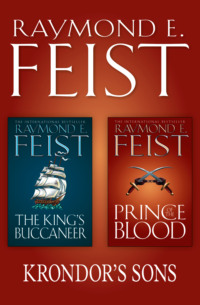
Kitabı oku: «The Complete Krondor’s Sons 2-Book Collection»
RAYMOND E. FEIST
The Complete Krondor’s Sons
Collection
Prince of the Blood The King’s Buccaneer

Copyright
HarperVoyager An imprint of HarperCollinsPublishers Ltd. 1 London Bridge Street London SE1 9GF
www.harpercollins.co.uk
Prince of the Blood © Raymond E. Feist 1990, 2008
The King’s Buccaneer © Raymond E. Feist 1992
Cover Layout Design © HarperCollinsPublishers Ltd.
Raymond E. Feist asserts the moral right to be identified as the author of this work
A catalogue record for this book is available from the British Library
All rights reserved under International and Pan-American Copyright Conventions. By payment of the required fees, you have been granted the nonexclusive, nontransferable right to access and read the text of this ebook on screen. No part of this text may be reproduced, transmitted, downloaded, decompiled, reverse engineered, or stored in or introduced into any information storage and retrieval system, in any form or by any means, whether electronic or mechanical, now known or hereinafter invented, without the express written permission of HarperCollins ebooks
HarperCollinsPublishers has made every reasonable effort to ensure that any picture content and written content in this ebook has been included or removed in accordance with the contractual and technological constraints in operation at the time of publication
Ebook Edition © SEPTEMBER 2013 ISBN: 9780007532155
Version: 2019–09–03
Table of Contents
Cover
Title Page
Copyright
Maps
Prince of the Blood
The King’s Buccaneer
Continue the Adventure …
About the Author
Also by the Author
About the Publisher
Maps


RAYMOND E. FEIST
Prince of The Blood
Book One of Krondor’s Sons
Copyright
HarperVoyager An imprint of HarperCollinsPublishers Ltd. 1 London Bridge Street London SE1 9GF
www.harpercollins.co.uk
First published HarperCollins Science Fiction & Fantasy 1990
Copyright © Raymond E. Feist 1990, 2008
Cover Illustration © Nik Keevil
Raymond E. Feist asserts the moral right to be identified as the author of this work
A catalogue record for this book is available from the British Library
All rights reserved under International and Pan-American Copyright Conventions. By payment of the required fees, you have been granted the nonexclusive, nontransferable right to access and read the text of this ebook on screen. No part of this text may be reproduced, transmitted, downloaded, decompiled, reverse engineered, or stored in or introduced into any information storage and retrieval system, in any form or by any means, whether electronic or mechanical, now known or hereinafter invented, without the express written permission of HarperCollins ebooks
HarperCollinsPublishers has made every reasonable effort to ensure that any picture content and written content in this ebook has been included or removed in accordance with the contractual and technological constraints in operation at the time of publication
Source ISBN: 9780007176168
Ebook Edition © AUGUST 2012 ISBN: 9780007385355
Version: 2019–009–03
This book is dedicated
with love to my wife
Kathlyn Starbuck
who makes everything make sense
Table of Contents
Cover
Title Page
Copyright
Dedication
Chapter One: Homecoming
Chapter Two: Accusation
Chapter Three: Stardock
Chapter Four: Concerns
Chapter Five: Southward
Chapter Six: Dilemma
Chapter Seven: Captive
Chapter Eight: Escape
Chapter Nine: Welcome
Chapter Ten: Companion
Chapter Eleven: Hunting
Chapter Twelve: Evasion
Chapter Thirteen: Jubilee
Chapter Fourteen: Bargain
Chapter Fifteen: Snares
Chapter Sixteen: Stalking
Chapter Seventeen: Traps
Chapter Eighteen: Triumph
Afterword
Acknowledgments
• CHAPTER ONE •
Homecoming
THE INN WAS QUIET.
Walls darkened by years of fireplace soot drank in the lantern light, reflecting dim illumination. The dying fire in the hearth offered scant warmth and, from the demeanour of those who chose to sit before it, less cheer. In contrast to the mood of most establishments of its ilk, this inn was nearly sombre. In murky corners, men spoke in hushed tones, discussing things best not overheard by the uninvolved. A grunt of agreement to a whispered proposal, or a bitter laugh from a woman of negotiable virtue, were the only sounds to intrude upon the silence. The majority of the denizens of the inn, called The Sleeping Dockman, were closely watching the game.
The game was pokiir; common to the Empire of Great Kesh to the south and now replacing lin-lan and pashawa as the gambler’s choice in the inns and taverns of the Western Realm of the Kingdom. One player held his five cards before him, his eyes narrowed in concentration. An off-duty soldier, he kept alert for any sign of trouble in the room, and trouble was rapidly approaching. He made a display of studying his cards, while discreetly inspecting the five men who played at the table with him.
The first two on his left were rough men. Both were sunburned and the hands holding their cards were heavily callused; faded linen shirts and cotton trousers hung loosely on lank but muscular frames. Neither wore boots or even sandals, barefoot despite the cool night air, a certain sign they were sailors waiting for a new berth. Usually such men quickly lost their pay and were bound again for sea, but from the way they had bet all night, the soldier was certain they were working for the man who sat to the soldier’s right.
That man sat patiently, waiting to see if the soldier would match his bet or fold his cards, forfeiting his chance to buy up to three new cards. The soldier had seen his sort many times before; a rich merchant’s son, or a younger son of a minor noble, with too much time on his hands and too little sense. He was fashionably attired in the latest rage among the young men of Krondor, a short pair of breeches tucked into hose, allowing the pants legs above the calf to balloon out. A simple white shirt was embroidered with pearls and semiprecious stones, and the jacket was the new cutaway design, a rather garish yellow, with white and silver brocade at the wrists and collar. He was a typical dandy. And – from the look of the Rodezian slamanca hanging from the loose baldric across his shoulder – a dangerous man. It was a sword used only by a master or someone seeking a quick death. In the hands of an expert it was a fearsome weapon; in the hands of the inexperienced it was suicide.
The man had probably lost large sums of money before and now sought to recoup his previous losses by cheating at cards. One or the other of the sailors would win an occasional hand, but the soldier was certain this was planned to keep suspicion from falling upon the young dandy. The soldier sighed, as if troubled by what choice to make. The other two players waited patiently for him to make his play.
They were twin brothers, over six feet tall and fit in appearance. Both came to the table armed with rapiers: the choice of experts or fools. Since Prince Arutha had come to the throne of Krondor twenty years before, rapiers had become the choice of men who wore weapons as a consideration of fashion rather than survival. But these two didn’t look the type to sport weapons as decorative baubles. They were dressed as common mercenaries, just in from caravan duty from the look of them. Dust still clung to their tunic and leather vest, while their red-brown hair was lightly matted. Both needed a shave. Yet while their clothing was common and dirty, there was nothing that looked neglected about their armour or arms; they might not pause to bathe after weeks on a caravan, but they would take an hour to oil their leather and polish their steel. They looked genuine in their part, save for a feeling of vague familiarity which caused the soldier slight discomfort: both spoke with none of the rough speech common to mercenaries, but rather with the educated crispness of those used to spending their days in court, not fighting bandits. And they were young, little more than boys.
The brothers had commenced the game with glee, ordering tankard after tankard of ale, letting losses delight them as much as wins, but now that the stakes of the game were rising, they had become sombre. They glanced at each other from time to time, and the soldier was certain they shared silent communication the way twins often did.
The soldier shook his head. ‘Not me.’ He threw down his cards, one of them flipping completely over for an instant before it came to rest upon the table. ‘I’ve got duty in an hour; I’d best be back to the barracks.’
What he really knew was that trouble was imminent and if he were still around when it arrived, he’d never make muster. And the duty sergeant was a man not given to receiving excuses kindly.
Now the dandy’s eyes turned to the first of the two brothers. ‘Play?’
As the soldier reached the door of the inn, he took note of two men standing quietly in the corner. They stood in great cloaks, faces obscured slightly by the shadows of their hoods, despite the inn being warm. Both made a show of quietly watching the game, but they were taking in every detail of the inn. They also looked familiar to the soldier, but he couldn’t place them. And there was something about the way they stood, as if ready to leap to action, that reaffirmed the soldier’s determination to reach the city barracks early. He opened the door to the inn and stepped through, closing it behind.
The man closest to the door turned to his companion, his face only partially illuminated by the light from the lantern above. ‘You’d better get outside. It’s about to break loose.’
His companion nodded. In the twenty years they’d been friends, he had learned never to second guess his companion’s ability to sense trouble in the city. He quickly stepped through the door after the soldier.
At the table, the betting reached the first of the two brothers. He made a face, as if perplexed by the play of the cards. The dandy said, ‘Are you staying or folding?’
‘Well,’ answered the young man, ‘this is something of a poser.’ He looked at his brother. ‘Erland, I would have sworn an oath to Astalon the Judge that I saw a Blue Lady flip when that soldier tossed in his hand.’
‘Why,’ answered his twin with a twisted smile, ‘does that pose a problem, Borric?’
‘Because I also have a Blue Lady in my hand.’
Men began to back away from the table as the tone of conversation shifted. Discussion of what cards one held was not the norm. ‘I still see no problem,’ observed Erland, ‘as there are two Blue Ladies in the deck.’
With a malicious grin, Borric said, ‘But you see, our friend over here,’ he indicated the dandy, ‘also has a Blue Lady tucked just not quite far enough back in his sleeve.’
Instantly the room erupted into motion as men put as much distance as possible between the combatants and themselves. Borric leaped from his seat, gripping the edge of the table and overturning it, forcing the dandy and his two henchmen back. Erland had his rapier and a long dirk out as the dandy drew his slamanca.
One of the two sailors lost his footing and fell forward. As he tried to rise, he found his chin met by the toe of Borric’s boot. He collapsed into a heap at the young mercenary’s feet. The dandy leaped forward, executing a vicious cut at Erland’s head. Erland deftly parried with his dirk and returned a vicious thrust his opponent barely dodged.
Both men knew they faced an opponent worthy of wariness. The innkeeper was circling the room, armed with a large cudgel, threatening anyone who sought to enlarge the fray. As he neared the door, the man in the hood stepped out with startling speed and gripped his wrist. He spoke briefly, and the innkeeper’s face drained of colour. The proprietor briskly nodded once and quickly slipped out the door.
Borric disposed of the second sailor with little trouble and turned to discover Erland in a close struggle with the dandy. ‘Erland! Could you use a hand?’
Erland shouted, ‘I think not. Besides, you always say I need the practice.’
‘True,’ answered his brother with a grin. ‘But don’t let him kill you. I’d have to avenge you.’
The dandy tried a combination attack, a high, low, then high series of chops, and Erland was forced to back away. In the night the sound of whistles could be heard.
‘Erland,’ said Borric.
The hard-pressed younger twin said, ‘What?’ as he dodged another masterfully executed combination attack.
‘The watch is coming. You’d better kill him quickly.’
‘I’m trying,’ said Erland, ‘but this fellow isn’t being very cooperative.’ As he spoke, his boot heel struck a pool of spilled ale and he lost his footing. Suddenly he was falling backward, his defence gone.
Borric was moving as the dandy lunged at his brother. Erland twisted upon the floor, but the dandy’s sword struck his side. Hot pain erupted along his ribs. And at the same instant the man had opened his left side to a counter thrust. Sitting upon the floor, Erland thrust upward with his rapier, catching the man in the stomach. The dandy stiffened and gasped as a red stain began to spread upon his yellow tunic. Then Borric struck him from behind, using the hilt of his sword to render the man unconscious.
From outside the sound of rushing men could be heard, and Borric said, ‘We’d best get clear of this mess,’ as he gave his brother a hand up. ‘Father’s going to be upset enough with us as it is without brawling.’
Wincing from his injury, Erland interrupted, ‘You didn’t have to hit him. I think I would have killed him in another moment.’
‘Or he you. And I’d not want to face Father had I let that happen. Besides, you really wouldn’t have killed him; you just don’t have the instinct. You’d have tried to disarm him or something equally noble—’ Borric observed, catching his breath in a gasp, ‘—and stupid. Now, let’s see about getting out of here.’
Erland gripped his wounded side as they headed toward the door. Several town toughs, seeing blood upon Erland’s side, moved to block the twin’s exit. Borric and Erland both levelled their sword points at the band of men. Borric said, ‘Keep your guard up a moment,’ picked up a chair, and threw it through the large bay window facing the boulevard. Glass and leading showered the street, and before the tinkle of shards upon stone had stopped, both brothers were leaping through what remained of the window. Erland stumbled and Borric had to grip his arm to keep him from falling.
As they straightened, they took in the fact that they were looking at horses. Two of the more bold thugs jumped through the window after the twins, and Borric smashed one in the side of the head with his sword hilt, while the other man pulled up short as three crossbows were levelled at him. Arrayed before the door was the small company of ten burly and heavily armed town watchmen commonly known as the Riot Squad. But what had the half-dozen denizens of the Sleeping Dockman standing in open-mouth amazement, was the sight of the thirty horsemen behind the Riot Squad. They wore the tabards of Krondor and the badge of the Prince of Krondor’s own Royal Household Guards. From within the inn someone overcame his stupefication and shouted, ‘Royal Guardsmen!’ and a general evacuation through the rear door of the tavern began, while the gaping faces at the window vanished.
The two brothers regarded the mounted men, all armed and ready in case trouble came. At their head rode a man well known to the two young mercenaries.
‘Ah … good evening, my lord,’ said Borric, a smile slowly spreading across his face. The leader of the Riot Squad, seeing no one else in sight, moved to take custody of the two young men.
The leader of the Royal Guard waved him off. ‘This doesn’t concern you, Watchman. You and your men may go.’ The watch commander bowed slightly and led his men back to their barracks in the heart of the Poor Quarter.
Erland winced a bit as he said, ‘Baron Locklear, what a pleasure.’
Baron Locklear, Knight-Marshal of Krondor, smiled an unamused smile. ‘I’m certain.’ Despite his rank, he looked barely a year or two older than the boys, though he was nearly sixteen years their senior. He had curly blond hair and large blue eyes, which were presently narrowed as he watched the twins in obvious disapproval.
Borric said, ‘And I expect that means that Baron James—’
Locklear pointed. ‘Is standing behind you.’
Both brothers turned to see the man in the great cloak framed in the doorway. He threw back his hood to reveal a face still somewhat youthful despite his thirty-seven years of age, his curly brown hair slightly dusted with grey. It was a face the brothers knew as well as any, for he had been one of their teachers since boyhood, and more, one of their closest friends. He regarded the two brothers with ill-disguised disapproval and said, ‘Your father ordered you directly home. I had reports of your whereabouts from the time you left Highcastle until you passed through the city gates … two days ago!’
The twins tried to hide their pleasure at being able to lose their royal escorts, but they failed. ‘Ignore for a moment the fact your father and mother had a formal court convened to welcome you home. Forget they stood waiting for three hours! Never mind your father’s insisting that Baron Locklear and I comb the entire city for two days seeking you out.’ He studied the two young men, ‘But I trust you’ll remember all those little details when your father has words with you after court tomorrow.’
Two horses were brought forward and a soldier deferentially held out the reins to each brother. Seeing the blood along Erland’s side, a Lieutenant of the Guard moved his horse nearby and said in mock sympathy, ‘Does His Highness require help?’
Erland negotiated the stirrup and heaved himself into the saddle without aid. In irritated tones, he answered, ‘Only when I see Father, Cousin Willy, and I don’t think you can do much for me then.’
Lieutenant William nodded and in unsympathetic tones, he whispered, ‘He did say come home at once, Erland.’
Erland nodded in resignation. ‘We just wanted to relax for a day or two before—’
William couldn’t resist laughing at his cousins’ predicament. He had often seen them bring disaster down upon themselves and he never could understand their appetite for such punishment. He said, ‘Maybe you could run for the border. I could get very stupid following you.’
Erland shook his head. ‘I think I’ll wish I had taken your offer, after tomorrow morning’s court.’
William laughed again. ‘Come along, this dressing down won’t be much worse than a dozen you’ve already had.’
Baron James, Chancellor of Krondor and first assistant to the Duke of Krondor, quickly mounted his own horse. ‘To the palace,’ he ordered, and the company turned to escort the twin princes, Borric and Erland, to the palace.
Arutha, Prince of Krondor, Knight-Marshal of the Western Realm, and Royal Heir to the throne of the Kingdom of the Isles, sat quietly attentive to the business of the court being conducted before him. A slender man in his youth, he had not gained the bulk commonly associated with middle age, but rather had become harder, more angular in features, losing what little softening effects youth had given his lanky appearance. His hair was still dark, though enough grey had come with the twenty years of ruling Krondor and the West to speckle it. His reflexes had slowed only slightly over the years, and he was still counted one of the finest swordsmen in the Kingdom, though he rarely had reason to exercise his skill with the rapier. His dark brown eyes were narrowed in concentration, a gaze that seemed to miss nothing, in the opinion of many who served the Prince. Thoughtful, even brooding at times, Arutha was a brilliant military leader. He had rightfully won his reputation during the nine years of the Riftwar which had ended the year before the twins’ birth after taking command of the garrison at Crydee, his family’s castle, when only a few months older than his sons were now.
He was counted a hard but fair ruler, quick to dispense justice when the crime warranted, though often given to acts of leniency at the request of his wife, the Princess Anita. And that relationship more than anything typified the administration of the Western Realm: hard, logical, even-handed justice, tempered with mercy. While few openly sang Arutha’s praises, he was well respected and honoured, and his wife was beloved by her subjects.
Anita sat quietly upon her throne, her green eyes looking off into space. Her royal manner masked her concern for her sons from all but those who knew her most intimately. That her husband had ordered the boys brought to the great hall for morning court, rather than to their parents’ private quarters last night, showed more than anything else his displeasure. Anita forced herself to be attentive to the speech being given by a member of the Guild of Weavers; it was her duty also to show those coming before her husband’s court the consideration of listening to every petition or request. The other members of the royal family were not normally required at morning court, but since the twins had returned from their service upon the border at Highcastle, it had become a family gathering.
Princess Elena stood at her mother’s side. She looked a fair compromise between her parents, having red-brown hair and fair skin from her mother but her father’s dark and intelligent eyes. Those who knew the royal family well often observed that if Borric and Erland resembled their uncle, the King, then Elena resembled her aunt, the Baroness Carline of Salador. And Arutha had observed on more than one occasion she had Carline’s renowned temper.
Prince Nicholas, Arutha and Anita’s youngest child, had avoided the need to stand next to his sister, by hiding from his father’s sight. He stood behind his mother’s throne, beyond his father’s gaze, on the first step off the dais. The door to the royal apartments was hidden from the eyes of those in the hall, down three steps, where, in years past, all four children had played the game of huddling on the first step, listening to their father conduct court, enjoying the delicious feeling of eavesdropping. Nicky waited for the arrival of his two brothers.
Anita glanced about with that sudden sense mothers have that one of their children is somewhere he shouldn’t be. She spied Nicholas waiting down by the door, and motioned him to stand close. Nicky had idolized Borric and Erland, despite them having little time for the boy and constantly teasing him. They just couldn’t find much in common with their youngest sibling, since he was twelve years younger.
Prince Nicholas hobbled up the three broad steps and moved to his mother’s side and, as it had every day since his birth, Anita’s heart broke. The boy had a deformed foot, and neither surgeon’s ministrations nor priest’s spell had any effect, save to enable him to walk. Unwilling to hold up the deformed baby to public scrutiny, Arutha had ignored custom and refused to show the boy at the Presentation, the holiday in honour of a royal child’s first public appearance, a tradition that may have died with Nicholas’s birth.
Nicky turned when he heard the door open, and Erland peered through. The youngest Prince grinned at his brothers as they gingerly slipped through the door. Nicky scrambled down the three steps with his canted gait to intercept them, and gave each a hug. Erland visibly winced and Borric bestowed an absent pat on the shoulder.
Nicky followed the twins as they slowly mounted the stairs behind the thrones, coming to stand behind their sister. She glanced over her shoulder long enough to stick out her tongue and cross her eyes, causing all three brothers to force themselves not to laugh. They knew no one else in court could see her fleeting pantomime. The twins had a long history of tormenting their little sister, who gave back as good as she got. She would think nothing of embarrassing them in the King’s own court.
Arutha, sensing some exchange between his children, glanced over and gifted his four offspring with a quick frown, enough to silence any potential mirth. His gaze lingered on his elder sons and showed his anger in full measure, though only those close to him would recognize it as such. Then his attention was back upon the matter before the court. A minor noble was being advanced into a new office, and while the four royal children might not find it worthy of much dignity, the man would count this among one of the high points of his life. Arutha had tried to impress such awareness upon them over the years but continuously failed.
Overseeing the Prince’s court was Lord Gardan, Duke of Krondor. The old soldier had served with Arutha, and his father before him, thirty years and more. His dark skin stood in stark contrast to his beard, almost white in colour, but he still had the alert eyes of one whose mind had lost none of its edge and a ready smile for the royal children. A commoner by birth, Gardan had risen on his ability, and despite an often expressed desire to retire and return to his home in Far Crydee, he had remained in Arutha’s service, first as Sergeant in the garrison at Crydee, then Captain of the Prince’s Royal Household, then Knight-Marshal of Krondor. When the previous Duke of Krondor, Lord Volney, had died unexpectedly after seven years’ loyal service in his office, Arutha had awarded the office to Gardan. Despite the old soldier’s protestations of not being suited to the nobility, he had proven an able administrator as well as a gifted soldier.
Gardan finished intoning the man’s new rank and privileges and Arutha proffered a terribly oversized parchment with ribbons and seals embossed upon it.
• CHAPTER TWO •
Accusation
THE BOY CRIED OUT.
Borric and Erland watched from the window of their parents’ private chamber as Swordmaster Sheldon pressed his attack on young Prince Nicholas. The boy shouted again in eager excitement as he executed a clever parry and counterthrust. The Swordmaster retreated.
Borric scratched at his cheek as he observed, ‘The boy can scamper about, for certain.’ The angry bruise from the morning’s boxing practice was darkening.
Erland agreed. ‘He’s inherited Father’s skills with a blade. And he manages to do right well despite his bad leg.’
Borric and Erland both turned as the door opened and their mother entered. Anita waved her ladies in waiting to the far corner of the room, where they commenced to discuss quietly whichever current piece of gossip was judged most interesting. The Princess of Krondor came to stand between her sons and peered through the window as a joyous Nicholas was lured into an overbalanced extension and found himself suddenly disarmed.
‘No, Nicky! You should have seen it coming,’ shouted Erland, though the glass window prevented his words from reaching his younger brother.
Anita laughed. ‘He tries so hard.’
Borric shrugged as they turned away. ‘Still, he does well enough for a boy. Not much worse than when we were his age.’
Erland agreed. ‘The monkey.’
Suddenly his mother turned on him and slapped him hard across the face. Instantly, the women in the other corner of the room ceased their whispers and stared in wide-eyed amazement at their Princess. Borric looked at his brother whose astonishment matched his own. Not once in the nineteen years of their lives had their mother raised a hand to either boy. Erland was more stunned by the act than any pain from the slap. Anita’s green eyes revealed a mixture of anger and regret. ‘Never talk that way about your brother again.’ Her tone left no room for argument. ‘You have mocked him and caused him more pain than all the unkind whispers among the nobles together. He is a good boy and he loves you, and all you have for him is ridicule and torment. Your first day back in the palace and within five minutes of speaking with you he was in tears again.
‘Arutha was right. I’ve let you go unpunished for your trespasses too long.’ She turned as if to leave.
Borric, seeking to rescue his brother and himself from the embarrassment of the moment said, ‘Ah, Mother. You did send for us? Was there something else you wanted to discuss?’
Anita said, ‘I didn’t send for you.’
‘I did.’
The boys turned to see their father standing quietly at the small door that opened between his study and the family room, as Anita called his part of the royal apartment. The brothers glanced at one another and knew their father had been observing long enough to have witnessed the exchange between mother and sons.
After a long silence, Arutha said, ‘If you’ll excuse us, I would have a private word with our sons.’
Anita nodded and indicated to her ladies they should come with her. Quickly the room emptied, leaving Arutha with his sons. When the door was closed, Arutha said, ‘Are you all right?’
Erland made a display of stiff muscles and said, ‘Well, enough, Father, given the “instructions” we received this morning.’ He indicated his tender side was not further injured.
Arutha frowned and shook his head slightly. ‘I asked Jimmy not to tell me what he had in mind.’ He smiled a crooked smile. ‘I just requested he somehow impress upon you that there are serious consequences to not doing what is required of you.’
Erland nodded. Borric said, ‘Well, it is not entirely unexpected. You did order us directly home and we did stop to play a bit before coming to the palace.’
‘Play …’ Arutha said, his eyes searching his eldest son’s face. ‘I’m afraid there will be little time for play in the future.’
He motioned for the boys to approach and they came to him. He turned back into his study and they followed as he moved past his large writing table. Behind it was a special alcove, hidden by a clever locked stone, which he opened. He withdrew a parchment bearing the royal family crest and handed it to Borric. ‘Read the third paragraph.’
Borric read and his eyes widened. ‘This is sad news, indeed.’
Erland said, ‘What is it?’
‘A message from Lyam,’ Arutha said.
Borric handed it to his brother. ‘The royal chirurgeons and priests are certain the Queen will have no more children. There will not be a Royal Heir in Rillanon.’
Arutha moved to a door at the back of the royal chambers and said, ‘Come with me.’
He opened the door and moved up a flight of stairs. His sons followed quickly after, and soon all three stood on the top of an old tower, near the centre of the royal palace, overlooking the city of Krondor. Arutha spoke without looking to see if his sons had followed.
‘When I was about your age, I used to stand upon the parapets of the barbican of my father’s castle. I would look down over the town of Crydee and the harbour beyond. Such a small place, but so large in my memory.’
He glanced at Borric and Erland. ‘Your grandfather did much the same when he was a boy, or so our old swordmaster, Fannon, once told me.’ Arutha spent a moment lost in memory. ‘I was about your age when command of the garrison fell to me, boys.’ Both sons had heard tales of the Riftwar and their father’s part in it, but this wasn’t the same sort of old story they had heard swapped by their father and their uncle, Laurie, or Admiral Trask over dinner.
Arutha turned and sat in one of the merlons and said, ‘I never wanted to be Prince of Krondor, Borric.’ Erland moved to sit in the merlon next to his father, as he sensed that Arutha’s words were more for his older brother than himself. They had both heard often enough that their father had no wish to rule. ‘When I was a boy,’ Arutha continued, ‘I had no larger desire than to serve as a soldier, perhaps with the border lords.
‘It wasn’t until I met the old Baron Highcastle that I realized that boyhood dreams are often with us as adults. They are difficult to be shed of, and yet, to see things as they really are, we must lose that child’s eye view of things.’
He scanned the horizon. Their father had always been a direct man, given to direct speech and never at a loss for words to express himself. But he was obviously having difficulty saying what was on his mind. ‘Borric, when you were much younger, what did you think your life would be like now?’
Borric glanced over at Erland, then back at his father. A light breeze sprang up and his thick, ill-cut mane of reddish brown hair blew about his face. ‘I never gave it much thought. Father.’
Arutha sighed. ‘I think I have made a terrible mistake in the manner in which you were raised. When you were both very tiny you were very mischievous and upon one occasion you really upset me. It was a little thing, a spilled inkwell, but a long parchment was ruined and a scribe’s work for a day was lost. I swatted you upon the bottom, Borric.’ The elder brother grinned at the image. Arutha did not return the grin. ‘That day Anita made me promise that never again would I touch either one of you in anger. By doing so, I think I have coddled and ill-prepared you for the lives you are to lead.’
Erland couldn’t help feeling embarrassed. They’d been scolded often enough over the years, but rarely punished and, before this morning, never physically.
Arutha nodded. ‘You and I have little in common in the manner in which we were raised. Your uncle the King felt our father’s leather belt on more than one occasion when he was caught. I only took one beating as a boy. I quickly learned that when Father gave an order, he expected it to be obeyed without question.’ Arutha sighed, and in that sound both boys heard uncertainty from their father for the first time in their lives. ‘We all assumed Prince Randolph would be King someday. When he drowned, we assumed Lyam would have another son. Even as daughters arrived and the prospects for a Royal Heir in Rillanon lessened with the passing years, we still never considered that someday you—’ he put his finger on Borric’s chest ‘—would be ruler of this nation.’
He looked over at his other son and in an uncharacteristic gesture, reached out and placed his hand over Erland’s. ‘I am not given to speaking of strong feelings, but you are my sons and I love you both, though you try my patience to distraction.’
Both sons were suddenly uncomfortable with this atypical revelation. They loved their father but, like him, were discomforted by any attempt to express such feelings openly. ‘We understand,’ was all Borric could manage.
Looking Borric directly in the eyes, he said, ‘Do you? Do you really? Then understand that from this day forth you are no longer my sons alone, Borric. You are both now sons to the Kingdom. Each of you is a Royal. You are to be King someday, Borric. Wrap your mind around that fact, for it is so, and nothing this side of death will change that. And from this day on a father’s love of his son will no longer shield you from life’s harshness. To be a king is to hold men’s lives by a thread. A thoughtless gesture will end those lives as certainly as if you had chosen to tear the threads.’
To Erland, he said, ‘Twins pose a serious threat to peace in our Kingdom, for should old rivalries surface, you’ll find some claiming the birth order was reversed, some who will raise your cause without your consent, as an excuse to make war upon old foes.
‘You both have heard the story, of the First King Borric and how he was forced to slay his own brother, Jon the Pretender. And you have also heard, often enough, of how I stood with the King and our brother Martin in the hall of our ancestors, before the Congress of Lords, each of them with a just claim to the crown. By Martin’s signal act of nobility, Lyam wears his crown and no blood was shed.’ He held his thumb and forefinger a scant fraction of an inch apart. ‘Yet we were but this far from civil war that day.’
Borric said, ‘Father, why are you telling us this?’
Arutha stood, sighed, and put his hand upon his eldest son’s shoulder. ‘Because your boyhood is at an end, Borric. You are no longer the son of the Prince of Krondor. For I have decided that should I survive my brother, I will renounce my own claim upon the crown in favour of yours.’ Borric began to protest, but Arutha cut him off. ‘Lyam is a vigorous man. I may be an old one when he dies, if I don’t precede him. It is best if there is not a short rule between Lyam’s and your own. You will be the next King of the Isles.’
Glancing at Erland, he said, ‘And you will always stand in your brother’s shadow. You will forever be one step from the throne, yet never permitted to sit upon it. You will always be sought out for favour and position, but never your own; you will be seen as a stepping-stone to your brother. Can you accept such a fate?’
Erland shrugged. ‘It doesn’t seem too grave a fate, Father. I shall have estates and title, and responsibilities enough, I am certain.’
‘More, for you need stand with Borric in all things, even when you disagree with him in private. You will never have a public mind that you may call your own. It must be so. I cannot stress this enough. Never once in the future can you publicly oppose the King’s will.’ Moving a short way off, he turned and regarded them both. ‘You have never known anything but peace in our Kingdom. The raids along the border are trivial things.’
Erland said, ‘Not to those of us who fought those raiders! Men died, Father.’
Arutha said, ‘I speak of nations now, and dynasties, and the fate of generations. Yes, men died, so that this nation and its people may live in peace.
‘But there was a time when border skirmishes with Great Kesh and the Eastern Kingdoms were a monthly occurrence, when Quegan galleys took our ships at their leisure, and when invaders from the Tsurani world held part of your grandfather’s lands – for nine years!
‘You will be asked to give up many things, my sons. You will be asked to marry women who will most likely be strangers to you. You will be asked to relinquish many of the privileges lesser men know: the ability to enter a tavern and drink with strangers, to pick up and travel to another city, to marry for love and watch your children grow without fear of their being used for others’ designs.’ Gazing out over the city, he added, ‘To sit at day’s end with your wife and discuss the small matters of your life, to be at ease.’
Borric said, ‘I think I understand.’ His voice was subdued.
Erland only nodded.
Arutha said, ‘Good, for in a week you leave for Great Kesh, and from this moment forward you are the Kingdom’s future.’ He moved toward the stairs that led down into the palace and halted at them. ‘I wish I could spare you this, but I can’t.’ Then he was gone.
Both boys sat quietly for a time, then as one, turned to look out over the harbour. The afternoon sun beat down, yet the breeze from the Bitter Sea was cooling. In the harbour below, boats moved as punts and barges carried cargo and passengers back and forth between the docks and great sailing ships anchored in the bay. In the distance white dots signalled approaching ships, traders from the Far Coast, the Kingdom of Queg, the Free Cities of Yabon, or the Empire of Great Kesh.
Then Borric’s face relaxed as a smile spread. ‘Kesh!’
Erland laughed. ‘Yes, to the heart of Great Kesh!’
Both shared the laughter at the prospect of new cities and people, and travel to a land considered exotic and mysterious. And their father’s words vanished upon the wind to the east.
Some institutions linger for centuries, while others pass quickly. Some arrive quietly, others with fanfare. In years past it was considered a general practice to give apprentices and other servants the latter half of the sixth day of the week for themselves. Now the practice had come to include a general closing of businesses on sixthday at noon, with seventhday generally held to be a day of devotions and meditations.
But within the last twenty years another ‘tradition’ had arisen. From the first sixthday following the winter equinox, boys and young men, apprentices and servants, commoner and noble, began preparing. For upon the holiday of First Thaw, held six optimistic weeks after the equinox, often despite inclement weather, football season commenced.
Once called barrel ball, the game had been played for as long as boys had kicked balls of rags into barrels. Twenty years before, the young Prince Arutha had instructed his Master of Ceremonies to draw up a standard set of rules for the game, more for the protection of his young squires and apprentices, for then the game was rough in the extreme. Now the game had been institutionalized in the minds of the populace; come spring, football returned.
On all levels, from boys playing in open fields up to a City League, with teams fielded by guilds, trading associations, or rich nobles eager to be patrons, players could be seen racing up and down attempting to kick a ball into a net.
The crowd shouted its approval as the Blues’ swiftest forward broke away from the pack with the ball, speeding toward the open goal net. The Reds’ goalkeeper hunkered down, ready to leap between ball and net. With a clever feint, the Blues’ player caused the Reds’ to overbalance, then shot it past him on his off side. The goalkeeper stood with hands on hips, evidencing disgust at himself while the Blues’ players mobbed the scorer.
‘Ah, he should have seen it coming,’ commented Locklear. ‘It was so obvious. I could see it up here.’
James laughed. ‘Then why don’t you go down and play for him?’
Borric and Erland shared in James’s laughter. ‘Certainly, Uncle Locky. We’ve heard a hundred times how you and Uncle Jimmy invented this game.’
Locklear shook his head. ‘It was nothing like this.’ He glanced about the field at the stands erected by an enterprising merchant years before, stands that had been expanded upon and enlarged until as many as four thousand citizens could crowd together to watch a match. ‘We used to have a barrel at each end and you couldn’t stand before the mouth. This net business and goalkeepers and all the other rules your father devised …’
Borric and Erland finished for him in unison, ‘… It’s not sport anymore.’
Locklear said, ‘That’s the truth.’
Erland inserted, ‘Not enough bloodshed!’
‘No broken arms! No gouged eyes!’ laughed Borric.
James said, ‘Well, that’s for the better. There was one time—’
Both brothers grimaced as one, for they knew they were about to hear the story of the time Locklear was hit from behind by a piece of farrier’s steel an apprentice boy had concealed in his shirt. This would lead, then, to a debate between the two Barons on the general value of rules and which rules enhanced the game and which impeded.
But the lack of further comment from James caused Borric to turn. James had his eyes focused not on the game below which was drawing to a close, but upon a man down near the end of the row upon which the Baron sat, one row behind the Princes. Rank and a well-placed bribe had given the sons of the Prince of Krondor two of the best seats for the match, at the midfield line halfway up the stands.
James said, ‘Locky, is it cold?’
Wiping perspiration from his brow, Locklear said, ‘You’re joking, right? It’s a month after midsummer and I’m roasting.’
Hiking his thumb toward the end of the row, James said, ‘Then why does our friend over there feel the need to wear such a heavy robe?’
Locklear glanced past his companion and noticed a man sitting at the end of the bench, muffled in a large robe. ‘A priest perhaps?’
‘I know of no order that has members with an interest in football.’ James glanced away as the man turned toward him. ‘Watch him over my shoulder, but nod as if you’re listening to everything I’m saying. What’s he doing?’
‘Nothing presently.’ Then a horn was blown, signalling the end of the match. The Blues, a team sponsored by the Millers Guild and the Worshipful Association of Iron Mongers, had defeated the Reds, a team sponsored by a group of nobles. As such sponsorship was well-known among those in attendance, the result of the match met with general approval.
As the crowd began to depart, the man in the robe stood. Locklear’s eyes widened as he said, ‘He’s taking something out of his sleeve.’
James whirled about in time to see the man raise a tube to his lips and point it in the direction of the Princes. Without hesitation, James pushed hard, knocking the two young men into the row below. A strangled gasp sounded from a man standing just beyond where Erland had been, and the man raised a hand to his neck. It was a gesture never finished, for as his fingers neared the dart protruding from his throat, he collapsed.
Locklear was only an instant behind James to react. As James and the twins went sprawling below, accompanied by angry shouts as spectators were knocked about, Locklear had his sword out and was leaping toward the robed and cowled figure. ‘Guards!’ he shouted, as an honour guard was stationed just below the viewing stands.
The sounds of boots pounding upon wooden stairs answered his call almost instantly as soldiers of the Prince raced to intercept the fleeing figure. With little concern for bruises caused, the guardsmen roughly shoved innocent onlookers out of their way. With the silent understanding mobs possess, suddenly everyone knew that something was wrong in the viewing stands. While those nearby scampered to get away, those in other parts of the field turned to observe the cause of such turmoil.
Seeing guardsmen mere yards away, with only a few confused citizens blocking their approach, the robed man put one hand upon the rail of the stairs and vaulted over the side, falling a full dozen feet to the earth below. A heavy thud and an exclamation of pain could be heard by Locklear as he reached the railing.
Sprawled upon the ground, two stunned commoners sat inspecting the unmoving form that lay next to them. One man pushed himself back without standing while the other crawled. Locklear vaulted over the rail and landed upon his feet, sword point levelled at the robed figure. The form upon the ground stirred, then leaped at the young Baron.
Almost taken by surprise, Locklear let the man get inside his guard. The robed man had his arms around Locklear’s waist as he drove him back into the supports of the viewing stand.
Locklear’s breath burst from his lungs as he struck the heavy wooden beams, but he managed to strike the man behind the ear with his sword hilt. The man staggered away, obviously intent upon escape rather than combat, but shouting voices heralded the approach of more guardsmen. Turning, the man struck out at Locklear, who was struggling to regain his breath, and his fist found Locklear’s ear.
Pain and confusion overwhelmed Locklear as the assailant rushed into the darkness under the viewing stands. The Baron shook his head to clear it, then turned and hurried after.
In the sudden darkness under the stands, the man could be hiding anywhere. ‘In here!’ Locklear yelled, in reply to an inquiring shout, and within seconds a half-dozen guardsmen were standing behind him. ‘Spread out and be alert.’
The men did as they were bidden and slowly advanced beneath the viewing stands. The men closest to the front were forced to stoop, as the lowest risers of the stands were but four feet off the ground. One soldier walked along, poking his sword into the gloom, against the fugitive having crawled under the front-most stands to hide. Above them the sounds of citizens leaving the stands filled the gloom with a thunderous clatter of sandals and boots upon wood, but after a few minutes, the noise diminished.
Then the sounds of struggle came from before them. Locklear and his men hurried forward. In the dark, two figures held a third. Without seeing who was whom, Locklear drove his shoulder into the nearest body, knocking everyone to the ground. More guards piled on top of the fray, until at last the struggle at the bottom of the mass was ended by sheer weight. Then the guards were quickly unpiling and the combatants were pulled up. Locklear grinned as he saw that one of them was James and the other Borric. Looking down, he could see the still form of the man in robes. ‘Drag him out into the light,’ he ordered the guards. To James he said, ‘Is he dead?’
‘Not unless you broke his neck jumping on him that way. You damn near broke mine.’
‘Where’s Erland?’ asked Locklear.
‘Here,’ came an answering voice in the gloom. ‘I was covering the other side of the fray in case he got past these two,’ he indicated James and Borric.
‘Nursing your precious side, you mean,’ shot back Borric with a grin.
Erland shrugged. ‘Maybe.’
They all followed the guards, who were carrying the still form of the assailant, and when they were in the afternoon sunlight again, discovered a cordon had been thrown up by other guards.
Locklear bent over. ‘Let’s see what we have here.’ He pulled back the hood and a face stared blankly up at the sky. ‘He’s dead.’
James was instantly on his knees, forcing open the man’s mouth. He sniffed and said, ‘Poisoned himself.’
‘Who is he?’ said Borric.
‘And why was he trying to kill you, Uncle Jimmy?’ said Erland.
‘Not me, you idiot,’ snapped James. He pointed at Borric. ‘He was trying to kill your brother.’
A guard approached. ‘My Lord, the man struck by the dart is dead. He died within seconds of his wounding.’
Borric forced himself to a nervous grin. ‘Why would anyone wish to kill me?’
Erland joined in the strained humour. ‘An angry husband?’
James said, ‘Not you, Borric conDoin.’ He glanced around the crowd, as if seeking other assassins. ‘Someone tried to kill the future King of the Isles.’
Locklear opened the man’s robe, revealing a black tunic. ‘James, look here.’
Baron James peered down at the dead man. His skin was dark, even darker than Gardan’s, marking him as Keshian by ancestry, but those of Keshian ancestry were common in this part of the Kingdom. There were brown- and black-skinned people in every strata of Krondorian society. But this man wore odd clothing, a tunic of expensive black silk and soft slippers unlike anything the young Princes had seen before.
James inspected the dead man’s hands, and noticed a ring set with a dark gem, then looked for a necklace and found none.
‘What are you doing?’ Borric asked.
‘Old habits,’ was all Jimmy would answer. ‘He’s no Nighthawk,’ he observed, mentioning the legendary Guild of Assassins. ‘But this may be worse.’
‘How?’ asked Locklear, remembering all too well when the Nighthawks had sought to kill Arutha twenty years before.
‘He’s Keshian.’
Locklear leaned down and inspected the ring. Ashen-faced, he stood. ‘Worse. He’s a member of the Royal House of Kesh.’
The room was silent. Those who sat in the circle of chairs moved slightly, as discomfort over the attempt upon Borric manifested itself in the creaks of leather and wood, the rustle of cloth, and the clink of jewellery.
Duke Gardan rubbed at the bridge of his nose. ‘It’s preposterous. What would Kesh gain in killing a member of your family? Does the Empress wish war?’
Erland chimed in. ‘She’s worked as hard as anyone to preserve the peace, or at least all the reports say that. Why would she want Borric dead? Who—’
Borric interrupted his brother. ‘Whoever wants war between the Kingdom and the Empire.’
Locklear nodded. ‘It’s such a shallow lie; so transparent an attempt that it is not believable.’
‘Yet …’ Arutha mused aloud, ‘what if that assassin was chosen to fail? A dupe. What if I am supposed to withhold my envoy, keep my sons at home with me?’
Gardan nodded. ‘Thereby insulting the Royal House of Kesh.’
James, who leaned against the wall behind Arutha said, ‘We’ve managed a fair job already by dispatching a member of the Empress’s house. He was a very distant cousin, true, but a cousin, nevertheless.’
Garden returned to rubbing the bridge of his nose, a gesture of frustration more than fatigue. ‘And what was I supposed to say to the Keshian Ambassador? “Oh, we’ve found this young fellow, who seems to be a member of your Royal House. We had no idea he was in Krondor. And we’re sorry to tell you he’s dead. Oh, by the way, he tried to murder Prince Borric.”’
Arutha leaned back in his chair, his fingers forming a tent before his face, absently flexing in a gesture that all in the room had come to recognize over the years. He glanced at last at James.
‘We could dump the body,’ offered the young Baron.
Gardan said, ‘I beg your pardon?’
James stretched. ‘Take the body down to the bay and toss it in.’
Erland grinned. ‘Rough treatment for a member of the Royal House of Kesh, wouldn’t you say?’
Arutha said, ‘Why?’
James moved to sit on the edge of Arutha’s desk, as the Prince over the years had come to conduct very informal sessions with close advisors and family. ‘He’s not officially a guest in the city. We aren’t supposed to know he’s here. No one is supposed to know. The only Keshians who will know he’s here are those who know why he’s here. And I doubt any of them will inquire as to his well-being. He’s now the forgotten man, unless we call attention to his whereabouts.’
Drily, Borric added, ‘And his condition.’
‘We can claim he tried to kill Borric,’ James acknowledged, ‘but all we have is a Keshian corpse, a blowgun, and some poisoned darts.’
‘And a dead merchant,’ added Gardan.
‘Dead merchants are a frequent enough commodity on any given day in the Western Realm, my Lord Duke,’ observed James. ‘I say we strip him of his ring and toss him into the bay. Let the Keshians who sent him wonder for a while. Should anyone inquire, we might gain an opportunity to learn more of who’s behind him. At worst, we can show considerable distress at his demise, insisting that had we but known he was in the city we would have made every effort to ensure his safety, but if bored royal visitors slip into the city incognito, and insist on frequenting the seedier parts of the city …?’ He shrugged dramatically.
Arutha said nothing for a while, then gave one affirmative nod. James indicated with a jerk of his head that Locklear should use Royal Guardsmen for the job, and the other young Baron slipped through the door. After a short conference with Lieutenant William outside, Locklear returned to his seat.
Arutha sighed. Looking at James, he said, ‘Kesh. What else?’
James shrugged. ‘Hints, rumours. Their new Ambassador is … an odd choice. He’s what they call a “trueblood”, but not of the Royal House, the assassin would have been a more logical choice. The Ambassador is a purely political appointment. It’s rumoured that he may actually have stronger influence in Kesh’s court than many with royal blood. I can’t find any obvious reason why he should be given such an honour – save as a compromise, to appease different factions in court.’
Arutha nodded. ‘While none of this makes apparent sense, still, we must play according to the rules of such games.’ He was silent for a while, and no one spoke as the Prince gathered his thoughts. ‘Send word to our people in Kesh,’ he instructed James. Years earlier, he had allowed James to begin creating a network of agents, starting inside the Principality, and slowly spreading through the Western Realm. Now Prince Arutha had operatives in the Royal Courts of Kesh and Queg and close to the most powerful men in the Free Cities. ‘I want our agents hard at work before my sons arrive. If someone seeks to suck us into war with Kesh, striking at the King’s nephews would be a logical choice. You will accompany the Princes to Kesh. There is no one I trust more to swim through these murky waters.’
Baron Locklear said, ‘Highness?’
Looking at the other young Baron, Arutha said, ‘You will accompany Baron James, as Master of Ceremonies, Chief of Protocol, and the rest of that idiocy. The Imperial Court is dominated by women. We will at last find a use for that infamous Locklear charm. Instruct Captain Valdis he will act in your place as Knight-Marshal. And have Cousin William take over the Household Guard as acting Captain.’ Absently he added, ‘He’s overdue for promotion, anyway.’ Arutha drummed his fingers on the table as he reflected for a moment. ‘I want you,’ he said to James, ‘shed of any office and protocol on this journey. Your only title will be “tutor”. You must be free to come and go as you need.’ He stood and the others followed suit. He looked at the boys and said, ‘Supper tonight.’
The twins nodded their understanding and rose, assuming this meant they were dismissed. As Locklear and James followed suit, Arutha said, ‘James, abide a moment longer.’
The twins exchanged glances, but said nothing, and left the room with Locklear a step behind. When only Arutha, James, and Gardan remained, the Prince asked, ‘What sort of intelligence are we getting out of the city of Kesh?’
Ten years previously, Arutha had quietly asked James to begin creating an intelligence system, primarily as a means to counteract a very well established network of agents working for Kesh in the Western Realm of the Kingdom of the Isles. James had begun with his already established contacts in the Krondorian underworld. Within a year he had informants watching every ship and caravan in and out of the city as well as having identified a dozen likely recruits in the region in other cities and towns, from Land’s End up to Ylith.
A visit to Locklear’s father two years earlier had provided James with his best new agent on the border with Kesh. James had only been to Land’s End once, previously, as a boy, and used a very old acquaintance from that visit as his introduction around the city.
Bram had been the illegitimate son of the Baroness of Land’s End and his claim on the title had not been upheld by the crown, the title and estates being given to Locklear’s father. But as a reward for service done the crown, a bit of black murder which few besides James knew about, Bram, and his wife Lorri, had been set up as very wealthy farmers. By the time James reacquainted himself with them, they had established lucrative trading concerns down into Great Kesh, and finally, after years of work, James had positioned an agent in the Imperial palace.
James said, ‘I have someone as highly placed in the palace staff as possible without trying to recruit a trueblood.’ Both Arutha and Gardan knew that trying to recruit any trueblood Keshian into service for a foreign power would likely prove impossible. ‘The difficulty is sifting through rumour and gossip looking for useful information.
‘Here’s what we know,’ James continued, knowing both men had read every report he had prepared. ‘There are factions within the trueblood community with differing loyalties to the various claimants to the throne. The Empress has a daughter who is widowed, and who would normally be next in line, but for reasons we don’t yet understand is not openly acknowledged. She has a younger brother who is very popular with the military leaders. The Empress also has a granddaughter, who is very young, but who – if married to the right leader – would create even more division among the factions.’
‘Civil war,’ said Gardan. ‘If the Empress doesn’t clean up the question of succession before she dies, Kesh could be shattered.’
Arutha nodded. ‘The Confederation is always looking for an excuse to rebel, and nothing would suit them better than the Royal House of Kesh being torn apart.’
James said, ‘I’m still waiting for copies of the last year’s communications between our ambassador and your brother, Highness.’
Arutha nodded. One of his frustrations was that while he had a great deal of autonomy in dealing with the Western Realm, the Kingdom was still ruled from Rillanon, a city thousands of miles away. And while Kesh often sent envoys and ambassadors to the Western Realm as a concession to necessity, Arutha had no formal reciprocation. And for reasons not clear after years ruling Krondor, he still had trouble getting copies of the communications between the Isle’s ambassador in Kesh and the King. ‘You’ll have to wait longer, I’m afraid. By the time you return from Kesh, I expect you’ll be more informed than Lord Dougrey.’ The Kingdom’s ambassador to Kesh was a minor Earl with a talent for entertaining and a distinct lack of other gifts. ‘For he has been recalled by the King, so when you get there, you’ll have to rely on your agent in the palace, and your own wits.’
James sighed. ‘Well, at least that rids us of the problem of how to keep the ambassador busy and out from under foot.’
Arutha said, ‘We have two possibilities to consider. Either, someone wants to keep the Empire together, and what better way to avoid a civil war than by plunging the Empire into a major war with a neighbour?’
James finished. ‘Or, someone wants to use a war with the Isles or the threat of a war to pull the Empire apart.’
Gardan said, ‘And the list of those who would delight in seeing Kesh collapse is not short.’
Arutha stood. ‘I’m sending you into another mess, Jimmy. But this one has consequences as dire as any before if mistakes are made. I would not bother to inform you of the obvious, save this time you’re labouring with a grave handicap.’
James smiled. ‘Borric and Erland will be kept on a short leash.’
‘Don’t let them start a war, please?’ Then without another word, he departed, the Duke following after.
James had come to understand Arutha’s moods as well as any outside his family. A mind as complex and deep as the Prince’s was like a chess master’s; Arutha was planning every conceivable outcome as many moves in advance as possible.
James left the room and found Locklear and the twins waiting for him outside the door. ‘We leave early in the morning,’ James informed them.
Borric said, ‘We’re not due to leave for another three days.’
James said, ‘Officially. If your Keshian friend has compatriots about, I would prefer they not know our plans.’ He glanced at Locklear. ‘We’ll slip out of the palace before dawn, and gather at a tavern. Horses and supplies will be waiting for us. A small mounted troop, twenty guards, dressed as mercenaries. Couriers leave in an hour by fast horses. Arutha’s sending word to Shamata we’re going to need fresh mounts and stores enough for two hundred escorts.’
Locklear said, ‘We’ll be arriving in Shamata at the same time as any message and two hundred—’
James cut him off. ‘We’re not going to Shamata. We want any Keshian agents who might be paying attention to think we’ll travel in state to Shamata. But we’re not going to Shamata. We’re going to Stardock.’
• CHAPTER THREE •
Stardock
DUST SWIRLED.
Twenty-four riders moved at a steady pace along the edge of the Great Star Lake. A week and a half of hard riding had taken them southward from Krondor, to Landreth on the north coast of the Sea of Dreams. Then, from where it entered the sea, the Star River led them further southward, the rugged mountains of the Grey Range always in sight as they entered the lush Vale of Dreams. Years of border wars between the Kingdom and the Empire had seen this rich farming land changing hands many times. Those who lived in this part of the world spoke the languages of the Southern Kingdom and the Northern Empire with equal fluency. And the sight of twenty-four armed mercenaries evoked no notice. Many armed bands of men rode the vale.
At the midpoint of the river, near a small waterfall, they forded the currents, making for the south shore. Upon reaching the headwaters of the Star River, the Great Star Lake, they turned to track the shoreline southward, seeking that point closest to the island dominating the centre of the lake, Stardock. There they would find the ferry that provided passage from the shore to the island.
Along the banks of the shore they passed tiny fishing and farming villages, often no more than an extended family, little groups of huts and cottages, but all looking prosperous and well tended. The community of magicians upon Stardock had grown over the years, and now other communities had developed to meet the demands for food of those upon the island.
Borric urged his horse forward, as they rounded a small promontory of land, bringing them their first clear view of the large building upon the island. It nearly shone in the orange light of the sunset, while the advancing night behind turned the distant sky violet and grey. ‘Gods and demons, Uncle Jimmy, look at the size of that place!’
James nodded. ‘I had heard they were building a massive centre for learning, but the tales never did it justice.’
Locklear said, ‘Duke Gardan visited here many years ago. He told me they had laid a huge foundation for the building … but this is larger than anything I’ve seen.’
Glancing at the falling light, James said, ‘If we hurry, we’ll make the island within the next two hours. I’d rather a warm meal and clean bed than another night on the trail.’ Setting heels to his horse’s sides, he moved on.
Under a canopy of brilliant stars on one of the rare nights when all three moons had yet to rise, they passed through a small gap between hillocks and entered a prosperous-looking town. Torches and lanterns blazed at every storefront – an extravagance in all but the wealthiest of towns and cities – and children ran after them, shouting and laughing in the general confusion. Beggars and prostitutes asked favours or offered them respectively, and ramshackle taverns stood open to provide the weary traveller with a cool drink, hot meal, and warm company.
Locklear shouted over the noise, ‘Quite a prosperous little metropolis growing here.’
James glanced about at the dirt and squalor. ‘Quite. The blessings of civilization,’ he observed.
Borric said, ‘Perhaps we should investigate one of these small pubs—’
‘No,’ answered James. ‘They’re certain to offer you refreshments at the Academy.’
Erland smiled ruefully. ‘A sweet and slightly feeble wine, no doubt. What else would one expect from an assemblage of old scholars, poking around in musty piles of manuscripts.’
James shook his head. They came to what was obviously the crossroads of the two main streets in the town and turned toward the lake. As James expected, down near the waterfront a large pier had been constructed and several ferries of differing sizes waited to haul goods and people to the island. Despite the late hour, workers still stacked sacks of grain against the need of hauling them the next morning.
Reining in, James called down to the nearest ferryman, ‘Good evening. We seek passage to Stardock island.’
A face, dominated by a hawk-beaked nose, with ill-cut bangs almost hiding the eyes, was revealed as the man glanced over his shoulder and said, ‘I can make one quick run across, sir. Five coppers a man, sir, but you need stable your horses here.’
Jimmy smiled. ‘How about ten gold pieces for the lot of us, including the mounts?’
The man returned to his work. ‘No bargaining, sir.’
Borric rattled his sword a bit as he said, half-jokingly, ‘What, you turn your back upon us?’
The man turned again to face them. Touching his forehead, in slightly sarcastic tones, he said, ‘Sorry, young sir, but no disrespect was intended.’
Borric was about to respond, when James tapped his arm with a gloved hand and pointed. In the gloom, just out of the light of a guttering torch, a young man in a plain robe of homespun sat at the dockside watching the interplay calmly.
Borric said, ‘What?’
‘The local constable, I expect.’
‘Him?’ said Borric. ‘He looks more a beggar or monk than any sort of fighting man.’
The ferryman nodded. ‘Right you are, sir. He’s our Peacekeeper.’ He grinned up at James. ‘You know your way around, sir. Yes, you do. That’s one of the magicians from the island. The council that runs the place keeps it peaceful-like over here in Stardock Town, so they make sure that we have the means. He has no sword, young sir,’ he said to Borric, ‘but with a wave of his hand he can stun you worse than a poleaxe to the noggin. Believe me, sir, I found that out the hard way.’ His voice falling to a near mutter, he added, ‘Or, it could be the magic what sets you to itching so bad you wish to die …’ Returning to the topic at hand, he raised his voice, ‘And as far as hagglin’, sir, as much as I do enjoy a good round of lying about how much injury a good profit does my children’s diet, the fact is the Academy sets the rates.’ He scratched his chin. ‘Suppose you could haggle with that young spellcaster over there, but I expect he’ll tell you the same. Given the traffic back and forth, the prices are fair.’
‘Where is the stable?’ James asked, but just then several small boys pushed from the crowd and offered to take their horses.
‘The boys will see your mounts to a clean stable.’ James nodded and dismounted. The other riders followed suit. Instantly, small hands removed reins from James’s grasp as other children did likewise throughout the company. ‘Very well,’ said James, ‘but see they have clean stalls and fresh hay and oats. And have a farrier check shoes, will you?’
James ceased his commentary as something caught his eye. He turned abruptly, reached out, and yanked a small boy away from Borric’s horse. James lifted the boy off the ground and looked him hard in the eyes. ‘Give it back,’ he said with a calm note of menace. The boy began to protest, then when James shook him for emphasis, thought better of it and held out a small coin purse to Borric. Borric’s mouth opened as he patted himself down and then accepted the purse.
James put the boy down but held onto his shirt front, then leaned down so he was eye to eye with the would-be cutpurse. ‘Boy, before I was half your size I knew more than twice what you’ll ever know about thieving. Do you believe me?’ The boy could only nod, so frightened was he at discovery. ‘Then take my word on the matter. You haven’t the knack. You’ll end up at the end of a short rope waiting for a long drop before you’re twelve if you keep this up. Find an honest trade. Now, if anything is missing when we leave, I’ll know who to look for, won’t I?’ The boy nodded again.
James sent him scurrying and turned to the ferryman. ‘Then it’ll be twenty-four of us on foot to the island.’
At this, the young magician rose to his feet and said, ‘It’s not often we have armed soldiers come to the Academy. May I ask your business?’
‘You may ask,’ said James. ‘But we’ll save our answers for another. If we need your permission, send word to the magician Pug that old friends come to call.’
The young magician raised an eyebrow. ‘Who should I tell him comes to call?’
James smiled, ‘Tell him … Baron James of Krondor, and …’ he glanced at the twins, ‘some of his kinsmen.’
A small group waited to welcome the company as the ferry came to rest against the shore with a bump. A loading dock was the only sign that this was the entrance to perhaps the strangest community upon Midkemia, the Academy of Magicians. Workers aided the soldiers as they negotiated the dock. Many were unsteady after their first ride on a flat-bottomed ferry. Lanterns hung from the dock posts, illuminating the welcoming committee.
A short man of middle years, wearing only a black robe and sandals, was at the centre of the group. To his right stood a striking, dark-skinned woman with iron-grey hair. An old man in robes stood to his left, a large huntsman in leather tunic and trousers at his shoulder. Behind them two younger men, attired in robes, waited patiently.
As James, Locklear, and the twins stepped off the ferry, the short man stepped forward and bowed slightly. ‘Your Highnesses honour us.’ Then he said, ‘Welcome to Stardock.’
Borric and Erland stepped forward, and awkwardly held out their hands to exchange a less formal hello with the man. While they were Princes born, used to some degree of deference and awe at their rank at times, here before them stood a man legends and tales had grown around. ‘Cousin Pug,’ Borric said, ‘thank you for receiving us.’
The magician smiled and everyone relaxed. Though nearly forty-eight years old, he looked a man in his early thirties. Brown eyes almost shone with warmth and, despite his age, the dark beard couldn’t hide an expression that was almost boyish. This youthful face could not belong to the man reputed to be the single most powerful individual in the world.
Erland and he quickly exchanged greetings, and James stepped forward. ‘Lord Pug …’ James began.
‘Just Pug, James.’ He smiled. ‘Around here we have little use for formal titles within our community. Despite King Lyam’s generous intentions in creating a tiny duchy out of Stardock and naming me its lord and master, we rarely think of such things.’ He took James by the arm. ‘Come; you remember my wife?’
James and his companions bowed slightly and took the woman’s slender hand. Upon close inspection, James was surprised at how delicate the woman looked. He hadn’t seen her for over seven years, but she had been a robust, healthy woman in her early forties, with suntanned cheeks and raven dark hair. Now she looked ten years her husband’s senior. ‘My Lady,’ said James, bowing over her hand.
The woman smiled and years vanished from her. ‘Just Katala, James. How is our son?’
James grinned. ‘William is happy. He is Acting Captain of Arutha’s Guard. He is well thought of, and I expect will hold the office when Valdis steps down. He’s a fine officer and will rise high, perhaps even to Knight-Marshal someday.’
Katala said, ‘And … otherwise?’
James’s smile faded. ‘He pays court to several lovely ladies of the Princess’s retinue.’ For a brief instant Katala’s expression lightened. ‘But no one holds his interest, I’m afraid.’ Katala’s face turned sombre again. Nothing more need be said; Katala, Pug, and James remembered the young woman who had been very dear to William, a young woman lost in serving the Kingdom. Softly James said, ‘That wound doesn’t seem to heal, does it?’
Pug said, ‘He should be here.’ Seeing his wife’s features darken, he said, ‘I know, dearest, we have put that argument to rest. Now,’ he said to the Princes, ‘may I present the others?’
When Borric nodded, Pug said, ‘I think you boys will remember Kulgan, my old teacher. And Meecham, who oversees our community’s food stores and a thousand other tasks.’ The two men named both bowed, and Borric and Erland shook each hand in turn. The old magician who had been Pug’s teacher moved with difficulty, aided by a cane and the hand of the other man.
Meecham, a powerful-looking man of advancing years, scolded the old magician like a nagging wife. ‘You should have stayed in your room …’
Kulgan shook off the aiding hand as Erland moved to take Borric’s place before Pug’s old master. ‘I’m old, Meecham, not dying.’ The man’s hair was white as winter’s first snow, and the skin was lined and tanned like old leather. But the blue eyes were still bright and alert. ‘Your Highness,’ he said to Erland.
The Prince smiled back. As boys they had delighted in Kulgan’s visits, for the old magician had entertained them with stories punctuated by small feats of magic. ‘Seems we’re informal, here. Uncle Kulgan. It’s good to see you again. It’s been too long.’
The two younger men behind were unknown to James. Pug said, ‘These are leaders in our community and were among the first of those to come to Stardock to learn the Greater Magic. They are teachers of others, now. This is Korsh.’ The first man, tall and bald, bowed slightly to the Princes. His eyes shone brightly in contrast to his very dark skin, and gold earrings hung to his shoulders.
The second man looked nearly the twin of the first, save for a full black beard, oiled to ringlets which hung loosely from his cheeks. ‘And his brother, Watume.’
Pug said, ‘You must all be tired from your journey.’ He glanced around. ‘I was expecting our daughter, Gamina, to join us, but she is helping to feed the children and I suppose she was detained. You’ll meet her soon enough.
‘Now, to your quarters. We have rooms for you in the Academy. You’ve missed supper, but we’ll have hot food delivered to your room. In the morning, we can visit.’
The small company moved up the shoreline, to where they could see past the monstrous building that dominated the island. Fully forty stories tall at points, its central focus was a lofty spire that reached another hundred feet above the roof. It seemed little more than an un-railed stairway around a column, topped by a tiny platform. It was illuminated by an odd blue light which shone from below, so that it seemed to almost float upward, rather than be a thing of stone and mortar.
‘Everyone is struck by the sight of our Tower of Testing,’ Pug remarked. ‘That is where those of the Greater Path learn their first mastery, and leave their apprenticeship behind.’
The two dark-skinned brothers cleared their throats in a meaningful way and Pug smiled. ‘Some of us have differing feelings as to how much “outsiders” should be allowed to know.’
Rounding the shore, they saw a rather busy town at the other end of the building. Cleaner than its twin upon the shoreline, it was still its equal in activity. Despite the advancing hour, many people were in the streets upon one errand or another. ‘Stardock Town,’ said Katala, pride evident in her voice.
Locklear said, ‘I thought the town upon the shore was Stardock Town.’
Pug said, ‘So those who live there call it. But this is the true town upon the island of Stardock. This is where many of our brothers and sisters in magic live. Here is where their families abide. Here we have built a haven for those who have been driven from their communities by fear and hatred.’ Pug motioned for his guests to enter the main Academy building through a large double door and escorted them inside. At an intersection of two halls, most of the welcoming committee bid the guests good night, while Pug led the travellers down to a series of doors upon each side of a long hall. ‘We’re lacking in regal accommodations, I’m afraid,’ he said, ‘but these guest cells are warm, dry, and comfortable. You’ll find a basin for washing, and if you leave your dirty travel clothing outside, someone will see it is washed. The garderobe is at the far end of the hall. Now, rest well and we’ll have a long talk in the morning.’
Pug bid them good night and the twins quickly found the food waiting for them in their cells. Up and down the hall the night was full of the noise of soldiers shedding travelling armour and arms, splashing water, and the clink of knives against serving plates. Soon all were gone from the hall, save a puzzled-looking Locklear standing next to James. ‘What ails you?’
James shrugged. ‘Nothing, I guess. Tired, or …’ he let his voice trail off. He thought of Kulgan’s age and Katala’s less than healthy appearance. ‘It’s just that the years have not been kind to some fine people.’ Then his manner brightened, ‘Or it could be my youthful crimes coming back to haunt me. I’m just not comfortable with the idea of spending the night in any room referred to as a “cell”.’
James had never so much wished to flee in his life. No experience filled him with such nameless dread as seeing this beautiful young woman sitting near. Tears rose unbidden to his eyes. ‘Who are you?’ he whispered. Yet as he wished to flee, so much more so did he long to be close to this woman.
Slowly she rose, unselfconscious in her nudity, and came to stand before him. She knelt until her face was before his. A voice sounded inside his mind: I am Gamina, James.
Fear again visited James, and he found himself unable to move. He said, ‘You spoke inside my head.’
‘Yes,’ she answered aloud. ‘You must understand that I can see your thoughts, hear them,’ she seemed to grope for a concept, ‘those words are not right. But I know what you think unless you try to keep your thoughts from me.’
He attempted to gather his wits about him as he fought down the aching pain inside. ‘What happened over there?’ He indicated the reed-filled pool.
‘Your thoughts startled me, and I reacted without reason. I can defend myself, as you discovered.’
James raised a hand to his head, a memory of pain there. ‘Yes,’ was all he could say.
She reached out and touched his cheek softly. ‘I am sorry. It was not something I would have done knowingly. I can cause much harm to the mind. It is one of the ways my talents could be abused.’
James found the touch of her hand both reassuring and disturbing. A fearful thrill ran from his chest to his groin. Softly he asked, ‘Who are you?’
She smiled and pain and fear fled from James. ‘I am Gamina. I am Pug and Katala’s daughter.’ Then she leaned forward and softly kissed his lips. ‘I am who you have been seeking, and you are who I have sought.’
James felt hot desire rise up within, but a giddy fearfulness came with it. No stranger to a woman’s embrace, he suddenly felt like a child with his first stolen moment of love. Words he had never thought to hear himself utter came unbidden. ‘I am frightened,’ he whispered.
‘Don’t be,’ she whispered back.
Holding him close, she spoke to his mind. When I stunned you, you fell back into the water. Had I not pulled you out, you would have drowned. As I revived you, your mind was open to me, and mine to you. Had you the ability, you would know me as well as I know you, my Jimmy.
James’s own voice sounded small and wounded in his ears as he spoke. ‘How can it …?’
‘It is,’ she answered. Then she sat back, rubbing salt tears from his face. ‘Come, let me show you.’ Like a baby, he let himself be gathered to her breast, and as her hands caressed his head and shoulders, her voice spoke into his mind. You will never be alone again.
Borric and Erland sat beside each other, enjoying the array of foods for the morning meal. Besides the usual Kingdom fare, a large number of Keshian delicacies also were provided. Pug’s family as well as Kulgan and Meecham dined with the guests. Two places were empty, next to Katala and Locklear.
Borric chewed a mouthful of fine cheese and wine, while Erland said, ‘Cousin Pug, how many people live here now?’
Pug picked lightly at his plate, not eating much. He smiled at his wife and said, ‘Katala attends the daily business of governing this community.’
Katala said, ‘We number nearly a thousand families, both here and on the shore. Here, upon the island—’ Her words fell away. All at the table turned to see the cause of Katala’s truncated speech.
The door at the end of the hall had opened and James entered, escorting a young woman dressed in a simple lavender dress cinched about the waist with a rainbow-coloured belt.
Borric, Erland, and Locklear rose, as the girl hurried to Pug and kissed him upon the cheek. Then she looked into Katala’s eyes for a long moment, as if speaking, though no words were exchanged. The older woman’s eyes began to brim with tears as a smile spread across her face.
Pug turned to look at James, expectantly.
Locklear said, ‘James?’
James cleared his throat, and in a self-conscious tone of voice, like a schoolboy reciting before his master, said, ‘Lord Pug, I, I have the honour of asking permission … to ask for the hand of your daughter in marriage.’
Borric and Erland’s eyes widened in disbelief, then both looked at Locklear. James’s life-long companion since coming to the palace sat down heavily with a stunned expression equal to the twins’ own. Shaking his head, all he could say was, ‘Sink me!’
• CHAPTER FOUR •
Concerns
BORRIC SHOOK HIS HEAD.
Erland asked, ‘What’s bothering you?’
Borric said, ‘What?’
‘You’ve been shaking your head “no” as you’ve been walking for the last couple of minutes. You’re arguing with yourself again.’
Borric made a sound between a sigh and a grunt. ‘I’m worried about Uncle Jimmy.’
Erland turned slightly as he picked up the pace so he could examine his brother’s face while they walked. The evening sky was turning inky as the middle moon hadn’t risen yet. But the balmy evening promised romance for those inclined and able to find willing partners. It was upon such a search the twins were now embarking. As they headed to where the ferry barge was tied, Erland said. ‘It’s not usual for you to concern yourself with others, let alone someone as capable as Uncle Jimmy.’
‘That’s why I’m worried,’ said Borric, halting to emphasize the point. He poked his finger on Erland’s chest. ‘“There’s nothing dumber in the world than a man with an erection,” he used to tell us, right?’
Erland laughed and nodded. ‘Except Uncle Locky. It just makes him that much more cunning.’
‘Only when it comes to finding a warm place to put his great sword. Otherwise he’s just as stupid as the rest of us.’
‘The rest of us except Uncle Jimmy.’
‘Right,’ agreed Borric. ‘My point exactly. He’s had his share, we both know that. But he’s always kept them at a distance and never made stupid promises. It’s like … he never found something he was looking for. Now he meets this woman and …’ He paused, at a loss for words.
‘Like magic.’
‘Exactly!’ said Borric. ‘And what better place to find magic than an island of magicians?’
Erland put a restraining hand on Borric as his brother started to walk again. ‘You think this is some sort of spell? An enchantment?’
‘Ah, a very special enchantment,’ said a gravelly voice from the dark.
Both brothers turned to see a stout figure sitting upon a tree stump not ten feet away. Because the man had been motionless, he had remained unseen in the gloom until he spoke. Coming closer, the young Princes saw the speaker was the old magician, Kulgan.
‘What do you mean?’ asked Borric, as if his suspicions had been confirmed.
Kulgan laughed. He stuck out his hand for a moment and then waved it impatiently. ‘Well just don’t stand there. Give an old man some help. My knees are older than creation!’
Erland assisted the old magician as Kulgan pulled himself upright, one hand in Erland’s, the other on a large wooden staff. The magician continued, ‘I’ll walk with you to the ferry landing. I assume you’re going across to find some trouble. Boys your age always are interested in trouble.’
‘The enchantment?’ said Borric impatiently.
The old man laughed. ‘You know, when your grandfather Borric was a little older than you, he was just as unwilling to wait. When he wanted an answer, he wanted it right now, by damn. It took a lot of years for him to get over that. Your father has the same flaw, but he hides it better. Arutha always was among the best I’ve known for recognizing limits.’
Erland said, ‘He has that knack, except when it comes to us.’
Kulgan fixed both brothers with a baleful gaze. ‘Limits? What do you spoiled children know of limits? Oh, maybe you’ve had to use your swords now and again, but limits?’ He halted for a moment, and leaned upon the staff. Tapping his head with one finger, he said, ‘This. Your brain. When you bring all your faculties to bear on a problem, try every conceivable solution in your mind, and still have no solution, then you’ll understand what limits I’m talking about.’
‘Father always said you were one of his most demanding teachers,’ said Erland with a grin.
‘Ha!’ snorted Kulgan. ‘Now Father Tully, there was an exacting taskmaster.’ His eyes looked off in the distance, reflecting for a moment, then he continued, ‘It’s a pity you never knew him. You were babies when he died. Tragic loss. One of the finest minds I’ve ever known … even if he was a priest,’ he added, unable to resist the jab at his old debating partner, and feeling sadness at the lack of a rejoinder.
Borric said, ‘Were you joking about the enchantment on Jimmy?’
Kulgan said, ‘You are very young, my Prince. You don’t know half of everything yet. Or a half of a half. Or even half of that,’ he added with a more than playful whack with his staff to Borric’s leg for emphasis.
‘Ow,’ Borric said, reflexively dancing back.
As Erland began to laugh, Kulgan gave him a bark on the shins as well, saying, ‘Just to keep things even.’
As both brothers made a show of being in pain, Kulgan said, ‘Now pay attention. I’m old and I don’t have the time to waste repeating myself.’
When the twins ceased their little dances of distress, Kulgan said, ‘The sort of enchantment I am speaking of is nothing you can teach. It’s not of the sort of magic men can employ at whim. It’s a magic the gods have given to only a few lucky men and women. It’s the magic of a love so real and profound that nothing can change you back once you’ve known it.’ His eyes again sought distant horizons as he said, ‘I’m so old I have to work to remember last night’s dreams. Yet there are times boyhood recollections come to me as if they were but moments ago.’ He looked at Borric, as if searching for something familiar in his young face. After a quiet moment, he said, ‘Your grandfather was a passionate man, and your uncle is, as well. So’s your father, though you’d not know it to look at him, he was trapped by your mother almost from the moment they met, though he was too thick to know it. He was incredibly fortunate to fall in love with a woman to whom marriage would prove advantageous for the nation. If not for that, your mother might have been a minor princess from Roldem or the daughter of some eastern duke.
‘Your Aunt Carline was set upon marrying your Uncle Laurie within days of meeting him. And do you know what a fuss that caused? She was the King’s sister, and it could have been vital for Lyam to marry her off to a Prince of Kesh or Roldem, the Duke of Olasko, or an eastern noble to strengthen his rule, but she would have none of it. She made him name a commoner Duke of Salador so she could marry nobility, but your aunt would have still run off with him had he stayed a lowly minstrel.’ He chuckled. ‘Fortunately for everyone, your Uncle Laurie turned out to be a competent enough ruler.
‘The point is that you will feel needs as you get older, needs that carousing through alehouses with net-menders’ daughters will not satisfy, no matter how rosy their cheeks, sweet their laughter, or soft their arms may be. And the bed-silks of the nobility’s daughters will lose their lustre as well.’
Both Borric and Erland exchanged glances, and Erland said, ‘That will be some time to come, I think.’
Kulgan silenced him with another smack to his shins. ‘Don’t interrupt. I don’t care if you are a prince. I’ve whacked better men than you and of higher rank. Your uncle, the King, was a poor student and saw the flat of my hand more than once.’ He sighed. ‘Now, where was I? Oh, yes, true love. You’ll find as you get older that passion fades, but the need for a true mate deepens. Your father found it, Carline found it, your Uncle Martin found it. The King did not.’
Borric said, ‘He loves the Queen, I’m certain.’
‘Oh, in his way, certainly. She’s a fine woman and I’ll not hear any man say otherwise, but there’s love and there’s what our young Baron James has discovered. He’s a changed man, no doubt about it. You watch and learn. If you’re fortunate, you might witness what you will likely never know.’
Borric sighed and looked at the ground. ‘Because I am to be King?’
Kulgan nodded. ‘Precisely. You’re not as thick as I took you to be. You will marry for the good of the nation. Oh, you’ll have plenty of opportunity to satisfy itches with willing ladies of many ranks, no doubt. I know your uncle has given you at least a half a dozen cousins born on the wrong side of the blanket. Several of them will no doubt rise through the ranks of the nobility by the time it’s over with and done. But that’s not the same thing.
‘The King is very fond of the Queen, and from what I hear, she is an able confidant and wise counsellor, but she is still no more than a friend to him. Your uncle has to live every day of his life without that one special thing that your father, your aunt, and your uncle Martin were blessed with.
‘James has found the person whom the gods placed here to make his life complete. Don’t doubt for a moment that it was fated, and don’t think for a moment that he was taken unawares. What seems to you to be a hasty act of rash thoughtlessness is in fact a recognition of something so profound that only one who has known it can understand. The mind and logic have nothing to do with this; it is a thing of the heart and intuition. So, do you understand now?’
‘We should let him alone?’ said Erland.
‘Precisely,’ said Kulgan, pleased with himself. He smiled as he studied the Princes for a moment. ‘You know, you two are nowhere near the stupid pair of street thugs you resemble. Blood will tell after all, I guess. Now, you’ll most likely forget everything I’ve told you five minutes after you find an alehouse with a card game and a couple of amply endowed serving women looking to snag a rich gift from a young noble.
‘But with luck, at some critical time in your life, you will recall what I’ve said. It will help you make choices you must make, both of you, for the good of your nation.’
Borric shrugged. ‘It seems that the last few weeks have been dedicated to constantly reminding us of our duty.’
‘As it should be.’ Kulgan studied the boys. ‘You have been placed upon a high seat, Borric, and you one step below, Erland. You are not given all the power your rank carries for your simple pleasures and amusements. They come to you in payment for terrible sacrifices. Your grandfather made them, as did your uncle, and your father. I served with Lord Borric during the Riftwar and watched him order men into battle, knowing that many of them would not return. The ghosts of the many men who died under your grandfather’s command haunted his nights. As the ghosts of those who served your father haunt his nights. And while every one of those men died willingly in service to their King and Prince, still their deaths weigh heavily upon Arutha. That’s the sort of man your father is. You will come to know him better as you get older.’ Looking at Borric, he said, ‘And the day will come when you have to order men to go forth and die for the Isles, and unless you came into this world without a soul and heart, my young friend, your nights will be as haunted as your father’s and grandfather’s.’
Both brothers said nothing. At last Kulgan turned back toward the imposing edifice of Stardock. ‘It’s turning cool. I’ll find me a fire to warm myself next to. You go find whatever trouble you can.’ After he took a few steps, Kulgan halted, turned and said, ‘And be cautious of some of our fisher lads. Make free with their women and they’ll have their scaling knives out before they remember you’re royalty.’ He studied the twins’ faces a long moment, then added, ‘Take care of yourselves, boys.’
Borric and Erland watched the old magician head back to the entrance of the main building of the Academy, then resumed their walk to the ferry. As they came to the beach, Erland said, ‘What do you think?’
Borric said, ‘About what he said? I think he’s an old man with a lot of strange ideas.’
Erland nodded in agreement as they signalled to the ferryman they wished to cross to the beckoning lights of the distant town. While they waited, Borric turned and stared into the gloom at the doors where Kulgan had passed. For a brief moment he pondered the old magician’s words, and wondered if the reason he felt so uncomfortable with what Kulgan said was because he didn’t understand what Kulgan said, or because he did understand what Kulgan said.
The wind blew softly as Gamina and James walked along the shore, silently sharing the evening. James felt both invigorated and exhausted. In his thirty-seven years he had shared little of himself with anyone. True intimacy seemed impossible for him, but in Gamina he found someone able to break past previously unbreachable defences. No, it wasn’t that way, he amended silently to himself. She hadn’t broken past anything. She simply found the door waiting for her to open.
A scented breeze blew out of the south, the fragrance of distant orchards and fields in bloom across the Vale of Dreams. Middle moon rose in the east, a copper disc in the dark night approaching. James turned to his intended bride. He marvelled at the arch of her neck, the way her fine pale hair seemed to float about her face and shoulders, a nimbus of white tinged smoky grey in the twilight. Her pale eyes regarded him, then she smiled and his spirit leaped. ‘I love you,’ she said.
‘I love you,’ he said, not quite believing his own joy. ‘And I must leave you.’
She turned to watch the moon for a long moment, then her thoughts came to James. No, my love. My time here is over. I will journey to Kesh with you.
James gathered her into his arms. ‘It’s dangerous. Even for one of your gifts, there will be peril.’ He kissed her neck and felt her shiver slightly in response. ‘I would be more content within my mind with you safely here.’
Would you? she asked. I wonder … She stepped slightly away and studied his face in the fading light. ‘I fear you might retreat within yourself, Jimmy, and after a time you would convince yourself what we have found here was an illusion and those barriers against love and pain would then be restored, stronger, higher, and more firmly buttressed than ever before. You would find a reason to journey back to Krondor another way, and you would find reasons to postpone your return to Stardock. For a time you would convince yourself that you intended to come for me as soon as possible, but there would be one reason then another to keep you away. And always one reason or another to keep you from sending for me. After a time, you would simply put all this away from your heart and forget.’
James looked stung. Newly discovered feelings rampaged through him and his usual pose of relaxed confidence was absent. He looked nothing more than the boy he had never truly been, confused and disturbed by the loving attentions of a woman. ‘Do you think so little of me, after all?’
Touching his cheek, she smiled, and the warmth of her loving gaze swept away the fear again, as it had a dozen times during the day. Gamina had read James’s heart and soul when she had revived him upon the lakeshore and had shared herself with him, both her body and heart. Still, trust for James was grudgingly surrendered, even to the woman who had touched him as no other had. ‘No, love, I do not underestimate you. But I also do not underestimate fear. My talents are not just magic as others upon this island know it. My skills are also in healing the mind and heart. I can share things with those who are weakened in spirit and sick of mind, and help them, sometimes. I can listen to dreams. And I have seen what fear can do. You fear being left again as you were by your mother.’
James knew she was right. Even as she spoke, the feelings of that dreadful night returned, when as a child of six or seven he stole out of his mother’s crib, the stickiness upon the floor her blood, the horror of knowing only utter abandonment. Unbidden tears came to James’s eyes. Gamina gathered him into her arms and let him vent his pain. You will never be alone again, came her thoughts in his mind.
He stood motionless, holding her as if she were his only connection to life. And as it had before, the pain slipped away, leaving behind a tired but warm and relieved feeling. Something angry and festering within him for years had been lanced, and poisonous fear and loneliness were draining away. The wound wouldn’t heal in the space of a single day, or even many days, but in time it would heal and James of Krondor would be the better man for the healing. Her voice came to him as she said, And it is my fear speaking, as well. Doubt can make us all vulnerable.
‘I have no doubt,’ he answered simply. She smiled as she again hugged him tight.
The sounds of footfalls upon the ground and a pointed clearing of a throat signalled Locklear’s arrival. ‘Sorry to intrude, but Pug would like to see you, James.’ He smiled apologetically. ‘And your mother would like you to join her in the kitchen, Gamina.’
‘Thank you,’ Gamina answered. She gifted Locklear with a warm smile and kissed James on the cheek. ‘I will see you at dinner.’
He kissed her again, and she headed toward the kitchen. James and Locklear walked toward Pug’s study. Locklear cleared his throat in a significant, theatrical manner.
James said, ‘You’ve got something on your mind. Out with it.’
Locklear’s words came in a rush. ‘Look, we’ve known each other, what, twenty-two years? In all that time I’ve never known you to show the least bit of interest in women—’ James gave him a strange look and he amended that to, ‘—I mean interest in marriage, at least. Now, out of nowhere, you suddenly walk in and announce to all that you’re getting married! I mean, she’s certainly a beauty, with that nearly-white hair and all, but you’ve known—’
‘I’ve known no one, nothing, like Gamina,’ Jimmy interrupted. He stopped his companion with a restraining hand to Locklear’s chest. ‘I don’t know if someone like you can understand, Locky, but she’s seen inside of me. She’s seen all there is to see, the bad I’ve done and felt, the things that I’ve only hinted at to you, and she loves me despite those things. She loves me, anyway!’ He took a deep breath. ‘You will never know what that means.’
He resumed walking and Locklear hesitated an instant before catching up. ‘What do you mean “someone like you”?’
James halted again. ‘Look, you’re the best friend – perhaps the only real friend – I’ve ever known, but when it comes to women … you have no … consideration. You’re charming, you’re attentive, you’re persistent, and when the lady in question wakes up in your bed, you’re gone. I don’t know if you’ve ever really loved a woman, and sometimes, I’m not entirely sure you really even like them. You certainly don’t take their feelings into account. Why some woman’s brother or father hasn’t run a sword through you … When it comes to you and women, Locky, you just are not very constant.’
‘And you are?’
‘I am now,’ James answered. ‘As constant as water running downhill.’
Locklear said, ‘Well, we’ll see what Arutha has to say about this headlong flight into matrimony. We court Barons need his permission to marry, remember?’
‘I know.’
‘Well, I’ll leave you to your meeting with the spellcaster,’ Locklear said as they reached the door to the Academy building. ‘I expect he’ll also have a thing or two to say about you spiriting away his daughter.’ Locklear left James alone at the entrance.
James entered the building and made his way down a long corridor to the base of the tower, the top of which housed Pug’s study. He mounted a spiral stairway and climbed until he reached the door of the study. As he raised his hand to knock, the door swung open to admit him. Stepping through the portal, he was not surprised to discover Pug alone in the study, some distance away from the door. After he was inside, the door closed behind James without apparent aid.
‘We need to speak,’ Pug said, as he rose and beckoned James to a large window. Looking out, he pointed at small lights which dotted the far shore. ‘People,’ he said.
James shrugged. He knew the sorcerer hadn’t called him to his presence to discuss the obvious.
‘When we came to Stardock over twenty years ago, this was a barren patch of ground in the middle of a deserted lake. The shore was a bit more hospitable, but this Vale was the scene of constant warfare between the Kingdom and the Empire, between rival border lords, or gangs of renegades. Durbin slavers raided, and simple bandits plagued the farmers as much as locust.’ He sighed as he remembered. ‘Now people lead relatively peaceful lives. Oh, there are occasional problems, but for the most part, things in the area of the Great Star Lake are quiet. And what caused that change?’ he asked James.
James said, ‘It doesn’t take a genius to deduce your presence here caused that change. Pug.’
Pug turned away from the view of the lake shore and said, ‘Jimmy, when we first met I was a young man and you were a boy. But in the time between then and now I’ve encountered more than most men could imagine in a dozen lifetimes.’ With a simple wave of his hand he created a cloud in the middle of the room, less than two feet in diameter. It shimmered, then appeared a hole in the air, through which James could see a strange hall. It was a hall hanging in the midst of a grey nothingness, along the path of which doors were spaced every dozen yards or so. The grey void of nothingness between the doors was so absolute that even the black of night seemed rich and alive in comparison. ‘The Hall of Worlds,’ said Pug. ‘By this path I have ventured to places no human has seen, nor will likely see again. I have visited the ashes of ancient civilizations and seen new races aborning. I have counted stars and grains of sand both, and find that the universe is so vast that no mind, perhaps not even that of a god, could encompass it.’
Pug waved his hand and the image vanished. ‘It would become easy to dismiss the concerns of those who live in such a tiny place as the Vale as trivial.’
James crossed his arms as he said, ‘Compared to that, it is trivial.’
Pug shook his head. ‘Not to those who live here.’
James sat without Pug’s leave and said, ‘I know there’s a point to this. Pug.’
Pug returned to his own chair behind his study table and said, ‘Yes, there is. Katala is dying.’
That news, unexpected as well as shocking, caught James by surprise. ‘I thought she appeared unwell, but dying …’
‘There is much we can do here, James, but there are limits. No magic, potion, charm, or prayer can do more for my wife than has already been done. There is a link between healing magic and something profound in the human spirit.’ He grew thoughtful and barely masked the pain his voice did not betray. ‘I think it is natural for all things to die, eventually, even the longest lived races, the elves, and great dragons.’ He looked at James, without words for a moment, then added, ‘If it is time, no magic or spell can prevent this. Katala … is ready to die. Soon she will journey through a rift back to her homeland, the Thuril Highlands on Kelewan. She has seen no kinsman in nearly thirty years now. She will return home to die.’
• CHAPTER FIVE •
Southward
THE GUARDS LAUGHED.
James turned to see what caused their mirth and saw the two Princes approaching. Erland was wearing an improbable-looking coat of heavy chain, weighing at least five times what his usual leather armour weighed, a bright red cloak tossed rakishly over his shoulder. But the laughter was primarily directed at his brother, who wore a robe which covered him from head to toe. It was a repulsive shade of purple with arcane symbols sewn in gold thread around the hood and sleeves, no doubt once the stunning centrepiece of some magician’s wardrobe, it had seen better days. An odd-looking wooden staff with a milky-white glass ball mounted atop it, hung in place of the usual sword at his side. On Kulgan or one of the Keshian magicians the robe would have seemed appropriate; on Borric the effect was entirely comic.
Locklear joined in the laughter as he came to James’s side. ‘What are they made up for?’
James sighed. ‘I have no idea.’ To the Princes he said, ‘What is this, then?’
Erland grinned. ‘We found a game of pokiir – here they call it poker. Our luck was … uneven.’
James shrugged, absently wondering how long Gamina would keep him waiting. His bride was in her quarters, gathering the last of what she would bring with her to Kesh. The rest of her belongings would be sent to the palace in Krondor, in anticipation of her return there after the Empress’s Birthday Jubilee.
Borric said, ‘I lost my own cloak to a barge-man, and my sword to a fellow who most likely sold it for a bottle of wine. But then I found a magician who believed a little too much in luck and not enough in good card sense. Look at this.’
James cast a glance at the elder of the twins and saw him holding out the odd-looking staff. ‘All right. What is it?’
Borric took the staff out of its sheath and gave it to James to examine. ‘It’s a magic device. The crystal glows when it gets dark, so you needn’t bother with lamps or torches. We saw it work last night. It’s quite good.’
James nodded as if to say that was nice. ‘What else does it do?’
‘Nothing, except it’s a rather nice-looking walking stick, I think,’ answered Erland. To his brother, he added, ‘But I wager you’ll wish you had your sword back if someone comes running at you with a bloody great falchion in his hand.’
‘I expect,’ agreed Locklear.
‘Well, I’ll buy another sword when we reach civilization,’ said Borric.
James sighed. ‘And some new clothing. Those outfits look absurd.’
Locklear laughed. ‘You want to see absurd!’ To Borric he said, ‘Show him the boots.’
Grinning, Borric pulled up the hem of his robe, and James shook his head in astonishment. Borric wore boots of red leather, rising to mid-calf, each adorned with a yellow eagle. ‘I won these as well.’
‘I think the previous owner was pleased to see the losing hand when those were wagered,’ James said. ‘You look like you’re about to open a travelling carnival. Hide those, if you please. The colours are beyond belief,’ he added, indicating the clash between the red and yellow boots, and the purple robe. To Erland he added, ‘And you look like you’re about to invade Kesh single-handed. I haven’t seen chain like that since the battle of Sethanon.’
Locklear who, like James, wore a simple tunic and a leather vest, said, ‘You’re going to love that chain when we reach the edge of the desert.’
Erland’s retort was interrupted by the appearance of Gamina and her parents. Pug held Katala’s arm and it was now clear to James that she was indeed ill. Whether it was due to the demands of her daughter’s wedding the day before or her realization that now her children no longer needed her or the illness asserting itself, James could not know. But it was clear to anyone with eyes that Katala’s life was numbered now in weeks at the most.
They came to where James waited, and Katala spoke to her son-in-law in quiet tones. ‘This is good-bye, James.’
James could only nod. Katala’s people were warriors and proud and always direct. So Pug had impressed on him and so she behaved. ‘You will be missed,’ he said at last.
‘As I will miss all of you.’ She placed her hand on his chest, gently, and he could feel the frail fingers touching him lightly over his heart. ‘We only pass on from view. We live here as long as we are remembered.’
James lowered his head and kissed her lightly upon the cheek, a gesture of both affection and respect. ‘Always remembered,’ he said.
She returned his kiss, and then turned away to say good-bye to her daughter.
Pug motioned James to walk with him a short distance away. When they were out of earshot of the others, he said, ‘Katala returns to her home world tonight, James. There’s no reason to delay any longer, and if we linger, she might not have the strength to make the journey from the site of the rift on Kelewan to the Thuril border. I have friends who will help, but it will still be an arduous trip for someone in her condition to make alone.’
James’s eyebrows rose in surprise. ‘You’re not travelling with her?’
Pug just shook his head. ‘I must be about other business.’
James sighed. ‘Will we see you …?’ He had been about to say soon, but something in Pug’s expression caused him to let the sentence fall off.
Pug glanced over his shoulder at his wife and daughter, who stood holding hands silently. Both Pug and James knew they were speaking with their minds. ‘Probably not. I suspect if I come this way again, few will welcome the sight of me, for I imagine it will herald only the most dreadful circumstances, perhaps something akin to the terrors we faced at Sethanon.’
James was quiet a moment. He had been only a boy when the armies of the moredhel, the Brotherhood of the Dark Path, marched under the banner of their false prophet, Murmandamus. But that time was forever etched in stark relief in his memory. He still recalled the battles of Armengar and Sethanon in detail and could vividly recall the sight of the sky torn open by the return of the Dragon Lords, and the nearly catastrophic end of life their return heralded. The seemingly miraculous victory over them, directed by Pug, Tomas of Elvandar, Macros the Black, and Arutha was still something he could not fully comprehend. Finally James said, ‘That would be when you were the most needed, though.’
Pug shrugged, as if to say that wasn’t necessarily true. ‘In any event, I am now dependent upon others to carry forth the work begun under my guidance. You must help.’
‘What can I do?’
With a faint smile. Pug said, ‘The first should be no issue between us. Love my daughter and care for her.’
James smiled. ‘No more could any man do.’
‘And keep an eye on her brother.’
‘Willy is a more than competent officer, Pug. He needs very little looking after. I expect he will be Knight-Marshal of Krondor in a few years. Locklear’s tenure was a stopgap to do administrative work after Gardan was named Duke.’ He didn’t truly understand the estrangement between Pug and his son; William had one very odd talent, the ability to understand animals and talk to them in some fashion they could comprehend, but as far as James could tell, the total net effect was to make him an exceptional horseman. Other than that, he showed no particular skills in the area of magic. Trying to help, James said, ‘I will never know what it’s like to be a father until we have one, so I won’t presume to know what caused your differences with Willie, but you must know that he’s happy in his work and more, he has exceptional talent, perhaps even genius, and that’s where his true talents lie.’
Pug shrugged again, showing only a small hint of his disappointment that his son was not here to follow after him. ‘I’ll think on that,’ said Pug. ‘Secondly, I need your voice in support of Stardock’s autonomy.’
‘Agreed.’
‘And remember what I told you when you need to speak on my behalf, the secret I shared with you.’
James tried to find humour in the sad departure, but could only say, ‘As you wish. I will remember. Though standing upon an island where men work spells of great art every day makes me wonder at what nonsense I’m to remember.’
Pug patted his arm as he moved to return to his wife and daughter. ‘Not nonsense. Never fall into the trap of judging that which you don’t understand as nonsense. That error can destroy you.’
James followed after, and then they were leaving. As they walked to where three large barges waited to ferry them across the lake, James glanced over at the Princes.
Borric and Erland stood chatting about the coming trip, obviously relieved to be away from what they judged unwelcome tranquillity, and for a brief moment James wondered if they might not all regret having no more such tranquillity.
Light gusts blew stinging sand, and the twins reined in their horses. Gamina studied the horizon and spoke loudly enough for all to hear. ‘I don’t think it’s a serious storm. The sky looks wrong. But it may be bothersome.’ They rode at the edge of the Jal-Pur, along the road to Nar Ayab, the northernmost city of consequence in the Empire. The rough plateau landscape was almost as desolate as the desert itself, with few trees and bushes, and most of those thickly bunched along the banks of the few small streams that coursed down out of the hills below the mountains called the Pillars of the Stars by the Keshians.
James motioned toward the far end of the road, where it crested a distant hill, as a company of riders slowly made their way toward them. ‘Keshian border guards,’ he shouted over the rising wind. ‘Sergeant! Time to display the guidons.’ The sergeant of the company motioned two guards forward, and they quickly broke segments of wooden standards out of their saddlebags. Hastily screwing the segments together, they raised two small standards just as the Keshian riders breasted the hill upon which James and his companions waited. Two Royal Krondorian House flags, each with a different cadence mark overlaid, Borric and Erland’s royal standards, now greeted the suspicious eye of the advancing Keshian leader.
A dark-skinned man, his nappy beard matted with grey dust, motioned his own company to halt. They were a rough-looking band. Each man had a bow slung over the saddle horn as well as a round hide shield with a metal bosk; each rider wore a curved scimitar at his belt and carried a light lance. All wore heavy trousers tucked into high boots, white linen shirts, leather vests, and metal helms with long linen head coverings hanging over their necks. Borric motioned to Erland. ‘Clever, isn’t it? They keep the sun off their necks and can hook the cloth over their faces if the wind gets vicious.’
Erland simply let out a heavy breath and said nothing. He was feeling the heat in the heavy chain-mail coat.
The leader of the Keshian patrol kicked his horse and trotted forward, pulling up before James. He examined the ragged-looking company, unconvinced that such dirty, tired-looking travellers would indeed be a royal caravan from the Isles. At last he saluted no one in particular, a lazy gesture of bringing his right hand to his head, palm out, then let his hand fall to his horse’s neck. ‘Welcome, my lords … and lady.’
James moved to the fore. ‘I am James, Earl of Krondor, and I have the honour of presenting Their Royal Highnesses, Princes Borric and Erland.’
The two Princes inclined their heads slightly, and the Keshian patrol leader bowed his head slightly in return. ‘I am Sergeant Ras-al-Fawi, my lord. What conspires to bring your august company to such a miserable place?’
‘We are travelling to the City of Kesh for the Empress’s Jubilee.’
The sergeant shrugged, indicating that the ways of the gods were not for mortals to understand, nor the ways of nobility clearly sensible to common soldiers. ‘I would have thought nobles such as yourselves would have been travelling in more … stately company.’
As the wind increased, the horses began to stamp and shy. James raised his voice over the noise, ‘It seemed better to move quickly and with stealth than slowly, Sergeant. The storm rises. May we continue?’
The Captain signed his own men forward as he said, ‘Of course, my lord. I and my men are travelling to the Inn of the Twelve Chairs, to wait out the storm in comfort. I suggest you join us.’
‘Is it dangerous?’
The Sergeant glanced at the horizon as Gamina had and said, ‘Who can say? Dust storms that rise in the Jal-Pur may blow quickly or long. If I was a betting man, I would wager this one will be little more than an inconvenience. Still, I would rather be conveniently inside.’
‘We’ll continue,’ said James. ‘We stayed longer at our last rest than planned, and it wouldn’t do to arrive late to the Jubilee.’
The Sergeant shrugged, clearly not caring one way or the other. ‘Insults to the Empress, blessings be upon her, are to be strenuously avoided. She is often merciful, but rarely forgiving. May the gods guide your travels, my lords.’
With a wave, he motioned his patrol to give way as the Kingdom party resumed its journey. James signalled and his small band started down the hard-packed dirt that passed for an Imperial road in the northern frontier.
As they rode past the silent Keshians, Borric nodded to Erland, who had also been studying the tired, dirty soldiers. Each man looked a seasoned fighter, with not one youthful face in the company. To his brother, Erland said, ‘They keep their veterans along our borders.’
Jimmy, overhearing, said loudly enough for the entire company to hear, ‘They have veterans to spare in Kesh. A man who retires in their army has spent twenty years and more putting down revolts and fighting civil wars. They keep but a tenth part of their army near our borders.’
Borric said, ‘Then why do they fear us?’
James shook his head. ‘Nations fear their neighbours. It’s a fact of life, like the three moons in the sky. If your neighbour is bigger than you, you fear invasion and occupation. If smaller, you fear their envy, so you invade them. So, sooner or later, there’s war.’
Erland laughed. ‘Still, it’s better than having nothing to do.’
James glanced at Locklear. Both had seen more than their share of war before they were the twins’ age. Both disagreed with Erland’s sentiments.
‘Riders!’
The soldier pointed to the far horizon, where the wind blew up a dark wall of swirling sand that raced toward the travellers. And within the dusty murk, the shape of approaching riders could be seen. Then, as if the soldier’s warning had been a signal, the riders spread out and galloped their horses.
‘Gamina! Get to the rear,’ James shouted, as he drew his sword. The soldiers were but a moment behind in releasing the pack animals and bringing their own weapons to the ready.
‘Bandits!’ cried one, as he moved to Borric’s side. Instinctively, the Prince reached for his sword, finding the odd staff there instead. Cursing fate, he circled his horse away from the attack, moving toward the rear alongside Gamina, who had taken it upon herself to herd the shying packhorses in a circle so they didn’t run away. Seeing that the four animals were more than she could manage, Borric leaped from his horse and took two in hand.
The sounds of steel upon steel caused Borric to pull the horses around, back to the wind, in time to see the first bandits intercepted by his own soldiers. In the fray, he sought out sight of Erland, but the milling horses and swirling dust made it impossible.
Then a horse screamed and a rider went down cursing loudly. A clash of sword upon shield and a grunt of effort were followed by a succession of shouts made almost incoherent by the rising shriek of the wind. The bandits had timed the raid with perfection, picking the moment when the travellers would be most vulnerable to the onslaught, almost blinded by the sandstorm. In the time it had taken to react and draw weapons, the bandits had already succeeded in throwing the men of the Isles into confusion.
But the men of Arutha’s garrison were tested veterans and quickly they regrouped as the first few bandits rode past. To a man, they sought sight of Baron Locklear, who shouted orders to those closest to him. Then a tremendous blast of stinging sand and dust hit the company and it was as if the sun had vanished.
In the biting sand, Borric fought to control horses terrorized by the sounds of wind and battle and the smell of blood. He could only use his weight to slow their pulling, shouting ‘Whoa!’ repeatedly. A pair of war-trained, riderless horses heard his shouts and halted their trot away from the battle, but the pack animals were ready to bolt.
Borric was suddenly pulled off-balance and released his grip on the lead ropes. He hit the ground and rolled, coming to his feet. He thought of Gamina and feared she might be in any danger from the spooked horses. He looked about, but all he could see were riders locked in combat. He called her name. In his mind he heard her answer, I am fine. Borric. See to yourself. I will attempt to keep the pack animals in sight.
Attempting to ‘think’ back at her, he yelled, ‘Be alert for raiders! They’ll seek the pack animals!’ He glanced about, hoping to find a dropped weapon, but saw none.
Then suddenly, a rider was galloping toward him, one of his own guards, shouting at him. Borric couldn’t understand him, but sensed something behind. He spun as two bandits bore down upon him, one pointing a scimitar at the guard who raced toward them, the other veering his horse toward the Prince.
As the guard was intercepted by the first rider, Borric braced himself, then jumped at the horse’s bridle, causing the mount to stumble and throw his rider. The horse’s chest struck the Prince, the impact sending Borric flying back, landing upon the ground with a heavy thud. Quickly he was on his feet, poised for the attack he knew was coming. The raider had also come up ready for a fight, but had the advantage of his weapon. Borric pulled the glowing staff from his belt and attempted to use it to defend himself. The bandit swung wildly, and Borric slipped the blow, moving inside the man’s guard. He drove the head of the staff into the pit of the man’s stomach, generating a satisfying explosion of breath as the bandit went down, the wind knocked out of him. Borric then broke the staff over the man’s head, leaving the raider unconscious or dead. The Prince didn’t have time to investigate. He picked up the fallen rider’s sword, a short-bladed, heavy thing, suitable for hacking at close quarters, not as sharp as the scimitar most of the other raiders used, nor as pointed as a good rapier.
Borric turned and attempted to see what was happening, but all that was visible were milling, cursing shadows in sandy gloom. Then he felt more than heard something behind him. He ducked to one side as a blow intended to crack his skull glanced off the side of his head. Falling heavily, he attempted to roll away from the rider who had taken him by surprise from the rear. He rose to his knees and was almost to his feet, when the chest of a horse struck him, as the rider used his mount as a weapon. Stunned as he lay upon the ground, the Prince barely understood what he saw as the rider leaped from his mount and came to stand over him. Through dust and his own muddled senses, the Prince watched with some detachment as the man drew back a boot and kicked him in the head.
James spun his horse and moved to intercept a bandit heading toward the packhorses. Two soldiers were down by his count, and Locklear was engaged in a running fight with a raider. The raider veered off, and for an instant James was in an island of relative calm in the midst of the struggle. He glanced about, trying to discover the whereabouts of the two Princes and saw Erland clubbing a raider from his horse. There was no sign of Borric.
Through the howl of the sandstorm, James heard Locklear’s command, ‘To me! To me!’ Abandoning his search for Borric, James spurred his horse and headed toward the gathering band of Islemen. Quickly commands were given and obeyed, and where moments before a milling band of surprised guards had been fleeing, now a trained unit of the finest horsemen the Kingdom had in service sat ready to receive the next attack by the bandits.
Then the raiders were upon them and the battle was joined in full. Furious cries and screams of pain cut through the constant howl of wind and the sting of sand. James felt the giddy mix of elation and fear, a sensation he hadn’t experienced since the Battle of Sethanon. He struck out at a raider, driving the man back as the severity of the storm increased. Then the storm overcame the battle and all was whirling dust and noise. Each man knew he now had a blind spot, for to look into the storm was impossible. Men vainly attempted to cover their faces with cloths and sleeves, but the only relief was to turn away from the storm. After an instant of screaming wind, the storm diminished.
A grunt of surprise and a wet sound of blood filling a throat gasping for breath was followed only by the sound of metal clanking as horses again moved at their riders’ commands. Steel upon steel rang out, and again men strove to kill strangers.
Then there was only the storm and the fighting was forgotten. The gusts were literally blinding, for to turn one’s face to the shrieking sands was to risk losing sight. Covering his face, James turned himself and his mount away from the wind, conscious of his unprotected back, but there was nothing else to do. He was given at least partial comfort by the knowledge the raiders were as blind as he.
Again the winds lessened, and James spun his mount to face any possible attacker. But like phantoms of dream, the raiders were gone into the storm.
James glanced about and could only see men of the Isles. Locklear gave orders and the company dismounted, each man gripping his horse’s reins firmly as the intensity of the storm alternately increased and diminished.
Turning the animals’ backs to the wind, they waited for the seemingly endless howl of wind to stop. Locklear shouted. ‘Are you hurt?’
James indicated no. ‘Gamina?’ he asked after his wife.
Locklear pointed to the rear. ‘She was with the baggage animals. Borric was seeing after her.’
Then Gamina’s voice sounded in James’s mind. I’m here, beloved. I am unhurt. But Borric and another guard were carried off by the raiders.
James shouted, ‘Gamina says that Prince Borric and a guard were carried off!’
Locklear swore. ‘There’s nothing we can do but wait for this storm to blow out.’
James tried to look into the dusty murk and could see barely ten feet away. All they could do was wait.
Borric groaned and a rough toe jammed into his ribs brought him to consciousness. Above him, the wind still shrieked as the sandstorm blew itself to full fury, but the sheltered gully where the raiders hid was relatively quiet. He levered himself up on one elbow and found his hands were shackled by a chain of odd design.
Beside him lay an unconscious guard from his own band, tied with ropes. The man mumbled slightly but was not conscious. Matted blood dried in his hair showed he had received a vicious head wound. A rough hand reached out and grabbed Borric by the chin, yanking his face around to face the man who had kicked him. The man squatted before Borric. He was thin, wore his beard cut close so that it looked little more than stubble. His head was covered in a turban that once may have looked fine but now looked only faded and lice-ridden. He wore simple trousers and tunic and high boots. Over his shoulder stood another man, wearing an unadorned leather vest over his bare chest. His head was shaved, save a single lock of hair down the middle, and a large gold ring hung in his left ear. Borric recognized these as the trademarks of the Guild of Slavers, from Durbin.
The first man nodded at Borric, then looked at the guard with the bloody face and shook his head in the negative. The slaver pulled Borric roughly to his feet without a word, while the thin man took out a dagger and before Borric realized his intent, cut the unconscious guard’s throat.
The slaver whispered harshly in Borric’s ear, ‘No tricks, spellcaster. Those chains will blank out your magic, or Moskatoni the Trader will have my dagger for dinner. We move before your friends can find us. Speak a single word aloud and I’ll kill you.’ He spoke in the northern Keshian dialect.
Borric, still groggy from the blow to his head, only nodded weakly. The slaver pulled him along through the small gully where a group of horsemen were ransacking a bundle of baggage. One of the men swore quietly. The slaver’s companion passed where Borric stood and grabbed the man. ‘What did you find?’ he asked, speaking the patois of the desert, a mingling of Keshian, King’s Tongue, and the language of the desertmen of the Jal-Pur.
‘Women’s clothing and some dried meat and cakes. Where is the gold we were promised?’
The thin man, obviously the leader, swore as well. ‘I’ll kill that Lafe. He said nobles brought gold to the Empress.’
The slaver shook his head, as if he had expected this sort of disappointment. ‘You should know better than to trust fools.’ He glanced up at where the wind shrieked overhead and said, ‘The storm passes. We’re only yards away from this one’s companions.’ He inclined his head at Borric. ‘We don’t want to be found here when the storm is over.’
The thin man turned to face his companion. ‘I lead this band, Kasim.’ He looked to be on the edge of rage. ‘I’ll say when we move and when we stay.’
The slaver shrugged. ‘If we stay, we will have to fight again, Luten. They will be ready this time. And I see nothing to make me think we’ll find gold or jewellery with this band.’
The man called Luten glanced around, a near-feral light in his eyes. ‘These are armed soldiers.’ He closed his eyes a moment as if about to cry, then opened them and clenched his teeth. Borric recognized a man with a violent temper, who ruled his company through intimidation and threats as much as through any natural leadership. ‘Ah!’ he exclaimed. Nodding at Borric, he said, ‘Kill him and let us flee.’
Kasim moved Borric behind him, as if protecting him, and said, ‘Our agreement was I would have the prisoners for slaves. Otherwise my men would not have joined with yours.’
‘Bah!’ spat Luten. ‘We didn’t need them. We were more than a match for those guards. We were both misled by that fool Lafe.’
As the wind began to lessen, Kasim said, ‘I don’t know who is worse, the fool or he who listens to the fool, but I will have this man for the auction. He is my profit in Durbin. My guild would not look kindly upon returning without at least this small profit.’
Whirling to face Borric, the man called Luten said, ‘You. Where is the gold?’
Feigning ignorance, Borric said, ‘Gold?’ Luten stepped forward and struck the Prince across the face. ‘The gold some nobles brought to the Empress’s Jubilee.’
Borric extemporized. ‘Nobles? There was a party of nobles we passed along the way. Two, three noblemen with guards, heading for … an inn. The Inn of the Twelve Chairs, I think. We … hurried because … the hide trader was anxious to get his hides to the tanner before they turned rotten.’
Luten turned and shrieked his fury into the wind. Two men nearby put hands to swords, startled by the sound. ‘Quiet,’ said Kasim.
Luten spun, his dagger out, pointed at Kasim. ‘Don’t order me, slaver.’ He then pointed his dagger at Borric. ‘This one is lying and I’ll have more than these damn boots to show for three men killed!’ Borric glanced down and saw the boots he had won gambling were now on Luten’s feet. He had been thoroughly searched while unconscious, it seemed. Luten shoved Kasim aside, coming to face Borric directly. ‘I’ll have the truth out of him, as well.’ He drew back the dagger, as if to thrust at Borric, then stiffened. A sad, almost apologetic expression crossed his face for an instant, then he fell to his knees.
Behind him Kasim withdrew the dagger he had just stabbed into Luten’s back. Kasim then grabbed Luten by the hair and said, ‘Never threaten me, you stupid man.’ Then with a quick jerk he pulled back Luten’s head and sliced his neck, sending a fountain of blood spurting off to one side. ‘And never turn your back on me.’ Luten’s eyes turned up in his head and Kasim released him, letting him fall at Borric’s feet. ‘Let this be a lesson to you in your next life.’
To the others in Luten’s band, he said, ‘I lead.’ There was no argument voiced. Glancing around, he pointed to a depression in the small gully, overhung by a clump of boulders. ‘Dump him in there.’ Two men picked up Luten and threw him into the depression. ‘And the other.’ The dead guard was carried and tossed in beside Luten.
Turning to face Borric, the slaver said, ‘Show me no trouble, and you’ll live. Trouble me, and you’ll die. Understand?’
Borric nodded. To the others, Kasim said, ‘Get ready to leave now.’ He then jumped up to the edge of the gully, ignoring the howling wind. The powerful slaver put shoulder to one of the larger boulders and shoved it over, starting a small landslide which covered the two bodies. He leaped nimbly down into the depression, and glanced about as if anticipating trouble from one of Luten’s men. When no one offered him any difficulty, he rose to his full height. ‘To the oasis at Broken Palms.’
‘What are your skills?’ The slaver stood above Borric, whose wits were slowly returning to him. He had been dragged to a horse and forced to ride with his hands manacled. The pounding he had taken had added to the disorientation he had felt since his capture. He vaguely recalled the storm suddenly being over and then arriving at an odd oasis, surrounded by three ancient palm tree trunks, broken off by some cataclysmic storm of years gone by.
Borric shook his head to clear it and answered back in the formal court language of Kesh, ‘What skills?’
The slaver took his answer as a sign of confusion from the head blow. ‘What tricks? What magics do you do?’
Borric understood. The slaver judged him a magician from Stardock, which accounted for the magic blanking chains. For an instant, Borric felt an impulse to explain who he was, but thoughts of his father receiving ransom demands on his behalf kept him from answering quickly. He could come forth at anytime between now and the slave auction at Durbin, and perhaps between now and then he could conspire to escape.
Suddenly the man lashed out and struck the Prince a backhanded blow. ‘I’ve no time to be gentle with you, mage. Your party is but a few hours away and no doubt will be looking for you. Or even if they have no love of you in their hearts, there are still many Imperial patrols out. We mean to be far from here, quickly.’
Another man came to stand over the kneeling man. ‘Kasim, just kill him and leave him. No one pays a good price for a magician at the slave blocks. Too much trouble keeping them in line.’
Kasim looked over his shoulder and said, ‘I lead this band, now, I’ll decide who we kill and who we take to market.’
Borric said, ‘I’m no magician. I won the robes in a game of poker.’
The second man ran a hand over his dark-bearded face. ‘He lies. It’s some magician’s trick to get free of the manacles and kill us all with his magic. I say kill him now.’
‘And I say if you don’t shut up and quit arguing, there’ll be another worthless carcass for the vultures to feast on. Get the men ready. As soon as the horses have been watered and rested, I want to put as much distance as I can between those guards and us.’ To Borric he said, ‘We found some pretty baubles in the bottom of the baggage, mage. The lady you rode with had enough gold for me to pay these brigands. You’re my profit.’
With an inarticulate grunt, the raider moved away, signalling the others to ready for riding. Borric managed to sit upright against a large boulder.
‘I’m no magician.’
‘Well, you’re no fighting man, either. To travel unarmed at the edge of the Jal-Pur, one must either have a great company of guards or a great deal of faith. Faith is for priests, which you’re not. You don’t look the fool, but then I’ve never been one for casual appearances.’ Shifting from Keshian to the King’s Tongue, he said, ‘Where are you from?’
‘Krondor,’ Borric decided through his aching head that he would be best served by obscuring his identity, ‘but I’ve travelled a lot.’
The slaver sat back on his haunches, arms resting on his knees. ‘You’re not much more than a boy. You speak Keshian like a courtier and your Kingdom tongue is nearly as fair. If you’re not a spellcaster, what are you?’
Improvising, Borric said, ‘I … teach. I know several languages. I can read, write, and do sums. I know history and geography. I can recite the line of kings and empresses, the names of the major nobles and trading houses—’
‘Enough!’ interrupted Kasim. ‘You’ve convinced me. A tutor, then, is it? Well, there are plenty of rich men who need educated slaves to teach their children.’ Without waiting for any response from Borric, he stood up. As he stepped away, he said, ‘You are worthless to me dead, teacher, but I am also not a patient man. Do not be too much trouble and you will live. Cause me difficulty, and I’ll kill you as soon as spit on you.’ To his band he said, ‘Mount up! We ride to Durbin!’
• CHAPTER SIX •
Dilemma
ERLAND TURNED HIS HORSE.
‘Borric!’ he shouted over the still-howling wind.
James and the guards watched from where they stood holding their horses. The newly elevated Earl shouted, ‘Get off your horse before she runs away with you!’
The already excited mount was snorting and whinnying at the frightening noises and stinging blasts from the sandstorm, despite her training and Erland’s firm control. The Prince ignored James’s orders and continued to circle away from the others, shouting his brother’s name. ‘Borric!’
Gamina stood beside her husband and said, ‘It’s difficult to concentrate with this wind screaming in my ears, but there are thoughts coming from that direction.’ She covered her face with her forearm, turned, and pointed to the west.
‘Borric?’ asked Locklear, who stood next to James, his back to the biting wind.
Gamina held up her arm, letting the sleeve of her gown shield her face. ‘No. I’m sorry. I don’t know these men, but none of the minds I’ve touched is his. When I attempt to focus on what I remember of his thoughts during the battle …’
‘Nothing,’ James finished.
‘Could he be unconscious?’ Locklear’s expression was hopeful.
Gamina said, ‘If he’s stunned or farther away, then I would not sense him. My abilities are limited by the strength and training of the other mind. I can speak to my father from over a hundred miles away and he can speak to me across incredible distances. But those who attacked us are no more than a few hundred feet away; I get images and stray words about the fight.’ With sadness in her voice, she said, ‘I can’t sense Borric anywhere.’
James reached out to her and she came into the comfort of his arm. His horse nickered at the change in pressure on the reins and James gave an impatient yank on the leathers, silencing the animal. Softly, so that only Gamina would hear, he said, ‘I pray the gods let him be alive.’
For an hour the wind blew, and Erland circled his companions to the limit of his ability to see them, while he cried his brother’s name. Then the winds ceased, and in the silence that followed, his hoarse cries rang across a desolate landscape: ‘Borric!’
Locklear signalled to the Captain of his company for a report. The officer said, ‘Three men dead or missing, m’lord. Two more wounded enough we should get them to shelter. The rest are fit and ready.’
James considered his options, then decided. ‘You remain here with Erland and search the immediate area, but don’t wander too far. I’ll take two men and ride to the Inn of the Twelve Chairs and see if that Keshian patrol can help us locate Borric.’ With a glance around the barren landscape, he added, ‘I’m certain I have no idea where to begin looking.’
For the next few hours, through the early afternoon, it took all of Locklear’s powers of persuasion, with some not-so-idle threatening, to keep Erland from riding farther into the wastes than Locklear judged safe. The young Prince was frantic to search for his brother, in case he was lying unconscious a few yards away, in a gully or ravine, in need of care. Locklear spread the men out to patrol the surrounding area, always keeping a chain of guards posted so that someone was always in sight of the impromptu camp. Gamina tended the wounded, getting them ready to ride to the closest shelter when James returned.
Finally, James returned, accompanied by the Keshian patrol. Sergeant Ras-al-Fawi was obviously displeased to have his respite interrupted, especially given the potential for personal difficulty should his superiors judge him somehow at fault, as the attack came in his patrol area. He wished to put as much distance between himself and these cursed Islemen as possible, but the possibility of an international incident between the Empire and her largest neighbour gave sufficient reason to put his irritation aside and help in the search for the lost Prince.
Experienced trackers quickly discovered the gully wherein the raiders had hidden. Shouts brought the entire company to the edge of a gully, where two scouts were inspecting a large rockfall. One continued poking about in the rubble while the second scout carried a single boot up to where the Islemen waited. There was no mistaking the scarlet and yellow design of the boot. Pointing back down at the mass of boulders he said, ‘M’lord, I found this. A little farther in, under the rocks, I can see what’s left of the foot that wore it.’
Erland sat in silent shock as James asked, ‘Can we dig him out?’
The Keshian scout at the bottom of the rockfall shook his head. ‘It would take a company of engineers a day or two at best, m’lord.’ He pointed up to the place the slide had begun. ‘It was recently done, from the signs. To cover the owner of this boot, and others, perhaps.’ Then he pointed to the far side of the gully. ‘And if too much movement occurred here, the other side might come down as well. I’m afraid it will be risky.’
Erland said, ‘I want him dug out.’
James said, ‘I understand—’
Erland interrupted. ‘No, you don’t. That may not be Borric down there.’
Locklear attempted to be understanding. ‘I know how you must feel.’
‘No,’ said Erland, ‘you don’t know.’ To James he said, ‘We don’t know that’s Borric down there. He could have lost the boot during the struggle. He could be a prisoner. We don’t know if that’s him under the rocks.’
James said, ‘Gamina, is there any sign of Borric?’
Gamina just shook her head. ‘The thoughts I detected earlier were in this gully. But there was no pattern of thinking that was familiar.’
Erland was unmoved. ‘That proves nothing.’ To James he said, ‘You know how close he and I are. If he were dead … I’d feel something.’ Looking across the broken landscape of the high desert he said, ‘He’s out there somewhere. And I intend to find him.’
‘And what are you going to do, m’lord?’ asked the Keshian Sergeant. ‘Ride out into the plateau country alone and without water or food? It doesn’t look it, but it’s as much a desert here as in the great sand ergs of the Jal-Pur. Beyond that rise of ridges over there the true sandy wastes begin, and if you don’t know where the Oasis of the Broken Palms is, you’ll not live long enough to find the Oasis of the Hungry Goats. There are thirty or so places out there you can find water and a few with food-bearing plants as well, but you can walk within yards of several and not know them. You would die, young lord.’
Turning his horse back toward the way they had come, Sergeant Ras-al-Fawi said, ‘My lords, I grieve for your loss, but my duty dictates I ride on and discover others bent upon breaking the Empire’s peace. I shall file a report on this when I reach the terminus of my patrol. If you would like, I’ll leave a scout with you and you may continue your search. When you are satisfied that nothing more can be done, head back to the road.’ Pointing south, he said, ‘The road continues past the foothills of the Pillars of the Stars to Nar Ayab. We keep many stations and patrols along that route. Dispatch riders move constantly among those stations and into the heart of the Empire. Send word ahead of your arrival and a state welcome will be mounted by the Governor of Nar Ayab. From there, he will send mounted soldiers to protect you until you reach the city of Kesh.’ He left unsaid that had this been done from the start, the bandits would never have been able to surprise the Islemen. ‘I will mark this location, and ensure exact directions are in my report. In time, the Empress, blessings be upon her, will order engineers out to retrieve your young Prince, and he will be returned home for a fitting burial. Until then, I can only wish you the gods’ favour in your travels.’
With a wave and heels to the side of the horse, the Sergeant and his patrol headed away from the gully. James skirted the top of the fall and looked down to the lone Keshian scout who remained. ‘What do you see?’
The scout considered the signs, ‘Many men, milling about. A murder, there.’ He pointed to a dark spot upon the already dry ground.
‘Murder!’ said Locklear. ‘How can you be certain?’
‘Blood, m’lord,’ answered the scout. ‘Which would not be unusual after a struggle, save this is in a large pool, with no signs of a wounded man approaching this spot. See the large splatter on those rocks there? I would guess a throat was cut.’ He pointed to two lines of faint scratches in the dust leading from the bloodstain to the rockfall. ‘Two heels as someone was dragged to where the rocks were pushed.’ He pointed again to the top of the gully. ‘One climbed there.’ He glanced about once more, then scampered up the incline to where his horse waited. ‘They move south, to the Oasis of the Broken Palms.’
Locklear said, ‘How do you know?’
The guard smiled. ‘It is the only place they can go, m’lord, for they move into the desert, and without baggage horses they cannot carry enough water to see them through to Durbin.’
‘Durbin!’ Erland almost spat the word. ‘That rat hole. Why would they risk the dangers of the desert to go there?’
‘Because,’ James answered, ‘it is a safe harbour for every cutthroat and pirate from every nation bordering the Bitter Sea.’
‘And the best market for slaves in the Empire,’ said the scout. ‘In the heart of the Empire, slaves are plentiful, but up here very difficult to find. Only Kesh and Queg have open markets for slaves. In the Free Cities and the Kingdom, the practice is discouraged.’
Erland said, ‘I don’t follow.’
James turned his horse toward the direction the scout had indicated and said, ‘If only two guards,’ quickly he added, ‘or Borric and one guard remain alive, there’s enough profit at the Durbin slave auction to make the raid profitable. If they are taken into the Empire, the money is less than a third what it is in Durbin, and then the leader has an angry crew to govern, and that can be dangerous.’ James spoke with authority.
Erland said, ‘Then why wouldn’t Borric just tell them who he is? He’s certainly worth more in ransom than he’d ever fetch as a slave.’
James looked out thoughtfully across the wastelands at the late afternoon sun. Then he said, ‘If he is alive, I would have expected a message from the raiders, something telling us he is well and for us not to follow, and that a ransom demand would be made within a short time. It’s what I would have done … I would have made sure I didn’t have a company of soldiers dogging my heels.’
The Keshian scout ventured, ‘These raiders may not be as clever as you, m’lord. Your Prince, should he live, may feel it dangerous to tell them who he is. They might cut his throat to avoid trouble and flee into the wastes. He may be unconscious, yet not injured enough for them to abandon. There may be other answers, m’lord.’
Erland said, ‘Then we must hurry.’
The scout said, ‘We must proceed cautiously to avoid ambush. Highness.’ He pointed into the sandy landscape. ‘If slavers attack the road, then out there at an oasis or in one of the wadis a slave caravan gathers. Many raiders with many guards will bring their catch to be taken to Durbin – many more fighters than we could face, even had my Sergeant remained – more than both our companies could face. Perhaps a hundred guards.’
Feeling the heavy weight of despair begin to descend upon him, Erland said, ‘We’ll find him. He isn’t dead.’ But his own words sounded hollow in his ear.
The scout scrambled up the wall of the gully to where his horse waited. ‘If we ride quickly, m’lord, we shall reach the Oasis of the Broken Palms at sundown.’
James detailed two guards to accompany the two wounded men back to the inn where they would recuperate until they were ready to return to the Kingdom. He did a swift calculation and realized he now had only a dozen healthy soldiers. Feeling vulnerable and somewhat foolish, he ordered that small band into the desert.
The sun was touching the horizon when the scout rode at a gallop toward the Islemen. James signalled a halt. Reining in his mount, the scout said, ‘In the Wadi al Safra, a caravan gathers: one hundred guards, maybe more.’
James swore. Erland said, ‘Any sign of my brother?’
‘I could not get close enough to tell, my Prince.’
‘Is there any place nearby where we could get close to the camp?’ asked Locklear.
‘A shallow ravine courses along one side of the wadi, and at the far end it becomes a gully running close to the camp, m’lord. Four, maybe five men could approach unobserved, be they stealthy. But it is dangerous. At the far end it becomes shallow enough for a standing man to see into the camp, but it is also close enough for a standing man to be noticed.’
Erland began to dismount, but James said, ‘No, you’ll clank like an armourer’s wagon in that chain. Wait here.’
Gamina said, ‘I should go, James. I can tell if Borric’s in the caravan if I can get close enough.’
‘How close is close enough?’ asked her new husband.
‘A stone’s throw,’ answered Gamina.
James asked the scout, ‘Can we get that close?’
The scout said, ‘We shall be close enough to see if any of the pigs have boils upon their faces, m’lord.’
‘Good,’ said Gamina, picking up the hem of her riding gown so it stayed clear of the ground. She tucked it in her wide leather belt, in the fashion of the Stardock fisherwomen when they waded into the shallows.
James ignored the unseemly display, exposing two slender white legs very high up on the thighs, as he attempted to think of a good reason to object to her coming along; he couldn’t. It’s the problem with having a logical mind and giving women the same credit for ability as men, he mused to himself as he dismounted. You can’t contrive reasons to keep them safe.
Locklear signalled a pair of guards to accompany James, Gamina, and the scout and the five set out down the trail on foot. They moved slowly, as the sun fell below the western horizon. By the time they approached the near end of the ravine, the sky was slate grey and the desert was alive with highlights of crimson and pink as the reflected sunlight off the clouds over the distant sea bathed the landscape in rose twilight.
Noise from the caravan echoed through the deepening gloom and James glanced around to see if everyone had stayed close. Gamina touched his arm lightly and her thoughts came to him. I can sense many minds in the wadi, my love.
Borric? he asked silently.
Nothing, she admitted. But I must get closer to be certain.
Gripping the scout’s arm, James whispered, ‘Can we get closer?’
Whispering back, he answered, ‘There is a bend ahead, and if we follow it, we shall be close enough to urinate upon the dogs. But be cautious, my lord, for it is a likely place to dump offal and garbage and there may be guards nearby.’
James nodded and the scout led them into the gloom.
James could remember several times in his past when he had taken short journeys that seemed to take for ever, but none seemed to take so long as it took to travel the short distance to the end of the gully. As they reached it, the voices of the guards could be heard in soft conversation as they walked easily along the perimeter of the camp. Not only was the journey nerve-wracking for the danger, but the end of the gully was being used as a garbage dump and privy trench; the Islemen had to creep through garbage and waste, both human and horse.
James stepped in something wet and soft and from the odour which hung in the ravine like a noisome fog he was certain he didn’t want to know what it was. He could guess. He signalled to the scout who signalled back that they were as close as they dared get.
Cautiously James peeked over the edge of the gully. Standing no more than ten paces away, two silhouettes stood outlined against the campfires. Huddled near them for warmth were at least thirty miserable-looking people, but nowhere in the group could James see Borric. Not every face could be seen, but James was certain his red hair would be easily noticeable in the sea of dark heads, despite the flickering firelight.
Then a man in a purple robe approached the two guards and for a moment, James’s chest constricted. But it wasn’t Borric. The wearer of the robe had the hood tossed back and the darkly bearded face that scowled at the two guards was one James had never seen before. He wore a sword at his hip, and ordered the two men to cease their chatter and move on.
The robed man turned as another joined him, a large man in a leather vest, wearing the caste mark of the Durbin slavers on his arm. It was a mark James hadn’t seen since he was a boy, but like all members of the Mockers, Krondor’s Guild of Thieves, he knew it by reputation. The Durbin slavers were not men to trouble lightly.
James chanced another glimpse of the camp, then hunkered down next to his wife. Her eyes were closed and her face was set in an expression of concentration as she sought out Borric among the prisoners in the camp. Finally she opened her eyes and her mind’s voice came to James. There is no thought I recognize as Borric’s in the camp.
Are you certain? he asked.
Sadly, she said. If he were in that camp, as close as we are, I would find him. Even were he sleeping, I could sense his presence were he in that camp. She silently sighed and he caught the echoes of sorrow in her mind. There can be no explanation for it save he lay buried beneath the rubble back where we found the boot. There was a moment of silence, then she said. He is dead.
James was motionless for an instant, then he motioned to the scout. By sign he gave the order to return the way they had come. The search was over.
‘No!’ Erland’s face was harsh as he refused to accept Gamina’s pronouncement. ‘You can’t know for certain.’
James recounted his observations for the third time since returning to where Erland and the balance of the company waited. A campfire had been started and the men were busy preparing an evening meal. James dismounted and gave the reins of his horse to a solider, who led the animal away. ‘We saw another bandit wearing the robe, so we can assume that it’s possible they took the boots from him as well, I grant that. But there was no sign of him in the camp.’ To the Keshian scout he said, ‘Is there any chance the bandits who raided us were not part of this slaver caravan?’
The scout shrugged, as if to say anything was possible. ‘Probably not, my lord. By carrying off some of your men it is unlikely it was but a coincidence you were raided. Any of your men who remain alive are for certain in that camp.’
James nodded. ‘If he had been alive, Erland, Gamina would have been able to speak to him.’
‘How can you be so certain?’
So that all in the camp could hear her, Gamina said, I have control over my talents, Erland. I can choose how many or few I wish to speak to, and once I touch a mind I can recognize its thoughts. Borric’s thoughts were not among those in the camp.
‘Perhaps he was unconscious.’
Gamina shook her head sadly. ‘I would have sensed his presence, even if he were unconscious. There was an … absence of him. I can’t explain it better than that. He was not among them.’
The scout said, ‘My lord, if I may remain with you this night, I shall have to move on to find my Sergeant. He will wish to know of these Durbinites. The Governor of Durbin is little better than a pirate and renegade himself, and sooner or later, word of this outrage will reach the Court of Light. When the Empress, blessings be upon her, at last decides to act, retribution shall be forthcoming, and it shall be terrible indeed. I know it can not ease your burden, but to assault the person of a royal family en route to her Jubilee is beyond insult. The Empress, blessings upon her name, will no doubt take it as a personal affront to the Empire’s honour and act to revenge your family.’
Erland’s anger was not soothed in the least. ‘What? The Governor of Durbin reprimanded? Then a formal letter of apology, I suppose.’
‘More likely she will order the city surrounded and burned to the ground with all the citizens within, sire. Or if she is feeling merciful, perhaps she will only send the Governor of Durbin, with his family and retainers of course, to your King for punishment, sparing the city. It will depend upon her mood at the time she decides.’
Erland was overwhelmed. The shock of Borric’s apparent death at last setting over him and the blasé attitude of the guard as he recounted such power on the part of one woman, conspired to render him without wit. He just nodded dumbly.
James, seeking to turn talk away from the terrible diplomatic situation that would arise out of Borric’s death, said, ‘We shall ask you to bear letters to be forwarded back to the Prince of Krondor, so that we may mitigate any difficulties between our two nations.’
The scout nodded. ‘As one who serves along the border, I would do so gladly, m’lord.’
James said, ‘See to your mount and picket her with our own; the boys in the luggage will feed and water her. Then get some food and find a place to sleep.’
The scout saluted, and left to see to his horse. James nodded at Locklear, who in turn motioned with his head toward Erland. Both young nobles moved away to speak in private.
As the fading light of day fled over the western hills, Locklear knelt on the other side of the fire and said, ‘This is a fine mess.’
James also sat, trying to relax. He saw Gamina move to Erland’s side, as if to comfort him. ‘Well, we have faced difficulties in the past. This is what we were trained for, to make choices.’
Locklear said, ‘I think we should consider returning to Krondor.’
James said, ‘If we do, and Arutha orders Erland back to the Jubilee, we risk insulting the Empress by arriving late.’
‘The festival will last more than two months,’ Locklear pointed out. ‘We would be there before it’s over.’
‘I still would rather have us there at the beginning.’ He glanced around at the black night. ‘Out there something’s going on. I can’t help feeling that.’ He put a finger on Locklear’s chest. ‘It’s just too much a coincidence that we were the ones raided.’
‘Perhaps,’ agreed Locky in part, ‘but if we were the target for a raid, then those behind it were those who attempted to assassinate Borric in Krondor.’
‘Whoever they are.’ James was silent for a long moment, then said, ‘It makes no apparent sense. Why would they wish to kill the boy?’
‘To start a war between our Kingdom and the Empire.’
‘No, that’s obvious. I mean why would anyone wish war?’ The question was rhetorical.
Locklear shrugged, choosing to answer it anyway. ‘Why does anyone ever wish to start one? We must discover who within the Empire will profit most from a destabilized northern border, and that is our likely culprit.’
James nodded. He stared out into the gloom, away from the firelight, and said softly, ‘We will not be able to do that in Krondor.’
Locklear agreed. ‘Yes, and doing insult to the Empress coupled with Borric’s disappearance may have the desired effect. Arutha has the coolest head on his shoulders that I’ve ever encountered, but he’s also a man whose lost a son – and more, the Heir to the throne of the Isles – and if ever his judgment gets cloudy, it’s when the lives of those he loves are at risk.’
James nodded, remembering how he behaved when on the quest for Silverthorn, when Princess Anita lay at death’s threshold. ‘Still, he’s a lot older now than then, and—’ James didn’t finish.
Gamina’s thoughts came to him. I can give him no comfort husband. Do what you can for him.
Turning to find Erland alone, facing out into the desert night, as Gamina returned to the campfire, James motioned to Locklear to give the two of them some privacy. He stood and crossed to stand beside him. In quiet tones he said, ‘You must come to terms with this, Erland. Your grief must quickly be abandoned and you must accept the change in circumstances fate has forced upon you.’
Erland blinked in confusion, as one suddenly thrust into the light. ‘What?’
James turned and stood before him. With firm hand upon the younger man’s shoulder, he said, ‘I know you, as I know myself. I’ve spent as much time with you and Borric as any man living, and I understand you both. You will hold to this thing like a terrier with a rat, worrying it and shaking it, and trying to make it not true, but it is true.
‘You are now Heir. You will be our next King. And you will carry the fate of your homeland with you when we ride to Kesh.’ James gently squeezed Erland’s shoulder. ‘This night you must grieve, and you will battle that grief from now until we reach the City of Kesh, but the moment you step before the Empress Lakeisha you must be Heir to the Throne of the Isles. You can not be a grieving brother or an impulsive and angry child. You must become the man your father expects you to be.’
Erland seemed not to hear him.
James tightened his grip on the young man’s shoulder. ‘You have no choice, Erland. The fate of nations depends on you.’ James turned and walked back to the campfire.
The Prince said nothing as he returned his gaze to the west, to the distant slaver caravan somewhere out there under the shroud of darkness. After an hour standing motionless, he turned and walked back to where the others were waiting. Nothing was said as Erland sat and took a plate of food offered to him by a soldier. He quietly ate and became lost in his own dark and painful thoughts. For he knew that James was correct, and that he must come to grips with his loss, for tomorrow they would resume their trek southward, into the heart of Great Kesh.
• CHAPTER SEVEN •
Captive
BORRIC AWOKE.
He lay motionless, straining to hear through the confusion of voices and sounds that were ever-present in the camp, even at night. For an instant, while still half-dozing, he had thought he heard his name being faintly called.
Sitting up, he blinked as he looked around. Most of the captives still sat huddled near the campfire, as if its light and warmth would somehow banish the cold fear in their souls. He had chosen to lay as far from the stench of the waste trench as possible, on the opposite side of the band of slaves. As Borric moved, he was again reacquainted with the manacles that bound his wrists, the odd-looking flat silver metal with the reputed property of blanking out all magic powers of whoever was forced to wear them. Borric shivered, and realized the desert night was indeed turning cold. His robe had been taken from him and his shirt as well, leaving him with only a pair of trousers to wear. He moved toward the campfire, eliciting an occasional curse or complaint as he forced his way between captives reluctant to move. But as all the fight was gone from them, his inconsiderate shoving through the mass of slaves got him nothing more than a glare of anger or a muttered oath.
Borric sat down between two other men, who attempted to ignore his intrusion. Each lived moment to moment in his own world of misery.
A scream cut through the night as one of the five women captives was again assaulted by the guards. Earlier a sixth woman had struggled too much, biting out the neck artery of the guard who was raping her, earning both of them death, his the swifter and less painful.
From the sound of the pitiful wail that trailed on after the scream, Borric considered her the lucky one. He doubted any of the women would be alive by the time they reached Durbin. By turning them over to the guards, the slaver avoided problems for many days to come. Should any survive the trip, she would be sold cheaply as a kitchen drudge. None was young enough nor attractive enough that it was worth the slave master’s trouble to keep them out of the guards’ reach.
As if summoned by Borric’s thoughts of him, the slaver appeared at the edge of the campfire. He stood there in the golden red glow of the firelight and made his tally. Pleased by what he saw, he turned toward his own tent. Kasim. That’s what Borric had heard him called. He had marked him well, for someday the Prince was certain he would kill Kasim.
As he moved away from the closely guarded slaves, another man called his name and approached. The man’s name was Salaya, and he wore the purple robe Borric had won two nights before in Stardock. When Borric had first come to camp in the dawn hours that morning, the man had demanded the robe at once and had beaten the Prince when he appeared slow to remove it. The fact Borric was wearing manacles at the time seemed to make no difference. After the Prince had been struck repeatedly, Kasim had intervened, pointing out the obvious. Salaya was hardly mollified as Borric had one wrist, then the other, freed while he removed the robe. He seemed to blame Borric for that embarrassment before the others his own impatience had caused, as if it had been the Prince’s fault somehow that Salaya was a stupid pig. Borric had marked him for death as well. Kasim gave some instructions to Salaya, who seemed to listen with a surly half-attention. Then the slaver was gone, heading off toward the string of horses. Most likely, thought Borric, he’s off to supervise another band of slaves being brought to the impromptu caravansary.
Several times during the day, he had considered revealing his identity, but caution always overruled him. There was a good chance he would not be believed. He never wore his signet, always finding it inconvenient when riding, fighting, or doing any of the camp chores common to his life on the frontier while serving at Highcastle. He had got out of the habit of wearing it, so it was locked away in his baggage, among those packs the bandits did not conspire to capture. While red hair might make them pause to consider the probability of his claim, it was in no way unique among those who lived in Krondor. Blond hair might be the norm for fair-skinned people living in Yabon and along the Far Coast, but Krondorians numbered as many redheads as blonds among their citizenry. And proving he was not a magician would take some doing, for what difference was there between someone who doesn’t know any magic and someone who knows magic but pretends he doesn’t.
Borric was decided. He would wait until he reached Durbin then seek to find someone a little more likely to understand his circumstance. He really doubted Kasim or any of his men – especially if they all were as bright as Salaya – would either understand or believe him. But someone with the intelligence to be the master of such as these might. And if so, Borric could most likely ransom himself to freedom.
Taking what comfort he could from thoughts like these, Borric pushed a half-dozing captive, moving him a few inches, so Borric might lie down again. The blows to the head had made him very groggy and sleep beckoned often. He closed his eyes, and for a moment the sensation of the ground spinning beneath made him nauseous. Then it passed. Soon a fitful sleep descended.
The sun burned like the angry presence of Prandur, the Fire God, himself. As if hanging only a few yards above him, the sun beat down on Borric’s fair skin, searing it. While Borric’s hands and face had been lightly tanned when serving at the northern borders, the scorching desert sun burned him to weakness. Blisters had erupted along Borric’s back the second day, and his head swam from the pain of his burn. The first two days had been bad enough, as the caravan had moved from the rocky plateau country down into the sandy wastes the local desert men called the ergs of the Jal-Pur. The five wagons moved slowly over what was less dirt than hard-packed sand baked to brick finish by the same sun that was slowly killing the slaves.
Three had died yesterday. Salaya had little use for weaklings; only healthy, strong workers were wanted on the slave blocks at Durbin. Kasim had still not returned from whatever business he was upon, and the deputized caravan leader was revealed for the sadistic pig Borric had marked him in their first minute of meeting. Water was handed out three times a day, before first light, at the noon break when the drivers and guards halted to rest, and then with the evening meal, the only meal, Borric corrected himself. It was a dried mush bread, with little flavour and little that gave strength. He hoped the soft things in the bread were indeed raisins; he had not bothered to look. Food kept him alive, no matter how distasteful it might be.
The slaves were a sullen group, each man lost in his own suffering. Weakened by the heat, few had anything to say to each other; talk was a needless waste of energy. But Borric had managed to glean a few facts from one or two of them. The guards were less vigilant now that the caravan was into the wastes; even should a slave escape, where would he go? The desert was the surest guard of all. Once in Durbin, they would rest for a few days, perhaps as long as a week, so bloody feet and burned skins could heal, and weight could be regained before they were offered upon the block. Travel-weary slaves brought little gold.
Borric attempted to consider his choices, but the heat and sunburn had weakened him, made him ill, and the lack of food and water was keeping him dull and stupid. He shook his head and tried to focus his attention on ways to escape, but all he could manage was to move his feet, one then the other, pick them up and let them fall before him, over and over, until allowed to halt.
Then the sun vanished and it was night. The slaves were ordered to sit near the campfire as they had been for the last three nights and listened to the guards having sport with the five remaining women captives. They no longer struggled or screamed. Borric ate his flat piece of bread and sipped his water. The first night after entering the desert, one man had gulped his water, then vomited it a few minutes later. The guards would give him no more. He had died the next day. Borric had learned his lesson. No matter how much he wished to tilt back his head and drain the copper cup, he lingered over the stale, warm water, sipping it slowly. Sleep came quickly, the deep dreamless sleep of exhaustion, with no real rest obtained. Each time he moved, angry sunburns brought him awake. If he faced away from the fire, his back smarted at any touch of heat, yet if he moved from the fire, the cold brought him chills. But no matter how close or far the source of his discomfort, he soon was overcome by his fatigue, until he moved, when the cycle began again. And then suddenly, spear butts and boot kicks roused Borric to his feet with the others.
In the cool of the morning, the almost damp night air seemed nothing so much as a lens for the sun, bringing the searing touch of Prandur to torment the slaves. Before an hour was passed, two more men were fallen, left where they hit the sand.
Borric’s mind retreated into itself. An animal consciousness was all that remained, a cunning, vicious animal that refused to die. Every iota of energy he possessed was given over to but one task, to move forward and not to fall. To fall was to die.
Then after a time of mindless moving forward, hands seized him. ‘Stop,’ commanded a voice.
Borric blinked and through flashing yellow lights, he saw a face. It was a face composed of knots and lumps, angles and planes, skin dark like ebony over a curly beard. It was the ugliest face Borric had ever beheld. It was magnificent in its repulsiveness.
Borric began to giggle, but all that came from his parched throat was a dry wheeze. ‘Sit,’ said the guard, helping Borric to the ground with a surprising gentleness. ‘It’s time for the midday halt.’ Glancing around to see if he was being observed, he opened his own water skin and poured some out upon his hand. ‘You northerners die from the sun so quickly.’ He washed the back of Borric’s neck and dried his hand by running it through Borric’s hair, cooling his baking head slightly. ‘Too many have fallen along the way; Kasim will not be pleased.’ Quickly he poured a mouthful for the young Prince, then moved on, as if nothing had passed between them.
Then another guard brought around the water skin and cups and the clamour for water began. Each slave who could still speak announced his thirst, as if to remain silent was to chance being ignored.
Borric could barely move, and each motion brought waves of bright yellow and white light and red flashes behind his eyes. Yet, almost blindly, he pushed out his hand to take the metal cup. The water was warm and bitter, yet sweeter than the finest Natalese wine to Borric’s parched lips. He sipped the wine, forcing himself to hold it in his mouth as his father had taught him, letting the dark purple fluid course around his tongue, registering the subtle and complex components of the wine’s flavour. A hint of bitterness, perhaps from the stems and a few leaves left in the vat of must, while the winemaker attempted to bring his wine to just the proper peak of fermentation before barrelling the wine. Or perhaps it was a flaw. Borric didn’t recognize the wine; it lacked noticeable body and structure, and was deficient in acid to balance the fruit. It was not a very good wine. He would have to see if Papa was testing him and Erland by putting a poor local wine on the table, to see if they were paying attention.
Borric blinked and through eyes gummy from heat and dryness, he couldn’t see where the tip was. How was he to spit the wine if there was no tip bucket to spit into? He mustn’t drink it, or he would be very drunk, as he was only a small boy. Perhaps if he turned his head and spit behind the table, no one would notice.
‘Hey!’ shouted a voice. ‘That slave is spitting out his water!’
Hands ripped the cup from Borric’s hands and he fell over backwards. He lay on the floor of his father’s dining hall and wondered why the stones were so warm. They should be cool. They always were. How did they get so warm?
Then a pair of hands lifted him ungently from his sitting position, and another helped to hold him up. ‘What’s this? Trying to kill yourself by not drinking?’ Borric opened his eyes slightly and saw the vague outline of a face before his.
Weakly, he said, ‘I can’t name the wine, Father.’
‘He’s delirious,’ said the voice. Hands lifted him and carried him and then he was in a darker place. Water was daubed over his face and poured over his neck, wrists, and arms. A distant voice said, ‘I swear by the gods and demons, Salaya, you haven’t the brains of a three days’ dead cat. If I hadn’t ridden out to meet you, you’d have let this one die, too, wouldn’t you?’
Borric felt water course into his mouth and he drank. Instead of the bitter half-cup, this was a veritable stream of almost fresh water. He drank.
Salaya’s voice answered: ‘The weak ones fetch us nothing. It saves us money to let them die on the road and not feed them.’
‘You idiot!’ shouted the other. ‘This is a prime slave! Look at him. He’s young, not more than twenty years, if I know my business, and not bad looking under the sunburn, healthy, or at least he was a few days ago.’ There was a sound of disgust. ‘These fair-skinned northerners can’t take the heat like those of us born to the Jal-Pur. A little more water, and some covering, and he’d have been fit for next week’s block. Now, I’ll have to keep him an extra two weeks for the burns to heal and his strength to return.’
‘Master—’
‘Enough, keep him here under the wagon while I inspect the others. There may be more who will survive if I find them in time. I do not know what fate befell Kasim, but it was a sorry day for the Guild when you were left in charge.’
Borric found this exchange very odd. And what had happened to the wine? He let his mind wander as he lay in the relative cool, under the wagon, while a few feet away, a Master of the Guild of Durbin Slavers inspected the others who in a day’s time would be delivered to the slave pens.
‘Durbin!’ said Salman. His face of dark knots split in a wide grin. He drove the last wagon in the train, the one in which Borric rode. The two days since Borric was carried into the shade of the wagon had returned him from the edge of death. He now rode in the last wagon with three other slaves who were recovering from heat-stroke. Water was there for the taking, and their burned skins were dressed with a soft oil and herb poultice, which reduced the fiery pain to a dull itch.
Borric rose to his knees then stood upon shaky legs as the wagon lurched across the stones in the road. He saw little remarkable about the city, save the surrounding lands were now green rather than sandy. They had been passing small farms for about a half-day. He remembered what he had been taught about the infamous pirate stronghold as a boy.
Durbin commanded the only arable farm land between the Vale of Dreams and the foothills of the Trollhome Mountains, as well as the one safe harbour to be found from Land’s End to Ranom. Along the south coast of the Bitter Sea the treacherous reefs waited for ships and boats unfortunate enough to be caught in the unexpected northern winds that sprang up routinely. For centuries, Durbin had been home to pirates, wreckers and scavengers, and slavers.
Borric nodded to Salman. The happy little bandit had proved to be both friendly and garrulous. ‘I’ve lived there all my life,’ said the bandit, widening his grin. ‘My father was born there, too.’
When the desert men of the Jal-Pur had conquered Durbin hundreds of years before, they had found their gateway to the trade of the Bitter Sea, and when the Empire had conquered the desert men, Durbin was the capital city of the desert men. Now it was the home of an Imperial Governor, but nothing had changed. It was still Durbin.
‘Tell me,’ asked Borric, ‘do the Three Guilds still control the city?’
Salman laughed. ‘You’re a very educated fellow! Few outside Durbin know of this thing. The Guild of Slavers, the Wreckers Guild, and the Captains of the Coast. Yes, the Three still rule in Durbin. It is they, not the Imperial Governor, who decide who is to live and die, who is to work, who is to eat.’ He shrugged. ‘It is as it has always been. Before the Empire. Before the desert men. Always.’
Thinking of the power of the Mockers, the Guild of Thieves, in Krondor, he asked, ‘What of the beggars and thieves? Are they not a power?’
‘Ha!’ answered Salman. ‘Durbin is the most honest city in the world, my educated friend. We who live there lay at night with doors unlocked and may walk the streets in safety. For he who steals in Durbin is a fool, and either dead or a slave within days. So the Three have decreed, and who is foolish enough to question their wisdom? Certainly not I. And so it must be, for Durbin has no friends beyond the reefs and sands.’
Borric lightly patted Salman on the shoulder and sat down in the back of the wagon. Of the four sick slaves, he was the quickest to recover, as he was the youngest and fittest. The other three were older farmers, and none had shown any inclination to quick recovery. Despair robs you of strength faster than sickness, Borric thought.
He drank a little water and marvelled at the first hint of ocean breeze that came into the wagon as they headed down the road toward the city gate. One of his father’s advisors, and the man who had taught Borric and Erland how to sail, Amos Trask, had been a pirate in his youth, raiding the Free Cities, Queg, and the Kingdom under the name Captain Trenchard, the Dagger of the Sea. He had been a renowned member of the Captains of the Coast. But while he had told many tales of the high seas, he had said almost nothing of the politics of the Captains. Still, someone might remember Captain Trenchard and that might stand Borric in good stead.
Borric had decided to keep his identity hidden a while longer. While he had no doubt the slavers would send ransom demands to his father, he thought he might avoid the sort of international difficulties that would arise should it come to pass. Instead, he might bide his time in the slave pens a few days, regain his strength, then flee. While the desert was a formidable barrier, any small boat in the harbour would be his passage to freedom. It was nearly five hundred miles of sailing against prevailing winds to reach Land’s End, Baron Locklear’s father’s city, but it could be done. Borric considered all this with a confidence of one who, at the age of nineteen, did not know the meaning of defeat. His captivity was merely a setback, nothing more.
The slave pens were sheltered by shingle roofs rested upon tall beams, protecting the slaves from the noon heat or unexpected storms off the Bitter Sea. But the sides were open slats and crossbeams, so the guards could watch the captives. A healthy man could easily climb over the ten-foot fence, but by the time he reached the top and crawled through the space between the fence and the crossbeams supporting the roof three feet above, guards would be waiting for him.
Borric considered his plight. Once he was sold, his new master might be lax in his security, or he might be even more stringent. Logic dictated he attempt to escape while confined close to the sea. His new owner could be a Quegan merchant, a traveller from the Free Cities, or even a Kingdom noble. What would be worse, he could be carried deep into the Empire. He was not sanguine about letting fate make the choice.
He had a plan. The only difficulty lay in getting cooperation from the other prisoners. If a long enough diversion could be arranged for, then he could be over the fence and out into the city. Borric shook his head. He realized as plans go, it wasn’t much.
‘Pssst!’
Borric turned to see from where the odd sound came. Seeing nothing, he turned back into himself as he considered improvements on his plan.
‘Pssst! This way, young noble.’ Borric looked again through the bars of the pen, but this time down, and in the scant shadows he saw a slight figure.
A boy, no more than eleven or twelve years old, grinned up at him from the meagre shelter of a large roof support. If he moved more than inches in any direction, he would certainly be spotted by the guard.
Borric glanced around, seeing the two guards at the corner speaking to one another. ‘What?’ he whispered.
‘Should you but divert the guards’ attention for an instant, noble sir, I will be indebted to you for ages,’ came the answering whisper.
Borric said, ‘Why?’
‘I need but a moment’s distraction, sir.’
Counting no harm from it, save perhaps a blow for insolence, Borric nodded. Moving to where the guards stood, he said, ‘Hey! When do we eat?’
• CHAPTER EIGHT •
Escape
THE BOY SHOOK HIS head no.
‘Yes,’ repeated Borric.
Suli again shook his head. He had been almost speechless since returning to the attic. In a hoarse whisper, he said, ‘If I go back they shall kill me, my Prince.’
Borric leaned forward and firmly took the boy’s shoulders. He attempted to fill his voice with as much menace as possible while whispering. ‘And if you don’t, I will kill you!’ From the terror that shone from the boy’s eyes, he must have succeeded.
The debate was over the boy’s refusal to return to his listening post near the Governor’s chambers to discover more of what was said there. Borric had told him that the more information they possessed, the better their chances of survival. The theory seemed lost upon the terrified boy.
Discovering that the prisoner who escaped was a royal prince from a neighbouring kingdom was a shock, enough of a shock to push the boy to the brink of hysteria. Then by the time the boy had returned to the attic, it had sunk in that every power in the city of Durbin was being turned toward finding that Prince, with one thought in mind, to kill him! That had him teetering over the edge of hysteria. Then it hit him that whoever was found in the company of said Prince would be disposed of at the same time, to ensure his silence, and the boy found himself hanging out over the brink of hysteria, his feet churning in air as he clung with all his might to what remained of his wits. He sat silently crying, only his fear of discovery keeping him from wailing like a scalded cat.
Borric at last saw the child was beyond reason. Shaking his head in disgust, he said, ‘Very well. You remain here and I’ll go. Which way was it?’
The prospect of this large warrior knocking over statues and banging into furniture in the dark and making enough noise to wake the city hit the boy like cold water. It was an even more fearful choice than risking capture one more time. Shivering, the boy swallowed his fear and said, ‘No, my good master, I’ll go.’ He took a moment to collect himself, then said, ‘Stay quiet, and I will go listen to what is said.’
Once he had made the choice, the boy acted without hesitation, and moved back to the trapdoor. He levered it up and slipped through silently. Borric thought that despite everything, the boy showed a particular type of courage, doing what had to be done regardless of how frightened he was.
Time passed slowly for Borric and after what seemed an hour, he began to worry. What if the boy had been caught? What if instead of a round-faced little beggar coming through that trap, an armed warrior or assassin climbed into the attic?
Borric picked up the dull kitchen knife and held it tightly. It was scant comfort.
More minutes passed, and Borric was left alone with the sound of his own heartbeat. Someone wanted him dead. He had known that since the football match in Krondor. Someone named ‘Lord Fire.’ A silly name, but one designed to hide the identity of the author of that order to kill the son of the Prince of Krondor. The Governor of Durbin was part of the plot, as was a man in a black cloak. Probably a messenger from this Lord Fire. Borric’s head ached from stress, fatigue, hunger, and the after-effects of his journey across the desert. But he forced himself to concentrate. For the Governor of even a pest-hole city like Durbin to be involved in such a plot meant two things: the author of the plan to plunge the Empire into war with the Kingdom was placed highly enough to influence many people of rank, and the plot was far flung, as there were few places within the Empire farther away from the capital city as Durbin.
The trap opened and Borric tensed, bringing his knife to the ready. ‘Master!’ a familiar voice whispered. Suli had returned. Even in the dark, Borric could sense his excitement.
‘What?’
The boy hunkered down close to Borric, so he could whisper the news. ‘Much consternation in the city from your escape. The auction is closed tomorrow! This is an unprecedented thing. All wagons and pack trains from the city are to be searched. Any man with red hair is to be arrested at once, gagged so he may not speak, and brought to the palace for identification.’
‘They really want to ensure no one knows I’m here.’
Borric could almost sense the boy’s grin as he said, ‘Difficult, master. With so much alarm in the city, sooner or later someone will discover the cause. The Captains of the Coast have agreed to sweep the sea lanes between the reefs and Queg, from here to Krondor, to find the runaway slave. And every building in the city is to be investigated, the search is underway even as we speak! I do not understand this thing.’
Borric shrugged. ‘I don’t know either. How they could get so many people to agree to this sort of business without telling them what they were after …’ Borric moved toward a tiny gap in the support beam of the roof, where he could peek into the courtyard. ‘It’s another five, six hours to dawn. We might as well get some rest.’
‘Master!’ hissed the boy. ‘How can you rest? We must flee!’
Borric said softly, ‘Fleeing is what they expect. They are looking for a man who is fleeing. Alone. A red-haired man.’
‘Yes,’ agreed the boy.
‘So we wait here, steal a little food from the kitchen, and wait for the search to wind down. In a household as big as this, we should be able to pass unnoticed for a few days.’
Sitting back on his haunches, the boy let out a long sigh. It was clear Suli wasn’t pleased to hear this, but having nothing more intelligent to offer, he remained silent.
Borric awoke with a gulp of breath, his heart pounding in his chest. It was still dark. No, he corrected himself as he spied a bit of light entering through the crack at the roof line, it’s still dark in this attic.
He had been dreaming, of a time when he and his brother had been playing in the palace as children, using the so-called secret passages that were used by servants to move unseen between the different suites. The boys had split up and Borric had become lost. He had waited a long, lonely time before his Uncle Jimmy had come looking for him. Borric smiled as he remembered. Erland had been the more upset of the two.
Moving to peer through the tiny crack at the sliver of courtyard he could see, Borric had little doubt it was much the same now. ‘Erland must think me dead,’ he muttered to himself.
Then he realized he was alone. The boy, Suli, was gone!
Borric patted around in the dark for the knife and found it where he left it. Feeling only slightly better for the presence of the indifferent weapon, he wondered what the boy could be up to. Perhaps he figured to bargain his own life in exchange for knowledge of the whereabouts of a certain red-haired slave?
Borric felt close to panic. If the boy had indeed tried to bargain for his own safety, both were as good as dead. Forcing himself to calmness, he again peered through the little crack. It was nearly sunrise, and already the Governor’s household was busy, with servants hurrying between the outbuildings, the kitchen, and the main house. Still, there was nothing to suggest other than the normal morning’s activities. No armed men were in sight, no shouting voices could be heard.
Borric sat back and thought. The boy might not be terribly educated, but he was not stupid. No doubt he knew his own life was forfeit if anyone learned of his involvement with the escaped slave. He most likely was hiding in another part of town, or perhaps even on a ship heading out of the city, working as a common seaman.
Always a hearty eater, Borric felt his stomach knot. He had never truly been hungry before in his life, and he didn’t care for the feeling. He had been too miserable while travelling to Durbin to dwell much on his hunger; it was merely one among many afflictions. But now with his sunburn turned to a deep reddish tan and his strength almost returned in full, he was very aware of his empty stomach. He wondered if he could slip out into the early morning bustle, and decided against trying. Red-headed slaves over six feet tall were certainly not common in this city and he would probably be caught before he got within a hundred paces of the kitchen. As if fate conspired to torment him, a familiar odour came wafting in on the morning breeze. The kitchen cooked bacon and ham for the Governor’s household. Borric’s mouth began to water, and he sat for a miserable minute, thinking of breakfast cakes and honey, boiled eggs, fruit with cream, hot slabs of ham, steaming fresh bread, pots of coffee.
‘No good can come from this,’ he scolded himself, forcing himself back from the crack. Hunkering down in the dark, he attempted to discipline his mind away from the torment of hunger. All he need do was wait for night to fall and then he could steal into the kitchen and nick some food. Yes, that’s all he need do. Wait.
Borric discovered, that like hunger, waiting was not to his liking. He would lay back for a time, then cross over to the crack in the roof, peer through, and wonder how much time had passed. Once he even dozed for a while, and was disappointed to discover that – judging from the nearly unchanged shadow angles – only minutes had passed when he had hoped for hours. He returned to his place of resting, a section of attic where the floor seemed a little less uncomfortable than the rest of the floor, more likely due to his imagination than any real difference. He waited and he was hungry. No, he corrected himself. He was ravenous.
More time passed and again he dozed. Then to break the routine, he practised some stretching exercises a Hadati warrior had once taught him and Erland, designed to keep muscles loose and toned at times when there was no room for sword practice or the other rigors common to warcraft. He moved one way then another, balancing tension and relaxation. To his astonishment, he discovered that not only did the exercises take his mind off of his stomach, they made him feel better and calmer.
For the better part of four hours, Borric sat near the crack, observing the comings and goings of those in the Governor’s courtyard. Several times, soldiers running messages hurried through Borric’s field of vision. He considered: if he could stay hidden here long enough – assuming he could steal food and not get caught – in a few more days they would assume he had somehow slipped out of their grasp. At that time he might be able to sneak aboard an outbound ship.
Then what? He thought upon that prickly issue. It would do little good to return home, even if he should find a way. Father would only send fast riders south to Kesh with warnings to Erland to be cautious. No doubt he could be no more cautious than he already was. With Borric’s disappearance, Uncle Jimmy was sure to assume the worst and count Borric dead. It would take a gifted assassin to win past Earl James’s notice. As a boy, Jimmy had rightly been counted something of a legend in the city. When years younger than Borric’s present age, he was already a master thief and counted an adult by the Mockers. No mean feat that, Borric thought.
‘No,’ he whispered to himself. ‘I must get to Erland as quickly as possible. Too much time will be lost if I return home first.’ Then he wondered if perhaps he should attempt to reach Stardock. The magicians could do astonishing things and perhaps could provide him with a faster way yet to reach Kesh. But Jimmy had mentioned Pug was leaving the day after they departed, so he was already gone. And the two Keshian magicians he left in charge were not men who appeared to Borric as likely candidates for generous help. There was something decidedly off-putting about both of them. And they were Keshian. Who knows how far this Lord Fire’s plotting reaches? Borric considered.
Looking up from his musing, he realized that night was falling. The evening meal was being prepared in the kitchen and the smell of meat roasting over a spit was nearly enough to make him mad. In a few hours, he told himself. Just relax and let the time pass. It won’t be long. In just a few more hours, the servants will be in their own beds. Then it will be time to steal out and—
Abruptly the trap moved and Borric’s heart raced as he readied the knife to defend himself. The trap raised up and a slight figure pulled himself into the trap. Suli Abul said, ‘Master?’
Borric almost laughed from relief. ‘Here.’
The boy scurried over and said, ‘I feared you might have been found, though I suspected you were wise enough to stay here and await my return.’
Borric said, ‘Where did you go?’
Suli was carrying a sack that Borric could barely make out in the gloom. ‘I stole out before dawn, master, and as you were sleeping soundly I chose not to disturb you. Since then I have been many places.’ He opened the bag and brought forth a loaf of bread. Borric tore off a hunk and ate without having to be asked twice. Then the boy handed over a block of cheese and a small skin of wine.
Through his full mouth, Borric asked, ‘Where did you get this?’
The boy sighed, as if being back in the attic was a relief. ‘I have had a most perilous day, my kind master. I fled with the idea of perhaps leaving you, then considered what fate has offered. Should I be caught, I will be sold for a slave because of my incompetent theft. If I am linked with your escape, I will be dead. So, what are the risks? By hiding until you are caught and hoping you will not speak the name of Suli Abul before they kill you, I wager a death sentence against the possibility of regaining the life I had before these recent turns of events, which upon consideration is not a very grand thing. Or I can risk that poor life and return to help my young master against the day you return to your father, to reward your faithful servant.’
Borric laughed. ‘And what reward shall you have if we get safely back to Krondor?’
With a solemnity that almost made Borric laugh again, the boy said, ‘I wish to become your servant, master. I wish to be known as the Prince’s body servant.’
Borric said, ‘But what about gold? Or perhaps a trade?’
The boy shrugged. ‘What do I know of trade, master? I would be a poor merchant, and perhaps be ruined within a year. And gold? I would only spend it. But to be the servant of a great man is to be close to greatness in a way. Do you not see?’
Borric’s laughter died in his throat before it was voiced. He realized that to this boy of the street, the position of a great man’s servant was the highest attainment he could imagine. Borric thought about the countless and nameless bodies that had surrounded him all his life, the servants who had brought this young son of the Royal House his clothing in the morning, who washed his back, who prepared his meals, each day. He doubted he knew more than one or two by name and perhaps only a dozen by sight. They were … part of the landscape, no more significant than a chair or a table. Borric shook his head, and sighed.
‘What is it, master?’
Borric said, ‘I don’t know if I can promise you a position that close to me, personally, but I will guarantee that you’ll have a place in my household and that you will rise as high as your talents will take you. Is that fair enough?’
The boy bowed with solemn formality. ‘My master is most generous.’
Then the boy pulled some sausage from the sack. ‘I knew you would be a generous, kind master, so I returned with many things.’
‘Hold a moment, Suli. Where did you get all this?’
The boy said, ‘In one of the rooms below, a woman’s sleeping chamber from its look, I found a comb with turquoise set within silver, left behind by a thoughtless maid when the quarters were last vacated. I sold this to a man in the bazaar. I took the coins he gave me and purchased many things. Not to worry. I moved along and purchased each item from a different merchant, ensuring no one knew what business I was upon. Here.’ He handed Borric a shirt.
It was nothing fancy but obviously a significant improvement over the rough homespun the slavers had given him. Then the boy passed over a pair of cotton trousers, the kind worn by sailors throughout the Bitter Sea. ‘I could not find boots, master, that I could purchase, yet have enough left for food.’
Borric smiled at the boy. ‘You did well. I can go without the boots. If we’re to pass as sailors, bare feet will not bring us any notice. But we’ll have to sneak to the harbour at night and hope no one sees this red hair of mine under a lamp.’
‘I have taken care of that, master.’ The boy handed over a vial of some liquid and a comb. ‘I have this from a man who sells such to the older whores down by the waterfront. He claims it will not wash out nor run with water. It is called oil of Macasar.’
Borric opened the vial and his nose was assaulted by a pungent, oily odour. ‘It better work. The smell will have people marking me.’
‘That will pass, according to the merchant.’
‘You’d better put it in my hair. I wouldn’t want to pour it over half my head. There’s barely enough light for you to see what you’re doing.’
The boy moved behind him and ungently rubbed the vial’s contents into the Prince’s hair. He then combed it through, many times over, spreading it as evenly as possible. ‘With your sunburn, Highness, you will look every inch the Durbin sailor.’
‘And what of you?’ asked Borric.
‘I have trousers and a shirt in the bag, too, my master. Suli Abul is known for his beggar’s robe. It is large enough for me to hide limbs when I play at being deformed.’
Borric laughed as the boy continued to work on his hair. He sighed in relief as he thought, Just maybe we do have a chance to get out of this trap.
Just before dawn, a sailor and his younger brother ventured into the streets near the Governor’s estate. As Borric had surmised, there was little activity near the Governor’s home, as it was logical to assume the fugitive was unlikely to be anywhere near the heart of Durbin authority. Which is why they made back toward the slave pens. If the Governor’s house was an unlikely place for the fugitives to hide, the slave quarters were even less likely. Borric was not entirely comfortable being in a rich part of town, as the presence of two obviously shabby figures near the residences of the wealthy and powerful was in and of itself sufficient to bring unwanted scrutiny upon them.
When they were but a block from the slave quarters, Borric halted. Upon the wall of a storage shed was a newly hung broadside. Painted by skilled craftsmen, it proclaimed in red letters a reward. Suli said, ‘Master, what does it say?’
Borric read aloud. ‘“Murder most foul!” is what it says. It says that I killed the wife of the Governor.’ Borric’s face went pale. ‘Gods and demons!’ He quickly read the entire broadside, then said, ‘They say a Kingdom-born house slave raped and killed his mistress, then fled into the city. They’ve put a reward of one thousand golden ecu on me.’ Borric couldn’t believe his eyes.
The boy’s eyes widened. ‘A thousand? That is a fortune.’
Borric tried to calculate the worth. It came out to roughly five thousand Kingdom Sovereigns, or the income from a small estate for a year, a staggering sum indeed for the capture, dead or alive, of a runaway slave, but one who had murdered the city’s foremost lady of society. Borric shook his head in pained realization. ‘The swine murdered his own wife to give the guards a reason to kill me on sight,’ he whispered.
Suli shrugged. ‘It is no surprise when you understand that the Governor has a mistress who demands more and more from him. To put aside his first wife and marry his mistress – after the appropriate period of mourning, of course – will ease two sources of concern for him: keeping his mistress and Lord Fire happy. And while astoundingly beautiful, the mistress would do well to consider the future of one who marries a man who killed his first wife to make her his second. When she becomes older and less fair of face.’
Borric looked around. ‘We better keep moving. The city will be at full speed within the hour.’
Suli seemed unable to stifle his incessant chatter, except under the most dire circumstances. Borric didn’t attempt to shut him up, deciding the garrulous lad would look less suspicious than one who was sullenly glancing in all directions. ‘Now, master, we know how the Governor convinced the Three to help apprehend you. The Three and the Imperial Governor have little love amongst them, but they have less love for slaves who murder their lawful lords.’
Borric could only agree. But he found the Governor’s means to achieve that reaction chilling. Even if he hadn’t loved the woman, he had lived with her for some number of years. Wasn’t there any compassion in him? wondered Borric.
Rounding a corner, they saw the side of the slave pens. Because the auction had been cancelled, the pens were especially crowded. Borric turned his face toward Suli and moved steadily, but not so hurried as to attract attention. To any guards who might be looking, he was simply a sailor speaking to a boy.
A pair of guards walked around a corner and approached them. Instantly, Suli said, ‘No. You said I would have a full share this voyage. I am grown now. I do the work of a man! It was not my fault the nets fouled. It was Rasta’s fault. He was drunk. You always liked him better and take his side.’
Borric hesitated only an instant, then replied in as gruff a voice as he could muster, ‘I said I would consider it. Be silent or I’ll leave you behind, little brother or not! See how you like another month working in Mother’s kitchen while I’m gone.’ The guards gave the pair a quick glance, then continued on.
Borric resisted the temptation of looking to see if the guards were paying attention. He would know quickly enough if they became suspicious. Then Borric turned another corner and collided with a man. For a brief instant the stranger looked into his eyes with a threatening mutter, his alcohol-laden breath in Borric’s face, then the man’s expression turned from drunken irritation to murderous hatred. ‘You!’ said Salaya, reaching for the large dagger in the belt of his robe.
Reacting instantly, Borric put his fingers together in a point and drove it as hard as he could into Salaya’s chest, right below the bottom-most ribs. As his fingers smashed into the nerves there, Salaya’s breath was driven from his lungs. As he struggled to catch his breath, Salaya’s face turned crimson and his eyes went unfocused. Borric then struck hard into his throat, pulled him forward, and smashed down as hard as he could manage on the back of the slaver’s neck, at the base of the skull. Borric had him by the arm before the slaver hit the ground, and if any more guards chanced to glance their way a moment after the encounter, they would see nothing more suspicious than two friends, a man and boy, helping home a friend who had had too much to drink.
Halfway down the street they came to an alley and turned into it, dragging the now-unconscious man along like so many sacks of rotten vegetables. Borric deposited him on a pile of refuse and quickly had his purse off. A fair number of Keshian and Kingdom coins weighed down the heavy leather pouch. That went inside Borric’s shirt. He removed the belt knife and sheath, wishing the slaver had carried a sword as well. As he hesitated as to what to do next, Suli stripped Salaya of his rings, four from his hands, two from his ears. Then the boy took off the slaver’s boots and hid them. ‘If we leave anything of value behind, it will look suspicious.’ Stepping back, he said, ‘You can kill him now, master.’
Borric halted. ‘Kill him?’ Suddenly it registered. He had dreamed of revenging himself upon this swine, but all those visions had involved killing him in a duel, or bringing him before a magistrate on charges. ‘He’s unconscious.’
‘All the better, master. There will be no struggle.’ Seeing Borric hesitate, he added, ‘Quickly, master, before someone chances upon us. The city stirs and this alley will be travelled shortly. Someone is bound to find him soon. If he is not dead …’ He let the consequences of that go unspoken.
Steeling himself, Borric withdrew the knife he had taken from Salaya and held it. But then he was confounded by a completely unexpected concern: how to do it? Should he drive the knife into the man’s stomach, cut his throat, or just what?
Suli said, ‘If you wish not to kill a dog, master, let your servant do it for you, but it must be done now! Please, master.’
The thought of letting the boy kill was even more repugnant to Borric, so he pulled his arm back and drove the knife into the slaver’s throat. There was not the slightest movement from Salaya. Borric stared in astonishment, then with a bitter laugh, he said, ‘He was already dead! The second blow must have broken his neck.’ Borric shook his head in astonishment. ‘The punch to the chest and throat was one of the dirty fighting tricks taught me by James – not the sort of thing noble sons usually learned – but one which I am glad to have been taught. I didn’t know the blow to the neck would be lethal.’
Not caring for explanations, Suli said, ‘Let us go now, master! Please!’ He tugged on Borric’s tunic, and the Prince let the boy pull him out of the alley.
When he was clear of the sight of the dead slaver, Borric turned his thoughts away from revenge and back toward escape. Putting his hand upon Suli’s shoulder, he said, ‘Which way to the harbour?’
Suli didn’t hesitate. He pointed down a long street and said, ‘That way.’
‘Then lead on,’ was Borric’s answer. And the beggar boy led the Prince through a city ready to kill them both at a moment’s notice.
‘That one,’ said Borric, indicating a small sailboat tied to a relatively lonely dock. It was a pinnace, the sort used as a tender, to run to and from larger ships in the harbour, carrying passengers, messages, and very small cargo. It was smaller than most, having only four oarlocks instead of the usual eight, and one mast rather than two. It was a flat bottom, with a drop centreboard; Borric judged it designed to work in shallows. But if handled right, it would do well upon the open sea, as long as the weather remained fair. As the entire Fleet of Durbin pirates had put out the day before to intercept the murdering slave, there was almost no activity in the harbour. But that condition wouldn’t last long, Borric was certain, as there were common citizens who had no concerns with the hunt for the murderer of the Governor’s wife. Soon the docks would be busy and the theft of the boat would be observed.
• CHAPTER NINE •
Welcome
THE TRUMPETS SOUNDED.
A thousand soldiers came to attention and presented arms. One hundred drummers on horseback began a rhythmic tattoo. Erland turned to James, who rode to his left, and said, ‘This is unbelievable!’
Before them stood the Imperial City, Kesh. They had entered the ‘lower city’ an hour earlier, to be met by a delegation from the City Governor and his retinue. It was the same ceremony they had been forced to endure at each stop along the wearisome journey from Nar Ayab to the capital. When the Governor of Nar Ayab had met them at the outskirts of town, Erland found the welcome a relief from his black mood. He had been numb with Borric’s death for nearly a week, giving himself over to dark bouts of depression, interspersed with rage at the unfairness of it all. The pageantry of the Governor’s welcome had taken his mind off the ambush for the first time, and the novelty of seeing such a display had kept him diverted for over three hours.
But now, the displays wore upon his patience. He had received another extravagant welcome at the cities of Kh’mrat and Khattara, and half a dozen other welcomes that might have been smaller in scale, but were just as formal and tedious at smaller towns along the way. From any official from Regional Governor down to town alderman, Erland had been forced to endure welcoming speeches from them all.
Erland glanced behind to where Locklear rode with the Keshian official sent to meet them at the lower-city gates. The Prince signalled, and both men set heels to their mounts, trotting them to where Erland rode. The official was one Kafi Abu Harez, a noble of the Beni-Wazir, one of the desert people of the Jal-Pur. Many desertmen had come to Imperial service over the last hundred years, with a marked preference and talent for diplomacy and negotiations. Kesh’s old Ambassador to the Western Realm, Abdur Rachman Memo Hazara-Khan, deceased for ten years now, had once told Erland and his brother, ‘We are a horse people, and as such we are rigorous horse traders.’ Erland had heard his father curse the man with grudging respect enough times to believe it so. He knew that whatever else this protocol officer might be, he was no man’s fool and he needed to be watched. The desertmen of the Jal-Pur were terrible enemies.
Kafi said, ‘Yes, Your Highness. How may I serve you?’
Erland said, ‘This is a bit of a change from what we’ve been seeing. Who are these soldiers?’
Kafi pulled his robe around him slightly as he rode. His outfit was similar to those Erland had seen before in Krondor, head covering, tunic, trousers, long vest, knee-high boots, and belt. But where this costume differed from those Erland had seen before was in the intricate designs sewn into the fabric. Keshian court officials seemed to display an almost unnatural affection for gold thread and pearls.
‘These are the Imperial Household Guard, Highness.’
Erland casually said, ‘So many?’
‘Yes, Highness.’
‘It looks almost like a full city garrison,’ observed Locklear.
The Keshian said, ‘It would depend which city, m’lord. For a Kingdom city, it is. For a Keshian city, not quite. For the city of Kesh, but a small part.’
‘Would it be giving military secrets away to ask how many soldiers guard the Empress?’ asked Erland drily.
‘Ten thousand,’ answered Kafi.
Erland and Locklear exchanged glances. ‘Ten thousand!’ said the Prince.
‘The Palace Guard, which is a part of the Household Guard – which is but again a part of the city garrison – that is the heart of Kesh’s armies. Within the walls of the upper and lower city, ten thousand soldiers stand ready to defend She Who Is Kesh.’
They turned their horses along the route lined by soldiers, and curious citizens, who stood and observed the passing Islemen in relative quiet. Erland saw the road turn upward and climb an incline, a gigantic high-way of stone that wound its way up to the top of the plateau. Halfway up the ramp, a gold-and-white banner flew and, Erland took note, the uniform of the soldiers above and below changed. ‘These are different regiments, then?’ he asked.
Kafi said, ‘In ancient times, the original people of Kesh were but one of many nations around the Overn Deep. When pressed by enemies, they fled to the plateau upon which the palace rests. It has become tradition that all who serve the Empire, but who are not of true Keshian stock, live in the city below the palace.’ He pointed up the ramp to where the banner flew. ‘All the soldiers you see here in Kesh are of the Imperial garrison, but those above the Imperial banner are all soldiers of true blood. Only they may serve and live in the palace.’ There was a faint edge to his voice as he added, ‘No one who is not of the true Keshian blood may live within the palace.’ Erland looked close, but there was nothing to indicate any feelings one way or the other in the protocol officer. He smiled, as if to say it was a mere fact of Keshian life.
As they neared the bottom of the ramp, Erland also could see that those who stood guard along the route were much as he had seen throughout the Empire so far: men from all races and of all appearances, more dark skins and hair tones than in the Kingdom, to be certain, but a few red-headed and blond citizens. But those above the banner were nearly uniform in appearance: dusky skin, but not black or dark brown, nor fair. Hair uniformly black or dark brown, with an occasionally red cast to it, but no real redheads, blonds, or light browns in sight. It was clear that this company of soldiers came from bloodlines with little intermixing with the other peoples of Kesh.
Erland studied the wall that ran along the edge of the plateau above, noticing the many spires and towers visible from where he rode. Considering the size of the plateau, he said, ‘So then all who live in the city above, but outside the palace, are also of “true” blood?’
Kafi smiled indulgently. ‘There is no city atop the plateau, Your Highness. All you will see atop the plateau is the palace. Once there were other buildings atop the plateau, but as the palace grew and expanded over the centuries, they were displaced. Even the great temples were relocated below so that those not of true Keshian blood could worship.’
Erland was impressed. Under the rule of Mad King Rodric, the city of Rillanon had been beautified to become the most splendid city on Midkemia, or that was Rodric’s stated ambition. But Erland was forced to admit that even had Rodric’s plan come to fruition, even with the marble facings on all public buildings, the gardens along the walking paths throughout the city, the waterways around the palace, even with all that, Rillanon was a poor thing next to the city of Kesh. It was not that Kesh was a lovely city; it wasn’t. Many of the streets they had ridden were packed tight with dirty little buildings thick with the odours of life: cooking, the acrid smell of the forge, the pungent leather of the tanner, and the ever-present stink of unwashed bodies and human waste.
There was little that was lovely in the city of Kesh. But it was ancient. It held the echoes of centuries of history, a city rising to become a state, then a mighty nation rising to become a great empire. There was a culture that produced artists and musicians here when Erland’s own ancestors were fishermen who had just turned their hand to raiding their neighbouring islands from their safe harbour at Rillanon. The point had been made to him by his history teacher as a child, but now he could see exactly what his teacher had meant. The stones under his horse’s hooves were worn with the passage of raiders, captive chieftains, and triumphant commanders before Rillanon had come under conDoin rule. And conquering armies under legendary generals passed here to bring subjugation to other nations when Rillanon and Bas-Tyra first began their trade wars, two city-states seeking dominance over what would come to be called the Sea of Kingdoms. Kesh was old. Very old.
Kafi said, ‘Of course. Your Highness, those who are guests of the Empress, will be housed in a special wing of the palace, overlooking the Overn Deep. It would be unkind to require you to ride this route daily.’
Erland came out of his reverie and said, ‘But you ride this route each day, do you not?’
There was a tiny tightening around the man’s mouth as he said, ‘Of course, but those of us not of true Keshian blood understand our place in the scheme of things. We serve gladly, and such a small inconvenience is not even to be discussed.’
Erland took the clue and let the subject drop. Coming down to meet him was an assortment of officials, each more colourfully dressed than the one before. The thundering drums ceased, and a band of musicians played something that sounded suspiciously like a Kingdom tune but played by those who had never heard such.
To James, he said, ‘Welcomed in grand fashion.’
James nodded absently. Since reaching the city, he had let old habits of watchfulness come to the fore. His eyes constantly scanned the crowd, looking for any sign that trouble was coming at Erland. Messages had been dispatched to Krondor and an answer had overtaken them, as the Keshian rider post had operated with amazing efficiency in carrying word to Arutha of Borric’s death and bringing his answers. There had been many letters in the pouch the rider had carried. The Kingdom rider was exhausted as he had been ordered not to surrender the contents of the diplomatic pouch to any but Earl James, Baron Locklear, or Prince Erland. He had been escorted by a changing succession of Keshian post riders, changing fresh horses at stations along the way. The man had ridden without stopping for over three weeks, halting only when exhaustion was overwhelming, otherwise napping in the saddle as well as eating while riding. James had commended the man and sent back word to Krondor with him, along with an order to return at a more sedate pace, as well as a recommendation for promotion and reward for his heroic ride.
Arutha’s reply to the news of Borric’s death had been what James expected: closed off, all personal reaction to the news absent. The Prince of Krondor let nothing sway him from the hard choices he faced as ruler of the Western Realm. He had cautiously instructed Earl James to see to recovering Borric’s body, but that under no circumstances was there to be any significant change in their demeanour. The envoy’s first duty was to pay the Kingdom’s respects to the Empress, on the event of her seventy-fifth birthday Jubilee, and nothing was to cause more friction between the two nations. James smelled trouble. Borric had been murdered to plunge the Empire into war with the Kingdom, but Arutha had refused to rise to the bait. This could only mean an escalation in the provocations. And the only thing James could imagine more provocative than killing one would be killing both of them. He felt personally responsible for Borric’s death, and he had put his own grieving aside for a time while he protected Erland. Glancing at his side, he noticed his wife watching him. To Gamina, he thought, How are you doing, my love?
I will be glad to be off this horse, at last, my love, came the answer, as Lady Gamina showed no outward signs of discomfort. She had born up under the rigors of the long trip without complaint, and each night as she lay at James’s side, she was well aware that their happiness at being together took away the day’s discomfort but could not eradicate James’s pain at Borric’s death, nor his concern for Erland’s well-being. She nodded toward the front of the procession. The most official welcome yet, my darling.
At least a hundred officials stood just a short distance beyond the white-and-gold banner, to welcome the Prince and his retinue to the upper city. Erland’s eyes opened slightly at the sight. The first impression was disbelief, as if some odd joke was being perpetrated upon him. For standing before him were men and women wearing very little clothing and a great deal of jewellery. The common dress was a simple skirt or kilt, fashioned from gauzy silk, wrapped once about the hips, from waist to mid-thigh. Ornate belts held the kilt in place, with golden clasps of complex designs common throughout the party. But both men and women alike were bare-chested, and the footgear of choice was an unadorned cross-gartered sandal. All the men had their heads shaved and the women wore their hair cut short, at the shoulder or at the ear, with magnificent rows of gems and gold woven into the tresses.
Kafi spoke with his head turned slightly toward Erland. ‘Perhaps Your Highness didn’t know, but the nudity taboo common to your nation and some of the people of the Empire does not exist among those of the true Keshian blood. I also had to become accustomed to the sight – among my people, to see another man’s wife’s face is to die.’ With an ironic note, he said, ‘These people are from a hot land, Highness, but not so hot as my home desert, where to dress as such would be to invite death. When you experience the long, hot, sultry nights up on the plateau, you will understand why here clothing is a matter of fashion only. And the Keshian truebloods have never been terribly concerned with the sensibilities of their subject peoples. “In Kesh you do as the true Keshians do,” goes an old adage.’ Lowering his voice as to not be overheard, he added, ‘And they are a vain people.’
Erland nodded, attempting not to stare at so much skin. He found himself thinking that if they were a vain people, that vanity was hardly undeserved. There were exceptions, but for the most part the trueblood Keshians were a handsome breed. The men were muscled and the women slender. Even those who were unusually portly or thin carried themselves with pride and that manner went a long way to overcoming any hint of the ridiculous.
A man stepped forward, not much older than Erland, powerfully muscled and carrying a shepherd’s crook and a bow, both of which appeared ceremonial rather than functional. His head was shaved like the others, but for a lock of hair, tied with loops of precious stone, gems, and gold. An instant later, another man, stout and obviously discomforted by standing in the hot sun, stepped to the first’s side. He was the first truly fat true-blood Erland had seen and it was hard not to stare at the waddles of fat that jiggled as he walked. Ignoring the perspiration which coursed off his reddening skin, he said, ‘We welcome our guests.’
To Erland, Kafi said, ‘Highness, may I present Lord Nirome, First Counsellor to She Who Is Kesh, and her beloved nephew?’ The fat man bowed. To him, Kafi said, ‘My lord Nirome. I have the honour of presenting His Highness, Prince Erland, Heir to the Throne of Isle, Knight-Captain of the Armies of the West, and envoy to She Who Is Kesh from his Majesty, Lyam, King of the Isles.’
‘Your Highness,’ said the stout Nirome. ‘To honour your arrival, one of the Imperial blood comes to greet you. It is my great honour to present Prince Awari, son of She Who Is Kesh.’
The young man stepped forward again, and spoke directly to Erland. ‘We welcome our brother Prince. May your stay here be happy and for as long as it pleases you, Prince Erland. For the King of the Isles to send his heir is an honour indeed. She Who Is Mother To Us All is pleased enough to have sent her poor son to bid you welcome. I am to tell you that all Kesh’s hearts are gladdened the moment you come to us and that each moment of your stay is as riches in our treasury. Your wisdom and valour are unrivalled and She Who Is Kesh waits with anticipation at welcoming you to her court.’ So saying, Prince Awari turned and began walking up the road. The men and women of the Imperial welcoming committee stepped aside so the Prince and Lord Nirome could pass, then Kafi indicated the Prince and Baron Locklear should follow, with himself and Earl James behind.
As they moved up the ramp, James turned to Kafi and said, ‘In truth, we know so little about the Empire, save what we see along its northern border. It would please His Highness if you could guest with us and perhaps tell us more of this wondrous place.’
The man smiled and James saw something in his eyes. ‘Your wish has been anticipated. I shall be outside your door at first light each day and not be gone from your side until you have given me leave to depart. The Empress, blessings be upon her, has ordered it so.’
James smiled and inclined his head. So, he’s our watchdog.
Gamina smiled at those nearby and said, Among many, I’m sure, beloved.
James turned his attention to the front of the company, where Erland followed the Imperial welcoming delegation. His wits and talents might be tested in the next two and a half months, he knew. And he had but two basic tasks: keep Erland alive and the Kingdom out of war.
Erland was almost incapable of words. His ‘apartment’ was a six-room complex set off in the ‘wing’ of the palace set aside for them, which itself was nearly as large as his father’s palace in Krondor. The Imperial palace was indeed a city unto itself. And the guest apartments were opulent beyond imagining. The stone walls had all been faced with marble, polished to a brilliance that reflected back torchlight like the sparkle of a thousand jewels. Rather than the Kingdom fashion of many small rooms, all the rooms in the apartment were large, but able to be partitioned by hanging curtains of varying opacity. Right now, the only curtains were to his right and left, and both were transparent gauze, allowing him to see that divans and chairs were arrayed in anticipation of his need for holding conferences. And at his left, a large terrace permitted a stunning view of the Overn Deep, the gigantic freshwater lake that was the heart of this Empire. The sleeping chamber lay just beyond a pair of doors in this, the audience chamber, where he could meet with his advisors if needed.
Erland signalled one of his two guards, detailed to act as servants, to open the large door. Before they could react, a young woman appeared at his side. ‘M’lord,’ she said, clapping her hands loudly, once.
The doors swung open and Erland nodded absently as he stepped through to what was his sleeping chamber. The Prince halted at the sight which greeted him. Everywhere he glanced, he saw gold. It was used on the tables and divans, stools and chairs that were arrayed around the room, for whatever needs he might have while dressing, composing messages, or eating a solitary meal. High upon the wall, the marble ceased and was replaced by sandstone, upon which murals of bright colour had been painted against the muted ochre of the sandstone. In the stylized Keshian fashion, they showed warriors, kings, and gods, many depicted with animal heads, as the Keshians gave aspects to the gods that differed markedly from how they were perceived in the Kingdom.
Erland stood silently taking in the splendour of the room. A giant bed dominated the chamber, surrounded on three sides by gauzy silk curtains, hanging from a ceiling twenty feet above his head. The bed was twice the size of his own large bed at home, which had seemed immense when he and Borric had returned from their service with Lord Highcastle, given what they had been used to sleeping on, the narrow cots of Highcastle’s barracks.
Thinking about Borric made Erland wistful for a moment, as he wished he could share his astonishment with his brother. For a countless time again since the attack, Erland could not admit to his brother’s death. Somehow it just didn’t feel within as if Borric was dead. He was out there somewhere, Erland was certain. The young woman who had entered with them clapped again, and suddenly the room was filled with activity.
The Prince’s guards stood in mute amazement at the seemingly endless parade of Keshian servants who paraded through the suite, first for their quick efficiency in unpacking the Prince’s baggage and laying out formal clothing upon an armoire nearby, but mostly for the fact they were women, all beautiful and all clad in the same scanty fashion as the welcoming committee. The only difference was the lack of jewellery. The plain kilt was bound about the waist with a linen belt. Other than that, the women were naked.
Crossing to where the two guards stood, Erland said, ‘Go get something to eat. If I need you, I’ll send word.’
The two saluted and turned, obviously uncertain of where to go, but as if reading the Prince’s mind, a young woman said, ‘This way,’ and led them off.
Another young woman, with eyes mahogany brown, came to stand before Erland. ‘If it pleases m’lord, your bath is ready.’ Erland noticed her belt was red, with a gold clasp, instead of the common white one, and assumed her to be the one in charge of this host of young women.
Feeling suddenly both overdressed in the motionless hot air in the palace, and dirty from two days’ ride, Erland nodded and followed the woman into the next chamber. There a pool at least thirty feet long awaited. At the far end a gold statue of some sort of water spirit held a vase pouring water into the pool. Erland glanced around, for at least five women waited for him in the pool, all without clothing.
Two others stepped to his sides, while the one who led him turned and began unfastening his tunic. ‘Er …’ began Erland, reflexively stepping away.
‘Is there something amiss, m’lord?’ asked the young woman with the mahogany eyes. Erland was suddenly aware that her dark skin was several hues: a reddish warmth of suntan over the naturally dark olive-tinged duskiness. Her black hair was pulled back in a tight braid, and Erland noticed her very long neck.
Erland started to speak, then stopped, uncertain of what to say. Had Borric been with him, he was sure the two of them would both be splashing about in the pool, testing the limits of their prerogatives with the lovely serving women. But alone … he felt awkward. ‘What is your name?’
‘Miya, m’lord.’
‘Ah, Miya …’ He glanced at all the lovely ladies waiting for him to make his requirements known. ‘In my land it is not the custom for so many servants to … so many are not needed.’
The young woman’s eyes searched his for an instant. Softly she answered, ‘If m’lord would indicate which servants he finds pleasing, I will send the rest away.’ She hesitated a second, then added, ‘Or should you wish but one, I would be most honoured to … care for your needs, m’lord.’ The last was said with clear meaning.
Erland shook his head. ‘No, I mean …’ He sighed in resignation. ‘Just get on with it.’
Deft hands stripped him of his clothing, and when he was nude he stepped quickly into the pool, feeling awkward and self-conscious. The water was hot, he was surprised to discover, when he descended the steps into the shallow pool. Feeling foolish, he sat upon the bottom step, the water coming to his chest. Then Miya unclasped her own belt and her small kilt fell to the floor. Unselfconsciously she entered the water and sat upon the step just behind Erland. Clapping once, another bath attendant signalled those outside of the pool to begin bringing oils, soaps, and unguents.
With gentle pressure on his shoulders, Miya drew him back until his head was resting upon her soft breasts. Then he felt her fingers working upon his scalp as she rubbed scented oils into his hair. Two other servants were now at his side, rubbing his chest with soaps that smelled faintly of flowers. Another two then began to clean and trim his fingernails, while two more were busy kneading the tired muscles in his legs.
After the first moment of tension at being handled so intimately by seven strange women, Erland took a deep breath, willing himself to relax. This was not much different from having one of the serving men scrub his back at home, he told himself. Then he glanced around at the dozen beautiful women standing on the side of the pool, and the seven in the water with him, and chuckled. Sure it was just like back home.
‘M’lord?’ asked Miya.
Erland let out a long breath. ‘This takes some getting used to.’
The woman ceased washing his hair, rinsing his head with water from a golden bowl, then she began to knead the muscles of his neck and shoulders. Despite his self-consciousness at being in the pool with the nude servants, he found that the persistent massage was causing his eyelids to feel heavy. Smelling the lovely sun-touched fragrance of Miya’s damp skin along with the soft aromas of the oils, he closed his eyes and felt fatigue and worry begin to slip away from him.
He sighed deeply, and Miya spoke softly. ‘Does m’lord desire anything?’
Erland smiled for the first time since the bandits’ attack and said, ‘No, I think I could get used to this.’
‘Then rest, my handsome young lord with the fire hair,’ she whispered in his ear. ‘Rest and refresh yourself, for tonight She Who Is Kesh will receive you.’
Erland settled back against the soft body of the servant and let the warmth of the pool and the kneading fingers of the women, as they probed tense and tired muscles, overtake him. Soon he felt himself drifting off into a hazy, sensuous doze, and as he relaxed, he felt himself responding to the gentle caresses of the women. Through lowered lashes he saw smiling faces looking at him with expectation, as two of the servants exchanged whispers and stifled a giggle. Yes, he thought, I could get used to this.
One of the servants shook his foot, as she whispered, ‘M’lord!’
Erland elbowed himself up to see what was occurring and blinked through sleepy eyes. Rousing himself fully awake, Erland said, ‘What?’
‘The Lord James sends word he will be here within half an hour, m’lord. He advises you to be ready for your presentation to the Empress. You must get dressed.’
Erland looked first right, then left, and found himself hemmed in on both sides by two motionless bodies; on his right, the sleeping Miya made soft breathing sounds, while on the left, another servant – the one with the startling green eyes, he remembered, but he couldn’t recall her name – watched him through half-closed eyelids. Slapping Miya playfully on her bare buttocks, he said, ‘Time to get ready, my darlings!’
Miya responded by coming fully awake and out of the huge bed in one fluid motion. She signalled by clapping her hands once and instantly half a dozen more slaves appeared with Erland’s wardrobe, cleaned and ready to wear. Erland jumped out of bed and motioned for them to wait and hurried into the room with the pool. Motioning the servants to stay out of his way, he walked down the three steps, dunked himself under, and rinsed off. To Miya, who had followed him, he remarked, ‘I was drenched. And I needed this.’
Ücretsiz ön izlemeyi tamamladınız.