Kitabı oku: «Keywords: A Vocabulary of Culture and Society»
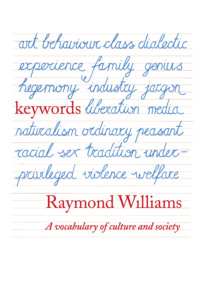
Keywords
A vocabulary of culture and society
Raymond Williams
Fourth Estate • London
Contents
Title Page
Introduction
Preface to the Second Edition
Abbreviations
A
AESTHETIC
ALIENATION
ANARCHISM
ANTHROPOLOGY
ART
B
BEHAVIOUR
BOURGEOIS
BUREAUCRACY
C
CAPITALISM
CAREER
CHARITY
CITY
CIVILIZATION
CLASS
COLLECTIVE
COMMERCIALISM
COMMON
COMMUNICATION
COMMUNISM
COMMUNITY
CONSENSUS
CONSUMER
CONVENTIONAL
COUNTRY
CREATIVE
CRITICISM
CULTURE
D
DEMOCRACY
DETERMINE
DEVELOPMENT
DIALECT
DIALECTIC
DOCTRINAIRE
DRAMATIC
E
ECOLOGY
EDUCATED
ELITE
EMPIRICAL
EQUALITY
ETHNIC
EVOLUTION
EXISTENTIAL
EXPERIENCE
EXPERT
EXPLOITATION
F
FOLK
FAMILY
FICTION
FORMALIST
G
GENERATION
GENETIC
GENIUS
H
HEGEMONY
HISTORY
HUMANITY
I
IDEALISM
IDEOLOGY
IMAGE
IMPERIALISM
IMPROVE
INDIVIDUAL
INDUSTRY
INSTITUTION
INTELLECTUAL
INTEREST
ISMS
J
JARGON
L
LABOUR
LIBERAL
LIBERATION
LITERATURE
M
MAN
MANAGEMENT
MASSES
MATERIALISM
MECHANICAL
MEDIA
MEDIATION
MEDIEVAL
MODERN
MONOPOLY
MYTH
N
NATIONALIST
NATIVE
NATURALISM
NATURE
O
ORDINARY
ORGANIC
ORIGINALITY
P
PEASANT
PERSONALITY
PHILOSOPHY
POPULAR
POSITIVIST
PRAGMATIC
PRIVATE
PROGRESSIVE
PSYCHOLOGICAL
R
RACIAL
RADICAL
RATIONAL
REACTIONARY
REALISM
REFORM
REGIONAL
REPRESENTATIVE
REVOLUTION
ROMANTIC
S
SCIENCE
SENSIBILITY
SEX
SOCIALIST
SOCIETY
SOCIOLOGY
STANDARDS
STATUS
STRUCTURAL
SUBJECTIVE
T
TASTE
TECHNOLOGY
THEORY
TRADITION
U
UNCONSCIOUS
UNDERPRIVILEGED
UNEMPLOYMENT
UTILITARIAN
V
VIOLENCE
W
WEALTH
WELFARE
WESTERN
WORK
References and Select Bibliography
About the Author
Copyright
About the Publisher
Introduction
In 1945, after the ending of the wars with Germany and Japan, I was released from the Army to return to Cambridge. University term had already begun, and many relationships and groups had been formed. It was in any case strange to travel from an artillery regiment on the Kiel Canal to a Cambridge college. I had been away only four and a half years, but in the movements of war had lost touch with all my university friends. Then, after many strange days, I met a man I had worked with in the first year of the war, when the formations of the 1930s, though under pressure, were still active. He too had just come out of the Army. We talked eagerly, but not about the past. We were too much preoccupied with this new and strange world around us. Then we both said, in effect simultaneously: ‘the fact is, they just don’t speak the same language’.
It is a common phrase. It is often used between successive generations, and even between parents and children. I had used it myself, just six years earlier, when I had come to Cambridge from a working-class family in Wales. In many of the fields in which language is used it is of course not true. Within our common language, in a particular country, we can be conscious of social differences, or of differences of age, but in the main we use the same words for most everyday things and activities, though with obvious variations of rhythm and accent and tone. Some of the variable words, say lunch and supper and dinner, may be highlighted but the differences are not particularly important. When we come to say ‘we just don’t speak the same language’ we mean something more general: that we have different immediate values or different kinds of valuation, or that we are aware, often intangibly, of different formations and distributions of energy and interest. In such a case, each group is speaking its native language, but its uses are significantly different, and especially when strong feelings or important ideas are in question. No single group is ‘wrong’ by any linguistic criterion, though a temporarily dominant group may try to enforce its own uses as ‘correct’. What is really happening through these critical encounters, which may be very conscious or may be felt only as a certain strangeness and unease, is a process quite central in the development of a language when, in certain words, tones and rhythms, meanings are offered, felt for, tested, confirmed, asserted, qualified, changed. In some situations this is a very slow process indeed; it needs the passage of centuries to show itself actively, by results, at anything like its full weight. In other situations the process can be rapid, especially in certain key areas. In a large and active university, and in a period of change as important as a war, the process can seem unusually rapid and conscious.
Yet it had been, we both said, only four or five years. Could it really have changed that much? Searching for examples we found that some general attitudes in politics and religion had altered, and agreed that these were important changes. But I found myself preoccupied by a single word, culture, which it seemed I was hearing very much more often: not only, obviously, by comparison with the talk of an artillery regiment or of my own family, but by direct comparison within the university over just those few years. I had heard it previously in two senses: one at the fringes, in teashops and places like that, where it seemed the preferred word for a kind of social superiority, not in ideas or learning, and not only in money or position, but in a more intangible area, relating to behaviour; yet also, secondly, among my own friends, where it was an active word for writing poems and novels, making films and paintings, working in theatres. What I was now hearing were two different senses, which I could not really get clear: first, in the study of literature, a use of the word to indicate, powerfully but not explicitly, some central formation of values (and literature itself had the same kind of emphasis); secondly, in more general discussion, but with what seemed to me very different implications, a use which made it almost equivalent to society: a particular way of life – ‘American culture’, ‘Japanese culture’.
Today I can explain what I believe was happening. Two important traditions were finding in England their effective formations: in the study of literature a decisive dominance of an idea of criticism which, from Arnold through Leavis, had culture as one of its central terms; and in discussions of society the extension to general conversation of an anthropological sense which had been clear as a specialist term but which now, with increased American influence and with the parallel influence of such thinkers as Mannheim, was becoming naturalized. The two earlier senses had evidently weakened: the teashop sense, though still active, was more distant and was becoming comic; the sense of activity in the arts, though it held its national place, seemed more and more excluded both by the emphasis of criticism and by the larger and dissolving reference to a whole way of life. But I knew nothing of this at the time. It was just a difficult word, a word I could think of as an example of the change which we were trying, in various ways, to understand.
My year in Cambridge passed. I went off to a job in adult education. Within two years T. S. Eliot published his Notes Towards the Definition of Culture (1948) – a book I grasped but could not accept – and all the elusive strangeness of those first weeks back in Cambridge returned with force. I began exploring the word in my adult classes. The words I linked it with, because of the problems its uses raised in my mind, were class and art, and then industry and democracy. I could feel these five words as a kind of structure. The relations between them became more complex the more I considered them. I began reading widely, to try to see more clearly what each was about. Then one day in the basement of the Public Library at Seaford, where we had gone to live, I looked up culture, almost casually, in one of the thirteen volumes of what we now usually call the OED: the Oxford New English Dictionary on Historical Principles. It was like a shock of recognition. The changes of sense I had been trying to understand had begun in English, it seemed, in the early nineteenth century. The connections I had sensed with class and art, with industry and democracy, took on, in the language, not only an intellectual but an historical shape. I see these changes today in much more complex ways. Culture itself has now a different though related history. But this was the moment at which an inquiry which had begun in trying to understand several urgent contemporary problems – problems quite literally of understanding my immediate world – achieved a particular shape in trying to understand a tradition. This was the work which, completed in 1956, became my book Culture and Society.
It was not easy then, and it is not much easier now, to describe this work in terms of a particular academic subject. The book has been classified under headings as various as cultural history, historical semantics, history of ideas, social criticism, literary history and sociology. This may at times be embarrassing or even difficult, but academic subjects are not eternal categories, and the fact is that, wishing to put certain general questions in certain specific ways, I found that the connections I was making, and the area of concern which I was attempting to describe, were in practice experienced and shared by many other people, to whom the particular study spoke. One central feature of this area of interest was its vocabulary, which is significantly not the specialized vocabulary of a specialized discipline, though it often overlaps with several of these, but a general vocabulary ranging from strong, difficult and persuasive words in everyday usage to words which, beginning in particular specialized contexts, have become quite common in descriptions of wider areas of thought and experience. This, significantly, is the vocabulary we share with others, often imperfectly, when we wish to discuss many of the central processes of our common life. Culture, the original difficult word, is an exact example. It has specialized meanings in particular fields of study, and it might seem an appropriate task simply to sort these out. But it was the significance of its general and variable usage that had first attracted my attention: not in separated disciplines but in general discussion. The very fact that it was important in two areas that are often thought of as separate – art and society – posed new questions and suggested new kinds of connection. As I went on I found that this seemed to be true of a significant range of words – from aesthetic to work – and I began collecting them and trying to understand them. The significance, it can be said, is in the selection. I realize how arbitrary some inclusions and exclusions may seem to others. But out of some two hundred words, which I chose because I saw or heard them being used in quite general discussion in what seemed to me interesting or difficult ways, I then selected sixty and wrote notes and short essays on them, intending them as an appendix to Culture and Society, which in its main text was dealing with a number of specific writers and thinkers. But when that book was finished my publisher told me it had to be shortened: one of the items that could be taken out was this appendix. I had little effective choice. I agreed, reluctantly. I put in a note promising this material as a separate paper. But the file of the appendix stayed on my shelf. For over twenty years I have been adding to it: collecting more examples, finding new points of analysis, including other words. I began to feel that this might make a book on its own. I went through the whole file again, rewrote all the notes and short essays, excluded some words and again added others. The present volume is the result.
I have emphasized this process of the development of Keywords because it seems to me to indicate its dimension and purpose. It is not a dictionary or glossary of a particular academic subject. It is not a series of footnotes to dictionary histories or definitions of a number of words. It is, rather, the record of an inquiry into a vocabulary: a shared body of words and meanings in our most general discussions, in English, of the practices and institutions which we group as culture and society. Every word which I have included has at some time, in the course of some argument, virtually forced itself on my attention because the problems of its meanings seemed to me inextricably bound up with the problems it was being used to discuss. I have often got up from writing a particular note and heard the same word again, with the same sense of significance and difficulty: often, of course, in discussions and arguments which were rushing by to some other destination. I began to see this experience as a problem of vocabulary, in two senses: the available and developing meanings of known words, which needed to be set down; and the explicit but as often implicit connections which people were making, in what seemed to me, again and again, particular formations of meaning – ways not only of discussing but at another level of seeing many of our central experiences. What I had then to do was not only to collect examples, and look up or revise particular records of use, but to analyse, as far as I could, some of the issues and problems that were there inside the vocabulary, whether in single words or in habitual groupings. I called these words keywords in two connected senses: they are significant, binding words in certain activities and their interpretation; they are significant, indicative words in certain forms of thought. Certain uses bound together certain ways of seeing culture and society, not least in these two most general words. Certain other uses seemed to me to open up issues and problems, in the same general area, of which we all needed to be very much more conscious. Notes on a list of words; analyses of certain formations: these were the elements of an active vocabulary – a way of recording, investigating and presenting problems of meaning in the area in which the meanings of culture and society have formed.
Of course the issues could not all be understood simply by analysis of the words. On the contrary, most of the social and intellectual issues, including both gradual developments and the most explicit controversies and conflicts, persisted within and beyond the linguistic analysis. Yet many of these issues, I found, could not really be thought through, and some of them, I believe, cannot even be focused on unless we are conscious of the words as elements of the problems. This point of view is now much more widely accepted. When I raised my first questions about the differing uses of culture I was given the impression, in kindly and not so kind ways, that these arose mainly from the fact of an incomplete education, and the fact that this was true (in real terms it is true of everyone) only clouded the real point at issue. The surpassing confidence of any particular use of a word, within a group or within a period, is very difficult to question. I recall an eighteenth-century letter:
What, in your opinion, is the meaning of the word sentimental, so much in vogue among the polite …? Everything clever and agreeable is comprehended in that word … I am frequently astonished to hear such a one is a sentimental man; we were a sentimental party; I have been taking a sentimental walk.
Well, that vogue passed. The meaning of sentimental changed and deteriorated. Nobody now asking the meaning of the word would be met by that familiar, slightly frozen, polite stare. When a particular history is completed, we can all be clear and relaxed about it. But literature, aesthetic, representative, empirical, unconscious, liberal: these and many other words which seem to me to raise problems will, in the right circles, seem mere transparencies, their correct use a matter only of education. Or class, democracy, equality, evolution, materialism: these we know we must argue about, but we can assign particular uses to sects, and call all sects but our own sectarian. Language depends, it can be said, on this kind of confidence, but in any major language, and especially in periods of change, a necessary confidence and concern for clarity can quickly become brittle, if the questions involved are not faced.
The questions are not only about meaning; in most cases, inevitably, they are about meanings. Some people, when they see a word, think the first thing to do is to define it. Dictionaries are produced and, with a show of authority no less confident because it is usually so limited in place and time, what is called a proper meaning is attached. I once began collecting, from correspondence in newspapers, and from other public arguments, variations on the phrases ‘I see from my Webster’ and ‘I find from my Oxford Dictionary’. Usually what was at issue was a difficult term in an argument. But the effective tone of these phrases, with their interesting overtone of possession (‘my Webster’), was to appropriate a meaning which fitted the argument and to exclude those meanings which were inconvenient to it but which some benighted person had been so foolish as to use. Of course if we want to be clear about banxring or baobab or barilla, or for that matter about barbel or basilica or batik, or, more obviously, about barber or barley or barn, this kind of definition is effective. But for words of a different kind, and especially for those which involve ideas and values, it is not only an impossible but an irrelevant procedure. The dictionaries most of us use, the defining dictionaries, will in these cases, and in proportion to their merit as dictionaries, list a range of meanings, all of them current, and it will be the range that matters. Then when we go beyond these to the historical dictionaries, and to essays in historical and contemporary semantics, we are quite beyond the range of the ‘proper meaning’. We find a history and complexity of meanings; conscious changes, or consciously different uses; innovation, obsolescence, specialization, extension, overlap, transfer; or changes which are masked by a nominal continuity so that words which seem to have been there for centuries, with continuous general meanings, have come in fact to express radically different or radically variable, yet sometimes hardly noticed, meanings and implications of meaning. Industry, family, nature may jump at us from such sources; class, rational, subjective may after years of reading remain doubtful. It is in all these cases, in a given area of interest which began in the way I have described, that the problems of meaning have preoccupied me and have led to the sharpest realization of the difficulties of any kind of definition.
The work which this book records has been done in an area where several disciplines converge but in general do not meet. It has been based on several areas of specialist knowledge but its purpose is to bring these, in the examples selected, into general availability. This needs no apology but it does need explanation of some of the complexities that are involved in any such attempt. These can be grouped under two broad headings: problems of information and problems of theory.
The problems of information are severe. Yet anyone working on the structures and developments of meaning in English words has the extraordinary advantage of the great Oxford Dictionary. This is not only a monument to the scholarship of its editors, Murray, Bradley and their successors, but also the record of an extraordinary collaborative enterprise, from the original work of the Philological Society to the hundreds of later correspondents. Few inquiries into particular words end with the great Dictionary’s account, but even fewer could start with any confidence if it were not there. I feel with William Empson, who in The Structure of Complex Words found many faults in the Dictionary, that ‘such work on individual words as I have been able to do has been almost entirely dependent on using the majestic object as it stands’. But what I have found in my own work about the OED, when this necessary acknowledgment has been made, can be summed up in three ways. I have been very aware of the period in which the Dictionary was made: in effect from the 1880s to the 1920s (the first example of the current series of Supplements shows addition rather than revision). This has two disadvantages: that in some important words the evidence for developed twentieth-century usage is not really available; and that in a number of cases, especially in certain sensitive social and political terms, the presuppositions of orthodox opinion in that period either show through or are not far below the surface. Anyone who reads Dr Johnson’s great Dictionary soon becomes aware of his active and partisan mind as well as his remarkable learning. I am aware in my own notes and essays that, though I try to show the range, many of my own positions and preferences come through. I believe that this is inevitable, and all I am saying is that the air of massive impersonality which the Oxford Dictionary communicates is not so impersonal, so purely scholarly, or so free of active social and political values as might be supposed from its occasional use. Indeed, to work closely in it is at times to get a fascinating insight into what can be called the ideology of its editors, and I think this has simply to be accepted and allowed for, without the kind of evasion which one popular notion of scholarship prepares the way for. Secondly, for all its deep interest in meanings, the Dictionary is primarily philological and etymological; one of the effects of this is that it is much better on range and variation than on connection and interaction. In many cases, working primarily on meanings and their contexts, I have found the historical evidence invaluable but have drawn different and at times even opposite conclusions from it. Thirdly, in certain areas I have been reminded very sharply of the change of perspective which has recently occurred in studies of language: for obvious reasons (if only from the basic orthodox training in dead languages) the written language used to be taken as the real source of authority, with the spoken language as in effect derived from it; whereas now it is much more clearly realized that the real situation is usually the other way round. The effects are complex. In a number of primarily intellectual terms the written language is much nearer the true source. If we want to trace psychology the written record is probably adequate, until the late nineteenth century. But if, on the other hand, we want to trace job, we have soon to recognize that the real developments of meaning, at each stage, must have occurred in everyday speech well before they entered the written record. This is a limitation which has to be recognized, not only in the Dictionary, but in any historical account. A certain foreshortening or bias in some areas is, in effect, inevitable. Period indications for origin and change have always to be read with this qualification and reservation. I can give one example from personal experience. Checking the latest Supplement for the generalizing contemporary use of communications, I found an example and a date which happened to be from one of my own articles. Now not only could written examples have been found from an earlier date, but I know that this sense was being used in conversation and discussion, and in American English, very much earlier. I do not make the point to carp. On the contrary, this fact about the Dictionary is a fact about any work of this kind, and needs especially to be remembered when reading my own accounts.
For certain words I have added a number of examples of my own, from both general and deliberate reading. But of course any account is bound to be incomplete, in a serious sense, just as it is bound to be selective. The problems of adequate information are severe and sometimes crippling, but it is not always possible to indicate them properly in the course of an analysis. They should, nevertheless, always be remembered. And of one particular limitation I have been very conscious. Many of the most important words that I have worked on either developed key meanings in languages other than English, or went through a complicated and interactive development in a number of major languages. Where I have been able in part to follow this, as in alienation or culture, its significance is so evident that we are bound to feel the lack of it when such tracing has not been possible. To do such comparative studies adequately would be an extraordinary international collaborative enterprise, and the difficulties of that may seem sufficient excuse. An inquiry into the meanings of democracy, sponsored by UNESCO and intended to be universal and comparative, ran into every kind of difficulty, though even the more limited account that Naess and his colleagues had to fall back on is remarkably illuminating. I have had enough experience of trying to discuss two key English Marxist terms – base and superstructure – not only in relation to their German originals, but in discussions with French, Italian, Spanish, Russian and Swedish friends, in relation to their forms in these other languages, to know not only that the results are fascinating and difficult, but that such comparative analysis is crucially important, not just as philology, but as a central matter of intellectual clarity. It is greatly to be hoped that ways will be found of encouraging and supporting these comparative inquiries, but meanwhile it should be recorded that while some key developments, now of international importance, occurred first in English, many did not and in the end can only be understood when other languages are brought consistently into comparison. This limitation, in my notes and essays, has to be noted and remembered by readers. It is particularly marked in very early developments, in the classical languages and in medieval Latin, where I have almost invariably simply relied on existing authorities, though with many questions that I could not answer very active in my mind. Indeed, at the level of origins, of every kind, this is generally true and must be entered as an important reservation.
This raises one of the theoretical problems. It is common practice to speak of the ‘proper’ or ‘strict’ meaning of a word by reference to its origins. One of the effects of one kind of classical education, especially in conjunction with one version of the defining function of dictionaries, is to produce what can best be called a sacral attitude to words, and corresponding complaints of vulgar contemporary misunderstanding and misuse. The original meanings of words are always interesting. But what is often most interesting is the subsequent variation. The complaints that get into the newspapers, about vulgar misuse, are invariably about very recent developments. Almost any random selection of actual developments of meaning will show that what is now taken as ‘correct’ English, often including many of the words in which such complaints are made, is the product of just such kinds of change. The examples are too numerous to quote here but the reader is invited to consider only interest or determine or improve, though organic, evolution and individual are perhaps more spectacular examples. I have often found a clue to an analysis by discovery of an origin, but there can be no question, at the level either of practice or of theory, of accepting an original meaning as decisive (or where should we be with aesthetic?) or of accepting a common source as directive (or where should we be as between peasant and pagan, idiot and idiom, or employ and imply?). The vitality of a language includes every kind of extension, variation and transfer, and this is as true of change in our own time (however much we may regret some particular examples) as of changes in the past which can now be given a sacral veneer. (Sacral itself is an example; the extension from its physical sense of the fundament to its disrespectful implication of an attitude to the sacred is not my joke, but it is a meaningful joke and thence a meaningful use.)
The other theoretical problems are very much more difficult. There are quite basic and very complex problems in any analysis of the processes of meaning. Some of these can be usefully isolated as general problems of signification: the difficult relations between words and concepts; or the general processes of sense and reference; and beyond these the more general rules, in social norms and in the system of language itself, which both enable sense and reference to be generated and in some large degree to control them. In linguistic philosophy and in theoretical linguistics these problems have been repeatedly and usefully explored, and there can be no doubt that as fundamental problems they bear with real weight on every particular analysis.
Yet just because ‘meaning’, in any active sense, is more than the general process of ‘signification’, and because ‘norms’ and ‘rules’ are more than the properties of any abstract process or system, other kinds of analysis remain necessary. The emphasis of my own analyses is deliberately social and historical. In the matters of reference and applicability, which analytically underlie any particular use, it is necessary to insist that the most active problems of meaning are always primarily embedded in actual relationships, and that both the meanings and the relationships are typically diverse and variable, within the structures of particular social orders and the processes of social and historical change.
This does not mean that the language simply reflects the processes of society and history. On the contrary, it is a central aim of this book to show that some important social and historical processes occur within language, in ways which indicate how integral the problems of meanings and of relationships really are. New kinds of relationship, but also new ways of seeing existing relationships, appear in language in a variety of ways: in the invention of new terms (capitalism); in the adaptation and alteration (indeed at times reversal) of older terms (society or individual); in extension (interest) or transfer (exploitation). But also, as these examples should remind us, such changes are not always either simple or final. Earlier and later senses coexist, or become actual alternatives in which problems of contemporary belief and affiliation are contested. It is certainly necessary to analyse these and other consequent problems as problems of general signification, but my emphasis here is on a vocabulary of meanings, in a deliberately selected area of argument and concern.
My starting point, as I have said, was what can be called a cluster, a particular set of what came to seem interrelated words and references, from which my wider selection then developed. It is thus an intrinsic aim of the book to emphasize interconnections, some of which seem to me in some new ways systematic, in spite of problems of presentation which I shall discuss. It can of course be argued that individual words should never be isolated, since they depend for their meanings on their actual contexts. At one level this can be readily conceded. Many of the variable senses that I have analysed are determined, in practice, by contexts. Indeed this is why I mainly illustrate the different senses by actual examples in recorded use.
Yet the problem of meaning can never be wholly dissolved into context. It is true that no word ever finally stands on its own, since it is always an element in the social process of language, and its uses depend on complex and (though variably) systematic properties of language itself. Yet it can still be useful to pick out certain words, of an especially problematical kind, and to consider, for the moment, their own internal developments and structures. This is so even when the qualification, ‘for the moment’, is ignored by one kind of reader, who is content to reassert the facts of connection and interaction from which this whole inquiry began. For it is only in reductive kinds of analysis that the processes of connection and interaction can be studied as if they were relations between simple units. In practice many of these processes begin within the complex and variable sense of particular words, and the only way to show this, as examples of how networks of usage, reference and perspective are developed, is to concentrate, ‘for the moment’, on what can then properly be seen as internal structures. This is not to impede but to make possible the sense of an extended and intricate vocabulary, within which both the variable words and their varied and variable interrelations are in practice active.
To study both particular and relational meanings, then, in different actual speakers and writers, and in and through historical time, is a deliberate choice. The limitations are obvious and are admitted. The emphasis is equally obvious and is conscious. One kind of semantics is the study of meaning as such; another kind is the study of formal systems of signification. The kind of semantics to which these notes and essays belong is one of the tendencies within historical semantics: a tendency that can be more precisely defined when it is added that the emphasis is not only on historical origins and developments but also on the present – present meanings, implications and relationships – as history. This recognizes, as any study of language must, that there is indeed community between past and present, but also that community – that difficult word – is not the only possible description of these relations between past and present; that there are also radical change, discontinuity and conflict, and that all these are still at issue and are indeed still occurring. The vocabulary I have selected is that which seems to me to contain the key words in which both continuity and discontinuity, and also deep conflicts of value and belief, are in this area engaged. Such processes have of course also to be described in direct terms, in the analysis of different social values and conceptual systems. What these notes and essays are intended to contribute is an additional kind of approach, through the vocabulary itself.
For I believe that it is possible to contribute certain kinds of awareness and certain more limited kinds of clarification by taking certain words at the level at which they are generally used, and this, for reasons related to and probably clear from all my other work, has been my overriding purpose. I have more than enough material on certain words (for example class and culture) and on certain formations (for example art, aesthetic, subjective, psychological, unconscious) to write, as an alternative, extended specialist studies, some themselves of book length. I may eventually do this, but the choice of a more general form and a wider range was again deliberate. I do not share the optimism, or the theories which underlie it, of that popular kind of inter-war and surviving semantics which supposed that clarification of difficult words would help in the resolution of disputes conducted in their terms and often evidently confused by them. I believe that to understand the complexities of the meanings of class contributes very little to the resolution of actual class disputes and class struggles. It is not only that nobody can ‘purify the dialect of the tribe’, nor only that anyone who really knows himself to be a member of a society knows better than to want, in those terms, to try. It is also that the variations and confusions of meaning are not just faults in a system, or errors of feedback, or deficiencies of education. They are in many cases, in my terms, historical and contemporary substance. Indeed they have often, as variations, to be insisted upon, just because they embody different experiences and readings of experience, and this will continue to be true, in active relationships and conflicts, over and above the clarifying exercises of scholars or committees. What can really be contributed is not resolution but perhaps, at times, just that extra edge of consciousness. In a social history in which many crucial meanings have been shaped by a dominant class, and by particular professions operating to a large extent within its terms, the sense of edge is accurate. This is not a neutral review of meanings. It is an exploration of the vocabulary of a crucial area of social and cultural discussion, which has been inherited within precise historical and social conditions and which has to be made at once conscious and critical – subject to change as well as to continuity – if the millions of people in whom it is active are to see it as active: not a tradition to be learned, nor a consensus to be accepted, nor a set of meanings which, because it is ‘our language’, has a natural authority; but as a shaping and reshaping, in real circumstances and from profoundly different and important points of view: a vocabulary to use, to find our own ways in, to change as we find it necessary to change it, as we go on making our own language and history.
In writing about a field of meanings I have often wished that some form of presentation could be devised in which it would be clear that the analyses of particular words are intrinsically connected, sometimes in complex ways. The alphabetical listing on which I have finally decided may often seem to obscure this, although the use of cross-references should serve as a reminder of many necessary connections. The difficulty is that any other kind of arrangement, for example by areas or themes, would establish one set of connections while often suppressing another. If representative, for example, is set in a group of political words, perhaps centring on democracy, we may lose sight of a significant question in the overlap between representative government and representative art. Or if realism is set in a group of literary words, perhaps centring on literature or on art, another kind of overlap, with fundamental philosophical connotations and with descriptions of attitudes in business and politics, may again not be readily seen. Specialized vocabularies of known and separate academic subjects and areas of interest are, while obviously useful, very much easier both to write and to arrange. The word-lists can be fuller and they can avoid questions of overlap by deliberate limitation to meanings within the specialism. But since my whole inquiry has been into an area of general meanings and connections of meaning, I have been able to achieve neither the completeness nor the conscious limitation of deliberately specialized areas. In taking what seemed to me to be the significant vocabulary of an area of general discussion of culture and society, I have lost the props of conventional arrangement by subject and have then needed to retain the simplest conventional arrangement, by alphabetical order. However, since a book is only completed when it is read, I would hope that while the alphabetical order makes immediate use easier, other kinds of connection and comparison will suggest themselves to the reader, and may be followed through by a quite different selection and order of reading.
In this as in many other respects I am exceptionally conscious of how much further work and thinking needs to be done. Much of it, in fact, can only be done through discussion, for which the book in its present form is in part specifically intended. Often in the notes and essays I have had to break off just at the point where a different kind of analysis – extended theoretical argument, or detailed social and historical inquiry – would be necessary. To have gone in these other directions would have meant restricting the number and range of the words discussed, and in this book at least this range has been my priority. But it can also be said that this is a book in which the author would positively welcome amendment, correction and addition as well as the usual range of responses and comments. The whole nature of the enterprise is of this kind. Here is a critical area of vocabulary. What can be done in dictionaries is necessarily limited by their proper universality and by the long time-scale of revision which that, among other factors, imposes. The present inquiry, being more limited – not a dictionary but a vocabulary – is more flexible. My publishers have been good enough to include some blank pages, not only for the convenience of making notes, but as a sign that the inquiry remains open, and that the author will welcome all amendments, corrections and additions. In the use of our common language, in so important an area, this is the only spirit in which this work can be properly done.
I have to thank more people than I can now name who, over the years, in many kinds of formal and informal discussion, have contributed to these analyses. I have also especially to thank Mr R. B. Woodings, my editor, who was not only exceptionally helpful with the book itself, but who, as a former colleague, came to see me at just the moment when I was actively considering whether the file should become a book and whose encouragement was then decisive. My wife has helped me very closely at all stages of the work. I have also to record the practical help of Mr W. G. Heyman who, as a member of one of my adult classes thirty years ago, told me after a discussion of a word that as a young man he had begun buying the paper parts of the great Oxford Dictionary, and a few years later astonished me by arriving at a class with three cardboard boxes full of them, which he insisted on giving to me. I have a particular affection for his memory, and through it for these paper parts themselves – so different from the bound volumes and smooth paper of the library copies; yellowing and breaking with time, the rough uncut paper, the memorable titles – Deject to Depravation, Heel to Hod, R to Reactive and so on – which I have used over the years. This is a small book to offer in return for so much interest and kindness.
Cambridge, 1975, 1983
RW
Preface to the Second Edition
The welcome given to this book, in its original edition, was beyond anything its author had expected. This has encouraged me to revise it, in ways indicated in the original Introduction, though still with a sense of the work as necessarily unfinished and incomplete. In this new edition I have been able to include notes on a further twenty-one words: anarchism, anthropology, development, dialect, ecology, ethnic, experience, expert, exploitation, folk, generation, genius, jargon, liberation, ordinary, racial, regional, sex, technology, underprivileged and western. Some of these are reintroduced from my original list; others have become more important in the period between that original list and the present time. I have also made revisions, including both corrections and additions, in the original main text.
I want to record my warm thanks to the many people who have written or spoken to me about the book. Some of the new entries come from their suggestions. So too do many of the additions and corrections to the original notes. I cannot involve any of them in my opinions, or in any errors, but I am especially indebted to Aidan Foster-Carter, for a series of notes and particularly on development; to Michael McKeon, on many points but especially on revolution; to Peter Burke, for a most helpful series of notes; and to Carl Gersuny, for a series of notes and particularly on interest and work. I am specifically indebted to Daniel Bell on generation; Gerald Fowler on scientist; Alan Hall on history; P. B. Home on native; R. D. Hull on industrial; G. Millington, H. S. Pickering and N. Pitterger on education; Darko Suvin on communist and social; René Wellek on literature. I am also indebted for helpful suggestions and references to Perry Anderson, Jonathan Benthall, Andrew Daw, Simon Duncan, Howard Erskine-Hill, Fred Gray, Christopher Hill, Denis L. Johnston, A. D. King, Michael Lane, Colin MacCabe, Graham Martin, Ian Mordant, Benjamin Nelson, Malcolm Pittock, Vivien Pixner, Vito Signorile, Philip Tait, Gay Weber, Stephen White, David Wise, Dave Wootton, Ivor Wymer and Stephen Yeo.
Cambridge, May 1983
RW
Abbreviations
The following abbreviations are used in the text.
| fw : | immediate forerunner of a word, in the same or another language. |
| rw : | ultimate traceable word, from which ‘root’ meanings arc derived. |
| q.v. : | see entry under word noted. |
| C : | followed by numeral, century (C19: nineteenth century). |
| eC : | first period (third) of a century. |
| mC : | middle period (third) of a century. |
| lC : | last period (third) of a century. |
| c. : | (before a date) approximately. |
| AN : | Anglo-Norman. |
| mE : | Middle English (c. 1100–1500). |
| oE : | Old English (to c. 1100). |
| F : | French. |
| mF : | Medieval French. |
| oF : | Old French. |
| G : | German. |
| Gk : | Classical Greek. |
| It : | Italian. |
| L : | Latin. |
| 1L : | late Latin. |
| mL : | Medieval Latin. |
| vL : | Vulgar Latin. |
| Rom : | Romanic. |
| Sp : | Spanish. |
| OED : | New English Dictionary on Historical Principles (Oxford). |
Quotations followed by a name and date only, or a date only, are from examples cited in OED. Other quotations are followed by specific sources. References to secondary works are by author’s name, as entered in References and Select Bibliography.

A
AESTHETIC
Aesthetic first appeared in English in C19, and was not common before mC19. It was in effect, in spite of its Greek form, a borrowing from German, after a critical and controversial development in that language. It was first used in a Latin form as the title of two volumes, Aesthetica (1750–8), by Alexander Baumgarten (1714–62). Baumgarten defined beauty as phenomenal perfection, and the importance of this, in thinking about art, was that it placed a predominant stress on apprehension through the senses. This explains Baumgarten’s essentially new word, derived from rw aisthesis, Gk – sense perception. In Greek the main reference was to material things, that is things perceptible by the senses, as distinct from things which were immaterial or which could only be thought. Baumgarten’s new use was part of an emphasis on subjective sense activity, and on the specialized human creativity of art, which became dominant in these fields and which inherited his title-word, though his book was not translated and had limited circulation. In Kant beauty was also seen as an essentially and exclusively sensuous phenomenon, but he protested against Baumgarten’s use and defined aesthetics in the original and broader Greek sense of the science of ‘the conditions of sensuous perception’. Both uses are then found in occasional eC19 English examples, but by mC19 reference to ‘the beautiful’ is predominant and there is a strong regular association with art. Lewes, in 1879, used a variant derived form, aesthesics, in a definition of the ‘abstract science of feeling’. Yet anaesthesia, a defect of physical sensation, had been used since eC18; and from mC19, with advances in medicine, anaesthetic – the negative form of the increasingly popular adjective – was widely used in the original broad sense to mean deprived of sensation or the agent of such deprivation. This use of the straight negative form led eventually to such negatives as unaesthetic or nonaesthetic in relation to the dominant use referring to beauty or to art.
In 1821 Coleridge wished that he could ‘find a more familiar word than aesthetics for works of TASTE and CRITICISM’ (qq.v.), and as late as 1842 aesthetics was referred to as ‘a silly pedantical term’. In 1859 Sir William Hamilton, understanding it as ‘the Philosophy of Taste, The theory of the Fine Arts, the Science of the Beautiful, etc.’, and acknowledging its general acceptance ‘not only in Germany but throughout the other countries of Europe’, still thought apolaustic would have been more appropriate. But the word had taken hold and became increasingly common, though with a continuing uncertainty (implicit in the theory which had led to the coinage) between reference to art and more general reference to the beautiful. By 1880 the noun aesthete was being widely used, most often in a derogatory sense. The principles and practices of the ‘aesthetic movement’ around Walter Pater were both attacked and sneered at (the best-remembered example is in Gilbert’s Patience (1880)). This is contemporary with similar feeling around the use of culture by Matthew Arnold and others. Aesthete has not recovered from this use, and the neutral noun relating to aesthetics as a formal study is the earlier (mC19) aesthetician. The adjective aesthetic, apart from its specialized uses in discussion of art and literature, is now in common use to refer to questions of visual appearance and effect.
It is clear from this history that aesthetic, with its specialized references to ART (q.v.), to visual appearance, and to a category of what is ‘fine’ or ‘beautiful’, is a key formation in a group of meanings which at once emphasized and isolated SUBJECTIVE (q.v.) sense-activity as the basis of art and beauty as distinct, for example, from social or cultural interpretations. It is an element in the divided modern consciousness of art and society: a reference beyond social use and social valuation which, like one special meaning of culture, is intended to express a human dimension which the dominant version of society appears to exclude. The emphasis is understandable but the isolation can be damaging, for there is something irresistibly displaced and marginal about the now common and limiting phrase ‘aesthetic considerations’, especially when contrasted with practical or UTILITARIAN (q.v.) considerations, which are elements of the same basic division.
See ART, CREATIVE, CULTURE, GENIUS, LITERATURE, SUBJECTIVE, UTILITARIAN
ALIENATION
Alienation is now one of the most difficult words in the language. Quite apart from its common usage in general contexts, it carries specific but disputed meanings in a range of disciplines from social and economic theory to philosophy and psychology. From mC20, moreover, it has passed from different areas of this range into new kinds of common usage where it is often confusing because of overlap and uncertainty in relation both to the various specific meanings and the older more general meanings.
Though it often has the air of a contemporary term, alienation as an English word, with a wide and still relevant range of meanings, has been in the language for several centuries. Its fw is aliénacion, mF, from alienationem, L, from rw alienare – to estrange or make another’s; this relates to alienus, L – of or belonging to another person or place, from rw alius – other, another. It has been used in English from C14 to describe an action of estranging or state of estrangement (i): normally in relation to a cutting-off or being cut off from God, or to a breakdown of relations between a man or a group and some received political authority. From C15 it has been used to describe the action of transferring the ownership of anything to another (ii), and especially the transfer of rights, estates or money. There are subsidiary minor early senses of (ii), where the transfer is contrived by the beneficiary (stealth) or where the transfer is seen as diversion from a proper owner or purpose. These negative senses of (ii) eventually became dominant; a legal sense of voluntary and intentional transfer survived, but improper, involuntary or even forcible transfer became the predominant implication. This was then extended to the result of such a transfer, a state of something having been alienated (iii). By analogy, as earlier in Latin, the word was further used from C15 to mean the loss, withdrawal or derangement of mental faculties, and thus insanity (iv).
In the range of contemporary specific meanings, and in most consequent common usage, each of these earlier senses is variously drawn upon. By eC20 the word was in common use mainly in two specific contexts: the alienation of formal property, and in the phrase alienation of affection (from mC19) with the sense of deliberate and contrived interference in a customary family relationship, usually that of husband and wife. But the word had already become important, sometimes as a key concept, in powerful and developing intellectual systems.
There are several contemporary variants of sense (i). There is the surviving theological sense, normally a state rather than an action, of being cut off, estranged from the knowledge of God, or from his mercy or his worship. This sometimes overlaps with a more general use, with a decisive origin in Rousseau, in which man is seen as cut off, estranged from his own original nature. There are several variants of this, between the two extreme defining positions of man estranged from his original (often historically primitive) nature and man estranged from his essential (inherent and permanent) nature. The reasons given vary widely. There is a persistent sense of the loss of original human nature through the development of an ‘artificial’ CIVILIZATION (q.v.); the overcoming of alienation is then either an actual primitivism or a cultivation of human feeling and practice against the pressures of civilization. In the case of estrangement from an essential nature the two most common variants are the religious sense of estrangement from ‘the divine in man’, and the sense common in Freud and Freudian-influenced psychology in which man is estranged (again by CIVILIZATION or by particular phases or processes of CIVILIZATION) from his primary energy, either libido or explicit sexuality. Here the overcoming of alienation is either recovery of a sense of the divine or, in the alternative tradition, whole or partial recovery of libido or sexuality, a prospect viewed from one position as difficult or impossible (alienation in this sense being part of the price paid for civilization) and from another position as programmatic and radical (the ending of particular forms of repression – CAPITALISM, the BOURGEOIS FAMILY (qq.v.) – which produce this substantial alienation).
There is an important variation of sense (i) by the addition of forms of sense (ii) in Hegel and, alternatively, in Marx. Here what is alienated is an essential nature, a ‘self-alienated spirit’, but the process of alienation is seen as historical. Man indeed makes his own nature, as opposed to concepts of an original human nature. But he makes his own nature by a process of objectification (in Hegel a spiritual process; in Marx the labour process) and the ending of alienation would be a transcendence of this formerly inevitable and necessary alienation. The argument is difficult and is made more difficult by the relations between the German and English key words. German entäussern corresponds primarily to English sense (ii): to part with, transfer, lose to another, while having also an additional and in this context crucial sense of ‘making external to oneself’. German entfremden is closer to English sense (i), especially in the sense of an act or state of estrangement between persons. (On the history of Entfremdung, see Schacht. A third word used by Marx, vergegenständlichung, has been sometimes translated as alienation but is now more commonly understood as ‘reification’ – broadly, making a human process into an objective thing.) Though the difficulties are clearly explained in some translations, English critical discussion has been confused by uncertainty between the meanings and by some loss of distinction between senses (i) and (ii): a vital matter when in the development of the concept the interactive relation between senses (i) and (ii) is crucial, as especially in Marx. In Hegel the process is seen as world-historical spiritual development, in a dialectical relation of subject and object, in which alienation is overcome by a higher unity. In a subsequent critique of religion, Feuerbach described God as an alienation – in the sense of projection or transfer – of the highest human powers; this has been repeated in modern humanist arguments and in theological apologetics. In Marx the process is seen as the history of labour, in which man creates himself by creating his world, but in class-society is alienated from this essential nature by specific forms of alienation in the division of labour, private property and the capitalist mode of production in which the worker loses both the product of his labour and his sense of his own productive activity, following the expropriation of both by capital. The world man has made confronts him as stranger and enemy, having power over him who has transferred his power to it. This relates to the detailed legal and commercial sense of alienation (ii) or Entäusserung, though described in new ways by being centred in the processes of modern production. Thus alienation (i), in the most general sense of a state of estrangement, is produced by the cumulative and detailed historical processes of alienation (ii). Minor senses of alienation (i), corresponding to Entfremdung – estrangement of persons in competitive labour and production, the phenomenon of general estrangement in an industrial-capitalist factory or city – are seen as consequences of this general process.
All these specific senses, which have of course been the subject of prolonged discussion and dispute from within and from outside each particular system, have led to increasing contemporary usage, and the usual accusations of ‘incorrectness’ or ‘misunderstanding’ between what are in fact alternative uses of the word. The most widespread contemporary use is probably that derived from one form of psychology, a loss of connection with one’s own deepest feelings and needs. But there is a very common combination of this with judgments that we live in an ‘alienating’ society, with specific references to the nature of modern work, modern education and modern kinds of community. A recent classification (Seeman, 1959) defined: (a) powerlessness – an inability or a feeling of inability to influence the society in which we live; (b) meaninglessness – a feeling of lack of guides for conduct and belief, with (c) normlessness – a feeling that illegitimate means are required to meet approved goals; (d) isolation – estrangement from given norms and goals; (e) self-estrangement – an inability to find genuinely satisfying activities. This abstract classification, characteristically reduced to psychological states and without reference to specific social and historical processes, is useful in showing the very wide range which common use of the term now involves. Durkheim’s term, anomie, which has been also adopted in English, overlaps with alienation especially in relation to (b) and (c), the absence of or the failure to find adequate or convincing norms for social relationship and self-fulfilment.
It is clear from the present extent and intensity of the use of alienation that there is widespread and important experience which, in these varying ways, the word and its varying specific concepts offer to describe and interpret. There has been some impatience with its difficulties, and a tendency to reject it as merely fashionable. But it seems better to face the difficulties of the word and through them the difficulties which its extraordinary history and variation of usage indicate and record. In its evidence of extensive feeling of a division between man and society, it is a crucial element in a very general structure of meanings.
See CIVILIZATION, INDIVIDUAL, MAN, PSYCHOLOGICAL, SUBJECTIVE
ANARCHISM
Anarchy came into English in mC16, from fw anarchie, F, rw anarchia, Gk – a state without a leader. Its earliest uses are not too far from the early hostile uses of DEMOCRACY (q.v.): ‘this unleful lyberty or lycence of the multytude is called an Anarchie’ (1539). But it came through as primarily a description of any kind of disorder or chaos (Gk – chasm or void). Anarchism, from mC17, and anarchist, from lC17, remained, however, much nearer the political sense: ‘Anarchism, the Doctrine, Positions or Art of those that teach anarchy; also the being itself of the people without a Prince or Ruler’ (1656). The anarchists thus characterized are very close to democrats and republicans, in their older senses; there was also an association of anarchists and atheists (Cudworth, 1678). It is interesting that as late as 1862 Spencer wrote: ‘the anarchist … denies the right of any government … to trench upon his individual freedom’; these are now often the terms of a certain modern liberalism or indeed of a radical conservatism.
However the terms began to shift in the specific context of the French Revolution, when the Girondins attacked their radical opponents as anarchists, in the older general sense. This had the effect of identifying anarchism with a range of radical political tendencies, and the term of abuse seems first to have been positively adopted by Proudhon, in 1840. From this period anarchism is a major tendency within the socialist and labour movements, often in conflict with centralizing versions of Marxism and other forms of SOCIALISM (q.v.). From the 1870s groups which had previously defined themselves as mutualists, federalists or anti-authoritarians consciously adopted anarchists as their identification, and this broad movement developed into revolutionary organizations which were opposed to ‘state socialism’ and to the ‘dictatorship of the proletariat’. The important anarcho-syndicalist movement founded social organization on self-governing collectives, based on trade unions; these would be substituted for all forms of state organization.
Also, however, mainly between the 1870s and 1914, one minority tendency in anarchism had adopted tactics of individual violence and assassination, against political rulers. A strong residual sense of anarchist as this kind of terrorist (in the language, with terrorism, from Cl8) has not been forgotten, though it is clearly separate from the mainstream anarchist movement.
Conscious self-styled anarchism is still a significant political movement, but it is interesting that many anarchist ideas and proposals have been taken up in later phases of Marxist and other revolutionary socialist thought, though the distance from the word, with all its older implications, is usually carefully maintained.
See DEMOCRACY, LIBERAL, LIBERATION, RADICAL, REVOLUTION, SOCIALISM, VIOLENCE
ANTHROPOLOGY
Anthropology came into English in lC16. The first recorded use, from R. Harvey in 1593, has a modern ring: ‘Genealogy or issue which they had, Artes which they studied, Actes which they did. This part of History is named Anthropology.’ Yet a different sense was to become predominant, for the next three centuries. Anthropologos, Gk – discourse and study of man, with the implied substantive form anthropologia, had been used by Aristotle, and was revived in 1594–5 by Casmann: Psychologica Anthropologica, sive Animae Humanae Doctrina and Anthropologia: II, hoc est de fabrica Humani Corporis. The modern terms for the two parts of Casmann’s work would be PSYCHOLOGY (q.v.) and physiology, but of course the point was the linkage, in a sense that was still active in a standard C18 definition: ‘Anthropology includes the consideration both of the human body and soul, with the laws of their union, and the effects thereof, as sensation, motion, etc.’ What then came through was a specialization of physical studies, either (i) in relation to the senses – ‘the analysis of our senses in the commonest books of anthropology’ (Coleridge, 1810) – or (ii) in application to problems of human physical diversity (cf. RACIAL) and of human EVOLUTION (q.v.). Thus until the later C19, the predominant meaning was in the branch of study we now distinguish as ‘physical anthropology’.
The emergence (or perhaps, remembering Harvey, the re-emergence) of a more general sense, for what we would now distinguish as ‘social’ or ‘cultural’ anthropology, is a C19 development closely associated with the development of the ideas of CIVILIZATION (q.v.) and especially CULTURE (q.v.). Indeed Tylor’s Primitive Culture (1870) is commonly taken, in the English-speaking world, as a founding text of the new science. This runs back, in one line, to Herder’s lC18 distinction of plural cultures – distinct ways of life, which need to be studied as wholes, rather than as stages of DEVELOPMENT (q.v.) towards European civilization. It runs back also, in another line, to concepts derived from this very notion (common in the thinkers of the C18 Enlightenment) of ‘stages’ of development, and notably to G. F. Klemm’s Allgemeine Kulturgeschichte der Menschheit – ‘General Cultural History of Mankind’ (1843–52) and Allgemeine Kulturwissenschaft – ‘General Science of Culture’ (1854–5). Klemm distinguished three stages of human development as savagery, domestication and freedom. In 1871 the American Lewis Morgan, a pioneer in linguistic studies of kinship, influentially defined three stages in his Ancient Society; or Researches in the Line of Human Progress from Savagery through Barbarism to Civilization. Through Engels this had a major influence on early Marxism. But the significance of this line for the idea of anthropology was its emphasis on ‘primitive’ (or ‘savage’) cultures, whether or not in a perspective of ‘development’. In the period of European imperialism and colonialism, and in the related period of American relations with the conquered Indian tribes, there was abundant material both for scientific study and for more general concerns. (Some of the latter were later systematized as ‘practical’ or ‘applied’ anthropology, bringing scientific knowledge to bear on governmental and administrative policies.) Yet the most important effect was the relative specialization of anthropology to ‘primitive’ cultures, though this work, when done, both provided models of studies of ‘whole and distinct ways of life’, with effects on the study of ‘human structures’, generalized in one tendency as STRUCTURALISM (q.v.) in the closely related linguistics and anthropology; in another tendency as functionalism, in which social institutions are (variable) cultural responses to basic human needs; and, in its assembly of wide comparative evidence, encouraging more generally the idea of alternative cultures and lines of human development, in sharp distinction from the idea of regular stages in a unilinear process towards civilization.
Thus, in mC20, there were still the longstanding physical anthropology; the rich and extending anthropology of ‘primitive’ peoples; and, in an uncertain area beyond both, the sense of anthropology as a mode of study and a source of evidence for more general including modern human ways of life. Of course by this period SOCIOLOGY (q.v.) had become established, in different forms, as the discipline in which modern societies (and, in some schools, modern cultures) were studied, and there were then difficult overlaps with what were now called (mainly to distinguish them from physical anthropology) ‘social’ or ‘cultural’ anthropology (‘social’ has been more common in Britain; ‘cultural’ in USA; though cultural anthropology, in USA, often indicates the study of material artefacts).
The major intellectual issues involved in this complex of terms and disciplines are sometimes revealed, perhaps more often obscured, by the complex history of the words. It is interesting that a new grouping of these closely related and often overlapping concerns and disciplines is increasingly known, from mC20, as ‘the human sciences’ (especially in France ‘les sciences humaines’), which is in effect starting again, in a modern language, and in the plural, with what had been the literal but then variously specialized meaning of anthropology.
See CIVILIZATION, CULTURE, DEVELOPMENT, EVOLUTION, PSYCHOLOGY, RACIAL, SOCIOLOGY, STRUCTURAL
ART
The original general meaning of art, to refer to any kind of skill, is still active in English. But a more specialized meaning has become common, and in the arts and to a large extent in artist has become predominant.
Art has been used in English from C13, fw art, oF, rw artem, L – skill. It was widely applied, without predominant specialization, until lC17, in matters as various as mathematics, medicine and angling. In the medieval university curriculum the arts (‘the seven arts’ and later ‘the LIBERAL (q.v.) arts’) were grammar, logic, rhetoric, arithmetic, geometry, music and astronomy, and artist, from C16, was first used in this context, though with almost contemporary developments to describe any skilled person (as which it is in effect identical with artisan until lC16) or a practitioner of one of the arts in another grouping, those presided over by the seven muses: history, poetry, comedy, tragedy, music, dancing, astronomy. Then, from lC17, there was an increasingly common specialized application to a group of skills not hitherto formally represented: painting, drawing, engraving and sculpture. The now dominant use of art and artist to refer to these skills was not fully established until lC19, but it was within this grouping that in lC18, and with special reference to the exclusion of engravers from the new Royal Academy, a now general distinction between artist and artisan – the latter being specialized to ‘skilled manual worker’ without ‘intellectual’ or ‘imaginative’ or ‘creative’ purposes – was strengthened and popularized. This development of artisan, and the mC19 definition of scientist, allowed the specialization of artist and the distinction not now of the liberal but of the fine arts.
The emergence of an abstract, capitalized Art, with its own internal but general principles, is difficult to localize. There are several plausible C18 uses, but it was in C19 that the concept became general. It is historically related, in this sense, to the development of CULTURE and AESTHETICS (qq.v.). Wordsworth wrote to the painter Haydon in 1815: ‘High is our calling, friend, Creative Art.’ The now normal association with creative and imaginative, as a matter of classification, dates effectively from lC18 and eC19. The significant adjective artistic dates effectively from mC19. Artistic temperament and artistic sensibility date from the same period. So too does artiste, a further distinguishing specialization to describe performers such as actors or singers, thus keeping artist for painter, sculptor and eventually (from mC19) writer and composer.
It is interesting to notice what words, in different periods, are ordinarily distinguished from or contrasted with art. Artless before mC17 meant ‘unskilled’ or ‘devoid of skill’, and this sense has survived. But there was an early regular contrast between art and nature: that is, between the product of human skill and the product of some inherent quality. Artless then acquired, from mC17 but especially from lC18, a positive sense to indicate spontaneity even in ‘art’. While art still meant skill and INDUSTRY (q.v.) diligent skill, they were often closely associated, but when each was abstracted and specialized they were often, from eC19, contrasted as the separate areas of imagination and utility. Until C18 most sciences were arts; the modern distinction between science and art, as contrasted areas of human skill and effort, with fundamentally different methods and purposes, dates effectively from mC19, though the words themselves are sometimes contrasted, much earlier, in the sense of ‘theory’ and ‘practice’ (see SCIENCE, THEORY).
This complex set of historical distinctions between various kinds of human skill and between varying basic purposes in the use of such skills is evidently related both to changes in the practical division of labour and to fundamental changes in practical definitions of the purposes of the exercise of skill. It can be primarily related to the changes inherent in capitalist commodity production, with its specialization and reduction of use values to exchange values. There was a consequent defensive specialization of certain skills and purposes to the arts or the humanities where forms of general use and intention which were not determined by immediate exchange could be at least conceptually abstracted. This is the formal basis of the distinction between art and industry, and between fine arts and useful arts (the latter eventually acquiring a new specialized term, in TECHNOLOGY (q.v.)).
The artist is then distinct within this fundamental perspective not only from scientist and technologist – each of whom in earlier periods would have been called artist – but from artisan and craftsman and skilled worker, who are now operatives in terms of a specific definition and organization of WORK (q.v.). As these practical distinctions are pressed, within a given mode of production, art and artist acquire ever more general (and more vague) associations, offering to express a general human (i.e. non-utilitarian) interest, even while, ironically, most works of art are effectively treated as commodities and most artists, even when they justly claim quite other intentions, are effectively treated as a category of independent craftsmen or skilled workers producing a certain kind of marginal commodity.
See AESTHETIC, CREATIVE, CULTURE, GENIUS, INDUSTRY, SCIENCE, TECHNOLOGY
Ücretsiz ön izlemeyi tamamladınız.