Kitabı oku: «Inside Story: Politics, Intrigue and Treachery from Thatcher to Brexit»


Copyright
William Collins
An imprint of HarperCollinsPublishers
1 London Bridge Street
London SE1 9GF
WilliamCollinsBooks.com
This eBook first published in Great Britain by William Collins in 2016
Copyright © Philip Webster 2016
Peter Brookes cartoons © Peter Brookes
Photograph in Introduction © Dave Bebber/The Times
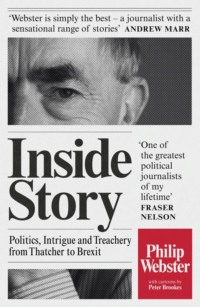
Cover photograph © David Bebber for The Times
While every effort has been made to trace the owners of copyright material reproduced herein, the author and publishers would like to apologise for any omissions and will be pleased to incorporate missing acknowledgements in any future editions.
Philip Webster asserts the moral right to be identified as the author of this work
A catalogue record for this book is available from the British Library
All rights reserved under International and Pan-American Copyright Conventions. By payment of the required fees, you have been granted the non-exclusive, non-transferable right to access and read the text of this e-book on screen. No part of this text may be reproduced, transmitted, down-loaded, decompiled, reverse engineered, or stored in or introduced into any information storage and retrieval system, in any form or by any means, whether electronic or mechanical, now known or hereinafter invented, without the express written permission of HarperCollins.
Source ISBN: 9780008201333
Ebook Edition © September 2016 ISBN: 9780008201340
Version: 2017-08-23
Dedication
To my late sister, Kay, for encouraging me to become a journalist, and to Sally, for encouraging me to write this book.
Contents
Cover
Title Page
Copyright
Dedication
Introduction
A Nervous Breakdown as Britain Votes ‘Out’
John and Edwina: The Liverpool Novel
1970s: Scary Days in the Commons Gallery
Return of The Thunderer
The Iron Lady: Early Lobby Years
How I Upset the Commons by Doing My Job
The Foreign Secretary Who Never Was
Dangerous Travelling with Thatcher
Some Stories Are Just Too Good …
Westland and Wapping Wars
A Horse, A Horse – My Paper for a Horse
The Lobby Lunch
Madrid – and Dominic Lawson’s Star Turn
Thatcher’s Fall, Major’s Arrival – and How the Rugby Team Might Have Saved Her
Kinnock and the White House Stitch-Up
As Thatcher Rules, Labour Battles for Its Soul
Was She Crying? Oh Yes, She Was: Glenys on the West Bank
Held at Gunpoint in the African Bush
Jenkins, Owen, Steel: Third Party Hell
John Smith: Britain’s Lost PM
After 1992, the Deluge
Carrying On up the Khyber
A Day in the Life of a Political Editor
1997: Granita and All That
My Part in Keeping Britain Out of the Euro
Taking a Punt on the 2001 Election
Tony and Gordon: Give Me the Euro, I’ll Give You Britain
The Naked Chancellor
Robin Cook Interrupted My Golf Swing
Our Small Part in Winning the Olympics
The Hand of History on a Snowy Good Friday
Why They Sack – and Why They Regret It
Blair and Gaddafi
Blair and Iraq: A Legacy Damaged Beyond Repair
The Death of David Kelly
My Part in the Fall of Tony Blair
Gordon’s Three Missed Chances to Win
Mandelson Returns as the Wolves Gather
How James Purnell Took His Leave
The Final Coup
Leveson and the Lobby
The Mystery of Michael Portillo
How Michael Howard Handed It to David Cameron
David Miliband Blows It and Balls Falls Out with Brown
Cameron ‘Ate Us Up and Spat Us Out’
How the Grandees Tried to Enlist Alan Johnson
Could Miliband Have Stopped Corbyn?
Uncle Jeremy, the Sea-Green Incorruptible
Our Power-Driven Politicians
The Men Who Followed Delane
Goodbye to All That
Acknowledgements
Index
About the Publisher
Introduction
Life is full of chances. A chance visit to The Times’s office at Westminster on a Tuesday in July 1972 led me to an adventure lasting more than four decades which finally ended in January 2015, after my 15,932nd day as an employee of the world’s greatest newspaper. I am lucky to have been part of a small chunk of its 230-year history.
In those days The Times had far more reporters in Parliament than any other paper and gave far more column inches to coverage of parliamentary affairs. Unlike many other papers, it had its own office, known as The Times Room. I walked into The Times Room on that July afternoon during a tour round the House of Commons. I was a subeditor on the Eastern Evening News in Norfolk, and Tuesdays happened to be my day off. I had been to the office of the Commons Official Report, known as Hansard, next door and the editor kindly took me to meet the head of The Times’s parliamentary staff, Alan Wood. It being a Tuesday, Prime Minister’s Questions were about to happen. In those days it was two fifteen-minute sessions on Tuesday and Thursday. Alan gave me a notebook and took me into the gallery, asking me to have a go at recording the exchanges between Edward Heath and Harold Wilson. I had good shorthand, which Alan could see, but my efforts at reading it back were patchy to say the least. In any case there were no jobs going.
Four months later I received a handwritten letter from Alan telling me a vacancy had arisen and asking if I would be interested. I went down to the Commons again in mid-January. It was again on a Tuesday and my left arm was in a sling after a football injury that Saturday. The cynics in the office smiled to themselves, thinking I had come up with the ultimate alibi for a failed test in the gallery. Fortunately, I’m right-handed.
Alan Wood put me through the same process and, this time, knowing what to expect, I made a good fist of it. He asked me to head down to Printing House Square at Blackfriars, then the home of The Times, where I was interviewed by John Grant, the managing editor. He was at the time president of the National Council for the Training of Journalists (NCTJ) and it helped a lot that I had been on one of the NCTJ’s pioneering full-year courses, and had secured the NCTJ diploma at the end of my training period. He offered me a job and I bit his hand off. It was the biggest decision of my life but it was not at all difficult.
Forty-three years later I have written this account of my career covering politics for The Times. It does not pretend to be a political history of the period. Enough biographies and autobiographies have been written to do that job many times over. But I have found myself at the centre of most of the big stories of the last thirty-five years – the fall of Labour in 1979, the rise and fall of Margaret Thatcher, the emergence and fall of John Major, the rise and fall of Tony Blair and his wars with Gordon Brown, the aftermath of 9/11, the war in Iraq, the fall of Brown, the rise and rise of David Cameron, and the shock election of Jeremy Corbyn. This is my take on some of the big things that happened, and how I covered and unearthed them.
Being a political correspondent of The Times, including eighteen years as its political editor, has given me a ringside seat at the most dramatic political events of the last quarter of the twentieth century and the early years of the twenty-first. Although my predecessors have probably felt the same – and despite having no illusions myself – this to me has seemed like a golden era of political journalism and I am lucky to have been part of it. During all those years I was a member of the Westminster Lobby, whose merits or otherwise I deal with later.
It was a position that gave me ready access to politicians of all parties and I got to know them well, including four prime ministers, any number of Cabinet ministers and countless back-benchers, as well as the hundreds of officials and advisers who support the ministers and their shadow ministers in their jobs.

It was a role that gave me the opportunity to travel the world – a rough calculation puts my total air miles in the service of The Times at close to the million mark – as well as a seat in the Commons Press Gallery at every significant event. I was there the night Michael Heseltine brandished the mace, the night the Callaghan government fell, the day Sir Geoffrey Howe brought down Margaret Thatcher, the days she and Tony Blair said farewell, the night MPs voted for war in Iraq, and for every Budget and autumn statement for forty years.
Occasionally it was a role that landed me in the most unexpected, even dangerous, scrapes. But most of it was fun, and if the reader does not get the impression after reading this that I had a very good time I have failed in my task.
It was also a position of huge responsibility, something of which I was well aware and about which I sometimes worried. The political press clearly has an important role in holding politicians to account. But what we write shapes events and makes or breaks careers, including those of party leaders. A few reporters have gone on to work for political parties but the vast majority are not players. Most political correspondents have no allegiance to a party. I never have or will but I have good friends in all the parties. The reader may find this strange, but in the tens of thousands of conversations I had with politicians while I was a senior political correspondent, not one asked me how I voted. I imagine they felt that as an impartial reporter I would have been insulted by the question, but I would have had an answer: I did not vote during those years.
Political correspondents are without doubt an integral part of the political process. It places a severe duty on us to get our stories right, ensuring they are fair, accurate and impartial – the mantra that is drummed into us from our first day in journalism school. When I appeared before the Leveson Inquiry into press standards in 2012, one point I tried to make very firmly was the importance of separating fact and comment in newspaper coverage, a line that has occasionally been blurred in recent years.
What I have tried to do here, having written about all these events as they happened, is to offer a fresh insight on them and reveal, as far as I can without compromising living sources, how stories I wrote at the time came into my hands and influenced events as they unfolded. Sometimes the stories originated from me learning from one source or another that something was brewing, and then nagging the people in a position to know until I was able to write. Sometimes, particularly when the parties started pre-briefing announcements rather than waiting for them to be put to MPs in the Commons – a practice that has infuriated successive speakers – they have come to me without a struggle. There was a time in the early years of New Labour, in government and opposition, when I would be surprised if there was NOT a phone call from Alastair Campbell or his Conservative counterpart when I came off the golf course on a Sunday lunchtime, on what until then had been a day off. On those occasions I would often spend the next few hours in my car, making calls to the office and contacts.
It could be a risky business. In the pages that follow I tell of many occasions when I pushed a story to the limits and spent worrying hours wondering if I would be embarrassed when it appeared.
Britain had eight prime ministers during my years as a reporter at The Times. I worked under nine editors, starting with William Rees-Mogg and finishing under John Witherow. Labour was on its way to power, or in power, for most of my eighteen years as political editor and for obvious reasons those years are covered comprehensively in what follows. I was fortunate that in my time as a junior Lobby man I was assigned the Labour beat when it was in opposition, meaning that I got to know well the men and women, and their aides, who were to become the leading figures in the party as Blair pushed for power, and he and Gordon Brown held sway for thirteen years.
I left Westminster in 2010 and after a four-year period as editor of The Times digital editions, I grabbed John’s offer to become assistant editor (politics) of The Times and to be the first editor of the ‘Red Box’ daily political bulletin and website. It meant I was back reporting on politics in time for the 2014 Scottish referendum and the 2015 general election. I had never been far away, though, and had continued to write about politics in the interim period, so this was another chance in a life of chances that I was not going to pass up.
As I’ve looked through mounds of my cuttings while writing this book, I’ve been struck by just how much I did. I only kept sparse notes of key conversations and cuttings of which I was particularly proud. I have a strong – my friends say nerdish – memory for the minutiae of the major political events in which I was involved, but in my trawl of the files I have come across stories under my byline and trips to the other side of the world which had temporarily gone from the memory.
Political journalism has changed in my years, as I explain later. Television has taken over from the House of Commons as the cockpit of political debate. Power has shifted from Westminster to the television studios, to Europe and to Scotland. But my successors need have no fear. There will always be a need for journalists to work and watch closely as politicians exercise their power.
My story is of one journalist who stuck with the same paper, the one he had always dreamt of working on, and resisted the occasional blandishments of rival editors who told him his career would progress faster if he moved over to them.
This book is about the story behind the stories that ran across the front pages of The Times for four and more decades. There were serious, tragic, sad, dramatic and traumatic moments behind those stories. But chasing them and writing them was a great joy and privilege.
I start with the momentous events of 23 June 2016 that changed all our lives, finished off another prime minister, split the country in two and left British politics in utter turmoil.

A Nervous Breakdown as Britain Votes ‘Out’
A much-diminished David Cameron said an emotional farewell to the twenty-seven other heads of European governments in Brussels on 28 June 2016. It was a sombre occasion for the man who will go down in history as the leader who took Britain out of the European Union, and possibly broke up the United Kingdom. Five days earlier a chastened Cameron, along with George Osborne, his chancellor, watched their dreams turn to dust as Britain voted against their wishes, and the odds, to say goodbye to Brussels.
As the leader who gambled on a referendum that the country was not demanding at the time he announced it, Cameron knew that it was his fault. Within three hours of the final result he stood on the steps of 10 Downing Street and resigned. He was gone three weeks later. Osborne’s chances of succeeding Cameron, already slim because he was felt to have overstated his economic warnings during the referendum campaign, disappeared. He was not a candidate in the leadership election that followed. And his humiliation was not complete.
On the day of the vote, Cameron and his aides, and Osborne, had discussed what would happen if they lost, although at that time they were expecting to win. The chancellor, I was told, said there was a case for Cameron staying on to bring stability, as well as one for him going. Cameron was adamant that he must depart in those circumstances and his aides did not try to dissuade him. He went to bed for a few hours after the result became known; his mind was made up. Twenty days later – after a vicious but truncated leadership election – he was succeeded by Theresa May, who became Britain’s second woman prime minister at the age of fifty-nine.
Within hours she had stamped her authority with a ruthless reshuffle that saw few ministers stay in their jobs, and many of Cameron’s closest allies purged. Osborne was sacked, as was Michael Gove, the justice secretary. The ‘chumocracy’, the name given by detractors to the tight group of friends around Cameron which was reputed to take most government decisions, was brutally slain.
Britain woke up on 24 June, the morning after the referendum, a divided nation. We were a country split between young and old, better off and poor, north and south. The young, rich and parts of the south, particularly London, had voted ‘In’. The old, the angry and disadvantaged, and the north, had voted ‘Out’.
The kingdom was divided, with Scotland and Northern Ireland voting to stay in the EU, England and Wales opting for out. Nicola Sturgeon, leader of the Scottish National Party, said a second referendum on independence was highly likely. Scotland could leave the UK within years, and Brexit, as our departure will forever be known, will be to blame.
Apart from the leader of the United Kingdom Independence Party (UKIP), the irrepressible Nigel Farage – whose referendum and victory it was – few of the leaders of the ‘Leave’ campaign offered outward signs of jubilation. They had not expected to win, and secretly many had probably hoped they would not. Many who had voted to leave wondered what they had done. Some recanted on the airwaves within hours. It was too late. Out was out.
In the days that followed, British politics descended into a form of insanity. The two men who had led the campaign to leave, Boris Johnson (the former London mayor) and Michael Gove, killed each other’s chances of leading their party – the latter accused of committing an act of treachery without parallel in modern political history; Jeremy Corbyn, the Labour leader, was pushed to the brink of resigning from his party; Farage stood down in triumph, his job done; and for a few days it looked as if the country was running without a government or opposition.

Andrea Leadsom, the energy minister who became the main Brexit candidate as Johnson and Gove fell away, was chosen by MPs to go into a run-off with Theresa May. But then she stunned an already shell-shocked Westminster by suddenly withdrawing only an hour after May formally launched her campaign, leaving the home secretary the victor without the need for an election by party members. After starting her own campaign, Leadsom had suffered a torrid weekend, fiercely criticized by the Conservative press and MPs after claims that she had exaggerated her CV, questions over her tax return, and an interview with The Times in which she appeared to suggest that as a mother she had an advantage over the childless May.
The rest of Europe, and much of the world, looked on in horror and amazement. The Dutch prime minister, Mark Rutte, not known for hyperbole, suggested: ‘England has collapsed politically, monetarily, constitutionally and economically.’
The bloodletting was by no means over, and the twists and turns in this fast-moving epic continued. First May called in Osborne and told him she needed a new chancellor after using her leadership campaign to distance herself from his economic stance. As the principal architect of ‘Project Fear’, the name given to the torrent of gruesome economic warnings that emanated from the Treasury during the campaign, and which was felt to have backfired, he harboured little hope of surviving.
Then she revived Johnson’s tottering career by making him foreign secretary. She had texted him expressing sympathy on the morning when he had been suddenly deserted by Gove. Boris claimed to be ‘humbled’ and his elevation surprised him and most of the political world, which had started to write him off.
The next morning May called in Gove, with whom she had sharply clashed in government, and sacked him as well in what friends called an ‘impeccably polite’ exchange. So Boris was in the Cabinet for the first time and Gove, who had struck him down just days earlier, was out.
Nicky Morgan, the education secretary who had made the mistake of backing Gove, was shown the door as well. The speed of events was startling and May, having watched a fortnight of political assassinations, proved to be a brutal axe-woman when her time came. In just forty-eight hours the old guard had retired from the fray, with Cameron and Osborne spotted having coffee in a Notting Hill cafe, and the new regime was in place.
Until 2016, Harold Macmillan’s ‘Night of the Long Knives’ in 1962, when the then prime minister ejected seven ministers from his Cabinet, was deemed the most ferocious exercise in prime ministerial power in history. No longer. May culled Cameron’s team and sent nine of them to the back-benches. Cabinet executions are normally done by telephone. But May looked them in the eye as she did it. Her aides said it was a matter of courtesy, but some of the victims wished they had not been put through the ordeal. She even gave Gove a lecture in loyalty as she despatched him. May had shown herself to be fearless and not a leader to be messed with. But her Commons majority is tiny and one day she may regret making so many enemies in one fell swoop.
The nervous breakdown that gripped Westminster overshadowed the gravity of the decision that Britain had taken and the mess that the departed leaders had left for others to clear up. Yes, Britain now had a new prime minister. But this was of much less significance than what else had happened. After forty-three years, the United Kingdom was cut adrift from the organization with which it had always lived uneasily but which, until the referendum dawned, people had seemed prepared to accept.
Now we were on the outside, and the nation was in shock, most not having expected the outcome even if they voted for it. The pound slumped to its lowest level in a generation, firms voiced doubts about investing here, young people marched on Parliament complaining that their futures had been compromised by what they called the lies of the ‘Leave’ campaign, and Osborne was forced to drop his plan to take the economy into surplus by 2020. At the same time, there was a disturbing rise in racially motivated attacks, with Polish and other migrants saying they no longer felt welcome.
Europe had killed another prime minister. But far more important than that, the vote had left Britain with a deeply uncertain future, facing at least two years of negotiations about its relationship with the body it had abandoned.
In truth it will be years before the full impact of cutting formal links with our biggest market can be assessed, but the Treasury is fully expecting a bleak 2017, and the outlook for future years is not much better. A friend said of Osborne: ‘George fears that an awful lot of hard work by the country and us has gone up in smoke.’
This is a chronicle of events in a nutshell. The details, however, bear much closer examination.
I have known Boris Johnson and Michael Gove for years. I remember little of Boris’s brief spell on The Times as a young reporter, but got to know him pretty well on my regular trips to European summits when he was the Brussels chief for The Daily Telegraph. I knew Michael well from his time as comment editor and news editor at The Times, when we would have several conversations every day about the political stories of the moment.
I got on very well with both of them but neither I nor anyone who worked with them could have dreamt that one day they would have the destiny of the nation in their hands. Boris made us laugh and was wonderfully indecisive, as I describe in a later chapter. Govey, as many in the office called him, was bookish, polite, deeply knowledgeable about politics, humorous. We knew that Gove, a Conservative, was looking for a parliamentary seat. But political leaders? It never occurred to us.
Yet here they were, on the morning of 24 June, squinting into the cameras, speaking in hushed, statesmanlike tones about the seriousness of the decision that had been taken. They together had been the public face – along with Farage – of the ‘Leave’ campaign. And here on the dawn of victory it was obvious they had no idea what would happen next. That ignorance was shared by most of the rest of the Government. As the markets tumbled, and as recriminations broke out between the rival campaigns, government came to a stop and it was clear that there had been little planning for a Brexit outcome.
As the Government floundered, Her Majesty’s Opposition fell apart. The campaign to stay in the EU, dubbed ‘Remain’, lost because millions of traditional Labour supporters in its heartlands voted to leave, rebelling at last at what they saw as a southern elite telling them what was good for them and failing to heed their worries about excessive immigration. Many saw themselves as the victims of what the southerners called globalization and what they saw as foreigners taking their jobs.
Labour was distraught because as a party it was strongly in favour of staying in. But Jeremy Corbyn had a long history of animosity towards the EU and was felt at best not to have pulled his weight during the campaign and at worst to have allowed his hard-left aides to undermine it. His shadow Cabinet and front-bench walked out on him, a motion of no confidence was easily passed against him, and senior figures dithered over challenging him. He refused to step down and vowed to fight on. Angela Eagle, shadow business secretary and shadow first secretary, who had excelled during the previous year when standing in for Corbyn at PM’s Questions, announced she was running but then pulled out, leaving Owen Smith, former shadow work and pensions secretary and an MP for only six years, to take on Corbyn. A leadership contest – for the second summer in succession – was under way as this book went to the printers.
Within a week of the referendum the Tory party was in complete chaos. Johnson was briefly and magically transformed from the assassin of the Prime Minister into the unity candidate best able to uphold the values of liberal Conservatism. Gove promised to be his campaign manager for what looked likely to be a relatively straightforward victory. We should have known, however, that nothing is simple in the Tory party.
Gove, his campaign team, and his wife, the journalist Sarah Vine, began – according to their side of the story – to have doubts about Johnson’s ability to be prime minister, leading Gove, just a week after the vote, to withdraw support from Johnson, announce he was standing himself and decry the leadership qualities of his friend and colleague.
The betrayal stunned Johnson, who swiftly pulled out, leaving May, the home secretary, the clear favourite, and his team went to war on Gove. One suggested there was a ‘deep pit reserved in hell’ for Gove, Johnson’s sister Rachel accused Gove of being a political psychopath, and Ben Wallace, another Johnson campaign aide, said Gove could not be trusted to be prime minister because he has ‘an emotional need to gossip, particularly when drink is taken, as it all too often seemed to be’. The governing party was in turmoil.
How did the two men who had done more than any, apart from Farage, to bring Brexit about fall out so spectacularly and so quickly?
Friends told me that Johnson had asked Gove to be his campaign manager on the Friday after the vote. Gove asked for twenty-four hours to think it over and was approached by several colleagues to run. He pointed out that he had always said he did not want to be prime minister and felt that Boris was the man.
Gove’s friends said that, although he had known Boris for twenty years, he had never worked closely with him. Johnson had risen to the occasion during the campaign and Gove assumed he was ready for the top job. But that confidence was to be swiftly shattered. According to friends, he found that Johnson had only a ramshackle leadership campaign operation in place and did not appear to be taking seriously the coming moment when he switched from the populist ex-mayor liked by the voters to the serious job of prime minister. Little work had been done on setting out a programme or vision for leadership.
For three days Gove campaigned for Johnson, growing more and more concerned that he seemed unfocused on the task in hand. For Boris, it was vital to have Andrea Leadsom, who had won plaudits for her role during the referendum campaign, on board. I have learnt that on the morning of Wednesday, 29 June, an astonishing meeting took place in a Commons office. Three of the leaders of the Brexit cause met privately to discuss what jobs would be allocated if Johnson won.
Strategists also regret that polls showing ‘Remain’ with a comfortable lead were published during the day of voting. It may well have contributed to the growing national feeling that the ‘In’ camp was heading for certain victory and may have encouraged the wave of protest votes against ‘the Establishment’. For days afterwards the airwaves were full of people admitting they had voted ‘Leave’ in the expectation of losing, explaining that they wanted to give a kick to the Brussels machine.
They were not the only ones. Johnson admitted when he declared for ‘Leave’ that he did not expect to win, and sources close to the ‘Leave’ campaign have told me that Johnson privately was never confident. The strong view at Westminster and elsewhere was that Johnson had signed up to ‘Leave’ to boost his own standing with the Conservative parliamentary party and, crucially, with the members who would pick the next leader. One former minister told me: ‘Of course Boris did not expect to win and he did not want to win. A narrow victory for Cameron would have suited him better than a Brexit for which he and no one else had prepared.’
At 10 p.m. as voting closed, ‘Remain’ thought it had won and started briefing why. Farage conceded prematurely; Michael Gove went to bed believing he had lost. Then came the result from Sunderland which showed that the ‘Leave’ vote was far higher than expected in that Labour area. It was not a rogue outcome and was matched as further results came in. Farage withdrew his concession. In Number 10, Cameron knew that his gamble had failed and prepared his resignation speech.
The essay-crisis PM got through until 2016 but then the Great Examiner, the British people, caught up with him. Now Theresa May is picking up the pieces.
Cameron got it wrong. It will be years, perhaps a decade, before Britain knows for sure whether it has benefited or suffered from his mistake.
John and Edwina: The Liverpool Novel
At around 9 p.m. on the evening of 27 September 2002, Robert Thomson, editor of The Times, stunned his colleagues by doing an impromptu jig around the office. Thomson suffered from a notoriously bad back and his manoeuvres might normally have caused him some pain. But the editor was too excited to feel any discomfort. He had just received from me a statement from John Major, the former prime minister, confirming that he had an affair with Edwina Currie.
It was the trigger that meant a specially prepared, secret edition of the paper – replacing a phoney earlier one that had been sent out to fool rivals – could be published and a story that was to shake the political and non-political worlds would arrive at the breakfast tables. I have been told by many people over the years that it was one of those jaw-dropping stories that made them remember where they were when they first heard it. Major was seen as the ultimate grey man, while Currie had been one of the country’s most flamboyant political figures with a gift for publicity matched only by Margaret Thatcher.
It was the culmination of an extraordinary cloak-and-dagger operation that depended on the few people who knew about the contents of Currie’s diaries maintaining complete and utter confidentiality about them. It was a scheme that could have gone wrong at any point. It would be an astonishing scoop for the publishers Little, Brown and for the paper, which had paid to serialize it, but it was no good to either if the story leaked and it ran across the front pages of other papers as well.
I had been assigned the task of reading the diaries, satisfying myself that the story was true and plausible, and then assuring everyone else in the loop that it was. Further, my job would be to write it up as the main front-page story, known in the industry as the ‘splash’, and most important of all to contact John Major on the day, breaking the news to him that a secret he had lived with for much of his life was out, and getting a reaction from him if that was at all possible. That was all!
Robert Thomson was adamant that the story would not be published unless Major had been told. Normal journalistic courtesy and propriety demanded it. Whether he would confirm it, we had no way of knowing. If he denied it, we were in trouble. But getting to him was paramount. And on the night of 27 September 2002, I nearly failed in one of the most critical missions an editor has ever asked me to undertake.
The story of how it almost went horribly wrong has never been told – until now.
Robert had called me down to the office two weeks beforehand. He had been editor for six months, having joined The Times from the Financial Times. We had immediately struck up a good relationship, with me organizing a series of lunches and dinners at which he got to know leading politicians. He asked me what I knew about Edwina Currie and John Major and whether it was possible they had ever had a relationship. I was agog. He knew that, if true, it was an extraordinary story. But having spent most of his working life away from British politics, he was testing whether I saw it in the same light. My reaction told him. He asked me to read the diaries – but without telling a soul.
A manuscript arrived at my home by special delivery and I spent the next few nights racing through it, growing more and more stunned. I knew Major pretty well, and in the years before he soared to very high office he was someone with whom I often discussed the issues of the day. At this stage I was reading only the early entries in the diaries and Currie was writing intimately about her relationship with a man she called ‘B’. She called him B for no other reason than he was the second man in her life.
A typical entry was this: ‘Spoke to B this evening – I’m so glad he was in. Oddly enough I need the diary more now that he’s so busy. I wonder if it will start to fade. It’s so hard when I don’t see him. Still, I’ve thought that every year and we are still at it.’ The affair had started in 1984 and this was September 1987.
Another entry read: ‘I saw B again on Friday. I was in the area where he lives and his wife offered their home for a rest, which I appreciated. It’s nice, a bit plain and unimaginative. To my horror, the magic started to work again and in a very big way. When we parted he held my hand a long time and squeezed it, even though other people were there.’
Or this one: ‘Then B came along, and he was so bloody nice and attractive, and so quiet in public that it was a challenge to unearth the real person and to seduce him – easy! And it was unexpectedly spectacularly good for such a long time.’ This was not my normal terrain but I was riveted.
There were enough clues for me to realize quite quickly that B was indeed John Major. When I raced on to much later entries, after the affair ended in 1988 when B had become ‘John’, it was confirmed in my mind that, unless Currie had been victim to a lengthy fantasy, one of the most unlikely of political couplings had happened. I had to smile. Major was a Conservative whip when the affair started. The whips make it their business to know the private business of every one of their MPs, allegedly keeping notes in a black book. Here was one ex-whip who had kept a massive secret from his colleagues; even more surprising was that the affair was with one of the more colourful and controversial of their charges.
Brian MacArthur, our associate editor who was in charge of the whole operation and whose extensive publishing-world contacts helped us to get a first sighting of the diaries, had also read the extracts. I told Robert that it was clear it was Major. He asked me point-blank: ‘Do you believe it?’ I replied that I had to believe it, although if I had not seen the evidence I would not have done.
Next came a trip to the publishers Little, Brown on Waterloo Bridge, where MacArthur, George Brock (managing editor), myself, Ursula Mackenzie (the publisher), Alan Samson (the book’s editor), and our publicity chief, Mary Fulton, discussed issues such as where Currie would be over the crucial weekend after next and how I would approach Major. Our lawyer, Pat Burge, had warned from the outset that there might be two grounds for action of which we had to be aware – defamation if the story was wrong and breach of privacy. At that meeting the greatest worry was that Major might attempt to take out a privacy injunction when he learnt of what we intended to run. The general view was that I should leave the call to Major as late as I dared, to minimize that risk. But I stressed again the editor’s bottom-line demand: Major MUST be contacted.
Roy Greenslade, of The Guardian, wrote later that it was at a meeting in Wapping on 20 August that MacArthur and Thomson had first been told of the explosive, alleged contents of the diaries after signing confidentiality agreements. Both had agreed it was a great story, but asked if it could possibly be true. They were assured that it was. The publishers had come to The Times first because it was there that Currie hoped the book would be serialized.
As Friday, 27 September approached there was still in my mind, and in those of the handful who knew, that nagging doubt about what would happen when I got to Major with the news. Would he deny it, would he apply for an injunction, would he put out a press release telling the world in general and scuppering our exclusive? Knowing him, the latter was unlikely, but I was unsure on the other points.
No one in my office at Westminster was aware of what I had been doing. I went into the office very early that Friday morning and got the splash story written before anyone else appeared. I had during the week collected every possible number for Major – two office numbers in London, a Huntingdon constituency number, and several numbers for former close aides and friends. He was no longer in the Commons and my contact with him had been limited since the 1997 election defeat.
Peter Riddell – our chief political commentator – arrived back from the Lib Dem conference in the late morning. Peter was always my most trusted adviser and I confided in him about what we had got and showed him some of the relevant entries in the manuscript. If I was ever in danger of going over the top with a story, I could rely on Peter to pull me back from the brink, but this morning he said something I just did not want to hear. He wondered whether it was all an Edwina fantasy, the very doubt that had entered the head of Robert Thomson, me and others when we first learnt about it. At this stage I had not explained to Peter quite how much was at stake – the cost of the memoirs, the phoney first edition, the rest.
But I assured him I was satisfied and tried not to let any further doubts enter my head. The day went slowly by. At about 4 p.m. I was itching to call Major’s office number, but it was still too early. I would have some explaining to do if I called prematurely and an injunction swiftly followed.
At The Times the secret had been kept for thirty-eight days despite the number of people knowing about it gradually increasing, as the marketing director, picture editor, Ginny Dougary (who was to interview Currie in advance), and the night and design editors who were to work on the Currie edition, were all told. In the office the codename for the book among those who were in on it was ‘the Liverpool Novel’, after Currie’s birthplace.
Six p.m. arrived. OK. A deep breath. I had often in recent days framed in my mind how I would tell Major what we were about to publish. I rang the first number I had for the London office, which I had found in the past was always manned. No reply. I rang the second number. No reply. And no answerphone message on either. I had a mobile number for Arabella Warburton, Major’s chief of staff, too. No luck. It did not work.
This was worrying. I rang Huntingdon. Again no reply. Things were now serious. Not quite panic yet. But serious. I then, almost at random, started calling other people who might know where he was. I rang an ex-colleague, Sheila Gunn, who had gone on to work as a press adviser to Major. She did not know where he was and was very curious. I rang Jonathan (now Lord) Hill, his former political secretary. No joy. At Peter’s suggestion I rang Tristan Garel-Jones, a former minister and great friend of Major, on his number in Spain. No reply. In between all these calls I kept trying the London office numbers.
At head office everyone was busy preparing what they thought would be the paper’s main edition. Only the chosen few realized it was due to be just the first edition, so that rivals would not see the big one when it dropped in most newsrooms at around 10.30 p.m. It was agreed to put a story about Jeffrey Archer across the top of the front page. Full-page ads for the electrical firm Currys were put on pages four and five. Robert Thomson liked a joke. The staff were unaware that in another part of the building, a handful of their colleagues were preparing the real edition.
I told no one at the office at this stage that I was becoming desperate and that the whole thing was in danger of collapsing.
By now my deputy, Tom Baldwin, had arrived and I kept him in the dark, too – for the time being at least. But he could tell that his normally unflappable boss was anything but, and offered to help. Nobody could help, though; I needed someone, anyone, to answer one of these phones. I rang Huntingdon for the umpteenth time. London yet again. I tried Arabella’s number once more.
It was well after 7 p.m. when I tried the London office one last time, thinking that I was soon going to have to tell Robert that I could not find Major. Someone answered, apparently a secretary. I asked if Mr Major was there. No. I asked if Arabella was there. No. Aagh! I then told her that it was a matter of absolute life and death that I get hold of one of them. Was there anything she could do to help? She said she would try and I gave my Commons number. I repeated that it was of the utmost urgency and that they would be grateful to her if she could put them in touch with me. If I sounded desperate, I was.
No more than five minutes later, the phone rang. It was Arabella. I did not know how this conversation was going to go, but never had I been more relieved to receive a call. It sounded like a long-distance call and she told me she was in Chicago, where Major was about to make a speech. Yes, Chicago! I said that I must speak to him about something that The Times was about to run. I had to speak to him personally. She said: ‘You know, Phil, that you can tell me so that I can tell John.’ I said that on this one occasion it was difficult and that I really had to speak to him. Arabella could tell that I was serious and she must have wondered what on earth it was all about, given my insistence. She said that she would talk to Major. But I said: ‘Please don’t ring off – I don’t want to lose you at this stage.’ Arabella, who had always been the most straightforward person to deal with, was magnificent. She came back on the phone very quickly and said that whatever it was, however personal, I could tell her and that Major was happy that I should.
Tom Baldwin had been listening, and asked if he could get me a drink. I gave him the thumbs up and he raced off. I now had to tell Arabella what we were about to run. In my own mind I suppose I assumed that Major may have by now guessed what was coming. I did not know if he had picked up from somewhere that the Currie diaries were imminent. In any case I supposed this was something he had known might be revealed at any stage in the last thirteen years.
I told Arabella the essentials of the Times splash – that we were serializing Currie’s diaries and that she had disclosed that she and John Major had had a four-year affair. Arabella was clearly shocked but she was utterly professional. Her calm in the face of what I told her made me feel that there was unlikely to be a denial or any attempt to stop the story. The reaction was more one of sad resignation. I told her that if it was possible to have some response from her boss – and quick – I would be massively grateful. By now my anxiety had given way to huge relief. I had fulfilled Robert’s command.
And I now told him that the contact had been made, and that I was hopeful of getting some kind of comment from Major. It was by then close to 8.40 p.m. Arabella asked if I could give her twenty minutes and I said of course, but please come back to me even if there is nothing other than a ‘no comment’.
Tom Baldwin returned with beers and pizza. The Press Gallery bar was closed, it being a Friday. He had been up to Victoria Street. I was starving and thirsty. Again I told Robert that we were nearly there. Maybe twenty-five minutes later my phone rang again and I knew it would be Arabella. As I said hello, I quietly dialled Robert’s direct line in the office and heard him pick it up. She did indeed have a statement. And as she read it I repeated it out loud so that Robert could hear. It was 9.12 p.m. The statement read: ‘Norma has known of this matter for many years and has long forgiven me. It is the one event in my life of which I am most ashamed and I have long feared it would be made public. Neither Norma nor I has any further comment.’
Major has stayed true to that statement ever since. His first thought when he learnt of what we were running was for his family, and he obviously wanted to tell them what was appearing. But he has never since that day said another word on the subject.
I thanked Arabella. She in turn thanked me for giving Major advance knowledge and a chance to respond. It was a stunning result for the paper. Not only was the story confirmed by the main subject, he had also given a very good quote talking about his shame at what had happened. Even at that stage Tom and I surmised that Currie – hidden away in France – would not take too kindly to Major’s response. It gave us a follow-up for Monday morning.
My office sources tell me that it was at this stage that the editor of The Times gave out a whoop of delight and did his jig. I swiftly e-mailed Major’s words to the night editor, Liz Gerard.

The main paper of the night was then prepared at lightning speed.
As Brian MacArthur wrote later: ‘We had our scoop. Our rivals had the spoof. The new front page and pages four and five – carrying the Dougary interview – were ready to go immediately and were being printed by 9.36 p.m. Out of 655,000 copies printed from London, only 18,000 were the spoof edition. Luck plays as big a part in newspapers as in other areas of life and none of the nightmare scenarios we had considered occurred on the night.’
I didn’t tell them even then that for ninety minutes or so I had gone through a real nightmare. But I’ve mentioned since to George Brock, among others, that it nearly didn’t go all right on the night. George replied: ‘OK, there was the odd ripple of alarm. We knew you’d manage and you did.’
When the edition was done, a glass or two of champagne was drunk at the office – well deserved given the brilliance of the operation marshalled by Thomson, his deputy, Ben Preston, and the rest of the team. Tom and I had our beer.
I went home shattered but the tension of the night made sleep impossible. I was up early and in my car driving north to the Labour conference in Blackpool (via a Norwich match against Preston at Deepdale) when Robert Thomson was introduced on the Today programme by John Humphrys and interviewed about one of the great scoops of recent years. Piers Morgan, then editor of the Daily Mirror, who was woken after 2 a.m. when our Currie edition landed in his office, wrote that it rated as a story alongside ‘Elvis Dead’ and ‘Man on the Moon’.
A Day in the Desert as John Major Sues
My job was full of coincidences. Nine years earlier, I had been with John Major when he announced he was suing two magazines for libel for alleging – falsely – that he had an affair with Clare Latimer, a Downing Street caterer.
Stopping off in Oman – where he went off to the desert to see the sultan, on his way between Mumbai, India, and Riyadh, Saudi Arabia – Downing Street officials announced that he was taking legal action against the New Statesman & Society and Scallywag over the allegations about his private life. Clare Latimer also took action.
News that the New Statesman had repeated rumours that had appeared in the satirical magazine the previous month reached Major and his team very late the previous night in Bombay. It meant little sleep for him or the travelling press, who raced around for most of the early hours looking for comments, and in the paper of 29 January, I chronicled the events in Major’s extraordinary thirty-hour day.
All of us were up at around 5 a.m. on the Thursday, after at the most three hours of sleep. The decision to sue was taken on the plane to Muscat and announced by Gus O’Donnell, the PM’s press secretary, on arrival. Returning from the overpowering heat of the desert, Major staged a press conference and took the inevitable questions from UK reporters who were not too interested in the news of orders received from the Omani Government.
At 6 p.m. that night we put down in Riyadh, where Major had six hours of talks with King Fahd and other ministers. At midnight we were told that British Aerospace was to supply forty-eight Tornado aircraft to Saudi Arabia in what was Britain’s second-biggest defence contract. Both the libel and Tornado stories were spread across the front page of The Times. In the early hours of Friday we then got on the plane for Heathrow. A long day in our lives.
Fast-forward nine years and an angry and relieved Clare Latimer voiced her satisfaction that the ‘shabby truth’ had come out at last. She spoke of her pleasure that the real ‘other woman’ in Major’s life had identified herself, sparing herself the fate, as The Times reported, of becoming a footnote in the history of Conservative sleaze in the 1990s. ‘The world will now hopefully believe I did not hop into bed with John Major,’ she said.
There were other spin-offs from our sensational revelation that Saturday. As Tom Baldwin and I had predicted, Currie was not best pleased. From her hideaway she spoke of the hurt she felt at his describing his shame over the affair. ‘He was not very ashamed of it at the time I can tell you. I think I’m slightly indignant about that remark.’
And for the Kremlinologists of Westminster – those of us who enjoyed analysing every word and gesture from politicians to divine their motives and feelings – it threw some light on Major’s decisions not to bring back Currie to the Government from which she had resigned as health minister in 1988 over remarks about salmonella in eggs.
In her diaries she claimed Major had told her shortly before he became prime minister in 1990 that she might become housing minister in the reshuffle that followed his win. But no offer came.
Then, after Major’s victory in 1992, we watched on reshuffle day as Currie marched happily up Downing Street. We expected her to get a Cabinet job but Major offered her the post of prisons minister under Kenneth Clarke, the home secretary. But their relations were not good when Clarke was her boss at health and she refused, and walked down Downing Street, this time less happily.
In 1991 she had written in the diaries: ‘He did not keep his promise to me … that hurt so terribly. I think I’d like the man to know exactly what he did last winter and how I felt, preferably not when the knowledge can do any damage, but he won’t always be prime minister and it won’t always matter.’
It was, indeed, a prophetic entry, and it was another eleven years before she did the deed.
Ücretsiz ön izlemeyi tamamladınız.