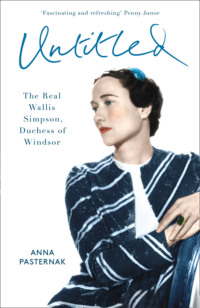
Kitabı oku: «Untitled: The Real Wallis Simpson, Duchess of Windsor»

Copyright
William Collins
An imprint of HarperCollinsPublishers
1 London Bridge Street
London SE1 9GF
www.WilliamCollinsBooks.com
This eBook first published in Great Britain by William Collins in 2019
Copyright © Anna Pasternak 2019
Cover image © Getty Images
Lettering www.ruthrowland.co.uk
Family trees by Martin Brown
Anna Pasternak asserts the moral right to be identified as the author of this work
A catalogue record for this book is available from the British Library
Every effort has been made to contact copyright holders and obtain permission to reproduce material in this book. The publisher would be pleased to rectify any omissions in subsequent editions of the book.
All rights reserved under International and Pan-American Copyright Conventions. By payment of the required fees, you have been granted the non-exclusive, non-transferable right to access and read the text of this e-book on-screen. No part of this text may be reproduced, transmitted, down-loaded, decompiled, reverse engineered, or stored in or introduced into any information storage and retrieval system, in any form or by any means, whether electronic or mechanical, now known or hereinafter invented, without the express written permission of HarperCollins.
Source ISBN: 9780008297299
Ebook Edition © March 2019 ISBN: 9780008297329
Version: 2019-03-05
Dedication
To Wallis,
Her Royal Highness The Duchess of Windsor
Epigraph
I who had sought no place in history would now be assured of one – an appalling one, carved out by blind prejudice
The Duchess of Windsor
The fault lay not in my stars but in my genes
HRH The Duke of Windsor
Contents
Cover
Title Page
Copyright
Dedication
Epigraph
Family Trees
Prologue: The Heart Has Its Reasons
1. The Prince’s Girl
2. Ich Dien
3. One and Only
4. God Bless WE
5. Down with the American Harlot
6. Oceans of Agony
7. The Last Hour
8. The Fury
9. Untitled
10. The Twilight Zone
11. A Shadow King
12. Son Altesse Royale
13. My David
Epilogue: The Cedar Walk
Postscript
Select Bibliography
Acknowledgements and Note on Sources
Notes
Picture Section
Index
By the Same Author
About the Author
About the Publisher
Family Trees


Prologue
The Heart Has Its Reasons

Once upon a time there was a charming, handsome prince. Whenever he visited even the farthest reaches of his kingdom, his people flocked to see him. He was adored the world over. Everyone expected him to marry a pretty, well-bred English virgin who would one day become Queen of England and its vast empire. But, when the prince was thirty-seven years old – having previously shown no sign of wanting to get married – he fell in love with an odd-looking, twice-divorced American. No one thought that the affair would last, so everyone close to him kept quiet about it. When the prince’s father, the king, died five years later, the prince inherited the Crown. Courtiers assumed that the new king would find a suitable young bride. To their horror he said that he could not continue to be king without the American woman he loved by his side and that he intended to marry her. Everyone in the royal palaces, the prime minister, the government, the Church, were shocked. They accused the wicked witch-divorcee of being a sorceress who had cast a spell over their poor, gentle prince in order to become queen. The king’s ministers told him that if he married this terrible woman, he would have to surrender the Crown.
But instead of renouncing his love, the king sacrificed his whole realm – an empire of over five hundred million people – to be with her. He only ruled for 326 days, making his reign one of the shortest in his country’s history. His devoted subjects were heartbroken. They blamed the ugly witch for taking their beloved sovereign away from them. His family banished him from the land, leaving him free to marry the woman he loved. Denied royal status, the couple spent the rest of their lives in exile, roaming the world aimlessly, sad that they could not return to the king’s homeland and to the little castle that he adored. The world, meanwhile, imagined that this was the Greatest Love Story Ever Told and that husband and wife went on to live Happily Ever After.
***
The story of the abdication of King Edward VIII and his marriage to Wallis Simpson has been told so many times that it has taken on the character of a fairy tale. Like fairy tales, much of what we are repeatedly told is in fact make-believe. The most scandalous love affair of the twentieth century may have softened into a romantic legend with time, but dark myths still endure. The dashing young prince, whose charisma and glamour ensured him the status of a movie star, gave up ‘the greatest throne in history’, as Churchill called it, to marry his one true love, an American divorcee. Surely, there can be no greater act of sacrifice than to give up such power, privilege and adoration for love? And for a woman whose appeal was such a mystery to most.
Edward Albert Christian George Andrew Patrick David Windsor was considered the world’s most eligible bachelor. Society hostess Elsa Maxwell first met the Prince of Wales in the early 1920s ‘at Mrs Cuckoo Belleville’s house in Manchester Square. He was a gay, golden-haired, blue-eyed, debonair Prince Charming, the most famous celebrity in the world, who seemed a Raphael angel grown up. He projected an aura of glamour that was as unmistakeable as it was authentic.’ To the fashion editor Diana Vreeland ‘he was the Golden Prince. You must understand that to be a woman of my generation in London – any woman – was to be in love with the Prince of Wales.’
Men were equally beguiled. Even the senior Palace courtier, Alan Lascelles, known in royal circles as ‘Tommy’ and later a fierce critic of the former king, gushed in 1921 that the heir to the throne was ‘the most attractive man I ever met’. Piers ‘Joey’ Legh, an equerry who remained in the prince’s service for twenty years, accompanying him into exile, said of Edward a decade after the abdication: his ‘charm was so great that he would thrill with emotion if the duke entered the room just now’.
When news of Wallis Simpson’s affair with Edward broke from under a media blackout in 1936, what seemed unfathomable was why, when the Prince of Wales could have had any beauty he desired, he was smitten with an unconventional, severe-looking American, two years his junior with two living husbands. So much gossip and innuendo has been levelled at Wallis that it has become near impossible to discern the real woman or to hear her authentic voice amid the cacophony of condemnation. As her friend Herman Rogers said of her in 1936, ‘much of what is being said concerns a woman who does not exist and never did exist’. Lady Monckton, a close friend of the Windsors, later concurred: ‘People were always being nasty about Wallis. You must remember how jealous people felt when the Prince of Wales fell in love with her.’
Ever since, we have been overfed a diet of fantastical slander: that Wallis was really a man; that she had a perverse psycho-sexual hold over the prince; that she used manipulation and feminine wiles to lure him into abdicating; that she was a ruthless, cold, ambitious bitch, who schemed from the outset to be Queen of England. The well-worn view is that she alone was responsible for almost bringing down the British monarchy, triggering a constitutional crisis caused by her determination to marry the heir apparent. We have experienced her so fully as Machiavellian through others’ projections and prejudice, through misogynistic memoirs, biographies and unflattering portrayals, that she has become a caricature of villainous womanhood. Devoid of warmth, emotional complexity and a beating heart, she remains the brittle victim of salacious chatter and brutal character assassination many decades after her pitiful death.
Instead of simply belittling Wallis and defaming her reputation, we might try to understand this modern, intelligent, remarkable woman and the impossible situation she was placed in. She was, in fact, very warm, funny, irresistibly charming, loyal and dignified to the end. Adored by her many friends, she was written off by a cunning, powerful British establishment who sought to destroy and diminish her; men like Tommy Lascelles – who famously dismissed Wallis as ‘shop-soiled’ with ‘a voice like a rusty saw’ – the British prime minister Stanley Baldwin, and Cosmo Lang, the Archbishop of Canterbury.
However, far from being the villain of the abdication, Wallis was the victim. Instead of pushing for Edward to leave the throne, she had tried to prevent it. What most of her detractors fail to acknowledge is that she never wanted to marry Edward. Naturally she was initially flattered by his attention; as an American woman, living in London surrounded by society hostesses and social climbers, she felt giddy to be included in His Royal Highness’s elegant and rarefied circle. What woman would not have been beguiled by the prince’s ‘unmistakable aura of power and authority?’ According to Wallis: ‘His slightest wish seemed always to be translated instantly into the most impressive kind of reality. Trains were held; yachts materialised; the best suites in the finest hotels were flung open; aeroplanes stood waiting.’ Wallis made no secret of her open-mouthed delight, but she also believed Edward’s interest in her was transitory. She never expected his infatuation to last. In 1935 she wrote to her beloved aunt, Bessie Merryman, in Wallis’s hometown of Baltimore: ‘What a bump I’ll get when a young beauty appears and plucks the Prince from me. Anyway, I am prepared.’
The real tragedy for Wallis is that she could never have been prepared for what was to come, for the speed with which events spun so quickly out of her control. Though worldly, she would find herself painfully out of her depth. Unable to juggle her settled, second marriage to Ernest Simpson with the overwhelming and incessant demands of a besotted prince – whom she and Ernest nicknamed ‘Peter Pan’ – Wallis became the perfect pawn. She did not bargain for Edward’s self-absorbed, possessive and stubborn love for her and his absolute refusal to give her up. Although she valiantly tried to break off the relationship prior to the abdication, it would become impossible for Wallis to ever leave his side.
Probably the biggest lie in this fable is that Wallis lured Edward from his destiny. Her detractors claim that if she had never divorced Ernest Simpson, the abdication would not have occurred. Yet the truth is that she had had no intention of divorcing Ernest. It was Edward, then king, who forced her into this untenable position. In the name of his needy love, Wallis paid the ultimate price: entrapment by a childish narcissist who threw the largest tantrum in history when he could not have the two things he wanted most in the world: Wallis and the throne.
When I began my research, keen to strip away decades of grotesque caricature in an attempt to find the real Wallis, I feared that doors might close. The opposite happened; people were keen to talk with me and I found that those close to the story did not hold Wallis in contempt. Many powerful, key players who had led the charge against Mrs Simpson were now dead. The late queen mother, then Elizabeth, Duchess of York, for one, was furious that Edward’s abdication might force her highly strung and physically weak husband, Bertie, onto the throne and dehumanised Wallis as ‘that woman’ and ‘the lowest of the low’. The spite meted out to Wallis by certain members of the royal family was staggering. Those of Wallis’s friends who are still alive seem to finally feel freer to speak about the injustice they witnessed. Sitting in elegant drawing rooms in London, Paris, Gstaad and Marbella, interviewing those who knew Wallis, I heard the same sentiments echoed; that she was witty and diverting company; that the duke was self-absorbed and less engaging. That Wallis, possessed of perfect manners, behaved with laudable inner strength and dignity, despite the terrible slurs and insults hurled at her. ‘The world adored him,’ Hugo Vickers said of the Duke of Windsor, ‘yet the people who knew him and worked for him, had reservations about him. The world hated her but the people who knew her and worked for her, absolutely adored her.’
None of those with whom I spoke recognised the wicked Wallis of the history books. Repeatedly, I heard of her kindliness, sense of fun and depth of friendship, which contradicted the public image of a hard-nosed, shallow woman. The closer I got to Wallis’s true character, the greater my incredulity and mounting fury that the world has judged her unfairly and unkindly. She certainly was no saint, but she was far from the sinister manipulator depicted in many accounts. Her friends noted in their diaries and memoirs their warmth and respect for Wallis, yet these tender recollections never seemed to gain sufficient attention. ‘She was so affectionate, a loving sort of friend – very rare you know,’ wrote Diana Vreeland. ‘Women are rarely that sort of friend to each other.’ Wallis was similarly loyal to male friends, too. The Conservative MP Sir Henry ‘Chips’ Channon said: ‘She has always shown me friendship, understanding and even affection, and I have known her to do a hundred kindnesses and never a mean act.’
Wallis was viciously derided at the time of Edward’s abdication and then kept at a distance, denied the opportunity to change public mistrust and misgivings about her. When the scandal broke in the press, she was, understandably, devastated. ‘The enormity of the hatred I had aroused and the distorted image of me that seemed to be forming in minds everywhere went far beyond anything I had anticipated even in my most depressed moments,’ she later wrote. ‘I became obsessed by the notion that, in a manner impossible for me to comprehend, a calculated and organized effort to discredit me had been set afoot.’
She was right. So sensational were the press reports and fevered gossip in 1936 – Mrs Simpson was ‘gold digger’, ‘a whore’, ‘a sorceress’, ‘a Nazi spy’ – that many of the British and European aristocracy, meeting her for the first time, were taken aback. The woman they encountered was nothing like her vulgar fictional persona. ‘I was absolutely flabbergasted when I first met the duchess,’ recalled Count Rudolf Graf von Schönburg. ‘She was the complete opposite of everything we had heard about her.’
Count Rudi became a close friend of the Windsors, after meeting them in the early sixties in Marbella, where he ran a fashionable club. ‘The story of the abdication was so shocking,’ he recalled, ‘but the duchess was so much more ladylike than anything we had been led to believe. It was all “this loud, twice-divorced, American” … yet here was this charming, dignified woman, always well-dressed but never overdoing it. Maybe sometimes she laughed too loudly but that was it. I liked her very much and we spent many days and evenings with the couple, so had the opportunity to be treated like close friends and almost family. I have always considered that her position in history is factually incorrect and very unfair.’
The Duke of Fragnito had similar preconceptions when he met the duchess in Palm Beach in the early 1960s. ‘I didn’t want to like her because of everything I had heard about her,’ he admitted. ‘But I was taken aback by her grace and impeccable manners. To my great surprise she behaved like a real royal. She was just as captivating as the duke. They both had this ability to produce an electric charm which I have never forgotten.’
Vogue editor Diana Vreeland noted of Wallis: ‘There was something about her that made you look twice.’ The duchess’s private secretary, Joanna Schutz, accompanied Wallis to New York by boat shortly after the duke died. The duchess did not put her name on the passenger list and usually ate in her room. Occasionally, she would enter the dining room to keep Miss Schutz company. ‘Some people recognised her, others didn’t, but they knew she was special,’ said Hugo Vickers. ‘She was somebody. She had a hypnotic effect.’
‘I can’t say that she was sexy but she was sassy,’ remembered Nicky Haslam. ‘She walked into the room and it took off. The only other person I knew who had that quality was Frank Sinatra.’ Haslam, an interior designer who met Wallis in New York in 1962, said: ‘Wallis had innate American style. But to be an American was against her then, almost more than the divorce.’ Wallis described the archaic snobbery she encountered when living in London: ‘The British seemed to cherish a sentiment of settled disapproval towards things American.’
I was sitting with Nicholas Haslam in a Chelsea restaurant, when he produced an envelope, saying that he had something special to show me. It was a handwritten letter from Wallis to her friend, Elsie de Wolfe. Elsie, who became Lady Mendl in 1926 on her marriage to Sir Charles Mendl, a press attaché to the British embassy in Paris, was an eccentric who practised yoga and underwent plastic surgeries, years before both became de rigueur. Credited with inventing the profession of interior decorating, she was famed for her elaborate parties, and in particular the Circus Ball at the Villa Trianon, in Versailles in 1939. Attended by over 700 guests, including the duke and duchess, the ball was held in a green and white dance pavilion, and featured a fabulously jewelled elephant. Circumstances would force Wallis to adopt Elsie’s favourite motto, embroidered on taffeta cushions strewn throughout the Villa Trianon: ‘Never Complain, Never Explain’.
Turning the letter over in my hand, I admired Wallis’s chic stationery, the thick envelope lined with forest green tissue paper and the simple address on crisp cream paper, ‘La Croë, Cap D’Antibes’, the duke and duchess’s villa in the south of France. The letter, written in 1948, and dated Friday 24 September, reveals Wallis’s loose, looping handwriting in black ink: open and hurried in style and pace, there are endearing crossings out and insertions as her thoughts race across the page with barely any punctuation. She asks Elsie if she and Edward can come to stay with her at the Villa Trianon on their way back to Paris, and shares details of her day-to-day life: ‘I swam this A.M and tonight I go to Cap d’ail to play Oklahoma [a card game] with Winston Churchill who is stopping with Max Beaverbrook – we are great rivals and play every other night …’
The letter is full of warmth and love. Wallis reveals herself to be a genuine, open friend. She tells Elsie how difficult it is packing up and leaving La Croë, which she and the duke had leased for the previous decade. Her loneliness and tension is tangible; she details her desire to be alone, relaxing with Elsie, whom she misses: ‘I long to see your elephant again and sit in the tent with the blackamoors, look at you and the things you have created,’ Wallis wrote. ‘I do wish I could come sooner to do all this. My great and deep affection, as always, Wallis.’

When I contemplated the duke and duchess’s empty, peripatetic life after abdication and exile, I felt a profound sadness. What was their purpose from that point on? To live a life together to prove that it had not all been for nought? To be happy? To appear to be happy? There must have been an element of continuous silent strain for them both, a seam of guilt they dared not plunder. ‘I have a theory that when men let women down, they feel awful,’ Hugo Vickers told me. ‘The duke turned Wallis into the most hated woman in the world, then he couldn’t get her what he promised her: the HRH title, or his family to accept her. So he must have spent his whole life feeling guilty. I saw him once at Princess Marina’s* funeral and I have never seen a man with sadder eyes.’
Over three decades into their post-abdication existence, just a few years before the duke’s death, the Windsors were interviewed on live television, on the BBC, by the broadcaster, Kenneth Harris. The programme was watched by 12 million viewers. Wallis comes across effortlessly, she is witty and warm. The duke, with his hangdog eyes, appears less comfortable in his own skin, constantly looking down at his hands, studying his nails, fidgeting. The interviewer asks the couple if they have any regrets. The duchess, elegant in cream silk with a pale blue scarf, laughs nervously: ‘About certain things. I wish it could have been different. Naturally, we’ve had some hard times. Who hasn’t? But we’ve been very happy.’ The duke awkwardly grabs her hand in confirmation.
The main aim of this book is to look beneath this convenient illusion and give Wallis a voice: to peel back the layers of prejudice and examine the wider motives for the enduring propaganda against her. For Edward the relationship started as a thrilling coup de foudre; for Wallis, it would soon feel like a Faustian pact. Did a genuine love emerge between them as they surmounted the abdication together; or was the monumental sacrifice on both their parts a tragedy of Shakespearean proportions? Wallis, quietly stoical, rarely sought pity or openly complained about her suffering. She was always incredibly dignified, generously concluding in her memoirs: ‘Any woman who has been loved as I have been loved, and who, too, has loved, has experienced life in its fullness.’
* Princess Marina, Duchess of Kent (1906–68), was born Princess Marina of Greece and Denmark. She was married to Prince George, Duke of Kent, Edward’s favourite brother.
1
The Prince’s Girl

As the train hurtled north from St Pancras to Melton Mowbray in Leicestershire, Wallis Simpson stood in the aisle of a compartment, practising her curtsy. No mean feat, given the lurch and sway of the carriage. She was being instructed that the trick was to put her left leg well back behind her right one. Wallis’s balance was further challenged due to a streaming cold; her head was bunged up, while a voice rasped in her ears as she tried to master an elegant swoop down, then up. This comical scene was being watched by her husband, Ernest Simpson – always gently encouraging – and their friend Benjamin Thaw Jr, who was delivering the etiquette tutorial. Benjamin, known as Benny, first secretary at the United States embassy, was married to Consuelo Morgan, whose glamorous American half-sisters were Thelma, Viscountess Furness, and Gloria Vanderbilt.
Benny and Connie Thaw had become close friends of the Simpsons in London. Wallis and Ernest mixed in society circles thanks to the introductions of his sister, Maud Kerr-Smiley. Maud had married Peter Kerr-Smiley in 1905. He became a prominent Member of Parliament and it was the Kerr-Smileys who facilitated the Simpsons’ entrée into the upper echelons of the aristocracy. It was through Consuelo that Wallis first met Thelma Furness. Consuelo had told her sister that Wallis was fun, promising Thelma that she would like her. In the autumn of 1930, she took Wallis to her sister’s Grosvenor Square house for cocktails. ‘Consuelo was right,’ said Thelma. ‘Wallis Simpson was “fun”, and I did like her.’ ‘She was not beautiful; in fact, she was not even pretty,’ she recalled of thirty-four-year-old Wallis – who was accustomed to an ever-present scrutiny of her looks – ‘but she had a distinct charm and a sharp sense of humour. Her dark hair was parted in the middle. Her eyes, alert and eloquent, were her best feature.’ Wallis was blessed with riveting sapphire blue eyes.
That November, 1930, Wallis received a tantalising invitation. Connie Thaw asked her if she and Ernest would act as chaperones to Thelma and the Prince of Wales at a weekend house party in Leicestershire. Connie had to leave for the Continent at the last minute, due to a family illness, and wondered if Wallis and Ernest would accompany Ambassador Thaw to Burrough Court, Viscount Furness’s country house, instead. The Simpsons had heard the rumours that Thelma Furness was ‘the Prince’s Girl’, having stolen the maîtresse-en-titre role from his previous lover, Mrs Freda Dudley Ward. The prince’s pet name for Thelma was ‘Toodles’ and she was said to be madly in love with him. It was an open secret in society circles that Thelma was unhappily married to Marmaduke, the 1st Viscount Furness. Known as the ‘fiery Furness’, he had red hair and a temper.
Wallis’s first reaction to the invitation was ‘a mixture of pleasure and horror’. ‘Like everybody else, I was dying to meet the Prince of Wales,’ she said, ‘but my knowledge of royalty, except for what I had read, had until then been limited to glimpses at a distance of King George V in his State Coach on his way to Parliament.’ Though unsure of royal etiquette, she was at least confident of looking the part, having been on a shopping spree in Molyneux, Paris, a few months earlier. Her attractive blue-grey tweed dress, with a matching fur-edged cape, ‘would meet the most exacting requirements of both a horsy and princely setting’.
It was past five o’clock on Saturday afternoon when Thaw and the Simpsons arrived at Melton Mowbray, in the heart of fox-hunting country. A thick fog choked the county. Burrough Court was a spacious, comfortable hunting lodge full of traditional mahogany furniture and lively chintz. Thelma’s stepdaughter, Averill, greeted the guests, informing them that the rest of the party had been delayed out hunting on the road, due to the fog. Taken into the drawing room, where tea had been laid out on a round table in front of the fire, Wallis could feel her skin burning. Suspecting she had a slight temperature, she hankered to go to bed. Instead, they were forced to wait a further two hours until the royal party arrived.
After what seemed an age, voices were heard in the hallway and Thelma appeared with two princes: Edward, Prince of Wales, and his younger (favourite) brother, Prince George. To her surprise, Wallis’s curtsy to each prince came off well, to the Simpsons’ shared amusement. Thelma led everyone back to the table in front of the fire and they had tea all over again.
Like many who meet celebrities in the flesh for the first time, Wallis was taken aback; she was surprised by how small the Prince of Wales was. She was five foot five and Edward less than two inches taller. Prince George was ‘considerably taller’, she noted, ‘with neatly brushed brown hair, aquiline features, and dark-blue eyes. He gave an impression of gaiety and joie de vivre.’ Facially, Edward was immediately recognisable. ‘I remember thinking, as I studied the Prince of Wales, how much like his pictures he really was,’ she recollected. ‘The slightly wind-rumpled golden hair, the turned-up nose, and a strange, wistful, almost sad look about the eyes when his expression was in repose.’
At eight o’clock, Prince George’s friends arrived and took him to another house party. Finally, the Simpsons could retire upstairs to change. Wallis had a much longed-for hot bath and took two aspirin, while Ernest – from America but naturalised British – remarked on the charm of the two royal brothers and how they instantly put everyone at their ease. ‘I have come to the conclusion,’ he added, ‘that you Americans lost something that is very good and quite irreplaceable when you decided to dispense with the British Monarchy.’
The dinner party that night for thirty guests was late even by European standards, past ten o’clock. Ernest and Wallis knew no one and were at a conversational loss as they had no knowledge of, or curiosity about, hunting. A fact not lost on the prince. ‘Mrs Simpson did not ride and obviously had no interest in horses, hounds, or hunting in general,’ Edward later wrote. ‘She was also plainly in misery from a bad cold in the head.’ Discovering that she was American, the prince kicked off conversation by observing that she must miss central heating, of which there was a lamentable lack in British country houses and an abundance in American homes. Wallis’s response astonished him: ‘On the contrary. I like the cold houses of Great Britain,’ she replied. According to the prince ‘a mocking look came into her eyes’, and she replied: ‘I am sorry, Sir, but you have disappointed me.’
‘In what way?’ said Edward.
‘Every American woman who comes to your country is always asked the same question. I had hoped for something more original from the Prince of Wales.’
***
Wallis, born Bessie Wallis Warfield on 19 June 1896, took pride in coming from old Southern stock. ‘Wallis’s family was very old by American standards,’ said her friend, Diana, Lady Mosley, approvingly. Wallis’s mother, Alice, gave birth to her in a holiday cottage at Blue Ridge Summit in Pennsylvania, where she had gone with her consumptive husband, named Teackle, to escape the heat of his native Baltimore. Alice and Teackle, both twenty-six years old, were fleeing their disapproving parents. Wallis wrote that her mother and father had married in June 1895: ‘without taking their parents into their confidence, they slipped away’. Records show that they actually married on 19 November, seven months before her birth, in a quiet ceremony with no family present. Wallis was conceived out of wedlock, a fact she tried to blur in later accounts of her life. She recalled how she once asked her mother for the date and time of her birth ‘and she answered impatiently that she had been far too busy at the time to consult the calendar let alone the clock’. Wallis learned early the benefits of discretion.
Her mother was a Montague from Virginia. They were famous for their good looks and sharp tongues. When Wallis was growing up, if she made one of her familiar wisecracks, friends would exclaim: ‘Oh, the Montagueity of it!’ Perhaps it was a Montagueism that caused Wallis as a young child to drop the first name Bessie and say that she wished to be known simply as ‘Wallis’. She was ‘very quick and funny’, remembers Nicky Haslam. ‘She could be cutting too. She put people’s backs up amid the British aristocracy in the sense of being too bright and witty.’ On meeting Wallis, Chips Channon declared: ‘Mrs Simpson is a woman of great wit’, she has ‘sense, balance and her reserve and discretion are famous’. ‘Her talent was for people,’ said Diana Mosley. ‘Witty herself, she had the capacity to draw the best out of others, making even the dull feel quite pleased with themselves.’
From a young age, realising that she was not conventionally attractive, and could not rely on the flimsy currency of her looks, Wallis developed an inner resilience and astute insight. ‘My endowments were definitely on the scanty side,’ she later recalled. ‘Nobody ever called me beautiful or even pretty. I was thin in an era when a certain plumpness was a girl’s ideal. My jaw was clearly too big and too pointed to be classic. My hair was straight where the laws of compensation might at least have produced curls.’
Wallis’s father died from tuberculosis when Wallis was five months old, leaving her mother penniless. The Warfields supported Alice and their granddaughter, affording Wallis a happy childhood. An only child, she plainly adored her mother, who summoned up ‘reserves of will and fortitude’ to surmount her single-mother status. Wallis admired her mother for never ‘showing a trace of self-pity or despair’ – characteristics that she inherited and would employ throughout her own life with similar aplomb. Alice urged Wallis never to be afraid of loneliness. ‘Loneliness has its purposes,’ she counselled her daughter. ‘It teaches us to think.’
Wallis and her mother were so close that Wallis described their relationship as ‘more like sisters’, in terms of their ‘comradeship’. Alice Warfield was both loving and strict. If Wallis swore, she would be marched to the bathroom to have her tongue scrubbed with a nailbrush. When Wallis was apprehensive about learning to swim, her mother simply carried her to the deep end of a swimming pool and dropped her in. ‘Then and there I learned to swim, and the thought occurs that I’ve been striking out that way ever since,’ Wallis wrote years after Edward VIII’s abdication.
When Alice first met Ernest Simpson, she warned her future son-in-law: ‘You must remember that Wallis is an only child. Like explosives, she needs to be handled with care. There are times when I have been too afraid of having put too much of myself into her – too much of the heart, that is, and not enough of the head.’ Alice sent Wallis to a fashionable day school in Baltimore, where Wallis was a diligent student. ‘No one has ever accused me of being intellectual. Though in my school days I was capable of good marks,’ she said. As a young girl, Wallis was already tiring of her unsettled life and ‘desperately wanted to stay put’. This desire to find a stable home would become a constant theme in her life, heightened when forced into exile with the Duke of Windsor. For a few years Wallis and her mother lived with her Warfield grandmother, then with her Aunt Bessie, until Alice, craving a place of her own, took a small apartment when her daughter was seven. Wallis loved her grandmother’s Baltimore house: ‘a red brick affair, trimmed with white with the typical Baltimore hall-mark, white marble steps leading down to the side-walk’. Here her grandmother lived with her last unmarried son, S. Davies Warfield – ‘Uncle Sol’ to Wallis. ‘For a long and impressionable period he was the nearest thing to a father in my uncertain world,’ Wallis recalled. ‘But an odd kind of father – reserved, unbending, silent. I was always a little afraid of Uncle Sol.’
A successful banker, Sol paid the school fees until Wallis’s mother married again. Alice’s new husband was John Freeman Rasin, who was prominent in politics and fairly wealthy. While offering financial security, he took Alice to live part time in Atlanta, which was a wrench for Wallis. She was sent to boarding school – Oldfields – in 1912 where the school motto, pasted on the door of every dormitory, was ‘Gentleness and Courtesy are expected of the Girls at all Times’. Wallis’s best friend at Oldfields was Mary Kirk, who was later to play an astonishing part in her life.
In 1913, Wallis and her mother suffered another shock. Freeman Rasin died of Bright’s disease, a failure of the kidneys. Wallis was heartbroken to see her mother so distressed. ‘It was the first time I had ever seen her dispirited.’ Wallis would never forget her mother whispering to her: ‘I had not thought it possible to be so hurt so much so soon.’ Alice had been with her second husband for less than five years.
Wallis left Oldfields in 1914, signing her name in the school book with the bold and rebellious ‘ALL IS LOVE’, and made her debut as part of the jeunesse dorée at the Bachelors’ Cotillion, a ball in Baltimore, on 24 December. (To be presented at the ball was ‘a life-and-death matter for Baltimore girls in those days’, maintained Wallis.) The Great War had begun in Europe in August, and the US daily newspapers were ‘black with headlines of frightful battles’. Baltimore’s sentiments were firmly on the side of the Allies and the thirty-four debutantes attending the ball were instructed to sign a public pledge to observe, for the duration of the war, ‘an absence of rivalry in elegance in respective social functions’. This was, according to Wallis, an attempt to set an example of how young American women should conduct themselves at a time when other friendly nations were in extremity.
Unable to afford to buy her ball gown from Fuechsl’s, Baltimore’s most fashionable shop, like most other debutantes, Wallis designed her own dress. White satin with a white chiffon tunic and bordered with seed pearls, it was made by ‘a local Negro seamstress called Ellen’. Wallis’s mother permitted her for the first time a brush of rouge on her cheeks, even though rouge ‘was considered a little fast’. Wallis’s love of couture would become legendary; as the Duchess of Windsor, she became an icon of style and an arbiter of meticulous taste. She regularly featured in the best dressed lists of the world. Her sharp eye for fashionable detail burgeoned early. According to Aunt Bessie, Wallis created a ‘foot-stamping scene’ at one of the first parties she ever attended as a little girl, when she wanted to substitute a blue sash her mother wanted her to wear, with a red one. ‘I remember exactly what you said,’ Aunt Bessie later told Wallis. ‘You told your mother you wanted a red sash so the boys would notice you.’ Wallis told a fashion journalist in 1966: ‘Whatever look I evolved came from working with a little dressmaker around the corner years and years ago, who used to make all my clothes. I began with my own personal ideas about style and I’ve never felt correct in anything but the severe look I developed then.’
As the Duchess of Windsor, she created an eternal signature style, which became her personal armour. Her dedication to appearance defined her as a Southern woman, hailing from an era when a woman dressed to please her man. ‘She was chic but never casual,’ said the French aristocrat and designer Jacqueline de Ribes, who similarly topped the best dressed lists. ‘Other American society women, like Babe Paley, could be chic in blue jeans. The duchess was a different generation.’ Elsa Maxwell observed: ‘The Duchess has impeccable taste and she spends more money on her wardrobe than any woman I’ve ever known. Her clothes are beautiful and chic, but though she invests them with elegance, she wears them with such rigidity, such neatness, that she destroys the impression of ease and casualness. She is too meticulous.’ Diana Vreeland, later of Harper’s Bazaar and editor of Vogue, described Wallis’s style as ‘soignée, not degageé’ – polished but not relaxed.
Wallis learned to distil every outfit to its essence, later asking Parisian couturiers, including Hubert de Givenchy and Christian Dior’s Marc Bohan, to dispense with pockets. Yet in her choice of nightwear she was the essence of soft, traditionally feminine sensuality. Diana Vreeland, who had an exclusive lingerie boutique off Berkeley Square in London in the mid-1930s, recalled that when Wallis shopped, ‘she knew exactly what she wanted’. One day, in autumn 1936, just before the king’s abdication, Wallis ordered three exquisite nightgowns to be made in three weeks. ‘First, there was one in white satin copied from Vionnet, all on the bias, that you just pulled down over your head,’ said Vreeland. ‘Then there was one I’d bought the original of in Paris from a marvellous Russian woman. The whole neck of this nightgown was made of petals, which was too extraordinary, because they were put in on the bias, and when you moved they rippled. Then the third nightgown was a wonderful pale blue crêpe de Chine.’
Years after the abdication, Elsa Maxwell asked Wallis why she devoted so much time and attention to her clothes. Was it not a frivolous pursuit when she had so many other responsibilities and her extravagance merely invited criticism? Wallis replied candidly: ‘My husband gave up everything for me. I’m not a beautiful woman. I’m nothing to look at, so the only thing I can do is to try and dress better than anyone else. If everyone looks at me when I enter a room, my husband can feel proud of me. That’s my chief responsibility.’
‘Wallis was a much more artistic creature than people thought,’ said Nicky Haslam. ‘She liked beautiful things and had a keen eye.’ Haslam, who worked on American Vogue in the 1960s, was introduced to Wallis in New York by the magazine’s social editor, Margaret Case. ‘We were seated at a booth at the back of the Colony restaurant in New York, on the best banquette, and in walked the duchess,’ he recalled. ‘Every single head turned to look at her and cutlery literally dropped. She was wearing an impossibly wide pink angora Chanel tweed with a black grosgrain bow at her nape. At the end of a wonderful lunch, she took a discreet peek at her watch, which was tied to her bag on a delicate chain. It was Fulco Verdura* who told her that it was common for women to wear a watch.’
Having the sartorial edge hugely increased Wallis’s confidence. Of her first meeting with the Prince of Wales at Melton Mowbray, she said her clothes would give her ‘the added assurance that came from the knowledge that in the dress was a little white satin label bearing the word Molyneux’.
***
It was her sister-in-law, Maud, who suggested that Wallis should be presented at court on 10 June 1931. Ernest Simpson’s rank as a captain with the Coldstream Guards gave him the requisite social status, but Wallis was reluctant to go. Once again, as for her debutante ball in her youth, she did not have the funds to buy the splendid clothes the occasion demanded. However, Wallis’s friends persuaded her that she would be foolish to turn down the generous offer of her girlfriend, Mildred Andersen, to present her. ‘Determined to get through the ceremony in the most economical manner,’ she wore the dress that Connie Thaw herself had worn to be presented, while Thelma Furness lent her the train, feathers and fan. She treated herself to a large aquamarine cross and white kid three-quarter-length gloves, writing to her Aunt Bessie that her aquamarine jewellery looked ‘really lovely on the white dress’.
Of the magnificent pageantry of the event, what impressed Wallis ‘to the point of awe’ was the grandeur that invested King George V and Queen Mary, sitting side by side in full regalia on identical gilt thrones on their red dais. Standing behind the two thrones were the Prince of Wales and his uncle, the Duke of Connaught. Ernest Simpson, in his uniform of the Coldstream Guards, looked on proudly as Wallis and Mildred performed deep curtsies to the sovereign, then to the queen. The Prince of Wales later recalled of Wallis: ‘When her turn came to curtsey, first to my father and then to my mother, I was struck by the grace of her carriage and the natural dignity of her movements.’ After the ceremony, Wallis was standing with Ernest in the adjoining state apartment, in the front row, watching as the king and queen walked slowly by, followed by other members of the royal family. As the Prince of Wales passed her, Wallis overheard him say to his uncle: ‘Uncle Arthur, something ought to be done about the lights. They make all the women look ghastly.’
That evening, at a party hosted by Thelma Furness, Wallis met the Prince of Wales again. Over a glass of champagne, he complimented Wallis on her gown. ‘“But, Sir,” she responded with a straight face, “I understood that you thought we all looked ghastly.”’ The prince ‘was startled’, Wallis noted with some satisfaction. ‘Then he smiled. “I had no idea my voice carried so far”.’
The prince was captivated. No British woman would have dreamed of speaking to him in such a direct and provocative way. ‘In character, Wallis was, and still remains, complex and elusive,’ he wrote of that encounter. ‘From the first I looked upon her as the most independent woman I had ever met.’
***
Prince Edward was born on 23 June 1894 at White Lodge, Richmond Park, the home of his parents, the Duke and Duchess of York. An extraordinary prophecy was made about the great-grandson and godson of Queen Victoria, the queen then aged seventy-five and in the fifty-seventh year of her reign. The socialist pioneer Keir Hardie rose in the House of Commons to shatter the polite rejoicing about the royal birth. Instead, he hollered: ‘This boy will be surrounded by sycophants and flatterers by the score and will be taught to believe himself as of a superior creation … in due course … he will be sent on a tour round the world, and probably rumours of a morganatic alliance will follow, and the end of it all will be that the country will be called upon to pay the bill.’ As a predictor of Edward’s royal destiny, the Scot proved uncannily prescient.
Baptised by the Archbishop of Canterbury from a golden bowl of holy water from the River Jordan, in the presence of Queen Victoria, ‘David’, as his family always called him, would experience a strict, unhappy and largely loveless childhood. His mother showed little maternal warmth to her six children. While her husband, who in 1910 became King George V, was even more severe. A dogged disciplinarian, with rigid rules on dress and protocol, he ensured that any errant childish behaviour was bullied and beaten out of his offspring. ‘My father was the most terrible father, most terrible father you can imagine,’ Edward’s brother, Prince Henry, later said. ‘He believed in God, in the invincibility of the Royal Navy, and the essential rightness of whatever was British,’ said Edward. Handwritten on his father’s desk were the words that Edward was made to memorise as a young boy: ‘I shall pass through this world but once. Any good thing, therefore, that I can do or any kindness that I can show any human being, let me do it now. Let me not defer nor neglect it for I shall not pass this way again.’ These were the lines of an early nineteenth-century American Quaker, Stephen Grellet.
As a sense of duty and responsibility cleaved through every aspect of his royal bearing, the Duke of York made Edward fully aware of the influence of his great-grandmother, Queen Victoria. Her children and grandchildren ruled the courts of Europe. Her eldest daughter, Victoria, was the Dowager Empress of Germany; Kaiser Wilhelm II was the queen’s grandson, and the Tsar of Russia, Nicholas II, was her grandson by marriage. The empire over which Queen Victoria ruled was the most powerful in the world; it embraced a quarter of the earth’s surface and nearly a quarter of its population. On her death in 1901, this empire passed to her eldest son Edward VII and then to George. An empire Edward VIII would inherit, albeit briefly.
As Edward later wrote of his childhood: ‘For better or worse, royalty is excluded from the more settled forms of domesticity … The mere circumstances of my father’s position interposed an impalpable barrier that inhibited the closer continuing intimacy of conventional family life.’ Despite having five siblings, and being particularly close to Bertie and later, George, his younger brother by eight years, Edward recalled that: ‘We were lonely in a curious way.’ Denied association with other children their own age and home-educated by uninspiring tutors, behind the turreted facades of the royal households, there was emotional sterility. ‘Christmas at Sandringham,’ Edward reflected, ‘was Dickens in a Cartier setting.’ The writer James Pope-Hennessy described Sandringham as ‘a hideous house with a horrible atmosphere in parts, and in others no atmosphere at all. It was like a visit to a morgue.’ The Hon. Margaret Wyndham, who served as Woman of the Bedchamber to Queen Mary from 1938, recalled: ‘At Sandringham if the king were present they put on Garter ribbons, tiaras and diamonds for every family dinner even without guests.’ Freda Dudley Ward later said of the prince’s childhood: ‘If his life was a bit of a mess, his parents were to blame. They made him what he was. The duke hated his father. The king was horrible to him. His mother was horrible to him, too … The duke loved his mother but his mother wouldn’t let him love her. She always took the king’s side against him.’
In 1907, twelve-year-old Edward was dispatched, in tears, to the Royal Naval College at Osborne on the Isle of Wight with the bizarre assurance from his father that: ‘I am your best friend.’ Edward quickly settled in as a cadet. His letters home were full of boyish excitement: he wrote to his parents of meeting the explorers Sir Ernest Shackleton and Captain Robert Falcon Scott and he performed in a pantomime. Instead of inheriting his father’s unassailable sense of duty, a duty that was ‘drilled into’ him, Edward, burdened by his regal inheritance, longed to break free. Even as a young boy he said that he ‘never had the sense that the days belonged to me alone’. Edward progressed to officer training at Dartmouth Royal Naval College, where he struggled academically – he came bottom of his year – but proudly reported to his parents that he was ‘top in German’. Perhaps the only thing he excelled in as a boy was German, learning first from his German nursemaid and then Professor Eugene Oswald, an elderly master who had previously taught his father the language. ‘I liked German and studied diligently,’ he said, ‘and profited from the hours I spent with the professor.’
The death of King Edward VII on 6 May 1910, after a reign of nine years, interrupted Edward’s summer term at Dartmouth for three weeks. Now heir apparent, he was called home to Windsor for his sixteenth birthday. His father informed him that he was going to make him Prince of Wales (the king’s eldest son does not automatically become Prince of Wales; he is anointed by the monarch when deemed appropriate). Edward returned to Dartmouth with a new title, the Duke of Cornwall, and considerable wealth from the Duchy of Cornwall estate. For the first time he had an independent income. ‘I do not recall that this new wealth gave rise to any particular satisfaction at the time,’ he said.
In his last term at Dartmouth, both Edward and Bertie (who had followed his brother’s trajectory from Osborne to Dartmouth, where Edward had ‘assumed an older brother’s responsibility for him’) caught a severe case of mumps, followed by measles. Two-thirds of cadets were hospitalised in this epidemic. It is believed that Edward then developed orchitis, a complication of mumps that left him sterile. The knowledge that Edward would not be able to produce an heir may have been significant later, in the establishment’s push to have brother Bertie (George VI) as king.
The coronation of George V in June 1911 thwarted Edward’s ‘first serious ambition’. He was forced to forgo the goal of his officer-cadet life and miss a training cruise in North American waters. After completing his naval training, Edward underwent a ‘finishing’ programme in preparation for his future full-time role as Prince of Wales. Assumed to be studying for Oxford, while his parents travelled to India for the coronation durbar, Edward instead opted to play cards with his grandmother, Queen Alexandra, and helped her with jigsaw puzzles. Nevertheless, Edward went up to Magdalen College, Oxford, in October 1912. Befitting the future king, he had a special suite of rooms installed for him, including his own bath in the first private undergraduate bathroom.
Missing the camaraderie of his Royal Navy friends, he was ‘acutely lonely’ and ‘under the added disadvantage of being something of a celebrity’. He soon realised that the skills he had acquired in the navy, which included an ability to ‘box a compass, read naval signals, run a picket boat, and make cocoa for the officer of the watch’, held little sway with learned Oxford dons. The Prince was tutored by the most eminent scholars, including Magdalen’s esteemed president, Sir Herbert Warren, but Oxford did nothing academically for him. Personally, he seemed uncertain of himself; encouraging familiarity from fellow undergraduates, then swiftly acting with regal hauteur. He found himself happiest on the playing fields, discovering at Oxford a love of sport; he played football, cricket and squash. He beagled with the New College, Magdalen and Trinity packs, took riding lessons – progressing to become a fearless horseman. He punted, gambled, smoked, drank to excess and even smashed glasses and furniture as part of the high jinks of the Bullingdon Club – a club which, the New York Times explained to its readers, represented ‘the acme of exclusiveness at Oxford; it is the club of the sons of nobility, the sons of great wealth; its membership represents the “young bloods” of the university’.
Ücretsiz ön izlemeyi tamamladınız.