Kitabı oku: «You Will See Fire»
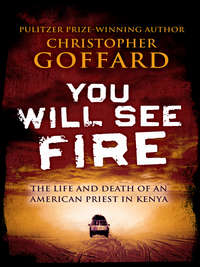
You Will See Fire
The Life and Death of an American Priest in Kenya
Christopher Goffard

Dedication
To Jennifer, Julia, Sophia, Olivia,
and my parents
Epigraph
A man who does next to nothing but hear men’s real sins is not likely to be wholly unaware of human evil.
—G. K. Chesterton
CONTENTS
Cover
Title Page
Dedication
Epigraph
1 The House at the Edge of the Dark
2 The Lawyer
3 The Collar and the Gun
4 Oaths
5 The Dictator
6 The Clashes
7 The Terrible Place
8 The Raid
9 Lolgorien
10 The Tribunal
11 The Girls
12 We Will All Be Sorted Out
13 The Bureau
14 Manic Depression
15 The Verdict
16 The End of the Time of Moi
17 The Inquest
18 The Labyrinth with No Center
Sources and Notes
Selected Reading
Searchable Terms
Acknowledgments
Other Books by Christopher Goffard
Copyright
About the Publisher
1
THE HOUSE AT THE EDGE OF THE DARK
WHEREVER HE WENT, the man of God carried his shotgun. Like its owner, the double-barrel twelve-gauge was old and broken in places, dusty from miles of hard African road. He kept the splintered stock bound together with a length of black rubber, and he believed it might be his only protection, save for the good Lord and his American name, in a country that had never felt more dangerous.
John Kaiser’s redbrick parish house, without a gate or guard or phone, sat on a twenty-nine-acre plot at the edge of an immense valley rolling away toward the Serengeti Plain. It was the finest house in the township, with five bedrooms and small outdoor water tanks. He would be awake before dawn, lifting his head with difficulty from his narrow metal-frame bed, blinking into the darkness of a room as spartan as a cell. Shapes congealed around him: the crucifix on the wall, the cluttered desk, the shotgun.
He’d be walking the grounds before sunrise, clutching his rosary beads and praying in the dark, his arthritic neck already encased in a thick orthopedic brace. At first light, the rutted murram road running past the parish house acquired a pinkish hue. As the countryside awoke, birdsong filled the surrounding trees, and from the long, wet grass, insects thrummed at his passing heels.
A few yards from his front door stood the church he had built soon after his arrival, five years back, in this tiny township in the heart of Masailand. It was a rough and functional structure, like dozens he’d thrown up across the countryside: corrugated-iron roof, concrete floor, unburnished wood pews, and exposed crossbeams in the vault overhead. He had developed a reputation as a ferocious and tireless builder during his years in Africa; this alone made him an unusual figure among white missionaries. He’d gone up ladders with pockets stuffed with bricks and pulled long roof beams after him by rope. But scattered around the compound now were crude brick structures—the shells of a girls’ dormitory and schoolhouse and dispensary—that he had not mustered the energy to finish in these last pain-racked years. He had begun to doubt he would.
The year was 2000. It was late summer. From his radio came the Voice of America, the cadences of home, where the news of late had been dominated by the presidential race to succeed Bill Clinton. He would sit down to breakfast in a dining room with lime green walls, adjoining a living room with a plain worn couch. His diet was as spartan as his room, and his breakfast, laid out by his housekeeper, Maria, would be quick and simple—some mandazi, a fried sweetbread, and ugali, the maize porridge that was the country’s staple.
By midmorning, he would be steering his Toyota pickup over the gravel driveway onto the red-dirt ribbon that formed Lolgorien’s one main road. As in many of Kenya’s disease-blighted towns, there were only a few intact families. Flanking the main road on either side, for a few blocks at the center of town, were tumbledown clusters of one-story shops topped by rusty roofs of corrugated iron, dukas, wood-plank stands, dirt-floor hotels. Milling there were police, game wardens from the Masai Mara, government functionaries, and the pack of prostitutes that served them. Shoulder-to-shoulder on the porches lounged gaunt, long-limbed Masai men, sinewy, sandaled, with shaven scalps, the ropy skin of their stretched and punctured earlobes bright with beads, their bodies wrapped in crimson and vermilion shukas. Their staffs were slanted across their laps or angled over their shoulders; a Masai male who didn’t carry one was considered a worthless guardian against the lions, and the tradition persisted even as the lions had begun to vanish. They were nomadic cattle herders who lived in manyattas—circular arrangements of loaf-shaped mud-and-dung huts, where they corralled their cattle at night, secure from predators behind lashed-together fences of thorned acacia branches. Cows supplied their diet: milk mixed with blood collected from a small arrow puncture in the animal’s neck. White missionaries sometimes talked of feeling like strangers among Africans, even after decades of taking their confessions and serving them Mass and burying their dead. No group elicited this sense of exclusion as powerfully as the Masai. During the priest’s years in Masailand, conversions had been slow, nothing like the success he’d had for decades among the Kisii. The priest knew he was a peculiarity to them, maybe the strangest mzungu they had known—an American, rich by definition, who insisted on a life of hard physical labor in the sun and had chosen to live without a woman or children. Inexplicable enough was a lifetime without physical love—only witch doctors live alone, people said—but a man who consciously forsook progeny meant an even deeper strangeness.
From his truck, as he rumbled through town with the shotgun and rosary beads resting beside him, he could see the Masai watching him from the porches, their gaze indifferent and unreadable in the baking sun. He had to assume that some of them were monitoring his movements, informing on him, reporting back to the man some called “the Butcher,” Julius Sunkuli. Many—it was impossible to know how many—were linked to Sunkuli by family or clan or ties of financial loyalty or fear.
This was Sunkuli country. He held the local parliamentary seat. He was not just the area’s political kingpin and its most prominent Masai but also one of the most powerful figures in the country. He had grown up on the grass plains, tending his family’s goat herds. He had been an altar boy and a Christian youth leader, and remained a conspicuous member and benefactor of the Catholic Church. He had been plucked from the margins of power by His Excellency the President of Kenya, Daniel arap Moi, East Africa’s longest-reigning gangster-statesman, who had given him a place in his inner circle. As minister of state in charge of internal security, Sunkuli commanded a vast police network, and was widely rumored as a possible successor to the president. When he smiled, the gap in his lower jaw showed where his teeth had been chiseled out, evidence of his childhood initiation as a Masai warrior. Sunkuli was different from some of Moi’s other top men, with their charm and European degrees. Sunkuli emitted a raw street fighter’s intelligence, a backcountry roughness that had persisted through his years as a lawyer, magistrate, and political boss.
To Kaiser, Sunkuli seemed the crystallized embodiment of Moiism, the perfect product of a culture of Big Man impunity—widely feared, apparently untouchable by the law or the electorate. For years, the priest had received reports that Sunkuli had been preying on schoolgirls; some said the countryside was dotted with his unacknowledged children. Kaiser had helped push a legal case, now working its way through the courts, in which a young Masai girl from his parish had accused Sunkuli of rape; it had made headlines. The priest described him as his “biggest worry.” It will be one or the other of us, he told people. There was no way to know how many spies he might have. Some people said that one of them was living in the priest’s own house.
Kaiser would pass on, into the countryside. His truck had a whimsical name, “the Helicopter,” because it frequently left the roads, heaving and lurching over terrain that brought anguish to his neck. Throughout the day, he would venture deep into the grasslands, through drenching rains and sucking mud and hard sunlight, to reach the scattered outstations of his vast parish. He had traversed this mapless landscape so many times that the topography itself supplied his signposts: a fig tree, a ridge of rock, a gulley. Certain arcane knowledge accrued to a man over a lifetime in the bush. He had learned to start his truck with a coin when he lost the key, and he understood the utility of a bar of brown soap to patch cracks in a leaking gasket. He had learned to deflate the tires to surmount a bad hill, and to sit on a crate when the front seat fell apart.
A fiercely doctrinaire Catholic who espoused obedience to the letter of Vatican law, he was nevertheless adept at bush-missionary improvisation. He found that a Coke bottle was a serviceable receptacle for holy water. When he’d traveled hours, only to discover he had forgotten the Communion wafers, he looked for the nearest kiosk that sold chapati—a doughy flat bread resembling a pancake—to transform into the Savior’s body. A crack shot, he’d been vanishing for years into the elephant grass with his shotgun, stalking wildebeests and impalas, warthogs and zebras and buffalo. He would skin the carcasses—sometimes yanking the skin free with ropes attached to his truck—and carve up the meat and distribute it among the parish schools. He whittled the stocks of his guns and made his own bullets, shaving lead from an old battery and pounding the pieces into slugs. He shook in half rounds to conserve gunpowder and to mute the noise when he hunted, in case a game warden was within ear-shot. Poaching had been outlawed since the late 1970s, but that was one of man’s laws and therefore negotiable.
Some regarded him as an unbreakable man, the “John Wayne of priests.” They saw the six-foot-two former U.S. Army paratrooper who could creep close enough to a buffalo to kill it with a single half-powder round through the lungs or heart (to take a second shot gave wardens a bead on your location). They saw the hunter who refused to leave a wounded animal behind, despite the danger of pursuing an enraged, bleeding beast into the bush. He had promoted a fierce image, in part, as a form of protection. Even before he was an enemy of the state, he recognized the shotgun’s value in deterring ordinary trouble. He hauled it outside now and then to shoot at birds; everyone knew the American priest was armed. He had performed prodigious physical feats well into middle age, hunting, hauling, digging, building. When he arrived in Masailand in his early sixties, he was still strong and fast enough to kill a rabbit with a hurled stone or a dik-dik with an ax, and he’d be on top of the animal before it even fell, hacking with a big overhand arc. He was still popping wheelies on his motorbike for the amusement of the Masai girls.
He’d come through the crucibles of any bush missionary—hepatitis, typhoid, malaria, amoebic dysentery. He’d broken bones in motorcycle spills and survived a roof beam crashing on his neck during a construction project.
But the last few years had been brutal even by his standards; his body had become a catalog of anguish. Though he hated seeing the doctor, he’d gone dozens of times. He’d endured prostate cancer, and multiple bouts of malaria that grew increasingly resistant to quinine and left him helpless, sweating through fevers and convulsions and hiding from harsh sunlight and the gouging of birdsong in the ears, the terrible cold seizing him, his body without bones or muscles or volition for weeks. At times, as the decades accreted in the bones, a man could feel like the sum of all the stumbles off his motorcycle and falls in the mud, a creature of collapsing cartilage and inflamed joints and ulcers. He was a former soldier, and a soldier did not complain, but on his best day now he couldn’t move his neck without pain. He wore the cervical collar everywhere, except at Mass. There, facing his faithful, he refused any concession to his decaying sixty-seven-year-old body. His parishioners streamed down from the hills in their bright tribal wrappings to hear him speak in Swahili of the risen Savior, to stand in line at Mass as the enormous old white hands, aching now like the rest of him, leaking strength every day, cradled God Himself aloft.
Everybody in the area knew the American priest, and many depended on him for food and school fees; they would surround him as soon as he pulled up to a cluster of huts or to the little brick schools or churches. By the side of the road, in the shade of eucalyptus trees, he bowed his head and listened to their confessions. I have stolen a cow, Father. I have slept with girls, Father. I have struck my wife, Father. So much of his knowledge about the country had arrived in this fashion; the chronicle of sins formed an infinitely more accurate barometer of the country’s soul than did the Nairobi newspapers.
With luck, he would be home before nightfall. The road bristled with bandits, or shifta, and the sun didn’t linger on the horizon. It was nothing like the protracted twilights of his Minnesota childhood—that long dream hour of crying cicadas and droning mosquitoes. Here near the equator, night scythed down as swiftly as a panga knife; one writer compared the experience to having a sack pulled over your head.
The shotgun would stay with him as he walked the grounds at night, locking the church, shuttering the windows of his home, double-checking the locks; it stayed with him as he walked down the long, shadowed hallway to his room, the last on the left. Scattered before him at his desk, dimly illuminated by generator light, were dangerous documents. They told the story of the secret history of his adopted country, a subterranean narrative of land and blood. They chronicled the sins of Kenya’s rulers—decades of land-stealing, ethnic carnage, rape. There were affidavits from peasant farmers, land deeds, newspaper clips, correspondence, accounts from local girls. He had been collecting them for years. He spent hours in his room, reading, poring over documents, making notes in his journal. For some time, he’d been anticipating his violent death, warning friends and family in the States to expect it.
For most of his career as a bush missionary, save for the church and the tribes he had lived among, few in Kenya had known his name. He had done a fair job of impersonating the other good, hardworking, politically impassive men of Christ. He had raised little noise outside the Church, with the rationalization that he had plenty of God’s work to keep him busy. Then, no longer young or even middle-aged, he’d become chaplain at a hillside displacement camp called Maela, where he witnessed a scale of misery that nothing had prepared him for—ubiquitous choking dust, mud, disease, burned skin sloughing off children’s hands like gloves, and then the government’s nighttime raid on the camp. Good Lord, some of the refugees had even been singing as they were crammed onto trucks to be scattered across the countryside, singing because they’d actually believed the president’s promise that he would find them land. That six-month experience—culminating in his own beating and banishment from the camp—had forced him to reexamine his silence. Some of the lightness went out of him; photos showed a depth of sadness shadowing his eyes after that.
It would have been possible, even then, for him to melt back into his missionary work. His bishop, whose mantra was “Don’t provoke,” had sent him to the house in Masailand at the country’s southwest edge—about as far as he could go without spilling into Tanzania—with the hope that the remoteness would keep him out of trouble. The bishop had been mistaken. It had not deterred Kaiser from appearing at the Akiwumi Commission—a tribunal launched by President Moi, with the ostensible goal of probing the causes of the tribal clashes that had killed more than one thousand people in recent years. The real purpose, many suspected from the start, was to conceal the government’s central role in the carnage. Kaiser had been warned against speaking. His bishop believed the tribunal a waste of time, and Kaiser’s intention to name names a pointless provocation.
Some African churchmen considered it an embarrassment that a white man should presume to lecture them about their affairs. The missionary’s role in Kenyan history had been a fraught one. Determined to bring pagans of the Dark Continent into the Christian fold, the early missionaries preached not just salvation but also the superiority of white civilization. Many of Africa’s independence leaders, including Kenya’s, had been products of missionary educations. But it was easy for Africans to view the missionary legions with ambivalence, if not outright hostility. They had built schools but taught Africans to hate themselves. The Church had been a spearpoint of the colonial land grab, legitimizing the conquest, and had sided with the British against the Mau Mau uprising of the 1950s, defining the struggle as one of light versus darkness, God versus Satan. Jomo Kenyatta, Kenya’s first president, had put it this way: “When the missionaries arrived, the Africans had the land and the missionaries had the Bible. They taught us to pray with our eyes closed. When we opened them, they had the land and we had the Bible.” Kaiser had inherited this uneasy legacy. For many of his colleagues, guilt fostered paralysis and passivity—a feeling that African politics was best left to Africans, lest the Church be accused of reproducing its past sins.
Yet Kaiser had gone to the tribunal, braving the bad roads, waiting in the makeshift courtroom in his ironed clerical blacks, with his neck brace and his Roman collar and a folder of documents. Up he walked, a broad-shouldered, long-limbed man with a loose, slightly bandy-legged gait and thinning white hair. He was not a churchman of rank, not a bishop or a nuncio, not even the priest of a politically important parish like Nairobi. He was, up until then, a man of small importance to history—just a bullheaded old mazungu from one of the country’s poorer corners.
His voice was high and thin, almost feminine, incongruous with his cowboy gait, but it had not betrayed him that day. He had named names—a roster of the regime’s untouchable potentates. Sunkuli was prominent among them. This was dangerous enough, but then he went on to do the unpardonable: He named Moi himself. People would remember his voice as steady and even and insistent. Listening to it, it had been impossible to tell that he’d been sleeping with his shotgun for weeks, afraid that he would never be allowed to speak, afraid that once he began, he’d never be allowed to finish. He testified for two days, sparring with government lawyers, trying to distill the dark knowledge he had absorbed. Long portions of his testimony ran verbatim in Kenya’s daily newspapers, and in an instant the backwoods missionary had become a symbol of national conscience, a source of hope, a galvanizing force.
That was how it began: not just the fame but also the steady note of dread in his letters, the unbanishable sense that he would be called on to die violently in this green, malarial patch of East Africa. In the eighteen months since then, he had been upping the stakes, demanding not just that Moi be prosecuted at the Hague, where he vowed to serve as a witness, but pressing for criminal charges against Sunkuli, as well. The good, gentle men of his missionary order found it exasperating, his unwillingness to listen to reason, to moderate his tone, to demonstrate a normal man’s respect for death. You’re going to get us killed, John.
AGAINST HIS WINDOW pressed the cold deep-country dark, and from it rose the distant bedlam of hyena packs on the savanna. Cackles, whoops, rattles, gibbers—in the right state of mind, these sounds could be calming, melodic. Africa’s nightsounds used to be music to him, and there were nights as a young missionary in the open Mara that he would recount as if he were the world’s luckiest man. Picture him: the stars ablaze above, the breeze rippling quietly through the dry waist-high grass, the winged ants battering his lantern, the carcass of a wildebeest or zebra gutted in his truck and the aftertaste of its fried heart in his mouth, and all around the cacophony of animals in their night rituals. He had lived close to nature’s beauty and cruelty since childhood. It had suited him, this life. Now, the veldt noises lashing against his room’s little square of light seemed to remind him of the closeness of his own death. Again and again, the priest told people, That is what they will do to me if they catch me. Leave me as carrion. Human flesh was familiar to the scavengers, for the Masai still were known to leave their dead unburied, smeared with animal fat to hasten the bodies’ disappearance. Nothing lasted long out there, among the immense spear-beaked marabou storks—bald, Boschian grotesques whose wrinkled heads seemed born in some stygian pit of blood and ash—and the hyenas, spotted, hulk-shouldered, level-eyed. These he seemed to fear most. They fed deep on the entrails of living, thrashing gazelles. They ate the viscera and the muscles and the skin, crunched through bone and swallowed the hair, whole corporeal forms vanishing in the space of hours. They were, to assassins, an ideal evidence-disposal system. Everyone knew the story of the young English traveler Julie Ward, who had been murdered not far from here, her body devoured by animals, and the truth about her death—like so many crimes in Kenya—gone with equal thoroughness.
As a paratrooper, he’d been taught that darkness can be a friend and ally; a trained man can turn it to his advantage. Here, however, the mind peopled that void with innumerable evils; he knew the advantage was theirs, not his. Every odd sound, every rustle and crunch, seized his attention, his body tensing. He knew they could be out there even now, crouched, smoking, silent, patient, catching a glimpse now and then of his tall silhouette passing by a window, waiting for him to be separated from his gun, for his vigilance to slip. They’ll say I killed myself. Don’t believe it. He clutched his rosary beads. He prayed for strength.
THROUGH THE SUMMER, his missionary bosses and fellow priests made the trip from Nairobi to plead with him: Go back to Minnesota, John. Rest.
They knew there was small chance of reasoning with a man of such preternatural stubbornness. If he went home now, he explained, Kenya’s rulers would probably never allow him to return.
Any of his superiors could have ordered him out of Lolgorien, back to the States. He had taken a vow of obedience, and he very well might have complied; his last years would have been spent peacefully among his boyhood haunts in Otter Tail County, Minnesota, fishing quietly among the mayflies, visiting old friends and family, and browsing the cemetery slabs for childhood names. But his bosses gave no orders. Their preferred method was to offer suggestions, appeals to reason, pleas for prudence. These, he could ignore.
The summer was a dry one in Lolgorien, the green leaching from the hills until the grass was brown and short and brittle. His water tanks were depleted, and across the hills the skin tightened on the ribs of the cattle. The Masai watched the sky constantly, knowing that if it remained empty, their calves would begin to die first. Cows were not just their livelihood but God’s special bequest to their tribe. Every few seasons, droughts stole them in large numbers, and it was a terrible thing to hear the weeping of a proud Masai. They prayed and made sacrifices, and still nothing brought the rain.
All that summer, for the priest, the warnings kept coming. One day, returning home, he found someone had hurled a large rock through a window of his house. Another day, a friendly Kenyan contact—a game warden or policeman—came surreptitiously to say, A decision has been made to eliminate you. Another day, he opened a letter that had arrived in his mailbox and found an unsigned threat in Swahili: Utaona moto. You will see fire.
Much later, Francis Kantai, one of his catechists—a young Masai he had enlisted as a helper and a cultural bridge to the local people—would describe the priest’s sudden unease as he opened the letter. What is it, Father? What does it say?
As Kantai recalled, the priest gave a curt reply—I don’t give a damn—and took the letter down the hall to his room and closed the door. The threat was apt. Fire had been the medium of terror in village after village, defenseless thatched-roof huts and wooden hovels transformed into the tinder of infernos across the countryside. Flames took them quickly and completely. Even in his house of brick, there was little protection against a torch in the night.
It’s easy to imagine that the priest sat on his bed and prayed, clutching that note. It’s possible that he brooded, too, on his young Masai catechist, who slept down the hall from him. To many of the priest’s colleagues and acquaintances, why he permitted Kantai’s presence was a mystery. He was widely believed to be a spy for Sunkuli, and he had confessed to burning houses for the police. The priest had repeatedly defended Kantai, had once even smashed a table in rage when his name was impugned.
By this point, however, there were signs that he had begun to distrust Kantai himself. His housekeeper, Maria, told him that Kantai had let Sunkuli’s men into the parish house, into the priest’s room—the place where he allowed no one, the place where he kept his papers.
The priest had asked a Kenyan friend, Can Francis hurt me?
The friend had responded with a Swahili proverb: Kikulacho kimo nguoni mwako.
It meant: The bug that bites one’s back is carried in what one wears.
IN THE THIRD week of August, the rains came and the grass greened, and from his veranda he watched the cows dance.
One of his catechists, Lucas, handed him an envelope.
A letter for you, Father.
The priest opened it. It had been hand-delivered all the way from Nairobi, passed between church assistants. It was a summons from an authority he could not refuse—Giovanni Tonucci, the papal nuncio, the Pope’s representative in Kenya. The priest was to report to him immediately. The matter was apparently urgent, though unspecified.
Kaiser was certain what the meeting would entail. He would be thanked for his years of service in Kenya, and told to return to the United States to take an extended rest. It would mean, he was sure, his departure from the country for good. He would have to obey. Thirty-six years, and now it was over.
What he did in the days that followed would invite the most exacting scrutiny, his actions weighed and analyzed and puzzled over, his phrases parsed, word by word, and subjected to dramatically different readings. After the summons, his mood changed. He wept at Mass. He asked for prayers. He grabbed his duffel bag, then climbed into his truck with his ax and his rosary beads and his Bible and his neck brace and his shotgun, disappearing down the red-dirt road on the half-day trip to Nairobi.
2
THE LAWYER
THE LAWYER’S PHONE started ringing early that morning. They’ve killed Kaiser. He was at home in Ngong, on the outskirts of Nairobi. He felt a chill spread between his shoulder blades. The first details to reach him were vague, secondhand, filtered through a network of informants whose voices were tight with panic. It was August 24, 2000, four days after Kaiser’s departure from his parish house, and his body had been found in a weedy ditch that morning in Naivasha, about forty miles outside the capital. Nobody could determine what had brought him there. People were saying that his head had been blown apart, that his own shotgun lay nearby.
Charles Mbuthi Gathenji was fifty-one, a man of stocky build and medium height. He had a thin mustache, thinning gray-black hair, and sharp cheekbones. He possessed an air of wary circumspection informed by decades on the wrong side of a police state. His eyes were deep-set and heavy-lidded, and his thin, rimless glasses contributed an aura of scholarly gravity, an impression reinforced by his careful, formal English, his accent thickly Kenyan and punctuated with phrases like “It is quite in order.”
He did not deviate from his daily routine on this day. He put on his suit, picked up his leather briefcase, and steered his Mitsubishi Pajero into the cacophony of the capital’s morning gridlock. He had an appearance at the High Court and some appointments at his office. But the sense of prickly unease that had never entirely left him these past few years was very close now. They’ve killed Kaiser. In recent weeks, under the employ of the Catholic Church, the lawyer had been preoccupied by a case that felt eerily similar—the slaying of an Irish monk named Larry Timmons. The monk, not nearly as well known as Kaiser, had accused a Rift Valley policeman of demanding bribes, and one night the cop had shown up at the mission house—in response to a robbery—and shot him to death. A terrible accident, authorities said, but after all, it had been so dark. Now, three years after the shooting, Gathenji was arguing to bring murder charges against the cop; they were in the thick of a protracted inquest, and his witnesses were slowly dismantling the official narrative.
When Gathenji returned home that evening he turned on the television news and got a glimpse of the scene where Kaiser had been found. There was the priest’s body, with its fringe of white hair, supine in the weeds, clad in light gray slacks, black leather shoes, and a leather jacket. There was his Toyota pickup aslant in a drainage culvert, with a twisted right front wheel. There was the interior of the dirty cab, with the priest’s rosary beads hanging from the steering wheel and the sharp edge of his ax visible under some clutter. There were the dark-suited plainclothesmen and black-hatted officers milling around the truck in the sharp country sunshine. There was the shotgun—wrapped, ineptly and incompletely, in police plastic. There was the large crowd of onlookers massed on a nearby berm, mothers standing with arms crossed and children sitting at their feet in the brownish red dirt, all watching wordlessly and immobile as statuary. There was the sky as it had been that morning, pale blue and clear beyond the towering, slender-branched fever trees, and the road already alive with zooming buses as the body was wrapped and loaded into the back of an official Land Rover.
For the last five years, their lives had been closely linked, the lawyer’s and the priest’s. Kaiser would materialize at Gathenji’s office unannounced, always on a crusade, always in dusty shoes. To call ahead of time would have increased the possibility of being followed. He’d bring in people from his parish who needed legal help. He’d scribble notes on newspapers or whatever was on hand. He’d seek advice on how to build cases against government men, and how to get supplies to refugees displaced by violence.
If the Church remained one of the few institutions in Kenya that had raised its voice against the government, it did so mostly in a carefully hedged and muted way. As a corporate body, it preached reconciliation but rarely went further. The American priest had been an exception: He’d named names, and looked for every opportunity to do it again.
As Gathenji saw it, over their years of working together, their bond had evolved into something more profound than mere friendship. They shared the understanding of two colleagues who knew for a certainty that their work could get them killed. They were brothers in a foxhole.
Temperamentally, they were poles apart. Kaiser had a hard-charging, elbows-out approach, always racing toward the cannon’s mouth. Dogged but not personally flashy, Gathenji was quiet, methodical, and preferred to operate behind the scenes. He had a wife and two children. Despite his high-profile battles with the powerful, he tried to speak through his legal work. He saw no reason to draw more attention to himself than necessary.
Many of his peers had cultivated political connections and made themselves rich. He did not view the law as a stepping-stone for political power; to him, his country’s politics had a rank taste. He wasn’t an editorial writer or a maker of screeds and fiery speeches. He seemed to know everybody but made it a point to avoid social clubs. He would not be found mingling with the nation’s legal stars on a Nairobi golf course. He couldn’t be mistaken for a member of the wabenzi class—the Swahili term for those possessed of a Mercedes-Benz, the badge of arrival. He stayed away from bars and made it a habit to be home on his small farm, with his family, well before sunset.
Much of his work, championing the victims of political violence, carried small financial reward. And so despite being one of his country’s best attorneys, he labored in what he characterized as the lower-middle class. He described himself as a simple man, a working lawyer with a Mitsubishi and, when he could afford it, a clerk. He thought of himself as a foot soldier, and had the instincts of a survivor.
For years, he had worked from a respectable fourth-floor office in a tower across the street from the Central Law Courts in downtown Nairobi, but the place had stopped feeling safe a year back; one of Moi’s ministers had moved into the floor below, and Gathenji nervously found himself passing the man’s security detail in the stairway.
Now, in the summer of 2000, he was in semihiding in an old, peeling, out-of-the-way office bungalow on Chania Road in a compound of decrepit trees and flowers. The red-tiled roof leaked when it rained, and the cold days were bitterly uncomfortable. He had removed his name from the telephone book and changed his numbers. He was doing mostly low-level legal work to make a living—most clients had deserted him after his incarceration as an alleged enemy of the state a few years back—and quietly consulting human rights groups on strategies for prosecuting Moi.
To Gathenji, Kaiser’s death had the feel of a classic state-sanctioned hit, carried out by a cadre of professional assassins. It was the work of what he called “Murder, Inc.”—a vast apparatus of spies, security forces, and hit men with links to State House. Could Moi have been brazen enough to kill the American? If so, it meant anyone might be next; it suggested there might be a list the assassins were working from. His own name could plausibly be on it; many of the calls he would receive in coming days were from people concerned for his safety.
The country was two years away from the most important election in its postindependence history, a potential pivot point in East Africa’s rueful political trajectory. There was hope that Kenya’s fragmented ethnic groups might finally do what had seemed impossible before, coalescing long enough to defeat Moi’s machine. The ruler was apparently growing desperate, his grip threatened as never before.
SIX DAYS AFTER Kaiser’s death, as the priest lay in a glass-lidded brass-and-teak coffin under the vault of Nairobi’s Holy Family Basilica, Gathenji sat in the crowded cathedral among Catholic bishops, human rights activists, diplomats, and the priest’s friends and colleagues from across the country. The anger in the air was palpable. Gathenji listened as the papal nuncio—the man who’d issued Kaiser’s final summons to Nairobi—stood before the crowd, extolling the American priest’s crusade for justice and declaring him a martyr to the faith. In life, he’d been a troublemaker, an obstinate and single-minded man who’d railed against the Church’s passivity and clashed with his bishops, his missionary bosses, his fellow priests. Now it was possible to ignore the rough edges and complicated history.
The transformation had been instantaneous: The priest had been rubbed as smooth and flawless as a Masai bead, delivered from his aching body and messy humanity to abstraction, a clear and perfect symbol. After twenty-two years of Moi’s misrule, Kenyans were ready for such a symbol. The president’s face stared from every shilling in their pockets and the wall of every shop they entered—his name was on schools, streets, stadiums—and they had no trouble envisioning his hand steering the American priest to his grave. On everyone’s lips was a litany of political murders, unexplained car wrecks, implausible suicides. Outside the basilica, thousands crammed the streets in mourning and in rage. The American had already become a byword for Moi’s ruthless determination to stamp out dissent, and a rallying cry for the forces gathering against the dictator. Gathenji noticed that the regime had sent no representative to the funeral ceremony.
After the Mass, the priest’s body was loaded into a church van for transport to Kisiiland in the west, where Kaiser had spent decades, and then on to the gravesite in his last parish, in Lolgorien.
Gathenji did not follow the church caravan; there was no telling who might be waiting to ambush him on those long stretches of country road. His association with Kaiser was well known. He believed it best to lie low until facts could be gathered, the scope of the plot uncovered, the killers identified. On this score, there were grounds for hope far beyond what anyone could have expected. A team of FBI agents, summoned by the U.S. ambassador, Johnnie Carson, had crossed the Atlantic to begin investigating. Even now they were fanning out across the countryside, gathering evidence, digging up witnesses.
The ambassador had promised the Bureau’s investigation would be an independent one. To Gathenji and to others, this was a crucial reassurance, since no rational person expected the slightest help from the Kenyan police themselves; it was widely rumored that they’d played some role in the death.
Gathenji was heartened by the FBI’s reputation, by its awesome resources and name for professionalism; the agency had been instrumental in rounding up suspects in the terror bombing of the U.S. embassy in Nairobi two years earlier.
But even now, a piece of not-so-distant history supplied grounds for anxiety. A decade earlier, Moi had invited New Scotland Yard in to investigate the murder of his foreign minister, Robert Ouko, but had curtailed the probe when it pointed to members of his inner circle. The investigation had supplied the illusion of the pursuit of justice while anger abated and memories faded and witness after witness died, some of them mysteriously.
No, Gathenji thought. This investigation was in good hands. The Kaiser case would not be like Ouko’s. The Americans wouldn’t permit themselves to be Moi’s dupes, and they would raise hell if they were trifled with. So seriously was the case being treated in the United States that senators there were taking to the floor of Congress to demand justice for Kaiser.
Gathenji’s day-to-day work representing victims of political violence was dangerous enough, and the Kaiser case promised even deeper hazards. He did not think it prudent to venture too soon to the crime scene in Naivasha, a closely surveilled area with a reputation as a regime stronghold, where the slightest political talk could easily be overheard.
In the weeks that followed Kaiser’s death, he would make discreet inquiries, trying to retrace the priest’s final steps. Mostly, though, he waited. It might not be necessary for him to get involved.
The case felt coldly familiar to Gathenji in a personal way. His father, a Presbyterian evangelist, had been the victim of a politically charged slaying in September 1969, dragged from his home by fellow Kikuyus for refusing to swear an oath of tribal loyalty.
Gathenji, a twenty-year-old student at the time, believed the attack was sanctioned by elements of the Kikuyu-dominated government of Kenya’s first president, Jomo Kenyatta. No one had ever been punished for his death; there had been no trial, and nothing resembling a real investigation. The experience, more than any other factor, had pushed the young Gathenji into a career in the law, which he perceived as a process—at its best—of ferreting truth from darkness and lending strength to the helpless. He had developed an abiding wariness and a deep-seated distrust of institutions, including ecclesiastical ones.

Charles Mbuthi Gathenji. For the Kenyan attorney who lost his father as a young man, Kaiser’s death had personal echoes. Photograph by Carolyn Cole. Copyright 2009, Los Angeles Times. Reprinted with permission.
Like Kaiser, Gathenji’s father had been an inveterate builder and a tough former soldier who had ignored reported warnings to adopt a more compromising stance. He had suspected that his betrayer would likely be a friend, a church mate, someone scared enough to sell him out.
Kaiser had been aware of the story of Gathenji’s father, of course. During one of their last meetings, the harried priest had invoked the lawyer’s father as a reminder of what they were both fighting for.
Both deaths had had a feeling of inevitability. Both of the dead had seen it coming, clear-eyed, from a great distance.
3
THE COLLAR AND THE GUN
HE ARRIVED IN December 1964, stepping off a freighter into the harsh equatorial sunlight at Kenya’s eastern port of Mombasa, into a country that had just reeled exuberantly through its first year of independence from the British. Across the continent, the apparatus of European domination was being shuffled off, with varying degrees of violence, and the sense of possibility was unbounded. Kaiser was thirty-two years old and just ordained, fair-skinned and squared-jawed, a big-framed man with an army duffel bag under a thick arm. He boarded a prop plane, which carried him over the vast bulge of land toward his first parish in western Kenya. It was his first sight of the country in which he would spend most of his life—the great forests and maize farms and tea plantations, the ice-capped towers of Mount Kenya, the staggering cleft of the Great Rift Valley.
Kaiser’s early years in Kenya seem to have reflected the country’s own mood of hope and possibility. He lived in a cool, high region of softly sloping green hills dotted with huts and little granaries and covered with groves of black wattle trees, eucalyptus, and cypress, grass pastures, and terraced fields. This was the land of the Kisii, or Abagusii, a place the British had declared off-limits to European settlers.
Crowds swarmed to meet the missionary as he settled into a parish with eighteen thousand baptized Catholics and eighteen Catholic schools. Winds from Lake Victoria rustled maize rows that soared above a tall man’s head, and from the high hills of Kisiiland he could glimpse the great gulf. Families tended small farms called shambas, growing tea and coffee, as well as sweet potatoes, finger millet, and corn. Along the narrow dirt roads the women toted heavy kerosene tins of corn kernels to the power mills. Sclerotic little buses called matatus raced by helter-skelter; frequent rains stalled them in thick, impassable mud.
English and Swahili were of limited use here. The Kisii, isolated in the hills for two hundred years, were Bantu speakers whose language was grasped by few outsiders. There were no dictionaries or written grammatical rules. Kaiser set to work mastering the language, and after four months he was conversant enough to hear confessions.
The Kisii were fond of late-afternoon drinking parties, and men clustered together on stools, thrusting three-foot-long bamboo drinking tubes into pots of boiling, gruel-thick beer made of fermented millet and maize flour. The sociable Minnesota priest, invited to partake, confided to friends that he found it awful-tasting but learned how to fake a sip.

John Kaiser during his first years in Kenya, in the 1960s. He lived among the Kisii in the fertile highlands of western Kenya. A stout six foot two, he built churches across the countryside, quick, crude structures of red earth and river-bottom sand, and went up ladders with pockets stuffed with bricks. Photograph courtesy of the Kaiser family.
The huts were windowless, with walls of mud and wattle. All night during the cold months, upward through fissures in the tight grass thatching of the high-coned roofs, filigrees of smoke curled from hearth fires where families huddled, asleep on cowhides scattered across floors of dried mud and dung.
On some levels, the area was as foreign to Kaiser’s native Midwest as it is possible to conceive. Despite the presence of Catholics and Seventh-Day Adventists, most Kisii remained animists steeped in traditional practices. Polygamy was ubiquitous. For a man, the highest ambitions were abundant offspring—the only insurance of personal immortality—and multiple wives, each with her own hut, between which he would rotate. Fecundity was celebrated, the ultimate badge of a woman’s worth, and she was expected to give birth every two years while it was biologically possible. Giving birth to fifteen children was common. The Kisii birthrate, one of the world’s highest, was to Kaiser “a great sign of Divine favour.” Population control he regarded as evil. In Kisiiland, a pregnant woman did not speak of her pregnancy for fear she would appear boastful and invite malevolent envy. Any perceived advantage, in fact, invited envy and witchcraft.
“No one dies without carrying someone on his back,” went one proverb. This reflected a dark vision of invisible forces harrying people to their graves. Everything required a cause, an explanation, especially major calamities. Rancor between co-wives was a given, and a woman who found herself infertile, or who lost a child during pregnancy, inevitably suspected some machination of the women who shared her husband. The wealthy lived in fear of the poor; the poor lived in fear of the very poor; the very poor lived in fear of the wretched. It was understood that for the powerless, the jealous, and the angry, there was no recourse except through magic, and so the community’s most miserable and reviled members—childless, neglected old women, for instance—were often the most feared and vulnerable to murder. The killing of accused witches was common.
Once, Kaiser would recall, he installed a drain under an old woman’s hut, but she remonstrated with him over the shallowness of the ten-foot hole he had excavated. No, she said—they might claw down into the earth and witch me with my used bathwater: the omorogi. These were malign grave-robbing entities in human form, witchdoctors capable of casting a hex on anyone whose clothing, hair, fingernails, or excrement they could lay hold of and boil into a lethal brew.
Against those forces stood friendly diviners who could diagnose frightful omens and determine whether they were a function of witchcraft or, perhaps, of ancestor spirits angry at some slight. Other divines prescribed the proper sacrifices to banish spells, indicating whether the occasion called for the slaughtering of a black hen or a white he-goat. Kaiser viewed these divines as “clever rogues and excellent students of human psychology.” Professional witch-smellers were paid to scour one’s hut and root out the charms hidden in the roof and the walls. Having surveyed the grounds ahead of time and planted the charms, they waited for a crowd to gather, removed the alleged artifacts with a flourish—animal tails, potions, little pots—and dramatically announced that they would identify the witches responsible unless the plots were ceased immediately. Even progressive-minded Christians, lectured at church not to believe in witchcraft, secretly kept potions as a hedge against it. Some converts to Christianity abandoned it to take multiple wives, and some abandoned it in the face of serious illness or death: Confronting such calamities, you took no chances with new and unproven gods like the Nazarene.
For the Kisii, the supernatural was everywhere, but they lacked what some anthropologists called “an organized cosmology.” Their religion was essentially an ancestor cult. In a volcanic peak, shapeless as the wind that swirled around its high ridges, dwelled immortal ancestor spirits called “grandfathers”—a fickle, prickly, demanding pack that meted out rough justice in human affairs, punishing homicide and adultery and incest. They sent death and disease, killing bolts and madness, barren wombs and ruined crops. They were not deities, the object of daily prayer and ritual, but their hand was detected when misfortune struck; in this sense, they more closely resembled demons or furies. When angry, they placed omens in your path—an aardvark or copulating snakes—to signal their need for appeasement by funerary and animal sacrifices.
Kaiser perceived the Kisii outlook as one of profound “fear and fatalism,” akin to the pagan Europe of his Irish and German forebears. This enlarged the exhilaration of his missionary work. He saw himself bringing the good news of Christ’s victory over death and evil, liberating a superstition-enslaved people from their terrors. People sought his protection against the curse left by a lightning strike on a homestead; a sprinkling of his magic water could remove it. Once, he came upon the corpse of a young girl killed by a lightning bolt, and was warned not to touch her: It was certain to bring death, unless goats were sacrificed. Kaiser disregarded the warning, hammered together a wooden coffin, and lifted her into it for burial. If he didn’t banish the belief in curses, he seemed at least to possess a special power to defeat them. His celibacy set him apart from the community’s normal rhythms and aspirations, and that sense of apartness—coupled with his connection to the spirit world, his ability to influence hidden forces—made him a relation of traditional Kisii diviners.
In a study of the Kisii conducted a few years before Kaiser’s arrival, ethnographers Robert and Barbara LeVine described them as a “distinctively paranoid” people who viewed families and neighbors as nests of potential enemies. They sued one another with astonishing frequency—over stolen cattle, boundary lines, beer-party brawls. Litigants were expected to fabricate elaborate stories to avoid admitting guilt, which is why, outside the courthouses, there stood small flowering omotembe trees—oath trees—on which they were made to swear; to lie was to invite supernatural disaster, and to refuse the oath was tantamount to confession. In matters of justice, families closed ranks, and many killers avoided trial for want of witnesses. Punishment by the human justice system was regarded as meaningless against the rage of the spirits.
Studying the Kisii, the ethnographers found a streak of sexual puritanism and sadomasochism. Women who initiated sex were seen as prostitutes; faced with a male overture, they were expected to demonstrate serious reluctance, a practice that obscured distinctions between consensual sex and rape. On her wedding night, the bride mounted a show of resistance while the groom’s clan mates tore off her clothes and forced her onto the marriage bed. In a kind of ritualized contest, she would have stashed a piece of knotted grass under the bed or a piece of charcoal in her mouth, magic amulets meant to render the groom impotent. Multiple sessions of intercourse were expected of him that night; it was cause for pride if he injured the bride so badly that she couldn’t walk. There was also a form of ritualized rape (still enduring in the late 1950s, though growing less frequent) called “taking by stealth”: On the occasion of annual initiation ceremonies, boys were permitted to sneak into girls’ huts, where “a few boys achieve a hurried and fearful act of coitus with girls who pretend to be sleeping.”
As in the midwestern farmland of Kaiser’s youth, cows were ubiquitous in Kisii country. Along with the number of wives he managed to collect, cattle was the mark of a man’s wealth and status. They were a dowry for a daughter and an insurance policy, convertible to cash in emergencies that required payments to a witch-smeller or medicine man. And as in the Midwest, the rhythms of life in Kisiiland were dominated by the seasons, the rain and the crops, and survival depended on how well you read the signs. The year began with groups of women entering their little fields, their infants bound to their backs, their panga knives slashing the underbrush, their hoes pulverizing clumps of dirt in preparation for the broadcasting of millet and corn. Then came the long rains and the weeding and the waiting, and by August the granaries would be depleted, and the families, when they ate, survived on sweet potatoes and bananas. In the months that followed came the harvesting, and with it the initiation ceremonies, including mass clitoridectomies, the culture’s central ritual for girls. To an outsider, the rite involved bewildering dramas. Girls expressed great eagerness for the painful procedure in the face of older women who mockingly discouraged them. By this playacting, girls were signaling their mental readiness to enter the hut of the surgeon, who waited with a harvesting knife or razor; to flee the ceremony, once it had begun, was a disgrace to the family and an affront to the spirits.
Despite the vast cultural differences, Kaiser felt a kinship with his parishioners. They reminded him of the Scandinavian farmers he’d known as a boy in Minnesota. They were “tenacious and stubborn, yet warmhearted and generous, tightfisted and grasping, superstitious and religious—perceiving the influence of the spirit world in every occurrence,” he wrote in a memoir late in life. Kaiser came to respect native medicine men who used herbs and leaves to rescue people from the throes of mental breakdowns after modern medicine had failed. A sick Kisii saw no contradiction in treating his affliction with both a pill and a sacrifice to an offended ancestor.
This, then, was the land that Kaiser entered in his early thirties, the place he would spend much of his life. He came to regard himself not just as an African generally but as a Kisii in particular.
THE COUNTRY, WITH its fierce light and impenetrable dark, its jumbo maize rows and seasons of starvation, was immense, large enough to contain his clashing selves: the priest and the paratrooper, the healer and the hunter, the collar and the gun, the man of obedience who chafed at authority. The duality of his character had been obvious since his childhood, and partly a function of it. He was born in November 1932, the second of four children in a devoutly Catholic family in Otter Tail County, a backwoods patch of wild Minnesota where the children worked the farm and wandered deep woods of ash and poplar and basswood, and where learning to shoot was both survival and a poor boy’s central entertainment. The young John Kaiser, thin and sandy-haired, evinced a penchant for solitude, and he thought it would be a fine life to live as a trapper. He spent dark winter mornings roaming with his .22 rifle or single-barrel shotgun, hunting for muskrats and inspecting traps he had set. He became renowned for the speed with which he could detach a skin from the carcass. Animal fur earned the family a few dollars for a day’s work.
Religion, like firearms, saturated the Kaiser farm’s rhythms. Prayers began on awakening. Mom and Dad drilled their children in the proper responses to the Latin Mass. Their small, white, steepled church had frosted glass, plain wooden pews with uncushioned kneelers, and a wood furnace under the sanctuary. At the pulpit, a German-born priest named James Mohm upbraided parishioners by name for their sins and for their ignorance of the faith. He was opinionated, confrontational, deeply involved in the life of the congregation, and widely loved, a man Kaiser would later describe as a strong influence.
One Christmas at his one-room country school, Kaiser drew a nativity scene on the school chalkboard, carefully detailing the three kings, lovingly texturing the wool of the sheep, scrupulously shaping the halo around baby Jesus’ crib. Nights at home, he sat with the family around the kerosene lamp, creating images that might have sprung from the covers of a boys’ pulp magazine: horses, sheriffs, gunslingers, elaborate battle scenes. In one image of men at war, he lavished detail on the soldiers’ uniforms, on the sights of their M1 rifles, on their anguished faces as bullets riddled their bodies.
His capacity for concentration was married to an impetuous streak. One winter morning as a high school freshman, he and his elder brother, Francis, were exploring the deep woods with their rifles in search of mallards. Coming upon an ice-sheathed pond, the boys approached on elbows and knees, waiting silently for ducks to cluster in the pond’s melted center. They fired; the birds shuddered and lay floating. John Kaiser plunged into icy water above his waist to retrieve their prize. He emerged trembling uncontrollably and unable to speak. He ran home, a good mile’s distance, to be wrapped in a quilt and warmed by the potbellied cast-iron stove.
Ücretsiz ön izlemeyi tamamladınız.