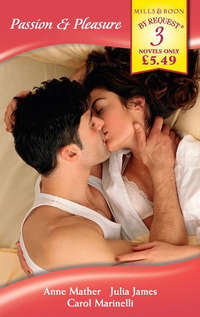
Kitabı oku: «Passion & Pleasure: Savage Awakening / For Pleasure...Or Marriage? / Taken for His Pleasure»
Give in to…
Passion & Pleasure
Three heart-stopping, dramatic romances from three beloved Mills & Boon authors!
Passion & Pleasure
SAVAGE AWAKENING
BY
ANNE MATHER
FOR PLEASURE…OR MARRIAGE?
BY
JULIA JAMES
TAKEN FOR HIS PLEASURE
BY
CAROL MARINELLI

www.millsandboon.co.uk
SAVAGE AWAKENING
Born and raised in the north of England, Anne Mather still makes her home there with her husband, two children and now grandchildren. Asked if she finds writing a lonely occupation, she replies that her characters always keep her company. In fact, she is so busy sorting out their lives that she often doesn’t have time for her own! An avid reader herself, she devours everything from sagas and romances to mainstream fiction and suspense. Anne has also written a number of mainstream novels, including Dangerous Temptation, published by MIRA Books.
Don’t miss Anne Mather’s exciting new novel, His Forbidden Passion, available December 2009 from Mills & Boon® Modern.
Chapter One
IT WAS the chimes of the church clock that woke him.
Ironically enough, he’d grown used to sleeping through the wailing call of the muezzin. Four years in North Africa, the last eighteen months in an Abuqaran jail, had made such sounds familiar to him. That, and the staccato shots that erupted from time to time across the prison yard.
Not that he’d slept well, of course. A thin blanket thrown on a concrete floor was hardly conducive to a sound—let alone a comfortable—slumber. But it was amazing what the body could get used to, how little sustenance it needed to survive.
Still, he had survived, and after six months back in England he should have become accustomed to the ordinary sounds of civilised living again.
But he hadn’t. He was still coming to terms with the fact that he was not the man he used to be and whether or not he slept well—or at all—was a small problem in the larger scheme of things.
Not liking the direction his thoughts were taking, he thrust back the covers and swung his legs out of bed. At least sitting up no longer caused the sickening feeling of dizziness he’d suffered during his first few weeks of freedom. And his limbs, which had been almost skeletal when he returned, were gradually filling out, his muscles strengthening with the regular workouts he subjected himself to every day. The doctors had warned him not to try and do too much, but there’d been no way he could control the desire to regain his health and strength, and moving at a steady pace had never been good enough for him.
Consequently, although his psychological problems showed little sign of improvement, physically he felt much better than he had even a month ago.
Which was such a sucker, he chided himself grimly, pressing down on the mattress and getting a little unsteadily to his feet. Sometimes he had the feeling he’d never make it, never recover even the belief in himself he’d once enjoyed. Perhaps it would be kinder all round if other people realised it, too.
Nevertheless, he’d had to give it a try. And, to that end, he’d bought this house in a village far enough from London and the life he and Diane had had there before he’d been sent to Abuqara to cover the civil war.
Diane didn’t approve of his decision. Mallon’s End was the village where she’d grown up and where her parents still lived. She thought he was crazy wanting to leave the exciting opportunities London presented behind. He’d already been offered his old job with a commercial television station back again and she couldn’t understand why he’d turned it down. He didn’t honestly know himself. But, thanks to the legacy his grandmother had left him, money wasn’t a problem, and there was always that offer of a book deal if he should choose to write about his experiences as a prisoner of the rebel forces in Abuqara.
He crossed the floor to the windows, shivering a little in the cooler air. The polished boards beneath his feet were cold, too, but he didn’t notice them. He was used to going barefoot. The first thing his captors had done was take his shoes away from him. And although initially his feet had blistered and been agony to walk on, gradually they’d hardened up.
All the same, he was used to temperatures that usually hovered near forty degrees Celsius in daylight hours, and although England was supposed to be enjoying a heatwave at the moment, he hadn’t noticed.
Pulling the curtain aside, he peered out. Outside the long windows, the gardens of the house stretched in all directions, lush with colour. To someone used to bare walls or stark packed-earth streets stripped of any sign of civilisation, it was an amazing view. Even the months he’d spent since his return in his comfortable apartment in Belsize Park hadn’t prepared him for so much beauty. This was what he needed, he told himself, what he’d dreamed of while he was in prison. It was a humanising experience.
Beyond the grounds of the house, the churchyard offered its own kind of absolution. He could see cottages through the swaying branches of the elms and yews that guarded the lychgate, and an occasional car passing the bottom of his drive on its way into the village proper.
It was all so—yes, that word again—civilised. But he was still isolated from the people and places that had once been so familiar to him. It was strange but while he was a prisoner, he’d longed for company, for someone who spoke his own language.
He’d had some conversations with the captain of the rebel forces. Fortunately, he’d known a little of his language, and the man had been surprisingly intelligent and well read.
Yet now he was home, he found himself shunning company, avoiding conversation. He was a mess, he thought ruefully. Diane was right. He wouldn’t blame her if she got sick of trying to get through to him.
Even so, he thought as he moved away from the windows, given the hassle of the last few months, surely he had a right to some peace, some tranquillity. God knew he hadn’t been prepared for the amount of interest his return had engendered, but what with interviews, phone-ins, online question-and-answer sessions, he’d begun to feel persecuted all over again. He’d wanted out, not just out of London, but out of that way of life. His old way of life, he acknowledged. And if that meant he was cuckoo, then so be it.
A shower removed a few more of the cobwebs that were clouding his system, and after towelling himself dry, he dressed in drawstring sweat pants and a black cotton T-shirt. He pulled a rueful face at his roughening jawline and decided he liked not having to use a hair-dryer. In North Africa his head had been shaved, and since his return he’d kept his hair barely long enough to cover his scalp. Diane said it suited him, but then, she’d say anything to boost his self-esteem. She was worried about him, worried about their relationship. And he couldn’t say he blamed her.
The house felt chilly as he went downstairs. It was barely seven o’clock, after all, and until he’d worked out how the central heating operated, he’d have to live with it.
But at least the place had central heating, he mused gratefully. These old houses often didn’t, but the previous owner had apparently demanded that comfort and he was glad.
Nevertheless, he would have to see about getting some decorating done. The heavy flock wallpaper on the stairs and the crimson damask in the main reception room would definitely have to go, and he needed a lot more furniture than the bed and the couple of armchairs he’d brought with him. The rest of his furniture was still in his London apartment and, until he’d definitely decided he was going to stay here, it would be staying there.
But this place was big enough for several living and bedroom suites and he couldn’t exist with what he had. He would have to visit a saleroom; an auction saleroom, perhaps. These rooms would not take kindly to modern furniture.
Thankfully, the kitchen faced east and already it was warm and bathed in sunlight. Like the rest of the house, it could do with some updating, but he decided he rather liked the rich mahogany units and the dark green porcelain of the Aga.
However, the Aga presented another problem and, rather than try to figure it out this morning, he started a pot of coffee filtering through the strong Brazilian grains he preferred and turned with some relief to the gas hob.
Pretty soon, the kitchen was filled with the appetising scents of hot coffee and frying bacon and he was glad his mother had suggested taking a box of groceries with him. Left to himself, he would probably have had to go out for breakfast and that was definitely not part of his plan.
The kitchen windows overlooked the gardens at the back of the property and he stood staring out at an overgrown vegetable plot as he drank his first cup of coffee of the day. There was such a lot to do, he reflected with a twinge of apprehension. Had he bitten off more than he could chew?
But, no. The whole idea was that he should be able to fill his days to the exclusion of all else. He didn’t want time to relax, time to think. Until he’d figured out whether he was ever going to feel normal again, simple manual labour was what he needed.
The sound of footsteps clattering across the paved patio outside brought his brows together in a frown. Dammit, he thought. No one was supposed to know he was here yet. He’d deliberately stowed the four-by-four in the garage to disguise his presence. Who the hell had discovered he’d moved in?
He moved closer to the windows and looked out. He couldn’t see anyone and that bothered him, too. He had heard the footsteps, hadn’t he? He couldn’t be starting having hallucinations. God, that would be the last straw!
He drew back, setting his coffee down on the pine-blocked table behind him. But as he moved to check on the bacon, he heard the footsteps again and a sick feeling of apprehension invaded his stomach.
There was no one there. He would have seen a shadow cross the window if anyone had really walked past. Which meant? Which meant what?
Swearing, he moved to the door and, flicking the lock, he yanked it open, all in one fluid motion. And disturbed a young girl who was squatting down beside what looked like a rabbit hutch, feeding dandelion leaves into the cage.
He must have frightened her, he thought, his own feelings of relief flooding his system with adrenalin. But it was good to know he wasn’t losing his mind as well as his—
He severed that thought and forced a rueful smile to his lips as the girl got hurriedly to her feet. Sufficient unto the day, he quoted grimly. He was alive, wasn’t he? And sane? Which was definitely a bonus.
‘Who are you?’
The words caught him unawares. That was his question, he thought, half resenting her presence of mind. She was looking at him as if he was the intruder, and he gave a rueful shake of his head.
‘My name’s Quinn,’ he said, humouring her. ‘Who are you?’
‘Um—Nancy,’ she answered, after a moment. ‘Nancy—Drew.’ And then, before he could comment on her name, a frown creased her childish features. ‘Do you live here?’
‘I do now,’ said Quinn drily. ‘Is that a problem?’
Nancy shrugged. ‘No,’ she conceded, but she sounded less sure of herself now. ‘That is—you don’t have a dog, do you?’
Quinn grinned. He couldn’t help himself. ‘Not at present,’ he replied, considering it. ‘Do you like dogs?’
‘I do.’ Nancy sounded doubtful none the less. ‘Grandad has a dog. A retriever. But he’s very naughty.’
‘Who, your grandad?’
Quinn couldn’t help himself and Nancy gave him a reproving look. ‘No!’ she exclaimed impatiently. ‘Harvey. He used to chase Buttons all around the garden. He was terrified!’
‘Harvey?’ asked Quinn innocently and Nancy’s face took on a suspicious stare.
‘Buttons,’ she corrected him. ‘You’re teasing me, aren’t you?’
Quinn sighed. ‘Just a little.’ He paused. ‘Who’s Buttons?’
‘My rabbit,’ said Nancy, squatting down again and pointing to what Quinn now saw was a cage, as he’d thought. ‘Mummy said I ought to find another home for him. So I did.’
Quinn suspected her mother had not meant in someone else’s garden, but he didn’t say anything. Instead, he hunkered down beside her and saw the white nose of what appeared to be quite a large rabbit nuzzling at the wires of its cage.
‘This is Buttons,’ went on Nancy, performing the introduction. ‘Isn’t he sweet?’
‘I guess.’ Quinn knew nothing about rabbits so his opinion was limited. ‘But isn’t his cage rather small?’
‘Mmm,’ Nancy agreed. ‘That’s why I used to let him out. But as I said—’
‘Harvey chased him,’ Quinn finished for her and Nancy nodded.
‘He doesn’t realise that Buttons is frightened of him.’
‘Well, dogs chase rabbits,’ said Quinn matter-of-factly. ‘It’s what they do.’
‘So—can he stay here?’ asked Nancy quickly, and Quinn got abruptly to his feet.
‘I—maybe,’ he said slowly. ‘If your mother approves.’
‘Oh, she doesn’t know,’ said Nancy airily, standing up, too. Then, more anxiously, ‘You won’t tell her, will you?’
Fliss had opened her mouth to shout Amy’s name again when she saw her. The door to the Old Coaching House was open and a man was standing on the threshold talking to her daughter.
A relieved breath escaped her. She hadn’t really been worried, she assured herself, but you heard such awful stories these days about children being abducted and Amy was only nine years old.
Nevertheless, she didn’t approve of her coming here without permission, even if Amy was naturally familiar with the place. She’d accompanied her mother often enough during school holidays and the like and she knew the grounds almost as well as her own garden.
But that didn’t alter the fact that things had changed now. Old Colonel Phillips was dead and, although she hadn’t heard about it, the Old Coaching House had apparently been sold. To someone Amy didn’t know, Fliss reminded herself, quickening her step. How many times had she warned her daughter not to talk to strange men?
The man became aware of her presence before her daughter did. His head turned and she got a swift impression of a hard, uncompromising face with dark, deeply tanned features. He was tall, that much was obvious, but there didn’t appear to be an ounce of spare flesh on his leanly muscled frame.
He looked—dangerous, she thought fancifully, not liking the conclusion at all. He looked nothing like the people who usually retired to Mallon’s End, and she wondered why someone like him would choose to buy a house in such a quiet, unexciting place.
She got the distinct impression that he would have preferred to cut short his conversation with Amy and close the door before she reached them. But something, an unwilling acceptance of his responsibilities—or common decency, perhaps—persuaded him to at least acknowledge her before he made his escape.
For her part, Fliss was more curious than anything else. As she got nearer, she could see that he was younger than she’d imagined; possibly late thirties, she guessed, with very short dark hair that added to his harsh appearance.
But for someone who looked so menacing, he was absurdly attractive. Goodness! Fliss swallowed a little nervously, feeling butterflies fluttering in her stomach. Who on earth was he?
‘I—I’m sorry,’ she began, deciding an apology was in order. ‘If my daughter’s been troubling you—’
‘She hasn’t,’ he said, his voice low and a little hoarse, and Fliss saw the way Amy’s shoulders hunched in the way she had when her mother embarrassed her.
‘Oh, Mum!’ She grimaced, casting an impatient look in Fliss’s direction. ‘I’m not a baby, you know.’
Fliss reserved judgement on that one. In her opinion Amy was still young enough to warrant the anxiety she had felt at her disappearance.
‘I’ve been looking for you,’ she said, deciding any chastisement could wait until later. ‘Didn’t you hear me calling you?’
Amy shrugged now. ‘I might have done,’ she said airily, but Fliss wondered if it was only her imagination that made her think her daughter was looking slightly uneasy now. What had been going on, for heaven’s sake? What had this man been saying to her?
‘Well, why didn’t you answer, then?’ she demanded, before allowing their audience a slight smile. ‘I was worried.’
‘I’m sure Nancy didn’t mean to cause you any unnecessary distress, Mrs Drew,’ the man broke in abruptly, and if Fliss hadn’t been so shocked by the name he’d used, she’d have realised there was an increasing weariness in his harsh tone. ‘No harm done.’
‘You think not?’ Fliss couldn’t let it go. She looked down at her daughter. ‘Amy? Did you tell this—gentleman—that your name is Nancy Drew?’
Amy flushed now. ‘What if I did?’
Fliss shook her head. ‘I don’t believe it.’
The man breathed heavily. ‘I gather that’s not her name?’
‘No.’ Fliss tried to control her temper. It wasn’t his fault, after all. ‘It’s Amy. Amy Taylor. Nancy Drew is just—’
‘Yeah, I know who Nancy Drew is.’ He interrupted her drily. ‘Way to go, Nancy. Solved any exciting cases lately?’
Amy pursed her lips, but she reserved her anger for her mother. ‘Now see what you’ve done!’ she exclaimed. ‘You’ve made me look silly in front of Quinn!’
‘Quinn?’
Fliss’s eyes moved to the man again and glimpsed the spasm of resignation that crossed his face. ‘Matthew Quinn,’ he agreed flatly. ‘I’ve bought this place.’
‘Oh.’ Fliss wondered why he seemed so reluctant to tell her that. ‘Oh, well—good,’ she murmured. ‘I hope you and your—er—family will be very happy here.’
‘I don’t have a family,’ he replied in that harsh, abrasive voice that Fliss found as sexy as his appearance. ‘But thanks.’
‘You’re welcome.’
Fliss managed a polite smile and then caught her lower lip between her teeth. Would this be a good time to explain why Amy felt she had a right to enter his garden at will? Maybe he would need a housekeeper, too. If he didn’t have a wife…
‘Come on, Mum.’ Amy caught her arm now and attempted to pull her away. ‘It’s nearly time for school.’
‘Is it?’
Fliss’s brows narrowed. Since when had Amy been so eager to go to school? Her suspicions resurfaced. What had she been doing? What had this man been saying to her that she didn’t want her mother to know about?
Her eyes returned to his dark face, but when he met her gaze with a cool appraisal she was forced to look away. Her gaze dropped down over his tight-fitting T-shirt, over drawstring sweat pants that couldn’t hide the impressive bulge of his sex, the powerful length of his legs. And bare feet. Her skin prickled. He must have just got out of bed.
Had Amy awakened him?
And then she saw the box-like structure that was wedged beside the doorstep and comprehension dawned. The compulsive—if unwilling—awareness his hard male beauty had had on her disappeared beneath a sudden wave of frustration.
Grasping Amy’s arm before she could get away from her, she pointed to the offending item. ‘What is Buttons’s hutch doing here?’ she demanded shortly. ‘Is he inside?’ She dipped her head. ‘Yes, I can see he is. Come on, Amy. What is he doing here?’
Amy’s shoulders drooped and Fliss wasn’t at all surprised when her eyes moved appealingly to Matthew Quinn. Of course, she thought irritably. He must have known about this. That was what he and Amy had been talking about when she’d interrupted them. And he hadn’t said a word, even though he must have realised that she hadn’t been aware of what was going on.
She turned on him then, prepared to voice her indignation—however unjustified that indignation might be—and found him leaning tiredly against the frame of the door. His face was drawn now and scored with a haunting weariness she was sure wasn’t just the result of lack of sleep.
Immediately, all thought of reprimanding him fled. The man looked ill, for goodness’ sake. And exhausted. Or utterly bored by their exchange.
‘Um—are you all right?’ she ventured, and at her words he seemed to make a conscious effort to recover himself.
‘A little fatigued is all,’ he assured her firmly, but he backed into the kitchen as he spoke and now she could smell the acrid aroma of charred bacon. He glanced behind him, evidently noticing the same problem, and, forestalling any offer she might have made, he added, ‘Can we continue this at some other time, Mrs Taylor? I’m afraid my breakfast is burning.’
Chapter Two
FLISS endeavoured not to think about Matthew Quinn again until she’d taken her daughter to school.
Instead, she’d concentrated on Amy’s behaviour, on how disappointed she was that the little girl had lied to her. When, faced with the prospect of Buttons being sent to the local animal shelter for his own safety, Amy had come up with a solution of her own, her mother had been relieved. A friend at school had offered the rabbit a home, she’d said, and Fliss had allowed her to take Buttons away on her grandfather’s wheelbarrow, never dreaming that Amy had had no intention of giving the rabbit to anyone.
Now, however, her deception had been discovered, and in the most embarrassing way possible. Matthew Quinn either considered Fliss was an unfit mother—a label that had been slung at her more times than she cared to remember since, at the age of sixteen, she’d discovered she was pregnant—or an unfeeling one, which was probably worse.
Amy, attempting to justify her actions, had assured her mother that ‘Quinn’ hadn’t minded the fact that he had had an unwanted squatter on his land, but Fliss believed she knew better. From what she’d seen of him, she thought Matthew Quinn was not a well man, and he’d probably only been humouring the child to avoid further argument.
Whatever, Fliss was faced with the not-very-pleasant task of returning to the big house to collect the rabbit and make her apologies. Again. Amy wouldn’t be pleased, particularly if she was once again forced to consider the prospect of Buttons living out his days at the animal shelter, but it couldn’t be helped. Whatever Matthew Quinn had said, she doubted he would really appreciate having a furry mammal—however appealing—on his premises on a permanent basis.
And if he did have a wife…
Just because he’d said he didn’t have a family didn’t necessarily mean…
But that was one speculation too far. Fliss had no intention of making that mistake. OK, he was one of the most attractive men she’d ever seen. He was also one of the most dangerous to her peace of mind and, with or without a wife, he was way out of her league.
Her father was up by the time she got back from taking Amy to school.
Until four years ago George Taylor had run the small pharmacy in the village. But a dwindling population—due to the shortage of jobs, and many houses being bought as second homes by city-dwellers—plus the cheaper attractions of the supermarket in nearby Westerbury, had hastened his retirement. These days he supplemented their income by writing articles for the local paper, occasionally babysitting Amy when Fliss worked occasional evenings at the local pub.
Harvey, her father’s retriever, barked and jumped up at her excitedly when she let herself into the cottage, and she wished the dog would act his age. Harvey was seven years old, for heaven’s sake. Old enough to behave himself. But he still acted like a puppy and her father spoiled him outrageously.
‘Everything OK?’ he asked now as Fliss came into the kitchen, where he was enjoying his breakfast of toast and marmalade, and she dropped down into the chair opposite him and pulled a face.
‘As it will ever be, I suppose,’ she grumbled, reaching for the coffee pot and pouring herself a cup. ‘I’ve just discovered where Buttons is living.’
‘The rabbit?’ Her father put his paper aside and regarded his daughter curiously.
‘Yes, the rabbit.’ Fliss scowled.
‘Well, I thought Amy had found him a home,’ he said, puzzled. ‘Don’t tell me she’s keeping the rabbit in her room.’
‘No. Nothing like that.’ Fliss shook her head. ‘She’s been keeping it at the Old Coaching House.’
Her father started to laugh and then subdued it. ‘Well, the little monkey,’ he said instead. ‘Still, it doesn’t matter, does it? The place is empty.’
‘As a matter of fact, it’s not,’ declared Fliss, taking a sip of her coffee. ‘There’s a new tenant. Or rather, a new owner. I met him this morning.’
‘Really?’ George Taylor looked surprised. ‘They’ve kept that quiet. I didn’t even know it was on the market.’
‘Nor did I.’ Fliss looked momentarily wistful. ‘It certainly brings it home to me that Colonel Phillips is gone for good.’
‘Hmm.’ Her father nodded, and then reached across the table to pat his daughter’s hand. ‘He was very old, Fliss. What was he? Ninety-two or—three?’
‘Ninety-one,’ said Fliss firmly. ‘And I know he was old. But he was very kind to me.’
Her father sighed. ‘And you were kind to him, too. I doubt if he’d have got anyone else to do all his housework as you did.’
‘He paid me,’ Fliss protested. ‘I miss that income, I really do.’
‘Well, I can’t say I’m sorry you’re not working as a domestic any longer,’ declared her father, buttering another slice of toast. ‘You deserve better than that. I don’t know what your mother would say about you wasting your degree.’
Fliss sighed now. This was an old argument and one she didn’t particularly want to get into today. It was true, while her mother was alive, she had been able to leave Amy with her and attend the local university. But when her mother died in a car crash just a year after she’d graduated, she’d had to give up her job as a trainee physiotherapist to look after Amy herself.
There’d been no question of paying a child minder. Her father’s business had been folding and money was scarce. And, although he’d offered to babysit, he’d had enough to do coping with his own grief. Looking after a lively four-year-old would have been too much for him to manage.
Now, of course, he could have coped, but Fliss didn’t think it was fair to ask him. He’d settled happily into his retirement and he would have missed being able to go to the library when he felt like it, calling in at the pub for a drink, gossiping with his cronies.
‘Anyway, we weren’t talking about me,’ she said, taking another swallow of coffee. ‘Hmm, this is good. Why does my coffee never taste like this?’
‘Because you don’t put enough coffee in the filter,’ replied her father comfortably, slipping a crust of bread beneath the table for Harvey to take. Then, seeing his daughter’s eyes upon him, he added swiftly, ‘Anyway, maybe the new owner will want a housekeeper, too.’
Fliss knew he’d never have said that in the ordinary way. It was just to divert her from his persistent habit of feeding the dog at the table, and she pulled a wry face.
‘I don’t think so.’
He frowned now. ‘Why not?’ He paused. ‘Oh, perhaps they already have a housekeeper, hmm?’
‘Perhaps they do.’ Fliss felt curiously loath to discuss Matthew Quinn with her father. ‘In any case, I’m going to have to go over there and fetch the rabbit back.’
‘Do you want me to do it?’
It was tempting, but Fliss shook her head. She wanted—no, needed—to see Matthew Quinn again. She needed to explain why Amy had felt free to deposit the rabbit on his doorstep.
When Colonel Phillips was alive and Fliss had worked at the house three mornings a week, Amy had often accompanied her. The old man had been especially fond of the little girl and he’d encouraged Fliss to bring her along. So, whenever Amy had been away from school, for holidays and suchlike, she’d been a welcome visitor at the house.
Sometimes the colonel had played board games with her, and she’d been fascinated by his display cases filled with coins gleaned from almost a century of collecting. The house had been an Aladdin’s cave to the little girl, and she’d been encouraged to share it.
In consequence, Amy had missed him almost as much as Fliss when he’d suddenly been taken into hospital. She hadn’t understood why she couldn’t go to visit him and, although Fliss had explained the circumstances of his illness, she suspected the child still regarded the Old Coaching House as his home.
When he died the house had been inherited by a distant cousin, who had apparently lost no time in putting it on the market, Fliss thought wryly. No one in the village had known anything about it or she was sure her father would have picked up the news on the grapevine.
Now she got up from the table, carrying her empty cup across to the sink. The overgrown lawn at the back of the cottage reminded her that she had other jobs she’d promised herself she’d do today. Dammit, if only Amy had let the rabbit go to the shelter and been done with it.
‘So what’s the new owner like?’ asked her father, getting up from the table to bring his own dishes to be washed. Then he opened the door to let the dog out, stepping outside for a moment and taking a deep breath of the warm, flower-scented air. ‘Mmm, those roses have never smelt better,’ he added. ‘I don’t know why you don’t bring some of them into the house.’
Because I don’t have the time, thought Fliss grimly, fighting a brief spurt of irritation. But it would never have occurred to her father to do something like that himself. No more than it occurred to him to wash his own dishes or make his own bed in the mornings. She filled the washing-up bowl with soapy water and dropped his cup, saucer and plate into the hot suds. She sighed. She mustn’t let her annoyance over the rabbit in—fluence her attitude towards her father. He was the way he was, and there was nothing she could do about it.
But despite his admiration for the roses, he hadn’t forgotten his original question. ‘Who is he?’ he asked, coming back into the kitchen. ‘The man you spoke to at the big house? Did he tell you his name?’
Deciding there was no point in prevaricating, Fliss shrugged. ‘I think he said his name was Quinn,’ she replied carelessly. She finished drying the dishes and hung the tea towel over the rail to dry. ‘I might as well go and get Buttons now. You never know, he may have gone out. Do you think it would be all right if I took the rabbit without his say-so?’
‘Why not?’ asked her father, but he was looking pensive. ‘Quinn,’ he said ruminatively. ‘Quinn.’ He frowned. ‘Where have I heard that name before?’
‘The Mighty Quinn?’ suggested Fliss, giving her reflection a quick once-over in the mirror beside the hall door.
She looked unusually flushed, she thought ruefully, and she hadn’t even set out on her mission yet. Pale skin, that never tanned no matter how long she stayed out in the sun, had the hectic blush of colour, vying with the vivid tangle of her hair. Blue eyes—her father insisted they were violet—stared back with a mixture of excitement and apprehension, and she felt a frustrated surge of impatience. She wasn’t going on a date! She was going to rescue a rabbit, for pity’s sake.
‘I know!’ Her father’s sudden exclamation had her swinging round in surprise to find him balling a fist into his palm. ‘That name, Quinn. I knew I’d heard it recently. That’s the name of that man—that journalist—who spent about eighteen months as a prisoner of the rebels in Abuqara. You remember, don’t you? They did a documentary about it on television recently. He escaped. Yes, that’s right, he escaped. But not before he’d suffered God knows what treatment at the enemy’s hands.’
Fliss swallowed with difficulty. Her breath suddenly seemed constricted somewhere down in her throat. ‘I—don’t remember,’ she said faintly.
But she did. Now that her father had reminded her of it, she remembered the documentary very well. Not that Matthew Quinn himself had appeared in it. It had simply been an examination of the situation in Abuqara, with Matthew Quinn’s imprisonment used to illustrate the violence meted out to foreigners who got caught up in the country’s civil war.
‘Not that I’m suggesting that your Mr Quinn is the same man,’ her father was going on, unaware of his daughter’s reaction. ‘That would be a bit of a coincidence, don’t you think? What with his aversion to the media and me being a part-time hack myself.’
‘Y-e-s.’ Fliss let the word string out, not sure why she didn’t just admit what she was thinking there and then. But the memory of Matthew Quinn’s dark, haunted face was still sharply etched in her mind, and, if he was who she thought he was, she couldn’t betray him. Not even to her own father. ‘Um—I ought to get going. I’ll take the car. I can easily dump the hutch in the back.’
‘Right.’ But her father was still looking thoughtful and her nerves tightened. ‘Perhaps I ought to come with you. Introduce myself, welcome him to the village, show him we’re a friendly lot. What do you think?’
‘I—no.’ Fliss realised he might take umbrage at the sharpness of her tone and hurried to justify herself. ‘I mean—I don’t think this is a good time, Dad. What with the trouble over the rabbit and all. Let’s let the dust settle, hmm? We don’t want—the family—to think we’re pushy.’
‘Well, you could be right.’ He looked downcast. ‘It’s a pity, though. It would have been a good opportunity to get to know them.’
‘Later,’ said Fliss fervently, picking up the car keys. ‘See you soon.’
‘Wait.’ As she was about to leave, her father came after her. ‘How are you going to lift the hutch into the car? It’s heavy, you know. It was all Amy could do to push it on the wheelbarrow.’
‘I’ll manage.’ Fliss thought she’d do anything rather than have her father discover who the new occupant of the Old Coaching House was because of her. As he’d said, he took his journalism seriously, and he wouldn’t be able to resist talking about a scoop like this. ‘Bye.’
It was only a few minutes’ drive from the cottage to the Old Coaching House. Their cottage adjoined the grounds of the church on one side and the Old Coaching House adjoined them on the other.
But there the similarity ended. Cherry Tree Cottage was set in a modest garden whereas the Old Coaching House had extensive grounds, with lawns and flowerbeds and an apple orchard, as well as a tennis court at the back of the house.
As she drove, Fliss had to concede that Amy had done well to wheel the rabbit this far. Of course, when Fliss was working for Colonel Phillips, they had taken the short cut around the back of the church, but it was still some distance. She gave a rueful smile. Amy had obviously been determined to keep the pet that one of her school friends had given her.
The front of the old house was still impressive, despite its air of faded grandeur. Stone gateposts, with rusting iron gates that hung rather optimistically from them, gave access to a drive that definitely required some maintenance. Fliss’s father’s elderly hatchback bumped rather resentfully over the holes in the tarmac, and Fliss realised she would have to make sure the rabbit hutch didn’t bounce out again as she was driving home.
Tall poplars lined the drive, framing the house with greenery. The rhododendron bushes that flanked them had been a mass of colour a couple of weeks ago, but now they were shedding their brilliant petals onto the grass verge. They made Fliss feel sad. Colonel Phillips had loved those rhododendrons.
There was a car parked at the foot of the shallow steps that led up to the terrace, one of those expensive off-roaders, much favoured by people who wanted to make a statement about their financial status. It was not the sort of car Fliss would have expected Matthew Quinn to drive—if he was the Matthew Quinn her father had been talking about—but what did she know? She was a humble single mother who had to serve bar meals and clean other people’s houses just to make ends meet.
And how pathetic did that sound?
Parking the Ford beside the BMW, Fliss turned off the engine and opened her door. Sliding her legs out of the car, she wished she’d taken the time to change before coming back. Her sleeveless vest and canvas shorts were all very well for taking Amy to school, but they hardly created an impression of responsible motherhood. But then, she reflected, if she had changed, her father might have wondered why and that might have opened another can of worms.
Taking a deep breath, she rounded the car and mounted the steps to the heavy oak door. She couldn’t help noticing that no one had polished the brass work recently, or swept the terrace, and she pulled a wry face. It was true. She was developing a servant’s mentality. Go figure!
Dismissing such thoughts, she lifted the knocker and let it fall, wincing as it echoed around the building. There was no way anyone could ignore that.
There was silence for a few moments and Fliss was just considering knocking again, when she heard the sound of footsteps crossing the hall. They didn’t sound like a man’s footsteps, however, and she steeled herself for the ordeal of identifying herself to Matthew Quinn’s wife. She just hoped he’d clued her in to what had happened. She was going to feel such a fool if he hadn’t.
She straightened her spine, drawing herself up to the full five feet six inches she’d been blessed with. Squaring her shoulders, she looped back several strands of bright coppery hair behind her ears. As if that would improve her appearance, she thought wryly. She looked what she was; a slightly harassed woman in her mid-twenties, with a little too much weight both above and below her waist.
‘I’m sorry to disturb you—’ she was beginning as the door opened, and then broke off in surprise. ‘Diane,’ she exclaimed, recognising the girl she had used to go to school with. ‘Diane Chesney!’ She hesitated as the obvious thought struck her. ‘Or should I say Mrs Quinn?’
‘Diane will do,’ retorted the other woman shortly. She arched an enquiring brow. ‘Can I help you—Felicity, is it?’
Great!
Fliss blew out a breath. It was obvious that whatever the circumstances of Diane’s being here, she had no desire to rekindle old friendships. Fliss couldn’t believe she’d forgotten how much she hated her name, or that there was any doubt about her identity.
But it was also obvious that her—husband? Boyfriend? Whatever—had conveniently forgotten to mention the uninvited visitors he had had earlier.
‘Well…’ She murmured now, feeling even more inadequate in the face of Diane’s cool sophistication. ‘I’ve come to get my daughter’s rabbit.’
‘Your daughter’s rabbit!’
Clearly Diane had no idea what she was talking about. Her contemptuous tone proved it and, unwillingly, a memory surfaced of Diane using that tone to her before. It was when Fliss had first confessed to her friend that she was going to have a baby. She’d been seeking advice, understanding. But all Diane had done was urge her to have an abortion.
‘You’re too young to have a sprog!’ she’d exclaimed scornfully. ‘Do yourself a favour, Fliss. Get rid of it. I would.’
With hindsight, Fliss had to admit that Diane had had a point. She had been too young, too innocent, too infatuated with the boy who had taken advantage of her to know exactly what she wanted to do. She’d been afraid to tell her parents; scared of what they might say; desperate for a way out.
In the event, it was her mother who had come to her rescue. Lucy Taylor hadn’t thought twice. Fliss should have the baby, she’d said. She’d help her. Both her parents would help her. They’d also supported her decision to have nothing more to do with the father of the child. Terry Matheson had denied everything, of course, and thankfully he’d left the district long before Amy was born.
Nevertheless, Fliss’s pregnancy had driven a wedge between her and Diane. She’d had to postpone taking her higher-level exams for a year and, by then, Diane had moved on.
They could have resumed their friendship, of course, but Diane hadn’t been interested. She was having too good a time at university in London to care about a girl who, in her opinion, had as good as ruined her life.
By the time Diane graduated, her parents were telling everyone that she was an art expert, that she was going to be running a gallery in the smartest part of town. The fact that she rarely visited her parents was always conveniently forgotten. Diane was soooo in demand; soooo busy. They were soooo proud of her.
And now, here she was, apparently living with the man who, either with or without his consent, had become a minor celebrity in his own right.
No surprise there, then.
‘Amy’s rabbit,’ Fliss continued, trying not to let the other woman’s attitude faze her. ‘I spoke to your—er—?’
‘My fiancé?’ suggested Diane condescendingly, and Fliss nodded.
‘I guess,’ she said. She moistened her lips. ‘I gather he didn’t mention it.’
‘Why would he?’ Diane rolled her eyes. ‘I’m sorry, Fliss, but Matt and I have more important things to talk about than a bloody rabbit, for God’s sake!’
So she did remember her name, thought Fliss smugly. But Diane was annoyed about something. That was obvious. And it was evidently nothing to do with her and Amy.
‘OK.’
Fliss was trying to decide how to explain the situation in the briefest terms possible when Matthew Quinn himself appeared behind Diane. He was still barefoot, Fliss noticed unwillingly, his expression only marginally less hostile than his fiancée’s.
‘What’s going on?’ he asked impatiently, and then he saw Fliss. ‘Oh—Mrs Taylor.’
Diane snorted at this and he paused a moment to give her a curious look. Then, with a shrug, he went on, ‘Did you want something else?’
Fliss’s cheeks had flushed at Diane’s scornful reaction to her name, but she refused to be daunted. ‘It’s Miss Taylor, actually,’ she said, telling herself she didn’t care what he thought of her. ‘I’ve come to collect the rabbit.’
‘Ah.’ Matthew Quinn glanced again at the woman beside him. He frowned. ‘Forgive me, but do you two know one another?’
‘We used to.’ Diane answered him before Fliss could say a word. ‘But we lost touch many years ago.’
Matthew’s only response was a sudden arching of his brows, but Fliss had no intention of continuing this. ‘Is it all right if I back the car along the path beside the house?’ she asked. ‘Then I can just lift the hutch into the boot.’
‘What’s all this about?’ demanded Diane, clearly not liking the idea that Fliss and her fiancé had some unfinished business she didn’t know about. ‘Where is this rabbit, for heaven’s sake? And what’s it doing here?’
‘It’s a long story,’ said Matthew carelessly. Then, to Fliss, ‘You don’t have to move it, you know.’
‘Oh, I think I do,’ she retorted stiffly. She turned away. ‘I’ll get the car.’
By the time she’d reversed the Fiesta along the service lane, he was waiting for her. Still barefoot, he had hoisted the rabbit’s cage into his arms, and when she hurriedly got out to lift the hatch, he shoved the hutch inside.
‘Thanks,’ she said, a little breathlessly, noticing that he seemed out of breath, too. ‘I’m sorry.’
‘No problem,’ he assured her, leaning forward with his hands on his thighs, taking a few gulping breaths of air. ‘God, I’m out of condition. I guess I need to get myself in shape in more ways than one.’
Fliss forced a faint smile. ‘I think you need to rest,’ she murmured carefully. Then, glimpsing Diane watching them from the corner of the house, ‘Thanks again. I’ll try and keep Amy out of your hair in future.’
Chapter Three
DIANE was pacing about the kitchen when Matt came back inside. ‘D’you want to tell me what’s going on?’ she demanded, her grey eyes flaring with irritation. ‘How long have you and Fliss Taylor known one another?’
Matt gave her an incredulous look. ‘We don’t know one another,’ he said, going to wash his hands at the sink. ‘How the hell would we? I’ve only been here a couple of days.’
‘You tell me.’ Diane was huffy. ‘You seemed pretty familiar with one another. And she obviously didn’t expect to see me. Didn’t you tell her I was coming down this morning?’
‘Oh, for pity’s sake!’ Matt dried his hands and then shoved them into his pockets so she wouldn’t see they were shaking. ‘Why would I tell her anything? I’ve only met her once before.’
Diane regarded him suspiciously. ‘So what was that rabbit doing here?’
Matt heaved a sigh. He badly wanted to sit down, but dogged determination—and pride—kept him on his feet. He should have known Diane would come here looking for trouble, but however appealing Fliss Taylor might be—and he couldn’t deny she was appealing—he wasn’t interested.
‘She has a kid,’ he said wearily. ‘But then, you probably know that. You’re the one who seems to know everything about her.’
‘I used to,’ declared Diane dismissively. ‘Personally, I haven’t set eyes on her or her kid for years.’
‘OK.’ Matt endeavoured to control his irritation. ‘Well, for some reason, the kid decided her rabbit would be safer in my garden than hers. She’d stowed its cage near the back door and I caught her feeding it this morning. That’s all there is to it.’
‘So—then what? You phoned her mother and asked her to come and get it?’
‘No.’ Matt was tired of this interrogation. He didn’t know why Diane had bothered to come if all she intended to do was pick an argument with him. Surely she knew he was supposed to avoid any unnecessary stress, and getting riled up about something so trivial was definitely unnecessary. He blew out a breath. ‘She came here looking for her daughter. No law against that, is there?’
Diane’s lips tightened. ‘I suppose not.’
‘Good. I’m glad we agree on something, at any rate.’ Matt turned away. ‘Want some coffee?’
‘So why didn’t they just take the rabbit with them?’ she asked after a moment, and Matt swore.
‘For pity’s sake,’ he snapped. ‘Does it matter? I’ve explained what happened. Let that be an end of it.’
Diane hesitated. ‘I—suppose it would have been difficult to move the thing without a car.’
‘Right.’
Diane nodded. ‘And Fliss didn’t know the kid had left the rabbit here?’
‘Diane…’
Matt’s tone warned her not to proceed, but she spread her hands defensively. ‘I just want to know,’ she said innocently. ‘I suppose Amy still regards this place as her second home.’
Matt swung round then, a frown drawing his brows together. ‘What are you talking about?’
Diane looked smug now. ‘I thought you were sick of talking about it,’ she mocked, and then, realising she was pushing her luck, she gave in. ‘Fliss used to work for the old man who owned this place,’ she explained. ‘I’ve heard she used to bring the kid with her.’
‘What work did she do?’
‘What do drop-outs usually do?’ asked Diane contemptuously. ‘She was his housekeeper, of course. When she wasn’t working in the pub, that is.’
Matt poured coffee into two mugs and handed one to her. ‘For someone who claims not to have seen the woman for God knows how long, you seem to know a lot about her,’ he said, sinking gratefully onto one of the two stools he’d brought down from London. He swallowed a mouthful of coffee, feeling the reassuring kick of caffeine invading his system. ‘Are you a snob, Diane?’
‘No!’ She was indignant. ‘But I can’t help it if I think she was a fool to throw away a decent education to be a single mother.’
Matt arched a dark brow. ‘Is that what she did?’
‘Yes.’ Diane scowled. ‘I mean, she was sixteen, for God’s sake. She must have been crazy.’
‘Obviously she didn’t think so.’
Diane shrugged. ‘More fool her.’ She shook her head. ‘It was the talk of the village.’
‘I bet.’
‘Well, it was so stupid. She could have had an abortion. No one need have known anything about it. It wasn’t as if the boy wanted to marry her. Mummy thinks her mother never really got over it.’
‘Ah.’ Matt was beginning to understand. ‘So you get your information from your mother.’
Diane looked offended. ‘There’s no need to take that attitude. Mummy thought I’d be interested. After all, Fliss and I used to be friends.’ She grimaced. ‘To think, I used to be like her!’
Matt was not prepared to get into that one. Instead, he concentrated on his coffee, knowing that sooner or later Diane would remember what they’d been talking about before the other woman had knocked at the door.
And he didn’t have to wait long.
‘Anyway,’ she said, ‘that doesn’t matter now. You were telling me what you intend to do with this place. I mean, look around you, darling. It’s going to take a fortune to make it anything like habitable.’
‘A small fortune, perhaps,’ he allowed, with a wry smile. ‘And I don’t intend to do it all at once. Just the main bedroom and a couple of reception rooms. Most of the changes are cosmetic, anyway. According to Joe Francis, the building’s sound enough.’
‘But what does it matter?’ protested Diane, setting down her mug with hardly controlled frustration. ‘Matt, you’re not going to stay here. You may kid yourself that this is what you want, but that’s just a passing phase. As soon as you’re feeling yourself again, you’ll realise that you can’t live anywhere but London. Your job’s there; your friends are there. You don’t know anyone in Mallon’s End. Except Mummy and Daddy, of course, and you don’t really care for them. Admit it.’
‘I know Mrs—Miss Taylor,’ remarked Matt, knowing it would annoy her. But dammit, she was annoying him right now. ‘And you don’t know what I want, Diane. What you’re talking about is what you want. How do you know my priorities haven’t changed?’
‘Because I do know you!’ she exclaimed fiercely. ‘You’ll soon get bored doing nothing. Even if you don’t need the money.’
Matt shrugged. ‘We’ll see.’
‘Oh!’ Diane’s exclamation was impatient. ‘All right, what about me? Have you thought about me at all? I can’t live here. My job’s in London.’
‘I know that.’
‘And?’
Matt bent his head, rubbing palms that were suddenly slick with sweat over the knees of his pants. ‘And—I think it would be a good idea if we cooled it for a while—’
‘No!’
‘Yes.’ Matt knew he was being harsh but he really didn’t have a choice. Not in the circumstances. ‘Help me on this, Diane. I need some time on my own; time to get my head straight.’ He paused, considering his words. ‘Pretending things are the way they used to be isn’t going to do it.’
‘It could.’ Diane quickly crossed the room to kneel at his feet. ‘Darling, don’t do this to me. To us. We’re so good together.’
We were, thought Matt flatly, making no attempt to touch her. ‘Diane—’
‘No, listen to me.’ She looked up at him appealingly, her heart-shaped face alight with enthusiasm, grey eyes entreating now, eager to persuade him she was right. ‘I can help you, darling. You know I can. But not if you send me away.’
‘Dammit, I’m not sending you away,’ he muttered grimly, but she wasn’t listening to him.
Moving his hands aside, she replaced them with her own. For a moment, she was still. And then, watching him with an almost avid concentration, she slid her hands along his thighs to the apex of his legs. Her intention was clear. When she licked her lips, he could see her anticipation. Then, she spread his legs and came between them…
Matt couldn’t let her go on. With a surge of revulsion, he thrust her aside and sprang to his feet. Somehow he managed to put the width of the room between them, his pulse racing, his heart hammering wildly in his chest. But it wasn’t a good feeling. He felt sick, and sickened, by what she’d tried to do, and he could hardly bear to look at her now.
‘Well…’ Diane got to her feet, bitterness and disappointment etched sharply on her flushed face. ‘You had only to say no, Matt. There was no need to practically knock me over in your eagerness to get away from me.’
Matt groaned. ‘Diane, please—’
‘At least I know where I stand,’ she went on, patting down her skirt, brushing a thread of cotton from the silk jersey. ‘What happened in Abuqara, Matt? Did you suddenly acquire a taste for different flesh from mine? Or was it something even more extreme? A change of sex, perhaps?’
Matt’s hands balled into fists at his sides. ‘I think you’d better go, Diane,’ he said harshly. ‘Before I forget I was brought up to be a gentleman.’
She stared at him for a moment, and then her face crumpled, the coldness in her expression giving way to a woeful defeat. ‘Oh, Matt,’ she breathed, scrubbing at the tears that were now pouring down her cheeks, ‘you know I didn’t mean that. I love you. I’d never do anything—say anything to hurt you.’
Matt felt weariness envelop him. It was all too much. Diane was too much. She had no idea how he was feeling and he didn’t have the urge—or the patience—to deal with her histrionics.
That was why he’d bought this house in the first place. He’d known Diane would not be able to accompany him and he’d persuaded himself that she’d come to see it was the best solution for both of them. He still cared about her, of course he did. But she had to understand that his attitude had changed, his aspirations had changed. He was not the man he used to be.
God help him!
‘Look,’ he said at last, crossing his arms against any attempt she might make to touch him again, ‘I know this has been hard for you, Diane. It’s been hard for both of us. And I don’t expect you to give up your life in London and move down here.’
Diane sniffed. ‘So what? You’re giving me the brush-off.’
‘No.’ Matt gave an inward groan. ‘I’m not saying I never want to see you again—’
‘Is that supposed to reassure me?’ Diane pushed back her silvery cap of hair with a restless hand. ‘Matt, I thought you loved me; I thought that one day we might—well, you know, make it legal.’
‘And I’m not saying we won’t. One day,’ said Matt steadily. ‘Come on, Diane, you know I’m right. It’s just not working right now.’
Diane regarded him from beneath her lashes. ‘And that’s all it is? This—need you have for some time alone, for some space?’
‘I swear it.’ Matt spread his hands. ‘What do you think? That there’s someone else? Goddammit, Diane, when have I had the chance to find someone else?’
‘I don’t know everything you did while you were in Abuqara,’ she protested. ‘Tony said that Abuqaran women are really beautiful—’
‘Tony!’ Matt was scathing. ‘I might have known Tony Corbett had a hand in this. Since when has he been such an expert on Abuqaran women?’
Diane shrugged a little defensively now. ‘He was only speaking objectively.’
‘I’ll bet.’
Diane pulled a face. ‘He’s my boss. He cares about me.’ She paused. ‘I’m glad he’s wrong.’
‘Yeah.’ Matt managed a faint smile in response. ‘So—what are you going to do? I’d offer to let you stay the night but only one of the rooms is furnished.’
‘We could always share—’ began Diane, and then cut herself off with a wry grimace. ‘No, scrub that. I can’t stay in any case. I’ve got a meeting with the board of governors this afternoon and I’ve promised to have dinner with Helen Wyatt this evening. She’s hopefully going to give the gallery some good publicity and I wouldn’t want to disappoint her. No, I’ll drop in on Mummy and Daddy and then I’ll head back to town. I suppose I just wanted to assure myself that the move had gone OK, to assure myself that you were all right.’ She paused. ‘And obviously you are.’
Matt inclined his head. ‘Thanks.’
Diane managed a bright smile. ‘My pleasure,’ she said, restricting herself to a quick squeeze of his arm. ‘OK, you look after yourself, right? I’ll be in touch again in a couple of days.’
The words ‘I’ll look forward to it’ stuck in Matt’s throat and he gave a rueful smile instead. ‘You take care,’ he said, as she picked up her handbag and headed towards the front door.
‘I will,’ she replied, and he felt guilty when he heard the sudden break in her voice. ‘Bye.’
‘’Bye,’ he answered roughly. But he closed his eyes against the sudden surge of relief he felt as the BMW crunched away down the drive.
‘I’ve been thinking, perhaps I could build a run for Amy’s rabbit in the garden. That way, Harvey wouldn’t be able to chase him. What do you think?’
It was a couple of days later and Fliss was making a shopping list to take to the supermarket in Westerbury when her father joined her. He had spent most of the morning editing an article he was writing about the need for care in the community, but now he came to lean on the table next to her chair.
Fliss looked up in some confusion. In all honesty, although her fingers were busy detailing the household goods and foodstuffs they needed, her mind had been far away. Well, across the churchyard actually, she conceded drily. Despite her resistance, Matthew Quinn had had that effect on her.
‘I’m sorry,’ she said, blinking rapidly. ‘What did you say?’
‘The rabbit,’ said her father patiently. ‘I was wondering whether it would be a good idea for me to build it an enclosure in the garden.’
‘Oh.’ Fliss endeavoured to get her brain in gear. She hesitated. ‘Do you think you could?’
‘I dare say.’ He straightened and regarded the expanse of lawn beyond the windows. ‘We can’t keep the poor thing trapped in its hutch all day, can we?’
‘I suppose not.’ Fliss shrugged. ‘Unless I take Buttons to the animal shelter while Amy’s at school.’
‘You wouldn’t do that,’ said her father firmly. ‘OK. I think there are some slats of wood in the shed. Perhaps you could get me a roll of netting when you go into Westerbury. A couple of metres should be enough.’
‘More than enough,’ agreed Fliss drily, hoping he wouldn’t destroy her flowerbeds in the process. She got to her feet. ‘What shall we have for lunch?’
It was a quarter to two when Fliss parked the Fiesta on the lot adjoining a small retail park. A do-it-yourself outlet, an electrical store, an auction warehouse—where Fliss sometimes liked to browse—and a supermarket circled the central parking area. Fliss liked its location because it was situated at the edge of town. It meant she didn’t have to negotiate the maze of oneway streets that characterised the central part of the city.
It was hot, the grey spire of the cathedral rising tall and impressive against the vivid blue of the sky. She knew she was lucky to live in this part of the country. It was very busy at this time of year, of course, with foreign tourists and more local traffic thronging the streets and clogging up the main arteries. But it was worth it for the times when there were no visitors, and she could walk along Cathedral Close and visit the ancient church without being jostled by the crowds.
She had got what she needed from the supermarket and was stowing her shopping in the car when she saw him. He was coming out of the auction warehouse and, judging by the fact that the manager had accompanied him outside, she guessed he’d bought something substantial.
Or maybe Harry Gilchrist had recognised him. Fliss knew the man who was with him. Harry Gilchrist’s son was in the same class as Amy at the village school. A single father himself, he’d often tried to draw Fliss into conversation. He evidently thought they had a lot in common, but Fliss didn’t encourage single men. Or married men, for that matter, she thought wryly. She was happy the way she was.
Now, however, she wished she had been a little more friendly. Then she might have felt free to saunter across the car park and exchange a few words with him and Matthew Quinn. Just to find out what Quinn had been buying, she assured herself firmly. Not with any idea of presuming on what had been a very brief acquaintance.
In any case, Diane was probably with him, she thought. Just because she wasn’t visible at the moment didn’t mean she wasn’t around. It was the most natural thing in the world that a couple who were planning on setting up home together should look for suitable furniture. Yet, knowing what she did of Diane, Fliss wouldn’t have expected her to want old—albeit valuable—furnishings.
Still…
She turned back to the car and finished packing her shopping into the boot. It meant wedging things together, but she didn’t want a jumble of spilled goods when she got home. Then, closing the hatch, she straightened—and looked directly into Matthew Quinn’s eyes, staring at her from across the car park.
For a moment she was immobilised by his gaze, which seemed more penetrating than the brilliance of the sun beating down on her bare head. Had he recognised her? Was that why he was staring at her? What was she supposed to do about it? Smile? Wave? Ignore him? What?
The dilemma was taken out of her hands when he nodded in her direction. Yes, she thought, feeling the erratic quickening of her heartbeat, he had recognised her. She felt ridiculously gratified that in spite of Diane’s hostility he did remember who she was. But then, it had only been a couple of days since he’d seen her. And he had been a journalist, after all.
She’d confirmed his identity by following her father’s example, when he was researching a story for his column, and checked the Internet. And, although the pictures they’d shown of him didn’t compare to the way he looked now, she’d been left in no doubt that he was the same man. He’d been gauntfeatured and skeletally thin when he’d returned from his imprisonment in Abuqara, but the strength of character and intelligence in his face had been unmistakable.
She hadn’t told her father who he was, however. She’d consoled herself with the thought that it wasn’t her job to expose the fact that they had a celebrity living in their midst. It was bound to come out sooner or later. Maybe Harry Gilchrist would be the one to blow his cover. Just so long as it wasn’t her. For some reason, that was important.
Deciding that the netting her father had asked her to get could wait, Fliss pulled her keys out of her pocket and started towards the driver’s door. It had suddenly occurred to her that she hadn’t bothered to change before she came out. In a white cotton vest and pink dungarees that fairly screamed their chainstore origins she’d be no match for Diane in her expensive designer gear. She wasn’t a vain woman, but she had her pride.
She had no desire to allow the other girl to embarrass her again. She swung open the car door, but before she could get inside, she heard someone call her name. Matthew Quinn was striding across the tarmac towards her and there was no way she could pretend she hadn’t noticed him.
Once again, she was impaled by the distracting intensity of his gaze, and she found herself turning to press her back against the car, holding on to the handle of the door with nervous fingers.
‘Mr Quinn,’ she said, clearing her throat as her voice betrayed her. But in narrow-fitting chinos and a black T-shirt, he made her nerves tingle, his dark eyes and hard features more familiar than they should have been. ‘How—how are you?’
‘I’m getting there,’ he said drily, regarding her so closely she was sure no aspect of her appearance had gone unremarked. ‘How about you? How’s—what’s its name—Buttons getting on?’
‘Oh—he’s OK.’ Fliss wondered if anyone would believe they were standing here having a conversation about a rabbit. She swallowed, forcing herself to look beyond him. ‘Is Diane with you?’
‘No.’ He didn’t elaborate. ‘Are you heading home now?’
‘Yes.’ Fliss lifted her shoulders awkwardly. ‘You don’t need a lift, do you?’
‘Would you have given me one?’ he enquired, a trace of humour in his voice, and Fliss felt her cheeks heat at the deliberate double entendre.
‘Of course,’ she replied, refusing to let him see he’d disconcerted her. ‘Well, if you don’t need my help…’ She glanced behind her. ‘I suppose I’d better be going…’
‘Do you have time for a coffee?’
If she’d been disconcerted before, his question caught her totally unawares and she gazed at him with troubled eyes. ‘A coffee?’
‘Yeah.’ His mouth turned down. ‘You know, an aromatic beverage beloved of our so-called civilised society?’
‘I know what coffee is,’ she said a little stiffly.
‘Well, then…?’
Fliss hesitated. She was getting the distinct impression that he was already regretting the invitation, but he’d made it now and he’d stand by it.
So why shouldn’t she take advantage of it?
‘All right,’ she said, feeling a little frisson of excitement in the pit of her stomach. ‘Where do you want to go?’
Matthew Quinn frowned. ‘Well, there’s a coffee shop in the supermarket, isn’t there? Or—’ His mouth thinned. ‘We could go back to my place.’
‘The supermarket sounds fine,’ said Fliss hastily, turning to lock the car again. She moistened her lips. ‘If you’re sure.’
‘Why shouldn’t I be sure?’ he demanded, and then sudden comprehension brought a sardonic twist to his mouth. ‘Oh, right. You think I might want to avoid public places, yeah?’
Fliss gave a nervous shrug. ‘It’s your call.’
‘But you know who I am, right?’ he persisted, and she gave him a defensive look.
‘Did you think I wouldn’t?’
‘Perhaps I hoped,’ he admitted, moving closer as another car came to take the slot beside Fliss’s. ‘I guess the whole village is twittering about it.’
‘You flatter yourself!’
Fliss used the retort to put some space between them. The other car had initiated an intimacy she hadn’t expected and she couldn’t deny she was flustered. The brush of his arm against hers had stirred an awareness that pooled like liquid fire in her belly and she was desperate to escape before he realised she was unsettled by his nearness.
‘Do I?’ he asked now, falling into step beside her as she hurried towards the supermarket. ‘How’s that?’
‘Well, I didn’t say anything!’ exclaimed Fliss hotly, feeling an unwelcome trickle of perspiration between her breasts. Rushing about in this heat wasn’t just unwise, it was stupid. ‘If you don’t believe me—’
‘Did I say I didn’t believe you?’ he countered softly. Then hard fingers fastened about her upper arm, bringing her to an abrupt stop. ‘OK, let’s start again, shall we? I know I probably seem paranoid to you and I’m sorry. It’s what comes of spending the last six months trying to pretend I’m normal. Obviously I’m not being very successful.’
Fliss’s eyes widened. ‘Don’t be silly,’ she said after a moment. ‘Of course you’re normal. It’s me. I’m too easily offended. But, honestly, I haven’t told anyone who you are.’
His lips twitched. ‘I believe you.’
‘Good.’ Fliss forced a smile, even though she doubted anything he said would slow her pulse. ‘So—do you want to go in?’
Matthew Quinn smiled then, which did nothing for her rattled equilibrium. Yet there was a vulnerability about that smile—as well as a raw sensuality—that seemed to tug almost painfully at her heart.
The fact that he’d actually said nothing to warrant such a reaction disturbed her quite a bit. She had no reason to feel sorry for him, for heaven’s sake. Or was feeling sorry for him her defence? The alternative—that she might be attracted to him—was definitely a more dangerous proposition.
‘You wouldn’t reconsider my offer of coffee at my house,’ he said at last, when she was almost at breaking point. ‘Maybe you’re right; maybe I do flatter myself. But right now, I’ve got no desire to risk being stared at yet again.’
Ücretsiz ön izlemeyi tamamladınız.