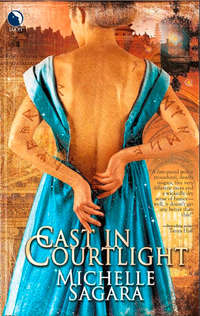
Kitabı oku: «Cast In Courtlight»

Praise for
MICHELLE SAGARA
and The Chronicles of Elantra series
Cast in Shadow
“No one provides an emotional payoff like Michelle Sagara.
Combine that with a fast-paced police procedural, deadly
magics, five very different races and a wickedly dry sense of
humor—well, it doesn’t get any better than this.”
—Bestselling author Tanya Huff
“First-rate fantasy. Sagara’s complex characterizations
and rich world-building lift her above the crowd.”
—New York Times bestselling author Kelley Armstrong
Cast in Courtlight
“Readers will embrace this compelling, strong-willed
heroine with her often sarcastic voice.”
—Publishers Weekly
“A fast-paced novel, packed with action and adventure …
integrating the conventions of police procedurals
with more fantastic elements.”
—Romantic Times BOOKreviews
Cast in Secret
“The impressively detailed setting and the book’s spirited
heroine are sure to charm romance readers as well as fantasy
fans who like some mystery with their magic.”
—Publishers Weekly
“Remarkable … Filled with time-release plot threads and
intricate details, these books are both mesmerizing
and unforgettable. If you’re a fan of rich fantasy,
this is the series for you!”
—Romantic Times BOOKreviews, Top Pick (4½ stars)
About the Author
MICHELLE SAGARA has written twelve novels since 1991, when her fi rst book, Into the Dark Lands, was published. She’s written a quarterly book review column for the venerable Magazine of Fantasy and Science Fiction for a number of years, as well as dozens of short stories (or novellas, to be more exact).
In 1986 she started working in an SF specialty bookstore, where she continues to work to this day. She loves reading, is allergic to cats (very, which means they crawl all over her), is happily married, has two lovely children, and has spent all of her life in her native Toronto—none of it on Bay Street.
She started reading fantasy almost as soon as she could read, and fell instantly in love with Narnia; her next fantasy discovery was Patricia McKillip’s Forgotten Beasts of Eld. She moved on to The Hobbit, which led to her discovery of the life-changing The Lord of the Rings.
Her greatest hope for her writing is that someone will read it and be moved by the same sense of magic and mystery that she fi nds in the books she loves.
She will talk about writing, bookselling and books forever if given a chance. You’ve been warned.
Cast In Courtlight
Michelle Sagara

www.millsandboon.co.uk
This is for Tanya and Fe, with gratitude for long years of friendship that involved phone calls about all of life’s little anxieties and triumphs, none begrudged.
Acknowledgments
The home team, again, came through: First and foremost Thomas, Daniel and Ross, who put up with my imaginative flights and figurative absences; John, Kristen, Jamie (affectionately referred to as His Majesty), Gary and Ayami, who do the same; and my mother and father.
The away team: For this book, my editor, Matrice, patient with my unusual inability to deal with outlines; my agent, Russ Galen; and of course, as always, Terry Pearson, who read it all a chapter at a time.
Thanks, guys.
CHAPTER 1
In the old days, before the Dragon Emperor—sometimes called the Eternal Emperor by those responsible for toadying—had invested the Halls of Law with the laws which governed the Empire, angry Dragons simply ate the idiots who were stupid enough to irritate them. Or, if they were unappetizing, burned them into a very slight pile of ash.
Ash had the advantage of requiring little to no paperwork.
Marcus Kassan, Sergeant for the Hawks—one branch of officers who served in the Halls of Law—stared gloomily at a pile of paperwork that, were it placed end to end, would loom above him. At over six foot, that was difficult. The desire to shred it caused his claws to flick in and out of the fur of his forepaws.
The desire to avoid annoying Caitlin, the woman who was—inasmuch as the Hawks allowed it—den mother to the interior office, which set schedules, logged reports, and prepared duty rosters and pay chits, was just slightly stronger. In their personal life, Leontines disavowed all paperwork, usually by the expedient of chewing it, shredding it, or burning it, when it wasn’t useful for the kits’ litter.
Then again, he’d been at his desk for the better part of an hour. He expected there’d be a shift in the balance before the day—which looked to be long and grueling—was over.
Caitlin smiled at him from the nest she made of the paperwork she endured, day in, day out. It was a slightly sharp smile that looked, on the surface, quiet and sweet. That was Caitlin. Human all over. She’d been with him for years. He was aware of her value; the three people before her had lasted two weeks, three weeks, and four days, respectively. They had all babbled like morons.
Fear does that, Caitlin had said when she’d applied for the job. She was bird-thin and fragile to the eye, and her voice was soft and feminine—no growl or fang there. But definitely some spine. She was one of two people who manned the desks who could stand six inches from his face when he was on the edge of fury. She barely blinked, and attributed that, regretfully, to his breath.
At any other time of the year, paperwork was optional. Pay chits and duty rosters weren’t, but he was enough of a Sergeant to at least sign off on them when he wasn’t actively composing the lists themselves. No, this hideous mess was courtesy of the Festival. Permits, copied laboriously by clerks in some merchant branch of the Imperial palace, had been sent by dim-witted couriers in bags that were half again as large as Caitlin. Bags. Plural.
But not just permits. Festival regulations, which seemed to change year after year. The names of important dignitaries from the farthest damn fringe of the Empire of Ala’an, manifests of cargo transports, and diplomatic grants were also shoved in the same bags. The latter were, however, sealed in a way that screamed “special privilege.” Diplomatic immunity.
Marcus hated the Festival season. The city was enough of a problem; throwing foreigners into the streets by the thousands was just asking for trouble.
Not only that, but every get-rich-quick scheme that had occurred to any half-wit moron in the street could be expected to rear its imbecilic head during the next two weeks. Unfortunately, every get-rich-quick scheme that occurred to any cunning, intelligent person would also rear its head during the next two weeks. The money that flowed into the Empire’s capital during the Festival was staggering, and everyone wanted a piece of it.
The Swordlord, and the men who followed his orders, were probably in worse shape, and this provided a moment’s comfort to Marcus. He was Hawk, through and through; the Swords were his natural rivals. Not, of course, his enemies; they all served the Lords of Law, and they all worked in the labyrinthine buildings referred to as the Halls of Law by people who saw them from the outside. But the Hawks and the Swords had their own way of doing things, and when the Festival season was at its height, there were always disagreements.
On the other hand, at least the Swords were in the streets; the damn Wolves were at bay. It was hard to hunt in the city during the Festival, even at the behest of the Wolflord. The Wolves were kept in reserve in case of riot, when all servants of the Law could be called into action. This was, however, downtime for the Wolves, and Marcus sullenly resented them their freedom.
Paperwork was best left for bureaucrats.
Unfortunately, bureaucrats were damn good at shoveling the work onto the shoulders of men and women who were already too busy, where being too busy meant they didn’t have time to kick up enough of a fuss to give it back.
He heard a door slam. It was followed by a raised, angry voice—only one—and the sound of a very heavy tread. Deliberately heavy.
Paperwork looked almost good in comparison.
“Oh dear,” Caitlin said. “That’s three this week.”
“Two. One of them left last week.” He rearranged the paperwork in the vague hope that this would provide some sort of fortification against the red and dour expression of a very annoyed mage.
Sure enough, down the long hall that led from the West Room, which had been ceded to the Hawklord for educational purposes, the swirling robes of a man who had probably been ancient ten years ago came into view. His fists were bunched just below the drape of long sleeves, and his forehead was engraved with permanent wrinkles. The kind that said foul mood.
The office had grown somewhat quieter as people stopped to listen in. You could count on curiosity to get the better of work at Festival time. Well, to be fair, at any time, but during the Festival it was more costly.
The man stormed over to the Sergeant’s desk. “You will tell the Lord of Hawks that I am finished with this—this ridiculous task!”
Marcus raised a brow. Given that his face was entirely composed of golden fur, this should have been discomfiting at the very least.
“The girl is untrainable. She doesn’t listen. She barely reads. She thinks like a—like a common soldier. She is rude beyond bearing, she is stupid, and she is an insult to the Imperial Order of Mages!”
The other brow lifted slightly as the Leontine attempted to look surprised. This was, however, lost on the mage, who was as human as Caitlin—as human, in fact, as most of the other paper pushers who called the office their second home.
Leontines were many things, but actor wasn’t one of them. They were sort of the anti-actor.
“Tell your superior that I will have words with the Imperial Order about this!”
As he’d now heard a variant of this speech three times, he had it memorized. It generated some paperwork, on the other hand, which soured a mood that was worse than sour to begin with.
Holding his tongue was difficult. Holding his claws was a shade more difficult. He managed to breathe shallowly enough that the growl couldn’t be heard over the mage’s shouts.
Which went on for another five minutes before he stormed off. It was a wonder he wasn’t followed by black clouds and lightning bolts.
“Oh dear,” Caitlin said again, rising. “He didn’t last two days.”
Marcus shrugged, letting the growl into his words. “I told the Hawklord,” he said.
“I know. I think we all tried. There must be a suitable mage somewhere in the Order—”
“I doubt it. You know how the Dragon Emperor feels about mages and sanity.” Marcus pushed himself out of his chair. His claws clicked against the floorboards.
“I’ll tell the Hawklord,” he said with a shrug.
“I’ll talk to Kaylin,” Caitlin added.
Kaylin Neya was sitting in the West Room, her arms folded across her chest. There was a candle on the desk; it had been cut in half.
“Dear,” Caitlin said quietly, “I think you’re supposed to light it.”
Kaylin muttered something about light and places in which it didn’t shine. She was the youngest of Marcus’s Hawks, and it showed.
“He really is a nice old man,” Caitlin began.
“They’re all supposed to be ‘nice old men.’” Kaylin shoved herself out of her chair as if she were a miniature Marcus. On the other hand, she had boots instead of bare pads, and her very human nature didn’t lend itself to extended claws and long fangs. “They’re arrogant, they’re long-winded, and they think they know everything.”
“They do know a lot—”
“They know a lot about useless things! Light a candle?” She rolled her eyes. “I can light a candle in five seconds, the normal way. I can kill a man just as easily as a mage—and probably more efficiently.” Her hands fell to her daggers and rested there. “I can run faster, I can see farther, I can—”
“Kaylin,” Caitlin said, raising both her hands. “No one is doubting your competence as a Hawk. You’re an officer of the Halls of Law.”
“And how is this supposed to help me?”
“You cut the candle in half, dear?”
“It didn’t get that way by itself.”
“No, I imagine it didn’t.” Caitlin shrugged. “You’ve already annoyed a number of the Imperial mages. I do think it would be best for the Hawks if you tried not to annoy any more.” She paused. Added, “You’ve got to expect a little arrogance, Kaylin. These men are old, they’ve survived the Emperor’s service, and they are considered experts in their field. Given your general reaction to any power that isn’t owned by the Hawks, I’ll forgo mention of the fact that these men are powerful. And you’re insulting their life’s work.”
Kaylin’s lips were set in a line that could be called thin. Or invisible. “I don’t want to be part of their life’s work,” she said at last. “I want to be part of my life’s work. I want—all I’ve wanted since the first day I was introduced to all of you—is to be a Hawk.”
“You are a Hawk, Kaylin.”
“The Hawks don’t employ mages.”
Caitlin’s smile froze in place. “You do realize that annoying them probably won’t stop them from coming?” “I can try.”
The older woman’s expression gave trying a different meaning. “I believe the Hawklord will want to speak with you. Again.”
Kaylin’s shoulders sagged. She walked past Caitlin and out of the room.
The Hawklord’s tower boasted a fine set of stairs, one that curved upward against the inner wall in a continuous stacked spiral. There was good stonework here, girded by brass rails, and the echoes went up forever, bouncing against the walls.
Or against the breastplates of the guards on the various landings Kaylin walked past.
She nodded at them; they nodded back. If they were inclined to smirk, they managed to hide it, which was just as well. A brawl on these steps could cause injury. And, following it, more injury of an entirely Leontine nature. Marcus didn’t approve of Hawks fighting each other in the Halls; he’d long since given up on Hawks squabbling after too many drinks in their private time.
The door to the Hawklord’s inner sanctum, with its much-hated magical ward, was as usual closed. Kaylin, grimacing, placed her palm squarely against that ward and waited while the familiar prickle of magic ran up her arm and caused her hair to almost stand on end. The first time she’d touched it, she’d sworn her head off. Unfortunately for Kaylin, the most severe of the words occurred as the doors were opening; the domed cavern that the Hawklord ruled had reminded her of the unpleasant existence of acoustics. The Hawklord himself reminded her about the correct use of language in his presence.
It mostly consisted of “don’t talk” in exactly the wrong tones. Kaylin wasn’t a firm believer in soft-spoken threats, but if anyone could make her one, it was Lord Grammayre, the Aerian who held the title of Lord of Hawks.
She walked across the threshold.
The Hawklord, pale white wings turned toward her, was waiting in the silence. When he turned, she could see a piece of paper in his hands. It seemed to command most of his attention.
And given what it probably said, that wouldn’t last long.
She paid him the obeisance the difference in their ranks demanded: She knelt. This was only partly because she was his junior in every possible way. The other part—the one that wanted to remain a member of his Hawks—was not above a little groveling, especially when there were no other witnesses. It wasn’t the worst thing she’d done in his presence by a long shot.
His eyes, narrow gray, traveled along the top of her head as if they could scalp her and keep the scalp as an object lesson for other Hawks. Marcus, all bristling fur and exposed fangs, was no match for the Hawklord when it came to intimidation. Kaylin had annoyed them both in her time, and had more than ample experience as proof.
He handed her the piece of paper. She had to rise to take it. “That,” he said, “was the third member of the Imperial Order of Mages you’ve managed to offend in less than ten days.”
She recognized Leontine scrawl; it was bold, dark, and put holes in the paper.
“He started it” was not an option, and she bit the words back, swallowing them. “I’ve never been a good classroom student,” she said at last.
“We’re well aware of that,” he replied, his words dry enough to catch fire. “We’ve attempted to keep your academic transcripts from the mages who have condescended to tutor you. Unfortunately, they seem to think it necessary to review them.”
She said nothing, as it seemed safest. It usually was, and she frequently failed to remember this until after her mouth had engaged. “I don’t understand why you even think it’s necessary,” she said at last, when his silence grew a little too weighty.
He raised a pale brow. His eyes, Aerian to the core, were shading to blue, which was never a good sign.
“The Hawks don’t employ mages,” she said woodenly. “You are not a mage.” “Then why—”
He lifted a hand. “I have always considered patience a virtue when dealing with the Hawks,” he told her, “but I find that, as usual, you tax precious resources.
“Therefore, I will be blunt. You are a Hawk, but you are also—as you well know—blessed or cursed with magical ability. You can’t control it well enough—you don’t understand what it is, or what it can do. It is the opinion of experts that the power itself can be wielded in a manner similar to the way that mages channel their power.”
Which experts?
“Do not even think of asking, Kaylin.” He knew her far too well.
“It’s Festival,” she snapped. “We’re up to our armpits in work—if we’re lucky. We’ve just gotten the tally of so-called diplomats and Important Visitors—” she managed to wedge a powerful sneer into each syllable of the last two words “—and we’re undermanned, as usual.
“I don’t have time for this right now.”
“I will agree that the timing is not the most opportune,” the Hawklord said in a tone that implied the exact opposite. “But as the timing is not of our choosing, we have little choice.
“I understand what you’re attempting to do, Kaylin,” he added, his voice smoothing to velvet. “And I will now insist that you cease this. It is unworthy of you. You can insult and infuriate every mage who crosses the threshold on my behalf, if it pleases you. But they will not stop coming. Do you understand?”
She didn’t.
He raised a hand to his brow. As gestures went, it was human, and even if it hadn’t been, it was transparent. “The Emperor himself has taken an interest in your education.”
They were not the words she expected to hear. They were also the last words she wanted to hear. Unfortunately, lifting her hands to stop her ears wasn’t an option.
“How much does he—”
“He is the Emperor. It is to the Emperor that the Lords of Law are beholden. How much do you think he knows?”
The words too damn much flitted about, but she tried to ignore them.
“You fought a Dragon,” he added quietly. “You fought the only Dragon who has ever survived being outcaste among his kin. The battle was felt all the way to the palace. Some diplomacy was necessary—you can thank Tiamaris for his intercession—and there was, perhaps, a surfeit of actual facts offered. But enough was said. The Emperor knows that you bear the marks.”
Her eyes fell to her sleeves automatically; they always did when anyone spoke of the strange writing that ran the length of her arms and her thighs. They had been symbols to be hidden when she had been a child on the edge of adulthood; she knew them now as words. Or names. But whose words and whose names were still mostly mystery—and in Kaylin’s universe, it was vital that they stay that way. She was used to them, in any case; the new ones bothered her more.
“He is,” the Hawklord continued, “also aware that you bear a Barrani mark.”
“Everyone is,” she said.
“Were it not for Tiamaris, he would not be inclined to … give you the benefit of the doubt. He has shown some forbearance in this. But he has made clear that you present a danger if you cannot be trained. And it seems that you intend to demonstrate your intractability in the worst possible way. For you,” he added, as if it were necessary. “I will send for another member of the Imperial Order of Mages.”
She was stony silence defined.
“If you happen to offend him before the week is out, you will be suspended from active duty. Have I made myself clear?”
“Yes, sir.”
“Good.”
She was aware that he had just won someone the office betting pool, but could not for the life of her remember who. Just as well. She waited for a few minutes, but he had turned from her, and was now studying the opaque surface of the room’s long mirror. The fact that it was opaque made it clear that whatever he was looking at was keyed to his eyes alone.
She started toward the door.
“One other thing, Kaylin.”
“Sir?”
“If you are late for any more of these lessons, it will come out of your pay.” “Yes, sir.”
Kaylin and punctuality lived on separate continents. Another happy source of petty betting in the office. She looked at his profile; he hadn’t bothered to look in her direction.
But something about his expression was stiff and wrong. She watched the lines around his mouth deepen until his face looked like engraved stone, but less friendly. Whatever it was he was looking at was something he didn’t like—and at Festival time, Kaylin could honestly say she had no interest whatsoever in knowing what it was.
She chose the better part of valor and left. Quickly.
Tain, his black hair flowing in a healthy trail down his back, was at the center of the crowded office when Kaylin made it back down the stairs. As he was the only Barrani in attendance, it answered a question, albeit not a pressing one.
He smiled as she slid silently through the open arch and along the nearest wall. Even without breathing, it was impossible for her to sneak up on a Barrani Hawk; she knew. She’d been trying for seven years.
“Kaylin,” he said, looking up. His eyes were that shade of bottomless green that made jewelry superfluous. It meant, on the other hand, that he was happy. Or as happy as any Barrani ever got when they weren’t killing someone or winning some invisible-to-human-eyes political struggle.
If Leontines were incapable of acting, Barrani were their opposite; they were incapable of not acting. Immortal, stunningly beautiful, and ultimately cool, they had a quiet love of showmanship. It had taken her years to understand that, as well.
They were, however, plenty capable of being smug, which Tain was now demonstrating to the office staff; he had coins in his hand.
Had she won, she probably wouldn’t. But there was no such thing as a friendly bet among the Barrani, and no one—not even the men and women who were nominally his equals in rank—wanted to be in the wrong kind of debt to a Barrani.
Still, it didn’t stop them from betting. She prided herself on being the person who had introduced the office to this pastime; it was one of the few that she’d enjoyed in her childhood. Then again, anyone who grew up in the wrong part of town—the huge neighborhood known colloquially as the fiefs in the right parts of town—enjoyed gambling. There wasn’t much else about the life to enjoy.
Certainly not its brevity.
She shrugged and made her way to Tain. “You won?”
“It looks that way.” His teeth were chipped; they made his smile look almost natural. They also made him obvious to anyone who hadn’t known the Barrani for months. They looked so much alike, it was hard for humans—or mere humans, as the Barrani often called them—to tell them apart. Much malicious humor could be had in mistaken identity—all of it at a cost to the person making the mistake.
His smile cooled slightly as his gaze glanced off her cheek. There, in thin blue lines that could be called spidery, was the mark of Lord Nightshade—the Barrani outcaste Lord who ruled the fief that Kaylin had grown up in. The mark meant something to the Barrani, and none of it was good.
If she were honest, it meant something to her. But she couldn’t quite say what, and she was content to let the memory lie. Not that she had much choice; Lord Nightshade was not of a mind to remove the mark, and short of that, the only way to effect such a removal also involved the removal of her head. Which, according to Marcus, she’d barely miss anyway, given how much she used it.
In ones and twos the dozen or so Barrani—well, fourteen, if she were paying close attention—that were also privileged to call themselves Hawks had been brought by either Tain or Teela to look at the mark.
In one or two cases, it was a good damn thing Teela was there; they were almost unrestrained once the shock had worn off, and the restraint they did have was all external.
Kaylin had gotten used to this.
And the Barrani, in turn, had grown accustomed to the sight of the offending mark. But they didn’t like it. They didn’t like what it meant.
Kaylin understood that the word they muttered under their breaths was something that loosely translated into consort. Very loosely. And with a lot more vehemence.
Pointing out that marking a human in this fashion was against both Barrani caste law and Imperial Law had met with as much disdain as Kaylin ever showed the Barrani.
“Fieflord, remember? Nightshade? Not exactly the biggest upholder of Imperial law?”
But she didn’t take offense. It was hard to; they were Barrani. A Barrani who wasn’t arrogant was also not breathing. And in a strange way, it was a comfort; they were enraged for her.
Of course, there was a tad more possessiveness in that anger than she’d have ideally liked, but beggars couldn’t be choosy.
“Where’s Teela?” she asked Tain. The two were often inseparable.
Tain’s silence had a little of the Hawklord’s grimness. “Either you’re not going to answer,” she said carefully, “or you are, and I won’t like it.”
“Why would you be displeased?” he said. “You are.”
“It is a matter that concerns the Barrani.” Cold and imperious.
“This means you won’t answer.”
“No,” he said, the word measured and stretched thin, given it was only a meager syllable, and that, in Elantran. Elantran was the default language of the Hawks, because everyone spoke it. Unfortunately, the labyrinthine paper trail of the Law itself was written in Barrani. He could have spoken his mother tongue, and she’d have been able to follow it with the ease of long practice, Barrani being one of the few things she’d been able to learn while locked in a classroom and chained to a desk, metaphorically speaking.
“You’ve looked at the duty roster?” he added.
“Not recently. It’s not like it hasn’t been changed six times a day for the last week. Why?”
He gestured toward the board that had been nailed into the wall by an annoyed bureaucrat. There, also nailed into the wall, was a long piece of paper that bore several marks and a few gashes—that would be Marcus.
The only time the duty roster was this complicated was during the Festival. She approached the board and scanned it carefully.
“I’m not on it!”
“Lucky you. You want to talk to so-called merchants who can’t spell and can’t plot their way out of a wet bag?” “It’s better than the alternative.” “And that?”
“Talking to—or listening to—mages who couldn’t police their way out of a murder.” She frowned. “What’s this?” she asked him softly.
“Good girl.”
Anyone else, she would have hit. Barrani, on the other hand, required more cautious displays of annoyance.
“High Court duty?” She frowned. Looked at the names. There were Aerians among them, and Barrani; there were almost no humans.
Severn was one of them.
“What the hell is High Court duty?”
“Have you paid no attention to office gossip?”
“I’ve been busy being insulted by Imperial mages.”
“This Festival,” he said quietly, “the castelord has called his Court. It has been a number of years since he has chosen to do so. I don’t think you were even alive for the last one.”
She had never been good in the classroom. She had never been bad outside of it. “Teela’s gone to Court,” she said flatly.
“She was summoned, yes.”
“But she’s—”
“She has not been summoned as a Hawk,” he continued quietly. “She will take her place among her peers in the High Caste.”
Kaylin almost gaped at him. “Teela? In the High Caste Court?”
His expression made clear that there was nothing humorous about it, although Kaylin wasn’t laughing. He nodded. The nod was stiff for a Barrani nod; they kind of epitomized grace.
“Is she in trouble?”
“She may well be.”
“Why?”
“She failed,” he said softly, “to bring the nature of your … mark … to the castelord’s attention.”
“But he—” She stopped. “Evarrim.”
“Lord Evarrim. You attracted his interest,” he added softly. “What have we told you about attracting the interest of a high lord?”
“It’s lethal.”
“Yes. But not always for you.” The disapproval in the words was mild, for Tain. “She will be called upon to defend her oversight,” he added.
“You’re worried?”
Tain shrugged. “She owes me money.”
Kaylin laughed. It was a bitter sound. “Severn’s there.”
“I note that you haven’t tried to kill him since you returned to active duty.”
She shrugged. It was easier than words. Everything about Severn had changed. And much about Kaylin, to Kaylin’s horror, had changed, as well.
What they had—what had driven them apart—had been the foundations upon which she’d built this life; he’d kicked them out from under her feet, and she still didn’t know where to stand. Not where he was concerned.
But she’d been given the opportunity to be rid of him. And she’d rejected it, in the privacy of the Hawklord’s tower. There wasn’t likely to be a second such opportunity offered.
“Why is he on duty roster there?”
Tain didn’t answer.
“Why am I not on—oh. Never mind.” She lifted a hand and covered the mark on her cheek. To Tain, it made no difference; she could have gouged a chunk of her face off, and he’d still see it. Anyone born Barrani would.
“It will be over in one way or another.”
“Over good, or over bad?”
“It depends,” he said. His voice was the kind of guarded that implied imminent death. “On the castelord.” “But she’s a Hawk!”
“Indeed. The Hawks comprise many races, however, and the caste-law of the race has precedence in exceptional circumstances. As you would know, if you’d paid more attention in your classes.”
Exceptional circumstances: When either of two situations proved true. One: No other species was involved in the commission of the crime or its outcome. This was about as likely as the sun never rising or setting, at least in this city. Two: No member of any other species could be found who would admit that they had been damaged in some way by the commission of the crime in question. This, given the nature of the Barrani’s exceptionally long memory and their famous ability to nurse a grudge down a dozen merely mortal generations, was entirely too likely.
“He can’t make her outcaste. She’s already pledged to Imperial service.”
“The Lords of Law are pledged to the service of the Emperor. Employing an outcaste Barrani would not be in the best interests of any one of those Lords.”
“Marcus won’t let—”
“Kaylin. Let it go. As I said, it is a Barrani affair. Teela accepted the invitation. She has gone.”
“You let her go.” She didn’t even bother to try to keep the accusation out of her voice.
“And had you been summoned by your castelord, we would have done the same.”
“Humans don’t have castelords. Not like that.”
“No. Not like that. You couldn’t. The span of your years is too short. Were it not for the intolerable speed at which you breed, there would be no humans in Elantra.” He turned away, then.
And she realized, as he did, that he’d slipped into High Barrani, and she hadn’t even noticed.
Mouth set in a thin line, she worked her way over to Marcus’s desk. He was, to no one’s surprise, on lunch. On early lunch. She was certain there was some betting going on about the duration of the lunch itself.
But that wasn’t her problem.
She began to leaf through the notices and permits on his desk, moving them with care, as if they had been constructed by a finicky architect who’d been drinking too much.
After about ten minutes, she found what she was looking for—the writs or grants of rights given to foreign dignitaries.
CHAPTER 2
When Marcus came back from lunch an hour and a half later, he walked to his desk. The circuitous way. He paused in front of the schedule nailed to the wall, glared at the various marks made by the Hawks that were lucky—or unlucky—in their assigned duties, and added a few of his own. Although the schedule itself was an official document, this particular rendering of it was not; it was meant, or so office parlance said, as a courtesy. What he added was against the spirit of the thing, but he had a Leontine sense of courtesy; it wasn’t as if he’d drawn blood.
And if the Hawks didn’t like what he appended, they could come crying. Once.
He stopped by Caitlin’s desk, and threw the mirror on the wall a thoroughly disgusted glare; like anything that made noise and conveyed messages, it never went off at his convenience. It had been dull and silent for the entire morning. If there was anything of import to be reported, the Swords and the Wolves were having all of the luck.
He had paperwork.
Oh, and Kaylin.
She was perched in the center of his chair, looking like a leather-clad waif, her hair pulled up in imitation of Caitlin’s, and with vastly less success; she’d stuck a stick through its center, and hair had already escaped it in great chunks.
“What,” he growled, “are you doing in my chair?”
His chair was large; he was heavier than any of the humans he commanded, and wider by far than the Barrani. It wasn’t his favorite piece of furniture; he’d broken three chairs this year because of the shoddy workmanship of the craftsmen employed by the Halls of Law. Armrests were not meant to snap off that easily.
She appeared to be taking notes.
And, as was so often the case when she wasn’t locked in a classroom, her concentration had shut out most of the office noise. His presence dimmed the rest. He could walk silently; as a hunter, he had to. He was seldom given the opportunity to use the skill.
When he was exactly behind her, he roared in her ear.
Papers went flying like loosed birds.
As she tried to catch some of them, she gave him a reproachful jab. As he was smiling, this was safe. Barely. But this was Kaylin; she hadn’t the grace to look flustered or embarrassed. Not for the first time, he thought she’d been born in the wrong skin; she was like a young Leontine kit—a female, at that—and very little unnerved her for long.
Then again, she’d been under his care for seven years, and she’d come as a youngling. If he hadn’t been entirely protective in the normal Elantran sense of the word, he had protected her, and she took advantage of the fact without shame. Or notice.
“If you want to do paperwork,” he said, sitting on the sparse inches of desk that weren’t covered by paper, “you could have volunteered.”
“Would it get me out of those damn lessons?”
“No.”
“Overtime pay?”
“No.”
She shrugged. “Well, then. I guess I’m not stupid.”
His roar was mostly laugh. Many humans found differentiating between the two difficult—or at best, unwise, as the cost of a mistake was high—but Kaylin didn’t labor under that difficulty.
Which was good, considering how many other difficulties she had. He held out a hand, and she dropped the papers she’d picked up across his palm. He glanced at them, and then back at her face. “You’re suddenly interested in diplomats?”
She shrugged. “Had to happen sometime.”
“Then you guess wrong. You are stupid.” His dark eyes narrowed slightly. “These appear to be Barrani,” he said. He had the satisfaction of hearing her curse. In Aerian. He wasn’t entirely conversant with Aerian, but, like any good Hawk, he knew the right words.
“Flight feathers don’t fit,” he replied calmly. He looked over her head, his eyes snapping into their habitual glare. “What are you looking at? You don’t have enough to keep you occupied?”
To a chorus of mumbles, which were a type of applause if you were stuck behind a desk for any length of time, he turned back to Kaylin. “You heard,” he said flatly.
“Tain told me.”
“If Tain told you, he also informed you that any interference on our part would not be appreciated.”
She shrugged. “There are a lot of lords and ladies in that bundle.”
“There always are.” His fangs appeared as he drew his lips over them. “Do not get involved in this, Kaylin.” “But she’s a—”
“She has her place. You have yours. At the moment, they’re not the same.” When she met his glare, and equaled it, he let his shoulders fall; they’d risen, as had his fur. “Given the snit the mage left in, you’ve probably managed to buy yourself a couple of days.”
“You didn’t put me on the duty roster.”
“Observant girl.”
“Is it because of the damn mages?”
“No. I take my orders from the Lord of Hawks.”
“Then why—”
“I used the word orders, Private. Try to pay attention.” He reached out with a claw and drew it across her cheek. The gesture was gentle. “You’ve been marked. You’ve already caused enough grief for this lifetime. You can wait ten years until I retire and give the poor fool who takes my stripes hell. Lord Evarrim has written, did Grammayre mention this?”
“No.”
“Then he probably thought it best you didn’t know.” “I don’t.”
“Good.” He shoved her to one side and sat; the chair creaked. He’d managed to split leather twice. “Do not mess with the Arcanists.”
“Sir.”
“How many Festivals have you patrolled?”
“Officially?”
“Or unofficially.”
“Enough.” The fact that she was evasive meant that some of those patrols had occurred while her life was rooted in the fief of Nightshade. She’d been a child, then. And she probably hadn’t been there to preserve the peace or prevent a crime.
“Good. You are aware that a few unscrupulous men—”
“A few?” Very few people did sarcasm as well as Kaylin.
“Very well, if you insist on being picky. A few competent and unscrupulous men work under the cover of the Festival crowds for their own ends?”
“Sir.”
“Good. In all of your many colorful descriptions of High Caste Barrani Lords, did any of them include stupid?” “No, sir.”
“Good. Lord Evarrim is not a stupid man.” “He’s not a man, sir.” “That’s enough, Kaylin.”
“Sir.”
“If he is aware of your presence in the streets, it is likely that he will take the opportunity to interview you. As we’ve now denied his pleasant request three times, he’ll be composing less pleasant requests, which are often misunderstood by little Sergeants like me—” and here his voice did break in a growl “—and mislabeled as threats. It isn’t as if he hasn’t asked politely, after all.
“Have you ever been to the High Court?”
“No.”
“You think of it as a place of refinement and unearthly beauty.”
“No, sir! I—”
He lifted a paw. Inspected it for invisible splinters. Let her splutter for a few more minutes. “It is beautiful in exactly the same way the Emperor’s sword is beautiful—it is a work of art, and it is usually drawn for only one purpose. You do not want to be present when the blade is exposed.”
“Sir.”
“Good. You will sit this Festival out. And before you start whining, may I just point out how many Hawks would switch places with you in a second?”
“Yes, sir.” She sounded deflated.
He wasn’t fooled. “Give me the notebook, Kaylin.”
She didn’t spit; this was an improvement over her thirteen-year-old self. But it took her a minute to find the notebook, which, given it was clutched in her hands, was an accomplishment.
As she began to walk away from the desk, he said, “If you access Records for this information, I’ll have your hide.”
“Yes, Marcus.”
She accidentally met Severn just outside of the Quartermaster’s hall. Where accident had much to do with a bit of careful deduction, the information on the duty roster, and a damn boring wait.
The fact that he’d nursed her to health after saving the lives of many orphaned children had made an impression; enough of an impression that Kaylin had chosen to avoid him in every way possible for the past couple of weeks.
If he noticed, he gave no sign. But that was Severn all over. After all, he’d joined the damn Wolves and waited for her to find him for seven long years, watching from gods only knew which shadows, a window into the past.
She wasn’t fond of windows. For one, it encouraged thieves, and for two, it made heating a small room that much harder.
But she could look at him, now. She could stand beside him without feeling guilt about the fact that he hadn’t yet died. Or, if she were being truthful, that she hadn’t killed him.
He raised a brow as she slid off the long bench that discouraged loitering. “Kaylin.” His tone of voice told her pretty much everything she needed to know.
She fell into step beside him; he was practically gleaming. Official armor fell off his shoulders like a curtain of glimmering steel, which is pretty much what it was. The Hawks wore surcoats; he hadn’t bothered to put his on. Like Kaylin, he’d grown up in the poorest streets of the city, and like Kaylin, he’d had no parents to rely on. No one to tell him how to dress, and when, and why, for a start.
No one to dress his wounds, to tell him to avoid the streets of the fiefs at night; no one to tell him how to avoid the men who preyed on children, or pressed them into early service.
Like Kaylin, he’d learned those lessons on his own.
“You’ve seen your assignment?” he asked her. He had to look down, and it irritated her. There should, she thought, be strict height limits on entry.
“Yes.”
“I heard a, ah, rumor.” “It’s true.”
“You don’t know what it is yet.”
She shrugged. “Doesn’t matter. It’s probably true.” She hesitated and added, “Which rumor?”
“You offended another Imperial mage.”
“Oh, that.” She shrugged. She half expected him to smile. But not even Kaylin was up to the delusion required to see his curt frown as mirth. “Have you heard about Teela?”
He said a lot of nothing, and kept walking. She took that as a yes. “I was thinking,” she began.
“Oh? When?”
“Very funny. You’ve never worked a Festival before—the Wolves don’t mingle well.”
“I’ve been called upon for the Festival,” he replied, his words carefully neutral. It surprised her, though.
“You have?”
His smile was like a wall. A fortified wall. “Never mind. Working as a Hawk isn’t the same.” “No. It’s been more … interesting.”
“It won’t be. You’ll be given permits and the new ordinances, and you’ll be sent out to talk to a bunch of whiny, hot, would-be merchants. The unlicensed variety.”
“I believe I’ve met a few.” He shrugged. “I won’t be near the market.”
“The market isn’t the problem. Well, okay, breaking up the fights between actual, licensed merchants is—but the Swords do most of that.”
He stopped walking. “I am not taking you with me.”
“I wasn’t going to ask.”
“Good.”
“But I noticed you haven’t been assigned a partner, and I was wondering—”
“Kaylin, do I look like I’m still breathing?”
“It’s been five years since Marcus actually killed anyone—”
“I’d like to see six.” He shook his head. “If you’re concerned about Teela, take my advice. Don’t be. She’s Barrani. These are her games.”
“She’s a Hawk!”
“She’s been a Hawk for a very, very short time. She’s been Barrani for a very, very long time.” “You don’t know her as well as I do.” “Clearly.”
“Severn—”
He held up a hand. “While tolerance for your interpretation of punctuality seems unnaturally high, it also seems to be granted only to you.” He started to walk again, and then stopped. “I don’t want you out in the streets,” he said without looking back. “For the same reason that neither Marcus nor the Hawklord do. But I’m not Marcus, and I’m not the Hawklord.”
“What’s that supposed to mean?”
“I have more to lose if you disobey your orders.”
A reminder. One she didn’t want.
“I’ll tell you what I can,” he continued, without looking back. “But stay here. Not even the Arcanum will attempt to reach you in these halls.”
“I have to go home sometime.”
He hit the wall. The movement was so fast she didn’t see it coming; she jumped back in surprise. “I know,” he said softly. And left her.
Severn was not there to walk her home, for which she was profoundly grateful. The area in which she lived wasn’t noted for its crime, and the only major threat to the streets that bounded her building had been a few ferals that had managed to make it across the Ablayne River.
In the fiefs, ferals were common. So were murderers, and they both had the same effect—but there was something about shiny, long fangs bunched in the front of a half ton of rank fur and large paws that made the ferals seem the greater threat. They weren’t exactly intelligent; they certainly didn’t care much whether their meal was rich or poor, something that couldn’t be said about any of the other occupants of the fiefs.
But they were occupants of the fiefs.
They had, apparently, caused mayhem and fear for a night this side of the river; it took all of a second night for the Wolves of the Law to hunt them down and exterminate them. No such Law existed in the fiefs, and the streets at night in the fiefs were deserted for that reason.
No, crime in the fiefs happened during the sunlight.
Here? They happened most frequently when the sun went down.
It was one of the adjustments she’d found hard to make when she’d first crossed the river.
And she’d dreamed of that crossing for most of her childhood. The river was the divide. Beyond the far banks, she would find wealth beyond measure, and food, and the comfort of a place she could call her own; she’d find friends and meet people who she could trust.
Okay, she’d been a bit naive.
Hard to believe that a girl from the fiefs could be naive—but dreams died hard, and they could be such a damn embarrassment if they were shared. Which, because she was foolish, they had been. The Hawks had snickered for weeks, and without the grace to wait until her back was turned.
She’d stolen their inkwells in response. Except for Garrity’s; him, she’d left invisible ink.
But it had taught her something. The Law? It existed for a reason. The reason being that people weren’t basically as honest as she’d dreamed they would be, when they had the choice.
At home, she’d had no choice: steal or starve. Here, they had a choice. But it was steal or be left behind. Words failed her when she tried to put her contempt for this into them; she often hit people instead. Or tried.
This is when she discovered that Law applied to the officers of said Law. All in all, a discovery she could have done without.
She wondered, not for the first time, what Severn’s life with the Wolves had been like. He wouldn’t talk about it. And that was probably a good thing, if he wanted to keep on breathing. He’d spent time in the Shadows, and the Shadows were unkind; they were the darkest face the Law could turn on the populace. People whispered about Shadow Wolves when they’d had too much to drink. Some even said there were arcane arts that turned good men—well, okay, bad men—into things that weren’t men anymore.
But she’d seen Severn, and she knew that he was more or less exactly what he had been when he’d taken her under his wing after her mother’s death. She’d been five. He was ten. She’d thought she understood him, then—but what had she understood?
That he would die to protect her.
She could live with that.
That he would kill to protect her.
Hating the direction of her thoughts, she turned them aside; she’d become good at that, over the years.
It wasn’t close to dark, yet; the sun was edging across the river, and reflected light turned parts of the slow-moving water a shade of pink that would have been an embarrassment to the man the river had been named after. She paused on the banks, looking up and down their length for as far as the eye—and hers was keen—could see. The riverbanks were where many petty criminals gathered to exchange gold for a moment’s illegal escape from pathos; it was easy to dump evidence, and the river would carry it away before it could be gathered and used in the courts.
Of course, some officers forgot the Laws that applied to Officers of the Law at that point; they called it self-defense. Had any of the injured dealers ever lodged a complaint, Teela and Tain would have been permanent fixtures on the inside of the small prison that sheltered behind the Halls. But oddly enough, there seemed to be a game in this, and you lost if you complained.
Everyone knew, after all, that the Barrani had only been part of the Law for some two decades—the whole of Kaylin’s life. And they had memories that lasted a lot longer.
There were no deals going down.
Even the petty criminals seemed to have decided their stash was better sold on the streets that the Festival occupied. And the streets? Once the carters had got in and done their work, they were almost impassable. You couldn’t walk a foot without someone trying to sell you something, usually at a three hundred percent markup over what it would cost at any other time of year.
She found herself at the foot of the bridge. It was, by foreign accounts, a perfectly normal, if somewhat unimpressive, bridge; you could take a horse across it, and you could certainly march a contingent of men that way—but a wagon was almost impossible, unless the driver was unnaturally gifted and the horses under perfect control. Perfect.
She didn’t much like riding. She stood there, and then leaned over the nearest rail, watching the water pass under her feet. Here, on the boundary of her old life, she let the day unwind. The night was cool, for a Festival night; the air was clear. She wondered, sourly, if the Arcanum was controlling the weather; it was unseasonal. It would also be illegal.
Technically. In this city, even on this side of the banks, power was the order of the day; if you had it, the Law was a petty inconvenience. As long as no one was killed, or more likely, you were very, very good at disposing of the bodies.
Her cheek was throbbing dully; she lifted a hand almost absently to touch the flower placed there by the magic that she most hated. Well, second most. The magic that she most hated was engraved on her arms, her legs, the back, now, of her neck.
But it had been quiet. If it weren’t for the arrogance of the Imperial mages, she would have had nothing to complain about, and this was unnatural. Complaining, according to Garrity, was the gods-given right of people who were Doing Something Useful; it was a little luxury. When, you know, duty forbade larger luxuries, like drinking.
And she wasn’t Doing Something Useful, as Garrity would put it. The Festival season had been expressly forbidden her; she was surprised that they hadn’t sent her out of town on the first coach.
Her cheek was actively painful, now. She touched it, wondering if it was swollen; if the lines engraved there were like the lines of a burn, and had taken some sort of stupid infection. Her skin was cool to the touch, her palm a little too dry.
She let her hand fall, casually, to her side. It was the side at which her daggers were neatly arranged.
Straightening slightly, she turned.
A man was standing at the foot of the far end of the bridge, except that he wasn’t. A man, that is.
Surprise robbed her of words for a moment, but it added the hilt of a dagger, and the rest of the blade followed as she drew it. A warning, really. Or perhaps a gesture of greeting; it certainly wouldn’t do her much good in a fight.
He was Barrani.
She wasn’t. The odds favored him.
Even had she been Barrani, the odds would still favor him. He was, after all, Lord Nightshade, the crime lord under whose sway the fief of Nightshade prospered.
“It is sunset,” Lord Nightshade said as he stepped onto the bridge. The wooden planks didn’t even register his weight. Which, given the age of the bridge, said more about his movement than it did about the planks.
“Almost.” She managed to shrug.
“You shouldn’t be out in the streets, Kaylin. I was, I believe, most explicit about that.”
She shrugged again before his words really registered. Sometimes nerves made her quick; sometimes they slowed her down. Quick was preferable. “Explicit to who?”
He raised a perfect, dark brow. It was perfect because he was Barrani. In fact, his eyes, which were a deep, startling green, were also perfect, and framed by—yes—perfect lashes. His face was the long, fine face of Barrani everywhere, his hair, the long perfect raven-wing black. He moved like a dancer. Or a hunting feral.
But he wore clothing—a long, dark cape over a robe that was both fine and edged with gold. Nothing about Barrani dress was ever less than ostentatious, even when it happened to be the same uniform—sized up—that she herself was now wearing.
She hated that. Anyone sane did.
Well, all right, anyone sane who wasn’t also immortal and perfect and didn’t take unearthly beauty for granted. “Why are you here?”
“Because you are,” he replied. “You’ve been calling me for the last week.”
She frowned. “I haven’t.”
His shrug was elegant; it made hers look grubby. And unlike Teela or Tain, he didn’t even make an effort; he spoke Barrani, and at that, the High Caste Barrani she most despised. Teela spoke Elantran when she was with the Hawks. Even when they were Barrani. When Teela broke into Barrani of any flavor, it meant trouble. “As you like,” he said quietly.
He drew closer, but stopped about two feet away. He did not, however, lean against the railing.
“You’re almost on my turf,” she said quietly.
“Almost is a mortal word.” He gazed at the river, and gestured; it seemed to freeze in its bed, like sleek glass. She could see herself clearly in the momentary reflection; she could see him more clearly, and in the end, it was the fieflord she looked at. Who wouldn’t?
“You have not come to visit,” he said quietly.
She started to reply, and caught the words before they left her mouth, for perhaps the first time today. The fieflord was not known for his sense of humor. Or perhaps he was: He regularly killed people who offended by implying it existed at all.
Bravery was costly in the fiefs. Defiance was more painful, but not ultimately more costly.
“No,” she said when she could talk. “I haven’t.”
Before she could move, he reached out to touch her cheek, his fingers caressing the skin that bore his mark. He did not touch any other part of her face, but he didn’t have to—his meaning, in the gesture, was plain.
“You could remove it,” she told him softly.
“Yes, I could. But not without cost.” His smile was unsettling. “You speak my name when you sleep,” he said softly. “My true name. And there is no way to avoid hearing it—not for me.”
“I can’t speak it,” she said, something like fear informing the words.
“I know. I believe you did try when Tiamaris asked.” “I tried. Once.” “What did he hear?” “Nothing.”
“But I heard it,” he said softly. “You were in Castle Nightshade.”
His brow rose. “Yes,” he said, and it seemed there was caution in the affirmation. “I was.”
“Why did you—why are you here?”
His eyes shifted in color. It was sudden, but it was entirely unexpected; nothing Barrani did could be expected, almost by definition. You just couldn’t trust them, and predictability implied a certain belief in routine. “The castelord has called the High Court,” he said quietly. The wrong type of quiet.
“I … know.”
“Anteela will be there.”
“An—oh. Teela.” She remembered that Lord Evarrim had called Teela that, what seemed like another lifetime ago. “She’s gone. But none of the other Barrani are.”
“They wouldn’t be. None of the other Barrani, as you so casually put it, withdrew from the Lord’s Court to pursue the idle life of a … Hawk.”
“She’s a—”
“In Elantran, you would call her Lady Anteela,” he said, using the word Lady with some distaste. “If she desired it. She does not.”
“So she left.”
His smile was cold. “The Hawks are trained to observe, are they not?” “They are.”
“Then the training given is poor indeed.” “We like to observe fact.”
“Fact, as you so quaintly put it, is something that is rarely understood if it is observed with no understanding of context. She withdrew from Court. Her absence was noted. It was not, however, appreciated.”
She didn’t ask him how he knew.
“Wise,” he told her. “Understand, Kaylin Neya, that you will be at the heart of many discussions when the Court convenes.”
“And that will be?”
“When the moon is full,” he replied. “And silver.”
“Which moon?”
“There is only one that counts.”
She didn’t ask. As far as she was concerned, there were two. “Why are you here?” she said again.
“I am unwilling to risk you in the games that will no doubt unfold. You are too ignorant of our customs.”
“You’re outcaste,” she said without thinking. “They’re not your customs anymore.” She caught up with her flapping mouth and shut it hard enough to hear—and feel—her teeth snap.
His eyes were now a blue that was sapphire. Midnight sapphire. “Come,” he said, and he began to walk away, down the gentle slope of the bridge.
On the wrong side.
“You can’t—you can’t go there!”
“While it is true that I seldom venture outside of my domain, I am seldom stopped when I do so.”
He continued to walk, and after a moment, she pushed herself back from the comfort of bridge rails and leaped after him. His stride was a good deal longer than hers, and she had to work just that little bit harder to keep up; it was hard to look cool and composed when one was breathing too hard.
She followed him, looking back and to her side in growing unease. No one seemed to notice that the damn fieflord of Nightshade was walking the streets of Elantra. Then again, she wouldn’t have believed it either; she would have seen just another Barrani, in the company of a junior Hawk.
But as she followed him, the streets grew familiar. Not even the gaudy ribbons and wreaths, the symbols of a dozen different gods, the statues—layers of new paint over layers of old paint, like some miniature ode to geological formations—could make these streets so new or strange that she wouldn’t recognize them; if she closed her eyes and slowed down, her feet would know the path.
He was walking her home.
She stopped walking, in the vague hope that he would. Instead, the distance between them grew until she’d have to really sprint to close it. She did.
She couldn’t bring herself to touch him; had he been Severn, she’d have had two handfuls of elbow as she swung him around. Instead, she tried hard to avoid looking at any of the details of her daily life that made her life bearable. As if, by ignoring them, she could protect them. She walked.
He stopped in front of her building, at the locked door. She fumbled for her keys, but because it was deliberate, a way of buying time, he taught her a small lesson; he passed his hand over the lock, and she felt her cheek flush. Just the one.
Ücretsiz ön izlemeyi tamamladınız.