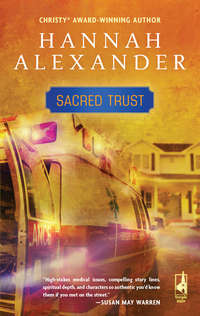
Kitabı oku: «Sacred Trust»
Critical Praise for
HANNAH ALEXANDER'S
Novels
SACRED TRUST
“Alexander is great at drawing the reader into her story line and keeping them hooked until the resolution of the plot.”
— Christian Retailing
A KILLING FROST
“Running dialogue and a few twists will keep romantic suspense fans coming back for more.”
— Publishers Weekly
DOUBLE BLIND
“Native American culture clashes with Christian principles in the freshly original plot.”
— Romantic Times BOOKreviews
GRAVE RISK
“The latest in Alexander’s Hideaway series is filled with mystery and intrigue. Readers familiar with the series will appreciate how the author keeps the characters fresh and appealing.”
— Romantic Times BOOKreviews
FAIR WARNING
“The plot is interesting and the resolution filled with action.”
— Romantic Times BOOKreviews
LAST RESORT
“The third novel in Alexander’s Hideaway romantic suspense series (after the Christy Award-winning Hideaway and Safe Haven ) is a gripping tale with sympathetic characters that will draw readers into its web. The kidnapped Clarissa’s inner dialogue may remind some of Alice Sebold’s The Lovely Bones. ”
— Library Journal
Sacred Trust
Hannah Alexander
 www.millsandboon.co.uk
To the Great Physician,
the Author and Finisher of our faith.
In memory of our fathers:
Johnie R. Cook & Ralph B. Hodde
We wish to thank Joan Marlow Golan and her excellent staff for giving us this opportunity to share our books with a new reading audience.
Sacred Trust
Contents
Prologue
Chapter One
Chapter Two
Chapter Three
Chapter Four
Chapter Five
Chapter Six
Chapter Seven
Chapter Eight
Chapter Nine
Chapter Ten
Chapter Eleven
Chapter Twelve
Chapter Thirteen
Chapter Fourteen
Chapter Fifteen
Chapter Sixteen
Chapter Seventeen
Chapter Eighteen
Chapter Nineteen
Chapter Twenty
Chapter Twenty-One
Chapter Twenty-Two
Chapter Twenty-Three
Chapter Twenty-Four
Chapter Twenty-Five
Chapter Twenty-Six
Chapter Twenty-Seven
Chapter Twenty-Eight
Chapter Twenty-Nine
Chapter Thirty
Chapter Thirty-One
Chapter Thirty-Two
Chapter Thirty-Three
Epilogue
Questions for Discussion
Prologue
F rankie Verris held the plastic cup in his trembling left hand and stared out the bedroom window. Broken limbs from winter storms littered an unmowed lawn. Weeds lay flattened in the vegetable garden. The jonquils and tulips, which Doris had always loved so much, had refused to bloom this spring. It pretty well summed up Frankie’s life over the past year, with Doris gone. Another sleepless night, filled with pain and loneliness, had brought him to this despair.
He looked at the easy-open prescription vial in his right hand, cherishing even the look of his wife’s name on the white label. Why hadn’t he cherished her more when she was alive?
With unsteady fingers, he flipped off the cap and poured the pills onto the dusty chest beside the window. They had helped Doris sleep. Would they work for his pain?
He gagged on the first swallow, but it finally went down. He sank into the bedside chair and took two more. They went easier. He watched the silent flight of a hawk as it winged over the horizon of forest past the yard. Everything seemed to remind him of Doris these days. She’d loved the hawks because of “the poetry in their wings.” She’d loved so many things. She’d loved him, unworthy as he was.
She’d loved God most of all.
For years Frankie had been jealous of God, often resentful because of the special relationship Doris seemed to have with Him. And now God had taken her and there was nothing left.
He swallowed two more pills, then kept going, two at a time. It grew easier and easier.
The drug was fast acting, and he appreciated that. He didn’t want to sit around and wait for it to work. In fact, he thought he might be feeling the first effects already….
Jacob Casey gripped the telephone receiver hard, fighting back another wave of pain in his upper thigh. “Hello, emergency room? This is Cowboy again. I’m coming in with another injury.” It had been a few months since they’d seen him, and he’d never been there in the daytime. Maybe today’s would be a different staff, and maybe this time the doc on duty wouldn’t give him the familiar three-hour sermon about being careful around wild animals.
He grimaced as the secretary questioned him. “Nope, no ambulance. I’ll do it myself.” He’d called an ambulance once—last year when the bison had kicked the paddock gate over on him. It had taken him longer to get to the hospital then than ever before or since.
He looked down to find more blood dripping from his thigh. “Can’t take the time to talk. Just be ready for me. My pet cat bit me. No rabies, so don’t even think about shots.” Leonardo was well vaccinated.
With a short grunt Cowboy hung up the phone and reached for his hat. The room started to go black on him, and he lowered his head. Must be losing more blood than I thought. Forget the hat. He picked up his keys from the kitchen table and flung one last, angry glance out the window toward the cage outside where Leonardo the lion paced from end to end. Let him go hungry if he was going to behave like this.
At this rate there would be blood all over Cowboy’s beautiful vintage Mustang. That cat had a lot to answer for.
Frankie stood up unsteadily from his perch at the un-curtained window. The sun had passed the tree line and now blasted through the bedroom with unrelenting force. Dust particles danced in the sunbeams, and Frankie stared at them for a moment, fascinated. The neighbor kids would want to see this. He’d have to show them the next time they came over….
No, he wasn’t planning to be here to show them. He was going to be with Doris by then.
He would be with Doris, wouldn’t he? She was dead and he’d be dead, in the ground.
His mind worked through that thought slowly. Doris had never believed she would just end up in the ground. She was sure she was going to heaven. He’d gotten sick of listening to her talk about heaven so much. But it sure had comforted him after she was gone.
Frankie’s hands felt numb. He wiggled his fingers and tried to shake the muzziness from his head, but it just made him dizzier. Man, oh, man, this drug is working fast.
Maybe he didn’t want it to work so fast. What about the kids next door? He hadn’t thought about them. What if this drug worked and he died, and those little kids found him?
He did not want that to happen.
Using all his strength to force his feet to move, he walk-stumbled from the bedroom toward the living room. He’d better try to reach that phone. He could call 9-1-1 and stop all this. Then, even if he died, the kids wouldn’t be the ones who found him.
Ivy Richmond sat on the chair closest to the front door and listened to the siren. Soon the ambulance would pull up outside. They’d take care of everything. She pressed her hands against her chest and tried to breathe slowly, as if that would help normalize the crazy rhythm of her heart. This was not a heart attack. She wouldn’t let it be.
So what was it? Stress? She could get philosophical about it and say she had a broken heart. It would be true. Her heart was breaking more and more every day, but she hadn’t expected to get so physical about it. She’d experienced grief before, but maybe it was different every time. Maybe it dug deeper each time until it finally destroyed either the mind or the body. Or maybe she was just being melodramatic. She needed to snap out of this.
The siren stopped as the ambulance pulled up outside. She could see the reflection of the lights against her living-room drapes. Time to let them in.
She stood up and opened the door just as they stepped up to knock.
“Mrs. Richmond?” It was the big guy she’d seen before.
She nodded and stepped back. “This way. She’s in the first bedroom.” She gestured down the hallway, and her hand shook.
The man stopped in front of her. “Are you okay?”
“I didn’t call for me,” she snapped. “It’s my mother. Cancer. Get her to the hospital!”
Frankie never realized how much effort it took just to walk. He could not concentrate long enough to form his steps. He finally leaned against the wall and pulled himself down the hallway that seemed to stretch for miles. If he could just get to the phone…
Doris would be so ashamed of him, trying to buy his way out of life like this. He couldn’t do it. He wanted her to be proud of him when they greeted each other again.
Would they ever see each other? What if she was right about heaven and hell?
He needed time to think about it. He had to reach that phone.
There it sat on the end table. Frankie teetered as he stepped away from the wall and reached forward. His foot caught on something, and he fell as if in slow motion.
Yes, he should have thought about this to begin with. He could crawl so much easier than he could walk. He inched across the remaining space on his elbows and knees and raised his hand toward the phone. He knocked off the receiver, and it fell next to him. He squinted at the face of the dial pad and realized he’d lost his glasses. He peered closer, fighting the heavy darkness that rushed in toward him like a hard wind. He hit the first button: nine. He found the one and poked it, then raised his finger to hit it again, but the black wind grabbed him.
The receiver slipped from his hand, and his head and shoulders slumped helplessly onto the carpet.
Chapter One
A delicate carpet of spring-green crept across the central Arkansas-Missouri border. The buds of serviceberry and dogwood had clothed their trees in pristine white just in time to welcome Dr. Lukas Bower to his new place of residence in Knolls, Missouri. He refused to call it home yet. After his most recent experiences in the job market, he couldn’t place his trust in these strangers. Nevertheless, nestled between patchwork properties of Mark Twain National Forest, this Ozark community of ten thousand promised to meet the needs of a country boy who loved the outdoors, especially hiking. When he had driven down from Kansas City to check out the area, the first order of business, before interviewing for the position of full-time emergency room physician, was to count the logging trails and off-road-vehicle paths that crisscrossed the forest. He’d even followed several of the trails in his Jeep. By the time he’d appeared for the interview with Mrs. Estelle Pinkley, the hospital administrator, he was sold on the place.
He was just finishing his usual morning repast of grease and eggs in the hospital cafeteria when the phone rang for him. He recognized the voice of an emergency room registered nurse.
“Dr. Bower, this is Beverly. We have a man by the name of Jacob Casey on his way here in his own car. He says he’s been bitten by his pet cat. He sounds pretty excited about it.”
Lukas frowned. “His cat bit him?”
“I gathered that the bite was pretty bad,” answered the RN.
“Rabies?”
“He specifically said there were no rabies. From the way he talked, the secretary thinks he’s been here before.”
“Okay, Beverly, I’ll be there shortly. Would you please pull his chart?” How much damage could a house pet do?
“But I’ve got good news,” she said. “We’ll have double nursing coverage through the noon rush.”
“As far as I know, this cat bite is the noon rush.”
Beverly chuckled. “Don’t worry, when Lauren and I do a double-coverage shift together, we always have some excitement.”
“I’ll trust your judgment.” Lukas hung up and took the one-minute walk to the emergency room.
He stepped in to find everything quiet. “Beverly, did Mr. Casey estimate how long it would take him to—”
The sudden blare of a car horn interrupted him and continued, obnoxiously loud.
“What on earth…?” Beverly walked through the open E.R. entrance and disappeared down the hallway. In less than fifteen seconds the honking stopped. Beverly came running back.
“Dr. Bower, Carol, I need your help.” She reached for one of the two gurneys sitting just inside the entrance. “There’s a man parked in the ambulance bay who looks like he’s bleeding all over the place. He’s alone.” She pushed the gurney out the door, with Lukas and Carol, the secretary, close behind.
By the time they reached the bay, the forty-odd-year-old man had opened his door and now clung to it desperately as he tried to get to his feet.
“Can’t seem to stand up,” he grated in a deep voice. His face was the color of recycled paper, and even his lips looked bloodless. “Cat bit me.”
Lukas, Beverly and Carol grabbed him and eased him onto the gurney.
Beverly gaped at him, then at the blood around his upper right thigh. “A cat did this?”
He held out a set of keys to her. “I always wanted a beautiful redhead to drive my Mustang. Take good care of her.” His eyes shut and his head dropped sideways.
“Let’s get him inside.” Lukas closed the car door. “Beverly, give those keys to Carol. She can drive this car out of the way and park it as soon as we get him transferred to a bed.”
“Oh, come on!” Beverly protested. “He told me I could take care of it.”
“He needs you worse than his car does.” Lukas held out his hand as they pushed the gurney through the automatic sliding glass doors. “The keys, please.”
Beverly curled her lip at him, but handed over the set of keys. “I’ve never driven a Mustang before.”
“Thank you.” Lukas handed them to Carol. “Would you do the honors? Beverly, let’s get an IV established on this man immediately, and we need to get his clothes off and see where the blood is coming from.”
While they worked on him, the double-coverage nurse arrived. Lauren groaned when she saw Beverly. “We’ll be swamped.” Even as she spoke, the ambulance radio blared. She pulled her long, blond hair into a ponytail and fastened it as she sat down at the desk to take the call.
In fifteen minutes, the emergency room was nearly full. The man in exam room seven had a deep laceration in his right forearm from an industrial accident. Lukas called industrial accidents his “graveyard specials,” because they happened most often during the predawn hours when the need for sleep was at its highest. Lukas used them as an example when arguing against twenty-four-hour shifts for emergency room physicians. This patient had worked since midnight, having had no sleep the day before. Dangerous?
A high school track student in room two had a possible broken wrist. The E.R. staff was waiting for parental consent to treat, enduring endless telephone calls from classmates to check on the patient’s progress while the track coach searched for the completed consent form. Naturally the parents were out of town for the day.
A baby in room three had a red ear, and Lukas was still trying to decide if it was serious enough to treat with an antibiotic. The young mother had come in crying almost as loudly as her baby, and for a while no one had known which of them was here for treatment.
Two unwashed females stood out at the reception desk complaining loudly because they hadn’t been treated yet for their head lice.
“No, you did not ‘wimp out,’ Mr. Casey.” Lukas stood beside the bed of their first arrival, thirty minutes after they’d wheeled him in. The man still looked weak, although his color had improved. “You lost a couple of pints of blood. Your loving pet nicked an artery in your thigh.” He indicated Casey’s bare leg.
Lukas traced the stablike wounds on the inside of Casey’s right thigh. “That’s some cat.”
“This is just a love bite, Doc. My name’s Jake, or Cowboy, but don’t call me Mr. Casey.”
“A love bite?”
“Male African lion.”
“A pet?”
“Had him for four years, since he was a cub. I raise exotic animals for parks and zoos, but I kept Leonardo. He’s good company.”
“When he’s not eating various parts of your anatomy. You must live alone.”
“How’d you guess?”
Beverly entered the trauma room to recheck Cowboy’s vitals and help Lukas finish irrigating the wound.
Covered in nothing but a towel, Cowboy’s whole body blushed. “Uh, Doc, I’d be grateful if you could spare one of those skimpy hospital gowns. It’d cover a whole lot more.”
Lukas grinned at him. “I think that could be arranged.” He glanced at Beverly. He had already seen the way Cowboy looked at her—and the way she looked back. “Maybe I should help him dress.”
“You don’t have time,” Beverly said. “I hear the ambulance phone now, and we have a mom out in the waiting room with three children she wants to have checked out for sore throats and earaches.”
“How long before our surgeon arrives?” Lukas asked.
Beverly wrote down Cowboy’s vitals on a clipboard. “Any minute now, Dr. Bower. He laughed when I told him who it was. He says he’s had this patient before.” She grinned at Cowboy. “I hear you’re pretty adventurous.”
He returned her smile and blushed again. “The folks I work with aren’t always predictable. Dr. Wong took care of a gash I got in the head when a scared zebra kicked me.” He looked at Lukas. “But why do I need a surgeon for this bite? Can’t you just sew me up and let me get home? Leonardo will be hungry before long, and he’s probably worried.”
“Good,” Beverly said. “Let him worry. Maybe he’ll remember this the next time he confuses you with a beefsteak.”
“Sorry, Cowboy,” Lukas said. “Leonardo bit into a deep artery. That’s surgeon territory.”
“But you’ve stopped the bleeding.”
“With pressure. When we remove the pressure, we’ll be leaving an unstable wound that can burst open at any time. You’ve lost enough blood already. You can’t afford to lose more.”
“But, Dr. Bower—”
“Listen to your doctor.” Beverly laid a hand on Cowboy’s arm. “He knows what he’s doing. Besides, if you’re too eager to get out of here, we’ll think you don’t like our company.” She winked at him. “You never want to offend your local emergency department personnel. You can’t tell when you’ll need them.” She dug into her pocket and pulled out the set of keys she had retrieved from Carol. “I’ll make a deal with you. If you’ll let me drive your car and give me some instructions, I’ll go out to your place when I get off work and feed Leonardo for you.”
Both men stared at her.
“Uh, Beverly,” Lukas said, “you do realize we’re talking about an African lion.”
“I heard through the crack of the door. Besides, I’ve read the chart.”
“Sorry,” Cowboy said in his gravelly voice. “No way am I sending a pretty female out to do the job I should’ve done. Get a man to feed Leonardo, and you can drive him out there in my car.”
Lukas expected Beverly, with her obviously independent spirit, to spit fire. Instead, she gazed bemusedly at Cowboy and nodded. “I’ll see what I can do.”
Someone approached the trauma room entrance. “Dr. Bower?” It was Lauren’s voice.
“Oh, Doc, please,” Cowboy said. “I’m still practically naked here. Don’t give me an audience.”
Lukas slipped through the partially open door, leaving Cowboy his privacy. “Yes?”
“We have an elderly man in exam room one who has just been brought in unresponsive.”
“I’ll be right there.” He rechecked Cowboy’s wound, then crossed to exam room one, where Lauren was rushing through the vitals of an unconscious, toothless elderly man in his pajamas, who was already hooked to a monitor and a nonrebreather oxygen mask.
A worried-looking woman in her thirties stood at the patient’s side, her eyes puffy and red from crying.
“Hello, I’m Dr. Bower,” he said to the woman. “Are you his daughter? Granddaughter?”
“No, I’m Shelly, Frankie’s neighbor. My children go over to see him every day, and today they found him like this on the floor of his living room. I think he’d been trying to call someone, because the telephone receiver was off the hook and lying beside him.”
“Did you bring him in by yourself?”
“Another neighbor helped me get him into the van. We should have called an ambulance, but I just didn’t think. We only live four blocks from the hospital.”
Lukas adjusted his stethoscope and did a quick auscultation of the man’s chest. He had mild tachycardia and slow respiration. His skin was pale and cool to the touch. A quick check of his head and upper body revealed no signs of injury. Lukas didn’t smell alcohol.
“Lauren, let’s get a bedside glucose on him.”
“Yes, Doctor. We have a new patient in room eight who needs you next.” She lowered her voice. “It’s cancer. She’s a DNR.”
Lukas grimaced. Those were the hardest. “Okay, thank you, Lauren.” He checked Frankie’s eyes. The man had good papillary sparing. Lukas quickly but gently turned the patient’s head, holding his eyes open. The eyes remained fixed on the ceiling. Positive doll’s eyes told him that this was either drug related or that there was bilateral brain swelling.
“Shelly, has he been ill recently? A cold? Flu?”
“No. Yesterday he was fine. He always brags about never getting sick.”
“Does he ever drink?”
“You mean liquor? Never.” She held out two prescription bottles. “I brought these. I found them on the bureau in his bedroom. His bottle is almost full, but the other one is empty. It belonged to his wife. She died last year.”
Lukas took the bottles from her and glanced at the names of the drugs. Both were benzodiazepines for sleep. He glanced at the patient and didn’t like what he was thinking.
“Blood sugar’s 125, Dr. Bower,” Lauren said.
“Thank you.” He glanced again at Shelly, hating to ask his next question. “These are tranquilizers. Is it possible he might have taken an overdose of his wife’s prescription?”
Her eyes widened with alarm. “On purpose? No way! I don’t even want to consider it. He’s so good with the kids, and he never seems depressed. He was doing so well after his wife, Doris, died.”
Lukas was also reluctant to believe this kindly looking older gentleman would do anything so drastic. He’d probably flushed his wife’s pills after her death. But what if he hadn’t?
“He hasn’t talked about going to be with his wife lately?” he asked Shelly.
“No.”
“Has he displayed any changes in his normal habits, like changes in sleep time or amount? Changes in eating habits? Has he given any of his personal items, such as jewelry, to friends or neighbors?”
“Nothing that I know about.”
“How long ago did his wife die?”
“About eight months ago. Long enough for him to show signs of depression if he’s going to, I would think.”
“Not necessarily. A wedding anniversary could have set him off, or her birthday, anything of significance to him.” Lukas was well aware of this because his own father had gone through a similar depression after Mom’s death. So had Lukas, though not as severe as Dad’s.
“But they had just celebrated their wedding anniversary before she died,” Shelly said. “And her birthday was two weeks before their anniversary. We celebrated it with them.”
“Okay, thank you, Shelly. Lauren, set him up for a CBC, a comprehensive chemistry panel, a portable chest, and a drug screen. Then set up a heplock. I want him to have a milligram of Romazicon at 0.2 milligrams per minute. We’ll repeat the dose after twenty minutes.”
“What’s that for, Doctor?” Shelly asked.
“Romazicon is the antidote for benzodiazepine overdose, just in case.” At her blank look, he explained gently, “He may have taken too many of these tranquilizers. I don’t want to dismiss the possibility and take a chance on being wrong.”
He glanced at Frankie’s prescription bottle again. Dr. Robert Simeon had prescribed the drug. “Lauren, also put a call in to Dr. Simeon’s office. He’s the family doc. I’m going to check on Cowboy, then look in on the cancer patient. Would you see if that permission to treat has come in for the track student? We’ll need a CT head scan on Frankie if our workup is negative.”
Dr. Wong entered the E.R. and greeted Lukas with a cheery smile and warm handshake. “Lukas, I hear you have one of my favorite patients visiting with you this morning.”
“Yes, and your patient is already asking for some clothes. Beverly will assist you.”
As soon as Cowboy was settled with his new doctor, Lukas heard Beverly’s cajoling voice through the door.
“Dr. Wong, you’re a kindhearted person,” she said. “What time do you get off?”
“Um, excuse me? Hold it, Beverly, you know I’m married.”
“I know that, silly. How would you like to help out a hungry house pet?”
“Forget it. I know all about Cowboy’s house pets. He just happens to be here because that ‘pet’ mistook his thigh for a drumstick. Isn’t that right, Cowboy?”
Lukas chuckled as he walked back to the central desk. Beverly wanted that Mustang.
His laughter died when he entered exam room eight with a chart for Mrs. Jane Conn. The eighty-six-year-old woman lay moaning in pain in spite of the morphine Lauren had just injected at Lukas’s order. A smooth, shiny sheath of mottled scar tissue obliterated half of Mrs. Conn’s face and showed up plainly beneath the nonrebreather oxygen mask she had received upon arrival. She had been brought here from her daughter’s home about thirty minutes ago, her pain unresponsive to oral medication or morphine suppositories. Lauren had established an IV where dark bruises attested to the failure of the new paramedic to do so.
Since Lauren and Beverly were both busy, Lukas checked the blood pressure himself. It was going down, and the heart rate was dropping, probably due to a decrease in pain—or Mrs. Conn was dying.
Lukas found Lauren and gave instructions for blood tests and X-rays. “You did say Mrs. Conn had filled out a do-not-resuscitate form for her family, didn’t you?”
“Yes, but we haven’t received it yet.” Lauren wrote his instructions down on a sheet. “Her daughter, Ivy Richmond, should have it.”
“I’ll need to get it from her, or we’ll have to take measures to resuscitate if…” He shrugged, hoping they would have no trouble getting the DNR form. He’d been forced to run codes on late-stage cancer patients before, and it had been very painful for everyone, especially for the patient.
As Lauren ran orders for the tests, Lukas listened once again to Mrs. Conn’s chest. He glanced up, and to his surprise, he saw her one unaffected eye watching him.
He took her hand. “Mrs. Conn, we’re trying to reduce your pain. How does—”
“Let me…” her damaged mouth twisted in an effort to form the hoarse words “…go.” Her eye held him a few seconds, then glazed over and closed.
Sadness overwhelmed Lukas as he watched her. He hated to see the pain, had always hated to see suffering of any kind. It was one of the things that had driven him to be a doc in the first place, and ironically, it had been one of his worst hindrances in premed vertebrate physiology. He’d always been physically sick afterward, even though the animals were anesthetized and even though he reminded himself over and over again that human lives would be saved because of the sacrifice.
Mrs. Conn’s moaning had stopped. Lukas placed a hand on her frail arm, then looked over to find the eye watching him again. He couldn’t read the expression, for there was little expression to be displayed on the harsh mask.
She moved her mouth.
Lukas leaned closer to hear her.
“Ready.” The word wasn’t even a whisper, but a breath of sound that barely carried past the barrier of the transparent oxygen mask. “I’m…ready.”
When he looked at her eye it was closed again. For some reason, some infinitesimal sign relayed itself to him—some lightening of expression on that scarred mask? He felt almost…a peace…assurance. Or was he just trying to comfort himself? Cancer was the hardest of all to take since Mom’s days of suffering. Lord, help her.
“Dr. Bower?”
He turned to find the X-ray tech waiting to do the portable chest. Lauren stepped into the room behind her.
“Lauren, where is Mrs. Conn’s daughter?” he asked.
“She’s in the private waiting room. I’m surprised Dr. Mercy isn’t already with her.”
“Dr. Mercy?”
“She’s Mercy Richmond, Ivy Richmond’s daughter and Mrs. Conn’s granddaughter. Dr. Mercy is a nickname a lot of her patients and staff members called her to keep from confusing her with her father, who was also a physician. He was Dr. Cliff, she was Dr. Mercy. If you haven’t met her yet, you will. She hasn’t had an E.R. shift in a couple of weeks. She has a family practice across the street.”
“Good,” replied Lukas. “We can call her when we need to. But I’m going to need to see Ivy Richmond soon. I need that DNR sheet, and she needs to be prepared.”
Lauren stood gazing at Mrs. Conn. “This has been a rough one. Everyone knows and loves Mrs. Conn. She used to do a lot of volunteer work here. Her daughter Ivy has made several large contributions to the hospital in the five years since her husband died.”
The X-ray tech finished her work in the room, and Lauren took Mrs. Conn’s vitals once more. “Down again. BP is 95 over 55 with a 90 pulse.”
“Thanks, Lauren. I’ll go have a talk with her daughter as soon as I check the test results.”
“Okay, I’ll go see Frankie again.” Lauren gave Mrs. Conn another sad look and walked out of the room.
Had there been time, Lukas would have sat with the patient, but he had to return to reassure the mother with the sick baby, talk to the girl with the sprain, and check on Frankie. Where was Mrs. Conn’s daughter, Mrs. Richmond? Why wasn’t she in here? More than likely she was exhausted and had found a sofa or chair on which to sleep.
When Lukas finished his round of the patients, he returned to Mrs. Conn and read the test results. As expected, they looked normal for an elderly woman with late-stage cancer. She continued to rest peacefully, but her blood pressure and respiration were falling.
He found the E.R. secretary at the central desk. “Carol, would you please call Dr. Richmond’s office and advise her of her grandmother’s condition? I’m going—”
Carol raised a hand. “Wait a minute, Dr. Bower. We received permission to treat Cindy Hawkins with the injured wrist. Also, I have Dr. Simeon on the line. You wanted to talk with him about his patient, Mr. Verris?”
After a quick consultation with Dr. Simeon, Lukas made arrangements to have Franklin Verris, the possible suicide attempt, admitted to ICU, then went back to check on the seventy-three-year-old gentleman one more time.
Shelly kept her vigil at her neighbor’s bedside. Lauren stood at the other side of the bed, adjusting an IV line.
“Any change, Lauren?” Lukas asked.
“I’m not sure. There’s no difference in his vitals, but his breathing seemed to change a moment ago. It’s been twenty minutes, and I’m getting ready to give him the next dose. Do you want me to go ahead with it?”
Lukas bent over Mr. Verris and gently raised his right eyelid. He took out a penlight and shone a beam directly at the pupil. There was a faint reaction. The man didn’t look as pale as he had looked before. But according to Dr. Simeon an overdose was highly unlikely. He had disagreed with Lukas’s request for Romazicon. However, Lauren was prepared for another dose, and since Lukas had already given the order, he decided to carry it out.
“Go for it, Lauren. I need to stay and watch him, but I also need to talk to Mrs. Richmond. I’ll be back.”
Chapter Two
L ukas opened the door to the private waiting room and saw a tall, slender woman pacing the floor. Her casual attire of jeans, jogging shoes and a “Hiking is Life” T-shirt skewed the impression he’d formed in his mind of a wealthy, polished benefactress of the hospital.
Mrs. Richmond’s long, dark brown hair was pulled back into a ponytail at the nape of her neck. She turned to face him, and he saw that the hair was liberally streaked with gray around the temples. Her large, dark eyes met his with deep gravity. She was at least sixty, and the gaunt face told him of recent weight loss. The prominent dark circles under her eyes told him she probably hadn’t slept well for weeks.
“Mrs. Richmond?”
“Yes.” Her voice held fear.
“I’m Dr. Bower, the emergency room physician on duty today. I need to speak with you about your mother.”
Mrs. Richmond nodded. “I should be in there with her, I know, but the moaning…I just couldn’t handle it, had to get away from it for a while.” She resumed her pacing. “She moaned all night. I gave her morphine suppositories twice as often as…” She turned back. “I’m sorry. I’m rambling. It’s just so hard to think straight these days.”
“I understand. Have you had an aide helping you with your mother at home?”
“No. I didn’t want my mother thinking I’d abandoned her to a stranger.”
“So you’ve been taking care of her yourself?”
“My daughter helps when she can.”
“I’m sure that’s very hard on you, Mrs. Richmond.”
“Call me Ivy. Is she still moaning?”
“She was peaceful when I left her a few minutes ago. We gave her an injection. We ran some tests to see if there might be a pneumonia or something else causing her deterioration.” He paused. “I’m sorry, Ivy, but none of the tests show a secondary problem. I’m afraid the cancer is taking her.”
Ivy nodded slowly. “Hard to believe a little mole on her cheek could do such damage. Melanoma, you know.”
“Yes. I’m sorry. Her oncologist is in Springfield?”
“Yes, but it’s no use calling him. He’ll just increase the morphine.” Fatigue sharpened her voice. “She’s not worth his time. She’s just an old woman.”
“We want to make her as comfortable as possible. I understand you have the DNR request she signed?”
Ivy grew still as her eyes flashed back to his face. Her chin lifted a fraction. “Why?”
“Would you like to sit down?”
“I’ll stand.”
“I know you must be tired. I want to honor your mother’s advance directive, and to do so, I need the DNR sheet. This is all just legalities, and I apologize for having to ask you for it at a time like this.”
“You mean to just let her die?”
Lukas flinched at the harsh tone of her voice and the sudden, angry-suspicious expression in her eyes.
“If her heart should stop,” he said gently, “we wish to honor her request not to restart it.”
“What’s this ‘we’ business? You’re the doctor. You call the shots. I don’t want my mother’s heart to stop, and if it does, I want you to start it again.”
He held her suddenly angry gaze for a moment. She couldn’t know what she was saying.
“Mrs. Richmond, I thought you understood about your mother’s request.”
“My mother is not capable of making that decision now. I have power of attorney, and I don’t want you to just let her die like some worthless old woman. She’s a living human being with a soul.”
“Of course she is.” He hadn’t foreseen this. How could he get through to her? “I’m not talking about euthanasia. I’m talking about allowing nature to take its course, allowing your mother to retain her dignity and keep her from unnecessary pain. I’ve asked a nurse to call your daughter, Dr. Richmond, and she should be here—”
“You did what?” Her dark eyes flashed, and fatigue tightened the tension in her voice.
Lukas blinked at her helplessly. This was not going well. She was clearly, and understandably, irrational from lack of sleep. There had to be some way to make her see, without becoming too graphic.
“I specifically delayed calling my daughter because I wanted to put her through as little heartache as possible,” Ivy said. “She’s been through enough. You had no right to call her.”
“I’m sorry you feel that way, but Mrs. Conn’s condition is getting worse. I felt family needed to be here.”
“Not yet!” She paused with a gasp, placing a hand on her chest.
He stepped toward her. “Are you okay?”
“I’m fine.” Lowering her hand, she took a deep breath and held his gaze. “I don’t care what the DNR form says. I have durable power of attorney, and I want you to do everything for my mother. She’s not ready to die. She’s not…”
“I didn’t mean for this to be so difficult.” Lukas kept his voice gentle, resisting the urge to ask if he could examine her. He’d seen this kind of family reaction before, during his oncology rotation, when a caregiver was so exhausted that they became confused and combative. They often blamed the physician for the pain of their dying loved one. “I will contact Mrs. Conn’s family physician and clarify the matter.” He turned to leave.
“You don’t believe I have power of attorney?” she challenged, her voice rising a decibel.
He paused with his hand on the door. Lord, give me compassion.
But what about Mrs. Conn? She would suffer even more pain if they managed to resuscitate her.
He turned back to face Ivy, and he tried to keep his voice gentle. He knew his words were not. “What I believe is immaterial, Mrs. Richmond. For instance, I believe that to impose heroic measures onto a patient suffering the last stages of advanced carcinomatosis is not only transferring much-needed care from the living to the dying, it is inhumane to the dying.”
“Only if you don’t believe in hell.”
“Mrs. Richmond—”
“Ivy! My name’s Ivy!”
“I’m sorry, Ivy. I do believe in hell. I also believe that your mother is at peace about this. She told me she was ready to go.”
“What do you mean, she told you?” Ivy snapped. “Mother hasn’t spoken in days. What are you trying to pull here?”
Be gentle. Be patient. But what about Mrs. Conn? “Ivy, to try to resuscitate your mother at this stage would only cause greater, unnecessary suffering. And for what? A few more minutes or hours for the family to say goodbye? What about your mother’s feelings? She’s made her decision already.”
There. He’d done it again, him and his bad habit of stating his opinion to the wrong people at the wrong time. But if there was the slightest chance Ivy would listen…
She bent her head, her eyes closed for a moment. He watched her hopefully.
She reached into the right back pocket of her jeans and drew out a folded three-page form. “I had hoped it would never come to this.” The strength had left her voice. She unfolded the papers and held them out with shaking hands. “I have the power of attorney. Are you satisfied?”
Beverly caught up with Lukas as he reentered the E.R. proper. “That Mustang’s mine!”
Lukas struggled to work up some enthusiasm. “Don’t tell me you cajoled Dr. Wong—”
“Nope.” She jingled Cowboy’s keys. “Sweet-talked one of the new EMTs to help me. Buck likes animals.”
“Yes, but did you tell him this wasn’t a gerbil?”
She grimaced. “He knows it’s a big animal.”
“Horses are big animals. How will you feel if your helper comes back in here on a stretcher?”
“Awful.” She shrugged. “Dr. Wong’s finished with Cowboy. Got any patients for me?”
“Have I ever.” He gestured toward the charts at the desk. “Enjoy.”
He left her staring at the sudden overload and stepped back into exam room one to check on Mr. Verris. Shelly still sat there beside his bed, and Lauren entered behind Lukas, as if geared to his location by radar.
“Any change?” Lukas asked Lauren.
“Test results are in.”
Lukas checked the printouts. Nothing. Everything was normal. Even the drug screen was not helpful, because all it showed were benzodiazepines, and that was to be expected for someone who occasionally took them to sleep. Lukas could have done a quantitative drug screen, but that would have taken too long.
“BP’s gone up just a little, but not much,” Lauren continued. “Pulse and respiration are the same. They’ve called from upstairs to let us know they’re coming to take him to ICU.”
“Let’s make sure they know he still needs a CT scan.” Lukas did his own assessment. Was it his imagination, or was the man breathing more deeply? As he watched, Frankie’s head moved a fraction of an inch.
Lukas looked up to see if Lauren had noticed. “Has he moved like that before?”
“I don’t think so.”
He watched a moment longer. It was probably just a stimulation of the limbic system, a common event in a coma patient.
Lukas did an auscultation of Frankie’s chest one more time, then shook his head. With a nod at Shelly, he left the room. He was feeling more and more frustrated as the day progressed.
Lauren stepped out of the room behind him. “Dr. Bower? Some of the staff are getting together after this shift over at the cantina across the street. Want to join us?”
“Uh…sure. Yes, I’ll be there. Thank you for asking.” Lukas nodded and continued down the hall, knowing he would be kicking himself tonight when it came time to show up at the cantina. He would be starving when he got off, as usual, and since he always ate out anyway, this would be a good way to get better acquainted with the people who worked here. Unfortunately, he knew that by the time he arrived at the restaurant, he would be feeling so awkward about meeting with a group of near strangers, he would have lost his appetite. Almost.
Moving to a new place was lonely business, especially for him. Funny, he could face patients and coworkers all day long with no problem, but when his time was not regimented, he had trouble forcing himself to reach out to others. It wasn’t that he didn’t like people, because he did. The youngest of three boys in a loving Christian family, Lukas was the only shy one in the bunch, and he had often been teased about it. The teasing had only made him more self-conscious, turning him inward, and now his family despaired of ever seeing him married. But this was a new place, and no one here knew about his shyness. It was time to dig himself out of the rut—or pray that God would move him out.
He took Mrs. Richmond’s papers to the secretary. “We’ll need copies of these, Carol. Please call Dr. Richmond back and tell her that she needs to be on standby. Her grandmother is holding her own at the moment, but she could deteriorate fast, and she’s now a full code.”
“Yes, sir.” Carol grabbed the papers from him, dark eyes glowering as she spun around to the copier. She muttered something under her breath.
Lukas watched the characteristically cheerful secretary in surprise. “Carol, are you okay?”
She put the first sheet into the copier and pressed the button. “Fine, just fine,” she mumbled. “We’re swamped, we’ve got patients dying back there, and all I hear are complaints that we’re not seeing people fast enough.” She indicated the waiting room. “Griping because you haven’t looked at their scalps yet. They’d be in here right now, except one of them had to step outside for a smoke. I get so tired—”
“Have they been signed in?”
“No, I’ve been too busy with these other—”
“I’ll take care of them.” Lukas glanced out the door, where one of the women he’d seen earlier stood smoking, talking to the other. He strolled out to join them.
“Hello, ladies, I’m Dr. Bower. I hear you’re unhappy about our service. What’s the emergency?”
The smoker quickly shoved her half-smoked cigarette into the receptacle like a school kid caught by the teacher.
“We need to be treated for head lice,” the nonsmoker said.
The patio was deserted, Lukas noticed. He took another step forward, carefully looked at first one over-permed head of hair, then at the smoker’s long, stringy brown hair.
He took out a notepad and a pen and wrote the name of a shampoo. He held it out toward the smoker. “Wash with it once, then wait a week and wash again. You can buy this at your local pharmacy.”
She stared at the note in his hand. “No prescription?”
“You don’t need a prescription for this. The two of you can share a bottle.”
“But we’ll have to pay for it.”
Lukas felt his skin tingle with growing irritation. He inhaled slowly, counting to ten as he placed the note on the top of a trash can nearby. It had suddenly become a stressful day, the worst he’d had in a long time. He couldn’t blame it all on these two misguided souls.
He turned and opened the heavy glass door. “Ladies, the shampoo costs less than a pack or two of your favorite brand of cigarettes.”
“But we have Medicaid cards,” the smoker called after him. “We can report you for refusing to treat us!”
He stopped midstride and slowly turned back toward them. “Feel free,” he said, keeping his voice calm. “I feel I should warn you, however, that when a card carrier tries to use the card in the E.R. for nonemergency care, she can lose her card. It’s called Medicaid abuse. I think you’ll find that shampoo works very well as long as you follow the directions.” He stepped inside and let the door close silently behind him.
There were other Medicaid cardholders—for instance, the little baby in exam room three—who needed treatment today, not next week, and Lukas saw to it that they received good care. Lots of Medicaids used the emergency room here because many family practitioners refused to take assignment. Those who did still limited their patients. Medicaid paid so little that a physician who took too many could go broke. The system didn’t work. Many times the people who behaved with integrity got left out entirely—both the honest Medicaid recipients and the honestly compassionate physicians. Greed was the culprit on all sides. Lawmakers spent their time writing more laws because people kept figuring out ways to take advantage of the system. It was frustrating. Lukas had to keep reminding himself not to blame the patients who sometimes misunderstood the constantly changing rules.
Lukas glanced around at the emergency department. He liked this little ten-bed setup. The exam rooms surrounded a large central station. Each room was well equipped. Five of the ten rooms had excellent cardiac equipment. There was a separate ambulance entrance and two physician call rooms.
Mrs. Estelle Pinkley, the hospital administrator, had done a remarkable job when she’d convinced the county to pay for this upgrade. Lukas had jumped at the chance to receive a dependable salary with benefits so far away from the congestion and stress and corruption of the city. Yes, he knew corruption was everywhere, but right now, with specific, damaging events so fresh in his memory, Kansas City represented everything painful.
Carol met Lukas as he entered the E.R. proper. “Dr. Bower, Mrs. Conn is getting worse. Lauren said to notify you.”
“Thanks, Carol. Please call Dr. Richmond back.”
“Lauren already did so.”
“Get ready to call a code if necessary.”
“Dr. Richmond will have a fit about that, you know.”
“Maybe she can do more about it than I was able to.”
Chapter Three
M ercy Richmond ran the block from her medical office to the hospital, not bothering to remove her lab coat. Mom had promised to call when the time came, but she hadn’t done so. Instead, Lauren had been the one to break the news.
Shoving open the glass doors into the emergency room reception area, Mercy barely slowed her stride. “Carol, where’s Grandma?”
“She was in exam room eight, but they called a code and moved her to trauma room one.”
Mercy stopped and wheeled back. “What? There’s not supposed to be a code!”
Carol shook her head in sympathy. “I’m sorry. Dr. Bower called it. He had to.”
“We’ll see about that.” Mercy swung back on course. First, administration had arbitrarily decided to bring in a full-time E.R. doc from Kansas City, and now this hotshot doc had decided to ignore a perfectly legal DNR request. Perhaps he’d never learned to read.
She pushed through the swinging double doors that pretended to lend privacy to the open emergency room. A secretary manned the central station. All other hands were gathered in the trauma room, six people altogether, including Grandma’s frail, still body on the bed. Others worked with quick efficiency, responding without question to the soft-spoken commands of a slender, brown-haired man in green scrubs. He knew the drill well.
“Get me a blood gas…. Push the epi now, Lauren…. Any pulse…? Continue CPR.”
Mercy stopped just inside the doorway as a nurse from upstairs pushed methodically against Grandma’s chest and another bagged her.
“What’s going on here?” Mercy demanded. “Doctor, what are you doing to my grandmother?”
He looked up, his blue eyes behind gray-framed spectacles holding her with gentle concern. “You must be Dr. Richmond. I’m sorry, but as per your mother’s request, we are attempting resuscitation.” He turned back to the table.
“Stand clear,” he called as he prepared the paddles to send a jolt of electricity through Grandma’s chest. He placed one paddle above her right breast, and the other paddle he placed to the side below her left breast.
Mercy stood in stunned horror as the frail body jerked, arms flying out, legs up. Mercy had done the same procedure herself many times during her shifts in E.R. but not on someone she loved like Grandma.
“Check pulse,” Dr. Bower said.
Lauren gently felt the carotid artery for a moment, then shook her head. “Nothing, Doctor.”
“Continue CPR. Prepare more epi, and I need lidocaine, 1.5 milligrams per kilogram. What’s that blood gas?”
“Not back yet, Doctor.”
Mercy stepped toward him. “Dr. Bower, I’m her granddaughter. Stop this code.”
He was barely taller than her five feet eight inches, but his expression held calm authority. “As I said, Dr. Richmond, your mother—”
“I heard what you said, but my grandmother signed a DNR form weeks ago. Surely that has some bearing on this case.”
“You know that form does me no good. Believe me, I wish it did.” Dr. Bower’s voice betrayed frustration. He lowered his voice. “Your mother showed me her papers for legal power of attorney. Her order is to resuscitate.”
“Forget that order. As a fellow physician—”
“I can’t break the law, Dr. Richmond.”
“Don’t abuse this patient any more than she has already been abused!”
Dr. Bower grimaced at her words, sighed and shook his head. “I’d love to comply, but I can’t. If you want to sway the decision, please talk to your mother. I tried.” He turned back to the table. “Stop CPR.”
The monitor showed an irregular, sawtooth pattern. Grandma’s heart was in ventricular fibrillation. Mercy hoped it would not change back.
“Where is my mother?” she asked, her voice heavy with frustration.
“She was in the private waiting room when I left her.” Dr. Bower shook his head at the monitor. “No change. We need to shock again.”
He charged the defibrillator to 360 joules. “Clear.”
Mercy stepped back and almost turned to leave, but she couldn’t. A sort of morbid amazement held her there, watching the scene of horror play out before her. She gripped the door frame. A loud pop and flash preceded the stench of burned flesh. An electrode had blown. Lauren and Dr. Bower checked for signs of life while another nurse replaced the electrode.
“No change,” Dr. Bower said.
Mercy felt sick. Mom should be here to see what her crazy order was doing to Grandma. But then, Mom, too, had suffered enough.
Again they shocked, and Mercy could not bring herself to leave. CPR resumed. The longer they worked, the more convinced she became that Grandma was already far past their so-called help. And that meant she was also past any more pain.
Dr. Bower called a halt a seeming eternity later. Mercy did not move until he pronounced the time of death.
She stepped from the doorway as the code team cleaned up the mess of scattered monitor strips and plastic wrapping that had been tossed on the floor during the code. One by one, they filed out past her, some avoiding her eyes as if ashamed of the work they had just done.
Lauren stopped and laid a tanned, slender hand on Mercy’s shoulder. “I’m sorry, Dr. Mercy.” Tears filled her pretty green eyes.
“So am I, Lauren. Thanks for calling me over.”
“It was Dr. Bower’s request. Your mom told us not to.”
“Figures.” Mercy was thirty-nine, and Mom had still not overcome the need to hem her in with maternal over-protectiveness. Often it rankled. It showed lack of respect for Mercy’s ability to cope. For goodness’ sake, she was a doctor.
Dr. Bower paused for a moment at the bedside, his hand resting gently on Grandma’s arm, his head bent and eyes closed. When the last team member had left the room, Mercy walked over to stand beside the man and gaze into Grandma’s silent, scarred face.
Dr. Bower raised his head and looked at her. “I’m sorry, Dr. Richmond, I’ve been told she was a much loved lady.” He had a kind voice, deep and masculine, but with a gentle quality.
Mercy nodded, dry eyed. “She was.”
“I apologize for my abruptness. I could have handled the situation better.”
The sincerity in his voice disarmed her. She’d been prepared for battle when she came in here. Now she felt spent. Empty. “I wouldn’t let you.” She shook her head. “I had always sworn that I would never do to another doc what patients and families have done to me, and here I led the pack—aided by my mother, of course. I know the law, Dr. Bower. It’s just that she’s my grandma.” Her voice caught, and her professional demeanor abandoned her for a moment. Her throat ached with tears she refused to shed. She was grateful for the man’s thoughtful silence.
“My mother died of metastatic breast cancer three years ago,” he said after a few moments. “I remember the feelings of helplessness and anger. I wanted to do so much more for her, and there was nothing more to do except keep her comfortable. Had we revived your grandmother…”
“I know.”
There was another pause, then Dr. Bower asked, “Would you like me to go with you to tell your mother?”
Mercy took a final look at Grandma and turned away. “No, thank you. It’ll be best coming from me.”
He hesitated. “Did you not have a chance to discuss the DNR form with your mother?”
“I tried. Mom wouldn’t talk about it.”
“It’s a difficult subject to discuss. I gathered that your mother was the main caregiver.”
“Yes. I tried to help more, just to keep her from exhausting herself.” Mercy shook her head. “Mom can be stubborn and self-sufficient. She’s lost so much sleep lately…she hasn’t been her usual, rational self—not that she’s ever been a perfect example of rationality.” Why was she talking to this stranger like this? And a man, to boot.
“I know what you mean,” he said. “My father was the same way after Mom’s death. Be patient with your mother. This kind of grief and exhaustion can do strange things to the mind. And it can last a lot longer than anyone expects.”
“Let me talk to Mom.” She forced a smile and looked again into those blue eyes. “It’ll be easier for all of us.”
A few moments later, after taking a drink of water from the fountain and a few deep breaths to compose herself, Mercy opened the door to the private waiting room. The first thing she saw was Mom standing there in the middle of the floor, glaring in her direction.
“Where is that blasted doctor? I told them not to call you yet.” Ivy Richmond turned to pace across the room toward the thickly cushioned sofa on the far side, then back again. “It’s been over an hour, and no one has seen fit to tell me anything. Do you know that man came in here and asked for permission to just let Mother die?”
“Grandma had an advance directive, Mom.”
“How can he just take it upon himself to decide who is and who isn’t worthy to live? Mother couldn’t have known what she was doing when she signed that form.” Tears filled Ivy’s eyes. “Oh, Mother.”
Mercy’s eyes grew moist, too. She’d thought they would have been drained of emotion months ago, but the stages of grief had continued to batter them. Right now confusion ran high, and Mercy knew Mom was exhausted and weak from too many nights of sleeplessness.
Ivy jerked another tissue from the box on an end table and blew her reddened nose. “I wish they hadn’t called you against my wishes.”
“It’s a good thing they did.”
Ivy stiffened at those words.
“She’s gone, Mom.”
Ivy’s face twisted into a mask of pain. “Mother wasn’t ready to die.”
Mercy closed the door behind her and took a seat on the nearby recliner, perching on the edge with her hands in her pockets. “We’re the ones who weren’t ready.”
Ivy turned away. “I can’t believe my own daughter, the learned doctor, cannot grasp the reality of an afterlife.”
Mercy suppressed a sigh. Now was not the time to bring up that old argument again, but if Mom had found peace in her so-called God these past few years, where was that peace now?
Ivy reached up toward her chest with both hands and bent forward, as if on a sob.
“Mom…?”
Ivy shook her head.
Mercy stepped up and laid a hand on her mother’s shoulder. “Mom? Are you okay?”
Slowly Ivy straightened and turned around. Her face was as gray as the clouds gathering outside, but she nodded and patted Mercy’s hand.
“I’ll be fine. This just brings back so many memories.”
“I know.” Mercy’s father had also died a lingering, painful death five years ago. That was when Mom had suddenly started babbling about “finding Jesus.” At the time, Mercy was sure she would get over it, but she hadn’t. Where was her Jesus now?
Ivy took a deep breath and squared her shoulders. “That doctor is dangerous. He doesn’t hold human life sacred. He tried to manipulate me into allowing Mother to die. He was going to go over my head to keep from doing anything for her. Did he even try to save her?”
“He called a code. I saw it.”
“How hard did he try?”
“He did everything to resuscitate her. He had already begun when I arrived.”
“And he didn’t revive her at all?”
“No.”
“Is that normal for someone whose heart has just stopped?”
“It would be hard for me to say, Mom. Everyone is different. Most of the codes I get have been out for at least fifteen minutes.”
“I think he could have bought us more time. Do you know that he as much as told me he had other patients who needed him more than she did and that doing more for her would be inhumane?” Ivy put a hand to her chest again, then quickly dropped it.
Mercy held her mother’s dark gaze and said nothing.
“Jarvis didn’t want this new doctor here in the first place, did he?” Ivy asked. They both knew that Dr. Jarvis George, E.R. director, had been bitterly opposed to bring in a full-time physician for the E.R.
“No, and neither did I. But to be fair, I disagreed with the code, too. I even tried to stop him. He did what he felt he had to, and I can’t blame him for that. Granted, he could have been a little more tactful with you, but…”
“I’ll have a talk with Jarvis. Maybe he can put my mind at ease about this guy, but if he can’t, I may have to have a talk with administration.”
Lukas Bower could find his way around an unfamiliar hospital or a forest trail almost by instinct. Let him loose in a strange town, however, and he would be lost the moment he stepped out the door. By the time he entered the front door of the cantina—little more than a house with a small unlit sign in the front yard—where he was supposed to meet the others Wednesday night, the tiny place was nearly empty and a Hispanic waiter was clearing the tables. It still smelled wonderful, full of smoky spices and warmth.
Lauren waved at him from the far back left corner, where two smaller tables had been pushed together for a larger group. Much larger. Only Lauren was left.
Ücretsiz ön izlemeyi tamamladınız.