Kitabı oku: «Red Hot Lies»

Praise for the novels of Laura Caldwell
“Laura Caldwell writes remarkable, sexy, razor-edged thrillers that race to the finish and yet always make you stop to think. Chicago is brilliantly illuminated in Red Hot Lies, a book bursting with scandals and secrets. Caldwell’s stylish, fast-paced writing grips you and won’t let you go, making the Izzy McNeil trilogy a riveting must-read.” —David Ellis, Edgar Award-winning author of Line of Vision and Eye of the Beholder
“Caldwell’s writing is always smart, sassy and sexy, with more suspense than a celebrity murder trial. In Red Hot Lies, her prose burns up the page, and you’ll be still reading waaaaay past your bedtime. Highly recommended!” —JA Konrath, author of the Lieutenant Jacqueline Daniels thrillers
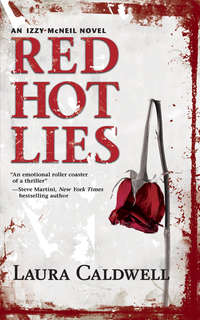
“Red Hot Lies is a wonderfully plotted story, smoothly crafted, filled with striking characters and great narrative. Caldwell slips seamlessly between voices to deliver an emotional roller coaster of a thriller. A legal lioness—Caldwell has written a gripping edge-of-the-seat thriller that will not disappoint.” —Steve Martini, New York Times bestselling author of Shadow of Power and Compelling Evidence
Also by Laura Caldwell
THE YEAR OF LIVING FAMOUSLY
Red Hot Lies
Laura Caldwell

www.mirabooks.co.uk
Dear Reader,
The Izzy McNeil series is fiction. But it’s personal, too. Much of Izzy’s world is my world. She’s proud to be a lawyer (although she can’t always find her exact footing in the legal world), and she’s even more proud to be a Chicagoan. The Windy City has never been more alive for me than it was during the writing of these books—Red Hot Lies, Red Blooded Murder and Red, White & Dead. Nearly all the places I’ve written about are as true-blue Chicago as Lake Michigan on a crisp October day. Occasionally I’ve taken licence with a few locales, but I hope you’ll enjoy visiting them. If you’re not a Chicagoan, I hope you’ll visit the city, too, particularly if you haven’t recently. Chicago is humming right now—a city whose surging vibrancy is at once surprising and yet, to those of us who’ve lived here a while, inevitable.
The Izzy McNeil books can be read in any order, although Izzy does age throughout, just like the rest of us. Please e-mail me at info@lauracaldwell.com to let me know what you think about the books, especially what you think Izzy and her crew should be doing next. And thank you, thank you, for reading.
Laura Caldwell
ACKNOWLEDGEMENTS
My deepest appreciation to Margaret O’Neill Marbury, Amy Moore-Benson and Maureen Walters. Thanks also to everyone at MIRA Books, including Valerie Gray, Donna Hayes, Dianne Moggy, Loriana Sacilotto, Craig Swinwood, Pete McMahon, Stacy Widdrington, Andrew Wright, Pamela Laycock, Katherine Orr, Marleah Stout, Alex Osuszek, Margie Miller, Adam Wilson, Don Lucey, Gordy Goihl, Dave Carley, Ken Foy, Erica Mohr, Darren Lizotte, Andi Richman, Reka Rubin, Margie Mullin, Sam Smith, Kathy Lodge, Carolyn Flear, Maureen Stead, Emily Ohanjanians, Michelle Renaud, Linda McFall, Stephen Miles, Jennifer Watters, Amy Jones, Malle Vallik, Tracey Langmuir and Anne Fontanesi.
Much gratitude to my panel of experts—Chicago Police Detective Peter Koconis; Chicago Police Officer Jeremy Shultz; private investigators Paul Ciolino, Sam Andreano and John Powers; criminal defence lawyer Catharine O’Daniel; Gabriele Carles and Jason Billups for their help with Panamanian real estate; Dr Richard Feely for explaining Chinese herbs; Dr Doug Lyle for his autopsy and cardiology expertise; Matt Garvin for his computer hacking intel, and Chicago Lions rugby coach Chris McClellan.
Thanks also to everyone who read the book or offered advice or suggestions, especially Dustin O’Regan, Margaret Caldwell, Christi Smith, Katie Caldwell, Rob Kovell, William Caldwell, Pam Carroll, Liza Jaine, Morgan Hogerty, Beth Kaveny, Katie Syracopholous, Brooke Shawer, Clare Toohey, Mary Jennings Dean, Steve Gallagher, Les Klinger and Joan Posch.
One day can shift the plates of your earth.
One day can age you.
Usually, I pride myself on my intuition. I listen to that voice that says, “Something bad is happening …” or maybe, “Get out now, you idiot.”
But on that Tuesday at the end of October, my psyche must have been protecting the one remaining day while I still believed that the universe was kind, that life was hectic but orderly. Because I didn’t hear that voice. I never saw it coming.
1
Day One
“McNeil, she’s not signing this crap.”
“She told me she was signing it last week.”
“She told you she was considering it.”
“No.” I moved the phone to my other ear and pinned it there with my shoulder. With my hands free, I shifted about ten stacks of papers on my desk, looking for Jane Augustine’s contract. I punched the button on my phone that would send a bleating plea to my assistant. “She told me she was signing it. Period.”
“That’s insane. With that lame buyout clause? No way. No. Way. You have no idea what you’re doing, kid.”
I felt a hard, familiar kernel of fear in my belly.
“It’s the same buyout clause she had in her last contract.” I ignored the personal comment he’d lobbed at me. I had gotten my fair share of them while representing Pickett Enterprises over the past three years and, although I acted like such comments didn’t sting, I often thought, You’re right. I have no idea what I’m doing.
I finally found the current contract under a pile of production-facility agreements. I flipped through it as fast as I could, searching for the clause in question.
My assistant, Q—short for Quentin—stuck his head in my office with a nervous what now? look. I dropped the document and put my hand over the mouthpiece. “Can you get me Jane’s last contract?”
He nodded quickly, his bald, black head shining under the fluorescent lights. He made a halfhearted attempt to find it amongst the chaos that was my law office—redwell folders that spanned the length of my visitors’ couch, file folders, motions and deposition transcripts stacked precariously on my desk. Throwing his hands up, Q spun around and headed for his own tidy and calm workstation.
“I’m not messing around, kid,” Steve Severny continued. Severny was the biggest agent/lawyer in town, representing more than half of Chicago’s broadcasters and nearly all its top actors. “Change the buyout or we’re walking. NBC has been calling, and next time I’m not telling them no.”
I swallowed down the tension that felt thick in my throat. Jane Augustine was the most popular news anchor at the station owned by Pickett Enterprises, my client. The CEO, Forester Pickett, was a huge fan of hers. I couldn’t lose Jane to another station.
Meanwhile, Severny kept rolling. “And I want a pay-or-play added to paragraph twenty-two.”
I flipped through the contract and found the paragraph. It was tough, yes, and it was favorable to Pickett Enterprises, but as much as I couldn’t lose Jane, I couldn’t simply give in to anything her agent wanted. My job was to land the terms most favorable to Pickett Enterprises, and although the stress of that job was always heavy, sometimes so heavy I could barely see through it, I would do my job. There was no alternative.
“No pay-or-play,” I said. “It’s nonnegotiable. I told you that last time, and I’m telling you again. That comes from Forester himself.” It always helped to throw Forester’s name in the mix, to remind people that I was here, making their lives tough, because he wanted me to.
“Then let’s talk about the non compete.”
“Let’s do that.” I thumbed through the contract, grateful to have seemingly won a point. Q darted into the room with Jane’s previous contract, cleared a space on my desk and put it down.
I nodded thanks.
Q then placed a sheet of white paper on top of it, giving me a sympathetic smile. In red ink, he’d written, Izzy, your meeting with the wedding Nazi is in forty-five minutes.
“Crap,” I said.
“That’s right,” Severny said, his voice rising. “That’s what I told you before. It is crap. And we’re not signing it!” And with that, he hung up.
“Mother hen in a basket!” I yelled, slamming down the phone.
I was trying not to swear anymore. I thought it sounded crass when people swore. The problem was it sounded great to me when I did it. And it felt so damn good. But swearing wasn’t appropriate at a law firm, as Q had reminded me on more than one occasion, and so I was replacing things like goddammit with God bless you and Jesus Christ with Jiminy Christmas and motherfucker with mother hen in a basket.
Q sank into a chair across from my desk. “I know you’re crazed, and I know you have to leave soon, but first I need some of your fiery, redheaded decisiveness.”
I sat down, crossed my hands on my desk and gave Q my army-general stare. “I could use a quick break. Hit me.”
Q was wearing his usual crisp khakis and a blazer. He tugged at the blazer to try to hide the slightly protruding belly he hated—his personal nemesis to the perfect gay physique. Not that this deterred him from sizing up the rest of the male species. Q had emerged from the closet six years prior, and though he had a live-in boyfriend, Max, he still enjoyed the “new gay” privilege of ogling every man he came across.
He paused dramatically now. “Max’s mother is coming to town tomorrow.”
“I see your problem.” Max’s mother was a former Las Vegas showgirl, an eccentric woman with whom you’d love to grab a martini, but who wears you out after two hours. The last time she’d come to Chicago, Q nearly broke up with Max just for an excuse to get out of the house.
“How long is she in for?” I asked.
“Two weeks.”
“That’s not going to work.”
“I know it’s not going to work.”
“You can make her help with your Halloween party this weekend.”
He nodded, reluctantly conceding the point. “What am I going to do the rest of the time?”
“Watch a lot of football?” Q had retained many of his straight-man tendencies. A love of football was one of them.
Q had gray eyes that I’d always found calming, but they flashed with irritation now. “That’s another not decisive, Izzy. There’s a question mark at the end of that sentence. And you know she’ll hover and talk, hover and talk. I won’t see a single play.”
“Okay, okay. Tell Max she has to stay in a hotel, and you guys will pay for part of it.”
Q ran his hands over his head again. “I guess maybe that would work.” He sighed. “God, I hate being in a relationship.”
“No, you don’t.”
“Yes, I do.”
Just then Tanner Hornsby, a high-ranking partner in his mid-forties, walked by my office. He was tall, with deep-black hair (dyed, I suspected) that arched into a widow’s peak. He was rumored to run five miles a day, every day, before work, and so he was lean and wiry, but he had the tired, slightly puffy eyes of a career drinker.
He stopped now and frowned at us.
Q turned in his seat. “Oh, hello, Mr. Hornsby,” he said in a breathy, effeminate voice, which he doled out only to annoy certain people like Tanner and his father.
“Hi, Tan,” I said.
His frown deepened. No one called him Tan. He was Mr. Hornsby to most, and Tanner to the elite few, myself definitely not included, but I needed him to consider me his legal equal. I ignored his disdain and called him Tan because I wanted him to know he didn’t scare me, even if he did. Behind closed doors, Q and I had other names for him—Toad Horny, Tanned Hide, the Horned One …
“I couldn’t help but hear your phone conversation from down the hall,” Tanner said. “Was that Steve Severny you were speaking with? Problems?”
Tanner Hornsby had negotiated hundreds of contracts with Steve Severny. Severny would never tell Tanner he didn’t know what he was doing.
“No problems.” I gave Tanner my dutiful-nice-girl look that served me well at the law firm of Baltimore & Brown. Though truthfully, I didn’t need the look anymore. The ludicrous amount of dough I pulled in through the Pickett Enterprises work allowed me to get away with just about anything. I was my own little island amid a sea of associates who hadn’t been as lucky as me and, as a result, were forced to be ass kissers and line-toers.
“How are your hours this month, Isabel?”
“Just fine, Tan, thanks for asking.”
Ever since Forester Pickett had made me the lead attorney for Pickett Enterprises, taking the cases away from Tanner, Tanner had hated me. Tanner was lifelong friends with Forester’s son, Shane. He’d originally gotten the Pickett Enterprises work because of that connection and thought he’d never lose it. Every so often, Tanner tried to throw his lean, wiry weight around and remind me that he was still my superior by asking questions about billable hours or continuing legal education. I felt bad for him. I felt guilty. I hadn’t tried to take Forester’s work from him. Forester had simply taken a shine to me, and I rode that windfall as far as I could. I knew many attorneys at the firm thought I’d gotten the work because I was a woman—a young woman with long curls of red hair who wasn’t afraid to wear high, high heels and drink with Forester until the wee hours.
Even if that was true, I didn’t care. I adored Forester. He was a smart, sweet man—not one of those older guys who oh so accidentally kept touching your hand … and your elbow … and your lower back. No, Forester was a prince, and like a prince he’d swooped in and saved me from the torment and agony of being just another associate slave. The job was hard, but I knew I was now doing good things for Pickett Enterprises. Still, that knowledge couldn’t hedge my occasional yet powerful bouts of self-doubt or the feeling that I was an impostor, one who could be exposed at any time.
Tanner grunted. “Keep the hours up. We’ve got the end of the year soon.”
I put a concerned look on my face, as if I didn’t have the top billable hours of any associate at the firm, and nodded. “Sure. Will do.”
He left. Thank God.
My cell phone dinged from where it sat atop a monstrous deposition transcript on my desk. I picked it up. A text message from Sam. Hey, Red Hot. Leaving for Cassandra’s. See you there.
“Dammit.” Cassandra was the wedding planner.
Q raised his eyebrows.
“Darn it,” I corrected.
I swiveled around and started scrambling through the chaos on my credenza until I found my bag. I couldn’t be late again. Plus, I needed to talk to Sam about this wedding stuff, which was starting to weigh me down as heavily as my job.
“Are you taking home the Casey research?” Q asked. “We have to file the motion by tomorrow.”
“I know, I know.” I stuffed a pile of case law and my Dictaphone into my bag.
“And don’t forget Sam’s work dinner tonight at the Union League Club,” Q said.
I tried to ignore the mountain of panic taking over my insides. “Yeah, it’s going to be torture. Those financial dinners always are. But I’ll leave early and work on the motion.”
“You can do it,” Q said. “You always do.”
“Thanks.” I stopped and smiled, and he flashed one back.
As I kept stuffing things into my bag, I thought about how a big blowout wedding had not been my idea. In fact, when Sam and I got engaged, I was fine to book a trip to the Caribbean with a few friends, throw on a little slip dress and get married to the sound of steel drums. But my mother, who hadn’t planned much of anything, or didn’t usually care about much of anything, seemed stuck on a huge, traditional wedding. And my soon-to-be husband, who had legions of friends from grade school, high school, college, business school and work, said he was on board for that as well. I want everyone to see how much I love you, he’d said. How does a girl say no to that?
My phone rang. Q took a step toward my desk and we both looked at the caller ID. Victoria McNeil. My mother.
Q picked it up, handed it to me and left the office.
“Hi, Mom.” I zipped up my bag. “What’s up?”
“Izzy, I know you two picked out the plates with the silver border for the reception, but I think we should consider the gold again.” My mother’s voice was calm and smooth, as always. “I’ve been thinking about it, and the linens are a soft white, rather than a crisp white, and that really lends itself toward gold rather than silver.”
“That’s fine. Whatever you think.” Reflexively, I extended the fingers of my left hand and glanced at my engagement ring, an antique, art-deco piece with an emerald-cut diamond. Looking at my ring used to make me grin. Now, it made me wince a little.
“Okay, and another thing. If you talk to your brother, Charlie, give him a little encouragement, will you? We need him to try on suits.”
“The wedding is still six weeks away.”
“That’s right. Only six weeks away.”
My stomach hollowed. Only six weeks.
“Charlie has to stop dragging his feet,” my mom said.
I murmured in vague agreement, but for once I felt simpatico with my brother. Mentally, I, too, needed to stop dragging my feet about this wedding thing.
“Don’t forget, you have another dress fitting tomorrow night.”
I tried not to sigh. “I know,” I said. “Battle number five.”
During the first visits with my bridal seamstress, Maria, it seemed she was trying to flatten my breasts and hide my hips, parts of my body I rather liked. I kept telling her, “I think the dress needs to be sexier,” and so she’d been dutifully making the bustline lower and the waistline tighter, until the last time, when she’d taken the pins out of her mouth and said in her accented English, “You want to look like hooker on wedding day?”
I told her I’d think about it.
I realized that most women wanted an ethereal look for their wedding, but I liked wearing sexy clothes on a daily basis, so why not for my wedding day? Plus, Sam said he wanted me in something hot. So I was going to give him hot.
“Izzy, really,” my mom said. “I don’t want you showing nipple on your wedding day.”
I laughed, and it felt good, like it was loosening up my insides. “See you tomorrow.”
I logged off the computer, grabbed my bag and left to meet Sam.
It was just an average day.
2
The funny thing—although maybe funny isn’t the right word—is that I already knew a single day could slap you around and send you reeling. I’d had such a day twenty-one years ago when my father died. It was Tuesday, and it was gloriously sunny and clear—I always remember the weather first—and Charlie and I were playing in the leaves in the backyard, making painstakingly neat piles, which we would dive into with a yelp and destroy in an instant.
My mother came out of the house. She was wearing jeans with a brown braided belt that tied at the waist, the ends of which slapped her thighs as she walked. Her red-blond hair was loosely curled around her face, as usual, but that face was splotched and somehow off-kilter, as if it had two different sides, like one of those Picasso paintings my teacher showed us in art class.
She sat us down on the scattered leaves and told us he was gone. He had been on a solo flight, training for his helicopter license when the helicopter experienced mechanical trouble and went down over Lake Erie. My father was a psychologist and a police profiler, but my mother would later tell us that he was always learning new skills. And now he was dead. It was as simple, and awful, as that.
Charlie seemed to take the news well. He furrowed his tiny brow, the way he did in school in order to avoid accusations of not paying attention. He nodded at her. He was six then, two years younger than me, and I could tell he didn’t understand, or at least he didn’t grasp the gravity of the situation. It was a trait Charlie would carry all his life.
After my mom and Charlie went inside, I raked the scattered leaves into neat piles and left them that way.
We moved from the small log house in Michigan to an apartment on the north side of Chicago, where my mother knew a few distant family members. We changed our wide swath of lawn for a concrete sidewalk. The air we breathed no longer smelled of pine or lake water, but of bus fumes and sometimes, when the wind was right, dark cocoa from the chocolate factory a few blocks away.
My mother, who had been a local radio DJ in Michigan, got some help from her boss, who found her a job as a traffic reporter. Every day, she ironically boarded a helicopter and floated above a city she hadn’t known since childhood, telling people about the congestion on the Dan Ryan Expressway, the gridlock on the Northwest Tollway.
Sometimes at my new school, I would stare out the classroom window and into the sky, imagining her flying around up there, like an angel. My mother had taken on angelic properties, too. She was thin—so thin I sometimes imagined I could see her veins and muscles right through the translucent shell of her skin. She rarely played with us anymore. She never laughed. I thought she was probably thinking of my father, of his messy brown hair and mischievous eyes that made him look as if he was about to crack up, despite his serious round glasses.
I thought I’d grown up that day, sitting on those leaves. My mother would tell people afterward that I was an “old soul,” a comment I took as the highest of compliments and a quality I worked hard to cultivate. It wasn’t difficult given the fact that I had taken on many of my mother’s duties. Every morning, I toasted two slices of bread, just like she used to. Every morning, I smeared them with peanut butter, and then, very carefully, striped the middle of the bread with a column of strawberry jam, just like my mother had when we were in Michigan. I would coax Charlie from bed and make him sit in the kitchen, where we would eat our toast, just like we used to.
And then one day, my mother came back, at least for a while. She smiled again, she had gained a little weight, she laughed when Charlie spilled chocolate milk on the couch.
As I got older, I felt stronger for having lost my dad at a young age. There was a certain relief in having experienced that loss, because I knew what pain was like; I knew I could survive. I laugh now when I think of that. The fact was I was only eight—old enough to be nearly destroyed, yet resilient enough to see no alternative but to march forward.
I’m not eight anymore, and the truth is, I grew lighter over the years. Maybe the old soul was still there, a piece of me that watched over my life, but my life had become fun again; I found friends with whom I could be silly and revel in it. Eventually, I found Sam, who had brought me so much joy. And then came that Tuesday—another autumn Tuesday—when the plates of my world screeched and shifted.
3
Forester Carlton Pickett loved being alone. Absolutely loved it. He was the youngest of eight from a poor Southern family. He had begun working steady jobs when he was eleven, and since his twenties, he had run Pickett Enterprises, which had some four hundred employees. All of this meant he was rarely alone.
At age sixty-eight, he now felt entitled to an occasional bit of solitude. So at a time like this—home early on a surprisingly balmy autumn day with no dinner parties, no date, no work occupying his mind—he planned to take advantage of that solitude.
His Audi hugged the long gravel driveway. At first, only the towering pines lining the drive were evident, but then they cleared, and his house, still far in the distance, came into view. Its style was Greek Revival, the kind Forester used to stare at in awe while growing up. It was made of white stone, the front protected by massive columns. Inside, the house boasted ten bedrooms, eleven baths, two kitchens, a gym and a movie theater. The place would have been ostentatious if it wasn’t in the big-money area of Lake Forest and if it wasn’t surrounded by acres and acres of lawn and trees. Forester had known the house was over the top, but he entertained frequently, and he felt he deserved it. He had never been shy about living a big life.
Forester entered through the garage door and came into the kitchen. His housekeeper stood at the counter, back turned, fixing his meal.
“Hello, Annette,” he said. He remembered when it was Olivia he used to call hello to. He remembered that every day, even though she’d been gone thirteen years now, stolen by ovarian cancer.
Annette turned at the waist and bid him a subdued good-evening, then returned to her work.
Forester walked from the kitchen and through his large marble foyer. In the front living room, he opened the four sets of French doors looking out onto the patio, the vast yard and a small pond. For some reason, Annette liked to keep the house sealed up tight, a habit he couldn’t seem to break. He glanced around the living room. The effect, he hoped, was one of eclectic elegance. The designer had packed it full of expensive rugs, couches and wall coverings that showcased Forester’s unique and odd collection of objects collected on his travels—an oxidized brass bowl he paid two dollars for in Malaysia; the plaster statue of a radio microphone his mother gave him after he bought his first station.
Annette stepped into the room. “Cornish hen tonight,” she said simply.
“Wonderful.”
“They’re in the warming oven when you’re ready.”
“Thank you, Annette.”
In the study, he opened a bottle of DuMol Pinot Noir and poured it into a glass decanter. He turned on Ramsey Lewis. God, he loved jazz. He could still remember arriving in Chicago when he was twenty-one. He would hang out at the Green Mill, seeing every kind of jazz he could. His favorites were the southern, bluesy stuff that made him think of home, and the true Chicago style, guys like Franz Jackson that reflected the big, new, shiny city he lived in. In a way, it was jazz that had brought him everything he owned.
Looking back at his life, Forester was amazed at the apparent organization of it. He believed now that everything had happened for a reason—leading him to the next stage—but while he was busy living that life it had felt, at the time, like a convoluted, random mess. It was random that he had lost his factory job only seven months after moving to Chicago. It was random that a radio-station owner, a guy named Gus Connifer whom he’d met at the Green Mill, offered him a job as a “production assistant” at the jazz station, where he was essentially a glorified gofer. And it was decidedly random that after a year at the station, a year in which Forester had soaked up the world of radio the way the summer ground soaks up rain, he had a chance to buy the station.
Gus Connifer was a smoking, drinking, hard-living man who’d finally been diagnosed with emphysema and a host of other respiratory illnesses. He thought he would die soon, and he was fine with that, except for one little thing—he couldn’t stand his wife, whom he suspected of cheating, and wanted her to inherit nothing. Gus was a Catholic, so divorce wasn’t an option. He wanted to unload the radio station, and he didn’t care for how much. He liked Forester, who over the last year had been a bigger help to him than his ten other employees combined. He told Forester he’d sell the station for exactly a thousand dollars. Forester got a loan and with it his first property. Later, he bought other radio stations, not to mention television stations, cable networks, production companies, newspapers, recording studios and publishing companies, making Pickett Enterprises the largest media conglomerate in the Midwest.
Forester poured wine into a long-stemmed glass. Thank God red wine was considered healthy these days. It gave him an excuse to indulge in one of his few vices. And hopefully it would give him a mellow buzz, maybe take away that vague sense that something was wrong inside his body. He was a fit, strong sixty-eight—that’s what all his doctors said, and he had a few of them. Forester now believed in preventive medicine rather than a reactionary approach. Yet there was still this tiredness, this sense that his body wasn’t exactly right. But he was nearing seventy. What did he expect?
He glanced at the framed pictures above the wet bar. He kissed the tips of his fingers and touched the photo of his late wife, Liv. He would give up everything to have her back. Were Livvie here, he would gladly give up his current preference for solitude.
The photo next to Liv’s was of their only son, Shane. He often wished they shared the bond he saw and envied between many fathers and sons. That envy had worsened with the recent doubts he suffered about Shane—ever since the anonymous letters and peculiar occurrences that had happened over the past few months.
He picked up the photo of Shane. Looked closely at it. Was there any chance he was the source of the threats? Logically, it made sense, because Shane would take over the reins of his empire whenever Forester decided to hand them over. But they both knew and understood Shane simply wasn’t ready yet. He thought they both knew and understood that.
He put the photo back. His doubts sometimes ashamed him. But who else could be behind the threats? He thought of Chaz and Walter, his two right-hand men at Pickett Enterprises. They knew Shane’s limitations, and they knew they could pull his strings if he was CEO. If Forester was out, they could manage the company the way they wanted, which was often different from his way. But that’s why Forester had hired people like them, people who didn’t think exactly as he did. And until he figured out the source of the threats, he wasn’t going to start axing people.
He heard a ding telling him a door had been opened—Annette leaving for the day. With Ramsey Lewis pounding the black and whites on “Limelight,” Forester walked to the kitchen and made himself a plate with the Cornish hen and potatoes she had prepared. He took his dinner and wine through the French doors of his study and seated himself at the iron patio table.
In the deep-blue twilight his lawn took on a silvery hue, the edges of his estate blurring in the distance. He took a few bites of the hen, then a sip of the Pinot Noir. He sighed, anticipating the pleasure he got from such nights. But satisfaction eluded him. Why? He was alone, he had a perfect glass of wine and a delicious dinner, he had his jazz. He had everything he needed for a quiet night of contentment.
Yet that vague discomfort kept command of his body. In fact, it grew, and spread to his mind. Forester felt an overwhelming tiredness, even sadness, while something else—what was it?—caused his heart to race. His eyes swept across the acres of lawn, the old, drooping oaks and the stately pines. For the first time, he wished he had gated his estate. He’d never liked that concept, didn’t like the thought of closing himself off from the rest of the world, but now it would have been a comfort against this strange dread.
He saw no one. He noticed nothing out of the ordinary.
Still, he took his cell phone out of his pants pocket. He hit a speed-dial number, not identifying himself to the person on the other end, and began to speak. “I know it’s a lot to ask, but I’m just confirming that you understand what has to be done if … well, if something should happen to me.” He paused, listening. “No, of course not. I don’t anticipate anything. I just wanted to ensure your help and tell you how much I appreciate it. And I wanted to remind you that discretion, absolute discretion, is required.”
He listened, then gave a short shake of his head. “No, really. It’s nothing. I didn’t intend to startle you. Everything is fine.”
And indeed it was. The sky was turning a sultry blue-black now. “I’m sorry to have disturbed you,” he said into the phone. “Thank you, and have a pleasant night.”
He picked up his wine again. He speared a bit of scalloped potato. He tried to force himself into the relaxed, almost euphoric state he would usually enjoy on such an evening.
The Ramsey Lewis CD came to an end, throwing his estate into cavernous silence.
Suddenly, he didn’t like being alone. What an odd thought.
For the first time in a very long time, Forester Pickett was afraid.
4
Sam was distracted. I could see it when I walked into the office of Cassandra Milton, Wedding Creator. Sam and I both thought the title wedding creator was pompous, but Cassandra was one of my mother’s best friends, and we’d heard her weddings always went off flawlessly.
“Hi, gorgeous.” Sam got up from his seat on one of the white couches in the waiting room. He was wearing a navy suit over his short but trim, strong body. He was thirty, a year older than me, and he had cropped blond hair and the sweetest olive-colored eyes I’d ever seen. But those eyes were strained today, the faint creases at the corners somewhat deeper.
He hugged me just a fraction tighter than normal.
I pulled back, studied him. “What’s up with you?”
“Just some complications at work.”
“Forester Pickett kind of work?” Sam also worked for Forester Pickett. Specifically, he worked for a private wealth-management firm that handled most of Forester’s investments, and Sam was one of the financial advisors assigned to him.
He nodded.
“Want to talk about it?”
“Not right now.”
“Does Forester know about it?”
“Yeah. But I need to talk to him some more.”
“Sometimes Forester likes determinations rather than discussions.”
“I know. And it makes me nuts.” Sam let me go and sank back into the couch. He dropped his head in his hands for a second, and his gold hair glinted under the muted overhead lights.
I sat next to him. “Are you all right?” Maybe it wasn’t work. Maybe he was suffering the same issue I was—feeling as if the wedding was a speeding train that wouldn’t stop. Hell, I was starting to feel like my life was that train. In a few short years, I’d gone from single girl associate with no responsibilities (except to bill some hours and have a good time on a Saturday night) to a nearly married, almost-partner, lots-of-responsibility woman with a fiancé who, just this past weekend, had started talking about houses in the suburbs.
Sam raised his head and put on the composed smile he used when he wanted to pacify his mother. “I’m fine.”
“C’mon, tell me.” And then I’ll tell you.
I had a happy vision of us blowing off Cassandra and the dinner at the Union League Club. We’d flee to a dark bar on Roscoe near Sam’s apartment. We’d drink beer and talk about how it had all gotten away from us, how we wanted to put the breaks on. We would decide that we wanted to be together, sure, but without all this formality and fuss. I would continue to get my sea legs at work. I would finally feel like I owned that job. And, in a few years, when we were both established and tiring of it all, maybe then we’d get married and think about a house in Winnetka.
Just then Cassandra Milton floated into the room. She was a tall, immaculately dressed woman in her fifties. “Well preserved,” Sam once called her. He was right. All I knew was that when the time came, I needed to have the name of the surgeon who preserved her.
“Ready for a few details?” Cassandra said. She said this every meeting. “A few details” almost always consisted of an hour of excruciating decisions about shrimp forks and frosting.
“Absolutely.” Sam stood and loosely clapped his hands in front of him, as if he’d just been in a huddle and someone had called Break!
I stood, too, telling myself it would all be worth it—eventually. I was just being immature about wanting to slow things down. I was a hundred percent certain I wanted to be with Sam. I’m not going to lie and say it had always been that way. When Sam and I first discussed getting married, I was struck with the enormity of the situation—no sex with anyone else ever again; having to see the same person every morning for as long as my life lasted; having to consult with someone about every major life decision from what blender to buy to what vacation to take. Being in the holy state of matrimony was nothing I’d ever romanticized. I didn’t need it as a notch on my belt. But I was wild for Sam. I adored him in a way I’d never realized was possible. Monogamy required giving a lot up, but I was going to gain a hell of a lot more. I loved Sam in such a way, that my whole body said, God, yes, each time I saw him.
And now here we were at the office of a Wedding Creator. It was all going to be okay.
I glanced at him for the hang in there look he always gave me at Cassandra’s, but he didn’t meet my gaze.
“Sure, Cassandra.” I stood and reached for Sam’s hand, but he just sat there, staring straight ahead.
“Sam?”
He looked up. “Sorry.” He stood quickly. “I forgot something. I mean, I’ve got to check on something. Can you handle this on your own?”
“You want to leave?”
“Yeah.”
“I’ll go with you. We can put this off.”
“We cannot put this off,” Cassandra said. “The contract with the restaurant requires we choose our appetizer selections by tomorrow.”
“Can you do it?” Sam said. “Please?” With any other groom, I would assume he was wisely trying to shirk his duties. But Sam actually enjoyed all the planning that went into our wedding.
“Of course, but seriously, are you all right?”
He put on that practiced smile again. “Sure, yeah.”
“Okay. I’ll meet you at the dinner.” We’d talk then. I would get the whole thing out—all my doubts—and the talking would dispel my panic.
He blinked. He seemed to have forgotten about the work dinner. He looked at his watch. “Right, okay. I might be a little late, but I’ll meet you there.”
“Shall we?” Cassandra said, in the voice I knew as her impatient tone, even if it was cultured and low.
I squeezed Sam’s hand and kissed him on the cheek. “I’ll see you at the club.”
Later, I realized Sam hadn’t answered me. He just watched me walk into Cassandra’s office, and when I turned back to give him a reassuring smile, he seemed to be studying me, memorizing my face.
5
I sat in the ballroom of the Union League Club, an empty chair at my side.
“Where’s Sam?” asked Faith McLaney, a woman from Carrington Associates, the wealth-management firm where Sam worked. Faith was ten years older than Sam and, in some ways, a mentor to him. Their boss, Mark Carrington, handled only a few exclusive clients, while Sam and Faith backed him up, dividing the clients between the two of them.
“I’m not sure.”
I texted him again—Where are you? Still no reply.
I watched while a line of speakers from a newly formed venture-capital firm took the dais and eternally praised themselves for raising so much funding. I tried to make small talk with the others at our table—two people from a local accounting firm and their spouses—but because of my increasingly agitated worries about Sam, they were tough to tell apart save one woman’s lazy eye and her husband’s psoriasis.
“Sam’s on his way,” I kept saying to no one in particular, starting to doubt my own words with each second. Had he gotten held up with some emergency with Forester’s work? It was strange for him not to text me and let me know what was happening.
I went to the bathroom, stood at the counter and called Sam’s cell. It went to voice mail.
Q was someone I turned to for help with everything, not just work, so I called him to see if he had any ideas.
I’d been lucky enough to find Q while he was night staff at Baltimore & Brown doing word processing for attorneys, like me, who worked too much and too late. He had simply wanted to make some money until he could figure out what he should do with his life, having realized that his acting career wasn’t exactly taking off. He was conscientious and meticulous, and as soon as he’d handled a few projects for me, I begged him to become my assistant. Yes, he’d be working for someone slightly younger, I told him, and yes, maybe “legal assistant” wasn’t the day job he’d always dreamed of, but I’d get him as much money as I could, I’d let him go on auditions anytime he wanted and we’d have a blast. I told him that I needed him. Desperately. At the time, I was twenty-six. Only a year and half out of law school, and suddenly I’d found myself handling a large chunk of the legal work for Pickett Enterprises—and I knew I was in way over my head.
Q finally caved, and now, three years later, he was, as Sam always joked, my “work husband,” a husband who could and would always make things better.
But oddly, Q’s phone didn’t ring either and went straight to voice mail.
I went back into the dining room and sat staring at my engagement ring, while the speakers droned on. I tried to figure out when it had happened—when the feeling had started that the wedding was getting away from us, didn’t seem like us anymore. I had to talk to Sam about it. So where was he?
Whenever a dinner course was cleared, my eyes darted to my lap, where my cell phone sat, and I stared at the empty display. I texted him a few more times. Again, nothing. Something was wrong.
The desserts—glazed pears that were better suited for a Gerber jar—were served, but I pushed them away.
When the dinner ended I said goodbye to Faith and the rest of the table, then I left and tramped down the stairway that was lined with an eclectic, expensive array of oil paintings. Once in the lobby of the club, I called Q again, but again it went right to voice mail. I tried Sam’s cell phone … and his office … and his apartment number. Nothing.
I jammed the phone in my purse and wondered whether to keep being worried about Sam or move to pissed-off mode. This no-show was completely unlike him. In fact, he’d never done something this inconsiderate, this out of character, so my usual repertoire of fiancé-management techniques seemed inappropriate.
I walked back to my office, through the mostly empty Loop, now lacking its daytime vitality. I found my silver Vespa parked behind the building. My mom had gotten me started on scooters when I was sixteen. We didn’t need a car in the city, and yet she constantly worried about me waiting at public bus stops and El stations. I’d used the scooter through college and bought a new one during law school. I thought that when I started practicing law I’d get rid of it. But then gas prices skyrocketed, and there was something about driving the Vespa I found not only convenient and energy saving, but cathartic. After a day spent in the stale stratosphere of the law firm, I liked the fresh air on my face, the feel of movement, of getting somewhere, sooner than later.
I got on the Vespa and pointed it in the direction of Sam’s office. There was little traffic, so I was able to floor it up LaSalle Street. The dazzling lights of office buildings and restaurants bled past me into streams of colors. The wind tore through my hair, causing strands of orange curls to flick against my eyes and cheeks. I tried not to think of Sam. Instead, I let myself think how grateful I was that Illinois had no helmet law and, as a result, I could let my ears and my head fill up with the rumble and roar of city life.
In the lobby of Sam’s building the security guard called upstairs, at my request, and said no one was answering. Everyone had gone for the night.
“Can I look at the log to see when he signed out?” Sam had told me about how the security in his building was woefully out of date. To make up for it, the building required every person, even employees, to sign in and out each time they left or entered.
The guard, an overweight, middle-aged man with a drooping mustache, shook his head. “Sorry. No one can see the log.”
“Sure, sure.” I flipped my hair over my shoulder. “How do you like the Bears this year?”
The guard waved a hand. “Ah, shit, that kid they got as quarterback doesn’t even have gonads yet. We need somebody good.”
“Somebody like McMahon?” Most Chicagoans had never emotionally recovered from the beauty of the Bears’ mid-eighties victory in the Super Bowl. A reminder of such beauty was a guaranteed way to become best friends with anyone over forty who lived within a sixty-mile radius of Soldier Field. Name-drop a player from the ‘85 team to these guys and they were putty in your hands.
“Exactly!” the guard said.
“And they need a moral leader. Somebody like Singletary.” At this point I was just spouting names I remembered from seeing the Super Bowl Shuffle video after we moved to Chicago.
“Right! Shit, that’s exactly what they need.”
“My fiancé and I are big Bears fans. He was at Soldier Field the day Payton broke the rushing record.”
The guard’s eyes narrowed. “You kidding me?”
“No.” At the time, Sam had only been a kid, visiting a distant relative in Chicago, but he remembered it vividly.
“Wow,” the guard said in a hushed, reverent tone. “Wow.”
“Yeah, I gotta find him.” I straightened up. “Can you check that log and just tell me when he left?”
The guard eyed me. Then he put the logbook on the counter, swung it around and pointed to an entry at the top of the page. There, Sam had signed out of the office ten minutes before I’d seen him at Cassandra’s.
I looked up at the guard. “And he didn’t come back?”
He shook his head then retracted the book.
“Thanks.”
“Sure thing. Go Bears.”
“Go Bears,” I answered and left.
I called Sam’s apartment, then mine. No answer at either. I started my Vespa, but I wasn’t sure where I should go. What was I supposed to do now? Sam, where are you?
I called my best friend, Maggie, but only got her voice mail. Where in the hell was everyone?
As I clicked the Off button, my phone rang. I felt a tiny bit of relief rupture my worry. But it was a Chicago number I didn’t recognize.
“Hello?”
“Izzy, it’s Shane.”
“Oh. Hi, Shane.” Forester’s son rarely called me, but then maybe Sam was out with him for some reason. God, let it be as easy as that.
“Izzy,” Shane said. He seemed to choke, then I heard a snuffle. “My dad is dead.”
Ücretsiz ön izlemeyi tamamladınız.