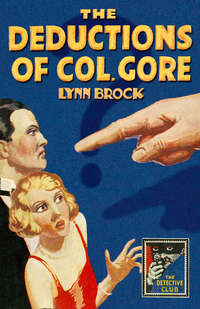
Kitabı oku: «The Deductions of Colonel Gore»
‘THE DETECTIVE STORY CLUB is a clearing house for the best detective and mystery stories chosen for you by a select committee of experts. Only the most ingenious crime stories will be published under the THE DETECTIVE STORY CLUB imprint. A special distinguishing stamp appears on the wrapper and title page of every THE DETECTIVE STORY CLUB book—the Man with the Gun. Always look for the Man with the Gun when buying a Crime book.’
Wm. Collins Sons & Co. Ltd., 1929
Now the Man with the Gun is back in this series of COLLINS CRIME CLUB reprints, and with him the chance to experience the classic books that influenced the Golden Age of crime fiction.

Copyright
COLLINS CRIME CLUB
An imprint of HarperCollinsPublishers Ltd
1 London Bridge Street
London SE1 9GF
www.harpercollins.co.uk
First published in Great Britain by
W. Collins Sons & Co. Ltd 1924
Published by The Detective Story Club Ltd 1930
‘Too Much Imagination’ published in Flynn’s magazine 1926
Introduction © Rob Reef 2018
Cover design © HarperCollinsPublishers Ltd 1930, 2018
Lynn Brock asserts the moral right to be identified as the author of this work.
A catalogue copy of this book is available from the British Library.
This novel is entirely a work of fiction. The names, characters and incidents portrayed in it are the work of the author’s imagination. Any resemblance to actual persons, living or dead, events or localities is entirely coincidental.
All rights reserved under International and Pan-American Copyright Conventions. By payment of the required fees, you have been granted the non-exclusive, non-transferable right to access and read the text of this e-book on screen. No part of this text may be reproduced, transmitted, down-loaded, decompiled, reverse engineered, or stored in or introduced into any information storage and retrieval system, in any form or by any means, whether electronic or mechanical, now known or hereinafter invented, without the express written permission of HarperCollins.
Source ISBN: 9780008283001
Ebook Edition © November 2018 ISBN: 9780008283018
Version: 2018-08-24
Contents
Cover
Title Page
Copyright
Introduction
Chapter I
Chapter II
Chapter III
Chapter IV
Chapter V
Chapter VI
Chapter VII
Chapter VIII
Chapter IX
Chapter X
Chapter XI
Chapter XII
Chapter XIII
Chapter XIV
Chapter XV
Chapter XVI
Chapter XVII
Chapter XVIII
Chapter XIX
Chapter XX
Chapter XXI
Chapter XXII
Chapter XXIII
Chapter XXIV
Chapter XXV
Chapter XXVI
Chapter XXVII
Chapter XXVIII
Too Much Imagination
Chapter I. Into the Net
Chapter II. Too Much to Swallow
Chapter III. The Note in her Hand
Chapter IV. Gore is Frank
Chapter V. Bloodstained Linen
Chapter VI. Arling Makes a Confession
Chapter VII. Tastes of a Secretary
Chapter VIII. Spain Waxes Vehement
Chapter IX. What Really Happened
Also by Lynn Brock
The Detective Story Club
About the Publisher
INTRODUCTION
ALEXANDER PATRICK MCALLISTER’S literary career had had a very promising start. Born in Dublin in 1877 and educated at Clongowes Wood College, he later obtained an Honours Degree at the Royal University and was appointed chief clerk shortly after the inception of the National University of Ireland. His stage plays Irene Wycherly (1906) and At the Barn (1912), both written under the pseudonym Anthony P. Wharton, became great successes both in London and on Broadway.
Following these two hits, McAllister continued to write, but none of his subsequent plays could revive his early fame. He and his wife Cicely moved from London to Guildford, where they were to run a pub called The Jolly Farmer, and at the age of 46 he wrote his first detective novel, The Deductions of Colonel Gore (1924), under the pseudonym Lynn Brock. By this time, his early fame as a playwright had faded and he appears to have turned his hand to crime fiction simply to improve his finances at a time when detective books had begun to outsell all others. Nevertheless, the book was sold to William Collins in the UK and Harper & Brothers in the US, and became so successful that ‘Lynn Brock’ lived on to publish thirteen detective novels, seven of which featured his titular hero-detective Colonel Wickham Gore.
Brock’s complex plots and witty style won the praise of many critics including Dorothy L. Sayers and S. S. Van Dine, and his mysteries were often reprinted and widely translated. Despite their fame, however, the novels slid into obscurity shortly after the end of the Second World War—unjustly, some might suggest. Several recent reviews have criticised his novels as cliché-studded, dull affairs overloaded with Golden Age formulas and stereotypes. These reviews have missed the point: Brock actually played his part in the creation of those classic detective fiction patterns now so familiar and dear to us. He wasn’t a mere imitator of the genre, but rather experimented with existing formulas long before they became formulaic.
Comparison with some of his fellow-writers shows that Brock was an ‘early bird’ in the genre. Colonel Gore took the stage three years before Sherlock Holmes’ last appearance in ‘The Adventure of Shoscombe Old Place’; he preceded the debut of S. S. Van Dine’s Philo Vance in The Benson Murder Case by two years, and Anthony Berkeley’s Roger Sheringham in The Layton Court Mystery, John Rhode’s Dr Priestley in The Paddington Mystery and Anthony Wynne’s Dr Hailey in The Mystery of the Evil Eye by one year. All these authors (and many more not mentioned here) established serial detectives in the fashion of the times, and Brock’s Colonel Gore appears to fit into this category remarkably well.
But was he really originally meant to be just another amateur detective with a military background like Philip MacDonald’s Anthony Gethryn, who made his debut in The Rasp the same year as Colonel Gore? It is reasonable to doubt that. Gore lacks too many of the typical characteristics of the traditional hero-detective. He is not a well-to-do super sleuth like Lord Peter Wimsey or Hercule Poirot. He has no profession that could help him solve crimes like the many doctors and scholars in the trade. He has no sidekick and no ally at Scotland Yard and, to cap it all, absolutely no talent for detecting! Gore makes mistakes. Many mistakes. In fact, he finds so many wrong solutions in The Deductions of Colonel Gore that the real solution ends up being the only one that is left.
T. S. Eliot called Gore ‘too stupid’. But he may have missed the parody in the title and the satirical undertones of Gore’s first adventure in his critique. The Deductions of Colonel Gore reminds one of Ronald A. Knox’s The Viaduct Murder (1925), where the four protagonists tumble from one wrong conclusion to the next trying to solve a murder on a golf course. Both books share the same tongue-in-cheek attitude towards the science of deduction and a tendency to spoof the methods of the great Sherlock Holmes. In fact, this similarity of approach suggests that Brock, like Knox, had intended to write a non-series book. Knox introduced a new detective in his next novel, The Three Taps (1927), whereas Brock—perhaps surprised by the success of his debut—elected for the security of continuing to develop his eponymous character. Colonel Gore’s Second Case (1925) shows Brock working to transform Gore into a sustainable serial protagonist, culminating in Gore finding a sidekick and, later in the series, establishing a detective agency in London. But all that is in the future.
Colonel Gore steps into his first adventure having just returned from Africa and looking forward to meeting many of his old friends. The story begins with a perfectly conventional dinner party. However, before the evening is over, ‘blackmail’ and ‘murder’ complete the guest list. These are not the only gruesome elements in the story. T. S. Eliot once mentioned the ‘extremely nasty people’ in Brock’s novels, and it is true that the author evokes a rather dark and pessimistic view of human nature. Nevertheless, The Deductions of Colonel Gore is a rip-roaring and, from today’s point of view, wonderfully old-fashioned mystery. It includes an archaic African murder weapon and a constantly confused detective who changes his mind about the possible culprit with each new clue he uncovers.
It is important to note that Brock’s stories contain some antiquated stereotypes of Jews and Africans. Such stereotypes would be intolerable in fiction written today, but were unfortunately not uncommon in the 1920s when these stories were published, and like similar writings of their era must be considered within their historical context.
The Deductions of Colonel Gore was reissued as Book 31 in Collins’ popular Detective Story Club in July 1930, and was joined by reprints of his second and third cases the following year. This new edition now includes for the first time the only published Colonel Gore short story, ‘Too Much Imagination’, which first appeared in Flynn’s weekly magazine on 30 January 1926. It follows Gore’s (by now more serious) deductions in a country house murder case. Connoisseurs of his adventures will be interested to note that the story appears to be a sketchy draft of Colonel Gore’s Third Case (1927, published in the USA as The Kink)—as well as the playful appearance of the author’s own home, The Jolly Farmer. It was in Guildford that McAllister wrote his first ‘Lynn Brock’ mystery and it is thus not surprising that most of his Colonel Gore adventures are set in or near Surrey.
In 1932, the innovative psychological novel Nightmare began a run of standalone books from Brock, although it was not quite the end for Gore: the Colonel returned after a break of ten years in his swan song, The Stoat: Colonel Gore’s Queerest Case (1940). Three years later, on 6 April 1943, Alexander Patrick McAllister died at the age of 66 at Herrison House, a hospital near the Dorset village of Charminster, ending a literary career very different from the one he had started, but no less successful for all that.
ROB REEF
February 2018
CHAPTER I
FOR just a moment following the sound of the door’s closing behind her husband’s entry Mrs Melhuish’s profile remained downbent in abstracted calculation to the bridge-block in her lap. A small forgetfulness, natural enough, perhaps, in a hostess’s last half-hour of anxiety before a duty dinner of importance. Yet, even twelve months ago, Sidney Melhuish remembered with passionate resentment, that absorbed, adorable little face would have flashed round, even in such an anxiety, in eager welcome to his coming. As they noted and weighed the momentary delay, his rather cold eyes hardened. Then, swiftly, they averted themselves. When Mrs Melhuish raised to him an expression of good-humoured perplexity, he was mildly absorbed in his finger-nails.
‘What a nuisance, Sidney. Mr Barrington has just rung up to say that Mrs Barrington can’t possibly come. Frightful earache, poor thing. I’ve been trying to work out my table. Do come and help me.’
Her air of charming, unruffled dismay was candour itself—beyond suspicion. And yet Melhuish was aware that for an instant as she spoke her smiling eyes had repeated once more the question they had asked of his so often of late. But of the hideous, the incredible suspicion that lurked behind it his clean-cut, gravely-smiling face betrayed no slightest hint as he moved behind her chair to inspect the much-altered plan of the dining-table which was drawn on the bridge-block.
For a moment or two they considered it in silence.
‘If I had had even another quarter of an hour’s notice—I know Beatrice Colethorpe would have stopped the gap for me. But even the amiable Beatrice would kick at a dinner-invitation of twenty minutes.’
She turned—Melhuish observed how instantly—as the door of the drawing-room reopened and Clegg announced the first of the evening’s guests.
‘Colonel Gore.’
No moment of feigned abstraction now—no summoning of her forces—no steadying of her nerves to meet his glance. Instead, a quick smile and gesture of vivid, frankest pleasure, in which his poisoned thought detected relief and eager escape from the danger of being alone with him.
Gore’s lean brown face reflected the cordiality of his hostess’s greeting, as she rose and went to meet him with outstretched hand.
‘“Early”, you commanded me. Therefore I have obeyed. Not too literally, I hope.’
Mrs Melhuish laughed as her hand slid into a clasp of fraternal heartiness.
‘Well, as you have kept us waiting for three years, I think we may acquit you of undue precipitation.’ She turned to her husband. ‘This, Sidney, is the one and only Wick.’
Gore’s twinkling gray eyes ran over his host in swift appraisement as they shook hands. In the four days for which he had been installed at the Riverside Hotel he had contrived to learn a good deal about Barbara Melhuish’s husband, and that swift, straight, shrewd glance of his assured him at once that his informants had not been mistaken. A bit frigid, Dr Sidney Melhuish—a bit solemn, perhaps—but one of the right sort. Steady, clean eyes—steady, clean mouth—plenty of jaw and chin. A man that knew his job and knew he knew it. He grinned his charming grin and took the hand of Pickles’s husband in a grip of steel. Thank the Lord, she hadn’t made a mess of it, as so many of the Old Lot had somehow contrived to do.
‘I know you very well by repute, Colonel Gore,’ Melhuish smiled cordially—few men could resist Wick Gore’s grin. ‘Indeed, it is only with the utmost difficulty, I assure you, that I refrain from addressing you as “Wick” straightaway.’
‘Why refrain?’ twinkled Gore. ‘Especially as I may confide to you that I have been in the habit of addressing your wife as “Pickles” since she was able to throw dolls and bottles and things at me out of a perambulator.’
‘Now, now,’ expostulated Mrs Melhuish. ‘No indiscretions, please.’
‘I apologise. I must remember that now I find you with a husband who believes not only that you are perfection, but that you always were.’
But his little pleasantry had somehow fallen flat, he perceived—as little pleasantries sometimes did. Melhuish, he divined, was a man to whom little pleasantries must be administered cautiously; no doubt, too, in three years of matrimony the light-hearted Pickles had acquired some of the seriousness of mind becoming to the wife of a rising physician.
‘I must get my table right. Do come and help me,’ said Mrs Melhuish hurriedly, returning to her diagram. ‘Mrs Barrington has developed bad earache and can’t come. We have just seven minutes to divide four women neatly and tactfully amongst five men. Let us concentrate our three powerful intellects. There—now I’ve drawn a nice new table. The blob at the top is Sidney.’
Gore glanced down at the first design, thus abandoned.
‘Barrington is coming then?’ he asked.
Mrs Melhuish nodded her golden head abstractedly.
‘Mrs Barrington insisted upon it, he said. Ah—I’ve got it.’ She scribbled some hasty initials. ‘There’s no help for it, Wick. You must divide Sylvia Arndale with Sir James. There—!
She held up her revised scheme for her husband’s consideration, and, when he had approved it with his grave smile, flitted from the room to superintend the rearrangement of her cards. It was nine years since Gore had seen her; but she had changed, he reflected, as he attended upon her exit, very little; if at all, for the better. Pickles must be just thirty now. Thirty … Extraordinary. His mind flashed back to the night of her coming-out dance—November, 1910. Twelve years ago—incredible. Ah, well—those days were done with, and the Pickles of them. With the faintest of sighs he turned to rejoin the lucky beggar who had, somehow, succeeded in capturing that airy miracle and putting it in charge of his socks and his servants and his dinner-parties. A good chap—a good-looking chap—a chap, perhaps, a tiny shade too old for her, but in every way plainly to the eye a chap to make her as happy and contented a wife as—well, as any intelligent wife was likely to be made.
‘You know most of the people who are coming to us this evening, Barbara assures me,’ said Melhuish.
‘All, I believe, except Barrington. I knew Mrs Barrington, of course, very well in the old days—when she was Miss Melville. She married just after the war, I think?’
‘Yes.’
A certain quality in the monosyllable attracted Gore’s attention.
‘Successfully, I hope? What part of the world does Barrington come from?’
‘Jamaica, I believe.’
Gore grinned.
‘Sounds like sugar. Money to money, I suppose. Always the way here in Linwood. Simply revolting the way it breeds in hereabouts. No chance whatever for the deserving poor, is there? I suppose old Melville came down with thirty or forty thousand at least?’ He sighed. ‘Lord—who wouldn’t be a son-in-law … in Linwood?’
For a moment Melhuish was absorbed in adjusting the rose shade of a light to his satisfaction.
‘As a matter of fact,’ he said, with that curious dryness of tone which his guest had already noticed, ‘I understand that the Melvilles disapproved of the marriage and made a very small settlement. Mr Barrington is a patient of mine—Mrs Barrington too, indeed. But I cannot claim what one would describe as an intimate acquaintance with either of them personally. My wife, no doubt, can tell you all about their affairs. As you are aware, of course, she and Mrs Barrington are very old friends—’
He paused. His smile was formally courteous, but unmistakably resolved to discuss Mrs Barrington and her husband in no further detail.
‘Right, my good man,’ reflected his insouciant guest, without resentment. ‘Keep your poker down your back if you think it makes you more impressive. A little bit sensitive, are you, because people are old friends of your wife’s and not of yours? Myself included, perhaps? Well, we’ve got to talk about something. Let’s try golf.’
But Melhuish, it became clear at once, regarded golf merely as an inducement to walk six miles on Sunday afternoon. Cheerfully Gore tried the by-election of the preceding week, fishing, the Panel System, and the Navy cuts. Mrs Melhuish returned to find the two men staring at the fire with the apparent conviction that in all the universe it alone held for them a common interest.
‘I did tell you, Wick, that Sir James Wellmore is our pièce de résistance this evening? Or did I? At any rate he is. We are awfully proud of him. He’s our show patient.’
‘You have met Sir James before, of course?’ Melhuish asked.
‘Once or twice—in the deplorably long ago—when he was not yet Sir James. When we were stationed out at Fieldbrook Barracks in nineteen-thirteen—just before we went to India—I remember he dined us and danced us and shot us in the most princely way. His first wife—she was still alive then—had, I recall, a penchant for the Services.’
Mrs Melhuish flashed a little teasing smile at him.
‘If I am not mistaken the present Lady Wellmore was addicted to the same pleasant vice in those days. Or was it the younger Miss Heathman who was the attraction?’
Gore’s teeth showed beneath his trim little wheaten moustache.
‘How happy could I have been with either,’ he laughed lightly. ‘I believe I did miss the chance of my lifetime then. Someone told me last night at the club that Angela Heathman’s income at present works out at just a shilling a minute. I’ve never stopped thinking about it since. If I hadn’t gone off so hopelessly, I—by Gad, I believe I’d chance my luck now.’
‘My dear Wick,’ laughed Mrs Melhuish, ‘Miss Heathman lives in the fourth dimension nowadays—or somewhere where there are better things than marriage and giving in marriage. Quite a difficult proposition, I should say, for a mercenary adventurer—even if he still has the smile of an angel and, still, no perceptible symptoms of a tum-tum.’
As their eyes met in smiling mutual approval, it seemed to Gore that nothing of their old camaraderie had faded, after all, in the passage of all those years. They had always looked at one another and chaffed one another just so, shrewdly yet with conviction of absolute understanding and sympathy, since the days when he had been a Harrovian of unusually misguided enterprise, and she the twinkling-legged bane of her nursemaid’s existence. It was pleasant to be back, if only for a little while, in one’s own country, and to find that one’s old place was still there, waiting for one. The chilling disillusionment that had invaded him steadily during the four days since his return was forgotten in a soothing content. From the radiant, piquant face of his hostess—smiling at him precisely as it had smiled at him twenty-five years before amongst the branches of forbidden apple-trees, with one eyebrow slightly higher than the other—his eyes turned to absorb the effect of the warmth and colour and dainty comfort of the big drawing-room that was her setting. And as they turned they met the eyes of her husband.
There was a moment of silence, and then Gore said, brightly, that it had looked quite like snow about five o’clock that afternoon. With that opinion the Melhuishs agreed, Mrs Melhuish with sparkling vivacity, her husband with considered conviction, as Clegg reappeared to announce the arrival of Mr and Mrs Arndale.
‘Good Lord,’ thought Gore, as he reared his graceful and admirably-tailored person from the most comfortable chair he had sat in for nine years. ‘The man thinks I’m an old flame of Pickles’s. I know he does. That’s why he has been watching me like a cat, is it? Fi-fi. Tut-tut. Pickles, Pickles … I hope I have not been mistaken in you?’
But no trace of these interior misgivings was visible as he shook hands with Cecil Arndale and his pretty, plump little wife. They, too, were part of the Old Days and the Old Lot—Sylvia Arndale and Barbara Melhuish were first cousins, and Cecil Arndale and he had been at Harrow together, though nearly three years separated them—and their pleasure at the meeting was as manifest as his own. In sixty seconds Mrs Arndale had reproached him for calling on two afternoons on which she had been out, informed him that she had made fifteen people buy his book, and secured him for dinner next day and a dance in the following week.
‘I went to see your film twice,’ she pouted, ‘and there you were, standing with hundreds and dozens of dead antelopes and things stacked all around you—and I never got as much as tsetse-fly’s whisker out of the lot. I shall never forget that you sent Barbara all those lovely stickers and beads and things as a wedding-present, and forgot me—me, who was once more than a sister to you—absolutely. Never, never.’
‘My dear Roly-Poly,’ grinned Gore placidly, ‘you forget that I sent you a very beautiful and costly flower-bowl when you were entitled to a wedding-present—which was, pray recollect, four years before I became a movie-star—’
‘For Heaven’s sake,’ cried Mrs Arndale, ‘don’t remind me how long I’ve been married to Cecil. It’s not fair to him, poor dear. It embitters me so, and he has a perfectly ghastly time when I’m embittered.’
Cecil Arndale laughed—a little foolishly, as he had always laughed, his rather prominent blue eyes glistening slightly in his large, brick-red face. He had grown fat, Gore observed—much too fat for a man of thirty-nine—and his fatness accentuated that slight weakness of mouth and chin that had always marred his good-humoured, healthy, conventional good looks. His laugh faded again instantly into abstraction; his blue eyes stared vacantly across the room, while his lips twisted and puckered and smoothed themselves out again restlessly. Too much food, Gore conjectured—altogether too much drink—too much money—too easy a life of it. Poor old Cecil. He had always threatened to go soft. With some little difficulty Gore suppressed the recollection that this hefty, healthy six-footer had spent the war in England, and, incidentally, doubled during it the fortune which he had inherited from his father. Well, someone had had to stay at home and build ships. Besides, Arndale had married in 1915. And anyhow all that was his own affair. Gore, who had been through the business from start to finish, was not disposed to overrate the advantages to be derived from that experience. He wondered a little, none the less, just what the plump, outspoken little Roly-Poly had thought, privately, of her spouse’s devotion to his business—say, in March, 1918.
‘How’s your brother?’ he asked her. ‘I fancied I caught a glimpse of a face that might have been his—brought up to date—passing me on the Promenade in a most vicious-looking two-seater. But I haven’t run into him yet, end-on, so to speak—’
‘Bertie? He lives just beside you. You’re staying at the Riverside, aren’t you? He has a flat in Selkirk Place at present—just across the way … at the other side of the Green. Number 73. You’ll find him there any morning up to lunch-time in bed.’
‘Still unattached?’
‘We hope so.’
‘What does he do all day?’
Mrs Arndale shrugged her pretty shoulders.
‘He plays a good deal of golf, I believe—races a good deal—hunts a little. If he happens not to be away, and if it’s too wet to do anything else, he runs down to the Yard in his car, smokes a cigarette, and runs back to change. I have calculated that on an average Bertie changes seven times a day.’
‘Oh, then he’s attached to the Yard now, is he?’
‘Cecil says so. I suppose Cecil knows. It’s his Yard.’
Arndale came out of his abstracted silence for a moment.
‘Bertie’s all right,’ he said. ‘Bit of an ass about women, that’s all.’
‘We all are, thank Heaven,’ smiled Gore—‘er … until we’re forty … or … er … thirty-nine.’
Arndale’s eyes regarded him blankly.
‘Eh? Thirty-nine? No. Bertie’s nothing like that …’ With a visible effort he concentrated upon his calculation. ‘Bertie’s thirty—or thirty-one. Why, hang it, old chap—I’m thirty-nine.’
He smiled vaguely and strolled away. Gore caught his wife’s eye.
‘What’s the trouble, Roly-Poly?’ he asked bluntly.
She shrugged.
‘Heaven knows. Cecil’s always like that now … I’m frightfully worried about it, really. It’s not money, I know. We’re simply revoltingly well-off … It’s some sort of blight … something mental.’ She smiled wryly. ‘Sometimes I think it’s I who am responsible for it … of course I’ve always known that I’m not the right person … And yet we get on quite well … He’s quite fond of me, really, in his way … Oh, don’t let us talk about it any more. Let’s talk about you. It’s so absolutely ripping to see your old phiz again, Wick.’
As she patted his arm with a little impulsive gesture the door reopened and Clegg announced the guests of honour.
‘Sir James and Lady Wellmore and Miss Heathman.’
While the Melhuishs chatted for a moment with the new arrivals Gore took stock of them with something like dismay. Wellmore, whom he remembered as a brisk, cheerful, keen-eyed middle-aged man, looked now every day of a tired, peevish, short-sighted sixty-five. Lady Wellmore—could that large-bosomed, broad-hipped, triple-chinned woman be the Phyllis Heathman of the old days? And that sallow, weary-eyed, bony-necked female with the nervously-flickering smile—could that be the once really quite pretty Angela? Good Lord.
His hostess’s voice claimed his attention.
‘You have met Colonel Gore before, Sir James, I think.’
Wellmore’s tired eyes rested on the younger man’s face perfunctorily, as he allowed his flabby, damp hand to be shaken.
‘Yes,’ he said briefly, ‘I remember you. Nineteen-thirteen. You were stationed at Fieldbrook Barracks. In the Westshires. One of the prettiest shots I ever saw. Been in Africa, haven’t you? Wonder you didn’t stay there instead of coming back to this filthy climate. My wife has your book. But I’ve no time to read books. Never had.’
He passed on towards the fireplace and bent to warm his hands at the cheerful blaze wearily, his back to the room. Chairman of the United Tobacco Company—owner of three millions—master of six thousand lives—he could afford to dispense with ceremony.
But Lady Wellmore was graciousness itself. She had simply revelled in his book—especially the parts about the pigmies—she considered the parts about the pigmies perfectly fascinating. And the film—perfectly wonderful. She had been absolutely thrilled when dear Barbara had told her that she was to meet him again that night. She rounded him up in a cul-de-sac formed by a small table, two chairs, the flank of the big piano, and her sister.
‘Angela, have you forgotten Colonel Gore? He has been regarding you with the most reproachful of eyes.’
Angela Heathman smiled nervously and held out a languid hand. At close quarters the sallow, haggard weariness of her face, with its drawn lips and shadowed eyes, was still more noticeable. Beside her sister’s florid exuberance her faded thinness was accentuated painfully. Her smile faded, her eyes looked beyond him in brooding abstraction. She said nothing—withdrew her hand listlessly, and appeared to have forgotten the existence of the people who surrounded her.
‘Nerves, poor thing,’ Gore reflected. ‘Another of ’em that doesn’t know why she was born.’
As a silvery-toned clock somewhere in the room chimed eight fleetly, Clegg announced the last guest.
‘Mr Barrington.’
For a moment the hum of voices died. The man who had entered surveyed the occupants of the room with smiling composure as he moved towards his hostess.
‘My wife has charged me with the most abject of apologies, Mrs Melhuish. She had hoped until the last moment to be able to come.’
‘We are so sorry,’ Mrs Melhuish assured him. ‘But it would have been folly for her to have ventured out on an evening like this. Of all afflictions in the world, I can imagine none worse than earache.’
‘Dreadful. Quite dreadful,’ Barrington agreed. He included Melhuish in his smile. ‘However, she has retired to bed with a large supply of aspirin tabloids at hand … How are you, doctor? Worked to death, I suppose, as usual? I see you rushing about in that big car of yours from morning to night. Lot of sickness about, isn’t there?’
‘Yes,’ said Melhuish simply.
Not a brilliant conversationalist, Dr Sidney Melhuish, Gore reflected—an exceedingly dry stick indeed. No one could suspect him of shyness or nervousness; his clean-cut face was as cool as a chunk of ice. Just one of those men who just didn’t want to talk most of the time and wouldn’t. Grim-looking chap, when his mouth set. Sort of chap that would look at your tongue and tell you you had six months to live and touch the bell for his man to show you out. Poor Pickles … What sparkling conjugal tête-à-têtes …
And yet, a moment later, when Melhuish crossed the room, Gore caught a glimpse of another man—a man whose kind, wise eyes and almost boyish sincerity and simplicity of manner and gesture brought a faint flush of animation to Angela Heathman’s apathetic face as he smiled at her. No doubt she, too, was a patient of his. For that matter, as far as Gore had been able to discover, everybody in Linwood was, though it was only four years or so, he had learned, since Melhuish had purchased an old and decaying practice and installed himself in that most conservative of Westmouth’s suburbs, a stranger and an interloper. True, he had brought with him from Bath, where he had been in practice for several years before the war, a reputation for brilliance, especially in heart cases. But Gore knew the stiff reserve and suspicion of Linwood too well to believe that a reputation for anything in the world acquired, anywhere else in the world could influence it in the least. Something—something which no doubt Pickles had found out for herself—there must be in this difficult husband of hers that was not vouchsafed to the common or garden general practitioner … Something, for instance, that had been able to win for him not merely the patronage but the friendship of a man like James Wellmore, whose sole standard of judgment was value for his money.
His eyes returned to the shrivelled, peevish face of the tobacco magnate, bent obstinately on the fire, its underlip protruding sulkily as he listened to something which Barrington was saying to him. There was no trace of affection, paternal or otherwise, in his expression just then. Indeed as Barrington moved away from him towards Mrs Melhuish, Wellmore turned to look after him with an unmistakable scowl until, detecting Gore’s interest in him, he switched his erring gaze back to the fire once more.
‘I have succeeded in finding that cutting for you, Mr Barrington,’ said Mrs Melhuish.
‘How kind of you to have remembered,’ replied Barrington, displaying his small, even teeth in a smile of open admiration. He was an extraordinarily handsome man, Gore admitted ungrudgingly—quite the handsomest man he had seen for some time—with some quality of charm that lay deeper than the perhaps slightly theatrical effect of his dark aquilinity and reckless gray eyes. Thirty-five at most, broad-shouldered, slim-flanked, easily—a little too easily, perhaps—sure of himself, he was one of those men at whom no woman could look without interest or without the awakening of her oldest and strongest instinct. Already Gore had noticed with amusement that, as he moved across the room to his hostess, the regards of the other three women had followed him with a speculative intentness. And that the charms of this smiling Adonis were not lost upon Mrs Melhuish herself was no less evident. Her colour had brightened beneath the flattery of his look; her poise and intonation as she spoke to him were tinged with the subtle challenge of her sex—the indefinable yet unmistakable blending of defiance and invitation that—by a cynic as hardened as Wick Gore—could be taken for nothing but … well, what any chap with two eyes in his head would take it for. Miss Pickles hadn’t changed all her spots, then—for all the rash vows of holy matrimony. Still a flash of colour and a sparkling eye for an agreeable-looking young fellah. She had always preferred ’em dark … and a bit hooky about the beak.
‘I put it down somewhere,’ said Mrs Melhuish, glancing about her. ‘Now … where …? Oh, yes. I remember.’
She moved to the piano, and picked up an envelope that lay on some music. Barrington took the envelope from her smilingly, opened it, glanced casually at the newspaper cutting which it contained.
‘Thanks so much,’ he said, as he replaced the cutting and put the envelope away in a pocket. ‘As a matter of fact I had rather thought of running up to look at another shoot in that part of Wiltshire this week.’
‘Really?’
Mrs Melhuish’s colour had forsaken her now. Her eyes consulted with anxiety the little Sèvres clock on the table beside Gore, rose to his brown, hard profile, and rested there for a moment warily. He stood but an arm’s-length from her; but he was listening with the most flattering of attention to Lady Wellmore’s views upon the sinister aims of Labour. The slightest movement of her golden head showed her her husband and Sylvia Arndale grouped by the big chair near the fire into which Wellmore had subsided with a yawn. At the other side of the room Arndale struggled feebly with Miss Heathman’s vague-eyed listlessness, pausing between each laborious effort to regard a water-colour above her head vacantly. Mrs Melhuish’s hand strayed to a bowl of chrysanthemums by the piano, touched a great gold and russet bloom caressingly.
‘If the door is shut, go away,’ she said softly—almost inaudibly. ‘I may not be able to manage tonight. I will ring you up tomorrow at eleven if not.’
Barrington bent to examine the gorgeous blossom.
‘It will be open,’ he smiled.
His reckless eyes dwelt in hers victoriously for an instant. As she turned to introduce him to Gore, Clegg appeared once more, slightly flushed and seven minutes late.
‘Dinner is served, madam.’
CHAPTER II
IT was, it appeared, Sir James Wellmore’s inviolable rule to get out of his bed at seven o’clock and get into it again before midnight, and at half-past eleven he and Lady Wellmore departed in an immense limousine. Miss Heathman, silent and vague-eyed to the last, accompanied them; the big house on the Promenade of which she was the capricious mistress, lay on the Wellmores’ homeward way across the Downs to their palatial mansion at Bishops Leaze. The Arndales had gone away before eleven o’clock hurriedly, disturbed by a telephone-message requiring, Gore presumed, Mrs Arndale’s immediate return to some urgent trouble of the baby, with details of whose incredible brilliancy of intellect and beauty of form she had regaled him at intervals during dinner. It was twenty minutes to twelve when he and Barrington made their adieux to Mrs Melhuish and went down the stairs accompanied by their host.
As Clegg helped him into his overcoat, in the hall, Gore glanced at the artistically-arranged trophy which occupied the wall space between the hall door and the door of the dining-room. His wedding present made, he reflected, quite a decent display, the two befeathered Masai head-dresses and the scarlet-and-ochre magic-mask forming an effective centre to the design. The shaft of one of the Wambulu spears had developed some mysterious breed of worm some months after its arrival, Melhuish told him, and had been replaced by a new one.
‘Hope your maids aren’t curious about cutlery, doctor,’ Gore grinned, as he accepted a light for his cigarette. ‘I mean—those hunting spears are probably quite safe. But those little arrows—and the knives—Well, I think I inserted lavish warnings in the packing-cases. I hope I did.’
Barrington fitted a cigarette into a long amber holder.
‘What?’ he asked. ‘Bad medicine, are they?’
‘Possibly very nasty indeed,’ said Gore—‘some of them.’ He touched the beaded sheaths of two small knives, crossed to form the lower point of the trophy. ‘These two little brutes, for instance … I shouldn’t mind betting that if you were thoughtless enough to scratch yourself with one of these—even after three years—something exceedingly unpleasant would happen you in the next few minutes. I’ve actually seen a poor beggar die in less than two minutes from a prick of one of those little throwing-knives … Die most untidily, too.’
‘What’s the poison?’ asked Melhuish, with professional interest. ‘I remember now that my wife did say something about the cautions you sent her. But I’m afraid we had both forgotten all about them.’
‘It’s a root called “nmakato.” Not in the B.P., I rather fancy, doctor. We didn’t succeed in seeing the root itself. As a matter of fact, the old witch-doctors who distill the stuff are rather reticent about little trade-secrets of that sort. I saw the flowers of the thing, though—yellow—not unlike our gorse, both to look at and to smell. They use the flowers to make wreaths for their young women when they retire into seclusion to think over the joys of matrimony for a month or so before they plunge into them.’
He held out his hand. ‘Well, we shall meet again, doctor, no doubt.’
‘You haven’t decided yet how long you’ll stay in Linwood?’
‘Some weeks, at any rate, I hope. Good-night.’
‘You coming my way, Colonel?’ Barrington asked, as the hall door opened to let them out into the foggy dampness of the November night.
‘I’m at the Riverside,’ Gore replied. ‘Just across the way.’
‘Oh.’
Barrington turned to his host.
‘Good-night, doctor. I shall run in and see you tomorrow or next day. I’ve been sleeping a lot better since I cut tobacco right out. But I still get those nasty twinges …’
Melhuish nodded gravely.
‘Come and see me. I hope you’ll find Mrs Barrington’s earache better when you get back. Please tell her how sorry we were that she was unable to come.’
‘I will. Good-night.’
‘Good-night.’
The two departing guests sauntered side by side for a few yards, chatting desultorily until their paths diverged—Gore’s towards the hotel, the lights of whose upper windows were visible through the branches of the trees in the Green, his companion’s along the deserted vista of Aberdeen Place, at the end of which the Corinthian façade of the club rose palely in the glare of the arc-lamps in the Mall.
‘My old heart’s worrying me a bit,’ Barrington explained. ‘I’ve had to cut out most of the joys of life—temporarily, at any rate.’
Gore murmured sympathetically.
‘Bad luck. You’re in good hands, though.’
‘Melhuish’s? None better. You a bridge player?’
‘Incurable.’
‘Then I expect I shall run into you at the club.’
‘I expect so. Remember me to your wife, won’t you? She and I are very old friends.’
‘Indeed? She’ll be delighted so see you any afternoon you care to run in. Hatfield Place—Number 27. Don’t forget.’
‘Twenty-seven. Many thanks. Good-night.’
‘Good-night, Colonel.’
The two parallel rows of tall houses which formed Aberdeen Place and Selkirk Place respectively faced one another, at the distance of a long stone’s-throw, across the Green—a pleasant strip of ornamental garden enclosed by railings for the exclusive use of residents, and running the entire length from Albemarle Hill at the western end to the Mall at the eastern. For convenience’ sake two transverse passages of roadway divided the Green into three detached sections, roughly equal in length. Gore’s path from the Melhuish’s house to the back entrance to the Riverside Hotel—the front entrance was in Albemarle Hill, overlooking the river—lay along one of these two cross passages, and when he had parted from his fellow-guest, therefore, a very few steps interposed between him and Barrington the railings of the middle section of the Green and the shrubs and trees which formed, inside the railings, the ornamental border of the garden. Happening to glance backwards, however, for no more particular reason than that his ears had informed him that the retreating sound of his late companion’s footsteps on the pathway had ceased abruptly, he caught a glimpse of Barrington halted beneath a lamp, facing another man—taller, and wearing a light-coloured raincoat—the sound of whose voice, raised, it seemed to Gore angrily, reached his ears indistinctly during the instant for which he slackened pace to look back. Afterwards he recalled that in that brief instant he had wondered a little from where that taller, raincoated figure had emerged; since, while he had lingered chatting with Barrington not a soul had been in sight in Aberdeen Place against the glare of the Mall. He was to recall, too, that something in the build and size of the second man had suggested Cecil Arndale vaguely—but just how vaguely or how accurately he was afterwards quite unable to weigh. These particular speculations, to which at the moment he attached no importance of any kind, were destined subsequently to assume one of very serious concern to him. For, in fact, as it proved, that hurried, careless, backward view of Barrington, partially blocked out by the laurels, yet unmistakable, was the last he was to see of him alive.

He went on his way, turning left-hand as he reached the roadway of Selkirk Place, which terminated in a cul-de-sac at the pillared gates admitting to the grounds of the Riverside. Beside the gates a three-storied red-brick building, comprising a retail-bar on the ground floor with some living-rooms used by the staff above, formed the rear of the hotel, connected with the main block facing the river by the annexe in which Gore’s suite lay. The bar, a discreetly-managed, quiet little place, unexpected in that exclusive residential quarter of the suburb, catered principally, Gore surmised, for a regular little clientèle of chauffeurs and coachmen from Selkirk Lane. The lane which branched off northwards from Selkirk Place at its doors was bordered by stables, most of them now converted into garages, and provided, no doubt, a considerable number of such customers.
But at that hour the bar had long closed its doors for the night; the wan illumination of an arc-lamp suspended above its portals accentuated its effect of cold inhospitality. One window of the seven that looked up Selkirk Place was still, however, lighted up. A shadow moved across the yellow blind as he passed—possibly the shadow of the tawny-haired Hebe who presided over the bar, and of whom Gore had caught glimpses as she went to and fro across the annexe between her domain and the main building of the hotel. Rather a pretty little thing, he had noticed, if somewhat excessively embellished; not too severe, either, to refuse a smile in return to his ‘Good-morning’ or ‘Good-afternoon.’ Betty, he had gathered, was her name—Betty Rodney. Rather a pretty name. He yawned, crossed the grounds, and was admitted into the annexe by the night porter.
‘I want to get a couple of letters off in half an hour or so,’ he said, when the man had roused his sitting-room fire, ‘if you’ll leave the door into the gardens open for me, I’ll stroll up myself and drop them into the box in Selkirk Place, when I’ve written them.’
Left alone, he manufactured himself a modest whisky-and-soda and seated himself to compose with its aid and that of a very terrible pipe, applications for two vacant positions for either of which, it seemed to him, he might hope to be considered as eligible as the next fellow. One was the secretaryship to a small London club devoted to the consolation of the Very Poor of the Services; the other the secretaryship of a golf club in Hampshire. A cheerful fire glowed and crackled soothingly; there was no other sound to disturb his efforts at ingratiating composition. Presently he finished his drink, knocked the ashes out of his pipe, refilled it, and slewed round in his chair to regard the fire-irons thoughtfully. On the uppermost page of his writing block the words—
‘RIVERSIDE, HOTEL,
‘LINWOOD, WESTMOUTH.
‘Nov. 6, 1922.
‘GENTLEMEN,—’
lay reproachful and forgotten.
‘If the door is shut, go away. I may not be able to manage tonight. I will ring you up tomorrow at eleven if not.’
That was what she had said, furtively, nervously, under cover of the clumsiest interest in the chrysanthemums. And Barrington, as cool and cocksure as be-dam, had said, ‘It will be open.’
What door? When was it to open? What the devil did it mean?
What the devil could it mean? Was it possible that, in her own house—under her husband’s very nose, Pickles—the Pickles whose image, idealised, no doubt, in parts, yet always extraordinarily vivid, had cheered him and bucked him up and made him feel a bit better in even the darkest hours of the past nine years—was it possible that she was playing the rotten, silly old game—carrying on with that sleek-headed— Gore’s private surmise used at that point an epithet of Anglo-Saxon vigour which it instantly deprecated. No. The thing was incredible.
Incredible—unthinkable. A bit of a flirtation, perhaps—perhaps not even that. He drew a breath of relief to find his loyalty to the Pickles of the old days still staunch enough to hold her clear in the face of any suspicion, however insidious.
Straight as a die she had always been—in everything. It wasn’t possible that she could have changed—could have become one of those treacherous, loathsome little cats whose exploits filled the papers nowadays. There was some quite simple explanation of that remark of hers about the door. There must be. It was pretty rotten of him to have believed anything else for a moment, he told himself—the sort of thing one might expect from some half-baked young cub eager to sniff out filth in every corner. He turned, rather peevishly, in his chair, took up his pen, dipped it in ink, and resumed his correspondence with determination.
The son, the grandson, and the great-grandson of soldiers, he had found himself at his father’s death a subaltern in his father’s old regiment, with exactly two hundred a year in addition to his pay. To most people, since the average income of the men in the Westshires was some ten times that amount, such a position would have appeared embarrassing. He had contrived, however, to endure it with fortitude, aided by a practically imperturbable smile, a useful dexterity in all sports and pastimes beloved of youth, and a quite special brilliancy as a polo-player—an amusement which he had pursued, unavoidably, on other people’s ponies for the greater part, but to the great glory of the Westshires. In the year 1912–13, the year in which he had obtained his company, he had been, with one unpublished reservation, as blithe and contented a young man as was to be discovered in the length of the Army List. The reservation was Miss Barbara Letchworth—better known to her intimates as Pickles. But of that fact Wick Gore took very great pains to ensure that neither she nor anyone else should have the slightest inkling. To the day in 1913, when he went out to drink three cups of tea and eat eleven sandwiches and take a cheerful farewell of Miss Letchworth—then one-and-twenty or thereabouts and horribly sweet in cool, fluffy, summer things—preparatory to his departure to India, that extremely intelligent young woman had no faintest suspicion that night and morn for three whole years past he had cursed, for her sake, the day on which he had been born—born, at all events, to two hundred a year in addition to his pay.
From India the battalion had gone, very abruptly, to France in 1914. In the course of the following four years Pickles had written quite a number of charming letters to Captain, Major, and Lieutenant-Colonel Gore successively, accompanied by superior brands of cigarettes and sundry strange garments, each of which he had worn solemnly at least once. A year on the Rhine had completed his military career. Chance had thrown in his way an offer to form a member of an expedition to Central Africa; he had accepted the offer eagerly, sent in his papers, and disappeared for two years. A pleasant twelve months in Rhodesia, where his book—the record of the expedition’s adventures and discoveries—had been written, had induced him to consider seriously the project of settling there permanently.
But at that point a childless and long-widowed aunt had chosen to die and leave for distribution amongst a horde of nephews and nieces a very considerable portion of the money which her husband had extracted from a small colliery in the north. Gore’s share in this good fortune, long despaired of, had amounted on final examination, to an income of three hundred and fifty pounds a year. Two days after his forty-second birthday he had landed in England, spent a week interviewing solicitors and tailors and such things, and, bored to extinction by a London which seemed to him entirely populated by Jews, had fled westwards in search of such of his kith and kin as still survived.
The Riverside Hotel had commended itself to him as a headquarters for various reasons. Its advantages for that purpose had been in no way discounted by the fact that the entrance to the very comfortable private suite with which the management provided him lay within just one minute’s walk from a certain hall door in Aberdeen Place which bore the plate of Dr Sidney Melhuish.
On the very afternoon of his arrival in Linwood, as he returned along Aberdeen Place to the hotel, he had caught a glimpse of a slim figure in moleskins as it disappeared through that hall door. A quite amusing acceleration of his heart-beat had been perceptible for some moments. The same amusing symptom had manifested itself when next morning he had rung up Mrs Melhuish from the Riverside and heard, for the first time for nine years, her voice say, ‘Yes?’ He had found the operation of breathing troublesome for an instant—an instant so long that she had added: ‘Who is speaking, please?’ Quite amusing. Especially in view of her placidity when at length—after nine years—he had replied, a little curtly, ‘Gore.’
There had been a silence, and then a calm, unsurprised ‘Gracious. Why, you said you were going to stay in Rhodesia for ever and ever.’
And then:
‘I’m so sorry. But my husband has just come in for lunch. I must fly. Can you ring me up this evening … about seven? I shall be—’
And then, of course, after nine years, the exchange had cut off.
But her invitation to dinner had made up a good deal for that first flat disappointment.
‘Do come early, like a dear,’ she had said. ‘We want to have you to ourselves for a few minutes. Sidney is pining to meet you. You’ll love him. He’s just the darlingest old thing in the world.’
He recalled now exactly the inflection of her voice as she had said that—
With fresh determination he dipped his pen once more in ink and after the word ‘Gentlemen’ wrote the words, ‘I beg to apply—’
It was then five minutes to one.
It was twenty-five minutes past one when he stamped his two letters. He slipped into an overcoat, and let himself out into the chill clamminess of the fog. The pillar-box for which he was bound lay half-way along Selkirk Place, a couple of hundred yards from the back entrance to the Riverside. At the gates he paused for a moment to light a cigarette, and observed that the window above the bar was still illuminated. As his eyes rested on it, the yellow blind was drawn a little aside, and someone feminine—the tawny-haired Miss Betty Rodney, he presumed—was visible for a moment, peeping down at him.
No doubt Miss Rodney’s attention had been attracted by the halting of his footsteps beneath her window at that hour. He went on his way towards the pillar-box, reflecting, perhaps not entirely originally, that in general and in particular women were curious things.
Ücretsiz ön izlemeyi tamamladınız.