Kitabı oku: «The New English Kitchen: Changing the Way You Shop, Cook and Eat»
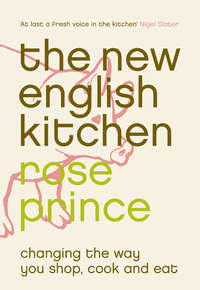
the new english kitchen
changing the way you shop, cook and eat
rose prince

to dominic
contents
cover
title page
praise
dedication
introduction
part one
1: bread and flour
2: store
3: stock
4: poultry
5: beef, pork and lamb
6: game and wild meat
part two
7: fish and shellfish
8: gluts of fruit and vegetables
9: eggs
10: dairy
shopping guide
index
acknowledgements
keep reading
about the author
copyright
about the publisher
introduction
When you eat a langoustine, it gives you a present of its shell. Take that shell, toast it in a pan with some others, then boil in water – and you have a broth. That broth becomes one to pour over rice noodles with spices … You bought something good for a meal and it gave you two things good.
This simple idea not only enables you to eat well – twice – but is also a solution to the contemporary kitchen dilemma: how to make better-quality food something everyone can eat every day. This is possible not only through clever recycling – making, say, roast chicken leftovers into stock and so bringing to the table a second dish of risotto plus a third of smooth vegetable soup – but also by finding economical ways of buying the best, such as buying direct from farms using home delivery, or scouting vegetable stalls for good deals on seasonally abundant vegetables.
The New English Kitchen was born of a furious determination to connect the paths of two parallel stories. The first is a happy tale of lovely food, made using good recipes created by television chefs. It has been hard to ignore the cookery boom in all its guises. Up front, the message is all-embracing: consume, and choose what you want; it is all there in the lifestyle pages of the weekend supplements for the taking, cooking and eating.
The second story is unsettling. Looking regularly at the daily papers, it is clear that there is something wrong: the food chain is in crisis. Resources have buckled under consumer and retailer pressure to produce cheap food. Unpleasant stories emerge about food-related diseases in livestock and humans; UK farming faces financial ruin, the global market unfair, food is adulterated with chemicals and a growing number of children so unhealthy due to overeating fatty, sugary food that their parents may well outlive them. Rarely does a week pass without headlines reporting more trouble in the food industry.
Flick back to the recipe feature in the magazine – and to be quite frank you could be on another planet. Enjoy! Chargrill some more tiger prawns – to hell with the devastating effect warm-water prawn farming has had on the mangrove forests! Teriyaki another chicken breast – never mind where it comes from!
But beyond the headlines, there is a fledgling army of farmers, food producers, campaigners and food writers who are giving food and cookery back their integrity. More vital still is the consumer who wants to buy the best in order to eat well every day. This book is for you. It will help your good intentions into practical reality, proving that sustained good eating need not use up all your money and time.
The New English Kitchen’s philosophy could equally be applied in Scotland, Wales, Ireland, the United States of America, Australia and Canada. It already exists in many European countries where the culture of home cooking has not faltered over the generations in the way that it has here. Focusing on English food was not an attempt to narrow the style but to broaden it, taking on the incredible variety of foods available in this province. True English food has always gone far beyond the Mrs Beeton concept of plain food economically produced. The national cuisine may be fossilised in people’s minds as pies, roasts and nursery puddings, but there is now no reason why it could not include the rice noodle dishes of Southeast Asia or the delicious food of the Mediterranean. This is after all a country with a five-hundred-year-old history of food piracy: borrowing ideas from other shores, importing their raw materials and learning to cultivate them in our own soil, or rear new animal species on our pastures.
Then there is the impact of the last 50 years’ food writing tradition. Without the great, inspirational books of those very English writers, Constance Spry, Elizabeth David and Jane Grigson, the good food renaissance would have been snail-pace slow. Multiculturalism and affordable worldwide travel have conspired to make English food in the 21st century more interesting still. So among the recipes in The New English Kitchen you will find pilaffs and soufflés, noodle soups and pasta dishes. They have every right to be considered as English as beef and Dover sole. There is one proviso: as far as possible, all the recipes must make use of UK-grown ingredients.
UK specialist and artisan food producers face a tough future, and in England the situation is uniquely difficult. I work in London but escape to a rented cottage in the West Country whenever possible. Bridging both worlds, urban and rural, has been insightful; essential to both my research and to the formation of the New English Kitchen concept. The English rural vote is small – and it affects the future of the food produced in the countryside. Small-scale farmers have often described as plain hostile the attitude of our authorities towards them. Enterprise is threatened constantly by both overseas competition and the crippling cost of the regulatory regime imposed on the food industry. Loyalty to the best that the country can produce will go a long way to help protect artisan food from extinction. Inside every shopper’s wallet is power, no matter how large or small the amount.
There is much to take in. The commitment needed means a little sacrifice and asks that you take on more responsibility. My book won’t solve every problem; indeed, confronting some of the information on its pages will add to your troubles and concern. Much of the methodology is easy to carry out but no, it won’t make life easier. It will make it very different, though, because the idea is to empower you. A new enjoyment will creep into each day, infecting everyone in your home, literally engraving good aromas on to minds. The New English Kitchen is my own kitchen; these are my experiences with food, grasped at ground level through my work and in my home – now it’s over to you.
part one
the chapters that follow feature foods that are especially suitable to roll into several meals. bread, stock, store vegetables, grains and pulses, poultry, meat and game are flexible enough to adapt for many uses.
1 bread and flour
Bread can pull off a feat that few cooked foods are capable of: as it matures, it develops new and interesting uses. In other words, it ages gracefully. Once past its sandwich era, older bread fits easily into simple recipes: it lies beneath radiant vegetable broths, turns up in a bread, red wine and onion soup, blends smoothly into a clove-infused sauce, and can be sweetly saturated by a creamy, eggy custard with spices and fruit. There’s always toast, too, an edible plate for favourite things. The bread that can do all this is not sliced and wrapped, sometimes costing little more than a first-class stamp, but made in the slower tradition. This bread has real integrity but it costs a bit more – which is why it is worth knowing how to use it as it ages.
The life of a good loaf of bread could unfold in the following way. On day one, it is as fresh as can be, the interior deliciously elastic and the crust crisp as an eggshell. A day or two later the crumb begins to dry, the crust to soften, and it’s good for toast. Toast brushed with flavoured oil, then topped with salad leaves and soft fresh cheese; toast with creamy scrambled egg and marinated fish; or, best of all, toast spread with real beef dripping from yesterday’s roast. Next day, put a slice of the now drying bread into a bowl and ladle over some vegetable broth. Or, if you are having a supper party, you might use the bread to make a toffee pudding or a fruit charlotte. By the end of the week, anything left from the loaf can be made into breadcrumbs. Eat them spiked with lemon zest beside roast poultry or game; mix them with garlic, herbs and olive oil for stuffing vegetables; or store them in the freezer for bread sauce. By now, I think it would be safe to say your loaf has earned its keep. You bought it to make a sandwich and it has contributed to at least four meals.
The economics of bread have an interesting pattern. A loaf of sliced, wrapped bread costs about 50 pence – although supermarket price wars have seen it drop down to 20 pence as a ‘loss leader’. Better-grade, high-street-baked sliced white costs about £1. Handmade traditional bread is twice that, at around £2, but a loaf made at home with best-quality flour costs about 50 pence – again.
This leaves two choices: buy better, more expensive bread and learn how to reap more from it – as the recipes in this chapter will show – or bake bread at home and spend no more than usual. Obviously there’s yet more to gain from baking your own bread and letting it earn its keep as it ages. I look at it this way: the time investment made when baking bread at home rewards you financially, leaving you more money to spend on other things. Having said that, it occurs to me that it is in fact quicker to make good bread than to go off and seek it out. Bread machines have made it easier still for busy people. But, putting the economics to one side, you can take real satisfaction in the fact that the bread you make in your own home will be the best. Unadulterated, wholesome bread is something of an endangered species nowadays …
the currency of bread
If the essence of this book is to know the value of food and make the most of it, then bread is the currency. Bread is money. It is slang for money and when you’re on the breadline you have run out money. Two bestselling books that differ in their account of the value of bread wryly tickle. In Angela’s Ashes, by Frank McCourt (Flamingo, 1996), a poverty-stricken boy glimpses through a Limerick window a piece of bread spread with jam. His mouth-watering description of it is enough to prove that even at a young age he knows the value of bread. The other book, Dr Atkins’ New Diet Revolution (Vermilion, 1999), advises avoiding bread – or carbohydrates. Dr Atkins says that mixing carbs with protein, or meat, makes us obese – and so bread must be banished. It goes without saying that Dr Atkins’ book is not a bestseller in the developing world. It walks off the shelves in Britain and America, however, because most of these countries’ inhabitants are rich enough not to need bread.
the giant bread machine
‘All our bakers are master bakers,’ the factory manager told me. At that moment a master baker, dressed in regulation cover-up clothing, pushed a button and the bread production line swung into action.
Real master bakers are trained to use their hands to judge the texture of the dough, feeling its elasticity and warmth. They learn their trade in high-street bakeries or medium-sized bread wholesalers, where the bread is made at night. After leaving school, I worked as a shop assistant in a traditional bakery for nearly two years. The baker arrived at one in the morning to start the baking and clocked off at 8 a.m., half an hour after we turned the door sign to read ‘open’. The hardship of beginning work at 7 a.m. was tempered by that gorgeous smell of bread emerging from the oven. As I walked to the bakery in the dark early morning, the aroma grew gradually more powerful until I was close enough to see a spectre of steam puffing out of the basement. The baker, Steve, who had spent time ‘inside’ after a fight, controlled his aggression with an interest in martial arts. But he also loved to bake. He liked the science and enjoyed using his skill – judging the readiness of the dough at every stage, shaping it by hand, and baking it in a century-old brick oven. He even liked to be up at night working while everyone else slept. His hours were strictly controlled by his trade union, in spite of his lonely job. Any slight alteration to the weekly timetable was subject to intense negotiation: well-muscled Steve versus a skinny shop manager, hell bent on not provoking the baker to lose his temper.
In the Midlands factory I visited many years later, the bakers use their hands only to push buttons during their eight-hour shift. This bread is made via the Chorleywood Process, the revolutionary high-speed mechanical baking system invented in 1961. The factory never rests, baking around the clock. It takes just one and three-quarter hours for a loaf to make its journey along the production line, helped by extra yeast and water and high-speed mixers. It is necessary to add flour ‘improvers’, usually in the form of soya flour, to ensure that the bread will literally rise to the occasion in such an artificially short space of time. Enzyme processing aids, softening agents, sugars, fats and preservatives are also sometimes added. These ingredients combine to speed up the natural breadmaking process, resulting in a soft, sweetish loaf with a long shelf life, which fits neatly into the modern maxim that shopping should happen just once a week.
And where do you, the consumer, fit in? The bread factories would say that all this is done for your benefit. This is the bread you want, and indeed for many, soft, sweet bread is easy to like; children in particular are swiftly seduced.
The high-tech mechanisation of bread comes at the cost of its integrity, however. Compare factory-produced bread to Italian dried durum wheat pasta, most of which is now made speedily in giant factories. The mixing is done high in their ceilings, the dough passes through giant tubes, is pressed through the various dies that make the shapes and then travels into vast drying machines that imitate the Neapolitan sun and sea breezes. But it still contains just flour and water. Pasta is perfect for mechanisation – the food itself never loses its integrity. Bread, on the other hand, needs a whole lot of help by way of additives if it is to survive the Chorleywood palaver.
bread in society
When I criticised sliced and wrapped bread in a newspaper for the first time, it provoked a reaction from the industry that both surprised and annoyed me. Their letters of complaint did not exactly defend their process; instead, they justified it by saying that it ‘allowed everyone to eat cheap white bread’. This polemic takes us back over 140 years, when refined white bread had status. The upper classes ate white bread, the poor could afford only the rough, wholegrain type. Flour was ground between stones and then painstakingly sifted to remove the wheatgerm, leaving the flour pure and white – an expensive process.
Then roller mills were invented and suddenly white flour was cheaper to produce. The china rollers removed the brown (good) bits in the flour efficiently. This flour was the forerunner of our modern sliced and wrapped bread. It did indeed give cheap white bread to the poor, but I find it sickening that the modern industry is still arguing that this is the point of high-speed mechanisation. I believe that what it is really saying is: ‘You’re poor, so you get bread with additives, too much yeast, and no flavour; its integral goodness has been milled out, artificial vitamins have been added to replace it – but you can lump it because you are eating white bread, you lucky people.’
Food snobbery is alive and well, sadly. And highly divisive. There is still one form of nutrition for one group in society and one for another. What can you say in a country that still has two different words for the meal eaten in the middle of the day?
Mechanised breadmaking is no longer about feeding everyone white bread; it is about profit. It is about producing more for less, faster – and to hell with breadmaking tradition. But breadmaking, just like winemaking or rearing a beef steer naturally, is a slow process that yields results that are worth the wait. The recipes in this chapter help to solve the problem of how to afford good bread. They show that bread can be made inexpensively and retain its integrity, and they also show how to use every last crumb. This is bread for all.
how to recognise good bread
There has been a definite surge of interest in handmade or craft bread. This is bread made in the traditional way with two fermentations, during which time it builds true flavour. Good flour is essential. Bread made from stoneground flour retains wheatgerm, even if the ‘brown’ has been sifted out. Some bakers are interested again in good flour, in the slower baking process and also in traditional ovens – there are now commercial bakeries with domed brick ovens, offering all kinds of loaves made from a wide variety of grains.
When you buy bread, take a good look at it. The crust should not be too thick but its outer veneer should be brittle and crisp. The shape should be as the baker intended – bread that has been hurried will have a lopsided appearance where the interior has risen too fast, breaking through the crust. Smell the bread, too. The aroma of new baking should cling to a fresh loaf. Once it begins to fade, your bread is ready to use for toast or in recipes.
Feel the bread. The interior crumb should have elasticity, tearing when pulled rather than breaking. Despite its bubbly appearance, it should feel heavy for its size. Compare the weight of a piece of factory-produced sliced bread to a similar-sized slice of bread made with stoneground flour at traditional speed. Dry, crumbly bread has either been incorrectly made or is no longer fresh.
Finally, when you taste the bread, you should be able to detect the flavour of the grain. Even in white bread, if the flour is stoneground the flavour will be enhanced by traces of the oils that remain in it, and which are diminished in ordinary, roller-milled flour. Good bread will also taste ripe, indicating that it has been given a good long time to rise. This is most pronounced in sourdough bread, which undergoes a lengthy fermentation.
where to buy bread
 Craft bakeries – Independent small bakers making bread using traditional techniques are still few in number but well worth seeking out. Don’t forget that bread freezes very well, so a journey to buy good bread is a worthwhile mission. Keep an eye on the food media – magazines, weekend newspapers, local press – for new bakery businesses starting up and give them a try.
High-street bakery chains – Home to the ubiquitous jam doughnut and bizarrely decorated buns and biscuits, the chains on the high street vary immensely but I have bought excellent bread from some of these shops. They can be a source of good everyday bread sold in whole loaves that can be sliced and bagged the moment you buy – a preferable alternative to ready sliced and wrapped.
Farmers’ markets and other specialist food markets – Worth visiting for good bakery stalls.
Urban local shops and delis – Many corner shops now sell French-style baguettes and loaves ‘baked on the premises’. The dough is made elsewhere, though, and the lack of labelling leaves you wondering how. But these Continental loaves often contain an element of authentic sourness, and I’d choose them over sliced and wrapped any day.
Food chains and smaller supermarket chains – Shops such as Marks & Spencer, Waitrose and some Spar stores have responded to the demand for craft-made breads. While never as good as true artisan-made bread, because they are produced in considerable quantities, there are some imaginatively made loaves with plenty of flavour and a good crust.
Supermarkets – The vast majority of bread sold in the Big Four supermarket chains (Asda, Morrison, Sainsbury’s and Tesco) is sliced and wrapped but again they are making inroads to supplying traditional-style bread and flour and need your encouragement. Your questions and demands concerning bread and flour will be heard. Vote, as always, for good food with the power that your own money holds. Choosing craft bread over sliced and wrapped will send messages to the industry that it has no choice but to absorb.
organic bread and good flour
Many new craft bakers use organic flours milled with wheat that has been grown naturally. Organic grain farmers are permitted to use a very few fertilisers and pesticides that are deemed safe, but this is often criticised by the conventional food industry. However, it is undeniable that traditionally made bread using organic flour tastes wonderful. The technique is partly responsible for the flavour, but with organic flour the species of wheat also has an impact.
Organic farmers tend to use traditional grain varieties that are slow to grow but are more resistant to pests and disease. Some claim that the good health of the soil has an impact on the flavour of food. This makes sense, but the organic sector would be the first to say that more research is needed into the flavour and vitality of organic food. Independent research needs Treasury money – something that has not exactly been forthcoming since the popularity of organic food has quadrupled in recent times.
All craft bakers are interested in the flour they use because flour is bread’s personality, its character. A craft baker will seek out good-quality flour, which may or may not be organic, for the greater good of the bread they bake. There is one simple way to find out – ask them. Good food producers love to talk about the food they make.
making bread at home
I make bread twice a week in a food mixer with an attached dough hook. Each batch of two loaves takes ten minutes to mix and knead. Two hours later I shape it, and about an hour later the bread is baked. There is very little physical work – bread needs your presence more than anything else. People who go out to work will find breadmaking machines useful. Alternatively you can make the dough in a mixer, put it in the fridge for the day and shape and bake it when you get home.
hands versus machine
Making bread by hand is a real pleasure, but you will need to set aside a good 15 minutes to knead the dough. Food mixers make smooth, elastic dough. I have a KitchenAid but have also used a Kenwood mixer in the past. Use mixers fitted with a dough hook on a low setting.
Busy people swear by their bread machines. They can do the whole job for you, or be set to stop when the dough is ready so it can be shaped and cooked in a conventional oven. Beware of the manufacturer’s recipe books. Some of them include recipes that are simply aping the factory process, with too much yeast and milk powder so the bread will be big and soft. Use traditional recipes instead, using the quantities given in the manufacturer’s recipe book as a guide, and you will be very pleased with what a bread machine can do.
kitchen note
Look for used Kenwood mixers in local papers and car boot sales – a heavy old one with a good motor will go on for years.
the cost of bread
At the time of writing, I buy flour in bulk and it costs me approximately 50 pence to make a loaf, plus negligible costs for yeast, oil and oven power. A loose calculation based on baking four good-quality loaves a week shows that I can save up to £312 a year on buying bread of comparable quality – money for treats.
buying flour
I used to be hopeless at making scones. When I worked at the bakery, we threw away more scones than we sold because they were always dry, weighty and crumbly. Twenty years later I nibbled a sample scone from a stall at a farmers’ market. Light and chewy, without a hint of dryness, this was the scone we were never able to make in the bakery. The stall-holder, slightly taken aback by the passionate interrogation I inflicted on her, casually remarked, ‘Oh, it’s the flour.’ She bought her flour from Cann Mills, a local water mill in Dorset. She did not know why it was so good, it just was.
I wanted to know more, so I visited the mill. The miller, Michael Stoate, took up the story of good wheat flour, the type most commonly used for making bread, scones and cakes. The modern milling industry rolls the grain to remove the bran, taking out the wheatgerm and the flour’s natural oil as it does so. This also removes a vital source of vitamins, which means that they have to be added back to the flour artificially. The wheatgerm oil is very valuable to the pharmaceutical industry, which puts it into creams to go on the outside of our bodies – oh, the irony of it. What’s more, commercial bakers need not mention that it is missing from the flour. About 70 per cent of the bread bought in the UK is made from roller-milled white flour. That is a scandalous amount of missing wheatgerm from what most of us presume is a wholefood.
Stoneground flour, whether white or brown, still contains the wheatgerm – the white flour is simply sifted to remove the bran. Michael Stoate uses millstones to grind all his flour, including the white flour that was used in those scones, with their delightful texture. Traditionally milled stoneground flour can be bought direct from mills, and in some cases delivered to your home (see the Shopping Guide). Look also in specialist independent food shops, farm shops or farmers’ markets, and on the internet. Some supermarkets stock British flour from traditional mills, but do check the label carefully.
Store flour in a sealed bin to keep out pests, or buy it in smaller bulk bags of about 5 kilos that can be sealed between use.
Bread baked in tins or shaped into high rounds needs strong flour, made from ‘hard’ wheat species. These contain a greater amount of glutenin and gliadin, essential for the bread to rise well and form a nice, elastic crumb. In the past, hard wheat was grown mainly in North America for the British bread industry, but with selective breeding it has been adapted over the last few decades to grow well in British conditions. Do not confuse strong flour with hard durum wheat flour, or semolina, which is used specifically for pasta making.
Soft wheat flour, sold as plain flour, is suitable for cake and pastry making and can also be used for soda bread and scones.
other types of flour
While the gluten in wheat flour is vital for the standard bread recipe, a percentage of another type of cereal flour can be added for variety, such as rye, barley, buckwheat or oats. These cereals, however, contain little gluten, and yeast bread made with rye, barley or oat flour alone will be heavy, and does not keep well. Alternative types of flour, made from vegetables like chick peas or potato, are more useful in other forms of cookery. There are recipes using these flours (here.
yeast
Fast-action, or easy-blend, yeast is now the most widely available type. It can be mixed straight into the flour, speeding up breadmaking by about half an hour. Conventional dried yeast, sold loose in tins, should be used in the same quantity but must be dissolved in warm water first. Compressed or fresh yeast is not always easy to find now. The best places to try are independent bakeries and some health-food shops. It should be dissolved in warm water or milk before adding it to the dry ingredients. If substituting fresh yeast for dried, you will need double the quantity stated in the recipe.
a little bread science
The breadmaking process is easier to understand once you know a little piece of molecular chemistry. Yeast gives dough its oomph, but it needs gluten to do so. Live yeast makes bubbles of carbon dioxide in the soft, elastic dough. The legend of the first yeast goes that a cook left a piece of dough near a vat of beer and some of the wild yeasts from the ale got into the dough. The cook noticed the bubbles in the bread – the rest is history.
When water comes into contact with flour, it swells the proteins in it. Kneading the dough by hand or machine allows these proteins to blend, changing the molecular structure and forming the all-important gluten.
You must choose if you want to add fat to your bread. Fat improves bread’s keeping qualities and gives it a denser texture. It can, however, prevent the dough becoming soft and elastic if it is rubbed into the flour before the water is added, because this delays the essential formation of gluten. Gluten is to dough what steel frames are to skyscraper construction. Its strength allows large spaces of air to form and hold within the dough. The best way to get bread going quickly is to add fat after the water. I do this by oiling the bowl that holds the dough as it rises, then mixing it in before the bread is shaped.
It is fine to leave fat out of bread; it simply results in a lighter dough with large bubbles. If you make small quantities of bread frequently, or rolls, there is no real need to add fat.
Two things kill yeast: too much salt, and heat. Don’t be too free with salt – follow the amount specified in recipes until you get to the stage where experience teaches you how much to add. And don’t leave the dough to rise anywhere too hot, such as on a radiator or beside a fire. In fact, bread doesn’t have to be left in a warm place to rise at all, and will even rise perfectly happily – though slowly – in the fridge. The important thing is that it should be in a draught-free place.
how to knead bread by hand
Take the dough, which will still be sticky, out of the bowl and place it on a floured work surface. Use both hands to pull and stretch the bread, folding it back on itself, pulling and stretching again, giving it a quarter turn each time. Persevere for several minutes – 15 is best. The process helps the gluten develop, making the dough silky, soft and elastic. Be robust when kneading – you can be as aggressive as you want, since it will speed up the process.
basic yeast bread
This recipe works well in a food mixer and can be used for the classic, rectangular tin loaf or for any other shape. Strong white flour, malted wheat, wholemeal or a mixture all work well.
Makes 2 small loaves
700g/1 1/2lb flour
2 x 7g sachets of fast-action (easy-blend) yeast
1 heaped teaspoon fine salt or 2 teaspoons soft sea salt crystals
1 heaped teaspoon unrefined sugar
425ml/14fl oz water, at blood temperature
1 tablespoon vegetable or olive oil (optional – see here)
Put the flour in a large bowl with the yeast, salt and sugar and stir until combined. Make a well in the centre and add the warm water, stirring all the time until the ingredients form a sticky dough. Continue to knead the bread – by hand (see above) for 15 minutes, or for 5 minutes on the slow setting of a food mixer fitted with a dough hook. If the dough is too sticky, add more flour; if it is too dry, work in a little water.
The dough will become smooth and elastic as the gluten forms. When you have finished kneading it, put it into an oiled bowl (if you are using the oil), cover with a cloth and leave in a warm, draught-free spot for 1 1/2–2 hours, until doubled in size (or leave for longer at cool room temperature, or overnight in the fridge).
Knock the air out of the dough, kneading the oil into it. Prepare two 480g/1lb loaf tins by brushing all over the inside surface with a little oil. Divide the dough in half, shape each piece into a fat sausage and put into a tin or make 2 rounds and place each in the centre of a baking sheet. Scatter flour on top, cut a slash lengthways down the centre with a sharp knife and leave to rise again, uncovered, for 20–30 minutes. Preheat the oven to 230°C/450°F/Gas Mark 8.
Bake the loaves for 30–40 minutes. They are ready when they come easily out of the tin and sound hollow when tapped on the base with a finger.
kitchen notes
To improve the quality of the crust, put a roasting tin half filled with water in the oven as you preheat it and leave in during baking.
If bread goes wrong, it could be the weather. Ambience affects bread: on humid days the dough needs slightly less water; when the weather is dry, it will need more.
You can freeze bread at almost any stage of the preparation – before the dough has risen; after knocking it back, or after baking.
more adventures with dough
Once you are hooked on making bread at home, it is easy to adjust the recipe or substitute different flours and ingredients. I am not crazy about adding olives, Parmesan, sun-dried tomatoes or fried onions to bread – I’d rather eat those things another way – but working fresh herbs or aromatics into the dough does have a good effect. A few chopped rosemary leaves or sage make a nice savoury bread. Steeping some saffron threads in the warm liquid before you add it to the flour makes a beautiful saffron-scented loaf, delicious with dry-cured meats and fresh cheeses.
To make tea bread, set aside a piece of dough and roll it into a rectangle. Scatter over a little brown sugar and some chopped dried fruit (figs, raisins, prunes or apricots), then roll it up into a Swiss roll shape. Either brush it with beaten egg and bake whole, or cut it into slices to make Chelsea buns, lay these on a greased baking sheet, brush with egg and bake. Scatter some golden caster sugar on Chelsea buns when they come out of the oven.
Substituting milk for water in your dough will make a softer, sweeter tea bread.
sourdough bread
Sourdough bread is a treat to buy from a specialist baker and can be eaten fresh or used in recipes. I admit I often beg mine from my sister and brother-in-law, Sam and Sam Clark. With apologies to the late M. Poîlaine, creator of the famous sourdough loaf, pain Poîlaine (see the Shopping Guide), and, honestly, no sibling conspiracy, I believe their experiments at their restaurant, Moro, have resulted in the absolute best there is. A recipe for it is given in Moro – The Cookbook (Ebury, 2001).
Slow fermentation of the yeast in bread makes a sour dough. You can make your own yeast, beginning with a combination of flour and fruit juice and ‘feeding’ the bacteria, but there are simpler methods for home kitchens. Leaving the dough to rise overnight in the fridge, rather than giving it a quick rise in a warm place, produces a more sour dough. You can also knead into it a piece of dough left over from breadmaking a few days earlier (keep it in the fridge, wrapped in cling film; it will sour as it matures). When you make your bread, use only half the yeast specified in the recipe and work the older dough into the new. Allow your dough to rise in the fridge either overnight or during the day. Once baked, the bread will have a full, ripe, savoury taste and the scent of toasted nuts. It will have a strong, tactile crumb, and larger bubbles even if you have used fat. There is no doubt at all that the inner crumb of sourdough keeps its elasticity longer. Nor will the flavour diminish as it ages: old sourdough bread will be as good eaten fresh as it is in your cooking.
soda bread
If you don’t have any yeast, or prefer not to eat it, soda bread is a wonderful quick standby and the best bread to eat, buttered, with smoked fish or pastrami. While yeast comes to life with the changing temperature and moisture in the dough, bicarbonate of soda reacts with sour milk or buttermilk, making bubbles that raise the dough and set when baked.
480g/1lb wholemeal flour (or a 50/50 mix of white and wholemeal
flour for a paler loaf)
1 teaspoon fine oatmeal
11/2 teaspoons fine salt
11/2 teaspoons bicarbonate of soda
30g/1oz butter
500ml/16fl oz sour milk (see Kitchen Note overleaf) or buttermilk
(or low-fat yoghurt)
Preheat the oven to 230°C/450°F/Gas Mark 8. In a large bowl, mix together the flour, oatmeal, salt and soda, then rub in the butter. Make a well in the centre and slowly add the liquid, mixing all the time. Work the flour in using your hand, until you have a soft but not sticky dough. Turn it out on to a board and shape lightly into a smooth round. Place on a greased baking sheet, scatter with a little extra flour and cut a deep cross on the top with a sharp knife. Bake for 30–35 minutes, turning down the heat to 200°C/400°F/Gas Mark 6 halfway through. The loaf is ready when the base sounds hollow when tapped with a finger. If the loaf is soggy underneath, bake it upside down for a further 5 minutes.
kitchen notes
To sour milk, warm it slightly, add about a teaspoon of lemon juice and leave to stand for a few minutes.
Soda bread makes good breadcrumbs but can be dry and rubbery when toasted, so it is best made frequently in small quantities.
savoury pan scones
Try to find stoneground white flour for these scones; it will give them a lovely chewiness. A really heavy-based frying pan or flat griddle is essential if you cook them on the hob, otherwise they’ll burn.
The nicest way to eat pan scones is while they are still warm, halved and buttered.
Makes 8–10 scones
480g/1lb plain flour
1 teaspoon bicarbonate of soda
1 teaspoon cream of tartar
2 teaspoons salt
90g/3oz beef dripping (see here) or butter (or 6 tablespoons
olive oil)
300ml/1/2 pint sour milk (see above), buttermilk or low-fat yoghurt
Sift all the dry ingredients into a bowl and rub in the fat. Make a well in the centre and stir in the milk, buttermilk or yoghurt to make a smooth dough.
With floured hands, quickly shape the dough into small rounds, 2cm/3/4 inch thick. Heat a heavy-based frying pan or a flat griddle and cook the scones for 4 minutes on each side, until golden and slightly puffed. Alternatively, bake them in an oven preheated to 230°C/450°F/Gas Mark 8 for 10 minutes.
kitchen note
You can play around with the flavour of scones, adding grated or chopped cheese (it’s a good way to use cheese that is no longer presentable on the table). Try to use one of the many interesting British farmhouse hard cheeses. Crumbled pork crackling makes them wickedly delicious, too. Alternatively, try chopped spring onions, dried thyme or rosemary.
drop scones
I include these because they were one of the first things I ever made myself, and because my mother often made them for tea to eat with golden syrup and butter. The ingredients are pure store cupboard, so you won’t have to rush out and buy biscuits on a Sunday when someone drops in for tea. The recipe is from a much-Sellotaped 1950s copy of The Constance Spry Cookery Book – one of my bibles.
Makes about 12
240g/8oz plain flour
1/2 teaspoon bicarbonate of soda
1/2 teaspoon cream of tartar
1/2 teaspoon baking powder
1 tablespoon golden caster sugar
a nut of butter
1 tablespoon golden syrup
about 300ml/1/2 pint milk
1 egg
Mix the dry ingredients in a bowl, then rub in the butter and add the syrup. Add half the milk, mixing well with a wooden spoon. Break in the egg and beat well, then add the remaining milk. The mixture should just drop from the spoon. Allow to stand for 10–15 minutes, not more.
Heat an oiled flat griddle or heavy-based frying pan. When it is moderately hot, drop in the mixture in spoonfuls and cook for 2–3 minutes, until small bubbles appear on the surface. Flip the drop scones over and cook for about 30 seconds to brown the other side. Wrap the scones in a tea towel to keep them warm while you cook the rest, then serve with butter, jam and syrup.
kitchen note
It won’t be necessary to re-grease the pan as you cook each batch; the drop scones are all the better for being cooked without much oil at all.
flat breads
The earliest breads were unleavened – they did not contain yeast. They were rolled or pressed out and baked absolutely flat. The offspring of these ancient flat breads can still be found in the Middle East, where there are hundreds of versions, including breads no thicker than card but floppy enough to wrap around herbs and salty cheese, and slightly thicker, round flat breads, which are put to use as a jacket for kebabs. I remember when pitta bread was considered avant garde, but now flat breads in every guise can be bought from Middle Eastern and Asian shops; even supermarkets sell several versions of flat bread, or ‘wraps’ – a word that came from the United States. There are soft breads such as Indian naan and chapatis or Mexican tortillas, crisp breads like lavash to crumble into soups and salads, or flaky roti to parcel up West Indian curries.
Making flat breads at home is good economics: a batch of up to ten can be made from 360g of good flour, worth less than 50 pence, which comes in at approximately a third of the cost of ten tortilla wraps or pitta breads.
basic flat bread
I cannot even begin to give an authentic recipe for every kind of flat bread but the recipe below, adapted from Tom Jaine’s Making Bread at Home (Weidenfeld & Nicolson, 1995), makes a good, crisp, flat bread that can be broken into soup or a leafy salad, or used to scoop food into your mouth. It uses yeast, but you could use a little dough left over from the previous baking instead for the same lightening effect.
The secret of all flat breads is to rest the dough in the fridge. This gives the gluten time to relax, so that you can roll or press the bread out very flat. It also sours the dough slightly, adding flavour.
Makes 8–10
360g/12oz unbleached strong white flour (or 240g/8oz flour and 180g/6oz stored dough from the last bread)
1 teaspoon salt
7g sachet of fast-action (easy-blend) yeast
240g/8oz low-fat yoghurt
Mix together all the dry ingredients, then stir in the yoghurt. Knead, in a machine or by hand (see here and here), until the dough is smooth and elastic. Cover with cling film and store in the fridge for at least 4 hours, or overnight.
Preheat the oven to 230°C/450°F/Gas Mark 8. Divide the dough into balls the size of a large walnut. Roll out each one on a floured work surface until it is very thin. Place on an oiled baking sheet, allow to rest for 5–10 minutes then bake for 8–12 minutes, until the flat breads are crisp and light golden in places.
kitchen note
You can also make these breads from maize flour (polenta), chestnut flour or gram (chick pea) flour, using them to replace a third of the ordinary flour.
dry flat bread
Bought and home-made flat breads become stale quickly but they can still be worked into other meals. If they are still soft, tear them up, then toast until dry. Alternatively fry gently in olive oil. Store in jars ready for use in salads or soups.
bread salad
Cut or tear a dry or toasted flat bread into postage-stamp-sized pieces. Make a salad with the bread, Cos or romaine lettuce hearts, spinach or other leaves, herbs (parsley and dill), sliced tomatoes – the juice soaks nicely into the bread – and cucumber. Dress with just extra virgin olive or walnut oil and lemon juice, salt and pepper.
pizza margherita
San Gennaro is the patron saint of Naples, the birthplace of spaghetti and that other international fast food, pizza. It is also the name above the door of our local pizzeria in London. We are lucky. At San Gennaro they make pizza in the traditional way, with ingredients from Campania, the region around Naples that is famous for its wheat, tomatoes and buffalo mozzarella. The proprietor, Enzo, operates on Neapolitan hours – the door never opens before 5.30 p.m. and it closes in the small hours. I first walked into this south London pizzeria late one August night. A few people were sitting at the bar drinking small glasses of home-made limoncello. We could have been in Campania itself and that was before we ate the pizza.
Good pizza dough is almost flaky, the air barely held inside, and breaks easily. It has a slight sourness, a faint smoky flavour where it has been charred by the heat of the oven. The secret of this recipe was revealed to me after an evening spent deep in the basement of San Gennaro, watching José make the dough. He refrigerates it overnight, so that it can be stretched to incredible thinness the following day.
‘Anyone can make good pizza,’ says Enzo. ‘You can be from Ecuador, Nigeria or London, but you need two things: authentic ingredients and “the knowledge”.’
Makes 2
4 tablespoons olive oil
8 basil leaves
6 tablespoons Tomato Sauce (see here)
120g/4oz buffalo mozzarella, cut into 1cm/1/2 inch pieces
freshly ground black pepper
extra virgin olive oil, to serve
For the dough:
540g/1lb 2oz plain flour
1/2 teaspoon salt
7g sachet of fast-action (easy-blend) yeast
150ml/1/4 pint milk, warmed to blood temperature
200ml/7fl oz water, warmed to blood temperature
2 tablespoons olive oil
Put the flour, salt and yeast in a mixing bowl and slowly add the milk and water, mixing until it forms a dough. Knead by hand (see here) or in a food mixer until the dough is smooth and elastic. Add a little more flour if the dough is too sticky. Pour the oil into a large, clean bowl, add the dough and turn to coat it in the oil. Cover and place in the fridge for a minimum of 8 hours and up to 24 hours (you can use it sooner, after 2 hours, but it will not be pliable).
Preheat the oven to its highest setting (a commercial pizza oven cooks pizza at 350°C). A preheated pizza stone or perforated pizza baking dish helps; use in place of a baking sheet.
If you have time, bring the dough to room temperature before you shape the pizzas. Take half the dough and use your fingers to press it into a circle. Then pick it up and ‘open’ it with your hands by holding the edges and turning it about 45 degrees at a time. The pizza base should measure 30cm/12 inches across. Place on a baking sheet (or on the preheated pizza stone – but work fast when adding the tomato and cheese). Repeat for the second pizza.
Stir the oil and basil into the tomato sauce, then smear the sauce on to each circle of dough and scatter the mozzarella on top. Bake until the outer edge bubbles and turns crisp and the mozzarella is melted but not browned. Shake over a little extra virgin oil and grind over some black pepper before you eat the pizza.
kitchen note
Liquidised canned Italian tomatoes or passata can be used in place of the tomato sauce, but the pizza must cook fast at a high temperature for the tomatoes to sweeten and the juice to evaporate.
other uses for pizza dough
Try the Tuscan Schiacciata con l’uva, which is eaten during the grape harvest. Roll out the dough to a thin rectangle, sprinkle over a little Pernod or aniseed-flavoured alcohol, then fold it in three and roll again to about 5mm/1/4 inch thick. Scatter over a few red grapes – red wine grapes, if available, because their thin skins make them good for cooking. Bake at your oven’s highest setting until the dough is crisp, then serve sprinkled with a little sugar.
To make garlic bread, infuse 2 chopped garlic in 4 tablespoons of olive oil for an hour or two, then shake it over the uncooked pizza bases. Cut a few slashes in the centre of each one and bake as for pizza. Shake a little extra virgin olive oil over the bread as it comes out of the oven.
To make goat’s cheese pasties, roll out the dough thinly and cut it into rounds with a tumbler. In the centre of each one, put a spoonful of mild, fresh goat’s cheese and a little finely chopped dill or lightly cooked greens (such as chard or spinach, with all the water squeezed out). Brush the edges with water, fold over and pinch together to make little pasties. Bake until crisp and golden in an oven preheated to 230°C/450°F/Gas Mark 8.
making the most of stale bread
It is easy to glance around the kitchen and say, ‘I have nothing in the house’, but that is not strictly true if the end of a loaf is lurking in the bread bin. This section of the bread chapter is intended to change ‘I have nothing …’ to ‘hmmm, well perhaps …’, or even to, ‘I have eggs, I have some herbs and I can make toast …’ Then there are breadcrumbs, so quick to defrost after storage in the freezer, then fry in olive oil with a little garlic and parsley to serve with pasta, or use as a coating for meat that has been hammered thin (see here).
The art of making bread go further has become almost extinct – partly because of the preservatives in commercially baked bread, but also because it is the kind of hand-me-down information that disappeared when mothers stopped cooking and broke the chain of food lore. It is not that recipes using stale bread are old-fashioned – Tuscan bread soups are now championed by contemporary chefs as one of the most delicious things in the world. Their recipes invariably suggest using the ubiquitous ciabatta but it is fine to make use of that old loaf of everyday bread.
Good bread deteriorates faster than sliced and wrapped factory-baked loaves containing preservatives such as citric acid. They will not, however, develop a mould quickly, but gradually dry out during the week. My experience with factory-made breads is that they deteriorate suddenly approximately six days after they are bought, when an outbreak of mouldy spots appear and the whole lot must go in the bin.
Sourdough bread, on the other hand, has an extraordinary life. The crust will dry but no spots appear for up to two weeks. Because it costs more, I tend to scrape or cut any mould away and continue popping the bread under the grill, where it obediently becomes springy inside and crisp on the outside – edible again.
This is what a home-made loaf can give, assuming it yields 10 slices of bread. Half the loaf is eaten fresh over a day for breakfast, or in packed lunches; 4 slices of the drying remains are toasted and put in the bottom of four soup bowls, then a vegetable broth spooned over; the remainder is made into breadcrumbs. Half the breadcrumbs are used to coat some hammered chicken thigh meat and the other half fried with herbs and nuts beside a separate dish of roast pheasant or partridge. Fifty pence goes a long way with food.
toast
There’s nothing new. The French have croûtons, Italians crostini – we have toast. Crostini sounds so neo-Italian, so latter-day peasant that it is easy to forget that it is simply toast. Putting things on toast is genius – ordinary, everyday items of food are greatly elevated by their toasted mattress of bread. Toast belongs to the British Isles, and it is one of those things that we do better than anyone else. Thick slices of toast with butter and marmalade, what better breakfast? Apart from perhaps boiled eggs and toast. Or scrambled eggs on toast.
My father was very fond of savouries. These were small dishes, often on toast, served after the main course. They are out of fashion now, outside the gentleman’s club. His favourite was sardines on toast – and yes, they were from a can. We quaked with horror at the table, but out came the macho Worcestershire sauce: ‘They must have Worcestershire sauce!’ And he was right. They were very good after a liberal shaking.
sardines on toast
I tried them again the other day, with very little modification, and liked them all over again. It is the same story of good and bad food in England. They do need good bread, good butter and good sardines. You can buy line-caught canned sardines from Spanish shops and delis. Ramon Bue is an excellent brand that has been around for ever – as long as Worcestershire sauce, in fact.
Serves 4
8 canned sardines
4 medium-thick slices of day-old bread
butter
Worcestershire sauce
chopped parsley
Pick over the sardines without damaging their silver skins. Where possible, remove the gritty spines or obvious bones. Toast the bread and spread it with butter while it is still hot. Lay fillets from 2 fish on top of each slice, skin-side up, and put under a hot grill for 2 minutes. Dress with Worcestershire sauce and sprinkle with parsley.
dripping toast
When well-hung beef is roasted, it produces a full-tasting dripping with a jelly beneath that can only be described as nectar. Hot toast or Melba Toast (see here), cut nicely into triangles, with a fifty-fifty mixture of dripping and jelly spread on top, finished by black pepper and maybe a watercress leaf, is a completely respectable thing to serve with drinks. It fed the poor for centuries, but was killed off by tasteless, poorly hung meat. It is not an everyday dish; a little dripping is good for you but too much is not. But on those occasions when you splash out on the best beef joints, make sure you collect the dripping to make Roast Potatoes (see here), pilaffs (see here) – and for toast.
more good things on toast
Melted cheese – Try some of the new British and Irish cheeses as well as traditional farmhouse Cheddar and Double Gloucester. Lord of the Hundreds is used often in this book – a hard ewe’s milk cheese that melts to a tart, white cream. Other good melting cheeses include Saval, Malvern and Coolea, plus the obvious European mountain cheeses, Gruyère, Cantal, Emmental and Tilsiter.
Fresh, young goat’s cheeses – Soft white goat’s cheese can be crumbled on to toast, with herbs, salad leaves and olives, and dressed with a few drops of those piquant oils you can buy, infused with chilli or aromatic herbs.
Cooled scrambled eggs (see here) – With added cream, scrambled duck or hen’s eggs on toast make a truly elegant starter or supper dish. If you like, you can add very thin, crisp bacon, fresh herbs or smoked fish, such as eel or trout.
Chicken livers and other offal (see here and here) – Chopped and fried with butter, chopped capers, anchovy and a little white wine.
Smoked fish – Organic smoked salmon or trout, mackerel or kippers, or perhaps the more unusual fish now being smoked by specialists, such as pollack and ling.
Herring – Filleted and fried in butter, then placed on hot toast that has been spread with a mixture of butter and mustard. Finish with lots of fresh dill.
North Atlantic or other cold-water prawns or Morecambe Bay grey shrimps (see here) – Dress with a few herbs and scatter a little cayenne pepper and ground mace over the top.
Fried tomatoes – Go a step further and fry the day-old bread, then cover it with sweet fried tomatoes. Add a blob of crème fraîche or soured cream and a few basil leaves for something richer.
melba toast
Melba toast is made by splitting a piece of toast apart and baking it in the oven. It has a lovely old-fashioned feel to it and is wonderful with those smooth duck liver pâtés from delis, finished with a slice of pickled cucumber. Use it also as a base for semi-dried tomatoes (sold as sunblush) and dress with virgin olive oil, or break it up and throw it into leafy salads with herbs, spring onions, lemon juice and olive oil.
The renowned chef, Auguste Escoffier, named Melba toast after the prima donna, Dame Nellie Melba, in 1897. But in her book, English Bread and Yeast Cookery (Allen Lane, 1977), Elizabeth David found an earlier recipe written by the Scottish home cook, F. Marian McNeill, proving that Melba toast belongs as much in our own kitchens as it does in the grand dining rooms of old hotels.
Serves 4
4 thin slices of white or brown bread
Preheat the oven to 180°C/350°F/Gas Mark 4. Toast the bread on both sides, then cut off the crusts. Using a serrated knife, split the toasted bread apart into 2 sides; you will find it comes away easily. Cut each side into 2 triangles, place them on a baking sheet and bake in the oven until dry. They tend to curl up, looking lovely as you bring them to the table in a basket.
kitchen note
To make a rich toast that will not go soggy, brush each side of the Melba toast with melted butter before you put it in the oven. This will keep for a week in an airtight container.
breadcrumbs
Like chicken bones, prawn shells and vegetable peelings, breadcrumbs are a gift to the cook. They are essentially ‘free’. The crusted end of a dry loaf or the cut-away crusts from Melba toast, once headed for the duck pond in the park, still form the basis of another meal. They can perform a variety of jobs, from making a filling winter pasta dish to becoming a summer salad, spiked with chilli and soaked with olive oil.
There are two ways to make breadcrumbs:
Simply put stale but soft bread into the food processor and whiz. These crumbs can be used for stuffings, bread sauce and meatballs, but if you want to dry them, put them on a baking sheet and place in a moderate oven until golden.
Or – dry out old bread slices and rolls in a moderate oven, then either whiz them in a food processor or put them in a strong, thick plastic bag and crush with a rolling pin.
kitchen note
Dried breadcrumbs can be stored in an airtight container, where they will keep for at least three weeks. Fresh ones must be stored in the freezer.
bread sauces for poultry and game
These absorb and flavour the juices of poultry beautifully. I prefer them to bread-based stuffings which can take ages to cook, drying out the birds as they do so.
fried breadcrumbs with lemon
The pine nuts can be left out altogether, or replaced with pecans (for turkey), walnuts (for duck) or shelled unsalted pistachios (for partridge or pheasant).
Serves 4
4 tablespoons olive oil
4 heaped tablespoons fresh or dried breadcrumbs
zest of 1 lemon
4 sprigs of parsley, chopped
2 tablespoons pine nuts
1/2 teaspoon crushed pink peppercorns
Heat the oil in a small pan, add all the remaining ingredients and fry gently until golden. Serve with roast turkey, wild duck, partridge or pheasant.
kitchen note
Middle Eastern shops are the best places to buy dried nuts of every variety (and dried fruit, for that matter). Large bags of pistachios and walnuts are always fresh and cost about half the price of those found in conventional groceries and supermarkets.
almond, sherry and clove sauce
An aromatic sauce with a crumb base.
Serves 4
4 tablespoons olive oil
4 garlic cloves, chopped
4 tablespoons fresh or dried breadcrumbs
4 tablespoons ground almonds
8 sprigs of parsley, finely chopped
1/2 teaspoon ground cloves
a pinch of ground cinnamon
1 glass of sherry
175ml/6fl oz chicken stock
salt and freshly ground black pepper
Heat the oil in a pan, add the garlic and cook until golden. Stir in the breadcrumbs, almonds, parsley, spices and some black pepper. Add the sherry, bring to the boil and simmer for a minute. Then pour in the stock and simmer for a further minute. Season to taste with salt. Serve with rice, beside roasted poultry or game.
traditional bread sauce
Serves 6
600ml/1 pint whole milk
1 onion, peeled and halved, studded with 5 cloves
a pinch of grated nutmeg
about 10 tablespoons fresh breadcrumbs
1 tablespoon butter
salt and freshly ground black pepper
Put the milk in a pan and add the onion halves and nutmeg. Heat to boiling point, then turn off the heat and leave to stand for at least half an hour. Reheat, adding enough fresh breadcrumbs to form a thick sauce, then stir in the butter and season to taste. If the sauce becomes too thick, let it down with more milk.
Ücretsiz ön izlemeyi tamamladınız.