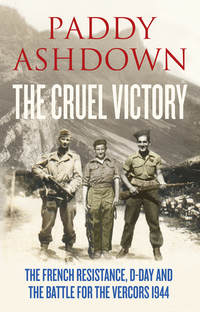
Kitabı oku: «The Cruel Victory: The French Resistance, D-Day and the Battle for the Vercors 1944»

COPYRIGHT
William Collins
An imprint of HarperCollinsPublishers,
77–85 Fulham Palace Road,
London W6 8JB
WilliamCollinsBooks.com
First published in Great Britain by William Collins in 2014
Copyright © Paddy Ashdown 2014
Maps by Harriet McDougall
Paddy Ashdown asserts his moral right to
be identified as the author of this work
A catalogue record for this book is
available from the British Library
All rights reserved under International and Pan-American Copyright Conventions. By payment of the required fees, you have been granted the non-exclusive, non-transferable right to access and read the text of this e-book on screen. No part of this text may be reproduced, transmitted, downloaded, decompiled, reverse engineered, or stored in or introduced into any information storage retrieval system, in any form or by any means, whether electronic or mechanical, now known or hereinafter invented, without the express written permission of HarperCollins e-books.
Cover photographs © Musée départmental de la Résistance du Vercors, Vassieux-en-Vercors
Maps by Harriet McDougall
Source ISBN: 9780007520800
Ebook Edition © June 2014 ISBN: 9780007520824
Version: 2014-11-28
DEDICATION
To the boy in the white shirt
EPIGRAPH
In war, young men go out to die for old men’s dreams
Anon
CONTENTS
Cover
Title Page
Copyright
Dedication
Epigraph
A Note on Usages
Preface
Dramatis Personae
List of Maps
Prologue
1 The Vercors before the Vercors
2 France from the Fall to 1943: Setting the Scene
3 Beginnings
4 The Army Goes Underground
5 Camps and Plans
6 Exodus and Folly
7 Expectation, Nomadisation and Decapitation
8 Retreat, Retrenchment and Reconstruction
9 Pressure and Parachutes
10 The Labours of Hercules
11 January 1944
12 Of Germans and Spies
13 February 1944
14 March 1944
15 Weapons, Wirelesses, Air Drops and Codes
16 April 1944
17 A Basket of Crabs
18 May 1944
19 The First Five Days of June 1944
20 D-Day: 6 June 1944
21 Mobilization
22 The First Battle of Saint-Nizier
23 The Second Battle of Saint-Nizier
24 Respite and Reorganization
25 A Damned Good Show
26 Mixed Messages
27 The Republic
28 Action and Expectation
29 Bastille Day: 14 July 1944
30 Pflaum’s Plans and People
31 The Rising Storm
32 The End of Dreams: Friday 21 July 1944
33 Fighting On: Saturday 22 July 1944
34 The Final Battles: Sunday 23 July 1944
35 Retreat and Refuge
36 The Harrowing of the Vercors
37 Resurgence and Revenge
38 Aftermath and Afterlives
39 Postscript
Annex A
Annex B
Annex C
Acknowledgements
Notes
List of Illustrations
Bibliography
Picture Section
Index
Also by Paddy Ashdown
About the Author
About the Publisher
A NOTE ON USAGES
In this text I have not included dialogue unless it comes from a source who I have reason to believe might have been present at the time or it has been noted down as dialogue in the course of taking testimony from a living witness.
Since this story concerns primarily military operations, I have used the twenty-four-hour clock throughout. In 1943 and 1944 all British forces in the European theatre used Greenwich Mean Time (GMT) plus one hour (UK Single Summer Time) from 16 August to 3 April, and GMT plus two hours from 4 April to 15 August (UK Double Summer Time). The time used in all German-occupied western European territories was Central European Time (CET), which in that era was UK Single Summer Time plus two hours. Since this story takes place primarily in France, all times in the text are given in, or adjusted to be consistent with, CET.
For a similar reason, units of measurement have been converted, where appropriate, to the metric scale.
Readers may want to know what the wartime franc was worth. Prices more than doubled during the four years of the German occupation of France, and inflation was very much worse on the black market. But one can get a rough idea of money values if one thinks of 1,000 francs in 1943–4 as the equivalent of 250 euros or £200 today.
Except where otherwise stated the translations of French source documents into English are those of the author. Where the original French was in a written formal document I have tried to make the translation as precise as possible. Where the original source is oral (for example, the oral evidence of witnesses) I have allowed myself greater latitude to cope with the differences in sentence formation between spoken French and English in an attempt to preserve the original sense and colour, while conveying this to the English reader in the most readable fashion.
The word ‘maquis’ has subtly different meanings in English and French. The word originates from the Corsican term for the dry scrub which covers the hills of southern and Mediterranean France, but even more so from a Corsican expression prendre le maquis, which means to shelter in the woods to escape the authorities or a vendetta (to go underground). Even today, the word is used by the French primarily to describe those who resisted the Germans by going into the countryside and especially the wilder places. They formed into groups which sometimes took the name of the area they operated in – for instance, le maquis du Vercors. The term maquisard in French denotes someone who belonged to a maquis cell, usually in a rural area. In French the term is not normally taken to apply to those who belonged to urban Resistance groups (for example, in Paris or Lyon). In modern English usage, however, the word Maquisard has become, for all practical purposes, synonymous with that of a Resistant, whether urban or rural. Since this is an English book the word Maquis is used in the English sense, except where it is plainly inappropriate to do so.
One of the problems with writing this book has been the story’s high degree of complexity and detail. In an attempt not excessively to confuse the reader, I have tried to keep the personal names of those who played a minor role in the story out of the main text. For those interested, these, where known, are given in the Notes. Similarly, I have removed from the main text as many of the military unit names as possible; these too can be found in the Notes. And finally, in the same endeavour, I have submerged some of the myriad organizations involved in both London and Algiers. Thus the main directing French organization in London, the Bureau Central de Renseignements et d’Action (BCRA), is referred to simply as ‘London’ or ‘de Gaulle’s headquarters in London’, while the main Algiers organization for directing the Resistance in southern France, the Special Projects Operations Centre (SPOC), becomes just ‘Algiers’.
For the same reason and in the hope it will make them more accessible to the reader, I have tried to simplify the references by providing abbreviations for the main archives which I have consulted (such as TNA for the British National Archives at Kew, and NARA for the US National Archives and Records Administration). A key giving each of these abbreviations can be found at the start of the Notes section.
PREFACE
I first became fascinated by the wartime epic of the Vercors in the early 1970s when I worked in the United Kingdom Mission to the United Nations in Geneva. I was drawn to it because of the tragedy and the horror of the story. But also because it struck me as a powerful example of a subject that has always fascinated me: the consequences for those on the front lines of conflict when those at the top know too little about the harsh realities of war, or think too little about what their decisions mean on the ground.
This is a French story, of course. But it is also a very human epic which has lessons for us all. The strong are not always wise. The simple not always stupid. The weak do not always lose. In most cases, the final determiner of outcomes rests, not with machines, or might, or well-laid plans, but with how individuals behave at the moment of trial.
This story has another function too. In this, the year of the seventieth anniversary of D-Day, it is as well to remember that the Normandy invasion was about more than what happened on the Normandy beaches, most of which is minutely documented and recorded. This is the hidden story of D-Day, when thousands of ordinary, untrained and in most cases crudely armed French men and women put their lives at risk quite as much as those who stormed the beaches, because they were determined to help throw out a hated occupier and join the fight to liberate their country.
DRAMATIS PERSONAE
BENNES, Robert (BOB)*
Zeller’s radio operator and commander of La Britière radio house.
BILLON, Francis (TARTANE)
Parachuted in with Tournissa. Injured. One of those shot at the Grotte de la Luire.
BLAIN, Léa
Cipher and coding assistant to Eucalyptus. Runner for Jean Prévost.
BLANC, Paul (JEAN-PAUL)
Commander of the Trièves Maquis unit on the Pas de l’Aiguille.
BOIRON, Victor
Tractor driver in Vassieux.
BOISSIÈRE, Gustave (BOIS)
Speleologist and liaison officer to the Eucalyptus Mission.
BORDENAVE, André (DUFAU)
Commander of 6th BCA.
BOURDEAUX, Louis (FAYARD)
Commander of a Maquis company in Royans.
BOURGEOIS, Maurice (BATAILLE)
Maquis leader who accompanied Vernon Hoppers on the Lus-la-Croix-Haute ambush.
BOURGÈS-MAUNOURY, Maurice (POLYGONE)
Military delegate of R1, then National Military delegate.
BOUSQUET, René (CHABERT)
Huet’s deputy.
BUCKMASTER, Colonel Maurice
Head of SOE’s F Section.
CAMMAERTS, Francis (ROGER)
SOE F Section Organizer of Jockey circuit.
CATHALA, Gaston (GRANGE)
Maquis leader in the west of the plateau.
CHAMBONNET, Albert (DIDIER)
Commander of the Secret Army in the Lyon area.
CHAMPETIER DE RIBES, Maude (DANIELLE)
Milice spy and mistress of Dagostini.
CHAVANT, Eugène (CLÉMENT)
(Le Patron) Political leader of the Vercors.
CONSTANS, Jean (SAINT-SAUVEUR)
Responsible for assistance to the Vercors in Algiers.
CONUS, Adrien (VOLUME)
Member of Eucalyptus Mission. Sent by Huet to get help from Bauges Maquis on 21 July.
COSTA DE BEAUREGARD, Roland (DURIEU)
Responsible for the northern sector of the Vercors.
COULANDON, Émile (GASPARD)
Resistance leader on the Mont Mouchet.
CROIX, Yves (PINGOUIN)
Eucalyptus Mission radio operator.
CROUAU, Fernand (ABEL)
Commander of Compagnie Abel.
DAGOSTINI, Raoul
Milice Chief.
DALLOZ, Pierre (SENLIS)
Conceived Plan Montagnards in 1942.
D’ANGLEJAN (ARNOLLE)
One of Huet’s staff officers. He organized the counter-attacks in Vassieux.
D’ASTIER DE LA VIGÉRIE, Emmanuel (BERNARD)
Senior French Resistance official in London and Algiers.
DARIER, Albert (FÉLIX)
Member of the Mens section of the Compagnie de Trièves.
DELESTRAINT, Charles (VIDAL)
General. Head of the Secret Army in southern France. Captured and died in Dachau.
DESCOUR, Jacques (LA FLÈCHE)
Marcel Descour’s son. Killed at Vassieux, 21 July 1944.
DESCOUR, Marcel (BAYARD and PÉRIMÈTRE)
Chief of Staff of the Secret Army in R1 and FFI Commander of Region 1.
DESMAZES, Marie Alphonse Théodore René Adrien (RICHARD)
Secret Army conspirator with Delestraint in Bourg-en-Bresse.
DROUOT, Jean (HERMINE)
FFI leader in the Drôme.
EYSSERIC, Gustave (DURAND)
Maquis commander at Malleval.
FARGE, Yves (GRÉGOIRE and BESSONNEAU)
Commissioner of the Republic.
FISCHER, Dr Ladislas
Doctor in Saint-Martin and Grotte de la Luire. He sometimes used the false identity Lucien Ferrier while in the Vercors.
GANIMÈDE, Dr Fernand
Doctor in Saint-Martin and Grotte de la Luire.
GARIBOLDY, Paul (VALLIER)
First leader of Groupe Vallier.
BLUM-GAYET, Geneviève (GERMAINE)
Early Vercors Resistant activist.
GAGNOL, Abbé
The priest of Vassieux.
GEYER, Narcisse (THIVOLET)
Maquis commander. Responsible for the southern sector of the Vercors.
GODART, Pierre (RAOUL)
Maquis commander at Malleval.
GRANVILLE, Christine (née Krystyna SKARBEK) (PAULINE)
SOE F Section courier for Jockey circuit.
GUBBINS, Brigadier Colin
The operational head of SOE.
GUÉTET, Dom (LEMOINE)
Marcel Descour’s counsellor/monk.
HAEZEBROUCK, Pierre (HARDY)
Commander of the defence of Vassieux. Killed 21 July 1944.
HOPPERS, Vernon G.
Commander of the US Justine Mission.
HOUSEMAN, John (RÉFLEXION)
Member of Eucalyptus Mission.
HUET, François (HERVIEUX)
Commanded the Maquis on the Vercors.
HUMBERT, Jacques
Retired General who walked to the Vercors to join the battle on 21 July 1944.
JACQUIER, Paulette (MARIE-JEANNE and LA FRETTE)
Leader of Maquis group in the Chambarand forest.
JOUNEAU, Georges (GEORGES)
Garage owner and head of the Motor Transport Depot on the Vercors.
KALCK,* Louis (ANDRÉ and JOB-JOB)
Commander of Compagnie André defending the eastern passes.
KNAB, Werner
Commander German Sipo/SD Lyon area.
KOENIG, Marie Joseph Pierre François (known as Pierre)
Appointed by de Gaulle as CO of FFI.
LASSALLE, Pierre (BENJAMIN and BOLIVIEN)
Descour’s radio operator at La Matrassière and La Britière.
LE RAY, Alain (BASTIDE and ROUVIER)
Vercors military commander until January 1944 and then FFI commander of Isère Department.
LONGE, Desmond (RÉFRACTION)
Leader of Eucalyptus Mission.
MARTIN, Léon Dr
One of the founders of Grenoble resistance in the Café de la Rotonde.
MAYAUD, Charlotte (CHARLOTTE)
Early Vercors Resistant and organizer in Villard de Lans. Also a courier and liaison agent.
MOCKLER-FERRYMAN, Eric
Director for SOE operations in western Europe.
MONTEFUSCO, Mario (TITIN and ARGENTIN)
Radio operator at La Britière.
MOULIN, Jean (REX, MAX and RÉGIS)
De Gaulle’s representative in southern France and the architect of the unified southern Resistance.
MYERS, Chester L.
Hoppers’ second-in-command on the Justine Mission.
NIEHOFF, Heinrich
German military commander southern France.
ORTIZ, Peter Julien (CHAMBELLAN and JEAN-PIERRE)
US Marine parachuted in with the Union Mission and subsequently the head of Union II.
PECQUET, André Édouard (BAVAROIS and PARAY)
Eucalyptus Mission radio operator.
PFLAUM, Karl Ludwig
Commander 157th Reserve Division.
PINHAS, France
Nurse at the second Battle of Saint-Nizier.
PRÉVOST, Jean (GODERVILLE)
Writer and friend of Dalloz. Commander of Compagnie Goderville in the north of the Vercors.
PROVENCE, Mireille
Milice spy.
PUPIN, Aimé (MATHIEU)
Early Vercors Resistance leader.
RAYNAUD, Pierre (ALAIN)
An agent of Cammaerts and commander of a Drôme Maquis unit.
REY, Fabien (MARSEILLE and BLAIREAU)
Expert in and author of Maquisard guide to the the flora and fauna of the Vercors.
REY, Sylviane
Nurse and friend of Francis Cammaerts.
RITTER, Stefan
Commander No. 8 Company Reserve Gebirgsjäger Battalion II/98.
ROMANS-PETIT, Henri (ROMANS)
Resistance leader in the Jura.
ROUDET, Marcel (RAOUL)
Corrupt Lyon policeman who led his own ‘Raoul Maquis’.
SALLIER, Ferdinand (CHRISTOPHE)
Maquis leader in the west of the Vercors.
SAMUEL, Dr Eugène (JACQUES and RAVALEC)
Early founder of the Resistance movement in Villard-de-Lans.
SCHÄFER, Friedrich
Commander Kampfgruppe Schäfer.
SCHWEHR, Franz
Commander Kampfgruppe Schwehr.
SEEGER, Alfred
Commander Kampfgruppe Seeger.
SOUSTELLE, Jacques
Confidant of de Gaulle and head of the French Directorate for Intelligence and Special Forces.
STÜLPNAGEL, Carl-Heinrich
German military commander for all France.
TANANT, Pierre (LAROCHE)
Huet’s Chief of Staff.
THACKTHWAITE, Henry (PROCUREUR)
British member of the Union Mission.
TOURNISSA, Jean (PAQUEBOT)
Landing-ground expert sent in to build an airstrip at Vassieux.
ULLMAN, Henri (PHILIPPE)
Commander of Compagnie Philippe.
ULLMANN, Dr Marcel
Doctor in Saint-Martin and Grotte de la Luire.
VILLEMAREST, Pierre FAILLANT de (FRANTZ)
Maquis intelligence expert and later commander of the Groupe Vallier.
VINCENT, Gaston (AZUR and PIERRE)
OSS agent in Saint-Agnan.
VINCENT-BEAUME, André (Capt. VINCENT and SAMBO)
Head of Huet’s 2nd Bureau (intelligence).
WINTER, Anne
Nurse at the Grotte de la Luire.
ZABEL
Commander Kampfgruppe Zabel.
ZELLER, Henri (FAISCEAU and JOSEPH)
Chief of Resistance in south-east France.
* Aliases in brackets.
* There are several versions of this name, including Calke and Calk. I have used the one given in the journal of the 11th Cuirassiers and Robert Bennes’ memoirs.
LIST OF MAPS
Map 1: The Vercors
Map 2: Occupied Territories 1942
Map 3: Camps of the Vercors 1943
Map 4: Drop Sites
Map 5: German Operations 1944
Map 6: Options for the Southern Invasion
Map 7: The Battle of Saint-Nizier
Map 8: Huet’s Dispositions and Early German Probes
Map 9: Pflaum’s Plan
Map 10: The Battle for Vassieux
Map 11: Battle of the Passes
Map 12: The Battle of Valchevrière
Map 13: Flight and Refuge
PROLOGUE
Above the city of Grenoble, at Saint-Nizier-du-Moucherotte, the sun rose into a perfect sky at 04.48 on the morning of 13 June 1944. For the 700 young men who had spent the previous night under the summer stars, strung out along a 3-kilometre defensive line on the Charvet ridge, it bought a welcome warmth against the damp early-morning chill. Bees hummed among the flowers and grasses and everywhere little birds darted from clump to bush, seeking out insects. High above the early lark let down her string of liquid notes. Below them, the Grésivaudan valley, bounded by the Chartreuse massif on one side and the Bauges and Oisans ranges on the other, glowed with the colours of high summer. And in the distance, like a great white whale, the snow-covered hump-back of Mont Blanc sparkled in the sunlight. In normal times this would have been good day for lovers – and country walks – and family picnics. But this was not a normal time – and this would not be a normal day.
Modern-day soldiers almost always fight and die miles from home. But these young men – many little more than boys – looked down that morning to see their home city laid out as plain as a street map. They knew its every nook and cranny. There was the park where they had played football with friends. There the school they had attended. There the square in which they had hung around, watching the girls go by. There the café where they had met a lover. And there the rented flat where wives and children still slept this summer morning, as they lay out in the dew-soaked grass, waiting for the enemy to come.
Whatever politicians say, soldiers do not die for their country. They die, mostly, for the man next to them – the comrade they know will lay down his life for them. And for whom they, too, will lay down theirs in their turn – if required to do so. But most of these young Maquisards lying out this warm summer’s morning on the Charvet hill, in the same clothes – even the same white shirts – in which they had left home only days previously, were different. Young, naive, unpractised in the use of arms, inexperienced in the terrors of war, they had come to the plateau out of a genuine sense of patriotism mixed with romance and adventure. Their youthful enthusiasm remained undimmed by the dull, mind-numbing routines of the professional soldier. How were they to know that their proudly acquired Sten guns would be little more than pop-guns against the steel-clad might and majesty of the world’s finest army, now massing invisibly below them? How were they to know, plucked so suddenly out of comfortable city lives, what it would be like to watch a friend cough out his life’s blood on the grass next to them? These things were literally beyond their imaginings.
And so, in ways unknown to the common soldier, they lay there, waiting for their enemy – apprehensively of course – but in their innocence also proudly, bravely, determinedly, ready to carry out what they believed was a glorious duty on behalf of their long-oppressed country. ‘It’s the morning of Austerlitz!’ declared one, referring to Napoleon’s great victory over the Austrians in 1805.
Suddenly, there was a new noise punctuating the early-morning hum of the city, drifting up to them on a light summer breeze. It was the insistent thump of a German heavy machine gun somewhere in the woods and meadows below them. Little flowers of dirt started sprouting among them in the long grass where they lay. Looking to the foot of the hill, they could make out tiny dots of field grey spreading out as they started to move slowly up towards them.
‘They’re coming!’ someone shouted.
1
THE VERCORS BEFORE THE VERCORS
For those who live around the Vercors massif – from the ancient city of Grenoble lying close beneath its north-eastern point to the vineyards of Valence scattered around its south-western slopes – the forbidding cliffs of the plateau are the ramparts of another country. To them, this is not just a mountain. It is also a state of mind. Even when hidden behind a curtain of summer rain or with its summits covered by the swirling clouds of a winter tempest, the great plateau is still there – offering something different from the drudgery and oppressions of ordinary life down below. Best of all, on still, deep-winter days, when the cold drags the clouds down to the valleys, up there on the Vercors looking down on the sea of cloud, all is brilliant sunshine, deep-blue skies, virgin snow and a horizon crowded with the shimmering peaks of the Alps.
Today, this is a place of summer escape and winter exhilaration. But its older reputation was as a place of hard living and of refuge from retribution and repression.
The historical importance of the Vercors lies in its strategic position dominating the two major transport corridors of this part of France: the Route Napoleon which passes almost in the shadow of the plateau’s eastern wall and the valley of the River Rhône, which flows through Valence some 15 kilometres away from its south-western shoulder.
The Romans came this way fifty years before the birth of Christ. Pliny, writing in AD 50, referred to the people of the plateau as the Vertacomacori, a word whose first syllable may have been carried forward into the name ‘Vercors’ itself. Eight centuries later, the Saracens followed the Romans, implanting themselves in Grenoble for some years. According to local legend, they even sent a raiding party towards the Pas de la Balme on the eastern wall of the plateau, but were beaten back by local inhabitants rolling rocks down on the invaders. Less than a hundred years later, towards the end of the tenth century, the Vikings came here too, but from the opposite direction – south down the Rhône in their longships. And 400 years after that, the Burgundian armies followed them on their own campaign of conquest and pillage. Then in March 1815, Napoleon, after landing on the Mediterranean coast from Elba, marched his growing army north along the route which still bears his name under the eastern flank of the Vercors, towards Grenoble, Paris and his nemesis at Waterloo.
Napoleon excepted, what is most significant about these invaders is that, though there are signs enough of their passing in the countryside below, there are few on the Vercors itself. It is as though these foreigners were content to pass by in the valleys without wishing to pay much attention to the cold, poverty-stricken and inhospitable land towering above them. One consequence of this passage of armies and occupiers is, however, more permanent. The historian Jules Michelet, writing in 1861, commented: ‘There is a vigorous spirit of resistance which marks these provinces. This can be awkward from time to time; but it is our defence against foreigners.’
The plateau itself is shaped like a huge north-pointing arrowhead some 50 kilometres long and 20 wide. It covers, in all, 400,000 hectares, about the same size as the Isle of Wight. An Englishman who will play a small part in this history described it, in his prosaic Anglo-Saxon way, as a great aircraft-carrier steaming north from the middle of France towards the English Channel.
This extraordinary geological feature is the product of the the shrinking earth and the faraway press of the African continent, whose northward push against the European mainland generates the colossal pressures which wrinkle up the Alps and squeeze the Vercors limestone massif straight up in vertical cliffs, 1,000 metres above the surrounding plain.

Map 1
No concessions are found here to accommodate the needs of man. The Vercors offers nothing in the way of easy living. Extreme difficulty of access made the plateau one of the poorest areas, not just of France, but of all Europe, until new roads were blasted up the cliff faces in the nineteenth century. The forbidding bastion of the eastern wall of the plateau, stretching from Grenoble to the plateau’s southern extremity, is accessible only by goats, sheep and intrepid walkers. For vehicles, there are just eight points of access to the plateau, one on its southern flank, five spread out along its western wall and two on its north-eastern quarter. Of these, all bar one involve either deep gorges into which the sun hardly ever penetrates or roads which rise dizzily through a tracery of hairpin bends to run along narrow ledges and through dark tunnels blasted from vertical rock faces.
Only the road on the plateau’s north-eastern edge offers something different. Here the slope rises placidly from the back gardens of the Grenoble suburbs and is served by a moderately engineered road, supplemented, until 1951, by a small funicular tramway, at the top of which is the little town of Saint-Nizier. This sits on its own natural viewing platform, looking out over the city to the mountain-flanked valley of the Isère (known as the Grésivaudan valley) and the white mass of Mont Blanc in the distance.
The Vercors plateau itself is dominated by three rolling ridges which run along its length from north to south like ocean breakers. Their tops are above the treeline, rock-strewn and so sparsely covered with mountain grasses that on bright summer days the white from the limestone below seems to shimmer through the thin air and dazzle the eyes. In some high, very exposed areas, where the hot summer winds have whipped off all the soil, the limestone rock is laid bare and fissured into deep cracks, some large enough for a man – or several men – to stand up in. These are wild and terrible places, known to the locals as lapiaz. Their only gentleness lies in the strange lichens and alpine plants which make their homes in the cracks and survive by straining moisture from the dew-laden air of summer mornings.
Further down, there are cool conifers and one of the largest stands of hardwood in western Europe. Further down still, cradled in the valleys, are the little towns, villages and hamlets of the Vercors community – many of them, such as Saint-Martin, Saint-Julien, Saint-Agnan, La Chapelle, speaking of a past where an attachment to the right God was as important to survival as skill at animal husbandry and knowing the right time to plant the crops. Here, though the bitter snow-filled winters remain tough, there is good grazing and comfortable summer living.
One essential ingredient of life, however, is not easily available – water. This is a limestone plateau and every drop that falls as rain or seeps away from melting snow drops down through the limestone into hidden channels, underground rivers and a still-undiscovered network of chambers and caverns which honeycomb the whole Vercors plateau. Some say a drop of moisture captured in a snowflake which falls on the summit of the plateau’s highest peak, the 2,341-metre Grand Veymont, will take three years to pass in darkness through the hidden channels under the mountains before it sees the light of day again, tumbling down through the plateau’s gorges on its way to the Rhône and the warm waters of the Mediterranean far away to the south. Surface water across the whole plateau is rare and wells and springs even more so. All of them are widely known and meticulously marked on every Vercors map.
This is the unique topography and meteorology which has played such an important part in shaping both the Vercors, and the lives of those who have struggled to live and take refuge there, not least during the years of France’s agony in the Second World War.
But it is not just the topography that makes the Vercors unique. The plateau lies at the precise administrative, architectural, cultural and meteorological dividing line between northern, temperate, Atlantic France and that part of France – Provence – which looks south to the Mediterranean. The frontier between the departments of the Isère and of the Drôme divides the plateau into two halves: the northern Vercors is in the Isère and the southern Vercors is in the Drôme.
At least until the Second World War, these two Vercors were quite different. Indeed, as late as the nineteenth century, the rural folk of the plateau spoke two different and mutually incomprehensible languages, the langue d’oc and the langue d’oïl. The northern Vercors took its lead from sophisticated Grenoble. Here, at Villard-de-Lans, was established one of the first – and one of the most fashionable – Alpine resorts in France, frequented in the 1930s by film stars, the fashionable, the sportif and the nouveau glitterati of Paris. During pre-war summers, the area became one of the favourite Alpine playgrounds for those with a passion for healthy and sporty living; it teemed with hikers, climbers, bikers and even practitioners of Robert Baden-Powell’s new invention from England, le scouting. The southern Vercors on the other hand – the ‘true Vercors’ according to its inhabitants – remained virtually unchanged: still agricultural, still largely isolated, still taking its lead more from Provence and the south than the styles and sophistications of Paris and the north.
This division is visible even in the vegetation and architecture of the two halves. Travel just a few tens of metres south through the short tunnel at the Col de Menée at the south-eastern edge of the plateau and there is a different feel to almost everything. Even the intensity of the light seems to change. Pine trees, temperate plants and solid thick-walled houses, whose roofs are steeply inclined for snow, give way almost immediately to single-storey houses with red-tiled roofs crouching against the summer heat, tall cypresses as elegant as pheasant feathers, the murmuring of bees and the scent of resin in the air. Here the hillsides are covered with wild thyme, sage and the low ubiquitous scrub called maquis, from which the French Resistance movement took its name.
Many factors and many personalities shaped the events which took place on the Vercors during the Second World War. One of them was the extraordinary, secluded, rugged, almost mythical nature of the plateau itself.
2
FRANCE FROM THE FALL TO 1943: SETTING THE SCENE
It is only the French themselves who understand fully the depth of the wounds inflicted by the fall of France in 1940. They had invested more in their Army than any other European nation with the exception of Germany. With around 500,000 regular soldiers, backed by 5 million trained reservists and supported by a fleet of modern tanks which some believed better than the German Panzers, the French Army was regarded – and not just by the French – as the best in the world.
It took the Germans just six weeks to shatter this illusion and force a surrender whose humiliation was the more excruciating because Hitler insisted that it took place in the very railway carriage where Germany had been brought to her knees in 1918. It is not the purpose of this book to delve in detail into how France fell. But one important element of those six weeks in the summer of 1940 is often overlooked. Not all of France’s armies were defeated.
The French Army of the Alps – the Armée des Alpes – never lost a battle. They held the high Alpine passes against a numerically superior Italian assault. And they stopped the German Army too, at the Battle of Voreppe, named for the little town just outside Grenoble which guards the narrows between the Vercors and the Chartreuse massifs. Indeed the Battle of Voreppe ended only when the French artillery, wreaking havoc on German tanks from positions on the northern tip of the Vercors plateau, were ordered to return to barracks because the ceasefire was about to come into force. Thanks to this action, Grenoble and the Vercors remained in French hands when the guns fell silent. But this was small comfort to the victorious French Alpine troops who now found that they were part of a humiliated army. They regarded themselves as undefeated by the Germans but betrayed by the Armistice and ached to recover their lost honour.
The French rout and the German columns pushing deeper and deeper into France set in train a flood of internal refugees who fled south in search of safety. It was estimated that some 8 to 9 million civilians – about a quarter of the French population – threw themselves on to the roads, seeking to escape the occupation. They were later referred to as les exodiens. Among them were 2 million Parisians, French families driven out of Alsace-Lorraine and many Belgians, Dutch and Poles who had made their homes in France.
The ceasefire between German and French troops came into force at 09.00 on 24 June 1940 and was followed by the Armistice a day later. Under the terms of this peace, France was divided in two. The northern half, known as the Zone Occupée or ZO, was placed under General Otto von Stülpnagel, named by Hitler as the German Military Governor of France. The southern half, the Zone Non-Occupée or ZNO, comprising about two-fifths of the original territory of metropolitan France, was to be governed by Marshal Pétain, who set up his administration in the central French town of Vichy. The two were separated by a Demarcation Line, virtually an internal frontier, which ran from the border with Switzerland close to Geneva to a point on the Spanish border close to Saint-Jean-Pied-de-Port.

Map 2
There was another France created by the nation’s defeat and humiliation, but very few knew about it at the time. It had left with General Charles de Gaulle in a British plane from Mérignac airport outside Bordeaux not long before the Armistice was signed. On 18 June 1940, just two days after he arrived in London, de Gaulle made the first of his famous broadcasts to the French people: ‘has the last word been said? … Is defeat final? No! Believe me, I who am speaking to you from experience … and who tell you that nothing is lost for France … For France is not alone! She is not alone! She is not alone! … This war is a world war. Whatever happens, the flame of the French resistance must not be extinguished and will not be extinguished.’ The sentences were stirring enough. The problem was, almost no one in France heard them. In the early 1940s there were only 6 million radios in France and, since a quarter of France’s population were in captivity, or fighting, or on the roads fleeing the invader, there were not many who had the time to sit at home with their ears glued to the radio, even if they had one.
With almost 70,000 casualties, 1.8 million of her young men in German prisoner-of-war camps and la gloire française ground into the dust alongside the ancient standards of her army, France’s first reaction to her new conqueror was stunned acquiescence. Early reports arriving in London from French and British agents all speak of the feeble spirit of resistance in the country. In these first days, many, if not most, of the French men and women who had heard of de Gaulle saw him as a rebel against the legitimate and constitutional government in Vichy. They trusted Pétain to embody the true spirit of France and prepare for the day when they could again reclaim their country. After all, was he not the hero of Verdun, the great battle of 1916? Some believed fervently that the old warrior’s Vichy government would become, not just the instrument for the rebuilding of national pride, but also the base for the fight back against the German occupier and that he, Pétain, the first hero of France, would become also the ‘premier résistant de la France’.
There were, of course, some who wanted France to follow Germany and become a fascist state. In due course they would be mobilized and turn their weapons on their fellow countrymen. But these were a minority. For the most part, after the turbulence and the humiliation, the majority just wanted to return to a quiet life, albeit one underpinned by a kind of muscular apathy. The writer Jean Bruller, who was himself a Resistance fighter and used ‘Vercors’ as his nom de plume, clandestinely published his novel Le Silence de la Mer in 1942. In this he has one of his characters say of France’s new German masters: ‘These men are going to disappear under the weight of our disdain and we will not even trouble ourselves to rejoice when they are dead.’
There were many reasons why, in due course and slowly, the men and women of occupied France broke free of this torpor and began to rise again. But two were pre-eminent: the burning desire to drive out the hated invader, and the almost equally strong need to expiate the shame of 1940 and ensure that the France of the future would be different from the one that had fallen.
The formation of the earliest Resistance groups came organically – and spontaneously – from French civil society. Some were little more than clubs of friends who came together to express their patriotism and opposition to the occupier. Others were political – with the Communists being especially active after Operation Barbarossa, Hitler’s invasion of Russia in June 1941. Almost all were strenuously republican in their beliefs. There were even Resistance organizations supporting the regime in Vichy, preparing for the day when they would help to recapture the Zone Occupée. Although the early Resistance groups concentrated mainly on propaganda through the distribution of underground newspapers, over time they evolved into clandestine action-based organizations capable of gathering intelligence, conducting sabotage raids and carrying out attacks on German units and installations.
In London, too, France’s fall changed the nature of the war that Britain now had to fight. Now she was utterly alone in Europe. Churchill knew that, with the British Army recovering after the ‘great deliverance’ of Dunkirk, the RAF not yet strong enough for meaningful offensives against German cities and the Royal Navy struggling to keep the Atlantic lifeline open, the only way he could carry the war to the enemy was by clandestine rather than conventional means.
On 22 July 1940, he created the Special Operations Executive (SOE), instructing it to ‘set Europe ablaze’. SOE, headed by Brigadier Colin Gubbins and headquartered in Baker Street near Marylebone station, was organized into ‘country sections’ which were responsible for intelligence, subversion and sabotage in each of Europe’s occupied nations. France, however, had two country sections: F (for France) Section and RF (for République Française) Section. The former, led by Colonel Maurice Buckmaster, was predominantly British run and was staffed mostly by British officers and agents. The latter, which acted as a logistical organization for Free French agents sent into France, was made up almost exclusively of French citizens. Although members of the same overall body, SOE’s F and RF sections adopted totally different ways of doing business. The ‘British’ F Section operated through small autonomous cells, which were in most cases kept carefully separate from each other in order to limit the damage of penetration and betrayal. RF Section, on the other hand, tended to run much larger, centrally controlled agent networks.
But the organizational complexity and rivalry in London – which often seemed to mirror that on the ground in France – did not end there. De Gaulle, whose headquarters were at 4 Carlton Terrace overlooking the Mall, had his own clandestine organization too, headed by the thirty-one-year-old, French career soldier Colonel André Dewavrin. This acted as the central directing authority for all those clandestine organizations in France which accepted the leadership of Charles de Gaulle. However, as one respected French commentator put it after the war, ‘General de Gaulle and most of those who controlled military affairs in Free France in the early days were ill-prepared to understand the specificities of clandestine warfare … [there was a certain] refusal of career military officers to accept the methods of [what they regarded as] a “dirty war”. It was a long and difficult process to get [the French in] London to understand the necessities of the “revolutionary war”.’
For Churchill, who knew that a frontal assault on Festung Europa (Fortress Europe) was still years away, the strategic opportunities offered by the French Resistance, fractured and diffuse as it was, were much less appealing than those in the Balkan countries. The French Resistance may have been a low priority for Winston Churchill in these early years, but for General de Gaulle, who created the Forces Françaises Libres on 1 July 1940, it was the only means of establishing himself as the legitimate leader of occupied France. For him it was imperative to weld all this disparate activity into a unified force under his leadership, capable not only of effective opposition to the Germans, but also of becoming a base for political power in the future.
De Gaulle’s opportunity to achieve this came in October 1941 when the charismatic forty-one-year-old Jean Moulin escaped from France over the Pyrenees and arrived in Lisbon. Here Moulin, who, as the Préfet of the Department of Eure-et-Loire had been an early resister against the Germans, wrote a report for London: ‘It would be mad and criminal not to use, in the event of allied action on the mainland, those troops prepared for the greatest sacrifice who are today scattered and anarchic, but tomorrow could be able to constitute a coherent army … [troops] already in place, who know the terrain, have chosen their enemy and determined their objectives.’
Moulin met de Gaulle in London on 25 October 1941. The French General could be prickly and difficult, but on this occasion the two men instantly took to each other. On the night of 1/2 January 1942, Jean Moulin, now equipped with the multiple aliases of Max, Rex and Régis, parachuted back into France as de Gaulle’s personal representative. His task was to unify the disparate organizations of the Resistance under de Gaulle’s leadership. Thanks to Moulin’s formidable energy, organizational ability and political skill, he managed to unify the three key civilian Resistance movements of the southern zone into a single body whose paramilitary branch would become the Secret Army, or Armée Secrète, the military arm of the Gaullist organization in France.
Among those with whom Moulin made contact on this visit was the sixty-one-year-old French General, Charles Delestraint, who de Gaulle hoped would lead the Secret Army. On the night of 13/14 February 1943, a Lysander light aircraft of the RAF’s 161 Special Duties Squadron, which throughout the war ran a regular clandestine service getting agents into and out of France, flew from Tempsford airport north of London to pick up Moulin and Delestraint and fly them back to Britain.
Here, the old General, who had been de Gaulle’s senior officer during the fall of France, met his erstwhile junior commander and accepted from him the post of head of the Secret Army in France under de Gaulle’s leadership. His task was to fuse together all troops and paramilitary organizations, set up a General Staff and create six autonomous regional military organizations, each of which should, over time, be able ‘to play a role in the [eventual] liberation of the territory of France’. Delestraint’s first act was to write a letter under his new alias, ‘Vidal’, to ‘The officers and men of all Resistance paramilitary units’:
By order of General de Gaulle, I have taken command of the Underground Army from 11 November 1942.
To all I send greetings. In present circumstances, with the enemy entrenched everywhere in France, it is imperative to join up our military formations now in order to form the nucleus of the Underground Army, of which I hold the command. The moment is drawing near when we will be able to strike. The time is past for hesitation. I ask all to observe strict discipline in true military fashion. We shall fight together against the invader, under General de Gaulle and by the side of our Allies, until complete victory.
The Commanding General of the Secret Army
Vidal
On the night of 19/20 March, another Lysander flew Moulin and Delestraint back to France, where the flame of resistance was beginning to take hold. This change of mood was due, principally, to three factors.
The first was the increasing severity of German reprisals. In the beginning, hostages were taken at random, held against some required action by the French civil authorities and then released. But when Germans started to be assassinated, things took a much darker turn. On 20 October 1941 the German military commander of Nantes was shot dead. The Germans responded by taking fifty hostages from the local community and summarily executed them. As this practice became more and more widespread French outrage and anger deepened and the ranks of the Resistance swelled.
The second event which transformed the nature of the Resistance movement in France began at dawn on 8 November 1942, when Allied troops stormed ashore on the beaches of French North Africa. The strategic consequences of Operation Torch were very quickly understood by the Germans. Now the defeat of their forces under Field Marshal Rommel and the Allied occupation of the whole of the North African coast were only a matter of time. Germany’s hold on continental Europe could now be threatened not just from the Channel in the north, but also from the Mediterranean in the south. Three days after Torch, the Germans swept aside the barriers on the Demarcation Line and, amid squeals of protest from the Vichy government, sent their armoured columns surging south to complete their occupation of the whole of metropolitan France. This destroyed the Vichy government’s constitutional legality and laid bare the bankruptcy of their claim to be the protectors of what remained of French pride and sovereignty.
It also had another, even more powerful effect. The Vichy Armistice Army, or Armée de l’Armistice, created from the broken elements of France’s defeated armies, was immediately disbanded, causing some of its units to take to the maquis. Some dispersed individually and reassembled under their commanders in the forests, taking with them their structures, their ranks, their customs and even their regimental standards. From about January 1943 onwards, senior ex-Armistice Army officers, including two who will be important in our story, Henri Zeller and Marcel Descour, began to work more closely with Delestraint’s Secret Army. To start with, both forces, though co-operating closely with each other, maintained their separate autonomy. But in December 1943 they agreed to fuse together to form a single military structure, the FFI – the French Forces of the Interior, or Forces Françaises de l’Intérieur – under de Gaulle’s command.
The third and arguably greatest factor which turned many French men and women from relative apathy to armed resistance was Germany’s seemingly unquenchable appetite for resources and manpower. The Germans demanded 60 per cent of all France’s agricultural production, amounting to some 600,000 tonnes of food and equipment a month, causing severe rationing and acute food shortages, especially in the cities. Inevitably this in turn gave birth to an extensive, all-pervasive (and all-providing) black market. It was, however, Germany’s demand for labour which, more than anything else, provided the French Resistance with the recruits it needed to become a genuine popular movement.
It all began with a bargain which seemed, given the exigencies of war and France’s position as a subjugated nation, reasonable enough. With so many of her male population under arms, Germany was desperate for labour to run her industries and work her farms. Programmes to attract workers from France were implemented. These included a Sauckel/Laval scheme initiated in June 1942 (known in France as La Relève – the levy)under which the Germans would exchange prisoners of war for specialised volunteer workers on a ratio of 1 to 3. But by late summer 1942 La Relève had produced only some 40,000 new workers – nothing like enough for Germany’s needs; Sauckel demanded more.
To fulfil these new German demands, Pétain and Laval signed a law on 4 September 1942 requiring all able-bodied men aged between eighteen and fifty and all single women between twenty-one and thirty-five ‘to do any work that the Government deems necessary’. By these means the Sauckel/Laval deal was completed, albeit a month late, in November 1942. But this merely encouraged the Germans to demand even more. This time, in exchange for 250,000 French workers, an equal number of French PoWs would be given, not their freedom, but the status of ‘free workers’ in Germany. Laval agreed, but soon found that he could not keep his side of the bargain without adopting new measures of coercion. A law was passed on 16 February 1943 which required all males over twenty to be subject to the Compulsory Labour Organization (known as the STO after its French name – Service du Travail Obligatoire) and regulations governing the STO were issued the same day, calling up all those aged twenty to twenty-three for compulsory work in Germany. In March 1943, Sauckel again upped the stakes, demanding a further 400,000 workers, 220,000 of whom would go to Germany while the remainder would be handed over to Organisation Todt, the German-run labour force in France.
Of all the events in the early years of the German occupation which helped turn France against her occupiers, undermined the Vichy administration and boosted the cause of the Resistance, none did so more, or more quickly, than the establishment of the STO. The German Ambassador in Paris, Otto Abetz, later remarked: ‘If ever the Maquis were to erect monuments in France, the most important should be dedicated to “Our best recruitment agent, Gauleiter Sauckel”.’
There were public demonstrations against the STO across France, one being in the little market town of Romans under the western edge of the Vercors. Here, on 9 and 10 March 1943, the entire population occupied the railway station shouting, ‘Death to Laval! Death to Pétain! Long live de Gaulle!’ and stood in front of the train taking their young men away to Germany. Huge numbers of young men, now known as réfractaires, took to the maquis to avoid being sent to Germany. SOE agents reported to London on 12 March 1943 that the number of young men who had gone into hiding in the Savoie and Isère departments alone had reached 5,000 and was rising at an increasing rate every week.
These young men fled to the maquis for a complex set of reasons, not all of them to do with patriotism. For some it was simply a matter of avoiding being sent to Germany. For others it was seen as a form of civil disobedience. For many it was the romance of living the clandestine life in the mountains and the forests. Down there on the plain, men and women lived lives which were inevitably tainted by the daily exigencies of coexistence with the enemy. But up there in the high places and the forests the air was clean and freedom was pure and uncompromised.
But whatever their motives, all now lived as outlaws who had to rely on the already established Resistance movements for their food, shelter and protection. London recognized the opportunity and sent huge sums of money, mostly through Jean Moulin, to pay for food and shelter for the réfractaires. The French Resistance movements now found themselves with a growing of pool of young men whom they quickly set about turning into fully trained, armed and committed Maquisards.
It was probably in response to the new threat posed by this rise of the Resistance that, on 30 January 1943, Vichy Prime Minister Pierre Laval created – with help from the Germans – a new and much hated paramilitary force, the black-shirted Milice Française or French Militia, whose exclusive task was to fight the Resistance. Made up chiefly of Frenchmen who supported fascism, but including many from the criminal fraternity, the Milice by 1944 achieved a total strength in Vichy France, including part-time members, of perhaps 30,000. Although they worked very closely with both the Italians and the Germans, they were largely autonomous from any Vichy authority outside their own line of command, often operating outside the law and beyond its reach when it came to the torture, summary execution and assassination of their fellow French men and women.
And so it was that, by the early months of 1943, the forests and fastnesses of places like the Vercors had become home and refuge to a polyglot collection of the broken elements of defeated France: its new generations, its old administrators, its competing political parties, its heterodox communities and the scattered fragments of its once proud army. With the United States now in the war, with the Allied landings in North Africa and, just ten days later, the German defeat before the gates of Stalingrad, de Gaulle knew, as did almost every thinking French man and woman, that a turning point had been passed. It was now inevitable that Germany would lose. Only three questions remained. How long would it take? How could the Resistance be welded together into a force strong enough to play a part in the liberation of their country? And what would be the best military strategy to follow?
3
BEGINNINGS
The notion that the Vercors might become a citadel of liberty against France’s invaders began to take root in several places, among very different people and in very different ways, during the first half of 1941. According to Vercors legend it was first discussed one early-spring day in March 1941 when two old friends, both mountaineers, both writers and both members of France’s intellectual elite, were cutting down a dead walnut tree in a meadow above a small villa called La Grande Vigne, near the town of Côtes-de-Sassenage, a few kilometres north-west of Grenoble.
La Grande Vigne, which lies so close under the northern flank of the Vercors that the plateau’s slopes and woods seem to look in at every window, was – and remains still – the family home of the Dalloz family. In 1941, its occupants were the forty-one-year-old architect, writer, one-time government servant and ardent mountaineer Pierre Dalloz and his painter wife, Henriette Gröll. On this March day, the couple were entertaining two of their closest friends – and frequent visitors to La Grand Vigne – Jean Prévost and his doctor wife, Claude. Prévost, a year younger than Dalloz, was a startlingly handsome man with an arresting gaze and a character which combined love of action with a sturdy intellectual independence. A pacifist, an early and enthusiastic anti-fascist, Prévost had fiercely opposed the Munich settlement but had nevertheless heavily criticized the pre-war anti-German mood in France. He was best known as one of the foremost young writers in France, having written several well-received books, along with articles in the prestigious French magazine Paris-soir. Indeed it was writing which formed one of the major bonds between the two men – at the time of their tree-cutting exploit Dalloz was working on a translation of St Bernard’s Treatise on Consideration, while Prévost was preparing a study on Stendhal which would be published to widespread acclaim in Lyon on 9 November 1942, just two days before the German invasion of France’s ‘free’ southern zone.
According to Dalloz’s account, the two men were busy cutting down the old walnut tree – with Prévost offering his friend unsolicited advice on the best way to accomplish the task – when Dalloz stopped, leant on his axe and looked up at the cliffs of the Vercors rising above them into the blue March sky. ‘You could look at that up there as a kind of island on terra firma,’ he said, ‘a huge expanse of Alpine pasture protected on all sides by these vast Chinese walls of rock. The gates into it are few and carved out of the living rock. Once closed, paratroopers could be dropped clandestinely. The Vercors could then explode behind the enemy lines.’
There the conversation ended and the thought seemed to die. ‘I thought that the idea was probably a bit naive,’ Dalloz was later to explain. ‘This was more the kind of thing that the military would be considering, rather than me.’ It would take eighteen months, disillusion with the military leaders and a France more ready for resistance to bring it back to life.
A few kilometres away in Grenoble, General André Laffargue, a divisional commander in the Armistice Army, was also desperate to return to the struggle and spoke of the Vercors as ‘a vast closed Alpine fortress protected by a continuous solid wall of limestone rock’. He even drew up plans to protect the plateau against all comers with fixed defences made up of a ring of 75mm mountain guns sunk into concrete casements – a sort of Alpine Maginot Line, as though the recent failure of the first one had not been enough.
Some of Laffargue’s junior officers had a more realistic notion about what should be done to plan for the day when they would again take up their fight against the occupier and had begun to stockpile hidden weapons for future use. From late 1940 right through to the German invasion of Vichy France in November 1942, arms, ammunition and a wide range of matériel, including vehicles, fuel, optical equipment, engineering material, radios and medical stores, were spirited out of the city and into the surrounding countryside, and in particular on to the Vercors. All sorts of imaginative methods were used: lorries with false floors, carts loaded with hay, empty water and petrol bowsers, accumulator batteries emptied of acid and reserve petrol tanks on vehicles. They also made use of forged travel permissions so that the arms could be transported in official vehicles.
One of the chief smugglers who would in due course lead a local Resistance group in his own right, later described one of their hiding places: ‘An office of one of the Justices of the Peace in Grenoble became a veritable arsenal: heavy, medium and light machine guns, rifles, revolvers, munitions, explosives and aircraft incendiary bombs were hidden under the protection of the sword of Justice. The Court clerk, assisted by his men, buried the ammunition and concealed the arms in the walls. The judges of the police tribunals never guessed that under the defendants’ bench were hidden light machine guns, while sub-machine guns were piled up underneath the floorboard on which they sat holding court.’
By these means and many others, some thirty-five secret arms depots were established during the first months of 1941. At the time of the German invasion of Vichy, this number had increased to 135. These depots contained, it is estimated, 300 light and heavy machine guns, 3,000 revolvers together with a variety of other light arms, thirty 75mm mountain guns, four 81mm mortars, 4 tonnes of optical instruments such as binoculars, 5 tonnes of explosives, eight full petrol tankers and more than 200 vehicles of all types.
Another clandestine Armistice Army unit, meanwhile, forged false papers for military personnel imprisoned for breaking Vichy laws and those who had already gone underground.
On a fine August afternoon in 1941, five men sitting round a table in a working-class café behind Grenoble station took a decision which, though they did not know it, would link their fate indissolubly to the young military arms smugglers just up the road, even though their motives were entirely political and not military.
The Second World War had taken a surprising turn in June 1941 when Hitler launched Operation Barbarossa, the surprise invasion of Russia. Until this point, Hitler’s 1939 non-aggression pact with Stalin had meant that the war had been largely located in the west. Now the full force of his armies would strike east. Widely recognized as the key military turning point (and Hitler’s biggest mistake) of the early years of the war, Barbarossa had an effect on the populations of occupied western Europe that is often overlooked. Before Hitler’s invasion, the fact that Russia had stood aside from the struggle against fascism had constrained the attitude of the Communists in particular and the European left in general. Now, however, there was a common front against a common enemy. The French Communists and (though for very different reasons) their partners on the left, the French Socialist Party, shifted from an attitude of wait and see to one of activism – a process which greatly accelerated later in 1941 when, on 5 December, the Germans were beaten back from the gates of Moscow and, three days after that, following Pearl Harbor, the United States entered the war.
The five conspirators sitting in the Café de la Rotonde on the Rue du Polygone would have felt the ripples of these faraway events and would have known what they meant. Now there was hope; now there was a distant, dangerous possibility of liberation.
The Café de la Rotonde, set slightly back from the main thoroughfare, was a pink-stuccoed building on whose front façade three brown-shuttered windows functioned as a permanent prop for sheaves of bicycles. The area, just behind Grenoble freight station, was a working-class district, grimy with the soot of trains and permanently resonating with the clash of shunting engines, the hiss of steam and the day-round passage of lorries to and from the loading quays of the great station. Though graced by the name of café, La Rotonde was more like a bistro which depended for its custom on the railway workers at the station, the drivers of goods lorries and the workers at a nearby gas works, all of whom knew they could get a good cheap lunch here, washed down with the rough white wine of the nearby Grésivaudan valley.
At first sight, the five conspirators, all of whom held strong left-wing views, had nothing in common with the two intellectuals who had cut down a walnut tree at Sassenage four months earlier. They had even less in common with the young Army officers who, for months past, had been smuggling lorryloads of arms and ammunition past the front door of the café. But all three groups were in reality bound to a single purpose that would, in due course, bring them together in a common enterprise which would transcend their political differences: the distant but now growing possibility that some time – some time soon perhaps – their country might be free again.
Among those seated at the table that afternoon was a figure of medium height, round shoulders and powerful build whose face was underpinned by a sharply etched chin and enlivened by eyes which missed little that went on around him. Aimé Pupin, the patron of La Rotonde, was normally to be found behind its dark wooden counter, chatting to his customers and overseeing the service at the tables. Passionate about rugby – he had been a formidable hooker in his youth – Pupin had received, like so many of his class in pre-war France, only the bare minimum of education. But he had a force of personality, matched by firm opinions and a propensity for action, which made him a natural if at times obstinate and impetuous leader. He also had a marked sense of idealism for the brotherhood of man and the Socialist cause, and this was ardently shared by the four men sitting around him, all of whom were not only fellow members of the Socialist Party but also Masons.
Beside Pupin sat Eugène Chavant, forty-seven years old, stocky, pipe-smoking, taciturn, the haphazardly trimmed moustache on his upper lip complementing an unruly shock of hair greying at the temples. Chavant’s quiet demeanour hid an iron will and unshakeable convictions. As a young man he had followed his father into the shoe-making trade. During the First World War he had been quickly promoted to sergeant and platoon commander in the 11th Dragoons and received the Médaille Militaire and the Croix de Guerre with four citations for bravery. When the First World War finished, he returned to Grenoble, became a leading member of the French Socialist Party and was elected on the first ballot with the entire Socialist list in the 1936 elections. For this he was summarily sacked from his post as foreman in a local shoe factory, forcing him to go into the café business in order to pursue his political convictions. He had later been elected Mayor of the Grenoble suburb of Saint-Martin-d’Hères and was now, like Pupin, the patron of a restaurant in a working-class district of the city.
Others round the table included a railway worker at the station, a garage owner and Léon Martin, who practised as a doctor and pharmacist in the city. At sixty-eight, Martin was the oldest of the five, a past Socialist Mayor of Grenoble city and a strong opponent of the Vichy government. He told his co-conspirators that he believed the time had come to set up a Resistance cell in the Grenoble area. The others enthusiastically agreed, and the meeting broke up – but not before the conspirators marked their passage into the shadows by distributing aliases. Chavant’s clandestine name would henceforth be Clément and that of Pupin, Mathieu. Slowly, over the following months, the little group drew more and more supporters to their meetings in the back room of Dr Martin’s pharmacy at 125 Cours Berriat, which lies under the rim of the Vercors at the western edge of the city.
Although the daily lives of those who lived on the Vercors itself were less affected by the fall of France and the establishment of the Vichy government than those in Grenoble, the plateau was by no means immune from its consequences.
On 28 September 1940, the prestigious Polish school in Paris, the Lycée Polonais Cyprian-Norwid, which had decamped from the capital shortly after the Germans arrived, formally re-established itself in Villard-de-Lans on the northern half of the plateau. A month later, on 28 October, it opened its doors to students – chiefly the children of Polish refugees from the north – in the Hôtel du Parc et du Château, a famous pre-war skiing establishment in the town.
On 23 May 1941, a trainload of French refugees, driven out of their homes in Alsace-Lorraine by incoming German families, arrived in the station at Romans, below the western edge of the Vercors. They were kept on the station for three days while the Vichy authorities found houses in the region, many of them in the Villard-de-Lans area. To add to these new arrivals, Jewish families soon started to arrive as well, fleeing the early round-ups in the northern zone, later replicated by the Vichy government in the south as well. Even by the standards of a town used to the annual influx of winter-sports visitors, life in Villard was becoming unusually cosmopolitan.
Some time during the late summer or early autumn of 1941, a quite separate group of conspirators, also Socialists and Masons, started meeting in secret in Villard-de Lans. The moving spirit of this group, who were initially unaware of their Grenoble co-conspirators, was another doctor/pharmacist called Eugène Samuel. A Rumanian by origin, Dr Samuel, who had come to Villard to join his wife after the fall of France in 1940, held his meetings in the back room of his pharmacy under the cover of a Hunting Committee. The Villard group was as varied as its Grenoble equivalent, consisting, apart from Samuel himself, of a hotelier, the local tax inspector, the director of the Villard branch of the Banque Populaire and the three brothers, Émile, Paul and Victor Huillier, who ran the local transport company. Not long after their formation, the Villard group began searching for other organized Resistants in the area. Through the good offices of one of their number they were put in touch with Léon Martin in Grenoble.
On Easter Monday (6 April) 1942, ‘the day the history of [the Resistance] in the Vercors started’, according to Léon Martin, the two groups met together in Villard and agreed to form a single organization to promote the Socialist cause and foment resistance in the area. The journey had begun that would take this handful of idealistic plotters from furtive meetings in the back rooms of local pharmacies to a fully fledged, 4,000-strong partisan army ready to take on the full might of the German Wehrmacht.
Marcel Malbos, one of the teachers at the Polish school in Villard, summed up the mood of these early resisters: ‘When the life of a whole people is mortally threatened, when the tyrant sets out to destroy a whole civilization along with both its culture and its people, when the shipwreck is upon you – then, just when all seems lost, suddenly a conjunction of events occurs, as is so often found in history, which offers the possibility of hope. [In our case] it was the creation on our mountain plateau of a patch of dry land above the flood – above the tumult – where a few men came together to create a kind of rebirth. And soon this tiny plot above the waves would become a rock, a refuge, a home and a fortress …’
4
THE ARMY GOES UNDERGROUND
All day and all night, General Laffargue stayed in his grand office with its heavy Empire desk in the Hôtel de la Division on one side of the Place Verdun in Grenoble. The date was 10 November 1942, two days after the Allied landings in French North Africa, and the General was expecting a telephone call from his superior which would set in train the plan already drawn up by Vichy military headquarters for mobilization of the Armistice Army against a German invasion in the south. All through the long day and night, into 11 November (the anniversary of the German surrender in 1918), the General waited. But the call never came.
The truth was that the government of Vichy had been thrown into complete confusion, not to say panic, by the Allied invasion of North Africa. The Vichy leaders knew what would come next, but should they oppose, or acquiesce? Anticipation and indecision came to an end at dawn on 11 November 1942, when Hitler’s personal emissary arrived in Vichy and delivered a letter from the Führer to Marshal Pétain informing him that Axis troops were taking control of Vichy France. In fact, the Germans had already launched Operation Attila. Some hours previously Italian units had stormed across the French/Italian frontier with orders to occupy Grenoble. Meanwhile German columns under Generalleutnant Heinrich Niehoff, the newly appointed German Army commander for southern France, pressed at full speed towards Lyon where they swung south heading for the Mediterranean coast.
Early on the morning of that same day, 11 November 1942, a young cavalry officer, Lieutenant Narcisse Geyer, received orders to man the Pont de la Boucle in Lyon and maintain public order when the Germans arrived.
The thirty-year-old Geyer, known as ‘Narc’ to his friends, was in many ways a man born out of his time. Small in stature, dapper in dress, never other than a soldier, never out of uniform, ever impetuous of spirit, courageous to the point of folly and always in search of la gloire, he would have been far more at home among Dumas’ Three Musketeers than in the dull, gloryless existence of a junior officer in a defeated army. He was the scion of a military family: his father’s last words to the priest who comforted him as he lay dying of wounds in October 1918 had been ‘It is a terrible shame that my son is too young. He could have replaced me.’ Geyer, true to the family tradition, had fought with distinction under the then Colonel Charles de Gaulle before the fall of France, earning himself a Croix de Guerre for his bravery.
But it was not only the man who represented what was seen at the time as the forever vanished days of France’s military glory. The unit he commanded in Lyon that day was itself one of the most illustrious of France’s cavalry regiments. The 11th Cuirassiers (motto ‘Toujours au chemin de l’honneur’ – ‘Forever the path of honour’) was founded by Louis XIV in 1668, still carried the French royal insignia of the fleur de lys on its regimental standard and had fought with distinction in all the great battles of the Napoleonic Wars.
To ask such a man and such a regiment to guard a bridge in order to facilitate the entry of a hated occupier was too much for Geyer to bear. Wilful as ever and largely on a whim, he ignored his orders and, leading a troop of fifty-six of his troopers, mounted on horses and accompanied by eight machine guns and four mortars, headed north out of the city towards the forests of the Savoie. A few kilometres out of Lyon, Geyer appears to have had second thoughts – or at least to have concluded that going underground with his troops required more preparation than a spur-of-the-moment canter through the streets of Lyon. He turned his troops round and, rather ignominiously one imagines, led them back to barracks.
A few days after the occupation of Grenoble by the Italians, General Laffargue called his senior commanders together in the Mairie of Vizille, a small town south of Grenoble, to discuss what should be done. The meeting broke up in indecision. Aimé Pupin, one of the Café de la Rotonde plotters, rushed to Vizille and did his best to persuade Laffargue’s men not to hand over their weapons to the Germans. But the officer in charge refused even to see Pupin and ordered his regiment to disarm, leaving Pupin to comment: ‘We Resistants were left with just empty hands.’ At Christmas 1942, Pupin listed the arms at his disposal as a revolver and a rubber hammer.
On 27 November the Germans disarmed the remaining French units, disconnected their telephones and emptied the French barracks in Lyon and Vienne.
Narcisse Geyer’s second opportunity for a more considered escape came that day when the Germans burst into the Cuirassiers’ barracks in the Lyon suburb of Part-Dieu and began to drive the regiment from their quarters. Geyer grabbed his unit’s regimental standards and took them to the barracks guardroom, from where they were passed over the wall to a party waiting outside. Geyer’s initial intention had been to leave Lyon for the forests by bicycle. But how could a cavalryman leave without his horse? So that night he led a small group back to the barracks where, having muffled his horse Boucaro’s hooves to deaden the noise, he walked his mount to a nearby lorry and drove out of the city and into life as a Maquisard.
Geyer, his horse and two or three of his Cuirassiers took refuge in a fortified farm with thick walls and a massive iron-studded gate, attended by stables and substantial outbuildings in the Forêt de Thivolet, 8 kilometres west of the Vercors. It was from this farm that Geyer took the nom de guerre Thivolet by which he would from now on be known. Over the next months, Geyer, who had a disparaging view of non-military Maquisard units, referring to them as ‘as civilians playing at soldiers’, returned several times to see his old troopers, eventually persuading some fifty of them to join him. The 11th Cuirassiers was reborn as a clandestine unit of the French Resistance under a courageous but headstrong young officer, complete with its standards, its insignia, its uniforms, its ranks and its proud customs, such as the habit of saying the regimental grace before every dinner: ‘Gloire et honneur à ce cochon de popotier’ – ‘Glory and honour to the pig of a cook (who made this)’.
On 28 November, another much loved commander of one of France’s best Alpine units gathered his men in the square of the little town of Brié-et-Angonnes, 5 kilometres south-east of Grenoble, and asked them to sing the regimental song for one last time. Then he told them, with tears in his eyes, that he had just received the order for the battalion to be disbanded. But, he reassured them, ‘one day soon the bell will toll again to call us to action … no power on earth can break the bonds which bind us together as a fighting unit’.
Another French officer central to this story was among the many who chose the clandestine life during these turbulent days of November 1942. The forty-three-year-old Marcel Descour, one of the earliest organizers of secret resistance within the old Armistice Army, was, like Geyer, a decorated and courageous cavalry officer. Tall, and spare of build, Descour had a thin angular face adorned with a small military moustache and topped with carefully coiffed, lightly oiled, swept-back black hair. With an air of command that indicated that he expected instant obedience, Descour, conventionally military in his ideas, decidedly right wing in his political views and strongly Catholic in his beliefs, was always accompanied by his ‘religious counsellor’ and éminence grise, a Benedictine monk called Dom Guétet. Guétet’s omnipresence, reinforced by a cadaverous frame and sombre monk’s habit, made him look, according to one observer, ‘A bit like one of those holy soldier monks of the Middle Ages who accompanied their feudal masters on the Crusades’. Descour’s view of himself may be guessed at by his choice of alias, Bayard – after the fifteenth-century knight Pierre Terrail, the Chevalier de Bayard, famous as ‘The knight without fear and without reproach’.
Pierre Dalloz, in his house at La Grande Vigne in Côtes-de-Sassenage, watched all the farce and tragedy of the days after 11 November with despair. He confided his fears and his concept of the Vercors as a guerrilla base behind enemy lines to a young friend, Jean Lefort, who was not only an enthusiastic caver, with a deep knowledge of the Vercors, but was also a decorated officer in a French Alpine regiment. Lefort was as enthusiastic about the idea as Dalloz, and encouraged the older man to put the concept down on paper.
That mid-December night in 1942, Dalloz made the first three-page draft of his plan. ‘The project had ripened in me over the time [since he had first discussed it with Jean Prévost] and my thoughts flew easily off my pen on to the paper. After I had finished, I opened the door and breathed in the cool night air. The highest branches of the almond tree in the garden swayed in the wind, as though trying to sweep the stars from the sky, and the clamour of the local stream filled the silent darkness. The Vercors was there, very close – almost alongside me. I thought for a long moment. Secrecy suddenly seemed my co-conspirator; the moment was heavy with responsibility, resolution and hope.’
5
CAMPS AND PLANS
The bitter winter of 1942/3, which destroyed Hitler’s armies before the gates of Stalingrad, also held the Vercors in an icy siege. The cold that Christmas cut like a knife. The plateau lay under a deep layer of snow which weighed down branches in silent pine forests, piled up thick white quilts on timbered roofs and gave an extra tinge of blue to the woodsmoke rising from farmhouse chimneys.
It was a bad time to be away from home. Yet this was the choice that many young men in France faced that December: to leave home for the forests or join the work transports to Germany. By December 1942, the number of fleeing réfractaires was causing severe administrative problems for Resistance movements such as the Martin/Samuel organization in Grenoble and Villard-de-Lans. In early December, a group of young railwaymen from Grenoble station approached one of Eugène Chavant’s friends, Jean Veyrat, who had by now joined the Café de la Rotonde plotters in Grenoble. The young men told Veyrat that they wished to go underground to avoid having to leave for Germany. But where could they go?
In the second week of December, Eugène Samuel went to the little town of Pont-en-Royans, whose ancient houses cling impossibly to the vertical sides of the Gorges de la Bourne, guarding the narrow bridge which spans the river and the western entry to the plateau. Here he knocked on the door of one of his brothers-in-law, the café owner and town Mayor Louis Brun, and asked if he could help. Brun said he knew just the place.
On 17 December 1942, Brun, accompanied by Simon, Samuel’s younger brother, struggled through deep snow to look at an isolated farmhouse with substantial outbuildings called La Ferme d’Ambel, which lay in a desolate and deserted valley in the south-western corner of the plateau. It was ideal. The farm, fed by a bountiful and permanently running spring, is tucked under a high ridge covered in woods, which sweep down almost to its back door. The main access for vehicles is by a rough track served by stone bridges, leading down through beechwoods which shield the area from the nearby mountain road. The house, together with the loft space above and its outbuildings, was capable of accommodating, the two men estimated, around fifty or so réfractaires.
To add to its advantages the Ferme d’Ambel lay at the heart of a large timber concession centred on the nearby Ambel forest, which provided good cover for human activity in the area – indeed the réfractaires could be employed as a useful local labour force. These timber concessions played an important part in the life (and especially black-market life) of wartime France. Timber produced charcoal and charcoal produced the gas which, in the absence of readily available petrol, was the main driving power of the gazogène lorries and cars which could be seen everywhere puffing and wheezing around the streets of Grenoble and struggling their way in a cloud of smoke up the steep roads of the plateau. It was for this reason that timber concessions were often closely linked with the haulage industry – and so it was with the concession at the Ambel forest, two of whose most active partners were members of the transport firm run by the three Huillier brothers who had helped to found the Villard-de-Lans group of early resisters.
On 6 January 1943, a dozen or so young men, made up chiefly of railway workers and Polish refugees from Villard, moved into the Ambel farm. That month, as the pressure of conscription grew, a clandestine system was established to deal with the increasing flood of young men seeking refuge from the transports to Germany. Would-be réfractaires would be asked to go to a hardware shop, run by two sympathizers just a couple of hundred metres from the Place Verdun in Grenoble. The shop was served by two entrances, one on the main street and a second leading on to a small street at the rear. Here, in a back room, they were interviewed by Eugène Chavant and, if found acceptable, were instructed to go home, pack a few necessaries in a rucksack and catch the little funicular railway run by the Huillier brothers to Villard-de-Lans. There they would transfer to a Huillier bus to Pont-en-Royans where they would go to Louis Brun’s restaurant. From here they were guided across the mountains at night to Ambel. On arrival, they would be met by the site director of the Ambel forestry concession, Louis Bourdeaux, who had been appointed by the Villard group as the Ambel’s camp commander.
Measures were also put in train to make Ambel as secure as possible. The lights in the Ferme d’Ambel, which depended on a single electric cable supplied from the hydroelectric plant at Pont-en-Royans, were left on all day and night. This enabled a Resistance sympathizer at the plant to warn of approaching danger by turning the supply (and therefore Ambel lights) on and off three times in quick succession. Ambel was now a properly structured Maquis camp. Some claim that it was the first to be established in all France.
Meanwhile, at Côtes-de-Sassenage, Pierre Dalloz was thinking of ways to pursue his own ideas about the use of the Vercors to fight back against France’s occupiers. Encouraged by Jean Lefort’s welcome for his plan (but still completely unaware of the existence of his co-conspirators in Grenoble and Villard-de-Lans), he decided to take matters further. He was advised by a left-wing friend at Grenoble University that the man to see was Yves Farge, the foreign affairs editor of the regional newspaper Progrès de Lyon, who was known to have high-level Resistance connections.
In late January 1943, Dalloz, with his plan carefully tucked into an inside pocket of his jacket, took the train to Lyon, calling a little after midday at the offices of Progrès where he asked for the foreign affairs editor. The two men went to a nearby restaurant, where over lunch Dalloz explained his idea. He left a copy of his paper with Farge, who expressed enthusiasm for the plan and promised to ensure that it would be seen by the ‘appropriate people’. Farge must have briefed Jean Moulin very shortly after the lunch, for on 29 January Moulin sent a courier to de Gaulle in London with full details of the Dalloz plan and a personal recommendation that it should be supported.
On 31 January, Farge paid Dalloz a return visit in Grenoble to tell him that Moulin had seen the plan, approved it and agreed that 25,000 francs should now be assigned to Dalloz to develop the idea. Dalloz hurriedly typed a second, more comprehensive paper on his ideas. A few days later, he received a note which instructed him to join Farge and to ‘Be in the waiting room at Perrache station in Lyon at 12h15 on 10 February where “Alain” will meet you.’ The two men found their contact ‘Alain’ in deep contemplation of the window display of the station bookshop. ‘The meeting place has been changed,’ he instructed. ‘Someone will be waiting for you at Bourg-en-Bresse station. There is a train at 16h20. When you arrive, stand in front of the station entrance and carry a copy of the newspaper Signal in a prominent place. General “Vidal” will approach you. He will be dressed in a grey overcoat with a white silk handkerchief displayed in the top pocket.’
The two men did not have to stand long outside the station entrance before they saw, in the light of a street lamp, a rather small man with a brisk military step displaying a most luxurious silk white handkerchief, which fluttered in the wind from his top pocket. After introductions, the old soldier led them away from the station, turning left into the main street of Bourg-en-Bresse and, 200 metres further on, passing a cake shop whose éclairs Dalloz remembered with great affection from his youth. The General stopped in front of the next-door building, a three-storey turn-of-the-century terraced town house. Here he took a step back to get a better look, as though checking he was in the right place, and then fumbled with his key for a moment in the lock of the heavy oak front door before it opened. Inside, the General lit a match to find the switch and turned the lights on. They were in a large room with closed shutters which turned out to be the offices of an insurance company. A moment later they were joined by a fourth, older man with a magnificent white moustache who introduced himself as General ‘Richard’.
In fact, the two civilians were in the presence of the two most important military officers in the hierarchy of the Secret Army in France: the man de Gaulle had charged with heading up the Resistance’s military wing, Charles Delestraint and his deputy General Desmazes. Dalloz ran through his three-page report, a copy of which he gave to Delestraint, together with an annotated map of the Vercors, a guidebook of the plateau and several supporting photographs. After asking Dalloz some searching questions, Delestraint pronounced his verdict: ‘From now on the Vercors will be part of the national military plan for liberation. From today it will be known as the Plan Montagnards.’
Two days later, on the moonlit night of 12/13 February 1943, two Lysander light aircraft from the RAF’s 161 Squadron landed in a field near Ruffey-sur-Seille in the Jura. Here they picked up Jean Moulin and Charles Delestraint, who carried a briefcase containing Dalloz’s papers, maps and photos for Plan Montagnards, and flew them back to Britain. During his stay in London, Delestraint had several meetings with de Gaulle at which he discussed his plans for the Secret Army, including in the Vercors. Afterwards, according to de Gaulle, Delestraint ‘was able to work usefully with the Allied leaders. Thereby, the operations of the Secret Army during the landing in France would be linked as closely as possible to the plans of the Allied Command.’
On 25 February 1943, just under a fortnight after Delestraint had landed in Britain, Dalloz was listening to the ‘personal’ messages for France broadcast by the BBC in its nightly programme Les Français parlent aux Français when he heard the announcer say: ‘Les montagnards doivent continuer à gravir les cimes.’* It was the code message that Dalloz had been given by Delestraint to indicate that his proposal had been agreed by London. Plan Montagnards was to proceed as discussed.
It has always been presumed that Plan Montagnards was a purely French affair, known only to the Free French authorities in London and specifically not shared with the British, either at this stage or later. But we now know that Dalloz’s plan was in fact discussed with the British officer acting as French Regional Controller, who was directly responsible to the head of SOE, Brigadier Gubbins. A minute addressed to the Controller dated 10 April 1943 concluded that Montagnards could be ‘of appreciable value in support of an operation directed against the Mediterranean coast of France’. Noting that Dalloz’s plan ‘provides for co-operation with Allied airborne troops’, the minute makes it explicitly clear that ‘It seems extremely unlikely that such co-operation could be provided, except possibly from Africa, and it is certain that we could not promise it. We therefore feel that even if the organisation is to be encouraged they should be told … that they must expect to work on their own.’
Back in the Vercors, Dalloz immediately set about assembling a small team to help him carry out a full-scale study of the plateau. This included the head of the Department for Water and Forests on the Vercors, whom Dalloz asked to make a record of the plateau’s topography including its many caves and underground caverns, and an ex-commander of the Mountain Warfare School at Chamonix, whom he tasked with drawing up an inventory of all the huts, refuges, food resources, secret caches of arms and explosives and available vehicles on the plateau.
Dalloz, looking for a third member of his team, also sought out a young ex-Army officer whom he had not met, but had heard of as a skilled and courageous mountaineer. Alain Le Ray, who at thirty-two was Dalloz’s junior by almost ten years, was also an ex-member of a now disbanded Alpine regiment and had a number of noted Alpine climbing firsts to his credit. First captured by the Germans in 1940, he escaped, only to be recaptured and sent to the supposedly escape-proof PoW camp of Colditz Castle. But Colditz held him for only three weeks before he escaped again, this time making successful ‘home run’ back to France.
Le Ray, tall, athletic and striking to look at, was a most unusual Army officer for his time. Scrupulous about maintaining his political neutrality, meticulous in his analysis, cool in his judgements, he had, unlike most of his Army counterparts, a natural feel for irregular warfare, including an understanding of the need to make compromises in order to combine both the military and civilian elements of the French Resistance. Dalloz asked Le Ray to conduct a full-scale military study of the Vercors. Assisted by three fellow ex-officers, one of whom, Roland Costa de Beauregard, would later command a guerrilla unit on the plateau, Le Ray completed his study (see Annex B) while awaiting Delestraint’s return from London.
While Dalloz’s team were conducting their various surveys of the plateau, Dalloz and Farge were busy touring the shops in Grenoble and buying up all the available guidebooks and Michelin maps of the area. On the few days the two men were not scouring map shops they were criss-crossing the plateau in a taxi, looking for parachute and landing sites. On one such visit in early March, with the snow melting, Farge and Dalloz clambered over a forest-covered ridge to inspect one of the enclosed high mountain pastures which are a feature of the Vercors. The place was called Herbouilly and they immediately recognized it as an excellent parachute landing ground. There was only one problem. Right in the middle of the valley was a substantial, but unoccupied, farmhouse which was the property of someone suspected of being sympathetic to the Germans. Farge solved the problem by bringing in a special group of Resistants from Lyon one night to burn the place to the ground. By mid-March the two men felt they were ready for Delestraint’s return from London and the next stage of Plan Montagnards.
Elsewhere on the plateau, however, things which had started so well for Eugène Samuel and his team working with the réfractaires suffered a serious setback.
* ‘The mountain men should continue to climb to the peaks.’
6
EXODUS AND FOLLY
‘So you do not wish to go and work in Germany?’ Eugène Chavant asked abruptly, pulling his pipe out of his mouth for a moment.
‘No, M’sieu.’ The young man, no more than twenty or so, nervously twisted his beret between his fingers.
‘Who told you to contact me about this?’
‘My boss at the shoe factory, M. Blanc, told me you would be a good person to talk to, M’sieu.’
‘So you want to join the Maquis?’
‘Yes, M’sieu.’
‘Are you aware that life in the Maquis is very hard?’
‘Yes, M’sieu.’
‘Do you understand the risks involved – great risks?’
‘Yes, M’sieu.’
‘And you know how to keep your tongue, do you?’
‘Absolutely, M’sieu.’
‘OK. Go to the Fontaine halt on the tramway which takes you up to Villard at five o’clock tomorrow evening. Ask for one of the Huillier brothers and tell him discreetly that you have come to see “Casimir” – that’s the password. He will tell you what to do next. Follow his instructions closely and without any questions. Take a rucksack with what you need. But be careful. Don’t take too much. You must look like a casual traveller.’
The young man nodded and left the room, closing the door behind him.
Eugène Chavant took out a small piece of paper and wrote a message for his friend Jean Veyrat: ‘There will be one colis [package] to take up to Villard tomorrow evening.’
The following evening a Huillier bus set the young man down in the main square of the town of Méaudre on the northern half of the Vercors plateau. Here, following his instructions, he went to a café in one of the town’s back streets where he found he was among a number of young men who likewise seemed to be waiting for something – or someone. A short time later an older man arrived. He was wearing hiking clothes and boots and carried a small khaki rucksack.
‘Follow me,’ he said, and led the way out of the café and into the darkness.
The little group walked north along back roads for forty minutes or so and then took a short break before starting to climb steeply up the mountain. Half an hour later they entered a forest and five minutes after that their guide stopped in the darkness and gave three low whistles. Out of the night came three answering whistles. A guide emerged from the trees and led the little group of newcomers to a shepherd’s hut in a clearing in the forest. Though it is doubtful that any of them realized it, they had all taken an irreversible step out of normality, into the Maquis and a life of secrecy and constant danger. One way or another, their lives would never be the same again.
As German demands for manpower increased, the trickle of réfractaires turned into a flood. The numbers at the Ambel farm quickly rose to eighty-five. There was no more space. In Eugène Samuel’s words, ‘The young men coming up the mountain became more and more numerous. Now it was not just the specialists who were being called away, but whole annual intakes of young men whom Laval wanted to send to help Hitler’s war effort. There was a mood of near panic among the young men, and the resources of the Gaullist resistance organizations were very soon swamped. We needed new camps; we needed more financial resources; we needed food; we needed clothes and above all we needed boots. We needed to organize some kind of security system to search out the spies who we knew the Milice were infiltrating with the réfractaires. We needed arms.’
New camps were soon found. And not just in the Vercors. Elsewhere in the region, other early Resistance groups were also establishing camps for fleeing réfractaires in the remote areas of the nearby Chartreuse Massif and the Belledonne and Oisans mountain ranges which bordered the Grésivaudan valley. Between February and May 1943, eight new réfractaire camps – housing some 400 men in all and numbered consecutively from Ambel (C1) – were established across the Vercors plateau under the direction of Aimé Pupin. To this total must be added two military camps, one set up in May by an ex-Military School in Valence, another established in November under the control of Marcel Descour.

Map 3
Those who joined the camps between March 1943 and May 1944 (that is before the Allied landings in Normandy) were of differing ages and came from a wide area. In a sample of forty-four réfractaires in the initial influx between March and May 1943, almost half were over thirty years old, many of them married. As might be expected, the majority (60 per cent) were from the immediate locality (the region of Rhône-Alpes), but among the rest almost 10 per cent were Parisians, a further 10 per cent were born out of France and nearly 15 per cent came from the eastern regions of France. There was similar diversity when it came to previous employment. In C3, above Autrans, nearly half the camp members had been ordinary workers, almost a third technicians of one sort or another, some 12 per cent were students and nearly 10 per cent had been regular soldiers. Politically, too, there was a broad variety of opinions and views. The fact that the great majority of the Vercors’ civilian camps were loyal to de Gaulle meant that the organized presence of the Communists and the French far right was almost non-existent on the plateau. Individually, however, the camps included adherents to almost every political belief (except of course fascism). Political discussions round evening campfires were frequent, varied and at times very lively.
By autumn 1943, every community of any size on the plateau had a secret camp of one sort or another near by – and every inhabitant on the plateau would have been aware of the unusual nature of the new young visitors in their midst. For Samuel, Pupin, Chavant and their colleagues, the administrative burden of all this was immense. Pupin later said: ‘We didn’t have a moment of respite. Our eight camps occupied our time fully.’ The biggest problem by far, however, was finding the money to pay for all this. Collections were made among family, well-wishers and workplaces – two Jewish men contributed between them 20,000 francs a week which they had collected from contacts. But it was never enough.
London started providing huge subventions to support the réfractaire movement. During Jean Moulin’s visit to London in February 1943, de Gaulle charged him with ‘centralizing the overall needs of the réfractaires and assuring the distribution of funds through a special organization, in liaison with trades unions and resistance movements’. On 18 February, Farge delivered a second massive subvention amounting to 3.2 million francs to be used for Dalloz’s Plan Montagnards alone. And on 26 February Moulin’s deputy sent a coded message to London containing his budget proposals for March 1943. This amounted to a request for no less than 13.4 million francs for all the elements of the Resistance controlled by de Gaulle, of which some 1.75 million francs per month was designated for the Vercors. This was in addition to the private donations pouring into Aimé Pupin’s coffers by way of a false account in the name of a local beekeeper, ‘François Tirard’, at the Banque Populaire branch in Villard. This level of support made the Vercors by far the biggest single Resistance project being funded by London at this point in the war.
Despite these significant sums, money remained an ever-present problem for those administering the Vercors camps through 1943 and into the following year. A British officer sent on a mission to assess the strength and nature of the Maquis in south-eastern France visited the Vercors later in 1943 and reported that those in the camps ‘have to spend much of their time getting food etc. They have to do everything on their own and are often short of money. In one case they stole tobacco and sold it back onto the Black Market to get money.’
Not surprisingly this kind of behaviour, though by no means common, caused tensions between the réfractaires and local inhabitants. With food so short, the proximity of groups of hungry young men to passing flocks of sheep proved to be an especially explosive flash-point. On 14 June 1943, the réfractaires of Camp C4, fleeing to avoid a raid on their camp by Italian Alpine troops, arrived on the wide mountain pasture of Darbonouse where they were met by a flock of sheep numbering some 1,500. Their commander told them: ‘If there is any thieving I will take the strongest measures against the perpetrators. Remember that it is in our interests to make the shepherds our friends. Remember too that it is through our behaviour that the Resistance is judged.’
On the other hand, not far away at the Pré Rateau mountain hut above Saint-Agnan, another band of young réfractaires who had absconded from their original camp enjoyed a merry summer of pilfering and theft, to the particular detriment of the flocks of sheep in the area.
Tensions between local farmers were considerably eased when spring turned into summer and some camp commanders offered their young men as free labour to cut and turn grass and bring in the harvest. It was very common during the summer days of 1943 to see small armies of fit and bronzed young men among the peasant families in the fields and pastures of the Vercors. The easy habits of city living were being replaced by the calloused hands and sinewed bodies necessary for survival as a Maquisard.
This was not so everywhere. There was considerable variation between camps according to how and by whom they were run. By the middle of 1943, many camps had ex-military commanders and were run on military lines. Here, by and large, there was good order, effective security, discipline and good relations with the locals. In other camps, however, things had ‘the appearance of a holiday camp [with] young men taking their siestas in the shade of the firs after lunch or lying out in the sun improving their tans’.
One feature dominated the daily routine of all the camps, whether well run or not – the routine of the corvées, or camp chores. There were corvées for almost everything from peeling potatoes to gathering water (which in some camps had to be carried long distances from the nearest spring), bringing in the food, collecting the mail, chopping and carrying the wood (especially in winter), cooking, washing up and much else besides. Some camps – the lucky ones – were able to use mules for the heavy carrying, but many relied for their victuals, warmth and water on the strong legs and sturdy backs of their young occupants alone.
Soon it was realized that work in the fields was not going to be enough to keep the minds of intelligent young men occupied – or prepare them for what everyone knew would come in due course. One of the organizations established by the Vichy government – and then dissolved shortly after the German invasion of the south – was a school to train ‘cadres’ or young professionals to run Vichy government structures. The École d’Uriage, many of whose students came from the Army, was located some 15 kilometres outside Grenoble. Following the lead of its commander, the École soon became a hotbed of Resistant sentiment. When the École d’Uriage was dissolved in December 1943, most of the students and staff swiftly reassembled in the old château of Murinais, just under the western rim of the Vercors. It was from here, at the suggestion of Alain Le Ray, who had by now become the effective military commander of all the camps, that flying squads, usually of three or four students and staff, were sent out to the camps to provide training for the réfractaires. Typically a Uriage flying squad would spend several days in a camp, following a set training programme which provided military training, cultural awareness and political education. The curriculum included instruction in basic military skills, training exercises, weapon handling, physical exercise, map reading and orientation, security, camp discipline, hygiene and political studies covering the tenets of the Gaullist Resistance movement and a briefing on the aims of the Allies and the current status of the war. One camp even received instruction in Morse code. In the evenings there were boisterous games and the singing of patriotic songs around the campfire. Study circles were established which continued to meet after the flying squad had moved on. In many cases camp members were required to sign the Charter of the Maquis, which laid out the duties and conduct expected of a Maquisard. The Uriage teams even produced a small booklet on how to be a Resistance fighter with a front cover claiming it was an instruction manual for the French Army.
There was also some less conventional training given by one of the Vercors’ most unusual and remarkable characters. Fabien Rey was famous on the plateau before the war as a poacher, a frequenter of the shadowy spaces beyond the law, an initiate into the mysteries of the Vercors’ forests and hidden caves and an intimate of the secret lives of all its creatures. During the summer and autumn months of 1943, when not striding from camp to camp to share his knowledge with the young men from the cities, his latest crop of trapped foxes swinging from his belt, he could always be found sitting in his cabin invigilating a bubbling stew of strange delicacies such as the intestines of wild boars and the feathered heads of eagles, which he would press on any unwary visitor who passed. He also wrote a small cyclostyled handbook on how to live off the land on the plateau. It too was widely distributed and eagerly read.
In February 1943, Yves Farge, who had by now become the chief intermediary between Jean Moulin, de Gaulle’s emissary, and the Vercors Resistants, made the connection between Pierre Dalloz and Aimé Pupin’s organization. From now on, the two organizations, which were soon joined by their military co-conspirators, were fused into a single Combat Committee which directed all Resistance activity on the plateau.
On 1 March 1943, at a meeting in the Café de la Rotonde, Yves Farge handed Aimé Pupin the first tranche of the money London had sent by parachute to pay for the camps. Farge stayed the following night with Pupin and then, on the morning of 3 March, the two men set off on a day’s reconnaissance of the southern half of the plateau in a taxi driven by a sympathizer. They went first to La Grande Vigne to collect Pierre Dalloz and then continued their journey up the mountain to Villard-de-Lans, where they collected Léon Martin. From there the little group pressed on to Vassieux: ‘What I saw in front of me was the wide even plain around Vassieux … The aerial approaches to the plain from both north and south were unencumbered by hills, especially to the south. Somehow I had known that we would find an airstrip and here it was – and even better than I could have dreamed of … all around were wide areas which appeared specially designed to receive battalions parachuted from the sky.’
The little group stopped for a drink in a small bistro in Vassieux, pretending that they were looking to buy a piece of land on which to construct a saw-mill. But according to Dalloz, no one in Vassieux was deceived and the whole town, from that day onwards, believed that General de Gaulle himself was about to descend from the sky at any moment. The impression that secrets were impossible on the Vercors was further reinforced at lunch when, despite their attempts to appear discreet, the waiter at the Hôtel Bellier in La Chapelle announced their entry into the hotel dining room with the words ‘Ah! Here are the gentlemen of the Resistance.’
Ücretsiz ön izlemeyi tamamladınız.