Kitap dosya olarak indirilemez ancak uygulamamız üzerinden veya online olarak web sitemizden okunabilir.
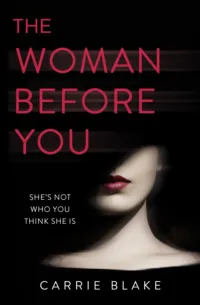
Kitabı oku: «The Woman Before You: An intense, addictive love story with an unexpected twist...»


A division of HarperCollinsPublishers
HarperImpulse
an imprint of HarperCollinsPublishers Ltd
1 London Bridge Street
London SE1 9GF
First published in Great Britain by HarperCollinsPublishers 2018
Copyright © 2018 Seven Acres, LLC
Cover design © HarperCollinsPublishers Ltd 2018
Cover photograph © Nina Masic / Trevillion Images
Carrie Blake asserts the moral right to be identified as the author of this work.
A catalogue copy of this book is available from the British Library.
This novel is entirely a work of fiction. The names, characters and incidents portrayed in it are the work of the author’s imagination. Any resemblance to actual persons, living or dead, events or localities is entirely coincidental.
All rights reserved under International and Pan-American Copyright Conventions. By payment of the required fees, you have been granted the non-exclusive, non-transferable right to access and read the text of this e-book on screen. No part of this text may be reproduced, transmitted, down-loaded, decompiled, reverse engineered, or stored in or introduced into any information storage and retrieval system, in any form or by any means, whether electronic or mechanical, now known or hereinafter invented, without the express written permission of HarperCollins.
Source ISBN: 9780008279479
Ebook Edition © May 2018 ISBN: 9780008279462
Version: 2018–03–16
Table of Contents
Cover
Title Page
Copyright
Prologue
Isabel
Isabel
Matthew
Isabel
Matthew
Isabel
Matthew
Isabel
Matthew
Isabel
Matthew
Isabel
Matthew
Isabel
Matthew
Isabel
Matthew
Isabel
Matthew
Isabel
Matthew
Isabel
Matthew
Isabel
Isabel
About the Author
About HarperImpulse
About the Publisher
Prologue
On the day he finally asked me, I knew. This was where everything had been leading, all along. I didn’t ask: What happens now? I didn’t ask: Why me? I didn’t ask: What will I have to do? I didn’t ask: How bad will I have to be? How evil?
I waited for him to speak.
He smiled at me across the table in the restaurant where he’d just shown me something that had changed everything. Something that put the last part of my life—or maybe my whole life so far and my immediate future—in an entirely new and different light.
He didn’t have to explain. He didn’t have to tell me what I’d just seen. He took my hand in his and gently stroked my palm. His hands were smooth and icy cold. As cold as the devil’s, I thought.
‘You’re perfect,’ was all he said. ‘Perfect.’
Isabel
It’s always a nasty shock to learn that what you believed was your deepest self, your inner core, was, all along, only your surface. It’s even more shocking to discover how fast that clean, pure surface can crack—and reveal the darkness and dirt beneath.
On the surface I was a nice girl; the girl you want to have coffee with after yoga class, the girl whose shoulder you cry on after your break-up, the girl you call to watch your kids when the babysitter cancels at the last minute.
My senior year in high school, they actually tested us for compassion—to see how much sympathy we had. Our principal’s wife taught in the college psych department, and everyone said that the test was part of her research. We knew that this was probably not approved by the Iowa Board of Education, but no one objected. If you refused to take the test, it meant you had no compassion. You weren’t a nice person. You failed.
The school guidance counselor, Mr Chambers, took us one by one into a side room off the gym, a windowless cubicle that reeked of disinfectant and old sneakers. He asked a lot of questions. I aced the test without trying. Would I risk my life to save someone? Sure. If I won the lottery, how much would I give to charity? Fifty percent. Did I usually assume that a person was telling the truth or lying? Mostly, telling the truth. It depended on who the person was.
Mr Chambers put his hand on my knee. Beads of sweat popped out on his forehead. He stared into my eyes. His eyes were liquid and brimmed with fat tears under his dark bushy eyebrows.
I ignored his hand inching up my leg. I pretended not to notice.
I answered his questions truthfully. I said what I thought. I didn’t have to think. I didn’t mention the fact that, all through the test, his hand kept edging further up my leg. Did he think he was being encouraging and supportive? Affectionate and kind?
Finally, I slapped his hand away, like a pesky mosquito. He raised his hand, and shook it from side to side, as if he were waving goodbye to me. After a few minutes, he put his hand on my leg again. I wanted to say something, to yell at him, to scream. But I didn’t. I just sat there, answering his questions.
To be fair, he never got further than my lower thigh. And maybe that was the real compassion test, underneath the fake one. Question: Did I think Mr Chambers was a disgusting perv who should be locked up for the rest of his life, or did I think he was a sick man who needed help? Answer: I thought he was a disgusting perv who needed help.
My friends and I never talked about what happened in that cubicle, and I think I learned something from that, though I couldn’t have said what it was. At least not then. Not yet.
Later, after everything had happened, I thought back to that day. And I thought I knew what the lesson was: Be careful. Trust no one. You never know the secret reason behind what seems to be happening. When (and if) you find out, it’s usually more sinister than whatever you could have imagined.
I’d always taken people at their word. Once, I ate a giant spoonful of cayenne pepper because a mean girl told me it was cinnamon candy. I dove into a slimy pond that a cute boy told me was clear. Everyone laughed when I came up for air, slicked with algae and mud.
For years the joke was on me. But what saved me was that I always somehow knew what people were thinking and feeling. It wasn’t anything weird, like telepathy or ESP or anything like that. But it was a little like that. I looked at the person and I knew. I could feel what they felt.
It was strange, I could almost see into their hearts and minds. It was like a new window opening up on an electronic device, a tablet or a phone. There was me, and there was that other person in a corner of my consciousness.
I sat with the kid at the party who needed someone to talk to. I stuck up for the bullied. I comforted the kids with problems at home. I wasn’t afraid to do the right thing, though I didn’t always know what it was. Even the cool kids came to like me for it. I was like their conscience, so they didn’t need to have one. Doing the right thing was a service they paid me for, with their friendship.
I never told my super-nice high school boyfriend that our hot romance bored me. Why would I hurt his feelings, telling him how often I was thinking of something else—a movie I’d seen, what Mom was cooking for dinner?—when we had sex in his bedroom after school while his parents were off at work? I was always relieved when he made that funny little snorting noise after he came. It meant that the sex part was over, and I could lie with my head on his chest and think my own thoughts, which I actually sort of liked. I was good at playing the girl in love for the time being.
After we graduated high school he went off to Oberlin. I could have gone to Oberlin, too. I got into all of the schools I applied to. And yet, despite the objections and fears of my mother, who thought that New York was a dangerous and scary place, I was going to New York to be an actress. Theater was the only place I felt at home. But this didn’t fit in with the kind of girl I was supposed to be—the one who went away to college to study hard, and then went to grad school to study harder, until I became a lawyer or a psychologist or a director of marketing at some startup company. Thankfully, my mother had raised me to be an independent person, to believe in myself, to be strong and not to let anyone make decisions for me. My dad had been killed in a car wreck when I was four, and she’d supported us since then, without a man to help her. She was an inspiring example of how a woman could be her own person and follow her own lights. And now she had to stick by her own principles, even though she worried about me.
My boyfriend and I pretended to be really sad about the fact that circumstances beyond our control were separating us. I could tell that what he was feeling was mostly relief … and happiness that he was leaving town to start over somewhere else. Maybe he’d meet a girl who honestly thought that he was interesting and sexy. We broke up with a long lingering kiss and hug. We were Midwesterners. We were nice.
On the day I met The Customer, that niceness began to crumble. That do-the-right-thing conscience started to peel away, like the papery skin that flakes off after a sunburn, and you can’t stop picking at it because it hurts so much and it feels so good. When that clean, pure surface was burned away by sex and need and desire, I was left with my true self: all body, all skin, all touch, no soul, lustful, depraved, and corrupt.
Isabel
I’d always wanted to be an actress. It was where I could use my ability to see what other people were feeling, what other people were thinking and make a crowd of strangers see it, too. I could even make them feel it. It was like a superpower. There was no limit to what I could do in these pretend worlds. That should have raised a red flag; pretending is never too far from reality. But I saw no flags. I loved the feeling of not being me, of being someone else. I loved the attention. I loved making my whole school cry when I did Emily’s ‘Goodbye, World’ speech in Our Town, at the end of senior year.
By the time I was in high school, my mom had finished school (she’d put herself through college working as a waitress) and had a job she really liked as an administrative secretary in the English department at the college in our town. I could have even gone there for free. But I needed to leave. I loved the small Iowa town where, it seemed, I knew everyone and everyone knew me. But that was another reason why it was time for me to get away.
When I moved to New York, I had about six hundred dollars of my own money—money I’d made when I’d worked every summer, babysitting and minding the neighborhood kids. And Mom had given me a fraction of the money she would have spent sending me to college—money that I knew she didn’t really have—in one lump sum. I dreamed of late-night rehearsals, smoke breaks on fire escapes, stacks of scripts piled high on dusty Turkish rugs in my bohemian penthouse. There’d be bottomless brunches and dinners till dawn with the crew. My name in lights. My glorious stage and film career.
I went to a few auditions. It took me a couple of weeks to realize this wasn’t high school anymore. I stopped going to auditions. I took a drama class at the New York School of Theater, which is where I met my two closest friends in New York, in fact my only friends in New York, Marcy and Luke.
I tried out at a few more auditions. I quit again. Everyone was better than me. I could hear them through the walls as I sat in the corridor, waiting for my name to be called. And when I got through the door, I could see the casting directors’ eyes glaze over. I was pretty, but not pretty enough. I wasn’t this enough, I wasn’t that enough. I looked like a million other girls who’d come to the city with the same hopes and ambitions. And boy, were they ever not interested in hearing me do the tragic monologue from Our Town.
Thanks. We’ll call you. Next!
I was running out of money way faster than I thought I would. If I wanted to stay in New York, I would have to make some changes. It wasn’t easy to give up on my dreams. And when I finally called my mom in Iowa to tell her that maybe I didn’t want to be an actress after all, it was as if I’d somehow made it official. Even though I knew my mom loved me and believed in me and wanted only the best for me, it made me furious when I heard, in her voice, that she’d always known how small—how ridiculous—my chances were.
She said, ‘Maybe you should consider something else, dear. Maybe you should think about becoming a psychologist. You’re so good with people, so sensitive. So intuitive. So caring.’
That was when I almost told her what the school guidance counselor had done in that dim cubicle off the gym. But I didn’t.
‘Thanks, Mom,’ I said. ‘I’ll think about it.’
That night, I cried myself to sleep. Could it really be this easy to give up on so much of myself?
Maybe that was part of what I saw in The Customer.
He gave me a chance to act, to pretend to be someone else—someone hotter and sexier than the nice girl I’d always been. But he knew I wasn’t pretending.
And he believed in me. He believed that I could become someone else, that I could do something else. And he let me show him how.
The week I got to New York, I found an apartment in Greenpoint, Brooklyn, a studio which was super cheap because it was tiny and had hardly any light and because everyone knew that it was directly over a giant toxic dump site that had never been properly cleaned up. I didn’t care. I wasn’t planning on staying there long enough for it to hurt me. I bought a plant—a cactus. I named it Alfred, I don’t know why.
The cactus shriveled up and died. Too little light, I guess.
I got jobs that paid almost nothing but that I was grateful to get. I helped people figure out how to use the copy machines at Staples until the flash of the machines started hurting my eyes and I got scared that it was going to damage them. I was a receptionist at a nail salon. The Korean girls were friendly and sweet and really brave in the midst of their terrible lives, but the only English they spoke was about nail shape and length and polish, and it made me feel even lonelier than I already did.
I guess that’s how I wound up selling mattresses at Doctor Sleep.
The place was named after Steve—my boss’s—favorite Stephen King novel. Steve lent me a tattered paperback copy of the novel and told me to read it. I got through the first two hundred pages, but it was too scary. It gave me insomnia—and when I finally fell asleep, I had nightmares. It seemed odd to me that a store designed to help its customers sleep better had taken its name from a book that would keep them awake. I thanked Steve for the book and told him that it was my new favorite novel, too.
Obviously, I’d never once in my life said: I want to be what Steve refers to as a ‘mattress professional.’ Believe me, I never thought: Oh, if only I could know everything in the world there is to know about memory foam and pillow tops and coils. If only I could work for a guy named Steve who looks like an aging groundhog, who has creepy, secretive habits and a pitiful business model, and who always stands way too close when he talks to me. Though in fact he never touched me, except once, to shake my hand when he hired me.
I could tell what Steve was thinking and feeling. I saw how he imagined himself: as the king of a vast mattress empire with branch stores all over the city and suburbs.
I decided that Steve was harmless, which didn’t mean that it wasn’t a little disturbing when, on my first day at work, he explained his theory: insomnia is not a psychological problem but an actual disease that only the right mattress can cure.
The showroom had touches—white tile walls, a weird little machine that blinked and beeped like a heart monitor, and to one side, a gurney on which there were stacks of fancy duvets no one ever bought—designed to look like Steve’s sick fantasy of a hospital or operating room. Steve even wore a white lab coat. At first he said that I should too, and he lent me one of his, which smelled of cologne and sweat and said ‘Steve’ on the pocket. But after a week he told me that it was a pity to hide my pretty legs under a uniform.
So he got me a short white medical jacket that came just down to my hips, the kind of jacket an outcall hooker would wear, a prostitute hired to play Naughty Nurse.
Maybe that’s why The Customer got the wrong idea. Except that it was the right idea. The right idea that went very, very wrong.
My name was stitched on the pocket of the medical jacket.
Isabel.
I felt like sobbing when I saw it. It was like a threat: I’d be working here forever, at least for a very long while. But I could tell that Steve was proud of the jacket. That little corner of my mind that had Steve’s feelings in it lit up like a Christmas tree. He was so happy when he gave it to me. I smiled and said, ‘Thanks, Steve.’
‘I can write it off as a business expense. It improves the look of the establishment,’ Steve said.
Was I supposed to say thank you for that?
My friend Marcy, from drama class, had worked at Doctor Sleep for a few weeks. She said it was easier than waitressing: better hours. But she preferred waitressing. I wondered if she’d left because of Steve, but I couldn’t ask a friend, even a friend I saw more rarely now that I’d quit drama class, if she’d set me up to work with a total creep. I didn’t like how Steve looked at me when I tried on the starchy white jacket.
On my second day at work Steve announced that he was in an open marriage, but that workplace romances were strictly forbidden for professional reasons. I was the only person he could have had an office romance with, so I assumed he was telling me something. That was a relief. As I said, he never once touched me, or did anything perverted. If I wanted to keep my job, it seemed like a stupid idea to ask my boss to stand back when we talked. I wouldn’t have been at all surprised if he took it the wrong way. So I didn’t say anything. I let him breathe his hot breath on me.
Whenever Steve left for his lunch break, he had a furtive, weaselly air. Through the window, I watched him scurry away. I always had the feeling that he was going to see a dominatrix. But weirdly, the part of my brain that told me what someone else was experiencing stayed empty—no picture, no sound—when Steve left for his lunch break. I’d always had an almost telepathic sense of empathy, but now I realized the foolishness of taking any gift for granted, of thinking you would have it forever.
I told myself that it wasn’t fair to blame Steve for being the person he was.
On the day Steve hired me, a Friday, he gave me a large binder full of papers from the International Mattress Retailers Association. He told me to study it over the weekend. On Monday he would give me a test.
I had a bad feeling about this ‘test,’ but I studied just in case it was real and not some euphemism for getting groped by Steve—like the ‘compassion test’ at my high school. I learned about the science of sleep and the fine points of mattress construction. There was even a section about feng shui—the ancient Chinese system that told you where and how to position your bed in your room for the soundest sleep and maximum good health.
The manual instructed me to look friendly, concerned, professional, like a doctor. I was dealing with one of the most intimate aspects of my customers’ lives. I should keep that in mind when I asked about slumber positions, back problems, sleeping difficulties, what they wanted in a mattress.
On Monday Steve handed me a multiple choice test and told me to fill it out at his desk. I scored one hundred.
‘Good girl, Marcy,’ Steve said.
‘I’m Isabel,’ I said.
‘Right,’ said Steve. ‘Marcy was the last girl.’
‘My friend Marcy,’ I said.
‘Right,’ said Steve. ‘The redhead. You’re the blond.’
I did what the mattress experts suggested. I acted concerned, sympathetic, professional. Like a kindly family doctor. I’d guide the customers to the most expensive mattress I thought they could afford, murmuring about why it was perfect for them. I even talked about feng shui, if I thought a client was the type to go for it. I never once tried to make clients buy something that I knew was beyond their budget.
Almost always, customers wanted to try out the mattress. Then my role would shift from that of the diagnostician to that of the tactful nurse who leaves the room or turns away when a patient undresses.
It was surprising how many people lay like corpses. On their backs, arms crossed. Even young couples, in love, lay there like statues on a tomb. Staring up at the ceiling, they discussed the mattress. Too hard? Too soft? You would never suspect that they might ever have sex on that mattress. Watching them, you couldn’t imagine the thought even crossing their minds.
The day I met The Customer was one of those weirdly warm, swampy September afternoons. An unusually quiet Saturday. Lately, business had been slow, even though Steve said it was usually his best season, when NYU students were moving into their dorms and convincing their rich parents that they needed a better mattress than the one the school provided. I could feel Steve’s gloom, his disappointment. He’d stopped talking about opening a second branch in the East Village.
Steve had gotten me a small cheap desk, at which I sat, looking out the window at people whose lives were more fun and exciting than mine. Everyone had somewhere to go, someone to be with, shopping to do. I wished them well. Someday I could be one of them. One of the lucky ones. I was determined not to feel sorry for myself—not to give up hope, no matter what.
A mom with a stroller came in and asked if we sold mattress covers for cribs. Steve sounded impatient when he told her to try Babies ‘R’ Us. When she passed me I flashed her a smile that I hoped said, what a cute baby, though I hadn’t actually seen her child under its milky plastic awning.
I tried to concentrate on my book, an anthology of poems based on Greek myths. I was obsessed with Orpheus, on how he could have gotten his beloved Eurydice out of hell if he hadn’t turned around to make sure she was there. What was that story about? Trust? Love? Fear? Stupid faithless men who would ruin everything in a heartbeat if something upset or scared them? Or women who think they can overpower fate and end up trapped forever?
I read the poems till I thought I understood them. Which I never did.
But I guess those poems prepared me for how I would feel about The Customer. For the sheer terror that I would turn around—and that he wouldn’t be there.
I pulled out my phone and scrolled through to a folder of apps I’d labeled ‘auditions.’ It hadn’t been easy to abandon acting. But the truth is I’d found a small workaround, for the time being at least. One drunken night, Marcy, Luke, and I all downloaded Tinder on our phones. It started out as a joke. We would each go on three dates and report back. ‘Come on, nice girl,’ Luke said. ‘Join the modern world. You’re not in Iowa anymore.’ We’d spent the rest of the night swiping left and swiping right, laughing out loud, screaming every time we had a match. I’d be lying if I said it didn’t feel good when a hot guy matched with me. We switched to beer and took a sip every time we landed on a picture of a guy with a puppy or a guy with a guitar. We were all hungover the next day.
I was surprised by how little effort it took to ‘match’ with somebody. But when I actually started texting with one of these so-called matches, I understood the old ‘plenty of fish in the sea metaphor’ on a whole different level; it was a big sea filled with a lot of creepy fish. The first guy made a joke about how cheesy dick pics were, told me he liked butt play, and then sent me a dick pic. Then there was the guy who sent me a picture of a paddle and asked me what I wanted to do with it. Or the guy who opened the conversation with ‘do u like to be choked?’ Finally, I matched with a guy who had just moved from Connecticut to work in marketing at some greeting card company in Midtown. He missed his mom and had a dog (the adopted, shelter variety—included in his Tinder profile) and lived just a few blocks away from me. Pretty vanilla. But after so many conversations with gross guys about the size of my chest and euphemisms for penises, I could do a first date with Mr Vanilla.
The date was pretty basic. We met at a bar around the corner from his apartment in Williamsburg that had just opened and he’d been meaning to check out. The bar was dog-friendly, so he could have brought his dog, he told me, but he didn’t want us to ‘move too fast.’ I wore a yellow knee-length dress and he wore a button-down shirt and khaki shorts. I could tell he’d gotten his hair cut for the occasion.
We talked about his hometown of West Orange; about what he studied in college, and his favorite TV shows. But when he started to ask me about my life a funny thing happened. I told him I grew up in Ohio, had two brothers, and two parents who were crazy in love. My dad was a historian and my mom was a lawyer. Dad was a total romantic and my mom was a real-life superhero. I had a grandmother I was really close to (actually my great-aunt, but I called her Nana—‘a long story,’ I told him), who passed away last year. The best Christmas present I ever got was my Labrador-mix named Juno, when I was nine. I met my best friend when we were in kindergarten, and I lived with her now.
I watched his eyes light up as I pulled out the props for my character. I could feel how excited he was to know me—this girl with so much potential who knew where she had come from and where she was going. I had written a different script for myself. I became the girl he would want to see again, someone who would meet his dog, his mom, his best friends from home.
After a chaste kiss at the corner, I walked home alone. I deleted our conversation from the app on my phone. I didn’t want a second date. I wanted to preserve that moment. The look on his face when he thought he recognized me, when I became the perfect girl. It was almost like acting except better. I wasn’t just memorizing lines, I was writing them, too. And in real time for an audience of one.
I wanted to feel that way again. To meet someone, figure out who they were and what they wanted, and become the person they needed, then watch them fall in love. Now I was the one not giving callbacks. I’ll admit, it felt good to finally have some power. When Tinder started to feel stale and flooded with perverts, I made profiles on Bumble, Thrinder (even more of a challenge), OkCupid, Coffee Meets Bagel—and each with a slightly different character. On Bumble, I was Riley from Portland, Maine. On Thrinder, I was Lorrie from the Bay Area. On OkCupid I was Amanda from Manhattan. All I had to do was make a new email, and a new Facebook profile (back when Facebook made it easy to do such a thing). I never went on more than a first date—and never took more than a sweet goodnight kiss on the cheek. I was still a good Midwestern girl, after all, and one date wasn’t enough time for anyone to get hurt. I thought of it as more of an ever-evolving character study game. I loved keeping all the scripts in my head at once, remembering which app I met so-and-so on, which backstory to pull out.
That day, I was going on a coffee date with a Mr Matthew from Bumble. I pulled up Bumble and scrolled through his pictures. From what I could see, he was tall with broad shoulders, and dark hair. There were no puppy pictures. There was Matthew on the beach in a tank top and American flag shorts, all square chest and tight, tan quads, Matthew sitting at the center of a group of guys, his thick shoulders wrapped around the two closest to him. But the one I kept swiping back to was a picture of Matthew standing on a pier, the sunset behind him framing his face. His head was thrown up to the sky and his eyes were closed, like he was in the middle of the greatest laugh. He had the best jawline I’d ever seen.
I grabbed my stuff and prepared to leave for my lunch break date. Steve told me to ‘have fun’ as I walked out the door. As I was walking to the coffee shop to meet Matthew, I kept thinking about that laugh, that jawline. I didn’t know why, but something about this date made me want to ride the line—maybe show him a little more of the ‘real’ Isabel. A new character challenge, or so I thought.
When I walked into the coffee shop, I spotted him immediately. Our eyes locked and we both grinned, mirroring each other’s delight as we moved closer to each other. When I got to his table, he stood up and gave me a kiss on the cheek. He smelled expensive—all sandalwood and vetiver—and my knees buckled as I tried to remember what he thought my name was.
‘Excited to meet you, Riley,’ he said, watching me as I sat down.
Ücretsiz ön izlemeyi tamamladınız.