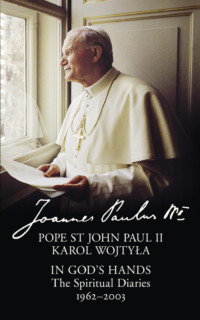
Kitabı oku: «In God’s Hands: The Spiritual Diaries of Pope St John Paul II»


Copyright
William Collins
An imprint of HarperCollinsPublishers
1 London Bridge Street
London SE1 9GF
WilliamCollinsBooks.com
This eBook edition published by William Collins in 2017
Copyright © Centrum Jana Pawła II ‘Nie lękajcie się’ 2017
English translation © Dr Joanna Rzepa 2017
Znak Publishing House on behalf of the author hereby asserts the author’s moral right to be identifed as the author of this work
Cover photo by Gianni Giansanti, Corbis
A catalogue copy for this book is available from the British Library.
All rights reserved under International and Pan-American Copyright Conventions. By payment of the required fees, you have been granted the non-exclusive, non-transferable right to access and read the text of this eBook on-screen. No part of this text may be reproduced, transmitted, downloaded, decompiled, reverse engineered, or stored in or introduced into any information storage and retrieval system, in any form or by any means, whether electronic or mechanical, now known or hereinafter invented, without the express written permission of HarperCollins Publishers.
Source ISBN: 9780008101053
eBook Edition © February 2017 ISBN: 9780008101060
Version: 2018-02-08
Contents
Cover
Title Page
Copyright
Introduction by the Archbishop of Cardiff, George Stack
Introduction to the Polish Edition
Preface by the Metropolitan Archbishop of Kraków, Stanisław Cardinal Dziwisz
The Secret of Father Karol Wojtyła – Pope John Paul II’s Spiritual Notes
The Retreats
1962
1962
[31 October – 4 November] 1962
6–7 July 196? [probably 1963]
19–23 [August] 1963
[5–8] March 1964
31 August – 3 September 1964
17–20 [August] 1965
[19]64 (65?)
31 October – 1 November 1966
19–21 December 1966
29 February 1968
11–14 September 1968
9–13 August 1969
4–7 November 1970
1–5 September 1971
5–6 July 1973
9–12 August 1973
1974
[3–7 September] 1974, The Holy Year
4–8 July 1975
21–26 September 1976
5–9 July 1977
26–29 June 1978
[October 1978]
4–10 March 1979
24 February – 1 March [1980]
8–14 March 1981
28 February – 6 March 1982
20–26 February 1983
11–17 March 1984
24 February – 2 March 1985
16–22 February 1986
8–14 March 1987
21–27 February 1988
12–18 February 1989
4–10 March 1990
17–23 February 1991
8–14 March 1992
28 February – 6 March 1993
20–[26] February 1994
5–11 March 1995
25 February – [2] March 1996
16–22 February 1997
1–7 March 1998
21–27 February 1999
12–18 March 2000
4–10 March 2001
17–23 February 2002
9–15 March 2003
Footnotes
About the Author
About the Publisher
Introduction
Not since the publication of Journal of a Soul, the spiritual autobiography of Pope John XXIII, have we had such privileged access into the spirituality of a pope. This is what we have been given with the publication in English of the spiritual diaries of Pope John Paul II. In God’s Hands has already been published in his native Poland and in Italy where it has been a phenomenal success. English-speaking readers will now benefit from the extraordinary insights of this spiritual journal.
The two notebooks from which it is drawn are not chronological. However, the first covers the years 1962–1984, whilst the second includes notes at retreats given to the Pope and Roman curia between the years 1985 and 2003. The electrifying element in this publication are the pages of handwritten reflections, explanations and prayers bearing characteristic insights of Pope John Paul II. There is an Ignatian structure to much of his response to the various presentations, homilies, feast days, Liturgy of the Hours and Mass celebrated during the retreats. This structure enables an amazing personal response to take place, with the unique ability to link such thoughts and texts to his own inner life as well as to the public ministry he was called to exercise in the Church and in the world.
In God’s Hands is unusual in that the immediacy of the Pope’s response is given, not just through his handwriting, but in the deepest thoughts elicited by the presentations of the retreat givers. This is not a sedate, refined or sanitised journal of devotion. It allows the reader to follow the different paths which lay before one who was sincerely discerning the will and plan of God unfolding in his own life.
In all this, the leitmotif of obedience to the will of God is obvious not least in his episcopal motto ‘Totus Tuus’. In his devotion to Mary, Pope John Paul II saw someone who was attentive to the will of God, the woman who listened, the woman who believed that God’s plan could be fulfilled through her obedience. By the same token, that obedience, which is based on prayerful listening and the response which follows, was the foundation of the dynamism he was able to bring to the papal ministry.
‘Prayer is the language of our hope’ wrote Cardinal Ratzinger, quoted in one of the spiritual conferences eliciting a very full entry in the retreat notes. Herein lies another path to the heart of the love of God when ‘Heart speaks to heart’ (Cardinal Newman) but always in the silence of the heart. Of course intercession is part of the prayer of Pope John Paul II as he prays for the needs of the world and the Church and all people. But it is in his prayer of adoration and contemplation that he comes to know himself as he is known. This is the path of the mystic, recognising that heaven is ‘… a space that Christ made for man in God’ (Ratzinger). This is also what allowed the Pope to spend time alone with God in prayer ‘… at the morning watch and even in the night’ (De profundis). So often, such waiting on God is regarded as a waste of time. The act of faith that gives the time and space to such contemplation says that no time is wasted in which God is served. The service of God is the sanctification of time. No time is sanctified more than when it is a pure gift, given in faith with no other expectation than to ‘be’ in the presence of God. This is the prayer which permeates these diaries of Karol Wojtyła.
There is another language of prayer with which he was intimately familiar: the language of suffering. From the devastating attempt on his life in St Peter’s Square on 13 May 1981, and the burden of ill health he subsequently bore, suffering was part of the reality of who he was. Old age and increasing infirmity limited his physical resources in ways which were surely both Calvary and cross to this once energetic man and skilled communicator. Even when he could no longer speak, he did not hide himself away from those who came to see and hear him. He had preached often on the meaning of the suffering of Jesus on Calvary and the significance of the cross in the suffering that each person has to bear. Now he was able to personify that teaching in his own weakness and vulnerability. The final pages of his diaries have lost the intensity and vigour of all that went before. It is significant that the last two entries touch closely the heart of his life and ministry: Mary, his patron and hope, standing at the foot of the cross followed by a meditation entitled, ‘Jonah, or the fear of preaching the love of God’.
Having stood with Mary in her faithfulness throughout his life and having preached the love of God on the worldwide stage, now was the time to return to the Father. His final words on his deathbed were: ‘Let me go to the house of the Lord’ (Psalm 122). In the first chapter of the Gospel of John we read of the disciples of the Baptist asking Jesus, ‘Master, where are you staying?’ Jesus said to them, ‘Come and see’ (John 1:38). In God’s Hands is a chronicle of one who responded to that invitation in prayer and in faith every day of his life.
+George Stack
Archbishop of Cardiff
Chair of the Department of Christian Life and Worship of the Bishops’ Conference of England and Wales
Introduction to the Polish Edition
We present the reader with a book that covers the content of the two notebooks in which Bishop Karol Wojtyła, and later Pope John Paul II took personal notes and recorded his reflections, which related primarily to the retreats and reflection days which he attended between 1962 and 2003.
The text has not been abbreviated in any way. We have attempted to maintain the layout of the notebooks’ pages, as well as any additional notation: underlining, textboxes, etc.; the marginalia are presented in the same way as in the original notebooks.
The words that were impossible to read are marked as [illegible].
The editorial interventions consisted in the following:
– restoration of the chronological order in the entries from the first notebook;
– translation of phrases and sentences recorded in foreign languages (mainly in Latin and Italian);
– correction of obvious spelling and punctuation mistakes;
– expansion of the abbreviations used in the reflections to facilitate reading; if these abbreviations were not easy to decipher, they were retained in their original form.
All editorial insertions are marked by square brackets.
Translator’s Note
Pope John Paul II’s notebooks were first published in Polish in 2014, and soon afterwards translated into several languages, including Italian, French, German, Romanian and Portuguese. It is a great joy to present the English-speaking reader with this translation. In order to help the reader fully to appreciate the richness of John Paul II’s thought, the English edition provides notes with references to biblical quotations and other important sources used by John Paul II, as well as additional background information on people, places and events mentioned in particular entries. All biblical quotations are given according to the Revised Standard Version Catholic Edition. For other sources, wherever possible, full references are given to the editions used by John Paul II and to existing English translations. When citing from John Paul II’s speeches and homilies delivered in Polish, I used the existing Vatican translations with minor adjustments where necessary. To make the edition more accessible, Latin names of regular prayers and services have been translated into English. The edition has greatly benefitted from Dr Máté Vince’s expertise in Latin and Greek, and Dr Andrea Selleri’s assistance with Italian. I gratefully acknowledge their help.
Preface by the Metropolitan Archbishop of Kraków, Stanisław Cardinal Dziwisz
‘I leave no possessions of which it will be necessary to dispose. As for the things I use every day, I ask that they be distributed as seems appropriate. Let my personal notes be burned. I ask that Fr Stanisław see to this, and I thank him for his kind help and collaboration over the years. I leave all my other “thank yous” in my heart before God Himself, because it is difficult to put them in words’ (John Paul II, Testament, 6 March 1979).
This is the instruction that the Holy Father John Paul II left in his Testament. After his death in 2005, I faithfully fulfilled the Holy Father’s will, giving away all his possessions, especially the personal memorabilia. I did not dare to burn the personal notes and notebooks that he had left behind because they contain significant information about his life. I saw them on the Holy Father’s desk, but I never looked into them. When I saw his Testament, I was moved that John Paul II, whom I had accompanied for almost forty years, had entrusted me with his personal affairs.
I did not burn John Paul II’s notes because they are a key to understanding his spirituality, that is, what is innermost in a person: his relationship to God, to other men and to himself. They reveal, so to speak, another side of the person whom we knew as the Bishop of Kraków and Rome, the Peter of our times, the Shepherd of the universal Church. They show his early life, in the years when he was ordained a bishop and installed in the Diocese of Kraków. They allow us to get a glimpse of the intimate, personal relationship of faith with God the Creator, the Giver of life, the Master and Teacher. At the same time, they present the sources of his spirituality – his inner strength and his determined will to serve Christ until the last breath of life.
When I return to John Paul II’s notes, I can see the figure of the Holy Father in the home chapel at Franciszkańska Street,1 as he prays immersed in God, before the Blessed Sacrament, and I hear his sighs coming from the little chapel at the Apostolic Palace in the Vatican. His radiant face never revealed his inner experiences. He always looked at the cross and the icon of Our Lady of Częstochowa with courage. He learnt from her to surrender himself to God entirely, repeating the words of Louis-Marie Grignion de Montfort: Totus Tuus ego sum, o Maria, et omnia mea Tua sunt – ‘I am entirely Yours, O Mary, and all that is mine is Yours’. Complete surrender to God in Mary’s likeness and the fulfilling of God’s will until the end were the characteristic traits of this man of prayer, who discovered the abundant world of the spirit in his relationship with God.
May reading the spiritual notebooks of John Paul II help everyone discover the spiritual depth of the people of the twenty-first century, and may it lead everyone to a greater love of God and other people.
Stanisław Cardinal Dziwisz, Metropolitan Archbishop of Kraków
On the Feast of the Presentation of the Blessed Virgin Mary, the Patron Saint of the Parish in Wadowice2 Kraków, 21 November 2013
The Secret of Father Karol Wojtyła – Pope John Paul II’s Spiritual Notes
Karol Wojtyła–John Paul II’s personal notes already aroused interest at the time of his death. The Pope wrote in his Testament that Fr Stanisław Dziwisz, his personal secretary and closest collaborator, who had accompanied him for the nearly forty years of his episcopal service in Kraków and the Petrine ministry in Rome, should burn the notes. Fr Dziwisz, the current Metropolitan Archbishop of Kraków, did not burn them out of respect for their author, but presented them to the Congregation for the Causes of Saints, which examined the life of the Holy Father in the beatification process. A glimpse at the notes was enough to see that their author led a rich spiritual life that embraced all dimensions of his work.
The spiritual notes reveal the depth of Karol Wojtyła’s life with God during the many years (1962–2003) when he served as Auxiliary Bishop, and then Archbishop of Kraków, Cardinal and Pope. They shed light on the secret of the heart of the Peter of our times, who was Bishop of Kraków in the difficult period of communism, and then for almost twenty-seven years led the Barque of St Peter through the turbulent waves of the twentieth and twenty-first centuries. The spiritual notes contain reflections on inner experiences, resolutions, prayers, meditations and remarks on spiritual progress. They express, above all, their author’s relationship to God, who was the centre of his inner life.
1. Two notebooks
The spiritual notes were recorded in two notebooks: in the diaries ‘Agenda 1962’ and ‘1985’. Both diaries were printed in Italy by the Archdiocese of Milan.
In the first notebook, the author introduced his own page numbering, from 1 to 220. However, the notes are not ordered chronologically: the first entry is devoted to the retreat that Archbishop Karol Wojtyła attended with the Polish Bishops’ Conference at Jasna Góra from 1 to 4 September 1971. In the following pages we find notes from earlier years – beginning with 1962 – which are interwoven with later retreats. The author recorded entries according to his own system and put together personal and spiritual experiences from various years.
The notes in this notebook cover the years when Karol Wojtyła was Auxiliary Bishop and Metropolitan Archbishop of Kraków, and include meditations from days of reflection and private retreats at Kalwaria Zebrzydowska; at the Benedictine Abbey in Tyniec; in Zakopane, at Jaszczurówka, at the Ursulines of the Agonizing Heart of Jesus; at the Bachledówka Pauline Monastery; in Kraków, in the district of Prądnik, at the Albertine Sisters’, in the so-called ‘cottage’ (the house situated in the garden of the motherhouse of the Albertine Sisters’ Convent at 10 Woronicza Street); at the Albertine Sisters’ in Rząska; and the annual retreats of the Polish Bishops’ Conference at Jasna Góra and in Gniezno. The first notebook also contains the notes from the first six years of John Paul II’s pontificate. The notes end with the reflections on the retreat led by Cardinal Alexandre do Nascimento on 11–17 March 1984 in the Vatican.
The second notebook originally belonged to the Pope’s Secretary, Monsignor Emery Kabongo, as witness the erased signature on the first page and the embossed paper seal. The centre of the seal contains the abbreviation ‘EK’ and the edge reads ‘Library of Emery Kabongo’. These notes cover the years 1985–2003. They begin on the page dated 5 January and continue over the next 315 pages, not all of which have been written over.
Thus, the notes taken by Cardinal Wojtyła–Pope John Paul II can be organised in the following way:
The first notebook contains notes covering the years 1962–1984 and focuses on the following events:
– the retreat (Dies recollectionis) after the arrival in Rome for the first session of the Second Vatican Council (9 and 14 October 1962) [p. 2]
– the retreat on the anniversary of priestly ordination at the Felician Sisters’ Convent in Rome (31 October– 4 November 1962) [p. 5]
– the retreat at Kalwaria – The Shrine of Our Lady (6–7 July 1963?) [p. 12]
– the retreat in Tyniec (19–23 August 1963) [p. 13]
– the retreat before the installation ceremony in Wawel Cathedral (5–8 March 1964) [p. 20]
– the retreat at Jasna Góra led by Bishop Kazimierz Józef Kowalski (31 August–3 September 1964) [p. 23]
– the retreat in Tyniec (17–20 August 1965) [p. 30]
– the retreat at [?unknown] (7 November–2 December 1964?/1965?) [p. 36]
– the retreat at Kalwaria Zebrzydowska (31 October– 1 November 1966) [p. 37]
– the retreat at the Albertine Sisters’ Convent (19–21 December 1966) [p. 38]
– the retreat at [?unknown] (29 February 1968) [p. 44]
– the retreat in Tyniec (11–14 September 1968) [p. 45]
– the retreat at Bachledówka (9–13 August 1969) [p. 51]
– the retreat in Tyniec (4–7 November and 19 December 1970) [p. 60]
– the retreat at Jasna Góra led by Bishop Lech Kaczmarek (1–5 September 1971) [p. 67]
– the retreat at Kalwaria Zebrzydowska (5–6 July 1973) [p. 75]
– the retreat at Bachledówka (9–12 August 1973) [p. 76]
– the retreat at [?unknown] 4 July–24 August 1974 [p. 86]
– the retreat in Gniezno led by Bishop Jerzy Ablewicz (3–7 September 1974) [p. 87]
– the retreat at Bachledówka (4–8 July 1975) [p. 99]
– the retreat in Jaszczurówka (21–26 September 1976) [p. 107]
– the retreat at Kalwaria Zebrzydowska (5–9 July 1977) [p. 117]
– the retreat at Kalwaria Zebrzydowska (26–29 June 1978) [p. 126]
– election to papacy (October 1978) [p. 136]
– the Vatican retreats led by:
– Father Faustino Ossanna OFM (4–10 March 1979) [p. 137]
– Archbishop Lucas Moreira Neves OP (24 February– 1 March 1980) [p. 149]
– Bishop Jerzy Ablewicz (8–14 March 1981) [p. 168]
– Father Stanislas Lyonnet SJ (28 February–6 March 1982) [p. 189]
– Cardinal Joseph Ratzinger (20–26 February 1983) [p. 205]
– Cardinal Alexandre do Nascimento (11–17 March 1984) [p. 221].
The second notebook covers the years 1985–2003 and the retreats led by:
– Archbishop Achille Glorieux (24 February–2 March 1985) [p. 235]
– Father Egidio Viganò SDB (16–22 February 1986) [p. 247]
– Father Peter-Hans Kolvenbach SJ (8–14 March 1987) [p. 265]
– Archbishop James Aloysius Hickey (21–27 February 1988) [p. 283]
– Cardinal Giacomo Biffi (12–18 February 1989) [p. 299]
– Father Georges Cottier OP (4–10 March 1990) [p. 316]
– Archbishop Ersilio Tonini (17–23 February 1991) [p. 333]
– Cardinal Ugo Poletti (8–14 March 1992) [p. 346]
– Bishop Jorge Arturo Agustín Medina Estévez (28 February–6 March 1993) [p. 363]
– Cardinal Giovanni Saldarini (20–26 February 1994) [p. 379]
– Father Tomáš Špidlík SJ (5–11 March 1995) [p. 395]
– Archbishop Christoph Schönborn (25 February–2 March 1996) [p. 400]
– Cardinal Roger Etchegaray (16–22 February 1997) [p. 419]
– Cardinal Ján Chryzostom Korec SJ (1–7 March 1998) [p. 433]
– Bishop André-Joseph Mutien Léonard (21–27 February 1999) [p. 448]
– Archbishop François Xavier Nguyễn Văn Thuận (12–18 March 2000) [p. 454]
– Cardinal Francis Eugene George OMI (4–10 March 2001) [p. 467]
– Cardinal Cláudio Hummes OFM (17–23 February 2002) [p. 475]
– Bishop Angelo Comastri (9–15 March 2003) [p. 479].
The entries in both notebooks were written in Polish. However, the author often introduced phrases in Latin and Italian, especially during the Vatican retreats. The Vatican retreats for the Holy Father and the Roman Curia were always preached in Italian.
2. The schedule of a retreat day
The daily schedule played an important role in the retreats and days of reflection. The order of the retreat that was developed in Kraków, when Bishop Karol Wojtyła began his ministry, included three talks; Lectio spiritualis – spiritual reading; Corona Rosarii – Rosary; Via crucis – the Way of the Cross; Adoratio – Adoration; Matutinum – Matins; Lectio – reading; Sacrum or Officium Eucharisticum – Holy Mass or Eucharist; Vesperae – Vespers; Adoratio Sanctissimi Sacramenti – Adoration of the Blessed Sacrament; Completorium – Compline.
During the retreats, Archbishop Karol Wojtyła followed the Ignatian method. He became familiar with this method in the seminary under the guidance of Fr Stanisław Smoleński, who was later made Auxiliary Bishop of Kraków. The method involved preparing a detailed outline of a topic for reflection and spiritual reading. During his episcopal ministry in Kraków, Archbishop Wojtyła led retreats and days of reflection himself, consulting Bishop Smoleński or Fr Aleksander Fedorowicz on spiritual topics. The latter was the spiritual father of the Lwów Seminary in Kalwaria Zebrzydowska in the 1960s, and then the spiritual director at the Laski Centre, near Warsaw. He would also come to Rome and offer counsel to the Holy Father.
This method of reflection allowed Fr Wojtyła to organise the whole retreat or reflection day according to a characteristic plan. The rhythm of the retreat day was set out by the breviary, which was recited according to the pre-conciliar method, with Matins, Lauds (laudatory prayers), Terce, Sext and Nones. Almost every day included:
– Laudes – Lauds
– Meditatio ante Sacrum – meditation before Holy Mass
– Sacrum – Holy Mass
– Gratarium actio – thanksgiving
– Lectio S. Scripturae – reading the Holy Scriptures
– Meditatio – meditation
– Via crucis – the Way of the Cross
– Vesperae – Vespers
– Adoratio – Adoration
– Rosarium – Rosary
– Lectio spiritualis – spiritual reading
– Meditatio – meditation
– Matutinum anticipatum – anticipated Matins
– Lectio S. Scripturae – reading the Holy Scriptures
– Rosarium – Rosary
– Completa – Compline
– Hora Sancta (Sacra) – Holy Hour
– Lectio – reading.
Bishop Wojtyła remained faithful to this order of reflection days and retreats throughout his life, which is evident in his later notes, in particular the notes from the period when he was pope.
3. The content of the notes
The notes taken during the retreats reflect the quality of Bishop Wojtyła’s and Pope John Paul II’s spirit. They show how spiritually sensitive he was to the problems that the Church in Poland and the Church in the world faced. He took the effort to prepare the topics of reflection days and private retreats by himself. At the retreat that he attended together with the Polish Bishops’ Conference, he used the retreat leader’s thoughts to develop his own reflection on his relationship with God and the ways in which he should fulfil his episcopal duties, which gave meaning to his life.
The author of the notes appears to be an extraordinarily regular and well-organised person, focused on spiritual topics. He refrains from describing his emotional states, current affairs and people involved in them. His entire focus is on the extent to which he can reflect Christ in his own life – Christ the Highest Priest. At the end of his entries, the Pope often adds the abbreviation: AMDG/UIOGD – Ad maiorem Dei gloriam / Ut in omnibus glorificetur Deus (For the greater glory of God / That in all things God may be glorified).
A characteristic feature of the notes is their Christocentrism. Fr Wojtyła related all his experiences to Christ, the Highest Priest. He sought to establish a personal contact with Him through regular prayer, meditation on the word of God and pastoral service. He related to Christ all his personal affairs and problems, which he had to face as diocesan bishop, cardinal and pope.
At the centre of all of Fr Wojtyła’s days was the Holy Mass. He prepared for it through the morning meditation, thanksgiving after the Holy Mass and during the day, as well as the Holy Hour in the evening, before the Blessed Sacrament. For Fr Wojtyła, the Eucharist was the space where he could experience Christ’s sacrifice and, at the same time, offer his own life as a sacrifice to God. It was his style of life, which consisted in the surrender of his own self, just as Christ gave up His life on the cross. Through the daily celebration of the Holy Mass, Fr Wojtyła was united with the unique sacrifice of Christ and entered into a personal relationship with the Triune God: Father, Son and Holy Spirit.
The Marian theme is another important feature of the notes. It is developed around the theology and spirituality of St Louis-Marie Grignion de Montfort (Treatise on True Devotion to The Blessed Virgin Mary). Mary appears in Fr Wojtyła’s prayers and reflections as the One who received and fulfilled God’s will in the most perfect way. Fr Wojtyła underlines Her greatness, which was expressed in the wonderful gift of divine grace that She received as the Mother of the incarnate Word. At the same time, the Holy Father considered Mary a person who was mature in faith and who, taking the decision to say ‘fiat’ – let it be to me according to Your word – became a partaker in the divine plan of salvation.
4. Faithfulness until the end
In the last years of his life, John Paul II’s notes became sparser. The Holy Father took note of the topic of the retreat and the order of the day. There is less of his own reflections. It is evident that he found writing more and more difficult. His handwriting also changed and became more irregular.
In 2005, the Vatican retreat was led by Bishop Renato Corti from Novara, who in accordance with the tradition gave talks in the Redemptoris Mater Chapel on 13–19 February. The topic of the retreat was: ‘The Church in the service of the new and eternal covenant’ (‘La Chiesa a servizio della nuova ed eterna alleanza’). John Paul II took part in this retreat by listening to the radio broadcast from the chapel. He listened to all the talks and participated in the Spiritual Exercises, which he practised privately during retreats. He was accompanied by his personal secretary, Archbishop Stanisław Dziwisz, and other members of the household. The notebooks contained only the printed programme of this retreat, which the Holy Father held in his hand while listening to Bishop Corti’s talks. John Paul II remained faithful to the tradition of annual retreats. His last retreat was made complete through his suffering, which became a special mark in his spiritual diary.
Fr Jan Machniak1
The Retreats

1962
Recollectio (inter.) [Inner retreat]
Praenotanda [Introduction]

8 July
The following key inner topics have been put together and discussed with the father:
1. death
2. power
3. creativity
4. people.
2 September
The recollection of these topics and novum [novelty] (as if a common denominator was found for all the experiences and reflections): I am very much in God’s hands – the content of this ‘Totus Tuus’ [‘Entirely Yours’]1 opened, so to speak, in a new place. When any concern ‘of mine’ becomes in this way Mary’s, it can be undertaken, even if it involves an element of risk (though one must not overdo it: in human terms, i.e. on the human side, the issue needs to be dealt with thoroughly). At a certain point, however, one needs to abandon human calculations and somehow grasp the Godly dimensions of every difficult issue. A peculiar iunctim [junction] of issue 4 with issue 2 begins to emerge here.
I discussed all this with the father too.
1962 Dies recollectionis (sequ.)
[Reflection days (continuation)] after the arrival in Rome for the first session of the Second Vatican Council
9 October
Holy Mass; Lauds; Prime
I participated in the ‘capella papalis’ [‘solemn papal ceremonies’] on the fourth anniversary of the death of the late Pope Pius XII, thanks to whom I became a bishop. Thoughts: (a) moving from external to internal vision, I have realised that all those present are connected in one spirit and it is the Spirit of Christ, the Son of God. I experienced this unity in diversity very clearly, and with various degrees of participation taken into account. Not a gathering of many separate units, but the unity of substance. It is the substance of thought, doctrine – and it is attended to by the Pope and the Council. But it is also the substance of life, morals, which we realise within the one Church, through, above all, the mysterium (sacraments): the unity of our sacrificial posture with Christ’s, sealed with the Communion; (b) a background thought that came to me was about the truth of priesthood and episcopacy, which was also given to me from within Christ’s priesthood through His Vicar on earth (Vicarius Christi).1
Adoration: Christ is entirely within the Church and the Church is entirely within Christ. NB I constantly need to remind myself to wish for a good shepherd for the seat of St Stanislaus above all and fundamentally, without allowing for any ‘mea’ [‘mine’].2

Reading the schema ‘de castitate, matrimonio, familia, virginitate’ [‘on chastity, marriage, family, virginity’].3
Reflection (meditation):
1. quoad theoriam [concerning theory]
2. quoad practicam [concerning practice].
(The problem of a general and ‘perspectival’ leadership in this area.)
14 October
Meditation: Let us consider the most proper way for the human spirit to meet the Divine Spirit. Our Lord Christ laid the foundation for this meeting for every human being – and for the work of the Divine Spirit in the human spirit.
(The theological virtues: the means to adjust the human spirit to the Divine Spirit; the gifts of the Holy Spirit: the means, so to speak, of adjusting the Divine Spirit to the ‘dimensions’ of the human spirit.) A move towards the opening and submission of the human spirit to the Divine Spirit is necessary, particularly during the Council. The goal cannot be the expression or assertion of oneself, the human being, the human spirit alone – but above all the expression of that which comes from the Divine Spirit in the form of virtues and gifts. In this light, the fundamental attitude: (1) a permanent necessity to subordinate creativity to truth; (2) experimentum divinum, non humanum [the divine, not human, experience]; (3) humility.
[31 October – 4 November] 1962
Rome, at the Felician Sisters’ Convent
Topic: The mystery of redemption
Deus, Redemisti nos Domine
in sanguine Tuo ex omni
tribu et populo et natione
et fecisti nos Deo nostro regnum
[God, by Thy blood, O Lord,
you didst ransom us from every
tribe and people and nation,
and hast made us a kingdom to our God]1
31 October
The retreat begins at 7.00 p.m.
Adoration; Matins
Introductory meditation: Sixteenth anniversary of [my] ordination to the priesthood – recapitulatio, ut ita dicam, historica [a historical recollection, so to speak]2
Reading: Rahner K., XX siècle – siècle de grâce? [twentieth century – the century of grace?]. Opus Creationis – opus Redemptionis [the order of creation – the order of redemption].3 (La Rédemption au Coeur de Marie [Redemption in Mary’s Heart]).
Compline
1 November
Rosary (petitionary); Lauds
Meditation: Memories from the ceremony of the sacrament of priesthood ‘ut quidquid benedixerint, benedicatur, et quidquid consecraverint, consecretur et sanctificetur’ [‘that whatever they bless may be blessed, and whatever they consecrate may be consecrated and made holy’].4

– On the priest’s hands – Nothing, however, was ‘right’, until the point when I felt great humility towards Christ’s work of redemption – in this spirit, Sacrum cum grat. act., Prima [Holy Mass with thanksgiving, Prime].
Further meditation: Christ redeems us and all for the Father, i.e. offers an atoning sacrifice (propitiatorium), which consists in His complete devotion and union with the Father. Hence the Holy Spirit as the breath of both. We – people – are elevated by the act of Christ’s redemption. Even though we remain outside of what ‘happens’ between the Persons of the Most Holy Trinity, we nevertheless experience the effects of this wonderful spiritual fertility and abundant love. The redemptive act of Christ the Lord embraces, in a special way, priesthood as the culmination of the sacrificial posture, which is, after all, not alien to man as part of the creation. Redemption (Redemptio) also involves a certain striving towards the re-evaluation of everything that is created, in particular everything that is human – and this, as well, should be shared by the priesthood and reflected in it.
The Way of the Cross
Spiritual reading (S. Paul et l’apostolat d’aujourd’hui [St Paul and Today’s Apostolate] and others)
Rosary (II); Vespers
Meditation practica [concerning practical issues]: Problems: (a) Focusing on ‘one’s own’ matters and the necessity to work on a wider range and broaden one’s orientation in many disciplines; (b) certain conclusions on the issue of the ‘priest–laypeople’ balance, and further tasks; (a1) a search for concise and abstract formulae in relation to the human and priestly reality (‘all’ and ‘different’) esp. the needy.
Adoration: In the Eucharist, Christ the Lord allowed us to draw as close to Himself as possible – particularly through priesthood: the closest to who He is, [illegible] and what He fulfils.
Matins (for the dead); Litany of the Saints
Holy Hour: A personal moment with Christ, a personal wish – waiting for a response. Propitiatio pro peccatis meis [The atoning sacrifice for my sins].5
2 November
Rosary; Petitionary prayers; Lauds
Meditation (a) Being much engaged in earthly tasks, in creative work, always to be ready: not to lose perspective. ‘Re-evaluation’ constitutes only one aspect of redemption, which in a sense is its least important aspect (when it comes to the values on ‘this side’); (b) and with this understanding to comprehend the words of the liturgy ‘quia in inferno nulla est redemptio’ [‘for in hell there is no redemption’].6
Three Holy Masses; Thanksgiving
Reading (L’Eglise dans le monde qui vient [The Church in the modern world])
The Way of the Cross
Meditation: ‘Copiosa apud Eum Redemptio’ [‘with Him is plenteous redemption’]:7 Holiness is the source. In Christ the absolute holiness of God is united hypostatically with the holiness of man. God’s holiness (as the love of good and the hatred of evil), but first and foremost as the love of good in everything, even the one who is evil (per accidens [contingently]). All good (the entire sum of values) outside God has its prototype in God Himself. God loves one in another – in this consists His holiness. This holiness is the basis for redemption – also understood as the ‘re-evaluation’ of everything: God restores the value of everything in man, who is personally united with Him. He is Christ – Redemptor [Redeemer]: the holiness of man consists in receiving this good, which God loves – in this manner Christ becomes the model of holiness. In Him that holiness is in a way identical to redemption (Redemptio). In us it has to depend on, first, conversion to God, and second, re-evaluation of everything in accordance with the value that everything has in God, and which Christ the Lord has shown to us.
Rosary; Adoration; Vespers
Meditation super experimentum [on experience]: (An element of risk.) Everything has to be permanently in God’s hands and dependent on God’s assistance. Hence no psychologisation, but moral and, first and foremost, religious orientation (i.e. in Mary’s hands).
Conversation with M.W. (a) missionary–apostolic element; (b) God makes use of different people.
Penitential psalms
Meditation: Conversion in actu quolibet [in every action] has to consist in finding the will of Christ the Lord. There is no other method of opposing the various impulses of human vanity of life; the problem of power, criticism, envy, even together with a certain foundation of some ‘transcendental’ humility towards the Lord God.
Matins (at the Church of the Blessed Virgin Mary)
3 November
Rosary; Petitionary prayers; Lauds
Meditation: Redemption began with ‘Totus Tuus’;8 Preparation for Holy Mass
Holy Mass; Thanksgiving
Spiritual reading (L’individu dans l’Eglise [The individual in the Church])
Meditation: Redemption began with ‘Totus Tuus’: the one and only person, the new human being to whom God entrusted Himself. God–Son needed Her to fulfil His task. God–Son could entrust to Her His own being in this task, because it was first achieved in Her and He prepared Her for this Totus Tuus. Mary responded to this devotion of God in its entire redemptive sense, its entire dynamics. She drew from it and is still drawing that which is contained in it for each and every person: first, conversion, and second, re-evaluation. And in all who entrust themselves to Her, She performs both in due proportion.
My problem is solved here: recently I have felt I was very much in Mary’s hands and close to God through two specific issues. Yet, has not the order been reversed? Am I not ‘using’ it to do something that is ‘very much mine’? The stance I am taking on these issues is total humility. Here is the solution: In Mary’s hands, according to the ‘Totus Tuus’ principle, the work of redemption must be realised also in me with the proportion between conversion and re-evaluation duly maintained.
The Way of the Cross (with Mary); Pastoral letter; Vespers; Rosary
Meditation: The most appropriate effects of redemption in the human being are deeds that stem from it – deeds that through Mary are rooted in Christ, through one’s belonging to Her (Tuus [Yours]), and that are simultaneously in accordance with Christ’s law, with His gospel – in the highest accordance. Here also, among other things, the issue of Father W. (Three possibilities: to simply remain humble and make use of what is at least partly true in there; to make light of it: he will improve as he is young; ‘to keep watch’ and make sure he has improved intellectually and also ‘morally’. First and foremost, one needs to pray for him and for the right decision.)
Adoration; Final concluding meditation (the issue of envy); Matins (memorial of St Charles);9 Rosary
4 November
Holy Mass with the relic of St Charles’s heart, celebrated by the Pope
Meditation: ad instar s. Caroli afferre se ipsum ad bonum commune Ecclesiae et in domicilio et in Dioecesi, participans hoc modo in opere Redemptionis [to work towards the common good of the Church both at home and in the diocese after the example of St Charles, thus participating in the work of salvation].
Adoration

[1 December 1962]
Missa ad intentionem satisfaciendi S. Cordi BMV [Mass offered in reparation to the Most Sacred Heart of Mary]
[2 December 1962]: First Sunday of Advent
There are, so to speak, two planes: the divine plane (the love of the Son–Word for the Father) and the human plane (people’s yearning for the true God, for the revelation of God in the Son–Word). These two planes approach and come into contact with each other – this is the spirit of Advent.
My Advent (a reminder from last year): a strong wish for God–Christ to enter into every matter. In this context, there is the experimental meaning too: it is still in fieri [in the process of ‘becoming’] in me, in others, in an objective way and regarding its future sense.
6–7 July 196? [probably 1963] Kalwaria – The Shrine of Our Lady1
Aims:
1. To ask for peace and good for the Church of Kraków, efficacy of action, vocations.
2. To prepare the basis for the retreat.
3. To move forward certain tasks.
In general: preferably the form of reflection days (= meditation connected with other tasks).
Confession; Holy Mass; Meditation; The Way of the Cross; The Little Ways2
(a) Numerous threads, reflective and ‘existential’. One needs to bring them all here and pass them into These Hands in accordance with the principle ‘Totus Tuus’ [‘Entirely Yours’].
(b) The main topic of the retreat emerges: ‘between past and future’.
19–23 [August] 1963 Retreat in Tyniec1 Topic: Justification – grace
19 August
Compline; Adoration; Meditation
20 August
Lauds; Prime
Meditation before Holy Mass:
1. Holy Mass brings the rhythm of Christ, the rhythm of the Son of God into our lives.
2. (The integrating role of consciousness – the disintegrating role of sensuousness.)
Holy Mass; Thanksgiving; Reading the Holy Scripture; Reading the Council schema; Meditation; The Way of the Cross
A reference to the previous retreat held in Rome on 31 October – [4] November 1962. The dogmatic topic that requires a deeper spiritual reflection is the mystery of justification (iustificatio). Man cannot be ‘just’ before God; he can only be ‘justified’ before Him. The former is proved by the fact that man is not equal to God, his Creator, and the latter by Christ and the entire order of grace.
No creature can be in a position of justice before its Creator. Man is in a way a synthesis of creatures. As a creature in general, he and his existence are unconditionally dependent on his Creator; he is dependent also by virtue of his nature and, consequently, unequivocally subordinate. As a being endowed with vegetative (sensual) life, he is subject to the laws of life and death (generatio et corruptio) like other creatures. As a spiritual being – a person – he bears a more special resemblance to the Creator, which obligates him to maintain the order of justice, i.e. to give to everybody what rightly belongs to them (which also includes paying religious worship to God). The fact of personhood does not render invalid man’s vegetativeness and animalitas [animal nature], which turns him into ‘ash and nothing’2 before his Creator. As a person, man can enter into personal contact with the Creator; this contact, however, has to be initiated by the Creator. When He initiates it, it consists (like the act of creation) in an act of mercy, because man as a creature is fully dependent and subordinate. In particular, he needs to be justified because of his sin, which, as an offence to God, does harm to the very essence of this personal contact understood in the way it is understood and intended by the Creator – and it is His prerogative to define the essence of the contact He establishes with His rational creature.

Justification comes through Christ, the Son of God, who initiates this essential contact and gives it, to a certain extent, the qualities of His contact with the Father. Therefore, justification is expressed in us as the new esse [being] – ‘esse ad Patrem’ [‘being towards the Father’] (i.e. sanctifying grace), and the continuation of this personal contact consists in faith, hope and love.
Vespers
Adoration: Lord Jesus hid in the womb of Mother Mary, which He left as a human being – and in the womb of Mother Church, so that it could give birth to sons of God.
Rosary; Spiritual reading (G. Vann)3
Meditation: I note down briefly: the (diocesan) bishop’s authority and vocation require, on the one hand, generosity and courage, and on the other hand, service to everybody and universal charity, in particular charity for priests. Regarding all these points: reservations. ‘Episcopatum desiderare’ [‘To aspire to the office of bishop’]4 – but it cannot be ‘propter se’ [‘for oneself’]. Many things have yet to ‘burn out’ and ripen. Providence is sweet. Very useful reflections, and thereby quieting down.
Anticipated Matins
One more thing: what has a particular value is suffering for the sake of the matter – it brings more benefit than all the efforts. (Fr Pr.).
Reading; Rosary; Compline; Reading
21 August
Lauds; Prime; Rosary; Reflection; Holy Mass; Meditation
It happened that today I celebrated Holy Mass to mark the reception of the habit and profession at the Daughters of Divine Charity. It allowed me to bring yesterday’s topic – the mystery of justification – closer to the mystery of the Church. The Church – the mystical body of Christ – is, so to speak, ‘esse ad Patrem’ [‘being towards the Father’]. The sisters, who through their vows choose Christ for their bridegroom, in a special way enter into this ‘esse ad Patrem’ not only personally, but they also impress the sign of this ‘esse’ [‘being’] on the life of our entire society. Hence they are much needed by the Church and in the Church. In a way, they constitute its vertical core. At the same time, it needs to be observed that their special vocation and involvement stems from the mystery of justification. It is simultaneously the fruit and the realisation of this justification.
The Way of the Cross
Meditation: Although yesterday it was said that man – a creature – cannot be stricto sensu [in the strict sense] ‘just’ before God, but needs to be justified by Him, this justification nevertheless aims to create the type of relationship between man and God that consists in justice; in any case, it builds its elements and conditions. God wants man to be ‘just’ intrinsically (intrinsece) and not only ‘justified’ (extrinsically – extrinsece). This is indicated by a contrast with the reality of sin, which is an ‘offence to God’. If the Creator had placed his rational creature, man, entirely beyond the relationship of justice, sin would be impossible: An offence is to some extent a violation of justice with regard to a person (and also charity). The Creator gave primary justice to man through grace, and after the sin, He did not deprive him of the possibility of such a relationship. This possibility gestures towards the supernatural order, the order of grace, but it is grounded in the natural order: in the fact that man is a person.
Christ the Lord justified man, that is, helped and has been helping man to be just before God. Man is ‘just’ before God through ‘esse ad Patrem’, which is grace. The Church as the mystical Christ helps man achieve the same, because its task is to be the continuation of Christ and His work. Doing this, Christ and the Church simultaneously contribute to the fulfilment of human personhood. Man is fully a person when he is ‘justified’, that is ‘just’ before God. Without this – one could say – his personhood remains incomplete, it is unfulfilled.
Man was justified, because he could be (can be) and was (is) unjust before God. Whereas God wants – and He wants it through Christ – man to be just before Him, so indirectly He also wants him to be ‘made equal’ with regard to God – of course through grace. It seems to be the most essentially revealed (genuinely revealed) part of the entire ethics, and simultaneously the most essentially ethical (genuinely ethical) part of the entire revelation (theology!).
Vespers
Adoration: Christ hidden in the womb of the Church, so that He can reveal Himself to humankind. The grace of maturation.
Rosary; Meditation: casus [the case of] W. (T., I.) separately
Reading: De statibus perf. [On the stages of perfection]; Holy Scripture; G. Vann
Matins; Matins (II) for the Feast of the Immaculate Heart of the Blessed Virgin Mary; Compline
Moreover: thoughts of death!
22 August: Feast of the Immaculate Heart of the Blessed Virgin Mary
Lauds; Prime; Meditation; Holy Mass; Thanksgiving; Rosary; Conversation with Sister Aug.
Reading: Holy Scripture; schema De clericis [Concerning the clergy]
Meditation:
1. The mystery of justification evokes the awareness of the human creature’s unjustness to God–Creator. This awareness grows bigger and brings out the need of restitution: to make amends to Christ – Him, who has atoned for us all and ‘justifies’ all.
2. Furthermore: justice has followed from justification, which points to the primacy of grace, as it puts us in the position of justice before God: it is this justice that the Lord God wants from us and that He wants in us.
3. The primacy of grace in being – and as a consequence the primacy of grace in action. In the past year it became very clear to me in a well-known context. It undoubtedly means reliance on God. Example: St Peter on the lake – if I look at the man, I am overwhelmed by pessimism; when I look at Christ, trust returns. However, this trust and reliance cannot be presumptuous. Even here some measure of justice should be considered.
4. Justice in relation to one’s position. A bishop bears a particular responsibility for the Church – and this responsibility should be contained in his justification and justice before the Highest and Only Shepherd of souls. One needs both generosity and humility, in fact, a supernatural courage, not only a ‘drive for importance’.
The Way of the Cross: Station XII: the courageous is the one who is ready for the cross!
Vespers
Adoration: Lord Jesus gathered His apostles in the Upper Room and instituted the Eucharist in front of them. He took with Him perfectly ordinary people.
Rosary
Meditation: Problem of ‘successio’ [‘succession’] – separately. The grace of humiliation. Other concerns: priests, family (W. and others), earlier ones.
Matins; Conversation with Br Michael – v. helpful; Compline
Holy Hour: Our justification follows in a way from our very injustice, because the Lord Jesus accomplished it through His death, which He suffered most unjustly. Justification was then decided solely through the Redeemer’s inner act, the act of love and atoning and justifying sacrifice.
23 August
The Way of the Cross; Lauds; Holy Mass with a homily; Thanksgiving (Rosary); Prime
Meditation: All the thoughts from the retreat somehow come together in this week’s prayer (11 Post Pent. [Eleventh (Sunday) after Pentecost]).
Omnipotens sempiterne Deus,
qui abundantia pietatis Tuae
et merita supplicum excedis et vota –
effunde super nos misericordiam Tuam,
ut dimittas quae conscientia metuit
et adiicias quod oratio non praesumit
Per Dominum …5
[Almighty ever-living God,
who in the abundance of Your kindness surpass the merits
and the desires of those who entreat You,
pour out Your mercy upon us
to pardon what conscience dreads
and to give what prayer does not dare to ask.
Through our Lord …]
[5–8] March 1964 Before the installation ceremony1
5 March
Funeral of Fr Dean J. Śliwa RIP in Wieliczka2
Meditation on death: The reality of Christ’s priesthood emerges out of death in a special way: He stands before the Father as the eternal priest, and we stand before the Father with what we share in Christ’s priesthood.
Conversation at the Visitation Sisters’
Conclusion at the Abbey in Tyniec3
6 March
Holy Hour; Lauds; Holy Mass; Prime
Meditation: On the relation ‘priest–shepherd’ in Christ the Lord and in each of us.
Reading: ‘Der Bischof als Priester und Hirt seiner Diözese’ [The Bishop as the Priest and Shepherd of His Diocese];4 Daniélou: Temple [illegible];5 Estreicher: [illegible]; [Zarewicz]: Biskupstwo Krakowskie [The Bishopric of Kraków].6
Meditation: On the ways in which my actions are ‘rooted’ in God’s mysteries (preparation for confession).
The Way of the Cross; Adoration; Office
7 March
Holy Mass
Meditation: ‘Domine Deus, in simplicitate cordis mei laetus obtuli universa; et populum tuum, qui repertus est, vidi cum ingenti gaudio: Deus Israel, custodi hanc voluntatem’ [‘Lord God … in the uprightness of my heart I have freely offered all these things, and now I have seen your people, who are present here, offering freely and joyously to you. O Lord, the God of … Israel, keep forever such purposes’].7
The Way of the Cross; Meditation: Priest and shepherd; Confession; Vespers
Pilgrimage to the tomb of Bl. Wincenty Kadłubek, Bishop of Kraków

8 March
Installation
31 August – 3 September 1964 Retreat led by Bishop K[azimierz] J[ózef] Kowalski1
31 August
Talk: The retreat moves on to focus on the most sacred humanity of Christ (ergo: Mater Eius [that is: His Mother]) = sileant doctores … unus est magister: Christ … recedant creaturae … Tu mihi loquere solus [let the scholars be silent … there is one teacher: Christ … let the creatures depart … Let only You speak to me]. Indeed, I wish for and fervently beg for answers on various matters. Finally: for a ‘kenosis’, that is, for the destruction of self-love as a condition for listening to (in a way, a participatory dialogue in) this retreat.
1 September
Matins; Lauds; Prime
Participation in Holy Mass: with a meditation on the topic of ‘humilis Tuae Crucis Sequela’ [‘humble imitation of Your Cross’] (Bl. Bronisława).2
Talk: Mission and adoration, or rather the mission to adore God. The foundation for this adoration [is] in the order of creation (creation ex nihilo [out of nothing] and creation ad Deum [towards God]): ‘You are she who is not’;3 and furthermore: the foundation in the order of grace, which is entirely and exclusively ex benevolentia et misericordia Divina [out of God’s benevolence and mercy]. Therefore, man, and even more so the priest/bishop, is ‘doulos’, God’s slave.
An analysis of the attitude to atheism: Cardinal Mercier’s suggestive statement on Kant: ‘le plus grand malfaiteur du monde contemporain’ [‘the greatest malefactor of the contemporary world’] (since he maintains that the phenomena and noumena do not tell us anything about God). The attitude grounded in Pope Paul VI’s encyclical Ecclesiam suam4 (a dialogue with atheism) = atheism and its alternations: statolatry, materialism and the worship of one’s self (idols).
Talk: The retreat leader called the moment when Plato formulated the term ‘participatio’ (participation) one of the happiest moments of the human mind. With the help of this term, human thought, inspired by the revelation, could reach the reality of God and the mystery of God. For God is the One who gives Himself (the antithesis of the ‘clenched fist’). The retreat leader speaks beautifully about all the material creatures’ participation in being, and how their wealth becomes more and more visible to man – next, the living creatures’ participation in being: vegetation, sensual–affective life, spiritual life – stages, or rather incomparable domains. Even higher there is the supernatural life: grace.
Now we will move on to the participation that we, priests, have in what is most personal to Christ: in His priesthood. And in an even more complete way in episcopacy: we offer all natural and supernatural concerns of all the members of our dioceses. The retreat leader speaks in an especially beautiful way of how episcopacy should bring about the union of fatherhood and motherhood: the participation of the Divine Heart of Jesus and the Heart of Mary. It finds expression in the care for those who are in the greatest spiritual and corporal need.
Spiritual reading: (the encyclical Ecclesiam suam)

Talk: The bishop participates in Christ’s authority. What is at stake is how to use this authority. There is a way of using authority that the Master describes as appropriate for the ‘kings of this world’: they rule in such a way that their subjects can feel their authority and, what is more, they have to consider such rulers their benefactors.5 ‘But not so with you’ says Christ.6 The proper mode of wielding authority in the Church must be pastoral, which was emphasised so much by John XXIII. ‘Caritatem facientes in veritate’ [‘Enacting love in truth’].7 There must be a close relation between truth and love, just like between the Persons of the Most Holy Trinity veritas praecedit [the truth comes first].
On the topic of the importance of truth in the life and work of the bishop: the truth of the spoken word, the truth of judgements made about others: audiatur et altera pars [let the other side be heard as well]. The issue of advisors.
V. interesting sentence: atheism gives birth to satellites. God’s love seeks brotherhood.
On the topic of charity: it has to be universal, it cannot be particular and it cannot create divisions. Next: it has to be servile; servitude perhaps best expresses love. Finally: it has to be forgiving. All this needs to be learnt beside the Heart of Jesus through the Heart of Mary.
Anticipated Matins (memorial of St Stephen); Adoration; (Evening) Mass, 7.00 p.m.; Litany of the Saints; Benediction; Compline
2 September
Rosary; Meditation; Morning Mass, 7.30 a.m.; Lauds; Prime
Talk: On sanctity and love, based on the calling and life of St John the Evangelist. The exegesis of some passages in his Gospel, in particular the reassurance given by the Redeemer (love opens itself up, and this opening inspires others). It is this fire, this apostolic zeal, that it is mostly about. Have I inspired anybody?
Much on the attitude to the Eucharist: to protect it with utmost care (it was also mentioned in yesterday’s Benediction), but also to make it accessible as widely as possible.
Love is kindled by the Heart of the Lord Jesus and enters it together with others. The sanctity of an open heart.
(The Little Hours)
Now the example of St Peter, who both was v. imperfect and considered himself such, ‘for I am a sinful man’.8 Each of us is a sinful man too, but also bishops as a group (the times of Arianism, the French Revolution, d’Herbigny).9 To dispose of the ‘acceptatio personae propriae’ [‘acceptance of oneself’] and then to stand before Christ the Lord. Since we are called to greater love, sin becomes a greater burden for us, and it can, above all, ‘break’ the entire Church, particularly one’s own diocese. Therefore odium peccati [the hatred of sin] is necessary. This is also fire: and here one needs to call good what is good, and evil what is evil. When it comes to one’s own and others’ struggle against sin, it is not enough to reproach and destroy, but one has to always introduce positive ideals.
Question: How do we benefit from our own confession? The choice of the right confessor, not necessarily one, who is our forgiving Christ. In addition to that, to value those who reproach us. Away with flatterers. And not to break down in the face of persecution: because sin enters this way. To avoid occasions for sin. Not to undertake to solve ‘satanic’ problems (the temptation of the Lord Jesus: apage satanas [go away, Satan]). A discussion with Satan is possible only when we are very much united with Christ and ‘deep in the Mother of God’. Each victory over Satan should be a stimulus for even greater humility and alertness.
The attitude of the bishop to the sinner: an open heart, to accept humiliation even from the mouths of sinners, and when the time comes – fortiter agere [to act firmly]. And, finally, to believe in the victory of grace over sin (ubi abundavit delictum, superabundavit gratia [where sin grew bigger, grace was even more abundant]). Our task is to bring down grace. Not to surrender before any sin (delictum). Misericordia = summa christianitas [Mercy = the highest form of Christianity].
The Way of the Cross [illegible]; Rosary (together); Vespers
Talk: We follow St Paul, ‘douloi Jesu Christi’:10 Christ’s slaves – not to weaken it! The retreat leader speaks about the rhythm of inner life: between the periods of dullness, when one needs to keep the lamp of faith and love always burning, and the periods of growth. It is about constant obedience to Jesus and Mary. It should move forward in uniform acceleration. Growth in wisdom and charity, which is related to the cross (stultitia crucis [the foolishness of the cross]).11 Not to be discouraged by crosses. The cross is our dowry – above all, it was Mary’s dowry. The Lord Jesus underwent passion three times: in the sacramental, spiritual and bloody ways (the first holy hour of Christ’s Mother during the agony and in Gethsemane), and then Her presence under the cross. When we celebrate the Holy Mass, we are ‘en Christo’ [‘in Christ’] – and at the same time we receive the Mother from Christ – ‘this is your Mother’ … The influence of Mary’s motherhood through the Holy Mass. Celebrating the Holy Mass, we can be ‘en Christo’, enter into Him together with the Mother of God as His slaves. The happiness derived from celebrating the Holy Mass: here we are at the roots of the priestly vocation. Jesus never denies the sufficient number of priestly vocations to the Church. If this number falters, the cause must lie within us – not Christ. Our death is the completion of our sacrifice ‘en Christo’, a participation in the Lord Jesus’ resurrection along the entire path of our inner life. We have to change in the hands of the Mother of God in such a way as to raise the level of the Church in Poland for ages to come.
We follow Our Lady of the Rosary. Joyful Mysteries.
Sorrowful Mysteries.
Glorious Mysteries.
Adoration; Matins; Benediction [illegible]; Penitential psalms; Compline
3 September
Laudes (St Pius X); Rosary; The Way of the Cross; Prime; Holy Mass
Meditation: ‘instaurare omnia in Christo’ [‘to unite all things in Christ’].12 ‘Terrena non metuit’ [‘He feared no earthly powers’] (St Pius).
Talk: Faith. Jesus demands faith in Him, in His person (in Me veritas [truth is in Me]). He demands strong faith (resilient and exultant), unconditional faith (modicae fidei [of little faith]). Faith comes from the Father (Pater revelavit [the Father revealed]), it is the divine light and divine truth instilled in our minds. An example of faith: the annunciation to Zechariah versus the annunciation to the Blessed Virgin Mary (a very beautiful analysis). How much of the ‘flesh and blood’13 is still in our theological virtue of faith? The example of the Mother of God. St Louis-Marie Grignion de Montfort says the Mother of God’s faith is preserved in the holy Church. Participation in Mary’s faith is the only way against perils and threats to faith.
Faith makes use and should make use of reason ‘to ponder and treasure God’s truth in one’s heart’.14 It is the function of the depth: ‘ancilla’ [‘servant’].15 The greatness of Mary’s faith throughout Her entire life (thirty years, Calvary, Pentecost). The apostles were sustained by Mary’s faith. Let us be so too – in order to provide sustenance to others. To do so, we need to be ‘douloi’ [‘slaves’].
Does everything in me ‘live out of faith’? One needs to believe in an episcopal way. The example of the Holy Father Paul VI: the way he speaks about the Mother of God! Building the Church through universal faith, but at the same time with our own local contribution.
Talk (final): St Paul as the model of Christian hope, though he was a Roman citizen. It was different with ‘Ancilla’ (Virgo Marya [Virgin Mary]), no human connections, no human support. And therefore Her hope is the greatest. At all stages of Her life. Under the cross, and especially later: She supported the early Church with this hope of Hers. And Her hope is kept within the holy Church. To what extent do we participate in Mary’s hope? The Church in Poland is in the position of ‘ancilla’, that is a servant.16 The Lord God allows for this in order to make our hope grow. Stabat Mater – stabat episcopus sub Cruce Christi [the Mother stood – the bishop stood under Christ’s cross].17 Do we live with hope? Do we find support essentially and exclusively in God’s grace? In what mood do people go back after meeting us? If they stand, inspired by the bishop’s optimism, we have fulfilled our service to hope. ‘Grant me, Mother, Your hope, and fill my heart with Your hope’ (nostra conversatio in coelis est [our citizenship is in heaven]).18 Nothing can threaten us, neither Satan, nor the world, nor sin – if there is Christ’s power in us in the same way it is in Mary.
And during this retreat God’s love has been poured into our hearts, as it was into Mary’s, by the Holy Spirit.
1–3 November [probably 1964]
Visiting the shrines: Montèvergine – S. Giovanni Rotondo – S. Michele in Gargano – Lanciano (!)
4 November: Memorial of St Charles Borromeo
At the Felician Sisters’ – quaedam reasumptio [a certain conclusion]
17–20 [August] 1965 Retreat in Tyniec Topic: Justification, theological virtues
17 August
Holy Mass read on the Memorial of St Hyacinth of Poland (OP). After the arrival in Tyniec: Vespers; Adoration; Compline
18 August
Morning prayers [illegible]; (Rosary); Lauds; Holy Mass; Thanksgiving; Matins; Prime; Act of Consecration to the Blessed Virgin Mary
Meditation: Referring back to the retreat of 1963, I wish to expand on the topic of ‘justification’. I find this topic academically (theologically) appealing and at the same time internally, personally important. The topic develops into a reflection on theological virtues, i.e. divine virtues.
Faith. The catechism’s definition: ‘to accept as true all that God has revealed to us and that holy Church proposes for our belief’1 can be interpreted and even experienced in different ways. The intellectualist (ideological) interpretation is different from the personalist (charitological) interpretation. It is not only about the sum of truths (propositions) which the mind accepts through the authority of ‘God who reveals them’ – and more directly: Christ, the Church (cf. motiva credibilitatis [compare motives of credibility]).2 It is about the specific supernatural relationship of man – a person – with the personal God (Trinitas SS [the Holy Trinity]). The nearer foundation of this relationship is the mind (reason). The proper subject matter of this human faculty is truth. Faith is a readiness, indeed, it is an act of reason which is ready to accept God’s truth as its own truth. Communicatio in veritate cum Deo [Communion with God in truth]. It is probably the highest act – one of the highest acts – in a relationship of a person to a person. This readiness to communicate in truth becomes, in a particular way, renewed through revelation, and in general with its help (in its extension lies theology). Faith consists in the acceptance of revelation, but it is possible thanks to the readiness of the mind mentioned above, which revelation takes for granted and simultaneously makes fully possible.
The Way of the Cross: main theme ‘viator – comprehensor’ [‘wayfarer – comprehensor’];3 The Little Hours; Reading the schemas; Vespers for Wednesday
Adoration: it somehow provides me with topics for the afternoon meditation
Meditation on practical issues: dialogue, the Church of dialogue, others separately
Matins; Spiritual reading; Compline
19 August
Lauds; Prime (communal); Holy Mass with petitionary prayers before and after; Writing pastoral texts
Meditation: To continue yesterday’s topic, it must be first observed that faith would require a much broader analysis, including the issue of atheism (unbelief) and the attitude to it. (The Church of dialogue is in fact the object of the virtue of hope.) Hope itself is a very rich and complex virtue. It is not possible to conduct its multidimensional analysis right now. Just some dimensions. In hope there is something of faith and something of charity. Fundamentally, it is the wish for what God offers us in revelation, which we mentally accept through faith. It is then our wish for and choice of God and the entire world of supernatural goods. There is a certain personalist dimension in this; hope turns us towards God as the aim, hope is the wish for or even the desire of ‘the everlasting hills’.4 But it is here that its second dimension is revealed, and it could be called the ‘dimension of strength’. Will I manage? A certain evaluation of one’s own strength in relation to the aim. And after this evaluation, trust: God Himself will give me strength for that. ‘Deus adiuvabit’ [‘God will help’]. So the relationship of a person to the Person in hope has two dimensions: first, the readiness to wish for that which God wishes for (through this dimension hope frees us from ideological negativism and the senselessness of life), and, second, trust (through this dimension hope frees us from despair). The first dimension takes place thanks to the second, and vice versa. And an essential and indispensable element of the justification of man before God is realised through the entire virtue of hope in both its dimensions. Hope is an attitude of the human being towards God (a person towards the Person) in which one is ‘just’, i.e. in the right position towards the one who is God. This attitude results from grace and simultaneously leads to it. (NB personalist and revealed morality in some way consists of analysing such attitudes.)
Here also ‘timor’ [‘fear’].
The virtue of hope turns towards eternity and temporality at the same time. God, helping us reach eternity in temporality, simultaneously helps us fulfil His plan, which is focused on eternity, in temporality. It is all about making this plan of His ours. Hope does not accept fiction nor ‘substitutes’. However, it permeates our various temporal tasks, which we undertake through God’s will. Without hope – without putting trust in Him and having confidence that He will help – it would definitely be impossible.
The Way of the Cross: Main theme: salvation is linked to hardship – hope takes this into account too.
The Little Hours; Reading schema XIII;5 Vespers for Thursday; Rosary continued
Adoratio SS-mi, ubi Xristus tamquam fons et stabilis mensura vitae humanae praesens adest [Adoration of the Holy Sacrament, in which Christ is present as the fount and permanent measure of human life]
Afternoon meditation on practical issues, on these separately; Anticipated Matins
Reading (on the priesthood of laity by Father Przybylski)
Compline; Holy Hour – priesthood as the main topic – for priests and vocations
20 August: Memorial of St Bernard
Lauds; Prime; Rosary; Prayers (preparation for Holy Mass); Holy Mass; Thanksgiving; Writing texts related to 5 September and the following days
Meditation: Love, the virtue of charity, is an even broader topic than the previous one. First of all, the fact that God is love puts it above everything, and makes it the centre towards which all participation gravitates. Charity is the ‘fulfilment of justification’. It is even more than ‘plenitudo legis’ [‘the fulfilling of the law’].6 Through love the fullest and the most mature contact of a person with the Person can be established – the contact that faith and hope have already foregrounded. It seems that both these virtues share something with charity, they prepare one for it and lead one towards it. It is not surprising that charity cannot exist without them (though they can exist without charity). At the same time, the essence of charity exceeds what faith and hope are by themselves. There is more in charity – and through this ‘more’ it remains incomparable to the other two. It is difficult to grasp this ‘more’. It seems that charity is always responsible for the union with a person that takes place within that which is good, and the union with that which is good that takes place in a person. Its nature is, in a sense, bipolar, being simultaneously ‘personalist’ and ‘axiological’. It has to be love ‘above all’ for God, who is the fullness of good – and for creatures, specifically people, according to the measure of good they represent. Love is not bound to a person in a way that would make it impossible for it to go beyond that person (where it is possible) towards good. At the same time, a proper relation between good and charity makes it always possible to turn love towards other people – not only one specific person, but people in general. Love is characterised by the properties which St Paul wrote about (1 Cor. 13). Its essence is beyond properties and it is such a participation in God that it fills all eternity.

The Way of the Cross: Expanding on these reflections, e.g. Station II: ‘ubi amatur, iam non laboratur, et si laboratur, etiam labor amatur’ [‘in love, there is no hardship; even in hardship, the hardship is loved’]; Station VIII: the strength of love lies also in the identification of that which is not love – even though it appears to be – for what it is.
The Little Hours; Adoration (Words of Our Lord Jesus Christ on the cross); Rosary; Vespers; Afternoon meditation on practical issues (separately)
Continuation: 26 September, 28 September [probably 1965]
7/8 November: Dies recol. [Reflection days]
Main thoughts: (a) participatio in sacerdotio Christi – in summo sacerdotio [participation in Christ’s priesthood – in the highest priesthood]; (b) priesthood and the days of death (1–2 November) coincide in my life in a significant way; (c) then thoughts ‘de redemptione’ [‘of redemption’] come back (redemptio – redemption = the restoration of full worth to man and creatures in general); (d) a supplement to the meditation on theological virtues: charity is a participation in the very person, and differs from faith and hope in that it leads to a participation in a person, thus, a union; (e) just like at the retreat, also here one feels an eagerness to complete tasks (which at this stage I have put in some order).
[19]64 (65?)
7/8 November
This day was a kind of anticipation of the retreat day (intertwined with other activities). The key thoughts of the day: (1) the reality of the Most Holy Trinity (preface); (2) the issue of ‘meaning – service’.
2 December
Matins; Holy Mass; Lauds; Prime
Meditation 1: The Church as the means to the end, which is God Himself: the union of persons–souls with Him. Simultaneously, the same Church as Sponsa [Bride]: the divine order is the order of love.
Meditation 2: God Himself gives ‘meaning’ to man and his actions. At the same time, there is a drive towards this ‘meaning’ in man. This drive is turned into service when man accepts the meaning given to it by God. This ‘meaning’ is always larger than man. It overwhelms him.
Vespers; The Way of the Cross (associations with Genesis)
Meditation 3: A timely one on the topic of ‘pastor – auctor’ [‘shepherd – creator’]
Conclusion: to order things according to the meaning given to them by God, though the question remains.
Meditation 4: Litany of the Saints. Modus procedendi [how to proceed] in case 1.
Adoration; (Talk for the Felician Sisters)
Spiritual reading (F. Wulf SJ, La vie spirituelle dans le monde d’aujourd’hui)1
Matins; Rosary; Penitential psalms; Compline
31 October – 1 November 1966
[Kalwaria]
(Twentieth anniversary of priestly ordination)
The Little Ways:1 An extraordinary theological fusion of Christ’s way of the cross and His Mother’s way. Christ’s priesthood was planted, sown and deposited in the people of God as their permanent inheritance. My own priesthood was also born out of the people of God’s inheritance.
Holy Mass at the altar of the Blessed Virgin Mary; Talk on current issues; (1 November) the ordination of subdeacons in the cathedral; The Way of the Cross; Prayers for the dead

19–21 December 1966 Retreat at the Albertine Sisters’ Convent Topic: iustificatio – restitutio – (vocatio) [justification – restitution – (vocation)]
19 December
Preparation for Holy Mass: ‘Order – grace’ (Meditation 1);
Holy Mass, Thanksgiving; Lauds, Prime
Meditation 2: Vocation and eschatology. Having to consider some more specific issues related to my vocation, I am looking for the broadest background possible. The human vocation is eschatological, directed at God Himself through participation in His life and eternity. Recently I have connected this eschatological vocation with the idea of ‘restitutio’: the creation’s return to the Creator. Such a return is, so to speak, the primary function of the Son–Word: Christ. At this point the earthly Advent exceeds its historical boundaries. Everything in Christ aims for ‘restitutio’ [a return to the original condition] – for a return to the Father. Man participates in this in a conscious way through faith. Conscious participation in Christ’s ‘restitutio’ coincides with human justification (iustificatio) as the basic conception of being in grace.
The second eschatological element is judgement. We also await Christ from this angle: first, historically, as Word made flesh – Word that is truth: the truth-norm expressed in the Gospels. Then as Word–Judgement (‘The Father judges no one but has given all judgement to the Son’).1 As the consequence of incarnation and redemption, the Word’s judgement will be as if a special ‘self-judgement’ of humankind: a judgement in the light of the Word.
Thus, eschatology takes shape as a particular connection between these two elements: ‘restitutio’ and ‘Verbum–Iudicium’ [‘Word–Judgement’]. Death is a border only from the human perspective.
The Way of the Cross (text by E. Krajewska written in the Pawiak prison);2 The Little Hours
Spiritual reading (Fr Granat, dogmatics: The ultimate destiny of man and the world),3 Steinmann: Paul of Tarsus,4 Burke: on St Paul of the Cross (‘Hunter of Souls’), Rosary (III)
Meditation 3: De quibusdam particularibus in vocatione mea [On particular aspects of my vocation]: a continuation of the topic of ‘meaning given to man by God’ – the grace of state5 is contained within these boundaries, to cooperate with it, to be faithful to it.
Meditation 4: De apostolatu laicorum [On the apostolate of the laity]
Vespers; Adoration of the Blessed Sacrament; Matins of the following day; Litany of the Saints; Compline
20 December
Preparation for Holy Mass
Meditation 1 (short): recapitulatio [summary]; Petition for the development of what was outlined on the first day
Lauds; Holy Mass; Thanksgiving; Prime; Spiritual reading
Meditation 2: Our (all people’s) vocation in Christ. Christ is, above all, a great calling which permeates temporality, but gestures towards eternity. It permeates temporality and attempts to organise it from the angle of ‘restitutio’, that is a return to the Father. The double meaning of the cross is connected to this – and the double ‘elevatio’ [‘elevation’] during the Holy Mass. The cross as the victim – the expiatory destruction. And the cross as the labour of constant search for the correct value (re-evaluation) of everything – the values which were intended and established by the Creator–Father. Jesus is our guide in this search and His cross is the sign of labour connected to it. (This is a side-reflection on St Paul of the Cross – and the constitution Gaudium et spes.)
The vocation is the consequence of the calling, God’s voice in Christ. It has consequences for all people, but for every person [they are] different – special. A glance at my vocation. It has (like every vocation) a social and charismatic sense.
The Way of the Cross according to Bishop Wł. Bandurski;6 The Little Hours; Spiritual reading
Meditation 3 de particularibus [on particular issues]: In relation to the Church, I must strictly follow my own vocation – the vocation which the Lord God gave to me. Not to go beyond this vocation, because the grace of state is strictly linked to it. In such a following of one’s vocation, its proper meaning and boundaries, one finds strength for various ‘inner reactions’. Cooperation with the grace of state will form the basis of the fulfilment of the vocation with love and faithfulness.
Vespers; Adoration of the Blessed Sacrament; Matins for the Feast of St Thomas the Apostle;
Meditation 4: de apostolatu laicorum [on the apostolate of the laity] (hereafter in writing);
Rosary (II); Reading the Holy Scripture (Letter to the Romans)
Meditation 5 ubi quaedam alia particularia assumuntur [where other specific issues are addressed]: ‘The line of fatherhood’ – dialogue – TP – synod – ad ulteriorem considerationem [for further consideration].
Penitential psalms; Compline
21 December: Feast of St Thomas the Apostle
Preparation for Holy Mass
Meditation 1: Yesterday, an accumulation of problems – today, judgement.

Petition for the grace of judgement; Lauds; Holy Mass; Thanksgiving; Prime; Spiritual reading
Meditation 2: A reflection on my own vocation. Its elements (constitution Lumen gentium7): the Father, the shepherd, the teacher–‘sanctifier’ – deserve a separate, contemplative study. The concept of the ‘father’ contains the beginning, the begetting of life and constant care for its maintenance in one’s own children. It is about life in its material and spiritual sense. The latter refers to spiritual fatherhood. The ‘shepherd’ is also the father when it comes to the concern for maintaining life (this is a narrower concept), and he is simultaneously the ‘leader of the sheepfold’ – the one who manages and governs. Teaching (the teacher) and sanctification are contained in the function of the father and shepherd.
We are constantly and repeatedly asked to grow gradually ever deeper roots in our people (crescere in plebem suam [to increase among one’s people]).8 At the same time, this growing of roots offers a fuller entrance into the elements of vocation mentioned above. Their verification. A vocation also points to certain inner and outer forms of life.
The Little Hours; The Way of the Cross according to Fr W. Smereka’s commentary; Spiritual reading
Meditation 3: Thinking of people: ‘W.’ – this relationship is above all religious. This is its specificity. The sense of belonging governs the relation to God: First, it removed the most fundamental obstacle, and then, it has maintained and supported this relationship. (Conclusion: this form of belonging should probably not be done away with or fundamentally changed.) ‘T.’ and ‘M.’: the sense of belonging has above all a moral meaning, it helps to put one’s moral life in order – in a way, on two different poles of life. ‘T.’: it is more of an attachment than belonging; a certain struggle for belonging is taking place, especially for its moral consequences.
Vespers; Adoration of the Blessed Sacrament; Matins of the following day
Meditation 4: De apostolatu laicorum [On the apostolate of the laity]
Afterwards: reading three texts related to the Act of Consecration to the Mother of God9
A visit to the exhibition on Brother Albert10
Meditation 5: Three themes merge into one. The theme of ‘dialogue’ and the theme of ‘TP’ together with the consecration to the Mother of God. This year in a special way ‘I renew and ratify in Thy hands the vows of my Baptism’.11 After all, my vocation and mission of today is contained within these vows. It is a mission of labour, because it has to integrate both defence and dialogue properly. That is why it needs to be – as the consequence of my baptism – entrusted to Mary in the spirit of holy slavery.12 The completion of a difficult mission, which humanly nobody knows how to complete, through this consecration becomes an object of hope.
Rosary (III); Compline; Reading the Holy Scripture
29 February 1968
(in via [on the way])
Day of reflection
Meditation 1 on the topic: (a) ‘dinumerare nos doce dies nostros, ut perveniamus ad sapientiam cordis’ [‘teach us to count our days that we may gain a wise heart’]1 (Ps. 89); (b) nos confitentes poscimus Te, iuste Iudex cordium [in confession we plead with You, righteous Judge of hearts].2
Meditation 2 on the overall picture of the ‘Roman’ matters
Penitential psalms; Litany of the Saints; Holy Hour; (Yesterday: the Way of the Cross)
11–14 September 1968 Retreat in Tyniec Topic: Union and rejection
Further preparation: Kalwaria Zebrzydowska: 9 and 10 July:
(a) (The question of how to put the Council into practice in Poland.)
(b) The Little Ways, petition for God’s blessing, ‘not to do harm’.
11 September
The end of the visit of the icon of the Mother of God to the Myślenice Deanery (Głogoczów) and the beginning of the visit to the Bolechowice Deanery (Zielonki): presence, the Word of God.1
Studying notes from previous retreats – preparing the subject matter
12 September: Feast of the Most Holy Name of Mary
Lauds; Prime; Private Mass; Thanksgiving; ‘In me omnis spes vitae et virtutis’ [‘In me is all hope of life and of virtue’]2 – as a Marian motto for the retreat
Meditation 1: Ten years have passed since my episcopal ordination and the retreat in Tyniec that preceded it. Time draws me away from this central fact in my life very quickly. The fact that will be of decisive significance for my death and for eternity.
Time and eternity – not as an abstract idea, but as a share of one and the same person. The perspective of participation in eternity, that is in God. This perspective is grounded in the reality of the Person – ‘on the side’ of God and on the human side.
The reality of the human person as a unity endowed with a certain transcendence and immortality of the soul (this matter awaits an in-depth consideration): Experience reveals to me not only the unity of existence, but also its complexity. Transcendent = spiritual; the basis of transcendence is the spirit. An awareness of the essential indestructibility of that which is spiritual and transcendent in a person (= its essence is such that it cannot be destroyed), e.g. moral or intellectual value. Hence the conclusion about the existence of an immanent cause in the human being, which is also indestructible. At the same time, the obvious evidence for the destructibility of the body: our ‘I’ as the body – destructible; as the spirit – indestructible.
The Little Hours; Conversation with Br Aug. on the matters of governance in the Church; Vespers
Adoration: The notion of transsignificatio [a change of meaning] and transfinalisatio [a change of aim] are not enough in themselves – trans-substantiatio [transubstantiation] reflects the depth of the mystery. ‘Beyond’ the reality of the Eucharist is the reality of God–Man, who ‘gives Himself entirely’ to us.
Rosary (III)
Meditation 2: On the matters which play a considerable role in my moral consciousness and conscience. First, their nature ‘in se’ [‘in themselves’]: diversity, the good – does it not include any subjectivity? – then ‘per accidens’ [‘contingently’]: the confessional – similar, but different – a ‘new stage’. A passionate petition for divine grace to help me carry out these matters well.
Matins; Holy Hour: Christ face to face with the Father: Your will – call for vigilance (Humanae vitae) – betrayal or weakness? (of priests).
Compline
13 September
Lauds (communal); Concelebrated Mass; Thanksgiving; Prime (private)
Meditation 1 (potius consideratio [rather a consideration]): On my role in the Council of Bishops; on ‘complementarity’ – which is important now because of the preparation for the implementation of the Council in Poland. Also here, at the retreat, I collect and put in order my thoughts which relate to this and I begin writing.
Rosary (I); Prayer for the gifts of the Holy Spirit; Rosary (II)
Meditation 2: Further reflection on the last things. Man is called to a union with God. This final union is a mystery of faith: heaven as well as hell and purgatory. Excedit intelligentiam [it exceeds our understanding]. If an analogy of any kind can be evoked here, it is the relationship of persons. In this light, the union is, firstly, ‘personal’, which means that it is a union in truth and love founded in mutual knowledge (seeing) and will; and it is, secondly, a union of persons: the union of the human person with the Persons of the Most Holy Trinity: with the Father through the Son in the Holy Spirit.
Rejection, that is, a non-union due to the lack of ‘personal’ foundation in truth and love, may be followed by a rejection of a person.
Finally: reaching maturity necessary for the union in contrast to the lack of maturity.
The Way of the Cross: The reflections on the Stations of the Cross partly followed the previous theme. The cross is, on the one hand, a tragedy of the rejection of God by the chosen people, yet at the same time, the cross rises above the tragedy of this rejection through the power of the redemptive, atoning and uplifting sacrifice – cf. the triple fall and the rising from weakness and mistake – from error and fault – from lies and hatred. Mary takes part in this, and She also helps us overcome that which causes our downfall.
The Little Hours; Conversation with Br Michaёle (as if [illegible] an ascetic talk) on the topic: ‘the apostolate fundamentally grounded in prayer and sacrifice’; Vespers
Adoration of the Blessed Sacrament: Marked by the revival of faith in the presence of the very same Christ who suffered on the cross: ‘transubstantiation’ – the beginning of this presence and its permanent foundation. He is present to give Himself to people. Here again the understanding of the ‘personal’ order helps a lot.

Meditation (consideration): A continuation of the morning’s questions. Then the topic of the love of the enemy. Testimony to the truth given in a courageous and tenacious way is necessary. Defence of the Church and righteousness is necessary. What remains is the attitude to people: one needs to pray all the more.
Message du S. Père aux prêtres [The Holy Father’s letter to all priests] (to mark the end of the year of faith).
Other signs of the ‘negative attitude’: When I greatly desire the good of e.g. my community, I need to be careful that this ‘great desire’ does not turn into a kind of hostility towards others.
Rosary (III); Penitential psalms; Litany of the Saints; Office prayers; Compline
14 September: Feast of the Exaltation of the Holy Cross
Lauds; Participation in the concelebrated Mass, and simultaneously:
Meditation 1: (Consideration): A continuation of yesterday evening’s meditation. One needs to be vigilant because even here I have heard of some breakdowns. There needs to be a deep wish for the good, and a courageous defence of the Church, righteousness and truth – but one needs to be vigilant so that it does not become an ordinary ‘vehemence’. This difficult aspect of self-improvement should be entrusted in particular to the Mother of God (Saturday!).
Prime; Participation in the Low Mass, and simultaneously: Rosary (I), Rosary (II)
Meditation 2: In a sense a continuation of yesterday morning’s reflection on the topic of union with God. Today I consider the ‘structure of condemnation’. Condemnation, just like salvation, the union with God, is a mystery of faith. However, if one can per analogiam [by analogy] use personalist structures, various stages are, so to speak, revealed. A failure to meet in truth and love caused by some weakness or mistake is something other than the rejection of God – because He upsets e.g. one’s vanity.
Actually, we only know the figure of the condemned angel (‘… prepared for the devil and his angels’).3
And Christ says: ‘the one who does not believe will be condemned’4 and ‘depart from me into the eternal fire … truly I tell you, just as you did not do it to one of the least of these, you did not do it to me’.5 One needs to consider these mysteries further:
The structure of rejection is closely linked to the structure of conscience (quod non est ex fide, peccatum est [whatever does not proceed from faith is sin]):6 the question of good and bad faith (bonae et malae fidei). The rejected angel is certainly of bad faith; he hates God, even though he knows that He is the fullness of good, and he does not want to serve Him, even though he knows he ought to.
The problem of ‘conviction’: certain conscience – and doubtful conscience (one must not act in accordance with the latter). The problems ‘ad cautelam’ [‘for caution’].
The Way of the Cross (in unity with the Mother of God); The Little Hours;
Conversation with Br Ludwik (and Marian) – about vocation; Vespers
Adoration of the Blessed Sacrament: Thanksgiving for the wonderful reality of the Eucharist, in which I have been participating for so many years as a priest, and for ten years as a bishop!
Consideratio super sacerdotio et de sacerdotibus [Reflection on priesthood and priests]: During the retreat I read a report on the debates of priests from the Kraków Archdiocese on this topic during deanery and inter-deanery conferences. Regarding the need to appoint a council of priests and clergymen.
I concluded the retreat by taking part in the closing day of the visit of the icon of the Mother of God to Giebułtów and the beginning of its visit to Modlnica. I constantly, and specially, consecrate my ten years of episcopacy and further service, as long as divine providence allows, to the Mother of God. I entrust to Her the matter of the renewal of presbyterium [priesthood] in particular.
Evening Mass for Monika and Jacek on the tenth anniversary of their marriage UIOGD
9–13 August 1969 Retreat at Bachledówka1 Topic: ‘Good in its divine source and its human verification’
9 August In the afternoon: preparation for the retreat: (a) Holy Mass, penitential psalms; (b) reading notes from previous retreats; (c) searching for the topic (Myst. SS Trinit., myst. Ecclesiae: sacerd. populi regal., mysterium iniquitatis: triplex concupisc. [The mystery of the Holy Trinity, the mystery of the Church: the priesthood of a royal people,2 the mystery of evil: the triple concupiscence3]); (d) apart from that – a glance at the Church that the Holy Spirit has entrusted to me.
10 August
Intentions; Preparation for Holy Mass; Lauds; Holy Mass; Thanksgiving and prayers; Prayer for the gifts of the Holy Spirit
Meditation 1: Vatican II and, in particular, the Constitution on the Church, takes for its starting point God’s eternal love for man (‘philantropia divina’). The mystery of the Most Holy Trinity is seen from the perspective of this love (missiones Div. Person. [the divine Persons’ mission]). This starting point, which reveals above all God’s immanence (‘God for man, for the creation’) needs to be considered in more depth, in the direction of God’s transcendence. God’s eternal love ‘for man’ is explained by and stems from the fact that ‘God is love’.4
(Contemplation of the mystery of deity.) We think of God through creatures and on the basis of creatures. Although we ascribe to Him to an infinite degree (per viam eminentiae [by way of eminence]) all types of perfection that we find in the created world, deity, God’s nature – which the Father, the Word and the Holy Spirit possess – is not only a summation of these perfections inferred from the world. Deity is transcendent in relation to everything that is created. Despite the similarity and ‘per viam eminentiae’, God is ‘completely different’ from the world.
A special point of this contemplation of deity – ‘God in Himself’ – is the mystery of good. It seems that within the world good is always connected to some need, it responds to some need – and this is how one can discover and verify it. Human thought and human sensitivity to values move towards ‘bonum in se’ [‘good in itself’] with much difficulty. However, the contemplation of good beyond the structure of our needs, longings and desires is the deepest need and yearning of the human soul, which reflects the trait of divine likeness, characteristic of the human soul.
God Himself as good is – if one may say so – beyond any need. He is the Absolute, or the fullness of good, and also the fullness of glory. He does not need any of the creatures nor man to add anything to His divine perfection, happiness and glory. And this is why God’s ‘philantropia’, the love of man and creatures in general – beyond any need or usefulness – introduces us into the correct order of good. And it alone constitutes and guarantees this order.
If we were left with the worldly dimension, where good is to a large extent explained by need, benefit and usefulness – and this interpretation is the main trait of the materialistic axiology – man would be doomed to an almost hopeless search for ‘bonum in se’. And by the same token he would be doomed to dampen the deepest desire that lives in his soul, the desire for selfless good – and the selfless desire for good.
God determines and at the same time releases this desire – and through this He creates the foundations for love in the human world. ‘I came to bring fire to the earth’.5 For love presupposes good in itself, ‘bonum in se’.
Adoration: Glorification of God coming out of the depth of my heart, God as the good which exceeds everything else and which came close to man – and through the sacrament of its presence – the Eucharist – is still among us. Sacramentally, but in a way personally.
prandium [lunch]
Reading: Fr Jaworski, ‘On the philosophical and pre-philosophical knowledge of God’
Reading: Fr Macharski, ‘Remarks on the organisation of pastoral units’ – and a reflection on the tasks of the diocese
At the same time, the retreat is to help me deepen my love for the Church, which the Eternal Bridegroom has entrusted to me. In the margin of these reflections I make notes on the topic of the implementation of the Council and the diocesan structures.
Rosary; Vespers
Meditation 2: ‘The Church has been seen as “a people made one with the unity of the Father, the Son and the Holy Spirit”’ (L[umen] G[entium] 4).
A continuation of the meditation on the mystery of God oriented towards the reality of the Church (Myst. Ecclesiae [The mystery of the Church]) in accordance with my own plan for the retreat (‘philantropia’). The Father, the Son and the Holy Spirit in the unity of the Godhead and the inexpressible mystery of the personal union in the Trinity simultaneously carry out this wonderful mission which shapes the divine reality of the Church. The Church is born and lives by the principle of this mission; it is the Church’s foundation, so to speak. Through this mission and in this mission humankind partakes in the divine unity, which brings about the unity of people in the Church and through the Church. First, it is an inner unity of man established by truth and love, and then the principle of communality among people.
The entire Church – and its every part – receives this unity from the mission of the divine Persons. The mystery of the universal Church and the particular Church.6
The divine mission is shared by people in the Church in various ways.
Matins of the following day; The Way of the Cross; Rosary; Compline; Examination of conscience
11 August
Morning intentions; Lauds; Prime; Holy Mass; Thanksgiving (and Rosary)
Reading: (Catechism); (Congr. pro Clericis [Congregation for the Clergy])
Prayer for the gifts of the Holy Spirit
Meditation 3: ‘If anyone loves the world, love for the Father is not in him. For all that is in the world, the lust of the flesh and the lust of the eyes and the pride of life, is not of the Father but is of the world. And the world passes away, and the lust of it; but he who does the will of God abides for ever.’7
The human ‘I’– the dignity of the person, and the human body, and all flesh, and all material goods are from the Father, from God. And the entire order of ends and needs to which these goods correspond is also from God. The triple concupiscence, however, comes from the world. Father–God guarantees (as was said yesterday) good, the value of every creature (bonum in se [good in itself]). The creature which follows the proper needs assigned to it does not lose its proper value. The three forms of concupiscence – each of them differently – lose sight of this value (e.g. the value of the human ‘I’ or the body or other visible creatures). At the same time, they lose the correspondence of values to real needs; they lose the order of ends. The tragedy of concupiscence (including the pride of life) lies in the very fact that – when losing this order – it diminishes the value of creatures for whom it strives blindly.
This is fostered by the human sensual energy (disordered) and the limitation of the thought horizon, which has something in common with the ‘fallen spirit’ when it comes to the pride of life. However, it (pride) is also ‘of this world’. In summary: the lack of possibility to see creatures and oneself, the body, material goods from God’s perspective. Seeing them from this perspective enhances their value and ennobles the striving for them; it balances the needs and desires for created goods.
The analysis has proved that the ‘triple concupiscence’ constitutes a strictly theological category characteristic of revelation. It cannot be equated with psychological or other similar categories, e.g. ‘the lust of the flesh’ cannot be identified with ‘sex appeal’ nor the pride of life with the drive for importance.

Adoration: The glorification of the One who is ‘Primogenitus omnis creaturae … in Quo omnia constant …’ [‘the Firstborn of all creation … in Him all things hold together …’].8 The fixing of our eyes on Him will entirely revise our attitude to creatures and help us leave the limiting perspectives of the triple concupiscence, and enter into God’s perspective.
Reading: Gilson, ‘The concept of God in the philosophy of St Thomas Aquinas’;9 ‘The Implementation of the Council and the diocesan structures’ (cont.)
The Way of the Cross (according to the psalms); Rosary
Prandium [lunch]
Meditation 4: In the light of the reflection on the triple concupiscence – self-reflection and inner judgement.
(a)‘the meaning that the Lord God will give to me’ – trust, a desire to serve, but … restlessness
(b) once again the judgement of conduct (experimentum) in se and quoad alios [in oneself and in relation to others]
(c) the implementation of the ‘Church of the poor’, how to work for it?
(By the way, matters such as the evaluation of character: reflexivity, complementarity, the question of ‘personality’, etc.)
Matins of the following day (memorial of St Clare); Rosary (of the day); Penitential psalms
Imploratur sinceritas conscientiae et rectum de omnibus iudicium (de Dom. XI: … ut dimittas, quae conscientia metuit, et adicias, quod oratio non praesumit) [Prayer for honest conscience and right judgement on everything (from the eleventh Sunday: … pour forth your mercy upon us, so that you set aside those things which our conscience fears, and apply what our prayer dares not)]10
Veni S. Spiritus [Come, Holy Spirit]; Compline
12 August: Memorial of St Clare
Morning intentions; Lauds; Prime; Holy Mass; Thanksgiving (Rosary)
Reading: (S. Congr. pro Clericis respons. [Response from the Congregation for the Clergy])
Meditation 5: God – the world. Love is of God; lust is of the ‘world’. Love refers to the relation with ‘bonum in se’ [good in itself] of every single thing, and the situating of it in its true order of ends and needs. Lust changes this order into an order of pure ‘usefulness’ (utility) and in this way diminishes ‘bonum in se’ (value) of the human being and every created thing. It is against this background that the work of salvation undertaken by the Church as the work of God can be explained. Salvation consists in the bringing of love into the ‘world’. Because, if only lust remained in the world and in the creation, then the world, and man in it, would be doomed to a kind of ‘self-destruction’ of value – their own value, the value of all creatures.
This tension on the one hand, and the work of salvation on the other, constitute the deepest principle of conjunction: the Church and the world.
Salvation is the work of God carried out by the Man who was the Son of God, that is, by Christ. The fact that Christ was a prophet, priest and king is not only a historical accumulation of attributes and functions, but it also points to the relevant aspects and characteristics of the work of salvation. And this is why these characteristics still have to abide in the Church as the people of God, since it is the sign and the sacrament of the salvation of the ‘world’ (above all, the salvation of humankind).
Prophecy is the expression of God’s truth. It is the truth about God Himself and about creation. The ‘axiological’ truth which defines values. The work of salvation is based on this truth; thanks to it, the work of salvation can introduce love and overcome lust in the world.
Priesthood is the returning (the offering in sacrifice) of all that is created to the Creator. It also involves a double ‘prophetic’ function – revealing the relationship of values: God – creation, and bringing all the passing values closer to the eternal value, and all creation, above all man, to God. Priesthood has an eschatological sense.
Kingship comes from this service to God, and it is the inner order in man, that is, self-control; and it is the reign over the world of creatures through man.
These three features of the work of salvation are at the same time – in man – the features of the living faith.
(Prophecy = knowledge; priesthood = the consecration of oneself to God; kingship = deeds that follow from this.)
The work of salvation has its meaning and ‘eschatological’ direction: It consists in the final union with God, but it also has a ‘cosmological’ meaning and direction, since it is the ‘salvation of the world’. Besides, the former meaning and direction is realised through the latter.
Adoration: All this predisposes one to glorify the Eucharistic Saviour ever more passionately, and this glorification is connected to a petition to take part in His work in as fruitful a way as possible.
lunch
Reading: Fr Kamiński, Methodological questions relating to the philosophy of God;11 ‘The Implementation of the Council and the diocesan structures’ cont.
Rosary
Meditation 6: (Re-evaluation of all the recent and, in a way, all previous retreats.)
I see my task as participating in the work of salvation, and this task consists in the implementation of aspects of this work both in myself and in other people. In other people – in a different way than I used to, when I could do it in a direct way (direct priesthood). Today it needs to be done in a more indirect way (with exceptions), but also with a broader scope. Here a reference to certain specific matters (‘community’). One needs to take care and learn to do it effectively, and to act in the right direction, to work together with others who do it in the best spirit.
And here my thoughts turn to Mary. ‘The Work of redemption’ began with ‘Totus Tuus’ [‘Entirely Yours’] – from the 1962 retreat.12 At this stage of my participation in the work of salvation, and in these circumstances and in the face of these tasks, I need to repeat this. To find the way, solutions, patience, resilience, courage and unity in the principle of ‘Totus Tuus’.
The Lord Jesus hid His Mother in His work – but He hid Her in such a way that everyone who really wishes to take part in it can find Her.
The Way of the Cross (prayer of the heart); Matins of the following day

13 August
Holy Mass; Thanksgiving
4–7 November 1970 Retreat in Tyniec Topic: ‘The threefold meaning of episcopacy’
Further preparation: 18 May (fiftieth birthday); 2 July: Kalwaria Zebrzydowska – meditation along the Little Ways
4 November
In the evening: The Little Hours; Vespers
Meditation 1: An outline of the topic: episcopacy: rootedness – (episkopein [to view, to consider]) = an all-embracing view. Leadership; (Rosary).
Meditation 2: The outline of the topic cont.: ‘matters’.
Matins; Adoration of the Blessed Sacrament; Compline
Reading: Fr Stefan Schudy, ‘The Priesthood of Jesus Christ’ (Coll. Theol.)1
5 November
Lauds; (Prime); Mass – concelebration (conversation with Fr Augustyn); Thanksgiving; The Joyful Mysteries of the Rosary
Reading: Fr H. de Lubac, La foi chrétienne. Essai sur la structure du Symbole des Apôtres2
The Way of the Cross: association with the Gospel of Cana of Galilee
Meditation: On rootedness. The fundamental reality of revelation and faith is the Son of God’s ‘rootedness’ in human nature, in humankind, in the human family, in every human being. This rootedness takes place through the Church, which is the Bride and the ‘Lamb’s Spouse’. In this relationship the Church ‘enables’ her Bridegroom to take root in humankind ever anew, in the course of generations – and in this way she constantly ‘gives birth’ to new people for God by way of the supernatural likeness to Christ. This fundamental process of Christ’s taking root in people through the Church is fulfilled by the power of the Holy Spirit, who acts in the human soul in His own particular way. The holy sacraments serve to signify and realise simultaneously Christ’s rootedness in man. In the sacraments Christ receives us – it happens so even in the Eucharist, when we receive Him, and in baptism, when Christ receives us for the first time. Christ’s ‘taking root’ in man constitutes the ground for the justification and the union. Christ is ‘Consubstantialis’ [‘consubstantial’] and ‘Missus’ [‘sent’] at the same time: remaining consubstantial with the Father in accordance with His deity, He is simultaneously sent: the Father ‘gave’ Him. His mission is still ongoing: He continues it, taking root in humankind and in every human being. This rootedness constitutes the ‘ontological’ ground for man’s justification before God and the union with God for every human being. It is also the primary reality; whenever we think of our rootedness in Christ. Because the latter is only secondary and derivative. We take root in Christ according to the principle of His ‘taking of root’ in human nature, in humankind, in the human family and in every human being.
Our rootedness in Him takes place ex opere operato [by the work performed] (that is, by the power of His actions in the Church, outside the Church and through the Church).3 At the same time, however, a broad perspective for ‘opus operantis’ [‘the efficacy of the agent’] opens up. One needs to ‘carry out’ thoroughly one’s rootedness in Christ through one’s entire consciousness and attitude. Rootedness through baptism, through priesthood and episcopacy. It is simultaneously a participation in Christ’s vocation, in His mission. Because Christ is ‘Consubstantialis’ and ‘Missus’.
The Little Hours; ‘Matters’; Vespers
Meditation: Lumen gentium emphatically teaches how Christ, glorified in heaven, is simultaneously present in the bishops of His Church and acts through them to lead people to truth and salvation. Christ’s ‘rootedness’ needs to be conceived through all forms and levels of the Church community, including the bishops’ community: ‘communio Ecclesiarum – communio episcoporum’ [‘the communion of Churches – the communion of bishops’], as last year’s Council reminded us. While acting towards this end, forming the right attitude, becoming involved and accepting involvement – one needs to take care of:
1. The intention with which one undertakes tasks (Cons. de Laicis, Congr. pro clero, Congr. pro Eccles. Orient., Congr. Pro Cultu Div. – Synod [the Pontifical Council for the Laity, Congregation for the Clergy, Congregation for the Oriental Churches, Congregation for Divine Worship – the Synod])
2. The Bishops’ Conference, Province: complementarity which is being thoroughly and laboriously developed – the Synod: the preparation of the subject matter, the attitude to D. K. (H. B.). The Commission of the Bishops’ Conference
3. The Chapter: The Commission of the Bishops’ Conference
4. Diocese: the steps taken are probably right and necessary: thoroughness and gradation.
Adoration of the Blessed Sacrament: ‘apart from me you can do nothing’;4 Eucharist = ‘With Me’; ‘Matters’; Fr Augustyn’s talk on the topic of ‘immersion in Christ’s death’ according to St Paul; Rosary; Matins; Holy Hour as a ‘priestly hour’; Compline
Reading: Fr H. de Lubac (cont.)
6 November
Lauds (Prime); Holy Mass – concelebration; Thanksgiving; ‘Matters’
Reading: Fr H. de Lubac (cont.)
Meditation: ‘Seeing – episkopein’.
The basis for this is faith in its supernatural essence: participation in the knowledge which God Himself has. One must ask to partake in this, since it is a gift given by the Person to a person.
One must ask for it and deepen it by oneself (the issue of the increase of faith) in two directions: (1) in the direction of eschatological fulfilment, so that this perspective never gets weaker (different current events point to it). Faith is the primary result of Christ’s rootedness in us – and the expression of our rootedness in Him. Hence the relationship: rootedness–seeing. (2) One must ask to see the universal Church and its issues and the ‘local’ Church through the lens of faith. This is a special meaning of ‘episkopein’, the seeing in faith of the universal–local Church as that part of the people of God whom Christ leads to the Father through the bishop. This in turn results in seeing individual people from this perspective.
The Way of the Cross: Reference to yesterday’s talk: participation in Christ’s death and resurrection: only Christ’s resurrection has an eschatological meaning – ‘Christ, being raised from the dead, will never die again.’5 The death of Adam’s descendant; the birth in Christ.
The Little Hours; Rosary
(During the morning Mass I was nourished by the spirit of trust in God’s work during the retreat, despite all human shortcomings and obstacles.)
Vespers; Adoration of the Blessed Sacrament (following the Friday custom)
Meditation (pract.):
(a)‘Experience’ has a certain communal sense: there is a force in man that directs his feelings in a given domain. The matter at stake is man’s ability to control his feelings by himself and by virtue of this force. This is also a type of a ‘test of grace’, because it is only with the help of grace that man can achieve that. At the same time, it is about the correct interpretation of values: the objective side of ‘experience’. The margin of error or fault? imperfection? peccatum leve [venial sin]?
(b) Question: Can the misfortunes that recently befell people close to me be considered a punishment? (marginal thoughts) May they be considered a sign? What are they supposed to signify?
(c) Multidirectional work, in particular creative work: intensive, the issue of necessity.
Many thoughts on the topic of grace and its proper meaning and interpretation.
With reference to (a), (b), (c) it is important that grace is included in it:
1. grace in its objective meaning = the good willed by God
2. grace as help.
Reading: Fr de Lubac (cont.)
Litany of the Saints; Penitential psalms
Consideration: (a) occasione anniv. [illegible] [on the occasion of the anniversary […]]
= Episcopus debet esse ‘homo videns’? [The bishop should be the ‘man who sees’?]
(b) videns in multis [who sees in many matters] (‘matters’)
(c) the need for increased eschatological awareness – in the course of years – with the simultaneous growth of the involvement in the Church.
Rosary; Anticipated Matins; Compline
7 November
(From the Saturday office of the Blessed Virgin Mary: Holy Mass in the afternoon); Lauds; Adoration of the Blessed Sacrament
Meditation: during the concelebrated Holy Mass in which I participated. Topic: the Mother of God: quem totus non capit orbis, in Tua se clausit viscera, factus homo – lumen aeternum mundo effudit [He, whom the whole world cannot hold, enclosed Himself in Thy womb, being made man – gave forth to the world the everlasting light].6
The Holy Mass revealed itself to me as Sacramentum Messiae [the sacrament of the Messiah], an act of redemption, in which He is alone with the Father and before the Father. At the same time, the Mother makes this act possible – She, so to speak, creates a space in which this act is fulfilled. She also participates in it most completely from the first ‘fiat’ [‘let it be’]. She complements it to the fullest and draws from it to the utmost. Totus Tuus [Entirely Yours]. Mary can lead us into participation in the act of redemption, Sacramentum Messiae, in the simplest and most mature way.
Totus Tuus.
Rosary; Petitionary prayers; Conversation with the Prior
Two Letters – two problems: (a) to W.; (b) for the Solemnity of Christ the King as a celebration of social charity
Rosary
Meditation: Leadership. The bishop has to lead his Church. This is a separate task which cannot be undertaken without ‘rootedness’ and ‘seeing’. The completion of this task enters the dimension in which Christ – the Good Shepherd – is the foundation, the beginning and the end. In this meditation the question is only briefly raised and outlined. I will have to return to it. The bishop’s leadership over the Church needs to be embedded in Christ as the Good ‘Shepherd’.
This is not an easy task. It rests on the office and spiritual gifts of episcopacy. This issue will have to be elaborated on too. The following profiles can be outlined: leadership through thought; leadership through example – role model; leadership through heart – and the humble pursuit of all matters with prayer.
The Little Hours; The Way of the Cross: following Marian themes and the text of the Magnificat; Rosary, until Vespers
Completion: 19 December [probably 1970]
In the morning: Matins; Lauds; Prime
Meditation: Reflection on the entire topic of rootedness – seeing – leadership: esp. that last topic. The leadership of thought, example, command and above all the leading of matters and people with prayer.
Reflections on ‘borderline’ matters
Rosary; The Way of the Cross (Advent); Reading
Adoration: The need for a more complete expression of my consecration to God has grown over the last few months, which were full of human experiences.*
* response (T. to (b)) only as a sign that one must always be ready.
The framework for this consecration has been formed by the consecration to the Sacred Heart of Jesus and the act of ‘holy slavery’: ‘… my body and soul, my goods, both interior and exterior, and even the value of all my good actions, past, present and future; leaving to Thee (Mother) the entire and full right of disposing of me, and all that belongs to me, without exception, for the greater glory of God, in time and in eternity …’7
Within this fundamental act of consecration and the entrusting of myself, I wish: (1) to be at Lord Jesus’ complete disposal when it comes to the service and ways of serving the people of God in the Church; (2) to accept all experiences, which according to His thought and will belong to the entirety of my earthly path; (3) asking only for grace, so that I could always live up to the task: so that I could accept, undertake, serve.
1–5 September 1971 The Bishops’ Conference Retreat at Jasna Góra Led by Bishop L[ech] Kaczmarek1
1 September
Introductory [meditation]:
1. Dinumerare nos doce dies nostros, ut perveniamus ad sapientiam cordis [So teach us to number our days, that we may get a heart of wisdom] (Ps.).2
2. Voluntas Tua – pax mea [Your will – my peace] (St Gregory of Nazianzus).
3. God is omnipotent – man is impotent? (Primate).
2 September
Rosary; Petitionary prayers; Prayer to the Holy Spirit; Participation in the Mass celebrated by His Excellency Primate Stefan Wyszyński3
Meditation: I turn to the Mother of souls, of my soul! The Mother of conscience, the Mother of divine grace, the Mother of the inner man, the Mother of the inner mysterium – at the start of the retreat that is to shed new light on the way of the soul. I entrust to Her all (theological, diocesan Synod’s, personal) concerns.
Talk: Episcopus – imago Patris [Bishop – image of the Father]. How to act on this ‘image’? (paura [fear], prudenza [prudence], pazienza [patience]). Not to take any decision without prayer. The proper meaning of the dialogue with priests. Goodness and firmness.
Ancillary reflection: Confrontation of fatherhood as a value which comes from above, from the Father, with the contemporary idea of social life, which comes from below, and which, in a way, does not leave any place for the father. A fervent prayer for fatherhood to be fulfilled in the Church despite these unfavourable circumstances – although, as the retreat leader said, ‘priesthood (and so also episcopacy) will be ever more difficult’ (Malraux).
The Little Hours (word for the Week of Mercy)
Talk: ‘Blessed is he whom thou dost choose and bring near’ (Ps.)4 – the problem of emptiness as the cause of priests’ resignations. Priest, bishop: forma gregis [example to the flock].5
Conversations with priests who are going down a path with no way out – formational conversations aimed at renewing priesthood in individual priests. Care for priests and their pastoral duties. The bishop knows what threatens contemporary priests (neomodernism, Bultmann, Küng) – practical materialism, pessimism (‘earthly life is not the highest value’ – Fr Kolbe’s words).6 The lack of prayer, routine, lack of love for learning – the bishop knows that priests need unity, mutual love, openness to the world (Ecclesia semper reformanda [the Church always being reformed]).7
Reflection: (a) petition for the ability to turn to the value that lies beyond the value of earthly life; (b) ([illegible] – the witness [illegible] of my devotion to God); (c) on the topic of what serves the unity among bishops and what impedes that unity (de affectu collegialitatis [on the feeling of collegiality]).
(‘The bishop is the parish priest of parish priests and the father of the fathers of families’ – St Francis de Sales.)
Spiritual reading: (1) Sacraments of the post-Concilliar Church; (2) Znak;8 (3) on Fr M. Kolbe
Rosary (longer); The Way of the Cross (shorter)
Talk: Episcopus – homo doloris [Bishop – man of suffering]. Longing for heaven, thoughts about death and eternity; let us not be afraid of death, but let us be afraid of the responsibility for life; responsibility for ‘our sheep’.
Suffering in the bishop’s life: falsi fratres [false brothers] and others – one needs deep trust in Christ. Suffering is marked by a particular kind of consecration, hence our eyes are turned upwards, ‘beyond the crossbeam of the cross’. The philosophy of suffering is best understood when one becomes humble and aware of the frailty of life. One needs to prepare oneself for suffering without becoming immersed in suffering. To be a Christian and not to want to suffer is a blasphemy (Tertullian). Suffering brings us closer to God in a fuller, faster and firmer way. It is a condition of spiritual maturity.
Petition to Mother Church to stand in suffering (Stabat Mater) and not to fall, and to maintain ‘Magnificat’.
Adoration (thoughts on the fourth talk); (Anticipated) Matins; Holy Mass concelebrated in the Chapel of the Blessed Virgin Mary; Reading (afterwards)
Eucharistic service (Primate: topics: for authentic priesthood at the Synod, consecration of the entire Church to the Mother of the Church, beatification of Fr Kolbe, collegial unity of the Bishops’ Conference)
Holy Hour (evening); Compline
3 September
Holy Hour (morning); Rosary; Petitionary prayers; Lauds; Prime; Concelebrated Mass
Talk: Episcopus – custos fidei – custos morum [Bishop – custodian of faith – custodian of morals]. A description of the situation in Poland and around the world (theocentrism – communocentrism – anthropocentrism – anthropotheism). Novelties, progressivism (effrenata novitas [unbridled striving for novelty]). The attitude to theologians – with a simultaneous sense of the bishop’s responsibility, his special responsibility for faith, ‘strengthen your brethren in faith’! (Gospel).9 To defend law and truth until death! (Bishop Fischer). At the same time, it is necessary to renew theology and kerygma, to change the language while maintaining the identity of the content.
Contemporary man finds himself in a crisis which is directly proportional to the difficulty of issues he needs to solve and to the price he pays for his mistakes.
The Church abides in divine truth by the power of Christ’s guarantee – this is the special mission and responsibility of the bishops.
The question of preaching the word of God in a way that speaks to everyone (pateat [so that it becomes accessible], placeat [so that it pleases], moveat [so that it moves]). The danger of certain truths of faith being marginalised.
Reflection: Am I to blame for anything in this area? Petition for light (opus fac evangelistae, ministerium tuum imple [do the work of an evangelist, fulfil your ministry]).10
The Little Hours; Writing a letter to the youth on Fr Maksymilian Kolbe
Talk: Episcopus – vir orationis [Bishop – man of prayer].
St Francis de Sales: The salvation of your neighbour is also your own salvation. The best means to achieving perfection is preaching the Gospel/(evangelical). Delectatio contemplationis [delight of contemplation] has to be accompanied by pastoral zeal:

Eucharistic and Marian piety. Enduring and faithful piety, despite many tasks and fatigue. To the latter two ‘non est applicandum totum cor’ [‘one cannot devote one’s whole heart’]. To draw energy for work, for tasks from prayer. To be Mary and Martha at the same time.
(The prayer of Copernicus; the prayer of van Beethoven.)

The feeling of God’s closeness.
One needs to promote the prayer of adoration, thanksgiving. To submit all in prayer. ‘Prayer is a dialogue with God, even though we often turn it into a monologue.’ Kierkegaard: To pray means to listen – the more internal prayer becomes, the less I want to say in it.
Let us entrust our ability to pray to the Mother of the Church – the one who prayed with the apostles in the Upper Room.
Spiritual reading (afterwards); The Way of the Cross along the defensive walls of the Jasna Góra Monastery (a different bishop led the prayer at each Station); Rosary (on the walls); Vespers
Talk: Episcopus – vir predicationis [Bishop – man of preaching]. He always has to follow the truth in his use of the word, nulla acceptio personarum [regardless of the person]. At the same time, he should show understanding (humanism, moralism). But first and foremost, Christ has to be the central point of his life (re-evaluation).
marriage ↔ celibacy
horizontalism ↔ verticalism
The proper vision of the human being and their happiness, the disappearance of inner life – the cardinal virtues. The principle of ‘the cult of man’ – in addition to that, propensity for inner life led in isolation from others. Meanwhile the true Christian is the one who has supernatural love for their neighbours.
(what to preach on selectively?)
Reflection: quando munus praedicationis adimpleam? [when do I fulfil the task of preaching?].
Matins; Adoration of the Blessed Sacrament; (Film about the Jasna Góra Monastery); The Jasna Góra Appeal; Litany of the Saints; Compline
4 September
Meditation on the Act of Consecration to the Mother of God: (The fact that Jesus Christ gives us His Mother for ours – this is an important element of the order of grace and the entire givenness.)
Concelebrated Mass; Thanksgiving; Rosary; Petitionary prayers; Prayer to the Holy Spirit; Lauds; Prime
Talk: (On liturgy; bishop – liturgy.) The bishop must be the preacher of truth in adverse times (love in opposition to hatred). One has to pay much attention to liturgy. The bishop should turn his face to everyone. The implementation of the Council: the putting into practice of mysterium salutis [the mystery of salvation], understood better than ever before. This all (even ecumenism and dialogue) takes place through the liturgy. ‘My task is to serve Christ the Lord’ – this is the basis of the liturgical attitude. The Church is never more true to itself than in the liturgy celebrated by bishops. The Mother of God, who looked after, took care of and revealed Jesus, is the role model.
The Little Hours; Writing a note on sacred architecture
Talk: (On striving for happiness.) The law of harmony; the law of struggle; the law of development – these three laws govern our striving for happiness. In all this, one has to constantly rely on God’s mercy, so that God’s grace in me is not fruitless. Ferrari (Italian mathematician) – one understands Christianity better while on one’s knees. Zeal and great devotion to the Mother of God. To trust especially in moments of sadness and dejection. (There is not and cannot be a bishop who is entirely calm about everything.) Mihi vivere Xristos est et mori lucrum [For to me to live is Christ, and to die is gain].11 Through all these paths described here, the bishop wins salvation. He walks towards it, leading others to it.
The only joy that can fill the human soul fully is God. Solus Deus [Only God]. Mary’s example comes from this.
In the afternoon: Conclusion; Confession; Chapter 15 of St John; Reflection in the chapel; The Way of the Cross; Reading
Ultimum autem officium coram SS. in capella BMV: ubi festivitas diei sequentis ferventer praeparata est [The last service before the Blessed Sacrament in the Chapel of the Blessed Virgin Mary: where tomorrow’s festivity was being fervently prepared]
Vespers; Compline; Matins; Penitential psalms; Rosary
On this last day I experienced a particular awareness of God in His personal transcendence in relation to the created world: the awareness of the Creator and Father, who is one God with the Son and the Holy Spirit. At the same time, an awareness of the extraordinary immanence of this God in the world, above all in humankind, by the power of redemption performed by the Son, from where sanctification in the Holy Spirit comes. The awareness of God who holds the world and permeates the world.
Mary is present in this mystery in a special way, She is particularly closely united with redemption and sanctification, and through these with the Church.
Evening adoration in the Chapel of Jasna Góra: Preparation for the Act of Consecration of the World to the Mother of the Church (Primate: ‘being led by almost foolish faith’)
5 September
The Act of Consecration of the World to the Mother of the Church: concelebrated High Mass at 11.00 a.m. In the afternoon: the coronation of the image of Our Lady of Solace in Wieluń (5.00 p.m.)
5–6 July 1973 Kalwaria Zebrzydowska
Dies recollectionis [Reflection days] of double nature: thanksgiving and petition; the day’s aim was to bring together different matters as well as to prepare us for holiday.
5 July
Meditation: reference to last year’s retreat; Adoration; Liturgy of the Hours
Holy Hour: Priesthood and sacrifice are inscribed very deeply into the reality of creation: of the world and of the human being. While this reality, on the one hand, shows the dependence of everything that is created on the Creator, on the other hand, it in a particular way expresses and actualises the relationship of the gift, the giving of oneself, which is special to the human being as a person. This relation is ‘introduced’ by Christ into the Trinitarian, that is ultimate, dimension.
6 July
Lauds; Holy Mass; Daytime prayers; Rosary
Meditation: The Little Ways of Jesus1 – in relation to yesterday’s primary reflection, a meditation on the matters pro praeteritio et pro futuro [relating to the past and future] connected to the petitionary prayer for these issues.
The Way of the Cross; Litany of the Saints; Penitential psalms; Adoration
(Reading: Prof. G. Labuda, ‘Factum Św. Stanisława’ [The Factum of St Stanislaus]2 – remarks)
9–12 August 1973 Retreat at Bachledówka1 Topic: SS-ma Trinitas[The Holy Trinity]
9 August
Vespers from 3.00 p.m.
Adoration of the Blessed Sacrament: Xtus praesens nobis in Patre, Xtus dans nobis cum Patre Spiritum SS-um. – Homo – ager expectans [Christ is present for us in the Father, Christ together with the Father gives us the Holy Spirit – Man – an expectant field].
Rosary (III); Petitionary prayer
Reading various texts: the Letter of the Bishops’ Conference for 26 August; Information on the Holy Year: Reconciliation.2
Inde post Viam Crucis, in qua mysterium Cordis Xti praecipue contemplabatur, fit [Then, the Way of the Cross, in which the mystery of Christ’s Heart was contemplated, was followed by]:
Evening meditation: Retreats grow out of the entire network of problems and tasks of the universal Church and the Polish Church. Retreats also have to be somehow rooted in these matters. They cannot lead away from the episcopal mission, but have to lead ever deeper into it. Among those tasks the one that has priority in our region is Catholic upbringing. Due to the present threats, one needs a stronger affirmation (statement). This affirmation takes shape in both the Holy Year’s theme, ‘Reconciliatio’ [‘Reconciliation’], announced by Pope Paul VI, and even more in the upcoming Synod of Bishops on the theme of ‘Evangelisatio’ [‘Evangelisation’]. These topics mutually explain and direct each other. A plan outlining them for the Church in Poland and in the Archdiocese needs to be prepared.
This matter has to be connected with the general issue of Catholic culture in Poland, especially the contribution of Catholic scholarship (and church scholarship: theology) to Polish scholarship (the feast day of St John Cantius: 500th anniversary of his death).
Rosary (I)
(Reading a chapter from the book): Maryja nasz wzór [Mary: Our Role Model] by Fr F. Ziebura3
Supper, followed by: Matins for the Feast of St Lawrence
Holy Hour: contemplatio Xti in Monte Oliveti sec. misteria ros. cor. II: ubi veritas iustificationis invenitur sub diversis aspectibus [contemplation of Christ on the Mount of Olives according to the Sorrowful Mysteries: where the truth of justification is revealed in diverse ways]
Compline
Finally, reading the article: ‘Sumienie a autorytet’ [Conscience and Authority] by Fr Dr S. Rosik (Studia theol. varsav.)4
10 August: Feast of St Lawrence, deacon and martyr
Getting up about 6.00 a.m. and first prayers according to the morning intention; (Short) meditation before the Holy Mass on the readings on St Lawrence from the breviary and preparation for the Mass; Holy Mass for the Feast of St Lawrence (ad peccata remittenda et conversionem semper pleniorem obtinendam infra haec exercitia [for the forgiveness of sins and for an experience of an ever-fuller conversion during this retreat]); Afterwards: thanksgiving; Lauds; Rosary (I) (petitionary prayers); Prayer to the Holy Spirit
Reading: ‘Die Mitte der Botschaft. Jesu Tod und Auferstehung’ [The Centre of the Good News: Jesus’ Death and Resurrection] by Jacques Guillet in ephem. [in the journal] Communio (Inter. Theol. Zeitschrift).5
Meditation: De mysterio Patris [On the mystery of the Father]: (cf. Mystère du Père [The mystery of the Father] by Fr Guillou read over the holiday).6 The analogy of fatherhood/father that is given to us in the created world is simultaneously rich and multidimensional, and limited and disproportionate in relation to the reality of the ‘Father’ in God. God to some extent identifies with the Father, but at the same time He exceeds everything that we can conceive of ‘fatherhood’ in created reality, especially in human reality. The father is the one who gives life, who passes on humanity and allows it to develop, the one who is the point of reference for the child, the equivalent of the certainty of existence and goodness.
And yet Jesus did not hesitate to speak of God as the ‘Father’
Father–God is essentially impermeable in terms of the world and creation. He is the mystery that lies beyond everything and that determines everything. This mystery is illuminated in relation to one point of reference: This point of reference is Christ – ‘no one knows the Father except the Son and anyone to whom the Son chooses to reveal Him’.7 Thanks to Christ, we also ‘know’ the Father to some extent and have access to Him. In Christ’s consciousness, as well as in His mission and words, the Father completely overshadows the ‘Absolute’, even though at the same time He in a sense absorbs it. The Father is also the Creator and the Lord (‘I thank Thee, Father, Lord of heaven and earth, that …’).8 He is the fullness of existence and goodness, the beginning, the ultimate support, the certainty and fulfilment of all fulfilments. If man can think of Him in any meaningful way, it can be only on the condition that, following Christ, he accepts the truth about love. The Father is the fullness of being, truth and good, who in His own special way accepts the world – from the very reality of creation, the giving of life, to the human being, whom He creates ‘in His image, after His likeness’ to let him partake in His own divinity.9 In all this, He is constantly – being at the very heart of the created world, especially the human being – beyond the reach of our created imagination and thoughts. Yet at the same time
He is the only anchor of certainty and the condition of the development of everything, especially the human being (cf. upbringing). Outside ‘the mystery of the Father’ there is no evolution of man in truth and love (cf. Guillou’s thesis).
The Way of the Cross (Friday) which develops the contemplation of the Passion of Christ: He is constantly turned towards the Father and the basis of this relationship informs the diverse ways in which He relates to different people and groups He meets on His way.
Daytime prayers; After lunch – a break; Reading; Rosary (II); Rosary ad Vulnera Redemptoris [to the Wounds of the Redeemer]; Adoration in the spirit of Christ’s final words; Vespers
Reading the decree of the Synod of Bishops: ‘De evangelizatione in mundo hodierno’ [On Evangelisation in the Contemporary World]
Evening meditation: Super munera mea episcopalia [On my episcopal tasks]. This is a continuation of yesterday’s afternoon meditation. There is a need for undertaking tasks and putting them in order, to organise them according to their merit. Each of these tasks includes many smaller tasks, more detailed and specific (e.g. the attitude to brother priests, to laypeople, to individual departments of the Curia, TP, etc.). The bishop’s work has to be concrete, pastoral; it cannot remain only general, theoretical (unproductive talk, even though one undoubtedly needs councils, conferences and meetings).
Above all, the entire style of episcopal activity has to be governed by the following premises:
1. ‘My Father is working still, and I am working’ ( ).10
2. ‘Apart from me you can do nothing’ (Christ).11
3. ‘Do whatever he tells you’ (Mary).12
It is about allowing God–Father, Christ the Lord and His Mother to work through me at all times. Hence the entire activity of the bishop is contained in prayer and devotion (sacrifice).
Rosary (III); (Beginning to write the Declaration on Christian education); Finally:
Concluding meditation intra devotionem Eucharist. [during the Eucharistic service]: Rosary, litanies etc. This meditation, on the one hand, brought together the fruits of yesterday’s reflections, and, on the other hand, expanded on the Marian theme. The Mother of God remains in a special relationship to the ‘mystery of the Father’. She receives into Herself His participation in the world, in the human being – grace, to the fullest among all created beings. Hence the first words spoken to Mary: ‘full of grace’.13 She also adds to this participation, to grace, a human shape. In this mission of Hers, She constantly becomes and still is the Mother of the Church. But a reflection on these mysteries has to be preceded by a meditation on the Son of God according to the words ‘He who has seen me has seen the Father’ (J).14

Reading the Holy Scripture (2 Chronicles); Anticipated Matins (Saturday office of the Blessed Virgin Mary)
Reading the Directory for the Pastoral Ministry of Bishops
Praying the penitential psalms in accordance with the intention for the day, which was a penitential day (cf. Holy Mass); Compline
Until now: reading the journal Nasza Przeszłość [Our Past], ‘Wspomnienie o kard. A. Sapieże’ [Remembering Cardinal A. Sapieha] by P. Żółtowski
11 August
Saturday office of the Blessed Virgin Mary; Getting up at about 6.00 a.m. and first prayers in accordance with the intention for the day
Shorter meditation on the readings from the breviary before the Holy Mass (from Prophet Malachi: The day of the Lord – and from Lumen gentium VIII: Mary as the figure of the Church)
Then follows the Holy Mass (offered for my brothers and sons in episcopacy and in priesthood, and also for those who resigned from priesthood); Afterwards: thanksgiving (a thanksgiving prayer for the Father General of the Order of Saint Paul the First Hermit during the Holy Mass); and Lauds
After breakfast: Rosary (I); Petitions and prayers to the Holy Spirit; Then, writing the Declaration on Christian education (cont.). After some time:
Morning meditation (longer): De mysterio Filii [On the mystery of the Son]: The Lord Jesus said, ‘he who has seen me has seen the Father’, and at another time, ‘I and the Father are one’.15 These words are the main theme of the meditation. The Son is, so to speak, the ‘visibility’ of the Father; the Son is not only the Father’s invisible image, which is the consubstantial Word, but also His ‘visualisation’ in the history of humankind, which He enters by becoming Man. God–Man: The God of history simultaneously circumscribes the entire history of salvation and centres it around Himself. In this utmost closeness – to man, to humankind, to history – Jesus–Son-of-God acts, above all, as consubstantial with the Father (Consubstantialis). At the same time, He prepares the ground for further such work in the Church. This divine action coming from His Person enters deeply into human history from Bethlehem to Calvary. Above all, it enters into the event of the cross, the atoning sacrifice, which has a redeeming power.
The entire canvas of human history, life and death, does not overshadow Son–God. This meditation powerfully revealed to me His reality, in which the Father became (and is still becoming) particularly visible. The mystery of the Son–Word’s birth is unfathomable. The analogy of human birth ‘through the body’ fails here. The Son is eternally consubstantial – and, as the Son, is eternally being born by the Father. There is no dependence here, the birth is an expression of the Son’s consubstantiality with the Father – as well as with the Holy Spirit in the unity of the Godhead.
The Way of the Cross: new thoughts, new associations with the words of the Holy Scripture – based on the previous meditations
Reading at lunch: Maria nasz wzór [Mary: Our Role Model], and in particular ‘Zbiór dokumentów katedry i diecezji krakowskiej’ [Collected Documents on the Cathedral and Diocese of Kraków] (St. Kuraś)16
Daytime prayer (Terce)
At around 3.00 p.m., reading in the chapel: ‘Die Christuserfahrung des Ignatius von Loyola’ [Ignatius Loyola’s Experience of Christ] by Robert Stalder (journal Communio)17
Adoration of the Blessed Sacrament; Rosary (II); Daytime prayers (Sext, None)
Then reading a passage from the ‘Declaration in defence of the Catholic doctrine of the Church against certain errors of the present day’ by the Congregation for the Doctrine of the Faith (Mysterium Ecclesiae [The mystery of the Church])
Meditatio postmeridiana circa aliquos aspectus personales (uti adhuc: methodus procedendi in oratione fundetur). Praecipue commendantur [illegible] successivi cum sacerdotibus [Afternoon meditation about certain personal questions (like previously: let the method of proceeding be based on prayer). Particularly advisable are […] with priests] (!)
Rosary (III); First Vespers for Sunday
Evening meditation: Recapitulatio diei totius [Summing up the whole day]: mysterium [mystery] of the Son, the ‘visibility’ of God, His ‘historicity’ is connected to the Mother, Mary, in a special way. She is the first one, in a way, to determine this visibility and historicity. And this is why our entire relation with the visible God, with the Son – and through Him with the invisible Father – takes place through Mary. In any case, the relation cannot exclude Her, and it is well known that it is thanks to Her that this relation is the most complete and most potent.
At the same time, one thought kept returning to me in the meditation: how Mary, experiencing God’s ‘visibility’ and ‘historicity’ every day in Her Son–Man, simultaneously had to experience His divine transcendence. Amazing and unfathomable life.
(Meditation throughout the Eucharistic service and Rosary); Anticipated Matins for Sunday
Reading the ‘Directory for the Pastoral Ministry of Bishops’
Litany of the Saints and others; Compline
Finally, reading the book Polacy w Australii [i Oceanii] 1790–1940 by L. Paszkowski (in the context of my recent participation in the Eucharistic Congress in Melbourne)18
12 August
Getting up at 6.00 a.m.; Intention; Daily prayers; Lauds in the chapel
Meditation before Holy Mass, with the preparation of the Liturgy of the Word and the homily, was from the beginning directed at the mystery of the Holy Spirit
Adoration of the Blessed Sacrament; 8.00 a.m., Holy Mass with a congregation, homily; Reading from the Divine Office
Meditation (longer): De mysterio SS-mi Spiritus [On the mystery of the Holy Spirit]: ‘God is spirit, and those who worship Him must worship in spirit and truthy’ (J).19 Our conception of God’s spirituality is based on our meagre experiences of our own human spirituality. The ‘purely’ spiritual and ‘purely’ personal reality at the same time. The Father, the Son and the Holy Spirit are the Spirit. ‘The Spirit searches everything, even the depths of God.’20 We know that He is holy and that He is a Person, like the Father and the Son. We know that He ‘proceeds’ from the Father and the Son as love. God is love. The Holy Spirit is the love of the Father and the Son. He is ‘holy’ because holiness consists in love. His ‘proceeding’ from the Father and the Son is simultaneously His being in unity with the Father and the Son and – in a way – constituting that unity (communio). Beyond this, however, the mutual givenness of the Son with the Father and the Father with the Son in the Holy Spirit – and the mutual ‘breathing’ of the Spirit – is an absolute mystery of faith. The Holy Spirit is the ‘hidden God’ (Deus absconditus). If He is an inner gift with whom the Father and the Son are united, then He was revealed to people as, above all, the Gift. He was revealed by Christ, who described His passion and death as the price of that Gift for man: ‘for if I do not go away, the Counsellor will not come to you; but if I go, I will send him to you’ (J).21
Here we already pass from ‘Trinitas theologica’ [‘theological Trinity’] to ‘Trinitas oeconomica’ [‘economic Trinity’]: the Persons’ actions in the work of human salvation. The Holy Spirit – for the price of the Son’s passion and death – becomes the gift for souls: ‘He will guide you into all the truth’, ‘God’s love has been poured into our hearts through the Holy Spirit who has been given to us’: the Holy Spirit is the source of human holiness, and holiness consists in truth and love.22 They express the very essence of ‘spirituality’ and holiness, also on the human level. In a sense, revelation tells us more about the Holy Spirit in the ‘economic’ than in the ‘theological’ order. But He is also ‘Deus absconditus’ [the ‘hidden God’] in the economic order. While the Son–Christ is God’s ‘visibility’ and ‘historicity’ – the Holy Spirit introduces us back into His ‘invisibility’. And yet the Holy Spirit is, above all, action, He is efficacy and fruitfulness – without entering into our sphere of vision. His work in the soul, which is very efficacious and fundamental indeed, is always the work of the Invisible in the invisible.
Lunch at 1.00 p.m. and thanksgiving at Bachledówka
Reading on the way to Kraków: Holy Scripture (the end of 2 Chronicles); Directory for the Pastoral Ministry of Bishops; Fr Wciórka – the end of the book on Teilhard de Chardin23
Sunday Vespers; 4.00 p.m., Bachledówka, participation in the visit of the icon of Our Lady of Częstochowa;24 Holy Mass; Sermon
In the evening: Rosary (II), (III); Anticipated Matins; Compline
Deo Gratias! [Thanks be to God]
De Maria numquam satis [One cannot say too much about Mary]
7/8 November [probably 1973]
In the afternoon – Tyniec, recapitulatio [summary]:
1. Trinitarian
2. The Good Shepherd.
Thanksgiving; The Way of the Cross; Litany of the Saints; Penitential psalms
1974 Ante exerc. spir.
[Before the Spiritual Exercises]
4/5 July
Kalwaria1
23/24 August
Rząska (at the Albertine Sisters’)
(Fr Granat: Ku człowiekowi i Bogu w Chrystusie)2
Remembering previous retreats, especially the retreat of 1973; Office for the Feast of St Bartholomew (the Way of the Cross; Adoration)
Topic: ‘evangelisation’ (Synod; CRIS);3 Reading texts; Participation in Holy Mass; Rosary
Reflections lead to a re-evaluation – based on previous reflections – of the main problems and tasks of spiritual life (1) personal, (2) in the archdiocese and in Poland, (3) in the universal Church (Synod), in order to understand God’s thoughts and submit to the actions of the Holy Spirit through the mediation of the Mother of God. Only in this way can one maintain the balance in one’s soul, retaining it in love, purity and humility in the face of all these problems and tasks.
[3–7 September] 1974, The Holy Year Retreat in Gniezno Topic: God was in Christ reconciling the world to Himself. We beseech you on behalf of Christ, be reconciled to God. (St Paul)1 Led by Bishop J[erzy] Ablewicz2
3 September
Wrocław
Funeral of Bishop A. Wronka. Concelebration and the Word of God were a kind of ‘memento’ on the way to Gniezno.
Gniezno
8.00 p.m.
The opening of the retreat/(absent)/separately: Veni Creator [Come, Creator]
And I will pray the Father, and He will give you another Counsellor, to be with you for ever – the Spirit of truth. He will guide you into all the truth, for He will take what is mine and declare it to you.3
Evening reading
4 September
Morning intentions; Rosary; Petitionary prayer; Lauds; Mass concelebrated at the altar of St Adalbert; Thanksgiving
9.00 a.m.
Talk 1:
Reference to Ephesians
(a) Christ is the sign of the invisible God, His visible image (God’s portrait painted on Man’s face). Example: Panin, Solzhenitsyn.4
(b) Christian – priest – bishop as a sign of Christ.
(c) The bishop is a sign of Christ because he proclaims the glory of the Father. Do I proclaim God, who is love; or love, which ‘is God’? – verticalism ↔ horizontalism.
(d) The bishop is a sign of Christ – the Good Shepherd. Hence the priority of pastoral work in a bishop’s life. Does anything overshadow this single work or distract me from it?
(e) The shepherd knows his sheep (do I know my priests? my alumni? my congregation?). Do I do everything I can to win those who are far away? New initiatives – creativitas [creativity] in the good sense of the word.
(f) Bishop – a living sign of Christ. His heart, his blood (the example of St Januarius), his hands (the example of the priest from Brzozów) are always ready to give, never to receive nor take away.
Meditation
Talk 2: On the breviary.
‘Jesus Christus orat pro nobis ut Sacerdos noster, orat in nobis ut caput nostrum, oratur a nobis ut Deus noster’ (s. Aug.) [‘Jesus Christ prays for us, as our priest; He prays in us, as our head; He is prayed to by us, as our God’ (St Augustine)].5
(a) On Christ’s prayer, which He said so often, at so many places and times.
(b) On the breviary: the hymn of God’s glory transplanted into the earthly life of the Church.
(c) Since Christ prays for us in the breviary, we need to have hearts as wide open as He has.
(d) A communal psalm of the bishops (cf. Acts of the Apostles) bears the stigma of the Holy Spirit. His power. Vespers should be separated and communal Lauds introduced.
(e) Collective prayer and constant prayer. We need to have faith in the power of constant prayer. Status orationis [the state of prayer], existential prayer.
(f) This is what the breviary is for: the liturgy of hours. The truth of hours.
(g) The pinnacle of pastoral work – and at the same time, its source, because this is when Christ prays in us.
(h) Further discussion of the new breviary.
(i) How is it with my breviary? Do I, despite many tasks, try to retain the truth of hours?
(j) Prayer – the breath of the mystical body (Paul VI) is not only the fruit of every man’s religious sense, but above all, the fruit of the Holy Spirit’s work in us ‘qui orat in nobis gemitibus inenarrabilibus’ [‘who prays for us with sighs too deep for words’] (St Paul)6 – so ‘we pray in the Spirit’ (St Paul).7
(k) And then the liturgy of hours will lead us to the heavenly liturgy (cf. Isaiah, Revelation).

Shorter meditation; Angelus; Examination of conscience (in relation to preaching)
(After lunch) reading: Fr Granat, Ku człowiekowi i Bogu w Chrystusie [Towards Man and God in Christ] and others
The Way of the Cross: An amazing text, the prayer to the Holy Spirit, who is the ‘maker of the Eucharist’. The entire Way of the Cross is a reference to the Holy Mass; each Station refers to a different word, a different meaning, a different problem, e.g.
I: to the words of greeting
III: to confiteor [I confess …]. On the sins of neglect in the lives of priests and bishops
IX: on celibacy
XII: on the entire celebration of the Most Holy Sacrifice.
It would be worthwhile to have the entire text!
Letter to the youth
Talk 3: On death as exspectatio [expectation].
(a) sit mors pro doctore [let death be our teacher] (St Augustine).
(b) (Lack of work on the future of humankind (Prof. Rzepecki) interview in Kultura).8
(c) theologia expectationis [theology of expectation] and the spirituality of our waiting for the Lord:

The example of Pius XI.
(d) Christus – metuendus Pastor [Christ – fearsome Shepherd]. Waiting for the Lord fills our consciousness and tries each of us especially in difficult moments: ‘tell me what you are waiting for?’
(e) Eschatological testimony. Our waiting for Christ is such a testimony – and this testimony is given by celibacy ‘propter regnum coelorum’ [‘for the sake of the kingdom of heaven’]9 for ourselves and for others.
(f) It is about chastity that is not limited to sexual matters. All our sacrifices as well as all our work etc. testify to our waiting for the Lord.
(g) The theology and spirituality of expectation give us the skill of dying, the ability to die by submitting everything to God and the Church. Bishop Łoziński: ‘Do not pray for my healing, pray for me not to waste the grace of suffering.’
(h) Maranatha! [Our Lord, come!]10
(i) ‘… and He will serve them!’11 … The eternal life consists in Christ serving us: Auctor et consummator fidei nostrae [The pioneer and perfecter of our faith].12
(j) Re-capitulatio in Xto [Conclusion in Christ]: everything will come back to Christ, everything will be at His feet, everything will be concluded in Him, ‘that God may be everything to every one’13 … – And it is there that Christ ‘will serve us’ … with truth (!) and fatherly love (!). Pater futuri saeculi [Everlasting Father];14 the joy of seeing the Father’s face.
(k)‘No longer do I call you servants, but friends’15 – this is what Xtus [Christ] said at the first consecration – so He shall serve the bishops with truth and brotherly, friendly love.
(l) ‘I consider that the sufferings of this present time are not worth comparing with the glory that is to be revealed to us’ (Romans 8).16
(m) Therefore it is worth it to follow Christ, it is worth it to consider everything ‘refuse’.17
Vespers; Adoration; (Anticipated) Matins; Rosary (I), (II), (III); Compline; Benediction with the Blessed Sacrament: conclusion of the whole day (the Holy Spirit – the Fire of the Word; the vehicle of the Holy Spirit – the Blood of Christ); Reading; Sleep
5 September
Getting up; Morning prayers; Lauds; Holy Mass concelebrated at St Adalbert’s altar; Thanksgiving
Talk 4: Ecclesia non est relinquenda, sed regenda [The Church is not to be abandoned but to be controlled].18
(a) (Example: ‘the world without the key’.)
The Church – the authority of the keys, the authority of Peter, the authority of the bishops (Matthew 16). Vatican II, L[umen] G[entium] III. Peter’s keys are not in conflict with the bishops’ keys; Peter’s keys confirm the bishops’ authority and strengthen it. Vatican I: the significance of Bismarck’s reaction, the significance of the German bishops’ response, which was immediately approved by Pius IX.
(b) ‘Fear not – I have the keys’ (Revelation).19 Peter’s keys – the keys to happiness related to the deposit of faith and grace. ‘The keys that will open so that none shall shut and that will shut so that none shall open’ (Isaiah).20 There is a longing for such keys, for a bedrock, in the world.
(c) Bishops’ authority is connected with the cross (cf. St Paul’s speech in Miletus).21 To lead the Church in accordance with God’s will – this must be connected with the carrying of the cross. (Evidence: Paul VI’s pontificate.) It is, above all, the inevitable struggle with Satan (Il Papa e il diavolo [The Pope and the devil]).
(d) And therefore the bishop might experience a temptation to flee from authority (St Boniface:
Ecclesia non est relinquenda sed regenda Veritas fatigari potest, sed vinci et falli non potest.
[The Church is not to be abandoned but to be controlled The truth can be impeded, but it cannot be conquered nor deceived]).
The Holy Spirit has anointed us so that we can conquer satan in difficulties, even though sometimes it might seem that he is winning. ‘You have been anointed by the Holy One’ (1 John).22
(e) The crosier (Baculum from battero = to strike) should bear two marks: the mark of fatherhood and the mark of the Eucharist. (The Church, through the will of God, is a monarchy, it will never be a democracy), but it is a fatherly monarchy. Paternalism is a mistake, fatherhood is the truth (1 Cor. 15: For though you have countless guides in Christ, you do not have many fathers … I became your father in Christ Jesus through the gospel).23
(f) What contradicts the bishop’s fatherhood? Permissivism, protectionism, parochialism, indecisiveness, verbosity (empty talk), overproduction of dialogue. The bishop’s fatherhood has to be full of love and prudence.
(g) The mark of the Eucharist: one needs to follow the Eucharistic Christ – for God, one needs to be the host, and for people, the bread (imitamini quod tractatis [imitate what you practise]): Theology of bread.
During the retreat one should see that which should be placed on the paten, but which we do not place there. (Could we not give more to people?) Brother Albert’s theology of bread: One has to imitate the Eucharistic communion.
Meditation
Talk 5: On the retreat confession, on the sacrament of penance. The grace of our Lord Jesus Christ, and the love of God, and the communion of the Holy Spirit.
(a) The Father’s love is forgiving – Luke 15 – on the prodigal son. The way to happiness leads through the confessional – each Lord’s Prayer is an amazing psychotherapy – the sacrament of penance: to rebuild our love of God completely (not ‘almost’ completely).
(b) The grace of our Lord Jesus Christ is with us in the sacrament of penance. In amplexu Crucis [Embracing the Cross], we can receive all graces and cleanse ourselves from all sins. The Catechism of the Catholic Church: ‘through the sacraments we celebrate our existence’.24 Through the sacrament of penance a personal intervention of the merciful Christ takes place in my soul.
Example: Servants of God, Brother Balicki and Cardinal Mercier. Bene, Domine quia humiliasti me [Lord, it is good that you made me humble].25
– Contrition for God’s graces which I have wasted, in the confession.
– Confession always has to be connected with work on oneself, constant rebuilding, since the bishop ‘positus in Ecclesia quasi in statu perfectionis acquisitae’ (S. Th.) [‘is placed in the Church as if in acquired perfection’ (St Thomas Aquinas)].
(c) The communion of the Holy Spirit; in confession the Holy Spirit is certainly with us (Seraphim of [Sarov]: the aim of Christian life is to acquire the Holy Spirit) – ‘peace be with you’ – rebuilding the communion with the Holy Spirit, we are rebuilding the communion with the Church, with our neighbours.
All this is the aim of our retreat confession.
Short meditation; Rosary; Examination of conscience; After lunch – reading; Confession; Adoration; Vespers; Rosary
The Holy Year’s pilgrimage to St Adalbert’s tomb: enriched by the jubilee indulgence
Concelebration; Introduction by His Eminence Cardinal Primate
[Talk] 6: Contio [Sermon]: on the words from St John’s Gospel on the grain of wheat which falls into the earth … and bears fruit. Three grains – the first is Jesus Christ, the second – St Adalbert, the third – we. The entire theology of the Holy Year indulgence was developed on this basis.26
Procession and benediction with the Blessed Sacrament, including: Holy Hour in the spirit of satisfaction; Penitential psalms; Litany of the Saints; Compline; Reading
6 September
Getting up; Morning prayers; Lauds; Prime; Concelebration at the tomb of St Adalbert; Thanksgiving
Talk 7: Glory to you, Word of God.
(a) The beauty of the Word of God; reflection on the first human word; Modrzejewska;27 [illegible] (cf. Parandowski, Alchemia słowa).28
(b) The word of God is the power of God to save man (per Evangelica dicta deleantur nostra delicta … [let the words of the Gospel erase our sins …]). Lord, only say the word and my soul shall be healed … The word of God has an amazing therapeutic power. From the Synod of Bishops’ instrumentum laboris [working paper]: vi Spiritus Sancti praedicatio Verbi Dei semper efficax est [by the power of the Holy Spirit, the preaching of the Word of God is always effective]. Although sometimes we cannot see the effects clearly. – Verbum – Sacramentum [Word – Sacrament].
(c) Rex regum – metuendus Censor [The King of kings – fearsome Judge] (!) demands of us to preach the entire word of God; Acts of the Apostles – St Paul’s speech in Miletus: the entire will of God. According to St Paul, the violation of this entirety resembles murder. (Paul says: I am innocent of the blood of all of you … for I did not shrink from declaring to you the whole counsel of God.)29 The doctrine of faith is complete or it does not exist at all (bonum ex integra causa, malum ex quovis defectu [a thing is good when good in every respect; it is wrong when wrong in any respect]). The bishop needs to have ‘sensum limitis’ [‘a sense of his limitations’].

(d) The aim of preaching the word of God, evangelisation, is salvation. The usual path to salvation is through Christ present in the Church. Involvement in the world (pre-evangelisation) cannot be an anti-testimony, i.e. an end in itself. It also has to be a testimony given to God and the eschatological reality.
(e) Metuende Censor [O fearsome Judge]: Christ is also metuendus Censor [fearsome Judge] of our language. The language that does not grow old is the language of the Gospels. It is a language that calls us to follow Christ. One needs to take the effort to find the appropriate contemporary language, but also not to lose the biblical language.
 30
(idol – a sin, idol – an error)
Meditation: a general description of the retreat – examination of the (bishops’) spirit; The Way of the Cross considered individually in relation to certain words of the retreat.
Talk 8: (De Beata [On the Blessed One])
(a) s. Bernardus: totus mundus exspectat responsum Mariae – ecce ancilla Domini [St Bernard: the whole world expects Mary’s response – She is the handmaid of the Lord]:31 Through these words Mary became the Mother of our reconciliation with God – through these words uttered in Nazareth, and repeated under the cross. God reconciled the world in Christ through the mediation of Mary.
(b) Mary reveals Her Immaculate Conception when – while a new world is being born, a new world full of wars – She comes to reconcile people with God.
We must help Her with this, work with Her. What would have happened if Mary had said ‘no’? What would have happened if Fr Maksymilian had said ‘no’?32
(c) The three ‘aperi’ [‘open!’] of St Bernard.33 The response of the heart open to faith – Mary’s faith was paid for dearly with Her sacrifice. Sacrifice is the implication of faith (cf. the analysis of the icon of Our Lady of Perpetual Help – in the East, ‘a terrible vision’) – only through this kind of faith can we become Mary’s assistants, like Fr Kolbe. Such faith reaches prophetic dimensions.
crede! [believe!]
Is this the answer of faith that I give to God every day, together with Mary?
(d) St Bernard: Mary’s lips are open to adore God: confitere! confess! The Mother of God is the Mother of brave confession. Evidence: Fr Kolbe.
Is the answer that I give to God every day an answer of faith, notwithstanding the circumstances, together with Mary?
(e) St Bernard: Suscipe! [Receive!]. Mary taught Fr Kolbe how to accept God through love. Mary heals us from our coldness (satan’s name – ‘coldness’) so that we can work with Her to reconcile people with God. An amazing ‘thank you’ of St Bernadette Soubirous.
(f) The nation, world, Church and heaven await our – Polish bishops’ – constant answer, ‘yes’ uttered with Mary. The future depends on this and nothing else. Amen.
Magnificat; Act of Consecration to Our Lady (Primate); Benediction with the Blessed Sacrament
Major Council of the Bishops’ Conference in the afternoon
Breviary; Adoration; Rosary
7 September
Concluding meditation: In order to respond ‘yes’ to God with the Most Holy Mother, one has to be a sign of Christ through prayer (breviary), celebrating the Eucharist, the spirituality of expectation, solemnity of authority, verbal service, the spirit of penance …
Deo gratias! [Thanks be to God!]
4–8 July 1975 Retreat at Bachledówka1
4 July: Anniversary of the Cathedral’s Consecration
(First Friday): preparation of the ‘material’, arrival at Bachledówka about 9.00 p.m.
Adoration of the Blessed Sacrament; Compline
5 July
Morning prayers; (First Saturday) Introductory meditation 1, in which the following topic emerges: Creator – Judge – God and Father of our Lord Jesus Christ
First reading; Lauds; Holy Mass; Thanksgiving
Reading: Analecta Cracov. 1975: ‘Nowa interpretacja dogmatów’2
Rosary (petitions); Prayer to the Holy Spirit
Morning meditation 2: ‘I thank Thee, Father, Creator (Lord) of heaven and earth, that Thou hast hidden these things from the great and revealed them to babes’3 – The truth about creation and the truth about God as the Creator is the first step the human mind takes towards God. This first step seems very difficult to many people today due to certain cognitive assumptions that have developed in the modern understanding of the world. This understanding is devoid of transcendence. ‘The great’ in a way become the slaves of such an understanding. In the same reality, ‘babes’ discover being, beauty, goodness, coincidence, creativeness – all that St Thomas so successfully described in an objective way. Man indispensably needs this first step through the visible creation (the world) towards the invisible Creator (compare Wisdom, Romans).
The discovery of the Creator is not only the belief in the First Cause, which is Esse Subsistens [Being Itself]. It is also – and first and foremost – the discovery of love. To create means not only to reveal power, omnipotence that surpasses all, but also it means: to give being, existence and goodness, therefore – to love!
The Way of the Cross: In quam verba Mariae vel de Maria introducuntur (XII: Misit Deus Filium suum natum ex Muliere … Signum magnum apparuit … et verba e Magnificat, ex Annuntiatione) [In which Mary’s words or words about Mary are introduced (Station XII: God sent forth His Son, born of woman … And a great portent appeared … and Mary’s words from the Magnificat, from the Annunciation)].4
Meanwhile: Terce; Sext; None; Reading (as above)
Adoration: The Eucharist makes it possible for our life still to revolve around ‘the dimension of the living God’.
Vespers; Rosary; Petitionary prayer
Meditation 3: According to St John, man turns away from God, the Creator and Father, through concupiscence, which is not ‘of the Father’, but ‘of the world’.5 It deprives us of true and full joy of creation and joy derived from creation. It diminishes the perspectives of experience.
I considered the entire issue of A.T.6 against this background, trying thoroughly to understand it, and above all begging for the right steps. (To some extent also A.P.) and others, considered previously.
(Anticipated) Matins for Sunday after Holy Mass; Paul VI’s encyclical on joy7
Concluding meditation of the day [Meditation 4]: Mary as the fullness of the Creator’s experience, the fullness of creation and one’s own creativeness: fecit mihi magna … [has done great things for me].8 Because the fullness of creation is grace: God wishes to create, but He even more wishes to create ‘things’, to give Himself personally. Mary is the one who is the most open to it. Mary teaches us openness to God’s work. Let us imitate her without failure!
The Jasna Góra Appeal; Compline (after reading)
6 July
Morning prayers; Intention; In relation to the Divine Presence (the beginning of the meditation): God and Father of Our Lord Jesus Christ
Lauds; Holy Mass; Thanksgiving; Rosary
Reading: the journal Analecta Cracoviensia
Prayer to the Holy Spirit
Meditation 5: Further contemplation of the Creator’s mystery concentrates on the creation of the human being, who is made in the image and likeness of God. Awareness and freedom, hence also conscience, enter the world of visible creatures. God–Creator reveals Himself as God–Judge through conscience. We will discuss this theme of the retreat later. One needs to enter more deeply into the dynamism of creation, which is revealed together with the creation of man. Proto-evangelium (Genesis 1–3) has to be interpreted more fully.
The essence of the mystery of creation does not consist only in creation out of nothing. It is present more fully in givenness: Existence is a gift – it becomes a gift in creation. And it reaches man as a gift. In him the act of creation signifies such dynamism of givenness on the part of the Creator that cannot be exhausted in existence, life or even spiritual likeness. Through all this and beside all this, God gives Himself to man in such a way that is possible only in friendship. The dynamism of creation leads to grace. At the same time, friendship attains the features of a covenant: There cannot be any friendship without certain expectations. Nevertheless, the created man remains in the fullness of the dynamism of givenness and enters the communion (communio) with God–man (Adam–Eve), and the communion entails a gift and mutual givenness. Sin – the breaking of the covenant – destroys this order. Concupiscence is in a way a renunciation of the gift.
The structure of creation as free givenness (out of nothing) and the dynamism which follows from this allow us to introduce an evolutionary theme (creation is immanently directed towards fullness) into our considerations of the mystery.
First and foremost, however, the entire dynamism of creation (cf. Genesis 1–3) allows us to see in it a kind of pouring out of the love with which the Father has eternally embraced the Son–Word. ‘Without Him was not anything made that was made.’9 The mystery of creation has a Trinitarian character and, in a further perspective, a Christological character: ‘the God and Father of our Lord Jesus Christ’.10 The omnipotent Father creates ‘through Him and with Him and in Him’ – in order to make the entire creation, above all man, ‘through Him and with Him and in Him’ – ‘return’ to the Father.
The Way of the Cross – the Trinitarian and Christological dimensions
Terce; Sext; None; Reading etc., Rosary; Vespers
Adoration of the Blessed Sacrament: Jesus is present and acts: let me not waste any word nor any inspiration of the Holy Spirit
Meditation 6: The pride of life is not of the Father, but of the world (BT translation),11 and the world passes away, and the lust of it; but he who does the will of God abides for ever.12
Reflection: (a) petition for a proper discernment of specific problems in the spirit of humility, i.e. the spirit of truth and generosity; (b) petition for fidelity to an established formula (in relation to the so-called drive for importance): to desire only the significance which will be given to me by God Himself – and work with Him; and finally (c) not to resign from the highest ‘ambition’, which is the desire for sanctity.
Reading; Anticipated Matins of the following day (Feast of Ss Cyril and Methodius); Rosary
Concluding meditation of the day [Meditation 7]: Mary stands in the middle of the dynamism of creation: full of grace. Together with Her I try to resolve issues like (a) and (b). My ‘ambition’ of sanctity is also connected to Her: Totus Tuus.13
Reading (the encyclical on joy); Compline
7 July: Feast of Ss Cyril and Methodius
Morning prayers
The beginning of the daily meditation: before the face of God Himself, creation – fulfilment
Lauds; Holy Mass (Eucharistic prayer 4); Thanksgiving
Reading: Kim jest dla mnie Jezus Chrystus14 – Analecta Cracoviensia
Meditation 8: The dynamism of creation leads to fulfilment. Precisely because creation is the gift of the Creator, it has to have a final sense in His own plan (providence). It is related to purposefulness. Creation is fulfilled constantly on the level of ‘nature’ among creatures deprived of transcendence. Fulfilment consists in them being alive, their existence as species, their evolution. Their fulfilment belongs to the ‘world’; and from the Creator’s perspective, this fulfilment consists in the fact that all those creatures, and through them the entire world, express His presence, His wisdom and His power ‘externally’, in a way outside of God.

The relationship between creation and fulfilment is different for beings endowed with transcendence. This is man in the visible world (and, apart from it, the world of pure spirits). The fulfilment of man is immanently linked to judgement. For judgement is an act of transcendence. It is realised in the voices of conscience, and there has to be finally a kind of synthesising judgement. In this judgement, man–conscience meets God–Just Judge. The judgement equates transcendence ‘towards truth’. However, it consists in arriving at the truth about love (‘in the evening of your life you will be judged by your love’) and the truth for love.
For man is called to fulfilment through participation in God, who is love. God–Trinity is the self-contained fullness, above all fulfilment of the world and the human heart. At the same time, this fullness outlines the horizon of fulfilment for all creation in the human being. At the end of his life, man will be judged by the ways in which he served the fulfilment of the world, whose transcendent end is God as fullness. This fulfilment finds its realisation in the partaking of God, which will lead to God being all in everything. The foundation of this fulfilment is not personal transcendence, but grace, which ingrains the participation in God’s life, which is fullness, in this transcendence.
(Many themes are still to be developed here).
The Way of the Cross; Terce; Sext; None
In the afternoon we enter the final stage of the retreat (rest, reading)
Adoration of the Blessed Sacrament: Joyful conviction that Christ is, and giving thanks for that, and a fervent petition for Him to be with me in everything that I wish to root in Him and develop with Him – despite all my weakness and even though ‘conscientia metuit’ [‘the conscience is anxious’]: so that He Himself develops properly good things beyond my weakness and clumsiness.
Meditation 9: Reference to specific issues – and once again to 1 John on the triple concupiscence, which is ‘of the world’. The lust of the eyes may take the form of not only desire for material goods, but also for any visible success achieved to fulfil one’s self-love in any area. Hence, one needs to look at facts critically.
The triple concupiscence impedes creation’s way to fulfilment. If we follow different impulses, reactions, feelings, sometimes it is difficult to discern and draw boundaries. Christ the Lord gave us one method and taught us one attitude, which seems to constitute the simplest remedy for the triple concupiscence. It is the attitude and method of service. One has to follow it, cutting across the entire complicated field of inner tensions, which are born of the lust of the eyes, the flesh and the pride of life.
Anticipated Matins of the following day (Feast of St Elisabeth); Reading and letters; Penitential psalms; Litany of the Saints; Rosary
Concluding meditation [Meditation 10]: Mary took the path from creation to fulfilment in the simplest and quickest way. This is how Her response at the Annunciation can be translated: I am the handmaid of the Lord. The attitude of service emerges spontaneously, surpassing the area of the triple concupiscence so common to man. Therefore She is – as Vatican II reminds us – the fulfilment of what the entire people of God in the Church strive for. One needs to learn from her the simplest – and at the same time most deeply grounded – resolution.
Ücretsiz ön izlemeyi tamamladınız.