Kitabı oku: «Undivided: Coming Out, Becoming Whole, and Living Free From Shame»


Copyright
William Collins
An imprint of HarperCollinsPublishers Ltd
1 London Bridge Street
London SE1 9GF
WilliamCollinsBooks.com
First published in Great Britain in 2018 by William Collins
First published in the United States by HarperOne in 2018
Copyright © Victoria Beeching
Victoria Beeching asserts the moral right to be identified as the author of this work in accordance with the Copyright, Designs and Patents Act 1988
A catalogue record for this book is available from the British Library
Designed by Yvonne Chan
Front cover Design by Matthias Roberts
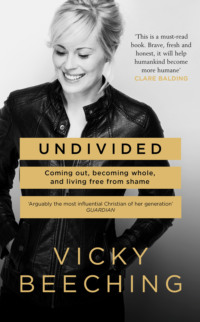
Photos by Nicholas Dawkes
“Above All Else” here by Vicky Beeching, copyright © 2001 Vineyard Songs (UK/Eire) (PRS) admin. in North America by Music Services.
“Undivided Heart” here and here by Vicky Beeching, copyright © 2010 Thankyou Music (PRS) (adm. worldwide at CapitalCMGPublishing.com excluding Europe which is adm. by Integrity Music, part of the David C. Cook family. Songs@integritymusic.com) / Integrity Worship Music (ASCAP) (adm. at CapitolCMGPublishing.com). All rights reserved. Used by permission.
Scripture quotations, unless otherwise noted, are taken from New Revised Standard Version Bible. Copyright © 1989 National Council of the Churches of Christ in the United States of America. Used by permission. All rights reserved.
All rights reserved. No part of this publication may be reproduced, stored in a retrieval system, or transmitted, in any form or by any means, electronic, mechanical, photocopying, recording or otherwise, without the prior permission of the publishers.
Source ISBN: 9780008182144
Ebook Edition © June 2018 ISBN: 9780008182151
Version: 2018-07-18
Dedication
This book is dedicated to the memory of Lizzie Lowe, a fourteen-year-old British girl who tragically took her own life in 2014 because she feared telling her Christian community that she was gay.
Research statistics show that lesbian, gay, bisexual, and transgender (LGBTQ+) young people are far more likely to self-harm, suffer from mental-health issues, and contemplate suicide than their heterosexual peers.
For Lizzie and the countless other LGBTQ+ young people who have ended their lives out of fear and shame: We will remember you. Your stories matter. We carry you in our hearts.
Contents
Cover
Title Page
Copyright
Dedication
Preface
Chapter One
PART I: BEGINNINGS
Chapter Two
Chapter Three
Chapter Four
Chapter Five
Chapter Six
PART II: OXFORD
Chapter Seven
Chapter Eight
Chapter Nine
Chapter Ten
Chapter Eleven
Chapter Twelve
Chapter Thirteen
Chapter Fourteen
PART III: AMERICA
Chapter Fifteen
Chapter Sixteen
Chapter Seventeen
Chapter Eighteen
Chapter Nineteen
PART IV: RETURNING HOME
Chapter Twenty
Chapter Twenty-One
Chapter Twenty-Two
Chapter Twenty-Three
Chapter Twenty-Four
Chapter Twenty-Five
PART V: INTO THE UNKNOWN
Chapter Twenty-Six
Chapter Twenty-Seven
Chapter Twenty-Eight
Chapter Twenty-Nine
Chapter Thirty
Chapter Thirty-One
Chapter Thirty-Two
Chapter Thirty-Three
Appendix: A Benediction for Inclusive Worship
Footnote
Notes
Author’s Note: Resources and Disclaimers
Acknowledgments
About This Book
About the Author
About the Publisher
PREFACE
This is a book about me, and also not a book about me.
It’s a memoir about the battle I’ve fought to make peace with who I am and to unlearn a lifetime of shame and fear. In my case, this centered on the vast tension between being gay and being Christian.
When I asked on social media, “What would you like me to include in my memoir?,” hundreds of you responded. A common theme was: “I identify as part of the LGBTQ+ community too. I wish there were more books I could relate to about growing up dealing with identity struggles. Reading those would make me feel less alone.” Others of you said, “I’m straight, but I want to understand what it’s like to be gay, so I can be a better ally. Your story could provide one example of that.”
Some messages I received said, “I believe the Bible teaches that same-sex relationships are sinful. Can you explain how you understand the Bible on this topic?” Others said, “I’m nonreligious and work in the corporate world, where I’m championing diversity. Your memoir could shine a light on the harm it does when you can’t be your authentic self at work. It could encourage businesses to take better care of their staff’s well-being.”
I decided that all of these suggestions were important, so I chose to use them as my guide. Also, I decided that unless I was going to get vulnerable enough in the writing process to wonder whether I should really be putting certain things in print, the book was unlikely to help anyone. So prepare for me to share (and perhaps overshare) about the highs and lows of my teens, twenties, and thirties; about how I finally found the courage to come out, leaping into the unknown; and about what life has been like since.
Some of you, I hope, will feel a resonance—a sense of “me too.” Others of you reading this who believe that LGBTQ+ equality goes against the teachings of Bible, thank you for giving this book a chance. I hope you’ll keep the door of your heart open as you travel through its pages.
Right now, the issue of same-sex marriage threatens to split the global church. In news headlines, in political campaigns, and on social media, people with polar views are debating this heated topic. It’s reaching boiling point. Juggernauts like the Anglican Church, with its 85 million members worldwide, teeter on the edge of a split. This book is only a drop in the ocean of that vast situation, but it’s my attempt to show that LGBTQ+ people of faith, and same-sex marriage, should be fully affirmed.
So, yes, this is a book about me and my story.
But it’s also a book that’s not about me. At least, not only about me.
It’s about something far bigger and wider—about themes that are woven into all of our human DNA: our need to find a place to belong, our fear of becoming vulnerable, our longing to be authentic, the shame we feel about aspects of who we are, and the way others’ criticisms can paralyze our ability to live and love.
So, this might be a story about you too. About the ways you feel awkward about, embarrassed by, or ashamed of parts of your identity, or the way fear holds you back and stops you from attempting to dream big. Diversity can be tricky: the very things that make us stunningly unique can also be the things we hide in the closet because they cause us to feel different from the crowd.
The shapes these differences take are as diverse as we are. Perhaps it’s that you can’t talk about your struggles with mental health; you’re dealing with anxiety or depression and don’t want colleagues at work to know. That part of your identity is firmly locked in the closet, even though deep down you wish you could be open about it.
Or maybe you’ve always known you are trans, but haven’t dared tell anyone, fearful that no one in your life will understand. Or maybe your battle is similar to the one I faced; you’re gay and terrified to come out.
Or perhaps it’s about neurodiversity. You’re on the autistic spectrum and don’t want to mention it for fear that people will treat or think of you differently. Maybe it’s about gender roles; you might be a teenage boy who dreams of becoming a ballet dancer (like the fabulous Billy Elliot), but you’re afraid your friends (and enemies) would endlessly tease you and make life unbearable if you chased that dream.
Of course, it’s totally fine to keep these things private if it feels safer; only you know what’s right for you. Not everyone needs to “come out,” and you can be perfectly happy, healthy, and whole without taking that step. What is crucial, though, is this: we need to love and accept who we are. It’s about making peace with ourselves.
It’s about finally feeling comfortable in our own skin, not allowing others to make us ashamed or embarrassed of things that are part of our beauty, our diversity and uniqueness. When we take those pieces, shattered by shame, and dare to be ourselves, we find healing. We’re not forced to choose between aspects of our identity. We become whole and “undivided.”
Isn’t this just a bunch of selfish navel-gazing?” critics may ask.
No, it’s quite the opposite. We can only love others well when we live from a place of wholeness.
The Christian faith teaches: “Love your neighbor as you love yourself”—the implication being that we must learn to love ourselves first, in order to love others from a place of health and well-being. Otherwise, it’s like pouring a glass of water from a broken jug; our fragmentation affects everyone.
Entrepreneur and inventor Steve Jobs, in his 2005 address at Stanford University, said, “Your time is limited, so don’t waste it living someone else’s life … Don’t let the noise of others’ opinions drown out your own inner voice … Have courage.”
He’s right. When fear and shame push us to copy the crowd, we risk living someone else’s life. Everyone loses when that happens; we won’t be the best family member, coworker, or friend we can be unless we’re authentic and whole.
So becoming “undivided” is not just about us: When we make peace with ourselves and are no longer fearful or defensive, it changes how we engage with the world. If enough of us do this, the ripple effect will go far and wide, from neighborhoods to nations.
Often, we humans run away from what we can’t relate to, from people who seem different to us. It might be someone from a different political party, a refugee from a far-flung nation, someone from a different socioeconomic background, or someone who is LGBTQ+. We build walls, bunker ourselves away, and allow stereotypes to govern the way we view the people we don’t understand. This is rife in global politics and in the church right now and requires urgent change.
Fear of the “other”—fear of the person who is different from you—is something I’ve felt personally and painfully. One moment I was seen as an insider in my evangelical Christian world; the next, I was treated as an outsider. People I’d known my entire life suddenly saw me as different, because my orientation did not match theirs. I felt their suspicion and coldness as they stepped away. They didn’t see me anymore—they just saw someone who was different from them, and they relied on broken stereotypes and judgments. Experiencing this firsthand has fueled my desire to see society change.
So, as well as becoming “undivided” on an individual level, I hope we can break down the walls that divide us societally. If we exchange our fear of others’ differences for a love that transcends stereotypes, it could have vast impact.
I’ll bring this preface to a close and let you dive into the book itself. As you read on, whoever you are and whatever the reason this book came to be in your hands, my hope for you is this: May you find the courage to be yourself in all your uniqueness. Then, free from fear and shame, may you live and love from that place of healing and wholeness.
Never underestimate the change you can bring to the world around you. Authenticity and vulnerability have a powerful domino effect. If enough of us try to live in an authentic and vulnerable way, who knows what might happen. The world could become a very different place.
1
Blinking in the bright lights, I stared out at twenty thousand people. The stadium was filled to capacity, and they sang along to one of my songs, “Yesterday, Today and Forever,” at the top of their lungs. I was in my late twenties and living in the US, and although I’d been recording and touring for a decade, I still treasured every time I was able to play and sing.
The volume of so many voices always takes my breath away. It sounds like a waterfall—thunderous. Crowds that big have an energy all their own, and emotion hangs in the air like a tangible mist.
I motioned to my band to bring the music down to a softer volume and, taking the microphone, I asked for the arena lights to be dimmed. I then invited the crowd to get out their phones and hold them up. Doing this creates a beautiful moment at any concert; each phone shines a tiny speck of light, and they join together to illuminate the darkness, like thousands of glowing candles, or stars in the night sky.
I’m sure all songwriters feel deeply moved when they hear people using their lyrics and melodies to express themselves—I certainly always have. It meant even more to know that people were using my songs to connect with God, as the events I played at were faith based.
I stood back, watching the sea of faces and listening to the beautiful thunder of twenty thousand voices. Every hair on the back of my neck stood on end as I captured the moment in my mind: every voice, each harmony, every sparkling light. They sang and sang, and I listened, soaking it all in. I could’ve watched them forever. It was like visiting a loved one for the last time, knowing you’ll never see that person again; you struggle to take note of all the details in an effort to ward off the inevitable dimming of the precious memory with time.
I knew that someday very soon I would lose all of this. Something in me was breaking, and I couldn’t keep going much longer. There were things I needed to say—and doing so would bring it all crumbling down.
But in that brief moment, my heart was at peace. The crowd and I were one as we sang in the darkness.
If I close my eyes, even now, I can still hear them singing.
One week after that stadium event, I sat on an overnight flight to England, headed to a Christian conference where several thousand people gathered every year. Despite trying, I hadn’t slept a wink as my mind raced with emotion. My body ached from months of touring and constant jet lag, but far more painful was my inner world: I was heartbroken because the girl I’d secretly fallen in love with had just got married.
I say secretly fallen in love with, because she never knew about my feelings—no one knew. Nobody in my life had the faintest idea that I was gay, as I’d never dared talk about it, despite the fact I was now in my late twenties. So, unknown to anyone but me, these feelings had grown the more I’d got to know this smart, vivacious, and creative American girl.
We’d become close friends over the years, so I was the first person she called when she met the guy she’d ultimately marry. I got to hear every detail of their relationship whether I wanted to or not—their first date, their first kiss, and a year later the evening he got on one knee and proposed. Wanting to be a good friend to her, I’d been there to watch the couple walk down the aisle in a New York church. As they drove off at the end, headed for their honeymoon, my heart was shattered at the loss.
I was grateful that a UK trip had come up; I knew it would be a helpful distraction from the pain. The sleepless flight wasn’t helping, though, as memories of the wedding played on my mind all night. Jammed into my coach-class seat, staring out the window into the darkness, I felt my heart free-falling into nothing, as lonely and endless as the cold midnight sky.
A lifetime of secret sadness was washing over me. This certainly wasn’t my first heartbreak. I felt stuck in a recurring cycle of unexpressed feelings, repeatedly watching the women I’d fallen for walk away with someone else. It wasn’t that they’d rejected me—they’d never even known how I felt because I couldn’t tell them. I couldn’t tell anyone.
Since childhood, the church had taught me that homosexuality was an “abominable sin.” As a result, I couldn’t accept my own gay orientation. As an adult, my only survival solution was to shelve my feelings, keep them entirely private, and assume I’d never be able to date or marry. This way I could still belong to my faith community, keep my livelihood—the church-music career I loved—and not risk losing everything and everyone.
I was only twelve or thirteen when I first realized I was different, and knowing how “sinful” these feelings were caused waves of shame to crash over me. At that age, I’d felt shame before—when I’d lied to my parents about something small or failed to do school homework. But the feelings around my sexuality were different. This wasn’t shame about anything I’d done; it was shame about who I was.
I’d first fallen in love around my fourteenth birthday, and, in the way of teenagers, I fell hard. Everything she said was magical. Everything she did captivated me. Our class had been together for a couple of years already, but as with most kids, puberty brings a totally new perspective on people you’ve been next to every day and never noticed.
Suddenly, I realized how incredibly blue her eyes were, how gracefully her body moved, and I could pick out the sound of her voice from another room. I wanted to be around her, to matter to her, to hear her thoughts on everything and anything. It was unlike anything I’d ever felt before and definitely a world away from the platonic emotions I had for boys.
One fateful day she confided in me that she’d met an amazing guy and that they were dating. The moment I heard this, it felt like all the lights in my world went out. I went home that night and sobbed into my carpet, utterly heartbroken and weighed down by the shame of my “sinful attractions.” After hours of crying, my thoughts kept turning to suicide. I told God I’d rather end my own life now if I had to continue to live with the tension of being gay and Christian; it was just too much to bear. If this was just the first of many such broken hearts, I could tell it would eventually leave me in pieces too shattered to mend.
There was a lot of pressure on me during those formative years from another source too—my profile as a young Christian leader. In my late teens I was already singing in front of hundreds of people at worship gatherings. As that grew to national and international exposure, the pressure increased. I was a role model—parents encouraged their kids to buy my CDs, and pastors told their youth groups to follow my example. I was terrified at the thought of disappointing them all. What if they knew who I really was? Being put on a pedestal felt as much like a prison as it did a privilege.
Year had followed year, and heartbreak had followed heartbreak as reliably as the changing of seasons. I sensed the future held more of the same, and if that was the life ahead of me, I wasn’t sure I wanted to live.
My peers were now marrying and starting families as we all progressed through our twenties. They were moving forward with their lives, celebrated at every step by their families and their faith communities—bringing a partner to church for the first time, getting engaged, getting married, announcing a pregnancy, baptizing a child. Every heterosexual social milestone was met with smiles and church ceremonies.
I felt frozen in time. No one would have celebrated my feelings, had I expressed them. No one would have celebrated my milestones if I’d gone on dates, brought a female partner to church, gotten engaged or married. For straight people, finding a spouse and starting a family were viewed as blessings from God. For anyone gay, these exact same steps were seen as sinful and something to be ashamed of.
Because of this, I’d never acted on my feelings for girls—not so much as even the briefest kiss, despite the fact I was nearing thirty. All of it was locked away inside as I tried to impeccably do the right thing by my Christian values. As I saw it, I’d chosen God instead of these attractions, pursuing holiness instead of sin. I’d boxed my feelings up and put them on a high shelf in my psyche, leaving them there—I believed—permanently. But I had no idea how deeply it would damage me.
Slowly but surely, over the years, all my emotions began shutting down and switching off, like a giant factory closing up until every machine is still and every light is out. My heart stood like an abandoned building. Empty and echoey. Uninhabited, unvisited, with doors and windows all boarded up. A monument to someone I used to be—or maybe could have been. I felt like a shell of a human being.
My life seemed a monotonous drone of work with no one to come home to. I kept my friends and family at arm’s length, because my core identity was something they couldn’t know about, and most likely wouldn’t understand. I asked my music manager to book gigs on as many holidays and special occasions as possible, so I never had to be home alone—especially on my birthday, Valentine’s Day, and New Year’s Eve. Since I was always on the go, my undecorated apartment was simply the place I did laundry, repacked my suitcase, and left again.
Weighed down by these thoughts, I stared out of the plane window as we descended into London’s Heathrow airport and taxied on the tarmac. Soon I was inside, lugging my equipment off the baggage carousel. I slung a heavy guitar case over my shoulder and wheeled a large suitcase behind me, heading toward a train bound for central London.
Fifteen minutes later, the Heathrow Express train pulled in to Paddington station. One more quick journey on the Underground, and I’d meet the conference runner who would take me to the event. The idea of stepping into the busy, upbeat energy of a worship conference felt utterly overwhelming—I had cried all night; I could barely speak, let alone sing.
On the Underground platform, the first train to arrive wasn’t going to my destination. It rushed in at breakneck speed, and I felt the whoosh of air as it sped toward me. People boarded, and then with a release of energy it sped away into the blackness of the tunnels.
I dropped my luggage next to a bench and sat with my head in my hands. My mind kept returning to the same question: “What’s the point anymore?” This frightened me to the core. I was usually a stable, balanced person, but this inner struggle with my sexuality and the incessant cycle of brokenheartedness had brought me to the point of breakdown. Embarrassed to cry in public, I tried to brush the tears away as they fell down my cheeks, but no one was watching anyway. Busy, faceless commuters stared into space, lost in their own worlds as they rushed past.
I was so incredibly tired. Every cell in my body, every fiber of my being was exhausted from carrying this emotional weight since my teens. Growing up, I hadn’t known a single gay person and had had no LGBTQ+ role models; social media didn’t exist back then in the early 1990s, so finding solace in YouTube’s coming-out advice videos—as young people do today—was a universe away from my teenage experience. I’d felt utterly isolated back then, and all these years later, I still felt the icy grip of loneliness; the passing of time only made it harder to bear.
I stood up, rubbing my bloodshot eyes and my tear-stained cheeks, and walked to the edge of the platform. This could be it, I thought. I don’t have to do this anymore. I don’t have to live this cycle of heartbreak, shame, fear, and isolation over and over. I don’t have to do this anymore—it could be over so easily.
I moved my feet forward inch by inch on the concrete floor, stepping past the line of yellow paint that marked the safety point. I looked down into the tunnel and saw distant lights. Tears were streaming down my face again. I knew if I moved another inch forward, at just the right second, I could step out onto the tracks as the train thundered into the station. It could all be over.
The lights blinded me as the train approached. My feet moved another inch closer to the edge. But just before I stepped out, I thought: The last hands that touch me and carry my body will belong to total strangers. My whole life I’ve felt alone. If I die here, it’ll be with people who don’t even know my name.
Dying that way, falling onto the hard steel of the train tracks, to be carried away by total strangers, seemed too lonely to go through with. In that split second, I’d found a thought more painful than carrying on with life, and it had distracted me long enough for the train to thunder into the station with my feet still firmly planted on the platform edge.
I staggered backward, returning to the bench where I’d sat before. My heart was racing. I tried to slow my breathing and recover from the shock of what I’d almost done. No one noticed. Hundreds of pairs of feet continued to rush past, on their way to their next appointment. Surrounded by this chaos, I sat, and breathed, and cried as relief washed over me. I don’t know how long I stayed there; it could have been minutes or maybe hours. I just sat and sat, until my breathing relaxed and my heart rate finally slowed.
Eventually, feeling as though I were moving in slow motion, I took a deep breath, grabbed my belongings, and boarded the next train. I had only minutes to pull myself together before I’d arrive at the worship conference and be plunged into a busy week of meetings and rehearsals. There would be no one safe there to confide in—any confession of being gay would be a one-way ticket to the end of a career. I just had to hide my pain and keep going.
Desperate for change, my heart ached. I couldn’t seem to die, but I also couldn’t seem to live.
PART I
2
Baby photos are supposed to be treasured keepsakes, showing you at your very best: wide-eyed, angelic, and utterly adorable. Unfortunately, in my first baby photo I resemble a small, startled alien. My hair stands straight up in jet-black spikes as though I were auditioning for an infant rock band. I’m told that I’d been fast asleep when the hospital photographer arrived. In a hurry, he’d clapped his hands loudly to wake me up, and the moment I’d stirred, he’d snapped the shot. Thanks to him, the photo of the startled spikey-haired alien has been displayed on my parents’ living-room wall ever since.
My early years were carefree. In my favorite childhood photo, I’m six years old, wearing a bright-red t-shirt and yellow dungarees, and grinning like a Cheshire cat. My hair is cut in a bowl-shaped bob, and my green-gray eyes have a mischievous twinkle. Back then, my favorite hobby was reciting the latest joke I’d memorized from my collection of joke books. Making people laugh was one of my favorite things, and more often than not I had a big smile on my face.
I grew up before the wonders of the internet. My family lived in the countryside, so instead of PlayStations or Xboxes, my days were filled with playing in tree houses, building forts, damming rivers, and running through fields. It gave me a love for wide open skies, the smell of forests after rainfall, and the rustle of wheat as you run your fingers over it like a golden, waist-high carpet. If I’d owned Mario Kart or Zelda back then, I probably never would have left the house.
Perhaps everyone grew up more slowly before cyberspace came along. Today, kids’ minds can be exposed to wonderfully diverse ideas and perspectives at the click of a button. But back then, education and socialization happened organically, not digitally. I learned everything from the small radius of my everyday life, from teachers, schoolmates, family, and the other huge influence in my life: church.
My family lived in a small village of four hundred people. The local school was tiny too, with only forty pupils, aged four to eleven. Always a tomboy, I saved my pocket money until I could afford my first skateboard. My sister, Jo, two and a half years younger than I, also loved skateboarding and riding bikes, so it was brilliant to have a comrade to play with.
Along with my sister, my other childhood partner in crime was the boy who lived across the road. We spent our evenings and the gloriously long summers walking his dog in the nearby woods, practicing skate tricks, and sneaking into the local farmer’s hay barn and climbing all the way to the top of the bales, where we’d lie giggling and coughing in the clouds of straw and dust. Sometimes, if it was raining, I’d hide up in the hayloft on my own with a good book and read, listening to the raindrops drumming on the steel roof.
Two threads wove through my earliest years: one was faith and the other was music. Our local church felt like a second home to me, and I was taken to my first service within days of being born. My grandparents on my mother’s side, who had left their careers in England and moved to Africa as missionaries, were well known throughout our Pentecostal denomination. They came back from Africa once a year to visit us, often around Christmastime. They’d tell us stories of life in Harare, Zimbabwe, showing us photos of the Bible school they ran and of landmarks like Victoria Falls.
While home in England, they’d gather spare clothes and shoes from everyone in our church and ship them back to Zimbabwe to distribute among those in need when they returned. Hearing their stories prompted my earliest dream: to be a missionary in some remote part of the world, preaching, teaching, and pastoring. I remember, around the age of six, when my teacher asked our class, “What do you want to be when you grow up?” Most children replied, “A footballer,” or “A film star,” or “A doctor.” Not me. I answered resolutely, “I want to be a missionary.” My grandparents had become heroes to me, and I wanted to follow in their footsteps and make them proud.
Christian faith felt as natural to me as breathing. It was not a rigid, cold, distant religion, but a genuine heartfelt relationship with God. Prayer never seemed formal either—for me it was just a conversation. At five years old, I walked around the schoolyard chatting with God about my day so far, sharing the highs and lows of my little life. God felt like a friend and a confidant. When I looked out my window at night and saw the moon and stars, my small mind spun with questions about where heaven was located, what angels looked like, and whether I’d ever see my recently deceased (and much-loved) hamster again someday.
Our church, part of the Pentecostal tradition, was always relaxed and upbeat, with music played on guitars, drums, and keyboards and everyone wearing casual clothes. It was a world away from the choirs, pipe organs, incense, and people wearing their Sunday best, found in more formal places of worship.
There were always new faces each Sunday, and everyone was made to feel at home. Refugees from other nations, students who’d moved away from their parents to study at Kent University, homeless men and women, elderly folks in need of a hug and a chat—all received a warm welcome. Our lunches buzzed with the energy of connection as lonely people found community and hungry people received a meal. It was church doing what church is meant to: loving people with grace and kindness.
My mum led the musical part of the worship service every Sunday at church and at weekday prayer meetings. She was a prolific songwriter, penning something new every week without fail. After the sermon, there would be a time of reflection and she would play her latest song—it was her way of serving the church community, using her gift to help others.
Mum worked on her new song during the week at home, in the snatched moments that any parent makes use of while raising kids. So while I was building with Lego blocks or arranging my stuffed animals in rows, she would grab ten minutes to craft her latest song. As soon as I could shake a tambourine or rattle a maraca, I joined in on Sundays, toddling up to the front to stand next to her and trying to keep time with the song.
Our church taught that the Bible was literally true, word for word, so Adam and Eve were considered actual humans who historically existed. The talking snake in the book of Genesis was considered historical too, as was the speaking donkey in the book of Numbers. Everything had happened exactly as it was written.
A few members of the church went out with presentations about Creationism in their spare time, trying to disprove the scientific evidence behind evolution. Medicine was suspect, as people believed in God’s healing power, and we heard stories of people like Kathryn Kuhlman, Smith Wigglesworth, Aimee Semple McPherson, and Benny Hinn, who (allegedly) healed thousands by the power of prayer.
There was a firm belief that God still did miracles today, so when the pastor gave an altar call, people would come forward and stand at the front to be prayed for. Many spoke in tongues—something described in the New Testament as an unknown language given to believers by God. Sometimes, when prayed for at the altar, these people would fall down—“slain in the spirit”—when the Holy Spirit was thought to have powerfully touched them.
When I was four years old, my first job at church was to carry a small basket of cloths. These were known as “modesty protectors.” If during the altar call a woman was “slain in the spirit” and fell down, I would carry my little basket of cloths to where she was lying. If her skirt or dress had accidentally found its way above her knees, I would lay one of the cloths over her legs to protect her “modesty.” I felt very adult and responsible as I trotted around and carried out this important task.
For most of the service, we children had our own meeting in a different part of the building: kids’ church. It was a place for the under-twelves to go while the adults listened to the sermon, as the preaching often lasted for forty-five minutes. In kids’ church we had our own teachers, songs, and picture books; it was a lot of fun.
One thing baffled me though. The picture-book Bible that was read to us had some very disturbing images and stories. The double-page illustration of Noah and the flood left me bewildered about why so many people were pictured in the throes of death, flailing in the foaming waters. The next page showed Sodom and Gomorrah burning to the ground with hundreds of people, charred and frightened, running to escape the flames.
We were told Sodom and Gomorrah were destroyed because of the “sin of homosexuality.” When a bold child piped up, asking, “What is homosexuality?” the only reply given was “We can’t talk about that until you’re older—just know that it’s something very bad.” In my tiny mind, this instilled the knowledge that whatever homosexuality is, it must be terrible indeed.
The picture-book Bible also told the story of Moses and the Israelites fleeing captivity in Egypt. God had struck the Egyptians with various plagues when they refused to release the Israelites from slavery, culminating in the murder of every Egyptian firstborn boy. The artwork showed parents sobbing, holding their dead children in their arms, as Moses led his people out of captivity toward the promised land. It was a lot for a child to take in.
Another page showed Abraham sacrificing his little son, Isaac, as God had asked him to. He’d tied the boy up with ropes and raised a knife over the child, ready to kill him. The story ended with God telling Abraham, at the very last moment before he stabbed the child to death, not to murder the boy after all; it had been a test of his faithfulness. This too seemed an extremely violent and frightening story.
Even as a child, I had a hundred questions. What about all the people who drowned in Noah’s flood—did they really need to die? What about everyone who was burned in Sodom and Gomorrah? What about the Egyptian baby boys who were slaughtered—how could that be fair? How did Isaac ever recover from the trauma of being tied up by his dad and almost knifed to death? Why was all of this portrayed as okay? And how could these stories be the work of a loving God? My mind spun. It didn’t feel safe to ask any of these questions at kids’ church, and I felt bad for thinking them in the first place.
Many of our worship songs were about love and forgiveness, but others contained military language and reminded me of the more violent Bible stories. Hymns had lyrics like: “Onward Christian soldiers, marching out to war, with the cross of Jesus going on before. Christ, the royal Master, leads against the foe; forward into battle see his banners go. Like a mighty army moves the Church of God.”
More modern songs also reflected these themes: “The victory is the Lord’s; we’ve just begun to fight,” “The Lord is a warrior,” and “Our God is mighty in battle, our God is mighty in war.” I found the aggressive language of these songs a bit confusing and unsettling. Although I understood, as much as a child could, that they were based on the Bible, they still seemed at odds with the Jesus who was pictured in my kids’ Bible holding a baby lamb in his arms and smiling at a crowd of children in a field of flowers.
If God really was as angry as those violent stories suggested, I didn’t want to be on the receiving end of his punishment, or on the wrong side of a church “marching out to war.” I never wanted to feel like the people drowning in the flood waters as Noah sailed past. It was confusing. Was God the person standing with the lamb, the children, and the flowers, or was he an angry warrior destroying people?
I brushed these thoughts away from my mind, as they were too much for me to figure out at that tender age. My simple childhood faith was one rooted in God’s love and kindness, so I tried to focus on the stories that emphasized those qualities. Besides, I had no reason to believe I’d ever be “out of the club.” After all, I was part of God’s army, not someone his people were fighting against. I was “inside the ark” and always would be—not someone left outside to drown. At least, that’s what I imagined back then.
Another thing that stood out at church was that God was always described as male. Jesus was male too, of course, and our senior pastor and elders were all men. God was called Father, not Mother. It gradually dawned on me that girls and women were seriously underrepresented.
When anyone preached about marriage, St. Paul’s teaching was quoted: “The husband is head of the wife just as Christ is the head of the church.” Boys and men were in charge at church, and men took the leading roles in the exciting Bible stories, whereas women were almost always supporting characters. I wasn’t used to challenging “what the Bible clearly said” as a child, but something about it didn’t sit well with me. I guess I felt shortchanged for being female, and sad that maybe I couldn’t be part of the action.
Back then, in the mid-1980s, most UK churches weren’t ready to give women the freedom to lead. Singing or teaching kids’ church was allowed, but being a senior pastor or priest-in-charge was not. It was a stained-glass ceiling, a layer of promotion through which women could not pass.
The Church of England wouldn’t see its first female priests ordained until 1994, when I was fifteen, despite the campaign for this change spanning back to the time of the suffragettes at the turn of the century. The first female bishop wasn’t consecrated until just a couple of years ago, in 2015, when I was thirty-six.
At school, I tried to express my faith passionately, especially as I had dreams of becoming a missionary like my grandparents. I told other children in my class about God, hoping they might get converted. At the age of four, I had a very serious chat with a female classmate about the fact she was going to hell unless she accepted Jesus and became a Christian. All of this happened while playing in the sandbox, an unlikely setting for such severe theology. Several of my friends came to church with me a few times—possibly because of my fire-and-brimstone preaching in the sandbox, or perhaps because the elderly women in our congregation handed out jelly babies and fruit gums to us kids after the meeting.
I was well-meaning at heart. Even in those early years, God had become a genuine presence in my life. He was a constant companion and friend, and I wanted to share that, in my simple childhood way, with everyone I knew so they could experience it too.
When I reached the age of eleven, our family moved from the Pentecostal denomination to a small Anglican church in our village. Our goal was to help revive it, as its numbers were shrinking and many smaller parish churches like this were at risk of closure.
The Church of England congregation was far more moderate in its theology than our previous church, but the longer we were there, the more it started to reflect our charismatic evangelical values. My mother and I started playing guitars and keyboards on Sundays, rather than the traditional pipe organ, and enlisted a drummer and saxophonist when we could find volunteer musicians. My parents hosted small meetings at our home one evening a week, where people studied the Bible, sang songs, prayed for the sick to be healed, spoke in tongues, and prophesied over one another. We also organized trips to conferences so the people in our new church could hear well-known evangelical and Pentecostal speakers.
Alongside all this, I continued to go to local youth events linked to my previous church too. So, despite moving to a more moderate denomination, little changed for me. I retained the beliefs that had been woven into me during my formative years and, rather than growing out of them, I held on to them with even more passion.
3
As most British kids do, I started high school at the age of eleven, and it was a shock to my system. My village elementary school with only forty pupils seemed tiny now as I entered a huge building containing a thousand students in the nearby city of Canterbury. It was a girls’ school with an associated boys’ school a mile down the road. Single-sex education seemed great at first, but it would bring me some unique challenges as the years went by.
Once I acclimated to the size and scale of the new environment, I thoroughly enjoyed it. The high school had an entire wing dedicated to music: several private rooms with their own pianos, plus a drum kit and a cupboard full of acoustic guitars. Every lunch break I’d try and get one of these rehearsal rooms, where I would make up piano compositions or learn new guitar chords.
Sometimes my classmates and I would go there and sing. We’d take our lunch boxes with us and spend an hour making up songs and harmonies as we ate and talked. More often, though, I’d head over to one of the music rooms alone. With the security of a locked door, I found a privacy for my singing and playing that I’d never experienced before. I began writing very personal songs—mostly about faith and spirituality. Before long, I’d filled several notebooks with compositions.
My mum overhead me playing them at home in my bedroom and encouraged me to share them at church sometime. The idea terrified me—standing up there in front of so many people—but after months of her encouragement, I agreed to give it a go. I vividly remember that teenage debut. My mum was leading worship, and I was playing guitar. I’d agreed to play one of my songs during the service, and I became increasingly racked with nerves as the evening progressed.
With my eyes clamped shut so no one could see how nervous I was, I stood in front of the fifty or so people in the congregation and sang into the microphone. To my amazement, when I finished and opened my eyes, people looked visibly moved and tearful. Several of them were quietly praying. Somehow, my simple song had helped them connect with God.
What could be more rewarding than that? I pondered, on an emotional high as I packed my guitar into its case at the end of the church service. That first experience made me want to write more songs that would help people to worship. That day, and that song, set the course of my career.
My first experience singing in church, and the positive welcome it had received, had been formative. As the months went by, I wrote and sang more songs, and my shyness slowly went away. I was growing up, discovering my place in the world, finding my voice. But, simultaneously, all that growing up and self-discovery was revealing other aspects of who I was becoming—and not all of them were easy.
As my classmates began nervously giggling about which boy they “fancied,” I was experiencing something totally different. I kept noticing girls. And I was increasingly embarrassed each time it happened. By this time, I’d found out what the word “homosexuality” meant (the older kids at school liked to try and educate us about anything and everything), and I’d made the connection between the Bible stories of my childhood, the punishment of Sodom and Gomorrah, and my attraction to girls.
All these feelings had come totally out of left field for me. It baffled me; I knew I wasn’t choosing them. The conversations I’d overheard among Christians about gay people being sinful all centered around it being a willful choice, but I knew what I was experiencing was involuntary. Even if I didn’t want those thoughts and feelings, they kept happening regardless. It was as normal and natural for me as my friends giggling and getting butterflies over their latest opposite-sex crush.
Female school friends started noticing boys’ bodies were changing. They remarked about how our male friends’ voices were deepening and their skinny arms were turning to muscle. Sometimes the local boys’ school used our gym or outdoor track in addition to its own, and our school erupted with whispers of “Check him out!” as an especially tall or muscled male student walked through our hallways on his way to meet his teammates.
In contrast, I was far more aware of the changes happening in the girls around me. Puberty was hitting all of us, and I blushed anytime I found myself looking too long at someone across the school dining hall or tennis courts. I would catch a glimpse of someone I liked across the classroom and feel butterflies in my stomach. I would daydream about how amazing it would be to hold her hand or kiss her cheek, wishing I could ask her to the school dance, and wanting to help with her English essay just because I would get to spend time with her.
I remember one awful moment when a girl a year ahead of me was changing for sports and walked in front of me in her bra. My eyes fell on her for a couple of seconds longer than would have seemed normal, and she snapped, “What are you staring at?” Blushing terribly, I stammered, “Nothing, sorry. I was just thinking about something else … It was nothing to do with you …” This wasn’t about lust or ogling anyone—I was just struck by how beautiful she was.
A similarly awkward moment happened when, at a school assembly, a group of girls from an older class decided to perform a Madonna song. I had been sheltered from dance parties and clubs as they were considered to be unwholesome by the Christians I knew, so it was a shock to my system when the girls emerged onto the school stage dressed in revealing clothes and danced to the pop track.
My classmates clapped along to the music, loving it, but I felt extremely uncomfortable. I stared at the floor, with no idea where to look. The girls who were performing seemed like the most stunning humans I’d ever cast eyes on, but surely those feelings were not right—God would not be pleased. What on earth is wrong with me? I thought, as I blushed with ever-increasing embarrassment, hoping no one around me had noticed my discomfort.
Outside of school, it was the same. Every now and then, often when I least expected it, these thoughts would break into my consciousness. I went with my family to watch a local performance of the musical South Pacific and was embarrassed when I realized how gorgeous I thought the female lead actress was.
Once at a Christian conference I attended, I was distracted by one of the female singers in the worship band; her voice and personality were so captivating. Whenever these things happened, I felt a wave of shame and did all I could to drown out the thoughts in my mind, especially in a place like church. These were just the normal, run-of-the-mill moments of attraction that would take place in any straight person’s mind each day and be dismissed without a second thought. But for me, as a gay person, each one of them was laced with anxiety and left me feeling dirty and ashamed.
I was certain I couldn’t hide these thoughts forever. Someone would figure me out, I worried. Acting on any of these attractions wasn’t an option for me—I might have daydreamed about it, but I shut down those thoughts as, to me, they were off-limits and wrong. But I feared my accidental gazes at girls might make people suspicious, and it felt awful.
Honestly, I hoped it was just a phase—I wanted to fit in with my Christian friends and my church; I just wanted to belong. Sneaking away from my parents once at the local library, I found a book about teenage psychology. Flicking to a section on sexual development, I read that lots of young people experienced attraction to people of the same gender for a while and then they grew out of it.
After reading that, my prayers every night—offered with urgency—begged God to help this “phase” come to an end, so that I could stop these sinful thoughts and start living a holy life. The guilt these feelings generated was leaving me feeling paralyzed. I had nowhere to go with them and no one safe to confide in. Would God still love me if I was attracted to girls? I was pretty sure the answer was a resounding no.
Go on, Vicky. It’s just for a weekend,” a school friend said, handing me a paper invitation. “You’ll love it—loads of us are going.”
Despite my increasingly solitary behavior at school, one Christian classmate invited me to a weekend event for church youth. Lately, I’d felt miles away from everyone, behind an invisible wall, trying to navigate the tensions in my life created by this new awareness that I was attracted to girls and not boys. All my friendships had grown distant as I spent my free periods alone in the library writing in my journal or with my Walkman plugged into my ears.
I didn’t feel like being social, but since this would be a conference to develop young adults in their Christian faith, I thought I’d give it a try. It would be held in a beautiful old property in a nearby town and was a Catholic event—something outside my usual Protestant tradition. I was curious and intrigued. “Okay,” I said. “Count me in.”
The weekend arrived, and my initial nerves about being with a roomful of strangers dissipated when someone grabbed a guitar and led worship songs that I was familiar with. I enjoyed the talks, the meals, and, most of all, the singing. But, as always, nagging shame and fear plagued me as I thought about my orientation, knowing that everyone on the weekend would see me in a totally different light if they knew I was gay. Their friendliness would have turned to disapproval and judgment, and I would certainly not have been viewed as an “up-and-coming young faith leader,” as they were describing me there that weekend.
Every time we prayed, and each time we sang a slow song encouraging inner reflection, my mind played the same broken record that beat me up mentally and emotionally for being broken and sinful because of my orientation.
I wondered if maybe, somehow, I could get help that weekend. Perhaps in this more anonymous setting, one of the Catholic leaders could help me? I thought. Whispering a prayer, I asked God for a breakthrough.
On the final afternoon, the event leaders announced that something different would be happening. A priest was visiting for a few hours and would be performing private confessions in a small room down the hall. Any participants wanting to go to confession, to repent of whatever sins they had committed and receive the priest’s absolution (official forgiveness from God), could make their way to that small room and wait their turn.
The Church of England didn’t offer one-on-one confession, neither had my earlier Pentecostal denomination. This was something new to me and I wondered if it might be the key to getting free from my feelings for girls.
Summoning all the courage I had, I made my way down the hallway to the small room and knocked on the dark mahogany door. The sound of that knock seemed to echo for miles, and I blushed, hoping none of my friends knew I was going to see the priest. It could only mean I was struggling with something. And for an “up-and-coming” young Christian leader like me, that was not the impression I wanted to give anyone.
The whole exchange was unfamiliar to me, but the old Catholic priest was friendly and put me at ease. With a smile, he gestured to an empty seat opposite him. After reading some liturgy, the priest wanted to make it more teen-friendly, so he spoke in everyday language: “Are there specific things you’d like to repent of, to say sorry to God for? If there are, just speak them out now, and we’ll give those things to God.”
I listed some minor things—like getting angry, using bad language, and forgetting to do my daily Bible readings. When I left a long pause after this, he sensed that there was something I hadn’t mentioned, the real reason I was there.
“Is there anything else?” he interjected.
I gulped and felt my chest tighten. Desperate for change, for the first time in my life I tried to voice the words: “Um … Yes … I am having feelings for other girls … like gay feelings … and I want to be forgiven for that, and set free from it as I know it’s sinful.”
I hung my head, red-faced, as heavy tears began streaming down my cheeks. It was a shock to hear those words come out of my mouth for the first time.
The priest gave me a kind look and said, “That was very brave. Well, let’s pray, shall we?” Then he read the prayer of absolution, offering my repentance to God and pronouncing his forgiveness over my life. I heard the words, but mostly I was lost in a moment of shock that I’d told someone.
The prayer ended, and he thanked me for dropping in. Surely, I thought, God would see how brave I’d been in speaking out this deeply held secret. Surely, the Catholic priest, with his spiritual authority and the powerful words of the liturgy, would have the ability to change me.
Stepping out of the room, I closed the heavy wooden door behind me. I heard it shut with a loud thud and believed I’d left my sins—my gay feelings, my gay identity—behind that door. Forgiven and set free, I’d stepped out of an old life and into a new one.
But it didn’t take long for me to realize nothing had changed. The feelings remained and with them came the rush of embarrassment and fear. I was crushed—my prayer hadn’t been answered. My moment of courage and honesty with the priest had been for nothing. Perhaps God had forgiven me, according to the priest’s absolution, but he certainly hadn’t set me free.
My head spun with questions, but I had no one to go to with them. That priest had been from another town, and I had no idea how to contact him; to be honest, I was so embarrassed about telling him that I hoped we’d never cross paths again.
Ücretsiz ön izlemeyi tamamladınız.