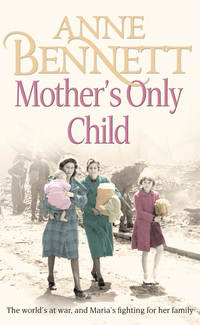
Kitabı oku: «Mother’s Only Child»
Mother’s Only Child
Anne Bennett

Copyright
This novel is entirely a work of fiction.
The names, characters and incidents portrayed in it are the work of the author’s imagination. Any resemblance to actual persons, living or dead, events or localities is entirely coincidental.
Published by HarperCollinsPublishers Ltd 1 London Bridge Street London SE1 9GF
www.harpercollins.co.uk
This paperback edition 2005
SIXTH EDITION
First published in Great Britain by HarperCollinsPublishers 2005
Copyright © Anne Bennett 2005
Anne Bennett asserts the moral right to be identified as the author of this work
A catalogue record for this book is available from the British Library
All rights reserved under International and Pan-American Copyright Conventions. By payment of the required fees, you have been granted the non-exclusive, non-transferable right to access and read the text of this e-book on-screen. No part of this text may be reproduced, transmitted, down-loaded, decompiled, reverse engineered, or stored in or introduced into any information storage and retrieval system, in any form or by any means, whether electronic or mechanical, now known or hereinafter invented, without the express written permission of HarperCollins e-books.
Ebook Edition © NOVEMBER 2009 ISBN: 9780007355341
Version: 2017-09-13
This book is sold subject to the condition that it shall not, by way of trade or otherwise, be lent, re-sold, hired out or otherwise circulated without the publisher’s prior consent in any form of binding or cover other than that in which it is published and without a similar condition including this condition being imposed on the subsequent purchaser.
To my youngest daughter Tamsin, with all my love
Table of Contents
Cover Page
Title Page
Dedication
Copyright
Chapter One
Chapter Two
Chapter Three
Chapter Four
Chapter Five
Chapter Six
Chapter Seven
Chapter Eight
Chapter Nine
Chapter Ten
Chapter Eleven
Chapter Twelve
Chapter Thirteen
Chapter Fourteen
Chapter Fifteen
Chapter Sixteen
Chapter Seventeen
Chapter Eighteen
Chapter Nineteen
Chapter Twenty
Chapter Twenty-one
Chapter Twenty-two
Chapter Twenty-three
Chapter Twenty-four
Chapter Twenty-five
Chapter Twenty-six
Chapter Twenty-seven
Chapter Twenty-eight
Chapter Twenty-nine
Acknowledgments
About The Author
Other Books By
About the Publisher
CHAPTER ONE
Maria Foley almost ran across The Square that day in late July 1941. The faint summer breeze riffled through her long wavy hair, tied back loosely with a ribbon the same green as her eyes. Bella McFee, catching sight of the girl, stepped out of the post office-cum-grocery shop when she saw the envelope in Maria’s hand.
‘It’s come then?’
‘Aye,’ Maria said. She tried to keep the elation out of her voice. ‘I’ve passed.’
She saw Bella’s lips purse in disapproval and, for a moment, Maria was resentful. She’d worked for Bella in the shop for two years. Couldn’t she just say she was the tiniest bit pleased? Congratulate her even?
Her mother, Sarah, had said the right words—‘Congratulations. You’ve done well’—but in a flat, expressionless and totally insincere tone. However, what Bella did say was, ‘I’m away to see your mother. She’ll likely be feeling low after this. Mammy will mind the shop. And where are you off to in such a tear? You’re not due in till nine.’
‘The boatyard,’ Maria said. ‘I want to see Willie.’
‘Oh, he’d like to know right enough,’ Bella said. ‘But you, Maria, aren’t you the tiniest bit ashamed, wanting to go to some fancy academy in Dublin just now, when you could be a help and support to your mother? Have you no thought for her, and you an only one too?’
Immediately, guilt settled between Maria’s shoulder blades. It isn’t my fault I’m the only one, she wanted to cry. That was the main problem, of course. If her mother had had a houseful of children, she could have taken pride in the fact that her eldest daughter had won a scholarship to the Grafton Academy in Dublin to study Dress and Fabric Design for two years.
But Sarah’s fall down the stairs when Maria had been just eighteen months old had killed the child she was carrying and assured there would be no more either. It had also, so it was said, given her ‘bad nerves’. Maria hadn’t known what ‘bad nerves’ were then, of course, although she knew her father was never willing to upset her mother and strongly discouraged Maria from saying or doing anything that might disturb her at all. She was well aware that the news that morning would have disturbed her greatly, and yet she couldn’t help being pleased and, yes, proud of herself. She knew Willie would congratulate her warmly and, oh God, how she needed someone on her side for once.
‘Mammy should never have let me go in for the exam if she can’t take any joy in the fact that I have passed it,’ Maria said.
‘You don’t understand anything yet, girl,’ Bella said sharply.
Maria flushed at the sharp tone and then tossed her head a little defiantly and said, ‘I have to go, or I’ll be late getting to the shop.’
Before Bella could say another word, Maria gave her a desultory wave and ran over the green to the coastal path, which ran to Greencastle, the next village up Inishowen Peninsular. It was the path her father used to take every day bar Sunday, when he’d owned a boatyard in the small village. Now he worked at the Derry docks, and Willie Brannigan was put in charge of the Greencastle boatyard. He’d known Maria since the day of her birth and she knew he’d wish her well.
She paused on the banks of Lough Foyle, the sun, warm on her back from a cloudless sky, glittering on the water. Well, what could be seen of the water. The lough was so filled with naval craft, she could barely see Milligan’s Point on the further side, the side the British still owned. She couldn’t see the airports at Limavady and Eglinton either, but she knew they were there. It was a fine sight to see the aircraft flying above the flotilla of naval vessels on convoy duty. Her father said they were more effective at sinking German U-boats than the ships. The British-owned six counties had been dragged into the war along with Britain, but the Free State, Maria’s side of the border, had declared itself neutral and Maria knew there were soldiers from the Irish Army stationed at Buncrana, which was the other side of the peninsular, to try to ensure the Germans respected that neutrality
She gave a sigh and made her way to the boatyard. For a moment she wished Greg Hopkins was just a couple of miles away on his father’s farm and she could rush to him with her news, for he was another one who believed she was doing the right thing. He was in the army now and, though she was proud of him, she missed him sorely. Letters couldn’t make up for his absence.
It was strange how she and Greg had always been such friends, because Greg hadn’t been born in Inishowen at all, but in Birmingham, England, where his father came from, though his mother was from Moville.
The whole family had arrived in 1934 when Greg’s mother inherited a farm from an uncle. Maria had only been nine, and Greg thirteen, but she remembered the lost and unhappy boy he was then, who made no effort to make friends. He was like a fish out of water, her mother would say.
‘But, why come here?’ Maria had asked him one day, when he had been there more than a year and was ready to leave school. ‘It seems such an odd thing to do, when you were not born and bred for it.’
Greg had shrugged. ‘Dad hadn’t worked for two years when we came here. He wasn’t the only one, or owt. Many like him were hit by the slump. We were on our beam ends, nearly starving, and when we got the news about the farm out of blue, Dad said it was like a miracle. He’s pulled the farm round and it’s doing all right. At least we all get enough to eat.’
‘Do you like farm work?’
‘I hate it,’ Greg had said fiercely. ‘And I hate this little village—in fact, the whole of Inishowen—and one day I’ll go back to Birmingham. I know I’ll have to wait a while; Phil is only just ten, Billy two years younger still—the girls don’t count—and they wouldn’t be able to be much of a hand to our dad. Anyway, there’s no work for anyone much in Birmingham at the moment, but I don’t intend to stop here all the days of my life.’
But, while Greg had waited, he found Maria to be a fine distraction, especially as she grew and began attending the socials held for the young people at the church. There he danced with her many times, often walked her home and sought her company after Mass.
‘You have an admirer,’ Sarah said. She knew nothing of Greg’s restlessness. All she saw was that Greg was the eldest son and set to inherit the farm, and the family were respectable and God-fearing. If her daughter was to marry Greg Hopkins, Maria would live not far from her parents at all, and that would fulfil Sarah’s dream.
Maria wasn’t ready for any sort of relationship. ‘Don’t be silly, Mammy, he’s just being kind,’ she said. ‘He’s the same with everyone.’
That morning, though, she so wished he was there to tell her news to.
There was another person she wished was still in Moville. Philomena Clarke had been the tutor at the evening classes for dressmaking who had recognised Maria’s quite exceptional talent and knew that she had the chance of winning a scholarship to the Academy. They had gone together to the college in Derry for Maria to take the exam in May, and she had even promised she would travel down to Dublin with her and settle her in.
However, life had a hammer blow waiting to hit Philomena, for the day after the exam she had a telegram from New York from the husband of her twin sister, who had been badly injured in a car accident and was asking for her. Philomena was gone within days and a little after she had left, Maria had a letter from her. Her sister had died, leaving the husband distraught, and she had decided to stay to help him rear his three small children, who were devastated and traumatised by the tragedy.
Maria was touched that even in the middle of that appalling upheaval and upset, while still grieving for her sister, she still had a thought in her head for Maria.
‘Please write and tell me as soon as you get news from the college,’ she had pleaded in her first letter to Maria. ‘I will be on tenterhooks until I hear from you.’
Maria would write to both Greg and Philomena that very night, she decided, and she walked on, composing the letters in her head as she went.
Bella found Sarah in the scullery, washing the breakfast dishes, her red-rimmed eyes betraying the tears she’d shed. Visibly she tried to take a grip on herself when she saw Bella.
‘Shall I make a cup of tea?’ she said. ‘Have you time?’
‘Aye, Mammy’s seeing to the place and Maria will be there at nine.’
‘Maria!’ Sarah said plaintively. ‘What will I do when she leaves, Bella? I’ll be destroyed.’
‘No, you won’t!’ Bella said emphatically. ‘I’ll see you’re not.’
Bella remembered the time Sam Foley had brought his young wife back into the village to live. She’d been only young herself then, and, though married for eight years, she was still childless. Her frustrated maternal instinct was stirred by Sarah, who was only seventeen and looked such a frail and delicate wee thing, with her blonde hair and big blue eyes. The two became good friends.
‘Tom Tall and Butter Ball,’ Bella used to call the two of them, for though Sarah wasn’t that tall, her slenderness made her appear so. Bella was, like her mother, under five foot and ‘as wide and she was high’, she was fond of saying. That wasn’t strictly speaking true, but she was plump and her mother, Dora Carmody, stouter still. Everything about them was round, but their faces were open and friendly and their brown eyes kindly looking. Bella had once had dark blonde hair, but now it was as grey as her mother’s and, like hers, fastened into a bun.
Sam Foley, being the third son, had never thought to inherit the boatyard in Greencastle, nor the family house in nearby Moville. Knowing there would be no opening for him in the family business, his father had apprenticed him to a carpenter friend, who ran his business from a small town called Belleek, in the neighbouring county of Fermanagh, when Sam had been twelve years old.
Sarah Tierney’s family lived not far from the village, on a thriving farm in Derrygonnelly on the banks of the huge Lough Erne, and Sarah often shopped in Belleek with her sisters, Peggy and Mary.
There she met and fell in love with Sam, and he with her. No obstacles were put in the way of her marrying him, for everyone liked the man and knew he was set to inherit the carpentry business, so it was generally thought that Sarah had done well for herself.
Sam’s family had come down for the wedding, and there Sam’s two brothers sought him out and told him they were off to seek their fortune in America as soon as it could be arranged. The boatyard was all his if he wanted it.
Sam wasn’t keen to go back and knew Sarah would be unhappy living so far away from her people, but he also knew his father couldn’t run the place alone. His only option was to return.
The only sweetener to that very bitter pill for Sarah was the house Sam inherited along with the boatyard. It was a fine, solid house just off The Square in Moville. It had two storeys, three bedrooms, and was built of stone with a slate roof. ‘A family house,’ Sam’s father had said. ‘Me and your mother will be fine and dandy in the wee cottage in Greencastle by the boatyard.’
‘I mind the day Sam’s brothers left as if it were yesterday,’ Sarah said to Bella as they drank their tea. ‘We hadn’t been in Moville more than a day or so and we went down to the pier to see them off. Sam had told me that the liners crossing the Atlantic had to be moored out in the deeper waters of Lough Foyle. Passengers were taken out to the ships in small tenders from Moville Pier. There was always a collection of people waiting and that day was no different.
‘Sam’s brothers seemed sorrowful yet, for all their sadness at the parting, they still left. When they climbed into that boat, Sam’s mother’s eyes were so bleak and bereft, I could hardly bear to look at her. The father was holding her fast, or I think she may have thrown herself into the boat after her sons. We waited at the pier side until we saw the small boat bump alongside the liner. The boys gave one last wave and we turned for home. Sam’s mother was crying gulping sobs of such sadness I felt my heart turn over. I thought I understood how she was feeling; I remember thinking I’d die if one of mine was to go such a distance away.’
She sighed and went on, ‘I tell you, Bella, children would tear the very heart out of you.’
However, more tragedy was to hit Sarah. She’d been married just six months when her mother and sisters, Peggy and Mary, took sick with TB. They were all dead before October drew to a close, before Sarah had been able to arrange to go and see them. She’d not even had the chance to bid them goodbye and she spoke of this now to Bella.
‘D’you mind that time?’
Bella remembered it well. Sarah’s grief had been so deep and profound, Sam had worried for her sanity. They travelled down for the funerals. Seeing everyone there so mournful and sorrow-laden had made Sarah worse.
‘Daddy was so sad it near broke my heart to see him,’ Sarah said to Bella. ‘He didn’t seem to see anything around him and it was up to my brother Sean to keep the farm ticking over.’
It was arranged that a widowed aunt called Agatha, whose children were grown and married, would see to things in the house and Sam and Sarah returned to Moville.
‘I never thought I’d be happy again in the whole of my life,’ Maria reminded Bella. ‘And then I found I was expecting. A little life would be dependent on me, something to go on for.’ She grasped Bella’s hand and went on, ‘You showed what a true friend you were then, for you showed not a trace of envy and yet I know how you had always longed for a child of your own.’
That brought the tears to Bella’s own eyes, for it was a burden she carried with her always.
‘When Maria was born, in 1925, I thought her the most beautiful baby in all the world,’ Sarah said, ‘and for sixteen years she has been at the forefront of my mind all the time. I love her so much, Bella, and I really can’t bear the pain of losing her. Once Maria leaves this village I know she will never come back to live.’
‘You will get through this, you know,’ Bella said. ‘It will take time, but it will get easier. I thought when my man died I’d never recover from it.’
‘That was a tragic time, right enough,’ Sarah agreed. It had been a tragic time for both of them. Sarah had just has the disastrous fall that rendered her sterile and was in the hospital. Bella was looking after the toddling Maria, when her husband, a fine, strapping man, who’d never had a day’s illness in his life, suddenly keeled over as he was getting up from his dinner, and was dead before he reached the floor.
‘We supported each other then,’ Bella said.
‘Aye, and wasn’t it wee Maria who was the salvation of us both?’
‘She was indeed,’ Bella agreed. ‘Then Mammy said she couldn’t manage the shop on her own and asked me in with her. I don’t know whether she really couldn’t manage, or did it for me, but I know the occupation of it was a good thing.’
‘I know it,’ Sarah said. ‘But what occupation could I take up that will chase the heartache from me?’
Bella had no answer to this and Sarah went on, ‘I knew that Maria was good at sewing and all. I mean, I taught her to sew, darn, embroider, that sort of thing, and in time she was better than me—far neater, and faster too. I knew she had an eye for colour, the things that go together. Whenever we went in the draper’s shops in Derry, she’d be fascinated by the array of fabrics. She’d feel them between her fingers and be amazed by the different things you could sew on to decorate clothes. She’d prowl around the haberdashery counter like another child might do around a cake shop.
‘I took it as a good, wifely attribute, especially when she mastered that old treadle machine. I told her she’d be a catch for any man, for you know she could make something out of nothing, and I encouraged her to go to evening classes for dressmaking. People say you can’t make a silk purse out of sow’s ear—well, I think Maria probably could.
‘She’s a tidy cook too—we all know the way to a man’s heart is through his stomach—and she’s helped me with the laundry this past year or so. She can poss the clothes, starch and iron with the best of them.’
She looked at Bella with mournful eyes and said, ‘She’ll make a good wife for someone in a year or two, when she is fully grown. That’s what I want for her—to marry a boy here so I can still see her and help her rear any children she might have. It’s all I’ve wanted since the first moment I held her in my arms, and if it hadn’t been for this damned war it would have happened like that. Whatever Philomena Clarke wanted, without the war, Maria going to the Academy would have been impossible.’
Bella knew that was true. By the time Maria finally left school at Easter 1939, everyone knew Britain, and therefore Derry and the other counties across the Foyle, was perched on the brink of war, despite Chamberlain’s claim that there’d be ‘peace for our time’, the previous September.
As soon as Easter was over, Maria had got a job in the shop with Bella and her mother, Dora, and began at her evening classes, but wasn’t in the house when Philomena went to see her mother and told her about the Grafton Academy in Dublin where the gifted Maria could learn Dress and Fabric Design, which would fit her for a fine and well-paid job in a Dublin fashion house later. ‘I am sure she will win a scholarship,’ she’d said. ‘The girl has an amazing talent. I’ve never seen or taught someone so good before.’
‘But she’s so young,’ Sarah had said. ‘Little more than a child.’
‘We’re not talking about now,’ Miss Clarke said gently. ‘But of two years’ time. Maria will be sixteen then.’
‘But where would she stay?’
‘Well,’ Philomena said, ‘I have been making enquiries and the college has a hostel nearby. I believe the rates are very reasonable.’
And there the discussion had ended, for times had been hard for years. Often Sam had repaired a boat for a neighbour, knowing that if he insisted on payment the man and his wife and children would not eat. How could he do that? Sometimes he took his payment in fish, sometimes in instalments, and sometimes he’d get nothing at all. He was glad his parents, who’d died within a month of one another in 1935, were no longer there to provide for from a yard that paid so little. In those lean pre-war years Sam often thanked God that he had just the one child to rear, though he would have loved a son.
When England finally made the declaration of war with Germany in the autumn of 1939, life became harder still. There was no longer any fishing at all, for Lough Foyle was commandeered by the navy, and so were the docks in Derry, which were renamed HMS Ferret. Lough Foyle was quickly filled with naval warships, destroyers, frigates, corvettes and converted trawlers.
The open sea, full of mines and German submarines, was no place for fishermen either, so they hung up their nets and many younger men enlisted in the armed forces, despite the neutrality pact.
Sam too had little work, although there was a small fishing fleet still operating in Lough Swilly on the other side of the peninsular. There he was able to pick up a bit of repair and maintenance work. Sometimes, though, he had so little to bring home at the end of the week, he was ashamed.
Many of the women took themselves off to Derry to work in the shirt factories, most now converted to making uniforms for the armed forces. In a good few homes it was the women who put the food on the table. Sam knew himself how it cut into a man’s pride to see his wife provide for the family while he was idle. He was embarrassed that he was often dependent on the money that Maria would tip up on the table every Friday evening and the big bag of groceries that Bella would pack for her. They got by, like many others, but there was no money to spare and certainly none to send a daughter off to Dublin to train in some fancy academy. Sarah told Philomena Clarke that firmly. Maria never knew of her visit.
In June 1940, the rescue of the British from the beaches of Dunkirk was heroic, but while the operation was a magnificent achievement, it was still a defeat, a fact that couldn’t be disguised. Most of mainland Europe was under Nazi control and only a small strip of water separated Britain from the German Armies, massing ready for invasion on the French coast.
A smartly dressed man called in to see Sam in the boatyard just a few days after the fall of France. He was so unlike Sam’s usual customers that he was intrigued. ‘Can I help you, sir?’
‘Yes, I hope so,’ the man said. ‘My name is Robert Dawlish and I work for the Government in London. Word has it that you are the best around here at repairing boats.’
‘I do all right.’
The man stood gazing at the very few boats bobbing in the small harbour. He knew the navy commandeering Lough Foyle had sounded the death knell for the fishermen that had operated from here and, because of that, this man’s business too. But winning the war held precedent and everyone had to be expected to make sacrifices. He asked the question he already knew the answer to. ‘Is the boatyard profitable?’
‘Is that any of your business?’ Sam snapped.
‘It could be and I have a reason for asking.’
‘I have no reason to reply.’
‘Don’t be so pig-headed, man.’ Dawlish snapped. ‘You haven’t even heard what I have to say yet. I may be able to offer you something more lucrative.’
Then Sam knew he probably couldn’t afford to be too rude. ‘All right,’ he said. ‘State your business.’
‘I’ll come straight to the point,’ Dawlish said. ‘With Ireland determined to be neutral in this war, Derry is Britain’s most westerly point. It will be needed as an escort base, to try and protect the merchant ships. We intend to establish a large repair workshop on Strand Road, alongside the present graving dock, and use Derry as a refuelling depot too.’
Sam nodded. He could see the sense of it. ‘How do I come in?’
‘I’d like you to be part of the repair team,’ the man said.
‘Working for the British Government?’ Sam said, bristling.
‘Indirectly, but if that offends you, think of it as working for a freer Europe,’ the man said, adding more harshly, ‘Do you think for one moment your neutrality will matter a jot to the Germans if they invade Britain? Norway tried that, to no avail. If Britain is invaded, Ireland will fall too. Mark my words.’
Sam was no fool and he knew the few men the Irish Government had stationed at Buncrana would be no match for the highly disciplined German Army if they were intent on invasion and so he said to the man, ‘All right then, say I agree to this, how is it to be arranged?’
The man sighed inwardly in relief. He hadn’t been sure he’d get this Sam Foley to agree. The word was he could be stiff-necked, and he was no lover of the English. Dawlish went on, choosing his words with care, ‘You would work for the Admiralty, but in a civilian capacity, and as the foreman you could choose your own team, men you know and can trust.’
Sam knew he was being given a chance, certainly while the war lasted, to lift the standard of living for all the men involved. Pride was a fine thing to have, when you had enough to eat, warm clothes to wear and a good fire to sit beside. ‘When would you want us to start?’ he asked.
‘Time is of an essence,’ Dawlish said. ‘We have a war to win. Shall we say Monday week? Is that time enough to get people together?’
‘Plenty of time, but how are we to get to the docks? The first bus from Moville doesn’t get to Derry till eight twenty. Presumably you’d want us to start work before then.’
‘Don’t worry about that. We’ll send a military truck to pick you up at half-past seven. How many men can you round up?’
Sam did a swift calculation. ‘Sixteen, maybe seventeen at the outside. Would that be all right?’
‘Splendid.’
‘And wages. They’ll need to know. I’ll need to know.’
‘This will have to be agreed upon officially,’ the civil servant said, ‘but it will be in the region of twelve pounds ten shillings for yourself as foreman, and ten pounds for the men you bring with you.’
Twelve pounds ten shillings—the figure floated in Sam’s mind. It was riches. It would be riches for them all. He extended his hand to Dawlish and they shook warmly.
‘It’s a deal.’
Sam went out visiting the neighbours he wanted in his new team that night, even routing a few from Rafferty’s pub. Eventually he had his chosen men around him. His special mate, Conrad Milligan, was to be his second in command.
The men all went back to Rafferty’s to seal their future in pints of Guinness. There they met Barney McPhearson, who listened to the talk of the men and then approached Sam and asked if he could be part of the team.
Sam had little time for Barney. The McPhearsons had always been known as a bad lot and Barney’s brother was the worst of all. He had never had a real job of work, though he didn’t seem short of money. Sam didn’t want the responsibility of taking Barney on. Every man was hand-picked and he could vouch for their diligence and honesty. He could not do that with Barney McPhearson.
‘I have all the men I need,’ he said shortly.
Barney’s face fell. ‘I’m real sorry about that, Mr Foley,’ he said respectfully enough. ‘There’s sod all doing in Moville just now.’
Sam suddenly felt sorry for the lad. Maybe Barney could be turned around yet, he thought. After all, he was just twenty. Maybe all he needed was a helping hand.
‘I think you’re right,’ Sarah said that evening, when Sam discussed it with her. ‘If you don’t want the man on your team, why not give him a job at the boatyard? He can do the work you’ve picked up in Buncrana from the Lough Swilly fishing boats. Willie is too old to make the journey to Buncrana more that a time of two, but he’ll be there to keep him in line.’
Sam offered this position to Barney, though he knew Willie, who’d been in the boatyard since he’d been a lad, working for his late father, wouldn’t be able to keep anyone in line. He’d never been that sort and now the old man’s mind had begun to slip. Sam kept him on only out of kindness. He didn’t even pick up a wage any more, for he said he was fine with his pension and he just loved being around and dealing with boats.
Sam said none of this to Sarah, but what he did say was, ‘Tell that teacher our Maria can go to that Academy place now. I’ll be earning enough soon to pay for her accommodation.’
‘The girl knows nothing about any academy, sure,’ Sarah said to Sam.
‘Surely she should have this chance?’
‘Not at all,’ Sarah said. ‘She’s not that type of child.’
‘I wonder what Sean would think about it,’ Sam mused.
Sean was the only sibling Sarah had left. She loved him dearly and thought a lot of his opinion. He’d been delighted when Maria was born and took great joy in her, seeing in his niece the child he might never have. Despite the confines of the farm, he saw the family as often as he could. Maria in turn adored her uncle.
Sean had often regretted that his beloved niece would be brought up on her own, but accepted it as the will of God, like he’d accepted the idea that she wouldn’t be able to go to Grafton Academy, despite her gift, when Sarah had told him of the teacher’s visit. Now, the opportunity was there again as Sarah explained when Sean next visited her. He fastened his wise brown eyes upon Sarah and said, ‘It would be wrong to deny her the chance at least of trying for the scholarship.’
‘Ah, Sean, how can you say that? You know I only have Maria.’
‘You cannot chain her to your side,’ Sean said. ‘God knows, I’m well aware what that feels like.’
‘You don’t like the farm, do you?’
Sean sighed. ‘It isn’t me we’re talking of. If Maria ever found out that you denied her this chance, she might hold it against you.’
Sarah couldn’t bear the thought of that. Later, reluctantly, she said to Sam, ‘I’ll contact Philomena and see what Maria has to do.’
Maria, who hadn’t any idea of the things being planned for her, was ecstatic when she was told. The light of excitement danced in her eyes at the thought of being given the chance of such a glittering and wonderful future, doing something she enjoyed above all else. She had no problem with the work Philomena set for her, either. The teacher explained that the academic standard was high too, and Maria would have to work hard if she wanted to secure a scholarship.
Maria told Greg all about the plans for her future as soon as she could, and though he was sincerely pleased for her and said so, other worries had been pressing on his mind after Dunkirk. One of these was the thought that it was wrong to sit out the war in Ireland, when Britain was in such dire straits. While he was milking the cows, hoeing the ground for planting and feeding the pigs, many like him were away fighting the enemy.
He turned this over and over in his mind. Phil, the brother nearest to him in age, was fifteen now and had left school, Billy was thirteen, and both of them were now well able to help their father. The girls, still at school, already helped their mother.
That same night Maria told Greg about the Academy, he told his father he wanted to enlist. Greg’s father wasn’t surprised, for he knew how the lad felt about farming. He respected him for the fact he had never shown any resentment and worked alongside him as hard as the next man. He knew too that Greg was worried about the war, the more so since Dunkirk.
‘You’ve never taken to this life, have you, Greg?’ he asked.
‘No, Dad,’ Greg said. ‘I know why you took the place on and that if we were to make a go of it we had to work hard. Phil and Billy were too young to be of any use, but now…‘
‘Now they are,’ his father finished the sentence for him. ‘You must do as you feel fit. What outfit were you thinking of joining—the Fusiliers, the Inniskillings?’
‘No, Dad,’ Greg said. ‘There is only one regiment for me. I want to go back to Birmingham and join the Royal Warwickshires.’
His father clapped him on the back. ‘Good on you, son.’
‘There’s just Mom,’ Greg said. ‘She’s bound to be upset.’
‘Leave your mother to me.’
However, Greg’s mother wailed and cried, and held her son tight as if she’d never let him go. When all this failed she said, ‘And what of Maria in all this? I know you are sweet on her.’
‘She is set for two years yet in the Academy in Dublin next year if she passes the scholarship,’ Greg said. ‘There is no understanding between us, although I will ask her to write. She will understand I must follow my heart, as she is doing.’
Greg’s mother said no more. She knew she had lost.
Maria was sad to see Greg leave, but soon she was too busy to miss anyone. She had little time for a social life—for going around the village arm in arm with giggling girlfriends, or having a day in Derry. She wrote to Greg, though they were letters only of one friend to another. Now, in her next letter, she could tell him all the extra work and worry was over and her future was set.
When Maria reached the boatyard to tell Willie Brannigan her news, the first people she saw were Barney McPhearson taking his ease outside, talking to his brother, Seamus. She knew her father wouldn’t like Seamus hanging about the boatyard, for he always said he was a bad influence on his younger brother, but what could he do, away in Derry everyday, even if she were to tell him? And what could she tell him? Only that Barney was talking to his brother. She had no idea if Seamus was a regular visitor to the boatyard. Maybe he’d just popped in today with a message. Surely Willie would mention it if he were worried?
Barney’s eyes lit up when he caught sight of Maria approaching, for he had a great fancy for the girl. ‘Now isn’t this a sight for sore eyes, or any eyes at all, for that matter,’ he addressed Seamus. The older man looked her all over, his leering eyes raking her body in a way that made Maria feel uncomfortable.
She had no time for it, and none at all for Seamus, so she gave neither a greeting and asked instead, ‘Where’s Willie?’
‘In the boathouse,’ Barney said. ‘What’s up?’
‘Nothing,’ Maria said. ‘It’s not that important. Well, I mean it is to me. I got this today,’ and she handed Barney the letter.
Barney had known about Maria taking the exam for the Academy and hadn’t been pleased. He was a handsome, well-set-up young man, and most girls and young women were falling over themselves to be noticed by him. But Maria, the one he wanted, seemed not a bit impressed by him. He had no desire for her to be spirited away to Dublin and snapped up by another, but he sensed that to say so wasn’t the way to play this and so he congratulated her warmly.
‘Why, that’s tremendous, so it is, Maria,’ he said, taking the paper from her hand. ‘D’you see this?’ he said to Seamus, pointing at it. ‘Our Maria here has won a scholarship to a fancy academy, in Dublin no less.’
Seamus murmured his congratulations. Barney knew his brother thought him mad to hanker after the unattainable. Their parents had died when Barney was ten, but his father hadn’t worked for years before that. The family had lived on charity. Barney was left in the doubtful care of his elder brother, who’d then been twenty-one. He had often gone hungry and Seamus was not averse to giving him the odd clout, or even a thrashing a time or two. The priest had been called out once by worried neighbours and yet Barney perversely loved his brother.
‘Plenty more fish in the sea,’ Seamus had said, when he first saw the lustful glances Barney was giving Maria Foley. ‘She’s not for the likes of you and guarded well. Anyway, you know what you are like. If you got her you’d likely not want her, because it’s how you are with everything.’
‘This,’ maintained Barney, ‘is different.’
And now here she was before him. Greatly daring, Barney put his two arms around Maria’s waist, and drew her close.
Maria submitted to the embrace willingly, though usually would not have allowed such familiarity. She put it down to the man being so pleased for her. Certainly she found the kiss he planted on her full lips very pleasant indeed.
Seamus shook his head over his young brother. Willie, watching from the doorway, felt prickles of alarm down his spine. He could have told many a tale about the young man, like the fact Barney was too fond of drinking the afternoon away while he played a hand or two of cards with his brother and like-minded fellows and took little notice of Willie if he tried to take him to task about it.
Willie had said nothing to Sam because he could do little, away in Derry all the day. He’d never worry Sarah about such things. It wasn’t as if they were overburdened with work now that the fishing fleet had had to be disbanded.
Maria broke away from Barney’s embrace, and ran over to tell Willie the news. He was as delighted for her as Maria had known he would be. His lined face beamed and his blue eyes became moist with the emotion of it all.
As he put his arms around her, his words of congratulations held a note of relief, though Maria wasn’t aware of it. A new life beckoned Maria, Willie thought, and quite right too, well away from the clutches of people like Barney McPhearson. Really, he thought, it couldn’t come soon enough.
CHAPTER TWO
All who came in the shop that day were told of Maria’s success. Though they all congratulated her, Maria knew by their faces that many thought it a disgraceful thing for her to leave her mother. Some actually said this.
‘I mean,’ said one woman. ‘It’s hard right enough when you have just the one. Have you thought this through, Maria? Your mother will undoubtedly miss you.’ and then added, ‘Especially the way she is.’
‘The way she is?’ Maria asked. ‘What do you mean?’
‘Well, she’s not very strong, is she?’ the woman went on. ‘And nervy, like. Not been right since she lost the baby and that was years ago.’
‘She’s fine,’ Maria protested. ‘She’s grand now.’
The woman’s face was grave. ‘Funny things, nerves. Never really recover, if you have a tendency to nerves.’
Maria, who had been brought up to have respect for her elders and betters, could hardly be rude to customers, but by the time she was ready to leave for the day she was worn down by the disapproval many had shown her.
Maria wanted to let her Uncle Sean know the result of the exam, but he was no longer able to visit them so often because in January, Maria’s Granddad Tierney had been diagnosed with a tumour in his stomach. Since April he’d been needing round-the-clock nursing. Sean took it in turn with Agatha, while he also did the work on the farm and Agatha the work in the house.
Maria was so insistent that her uncle should be told her news that Sam went with her to visit him by bus and train on Saturday, 26 July. Bella gladly gave her the day off, knowing how much she loved her uncle. Sean’s praise and congratulations were genuine, and the welcome they both got was warm. Only Sam read the weariness in Sean’s eyes.
As Sean hugged the girl’s slight frame and told her how proud he was, he realised how like her mother she was, though her hair was the colour of deep mahogany, and her eyes vivid green, with long black eyelashes. But Maria had Sarah’s slight frame and elfin face. Sean saw that his niece was shedding her childhood and becoming a stunningly beautiful young lady. He wondered if she’d make the two years at the academy before some young Dublin swain claimed her.
But, he reminded himself, the girl was focused on a new life for herself and so far had never let her head be turned. He was saddened that now he’d see even less of her. He knew he’d done the right thing encouraging Sarah to let her daughter try for the scholarship, although all their lives would be poorer when Maria moved out of the village.
Sarah, who’d prayed earnestly for Maria to fail the exam, now redoubled her efforts to stop Maria leaving home. To this end she had a Mass said, lit numerous candles, began a novena and attended every service at the chapel. Always she pleaded the same thing; ‘Please God, Jesus, the Holy Ghost and Mary who has tasted sorrow herself, stop this. Let something happen to prevent my girl from leaving home.’ The same beseeching plea was made as she knelt before her bed at night, and in the morning as soon as she woke.
Maria was unaware of this, but she was fully aware of her mother’s sighs and reproachful looks. Though she was a model daughter, as the summer wore on, it began to wear her down and she wished the days could speed by.
She was due to go up on 9 September, although the term didn’t start until a few days after that. It was to give the girls time to get to know each other and familiarise themselves with a city that would be their home for two years. Even to think about it sent a thrill running all through Maria.
Sarah and Sam threw a party on the night of 7 September to mark Maria’s departure. As people hugged her, patted her on the back and wished her Godspeed, she realised how she’d miss them. She’d known most of them all her life and she felt tears stinging her eyes.
‘Don’t start being homesick before you’ve even left the place,’ Sam said suddenly at her elbow.
Maria flashed him a watery smile. ‘I’ll try not to,’ she said.
Sam patted her on the arm. ‘That’s my girl.’
All the evening, Sam watched his daughter, already aching with the loss of her. He could easily have resented Philomena Clarke for putting such odd notions in a young girl’s head, but he knew she’d had only Maria’s best interests at heart when she’d had made the suggestion. What sort of a father would he be if he didn’t allow his daughter the chance of a better future?
Sam had loved Sarah since the moment he’d seen her, and loved her still, though her once blonde hair now had streaks of grey in it. His was the same, of course, though it had once been as dark as Maria’s. His eyes, though, were a indeterminate grey, not vibrant green like his daughter’s. Maria had been the icing on the cake for the pair of them. He knew when she left, a lot of the joy would go out of his life.
Sam recognised that Sean felt the same, for his deep brown eyes were full of sadness. His father was too ill for him to be away from the farm for long and it was still light when he left. Sam watched the stooped, dejected stance of him as he strode towards The Square and the bus into Derry. He remembered how straight and upright Sean had once been.
Now he was tied to a farm he had no love for, tended by the dour, sour-faced Agatha, and watching his father sink daily. He’d had no chance of a life of his own, no loving wife to greet him and warm his bed at night, no child to climb onto his knee and gladden his heart. Sam knew Sean would feel the loss of Maria almost as keenly as her parents would.
Eventually, the party drew to a close. There would be more than one thick head in the village the following morning. Sam felt a little that way himself, if he was honest. He’d drank far more than was customary for him and he had work in the morning.
He followed his wife and daughter to bed, but once there, despite the tiredness stinging his eyes and the beer consumed, he lay wide-eyed and restless for hours before utter weariness claimed him.
The following evening the truck stood ready and waiting to take the men home. Yet Sam was loath to leave the docks, despite it being Maria’s last evening in Moville for some time.
‘How important is the frigate? he asked the lieutenant. ‘There’s still a fault in the engine room and it can’t go out tomorrow the way it is.’
‘It’s part of the convoy scheduled to leave at dawn.’
‘Well, I’ll stay to finish it,’ Sam said. ‘Con will give me a hand. There’s no need to keep the others. More than two will not fit in that small space anyway. But how will we get back home when we’ve finished? I don’t fancy walking.’
‘I’ll see if I can rustle up a couple of bicycles,’ the lieutenant said. ‘You can pile them in the truck in the morning. Will that do?’
‘Aye,’ Sam said with a chuckle, ‘though it’s years since I was astride a bike. I’ll more than likely have a sore backside in the morning.’
The lieutenant smiled. He liked both Sam and Con, and knew them to be first-rate workers, the sort who’d get on with the job in hand and not need the whip cracked over them.
‘I’m grateful, Sam,’ he said. He hesitated a moment and then went on, ‘There’s something else. Keep your eyes peeled, will you? There’s a rumour circulating the IRA are planning something.’
‘They’ll never get in here,’ Sam said. ‘Haven’t you the place as tight as a drum?’
‘They might, if they had help from inside.’
‘Who’d do that?’ Sam said and then as the man said nothing, burst out, ‘It’ll not be one of my men. I hope you’re not suggesting—’
‘No, no, I’m not. They came on your surety and that’s good enough for me, but I’m convinced if the IRA break in here, they’ll do it because someone from the inside will have helped them.’
‘They could cause havoc,’ Sam said. ‘Buggering up the boats could leave the merchant ships unprotected. Don’t they think of that?’
‘Obviously not.’
‘Well, I’ll keep my eyes and ears to the ground, never fear. Mind you, you’d have to have eyes like a cat to see anything in this blackness. Nights are certainly drawing in.’
The lieutenant agreed and watched as Sam walked over to the truck. Sam knew Con wouldn’t bat an eyelid at working over, but he told a couple in the truck to tell Sarah and Con’s wife, Brenda, where they were. ‘Don’t give them a time that we’ll be home,’ he cautioned. ‘I don’t know how long it will take us and I don’t want Sarah fretting.’
It was Andy Carmody, Bella’s nephew, who called at the Foley door later and told Sarah and Maria about Sam. Sarah knew her man and she recognised that, as the gaffer, the responsibility would lie on his shoulders. She was glad, though, when Andy told her Con was there too.
‘Pity,’ she said to Maria. ‘And on your last night too.’
‘It’s Daddy I feel sorry for,’ Maria said. ‘He’s already been at it for hours. The job must be urgent for him to stay. But I’m no wean any more; I understand these things.
In the engine room of the frigate, Sam and Con toiled away. The job was not difficult but the parts were tricky to reach and it was taking much longer than Sam had anticipated.
More than two hours after the others had left, Sam and Con tightened up the last bolt, wiped their oily hands on rags and climbed off the ship onto the dockside, where the lieutenant had left the bikes standing against a wall.
It was as they were pushing them to the gates that Sam heard the hoot of an owl, followed by a thud, as if a person or persons had landed on the deck of one of the ships.
‘What was that?’ Con asked.
‘I don’t know, but if that was an owl hooting just now, then I’m a Dutchman,’ Sam said. He recalled the conversation he’d had with the lieutenant that evening and knew he’d have to investigate the noise.
‘We’ll go together,’ Con said when Sam told him what the lieutenant had said.
‘No,’ Sam said. ‘Brenda will be waiting with your supper. You best go on home.’
‘Why don’t you call the dock police?’
‘I will,’ Sam said, ‘soon as I’m certain. Don’t worry, I’m not bursting in there myself like some unsung hero, but it’s just maybe two young fellows having a lark and I can send them home with boxed ears and no harm done. If I think it’s more serious, then I’ll get help quick. Don’t worry. Go on, I don’t intend spending one minute longer than necessary. I am fair jiggered and then it’s Maria’s last night. I’ll likely overtake you on the road.’
Con went. He knew Brenda would go for him when he reached home as it was. She had a fine temper on her when she wanted. But he was worried about Sam and told the policeman, as he let him out of the gates, what they’d heard.
‘I’m being relieved in less than ten minutes,’ the policeman reassured Con. ‘I’ll take a look for your mate before I go off, but he’ll likely contact us before then…‘
When Con left, Sam began walking stealthily to where he was sure the thudding noise had come from. He knew he had to be careful, especially when he left the quayside and boarded one of the ships moving gently in the water. His eyes strained to see in the darkness and he crept gingerly forward.
A pinprick of light alerted him first, a match and then the smell of cigarette smoke on the breeze and the soft murmur of voices. He couldn’t hear the words, but he didn’t need to. He knew whoever the people were just ahead of him, they were not a couple of kids, but grown men probably intent on destruction, and the sooner he got off the boat and got help the better.
In his haste to turn round, he stumbled. He didn’t fall, but stood for a moment stock-still, wondering if the slight sound he’d made had alerted the men in any way.
There was no sound of pursuit, however, so Sam went on again. He crossed to a gunboat, which lay against the dockside wall. Thinking it a safer route, he was creeping round the deck of the boat, next to the wall, when his foot slipped and he fell with a thud onto the deck. He lay still for a moment, but he didn’t appear to be hurt anywhere, just winded. He began struggling to his feet.
There was a sudden thump in the middle of his back and, unbalanced as he was, he couldn’t save himself. He couldn’t prevent the cry that escaped from him. His hands clawed desperately at the air as he tumbled from the boat and hit the water with a splash.
The shock and cold of it took his breath away at first and then he began to thresh about, trying to find the side of the boat, anything to pull himself up. Suddenly the boat, jostled by its neighbour, moved slightly, crushing Sam against the harbour wall.
Sam screamed against the agonising pain, but the boat pinned him effectively and what came out was just a groan. He knew he would die, there in the dockside. The pain of leaving Sarah and Maria, and the thought of what they’d do if he wasn’t there to see to them caused him to close his eyes against encroaching death.
By the time the policeman went off duty, Sam was unconscious and the dockyard as silent as a grave, the only sound that of the lap of water as the boats moved against the swell. He called for Sam—more urgently when he found his bicycle still propped against the wall—but there was no answer. In the end he went into the barracks room and reported that Sam was missing.
The lieutenant who had spoken to him earlier that evening was more worried than anyone. He led the search for Sam Foley, but in the light of the shaded torches, all that the Government allowed in the blackout, to search for anyone was a miserable and probably pointless task.
Despite the message sent with one of his colleagues, Conrad’s wife berated him soundly for the time he’d got home, hours after the others. ‘There was a job to finish. I’m second in command,’ he protested. ‘Sam was there too. In fact, I intend going over in an hour or so to see he’s made it back all right.’
‘Why shouldn’t he?’
‘He was still at the docks when I left.’
‘Why?’
‘He heard a noise and went to have a closer look.’
‘What sort of noise?’
‘Any noise would be unusual in a dockyard that is supposed to be deserted.’
‘On his own?’
‘Aye,’ Con said. ‘The police and military are almost within calling distance and military police patrol the dock every hour or so.’
‘Well, then, what harm could come to him? Isn’t he surrounded by people?’
‘I know. I’d just like to check.’
‘You’ll do no such thing,’ Brenda said. ‘Isn’t Sam a grown man?’
‘I know, but—’
I know, I know…Dear Christ, if Sam suggested you leap in the fire, you’d likely consider it,’ Brenda said scathingly. She was jealous of the deep regard the two men had for one another and always had been. ‘It’s not Sam Foley you’re married to, a fact you seem to forget at times. I see little enough of you. The only place you’ll go this night is to your bed with me.’
Con, seeing the set of his wife’s mouth, wondered what would happen if he was just to put on his coat and push past her to still the tug of anxiety he had for Sam. But Brenda’s temper was such that he seldom defied her and he was too weary himself to start a fight, which he knew from experience could go on for hours. So he shrugged.
‘As you like,’ he said. ‘But, it’s not unusual to be concerned for a mate.’
The knot of worry stayed with Con, even after he’d climbed the stairs and into bed, where he lay wide awake.
By half-past ten, Sarah became concerned. Andy had told them Sam would be late, but did he mean as late as this? She hated Sam to be in Derry long after dark in case there was a raid.
Derry had been attacked only the once, and that had been on the previous Easter Tuesday. The sirens were plainly heard in Moville, but in the end there was just one bomber, which dropped two parachute mines. The newspapers reported that the pilot was trying to bomb the river, but he missed that and the mines landed in the Messine’s Park area of the city, killing thirteen people and injuring thirty-three.
Yet the city had got away lightly, because that same night, Belfast had been blitzed, leaving over nine hundred people dead. Sarah was always worrying that it might be Derry’s turn next.
She put down her knitting and sat with her hands in her lap, listening.
Maria put down the book she’d been reading and watched her mother with concern. She too was anxious about her father and yet she knew she had to shield her anxiety from her mother. It had always been that way. ‘Shall I put the wireless on, Mammy?’
‘No, child, I have no heart for it.’
‘I’ll make a cup of tea for us then, shall I?’
Sarah didn’t answer. Instead, her brooding eyes met those of her daughter. ‘I didn’t think your daddy would be this late,’ she said.
‘Maybe he stopped off at Rafferty’s for a drink?’ Maria said, though she knew her father had never done such a thing before.
Sarah shook her head. ‘He wouldn’t. He’d know we’d be concerned. And particularly tonight, your last night. He’d come straight home.’
‘Maybe the job was more difficult than he thought,’ Maria said soothingly. ‘Would you like me to go and look for him, maybe have a talk with some of the men?’
‘What good will that do?’
‘You never know.’
‘Oh, go if you want to.’
Maria was glad to be out of the house and doing something. She went first to see Andy Carmody, only to find he’d gone to Rafferty’s pub. She made her way there uncertainly. She’d never been in a pub in her life. It wasn’t done; the bar was the prerogative of the men. Maybe in Dublin it was customary for women to visit the pub, but it wasn’t in Moville.
She was hovering outside the door when Barney McPhearson left the pub, on his way home.
‘Why, Maria, what is it?’ he said, knowing only a matter of importance would have brought Maria there, and at that time of night.
Maria told him of her father’s absence. ‘Andy Carmody came with news he would be late,’ she went on, ‘and I’ve been to the house, but his mother said he’d gone to Rafferty’s. I just wondered if he knew anything more. We’re worried.’
With reason, Barney thought, with the time going on for eleven. But he didn’t say this. What he did say was, ‘Well, we’ll soon find out, Maria. Young Andy is in there and I’ll bring him out to talk to you.’
But Andy knew no more, though he did tell Maria that Conrad had been with him. That thought comforted Maria. At least he wasn’t alone.
‘D’you want to go up to see if Con’s wife has further news?’ Barney said. Maria nodded. However, when they arrived the house was in darkness. She hesitated. Was it likely Brenda would go to bed if Con hadn’t returned?
Some women might doze in the chair, but nearly all would be ready with a hot meal when their husbands did appear. So, full of trepidation, Maria knocked on the door.
Afterwards, Con was to say the knock barely surprised him. It was as if he’d been half expecting it. He was out of bed in seconds, taking time only to pull his trousers over his linings before he answered. He was aghast when he learnt that Sam hadn’t come home. He told Maria what he knew.
‘Wait, I’ll get dressed properly,’ he said. ‘We need to go down there and find out what’s happened.’
‘You must go home and support your mother,’ Barney said to Maria. ‘We’ll be away to Derry as soon as it can be organised. Try not to worry. We’ll find your father.’
She went home slowly, dreading to face her mother, for a heavy apprehension had settled inside her. Even then, with worry for her father gnawing away inside, she thought of the Academy and was consumed with guilt for even giving a thought to herself. The Academy and her future didn’t matter any more, she told herself firmly; the only thing that mattered was finding out what had happened to her father. She told Sarah what she knew, which was precious little. Sarah stared at her in shock and sudden petrifying fear, but she said not a word. Maria enfolded her mother’s frozen hands in her own, sat her down in the chair and made her a strong cup of tea, putting lots of sugar in, for she had heard it was good for shock.
As the news about Sam Foley spread around the village, men left unfinished pints or clambered from the bed they’d just got into. Those who owned carts harnessed horses to them and a good contingent of the men of the village clattered away in three carts as the church clock struck midnight.
Maria would have preferred to go with them. She always thought waiting for news the hardest job of all, but she knew she couldn’t leave her mother. They sat in silence, listening to the tick of the clock and the peat settling in the hearth, Maria feeling sick to her stomach as the time passed slowly.
CHAPTER THREE
It had been half-past two when, hampered by the blackout, they’d found Sam, and half-past three before Barney McPhearson pounded on the Foleys’ door.
Sarah’s face was ravaged with worry, the puffiness around her eyes evidence of the time she’d spent weeping, but when Maria got to her feet to answer the door, Sarah stopped her. This was something she had to do herself.
Barney almost fell in the door, snatching his cap off his head as he did so.
He could barely look at Sarah’s face. He’d have preferred to talk to Maria, for all she was so young, but Sarah blocked his way and he had to tell her first. ‘Your man, Sam, has been injured,’ he said. ‘He must have slipped into the water.’
‘Is he dead?’
‘No,’ Barney said. He didn’t add ‘he might soon be’, though he knew the man must have been in the water some six hours. He’d been unconscious when they hauled him out and only prevented from drowning by the boat rammed against him. ‘He’s been taken to the hospital in Derry,’ Barney went on.
‘I must go to him,’ Sarah said.
Maria didn’t argue and neither did Barney. ‘I have the trap outside. Wrap up well, for the night air can be treacherous.’
Maria would always remember that journey, the crowd of people outside the house and Barney McPhearson’s arms encircling her as she emerged. He helped first her mother into the trap and then Maria herself, tucking the blankets he’d brought around them solicitously. Then they were off, the clop of the pony’s feet on the cobbles almost drowned by the encouraging shouts of the villagers.
Sarah was sunk in misery and Maria could do nothing but put her arm around her. It wasn’t just grief tugging at Sarah, but guilt too. For weeks, she’d prayed for something to happen to prevent Maria leaving them, but hadn’t given a thought to what that could possibly be. She had never envisaged anything happening to Sam.
Later, as she looked down at her unconscious husband in the hospital bed and listened to the doctor telling her that Sam’s legs were crushed beyond repair and he would never walk again, she knew she had condemned him to this living death. Maria would never leave home now but that thought now gave her little joy.
It was by no means certain that Sam would even survive. ‘He is,’ the doctor said, ‘a very sick man. The next twenty-four hours will be crucial.’
‘We’ll stay,’ Sarah declared, and Maria agreed.
And they did stay, sitting on a hard bench in a hospital corridor, Barney between them. When Sarah’s body sagged against him in a sleep of total exhaustion, Barney put his arm about Maria. ‘This is dreadful for you,’ he said. ‘I do understand.’
Maria was glad he was there, glad of his solid bulk beside her. He seemed, at that moment, the only one she could confide in, tell of her confused feelings. ‘Daddy—he means the world to me,’ she said. ‘I love him so very, very much, but this course at the Academy…For a full year I’ve worked towards it and for weeks have known I was going. I’ve never felt so excited, so exhilarated as I did the day I received that letter offering me a scholarship place. But, really, I shouldn’t be feeling any regret at all about it with Daddy so ill. Surely my thoughts and tears should be all for him.’
‘They are really,’ Barney assured her. ‘But you can’t just turn off hopes and dreams, kept alive this long while.’
‘You seem to understand so much,’ Maria said in surprise. She realised she’d never really taken much notice of Barney before.
‘That’s because I care a great deal about you,’ Barney said. ‘All of you.’
Maria was relieved to hear Barney say that, because she knew her mother would never deal with this. Maria herself would shoulder the burden of the house, with not even Sean on hand, with his own father so ill, and she wasn’t sure she could cope with all that responsibility alone.
‘What if Daddy doesn’t survive, Barney?’ Maria asked a few moments later.
‘Every hour that passes is better news, I should think,’ Barney said. ‘He’s in the best place and all we can do is hope and pray.’
As soon as Bella heard about the tragic events in the Foley family, and the women had returned home, she went down to see them. Sarah had already gone to bed, but Maria was still doing last-minute things. At the sadness in the girl’s eyes, Bella put her arms around her trembling shoulders.
‘Maria, there are no words to express what I feel. This is a terrible thing to happen.’
‘I know.’ Maria’s voice was barely above a whisper. ‘Daddy will live. We stayed, me and Mammy, until he was out of danger, but, oh God, Bella, if you could see him lying there so still, so white. He’s never regained consciousness and so probably doesn’t know we were there, for all I spoke to him, as the nurse advised. She raised her eyes to Bella’s and said, ‘He’ll never walk, nor work again.’
‘And the Academy?’
‘That will never be now, of course, and it does no good fretting over it. I will have more to occupy my time, anyway.’
Bella saw the disappointment in the sag of Maria’s body and the tone of her voice, yet she was right to try to put it from her mind. It would be like probing a sore tooth.
‘You know where my door is if you or your mother need anything,’ she said. ‘And I do mean anything at all.’
‘Aye, Bella, I do, and I thank you, but just now I am too weary to think about anything but my bed.’
‘And I’ll not keep you from it a moment longer,’ Bella said. ‘Go on up now. I’ll let myself out.’
When Sam was in a position to know that he was paralysed from the waist down, he wished he had died. Inside his head he ranted and railed about his condition, though he wouldn’t let his daughter see his anger and frustration nor his tears of self-pity.
He worried as to how they would all manage when he would be unable to work and was glad that they had the support of Barney McPhearson. He’d completely misjudged that young man.
He felt bad about Maria, who’d once held her future in the palm of her hand and not only had it dashed to the floor, but trampled on.
‘I don’t want to hear another word about it,’ Maria said firmly when he’d said this. ‘It was an accident and that’s all there is to it. Everyone has helped and the villagers have been golden.’
She didn’t go on to say that it was as well they had, because her mother seemed incapable of doing anything, including speaking. Since the night the doctor had told them Sam would live, but never work or walk again, she hadn’t spoken one word. Maria didn’t want to burden her daddy with news like that.
Anyway, she’d told herself over and over, it was probably just shock. Everyone knew that shock could do funny things to a body and Sarah would likely get over it in time. Even Bella and Dora had agreed with her over that.
When the word was first out about Sam, the men from the dockyard had rallied around him and had gone to the hospital in droves. Con was a regular, though he felt bad that he was now made gaffer in Sam’s place. Sam told him not to be such a bloody fool and there was not a man alive that he’d rather have taking over from him, but Con couldn’t help feeling guilty about it.
Maria was almost overwhelmed by the people’s concern and their generosity, though she knew the family couldn’t live on their neighbours for ever. Sam knew it too. It was Barney that he appealed to one day to find out the position he was in with regard to the Royal Navy and whether he was entitled to any sort of compensation or a pension.
But the news Barney brought him was not good. Because Sam had been self-employed and just contracted to the navy for the duration of the war, they were under no obligation to compensate him in any way.
‘It’s a bugger, that’s what it is,’ Barney said. ‘Con told me about the noise you went to investigate and I bet it was them IRA bastards tipped you in the drink.’
‘Aye,’ Sam agreed. ‘Someone punched me in the back, all right.’
‘That’s what I mean,’ Barney said. ‘You probably foiled an IRA plot, and certainly saved more that a few ships from being damaged. You should be hailed as a bloody hero, not thrown aside like so much rubbish.’
‘They found no one, Barney,’ Sam reminded him gently.
‘Well, of course they bloody didn’t,’ Barney cried angrily. ‘Those lot would have scarpered not long after you hit the water. What did they expect—that they’d hang about to shake hands?’
‘Barney, we can do nothing about it,’ Sam said. ‘The official line is that I slipped in the water. It was no one’s fault but mine and there is no one to be held accountable for it and that’s that. I suppose the boatyard at Greencastle—’
‘Don’t even ask,’ Barney said. ‘If the boatyard earns anything at all it’s a pittance. Willie has left now, his mind almost gone completely, but in all honesty he had been going that way for some time. I’m going to have to look for something else for myself soon. We could put young Colm, Willie’s grandson, in for now, if you like, to sort of mind the shop? He’s just left school and his mother was asking. Apparently, he’s as mad about boats as his old granddad and would jump at it.’
‘He is,’ Sam said, ‘and he would.’
‘And he’d not need much of a wage,’ Barney said. ‘I mean, he is only fourteen.’
‘It’s something to think about, certainly,’ Sam said. ‘I’d not like the boatyard to lie empty altogether, for it would soon go to rack and ruin, but I understand that you—’
‘Don’t worry about it now,’ Barney told him soothingly, ‘and don’t fret about me. I have a few irons in the fire. You just concentrate on getting well enough to leave here.’
Sean had come over to see Sam as soon as he’d been told of the accident. ‘When it’s all over with my father—and, God knows, he’s in such pain, I hope that’s not long away—will you all come up to live at the house?’
‘I don’t think so, Uncle Sean,’ Maria said. ‘I don’t think Mammy would like to leave here. And I’m worried enough about her as it is.’
Sean thought Maria had cause to worry, for he had been concerned by the vacant look in his sister’s eyes and the way she didn’t seem to hear when a person spoke to her, or even be aware of her surroundings. It was as though she was on the edge of normality and he knew it wouldn’t take much to tip her over into true madness.
Maria knew it too. Somehow she’d have to make a living, but she didn’t know how she could leave her mother day in, day out for hours on end. She wasn’t fit to be left. Dora or Bella would come to sit with her the times Maria went to the hospital, knowing she was worried about leaving her alone. Maria knew that when her father came home, she’d be his main carer too, and she just didn’t know how they were all to survive. The anxiety of this drove sleep from her each night and so her eyes stung with tiredness and there were smudges of blue beneath them.
Sam saw how his daughter suffered and, though his heart ached, he could nothing to ease any of it for her.
By the beginning of the third week, Sarah seemed to have retreated into a world of her own. ‘It is shock, as you suspected,’ Dr Shearer said, when a worried Maria asked him to call. ‘Her mind has shut down because she can’t bear what has happened.’
‘Is it permanent?’ Maria asked.
‘It’s impossible to say,’ the doctor said. ‘The mind is a strange thing. I could arrange for her to go to the psychiatric unit of the District Hospital in Letterkenny for assessment.’
‘A mental hospital?’ Maria said. ‘An asylum?’ Unconsciously she curled her lip.
‘The psychiatric unit of the District Hospital,’ the doctor repeated.
‘She isn’t that bad, is she?’ Maria asked.
‘It isn’t a question of how bad she is, but whether she can be helped further,’ the doctor said.
Maria had a horror of her mother going to such a place. She had a mental picture of what went on in an asylum—and it was an asylum, no matter what fancy name the doctor gave it. She was sure there would be raving lunatics, encased in strait-jackets, or incarcerated in cells, sometimes padded, to prevent them injuring themselves. She wanted her frail and gentle mother nowhere near that, not mixing with mad people.
‘I think she’d be better at home for now, Doctor, but thank you anyway,’ she said.
The doctor shrugged. ‘As you wish, Maria, but remember everyone of us has a breaking point, even you. Don’t allow yourself to go under, for you’ll soon not only have your mother to see to, but your father too.’
Did he think she was unaware of that? Maria shut the door behind him with a bang. She caught her mother up by the hand and, stopping only to wrap a shawl around her, made for the shop.
‘I must get a job,’ she told Dora. ‘But I can’t leave Mammy, and when Daddy comes home it will be worse. What am I to do?’
‘And will your father get nothing from the navy or the Government?’ Dora asked.
‘Barney says not.’
‘And the boatyard?’
‘Limping along just,’ Maria said. ‘Willie’s finished. He’s living with his daughter now.’
‘Barney’s been a grand help to you,’ Dora said.
‘He’s been wonderful,’ Maria agreed warmly. ‘I don’t know what I’d do without him, and that’s the truth. Daddy has quite revised his opinion of him, but that doesn’t help me find a solution to this problem of earning some money.’
Dora was thoughtful that evening and eventually Bella asked what was bothering her.
‘I could see to Sam through the day once he’s home, so that Maria could get a job, but there’s still the problem of Sarah.’
Bella had been heartbroken to see her friend so ill, and hoped and prayed she might one day recover. She’d taken on a girl called Maggie to help in the shop when Maria left. She said, ‘I could maybe have Sarah here during the day. I’m sure I could find her some occupation, weighing and bagging up or some such. Between myself and Maggie, we’ll manage her. After all, Maria can’t do it all.’
Maria was almost overcome by Bella and Dora’s offer and set about finding a job straight away in one of the factories making military uniforms.
However, a few days before she started work, Greg Hopkins came home on leave and soon landed himself at Maria’s door. She smiled, glad to see him and invited him inside.
‘I can’t tell you how heartsore I am,’ he said, and his dark brown eyes were troubled. ‘My mom wrote and told me.’
‘Thank you, Greg,’ Maria said. She saw that Greg’s boyhood had been shed and he was now a man, fine and strapping. He had always been handsome, but his face had once had a sort of soft look about it. Now that was gone. He looked more determined somehow. He was broader shouldered than he’d ever been and carried himself with confidence and assurance. Maria felt a tremor pass down her body as she looked at him.
‘I’m truly sorry that I won’t be around to help you through this,’ Greg said. ‘Pardon me asking this, and please don’t be offended, but how are you managing for money?’
‘I’m not offended,’ Maria said. ‘I know you are asking only out of concern, but you needn’t worry. Daddy had a little saved from his time in the yard and then the villagers have been marvellous. With Bella and Dora’s help, I have been able to look for a job and I am starting at a shirt factory in Derry in a few days’ time. Bella is taking charge of Mammy during the day and Dora will see to Daddy, once he is ready to come home.’
It was said so matter-of-factly, but Greg heard the sadness and weariness in Maria’s voice and his heart turned over in pity for this lovely, young girl with such a heavy burden across her narrow shoulders.
He was certain now he loved and would always love her and wondered how Maria felt about him. He wouldn’t press her, knowing such a lot had happened to her recently, and she was but sixteen yet.
‘Do you ever get out, Maria?’ he asked. ‘Have time for yourself?’
‘What do you think?’ Maria said. ‘Free time is something I don’t have an abundance of.’
‘I have but a few days before I report back,’ Greg said, ‘and you have less time before you start work. It would please me greatly if you let me take you to the pictures this evening. Gone with the Wind is showing in Derry.’
‘Oh,’ Maria said. The pictures! She’d never been and oh, how she’d longed to often. But she shook her head regretfully. ‘I…I couldn’t,’ she said. ‘I’m sorry, but…but I just couldn’t.’
‘Why not?’
‘My mother, I couldn’t leave her.’
‘Could someone sit with her, just for the one evening?’
Maria’s mind was racing. Maybe if she got her mother to bed, Dora or Bella could sit in the house until she came back. ‘I don’t know,’ she said. ‘I’ll get word to you if I can work something out.’
A little later she said to Bella, ‘D’you think me awful?’
‘No. Why on earth should I?’
‘You know, going out enjoying myself with Mammy how she is, and as for Daddy…‘
Bella liked young Greg Hopkins, had always liked him, and far better than Barney McPhearson for all the great turnout Maria said he’d made of himself.
‘What difference will it make to either of your parents whether you go out or stay in?’
‘It’s just that I feel guilty.’
‘You think things will improve for your mammy if you are miserable?’
Maria smiled. ‘Of course not.’
‘Well then,’ Bella said. ‘You go with an easy conscience and remember Greg will only have a few days before he is back in the battlefields. I’ll be there if your mammy should need anything.’
Maria had never enjoyed herself so much. The film was wonderful, and when she cried, Greg’s arm had gone around her gently in comfort, as he passed her his snow-white hanky. She’d leant against him and sighed. How good it would be, she thought, to have someone special just for herself, someone to lighten the load a little.
Greg’s heart was singing as the two alighted from the bus in The Square. He’d held Maria’s hand in the cinema at first and she took it again as they walked home, as if it was the most natural thing in the world. At the door, Greg kissed her tenderly on the lips.
‘Will you see me tomorrow?’
‘Oh, I don’t know.’
‘Please. We can take a walk out if the weather is kind to us.’
Maria looked into Greg’s clear, brown eyes and knew that she wanted to see him again and yet still she said, ‘No, not in the daytime. Bella and Dora are kind enough to mind Mammy in the evening so that we can have time together. I will not take advantage of that kindness, and before we do anything else tomorrow, I must see my father.’
Greg didn’t argue further, both because he knew Maria had a point and because she had a way of talking, a certain tone that would brook no argument. But the next evening he turned up in his father’s rattly old tip-up truck he’d had the loan of and so they travelled to Derry in style and Maria took Greg’s hand as they went into the hospital.
Sam liked Greg. He knew too how Sarah had felt about him, the hopes she’d had for him and Maria. Greg sat beside him and told Sam about the lighter side of army life and the high jinks they got up to, and Sam laughed till the tears ran down his weathered cheeks. Then he discussed the true war situation with Greg and found his regard for the man growing.
Sam knew he’d be no help to Maria the way he was, and he saw plainly the way Greg thought about the girl. It was portrayed in his eyes. Of course, Maria was young yet, but so much had happened to her in her brief life that her youth mattered less than getting support for her. Greg Hopkins came from a decent respectable family, whom, he knew, would rally round Maria, particularly if she was the one he wanted. Pity the lad had enlisted really.
And as they left the hospital that night, Greg too wished he’d never left Moville and then he’d be around to help Maria, but nothing could be done about that now. They just had to make the most of the time they had.
‘Care for a drink before we go back?’ he asked.
‘Oh, I don’t know,’ Maria said. ‘I’ve never been in a public house in my life.’
‘That’s because you’ve been born and bred in Moville,’ Greg said. ‘In other parts of the country, the cities in particular, it is a respectable enough place for women to go to.’ Maria still looked doubtful and Greg tucked her arm in his. ‘Trust your Uncle Greg in this,’ he said, and Maria laughed as he ushered her through the door.
Mindful of Maria’s age, Greg brought her just an orange and for himself a Guinness. As they sat at a small table Maria glanced around self-consciously and saw that there were other girls and women in the pub. She began to relax.
Greg hadn’t wanted to press Maria yet, but when she had excused herself for a few minutes at the hospital, Sam had asked him bluntly how he felt about his daughter. When he admitted he loved her to distraction, Sam had advised him to tell her.
‘I know that Maria is barely out of childhood,’ he said. ‘Had things been different, then I would not be advocating this at all, but in the situation she finds herself, her needs have changed. It would ease my mind if you and your family were there for her if she needed you.’
Greg had quite understood Sam’s reasoning, but he guessed Maria didn’t know how he felt about her. How would she know? He saw that she was indeed surprised when he suddenly said, ‘This is a conversation I didn’t intend to have yet, Maria—not for a few years, when you were older.’
Maria was intrigued. ‘What are you talking about, Greg?’
‘Can’t you guess?’ Greg reached across the table and caught up her hand. ‘I love you, Maria, and have done for years. I didn’t speak of it because you were set for a glittering future in Dublin.’
‘Would you have just let me go then?’
‘No,’ Greg said. ‘You’d already given me the name and address of the hostel where you would be staying in one of your letters. I intended going to see you a time or two, when I had leave, so that we had a chance to get to know each other. That can never be now, so I will ask you today. Maria, will you be my girl?’
Maria was taken aback and she stared at Greg open-mouthed for a minute or two.
‘Are you shocked?’ Greg asked. ‘Repulsed?’
‘Shocked, yes,’ Maria admitted. ‘But never repulsed. It’s just I’ve never thought of you that way, Greg.’
‘Could you?’
Maria regarded the man before her, his wide-open face, with eyes now full of trepidation, and a generous mouth. She imagined what it would be like to kiss those lips properly, to be held lovingly in Greg’s arms, and at these thoughts a delicious shiver ran all through her. Greg felt it through the fingers he held and still he waited. ‘I think I could, Greg,’ Maria said at last. ‘Yes, I really think I could.’
Greg leant across the table and gave Maria a gentle kiss on the lips. ‘You’ve made me the happiest man in the world at this minute, and on my next leave maybe we can get engaged?’
‘Aye,’ said Maria. It wasn’t how she’d imagined her future, but then none of it was how she’d imagined.
‘I love you so much, Maria,’ Greg said. ‘There aren’t enough words to tell you.’
Oh, how wonderful it felt, Maria thought, to be loved like that. She laid one of her hands on Greg’s arm and the heat of desire for this beautiful girl filled his body. He knew, however, she’d be pure and innocent so any courtship would have to proceed slowly. He’d had a few dalliances with women since he joined the army; most girls seemed to like men in uniform. None of them had meant anything, including the clingy Nancy Dempsey, who tried to stick to him like a limpet, even after he told her it was over.
Well, there was to be no more of that, he told himself. He would be true now to Maria.
As he left Maria at the door that night, Greg kissed her chastely and tentatively, then, as she responded to him, more passionately. Maria felt as if she was drowning in pleasure. The yearning urges in her body she didn’t fully understand, but they caused her to moan softly. Greg tried to loosen the arms he’d had tight around her, lest she feel how aroused he was and be alarmed by it. But his kisses had left her wanting more, and it was Greg who pulled away first.
‘See you tomorrow, darling.’
‘You will?’
‘Of course. Don’t you start work the day after?’
‘Aye.’
‘And the following day, I’m back at camp, and then who knows? We must grab every minute we can.’
‘I know,’ Maria said miserably. ‘I will miss you so much when you go back.’
‘And I’ll miss you, my love,’ Greg said, kissing her again. ‘But go in now, or Bella will give out to you for keeping her up so late.’
Maria knew Greg spoke good sense. It was neither sensible nor right to alienate Bella. However, when she went inside, it wasn’t Bella sitting in the chair before the fire, but Barney.
He had heard with irritation about the young Greg Hopkins, home from the war and buzzing around Maria’s door. His anger was fuelled that evening when he’d called to take Maria to the hospital and found out she had already gone, and with Greg Hopkins. ‘She called to see you at the boatyard and tell you this,’ Bella had said. ‘And all she saw was young Colm Brannigan, who didn’t seem to know where you were at all.’
‘I had to go to Buncrana to see about a boat,’ Barney said. ‘I did tell the boy. He must have forgotten.’
In fact he had been nowhere near Buncrana, but away in the hills with Seamus, learning about a very lucrative business proposal that he preferred above baby-minding a boatyard. However, he wasn’t sharing that with Bella. She was suspicious enough of him already. What he did say was, ‘Well, I have the night to myself, for I had thought to be taking Maria to the hospital, so if you want to get off, I will listen out for her mother. I need to see Maria tonight about a spot of business.’
‘At this time of night?’
Barney shrugged. ‘I’ve been busy all day and the plan was to talk to her on the way into Derry. Now I am here it is pointless the two of us waiting.’
It was, and Bella was tired. ‘Well, I’ll be off then, if you are sure?’
‘Quite sure,’ Barney told her, and Bella made her way home.
Barney noted Maria’s flushed face and dancing eyes just as she noted the glass beside the large bottle of poteen, which was half empty. She was annoyed to find Barney sitting there as if he owned the place, and even more annoyed when he said he’d sent Bella home.
‘You had no right.’
‘I had every right,’ Barney said. ‘She’d been on her feet all day and was tired, yawning like a good one. I sent her home as a kindness to her, and said I would wait for you. Fine consideration you had for the woman doing you a favour, for you are powerfully late.’
Maria flushed with embarrassment, because she knew Barney had a point. ‘Yes, I didn’t mean it to be such a long night. We went for a drink after we’d been in to see Daddy.’
Barney’s innards were twisted with jealousy for Greg Hopkins, who’d had Maria’s company all night, but he remembered Seamus telling him not to fret when he’d complained before. ‘Your man will be back to soldiering soon,’ he’d said, ‘and the way clear for you.’ So Barney swallowed the anger.
‘What are you doing here, anyway?’ Maria asked him.
‘I needed to talk to you.’
‘It’s very late, as you pointed out,’ Maria said. ‘Couldn’t it have waited?’
‘I didn’t think so,’ Barney said. ‘We need to discuss the boatyard.’
‘Oh, yes,’ Maria said. ‘I didn’t know you’d engaged Colm, Willie’s grandson.’
‘He’s left school now and was for ever asking me if I could get him set on.’
‘Even so,’ Maria said, ‘it should have been discussed.’
‘I talked it over with your father,’ Barney said. ‘All right, perhaps I should have mentioned it to you as well, but the point is the boatyard barely makes enough to pay the boy, so I have got another job.’
‘Oh.’
‘It’s delivering supplies over the border to the naval staff.’
‘Oh,’ Maria said again, surprised. ‘Are you employed by the military then?’
‘No, it’s a private concern.’
Barney didn’t elaborate further. He didn’t say he was joining Seamus to smuggle poteen and rationed goods across the border, bringing back petrol, fertiliser and animal feed. All these things were transported under the cover of darkness, as was Seamus’s setting-up of card schools, which now Barney would be involved in. They had special packs of cards and many tricks to fleece the sailors of their money, especially when the sailors’ brains were addled with poteen.
But Maria wasn’t suspicious. In her opinion the services had to have supplies and the job seemed a legitimate one.
‘I’ve told Colm in the afternoons I’ll still be around to deal with anything he can’t handle,’ Barney said.
‘I appreciate that.’
‘Least I can do,’ Barney said, pouring himself another large glass of poteen. He proffered the bottle in Maria’s direction. ‘Want one?’
Maria shook her head. She was more than tired—shattered suddenly—and she really wanted to be rid of Barney so that she could lie in bed and think about the new future Greg had offered her.
Barney saw the dreamy look in Maria’s eyes. Christ! For two pins he call that Greg out and pound him to pulp. And then what? said a little voice in his head. You would be the one up before the magistrate and Maria would never want anything to do with you ever again. Wait till he’s away and you are not before you move in.
‘I’ll be off then,’ he said to Maria. ‘Will I see you tomorrow?’
‘Probably.’
Probably, thought Barney. One time it would have been ‘of course’, but that was before lover boy’s appearance. Well, he would have patience. It wasn’t something he was noted for, but he imagined he could learn it as quick as the next man if he had to.
Early the next evening, Greg took Maria into Derry after she’d taken tea with his family. Maria hadn’t wanted to go to tea, but Greg had insisted. Greg’s parents and his two brothers and two sisters were welcoming, and when Maria left, she knew they would accept her into their family with little or no trouble.
Ücretsiz ön izlemeyi tamamladınız.