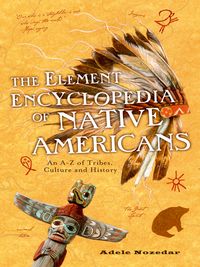
Kitabı oku: «The Element Encyclopedia of Native Americans: An A to Z of Tribes, Culture, and History»

DEDICATION
“That knowledge of past wrongs
will teach us to be wiser”
CONTENTS
Cover
Title Page
Dedication
Introduction
Map
The Element Encyclopedia of Native Americans
A—Abenaki to Atlatl
B—Babiche to Bury the Hatchet
C—Cacique to Custer’s Last Stand
D—Dakota to Duwamish
E—Eagles to Etching
F—False Face to French and Indian War
G—Gall to Guyasuta
H—Hair to Huron
I—Illinois to The Iroquois False Face Society
J—James Bigheart to Jumping Bull
K—Kachina to Kokopelli
L—La Flesche, Susette to Luther Standing Bear
M—Mahican to Mystery Dog
N—Names for the White Man to Nisqually
O—Oglala to Ouray
P—Pacanne to Pushmataha
Q—Quapaw to Quetzalcoatl
R—Rain-in-the-Face to Roots
S—Sacajawea to Syringes
T—Tadodaho to Tuskaloosa
U—Umiak to Ute
V—Vanilla to Vision Quest
W—Wabanaki Confederacy to Wyandot
Y—Yakama to Yuchi
Z—Zitkala-Sa to Zuni
Picture Section
Image credits
Copyright page
About the Publishers
INTRODUCTION
“Though the treatment accorded the Indians by those who lay claim to civilization and Christianity has in many cases been worse than criminal, a rehearsal of these wrongs does not properly find a place here. Whenever it may be necessary to refer to some of the unfortunate relations that have existed between the Indians and the white race, it will be done in that unbiased manner becoming the student of history. As a body politic recognizing no individual ownership of lands, each Indian tribe naturally resented encroachment by another race, and found it impossible to relinquish without a struggle that which belonged to their people from time immemorial. On the other hand, the white man whose very own may have been killed or captured by a party of hostiles forced to the warpath by the machinations of some unscrupulous Government employee, can see nothing that is good in the Indian. There are thus two sides to the story, and in these volumes such questions must be treated with impartiality.”—Edward S. Curtis, 1907
The story of the indigenous peoples of North and South America is a harrowing one. Time after time, in reading accounts of what happened, we see the same sequence of events, which were wryly and concisely encapsulated in a cartoon seen on a popular social networking site: an image of a “typical” Native American with the caption, “Bet you wish you’d never fed those pilgrims.”
The striving for cultural superiority—and the many ways and means in which that superiority was demonstrated—has destroyed many lives, crushed cultures and belief systems, wrecked families, and smashed peace and equanimity to smithereens. And yet, ironically, what we perceive as the Native American way of life is something to which many aspire. The spirituality of the Native American way is not separate from “normal” life as it is for those of a Western mind-set. The innate respect for all of nature, and the consequences of that respect, are goals that have a practical as well as spiritual force and are within reach of everyone, no matter their culture.
Despite the many privations inflicted upon the Native Americans, their profoundly empathetic underlying nature is as strong as it ever was, and so the stories in this book should be absorbed in the context of us being aware of a history which affects everyone. And we should do our utmost to make sure these types of atrocity never happen again.


ABENAKI
This group, who were concentrated in what has become New Hampshire and Maine, are a part of the Algonquian people and were among the first of the Native peoples of North America that European settlers would have encountered. The coming of the white man’s diseases, along with the risk of annihilation by warring French and English factions, forced the tribe into Quebec in the later part of the 17th century.
The Abenaki people refer to themselves as Alnobak, which means “The Real People” or “men.” It was not uncommon among Native American nations to refer to themselves in this way. The origin of the word Abenaki is from Wabanaki, which translates as “People of the Dawn Lands,” a reference to their home in the east.
One Abenaki myth states that the god Kechi Niwaskw created the first man and the first woman from stone; however, Kechi Niwaskw wasn’t happy, destroyed his first attempt at sculpture, and instead carved his creation again from wood. The Abenaki believed that they were descended directly from these wooden figures.
There was an Abenaki Confederacy, a unified group that encompassed the Penobscot, the Passamaquoddy, and Malecite peoples.
The traditional home of the Abenaki is the wigwam, a semipermanent structure usually covered in bark or fabric. The word “wigwam” mistakenly became the generic term used by European settlers for any semipermanent Native American dwelling, because they assumed that this was what the word meant.
The Abenaki survived by hunting, fishing, and agriculture. Their crops would have included corn, potatoes, and, of course, tobacco. At the time that explorers and settlers first encountered them, the Abenaki lived in small groups or villages, each enclosed by wooden fences. They knew that the flesh and bones of fish made an efficient fertilizer, and so had the habit of burying a couple of dead fish at the base of each stem of maize. Using fish as fertilizer was an area of expertise which would be adopted by the settlers in later years—and, indeed, is still in common practice today.
The Abenaki also knew how to make a delicious sweet syrup from the sap of the maple tree—maple syrup—something that wild food-lovers even today celebrate as a great delicacy. The Abenaki were, and are, skilled at basketware.
The area belonging to the Abenaki was situated between Massachusetts and Quebec, areas that came to be colonized by the English and the French respectively, who subsequently went to war with one another.
The Abenaki gravitated toward the French side during the Anglo-French Wars, and one of their warriors—Nescambuit—was made a knight after he slayed over 140 enemies of the French king, Louis XIV. The allegiance of the Abenaki toward the French could have come about because of their relationship with an early French missionary, a Jesuit priest named Father Sebastian Rasles, whose mission was at Norridgewock on the Kennebec River. In 1722 the British destroyed the mission and killed Father Rasles; among his papers was discovered an Abenaki-French dictionary that he had been working on. Also, in 1614, 24 young Abenaki had been kidnapped by the British and shipped back to England, an outrage that would also have been a key factor in helping the Abenaki to decide which side they should support.
Contemporary accounts from the Jesuits who had dealings with the Abenaki described them as “not cannibals,” and also as “not profane.”
In contrast to other peoples such as the Iroquois, the Abenaki followed the patrilineal line (in which the nation of the father was considered to be the nation of the child) as opposed to the matrilineal. This arrangement was common to the New England peoples but unusual among Native Americans on the whole.
Single Abenaki men could be identified by their long, untied hair; when a prospective wife came along, the man would tie back his hair. Once married, the Abenaki husband showed his status by sporting only a high ponytail and shaving the rest of his head. Before the need to alter his hairstyle arrived, however, there was the matter of arranging the marriage. This wasn’t always simple. A proposal of marriage was not simply for the prospective partners, but a matter for the whole village. And the bride and groom would make a gift to one another of a fine box, engraved with the loved one’s attributes.
Other decisions besides betrothals were decided by the entire group. Everyone was given the right to an equal say, and to simplify matters various members would elect a single spokesperson. The Abenaki also had a system in which an impartial person would arbitrate in the case of disagreements. Until all parties agreed, there was no resolution.
At the time of writing, the Abenaki are still not recognized federally, although the state of Vermont recognized their status as a People in 2006. At the time, the authorities noted that many of the Abenaki had been “assimilated.”
ABIAKA
1760(?)—1860(?)
Born in Georgia, Abiaka, a.k.a. Sam Jones, was a medicine man, spiritual leader, and also chief of the Muskogee Seminole tribe, who lived in the southeastern United States. He played a major part in the Seminole resistance to relocation, a resistance which would ultimately result in the establishment of a Seminole reservation in Florida. Perhaps not so famous as the other most influential of Seminole chiefs, Osceola, who died in his thirties, Abiaka was able to use powerful “medicine” to stir his men up into a frenzy, managing to keep the uncompromising resistance strong during many years of war, starvation, and hardship; no doubt the fact that Osceola had been attacked, imprisoned, and kidnapped after he was invited to peace talks fueled Abiaka’s determination not to fall for the same ploy.
Above all, it seems that Abiaka provided a consistent reminder to his people of their spiritual strength. After the third of the Seminole wars, Abiaka moved to the Big Cypress Swamp with a small band of men and a larger number of women and children. By this time he was in his nineties, still retaliating against removal despite his great age.

ACORN
The seed of the oak tree, the acorn was a very useful foodstuff for the Native Americans in and around California. An entire community would gather to harvest the crop, which was processed by being shelled and then mashed in a mortar and pestle. Eaten alone, an acorn is bitter because of the tannins that it contains; however, the Native Americans had an ingenious method of leaching out this bitterness. First they would dig a shallow pit in clean sand, then line it with a dough made from ground acorns. Then hot water would be poured onto the dough. As the water seeped through the acorn paste and into the sand, it would carry away the bitter tannic acid. After this process, the dough would be baked into bread or used in soups.
ADIRONDACK
One of the Algonquian tribes, the Adirondack were so-named by the Mohawk; the word means “They Eat Trees” or “Bark Eaters,” and is likely to have been used as a derogatory name. The name refers to the Adirondack habit of chewing the bark of certain trees, and although most authorities suggest that the Adirondack only ate bark at times when there was nothing else available—that is, during times of famine when sustenance was scarce—it is likely that bark would have been an important staple. The inner part of the Eastern White Pine, which grows prolifically in the area, is not only tasty but nutritious and easy to carry, and Native American peoples have a tradition of being extremely resourceful when it comes to identifying edible plants.
The Adirondack lived north of the St. Lawrence River, and, like the Abenaki, allied themselves with the French during the Anglo-French wars.
Incidentally, the Adirondack Mountains and National Park are named after the Adirondack peoples who once roamed the area.

ADOBE
Common to the Pueblo peoples, “adobe” is a particular kind of brick made from dried grasses and mud, and baked in the sun. Alternatively, the term is used to refer to the mortar that holds such bricks in place.
ADOBE WALLS
The name of a trading post in the Texas Panhandle area on the Canadian River. Adobe Walls is infamous as the site of a terrible battle between 28 white men and one woman, and the massed forces of some 700 Kiowa, Comanche, and Cheyenne, in June 1874. The Native Americans wanted to destroy the contingent at Adobe Walls to protest at the white men’s wholesale slaughter of the buffalo, which accorded no respect to the animal which was so vital to the survival of the tribes.
Despite their numbers, the white settlers had the advantage of guns, and managed to fight off the Natives, who were massacred. Some 100 died at Adobe Walls; only three of the white men perished.
AGRICULTURE
When the huge animals that formed the primary part of the diet of the early Native Americans eventually died out, they were forced to turn their attention to hunting smaller prey, including birds. Around the same time, Native Americans also began to forage for wild plants, not only as a source of food but also as a source of medicine.
It may come as a surprise that 60 percent of the food we eat today comes from plants that were discovered, and then developed, by early Native Americans. These foods include the potato, the tomato, and, most important of all, maize, or corn.
The first corn came from a wild grass called teosinte that grew in Mexico. The early men and women that lived there managed to modify this grass by selecting those with the fattest heads and cross-fertilizing them with other hardy grasses. By a time a thousand years prior to the birth of Christ, corn was the most important vegetable foodstuff in Mexico. The cultivation of corn then spread into the American southwest and was adopted by three civilizations that became famed for their farming methods. These were the Anasazi, the Mogollan, and the Hohokam.
The earliest of these three peoples were the Mogollan, who dwelled on the borders of what is now New Mexico and Arizona between A.D. 150 and 1450. Their homes—subterranean pits covered by a “roof” of brush and plaster made from mud—would develop into stone dwellings.
Next came the Hohokam, who lived in the scorchingly hot Sonoran desert west of the mountains that bordered the Mogollan areas. They lived between A.D. 200 and 1450. The harshness of their environment forced them to become ingenious, and they discovered that they could make the dusty desert soils and sands blossom by means of irrigation. They built hundreds of miles of canals, up to 25 feet wide, sourcing their water from the Gila and Salt rivers. Their crops included corn, beans, squash, and cotton. Examination of Hohokam remains has revealed rubber balls; this is a mystery, since at the time of the Hohokam, rubber was unavailable in Arizona.
Around A.D. 1450 the Hohokam seem to have simply disappeared. It is possible that a drought or a crop failure caused them to disband and seek other places to live.
In the meantime, the Anasazi people—otherwise known as “The Ancient Ones”—arose to the north of Hohokam territory. They further developed effective systems of irrigation, and farmed maize and cotton, learning along the way to weave the cotton crop into a useful fabric.
THE THREE SISTERS
There were three crops that were fundamental to the Native American, and their cultivation was developed and refined by the invention of a method that was a superb example of what we call “sustainable farming” these days. The “Three Sisters” in question were corn, beans, and squash.
According to an Iroquois myth, these three plants were three sisters, also known as Deohako, who had been gifted to mankind by the Great Spirit. The Three Sisters thrive best in each other’s company, and another of their names reflects this: collectively they were referred to as “Our Sustainers.” The planting of the Three Sisters was accompanied by songs and ceremonies, the three seeds being planted together in the same mound of soil. Each of these plants not only supplies a healthy diet but, as the unused parts are plowed back in, adds nutrients to the soil. The first crop of green corn is still celebrated with festivals and dancing.
The symbiosis between the three plants has a wonderful logic. The corn—growing straight and strong—provides a “pole” of support for the bean plants to scramble up toward the sun. These beans have the additional benefit of helping to fix nitrogen into the soil, which further fertilizes the ground. The vines of the bean also strengthen the corn stalks, making them less liable to wind damage. Thirdly, the squash—which have shallow roots—not only act as a mulch, covering the ground and suppressing weeds, but also help keep the soil moist. Squash plants with spiny skins also help to deter any predators. At the end of the harvest, the debris of leaves and stalks left by all three plants would be dug back into the soil, enriching it even further.
As well as growing beautifully together, the nutritional value of the Three Sisters complement one another perfectly, too. The beans, when dried, not only provide protein but can be stored against the winter. The corn is starchy and full of carbohydrates, providing energy. The squash not only contains vitamins but its seeds yield a useful oil.
Native Americans invented this system with no knowledge of vitamins, nitrogen-fixing capabilities, or any of the technical information that we know of today. Further, the natural world, it was believed, offered up signs that the time had come either to plant the seeds or to harvest the crop. For example, the return of the Canada Geese signaled the time for planting the corn.
ALEUT
Originally from the Aleutian Islands, which extend in a westerly direction from Alaska for a distance of about 1,200 miles to the Pacific Ocean, the name Aleut is believed to mean either “Island” or, alternatively, “Bald Rock,” from a Russian word. “Alaska” is from an Aleutian phrase meaning “mainland.”
Aleut culture was very similar to that of the Inuit. Both peoples belong to what is termed the Arctic Culture Area. Their livelihood was based almost entirely on the ocean: they hunted sea mammals, such as otters and whales, and fished, using the traditional baidarkas—a kayak-like vessel made from waterproofed oiled sealskins stretched over a wooden frame. Much of the hunting for larger sea mammals was carried out using a harpoon. The Aleut seafood diet was supplemented with seasonal berries, fruits, and roots. Aleuts lived in partially buried homes called barabaras—large buildings shared by a number of families. Beautiful, intricately decorated baskets were made from the rye grass growing along the edges of the beaches. Shells and amber were used as currency.
In such a harsh climate, the Aleuts had to be particularly ingenious about keeping warm. Their clothing was generally double-layered to preserve heat, made from animal hides and also animal guts. It is the Aleuts that we have to thank for the parka—the long, hooded coat that is worn all over the world.
The coming of the Europeans and their involvement in the fur trade had a significant impact on the traditional Aleut way of life. The first explorer, Vitus Bering of Denmark, working under the auspices of the Russian Czar Peter the Great, arrived on the Aleutian Islands in 1741. His reports of the rich sealife and opportunities for fur trading soon saw a large contingent of prospectors from Siberia arriving in the area. Their methods of working were harsh for the Aleuts. Arriving in a village, hostages were captured, primarily women and children. The men were then forced to trade furs in return for the safe return of their families. The women and children were used as slaves, forced to skin the animals and clean the furs. The Aleuts rebelled in 1761 and succeeded in killing a group of traders; however, the Russians responded by sending in a veritable armada of warships, and blasted many Aleut villages to smithereens with their cannons.
Thereafter, the Russians made some attempts to regulate the fur trade and to treat the Aleuts and the Inuit more fairly, including actually paying them for their efforts. This just meant that the traders found new ways to cheat the Aleut, inventing charges such as fees for food and transportation. The end of the 18th century saw the founding of the Russian American Company, a massive fur-trading company which would become the main competitor with the British Hudson Bay Company.
ALGONQUIAN
The collective grouped under the Algonquian banner lived primarily in and around the woodlands of northeastern America. The different Native peoples belonging to this family included the Abenaki, Wampanoag, Mohegan and Narragansett, the Mahican, Lenni Lenape, the Powhatan and Roanoke, the Ojibwe and Ottawa, the Shawnee and Illinois, the Sauk and Fox, Kickapoo, the Mi’kmaq, Cree, Montagnais, and Naskapi, as well as many others.
There are of course differences in the lifestyles and histories of all the Algonquian peoples, which were banded together far more loosely than the Iroquois Confederacy, but still tended to come together to support one another during times of war or hardship. The tribes also tended to live grouped into small villages, typically living in wigwams. As well as tending their crops of corn, beans, and squash, the tribes hunted small game, fished, and foraged for various wild plants and roots. The peoples who lived close to the prairies where the buffalo roamed, for example in the Mississippi River Valley, would also have hunted the buffalo.
ALLOTMENT ACT
This is also known as The Dawes Act, after Senator Henry Dawes of Massachusetts, who was its main proponent. Passed in 1887, the Act gave the President of the United States the right to audit all the lands that belonged to the Native American peoples, and then, where necessary, divide that land into smaller pieces for individual tribes. The overarching aim of the Act was to aid the assimilation of Native Americans into the white majority; individual ownership of land was perceived to be of paramount importance in facilitating this aim. The European sensibility placed a lot of importance on land and property ownership, while this was not a primary concern of the Native peoples, who believed that the land belonged to everyone. As well as apportioning parcels of land, the Act enabled the Government to buy any “excess” land from the Native Americans, and then apportion that land to others—primarily, white settlers.
Dawes was very much of the mind that ownership of land would have a “civilizing” effect on the Native Americans. In order to be civilized, he said, a man had to:
“… wear civilized clothes … cultivate the ground, live in houses, ride in Studebaker wagons, send children to school, drink whiskey and own property …”
The key points of the Act were as follows:
The head of a family would be allotted 160 acres; an orphan or a single person under the age of 18 would receive 80 acres; and anyone else under the age of 18 would receive 40 acres.
These allotted chunks of land would be held in trust by the U.S. Government for 25 years.
Native Americans could choose their own land, and had four years to do so. If they still had not made a decision after this time, then they would have to take what they were given.
Further, any Native American who had received land and who had subsequently “adopted the habits of a civilized life” would be made a citizen of the United States.
Excluded from the Act at the time it was passed were the Cherokee, Creek, Choctaw, Chickasaw, Seminole, Miami, and Peopria, who were living in the Indian Territory, also the Osage, Sauk and Fox in the Oklahoma Territory, and any of the Seneca in New York.
The Act was not universally admired by any means, certainly not by the Native Americans whose traditional way of living, sharing the land and its bounty, was completely ignored. It was also looked upon with a great deal of suspicion and cynicism by many of European descent. Senator Henry M. Teller of Colorado spoke for many when he said that the real purpose of the Allotment policy was:
“… to despoil the Indians of their lands and to make them vagabonds on the face of the earth …”
Teller also pointed out that:
“… The provisions for the apparent benefit of the Indians are but the pretext to get at his lands and occupy them … If this were done in the name of Greed, it would be bad enough; but to do it in the name of Humanity … is infinitely worse …”
Teller was proved right. The amount of land given to individuals was not sufficient for them to subsist in the ways that they had done for generations, and effectively saw the end of the traditional way of hunting. It also forced the Native Americans to become farmers instead. A further complication came about in that, if the owner of the land died, the allotment could be divided into even smaller chunks by his heirs. After 25 years the Native had the right to sell the land, and the result was that much of it was bought by white settlers for bargain-basement prices. It was also sold to the railroad companies and other major organizations, as Teller had predicted.
The amount of land originally owned by Native Americans was estimated at some 150,000,000 acres; fewer than 15 years after the Act, in 1900, this had been reduced to 78,000,000 acres.

The Allotment Act was abolished in 1934, as no longer deemed necessary.
AMERICAN HORSE
1840-1908
An Oglala Sioux chief and son of Sitting Bear, American Horse’s Native name was Wasicun Thasunke, meaning “he who has the horse of a white man.” He also had the nickname “Spider.” Other illustrious members of his family include his uncle, also American Horse, and his father-in-law, Red Cloud. He also fought alongside Crazy Horse and, in later years, became a performer in Buffalo Bill Cody’s Wild West Show.
American Horse became Shirt-wearer, or chief, along with Crazy Horse, Young Man Afraid of His Horses, and He Dog, in 1868. In 1887 American Horse was one of the chiefs who signed a treaty between the U.S. Government and the Sioux, which essentially reduced the Sioux territory in Dakota by half, a ruling which, not surprisingly, was vehemently opposed by over half the Oglala. At the same time the unrest was reflected in the burgeoning Ghost Dance Movement, and further exacerbated by the murder of Sitting Bull. However, the potential uprising against the Federal Government by the Oglala was deflected by American Horse, who persuaded them to adhere to the terms outlined by the treaty in the name of peace; consequently, the tribe settled at the Pine Ridge Reservation. American Horse campaigned for fair treatment of the Sioux—including better rations—in accordance with what had been agreed.
A great advocate of education, American Horse believed that Native Americans would do well to be schooled according to the white man’s ways; his son and nephew were among the first to attend the controversial Carlisle School.
American Horse died peacefully at Pine Ridge in 1908.
AMERICAN INDIAN MOVEMENT
Also known by the acronym AIM, this organization was founded in Minneapolis in 1968 as a focus for numerous issues that concerned the Native American community. It followed on from the Red Power movement.
The issues concerning AIM included housing, police harassment toward those of Native American origin, poverty, and also the outstanding issues concerning treaties between the Native peoples and the U.S. Government. Although the movement started in Minneapolis, it soon gained momentum across the United States, and in 1971 members gathered together to protest in Washington, D.C.
The “Trail of Broken Treaties” saw the Native American representatives present a list to the Government of 20 demands that they felt they were entitled to, due to various promises that had been made in historical agreements. These 20 items were:
 Restore treaty-making (ended by Congress in 1871)
Establish a treaty commission to make new treaties (with sovereign Native Nations)
Provide opportunities for Indian leaders to address Congress directly
Review treaty commitments and violations
Have any unratified treaties reviewed by the Senate
Ensure that all American Indians are governed by treaty relations
Provide relief to Native Nations as compensation for treaty rights violations
Recognize the right of Indians to interpret treaties
Create a Joint Congressional Committee to reconstruct relations with Indians
Restore 110 million acres of land taken away from Native Nations by the United States
Restore terminated rights of Native Nations
Repeal state jurisdiction on Native Nations
Provide Federal protection for offenses against Indians
Abolish the Bureau of Indian Affairs
Create a new office of Federal Indian Relations
Remedy breakdown in the constitutionally prescribed relationships between the United States and Native Nations
Ensure immunity of Native Nations from state commerce regulation, taxes, and trade restrictions
Protect Indian religious freedom and cultural integrity
Establish national Indian voting with local options; free national Indian organizations from governmental controls
Reclaim and affirm health, housing, employment, economic development, and education for all Indian people.
Perhaps the most noteworthy piece of activism by AIM was “The Longest Walk.” Following a spiritual tradition with political aims in mind, The Longest Walk began in February 1978 with a ceremony on Alcatraz Island, where the Red Power movement had first drawn attention to the plight of Native Americans ten years earlier. The beginning of the Walk started with a pipe ceremony; this pipe was carried the entire length of the route, some 3,200 miles across the U.S.A., ending in Washington, D.C. in July of the same year.
The walk highlighted many issues, such as the need for tribal sovereignty and the civil rights of the Native American people. Support was garnered from both within the Native community and outside of it; and from both inside the United States and from much further afield.
Once in Washington, the pipe, which had been loaded with tobacco at the beginning of the journey, was smoked at the site of the Washington Monument. Thereafter, rallies were held to highlight all the issues that The Longest Walk had set out to address.
AIM continues to fight on behalf of the Native American peoples.
AMOS BAD HEART BULL
1868-1913
Also known as Eagle Bonnet, Amos Bad Heart Bull belonged to the Oglala Lakota branch of the Sioux Nation. The nephew of the chiefs He Dog and Red Cloud, and the son of Bad Heart Bull and his wife, Red Blanket, Amos grew up in the traditional way for a young Lakota boy, although his upbringing was disturbed by the growing unrest between the tribe and the European settlers. Amos was only eight years old when the Sioux defeated General Custer at the Battle of Little Big Horn; despite their victory, the Great Sioux War saw the tribe eventually overcome, and Amos’ family fled north to be with the great chief, Sitting Bull, in Canada, for a few years before returning south to the Standing Rock Reservation, and then to the Pine Ridge Reservation, in the early 1880s.
Amos was interested in the history of his people and this, combined with an artistic skill, saw him start to draw pictures showing key events in the life of the tribe. His father Bad Heart Bull was responsible for keeping the Winter Count, a pictorial calendar, and it’s likely that the young Amos picked up these skills from his father.
It was during his time serving as a scout for the U.S. Army that Amos bought a ledger book—intended for accounts, etc.—from a store, and began to draw in it. By chance, he adapted a traditional Indian technique of drawing on hide or skins to a modern medium: paper. This style became known as Ledger Art, and Amos became famous for it. Once he returned to the tribe after his time in the Army, he became the Winter Keeper of the tribe, following in the footsteps of his father before him.
It wasn’t until after his death, though, that Amos’ art gained recognition. His sister, Dolly Pretty Cloud, had inherited the ledger book full of drawings, and she was contacted by a university student, Helen Blish, who wanted to study the drawings as part of her thesis. Her professor, Hartley Alexander, made photographs of the drawings to accompany his student’s text—which was fortunate, since when Dolly died the ledger book was buried with her. The text and drawings were subsequently published in 1938 by Professor Alexander as Sioux Indian Painting. Some 30 years later it was printed again, the content considered a very important record of the history and culture of the Lakota people, this time under the title A Photographic History of the Oglala Sioux, by Helen Blish’s alma mater, the University of Nebraska Press.
ANASAZI
Meaning “The Ancient Ones,” the Anasazi were among the first dwellers in the vast land that became the United States. Sometimes called the “Ancient Pueblo Peoples,” the Anasazi lived in the southwest. The Anasazi have been traced back as far as 6000 B.C., a hunter-gatherer people who had started to settle into agriculture (primarily growing maize as a crop) in the last two centuries B.C. The Anasazi also left behind a significant accumulation of archeological remains that have helped us to understand something of their culture and way of life.
By A.D. 1200, horticulture had become a very important part of Anasazi economy, although prior to this they had still traveled in search of hunting grounds and sources of food. The more settled they became, however, the more skilled the Anasazi became at basket making, and indeed this was so important that the three delineated periods of Anasazi culture, from 1000 B.C. until A.D. 750, are defined as “the three Basket-Making periods.” Remains of these baskets—and sandals—prove that they were not simply utilitarian objects, but works of art, too.
The Anasazi buried their dead in deep circular pits lined with stones, grasses, and mud; they stored goods in the same way. Houses were similar to hogans—circular permanent structures constructed of a framework of branches covered in reeds, grasses, and earth.

By A.D. 500, the Anasazi were settled into a farming culture, living in small settlements that were scattered widely over what is now southern Utah. These settlements could be as small as just three homes, or as large as a “village” containing more than a dozen buildings.
Archeological investigations of Anasazi remains have also helped us to gauge the arrival of the bow and arrow into this part of America. Sometime before A.D. 750, the bow and arrow replaced the older spear thrower. Around about the same time period, the people also started to make pots, probably as a direct result of using a basket lined with clay as a cooking receptacle. It wouldn’t have taken long to realize that the basket itself wasn’t a necessary part of the structure once the clay had hardened (probably in the cooking process). Anasazi pottery came in two grades: the plain “everyday” kind, and the more decorative ware which was patterned with black-on-white designs.
From A.D. 750 onward, we start to think of the Anasazi as the Pueblo. This name refers to the way the people came to live, in solid, stonebuilt multistoried houses. “Pueblo” is not a tribal name, as some suppose.
For 250 years onward, from A.D. 900, the Pueblo houses, formerly made from wooden poles and adobe, started to be replaced with stone masonry, and a floor was developed that was at the same level as the ground. The actual pithouses, or kiva, were used instead for ceremonies.
ANGAGOK
The shaman or medicine man of the Inuit.
APACHE
A tribe from the Northwest, the Apache were renowned for their fearlessness which, combined with a natural ferocity, meant that they were much feared, not only among the white settlers, but by other Natives, against whom were long-running feuds. Since they had been living in New Mexico when the Spaniards had first arrived there with horses, the Apache were one of the first tribes to train, breed, and ride horses after they had captured the animals in raids. It was their horseback raids on the Pueblo settlements of that area that gave them their name: Apachu means “enemy” in the Zuni language, and “fighting men” in the Yuma tongue. Inde, meaning “people,” is the term that the Apachean groups used to refer to themselves. Although the Apache and the Navajo are related, the term “Apache” isn’t used in reference to the Navajo. Both Apache and Navajo are a part of the Athabascan language group.
There were several different bands of tribes that are grouped under the general heading of Apache. These include the Chiricahua, who had the reputation of being the most ferocious of all the Apache groups, the Kiowa Apache (or Plains Apache), the Jicarilla (who cultivated corn as well as hunting buffalo), and the Mescalero (so-named because of their fondness for the roasted heads of the wild mescal plant). The Lipan Apache in Texas were known to be particularly “unruly.” These separate Apache groups didn’t really work in any kind of unity; there were seven different languages between the major groups, as well as diverse cultural differences between those groups.
The Apache were seasonal hunters, ranging after buffalo, deer, and elk. The Apache were matrilinear—that is, the children were deemed to belong to the tribe of their mother and, once married, their father’s obligations lay with their mother’s clan. Although all the separate Apache clans operated distinctly from one another, during times of warfare they banded together to make a formidable fighting force.
As soon as they gained access to firearms as well as horses, the Apache became even more dangerous than before. It’s fair to say that they posed the greatest threat to the Europeans in the desert territories of New Mexico and Arizona. In addition to their warlike ferocity, the Apache were intelligent, wily strategists. One U.S. general, whose identity has been lost, described the Apache as “the tigers of the human species,” although for the Apache themselves their nature was simply one born of the constant struggle to survive, and the guerrilla war tactics that they adopted came completely naturally to them. It was rumored that an Apache warrior could run for 50 miles without stopping.
The relationship between the Apache and the Pueblo people was peaceable enough. The Apache pitched their wickiup shelters on the outskirts of the Pueblo villages as they moved through in pursuit of wild game. However, the coming of the Spanish put an end to this existence. The Spanish slave traders had no compunction in hunting down captives to work in the silver mines of northern Mexico, and the Apache found in the Spanish a rich source of horses, guns, and captives of their own.
When, in 1870, the tribe were told that they had to stay on the reservation that had been allotted them, a particular band, under the leadership of Cochise, simply refused, and caused as much mayhem for the U.S. Government troops as they possibly could. In 1873 the troops had corraled some 3,000 Apaches and forced them onto the reservation. Unsurprisingly in view of such treatment, the Apache chose to continue fighting.
Perhaps the most famous of all Apache leaders was Geronimo, who led the tribe from 1880. However, even Geronimo had to admit defeat at the hands of the U.S. Government in 1886.
APACHE MEDICINE CRAZE
During the spring of 1882, Doklini, a popular medicine man of the Apache tribe who was otherwise known as “Attacking the Enemy,” otherwise Nabakelti, told his considerable number of followers who lived on the White Mountain Reservation in Arizona that he had had a vision, a divine revelation: the information imparted to Doklini revealed how the dead could be brought back to life.
At this time, the losses to Native Americans of all tribes are impossible to estimate; suffice to say that everyone must have been affected by the deaths of family, friends, and colleagues because of diseases, war, and starvation. Such a message of hope must have been inspiring, and the same emotions would hit those affected by the Ghost Dance Movement, which would gain momentum just a few short years later.
Doklini prepared some equipment that he needed for the miracle. He constructed 60 large wooden wheels painted with magical symbols, and also carved 12 sacred sticks. One of them, which he shaped into a cross, was given the title “Chief of Sticks.” Then he gathered 60 men from among his most fervent followers, and then Doklini started the dance.
When the time was right, Doklini went to the grave of a man, prominent among his people, who had died just a little while earlier. The medicine man and his followers danced around the grave and then disinterred the bones. They then danced a circle dance four times around these bones; this dance went on all that morning, and then the group chose another grave and repeated the ritual in the afternoon. A shelter of brush was placed over the bones in each instance.
The next set of instructions was then given by the medicine man. Everyone must pray for the next four mornings, he said; at the end of this time, the people to whom the bones belonged would be restored once more to life and vitality.
By the second morning of prayer, the small band of Apache, anticipating the restoration of two of their loved ones, were almost at the point of hysteria, convinced that Doklini’s medicine would have the desired effect.
Meanwhile, news of this interesting development had reached some of the Apache scouts who were based at Fort Apache, and were excused from their duties so that they could go and see what was happening. To the outside visitor, it must have appeared as though those waiting for their dead to be resurrected had gone crazy; this was the information that was relayed back to the fort. The presence of Doklini was requested, who responded by sealing the brush shelters over the bones tightly and suggesting, angrily, that he would appear to answer questions after two more days had passed. He also called together his people, explaining that the interruption meant that the bones might not reconstitute in the way he had promised, but that, because of the interference and interruption of the white men, the whole procedure might need to be repeated.
Doklini traveled to Fort Apache with something like an entourage: 62 dancers and all the equipment: the wheels, the sticks, and ceremonial drums. In all, it took the party nearly two days to reach their destination, stopping to dance along the way, and they made an encampment just above Fort Apache, dancing, drumming, and waiting for someone to come and see them. But no one came. After dancing and waiting all night, at dawn the party wended their way back home, arriving not long after dawn after a day and a half of traveling. Word came that the agent at Fort Apache was expecting them. Doklini replied that they had traveled to Fort Apache, no one came to see them, and that he wasn’t going to go all that way again.
The powers at Fort Apache decided to send a troop of 60 men to the small Apache settlement where Doklini and his band were based, with the purpose of arresting the old medicine man. Sixty men might seem extreme, given the task, but the agent was concerned that the Indians might resist the arrest of their spiritual leader.
In the event, neither Doklini nor his followers put up any resistance at all, and rode with the men to their temporary headquarters. There was no sign that there would be any trouble, but suddenly one of Doklini’s brothers, angered at the arrest, rode into the camp and killed the commanding officer with a single bullet. Seconds later, a soldier hit Doklini over the head with a blunt weapon; the old man was killed.
Knowing that a fight was looming, the soldiers hastily prepared their defenses. The Apache, outraged at the loss of Doklini, did indeed attack, and killed six of the soldiers. The pack animals escaped, but in the ensuing months the fighting caused deaths on both sides.
Had the authorities at Fort Apache not interfered, the chances are high that, after the fourth day, when none of the bones had been transformed into living men once more, the whole Apache Medicine Craze would have fizzled out, Doklini discredited, but no lives lost.

APACHE MOON
This was the term used by the white settlers for a full moon. The reason? Some of the Plains Indians—the Apache in particular—chose to attack by the light of the full moon, since there was a belief among the Apache that when a warrior died he would find in the afterlife the same conditions that he had left behind on the earthly plain. A raid undertaken under a moon-filled sky would have been very effective for the Apache attackers, and would also mean that any enemies that were killed would be destined to wander around in the half-light for all of eternity.

APALACHEE
When the explorer De Soto visited the Apalachee people at their territory in what is now known as Apalachee Bay in Florida, he found an industrious, hard-working people who were not only wealthy and skilled in agriculture, but had the reputation of being fierce warriors, too. When the tribe allied with the Spanish, they became the subject of raids from the Creek people, sent on behalf of the English Government. As a result, the Apalachee really began to suffer.
The worst was yet to come for this people, though. In 1703 the European colonists, accompanied by their Native American allies, conclusively raided the Apalachee territory and ransacked and burned all before them. More than 200 warriors were slaughtered and over 1,000 more were forced into slavery. Anyone lucky enough to survive fled, taking refuge with other peoples who were sympathetic to their plight.
Although there were reports of a few Apalachee still living in Louisiana in 1804, all that remains of the Apalachee today is remembered in some place names, including the bay in Florida mentioned earlier, and of course in the name of the Apalachian Mountains.
APPALOOSA
This is the name that the white men gave to the beautiful war ponies, with distinctive spotted coats, that belonged to the Nez Perce peoples. The name itself was derived from the area in which the people lived at one time, the Palouse Valley of the Palouse River, located in Oregon and Washington. The Nez Perce had been breeding, handling, and riding horses for at least 100 years before the Lewis and Clark Expedition “discovered” the tribe in the early 19th century. Although many of their Appaloosa ponies were killed in the latter part of the 1800s, the breed was revived in the latter part of the 20th century, and continues to flourish.
ARAPAHO
When the settlers first came upon them, the Arapaho were already expert horsemen and buffalo hunters. Their territory was originally what has become northern Minnesota, but the Arapaho relocated to the eastern Plains areas of Colorado and Wyoming at about the same time as the Cheyenne; because of this, the two people became associated and are also federally recognized as the Cheyenne and Arapaho tribes. The Arapaho were also aligned with the Sioux.
The Arapaho tongue is part of the Algonquian language group. In later years—toward the end of the 1870s—the Northern Arapaho would be further relocated to the Wind River Reservation in Wyoming, while the Southern Arapaho went to live with the Cheyenne in Oklahoma. Despite this close association, which often meant intermarriage, each people retained its own customs and language. One major cultural difference between the two, for example, is that the Arapaho buried their dead in the ground, whereas the Cheyenne made a raftlike construction on which to lay their deceased, leaving birds and animals to devour the remains. The Arapaho were tipi dwellers, part of the Woodland Culture tribes. It was this group that were the originators of the Sun Dance. They also had a government of consensus.
Like other Native Americans, the Arapaho and the horse took to one another as though they’d been designed to; this meant that the tribe could travel further and faster, and also had the capability of carrying goods and chattels more efficiently than before. Fishing and hunting—which included hunting buffalo—provided much of what the Arapaho needed to survive.
In 1851, the First Fort Laramie Treaty set the boundaries of the Arapaho land, from the Arkansas River in the south to the North Platte in the north, and from the Continental Divide in the west to western Kansas and Nebraska. When gold was discovered near Denver in the late 1850s, contact with the settlers increased rapidly, and in 1861 there was an attempt to shift some of the Arapaho to a chunk of land along the Arkansas River. The Arapaho did not agree to this, however, and the treaty remained unenforceable in law. However, the matter escalated when in 1864 a peaceable band of Arapaho, camping along Sand Creek in the southeastern part of Colorado, were brutally attacked by a Colonel Chivington, who had wanted to prove himself a war hero. These Arapaho had no warning whatsoever. The Sand Creek Massacre, as it came to be known, included the slaughter of women, children, and elderly people, and ignited angry conflict in the mid 1860s. Rather than giving him heroic status, the matter brought shame to Chivington. Eventually, treaties were agreed that saw the Southern Arapaho settling in west central Oklahoma.
The Northern Arapaho became embroiled in Red Cloud’s War between 1866 and 1867. Sparked by the white man encroaching on Native American buffalo-hunting territory in Montana after gold was discovered there, the Arapaho, Cheyenne, and Sioux were victorious. The conflict continued, however, climaxing in the Battle of Little Big Horn and the defeat of General Custer in 1877. Today, the Arapaho are among the peoples who operate casinos, one of which is located at the Wind River Reservation in Wyoming.

ARAWAK
Also called the Taino, the Arawak people did not live on the mainland of North America, but on the Caribbean islands to the south—specifically, the chain of islands which came to be known as the West Indies/Antilles. As most people know, the islands are called the West Indies because Christopher Columbus stumbled across them while seeking a passage to India, thought that the Antilles were the East Indies, and called the Native Americans that he encountered there “Indians.” This name stuck (although for many it is a continual source of annoyance).
Although Viking explorers reached America long before Columbus, it was Columbus’ “discovery” that really brought the continent to the attention of Europe and, consequently, to the rest of the world. And it was the Arawak with whom Columbus had the most contact.
A farming people, the Arawak had traveled to the Caribbean from South America, and called themselves the Taino, meaning “good people.” Able to grow a varied number of plants because of the tropical climate, the tribe supplemented these crops of corn, potatoes, cassava, peanuts, peppers, and tobacco with hunting (mainly small game, specifically an animal called the Hutia) and fishing (from dugouts; they speared fish and also caught sea turtles). The tribe built seaworthy dugout canoes which could take 100 people; these were used to carry goods to and fro between the Arawak and the Native peoples in South America.
The position of chief, or cacique, of each village, was a hereditary title; this could be a man or woman. Female chiefs were called cacicas. The chief lived in a square or rectangular house with a pitched roof; the villagers lived in circular huts and slept in hammocks, a Native American invention which has proved popular all over the world. These Arawak hammocks were the first that any European would have seen.
Because of the climate, little was needed in the way of clothing, and when Columbus encountered the Arawak he would have seen many naked natives. Both men and women wore beautiful jewelry made from natural materials that were ready to hand, such as shells or bone. The Arawak provided the first contact for many things as well as the hammock, which was rapidly copied as a way of sleeping on board ship. The amiable Arawak showed their visitors potatoes, corn, and, of course, tobacco; in fact, the Arawak word for “cigar” was tabaco.
The Arawak showed Columbus and his men nothing but kindness; this was not repaid. Columbus forced several members of the tribe to accompany him as slaves, and other potential colonists followed suit by treating the Arawak like slaves. The Arawak killed the Europeans, but when Columbus returned he tried to make the Arawak work for him in finding gold. This proved unsuccessful, but taking Natives to sell as slaves proved profitable.
The Arawak were among the first to suffer from the diseases brought by the Europeans, as well as dying of starvation when they were forced into slavery. Others killed themselves, unable to bear such subjugation.

ASSIMILATION
A policy that was actively encouraged by the white settlers in order to encourage Native Americans to be absorbed into the “mainstream” culture. Assimilation of Natives into the ways of the white man generally resulted in the exchange of one culture for the other; for example, when they were sent to European schools, Native American children were not allowed to use their native tongue, and were encouraged to reject their traditional religious practices in favor of Christian ones. The movement toward assimilation was at its height in the late 1800s and the early 1900s.
ASSINIBOIN
Also known as the Rocky Mountain Sioux, despite the fact that the Assiniboin and the Dakota Sioux share virtually the same language, the two were enemies for as long as anyone could remember. The early Jesuits in America found the two peoples distinctly different from one another, except for their language.
The name Assiniboin means “one who cooks with hot stones,” and the tribe were given this name by the Ojibwe; the Assiniboin united with the Ojibwe, and also with the Creek, to fight the Dakota Sioux for overall control of the buffalo plains.
The Assiniboin originally lived in Canada, subsequently traveling south to what are now North Dakota and Montana. Sadly, many of the Assiniboin tribe fell prey to the white man’s disease of smallpox in the 1840s and were wiped out.
ATLATL
A device used to make spear throwing more effective, the atlatl was a prehistoric invention. It was constructed from a stick approximately 2 feet long. Using a rock as a balance, there was a groove in the stick to hold the shaft of the spear in place, and loops made of animal hide with which the atlatl was grasped firmly.


BABICHE
This is the name given to a string, or thong, made from the hide of a caribou, a deer, or even an eel. A useful material, it was used in the same way that string or twine is used today, except it was likely to be much longer-lasting. Babiche would be made into skeins and carried around with a person just in case it was needed for repairs.
BALSA
The Californian Native Americans made small boats from reeds or rushes that were tied together into bundles and bound into a cylindrical shape. After a period of use this small craft, or balsa, would become waterlogged and had to be dried out before it could be used again. The name “balsa” also refers to the lightweight wood that comes from the tree, whose Latin name is Ochroma pyramidale.

BAND
Smaller than a tribe, the term “band” is used to describe a small group of Native Americans, often a sub-division of a tribe or clan. A band might also be used to describe a group who had elected to follow a leader other than the accepted tribal chief.
BANNERSTONE
A decoratively carved and polished stone or rock, often sculpted into the form of a bird. This might be mounted onto the top of a staff to show the authority of the bearer. Such decorative stones were also used as weights on the atlatl.
BANNOCK
Related to the northern Paiutes, the Bannock belong to the northern Shoshone people.
Their original stamping ground included southeastern Oregon, southeastern Idaho, western Wyoming, and the southwestern part of Montana. They belong to the Paiute language group.
The Bannock had less trouble in general with the white settlers than other tribes. The tribe traded with other Indian nations, using their pottery, horn utensils, and salmon-skin bags as currency with which to barter. After they adopted the horse in the middle of the 18th century, they traded the animals with the Nez Perce.
The Bannock, as well as other tribes, place a huge amount of importance on the buffalo, not only for food but for all manner of essential items: clothes, implements, tipi coverings, etc. There was another natural resource that was an essential for the Bannock lifestyle: a plant named camas, a purple/blue flower whose bulb was an important form of nutrition, especially in the winter months when little else was available.
In 1868 the Bannock had been removed to the Fort Hall Reservation in Idaho. The rations allotted to them by the U.S. Government were not sufficient to keep the Indians from starvation. In the spring of 1871, the tribe left the reservation to harvest camas roots, but discovered that the settlers had allowed their livestock to roam free in the Great Camas Prairie; there were not enough of the precious tubers left. In addition, it became clear that the numbers of buffalo were rapidly diminishing due to dramatic overhunting by the white men. These two factors forced the Bannock to rebel against the white settlers and the U.S. Government, in an uprising known as the Bannock War, in 1878. The Bannock Chief, Buffalo Horn, made an allegiance with the northern Paiutes; the massed tribes made a series of raids on the white settlers in order to try to find some food. The tribes were defeated by the U.S. Army, and many members of the tribe were captured. After this defeat, they returned to the reservation at Fort Hall in southeastern Idaho.
BARABARA
The Inuit and Aleut peoples built large lodges in which many people could live; this was the barabara. Partially dug into the ground to a depth of approximately 2 feet, the barabara was lined with timber and the roof—except for a chimney or smokehole—made from arched branches covered over with earth and bark.

BASKETWARE
An ancient craft, the making of baskets was an essential skill carried out by every Native American people. Materials used for making baskets included grasses and reeds, whippy branches, bark, and roots. The Natives of the Great Lakes favored birch bark containers over baskets, whereas cane and willow were the preferred materials in the south. There were two specific styles of basket which are still made all over the world—woven baskets, and coiled ones. The former took as its basis a framework of a stouter material which would be woven through and in between that framework. Coiled baskets were made from braided material that would be coiled and then stitched into the shape of the basket.
Patterns can be woven into baskets with fibers of contrasting color and texture. Different tribes developed their own unique designs.
As well as being used to carry equipment, food, and other objects, baskets also made handy cooking receptacles. To use a basket in this way the receptacle was first lined with pitch or clay to make it watertight. During the cooking process the clay hardened; afterwards it was discovered that the clay vessel could be used on its own, without needing the basket itself. It’s not unlikely that pottery was developed because of using baskets in this way. However, it was also possible to weave baskets which were in themselves watertight, with no need to use any coating material. To boil something in a basket—which of course could not be used over direct heat—the water inside it was heated by dropping hot stones inside.
Basket-weaving skills were also used to make cradles, shields, fences, boats, and fishing nets, among other objects.
BATTLE OF LITTLE BIG HORN
See Custer’s Last Stand
BAYETA
Blankets were an important resource for the Native Americans, and were made from hair, down, fur, wool, cotton, feathers, and even bark. They were used as clothing, shelter, for making partitions, and even to wrap up goods and carry them while traveling.
The bayeta—Spanish for “baize”—was the best known of all the various types of blankets made by the Navajo. They were generally a subdued reddish color, made from the baize which had been introduced as a trading item in the 19th century. The Navajo unraveled the fabric and reconstituted it into beautiful blankets.
BEADS
Just about all Native American peoples used beads as decoration. These beads were made from nuts and seeds, wood, bone, horn, shells, teeth, claws, the beaks of birds, and also minerals including turquoise, soapstone, quartz, and other stones. Beads made from the shells of shellfish such as the periwinkle were called wampum and were used as currency.
Beads were used to ornament the hair, were sewn onto clothing, and strung onto sinew to make jewelry. When the white settlers arrived, they introduced glass and ceramic beads to the Indians. Historians are able to determine the age of an item by examining any beads that were a part of it.
BEAVER
The territorial spread of the beaver ranged from west of the Mississippi to south of the Great Lakes.
The beaver was a much loved “brother” to the Native American, honored for its industry and ingenuity. Beavers, like men, were observed to live in “families,” and appeared to have their own language, laws, and a chief, and so they were considered to be the equal of human beings. The beaver was also a useful animal: some tribes ate its meat, and after killing it every single part of the animal was used; nothing was wasted. The teeth—notoriously sharp and able to chisel easily through trees to fell them—were prized as weapons, mounted onto the end of a stick which could be used either as a tool or as a weapon. The beaver skin was used to make bags, pouches, and clothing.
Beavers build ingenious homes for themselves: oval-shaped lodges of which about a third is actually in the water. The rest is coated densely with clay so that it is both airtight and watertight.
Native Americans might catch beavers by cutting holes in the ice and waiting until the animal emerged for air, when the hunter would grasp the animal quickly and kill it cleanly and efficiently.
The white settlers, however, also quickly realized the value of the beaver, and soon established a thriving fur trade with the Natives, which assisted good relations on both sides.
BEAVER (TRIBE)
Also called the Tsattine, a word that means “those who live among the beavers.” There were many beavers in what is now northwest Alberta in Canada, especially near the Peace River, whose name in the language of the tribe was the Tsades, meaning “beaver river.” The tribe belonged to the Athapascan language family.
The Beaver, among the hardy Native Americans who lived in subarctic conditions, were seminomadic, moving to follow the hunt. Their prey included not only beavers but moose, caribou, and smaller mammals such as rabbits. The Beaver used hand-made animal “calls” of birch-bark to attract their prey. They also sometimes encountered the buffalo.
The Beaver lived in cone-shaped houses which looked a little like tipis, and when hunting built lean to shelters from whatever materials were at hand. Hunting parties consisted of loose bands of families, each assigned a territory; to follow the hunt the tribe used canoes, toboggans, and snowshoes.
The shaman or medicine man of each band slept with his head toward the west, in order to allow him to speak with the spirits. The other tribal members slept toward the rising sun, facing east. They believed that this direction would help them to dream. The Beaver had a strong belief in guardian spirits, and would mutilate themselves to show grief, using methods of self-harm that ranged from chopping off a joint of a finger to piercing their chests. Their introduction to Christianity absorbed many of their traditional beliefs, and placed the priests in a role very similar to that of the shamen.
Because of the potential for the fur trade in territory that was so rich in beavers, the tribe were among the first of the Athapascans to encounter the Europeans, and in 1799 their chief asked for their own fur-trading post. By 100 years later, the Beaver tribe had handed over vast tracts of their land to the Canadian Government.
BIG ELK
“What has passed and cannot be prevented should not be grieved for.”
1770–1846
The last pure-blood chief of the Omaha people, Big Elk was known to his own people as Ontopanga. Big Elk lived during rapidly changing times, and steered his people through these changes with wisdom and perspicacity. It was not only the white men who posed a threat to the Omaha, but the Sioux. What was out of the chief ‘s control, however, was the devastation caused by European diseases: smallpox, in particular, had a shocking effect on the population of his people, which was reduced from 3,000 in 1780 to 300 in 1802.

Big Elk supported the United States in the War of 1812, hoping that a victory would mean that the Government would help protect the Omaha against the Sioux.
A progressive leader, there were many facets of the new culture of America that Big Elk thought were good, and he was happy to have two of his daughters marry successful fur traders since he believed that assimilation could work well for both parties, and that such illustrious sons-in-law would give credence to his own family. Since the Omaha tribe followed a matrilinear system, any offspring would be automatically accepted as tribal members.
One of these “good” marriages came with the betrothal of Big Elk’s daughter, named Mitain, to the Governor of the Missouri Territory, Manual Lisa, even though he was at the time still married to a white woman who had been left behind in St. Louis.
Big Elk’s daughter Me um Bane married a wealthy fur trader named Lucien Fontanelle. Their eldest son, Logan, worked as a translator for the U.S. Indian agent from the age of 15. Logan went on to become an important person within the tribe because of his abilities, especially in negotiating land deals, although he was unfortunately killed by the Sioux.
Big Elk believed that, in ceding land to the Government, his people would receive protection in exchange. Accordingly, the tribe gave up most of their land and were relocated onto a reservation in the northeastern part of Nebraska. At this time Big Elk adopted another fur trader, Joseph LaFlesche, not only into the tribe but as his son. In 1842 Big Elk informed Joseph that he would succeed him as chief, and so the young man began to train himself in the traditional ways of the tribe.
Big Elk died in 1846, after a fever. He is buried in Nebraska, at a site known as Elk Hill but also known to the Omaha people as Ong-pa-ton-ga Xiathon, meaning “The Place Where Big Elk Is Buried.”
BIG SPOTTED HORSE
1836(?)–?
As a young Pawnee brave of 15 or 16 in 1852, Big Spotted Horse was chased by a Cheyenne warrior while taking part on a buffalo hunt in Kansas. The warrior, Alights on the Clouds, wore a protective material called scalemail which meant that he was impervious to arrows. Alights on the Clouds intended to count coup on Big Spotted Horse, and galloped toward his right hand side. What he did not know, however, was that Big Spotted Horse was left-handed; he turned to the right as Alights on the Clouds approached him with a sword, pulled back his bow, and struck home, piercing his enemy’s eye.
The young Big Spotted Horse had no idea what had happened until some of his fellow Pawnee hunters, seeing the body fall, shouted out. The Cheyenne, shocked at the death, retreated, but for the Pawnee, the killing of a warrior decked in protective metal discs was celebrated as a great victory. Big Spotted Horse’s name as a great warrior was made, and his exploits as a horse thief and warrior became the subject of folklore.
In one raid, in 1869, he led his men to a Cheyenne village near a river. There they stealthily untied the choicest horses, setting off for home with some 600 animals. Despite blizzards, they made it home intact to their village. However, horse raiding was very much frowned upon by the Indian agents, and 600 horses were too many to hide from Jacob Troth. Big Spotted Horse was called before him and ordered that the horses should be returned to the Cheyenne. Big Spotted Horse, determined not to be humiliated by such an action, refused, and was imprisoned. After five months he was released, however, when it was proved that there was no statute that made horse raiding illegal.
On returning to his village, Big Spotted Horse was outraged to find that only some 40 of the horses remained, the rest having been returned whence they came. In his anger, he joined the Wichita people in Oklahoma.
In 1872 Big Spotted Horse returned to his village with the intention of relocating his entire tribe to the Wichita territory, a move supported by them but disapproved of by the Pawnee chiefs, who did not want to leave. So Big Spotted Horse gathered some 300 supporters and returned to the Wichita; two years later, to the dismay of the Pawnee chiefs, the rest of the tribe followed him, despite the fact that the Wichita land was far less fertile than that of Nebraska.
BIGIU
The Chippewah word for the resins obtained from certain evergreen trees including the cedar and various firs. Bigiu was used to make things waterproof: rafts and canoes, basketware, etc. It was also used to coat the ends of sticks which could then be set alight so that hunters could hunt at night.
See also Glue
BILLY BOWLEGS
1810(?)–1859
Also known as the “Alligator Chief,” Billy Bowlegs’ name in the language of his Seminole tribe was Holata Micco, meaning “chief.”
Billy was born in the Seminole village of Cuscowilla, in the part of the U.S. which is now Paynes Prairie, Florida. His family, the “Cowkeeper Dynasty,” were the hereditary chiefs of the Seminole; among his relatives was King Bowlegs, who was head chief at about the time that Billy would have been born. Billy became chief in 1839 after the old chief, Micanopy, was forced west into exile during the Second Seminole War and thereby forfeited his right to remain chief.
Billy remained chief during the Second and Third Seminole Wars, fought against the U.S. In 1832, on behalf of his tribe, he signed a treaty to agree that the Seminole would relocate west if suitable land were found for them. Land was found, but the tribe, under Billy, refused to quit Florida, and shortly afterward the Second Seminole War broke out. This war resulted in the deaths of many Seminole, including other leaders, and Billy and a small band of 200 warriors were among the few survivors. They lived peacefully for some 20 years until, in 1855, a group of white men who were surveying the territory built several forts in the area after destroying property and chopping down valuable banana trees. The Third Seminole War broke out as Billy Bowlegs and his men led a series of guerrilla attacks on the invaders. This war lasted for three years until, in 1858, Billy was approached by the chief of the Western Seminole, Wild Cat. Wild Cat had been sent to try to persuade Billy and his band to relocate; faced with an offer of hard cash, the 124 Seminole, including their leader, agreed to move to the Indian Territory. Billy died shortly after the journey there.
BILOXI
The Biloxi people belong to the Siouxan language family, although their actual dialect is no longer spoken; the last speaker died in the 1930s. Originally they lived near the Gulf of Mexico close to the city that is named for them—Biloxi, Mississippi. The tribe were descended from the mound-building people.
When they were first “discovered” by a French Canadian explorer in 1699, Pierre Le Moyne d’Iberville was told that the tribe had been quite large before they suffered the ravages of smallpox.
The Biloxi were a farming people who supplemented their agricultural efforts with fishing and hunting; their prey included buffalo, deer, and sometimes bear. The Biloxi society had as its head the Great Sacred One, effectively the monarch, who could be a king or a queen but was always a shaman or spiritual practitioner. In the Biloxi language he or she was called the Yaaxitqaya; nobles below the Yaaxitqaya were called ixi. The tribe lived in cabins made of packed mud and bark.
The Biloxi had unusual funeral practices. The deceased were dried out by means of smoke and fire and then tied to red-painted poles which would be sunk vertically into the ground in the center of the temple.

BIRCH BARK SCROLLS
In the Ojibwe language, the wiigwaasabak are scrolls made of the flexible, long-lasting bark of the paper birch tree, which peels from the tree neatly and cleanly. The Ojibwe used these sheets to inscribe pictures and designs depicting all sorts of information: songs, rituals, maps, the movement of the stars, and the history of a family, clan or tribe. Sometimes the scrolls were themselves used in rituals, in which case they incorporated the word midewiwin (medicine), and were therefore named midewiigwaas.
The designs were drawn or inscribed onto the soft inner side of the bark with a tool made out of bone or wood. The resulting indentations were made more visible by rubbing soft charcoal into them. If the scroll that was being made needed to be bigger than a single sheet of bark, then separate pieces of bark were stitched together using the strappy roots of pine trees. Once completed, the scroll was tightly rolled up and placed for safe keeping in a cylindrical box, also made of birch bark. These boxes might then be secreted away underground or in hiding places; after a few years had elapsed, the information might be copied onto another sheet of birch bark to ensure that the information remained intact. The scrolls could measure as little as a single sheet or as large as several yards of bark stitched together. We know that the scrolls have been in use for at least 400 years.
The discovery of certain scrolls have revealed important aspects of Ojibwe history: for example, the route of the migration of the tribe toward the west from the eastern part of North America. Thanks to these scrolls, we also know about the discovery of white cowrie shells, which are found only in certain saltwater areas.
The scrolls are very much a piece of living history, kept alive by the Native peoples of today, particularly among the medicine (midewiwin) societies. The contents of the scrolls are often memorized, and the interpretations can remain a secret among the elders of the group.
BIRD WOMAN
See Sacajawea
BLACK DRINK
The Native Americans of the southeast blended a particular type of brew which they then used in ritual and ceremonial practice. The primary ingredient of the tea was a poisonous plant called Ilex vomitoria; also included were tobacco and other herbs. As the name of the main ingredient might suggest, the tea induced vomiting, believed to detoxify the body as well as provide visions.
BLACK ELK
“And I say the sacred hoop of my people was one of the many hoops that made one circle, wide as daylight and as starlight, and in the center grew one mighty flowering tree to shelter all the children of one mother and one father.”
1863–1950
That we know so much about the life of Black Elk is because of a man named John Neihardt. As an historian and ethnographer, Neihardt was, in the interests of his personal research, searching out Native Americans who had a perspective on the Ghost Dance Movement. He was introduced to Black Elk in 1930, and thus began a productive collaboration which would provide a major contribution to the Western perspective on Native American life and spirituality—coming, as it did, from an authority on such subjects. The books they produced, including Black Elk Speaks, became classics, and are still in print today.
Living during the time that he did, Black Elk was in a unique position: born into the Oglala Lakota division of the Sioux, he not only participated in the Battle of Little Big Horn in 1876, when he would have been 12 or 13, but also toured as part of Buffalo Bill Cody’s Wild West Show in the 1880s, and traveled to England when the show was performed for Queen Victoria in 1887. He was 27 when the massacre at Wounded Knee took place in 1890, during which he sustained an injury.
Black Elk was a heyoka, a medicine man, and a distant cousin to Crazy Horse. Elk was born in Wyoming in 1863. Acknowledged as a spiritual leader and as a visionary, Black Elk’s first revelation came to him when he was just nine years old, although he did not speak of it until he was older. In this vision, he said, he met the Great Spirit and was shown the symbol of a tree, which represented the Earth and the Native American people.
After Wounded Knee, Black Elk returned to the Pine Ridge Reservation and converted to Christianity. He married Katie War Bonnet in 1892. All three of their children, as well as their mother, embraced the Catholic faith, and in 1903, after Katie died, Black Elk, too, was baptized, although he remained the spiritual leader among his own people. He saw no inherent problems in worshipping both the Christian God and Wakan Tanka, or the Great Spirit—an open-minded attitude which undoubtedly was not shared by his fellow Catholic. Black Elk married once more in 1905, and he and Anna Brings White had three more children. He was one of the few surviving Sioux to have first-hand knowledge of the rituals and customs of the tribe, and he revealed some of these secrets to both Neihardt and Joseph Epes Brown, who published books based on his knowledge.
BLACK HAWK (MAKATAIMESHEKIAKIAK)
“Courage is not afraid to weep, and she is not afraid to pray, even when she is not sure who she is praying to.”
1767–1838
In what is now called Rock Island, Illinois, there was once a village called Saukenuk, and this is where Black Hawk, also known as Black Sparrow Hawk, was born. His father, Pyesa, was the medicine man of the tribe, and, in accordance with his destiny to follow in his father’s footsteps, Black Hawk inherited Pyesa’s medicine bag after Pyesa was killed in a battle with some Cherokee.
Like many other young men of his people, Black Hawk trained in the arts of battle from an early age. When he was 15, he took his first scalp after a raid on the Osage tribe. Four years later he would lead another raid on the Osage, and kill six people, including a woman. This was typical of the training in warfare given to young Native Americans.
After the death of his father Pyesa, Black Hawk mourned for a period of about six years, during which time he also trained himself to take on the mantle of his father, as medicine man of his people. It would also prove a part of his destiny to lead his people as their chief, too, although he didn’t actually belong to a clan that traditionally gave the Sauk their chiefs. It was Black Hawk’s instinctive skill at warcraft that accorded him the status of chief; this sort of leader by default was generally named a “war chief” since, sometimes, circumstances dictate the mettle of the leader that was needed.
When he was 45, Black Hawk fought in the 1812 war on the side of the British under the leadership of Tecumseh. This was an alliance that split the closely aligned Sauk and Fox tribes. The Fox leader, Keokuk, elected to side with the Americans. The war pitted the North American colonies situated in Canada against the U.S. Army. Britain’s Native American allies were an important part of the war effort, and a fur-trader-turned-colonel, Robert Dickson, had pulled together a decent sized army of Natives to assist in the efforts. He also asked Black Hawk, along with his 200 warriors, to be his ally. When Black Hawk agreed, he was given leadership of all the Natives, and also a silk flag, a medal, and a certificate. He was also “promoted” to the rank of Brigadier General.
After this war, Black Hawk led a group of Sauk and Fox warriors against the incursions of the European-American settlers in Illinois, in a war that was named after him: the Black Hawk War of 1832. It was this Black Hawk War that gave Abraham Lincoln his one experience of soldiering, too.
Black Hawk was vehemently opposed to the ceding of Native American territory to white settlers, and he was angered in particular by the Treaty of St. Louis, which handed over the Sauk lands, including his home village of Saukenuk, to the United States.
As a result of this treaty, the Sauk and Fox had been obliged to leave their homelands in Illinois and move west of the Mississippi in 1828. Black Hawk argued that when the treaty had been drawn up, it had been done so without the full consultation of the relevant tribes, so therefore the document was not, in fact, legal. In his determined attempts to wrest back the land, Black Hawk fought directly with the U.S. Army in a series of skirmishes across the Mississippi River, but returned every time with no fatalities. Black Hawk was promised an alliance with other tribes, and with the British, if he moved to back to Illinois. So he relocated some 1,500 people—of whom about a third were warriors and the rest old men, women, and children—only to find that there was no alliance in existence. Black Hawk tried to get back to Iowa, and in 1832 led the families back across the Mississippi. He was disappointed by the lack of help from any neighboring tribes, and was on the verge of trying to negotiate a truce when these attempts precipitated the Black Hawk War, an embittered series of battles that drew in many other bands of dissatisfied Natives for a four- to five-month period between April and August of 1832. At the beginning of August the Indians were defeated and Black Hawk taken prisoner along with other leaders including White Cloud. They were interred at Jefferson Barracks, just south of St. Louis, Missouri. By the time President Andrew Jackson ordered the prisoners to be taken east some eight months after their internment, their final destination to be another prison, Fortress Monroe, in Virginia, Black Hawk had become a celebrity; the entire party attracted large crowds along the route and, once in prison, were painted by various artists. Toward the end of his captivity in 1833, Black Hawk dictated his autobiography, which became the first such book written by a Native American leader. It is still in print today, a classic, and is a timeless testament to Black Hawk’s dignity, honor, and integrity.
After his release, Black Hawk settled with his people on the Iowa River and sought to reconcile the differences between the other tribes and the white men. He died in 1838 after a brief illness.

BLACK HAWK WAR
See Black Hawk
BLACK KETTLE
“Although wrongs have been done to me, I live in hopes. I have not got two hearts … Now we are together again to make peace. My shame is as big as the earth, although I will do what my friends have advised me to do. I once thought that I was the only man that persevered to be the friend of the white man, but since they have come and cleaned out our lodges, horses and everything else, it is hard for me to believe the white men anymore.”
1803(?)–1868
Born as Moketavato in the hills of South Dakota, Black Kettle was a Cheyenne leader who, in 1854, was made chief of the council that formed the central government of the tribe.
The First Fort Laramie Treaty, dated 1851, meant that the Cheyenne were able to enjoy a peaceable existence, However, the Gold Rush which started a few years later in 1859 meant that the hereditary tribal lands were encroached upon by gold-hungry prospectors who invaded Colorado. The Government, whose duty it should have been to uphold the treaty, instead tried to solve the problem by demanding that the southern Cheyenne simply sign over their gold-rich lands, all except for a small reservation, Sand Creek, which was located in southeastern Colorado.
Black Kettle was pragmatic, and also concerned that unless they agreed with what the U.S. Government was suggesting, a less favorable situation might be on the horizon. Accordingly, the tribe moved to Sand Creek. Sadly, the land there was barren; the buffalo herds were at least 200 miles away, and in addition to these hardships a wave of European diseases hit the tribes and left their population severely weakened. The Cheyenne had no choice but to escape the reservation, relying on thieving from passing wagon trains and the white settlers. These settlers took the law into their own hands and started a volunteer “army”; the fighting escalated into the Colorado War, 1864–1865. The Sand Creek Massacre, a result of this war, saw 150 Natives slaughtered, many of them either the very old or the very young. Despite his wife having been severely injured at Sand Creek, Black Kettle continued to arbitrate for peace, and by 1865 had negotiated a new treaty which replaced the unusable Sand Creek Reservation for lands in southwestern Kansas.
Many of the Cheyenne refused to join Black Kettle in the exodus to Kansas, choosing instead to join up with the northern band of Cheyenne in the hills of Dakota. Others aligned themselves with the Cheyenne leader Roman Nose, whose approach to the white settlers was diametrically opposed to that of Black Kettle. Roman Nose believed the way forward was not via treaties or agreements, but via brute force. The U.S. Government saw that the Cheyenne were simply ignoring the new treaty, and sent General William Tecumseh Sherman to force them onto the assigned reservation.
Roman Nose and his followers retaliated by repeated attacks on the white settlers who were heading westbound; these attacks were so prevalent that passage across Kansas became virtually impossible. The Government tried to relocate the troublesome Cheyenne once again, this time to the Indian Territory in Oklahoma, tempted by promises of food and supplies.
Once again, the peacemaker Black Kettle signed the agreement, which was entitled the Medicine Lodge Treaty of 1867. However, the promises were empty; even more of the Cheyenne joined Roman Nose’s band and continued to stage attacks on the farms and dwellings of the pioneers. General Philip Sheridan devised an attack on the Cheyenne habitations. George Armstrong Custer was the leader in one of the attacks which was launched on a Cheyenne village on the Washita River. This was Black Kettle’s village. Despite the fact that the village was within the reservation, Custer launched an attack at dawn. He also ignored the fact that the white flag was flying from Black Kettle’s tipi. In 1868, 170 peaceful Cheyenne were massacred. Among the dead were Black Kettle and his wife.

Ücretsiz ön izlemeyi tamamladınız.