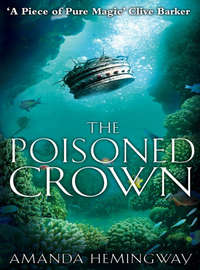
Kitabı oku: «The Poisoned Crown: The Sangreal Trilogy Three»

SANGREAL TRILOGY
IIITHE POISONEDCROWN
Amanda Hemingway

CONTENTS
Cover
Title Page
Tarot
Prologue The Albatross
Chapter One Ripples
Chapter Two Terror Firma
Chapter Three A Touch of Death
Chapter Four Eye of Newt
Chapter Five The Visitor
Chapter Six Pooping the Party
Chapter Seven How to Stop a War
Chapter Eight The Dragon’s Reef
Chapter Nine The Horn of Last Resort
Chapter Ten How to Stop a War
Chapter Eleven Father and Son
Chapter Twelve Scarbarrow Fayr
Epilogue Spring
About the Author
Other Works
Credits
Copyright
About the Publisher
TAROT
Fimble famble sift the boards pentacles and cups and swords fingers fleet as beetles’ wings fiddlefeet and twiddlestrings sift and shuffle, spiel and deal, Hand of Fortune spin the Wheel weave together strands of fate Ace of Wands opens the Gate – turn the card to learn your doom Death’s a portal not a tomb.
Double-deal and deal them double, eggs and bacon, toil and trouble, kings and queens and knights and knaves cups and coins and swords and staves lay them crooked, lay them straight, splay the pattern of your fate.
Earth and water, fire and air, Strength the maiden waiting there bold to part the lion’s jaws someone’s friend, but is she yours?
Sift and shift and wrap and weft the Emperor stands on your left authority, conviction, power – above your head the Falling Tower – see through the cobwebs of the Moon the silver lies unravel soon.
Fimble famble fi-fo-fum there we go and here we come.
Mist and magic, truth and lies Moon’s a card to fool the wise strangely lie with truth accords – now we turn the Three of Swords: alone, forsaken and betrayed another card must yet be played; veil the future while you can beyond the veil – the Hanged Man!
Double-deal and deal them double earth and water, toil and trouble, cups and coins and swords and wands fate is never set in bronze, eggsand bacon, blood and bone, betrayed forsaken and alone sift the cards and let them fall fate is never set at all
Humpty Dumpty runs through town knights and knaves will all fall down best-laid plans gang aft agely words on water flow away – when the cards are scattered far still you may turn up the Star.
Fimble famble fi-fo-fum therewego, and here we come …
PROLOGUE The Albatross
He was the bird, and the bird was him. He was Ezroc, son of Tilarc, fifteenth grandson in a direct line from Ezroc Stormrider, the greatest albatross who ever lived. He had flown the Four Oceans and the Ten Seas, and had seen the South Pole rising like a spire of emerald from the violet hills of the Land-Beyond-Night, and the white foam of the combers on the pink coral beaches, and had smelt the perfume of the last flowers that ever were, before the hungry waters took it all away. He had lived to a hundred and two, and had died in the season his fifteenth-generation grandson was born, so the name had been passed on, but young Ezroc knew he could only dream of touching the legend.
They had set out from the Ice Cliffs more than two moons past, the albatross flying on wings still short of three spans from tip to tip – three spans would mark him for an adult – leaving the cold clean seas of the north far behind, heading south, always south. Keerye could not match his speed, for all his seal-swiftness, and from time to time the bird would descend onto the rocking waters, waiting for his friend to catch up. Some nights they would rest together, sea-cradled, Keerye half-human, steadying himself on the swell with his tail-flippers, while they gazed up at the unfamiliar stars.
‘Do you think we’ve reached the Fourth Ocean yet?’ Ezroc said once.
‘There are no Four Oceans any more,’ said Keerye, who was older and wiser, or at least more knowledgeable. ‘No Ten Seas. When people speak of them, it’s just words. Now, it’s all one big ocean, without any land in between to divide it up.’
‘But we’re looking for land,’ Ezroc pointed out. ‘We’re looking for the islands in the stories – the Jewelled Archipelago, and the Giant’s Knucklebones, and the Floating Islands of the utter south. There must be land somewhere.’
‘Islands are different,’ Keerye said sagely. ‘Islands grow, like plants. They come out of the sea sprouting fire and when they cool down there are great weeds on them with stems as thick as a monster eel, poking up into the sky all by themselves.’
‘I don’t believe it,’ Ezroc said. He had dismissed such tales before. ‘Without water to support them, they’d fall down.’
‘I heard it from Shifka,’ said Keerye, naming the most venerable of the selkies, ‘and he heard it from the great whales, so it must be true. Whales don’t lie.’
Ezroc duly tried to picture weeds growing on dry land, standing up by themselves, and failed. But it was something to search for.
The seas were growing warmer now, and more dangerous. They were coming to the realms of the seakings, where they worship the Goddess, who hates all creatures of land and air. Ezroc was anxious, since it was said the merpeople would kill a selkie, if they found one in their territory, but Keerye was scornful. ‘They are fish,’ he scoffed. ‘I can outswim any fish. Let them catch me if they can.’ Ezroc wanted to know why the Goddess should hate them, but Keerye said there was no why. The Goddess was an elemental, who felt but could not reason, as strong as the currents which circle the world, in fury like the tempest, with a heart as black as the uttermost deeps where nothing can live. She was supposed to have a crown of iron that never rusted, but was kept in a mysterious cavern of air under the Dragon’s Reef. Had anyone seen her? Ezroc asked. What did she look like? In their rest-times, they speculated about it, visualising her as a huge ray, a hundred spans wide, whose creeping shadow brought death to the sea bed, or a squid as big as an iceberg, belching poisoned ink, or a merwoman tall as a tidal wave with coiling sea-snakes for hair and fins that crackled blue with electricity. Once, they met a great purple grouper which Ezroc thought might be her, but Keerye tickled it under its prognathous jaw and it mooched along with them for a while with no sign of hostility.
‘Do you know any islands?’ Keerye asked, but the fish didn’t answer.
‘Maybe it doesn’t speak our language,’ Ezroc suggested, so Keerye tried the other tongues he knew, the click-click of secret Dolphinspeech, the croaking of Penguin, the burble of Smallfish and even a few words of Shark, but the grouper never spoke at all. Presently it turned aside, heading west towards the shadow of sunken rocks.
This was reef-country, and now they grew very wary. Above the corals the shallow water was green with sunlight and teeming with smallfish, but there were deep blue chasms in between where the merfolk might hide, and cruising sharks in search of more substantial prey than yellowstripe and fairyfin, and dark clefts which might conceal monsters they had heard of but never seen, creatures of the tropical waters who didn’t venture into the north. Giant sea scorpions, crabs whose pincers could slice a selkie in half, things part fish, part reptile, which had no name and no real species, armoured with spikes and spines, their flippers half way to feet, their mouths agape with rows of dagger-teeth. Ezroc felt himself safe enough in the air, sustained on near-motionless wings, but concern for Keerye made him fly low, and the selkie was both reckless and curious, diving to peer under every rock. They met a turtle coasting the reefside who told them he was the last of his kind; his mate had been gone twenty years, searching for a place to lay her eggs.
‘Do you know any islands?’ Keerye said.
‘If I did, my mate would have buried her eggs there, and I would have found her again,’ the turtle replied. ‘The islands are all gone. Swim to the absolute south, and you’ll find only sea-swirl around the Pole, and the sun that never sets shines on the endless waters without even a rock to break the surface.’
Keerye asked the same question of those smallfish he could persuade to listen, a green octopus that was slithering over the coral, a frilled purple sea slug and even a passing shark. The smallfish responded with bubbletalk, meaning little, the octopus turned red and disappeared into a crevasse, the sea slug tied itself into a slow-motion knot and rippled away, and only the shark snapped a coherent answer.
‘There are islands,’ he said, ‘but you must move fast, to catch up with them.’
‘Which way?’ asked Keerye. ‘South?’
‘South – west – east.’ The shark flicked his tail by way of a shrug, and glided on.
‘The Floating Islands,’ Keerye said. ‘That’s what he means.’
‘I don’t trust him,’ Ezroc said. ‘My father says, a shark is a stomach with fins. He doesn’t talk, he just opens his mouth.’
But Keerye was too eager on their quest to take warning.
They met the mermaid on a night of shooting stars, at the full of the fourth moon since they left the Ice Cliffs of home. On an unknown signal the corals released their spores, uncurling like smoke into the sea-surge, glittering with reflected light, until both sky and sea seemed to be heaving with the dust of stars, and leaping fish, come to feast on the coral’s beneficence, left phosphorescent tracks like meteor-trails through the black water. Keerye lay on his back in the sway of gentle billows, made careless by the beauty, luxuriating in the night magic. ‘The sky fires of the north are lovelier,’ he insisted, but the star-glitter was mirrored in his dark eyes as he turned his head this way and that. Ezroc sat the wave beside him, skulling with web feet, dazzled by the wonder of it. Neither of them saw the watcher until she was very close.
Her hand brushed Keerye’s tail, feeling the strangeness of his fur, flinching away and returning to touch again. The selkie, whose reflexes were lightning, somersaulted and caught her arm, holding her though she wriggled, fish-like, trying to escape. Her skin felt cold and slippery, like bladderwrack. He forced her head out of the water and saw the gill-slits in her neck widen as she gasped in the alien element. Her wet hair looked black in the starlight but he guessed it was darkly purple, and the sheen on her arms was like pearl. Her eyes were unlike his, being narrow and slanting, with no whites; he could not tell their colour.
She was small, barely half his size; he guessed she was still a child.
‘You’re merfolk,’ he said. ‘Are you alone?’ And, when she didn’t answer: ‘What is your name?’
Her mouth opened and shut, but no noise emerged.
‘What is your name?’
‘Maybe she can’t talk out of water,’ Ezroc suggested.
Keerye had never met merfolk before, but he knew enough of them from rumour and hearsay. ‘She can talk,’ he insisted.
And again: ‘What is your name?’
‘Denaero,’ she said at last. Her voice sounded thin and strange in the air, more accustomed to carrying underwater. ‘I am Rhadamu’s daughter. If you hurt me, he will kill you.’
‘We won’t hurt you,’ Ezroc said. ‘We wouldn’t hurt anyone.’
‘If you answer my questions,’ Keerye amended.
‘I answer or not, as I please,’ said the girl, trying to toss her head; but Keerye held her by the hair. ‘I am not afraid of you, even if you eat me.’
‘Why should I eat you?’ Keerye demanded, startled.
‘Selkies eat merpeople,’ Denaero said. ‘We are fish. Lungbreathers eat fish. That is the way of things.’
‘I won’t eat you,’ Keerye said. ‘You are too small. When we catch fish which are too small, we throw them back.’
‘My father is the High King,’ Denaero declared. ‘When the Festival of Spawning is over, he will come looking for me, and hunt you with spears. You will be stuck full of spears till you bristle like a sea urchin. You won’t be so scornful then.’
Keerye laughed out loud at her defiance and her pride, and the girl sulked, then laughed too, ducking her head underwater when he let go her hair to inhale her native element.
‘Why must we talk like this?’ Denaero asked, meaning above water. ‘Can’t you talk undersea?’
‘I can, but Ezroc can’t. He’s a bird,’ Keerye explained.
‘I heard, there are birds that fly through the water,’ Denaero said, not wanting to appear ignorant, ‘called pinwings. If you can fly underwater, why can’t you talk there too?’
‘I’m not a penguin,’ Ezroc said. ‘I’m an albatross.’
The girl shivered, and shrank away. ‘A windbringer,’ she said. ‘I thought they were only in stories. Is it true, you can fly round the whole world in a day, and you bring ice storms from the north to destroy us? Did you bring the ice now?’ She glanced from side to side, as if expecting ice floes to emerge from nowhere.
‘I don’t bring ice,’ said Ezroc. ‘I don’t want to harm you.’
‘The stories say you are much bigger,’ said Denaero, recovering her courage.
‘He’s only young,’ said Keerye. ‘Like you. When he’s full grown, his wings will be as wide as – as the entire reef.’
‘Could I ride on you then?’ Denaero begged suddenly. ‘Could I fly – really fly – up in the sky among the stars?’
‘Well …’ Ezroc temporised.
‘One day,’ said Keerye. ‘But now we are on a quest. We are looking for islands. Do you know of any?’
‘Only in stories,’ Denaero said. ‘The Goddess ate the islands. She is always hungry. Once, there were whole kingdoms above the sea, full of creatures that didn’t swim, and strange people, neither merfolk nor selkie. I wish I could have seen them. But the Goddess swallowed them all up. Then she devoured the islands, one by one, crunching up the rocks that were their bones. There are no islands any more.’
‘We heard there were Floating Islands,’ Keerye persisted, ‘south of here, or east, or west. Have you seen them?’
The girl’s face changed; her hair lifted of its own accord, rippling with sparks.
‘Those are not islands,’ she said. ‘Don’t go near them … Listen!’ She dipped below the waves, the better to pick up vibrations, reappearing a moment later. ‘The Festival is over,’ she said. ‘My father is coming to look for me. If he finds you, you will be stuck full of spears like a sea urchin. I do not want that. You must swim fast, fast, till you come to the Great Reef Wall where the sea boils and the steam goes up a hundred spans into the air. If you can cross that, you will be safe. But you must go fast. Your swimming makes an echo-pattern that we can detect from far away; that was how I found you. If my father senses it, he will hunt you down.’
‘How far to the Great Reef Wall?’ asked Ezroc.
‘Can’t you stop the king?’ Keerye said.
‘I will leap and dance in the water and make a great splashing which will overlay the echo-pattern, but you must go now. Please!’
‘Thank you,’ said Keerye, and he kissed her cold little cheek.
‘Thank you!’ cried Ezroc, and he spread his wings, driving himself into the air.
The mermaid held her hand to her face for a second or two, as if she feared to lose the imprint of the kiss, though it was a gesture she had never known. Then she forgot it in the wonder of the bird’s rising.
‘Come back when you’re grown!’ she said. ‘Come back and fly me to the stars! Promise?’
‘I promise!’ Ezroc called, as he veered southward. Below, Keerye streaked like a javelin through the still-gleaming water.
Behind them, Denaero arced and plunged and dived, churning the midnight waves to a tumult of foam.
It was dawn when they reached the Great Reef Wall, and saw the steam of the boiling sea like a cloud over the sun. Keerye swam to the edge of the shallows, where the reef fell away in a submarine cliff, down to unguessable depths. Far below there must have been vents in the seabed, emitting gas-jets from the planet’s core, and so the water beyond the Wall bubbled like a cauldron, and the stink of sulphur hung in the air. Ezroc flew high above, soaring on the thermals, but he could see no way for a selkie to pass. ‘The steam-barrier stretches as far as the eye can see,’ he told Keerye, ‘and at its narrowest it must be more than twenty spans across. We might travel a sennight and find no way through.’
‘Show me the narrow part,’ the selkie said. ‘In seal form I can leap high and far, higher and farther than any from the Ice Cliffs.’
‘Not that high and not that far,’ said Ezroc. ‘You’ll scald in the water and bake in the steam. It will kill you.’
‘If you were to lift me, I could do it,’ Keerye said.
‘I cannot bear you. I am not yet strong enough.’
‘But if you swoop as I spring, and hold my fore-flippers, the joint impetus of both leap and flight will carry us over the barrier,’ Keerye declared.
‘Maybe, maybe not,’ Ezroc said doubtfully. ‘The risk is too great. Let us turn west. Somewhere, there will be a break.’
‘You said there were none,’ Keerye pointed out.
They might have argued about it long, but Ezroc, rising to scan the seas again, saw shadow-shapes skimming the reef towards them – the vanguard of the hunt. Mermen mounted on blue sharks wielding spears of bone tipped with blood coral, barracuda trained for the chase with fin rings that rattled to denote their route, and behind them on huge hammerheads the king and his court, trailing cloaks of whalehide and brandishing axes of polished obsidian. The king himself wore a helm or crown adorned with the claws of a giant lobster and mail of oyster-shells gleaming with mother-of-pearl.
‘Now we have no choice,’ said Keerye. ‘Swoop on me as I leap – catch me and hold firm – and we will make it.’
‘Suppose I cannot …? If I let you fall …’
‘I have faith. You won’t let me fall.’
Keerye could not go deep – the reef was too near the surface – nor give himself a long run – the hunt was drawing close. But he swam back as far as he dared and then arrowed towards the Wall, driving himself forward with his powerful tail, all seal now, breaking the water and rising up … and up … The sun glittered in the spray around him, then the sea-smokes stung his eyes, and he felt the talons of the albatross digging into him, tugging, lifting, sweeping him through the fume towards clear air and cool sea. Sudden pain scorched his flank – a well-aimed spear glanced off him and dropped into the fog. And then before he knew it he was plunging down, betrayed by his own weight, torn from the albatross’ grip to fall into the seething water …
It was hot, but it did not burn. He was through the barrier. They had done it.
They swam south for many days at leisure while the spear-wound healed and fur and feathers, singed in the sulphurous vapours, grew again. The days were longer, and the sun had barely dipped below the horizon before re-emerging to resume its orbit of the sky. Once, they came across a great shoal of silvertail, and fed until they were almost too full to float, but they saw no creatures they could talk to save a few smallfish who spoke a dialect they did not recognise. Another time they found a vast mat of kelp, rootless, drifting on the current with all its mobile populace. Ezroc thought it might be one of the Floating Islands in the stories, but Keerye said no, islands were solid, and did not wallow in the water.
‘I think there are no islands any more,’ Ezroc said.
But they kept on searching.
And then they saw it, on a day without sunset, a great hump looming out of the water ahead of them. It looked like a boulder or cluster of boulders, sea-smoothed, rose-tinted and marbled in blue, with occasional fan-like growths sprouting from cracks and testing the air with feathery tendrils. Keerye swam eagerly towards it, ran his hands over the boulders, then pulled himself out of the water and sat in the sun, shedding even the semblance of a tail, naked in his skin and gilded with light. Only his long silver hair and velvet-dark eyes showed him for a selkie.
‘This is what we sought,’ he said. ‘A Floating Island. Where there’s one, there will be more. Maybe there’s real land still, in the utter south, land with roots that go all the way to the world’s heart. The stories must be true after all.’
‘Are you sure it’s an island?’ Ezroc said, circling the atoll, still too wary to land there. ‘Denaero warned us—’
‘Denaero was a child, afraid of ghosts. This is solid: look!’ He slapped the boulder, making a wet sharp thwack!, but to Ezroc’s ear, it didn’t sound quite right.
‘It doesn’t feel like rock,’ he said, alighting beside Keerye. ‘Rock should be hard.’
‘It’s hard enough. I’m going to sleep here for a while. It’s too long since I slept out of water.’
‘I’m not tired,’ Ezroc lied. ‘I’ll keep watch.’
He took off again and drifted on the high air, scanning the sea in all directions, but could see no other island nor any living thing. The translucent water seemed to be empty even of smallfish, clear and limpid as a lagoon. That troubled him, though he couldn’t define why, and he widened the radius of his flight, covering a large area round the atoll, but still there was nothing to be seen. At last he settled on the water close to the island, folded his wings, and slept.
When he awoke he was alone. The sun was low, though it would not set; sky and sea met on the horizon in an arc of reflected fires. And in every direction there was only water. The island – and Keerye – had gone.
Ezroc hurled himself into the air with a great cry which seemed to carry to the ends of the world. He told himself it was a Floating Island: it had simply floated away. He would find it soon, and Keerye still sleeping, stretched out on the blue-veined boulders. He had only to fly high enough and he would see it: how could you lose an island?
‘Those are not islands,’ Denaero had said. ‘Don’t go near them …’
The dread lay coldly on his heart, dread and worse than dread, the terrible foreknowledge that it was too late, it had been too late from the moment he fell asleep. The island was gone and Keerye was gone and he would never see his friend again. The wide wastes of the ocean ached with his desolation, a void that could not be filled. He flew higher and higher, and the sun fell away beneath his wings, and the huge solitude of the sea unrolled below him, without land or life, empty now forever more. He would fly all the long lonely miles back to the north, and tell his tale to those who would mourn, or curse his name – Ezroc the faithless, who lost his childhood playmate and dearest friend – and then return to the south, travelling the seas for countless moons, until he knew every wave, every tug of the world’s current, every whim of the winds. His journeys would become a legend to outdo his ultimate grandsire, his adventures a fairytale for children; but he would never find Keerye again. His keening wail echoed over sky and sea, harsh with longing and despair.
‘Keeeeryeee … KEEEEEERYEEEE
No answer came.
He was the bird, and the bird was him. He felt the air under his wings, bearing him upward, the sun warming his feathers, the huge angry pain of his heart. It was too much pain, too much to endure, and he pulled his mind away, letting the bird go, watching its flight track into the sun while his thought sank seawards and drifted into a dim blue realm, no longer sharp with the awareness of the bird but soft and dream-like. In the azure gloom he saw the island, not floating on the surface but moving through deep water, the rose-stained boulders swelling and shrinking like the bulb of a vast jellyfish. A skein of tentacles trailed behind it, fifty yards long or more. Something pale was tangled in their grasp, something that barely struggled now. Vision dipped under the bulb and he saw a dozen mouths opening and closing, each with a ring of needle-tipped teeth. The pale thing, still wriggling slightly, was manoeuvred towards them, passed from one to another as each took a bite. Blood smoked on the water, but not much: the feeder did not believe in waste. Above, the bulb turned from pink to crimson as it gorged, pulsing with a glow of its own; the blue veins empurpled and swelled into ridges. Briefly, he touched its mind, such as it was – the mind of a glutton enjoying a rare special feast.
He wrenched his thought away in horror, out of the sea, out of the dream, through the veils of sleep to his own world.
ONE Ripples
‘Define the Irish Question between 1800 and 1917,’ Nathan read aloud.
‘If we knew the question,’ his mother said, ‘we might be able to work out the answer.’
‘I don’t think that’ll satisfy Mr Selkirk,’ Nathan sighed. He pushed his history essay aside and replaced it with a plate of buttered toast with honey and cinnamon, a recipe of his uncle’s. The honey had oozed just the right distance through the toast and he bit into it with enthusiasm, if a little absent-mindedly.
His mother noted his abstraction and knew or guessed the reason, but was prudent enough to say nothing. He was fifteen now, too old to press for confidences. She only hoped, if there was trouble, he would tell her in the end. The summer had been long and uneventful, a summer of normal teenage preoccupations: success (and failure) at cricket, doing homework, not doing homework, friends, fads, hormonal angst. They had managed a trip to Italy, looking at palaces and pictures in Florence and then staying with Nathan’s classmate Ned Gable and his family in a villa in Umbria. Annie had feared they would never afford their share of the rental but somehow Uncle Barty had found the money, though he wouldn’t accompany them. These days, he rarely left the old manor at Thornyhill, deep in the woods.
Yet he wasn’t really a stay-at-home sort of person. He had told Annie once that he was born in Byzantium before the fall of the Roman Empire, which, she worked out, made him about fifteen hundred years old. He called himself Bartlemy Goodman, though it was probably not his name. She might have thought him mad or unusually eccentric if she hadn’t known him so well and seen what he could do, when the occasion demanded it. He had taken her in on a cold lonely night long ago when she was pursued by invisible enemies, becoming an uncle to both her and Nathan; and as her son grew up into strange adventures, Bartlemy had been their councillor and support. But there had been no adventure this summer, and now autumn was failing, and the wind blew from the north, plucking the last ragged leaves from the tree-tops, and Nathan was restless with the feeling of deeds undone, and worlds to be saved, and time slipping away.
Soon, Annie thought, he’ll start sleeping badly, and there was a tiny squeeze of fear at her heart which she could not suppress.
I sleep too deeply, Nathan thought, and I dream too little and too lightly. The portal was closed, the connection broken: he could no longer roam the multiverse in his head, following trails he could not see on a quest he did not understand. He had dreamed his way through other worlds – the ghost city of Carboneck in Wilderslee, and the skytowers of Arkatron on Eos, where the Grandir, supreme ruler of a dying cosmos, sought for the Great Spell that would be the salvation of his people. Nathan had retrieved the cup and the sword to bind the magic, and now only the crown was wanting – the crown and the sacrifice and the words of power, whatever they might be. But there had been no dreams for nearly a year, and the pleasures of cricket and the problems of history were not enough to fill his life.
‘How’s Hazel?’ his mother asked, helping herself to a piece of his toast. ‘I haven’t seen her lately.’
Hazel was Nathan’s closest friend: they had grown up almost as brother and sister, though getting on rather better than most brothers and sisters. Adolescence had brought friction, but had never driven them apart.
‘You know Hazel.’ Nathan spoke around munching. ‘She didn’t exactly like her mum’s old boyfriend, but I think she approved of him. She doesn’t approve of the new one at all.’
‘Because he’s so young?’
‘Mm.’
Annie smiled. ‘Well, all I can say is good for Lily. I think Franco’s very sweet.’
‘He’s Italian,’ Nathan objected.
‘How insular! Besides, you didn’t mind the Italians last summer.’
‘That was in Italy!’
‘Supposing I got myself a toyboy,’ Annie said. ‘How would you feel about that?’
‘You are joking, aren’t you?’ Diverted from thoughts of other worlds, Nathan looked really alarmed.
‘Maybe.’
‘Look, you know, if there’s someone, it’s cool with me – as long as he’s nice, and really cares about you – but … well, I’d rather have a stepfather than an elder brother!’
‘Nicely put,’ Annie said. ‘Still, I doubt the situation will arise.’
Nathan couldn’t ever recall her having a proper boyfriend, even though several men had been interested. He said: ‘You must have loved dad very much.’ Daniel Ward had died before he was born, killed in a car crash when he fell asleep at the wheel.
‘Very much,’ she said. Only he wasn’t your dad … Your father was a stranger who waited beyond the Gate of Death, waited for my love and longing to open the unopenable door, and when I would have given all that I had for all I had lost he took me, body and soul. He seeded my womb and sealed up my memory, and until you grew up so unlike Daniel – until I found the courage to unclose the old scar in my mind – I never knew the betrayal and rape that was hidden there.
But she loved Nathan, conceived in treachery, child of an unknown being from an unknown world, so she kept her secret. She saw his father’s legacy in the mysteries that surrounded him, but she told herself, over and over, that he did not need to know. One day, perhaps, but not yet. Not yet.
That night, Nathan went to bed thinking of the Irish Question, and dreamed of the sea.
At Thornyhill Manor, Hazel Bagot was having a lesson in witchcraft.
‘But I don’t want to be a witch,’ she protested.
‘Good,’ said Bartlemy. ‘That’s the way to start. Now, you need to learn what not to do. Otherwise you could bumble about like you did last year, conjuring dangerous spirits and letting them get out of control. Someone might get hurt. It nearly happened once, you know that; you don’t want it to happen again. The Gift is in your blood; you need to know how not to use it.’
‘Why couldn’t we have done it in the summer, when the evenings were still light?’ Hazel said. She was wishing she had stayed at home, watching Neighbours and annoying Franco.
‘Dark for dark magic,’ Bartlemy said. ‘In summer, magic is all sparkle and fun, and the spirits come to us dressed in their best, scattering smiles and flowers. In the winter, you get down to the bone, and the true nature of things is revealed.’
Hazel said no more, remembering how she had summoned Lilliat, Spirit of Flowers, to win her the love of a boy at school, and how Lilliat had turned into Nenufar the water-demon, and nearly drowned her rival.
Bartlemy gave her tea and biscuits and she sat for a while eating, insensibly reassured. Bartlemy made the best biscuits in the world, biscuits whose effect was almost magical, though he insisted there was no spell involved, just good cooking. Anyone who ate those biscuits felt immediately at home, even if they didn’t want to, comforted if they needed comfort, relaxed if they needed to relax. Long ago another cook had tried to steal one for analysis, hoping to work out the ingredients, but he had eaten it before he got it home, and the urge to commit the crime had vanished.
‘I don’t want to be like my great-grandmother,’ Hazel explained at last. ‘She lived for two hundred years, until she didn’t care about anyone but herself, and she’d curdled inside like sour milk. I don’t think I want to live on when my friends are dead; it would be so lonely. And I don’t want to be mean and bitter like her.’
‘Then learn from her mistakes,’ Bartlemy said equably. ‘You won’t be mean and bitter, unless you choose to be. I will teach you what you need to know, for your safety and others, but how you use the knowledge – if you use it – is up to you. Tonight, I think we will make the spellfire. That will do for a start.’
He showed her how to seal the chimney and light the fire-crystals, which cracked and hissed, shooting out sparks that bored into the carpet. Then he threw on a powder which smothered the flames, and the room grew smoky, and Hazel’s eyes watered from the sting of it. Presently, Bartlemy told her to speak certain words in Atlantean, the language of spell-craft, and the vapour seemed to draw together, hovering in a cloud above the hearth, and then the heart of the cloud opened up into a picture.
To her astonishment Hazel saw her mother with Franco, climbing the stairs to the bedroom, laughing and hurried. She was embarrassed, and looked away. ‘Remember, the magic responds to you,’ Bartlemy said. ‘Magic is always personal. The pictures may have meaning for you, or they may not – sometimes, their purport won’t become clear till long after – but it is something in your thought, in your mind, which engenders them. You are the magnet: they are the spell-fragments which are drawn to you. What do you see now?’ ‘The past,’ Hazel said.
‘At least, I think so.’
She saw the Grimthorn Grail surrounded with a greenish nimbus: the snake-spirals round the rim seemed to move, and a man with a dark alien face was gazing into it, speaking words she couldn’t hear. In the background stood a woman with black hair bound up in a white veil or scarf, the ends of which hung down behind her in fluted creases. Her features, too, were somehow alien – her eyes too large, the proportions of her face elusively wrong – yet she was the most beautiful woman Hazel had ever seen. She held a tall yellow candle, and either they were indoors or the night was windless, because the flame burned absolutely still. Then Hazel saw the same man lifting a sword – the Traitor’s Sword, which Nathan had brought back from Wilderslee – and there was a dim figure sprawled in front of him, on a kind of table or altar, and when the sword fell blood jetted up, and as the woman proffered the cup to catch it red spattered on the cloth that bound her hair. Both man and woman drank from the cup, and she lifted a crown from the thing on the ground, and put it on his head – a misshapen crown of twisted metal spikes – and lightning stabbed up from the crown, splitting the sky in half. For an instant Hazel glimpsed a symbol drawn in lightning, something she recognised, though she couldn’t think from where: an arc bisected by a straight line, enclosed within a circle. Then the vision went dark, and she heard a voice crying out in an unknown language, words that seemed full of anguish or regret.
‘What does it mean?’ she asked Bartlemy, but he shook his head.
‘This is Nathan’s story,’ she said, ‘not mine,’ but her smoke-reddened eyes were wide, fixed on the changing images, and she no longer looked away.
‘Keep in mind,’ he pointed out, ‘the pictures are relevant, but there may be no logic to them, and no chronology.’
Now, they were looking at a river – a slow lazy river, dimpled with sunlight, with the occasional overhanging willow, and little eddies scooping out pools under the bank which vanished in a mudslide. A tidal river with hazardous currents beneath its dimpled surface, and lurking weeds that could entangle flailing limbs, and rafts of floating rubbish wedged here and there, hiding among the debris a child’s shoe, a water-logged teddy bear, an upturned hand. The River Clyde, which flowed through the village of Ede down the valley to the sea – the river where Effie Carlow, Hazel’s great-grandmother, had been found drowned, though Hazel knew she had never left the attic of their house. She heard the voice of the spirit called the Child, chanting an old doggerel, though the smoke-scene showed only the stream.
‘Cloud on the sunset,
Wave on the tide,
Death from the deep sea
Swims up the Glyde.’
And suddenly Hazel found herself wondering whose hand she had seen among the flotsam – whether it was her great-grandmother or some more recent victim, someone yet to be discovered …
A boat moved up the river, surely too large a boat for such a narrow waterway. It was all white, with white sails and a white-painted mast and a white prow without name or identification, and it looked faintly insubstantial, almost like a ghost ship. A woman stood in the bows, wrapped in a long white cloak pulled tight around her body, with a drooping hood covering both hair and face. The picture shifted, until Hazel thought she should be able to glimpse a profile – the tip of a nose, the jut of a chin – but under the hood there was only darkness. The boat drifted on, fading into mist, and then there was just a swan, wings half furled, floating on the water. Hazel had always hated swans, ever since one attacked her as a child; she thought they had mean little eyes.
She said: ‘That was her, wasn’t it?’
Bartlemy said: ‘Perhaps. But remember: to come, she must be called. Nenufar is a spirit; there are laws she cannot evade. Have you called her?’
‘Of course not!’
The vision dimmed, dissolving into smoke, and at a signal from Bartlemy she unblocked the flue. Gradually the air cleared, and she saw the fire-crystals had burned away, and the room was ordinary again. An old room with heavy wooden beams, diamond-paned windows, lamplight soft as candle-glow on the shabby Persian rugs and worn furniture. And in the middle Bartlemy, fat and placid and silver-haired, with eyes as blue as the sky. There were more biscuits, but Hazel didn’t take one, not yet, though his dog sat looking hopefully at her – a huge shaggy dog of questionable ancestry, known as Hoover, whose age was as indeterminate as his master’s. Suddenly, it seemed to Hazel that the world was complex and baffling beyond her understanding, and magic and reality were no longer separate but part of the same puzzle, tiny fragments of a jigsaw so vast and intricate that its billion billion pieces could never be fitted together, not though she had a hundred lifetimes. Her thought was too small, and infinity was too big, and she felt crushed into littleness by its immensity, its multiplicity, by the endless changing patterns of Chaos. Bartlemy asked her: ‘What troubles you?’ and she tried to explain, groping for the words to express her diminishment, her confusion, her fear.
Bartlemy smiled faintly. ‘We all feel that way sometimes,’ he said, ‘if we have the gift of perception. Embrace your doubts: if there is such a thing as wisdom, they are part of it. I’ve had my doubts for more than a thousand years. Actually, I’ve always believed that the answer to everything must really be very simple.’ And he added, unconsciously echoing Annie on Irish history: ‘The problem is finding out the question.’
‘So Riverside House is sold at last,’ Annie said to Lily Bagot in the deli. No one had lived in Riverside House since the tragedy, though rumours of new tenants had circulated from time to time, only to fade as another sale fell through. ‘Do you know when they’re moving in?’
‘They’re already there,’ Lily said. ‘Came down last week. Some family from London.’ All the newcomers in the village were from London these days, big-city types in search of a rural paradise, bringing with them their big-city lifestyle and their big-city needs – and their big-city income. ‘I daresay they’ll be coming into the bookshop soon.’
Annie managed a second-hand bookshop, owned by Bartlemy; she and Nathan lived in the adjacent house.
‘I hope so,’ she said. She couldn’t help being a little curious. She had been so closely involved in the events at Riverside, two years ago now. She wondered what kind of people would buy a house with such a well-publicised history of disaster.
A few days later, she found out.
A woman came in to browse among the books, a woman with a frizz of dark hair and a thin body that grew wide around the hips, dressed in antique shoulder-pads, hand-printed scarves, carved jewellery from the remoter parts of Asia. She studied the shelves for a while, enthused over an early edition of Mrs Henry Wood, then seemed to make up her mind, and pounced.
‘You’re Annie Ward, aren’t you? I know: I asked around. I’m Ursula Rayburn. We’ve just moved in to the oast house down by the river. Of course, I expect you’ve heard, haven’t you? – gossip travels so fast in a village. Such an intimate little community – I can’t wait to get to know everyone. Although Islington is really just a village enclosed in a city … Anyway, I’ve been dying to meet you. I hope you don’t mind me introducing myself like this.’
‘Not at all …’
‘You see, I did my homework. I know you’re the one who found the body …’
Slightly at a loss, Annie said: ‘Yes.’
‘Was it awful? I gather she was there for months, slowly decaying, while her husband lived on in the house with his mistress, who was pretending to be her. I suppose he’s in an asylum now … and they never caught the mistress, did they? I expect it was all her idea. Mind you, I don’t really see the necessity – I mean, everyone gets divorced these days, it’s as normal as eating your dinner. I’ve had two and Donny’s had one and the kids are totally well adjusted. They say more parents mean more presents at Christmas and birthdays! Are you divorced?’
‘Widowed,’ Annie said.
‘Oh dear. And then to have to go through all that … you poor child. You must have been in therapy for months. Bereavement and then post-traumatic stress …’
‘My husband died fifteen years ago,’ Annie said. She and Daniel hadn’t been married, but she’d taken his name anyway. ‘And I don’t have post-traumatic stress.’
‘But … you did find the corpse, didn’t you? You found Rianna Sardou?’
‘Oh, that.’ Annie was unable to resist lapsing into nonchalance. ‘Of course, it was rather unpleasant, but …’
‘Unpleasant? I heard she was lying in the bed, little more than a skeleton, with her hair all spread out – it goes on growing, doesn’t it? – and—’
‘In a village,’ Annie said serenely, ‘you learn to take these things in your stride. Part of the great cycle of life and death, you know. I expect it’s much the same in Islington.’
‘Well …’ Disconcerted by Annie’s composure, Ursula’s gush of words ran down. ‘Not – not exactly …’
Annie took pity on her. ‘Would you like some coffee?’
While the contents of the cafetiére were brewing, Ursula Rayburn filled in the details of her extended family. Her two exes, plus new wife/girlfriend/offspring, all on very good terms – ‘We wanted a big place where everyone could come and stay’ – and Donny’s ex and mother, ‘frightfully bitter, even after four years – they bossed him around all the time, and now they’re like two cats without a kitten.’ There were five resident children, all Ursula’s by previous fathers: Jude, Liberty, Michael, Romany and Gawain.
‘Michael?’ Annie queried, before she could stop herself.
‘His father insisted,’ Ursula explained, more in sorrow than in anger. ‘His first name is Xavier – I always called him that when he was little – but now he’s a teenager he’s gone so peculiar, he won’t answer to anything but Michael. Or Micky, which is almost worse. And the psycho’s name was Michael, wasn’t it? I told him – I said it’s ill-omened – but he refuses to go back to Xavier, no matter what I say.’
‘I shouldn’t worry,’ Annie said. ‘Lots of people are called Michael, and they don’t go around committing murders.’
‘Of course not. But in this house, with the atmosphere …’
‘Frankly,’ Annie said, ‘I never thought it had any. It’s an old building, but the renovations made it so bland inside, all shiny new paint and unused furniture. Rianna was dead, her husband was so busy pretending to be normal his personality never made any impact, and the – the mistress was hardly ever there. I’m sure, with so many of you, you’ll find it easy to change the feel of the place.’
‘Oh, but you can’t wipe out the past,’ Ursula said. ‘I don’t believe in the kind of ghosts that come with clanking chains, naturally, but there are vibrations. I won’t use the tower room till it’s been purified – I’ve got crystals hanging there now – and Melisande wouldn’t even go through the door. She’s my cat, pedigree Burmese, so sensitive. I know it’s a cliché but animals do feel things, don’t they? They’re so much more telepathic than people.’
Annie said something noncommittal and dispensed the coffee.
‘They never found out her name, did they?’ Ursula went on. ‘The mistress, I mean.’
Nenufar, Annie thought. Nenufar the water-spirit, the primitive goddess from the dark of the sea …
‘No,’ she said.
‘Strange, that. Nowadays they seem to have files on everyone – d’you know the police keep your personal details even if you were just caught smoking dope twenty years ago? It’s an abuse of human rights. I’m a member of the campaign for civil liberties, of course … But it’s curious they couldn’t even find a name for her. Names are so significant, don’t you think? We’re not going to stay with Riverside House. It’s really a bit ordinary. I thought Rivendell, but that’s been done to death lately. Perhaps Hesperides … there are apple trees in the garden.’
‘Dundrownin’?’ Annie hazarded. She wondered if she had overstepped the mark, but after a tiny pause Ursula burst out laughing.
‘Still, Rianna didn’t drown, did she?’ she resumed. ‘It was some old woman who drowned.’
Annie couldn’t recall if they’d been able to prove how Rianna died, but she knew.
‘You have to be careful of the river,’ she said. ‘It’s not deep, but there are treacherous currents.’
‘Oh, I know,’ Ursula said. ‘I hoped the children would be able to play there – I had this mental picture before we came: rustic bliss, swimming in the river, maybe a boat. There’s a mooring place, but everybody says boating’s a bit chancy unless you’ve got experience.’
‘Why did you buy the house?’ Annie said. ‘If you don’t mind my asking. Since you know its history …’
‘It was cheap,’ Ursula said candidly, ‘and it doesn’t need work. Just re-painting – like you said, it’s white all through, very boring. We’ve been looking to move out of London for a while. And I thought the murders would give it character …’
Annie opened her mouth and shut it again, saying nothing.
‘Actually, there is a bit of a problem,’ Ursula continued. ‘Do you know a good plumber? The surveyor didn’t pick up on it – he said everything was fine – but we keep getting leaks from somewhere. There was a puddle – really a puddle – in the living room only the other day. I don’t know where it came from. No, of course it wasn’t the cat – it was water, not pee. I said to Donny, if the surveyor missed something major, we’ll sue. Anyway, I need a plumber to come and check the pipes.’
‘Yellow Pages?’ Annie suggested.
‘Isn’t there – you know – a little man in the village? One of the natives who’s brilliant and inexpensive and does all the jobs round here?’
‘There’s Kevin Bellews,’ Annie said. ‘He’s brilliant but he charges the earth. He only works for City ex-pats – none of the locals can afford him any more. Besides, he’s always on the golf course near Crowford.’
‘The country isn’t what it used to be,’ Ursula mourned. ‘What happened to – to rural innocence, and all those nice dumb yokels in stories?’
‘They got smart,’ Annie said.
It was only after Ursula had gone that she found herself growing uneasy. There was never anything wrong with the plumbing at Riverside House before, she thought. Leaks … leaks meant water.
Water…?
‘Jude’s at uni,’ Hazel volunteered. ‘He’s at least twenty. The next two are at the Tertiary College up the road from Crowford Comp; Micky’s seventeen, Liberty’s sixteen. George fancies her, but she wouldn’t look at him: she’s far too grown up. The point is, they’re none of them our age, so nobody can expect us to be friends with them.’
‘Ageist,’ Nathan said. ‘What about the younger ones?’
‘They’re just kids.’ Hazel was dismissive. ‘They’re still at primary school. They’ve got a different surname – Macaire – it sounds Scottish but I think their dad must be black. They’ve both got dark skin and fuzzy hair.’ Mixed-race children were still an innovation in Ede, though the villagers had finally got used to Nathan, with his Asiatic colouring and exotic features.
‘Coming to think of it, Mum said the little girl was adorable,’ Nathan commented, tolerant of maternal sentiment. ‘Anyway, you don’t have to be so hostile.’ Hazel, he knew, was using the old-fashioned village mentality to shield her own space and the people she didn’t want to share. ‘We should try to be friendly, at least to the two at Tertiary. I can handle the age gap. They’re our neighbours, after all.’
‘I suppose you fancy Liberty too?’ Hazel said.
‘I haven’t seen her. Is she pretty?’
Hazel shrugged. ‘Ask George.’ George Fawn had formed part of a threesome with them when they were younger, though they saw less of him now. ‘She’s thin – long legs – tight jeans. She has this don’t-care attitude, like she’s way above anyone else. Probably ’cos they come from London. London people always think they’re so cool.’
‘Maybe you’ll live in London one day,’ Nathan remarked.
‘You might; I won’t. I’m not clever enough.’
‘You don’t have to be clever—’
‘You know what I mean!’ Hazel flashed. ‘To live in London you need a good job, and to get a good job you need to pass exams, and everyone knows I’m going to eff up my GCSEs. So don’t talk to me about living in London, okay?’
‘I thought Uncle Barty was helping you with school work and … stuff?’
‘Sometimes,’ Hazel said. ‘When I can be bothered.’
‘Bother!’ Nathan gave her a dig with his foot, almost a kick. Best friend’s privilege. He didn’t say: Do you want to be stupid? because he knew that in a way she did, being stupid was her protest in the face of the world, her little rebellion against education and convention, her insurance against any expectations he or others might have of her. I’ll do nothing, I’ll go nowhere, I’ll be no one. I’m stupid. That’s that. He wanted to tell her it was childish but he knew it wouldn’t do any good. ‘What about the witching?’ he asked. ‘Have you done any of that?’
She hunched a shoulder, tugging her hair over her face in a gesture she had still to outgrow. ‘You know I don’t like it.’
‘You tried it yourself last year,’ he pointed out, brutally. ‘You made a complete mess of it, too. Ellen Carver nearly got killed and so did I. Uncle Barty said—’
‘All right, all right, I’m learning it.’ She pushed her hair back again, and some of the sullenness left her face. ‘He taught me how to make the spellfire the other night.’
‘Wow … What did you see?’
‘Smoke,’ Hazel said.
‘Just smoke?’
‘Pictures,’ Hazel conceded. ‘Smoke-pictures. The past, the future – it’s all mixed up and you can’t tell which is which, and Uncle Barty says there are so many possible futures, you don’t know if any of it’s true, so what’s the point of looking? Magic is all shadows and lies: you can’t trust it. Anyway, I saw scenes from your life, not mine – the Grail, and some kind of sacrifice, and people from another world.’
‘Our lives run together,’ Nathan said. ‘But … you’re not supposed to see other worlds in the smoke. The magic can’t look beyond the Gate. Uncle Barty’s always told me that. Are you sure—?’
‘I’m not sure of anything,’ Hazel said irritably, ‘except that I’m hungry.’ They were in her bedroom, and her private store of crisps had run out. ‘D’you think your mum would have anything to eat?’
They went round to Annie’s, and although Nathan pressed her, Hazel wouldn’t be any more specific about what she’d seen.
Annie supplied them with cereal bars (‘I don’t like those,’ Hazel muttered. ‘They’re too healthy.’) and the information that the Rayburns were having a Christmas party the following month, holding open house for anyone from the village.
‘They’re not the Rayburns,’ Hazel said, nitpicking. ‘I told Nathan, the two little ones are Macaires, and the husband’s something else too. Coleman, I think.’
‘Donny Collier,’ Annie said. ‘Boyfriend or husband. Let’s keep it simple – just call them the Rayburns. Go with the majority. Anyway, it looks like they’re planning a pretty lavish do. At least half the village disapproves of them, but I bet they’ll all go.’
Hazel was surprised into a laugh.
‘Stay for dinner,’ Annie went on. ‘It’s cauliflower cheese.’
‘That’s healthy too,’ Hazel quibbled.
‘Are you sure there’s enough?’ Nathan said. ‘I’m not going short – that’s my favourite.’
‘I’ll stay,’ said Hazel.
Annie allowed herself a secret smile.
Once in a while Bartlemy had visitors not from the village, strangers whom few saw come or go and fewer still remembered. The man who hurried through the November dusk that year was one such, a tall, stooping figure as thin as a scarecrow, in a voluminous coat and hood that had seen better days, probably two or three centuries ago. Under the hood he had wispy hair and a wispy beard and a face criss-crossed with so many lines there was barely room for them all, but his eyes amidst all their wrinkles were very bright, and green as spring. A dog accompanied him, a wild-looking dog like a great she-wolf, who trotted at his heel and stopped when he stopped, without collar or lead or word of command. She never barked or panted, following him as silently as his own shadow. The man came striding along the lane through the woods on that chill winter’s evening, too late to have got off a local bus, too far from the train, and the dead leaves stirred behind him, as if something waked and watched.
There was a patter of pursuing feet on the empty road. Neither man nor dog looked back, though the hackles rose on the beast’s nape and her ears lay flat against her skull. When Bartlemy opened the door, the visitor said: ‘They are out there. I fear I am not welcome.’
‘You’re always welcome here,’ Bartlemy said, ‘though I could wish you would change that coat.’
‘It has travelled far with me,’ the visitor retorted. ‘It smells of the open road and open sky.’
Ücretsiz ön izlemeyi tamamladınız.